
basic math symbols Crossword Puzzles
English Plural (複数形) 2023-06-29
Across
- tooth
- apple
- pencil
- math
- sheep
- woman
- cheese
Down
- child
- box
- glass
- fish
- piece
- man
- Tokyo
14 Clues: box • man • fish • math • child • tooth • glass • apple • piece • Tokyo • sheep • woman • pencil • cheese
Housing Volunteer Group 2023-04-25
Across
- habitat
- helping
- apply
- construction
- humanity
- world
- lifetime
Down
- program
- teacher
- fifteen
- geometry
- partnership
- math
- build
14 Clues: math • apply • world • build • program • habitat • teacher • fifteen • helping • geometry • humanity • lifetime • partnership • construction
Vocab Crossword Puzzle 2025-11-09

Across
- the four areas of the coordinate plane
- a math sentence without an equal sign
- slope of a horizontal line
- each input has only one output
- have the same variable and the same exponent with that variable
- the graph is not a straight line
- a linear equation written Ax + By = C
- addition subtraction multiplication or division
- the number being multiplied by the variable
- to solve (get the answer to a math problem)
- ordered pairs on the coordinate plane
Down
- opposite operations (add and subtract or multiply and divide)
- multiply the outside number by everything inside the parentheses
- the pieces to a math problem separated by plus or minus
- an equation whose graph is a straight line
- the steepness of a line also rise over run
- always the same
- an unknown quantity represented by a letter
- math problems that use less than or greater than
- Draw a vertical line on a graph if it passes through only one point it’s a function
- set of y-values
- where the x-axis and y-axis meet also the point (0,0)
- math sentence with an equal sign
- another name for slope (often used in word problems)
- slope of a vertical line
- set of x-values
26 Clues: always the same • set of y-values • set of x-values • slope of a vertical line • slope of a horizontal line • each input has only one output • the graph is not a straight line • math sentence with an equal sign • a math sentence without an equal sign • a linear equation written Ax + By = C • ordered pairs on the coordinate plane • the four areas of the coordinate plane • ...
Basic Elements 2020-12-11

Across
- in group 5 and has 3 energy levels
- vertical on the periodic table
- Its symbol is He
- if this element were to have 1 more proton, it would have 19 with a charge of +1
- used to make ions
- metalloid with 3 energy levels
- the element diamonds are made of
- used to change elements
- neutral charge
- charge of an electron
- charge of a neutron
- charge of a proton
- Large marsupial
- 2 energy levels, 2 valence electrons
Down
- Bananas!
- seen in salt
- this is in the air and we breathe it
- atomic mass of 1
- 3 energy levels, 2 valence electrons
- horizontal on the periodic table
- this element is used in toothpaste
- 2nd element on the 1st group
- smells like rotten egg
- atomic mass of 11
- used in pools to clean them
- colored lights
- element 7
- group 2, period 4
28 Clues: Bananas! • element 7 • seen in salt • colored lights • neutral charge • Large marsupial • atomic mass of 1 • Its symbol is He • used to make ions • atomic mass of 11 • group 2, period 4 • charge of a proton • charge of a neutron • charge of an electron • smells like rotten egg • used to change elements • used in pools to clean them • 2nd element on the 1st group • vertical on the periodic table • ...
BASIC SCIENCE 2021-05-19

Across
- Ceramic is a material made from a type of soil called _______.
- A bulb, cell and __________ can make a working circuit.
- Electricity moves around the loop in the ______ part of the wire.
- A ____________ can be used to turn electricity on or off.
- A __________is a complete path that electricity can flow around. A working circuit makes a loop.
- _________ is the time when a place on the Earth is facing away from the Sun.
- ______________ is the time when a place on the Earth is facing the Sun.
- A ___________ can make things spin round.
- Materials that will stretch are called ___________materials
- stretching means to change the shape of a material by _______, making it longer or Wider.
- _________ means to change the shape of an object so it becomes curved or folded and not straight.
Down
- Shadows move _______ as the Earth spins.
- ____________means to change the shape of an object by pushing or crushing it making it shorter.
- A buzzer can make a ____________.
- A bulb uses electricity to make ______.
- Electricity comes out of the cell at the ______________ (-) end.
- __________ means to change the shape of an object by turning parts of it in different ways.
- _____________means to change the shape of a material by pulling, making it longer or Wider.
- Bending a material changes the shape of it and needs a _____ force.
- We get day and night because the earth _________.
20 Clues: A buzzer can make a ____________. • A bulb uses electricity to make ______. • Shadows move _______ as the Earth spins. • A ___________ can make things spin round. • We get day and night because the earth _________. • A bulb, cell and __________ can make a working circuit. • A ____________ can be used to turn electricity on or off. • ...
Basic Training 2022-09-06

Across
- aditif untuk mencegah gelembung busa(Eng)
- istilah untuk permasalahan meleleh pada cat solvent based(Eng)
- mesin tinting untuk cat solvent based
- umur campuran (Eng)
- cat tekstur dengan tampilan seperti wall paper
- istilah untuk pengkristalan garam pada tembok interior
- cat khusus untuk cement fiber yang membuat tampilan seperti kayu asli
- istilah cat dasar untuk tembok (Eng)
- bahan pelarut cat solvent base (Eng)
- bahan pengikat/binder pada cat solvent base
Down
- base dengan kandungan pigmen putih paling banyak
- korosi pada besi akibat tidak dilapisi cat
- istilah untuk jenis pigmen warna yang dapat menghasilkan warna cerah
- jenis resin pada roof coating
- cat anti-karat 2 in 1
- bahan pelapis yang digunakan untuk melindungi dan memperindah
- jenis resin EA9 Finish (Eng)
- cat berbahan dasar air yang dapat digunakan untuk mengecat besi dan cepat kering
- cat kayu solvent based berbahan dasar resin alkyd dengan tampilan translucent
- kondisi dimana tembok mengeluarkan serbuk putih
- bahan penyusun cat yang memberi warna
21 Clues: umur campuran (Eng) • cat anti-karat 2 in 1 • jenis resin EA9 Finish (Eng) • jenis resin pada roof coating • istilah cat dasar untuk tembok (Eng) • bahan pelarut cat solvent base (Eng) • mesin tinting untuk cat solvent based • bahan penyusun cat yang memberi warna • aditif untuk mencegah gelembung busa(Eng) • korosi pada besi akibat tidak dilapisi cat • ...
Basic Course 2022-09-12

Across
- Letter מם
- Letter א
- Letter ת
- Letter י
- Letter ע
- Letter ל
- Letter ב
- Letter ח
- Letter נן
- Letter כך
- How many letters are in the Hebrew alphabet?
- Letter ש
- Letter ז
Down
- Letter ג
- Letter ר
- Letter ו
- Letter פף
- Letter צץ
- Letter ד
- Letter ס
- The Hebrew alphabet only has...
- The Hebrew alphabet has no...
- Letter ט
- Letter ק
- Letter ה
25 Clues: Letter ג • Letter ר • Letter ו • Letter א • Letter ת • Letter י • Letter ד • Letter ס • Letter ע • Letter ל • Letter ב • Letter ח • Letter ט • Letter ק • Letter ש • Letter ה • Letter ז • Letter מם • Letter פף • Letter צץ • Letter נן • Letter כך • The Hebrew alphabet has no... • The Hebrew alphabet only has... • How many letters are in the Hebrew alphabet?
Basic Photosynthesis 2022-12-15

Across
- ____________ membrane; location of photosystems, electron carriers and ATP synthase
- organelle that performs photosynthesis
- dioxide gas that enters leaves
- location that has a lower pH than stroma when light is available
- AKA the Calvin cycle
- location that absorbs light and transfers energy to electrons used to make ATP
- what photons carry
- location that absorbs light and transfers energy to electrons used to make NADPH
- aqueous interior of a chloroplast
- plant organs where photosynthesis occurs
- waste gas of photosynthesis
- gas form of water that exits leaves
- color of light least effective for most plants
- source of electrons in photosynthesis
- organism that can make its own food
- of light
- sac inside chloroplast; many of them make a granum
- molecule of ATP after is loses energy and a phosphate
Down
- bacteria that perform photosynthesis
- name for something that absorbs light
- long name for ATP
- pigments that reflect orange/yellowish wavelengths
- location of plant cellular respiration
- reactions that make sugar from carbon dioxide, ATP and NADPH
- organism that must consume other organisms for food
- most famous photosynthesis doers
- name of cycle of reactions that uses CO2, NADPH and ATP to make G3P
- full electron carrier in photosynthesis
- stacks of thylakoids
- making carbohydrates with light energy, carbon dioxide and water
- green pigment that absorbs light energy in photosynthesis
- carbohydrate that is in the photosynthesis equation
32 Clues: of light • long name for ATP • what photons carry • AKA the Calvin cycle • stacks of thylakoids • waste gas of photosynthesis • dioxide gas that enters leaves • most famous photosynthesis doers • aqueous interior of a chloroplast • gas form of water that exits leaves • organism that can make its own food • bacteria that perform photosynthesis • name for something that absorbs light • ...
Basic Immunology 2020-04-04

Across
- Cells that have not yet encountered their specific antigens.
- It is an automatic response to cell injury that eliminates harmful agents & removes dead tissues.
- Proteins produced by pathogens but not processed by antigen presenting cells.
- Proteins produce by the immune system in response to the presence of a foreign substance.
- The actual part of an antigen that interacts with the immune cell to stimulate the immune response and antibody production.
- What is LFA-1?
- Antibody crosses the placenta.
- Response is mostly IgG.
Down
- Secreted early in the immune response.
- A molecule is to induce the movement of leukocytes up a concentration gradient and toward the chemokine source.
- Binding of peptide by MHC molecule and displaying the complex on the cell surface.
- A specific type of antigen that is able to induce adaptive immune response if injected on its own.
- A molecule is expressed IgM and IgD on its surface.
- Is where phagocytic cells surround and ingest foreign materials.
- The region at which arms of the antibody (ab) molecule forms a Y.
- Mediated by antibodies, which are produced by cells called B lymphocytes.
- Cells involved in killing of antibody-coated parasites.
- Antiviral Defense
- Proteins are sequentially activated in a cascade.
- Term given when 2 cytokines combine and give greater effects.
20 Clues: What is LFA-1? • Antiviral Defense • Response is mostly IgG. • Antibody crosses the placenta. • Secreted early in the immune response. • Proteins are sequentially activated in a cascade. • A molecule is expressed IgM and IgD on its surface. • Cells involved in killing of antibody-coated parasites. • Cells that have not yet encountered their specific antigens. • ...
Basic Calculus 2020-05-15

Across
- -3(1-x)2
- 380x18
- 18x2+12
- 5x4-16x3-6x2+7
- 12x
- -1
- -x/y
- 22x=2
- 3
- (3x-1/x2+3)
- -x
- -12
- (108x-6)(6x+9)3/s4x-1
Down
- 6-y2/2xy+12y2
- -3/5
- 24(1-x)5
- 18x2+12
- 9/4x2-8
- 3(x+1)
- 87x2
- -5
- 2/3x-1
- 27x2-6x+1
- +3
- 20x3
- 18x2+12
26 Clues: 3 • -5 • -1 • +3 • -x • 12x • -12 • -3/5 • 87x2 • -x/y • 20x3 • 22x=2 • 380x18 • 3(x+1) • 2/3x-1 • 18x2+12 • 9/4x2-8 • 18x2+12 • 18x2+12 • -3(1-x)2 • 24(1-x)5 • 27x2-6x+1 • (3x-1/x2+3) • 6-y2/2xy+12y2 • 5x4-16x3-6x2+7 • (108x-6)(6x+9)3/s4x-1
Basic Latin 2019-04-26

Across
- Quiet! (singular)
- puella
- no
- femina
- panis
- woman una femina
- discipulī discipulāeque! Goodbye students!
- tibi agō. I make/give thanks to you.
- eat edo
- quod
- malum
- man ille vir
- maybe,perhaps
- quaestiōnem. I have a question.
- is Ea est
- discipulī discipulaeque! Hello Students!
- Magistra! Hello Magistra!
Down
- I am here
- licet bibere ē fonte? Is it allowed for me to drink from the fountain?
- vir
- she/he is away, absent
- aqua
- gratiās! many thanks!
- eat edis
- Quiet! (plural)
- vērō. yes
- it eats edit
- edit
- is Is est
- puer
- mel, mellis
- saccharum
- Magistra! Goodbye Magistra!
33 Clues: no • vir • aqua • quod • edit • puer • panis • malum • puella • femina • eat edo • eat edis • I am here • vērō. yes • is Is est • is Ea est • saccharum • mel, mellis • it eats edit • man ille vir • maybe,perhaps • Quiet! (plural) • woman una femina • Quiet! (singular) • gratiās! many thanks! • she/he is away, absent • Magistra! Hello Magistra! • Magistra! Goodbye Magistra! • quaestiōnem. I have a question. • ...
Basic Boats 2019-09-10

Across
- The device used to pull the boat onto the trailer during loading.
- Refers to a boat heading forward.
- A tiller or wheel and any associated equipment for steering a ship or boat.
- The horizontal beam that reinforces the stern of a boat. Typically where the name of the boat is located.
- The rear of the boat.
- The vertical distance between the waterline and the bottommost part of the boat.
- These support the boat on the trailer. They are often made of wood and are covered with carpet or other soft material.
- When a boat is moving, either by motor or wind, this vessel is said to be ________.
- The minimum vertical distance from the surface of the water to the gunwale.
- On smaller power-driven vessels, this white light may be used to combine a masthead light and sternlight.
- Connects the trailer to the hitch on the vehicle used to tow the boat.
- The body of a ship or boat.
- When you are moving towards the rear of a boat.
- The red and green lights on the sides of a boat.
- The front portion of the trailer that "sticks out" and allows turning of the trailer without colliding with the towing vehicle.
Down
- The front of the boat.
- The greatest width of a boat.
- Safety ________ are intended to keep the trailer connected to the vehicle if the coupler accidentally becomes disconnected.
- The centerline of the boat running from the bow to the stern.
- Refers to a boat heading backwards (in reverse).
- Refers to when someone is moving towards the front of a boat.
- The right side of the boat is called the ________ side.
- A white light that is seen only from behind or nearly behind a vessel.
- The bow ________ is located on the front and center of a boat trailer and helps align the boat and keep it centered on the trailer.
- The trailer ________ is used to raise and lower the front of the trailer when it is not attached to a vehicle.
- This is a white light that shines forward and to both sides and is required on all power-driven vessels.
- The top edge of the hull of a boat where there is usually some form of stiffening.
- A component used to secure a rope, typically to tie a boat to a dock.
- The left side of a boat.
29 Clues: The rear of the boat. • The front of the boat. • The left side of a boat. • The body of a ship or boat. • The greatest width of a boat. • Refers to a boat heading forward. • When you are moving towards the rear of a boat. • Refers to a boat heading backwards (in reverse). • The red and green lights on the sides of a boat. • ...
Basic 3 2020-09-02

Across
- does not like to participate;
- doing a lot of things; busy
- paintings; sculptures
- face hair between your nose and mouth
- makes you laugh
- being able to invent and think of new things
- public people who work for the government
- modern culture related to media and technology
- hair on a man’s face
- computers; cell phones; video gaes
- relaxing exercise; meditation
- sport with snow and mountains
- likes speaking with people
- everyone likes this person
- hair that goes down to your shoulder
- not fat
- gives money, time, help
- sport with a ball that jumps; very popular in the USA
- sport played on a table
Down
- 40 years old
- football; soccer; baseball
- Olympic sport that is very athletic and looks like dancing
- English; Portuguese; German
- clothes; hair styles
- thinking very good about yourself and your abilities
- yellow hair
- hair that looks like the ocean
- hair that looks elastic
- to heavy to be good
- martial art from Japan
- going to different places to visit
- sport with a big, heavy,hard ball
- not having any hair on your head
- does not smile a lot
- spot in the water
- difficult sport with a small white ball and a stick
- books; reading
- a person who is 2 meters
- a person who is 1,5 meters
- old
40 Clues: old • not fat • yellow hair • 40 years old • books; reading • makes you laugh • spot in the water • to heavy to be good • clothes; hair styles • hair on a man’s face • does not smile a lot • paintings; sculptures • martial art from Japan • hair that looks elastic • gives money, time, help • sport played on a table • a person who is 2 meters • football; soccer; baseball • likes speaking with people • ...
Basic Crossword 2020-03-17

Across
- brown
- pink
- May
- Monday
- four
- nine
- Wednesday
- Months_of_the_year
- twelve
- April
- fifteen
- Days_of_the_week
- Sunday
- white
- purple
- Friday
- ten
- fourteen
- two
- March
- September
- gray
Down
- five
- yellow
- Saturday
- February
- orange
- three
- black
- June
- six
- numbers
- Thursday
- green
- December
- red
- thirteen
- November
- eight
- Tuesday
- August
- eleven
- colors
- seven
- July
- blue
- one
- October
- January
49 Clues: May • six • red • one • ten • two • five • pink • June • four • nine • July • blue • gray • brown • three • black • green • eight • April • white • seven • March • yellow • orange • Monday • twelve • August • eleven • Sunday • colors • purple • Friday • numbers • fifteen • Tuesday • October • January • Saturday • February • Thursday • December • thirteen • November • fourteen • Wednesday • September • Days_of_the_week • Months_of_the_year
Basic Neuroanatomy 2020-11-13

Across
- Sp. Cord Funiculus that is only sensory
- Motor neuron
- Forebrain
- Space between axon terminals and dendrites
- Help form the blood brain barrier
- Special Sensory neuron
- Towards the CNS
- Thalamus/Hypothalamus
- Neurotransmitter used at the NMJ
- PNS demyelinating disorder
Down
- Medulla
- Transport away from cell body
- Sensory neuron
- Type of cell for PNS myelin
- CNS myelin
- Towards the periphery/away from the CNS
- Pons
- Transport towards the cell body
- Phagocytic cells in the CNS
- Cell type that CNS ventricles
- Midbrain
- Bundle of Axons
22 Clues: Pons • Medulla • Midbrain • Forebrain • CNS myelin • Motor neuron • Sensory neuron • Towards the CNS • Bundle of Axons • Thalamus/Hypothalamus • Special Sensory neuron • PNS demyelinating disorder • Type of cell for PNS myelin • Phagocytic cells in the CNS • Transport away from cell body • Cell type that CNS ventricles • Transport towards the cell body • Neurotransmitter used at the NMJ • ...
Basic Calculus 2020-05-03

Across
- Real life application of derivatives to calculate the rate of changes in this fild like growth rate of tumor and blood flow.
- A function is a fundamental concept in calculus and analysis concerning the behavior of that function near a particular input.
- Real life application to population growth is another instance of thee derivatives used in the science.
- a limit is the behavior on one only one side of the value where the function is undefined.
- A rule with a formula d(u)/dx(v) = u du/dx – u dv/dx all over v2.
- Real life application wherein the derivative of velocity W.R.T time is acceleration.
- the process of finding the derivative of a dependent variable in an implicit function by differentiating each term separately
- a function that is a fraction and has the property that both its numerator and denominator are polynomials.
- a function that does not have any abrupt changes in value.
- Derivatives is used in this field to calculate rate of reaction and compressibility.
- Derivatives of 3x.
- A rule with a formula f(x) = f ’(g(x))g’(x)
- Function that has an example of f(x)=8x4−4x3+3x2−2x+22
- One way to solve limits, by visualizing and sketching it.
- Real life application of derivatives in this field that can estimate the profit and loss point for certain ventures
Down
- A rule with a formula d/dx xn = n . xn-1
- Real life application of derivatives to see the problems when remodelling the behaviour of moving objects
- any function of the form f(x)=Ax2+Bx+C where A,B and C are constants.
- Real life application of derivatives in solving the problems of optimisation such as those of profit maximisation, cost minimisation, output and revenue maximisation
- is all about finding rates of change of one quantity compared to another.
- One way to solve limits, by substituting the values.
- The graph of this function is a straight line, but a vertical line is not the graph of a function.
- It is simply means that there is no limit to its values.
- A rule with a formula d(uv)/dx = u dv/dx + v du/dx
- It is he fundamental tools of a function
25 Clues: Derivatives of 3x. • It is he fundamental tools of a function • A rule with a formula d/dx xn = n . xn-1 • A rule with a formula f(x) = f ’(g(x))g’(x) • A rule with a formula d(uv)/dx = u dv/dx + v du/dx • One way to solve limits, by substituting the values. • Function that has an example of f(x)=8x4−4x3+3x2−2x+22 • ...
basic words 2021-03-08

Across
- l'après midi
- discuter
- aller
- prendre
- avec
- toujours
- parler
- avoir
- quelle heure
- parfois
- à midi
- écrire
- le matin
Down
- quoi
- où
- faire
- le soir
- jamais
- la nuit
- souvent
- fabriquer
- écouter
- quand
- regarder la tv
- voir
- marcher
- être
- courir
- entendre
- dire
30 Clues: où • quoi • avec • voir • être • dire • faire • aller • quand • avoir • jamais • courir • parler • à midi • écrire • le soir • la nuit • souvent • prendre • écouter • marcher • parfois • discuter • toujours • entendre • le matin • fabriquer • l'après midi • quelle heure • regarder la tv
Basic Conversation 2021-10-07

Across
- Delighted;pleased to meet you
- How are you; Hows it going?
- See you soon
- Very well, thanks
- See you later
- How are you(fam)
- How are you(form)
- I would like to introduce you to(form)
Down
- Goodbye;See you later
- Whats happing;Whats new
- Good evening;Good night
- Whats your name(fam)
- See you
- Good afternoon
- Whats new?
- See you tomorrow
- Greetings to
- Not very well
- Good Morning
- The pleasure is mine
20 Clues: See you • Whats new? • See you soon • Greetings to • Good Morning • See you later • Not very well • Good afternoon • See you tomorrow • How are you(fam) • Very well, thanks • How are you(form) • Whats your name(fam) • The pleasure is mine • Goodbye;See you later • Whats happing;Whats new • Good evening;Good night • How are you; Hows it going? • Delighted;pleased to meet you • ...
Basic vocabulary 2021-08-03

Across
- protective
- muddy
- exhausting
- agitation
- disgustingly excessive
- frenzy
- careless
- unstated
- dart
Down
- stroke of fortune
- healthy
- wasteland
- omnipresent
- contagious
- demanding
- related to an empire
- spell
- clumsy
- surpass
- harrass
20 Clues: dart • muddy • spell • frenzy • clumsy • healthy • surpass • harrass • careless • unstated • wasteland • demanding • agitation • protective • contagious • exhausting • omnipresent • stroke of fortune • related to an empire • disgustingly excessive
Basic Spanish 2023-05-08
Across
- Black in Spanish
- April in Spanish
- Tuesday in Spanish
- Red in Spanish
- 16 in Spanish
- Yellow in Spanish
- 8 in Spanish
- Blue in Spanish
- Green in Spanish
- Brown in Spanish
- June in Spanish
- Purple in Spanish
- 10 in Spanish
- 11 in Spanish
- 12 in Spanish
- May in Spanish
- 17 in spanish
- 5 in Spanish
- 13 in Spanish
- 7 in Spanish
- January in Spanish
- September in Spanish
- October in Spanish
- Monday in Spanish
- 2 in Spanish
Down
- December in Spanish
- Pink in Spanish
- Wednesday in Spanish
- Sunday in Spanish
- 15 in Spanish
- Saturday in Spanish
- Orange in Spanish
- 4 in Spanish
- March in Spanish
- November in Spanish
- July in Spanish
- Friday in Spanish
- 14 in Spanish
- August in Spanish
- Thursday in Spanish
- 18 in Spanish
- 19 in spanish
- February in Spanish
- 3 in Spanish
- 9 in Spanish
- 6 in Spanish
- 20 in Spanish
- White in Spanish
- 1 in Spanish
49 Clues: 4 in Spanish • 8 in Spanish • 3 in Spanish • 5 in Spanish • 9 in Spanish • 7 in Spanish • 6 in Spanish • 1 in Spanish • 2 in Spanish • 15 in Spanish • 16 in Spanish • 14 in Spanish • 18 in Spanish • 10 in Spanish • 11 in Spanish • 12 in Spanish • 19 in spanish • 17 in spanish • 13 in Spanish • 20 in Spanish • Red in Spanish • May in Spanish • Pink in Spanish • Blue in Spanish • June in Spanish • July in Spanish • ...
Basic Terms 2013-09-15

Across
- situated near the center of the body or point of attachment
- situated on the back of the body
- feeling with the fingers and hands during a physical exam
- situated at or away from the midline
- fibrous tissue that connects muscle to bone
- lateral movement away from the midline of the body
- fibrous tissue that connects bone to bone
- injury occurs in a single event
- the stretching or tearing of ligamentous or capsular tissue
- motion that increases the angle at the joint
- motion that decreases the angle at the joint
- the stretching or tearing of muscular or tendinous tissue
Down
- situated at or near the midline
- movement at the radioulnar joints allowing the palm to turn downward
- circular movement of an object around a center point
- injury develops over time and is usually long lasting
- lateral movement toward the midline of the body
- movement at the radioulnar joints allowing the palm to turn upward
- situated on the front of the body or head
- situated away from the center of the body or point of attachment
- a fibrous membrane that supports and separates muscle and unites the skin with underlying tissue
21 Clues: situated at or near the midline • injury occurs in a single event • situated on the back of the body • situated at or away from the midline • fibrous tissue that connects bone to bone • situated on the front of the body or head • fibrous tissue that connects muscle to bone • motion that increases the angle at the joint • motion that decreases the angle at the joint • ...
Basic Chemistry 2013-10-03

Across
- contains genetic info needed to make proteins
- molecule attach to wall of other surface
- element 4%
- complex carbohydrate
- a main element in all organic compounds
- short term energy storage
- fats, oils, and waxes
- proteins that speed up reactions
- two monos covalently bonded together
- fats and oils
- amino acids
Down
- a sugar
- reactions brake them
- four ringed strucure
- bond involved ions
- all of the chemical reactons that occur in the body
- simple sugars
- involved in the actual protein building process
- reactions make them
- bond sharing of electrons
- acid there are 20 of them
- bond bonding to do with water
- cell membrane component
- molecules atach to each other
- unequal charges
25 Clues: a sugar • element 4% • amino acids • simple sugars • fats and oils • unequal charges • bond involved ions • reactions make them • reactions brake them • four ringed strucure • complex carbohydrate • fats, oils, and waxes • cell membrane component • short term energy storage • bond sharing of electrons • acid there are 20 of them • bond bonding to do with water • molecules atach to each other • ...
Basic Vocabulary 2013-08-13

Across
- on the same plane
- on the same line
- a piece of a line with two distinct endpoints
- two angles which add to 180 degrees
- a line or line segment which intersects a line segment at a 90 degree angle and divides the line segment into two equal parts
- the same distance
- a pair of adjacent supplementary angles
- the point of origin of the two sides of an angle
- two angles which share a common side
Down
- two nonadjacent angles which are formed by intersecting lines
- intersecting at a 90 degree angle
- the point of intersection of the three angle bisectors in a triangle
- two angles which add to 90 degrees
- the point of intersection of the three perpendicular bisectors in a triangle
- two rays with a common initial point but opposing directions
- a piece of a line with one distinct endpoint
- an angle which measures less than 90 degrees
- an angle which measures 90 degrees
- a ray which divides an angle into two equal parts
- an angle which measure more than 90 degrees
- Geometrically Equal in terms of both size and shape
21 Clues: on the same line • on the same plane • the same distance • intersecting at a 90 degree angle • two angles which add to 90 degrees • an angle which measures 90 degrees • two angles which add to 180 degrees • two angles which share a common side • a pair of adjacent supplementary angles • an angle which measure more than 90 degrees • a piece of a line with one distinct endpoint • ...
Basic Calculus 2018-01-09
Across
- The limit of (x+1) if x < 4, as x approaches 4
- The three conditions of continuity are satisfied
- _________ functions are continuous everywhere
- If the limit of f(x) as x approaches c and the limit of g(x) as x approaches c both exist, then the limit of (f(x) + g(x)) as x approaches c always exists.
- The limit of cos x as x approaches pi
- This theorem says that the limit of a multiple of a function is simply that the multiple of the limit is the function
- The limit of (x^2 – 2x + 4) as x approaches 1
- Discontinuity in which a point on the graph that is undefined or does not fit the rest of the graph
- The limit of f(x) as x approaches 0
Down
- One of the three conditions of continuity is not met
- The limit of a sum of functions is the sum of the limits of the individual functions
- The limit of (1/x+1) as x approaches 1
- The limit of (x+3) if x < 1, as x approaches 1
- 0/0
- Discontinuity which at x=c, if the limit of f(x) as x approaches c it DNE
- The value that a function or sequence "approaches" as the input or index approaches some value
- This theorem states that the limit of an integer power p of a function is just that power of the limit of the function
- If f(c) = the limit of f(x) as x approaches c-
- If f(c) = the limit of f(x) as x approaches c+
- The limit of log x as x approaches 1
20 Clues: 0/0 • The limit of f(x) as x approaches 0 • The limit of log x as x approaches 1 • The limit of cos x as x approaches pi • The limit of (1/x+1) as x approaches 1 • _________ functions are continuous everywhere • The limit of (x^2 – 2x + 4) as x approaches 1 • The limit of (x+1) if x < 4, as x approaches 4 • The limit of (x+3) if x < 1, as x approaches 1 • ...
basic Spanish 2022-03-08

Across
- first day of the weekend
- English
- primavera
- scissors
- 4to día de la semana
- piñata
- flag
- crayons
- night/evening
- winter
- third day of the week
- day
- May
- paper
- arm
- elephant
Down
- sun
- blue
- January
- December
- door
- week
- Spanish
- good morning
- foot
- November
- I am
- good afternoon
- eyes
- first day of the week
- (weather is doing this)
31 Clues: sun • day • May • arm • blue • door • week • foot • flag • I am • eyes • paper • piñata • winter • January • English • Spanish • crayons • December • scissors • November • elephant • primavera • good morning • night/evening • good afternoon • 4to día de la semana • third day of the week • first day of the week • (weather is doing this) • first day of the weekend
EMT, Basic 2022-03-03

Across
- The unit used to measure the dose for Oral Glucose
- Another term for "Heart Attach" due to a blocked vessel in the heart
- Lower extremity assessment that can aid in identifying CHF
- Contraindication for Aspirin
- Term used to describe the reason for the encounter verbalized by the patient
- When the heart rate is below 60
- Epinephrine Route of Administration for Anaphylaxis
- Aspirin Route of Administration
- State in which oxygen is not available in sufficient amounts at the tissue level
- When one or more arteries of the lungs develop a block by a blood clot
- One route of Albuterol Administration
- When the heart rate is greater than 100
- The "P" of OPQRST
- State in which oxygen is not available in sufficient amounts in the blood
- Contraindication for Nitroglycerin
- Acronym to describe a healthy assessment of a patient's pupils
- Device to used to administer oxygen if SpO2 is less than 90% despite high flow oxygen
- Term used to describe high blood pressure
- The "E" of SAMPLE
- Portion of Patient Assessment that includes History Gathering/Vital Signs
- Second Contraindication for Nitroglycerin
- Nitroglycerin Drug Class
- Nitroglycerin Route of Administration
Down
- Location to assess for a pulse on a responsive patient
- Aspirin drug class
- Term used to describe when a patient's blood sugar is low
- Term used to describe respiratory rate greater than 20 per minute
- The type of overdose that Naloxone is utilized for
- Phase of the Seizure when the muscles tense
- Term used to describe when a patient's blood sugar is high
- The unit used to measure the dose for an MDI
- Albuterol drug class
- Phase of the Seizure when the patient begins to recover and return to baseline
- The unit used to measure the dose for Aspirin
- Term used to describe low blood pressure
- Second Contraindication for Aspirin
- Phase of the Seizure when the patient has sustained rhythmical jerking
- Location to assess for a pulse for an unresponsive patient
- Device used to administer 1-6 lpm of Oxygen
- Portion of Patient Assessment that includes Airway-Breathing-Circulation
- Device used to administer 10-15 lpm of Oxygen
- Airway - ____________ - Circulation
42 Clues: The "P" of OPQRST • The "E" of SAMPLE • Aspirin drug class • Albuterol drug class • Nitroglycerin Drug Class • Contraindication for Aspirin • When the heart rate is below 60 • Aspirin Route of Administration • Contraindication for Nitroglycerin • Second Contraindication for Aspirin • Airway - ____________ - Circulation • One route of Albuterol Administration • ...
BASIC 1 2021-12-23

Across
- Indian currency (acronym)
- Units of equity holding in a company
- A company's stocks that are listed on the stock exchange
- Person who sets up a company
- Decline in purchasing power over time (reason for rising cost of living)
- Benchmark index of the Bombay Stock Exchange
- Acronym for government securities
- Not loss. Positive earning.
- A person's networth
Down
- You invest in the stock markets through this service provider
- You fill this in and sign it to make a payment.
- The central bank of India (acronym)
- Opposite of loss
- Currency notes and coins
- You pay this to the government from your earnings
- The possibility of loss
- What you own that earns you income/returns
- Money borrowed
- A person who buys securities with the expectation of capital appreciation.
- What you receive from the company whose equity shares you hold
20 Clues: Money borrowed • Opposite of loss • A person's networth • The possibility of loss • Currency notes and coins • Indian currency (acronym) • Not loss. Positive earning. • Person who sets up a company • Acronym for government securities • The central bank of India (acronym) • Units of equity holding in a company • What you own that earns you income/returns • ...
Basic Vocabulary 2022-02-16

Across
- helpful
- parts work together
- harmful habit
- choose
- watch to enjoy
- official power
- work together
- explain to another person
- keep it from happening
- friendly with people
- do regularly
- limit
- law
- power to affect
- creative expression
- food energy
- educated guess
Down
- skill
- healthy diet
- limit
- likeable
- allowed by law
- person bully focusses on
- show feelings
- not allow
- directly relating
- negative comment
- unhealthy weight
- open to doing an event
- verbal attack
- exact
- take attention away
- injure their privacy
- big effect on someone's life
34 Clues: law • skill • limit • exact • limit • choose • helpful • likeable • not allow • food energy • healthy diet • do regularly • harmful habit • work together • show feelings • verbal attack • watch to enjoy • allowed by law • official power • educated guess • power to affect • negative comment • unhealthy weight • directly relating • parts work together • take attention away • creative expression • friendly with people • ...
Basic grammar 2022-05-12

Across
- You (pl) fight
- to sleep
- Juppiter is this (Latin)
- college dorm for boys
- shout! Pl
- to call together
- witty, English from urbs
- to whom, dat. Pl
- great, fem, nom, Pl
- safe in neuter singular
- you care for
- Not the queen but the ...
- many, Masc, nom, Pl
- them, f, acc, Pl
Down
- Don't sail (no space)
- to throw
- dog, English from Latin word
- we rise
- to be able
- What Hector is
20 Clues: we rise • to sleep • to throw • shout! Pl • to be able • you care for • You (pl) fight • What Hector is • to call together • to whom, dat. Pl • them, f, acc, Pl • great, fem, nom, Pl • many, Masc, nom, Pl • Don't sail (no space) • college dorm for boys • safe in neuter singular • Juppiter is this (Latin) • witty, English from urbs • Not the queen but the ... • dog, English from Latin word
Basic Conversation 2024-02-21

Across
- what's up
- good afternoon
- good night/evening
- you're welcome
- thank you
- greetings
- I am...years old
- Miss
- nothing
- what's up
- please
- Madam/Mrs./Ms.
- adressing male senior citizen
- adressing female senior citizens
- bad
- see you later
- so so
- until we meet again
- very good
- delighted(feminine)
- and you?
- Sir/Mr
- the pleasure is mine
- What is your name?
- I am from
- same to you/likewise
- see you tomorrow
- How are you? (formal)
- so so
- not very well
- and you? (formal)
Down
- Nice/pleased to meet you
- good morning
- where are you from? (formal)
- delighted(masculine)
- what is your name? (Formal)
- how old are you?
- okay
- How are you?
- farewells
- see ya
- How's it going?
- Hello
- good/fine
- see you soon
- How old are you? (formal)
- goodbye
- where are you from?
- I am
- My name is
- very bad
51 Clues: bad • okay • Miss • I am • Hello • so so • so so • see ya • please • Sir/Mr • nothing • goodbye • and you? • very bad • what's up • thank you • greetings • farewells • what's up • good/fine • very good • I am from • My name is • good morning • How are you? • see you soon • see you later • not very well • good afternoon • you're welcome • Madam/Mrs./Ms. • How's it going? • how old are you? • I am...years old • see you tomorrow • and you? (formal) • ...
Survivor basic 2024-02-14

Across
- The “1” in a 2-2-1 split going into tribal
- A player who might be voted out next is “on” this
- Woven for shelter
- One-on-one interview to the camera
- What a player does before tribal, knowing they are on the chopping block
- Term for a player brought to the finale who likely won’t win
- Turning on an original alliance
- Where to win immunity and rewards
- Represents your life
- Official name of a Survivor contestant
- What votes are written on
- Player has no votes cast against them, then wins unanimously
- The only way to guarantee safety
- Deciders of the ultimate survivor
Down
- An unexpected vote-out
- The final word in Survivor’s motto
- Carries (FIRE)
- Needed for fire
- Reward challenge that lets players bet
- Happens to your torch when voted out
- Used as a top for many Survivor women
- Group of players who vote together
- A “backup” contestant
- Players used to be able to bring this item with them
- A player gets an “invisible” edit, named after a Nicaragua player
- The coming together of multiple tribes
- The game starts with this
- Player switches tribes
28 Clues: Carries (FIRE) • Needed for fire • Woven for shelter • Represents your life • A “backup” contestant • An unexpected vote-out • Player switches tribes • What votes are written on • The game starts with this • Turning on an original alliance • The only way to guarantee safety • Where to win immunity and rewards • Deciders of the ultimate survivor • The final word in Survivor’s motto • ...
Basic Chemistry 2023-09-19

Across
- weak electric forces that attract neutral molecules to one another in gases
- Type of molecule, often polar, that interacts with water by dissolving in water and forming hydrogen bonds with water molecules.
- The ability of water molecules to cling to each other due to the process of hydrogenbonding
- Substances that is dissolved in a solvent forming a solution
- Chemical bond in which ions are attracted to one another by opposite charges
- Chemical bond in which atoms share one pair of electrons
- substance or a group of substances that tend to resist pH changes of a solution
- A group of atoms bonded together
- A diatomic molecule that comes from water with a hydrogen removed
- Force that holds moist membranes together due to the attraction off water molecules through hydrogen bonds
- Number of protons within the nucleus of an atom
- Mass of an atom equal to the number of protons plus the number of neutrons
- Positive subatomic particle located in the nucleus
- Anything that takes up space and has mass
- Substance having two or more different elements in a fixed ratio
- Atoms of the same element having the same atomic number but a different mass number due to a variation in the number of neutrons
- Measurement scale for hydrogen ion concentration
- Substances that cannot be broken down into substances
Down
- Type of molecule that is typically nonpolar and therefore does not interact easily with water
- The ability of water molecules to cling to, or be attracted to, a surface, such as a transport vessel in a plant or animal
- The nucleus of a hydrogen atom separated from its accompanying electron
- Charged particle that carries a negative or positive charge
- Neutral subatomic particle, located in the nucleus
- The branch of science that deals with the identification of the substances
- molecules tending to lower they hydrogen ion concentration in a solution and thus raise the pH numerically
- The observation that an atom is most stable when its outer shell is complete and contains eight electrons
- Smallest particle of an element that displays the properties of the element
- Average of atom mass units for all isotopes of an atom
- Fluid that contains a dissolved solid
- The ability of an atom to attract electrons toward itself in a chemical bond
- Weak bond that arises between a slightly positive hydrogen atom of one molecule and a slightly negative atom of another molecule
- The outer electron shell of an atom
- A set of symbols showing the composition of a chemical compound
- Negative subatomic particle, moving about in an energy level around the nucleus
- Symbol of an atom
- molecules tending to rise the hydrogen ion concentration in a solution and thus to lower its pH numerically
36 Clues: Symbol of an atom • A group of atoms bonded together • The outer electron shell of an atom • Fluid that contains a dissolved solid • Anything that takes up space and has mass • Number of protons within the nucleus of an atom • Measurement scale for hydrogen ion concentration • Neutral subatomic particle, located in the nucleus • ...
Basic Ingredients 2024-03-15

Across
- QUESO
- ACEITE
- SAL
- LEUDANTES
- AZÚCAR
- AZÚCAR DE COLORES
- CANELA MOLIDA
- GELATINA
- HARINA
- AZÚCAR MORENA
- LECHE
- HUEVOS
- GRASAS
- MANTEQUILLA
Down
- CLAVOS DE OLOR
- COLARANTES DE COMIDA
- ESPECIES
- EXTRACTO DE VAINILLA
- LEVADURA
- MANÍ
- SABORIZANTES
- CHISPAS
- POLVO DE HORNEAR
- JALEA
- NUECES
- FLAVOR SABORIZANTE DE RON
- QUESOCREMA
- BICARBONATO
- NUEZ MOSCADA
29 Clues: SAL • MANÍ • QUESO • JALEA • LECHE • ACEITE • AZÚCAR • NUECES • HARINA • HUEVOS • GRASAS • CHISPAS • ESPECIES • LEVADURA • GELATINA • LEUDANTES • QUESOCREMA • BICARBONATO • MANTEQUILLA • SABORIZANTES • NUEZ MOSCADA • CANELA MOLIDA • AZÚCAR MORENA • CLAVOS DE OLOR • POLVO DE HORNEAR • AZÚCAR DE COLORES • COLARANTES DE COMIDA • EXTRACTO DE VAINILLA • FLAVOR SABORIZANTE DE RON
Basic Chemistry 2024-09-24

Across
- - A solution that resists pH changes.
- - Hydrophobic molecules, including fats and oils.
- - A lipid involved in cell membrane structure.
- Reaction - A reaction where parts of two compounds exchange places.
- - The basic unit of a chemical element.
- - Deoxyribonucleic acid, the molecule of heredity.
- - Ribonucleic acid, involved in protein synthesis.
- - An atom or molecule with a net electric charge.
- - A substance that dissolves a solute.
- - A scale measuring acidity or alkalinity.
- - A substance that speeds up a reaction without being consumed.
- - A reaction that joins two molecules and releases water.
- - Organic compounds used for energy.
- - A structural carbohydrate in plant cell walls.
- - The gain of electrons by an atom or molecule.
- - A stored form of glucose in animals.
- - Attracted to water.
- - The maintenance of a stable internal environment.
- - A molecule that prevents oxidative damage.
- - The loss of electrons from an atom or molecule.
- - The breakdown of a compound into smaller parts.
- - A substance that provides nourishment essential for growth and the maintenance of life.
- - A positively charged ion.
- - A chemical process that splits a molecule by adding water.
Down
- - Fats with no double bonds in fatty acids.
- - Variants of an element with the same number of protons but different neutrons.
- - The breaking-down phase of metabolism.
- - A macromolecule made of amino acids.
- Reaction - A process that leads to the transformation of one set of chemical substances to another.
- Radical - An atom or molecule with an unpaired electron, which can cause damage to cells.
- - Fats with one or more double bonds.
- - Repellent to water.
- - The building-up phase of metabolism.
- - The building block of nucleic acids.
- Group - A specific group of atoms within a molecule responsible for its characteristic properties.
- - The substance dissolved in a solution.
- - A negatively charged ion.
- - A group of atoms bonded together.
- - The sum of all chemical reactions in the body.
- Acid - The building blocks of proteins.
- - The reactant on which an enzyme acts.
- - A type of lipid with a four-ring structure.
- - A protein that accelerates chemical reactions.
- - A segment of DNA that encodes for a specific protein or function.
- Bond - A weak bond between polar molecules.
- - A bond formed through the transfer of electrons.
- - A bond formed by the sharing of electrons.
- - The process of combining smaller components to form a larger molecule.
- - A molecule’s distribution of charge.
- - Adenosine triphosphate, the energy currency of cells.
50 Clues: - Repellent to water. • - Attracted to water. • - A negatively charged ion. • - A positively charged ion. • - A group of atoms bonded together. • - Organic compounds used for energy. • - A solution that resists pH changes. • - Fats with one or more double bonds. • - A macromolecule made of amino acids. • - The building-up phase of metabolism. • ...
basic words 2024-09-27

Across
- the season between winter and summer when the weather gets warmer
- the hottest season of the year from June to August
- the space at the top of a house under the roof
- This cookie is from the USA. It is ...
- a person who is learning in a school
- Lisa is from Britain. She is ...
- a place in the house where you sleep
- I'm from Italy. I'm ...
- you can write with it
- a shirt for women
Down
- a large thing in classrooms where teachers write things for the students
- a space for parking cars
- Mercedes is a ... car brand.
- the day after Friday
- Gustav is Swedish. He is from ...
- clothes that keep you warm in winter
- I'm Hungarian. I come from ...
- clothes that cover your legs
- a place in the house where you cook food
- you put this thing around your neck to keep it warm
- the first day of the week
- a room in a house where people relax, watch TV or spend time together
22 Clues: a shirt for women • the day after Friday • you can write with it • I'm from Italy. I'm ... • a space for parking cars • the first day of the week • Mercedes is a ... car brand. • clothes that cover your legs • I'm Hungarian. I come from ... • Lisa is from Britain. She is ... • Gustav is Swedish. He is from ... • clothes that keep you warm in winter • ...
Basic English 2025-05-22

Across
- You read it
- White drink from cows
- Flies in the sky
- Where you live
- A yellow fruit
- Big water, often blue
- A small purple or green fruit
- You sit on it
- Comes from animals
- Your male sibling
- Another word for mom
- You eat it with butter or jam
- Moves the trees and air
- Lives in water and swims
- Colorful and smells nice
- You wear it on your foot
- Made from milk
- You eat it
- Color of grass
- Has 12 months
- A round orange fruit
- You use it to smell
- When it is light outside
- Where you buy things
- White or gray in the sky
- You read it on a clock
- Cars drive on it
- Green and grows on the ground
- When it is dark
- Barks and is a pet
- You use it to buy
Down
- January, February, etc.
- You speak it
- Color of sky and water
- Bright in the sky during the day
- Moves on tracks
- You write with it
- A red or green fruit
- Someone you like
- Has two wheels and pedals
- You eat on it
- Color of apples and hearts
- Has a trunk and leaves
- Water from the sky
- You see with it
- Glass you look through
- Beats in your chest
- Cold and white, falls in winter
- It is hot and burns
- Where students go to learn
- Part of your body with five fingers
- Blue above you during the day
- Apples, bananas, and oranges
- Another word for dad
- You drink it every day
- You see it at night
- Your female sibling
- Meows and likes to sleep
- You open it to go in or out
- Has four wheels and drives fast
60 Clues: You eat it • You read it • You speak it • You sit on it • You eat on it • Has 12 months • Where you live • A yellow fruit • Made from milk • Color of grass • Moves on tracks • You see with it • When it is dark • Flies in the sky • Someone you like • Cars drive on it • You write with it • Your male sibling • You use it to buy • Comes from animals • Water from the sky • Barks and is a pet • Beats in your chest • ...
BASIC ELECTRONICS 2025-06-11

Across
- positive extrisic semiconductor
- Materials that do not conduct electricity
- Majority carriers on N type semiconductors
- a full name for CD
- memory found on CPU
- adding inpurities to a pure semiconductors
- Include both ROM and RAMS
- represent 8 bits on characters
- Base 16 number system
- Storing files and data on the computer
Down
- Type of memory apart from Primary and Secondary
- Another name of PN juction
- A band where electrons live
- Gap between valence band and conduction band
- The border between P and N junction
- used to measure amount of space on the memory
- A good example of Semiconductor
- space left by an electron
- another name for Primary memory
- American Standard Communication for Information Interchange
- decimal in which 4 bits represent a digit
- Smallest part of the pure element
22 Clues: a full name for CD • memory found on CPU • Base 16 number system • space left by an electron • Include both ROM and RAMS • Another name of PN juction • A band where electrons live • represent 8 bits on characters • positive extrisic semiconductor • A good example of Semiconductor • another name for Primary memory • Smallest part of the pure element • ...
Basic Geometry 2026-01-15

Across
- angle with vertex on the circle
- angles whose sum is 90
- angle that measures greater than 90 and less than 180
- line that passes through 1 point on the circle
- segment from the to any point on the circle
- segment that connects to points on the circle
- segment that passes through center connecting 2 points
- angle that measures great than 0 and less than 90
- beginning or end of a line segment
- no beginning or end, name using 3 letters
- to cross
- angle with vertex at the center of the circle
- angles whose sum is 180
- to be the same distance from
- piece of a line with one endpoint
Down
- curved piece of circle between 2 points on the circle
- point that is equidistant from two endpoints
- line that passes through 2 points on the circle
- non-coplanar lines that do not cross
- the intersection of 2 rays
- angle that measures exactly 180
- lines that intersect for form right angles
- exact location in space
- angle that measures exactly 90
- piece of a line with two endpoints
- to be in the same plane
- set of points equidistant from a given point
- coplanar lines that do not cross
28 Clues: to cross • angles whose sum is 90 • exact location in space • to be in the same plane • angles whose sum is 180 • the intersection of 2 rays • to be the same distance from • angle that measures exactly 90 • angle with vertex on the circle • angle that measures exactly 180 • coplanar lines that do not cross • piece of a line with one endpoint • piece of a line with two endpoints • ...
BASIC ROUTINE 2025-07-24

Across
- You do this to a book.
- You do this when you are thirsty.
- You do this to a book or door when done.
- You do this to a door to enter.
- You use a pencil to do this.
- You do this when you are hungry.
- You do this on a chair.
- You do this during games.
- You keep things neat and tidy.
Down
- You go up in the air.
- You make a picture.
- You move fast with your legs.
- You make food.
- You make music with your voice.
- You do this with your mouth when happy.
- You do this with your hands after a performance.
- You do this at night on bed.
- You do this with soap and water.
- You speak to someone.
- You go slowly with your feet.
20 Clues: You make food. • You make a picture. • You go up in the air. • You speak to someone. • You do this to a book. • You do this on a chair. • You do this during games. • You use a pencil to do this. • You do this at night on bed. • You move fast with your legs. • You go slowly with your feet. • You keep things neat and tidy. • You make music with your voice. • ...
Basic Geometry 2026-01-20

Across
- can be flat or curved
- when all sides of a polygon are equal
- when a polygon has at least one interior angle greater than 180 degrees
- simplest element in geometry
- an equiangular quadrilateral
- both equilateral and equiangular
- where two faces of a polyhedron meet
- a branch of mathematics, a study of shapes and sizes
- the line segment joining two non-adjacent vertices
- like a pyramid, but with a circular base
- part of a straight line with two end points
- 90 degrees
- a flat surface
Down
- less than 90 degrees
- the flat surface formed by cutting a solid
- all faces are squares
- the type of polygon in which a trapezium is classified in
- where three or more edges meet at a point
- when the sides of a triangle are all of different lengths
- a solid enclosed by polygons only
- a polygon with 5 sides
- a quadrilateral with two pairs of parallel sides
- when a line is not straight
- shape of a basketball
- what angles are measured in
- between 90 degrees and 180 degrees
- when two sides of a triangle are equal
- all lateral faces are rectangles
28 Clues: 90 degrees • a flat surface • less than 90 degrees • can be flat or curved • all faces are squares • shape of a basketball • a polygon with 5 sides • when a line is not straight • what angles are measured in • simplest element in geometry • an equiangular quadrilateral • both equilateral and equiangular • all lateral faces are rectangles • a solid enclosed by polygons only • ...
Basic Phrases 2024-05-08

Across
- forgive me
- what
- tell me
- ok
- where
- good afternoon
- is located
- please/you're welcome
- good
- who
Down
- How old are you
- I love
- excuse me
- есть You have
- when
- есть I have
- excellent
- thank you
- I want
- how
- нет I don't have
- bad, poor
22 Clues: ok • how • who • when • what • good • where • I love • I want • tell me • excuse me • excellent • thank you • bad, poor • forgive me • is located • есть I have • есть You have • good afternoon • How old are you • нет I don't have • please/you're welcome
Basic English 2025-02-20

Across
- Estrela que ilumina o dia.
- Meio de transporte com rodas, usado para viagens.
- Sentimento de alegria.
- Aparelho usado para falar com outras pessoas à distância.
- Lugar onde você mora.
- Pessoa com quem você compartilha momentos bons.
- Algo que você lê, muitas páginas e histórias.
- Bebida popular para te deixar acordado de manhã.
- Temperatura baixa, oposto de quente.
- Animal de estimação que adora dormir e caçar ratos.
- Precipitação de gotas de água do céu.
Down
- Sons organizados que você pode ouvir.
- Líquido essencial para a vida.
- Fruta comum que mantém o médico distante.
- O que você come para se alimentar.
- Atividade realizada para ganhar dinheiro.
- Lugar onde as crianças aprendem.
- Planta grande com tronco e folhas, geralmente no parque.
- Móvel para sentar.
- Animal de estimação que adora correr atrás de bolas.
20 Clues: Móvel para sentar. • Lugar onde você mora. • Sentimento de alegria. • Estrela que ilumina o dia. • Líquido essencial para a vida. • Lugar onde as crianças aprendem. • O que você come para se alimentar. • Temperatura baixa, oposto de quente. • Sons organizados que você pode ouvir. • Precipitação de gotas de água do céu. • Fruta comum que mantém o médico distante. • ...
Basic Puzzle 2025-04-10

Across
- -Encoding Standard That Represents Letters, Numbers, Punctuation and Control Characters as Numbers.
- a computer hardware component responsible for rendering and displaying images, videos, and animations on a computer monitor
- software programs designed to help manage, maintain, and optimize a computer system
- (how many bits AND why a byte is important) A unit of information that is stored on a computer
- The part of the CPU that tells the computer what to do by managing instructions and data flow.
- software designed to harm, exploit or compromise devices, networks, or data
- The Smallest Unit of Digital Information
- A larger Unit Of Information on a Computer
- A system that allows computers to represent text from many different languages and symbols.
- the core software that manages computer hardware and software resources, providing an interface between the user and the hardware, and enabling applications to run efficiently.
- software designed for end-users to perform specific tasks, such as word processing, web browsing, or playing games
- A storage device that uses flash memory, making it faster and more durable than a hard drive.
- Tiny, super-fast memory in the CPU used to store small amounts of data or addresses temporarily.
- The delay or wait time it takes for data to move or respond within the computer or over the network.
- The process the CPU uses to run programs: first, it gets instructions (fetch), then figures out what to do (decode), and finally does it (execute).
Down
- is a device, typically made of metal, that absorbs and dissipates heat generated by electronic components like CPUs or GPUs, preventing overheating and ensuring optimal performance.
- A small, fast memory storage in the CPU that keeps frequently used data close for quicker access.
- two forms of identification to access a system or account enhancing security beyond a password
- manipulating people to trick people into making security mistakes or giving away sensitive information
- A unit that measures how many cycles (or instructions) a CPU can do per second. 1 GHz equals 1 billion cycles per second.
- The main circuit board in a computer that connects and lets all the parts (like the CPU, memory, and storage) communicate.
- (Basic Input/Output System): A special program that starts up your computer, checks hardware, and gets the system ready to run the operating system.
- How fast the CPU can perform tasks, measured in gigahertz (GHz). Higher speed means faster processing.
- A device used to store data using spinning disks. It's slower than newer storage types.
- a collection of electronic components, or integrated circuits, on a motherboard that manages the flow of data between the CPU, GPU, RAM, storage, and peripherals,
- a miniature semiconductor that regulates or controls current or voltage flow in addition to amplifying and generating these electrical signals and acting as a switch or gate for them.
- A part of the CPU that handles math and logic operations, like adding numbers or comparing values.
- a piece of hardware that uses laser light to read and write data from or to optical discs like CDs, DVDs, and Blu-rays.
- A timer inside the computer that keeps everything running at the same speed and makes sure tasks happen in the right order.
- A system that carries data between different parts of the computer, like the CPU, memory, and other devices.
30 Clues: The Smallest Unit of Digital Information • A larger Unit Of Information on a Computer • software designed to harm, exploit or compromise devices, networks, or data • software programs designed to help manage, maintain, and optimize a computer system • A device used to store data using spinning disks. It's slower than newer storage types. • ...
Basic Prohibitions 2025-04-07

Across
- One of the staple foods
- The staple foods
- is one of the causes of inflation
- Analogical reasoning
- Delay in payment of ribawi items
- Applies to sale transactions in certain commodities
- Riba exists when there is a predetermined ______ over and above the loan received
- Get something too easily or getting a profit without working for it
- The unit of value/ medium of exchange
Down
- Exchange of money and food can be done in _____ trading
- This type of gharar is tolerated and will not invalidate a contract
- Riba is imposed only after default
- Exchange of different type of foods must be done on __
- Usury
- Riba will give negative effects on______
- Winner obtains wealth without effort - existence of the element of ____
- Exchange of the same type of money must be done in __
- This kind of riba is the one commonly found in conventional banking products
- Acquisition of wealth or money which depends on luck or chance
- effective cause/ reason of prohibition
20 Clues: Usury • The staple foods • Analogical reasoning • One of the staple foods • Delay in payment of ribawi items • is one of the causes of inflation • Riba is imposed only after default • The unit of value/ medium of exchange • effective cause/ reason of prohibition • Riba will give negative effects on______ • Applies to sale transactions in certain commodities • ...
Basic Puzzle 2025-04-09

Across
- timing mechanism that synchronizes the operations of a computer's components.
- Engineering- The act of manipulating or influencing
- Card- a hardware component that processes and displays images, videos, and animations on your computer monitor
- a program that a computer's microprocessor uses to start the computer system after it is powered on
- allows computers to represent and manipulate text from different writing systems, including alphabets.
- speed-the speed at which helps the device synchronize operation of a computer components
- smallest unit of memory and it stores 1 piece of information
- practice of sending fraudulent communications that appear to come from a legitimate and reputable source, usually through email and text messaging
- type of malware which prevents you from accessing your device and the data stored on it, usually by encrypting your files.
- delay that happens between when a user takes an action on a network or web application and when it reaches its destination
- math, decisions and calculations
Down
- Sink-a component used in electronic devices to dissipate heat and prevent overheating
- form of malware or hardware that keeps track of and records your keystrokes as you type.
- all the important parts of a computer
- in order to gain control over a computer system
- that control the flow of electric current in a circuit
- a 8-bits code used to represent a letter or punctuation marks
- temporary storage area that holds frequently accessed data for faster retrieval.
- drive-a device that uses laser light to read or write data to or from optical discs like CDs, DVDs, and Blu-rays. Control unit- gets instructions, tells ALU what to do
- any program designed to harm, disrupt, or gain unauthorized access to a computer, network, or data.
20 Clues: math, decisions and calculations • all the important parts of a computer • in order to gain control over a computer system • Engineering- The act of manipulating or influencing • that control the flow of electric current in a circuit • smallest unit of memory and it stores 1 piece of information • a 8-bits code used to represent a letter or punctuation marks • ...
Basic Puzzle 2024-10-15

Across
- A billon Bytes
- Central Processing Unit
- Talking to a target to get specific information
- A trillion Bytes
- Carries data to and from memory
- Graphics Processing Unit
- How much time it takes for data to travel
- System that allows information exchange between the components on a computer
- A binary unit used to show on/off
Down
- Reads and writes on optical discs
- A system that supports the use of all the worlds languages on computers
- Stores Data that is used often
- Carries control signals to and from memory and other components
- Small storage space for data that the Central Processing Unit needs immediately
- Arithmetic logic unit
- Solid State Drive
- Random Access Memory
- Hard Disk Drive
- American Standard Code for Information Interchange
- A combination of binary units to show different values
20 Clues: A billon Bytes • Hard Disk Drive • A trillion Bytes • Solid State Drive • Random Access Memory • Arithmetic logic unit • Central Processing Unit • Graphics Processing Unit • Stores Data that is used often • Carries data to and from memory • Reads and writes on optical discs • A binary unit used to show on/off • How much time it takes for data to travel • ...
Basic Chemistry 2024-09-11

Across
- All matter is composed of? page 25
- Which type of mixture has tiny particles? page 29
- Substances that increase the rate of chemical reaction without themselves becoming chemically changed? page 38
- When bonds are broken in larger molecules, resulting in smaller, less complex molecules is which type of chemical reaction? page 36
- What energy is the results form from the movement of charged particle? page 24
- What is the other name for exchange reaction? page 36
- Two or more atoms held together by chemical bond is called? page 28
- What energy is energy in action? page 24
- Both protons and neutrons have the same? page 25
- What bear a positive electrical charge? page 25
- What energy travels in waves? page 24
- Part of calcium phosphate salt in bones and teeth. Also present in nucleic acids and part of ATP. page 26
- Which element is a component of proteins and nucleic acids (genetic material)? page 26
- Salt and water is an example of which type of mixture? page 29
- What kind of bonds form between water molecules? page 35
- We designate each element by one or two letter chemical shorthand called? page 25
- Present in bone. Also an important cofactor in a number of metabolic reactions, what am i? page 26
- the more modern model of atomic structure is called? page 26
- When four hydrogen atoms combine with one carbon atom to form what compound? page 28
- Substances composed of two or more components physically intermixed is called? page 29
- What type of mixture often appear translucent or milky? page 29
- Which element has the atomic symbol Ca? page 25
Down
- An atom has a central ___ containing protons and neutrons tightly bound together. page 25
- Which model of the atomic structure is the simplified model? page 26
- The heavier isotopes of many elements are unstable and their atomic decompose spontaneously into more stable form. Isotopes that exhibit this behavior are called? page 28
- What bear a negative electrical charge? page 25
- A component of proteins, particularly muscle proteins what am i ? page 26
- Which element has the atomic symbol O? page 25
- Which element is a component of all organic molecules and influences the pH of body fluid? page 26
- when two or more different kinds of atoms bind, they form molecules of a? page 28
- An element necessary for conduction of nerve impulses and muscle contraction. page 26
- The word atom comes from the ____ word. page 25
- When smaller participles are bonded together to form larger, more complex molecules this reaction is? page 36
- Which bond is form when electrons are transferred from one atom to another? page 32
- Which element has 3 protons,4 neutrons and 3 electrons? page 27
- An average of the relative weight of all isotopes of an element, taking into account their relative abundance in nature is? page 28
- Each element is composed of more or less identical particles or building block called? page 25
- What energy is stored energy? page 24
- What energy is directly involved in moving matter? page 24
- What have the same number of protons but differ in the number of neutrons they contain? page 27
- It is important for water balance, conduction of nerve impulses and muscle contraction page 26
- Which bond is form when electrons are shared? page 32
- Which energy is stored in the bonds of chemical substance? page 24
- Anything that occupies space and has mass. page 24
- What is define as the capacity to do work or put matter into motion? page 24
- it is important to understand that reach electron shell represents a different ____. page 31
- When two hydrogen atoms combine with one oxygen atom to form what compound? page 28
- What element is needed to make functional thyroid hormones? page 26
- Which element has the atomic symbol C? page 25
- What element has 26 proton and 26 electron? page 25
50 Clues: All matter is composed of? page 25 • What energy is stored energy? page 24 • What energy travels in waves? page 24 • What energy is energy in action? page 24 • Which element has the atomic symbol O? page 25 • Which element has the atomic symbol C? page 25 • What bear a negative electrical charge? page 25 • The word atom comes from the ____ word. page 25 • ...
Basic Chemistry 2024-09-11

Across
- important for all biochemical reactions in the body (pg.51)
- anything that occupies space and take up mass (pg.24)
- bonds This happen when electrons are completely transferred from one atom to another (pg.39)
- an ion with a positive charge (pg. 29)
- These acids are fundamental, they make up your genes, which provide the basic blueprint of life ( pg. 52)
- When polymers must be broken down or digested to their monomers, the reverse process, is called ( pg. 42)
- Acid- base balance is carefully regulated by the kidneys, lungs, and a number of chemicals called ( pg. 42)
- These are simple sugars and are single- chain (pg. 42)
- This type of energy is inactive or stored ( pg.25
- This is a process of spontaneous atomic decay ( pg. 30)
- This happen when two or more atoms combine chemically and is called ( pg.31)
- An ion with a negative charge (pg. 29)
- Bonds This bond forms when two non- metals share a pair of electrons. The electrons involved are in the outer shells of the atoms ( pg.33)
- has no mass and does not take up space (pg.25)
- reaction Bonds are both made and broken ( pg. 37 )
- sites These sites fit and interact chemically with other molecules of complementary shape and charge called substrate ( pg. 51)
- The negatively charge subatomic particle (pg. 26)
- This occurs when smaller particles are bonded together to form larger, more complex molecules ( pg. 37)
- are chainlike molecules made up of many similar or repeating units(monomers) (pg.42)
- This is the smallest atom, with just one proton and one electron (pg. 28)
- table This is an odd- shaped checkerboard that has the complete listing of the elements (pg. 26)
- These are subatomic with a positive electrical charge ( pg 26)
- It is the basic building block of chemistry. It is the smallest unit into which matter can be divided without the release of electrically charged particles ( pg 26)
- This is a liquid or gas in which smaller number of other substances, called salutes, that can be dissolved or suspended (pg. 39)
Down
- These are double sugars and are formed by two simple sugars that are joined by dehydration synthesis ( pg. 44)
- This is a neutral subatomic particle that are uncharged(pg.26)
- When they gain or lose electrons during bonding, their positive and negative charges are no longer balanced, and these charged particles are called ( pg. 32)
- model This depicted the general location of electrons outside the nucleus ( pg. 28
- These include sugars and starches, contain carbon, hydrogen, and oxygen (pg. 42)
- compounds These compounds lack carbon and tend to be small, simple molecules (pg. 38)
- This is an ionic compound containing cations other than the hydrogen ions and anions other than the hydroxide ion ( pg. 39)
- This occurs when bonds are broken in larger molecules, resulting in smaller, less complex molecules ( pg. 37)
- All matter is composed of a limited number of substances called? ( pg. 26)
- These compounds contain carbon, and they are important compounds in the body (pg. 38 &39)
- This is a given number of each element (pg. 29)
- These are substances that conduct an electrical current in solution ( pg. 40
- This is the fear of water ( pg. 46)
- This is the most abundant inorganic compound in the body ( pg. 39
- fats Fatty acid chains with only single covalent bonds between carbon atoms rereferred to as ( pg. 44)
- bonds This is a chemical bond that involves the electrostatic attraction between hydrogen atom and an atom containing a lone pair electron in a substance (pg. 34)
- This type of fat is common in many margarines and bake products (pg. 46)
- Help to regulate growth and development ( pg. 51)
- This is the most single important steroid molecule ( pg. 46)
- This is a substance that increases the rate of a chemical reaction without becoming part of the product or bring changed itself (pg. 51)
- This is a process in which one or more substances, also called reactants, are converted to one or more different substances, known as products.
- these have a sour taste, can dissolve any metal and can burn a hole in your rug (pg. 51)
- These are heavier isotopes of certain atoms are unstable and tend to release energy in order to become more stable (pg. 30)
- Highly specialized proteins that recognize, bind with, and inactive bacteria, toxins, and some viruses; function in the immune response, which helps protect the body from invading foreign substances ( pg. 51)
- This reaction occurs when acids and bases are mixed, they react with each other in an exchange reaction to form water and salt ( pg. 41)
- energy This type of energy is referred to as the working energy, it's involved in the constant movement of the tiniest particles of matter (pg. 25)
- These have a bitter taste, feel slippery, and are proton acceptor (pg. 40)
51 Clues: This is the fear of water ( pg. 46) • an ion with a positive charge (pg. 29) • An ion with a negative charge (pg. 29) • has no mass and does not take up space (pg.25) • This is a given number of each element (pg. 29) • This type of energy is inactive or stored ( pg.25 • Help to regulate growth and development ( pg. 51) • ...
Basic chemistry 2024-09-09

Across
- A carbohydrate composed of two monosaccharides
- Shell The outermost electron shell of an atom that determines its chemical behavior
- Organic molecules including fats, oils, and steroids, that are insoluble in water
- A substance that releases hydrogen ions in solution
- The smallest unit of matter retaining the properties of an element
- Large molecules composed of amino acids
- (Adenosine Triphosphate)The main energy currency of cells
- A substance that accepts hydrogen ions or releases hydroxide ions in solution
- A substance that is dissolved in a solvent
- Reaction A reaction between an acid and a base that produces water and a salt
- A substance formed by the chemical combination of two or more elements in fixed proportions
- Scale Ascale that measures the acidity or basicity of a solution
- Compounds Compounds that contain carbon
- A type of lipid characterized by a carbon skeleton consisting of four rings
- Fatty Acid Afatty acid with no double bonds between carbon atoms, fully saturated with hydrogen
- Structure The sequence of amino acids in a protein
- Organic compounds consisting of carbon, hydrogen, and oxygen, typically in a 1:2:1 ratio
- A substance composed of identical atoms that cannot be broken down by ordinary chemical means
- The building block of nucleic acids, consisting of a sugar, a phosphate group, and a nitrogenous base
- An atom or group of atoms that has gained or lost one or more electrons, thus acquiring a charge
- The simplest form of carbohydrate, such as glucose
- Molecule A molecule with an uneven distribution of charge, leading to a dipole moment
- Variants of an element that have the same number of protons but different numbers of neutrons
Down
- A substance that minimizes changes in pH by accepting or donating hydrogen ions
- Acid) The molecule that carries genetic information in cells
- The tendency of an atom to attract electrons towards itself
- Substances that conduct an electric current when dissolved in water
- Synthesis A chemical reaction that builds larger molecules by removing water
- Site The region on an enzyme where the substrate binds
- Fatty Acid : A fatty acid with one or more double bonds between carbon atoms
- Structure The overall three-dimensional shape of a protein
- Acids The building blocks of proteins, containing an amino group and a carboxyl group
- A substance that speeds up a chemical reaction without being consumed
- The addition of a phosphate group to a molecule, often to regulate its activity
- Two or more atoms bonded together
- The loss of a protein's native structure, rendering it nonfunctional
- Bond The attraction between oppositely charged ions
- Bond A weak attraction between a hydrogen atom and another atom
- chemical reaction that breaks down molecules by adding water
- Helix The spiral shape of DNA
- (Ribonucleic Acid) A molecule that plays a role in protein synthesis
- A substance in which other substances can dissolve
- Acids. DNA and RNA, molecules that store and transfer genetic information
- A protein that speeds up chemical reactions in the body without being consumed
- The reactant on which an enzyme acts
- Compounds Compounds that do not contain carbon, such as water and salts
- Structure The structure formed by the combination of multiple polypeptide chains
- Structure The folding or coiling of the amino acid chain into alpha helices or beta sheets
- Bond A bond formed when atoms share one or more pairs of electrons
- A complex carbohydrate composed of long chains of monosaccharides
50 Clues: Helix The spiral shape of DNA • Two or more atoms bonded together • The reactant on which an enzyme acts • Large molecules composed of amino acids • Compounds Compounds that contain carbon • A substance that is dissolved in a solvent • A carbohydrate composed of two monosaccharides • Structure The sequence of amino acids in a protein • ...
Basic Chemistry 2024-09-12

Across
- Term used to describe neither losing or gaining electrons. Pg 42
- Reacting substances in a chemical equation. Pg 35
- Term used to describe a strong attraction towards electrons. Pg 34
- Modified triglycerides with a Phosphorus containing group and 2 fatty acid chains. Pg 47
- Formed when two monosaccharides are joined. Pg 43
- Compact, water soluble, spherical Proteins which plays a role in almost all biological processes. Pg 50
- Waste product of protein that is broken down in the body. Pg 40
- Compounds that contain carbon, containing Covalent Bonds and are sometimes quite large. Pg 38
- Two or more atoms held together by chemical bonds. Pg 28
- Characterized as globular proteins that acts as a biological catalyst. Pg 51
- Homogeneous mixtures of compounds that may be gas, liquid or soild and dissolve evenly. Pg 29
- The substance on which an enzyme act. Pg 52
- Fairly insoluble, large storage sugars made of polymers of simple linked together. Pg 43
- Bears a net negative charge, gains one or more electrons and is a electron donor. Pg 32
- Heterogeneous mixtures also known as emulsions,usually translucent or milky and do not settle out. Pg 30
- Has a bitter taste, is slippery and is a proton acceptor. Pg 39
- Bears a positive charge.Pg 25
- Reactions that release energy. Pg 37
- Bears a net positive net charge, loses electrons and is a electron donor. Pg 32
- Sum masses of a element's proton and neutrons. Pg 27
- Single ring/ chain structures that contains 3 to 7 carbons.Pg 43
- Energy that can be placed in action. Eg. Throwing a ball. Pg 24
Down
- Indicated by M and used to express the concentration of a solution. Pg 30
- Also known as Exhange reactions.Bonds are both broken and made in these reactions. Pg 36
- Term associated with the building or repairing in the body.Pg 36
- Bonds found in ther formation of protein. Pg 47
- Has a sour taste, can react with many metals and is a proton donor. Pg 39
- Insoluble in water but readily dissolve in other solvents such as alcohol and ether. Pg 43
- Substances that conduct electrical current in solution. Pg 39
- An ionic compound that contains cations, other hydrogen ions and anions other than hydroxl ions. Pg 39
- Breaking of bonds due to changes in ph or temperature. Pg 50
- Regions of space around the nucleus of a atom.Pg 26
- The capacity to do work put matter into motion. Pg
- Large arrays of cations and anions held together by ionic bonds. Pg 32
- Heterogeneous mixtures with large visible solutes that settle out. Pg 36
- Substances composed of two or more components physically intermixed. Pg 29
- Reactions that comprises of potential energy in the chemical bonds than the reactants. Pg 37
- Low electron attracting ability that causes electrons to lose their valence shells to other atoms. Pg 34
- Compounds that are found mainly in the body, and are acids, water, salts and bases. Pg 38
- Chemical Bonds that form by the transfer of one or more electrons from one atom to another. Pg 32
- Made of chain like units comprising of similar repetitive units. Pg 42
- Term associated with the Decomposition or degradation in the body. Pg 36
- Charged particles formed when electrons are lost.Pg 32
- Isotopes whose elements are unstable and are radioactive. Pg 28
- Molecules that exhibit unequal electron pair sharing. Pg 34
- Term used for when two or more atoms combine and form molecules. Pg 28
- Reactions which sees molecules broken down into smaller molecules or it constituent atoms. Pg 36
- To contain two poles of charge. Eg Water Pg 34
- Anything that occupies space and has mass. Pg 24
- Bonds found between electron sharing molecules. Pg 32
- Extended Strand like proteins that are integral for structure in the body. Pg 50
51 Clues: Bears a positive charge.Pg 25 • Reactions that release energy. Pg 37 • The substance on which an enzyme act. Pg 52 • To contain two poles of charge. Eg Water Pg 34 • Bonds found in ther formation of protein. Pg 47 • Anything that occupies space and has mass. Pg 24 • Reacting substances in a chemical equation. Pg 35 • Formed when two monosaccharides are joined. Pg 43 • ...
Basic Chemistry 2024-09-13

Across
- a group of molecules that includes sugars and starches, represent 1–2% of cell mass page 43.
- The relative concentration of hydrogen ions in various body fluids is measured in concentration units called page 40.
- an atom’s outermost energy level or that portion of it containing the electrons that are chemically reactive page 31.
- a combination of two or more atoms held together by chemical bonds is called a page 28
- Every chemical reaction requires that a certain amount of energy, called page 52.
- are extended and strandlike some exhibitonly secondary structure, but most have tertiary or even quaternary structure as well page 50
- are homogeneous mixtures of components that may be gases, liquids, or solids page 29.
- of any atom is equal to the number of protons in its nucleus page 27
- is stored energy, that is, inactive energy that has the potential, or capability, to do work but is not presently so page 24.
- is the study of the chemical composition and reactions of living matter page 38.
- contains protons and neutrons tightly bound together.
- is anything that occupies space and has mass.Page 24
- donor The reactant losing the electrons is referred to as the page 36.
- is defined as the capacity to do work, or to put matter into motion page 24
- are insoluble in water but dissolve readily in other lipids and in organic solvents such as alcohol and ether page 43.
- have a bitter taste, feel slippery, and are proton acceptors that is, they take up hydrogen ions (H1) in detectable amounts page 39.
- is the form stored in the bonds of chemical substances page 24.
- is formed when two monosaccharides are joined by dehydration synthesis page 43.
- is energy that travels in waves page 24.
- have a sour taste, can react with (dissolve) many metals,and “burn” a hole in your rug page 39.
- are substances that increase the rate of chemical reactions without themselves becoming chemically changed or part of the product page 38.
- Electrons forming the electron cloud around the nucleus of an atom occupy regions of space called page 31.
- The structural units of nucleic acids page 53.
- Acids that do not dissociate completely, like carbonic acid (H2CO3) and acetic acid (HAc), are weak acids page 41.
- acids that dissociate completely and irreversibly in water are called page 41.
- are formed when atoms share electron pairs page 57.
- are modified triglycerides page 47.
- are globular proteins that act as biological catalysts page 51.
- also called neutral fats, are commonly known as fats when solid or oils when liquid page 45.
Down
- all cells contain a class of unrelated globular proteins called page 50.
- results from the movement of charged particles page 24.
- are heterogeneous mixtures with large, often visible solutes that tend to settle out page 30.
- acids composed of carbon, oxygen, hydrogen,nitrogen, and phosphorus, are the largest molecules in the body page 53.
- are diverse lipids chiefly derived from a 20-carbon fatty acid (arachidonic acid) found in all cell membranes page 47.
- are polymers of simple sugars linked together by dehydration synthesis page 43.
- are substances composed of two or more components physically intermixed page 29.
- Homeostasis of acid-base balance is carefully regulated by the kidneys and lungs and by chemical systems (proteins and other types of molecules) called page 41.
- unique substances that cannot be broken down into simpler substances by ordinary chemical methods page 25.
- are compact, spherical proteins that have at least tertiary structure page 50.
- an important base in the body,is particularly abundant in blood page 40.
- Reactions that release energy are called page 37.
- are single-chain or single-ring structures containing from three to seven carbon atoms page 43.
- the sum of the masses of its protons and neutrons page 27.
- The substance on which an enzyme acts is called a page 52.
- are basically flat molecules made of four interlocking hydrocarbon rings page 47.
- is energy directly involved in moving matter page 24.
- substances that conduct an electrical current in solution page 39.
- The building blocks of proteins are molecules page 47.
- is an ionic compound containing cations other than H1 and anions other than the hydroxyl ion (OH2) page 39.
- When two or more different kinds of atoms bind, they form molecules of a page 28.
- bear a negative charge equal in strength to the positive charge of the proton page 25.
- is a chemical bond between atoms formed by the transfer of one or more electrons from one atom to the other page 32.
- have the same number of protons (and electrons), but differ in the number of neutrons they contain page 27
53 Clues: are modified triglycerides page 47. • is energy that travels in waves page 24. • The structural units of nucleic acids page 53. • Reactions that release energy are called page 37. • are formed when atoms share electron pairs page 57. • is anything that occupies space and has mass.Page 24 • contains protons and neutrons tightly bound together. • ...
BASIC CHEMISTRY 2024-09-13

Across
- Each element is composed of it. page 24
- negatively charged. page 25
- complete transfer of electrons.page 34
- Process of atomic decay
- name given to something that has two poles of charge. page 34
- unequal electron pair sharing
- a substance composed of two or more components physically intermixed. page 29
- equal to the number of protons in it's nucleus. page 27
- when bonds are both made and broken. page 36
- combination of atoms held together by chemical bonds. page 28
- small particles bond to form larger, more complex molecules. page 36
- component of proteins and nucleic acids. page 26
- found as salt in bones and teeth. page 26
- a heterogenous mixture that tends to settle out. page 30
- Most useful form of energy in living systems.page 24
- Capacity to do work.Page 24
- The movement of charged particles.page 24
- Contains protons and neutrons bound together. page 25
- Anything that occupies space and has mass. Page 24
- Energy directly involved in moving matter. page 24
- occurs whenever chemical bonds are formed. page 35
- reactions that release energy. page 37
- component of muscle proteins. page 26
- Isotopes that experience atomic decay. page 28
- the reactant accepting electrons is said to be. page 36
- particles do not settle out or scatter light. page 29
- Stored energy. page 24
Down
- Have a definite shape and volume. page 24
- elements that have multiple structural variations. page 27
- the reactant losing the electrons is said to be. page 36
- influences the pH of body fluids. page 26
- when atoms bind. page 28
- gains stability by losing one electron. page 32
- average age of the relative weights of all isotopes. page 28
- positively charged. page 25
- Have definite volume but takes the shape of its container. page 24
- Neither definite shape or volume. Page 24
- particles are larger than in a solution. page 29
- bonds are broken in larger molecules. page 36
- when atoms attract electrons very strongly. page 34
- Energy in Action. page 24
- Stored in bonds of chemical substances. page 24
- sum of the masses of its protons and neutrons. page 27
- All matter is composed of it. page 25
- Table Listing of elements. page 24
- where an electron is most likely to be found. page 26
- a substance that increases the rate of chemical reactions without themselves becoming chemically changed. page 38
- component of all organic molecules. page 26
- sharing of electrons. page 32
- component of both organic and inorganic molecules. page 26
50 Clues: Stored energy. page 24 • Process of atomic decay • when atoms bind. page 28 • Energy in Action. page 24 • negatively charged. page 25 • positively charged. page 25 • Capacity to do work.Page 24 • unequal electron pair sharing • sharing of electrons. page 32 • Table Listing of elements. page 24 • All matter is composed of it. page 25 • component of muscle proteins. page 26 • ...
Basic Chemistry 2024-09-13

Across
- Substances present in great amounts
- Their composition is dissimilar in different areas of the mixture
- The loss of charges from an atom
- An ionic compound containing cations other than H+ and anions other than OH+
- A reaction that releases energy
- Diverse lipids cheifly derived from a 20-carbon fatty acid found in all cell membranes
- Modified triglycerides
- They have a bitter taste, feels slippery and are proton acceptors
- The form stored in the bonds of chemical substances
- Makes up 60-80% of the volume of most living cells
- A chemical bond between atoms formed by the transfer of one or more electrons from one atom to another
- A group of molecules that includes sugars and starches and represent 1-2% of cell mass
- They are insoluble in water but readily dissolvable in organic solvents such as alcohol and ether
- Possitively Charged
- Energy directly involved in moving matter
- Unique substances that cannot be broken down into simpler substances by ordinary chemical methods
- Equal to the number of protons in its nucleus and is written as a subscript to the left of its atomic symbol
- Two or more atoms held together by chemical bonds
- Heterogeneous mixtures with large,often visible solutes that tend to settle out
- Polymers of simple sugars linked together by dehydration synthesis
- The sum of the masses of its protons and neutrons
- An average of the relative weights of all the isotopes of an element
- Composes 10-30% of cell mass and is the basic structural material of the body
- Single-chain or single-ring structures containing from three to seven carbon atoms
- They are neutral but the nucleus is overall positively charged
- Elements that have two or more structural variations
Down
- These are known as fats when solid and oils when liquid
- They bare a negative charge but are equally strengthened to the postive charge of a proton
- When shared electrons occupy a single orbital commons to both atoms
- A double sugar formed when two monosaccharides are joined by dehydration synthesis
- These are known as the building blocks of proteins
- Substances present in small amounts
- Globular proteins that act as biological catalyts
- When an hydrogen atom is already covalently linked to one electronegative atom and is attracted by another electron-hungry atom so that a bridge forms between them
- Substances that increase the rate of chemical reactions without themselves being chemically changed
- The movements from charged particles
- Substances that conduct an electrical current in solution
- Elements are composed of more are less identical particles or building blocks known as
- Homogeneous mixtures of components that may be gases,liquid or solid
- Isotopes that experience radioactivity
- This occurs when a mole is broken down into smaller molecules or its constituent atoms
- Substances composed of two or more components physically intermixed
- They have a sour taste and can react with many metals
- The capacity to do work or put matter into motion
- Homeostasis of acid-base balance is carefully regulated by thr kidneys,lungs and chemical systems
- A net negative charge
- A net positive charge
- Anything that occupies space and has mass
- Two or more different atoms binded together
- Flat molecules made of four interlocking hydrocarbon rings
50 Clues: Possitively Charged • A net negative charge • A net positive charge • Modified triglycerides • A reaction that releases energy • The loss of charges from an atom • Substances present in great amounts • Substances present in small amounts • The movements from charged particles • Isotopes that experience radioactivity • Energy directly involved in moving matter • ...
BASIC CHEMISRTY 2024-09-13

Across
- _________ are formed when atoms share electron pairs pg 32
- The building blocks of proteins are molecules pg 47
- is the study of the chemical composition reactions of living matter pg 38
- substances present in the greatest amount pg29
- _____ is the most abundant and important inorganic compound in living material. pg 38
- ____ is a substances that conduct an electrical current in solution.pg 39
- the _______ of any atom is equal to the number of protons in its nucleus.pg 27
- stored energy pg 24
- energy absorbing reaction.pg 37
- the basis of all reactions in which food fuels are broken down for energy pg 36
- Reactions that release energy. pg 37
- substances present in the smallest amount pg 29
- ________ reactions involve both synthesis and decomposition pg 36
- ________ are polymers of simple sugars linked together by dehydration synthesis. pg 43
- ______ are flat molecules made of four interlocking hydrocarbon rings. pg 47
- ____ have a bitter taste, feel slippery, and are proton acceptors pg 39
- substances that conduct an electrical current in solution. pg 39
- ENERGY energy in action. pg24
- Fatty acids that contain one or more double bonds between carbon atoms are said to be __________ pg 46
- _______ include two major classes of molecule DNA & RNA pg 53
- have a sour taste, an can react with (dissolve) many metals. pg 39
- bear a negative charge equal in strength to the positive charge of the proton.pg 25
- when two or more different kind of atoms bind together. pg 28
- When acid and base react together. pg 40
- when atoms combine with other atoms, they are held together by _______ pg31
Down
- ______ of an atom is the sum of the masses of its protons and neutrons. pg27
- substances composed of two or more components physically intermixed pg 28
- The substance on which an enzyme acts is called a ______ pg 52
- ____ are chainlike molecules made of many similar or repeating units(monomers) pg 42
- the capacity to do work or put matter ino motion. pg 24
- _______ energy results from the movement of charged particles pg 24
- _____ of any element or compound is equal to its atomic weight or molecular weight pg.29
- _______ energy is the form stored in the bonds of chemical substances. pg24
- ______ is the universal energy compound of body cells pg 55
- anything that has mass and takes up space.
- ________ bonding is common between dipoles such as water molecules pg 34
- have the same number of protons (and electrons), but differ in the number of neutrons they contain. pg 27
- atoms with only one or two valence shell electrons tend to be _______ pg34
- ____ dissolve in fats or organic solvents, but not in water.pg 43
- small atoms with six or seven valence shell electrons tend to be ________ pg34
- clusters of smallest particles pg25
- _______is an important base in the body pg 40
- The main function is to provide the body with ready cellular fuel. pg 43
- ________ are compact, spherical proteins that have at least tertiary structure.pg 50
- bear a positive electrical charge pg25
- ________ is a type of chemical bond is formed between atoms when one or more electrons are transferred pg 32
- ________ energy that travels in waves pg 24
- specifically indicates an atom’s outermost energy level or that portion of it containing the electrons that are chemically reactive pg 31
- _________are homogeneous mixtures of components that may be gases, liquids, or solids. pg 29
- Substances that cannot be broken down into simpler substances by ordinary chemical methods pg 25
- ______ energy directly involved in moving matter pg24
- substances that increase the rate of chemical reactions without themselves becoming chemically changed or part of the product. pg 38
52 Clues: stored energy pg 24 • ENERGY energy in action. pg24 • energy absorbing reaction.pg 37 • clusters of smallest particles pg25 • Reactions that release energy. pg 37 • bear a positive electrical charge pg25 • When acid and base react together. pg 40 • anything that has mass and takes up space. • ________ energy that travels in waves pg 24 • ...
Basic Chemistry 2024-09-13

Across
- A radioactive isotope that emits radiation during decay (p. 28).
- A reaction that breaks chemical bonds by adding water (p. 38).
- A space region around the nucleus where electrons are likely to be found (p. 26).
- Reaction A reaction where a compound breaks down into simpler substances (p. 36).
- Energy Energy of motion (p. 24).
- Bond A bond is formed by sharing electrons between atoms (p. 32).
- A positively charged particle in the nucleus (p. 25).
- The substance that dissolves the solute in a solution (p. 29).
- A negatively charged particle outside the nucleus (p. 25).
- Reaction A reaction that releases energy (p. 37).
- The smallest unit of a compound with its properties (p. 28).
- A homogeneous mixture of substances (p. 29).
- Number The number of protons and neutrons in an atom’s nucleus (p. 27).
- The capacity to do work or cause change (p. 24).
- A substance that cannot be chemically broken down further (p. 25).
- The amount of a substance in a given volume (p. 37).
- An element that tends to lose electrons and form positive ions (p. 34).
- A negatively charged ion (p. 32).
- Physical combinations of substances not chemically bonded (p. 29).
- A positively charged ion (p. 32).
- Table A chart of elements arranged by atomic number, showing repeating properties (p. 25).
- A substance that reduces hydrogen ion concentration (p. 39).
- Energy Stored energy (p. 24).
- A substance that increases hydrogen ion concentration (p. 39).
Down
- Bond The force holding atoms together in molecules or compounds (p. 31).
- A substance that speeds up a reaction without being consumed (p. 38).
- The smallest unit of matter retaining element properties (p. 25).
- A mixture of large particles that settle out over time (p. 30).
- A reaction where a compound breaks into simpler substances (p. 36).
- The loss of electrons from a substance (p. 36).
- An atom’s tendency to attract electrons in a bond (p. 34).
- A substance formed from two or more chemically bonded elements (p. 28).
- A solution that resists pH changes (p. 41).
- Reaction A reaction where parts of two reactants are exchanged to form new products (p. 36).
- Bond A weak bond between a proton in one molecule and an electronegative atom in another (p. 34).
- Energy The minimum energy required to start a reaction (p. 52).
- Shell The outermost electron shell of an atom (p. 31).
- Reaction A reaction that absorbs energy (p. 37).
- A biological catalyst that speeds up reactions (p. 51).
- Reaction A process that transforms one set of chemicals into another (p. 35).
- Substances that change in a chemical reaction (p. 35).
- Reaction A reaction where two or more substances form a new compound (p. 36).
- An atom or molecule with an electric charge due to lost or gained electrons (p. 32).
- Number The number of protons in an atom's nucleus (p. 27).
- Energy Energy that travels in waves (e.g., light) (p. 24).
- Atoms of the same element with different neutron numbers (p. 27).
- Anything with mass and volume (p. 24).
- Substances formed by a chemical reaction (p. 35).
- A mixture with small particles that stay dispersed and don’t settle out (p. 30).
- A measure of a solution's acidity or basicity (p. 40).
50 Clues: Energy Stored energy (p. 24). • Energy Energy of motion (p. 24). • A negatively charged ion (p. 32). • A positively charged ion (p. 32). • Anything with mass and volume (p. 24). • A solution that resists pH changes (p. 41). • A homogeneous mixture of substances (p. 29). • The loss of electrons from a substance (p. 36). • The capacity to do work or cause change (p. 24). • ...
Basic Chemistry 2024-09-13

Across
- Occur when atoms transfer electrons. Page 36
- An ion that gain or accept electrons. Page 32
- Formed from the moving of charge particles
- Molecules that are formed from sharing electrons and are electrically balanced. Page33-34
- Anything that has space and mass. Page 24
- Substances consisting of two or more components. Page29
- Measures the number of atoms and is equal to atomic weight. Page 29
- Heterogeneous mixtures that do not settle out. Page 30
- Is the same as the number of protons in an atom. Page 27
- Atoms that are co posed of the same number of protons and different number of neutrons. Page 27
- Cannot be broken down in to any other substance or simpler substances. Page 25
- When small particles are bonded together to form large particles. Page 36
- Can be found in the nucleus of an atom has a neutral charge.
- The average of the mass numbers of the total isotopes of an element. Page 28
- Formed when hydrogen atoms share their electrons with another atom. Page 34
- Can be found in the centre of the atom and is consist of protons and neutrons. Page25
- When large particles are broken which will result in small particles. Page 36
- To change back t a fluid state to a more solid state. Page 30
- Located around the nucleus and where electrons can be found. Page 26
- Increases the rate of reactions without becoming chemically charged. Page 38
- Energy that is stored and is not active. Page 24
- Substances that are in large amounts. Page 29
- Equation describing what happens in a reaction. Page 35
- energy Energy of movement or action. Page 24
- When two or more atoms combine and is hold by a chemical bond. Page 28
Down
- When bonds are broken and created. Page 37
- Energy that moves from one place to another in waves. Page 24
- symbol Represented by one or two letters. Page 25
- The process of the decay of atoms. Page 28
- Isotopes that display radioactivity. Page 28
- Substances that are in small amounts. Page 2929
- Energy that involves the movement of matter. Page 24
- Can be found on the shell of an atom and has a positive charge. Page 25
- Smallest particles of a chemical substance that is composed of electrons, neutrons and protons. Page 24
- Used to express the contents of a solution. Page 29
- Bond that is formed during the combination of atoms. Page 31
- Formed when electrons are transfer from one atom to another. Page 32
- When electron pair sharing is not equal. Page 34
- When atoms donate electrons. Page 34
- Found in bonds of Chemical substances. Page 24
- A type of Homogeneous mixtures that consist of solutes and solvents. Page 29
- A type of Heterogeneous mixture with solutes that settles out. Page 30
- When atoms attract electrons on its valence shell. Page 34
- Regions where the electrons are located on an atom. Page 31
- A listing of all the elements and assist in the explanation of the elements properties. Page 25
- Showcase atoms chemical behavior. Page 26
- Can be found in the nucleus of the atom and has a positive charge. Page 25
- The total number of protons and neutrons. Page 27
- Formed when atoms share electrons. Page 32
- Reacting substances in a reaction. Page 35
- When different kinds of atoms are bonded together. Page 28
- Loses electrons and are electron donors. Page 32
52 Clues: When atoms donate electrons. Page 34 • Anything that has space and mass. Page 24 • Showcase atoms chemical behavior. Page 26 • When bonds are broken and created. Page 37 • The process of the decay of atoms. Page 28 • Formed from the moving of charge particles • Formed when atoms share electrons. Page 32 • Reacting substances in a reaction. Page 35 • ...
Basic Chemistry 2024-11-13

Across
- and physical properties are formed.
- energy in your diet – carbohydrates, fats, proteins
- change -occurs whenever new substances with different
- soup
- Bonds – Is formed when atoms share one or more pairs of
- – one kind of atom; food processing can strip some foods
- it causes both atoms to have a charge
- mixture – non-uniform distribution of particles ex.
- – are substances that are put together but not chemically
- Compound - are made up of minerals your body needs –
Down
- Bonds – Electrons are transferred from one atom to another
- mixture – uniform distribution of particles throughout
- salt, water, magnesium
- – is the study of the makeup, structure, and properties of
- Compound - contain hydrogen and oxygen; all the sources
- ex. Milk has calcium and salt
- Tea or soft drinks
- and the changes that occur to tPure substance – is matter in which all the basic units are the same;
- change – involve changing shape, physical state, size,
- elements or compounds; elements important for good health
- these vital elements – iron, calcium, potassium
- without changing the chemical identity.
22 Clues: soup • Tea or soft drinks • salt, water, magnesium • ex. Milk has calcium and salt • and physical properties are formed. • it causes both atoms to have a charge • without changing the chemical identity. • these vital elements – iron, calcium, potassium • energy in your diet – carbohydrates, fats, proteins • mixture – non-uniform distribution of particles ex. • ...
Basic Tastes 2025-08-11

Across
- Having a fresh, tangy taste like lemons or oranges.
- Having a stale, unpleasant taste or smell.
- Having a taste like nuts.
- Full-bodied and intense.
- Having a taste reminiscent of wood.
- Like sugar, honey, or candy.
- Having a strong, pleasant smell that affects the taste.
- Having a taste like fish.
- Smooth and rich, like cream or butter.
- Salty, like the sea.
- Spicy, or having a burning sensation from spices like chili peppers.
- Having a pleasantly sharp or sour taste.
- Sharp, sour, and acidic.
- Having a crisp, firm texture that breaks easily when chewed.
Down
- Full of liquid.
- Pleasantly salty or spicy, not sweet.
- Having a strong, sharp taste or smell.
- Delicious, causing one to salivate.
- Not strong or intense.
- Like lemons, vinegar, or unripe fruit.
- Like salt, pretzels, or ocean water.
- Having a taste like fruit.
- Having a burning sensation from spices.
- A savory, meaty taste, often from MSG or certain meats.
- Having a taste of smoke.
- Having a taste reminiscent of soil or dirt, often in mushrooms or truffles.
- Like coffee, dark chocolate, or some greens.
- Thin and tasteless, like water.
28 Clues: Full of liquid. • Salty, like the sea. • Not strong or intense. • Full-bodied and intense. • Having a taste of smoke. • Sharp, sour, and acidic. • Having a taste like nuts. • Having a taste like fish. • Having a taste like fruit. • Like sugar, honey, or candy. • Thin and tasteless, like water. • Delicious, causing one to salivate. • Having a taste reminiscent of wood. • ...
Basic Beatles 2025-08-27

Across
- written about his mother
- Written for John’s Son
- Three different versions
- song about a whore
- was once titles “scrambled eggs”
- George’s favorite Beatles album
- I NEED SOMEBODY
- Garden
- the lads are from
Down
- Died first
- mother Mary
- has the famous medley on side two
- Go with him
- “love you take is equal to love you make”
- Paul’s son
- how many days a week?
- Instrumental on MMT
- Nick named “Ringo”
- “yes I’m lonely, want to die”
- Ringo sings lead on first album
- Yellow ______
- ___ to ride
- captain cucumber
- ____ Preston
- REAAAAAAAAAAA
25 Clues: Garden • Died first • Paul’s son • mother Mary • Go with him • ___ to ride • ____ Preston • Yellow ______ • REAAAAAAAAAAA • I NEED SOMEBODY • captain cucumber • the lads are from • Nick named “Ringo” • song about a whore • Instrumental on MMT • how many days a week? • Written for John’s Son • written about his mother • Three different versions • “yes I’m lonely, want to die” • ...
Crossword 2022-03-29

Across
- - an account of someone's life written by someone else.
- - the choice and use of words and phrases in speech or writing.
- - A prediction/incident about something that will take place in the future.
- - the action or process of integrating.
- - a subtle difference in or shade of meaning, expression, or sound.
- - the use of symbols to represent ideas or qualities.
- - correspondence of sound between words or the endings of words, especially when these are used at the ends of lines of poetry.
- - the occurrence of the same letter or sound at the beginning of adjacent or closely connected words.
- - taking words in their usual or most basic sense without metaphor or allegory.
- - an account of a person's life written by that person.
- - in poetry, the repetition of the sound of a vowel or diphthong in nonrhyming stressed syllables near enough to each other for the echo to be discernible (e.g.,).
Down
- - exaggerated statements or claims not meant to be taken literally.
- - a group of words established by usage as having a meaning not deducible from those of the.
- - the action of repeating something that has already been said or written.
- - a group of words established by usage as having a meaning not deducible from those of the.
- - Showing a great deal of variety; very different.
- - a group of lines forming the basic recurring metrical unit in a poem; a verse.
- - a strong, regular, repeated pattern of movement or sound.
- - Remembering a memory from the past time or an incident in the past.
- - agreement or compatibility between opinions or actions.
20 Clues: - the action or process of integrating. • - Showing a great deal of variety; very different. • - the use of symbols to represent ideas or qualities. • - an account of someone's life written by someone else. • - an account of a person's life written by that person. • - agreement or compatibility between opinions or actions. • ...
WHO DO YOU KNOW? 2020-12-16
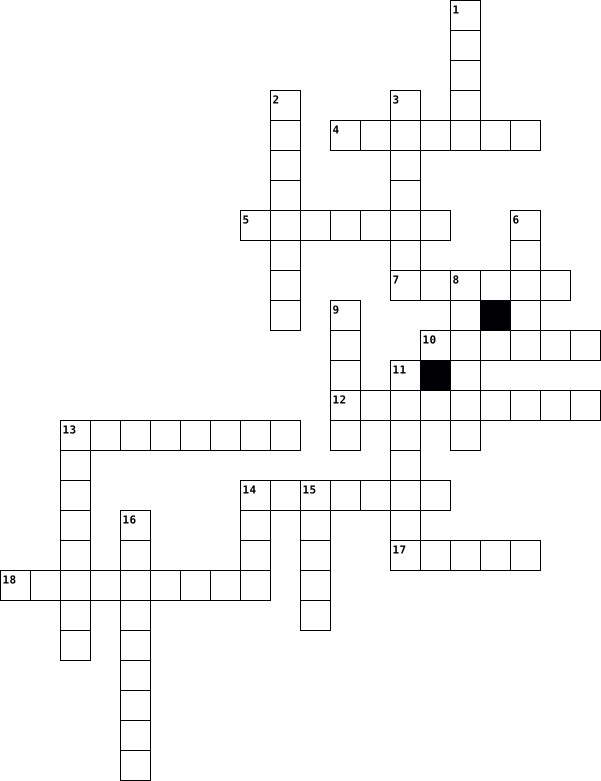
Across
- Teacher whose room got destroyed over summer
- ELA teacher who has been a gamer for 35 years
- Teacher who would love to visit Greece
- Elective tchr. from Dallas with dog named Frank
- AVID tchr. who grew up in NY and loves soccer
- Sci. tchr. who loves volleyball and BBQ
- This math teacher has a dog named Monster
- English teacher who loves baseball
- SS teacher likes hiking and has dog named Roxy
Down
- Math teacher who is married with two sons
- Married veteran whose fave team is Cowboys
- ELA teacher who went to school here at Bedichek
- Math teacher who has been to 21 countries
- Coach who is a BBQ expert
- Avid teacher who has a cat named Ponyo
- S.S. Teacher whose fave subject was math
- This elective teacher has 3 dogs and 2 kids
- Science teacher from El Paso who loves Torchys
- Elective teacher who is an only child
- Has 2 daughters and would like to visit Spain
20 Clues: Coach who is a BBQ expert • English teacher who loves baseball • Elective teacher who is an only child • Teacher who would love to visit Greece • Avid teacher who has a cat named Ponyo • Sci. tchr. who loves volleyball and BBQ • S.S. Teacher whose fave subject was math • Math teacher who is married with two sons • Math teacher who has been to 21 countries • ...
Algebra 2 Semester 1 2021-09-23
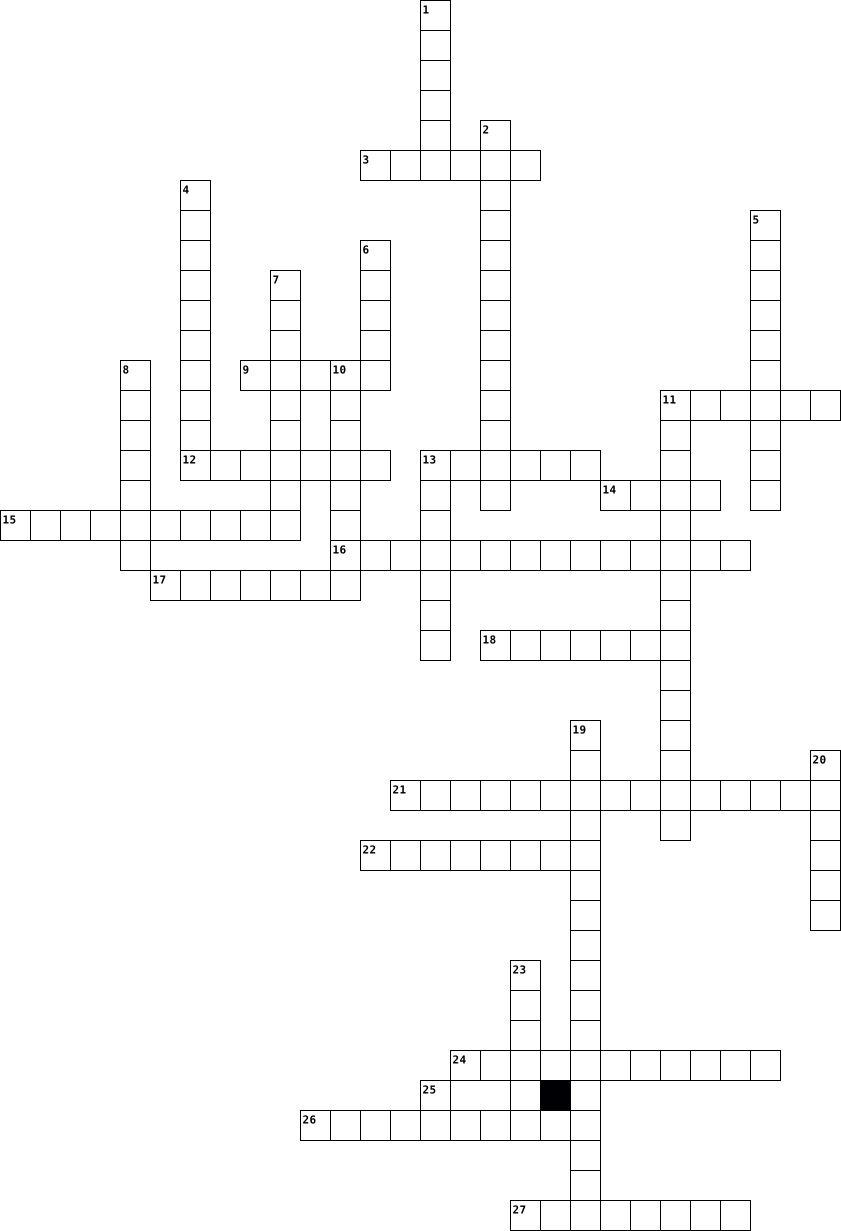
Across
- the middle point
- how a line graph moves up or down
- to use opposites to make something go away
- a square root, cube root, etc
- to make smaller
- your favorite teacher
- the most common type of radical
- an equation that makes a line graph
- your favorite class
- flip a graph
- "i"
- a person who uses math to build things
- all numbers that are not imaginary
- where a graph crosses the y-axis
- the most "fun" kind of equation
Down
- to break down into smaller parts by dividing
- 4, 9, 25, 100 for example
- tool for making math easier
- where a graph crosses the x-axis
- find the answer
- uses math to understand living things
- first high school math class for most
- a u-shaped graph made by a quadratic function
- it doesn't fly but we graph on it
- to make taller
- an equation that makes a parabola
- what puts the "fun" in functions
- turn
- Ms. Kirk's favorite student
29 Clues: "i" • turn • flip a graph • to make taller • find the answer • to make smaller • the middle point • your favorite class • your favorite teacher • 4, 9, 25, 100 for example • tool for making math easier • Ms. Kirk's favorite student • a square root, cube root, etc • the most common type of radical • the most "fun" kind of equation • where a graph crosses the x-axis • ...
Lanz Harley Domingo's CrossWord 2016-05-11
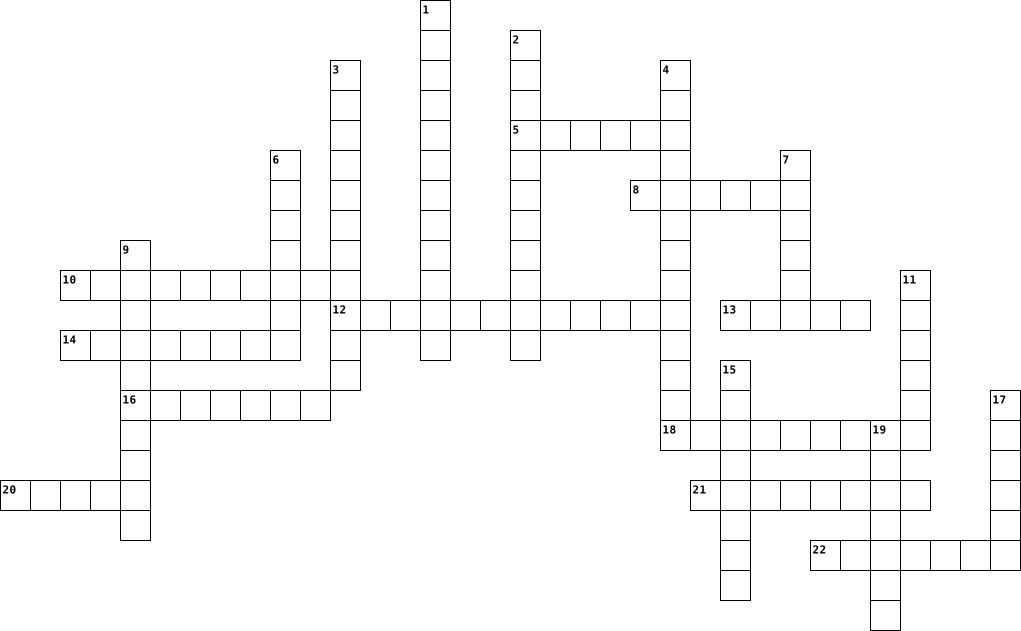
Across
- an order of a way to solve a math problem
- part of a species named pioneer species
- The event that created the new 52
- The mortal enemy of the flash
- Spiderman's arch nemesis
- when lines are the exact same distance from each other
- math with letters
- where biotic and a biotic co exist
- an angle below ninety degrees
- the person that always break the fourth wall
- something that is not living
Down
- a show that Lanz is obsessed about
- a type of math that has something to do with guessing
- The last name of the main characters from the show that lanz is obsessed with
- a team that is from DC comics
- an angel who fell
- A superhero that can grow or shrink depending on the situation
- the alter ego of the flash
- a man that gets his power by yelling out his name
- math with shapes angles and lines
- something that is living
- When a rock gets deformed by weather
22 Clues: an angel who fell • math with letters • Spiderman's arch nemesis • something that is living • the alter ego of the flash • something that is not living • a team that is from DC comics • The mortal enemy of the flash • an angle below ninety degrees • The event that created the new 52 • math with shapes angles and lines • a show that Lanz is obsessed about • ...
Math Terms 2025-12-02

Across
- The number you start with in a math machine
- Putting equal groups together
- The smallest multiple two or more numbers share
- The answer to a multiplication question
- A math sentence that includes an equals sign
- value The value of a digit based on where it sits in a number
- A 1 followed by six zeros
- The number you divide by
- A sequence that follows a rule
Down
- The answer to a division question
- A 1 followed by nine zeros
- Splitting a number into equal groups
- The number you get after the rule in a math machine
- A whole number that can be positive, negative, or zero
- The number being divided
- A number you get by multiplying a number by whole numbers
- The rule that tells you which order to solve operations in
- A 1 followed by twelve zeros
- The biggest factor two or more numbers share
- A math sentence without an equals sign
20 Clues: The number being divided • The number you divide by • A 1 followed by six zeros • A 1 followed by nine zeros • A 1 followed by twelve zeros • Putting equal groups together • A sequence that follows a rule • The answer to a division question • Splitting a number into equal groups • A math sentence without an equals sign • The answer to a multiplication question • ...
Vegeta Nakeith 2019-01-21

Across
- A substance made of atoms of more than one element bound together
- A substance that cannot be broken down into simpler substances
- mixture Substances are not uniformly mixed
- Anything that has mass and occupies space
- Smallest particle that has the properties of an element
Down
- The smallest unit of a substance that exhibits all of the properties characteristic of that substance
- Substance Any matter that has fixed composition a definite properties
- A combination of more than one pure substance
- Formula The chemical symbols and numbers indicating the atoms contained in the basic unit of a substance
- mixture Mixing occurs between individual units
10 Clues: Anything that has mass and occupies space • mixture Substances are not uniformly mixed • A combination of more than one pure substance • mixture Mixing occurs between individual units • Smallest particle that has the properties of an element • A substance that cannot be broken down into simpler substances • ...
Chapter 11 deffinitions 2020-09-11

Across
- the smallest unit of a substance that exhibits all of the properties characteristic of that
- any matter that has a fixed composition and definite properties.
- substances are not uniformly mixed
- a substance made of atoms of more than one element bound together.
- is anything that has mass and occupies space
Down
- mixture mixing occurs between individual units
- a substance that cannot be broken down into simpler substances.
- the chemical symbols and numbers indicating the atoms contained in the basic unit of a substance.
- the smallest particle that has the properties of an element.
- a combination of more than one pure substance.
10 Clues: substances are not uniformly mixed • is anything that has mass and occupies space • mixture mixing occurs between individual units • a combination of more than one pure substance. • the smallest particle that has the properties of an element. • a substance that cannot be broken down into simpler substances. • ...
Chapter 11 2020-08-28

Across
- is anything that has mass and occupies space
- combination of more than one pure substance
- substances are not uniformly mixed
- 2 or more liquids that don't mix into each other.
- the chemical symbols and numbers indicating the atoms contained in the basic unit of a substance.
Down
- the smallest particle that has the properties of an element.
- 2 or more liquids can dissolve into each other in various portions.
- mixing occurs between individual units
- a substance made of atoms of more than one element bound together.
- a substance that cannot be broken down into simpler substances.
10 Clues: substances are not uniformly mixed • mixing occurs between individual units • combination of more than one pure substance • is anything that has mass and occupies space • 2 or more liquids that don't mix into each other. • the smallest particle that has the properties of an element. • a substance that cannot be broken down into simpler substances. • ...
A.J. chapter 11 2021-09-14

Across
- anything that has mass and.
- the smallest unit of a substance that exhibits all of the properties characteristics of that substance.
- any matter that has a fixed composition and definite properties.
- mixing occurs between individual units
Down
- the smallest particle that has properties of an element.
- substances are not uniformly mixed
- a combination of more than one pure substance.
- a substance made of atoms of more than one element bound together.
- the chemical symbols and numbers indicating the atoms contained in the basic unit of a substance.
- a substance that cannot be broken down into simpler substances.
10 Clues: anything that has mass and. • substances are not uniformly mixed • mixing occurs between individual units • a combination of more than one pure substance. • the smallest particle that has properties of an element. • a substance that cannot be broken down into simpler substances. • any matter that has a fixed composition and definite properties. • ...
Mathematical Crossword 2023-06-06

Across
- The points at which a graph crosses the x-axis.
- The standard unit of angular measurement.
- A function with a "U" like shape
- An expression with variables and coefficients only involving basic operations.
- The language from which we get the number for calculating the circumference of a circle.
- Mathematics which uses letters and symbols to represent unknown numbers
Down
- The amount left over after performing a equation
- A line which approaches a curve, but never reaches it.
- There are six functions of an angle commonly used in:
- A set of numbers containing the numbers lying between two numbers of the set.
10 Clues: A function with a "U" like shape • The standard unit of angular measurement. • The points at which a graph crosses the x-axis. • The amount left over after performing a equation • There are six functions of an angle commonly used in: • A line which approaches a curve, but never reaches it. • Mathematics which uses letters and symbols to represent unknown numbers • ...
Mathematical Crossword 2023-06-06

Across
- The points at which a graph crosses the x-axis.
- The standard unit of angular measurement.
- A function with a "U" like shape
- An expression with variables and coefficients only involving basic operations.
- The language from which we get the number for calculating the circumference of a circle.
- Mathematics which uses letters and symbols to represent unknown numbers
Down
- The amount left over after performing a equation
- A line which approaches a curve, but never reaches it.
- There are six functions of an angle commonly used in:
- A set of numbers containing the numbers lying between two numbers of the set.
10 Clues: A function with a "U" like shape • The standard unit of angular measurement. • The points at which a graph crosses the x-axis. • The amount left over after performing a equation • There are six functions of an angle commonly used in: • A line which approaches a curve, but never reaches it. • Mathematics which uses letters and symbols to represent unknown numbers • ...
Basic Math Symbol 2022-03-17

Across
- ³√a
- -
- ÷
- √a
Down
- /
- +
6 Clues: / • + • - • ÷ • √a • ³√a
Algebra Unit 2 Vocabulary 2024-11-21

Across
- The graph of this would have a(n) _______circle x<9
- This symbol: <
- (5,9] for example
- These symbols: <, >, ≥, ≤
- This symbol: >
- "Or" graphs typically graph _______
- "and" graphs typically graph ___________
- The bars seen in this equation |x+4|=5
- This symbol: ≥
Down
- This symbol: ≤
- This is used in interval notation when there is a closed circle
- The graph of this would have a(n) ______ circle x≥7
- The direction that these symbols would graph > ≥
- These are used in interval notation when there is an open circle
- The direction that these symbols would graph < ≤
15 Clues: This symbol: ≤ • This symbol: < • This symbol: > • This symbol: ≥ • (5,9] for example • These symbols: <, >, ≥, ≤ • "Or" graphs typically graph _______ • The bars seen in this equation |x+4|=5 • "and" graphs typically graph ___________ • The direction that these symbols would graph > ≥ • The direction that these symbols would graph < ≤ • ...
Crossing Of The Words 2015-03-20

Across
- The protagonist who steals in “All the Years of Her Life”.
- The name of the gang Andy was in, in “On the Sidewalk Bleeding”.
- A group of lines forming the basic recurring material in a poem.
- The use of symbols to represent ideas or qualies.
- A figure intended to represent an abstract quality.
- This shows symbolism in “Blanket”.
- A thing regarded as representative.
- They had to turn into this to survive in “Alive”.
- Station This is where Hugo lived in “Hugo”.
Down
- A hint at what is to come.
- A figure of speech.
- They played this on “The Last Spin”.
- John senior had this problem in “The Father”.
- The name of the boy who calls in ‘The Caller”.
- This got destroyed by the baby in “Little Brother”.
- Charles real name in “Charles”.
- She had three centimeters left on this when the phone rang.
- The name of the staff member who helped Beth in “The Truth About Sharks”.
- To make a description more emphatic.
19 Clues: A figure of speech. • A hint at what is to come. • Charles real name in “Charles”. • This shows symbolism in “Blanket”. • A thing regarded as representative. • They played this on “The Last Spin”. • To make a description more emphatic. • Station This is where Hugo lived in “Hugo”. • John senior had this problem in “The Father”. • ...
Science lesson 1-3 2025-04-30

Across
- An object's ability to float is called
- Petroleum is a complex mixture of
- A(n) ? has north and south poles
- As more matter gets packed into the same amount of space, the material's density
- compounds can only be broken apart by
- solids keep their
- The tiny, very dense body in the atoms center is called the atomic
Down
- Each ? has its own density
- We call Mendeleyev's the periodic table after the periodic changes found in the element's
- When heat is absorbed by a solid, the molecules vibrate
- The basic building blocks of all matter are
- one state of matter
- Mass is often measure in
- A formula contains numbers below the elements called
- one state of matter
- When water absorbs enough heat it turns into a(n)
- Scientists write symbols for compounds called
- A measure of how tightly packed matter is is called
- A measure of the amount of matter in a object is
- the number of ? in a atom determines what element it is
- one state of matter
21 Clues: solids keep their • one state of matter • one state of matter • one state of matter • Mass is often measure in • Each ? has its own density • A(n) ? has north and south poles • Petroleum is a complex mixture of • compounds can only be broken apart by • An object's ability to float is called • The basic building blocks of all matter are • ...
chapter 11 2018-08-27

Across
- a combination of more than one pure substance.
- The smallest unit of a substance that exhibits all of the properties characteristic of the substance.
- mixing occurs between individual units.
- The smallest particle that has the properties of an element.
- any matter that has a fixed composition and definite properties.
Down
- substances are not uniformly mixed.
- the chemical symbols and numbers indicating the atoms contained in the basic unit of a substance.
- A substance that can not be broken down into similar substances.
- a substance made of atoms more than one element bound together.
- Anything that gas mass and occupies space.
10 Clues: substances are not uniformly mixed. • mixing occurs between individual units. • Anything that gas mass and occupies space. • a combination of more than one pure substance. • The smallest particle that has the properties of an element. • a substance made of atoms more than one element bound together. • A substance that can not be broken down into similar substances. • ...
Chapter 11 2019-08-25

Across
- Anything that has mass and occupies space.
- Any matter that has a fixed composition and definite properties.
- A substance made of atoms of more than one element bound together.
- Mixing occurs between individual units.
- A combination of more than one pure substance.
Down
- A substance that cannot be broken down into simpler substances.
- Substances are not uniformly mixed.
- The chemical symbols and numbers indicating the atoms contained in the basic unit of a substance.
- The smallest unit of a substance that exhibits all of the properties characteristic of that substance.
- The smallest particle that has the properties of an element.
10 Clues: Substances are not uniformly mixed. • Mixing occurs between individual units. • Anything that has mass and occupies space. • A combination of more than one pure substance. • The smallest particle that has the properties of an element. • A substance that cannot be broken down into simpler substances. • Any matter that has a fixed composition and definite properties. • ...
Chapter 11 2018-01-24

Across
- mixing occurs between individual units
- any matter that has a fixed composition and definite properties
- a substance that cannot be broken down into simple substances
- a combination of more than one pure substance
- anything that has mass and occupies space
Down
- substances are not uniformly mixed
- a substance made of atoms of more than one element bound together
- the smallest unit of a substance that exhibits all of the properties characteristic of that substance
- the chemical symbols and numbers indicating the atoms contained in the basic unit of a substance
- the smallest particle that has the properties of an element
10 Clues: substances are not uniformly mixed • mixing occurs between individual units • anything that has mass and occupies space • a combination of more than one pure substance • the smallest particle that has the properties of an element • a substance that cannot be broken down into simple substances • any matter that has a fixed composition and definite properties • ...
choice board unit 4 2022-04-01

Across
- agreement or compatibility between opinions or action
- the use of symbols to represent ideas or qualities stanza a group of lines in some Greek and Latin meters
- the biography of oneself narrated by oneself
- a repeated pattern of movement or sound
- showing a great deal of variety
- the representation of an abstract quality in human form
- to speak in words or phrases with the same ending sound
- the choice or words and phrases regarding to correctness
- a scene that takes place before a story begins
- a slight differences in shades of meaning
Down
- the repetition of the sound of a vowel
- a letter being repeated at the beginning of adjacent
- blend into a functioning or unified whole
- a group of words having a meaning not deducible from the words
- a usually written history of a persons life
- an indication of what is to come
- exaggerated statements
- repeating something that has already been said
- taking words in their usual or most basic sense
19 Clues: exaggerated statements • showing a great deal of variety • an indication of what is to come • the repetition of the sound of a vowel • a repeated pattern of movement or sound • blend into a functioning or unified whole • a slight differences in shades of meaning • a usually written history of a persons life • the biography of oneself narrated by oneself • ...
Flashdrive Fun 2013-09-30

Across
- transforms one object into another object
- organizes works into layers and frames so you can create animations
- allows you to animate symbols and give them the apperance of motion
- Panel stores the assets that you use in your flash files
- used to create and display content
- building blocks that are stored in the library
- the main working area in flash where you create and manipulate artwork
Down
- tool the basic drawing tools for flash
- the number of frames per second
- short for "in between"
- unique qualities for a specific object
- movie clip button and graphics
- where you create your flash content and animation
- a frame that defines a change in animation
- spaces by default you will see the essential workspace but you can also create your own
- a cell on the timeline that represents still images
- allows you to create and manipulate artwork
- rows on the timeline that organize and allow stacking of items on the stage
- flash content viewed in flash player
19 Clues: short for "in between" • movie clip button and graphics • the number of frames per second • used to create and display content • flash content viewed in flash player • tool the basic drawing tools for flash • unique qualities for a specific object • transforms one object into another object • a frame that defines a change in animation • ...
Crossing Of The Words 2015-03-20

Across
- A figure of speech.
- A figure intended to represent an abstract quality.
- The use of symbols to represent ideas or qualies.
- A hint at what is to come.
- This is where Hugo lived in “Hugo”.
- They had to turn into this to survive in “Alive”.
- She had three centimeters left on this when the phone rang.
Down
- The name of the boy who calls in ‘The Caller”.
- John senior had this problem in “The Father”.
- Charles real name in “Charles”.
- The name of the gang Andy was in, in “On the Sidewalk Bleeding”.
- A thing regarded as representative.
- To make a description more emphatic.
- They played this on “The Last Spin”.
- This got destroyed by the baby in “Little Brother”.
- This shows symbolism in “Blanket”.
- The protagonist who steals in “All the Years of Her Life”.
- A group of lines forming the basic recurring material in a poem.
- The name of the staff member who helped Beth in “The Truth About Sharks”.
19 Clues: A figure of speech. • A hint at what is to come. • Charles real name in “Charles”. • This shows symbolism in “Blanket”. • A thing regarded as representative. • This is where Hugo lived in “Hugo”. • To make a description more emphatic. • They played this on “The Last Spin”. • John senior had this problem in “The Father”. • The name of the boy who calls in ‘The Caller”. • ...
Crossing Of The Words 2015-03-20

Across
- The use of symbols to represent ideas or qualies.
- A figure intended to represent an abstract quality.
- A thing regarded as representative.
- This got destroyed by the baby in “Little Brother”.
- To make a description more emphatic.
- The name of the gang Andy was in, in “On the Sidewalk Bleeding”.
- They played this on “The Last Spin”.
- The name of the boy who calls in ‘The Caller”.
- The name of the staff member who helped Beth in “The Truth About Sharks”.
- The protagonist who steals in “All the Years of Her Life”.
- She had three centimeters left on this when the phone rang.
- This shows symbolism in “Blanket”.
Down
- This is where Hugo lived in “Hugo”.
- An object regarded as representing.
- They had to turn into this to survive in “Alive”.
- A hint at what is to come.
- John senior had this problem in “The Father”.
- A figure of speech.
- Charles real name in “Charles”.
- A group of lines forming the basic recurring material in a poem.
20 Clues: A figure of speech. • A hint at what is to come. • Charles real name in “Charles”. • This shows symbolism in “Blanket”. • This is where Hugo lived in “Hugo”. • An object regarded as representing. • A thing regarded as representative. • To make a description more emphatic. • They played this on “The Last Spin”. • John senior had this problem in “The Father”. • ...
Emilia's Crossword 2021-06-23
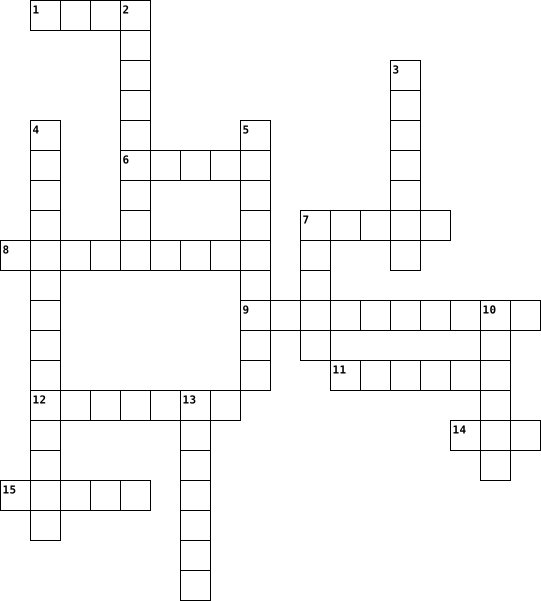
Across
- s_ _s(Math)
- B_ _L_ (Religion)
- f_ _r_ (Naturals Senses)
- d_ _i_i_ _s(Math)
- l_n_ _c_ _e_ (Social Studies)
- r_ y_ _S (Language and literature)
- a_ _o_ _t (inglis)
- v_t
- w_r_ _ (Language and literature)
Down
- s_ _l_ _l_s (Language and literature)
- h_s_ _r_ (Social studies)
- M_ _t_ _l_ _a_ _o_ (Math)
- J_ _u_ _l_m (Religion)
- f_ _n_ (Naturals Senses)
- E_ _t_r (Religion)
- a_ _m_l_ (Naturals Senses)
16 Clues: v_t • s_ _s(Math) • B_ _L_ (Religion) • d_ _i_i_ _s(Math) • E_ _t_r (Religion) • a_ _o_ _t (inglis) • J_ _u_ _l_m (Religion) • h_s_ _r_ (Social studies) • M_ _t_ _l_ _a_ _o_ (Math) • f_ _r_ (Naturals Senses) • f_ _n_ (Naturals Senses) • a_ _m_l_ (Naturals Senses) • l_n_ _c_ _e_ (Social Studies) • w_r_ _ (Language and literature) • r_ y_ _S (Language and literature) • ...
GEOMETRY SYMBOLS 2021-09-15

Across
- ″
- line that start from point A
- example AB ∥ CD
- infinite line
- formed by two rays
- c
- π
- example α = 60°
- ′
- example | x-y | = 5
Down
- equivalence of geometric shapes and size
- ~
- line from point A to point B
- Δ
- arc from point A to point B
15 Clues: ″ • ~ • Δ • c • π • ′ • infinite line • example AB ∥ CD • example α = 60° • formed by two rays • example | x-y | = 5 • arc from point A to point B • line that start from point A • line from point A to point B • equivalence of geometric shapes and size
Geometry Symbols 2021-09-11

Across
- ′
- ~
- rad
- ″
- angle ∟
- π
- ∠
- ≅
Down
- ∥
- g
- |x-y|
- grad
- ⊥
- °
- Δ
15 Clues: ∥ • g • ⊥ • ′ • ~ • ° • ″ • Δ • π • ∠ • ≅ • rad • grad • |x-y| • angle ∟
Numeral symbols 2021-09-11

Across
- VI
- X
- XIII
- IX
- IV
- XII
- V
- XIV
Down
- VIII
- VII
- XI
- III
- XV
- I
- II
15 Clues: X • I • V • VI • XI • XV • IX • IV • II • VII • III • XII • XIV • VIII • XIII
Geometry Symbols 2021-02-24

Across
- Same shapes but not the same size
- Is a part of a line that is bounded by two distinct end points, and contains every point on the line between its endpoints.
- Is sometimes also called a gon or a grade
- Means the same size and shape
- Are lines that intersect at a right (90 degrees) angle.
- Can be defined as a straight one- dimensional figure that has no thickness and extends endlessly in both directions.
Down
- Is the unit of angle measure defined such that an entire rotation is.
- Can be defined as the figure formed by two rays meeting at a common end point
- Is the ratio of the circumference of a circle to its diameter.
- Is a closed, two-dimensional shape with three straight sides
- Is the angle made at the center of a circle by an arc whose length is equal to the radius of the circle.
- Is a particular dihedral angle; it is the angle between two intersecting arcs of great circles on a sphere.
- Is part of a line that has a fixed starting point but does not have an endpoint.
- Usually refers to a portion of a circle
- can be defined as two lines in the same plane that are at equal distance from each other and never meet.
15 Clues: Means the same size and shape • Same shapes but not the same size • Usually refers to a portion of a circle • Is sometimes also called a gon or a grade • Are lines that intersect at a right (90 degrees) angle. • Is a closed, two-dimensional shape with three straight sides • Is the ratio of the circumference of a circle to its diameter. • ...
NUMERAL SYMBOLS 2021-09-05

Across
- LXX
- XII
- XI
- V
- XL
- VIII
Down
- I
- X
- XX
- III
- IX
- XVI
- XII
- XC
- XVIII
- L
16 Clues: I • X • V • L • XX • IX • XI • XC • XL • LXX • III • XVI • XII • XII • VIII • XVIII
GREEK SYMBOLS 2021-09-06

Across
- M
- B
- w
- TT
- E
- Z
- N
- P
Down
- Y
- H
- A
- K
- X
- O
- T
15 Clues: M • Y • B • H • A • K • X • w • E • O • Z • T • N • P • TT
GEOMETRY SYMBOLS 2021-09-06

Across
- arc from point A to point B
- parallel lines
- equivalence od geometric shapes and size
- distance between points x and y
- formed by two rays
- perpendicular lines(90degree angle)
- same shapes not same size
- line from point A to point B
Down
- arcminute 1deg=60'
- 1turn=360deg
- angle =90degree
- "
- line that start from point A
- triangle shape
- radians angle unit
15 Clues: " • 1turn=360deg • parallel lines • triangle shape • angle =90degree • arcminute 1deg=60' • radians angle unit • formed by two rays • same shapes not same size • arc from point A to point B • line that start from point A • line from point A to point B • distance between points x and y • perpendicular lines(90degree angle) • equivalence od geometric shapes and size
GEOMETRY SYMBOLS 2021-09-07

Across
- infinite line
- parallel lines
- distance between
- grads angle unit
- arcminute,1°=60’
- =90°
- arcsecond,1’=60°
- formed by two rays
Down
- ~
- perpendicular lines (90°angle)
- triangle shape
- x and y
- grads angle unit
- line from point A to point B
- 1turn=360°
- c
16 Clues: ~ • c • =90° • x and y • 1turn=360° • infinite line • triangle shape • parallel lines • distance between • grads angle unit • grads angle unit • arcminute,1°=60’ • arcsecond,1’=60° • formed by two rays • line from point A to point B • perpendicular lines (90°angle)
GEOMETRY SYMBOLS 2021-09-06

Across
- angle =90°
- arcminute
- perpendicular line(90°)
- triangle shape
- grads angle unit
- line that start from point A
- infinite line
Down
- arcsecond
- ~
- rad
- 1turn=360°
- equivalence of geometric and shapes and size
- parallel lines
- distance between points x and y
- formed by two rays
15 Clues: ~ • rad • arcsecond • arcminute • angle =90° • 1turn=360° • infinite line • parallel lines • triangle shape • grads angle unit • formed by two rays • perpendicular line(90°) • line that start from point A • distance between points x and y • equivalence of geometric and shapes and size
Geometry Symbols 2022-03-10

Across
- line from point A to point B
- perpendicular lines (90° angle)
- arc from point A to point B
- same shapes, not same size
- radians angle unit
- line that start from point A
- infinite line
- 1 turn = 360°
Down
- arcsecond, 1′ = 60″
- parallel lines
- = 3.141592654..
- grads angle unit
- arcminute, 1° = 60′
- = 90°
- formed by two rays
15 Clues: = 90° • infinite line • 1 turn = 360° • parallel lines • = 3.141592654.. • grads angle unit • formed by two rays • radians angle unit • arcsecond, 1′ = 60″ • arcminute, 1° = 60′ • same shapes, not same size • arc from point A to point B • line from point A to point B • line that start from point A • perpendicular lines (90° angle)
Mathematical symbols 2022-03-15

Across
- than <
- than >
- :
- -
- =
- slash /
- ;
- -
- *
- ×
Down
- mark !
- ( )
- [ ]
- +
- &
- sign $
- ÷
17 Clues: : • + • - • = • & • ÷ • ; • - • * • × • ( ) • [ ] • than < • mark ! • than > • sign $ • slash /
LOGIC SYMBOLS 2022-03-10

Across
- ⇒
- ∴
- ^
- ¬
- ~
- x'
- .
- ∨
Down
- +
- !
- ⇔
- ∀
- ∄
- ∵
- ⊕
15 Clues: ⇒ • + • ! • ∴ • ⇔ • ∀ • ∄ • ^ • ∵ • ¬ • ⊕ • ~ • . • ∨ • x'
LOGIC SYMBOLS 2022-03-16

Across
- &
- ~
- ^
- •
- +
- ∀
- ⇔
- ∨
- not-negation
Down
- X'
- !
- ∵
- ⇒
- ⊕
- ∴
15 Clues: & • ! • ∵ • ~ • ^ • ⇒ • ⊕ • • • + • ∴ • ∀ • ⇔ • ∨ • X' • not-negation
Geometry Symbols 2022-03-16

Across
- lines that never intersect.
- line that start from point A.
- arcminute, 1° = 60′.
- same shapes, not same size.
- between points x and y |x-y | = 5.
- π = 3.141592654...
- 1 turn = 360°
- equivalence of geometric shapes and size.
Down
- 360° = 2π rad.
- 360° = 400 grad.
- lines that intersect at a right(90 degrees) angle.
- formed by two rays
- ΔABC ≅ ΔBCD.
- infinite line
- from point A to point B
15 Clues: ΔABC ≅ ΔBCD. • infinite line • 1 turn = 360° • 360° = 2π rad. • 360° = 400 grad. • formed by two rays • π = 3.141592654... • arcminute, 1° = 60′. • from point A to point B • lines that never intersect. • same shapes, not same size. • line that start from point A. • between points x and y |x-y | = 5. • equivalence of geometric shapes and size. • ...
Geometry Symbols 2022-03-16

Across
- C
- Infinite line
- |X-Y|
- Formed by two rays
- ( 90° angel )
- arc from points A to point B
- gradians
Down
- ||
- constant, π
- ∆
- degree
- 1turn=360°
- radians
- line that start from point A
- '
15 Clues: C • ∆ • ' • || • |X-Y| • degree • radians • gradians • 1turn=360° • constant, π • Infinite line • ( 90° angel ) • Formed by two rays • line that start from point A • arc from points A to point B
Geometry Symbols 2022-03-11

Across
- ∢
- ∟
- π
- °
- ′
- ∠
- ~
- ≅
Down
- Δ
- ⊥
- g
- ∥
- c
- |x-y|
- ∡
15 Clues: Δ • ∢ • ⊥ • ∟ • g • π • ° • ′ • ∥ • ∠ • c • ~ • ∡ • ≅ • |x-y|
GEOMETRY SYMBOLS 2022-03-16

Across
- '
- ⊥
- form by two rays
- radians angle unit
- equals to 90°
- |x-y|
Down
- line from point A to point B
- same shape, not same size
- "
- ||
- °
- line that start from pint B
- grads angle unit
- π
- ≅
15 Clues: " • ' • ⊥ • ° • π • ≅ • || • |x-y| • equals to 90° • form by two rays • grads angle unit • radians angle unit • same shape, not same size • line that start from pint B • line from point A to point B
Geometric symbols 2022-03-17

Across
- it is the angle between two intersecting arcs of great circles on a sphere
- the figure formed by two rays meeting at a common end point.
- arcminute, 1° = 60
- defined as a part of a line that has a fixed starting point but no end point.
- if they have the same shape and size, or if one has the same shape and size as the mirror image of the other
- a straight one- dimensional figure that has no thickness and extends endlessly in both direction
- defined as the measure of the angle formed by the two rays or arms at a common vertex
- equal to 90°
Down
- The largest exponent the variable has in a polynomial with one variable.
- are lines in a plane that are always the same distance apart.
- are lines that intersect at a right (90 degrees) angle.
- line from point A to point B
- arcsecond, 1′ = 60
- the ratio of the circumference of any circle to the diameter of that circle.
- any smooth curve joining two points
15 Clues: equal to 90° • arcminute, 1° = 60 • arcsecond, 1′ = 60 • line from point A to point B • any smooth curve joining two points • are lines that intersect at a right (90 degrees) angle. • the figure formed by two rays meeting at a common end point. • are lines in a plane that are always the same distance apart. • ...