
bill of rights Crossword Puzzles
American and French Revolutions 2025-02-21

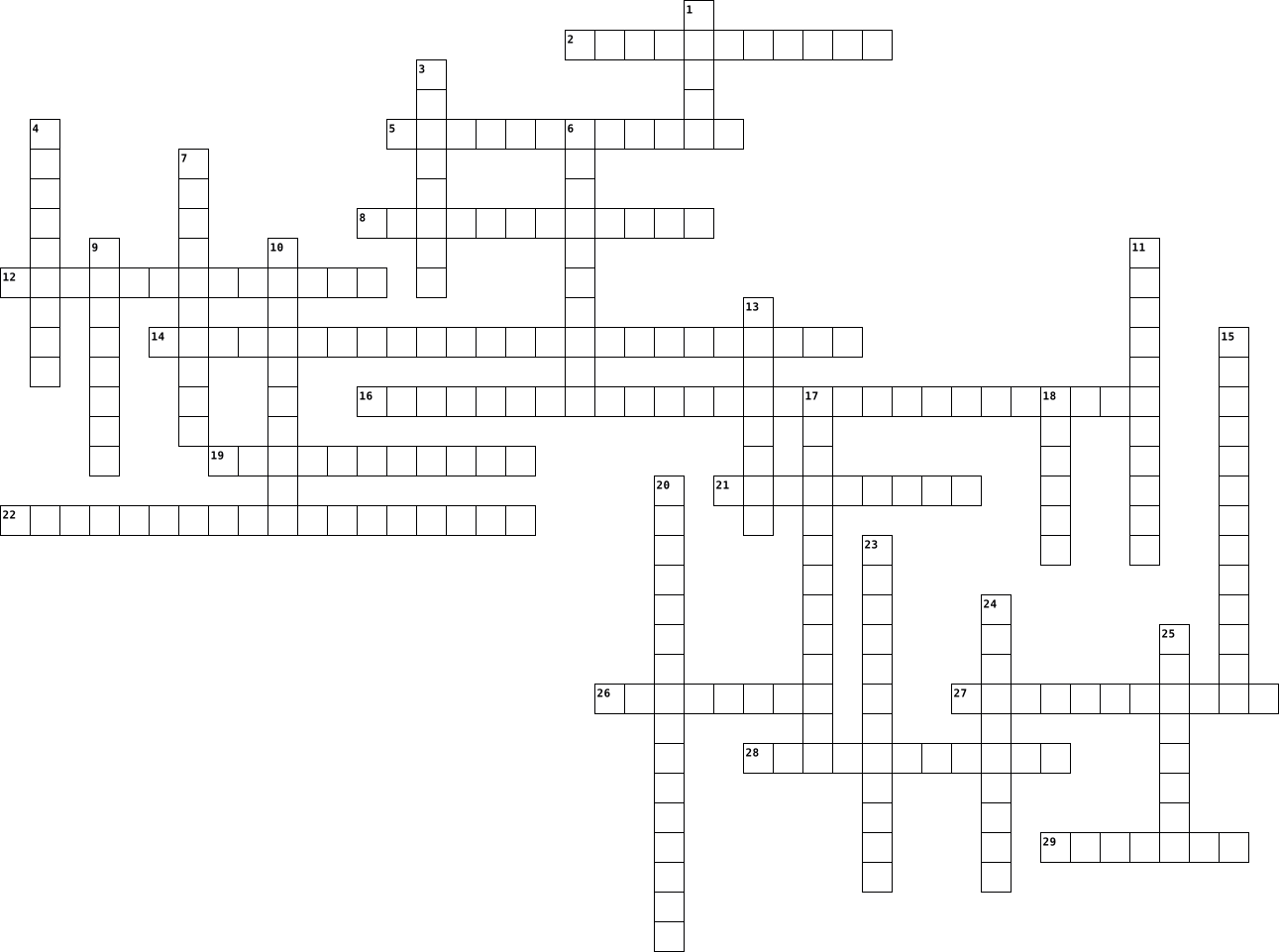
Across
- Document from the American Revolution that laid out the (mostly Enlightenment) reasons why the American colonies were breaking away from England
- Document coming out of the Glorious Revolution that later inspired the American Bill of Rights with ideas of due process and no cruel and unusual punishment
- The kind of government England had after the Glorious Revolution
- The American colonists had no _____________ in Parliament
- The American colonists' main slogan was "No ____________ without representation!"
- Parliament passed laws that said the colonists must pay new ______
- The National Assembly was made up mostly of people from the ________ Estate
Down
- Locke said that citizens must __________ to laws through the actions of their elected representatives
- Locke said that government is based on this and can be abolished if it isn't protecting our rights
- Both the American and French Revolutions were inspired by _______________ ideas
- The Third Estate representatives thought France could start a/an ____________ government like that of the United States
- colonists were beginning to think of themselves as ________ instead of British citizens
- With the __________ ________ Oath, the National Assembly delegates in France swore to keep meeting until they had written a constitution
- the kind of government England had before the Glorious Revolution (and France had before the French Revolution)
- Adopted on July 4, 1776, the Declaration of Independence was based on _______'s ideas
- King Louis and King James had claimed that they had absolute power by ___________ _______
16 Clues: The American colonists had no _____________ in Parliament • The kind of government England had after the Glorious Revolution • Parliament passed laws that said the colonists must pay new ______ • The National Assembly was made up mostly of people from the ________ Estate • Both the American and French Revolutions were inspired by _______________ ideas • ...
Midterm Review - Civic Literacy 2023-03-20

Across
- A small group in charge of creating, researching, and approving bills on specific topics.
- A political move made by the present to strike down a potential bill by Congress.
- The government principle of splitting power between the local, State, and Federal level.
- The minimum number of Representatives a State can have in the House.
- The early political party that believed in a strong central (national) government.
- A person who casts a vote for President representing a whole state.
- A proposed rule for the entire country that needs to be passed by Congress.
- The term length of a Representative in the House.
- The only city that receives Electoral College votes (3).
- The combined federal Legislative Branch; Both Senate and House of Representatives.
- The amount of time a politician stays in office.
- A change made to the Constitution allowing for more personal rights or a change to how we govern.
- A political ideology that desires small or no changes to the government.
- The document that serves as the bedrock (basis) for our current government.
Down
- A move made by one branch of government to correct/corral another.
- The modern Conservative political party.
- An Enlightenment thinker who believed people are evil.
- A political move to persecute a member of the government for committing a crime.
- A political ideology that desires medium size change(s) to the government.
- The ability to rule.
- A strategy used in the Senate to stop a vote/passing of a bill.
- The political move of redistricting a state to benefit your political party.
- The modern Liberal political party.
- An Enlightenment thinker who believed in the separation of Church and State.
- An Enlightenment thinker who believed in the Separation of Powers.
- A member of the House.
- An elected official (Minimum Age: 35)
- An Enlightenment thinker who believed people were a blank slate.
- A political ideology that desires large change(s) to the government.
- The geographic area that a Representative represents.
- An elected official--there are only 2 per state.
- Abbreviation for the first document that served as the national government for the United States of America.
- A rule for the entire country passed by Congress.
33 Clues: The ability to rule. • A member of the House. • The modern Liberal political party. • An elected official (Minimum Age: 35) • The modern Conservative political party. • The amount of time a politician stays in office. • An elected official--there are only 2 per state. • The term length of a Representative in the House. • A rule for the entire country passed by Congress. • ...
US History 2024-12-23

Across
- Washington's Secretary of the Treasury
- The Branch of govt. in which the President sits
- The party that advocated for a Bill of Rights and a limited government
- The Treaty of ______ concluded the Revolutionary war
Down
- The Branch of govt. that makes and passes laws
- The Articles of _______ served as the governing document of the US prior to the Constitution
- A state added to the US in 1820 as a slave state
- The Branch of govt. that interprets the Constitution
- The territory purchased by Jefferson in 1803
- The party that advocated for large government and the use of the Constitution
10 Clues: Washington's Secretary of the Treasury • The territory purchased by Jefferson in 1803 • The Branch of govt. that makes and passes laws • The Branch of govt. in which the President sits • A state added to the US in 1820 as a slave state • The Branch of govt. that interprets the Constitution • The Treaty of ______ concluded the Revolutionary war • ...
The Crossword of the Triffids 2024-04-26

Across
- (First name) Person that joins Bill in his journey after this person's plan fails.
- The day of the week the book starts on.
- (Plural) Releases debri that causes everyone to go blind.
- (All one word) Name of the book that Josella made.
- City in which the beginning of the story takes place.
- Name of the place that Bill finds out everyone is blind.
Down
- A word used a lot to define something that is strange/odd. First letter is "q".
- The last name of the author of the day of the Triffids.
- Last name of the person who runs a group that Coker and Bill want to find throughout the book.
- Name of the little girl who's family was killed by Triffids.
- The name of the place in which Bill finds Josella with three blind people.
- What Bill and the Beadley's group fall into right after Beadley announces his plan.
- Name of the person who runs Tynsham Manor.
- The novel ends with Bill's group on the ____ __ _____ determined on day...
14 Clues: The day of the week the book starts on. • Name of the person who runs Tynsham Manor. • (All one word) Name of the book that Josella made. • City in which the beginning of the story takes place. • The last name of the author of the day of the Triffids. • Name of the place that Bill finds out everyone is blind. • ...
Week 27 Studies Weekly Crossword 2025-05-15

Across
- – Had the power to negotiate with Native American tribes.
- – Congress couldn't collect these under the Articles of Confederation.
- – Created the first independent government in America.
- – He opposed signing the Constitution without a Bill of Rights. (modified clue)
Down
- – He presided over the Constitutional Convention. (modified clue)
- – Elbridge Gerry did not believe in a strong federal government.
- – Changed the U.S. government in 1787 by the stroke of a ___
- – He helped draft the Constitution and is known as its "Father."
- – Subject of population debate in the Constitution.
- – The Federalist Papers were this kind of writing. (modified clue)
- – States could regulate this under the Articles of Confederation.
11 Clues: – Subject of population debate in the Constitution. • – Created the first independent government in America. • – Had the power to negotiate with Native American tribes. • – Changed the U.S. government in 1787 by the stroke of a ___ • – Elbridge Gerry did not believe in a strong federal government. • – He helped draft the Constitution and is known as its "Father." • ...
jye p hass crossword 2022-08-11

Across
- people recieve that which they deserve
- the branch of government responsible for applying law
- a legal document that describes the rules or laws that govern Australia
- the branch of government responsible for approving new laws and putting them into action
- a form of government in which the supreme authority is actually or nominally ruled by monarch
Down
- a set of rules which describe how a country or state is run
- a person who holds citizneship of a country
- the rights that come from being a human being
- a proposed law
- a vote decided by the people to make changes
- a means of formally expressing opinion or choice
11 Clues: a proposed law • people recieve that which they deserve • a person who holds citizneship of a country • a vote decided by the people to make changes • the rights that come from being a human being • a means of formally expressing opinion or choice • the branch of government responsible for applying law • a set of rules which describe how a country or state is run • ...
Age of Revolutions 2024-02-26
Across
- This Enlightenment philosopher influenced early leaders of the U.S. to create a government characterized this, which created checks and balances between different branches of government
- The political revolutions of this period were possible because of support from these people
- This Latin American Revolutionary was inspired by Enlightenment ideas and began revolting against Spanish authority
- The American Revolution's success in overthrowing this highly influenced the Latin Revolutions
- Enlightenment ideas and the success of the French and American Revolutions led to this
- This document, formed during the French Revolution, was highly inspired by America's Declaration of Independence
- Absolute Monarchs and the idea of the divine right to rule led to this, which saw widespread revolts and the creation of new types of governments and political ideas
- In both the French and American Revolutions, citizens gained more ___________ rights
- This Enlightenment philosophy created a balance between branches of government and were incorporated into new constitutions created during the revolutions
- Type of monarchical government where the monarch has all of the power
- The rise of this group in French society lacked political representation in the government and this directly contributed to the French Revolution
- Europeans response to the rise and fall of Napoleon's empire helped to spread the idea of this, which saw people devoting themselves to their nation in extreme loyalty
- Both the American & French revolutionaries issued documents of independence that suggested that it was the government's responsibility to ______________ citizens' rights
Down
- The defeat of Spain & Portugal during the Napoleonic Wars helped to bring about political changes in Latin America because it gave them the opportunity to do this.
- The French and American colonies differed at the onset of their revolutions because the French suffered more _____________ struggles than the Americans
- This Enlightenment philosopher was the MAIN influence on the Declaration of Independence
- One main reason for the start of the American Revolution was the colonists lack of representation in this branch of the English government
- This legal document from 1215 stated that no leader may be above the law of the land
- This Enlightenment philosopher believed that laws should be created by the general will of the people
- This Enlightenment thinker supported theocratic governments
- This was the ultimate goal of both the French and American Revolutions
- Napoleon was this type of government leader
- Enlightenment philosophers inspired later political revolutions because of their belief that all people have this
- This movement furthered the development of democratic-republican governments because it introduced ideas about individual rights
- Replacing the existing political and social order was more relevant to this nation's revolution.
- This meeting of European leaders was meant to restore a balance of power in Europe by redrawing boundaries and reinstating legitimate monarchs
- This Enlightenment philosopher believed that a social contract involved an exchange of rights for the protection of a strong central government
- Both the Magna Carta & the English Bill of Rights had an impact on American government because both contained ideas about protecting the rights of the _____________
- This political philosopher of the Age of Enlightenment used his writing to promote toleration and freedom of speech
29 Clues: Napoleon was this type of government leader • This Enlightenment thinker supported theocratic governments • Type of monarchical government where the monarch has all of the power • This was the ultimate goal of both the French and American Revolutions • This legal document from 1215 stated that no leader may be above the law of the land • ...
government Units 1-3 2024-08-28

Across
- 36th president
- formal approval in a constitution
- the belief the government has the right to make public policy
- a change to the constitution
- groups joined for a common purpose
- loosely organized system
- those who opposed the ratification of constitution
- people that can represent
- self appointed elites power to rule
- one person holds unlimited power
- great charter forced by king John
- first permanent english settlement
Down
- when a state has absolute power
- rich upper class of roman empire
- father of our country
- process, government must act fair
- father of constitution
- an advisory body to the President
- tax on imports
- member of a state or nation full civil rights
- an adjective that describes two bodies
- group of delegates who drafted constitution
- formal agreement between more than one
- who enforces public policies
- written by a king city law
- made up of a Prime Minister
- to reject a bill
- common folk of roman empire
- least amount of members to be present to do business
- a body of people living in a defined territory
30 Clues: 36th president • tax on imports • to reject a bill • father of our country • father of constitution • loosely organized system • people that can represent • written by a king city law • made up of a Prime Minister • common folk of roman empire • who enforces public policies • a change to the constitution • when a state has absolute power • rich upper class of roman empire • ...
How to Rule the World crossword 2023-06-20

Across
- A political belief or ...
- Often seen in Hawaii
- A peninsula that sits in the Black Sea, formerly occupied by Ukraine
- An ideolody formerly adopted by a country in this crossword
- A country located in South America, formerly considered as socialist
- Government influenced and controlled information to the public
- Ideology derived from Marxism
- A formal opinion on a decision
- A name, or a statement, or a nose of a bird
- Last name of the current president of Ukraine
- The policy that Catherine the Great enforced on Ukranians
Down
- Sounds like constipation and is often full of 💩
- A form of freedom
- A political system that advocates for a centralised power
- ... d'état
- Mode or system of rule or management
- Last name of the current president of Russia
- Another word for gathering, originated from a European country.
- A set of idea or plans proposed by an individual or organisation
- A political system that advocates for equal voting rights, also we dabted this topic in class
- A union of countries that has disbanded
21 Clues: ... d'état • A form of freedom • Often seen in Hawaii • A political belief or ... • Ideology derived from Marxism • A formal opinion on a decision • Mode or system of rule or management • A union of countries that has disbanded • A name, or a statement, or a nose of a bird • Last name of the current president of Russia • Last name of the current president of Ukraine • ...
APUSH crossword puzzle 2023-05-15

Across
- deal, programs developed to help the economy recover during the great depression
- of rights, document that consists of the first 10 amendments
- amendment, gave black men the right to vote
- era after the civil war
- removal act, passed by andrew jackson for the removal of american indians and forced then to move out west
- drafted after the Articles of Confederation failed
- stormed the shores of france during WW2
- revolution, war for colonist to gain freedom from British Rule
- president during the great depression and some of WW2 and created the new deal
Down
- harbor, reason why the US joined WW2
- president during the civil war
- first president of the US
- name of the period when alcohol was not sold produced or manufactured
- v madison, established judicial review
- was shot during his presidency during the 1960s
- amendment, abolished slavery under the constitution
- war, war between the confederacy and union
- tea party, 92,000 pounds of tea were dumped due to the taxation of tea
- amendment, women gained the right to vote
- years war, another name for the french and indian war
20 Clues: era after the civil war • first president of the US • president during the civil war • harbor, reason why the US joined WW2 • v madison, established judicial review • stormed the shores of france during WW2 • amendment, women gained the right to vote • war, war between the confederacy and union • amendment, gave black men the right to vote • ...
Constitution 2022-06-02

Across
- Years in a representative's term
- people have the ____ to a speedy trial
- Right to _____ protected by the 15th Amendment
- Department headed by the president
- includes the Senate and House of Representatives
- taken by government officials (Article VI)
- high crime described in Article III
- Constitution replaced Articles of _____
- Congress has the power to do this
- an "arm," as in the Second Amendment
- 13th amendment forbid owning one
- years in a senator's term
- number of states needed to ratify the Constitution
- addition or change in the Constitution
- people can ____ peacefully (Amendment 1)
- ____ of representatives
Down
- A written plan of government
- introduction to the Constitution
- First Amendment freedom
- Bill of ______
- "We the ____ of the United States..."
- Legislative or "_____" branch
- Most powerful court in judicial Dept.
- must be 30 and 9 years a citizen
- population determines the number of representatives from each ___________
- citizen soldiers
- ____ of Religion
- Each year the president delivers a state of the ___ message
- Has 100 members, two per state
- first Amendment freedom
30 Clues: Bill of ______ • citizen soldiers • ____ of Religion • First Amendment freedom • first Amendment freedom • ____ of representatives • years in a senator's term • A written plan of government • Legislative or "_____" branch • Has 100 members, two per state • Years in a representative's term • introduction to the Constitution • must be 30 and 9 years a citizen • ...
the fifth amendment 2024-04-11

Across
- you have the right to remain ____
- the fifth amendment limits ______
- the fifth amendment protects you from ___
- gives you the right to a _____
Down
- the fifth amendment prevents a _____
- the fifth amendment is a part of the _____
6 Clues: gives you the right to a _____ • you have the right to remain ____ • the fifth amendment limits ______ • the fifth amendment prevents a _____ • the fifth amendment protects you from ___ • the fifth amendment is a part of the _____
2 2023-12-15

Across
- _____ include property attached to a structure but used in the course of business
- _____ rights belong to owners of land along a flowing body of water
- _____ is the right to ownership of real property and the evidence of ownership provided by a written document, called a deed
- A truckload of lumber that a homeowner purchased has been left in the driveway for use in building a porch. The lumber is considered ______ property
- ______ rights include mineral rights and other natural resources that can be leased or sold separately from surface rights
- The ______ rights includes the rights of possession, control, enjoyment, exclusion, and disposition
- ______ rights can be held by owners of land adjacent to rivers, lakes, or oceans
- The doctrine of _____ is followed in some states and provides that water use, aside from limited domestic use, is controlled by the state rather than the landowner adjacent to the water; to use water, the landowner must demonstrate a beneficial use of the water, such as for irrigation of crops
- A ____ is personal property that has been affixed to the land or to a building so that by law it becomes part of the real property
- ____ characteristics of land include scarcity, improvements, permanence of the investment, and area preference (situs)
- _____ describes the act by which real property can be converted into personal property
Down
- The term "Nonhomogeneity" refers to ____
- An _____ is a right or privilege associated with real property in some way, such as a parking space in a multiunit building, an easement, or water rights, and is normally conveyed to the new owner when the property is sold
- Another term for "personal property" is _____
- ______ includes the land as well as all things permanently attached or annexed to the land, both by nature and by humans
- Personal property generally includes____
- ______ includes the interests, benefits, and rights that are automatically included in the ownership of unimproved land and real estate
- _____ rights belong to owners of land that borders a commercially navigable lake, sea, or ocean
- The legal tests for a fixture include _____: the method of attachment, adaptability of the thing for the land's ordinary use, relationship of the parties, intent in placing the item on the land, and agreement of the parties
- ______ rights can be sold separately from surface rights and have limitations to enable air travel
- ______ characteristics of land include immobility, indestructibility, and nonhomogeneity (uniqueness)
21 Clues: The term "Nonhomogeneity" refers to ____ • Personal property generally includes____ • Another term for "personal property" is _____ • _____ rights belong to owners of land along a flowing body of water • ______ rights can be held by owners of land adjacent to rivers, lakes, or oceans • ...
Civil Rights Activists of the 1960s 2023-06-07

Across
- - Ella __, African-American civil rights activist and Freedom Rider.
- - Ruby __, first African-American student to attend an all-white school in the South.
- - Stokely __, leader of the Student Nonviolent Coordinating Committee (SNCC).
- - Bayard __, gay civil rights activist and organizer of the March on Washington.
- - Fred __, minister and co-founder of the Southern Christian Leadership Conference (SCLC).
- - Martin Luther __, iconic leader of the civil rights movement.
- - Julian __, civil rights leader, politician, and co-founder of the Student Nonviolent Coordinating Committee (SNCC).
Down
- - Fannie __, voting rights activist and co-founder of the Mississippi Freedom Democratic Party.
- - __ X, influential civil rights activist and advocate for Black empowerment.
- - Medgar __, NAACP field secretary who was assassinated for his civil rights work.
- - John __, prominent civil rights leader and congressman.
- - Rosa __, African-American woman who sparked the Montgomery bus boycott.
- - Amelia __, civil rights activist known for her role in the Selma to Montgomery marches.
- - Diane __, leader in the Nashville Student Movement and Freedom Rider.
- - Dorothy __, women's rights and civil rights activist.
15 Clues: - Dorothy __, women's rights and civil rights activist. • - John __, prominent civil rights leader and congressman. • - Martin Luther __, iconic leader of the civil rights movement. • - Ella __, African-American civil rights activist and Freedom Rider. • - Diane __, leader in the Nashville Student Movement and Freedom Rider. • ...
Reconstruction 2026-02-26

Across
- formations of the army that protect certain areas
- Lincolns vice president, became president after his death
- when the president is brought to court
- Republicans focused on ending slavery and enforcing civil rights
- when the president fails to sign a bill within 10 days
Down
- Created birthright citizenship, enforced due process, gave equal protection to all
- the period after Civil War, where the nation rebuilds
- Laws set in place by the South to restrict the freedom of former slaves
- When a person is given forgiveness by the president
- a standard set, an example
- Government granted pardon for certain crimes that erased responsibility
11 Clues: a standard set, an example • when the president is brought to court • formations of the army that protect certain areas • When a person is given forgiveness by the president • the period after Civil War, where the nation rebuilds • when the president fails to sign a bill within 10 days • Lincolns vice president, became president after his death • ...
How the State Government Works? 2023-01-14

Across
- If both the houses pass the bill, it is sent to the governor for his assent and the bill becomes a _________.
- It is passed to dissolve an assembly of the state government.
- Money bill can be introduced or originated in the legislative assembly by a minister with the prior consent of the _____________.
Down
- Vidhan Parishad is also known as legislative _______________.
- _____________ bill can originate in any house.
- Changes or suggestions in the bill.
- The __________ reading consists of a general discussion on the proposed bill.
- Bill regarding income and expenditure of the government is called _____________ bill.
- Only one house in the state legislature.
- Member of Legislative Assembly.
10 Clues: Member of Legislative Assembly. • Changes or suggestions in the bill. • Only one house in the state legislature. • _____________ bill can originate in any house. • Vidhan Parishad is also known as legislative _______________. • It is passed to dissolve an assembly of the state government. • ...
Beginnings of a Nation 2022-08-25

Across
- Stamp Act: required the colonists to pay a tax, represented by a stamp, on various forms of papers, documents, and playing cards
- the action or process of settling among and establishing control over the indigenous people of an area
- Tax (Boston Tea Party): a political protest that occurred on December 16, 1773, at Griffin's Wharf in Boston, Massachusetts
- withdraw from commercial or social relations with (a country, organization, or person) as a punishment or protest
- a person who journeys to a sacred place for religious reasons
- without Representation”: a populace that is required to pay taxes to a government authority without having any say in that government's policies.
- Companies: a company whose stock is owned jointly by the shareholders.
- Compact: an agreement to establish a government, entered into by the Pilgrims in the cabin of the Mayflower on November 11, 1620
- Bill of Rights: an act signed into law in 1689 by William III and Mary II.
- revoke or annul
- Liberty:the liberty of those persons who are free from external restraint in the exercise of those rights which are considered to be outside the province of a government to control.
- a ruined village in E Virginia, on Jamestown Island
- the highest legislature, consisting of the sovereign, the House of Lords, and the House of Commons.
- Sense: good sense and sound judgment in practical matters.
- of Burgesses: the lower house of the colonial Virginia legislature.
Down
- Columbus: Christopher Columbus was an Italian explorer and navigator who completed four Spanish-based voyages across the Atlantic Ocean.
- belief in the benefits of profitable trading; commercialism.
- the action of traveling in or through an unfamiliar area in order to learn about it.
- Resistance: the mechanism whereby the intestinal microbiota protects itself against incursion by new and often harmful microorganisms
- a grant by the Spanish Crown to a colonist in America conferring the right to demand tribute and forced labor from the Indian inhabitants of an area.
- Government: An electoral system where citizens vote to elect people to represent their interests and concerns.
- a form of government with a monarch at the head
- a conqueror, especially one of the Spanish conquerors of Mexico and Peru in the 16th century.
- Carta: a document constituting a fundamental guarantee of rights and privileges.
- a person sent or authorized to represent others, in particular an elected representative sent to a conference.
- a person who moves with a group of others to live in a new country or area.
- Government: In political philosophy, limited government is the concept of a government limited in power. It is a key concept in the history of liberalism.
- Rights: Rights that people supposedly have under natural law.
28 Clues: revoke or annul • a form of government with a monarch at the head • a ruined village in E Virginia, on Jamestown Island • Sense: good sense and sound judgment in practical matters. • belief in the benefits of profitable trading; commercialism. • a person who journeys to a sacred place for religious reasons • ...
Legislative Branch Review 2026-01-04

Across
- A person from a legislator’s district.
- One of the senators in Massachusetts.
- In an impeachment trial, the Senate acts as the ______________.
- There are two people from each state in this house of Congress.
- In the process for a Bill becoming law, it is highly likely that the bill will _____________.
- They have the majority in the House and the Senate.
- In this method of voting, everyone says their vote at one time.
- In this method of voting, Representatives names are said one by one.
- They have the minority in the House and the Senate.
- Warren One of the senators in Massachusetts.
- Mike Johnson is the ____________ of the House.
Down
- This is the main power of Congress. (Two words).
- This means to talk and talk to force a vote or delay a Bill in the Senate.
- The Senate has the special power to _____________ OR _____________ presidential nominations of various offices.
- Their job is to break a tie in the Senate.
- This is the type of committee a Bill goes to after it has been introduced.
- In most cases, a Bill officially becomes law when the __________________ signs it.
- Congress works in the U.S. ___________ building.
- All bills relating to ___________ must start in the House.
- These are the powers of Congress that are not listed in the Constitution.
- This word means to "refuse to sign."
- Since Congress has the expressed power to declare war, it is implied that they can set up a _____________.
- This is another term for a house of Congress
- Congress can override a presidential veto with a _____________ vote in both houses.
- There are 435 people in this part of Congress.
- This means to formally accuse an official of wrongdoing.
26 Clues: This word means to "refuse to sign." • One of the senators in Massachusetts. • A person from a legislator’s district. • Their job is to break a tie in the Senate. • This is another term for a house of Congress • Warren One of the senators in Massachusetts. • There are 435 people in this part of Congress. • Mike Johnson is the ____________ of the House. • ...
Government System Crossword Puzzle 2014-10-04

Across
- One of the three government level
- Related to ordinary citizens and their concerns
- To elect
- A sanction that's been ordered by the court system, but that person still gets to stay in their community, as long as he or she is getting supervised
- This person has 3 important roles such as deciding what the government policy should be
- This branch deals with laws
- A proposed law
- This person is also referred to as the Upper House of Parliament
- Due to good behaviour, a person may get released after their one third of the sentence, while still on sentence
- The elected head of a municipal level
Down
- The action where the Governor General signs a bill to make it a law
- This is held every 5 years (Sometimes 4 years)
- An object in the House of Commons
- This is where people discuss about a bill and whether or not make that bill a law
- This person picks out a certain portfolio of people, representing their party
- Any people who work together in order to win elections and have control of the government system
- In the executive branch
- The head of government of a province or territory
- The guy who does bad things
- Rules of the land
20 Clues: To elect • A proposed law • Rules of the land • In the executive branch • This branch deals with laws • The guy who does bad things • One of the three government level • An object in the House of Commons • The elected head of a municipal level • This is held every 5 years (Sometimes 4 years) • Related to ordinary citizens and their concerns • ...
Tanay shelar crossword 2021-07-20

Across
- was the vice chairman of the constituant assembly
- aparthied divided the people and labelled them on the basis of their
- was the prime minister of interim government
- was the colour of the people of south africa
- due to aparthied system there were lots of
- has the largest written constitution in the world
- was the place were nelson mandela was prisoned
Down
- was in prison of robben island for 28 years
- was the chairman of the drafting committee that drafted the indian constitution
- was the title of the autobiography written by nelson mandela
- is the short begining of indian constitution
- was the national leader who first tried to draft a constitution for india
- was the president of th constituent assembly
- was the name of a system of racial discrimination
- country which inspired the indian leaders to associate with ' bill of rights'
15 Clues: due to aparthied system there were lots of • was in prison of robben island for 28 years • is the short begining of indian constitution • was the president of th constituent assembly • was the prime minister of interim government • was the colour of the people of south africa • was the place were nelson mandela was prisoned • ...
Legislative Branch 2021-04-14

Across
- Congressional Committee chairperson can kill a bill assigned to his/her committee simply by ignoring it. (senate.gov)
- Veto when the chief executive does not sign or reject a bill within the time allowed to do so. (online glossary)
- a way to bring a bill out of committee and to the floor for consideration without a report from the committee by "discharging" the committee from further consideration of a bill or resolution. (norton.house.gov)
- the legislative process. (online glossary)
- Membership is divided into specialized groups for purposes such as holding hearings, preparing bills for the consideration of the entire House, and regulating House procedure. (britannica.com)
- Procedure that can be used to limit or end a floor debate in a legislative body. (online glossary)
- for members with the longest records of service. (online glossary)
- The power to coin money and regulate the value of it. (consitution.congress.gov)
- Various tactics that try to defeat a bill in a legislative body by preventing a final vote. (online glossary)
- To bring formal charges against a public official; only the House of Representatives has the power to impeach civil officers of the United States. (online glossary)
- Issue a formal condemnation (online glossary)
- An unpopular provision added to an important bill certain to pass so that it will “ride”
- A proposed law presented to a legislative body for consideration. (online glossary)
- Any money that a creditor must, by law, accept in payment for debts. (online glossary)
- branch. (online glossary)
- Member who leads a standing committee in a legislative body. (online glossary)
- Spokesperson chosen by the leading majority party in the legislation. (senate.gov)
Down
- A review by legislative committees of the policies and programs of the
- The presiding officer of a committee or subcommittee. (senate.gov)
- The distribution of seats in a legislative body. (online glossary)
- have the force of law and does not require the President’s signature. (online glossary)
- Chair of the legislation. (online glossary)
- The direct election of U.S. Senators by the voters of the states. (textbook)
- The power of government to take private property for public use. (online glossary)
- The exclusive power of Congress to regulate trade. (online glossary)
- Representative of their political party. (collinsdictionary.com)
- The process by which each chamber of Congress votes on a bill vetoed by the President. (senate.gov)
- Spokesperson of the minority party in the legislation. (senate.gov)
- A measure relating to the business of either house, or expressing an opinion; does
- Assistants to the floor leaders who are also elected by their parties. (senate.gov)
- A provision in Congressional legislation that allocates a specified amount of money for a specific project, program, or organization. (merriam-webster.com)
- An unwritten rule in Congress that reserves the top posts in each
- An adjective that describes a legislative body composed of two chambers. (online glossary)
33 Clues: branch. (online glossary) • the legislative process. (online glossary) • Chair of the legislation. (online glossary) • Issue a formal condemnation (online glossary) • Representative of their political party. (collinsdictionary.com) • An unwritten rule in Congress that reserves the top posts in each • The presiding officer of a committee or subcommittee. (senate.gov) • ...
Government Crossword 2015-10-09

Across
- a rule for all Canadians made by Senators, Members of Parliament and the Governor General through discussion and voting
- the process of choosing a representative by vote
- the person in charge of a meeting
- of two chambers, or rooms
- a change that is made to a bill a motion or a committee report with the intention of improving it
- the agreement by the provinces to join together to form the nation of Canada and create a federal Parliament
- a proposal for a law to be considered by Parliament
- the bringing to an end of a Parliament
- a member of the Senate or House of Commons who does not belong to a political party
- a group made up of all Senators and Members of Parliament from the same political party
- a discussion in which the arguments for and against a subject are presented according to specific rules
- the specific geographic area in Canada that a Member of Parliament represents in the House of Commons
- the political party with the most members elected to the house of Commons usually forms the Government
- a king or queen of a country
Down
- a special title given to Senators and Cabinet Ministers for life, and to the Speraker of the House of Commons as long as he or she is the Speaker
- all political parties and independent Members who do not belong to the governing party
- a large, heavy, silver- and gold-covered staff that is a symbol of the power and authority of Parliament
- a proposal by a Member for either the Senate or the House of Commons to do something, to order something to be done, or to express an opinion on a matter
- bill that are passed by Parliament
- one of two large rooms in the Centre Block of the Parliament Buildings
- a group of Senators, Members of Parliament, or both, selected to study a specific subject or bill and write a report about it
- to change or improve something;for example a law or an Act of Parliament
- the daily official record of debates in the Senate and the House of Commons in English and French
- a person living in an area in Canada represented by a Member of Parliament
- the set of rules that a country like Canada follows to work as a nation
- a person who has full political and civil rights in his or her country
- the government's plan for how it will collect and spend money each year
- a formal event that follows rules or traditions
- to pick one person from a group of several people by voting
- a group of all who make decisions about the Government's priorities and policies
- the city where a country's legislature is located and the government carries out its business
31 Clues: of two chambers, or rooms • a king or queen of a country • the person in charge of a meeting • bill that are passed by Parliament • the bringing to an end of a Parliament • a formal event that follows rules or traditions • the process of choosing a representative by vote • a proposal for a law to be considered by Parliament • ...
Unit 4 Vocabulary Crossword 2023-10-08

Across
- Russian ruler who supported freeing serfs until a peasant rebellion happened then changed her mind.
- carries out and enforces laws.
- system of federal courts and judges that interprets laws made by the legislative branch and enforced by the executive branch.
- French absolute monarch; centralized power, expanded French territory, ended religious freedom, and controlled nobles at the palace of Versailles.
- period in the mid-1500s, when scientists began to question accepted beliefs about the world and made new theories based on experimentation.
- laws of planetary motion- proved heliocentric theory using math.
- 1668 William of Orange and Mary take the throne of England from King James II. They signed the English Bill of Rights making England a constitutional monarchy.
- used math to prove heliocentric theory and explain planetary movement- described gravity.
- philospher who wrote about the social contract and thought government should provide for and protect the general will.
- the idea that people give up their rights to a government.
- 1215 the first document to put into writing the principle that the king and his government was not above the law.
- believed government exist to protect people's natural rights; overthrow governments that fail to protect the rights.
- political philosopher or thinker.
- set of written laws that govern a nation.
- theory that the sun is the center of the universe.
Down
- this system provides each branch of government with individual powers to check the other branches and prevent any one branch from becoming too powerful.
- rulers who made small reforms but did not give up any powers of the throne.
- developed heliocentric theory.
- Document that limited the power of English kings, Monarchs do not have divine right to rule; must have consent to suspend laws, levy taxes, and maintain army; can't interfere with parliamentary elections or debates.
- believed the best government was an absolute monarchy; all people are evil.
- Improved the telescope and supported heliocentric theory, was tried in the inquisition and held under house arrest.
- theory that the Earth was the center of the universe.
- ruled by one person, through force.
- makes laws and approves taxes.
- ruled by a set of laws, rulers must follow the laws too.
- wrote about separation of powers, checks and balances.
- a revolution in intellectual activity and changed European's view of government and society.
- used enlightenment ideas when writing the Declaration of Independence.
- wrote about freedom of speech and religion.
- ruled by a religious group.
30 Clues: ruled by a religious group. • developed heliocentric theory. • carries out and enforces laws. • makes laws and approves taxes. • political philosopher or thinker. • ruled by one person, through force. • set of written laws that govern a nation. • wrote about freedom of speech and religion. • theory that the sun is the center of the universe. • ...
Unit 4 Vocabulary Crossword 2024-03-04

Across
- Russian ruler who supported freeing serfs until a peasant rebellion happened then changed her mind.
- carries out and enforces laws.
- system of federal courts and judges that interprets laws made by the legislative branch and enforced by the executive branch.
- French absolute monarch; centralized power, expanded French territory, ended religious freedom, and controlled nobles at the palace of Versailles.
- period in the mid-1500s, when scientists began to question accepted beliefs about the world and made new theories based on experimentation.
- laws of planetary motion- proved heliocentric theory using math.
- 1668 William of Orange and Mary take the throne of England from King James II. They signed the English Bill of Rights making England a constitutional monarchy.
- used math to prove heliocentric theory and explain planetary movement- described gravity.
- philospher who wrote about the social contract and thought government should provide for and protect the general will.
- the idea that people give up their rights to a government.
- 1215 the first document to put into writing the principle that the king and his government was not above the law.
- believed government exist to protect people's natural rights; overthrow governments that fail to protect the rights.
- political philosopher or thinker.
- set of written laws that govern a nation.
- theory that the sun is the center of the universe.
Down
- this system provides each branch of government with individual powers to check the other branches and prevent any one branch from becoming too powerful.
- rulers who made small reforms but did not give up any powers of the throne.
- developed heliocentric theory.
- Document that limited the power of English kings, Monarchs do not have divine right to rule; must have consent to suspend laws, levy taxes, and maintain army; can't interfere with parliamentary elections or debates.
- believed the best government was an absolute monarchy; all people are evil.
- Improved the telescope and supported heliocentric theory, was tried in the inquisition and held under house arrest.
- theory that the Earth was the center of the universe.
- ruled by one person, through force.
- makes laws and approves taxes.
- ruled by a set of laws, rulers must follow the laws too.
- wrote about separation of powers, checks and balances.
- a revolution in intellectual activity and changed European's view of government and society.
- used enlightenment ideas when writing the Declaration of Independence.
- wrote about freedom of speech and religion.
- ruled by a religious group.
30 Clues: ruled by a religious group. • developed heliocentric theory. • carries out and enforces laws. • makes laws and approves taxes. • political philosopher or thinker. • ruled by one person, through force. • set of written laws that govern a nation. • wrote about freedom of speech and religion. • theory that the sun is the center of the universe. • ...
Legislative Branch 2021-04-02

Across
- Governor rejects a Bill
- most of work done in the General Assembly
- how state receives money from its citizens
- tax taken out from money earned from jobs
- tax on insurance companies
- tax on customer purchases of items in retail stores
- flat tax on corporations
- the "death tax"
- Must be 21 or older to run for this office
Down
- Special Purpose Committee
- taxes on land and homes
- when members from both houses meet in a committee
- Must be 21 or older to run for this office
- Permanent Committee
- Assembly Lawmaking body of Georgia
- when members of both chambers come together to compromise on a different version of bill
- to make laws
- taxes on gas, alcohol, tobacco
- law that is introduced into the General Assembly to be worked on
19 Clues: to make laws • the "death tax" • Permanent Committee • taxes on land and homes • Governor rejects a Bill • flat tax on corporations • Special Purpose Committee • tax on insurance companies • taxes on gas, alcohol, tobacco • Assembly Lawmaking body of Georgia • most of work done in the General Assembly • tax taken out from money earned from jobs • ...
Harry Potter characters 2020-04-26

Across
- 4th year DADA teacher
- the father of delphini
- godfather to Harry
- son of Ron and Hermione
- 5th year DADA teacher
- werewolf and a father and husband
- daughter of George and Angelina
- husband to Lily and father of harry
- daughter of Ron and Hermione
- mother of 7
- father of 3 kids and a godfather
- the only daughter of Harry and Ginny
- son of remus and Tonks
- father of 7
- Mother of 3 and a sister to 6 brothers
- husband to Hermione and father of 2
- middle child of Harry and Ginny
- only son of Bill and Fleur
- son of draco and Astoria
- daughter of Percy and Audrey
- 6th year DADA teacher
- lost his twin
Down
- dragon handler
- husband of bellatrix
- middle child of Bill and Fleur
- mother of harry and wife to James
- wife to Ron and mother of 2
- oldest son of Molly and Arthur
- son of George and Angelina
- oldest son of Harry and Ginny
- wife to Remus and mother of teddy
- died in the war
- the mother of delphini
- 3rd child of Molly and Arthur
- daughter of Percy and Audrey
- wife to Lucius
- brother of rodolphus
- son to lucius and Narcissa
- friends with Fred and george
- husband to Narcissa
- oldest daughter of Bill and Fleur
- married a half wolf
- wife to Percy and mother of 2 kids
43 Clues: mother of 7 • father of 7 • lost his twin • dragon handler • wife to Lucius • died in the war • godfather to Harry • husband to Narcissa • married a half wolf • husband of bellatrix • brother of rodolphus • 4th year DADA teacher • 5th year DADA teacher • 6th year DADA teacher • the father of delphini • the mother of delphini • son of remus and Tonks • son of Ron and Hermione • son of draco and Astoria • ...
Legal Terms by Riley Winckel and Rexanne Trautmann 2018-09-21

Across
- a written ruling
- A written summary, rhymes with thiefs
- Not a ruling, an interpretation
- Murder or robbery
- laws Controlling relations between individuals
- When you don’t like the last ruling so you choose to go to a higher court
- of powers Division of law making powers
- We watched a sketch about these
- Laws duties owed to societies
- hearings When you can go into a trial
- Power between states and country
- I was accused of committing a crime
- Study of law + legal philosophy
- A pact
- An examination of clues for a case in front of a judge
Down
- Doubt is he really guilty?
- government Limited power in the government
- review Highest U.S. court goes over acts
- of rights There are 10 of them
- Guides future cases with similar questions
- Against the rules
- clause Article VI
- Lawyer conducting the case
- The person harmed
- Deciding if the complaint is true
- intent Intention of the lawmakers
- Minor theft
- and balances Not more powerful and not less powerful
- President saying yes or no
29 Clues: A pact • Minor theft • a written ruling • Against the rules • clause Article VI • Murder or robbery • The person harmed • Doubt is he really guilty? • Lawyer conducting the case • President saying yes or no • Laws duties owed to societies • of rights There are 10 of them • Not a ruling, an interpretation • We watched a sketch about these • Study of law + legal philosophy • ...
US Regents Review (Presidents) 2024-06-10

Across
- Dollar diplomacy, income tax, bathtub
- Fourteen points, league of nations, Federal reserve
- Atomic bombs, desegregation of military
- Stay out of European Affairs, Era of Good Feelings
- Vietnam, Tonkin Gulf, Kent State
- "No new taxes," Persian Gulf War
- Corrupt Bargain, Son, 1824
- Teapot Dome, Heart Attack "Return to Normalcy"
- Reconstruction, Scandals, Union General
- 10% plus plan, impeachment, Reconstruction Acts
- Took over for Harding, pro-business, "silent"
- No direct relief, Stock market Crash, Bonus Army
- Annexes Texas, Oregon, Expansionist
- Trickle down, Star Wars, Iran Contra Affair
Down
- Democratic-Republican, Embargo, Louisiana
- President during the Trail of Tears, VP to Jackson
- Father of Constitution, War of 1812, Bill of Rights
- Watergate, China, Gold Standard Executive Privilege
- First trust-buster, Conservationist, Square Deal
- XYZ affair, Alien and Sedition Acts
- Pardons Nixon
- Precedents, neutrality, farewell address
- Interstate Highway act, D-day, Little Rock
- Camp David Accords, Oil Crisis, Iranian Hostage crisis
- defeats William Jennings Bryan, assassinated, Roosevelt
- New Deal, Court packing, WWII
- 1860, Emancipation Proclamation, Gettysburg Address
- Democrat, Bank War, Indian Removal
- Peace Corps, Bay of Pigs, Cuban Missile Crisis
29 Clues: Pardons Nixon • Corrupt Bargain, Son, 1824 • New Deal, Court packing, WWII • Vietnam, Tonkin Gulf, Kent State • "No new taxes," Persian Gulf War • Democrat, Bank War, Indian Removal • XYZ affair, Alien and Sedition Acts • Annexes Texas, Oregon, Expansionist • Dollar diplomacy, income tax, bathtub • Atomic bombs, desegregation of military • ...
US Regents Review (Presidents) 2024-06-10

Across
- Dollar diplomacy, income tax, bathtub
- Fourteen points, league of nations, Federal reserve
- Atomic bombs, desegregation of military
- Stay out of European Affairs, Era of Good Feelings
- Vietnam, Tonkin Gulf, Kent State
- "No new taxes," Persian Gulf War
- Corrupt Bargain, Son, 1824
- Teapot Dome, Heart Attack "Return to Normalcy"
- Reconstruction, Scandals, Union General
- 10% plus plan, impeachment, Reconstruction Acts
- Took over for Harding, pro-business, "silent"
- No direct relief, Stock market Crash, Bonus Army
- Annexes Texas, Oregon, Expansionist
- Trickle down, Star Wars, Iran Contra Affair
Down
- Democratic-Republican, Embargo, Louisiana
- President during the Trail of Tears, VP to Jackson
- Father of Constitution, War of 1812, Bill of Rights
- Watergate, China, Gold Standard Executive Privilege
- First trust-buster, Conservationist, Square Deal
- XYZ affair, Alien and Sedition Acts
- Pardons Nixon
- Precedents, neutrality, farewell address
- Interstate Highway act, D-day, Little Rock
- Camp David Accords, Oil Crisis, Iranian Hostage crisis
- defeats William Jennings Bryan, assassinated, Roosevelt
- New Deal, Court packing, WWII
- 1860, Emancipation Proclamation, Gettysburg Address
- Democrat, Bank War, Indian Removal
- Peace Corps, Bay of Pigs, Cuban Missile Crisis
29 Clues: Pardons Nixon • Corrupt Bargain, Son, 1824 • New Deal, Court packing, WWII • Vietnam, Tonkin Gulf, Kent State • "No new taxes," Persian Gulf War • Democrat, Bank War, Indian Removal • XYZ affair, Alien and Sedition Acts • Annexes Texas, Oregon, Expansionist • Dollar diplomacy, income tax, bathtub • Atomic bombs, desegregation of military • ...
Government Vocab 2024-02-27

Across
- The power of the president to organize foreign policies and treaties
- A part of the bill process that only the house goes through
- Where the house and senate create bills to be presented
- Apart of U.S. congress
- When a bill receives public hearing
- Where the house and senate meet
Down
- A lower part of U.S. congress where each person represents a state
- Someone who can veto a bill
- The power of president to affect and monitor the economy
- The representative of the country
- The power of president to veto laws
- A law before it's finalized
- The leader of the country
- An important U.S. Document
- The power of the president to grant pardons and carry out laws
15 Clues: Apart of U.S. congress • The leader of the country • An important U.S. Document • Someone who can veto a bill • A law before it's finalized • Where the house and senate meet • The representative of the country • The power of president to veto laws • When a bill receives public hearing • Where the house and senate create bills to be presented • ...
Government Crossword Puzzle 2024-05-13

Across
- A program added to the Social Security system in 1965 that provides hospitalization insurance for the elderly and permits older Americans to purchase inexpensive coverage for doctor fees and other health expenses
- A model of democracy in which a small number of people, usually those who are wealthy and well-educated, influence political decision-making
- The only procedure by which the Senate can vote to place a time limit on consideration of a bill or other matter, and thereby overcome a filibuster
- powers exercised by Congress that are not expressly granted to it by the Constitution, but are deemed “necessary and proper"
- Allows the powers not specifically given to the federal government to be given to the states and people of the states.
- The pen name of an Anti-Federalist in a series of essays designed to encourage New Yorkers to reject the proposed Constitution.
- The distribution of tax money to the state governments
- A procedural rule in the House of Representatives that prohibits any amendments to bills or provides that only members of the committee reporting the bill may offer amendments.
- The Constitution grants the president 10 days to review a measure passed by the Congress. If the president has not signed the bill after 10 days, it becomes law without his signature
- The supreme law of the United States that establishes the framework of the federal government and lays out the rights and responsibilities of citizens
- "Two chambers," and in practice refers to a government structure involving two houses, or two legislative bodies, that are separate in deliberation from one another
- The fundamental rights to which all humans are entitled without interference
- A conspicuous position that provides an opportunity to speak out and be listened to
Down
- Gives Congress the power to regulate all business activities that cross state lines or affect more than one state or other nation
- Social insurance that provides economic assistance to persons faced with unemployment, disability, or old age
- Grants issued by the United States Congress which may be spent only for narrowly defined purposes
- Prohibits the federal government from imposing unduly harsh penalties on criminal defendants
- Clause McCulloch v. Maryland used this clause
- A party leader who is the liaison between the leadership and the rank-and-file in the legislature.
- A requirement the federal government imposes as a condition for receiving federal funds
- Trial or punishment for the same crime by the same government
- An annual sum of money that is awarded by the federal government to a state or local government body to help fund a specific project or program
- A formal accusation of wrongdoing against a public official.
- The power of the government to take private property for public use
- In late 1786, farmers in western Massachusetts—facing high land taxes (and growing debt) and feeling that the economic (and governing) class in Boston didn’t represent them—took matters into their own hands
25 Clues: Clause McCulloch v. Maryland used this clause • The distribution of tax money to the state governments • A formal accusation of wrongdoing against a public official. • Trial or punishment for the same crime by the same government • The power of the government to take private property for public use • ...
I'm only a Bill 2022-03-24

Across
- The place where the bill has to wait for approval
- The president is able to _____ a bill if he disagrees
- The final person that decides if the bill becomes a law is the ____
- The ____ is the proposal before a law
- When the house and senate ____ and discuss about the bill
- The idea is then written by a senate or a _____
Down
- The bill has to ____ in committee.
- The bill starts off as a ____
- Both the house and the senate can try to _____ the veto by getting 2/3 majority votes
- The _____ consists of the Senate and House of representatives.
- The president makes the final ____ on whether the bill should become a law
11 Clues: The bill starts off as a ____ • The bill has to ____ in committee. • The ____ is the proposal before a law • The idea is then written by a senate or a _____ • The place where the bill has to wait for approval • The president is able to _____ a bill if he disagrees • When the house and senate ____ and discuss about the bill • ...
Women's Rights 2024-04-11

Across
- Where was the first women's rights convention held?
- Opposite of Men.
- What famous founding document was the famous declaration written at the first women's rights convention inspired by?
- What did women gain in the 19th amendment?
- One of the leaders of the women's rights convention
- What is God-given to everyone?
- Right that is given by whom?
- What was signed at the first women's rights convention?
Down
- An orator for the Women's Rights Movement
- a statement or action expressing disapproval of or objection to something.
- First women's rights convention.
- Opposite of Women.
- Who wrote the famous document at the first women's rights convention?
- One of the most famous leaders of the women's rights movement.
- Young woman.
15 Clues: Young woman. • Opposite of Men. • Opposite of Women. • Right that is given by whom? • What is God-given to everyone? • First women's rights convention. • An orator for the Women's Rights Movement • What did women gain in the 19th amendment? • Where was the first women's rights convention held? • One of the leaders of the women's rights convention • ...
Causes of the Civil War 2023-11-01

Across
- The act of the states trying to prevent something happening within their territory
- a bill to organize the Territory of Nebraska
- when the United States Supreme Court upheld slavery in United States territories
- an act to authorize the people of Missouri getting territory
- Ideas about the injustices of slavery
- It dealt with the issue of slavery and territorial expansion
Down
- Southern states began to secede, forming the Confederate States of America
- captured prominent citizens and seized the federal armory and arsenal
- established Georgia's conditional acceptance of the Compromise of 1850
- a political philosophy that emphasizes the rights of individual states
10 Clues: Ideas about the injustices of slavery • a bill to organize the Territory of Nebraska • an act to authorize the people of Missouri getting territory • It dealt with the issue of slavery and territorial expansion • captured prominent citizens and seized the federal armory and arsenal • established Georgia's conditional acceptance of the Compromise of 1850 • ...
Legal Terms by Riley Winckel and Rexanne Trautmann 2018-09-21

Across
- a written ruling
- A written summary, rhymes with thiefs
- Not a ruling, an interpretation
- Murder or robbery
- laws Controlling relations between individuals
- When you don’t like the last ruling so you choose to go to a higher court
- of powers Division of law making powers
- We watched a sketch about these
- Laws duties owed to societies
- hearings When you can go into a trial
- Power between states and country
- I was accused of committing a crime
- Study of law + legal philosophy
- A pact
- An examination of clues for a case in front of a judge
Down
- Doubt is he really guilty?
- government Limited power in the government
- review Highest U.S. court goes over acts
- of rights There are 10 of them
- Guides future cases with similar questions
- Against the rules
- clause Article VI
- Lawyer conducting the case
- The person harmed
- Deciding if the complaint is true
- intent Intention of the lawmakers
- Minor theft
- and balances Not more powerful and not less powerful
- President saying yes or no
29 Clues: A pact • Minor theft • a written ruling • Against the rules • clause Article VI • Murder or robbery • The person harmed • Doubt is he really guilty? • Lawyer conducting the case • President saying yes or no • Laws duties owed to societies • of rights There are 10 of them • Not a ruling, an interpretation • We watched a sketch about these • Study of law + legal philosophy • ...
American as Apple Pie (Mackenzy Williams) 2019-01-11

Across
- The only Indians in the Niitsitapitribes named __ or Siksika
- The tribe of Florida and a Team
- The fort built to defend the port of Baltimore
- A national park located in the U.S state of Wyoming
- The home of the Kentucky derby
- This rock is the traditional site of the mayflower pilgrims
- Also known as Socs or Saukies
- Bill of ___ is the ten commandments of the U.S
- The only president to own a patent and saloon
Down
- Standing in New York City was a gift from France
- ___ Yeager was the first man to travel faster than sound
- ____ Fisherman envisioned building a speedway to test cars
- ___ workers wore hard hats that were invented in 1933
- An enduring symbol of Americas 3rd president
- Indians constantly known as socially and culturally advanced
- ___ Anderson invented the windshield wiper around 1913
- Jacksonville's international airport in Atlanta
- Invented by Frank Henry Fleer in 1906 but failed
- Purchased from Russia in 1867 and its the largest state
- The most enduring symbol of Texas independence
20 Clues: Also known as Socs or Saukies • The home of the Kentucky derby • The tribe of Florida and a Team • An enduring symbol of Americas 3rd president • The only president to own a patent and saloon • The fort built to defend the port of Baltimore • Bill of ___ is the ten commandments of the U.S • Jacksonville's international airport in Atlanta • ...
Ch. 5 Sec. 3 Crossword The U.S. Constitution 2020-04-06

Across
- A permanent change in the Constitution.
- To be accused of serious wrongdoing.
- Job of the executive branch is to _______laws.
- Article 5 designs the __________ process.
- Number of goals of gov't. listed in intro to Constitution.
- The most important shared power.
- Elastic Clause is its' "nick name".
- Article dealing with the legislative branch.
- Article two designs this branch.
- Powers given to the federal government.
- The President is the head of this branch.
- Congress' over-ride of veto is an example.
- Powers shared by both the state & federal government.
- Presidential power used to reject a proposed law.
- Montesquieus' idea to prevent abuse of power.
Down
- Article designing the Judicial Branch.
- Article 7 deals with the _____of the Constitution.
- Division of power between state and federal gov't.
- Branch which makes laws.
- Article of Constitution declaring its' supremacy.
- Makes up the legislative branch.
- Article which deals with the states.
- The goal of maintaining peace in government.
- Number of amendments since the Bill of Rights.
- Makes up the judicial branch.
- Constitution is divided into seven _________.
- Branch which interprets laws.
- First ten amendments to the Constitution.
- Introduction to the Constitution.
- Powers kept by the states.
30 Clues: Branch which makes laws. • Powers kept by the states. • Makes up the judicial branch. • Branch which interprets laws. • Makes up the legislative branch. • The most important shared power. • Article two designs this branch. • Introduction to the Constitution. • Elastic Clause is its' "nick name". • To be accused of serious wrongdoing. • Article which deals with the states. • ...
Become a U.S citizen! 2022-12-17

Across
- Not civil liberties but _____ _________
- Political party who has a donkey as their logo
- Explains the ratification process
- President’s office
- Regulates relations between the states
- Branch that doesn’t evaluate or carry out laws
- Opposite of federalist
- Opposite of the majority party
- Political party who has an elephant as their logo
- Absolute authority over the people
- The party with the most members in each house
- Evaluate laws
- Authority needs a warrant to search you house
Down
- Part of congress that has a term for 2 years
- Didn’t want a bill of rights
- President has the power to ____ laws
- Powers clearly stated in the constitution
- Freedom of speech
- Opposite of expressed powers
- ”We the people…”
- Redrawing the district lines of a state in favor of one party to win more seats in house and more
- Government in which a single person holds unlimited political power
- The _________ has to be 35 years told to run.
- 10 amendments in the ____ __ ______
- Part of congress that has a term for 6 years
25 Clues: Evaluate laws • ”We the people…” • Freedom of speech • President’s office • Opposite of federalist • Didn’t want a bill of rights • Opposite of expressed powers • Opposite of the majority party • Explains the ratification process • Absolute authority over the people • President has the power to ____ laws • 10 amendments in the ____ __ ______ • Regulates relations between the states • ...
Texas Constitution of 1836 2024-11-21

Across
- The Mexican Constitution of 1824 played a crucial role in _____________ the Texas Constitution.
- The government is divided into _____________ branches.
- The Texas Constitution included a Bill of _________.
- The Constitution can be __________ to adapt to the changing times and needs.
- The President of Texas could ___________ government officials.
- the Texas Constitution established the __________ of Texas.
- The President of Texas had __________ powers.
- The Mexican Constitution divided powers between the central government and individual ________.
Down
- The Texas Constitution recognized the importance of ___________ and required that all officers acknowledge the existence of a Supreme Being.
- Congress is part of the __________ branch.
- The Texas Constitution of 1836 was adopted shortly after Texas declared independence from _____________.
- The President is part of the ___________ branch.
- The Supreme Court is part of the _________ branch.
- The U.S. Constitution was __________ in 1787.
- Both the U.S. and Mexican constitutions emphasize the separation of __________.
15 Clues: Congress is part of the __________ branch. • The U.S. Constitution was __________ in 1787. • The President of Texas had __________ powers. • The President is part of the ___________ branch. • The Supreme Court is part of the _________ branch. • The Texas Constitution included a Bill of _________. • The government is divided into _____________ branches. • ...
Bill Of what? 2022-01-27

Across
- Right to bear arms
- freedom from unsual punishments
- everyone has the right to have the freedom of speech,Press,religion,petition,peaceful assembally
- No quatering soldiers
Down
- Free from illegal search and seizure
- right to a public and speedy trial
- state power
- rights of others
- Free from double Jeopardy
- People in a jury that say guilty or not guilty
10 Clues: state power • rights of others • Right to bear arms • No quatering soldiers • Free from double Jeopardy • freedom from unsual punishments • right to a public and speedy trial • Free from illegal search and seizure • People in a jury that say guilty or not guilty • everyone has the right to have the freedom of speech,Press,religion,petition,peaceful assembally
BILL OF MATERIALS 2021-03-26

Across
- consists of preparatory work and operations necessary for the movement of personnel, equipment, supplies, and incidentals to the project site
- is a skilled trade and a craft in which the primary work performed is the cutting, shaping and installation of building materials during the construction of buildings
- is the concluding stage of construction;
- includes the following basic processes: preparation of the concrete mix; delivery of the mix to the construction site; feeding, distribution, and compaction of the mix in the formwork (molds)
- consists of the assembly of steel components into a frame on site.
- it entails laying down the system that will power your home
Down
- system of pipes and fixtures installed in a building for the distribution and use of potable water and the removal of waterborne wastes
- is a type of raw material which is commonly used for walls of buildings and retaining walls.
- they involve the processing of large quantities of soil with the aim of creating holes or for levelling the ground
- is a steel bar or mesh of steel wires used as a tension device in reinforced concrete and reinforced masonry structures to strengthen and aid the concrete under tension.
10 Clues: is the concluding stage of construction; • it entails laying down the system that will power your home • consists of the assembly of steel components into a frame on site. • is a type of raw material which is commonly used for walls of buildings and retaining walls. • ...
Manar Hameed 2016-11-14

Across
- what were the people who opposed the constitution call
- who was the most inflevential viginian aside from washiton
- who was also part of the virgians conivernion
- what has a system of goverment in which power is shared to the central government
- of the officers of their own appointment in
Down
- is of the society it self the other by
- of rights what was one of the first acts of the new government
- federalist paper these eassays first appeared as letters in new yourk newspapers
- who are the people that suppored the constitution
- in what month, when the nine state had voted
10 Clues: is of the society it self the other by • of the officers of their own appointment in • in what month, when the nine state had voted • who was also part of the virgians conivernion • who are the people that suppored the constitution • what were the people who opposed the constitution call • who was the most inflevential viginian aside from washiton • ...
8 H Q 11 7.1-7.4 2025-10-14

Across
- The _____ Era was the name were Federalists held political power.
- The ______ Affair intended to stop France from capturing American Ships.
- James Madison help ____ the power of the Government.
- Shay's ______ in 1787 proved the weakness of th Articles of Confederation.
- The ______ of Rights is another name for the first ten amendments.
Down
- The _______ Convention in 1787 changed the Articles of Confederation.
- Thomas _______ was the third president.
- Henry ______ said of Washington, "First in war, first in peace, first in the hearts of his countrymen"
- John ______ was remembered as the Father of Conservation.
- The nations first capital under the Constitution was New ______ city.
10 Clues: Thomas _______ was the third president. • James Madison help ____ the power of the Government. • John ______ was remembered as the Father of Conservation. • The _____ Era was the name were Federalists held political power. • The ______ of Rights is another name for the first ten amendments. • The nations first capital under the Constitution was New ______ city. • ...
Become a U.S citizen! 2022-12-17

Across
- Not civil liberties but _____ _________
- Political party who has a donkey as their logo
- Explains the ratification process
- President’s office
- Regulates relations between the states
- Branch that doesn’t evaluate or carry out laws
- Opposite of federalist
- Opposite of the majority party
- Political party who has an elephant as their logo
- Absolute authority over the people
- The party with the most members in each house
- Evaluate laws
- Authority needs a warrant to search you house
Down
- Part of congress that has a term for 2 years
- Didn’t want a bill of rights
- President has the power to ____ laws
- Powers clearly stated in the constitution
- Freedom of speech
- Opposite of expressed powers
- ”We the people…”
- Redrawing the district lines of a state in favor of one party to win more seats in house and more
- Government in which a single person holds unlimited political power
- The _________ has to be 35 years told to run.
- 10 amendments in the ____ __ ______
- Part of congress that has a term for 6 years
25 Clues: Evaluate laws • ”We the people…” • Freedom of speech • President’s office • Opposite of federalist • Didn’t want a bill of rights • Opposite of expressed powers • Opposite of the majority party • Explains the ratification process • Absolute authority over the people • President has the power to ____ laws • 10 amendments in the ____ __ ______ • Regulates relations between the states • ...
civics 2017-12-09

Across
- to accuse an office holder of misconduct
- first ten 10 amendments to the u.s constitution
- refers to the group of laws that define what acts are crimes
- are formal documents that allow u.s. citizens to travel abroad
- is the group of laws that refer to disputes between people
- also known as a law
- is any behavior that is illegal because society
- is the governments plan for interacting with other countries of the world
- forgives a person for his or her crime and eliminates punishments
- a policy requiring men to serve in the military
Down
- is the authority of a court to hear and decide a case for the first time
- u.s. written agreements
- allow foreigners to come to the United States
- citizens must report to serve as members of a jury
- is an act that betrays or endangers one's country
- postpones the carrying out of a person's sentence
- a proposed law
- the title of most cabinet members
- rights guaranteed to all u.s. citizens
- is a type of law that comes from judges decisions cases
20 Clues: a proposed law • also known as a law • u.s. written agreements • the title of most cabinet members • rights guaranteed to all u.s. citizens • to accuse an office holder of misconduct • allow foreigners to come to the United States • first ten 10 amendments to the u.s constitution • is any behavior that is illegal because society • ...
Article 1 2025-10-27

Across
- Congress regulates this between states and nations
- Nickname for the Necessary and Proper Clause
- Most votes needed to pass a bill
- A section or statement in a legal document
- Term meaning “two houses” in the legislature
- A bill becomes this when approved by Congress and the President
- The second part of the clause giving Congress flexibility
- Leader of the House of Representatives
- Type of powers specifically listed in Article I, Section 8
- Congress, not the President, has the power to declare this
- Members of the House are called this
- The chamber based on population representation
- Congress has the power to collect these to raise money
Down
- The chamber that holds impeachment trials
- The House has the power to do this to federal officials
- The branch of government created by Article I
- A body that makes laws
- Congress can do this to a veto with a two-thirds vote
- One of the two chambers of Congress
- The President’s power to reject a bill
- The companion concept that limits government power
- Period of time an elected member serves
- Article I gives Congress powers that act as these on other branches
- The clause allowing Congress to make laws that are "____ and Proper"
- A proposed law
25 Clues: A proposed law • A body that makes laws • Most votes needed to pass a bill • One of the two chambers of Congress • Members of the House are called this • Leader of the House of Representatives • The President’s power to reject a bill • Period of time an elected member serves • The chamber that holds impeachment trials • A section or statement in a legal document • ...
Legislative Branch Voc. Puzzle 2021-10-26

Across
- that period of time during which, each year, Congress assembles and conducts business
- the point where amendments can be added to a bill unless the House has adopted a closed rule
- serves as spokespersons for their party's positions on issues
- the order in which government officials replace the president of the United States if the president leaves office before an elected successor is inaugurated
- process of dividing the 435 memberships, or seats, in the U.S. House of Representatives among the 50 states
- a procedure that allows each senator to speak only one hour on a bill under debate
- the consider and refine legislative bills that fall under the committee's subject matter
- a paid representative of an interest group who contacts government officials on behalf of these interest groups
- a person who authorizes another to act in his or her behalf, as a voter in a district represented by an elected official
- direct contact made by lobbyists to persuade government officials to support the policies their interest group favors
- temporary, joint panels formed to create a compromise bill when each house has passed a different version of a bill.
- a method of defeating a bill in the Senate by stalling the legislative process and preventing a vote
- considers all bills reported from policy and fiscal committees and determines whether, and in what order, to schedule their consideration on the floor of the House
- motions placed on a bill in the Senate that alert party leaders that if unanimous consent were to be sought, they would object
- serve as presiding officer in the absence of the vice president
- a situation in which no member present objects to a proposal
Down
- a proposed law to authorize spending money
- a legislative sub-organization in the United States Congress that handles a specific duty
- manipulate the boundaries of (an electoral constituency) so as to favor one party or class
- to revise the legislative districts
- serve as spokesmen for their parties' positions on the issues
- termcode-amend-29-1917
- person currently in office
- the number of members of a decision-making body
- a resolution passed in the same form by both houses
- a group of members of the United States Congress that meets to pursue common legislative objectives
- groups of people who share common goals and organize to influence government and policy
- a congressional committee appointed to perform a special function that is beyond the authority or capacity of a standing committee.
- a committee composed of some members of a larger committee, board, or other body and reporting to it.
- the political and parliamentary leader of the House of Representatives
- the practice of having two houses of parliament
- a legislative proposal before Congress
- rejection of a bill by the president
- duty is to preside over the Senate
- a session at which a committee listens to testimony from people interested in the bill
- a formal, and public, group condemnation of an individual, often a group member, whose actions run counter to the group's acceptable standards for individual behavior
36 Clues: termcode-amend-29-1917 • person currently in office • duty is to preside over the Senate • to revise the legislative districts • rejection of a bill by the president • a legislative proposal before Congress • a proposed law to authorize spending money • the number of members of a decision-making body • the practice of having two houses of parliament • ...
Civil Rights Activists of the 1960s 2023-06-07

Across
- - Stokely __, leader of the Student Nonviolent Coordinating Committee (SNCC).
- - __ X, influential civil rights activist and advocate for Black empowerment.
- - Rosa __, African-American woman who sparked the Montgomery bus boycott.
- - Julian __, civil rights leader, politician, and co-founder of the Student Nonviolent Coordinating Committee (SNCC).
- - John __, prominent civil rights leader and congressman.
- - Bayard __, gay civil rights activist and organizer of the March on Washington.
- - Fred __, minister and co-founder of the Southern Christian Leadership Conference (SCLC).
Down
- - Fannie __, voting rights activist and co-founder of the Mississippi Freedom Democratic Party.
- - Medgar __, NAACP field secretary who was assassinated for his civil rights work.
- - Martin Luther __, iconic leader of the civil rights movement.
- - Ella __, African-American civil rights activist and Freedom Rider.
- - Ruby __, first African-American student to attend an all-white school in the South.
- - Dorothy __, women's rights and civil rights activist.
- - Amelia __, civil rights activist known for her role in the Selma to Montgomery marches.
- - Diane __, leader in the Nashville Student Movement and Freedom Rider.
15 Clues: - Dorothy __, women's rights and civil rights activist. • - John __, prominent civil rights leader and congressman. • - Martin Luther __, iconic leader of the civil rights movement. • - Ella __, African-American civil rights activist and Freedom Rider. • - Diane __, leader in the Nashville Student Movement and Freedom Rider. • ...
Constitution Crossword Puzzle 2022-03-11

Across
- The 19th ammendment gave ___________ the right to vote.
- Constitution states the U.S. is a _______
- This word means to accept or apporve an amendment to the constitution.
- _______ of Confederatio was the name of our countries first constitution
- Branch of government that declares laws constitutional or not.
- ______ of the house fills the position if the vice-president and president are unavailable?
- The official title for a member of a city, state or nation.
- The constitution is also known as the "law of the _________"
- The 13th ammendment outlawed _________
- The bill of rights is the first ______ ammendments
- Branch of government that contains the House and senate
- How many branches of government do we have in the united states?
- The constitution allows for freedom of ___________ allowing Americans to speak freely.
- people that are accused of crimes have a right to a ____________in court
- The president can _____ a law passed by congress.
- makes laws
- The president is part of this branch of government.
- _______ Randoph was the man who presented the Virginia Plan
- _____ Adams was our nation's first vice-president
- _____ Madison is the "Father" of the constitution
- _________Franklin was an Inventor and a man who signed the constitution.
Down
- Official document that provides the introduction for the constitution.
- The constitution states the use of _____ and balances.
- Sharing power between federal, state and local governments
- The constitution is currently kept in the National ________ museum.
- Madison, He wrote the original Bill of Rights and introduced it to congress.
- Where was the Constitutional Convention held in 1787?
- How many articles are there in the constitution?
- ______ Washington was the first person to sign the constitution.
- secretary of ________ deals with foreign countries
- _________ Hamilton was an Immigrant from the West Indies who signed the constitution.
- The 15th ammendment gave African-Americans the right to_________
- Popular_____ is the idea that government authourity comes from the people.
- Branch of government chosen by the president to help run the executive branch.
- Seperation of _______ divides the government into branches.
- The president acts as the commander-in-_______ of the armed forces.
- The constitution allows for freedom of ___________ allowing Americans to worship how they please.
- _____ Hancock has the biggest signature on the constitution.
- A name for a change or addition to the constitution.
- ______ Dayton was the youngest member of the Constitutional Convention at age 26.
- First line of the constitution is we the _______
41 Clues: makes laws • The 13th ammendment outlawed _________ • Constitution states the U.S. is a _______ • How many articles are there in the constitution? • First line of the constitution is we the _______ • The president can _____ a law passed by congress. • _____ Adams was our nation's first vice-president • _____ Madison is the "Father" of the constitution • ...
8 H Q 11 7.1-7.4 2025-10-14

Across
- Shay's ______ in 1787 proved the weakness of th Articles of Confederation.
- James Madison help ____ the power of the Government.
- The nations first capital under the Constitution was New ______ city.
- The ______ of Rights is another name for the first ten amendments.
- The _______ Convention in 1787 changed the Articles of Confederation.
Down
- The _____ Era was the name were Federalists held political power.
- Henry ______ said of Washington, "First in war, first in peace, first in the hearts of his countrymen"
- Thomas _______ was the third president.
- The ______ Affair intended to stop France from capturing American Ships.
- John ______ was remembered as the Father of Conservation.
10 Clues: Thomas _______ was the third president. • James Madison help ____ the power of the Government. • John ______ was remembered as the Father of Conservation. • The _____ Era was the name were Federalists held political power. • The ______ of Rights is another name for the first ten amendments. • The nations first capital under the Constitution was New ______ city. • ...
Unit 5- Revolutions Vocabulary Crossword 2024-05-24

Across
- New belief system which didn’t deny the existence of God, but rather, believed that God had created everything on Earth and then left it alone
- Philosophy and way of government based on abolishing classes and private property
- First women’s rights convention
- Declaration of the Rights of Woman and Female Citizen
- Enlightenment philosophy that focused on the basic rights of every individual
- Enlightenment feminist; leader in women’s suffrage, Seneca Falls Convention
- Leader of the Haitian revolution following the capture of Toussaint L’Ouverture
- Seized power in the October Revolution; communist party in the Soviet Union
- Proposed a laissez-faire economics
- First modern nationalist movement in Asia
- Enlightenment philosophy that focused on the relationship between government and its citizens
- Group of people who explored and wrote about social, political, and economical theories
- War between Russian Empire and the Ottoman Empire
- Founder of utopian socialism
Down
- Vindication of the Rights of Woman
- Haitian general and prominent leader during the Haitian Revolution
- Movement for the rights of women equal to rights of man
- French philosopher appreciated for civil rights and constitutional monarchy
- French emperor and military commander; reverted reforms
- Believed that a population had a general will and the sovereign power had an obligation to follow that will
- Revolutionary socialist; wrote the Communist Manifesto
- Philosophy based on collective ownership of businesses; government ownership and regulation
- Military and political leader; helped many Latin American colonies gain independence
- Leviathan
- Enlightenment philosopher; argued for natural rights of life, liberty, and property, inspired the Declaration of Independence
25 Clues: Leviathan • Founder of utopian socialism • First women’s rights convention • Vindication of the Rights of Woman • Proposed a laissez-faire economics • First modern nationalist movement in Asia • War between Russian Empire and the Ottoman Empire • Declaration of the Rights of Woman and Female Citizen • Revolutionary socialist; wrote the Communist Manifesto • ...
Due Process 2021-12-13

Across
- v. Jefferson County (1996), The court held that plaintiffs who did not participate in the suit, nor be represented by a party, may be given a hearing regarding a similar case. Res Judicata applies only to those who were involved with a previous decision.
- v. Arizona (1966), The Miranda Rights were created.
- v. Parker (1945), Congress is able to seize private property with just compensation.
- Due Process - The constitutional requirement that when the federal government acts in such a way that denied a citizen life, liberty, or property interest, the person must be given notice, the opportunity to be heard, and a decision by a neutral decision maker.
Down
- v. Rumsfeld (2006), Set a precedent that American citizens, regardless of enemy status, are entitled to Due Process rights and may challenge their enemy status.
- Due Process - Due process not only protect certain legal procedures, but also protects certain rights unrelated to procedure. May include things such as the right to work in an ordinary kind of job, marry, and to raise one’s child as a parent.
- v. United States (1972), This case determined that the governments grant of immunity from prosecution can compel a witness to testify over and assertion of the Fifth Amendment privilege against self incrimination.
- v. Baltimore (1833), The Constitution's Bill of Rights restricts only the power of the federal government and not those of the state governments.
- v. McDonnell (1974), Gave prisoners some due process rights and required disciplinary proceedings to include a written statement of evidence, as well as the ability for an inmate to present evidence.
- v. Din (2015), which held that no Constitutional rights were violated by denying a full explanation of why an alien’s visa was denied.
10 Clues: v. Arizona (1966), The Miranda Rights were created. • v. Parker (1945), Congress is able to seize private property with just compensation. • v. Din (2015), which held that no Constitutional rights were violated by denying a full explanation of why an alien’s visa was denied. • ...
Chapter 13 Section 4 "The Struggle for England and France" 2014-03-21

Across
- These people are the settlers in Northern france. A mixture of Germanic and Merovingian
- (two words) the name for the peoples who were a mixture of Angles and Saxons
- (two words) a book created under William the Conqueror that counted everything in the land. Homes, people, animals, ect. The first modern Census.
- (two words) a collection of verdicts; used in the study of cases
- the most powerful governmental district in early England
- This is a collection of 12 people, considered a defendant's peers, who will choose a verdict of guilty or not guilty in a case
- Another name for England, based off her Roman name "Britannia Province"
- (two words) A governing body of people in France, all classes are allowed to join
- a "decision" in a court of law
Down
- A governing body in England created under Henry III
- (two words) The inclusion of Norman rulers, ideas and customs into Anglo-Saxon England is known as this
- a governmental district in early England
- an emerging leading class in the middle ages, able to be in English Parliament
- these are what the Anglo-Saxons called the Vikings
- A count of everything in a country. We had one in the United States in 2010.
- An emrging class in the middle ages of merchants, day laborers and skilled workers not tied to the land
- (two words) The "Great Charter" signed by King John, protects certain rights to the people. Similar to the US Bill of Rights
- This literally means "land of the Angles"
- (two words) literally the sherrif of a shire
19 Clues: a "decision" in a court of law • a governmental district in early England • This literally means "land of the Angles" • (two words) literally the sherrif of a shire • these are what the Anglo-Saxons called the Vikings • A governing body in England created under Henry III • the most powerful governmental district in early England • ...
Module 3 Nationalism 2021-12-02

Across
- Was ratified in 1781
- The abusive use of power
- The amendment that abolished slavery
- Name given to the men who built the new plan of government(constitution)
- First 10 amendments to the Constitution
- How many votes are necessary in the electoral college to win the presidential election. ___votes
- Group of people who supported ratifying the constitution
- A person who was chosen to represent others
- The amendment that protects your right to deny people access to your home
Down
- Event resulting in John Adams defending British Soldiers in court
- Act causing colonists to pay for stamps and paper
- Laws restricting foreign born residents
- Branch of government that interprets the law
- A group of farmers banded together and caused a riot in 1786
- The state that wanted all states to have equal representation in congress
- How much a slave was worth in the count for representation
- Year the Bill of Rights was ratified
- Preference toward a specific belief or attitude
18 Clues: Was ratified in 1781 • The abusive use of power • The amendment that abolished slavery • Year the Bill of Rights was ratified • Laws restricting foreign born residents • First 10 amendments to the Constitution • A person who was chosen to represent others • Branch of government that interprets the law • Preference toward a specific belief or attitude • ...
English Revolution 2022-02-02

Across
- death started the revolution
- translated bible & spoke about divine right
Down
- war over absolute rule of Charles 1
- made a republican then became dictator
- last name of man who fought for religious toleration and beheaded King Charles 1
- Mary and William signed bill of rights to make a constitutional monarchy which protected citizens
- at war, signed petition of right, dissolved parliament
7 Clues: death started the revolution • war over absolute rule of Charles 1 • made a republican then became dictator • translated bible & spoke about divine right • at war, signed petition of right, dissolved parliament • last name of man who fought for religious toleration and beheaded King Charles 1 • ...
Government 2 2015-10-02

Across
- Person with full political and civil rights in his or her country
- Another word for electoral district
- The person in charge of a meeting
- Large staff that is a symbol of the power and authority of Parliament
- All political parties and independent Members who do not belong to the governing body
- Formal event that follows traditions
- Senator or Member of the House of Commons
- City where a country's legislature is located and where the government's business is carried out
- Specific geographic area in Canada that a MP represent in the House of Commons
- Period into which a Parliament is divided
- Agreement by the provinces to join together to form Canada and make a federal Parliament
- The bringing to an end of a Parliament which is followed by a general election
- Political party with the most members elected to the House of Commons form this group
- Rule for all Canadians made by Senators MPs and the Governor General through discussion and voting
- Word used for the stages during when a bill is debated
- Member of the Senate or House of Commons who does not belong to a political party
- King or queen of a country
- One of the two large rooms in the Centre Block of the Parliament Buildings
- Upper House of Parliament
- Discussion in which arguments for and against a subject are presented
- To place a document for consideration before the senate, House or committee
Down
- Person appointed to the Upper House by the Governor General on the Prime Minister's advice
- Group of Senators, MPs or both selected to study a specific bill and write a report about it
- To pick one person from a group of people by voting
- MP or Senator who gives information about the Chamber's business
- Two chambers or rooms
- Person who speaks for you
- Set of rules that a country like Canada follows to work as a nation
- Special title given to Senators and Cabinet Minister for life.
- Group of the same political party of Senators and MPs
- Student in university who works for the Senate or House of Commons
- Meeting of the Senate or House of Commons within a session
- Person living in an area in Canada represented by a MP
- Bills passed by Parliament
- Proposal by a Member for either the Senate or the House of Commons
- A change made to a bill with the intent to improve it
- Process of choosing a representative by vote
- To choose a representative in an election
- Daily official record of debates in the Senate and House of Commons in English and French
- Group of all the Ministers
- Proposal for a law to be considered by Parliament
- Government's plan for how it will collect and spend money each year
- Change or improve something
43 Clues: Two chambers or rooms • Person who speaks for you • Upper House of Parliament • Bills passed by Parliament • King or queen of a country • Group of all the Ministers • Change or improve something • The person in charge of a meeting • Another word for electoral district • Formal event that follows traditions • Senator or Member of the House of Commons • ...
Rights of the Colonists 2014-11-20

Across
- What was the Manga Carta?
- Parliament is what?
- English colonists saw themselves as __________.
- The Bill of Rights is a what?
Down
- English colonists saw the ______ as a victory not only for parliament...
- The Puritans were constantly on watch for signs of _______.
6 Clues: Parliament is what? • What was the Manga Carta? • The Bill of Rights is a what? • English colonists saw themselves as __________. • The Puritans were constantly on watch for signs of _______. • English colonists saw the ______ as a victory not only for parliament...
Black History Month 2024-02-20
Across
- Helped free slaves after escaping
- American author, anthropologist, and filmmaker
- American investigative journalist
- First black women to be elected to the United States Congress
- American voting and women's rights activist
- Coleman First African-American women to hold a pilot license
- American civil rights activist and the NAACP's first field secretary in Mississippi
- American professional boxer and activist
Down
- Was a professional basketball player
- American writer, professor, philosopher
- American memolrist, poet, and civil right activist
- African-American civil rights and women rights activists
- Made the I have a dream speech
- Refused to give up her seat on the bus
- First black women to graduate from Yale law school
- American social reformer, abolitionist, orator, writer, and statesman.
- African-American civil rights and human rights activist
- Was an american Muslim human rights activist
- American naval cook who was the black recipient of the navy cross
- American civil rights activist
20 Clues: Made the I have a dream speech • American civil rights activist • Helped free slaves after escaping • American investigative journalist • Was a professional basketball player • Refused to give up her seat on the bus • American writer, professor, philosopher • American professional boxer and activist • American voting and women's rights activist • ...
Congress 2021-01-14

Across
- A smaller group of senators or representatives that discusses bills of specific topics
- A legislative body with 1 branch
- Delaying a vote on a bill
- A vote to move straight to voting on a bill
- Delays a vote because a senator is not present
- Committee that deals with taxes
- In full agreement
- Barack Obama was this in the 2012 election
- In charge of the senate
- A vote done to override a veto
- "I'm just a ___ up on Capitol Hill"
- Someone who works in the Senate
- Congress can pass bills and ____
Down
- A legislative body with 2 branches
- A call that delays a vote but is really to see if enough people are present
- Someone who works in the House
- 100 reps in this
- Rules that govern the people
- The people that a representative represents
- When the president declines a bill
- This is taken every 10 years and decides how many reps a state gets
- The bin that bills are placed in before being discussed
- More than 50%
- The section of Congress with 100 senators
- The section of Congress that has 435 reps
25 Clues: More than 50% • 100 reps in this • In full agreement • In charge of the senate • Delaying a vote on a bill • Rules that govern the people • Someone who works in the House • A vote done to override a veto • Committee that deals with taxes • Someone who works in the Senate • A legislative body with 1 branch • Congress can pass bills and ____ • A legislative body with 2 branches • ...
Unit Test Review 2024-12-17

Across
- less than 170 seats in House of Commons
- Ontario premier
- voting system..rank the candidates
- law called this before it becomes a law
- branch that makes the laws
- controls debates in House of Commons
- MP's to help PM run the country
- where provincial laws are passed
- Kings rep at Provincial level
Down
- our voting system in Canada
- system based on percentage of votes received
- person that signs bills into law
- branch that interprets the law
- vote on a new bill taken during this stage
- bill passed by HofC then it goes here
- branch that enforces the laws
- leader of provincial governments called this
- over 170 seats in H of C gives a govt this...
18 Clues: Ontario premier • branch that makes the laws • our voting system in Canada • branch that enforces the laws • Kings rep at Provincial level • branch that interprets the law • MP's to help PM run the country • person that signs bills into law • where provincial laws are passed • voting system..rank the candidates • controls debates in House of Commons • ...
Unit 12- Civil Liberties and The Bill of Rights vocab 2020-11-19

Across
- life, liberty,pursuit of happiness
- considers; discusses
- justified; authorized
- examine the validity of an accusation
- example that may serve as a basis
- to surrender a claim
- include with a certain group or class
- agreement, harmony
- serious; dignified; formal
- offensive
- urging resistance to lawful authority
Down
- obliged to warn you
- tells how to do something
- Change over time
- acting without apparent reason
- to rouse, stir up, urge on
- Religion, Speech, Press
- having a solid basis
- random choice or personal whim
- will appear in court
- Nativity scenes allowed
- being in complete agreement
- narrow-minded
- three-part test Establishment Clause
24 Clues: offensive • narrow-minded • Change over time • agreement, harmony • obliged to warn you • considers; discusses • having a solid basis • will appear in court • to surrender a claim • justified; authorized • Religion, Speech, Press • Nativity scenes allowed • tells how to do something • to rouse, stir up, urge on • serious; dignified; formal • being in complete agreement • ...
60's crossward 2023-05-11

Across
- A DEBAT ABOUT FLAG
- AN CANADIAN BILL
- a wireless telecommunications device that receives and displays alphanumeric or voice messages.
- A WALL IN GERMANY
- A PRESIDENT DURING THE 60's.
- A CONFLICT THROUGHOUT 1960's
Down
- A CRISIS IN CUBA
- A RACE BETWEEN THE SOVIET UNION AN THE UNITED STATES
- AN INFLUENTIAL HUMAN RIGHTS ACTIVIST IN THE BLACK COMMUNITY
- A prime minister during the '60s
10 Clues: A CRISIS IN CUBA • AN CANADIAN BILL • A WALL IN GERMANY • A DEBAT ABOUT FLAG • A PRESIDENT DURING THE 60's. • A CONFLICT THROUGHOUT 1960's • A prime minister during the '60s • A RACE BETWEEN THE SOVIET UNION AN THE UNITED STATES • AN INFLUENTIAL HUMAN RIGHTS ACTIVIST IN THE BLACK COMMUNITY • ...
Constitutional Vocabulary 2021-11-16

Across
- Assign a job
- Charging an official
- Branch that makes laws
- Carrying out
- Suitable
- Something that goes against the constitution
- Rejecting a bill
Down
- To pass a bill despite a veto
- To go against
- Branch that interprets laws
- A possible law
- Branch that enforces laws
- To believe that one event caused another
- Advisors of the president
- SC power to judge laws
15 Clues: Suitable • Assign a job • Carrying out • To go against • A possible law • Rejecting a bill • Charging an official • Branch that makes laws • SC power to judge laws • Branch that enforces laws • Advisors of the president • Branch that interprets laws • To pass a bill despite a veto • To believe that one event caused another • Something that goes against the constitution
unit 1b vocab 2026-01-26

Across
- the belief that governments should operate according to an agreed set of principles, which are usually spelled out in a written constitution
- a clause in Article 1, Section 8 of the U.S. Constitution that allows Congress to regulate trade with other nations and among the states
- guarantees of equal rights and equal treatment under the law, such as trial by jury and voting rights
- a political system in which the powers exercised by the government are restricted, usually by a written constitution
- speech or other forms of expression considered offensive to conventional standards of decency
- basic freedoms guaranteed under the U.S. Constitution, such as freedom of speech and freedom of religion
- the right to keep internal discussions and documents of the White House private
- the imposition of the death penalty on a person by the state
- a political system in which power is divided between a central government and smaller regional governments
- powers shared by the federal and state governments under the U.S. Constitution
- a written grant of authority
- the process by which the Supreme Court applies the Bill of Rights to the states through the Due Process Clause of the Fourteenth Amendment
- a system in which each branch of government can limit the power of the other branches
- the principle that no person can be deprived of life, liberty, or property without fair legal procedures and safeguards
Down
- a formal charge of wrongdoing against the president or other public official; the first step in removal from office
- the ancient Roman idea that citizens should serve their country
- publishing false information about someone with intent to cause harm
- supporters of ratification of the U.S. Constitution, who favored the creation of a strong federal government that shared power with the states
- powers granted to the national government rather than to the states under the U.S. Constitution
- a clause in Article 1, Section 8 of the U.S. Constitution that allows Congress to stretch its lawmaking powers to include laws that are “necessary and proper” for carrying out its duties; also known as the Necessary and Proper Clause
- made up of two houses, as in a bicameral legislature
- the right of accused persons to be brought before a judge to hear the charges against them
- a body of electors from each state who cast votes to elect the president and vice president
- the prosecution of a person a second time for a crime for which the defendant has already been tried once and found not guilty; prohibited under the Fifth Amendment
- the rights and liberties that can be claimed by individuals by virtue of being human; also called natural rights or human rights
- a clause in the Fourteenth Amendment declaring that no state may deny “equal protection of the laws” to any person within that state
- an attempt by government to prevent the publication or broadcast of material considered harmful
- opponents of ratification of the U.S. Constitution, who favored the loose association of states established under the Articles of Confederation
- money given over to a court in exchange for a criminal suspect's release from jail until his or her trial begins
- a written agreement between two or more parties or nations to perform some action
30 Clues: a written grant of authority • made up of two houses, as in a bicameral legislature • the imposition of the death penalty on a person by the state • the ancient Roman idea that citizens should serve their country • publishing false information about someone with intent to cause harm • powers shared by the federal and state governments under the U.S. Constitution • ...
Vocab Crossword 2021-10-28

Across
- to set up new district lines after reapportionment is complete.
- elected official who is already in office.
- an event held before an election at which members of a political party select delegates to send to the national party convention, at which they will also vote to nominate a candidate; a private meeting of party leaders to choose candidates for office
- a bill that approves government spending.
- a method of defeating a bill in the Senate by stalling the legislative process and preventing a vote.
- the minimum number of members who must be present to permit a legislative body to take official action.
- a temporary committee formed to study one specific issue and to report its findings to the House or Senate.
- complete count of a population, including place of residence.
- motions placed on a bill in the Senate that alert party leaders that if unanimous consent were to be sought, they would object.
- the Senate member, elected by the Senate, who stands in as president of the Senate in the absence of the vice president.
- a vote of formal disapproval of a member’s actions.
- the Speaker’s top assistant whose job is to help plan the majority party’s legislative program and to steer important bills through the House.
- a meeting of congress, last for one year.
- a motion by all members of the Senate who are present to set aside formal rules and to consider a bill from the calendar.
- argue about (a subject), especially in a formal manner.
- an assistant to the party floor leader in the legislature.
- groups within the house and congress dedicated to a specific task.
- A committee which determines the flow of legislation to the house. It can stop, hold back, or move forward bills.
Down
- the action or process of inheriting a title or office.
- a permanent committee in Congress that oversees bills that deal with certain kinds of issues.
- a two-chamber legislature.
- a resolution passed in the same form by both houses.
- a procedure that allows each senator to speak only one hour on a bill under debate
- a session at which a committee listens to testimony from people interested in the bill.
- rejection of a bill by the president.
- a proposed law.
- a paid representative of an interest group who contacts government officials on behalf of these interest groups.
- a person whom a member of Congress has been elected to represent.
- a temporary joint committee set up when the House and the Senate have passed different versions of the same bill.
- to draw a district’s boundaries to gain an advantage in elections.
- presides over the Senate but cannot vote except to break a tie.
- the process of reassigning representation based on population after every decade.
- The house's presiding officer and its most powerful leader.
- to make direct contact by lobbyists to persuade government officials to support the policies their interest groups favor.
- a group of people who share common goals and organize to influence government and policy.
- a group within a standing committee that specializes in a subcategory of its standing committee’s responsibility.
- to change, alter .
37 Clues: a proposed law. • to change, alter . • a two-chamber legislature. • rejection of a bill by the president. • a bill that approves government spending. • a meeting of congress, last for one year. • elected official who is already in office. • a vote of formal disapproval of a member’s actions. • a resolution passed in the same form by both houses. • ...
Crossword by Colton Jessen 2012-02-23

Across
- of proof - the duty of proving a disputed charge
- jepardy - The prosecution of a person twice for the same offense
- - A person, esp. a public official, who institutes legal proceedings against someone
- -A formal written or spoken statement, esp. one given in a court of law
- rights - The miranda warning (also referred to as Miranda rights), is a warning that is required to be given by police in the United States to criminal suspects in police custody
- order - A judge's order that a case may not be discussed in public
- - A crime, typically one involving violence, regarded as more serious than a misdemeanor, and usually punishable by imprisonment for more than one year or by death
- Jury - a jury that is unable to agree on a verdict (the result is a mistrial)
- - A formal charge or accusation of a serious crime
- - An individual, company, or institution sued or accused in a court of law
- assault - a reckless attack with intent to injure seriously (as with a deadly weapon)
- - A decision on a disputed issue in a civil or criminal case or an inquest
- - A writ ordering a person to attend a court
- examination -(law) close questioning of a hostile witness in a court of law to discredit or throw a new light on the testimony already provided in direct examination
Down
- - An order to appear before a judge or magistrate, or the writ containing it
- - A worker, esp. a man, who supervises and directs other workers
- cause - (law) evidence sufficient to warrant an arrest or search and seizure; "a magistrate determined that there was probable cause to search the house"
- homicide - when you kill someone but you plan it out
- fifth amendment - which is part of the Bill of Rights, protects against abuse of government authority in a legal procedure. Its guarantees stem from English common law
- - (of two or more people) Fully in agreement
- - A judgment that a person is not guilty of the crime with which the person has been charged
- - The offense of willfully telling an untruth in a court after having taken an oath or affirmation
22 Clues: - (of two or more people) Fully in agreement • - A writ ordering a person to attend a court • of proof - the duty of proving a disputed charge • - A formal charge or accusation of a serious crime • homicide - when you kill someone but you plan it out • jepardy - The prosecution of a person twice for the same offense • ...
Bill Evans 2022-05-02

Across
- what instrument did bill evens play?
- how old was he when he played in a high school band
- when was Bill Evans born?
- what college did he go to?
Down
- what type of music did he play?
- what building did he die in?
- One of his famous songs
- One of his other famous songs
- How old was bill evans when he died?
- when did Bill Evans die?
- what sport did Bill evans play?
11 Clues: One of his famous songs • when did Bill Evans die? • when was Bill Evans born? • what college did he go to? • what building did he die in? • One of his other famous songs • what type of music did he play? • what sport did Bill evans play? • what instrument did bill evens play? • How old was bill evans when he died? • how old was he when he played in a high school band
Due Process 2021-12-13

Across
- , __________________ Due Process - The constitutional requirement that when the federal government acts in such a way that denied a citizen life, liberty, or property interest, the person must be given notice, the opportunity to be heard, and a decision by a neutral decision-maker.
- v. Din (2015), which held that no Constitutional rights were violated by denying a full explanation of why an alien’s visa was denied.
- , ___________________Due Process - Due process not only protect certain legal procedures, but also protects certain rights unrelated to procedure. May include things such as the right to work in an ordinary kind of job, marry, and raise one’s child as a parent.
- v. Rumsfeld (2006), Set a precedent that American citizens, regardless of enemy status, are entitled to Due Process rights and may challenge their enemy status.
- v. Parker (1945), Congress is able to seize private property with just compensation.
Down
- v. Jefferson County (1996), The court held that plaintiffs who did not participate in the suit, nor be represented by a party, may be given a hearing regarding a similar case. Res Judicata applies only to those who were involved with a previous decision.
- v. McDonnell (1974), Gave prisoners some due process rights and required disciplinary proceedings to include a written statement of evidence, as well as the ability for an inmate to present evidence.
- v. the United States (1972), This case determined that the government's grant of immunity from prosecution can compel a witness to testify over an assertion of the Fifth Amendment privilege against self-incrimination.
- v. Arizona (1966), The Miranda Rights were created.
- v. Baltimore (1833), The Constitution's Bill of Rights restricts only the power of the federal government and not those of the state governments.
10 Clues: v. Arizona (1966), The Miranda Rights were created. • v. Parker (1945), Congress is able to seize private property with just compensation. • v. Din (2015), which held that no Constitutional rights were violated by denying a full explanation of why an alien’s visa was denied. • ...
Final exam crossword 2021-01-14

Across
- the condition of running for a position you already have
- the difference between the results of random samples taken at the same time.
- A model of democracy in which citizens determine public policy either directly or through their elected representatives who serve their interests
- politicians who are trying to get reelected to the position they already have
- an attempt to defeat a bill in the senate by talking indefinitely, thus preventing the senate from taking action to the bill.
- The theory that a small group of
- final place for a bill
- individuals (like the ultra-wealthy) control public policy
- the nickname the Senate had
- What fraction of both houses is necessary to override a presidential veto so that the bill will still become law?
- A democracy in which citizens determine citizens direct policy by directly voting for the laws.
- A democracy in which citizens determine policy by voting for representatives who make the laws.
- government with one legislative house or chamber
Down
- bills that have a lot of riders
- lawmaking body made up of two chambers or parts.
- rather than scheduling further action on a bill, Committee chairs may simply set it aside and it dies.
- randomly selecting voters for polls on election days
- A theory democracy which holds that various interests group team up to form form coalitions that control the government and public policy.
- the place that has few formal rules when debating and passing a law
- rules used by the senate to end or limit debate.
- method of selecting from a population in which each person has an equal probability of being selected.
- members of constitutent
- How people think or feel about particular things.
- person who represents a group of
- to find out whether the necessary minimum number of members are present
25 Clues: final place for a bill • members of constitutent • the nickname the Senate had • bills that have a lot of riders • The theory that a small group of • person who represents a group of • lawmaking body made up of two chambers or parts. • rules used by the senate to end or limit debate. • government with one legislative house or chamber • ...
AP Gov Congress Vocab 2023-04-10

Across
- predict economic outcomes of bills
- two house legislature
- supporting a colleague's bill in return for future support
- presidents allow senators to block judicial nominations
- vote how constituents want
- formal gathering of all party members
- review spending of exec branch and federal agencies
- vote to cut off a filibuster
- party leader who keeps close contact with all members of their party
- temporary committee for a specific purpose
- redrawing district lines to reflect changed # of seats in a state
- choosing how to vote depends on the issue
- alloting congressional seats to states based on population
- drawing congressional districts to produce an electoral outcome
- provide info, studies, and research in support of bills and track their progress
Down
- committee to iron out differences in bills between Senate and House of Reps
- committee where bills are considered; continue from one Congress to the next
- proposed law
- party in each house with the 2nd most members
- long speeches/debate to delay a bill
- one party controls presidency; other party controls Congress
- charging pres, vice pres, or other civil officers with high crimes/misdemeanors
- head of party controlling most seats in a house
- determine scheduling and conditions of debate for all bills in the House
- listen to constituents but vote how they see fit
- vetoing a bill without a signature
- head of party with 2nd most seats in a house
- committee with ppl from both houses to conduct investigations/studies
- already holding an office
- party in each house of Congress with the most members
- presidential rejection of a bill
31 Clues: proposed law • two house legislature • already holding an office • vote how constituents want • vote to cut off a filibuster • presidential rejection of a bill • predict economic outcomes of bills • vetoing a bill without a signature • long speeches/debate to delay a bill • formal gathering of all party members • choosing how to vote depends on the issue • ...
Legislative Key Vocab Terms 2022-02-10

Across
- when members of legislature prolong the debate on a bill to prevent or delay a decision
- a list of bills that need to be reviewed in order to become a law
- when a person is disobedient towards the judicial branch or obstructs the work of a Congress member (bribery)
- Assistants to the majority/minority leaders that round up party members for voting
- The act of manipulating boundaries of a county etc. so voting favors a particular political party
- Minimum number of representatives needed from an assembly to make a meeting valid
- bill the ability to set aside government funds by the legislative branch for specific spending
- when members bring a debate to close quickly by voting
- A person who currently holds a position in a government office
Down
- When the House or the Senate vetoes a bill without consulting other branches
- The meeting of Congress and/or the houses
- A type of legislature that has two branches or houses
- Members of a political party nominate a candidate to represent their party in elections
- charging a public official with misconduct or doing something that’s unconstitutional
- when legislators trade votes to make sure that certain bills are passed
- lying in court after taking the oath to tell the truth
- The process of recounting the population of each state to determine how many representatives the House gets
- A type of legislature that has only one branch or house
- an amendment that is added to a bill even though it has little in common with the bill
- a written summons that forces a person to testify before court on a specific case
- A strong disapproval to a person who has acted badly, but their powers aren’t revoked
21 Clues: The meeting of Congress and/or the houses • A type of legislature that has two branches or houses • lying in court after taking the oath to tell the truth • when members bring a debate to close quickly by voting • A type of legislature that has only one branch or house • A person who currently holds a position in a government office • ...
Civil Rights Era in Utah 2023-04-13

Across
- Controversial civil rights leader
- City where a wide scale bus boycott took place
- A source written at the time of the event
- The March on __________ became the largest civil rights protests
- A textbook is an example of a _______ source
- A grassroot organization that had a branch in Utah
- Set of laws enforcing segregation
- The forced seperation of two groups
- The state we live in
- Brown v. Board ended segregation in what location
Down
- A person who tries to create political change
- Civil rights leader who preached peaceful protests
- African- American female Civil Rights leader in Utah
- Refusing to buy or do something to create political change
- Treating a group negatively because of a difference such as race
- Civil rights leader who refused to give up her seat
- Movement starting from everyday people
- Separate, but ________: Ruling in Plessy vs. Ferguson which legalized segregation
- Native American Civil Rights leader in Utah
19 Clues: The state we live in • Controversial civil rights leader • Set of laws enforcing segregation • The forced seperation of two groups • Movement starting from everyday people • A source written at the time of the event • Native American Civil Rights leader in Utah • A textbook is an example of a _______ source • A person who tries to create political change • ...
Life, Law, and Justice 2026-01-27

Across
- Minimum number of members needed to conduct business
- A proposed law before it becomes official
- The member of Congress who introduces a bill
- The lawmaking branch of the U.S. government
- When the president rejects a bill passed by Congress
- One chamber of Congress with 2 members per state
Down
- A change added to a bill or to the Constitution
- The supreme law that sets up the U.S. government
- A Senate tactic used to delay or block a vote
- When Congress can still pass a bill after a presidential veto
- One chamber of Congress with members based on population
- Smaller group that reviews and edits bills
12 Clues: A proposed law before it becomes official • Smaller group that reviews and edits bills • The lawmaking branch of the U.S. government • The member of Congress who introduces a bill • A Senate tactic used to delay or block a vote • A change added to a bill or to the Constitution • The supreme law that sets up the U.S. government • ...
Women's Rights 2024-04-11

Across
- Where was the first women's rights convention held?
- Opposite of Men.
- What famous founding document was the famous declaration written at the first women's rights convention inspired by?
- What did women gain in the 19th amendment?
- One of the leaders of the women's rights convention
- What is God-given to everyone?
- Right that is given by whom?
- What was signed at the first women's rights convention?
Down
- An orator for the Women's Rights Movement
- a statement or action expressing disapproval of or objection to something.
- First women's rights convention.
- Opposite of Women.
- Who wrote the famous document at the first women's rights convention?
- One of the most famous leaders of the women's rights movement.
- Young woman.
15 Clues: Young woman. • Opposite of Men. • Opposite of Women. • Right that is given by whom? • What is God-given to everyone? • First women's rights convention. • An orator for the Women's Rights Movement • What did women gain in the 19th amendment? • Where was the first women's rights convention held? • One of the leaders of the women's rights convention • ...
Constitution and Bill of Rights 2023-10-17

Across
- The highest law of land
- Amendment Protects against unreasonable searches and seizures
- amendment protects freedom of speech, religion, and assembly.
- Amendment Protects the right to peacefully.
Down
- Amendment Protects the right to a fair trial.
- The right to bear these
- Amendment Guarentees the freedom of the press.
- of rights The first ten amendments to the constitution.
8 Clues: The highest law of land • The right to bear these • Amendment Protects the right to peacefully. • Amendment Protects the right to a fair trial. • Amendment Guarentees the freedom of the press. • of rights The first ten amendments to the constitution. • Amendment Protects against unreasonable searches and seizures • ...
Constitution and Bill of Rights 2023-10-17

Across
- The highest law of land
- Amendment Protects against unreasonable searches and seizures
- amendment protects freedom of speech, religion, and assembly.
- Amendment Protects the right to peacefully.
Down
- Amendment Protects the right to a fair trial.
- The right to bear these
- Amendment Guarentees the freedom of the press.
- of rights The first ten amendments to the constitution.
8 Clues: The highest law of land • The right to bear these • Amendment Protects the right to peacefully. • Amendment Protects the right to a fair trial. • Amendment Guarentees the freedom of the press. • of rights The first ten amendments to the constitution. • Amendment Protects against unreasonable searches and seizures • ...
March 21st - Bill of Rights 2024-03-21

Across
- What do we call the first ten amendments to the Constitution?
- How many amendments does the Constitution have? (Spell the number)
Down
- In what month do we vote for president?
- Name one right only for United States citizens.
- How old do citizens have to be to vote for President?
- Who is in charge of the executive branch?
6 Clues: In what month do we vote for president? • Who is in charge of the executive branch? • Name one right only for United States citizens. • How old do citizens have to be to vote for President? • What do we call the first ten amendments to the Constitution? • How many amendments does the Constitution have? (Spell the number)
Reform Movements Crossword 2021-03-25

Across
- Fought for women's rights, was penalized for attempting to vote, and a well-known reformer.
- Author of Uncle Tom's Cabin.
- abolitionist, freed slave, a fighter for women's rights.
- Founded the newspaper The Liberator, abolitionist.
- American Philosopher.
- Poet and transcendentalist.
- To obtain equal rights, personal freedoms and opportunities for women.
- Quakers, educators, abolitionists, and supporters of women's rights.
- Escaped slave,conductor of the Underground Railroad.
- Abolitionist, freed slave,fought for voting rights for blacks and women, founded The North Star newspaper.
Down
- organized the Seneca Falls Convention, abolitionist, wrote the Declaration of Sentiments, and a fighter for women's rights.
- The practice of saving the mentally ill from being imprisoned.
- To give young children what they need to succeed.
- Quaker, went to the Seneca Falls Convention, abolitionist, and fought for women's rights.
- Fought for the mentally ill and prison reform.
- Artist who painted American landscapes and was a part of the Hudson River School.
- Author, wrote a book called Walden, refused to pay taxes and support the Mexican War.
- fighter for public education.
- Artist who documented every bird species in North America.
- The effort to free slaves.
20 Clues: American Philosopher. • The effort to free slaves. • Poet and transcendentalist. • Author of Uncle Tom's Cabin. • fighter for public education. • Fought for the mentally ill and prison reform. • To give young children what they need to succeed. • Founded the newspaper The Liberator, abolitionist. • Escaped slave,conductor of the Underground Railroad. • ...
Physics Club 2013-12-04

Across
- MLK was a
- Slave who brought the case of his freedom to court
- Abraham Lincoln was a member of the _________ Party
- white supremacy group
- First African American supreme court judge
- Assassinated MLK
- African americans wanted
- Legislation designed to overcome loopholes on the enforcement of desegregation laws
- Slavery abolished with this amendment
- Period in 1870s was
- Inaugurated in 1861
- Rhymes with hennesy
Down
- Segregation laws
- Rhymes with boating fights
- broke out after MLK's assassination
- First female African to become secretary of state
- First African American to receive votes
- John Brown was a
- American _____ of rights
- Martin Luther King had a
- act that prohibited slawveryr in region North of Ohio river
- people who wanted slavery abolished
- First Black President of USA
- alias for El-Haijj Malik El-Shabazz
- African Americans were to sit at the ____ of buses
- when some slaves are freed
- Civil liberties have been protected in English tradition through _________ law
- little rock _____
- Classical liberals ______ slavery
- led to compromise of 1833
30 Clues: MLK was a • Segregation laws • John Brown was a • Assassinated MLK • little rock _____ • Period in 1870s was • Inaugurated in 1861 • Rhymes with hennesy • white supremacy group • American _____ of rights • Martin Luther King had a • African americans wanted • led to compromise of 1833 • Rhymes with boating fights • when some slaves are freed • First Black President of USA • ...
Reconstruction Era 2022-10-24

Across
- Tried to encourage people to rejoin the union
- A bill where white men declare their allegiance to the bill or they will not be able to vote.
- When congress passed the fifteenth amendment which allowed anyone to vote without discrimination to race.
- also known as Congressional Reconstruction
Down
- _______ Republicans in the U.S. Congress took control of the Reconstruction from Pres.Andrew Johnson.
- Who was upset because the south had equal voting rights
- _______ believed that African Americans were unable to manage their own lives and were unable to vote.
- all who voted in 1860 they took oath to the U.S. they then would be elected officials to be sent to congress.
8 Clues: also known as Congressional Reconstruction • Tried to encourage people to rejoin the union • Who was upset because the south had equal voting rights • A bill where white men declare their allegiance to the bill or they will not be able to vote. • _______ Republicans in the U.S. Congress took control of the Reconstruction from Pres.Andrew Johnson. • ...
How Laws Are Made-U.S. Government #1 2020-12-09

Across
- Each law must be agreed upon by the President and whom?
- Each Law starts an IDEA from interest groups, the President, Regular Citizens and whom?
- The percentage of bills that dies in the committee.
- For example, if the bill has to do with the classroom size in public schools then it would be sent here.
- Are smaller groups of congress that are experts in certain areas.
- The bill needs a member of Congress to sponsor.
- The sponsor can either be a member of the House of Representatives or who?
Down
- Committees often reject bills by simply not acting on them.
- Once the bill has been introduced, it is assigned this and officially recorded as a bill.
- The sponsor introduces the bill either to the Senate or who?
- Large and important bills often have many sponsors called.
- The 1st draft of the idea.
- The next step is that the idea must be written down and what?
13 Clues: The 1st draft of the idea. • The bill needs a member of Congress to sponsor. • The percentage of bills that dies in the committee. • Each law must be agreed upon by the President and whom? • Large and important bills often have many sponsors called. • Committees often reject bills by simply not acting on them. • ...
New Nation 2021-08-26

Across
- leader of federalists, supported businesses
- division of land with certain power
- those who supported the government
- first president of the United States, lied to the British about gunpowdwer
- helped the articles of confederation, divided the western land into townships
- legislative branch of U.S., makes laws
Down
- leader of the anti-federalists/republicans, spoke for the farmers and agriculture
- farmers rebel because they did not want to give up their land.
- farmers rebel again because they did not want to pay taxes for whiskey.
- person know for writing first draft of constitution and bill of rights
10 Clues: those who supported the government • division of land with certain power • legislative branch of U.S., makes laws • leader of federalists, supported businesses • farmers rebel because they did not want to give up their land. • person know for writing first draft of constitution and bill of rights • ...
A More Perfect Union 2023-02-09

Across
- Branch created in article 1 of the constitution
- After the Articles of Confederation were scrapped what government document was made?
- The first three words of the constitution
- Article seven states that ___ states must ratify the Constitution
- People who wanted the Articles of Confederation to change into a constitution
Down
- Branch created in Article 3 of the constitution
- The branch that the president is in
- Changes made to the Constitution
- People who wanted to add a bill of rights and the rest of the Articles to stay the same
- The first ten amendments of the constitution
10 Clues: Changes made to the Constitution • The branch that the president is in • The first three words of the constitution • The first ten amendments of the constitution • Branch created in Article 3 of the constitution • Branch created in article 1 of the constitution • Article seven states that ___ states must ratify the Constitution • ...
Test Crossword 2026-02-03

Across
- majority party leaders determine the importance of the bills
- __ of the senate is reelected every two years
- step __ an idea is written and proposed as a bill
- house is based on ___
- two, senate,house
- president can call these when congress needs to deal with an emergency situation
- this lasts as long as congress wants
- president has to make a decision a bill within 10 days or else the law becomes a law without his signature
- members of the congress as a whole
- the individual currently holding a special position
- a formal accusation of misconduct in office by the house
- in the ___ representation is equal
Down
- ___ has four hundred thirty five members
- in congress you get __ medical clinic, gym, salon, and resterants
- drawing district lines that favor one political party
- unique rule for the senate, lasted 24 hours and 18 minutes
- both the president of the senate and president pro Tempro is __
- all legislative powers herein granted... congress... senate and house of reps
- second in line for the presidential succession of V.P.
- Step___ approved bill sent to the president
- step__ committee's take action on each bill
- the number of years people in the house of reps serve
- Missouri's representative
23 Clues: two, senate,house • house is based on ___ • Missouri's representative • members of the congress as a whole • in the ___ representation is equal • this lasts as long as congress wants • ___ has four hundred thirty five members • Step___ approved bill sent to the president • step__ committee's take action on each bill • __ of the senate is reelected every two years • ...
Chapter 6 Vocab 2015-04-17

Across
- un simbolo de un pais; es rojo, blanco, y azul en los EEUU.
- Mr. Silva tuvo que cerrar CCHS porque era una _______ de bomba
- El Bill of Rights promete algunas ________, como religion y expresion
- Seleccionar del gobierno
- El presidente es el lider del ________ de los EEUU
- Reagan era un __________; no le gusta impuestos (taxes)
- Una persona que toma cosas de la tienda sin pagar.
Down
- Cuando dos paises no estan peleando
- Monica Lewinsky y Watergate son ________ muy famosos.
- No se puede leer o escribir
- Una sistema de gobierno donde todas las personas tienen un voz
- escapar
- Muchas persona tiene ______ de alturas (heights)
- La persona en el tribunal que defiende otras personas.
- una accion que viola un ley
15 Clues: escapar • Seleccionar del gobierno • No se puede leer o escribir • una accion que viola un ley • Cuando dos paises no estan peleando • Muchas persona tiene ______ de alturas (heights) • El presidente es el lider del ________ de los EEUU • Una persona que toma cosas de la tienda sin pagar. • Monica Lewinsky y Watergate son ________ muy famosos. • ...
Chapter 11: Texas Government 2025-03-17

Across
- To give one's time
- One of the sections into which state is divided
- Something you must do
- Of a city or town
- The branch of governement that makes laws
- A member of a city, state, or town who has legal rights and responsibilites
- Something that a person should do
- The branch of governement that enforces laws
Down
- To refuse to sign a bill into law
- An organized group of people who share similiar ideas about how to run a government
- A form of governement in which representatives get their authority from the people, serve terms, and uphold the Constitution
- The branch of governement made up of courts and judges
- An official request to the government signed by many citizens
- A group of people who listen to evidence and decide the outcome of a trial
14 Clues: Of a city or town • To give one's time • Something you must do • To refuse to sign a bill into law • Something that a person should do • The branch of governement that makes laws • The branch of governement that enforces laws • One of the sections into which state is divided • The branch of governement made up of courts and judges • ...
Chapter 9 2023-05-23

Across
- An example that becomes the standard practice
- This treaty between Spain and U.S. opened up the Miss. River
- Hamilton was named the Secretary of what?
- The Democratic-Republicans were formed by Jefferson and which other founding father
- This group wore powdered wigs, bow ties and buckled shoes
- A tax placed on imported goods
- Henry Knox was appointed the Secretary of which department.
- The Federalists were formed by supporters of which individual
Down
- What city did Washington go to to be sworn in as President?
- Which state was Washington born in
- This product was taxed by Hamilton, leading to a rebellion.
- this event resulted in the U.S. being allowed to raid French ships
- John Jay was appointed the head of which branch of the government
- The Bill of Rights is a collection of 10 of these items.
- The Alien and Sedition Acts targeted this group of individuals
- Last name of the Secretary of State
- The last name of the first Vice President of the U.S.
17 Clues: A tax placed on imported goods • Which state was Washington born in • Last name of the Secretary of State • Hamilton was named the Secretary of what? • An example that becomes the standard practice • The last name of the first Vice President of the U.S. • The Bill of Rights is a collection of 10 of these items. • ...
Congressional Powers Puzzle 2023-09-29

Across
- Sometimes called enumerated powers; powers directly stated in the constitution
- The exclusive right of an inventor to manufacture, use, and sell his or her invention for a specific period, currently 20 years
- When one party controls the White House and the other controls the House and Senate
- A resolution that covers matters requiring the action of the House and Senate but on which a law is not needed
- The exclusive right to publish and sell a literary, musical, or artistic work for a specified period of time
- A provision that Congress wrote into some laws that allowed it to review and cancel actions of executive agencies
- Powers the government requires to carry out its expressed constitutional powers
- Laws proposed to authorize spending money
- The formal accusation of misconduct in office
- When a president kills a bill passed during the last 10 days Congress is in session by simply refusing to act on it
- Arequired government expenditure that continues from one year to the next
- A legal order that a person appear or produce requested documents
- Keeps the government open and operating under previous levels of appropriation during times the House and Senate are controlled by different parties and cannot agree on an appropriation bill
- A statement adopted to cover matters affecting only one house of Congress
- The largest political subdivision of a state
- A provision included in a bill on a subject other than the one covered in the bill
Down
- A form of government wherein citizens rule themselves rather than electing representatives to govern on their behalf
- Rule that forbids members of Congress to offer amendments to a bill from the floor
- How many presidents have been impeached since 1789?
- A bill dealing with general matters and applying to the entire nation
- A bill dealing with individual people or places
- Approval of government spending
- Authorizes the activities of the various agencies and programs that are part of the federal government of the United States
- A resolution passed in the same form by both houses
- An agreement by two or more lawmakers to support each other’s bills
- Article I, Section 8, of the Constitution, which gives Congress the power to make all laws that are necessary and proper for carrying out its duties
- A proposed law for raising money; Start in the House then go to the Senate
- A single-chamber legislature
- A paid representative of an interest group who contacts government officials on behalf of these interest groups
29 Clues: A single-chamber legislature • Approval of government spending • Laws proposed to authorize spending money • The largest political subdivision of a state • The formal accusation of misconduct in office • A bill dealing with individual people or places • How many presidents have been impeached since 1789? • A resolution passed in the same form by both houses • ...
Kalis cross puzzle 2025-04-23

Across
- belonging or relating to a particular area or neighborhood, typically exclusively "researching local history"
- A formal change or addition made to a law document or agreement (law)
- Body of principal to a country and state
- having or relating to a system of government in which several states form a unity but remain independent in internal affairs
- A national legislative branch
- The state of being a citizen of a state
- common to or characteristic of a whole nation
Down
- The right to reject made by the government
- a legally recognized subject or national of a state or commonwealth,
- Democracy A system of government where we elect
- of government The national or federal state and local
- the governing body of a nation, state, or community.
- A right to vote
- of rights The first 10 amendments of the constitution
14 Clues: A right to vote • A national legislative branch • The state of being a citizen of a state • Body of principal to a country and state • The right to reject made by the government • common to or characteristic of a whole nation • Democracy A system of government where we elect • the governing body of a nation, state, or community. • ...
27 Amendments 2022-12-19

Across
- Prohibition
- Congressional Compensation
- Jury Trial
- Rights Reserved to States
- Federal Income Tax
- Search and Seizure
- Repeal of the 18th Amendment
- Voting Rights to all races
- Protections against Excessive Bail, Cruel and Unusual Punishment
- Women's Right to Vote
- Protections against Excessive Bail, Cruel and Unusual Punishment
- Grand Jury, Double Jeopardy, Self-Incrimination, Due Process
Down
- Rights of Accused in Criminal Prosecutions: Rights to Jury Trial, to Confront Opposing Witnesses, and to Counsel
- Rights to Religion, Speech, Press, Assembly, Petition
- Abolition of Poll Tax Requirement in Federal Elections
- Election of President and Vice-President
- Abolition of Slavery and Involuntary Servitude
- Two-Term Limitation on President
- Right to Vote at Age 18
- Election of Senators
- Suits Against a State
- Quartering of Soldiers
- Right to Bear Arms
- District of Columbia Presidential Vote
- Protects rights against state infringements, defines citizenship, prohibits states from interfering with privileges and immunities, requires due process and equal protection, punishes states for denying vote, and disqualifies Confederate officials and debts
- Commencement of the Presidential Term and Succession
- Presidential Vacancy, Disability and Inability
27 Clues: Jury Trial • Prohibition • Right to Bear Arms • Federal Income Tax • Search and Seizure • Election of Senators • Suits Against a State • Women's Right to Vote • Quartering of Soldiers • Right to Vote at Age 18 • Rights Reserved to States • Congressional Compensation • Voting Rights to all races • Repeal of the 18th Amendment • Two-Term Limitation on President • ...
Early Rock 'N' Roll Review 2013-09-18

Across
- Elvis’ bass player.
- Artists associated with this style of music include Jerry Lee Lewis, Buddy Holly and the Crickets, Elvis Presley, and Bill Haley and His Comets.
- Performed a "cleaned-up" cover versions of rock ‘n’ roll for mainstream audiences not quite yet ready for the real thing.
- Big Joe Turner, Louis Jordan, and Big Mama Thornton are associated with this style of early R & B.
- This record company bought the rights to Elvis Presley from Sun.
- Robert Johnson and Leadbelly are associated with this style of music.
- “Cross Road Blues”
- Chess, Atlantic, and Sun were the most important ___________________ record companies of the 1950’s.
- “Rock Around the Clock”
- Sun Records was founded by _______________________.
- “Hound Dog” (1952)
- Which Elvis hit was originally written by Big Mama Thornton?
Down
- “That’ll Be the Day”, “Oh, Boy”, “Peggy Sue”
- This movie featured Bill Haley’s “Rock Around the Clock”.
- 3 new developments in the 1940’s and 1950’s that allowed for the rise of R & B and led to emerging rock ‘n’ roll styles.
- “I Got My Mojo Workin’”
- “Caldonia”
- For a brief time, Elvis Presley, Johnny Cash, Carl Perkins, and Jerry Lee Lewis were signed to this label.
- Record label based in New York had Big Joe Turner, The Coasters, and Ray Charles.
- “Shake, Rattle and Roll”
- “Blue Moon of Kentucky”, “Heartbreak Hotel”
- Country-Swing artist, sang “Hey, Good Lookin’”.
- Elvis Presley’s manager
- Muddy Waters, Bo Diddley, and Howlin’ Wolf were artists on this Chicago-based record label.
- “Roll Over Beethoven”, “Rock and Roll Music”
- “TuttiFrutti”, “Lucille”, “Ready Teddy”
- “Ain’t That a Shame”, “Blue Monday”
- Elvis Presley was born in _______________, Mississippi.
- Elvis’ guitar player.
29 Clues: “Caldonia” • “Cross Road Blues” • “Hound Dog” (1952) • Elvis’ bass player. • Elvis’ guitar player. • “I Got My Mojo Workin’” • “Rock Around the Clock” • Elvis Presley’s manager • “Shake, Rattle and Roll” • “Ain’t That a Shame”, “Blue Monday” • “TuttiFrutti”, “Lucille”, “Ready Teddy” • “Blue Moon of Kentucky”, “Heartbreak Hotel” • “That’ll Be the Day”, “Oh, Boy”, “Peggy Sue” • ...
5th S.S. EOY Review - All Units 2026-04-27

Across
- __________Act: Legislation passed in response to the 9/11 attacks, allowing law enforcement to access personal information without a warrant.
- ________ Destiny: The belief that the United States was destined to expand across the continent from the Atlantic to the Pacific Ocean.
- ___________Revolution: Increased reliance on slavery in the South for cotton production. Increased urbanization (the growth of cities).Led to sectionalism in the United States.
- Loyalty to a specific region of the country rather than to the country as a whole, contributing to tensions leading to the Civil War.
- __________& Balances: A system established to ensure that no one branch of government becomes too powerful, allowing each branch to limit the powers of the others.
- __________ warfare used in WWI to protect soldiers form enemy fire, caused a stalemate
- Main author of the Declaration of Independence, third president of the U.S., and responsible for the Louisiana Purchase.
- Franklin D. Roosevelt gave fireside chats to the american people through the _________.
- Gas mask were created during WWI to protect soldiers from _________ warfare
- _________& Indian War: Conflict that left Great Britain in debt, leading to taxation of the colonies without representation.
- March on ____________ a peaceful protest where Americans marched together to demand equal rights and an end to segregation for African Americans
Down
- After Rosa Parks refused to give up her seat, MLK Jr organized the Montgomery Bus _______________.
- tanks helped break the __________________ during WWII caused by trench warfare.
- William _________ Leader of the Pilgrims who settled in Plymouth and helped draft the Mayflower Compact
- ___________Plains: A region characterized by rolling plains and grasslands, significant for agriculture and settlement.
- Bus Boycott: A civil rights protest organized by Martin Luther King Jr. after Rosa Parks' refusal to give up her bus seat.
- __________Harbor Attack: A surprise military strike by Japan on December 7, 1941, which led to the U.S. entering World War II.
- GPS, scratch resistant lenses, memory foam and wireless headphones were originally created for __________ exploration.
- Bill of __________: The first ten amendments to the U.S. Constitution that guarantee individual rights such as freedom of speech and the right to bear arms.
- A U.S. policy aimed at preventing the spread of communism during the Cold War.
- ___________Territory: Vast area purchased from France in 1803, doubling the size of the United States. Gave the U.S. control of the Mississippi River and the New Orleans Port.
- Brown v. Board of ___________ ended segregation in schools
22 Clues: Brown v. Board of ___________ ended segregation in schools • Gas mask were created during WWI to protect soldiers from _________ warfare • A U.S. policy aimed at preventing the spread of communism during the Cold War. • tanks helped break the __________________ during WWII caused by trench warfare. • ...
Final exam crossword 2021-01-14

Across
- the condition of running for a position you already have
- bills that have a lot of riders
- What fraction of both houses is necessary to override a presidential veto so that the bill will still become law?
- randomly selecting voters for polls on election days
- method of selecting from a population in which each person has an equal probability of being selected.
- A theory democracy which holds that various interests group team up to form form coalitions that control the government and public policy.
- A democracy in which citizens determine citizens direct policy by directly voting for the laws.
- government with one legislative house or chamber
- rules used by the senate to end or limit debate.
- the difference between the results of random samples taken at the same time.
Down
- A democracy in which citizens determine policy by voting for representatives who make the laws.
- person who represents a group of
- lawmaking body made up of two chambers or parts.
- final place for a bill
- an attempt to defeat a bill in the senate by talking indefinitely, thus preventing the senate from taking action to the bill.
- A model of democracy in which citizens determine public policy either directly or through their elected representatives who serve their interests
- The theory that a small group of powerful individuals (like the ultra-wealthy) control public policy
- rather than scheduling further action on a bill, Committee chairs may simply set it aside and it dies.
- members of constitutent
- to find out whether the necessary minimum number of members are present
- How people think or feel about particular things.
- politicians who are trying to get reelected to the position they already have
- the place that has few formal rules when debating and passing a law
- the nickname the Senate had
24 Clues: final place for a bill • members of constitutent • the nickname the Senate had • bills that have a lot of riders • person who represents a group of • lawmaking body made up of two chambers or parts. • government with one legislative house or chamber • rules used by the senate to end or limit debate. • How people think or feel about particular things. • ...
Rights Crossword 2026-05-07

Across
- Mill’s principle says coercion is justified only to prevent this to others
- Forcing someone to act, rather than merely persuading them
- Hobbes’s pre-government condition is called the state of this
- Mill protects liberty of thought, feeling, belief, and this
- Bentham said natural rights were “nonsense on” these
- Bentham’s ethical theory is usually described as this
- Hobbes says life in the state of nature is savage, or this
- Protection from danger, a major reason Hobbes supports government
- Hobbes thinks this powerful ruler or authority is needed to keep peace
- Philosopher associated with natural rights to life, liberty, and property
- Hobbes describes the state of nature as a state of this
- One of Locke’s three famous natural rights
- Government that violates natural rights
- Philosopher who described life in the state of nature as “solitary, poor, nasty, brutish, and short”
- Locke’s rights are described as this because they exist before government
- Hobbes thinks this emotion helps motivate people to seek peace
Down
- Mill says society has this when conduct harms others
- Bentham thinks laws should promote the greatest amount of this
- For Locke, legitimate government requires this from the governed
- Title of Hobbes’s famous work about government
- Locke’s natural right to possessions and ownership
- Locke thinks government exists to provide this for natural rights
- Agreement by which people give up some freedom for protection
- Mill’s liberty to combine with others for shared purposes
- Locke says people may have a right to this against tyrannical government
- The central freedom protected by Mill’s argument
- Hobbes says life in the state of nature is lonely, or this
- Bentham’s moral theory is based on this principle
- Bentham thinks real rights must be created by this system
- Forcing someone “for their own good”
- Philosopher who called natural rights “nonsense on stilts”
- Bentham called natural rights this
- Mill says the individual is this over their own body and mind
- For Bentham, rights depend on this rather than nature
34 Clues: Bentham called natural rights this • Forcing someone “for their own good” • Government that violates natural rights • One of Locke’s three famous natural rights • Title of Hobbes’s famous work about government • The central freedom protected by Mill’s argument • Bentham’s moral theory is based on this principle • Locke’s natural right to possessions and ownership • ...
World History Crossword Exam Review 4 2023-05-17

Across
- Economist who believed colonization was immoral and that smaller countries should have control over their resources
- Time when people began to question their rulers and hold them accountable for their actions
- Mayans, Aztecs, and Incas had advanced civilizations before the arrival of
- Christian attempts during the Middle Ages to control the Holy Lands
- Person who believed every person is born with natural rights
- Empire which fell due to economics, politics, and weakening military
- Religion which expects alms-giving and prayer five times per day
- The expansion and glorification of a nation’s military
- America had several revolutions due to Colonial rule by European countries
- Writer who claimed a person should do whatever is necessary to stay in power
- He unified Asia by conquering land and promoting religious tolerance
- Roman Catholics and Eastern Orthodox split due to this Great
- French Leader who failed to defeat Russia
- Age when exploration sought new territories and trade routes
Down
- The English Bill of Rights made this part of government superior
- Russo-Japanese War challenged the notion of white superiority because ____ won
- Person who opposed the sale of indulgences in his 95 Thesis
- Great philosopher who stresses obeying the rules of society
- Theory supported by Kepler, Copernicus, and Galileo
- Revolution led to unsanitary living conditions and increased child labor
- Tool which calculated latitude so that explorers could map and navigate
- Belief in many gods
- Society with Knights, Peasants, and Lords during the Medieval Times
- Spread Greek culture as he conquered Egypt and Persia
24 Clues: Belief in many gods • French Leader who failed to defeat Russia • Theory supported by Kepler, Copernicus, and Galileo • Spread Greek culture as he conquered Egypt and Persia • The expansion and glorification of a nation’s military • Person who opposed the sale of indulgences in his 95 Thesis • Great philosopher who stresses obeying the rules of society • ...
American Government Unit 1 2024-01-03

Across
- The right of the people to overthrow a government that acts against their common interests.
- No quartering of soldiers
- The idea that all humans are born with rights, which include the right to life, liberty, and pursuit of happiness
- Powers shared by the state and federal governments
- 1st Constitution of the U.S. 1781-1788 (weaknesses-no executive, no judicial, no power to tax, no power to regulate trade)
- No cruel or unusual punishment
- The Right to Remain Silent/Double Jeopardy, right to due process
- A system that allows each branch of government to limit the powers of the other branches in order to prevent abuse of power
- No one is above the law
- Opponents of the American Constitution who wanted a Bill of Rights so the people had more rights.
- Government structure in which government actions are limited by law (the Constitution)
- A system in which power is divided between the national and state governments
- The document recording the proclamation of the second Continental Congress (4 July 1776) asserting the independence of the colonies from Great Britain
- The power of the courts to declare laws unconstitutional
- The division of power among the legislative, executive, and judicial branches of government
- The first ten amendments to the Constitution
- Freedom of Religion, Speech, Press, Assembly, and Petition
- (Consent of the governed) Rule by the people
Down
- English philosopher who argued that people have natural rights
- Right to a trial by jury in civil cases
- Freedom from unreasonable searches and seizures
- The document written in 1787 and ratified in 1788 that sets forth the institutional structure of the U.S. government and the tasks these institutions perform. It replaced the Articles of Confederation.
- The powers not delegated to the United States by the Constitution, nor prohibited by it to the States, are reserved to the States respectively, or to the people.
- Right to bear arms
- The belief that the people agree to set up rulers for certain purposes and thus have the right to resist or remove rulers who act against those purposes.
- Article VI of the Constitution, which makes the Constitution, national laws, and treaties supreme over state laws when the national government is acting within its constitutional limits.
- believed that people are born selfish and need a strong central authority
- A term used to describe supporters of the Constitution.
- Right to a speedy trial
- Citizens entitled to rights not listed in the Constitution
- for example, the authority to print money.
- (10th Amendment) The powers not delegated to the United States by the Constitution, nor prohibited by it to the States, are reserved to the States respectively, or to the people.
- Powers specifically given to the federal government by the US
- The institution through which a society makes and enforces its public policies
34 Clues: Right to bear arms • Right to a speedy trial • No one is above the law • No quartering of soldiers • No cruel or unusual punishment • Right to a trial by jury in civil cases • for example, the authority to print money. • The first ten amendments to the Constitution • (Consent of the governed) Rule by the people • Freedom from unreasonable searches and seizures • ...
civics 1 2022-02-11

Across
- a lengthy process before a trial of a person in power
- to no longer debate on a bill
- trying to influence government action
- a meeting with house of representatives and senate
- veto when the legislative branch has the final say in a debate
- for someone to have to testify as a witness
- lying in court
- limits debate to 30 hours
- unintentionally vetoing a bill
- the ability to regulate trading with other countries
- he person in office before election
Down
- prevent a vote or change for a bill or amendment
- a nation's expected income
- money for campaigns
- enforces party rules
- money government gets from citizens
- power to stop a political action
- something that only applies to the legislative branch
- minimum amount of members needed
- annual meeting of congress
20 Clues: lying in court • money for campaigns • enforces party rules • limits debate to 30 hours • a nation's expected income • annual meeting of congress • to no longer debate on a bill • unintentionally vetoing a bill • power to stop a political action • minimum amount of members needed • money government gets from citizens • he person in office before election • ...
Murica 2023-12-17

Across
- What language Obama’s dog would speak
- Oregon state tree
- Oregon state bird is Western ______
- The units classification for the stated or face value of financial instruments such as currency notes or coins, as well as for securities, bonds, and other investments.
- What language Biden’s dog would speak
- President on $50 bill
- President on $10 bill
- most spoken language in the US
Down
- richest moid in the US
- California state tree
- $5000 or up to year imprisonment for killing this
- colors of security fibers in US notes
- 50th US state
- 49th US state
- catch phrase on California state seal
- President on $2 bill
- US federal reserve notes are made of a blend of cotton and ___
- What do the 13 stripes on American flag represent
- Highest agricultural import source to US
- California state bird
20 Clues: 50th US state • 49th US state • Oregon state tree • President on $2 bill • California state tree • California state bird • President on $50 bill • President on $10 bill • richest moid in the US • most spoken language in the US • Oregon state bird is Western ______ • colors of security fibers in US notes • What language Obama’s dog would speak • catch phrase on California state seal • ...
Historical Documents 2023-07-31

Across
- Telling a story or describing a series of events
- A document that outlines how a government is formed and set up
- An announcement, often one that is written and official
- So obvious that it does not need proof or reasoning
Down
- A statement about the character or qualities of someone or something
- An official announcement
- The process of giving people social or political freedom and rights
- Something (like a paper) that serves as evidence or proof
- A law or decision made by a government
- A set of laws or rules
- A planned new law that is discussed before being voted on:
- A separate part in a written document such as a legal agreement
12 Clues: A set of laws or rules • An official announcement • A law or decision made by a government • Telling a story or describing a series of events • So obvious that it does not need proof or reasoning • An announcement, often one that is written and official • Something (like a paper) that serves as evidence or proof • ...
World History Crossword Exam Review 4a 2024-05-14

Across
- Person who believed every person is born with natural rights
- Tool which calculated latitude so that explorers could map and navigate
- Belief in many gods
- Spread Greek culture as he conquered Egypt and Persia
- The English Bill of Rights made this part of government superior
- Age when exploration sought new territories and trade routes
- Time when people began to question their rulers and hold them accountable for their actions
- Great philosopher who stresses obeying the rules of society
- Revolution led to unsanitary living conditions and increased child labor
- Economist who believed colonization was immoral and that smaller countries should have control over their resources
- He unified Asia by conquering land and promoting religious tolerance
Down
- Christian attempts during the Middle Ages to control the Holy Lands
- Theory supported by Kepler, Copernicus, and Galileo
- The expansion and glorification of a nation’s military
- Religion which expects alms-giving and prayer five times per day
- Writer who claimed a person should do whatever is necessary to stay in power
- Person who opposed the sale of indulgences in his 95 Thesis
- Russo-Japanese War challenged the notion of white superiority because ____ won
- Empire which fell due to economics, politics, and weakening military
- Mayans, Aztecs, and Incas had advanced civilizations before the arrival of
- America had several revolutions due to Colonial rule by European countries
- French Leader who failed to defeat Russia
- Roman Catholics and Eastern Orthodox split due to this Great
- Society with Knights, Peasants, and Lords during the Medieval Times
24 Clues: Belief in many gods • French Leader who failed to defeat Russia • Theory supported by Kepler, Copernicus, and Galileo • Spread Greek culture as he conquered Egypt and Persia • The expansion and glorification of a nation’s military • Person who opposed the sale of indulgences in his 95 Thesis • Great philosopher who stresses obeying the rules of society • ...