
bill of rights Crossword Puzzles
Unit 3 Vocabulary 2022-02-02

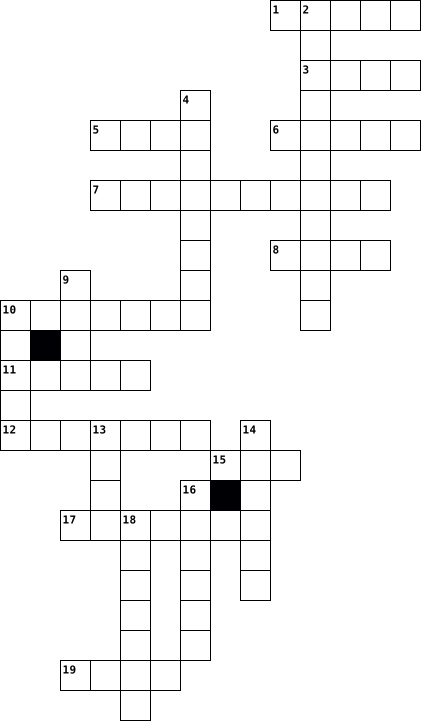
Across
- Contract An implicit agreement among the members of a society to cooperate for social benefits.
- Jeopardy A procedural defence that prevents an accused person from being tried again on the same charges.
- of Confederation Established the functions of the national government of the United States.
- Compromise Provided a dual system of congressional representation.In the House of Representatives each state would be assigned a number of seats in proportion to its population. Three-Fifth Compromise Agreement between delegates from the Northern and the Southern states that three-fifths of the slave population would be counted for determining direct taxation and representation.
- Thinkers Developed theories of government in which some or even all the people would govern.
- He is the principal source of the theory of separation of powers.
- sovereignty Said that people of federal territories should decide for themselves whether their territories would enter the Union as free or slave states.
- Smith Wrote the first comprehensive system of political economy.
- review Review by the US Supreme Court of the constitutional validity of a legislative act.
- Rights Rights that are not dependent on the laws or customs of any particular culture or government.
- of Independence The formal proclamation that the colonies would now be an independent country separate from Great Britain.
- Domain The right of a government or its agent to expropriate private property for public use.
- Bill of Rights Outlined specific constitutional and civil rights and ultimately gave Parliament power over the monarchy.
- Plan Outlined a strong national government with three branches legislative, executive, and judicial.
- Clause Prohibits the government from "establishing" a religion.
Down
- Locke One of the most influential of Enlightenment thinkers and commonly known as the "Father of Liberalism".
- Compact The first governing document of Plymouth Colony.
- The quality of being in accordance with a political constitution.
- College Compromise A compromise between two main proposals the popular election of the President and the election of the President by Congress.
- Jersey Plan Proposed a unicameral (one-house) legislature with equal votes of states and an executive elected by a national legislature.
- Neglect Avoiding strict enforcement of parliamentary laws, especially trade laws, as long as British colonies remained loyal.
- House of Burgesses The elected representative element of the Virginia General Assembly.
- To sign or give formal consent to (a treaty, contract, or agreement.)
- Exercise Clause Protects citizens' right to practice their religion as they please, so long as the practice does not run afoul of a "public morals" or a "compelling" governmental interest.
- Carta A charter of liberties to which the English barons forced King John to give his assent.
- and balances Ensuring that political power is not concentrated in the hands of individuals or groups.
- Democracy: Democracy where elected persons represent a group of people.
27 Clues: Compact The first governing document of Plymouth Colony. • Clause Prohibits the government from "establishing" a religion. • Smith Wrote the first comprehensive system of political economy. • The quality of being in accordance with a political constitution. • He is the principal source of the theory of separation of powers. • ...
Customer Service Week 2023-09-27

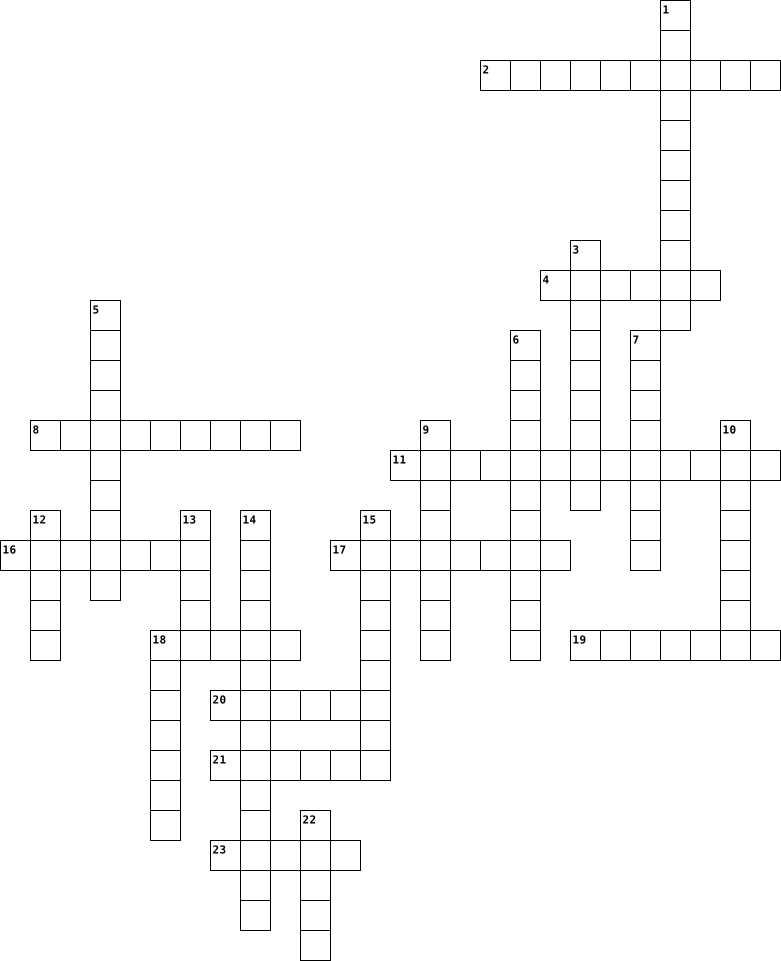
Across
- Governmental/major accounts
- Hi-low____
- Don't forget your customer _____
- Repairs electric wires
- _____ meeting
- Low income
- Daily ___
- Covers 71% of the Earth
- Disputes, LLA, discounts
- Waitlisted
- Bill segment (incomplete)
- Bill cancel
- Water or electric
Down
- Working from home
- Meeting
- ______& rebill
- Private ______
- Billing _____ & Review
- ____ ground leak
- Powered by the sun
- ______billing
- _____ service charge
- The ___ mile
- Odd or even
- Do not _____
25 Clues: Meeting • Daily ___ • Hi-low____ • Low income • Waitlisted • Odd or even • Bill cancel • The ___ mile • Do not _____ • _____ meeting • ______billing • ______& rebill • Private ______ • ____ ground leak • Working from home • Water or electric • Powered by the sun • _____ service charge • Billing _____ & Review • Repairs electric wires • Covers 71% of the Earth • Disputes, LLA, discounts • Bill segment (incomplete) • ...
Verizon Customer Service 2015-12-21

Across
- applies when the customer purchases a new device at a discount
- when a customer uses more than the plan or feature allowance
- assessed when there is past due balance of $5 or greater
- when a customer only receives an electronic copy of the bill
- reprint fee fee that is charged to reprint a bill through customer service
- what is done when the customer wants to have service transferred into someone else name
- call detail is included in the customer's bill with this feature
- used when an ESN swap needs to be done on an account & both devices are 4g and active
- fee that is charged when service is interrupted due to non-payment
- allows customer to choose phone numbers they call that will be unlimited even if they are not Verizon numbers
- charged when a device is returned or exchanged
- when a customer is paying for the device over a 24 month period
Down
- occurs when a customer uses services on another carrier's network and usage is reported after the bill is released or when unexpected conditions occur in our network disrupt the communication to billing
- unlimited calls between Verizon customers
- partial charges that result from on demand changes
- a printed bill that includes a breakdown for all charges but does not include call detail
- a call placed to a location outside of the plan's coverage
- when a customer keeps their number and leaves/comes to Verizon
- charged when there is a new line of service
- this charge is assessed when a customer cancels service before fulfilling the contract
- alert sent when 75%, 90% & 100% of an allowance has been used
- allows a customer to purchase equipment and pay for it on the next statement
- an additional copy of a statement
- the last day of the billing period
- using services while located in an area outside of the plan's coverage
- a service that allows customers to monitor and control usage
26 Clues: an additional copy of a statement • the last day of the billing period • unlimited calls between Verizon customers • charged when there is a new line of service • charged when a device is returned or exchanged • partial charges that result from on demand changes • assessed when there is past due balance of $5 or greater • ...
Historical Findings 2023-12-21

Across
- In blank 1830, visitors to the senate listened to senator Robert Hayne of South Carolina.
- Blank, opposed many parts of the whig program.
- Blank Carolina's economy had failed.
- The issue of states' rights was finally put to a blank in 1832.
- Jacksons blank and policies had angered many people.
- A bloody confrontation seemed inevitable until blank Clay stepped in.
- The democrats chose vise president blank as their candidate.
- Blank was in an unusually dangerous position in the government.
Down
- Jackson persuaded congress to pass the blank bill in 1833.
- The north was getting what?
- Blank Hayne was a senator of the south.
- In 1828, Calhoun wrote down his blank in a document.
- Calhoun was building a carrer as a national what?
- Calhoun supported the protective blank of 1816.
- Who was helping the north get rich?
- Blank Biddle decided to have the bank call in or demand repayment loans.
16 Clues: The north was getting what? • Who was helping the north get rich? • Blank Carolina's economy had failed. • Blank Hayne was a senator of the south. • Blank, opposed many parts of the whig program. • Calhoun supported the protective blank of 1816. • Calhoun was building a carrer as a national what? • In 1828, Calhoun wrote down his blank in a document. • ...
Government Crossword Puzzle 2014-04-07

Across
- part of a committee
- ending a debate then taking a vote
- party enforcers
- powers assumed in the constitution
- a part added to a bill by a legislature that's meant to backdoor its way into becoming a law/bill
- section 8, clause 18
- stalling
- a formal expression of intention
- highest officer of an organized group
- an administrator of a board
- voters in a specific area that elect a representative
- presiding officer of a senate
- power that limits states on regulating their own economy
- manipulating boundaries
- remove from power
Down
- practice that gives the chair of the committee to the party with the longest service on the committee
- powers shown in the constitution
- before law
- a permanent committee
- to reject a decision made by law
- representative
- a small legislative committee made for a specific reason
- back up vice president
- main officer of US House of Representatives
- the leader of a party in a legislative group
- rearrange
- receive
27 Clues: receive • stalling • rearrange • before law • representative • party enforcers • remove from power • part of a committee • section 8, clause 18 • a permanent committee • back up vice president • manipulating boundaries • an administrator of a board • presiding officer of a senate • powers shown in the constitution • to reject a decision made by law • a formal expression of intention • ...
Restaurants 2021-11-25
Across
- drink
- soup
- menu
- drink
- restaurant
- bill
- starter
- lunch
- dessert
- pay
- receipt
- chef
Down
- reservation
- customer
- main
- salad
- side
- waiter
- dinner
- counter
20 Clues: pay • soup • menu • bill • main • side • chef • drink • drink • salad • lunch • waiter • dinner • starter • dessert • receipt • counter • customer • restaurant • reservation
Sunshine 3 P1 2022-05-02

Across
- A place in India which is famous for lunch delivery system.
- Jumbled world : nascittaf
- It is popular in Japan.
- Bill haven't ________ about ekiben.
- Character bento is ____________ in Japan?
- Bill doesn't like __________ but he can eat them through the bentos.
- It's fun to find your __________ ekiben on a trip.
- it is a bento available at train stations.
Down
- Who made the bentos? Answer: Mao's ___________.
- What food from Hiroshima is available at ekibens?
- Cherry blossoms are so ____________.
- It's almost ______ so Bill and Mao are going to eat lunch.
- Today many countries have developed their own unique lunch ________.
- Jumbled world : yeldiver
- Someday Bill wants to travel around Japan and try ekibens.
- Jumbled world : tonirutin
- The bentos are so cute and ___________.
- Mao and Bill are going to eat their __________.
18 Clues: It is popular in Japan. • Jumbled world : yeldiver • Jumbled world : nascittaf • Jumbled world : tonirutin • Bill haven't ________ about ekiben. • Cherry blossoms are so ____________. • The bentos are so cute and ___________. • Character bento is ____________ in Japan? • it is a bento available at train stations. • Who made the bentos? Answer: Mao's ___________. • ...
page1 2026-03-19

Across
- A 1911 Supreme Court decision that directed the breakup of the Standard Oil Company into smaller companies because its overwhelming market dominance and monopoly power violated antitrust laws.
- A 1906 antitrust law that empowered the federal Interstate Commerce COmmission to set railroad shipment rates wherever it believed that railroads were unfairly colluding to set prices.
- A 1902 law, supported by President Theodore Roosevelt, that allowed the federal government to sell public lands to raise money for irrigation projects that expanded agriculture on arid lands.
- York A 1905 Supreme Court ruling that New York State could not limit bakers’ workday to ten hours because that violated barkers’ rights to make individual contracts. This example of legal formalism did not take into account the unequal power of employers and individual workers.
- A policy promoted by Republican governor Robert La Follette of Wisconsin for greater government intervention in the economy, with reliance on experts, particularly progressive economists, for policy recommendations.
- An 1892 statement by the Populists calling for public ownership of transportation and communication networks, protection of land from monopoly and foreign ownership, looser monetary policy, and a federal income tax on the rich.
- An 1898 Supreme Court ruling that allowed states to impose poll taxes and literacy tests. By 1908, every southern state had adopted such measures to suppress voting by African Americans and some poor whites.
- A policy of loosening the money supply by expanding federal coinage to include silver as well as gold, to encourage borrowing and stimulate industry. Democrats advocated the measure, most famously in the 1896 presidential campaign, but Republicans won and retained the gold standard.
Down
- Landmark 1890 act that forbade anti-competitive business activities, requiring the federal government to investigate trusts and any companies operating in violation of the act.
- A reform organization that worked (unsuccessfully) to win a federal law banning child labor. The NCLC hired photographer Lewis Hine to record brutal conditions in mines and mills where thousands of children worked.
- Progressive Era public payments to mothers who did not have help from a male breadwinner. Recipients had to meet standards of “respectability” defined by middle-class home visitors, reflecting a broader impulse to protect women but hold them to different standards than men.
- A 1908 Supreme Court case that upheld an Oregon law limiting women’s workday to ten hours, based on the need to protect women’s health for motherhood. Muller established a groundwork for states to protect workers but divided women’s rights activists, some of whom saw it as discriminatory.
- Also known as the Federal Election Bill of 1890, a bill proposing that whenever one hundred citizens in any district appealed for intervention, a bipartisan federal board could investigate and seat the rightful winner. The defeat of the bill was a blow to those seeking to defend African American voting rights and to ensure full participation in politics.
- Theodore Roosevelt’s 1904 campaign platform, calling for regulation of corporations and protection of consumers and the environment.
14 Clues: Theodore Roosevelt’s 1904 campaign platform, calling for regulation of corporations and protection of consumers and the environment. • Landmark 1890 act that forbade anti-competitive business activities, requiring the federal government to investigate trusts and any companies operating in violation of the act. • ...
patricia deising-civil rights movement crossword puzzle 2022-05-10

Across
- basic rights that every citizen has under the laws of the government
- a southern states flag stopped using it because they were racist
- was the politician and civil rights activist who served the united states house of representatives
- The March on ______ encourages the passage of the Civil Rights Act of 1964 and the Voting Rights Act of 1965
- parents believed the segregated school system violated the 14th amendment
- were formed to resist segregation during the civil rights movement
- focused on ending segregation and instead have peaceful protest like boycotts and sit ins
- was one of the first major events of the modern civil rights
- The ______ Movement attempted to protest all areas of discrimination,disenfranchisement,segregation
Down
- method used to fight for civil rights
- laws that kept African Americans segregated from whites
- president_______ integarted the military in 1948
- a court who ruled in favor of
- took their case to court with the help of the NAACP.
- made by the senate and the house of representatives
- the process of bringing people together who are different races
- the group made up by highschool students known for its freedom rides and the freedom summer in mississippi
- enforced different racial groups
- opened a restaurant in Atlanta Georgia where he refused to serve African Americans or those who supported integration
- peaceful protest during segregation
- MLK was the first leader of this group during segregation
21 Clues: a court who ruled in favor of • enforced different racial groups • peaceful protest during segregation • method used to fight for civil rights • president_______ integarted the military in 1948 • made by the senate and the house of representatives • took their case to court with the help of the NAACP. • laws that kept African Americans segregated from whites • ...
West Coast 2025-04-07

Across
- What colour line is 1.25kpa
- Where do you find all the contact numbers
- What is nine digits long
- What card do we do not accept for direct debit
- What do you need to do at the start of every call
- Who is the distributor
- Where do we add access details for the meter reader
- What is the name of the application used to do Bill smoothing
- Who do you transfer the complaints to
- If the account number has 8000/8001 where do you transfer the call to
- what is used to send welcome packs
- How many plans do we have
Down
- Where can you send out the welcome pack out by mail
- what is required for the customer to change their full name
- Where do you check Gas availability
- Where can you check a bill online
- If the account has a debt or bill issued you would set up a bill smoothing
- What application do you use to locate a missing payment
- What needs to be added at the end of every account that is opened
- What is the term called when you are closing one account and moving
20 Clues: Who is the distributor • What is nine digits long • How many plans do we have • What colour line is 1.25kpa • Where can you check a bill online • what is used to send welcome packs • Where do you check Gas availability • Who do you transfer the complaints to • Where do you find all the contact numbers • What card do we do not accept for direct debit • ...
The Sun Also Rises Crossword Puzzle 2017-03-29

Across
- The place Robert moved after he divorced with his wife.
- The musical instrument that Bill plays
- Likely to cause disease, morally harmful.
- The narrator and protagonist of the novel. (First name)
- To smile in a silly, self-conscious
- a person who is voluntarily absent from home or country
- The setting of the last chapter
- having decayed or disintegrated
- The issue that Harvey Stone has
- The most sportif town in the world that mentioned in the novel
- The author of The Sun Also Rises
Down
- lacking consequence.
- The place where Bill and Jake going to meet Robert
- The place where Jake and Bill going to fish (In Spain)
- City The city where Jake is from
- a serious devotee of some particular music genre
- acting with warmth or sincerity
- the front of a building, especially an imposing of decorative one.
- The person who falls in love with Brett at the beginning of the book
- The name of the little Greek portrait painter
20 Clues: lacking consequence. • acting with warmth or sincerity • The setting of the last chapter • having decayed or disintegrated • The issue that Harvey Stone has • City The city where Jake is from • The author of The Sun Also Rises • To smile in a silly, self-conscious • The musical instrument that Bill plays • Likely to cause disease, morally harmful. • ...
The Sun Also Rises Crossword Puzzle 2017-03-29

Across
- The person who falls in love with Brett at the beginning of the book
- The place where Bill and Jake going to meet Robert
- a person who is voluntarily absent from home or country
- The narrator and protagonist of the novel. (First name)
- lacking consequence.
- The name of the little Greek portrait painter
- City The city where Jake is from
- The musical instrument that Bill plays
- The most sportif town in the world that mentioned in the novel
Down
- having decayed or disintegrated
- The place where Jake and Bill going to fish (In Spain)
- acting with warmth or sincerity
- To smile in a silly, self-conscious
- The issue that Harvey Stone has
- the front of a building, especially an imposing of decorative one.
- Likely to cause disease, morally harmful.
- a serious devotee of some particular music genre
- The place Robert moved after he divorced with his wife.
- The author of The Sun Also Rises
- The setting of the last chapter
20 Clues: lacking consequence. • having decayed or disintegrated • acting with warmth or sincerity • The issue that Harvey Stone has • The setting of the last chapter • The author of The Sun Also Rises • City The city where Jake is from • To smile in a silly, self-conscious • The musical instrument that Bill plays • Likely to cause disease, morally harmful. • ...
Honors Trimester Final Crossword Puzzle 2024-02-26

Across
- it was like a rough draft for a national government
- the document that stated the nation’s ideas and goals
- despotism, authoritarianism, ruling without consent
- proportional representation in the House of Reps and equal representation in the Senate
- how decisions or elections are decided in a democratic nation
- the first ten amendments to the U.S. Constitution.
- life, liberty, and property, e.g.
- the right to vote
- also known as representative democracy or indirect democracy
- the compromise that settled how the president would be elected.
- government power is divided between three distinct branches with their own roles, powers, and people.
- the unwritten, implied agreement between individuals and society or government
- limits on government actions to protect individual rights
- evidence obtained by law enforcement in an illegal manner may not be used in court as evidence
Down
- what is best for the community
- the event that convinced people to fix the issues with the Articles of Confederation
- the president vetoing a law passed by congress, e.g.
- like the instruction manual for the Constitution, written by Madison, Hamilton, and Jay.
- anyone who is born on U.S. soil is automatically a citizen of the U.S.
- situation when majority rule is used to oppress the minority
- when a small group of people who have power and rule for their own selfish interests
- is about slavery, but never says the word slavery or slave
- the sharing of power between a national government and state governments
- putting someone on trial for the same crime twice
- legal steps government must follow before taking away someone’s natural rights
- according to Aristotle, rule by the best or most talented
- included a stronger central government with the power veto state laws and proportional representation
- guarantees by the government to protect liberty and equality
- the people are the source of government’s power
- had a stronger central government but kept equal representation
- the process of applying the Bill of Rights to the state governments
31 Clues: the right to vote • what is best for the community • life, liberty, and property, e.g. • the people are the source of government’s power • putting someone on trial for the same crime twice • the first ten amendments to the U.S. Constitution. • it was like a rough draft for a national government • despotism, authoritarianism, ruling without consent • ...
day of the triffids crossword challenge 2022-04-11

Across
- what color were the comets?
- what was used to spray water at the triffids?
- what was used to kill the triffids?
- the hospital where the story started
- where was the first triffid attack?
- the main charicter in this story was?
Down
- the man who kidnapped bill
- what was the name of chapter 6?
- what was everyone at the pub drinking?
- why didint bill go blind?
- "when I die dont bury me at all just pickle my _____ in alcohol"
- bills girlfriend and partner
- what did the man give bill when he was tied up?
- a large man eating plant
- what blinded anyone who looked at it?
15 Clues: a large man eating plant • why didint bill go blind? • the man who kidnapped bill • what color were the comets? • bills girlfriend and partner • what was the name of chapter 6? • what was used to kill the triffids? • where was the first triffid attack? • the hospital where the story started • what blinded anyone who looked at it? • the main charicter in this story was? • ...
Small Things Like These by Claire Keegan 2026-02-03

Across
- "It was a December of ...."
- Bill's wife
- The river that runs through New Ross
- The name of the girls' school in the town
- Lady who took Bill and his mother in
- Sarah's second name
- Bill's oldest daughter
- The Mother ..........
Down
- The order of nuns who run the school and laundry
- How many daughters has Bill?
- Bill could be described as .... (Good Trait)
- "The strong silent type male attitude"
- Could be Bill's father
- The river was "dark as ..."
14 Clues: Bill's wife • Sarah's second name • The Mother .......... • Could be Bill's father • Bill's oldest daughter • "It was a December of ...." • The river was "dark as ..." • How many daughters has Bill? • The river that runs through New Ross • Lady who took Bill and his mother in • "The strong silent type male attitude" • The name of the girls' school in the town • ...
become a citizen 2022-12-22

Across
- who makes federal laws
- when the president rejects a bill is called
- what is the highest court in the US
- what month do we vote for president
- what is the capital of the united states
- where is the statue of liberty
- what is the current president's name
- a change to the constitution
- who wrote the declaration of independence
- what branch is made up of the senate and house
- who advises the president
- what is a legislative proposal before Congress
- who is the commander in chief of the military
Down
- who was the first president
- supreme law of the land
- what party is the current president apart of
- what is one territory of the united states
- what branch can veto bills
- who determines if a bill is unconstitutional
- What economic system does the USA have
- how many amendments does the constitution have
- how many colonies were there
- what is one right in the first amendment
- what branch is the supreme court judges apart of
- who is the speaker of the senate
- who is in charge of the executive branch
26 Clues: who makes federal laws • supreme law of the land • who advises the president • what branch can veto bills • who was the first president • a change to the constitution • how many colonies were there • where is the statue of liberty • who is the speaker of the senate • what is the highest court in the US • what month do we vote for president • what is the current president's name • ...
Goverment 2026-05-08

Across
- The rights of equality under the law.
- The ability to get others to do what you want.
- Asserts that the enumeration of certain rights in the Constitution does not deny or disparage others retained by the people.
- Responsible for enforcing laws and carrying out the policies of the government. It includes the President, Vice President, and the Cabinet.
- Affirms that powers not delegated to the federal government are reserved to the states or the people.
- Protects the right to keep and bear arms.
- Provides for the right to trial by jury in civil cases.
Down
- The blank is a legislative body in many countries, including the United States and Japan. It drafts laws, approves budgets, and represents the population based on proportional distribution.
- A proposed law introduced for debate and approval.
- Prohibits excessive bail, excessive fines, and cruel and unusual punishment.
- Responsible for interpreting laws and ensuring they are applied fairly. It includes the Supreme Court and lower federal courts.
- Responsible for making laws. It consists of Congress, which is divided into the House of Representatives and the Senate.
- The process by which government decisions are made.
- Ensures the right to due process and protects against self-incrimination and double jeopardy.
- Guarantees the right to a fair and speedy trial by an impartial jury.
- Each branch can limit the others to prevent overreach.
- Guarantees freedoms of religion, speech, press, assembly, and petition.
- The legislative branch of the federal government, composed of the Senate and House of Representatives, responsible for making federal laws.
- Prohibits the quartering of soldiers in private homes without consent.
- Protects against unreasonable searches and seizures; warrants require probable cause.
20 Clues: The rights of equality under the law. • Protects the right to keep and bear arms. • The ability to get others to do what you want. • A proposed law introduced for debate and approval. • The process by which government decisions are made. • Each branch can limit the others to prevent overreach. • Provides for the right to trial by jury in civil cases. • ...
Gravity Falls 2024-02-20

Across
- question mark
- Season 2 finale
- founder of The Society of the Blind Eye
- Mabel and Dipper are ________ years old
- The author of the journals is Stan's __________
- pine tree
- wants to forget seeing little men
- shooting star
- loves puppets
Down
- The twins are from what state?
- Monster in the bunker
- pink
- Caesar cipher number
- _______ you later
- Bill tricks Mabel to get this
- machine / secret door
- unicorn _____
- _____ cipher
18 Clues: pink • pine tree • _____ cipher • question mark • unicorn _____ • shooting star • loves puppets • Season 2 finale • _______ you later • Caesar cipher number • Monster in the bunker • machine / secret door • Bill tricks Mabel to get this • The twins are from what state? • wants to forget seeing little men • founder of The Society of the Blind Eye • Mabel and Dipper are ________ years old • ...
Unit 4 Vocabulary 2022-03-04

Across
- the ability of the Court to declare a Legislative or Executive act in violation of the Constitution,
- a judicial opinion that is joined by more than half the judges deciding a case.
- in charge of deciding the meaning of laws, how to apply them to real situations, and whether a law breaks the rules of the Constitution.
- political powers granted to the United States government that aren't explicitly stated in the Constitution
- those not explicitly stated in the :Constitution that allows the government to take actions, which are needed to efficiently perform essential duties.
- a system of government in which the same territory is controlled by two levels of government
- If a federal official commits a crime or otherwise acts improperly, the House of Representatives may impeach—formally charge—that official.
- occurs when Congress adjourns during the ten-day period. The president cannot return the bill to Congress. The president's decision not to sign the legislation is a pocket veto and Congress does not have the opportunity to override.
- the introductory part of a constitution or statute that usually states the reasons for and intent of the law.
- not according or consistent with the constitution of a body politic (such as a nation) an unconstitutional infringement on rights
- made up of the House and Senate, known collectively as the Congress. Among other powers, the legislative branch makes all laws, declares war, regulates interstate and foreign commerce and controls taxing and spending policies.
- the separate judicial opinion of an appellate judge who disagreed with the majority's decision explaining the disagreement.
- an addition or alteration made to a constitution
Down
- a statement in the U.S. Constitution (Article I, Section 8) granting Congress the power to pass all laws necessary and proper for carrying out the enumerated list of powers.
- the highest court in the United States.
- a political philosophy based on the idea that government authority is derived from the people and should be limited by a constitution that clearly expresses what the government can and cannot do
- permanent committees established under the standing rules of the Senate and specialize in the consideration of particular subject areas.
- one whose legalized force and power is restricted through delegated and enumerated authorities
- made up of the House and Senate, known collectively as the Congress. Among other powers, the legislative branch makes all laws, declares war, regulates interstate and foreign commerce and controls taxing and spending policies.
- the division of government responsibilities into distinct branches to limit any one branch from exercising the core functions of another.
- principle of government under which separate branches are empowered to prevent actions by other branches and are induced to share power
- a distinct often numbered section of a writing an article of the constitution.
- a loosely defined term for action designed to prolong debate and delay or prevent a vote on a bill, resolution, amendment, or other debatable question.
- specifically granted to the federal government in Article I, Section 8 of the Constitution.
- The power of the President to refuse to approve a bill or joint resolution and thus prevent its enactment into law
- powers that are not specifically granted to the federal government by the Constitution.
- powers which are shared by both the federal government and state governments.
- a controversial political doctrine according to which the people of federal territories should decide for themselves whether their territories would enter the Union as free or slave states.
- a principle under which all persons, institutions, and entities are accountable to laws that are: Publicly promulgated. Equally enforced. Independently adjudicated. And consistent with international human rights principles.
29 Clues: the highest court in the United States. • an addition or alteration made to a constitution • powers which are shared by both the federal government and state governments. • a distinct often numbered section of a writing an article of the constitution. • a judicial opinion that is joined by more than half the judges deciding a case. • ...
The Canadian Government 2022-09-30

Across
- Represents the Monarch in Canada and must sign a bill into law.
- The MP who is leader of the party that wins the most seats in an election (forming the government).
- Level of government that deals with education, healthcare, and highways.
- Another word for an electoral district is a ___________
- MPs from the government party not chosen to have a Cabinet position who support, cheer on, and vote with the PM.
- Level of government having the greatest degree of influence in our lives (think garbage collection, snow removal, fire, utilities, etc).
- This important duty of the Senate involves reviewing, researching, and recommending regarding important current issues in Canada.
Down
- - An MP chosen by the PM to run the House of Commons proceedings.
- - Level of government dealing with national (Canadian) issues like defence, foreign affairs, Canada Post, etc.
- Before a law can be passed in Parliament, it needs to first be introduced (usually by the PM or a cabinet minister) as a _________.
- The written rules of Canada that outline the form of government (and powers) and the rights and freedoms of Canadians.
- - They are chosen by the PM to double check bills before they become laws, providing a "sober second look".
- The Official _________ (particularly its leader) opposes the PM, attempts to expose government problems/scandals, and generally holds the government accountable.
- A federal power involving the movement of people from other countries into Canada
- Branch of the federal government that enforces and interprets the law.
15 Clues: Another word for an electoral district is a ___________ • Represents the Monarch in Canada and must sign a bill into law. • - An MP chosen by the PM to run the House of Commons proceedings. • Branch of the federal government that enforces and interprets the law. • Level of government that deals with education, healthcare, and highways. • ...
Hannah Beecher Unit 1 Test 2022-09-19

Across
- power given to 3 branches
- a state in which supreme power is held by the people and their elected representatives, and which has an elected or nominated president rather than a monarch.
- kind of agreement
- wealthy upper class shared power to govern
- the way people live
- has the power to manage conflicts
- to provide essential services, fulfill the fundamental duties of safety, prosperity, and justice, ensure the rights
- permission for something to happen or agreement to do something
- that both citizens and their leaders were willing to set aside their private interest and personal concerns for the common good
- rights to life, liberty and property
- head of state
- the people themselves control goverment
- the people themselves control goverment
- is a type of government in which the citizen have power to govern
- legal framework for the government The people and institutions with authority to make and enforce laws and manage disputes about the law
Down
- has the power to carry out and enforce laws
- being under the rule of a monarch head of state
- Means that people had to provide for themselves
- the power of different branches are balanced
- is a proposed law
- is a person elected to act and speak for others
- that which is good for the community as a whole
- means that there are limits on the powers of the person or group running the government
- the people chose a leaders to make and administer laws for their country
- The political leaders of the colonies area under the full or partial political control of another country
- has the power to make new laws
- unlimited powers
27 Clues: head of state • unlimited powers • is a proposed law • kind of agreement • the way people live • power given to 3 branches • has the power to make new laws • has the power to manage conflicts • rights to life, liberty and property • the people themselves control goverment • the people themselves control goverment • wealthy upper class shared power to govern • ...
Chapter 6 Vocabulary 2017-11-02

Across
- The political party with more than half the members of Congress involved.
- The people represented by the members of Congress
- Accuse an official of a crime
- Laws that punish people without a trial by jury.
- When a bill does not pass because the President does not sign a bill and the session of Congress ends
- Requires the police to explain in court why a person is being held.
- A permanent committee
- A formal statement of lawmakers opinions or decisions that is passed in both the House and the Senate.
- When members of Congress help people from their home districts with problems with the federal government.
- Powers of Congress that are clearly listed in the Constitution
- The party with less than half the members of Congress involved.
- Perks of being a Congressperson such as free office space.
- Type of vote in the House where members in favor of a bill stand to be counted.
- The President refuses to sign a bill.
- Clause 18 of Article One that allows Congress to stretch its powers.
Down
- The 3/5 vote to end a filibuster.
- Government projects or grants the mostly benefit the home district or state.
- Type of vote in the Senate where members vote aloud.
- Law that makes an act a crime after it has been committed.
- Organization made up of people with common interests.
- People hired by private groups to influence government decision makers.
- Population count done every ten years
- An oddly shaped district designed to increase the voting strength of a particular group
- Years of service
- Powers of Congress that are not listed but give Congress the power to carry out their expressed powers.
- Type of vote in the House where members vote aloud.
- Senators can talk about a bill for as long as they want.
27 Clues: Years of service • A permanent committee • Accuse an official of a crime • The 3/5 vote to end a filibuster. • Population count done every ten years • The President refuses to sign a bill. • Laws that punish people without a trial by jury. • The people represented by the members of Congress • Type of vote in the House where members vote aloud. • ...
How a Bill becomes a law 2026-02-24

Across
- formal disapproval by a president
- vote level that must be reached for a bill to pass
- person who signs a bill into law
- group who can introduce bills in Congress
- Senate vote that pushes a bill towards a vote
- branch in charge of enforcing laws
Down
- branch in charge of creating laws
- must start all bills that deal with taxes
- committee who reconciles the different versions of House and Senate bills
- long speeches in the Senate that prevent action on a bill
- where most bills die in the legislative process
- branch in charge of interpreting laws
- Chamber that has 100 members
13 Clues: Chamber that has 100 members • person who signs a bill into law • branch in charge of creating laws • formal disapproval by a president • branch in charge of enforcing laws • branch in charge of interpreting laws • must start all bills that deal with taxes • group who can introduce bills in Congress • Senate vote that pushes a bill towards a vote • ...
Enlightenment 2023-11-20
Across
- heliocentric
- Vaccinations
- enlightened despot
- US first form of government was Articles of ______
- forced to recant support for heliocentric teaching
- anatomy
- belief in God but question Christianity
- Grand and ornate
- Social contract
- laws of gravity
- Gathering to discuss enlightenment
Down
- French social critiques
- logic
- earth centered
- separation of powers
- rights of accused criminals
- Speech
- individual free choice through social contract
- Empiricism
- chemistry
- women's rights
- Declaration of Independence
- encyclopedia
- natural rights
24 Clues: logic • Speech • anatomy • chemistry • Empiricism • heliocentric • Vaccinations • encyclopedia • earth centered • women's rights • natural rights • Social contract • laws of gravity • Grand and ornate • enlightened despot • separation of powers • French social critiques • rights of accused criminals • Declaration of Independence • Gathering to discuss enlightenment • belief in God but question Christianity • ...
Third nine weeks study assigment 2021-03-05

Across
- right
- prohibits discrimination
- regulating the money supply.
- independence
- political values, ideology
- long-lasting effect of the events
- Amish, rights to religious freedom
- protection under the law
- poll to sway voters
- "level playing field"
- armband protest, 1st amendment
- economic theory, gov stabilize econ
- allows African Americans to vote
- no one is above the law
- abortions
- first 10 amendments
- public opinion on an issue
- left
- 14th amendment, gov. deny people
- protect religious belief
- prayer school, establishment clause
- gov. limits freedom to publish
- individual liberty
Down
- prohibits denial substantive rights
- prohibits gov. to involve religion
- shared views
- rights to a counsel
- laissez-fare
- opinion change, major point in life
- individual rights protected by law
- measure of accuracy of a poll
- "clear and present danger"
- limit state regulation civil rights
- concept of federalism, funding
- a method of poll selection
- economic theory by president reagan
- gov. can't take away rights
- prohibit education discrimination
38 Clues: left • right • abortions • shared views • laissez-fare • independence • individual liberty • rights to a counsel • poll to sway voters • first 10 amendments • "level playing field" • no one is above the law • prohibits discrimination • protection under the law • protect religious belief • political values, ideology • "clear and present danger" • a method of poll selection • public opinion on an issue • ...
U.S. Currency 2025-09-02

Across
- Fifty-cent rarity, Kennedy’s bold imprint
- Smallest unit, often overlooked but ever-present
- Tangible currency, exchanged in everyday trade
- Paper or coin, from Washington to Sacagawea
- Formal term for printed money, backed by trust and treasury
- Five-cent piece, Jefferson’s profile and Monticello’s grace
- Jackson’s greenback, controversial and common
- Paper tender, folded and passed hand to hand
Down
- Lincoln’s purple bill, honest and foundational
- Rare bill, Jefferson’s note of quiet circulation
- Twenty-five cent coin, Washington’s face and state pride
- Franklin’s blue-hued note, wisdom and wealth combined
- Copper coin worth one cent, Lincoln’s enduring silhouette
- Ten-cent silver whisper, Roosevelt’s legacy in miniature
- Grant’s broad-faced bill, Civil War strength in ink
- Metallic currency, jingling with federal imprint
- Hamilton’s golden note, treasury’s founding mind
17 Clues: Fifty-cent rarity, Kennedy’s bold imprint • Paper or coin, from Washington to Sacagawea • Paper tender, folded and passed hand to hand • Jackson’s greenback, controversial and common • Lincoln’s purple bill, honest and foundational • Tangible currency, exchanged in everyday trade • Smallest unit, often overlooked but ever-present • ...
Government 2015-10-05

Across
- A person who has full political and civil rights in his or her country
- A person living in an area in Canada represented by a Member of Parliament
- The government's plan for how it will collect and spend money each year
- The agreement by the provinces to join together to form the nation of Canada and create a federal Parliament.
- A proposal for a law to be considered by Parliament
- The process of choosing a representative by vote.
- A group made up of all Senators and Members of Parliament from the same political party
Down
- A group of Senators or MP selected to study a specific subject or bill and write a report about it
- The bringing to an end of a Parliament, either at the end of its four year term or if the government is defeated on a motion of non-confidence by proclamation\
- To pick one person from a group of several people by voting
- A formal event that follows rules or traditions
- Of two chambers or rooms. Canada's Parliament is made up of two separate chambers. They are the Senate and the House of Commons.
- A group of Ministers. Cabinets makes decisions about the Government's priorities and policies
- A person who is normally a MP or a Senator who is chosen by the Prime Minister and appointed by the Governor General to help govern. Usually the head of a government department.
- To change or improve something; for example, a law
- The person in charge of a meeting
16 Clues: The person in charge of a meeting • A formal event that follows rules or traditions • The process of choosing a representative by vote. • To change or improve something; for example, a law • A proposal for a law to be considered by Parliament • To pick one person from a group of several people by voting • ...
Securities 2025-10-13

Across
- Securities that are short-term, safe, and liquid financial instruments
- securities serving as a substitution for a share.
- A certificate showing ownership in a mutual fund
- Regular payments to shareholders from company profits
- A written unconditional order to pay a certain sum of money
Down
- The most common type of share, giving voting rights
- A saving product where each deposit and withdrawal is recorded
- A negotiable instrument ordering a bank to pay a specific amount of money
- Long-term securities representing ownership in a company
- A security maturing within one year, issued by a government or bank
10 Clues: A certificate showing ownership in a mutual fund • securities serving as a substitution for a share. • The most common type of share, giving voting rights • Regular payments to shareholders from company profits • Long-term securities representing ownership in a company • A written unconditional order to pay a certain sum of money • ...
government crossword 2021-01-06

Across
- explains the purposes of the Constitution, and defines the powers of the new government as originating from the people of the United States
- type of democracy based on the protection of individual rights from the tyranny of the majority and on the consent of the governed to establish political authority
- compromise reached in writing the Constitution to satisfy both small and large states by having one house of Congress with an equal number of representatives for each state and the other house’s membership determined by a state’s population
- power is held at the national level, with very little power being held in political subdivisions, such as provinces, states, counties, parishes, or tow
- government is defined by law and serves the people; the law is above everyone and it applies to everyone, whether ruler or the ruled
- French writer who introduced the idea of separation of powers and checks and balances to prevent one part of government from becoming too powerful
- believed in natural rights- life, liberty and property; strongest influence on Thomas Jefferson, who wrote natural rights into the Declaration of Independence
- each branch of government is subject to a number of constitutional restraints, or checks, by the other branches so no single branch becomes too powerful
- considered intelligent and decisive, he was a leading supporter of the Constitution and helped write the Federalist Papers
- belief that monarchs were chosen by God; gave the monarch unlimited authority
- first ten amendments to the Constitution, added by the first Congress in 1791; protects the
- government attempts to control all facets of the lives of its citizens
Down
- division of the powers in our government among the legislative, executive, and judicial branches; no one branch has too much power
- the government is not all powerful; its powers are limited, and the acts of the government are those willed by the people Constitution were written
- king/queen controls all aspect of life: social, economic, and political – often times tied to divine right of kings (authority from God)
- Article I, Section 8, Clause 18 of the Constitution that gives Congress the right to pass all laws “necessary and proper” to carry out the other powers listed in Article I
- English political philosopher whose Social Contract Theory believed that in order to live together, individuals in a society give up their natural rights to a higher authority for the sake of protection
- group of people who feared the new government created by Constitution; gave too much power to the national government at the expense of individual rights
- compromise between slave states and free states to count three-fifths of the slave population in a state when allocating how many representatives a state was entitled to in the House of Representatives
- the distribution of power between the national government and the states within a union
- “Father of the Constitution” and fourth president of the United States; essential to the writing and ratification of the Constitution; he also wrote the first 10 amendments to the Constitution that were ratified as the Bill of Rights
- rights and liberties of the people
22 Clues: rights and liberties of the people • government attempts to control all facets of the lives of its citizens • belief that monarchs were chosen by God; gave the monarch unlimited authority • the distribution of power between the national government and the states within a union • ...
Government Vocabulary #2 2022-12-17

Across
- a draft of a proposed law presented to parliament for discussion
- sets out those rights and freedoms that Canadians believe are necessary in a free and democratic society
- was to make French the commonly used language of Quebec
- a Member of Parliament who does not hold office in the government or opposition and who sits behind the front benches in the House of Commons
- a system of government in which most of the important decisions are made by state officials rather than by elected representatives
- A comprehensive system of rules and principles usually arranged in codes and easily accessible to citizens and jurists
- British Columbia has a law to protect and promote human rights
- oversees the work of the Commissioner of Canada Elections who ensures that all provisions of the Canada Elections Act
- a system of government in which most of the important decisions are made by state officials rather than by elected representatives
- work in an organized and active way toward a particular goal
- a failed attempt by Prime Minister Brian Mulroney and all 10 provincial premiers to amend the Canadian Constitution
- the set of conditions required to make changes to the Constitution
Down
- a federal political party in Canada devoted to Quebec nationalism and the promotion of Quebec sovereignty
- a meeting at which local members of a political party register their preference among candidates running for office or select delegates to attend a convention
- The Act divided the province of Canada into Quebec and Ontario
- Identity Theft and Identity Fraud
- the elected government of a First Nations band
- a leader or ruler of a people or clan.
- a body of advisers to the president, composed of the heads of the executive departments of the government
- an economic and political system in which a country's trade and industry are controlled by private owners for profit.
20 Clues: Identity Theft and Identity Fraud • a leader or ruler of a people or clan. • the elected government of a First Nations band • was to make French the commonly used language of Quebec • work in an organized and active way toward a particular goal • The Act divided the province of Canada into Quebec and Ontario • ...
Essential/government vocab 2023-11-17

Across
- an ---- is a change to the constitution
- a direct democracy
- the president vetoing a law that congress passes
- a ---- is when a bill is rejected
- an example of -------- would be if a person committed a crime the gov. couldn't put them to death just because
- congress made a law that you have to wear a seatbelt
- a local gov. made a decision against the constitution and the Supreme Court declared it invalid
- the US has a ----- where there is one central power, and people have individual rights
- an --- is when a judge signs an order for someone to be arrested
Down
- someone who wants something to pass might start a -----
- ------ are rights granted to individuals (life,liberty,pursuit of happiness)
- the gov. has to use a --- so that it doesnt spend more than it's income
- when congress passed a law that U.S. citizens must wear a seatbelt, U.S. Citizens must wear a seatbelt
- the president makes a bad decision and the house decides to --- the president
- ---- are powers directly stated in the constitution
- the judicial, executive, and judicial branch all having their own responsibilities
- 9 states had to ----- the constitution
- a ---- is when a place has to be searched according to a judge
- tax a ---- is money paid in order to vote
- when there is one central power and multiple smaller powers shared
- when two or more countries make an agreement it is called a ----
21 Clues: a direct democracy • a ---- is when a bill is rejected • 9 states had to ----- the constitution • an ---- is a change to the constitution • tax a ---- is money paid in order to vote • the president vetoing a law that congress passes • ---- are powers directly stated in the constitution • congress made a law that you have to wear a seatbelt • ...
Bill Pay Knowledge Check 2023-11-26

Across
- Bill Pay limit resets after 30 days, not at the first of each ___
- Member can only add Ebill if they have a login and _____ for the biller
- Fee for Business Bill Pay is ____.95
- This share is required to qualify for Bill Pay
- Recipient of money transfer must live within this country
- Department who can increase bill pay limit
Down
- Bill Pay checks are ____ checks
- ACH submitted after this time will go out the following business day
- Members can pay an ______ amount of bills through Bill Pay
- Business Bill Pay must be turned on, Consumer is enrolled ______
10 Clues: Bill Pay checks are ____ checks • Fee for Business Bill Pay is ____.95 • Department who can increase bill pay limit • This share is required to qualify for Bill Pay • Recipient of money transfer must live within this country • Members can pay an ______ amount of bills through Bill Pay • Business Bill Pay must be turned on, Consumer is enrolled ______ • ...
Legislation 2025-01-27

Across
- A proposed law presented to a legislature for enactment
- The process by which a bill becomes a law
- The final approval needed for a bill to become a law
- A formal meeting where lawmakers discuss bills and policies
- The upper chamber of the United States Congress
- Elected officials in the House who represent districts
- A group of lawmakers assigned to review specific subjects like agriculture or defense
Down
- The act of influencing legislators to support or oppose certain policies
- A prolonged speech that obstructs progress in a legislative assembly
- The process of charging a public official with misconduct
- The power of the president to reject a bill
- A formal change or addition proposed to a bill or constitution
12 Clues: The process by which a bill becomes a law • The power of the president to reject a bill • The upper chamber of the United States Congress • The final approval needed for a bill to become a law • Elected officials in the House who represent districts • A proposed law presented to a legislature for enactment • The process of charging a public official with misconduct • ...
The U.S Constitution 2013-03-29

Across
- How many original states were there?
- They become president of the United States if the president should die
- How many full terms can the president of the United States serve?
- The head executive of a city government
- One of the two houses of Congress known as the upper house
- The Declaration of Independence was adopted on July 4, _____76
- In which month is the new president inaugurated?
- We elect each senator for a term of _____ years
Down
- The right to freedom of ____ is guaranteed by the Bill of Rights
- The chief executor of the executive branch
- The first ten amendments
- One of the 3 branches of government
- What branch of government is the president in?
- The number of amendments in the Constitution
- A Boston patriot, Paul _____ rode to warn Lexington and Concord that the British were marching their way
- In the Senate there are two senators from each ____ to represent that state
- How many branches are there in the government of the United States?
- Has the power to declare war
18 Clues: The first ten amendments • Has the power to declare war • One of the 3 branches of government • How many original states were there? • The head executive of a city government • The chief executor of the executive branch • The number of amendments in the Constitution • What branch of government is the president in? • We elect each senator for a term of _____ years • ...
Chapter 2- Outliers 2023-01-16

Across
- Author of book
- Years of time period to be the "perfect age"
- software name Bill Joy created
- How outliers achieve this much practice
- Prior computer programming need, cardboard(43)
- A member of the Beatles
- Amount of years said to complete 10,000 hours (41)
- Bill Gates: October 28, 1955 (3 words)
- Silicone Valley firm cofounded by Joy
- Where Gates & friends stole computer time
Down
- Company which Gates & classmates tested out software on weekends which eventually went bankrupt
- Name of computer language still used today
- School Gates attended where he got first real time programming experience
- Known as the "Edison of the internet"
- College where Bill Joy went
- Magic number for true expertise
- A British rock band who practiced at the Indra
- "Something that is classified differently from a main or related body" (Book name)
- Number of times the Beatles traveled to Hamburg
- Founder of Microsoft company
- Studies included pianists and
21 Clues: Author of book • A member of the Beatles • College where Bill Joy went • Founder of Microsoft company • Studies included pianists and • software name Bill Joy created • Magic number for true expertise • Known as the "Edison of the internet" • Silicone Valley firm cofounded by Joy • Bill Gates: October 28, 1955 (3 words) • How outliers achieve this much practice • ...
Bookings and Payments 2025-09-29

Across
- Offer money as payment
- When handling cash, entering cash tendered should be done at this stage
- A piece of information required for a customer booking
- Could be asked as an extra for a special requirement
- An electronic method of booking a table
- You can seek advice from this person if a customer forgets their pin
- An outdates method of payment
- How a booking should be handled
Down
- Reason for us having a billing system
- The billing system monitors
- Should be included on a customers bill
- The 5th stage that should be done when taking a phone call
- When preparing a bill, this is something that could go wrong.
- A special type requirement
- Method of payment that substitutes another method of payment
- The number that should be included on a bill
- This should be done to a customer if pin is forgotten
- A of way booking a table by voice from a distance
- Tendered method of payment
- A of booking a table
20 Clues: A of booking a table • Offer money as payment • A special type requirement • Tendered method of payment • The billing system monitors • An outdates method of payment • How a booking should be handled • Reason for us having a billing system • Should be included on a customers bill • An electronic method of booking a table • The number that should be included on a bill • ...
Government 2016-02-16

Across
- proposed bill of rights
- mutual trust and cooperation that arises from the web of connections among people involved in organizations and community groups
- society is run by a few people at the top
- any significant event
- sample must have the same basic characteristics
- when we ask people about their views and then compile the results
- civil liberties also known as
- group of people with broad common interest who organize to win elections, control government, and thereby influence government policies
- legal member of a political community, with certain rights and obligations
- news media covers all major political events extensively
- sampling error that doesn't match the population
- each person in the population has a known chance of being chosen as par of the sample
- endorsable right or privilege, which if interfered with by another give rise to an action or injury
- what amendment abolished slavery
Down
- there are many different centers of power
- results from bad samples
- when pollsters assign each person an equal chance of being selected
- most political and economic events affect people unevenly, so one's social and economic status naturally affects one's views
- set of attitudes and practices held by a people that shapes their political behavior
- someone who votes, obeys all laws, pays taxes
- law that protects a person from being subject for the same offence to be twice put in jeopardy
- many officials actively campaign to generate support among the public
- sometimes used as a synonym for the relationships that create the social capital
- a person whose views on an issue can affect the view of others
- first person to puzzle over what makes someone a citizen
25 Clues: any significant event • proposed bill of rights • results from bad samples • civil liberties also known as • what amendment abolished slavery • there are many different centers of power • society is run by a few people at the top • someone who votes, obeys all laws, pays taxes • sample must have the same basic characteristics • ...
Topic 4 Vocabulary 2023-12-11

Across
- A document that sets out the laws, principles, organization, and processes of a government
- A supporter of a strong federal government
- A duty or task one is expected to carry out
- To reject, as when the President rejects a law passed by Congress
- Freedom
- To bring charges of serious wrongdoing against a public official
- To approve
- An opponent of a strong federal government
- Something received by a predecessor or from the past
- Nonmilitary
- A settlement or peaceful solution in which each side gives up some of its demands to reach an agreement or peaceful solution
- A system of government in which citizens choose representatives to govern them
- A person who enters another country in order to settle there
- Related to lawsuits involving the private rights of individuals
- A proposed law
- To change
- A feeling of love and devotion to one's country
- Understanding when something is serious and acting appropriately
Down
- A law or rule
- To overrule, as when Congress overrules a presidential veto
- A system of transit lines, highways, bridges, and tunnels
- A government in which one person or a small group holds complete authority
- Money
- Following accepted standards for conduct or behavior
- A period when business activity slows, prices and wages fall, and unemployment rises
- To give up
- To grant citizenship to a person who has met official requirements for becoming a citizen
- Having to do with being a citizen
- To restrict or put limits on
- To put private individuals or companies in charge of something
- To give evidence against
- A person who owes loyalty to a particular nation and is entitled to all its rights and protections
- Force
33 Clues: Money • Force • Freedom • To change • To give up • To approve • Nonmilitary • A law or rule • A proposed law • To give evidence against • To restrict or put limits on • Having to do with being a citizen • A supporter of a strong federal government • An opponent of a strong federal government • A duty or task one is expected to carry out • A feeling of love and devotion to one's country • ...
ZPerez_RevolutionaryCrossword 2022-02-03

Across
- During what was when the Continental Army created?
- What period of time was when King Charles II restored the monarchy?
- What war was caused by British expansion between France and Great Britain?
- Which act gave the East India Company a monopoly compared to other tea businesses?
- Who was forced by Parliment to sign the Petition of Right?
- What is known as the "Shot heard around the world"?
- Who believed in freedom of speech and religion?
- Which couple overthrew King James the II and were Prodestant?
- What war was started because King Charles tried to force one religion onto his entire kingdom?
- Who believed that people should give up some rights to the government for protection?
- What act was a response to the Boston Tea Party?
- Who authorized new translations of the Bible but did not make Puritan reforms?
- Who were the representatives who met from all colonies to write the Declaration of Rights?
Down
- Which revolution is called the "Bloodless Revolution"?
- The Stuart family took over the English throne after who died?
- Who beheaded King Charles I publically?
- Thomas Jefferson wrote the first draft of this.
- What was started by colonists throwing items at British troops which lead to the death of 5 people?
- What bill protected citizens from their governments and helped create a constitutional monarchy?
- What king was catholic and had a catholic dynasty and a son?
- What prohibited colonists from settling west of the Appalachian Mountains?
- What act required colonists to pay for printed items?
- What rule installed a republican form of government but was quickly tore up?
- Why did Great Britain control the colonies to pay off the French and Indian War?
- Great Britain recognized independence of the USA during what?
25 Clues: Who beheaded King Charles I publically? • Thomas Jefferson wrote the first draft of this. • Who believed in freedom of speech and religion? • What act was a response to the Boston Tea Party? • During what was when the Continental Army created? • What is known as the "Shot heard around the world"? • What act required colonists to pay for printed items? • ...
SISTERHOOD AMAZING RACE EDITION: BEAT THE BUZZER!!! 2026-03-03

Across
- 7th National President-involved in civil rights movement on anti-lynching bill
- Number of states in the Southern Region
- Sorority stone
- Fundamental Principles are represented by a ____ candle.
- Who speaks for the chapter?
- Pyramid flower is a _______ Carnation
- Last name of the Founder who designed Sorority Pin
- Sorority Flower
- The largest region
- 8th National President-Office of 2nd National President created under her presidency and Victory Book Drive (national book drive)
- Pyramid pin represents Mind, _______, Spirit
- Deltas age 62 or older are ______
- Torch of Wisdom is represented by a __ candle.
- There are _______ Founders of Delta Sigma Theta Sorority, Inc.
- Sacred Vow: Membership in Delta Sigma Theta is a ___________ Commitment
- The sorority _____ women to honorary membership who are recognized because of their outstanding contributions to society.
- Intelligence is the ____ of Wisdom
Down
- Your song is the...
- First requisite in keeping peace with ourselves and meriting the trust of others is what Jewel?
- Membership stands when Honorary Members are introduced during ______ assembly only.
- Structure commissioned on Howard University in 1979 and is a tribute to our Founders of Delta Sigma Theta Sorority, Inc.
- One rap
- Delta Sigma Theta has how many regions?
- Membership stands when International President or Past National Presidents enter a Delta assembly ____ or closed and remains standing until Sorors are seated.
- Jewel dedicated to Honorary Members
- Delta Sigma Theta was Founded at _______ University.
- Amaris Johnson
- 9th National President that focused on voting and equal rights for women and minorities and fair employment practices
- Three raps
- Angela Bassett and Abby Phillip are ____________ Members
- The common spirit of Sisterhood
- Who speaks for Delta? ___________ President
32 Clues: One rap • Three raps • Sorority stone • Amaris Johnson • Sorority Flower • The largest region • Your song is the... • Who speaks for the chapter? • The common spirit of Sisterhood • Deltas age 62 or older are ______ • Intelligence is the ____ of Wisdom • Jewel dedicated to Honorary Members • Pyramid flower is a _______ Carnation • Number of states in the Southern Region • ...
Civil Liberties & Civil Rights 2019-11-15

Across
- (law) the administration of justice according to established rules and principles
- U. S. Supreme Court case found that a women's right to have an abortion is protected by the implied constitutional right to privacy
- Selective incorporation make the protections from the Bill of Rights applicable to the states
- Government can interfere with speech if it will lead to evil or illegal acts.
- If a police officer has a reasonable belief that someone is committing or about to commit a crime, that officer can stop and frisk the suspect without _____________?
- Civil liberties are _______________ that the government cannot take away.
- granted women the right to vote in 1920
- Profanity, obscenity, and threats are examples of which of the following?
Down
- constitutional amendment passed by Congress but never ratified that would have banned discrimination on the basis of gender
- The Supreme Court has ruled that states can limit abortions if the regulations do not pose which of the following?
- The Alien and Sedition Acts are an example of what kind of law?
- Constitutional freedoms guaranteed to all citizens
- This secured the rights of freedmen., it gave citizenship to African- Americans
- Convicted criminals whose sentences increase during their prison term due to a change in the law have been illegally subjected to what kind of law?
- the following generally is unconstitutional is school
15 Clues: granted women the right to vote in 1920 • Constitutional freedoms guaranteed to all citizens • the following generally is unconstitutional is school • The Alien and Sedition Acts are an example of what kind of law? • Civil liberties are _______________ that the government cannot take away. • ...
Family 1 2022-09-17

Across
- billy
- sydney
- tori
- love
- riley
- friends
- zoe
- ashley
- judy
- noah
Down
- linda
- albert
- family
- steelers
- mike
- bill
- lynn
- abby
- jon
19 Clues: zoe • jon • mike • tori • love • bill • lynn • abby • judy • noah • linda • billy • riley • albert • family • sydney • ashley • friends • steelers
All about Birds for Children 2023-06-05

Across
- nectar
- bright
- wing
- fish
- camouflage
- fruit
- meat
- species
- bold
- blind
Down
- penguin
- predator
- insects
- kiwi
- beak
- male
- female
- hatch
- fish
- bill
20 Clues: kiwi • wing • beak • male • fish • fish • meat • bold • bill • hatch • fruit • blind • nectar • bright • female • penguin • insects • species • predator • camouflage
Jena's Crossword puzzle 2022-02-22

Across
- How many months of an exhausting debates did it take to make a final decision
- What were they mostly celebrating for?
- When did special conventions are cold in the states to approve or reject the new constitution?
- What did James Maddison think about the Articles of Confederation?
- What does shay’s rebellion do to peoples beliefs?
- how did they celebrate the birth of a free government?
- When was the constitution written?
Down
- What did George Washington’s expressions show about the delegates?
- What question gets debated even now in Washington?
- Who drafted the bill of rights?
- Who are those who appose the constitution?
- After how many months of an exhausting debates did it take to make a final decision?
12 Clues: Who drafted the bill of rights? • When was the constitution written? • What were they mostly celebrating for? • Who are those who appose the constitution? • What does shay’s rebellion do to peoples beliefs? • What question gets debated even now in Washington? • how did they celebrate the birth of a free government? • ...
Bilingual Glossary 2017-01-26

Across
- Account Fee
- Missing Payment
- Charges on Bill
- License Plate
- Transponder Fasteners
- Collection
- Heavy Flat Toll Charge
- Pre-Authorized Debit
- Notice of Plate Denial
- Notice of Failure to Pay
- Enforcement Fee
- Video Toll Charge
- Bankruptcy
- Bill
Down
- Duplicate Billing
- Cash Payment
- Transponder did not beep
- Transponder Lease Fee
- Misread Plate
- Paperless Billing
- Pre-Authorized Credit Card
- Consolidation
- Bank Payment
- Free Kilometers
- ETR Rewards
- Cheque Payment
- Business
- Toll
28 Clues: Toll • Bill • Business • Collection • Bankruptcy • Account Fee • ETR Rewards • Cash Payment • Bank Payment • License Plate • Misread Plate • Consolidation • Cheque Payment • Missing Payment • Charges on Bill • Free Kilometers • Enforcement Fee • Duplicate Billing • Paperless Billing • Video Toll Charge • Pre-Authorized Debit • Transponder Lease Fee • Transponder Fasteners • Heavy Flat Toll Charge • ...
Constitution Vocabulary Puzzle 2024-10-15

Across
- freedom from cruel or unusual punishment and excessive bails and fines
- decided how many representatives large and small states would send to the bicameral Congress
- against Constitution, wanted more power given to state gov’ts, wanted a bill of rights; Patrick Henry and George Mason
- rights not given to the federal gov’t are given to the states; created federalism which prevents abuse of power by central gov’t
- no unreasonable search or seizure
- 1st gov’t; weak because feared abuse of power; NO: executive branch, regulate trade; YES: negotiate treaties, declare war
- each branch of government has some power over the other two branches; helps to prevent anyone branch from becoming too powerful
Down
- agreement over how slaves would count for representation and taxation purposes
- right to trial by jury
- serve on juries, vote in elections, stay informed, obey laws
- process for admitting new states to U.S., population requirement to apply = 60,000 settlers; territories govern themselves
- freedom of religion, speech, press, assembly, and petition; gives citizens the right to make their own choices regarding religion; prohibits government from passing laws regarding religion
- supported Constitution, wanted strong central gov’t, believed it created a more stable Union; Alexander Hamilton and James Madison
13 Clues: right to trial by jury • no unreasonable search or seizure • serve on juries, vote in elections, stay informed, obey laws • freedom from cruel or unusual punishment and excessive bails and fines • agreement over how slaves would count for representation and taxation purposes • ...
Constitution Part 2 Vocab 2019-01-15

Across
- strong central government, industry, loose interpretation and federalist papers
- Congress can overturn a veto with a 2/3 vote
- this branch makes laws
- powers given to the federal government
- this branch reviews laws for constitutionality
- stated that for every five slaves, only three would count for representation and taxation
Down
- powers given to the states governments
- weak central government, agriculture, strict interpretation and bill of rights
- this branch houses the president and cabinet
- is the introduction to the Constitution laying out key principles found in the document
- powers shared between the state and national governments
- divided and shared powers between the states and national government
- to say no to
13 Clues: to say no to • this branch makes laws • powers given to the states governments • powers given to the federal government • this branch houses the president and cabinet • Congress can overturn a veto with a 2/3 vote • this branch reviews laws for constitutionality • powers shared between the state and national governments • ...
day of the triffids crossword challenge 2022-04-11

Across
- what color were the comets?
- what was used to spray water at the triffids?
- what was used to kill the triffids?
- the hospital where the story started
- where was the first triffid attack?
- the main charicter in this story was?
Down
- the man who kidnapped bill
- what was the name of chapter 6?
- what was everyone at the pub drinking?
- why didint bill go blind?
- "when I die dont bury me at all just pickle my _____ in alcohol"
- bills girlfriend and partner
- what did the man give bill when he was tied up?
- a large man eating plant
- what blinded anyone who looked at it?
15 Clues: a large man eating plant • why didint bill go blind? • the man who kidnapped bill • what color were the comets? • bills girlfriend and partner • what was the name of chapter 6? • what was used to kill the triffids? • where was the first triffid attack? • the hospital where the story started • what blinded anyone who looked at it? • the main charicter in this story was? • ...
day of the triffids crossword challenge 2022-04-11

Across
- what color were the comets?
- what was used to spray water at the triffids?
- what was used to kill the triffids?
- the hospital where the story started
- where was the first triffid attack?
- the main charicter in this story was?
Down
- the man who kidnapped bill
- what was the name of chapter 6?
- what was everyone at the pub drinking?
- why didint bill go blind?
- "when I die dont bury me at all just pickle my _____ in alcohol"
- bills girlfriend and partner
- what did the man give bill when he was tied up?
- a large man eating plant
- what blinded anyone who looked at it?
15 Clues: a large man eating plant • why didint bill go blind? • the man who kidnapped bill • what color were the comets? • bills girlfriend and partner • what was the name of chapter 6? • what was used to kill the triffids? • where was the first triffid attack? • the hospital where the story started • what blinded anyone who looked at it? • the main charicter in this story was? • ...
Scientific Revolution Overview 2025-02-27

Across
- This philosopher created the idea of 'natural rights' where all people are born with life, liberty, and property
- The vaccine for this disease (that is similar to chickenpox) was created in the late 1700s by Edward Jenner
- Astronomer who created new theories about Earth's moon, Jupiter, and the Sun
- The philosophical idea that stated that society and humankind can improve
- The philosophical belief that truth can be discovered through logical reasoning
- The scientific invention created by Gabriel Fahrenheit that measures the temperature
- This political philosopher created 70 books that fought for tolerance, reason, and freedom
- The scientific invention that was invented in 1643 by Torricelli that measures atmospheric pressure and predicts weather
- The scientific invention created in 1590 by Zacharias Janssen that zooms in on specimen
Down
- Scholars began to ___ ideas that had been accepted for hundreds of years
- Galileo Galilei's numeric guess of how many moons Jupiter had
- This theory stated that the Sun is in the middle of the universe
- The philosopher who created the Social Contract and stated that humans are naturally selfish and wicked
- Scientist and physicist who concluded that all physical objects are affected equally by the same force
- This theory stated that the Earth was in the middle of the universe
- The philosophical idea that English people centered around when creating the English Bill of Rights
- The belief that God is the creator of the universe
17 Clues: The belief that God is the creator of the universe • Galileo Galilei's numeric guess of how many moons Jupiter had • This theory stated that the Sun is in the middle of the universe • This theory stated that the Earth was in the middle of the universe • Scholars began to ___ ideas that had been accepted for hundreds of years • ...
The U.S Constitution 2013-03-29

Across
- How many full terms can the president of the United States serve?
- One of the two houses of Congress known as the upper house
- The right to freedom of ____ is guaranteed by the Bill of Rights
- They become president of the United States if the president should die
- One of the 3 branches of government
- Has the power to declare war
- The chief executor of the executive branch
- The Declaration of Independence was adopted on July 4, _____76
- The head executive of a city government
Down
- The first ten amendments
- The number of amendments in the Constitution
- We elect each senator for a term of _____ years
- How many original states were there?
- In which month is the new president inaugurated?
- What branch of government is the president in?
- In the Senate there are two senators from each ____ to represent that state
- How many branches are there in the government of the United States?
- A Boston patriot, Paul _____ rode to warn Lexington and Concord that the British were marching their way
18 Clues: The first ten amendments • Has the power to declare war • One of the 3 branches of government • How many original states were there? • The head executive of a city government • The chief executor of the executive branch • The number of amendments in the Constitution • What branch of government is the president in? • We elect each senator for a term of _____ years • ...
The haunting of Bill house 2024-12-14

Across
- my Hogwarts house
- my middle name
- my best friend
- how many schools I have attended
- my niece’s name
- the name of my secondary school
- my nandos order
- my favourite animal
- what animal was my first pet
- what scout group was I a part of
- my mums name
- my second choice football team (local)
- where does my middle name come from
- the first artist I saw in concert
- the name of my first pet
Down
- my favourite film
- my phone percentage as I am writing this
- my top artist 2024
- my pooks
- my highest prestige survivor in dead by daylight
- my favourite video game
- how many first cousins I have
- my star sign
- my favourite colour
- my Xbox gamer tag
- my dream car
- my favourite band
- my local pub
- my favourite celebrity
- my shoe size
30 Clues: my pooks • my star sign • my dream car • my mums name • my local pub • my shoe size • my middle name • my best friend • my niece’s name • my nandos order • my favourite film • my Hogwarts house • my Xbox gamer tag • my favourite band • my top artist 2024 • my favourite colour • my favourite animal • my favourite celebrity • my favourite video game • the name of my first pet • what animal was my first pet • ...
Crossword Crisps 2025-11-18

Across
- An agreement made between two parties where both sides each get something they want.
- The last name of the meatiaro of the convention.
- Want a strong Central government and do not want a
- Want a week Central government and a bill of rights
- Another name for part of the government also known as federal.
Down
- The name of the written document that has some of are laws.
- The name of a Federalists who got sick.
- A rebellion that proved the weakness of the AOC.
- The abbreviation for the name of the first form of government that was for all states.
- The date of the constitutional convention.
10 Clues: The name of a Federalists who got sick. • The date of the constitutional convention. • A rebellion that proved the weakness of the AOC. • The last name of the meatiaro of the convention. • Want a strong Central government and do not want a • Want a week Central government and a bill of rights • The name of the written document that has some of are laws. • ...
Constitutional Convention 2023-09-07

Across
- This Branch of Government enforces the laws and consists of the president and people who report to the president
- This college was not for learning but for electing the president.
- This Branch of Government makes laws and takes the form of the United States Congress
Down
- This Branch of Government evaluates laws and includes the Supreme Court and other courts
- This person was the first American president, commander of the Continental Army, president of the Constitutional Convention, and farmer.
- Britain, This country is who the United States Gained independence from.
- An article added to the US Constitution
- This person is a Founding Father, the principal author of the Declaration of Independence, and the third President of the United States.
- This person is a founding father of the United States, who fought in the American Revolutionary War, helped draft the Constitution, and served as the first secretary of the treasury
- of Rights, This document guarantees civil rights and liberties to the individual
10 Clues: An article added to the US Constitution • This college was not for learning but for electing the president. • Britain, This country is who the United States Gained independence from. • of Rights, This document guarantees civil rights and liberties to the individual • This Branch of Government makes laws and takes the form of the United States Congress • ...
Government in Texas and the U.S. 2016-04-19

Across
- sharing of power and duties
- a document that outlines fundamental laws and principles of laws
- A branch of government that contains the supreme court
- The place where the representatives meet
- made sure that all government branch were to act as a check on the powers of the other two
- a branch in government who`s power is invested in the house of representatives and the senate
- promise that the government pays for any money borrowed
Down
- wrote Texas` first of seven constitutions
- A branch that contains the president and secretary of state
- smaller assembly of the us congress with a total of 31 people
- the highest court in the judicial branch
- a document listing individual freedoms
- powers given to the state
- prevents any branch from having more power
- added to the constitution for change
- The chief executive in the executive branch
16 Clues: powers given to the state • sharing of power and duties • added to the constitution for change • a document listing individual freedoms • the highest court in the judicial branch • The place where the representatives meet • wrote Texas` first of seven constitutions • prevents any branch from having more power • The chief executive in the executive branch • ...
Civics Review 2023-12-06

Across
- each branch of government has unique abilities and checks on others.
- Supreme Court decision that is in agreement with the majority but for different reasoning
- The president controls this as the Commander in Chief
- Supreme law of the land in the U.S.
- A change to the Constitution
- Example set by prior court decision
- Legal recognition of membership in a country
- amendment that moved the voting age from 21 to 18
- Traditionally, the person who swears in a new U.S. president
- Supreme Court decision that the larger number of judges agrees with
- System of government where religion is heavily involved in decision-making.
- Intro to the Declaration of Independence
- Form of government where power is consolidated in one person with complete control
- amendment That grants freedom of the press
- Amendment barring excessive punishment punishment for breaking the law
- list of candidates that voters select from
- Management of foreign relations
- The father of the Declaration of Independence
Down
- Period of time where it was illegal to purchase, manufacture or consume alcohol in the U.S.
- legislature consisting of two lawmaking bodies
- legislative position that serves 6 year terms
- U.S. party that supports gun rights
- U.S. party that supports large amounts of government programs
- Executive power that eliminates a bill
- Proposed law
- Lack of government
- The Supreme Court decides on this aspect of a law.
- Form of government in the United States
- A system of government where a small group has complete control
- Chief diplomat
- System of government that is essentially an alliance of states
- Enlightenment thinker who pioneered the idea of separation of powers
- An organization of people who share political belief and support the election of a candidate
- Branch of government that contains congress
- Election where a party's representative is chosen
35 Clues: Proposed law • Chief diplomat • Lack of government • A change to the Constitution • Management of foreign relations • U.S. party that supports gun rights • Supreme law of the land in the U.S. • Example set by prior court decision • Executive power that eliminates a bill • Form of government in the United States • Intro to the Declaration of Independence • ...
Jeu 2022-04-02

Across
- Philosophes des .........au XVIIIe siècle
- Nom du traité en 1783
- Type de République des Etats-Unis où le gouvernement laisse de larges pouvoirs aux régions qui le composent
- Type de monarchie de la Grande-Bretagne
- Elle est acceptée le 17 septembre 1787
Down
- Prénom de celui qui devient roi en 1689 après avoir accepté le Bill of Rights
- Qualifie la révolution en 1688
- .......CORPUS en 1679, voté par les parlementaires anglais
- Nom de celui ayant publié les Lettres anglaises en 1733
- Nombre de colonies britanniques en Amérique du Nord
- Nom du premier président des Etats-Unis
11 Clues: Nom du traité en 1783 • Qualifie la révolution en 1688 • Elle est acceptée le 17 septembre 1787 • Nom du premier président des Etats-Unis • Type de monarchie de la Grande-Bretagne • Philosophes des .........au XVIIIe siècle • Nombre de colonies britanniques en Amérique du Nord • Nom de celui ayant publié les Lettres anglaises en 1733 • ...
Real Estate Terms 2025-12-09

Across
- A physical intrusion onto another’s property.
- Government authority over zoning and land-use laws.
- The right to use land owned by another.
- A claim, lien, or restriction on property use or ownership.
- Property taxes and assessments used to fund public services.
- A claim for debt against a person or property; tax liens usually priority.
- Property reverting to the state when no heirs exist.
Down
- Movable items; transfers by bill of sale.
- Land, improvements, and rights; transfers by deed.
- Government’s right to take private property with compensation.
- Personal property that becomes real by attachment; tested using MARIA.
11 Clues: The right to use land owned by another. • Movable items; transfers by bill of sale. • A physical intrusion onto another’s property. • Land, improvements, and rights; transfers by deed. • Government authority over zoning and land-use laws. • Property reverting to the state when no heirs exist. • A claim, lien, or restriction on property use or ownership. • ...
Government (30) 2015-10-02

Across
- the city where a country's legislature is located and the government carries out its business.
- a group of senators. MP's or both selected to study a specific subject or bill and write a report about it.
- A king or queen of a country.
- the specific geographic area in Canada that a MP represents in the House of Commons.
- An appointed Member of every party that manages its business in the House of Commons.
- to choose a representative in an election
- A proposal for a law to be considered my Parliament.
- Bills that are passed my Parliament.
- A change that is made to a bill, a motion or a committee report with the intention of improving it.
- the government of Canada that acts and speaks for the whole country.
- another name for questioning period.
- to change or improve something
Down
- a person living in an area in Canada represented by a member of Parliament.
- A large, heavy, silver-and-gold-covered staff that is a symbol of the power and authority of Parliament.
- the bringing to an end of a parliament.
- a formal event that follows rules or traditions
- the set of rules that a country like Canada follows to work as a nation.
- the political party with the most member usually forms this.
- a system in which the powers of the monarch are limited by the written or unwritten constitution of the country.
- Person with full political rights.
- A special title given to Governors General, Prime Ministers and Chief Justices of the supreme court of Canada.
- Someone elected to a seat in the House of Commons.
- the daily official record of debates in the senate and the House of Commons in English and French
- on of two large rooms in the Center block of the parliament buildings.
- the political party that forms the government because more of its members were elected to the House of Commons that from any other party.
- Person in charge of a meeting. This person directs the discussion of business in a Senate or a House of Commons
- A discussion in which the arguments for and against a subject are presented according to specific rules.
- House Another name for the House of Commons.
- All political parties and independent Members who do not belong to the governing party.
- To pick one person from a group of several people by voting.
30 Clues: A king or queen of a country. • to change or improve something • Person with full political rights. • Bills that are passed my Parliament. • another name for questioning period. • the bringing to an end of a parliament. • to choose a representative in an election • House Another name for the House of Commons. • a formal event that follows rules or traditions • ...
Vocab Jam 2022-05-17

Across
- The to the fallen officer was televised on every channel
- van was, so the parents called the police
- When the manager counted my cash drawer, there was $19. Apparently, i gave someone a $20 bill as
- The person in the hoodie driving a plain
- The difference of 1/16th of an inch is a mere when measuring miles
- After cooking with his family the best holiday meal in memory, no one Emeril's skills again
- When the student asked an off topic question, the teacher allowed the discussion to go on a
- A trip to the beach ty's passion for the ocean, leading him to become a marine biologist
- after spilling chili on her shirt, Lia changed to a shirt that was
- Gandhi violence, he practiced nonviolent resistance
- Every payday, the employees expect for their hard work
- instead of a $1 bill
- Mr turner looked out the window and glared at his neighbor, how he that man
Down
- The caterpillar into a butterfly
- The con man the elderly woman out of
- One hundred years ago, a pocket sized computer that allowed real-time communication was
- The fighter remained calm as the building went up into flames, causing panic in others
- After tearing her ACL Melissa on the field in pain
- In a trial, a judges job is to seek and serve based on the evidence presented
- The 6th grade bully the 1st grader into giving up his seat
- A jury must vote to convict a defendant
- Sandpaper is an material that is used to smooth rough edges on wood
- The civil rights leader martin luther king delivered his famous "i have a dream" speech in 1963
23 Clues: instead of a $1 bill • The caterpillar into a butterfly • The con man the elderly woman out of • A jury must vote to convict a defendant • The person in the hoodie driving a plain • van was, so the parents called the police • After tearing her ACL Melissa on the field in pain • Gandhi violence, he practiced nonviolent resistance • ...
World History Tic-Tac-Toe 2021-03-03

Across
- A system of courts of law for the administration of justice: judges serving in the federal judiciary
- the body of law that regulates the operation and procedures of government agencies.
- any government agency responsible for the enforcement of the laws.
- A temporary, ad hoc panel composed of House and Senate conferees which is formed for the purpose of reconciling differences in legislation that has passed both chambers
- a wrongful act or an infringement of a right (other than under contract) leading to civil legal liability.
- trial before the trial" at which the judge decides, not whether the defendant is "guilty" or "not guilty," but whether there is enough evidence to force the defendant to stand trial.
- An action such as a prolonged speech that obstructs progress in a legislative assembly while not technically contravening the required procedures.
- the steps required for a proposed bill to become a law
Down
- The treatment of offenders through a system of penal incarceration,
- the power of a court to hear appeals from lower courts.
- an indirect veto of a legislative bill by the president or a governor by retaining the bill unsigned until it is too late for it to be dealt with during the legislative session
- formally charges a person with a criminal offense
- the series of steps a legal dispute goes through in the court system.
- a jury, typically of twenty-three people, selected to examine the validity of an accusation before trial.
- A court's power to hear and decide a case before any appellate review
- a constitutional right to reject a decision or proposal made by a law-making body.
- The steps required for a proposed bill to become a law
- the legally authorized killing of someone as punishment for a crime.
- rights carved out in the federal and state constitutions.
- a jury, typically of twelve people, who try the final issue of fact in civil or criminal cases and pronounce a verdict.
- a permanent committee that meets regularly
- to require a defendant convicted of any new felony, having suffered one prior conviction of a serious felony to be sentenced to state prison for twice the term otherwise provided for the crime. If the defendant was convicted of any felony with two or more prior strikes, the law mandated a state prison term of at least 25 years to life.
- a system of law concerned with the punishment of those who commit crimes.
- the system of law concerned with private relations between members of a community rather than criminal, military, or religious affairs.
24 Clues: a permanent committee that meets regularly • formally charges a person with a criminal offense • The steps required for a proposed bill to become a law • the steps required for a proposed bill to become a law • the power of a court to hear appeals from lower courts. • rights carved out in the federal and state constitutions. • ...
Revolução Inglesa 2025-02-14

Across
- Nome da segunda esposa de Henrique VII.
- Motivo do conflito entre rei e parlamento.
- Nome dos membros da gentry.
- País onde ocorreu a Revolução Inglesa.
- Guerra Civil entre parlamento e monarquia que resultou na derrota da monarquia.
- Nome do rei que assumiu após a morte de Charles.
- Grupo principal que liderou o parlamento.
- Rei que queria unir as igrejas da Escósia e Inglaterra.
Down
- Nome da religião criada por Rei Henrique VII.
- Principal orgão governamental durante o período republicano.
- Grupo político que apoiava o rei durante a guerra civil.
- Documento assinado em 1689 que limitava o poder do rei.
12 Clues: Nome dos membros da gentry. • País onde ocorreu a Revolução Inglesa. • Nome da segunda esposa de Henrique VII. • Grupo principal que liderou o parlamento. • Motivo do conflito entre rei e parlamento. • Nome da religião criada por Rei Henrique VII. • Nome do rei que assumiu após a morte de Charles. • Documento assinado em 1689 que limitava o poder do rei. • ...
U.S Government Important Terms 2021-07-22

Across
- A type of government where the government is ruled by the people
- This party aims to lower taxes, build a strong national defense, and is this party is known as conservative
- A person involved in a lawsuit
- Things shared between all people in a society i.e. the right to vote
- A type of legislature split between two houses
- The person/group that makes a legal complaint in a court proceeding
- (abbreviation) Fundraising arm of an interest group for elections
- The right to vote
- The means the U.S votes for presidents in election years the majority vote for a candidate in a state gets all of the state's votes for that candidate
- Removing a person from office
- A written, defamatory statement aimed to damage another's reputation
Down
- This party aims to promote equality for all Americans no matter their origin or beliefs, promotes affirmative action
- The process a foreign-born person becomes a citizen of the U.S
- A spoken, defamatory statement aimed to damage another's reputation
- An ideology promoting personal well-being over society's well-being
- Law that concerns relations between people and defines an individuals legal rights
- A Supreme Court principle establish in the case Marbury v. Madison
- A meeting of local members of a party to determine candidates for upcoming elections
- A decision made in a higher level of court which can be called upon in lower-level courts
- The level of government above the state level which controls nationwide laws
- When a police officer stops someone, this is legally called ___
- When the president doesn't sign a bill after Congress has adjourned, this act can't be overridden by Congress
- Rights that are guaranteed to all citizens, and cannot be taken away at any cost
23 Clues: The right to vote • Removing a person from office • A person involved in a lawsuit • A type of legislature split between two houses • The process a foreign-born person becomes a citizen of the U.S • When a police officer stops someone, this is legally called ___ • A type of government where the government is ruled by the people • ...
English Civil War 2023-08-29

Across
- Name of monarch who took the throne after the Lord Protector.
- Name of the English government?
- Bill of ___
- James the 2nds daughter who will take the throne with her husband William.
- Name of the type of religious people that believe that you shouldn't have anything that doesn't glorify God?
- Name of the king after Mary Queen of Scots son dies?
- The Lord Protector
- This was not spilt/shed, leading to the name The Glorious Revolution.
- Winner of the English Civil War
- The side of the king/nobles during the English Civil War.
Down
- Name of the king who let his mother be killed to get the English throne?
- Prior to the Age of Enlightenment, what type of monarchs were there?
- Activity the king was doing that upset the people?
- The side of the gov/peasants during the English Civil War.
- King who is beheaded by the Rump Parliament after the war.
- The first 13 settlements in America.
- 1666 Event that led to the destruction of a large part of London.
17 Clues: Bill of ___ • The Lord Protector • Name of the English government? • Winner of the English Civil War • The first 13 settlements in America. • Activity the king was doing that upset the people? • Name of the king after Mary Queen of Scots son dies? • The side of the king/nobles during the English Civil War. • The side of the gov/peasants during the English Civil War. • ...
Waterfowl Species 2023-08-12

Across
- Black bird often mistaken for a duck, with a distinctive white beak.
- Medium-sized diving duck with a golden eye patch.
- Small diving duck with striking black and white plumage.
- Medium-sized duck with a white crown and colorful plumage.
- Large diving duck with a distinctively shaped head.
- Aquatic bird with a slender neck and distinctive courtship displays.
- One of the most common and recognizable ducks, often found in ponds.
- Distinctive-looking duck with a large, colorful bill.
- Diving duck with a round head and bluish bill.
Down
- Colorful duck known for its iridescent feathers.
- Small duck with a bright blue bill and stiff tail feathers.
- Duck with a large spatula-like bill for filter-feeding.
- Large bird with distinctive black head and white chinstrap.
- Slim, elegant duck with a distinctive long tail.
- Large sea duck known for its soft down used in bedding.
- Small, quick-flying ducks often found in shallow waters.
- Fish-eating duck with a long bill and often seen diving.
- Medium-sized dabbling duck with a distinctive gray-brown plumage.
- Medium-sized diving duck with a red head and gray body.
- Graceful bird with a long neck often seen on lakes and rivers.
20 Clues: Diving duck with a round head and bluish bill. • Colorful duck known for its iridescent feathers. • Slim, elegant duck with a distinctive long tail. • Medium-sized diving duck with a golden eye patch. • Large diving duck with a distinctively shaped head. • Distinctive-looking duck with a large, colorful bill. • Duck with a large spatula-like bill for filter-feeding. • ...
Civil right champions 2024-04-30

Across
- Civil rights lawyer who successfully argued the landmark case Brown v. Board of Education. ___ Marshall
- Civil rights activist who organized the Freedom Rides to desegregate interstate bus travel. ___ Nash
- African American student who integrated the University of Mississippi. James ____
- Civil rights leader who played a pivotal role in the Montgomery Bus Boycott in 1955. ___ Parks
- Civil rights activist and leader of the Congress of Racial Equality (CORE). James ____
- African American girl who was the first to desegregate an all-white elementary school in New Orleans. ___ Bridges
- African American student who challenged segregation in public schools by enrolling in Little Rock Central High School in 1957. ___ Eckford
- Civil rights organization founded by Martin Luther King Jr.(Southern Christian Leadership Conference)
Down
- Civil rights activist and leader of the National Urban League. ___ Young
- Civil rights activist who organized the Montgomery Bus Boycott. Jo Ann ___
- Civil rights leader and founder of the Student Nonviolent Coordinating Committee (SNCC). Ella __
- Civil rights leader who delivered the famous "I Have a Dream" speech. Martin ___ King Jr.
- African American teenager whose murder became a catalyst for the civil rights movement. ___ Till
- African American singer and actor who became a symbol of the civil rights movement with his performances and activism. ___ Robeson
- Civil rights attorney who co-founded the NAACP Legal Defense and Educational Fund (LDF). Charles ____ Houston
15 Clues: Civil rights activist and leader of the National Urban League. ___ Young • Civil rights activist who organized the Montgomery Bus Boycott. Jo Ann ___ • African American student who integrated the University of Mississippi. James ____ • Civil rights activist and leader of the Congress of Racial Equality (CORE). James ____ • ...
Government 2015-10-12

Across
- a king or queen of a country
- a member of the Senate or House of Commons who does not belong to a political party
- the specific geographic area in Canada that a Member of Parliament represents in the House of Commons
- the government's plan for how it will collect and spend money each year
- a proposal for a law to be considered by Parliament
- another word for constituency or electoral district
- a person who speaks for you
- the bringing to an end of a Parliament
- formed by the political party with the most members elected to the House of Commons
- the person that directs the discussion of business in a Senate or a House of commons committee meeting
- a group of Senators, Members of Parliament, or both, selected to study a specific subject or bill and write a report about it
- the city where a country's legislature carries out its business
- a change that is made to a bill, a motion or a committee report
- a discussion in which the arguments for and against a subject are presented according to specific rules
Down
- a group of all Ministers who make decisions about governmental issues
- a special title given to Senators and Cabinet Ministers for life
- the set of rules that a country follows to work as a nation
- a person living in an area in Canada represented by a Member of Parliament
- a formal event that follows rules or traditions
- the agreement by the provinces to join together to form the nation of Canada and create a federal Parliament
- a group made up of all Senators and Members of Parliament from the same political party that meet up regularly
- one of two large rooms in the centre block of the Parliament Buildings
- to pick one person from a group of several people by voting
- of two chambers or rooms; for example the Senate and the House of Commons
- bills that are passed by Parliament
- the process of choosing a representative by vote
- a person who has full political and civil rights in his or her country
- the daily official record of debates in the Senate and the House of Commons in English and French
- a rule for all Canadians made by Senators, Members of Parliament and the Governor General
- to change or improve something; a law or an act of Parliament
30 Clues: a person who speaks for you • a king or queen of a country • bills that are passed by Parliament • the bringing to an end of a Parliament • a formal event that follows rules or traditions • the process of choosing a representative by vote • a proposal for a law to be considered by Parliament • another word for constituency or electoral district • ...
Third Parties in the U.S. Political Process-Alondra C. 2021-10-28

Across
- What party Ralph Nader in?
- The most successful third parties in the election in 1992.
- Popularized the women’s suffrage movement.
- The party supports the principles of the Declaration of Independence,the Constitution of the United States, and the Bill of Rights.
- What two parties dominate the modern American political process
- American voters have not elected a third party president since...
- Are the ones that raise the issues that no one wants to raise.
- An independent candidate in the 2004 presidential race.
- What is the third largest political party in the U.S.
Down
- What was the name of the Constitution party before 2000?
- Supports lower taxes, free-market capitalism, restrictions on immigration, increased military spending, gun rights, restrictions on abortion.
- The idea that humans should transcend their current natural state and limitations through the use of technology.
- What party promotes environmentalism, nonviolence,and social justice?
- Believes that the federal government needed to play a more active role in the American economy by regulating various businesses.
- Supports freedom of speech, equality before the law, social justice, equality, social justice.
- Says that it is better to give people more free choice and that the government should have less control over people.
- Since third parties often organize around a single personality or a single issue and that can lead to them being..
- Advocates using the Transcendental Meditation technique.
- Introduced the notion of a 40-hour work week
- Who was most popular candidate in 1992?
- Advocated for child labor laws in 1904
- Which party has been fighting for honest leadership and real solutions?
- Self-described as opposing all forms of oppression.
- Is committed to feminism, socialism, democracy, ecology, and racial equality.
- Political parties other than the two dominant parties.
25 Clues: What party Ralph Nader in? • Advocated for child labor laws in 1904 • Who was most popular candidate in 1992? • Popularized the women’s suffrage movement. • Introduced the notion of a 40-hour work week • Self-described as opposing all forms of oppression. • What is the third largest political party in the U.S. • Political parties other than the two dominant parties. • ...
EOY Crossword 2026-04-28

Across
- _______ Act was passed in response to the 9/11 attacks.
- Pearl _______ was a surprise military strike by Japan which led to the U.S. entering World War II.
- _______ and Balances is a system that was established to ensure that no one branch of government becomes too powerful.
- Montgomery Bus _______ was a civil rights protest after Rosa Parks refused to give up her bus seat.
- The _____ amendment gave citizenship to all.
- Great _____ are a region characterized by rolling plains and grasslands, significant for agriculture and settlement.
- The _____ amendment gave African American men the right to vote.
- French & ______ War conflict that left Great Britain in debt
- _______ Revolution increased tension between the North and South over slavery.
- Bill of Rights are the first ten _________ to the U.S. Constitution
- _____ & Dutch settled in America to trade natives for fur.
- ______Territory was land purchased from France doubling the size of the United States.
- Great ______ was caused by the stock market crash
Down
- Pilgrims & _______ settled in America for religious freedom.
- The ______ amendment gave African Americans their freedom.
- William ________ leader of the Pilgrims who helped draft the Mayflower Compact.
- Thomas _________ main author of the Declaration of Independence.
- _______ is the loyalty to a specific region of the country rather than to the country as a whole, contributing to tensio
- _________ was the U.S. policy aimed at preventing the spread of communism during the Cold War.
- Declaration of ________ is a document that announced the American colonies' decision to break away from British rule and
- The ______ Destiny is belief that the United States was destined to expand across the continent from the Atlantic to the
21 Clues: The _____ amendment gave citizenship to all. • Great ______ was caused by the stock market crash • _______ Act was passed in response to the 9/11 attacks. • The ______ amendment gave African Americans their freedom. • _____ & Dutch settled in America to trade natives for fur. • Pilgrims & _______ settled in America for religious freedom. • ...
Rights & Amendments 2025-12-11

Across
- a object
- and amendment
Down
- roles
- bill of rights
4 Clues: roles • a object • and amendment • bill of rights
Chapter 11 crossword puzzle 2023-02-16

Across
- : a court that decides on constitutional issues and sometimes acts as the final court for criminal cases
- : it is a place where most criminal laws are contained
- : it is the bill of rights and is in the constitution of Canada
- : a system of criminal justice which focuses on the rehabilitation of offenders through reconciliation with the victims and the community
- : a system for legal punishments for crimes
- : law that is based on rulings made by judges in court cases
- : this law type of cases uses R or Regina as the prosecutor
- : a court for family matters, criminal matters, youth matters, small claims, and traffic and municipal by-law matters
- : an offence which is a less serious case that gets handled by lower courts
- : it is our rights, privileges, and power we all enjoy and we balance them with our duties
- : a rule that are governed by laws, and there is no one above than the law
Down
- : it is used for police investigations for evidence by simply using the hair, blood, or anything to find the genetic code
- : a court that conducts civil and criminal jury and non-jury trials.
- : it is the structure of how the courts are leveled in BC
- : an offence that is a serious case that gets handled in provincial supreme courts
- : it is a penalty where you kill the guilty person as the punishment
- : law that has been passed as legislation by federal, provincial, or municipal governments
- : this law type of case usually disagree over contracts, property, or personal relationships
- : It covers prosecution of youths for criminal offences
- : it is a law that protects creators of original material from unauthorized duplication or use
20 Clues: : a system for legal punishments for crimes • : it is a place where most criminal laws are contained • : It covers prosecution of youths for criminal offences • : it is the structure of how the courts are leveled in BC • : this law type of cases uses R or Regina as the prosecutor • : law that is based on rulings made by judges in court cases • ...
Chapter 1 Civics 2025-09-17

Across
- – The state of being treated the same under the law and having equal rights.
- Ideology – A set of beliefs about government, politics, and society.
- – A government that seeks to control every aspect of society and public life.
- – A political and economic system where the state owns all property and resources.
- – Economic system where the community or government controls production and distribution of goods.
- – Belief in progress, reform, and government action to promote equality.
- – The organization or system that makes and enforces rules for a society.
- – Supreme power or authority of a state over its territory and citizens.
- – A government where citizens elect representatives to make decisions on their behalf.
- – A direct vote by citizens on a specific law or policy issue.
- – Belief in maximum individual freedom and minimal government interference.
Down
- Services – Services provided by the government that benefit society as a whole, like schools and roads.
- – Belief in limited government, traditional values, and personal responsibility.
- – The legitimate power to make decisions, enforce rules, and command obedience.
- – Strong loyalty to a political party or ideology.
- – People with political views that are between conservative and liberal positions.
- – A government system ruled by a single individual with unlimited power.
- – Governments controlled by a single leader or small group, often without citizen input.
- – A system of government where citizens hold political power and can participate in decision-making.
- – Coexistence of diverse cultures within a society.
- – A court decision that serves as an example or guide for future cases.
- of Rights – The first ten amendments to the U.S. Constitution, protecting individual freedoms.
- – The process of making decisions, resolving conflicts, and managing power in society.
- – Freedom from government control or interference in personal life.
24 Clues: – Strong loyalty to a political party or ideology. • – Coexistence of diverse cultures within a society. • – A direct vote by citizens on a specific law or policy issue. • – Freedom from government control or interference in personal life. • Ideology – A set of beliefs about government, politics, and society. • ...
Unit 1 Crossword 2024-10-09

Across
- Example: Federal Welfare system being passed down to the States to run
- Example: Overriding a presidential veto
- Example: State reserved powers location
- Example: 10th Amendment, Mandates, Power to collect taxes
- Powers like: Declare war, Make Treaties
- Grants for buying science textbooks in low income areas
- Rebellion that led to US Constitution creation
- Powers like: creating a National bank or agency
- Federalism like: Block Grants
- Corrupt politicians and too much power to federal government
- Example: Political Parties or interest groups
- Plan that led to the Senate
- Slavery compromise for representation in the House
- Example: The House and the Senate
- Plan that led to the House of Representation
- Grants for Education
Down
- Example: Wealthy donating millions to Super PACS for Campaign Ads
- Example: American Disabilities Act (ADA) or No Child Left Behind (NCLB)
- Federalism like: Clean Water Act
- Example: Environmental groups suing pro-coal policies
- Example: Regulating Blue Crabs trade from MD to around the US
- Factions can be controlled by large republic
- Federalism like Declare War or Elections
- Led of Bill of Rights
- Powers like: No titles of nobility or No Ex Post Facto Laws
- Democracy like: initiatives and referendums at State Level
- Powers like: Collecting taxes, establishing courts
- Example: Mandates or Can't tax a National institution
- Example: No political party has complete control around the country
- Example: Congress' implied powers
- Rights like Life, Liberty and Property
- Powers like: Driving age, Marriage Laws
- Example: US Government and Elections
33 Clues: Grants for Education • Led of Bill of Rights • Plan that led to the Senate • Federalism like: Block Grants • Federalism like: Clean Water Act • Example: Congress' implied powers • Example: The House and the Senate • Example: US Government and Elections • Rights like Life, Liberty and Property • Example: Overriding a presidential veto • Example: State reserved powers location • ...
Unit 4-1 Congress pt 1 2021-01-11

Across
- to set a congressional bill aside in committee without considering it.
- A nickname of the Senate
- A strategy of talking a bill to death
- Permits amendments from the floor
- House of Representatives and the Senate
- When the winner gets less than 55% of the vote.
- reviews most bills and adopts a rule that …
- a provision added to a piece of legislation that is not germane to the bill's purpose
- A lawmaking body made up of two parts
- the procedures under which they will be considered by the House.
- allows the senate to get on with other business while a filibuster is occurring
- Sets a strict on debate and forbids the introduction of any amendments from the floor, or forbids amendments except those offered by the sponsoring committee
Down
- when the winner gets more than 55% of the vote.
- The leader of the house of representatives
- A calling of roll in either house of Congress to see whether the number of representatives in attendance meets the minimum number required to conduct official business
- Already having the position you are running for
- Bills directing how money should be spent
- Permits some amendments but not others
- A bill that has a lot of riders
- a procedure where the full House or Senate can get a bill that is stalled in committee out and onto the floor.
- the group that consists of the minimum number of Representatives that need to be present
- A rule used by the Senate to end a debate.
- The leader of the senate
- powerful house committee where tax bills and spending bills are sent
- When the committee does they make revisions and additions to a bill
- A group of voters represented by someone
- must be relevant
27 Clues: must be relevant • A nickname of the Senate • The leader of the senate • A bill that has a lot of riders • Permits amendments from the floor • A strategy of talking a bill to death • A lawmaking body made up of two parts • Permits some amendments but not others • House of Representatives and the Senate • A group of voters represented by someone • ...
Government 2015-10-12

Across
- one of two large rooms in the centre block of the Parliament Buildings
- bills that are passed by Parliament
- the process of choosing a representative by vote
- a proposal for a law to be considered by Parliament
- the agreement by the provinces to join together to form the nation of Canada and create a federal Parliament
- formed by the political party with the most members elected to the House of Commons
- a group of Senators, Members of Parliament, or both, selected to study a specific subject or bill and write a report about it
- a member of the Senate or House of Commons who does not belong to a political party
- a group made up of all Senators and Members of Parliament from the same political party that meet up regularly
- a person living in an area in Canada represented by a Member of Parliament
- the daily official record of debates in the Senate and the House of Commons in English and French
- the set of rules that a country follows to work as a nation
- of two chambers or rooms; for example the Senate and the House of Commons
- a change that is made to a bill, a motion or a committee report
Down
- the government's plan for how it will collect and spend money each year
- a group of all Ministers who make decisions about governmental issues
- a formal event that follows rules or traditions
- to change or improve something; a law or an act of Parliament
- a person who speaks for you
- to pick one person from a group of several people by voting
- a person who has full political and civil rights in his or her country
- the person that directs the discussion of business in a Senate or a House of commons committee meeting
- the bringing to an end of a Parliament
- a discussion in which the arguments for and against a subject are presented according to specific rules
- the specific geographic area in Canada that a Member of Parliament represents in the House of Commons
- a king or queen of a country
- another word for constituency or electoral district
- the city where a country's legislature carries out its business
- a special title given to Senators and Cabinet Ministers for life
- a rule for all Canadians made by Senators, Members of Parliament and the Governor General
30 Clues: a person who speaks for you • a king or queen of a country • bills that are passed by Parliament • the bringing to an end of a Parliament • a formal event that follows rules or traditions • the process of choosing a representative by vote • a proposal for a law to be considered by Parliament • another word for constituency or electoral district • ...
Shreyashi Jha Constitution Crossword 2026-03-19

Across
- The principle that leaders only have powers written in the Constitution is called __________ government.
- The phrase “We the People” symbolizes the principle of __________‑government.
- James Madison’s plan called for three branches: legislative, executive, and __________.
- The President, Vice President, and Cabinet make up the __________ branch.
- Because the Articles created a weak government, Congress could only declare war and manage __________ affairs.
- The executive branch includes the President, Vice President, and the __________.
- The judicial branch is headed by the __________ Court.
- Article sections explain things like how a new __________ can join the country.
- Our First Constitution was the _______ of ______
- The legislative branch meets in the __________ Building.
- The states acted more like __________ than parts of one nation.
Down
- Congress needed __________ out of thirteen votes to pass a law.
- The Constitution is called a “__________ document.”
- Congress is made up of the House of Representatives and the __________.
- Things came to a head in 1785 farmers revolted against the government in this revolt.
- Under the articles, Congress could not collect ___________
- The Fourteenth Amendment says state governments must respect the same individual __________ as the federal government.
- The Second Amendment says Americans have the right to bear __________.
- The Sixth Amendment guarantees a speedy and public __________.
- The separation of powers divides the government into three __________.
- The First Amendment protects freedom of speech, press, religion, assembly, and __________ the government.
- The Seventh Amendment gives people the right to a __________ trial in civil cases.
- The Fifth Amendment gives people the right to remain __________.
- Small states supported the __________ Plan because it kept equal representation for each state.
- The first ten amendments added to the Constitution are known as the _______ of Rights.
25 Clues: Our First Constitution was the _______ of ______ • The Constitution is called a “__________ document.” • The judicial branch is headed by the __________ Court. • The legislative branch meets in the __________ Building. • Under the articles, Congress could not collect ___________ • The Sixth Amendment guarantees a speedy and public __________. • ...
Reconstruction 2023-04-19

Across
- no state should make laws that restrict people vbased on the color of there skin.
- charge president with misconduct
- this provided food and was clothes to African Americans and poor whites.
- He was the president after Abraham Lincoln.
- Republicans that believed that blacks had the same rights as all others
- Granted African Americans the right to vote
Down
- Was the first black senator
- this gave a few acres to workers and the landowner would take half the profit of what they made.
- Northerners who moved to the south
- The period after the civil war where the south and the north tried to rebuild.
- a bill that guaranteed slaves equality before the law
- White southerners who joined the republic
- Laws that outlawed black people.
13 Clues: Was the first black senator • charge president with misconduct • Laws that outlawed black people. • Northerners who moved to the south • White southerners who joined the republic • He was the president after Abraham Lincoln. • Granted African Americans the right to vote • a bill that guaranteed slaves equality before the law • ...
Ap Gov cross word 2025-05-09

Across
- Intro to the Constitution
- Power split between state and national
- U.S. legislative branch
- Court system branch
- Law-making body
- Elected representatives rule
- Limits on government power
- President’s top advisers
Down
- Population count
- Right to vote
- Influences lawmakers
- Government by the people
- Branch enforcing laws
- Senate delay tactic
- President’s rejection of a bill
- Framework of U.S. government
- Change to the Constitution
- Government run by departments
- Proposed law
- Charging a public official
20 Clues: Proposed law • Right to vote • Law-making body • Population count • Senate delay tactic • Court system branch • Influences lawmakers • Branch enforcing laws • U.S. legislative branch • Government by the people • President’s top advisers • Intro to the Constitution • Change to the Constitution • Limits on government power • Charging a public official • Framework of U.S. government • ...
Final Exam Crossword Creation 2021-01-14

Across
- A two branched congress
- determining # of members sent to congress
- Direct vote on a political question
- Ending a debate and taking a vote
- Poll asking people how they voted
- A district where a rep. wins by 55%+
- scheduling primaries sooner not later
- Deliberate stalling to kill a bill
- Election 50% through a presidents term
- Another election because no one won
- A way to stall in the house of reps.
- The right to directly elect a senator
- having held a government position
Down
- Margin of error in polls
- An unelected delegate, votes for anyone
- lower house of congress
- survey of the population every 10 years
- A single branched congress
- voter vote to remove an elected official
- Group of people represented by someone
- Upper of the two congressional houses
- The second stage in introducing a bill
- The first stage in introducing a bill
- Stop a unanimous consent
24 Clues: A two branched congress • lower house of congress • Margin of error in polls • Stop a unanimous consent • A single branched congress • Ending a debate and taking a vote • Poll asking people how they voted • having held a government position • Deliberate stalling to kill a bill • Direct vote on a political question • Another election because no one won • ...
Legislative Branch 2021-02-08

Across
- What a bill starts as
- What a president does to kill a bill
- Second step of making a bill a law
- Powers that aren't specifically listed
- As in having two chambers
Down
- Who has three options of making a law
- Who has the power to approve presidential appointments
- Powers that are specifically listed
- A rule or law
- The type of bill that must always go to the House of Representatives
10 Clues: A rule or law • What a bill starts as • As in having two chambers • Second step of making a bill a law • Powers that are specifically listed • What a president does to kill a bill • Who has three options of making a law • Powers that aren't specifically listed • Who has the power to approve presidential appointments • ...
Constitution Crossword Puzzle 2021-10-07

Across
- This part of the Constitution introduces the document and explains the purposes of the Constitution.
- Article I of the Constitution talks about this branch of government.
- Type of powers given to the State governments by the Constitution.
- People opposed to the Constitution, without having a Bill of Rights.
- This compromise detailed that 3 out of 5 slaves would count for representation.
- Article III of the Constitution talks about this branch of government.
- Type of powers that are shared by the National and State governments.
- The plan favored by smaller states.
- Division of power between the National and State governments.
- This person presided over the Constitutional Convention.
Down
- The first ten amendments to the Constitution.
- Article V of the Constitution talks about this process.
- This amendment guarantees freedom of religion, assembly, petition, press and speech.
- The Father of the Constitution.
- Article II of the Constitution talks about this branch of government.
- This amendment protects people accused of a crime.
- Current number of amendments to the United States Constitution.
- This amendment protects from unreasonable searches.
- Supporters of the new Constitution.
- At the Constitutional Convention, the name of the plan that large states favored.
20 Clues: The Father of the Constitution. • Supporters of the new Constitution. • The plan favored by smaller states. • The first ten amendments to the Constitution. • This amendment protects people accused of a crime. • This amendment protects from unreasonable searches. • Article V of the Constitution talks about this process. • ...
Government #4 2015-10-03

Across
- A formal event that follows rules or traditions
- A rule for all Canadians made by senators, MPs and the Governor General through discussion and voting.
- One of two large rooms in the centre block of the Parliament buildings.
- a change that is made to a bill, a motion or a committee report with the intention of improving it.
- the specific geographic area in Canada that a MP represents in the House of Commons
- the process of choosing a representative by vote.
- Queen Elizabeth II, the Queen of Canada is our head of state.
- A member of the Senate or the House of Commons who does not belong to a political party.
- A person living in an area in Canada represented my a MP.
- a person who is chosen by the prime minister and appointed governor general to help govern.
- A king or queen of a country.
- the bringing to an end of a Parliament.
- A special title given to senators and cabinet ministers for life, and to the Speaker of the House of Commons as long as she or he is Speaker.
- Another word for constituency or electoral district.
- a person who has full political and civil rights in his or her country.
- a discussion in which the arguments for and against a subject are presented according to specific rules.
Down
- An appointed Member of every party that manages its business in the House of Commons.
- a group of all ministers, most from the house of commons and at least one from the senate.
- to change or improve something.
- the city where a country's legislature is located and the government carries out its business.
- the political party with the most members elected to the House of Commons usually forms this.
- The agreement by the provinces to join together to form the nation of Canada and create a federal Parliament
- A group made up of all senators and MPs from the same political party.
- The set of rules that a country follows to work as a nation.
- A group of senators, MPs or both, selected to study a specific subject or bill and write a report on it.
- Bills that are passed by Parliament.
- The person in charge of a meeting.
- The daily official record of debates in the senate and the House of Commons in English and French.
- a proposal for s law to be considered by parliament.
- To pick on person from a group of several people by voting.
30 Clues: A king or queen of a country. • to change or improve something. • The person in charge of a meeting. • Bills that are passed by Parliament. • the bringing to an end of a Parliament. • A formal event that follows rules or traditions • the process of choosing a representative by vote. • a proposal for s law to be considered by parliament. • ...
Government 2015-10-02

Across
- bills that are passed by the Parliament
- proposal for a law to be considered by the Parliament
- person with full political and civil rights
- a person who speaks for you
- a king or queen of a country
Down
- another word for constituency or elected district
- set of rules that a country follows to work as a nation
- the upper house of Parliament (is made up of 105 senators)
- composed of the monarch, house of commons and senate; has the power to make laws in certain areas of responsibility
- one of the tree parts of Parliament; MPs meet and debate in House of Commons Chamber
10 Clues: a person who speaks for you • a king or queen of a country • bills that are passed by the Parliament • person with full political and civil rights • another word for constituency or elected district • proposal for a law to be considered by the Parliament • set of rules that a country follows to work as a nation • ...
Civil Rights Leaders 2023-07-30

Across
- Black Muslim leader & civil rights activist who advocated for black empowerment.
- Women's & civil rights activist & chairperson of the National Council of Negro Women.
- Civil rights leader & NAACP field secretary assassinated for his activism.
- Her refusal to give up her bus seat to a white passenger sparked the Montgomery Bus Boycott.
- Acclaimed writer & civil rights activist known for his works on racial & social issues.
- Longtime congressman known for his commitment to nonviolent activism.
- Former slave & conductor on the Underground Railroad.
Down
- Political activist & scholar who advocated for civil rights & women's rights.
- First African American Supreme Court Justice.
- Co-founder of the Student Nonviolent Coordinating Committee (SNCC).
- Abolitionist & women's rights advocate famous for her "Ain't I a Woman?" speech.
- Baptist minister known for advocacy of nonviolent civil disobedience.
- An anti-apartheid revolutionary & South Africa's first black president.
- Voting rights activist & co-founder of the Mississippi Freedom Democratic Party.
- Openly gay civil rights activist & organizer of the 1963 March on Washington.
15 Clues: First African American Supreme Court Justice. • Former slave & conductor on the Underground Railroad. • Co-founder of the Student Nonviolent Coordinating Committee (SNCC). • Baptist minister known for advocacy of nonviolent civil disobedience. • Longtime congressman known for his commitment to nonviolent activism. • ...
Nursing Fundamentals 1.03 Vocab Ball 2019-02-10

Across
- People who look to protect a residents rights
- Restraint alternative devices that can be connected to the redident to alert the staff when a resident moves.
- a bill including a list of 16 rights for nursing home residents
Down
- Facilities that implement restraint alternatives rather than restraints
- A complaint made by a resident in which you must try to resolve.
- A group of residents, CNAs and various others who meet and speak about what they'd like to see happen within the facility. This helps to give residents a voice.
- any means to restrict the free movement of an individual (chemical or physical)
7 Clues: People who look to protect a residents rights • a bill including a list of 16 rights for nursing home residents • A complaint made by a resident in which you must try to resolve. • Facilities that implement restraint alternatives rather than restraints • any means to restrict the free movement of an individual (chemical or physical) • ...
CROSSWORD PUZZLE 2026-01-24

Across
- __________ A course of action adopted by government
- __________ Supreme power or authority of the state
- __________ Legal membership in a state
- __________ Legitimate use of power
- __________ Direct vote of the people on an issue
- __________ A rule recognized and enforced by authority
- __________ Process of removing high officials from office
- __________ Chief executive of the Philippines
- __________ Branch of government that interprets laws
- __________ Government employees serving the public
- __________ A proposed law
- __________ Responsibility of public officials to the people
- __________ Fair application of laws
- __________ Obligations of citizens to the state
- __________ Activities of political parties
- __________ Openness in government actions
Down
- __________ A system of government where power comes from the people
- __________ Ability to influence or control decisions
- __________ The legislative body of the Philippines
- __________ The process of choosing leaders by vote
- __________ Process of decision-making and implementation
- __________ Position held by an elected or appointed official
- __________ A citizen qualified to vote
- __________ The supreme law of the Philippines
- __________ Upper house of the Philippine Congress
- __________ Legal entitlements of citizens
- __________ Institution that exercises authority over a state
- __________ Strong loyalty to one’s country
- __________ Branch of government that makes laws
- __________ Branch of government that implements laws
30 Clues: __________ A proposed law • __________ Legitimate use of power • __________ Fair application of laws • __________ Legal membership in a state • __________ A citizen qualified to vote • __________ Legal entitlements of citizens • __________ Openness in government actions • __________ Strong loyalty to one’s country • __________ Activities of political parties • ...
Rights 2018-12-14

Across
- List of rights for citizens
- The opposite of the title
- where she lives now
- gun laws
- nobody is allowed to ____ you
- You have the right to ___ if you've been hurt, neglected, or badly treated
- You have the right to be ____
Down
- "It's your _____"
- _____ of religion, ____ of press
- interview malala on his show
- award given every year for a special, or important person
- Her father was a _____
- Humans have ____-____
- ____ Nations
- Person who stands up for human rights
15 Clues: gun laws • ____ Nations • "It's your _____" • where she lives now • Humans have ____-____ • Her father was a _____ • The opposite of the title • List of rights for citizens • interview malala on his show • nobody is allowed to ____ you • You have the right to be ____ • _____ of religion, ____ of press • Person who stands up for human rights • ...
Three Branches of the U.S. Government 2019-10-15

Across
- a power of the President to reject a bill from becoming law
- President
- the name for a bill once it is passed by Congress and signed
- number of years of the President's term in office
- Judges
- Congress
- number of Senators from each state
Down
- the document of our government
- what a law is called before it becomes a law
- made up of two chambers (House of Representatives & Senate)
- signs bills into law
- number of justices on the Supreme Court
- the President is commander in chief of the _______
- group of close advisers to the President
14 Clues: Judges • Congress • President • signs bills into law • the document of our government • number of Senators from each state • number of justices on the Supreme Court • group of close advisers to the President • what a law is called before it becomes a law • number of years of the President's term in office • the President is commander in chief of the _______ • ...
Constitution 2013-01-23

Across
- Main source of federal financial aid to state and local government, which can only be used for specific purposes.
- The convention held from 25 May to 18 September 1787 which framed the Constitution.
- A statement in the Constitution granting Congress the power to pass all laws necessary and proper for carrying out the enumerated list of powers.
- Powers specifically granted to one of the branches of the national government by the Constitution.
- A constitution that consists of a full and authoritative set of rules written down in a single text.
- The practice of having two legislative chambers.
- The rights, powers and duties of the state governments and places limits on the implied powers of the federal government.
- Financial aid issued by the federal government in support of general governmental functions where recipients have freedom in deciding how best to use the money.
- Powers exercised by Congress which are not explicitly stated in the Constitution itself but are necessary to execute the powers which are.
- The right to vote gained through the democratic process.
Down
- A league of independent states in which the central government lacks significant powers and resembles more an international organisation than a national government.
- The compact made between the 13 original states that formed the basis for their government from 1781 until it was replaced by the US Constitution in 1789.
- The principle by which governmental and political power is vested not only in the federal government, but also in the state government.
- A theory of government by which political power is divided between a national government and state government, each having their own area of substantive jurisdiction.
- The fundamental rights guaranteed by the federal Constitution, principally in the Bill of Rights but also the subsequent amendments.
- Approval of an act or the principal making it legally binding (such as constitutional amendment).
16 Clues: The practice of having two legislative chambers. • The right to vote gained through the democratic process. • The convention held from 25 May to 18 September 1787 which framed the Constitution. • Approval of an act or the principal making it legally binding (such as constitutional amendment). • ...
British vs American 2022-01-14

Across
- bill
- film
- taxi
- pavement
- lift
- maize
- engine
- rubber
- wardrobe
- tube
- sweets
- post
Down
- biscuit
- queue
- rucksack
- pants
- zip
- motorway
- shop
- football
- tin
- note
22 Clues: zip • tin • bill • film • taxi • lift • shop • tube • note • post • queue • pants • maize • engine • rubber • sweets • biscuit • rucksack • pavement • motorway • football • wardrobe
American Revolution 2021-02-24

Across
- a person sent or authorized to represent others, in particular an elected representative sent to a conference
- washington was an important military general
- of Confederation, was an agreement among the 13 original states of the United States of America that served as its first constitution
- congress the body of delegates who spoke and acted collectively for the people of the colony-states
- people who fought for freedom were in the
Down
- of independence the formal proclamation that the colonies would now be an independent country separate from Great Britain
- of Rights the first ten amendments to the US Constitution, ratified in 1791 and guaranteeing such rights as the freedoms of speech, assembly, and worship
- Franklin was one of the founding fathers and helped write the Declaration of Independence
- a system of government by the whole population or all the eligible members of a state, typically through elected representatives
- Tea Party, incident where tea was dumped into the Harbor as an act of protest
10 Clues: people who fought for freedom were in the • washington was an important military general • Tea Party, incident where tea was dumped into the Harbor as an act of protest • Franklin was one of the founding fathers and helped write the Declaration of Independence • ...
Spelling 10/23 2018-10-23

Across
- repeat or copy a group of words from a text or speech
- the first ten amendments to the U.S. Constitution
- a member of a city, state, or country
- to tell or write briefly about the main ideas in a selection
- a way or writing a number as a sum of the value of each digit
- to estimate the value of a number based on a given place value
Down
- writing a number using words
- the value of a digit based on its position in a number
- our country’s first plan of government; it created strong state governments, but a weak national government
- writing a number using only digits
- to study something closely and carefully
- telling if a number is >,<, or = to another number
- express the meaning of the writer or speaker using different words
- introduction to the U.S. Constitution
- a plan of government
- to think deeply or carefully about something; look back on
16 Clues: a plan of government • writing a number using words • writing a number using only digits • a member of a city, state, or country • introduction to the U.S. Constitution • to study something closely and carefully • the first ten amendments to the U.S. Constitution • telling if a number is >,<, or = to another number • repeat or copy a group of words from a text or speech • ...
Civic influences 2021-01-29

Across
- system of government in which citizens choose representatives to govern them.
- Carta/Signed in 1215, a British document that contained two basic ideas: monarchs themselves have to obey the laws, and citizens have basic rights.
- democracy/People vote directly on laws and policies.
- of law/The restriction of the arbitrary exercise of power by subordinating it to well-defined and established laws.
- democracy/A form of government in which the power of the people is limited to the parameters of a constitution.
- of law/The restriction of the arbitrary exercise of power by subordinating it to well-defined and established laws.
- Confederacy/A historical indigenous confederacy in northeast North America.
- league or compact for mutual support or common action.
- Jacques Rousseau/Swiss-born philosopher, writer, and political theorist whose treatises and novels inspired the leaders of the French Revolution and the Romantic generation.
- states/Large towns that have their own government, and controls the surrounding countryside.
- assembly in England.
- of powers/Principle by which the powers of government are divided among separate branches.
- rights /Rights that belong to all people from birth.
- corpus/The right not to be held in prison without first being charged with a specific crime.
- contract /An implicit agreement among the members of a society to cooperate for social benefits.
- compact/A 1620 agreement for ruling the Plymouth colony.
- that sets out the laws, principles, organization, and processes of a government.
- Locke/An English philosopher and political theorist, and is recognized as the founder of British empiricism.
- meeting/In colonial New England where settlers discussed and voted on issues.
Down
- group of people who have the power to make laws.
- Bill of Rights/An act signed into law in 1689 by William III and Mary II, who became co-rulers in England.
- de Montesquieu/A French lawyer, man of letters, and one of the most influential political philosophers of the Age of Enlightenment.
- of a country by its own people, especially after having been a colony.
- of Burgesses/Representative assembly in colonial Virginia.
- government/Political system in which voters elect representatives to make laws for them.
- Law Of Peace/The oral constitution of the Iroquois Confederacy.
- good/The benefit or interests of all.
- pre-colonial Native American/Indian leader and co-founder of the Iroquois Confederacy.
- participation(duty)/An active participation in the public life of a community in an informed, committed, and constructive manner, with a focus on the common good.
- smaller of the two bodies that make up the legislative branch of the United States government.
- Plan of Union/Proposal by Benjamin Franklin to create one government for the 13 colonies.
- duty/An active participation in the public life of a community in an informed, committed, and constructive manner, with a focus on the common good.
32 Clues: assembly in England. • good/The benefit or interests of all. • group of people who have the power to make laws. • democracy/People vote directly on laws and policies. • rights /Rights that belong to all people from birth. • league or compact for mutual support or common action. • compact/A 1620 agreement for ruling the Plymouth colony. • ...
unit 2 vocab project 2023-01-26

Across
- review the ability of the Court to declare a Legislative or Executive act in violation of the Constitution,
- government based on consent of the people
- the lower house of the colonial Virginia legislature.
- Act The act granted the company the right to ship its tea directly to the colonies without first landing it in England, and to commission agents who would have the sole right to sell tea in the colonies.
- was the first document to put into writing the principle that the king and his government was not above the law
- government In political philosophy, limited government is the concept of a government limited in power. It is a key concept in the history of liberalism.
- of powers
- & Indian War American phase of a worldwide nine years' war (1754–63) fought between France and Great Britain
- of law the restriction of the arbitrary exercise of power by subordinating it to well-defined and established laws.
- Act acts of Parliament intended to promote the self-sufficiency of the British Empire by restricting colonial trade to England and decreasing dependence on foreign imported goods.
Down
- form of government that is ruled according to a charter, or constitution, and a democracy is a government that is ruled according to the will of the majority.
- Bill of Rights It is an original Act of the English Parliament and has been in the custody of Parliament since its creation.
- democracy form of democracy in which the electorate decides on policy initiatives without elected representatives as proxies
- a body of fundamental principles or established precedents according to which a state or other organization is acknowledged to be governed.In political philosophy,
- the federal principle or system of government.
- Act Townshend Act To help pay the expenses involved in governing the American colonies, Parliament passed the Townshend Acts, which initiated taxes on glass, lead, paint, paper, and tea.
- rule, minority rights the idea that the group with the most members has the most political power in a country and can make binding decisions, while minority rights are protected rights that are enjoyed by everyone, even those not considered part of the majority.
- of the governed A political theory in which a government or set of governments could only be deemed legitimate if it is supported by the people under which it exercises its political influence.
- Compact originally titled Agreement Between the Settlers of New Plymouth, was the first governing document of Plymouth Colony.
- act of vesting the legislative, executive, and judicial powers of government in separate
- and balances counterbalancing influences by which an organization or system is regulated, typically those ensuring that political power is not concentrated in the hands of individuals or groups.
21 Clues: of powers • government based on consent of the people • the federal principle or system of government. • the lower house of the colonial Virginia legislature. • act of vesting the legislative, executive, and judicial powers of government in separate • review the ability of the Court to declare a Legislative or Executive act in violation of the Constitution, • ...
5.3 - A new plan of Government 2024-10-24

Across
- the division of authority among executive, legislative, and judicial branches to make sure that no one branch has too much power.
- The delegates who shaped the Constitution were called ___________.
- French writer Baron de ___________ declared in The Spirit of Laws (1748) that the power of the government should be separated and balanced against each other.
- a system by which each branch of government limits the power of other branches so that one branch does not become too powerful.
- Sharing of powers between federal and state governments.
- The branch of government that executes, or carries out, the law and that is headed by the president.
- Those who opposed the Constitution were called ___________.
- The Special group that elects the president.
Down
- A special group of people named by each state legislature to select the president and vice president.
- The belief that all people have a right to life, liberty, and property was promoted by the philosopher named ________ ___________.
- Those who __________ the Constitution feared the national government would take rights away from people.
- The branch of government that interprets the law; it includes courts that settle disputes and questions of the law.
- lawmaking branch of government.
- A series of essays written by John Jay, James Madison, and Alexander Hamilton that explained and defended the Constitution.
- People who supported the new Constitution were called ___________.
- The movement that influenced the architects (writers) of the Constitution was the _____________ Period.
- Both the Magna Carta and the English Bill of Rights, greatly influenced the U.S. ____________.
17 Clues: lawmaking branch of government. • The Special group that elects the president. • Sharing of powers between federal and state governments. • Those who opposed the Constitution were called ___________. • The delegates who shaped the Constitution were called ___________. • People who supported the new Constitution were called ___________. • ...
bill cliton 2022-05-09

Across
- ran against clinton in 1992
- he dint bring economic change but
- he failed to bring this to middle class
- North America Free Trad Agreement
- nature
- where clinton was born
- bill clinton was the second ever
- he planed on doing this__national
- he was charged with this in the grand jury
- bill clintons mother
- he had a affir also known as_________
Down
- his father died by__3 months after hewasborn
- bill clitons father
- he was in office when tis war was happening
- people view of rumors spread about him
- he lyed under this and it ened him
- how he portrayed himself
- ran against clinton in 1992
18 Clues: nature • bill clitons father • bill clintons mother • where clinton was born • how he portrayed himself • ran against clinton in 1992 • ran against clinton in 1992 • bill clinton was the second ever • he dint bring economic change but • North America Free Trad Agreement • he planed on doing this__national • he lyed under this and it ened him • he had a affir also known as_________ • ...
Government 4 2015-10-10

Across
- One of two large rooms in the Centre Block of the Parliament Buildings.
- To change or improve something.
- A group of Senators, MPs, or both, selected to study a specific subject or bill and write a report about it.
- A formal event that follows rules or traditions.
- Of two chambers, or rooms.
- A change that is made to a bill, a motion or committee report with the intention of improving it.
- Bills that are passed by Parliament.
- The bringing to an end of a Parliament, either at the end of its four-year term or if the
- A rule for all Canadians made by Senators.
- The set of rules that a country like Canada follows to work as a nation.
- A discussion in which the arguments for and against a subject are presented according to specific rules.
- To pick one person from a group of several people by voting.
- The city where a country's legislature is located and the government carries out its business.
- A group made up of all Senators and MPs from the same political party.
- The process of choosing a representative by vote.
- A proposal for a law to be considered by Parliament.
Down
- A group of all Ministers (mostly from the House of Commons and at least one from the Senate).
- A person living in an area in Canada represented by a MP.
- A proposal by a Member for either the Senator or the House of Commons to do something.
- The agreement by the provinces to join together to form the nation of Canada and created a federal Parliament.
- A king or queen of a country.
- The specific geographic area in Canada that a MP represents in the House of Commons.
- The daily official record of debates in the Senate and the House of Commons in English and French.
- The government's plan for how it will collect and spend money each year.
- A Member of the Senate or House of Commons who does not belong to a political party.
- A large, heavy, silver-and-gold-covered staff that is a symbol of the power and authority of Parliament.
- A special title given to the Senators and Cabinet Ministers for life, and the Speaker of the House of Commons.
- The political party with the most members elected to the House of Commons.
- A person who has full political and civil rights in his or her country.
- The person in charge of a meeting.
30 Clues: Of two chambers, or rooms. • A king or queen of a country. • To change or improve something. • The person in charge of a meeting. • Bills that are passed by Parliament. • A rule for all Canadians made by Senators. • A formal event that follows rules or traditions. • The process of choosing a representative by vote. • A proposal for a law to be considered by Parliament. • ...
Government Vocabulary 2306 Unit II 2022-02-22

Across
- action the fourth step in the legislative process, during which a bill referred by a standing committee is scheduled for floor debate by the Calendars Committee
- the formal charge by the House of Representatives that leads to a trial in the Senate and the possible removal of a state official.
- the chief presiding officer of the House of Representatives
- the process of redrawing election districts and redistributing legislative representatives in the Texas House, Texas Senate, and U.S. House.
- resolution - a resolution of interest to both chambers of the legislature and which must pass both the House and Senate and generally be signed by the governor
- a regulation enacted by a city government in each of Texas’s incorporated cities and towns.
- elected state official who directs the collection of taxes and other revenues and estimates revenues for the budgeting process.
- occurring every two years
- an expression of opinion on an issue by a legislative body
- a proposed law that has been sponsored by a member of the legislature and submitted to the clerk of the House or Senate
- a person who is represented by an elected official
- the governor’s power to turn down legislation
Down
- bill a bill affecting only units of local government, such as a city, county, or special district
- the power to control floor debate by recognizing who can speak before the House and Senate
- the resources available to higher officials, usually opportunities to make political appointments to offices and to confer grants, licenses, or special favors to supporters.
- the complex structure of offices, tasks, rules, and principles of organization that is employed by all large-scale institutions to coordinate the work of their personnel.
- committee a joint committee created to work out a compromise on House and Senate versions of a piece of legislation
- the first step in the legislative process, during which a member of the legislature drafts a bill and files a copy of it with the clerk of the House or secretary of the Senate
- a step in the legislative process during v a bill is killed by the chair of a standing committee to which it was referred, as a result of his or her setting the bill aside and not bringing it before the committee
- a written statement issued by a grand jury that charges a suspect with a crime and states that a trial is warranted.
- the power of the chief executive, whether the president of the United States or the governor of a state, to appoint persons to office
- a civil wrong that causes harm to another; it is remedied by awarding economic damages to the injured party.
- having a legislative assembly composed of two chambers or houses
- resolution concurrent resolution is a resolution of interest to both chambers of the legislature and which must pass both the House and Senate and generally be signed by the governor joint resolution a resolution, commonly a proposed amendment to the Texas Constitution or ratification of an amendment to the U.S. Constitution, that must pass both the House and Senate but which does not require the governor's signature
- the second step in the legislative process, during which a bill is assigned to the appropriate standing committee by the Speaker
- committee a permanent committee with the power to propose and write legislation that covers a particular subject, such as finance or agriculture
- a tactic used by members of the Senate to prevent action on legislation they oppose by continuously holding the floor and speaking until the majority backs down.
- bill a bill that applies to all people and/or property in the state
- a serious criminal offense, punishable by a prison sentence or a fine
- resolution a resolution that concerns only the Texas House or Senate, such as the adoption of a rule or the appointment of an employee, and which does not require the governor's signature
- the presentation of a grievance by the plaintiff in a civil case
31 Clues: occurring every two years • the governor’s power to turn down legislation • a person who is represented by an elected official • an expression of opinion on an issue by a legislative body • the chief presiding officer of the House of Representatives • having a legislative assembly composed of two chambers or houses • ...
Crossword 2025-03-14

Across
- The system of voting in Youth Parliament
- Australia's system of government
- House of _________
- A passed bill
- Standing orders show what in Parliament?
Down
- Australia's head of state
- How many levels of government are there?
- Legislative ________
- The judiciary, legislature and executive make up the separation of _____
- An area represented by a member of parliament
- Change to a law/bill
- A proposed law
12 Clues: A passed bill • A proposed law • House of _________ • Legislative ________ • Change to a law/bill • Australia's head of state • Australia's system of government • How many levels of government are there? • The system of voting in Youth Parliament • Standing orders show what in Parliament? • An area represented by a member of parliament • ...
Legislative Branch Quiz 2022-12-11

Across
- the number of Senators in the senate.
- When the congress votes to ignore a veto.
- The larger party in a house of congress.
- the leader of the Minority party in a house of congress.
- the number of people needed for congress to run.
- When the President doesn't sign a bill into law.
- the leader of the Majority party in a house of congress.
- counting all the people in the US every ten years.
- There are two houses of congress.
- a proposed law
- To speak for a long time to kill a bill.
- the kind of trial that happens with impeachment
- to postpone or stop a pending motion.
Down
- the number of voting representatives in the House of Representatives.
- The smaller party in a house of congress.
- the official leader of the Senate.
- ____ are represented by representatives.
- a power of the congress to start a war
- The upper house of congress.
19 Clues: a proposed law • The upper house of congress. • There are two houses of congress. • the official leader of the Senate. • the number of Senators in the senate. • to postpone or stop a pending motion. • a power of the congress to start a war • The larger party in a house of congress. • ____ are represented by representatives. • To speak for a long time to kill a bill. • ...