
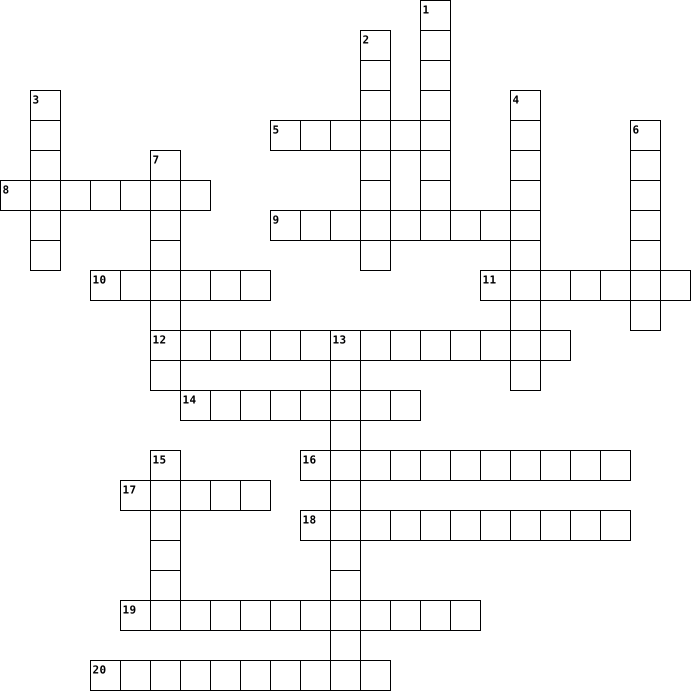
chemical reaction Crossword Puzzles
Biology Ch 1-2 2026-01-21

Across
- A pure substance made of only one kind of atom.
- A molecule having an uneven distribution of electrical charge.
- A substance that binds to an enzyme reducing its effectiveness.
- A description based on repeated observations (often mathematical)
- The building blocks of all matter.
- A naturally occurring catalyst, usually a protein.
- The process of one substance being broken up and dispersed in another.
- The substances required to start a chemical reaction.
- Anything that takes up space and has mass.
- The substances formed during a chemical reaction.
- The study of life.
- A group of organic compounds primarily used to store energy.
- A subset of observations gathered from within a larger possible set of data.
- Using living systems to produce new products.
- An electrostatic attraction that forms between two atoms.
- The attraction of particles in one substance to those in another.
Down
- A group of organic molecules primarily used to store information.
- Preservation and wise use of natural resources.
- A substance that produces hydroxide ions (or absorbs hydrogen ions) in solution.
- A change in a substance that does not alter its chemical identity.
- A model that attempts to explain a set of observations.
- The smallest particle of a covalently bonded compound.
- The building blocks of proteins.
- A substance that produces hydrogen ions in solution.
- Any covalent compound containing carbon.
- The attraction between like particles within a polar substance.
- A substance that changes the rate of a chemical reaction without being used up.
- A pure substance made from two or more bonded elements.
- The process by which particles in solution are evenly distributed.
- The ability to do work.
- A group of nonpolar organic compounds including fats and steroids.
- A simple, workable representation of a more complex object or concept.
- A testable statement that predicts the answer to a question.
33 Clues: The study of life. • The ability to do work. • The building blocks of proteins. • The building blocks of all matter. • Any covalent compound containing carbon. • Anything that takes up space and has mass. • Using living systems to produce new products. • Preservation and wise use of natural resources. • A pure substance made of only one kind of atom. • ...
Atomic Structure Topic Key Words 2025-12-02

Across
- The rows that make up the periodic table.
- equation A way of describing what happens in a chemical reaction by showing the chemical formulae of reactants and products. Must be balanced.
- solutions The mixture made by adding a soluble substance to water.
- Substance(s) made as a result of a chemical reaction.
- symbols The abbreviations used in balanced symbol equations to show if reactants and products are solid (s), liquid (l), gas (g) or aqueous/dissolved in water (aq).
- When some elements and/or compounds are mixed together but do not react. They are physically combined.
- A substance made when two or more elements are chemically bonded together.
- number The number of protons in an atom (which is equal to the number of electrons). Sometimes called the proton number.
- Atoms that have the same number of protons but different numbers of neutrons.
- The smallest part of an element that can still be recognised as that element.
- Subatomic particle with a relative charge of +1 and a relative mass of 1. Found in the nucleus.
- A charged particle produced by the loss or gain of electrons.
- The very small and dense central part of an atom that contains protons and neutrons.
- indicator A mixture of indicators that can change through a range of colours to show how strongly acidic or alkaline liquids and solutions are.
- Elements in group 7 of the periodic table.
- A substance made up of only one type of atom. An element cannot be broken down chemically into any simpler substance.
Down
- The columns that make up the periodic table (labelled 1-7 and 0).
- number The number of protons + neutrons in the nucleus of an atom.
- equation A way of describing what happens in a chemical reaction by showing the names of all reactants and the products they form.
- metals Elements in group 1 of the periodic table.
- Subatomic particle with a relative charge of 0 and a relative mass of 1. Found in the nucleus.
- table An arrangement of elements in the order of their atomic number, forming groups and periods.
- configuration A set of numbers to show the arrangement of electrons in their shells.
- Substance(s) we start with before a chemical reaction takes place.
- gases The very unreactive gases found in group 0 of the periodic table. Their atoms have very stable electronic structures.
- Subatomic particle with a relative charge of -1 and very little mass. Found in shells around the nucleus.
- of conservation of mass The total mass of the products formed in a reaction is equal to the total mass of the reactants.
- equation A requirement for a symbol equation – the same number of atoms of each element on either side of the equation.
28 Clues: The rows that make up the periodic table. • Elements in group 7 of the periodic table. • metals Elements in group 1 of the periodic table. • Substance(s) made as a result of a chemical reaction. • A charged particle produced by the loss or gain of electrons. • The columns that make up the periodic table (labelled 1-7 and 0). • ...
Kyle's Quarterly Review 2022-03-21

Across
- the dissolvent in a solution
- a group of chemically combined atoms
- a mixture that is the same throughout
- a liquid that is in the 8-14 on the ph scale
- a liquid that is in the 1-6 on the ph scale
- the mass of an element
- a group of chemically combined elements that keep their properties.
- the dissolved in a solution
Down
- a mixture that is not the same throughout
- the amount of dissolved solute in a solvent
- the resulting chemical from the reaction
- the amount of a solute that can be dissolved in a solvent
- a metal that has been melted together
- the molecules that cause a chemical reaction
- the result of adding more solvent in a solution
15 Clues: the mass of an element • the dissolved in a solution • the dissolvent in a solution • a group of chemically combined atoms • a metal that has been melted together • a mixture that is the same throughout • the resulting chemical from the reaction • a mixture that is not the same throughout • the amount of dissolved solute in a solvent • ...
SES 141 Key Terms and Definitions 2021-12-01

Across
- A speed divided by a time is called
- transports energy by the flow of photons
- Estimate energy in joule of one human heartbeat
- Work, in the technical sense of the word, has units of
- transports energy by the bulk motion of material
- measures the speed of atoms/molecules
- transports energy by collisions between neighboring atoms or molecules
Down
- A substance that reduces the rate of a reaction is called
- the capacity to do work
- Electrons freed from an atom
- Glow sticks are an example of what type of chemical reaction
- Chemical reactions which absorb energy as they proceed are called
- direction of the change in motion
- A distance divided by a time is called
- a force times a distance
15 Clues: the capacity to do work • a force times a distance • Electrons freed from an atom • direction of the change in motion • A speed divided by a time is called • measures the speed of atoms/molecules • A distance divided by a time is called • transports energy by the flow of photons • Estimate energy in joule of one human heartbeat • ...
Photosynthesis and Respiration 2025-11-05

Across
- A process where one gas is absorbed and the other is released.
- A type of reaction where substances are being broken down.
- A type of reaction where substances are being formed.
- The gas that is used during photosynthesis.
- A type of respiration that produces a lot of energy.
- Small openings on the underside of leaves.
- A chemical substances used to test for carbon dioxide.
Down
- The organelles where respiration takes place.
- A simple sugar produced by plants.
- A type of respiration that doesn't require oxygen.
- The organelle were photosynthesis takes place.
- A chemical used to test for starch.
- A green pigment found in plants.
- The gas that is inhaled by animals.
- A substance that excess glucose is stored as.
15 Clues: A green pigment found in plants. • A simple sugar produced by plants. • A chemical used to test for starch. • The gas that is inhaled by animals. • Small openings on the underside of leaves. • The gas that is used during photosynthesis. • The organelles where respiration takes place. • A substance that excess glucose is stored as. • ...
Chemistry Crossword 2017-11-11

Across
- cloudy mixture in which tiny particles of one substance are held within another and particles cannot be separated out from the other substance
- substance that helps a chemical reaction to proceed more quickly
- the smallest part of an element that is representative of that element
- combination of symbols that represent a compound
- group 1 element in the periodic table, not including hydrogen, the most reactive of the metals
- a solution in which water is the solvent
- invisible negatively charged particle that orbits around the nucleus of the atom
- chemical reaction that takes place in cells
- anything that has mass and takes up space
- positively charged center of an atom; contains protons and neutrons
- description of a substance that can be pounded or rolled into sheets
- change in state from a solid to a gas
- positively charged particle in the nucleus of an atom
- change of state from a solid to a liquid
Down
- a table in which elements are organized by their physical and chemical properties
- pure substance formed when at least one metal and non-metal combine
- mass of one atom of an element calculated from the total number of protons, electrons and neutrons of that atom
- number of protons in the nucleus of one atom of an element
- group 2 elements of the periodic table, their reactivity is not as strong as the alkali metals
- pure substance that cannot be broken down into other substances
- description of how a substance interacts with another substance
- measure of atomic mass
- change that results when 2 or more substances react to create a new substance
- vertical column of elements in the periodic table
- chemical reaction that occurs when oxygen reacts with a substance to form a new substance and give off energy
25 Clues: measure of atomic mass • change in state from a solid to a gas • a solution in which water is the solvent • change of state from a solid to a liquid • anything that has mass and takes up space • chemical reaction that takes place in cells • combination of symbols that represent a compound • vertical column of elements in the periodic table • ...
Chemistry crossword 2018-11-13

Across
- a chemical combination of two or more elements in a specific ratio
- change in the appearance or state of a substance that does not change the composition
- group 17 elements in the perodic table,the most reactive not metals
- gases group 18 elements in the periodic table,the most stable and interactive elements
- compound pure substance formed when non-metals combine
- substance that reacts with another substances in a chemical reaction to create new substances with different properties
- table a table in which the elements are organized by their physical and chemical properties
- something that has mass and occupies space
- metals group 1 elements in the peroidic table,not including hydrogeon the most reactive of the metals
- combination of pure substances
- compound that dissolves in water to form a solution with a ph lower than 7
- shell orbit of electrons around the nucleus of an atom
Down
- number number of protons in the nucleus of one atom of an element
- cloudy mixture in which tiny particles of one substance are held within another and the particles can be separated out
- compound pure substance formed when at least one metal and one non metal combine
- positively charged particle in the nucleus of an atom
- neutral particle in the nucleus of an atom
- reaction a reaction that takes place when to or more substances react to form a new substance
- chlorine
- group of atoms joined by covalent bonds
- homogenous mixture mixture of two or more pure substances that looks like one substance
- a pure substance that cannot be broken down into other substances,made up of only one type of atom
- cloudy mixture in which tiny particles of one substance are held within another and particles cannot be seperatedout from other substances
23 Clues: chlorine • combination of pure substances • group of atoms joined by covalent bonds • neutral particle in the nucleus of an atom • something that has mass and occupies space • positively charged particle in the nucleus of an atom • compound pure substance formed when non-metals combine • shell orbit of electrons around the nucleus of an atom • ...
Chemical Reactions 2026-02-05

Across
- able to cause damage
- a substance made by mixing other substances together
- made up or consisting of more than one element
- letters and numbers that represent the number and type of atoms that make up a substance
- a substance or compound that has been purified or prepared, especially artificially
- a structure formed by repeating groups of atoms (molecules) linked together
- the dissolved component in a solution
- a liquid mixture in which the solute in uniformly distributed in the solvent
- something that can be observed about a substance such as color, smell, or boiling point
- the ending substance created during a chemical reaction
- the relative size of things
Down
- a group of atoms joined in a particular way
- something that is made of all the same atoms or molecules
- the starting substances that are part of a chemical reaction
- the process in which atoms rearrange to form new substances
- the liquid in which a solute is dissolved
- each of over 100 known substances that cannot be broken down into simpler substances
- tiny pieces that all matter is made of
- to change the order or position of something
19 Clues: able to cause damage • the relative size of things • the dissolved component in a solution • tiny pieces that all matter is made of • the liquid in which a solute is dissolved • a group of atoms joined in a particular way • to change the order or position of something • made up or consisting of more than one element • a substance made by mixing other substances together • ...
Chemistry of life (Kevin) 2017-10-08

Across
- A covalent bond that one amino acid is attached to anther amino acid.
- monomer of disaccharide and polysaccharide.
- monomer of polypeptide and proteins.
- A subtance that cannot be turned into other subtance through chemical reactions.
- polymer of amino acids
- A kind of protein that defend against bacteria.
- A reaction that H20 are decomposed.
- Universal solvent.
Down
- general name of fat and oils.
- A bond that formed between a hydrogen atom covalently linked to an oxygen or a nitragen atom.
- A important disaccharide that prove energy.
- A substance consisting of two or more elements in a fixed ratio
- A strong interaction between atoms.
- Monomer of macromolecules
- An electrical attraction between two ions.
- The smallest unit that keeps the chemical properties of an element.
- Anything that takes up space and has mass.
- A reaction that form H2O.
- A kind of protein that is the catalyze biochemical reactions.
- Different atoms of an element that have the same number of proton, but different number of neutron.
20 Clues: Universal solvent. • polymer of amino acids • Monomer of macromolecules • A reaction that form H2O. • general name of fat and oils. • A strong interaction between atoms. • A reaction that H20 are decomposed. • monomer of polypeptide and proteins. • An electrical attraction between two ions. • Anything that takes up space and has mass. • ...
BIOLOGY 2014-09-30
Across
- a pyrimidine in RNA that replaces Thymine
- macromolecules composed of amino acids
- when two amino acids combine
- an organic catalyst that accelerates a specific chemical reaction by lowering the energy required
- consists of four carbon rings
- a sugar that cant be broken down by hydrolysis to a simple sugar
- a three carbon alcohol with hydroxyl group on each carbon
- a longer chain of amino acids which may contain up to hundreds
- any of a group of organic compounds that are insoluble in water but soluble in nonpolar solvents
- not readily reacting with water
- to alter physical properties
- two isomeric chemical compounds that are mirror images
Down
- substance that increase speed that a reaction occurs
- animal starch
- typical form of a carbohydrate used for energy storage in plants
- monomer of nucleic acid
- main component of cell walls of fungi and exoskeletons of insects and fish
- a molecule of RNA that has catalytic properties
- compound containing carbon hydrogen and oxygen
- 5 carbon sugar in ribonucleic acid
20 Clues: animal starch • monomer of nucleic acid • when two amino acids combine • to alter physical properties • consists of four carbon rings • not readily reacting with water • 5 carbon sugar in ribonucleic acid • macromolecules composed of amino acids • a pyrimidine in RNA that replaces Thymine • compound containing carbon hydrogen and oxygen • ...
Photosynthesis & Cellular Respiration Review 2024-02-13

Across
- types of cells that perform cellular respiration
- light
- powers photosynthesis
- the results in a chemical reaction
- an organism that eats other plants and animals for energy and nourishment
- to put together
- organelle that performs cellular respiration
- the starting molecules in a chemical reaction
- organelle that performs photosynthesis
- gas that is needed in cellular respiration but released as waste in photosynthesis
- process that occurs when oxygen is present
- process that releases energy or heat; cellular respiration is an example
- produced by breaking down glucose without oxygen
- broken down to release energy in cellular respiration
Down
- occurs in yeast and other single celled organisms
- process that stores energy or heat; photosynthesis is an example
- liquid reactant in photosynthesis and product in cellular respiration
- an organism that is able to form glucose
- gaseous reactant in photosynthesis and product in cellular respiration
- green pigment that makes up chloroplasts
- sugar produced in photosynthesis and broken down in cellular respiration
21 Clues: light • to put together • powers photosynthesis • the results in a chemical reaction • organelle that performs photosynthesis • an organism that is able to form glucose • green pigment that makes up chloroplasts • process that occurs when oxygen is present • organelle that performs cellular respiration • the starting molecules in a chemical reaction • ...
Unit 2 Ethan Wilker 2023-04-04

Across
- Diffusion that involves water
- a collection of cells bound together
- the basic unit of life
- where the substrate binds to the enzyme
- the movement of atoms from a high concentration to a low concentration
- Water fearing or hating
- Water loving
- a collection of organ systems
- Transport that does not require energy
- a part of a cell that performs a specific job
- when the shape of the enzyme is altered so it cannot perform it's job
- a type of protein that lowers the activation energy required to perform a chemical reaction
- what the enzyme is breaking down
Down
- A compound of two or more atoms
- a collection of tissue that does a job
- only allowing certain things to pass through
- what makes up the cell membrane
- Transport that requires energy.
- a group of organs that work together
- the amount of energy required to start a chemical reaction
- The result after a substrate is broken
- What Makes up everything
22 Clues: Water loving • the basic unit of life • Water fearing or hating • What Makes up everything • Diffusion that involves water • a collection of organ systems • A compound of two or more atoms • what makes up the cell membrane • Transport that requires energy. • what the enzyme is breaking down • a collection of cells bound together • a group of organs that work together • ...
Test 1 Review 2024-09-10

Across
- The most important among the 6 essential elements
- molecules attracted to water
- Positively charged ion
- the weakest type of bond
- central part of an atom that has protons and neutrons
- outer electrons involved in chemical bonding
- negatively charged ion
- atoms of the same element with different number of neutrons
- number of electrons in the first shell
- reaction that absorbs energy from its surroundings
- substance in which a solute is dissolved
- biological catalysts that speed up chemical reactions
Down
- subatomic particle with negative charge
- type of bond involving complete electron transfer
- molecules repelled by water
- uneven distribution of charge in a molecule
- bond involving shared electrons
- macromolecule that serves as the primary energy source
- macromolecule that serves as genetic material
- reaction that releases energy to its surroundings
- type of bond responsible for water to connect with water
- subatomic particle with a positive charge
- Mnemonic for knowing protons, neutrons, and electrons
- building blocks of polymers
24 Clues: Positively charged ion • negatively charged ion • the weakest type of bond • molecules repelled by water • building blocks of polymers • molecules attracted to water • bond involving shared electrons • number of electrons in the first shell • subatomic particle with negative charge • substance in which a solute is dissolved • subatomic particle with a positive charge • ...
biology 2023-10-02

Across
- Substances created during a chemical reaction
- Type of organism that must eat other organism that must eat other organisms to obtain energy.
- Describes a situation in which oxygen is present
- Third step of aerobic respirations
- Type of oganism that breaks down biotic compound into abiotic compunds, recyclers
- Process of using light energy to make glucose
- Sphere of earth, all living things on earth
- Anything that has mass and takes up space
- organelle, site of steps 2 and 3 aerobic cellular respiration
- Sphere of earth, all the water on earth
Down
- Type of organism that is able to make its own food
- Sphere of earth, all the gases surrounding earth
- Describes a situation in which oxygen is not present
- Second step of respiration
- Sphere of earth, all the rocks and soil on earth
- Organelle, site of photosynthesis
- Pigment in chloroplasts used to trap light energy during photsynthesis
- Second step of Aerobic respiration
- First step of Aerobic Respiration
- Substances at the beginning of a chemical reaction
20 Clues: Second step of respiration • Organelle, site of photosynthesis • First step of Aerobic Respiration • Third step of aerobic respirations • Second step of Aerobic respiration • Sphere of earth, all the water on earth • Anything that has mass and takes up space • Sphere of earth, all living things on earth • Substances created during a chemical reaction • ...
Semester Review 2025-01-13

Across
- a reaction where energy goes in, and the products often end cold
- the scientist that created a Nitrogen fixation process, often used for fertilizer
- stored energy depending on the position of the object
- an ion with a positive charge
- the phase change when a gas changes directly to a solid
- the splitting of atomic nuclei that releases mass amounts of energy
- element 8
- anything that has mass and takes up space
- the equation that is represented by mass divided by volume
- two hydrogen atoms coming together from mass temperature and pressure, forming a He atom
- A scientist that created the principle of equilibrium, and also blew up his lab partner
Down
- the energy required for a reaction to occur
- a system where neither energy nor matter can escape
- the ability to do work or transfer heat
- a substance that repels water
- the energy of movement
- the chemical change that happens when iron interacts with water
- an example of an endothermic reaction that happens in plants
- a reaction where energy comes out of the reaction
- the total heat content of a system
- your favorite subject
21 Clues: element 8 • your favorite subject • the energy of movement • a substance that repels water • an ion with a positive charge • the total heat content of a system • the ability to do work or transfer heat • anything that has mass and takes up space • the energy required for a reaction to occur • a reaction where energy comes out of the reaction • ...
Chemical Reactions (Unit 2 Vocab Crossword) 2021-10-27

Across
- characteristics of matter that can only be observed when one substance changes into a different substance, such as iron to rust.
- when the solute breaks up from a larger crystal of molecules into much smaller groups or individual molecules.
- the substances formed from chemical reactions.
- a mixture in which particles are dispersed throughout the bulk of a fluid.
- a mixture consisting of parts that are all the same, or evenly mixed. A solution is a type of homogenous mixture.
- a substance that takes part in and undergoes change during a reaction.
- when particles of different substances mix together naturally.
- a reaction that occurs when heat is absorbed by the system from the surroundings.
- a reaction that occurs when heat is released by the system into the surroundings.
Down
- a law that states that matter is not destroyed or created, therefore the reactants will have the same mass as the products.
- a number placed before the molecule that tells you how many molecules are in the equation.
- the major component in solution, able to dissolve other substances.
- contains different substances that are not chemically joined to each other.
- a small number placed after an element that shows how many atoms are in the molecule.
- a mixture that has different parts, not evenly mixed.
- a liquid mixture in which the minor component (the solute) is uniformly distributed within the major component (the solvent).
- when matter changes from one state to another.
- Formula identifies the number and type of each type of atom in a molecule.
- the minor component in a solution, dissolved in the solvent.
- a system of chemical changes that involves the breaking and reforming of chemical bonds to create new substances.
- characteristics of matter that can be seen through direct observation such as density, melting point, and boiling point.
21 Clues: when matter changes from one state to another. • the substances formed from chemical reactions. • a mixture that has different parts, not evenly mixed. • the minor component in a solution, dissolved in the solvent. • when particles of different substances mix together naturally. • the major component in solution, able to dissolve other substances. • ...
Science With Jellbart 2016-10-10

Across
- an article or substance that is manufactured or refined for sale.
- chemical decomposition produced by passing an electric current through a liquid or solution containing ions.
- the energy possessed by a body by virtue of its position relative to others, stresses within itself, electric charge, and other factors.
- a substance that takes part in and undergoes change during a reaction.
- a method or means of somehow changing one or more chemicals or chemical compounds.
- a compound of hydrogen and carbon, such as any of those which are the chief components of petroleum and natural gas.
- a reaction where two or more elements or compounds combine to form a single compound
- able to be dissolved, especially in water.
- incapable of being dissolved.
- a substance that flows freely but is of constant volume, having a consistency like that of water or oil.
- the total quantity or weight of organisms in a given area or volume.
Down
- cause (an event or situation, typically one that is undesirable) to happen suddenly, unexpectedly, or prematurely.
- a chemical reaction that releases energy by light or heat.
- a liquid or gel which contains ions and can be decomposed by electrolysis
- a means of solving a problem or dealing with a difficult situation.
- a natural fuel such as coal or gas, formed in the geological past from the remains of living organisms.
- the smallest particle of a chemical element that can exist.
- the branch of science concerned with the substances of which matter is composed, the investigation of their properties and reactions, and the use of such reactions to form new substances.
- an electrically charged atom or group of atoms formed by the loss or gain of one or more electrons
- the central and most important part of an object, movement, or group, forming the basis for its activity and growth.
20 Clues: incapable of being dissolved. • able to be dissolved, especially in water. • a chemical reaction that releases energy by light or heat. • the smallest particle of a chemical element that can exist. • an article or substance that is manufactured or refined for sale. • a means of solving a problem or dealing with a difficult situation. • ...
Chemistry crossword 2018-11-13

Across
- chlorine
- combination of pure substances
- substance that reacts with another substances in a chemical reaction to create new substances with different properties
- shell orbit of electrons around the nucleus of an atom
- a chemical combination of two or more elements in a specific ratio
- table a table in which the elements are organized by their physical and chemical properties
- cloudy mixture in which tiny particles of one substance are held within another and the particles can be separated out
- neutral particle in the nucleus of an atom
- number number of protons in the nucleus of one atom of an element
- group 17 elements in the perodic table,the most reactive not metals
- metals group 1 elements in the peroidic table,not including hydrogeon the most reactive of the metals
Down
- a pure substance that cannot be broken down into other substances,made up of only one type of atom
- something that has mass and occupies space
- group of atoms joined by covalent bonds
- homogenous mixture mixture of two or more pure substances that looks like one substance
- reaction a reaction that takes place when to or more substances react to form a new substance
- change in the appearance or state of a substance that does not change the composition
- compound pure substance formed when non-metals combine
- positively charged particle in the nucleus of an atom
- cloudy mixture in which tiny particles of one substance are held within another and particles cannot be seperatedout from other substances
- compound pure substance formed when at least one metal and one non metal combine
- compound that dissolves in water to form a solution with a ph lower than 7
- gases group 18 elements in the periodic table,the most stable and interactive elements
23 Clues: chlorine • combination of pure substances • group of atoms joined by covalent bonds • something that has mass and occupies space • neutral particle in the nucleus of an atom • positively charged particle in the nucleus of an atom • shell orbit of electrons around the nucleus of an atom • compound pure substance formed when non-metals combine • ...
Chemistry crossword 2018-11-13

Across
- neutral particle in the nucleus of an atom
- group of atoms joined by covalent bonds
- chlorine
- number number of protons in the nucleus of one atom of an element
- positively charged particle in the nucleus of an atom
- a chemical combination of two or more elements in a specific ratio
- a pure substance that cannot be broken down into other substances,made up of only one type of atom
- cloudy mixture in which tiny particles of one substance are held within another and particles cannot be seperatedout from other substances
- change in the appearance or state of a substance that does not change the composition
- compound pure substance formed when non-metals combine
- reaction a reaction that takes place when to or more substances react to form a new substance
- group 17 elements in the perodic table,the most reactive not metals
Down
- compound pure substance formed when at least one metal and one non metal combine
- shell orbit of electrons around the nucleus of an atom
- substance that reacts with another substances in a chemical reaction to create new substances with different properties
- something that has mass and occupies space
- homogenous mixture mixture of two or more pure substances that looks like one substance
- table a table in which the elements are organized by their physical and chemical properties
- combination of pure substances
- cloudy mixture in which tiny particles of one substance are held within another and the particles can be separated out
- metals group 1 elements in the peroidic table,not including hydrogeon the most reactive of the metals
- gases group 18 elements in the periodic table,the most stable and interactive elements
- compound that dissolves in water to form a solution with a ph lower than 7
23 Clues: chlorine • combination of pure substances • group of atoms joined by covalent bonds • neutral particle in the nucleus of an atom • something that has mass and occupies space • positively charged particle in the nucleus of an atom • shell orbit of electrons around the nucleus of an atom • compound pure substance formed when non-metals combine • ...
Chemistry crossword 2025-04-14

Across
- go into solution
- is a substance containning only one atom
- is a starting chemical reaction
- contains two or more substances that arenot chemically combined
- is the number of protons in the nucleus of an atom
- is a chemical made in a chemical reactant
- is something without colour
- is a measure of the concentration of hydrogen or hydroxyl ions in a solution
- is the psychical change in which a gas turns into a liquid in cooling
- is a minute portion of matter
- is a weak solution
- is a substance in which two or more elements are chemically combined
- is the bond formed between ions of opposite charge
- is a temperature at which a liquid changes to gas
Down
- the equipment used for a specific purpose, mainly experiments. ex. laboratory gown, test tube, beaker, etc.
- is the idea that for particles to react, they must collide
- is a group Vii
- is how electrons in an atom are arranged in electron shells
- is proteins made by living cells, that act as biological catalyst
- is a chemical formula (H2O)
- is a molecule contains two atoms joined by a covalent bond
- is a charged atom or group of atoms formed by the gain or loss of one or more electrons
- is a compound made up of ions, joined by ionic bonds
- is tells you how much of one substance is dissolved in another
- is where liquid turns into a gas at a temperature below its boiling point, taking place at the surface of the liquid
- is how fast a reaction is
- increase the rate of a reaction and is unchanged
- is a cloudy mixture of two or more substances that settle on standing
- elements are made up of atoms, which contain protons, neutrons, and electron
- tells how light or heavy a substance is, using mass and volume
30 Clues: is a group Vii • go into solution • is a weak solution • is how fast a reaction is • is a chemical formula (H2O) • is something without colour • is a minute portion of matter • is a starting chemical reaction • is a substance containning only one atom • is a chemical made in a chemical reactant • increase the rate of a reaction and is unchanged • ...
The Law of Conservation of Mass 2022-11-15

Across
- Relating to or resulting from motion
- Chemical element with the symbol 'H'
- Frozen water
- Small portion of matter
- Discovered The Law of Conservation of Mass
- The form of energy that is transferred between systems or objects with different temperatures
- Body of matter
- A sudden, dramatic, and important discovery or development
- A chemical process in which substances act mutually on each other and are changed into different substances, or one substance changes into other substances
Down
- A person who is studying or has expert knowledge of one or more of the natural or physical sciences
- Alter or modify
- Chemical element with the symbol 'N'
- The branch of science that deals with the properties, composition, and structure of elements and compounds
- A particle of matter that uniquely defines a chemical element
- Re-discovered The Law of Conservation of Mass
- Power derived from the utilization of physical or chemical resources
- Has mass and takes up space
- Chemical element with the symbol 'C'
18 Clues: Frozen water • Body of matter • Alter or modify • Small portion of matter • Has mass and takes up space • Relating to or resulting from motion • Chemical element with the symbol 'N' • Chemical element with the symbol 'H' • Chemical element with the symbol 'C' • Discovered The Law of Conservation of Mass • Re-discovered The Law of Conservation of Mass • ...
Chemical Reaction Vocabulary Terms 2024-10-21

Across
- A change that transpires in which substances transform into new substances with new properties.
- The law that mass is incapable of being created, nor destroyed; the mass of a substance does not change, regardless of the rearrangement of the molecules that comprise the substance.
- A substance or molecule, perhaps more than one, that constitutes a chemical reaction, specifically the initial materials (displayed on the left side of a chemical equation.)
Down
- A change that occurs in a non-chemical manner; merely physical changes are present.
- A substance or molecule, perhaps more than one, created due to the incident of a chemical reaction (displayed on the right side of a chemical equation.)
- A substance, typically a solid, created due to a chemical reaction or an alteration in temperature.
- A manner in which to represent a chemical reaction by utilizing the symbols of elements to display the quantity of substance of the reactants and products.
- When two or more substances combine and new substances, of which have dissimilar properties than those of the beginning materials, are created.
8 Clues: A change that occurs in a non-chemical manner; merely physical changes are present. • A change that transpires in which substances transform into new substances with new properties. • A substance, typically a solid, created due to a chemical reaction or an alteration in temperature. • ...
Biology 2021-10-01

Across
- bond cause water molecules to attract to each other
- natural sugar in milk
- monosaccharides
- no charge
- polysaccharide
- compounds made from carbon,hydrogen
- molecule made from two hydrogen atoms and 1 oxygen atom
- make up everything
- negatively charged
- acid macromolecules contains hydrogen,oxygen,nitrogen,carbon,phosphorus
Down
- positively charge
- containing or made from milk
- substance made from atoms
- reaction changes one set of chemicals
- most common element
- element carbon,hydrogen,oxygen
- proteins,lipids,carbohydrates,
- atom or molecule with negative/positive charge
- structure nucleus+protons+neutrons
- chemical reactions need them to speed up
20 Clues: no charge • polysaccharide • monosaccharides • positively charge • make up everything • negatively charged • most common element • natural sugar in milk • substance made from atoms • containing or made from milk • element carbon,hydrogen,oxygen • proteins,lipids,carbohydrates, • structure nucleus+protons+neutrons • compounds made from carbon,hydrogen • reaction changes one set of chemicals • ...
Biology Chapter 2 2023-11-17

Across
- sharing a pair of valence electrons
- starting molecules of a chemical reaciton
- number of protons in the nucleus
- atoms are not shared equally
- negatively charged ion
- sharing two pairs of electrons
- neutral charge
- positive charge
- atoms with net electric charge
Down
- outermost electrons
- attraction between a cation and an anion
- final molecules of a chemical reaction
- atom's total mass
- sum of protons and neutrons
- same # of atoms & elements, different structure
- outermost shell
- smallest unit of matter
- negative charge
- positively charged ion
- sharing one pair of electrons
20 Clues: neutral charge • outermost shell • negative charge • positive charge • atom's total mass • outermost electrons • negatively charged ion • positively charged ion • smallest unit of matter • sum of protons and neutrons • atoms are not shared equally • sharing one pair of electrons • sharing two pairs of electrons • atoms with net electric charge • number of protons in the nucleus • ...
Capillary Separation Techniques 2022-02-12

Across
- device which loads samples
- chemical substance on which chemical analysis is done
- positive charge ion
- same number of electrons
- measures opposition to current flow
- techniques of selective separation and concentration of ion analyte
- strong affinity for water
Down
- movement of charged species under influence of electric field
- separating compounds of mixture
- electron tranfer occurs.
- substance added in system for chemical reaction to occur
- property of substance which repels water
- migration of charged particle to less charged area
- ability of moving from one position to another
- negatively charged ion
15 Clues: positive charge ion • negatively charged ion • electron tranfer occurs. • same number of electrons • strong affinity for water • device which loads samples • separating compounds of mixture • measures opposition to current flow • property of substance which repels water • ability of moving from one position to another • migration of charged particle to less charged area • ...
Environment chemistry 2013-12-09

Across
- paper saturated with a chemical to show whether a substance is acidic or basic
- a substance that speeds up chemical reactions without being used up in a reaction
- a chemical used to control weeds
- a mineral which the body needs 100mg/day
- the combining of an acid compound having a pH value of less than 7
- a chemical used to control pests
- the process of adding calcium carbonate to the environment
Down
- a chemical that produces a basic substance having a pH value of more than 7
- a chemical used to control moulds and fungi
- rain or snow containing acid compounds from the air
- an organic nutrient made of carbon, hydrogen and oxygen
- a scale the measures the acidity or alkalinity of a substance
- the sate of matter which has no definite shape
- how much calcium do we need every day
- a mineral that the body requires at lest 100mg/day in order to maintain health
- a chemical used to control insects
- the process whereby chemicals accumulate in the tissue of organisms along the food chain.
- a chemical that produces an acidic substance, having a pH value of less than 7
- a chemical that changes colour to indicate whether a substance is an acid or a base
- a mixture of a plant compounds used as a chemical indicator
- a special molecule that regulates chemical reactions in living organisms
21 Clues: a chemical used to control weeds • a chemical used to control pests • a chemical used to control insects • how much calcium do we need every day • a mineral which the body needs 100mg/day • a chemical used to control moulds and fungi • the sate of matter which has no definite shape • rain or snow containing acid compounds from the air • ...
Module 2 2021-09-06

Across
- The process by which cells become progressively more specialized
- All chemical and physical changes sustaining an organism
- Detects change in variable
- Directly causes change in variable
- (feedback) Strengthen a change in body's condition
- something that causes a change or a reaction
- (feedback) Negates the original stimulus
Down
- A state of equilibrium, as in an organism or cell, maintained by self-regulating processes.
- Ability to respond to environmental changes
- Increase in cell size
- Changes in form and size
- Chemical used for energy and cell building
- Most abundant chemical in human body
- Generation of new individuals
- required for chemical reactions
15 Clues: Increase in cell size • Changes in form and size • Detects change in variable • Generation of new individuals • required for chemical reactions • Directly causes change in variable • Most abundant chemical in human body • (feedback) Negates the original stimulus • Chemical used for energy and cell building • Ability to respond to environmental changes • ...
photosynthesis 2022-11-01

Across
- a temporary way of creating energy without oxygen
- A way for plants to make their own food
- organelle necessary for respiration
- glucose, oxygen
- the chemical formula for glucose
- a mathmatic formula to show the chemical makeup of different substances
Down
- the things that will be used for a chemical reaction
- most common cell used for fermentation
- only type of cell that can preform photosynthesis
- bear, owl, fly
- An organelle found in plants that caries out photosynthesis
- cactus, tree, grass
- ingredient not used in photosynthesis : water, sunlight, soil, carbon dioxide
- A product of lactic fermentation
- Chemical formula for water
15 Clues: bear, owl, fly • glucose, oxygen • cactus, tree, grass • Chemical formula for water • A product of lactic fermentation • the chemical formula for glucose • organelle necessary for respiration • most common cell used for fermentation • A way for plants to make their own food • a temporary way of creating energy without oxygen • only type of cell that can preform photosynthesis • ...
Lilly Herr - Chapter 13 2021-03-04

Across
- energy is the amount of energy required to
- is a substance that lowers the activation energy of a chemical reaction.
- in an ____ reaction there is a net absorption of energy.
- no atoms are gained or lost during any reaction is the Law of Mass ________.
- acids _____ protons, bases accept them.
Down
- reaction rates are affected by (T).
- reaction rates are affected by (Co).
- two bonded atoms apart.
- when water behaves as a base, it gains.
- in an ____ reaction there is a net release of energy.
- is how quickly the concentration of reactants decreases and how quickly the concentration of products increases.
11 Clues: two bonded atoms apart. • reaction rates are affected by (T). • reaction rates are affected by (Co). • when water behaves as a base, it gains. • acids _____ protons, bases accept them. • energy is the amount of energy required to • in an ____ reaction there is a net release of energy. • in an ____ reaction there is a net absorption of energy. • ...
Lilly Herr - Chapter 13 2021-03-04

Across
- energy is the amount of energy required to
- is a substance that lowers the activation energy of a chemical reaction.
- in an ____ reaction there is a net absorption of energy.
- no atoms are gained or lost during any reaction is the Law of Mass ________.
- acids _____ protons, bases accept them.
Down
- reaction rates are affected by (T).
- reaction rates are affected by (Co).
- two bonded atoms apart.
- when water behaves as a base, it gains.
- in an ____ reaction there is a net release of energy.
- is how quickly the concentration of reactants decreases and how quickly the concentration of products increases.
11 Clues: two bonded atoms apart. • reaction rates are affected by (T). • reaction rates are affected by (Co). • when water behaves as a base, it gains. • acids _____ protons, bases accept them. • energy is the amount of energy required to • in an ____ reaction there is a net release of energy. • in an ____ reaction there is a net absorption of energy. • ...
Laila Felzer: Chapter 13 2021-12-01

Across
- breakdown, more plus signs of product size
- increasing, , favors the reaction tjat absorbs energy
- the plus sign beome less
- reaction when there is a net absorbtion of energy
- displacement, count how many atoms change "teams"
Down
- principle if changed, the equilibrium shifts to oppose change, until new equilibrium is reached
- increasing, , favors the reaction that produces less gas
- Bond energy is also known as
- a substance that lowers the activation energy of a chemical reaction
- reaction when there is a net release of energy
- when reaction and it's reverse act at the same rate
11 Clues: the plus sign beome less • Bond energy is also known as • breakdown, more plus signs of product size • reaction when there is a net release of energy • reaction when there is a net absorbtion of energy • displacement, count how many atoms change "teams" • when reaction and it's reverse act at the same rate • increasing, , favors the reaction tjat absorbs energy • ...
Couple goals (Mishka + Nami ❤) 2022-05-09

Across
- What is defined by the number of electrons on the outer shell of an element?
- Most reactive element in Group 1
- What reaction is this an example of? Na2SO4 + SrCl2 ----> 2NaCl + SrSO4
- A thermite reaction is an exothermic reaction between ferrous oxides and _______.
- A chemical reaction that absorbs heat from its surroundings
- Zinc chloride + Magnesium = _____ chloride + Zinc
- The reaction between an acid and alkali
Down
- What gas is produced in a reaction between a carbonate and an acid?
- Group 1 is called?
- The reactivity of each element in Group 7 (Halogens) as you go down _________.
- Calcium hydroxide is also known as?
11 Clues: Group 1 is called? • Most reactive element in Group 1 • Calcium hydroxide is also known as? • The reaction between an acid and alkali • Zinc chloride + Magnesium = _____ chloride + Zinc • A chemical reaction that absorbs heat from its surroundings • What gas is produced in a reaction between a carbonate and an acid? • ...
You didn't tell us we needed to do this!!! 2022-11-03

Across
- the result of a chemical reaction
- a group of organs working together
- the processes cell organelles/organsystems do to stay alive
- when the cell doubles its chromosomes
- the process that plants use to make food
- the building blocks of life
- several different types of tissues and several of each making a _____
- transfer of particles other than water through a cell membrane
- removal of wastes
- the ingredients to a chemical reaction
- one cell organism
- when the chromosomes are pulled apart
Down
- when the cell splits into 2 new daughter cells
- when the 2 cell membranes reform
- groups of a single type of cell working together
- when the cell membrane disintegrates
- GOLE growth, repair
- when the chromosomes line up the middle of the cell
- taking in food particles
- transfer of water through a cell membrane
- two or more cell organisms
- a whole being that can carry out all life processes
- making glucose into ATP
- breaking down food into energy
24 Clues: removal of wastes • one cell organism • GOLE growth, repair • making glucose into ATP • taking in food particles • two or more cell organisms • the building blocks of life • breaking down food into energy • when the 2 cell membranes reform • the result of a chemical reaction • a group of organs working together • when the cell membrane disintegrates • ...
Nervous System Vocabulary 2016-01-13

Across
- basic functioning unit of the nervous system
- controls memory, language, and thought
- space between neurons
- contains sensory and motor neurons
- controls muscle movement and regulates balance
- system that causes an increase of hormone release
- part of the organism that gathers, processes and responds to information in the environment
- a chemical carried in the blood stream from a gland to another area of the body
- area of the eye that focuses light
- consists of organs and tissues that release chemical messages
- structures that detect stimuli
- controls involuntary functions
Down
- part of the nervous system that detects the environment
- made up of the brain and spinal cord
- system that inhibits further release of hormones
- receptor that helps in dim light
- something in the environment that causes a reaction
- a reaction to a stimulus
- structure of neurons protected by vertebra
- receptor that helps determine color differences
- automatic response to a stimuli
- tympanic membrane
22 Clues: tympanic membrane • space between neurons • a reaction to a stimulus • structures that detect stimuli • controls involuntary functions • automatic response to a stimuli • receptor that helps in dim light • contains sensory and motor neurons • area of the eye that focuses light • made up of the brain and spinal cord • controls memory, language, and thought • ...
Chemistry Vocabulary 2018-02-07

Across
- an arrangement of elements into rows and columbs
- the space occupied by a sample of matter
- a starting substance in a chemical reaction
- A substance that can not be changed into something simpler
- a negatively charged subatomic particle
- negative and a negative or positive and a positive charge
- A mixture that is completely uniform in its composition
- a homogeneous mixture
- the smallest particle of an element
- The ratio of the mass of an object to it volume
- figures all the digits that can be known precisely in a measurement
Down
- a mixture that is not uniform in composition
- a chemical equation in which mass is converted
- matter that has a definite shape and volume
- positive and negative charges
- anything that takes up space and has mass
- A reaction that has to do with fire
- a pair of valence electrons that is not involved in bonding
- atoms of the same element that have the same atomic number
- the amount of matter in an object
20 Clues: a homogeneous mixture • positive and negative charges • the amount of matter in an object • A reaction that has to do with fire • the smallest particle of an element • a negatively charged subatomic particle • the space occupied by a sample of matter • anything that takes up space and has mass • matter that has a definite shape and volume • ...
unit 2 vocab 2025-10-03

Across
- charged energy storage molecule
- uncharged energy storage molecule
- organism that eats others for energy
- situation where oxygen is present
- all living things on earth
- site of steps 2+3 of cellular respiration
- 1st step of aerobic respiration
- anything that has mass and takes up space
- Nutrient: forms backbone for all macromolecules in living things
- organism that makes its own food
- used in proteins and nucleic acids
- all soil+ rocks on earth
- pigment in chloroplasts
- 3rd step of aerobic cellular respiration
Down
- all gases surrounding earth
- substances created from chemical reaction
- organism that breaks down biotic compounds
- site of photosynthesis
- substances beginning a chemical reaction
- cycle 2nd step of aerobic respiration
- all water on earth
- process of using light energy to make glucos
- reactions first step of photosynthesis
- 2nd step of anaerobic respiration
- situation where oxygen is not present
- second step of photosynthesis
- used in phosphates+ phospholipids
- respiration process of breaking down glucose to make ATP
28 Clues: all water on earth • site of photosynthesis • pigment in chloroplasts • all soil+ rocks on earth • all living things on earth • all gases surrounding earth • second step of photosynthesis • charged energy storage molecule • 1st step of aerobic respiration • organism that makes its own food • uncharged energy storage molecule • situation where oxygen is present • ...
Field Trip Days Crossword 2025-04-25

Across
- things that go into a chemical reaction
- tube that connects your mouth to stomach
- moves your bones around
- organelle used for storage
- life comes from _____________
- connects the inside of a building to the outside
- your science teacher
- makes ATP
- pumps your blood
- you wear these on your feet
- largest human organ
- organelle that controls what comes in and out
- organelle that makes proteins
- Mr. Soffer's favorite candy
- most important human organ
- Mr. Soffer's least favorite candy
- type of microscope that we have in our classroom
Down
- married to jay z
- Mr. Soffer's second favorite person
- another name for the large intestine
- carb that gives your body energy that is made by plants
- things that come out of a chemical reaction
- your body part that you have the most control over
- nutrient used primarily for growth and repair
- makes glucose
- organ that detoxes blood and creates bile
- Mr. Soffer's favorite person
- type of life form that does the most photosynthesis
- a living thing
29 Clues: makes ATP • makes glucose • a living thing • married to jay z • pumps your blood • largest human organ • your science teacher • moves your bones around • organelle used for storage • most important human organ • you wear these on your feet • Mr. Soffer's favorite candy • Mr. Soffer's favorite person • life comes from _____________ • organelle that makes proteins • ...
Claire Simon Unit 2 2025-03-24

Across
- A combination of atoms
- A combination of tissue
- Special proteins that lower the initial amount of activation energy
- A combination of molecules
- A method of moving molecules across the membrane without using energy
- Water fearing
- The reactants that bind to the enzyme
- Molecules naturally move apart
- A combination of all organ systems
- The place on an enzyme that a substrate binds to
- The active site of an enzyme changes shape and can't bind to a substrate anymore
Down
- The amount of energy needed to start a chemical reaction
- The diffusion of water across a membrane
- Only allows certain molecules in or out of the cell
- Cells use energy to move molecules across the membrane though a transport protein
- A molecule that contains 2 hydrophobic tails and 1 hydrophilic head (makes up the cell membrane)
- A combination of organelles
- Water loving
- A combination of organs
- The result of a chemical reaction
- A combination of cells
- The basic units of matter
22 Clues: Water loving • Water fearing • A combination of atoms • A combination of cells • A combination of tissue • A combination of organs • The basic units of matter • A combination of molecules • A combination of organelles • Molecules naturally move apart • The result of a chemical reaction • A combination of all organ systems • The reactants that bind to the enzyme • ...
Unit 2 2024-10-02

Across
- Oxygen is present
- Transport Chain, third step of aerobic respiration
- nutrient used in phosphates of nucleic acids
- forms the backbone for all macromolecules
- all gases surrounding earth
- Anything that has mass and takes up space
- has to eat other organisms
- nutrient used in proteins
- makes their own food
- First step of aerobic respiration and takes place in the cytoplasm
- Respiration, Process of breaking down glucose to make ATP
- all water on earth
- all soil and rocks on earth
- reactions, first step of photosynthesis
- Oxygen is not present
Down
- all living things on earth
- organisms that are recyclers
- Adenosine Diphosphate
- site of photosynthesis
- reactions, second step of photosynthesis
- Adenosine Triphosphate
- Substances created during a chemical reaction
- site of steps 2 and 3 of aerobic cellular respiration
- Cycle, second step of aerobic respiration
- Substances at the beginning of a chemical reaction
- pigment used to trap light energy
- Process of using light energy to make glucose
27 Clues: Oxygen is present • all water on earth • makes their own food • Adenosine Diphosphate • Oxygen is not present • site of photosynthesis • Adenosine Triphosphate • nutrient used in proteins • all living things on earth • has to eat other organisms • all gases surrounding earth • all soil and rocks on earth • organisms that are recyclers • pigment used to trap light energy • ...
Revision Fage Test 1 2016-10-24

Across
- reaction
- chemical in the brain linked to sleep
- ein Verband wechseln
- a clean covering that protects a wound from infection
- stitches
- go down
- very tired or exhausted
Down
- easily harmed/anfällig
- think
- chemical produced in brain when exposed to sunlight
- go up
- a physical injury, something that can damage the Skin
- to get better or become whole again, return to a normal state
- earth/ schmutz
- suture
- notice /bemerken
- a serious infection which cuases jaw spasms
17 Clues: think • go up • suture • go down • reaction • stitches • earth/ schmutz • notice /bemerken • ein Verband wechseln • easily harmed/anfällig • very tired or exhausted • chemical in the brain linked to sleep • a serious infection which cuases jaw spasms • chemical produced in brain when exposed to sunlight • a physical injury, something that can damage the Skin • ...
biomolecules 2022-11-05

Across
- A compound of a class of simple organic compounds that contain a carboxyl and an amino group and that combine to form proteins
- The minimum amount of energy required to start a chemical reaction
- An organic compound, either RNA or DNA, whose molecules are made up of one or two chains of nucleotides and carry genetic information
- The smallest unit of an element that maintains the chemical properties of that element
- On an enzyme, the site that attaches to a substrate
- A homogeneous mixture throughout which two or more substances are uniformly dispersed
- Is a group of atoms that are held together by chemical forces
- The attractive force between two bodies of different substances that are in contact with each other
- Deoxyribonucleic acid, the material that contains the information that determines inherited characteristics
- A value that is used to express the acidity and alkalinity (basicity) of a system
- A substance that forms a chemical reaction
- An electron that is found in the outermost shell of an atom and that determines the atom's chemical properties
Down
- An organic compound that is made of one or more chains of amino acids and that is a principle component of all cells
- An atom, radical, or molecule that has gained or lost one or more electrons and has a negative or positive charge
- A class of molecules that includes sugars, starches, and fiber; contains carbon, hydrogen, and oxygen
- An organic compound that consists of a sugar, a phosphate, and a nitrogen base
- Ribonucleic acid, a natural polymer that is present in all living cells and that plays a role in protein synthesis
- The capacity to do work
- The force that holds molecules of a single material together
- Any compound that increases the number of hydroxide ions when dissolved in water
- A substance made up of atoms of two or more different elements joined by chemical bonds
- A substance that cannot be separated or broken down into simpler substances by chemical means
- A molecule, either protein or RNA, that acts as a catalyst in biochemical reactions
- Any compound that increases the number of hydronium ions when dissolved in water
- A fat molecule or a molecule that has similar properties, including waxes and steroids
- Adenosine triphosphate, an organic molecule that acts as the main energy source for cell processes
- The reactant in reactions catalyzed by enzymes
- A solution made from a weak acid and its conjugate base that neutralizes small amounts of acids or bases added to it
- A substance or molecule that participates in a chemical reaction
29 Clues: The capacity to do work • A substance that forms a chemical reaction • The reactant in reactions catalyzed by enzymes • On an enzyme, the site that attaches to a substrate • The force that holds molecules of a single material together • Is a group of atoms that are held together by chemical forces • A substance or molecule that participates in a chemical reaction • ...
biomolecules 2022-11-05

Across
- A substance that forms a chemical reaction
- Adenosine triphosphate, an organic molecule that acts as the main energy source for cell processes
- A fat molecule or a molecule that has similar properties, including waxes and steroids
- An atom, radical, or molecule that has gained or lost one or more electrons and has a negative or positive charge
- The attractive force between two bodies of different substances that are in contact with each other
- The reactant in reactions catalyzed by enzymes
- The smallest unit of an element that maintains the chemical properties of that element
- A class of molecules that includes sugars, starches, and fiber; contains carbon, hydrogen, and oxygen
- The force that holds molecules of a single material together
- Any compound that increases the number of hydroxide ions when dissolved in water
- The capacity to do work
- A solution made from a weak acid and its conjugate base that neutralizes small amounts of acids or bases added to it
- On an enzyme, the site that attaches to a substrate
- The minimum amount of energy required to start a chemical reaction
- A substance made up of atoms of two or more different elements joined by chemical bonds
Down
- Is a group of atoms that are held together by chemical forces
- An organic compound, either RNA or DNA, whose molecules are made up of one or two chains of nucleotides and carry genetic information
- A compound of a class of simple organic compounds that contain a carboxyl and an amino group and that combine to form proteins
- An electron that is found in the outermost shell of an atom and that determines the atom's chemical properties
- A value that is used to express the acidity and alkalinity (basicity) of a system
- Deoxyribonucleic acid, the material that contains the information that determines inherited characteristics
- An organic compound that is made of one or more chains of amino acids and that is a principle component of all cells
- Ribonucleic acid, a natural polymer that is present in all living cells and that plays a role in protein synthesis
- A substance that cannot be separated or broken down into simpler substances by chemical means
- An organic compound that consists of a sugar, a phosphate, and a nitrogen base
- Any compound that increases the number of hydronium ions when dissolved in water
- A substance or molecule that participates in a chemical reaction
- A homogeneous mixture throughout which two or more substances are uniformly dispersed
- A molecule, either protein or RNA, that acts as a catalyst in biochemical reactions
29 Clues: The capacity to do work • A substance that forms a chemical reaction • The reactant in reactions catalyzed by enzymes • On an enzyme, the site that attaches to a substrate • The force that holds molecules of a single material together • Is a group of atoms that are held together by chemical forces • A substance or molecule that participates in a chemical reaction • ...
chemistry stuff 2022-05-02

Across
- what happens when you mix 2 chemicals together?
- chemicals that kill plants/animals
- used to remove sulfur and other pollutants formed during combustion
- Workplace Hazardous Materials Information System
- man-made things
- Mixture of plastics
- chemical reactions that absorb heat
- When an acid and base balance each other out
- Gases fucking up our climate
- chemical reactions that release heat
Down
- acidic material
- a process that chemically breaks down metals
- a chemical reaction that involves oxygen and results in fire
- temperature change in our climate
- chemicals that kill specific plants
- mixture of metals
16 Clues: acidic material • man-made things • mixture of metals • Mixture of plastics • Gases fucking up our climate • temperature change in our climate • chemicals that kill plants/animals • chemicals that kill specific plants • chemical reactions that absorb heat • chemical reactions that release heat • a process that chemically breaks down metals • ...
SCIENCE!!!! 2020-12-15

Across
- A substance you Can´t separate
- EXPLODE!
- something that has weak and strong
- water vapor smoke
Down
- A substance you CAN separate
- a liquid sometimes needed in a chemical reaction
- a ( somtimes) poisonous liquid
- To small to see
8 Clues: EXPLODE! • To small to see • water vapor smoke • A substance you CAN separate • A substance you Can´t separate • a ( somtimes) poisonous liquid • something that has weak and strong • a liquid sometimes needed in a chemical reaction
Chemical reactions 2022-10-28

Across
- biological catalyst
- easy reversible change
- gas to liquid
- liquid to gas below boiling point
- factor that can be changed or measured in a chemical reaction
Down
- insoluble solid product
- solid to liquid
- speeds up a chemical reaction
8 Clues: gas to liquid • solid to liquid • biological catalyst • easy reversible change • insoluble solid product • speeds up a chemical reaction • liquid to gas below boiling point • factor that can be changed or measured in a chemical reaction
MATTER & ENERGY VOCABULARY Part 1 2013-09-23

Across
- The smallest particle of an element that cannot be broken down without losing its properties; basic unit that makes up all matter.
- The number of each molecule in a chemical formula.
- A short simple way to describe a chemical reaction using symbols.
- Simple model of an atom that shows the distribution of protons and neutrons in the nucleus and the distribution of electrons in orbiting energy levels.
- The force that holds the atoms of molecules and compounds together.
- The average mass of an atom.
Down
- Breaks easily when placed under stress.
- The number of protons found in the nucleus of an atom.
- When chemical bonds are broken and atoms rearrange, a chemical reaction occurs.
- Change in a substance through chemical reactions to form new substances with different properties.
- A substance made up of two or more different types of atoms (elements).
11 Clues: The average mass of an atom. • Breaks easily when placed under stress. • The number of each molecule in a chemical formula. • The number of protons found in the nucleus of an atom. • A short simple way to describe a chemical reaction using symbols. • The force that holds the atoms of molecules and compounds together. • ...
Enzyme 2026-03-03

Across
- organic molecules/cofactors
- fit flexible active site that changes shape, or conforms to the substrate as they bond together
- sum of all the chemical reactions occurring in that cell
- inhibits the activity of enzymes
- released after reaction takes place
- process of breaking down large molecules into smaller ones
Down
- reaction that absorbs free energy from surroundings
- and key describes that active site as having a set shape
- reaction that has a net release of free energy
- substrates
- process of making large molecules from smaller ones
- energy energy required to start any reaction
12 Clues: substrates • organic molecules/cofactors • inhibits the activity of enzymes • released after reaction takes place • energy energy required to start any reaction • reaction that has a net release of free energy • reaction that absorbs free energy from surroundings • process of making large molecules from smaller ones • ...
Unit B Matter and Chemical Change Review 2021-11-15

Across
- made of more than one type of pure substance
- a __ change results in a new substance being formed
- made of one type of atom
- an atom with a charge
- also known as rusting, happens when a metal reacts with oxygen
- change from liquid to gas
- compounds that contain a metal and a non-metal
- negative subatomic particle
- neutral subatomic particle
- solid, liquid or gas
- compounds that contain non-metals and no metals
- contains more than one different type of atom
- a change in the state of matter is known as a _ change
- have properties of both metals and non-metals
Down
- a reaction that releases heat
- change from gas to a liquid
- positive subatomic particle
- a reaction that absorbs heat
- burning reaction which requires oxygen and produces carbon dioxide
- change from solid to gas
- increases rate of reaction without being involved in the reaction
- a table that organizes all of the elements
- mixture whereby the different parts cannot be seen, appears pure
- the smallest part of an element
- contains more than one atom, may be an element or a compound
25 Clues: solid, liquid or gas • an atom with a charge • made of one type of atom • change from solid to gas • change from liquid to gas • neutral subatomic particle • change from gas to a liquid • positive subatomic particle • negative subatomic particle • a reaction that absorbs heat • a reaction that releases heat • the smallest part of an element • ...
Allergy 2025-09-02

Across
- Uncomfortable skin reaction due to allergy.
- Microscopic particles from fungi that can act as allergens.
- Allergy occurring in spring, summer or winter.
- Antibiotic drug that can trigger allergic reaction.
- Digestive problem that may occur in food allergy.
- Test method where allergens are pricked into skin to test reaction.
- Food item that may cause severe food allergy.
- Protein-rich liquid food that can cause common allergy in children.
- Whistling sound while breathing, common in asthma.
- Symptom of insect bite allergy.
- Substance that causes an allergic reaction.
Down
- Chemical released during allergy causing inflammation.
- Protein made by the immune system during allergy.
- Common food allergen such as fish and shellfish.
- Powder from flowers that can trigger allergy.
- TEST Test to detect allergy-specific antibodies in blood.
- Allergy that persists throughout the year.
- FEVER Allergy caused by pollen, leading to sneezing and runny nose.
- Respiratory allergy that causes narrowing of airways.
- Severe sudden allergic reaction causing breathing difficulty.
- Fine particles that can act as allergens.
- Common symptom of pollen allergy.
- Swollen red itchy bumps on the skin due to allergy.
- Hypersensitivity to harmless substances like dust or pollen.
24 Clues: Symptom of insect bite allergy. • Common symptom of pollen allergy. • Fine particles that can act as allergens. • Allergy that persists throughout the year. • Uncomfortable skin reaction due to allergy. • Substance that causes an allergic reaction. • Powder from flowers that can trigger allergy. • Food item that may cause severe food allergy. • ...
Chemistry Crossword 2020-05-17

Across
- reaction in which the oxidation number of a molecule, atom, or ion changes by GAINING or LOSING an electron
- a substance that has the ability to OXIDIZE other substances
- any chemical reaction that involves the MOVING of electrons
- a chemical reaction that involves the GAINING of electrons by one of the atoms involved in the reaction between two chemicals
Down
- reaction that occurs when there is NOT a TRANSFER of electrons
- a NUMBER that is assigned to an element in a chemical combination
- a chemical reaction that involves the GAINING of electrons by one of the atoms involved in the reaction between two chemicals
- the LOSS of electrons during a reaction by a molecule, atom or ion
8 Clues: any chemical reaction that involves the MOVING of electrons • a substance that has the ability to OXIDIZE other substances • reaction that occurs when there is NOT a TRANSFER of electrons • a NUMBER that is assigned to an element in a chemical combination • the LOSS of electrons during a reaction by a molecule, atom or ion • ...
Basic Chemistry Crossword Puzzle 2024-09-12

Across
- energy in action.(Page 24)
- A combination of 2 or more atoms held together by chemical bonds.(Page 28)
- A group of molecules that includes sugars and starches, represent 1-2% of cell mass.(Page 43)
- Substances that conduct an electrical current in a solution.(Page 39)
- Acids that dissociate completely and irreversibly in water.(Page 41)
- Substances composed of 2 or more compounds physically intermixed.(Page 29)
- energy stored or inactive that has the capability to do work but is not presently doing so.(Page 24)
- Polymers of simple sugars linked together by dehydration synthesis.(Page 43)
- Globular proteins that act as biological catalysts.(Page 51)
- Bear a negative electrical charge.(Page 25)
- The sharing of electrons to fill the outer electron shell to achieve stability.(Page 32)
- Energy resulting from the movement of charged particles.(Page 24)
- Have the same number of protons and electrons but differ in the number of neutrons they contain.(Page 27)
- Have a sour taste, react with many metals and can burn a hole in your rug.(Page 39)
- Solute particles are very tiny, do not settle out or scatter light.(Page 29)
- Unique substances that cannot be broken down into simpler substances by ordinary chemical methods.(Page 25)
- Solute particles are very large settle out and may scatter light.(Page 29)
- The atom that gains one or more electrons and it acquires a net negative change.(Page 32)
- Simple sugars are single-chain or single-ring structures containing from 3 to 7 carbon atoms.(Page 43)
- Substances that increase the rate of a chemical reaction without becoming a part of the product.(Page 38)
- The atom that loses electrons and it acquires a net positive charge.(Page 32)
Down
- Resist abrupt and large swings in the PH of the body fluids by releasing hydrogen ions.(Page 41)
- A reaction when bonds are broken in larger molecules, resulting in smaller, less complex molecules.(Page 36)
- Occurs whenever chemical bonds are formed, rearranged or broken down.(Page 35)
- the capacity to do work, to put matter in motion.(Page 24)
- Have a bitter taste, feel slippery and are proton acceptors.(Page 39)
- Large arrays of cations and anions held together by ionic bonds.(Page 32)
- Double sugar, formed when 2 monosaccharides are joined by dehydration synthesis. (Page 43)
- The substance present in the greatest amount.(Page 29)
- Ionic compound containing cations other than H+ and anions other than the hydroxyl ion.(Page 39)
- Insoluble in water but dissolve readily in organic solvents such as alcohol and ether.(Page 43)
- energy that is stored in the bonds of chemical substances.(Page 24)
- Diverse lipids chiefly derived from a 20-carbon fatty acid found in all cell membrane.(Page 47)
- Acids that do not dissociate completely, like carbonic acid and acetric acid.(Page 41)
- A chemical bond between atoms formed by the transfer of one or more atoms from one atom to another.(Page 32)
- A reaction when bonds are both made and broken (also called displacement reaction).(Page 36)
- A common waste product of protein breakdown in the body.(Page 40)
- Bear a positive electrical charge.(Page 25)
- Solute particles are larger than in a solution, do not settle out and scatter light.(Page 29)
- Substances present in a smaller amount.(Page 29)
- Commonly known as fats when solid or oils when liquid.(Page 45)
- Flat molecules made of 4 interlocking hydrocarbon rings.(Page 47)
- Clusters of even smaller articles called protons, neutrons and electrons.(Page 25)
- Energy that travels in waves.(Page 24)
- anything that occupies space and has mass.(Page 24)
- Energy directly involved in moving matter.(Page 24)
- An important base in the body, is particularly abundant in blood.(Page 40)
- A reaction when smaller particles are bonded together to form larger, more complex molecules.(Page 36)
- Are neutral and have the same mass as protons.(Page 25)
- When acids and bases are mixed, they react with each other in displacement reactions to form water and a salt.(Page 40)
50 Clues: energy in action.(Page 24) • Energy that travels in waves.(Page 24) • Bear a positive electrical charge.(Page 25) • Bear a negative electrical charge.(Page 25) • Substances present in a smaller amount.(Page 29) • anything that occupies space and has mass.(Page 24) • Energy directly involved in moving matter.(Page 24) • ...
Basic Chemistry Crossword Puzzle 2024-09-12

Across
- Ionic compound containing cations other than H+ and anions other than the hydroxyl ion.(Page 39)
- Insoluble in water but dissolve readily in organic solvents such as alcohol and ether.(Page 43)
- Substances present in a smaller amount.(Page 29)
- energy that is stored in the bonds of chemical substances.(Page 24)
- Bear a negative electrical charge.(Page 25)
- Substances that increase the rate of a chemical reaction without becoming a part of the product.(Page 38)
- Solute particles are very large settle out and may scatter light.(Page 29)
- A combination of 2 or more atoms held together by chemical bonds.(Page 28)
- A reaction when bonds are both made and broken (also called displacement reaction).(Page 36)
- Substances that conduct an electrical current in a solution.(Page 39)
- Double sugar, formed when 2 monosaccharides are joined by dehydration synthesis. (Page 43)
- Diverse lipids chiefly derived from a 20-carbon fatty acid found in all cell membrane.(Page 47)
- Commonly known as fats when solid or oils when liquid.(Page 45)
- the capacity to do work, to put matter in motion.(Page 24)
- A reaction when bonds are broken in larger molecules, resulting in smaller, less complex molecules.(Page 36)
- Are neutral and have the same mass as protons.(Page 25)
- Energy that travels in waves.(Page 24)
- Have the same number of protons and electrons but differ in the number of neutrons they contain.(Page 27)
- When acids and bases are mixed, they react with each other in displacement reactions to form water and a salt.(Page 40)
- Unique substances that cannot be broken down into simpler substances by ordinary chemical methods.(Page 25)
- The atom that loses electrons and it acquires a net positive charge.(Page 32)
- The atom that gains one or more electrons and it acquires a net negative change.(Page 32)
- A group of molecules that includes sugars and starches, represent 1-2% of cell mass.(Page 43)
- A chemical bond between atoms formed by the transfer of one or more atoms from one atom to another.(Page 32)
- Clusters of even smaller articles called protons, neutrons and electrons.(Page 25)
Down
- Acids that do not dissociate completely, like carbonic acid and acetric acid.(Page 41)
- Substances composed of 2 or more compounds physically intermixed.(Page 29)
- Simple sugars are single-chain or single-ring structures containing from 3 to 7 carbon atoms.(Page 43)
- Flat molecules made of 4 interlocking hydrocarbon rings.(Page 47)
- anything that occupies space and has mass.(Page 24)
- Energy directly involved in moving matter.(Page 24)
- Large arrays of cations and anions held together by ionic bonds.(Page 32)
- Solute particles are larger than in a solution, do not settle out and scatter light.(Page 29)
- The sharing of electrons to fill the outer electron shell to achieve stability.(Page 32)
- A reaction when smaller particles are bonded together to form larger, more complex molecules.(Page 36)
- Polymers of simple sugars linked together by dehydration synthesis.(Page 43)
- Resist abrupt and large swings in the PH of the body fluids by releasing hydrogen ions.(Page 41)
- Occurs whenever chemical bonds are formed, rearranged or broken down.(Page 35)
- Have a sour taste, react with many metals and can burn a hole in your rug.(Page 39)
- An important base in the body, is particularly abundant in blood.(Page 40)
- Energy resulting from the movement of charged particles.(Page 24)
- Bear a positive electrical charge.(Page 25)
- energy in action.(Page 24)
- Solute particles are very tiny, do not settle out or scatter light.(Page 29)
- energy stored or inactive that has the capability to do work but is not presently doing so.(Page 24)
- Globular proteins that act as biological catalysts.(Page 51)
- Acids that dissociate completely and irreversibly in water.(Page 41)
- A common waste product of protein breakdown in the body.(Page 40)
- Have a bitter taste, feel slippery and are proton acceptors.(Page 39)
- The substance present in the greatest amount.(Page 29)
50 Clues: energy in action.(Page 24) • Energy that travels in waves.(Page 24) • Bear a negative electrical charge.(Page 25) • Bear a positive electrical charge.(Page 25) • Substances present in a smaller amount.(Page 29) • anything that occupies space and has mass.(Page 24) • Energy directly involved in moving matter.(Page 24) • ...
Chemistry Crossword 2020-05-17

Across
- reaction that occurs when there is NOT a TRANSFER of electrons
- a chemical reaction that involves the GAINING of electrons by one of the atoms involved in the reaction between two chemicals
- any chemical reaction that involves the MOVING of electrons
- a NUMBER that is assigned to an element in a chemical combination
Down
- the LOSS of electrons during a reaction by a molecule, atom or ion
- reaction in which the oxidation number of a molecule, atom, or ion changes by GAINING or LOSING an electron
- a chemical reaction that involves the GAINING of electrons by one of the atoms involved in the reaction between two chemicals
- a substance that has the ability to OXIDIZE other substances
8 Clues: any chemical reaction that involves the MOVING of electrons • a substance that has the ability to OXIDIZE other substances • reaction that occurs when there is NOT a TRANSFER of electrons • a NUMBER that is assigned to an element in a chemical combination • the LOSS of electrons during a reaction by a molecule, atom or ion • ...
Fun with Chemical reactions! 2025-05-09

Across
- Type of reaction which always gives a single product.[11]
- Lead iodide is a _______ colored precipitate.[6]
- Reaction involving evolution of heat is_____________[10]
- A shining metal which produce a dazzling white flame upon heating.[9]
- Gas released upon heating of calcium carbonate is _______[6,7]
- Substance which take part in a chemical reaction is _______[8]
- Heating of ferrous sulphate crystals is _________ reaction.[13]
Down
- A reddish-brown gas formed upon decomposition of lead nitrate.[8,7]
- A reaction in which an insoluble substance is formed.[13]
- Calcium oxide is also known as __________[5,4]
- Gain of oxygen is _________.[9]
- Type of reaction where addition and removal of oxygen takes place simultaneously.[5]
12 Clues: Gain of oxygen is _________.[9] • Calcium oxide is also known as __________[5,4] • Lead iodide is a _______ colored precipitate.[6] • Reaction involving evolution of heat is_____________[10] • Type of reaction which always gives a single product.[11] • A reaction in which an insoluble substance is formed.[13] • ...
crossword 2024-08-14

Across
- the study of the properties of matter
- can carry electricity
- high kinetic energy
- very high kinetic energy
- releases something
- depends on amount of matter
- very low kinetic energy
Down
- formed during a chemical reaction
- begin a chemical reactant
- depends on type of matter
- measurement of amount of space occupied
- occupies space
- absorbs something
- low kinetic energy
- the unit used to measure the amount of matter
15 Clues: occupies space • absorbs something • releases something • low kinetic energy • high kinetic energy • can carry electricity • very low kinetic energy • very high kinetic energy • begin a chemical reactant • depends on type of matter • depends on amount of matter • formed during a chemical reaction • the study of the properties of matter • measurement of amount of space occupied • ...
Science 2023-11-11

Across
- is a type of change that form a new substance.
- Is the smallest building unit of matter.
- Is everything around us that has Mass and volume.
- Is calculated by dividing mass and volume
- A state of matter that has definite shape and volume
- A state of matter that has definite volume but indefinite shape.
- is a type of change that keeps the identity of the substance.
Down
- Substances after the chemical reaction.
- Composed of one type of atom.
- Substances before the chemical reaction.
- found inside the atom with positive charge.
- Composed of two or more different atoms.
- combination of element symbols.
- Shows how many atoms for each element.
- found inside the atom with negative charge.
15 Clues: Composed of one type of atom. • combination of element symbols. • Shows how many atoms for each element. • Substances after the chemical reaction. • Substances before the chemical reaction. • Composed of two or more different atoms. • Is the smallest building unit of matter. • Is calculated by dividing mass and volume • found inside the atom with positive charge. • ...
Honors Biology crossword 2025-05-02

Across
- A substance that has a chemical reaction.
- bond Weak bond in DNA molecule.
- Very large molecules made of many atoms.
- when something matures as i ets older.
- Provides energy for cellular processes.
- in the surrounding that cause a reaction.
- Breaks compound by adding water.
- Large molecule made of monomers.
Down
- chemical reactions th food into energy and keep people alive.
- Changes something that helps it survive.
- When living things make new versions of the same ki wth when living things get bigger or heavier.
- The smallest thing alive.
- when living things keep the inside environment even when the outside changes.
- Small molecule that joins with others to make polymer.
- A molecule that has a positive and negative end.
15 Clues: The smallest thing alive. • bond Weak bond in DNA molecule. • Breaks compound by adding water. • Large molecule made of monomers. • when something matures as i ets older. • Provides energy for cellular processes. • Changes something that helps it survive. • Very large molecules made of many atoms. • A substance that has a chemical reaction. • ...
Chemistry Vocab 2020-09-07

Across
- purifying a liquid by a process of heating and cooling.
- row of elements in the periodic table.
- takes part in and goes through change in a reaction.
- process to separate solids from liquids or gases.
- display of the chemical elements arranged by atomic number.
- column of elements in the periodic table.
- substance that flows freely but is of constant volume.
- components are all uniform.
- property of an object that quantifies the amount of matter it contains.
Down
- law that states that mass is neither created nor destroyer.
- substance combined from two or more elements.
- result of a mixture.
- material made up of two substances combined.
- substance that cannot be broken down into a smaller substance.
- species formed from chemical reaction.
15 Clues: result of a mixture. • components are all uniform. • row of elements in the periodic table. • species formed from chemical reaction. • column of elements in the periodic table. • material made up of two substances combined. • substance combined from two or more elements. • process to separate solids from liquids or gases. • ...
Photosynthesis 2022-03-03

Across
- The ability to do work
- water
- substance that is formed as a result of a chemical reaction
- organism that eats other plants or animals for energy and nutrients.
- glucose
- respiration The process that uses O2 to convert food into energy (ATP)
- Organelle that converts glucose (sugar) into ATP
Down
- The energy (sugar) that plants make in photosynthesis
- pigment in the thylakoid membrane, this is why plants look green
- Molecule that stores and releases energy
- An organism that can make its own food
- The organelle that makes glucose (food) by the process of photosynthesis.
- The process that plants use to make energy from sunlight.
- the substances that are initially present in a chemical reaction. they are consumes by the products
- carbon dioxide
15 Clues: water • glucose • carbon dioxide • The ability to do work • An organism that can make its own food • Molecule that stores and releases energy • Organelle that converts glucose (sugar) into ATP • The energy (sugar) that plants make in photosynthesis • The process that plants use to make energy from sunlight. • substance that is formed as a result of a chemical reaction • ...
Rates and Practicals Wordsearch 2019-11-12

Across
- use your data to draw a _____ about the pattern or link between the two variables
- A statement suggesting what will happen in the future, based on observation, experience or a hypothesis
- The has used for Bunsen Burner flames
- The number of collisions taking place per unit time
- the minimum quantity of energy which the reacting species must possess in order to undergo a specified reaction
- The number of particles per unit volume
- A substance that speeds up a chemical reaction but remains chemically unchanged itself at the end of the reaction
Down
- An explananation of chemical reactions in terms of reacting particles colliding with sufficient energy for a reaction
- The maximum and minimum values if your dependent and independent variables
- If someone repeats you’re experiment with the same method but different equipment they should get the same result
- The variable that you change or select
- A ____ is one in which only the independent variable has been allowed to affect the dependent variable.
- The gap between readings
- A type of systematic error caused by measuring instruments with a false zero
- _____ are results which are clearly out of line from the results of pattern expected
15 Clues: The gap between readings • The has used for Bunsen Burner flames • The variable that you change or select • The number of particles per unit volume • The number of collisions taking place per unit time • The maximum and minimum values if your dependent and independent variables • A type of systematic error caused by measuring instruments with a false zero • ...
Chemistry Crossword 2025-05-25

Across
- A type of bond formed when electrons are transferred from one atom to another
- A small number written to the right and below an element symbol indicating atom count
- A number placed in front of a formula to balance a chemical equation
- Describes a chemical equation where atoms are equal on both sides
Down
- What an arrow in a chemical equation represents
- A starting substance in a chemical change
- A substance formed as a result of a chemical reaction
- A type of bond formed when atoms share electrons
- A process in which substances are transformed into new substances
9 Clues: A starting substance in a chemical change • What an arrow in a chemical equation represents • A type of bond formed when atoms share electrons • A substance formed as a result of a chemical reaction • A process in which substances are transformed into new substances • Describes a chemical equation where atoms are equal on both sides • ...
Larimer-Chemistry 2019-10-17

Across
- atoms bond together
- what we start with
- you can experience it with your five senses
- basic unit of chemical element
- founded the first periodic table
- negative particle
- mixture is the same
- Chemicals in specific amounts
- reaction where clouds
- A part thats abstract
Down
- material does not change
- abbrevation for a chemical element
- two substances mixed together
- can't be experienced with the five senses
- Number of protons in the nucleus of an atom
- What we end with
- material changes
- positive particle
- the mass of an atom
- its not positive or negative
20 Clues: What we end with • material changes • positive particle • negative particle • what we start with • atoms bond together • mixture is the same • the mass of an atom • reaction where clouds • A part thats abstract • material does not change • its not positive or negative • two substances mixed together • Chemicals in specific amounts • basic unit of chemical element • ...
Current Science Topics Review 2024-09-24

Across
- Tendency of water molecules to stick together due to the force of attraction between them
- Substance(s) before a chemical reaction in a chemical equation
- Small numbers written to the right and below the element symbol that tell you how many atoms
- Used to determine which elements are given in a chemical equation
- Have a pH greater than 7, a bitter taste, and are slippery to the touch
- When combined to form a _____________, substances do not undergo a chemical change
- Mixtures that have a uniform composition
- Rate of change of velocity; increase or decrease in speed and change in direction
- Water has a ________ surface tension due to the cohesive forces, allowing small objects to float
- Scale used to measure the acidity or basicity of solutions
- Another word for a homogeneous mixture
- How many molecules are present in the formula 4Fe2O3?
- Pure substance that contains only one type of atom; cannot be broken down chemically
- The pH of a neutral substance
- If the mass of an object does not change, but the force acting on it increases, what happens to the acceleration of the object?
- Pick the compound out of the following list: table salt, soil, sodium, cement
- Type of paper used to measure the pH of substances
- Compound that is a colorless, odorless, and tasteless liquid at room temperature
Down
- Pick the element out of the following list: glucose, coffee, aluminum, salad
- Choose the acid in the following examples: ammonia, bleach, soda
- A measure of how difficult it is to break the surface of a liquid
- The total mass of all reactants must ________ the total mass of all the products after a reaction
- Substance(s) after a chemical reaction in a chemical equation
- A push or a pull on an object, measured in Newtons
- In a heterogeneous mixture, parts of the mixture are easily distinguishable and can be __________
- Ability of water molecules to stick to other surfaces or materials
- Choose the base in the following examples: lemon juice, antacid, vinegar
- Mixtures that do not have a uniform composition
- Amount of matter in an object, measured in grams or kilograms
- Composed of two or more elements chemically combined; represented by a chemical formula
- Large numbers written to the left of a chemical formula that tell you how many molecules
- These organisms use cohesion and adhesion to uptake water through their root systems
- Have a pH less than 7 and a sour taste
- Cohesion is responsible for the formation of water droplets in this shape
34 Clues: The pH of a neutral substance • Another word for a homogeneous mixture • Have a pH less than 7 and a sour taste • Mixtures that have a uniform composition • Mixtures that do not have a uniform composition • A push or a pull on an object, measured in Newtons • Type of paper used to measure the pH of substances • How many molecules are present in the formula 4Fe2O3? • ...
Lilly Herr - Chapter 13 2021-03-04

Across
- energy is the amount of energy required to
- is a substance that lowers the activation energy of a chemical reaction.
- in an ____ reaction there is a net absorption of energy.
- no atoms are gained or lost during any reaction is the Law of Mass ________.
- acids _____ protons, bases accept them.
Down
- reaction rates are affected by (T).
- reaction rates are affected by (Co).
- two bonded atoms apart.
- when water behaves as a base, it gains.
- in an ____ reaction there is a net release of energy.
- is how quickly the concentration of reactants decreases and how quickly the concentration of products increases.
11 Clues: two bonded atoms apart. • reaction rates are affected by (T). • reaction rates are affected by (Co). • when water behaves as a base, it gains. • acids _____ protons, bases accept them. • energy is the amount of energy required to • in an ____ reaction there is a net release of energy. • in an ____ reaction there is a net absorption of energy. • ...
Chap. 2 Matter and Its Changes Voc.(6) 2021-09-13

Across
- subatomic particle with a positve charge
- mixture in which the substances are not evenly mixed
- states that the total mass of a chemical reaction is the same as the total mass after the chemical reaction
- a change in size, shape, form, or state of matter that does not change the matters identity
- is a pure substance made up of only one kind of atom
- Two or more atoms that are held together by chemical bonds and act as a unit
- subatomic particle with no charge (neutral)
Down
- a characteristic or trait of an object
- mixture in which two or more substances are evenly mixed but not bonded together
- matter that can vary in composition
- subatomic particle with a negative charge
- matter with a composition that is always the same
- small particle that is the building block of all matter
- a change in matter in which the substances that make up the matter change into other substances with different physical and chemical properties
- substance made of two or more elements that are specifically joined in a specific combination
- everything that has mass and takes up space
16 Clues: matter that can vary in composition • a characteristic or trait of an object • subatomic particle with a positve charge • subatomic particle with a negative charge • everything that has mass and takes up space • subatomic particle with no charge (neutral) • matter with a composition that is always the same • mixture in which the substances are not evenly mixed • ...
Jeykob's crossword puzzle 2022-11-01

Across
- Sugar
- the basic unit of life
- A process in which plants and animals use glucose and oxygen to produce energy and carbon dioxide
- separates the interior contents of the cell from the exterior environment
- the main type of sugar in the blood and is the major source of energy for the body's cells
- Organism that cannot produce their own food
- The end result of a chemical reaction
- Materials that are the starting materials or ingredients in a chemical reaction
Down
- A way for plants to make their own food
- An organelle found in plant cells that carry out photosynthesis
- Oxygen
- Organism that can make their own food
- first stage of Cellular respiration
- Carbon Dioxide
- Water
15 Clues: Sugar • Water • Oxygen • Carbon Dioxide • the basic unit of life • first stage of Cellular respiration • Organism that can make their own food • The end result of a chemical reaction • A way for plants to make their own food • Organism that cannot produce their own food • An organelle found in plant cells that carry out photosynthesis • ...
soutions 2026-03-03

Across
- -organic molecule solvent
- moles per kg solvant
- freezing point ____________ - Solute lowers the freezing point of the solvant
- - the maximum amount of solute that Can be dissolved in a solvant.
- - a Solute dissolved in a solvant.
- Solution - a solution with the maximum amount of solute to solvant ratio.
- - A chemical reaction that Absorbs heat
- - gas solvent (mostly diatomic molecules O₂, N₂, H₂, F₂, Cl₂, Br₂ I₂)
Down
- -covalent solvent
- - Polar molecule solvent
- boiling point _____________- Solute raises the boiling point of water.
- solution- Solution Made in hot water Made Saturated for that temperatore then cooled.
- - a solid, liquid or gas dissolved in a substance
- - the substance dissolving a solute.
- - A chemical reaction that. gives off heat
15 Clues: -covalent solvent • moles per kg solvant • - Polar molecule solvent • -organic molecule solvent • - a Solute dissolved in a solvant. • - the substance dissolving a solute. • - A chemical reaction that Absorbs heat • - A chemical reaction that. gives off heat • - a solid, liquid or gas dissolved in a substance • ...
Unit 5 Gas Laws & Thermo 2020-02-15

Across
- to find ?H, you would do this calculation: products _________ reactants.
- as the volume decreases, the pressure ________________.
- food & fuel have ______________ potential energy.
- gas law that relates volume & temperature.
- in an exothermic reaction, the surroundings would feel _________.
- if something is melting, it is _______________ energy.
- heat is a product in this type of reaction.
- gas law that includes "R".
- heat always flows from ________________. (no spaces in your answer).
- heat is a reactant in this type of reaction.
- ?H is ________________ in an endothermic reaction.
- pressure & volume have this type of relationship.
- volume & temperature have this type of relationship.
- liquids & gases ___________ the shape of their container.
Down
- the type of energy that measures temperature.
- gas law that relates pressure & volume.
- gases that have the same STP have _________ number of molecules.
- during an endothermic reaction, the products would have ___________ energy than the reactants.
- gas law that relates pressure & temperature.
- ?H is ________________ in an exothermic reaction.
- kinetic energy is a measure of this.
- by adding a ___________, the activation energy would decrease but the heat of reaction (?H) would remain constant.
- a graph that relates pressure & volume has this type of line.
- a graph that relates volume & temperature has this type of line.
- in the ____________, gas particles are in random, constant, rapid motion.
- a decrease in temperature would result in a(n) ________________ in pressure.
- during an exothermic reaction, the products would have _________ energy than the reactants.
- pressure & temperature have this type of relationship.
- as the air inside a tire becomes ____________, the molecules lose kinetic energy.
29 Clues: gas law that includes "R". • kinetic energy is a measure of this. • gas law that relates pressure & volume. • gas law that relates volume & temperature. • heat is a product in this type of reaction. • gas law that relates pressure & temperature. • heat is a reactant in this type of reaction. • the type of energy that measures temperature. • ...
Chapter 13: Chemical Reactions by Nate Finfera P2 2019-10-07

Across
- during a chemical reaction, one or more new compounds are formed as a result of the arrangement of atoms
- is also known as Activation Energy
- a chemical that donates a hydrogen ion
- gives off a net release of energy
Down
- when reaction and it's reverse act at the same rate
- is a substance that lowers the activation energy of a chemical reaction
- a chemical that accepts a hydrogen ion
7 Clues: gives off a net release of energy • is also known as Activation Energy • a chemical that accepts a hydrogen ion • a chemical that donates a hydrogen ion • when reaction and it's reverse act at the same rate • is a substance that lowers the activation energy of a chemical reaction • ...
Natural and Human Events: Vocabulary Menu 2022-04-26

Across
- a word for hurricane
- a speed scale
- it ground water
- the destruction of rock
- a large wind spiral that was a eye
- water that goes to a source
- the action
- the reaction
- Water it suface water
- where a place is full of water
Down
- a dune of sand
- weathering from chemical
- the disposition of rock
- a word for hurricane
- weathering by man-made
- a large wind spiral
- is where the life there is simliar
- holds water
18 Clues: the action • holds water • the reaction • a speed scale • a dune of sand • it ground water • a large wind spiral • a word for hurricane • a word for hurricane • weathering by man-made • Water it suface water • the disposition of rock • the destruction of rock • weathering from chemical • water that goes to a source • where a place is full of water • a large wind spiral that was a eye • ...
Slime Chemistry 2022-06-01

Across
- The name of a new chemical reaction
- The kind of substance slime is
- H2O
- When 2 or more substances react
Down
- A group of atoms bonded together
- What causes the glue to become slime
- White powder often used for laundry
- White substance used for sticking objects
- A form of science focusing on chemical reactions
9 Clues: H2O • The kind of substance slime is • When 2 or more substances react • A group of atoms bonded together • The name of a new chemical reaction • White powder often used for laundry • What causes the glue to become slime • White substance used for sticking objects • A form of science focusing on chemical reactions
Chemical Bonds 2023-11-14

Across
- bonds share electrons
- bond links between atoms
- become positive charged ions
- bonds transfer electrons
- become negative charged ions
Down
- reaction when bonds are built/broken and a new substance is created
- electrons Most outer electrons on a ring of an atom
- reaction of chemical bonds that causes heat
- group of atoms bond together
- protons, neutrons, electrons
10 Clues: bonds share electrons • bond links between atoms • bonds transfer electrons • become positive charged ions • group of atoms bond together • protons, neutrons, electrons • become negative charged ions • reaction of chemical bonds that causes heat • electrons Most outer electrons on a ring of an atom • ...
Kayla Gleckler Chapter 13 2019-02-25

Across
- The process by which a reactant loses one or more electrons
- Description in which the hydronium ion concentration is equal to the hydroxide ion concentration
- Any substance that increases the rate of chemical reaction without itself being consumed by the reaction
- Description of a solution in which the hydroxide ion concentration is higher than the hydronium
Down
- The reacting substances in a chemical reaction.
- The amount of energy required to pull two bonded atoms apart
- The deterioration of metal
- An ionic compound commonly formed from the reaction between an acid and a base
- Description of a substance in which the Hydronium ion concentration is higher that the hydroxide ion concentration
- A substance that accepts hydrogen ions
10 Clues: The deterioration of metal • A substance that accepts hydrogen ions • The reacting substances in a chemical reaction. • The process by which a reactant loses one or more electrons • The amount of energy required to pull two bonded atoms apart • An ionic compound commonly formed from the reaction between an acid and a base • ...
6B Vocabulary 2017-04-06

Across
- The alkali metals are a group of elements in the periodic table. They are all in the first column of the periodic table. They are extremely reactive.
- The law of conservation of mass or principle of mass conservation states that for any system closed to all transfers of matter and energy, the mass of the system must remain constant over time, as system mass cannot change quantity if it is not added or removed. Hence, the quantity of mass is "conserved" over time.
- An electron in an outer shell of an atom that can participate in forming chemical bonds with other atoms.
- the result of a chemical reaction.
- Physical changes occur when objects or substances undergo a change that changes the physical form of a composition but not the chemical composition.
Down
- A chemical equation is the symbolic representation of a chemical reaction in the form of symbols and formulas.
- A chemical bond is a lasting attraction between atoms that enables the formation of chemical compounds.
- The noble gases make a group of chemical elements with similar properties. Under standard conditions, they are all odorless, colorless, monatomic gases with very low chemical reactivity. The six noble gases that occur naturally are helium (He), neon (Ne), argon (Ar), krypton (Kr), xenon (Xe), and the radioactive radon (Rn).
- A chemical formula is a way of expressing information about the proportions of atoms that constitute a particular chemical compound, using a single line of chemical element symbols, numbers, and sometimes also other symbols, such as parentheses, dashes, brackets, commas and plus (+) and minus (−) signs.
- Chemical changes occur when a substance combines with another to form a new substance, called synthesis or, alternatively, decomposes into two or more different substances. These processes are called chemical reactions and, in general, are not reversible except by further chemical reactions.
- a substance that takes part in and undergoes change during a reaction.
11 Clues: the result of a chemical reaction. • a substance that takes part in and undergoes change during a reaction. • A chemical bond is a lasting attraction between atoms that enables the formation of chemical compounds. • An electron in an outer shell of an atom that can participate in forming chemical bonds with other atoms. • ...
science unit 6B 2017-04-06

Across
- a substance that takes part in and undergoes change during a reaction.
- A chemical equation is the symbolic representation of a chemical reaction in the form of symbols and formulas.
- The noble gases make a group of chemical elements with similar properties. Under standard conditions, they are all odorless, colorless, monatomic gases with very low chemical reactivity. The six noble gases that occur naturally are helium (He), neon (Ne), argon (Ar), krypton (Kr), xenon (Xe), and the radioactive radon (Rn).
- Physical changes occur when objects or substances undergo a change that changes the physical form of a composition but not the chemical composition.
- The alkali metals are a group of elements in the periodic table. They are all in the first column of the periodic table. They are extremely reactive.
- An electron in an outer shell of an atom that can participate in forming chemical bonds with other atoms.
Down
- Chemical changes occur when a substance combines with another to form a new substance, called synthesis or, alternatively, decomposes into two or more different substances. These processes are called chemical reactions and, in general, are not reversible except by further chemical reactions.
- A chemical formula is a way of expressing information about the proportions of atoms that constitute a particular chemical compound, using a single line of chemical element symbols, numbers, and sometimes also other symbols, such as parentheses, dashes, brackets, commas and plus (+) and minus (−) signs.
- of Mass The law of conservation of mass or principle of mass conservation states that for any system closed to all transfers of matter and energy, the mass of the system must remain constant over time, as system mass cannot change quantity if it is not added or removed. Hence, the quantity of mass is "conserved" over time.
- the result of a chemical reaction.
- A chemical bond is a lasting attraction between atoms that enables the formation of chemical compounds.
11 Clues: the result of a chemical reaction. • a substance that takes part in and undergoes change during a reaction. • A chemical bond is a lasting attraction between atoms that enables the formation of chemical compounds. • An electron in an outer shell of an atom that can participate in forming chemical bonds with other atoms. • ...
Unit 6B Vocab - Ty Morrow 2017-04-07

Across
- a substance that takes part in and undergoes change during a reaction.
- the result of a chemical reaction.
- The alkali metals are a group of elements in the periodic table. They are all in thefirst column of the periodic table. They are extremely reactive.
- A chemical equation is the symbolic representation of a chemical reaction in the form of symbols and formulas.
- Chemical changes occur when a substance combines with another to form a new substance, called synthesis or, alternatively, decomposes into two or more different substances. These processes are called chemical reactions and, in general, are not reversible except by further chemical reactions.
Down
- The law of conservation of mass or principle of mass conservation states that for any system closed to all transfers of matter and energy, the mass of the system must remain constant over time, as system mass cannot change quantity if it is not added or removed. Hence, the quantity of mass is "conserved" over time.
- A chemical formula is a way of expressing information about the proportions of atoms that constitute a particular chemical compound, using a single line of chemical element symbols, numbers, and sometimes also other symbols, such as parentheses, dashes, brackets, commas and plus (+) and minus (−) signs.
- An electron in an outer shell of an atom that can participate in forming chemical bonds with other atoms.
- The noble gases make a group of chemical elements with similar properties. Under standard conditions, they are all odorless, colorless, monatomic gases with very low chemical reactivity. The six noble gases that occur naturally are helium (He), neon (Ne), argon (Ar), krypton (Kr), xenon (Xe), and the radioactive radon (Rn).
- A chemical bond is a lasting attraction between atoms that enables the formation of chemical compounds.
- Physical changes occur when objects or substances undergo a change that changes the physical form of a composition but not the chemical composition.
11 Clues: the result of a chemical reaction. • a substance that takes part in and undergoes change during a reaction. • A chemical bond is a lasting attraction between atoms that enables the formation of chemical compounds. • An electron in an outer shell of an atom that can participate in forming chemical bonds with other atoms. • ...
Vocab 6B 2017-04-09

Across
- A chemical formula is a way of expressing information about the proportions of atoms that constitute a particular chemical compound, using a single line of chemical element symbols, numbers, and sometimes also other symbols, such as parentheses, dashes, brackets, commas and plus (+) and minus (−) signs.
- Chemical changes occur when a substance combines with another to form a new substance, called synthesis or, alternatively, decomposes into two or more different substances. These processes are called chemical reactions and, in general, are not reversible except by further chemical reactions.
- The law of conservation of mass or principle of mass conservation states that for any system closed to all transfers of matter and energy, the mass of the system must remain constant over time, as system mass cannot change quantity if it is not added or removed. Hence, the quantity of mass is "conserved" over time.
- A chemical bond is a lasting attraction between atoms that enables the formation of chemical compounds.
- A substance that takes part in and undergoes change during a reaction.
Down
- A chemical equation is the symbolic representation of a chemical reaction in the form of symbols and formulas.
- The result of a chemical reaction.
- An electron in an outer shell of an atom that can participate in forming chemical bonds with other atoms.
- Physical changes occur when objects or substances undergo a change that changes the physical form of a composition but not the chemical composition.
- The alkali metals are a group of elements in the periodic table. They are all in the first column of the periodic table. They are extremely reactive
- The noble gases make a group of chemical elements with similar properties. Under standard conditions, they are all odorless, colorless, monatomic gases with very low chemical reactivity. The six noble gases that occur naturally are helium (He), neon (Ne), argon (Ar), krypton (Kr), xenon (Xe), and the radioactive radon (Rn).
11 Clues: The result of a chemical reaction. • A substance that takes part in and undergoes change during a reaction. • A chemical bond is a lasting attraction between atoms that enables the formation of chemical compounds. • An electron in an outer shell of an atom that can participate in forming chemical bonds with other atoms. • ...
Science Vocab 6B 2017-04-04

Across
- Physical changes occur when objects or substances undergo a change that changes the physical form of a composition but not the chemical composition.
- A chemical equation is the symbolic representation of a chemical reaction in the form of symbols and formulas.
- a substance that takes part in and undergoes change during a reaction.
- A chemical formula is a way of expressing information about the proportions of atoms that constitute a particular chemical compound, using a single line of chemical element symbols, numbers, and sometimes also other symbols, such as parentheses, dashes, brackets, commas and plus (+) and minus (−) signs.
Down
- The law of conservation of mass or principle of mass conservation states that for any system closed to all transfers of matter and energy, the mass of the system must remain constant over time, as system mass cannot change quantity if it is not added or removed. Hence, the quantity of mass is "conserved" over time.
- The alkali metals are a group of elements in the periodic table. They are all in the first column of the periodic table. They are extremely reactive.
- the result of a chemical reaction.
- An electron in an outer shell of an atom that can participate in forming chemical bonds with other atoms.
- A chemical bond is a lasting attraction between atoms that enables the formation of chemical compounds.
- Chemical changes occur when a substance combines with another to form a new substance, called synthesis or, alternatively, decomposes into two or more different substances. These processes are called chemical reactions and, in general, are not reversible except by further chemical reactions.
- The noble gases make a group of chemical elements with similar properties. Under standard conditions, they are all odorless, colorless, monatomic gases with very low chemical reactivity. The six noble gases that occur naturally are helium (He), neon (Ne), argon (Ar), krypton (Kr), xenon (Xe), and the radioactive radon (Rn).
11 Clues: the result of a chemical reaction. • a substance that takes part in and undergoes change during a reaction. • A chemical bond is a lasting attraction between atoms that enables the formation of chemical compounds. • An electron in an outer shell of an atom that can participate in forming chemical bonds with other atoms. • ...
Biology 2015-09-25
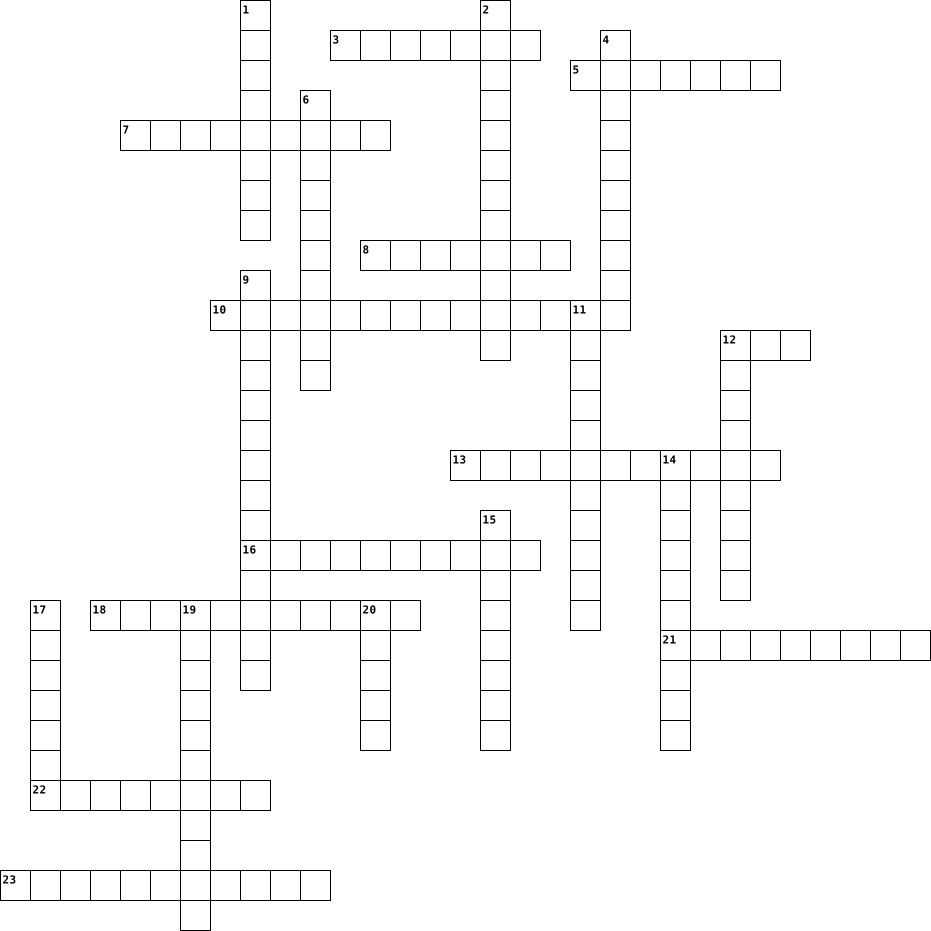
Across
- protein/ (of a reaction or process) accompanied by the release of heat.
- any of a class of organic compounds that are fatty acids or their derivatives and are insoluble in water
- protein/ protein that accelerates the speed of chemical reactions such as digestive enzymes which break down food in the digestive tract
- a substance produced by a living organism that acts as a catalyst to speed up a specific biochemical reaction.
- a molecule containing a very large number of atoms, such as a protein, nucleic acid, or synthetic polymer.
- a figure expressing the acidity or alkalinity of a solution on a logarithmic scale on which 7 is neutral, lower values are more acid, and higher values more alkaline
- form the basic structural unit of a nucleic acid
- energy/ the minimum quantity of energy that the reacting species must possess in order to undergo a specified reaction.
- reaction/ transformation of one molecule to a different molecule inside a cell and mediated by enzymes
- protein/ move many substances throughout the body. An example is hemoglobin that transports oxygen from the lungs to the other parts of the body to be used by cells in cellular respiration
- bonding/ an attraction between atoms that allows the formation of chemical substances that contain two or more atoms
- the chemical processes that occur within a living organism in order to maintain life.
Down
- a molecule that can be bonded to other identical molecules to form a polymer.
- (of a reaction or process) accompanied by or requiring the absorption of heat.
- the process of breaking down food by mechanical and enzymatic action into substances that can be used by the body.
- protein/ used for support such as connective tissue and keratin that forms hair and finger nails.
- any of a large group of organic compounds occurring in foods and living tissues and including sugars, starch, and cellulose
- (of a reaction or process) accompanied by the release of heat.
- any of a class of nitrogenous organic compounds that consist of large molecules composed of one or more long chains of amino acids and are an essential part of all living organisms, especially as structural components of body tissues such as muscle, hair, collagen, etc., and as enzymes and antibodies
- a molecule that binds to an enzyme and decreases its activity
- stance that has a molecular structure consisting chiefly or entirely of a large number of similar units bonded together
- Acid/ a complex organic substance present in living cells, especially DNA or RNA, whose molecules consist of many nucleotides linked in a long chain.
- protein/ help control movement such as proteins in the muscles which help control contraction.
- acids/ a simple organic compound containing both a carboxyl (—COOH) and an amino (—NH2) group.
24 Clues: form the basic structural unit of a nucleic acid • a molecule that binds to an enzyme and decreases its activity • (of a reaction or process) accompanied by the release of heat. • protein/ (of a reaction or process) accompanied by the release of heat. • a molecule that can be bonded to other identical molecules to form a polymer. • ...
chemistry 2014-02-18

Across
- concentration measured by the number of moles of solute per kilogram of solvent
- used to head substances at a very high temperature
- a pair of pincers or tweezers used in surgery or in a laboratory.
- used to grind paste or powder
- the chemical element of atomic number 54
- concentration measured by the number of moles of solute per liter of solution
- use for combining chemicals
- the chemical element of atomic number 25
- the chemical element of atomic number 29
- a substance that takes part in and undergoes change during a reaction.
- a tube or pipe that is wide at the top and narrow at the bottom, used for guiding liquid or powder into a small opening.
Down
- used for magnifying small objects.
- a lipped cylindrical glass container for laboratory use.
- used to spread heat
- are sources of heat
- use to measure temperature
- a group of atoms bonded together
- the mass of an atom of a chemical element expressed in atomic mass units
- the chemical element of atomic number 79
- the chemical element of atomic number 36
- the chemical element of atomic number 39
- the chemical element of atomic number 1
- the chemical element of atomic number 97
- the chemical element of atomic number 8
- the basic unit of a chemical element.
- used to pick large amount of solution
26 Clues: used to spread heat • are sources of heat • use to measure temperature • use for combining chemicals • used to grind paste or powder • a group of atoms bonded together • used for magnifying small objects. • the basic unit of a chemical element. • used to pick large amount of solution • the chemical element of atomic number 1 • the chemical element of atomic number 8 • ...
Photosynthesis and Respiration 2022-11-04

Across
- the organelle in which photosynthesis occurs
- a form of sugar that is the main energy supply
- a chemical compound in which is used as input in photosynthesis
- a organism that doesn’t make their own food.
- the right side of the chemical equation
- a form energy
- a chemical compound in which is used as a output in photosynthesis
- a organism that makes their own food
- the physical energy of electromagnetic radiation
Down
- a process in which all living things make their energy and food
- a organelle that makes energy
- a green pigment
- the left side of the chemical equation
- a process in which plants make their own food by using their environment
- cytoplasm inside the chloroplast
- a reaction in which changes the chemical compound of a substance
16 Clues: a form energy • a green pigment • a organelle that makes energy • cytoplasm inside the chloroplast • a organism that makes their own food • the left side of the chemical equation • the right side of the chemical equation • the organelle in which photosynthesis occurs • a organism that doesn’t make their own food. • a form of sugar that is the main energy supply • ...
Chemistry of life (Kevin) 2017-10-08

Across
- A covalent bond that one amino acid is attached to anther amino acid.
- monomer of disaccharide and polysaccharide.
- monomer of polypeptide and proteins.
- A subtance that cannot be turned into other subtance through chemical reactions.
- polymer of amino acids
- A kind of protein that defend against bacteria.
- A reaction that H20 are decomposed.
- Universal solvent.
Down
- general name of fat and oils.
- A bond that formed between a hydrogen atom covalently linked to an oxygen or a nitragen atom.
- A important disaccharide that prove energy.
- A substance consisting of two or more elements in a fixed ratio
- A strong interaction between atoms.
- Monomer of macromolecules
- An electrical attraction between two ions.
- The smallest unit that keeps the chemical properties of an element.
- Anything that takes up space and has mass.
- A reaction that form H2O.
- A kind of protein that is the catalyze biochemical reactions.
- Different atoms of an element that have the same number of proton, but different number of neutron.
20 Clues: Universal solvent. • polymer of amino acids • Monomer of macromolecules • A reaction that form H2O. • general name of fat and oils. • A strong interaction between atoms. • A reaction that H20 are decomposed. • monomer of polypeptide and proteins. • An electrical attraction between two ions. • Anything that takes up space and has mass. • ...
periodic table 2013-05-20

Across
- pure substances that are composed of two or more types of elements thet are chemically combined
- ability to be hammered into different shapes
- the component substances cannot be visibly
- heavy for their size
- heat and electricity move through easily
- new substance in a chemical reaction
- the component substances can be visibly
- a vertical colunms on the periodic table, also known as groups
- ability to be drawn into a wire
- composed of two or more different substances that are physically combined
- located on the left side of the zigzag line on the periodic table
Down
- heat and electricity do not move through easily
- having a shiny surface
- pure substances that cannot be changed into simpler sustances
- located on the right side of the zigzag line on the periodic table
- the number show how many of each kind of atom are in the compound
- substances combined in a chemical reaction
- a horizontal row on the periodic table
- break easily
- not shiny
20 Clues: not shiny • break easily • heavy for their size • having a shiny surface • ability to be drawn into a wire • new substance in a chemical reaction • a horizontal row on the periodic table • the component substances can be visibly • heat and electricity move through easily • the component substances cannot be visibly • substances combined in a chemical reaction • ...
Chemistry 2020-12-20
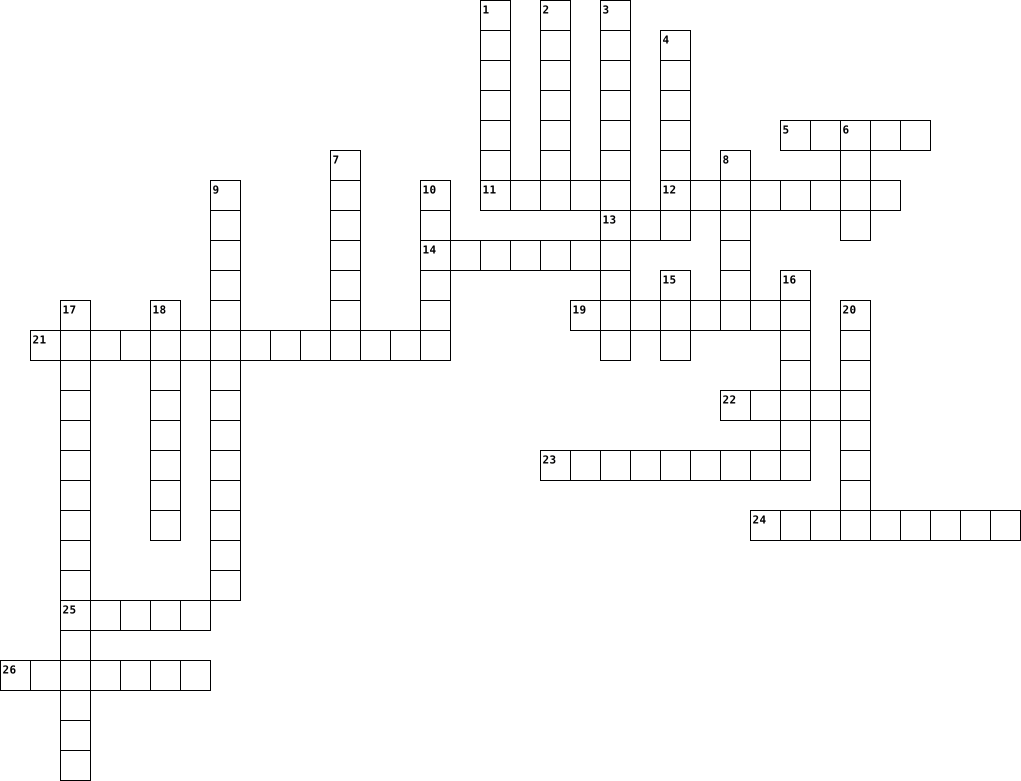
Across
- Physical property
- Conducts electricity and heat
- Chemical property
- 3rd element is oxygen
- Made of only one type of atom
- Gas to liquid
- A change in which no new substance is produced
- Column of periodic table
- A group of atoms joining together
- Where gas turns into liquid in distilation
- Metal mixtures
- 3rd element of periodic table
Down
- 20th element of periodic table
- A new substance made in a reaction
- Way to seperate two liquid
- Two or more elements not chemically bonded
- A tiny particle of matter
- Uses chemical symbols to show how many atom pf different elements are present in a molecule of an element or compound
- 6th element of periodic table
- Way to seperate colors
- Liquid to Solid
- When two element form a compound name often ends with
- Rows of periodic table
- A change in which new substances are produced
- Makes up 78% of air
- Two or more element chemically bonded
26 Clues: Gas to liquid • Metal mixtures • Liquid to Solid • Physical property • Chemical property • Makes up 78% of air • 3rd element is oxygen • Way to seperate colors • Rows of periodic table • Column of periodic table • A tiny particle of matter • Way to seperate two liquid • 6th element of periodic table • Conducts electricity and heat • Made of only one type of atom • ...
Mass and Matter 2023-09-26

Across
- has a fixed shape
- anything that has mass and takes up space
- when water vapor turns into droplets
- it flows and keeps the shape of it's container
- the amount of matter in an object
- a characteristic that is observed during a chemical reaction
- the amount of space that matter occupies
- the force exerted upon an object
Down
- a characteristic that is observed without a chemical reaction n
- a pure substance that cannot be broken down into other substances
- the measurement of the force of gravity on an object
- the measurement of how tightly a material is packed together
- the study of matter and it's properties
- the official array/organization of the elements
- the SI unit of mass
- the basic building block of all matter
- a building block that is slightly larger than an atom
- it has no fixed shape or volume
- the amount of heat in an object
- a single kind of matter that is pure
20 Clues: has a fixed shape • the SI unit of mass • it has no fixed shape or volume • the amount of heat in an object • the force exerted upon an object • the amount of matter in an object • when water vapor turns into droplets • a single kind of matter that is pure • the basic building block of all matter • the study of matter and it's properties • ...
biology 2023-10-02

Across
- pigment in chloroplast, used to trap light energy
- Adenosine Diphosphate,on charged energy storage
- sphere of earth, all gases surround earth
- First step of Aerobic Respiration,breaks down glucose into pyruvate.
- sphere of earth,all the soil and rock
- substances created during a chemical reaction made from reactants.
- oxygen is present.
- reactions first step of photosynthesis.
- densive triphosphate charged energy.
- nutrients used in phosphates of nucleic acid often limited
- type of organism that can make it's own food.
- second step of anaerobic definition,2 types include alcoholic and lactic acid
Down
- Site of photosynthesis.
- Nutrient used in proteins and nucleic acid must be fixed.
- describes a situation which oxygen is not present.
- respirations process of breaking down glucose.
- substances at the beginning of a chemical reaction
- Reactions second step of photosynthesis uses energy to make NADPH
- sphere of all water on earth
- Anything that has mass and takes up space
20 Clues: oxygen is present. • Site of photosynthesis. • sphere of all water on earth • densive triphosphate charged energy. • sphere of earth,all the soil and rock • reactions first step of photosynthesis. • sphere of earth, all gases surround earth • Anything that has mass and takes up space • type of organism that can make it's own food. • ...
Dakota 2019-06-13

Across
- Ag(CN)
- Electron Configuration ends in 3d6
- NaF
- Species formed from chemical reactions
- Electron Configuration ends in 5p2
- Numbers in front of the formulas
- Both sides of the equation are equal
- Electron Configuration ends in 3d4
- BeCl2
- Two compounds exchange ions and form two new compounds
- Ca3(PO4)2
- Electron Configuration ends in 4d9
- States that for any system closed to all transfers of matter and energy
- Al2(SO4)3
- Solution in which the solvent is water
Down
- Electron Configuration ends in 4p5
- Doesn’t show the relative and balanced amounts of reactants and products
- BaO
- Electron Configuration ends in 2p3
- Li3N
- single element reacts with a compound and displaces another element from the compound
- CaO
- Electron Configuration ends in3p6
- Electron Configuration ends in 4s1
- Substance that takes part in and undergoes change during a reaction
- Symbolic representation of a chemical reaction
- Electron Configuration ends in 5d9
- Electron Configuration ends in 3s1
28 Clues: BaO • NaF • CaO • Li3N • BeCl2 • Ag(CN) • Ca3(PO4)2 • Al2(SO4)3 • Numbers in front of the formulas • Electron Configuration ends in3p6 • Electron Configuration ends in 4p5 • Electron Configuration ends in 2p3 • Electron Configuration ends in 3d6 • Electron Configuration ends in 5p2 • Electron Configuration ends in 3d4 • Electron Configuration ends in 4s1 • Electron Configuration ends in 4d9 • ...
DevonBeller-Chemistry 2019-10-17

Across
- The scientific unit for measuring heat that starts at absolute zero
- the mixture of two chemicals
- to form from a solution
- Where there is NO atomic movement whatsoever
- when something participates in a _________ the substance does not change
- the energy produced from movement
- when things are different
- The building blocks of matter
- the process in which heat is let out
- many uses/extremely reactive
- the amount of matter in a substance
Down
- when materials participate in a ________ a new substance is formed
- what is combined in a reaction
- when things are the same
- The creator of the periodic table
- The electron on the outer ring
- the process in which heat is absorbed
- The end result in a chemical reaction
- two or more atoms bonded together
- my favorite class
- The average measure of kinetic energy in particles
- The type of atom
- The relative mass of an atom
- a chemical connection between atoms
24 Clues: The type of atom • my favorite class • to form from a solution • when things are the same • when things are different • the mixture of two chemicals • The relative mass of an atom • many uses/extremely reactive • The building blocks of matter • what is combined in a reaction • The electron on the outer ring • The creator of the periodic table • two or more atoms bonded together • ...
Biology crossword 2019-11-25

Across
- The chemical breakdown of substances
- respiration use oxygen to produce food
- does not require oxygen
- uses light energy to make molecules needed for photosynthesis
- respiration and energy production occur here
- carries energy within the cell
- the breakdown of glucose, releases energy
- glucose and carbon are converted into cellular energy
Down
- Where light-dependent reaction takes place
- chain Transports electrons from NADH to oxygen
- produces oxygen and glucose
- The sequence of reactions which most cells get energy from
- a pathway with linked chemical reactions occuring in a cell
- odorless gas produced by repiration
- converts glucose, fructose, and sucrose into cellular energy
- vital for all known forms of life
- where photosynthesis takes place
- requires oxygen
- life-supporting component in the air
- a simple sugar which is an important energy source
- the supportive tissue of an organ
- Cycle refers to the light-independent reactions in photosynthesis
22 Clues: requires oxygen • does not require oxygen • produces oxygen and glucose • carries energy within the cell • where photosynthesis takes place • vital for all known forms of life • the supportive tissue of an organ • odorless gas produced by repiration • The chemical breakdown of substances • life-supporting component in the air • respiration use oxygen to produce food • ...
The BIG Chemistry Crossword Challenge 2020-04-16

Across
- it lowers the activation energy required to start a reaction
- a mixture where the components dissolve in each other
- a crystal that contains attached water molecule
- a negative subatomic particle discovered by Thomson
- ions made up of multiple atoms
- when electrons jump to higher energy levels
- contains protons and neutrons
- when the forward and reverse reaction occur at the same rate
- substance shown after the arrow in a chemical equation
Down
- number used to balance chemical equations
- Mrs. Torres' favorite compound
- it goes down as the volume goes up
- nuclear emission with the greatest penetration power
- a nuclear emission with no mass and a negative charge
- two or more pure substances physically combined
- measures concentration
- a measure of the disorder in a system
- two or more elements chemically combined
- horizontal arrangement of elements in the periodic table
- reactions that absorb energy
- from gas to solid
- combines two light nuclei to form a heavier nucleus
- from solid to gas
23 Clues: from gas to solid • from solid to gas • measures concentration • reactions that absorb energy • contains protons and neutrons • Mrs. Torres' favorite compound • ions made up of multiple atoms • it goes down as the volume goes up • a measure of the disorder in a system • two or more elements chemically combined • number used to balance chemical equations • ...
Science Vocab Harmon Fuchs 2024-05-10

Across
- what is the energy that is stored in something
- a magnet that gets its magnetic field from an electric current
- a molecule made out of carbon and oxygen atoms
- a group of the same organisms living in an area
- a cause and effect that causes different effects
- what are the north and south ends of magnets
- is a group of atoms joined together in a certain way
- when something stays the same
- living things
- a type of energy that something gets because it is moving
- what is made in a chemical reaction
Down
- the matter that makes up nonliving things
- things being pushed away from each other
- a scientist who studies environments
- is what you start with in a chemical reaction
- what molecules are made of
- is the ability for something to move
- providing evidence that goes against a claim
- moving from one place to another
- being set apart
20 Clues: living things • being set apart • what molecules are made of • when something stays the same • moving from one place to another • what is made in a chemical reaction • a scientist who studies environments • is the ability for something to move • things being pushed away from each other • the matter that makes up nonliving things • what are the north and south ends of magnets • ...
Thermochemistry Vocabulary 2025-01-30

Across
- Solid to a liquid
- Has no fixed shape or volume
- Thermal energy transferred when two things come in contact
- Temperature where liquid turns into gas
- Gas changes into liquid
- Solid to gas, without passing through liquid state.
- The SI unit of Thermodynamic temperature
- A measure of average kinetic energy of particles in object
Down
- Thermodynamic system has the lowest energy
- The temperature a solid changes to a liquid
- Liquid turns into a gas
- Temperature liquid becomes a solid
- State of matter with fixed shape, mass, and volume
- Scale of temperature based on freezing and boiling point of water
- Liquid to gas below the boiling point
- The SI unit to measure energy or work
- A state of matter less rigid than solid, but more rigid than gas
- Chemical reaction that releases temperature
- Gas that normally exists as a liquid or solid under set conditions
- Chemical reaction that absorbs heat from the environment
20 Clues: Solid to a liquid • Liquid turns into a gas • Gas changes into liquid • Has no fixed shape or volume • Temperature liquid becomes a solid • Liquid to gas below the boiling point • The SI unit to measure energy or work • Temperature where liquid turns into gas • The SI unit of Thermodynamic temperature • Thermodynamic system has the lowest energy • ...
Unit 2 Ethan Wilker 2023-04-04

Across
- Diffusion that involves water
- a collection of cells bound together
- the basic unit of life
- where the substrate binds to the enzyme
- the movement of atoms from a high concentration to a low concentration
- Water fearing or hating
- Water loving
- a collection of organ systems
- Transport that does not require energy
- a part of a cell that performs a specific job
- when the shape of the enzyme is altered so it cannot perform it's job
- a type of protein that lowers the activation energy required to perform a chemical reaction
- what the enzyme is breaking down
Down
- A compound of two or more atoms
- a collection of tissue that does a job
- only allowing certain things to pass through
- what makes up the cell membrane
- Transport that requires energy.
- a group of organs that work together
- the amount of energy required to start a chemical reaction
- The result after a substrate is broken
- What Makes up everything
22 Clues: Water loving • the basic unit of life • Water fearing or hating • What Makes up everything • Diffusion that involves water • a collection of organ systems • A compound of two or more atoms • what makes up the cell membrane • Transport that requires energy. • what the enzyme is breaking down • a collection of cells bound together • a group of organs that work together • ...
Noah Rhoades 2026-03-27

Across
- The substance made after a chemical reaction.
- A type of fat that makes up cell membranes.
- A Group of organs working together
- The part of an enzyme where the substrate binds.
- The substance an enzyme acts on.
- Movement of substances without energy (same as above).
- Movement of particles from high concentration to low concentration.
- the buliding block of all mater
- permeable Allows some substances to pass through but not others.
- organized or specialized structures within a living cell
- When a protein loses its shape and can no longer work.
- Diffusion of water across a membrane.
- Engrgy required to ativate the reaction
Down
- Repels water (does not mix with water).
- Movement of substances across a membrane using energy.
- A protein that speeds up chemical reactions in living things.
- A group of tissues working together
- Movement of substances across a cell membrane without using energy.
- an individual animal, plant, or single-celled life form.
- The buliding block of living things
- A group of similar cells
- Groups of atoms
22 Clues: Groups of atoms • A group of similar cells • the buliding block of all mater • The substance an enzyme acts on. • A Group of organs working together • A group of tissues working together • The buliding block of living things • Diffusion of water across a membrane. • Repels water (does not mix with water). • Engrgy required to ativate the reaction • ...
Kaue Pereira 2022-03-08

Across
- The study of ratios within chemical reactions
- the quantity of a product that is obtained from a chemical reaction
- number of units in one mole of any substance
- the lowest whole # ratio of elements within a coumpound
Down
- the ratio of the actual yield to the theoretical yield
- Mass of one mole of a substance
- Reactant that rubs out first in a chemical reaction
- maximum amount of product that can be produced based on the limiting reactant
- use the coefficients in a balanced equation
- multiple of an empirical formula
10 Clues: Mass of one mole of a substance • multiple of an empirical formula • use the coefficients in a balanced equation • number of units in one mole of any substance • The study of ratios within chemical reactions • Reactant that rubs out first in a chemical reaction • the ratio of the actual yield to the theoretical yield • ...
Jayden Reilly 2022-03-08

Across
- the number between the theoretical and actual yield
- The placed before the variable
- another unit of measurement used in chemical reactions and can be found in the periodic table
- the element or mass used in the equation
- 6.12 x 10*23
Down
- Chemicals and symbols along with is subscripts
- the real amount of products after the reaction occurs
- unit of measurement used in chemical reactions
- The mass of one mole of a substance
- The study of the relationship between reactants and products through out the chemical reaction
10 Clues: 6.12 x 10*23 • The placed before the variable • The mass of one mole of a substance • the element or mass used in the equation • Chemicals and symbols along with is subscripts • unit of measurement used in chemical reactions • the number between the theoretical and actual yield • the real amount of products after the reaction occurs • ...
Chemistry 2017-03-03

Across
- What is the main substance in burning reaction?
- This is one of the most spread gas
- Another name for unsaturated hydrocarbon
- When we talk about radical that gravitates to particle with negative charge, we called it ...
- This is name of chemical element that is number 29 in periodic table
Down
- The lightest chemical element called...
- It is name of person who created one of the most popular chemical table
- The rule for electrophilic addition reaction was created by this man
- What is chemisrty teacher`s name?
- It consists of protons and neutrons
10 Clues: What is chemisrty teacher`s name? • This is one of the most spread gas • It consists of protons and neutrons • The lightest chemical element called... • Another name for unsaturated hydrocarbon • What is the main substance in burning reaction? • The rule for electrophilic addition reaction was created by this man • ...
The Chemistry of Biology 2016-10-24

Across
- only found in animals
- are proteins that speed up the chemical reactions of the cell
- the reactants in the reaction
- the substance that is dissolved
- tend to be liquid at room temperature
- Have a greater H+ ion concentration than pure water
- basic unit of matter
- a mixture of water and undissolved materials
- new Substances formed as a result of the reaction
Down
- the substance that does the dissolving
- a pure substance consisting of all the same type of atom
- Any compound that forms OH- ions in a solution
- where the substrate molecules bind to the enzyme
- in which electrons are shared unequally resulting in a molecule which has poles
- tend to be solid at room temperature
- have a lower H+ ion concentration than pure water
- any compound that forms H+ ions in a solution
- the attraction between molecules of the same substance
- an attraction molecules of different substances
- the chemical combination of two or more elements in definite proportions
- only found in plants
21 Clues: only found in plants • basic unit of matter • only found in animals • the reactants in the reaction • the substance that is dissolved • tend to be solid at room temperature • tend to be liquid at room temperature • the substance that does the dissolving • a mixture of water and undissolved materials • any compound that forms H+ ions in a solution • ...
biology crossword 2020-10-12

Across
- a material composed of two or more elements or compounds that are physically mixed
- smallest unit of most compounds
- substance in which the solute dissolves
- compounds of carbon, hydrogen, and oxygen atoms
- indicates H+ ions in solution
- when moving electrons travel about the nuclei of both atoms
- macromolecules containing hydrogen, oxygen, nitrogen, carbon, and phosphorus
- elements or compounds that enter into a chemical reaction
- attraction between molecules of different subtances
- attraction between molecules of the same substance
Down
- substance consisting entirely of one type of atom
- macromolecules that contain nitrogen, carbon hydrogen, and oxygen
- weak acids or bases that can react with strong acids or bases
- energy needed to start a chemical reaction
- Basic unit of matter
- compound that produces hydroxide ions in solution
- substance formed by the combination of two or more elements
- group of biological molecules not soluble in water
- single sugar molecules
- at center of atom
20 Clues: at center of atom • Basic unit of matter • single sugar molecules • indicates H+ ions in solution • smallest unit of most compounds • substance in which the solute dissolves • energy needed to start a chemical reaction • compounds of carbon, hydrogen, and oxygen atoms • substance consisting entirely of one type of atom • compound that produces hydroxide ions in solution • ...
Unit 2 Allison Pierron 2023-04-04

Across
- the minimum energy required for a reaction to occur
- the diffusion of water across the membrane
- third level of organization
- the second main part to a chemical reaction
- when the active site of the enzyme changes shape and can no longer bind to the substrate
- A molecule containing on hydrophilic (water loving) head and two hydrophobic (water fearing) tails
- seventh level of organization
- occurs when cells spend energy to move molecules across the membrane through a transport protein
- allowing some molecules through while blocking others
Down
- a molecule that an enzyme reacts with
- molecules naturally move from being spaced out
- speeds up the rate of chemical reactions
- a method of moving molecules across the membrane that does not require the cell to spend any energy
- fourth level of organization
- the special region on an enzyme
- water fearing
- eighth level of organization
- water loving
- fifth level of organization
- second level of organization
- first level of organization
- sixth level of organization
22 Clues: water loving • water fearing • third level of organization • fifth level of organization • first level of organization • sixth level of organization • fourth level of organization • eighth level of organization • second level of organization • seventh level of organization • the special region on an enzyme • a molecule that an enzyme reacts with • ...