
chemistry/ Crossword Puzzles
Final Project Chemistry 2024-06-03

Across
- A solution contains the maximum amount of dissolved solute
- dissolving medium in a solution
- Solution process with water as the solvent
- Liquids that dissolve freely in one another
- homogeneous mixture of two or more substances in a single phase
- If the particles in a solvent are so large that they settle out unless the mixture is constantly stirred or agitated
- on the line
- amount of substance required to form a saturated solution with a specific amount of solvent at a specified temperature
- An insoluble solid that emerges from a liquid solution
- substance being dissolved in a solution
- measure of the amount of solute in a given amount of solution
Down
- the separation of ions that occurs when an ionic compound dissolves
- when light is scattered by colloidal particles dispersed in a transparent medium
- A solution that contains more dissolved solute than a saturated solution
- being capable of being dissolved
- Liquids that are not soluble in each other
- Opposition of concentrated
- a mixture where throughout the solution the composition is not uniform
- A solution that contains less solute than a saturated solution
- under the line
- Particles that are intermediate in size
- the number of moles of solute in one liter of solution
- composition is uniform throughout the mixture
- above the line
24 Clues: on the line • under the line • above the line • Opposition of concentrated • dissolving medium in a solution • being capable of being dissolved • Particles that are intermediate in size • substance being dissolved in a solution • Liquids that are not soluble in each other • Solution process with water as the solvent • Liquids that dissolve freely in one another • ...
General Chemistry Review 2024-05-28

Across
- Elements in group 18 of the periodic table, generally unreactive due to their stable electron configurations.
- Elements in groups 3-12 on the periodic table, characterized by their variable oxidation states and colorful compounds.
- A measure of the acidity or alkalinity of a solution.
- The process by which a heavy atomic nucleus splits into two or more lighter nuclei.
- A biological catalyst that speeds up chemical reactions in living organisms.
- Bond A type of chemical bond that involves the transfer of electrons from one atom to another.
- A substance that increases the rate of a chemical reaction without undergoing permanent chemical change.
- Repelling, tending not to combine with, or incapable of dissolving in water.
- A large molecule composed of repeating structural units, or monomers.
- Bond A type of chemical bond that involves the sharing of electron pairs between atoms.
- Having an affinity for water, able to dissolve in, mix with, or be wetted by water.
- Two or more atoms chemically bonded together.
- Organic compounds composed solely of hydrogen and carbon atoms.
- A substance that conducts electricity when dissolved in water.
- Compounds with the same molecular formula but different structural arrangements.
- The principle that the volume of a gas is directly proportional to its temperature at constant pressure.
- Group 17 elements on the periodic table, highly reactive nonmetals.
- A reaction that releases heat into its surroundings.
- Electrons in the outermost shell of an atom, involved in chemical bonding.
Down
- The energy required to initiate a chemical reaction.
- The loss of electrons during a reaction by a molecule, atom, or ion.
- A substance that is dissolved in a solvent to form a solution.
- Law The equation of state of a hypothetical gas.
- An insoluble solid that forms from a reaction in a solution.
- The process by which multiple atomic nuclei join together to form a heavier nucleus.
- Group 1 elements on the periodic table, highly reactive and usually stored under oil.
- Atoms of the same element with different numbers of neutrons.
- Table A tabular arrangement of chemical elements, organized by their atomic number, electron configuration, and recurring chemical properties.
- The principle that the pressure of a gas is inversely proportional to its volume at constant temperature.
- The gain of electrons during a reaction by a molecule, atom, or ion.
- Bond A weak bond between two molecules resulting from an electrostatic attraction between a proton in one molecule and an electronegative atom in the other.
- The principle that equal volumes of gases at the same temperature and pressure contain equal numbers of molecules.
- A technique used to determine the concentration of a solution by reacting it with a solution of known concentration.
- A reaction that absorbs heat from its surroundings.
- A chemical reaction in which water breaks down another compound.
- A substance capable of dissolving other substances.
- A solution that resists changes in pH when an acid or base is added to it.
- A mixture of two or more elements, at least one of which is a metal.
- The smallest unit of matter, composed of protons, neutrons, and electrons.
39 Clues: Two or more atoms chemically bonded together. • Law The equation of state of a hypothetical gas. • A reaction that absorbs heat from its surroundings. • A substance capable of dissolving other substances. • The energy required to initiate a chemical reaction. • A reaction that releases heat into its surroundings. • ...
chemistry lock in 2024-06-11

Across
- when an atom gains or loses an electrons and changes the radii
- composition is the same throughout the sample
- reduction cathode, anode oxidation
- the temp at which a substance will change from a liquid to gas
- single compound is broken down to two or more products
- substance being dissolved
- this is the energy that is stored in a substance, and could be released/used but isn't yet.
- liquid to solid
- same protons but different number of neutrons
- rates are equal, concentrations are constant
- definite volume and shape
- gasses/network solids, brittle, high ionization and electronegativites, bad electric and heat conductors, and ions have large radii
- ions of halogens
- attractive forces between the positive end of one polar molecule and the negative end of another polar molecule
- creates a bond and releases heat
- use when melting/freezing
- a bond between a nonmetal and a metal/metalloid and has a difference of 1.7-4.0
- solids dissolved in a liquid that are separated by their boiling point
- a gentle sheen or soft glow, especially that of a partially reflective surface.
- diagnoses cancer
- the cathode is positive and the anode is negative (spontaneous and chemical to electrical)
- Celsius or Kelvin (C or K)
- able to be hammered or pressed permanently out of shape without breaking or cracking.
- are combinations of two or more pure substances that can be separated by physical means
- separating a mixture using two different thing (ink being separated with paper and water)
- a material or device that conducts or transmits heat, electricity, or sound, especially when regarded in terms of its capacity to do this.
- negative particle that is located around the nucleus
- how fast or slow a reaction will occur
- no shape or volume
- when uranium nuclei split apart
- the distance between the nuclei of two adjacent atoms (more electron shells means this is larger)
- a substance that doesn't like to keep its liquid form and separates it molecules quickly
- identify of an element
- a positive particle located in the nucleus
- an electron goes to a higher orbital before filling a lower one
- responsible for the gold foil experiment
- first person to identify basic unit of matter was an “atom:
- something that is smaller than an atom
- acids react with bases and forms water and salt
- The substance the solute is being dissolved in
- this is the energy actively being used. It is a measurement of the molecules moving around. It's basically the same thing as temperature.
- donate H+ ions (remember: two AAs dont go together)
- when electrons are shared equally between the two atoms and has a electronegativity difference of 0.4 or less
- Changing from solid directly to gas
- used when boiling/condensation
- loss of electrons (causes charge to go up)
- more solute can still be dissolved
- used when separating undissolved solids in a liquid
- Bromine, Iodine, Nitrogen, Chlorine, Hydrogen, Oxygen, Fluorine
- when nuclei come together
- solid at room temp, density greater than water, conduct heat and electricity, low ionization and electronegativity, ions have small radii
- holds more solute than the saturation point
- able to be drawn out into a thin wire.
- when a material has uniform composition throughout
Down
- definite volume, but no shape
- exactly 7 pH
- the center of an atom that is a dense core and made of protons and neutrons
- between 7 and 14 on the pH scale
- breaking a bond and inhales heat
- maximum amount of solute has been dissolved for that temperature
- the number of protons an element has
- mass number-atomic number= ?
- the amount of disorder (randomness or chaos) particles are displaying
- the amount of energy required to remove it’s most loosely bound electron
- are composed of two or more elements that are chemically combined in definite proportions by mass
- Two elements in two different compounds switch places, and form two new products
- (symmetrical, nonpolar, asymmetrical, polar)
- change from liquid to gas
- protons+neutrons= ?
- materials that are made up of parts with different chemical and physical properties
- when two or more reactants combine to form a single product
- elements that exist as a element bonded to another atom of itself
- all electrons are filling the lowest orbital level
- oxidation is loss and reduction is gain
- process that releases energy when they occur. The energy is usually released to its surroundings, so the energy is a product
- When one element in a compound is replaced by another element
- the temp at which a substance will change from a solid to a liquid
- high temperature and low pressure
- the amount of energy contained within particles
- mixing an acid and a base/ metal and nonmetal/ acid and a metal
- the anode is positive and the cathode is negative (electrical to chemical)
- Change from solid to liquid
- lowers activation energy and makes an easier pathway for a reaction
- can be homogeneous or heterogeneous
- used for carbon date fossil stuff
- electrons that have more energy
- gas to liquid
- accepts H+ ions
- the measure of hydrogen ion concentration
- treats cancer
- when electrons are shared unequally (0.4-1.6 difference)
- This is the amount of attraction an atom has for electrons. Attraction for electrons is otherwise known as “affinity”
- a neutral particle located in the nucleus
- a small particle formed by covalent bonds
- electrons that have less energy
- home of an electron
- results were that most of the atoms were positively charged, spread out equally, with the occasional electron
- has a difference of 0-1.6 and is usually two nonmetals
- is a homogeneous mixture
- are substances that can not be broken down or decomposed into simpler substances by chemical memes
- between 0 and 7 on the pH scale
- process that requires energy in order to occur. It means energy has been absorbed, so energy would be a reactant
- gaining electrons (causes charge to go down)
- gas directly to solid
- Atmospheres, Kilopascals, millimeters of mercury, torr (atm, kPa, mmHg, torr)
- used for geologic dating
- Liters or Milliliters (L or mL)
107 Clues: exactly 7 pH • gas to liquid • treats cancer • liquid to solid • accepts H+ ions • ions of halogens • diagnoses cancer • no shape or volume • protons+neutrons= ? • home of an electron • gas directly to solid • identify of an element • is a homogeneous mixture • used for geologic dating • change from liquid to gas • substance being dissolved • definite volume and shape • use when melting/freezing • ...
Chemistry Crossword 1 2024-11-20

Across
- solution holding more solute that it should be able to (over-full)
- liquids that don't mix
- changes color based on pH
- electrolyte that doesn't fully ionize in solution
- measure of basicity; -log [OH-]
- heterogeneous mixture that settles
- releases hydrogen ions (starts with H)
- properties that depend on concentration, not identity of solute
- unit for amount of substance
- acts as either acid or base
- solution holding less than the maximum amount of solute (not yet full)
Down
- substance that dissolves
- mol of solute / liters of solution
- proton acceptor (gains H+)
- electrolyte that fully ionizes in solution
- proton donor (loses H+)
- acid + base → salt + water
- releases hydroxide ions (ends with OH)
- insoluble solid product
- measure of acidity; -log [H+]
- heterogeneous mixture that looks homogenized
- substance that does the dissolving
- solution holding the maximum amount of solute (full)
- when dissolved, conducts electricity
- another word for homogeneous mixture
25 Clues: liquids that don't mix • proton donor (loses H+) • insoluble solid product • substance that dissolves • changes color based on pH • proton acceptor (gains H+) • acid + base → salt + water • acts as either acid or base • unit for amount of substance • measure of acidity; -log [H+] • measure of basicity; -log [OH-] • mol of solute / liters of solution • ...
Chemistry Crossword 3 2024-11-20

Across
- reaction with one reactant (A → B + C)
- net energy gained or lost in a reaction, Hprod - Hreac
- starting materials in a reaction (consumed)
- ratio of coefficients in units of moles
- reaction with double compound on both sides (AB + CD → CB + AD)
- reaction like burning (fuel + O2 → CO2 + H2O)
- energy to start reaction
Down
- law that states matter neither created nor destroyed (reactants = products)
- process where heat is given off, Hreac > Hprod
- reaction with compound + element on both sides (AB + C → CB + A)
- end results in a reaction (created)
- reactants must collide to react
- reactant that is left over when reaction stops
- in a reaction, products reform into reactants
- process where heat is taken in, Hprod < Hreac
- opposite changes at equal rates
- reaction with one product (A + B → C)
- reactant that limits amount of product (runs out first)
- an equation with equal amounts of atoms in reactants and products
- speeds up reaction by lowering activation energy
20 Clues: energy to start reaction • reactants must collide to react • opposite changes at equal rates • end results in a reaction (created) • reaction with one product (A + B → C) • reaction with one reactant (A → B + C) • ratio of coefficients in units of moles • starting materials in a reaction (consumed) • in a reaction, products reform into reactants • ...
Chemistry Word Search 2024-05-08

Across
- an elements that can not exist in the world without it being two atoms bonded together
- a unit a measure for liquids that can be used in equations
- a state of matter that does not shape to its container or float around
- the ability that an element can gain an electron or negative charge
- the amount something weights
- the amount of space an object takes up in an area
- a bitter substance that has a pH greater than 7
- the point at which the titration can end and the solution changes colors
- a tool used in chemistry to hold samples and solutions
- a sour substance that has a pH of less than 7
- unit that stands for Avogadro's number
Down
- a state of matter that bends to the shape of its container
- a reaction that occurs and heat is released or leaves the reaction
- an ion that creates a negative charge
- when the outer shell of an element is full and 8 protons are present in it
- a piece of paper that can tell one the pH of a substance
- a state of matter where the particles move freely
- the term for when a person uses a sieve when they want separate solids based on their size
- the outcome
- the center of a cell that holds the protons
- when an object can be easily bent into different shapes
21 Clues: the outcome • the amount something weights • an ion that creates a negative charge • unit that stands for Avogadro's number • the center of a cell that holds the protons • a sour substance that has a pH of less than 7 • a bitter substance that has a pH greater than 7 • a state of matter where the particles move freely • the amount of space an object takes up in an area • ...
Physical Chemistry Crossword 2024-05-02
Across
- The probability distribution of molecular states
- This partition function describes the number of accessible states of a system
- This is often described as the disorder of a system
- This branch of chemistry is known for causing mental pain for students
- Dr. Poler's favorite candy that he can't stop dropping jars of
- This partition function describes the number of accessible states of one molecule
- This type of system holds pressure constant
- This form of energy has the highest number of states (partition function)
- This theorem relates degrees of freedom to contributions of energy
- The branch of physical sciences that deal with relations between heat and other forms of energy
Down
- This form of energy has the third highest number of states (partition function)
- This type of system holds volume constant
- This type of matter is the easiest to do calculations and models for
- The total heat content of a system
- This form of energy has the lowest number of states (partition function)
- this type of system holds temperature constant
- This form of energy has the second highest number of states (partition function)
- This type of system holds heat constant
- This is held constant in the universe and isolated systems
- This describes the physical property of a substance needed to increase it by 1 ºC
- A fitting parameter that describes population distribution
21 Clues: The total heat content of a system • This type of system holds heat constant • This type of system holds volume constant • This type of system holds pressure constant • this type of system holds temperature constant • The probability distribution of molecular states • This is often described as the disorder of a system • ...
Physical Chemistry Crossword 2024-05-02

Across
- This is often described as the disorder of a system
- This form of energy has the lowest number of states (partition function)
- This type of matter is the easiest to do calculations and models for
- This type of system holds pressure constant
- Dr. Poler's favorite candy that he can't stop dropping jars of
- this type of system holds temperature constant
- This partition function describes the number of accessible states of a system
- The resistance to flow
- This order of reaction is independent of reactant concentrations
- The probability distribution of molecular states
- This partition function describes the number of accessible states of one molecule
- This form of energy is associated with things in motion
- This branch of chemistry is known for causing mental pain for students
- This is the time it takes for 1/2 a given amount of substance to decay (also a very popular game series started in 1998)
- The energy needed to move against a force
- Students draw many of these types of structures horribly wrong
- The average distance traveled without collisions
Down
- This is held constant in the universe and isolated systems
- This form of energy has the highest number of states (partition function)
- This describes the rate based on the amount of substance used
- This type of system holds heat constant
- This theorem relates degrees of freedom to contributions of energy
- This describes the physical property of a substance needed to increase it by 1 ºC
- This program was used to build and calculate values for molecular properties
- This type of system holds volume constant
- The branch of physical sciences that deal with relations between heat and other forms of energy
- This form of energy has the third highest number of states (partition function)
- A type of process whose system is related to spontaneity
- This type of inhibitor races the substrate to reach the enzyme active site
- The total heat content of a system
- A fitting parameter that describes population distribution
- This form of energy has the second highest number of states (partition function)
32 Clues: The resistance to flow • The total heat content of a system • This type of system holds heat constant • This type of system holds volume constant • The energy needed to move against a force • This type of system holds pressure constant • this type of system holds temperature constant • The probability distribution of molecular states • ...
Chemistry Bonus Crossword 2024-04-26

Across
- A gaseous form of a substance that is normally a liquid or solid
- A solid produced during a chemical reaction
- Mixture that is not uniform
- Transfer of electrons between atoms, resulting in cations and anions
- A neutral particle having equal numbers of p+ and e-
- Numbers that are known with complete certainty.
- Substances that are volatile vaporize easily
- The random movement of gas molecules from an area of higher concentration to an area of lower concentration
- Microscopic particles are dispersed evenly in another substance
- Sum of protons and neutrons
- Discovered electrons while experimenting with a cathode ray tube.
- The mass of one mole of particles
- Solution is heated and the solvent boils off
Down
- Standard unit that stands for 6.02x10^23
- Sharing of electrons by atoms so that all atoms involved achieve a filled valence level
- Solution that contains less than the max. amount of solute
- Solutions containing more than the maximum amount of solute
- Solution in which the solvent is water
- Solution is boiled to separate liquids
- The number of protons in the nucleus.
20 Clues: Mixture that is not uniform • Sum of protons and neutrons • The mass of one mole of particles • The number of protons in the nucleus. • Solution in which the solvent is water • Solution is boiled to separate liquids • Standard unit that stands for 6.02x10^23 • A solid produced during a chemical reaction • Substances that are volatile vaporize easily • ...
Chemistry Crossword Puzzle 2024-05-01

Across
- the length of time it takes for half of the atoms in an isotope to decay
- occurs when an acid and a base react to form a salt and water
- tend to form covalent bonds
- diffusion through a tiny opening
- atoms of the same element
- vertical columns on the periodic table
- a neutral particle having equal numbers of p+ and e-
- donates one proton per molecule
- substances that are volatile vaporize easily
- temperatures measured with a thermometer
- the mass of an atom (amu)
- the concave or convex surface of a liquid
- an atom or group of atoms that has either gained or lost e-
Down
- the random movement of gas molecules from an area of higher concentration to a lower concentration
- is the amount of matter in an object
- a ratio that compares mass and volume
- measured as half the distance between the nuclei of an atoms
- the smallest particle of a covalently bonded compound
- horizontal rows on the periodic table
- time measured with a clock or stopwatch
- negative ion
- length measured with a ruler
- positively charged ion
- ionic compound made up of a cation from a base and an anion from an acid
- is the concentration of a solution
- mass measured with a balance
26 Clues: negative ion • positively charged ion • atoms of the same element • the mass of an atom (amu) • tend to form covalent bonds • length measured with a ruler • mass measured with a balance • donates one proton per molecule • diffusion through a tiny opening • is the concentration of a solution • is the amount of matter in an object • a ratio that compares mass and volume • ...
Holiday Chemistry Crossword 2024-12-19

Across
- Chemical formula for table salt, used in holiday cooking
- The sweet compound found in candy canes
- Gas commonly found in a snow globe's atmosphere
- The process of turning water into ice crystals in winter
- The element responsible for the red color in fireworks
- Green colors in fireworks come from this element
- The most abundant element in a Christmas tree
- The element that gives a yellow glow to fireworks
- The chemical formula for carbon dioxide, released after singing carols
- An element with a name that sounds like part of the word 'Christmas'
- The compound responsible for the 'piney' scent of Christmas trees
- The element that makes up most of the universe and is found in the sun
Down
- The noble gas used in blue holiday lights
- An element used in red holiday lights and signs
- A metallic element used in bells
- A common holiday drink contains this element
- The metallic element that makes candles' wicks burn brightly
- The acid in vinegar, used for baking or holiday cleaning
- A metallic element used in sparklers
- Metal used to make shiny ornaments
- Compound that makes up baking soda, used in holiday cookies
- The sparkly mineral often used in crafting ornaments
- Shiny, gold-colored element used in holiday decorations
23 Clues: A metallic element used in bells • Metal used to make shiny ornaments • A metallic element used in sparklers • The sweet compound found in candy canes • The noble gas used in blue holiday lights • A common holiday drink contains this element • The most abundant element in a Christmas tree • An element used in red holiday lights and signs • ...
Water and Chemistry 2025-01-31

Across
- outer most electrons
- proton + neutrons = _______ ______
- hexagon ice crystals are ___ ______ than liquid, ice floats (2wds)
- type of bond by sharing pair(s) of electrons
- charge of the neutron
- stable because they have a full valance shell (2wds)
- most electronegative element
- majority of elements are _________ (plr)
- symbol used to show direction of polarity for a molecule (2wds)
- water sticking to other things
- lowercase greek letter used to mean slightly positive or negative
- Proton + __________ = mass of element
- charge of the proton
- proton count/how ptable is organized (2wds)
- energy required or released to change substance temperature
- heat of ______________ is the energy required to change from liquid to gas
- slight positive and negative side
- more or fewer electrons
Down
- water sticking to itself
- elements of life
- property of water that causes the beading/bubbling effect
- will form covalent bonds with each other (plr)
- center of the atom
- like charges ____________
- tiny particle that orbits the nucleus
- charge of the electron
- water is the universal __________ because it dissolves many substances
- Determines the element
- desire to gain electrons
- _________ action is the ability of water to "climb" narrow tubes
- does not react
- oil won't mix with water because it is ______
- fundamental force that explains how particles interact
- type of bond between positive and negative particles
- _____ bond weak attraction between this element on the end of polar molecules
- opposite charges ____________
36 Clues: does not react • elements of life • center of the atom • outer most electrons • charge of the proton • charge of the neutron • charge of the electron • Determines the element • more or fewer electrons • water sticking to itself • desire to gain electrons • like charges ____________ • most electronegative element • opposite charges ____________ • water sticking to other things • ...
Introduction to Chemistry 2025-02-03

Across
- A test to learn about science.
- The amount of matter in an object.
- Anything that has mass and takes up space.
- When substances change to form new substances.
- The amount of space something takes up.
- The smallest unit of matter.
- A state of matter with a definite shape and volume.
- Change A change that creates a new substance (e.g., burning wood).
- A type of mixture where one substance dissolves in another.
- A state of matter that takes the shape of its container but has a definite volume.
Down
- How much mass is in a given volume.
- Change A change in appearance, but not in substance (e.g., melting ice).
- A combination of substances that can be separated.
- The ability to do work or cause change.
- The study of matter and how it changes.
- Two or more atoms bonded together.
- A pure substance made of only one kind of atom.
- Table A chart that organizes elements by their properties.
- A substance made of two or more different elements.
- A state of matter that has no definite shape or volume.
20 Clues: The smallest unit of matter. • A test to learn about science. • The amount of matter in an object. • Two or more atoms bonded together. • How much mass is in a given volume. • The ability to do work or cause change. • The study of matter and how it changes. • The amount of space something takes up. • Anything that has mass and takes up space. • ...
Chemistry of Food 2024-12-02

Across
- A leavening agent containing both an acid and a base.
- The feel or consistency of food.
- Brown polymers formed during Maillard and caramelization reactions.
- An ionic compound formed from the neutralization of an acid and a base.
- The browning of sugar under heat, enhancing flavor.
- Substances that accept hydrogen ions or release hydroxide ions.
- Substances that release hydrogen ions in a solut ion.
- A solid that forms from a solution during a chemical reaction.
- Combining ingredients to form a homogenous mixture.
- The process of working dough to develop gluten.
- An ingredient in baking powder.
- A browning reaction that gives cooked food its flavor.
- Another protein in gluten that contributes to dough structure.
- A lab technique to determine the concentration of an unknown solution.
- A mixture of two liquids that usually don’t mix, like oil and water.
- Chemical changes induced by heat.
Down
- One of the proteins in gluten.
- Methods used to prevent food spoilage.
- A reaction where an acid and a base cancel each other out.
- Essential macromolecules that build and repair tissues.
- The chemical breakdown of a substance by bacteria, yeasts, or other microorganisms.
- A common base used in cooking and cleaning.
- The process by which dough expands due to leavening agents.
- The process of making dough rise.
- Substances used to thicken or stabilize mixtures.
- The chemical name for baking soda.
- Pigments that give fruits and vegetables red, purple, or blue colors.
- A solution that resists changes in pH.
- Sugars that can participate in Maillard reactions.
- Preserving food by soaking it in a solution of salt, water, and sometimes vinegar.
- A scale used to measure the acidity or basicity of a solution.
- A substance that helps mix oil and water.
- A protein found in wheat that gives dough elasticity.
33 Clues: One of the proteins in gluten. • An ingredient in baking powder. • The feel or consistency of food. • The process of making dough rise. • Chemical changes induced by heat. • The chemical name for baking soda. • Methods used to prevent food spoilage. • A solution that resists changes in pH. • A substance that helps mix oil and water. • ...
Chemistry Vocab - JS 2025-04-24

Across
- Change, same chemical structure
- Science of atoms and elements
- Space inside something
- Attracting molecules
- The result of mixing reactants
- Mixed with another, change
- From a reaction, irreversible
- Takes up space, weight
- Molecules, atoms, and elements combination
- Measurement, hot and cold
- Combination, can be separated\
- Reaction, release heat
Down
- Something that intensifies a reaction
- Visible form of a substance, characteristic
- A substance that can't be downgraded
- Measure of matter in something
- Result of a reaction
- Characteristic of a changed substance
- Unit of structure, smallest
- To do work
- Energy movement
- Group of bonded atoms
- To connect atoms
- Reaction, absorbs heat
24 Clues: To do work • Energy movement • To connect atoms • Attracting molecules • Result of a reaction • Group of bonded atoms • Space inside something • Reaction, absorbs heat • Takes up space, weight • Reaction, release heat • Measurement, hot and cold • Mixed with another, change • Unit of structure, smallest • Science of atoms and elements • From a reaction, irreversible • ...
Chemistry Unit 1 2024-12-19

Across
- Name of metals found in group 1
- Sub-atomic particle with -1 charge
- Centre of the atom
- Model that suggests the atom is a ball of positive charge with negative electrons embedded
- Charge when an atom gains electrons
- Particles used in scattering experiment to develop the nucelus model
- A substance made up of only one type of atom
- When an atom loses or gains electrons
- Atomic _______ - used to order the periodic table today
- Found on the left side of the periodic table
Down
- Name of elements found in group 7
- Sub-atomic particle with a +1 charge
- Charge when an atom loses electrons
- Surrounding the nucleus where electrons are found
- Arrangement of group 0 element with a full outer shell of electrons
- Sub-atomic particle with 0 charge
- A substance made up of 2 or more atoms chemically joined together
- Atomic _______ - used to order the modern periodic table
- Name of gases found in group 0
- Metals found between group 2 and 3
20 Clues: Centre of the atom • Name of gases found in group 0 • Name of metals found in group 1 • Name of elements found in group 7 • Sub-atomic particle with 0 charge • Sub-atomic particle with -1 charge • Metals found between group 2 and 3 • Charge when an atom loses electrons • Charge when an atom gains electrons • Sub-atomic particle with a +1 charge • ...
Solutions in chemistry 2025-01-14

Across
- Symbol: Ag
- Symbol: F
- Symbol: Cu
- A type of mixture where tbe substances are not dissolved and the composition is uneven.
- A type of mixture where the particles are evenly distributed and it looks uniform.
- A state of matter where a substance flows freely. It conforms to the shape of the container it is in.
- Symbol: Be
- Symbol: N
- Symbol: O
- A state of matter where the molecules are packed together and contain the least amount of kinetic energy. It has a defined shape and volume.
- Symbol: Na
Down
- Symbol: Li
- Symbol: H
- Substance in a mixture that is dissolved and it is present in a lower quantity.
- Symbol: Hg
- Symbol: He
- Substance in higher quantity in a mixture and it is used to dissolve the solute.
- Symbol: K
- A liquid mixture that has a solvent and a solute.
- A state of matter where particles expand freely to fill a container and has no fixed shape or volume.
- Symbol: Au
- Symbol: C
- Symbol: Ne
- Symbol: B
24 Clues: Symbol: H • Symbol: F • Symbol: K • Symbol: C • Symbol: N • Symbol: B • Symbol: O • Symbol: Li • Symbol: Hg • Symbol: He • Symbol: Ag • Symbol: Cu • Symbol: Au • Symbol: Ne • Symbol: Be • Symbol: Na • A liquid mixture that has a solvent and a solute. • Substance in a mixture that is dissolved and it is present in a lower quantity. • ...
Zoology and Chemistry 2025-01-09

Across
- salmon reproductive cell
- an organism that breaks down wastes and dead organisms
- the number of protons found in an element
- the study of matter, energy, space, and time
- what happens when your body goes above 41 degrees c
- a large number of individuals organize into a coordinate motion
- (characteristics of life) animals adjust to different environments
- when your body does not consume enough water
- the gamete of the male salmon
- A life cycle in which creatures are hatched in fresh water, migrate to salt water as adults, and then go back to fresh water in order to reproduce
- what happens when your body goes below 30 degrees c
- a group swimming in the same direction in a coordinated manner
- electrons on the outermost energy level of an atom
- the particles found inside an atom and are responsible for forming the structure of an atom
- when the number of neutrons does not equal the number of protons
- Bringing individual animals together into a group, maintaining the group, and moving the group from place to place
- a scientific procedure undertaken to make a discovery, test a hypothesis, or demonstrate a known fact
- group a group in an experiment which a variable is not being tested
- seasonal movement of animals from one place to another
- when animals slow their activity for the hot, dry summer months
- any group of atoms that are joined together by chemical bonds
- neutral particles
- variable a variable whose value depends on that of another.
- the use of senses to gather information either directly or indirectly
- individuals all move with the same velocity so that they remain together as a group
Down
- (characteristics of life) eating then rid waste
- weak attraction between a hydrogen atom and another atom
- (characteristics of life) plants avoid dangerous organisms and are drawn to good organisms
- positive charged particles
- (characteristics of life) production of new organisms and new cells
- where genes are located
- when organisms reproduce only once during their life
- average weather over a period of time
- (characteristics of life) plants learn to grow and develop in an environment
- a animal that has a external skeleton a segmented body and jointed appendages
- succession type of succession that occurs in an area that was only partially destroyed by disturbances
- succession succession that occurs on surfaces where no soil exists
- the gamete of the female salmon
- (characteristics of life) things that are living are very structured
- observing organisms and plants in their natural habitat
- negatively charged particles
- an element that has gained or lost an electron and therefore has a charge (negative or positive)
- where the river meets the ocean
- the study of elements and their chemical structures, reactions, and interactions
- (characteristics of life) things adapt and change over time to survive
- A state of greatly reduced body activity that occurs during the winter
- carbon, hydrogen, oxygen, nitrogen, phosphorus, sulfur (the primary elements found in biological molecules
- variable a variable that stands alone and isn't changed by the other variables you are trying to measure
- the study of animals
- a person or thing situated away or detached from the main body or system
- the number of protons and neutrons found in an element
- the theory that cells form the fundamental structural and functional units of all living organisms
- where salmon eggs are laid
- the basic unit of matter and defining structure of elements
- a fixed pattern of behavior in animals in response to certain stimuli
- a group of animals coordinate their activities as part of their hunting behavior in order to improve chances of making a kill and feeding
- Hooked jaw that male salmon develop when migrating back to their home stream to spawn
- any type of data that may either agree or disagree with a prediction, so it may either support or disprove a hypothesis
- offspring created when two different organisms mate
59 Clues: neutral particles • the study of animals • where genes are located • salmon reproductive cell • positive charged particles • where salmon eggs are laid • negatively charged particles • the gamete of the male salmon • the gamete of the female salmon • where the river meets the ocean • average weather over a period of time • the number of protons found in an element • ...
Chemistry Cross Word :) 2025-01-24

Across
- an atom with less electrons than protons
- atomic mass unit
- any of the series of fifteen metallic elements from lanthanum to lutetium
- the emission of ionizing radiation caused by the disintegration of a nucleus
- particles with a negative charge
- when an atom has more or less neutrons than protons
- an atom with more electrons than protons
- when a nucleus loses energy due to radiation
- particles with no charge
- center of an atom
- particles with a positive charge
- any of the elements helium, neon, argon, krypton, xenon, and radon,
- when an atom gains or loses an electron
- reactive to water
- a column of elements on the periodic table
Down
- any metals occupying the central block of the PTE, ex:copper
- an element that behaves like both a metal and non metal
- a row of elements on the periodic table
- all possible places for an electron to be
- fifteen radioactive elements from actinium to lawrencium
- an element that is not metal
- any of the elements fluorine, chlorine, bromine, iodine, and astatin
- a material that is malleable and conductes electricity
- the number of protons in an element
- lithium, sodium, potassium, rubidium, cesium, and francium,
25 Clues: atomic mass unit • center of an atom • reactive to water • particles with no charge • an element that is not metal • particles with a negative charge • particles with a positive charge • the number of protons in an element • a row of elements on the periodic table • when an atom gains or loses an electron • an atom with less electrons than protons • ...
Chemistry Extra Credit 2025-03-28

Across
- group 1 on periodic table
- neutral subatomic particle
- A chemical bond formed when two atoms share two
- A bond between atoms or ions that allows molecules to form
- the basic unit of a chemical element.
- negatively charged ion
- able to be hammered or pressed permanently out of shape without breaking or cracking.
- a thing that is composed of two or more separate elements; a mixture.
- positive subatomic particle
Down
- all of the atoms (or ions) are arranged in a regular grid pattern
- dissolved in water
- forms of the same element that contain equal numbers of protons but different numbers of neutrons
- a part or aspect of something abstract, especially one that is essential or characteristic
- group 2 on periodic table
- positively charged ion
- When a compound combines with oxygen gas to form water,
- group 17 on periodic table
- and carbon dioxide
- negative subatomic particle
- group 18 on periodic table
20 Clues: dissolved in water • and carbon dioxide • positively charged ion • negatively charged ion • group 1 on periodic table • group 2 on periodic table • neutral subatomic particle • group 17 on periodic table • group 18 on periodic table • negative subatomic particle • positive subatomic particle • the basic unit of a chemical element. • A chemical bond formed when two atoms share two • ...
Chemistry Vocabulary Final 2025-05-06

Across
- ion that consists of two or more atoms bonded together, which collectively have a net charge
- negatively charged subatomic particle found outside the nucleus
- distance from the nucleus of an ion to the outermost electron after the atom has gained or lost electrons to form an ion
- chemical compound consisting of a hydrogen and a carbon
- the ability of an atom to attract electrons towards itself when it is part of a chemical bond
- deals with quantitative relationships between reactants and products in a chemical reaction; uses a balanced chemical reaction
- chemical bond formed when two nonmetal atoms share electrons in order to achieve a full outer electron shell
- substance in a chemical reaction that is used up first
- pairs of electrons that are shared between two atoms in a chemical bond
- solid that forms and separates from a liquid solution during a chemical reaction
- amount of space an object takes up
- substances that are present at the beginning of a chemical reaction
- refers to the region around a central atom where electrons are likely to be found
- positively charged ion that has lost electrons
- substance made of two or more elements chemically combined in a fixed ratio
- number of protons in the nucleus of an atom
- pure substance made of only one type of atom
- type of chemical reaction in which a compound breaks down into simpler substances
- chemical compound formed when two nonmetal atoms share electrons in order to achieve a full electron shell
- an ionic compound formed with a metal and a nonmetal
- combination of two or more substances physically combined in variable proportions
- refers to the emission and transmission of energy in the form of waves or particles when an atoms nucleus decays
- 6.022x10^23 particles
- process in which reactants are transformed into products through the breaking and forming of chemical bonds
- subatomic particle found in the outermost shell of an atom
- states that atoms tend to gain, lose, or share electrons in order to have a full outer electron shell
- new substances formed from a chemical reaction
- molecule that has a net dipole, meaning there is an uneven distribution of electrons
- force of attraction that holds atoms together in a compound by either transferring or sharing electrons to become more stable
- mixture in which the components are not evenly distributed and composition is not uniform
- measure of the efficiency of a chemical reaction, compares actual and theoretical yield
- total number of protons and neutrons found in the nucleus of an atom
- region of space around the nucleus of an atom where there is a high probability of finding an electron
- the amount of energy required to remove one electron from a neutral atom
- substance in a chemical reaction that is not completely used up when the reaction is finished
- maximum amount of product that can be formed in a chemical reaction, calculated based on the balanced chemical equation and the amount of limiting reactant
- chemical reaction in which one element replaces another in a compound
Down
- measure of a fluids resistance to flow
- the temperature at which a liquid changes to a gas
- diagram that shows a representation of valence electrons of an element or molecules represented by dots
- chemical compound formed by the electrostatic attraction between cations and anions
- chemical reaction in which two or more compounds exchange ions to form two new compounds
- used to convert a quantity from one unit to another without changing its value
- number assigned to an atom that represents its charge in an ionic compound
- conversion factor derived from the coefficients of a balanced equation, showing the ratio of moles between substances
- the distance from the nucleus of an atom to the outermost electron shell
- positively charged subatomic particle found in the nucleus
- a regular, repeating arrangement of atoms, ions, or molecules in a solid
- the arrangement of electrons in their most stable form in an orbital
- same element with different different number of neutrons
- neutrally charged subatomic particle found in the nucleus
- mass of one mole of a substance
- mixture in which the components are evenly distributed and has uniform composition
- building block of all matter
- type of chemical reaction in which two or more simple substances combine to form a complex compound
- type of chemical bond formed when electrons are transferred from one atom to another,resulting in the formation of cations and anions
- chemical reaction that absorbs energy, usually in the form of heat
- Pairs of valence electrons that are not involved in bonding with other atoms
- elements that naturally exist as molecules composed of two identical atoms bonded together because they are more stable in this form than as individual atoms
- used to measure the amount of a substance
- anything that has mass and takes up space
- refers to the percentage by mass of each element in a compound
- atom or molecule with an electric charge because it has gained or lost electrons
- amount of matter in an object
- weighted average of all the masses of all the naturally occurring isotopes on the periodic table
- chemical reaction in which a substance reacts with oxygen to produce carbon dioxide and water
- chemical compound containing at least one oxygen atom
- measured amount of product obtained from a chemical reaction
- chemical reaction that releases energy in the form of heat or light
- family on the periodic table that corresponds to the number of valence electrons
- sum of the atomic masses of all the atoms in a chemical formula, expressed in amu
- horizontal row in the periodic table that corresponds to the number of energy levels
- negatively charged ion that has gained electrons
- measure of how readily an element or compound undergoes a chemical reaction
- molecules that do not have a net dipole, meaning there is an even distribution of charge
75 Clues: 6.022x10^23 particles • building block of all matter • amount of matter in an object • mass of one mole of a substance • amount of space an object takes up • measure of a fluids resistance to flow • used to measure the amount of a substance • anything that has mass and takes up space • number of protons in the nucleus of an atom • pure substance made of only one type of atom • ...
Intro to Chemistry 2024-10-13

Across
- group of atoms bonded together
- whether a substance will burn or not
- smallest particle to make up element
- ability to transfer heat
- how it responds to a substance
- fixed volume and fixed shape
- materials that can be drawn into long wire
- liquid changes to a gas
- suggested explanation for a scientific question
- how much damage a substance will do
- distinguishing characteristics of matter
Down
- variable shape and volume limited to the container
- anything that takes up space
- gas changes to liquid
- definite volume but assumes shape of container
- the study of matter
- materials that can be hammered thin
- data, data in form of numbers from measuring
- data, data in form of words to describe
- amount of matter packed into a given volume
- an atom that has gained or lost electrons
21 Clues: the study of matter • gas changes to liquid • liquid changes to a gas • ability to transfer heat • anything that takes up space • fixed volume and fixed shape • group of atoms bonded together • how it responds to a substance • materials that can be hammered thin • how much damage a substance will do • whether a substance will burn or not • smallest particle to make up element • ...
Chemistry of Life 2024-10-10

Across
- Long chains of carbon and hydrogen joined together
- The use of cell energy to move materials across a cell membrane
- The carbohydrate that forms the cell walls of plant cells
- A form of endocytosis in which solid particles are engulfed by cells
- A three carbon chain molecule containing three hydroxyl groups
- A difference in the number of molecules or ions of a substance between adjoining regions
- An organic molecule that is half of a glucose molecule with the molecular formula C3H6O3
- A solution where the concentration of solute molecules outside a cell is equal to the molecules inside the cell
- The raw materials needed for cell metabolism
- A series of chemical reactions that allow two molecules to bond by the formation of a water molecule
Down
- A solution where the concentration of solutes outside a cell is lower than that found inside the cell
- The basic structural units of nucleic acid
- A solution where the concentration of solutes outside a cell is higher than that found inside the cell
- The diffusion of water molecules across a selectively permeable membrane
- The process by which plants use chlorophyll to trap sunlight energy and use it to produce carbohydrates
- Artificial lipid vesicles
- Nutrients made up of a single sugar molecule or many sugar molecules
- A large carbohydrate molecule used by plants to store energy
- The form of carbohydrate storage in animals
- The loss of electrons from an atom or molecule
- The movement of molecules from an area of high to low concentration
21 Clues: Artificial lipid vesicles • The basic structural units of nucleic acid • The form of carbohydrate storage in animals • The raw materials needed for cell metabolism • The loss of electrons from an atom or molecule • Long chains of carbon and hydrogen joined together • The carbohydrate that forms the cell walls of plant cells • ...
Chemistry is Life 2024-10-06

Across
- biological catalysts
- molecules composed of many monomers; makes up macromolecules
- compound made up of carbon, hydrogen, and oxygen atoms; type of nutrient that is the major source of energy for the body
- reaction a reaction that absorbs energy (absorbs heat)
- reactant of an enzyme-catalyzed reaction
- a large organic molecule made up of many atoms (like proteins)
- energy energy that is needed to get a reaction started
- acid macromolecules containing hydrogen, oxygen, nitrogen, carbon, and phosphorus
- acid compound with an amino group on one end and a carboxyl group on the other end
- substance formed as a result of a chemical reaction
- substance that speeds up the rate of a chemical reaction
Down
- small chemical unit that makes up a polymer
- simple sugar molecule
- subunit of which nucleic acids are composed; made up of a 5-carbon sugar, a phosphate group, and a nitrogenous base
- reaction a reaction that releases energy (gives off heat)
- reaction process that changes, or transforms, one set of chemicals into another set of chemicals
- macromolecule made up of amino acids
- a complex carbohydrate made up of many monosaccharides
- macromolecule made mostly from carbon and hydrogen atoms; includes fats, oils, and waxes
- elements or compounds that enter into a chemical reaction
20 Clues: biological catalysts • simple sugar molecule • macromolecule made up of amino acids • reactant of an enzyme-catalyzed reaction • small chemical unit that makes up a polymer • substance formed as a result of a chemical reaction • reaction a reaction that absorbs energy (absorbs heat) • a complex carbohydrate made up of many monosaccharides • ...
Chemistry Comes Alive 2024-09-12

Across
- Any element or compound that is equal to its atomic weight or molecular weight weighed out in grams.
- The measure of hydrogen ion concentration of a solution (in moles per liter).
- This is a modified simple sugar (a sugar alcohol).
- These are single-chain or single-ring structures containing from three to seven carbon atoms.
- Synthesis The acid group of one amino acid is bonded to the amine group of the next, with the loss of a water molecule.
- A long double stranded polymer -a double chain of nucleotides.
- Substances that increase the rate of a chemical reactions without themselves becoming chemically changed or part of the product.
- These are heterogeneous mixtures, which means that their composition is dissimilar in different areas of the mixture.
- The most abundant and important inorganic compound in living matter.
- These are unique substances that cannot be decomposed into simpler substances by ordinary chemical methods.
- Ion An important base in the body, that is particularly abundant in the blood.
- These have the same molecular formula, their atoms are arranged differently and giving them different chemical properties.
- Structure The sequence of amino acids that forms a polypeptide chain.
- A type of globular proteins that act as biological catalyst.
- These have a sour taste, can react with many metals and burn a hole in your rug.
- Acids Composed of carbon, oxygen hydrogen, nitrogen and phosphorus, are the largest molecules in the body.
- Energy These are energy that travels in waves.
- This has a bitter taste that feels slippery and are proton acceptors, that is they take up hydrogen ions (H+) in detectable amounts.
- Bases This easily dissociates easily in water and quickly ties up H+.
- These have the same number of protons and electrons but differ in the number of neutrons they contain.
- These are diverse lipids chiefly derived from 20-carbon fatty acid (arachidonic acid) found in all membranes.
- These are substances composed of two or more components physically intermixed.
- The capacity to do work or to put matter into motion.
- These are heterogeneous mixtures with large, often visible solutes that tend to settle out.
- Bonds A chemical bond between atoms is formed by the transfer of one or more electrons from one atom to the other.
- This is called the energy of action.
Down
- Structure Two or more polypeptide chains, each with their own tertiary structure combine to form a functional protein.
- A combination of two or more atoms held together by chemical bonds
- Energy The amount of energy needed to break the bonds of the reactants so they can rearrange themselves and become the product.
- Acids These are the building blocks of protein molecules.
- The storage of carbohydrates formed by plants.
- These are polymers of simple sugars linked together by dehydration synthesis.
- A group of molecules that includes sugars and starches.
- These are homogeneous mixtures of components that may be gases, liquids or solids.
- Anything that can occupies space and has mass
- Peptide bonds linking amino acids together are broken when water is added to the bond.
- These are insoluble in water but dissolve readily in other lipids and in organic solvents such as alcohol and ether.
- This mixture has the same composition or makeup throughout.
- Single strands of nucleotides.
- This is found in cell membranes and is the raw material for synthesis of vitamin D, steroid hormones and bile salts.
- A type of energy which results from the movement of charged particles.
- Flat molecules made of four interlocking hydrocarbon rings.
- Living cells are extraordinarily sensitive to even slight changes in the pH of the environment.
- Number An atom is the sum of the masses of its protons and neutrons.
- The process of atomic decay.
- This is formed when two monosaccharides are joined by dehydration synthesis.
- The universal energy compound of body cells.
- This is the substance on which enzymes act.
- The study of chemical composition and reactions of living matter.
- An ionic compound containing cations other than H+ and anions other than the hydroxy ion.
- Reaction This occurs when a molecule is broken down into smaller molecules or its constituent atoms.
51 Clues: The process of atomic decay. • Single strands of nucleotides. • This is called the energy of action. • This is the substance on which enzymes act. • The universal energy compound of body cells. • Anything that can occupies space and has mass • The storage of carbohydrates formed by plants. • Energy These are energy that travels in waves. • ...
Chemistry key words 2025-01-26

Across
- Gases – Group 18 elements that are inert under normal conditions.
- – Radioactive elements from atomic numbers 89–103.
- – A division of principal energy levels in an atom.
- Affinity – The energy changes when an atom gains an electron.
- – Positively charged particle in an atom.
- – The electrons in the outermost shell of an atom.
- – Neutral particle in an atom's nucleus.
- – The smallest unit of matter.
- – A vertical column in the periodic table.
- – Rare earth metals from atomic numbers 57–71.
- – A region with a high probability of finding an electron.
- – Nonmetals in Group 17 are known for forming salts.
Down
- Radius – Distance from the nucleus to the outermost electron shell.
- – Atoms with the same number of protons but different neutrons.
- Metals – Highly reactive metals in Group 1 of the periodic table.
- – A measure of an atom's ability to attract electrons.
- Energy – The energy required to remove an electron from an atom.
- – Negatively charged particle in an atom.
- – A phenomenon that reduces the effective nuclear charge felt by outer electrons.
- – A horizontal row in the periodic table.
- – Central part of an atom containing protons and neutrons.
- Metals – Elements in the d-block of the periodic table.
- – Atom or molecule with a net electric charge.
- – The capacity to do work or cause change.
24 Clues: – The smallest unit of matter. • – Neutral particle in an atom's nucleus. • – Negatively charged particle in an atom. • – Positively charged particle in an atom. • – A horizontal row in the periodic table. • – A vertical column in the periodic table. • – The capacity to do work or cause change. • – Atom or molecule with a net electric charge. • ...
Q3 Chemistry Crossword 2025-03-04

Across
- The _two_words_ reaction is when two compounds trade partners, forming a precipitate
- Above this combination of temp and pressure (_two_words_), a substance is too hot to be a liquid, but the pressure is too great for it to become a gas.
- The _two_words_ is shorthand for what happens in a chemical reaction.
- When an atom throws off a piece of itself, transforming into a new element.
- A _____ speeds up a reaction but is not itself consumed
- A _two_words_ give the reactants and products but not has no coefficients
- Gasses create _____ through millions of collisions, every second, with each other or a surface.
- The _two_words_ is a ranking of metals from most to least reactive
- Avogadro’s unit, 6.02 x 10²³ atoms or molecules
- Combustion reactions of hydrocarbons (CxHy) will form carbon dioxide and ______
- _____ Law says that temperature and volume are directly proportional
- The ratio of a reaction is found by looking at the ______ of the reactants and products in the equation
- The _two_words_ of a liquid is the force with which the molecules push against the air
- A _______ reaction starts with a compound and oxygen, and forms two oxides.
- The _two_words_ of a solid is the temperature needed to break the intermolecular forces and cause the particles to begin changing position
- A _two_words_ is a map of the states a substance occupies at different combinations of pressure and temperature
- The _two_words_ of a particle or object is its mass x (velocity)2, it is the ‘energy of movement’
Down
- The _two_words_ of a substance is the combination of temp and pressure at which all three states coexist
- The __two_words_ reaction is when an element kicks out a less reactive element to form a new compound
- A _two_words_ gives the names of the reactants and products instead of their formulas
- The _two_words_ is the temp at which a liquid has a vapor pressure equal to the atmospheric pressure. It changes as the atmospheric pressure changes.
- The time it takes for half of the atoms in a radioactive isotope to decay
- The temperature scale developed to accurately measure kinetic energy
- The ______ in front of a product or reactant tells us their proportions in a reaction.
- The _two_words_ says that all matter is in constant motion, with temperature equal to the average kinetic energy
- Occuring in water
- A mole of any gas at room temperature and sea level (STP) is 22.4 ______
- The SI unit of pressure, 1000 kg per square meter
- The _two_words_ gives the reactants, products, and their proportions.
- A _____ reaction starts with two or three simple reactants and results in a single product
- _____ Law says that pressure and volume are inversely proportional
- When individual molecules of liquid ‘break free’ to become a gas
- A ________ reaction starts with a single compound which breaks apart into two or three simpler products.
- When a solid turns directly into a gas without becoming a liquid
34 Clues: Occuring in water • Avogadro’s unit, 6.02 x 10²³ atoms or molecules • The SI unit of pressure, 1000 kg per square meter • A _____ speeds up a reaction but is not itself consumed • When individual molecules of liquid ‘break free’ to become a gas • When a solid turns directly into a gas without becoming a liquid • ...
Introduction to Chemistry 2025-03-10

Across
- A process in which substances are transformed into new substances.
- The force that holds atoms together in a molecule.
- A neutral particle found in the nucleus of an atom.
- The scientist who discovered the neutron.
- The scientist who discovered the nucleus using the gold foil experiment.
- A chart that organizes all known elements by their properties.
- The scientist who discovered the electron.
- A pure substance made up of only one type of atom.
- The scientist who proposed electrons move in fixed orbits around the nucleus.
- A negatively charged particle that orbits the nucleus.
Down
- Atoms of the same element with different numbers of neutrons.
- The scientist who is known as the "Father of Modern Chemistry."
- A substance made from two or more different elements chemically bonded.
- Two or more atoms bonded together.
- The scientist who proposed the atomic theory in the early 1800s.
- An atom or molecule with a charge due to loss or gain of electrons.
- The scientist who proposed the idea of the mole and Avogadro’s number.
- The central part of an atom containing protons and neutrons.
- A positively charged particle found in the nucleus of an atom.
- The smallest unit of matter that retains the properties of an element.
20 Clues: Two or more atoms bonded together. • The scientist who discovered the neutron. • The scientist who discovered the electron. • The force that holds atoms together in a molecule. • A pure substance made up of only one type of atom. • A neutral particle found in the nucleus of an atom. • A negatively charged particle that orbits the nucleus. • ...
Food Chemistry: Energy 2025-10-31

Across
- Which type of energy holds together the nucleus of atoms and is released during nuclear fusion?
- What single word is used to describe conduction?
- What is it called when heat is transferred through density differences?
- Which type of energy is generated by moving electric charges called electrons?
- What is one of the two primary types of energy that deals with energy being stored?
- What is one of the two primary types of energy that deals with moving objects?
- Which type of energy undergoes a transformation through a chemical reaction to transform other chemical substances?
- Which type of energy is created from the vibration of molecules and atoms within substances?
- What single word is used to describe radiation?
- What is it called when energy can never be created nor destroyed, but it can be transformed from one type to another?
Down
- What is it called when heat is transferred by molecular contact?
- Which type of energy is a form of electromagnetic radiation?
- This is a resource that can be renewed easily by physical, chemical, or biological process.
- This is a resource that cannot be renew itself or takes millions of years for its formation.
- Which type of energy is held by an object because of its high position compared to a lower position?
- What single word is used to describe convection?
- What is it called when heat is transferred by wave motion?
- Which type of energy is produced when sound waves move outward from a sound source or a vibrating object?
- Which type of energy involves stretching or squashing?
- Which type of energy is associated with the position and motion of an object?
- The ability to do work is known as what?
- This is how energy moves.
22 Clues: This is how energy moves. • The ability to do work is known as what? • What single word is used to describe radiation? • What single word is used to describe convection? • What single word is used to describe conduction? • Which type of energy involves stretching or squashing? • What is it called when heat is transferred by wave motion? • ...
Chemistry of life 2025-10-31

Across
- Equal concentration of water
- movement of high to low concentration.
- broad flatted,specialized for grinding
- a flap used to close off the trachea
- enters the cell
- Contains digestive enzymes to digest food
- uses energy from the sun to make their own food
- chemical messengers that regulate the body's functions
Down
- even broader,specialized for crushing
- chisel shaped specialized for cutting
- component of a cell wall
- cannot make their own food
- exit the cell
- Cannot make their own food
- single sugar compound found in DNA
- The main source of the body's energy
- more solute outside the cell
- specialized for tearing
- watery fluid use to moisten food and contains enzymes
- more solute inside the cell
- small rounded piece of food
21 Clues: exit the cell • enters the cell • specialized for tearing • component of a cell wall • cannot make their own food • Cannot make their own food • more solute inside the cell • small rounded piece of food • Equal concentration of water • more solute outside the cell • single sugar compound found in DNA • The main source of the body's energy • a flap used to close off the trachea • ...
Soil Chemistry Terminology 2025-09-19

Across
- Positively charged ion such as calcium (Ca²⁺) or magnesium (Mg²⁺)
- Soil particles separating, often caused by excess sodium
- Soil particles clumping together, improving structure for roots
- Tension, Force that holds water molecules together at the surface
- Essential elements such as nitrogen, phosphorus, and potassium needed for plant growth
- Fully decomposed organic matter with high nutrient holding capacity
- Property of water molecules sticking to soil or other surfaces
- Material added to soil to supply nutrients like N, P, and K
Down
- Fine soil particle with high water and nutrient holding ability
- Negatively charged ion such as chloride (Cl⁻) or sulfate (SO₄²⁻)
- Soil, Soil with high sodium levels that destroys soil structure and reduces plant growth
- Soil that is a balanced mixture of sand, silt, and clay
- Exchange Capacity (CEC), Soil’s ability to hold and exchange nutrient cations
- Matter, Decomposed plants and animals that improve soil structure and fertility
- Property of water molecules sticking to each other
- Solution, The water in soil containing dissolved nutrients available for plants
- Amount of salts in soil that makes it harder for plants to absorb water
- Measure of soil acidity or alkalinity that affects nutrient availability and microbial activity
- Medium-sized soil particle with moderate nutrient holding capacity
- Large soil particle with low nutrient and water holding ability
- Property of water molecules that makes them attract to ions and dissolve nutrients
21 Clues: Property of water molecules sticking to each other • Soil that is a balanced mixture of sand, silt, and clay • Soil particles separating, often caused by excess sodium • Material added to soil to supply nutrients like N, P, and K • Property of water molecules sticking to soil or other surfaces • Fine soil particle with high water and nutrient holding ability • ...
Chemistry of Life 2025-12-02

Across
- The components of lipids. (3 words)
- The monomer of proteins. (2 words)
- The chemical that an enzyme acts on.
- The location on an enzyme where it binds to a substrate. (2 words)
- An example of a lipid.
- The chemicals that go into a reaction.
- A macromolecule that includes antibodies.
- An example of a disaccharide.
- An example of a nucleic acid.
- A small unit that can join with others to form a polymer.
- The location on a substrate where it binds to an enzyme. (2 words)
- The six elements most abundant in living organisms.
- A large molecule made of repeating parts.
Down
- Two ways we get necessary elements into our bodies. (2 words)
- Enzymes work by lowering the __________ of a reaction. (2 words)
- The monomer of a carbohydrate.
- The chemicals that come out of a reaction.
- A macromolecule that makes up exoskeletons.
- A function of lipids.
- Chemicals that speed up chemical reactions in biological organisms.
- A very large molecule.
21 Clues: A function of lipids. • An example of a lipid. • A very large molecule. • An example of a disaccharide. • An example of a nucleic acid. • The monomer of a carbohydrate. • The monomer of proteins. (2 words) • The components of lipids. (3 words) • The chemical that an enzyme acts on. • The chemicals that go into a reaction. • A macromolecule that includes antibodies. • ...
Year 8 Chemistry 2025-08-21

Across
- – The smallest unit of an element.
- change – A change where new substances are made.
- point – The temperature at which a solid melts.
- – Elements that are poor conductors and brittle if solid.
- – A state of matter with fixed shape and volume.
- – Two or more substances combined but not chemically bonded.
- – A substance that speeds up a reaction without being used up.
- – When a gas changes back to a liquid.
- – A positively charged particle in an atom.
Down
- change – A change that does not create a new substance.
- – The center of an atom containing protons and neutrons.
- point – The temperature at which a liquid boils.
- – A substance made of two or more elements chemically combined.
- – A state of matter with no fixed shape or volume.
- – Elements that are good conductors of heat and electricity.
- – When a liquid changes to a gas.
- – A state of matter that has a fixed volume but takes the shape of its container.
- table – A chart that organizes all known elements.
- – A process where substances change into new substances.
- – A negatively charged particle orbiting the nucleus.
- – A neutrally charged particle in an atom.
21 Clues: – When a liquid changes to a gas. • – The smallest unit of an element. • – When a gas changes back to a liquid. • – A neutrally charged particle in an atom. • – A positively charged particle in an atom. • point – The temperature at which a solid melts. • point – The temperature at which a liquid boils. • change – A change where new substances are made. • ...
Chemistry Combined Crossword 2025-05-24

Across
- This comes out of a solution as a solid.
- Russian chemist who invented the periodic table of the elements.
- This element is measured in millimeters to indicate pressure.
- Substance that does not conduct electricity well.
- Element used in making rechargeable batteries.
- A state of dissolving in water.
- Compounds that dissolve in a solvent are described as this.
- In a titration, this instrument is used to add a solution.
- Describes how close repeated measured values are to each other.
- A procedure that allows you to evaluate a hypothesis.
- The capacity to do work.
- The standard quantities used to specify measurements.
- Element that can extend the shelf-life of food
- A potential explanation for a single or small number of observations.
- A subatomic particle with mass 1 amu and charge 0.
Down
- Element discovered by Marie Curie.
- Inventor of dynamite.
- Compound that dissolves in water and conducts electricity.
- An atom becomes this after losing electrons.
- Study of the relative amounts of substances in balanced chemical reactions.
- The part of a solution that is in lesser amount.
- Person who discovered the law of conservation of mass.
- Element. The main component of fossil fuels.
- A state of matter in which particles move freely, with low density.
- The ionic form of the acid found in vinegar.
- Element crucial for life activities and industrial applications
- The compounds of this element are common air pollutants
- A substance composed of two or more elements in fixed proportions.
28 Clues: Inventor of dynamite. • The capacity to do work. • A state of dissolving in water. • Element discovered by Marie Curie. • This comes out of a solution as a solid. • An atom becomes this after losing electrons. • Element. The main component of fossil fuels. • The ionic form of the acid found in vinegar. • Element used in making rechargeable batteries. • ...
Chemistry Regents Review 2025-05-29

Across
- __ formulas are the most simplified version of a compound.
- Bases contain more __.
- Gamma radiation has a __ penetrating power.
- The average KE of molecules __ as temperature decreases.
- A __ reaction goes from heavy to light.
- __ ends with water and carbon dioxide.
- When a bond is __, energy is absorbed. And when a bond is formed, energy is released.
- __ energy is the energy required to pull off an electron.
- In nature, systems tend to move toward having a __ entropy.
- The Law Conservation of energy states that __ can’t be created nor destroyed but energy can change form
- __ polymerization creates a long polymer and H20.
Down
- In a __ cell, the anode is reduced and the cathode is oxidized.
- Increased concentration causes an __ collision rate.
- __ have a single bond and are unsaturated.
- An atom becomes a __ ion by losing electrons.
- Litmus paper is __ in an acidic solution.
- When the lines are flat on a heating curve, the average KE is remaining the same + the potential energy is __
- The Wave Mechanical Model introduced the idea of neutrons and electrons in __.
- In an __ cell, the anode is oxidized and the cathode is reduced.
- Aluminum cannot be broken down by a chemical change because it is an __
- Air pressure is __ to vapor pressure for a liquid to boil.
- Weak forces are __ w/ a low boiling point and they are in the gas phase.
- An increased temperature leads to __ solubility.
- 40g of KCL in 100g of water at 45 degrees celsius is __.
- As you move __ on the periodic table, the atomic radius decreases and the ionization energy and electronegativity increase.
- An ideal gas has an insignificant volume.
26 Clues: Bases contain more __. • __ ends with water and carbon dioxide. • A __ reaction goes from heavy to light. • Litmus paper is __ in an acidic solution. • An ideal gas has an insignificant volume. • __ have a single bond and are unsaturated. • Gamma radiation has a __ penetrating power. • An atom becomes a __ ion by losing electrons. • ...
Chemistry Final Exam 2025-05-16

Across
- atom's ability to attract electrons
- liquid becomes a solid
- an educated guess
- compound breaks down into 2 or more simpler substance
- element/compound you start with
- electrons in the outermost energy level
- Can be physically separated
- changes the identity of a substance
- gains electrons and becomes negatively charged
- Cannot be physically separated
- Hight KE- particles can separate & move throughout ex: helium
- Positive charge
- neutral charge
Down
- Anything that has mass and can take up space
- elements on the left side are called
- can be seen without changing the identity of the substance
- Low KE-particles can move around but are still close together ex: water
- loses electrons and becomes positively charged
- amount of matter per unit volume
- Negative charge
- type of bond between two nonmetals
- elements on the right side are called
- Very low KE- particles vibrate but can't move around ex: ice
- Gas becomes a liquid
24 Clues: neutral charge • Negative charge • Positive charge • an educated guess • Gas becomes a liquid • liquid becomes a solid • Can be physically separated • Cannot be physically separated • element/compound you start with • amount of matter per unit volume • type of bond between two nonmetals • atom's ability to attract electrons • changes the identity of a substance • ...
Elliana, Chemistry, 3 2025-05-22

Across
- When water turns into gas
- Chemical bond that shares electrons
- How hot or cold something is
- Means two (Hint: Double)
- Donates electrons and accepts protons
- The weight of an atom
- A equation of elements to show a result
- A charged atom or molecule
- When a metal can be forced into another shape without breaking, its called what?
- When a solid becomes a liquid
- Has a positive electric charge in an atom
- A table showing all of the elements
- How easy you can see through an element
- What you put on something when making contact (Hint: Pushing a wall, you are putting what on it?
- Dontates protons and accepts electrons
- A positively charged ion
- How easy something bends without breaking
- How fast a reaction happens
- Has a negitave electric charge in an atom
- When a liquid turns solid because it gets cold
- The result of two or more products combining
- The middle of an atom
- Has a neutral charge in an atom
- Bonded atoms
- Changes the substance or material of the object
Down
- Absorbs or uses heat (hint: Thermic)
- A reaction that causes the nucleus of an atom to split into two or more smaller nuclei
- Scale that ranges 0-14
- Same number of protons different number of neutrons
- Determined by how many protons are in the nucleus
- Releases heat
- Caused by atoms and molecules moving really fast
- When a metal is able to be stretched out into thin wire
- Has a PH greater than 7 on the PH scale
- Means three (Hint: Triangle)
- Means five (Hint: pentagon)
- Horizontal line of elements on the periodic table
- A negitively charged ion
- Vertical line of elements on the periodic table
- When a material shines or reflects light
- A combination of elements that are not chemically bonded
- The electrons located on the outermost shell of an atom
- A type of energy stored in the nucleus of an atom (Hint: Bomb)
- What you need to make a reaction
- Changes the size, color, shape or state of matter of an object
- Has PH less than 7 on the PH scale
- When an element can allow heat or electricity to pass THROUGH it
- How solid something is
- Means four
- Caused by atoms and molecules moving really slow
- A substance made of only one type of atom
- Has a PH of 7
- What takes up space and has mass
53 Clues: Means four • Bonded atoms • Releases heat • Has a PH of 7 • The weight of an atom • The middle of an atom • Scale that ranges 0-14 • How solid something is • Means two (Hint: Double) • A negitively charged ion • A positively charged ion • When water turns into gas • A charged atom or molecule • Means five (Hint: pentagon) • How fast a reaction happens • How hot or cold something is • ...
Chemistry & Chemical Safety 2025-07-24

Across
- unstable physical mixtures of undissolved particles in a liquid (glitter in nail polish)
- releases oxygen
- known as the universal solvent because it has the ability to dissolve more substances than any other solvent
- reaction that requires the absorption of energy or heat from an external source to readily occur
- water-loving
- oil-loving
- chemical combinations of two or more atoms of different elements in definite proportions
- 16 category document that includes safety information about products
- has a pH above 7
- this principle is used to describe how overexposure determines toxicity
- substance that may cause cancer but not always
- means that chemicals should not be mixed or stored near each other
- the separation of an atom molecule into positive and negative ions
- liquids that can easily be mixed together
- (aka: oxidation-reduction) chemical reaction in which oxidation and reduction take place at the same time
- combination of matter in any proportion
- substance that causes or is believed to cause cancer
- ion with a negative electrical charge
Down
- a stable uniform mixture of two or more substances
- reaction that releases energy in the form of heat
- has a neutral pH
- occurs when an acid is mixed with an alkali in equal proportions
- the basic unit of matter; cannot be divided into simpler substances by ordinary chemical means
- only products that contain water can have this
- change in the form or physical properties of a substance
- any substance that occupies space and has mass; exists in the form of a solid, liquid, or gas
- an unstable physical mixture of two or more immiscible substances united with the aid of a binder
- chemical combination of two or more atoms in definite proportions
- has a pH below 7
- an ingredient that brings two normally incompatible materials together and binds them into a uniform mixture
- adds hydrogen to a chemical compound or subtracts oxygen
- liquids that are not capable of being mixed together to form stable solutions
- substances that allow oil and water to mix
- the simplest form of chemical matter that cannot be broken down into a simpler substance without a loss of identity
- ion with a positive electrical charge
35 Clues: oil-loving • water-loving • releases oxygen • has a neutral pH • has a pH above 7 • has a pH below 7 • ion with a positive electrical charge • ion with a negative electrical charge • combination of matter in any proportion • liquids that can easily be mixed together • substances that allow oil and water to mix • only products that contain water can have this • ...
Chemistry Crossword Puzzle 2025-07-29

Across
- A process altering a substance's identity
- Compound containing oxygen and another element
- A state of matter with a definite shape and volume
- Substance made of two or more elements
- A pure substance that cannot be broken down
- Separating solids from liquids with a filter
- Bond formed by electron transfer
- State of matter with high kinetic energy
- Separating liquids by boiling points
- Combination of substances
- Mixture with unevenly distributed components
Down
- Separation technique using solubility
- Turns blue litmus paper red
- No change in chemical composition
- A mixture with a uniform composition
- Reacts with acids
- Property dependent on the amount of substance
- A bond formed by sharing electrons
- Property independent of the amount of substance
- Definite volume, indefinite shape
20 Clues: Reacts with acids • Combination of substances • Turns blue litmus paper red • Bond formed by electron transfer • No change in chemical composition • Definite volume, indefinite shape • A bond formed by sharing electrons • A mixture with a uniform composition • Separating liquids by boiling points • Separation technique using solubility • Substance made of two or more elements • ...
Chemistry Profile : Difficult 2025-07-26

Across
- :Blood sugar (elevated=diabetes mellitus, low levels=collapse, seizures, or coma)
- :(Elevations show pancreatitis or kidney disease
- Cortisol :Hormone measured in test for cushing's disease (Low dose dexamethasone supression test)and Addison's disease(ACTH Stimulation test)
- :Reflects kidney function (Increased = azotemia, caused by kidney, liver, and heart disease, urethral obstruction, shock, and dehydration)
- :(Increases may indicate liver, heart, or skeletal muscle damage)
- :Test helps ID bile duct problems and certain types of anemia. (Elevations indicate liver or hemolytic disease)
- :Deviations can lead to variety of disease(Tumors, Hyperparathyroidism, kidney disease, and low albumin alter calcium)
- :Indicates hydration status and provides info about the liver, kidneys, and infectious diseases.
- :Enzyme that may indicate pancreatitis when elevated
Down
- :(Elevations often associated with kidney disease, hyperthyroidism, and bleeding disorders)
- :Enzyme (When elevated indicates liver disease or corticosteroid excess)
- : Electrolyte lost with vomiting and Addison's disease (Elevations = dehydration)
- :Serum protein that helps evaluate hydration, hemorrhage, and intestinal, liver, and kidney health
- :Blood protein (Often increases with chronic inflammation and certain disease states)
- :(Sensitive indicator of active liver damagebut doesn't indicate the cause
- :Reveals kidney function (Test helps distinguish between kidney and nonkidney causes of elevated BUN)
- :Electrolyte lost with vomiting, diarrhea, and kidney or Addison's disease. (Test helps indicate hydration status)
- :(Elevations may indicate liver damage, cushing's disease, and active bone growth in young pets
- :Thyroid hormone (Decreased levels = Hypothyroidism in dogs, High levels = Hyperthyroidism in cats)
- :(Supplement diagnosis of hypothyroidism, liver disease, cushing's disease and diabetes mellitus)
20 Clues: :(Elevations show pancreatitis or kidney disease • :Enzyme that may indicate pancreatitis when elevated • :(Increases may indicate liver, heart, or skeletal muscle damage) • :Enzyme (When elevated indicates liver disease or corticosteroid excess) • :(Sensitive indicator of active liver damagebut doesn't indicate the cause • ...
Chemistry Unit 1 2024-10-01

Across
- metric prefix with a value of 0.1
- device used to measure mass
- _____ analysis; the process of cancelling units
- the amount of space a sample occupies
- a fraction made from an equivalence statement used to convert between units
- describes what the number it is written after is measuring
- information gathered as a result of an experiment
- known digits plus one smaller estimated digit
- a prediction of cause and effect that can be tested with an experiment
- type of variable that the scientist changes; the "cause"
- the SI scale for measuring temperature
- a letter representing a characteristic with a value that can change
- the SI base unit for measuring mass
- metric prefix with a value of 0.000 001
- the SI unit for measuring volume
- the SI unit for measuring time
- metric prefix with a value of 0.01
Down
- type of variable changed by another variable; the "effect"
- group of individuals that DO experience the IV
- the amount of matter in a specific volume
- the length of a path between two points
- the amount of matter in a sample
- type of variable that can change the effect, but are given constant values
- glassware used for precisely measuring liquids
- device used to measure short distances
- _____ statement; a math sentence showing how two different units can be equal
- metric prefix with a value of 1000
- paying attention to the world around you
- a procedure to test a hypothesis
- group of individuals in an experiment that DO NOT experience the IV
- metric prefix with a value of 0.001
- opinions and expectations that change the way an experiment is set up or influences the way results are interpreted
- the SI base unit for measuring distance
33 Clues: device used to measure mass • the SI unit for measuring time • the amount of matter in a sample • a procedure to test a hypothesis • the SI unit for measuring volume • metric prefix with a value of 0.1 • metric prefix with a value of 1000 • metric prefix with a value of 0.01 • the SI base unit for measuring mass • metric prefix with a value of 0.001 • ...
Chemistry Midterm Vocabulary 2026-01-12

Across
- matter with the same fixed composition and properties
- law in which states in a chemical change- matter is neither created nor destroyed
- a mixture that is the same throughout or homogenous
- A horizontal row in the periodic table
- simplest form of matter
- an observation made with measurement, numerical
- combination of two or more substances in which the basic identity of each substance is not changed
- the force of gravity acting on an objects mass
- smallest unit of matter
- a solid solution containing different metals and sometimes nonmetallic substances
- The space in which there is a high probability of finding an electron
- believed matter had a smallest unit and could not be divided
- the substance that is being dissolved when making a solution
- Weighted average of masses of all naturally occurring
- Tendency to occur at regular intervals
- developed the atomic theory and solid sphere model
Down
- the digits in a number that express accuracy and precision
- chemical combination of two or more different elements in a fixed proportion
- the substance that dissolves the solute when making a solution
- established the law of conservation of mass
- how close multiple measurements are to each other
- the variable that is measured and expected to change
- changed Greek ideology, determined air was a mixture of gas
- The principle that it is impossible to accurately measure both the position and energy of an electron at the same time
- anything that takes up space and has mass
- States that each electron occupies the lowest energy orbital available
- the variable that is changed or controlled by the scientist
- believed matter could be infinitely divided
- the measure of the amount of matter an object contains
- Atoms of an element that are chemically alike but have different masses
- the physical and chemical properties of the elements repeat in a regular pattern when they are arranged in order increasing atomic number
- an observation made without measurement, descriptive
- An electron in the outermost energy level of an atom
- Elements in vertical columns of the periodic table
- the science that investigates and explains the structure and properties of matter
- of an element by their abundance
- how close a measurement is to its true value
- period of 2000 years of qualitative science searching to purify, and perfect metals
- developed the law of definite proportions
39 Clues: simplest form of matter • smallest unit of matter • of an element by their abundance • A horizontal row in the periodic table • Tendency to occur at regular intervals • anything that takes up space and has mass • developed the law of definite proportions • established the law of conservation of mass • believed matter could be infinitely divided • ...
Chemistry Quiz #2 2026-01-16

Across
- gold foil
- poor conductor
- horizontal row
- metal divider
- negative charge
- smallest particle
- reactive nonmetals
- vertical column
- metal-like nonmetal
- electron path
- atom’s center
- very reactive metals
Down
- neutral particle
- conducts electricity
- positive charge
- reactive metals
- electron transfer
- stable gases
- plum pudding
- charged atom
- shared electrons
- planetary model
- billiard ball
23 Clues: gold foil • stable gases • plum pudding • charged atom • metal divider • billiard ball • electron path • atom’s center • poor conductor • horizontal row • positive charge • reactive metals • negative charge • planetary model • vertical column • neutral particle • shared electrons • electron transfer • smallest particle • reactive nonmetals • metal-like nonmetal • conducts electricity • very reactive metals
Unit 1 Crossword 2024-11-01

Across
- cover all aspects of water conservation and management
- one of the three basic sciences, it is the science of living things
- applied sciences that involve growth care and management of domestic livestock
- the application of scientific principles and new technologies to agriculture
- science and art involved in the cultivation, propagation, processing, and marketing of flowers, turf, vegetables, fruits, nuts and ornamental plants
- refers to all the conditions, circumstances, and influences surrounding and affecting an organism or group of organisms
- plants grown for their appearance or beauty
- refers to the management of the genetic characteristics transmitted from one generation to another and its application to our needs
Down
- last of the three basic sciences combination of biology and chemistry
- means the growing and management of living things in water, such as fish or oysters
- another basic science and studies substances
- refers to commercial firms that have developed in support of agriculture
- refers to the study of the properties and management of soil to grow plants
- defined as the application of science to solve a problem
- science of soil management and crops
- science of insects
16 Clues: science of insects • science of soil management and crops • plants grown for their appearance or beauty • another basic science and studies substances • cover all aspects of water conservation and management • defined as the application of science to solve a problem • one of the three basic sciences, it is the science of living things • ...
first crossword 2024-03-18

Across
- It is one of the natural sciences
- like a phone at your wirst
- each company has its own
- we have them in the garden
- Likes to chase mice
- instead of "pues"
- comes after wednesday
- Flying mammal
- Man's best friend
Down
- a synonim of "doing a task, implement,perform"
- top of the tops
- the "president" of the city
- It is the capital of Brazil
- to north of England
- friday, saturday and sunday
- 999+1
- next month
17 Clues: 999+1 • next month • Flying mammal • top of the tops • instead of "pues" • Man's best friend • to north of England • Likes to chase mice • comes after wednesday • each company has its own • like a phone at your wirst • we have them in the garden • the "president" of the city • It is the capital of Brazil • friday, saturday and sunday • It is one of the natural sciences • ...
Wedding 2025-02-23

Across
- The street they live on
- Amy’s favourite flower
- maid of honours relation to the bride
- the third member of their family
- Toms degree
- Grooms best man
- Mother of the brides name
- Where the couple are going on honyemoon
Down
- Where did Tom propose?
- Stag do location
- number of years together
- The football team they support
- Toms middle name
- The month tom proposed
- Amys middle name
- The school where they met
- Amy’s eye colour
17 Clues: Toms degree • Grooms best man • Stag do location • Toms middle name • Amys middle name • Amy’s eye colour • Where did Tom propose? • Amy’s favourite flower • The month tom proposed • The street they live on • number of years together • The school where they met • Mother of the brides name • The football team they support • the third member of their family • ...
Ancient Civilizations 2021-10-25

Across
- appeared in northern India
- gave kings divine right of rule
- known for its democratic institutions
- happened in the fifth century
- had river valleys
- emerged in river valleys
- this empire collapsed
- people who hunted animals
- the time before writing was developed
- share common elements
- they don't like dogs
- date human fossils and artifacts
Down
- date human fossils and artifacts
- inhabitants had divided into northern
- began around 10,000
- established Judaism as major religion
- it had river valleys
- examine artifacts
- first emerged in Africa
- was ruled by a series of dynasties
20 Clues: examine artifacts • had river valleys • began around 10,000 • it had river valleys • they don't like dogs • this empire collapsed • share common elements • first emerged in Africa • emerged in river valleys • people who hunted animals • appeared in northern India • happened in the fifth century • gave kings divine right of rule • date human fossils and artifacts • ...
The Alchemist vocabulary 2023-05-09

Across
- grieve
- embarrassed
- to keep trying
- without interruption
- to call for urgently
- talk foolishly
- unable to tire
- path
- likely to change moods quickly
- make secret plans jointly toward a common goal
Down
- uncivilized in nature
- to attack in return
- a place where priests study
- a narrative that has a literal meaning and a figurative one
- useless
- excessive pride or arrogance
- a group of people, animals or plants living closely together
- the predecessor to chemistry
- a feeling of satisfaction due to one's achievements
19 Clues: path • grieve • useless • embarrassed • to keep trying • talk foolishly • unable to tire • to attack in return • without interruption • to call for urgently • uncivilized in nature • a place where priests study • excessive pride or arrogance • the predecessor to chemistry • likely to change moods quickly • make secret plans jointly toward a common goal • ...
CYOA Puzzly 2023-03-01

Across
- the study of matter, analysing its structure, properties and behaviour to see what happens when they change in chemical reactions
- an abstract coordinate system with a reference surface (such as sea level) that serves to provide known locations to begin surveys and create
- the smallest unit that can live on its own and that makes up all living organisms and the tissues of the body
- average weather,
- The smallest part of a substance that cannot be broken down chemically
- the plant life of a particular region, habitat, or geological period."the botany of North America
- the study of everything in the universe beyond Earth's atmosphere.
- any substance that has a defined composition
Down
- the flow of electrical power or charge
- is the application of chemistry to the study of biological processes at the cellular and molecular level.
- a branch of astronomy dealing especially with the behavior, physical properties, and dynamic processes of celestial objects and phenomena.
- the science of life and living organisms
- a lipped cylindrical glass container for laboratory use.
13 Clues: average weather, • the flow of electrical power or charge • the science of life and living organisms • any substance that has a defined composition • a lipped cylindrical glass container for laboratory use. • the study of everything in the universe beyond Earth's atmosphere. • The smallest part of a substance that cannot be broken down chemically • ...
HAPPY LAB WEEK! 2021-03-21

Across
- the urinalysis analyzer
- a type of PPE
- test only valid for 3 days
- laboratory information system
- falsely increases potassium levels
- round and round it goes
- phone extension 77700
Down
- lab trash
- stacked coins appearance
- our favorite reference lab
- needle with wings
- top priority
- tube station is 13
- not a vampire
- small protein fragment present in the blood after a blood clot is degraded by fibrinolysis
- helps you aliquot
- chemistry analyzer
- the anticoagulant used for CBCs
- agar selective for gram negative organisms
19 Clues: lab trash • top priority • a type of PPE • not a vampire • needle with wings • helps you aliquot • tube station is 13 • chemistry analyzer • phone extension 77700 • the urinalysis analyzer • round and round it goes • stacked coins appearance • our favorite reference lab • test only valid for 3 days • laboratory information system • the anticoagulant used for CBCs • ...
Metabolism:Juno Vibbert 2022-02-16

Across
- something we all have in common
- 5 letter word for idea
- structure of life
- releases energy in to cells
- showing logical evidance for an idea
- what foster kids are in
- what happens to food when you eat it
- how everything breaths
- also referd to as a kind of syurp
- chemistry
Down
- claims supported evidance
- veins
- how we get energy
- we breath it out
- buliding blocks of proteins
- law of conservation
- the stuff in potaetos
- something that supports your idea
- high or low
19 Clues: veins • chemistry • high or low • we breath it out • structure of life • how we get energy • law of conservation • the stuff in potaetos • 5 letter word for idea • how everything breaths • what foster kids are in • claims supported evidance • releases energy in to cells • buliding blocks of proteins • something we all have in common • something that supports your idea • ...
SCIENCE crossword puzzle 2025-02-11

Across
- the study of everything
- gravitation
- a theory
- the smallest thing
- momentum
- energy
- the first attempt to describe matter in terms of atoms
- the study of the inorganic world
- third law
- a theory
- something from the periotic table
Down
- to look closely
- when 2 or more elements react
- ensure proper behavior and reliable research
- to spin from the gravitational pulphysical sciencethe study of the inorganic world
- second law
- first law
- a rule of what happens
- a theory
- the study of matter
- something that measures heat
21 Clues: energy • a theory • momentum • a theory • a theory • first law • third law • second law • gravitation • to look closely • the smallest thing • the study of matter • a rule of what happens • the study of everything • something that measures heat • when 2 or more elements react • the study of the inorganic world • something from the periotic table • ensure proper behavior and reliable research • ...
solve 2025-04-21

Across
- The colour of her favourite sweater of yours
- you rn
- Our dessert that has yet to be perfected
- Her favourite show
- Hanky’s last name
- A vegetable and a cat
- A daily game
- Her favourite cat of yours
- Her favourite thing to do with you
- A horrible class
Down
- Where we met
- Resembles a polar bear
- Her favourite drink
- That’s what ____ said
- Our hangout spot in block D
- Her favourite cookies
- When you can come over
- Something you are
- Her favourite ice cream flavour
19 Clues: you rn • Where we met • A daily game • A horrible class • Something you are • Hanky’s last name • Her favourite show • Her favourite drink • That’s what ____ said • Her favourite cookies • A vegetable and a cat • Resembles a polar bear • When you can come over • Her favourite cat of yours • Our hangout spot in block D • Her favourite ice cream flavour • Her favourite thing to do with you • ...
How well do you know Noelle & Joe? 2022-08-19

Across
- Joey's college mascot
- Noelle's Place of birth
- Instrument Joey played in marching band
- Sorority that Noelle was in
- Joey's Place of birth
- Company Joey works for
Down
- Country where Noelle studied abroad
- Name of Joey & Noelle's Corgi
- Class where Noelle & Joey met
- Noelle's profession
- Noelle & Joey's hometown
- Joey's favorite alcoholic beverage
- Where Noelle & Joey live now
- Name of Joey & Noelle's Aussie
14 Clues: Noelle's profession • Joey's college mascot • Joey's Place of birth • Company Joey works for • Noelle's Place of birth • Noelle & Joey's hometown • Sorority that Noelle was in • Where Noelle & Joey live now • Name of Joey & Noelle's Corgi • Class where Noelle & Joey met • Name of Joey & Noelle's Aussie • Joey's favorite alcoholic beverage • Country where Noelle studied abroad • ...
Emelie's crossword 2024-03-11

Across
- choose us how to spell the words corectly
- a kind of code
- airplane but in british english
- a bunch of things
- you learn it regurlarly
- to work on something and make it better
Down
- order of objects and phenomena
- stuck in a cage
- happens often
- most important
- adjust
- we use it in mathclass
- another word for transfer
- things you learn in chemistry
14 Clues: adjust • happens often • a kind of code • most important • stuck in a cage • a bunch of things • we use it in mathclass • you learn it regurlarly • another word for transfer • things you learn in chemistry • order of objects and phenomena • airplane but in british english • to work on something and make it better • choose us how to spell the words corectly
Alessandra Elisa Stefania 2022-12-22

Across
- you can do it ok the road
- where you run
- there is One in the kitchen
- it is elettromagnetic
- no by sea
- an area of the town
- a train that doesn’t arrive in time
Down
- the losers make it
- you were it
- when you fall
- something you can control
- a virus
- between Russia and Ukraine
- a combination of letters
14 Clues: a virus • no by sea • you were it • when you fall • where you run • the losers make it • an area of the town • it is elettromagnetic • a combination of letters • you can do it ok the road • something you can control • between Russia and Ukraine • there is One in the kitchen • a train that doesn’t arrive in time
Guess what department? 2023-01-17

Across
- Who’s your daddy?
- We have the right formula!
- Won’t find these tissues down the Kleenex aisle
- What’s bugging you?
- what’s your type?
Down
- Focusing on the PAParazzi!
- My cup runneth over!
- Stick it to me!
- Let’s get smeared!
- we see dead people!
- We’re sticking together!
11 Clues: Stick it to me! • Who’s your daddy? • what’s your type? • Let’s get smeared! • we see dead people! • What’s bugging you? • My cup runneth over! • We’re sticking together! • Focusing on the PAParazzi! • We have the right formula! • Won’t find these tissues down the Kleenex aisle
Go Cards!!! 2024-02-26

Across
- Marina's other favorite sport
- Sami's number
- The name of Sofia's dog
- Aleen's favorite cartoon calendar
- Lori recently got this
Down
- Coach Pav teaches this
- Coach Krista also coaches this
- Jenna H. does this every game
- Ceci's middle name
- Cami Hritz favorite shot
- Macey's nickname
11 Clues: Sami's number • Macey's nickname • Ceci's middle name • Coach Pav teaches this • Lori recently got this • The name of Sofia's dog • Cami Hritz favorite shot • Marina's other favorite sport • Jenna H. does this every game • Coach Krista also coaches this • Aleen's favorite cartoon calendar
ARINA NOVEMBER 2023 CROSSWORD 2023-11-18

Across
- Knights' clothes
- Moscow in Russia, London in England, Paris in France
- A character singing "Arabian Nights"
- Red flowers
- A character with a growing nose
- A tall building
- Month of Kate's and David's birthdays
- A job in zoology
- ... Old Elf
- North, ..., west, east
Down
- A happy person
- A job in biology
- A red insect with black spots, Gaston is his name
- A magic stick = a magic ...
- Food for breakfast
- A job in chemistry
- A sad person
- King's
- Lots of water, lots of jelly
19 Clues: King's • Red flowers • ... Old Elf • A sad person • A happy person • A tall building • Knights' clothes • A job in biology • A job in zoology • Food for breakfast • A job in chemistry • North, ..., west, east • A magic stick = a magic ... • Lots of water, lots of jelly • A character with a growing nose • A character singing "Arabian Nights" • Month of Kate's and David's birthdays • ...
CYOA Puzzly 2023-03-01

Across
- the study of matter, analysing its structure, properties and behaviour to see what happens when they change in chemical reactions
- an abstract coordinate system with a reference surface (such as sea level) that serves to provide known locations to begin surveys and create
- the smallest unit that can live on its own and that makes up all living organisms and the tissues of the body
- average weather,
- The smallest part of a substance that cannot be broken down chemically
- the plant life of a particular region, habitat, or geological period."the botany of North America
- the study of everything in the universe beyond Earth's atmosphere.
- any substance that has a defined composition
Down
- the flow of electrical power or charge
- is the application of chemistry to the study of biological processes at the cellular and molecular level.
- a branch of astronomy dealing especially with the behavior, physical properties, and dynamic processes of celestial objects and phenomena.
- the science of life and living organisms
- a lipped cylindrical glass container for laboratory use.
13 Clues: average weather, • the flow of electrical power or charge • the science of life and living organisms • any substance that has a defined composition • a lipped cylindrical glass container for laboratory use. • the study of everything in the universe beyond Earth's atmosphere. • The smallest part of a substance that cannot be broken down chemically • ...
CYOA Puzzly 2023-03-01

Across
- the study of matter, analysing its structure, properties and behaviour to see what happens when they change in chemical reactions
- an abstract coordinate system with a reference surface (such as sea level) that serves to provide known locations to begin surveys and create
- the smallest unit that can live on its own and that makes up all living organisms and the tissues of the body
- average weather,
- The smallest part of a substance that cannot be broken down chemically
- the plant life of a particular region, habitat, or geological period."the botany of North America
- the study of everything in the universe beyond Earth's atmosphere.
- any substance that has a defined composition
Down
- the flow of electrical power or charge
- is the application of chemistry to the study of biological processes at the cellular and molecular level.
- a branch of astronomy dealing especially with the behavior, physical properties, and dynamic processes of celestial objects and phenomena.
- the science of life and living organisms
- a lipped cylindrical glass container for laboratory use.
13 Clues: average weather, • the flow of electrical power or charge • the science of life and living organisms • any substance that has a defined composition • a lipped cylindrical glass container for laboratory use. • the study of everything in the universe beyond Earth's atmosphere. • The smallest part of a substance that cannot be broken down chemically • ...
Béla (Zoltán) 26 Sept 2025 2025-09-26

Across
- ... chemistry - szerves kémia
- - orvosi rendelő
- - holló
Down
- covalent ... - kovalens kötés
- - varjú
- - rovat
- - tenyér
7 Clues: - varjú • - rovat • - holló • - tenyér • - orvosi rendelő • covalent ... - kovalens kötés • ... chemistry - szerves kémia
Name the Following...Elements and Compunds 2014-03-15

Across
- Chloride Table Salt.
- Fill your balloons with ________.
- Comes from the Latin word "calcis" meaning "lime."
- The center of all organic chemistry.
- Banana's are filled with __________.
- The most abundant element.
Down
- Alkali metal with element symbol Li.
- What Canadians call a 5cent coin.
- Acid Vinegar anyone?
- Used in toothpaste.
- ______ foil.
- _______ digger.
12 Clues: ______ foil. • _______ digger. • Used in toothpaste. • Chloride Table Salt. • Acid Vinegar anyone? • The most abundant element. • What Canadians call a 5cent coin. • Fill your balloons with ________. • Alkali metal with element symbol Li. • The center of all organic chemistry. • Banana's are filled with __________. • Comes from the Latin word "calcis" meaning "lime."
Valentine 2023-10-03
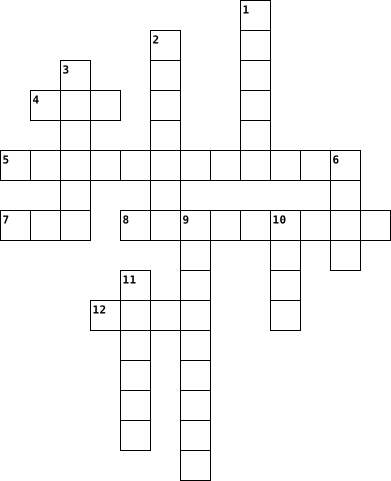
Across
- Your favorite animal is a
- You want to be a
- The month we met
- We have this class together
- I ____ you
Down
- Your favorite genre of movies
- My favorite subject
- I love writing
- you're a big
- I say this instead of cute
- I love to
- I think you're too
12 Clues: I love to • I ____ you • you're a big • I love writing • You want to be a • The month we met • I think you're too • My favorite subject • Your favorite animal is a • I say this instead of cute • We have this class together • Your favorite genre of movies
Majoody 2020-09-15

Across
- Denis Rodman has more of these then Michael Jordan
- its in Thuwal
- british valedictorian
- we do this in al-Hada
- something Majoody struggles to make
- after the nukes
- 672 minus a dozen
Down
- home of the celtics
- after ball we go ..
- elements and compounds
- looks nice when chiselled
- a nice hyundai
12 Clues: its in Thuwal • a nice hyundai • after the nukes • 672 minus a dozen • home of the celtics • after ball we go .. • british valedictorian • we do this in al-Hada • elements and compounds • looks nice when chiselled • something Majoody struggles to make • Denis Rodman has more of these then Michael Jordan
Majoody;s] 2020-09-15
![Majoody;s] crossword puzzle](/image/3465094.svg?size=30&stroke_width=1)
Across
- Denis Rodman has more of these then Michael Jordan.
- It's in Thuwal.
- British valedictorian.
- We do this in al-Hada.
- something Majoody struggles to make
- After the nukes.
- 672 minus a dozen.
Down
- Home of the Celtics.
- After ball we go ..
- Elements and compounds.
- Looks nice when chiselled.
- A Hyundai.
12 Clues: A Hyundai. • It's in Thuwal. • After the nukes. • 672 minus a dozen. • After ball we go .. • Home of the Celtics. • British valedictorian. • We do this in al-Hada. • Elements and compounds. • Looks nice when chiselled. • something Majoody struggles to make • Denis Rodman has more of these then Michael Jordan.
Majoody;s] 2020-09-15
![Majoody;s] crossword puzzle](/image/3465098.svg?size=30&stroke_width=1)
Across
- Denis Rodman has more of these then Michael Jordan.
- It's in Thuwal.
- British valedictorian.
- We do this in al-Hada.
- something Majoody struggles to make
- After the nukes.
- 672 minus a dozen.
Down
- Home of the Celtics.
- After ball we go ..
- Elements and compounds.
- Looks nice when chiselled.
- A Hyundai.
12 Clues: A Hyundai. • It's in Thuwal. • After the nukes. • 672 minus a dozen. • After ball we go .. • Home of the Celtics. • British valedictorian. • We do this in al-Hada. • Elements and compounds. • Looks nice when chiselled. • something Majoody struggles to make • Denis Rodman has more of these then Michael Jordan.
Chapter 9, Transformation in European Culture 2022-01-21

Across
- smallpox vaccine
- contributed to physics, geography, optics
- argued for empiricism
- change of power without war
- Father of Medicine
- Father of Modern Chemistry
- earth revolves around the sun
- Maria Theresa ruled this country
- ruler after Cromwell's death
Down
- knowledge only through experience
- country with large economic empire
- Father of Geometry
- ruled by Catherine the Great
- wrote Sceptical Chymist
- led Parliament's army during English Civil War
- society is free from religion
- fulfilled Creation Mandate
- studied body's circulatory system
- only trusted human reason for truth
19 Clues: smallpox vaccine • Father of Geometry • Father of Medicine • argued for empiricism • wrote Sceptical Chymist • fulfilled Creation Mandate • Father of Modern Chemistry • change of power without war • ruled by Catherine the Great • ruler after Cromwell's death • society is free from religion • earth revolves around the sun • Maria Theresa ruled this country • ...
labpuzzle 2016-04-25

Across
- device used to spin down blood samples
- pancreatic enzyme
- error occurring before testing
- AST
- Human Papilloma Virus
- container for used needled
- process of drawing blood specimen
- comment used on a critical result
- result must be called to provider within 1 hour
Down
- department performing D dimer testing
- immature RBC
- device used with a manual diff
- ALT
- WBC containing larger blue/purple granules
- Laboratory Medical Director
- Material Safety Data Sheets
- indicator of MI
- Chemistry POC analyzer
- pertaining to the liver
19 Clues: ALT • AST • immature RBC • indicator of MI • pancreatic enzyme • Human Papilloma Virus • Chemistry POC analyzer • pertaining to the liver • container for used needled • Laboratory Medical Director • Material Safety Data Sheets • device used with a manual diff • error occurring before testing • process of drawing blood specimen • comment used on a critical result • ...
U3-3 2025-01-31

Across
- 担心,令人担忧的事
- 书虫,书呆子
- 与…同龄的
- 进展,进步
- 发音
- 答复,回答
- 青少年辅导员
- 字典
- 不客气
- 提及;说起
Down
- 化学
- 发音
- 精神压力,紧张
- 解决,解答
- 复习;回顾
- 正确地
- 嘲笑
- 担心的,烦恼的
- 大声地;出声地
- 方法
20 Clues: 化学 • 发音 • 嘲笑 • 发音 • 字典 • 方法 • 正确地 • 不客气 • 解决,解答 • 复习;回顾 • 与…同龄的 • 进展,进步 • 答复,回答 • 提及;说起 • 书虫,书呆子 • 青少年辅导员 • 精神压力,紧张 • 担心的,烦恼的 • 大声地;出声地 • 担心,令人担忧的事
Types of Scientist 2021-11-30

Across
- study of marine organisms, their behaviors and interactions with the environment
- medical scientists working to develop new drugs
- works with law enforcement agencies to develop a brief profile of criminals, based on common psychological traits
- apply the principles of chemistry, biology, physics, and math to solve problems involving the production of chemicals
- design, develop, test, and supervise the manufacture of electrical equipment
- study the relationship between plants, animals and the environment.
- examine and analyze evidence from crime scenes and elsewhere to develop objective findings that can assist in the investigation and prosecution of perpetrators of crime or absolve an innocent person from suspicion
- a scientist who has a strong understanding of many scientific disciplines, such as biology and chemistry, and typically works with chemicals and other substances to determine if they are toxic or harmful to humans and other living organisms or the environment
- analyse how well software, hardware and the wider IT system fit the business needs of their employer or of a client
- focuses on the characteristics of microorganisms
- design, develop, test, and supervise the manufacture of electrical equipment,
Down
- study objects in the universe, including galaxies and stars to understand what they are made of, their features, their histories, and how they were formed
- wash, sort, catalog, and store recovered artifacts after bringing them back from the field
- Evaluate and explore the planet and its natural resources. Identify and improve upon research methods. Make land process predictions based on previous earthquakes, volcanoes, floods and tornadoes. Interpret and report data they collect from the field
- on applying the principles of engineering to software development
- produce machines keeping in mind the designing, testing, and development of the theoretical representation drawn for the purpose of construction
- study all plant life
- responsible for designing, coding and modifying websites, from layout to function and according to a client's specifications
- plan and conduct scientific experiments and studies to test theories and to discover properties of matter and energy
- conceive, design, build, supervise, operate, construct and maintain infrastructure projects and systems in the public and private sector, including roads, buildings, airports, tunnels, dams, bridges, and systems for water supply and sewage treatment
- chemistry, biology, and other sciences to study the basic elements of food
- assess, diagnose, and treat mental, emotional, and behavioral disorders
22 Clues: study all plant life • medical scientists working to develop new drugs • focuses on the characteristics of microorganisms • on applying the principles of engineering to software development • study the relationship between plants, animals and the environment. • assess, diagnose, and treat mental, emotional, and behavioral disorders • ...
School Subjects 2023-02-08

Across
- experiments
- calculating
- flowers and animals
Down
- the most used language
- gravity, energy, power
- computers and technology
- teaching about past
- singing and listening
8 Clues: experiments • calculating • teaching about past • flowers and animals • singing and listening • the most used language • gravity, energy, power • computers and technology
Soil Fertility 2021-03-08

Across
- Primary macronutrient
- soil, environment and profit
- Fertilizer vs crop yield
- Soil _ plays a big role in soil fertility
Down
- Law of Minimum
- Excessive nutrient
- Micronutrient
- natural sources of nutrient
- No visual deficiency is called as hidden _
- Beneficial element
10 Clues: Micronutrient • Law of Minimum • Excessive nutrient • Beneficial element • Primary macronutrient • Fertilizer vs crop yield • natural sources of nutrient • soil, environment and profit • Soil _ plays a big role in soil fertility • No visual deficiency is called as hidden _
Darcy’s ‘ch’ crossword 2024-02-14

Across
- is a Device
- someone how is Naughty
- something that digestive your food
- is a band
- a sound that reflects
- is someone who is in a play
Down
- a lab
- is a note
- is crazy
- a dull pain
10 Clues: a lab • is crazy • is a note • is a band • is a Device • a dull pain • a sound that reflects • someone how is Naughty • is someone who is in a play • something that digestive your food
Ecce Romani Capitulum XXIV 2024-03-18

Across
- Running, walking, etc
- 🏔
- Part of a contract
- supply < demand
- What you do at your job
- What you do with books
Down
- Part of a circle
- What you do with a pencil
- Things children play
- Chemistry concept
10 Clues: 🏔 • supply < demand • Part of a circle • Chemistry concept • Part of a contract • Things children play • Running, walking, etc • What you do with books • What you do at your job • What you do with a pencil
Technology 2022-12-15

Across
- digital lock
- magnetic force
- person who is studying chemistry
- hardware, which on you type
Down
- recording device
- person who is studying biology
- it dont exist in reality
- pocket computer
- hardware device, that makes clicking sounds
- bump into something
10 Clues: digital lock • magnetic force • pocket computer • recording device • bump into something • it dont exist in reality • hardware, which on you type • person who is studying biology • person who is studying chemistry • hardware device, that makes clicking sounds
Antoine Lavoisier 2018-05-06

Across
- He set up the steady utilization of the … balance, which used oxygen to rule out the phlogiston theory.
- He conducted many research studies in physical chemistry and …
- This French chemist is also known as the father of modern…
- Lavoisier did not discover any new …
- Antoine Lavoisier gave the names of elements: hydrogen and ….
Down
- He was basically a theorist, and was successful at taking over experimental work that other … were working on or he collaborated with them.
- He discovered oxygen’s role in corroding metal, along with its role in plant and animal …
- His description of combustion showed that the phlogiston theory was incorrect, because it postulated that … materials released phlogiston components
- Lavoisier was born into a very affluent family in…
- He discovered oxygen’s role in corroding …
10 Clues: Lavoisier did not discover any new … • He discovered oxygen’s role in corroding … • Lavoisier was born into a very affluent family in… • This French chemist is also known as the father of modern… • Antoine Lavoisier gave the names of elements: hydrogen and …. • He conducted many research studies in physical chemistry and … • ...
Antoine Lavoisier 2018-05-06

Across
- He discovered oxygen’s role in corroding …
- Lavoisier did not discover any new …
- He discovered oxygen’s role in corroding metal, along with its role in plant and animal …
- He set up the steady utilization of the … balance, which used oxygen to rule out the phlogiston theory.
Down
- Lavoisier was born into a very affluent family in…
- He was basically a theorist, and was successful at taking over experimental work that other … were working on or he collaborated with them.
- He conducted many research studies in physical chemistry and …
- This French chemist is also known as the father of modern…
- His description of combustion showed that the phlogiston theory was incorrect, because it postulated that … materials released phlogiston components
- Antoine Lavoisier gave the names of elements: hydrogen and ….
10 Clues: Lavoisier did not discover any new … • He discovered oxygen’s role in corroding … • Lavoisier was born into a very affluent family in… • This French chemist is also known as the father of modern… • Antoine Lavoisier gave the names of elements: hydrogen and …. • He conducted many research studies in physical chemistry and … • ...
Energy 2024-06-20

Across
- relating to chemistry, or the interactions of substances as studied in chemistry.
- that travel through the air or another medium and can be heard when they reach a person's or animal's ear.
- Depending on movement for its effect
- Not able to renewed
Down
- a turbomachine with at least one moving part called a rotor assembly
- a form of energy resulting from the existence of charged particles (such as electrons or protons), either statically as an accumulation of charge or dynamically as a current.
- Capable of being renewed
- A place that something come from
- Radiation from the Sun that is capable of producing heat,causing chemical.
- Natural movement of the air, especially in the form of a current of air blowing from a particular direction
10 Clues: Not able to renewed • Capable of being renewed • A place that something come from • Depending on movement for its effect • a turbomachine with at least one moving part called a rotor assembly • Radiation from the Sun that is capable of producing heat,causing chemical. • relating to chemistry, or the interactions of substances as studied in chemistry. • ...
Element mixtures and compounds crossword 2024-12-19

Across
- contains 0 or more atoms/elements
- a part or aspect of something abstract, especially one that is essential or characteristic.
- anything that has mass and takes up space
- a metal made by combining two or more metallic elements, especially to give greater strength or resistance to corrosion.
- relating to chemistry, or the interactions of substances as studied in chemistry.
Down
- a relationship between people or groups based on shared feelings, interests, or experiences.
- a mathematical relationship or rule expressed in symbol
- two or more atoms connected by chemical bonds, which form the smallest unit of a substance that retains the composition and properties of that substance
- another way of mixing chemicals not chemically bonding tho
- like building blocks have combinations
10 Clues: contains 0 or more atoms/elements • like building blocks have combinations • anything that has mass and takes up space • a mathematical relationship or rule expressed in symbol • another way of mixing chemicals not chemically bonding tho • relating to chemistry, or the interactions of substances as studied in chemistry. • ...
Engineering 2026-01-15

Across
- Designing, building, maintaining and applying systems that use X-ray technology.
- designs, develops and tests Aircraft and spacecraft.
- A multidisciplinary field focused on the design, construction, operation and maintenance of railway systems.
- Applies Earth science principles to solve engineering and environmental problems.
- lies engineering, biology, and chemistry to design processes and systems for making biochemical products
- Applying engineering principles to interpret and enforce local zoning laws.
Down
- Focuses on designing and building aircrafts.
- Designing,developing, and applying systems and devices that use electricity,electronics and electromagnetism.
- Involves designing, creating and managing spacecraft and their ground systems.
- Uses principles from chemistry,physics,math,and biology to design and improve industrial processes that convert raw materials into useful items like medicine and more,
10 Clues: Focuses on designing and building aircrafts. • designs, develops and tests Aircraft and spacecraft. • Applying engineering principles to interpret and enforce local zoning laws. • Involves designing, creating and managing spacecraft and their ground systems. • Designing, building, maintaining and applying systems that use X-ray technology. • ...
Radioactivity Crossword - Jake Hutchings 2014-03-28

Across
- Rays
- In lucozade
- another of the 3 main atoms
- the centre of a cell
Down
- Chernobyl
- One of the 3 main atoms in chemistry
- Primary
- the first
- When wood rots
9 Clues: Rays • Primary • Chernobyl • the first • In lucozade • When wood rots • the centre of a cell • another of the 3 main atoms • One of the 3 main atoms in chemistry
Science Crossword 2014-03-07

Across
- ___- of evolution
- Natural conversion of electromagnetic radiation to chemical energy
- positive electrode
- 6.022 X 10^23
- name of the sun
- Leftover of a meteor impact
- Scaled Mammal
- High energy electromagnetic radiation
- 6 protons
Down
- Second series in the Paleogene period (two words 6,5)
- Night Dwelling
- Behaviour of water/fluid
- Hominid that used oldawon tools (two words 4,7)
- ___-Chemistry; Natural
14 Clues: 6 protons • 6.022 X 10^23 • Scaled Mammal • Night Dwelling • name of the sun • ___- of evolution • positive electrode • ___-Chemistry; Natural • Behaviour of water/fluid • Leftover of a meteor impact • High energy electromagnetic radiation • Hominid that used oldawon tools (two words 4,7) • Second series in the Paleogene period (two words 6,5) • ...
Kennicott Crossword 2 2025-11-30

Across
- English Teacher
- the _____ cafe
- chemistry teacher
- welcome to...
Down
- Place with lots of books
- geography teacher
- Smallest class size
- Largest class size
8 Clues: welcome to... • the _____ cafe • English Teacher • geography teacher • chemistry teacher • Largest class size • Smallest class size • Place with lots of books
Unit 5 Revision 2021-01-13

Across
- to see how two things are different
- quick
- exams
- working well
- giving a lot of attention
Down
- helping you to do something
- difficult
- subject where we study substances (вещество)
- subject where we study egergy, heat, light, etc
- very old
- subject where we study countries, mountains, seas, etc
- not difficult
12 Clues: quick • exams • very old • difficult • working well • not difficult • giving a lot of attention • helping you to do something • to see how two things are different • subject where we study substances (вещество) • subject where we study egergy, heat, light, etc • subject where we study countries, mountains, seas, etc
Majoody 2020-09-15

Across
- Denis Rodman has more of these then Michael Jordan
- its in Thuwal
- british valedictorian
- we do this in al-Hada
- something Majoody struggles to make
- after the nukes
- 672 minus a dozen
Down
- home of the celtics
- after ball we go ..
- elements and compounds
- looks nice when chiselled
- a nice hyundai
12 Clues: its in Thuwal • a nice hyundai • after the nukes • 672 minus a dozen • home of the celtics • after ball we go .. • british valedictorian • we do this in al-Hada • elements and compounds • looks nice when chiselled • something Majoody struggles to make • Denis Rodman has more of these then Michael Jordan
Majoody 2020-09-15

Across
- Denis Rodman has more of these then Michael Jordan.
- It's in Thuwal.
- British valedictorian.
- We do this in al-Hada.
- something Majoody struggles to make
- After the nukes.
- 672 minus a dozen.
Down
- Home of the Celtics.
- After ball we go ..
- Elements and compounds.
- Looks nice when chiselled.
- A Hyundai.
12 Clues: A Hyundai. • It's in Thuwal. • After the nukes. • 672 minus a dozen. • After ball we go .. • Home of the Celtics. • British valedictorian. • We do this in al-Hada. • Elements and compounds. • Looks nice when chiselled. • something Majoody struggles to make • Denis Rodman has more of these then Michael Jordan.
Science Vocabulary List 2022-03-19

Across
- The study of Earth
- Investigate information
- The study of chemicals
- Used to measure liquids
- Something to beware of
- The study of life
Down
- An educated guess
- Do something in a specific order
- Used to hold chemicals
- Used to mix chemicals
- A place to do experiments
- The study of energy
12 Clues: An educated guess • The study of life • The study of Earth • The study of energy • Used to mix chemicals • Used to hold chemicals • The study of chemicals • Something to beware of • Investigate information • Used to measure liquids • A place to do experiments • Do something in a specific order
Jane Fomuso 2024-02-27

Across
- a language i speak fluently
- the career i am pursuing
- my favorite chemistry class
- my major
- branch of military I plan to join
Down
- my favorite fruit
- My favorite color
- my favorite food
- my number one song from 2023
- my sun star sign
- my favorite equation (4 components)
- my favorite pet
12 Clues: my major • my favorite pet • my favorite food • my sun star sign • my favorite fruit • My favorite color • the career i am pursuing • a language i speak fluently • my favorite chemistry class • my number one song from 2023 • branch of military I plan to join • my favorite equation (4 components)
Sam's Crossword 2024-03-05

Across
- favorite manga
- major
- home state
- what e-board am I on (acronym)
- best basketball team
Down
- what type of doctor do I want to become
- best basketball player of all time
- favorite food
- favorite hobby
- what position do I play in soccer
- what is my minor
- king of the pirates
12 Clues: major • home state • favorite food • favorite hobby • favorite manga • what is my minor • king of the pirates • best basketball team • what e-board am I on (acronym) • what position do I play in soccer • best basketball player of all time • what type of doctor do I want to become
9/19 2022-09-19

Across
- spiritual things that Lyndzie likes
- Mrs Douglass outfit
- British spelling for fav
- i am this
- Who was Bella’s shadow buddy today?
- British spelling of color
Down
- real surf jewelry
- Who’s concert is this weekend in Austin?
- Best joke ever
- the worst subject ever
- you can play games on these
- flinn is this
12 Clues: i am this • flinn is this • Best joke ever • real surf jewelry • Mrs Douglass outfit • the worst subject ever • British spelling for fav • British spelling of color • you can play games on these • spiritual things that Lyndzie likes • Who was Bella’s shadow buddy today? • Who’s concert is this weekend in Austin?
School Subjects 2025-07-04

Across
- people in the past, important events in the past
- crayons, paints, colors, pencils
- the earth, land, atmosphere
- chemical science, oxygen, hydrogen, water
- energy, motion, gravity
- language, grammar, reading, speaking
Down
- instruments, violin, guitar, singing
- the human body, nature, living creatures
- numbers, counting, adding, dividing
- computers, technology
- experiment, natural world
- exercise, basketball, stretching
12 Clues: computers, technology • energy, motion, gravity • experiment, natural world • the earth, land, atmosphere • crayons, paints, colors, pencils • exercise, basketball, stretching • numbers, counting, adding, dividing • instruments, violin, guitar, singing • language, grammar, reading, speaking • the human body, nature, living creatures • chemical science, oxygen, hydrogen, water • ...
Clue #10 2020-06-04

Across
- What is this year's school musical?
- Absolutely mathematical
- A core school value
- Extra__________
- Sold in the cafeteria for $4.50
- One of the core sciences
Down
- Compulsory school item
- A drink teachers probably have daily
- Our beloved principal
- An annual event held by Academic Council
- A sweet snack sold in the cafeteria
- Our current geographical area
- A compulsory school subject
- A blue house
14 Clues: A blue house • Extra__________ • A core school value • Our beloved principal • Compulsory school item • Absolutely mathematical • One of the core sciences • A compulsory school subject • Our current geographical area • Sold in the cafeteria for $4.50 • What is this year's school musical? • A sweet snack sold in the cafeteria • A drink teachers probably have daily • ...
Laureniscooler 2022-12-07

Across
- found a vaccine for smallpox
- published the law of inverse gas pressure
- advocated pantheism
- believed men are born free
- found orbits are elliptical
- studied human anatomy
Down
- believed men could change the government
- Unitarian Minister
- applied mathematics to the study of the universe
- sun-centered theory
- father of chemistry
- well-known astronomer
- came up with a heliocentric theory
- studied the heart
14 Clues: studied the heart • Unitarian Minister • sun-centered theory • father of chemistry • advocated pantheism • well-known astronomer • studied human anatomy • believed men are born free • found orbits are elliptical • found a vaccine for smallpox • came up with a heliocentric theory • believed men could change the government • published the law of inverse gas pressure • ...
PROGRAM PUZZLER 2021-09-24

Across
- misshapen pearl
- Borodin's day job
- Sibelius loved/hated him
- Like John Lee but older, and with a cello
- A generation before Wolfgang
- His marriage was postponed
- Judas' surname
Down
- Mozart's hater
- dabbled in chemistry
- Gave voice to bears, lions, walruses and badgers
- In the middle of John and Williams
- Where Sibelius hung his hat
- Killed Hyacinth
- Sounds the same, different meaning though
14 Clues: Mozart's hater • Judas' surname • misshapen pearl • Killed Hyacinth • Borodin's day job • dabbled in chemistry • Sibelius loved/hated him • His marriage was postponed • Where Sibelius hung his hat • A generation before Wolfgang • In the middle of John and Williams • Like John Lee but older, and with a cello • Sounds the same, different meaning though • ...
Majoody;s] 2020-09-15
![Majoody;s] crossword puzzle](/image/3465096.svg?size=30&stroke_width=1)
Across
- Denis Rodman has more of these then Michael Jordan.
- It's in Thuwal.
- British valedictorian.
- We do this in al-Hada.
- something Majoody struggles to make
- After the nukes.
- 672 minus a dozen.
Down
- Home of the Celtics.
- After ball we go ..
- Elements and compounds.
- Looks nice when chiselled.
- A Hyundai.
12 Clues: A Hyundai. • It's in Thuwal. • After the nukes. • 672 minus a dozen. • After ball we go .. • Home of the Celtics. • British valedictorian. • We do this in al-Hada. • Elements and compounds. • Looks nice when chiselled. • something Majoody struggles to make • Denis Rodman has more of these then Michael Jordan.
Abdulmajeed's World 2020-09-15

Across
- Denis Rodman has more of these then Michael Jordan.
- It's in Thuwal.
- British valedictorian.
- We do this in al-Hada.
- something Majoody struggles to make
- After the nukes.
- 672 minus a dozen.
Down
- Home of the Celtics.
- After ball we go ..
- Elements and compounds.
- Looks nice when chiselled.
- A Hyundai.
12 Clues: A Hyundai. • It's in Thuwal. • After the nukes. • 672 minus a dozen. • After ball we go .. • Home of the Celtics. • British valedictorian. • We do this in al-Hada. • Elements and compounds. • Looks nice when chiselled. • something Majoody struggles to make • Denis Rodman has more of these then Michael Jordan.
Go Cards!!! 2024-02-26

Across
- The name of Sofia's dog
- Marina's other favorite sport
- Coach Reel's wife makes the best_________
- Cami Hritz favorite shot
- Ceci's middle name
- Sami's number
Down
- Coach Pav teaches this
- Jenna H. does this every game
- Coach Krista also coaches this
- Macey's nickname
- Lori recently got this
- Aleen's favorite cartoon calendar
12 Clues: Sami's number • Macey's nickname • Ceci's middle name • Coach Pav teaches this • Lori recently got this • The name of Sofia's dog • Cami Hritz favorite shot • Jenna H. does this every game • Marina's other favorite sport • Coach Krista also coaches this • Aleen's favorite cartoon calendar • Coach Reel's wife makes the best_________
Science Vocabulary List 2022-03-19

Across
- The study of Earth
- Investigate information
- The study of chemicals
- Used to measure liquids
- Something to beware of
- The study of life
Down
- An educated guess
- Do something in a specific order
- Used to hold chemicals
- Used to mix chemicals
- A place to do experiments
- The study of energy
12 Clues: An educated guess • The study of life • The study of Earth • The study of energy • Used to mix chemicals • Used to hold chemicals • The study of chemicals • Something to beware of • Investigate information • Used to measure liquids • A place to do experiments • Do something in a specific order
Quarter 1 Crossword Puzzle 2022-08-23

Across
- 6 million Jews murdered
- pattern that multiplies
- an angle less than 90 degrees
- there are how many continents
- linear: ___ or subtracts
- rise/run
- world __ 1 began 1914
Down
- make a prediction in science
- pattern that adds/subtracts
- has math1, math2, math 3, etc
- has biology, environmental science, chemistry
- biggest and deadliest war
12 Clues: rise/run • world __ 1 began 1914 • 6 million Jews murdered • pattern that multiplies • linear: ___ or subtracts • biggest and deadliest war • pattern that adds/subtracts • make a prediction in science • has math1, math2, math 3, etc • an angle less than 90 degrees • there are how many continents • has biology, environmental science, chemistry