
chemistry Crossword Puzzles
Redox 2021-08-26

Across
- Aluminium
- Place where GISS students are asked about chemistry
- What Thermite is used fo
- What Herr Szartowicz teaches
- Oxygen
- Copper (II) Oxide
- Needs heat to begin
- Releases Heat
- Mnémotechnique used to remember Oxidation is Loss, Reduction is Gain
- When an element loses Oxygen
- Iron (III) Chloride
Down
- Equation only showing how one atom loses/gains electrons
- Sodium
- chlorine
- Iron
- Reaction of Ironoxide and Aluminium
- When an element loses an electron
- When an element gains Oxygen
- When an element gains an electron
- Iron (III) Oxide
20 Clues: Iron • Sodium • Oxygen • chlorine • Aluminium • Releases Heat • Iron (III) Oxide • Copper (II) Oxide • Needs heat to begin • Iron (III) Chloride • What Thermite is used fo • What Herr Szartowicz teaches • When an element gains Oxygen • When an element loses Oxygen • When an element loses an electron • When an element gains an electron • Reaction of Ironoxide and Aluminium • ...
Crossgame 2024-08-23

Across
- resolution
- compromise
- negotiation
- dispute
- inclusive
- intervene
Down
- escalate
- bumpheads
- improvisation
- chemistry
10 Clues: dispute • escalate • bumpheads • inclusive • chemistry • intervene • resolution • compromise • negotiation • improvisation
Vocabulary 3rd grade 2024-10-27

Across
- savings
- chemistry
- curtains
- loud
Down
- hammock
- library
- rush
- python
- crash
- ham
10 Clues: ham • rush • loud • crash • python • hammock • library • savings • curtains • chemistry
Matter and Change Vocab 2021-08-18

Across
- The study of atoms, how atoms interact with one another, and the changes associated with that interaction.
- Anything made of atoms, has mass, and takes up space.
- chemistry The branch of chemistry where the theories and techniques of physics are applied to chemistry.
- property Any property that describes the physical state of a substance. Can be observed without a chemical change occurring.
- change A change in the chemical composition of a substance. EX: Burning, rusting, exploding.
- chemistry The branch of chemistry that attempts to solve real world problems with the information and techniques of chemistry.
Down
- A substance made of only one type of atoms. Ex: Pure gold
- property A property that describes a characteristic or behavior of a substance that may be observed when it undergoes a chemical change or reaction.
- change Any change in the physical state of a substance without altering the chemical composition of that substance. EX: melting, freezing, tearing, crushing, etc.
- property A property that does NOT depend on the amount of a substance being measured. If the amount of the substance changes, its intensive properties will NOT change. Ex: density, color, etc.
- The smallest unit of matter. It cannot be broken down further without a nuclear change occurring.
- The study of the chemical processes that take place in living organisms.
- property A property that depends on how much of a substance is being measured. If the amount of the substance changes, its extensive properties will change. Ex: Mass, Volume, etc.
- A substance made of two or more different types of atoms bonded together.
14 Clues: Anything made of atoms, has mass, and takes up space. • A substance made of only one type of atoms. Ex: Pure gold • The study of the chemical processes that take place in living organisms. • A substance made of two or more different types of atoms bonded together. • change A change in the chemical composition of a substance. EX: Burning, rusting, exploding. • ...
Matter and Change Review 2020-10-05

Across
- the knowledge obtained by observing natural events and conditions in order to discover facts and formulate laws or principles that can be verified and tested
- a type of mixture that is uniform in composition, has same proportion of components throughout
- separates solids from liquids by using a porous barrier
- organizes elements by their chemical properties
- anything that has mass and takes up space
- chemistry that studies the identification of the components and composition of materials
- a blend of two or more kinds of matter, each of which retains its own identity and properties
- separates substances based on their movement through a special paper
- vertical columns on the periodic table
- a type of mixture that is not uniform throughout
- pure substance that cannot be broken down into simpler, stable substances and is made of one type of atom
- a change in which one or more substances are changed into different substances
- can be rolled or hammered into sheets
- atoms lose electrons and become charged
- does not have a definite volume or a definite shape
- definite volume and definite shape
- chemistry that studies carbon-containing compounds
- a type of homogeneous mixture
Down
- a change in which the substance does not change in identity
- chemistry that studies substances and process in living things
- substance that can be broken down into simpler stable substances, each is made from the atoms of tow or more elements that are chemically bonded
- can be drawn into a wire because of their high tensile strength
- separates substances on the basis of the boiling points of the substances
- a substance that has a definite composition
- chemistry that studies the properties and changes of matter and their relation to energy
- property of matter that does depend on the amount of matter
- formed by a chemical reaction
- separates liquids on the basis of their densities
- horizontal rows on the periodic table
- chemistry that studies non-organic substances
- chemistry that uses mathematics and computers to understand the principles behind observed chemical behavior and to design and predict the properties of new compounds
- the starting substance that reacts
- the study of the composition, structure, and properties of matter, the processes that matter undergoes, and the energy changes that accompany these processes
- smallest unit of an element that maintains the chemical identity of the element
- a property that does not depend on the amount of matter
- definite volume, indefinite shape
36 Clues: formed by a chemical reaction • a type of homogeneous mixture • definite volume, indefinite shape • the starting substance that reacts • definite volume and definite shape • horizontal rows on the periodic table • can be rolled or hammered into sheets • vertical columns on the periodic table • atoms lose electrons and become charged • ...
General Chemistry 2020-05-25

Across
- Negatively charged subatomic particle of an atom
- table metals: Elements at the left side and in the center of the periodic table.
- The separation of elemental metals from the
- mixture: Called as solution: a mixture with uniform composition.
- a metric unit of length: equal to one hundredth of a meter.
- chemistry: the branch of chemistry concerned with the application of the techniques and theories of physics to the study of chemical systems.
- metalloids: Elements found in the zigzag order in the
- level: Specific energy value of electrons for an atom
- Phase change in which liquid is converted to solid
- Separates components of mixture at different boiling points.
- ion: Formed when atom loses or gains electron
- gas: insert gas located at the rightmost side of
- movement of one fluid through another.
- periodic table nonmetal: Element that appears at the far right side of the periodic table.
- or fluid liquid: a substance that flows freely but
- chemistry: it is a branch of chemistry that
- Uncharged particle found within the atomic nuclei.
- bond: Formed by losing and gaining of electrons between metal and nonmetal
- the measurement or extent of something from end to end.
- phase change in which liquid is converted to gas
- combine: and change; and the use of these processes to form new substances.
- Composed of two or more substances: combined physically in variable proportions
Down
- Phase change that involves the conversion from solid to
- Group 7A elements.
- mass: Indicates that one mole of an element has a mass in grams numerically equal to its atomic mass units
- the size: length: or amount of something: as established by measuring.
- mass:The quantity of matter in the body mass.
- the closeness of a single measurement to its true value.
- the branch of science that deals with the identification of the substances of which matter is composed; the investigation of their properties and the ways in which they
- Positively:charged subatomic particle of an atom significant figures: The digits in any measurement that are known with certainty plus one digit which is uncertain
- Ratio of the mass of an object to the volume occupied by that object.
- it is a branch of chemistry that studies the chemical processes within and relating to living organisms. Biochemical processes give rise to the complexity of life.
- Process in which the solid particles are filtered to allow the liquid or filtrate to pass through the filter: and be collected as residue.
- the fundamental unit of length in the metric system equal to 100 centimeters or approximately 39.37 inches.
- Organic compound with carbon and oxygen only
- a metric unit of capacity: formerly defined as the volume of one kilogram of water under standard conditions: now equal to 1:000 cubic centimeters
- compound: Compound that consists of two charged
- chemistry: it is a branch of chemistry that studies and uses instruments and methods used to separate: identify: and quantify matter.
- Chemistry: it is a branch of chemistry that deals with synthesis and behavior of inorganic and organometallic compounds.
- the structure: properties and reactions of organic compounds: which contain carbon in covalent bonding. Study of structure determines their chemical composition and formula.
- The amount of space occupied by a substance
- a period of time equal to sixty seconds or a sixtieth of an hour.
- a substance or object that is solid rather than
- Substance consisting of only one kind of atom
- a substance or matter in a state in which it will expand freely to fill the whole of a container: having no fixed shape and no fixed volume.
- rule: states that atoms other than hydrogen tend to form bonds until surrounded by eight valence electrons.
- physical property: physical property that does not depend on the size or amount of the sample.
- mixture: Mixture whose a composition varies from position to position within a sample.
- Horizontal row in the periodic table
- inner transition elements located in the first row of the f block in the periodic table magnetic.
- of constant volume: having a consistency like that of water or oil.
- The sum of the number of protons and neutrons in its nucleus matter: Anything that has mass and occupies space
52 Clues: Group 7A elements. • Horizontal row in the periodic table • movement of one fluid through another. • The separation of elemental metals from the • The amount of space occupied by a substance • chemistry: it is a branch of chemistry that • Organic compound with carbon and oxygen only • mass:The quantity of matter in the body mass. • ...
General Chemistry 2020-05-25

Across
- Negatively charged subatomic particle of an atom
- mixture: Called as solution: a mixture with uniform composition.
- gas: insert gas located at the rightmost side of
- physical property: physical property that does not depend on the size or amount of the sample.
- metalloids: Elements found in the zigzag order in the
- combine: and change; and the use of these processes to form new substances.
- a period of time equal to sixty seconds or a sixtieth of an hour.
- the fundamental unit of length in the metric system equal to 100 centimeters or approximately 39.37 inches.
- of constant volume: having a consistency like that of water or oil.
- Group 7A elements.
- the structure: properties and reactions of organic compounds: which contain carbon in covalent bonding. Study of structure determines their chemical composition and formula.
- The sum of the number of protons and neutrons in its nucleus matter: Anything that has mass and occupies space
- The separation of elemental metals from the
- table metals: Elements at the left side and in the center of the periodic table.
- rule: states that atoms other than hydrogen tend to form bonds until surrounded by eight valence electrons.
- Phase change in which liquid is converted to solid
- chemistry: it is a branch of chemistry that studies and uses instruments and methods used to separate: identify: and quantify matter.
- mass: Indicates that one mole of an element has a mass in grams numerically equal to its atomic mass units
- bond: Formed by losing and gaining of electrons between metal and nonmetal
- Composed of two or more substances: combined physically in variable proportions
- a metric unit of capacity: formerly defined as the volume of one kilogram of water under standard conditions: now equal to 1:000 cubic centimeters
- Chemistry: it is a branch of chemistry that deals with synthesis and behavior of inorganic and organometallic compounds.
- movement of one fluid through another.
- it is a branch of chemistry that studies the chemical processes within and relating to living organisms. Biochemical processes give rise to the complexity of life.
- Separates components of mixture at different boiling points.
Down
- Positively:charged subatomic particle of an atom significant figures: The digits in any measurement that are known with certainty plus one digit which is uncertain
- Horizontal row in the periodic table
- or fluid liquid: a substance that flows freely but
- level: Specific energy value of electrons for an atom
- Substance consisting of only one kind of atom
- the measurement or extent of something from end to end.
- a substance or object that is solid rather than
- the branch of science that deals with the identification of the substances of which matter is composed; the investigation of their properties and the ways in which they
- mass:The quantity of matter in the body mass.
- The amount of space occupied by a substance
- a metric unit of length: equal to one hundredth of a meter.
- Phase change that involves the conversion from solid to
- periodic table nonmetal: Element that appears at the far right side of the periodic table.
- a substance or matter in a state in which it will expand freely to fill the whole of a container: having no fixed shape and no fixed volume.
- inner transition elements located in the first row of the f block in the periodic table magnetic.
- Process in which the solid particles are filtered to allow the liquid or filtrate to pass through the filter: and be collected as residue.
- chemistry: it is a branch of chemistry that
- chemistry: the branch of chemistry concerned with the application of the techniques and theories of physics to the study of chemical systems.
- Uncharged particle found within the atomic nuclei.
- mixture: Mixture whose a composition varies from position to position within a sample.
- phase change in which liquid is converted to gas
- the size: length: or amount of something: as established by measuring.
- compound: Compound that consists of two charged
- Ratio of the mass of an object to the volume occupied by that object.
- Organic compound with carbon and oxygen only
- ion: Formed when atom loses or gains electron
51 Clues: Group 7A elements. • Horizontal row in the periodic table • movement of one fluid through another. • The amount of space occupied by a substance • chemistry: it is a branch of chemistry that • The separation of elemental metals from the • Organic compound with carbon and oxygen only • Substance consisting of only one kind of atom • ...
School Subjects 2022-04-14

Across
- Before first period
- I clean at this time
- 2+2=?
- The study of life
- Chemistry and Biology
- Life in the Edo period
- Running and playing games
- The final of regular classes
- Chemicals and experiments
- How are you?
Down
- Learning about computers
- Mountains and rivers
- I eat at this time
- The period before lunch
- Christianity Islam Buddhism
- What is bad and what is good
16 Clues: 2+2=? • How are you? • The study of life • I eat at this time • Before first period • Mountains and rivers • I clean at this time • Chemistry and Biology • Life in the Edo period • The period before lunch • Learning about computers • Running and playing games • Chemicals and experiments • Christianity Islam Buddhism • What is bad and what is good • The final of regular classes
Emily Alberti 2017-06-13

Across
- the girl that attended chemistry class (under Miss. Deeley) with Dorothy
- country where Dorothy's father performed his excavations
- the topic Dorothy considered pursuing instead of chemistry
- the vitamin that she earned the Nobel Prize for working on
- the name of Dorothy's husband
- the year Dorothy was awarded the Nobel Prize in Chemistry
- scientist who used x-rays to develop protein crystallography
Down
- using crystallography (science dealing with forms and structures of crystals) to understand proteins
- date when Dorothy passed
- the name of the family friend who encouraged Dorothy to study crystals and chemistry
- where dorothy was born
11 Clues: where dorothy was born • date when Dorothy passed • the name of Dorothy's husband • country where Dorothy's father performed his excavations • the year Dorothy was awarded the Nobel Prize in Chemistry • the topic Dorothy considered pursuing instead of chemistry • the vitamin that she earned the Nobel Prize for working on • ...
Y do u study for chemistry? Cuz chemistry is Chem-Is-try! 2020-08-30

Across
- how many significant figures are here? 30.000
- What are you trying to find with this formula? K - 273 ?
- carbon reacts with the world around us in terms of its structure, properties and reactions
- the SI unit for temperature
- means 1000 meters
- field of study in chemistry that looks into the nature and structure of substances such as pharmaceuticals and in the fields of toxicology and forensics
- what are you trying to find with this formula? __= mass/volume ?
- how many significant figures are here? 20.
- is a measurement of how close a grouping of many attempts are to one another, regardless of the intended target or the "accepted value"
- during dimensional analysis,it is a factor that you use to help transfer what was given to you to help convert it to the other unit asked
- field of study in chemistry that looks into how non-carbon based molecules react with the world, like metals
- the SI unit for length
- how many meters are in a kilometer?
- safety symbols warn us of these
Down
- The metric unit for temperature
- the variable that YOU manipulate (control, twist, change from one subject to another) in an experiment
- Analysis is used to convert one unit of measurement to another unit
- field of study in chemistry that looks into
- means 1000
- the variable that is the measurable RESULT of your independent variable
- is a measurement of how close a grouping of many attempts are to one another with regard to how close they are to the target or "accepted value"
- how many significant figures are here? 30.02 ?
- Calculate the number of minutes in 3.6 hrs. The number of hours is considered to be your what?
- field of study in chemistry that looks into how the internal chemistry effects the growth of living things in fields such as heredity and disease research
24 Clues: means 1000 • means 1000 meters • the SI unit for length • the SI unit for temperature • The metric unit for temperature • safety symbols warn us of these • how many meters are in a kilometer? • field of study in chemistry that looks into • how many significant figures are here? 20. • how many significant figures are here? 30.000 • ...
Introduction to Chemistry 2017-09-20

Across
- chemistry the study of chemicals that do not contain carbon
- chemistry research that is directed toward a practical goal or application
- the study of the composition of matter
Down
- anything that has mass and occupies space
- chemistry the study of all chemicals containing carbon
- chemistry focus on the composition of matter
- chemistry the pursuit of chemical knowledge for its own sake
- chemistry area that deals with the mechanism, rate and energy transfer that occurs when matter undergoes a change
8 Clues: the study of the composition of matter • anything that has mass and occupies space • chemistry focus on the composition of matter • chemistry the study of all chemicals containing carbon • chemistry the study of chemicals that do not contain carbon • chemistry the pursuit of chemical knowledge for its own sake • ...
subjects and clubs 2023-07-06
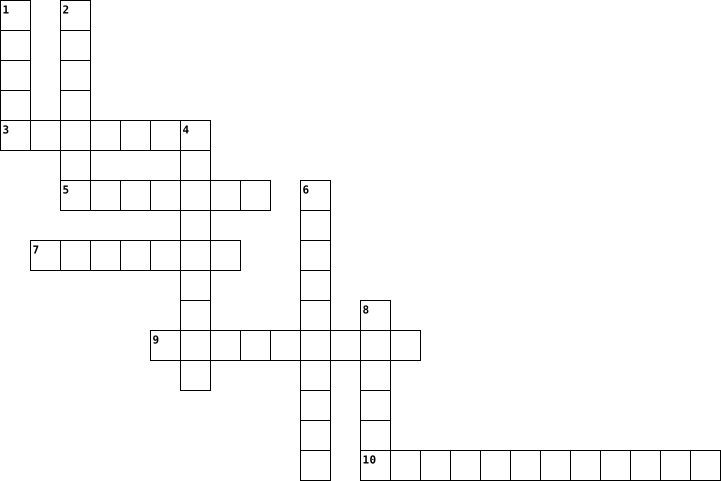
Across
- sailing
- history
- pottery
- chemistry
- horse-riding
Down
- maths
- English
- geography
- gymnastics
- French
10 Clues: maths • French • English • sailing • history • pottery • geography • chemistry • gymnastics • horse-riding
General Chemistry 2020-05-25
Across
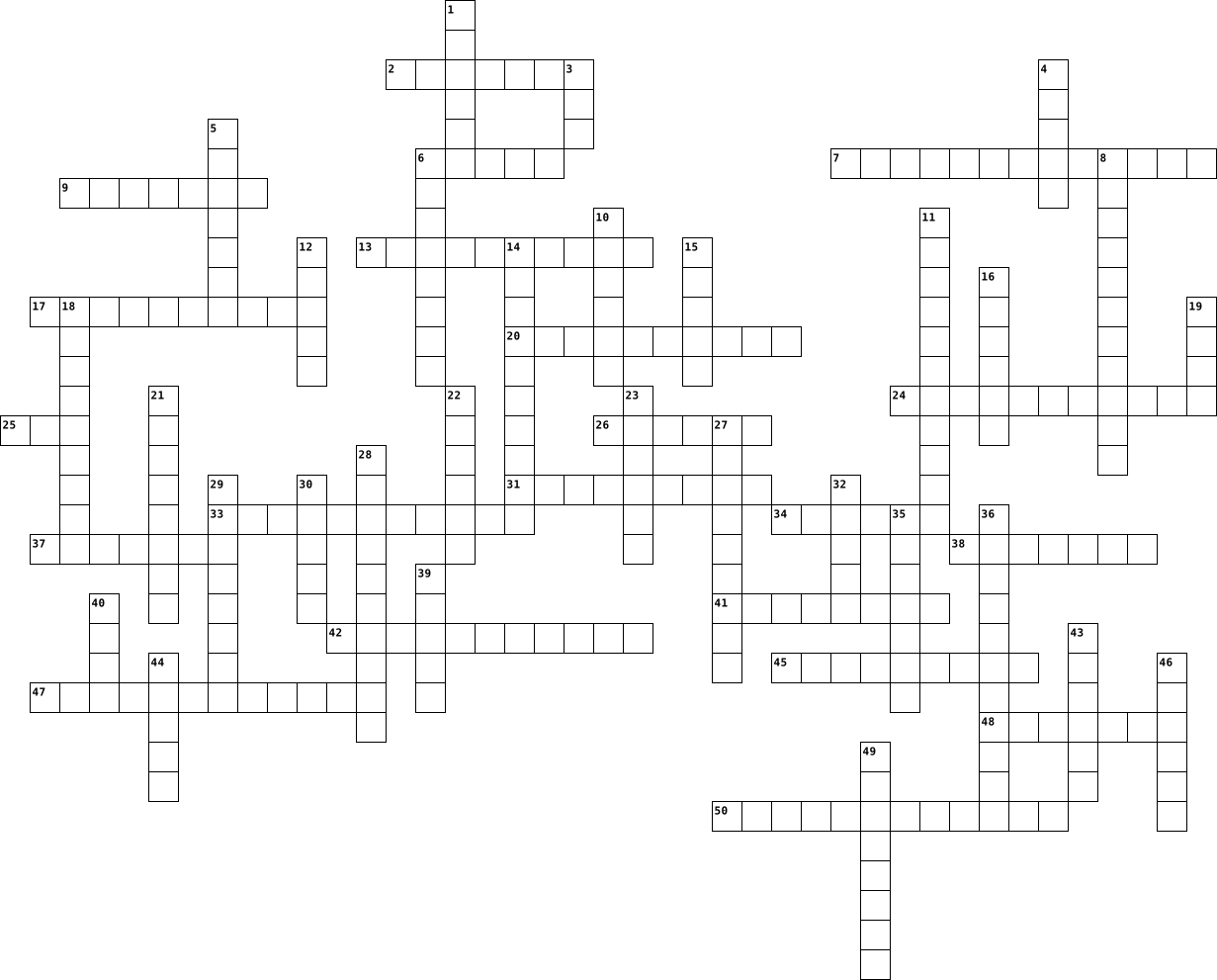
- Phase change that involves the conversion from solid to liquid
- the fundamental unit of length in the metric system equal to 100 centimeters or approximately 39.37 inches.
- mixture Mixture whose a composition varies from position to position within a sample.
- Group 7A elements
- a metric unit of length equal to one hundredth of a meter.
- Process in which the solid particles are filtered to allow the liquid or filtrate to pass through the filter and be collected as residue
- chemistry it is a branch of chemistry that studies and uses instruments and methods used to separate identify and quantify matter.
- inner transition elements located in the first row of the f block in the periodic table
- Formed when atom loses or gains electron
- a substance that flows freely but is of constant volume having a consistency like that of water or oil.
- movement of one fluid through another.
- mixture Called as solution a mixture with uniform composition.
- Positively charged subatomic particle of an atom
- Ratio of the mass of an object to the volume occupied by that object.
- Uncharged particle found within the atomic nuclei
- Element that appears at the far right side of the periodic table
- figures The digits in any measurement that are known with certainty plus one digit which is uncertain
- the branch of science that deals with the identification of the substances of which matter is composed; the investigation of their properties and the ways in which they interact combine and change; and the use of these processes to form new substances.
- Separates components of mixture at different boiling points.
- Composed of two or more substances combined physically in variable proportions
- it is a branch of chemistry that studies the chemical processes within and relating to living organisms. Biochemical processes give rise to the complexity of life.
Down
- The amount of space occupied by a substance
- a substance or matter in a state in which it will expand freely to fill the whole of a container having no fixed shape and no fixed volume.
- rule states that atoms other than hydrogen tend to form bonds until surrounded by eight valence electrons
- Substance consisting of only one kind of atom
- separation The separation of elemental metals from the mixtures
- phase change in which liquid is converted to gas
- Elements at the left side and in the center of the periodic table
- Organic compound with carbon and oxygen only
- compound Compound that consists of two charged ions
- Elements found in the zigzag order in the periodic table
- a substance or object that is solid rather than liquid or fluid
- the measurement or extent of something from end to end.
- physical property physical property that does not depend on the size or amount of the sample
- number The sum of the number of protons and neutrons in its nucleus
- Phase change in which liquid is converted to solid
- Horizontal row in the periodic table
- a period of time equal to sixty seconds or a sixtieth of an hour.
- Chemistry it is a branch of chemistry that deals with synthesis and behavior of inorganic and organometallic compounds.
- the quality, condition, or fact of being exact and accurate.
- chemistry the branch of chemistry concerned with the application of the techniques and theories of physics to the study of chemical systems.
- mass Indicates that one mole of an element has a mass in grams numerically equal to its atomic mass units
- gas insert gas located at the rightmost side of the periodic table
- chemistry it is a branch of chemistry that studies the structure properties and reactions of organic compounds which contain carbon in covalent bonding. Study of structure determines their chemical composition and formula.
- the size length or amount of something as established by measuring.
- bond Formed by losing and gaining of electrons between metal and nonmetal
- The quantity of matter in the body
- Anything that has mass and occupies space
- a metric unit of capacity formerly defined as the volume of one kilogram of water under standard conditions now equal to 1 000 cubic centimeters
- level Specific energy value of electrons for an atom
- Negatively charged subatomic particle of an atom
51 Clues: Group 7A elements • The quantity of matter in the body • Horizontal row in the periodic table • movement of one fluid through another. • Formed when atom loses or gains electron • Anything that has mass and occupies space • The amount of space occupied by a substance • Organic compound with carbon and oxygen only • Substance consisting of only one kind of atom • ...
General Chemistry 2020-05-25
Across
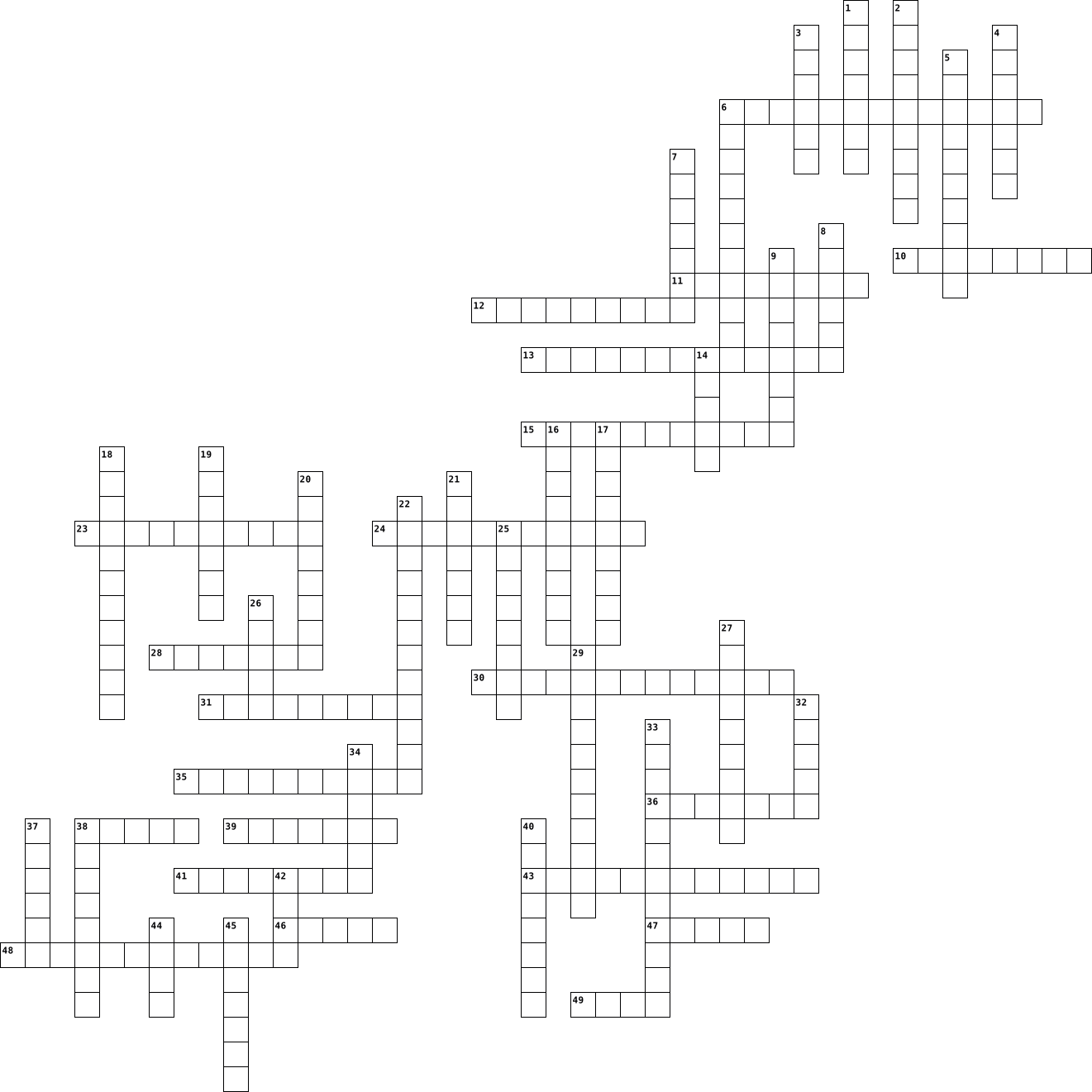
- mixture: Mixture whose a composition varies from position to position within a sample.
- chemistry: the branch of chemistry concerned with the application of the techniques and theories of physics to the study of chemical systems.
- Substance consisting of only one kind of atom
- Phase change in which liquid is converted to solid
- it is a branch of chemistry that studies the chemical processes within and relating to living organisms. Biochemical processes give rise to the complexity of life.
- Elements found in the zigzag order in the periodic table
- chemistry: it is a branch of chemistry that studies and uses instruments and methods used to separate: identify: and quantify matter.
- a metric unit of length: equal to one hundredth of a meter.
- the measurement or extent of something from end to end.
- Separates components of mixture at different boiling points.
- physical property: physical property that does not depend on the size or amount of the sample
- movement of one fluid through another.
- Horizontal row in the periodic table
- mass: Indicates that one mole of an element has a mass in grams numerically equal to its atomic mass units
- chemistry: it is a branch of chemistry that studies the structure: properties and reactions of organic compounds: which contain carbon in covalent bonding. Study of structure determines their chemical composition and formula.
- Ratio of the mass of an object to the volume occupied by that object.
- inner transition elements located in the first row of the f:block in the periodic table
- gas: insert gas located at the rightmost side of the periodic table
- bond: Formed by losing and gaining of electrons between metal and nonmetal
- Organic compound with carbon and oxygen only
- a substance or matter in a state in which it will expand freely to fill the whole of a container: having no fixed shape and no fixed volume.
Down
- Positively:charged subatomic particle of an atom
- Element that appears at the far right side of the periodic table
- the fundamental unit of length in the metric system: equal to 100 centimeters or approximately 39.37 inches.
- a substance that flows freely but is of constant volume: having a consistency like that of water or oil.
- the branch of science that deals with the identification of the substances of which matter is composed; the investigation of their properties and the ways in which they interact: combine: and change; and the use of these processes to form new substances.
- mixture: Called as solution: a mixture with uniform composition.
- a period of time equal to sixty seconds or a sixtieth of an hour.
- a metric unit of capacity: formerly defined as the volume of one kilogram of water under standard conditions: now equal to 1:000 cubic centimeters
- Uncharged particle found within the atomic nuclei
- compound: Compound that consists of two charged ions
- Negatively:charged subatomic particle of an atom
- the closeness of a single measurement to its true value
- figures: The digits in any measurement that are known with certainty plus one digit which is uncertain
- Anything that has mass and occupies space
- Phase change that involves the conversion from solid to liquid
- Elements at the left side and in the center of the periodic table
- the size: length: or amount of something: as established by measuring.
- separation: The separation of elemental metals from the mixtures
- rule: states that atoms other than hydrogen tend to form bonds until surrounded by eight valence electrons
- Chemistry: it is a branch of chemistry that deals with synthesis and behavior of inorganic and organometallic compounds.
- Process in which the solid particles are filtered to allow the liquid or filtrate to pass through the filter: and be collected as residue
- The quantity of matter in the body
- phase change in which liquid is converted to gas
- a substance or object that is solid rather than liquid or fluid
- level: Specific energy value of electrons for an atom
- Composed of two or more substances: combined physically in variable proportions
- Group 7A elements
- Formed when atom loses or gains electron
- number: The sum of the number of protons and neutrons in its nucleus
- The amount of space occupied by a substance
51 Clues: Group 7A elements • The quantity of matter in the body • Horizontal row in the periodic table • movement of one fluid through another. • Formed when atom loses or gains electron • Anything that has mass and occupies space • The amount of space occupied by a substance • Organic compound with carbon and oxygen only • Substance consisting of only one kind of atom • ...
General Chemistry 2024-05-09

Across
- Negatively charged subatomic particle of an atom
- table metals: Elements at the left side and in the center of the periodic table.
- The separation of elemental metals from the
- mixture: Called as solution: a mixture with uniform composition.
- a metric unit of length: equal to one hundredth of a meter.
- chemistry: the branch of chemistry concerned with the application of the techniques and theories of physics to the study of chemical systems.
- metalloids: Elements found in the zigzag order in the
- level: Specific energy value of electrons for an atom
- Phase change in which liquid is converted to solid
- Separates components of mixture at different boiling points.
- ion: Formed when atom loses or gains electron
- gas: insert gas located at the rightmost side of
- movement of one fluid through another.
- periodic table nonmetal: Element that appears at the far right side of the periodic table.
- or fluid liquid: a substance that flows freely but
- chemistry: it is a branch of chemistry that
- Uncharged particle found within the atomic nuclei.
- bond: Formed by losing and gaining of electrons between metal and nonmetal
- the measurement or extent of something from end to end.
- phase change in which liquid is converted to gas
- combine: and change; and the use of these processes to form new substances.
- Composed of two or more substances: combined physically in variable proportions
Down
- Phase change that involves the conversion from solid to
- Group 7A elements.
- mass: Indicates that one mole of an element has a mass in grams numerically equal to its atomic mass units
- the size: length: or amount of something: as established by measuring.
- mass:The quantity of matter in the body mass.
- the closeness of a single measurement to its true value.
- the branch of science that deals with the identification of the substances of which matter is composed; the investigation of their properties and the ways in which they
- Positively:charged subatomic particle of an atom significant figures: The digits in any measurement that are known with certainty plus one digit which is uncertain
- Ratio of the mass of an object to the volume occupied by that object.
- it is a branch of chemistry that studies the chemical processes within and relating to living organisms. Biochemical processes give rise to the complexity of life.
- Process in which the solid particles are filtered to allow the liquid or filtrate to pass through the filter: and be collected as residue.
- the fundamental unit of length in the metric system equal to 100 centimeters or approximately 39.37 inches.
- Organic compound with carbon and oxygen only
- a metric unit of capacity: formerly defined as the volume of one kilogram of water under standard conditions: now equal to 1:000 cubic centimeters
- compound: Compound that consists of two charged
- chemistry: it is a branch of chemistry that studies and uses instruments and methods used to separate: identify: and quantify matter.
- Chemistry: it is a branch of chemistry that deals with synthesis and behavior of inorganic and organometallic compounds.
- the structure: properties and reactions of organic compounds: which contain carbon in covalent bonding. Study of structure determines their chemical composition and formula.
- The amount of space occupied by a substance
- a period of time equal to sixty seconds or a sixtieth of an hour.
- a substance or object that is solid rather than
- Substance consisting of only one kind of atom
- a substance or matter in a state in which it will expand freely to fill the whole of a container: having no fixed shape and no fixed volume.
- rule: states that atoms other than hydrogen tend to form bonds until surrounded by eight valence electrons.
- physical property: physical property that does not depend on the size or amount of the sample.
- mixture: Mixture whose a composition varies from position to position within a sample.
- Horizontal row in the periodic table
- inner transition elements located in the first row of the f block in the periodic table magnetic.
- of constant volume: having a consistency like that of water or oil.
- The sum of the number of protons and neutrons in its nucleus matter: Anything that has mass and occupies space
52 Clues: Group 7A elements. • Horizontal row in the periodic table • movement of one fluid through another. • The separation of elemental metals from the • The amount of space occupied by a substance • chemistry: it is a branch of chemistry that • Organic compound with carbon and oxygen only • mass:The quantity of matter in the body mass. • ...
General Chemistry 2020-05-25

Across
- number The sum of the number of protons and neutrons in its nucleus
- phase change in which liquid is converted to gas
- Organic compound with carbon and oxygen only
- separation The separation of elemental metals from the mixtures
- Process in which the solid particles are filtered to allow the liquid or filtrate to pass through the filter and be collected as residue
- a substance or object that is solid rather than liquid or fluid
- Horizontal row in the periodic table
- mixture Mixture whose a composition varies from position to position within a sample.
- The quantity of matter in the body
- Negatively charged subatomic particle of an atom
- level Specific energy value of electrons for an atom
- chemistry it is a branch of chemistry that studies and uses instruments and methods used to separate identify and quantify matter.
- Elements at the left side and in the center of the periodic table
- a substance or matter in a state in which it will expand freely to fill the whole of a container having no fixed shape and no fixed volume.
- Formed when atom loses or gains electron
- the size length or amount of something as established by measuring.
- a metric unit of capacity formerly defined as the volume of one kilogram of water under standard conditions now equal to 1 000 cubic centimeters
- figures The digits in any measurement that are known with certainty plus one digit which is uncertain
- inner transition elements located in the first row of the f block in the periodic table
- bond Formed by losing and gaining of electrons between metal and nonmetal
- Chemistry it is a branch of chemistry that deals with synthesis and behavior of inorganic and organometallic compounds.
- it is a branch of chemistry that studies the chemical processes within and relating to living organisms. Biochemical processes give rise to the complexity of life.
Down
- Separates components of mixture at different boiling points.
- Composed of two or more substances combined physically in variable proportions
- Phase change that involves the conversion from solid to liquid
- Positively charged subatomic particle of an atom
- Element that appears at the far right side of the periodic table
- the branch of science that deals with the identification of the substances of which matter is composed; the investigation of their properties and the ways in which they interact combine and change; and the use of these processes to form new substances.
- Ratio of the mass of an object to the volume occupied by that object.
- a metric unit of length equal to one hundredth of a meter.
- mixture Called as solution a mixture with uniform composition.
- The amount of space occupied by a substance
- Group 7A elements
- Phase change in which liquid is converted to solid
- chemistry the branch of chemistry concerned with the application of the techniques and theories of physics to the study of chemical systems.
- chemistry it is a branch of chemistry that studies the structure properties and reactions of organic compounds which contain carbon in covalent bonding. Study of structure determines their chemical composition and formula.
- the fundamental unit of length in the metric system equal to 100 centimeters or approximately 39.37 inches.
- Substance consisting of only one kind of atom
- Anything that has mass and occupies space
- gas insert gas located at the rightmost side of the periodic table
- the measurement or extent of something from end to end.
- a substance that flows freely but is of constant volume having a consistency like that of water or oil.
- physical property physical property that does not depend on the size or amount of the sample
- mass Indicates that one mole of an element has a mass in grams numerically equal to its atomic mass units
- rule states that atoms other than hydrogen tend to form bonds until surrounded by eight valence electrons
- a period of time equal to sixty seconds or a sixtieth of an hour.
- Elements found in the zigzag order in the periodic table
- movement of one fluid through another.
- Uncharged particle found within the atomic nuclei
- compound Compound that consists of two charged ions
50 Clues: Group 7A elements • The quantity of matter in the body • Horizontal row in the periodic table • movement of one fluid through another. • Formed when atom loses or gains electron • Anything that has mass and occupies space • The amount of space occupied by a substance • Organic compound with carbon and oxygen only • Substance consisting of only one kind of atom • ...
Frankenstein 2017-04-22

Across
- Victor's youngest brother
- daughter of Lacey
- a blind old man
- the father of Victor
- site of original creation
- friend of Victor's father
- the main character
- where Victor and his family live
- the unfriendly professor
Down
- person who dies from scarlet fever
- professor in chemistry
- the author of the book
- where Victor abandons the creation plans
- the subject Victor studied
- the creature Victor created
- where the monster was last seen
- Victor's future wife
- the maid who gets executed
- the meeting site of Victor and the creature
- Victor's best friend
20 Clues: a blind old man • daughter of Lacey • the main character • the father of Victor • Victor's future wife • Victor's best friend • professor in chemistry • the author of the book • the unfriendly professor • Victor's youngest brother • site of original creation • friend of Victor's father • the subject Victor studied • the maid who gets executed • the creature Victor created • ...
General Chemistry 2020-05-25

Across
- mixture: Mixture whose a composition varies from position to position within a sample.
- chemistry: the branch of chemistry concerned with the application of the techniques and theories of physics to the study of chemical systems.
- Substance consisting of only one kind of atom
- Phase change in which liquid is converted to solid
- it is a branch of chemistry that studies the chemical processes within and relating to living organisms. Biochemical processes give rise to the complexity of life.
- Elements found in the zigzag order in the periodic table
- chemistry: it is a branch of chemistry that studies and uses instruments and methods used to separate: identify: and quantify matter.
- a metric unit of length: equal to one hundredth of a meter.
- the measurement or extent of something from end to end.
- Separates components of mixture at different boiling points.
- physical property: physical property that does not depend on the size or amount of the sample
- movement of one fluid through another.
- Horizontal row in the periodic table
- mass: Indicates that one mole of an element has a mass in grams numerically equal to its atomic mass units
- chemistry: it is a branch of chemistry that studies the structure: properties and reactions of organic compounds: which contain carbon in covalent bonding. Study of structure determines their chemical composition and formula.
- Ratio of the mass of an object to the volume occupied by that object.
- inner transition elements located in the first row of the f:block in the periodic table
- gas: insert gas located at the rightmost side of the periodic table
- bond: Formed by losing and gaining of electrons between metal and nonmetal
- Organic compound with carbon and oxygen only
- a substance or matter in a state in which it will expand freely to fill the whole of a container: having no fixed shape and no fixed volume.
Down
- Positively:charged subatomic particle of an atom
- Element that appears at the far right side of the periodic table
- the fundamental unit of length in the metric system: equal to 100 centimeters or approximately 39.37 inches.
- a substance that flows freely but is of constant volume: having a consistency like that of water or oil.
- the branch of science that deals with the identification of the substances of which matter is composed; the investigation of their properties and the ways in which they interact: combine: and change; and the use of these processes to form new substances.
- mixture: Called as solution: a mixture with uniform composition.
- a period of time equal to sixty seconds or a sixtieth of an hour.
- a metric unit of capacity: formerly defined as the volume of one kilogram of water under standard conditions: now equal to 1:000 cubic centimeters
- Uncharged particle found within the atomic nuclei
- compound: Compound that consists of two charged ions
- Negatively:charged subatomic particle of an atom
- the closeness of a single measurement to its true value.
- figures: The digits in any measurement that are known with certainty plus one digit which is uncertain
- Anything that has mass and occupies space
- Phase change that involves the conversion from solid to liquid
- Elements at the left side and in the center of the periodic table
- the size: length: or amount of something: as established by measuring.
- separation: The separation of elemental metals from the mixtures
- rule: states that atoms other than hydrogen tend to form bonds until surrounded by eight valence electrons
- Chemistry: it is a branch of chemistry that deals with synthesis and behavior of inorganic and organometallic compounds.
- Process in which the solid particles are filtered to allow the liquid or filtrate to pass through the filter: and be collected as residue
- The quantity of matter in the body
- phase change in which liquid is converted to gas
- a substance or object that is solid rather than liquid or fluid
- level: Specific energy value of electrons for an atom
- Composed of two or more substances: combined physically in variable proportions
- Group 7A elements
- Formed when atom loses or gains electron
- number: The sum of the number of protons and neutrons in its nucleus
- The amount of space occupied by a substance
51 Clues: Group 7A elements • The quantity of matter in the body • Horizontal row in the periodic table • movement of one fluid through another. • Formed when atom loses or gains electron • Anything that has mass and occupies space • The amount of space occupied by a substance • Organic compound with carbon and oxygen only • Substance consisting of only one kind of atom • ...
General Chemistry 2020-05-25
Across
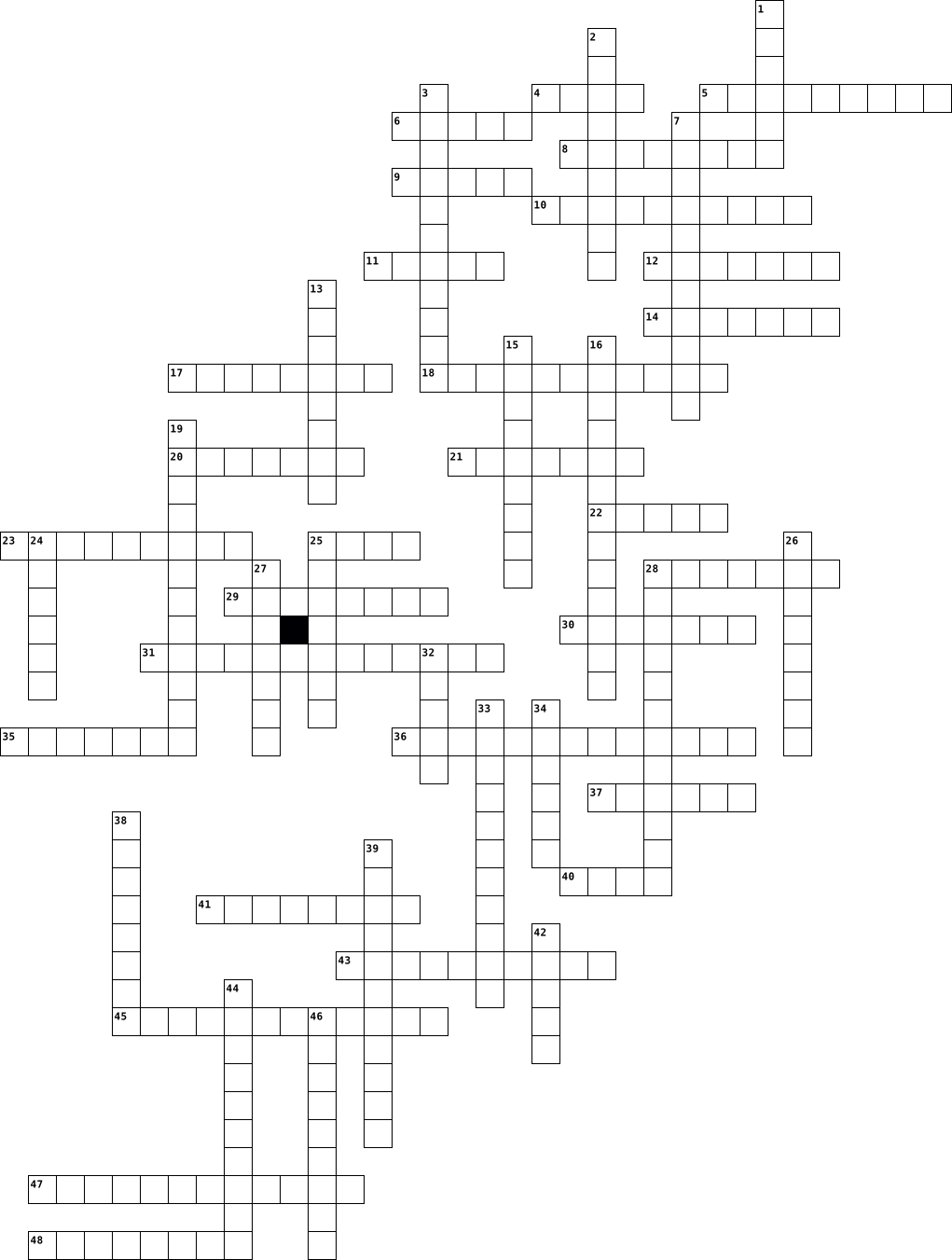
- Formed when atom loses or gains electron
- Phase change in which liquid is converted to solid
- gas: insert gas located at the rightmost side of the periodic table
- Ratio of the mass of an object to the volume occupied by that object.
- compound: Compound that consists of two charged ions
- chemistry: it is a branch of chemistry that studies and uses instruments and methods used to separate: identify: and quantify matter.
- bond: Formed by losing and gaining of electrons between metal and nonmetal
- Anything that has mass and occupies space
- a substance that flows freely but is of constant volume: having a consistency like that of water or oil.
- separation: The separation of elemental metals from the mixtures
- figures: The digits in any measurement that are known with certainty plus one digit which is uncertain
- The amount of space occupied by a substance
- the measurement or extent of something from end to end
- The quantity of matter in the body
- Negatively:charged subatomic particle of an atom
- number: The sum of the number of protons and neutrons in its nucleus
- a period of time equal to sixty seconds or a sixtieth of an hour.
- Phase change that involves the conversion from solid to liquid
- chemistry: it is a branch of chemistry that studies the structure: properties and reactions of organic compounds: which contain carbon in covalent bonding. Study of structure determines their chemical composition and formula.
- Separates components of mixture at different boiling points.
- Positively:charged subatomic particle of an atom
- mixture: Mixture whose a composition varies from position to position within a sample.
- level: Specific energy value of electrons for an atom
- a substance or matter in a state in which it will expand freely to fill the whole of a container: having no fixed shape and no fixed volume.
- Group 7A elements
- movement of one fluid through another.
- inner transition elements located in the first row of the f:block in the periodic table
- Organic compound with carbon and oxygen only
- Substance consisting of only one kind of atom
Down
- the fundamental unit of length in the metric system: equal to 100 centimeters or approximately 39.37 inches.
- Element that appears at the far right side of the periodic table
- mixture: Called as solution: a mixture with uniform composition.
- Process in which the solid particles are filtered to allow the liquid or filtrate to pass through the filter: and be collected as residue
- Composed of two or more substances: combined physically in variable proportions
- physical property: physical property that does not depend on the size or amount of the sample
- it is a branch of chemistry that studies the chemical processes within and relating to living organisms. Biochemical processes give rise to the complexity of life.
- phase change in which liquid is converted to gas
- a metric unit of capacity: formerly defined as the volume of one kilogram of water under standard conditions: now equal to 1:000 cubic centimeters
- Elements at the left side and in the center of the periodic table
- Uncharged particle found within the atomic nuclei
- Horizontal row in the periodic table
- the size: length: or amount of something: as established by measuring.
- rule: states that atoms other than hydrogen tend to form bonds until surrounded by eight valence electrons
- Elements found in the zigzag order in the periodic table
- a substance or object that is solid rather than liquid or fluid
- chemistry: the branch of chemistry concerned with the application of the techniques and theories of physics to the study of chemical systems.
- a metric unit of length: equal to one hundredth of a meter.
- mass: Indicates that one mole of an element has a mass in grams numerically equal to its atomic mass units
- the branch of science that deals with the identification of the substances of which matter is composed; the investigation of their properties and the ways in which they interact: combine: and change; and the use of these processes to form new substances.
- Chemistry: it is a branch of chemistry that deals with synthesis and behavior of inorganic and organometallic compounds.
50 Clues: Group 7A elements • The quantity of matter in the body • Horizontal row in the periodic table • movement of one fluid through another. • Formed when atom loses or gains electron • Anything that has mass and occupies space • The amount of space occupied by a substance • Organic compound with carbon and oxygen only • Substance consisting of only one kind of atom • ...
Teka Teki Kimia 2026-03-10

Across
- ilmuwan yang menemukan elektron melalui percobaan sinar katoda.
- ilmu yang mempelajari materi perubahan dan energinya.
- ilmuwan yang menemukan model atom dgn lintasan elektron tertentu.
- model atom yang menggambarkan elektron mengelilingi inti seperti planet.
- cabang kimia yang bertujuan mengurangi dampak buruk bahan kimia terhadap lingkungan.
- hukum yang menyatakan massa zat sebelum dan sesudah reaksi sama.
- partikel netral yang terdapat di inti atom.
- percobaan yang dilakukan rutherford untuk menemukan inti atom.
- model atom yang menggambarkan atom sebagai bola pejal.
- hukum yang menyatakan perbandingan massa unsur dalam beberapa senyawa merupakan bilangan bulat sederhana.
Down
- prinsip green chemistry yang menekankan efisiensi penggunaan energi.
- prinsip green chemistry yang bertujuan mengurangi limbah reaksi.
- prinsip green chemistry yang mendorong penggunaan katalis.
- hukum yang menyatakan perbandingan massa unsur dalam senyawa selalu tetap.
- reaksi kimia yang menghasilkan sedikit atau tanpa limbah.
- ilmuwan yang menemukan inti atom melalui percobaan lempeng emas.
- ilmuwan yang mengemukakan teori atom pertama secara ilmiah.
- prinsip kimia hijau yang mendorong penggunaan bahan baku yang dapat diperbarui.
- partikel atom yang bermuatan positif di inti atom.
- partikel bermuatan negatif dalam atom.
20 Clues: partikel bermuatan negatif dalam atom. • partikel netral yang terdapat di inti atom. • partikel atom yang bermuatan positif di inti atom. • ilmu yang mempelajari materi perubahan dan energinya. • model atom yang menggambarkan atom sebagai bola pejal. • reaksi kimia yang menghasilkan sedikit atau tanpa limbah. • ...
Chemistry Crossword 2025-12-11

Across
- the study of matter and its structures and properties
- the weight of something
- when you study matter that contains carbon
- the amount of space something takes up
- how poisonous or harmful something is
- how a substance reacts with other substances
- how reflective or shiny something is
- how heavy something is compared to its size
Down
- the first African American woman to fly in space
- characteristics of a substance that can be observed
- the ability to combine with other substances
- a type of chemistry that identifies and measures parts of a substance
- a substance that burns easily
- founder of modern chemistry
14 Clues: the weight of something • founder of modern chemistry • a substance that burns easily • how reflective or shiny something is • how poisonous or harmful something is • the amount of space something takes up • when you study matter that contains carbon • how heavy something is compared to its size • the ability to combine with other substances • ...
Alchemy 2020-11-10

Across
- the father of chemistry
- type OF Element
- Father of Toxicology
- alchemy is shrouded in
- Mary the ..........
- They follow ........... Elements
- the ulitmate metal
Down
- the metal that needed to be changed
- Element
- which century was Aristotle in
- turning one metal to another
- medieval science before chemistry
- is the goal actually possible
- Genius Physicists
14 Clues: Element • type OF Element • Genius Physicists • the ulitmate metal • Mary the .......... • Father of Toxicology • alchemy is shrouded in • the father of chemistry • turning one metal to another • is the goal actually possible • which century was Aristotle in • They follow ........... Elements • medieval science before chemistry • the metal that needed to be changed
chemistry 2019-11-26

Across
- a process where atoms or molecules are converted to electrically charged atoms or molecules
- a solution that can dissolve more solutes
- when an insoluble solid emerges from a solution
- molecule split into smaller parts
- Mol/L
- an (blank) solution conducts electricity
- relating to or consisting molecules
- the component of a solution that is dissolved in a solvent
- a liquid in which the substance is dissolved
- chemical bonding of oppositely charged ions
Down
- able to be dissolved in a solvent
- how much energy a material conducts
- the ability of a solute to dissolve in a solvent
- when a material has absorbed up to its limits
- aqueous
- An ion that is negatively charged
- the opposite of an anion
17 Clues: Mol/L • aqueous • the opposite of an anion • able to be dissolved in a solvent • molecule split into smaller parts • An ion that is negatively charged • how much energy a material conducts • relating to or consisting molecules • an (blank) solution conducts electricity • a solution that can dissolve more solutes • chemical bonding of oppositely charged ions • ...
Chemistry 2020-04-27

Across
- A SUBSTANCE THAT INCREASES THE RATE OF A CHEMICAL REACTION WITHOUT ITSELF UNDERGOING ANY PERMANENT CHEMICAL CHANGE
- pH BELOW 7
- WATER SOLID PHASE KNOWN AS?
- 8 VALENCE ELECTRONS SURROUNDING AN ATOM
- IRON
- A FUNCTIONAL GROUP DERIVED FROM METHANE, -CH3
- A SOLUBLE BASE
- A STATE OF MATTER BETWEEN GAS AND SOLID
- ATOMIC NUMBER 12
- ANOTHER NAME FOR FUMING SULPHURIC ACID
Down
- A SUBSTANCE THAT TAKES PART IN AND UNDERGOES CHANGE DURING REACTION
- A TABULAR DISPLAY OF THE CHEMICAL ELEMENTS
- ANOTHER NAME FOR CRYSTAL STRUCTURE ARRANGEMENT
- LARGE MOLECULE WITH MANY REPEATED SUB-UNIT
- ANOTHER NAME FOR ANGULAR MOMENTUM QUANTUM NUMBER
- NEGATIVELY CHARGED ION
- OH GROUP
17 Clues: IRON • OH GROUP • pH BELOW 7 • A SOLUBLE BASE • ATOMIC NUMBER 12 • NEGATIVELY CHARGED ION • WATER SOLID PHASE KNOWN AS? • ANOTHER NAME FOR FUMING SULPHURIC ACID • 8 VALENCE ELECTRONS SURROUNDING AN ATOM • A STATE OF MATTER BETWEEN GAS AND SOLID • A TABULAR DISPLAY OF THE CHEMICAL ELEMENTS • LARGE MOLECULE WITH MANY REPEATED SUB-UNIT • A FUNCTIONAL GROUP DERIVED FROM METHANE, -CH3 • ...
Chemistry 2021-06-16

Across
- When a solid turns into a liquid.
- What is a substance called with only one type of atom.
- This is found in the nucleus of an atom.
- Particles are very close together and vibrate.
- Particles are close together and move around each other.
- The name of a gas.
- The name of a salt
- What is the element called with the chemical symbol "Mg".
- What is a substance called when it can be separated.
- When a liquid boils it turns into a ...
Down
- What is the element called with the chemical symbol "Li".
- A gas that is found in air.
- When two elements are chemically joined together it is called ?
- When a solid becomes a liquid
- This is found in the outer shell of an atom.
- This has the chemical symbol "K".
- What is the name of the table showing the elements.
- Particles are far apart and move very quickly.
- All substances are made from tiny particles called
19 Clues: The name of a gas. • The name of a salt • A gas that is found in air. • When a solid becomes a liquid • When a solid turns into a liquid. • This has the chemical symbol "K". • When a liquid boils it turns into a ... • This is found in the nucleus of an atom. • This is found in the outer shell of an atom. • Particles are very close together and vibrate. • ...
chemistry 2021-09-08

Across
- a subatomic particle with a positive charge
- the temperature at which a liquid turns into a solid
- a subatomic particle with a negative charge
- a state of matter with a defined volume but no defined shape
- material that has mass and takes some space
- the temperature at which a solid turns into a liquid
- electron proton and neutron
- the process by which a gas changes into a liquid
- the process in which matter changes from a liquid to a gas
Down
- a subatomic particles with no electric charge
- two or more joined atoms
- matter phase change from solid directly to gas
- a property of matter which is undergoing phase change from liquid to gas
- Mercury Gold Curium
- a pure substance when 2 or more elements are combined
- solid matter with a fixed volume and shape
- a state of matter without any defined volume or shape
17 Clues: Mercury Gold Curium • two or more joined atoms • electron proton and neutron • a subatomic particle with a positive charge • a subatomic particle with a negative charge • material that has mass and takes some space • solid matter with a fixed volume and shape • a subatomic particles with no electric charge • matter phase change from solid directly to gas • ...
Chemistry 2022-01-26

Across
- sodium chloride
- a non-metal with another non-metal
- group 17 period 2 element
- a metal(or ammonium)with a nonmetal
- has the same atomic #(Z) and different mass #(A)
- net charge on a compound
- group 16 period 2 ion
Down
- group 1 period 4 element
- alkali-earth metal period 4
- subatomic particle with no charge
- metals in group 1
- subatomic particle with a negative charge
- one or more atoms with a net charge
- subatomic particle with a positive charge
- charge on a cation
- the quantity of matter in a physical body
- charge on an anion
17 Clues: sodium chloride • metals in group 1 • charge on a cation • charge on an anion • group 16 period 2 ion • group 1 period 4 element • net charge on a compound • group 17 period 2 element • alkali-earth metal period 4 • subatomic particle with no charge • a non-metal with another non-metal • one or more atoms with a net charge • a metal(or ammonium)with a nonmetal • ...
Chemistry 2022-01-31

Across
- The measure of how much “stuff” (atoms/molecules) is packed in a unit of volume.
- The measure of the amount of matter in a substance.
- Combination of two or more atoms bonded together
- Single, smallest unit of matter
- The conditions in which matter exists (solid, liquid, gas, or plasma).
- A physical model that represents molecules and their processes.
- Showing a chemical reaction using words rather than symbols to represent the substances.
- The substance(s) that are produced by a chemical reaction.
- A material with the same atoms or molecules all the way through (Pure)
Down
- A characteristic that never changes
- The ability of a substance to dissolve and mix in evenly with another substance.
- The temperature at which a substance changes state of matter from a solid to a liquid.
- The total amount of three dimensional space taken up by a solid, liquid, or gas.
- A property that describes how easily or difficult a substance can be scratched.
- Two or more different atoms or molecules, or not the same all the way through (Not pure)
- An expression of a chemical reaction using numbers and symbols of the type of atoms present.
- The starting substance(s), that react together, in a chemical reaction.
17 Clues: Single, smallest unit of matter • A characteristic that never changes • Combination of two or more atoms bonded together • The measure of the amount of matter in a substance. • The substance(s) that are produced by a chemical reaction. • A physical model that represents molecules and their processes. • ...
Chemistry 2013-11-19

Across
- Expressed as mol/L;unit for concentration.
- Compounds that are made up of a metal and a non-metal.
- A solution that conducts electricity.
- Liquid which dissolved solute.
- Combination of solvent and solute.
- Able to be dissolved.
- The process of separating the positive and negative ions in a solution.
Down
- Compounds that are made up of non-metals;covalent.
- The amount of solute required to make a certain volume of saturated solution.
- Undissolved solid in a solution.
- Materials' ability to conduct electricity.
- An ion that have a negative charge.
- a solution in which the maximum amount of solute is dissolved.
- A substance that is dissolved in solvent.
- A solution without any precipitate.
- An ion that have a positive charge.
- The process of converting an atom into an ion.
17 Clues: Able to be dissolved. • Liquid which dissolved solute. • Undissolved solid in a solution. • Combination of solvent and solute. • An ion that have a negative charge. • A solution without any precipitate. • An ion that have a positive charge. • A solution that conducts electricity. • A substance that is dissolved in solvent. • Expressed as mol/L;unit for concentration. • ...
Chemistry 2015-11-16

Across
- What is thick liquid?
- What occupies space?
- What is finding the hidden meaning?
- An educated guess?
- What does Ar stand for?
- What is watching closely?
- What is another word for touchable?
- What is 1000 ml?
Down
- What are particles always doing?
- What is the process going from a Solid to Liquid?
- What do humans breathe out?( the words is two words with a dot in the middle)
- What is frozen water?
- What is another word for heating up?
- What is matter made of?
- What is boiled water?
- What does water do when you are in the shower?
- How does a liquid turn to a solid?
- What is frozen water?
18 Clues: What is 1000 ml? • An educated guess? • What occupies space? • What is thick liquid? • What is frozen water? • What is boiled water? • What is frozen water? • What is matter made of? • What does Ar stand for? • What is watching closely? • What are particles always doing? • How does a liquid turn to a solid? • What is finding the hidden meaning? • What is another word for touchable? • ...
Chemistry 2024-02-10

Across
- Vertical column in a chart
- change A change in color and the formation of bubbles
- Atoms that are bonded to each other from a different element in material.
- Material that only has one element or compound
- The range of all possible frequencies of electromagnetic radiation
- Horizontal rows in a chart
- this is in all atoms
- what model replicates an object?
Down
- system that helps predict how something behaves.
- dense, positively charged center of an atom where protons and neutrons reside
- reaction form of percipitate and formation of a gas.
- orbital A region within an atom where there is a high probability of finding an electron
- Atoms of the same element with different numbers of neutrons
- properties what property describes look or feel of a substance?
- table elements are organized in what chart?
- the same mass as protons
- The sum of protons and neutrons in an atomic nucleus
- formula measures the masses of its constituent elements.
- property toxicity, and heat from combustion. this would be example of what?
- bonds chemical bond
20 Clues: bonds chemical bond • this is in all atoms • the same mass as protons • Vertical column in a chart • Horizontal rows in a chart • what model replicates an object? • Material that only has one element or compound • system that helps predict how something behaves. • The sum of protons and neutrons in an atomic nucleus • reaction form of percipitate and formation of a gas. • ...
chemistry 2024-01-19

Across
- To determine calorific value of Coal, ___ calorimeter is used
- If ___ increases, then rate of corrosion also increases
- The electrode whose electrode potential is stable & reproducible?
- Water purification technique which converts sea water into portable water?
- pH = 7
- When 2 or metals are in contact with each other, then _ cell is formed ?
- Material having size 10–⁹ meters (10 rest to -9 meters )
- pH > 7
Down
- To determine calorific value of CNG, ___ calorimeter is used
- The material which is 200 times stronger than steel
- __ is the destruction of metal by the environment at the surface of the metal
- Two types of hardness of water - 1) Temporary & 2) ?
- What makes water hard?
- pH< 7
- IR spectroscopy is also called as __
- Corrosion which occurs due to atmospheric oxygen is --
- Wet steam formation is called as ?
17 Clues: pH< 7 • pH = 7 • pH > 7 • What makes water hard? • Wet steam formation is called as ? • IR spectroscopy is also called as __ • The material which is 200 times stronger than steel • Two types of hardness of water - 1) Temporary & 2) ? • If ___ increases, then rate of corrosion also increases • Material having size 10–⁹ meters (10 rest to -9 meters ) • ...
Chemistry 2023-03-24

Across
- Substances with a ph higher than 7
- bubbles are released after a reaction
- The common element in bases
- A solution that can take more solute
- What solute into is dissolved
- A chemical which is part of copper sulphate
Down
- A table of all the elements
- What is dissolved in the solvent
- particles have lots of movement
- A full solution
- Whether a element can mix in a liquid
- Substances with a ph less than 7
- A chemical
- The building blocks of the world
- particles are very close together
- particles can move around a little
- How acidic or alkali a substance is
17 Clues: A chemical • A full solution • A table of all the elements • The common element in bases • What solute into is dissolved • particles have lots of movement • What is dissolved in the solvent • Substances with a ph less than 7 • The building blocks of the world • particles are very close together • Substances with a ph higher than 7 • particles can move around a little • ...
Chemistry 2023-06-12

Across
- Bond that occurs between two metals, and is very strong.
- Is one solution that is uniform at anytime.
- Bond that occurs between two non-metals and they share 1 pair of electrons.
- State of matter in which the particles takes the whole space of their container and they freely move everywhere.
- Susbstances that are simplier and formed by only one type of atom.
- Is the type of matter that has a constant composition and properties that are constant in all the sample.
- Are the physical combinations of two or more elements and compounds.
- Is the part of the atom that has NO charge.
Down
- State of matter in which the particles takes the shape of the container and move ligthly.
- Is one solution that is NOT uniform at anytime.
- State of matter in which the particles has positive and negative charge.
- Susbstances that are formed by more than two types of atoms.
- Is the part of the atom that has negative charge.
- State of matter in which the particles are strongly attached between each other.
- Is the smallest particle of the matter.
- Is the part of the atom that has positive charge.
- Bond that occurs between one metal and one non-metal, the most electronegative takes the electrones from the other.
17 Clues: Is the smallest particle of the matter. • Is one solution that is uniform at anytime. • Is the part of the atom that has NO charge. • Is one solution that is NOT uniform at anytime. • Is the part of the atom that has negative charge. • Is the part of the atom that has positive charge. • Bond that occurs between two metals, and is very strong. • ...
Chemistry 2023-01-29

Across
- oxidation state of chromium in Potassium dichromate
- study of drugs
- king of acids
- atomic number 78
- hydrogen isotope in heavy water
- bakelite is a __ polymer
- ammonium molybdate test
Down
- +I group increases
- brass,bronze,steel
- ozone deplection
- indicator used in iodometry
- flame colour of Potassium
- pleasant smell
- latin name of gold
- stoichiometric defect
- energy of product is less than its reactant
- coordination number in hcp
17 Clues: king of acids • study of drugs • pleasant smell • ozone deplection • atomic number 78 • +I group increases • brass,bronze,steel • latin name of gold • stoichiometric defect • ammonium molybdate test • bakelite is a __ polymer • flame colour of Potassium • coordination number in hcp • indicator used in iodometry • hydrogen isotope in heavy water • energy of product is less than its reactant • ...
chemistry 2022-12-06

Across
- energy level rings
- can be bent or hammered into a sheet
- can be pulled into a wire
- located in the center
- electricity and heat passes through it
- smallest part of an element
- on the left side of the periodic table
- shatter easily
- not shiny
- 1 made of 2 electrons max
- negative charge
- neutral charge
Down
- properties of both touching the zigzag line.
- 3 holds up to 18 electrons
- electricity heat does not pass through it.
- reflects light
- right side of periodic table
- 2 holds up to 8 electrons
- cloud on the outside made of electrons
- positive charge
20 Clues: not shiny • reflects light • shatter easily • neutral charge • positive charge • negative charge • energy level rings • located in the center • can be pulled into a wire • 2 holds up to 8 electrons • 3 holds up to 18 electrons • 1 made of 2 electrons max • smallest part of an element • right side of periodic table • can be bent or hammered into a sheet • ...
Chemistry 2024-09-26

Across
- the process of a substance changing from one state to another
- positivly charged subatomic particles located in the nucleus of an atom
- the part of the universe being studied in a chemical reaction
- atoms of the same element that have different numbers of neutrons
- the smallest unit of a chemical
- the smallest amount of energy that can be emmited or absorbed as electromagnetic radiation
- stateing that energy cannot be created nor destroyed, only transformed
- the total heat content of a system
Down
- a measure of how well a material conducts heat
- a unit of energy used to measure heat
- the number of protons in the nucleus of an atom, which determines the elements identity
- a fundamental property of electrons that describes their intrinsic angular momentum
- the movement of heat from one object or substance to another
- the study of how heat is involved in chemical reactions
- a fundamental constant used to describe the sizes of quanta in quantum mechanics
- a pure substance consisting of only one type of atom
- negatively charged subatomic particles found in atoms
17 Clues: the smallest unit of a chemical • the total heat content of a system • a unit of energy used to measure heat • a measure of how well a material conducts heat • a pure substance consisting of only one type of atom • negatively charged subatomic particles found in atoms • the study of how heat is involved in chemical reactions • ...
Chemistry 2025-04-01

Across
- - 16
- - 7
- - 12
- - 11
- - 2
- - 4
- - 10
- - 14
Down
- - 13
- - 9
- - 5
- -1
- - 6
- - 8
- - 3
- - 17
- - 15
17 Clues: -1 • - 9 • - 5 • - 7 • - 6 • - 8 • - 2 • - 3 • - 4 • - 13 • - 16 • - 12 • - 11 • - 17 • - 15 • - 10 • - 14
Chemistry 2024-11-20

Across
- State of matter
- Cylinder for experiments
- Put everything in it at the end
- Tie your hair up
- Many of them in a stand
- Pincher
- Au
- Two or more atoms
Down
- Not fashionable but handy
- subject
- Can be H2O
- Made of one atom
- Precaution for your eyes
- Makes up everything
- A lot of elements are...
- Fixed
- N
17 Clues: N • Au • Fixed • subject • Pincher • Can be H2O • State of matter • Made of one atom • Tie your hair up • Two or more atoms • Makes up everything • Many of them in a stand • Cylinder for experiments • Precaution for your eyes • A lot of elements are... • Not fashionable but handy • Put everything in it at the end
Chemistry 2025-07-14

Across
- The term used to identify anything that occupies space and has weight is called
- A negatively charged ion called an
- The primary materials the body uses to construct and renew itself are
- The scientific study of matter and the physical and chemical changes affecting matter is known as
- Alkalis tend to taste
- Basic substances that cannot be broken down into simpler substances are called
- Schedule treatments in a series of 4-8
- The atomic number of a particular element indicates the number of protons in a single
- Atom Water molecules have two hydrogen atoms and one
Down
- Atoms have three main parts: protons, neutrons and
- A solution that has more negative hydroxide ions than positive hydrogen ions is
- Acids tend to taste
- Hydrogen In chemistry, pH stands for
- One of the benefits of a chemical exfoliation treatment is improved texture, barrier function and moisture
- Solutions that are acidic or alkaline in value can be dissolved in and/or contain
- If hives are present, apply neutralizer, then apply a cool
- A solid is defined as matter with definite weight, volume and
17 Clues: Acids tend to taste • Alkalis tend to taste • A negatively charged ion called an • Hydrogen In chemistry, pH stands for • Schedule treatments in a series of 4-8 • Atoms have three main parts: protons, neutrons and • Atom Water molecules have two hydrogen atoms and one • If hives are present, apply neutralizer, then apply a cool • ...
Chemistry 2020-12-14

Across
- Horizontal rows
- Electrons in the outermost energy level
- Bond between nonmetals
- Loses electrons
- Poor conductors of heat and electricity
- Shape of one orbital
- May conduct heat and electricity
- Complex shape of f orbital
- Good conductors of electricity
Down
- Sea of electrons
- Bond between metal and a nonmetal
- Vertical columns
- Make React with metal to form salt
- Gains electrons
- Shape of five orbitals
- Force between charged particles
- Shape of three orbitals
17 Clues: Horizontal rows • Gains electrons • Loses electrons • Sea of electrons • Vertical columns • Shape of one orbital • Shape of five orbitals • Bond between nonmetals • Shape of three orbitals • Complex shape of f orbital • Good conductors of electricity • Force between charged particles • May conduct heat and electricity • Bond between metal and a nonmetal • Make React with metal to form salt • ...
Chemistry 2022-09-13

Across
- vertical columns that show how many outer electrons each atom has
- The softest element in Group 1
- The most reactive element in Group VII
- Transition metals have _____ densities
- in the Periodic table
- number of protons + number of neutrons
- horizontal rows that show the number of shells of electrons an atom has
- All substances are made of tiny particles of matter called _____.
- The most stable elements in the Periodic table
Down
- Reactivity of Group VII elements ______ going down the group.
- The protons and neutrons are located at the centre of the atom
- The lightest noble gas.
- Reactivity of Group 1 elements ______ going down the group.
- Another name for Group VII elements
- Group 1 element with the smallest atomic number
- Group 1 and 2 elements are _________. (metal, nonmetal, metalloid)
- Chlorine is a gas at room temperature
17 Clues: in the Periodic table • The lightest noble gas. • The softest element in Group 1 • Another name for Group VII elements • Chlorine is a gas at room temperature • The most reactive element in Group VII • Transition metals have _____ densities • number of protons + number of neutrons • The most stable elements in the Periodic table • ...
Chemistry 2022-12-08

Across
- electrons Electrons on the outside energy level
- Rows that go across the periodic table
- Subatomic particle with neutral charge
- Subatomic particle with positive charge
- Electricity and heat do not pass through
- the smallest part of a element
- only 8 of these elements of the periodic table
- Shatters easily
- where the electrons are located
Down
- Subatomic particle with negative charge
- Rows that go up and down on the periodic table
- Reflects light
- The scientific table with elements
- Where protons and neutrons are located
- elements that have opposite properties of metals
- Found on left side of periodic table
- unit of measurement to weigh atoms
17 Clues: Reflects light • Shatters easily • the smallest part of a element • where the electrons are located • The scientific table with elements • unit of measurement to weigh atoms • Found on left side of periodic table • Rows that go across the periodic table • Subatomic particle with neutral charge • Where protons and neutrons are located • Subatomic particle with negative charge • ...
Chemistry 2022-10-17

Across
- grooves in a gun barrel
- the first person to apply forensic science
- a condition where more and more of a drug is required for the same effect
- prescribed drug(s)
- morphine, codeine, etc.
- a class of compound with a characteristic four rings of carbon
- proteins that accelerate a biological process
- organ that oxidizes alcohol and other drugs
- alternative name for forensic science
- intake of a drug greater than recommended
Down
- common drug conjugate formed in the liver for excretion
- compound of interest in a test
- application of science to criminal law
- arsenic, lead, mercury etc.
- intermediate or end product of a drug
- compound with numbing or paralyzing properties
- the study of heredity
17 Clues: prescribed drug(s) • the study of heredity • grooves in a gun barrel • morphine, codeine, etc. • arsenic, lead, mercury etc. • compound of interest in a test • intermediate or end product of a drug • alternative name for forensic science • application of science to criminal law • intake of a drug greater than recommended • the first person to apply forensic science • ...
chemistry 2021-09-10

Across
- matter with a fixed volume and shape
- electron proton and neutron
- the process in which matter changes from a liquid to a gas
- a state of matter without any defined volume or shape
- a property of matter which is undergoing phase change from liquid to gas
- material that has mass and takes some space
- a pure substance when 2 or more elements are combined
- a subatomic particle with a positive charge
- the temperature at which a solid turns into a liquid
- the temperature at which a liquid turns into a solid
- a state of matter with a defined volume but no defined shape
Down
- Mercury Gold Curium
- the process by which a gas changes into a liquid
- matter phase change from solid directly to gas
- a subatomic particles with no electric charge
- a subatomic particle with a negative charge
- two or more joined atoms
17 Clues: Mercury Gold Curium • two or more joined atoms • electron proton and neutron • matter with a fixed volume and shape • material that has mass and takes some space • a subatomic particle with a negative charge • a subatomic particle with a positive charge • a subatomic particles with no electric charge • matter phase change from solid directly to gas • ...
Chemistry 2021-09-24

Across
- element symbol is O
- electrons are shared unequally in a molecule
- atom or group of atoms that has either a positive or negative charge
- bonds with Na to form a salt molecule
- ion made of more than 1 atom
- element symbol is Pb
- has an atomic number of 28
Down
- element symbol is Cu
- has an atomic number of 1
- has an atomic mass of 20.179
- element symbol is Ag
- element symbol is Ca
- element symbol is Fe
- has an atomic number of 19
- element symbol is Na
- has an atomic weight of 39.948
- atoms gain electrons and atoms lose electrons
17 Clues: element symbol is O • element symbol is Cu • element symbol is Ag • element symbol is Ca • element symbol is Fe • element symbol is Na • element symbol is Pb • has an atomic number of 1 • has an atomic number of 19 • has an atomic number of 28 • has an atomic mass of 20.179 • ion made of more than 1 atom • has an atomic weight of 39.948 • bonds with Na to form a salt molecule • ...
CHEMISTRY 2021-10-06

Across
- atoms of the same element that have different numbers of neutrons
- increased blood pH
- site the part of an enzyme that is especially suited to bond with a substrate
- acid a protein monomer consisting of an amino, carboxyl, and side chain
- the property to having excess H ions
- movement of a substance such as nutrient from the intestines into the bloodstream
- bond a bond created by the transfer of electrons
Down
- particles orbiting the nucleus
- a substance with weak intermolecular forces that does not have definite shape
- the property of having excess OH ions
- a protein that catalyzes chemical reactions in the body by lowering the activation energy
- a type of matter with a defined volume but no defined shape
- a column in the periodic tables
- a negatively charged ion
- number the number of protons in the nucleus of an element
- the smallest component of an element
- the form in which nucleotides function as source of energy
17 Clues: increased blood pH • a negatively charged ion • particles orbiting the nucleus • a column in the periodic tables • the property to having excess H ions • the smallest component of an element • the property of having excess OH ions • bond a bond created by the transfer of electrons • number the number of protons in the nucleus of an element • ...
Chemistry 2023-02-08

Across
- the final results of a reaction
- starting materials of a reaction.
- the liquid in which a solid substance dissolves.
- the symbol for the element sodium
- the chemical name for lime water
- the solid substance formed by mixing two soluble liquids.
- change from liquid to solid
- changes in which new substances are formed.
- mixture of solute and solvent
- a substance that dissolves in a liquid
Down
- the element with the symbol K
- one of the gases formed on burning candle
- reaction in which solid substances are formed while two soluble liquids are mixed.
- basic unit of matter
- change change of states is an example of this type of change.
- change from solid to gas
- the paper used in the identification test for water
17 Clues: basic unit of matter • change from solid to gas • change from liquid to solid • the element with the symbol K • mixture of solute and solvent • the final results of a reaction • the chemical name for lime water • starting materials of a reaction. • the symbol for the element sodium • a substance that dissolves in a liquid • one of the gases formed on burning candle • ...
Chemistry 2023-05-16

Across
- The number of protons in an atom
- An isotope in which the nucleus is likely to break apart
- The energy or particles released during radioactive decay
- An atom or molecule with a net positive charge
- The number of protons and neutrons in an atom
- A variation of an element with a certain number of neutrons in each atom
- A group of atoms bonded together
- The smallest particle of an element
- A large subatomic particle with positive charge
Down
- An isotope in which the nucleus is not likely to break apart
- A large subatomic particle with no charge
- A particle of matter that is smaller than an atom
- An electrical property of matter
- A substance made up of only one type of atom
- The central part of an atom, with an overall positive charge
- An atom or molecule with a net charge
- An atom or molecule with a net negative charge
- A very small subatomic particle with negative charge
18 Clues: The number of protons in an atom • An electrical property of matter • A group of atoms bonded together • The smallest particle of an element • An atom or molecule with a net charge • A large subatomic particle with no charge • A substance made up of only one type of atom • The number of protons and neutrons in an atom • An atom or molecule with a net positive charge • ...
chemistry 2023-07-06

Across
- amount of electrons in hydrogen
- atomic number 109
- unit for mass
- what group are called halogens
- a single covalent bond
- what orbits the nucleus in shells?
- chemical reaction that produces heat
- it has no charge
- current largest source of renewable energy in the electricity sector
Down
- two or more atoms chemically bonded together
- what variable is the one you measure
- speeds up a reaction
- a mixture of two or more metals
- the particles are more spread out
- atomic number of 62
- surname of discoverer of the nucleus
- word meaning unreactive
17 Clues: unit for mass • it has no charge • atomic number 109 • atomic number of 62 • speeds up a reaction • a single covalent bond • word meaning unreactive • what group are called halogens • amount of electrons in hydrogen • a mixture of two or more metals • the particles are more spread out • what orbits the nucleus in shells? • what variable is the one you measure • ...
chemistry 2015-04-27

Across
- acid rain element
- NO+CO
- Ziegler
- O.+O2 makes
- deep ocean carbon capture method
- off of the catalytic converter
- ...FCs
Down
- CFC food
- radical conditions
- solar,wind,hydroelectric
- gas/oil fields
- something you don't want in a reaction
- non toxic waste products can be
- on the catalytic converter
- radical fission
- plant fuel
- catalytic converter metal
17 Clues: NO+CO • ...FCs • Ziegler • CFC food • plant fuel • O.+O2 makes • gas/oil fields • radical fission • acid rain element • radical conditions • solar,wind,hydroelectric • catalytic converter metal • on the catalytic converter • off of the catalytic converter • non toxic waste products can be • deep ocean carbon capture method • something you don't want in a reaction
Chemistry 2015-06-16

Across
- new substances produced in a chemical reaction
- base indicator a substance that changes color when added to an acid or base
- of conservation of mass during a chemical reaction, the total mass and number of atoms of the reactants equal the total mass and number of atoms of the products
- reaction a chemical reaction in which two or more reactants combine to produce a new product
- reaction a change in matter that produces new substances with new properties.
- displacement reaction a type of chemical reaction in which the metal ions of two different compounds exchange places.
- reaction a chemical reaction between an acid and a base that “neutralizes” their acidic and basic properties
- reduced in concentration by being mixed with a liquid, such as water
Down
- substances that react together in a chemical reaction
- reaction a type of reaction in which one compound breaks down into two or more simpler compounds or elements
- displacement reaction a type of chemical reaction in which one element takes the place of another element in a compound.
- scale a scale from 0 to 14 that describes how acidic or basic a substance is
- an atom or molecule in which the total number of electrons is not equal to the total number of protons, giving the atom or molecule a net positive or negative electrical charge.
- a compound that tastes bitter, has a slippery texture, corrodes tissue, and turns red litmus paper blue.
- a compound that tastes sour, corrodes metals and tissue, and turns blue litmus paper red
- chemical equation represents a chemical reaction using coefficients (numbers in front of the reactants and products) that tell you how much of the reactants are used and how much of the products are made
- equation uses words instead of chemical formulas to describe what happens to reactants and products during a chemical reaction
- non-toxic base that is used to neutralize stomach acid; relieves the pain of excess stomach acid (acid reflux or heartburn)
18 Clues: new substances produced in a chemical reaction • substances that react together in a chemical reaction • reduced in concentration by being mixed with a liquid, such as water • base indicator a substance that changes color when added to an acid or base • scale a scale from 0 to 14 that describes how acidic or basic a substance is • ...
Chemistry 2018-02-07

Across
- an atom with a negative charge
- no one can take away from this element
- an atom with a positive charge
- a particle with a charge
- how powerful an atom is at stealing an electron
- Valence Shell Electron Pair Repultion
- the outermost electrons
- Compound one compound is a cation and the other is an anion
Down
- anything that takes up space and has mass
- 6.02 x 10^23
- Compound that tends to be more variable
- everything to the right of the "stair steps" (periodic table)
- atoms of the same elements but different numbers of neutrons
- Reaction A change in the electrons on the outside
- the rows on the periodic table
- table a table filled with all the elements
- the amount of mass per volume of an object
17 Clues: 6.02 x 10^23 • the outermost electrons • a particle with a charge • an atom with a negative charge • an atom with a positive charge • the rows on the periodic table • Valence Shell Electron Pair Repultion • no one can take away from this element • Compound that tends to be more variable • anything that takes up space and has mass • table a table filled with all the elements • ...
chemistry 2018-02-05

Across
- / a neutral atom the is in the nucleus
- / a way of measuring something
- / An object that is bent, crushed,or deformed
- / 2 or more different atoms or elements that are chemically combined
- / how much space something takes up
- / Anything that has mass or volume
- / high energy atoms
- / made of 2 or more atoms chemically combined , can be a element and a compound
- / able to see the different substances throughout the mixture
Down
- / the opposite of a electron and they are in the nucleus
- / electrons on the out side layer of the Bohr diagram.
- / medium energy powered atom
- / the rows on the periodic table
- / compacted atoms , stays the same shape
- / Cant see the different substances throughout the mixture
- / an object or element that has turned into a new substance.
- / 2 or more different atoms or elements physically combined
17 Clues: / high energy atoms • / medium energy powered atom • / a way of measuring something • / the rows on the periodic table • / Anything that has mass or volume • / how much space something takes up • / a neutral atom the is in the nucleus • / compacted atoms , stays the same shape • / An object that is bent, crushed,or deformed • ...
Chemistry 2022-01-11

Across
- Used to mix small substances
- Thomsons atomic model
- Cannot break down
- Used to mix substances
- Used to clean
- made the gold foil experiment
- Used to swirl
Down
- Use to calculate the temperature
- Used to boil
- Used on high temperatures
- Used as a filter
- Used for extremely accurate addition of liquid
- cylinder Use to measure volume
- Used to heat substances
- Solid sphere model
- Planatery model
- Used to suck and drop liquids
17 Clues: Used to boil • Used to clean • Used to swirl • Planatery model • Used as a filter • Cannot break down • Solid sphere model • Thomsons atomic model • Used to mix substances • Used to heat substances • Used on high temperatures • Used to mix small substances • Used to suck and drop liquids • made the gold foil experiment • cylinder Use to measure volume • Use to calculate the temperature • ...
Chemistry 2022-04-20

Across
- the substance the solute dissolves into
- one liquid will not dissolve in another
- a liquid that can conduct electricity
- the process of adding water
- a measure of moles per liter of solution
- fizzing or bubbling
- a solution holding all the solute it can
- the temperature change when a solution forms
- will dissolve(usually a solid into a liquid)
- the substance being dissolved
Down
- one liquid will dissolve in another
- a liquid that doesn't conduct electricity
- won't dissolve(usually a solid into a liquid)
- solution with medium-sized particles
- a solution holding more solute than normal
- a solution that can hold more solute
- the liquid made by combining a solute and solvent
17 Clues: fizzing or bubbling • the process of adding water • the substance being dissolved • one liquid will dissolve in another • solution with medium-sized particles • a solution that can hold more solute • a liquid that can conduct electricity • the substance the solute dissolves into • one liquid will not dissolve in another • a measure of moles per liter of solution • ...
Chemistry 2022-04-25

Across
- a substance that does not ionize when dissolved or melted
- not forming a homogeneous mixture
- the moles of a solute per liters of a solution
- the addition of solvent, which decreases the concentration of the solute in the solution.
- a solution in which no more solute can be dissolved at a given temperature
- the minor component in a solution, dissolved in the solvent
- able to be dissolved
- incapable of being dissolved
Down
- containing an amount of substance greater than that required for saturation
- a liquid that contains ions and can be decomposed by electrolysis
- the amount of a substance dissolved in a certain mass of solvent
- forming a homogeneous mixture when added together
- consisting of parts or elements that are all the same
- containing double or triple bonds between carbon items
- percent the ratio of the mass of solute that is present in a solution, relative to the mass of the solution
- the ability to be dissolved
- able to dissolve other substances
17 Clues: able to be dissolved • the ability to be dissolved • incapable of being dissolved • not forming a homogeneous mixture • able to dissolve other substances • the moles of a solute per liters of a solution • forming a homogeneous mixture when added together • consisting of parts or elements that are all the same • containing double or triple bonds between carbon items • ...
Chemistry 2023-08-23

Across
- orbits the nucleus of the atom
- liquid that evaporates easily
- negative ion
- positive electrode
- used to prepare insoluble salts
- carry the current through the electrolyte
- negative electrode
Down
- change of state from solid to gas directly
- method used to coat a metal with a less reactive metal
- non-metal used to make electrodes
- random movement of particles from an area of high concentration to an
- proton acceptor
- exists as a macromolecule
- of low concentration
- used to prepare soluble salts containing group 1 metals
- positive ion
- atoms with the same number of protons but different number of neutrons
17 Clues: negative ion • positive ion • proton acceptor • positive electrode • negative electrode • of low concentration • exists as a macromolecule • liquid that evaporates easily • orbits the nucleus of the atom • used to prepare insoluble salts • non-metal used to make electrodes • carry the current through the electrolyte • change of state from solid to gas directly • ...
Chemistry 2016-04-14

Across
- the process by which plants use sunlight to synthesize nutrients from carbon dioxide and water
- Changes colour according to the temperature
- needs a plentiful supply of air so that the elements in the fuel react fully with oxygen
- bonds formed by the sharing of electrons between atoms
- Can supply factories or power cars
- The act of clearing a wide range on trees
- Impervious to water
- any of the series of unsaturated hydrocarbons containing a double bond
Down
- Absorbs and stores light then glows in the dark by letting it out
- Water-hating, Oil-loving part of an emulsion molecule
- Water-loving, Oil-hating part of an emulsion molecule
- A substance or object capable of being decomposed by bacteria
- It can be bonded to other identical molecules to form a polymer
- Able to dissolve other substances
- How easily something can be evaporated at normal temperatures
- Altering the natural qualities of something
- any of the series of saturated hydrocarbons
17 Clues: Impervious to water • Able to dissolve other substances • Can supply factories or power cars • The act of clearing a wide range on trees • Changes colour according to the temperature • Altering the natural qualities of something • any of the series of saturated hydrocarbons • Water-hating, Oil-loving part of an emulsion molecule • ...
Chemistry. 2018-01-03

Across
- stances that help a reaction proceed faster.
- a natural catalyst
- slow chemical change that occurs when oxygen in the air reacts with a metal.
- WHMIS
- results in the formation of a different substance or substances.
- chemical reaction that occurs when oxygen reacts with a substance to form a new substance and give off energy.
- every element is composed of a particle called a(n)...
- new materials produced by the reaction.
- material that cannot be broken down into any simpler substance
Down
- chemical reaction that absorbs heat energy.
- a particle smaller than an atom
- chemical reaction that releases heat energy.
- a chemical reaction that takes place in the cells in your body.
- positively charged particles
- describes how a substance interacts with other substances such as acids.
- made of only one kind of matter and has a unique set of properties that sets it apart from any other kind of matter.
- neutral particles
17 Clues: WHMIS • neutral particles • a natural catalyst • positively charged particles • a particle smaller than an atom • new materials produced by the reaction. • chemical reaction that absorbs heat energy. • chemical reaction that releases heat energy. • stances that help a reaction proceed faster. • every element is composed of a particle called a(n)... • ...
chemistry 2013-09-14

Across
- ________is made out of atoms.
- sugar dissolved in water is ________ of substance.
- _______ is a chemical that has two or more different chemical of elements.
- metals that are _______, that can be drawn into wires.
- _______is the amount of matter that an object has.
- liquid changing into a vapor is ______point.
- causing an object to burn and ignite, causing a fire.
- liquid,gas and solid can be find in the ______ of matter.
- when you crumble a paper its a________change.
- a change of the ice to an water is _______point.
Down
- the water fills the ______ of an object.
- a gold as a pure substance of an_______.
- when the ice melts its a__________change.
- metal turning into a rust slowly is called ______.
- the heaviness of a substance is the_______.
- substance that can be separated from each other because the differences of _______.
- a matter that contains one type of particle is called _____ substance.
17 Clues: ________is made out of atoms. • the water fills the ______ of an object. • a gold as a pure substance of an_______. • when the ice melts its a__________change. • the heaviness of a substance is the_______. • liquid changing into a vapor is ______point. • when you crumble a paper its a________change. • a change of the ice to an water is _______point. • ...
Chemistry 2013-11-19

Across
- Expressed as mol/L;unit for concentration.
- Undissolved solid in a solution.
- Compounds that are made up of non-metals;covalent.
- a solution in which the maximum amount of solute is dissolved.
- An ion that have a positive charge.
- Materials' ability to conduct electricity.
- An ion that have a negative charge.
- Combination of solvent and solute.
- A solution without any precipitate.
- Liquid which dissolved solute.
Down
- The amount of solute required to make a certain volume of saturated solution.
- The process of converting an atom into an ion.
- A solution that conducts electricity.
- A substance that is dissolved in solvent.
- The process of separating the positive and negative ions in a solution.
- Compounds that are made up of a metal and a non-metal.
- Able to be dissolved.
17 Clues: Able to be dissolved. • Liquid which dissolved solute. • Undissolved solid in a solution. • Combination of solvent and solute. • An ion that have a positive charge. • An ion that have a negative charge. • A solution without any precipitate. • A solution that conducts electricity. • A substance that is dissolved in solvent. • Expressed as mol/L;unit for concentration. • ...
Chemistry 2014-09-07

Across
- the smallest indivisible part of matter
- this table contains a list of all known elements
- a subatomic particle with a neutral charge
- a group of elements in the periodic table that are good conductors of heat and electricity
- the general name given to the substances at the start of a chemical reaction
- a group of elements in the periodic table that are poor conductors of electricity and heat
- the general name given to a substance that results from a chemical reaction
- a substance containing two or more elements chemically bonded
- the centre of an atom containing protons and neutrons
- a pure substance made of only one type of atom
Down
- a subatomic particle with a positive charge
- anything that takes up space or has mass
- a subatomic particle with a negative charge
- this is characterised by a temperature or colour change, or light
- elements with the characteristics of both metals and non-metals
- a combination of two or more substances that are not chemically bonded
- a group of atoms bonded together of the same or different elements
17 Clues: the smallest indivisible part of matter • anything that takes up space or has mass • a subatomic particle with a neutral charge • a subatomic particle with a positive charge • a subatomic particle with a negative charge • a pure substance made of only one type of atom • this table contains a list of all known elements • ...
Chemistry 2022-10-17

Across
- grooves in a gun barrel
- the first person to apply forensic science
- a condition where more and more of a drug is required for the same effect
- prescribed drug(s)
- morphine, codeine, etc.
- a class of compound with a characteristic four rings of carbon
- proteins that accelerate a biological process
- organ that oxidizes alcohol and other drugs
- alternative name for forensic science
- intake of a drug greater than recommended
Down
- common drug conjugate formed in the liver for excretion
- compound of interest in a test
- application of science to criminal law
- arsenic, lead, mercury etc.
- intermediate or end product of a drug
- compound with numbing or paralyzing properties
- the study of heredity
17 Clues: prescribed drug(s) • the study of heredity • grooves in a gun barrel • morphine, codeine, etc. • arsenic, lead, mercury etc. • compound of interest in a test • intermediate or end product of a drug • alternative name for forensic science • application of science to criminal law • intake of a drug greater than recommended • the first person to apply forensic science • ...
Chemistry 2024-09-04

Across
- Metals ______ electrons when forming ions
- The outermost shell of an atom
- A negatively charged ion
- Another term for electron shell
- This element is represented by the symbol W
- This element is found in group 17, period 4
- A positively charged subatomic particle
- Protons and neutrons are found here
- This value tells you how many protons are in an element
- A row on the periodic table
Down
- Non-metals ______ electrons when forming ions
- A negatively charged subatomic particle
- An atom that has lost or gained electrons
- An atom of the same element with a different number of neutrons
- The element represented by atomic #74
- The smallest unit of matter
- A column on the periodic table
- A positively charged ion
18 Clues: A negatively charged ion • A positively charged ion • The smallest unit of matter • A row on the periodic table • The outermost shell of an atom • A column on the periodic table • Another term for electron shell • Protons and neutrons are found here • The element represented by atomic #74 • A negatively charged subatomic particle • A positively charged subatomic particle • ...
Chemistry 2024-12-18

Across
- a counting number that equals 6.022 x 10²³ particles
- group 18 elements
- the energy of movement
- a negatively charged subatomic particle found surrounding the nucleus of an atom
- horizontal rows on the periodic table
- the smallest unit of matter
- a force that holds atoms together
- the amount of matter in an object
- a positively charged subatomic particle found in the nucleus of an atom
Down
- the amount of space an object takes up
- group 17 elements
- a chemically inactive substance
- anything that takes up space and has mass
- an atom with a net charge
- a positively charged subatomic particle found in the nucleus of an atom
- atoms of the same element with different masses
- the force exerted per unit area on a surface
- vertical columns on the periodic table
18 Clues: group 17 elements • group 18 elements • the energy of movement • an atom with a net charge • the smallest unit of matter • a chemically inactive substance • a force that holds atoms together • the amount of matter in an object • horizontal rows on the periodic table • the amount of space an object takes up • vertical columns on the periodic table • ...
Chemistry 2026-03-24

Across
- Giving and accepting electrons reaction
- Type of cell that converts chemical into electrical energy
- Type of metal with more than one oxidation state
- Changes colour near pka
- Unit C
- Unit of I in I=q/t
- A reaction is "blank" when E cell potential is positive
- Unit of concentration
- Gives proton(s)
- An element with oxidation state of -2
Down
- "blank" constant = 96500 C
- chemical processes with movement of electrons
- Molecular with one proton
- Accepts proton(s)
- Where reduction occurs
- Where oxidation occurs
- Used to determine unknown concentration by reacting with standard solution
17 Clues: Unit C • Gives proton(s) • Accepts proton(s) • Unit of I in I=q/t • Unit of concentration • Where reduction occurs • Where oxidation occurs • Changes colour near pka • Molecular with one proton • "blank" constant = 96500 C • An element with oxidation state of -2 • Giving and accepting electrons reaction • chemical processes with movement of electrons • ...
Chemistry 2026-04-28

Across
- the point at which the indicator used in a titration changes color.
- occurs when and acid and a base react to form a salt and water.
- a substance that increases the concentration of hydrogen ions in an aqueous solution.
- pH less than 7
- The volume of a gas is inversely proportional to the pressure if temperature is held constant.
- the transition of a substance directly from solid to gas.
- Shiny, malleable element that conducts electricity
- pH greater than 7
Down
- donates more than one proton per molecule.
- donates one proton per molecule
- When the volume of a gas is at constant pressure is directly proportional to the temperature.
- a procedure in which the concentration of a solution is determined by comparing it to a solution of known concentration.
- a substance that increases the concentration of hydroxide ions in an aqueous solution.
- Reaction the releases heat
- a device used to measure the energy absorbed or released as heat in a chemical reaction.
- transition of a substance directly from gas to solid
- the total amount of energy
17 Clues: pH less than 7 • pH greater than 7 • Reaction the releases heat • the total amount of energy • donates one proton per molecule • donates more than one proton per molecule. • Shiny, malleable element that conducts electricity • transition of a substance directly from gas to solid • the transition of a substance directly from solid to gas. • ...
Rosalind Franklin 2024-10-04

Across
- : she didn't work with a group so she is "...".
- : Her fist name is "...".
- prize : She won an award, a "...".
- : With her "..." she awarded.
- : Material that Rosalind should have use during her experiences.
- : She works in the field of "..."
- : She is really "..." as she discovered lots of.
- : With her microsocpe she looked at and so she did "...".
- : Her surname is "...".
- : She is a biologist so she is a "...".
- : She was a person who defended her ideas.
- : She structure of DNA is "...".
- : Her work is "...".
- : She did a lot of discoveries in the field of "...".
- : She did lots of "..."
Down
- : She worked in the field of chemistry, so she is "...".
- : The nationality of her friends is "...".
- : She was dead of a "...".
- : During her work, she recherched lots of, she is a "...".
- : She studied the structure of "...".
- : She is 'the fist woman' who worked in chemistry, she was the "..." of chemistry.
- : She used this objet to analyse structures, it's a "...".
- : She is victime of "..." as she discoverd things but others appropriate it.
- : She was a "..." girl given that she works in sciences.
- : She innovated so she did "...".
- : Her nationality is "...".
- : She was "..." and having intense enjoyment.
- : When she was student, she was in the college called "..." where she obtained a degree.
- : She was a "..." important in science to maintains gender equality.
29 Clues: : Her work is "...". • : Her surname is "...". • : She did lots of "..." • : Her fist name is "...". • : She was dead of a "...". • : Her nationality is "...". • : With her "..." she awarded. • : She structure of DNA is "...". • : She works in the field of "..." • : She innovated so she did "...". • prize : She won an award, a "...". • : She studied the structure of "...". • ...
Perfect Chemistry 2013-05-08

Across
- Palsy/The disease that Shelley is diagnosed with.
- girl who is on the pom squad wit Brittany, but lived in Alex's neighborhood.
- Geneva/The lake where Brittany and her friends go to frequently.
- caretaker that quits after Shelley attacks her.
- expensive car that Brittany got for her birthday.
- best friend, Paco's, nickname.
- product that Brittany and ALex have to use in their chemistry project.
- state that Brittany's parents what to send Shelley to.
- main boy in the story.
- popular boyfriend who is the quarterback.
- Ellis' best friend.
- class that Alex and Brittany are in together.
- best friend.
- handicapped sister.
- city where the story takes place.
- Brittany feels even though she is the most popular girl in school.
- boyfriend who is also Colin's best friend.
Down
- cousin who is in the Blood Gang.
- high school Brittany and Alex attend.
- leader of the Blood Gang.
- Brittany and Alex have their first "date."
- enemy who tries stealing Colin from her.
- prized possession.
- younger brother who gets into trouble often.
- Peterson/The chemistry teacher.
- main girl in the story.
- Aguirre/The principal of Fairfield High.
- obsessive ex-girlfriend.
- Elkeles/The author of "Perfect Chemistry."
- Gang/The gang that Alex is apart of.
30 Clues: best friend. • prized possession. • Ellis' best friend. • handicapped sister. • main boy in the story. • main girl in the story. • obsessive ex-girlfriend. • leader of the Blood Gang. • best friend, Paco's, nickname. • Peterson/The chemistry teacher. • cousin who is in the Blood Gang. • city where the story takes place. • Gang/The gang that Alex is apart of. • ...
Teka Teki Kimia 2026-03-10

Across
- ilmuwan yang menemukan elektron melalui percobaan sinar katoda.
- ilmu yang mempelajari materi perubahan dan energinya.
- ilmuwan yang menemukan model atom dgn lintasan elektron tertentu.
- model atom yang menggambarkan elektron mengelilingi inti seperti planet.
- cabang kimia yang bertujuan mengurangi dampak buruk bahan kimia terhadap lingkungan.
- hukum yang menyatakan massa zat sebelum dan sesudah reaksi sama.
- partikel netral yang terdapat di inti atom.
- percobaan yang dilakukan rutherford untuk menemukan inti atom.
- model atom yang menggambarkan atom sebagai bola pejal.
- hukum yang menyatakan perbandingan massa unsur dalam beberapa senyawa merupakan bilangan bulat sederhana.
Down
- prinsip green chemistry yang menekankan efisiensi penggunaan energi.
- prinsip green chemistry yang bertujuan mengurangi limbah reaksi.
- prinsip green chemistry yang mendorong penggunaan katalis.
- hukum yang menyatakan perbandingan massa unsur dalam senyawa selalu tetap.
- reaksi kimia yang menghasilkan sedikit atau tanpa limbah.
- ilmuwan yang menemukan inti atom melalui percobaan lempeng emas.
- ilmuwan yang mengemukakan teori atom pertama secara ilmiah.
- prinsip kimia hijau yang mendorong penggunaan bahan baku yang dapat diperbarui.
- partikel atom yang bermuatan positif di inti atom.
- partikel bermuatan negatif dalam atom.
20 Clues: partikel bermuatan negatif dalam atom. • partikel netral yang terdapat di inti atom. • partikel atom yang bermuatan positif di inti atom. • ilmu yang mempelajari materi perubahan dan energinya. • model atom yang menggambarkan atom sebagai bola pejal. • reaksi kimia yang menghasilkan sedikit atau tanpa limbah. • ...
GENERAL CHEMISTRY 2020-05-19

Across
- depends upon the size, shape, and density of the particles.
- can be separated using different methods
- can dissolve more quantity of solute at a given temperature.
- matter does not have a fixed volume or shape
- Heterogeneous mixtures involving at least one fluid
- when one liquid is consistently dispersed all through another liquid.
- change is irreversible
- sample of matter whose physical and chemical properties are the same
- is a combination of a solid that is evenly dispersed throughout a fluid
- study of compounds not covered by organic chemistry
- characterizes the identity of a specimen
- The study of chemical processes that occur inside of living organisms
- made from atoms and molecule
- separation by boiling point differences
- measured amount of solute
- separation of solids by density different
- usually refers to a liquid concoction.
- change is reversible
Down
- When things mix well
- A substance that does not dissolve
- branch of chemistry that applies physics to the study of chemistry
- Have a definite Shape and Volume
- can be separated through physical processes
- separation by solubility
- composition of its constituents are uniformly mixed throughout
- shape changes according to the shape of their containers.
- The study of carbon and its compounds
- separation by particle size
- study of the chemistry of matter and the development of tools to measure properties of matter
- separation by inner molecular attractions
- cannot dissolve any more quantity of solute at a given temperature.
- A substance that dissolves
32 Clues: When things mix well • change is reversible • change is irreversible • separation by solubility • measured amount of solute • A substance that dissolves • separation by particle size • made from atoms and molecule • Have a definite Shape and Volume • A substance that does not dissolve • The study of carbon and its compounds • usually refers to a liquid concoction. • ...
Chemistry 2022-01-11

Across
- electrons travel in defined circular orbits around the nucleus. ... Electrons can jump from one orbit to another by emitting or absorbing energy.
- a funnel usually in the shape of a globe or cylinder provided with a stopcock for drawing off the lower layer of a mixture of immiscible liquids
- a gas burner consisting typically of a straight tube with small holes at the bottom where air enters and mixes with the gas to produce an intensely hot blue flame
- A … is … with its volume, in increments, marked along the tube.
- flat-bottomed conical laboratory flask
- a loose-fitting usually white … with deep pockets that is worn in a laboratory or medical facility
- a deep widemouthed thin-walled vessel usually with a lip for pouring that is used especially in science laboratories
- part of his theory states that all matter is made of atoms, which are indivisible.
Down
- used to dispense small amount of liquid.
- a graduated glass tube with a small aperture and stopcock for delivering measured quantities of liquid or for measuring the liquid or gas received or discharged
- experiments with cathode ray tubes showed that all atoms contain tiny negatively charged subatomic particles or electrons.
- a tall narrow container with a volume scale used especially for measuring liquids
- protective glasses set in a flexible frame (as of rubber or plastic) that fits snugly against the face
- has a tiny, massive core called the nucleus. The nucleus has a positive charge.
- use in analysis that contains a specific volume when filled to an indicated level
- a flat thin implement used especially for spreading or mixing soft substances, scooping, or lifting
- a utensil that is usually a hollow cone with a tube extending from the smaller end and that is designed to catch and direct a downward flow
17 Clues: flat-bottomed conical laboratory flask • used to dispense small amount of liquid. • A … is … with its volume, in increments, marked along the tube. • has a tiny, massive core called the nucleus. The nucleus has a positive charge. • a tall narrow container with a volume scale used especially for measuring liquids • ...
Chemistry 2013-06-17

Across
- repeating pattern.
- particles that form during chemical changes.
- pure substance composed of two or more elements that are chemically combined.
- gases/unreactive nonmetals.
- representation of an object or a symbol.
- substances formed from a chemical reaction.
- combination of two or more substances that are not chemically combined.
- charged particles found in all atoms.
- mixture/ the same apperence and property throughout the whole mixture.
Down
- row of elements.
- electrons/ electrons in their outter most energy level.
- equation/a shorthand description of a chemical reaction using chemical formulas and symbols.
- starting materials in a chemical reaction.
- smallest particle into which an element can be divided and still be the same substance.
- reactive nonmetals.
- pure substance that cannot be seperated into simpler substances by chemical or physical means.
- explanantion for a broad range of hypothosises and observations.
17 Clues: row of elements. • repeating pattern. • reactive nonmetals. • gases/unreactive nonmetals. • charged particles found in all atoms. • representation of an object or a symbol. • starting materials in a chemical reaction. • substances formed from a chemical reaction. • particles that form during chemical changes. • electrons/ electrons in their outter most energy level. • ...
Chemistry 2015-06-15

Across
- displacement- the chemical reactions in which one component each of both the reacting molecules is exchanged to form the products
- reaction- a process that involves rearrangement of the molecular or ionic structure of a substance, as opposed to a change in physical form or a nuclear reaction.
- equation- An expression of equality between two formulas in mathematics
- of conservation mass- the atoms of an object cannot be created or destroyed, but can be moved around and be changed into different particles.
- a chemical reaction in which an acid and a base react quantitatively with each other. In a reaction in water, neutralization results in there being no excess of hydrogen or hydroxide ions present in solution.
- scale- is a measure of how acidic or basic a substance is
- Chemical Equation- represents a chemical reaction using coefficients (numbers in front of reactants and products) that tell how much of the reactants are used and how much of the products are made
- displacement reaction- A single-displacement reaction, also named single-replacement reaction, is a type of oxidation-reduction chemical reaction when an element or ion moves out of one compound and into another - that is, one element is replaced by another in a compound.
- a compound that tastes sour, corrodes metals and tissue, and turns blue litmus paper red.
Down
- make (a liquid) thinner or weaker by adding water or another solvent to it.
- any substance that in water solution is slippery to the touch, tastes bitter, changes the colour of indicators (e.g., turns red litmus paper blue)
- reaction- analysis or breakdown is the separation of a chemical compound into elements or simpler compounds. It is sometimes defined as the exact opposite of a chemical synthesis.
- reaction- is a reaction where two or more elements or compounds
- indicator- a substance that changes colour when added to an acid or base
- non-toxic base that is used to neutralize stomach acid; relieves the pain of excess stomach acid
- reactant-They are the things that are present at the starting point. By convention, the chemical symbols for the reactants are written on the left hand side of the chemical reaction equation. The products are the substances that are formed during the chemical change
- formula- a set of chemical symbols showing the elements present in a compound and their relative proportions, and in some cases the structure of the compound.
- an atom or molecule with a net electric charge due to the loss or gain of one or more electrons.
18 Clues: scale- is a measure of how acidic or basic a substance is • reaction- is a reaction where two or more elements or compounds • equation- An expression of equality between two formulas in mathematics • indicator- a substance that changes colour when added to an acid or base • make (a liquid) thinner or weaker by adding water or another solvent to it. • ...
Chemistry 2016-06-13

Across
- Gives oxygen to another substance
- The horizontal rows in the periodic table are known as...
- Acids contain... (ions)
- An example of an endothermic reaction
- A gas that turns limewater cloudy
- The change of state from solid to gas
- Alkalis contain... (ions)
Down
- An example of an exothermic reaction
- The middle block of the periodic table is called the...
- A solution with a pH value less than 7
- The number of bonds that can form
- What substance do acids need to to give their typical acid reactions?
- The change of state from a gas to a liquid
- A reaction with oxygen to release energy
- The gain of oxygen
- The vertical columns in the periodic table are known as...
- Group 1 metals get ... reactive down the group
17 Clues: The gain of oxygen • Acids contain... (ions) • Alkalis contain... (ions) • The number of bonds that can form • Gives oxygen to another substance • A gas that turns limewater cloudy • An example of an exothermic reaction • An example of an endothermic reaction • The change of state from solid to gas • A solution with a pH value less than 7 • ...
Chemistry 2021-06-09

Across
- gave modern periodic table
- Iron
- krypton
- CO
- first one to define atoms
- focus on temperature,volume
- Mg2+
Down
- bromine
- A negatively charged particle
- A positively charged particle
- Focus on pressure,volume
- silicon
- the numbers of protons
- outermost electrons
- CaCl2
- Cl-
- Thorium
17 Clues: CO • Cl- • Iron • Mg2+ • CaCl2 • bromine • silicon • krypton • Thorium • outermost electrons • the numbers of protons • Focus on pressure,volume • first one to define atoms • gave modern periodic table • focus on temperature,volume • A negatively charged particle • A positively charged particle
chemistry 2019-11-26

Across
- the component of a solution that is dissolved in a solvent
- relating to or consisting molecules
- An ion that is negatively charged
- the opposite of an anion
- an (blank) solution conducts electricity
- a liquid in which the substance is dissolved
- how much energy a material conducts
- the ability of a solute to dissolve in a solvent
Down
- a solution that can dissolve more solutes
- able to be dissolved in a solvent
- molecule split into smaller parts
- chemical bonding of oppositely charged ions
- when a material has absorbed up to its limits
- when an insoluble solid emerges from a solution
- aqueous
- a process where atoms or molecules are converted to electrically charged atoms or molecules
- Mol/L
17 Clues: Mol/L • aqueous • the opposite of an anion • able to be dissolved in a solvent • molecule split into smaller parts • An ion that is negatively charged • relating to or consisting molecules • how much energy a material conducts • an (blank) solution conducts electricity • a solution that can dissolve more solutes • chemical bonding of oppositely charged ions • ...
Chemistry 2023-11-28

Across
- positively charged part of atom
- when something takes up space
- pure substance that is only one type of atom with same numbers of protons in their nuclei
- steam is this state of matter
- negative charged ions
- positive charged ions
- smallest chemical unit of matter
- water is this state of matter
- ice is this state of matter
- charged atoms that are neutral
Down
- 2 or more atoms linked together to make a substance
- substance that contains different compounds and elements
- neutral part of atom
- negatively charged part of atom
- anything that has mass and takes up space
- 1 or more elements chemically bonded together
- outermost position of an atom
17 Clues: neutral part of atom • negative charged ions • positive charged ions • ice is this state of matter • when something takes up space • steam is this state of matter • outermost position of an atom • water is this state of matter • charged atoms that are neutral • positively charged part of atom • negatively charged part of atom • smallest chemical unit of matter • ...
Chemistry 2023-10-24

Across
- A process in which substances undergo a transformation to create new substances with different properties.
- A group of elements that are generally not shiny, poor conductors of heat and electricity, and often found in a gaseous or brittle solid state.
- A substance composed of two or more different types of atoms chemically bonded together in a fixed ratio.
- A substance composed of only one type of atom, and it cannot be broken down into simpler substances by chemical means.
- A group of atoms bonded together.
- A neutrally charged subatomic particle found in the nucleus of an atom.
- A combination of different substances that are not chemically bonded, and their properties can vary based on the proportions of each component.
Down
- A substance that consists of only one type of particle, either a single element or a single compound.
- The path followed by electrons as they move around the nucleus of an atom.
- The smallest unit of matter.
- The central, positively charged part of an atom, containing protons and neutrons.
- Elements with properties that fall between metals and non-metals, also known as metalloids.
- A positively charged subatomic particle found in the nucleus of an atom.
- A group of elements that are typically shiny, good conductors of heat and electricity, and often malleable and ductile.
- A negatively charged subatomic particle that orbits the nucleus of an atom.
- Anything that has mass and takes up space.
- A representation of a chemical reaction using symbols and formulas, typically showing the reactants and products involved in the process.
17 Clues: The smallest unit of matter. • A group of atoms bonded together. • Anything that has mass and takes up space. • A neutrally charged subatomic particle found in the nucleus of an atom. • A positively charged subatomic particle found in the nucleus of an atom. • The path followed by electrons as they move around the nucleus of an atom. • ...
Chemistry 2024-09-19

Across
- Substance made from one type of atom
- a common element that forms gas molecules containing 2 atoms
- different substances combined together, but not chemically bonded to each other
- substance made from 2 or more types of atoms
- substance with the chemical symbol CH4
- You must do this to all chemical equations to make sure no atoms disappear or appear from nowhere
- mixture of a solute and solvent
- used to separate liquids with different boiling points
Down
- liquid used to dissolve solids
- number of atoms in one molecule of water
- Iron Lithium Neon
- substances on the right side of the arrow in a word equation
- substances on the left side of the arrow in a word equation
- solid that gets dissolved
- used to hold filter paper when filtering mixtures
- characteristic of a substance
- elements on the left side of the periodic table
17 Clues: Iron Lithium Neon • solid that gets dissolved • characteristic of a substance • liquid used to dissolve solids • mixture of a solute and solvent • Substance made from one type of atom • substance with the chemical symbol CH4 • number of atoms in one molecule of water • substance made from 2 or more types of atoms • elements on the left side of the periodic table • ...
chemistry 2025-11-12

Across
- graphite can conduct electricity because it has ____ delocated electron
- covalent bonds share _______
- bonding between two metals
- what electrons orbit in
- buckminsterfullerene contains ________ carbon
- ionic compounds from a giant ionic ________
- discovered an atom has a nucleus
- substance that cannot disslove
- group 1 metals are known as the _____ metals
Down
- who discorvered electrons
- group 0 gases are called the ______ gases
- where protons and electrons orbit
- group 0 gasses are un______
- bonding between non metals
- group 1 metals can gain an electron easier as they go down because the electrons provide a ______ effect
- metals are mallaeable because layers can ______
- bonding between metal and non metal
17 Clues: what electrons orbit in • who discorvered electrons • bonding between non metals • bonding between two metals • group 0 gasses are un______ • covalent bonds share _______ • substance that cannot disslove • discovered an atom has a nucleus • where protons and electrons orbit • bonding between metal and non metal • group 0 gases are called the ______ gases • ...
chemistry 2025-04-24

Across
- attraction of molecules
- smallest part of a substance
- change does not change composition
- branch of science
- takes up space, weight
- atoms bonded together
- moves heat, work
- come together to make new chemical
- measure matter
- change change composition
Down
- property no chemical change
- sped up, no chemical change
- force that holds atoms together
- releases heat
- substance mixed
- amount of space
- absorbs heat
- one atom, contains protons
18 Clues: absorbs heat • releases heat • measure matter • substance mixed • amount of space • moves heat, work • branch of science • atoms bonded together • takes up space, weight • attraction of molecules • change change composition • one atom, contains protons • property no chemical change • sped up, no chemical change • smallest part of a substance • force that holds atoms together • ...
Chemistry etymology 2023-05-10

Across
- a mutual attraction between two atoms that forms a bon
- a substance that causes or accelerates a chemical reaction without itself being affected
- modern chemistry dates back to ____
- one of a class of substances that cannot be separated into simpler substances by chemical means
- the law of definite proportions was developed by ____ in 1803
- an offhand version of chemistry not based on facts and observations
- the science that deals with the composition and properties of substances and various elementary forms of matter
- the capacity for vigorous activity; available power
Down
- what did the two Greek philosophers, Democritus and Leucippus, discover?
- anything that has mass and takes up space
- Chemistry is derived from what word
- chemistry began to make noticeable progress in the 16th and 17th centuries due to ____
- one of history’s most universally recognized scientists
13 Clues: Chemistry is derived from what word • modern chemistry dates back to ____ • anything that has mass and takes up space • the capacity for vigorous activity; available power • a mutual attraction between two atoms that forms a bon • one of history’s most universally recognized scientists • the law of definite proportions was developed by ____ in 1803 • ...
Teka Teki Kimia 2026-03-10

Across
- ilmuwan yang menemukan elektron melalui percobaan sinar katoda.
- ilmu yang mempelajari materi perubahan dan energinya.
- ilmuwan yang menemukan model atom dgn lintasan elektron tertentu.
- model atom yang menggambarkan elektron mengelilingi inti seperti planet.
- cabang kimia yang bertujuan mengurangi dampak buruk bahan kimia terhadap lingkungan.
- hukum yang menyatakan massa zat sebelum dan sesudah reaksi sama.
- partikel netral yang terdapat di inti atom.
- percobaan yang dilakukan rutherford untuk menemukan inti atom.
- model atom yang menggambarkan atom sebagai bola pejal.
- hukum yang menyatakan perbandingan massa unsur dalam beberapa senyawa merupakan bilangan bulat sederhana.
Down
- prinsip green chemistry yang menekankan efisiensi penggunaan energi.
- prinsip green chemistry yang bertujuan mengurangi limbah reaksi.
- prinsip green chemistry yang mendorong penggunaan katalis.
- hukum yang menyatakan perbandingan massa unsur dalam senyawa selalu tetap.
- reaksi kimia yang menghasilkan sedikit atau tanpa limbah.
- ilmuwan yang menemukan inti atom melalui percobaan lempeng emas.
- ilmuwan yang mengemukakan teori atom pertama secara ilmiah.
- prinsip kimia hijau yang mendorong penggunaan bahan baku yang dapat diperbarui.
- partikel atom yang bermuatan positif di inti atom.
- partikel bermuatan negatif dalam atom.
20 Clues: partikel bermuatan negatif dalam atom. • partikel netral yang terdapat di inti atom. • partikel atom yang bermuatan positif di inti atom. • ilmu yang mempelajari materi perubahan dan energinya. • model atom yang menggambarkan atom sebagai bola pejal. • reaksi kimia yang menghasilkan sedikit atau tanpa limbah. • ...
Teka Teki Kimia 2026-03-10

Across
- ilmuwan yang menemukan elektron melalui percobaan sinar katoda.
- ilmu yang mempelajari materi perubahan dan energinya.
- ilmuwan yang menemukan model atom dgn lintasan elektron tertentu.
- model atom yang menggambarkan elektron mengelilingi inti seperti planet.
- cabang kimia yang bertujuan mengurangi dampak buruk bahan kimia terhadap lingkungan.
- hukum yang menyatakan massa zat sebelum dan sesudah reaksi sama.
- partikel netral yang terdapat di inti atom.
- percobaan yang dilakukan rutherford untuk menemukan inti atom.
- model atom yang menggambarkan atom sebagai bola pejal.
- hukum yang menyatakan perbandingan massa unsur dalam beberapa senyawa merupakan bilangan bulat sederhana.
Down
- prinsip green chemistry yang menekankan efisiensi penggunaan energi.
- prinsip green chemistry yang bertujuan mengurangi limbah reaksi.
- prinsip green chemistry yang mendorong penggunaan katalis.
- hukum yang menyatakan perbandingan massa unsur dalam senyawa selalu tetap.
- reaksi kimia yang menghasilkan sedikit atau tanpa limbah.
- ilmuwan yang menemukan inti atom melalui percobaan lempeng emas.
- ilmuwan yang mengemukakan teori atom pertama secara ilmiah.
- prinsip kimia hijau yang mendorong penggunaan bahan baku yang dapat diperbarui.
- partikel atom yang bermuatan positif di inti atom.
- partikel bermuatan negatif dalam atom.
20 Clues: partikel bermuatan negatif dalam atom. • partikel netral yang terdapat di inti atom. • partikel atom yang bermuatan positif di inti atom. • ilmu yang mempelajari materi perubahan dan energinya. • model atom yang menggambarkan atom sebagai bola pejal. • reaksi kimia yang menghasilkan sedikit atau tanpa limbah. • ...
vaccutainer lab use- Abigayle Francis 2023-03-22

Across
- fasting blood sugar(FBS), glucose tolerance test(GTT)
- blood culture specimen
- coagulation procedures
- blood bank collection, whole blood hematology
- STAT serum determination
- plasma determination
- erythrocyte sedimentation rate (ESR)
- chemistry and serology testing
Down
- trace elements
- molecular diagnostic testing
- discard tube
- chem tests; plasma
- lead determinations; cousins with royal blue
- CBC, differential, Hgb, Hct, ESR,etc.
- serum chemistry
15 Clues: discard tube • trace elements • serum chemistry • chem tests; plasma • plasma determination • blood culture specimen • coagulation procedures • STAT serum determination • molecular diagnostic testing • chemistry and serology testing • erythrocyte sedimentation rate (ESR) • CBC, differential, Hgb, Hct, ESR,etc. • lead determinations; cousins with royal blue • ...
spelling words 2022-01-03

Across
- word after "test" or "toothpaste"
- become liquid, melt
- kind of glassware, seethrough, expensive
- chemistry deep glass
- dispensed from a container, serve
- tornado's shape
Down
- amount or number
- very closely
- tool to grip and lift weights, holding grams
- not so many, countable less
- narrow chemistry bottle
- chart, outline
- a party for something special
- every day, once a day
- noisy and annoying
15 Clues: very closely • chart, outline • tornado's shape • amount or number • noisy and annoying • become liquid, melt • chemistry deep glass • every day, once a day • narrow chemistry bottle • not so many, countable less • a party for something special • word after "test" or "toothpaste" • dispensed from a container, serve • kind of glassware, seethrough, expensive • ...
Chemistry 2013-06-17

Across
- mixture/ the same apperence and property throughout the whole mixture.
- row of elements.
- combination of two or more substances that are not chemically combined.
- pure substance that cannot be seperated into simpler substances by chemical or physical means.
- electrons/ electrons in their outter most energy level.
- gases/unreactive nonmetals.
- repeating pattern.
- particles that form during chemical changes.
Down
- the substances formed from a chemical reaction.
- explanantion for a broad range of hypothosises and observations.
- the starting materials in a chemical reaction.
- representation of an object or a symbol.
- equation/a shorthand description of a chemical reaction using chemical formulas and symbols.
- charged particles found in all atoms.
- reactive nonmetals.
- smallest particle into which an element can be divided and still be the same substance.
- pure substance composed of two or more elements that are chemically combined.
17 Clues: row of elements. • repeating pattern. • reactive nonmetals. • gases/unreactive nonmetals. • charged particles found in all atoms. • representation of an object or a symbol. • particles that form during chemical changes. • the starting materials in a chemical reaction. • the substances formed from a chemical reaction. • electrons/ electrons in their outter most energy level. • ...
Chemistry 2013-06-17

Across
- unifying explanantion for a broad range of hypothosises and observations.
- charged particles that form during chemical changes.
- the substances formed from a chemical reaction.
- negativley charged particles found in all atoms.
- representation of an object or a symbol.
- equation/a shorthand description of a chemical reaction using chemical formulas and symbols.
- the smallest particle into which an element can be divided and still be the same substance.
- very reactive nonmetals.
- a pure substance composed of two or more elements that are chemically combined.
Down
- a pure substance that cannot be seperated into simpler substances by chemical or physical means.
- electrons/ electrons in their outter most energy level.
- combination of two or more substances that are not chemically combined.
- mixture/ the same apperence and property throughout the whole mixture.
- horizontal row of elements.
- gases/unreactive nonmetals.
- regualr repeating pattern.
- the starting materials in a chemical reaction.
17 Clues: gases/unreactive nonmetals. • horizontal row of elements. • regualr repeating pattern. • very reactive nonmetals. • representation of an object or a symbol. • the starting materials in a chemical reaction. • the substances formed from a chemical reaction. • negativley charged particles found in all atoms. • ...
Chemistry 2020-03-20

Across
- Any group of 2 or more atoms joined together
- A positively charged atom
- 1-2 letters that represent an element on the periodic table
- A negatively charged particle in an atom
- The amount of matter in an object
- A negatively charge atom
- the smallest particle that retains the properties of its element
- A positively charged particle in an atom
- The center of an atom made of protons and neutrons held together by the strong force
- A Neutrally charged particle in an atom
Down
- An electron that is found in the outermost shell of an atom
- 2 or more atoms of different elements joined together
- a bond where electrons are shared between nonmetals
- the branch of science that deals with the identification of the substances and how they interact, combine, and change
- A substance which has mass and occupies space
- The amount of protons in an atom determines its _____
- A bond where electrons are transferred between a metal and nonmetal
17 Clues: A negatively charge atom • A positively charged atom • The amount of matter in an object • A Neutrally charged particle in an atom • A negatively charged particle in an atom • A positively charged particle in an atom • Any group of 2 or more atoms joined together • A substance which has mass and occupies space • a bond where electrons are shared between nonmetals • ...
Chemistry 2020-12-14

Across
- A conductive substance is able to conduct things such as heat and electricity
- a liquid in which sth is dissolved
- A solvent is a liquid that can dissolve other substances.
- the temporary or reversible process in which a molecule or ion is broken down into smaller molecules or ions
- the condition of being dissociated into ions
- not saturated
- concentration measured by the number of moles of solute per liter of solution
- being the most concentrated solution possible at a given temperature
Down
- a solid substance that has been separated from a liquid in a chemical process
- an ion with a positive electrical charge
- the quality of being soluble and easily dissolved in liquid
- of or related to ions
- the dissolved matter in a solution
- a liquid that an electric current can pass through, especially in an electric cell or battery
- Molecular means relating to or involving molecules.
- that can be dissolved in a liquid
- an ion with a negative electrical charge
17 Clues: not saturated • of or related to ions • that can be dissolved in a liquid • a liquid in which sth is dissolved • the dissolved matter in a solution • an ion with a positive electrical charge • an ion with a negative electrical charge • the condition of being dissociated into ions • Molecular means relating to or involving molecules. • ...
Chemistry 2020-11-06

Across
- electrode where electricity moves into
- the loss of electrons
- using electricity to coat one metal with another
- a volatile flammable liquid
- characteristic shown by size of flame and evaporation
- the process in which the enzymes in yeast break down sugars to form ethanol
- a family of unsaturated hydrocarbons containing a double bond
Down
- reaction that forms long-chains of alkenes
- reactions in which long chains of hydrocarbons are broken down to shorter
- process of separating petroleum into groups of compounds by fractional distillation
- chemical decomposition using electricity
- a compound made only of carbon and hydrogen
- a family of saturated hydrocarbons
- a fossil fuel formed millions of years ago
- electrode where electricity is given out
- a substance we use to provide energy
- a liquid that conducts electricity
17 Clues: the loss of electrons • a volatile flammable liquid • a family of saturated hydrocarbons • a liquid that conducts electricity • a substance we use to provide energy • electrode where electricity moves into • chemical decomposition using electricity • electrode where electricity is given out • reaction that forms long-chains of alkenes • ...
Chemistry 2024-05-11

Across
- pH at 1
- electrically charged atom
- atomic number 2
- H2O2
- year when the periodic table of elements got discovered
- with no charge
- negatively charged
Down
- CO
- who discovered the periodic table
- earth is 47%___.
- Ten down, 16 across and 17 across for example. (but for their questions)
- CO2
- positively charged
- the thing that electrons orbit on
- Periodic Table of___.
- center of an atom
- H2O
17 Clues: CO • CO2 • H2O • H2O2 • pH at 1 • with no charge • atomic number 2 • earth is 47%___. • center of an atom • positively charged • negatively charged • Periodic Table of___. • electrically charged atom • who discovered the periodic table • the thing that electrons orbit on • year when the periodic table of elements got discovered • ...
Chemistry 2024-08-30

Across
- positively charged unit
- a substance with two or more elements
- composed of protons and neutrons
- negatively charged unit
- the starting molecules of a chemical reaction
- an atom the has an unequal number of protons and electrons
- a chemical bond that forms between two molecules, one with a partially positive hydrogen and one with a partial negative atom
Down
- smallest unit of matter
- a chemical bond that results from the attraction between oppositely charged ions
- a substance that cannot be broken down into other substances
- the final molecules of a chemical reaction.
- three words; a chemical bond that results from the transient local partial charges of two molecules
- anything that takes up space and has mass
- form of an element with the same number of protons but differing number of neutrons
- a chemical bond that is formed due to the sharing of a pair of electrons
- form of an element with an unstable nucleus
- electrically neutral
17 Clues: electrically neutral • smallest unit of matter • positively charged unit • negatively charged unit • composed of protons and neutrons • a substance with two or more elements • anything that takes up space and has mass • the final molecules of a chemical reaction. • form of an element with an unstable nucleus • the starting molecules of a chemical reaction • ...
Chemistry 2021-11-21

Across
- element that is shiny and conducts heat and electricity
- light needed for photosynthesis to take place
- substance with only one type of particle
- state of matter of the sun
- cannot be separated into simpler substance by chemical means
- the smallest unit of a chemical element
- substance made up two or more different elements chemically bonded together
- state of matter definite volume and particles can flow
- chemical reaction that happens in all living cells
Down
- element that conducts heat and electricity poorly
- the smallest naturally occurring particle of a substance. It may contain one atom (neon) or many thousands of atoms (protein)
- metal used to wire homes
- product of respiration
- used to make rings gold
- state of matter where particles are packed tight but vibrate
- reactant in photosynthesis
- substances together but not chemically combined
- needed for photosynthesis to take place
18 Clues: product of respiration • used to make rings gold • metal used to wire homes • state of matter of the sun • reactant in photosynthesis • the smallest unit of a chemical element • needed for photosynthesis to take place • substance with only one type of particle • light needed for photosynthesis to take place • substances together but not chemically combined • ...
Chemistry 2021-12-10

Across
- the interaction between electric charges and magnets
- a material in which electrons are not able to move easily
- the attractive or repulsive force between electric charges and magnets
- the net movement of electric charges in a single direction
- a closed path that electric current follows
- a region of space that surrounds a magnet and exerts a force on other magnets and objects made of magnetic materials
- refers to the properties and interactions of magnets
- the rearrangement of electrons on a neutral object caused by a nearby charged object
- the region of the magnet that exerts the strongest force
Down
- the accumulation of excess electric charge on an object
- transferring charge by touching or rubbing
- temporary magnet created when there is a current in a wire coil
- a device that converts electrical energy into mechanical energy
- surrounds every electric charge and exerts the force that causes other electric charges to be attracted or repelled
- groups of atoms with aligned magnetic poles
- the tendency for a material to oppose the flow of electrons
- a material through with which electrons move easily
17 Clues: transferring charge by touching or rubbing • groups of atoms with aligned magnetic poles • a closed path that electric current follows • a material through with which electrons move easily • the interaction between electric charges and magnets • refers to the properties and interactions of magnets • the accumulation of excess electric charge on an object • ...
chemistry 2024-01-18

Across
- To determine calorific value of Coal, ___ calorimeter is used
- If ___ increases, then rate of corrosion also increases
- The electrode whose electrode potential is stable & reproducible?
- Water purification technique which converts sea water into portable water?
- pH = 7
- When 2 or metals are in contact with each other, then _ cell is formed ?
- Material having size 10–⁹ meters (10 rest to -9 meters )
- pH > 7
Down
- To determine calorific value of CNG, ___ calorimeter is used
- The material which is 200 times stronger than steel
- __ is the destruction of metal by the environment at the surface of the metal
- Two types of hardness of water - 1) Temporary & 2) ?
- What makes water hard?
- pH< 7
- IR spectroscopy is also called as __
- Corrosion which occurs due to atmospheric oxygen is --
- Wet steam formation is called as ?
17 Clues: pH< 7 • pH = 7 • pH > 7 • What makes water hard? • Wet steam formation is called as ? • IR spectroscopy is also called as __ • The material which is 200 times stronger than steel • Two types of hardness of water - 1) Temporary & 2) ? • If ___ increases, then rate of corrosion also increases • Material having size 10–⁹ meters (10 rest to -9 meters ) • ...
Chemistry 2024-10-05

Across
- effect an increase of gases in the atmosphere leading to global warming, hiệu ứng nhà kính.
- a household chemical product used to disinfect, thuốc tẩy.
- plants water through their roots and sunlight through their leaves, thẩm thấu.
- a chemical found in diamonds and coal, áp lực tạo kim cương đồ đó.
- another word for poisonous, tích cực hay tích __.
- a natural or chemical material used by farmers to help grow crops, phân bón.
- the opposite of synthetic, hữu cơ.
- the different types of synthetic material which can be molded and shaped to make many products, nhựa.
- the gas we breathe out.
- chemicals used to kill unwanted insects, thuốc trừ sâu.
- the release of a gas, khí thải.
Down
- a material with particular physical characteristics, chất.
- a nuclear accident may cause radioactive _____ of the surrounding area, sự ô nhiễm.
- the industry which produces medicines, ngành dược phẩm.
- the chemicals derived from petrol or natural gas, sản phẩm hoá dầu.
- the chemicals added to food, phụ gia thực phẩm.
- mixing chemicals may cause a _____.
17 Clues: the gas we breathe out. • the release of a gas, khí thải. • the opposite of synthetic, hữu cơ. • mixing chemicals may cause a _____. • the chemicals added to food, phụ gia thực phẩm. • another word for poisonous, tích cực hay tích __. • the industry which produces medicines, ngành dược phẩm. • chemicals used to kill unwanted insects, thuốc trừ sâu. • ...
CHEMISTRY 2024-10-30

Across
- Not flexible or hard to bent
- Metal ring when we hit
- The ability of material to be hammered into thin sheet
- The ability of material is stretched into wire
- Opposite of weak
- Cotton has this property
- I wear the rain coat made from plastic because of this properties
- Returning back to the original shape
- Opposite of heavy
Down
- A material that does not easily transmit electricity or heat
- No light passes through
- Symbol of gold
- The window is made of
- can see through
- Glass are easy to break. This is called ....
- Rubber band has this properties
- Cotton can absorb water because there are small ... inside
- Opposite of soft
18 Clues: Symbol of gold • can see through • Opposite of weak • Opposite of soft • Opposite of heavy • The window is made of • Metal ring when we hit • No light passes through • Cotton has this property • Not flexible or hard to bent • Rubber band has this properties • Returning back to the original shape • Glass are easy to break. This is called .... • ...