
colors Crossword Puzzles
Art Exam 2016-05-18

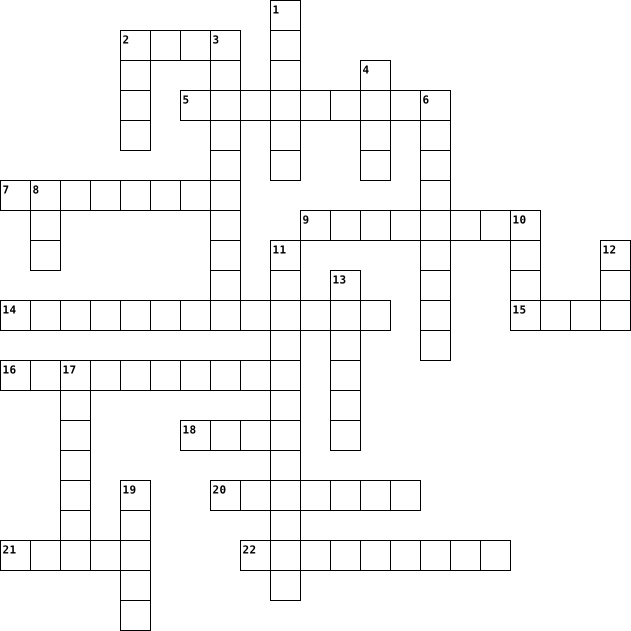
Across
- colors that give a feeling of calm or peace
- repetition of movement using color, shape or lines
- mark made by a pointed tool
- line that shows outside edge of a shape
- distribution of visual weight in a work of art
- using overlapping objects of different sizes to create depth in drawing
- the visual relation of one part of a work to another
- balance that is usually equal without being identical on both sides
- made by mixing 1 primary and 1 secondary color
- line that shows outside edge of a shape plus any inside detail lines
- balance where both side of the image are just alike
- when making a value scale and use lines that go in all directions
- colors that are side by side on the color wheel and share a color
- the space an object itself fills
- planned or random repetitions that increase visual interest in the artwork
- when making a value scale and use lines going in the same direction
- 2-dimensional (length and width)
- three basic colors that all other colors are made from
- how dark or light something is
- creates a focal point and makes it the center of interest
- another name for this is Hue
- makes an artwork feel complete and finished
Down
- 3-dimensional (height, width, length) and can be viewed from all sides
- balance using a design in a circular shape that radiates from central point
- to conceive and plan out a project in your mind
- the space around an object (background)
- Pure, true, bright, in your face color
- colors directly across from each other on the color wheel
- how elements are arranged in an artwork
- type of perspective using color or value to show depth
- used by artists to direct the viewer through the artwork
- lightest areas of your drawing or painting and shows reflected light
- three colors made by mixing equal parts of 2 primary colors together
- al illusion that creates a feeling of depth
- type of perspective using a vanishing point system
- a system used to place your focal point in the correct position
- how something feels or how it looks like it should feel
- differences in two elements of art in a work
- colors that give a feeling of warmth or heat
- occurs when all the art elements have been organized pleasingly
- add black to a color to make it darker when painting
- add white to a color to make it lighter
42 Clues: mark made by a pointed tool • another name for this is Hue • how dark or light something is • the space an object itself fills • 2-dimensional (length and width) • Pure, true, bright, in your face color • line that shows outside edge of a shape • the space around an object (background) • how elements are arranged in an artwork • add white to a color to make it lighter • ...
ELEMENTS OF ART 2023-08-29

Across
- Colors that consist of orange, violet, and green.
- The name of a color in the color spectrum (rainbow).
- These colors are made mostly of green, blue, and violet.
- A color scheme (one color) that uses one hue and the tints and shades of that color.
- To darken a color you add black.
- The part of the picture plane that appears closest to you.
- A line that shows only the outer edges of any object.
- The part of the picture plane that falls between the foreground and background.
- The area around, above, or inside an object.
- Drawing contour lines without looking at the paper. Do so forces you to really look at what you’re drawing.
- Texture that you can see but can’t feel.
- Line that follows the outer edges of an object.
- Seen by light reflecting off an object.
- There is a lot of depth in the artwork. Objects tend to disappear far in the distance.
- Colors that consist of Blue-green, yellow-orange, and red-violet.
- Type of line that moves straight up and down.
- Colors next to each other on the color wheel.
- The spectrum (rainbow) that is bent into a circle.
- Using a variety of thin and thick lines, or varying the weight of a single line, to create interest.
- The building blocks of Art.
- Orange & blue, yellow & violet, green & red are colors located directly across from each other on the color wheel.
Down
- The part of the picture plane that appears furthest from you.
- Two-dimensional that have height and width.
- The relative lightness or darkness of something.
- Colors consisting of red, yellow, and blue.
- Natural or freeform lines/shapes/forms often with curvy or soft edges. Can also be the outline or silhouettes of living things.
- There is not much depth in the artwork. Objects are close together without much room to move around.
- The space around the areas of focus- usually the background of an artwork.
- A line made up of a series of real or imaginary points connected by the viewer’s eyes.
- Colors that consist of black, gray, and white.
- To lighten a color you add white.
- Three-dimensional that have height, width, and depth.
- Mathematical lines/shapes/forms often with hard, sharp edges.
- The texture that you can actually feel.
- The brightness and dullness of a color.
- Type of line that is parallel to the horizon.
- These colors are made mostly of red, orange, and yellow.
- The area of focus- the important parts of an artwork.
38 Clues: The building blocks of Art. • To darken a color you add black. • To lighten a color you add white. • Seen by light reflecting off an object. • The texture that you can actually feel. • The brightness and dullness of a color. • Texture that you can see but can’t feel. • Two-dimensional that have height and width. • Colors consisting of red, yellow, and blue. • ...
Properties of Light Waves 2022-04-05

Across
- The majority of objects _______ over one frequency of light.
- A different _______ of light can make a different color of light.
- The colors that are reflected off of ______ items are the colors that you view.
- ___________ refract when they increase or decrease speed.
- __________ affects object color.
- Something one can use to find out why one sees various colors of light.
- The reason that the sky is blue through our eyes.
- A part of the electromagnetic spectrum in which light waves within a certain range of frequencies can be detected by the human eye.
- most light that you see is actually a mixture of a different _________ of another kind of light.
- The best song off of AJR's most recent album, Ok Orchestra (in Libby's opinion).
Down
- Something that is created when water droplets make sunlight's colors to bend and separate.
- The range of frequencies and wavelengths of all light waves.
- Something that is affected by light speed.
- The amount of energy light waves carry to an area in a certain amount of time.
- _____ light is a combination of different colors of light.
15 Clues: __________ affects object color. • Something that is affected by light speed. • The reason that the sky is blue through our eyes. • ___________ refract when they increase or decrease speed. • _____ light is a combination of different colors of light. • The majority of objects _______ over one frequency of light. • ...
Photography Final Exam Review 2024-05-16

Across
- Relative lightness or darkness
- This is a color scheme that uses one hue and values of that hue
- The angle of a camera can change the point of __________.
- This rule divides your frame in a grid structure and places an area of interest at an intersecting point
- A difference in elements
- This scheme uses colors close to each other on the color wheel
- Patterns to help create rhythm and unity
- Colors are red, yellow, and blue
Down
- The way elements are organized within a work of art
- An artist's research and process leading up to a final product
- This style of art depicts unrecognizable subject matter
- A review of work that includes description, analysis, interpretation, and evaluation
- This scheme uses colors opposite each other on the color wheel
- Colors are orange, green, purple
- The area noticed first in a work of art
- An artist's statement about a work of art
- Differences in elements to create interest
17 Clues: A difference in elements • Relative lightness or darkness • Colors are orange, green, purple • Colors are red, yellow, and blue • The area noticed first in a work of art • Patterns to help create rhythm and unity • An artist's statement about a work of art • Differences in elements to create interest • The way elements are organized within a work of art • ...
Abstract Art & Pop Art Project 2026-05-21

Across
- Colors on the color wheel that are opposites of each other.
- The artist who created the Balloon Dog
- —The process of putting materials on top of each other to create and effect.
- An art era in WW1 where artists created paintings or sculptures and people questioned, “what is that?”
- The outline of a shape when the middle isn’t shown.
- The use of shapes and different colors and lines on an artwork.
- Colors that represent coldness like green, blue, and purple.
- He was pioneering Russian avant-garde artist and art theorist of Polish descent.
- When one combines one color with another to make a new one.
Down
- He was a French American painter who did a lot abstract art.
- The structure of a subject in a piece of artwork.
- An art material made of talc and color pigment and breaks easily but blends well
- When factories were invented and they created w/people, smoke, noise. They drew real life hustle of daily living and led to impressionism.
- How color is contrasted from each other and combined colors.
- The difference between light and dark.
- Colors that represent hotness like red, orange, and yellow.
- When you stack different materials together on top of each other to make texture or a 3D affect.
- External outline that connect to create either geometric or organic shapes.
18 Clues: The difference between light and dark. • The artist who created the Balloon Dog • The structure of a subject in a piece of artwork. • The outline of a shape when the middle isn’t shown. • Colors on the color wheel that are opposites of each other. • Colors that represent hotness like red, orange, and yellow. • ...
Color and Eyesight 2019-12-04

Across
- This is another word for pinkeye
- True or false: Dogs can only see black, grey and white
- This is another word for nearsighted
- Who invented the color wheel?
- Red and and Yellow make Orange, a _____ color
- What is an eye doctor called?
- Something you put on your face to fix eyesight
- Green, Blue and Purple are cold, so Red, Orange and Yellow are _____
Down
- Red and Purple are examples of _____ eye colors
- True or false: Farsighted means you can see far objects clearly
- Other than wearing glasses, you can wear _____
- Black and White are not colors, they are _____
- What is the name of the Greek mythological creature with one eye?
- When you get older, your eyesight gets worse and you may become _____
- Opposite colors on the color wheel are called _____
- When you lose your ability to see colors you are _____
16 Clues: Who invented the color wheel? • What is an eye doctor called? • This is another word for pinkeye • This is another word for nearsighted • Red and and Yellow make Orange, a _____ color • Other than wearing glasses, you can wear _____ • Black and White are not colors, they are _____ • Something you put on your face to fix eyesight • ...
Flower 2023-10-29

Across
- Bright and tall, follows the sun
- Small and delicate, can be purple or blue
- Large, globe-shaped clusters of blooms
- Sword-shaped leaves, various hues
- Big and fragrant, many layers of petals
- Bright orange or yellow, hardy blooms
- Trumpet-shaped, comes in many colors
Down
- Fragrant and comes in various colors
- Vibrant and globe-shaped clusters
- Exotic and elegant, various shapes
- Yellow and trumpet-like, a spring favorite
- Colorful petals, sweet fragrance
- Bell-shaped, vibrant colors
- Simple and delicate, often white
- Vibrant red or orange, often wild
15 Clues: Bell-shaped, vibrant colors • Bright and tall, follows the sun • Colorful petals, sweet fragrance • Simple and delicate, often white • Vibrant and globe-shaped clusters • Vibrant red or orange, often wild • Sword-shaped leaves, various hues • Exotic and elegant, various shapes • Fragrant and comes in various colors • Trumpet-shaped, comes in many colors • ...
Art Materials 2026-04-05

Across
- a light draw
- thin and colored thinner than number 8 down
- a material made by wood and has different colors
- a piece of work made with different objects
- a piece of work made with one object and not colored in
- a place where creators sell their work
Down
- a waxy crayon that smears easily
- a piece of color that needs a liquid to use it and pole with bristles on one end
- art material that breaks easily and comes in multiple colors and used in kindergarten a lot
- full of ink and comes in different colors
- a object that can help you
- a pole with bristles on one end
- made from a tree and can come in different colors
- a thicker piece from a tree than number 8 down
- an a shaped stand to hold your work
- a piece of wood that draws gray or black
16 Clues: a light draw • a object that can help you • a pole with bristles on one end • a waxy crayon that smears easily • an a shaped stand to hold your work • a place where creators sell their work • a piece of wood that draws gray or black • full of ink and comes in different colors • thin and colored thinner than number 8 down • a piece of work made with different objects • ...
Art Vocabulary 2025-02-03

Across
- When a line comes back around and overlaps itself it creates a shape, they are 2D and are either organic or geometric
- the material and tools used by an artist, to create a work of art
- to place or be placed so that a part of one covers a part of another
- The center of interest of an artwork; the part you look at first
- One color and all of its values (shades)
- 3-5 colors next to each other on the color wheel
- The part of the design that catches the viewer's attention
- the distribution of the visual weight of objects, colors, textures, and space
- an oral or written discussion to go over, describe, and interpret art.
Down
- how and where you place things in a work of art
- plan, organization, or arrangement of elements in a work of art
- Where something is the same on both sides
- has 3 properties: hue (the name), value (lightness or darkness), intensity (the strength)
- a continuous mark made on a surface it is used to define shapes and outlines
- the surface of a drawing or painting
- the choice of colors used in various artistic and design contexts
- are often curvy in appearance, they are similar to things found in nature, such as plants, animals, and rocks
- the brightness or dullness of a color
- a design in which lines, shapes, forms or colors are repeated
19 Clues: the surface of a drawing or painting • the brightness or dullness of a color • One color and all of its values (shades) • Where something is the same on both sides • how and where you place things in a work of art • 3-5 colors next to each other on the color wheel • The part of the design that catches the viewer's attention • ...
Graphic Design Vocab Crossword 2022-10-18

Across
- The colors that are created by the result of primary and secondary colors being mixed
- Lightness or darkness of a color
- Another name for color
- The 3 colors that you get when mixing the 3 primary colors
- Drastic difference between multiple things
- Placement of visual elements for the purpose of lining them up in a composition
Down
- 3 basic colors that can be mixed together to create every other color
- White added to a color
- Something done or shown multiple times
- Black added to a color
- Brightness or dullness of a color
11 Clues: White added to a color • Another name for color • Black added to a color • Lightness or darkness of a color • Brightness or dullness of a color • Something done or shown multiple times • Drastic difference between multiple things • The 3 colors that you get when mixing the 3 primary colors • 3 basic colors that can be mixed together to create every other color • ...
Unit 4 Crossword Puzzle 2019-10-17

Across
- PROCESSES GRAY SCALE COLORS, PERIPHERAL VISON, AND VISION IN LOW LIGHT
- BENDS THE LIGHT; BRINGS LIGHT INTO THE EYE TO INSERT THE PICTURE
- FAILING TO SEE VISIBLE OBJECTS WHEN OUR ATTENTION IS ELSEWHERE
- PROTECTS THE EYE
- THE PROCESS OF ORGANIZING AND INTERPRETING SENSORY INFORMATION ALLOWING US TO RECOGNIZE OBJECTS AND EVENTS
- THE PROCESS OF OUR SENSORY RECEPTORS AND NERVOUS SYSTEM RECEIVING STIMULUS
Down
- WE TECHNICALLY ONLY SEE THREE COLORS, BUT ALL COLORS ARE MADE UP OF THOSE COLORS
- CHANGING LIGHT WAVES INTO IMAGES
- ANALYSIS THAT BEGINS WITH SENSORY RECEPTORS AND WORKS UP TO THE BRAIN'S INTEGRATION OF SENSORY INFORMATION
- FOCUSING CONSCIOUS AWARENESS ON A PARTICULAR STIMULI
- PROCESSES COLOR VISION, CENTER VISION, AND DAYTIME VISION
- MADE UP OF RETINAL RECEPTORS
- ANALYSIS GUIDED BY HIGHER LEVEL METAL PROCESSING CONSTRUCTION PERCEPTIONS BASED ON EXPERIENCES AND EXPECTATIONS
- NERVE TO BRAIN
- SURROUNDS PUPIL; WHERE EYE COLOR COMES FROM
- HOLE IN EYE; LETS IN LIGHT TO EYE
16 Clues: NERVE TO BRAIN • PROTECTS THE EYE • MADE UP OF RETINAL RECEPTORS • CHANGING LIGHT WAVES INTO IMAGES • HOLE IN EYE; LETS IN LIGHT TO EYE • SURROUNDS PUPIL; WHERE EYE COLOR COMES FROM • FOCUSING CONSCIOUS AWARENESS ON A PARTICULAR STIMULI • PROCESSES COLOR VISION, CENTER VISION, AND DAYTIME VISION • FAILING TO SEE VISIBLE OBJECTS WHEN OUR ATTENTION IS ELSEWHERE • ...
elements of design 2024-05-02

Across
- These are the colors formed by mixing a primary and a secondary color.
- are created in drawing when the ends of lines are joined together to enclose areas.
- The color in between three spaces in color wheel
- is very similar to shape, another element of design
- colors opposite each other in color wheel
- The elements of design create every object around us
- green, orange, purple
- Three colors diagonal with each other
Down
- We describe things as being rough, smooth, silky, shiny and fuzzy.
- is the element of art which is produced when light is reflected to the eye striking an object
- One color of different shade
- Red, yellow and blue
- deals with a color's lightness or darkness
- deals with the location of an object or entity in, around, above or below it
- is the most basic of all design elements.
- Three neighboring colors, one of which is dominant
16 Clues: Red, yellow and blue • green, orange, purple • One color of different shade • Three colors diagonal with each other • colors opposite each other in color wheel • is the most basic of all design elements. • deals with a color's lightness or darkness • The color in between three spaces in color wheel • Three neighboring colors, one of which is dominant • ...
Fashion crossword puzzle 2023-10-27

Across
- the focal point of the design
- made up of one color and its shades and tints
- serves of points connected to form a narrow patin
- colors, colors directly opposite one another on the color wheel
- how separate parts of a garment relate to each other and the whole
- three dimensional shape of an object
- colors that are next to each other on a color wheel
- how your eyes move over a garment
- the lightness or darkness of a color
Down
- the aspect of any object that may be described in terms of hue, lightness and saturation
- unequal to both sides of the garment
- equal on both sides of the garment
- how the fabric looks and feels on the surface
- the outline shape of an object two dimensional
- pleasing visual unity
- colors that are evenly spaced apart on the color wheel- creating an equilateral triangle
16 Clues: pleasing visual unity • the focal point of the design • how your eyes move over a garment • equal on both sides of the garment • unequal to both sides of the garment • three dimensional shape of an object • the lightness or darkness of a color • made up of one color and its shades and tints • how the fabric looks and feels on the surface • ...
Elements and Principles 2023-04-18

Across
- /Tool used to show hues, how they are related to each other, and what colors will be created when mixing paints & dyes together
- /The principle of design that uses a concentration of interest or area of focus in a particular part or area of a design.
- in an artwork that is positive. Filled with something, such as lines, designs, color, or shapes.
- /The lightness or darkness of a color in relation to a scale ranging from white to black.
- /orderly and pleasing arrangement of elements
- /A number of different kinds; assortment elements
- /Adding gray to a color
- /a state of equilibrium, produces equality in a design or outfit, when all sides of design appear equal in visual weight or power of attraction the design seems to have stability
- /the visual appearance of something or someone, The two-dimensional contour that characterizes an object or area, sometimes called a silhouette, in contrast to three-dimensional form.
- /Perceived surface quality, tactile quality of goods, how the surface of a material feels and looks
- /put in opposition to show or emphasize differences
- /Adding white to a color
- type of balance when both sides of the central axis are not identical, yet appear to have the same visual weight
- elements in a work of art to produce the appearance of movement. This may be achieved through repetition.
- /harmonious arrangement or relation of parts or elements within a whole (as in a design). the ratio between the size of something and a representation of it.
- of TWO colors that are directly across from each other on the color wheel
- Weight /Also called line width. The thickness of a line, characterized as thick or thin.
- lines, shapes, colors, or textures in a garment
Down
- /A three-dimensional object or the illusion of three dimensions
- Colors /black, white, gray, beige
- of adjacent (side by side) colors on the color wheel - usually in THREE colors
- Yellow, and Blue. Cannot be made by mixing other colors.
- /distribution achieved by arranging elements as horizontal or vertical mirrored images on both sides of an imaginary center line of a screen.
- /a length (straight or curved) without breadth or thickness, lead the eye through a design.
- /the combination of all elements working together to achieve a sense of harmony in your design; grouping related items close together
- /Colors that are made from a primary and secondary color mixing.
- /an empty area (usually bounded in some way between things)
- /empty spaces surrounding shapes and forms
- of Design /color, line, shape, form, value, space, and texture
- Green, Violet; made by mixing two primary colors
- of Design /Unity, variety, emphasis, rhythm/movement, balance, pattern/repetition, harmony, contrast, and proportion/scale. The effects that may result when the art elements are structured to achieve a successful composition.
- /Adding black to a color
- /the appearance of objects (or light sources) described in terms of a person's perception of their hue and lightness (or brightness) and saturation
33 Clues: /Adding gray to a color • /Adding white to a color • /Adding black to a color • Colors /black, white, gray, beige • /empty spaces surrounding shapes and forms • /orderly and pleasing arrangement of elements • lines, shapes, colors, or textures in a garment • Green, Violet; made by mixing two primary colors • /A number of different kinds; assortment elements • ...
Quarter 3 Final Assignment 2022-03-03

Across
- related in art through color, shape & line, leads viewer’s eye through a work of art or creates action
- the outline
- 3 colors next to each other on the color wheel (Warm colors are analogous)
- a closed figure that is 3-D, has space/volume inside
- shape: man-made, straight edges, corners and/or clear edges
- Blended colors, Red-Orange or Yellow-Green
- Shape: irregular, biomorphic shape often found in nature
- Composition or Radial Balance: Imagery that radiates out from a particular point
- The lightness and darkness of a color
- a closed figure that is 2-D, flat
- gradual blending from one color to another
- of Art: line, shape, value, form, texture, space, color
Down
- Gradual blending from one color to the next
- 1 color plus tints (add white) and shades (add black)
- Colors: black, grey, brown and white
- Space: the figure itself
- Shadow: an element that looks like a shadow
- colors across from each other on the color wheel R & G, P & Y, B & O
- Exactly the same on both sides of an axis
- Composition: Main subject is placed in the middle of the artwork
- placement of elements in an artwork
- The way something feels, can be actual or implied
- Composition: Equal visual weight on each side of the composition; Doe not have to by symmetrical to be balanced
- Space: a hole or an empty space
- principle of design; allows elements to coexist with one another to form a pleasing design
- Composition: Unequal visual weight on each side of the composition
26 Clues: the outline • Space: the figure itself • Space: a hole or an empty space • a closed figure that is 2-D, flat • placement of elements in an artwork • Colors: black, grey, brown and white • The lightness and darkness of a color • Exactly the same on both sides of an axis • Blended colors, Red-Orange or Yellow-Green • gradual blending from one color to another • ...
Color Review 2021-05-18

Across
- Colors that are opposite on the color wheel
- What artists use as a guide to mix colors
- Adding black or white to a color
- Purple, Green, Orange
Down
- 3 or more colors that are next to each other on the color wheel
- red, yellow, orange
- blue, green, purple
- when you choose three colors with equal spacing between them
- Red, Yellow, Blue
- Mixing Primary and Secondary colors
10 Clues: Red, Yellow, Blue • red, yellow, orange • blue, green, purple • Purple, Green, Orange • Adding black or white to a color • Mixing Primary and Secondary colors • What artists use as a guide to mix colors • Colors that are opposite on the color wheel • when you choose three colors with equal spacing between them • 3 or more colors that are next to each other on the color wheel
Divergent 2023-05-05

Across
- Amity (two colors)
- Tris's real name
- Divergent is in the... (future, past, present)
- Candor (two colors)
- Author
- Erudite
- tattoo artist
- How many fears Tris has
Down
- how old Tris was in the beginning
- Brave
- Peace
- Abnegation
- Honesty
- Knowledge
- father of Four
- Who is scared of heights
- selflessness
- Who hated Tris
- also known as Tobias
- people with special abilities that don't fit into one clan
- Dauntless
21 Clues: Brave • Peace • Author • Honesty • Erudite • Knowledge • Dauntless • Abnegation • selflessness • tattoo artist • father of Four • Who hated Tris • Tris's real name • Amity (two colors) • Candor (two colors) • also known as Tobias • How many fears Tris has • Who is scared of heights • how old Tris was in the beginning • Divergent is in the... (future, past, present) • ...
Quarter 3 Final Crossword 2022-03-03

Across
- related in art through color, shape & line, leads viewer’s eye through a work of art or creates action
- the outline
- 3 colors next to each other on the color wheel (Warm colors are analogous)
- a closed figure that is 3-D, has space/volume inside
- shape: man-made, straight edges, corners and/or clear edges
- Blended colors, Red-Orange or Yellow-Green
- Shape: irregular, biomorphic shape often found in nature
- Composition or Radial Balance: Imagery that radiates out from a particular point
- The lightness and darkness of a color
- a closed figure that is 2-D, flat
- gradual blending from one color to another
- of Art: line, shape, value, form, texture, space, color
Down
- Gradual blending from one color to the next
- 1 color plus tints (add white) and shades (add black)
- Colors: black, grey, brown and white
- Space: the figure itself
- Shadow: an element that looks like a shadow
- colors across from each other on the color wheel R & G, P & Y, B & O
- Exactly the same on both sides of an axis
- Composition: Main subject is placed in the middle of the artwork
- placement of elements in an artwork
- The way something feels, can be actual or implied
- Composition: Equal visual weight on each side of the composition; Doe not have to by symmetrical to be balanced
- Space: a hole or an empty space
- principle of design; allows elements to coexist with one another to form a pleasing design
- Composition: Unequal visual weight on each side of the composition
26 Clues: the outline • Space: the figure itself • Space: a hole or an empty space • a closed figure that is 2-D, flat • placement of elements in an artwork • Colors: black, grey, brown and white • The lightness and darkness of a color • Exactly the same on both sides of an axis • Blended colors, Red-Orange or Yellow-Green • gradual blending from one color to another • ...
Quarter 3 Final Assignment 2022-03-03

Across
- related in art through color, shape & line, leads viewer’s eye through a work of art or creates action
- the outline
- 3 colors next to each other on the color wheel (Warm colors are analogous)
- a closed figure that is 3-D, has space/volume inside
- shape: man-made, straight edges, corners and/or clear edges
- Blended colors, Red-Orange or Yellow-Green
- Shape: irregular, biomorphic shape often found in nature
- Composition or Radial Balance: Imagery that radiates out from a particular point
- The lightness and darkness of a color
- a closed figure that is 2-D, flat
- gradual blending from one color to another
- of Art: line, shape, value, form, texture, space, color
Down
- Gradual blending from one color to the next
- 1 color plus tints (add white) and shades (add black)
- Colors: black, grey, brown and white
- Space: the figure itself
- Shadow: an element that looks like a shadow
- colors across from each other on the color wheel R & G, P & Y, B & O
- Exactly the same on both sides of an axis
- Composition: Main subject is placed in the middle of the artwork
- placement of elements in an artwork
- The way something feels, can be actual or implied
- Composition: Equal visual weight on each side of the composition; Doe not have to by symmetrical to be balanced
- Space: a hole or an empty space
- principle of design; allows elements to coexist with one another to form a pleasing design
- Composition: Unequal visual weight on each side of the composition
26 Clues: the outline • Space: the figure itself • Space: a hole or an empty space • a closed figure that is 2-D, flat • placement of elements in an artwork • Colors: black, grey, brown and white • The lightness and darkness of a color • Exactly the same on both sides of an axis • Blended colors, Red-Orange or Yellow-Green • gradual blending from one color to another • ...
Color Theory 2025-03-31

Across
- The color is washed out or grayed out.
- By adding white to any color to make it lighter.
- The study of how colors work together and how they affect our emotions and perceptions.
- Color is made by mixing yellow and blue.
- Are the only hues that can’t be created by mixing any other colors together.
- When you combine any two of the pure primary colors.
- Features three or more that are positioned next to each other on the color wheel.
- Named by temperature: red, orange, and yellow.
- When you mix a primary and its nearest secondary on the basic color wheel, you mix six new mixtures.
- By adding black to any color to make it darker.
- Named by temperature blue, green, and violet.
Down
- Color is made by mixing red and blue.
- The intensity of a color; the measurement of how pure a color is.
- Colors are any two hues positioned exactly opposite each other on the basic color wheel.
- Taking any one of the twelve hues from the basic color wheel and repeating it in various tints and shades.
- The element of art produced when light striking an object is reflected back to the eye.
- A palette dominated by light values (midtone hues to white), often pastel and conveying a light, airy mood.
- By adding black and wh:ite to a hue to adjust its intensity.
- A palette dominated by dark values (midtone hues to black), creating a more dramatic or somber atmosphere.
- Color is made by mixing yellow and red.
- The 12 purest colors.
21 Clues: The 12 purest colors. • Color is made by mixing red and blue. • The color is washed out or grayed out. • Color is made by mixing yellow and red. • Color is made by mixing yellow and blue. • Named by temperature blue, green, and violet. • Named by temperature: red, orange, and yellow. • By adding black to any color to make it darker. • ...
Art I Vocabulary 2024-12-13

Across
- The Elements of Design are used to ______ the Principles of Art
- This type of line defines the edge of something
- _______ Space refers to the area around an object in either 2D or 3D artworks
- Colors next to each other on the color wheel that share a common hue.
- The main shapes or subject matter in a composition.
- In 1 and 2 Point perspective, vertical lines are always ______
- In 2 and 3 Point Perspective, you draw the TOP of an object when it is BELOW the______.
- The _______ of Design include: balance, unity, movement, pattern, rhythm, emphasis and contrast
- Darkened colors created by adding black.
- Colors associated with warmth (e.g., reds, oranges, yellows).
- This Principle of Design creates a focal point or draws attention to one part of an artwork
- This occurs when two differing or opposing elements (colors, values, shapes, etc.) in an artwork appear next to each other.
- Lightened colors created by adding white.
- In 3 Point Perspective, these lines should comes from the top or bottom Vanishing Points
- Colors made by mixing two primary colors (e.g., green, orange, violet).
- The _______ of Art include: color, line, space, shape, texture, value, and form
- A Principle of Design that creates the wholeness of completeness in a work of art.
- Placing one object in front of another to create depth.
Down
- Repeated elements in an artwork, either organized or random
- How Vibrant or dull a color is
- A mark made by a pointed tool, sometimes called a moving dot
- Colors associated with coolness (e.g., blues, greens, purples).
- This type of Balance appears to be equal on both sides of center
- Elements radiate out from a central point, creating a circular balance.
- Quick, expressive lines that capture movement and posture.
- The area between around, above, below, or within things
- _________Colors are visual opposites and are found across the color wheel from each other.
- The distribution and equilibrium of elements and visual weight in and artwork
- This type of texture occurs in 2D artwork.
- In 2 Point Perspective, horizontal lines should point to these
- Irregular, freeform shapes resembling natural forms.
- A type of drawing technique that emphasizes linear space
- An enclosed area defined by other elements of art; line, color, value, etc
- This Element of Design refers to repetitive elements that move the viewer's eyes throughout an artwork.
- Precise shapes with clear edges, like squares or circles.
- This Element of Art helps to create the illusion of 3D through changes in light and dark.
- Both sides of the composition are different but still appear ba
- Colors made by mixing a primary color with a secondary color
- How the viewer's eyes move through an artwork
- Actual Space only occurs in ____ artworks
- This Element of Art refers to the implied surface quality of a 2D artwork or the actual surface of a 3D artwork
- A 3D object that has Height, Width and Depth
42 Clues: How Vibrant or dull a color is • Darkened colors created by adding black. • Lightened colors created by adding white. • Actual Space only occurs in ____ artworks • This type of texture occurs in 2D artwork. • A 3D object that has Height, Width and Depth • How the viewer's eyes move through an artwork • This type of line defines the edge of something • ...
InDesign Terms 2021-05-03

Across
- both sides of the design differ.
- lighter version of a color made by adding white.
- a graduated blend of two or more colors.
- pre-mixed inks that are printed separately.
- stray text at the top of a document.
- process colors mixed using percentages of four colors.
- option selected to create a spread in InDesign.
- grid of 3 columns and 3 rows on which visual elements are placed
- printed size of your design (varies by project)
- typographical design where enlarged text is positioned prominently on a page
- both sides of design are similar.
- landscape (horizontal) or portrait (vertical)
- right, left, centered or justified
- stray text at the bottom of a document
- adjusts space between a group of characters
Down
- elements that are replicated in a design.
- the look and feel of a surface
- when all the elements work well together
- an area outside the perimeter of a page that can be printed
- vertical space between the lines of text.
- thickness of a stroke
- color applied to the outline of an object
- connected paths of lines and curves.
- two pages displayed next to each other
- adjusts space between a pair of characters.
- color applied to the inside of an object
- panel where new colors are added
- achieved using different fonts, colors, sizes in opposition.
- clarity for the reader using fonts, spacing formatting etc.
- combination of individual parts of a design to create a cohesive whole.
- linking text from one text frame to another
31 Clues: thickness of a stroke • the look and feel of a surface • both sides of the design differ. • panel where new colors are added • both sides of design are similar. • right, left, centered or justified • stray text at the top of a document. • connected paths of lines and curves. • two pages displayed next to each other • stray text at the bottom of a document • ...
Crafts Study Sheet 2023-12-13

Across
- The way something actually feels
- An area that has height and width
- The way something looks like it feels
- To characterize or represent
- Individual pieces of a mosaic
- Image or pattern created using small regular or irregular pieces of glass, colored stone, or ceramic
- To form an opinion on
- The language used to communicate in art
- Technique in which cords are knotted in various ways
- The area occupied by an object
- The lightness or darkness of a color
- Has height, width, and depth
- Technique where yarn is strung on a frame vertically with additional yarn woven into the vertical yarn horizontally
- Colors made by mixing two primary colors
- Another name for a color
- To discover or reveal something through detailed examination
- The way something feels or looks like it feels
Down
- Horizontal strings woven into the loom
- A mark made by a point moving across a surface
- Commonly referred to as "chewed paper"
- Art that utilizes fabrics
- Shapes that are mathematical
- To explain the meaning of an object, symbol, or setting
- Shapes that are found in nature
- vertical strings wrapped onto the loom
- The colors mixed to make all other colors
- The section between the foreground and the background
- A gradual change from light to dark
- A synthetic liquid that when hardens creates a durable, smooth coating
- The objects that a furthest away from the viewer
- Shows the relationship between colors
- The area around, above, between, inside, or below objects
32 Clues: To form an opinion on • Another name for a color • Art that utilizes fabrics • Shapes that are mathematical • To characterize or represent • Has height, width, and depth • Individual pieces of a mosaic • The area occupied by an object • Shapes that are found in nature • The way something actually feels • An area that has height and width • A gradual change from light to dark • ...
Flower 2023-07-09

Across
- A flower with ruffled petals that come in various colors, often used in bouquets and arrangements.
- A tropical flower with large, showy petals that come in vibrant colors like red, pink, and yellow.
- A flower with large, trumpet-shaped petals and a sweet fragrance, found in various colors.
- A trumpet-shaped flower with yellow petals, symbolizing the arrival of spring.
- A beautiful flower with petals that come in various colors, known for its sweet fragrance.
Down
- A flower with golden or orange petals, commonly used in festive decorations or garlands.
- A flower with cup-shaped petals that come in different colors, including red, yellow, and pink.
- A delicate and exotic flower known for its intricate and often colorful petals.
- A tall flower with a large round head, known for its bright yellow petals and brown center.
- A small flower with rounded petals in vibrant colors, resembling a face with two eyes.
- A flower with tall, sword-shaped leaves and striking petals in different colors, including blue and purple.
- A simple flower with a yellow center and white petals, commonly found in meadows and gardens.
12 Clues: A trumpet-shaped flower with yellow petals, symbolizing the arrival of spring. • A delicate and exotic flower known for its intricate and often colorful petals. • A small flower with rounded petals in vibrant colors, resembling a face with two eyes. • A flower with golden or orange petals, commonly used in festive decorations or garlands. • ...
Color Theory 2014-05-30
Across
- Red, Yellow, Orange
- Colors next to each other on the color wheel.
- Brush stroke used to create texture (two words)
- Watercolor technique which allows the paint to run and blend into other colors (3 words)
- Colors opposite one another on the color wheel.
- Hue + Gray
- Transparent, runny, paint medium
- Analagous to Violet and Green
- Red, Yellow, Blue
- Hue + Black
- Brush stroke used to create texture and shading
Down
- The Complementary color to Yellow
- Smooth area of color
- 1 color mixed with black and white
- Blue, Green, Violet
- Violet, Orange, Green
- the Complementary color to green
- Hue + White
- Mix 1 Primary and 1 Secondary color together
- Another name for color
- Analagous to Yellow and Red
- Thick, opaque, paint medium
- The Complementary color to Red
23 Clues: Hue + Gray • Hue + White • Hue + Black • Red, Yellow, Blue • Red, Yellow, Orange • Blue, Green, Violet • Smooth area of color • Violet, Orange, Green • Another name for color • Analagous to Yellow and Red • Thick, opaque, paint medium • Analagous to Violet and Green • The Complementary color to Red • the Complementary color to green • Transparent, runny, paint medium • ...
ART IS LIFE 2023-04-10

Across
- images in the between space
- arrangement of visual elements that make a picture
- content showing mood and or feeling
- principle design that creates unity
- quick drying polymer plastic
- space space that is not occupied
- a primary color
- color colors that cannot be made
- purpose and use of artwork
- images farthest away from the eye
- using white and another color
- line of design
- art Non objective art
- secondary color
Down
- plan or conception of an idea for an image
- the visual sensation dependent on reflection
- using black and another color
- colors that are made from primary
- condition of being twisted or altered from regular
- using gray and another color
- images closest to the eye, always the biggest images
- opposite colors on the color wheel
22 Clues: line of design • a primary color • secondary color • art Non objective art • purpose and use of artwork • images in the between space • quick drying polymer plastic • using gray and another color • using black and another color • using white and another color • space space that is not occupied • color colors that cannot be made • colors that are made from primary • ...
Color Wheel Vocab 2025-02-26

Across
- blue, green, and purple
- using only one color
- a range of color from light to dark
- red and yellow mixed
- the complimentary color of green
- blue, red, and yellow
Down
- opposite colors: blue and orange, for example
- red, yellow, and orange
- the colors in between primary and secondary
- blue and red mixed
- orange, green, and purple
- three colors sitting next to each other
- the complimentary color of purple
- blue and yellow mixed
14 Clues: blue and red mixed • using only one color • red and yellow mixed • blue and yellow mixed • blue, red, and yellow • blue, green, and purple • red, yellow, and orange • orange, green, and purple • the complimentary color of green • the complimentary color of purple • a range of color from light to dark • three colors sitting next to each other • ...
Art terms 2025-04-21

Across
- Lights and Darks of one color
- Browns and Tans
- The illusion that objects get smaller as they go back into space
- Three colors evenly spaced on the color wheel
- Three colors next to each other on the color wheel
- Two colors opposite each other on the color wheel
- A two dimensional enclosed space
- The name of a specific color
- A color plus white
- Orange, Green, Violet
Down
- Red, Orange, Yellow
- When objects go to two vanishing points
- Green, Blue, Violet
- Where the sky meets the land
- The perceived warmth or coolness of a color
- When objects go to one vanishing point
- A color plus black
- The effect of light reflected off an object and perceived by our eyes
- A three dimensional enclosed space
- Red, Yellow, Blue
- Black, White, Gray
21 Clues: Browns and Tans • Red, Yellow, Blue • A color plus black • Black, White, Gray • A color plus white • Red, Orange, Yellow • Green, Blue, Violet • Orange, Green, Violet • Where the sky meets the land • The name of a specific color • Lights and Darks of one color • A two dimensional enclosed space • A three dimensional enclosed space • When objects go to one vanishing point • ...
Minerals 2023-06-14

Across
- A gemstone with a captivating play of light, resembling the soft glow of the moon
- A pale blue gemstone reminiscent of the clear waters of the sea
- A deep red gemstone symbolizing passion and love
- A gemstone occurring in a variety of colors, often associated with deep red hues
- A precious gemstone known for its exceptional brilliance and hardness
- A gemstone formed from fossilized ammonite shells, displaying vibrant iridescence
- A yellow to orange gemstone symbolizing warmth and positivity
- A unique gemstone with a play of colors, reflecting a spectrum of hues
Down
- A gemstone available in a wide array of colors, known for its versatility
- A gemstone available in various colors, but most commonly associated with a deep blue hue
- A gemstone available in a range of colors, with blue and yellow being the most common
- A vibrant green gemstone associated with vitality and healing
- A purple gemstone believed to have calming and protective properties
- A rare blue-violet gemstone discovered in Tanzania
- A vibrant green gemstone representing rebirth and prosperity
15 Clues: A deep red gemstone symbolizing passion and love • A rare blue-violet gemstone discovered in Tanzania • A vibrant green gemstone representing rebirth and prosperity • A vibrant green gemstone associated with vitality and healing • A yellow to orange gemstone symbolizing warmth and positivity • A pale blue gemstone reminiscent of the clear waters of the sea • ...
Sock it to Me 2024-10-27

Across
- add white
- field shape
- primary colors
- float in water
- soft animal
- Dutch graphic artist
- reflection of all color
- add black
- straight line
- frasier fir
Down
- made from white stuff
- made from brown sweets
- peppermint
- elongated diamond
- good eating claws
- small circles
- sing alleluia come on get ...
- secondary colors
- keeps a ship still
- maple leaf country
- large polka dots
- my favorite roll
- absorption of all color
23 Clues: add white • add black • peppermint • field shape • soft animal • frasier fir • small circles • straight line • primary colors • float in water • secondary colors • large polka dots • my favorite roll • elongated diamond • good eating claws • keeps a ship still • maple leaf country • Dutch graphic artist • made from white stuff • made from brown sweets • reflection of all color • absorption of all color • ...
Color Terms 2022-12-14

Across
- A diagram or tool used in the visual arts to represent the colors of the visual spectrum of light and their relationships to each other
- A value obtained by mixing the hue of a color with gray
- The brightness or dullness of a color
- Any set of 3-5 colors that are directly next to each other on the Color Wheel
- The attribute of a color by virtue of which it is discernible as red, green, etc., and which is dependent on its dominant wavelength
- A color resulting from the mixing of one primary and one secondary color
Down
- The property possessed by an object of producing different sensations on the eye as a result of the way the object reflects or refracts light
- Any pair of two colors that are on opposite sides of the Color Wheel
- A value obtained by mixing the hue of a color with white
- The three colors in the spectrum of light from which all other colors can be obtained by mixing in some combination, but cannot be made themselves by mixing other colors
- A color resulting from the mixing of two primary colors
- A value obtained by mixing the hue of a color with black
- The lightness or darkness of a color
13 Clues: The lightness or darkness of a color • The brightness or dullness of a color • A value obtained by mixing the hue of a color with gray • A color resulting from the mixing of two primary colors • A value obtained by mixing the hue of a color with white • A value obtained by mixing the hue of a color with black • ...
6th Grade Art 2024-10-10

Across
- The space around the main object in an artwork
- Three colors that can NOT be mixed (red, yellow, blue)
- Three colors that are made from the primary colors
- The type of paint we used for our zentangle animals project
- A type of color scheme where three colors are next to each other on the color wheel
- The type of paint we used on our self portraits and newspaper sculptures
- The making of black and white doodles/repeated patterns that is meant to be relaxing
- The line that separates the sky from the ground
- A technique artist's use to trick the viewers eye
- The animal that won the great race to the Jade Emperor
- the way an object feels to the touch or looks as it may feel if it were touched.
Down
- A type of color scheme where the two colors are across from each other on the color wheel, like purple and yellow
- A tool used to blend out pencil or charcoal
- An element of art that is how light or dark a color is
- What is the chinese zodiac animal this year?
- Outline in french (Lines we used for our self portrait)
- All of your lines connect to these two dots when using two point perspective
- What kind of pastels did we use on the marbles and dragon eye?
- When an artist draws/paints a picture of themselves.
- An effect we used on the 4 style drawing with sharpie, red marker, and blue highlighter
- A large folder that artists keep their work in
21 Clues: A tool used to blend out pencil or charcoal • What is the chinese zodiac animal this year? • The space around the main object in an artwork • A large folder that artists keep their work in • The line that separates the sky from the ground • A technique artist's use to trick the viewers eye • Three colors that are made from the primary colors • ...
Photoopea terms 2025-04-11

Across
- object a type of layer that allows for non-destructive editing and transformation of content
- tool It lets us draw strokes with a foreground color onto an existing layer
- tool used to lighten specific areas
- tool deletes things
- tool define rectangular areas on top of our document
- eraser quickly removes the back of images, usually with similar colors
- select allow you to create rectangular selections
- picker allows you to sample a color from any point on your image
- select tool allows us select a slice by clicking on it (or select multiple by holding Shift)
- lasso select automatically applies the tool for you based on similar pixels
- tool moves things around
- transform allows you to shape your image however you want
- tool make your object any shape, but you cant let go of it
- tool makes colors darker
- lasso select great for selecting sharp/straight areas
- eraser allows you to remove areas of similar colors from an image with a single click
- good for saving good quality images
Down
- tool increases contrast, makes image appear sharper
- tool creates lines with hard edges
- tool two canvases side by side
- tool allows you to wrap and reshape images to correct perspective issues
- tool allows you to blend colors and smooth edges
- wand selects pixels based on similar colors
- selection to paint selections on an image
- tool quickly changes elements in images with AI
- select used to create elliptical or circular selections on images
- selection selects things by brushing over them
- tool makes colors more or less vibrant
- tool reduces contrast by creating a more blurred effect
- tool allows you to define the "viewing window" manually
30 Clues: tool deletes things • tool makes colors darker • tool moves things around • tool two canvases side by side • tool creates lines with hard edges • tool used to lighten specific areas • good for saving good quality images • tool makes colors more or less vibrant • selection to paint selections on an image • wand selects pixels based on similar colors • ...
Quarter 3 Final Assignment 2022-03-03

Across
- related in art through color, shape & line, leads viewer’s eye through a work of art or creates action
- the outline
- 3 colors next to each other on the color wheel (Warm colors are analogous)
- a closed figure that is 3-D, has space/volume inside
- shape: man-made, straight edges, corners and/or clear edges
- Blended colors, Red-Orange or Yellow-Green
- Shape: irregular, biomorphic shape often found in nature
- Composition or Radial Balance: Imagery that radiates out from a particular point
- The lightness and darkness of a color
- a closed figure that is 2-D, flat
- gradual blending from one color to another
- of Art: line, shape, value, form, texture, space, color
Down
- Gradual blending from one color to the next
- 1 color plus tints (add white) and shades (add black)
- Colors: black, grey, brown and white
- Space: the figure itself
- Shadow: an element that looks like a shadow
- colors across from each other on the color wheel R & G, P & Y, B & O
- Exactly the same on both sides of an axis
- Composition: Main subject is placed in the middle of the artwork
- placement of elements in an artwork
- The way something feels, can be actual or implied
- Composition: Equal visual weight on each side of the composition; Doe not have to by symmetrical to be balanced
- Space: a hole or an empty space
- principle of design; allows elements to coexist with one another to form a pleasing design
- Composition: Unequal visual weight on each side of the composition
26 Clues: the outline • Space: the figure itself • Space: a hole or an empty space • a closed figure that is 2-D, flat • placement of elements in an artwork • Colors: black, grey, brown and white • The lightness and darkness of a color • Exactly the same on both sides of an axis • Blended colors, Red-Orange or Yellow-Green • gradual blending from one color to another • ...
Quarter 3 Final Assignment 2022-03-03

Across
- related in art through color, shape & line, leads viewer’s eye through a work of art or creates action
- the outline
- 3 colors next to each other on the color wheel (Warm colors are analogous)
- a closed figure that is 3-D, has space/volume inside
- shape: man-made, straight edges, corners and/or clear edges
- Blended colors, Red-Orange or Yellow-Green
- Shape: irregular, biomorphic shape often found in nature
- Composition or Radial Balance: Imagery that radiates out from a particular point
- The lightness and darkness of a color
- a closed figure that is 2-D, flat
- gradual blending from one color to another
- of Art: line, shape, value, form, texture, space, color
Down
- Gradual blending from one color to the next
- 1 color plus tints (add white) and shades (add black)
- Colors: black, grey, brown and white
- Space: the figure itself
- Shadow: an element that looks like a shadow
- colors across from each other on the color wheel R & G, P & Y, B & O
- Exactly the same on both sides of an axis
- Composition: Main subject is placed in the middle of the artwork
- placement of elements in an artwork
- The way something feels, can be actual or implied
- Composition: Equal visual weight on each side of the composition; Doe not have to by symmetrical to be balanced
- Space: a hole or an empty space
- principle of design; allows elements to coexist with one another to form a pleasing design
- Composition: Unequal visual weight on each side of the composition
26 Clues: the outline • Space: the figure itself • Space: a hole or an empty space • a closed figure that is 2-D, flat • placement of elements in an artwork • Colors: black, grey, brown and white • The lightness and darkness of a color • Exactly the same on both sides of an axis • Blended colors, Red-Orange or Yellow-Green • gradual blending from one color to another • ...
Light and Shadows by Joe 2018-03-06

Across
- this reflect light from the sun
- the black in your eyes
- absorbs all the colors
- you can see through me
- light source that uses batteries
- this star gives light
- makes it on light that is hot
- reflects all the colors
Down
- the colors of the light spectrum
- light can't get through this
- an artificial source of light
- nerve connected to brain and eyes
- you can partially see through me
- this “ plastic bag” in the ocean is bioluminescence
- helps focus on a object
15 Clues: this star gives light • the black in your eyes • absorbs all the colors • you can see through me • helps focus on a object • reflects all the colors • light can't get through this • an artificial source of light • makes it on light that is hot • this reflect light from the sun • the colors of the light spectrum • light source that uses batteries • you can partially see through me • ...
Art Crossword 2023-05-23

Across
- A color made by mixing two different colors
- Fancy crayons
- A tool made of graphite
- A color made by mixing the primary colors
- Something made in order to stand out against the rest.
- The area at the back of the painting.
- A mark on a painting
- A form of paint activated by water
- A line turned over itself
- How bright a color appears
Down
- The dimensions of an object
- The idea of how something feels
- Red and yellow mixed together.
- Shapes put in orders that are pleasing to the eye.
- The way something is shaped
- Original; origin of colors, ex. Red Yellow Blue
- The addition of black to a color
- The adding of white to a color
- The different shades (usually black and white)of an image
- A type of paint.
20 Clues: Fancy crayons • A type of paint. • A mark on a painting • A tool made of graphite • A line turned over itself • How bright a color appears • The dimensions of an object • The way something is shaped • Red and yellow mixed together. • The adding of white to a color • The idea of how something feels • The addition of black to a color • A form of paint activated by water • ...
Vocab Review 2024-03-14

Across
- The range of gray values starting with white ending in black
- Describes the lightness/darkness of a color
- Arrangement of artistic elements
- Red, Blue, & Yellow
- Paints that dry fast and turn into plastic
- The hairs on top of your paintbrush
- 2D object
- The mixture of gray into a color
- Free Flowing Shapes/ Not traditional shapes
- Can be positive or negative
Down
- The mixing of a secondary and primary color
- Using one color with different amounts of black and white to create shades, tints, & tones
- The mixing of 2 primary colors
- 3D object
- The mixture of black into a color
- Green, Blue, Purple
- Created when you only mix white with a color
- Red, Yellow, Orange
- Three colors next to each other on the color wheel
- Holds your paints to mix colors together
20 Clues: 3D object • 2D object • Green, Blue, Purple • Red, Yellow, Orange • Red, Blue, & Yellow • Can be positive or negative • The mixing of 2 primary colors • Arrangement of artistic elements • The mixture of gray into a color • The mixture of black into a color • The hairs on top of your paintbrush • Holds your paints to mix colors together • Paints that dry fast and turn into plastic • ...
E-design 2018-04-17

Across
- balance not strictly symmetrical, but appear to be so because of the composition of slightly asymmetrical elements.
- not identical on both sides of a central line
- the relative difference between light and dark areas of a print or negative.
- proper relation between things or parts
- a group concepts, usual content, or structural design elements
Down
- something used to produce equilibrium; counterpoise.
- characterized by or exhibiting symmetry
- wheel see under complementary color
- colors the relationship of these pairs of colors perceived as completing or enhancing each other.
- a consistent, orderly, or pleasing arrangement of parts; congruity
- colors colors that are opposite each other on the color wheel are complementary colors
- balance a concept of aesthetic composition involving equal weight and importance on both sides of a composition.
- direct the eye, streamline eye monument or attract attention
13 Clues: wheel see under complementary color • characterized by or exhibiting symmetry • proper relation between things or parts • not identical on both sides of a central line • something used to produce equilibrium; counterpoise. • direct the eye, streamline eye monument or attract attention • a group concepts, usual content, or structural design elements • ...
Flowers 2023-07-14

Across
- A bright yellow flower with a trumpet-shaped center, symbolizing spring.
- A flower with a cup-shaped bloom that comes in various colors.
- A vibrant flower with delicate petals that come in various shades.
- A flower with clusters of small, colorful blossoms that form a round shape.
- A delicate and exotic flower known for its intricate blooms and diverse colors.
- A small flower with purple or blue petals and a sweet fragrance.
- A large flower with a yellow, disk-shaped center and radiating petals.
- A small flower with a yellow center and white petals, often associated with innocence.
Down
- A graceful flower with large, showy petals and a delightful fragrance.
- A flower with a multitude of petals that come in various shapes and colors.
- A large, fragrant flower with soft, layered petals in various colors.
- A hardy flower with bold orange or yellow petals, often used in gardens.
- A fragrant flower with ruffled petals, often used in bouquets and arrangements.
- A flower with tall, slender petals and a vibrant range of colors.
- A beautiful flower with a pleasant fragrance and often associated with love.
15 Clues: A flower with a cup-shaped bloom that comes in various colors. • A small flower with purple or blue petals and a sweet fragrance. • A flower with tall, slender petals and a vibrant range of colors. • A vibrant flower with delicate petals that come in various shades. • A large, fragrant flower with soft, layered petals in various colors. • ...
Elements of Design 2025-09-08

Across
- A color scheme using one hue with tints and shades.
- A 3D object or the illusion of it.
- Colors like blue, green, and violet.
- The name of a color on the color wheel.
- Orange, green, and violet are these.
- Made by mixing a primary and a secondary color.
- A flat, enclosed 2D area such as a square or circle.
Down
- Colors like red, orange, and yellow.
- The visual element created by reflected light.
- Colors located next to each other on the color wheel.
- A lighter version of a color made by adding white.
- A color scheme made of opposite hues on the color wheel.
- Red, blue, and yellow are these colors.
- Creates a sense of movement and can be horizontal or vertical.
- The way a surface feels or looks like it feels.
- Effects the traffic flow or traffic pattern in a room.
- A darker version of a color made by adding black.
17 Clues: A 3D object or the illusion of it. • Colors like red, orange, and yellow. • Colors like blue, green, and violet. • Orange, green, and violet are these. • Red, blue, and yellow are these colors. • The name of a color on the color wheel. • The visual element created by reflected light. • Made by mixing a primary and a secondary color. • ...
Color Theory and Paint Rules 2023-09-27

Across
- Wash ___ in between colors!
- One of the primary colors
- One of the secondary colors (starts with an O)
- Cover your ___!
- One of the primary colors
Down
- One of the secondary colors (starts with a P)
- The colors between primary and secondary
- One of the secondary colors
- Clean up after ____!
- Allow 1st ___ color to dry before starting 2nd!
- One of the primary colors
11 Clues: Cover your ___! • Clean up after ____! • One of the primary colors • One of the primary colors • One of the primary colors • One of the secondary colors • Wash ___ in between colors! • The colors between primary and secondary • One of the secondary colors (starts with a P) • One of the secondary colors (starts with an O) • Allow 1st ___ color to dry before starting 2nd!
Color Wheel 2020-11-25

Across
- _______colors that are black, white, and gray
- ______colors on the color wheel include: red, yellow, and blue
- (color scheme)Colors opposite each other on the color wheel
- ______colors on the color wheel include: orange, green, and violet
- when white is added to a color to make a color lighter
- scheme) when many values of one color are used together.
- shows the relationship between the colors.
- (color scheme) uses colors that next to each other on the color wheel.
Down
- (color scheme)Matching white, black or gray with an accent color.
- _____colors are reds, oranges, and yellows are considered bright and cheerful, and they “advance.”
- ______colors on the color wheel include: red-orange, red-violet, yellow-green, yellow-orange, blue-green and blue-violet.
- scheme) three colors equally spaced on the color wheel.
- ________colors are blues, greens and violets are restful and relaxing, and they “recede”.
- (color scheme) uses a color + colors on either side of its complement.
- when black is added to a color to make a color darker.
15 Clues: shows the relationship between the colors. • _______colors that are black, white, and gray • when white is added to a color to make a color lighter • when black is added to a color to make a color darker. • scheme) three colors equally spaced on the color wheel. • scheme) when many values of one color are used together. • ...
Flower's Name 2023-08-19

Across
- A fragrant flower with densely packed flowers along a tall stem.
- A large flower with a golden center and yellow petals that look like the sun.
- A popular flower with thorns and lovely petals in various colors.
- A tall flower with bright and vibrant petals that come in many colors.
- A large and showy flower with lush, soft petals in various colors.
- A delicate and exotic flower known for its intricate and unique shapes.
- An elegant flower with trumpet-shaped blooms and a sweet fragrance.
- of the Valley A fragrant flower with bell-shaped blooms that grow in clusters.
Down
- A flower with ruffled petals and a sweet fragrance, often given as gifts.
- Name Description
- A cheerful flower with a yellow trumpet-like center and white petals.
- A small and pretty flower with heart-shaped leaves and purple or blue petals.
- A bright and cheerful flower often used in gardens for its vibrant colors.
- A flower with colorful and delicate petals, often associated with remembrance.
- A simple flower with a yellow center and white petals, like a sunny face.
- A flower with sword-shaped leaves and striking petals in various colors.
16 Clues: Name Description • A fragrant flower with densely packed flowers along a tall stem. • A popular flower with thorns and lovely petals in various colors. • A large and showy flower with lush, soft petals in various colors. • An elegant flower with trumpet-shaped blooms and a sweet fragrance. • A cheerful flower with a yellow trumpet-like center and white petals. • ...
Brito 2026-07-27

Across
- happy and full of joy
- the line around a picture or shape
- full of light and color
- to make something look more beautiful
- made with simple shapes
- an insect with colorful wings
Down
- a place where artwork is displayed
- the difference between colors or shapes
- dark, strong, and easy to notice
- the way something is planned or created
- new or from recent times
- a symbol of love and kindness
- a design that repeats
- a modern art style with bright colors
- full of many bright colors
15 Clues: happy and full of joy • a design that repeats • full of light and color • made with simple shapes • new or from recent times • full of many bright colors • a symbol of love and kindness • an insect with colorful wings • dark, strong, and easy to notice • a place where artwork is displayed • the line around a picture or shape • a modern art style with bright colors • ...
Key Terms 2.01 2023-02-22

Across
- Colors with no hue; such as black, white, gray, brown, tan, ivory, beige.
- Lighter value of a hue created by adding white.
- Occurs when a color appears different under one light source than it does under another.
- Hues located opposite each other on the color wheel.
- Hues created by mixing two primary hues. They are: orange, violet (purple), green.
- The three hues red, yellow, and blue which form the foundation of the color wheel and from which all other hues are made.
Down
- Refers to only one color including its variations in value and intensity.
- Hues created by mixing a primary hue and a secondary hue. The tertiary colors are red-orange, yellow-orange, yellow-green, blue-green, blue-violet, and red-violet.
- Describes the brightness or dullness of a color. Hues are at full intensity.
- The colors from yellow through orange to red on the color wheel. These colors remind us of the sun and fire. They seem to advance and are energizing.
- Darker value of a hue created by adding black.
- The pure color at the base of all variations of a color. For example, the hue blue is at the base of the color navy, while the hue orange is the base of peach. Hues are shown on the color wheel.
- Hues located next to each other on the color wheel.
- The duller or desaturated version of a hue created by adding gray; to make a hue duller by adding gray.
- A diagram of the spectrum of hues in a continuous circle representing their relationship to each other.
- Describes the lightness or darkness of a color.
- story) A choice of colors to be used in combination.Color harmony: Color combinations based on color wheel relationships which are widely considered to create pleasing and balanced color schemes.
- The colors from green through blue to violet on the color wheel. These colors remind us of water and sky. They seem to recede and are calming and soothing.
18 Clues: Darker value of a hue created by adding black. • Lighter value of a hue created by adding white. • Describes the lightness or darkness of a color. • Hues located next to each other on the color wheel. • Hues located opposite each other on the color wheel. • Refers to only one color including its variations in value and intensity. • ...
flower 2023-06-21

Across
- A small flower with vibrant colors.
- A bright and lively flower.
- A flower with a variety of colors.
- A flower with large, beautiful petals.
- A vibrant and splendid flower that blooms in the spring.
- A flower that comes in various colors.
- A beautiful red flower.
Down
- A small, purple flower.
- A colorful and stunning flower.
- A small and cute flower.
- A fragrant flower with elegant petals.
- A flower that comes in various colors.
- An exotic and exquisite flower.
- Types Description
- A flower that blooms in large fields and thrives in sunlight.
- A sweet and fragrant flower.
16 Clues: Types Description • A small, purple flower. • A beautiful red flower. • A small and cute flower. • A bright and lively flower. • A sweet and fragrant flower. • A colorful and stunning flower. • An exotic and exquisite flower. • A flower with a variety of colors. • A small flower with vibrant colors. • A fragrant flower with elegant petals. • A flower that comes in various colors. • ...
Flower 2023-10-29

Across
- Bright and tall, follows the sun
- Small and delicate, can be purple or blue
- Large, globe-shaped clusters of blooms
- Sword-shaped leaves, various hues
- Big and fragrant, many layers of petals
- Bright orange or yellow, hardy blooms
- Trumpet-shaped, comes in many colors
Down
- Fragrant and comes in various colors
- Vibrant and globe-shaped clusters
- Exotic and elegant, various shapes
- Yellow and trumpet-like, a spring favorite
- Colorful petals, sweet fragrance
- Bell-shaped, vibrant colors
- Simple and delicate, often white
- Vibrant red or orange, often wild
15 Clues: Bell-shaped, vibrant colors • Bright and tall, follows the sun • Colorful petals, sweet fragrance • Simple and delicate, often white • Vibrant and globe-shaped clusters • Vibrant red or orange, often wild • Sword-shaped leaves, various hues • Exotic and elegant, various shapes • Fragrant and comes in various colors • Trumpet-shaped, comes in many colors • ...
Studio Drawing 1 2020-11-11

Across
- where an object receives strong light
- colors orange green violet
- art that represents actual objects
- relative size of one part to another
- values used to a describe form
- line that defines the edges of an objects shape
- continuous or broken markings left on the paper
- elements that come forward in a drawing
- art that is without reference to any subject
- creating levels of lightness and darkness
Down
- based on straight lines angles and curves
- mirror like image
- arrangement of elements in the drawing
- simplified geometric or organic forms
- colors opposite on the color wheel
- colors red yellow blue
- common name for color
- visual elements repeated 5 times in a design
- even stepped series of tones from white to black
19 Clues: mirror like image • common name for color • colors red yellow blue • colors orange green violet • values used to a describe form • art that represents actual objects • colors opposite on the color wheel • relative size of one part to another • where an object receives strong light • simplified geometric or organic forms • arrangement of elements in the drawing • ...
Color Theory! 2020-09-23
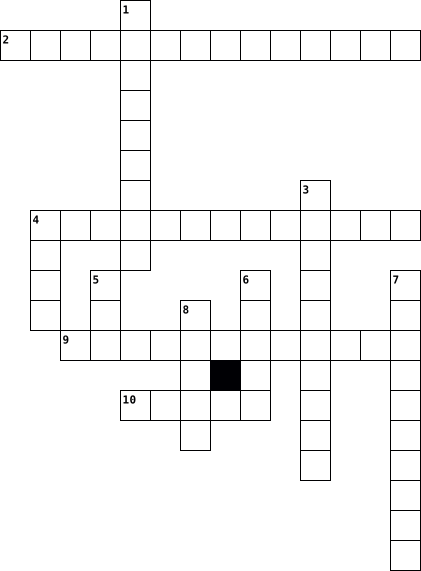
Across
- A mix of two primary colors.
- A mix of a primary and a secondar color.
- A color mixed with its complement.
- A hue plus black.
Down
- The brightness of a color.
- Colors like blue, purple, and green.
- A hue plus white.
- The truest form of a color.
- The lightness or darkness of a color.
- Colors like red, orange, and yellow.
- 3 equally spaced colors.
11 Clues: A hue plus white. • A hue plus black. • 3 equally spaced colors. • The brightness of a color. • The truest form of a color. • A mix of two primary colors. • A color mixed with its complement. • Colors like blue, purple, and green. • Colors like red, orange, and yellow. • The lightness or darkness of a color. • A mix of a primary and a secondar color.
Color Theory Review #2 2022-01-25

Across
- colors that are side by side on the color wheel and share a common hue
- colors that are in the red, orange, and yellow family
- hue + white =
- black, white, and gray colors
- plan for organizing colors in a pleasing way
- first color in the color spectrum
Down
- one hue and the hue's tints, shades, and tones
- colors that are in the blue, green, and violet family
- hue + gray =
- hue + black =
10 Clues: hue + gray = • hue + white = • hue + black = • black, white, and gray colors • first color in the color spectrum • plan for organizing colors in a pleasing way • one hue and the hue's tints, shades, and tones • colors that are in the red, orange, and yellow family • colors that are in the blue, green, and violet family • ...
Color Theory 2021-10-29
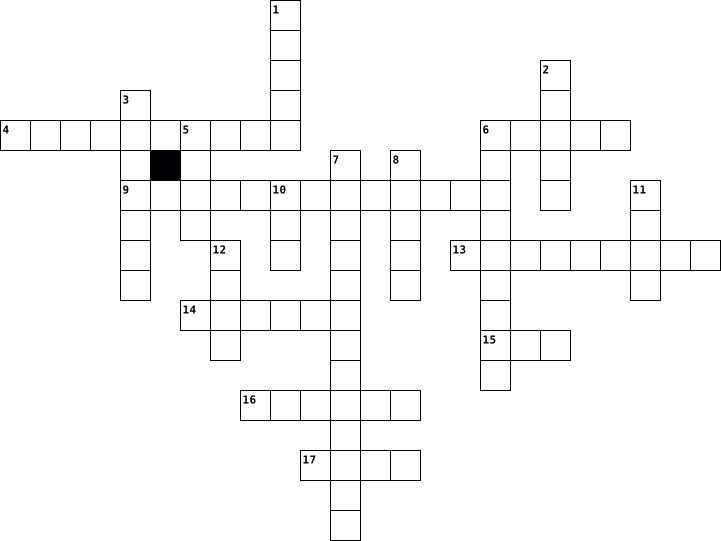
Across
- The intensity or strength of a color
- A color darkened by black
- A color scheme using values of only 1 color
- A scheme involving 3 adjacent colors
- Yellow is a complement of...
- This is a primary color
- A secondary color
- Red is what type of color? (feel)
Down
- Blue and yellow make this color
- This is a neutral color
- Yellow is what kind of color
- A color lightened by white
- Orange, green, and purple are classified as these type of colors
- Colors that are opposite of each other on the color wheel
- The lightness/darkness of a color
- The clearest form of any color
- Blue is what type of color? (feel)
- This is a primary color
18 Clues: A secondary color • This is a neutral color • This is a primary color • This is a primary color • A color darkened by black • A color lightened by white • Yellow is what kind of color • Yellow is a complement of... • The clearest form of any color • Blue and yellow make this color • The lightness/darkness of a color • Red is what type of color? (feel) • ...
Basic Color Mixing 2023-09-11

Across
- The three main colors that all color is made from
- The three main colors that are made from mixing Primary Colors
- The color made by mixing White and Red
- The color made by mixing the Primary Colors
- Opposite colors on the color wheel
Down
- The color made by mixing Yellow and Red
- The color made by mixing Black and White
- The color made by mixing Yellow and Blue
- The color made by mixing Red and Blue
- Abstract illustrative organization of color hues that show relationship of colors
10 Clues: Opposite colors on the color wheel • The color made by mixing Red and Blue • The color made by mixing White and Red • The color made by mixing Yellow and Red • The color made by mixing Black and White • The color made by mixing Yellow and Blue • The color made by mixing the Primary Colors • The three main colors that all color is made from • ...
Unit 2 - Landscape, Section 1 2019-10-07

Across
- a set of 3 colors that are next to each other on the color wheel. The set includes a primary, a secondary, and an intermediate color.
- the name of a color
- the range of colors in visible light, Roy G. Biv
- a hue to which black has been added
- scheme a planned combination of colors
- red, blue, yellow
- the color in-between a primary and a secondary color on the color wheel
- browns and grays
Down
- the lightness or darkness of a color
- colors that are opposite from each other on the color wheel
- orange, green, purple
- blue, green, purple
- a color scheme that has one hue that is used alone or mixed with black and/or white
- red, orange, yellow
- a hue to which white has been added
15 Clues: browns and grays • red, blue, yellow • the name of a color • blue, green, purple • red, orange, yellow • orange, green, purple • a hue to which black has been added • a hue to which white has been added • the lightness or darkness of a color • scheme a planned combination of colors • the range of colors in visible light, Roy G. Biv • ...
Michaels Crossword 2022-10-18

Across
- Mix of two Primary Colors
- Mix of primary and secondary colors.
- Darkness
- Lightness
Down
- Slight coloration
- the difference between opposites
- Light and dark
- Lining in relation to borders and edges
- Brightness or Dullness
- nearness in space
- The colors that make all others by mixing
- using the same element over and over again
12 Clues: Darkness • Lightness • Light and dark • Slight coloration • nearness in space • Brightness or Dullness • Mix of two Primary Colors • the difference between opposites • Mix of primary and secondary colors. • Lining in relation to borders and edges • The colors that make all others by mixing • using the same element over and over again
star crossword by benjy 2021-05-20

Across
- a band of colors
- five star simble
- is a diagram
- star
- spectrum –chemical element
- acrylic colors
Down
- variable – pulsates
- spectrum
- cloud of gas
- star
- something big
- dwarf short person
- in the sky
- blue stars
- sequence main thing
- star –star system
16 Clues: star • star • spectrum • in the sky • blue stars • cloud of gas • is a diagram • something big • acrylic colors • a band of colors • five star simble • star –star system • variable – pulsates • dwarf short person • sequence main thing • spectrum –chemical element
Sophia and Joy Crossword 2022-06-07

Across
- joy's bagel order that sophia judges
- valentine colors (aka sophia's and joy's fav colors)
- rat dog
- makeout show?
- sophia's favorite bagel
- sophia's tiktok fascination
- joy loves?
- joy's son
- rainbow cow
Down
- sheldon's little snack
- sophia's guilty pleasure
- sophia loves?
- sophia's favorite bread
- water adjacent
- anniversary!
- sophia's room buddy
16 Clues: rat dog • joy's son • joy loves? • rainbow cow • anniversary! • sophia loves? • makeout show? • water adjacent • sophia's room buddy • sheldon's little snack • sophia's favorite bread • sophia's favorite bagel • sophia's guilty pleasure • sophia's tiktok fascination • joy's bagel order that sophia judges • valentine colors (aka sophia's and joy's fav colors)
Painting 1 Vocabulary Review 2021-01-21

Across
- colors mixed from the primary colors; green, purple, and orange
- a donut-shaped chart of all the colors of the rainbow
- the color resulting from mixing a hue and white
- the color resulting from mixing a hue and black
Down
- colors that cannot be mixed from other colors; red, yellow, and blue
- colors that sit opposite from each other on the color wheel
- in painting, can be any color, but are usually pinks, browns, and beiges
- groups of 3 colors that sit next to each other on the color wheel
- a quick drawing that functions as an experiment or a plan for a more finished artwork
- the purest form of a color
10 Clues: the purest form of a color • the color resulting from mixing a hue and white • the color resulting from mixing a hue and black • a donut-shaped chart of all the colors of the rainbow • colors that sit opposite from each other on the color wheel • colors mixed from the primary colors; green, purple, and orange • ...
Annabel Texeira 2026-05-29

Across
- when you add white to a color/hue to make it lighter
- the second color group (orange green and purple)
- Colors that are opposite of each other
- four colors arranged into two complementary pairs, forming a rectangle or square
- adding grey or a complimentary color to the hue/color
- when you add black to a color/hue to make it darker
Down
- A split-complementary color scheme uses one base color, plus the two colors directly adjacent to its opposite on the color wheel.
- the first color group (red yellow and blue)
- pure color (the brightest color you can get)
- having only 1 color and all its shades, tints, and tones
- 3-5 colors next to each other on the color wheel
- the intensity of strength of the color/hue
- uses any three colors that are spaced exactly the same distance apart on the color wheel
- muted shades that lack intense hue or saturation (brown black grey and white)
14 Clues: Colors that are opposite of each other • the intensity of strength of the color/hue • the first color group (red yellow and blue) • pure color (the brightest color you can get) • the second color group (orange green and purple) • 3-5 colors next to each other on the color wheel • when you add black to a color/hue to make it darker • ...
Core & Sustainable 2021-09-08

Across
- powered by fluid under pressure
- incidental grounding of a conducting electrical wire
- powered by air pressure
- device that provides clean air
- capable of igniting BELOW 100 degrees F
- everyone acts to keep worksite safe
- unplanned event with no injuries
- signified by black and red colors
- also known as SDS goes with hazardous substance
Down
- narrow excavation made below the surface of ground
- OSHA requires contractors to educate employees about hazardous chemicals
- signified by yellow and black colors
- limited entry and exit area
- fuel with flash pint at or above 100 degrees F
- a sign that signifies location of information
- person that recognizes and acts on hazzards
- signified by green and white colors
- unplanned event resulting in injury
18 Clues: powered by air pressure • limited entry and exit area • device that provides clean air • powered by fluid under pressure • unplanned event with no injuries • signified by black and red colors • signified by green and white colors • unplanned event resulting in injury • everyone acts to keep worksite safe • signified by yellow and black colors • ...
Fall Colors 2015-09-04

Across
- / In a clear zone, this must be crashworthy.
- / _____ pavements absorb water and allow it to drain to the underlying layers.
- / This winter maintenance product can damage our waters.
- / This can lower your productivity and increase crash rates.
- / Drift-free roads deposit snow in the ______ rather than the roadway.
- / Reinforced ____ is used to make rigid pipe for culverts.
Down
- / What some gravel roads…and athletes’ abs…look like.
- / Standing ____ rows can be used as living snow fence.
- / Demo Day 2016 location
- / These secure loads…and get moved along the sideline.
- / Vertical substructure at bridge ends
- / Part of a truck…and what you might do before the big game.
- / MnDOT uses a decision ___ to prioritize maintenance.
- / Rock or other material used on an embankment slope to prevent erosion
14 Clues: / Demo Day 2016 location • / Vertical substructure at bridge ends • / In a clear zone, this must be crashworthy. • / What some gravel roads…and athletes’ abs…look like. • / Standing ____ rows can be used as living snow fence. • / These secure loads…and get moved along the sideline. • / MnDOT uses a decision ___ to prioritize maintenance. • ...
New Colors 2022-09-27

Across
- dark
- light
- brown
- silver
- gold
- turquoise
- bright
Down
- bronze
- the colors
- rose/pink
- emerald
- purple
- light blue
- cream
14 Clues: dark • gold • light • brown • cream • bronze • purple • silver • bright • emerald • rose/pink • turquoise • the colors • light blue
Fruits, Colors 2021-09-26

Across
- 蓝莓
- 红色
- 棕色
- 绿色
- 香蕉
- 紫色
- 白色
Down
- 黄色
- 蓝色
- 橘子
- 黑色
- 苹果
- 粉色
- 猕猴桃
14 Clues: 蓝莓 • 黄色 • 蓝色 • 橘子 • 红色 • 棕色 • 黑色 • 绿色 • 香蕉 • 苹果 • 紫色 • 粉色 • 白色 • 猕猴桃
Spanish Colors 2023-10-03

Across
- — amarillo
- — violeta
- — gris
- — rosa
- — verde
- — negro
- — rojo
Down
- — blanco
- — marrón
- — azul
- — naranja
- — turquesa
- — morado / púrpura
- — cian
14 Clues: — azul • — gris • — rosa • — cian • — rojo • — verde • — negro • — blanco • — marrón • — violeta • — naranja • — amarillo • — turquesa • — morado / púrpura
Appt Colors 2025-05-14

Across
- Double book
- same day
- New insurance
- Cash
- Medicaid(Under20)
- Medicaid(Over21)
- Perio Main
- Collect Payment
- New Patient
Down
- walk in
- Prophy
- New patient MDCD
- SRP
- Regular insurance
14 Clues: SRP • Cash • Prophy • walk in • same day • Perio Main • Double book • New Patient • New insurance • Collect Payment • New patient MDCD • Medicaid(Over21) • Medicaid(Under20) • Regular insurance
Appearances: Colors 2026-04-30

Across
- A deep mix of red and purple with a rich, bold feel.
- A soft, pale purple that feels light and calming.
- A pale, fresh green that feels cool and light.
- A deep, rich red that looks darker and more serious.
- A very deep blue with a slight purple tint, almost like the night sky.
- A glowing golden-orange shade, similar to hardened tree resin.
- A warm mix of pink and orange, similar to reef formations in the sea.
- A bright mix of blue and green, like clear tropical ocean water.
- A dark blend of blue and green with a cool, slightly muted tone.
Down
- A gentle blend of orange and pink with a soft, warm look.
- A light mix of blue and purple with a soft, airy look.
- A very dark gray, close to black, like burned wood.
- A light, soft neutral tone between cream and brown.
- A muted green with a slightly earthy, brownish tone.
14 Clues: A pale, fresh green that feels cool and light. • A soft, pale purple that feels light and calming. • A very dark gray, close to black, like burned wood. • A light, soft neutral tone between cream and brown. • A deep mix of red and purple with a rich, bold feel. • A deep, rich red that looks darker and more serious. • ...
Wild Colors 2026-05-19

Across
- Woke axolototl anglerfish dolphin thing
- Forsaken.
- St-st-stutters a lot
- She wears goggles. Like a badass.
- She likes her best friend a LOT.
- Who even is this guy?
- Rich jerkwad.
Down
- Lost.
- It's all in your head.
- It's all your fault...
- The main character
- Hurts.
- We cannot put you any more down.
- Mags' boyfriend
14 Clues: Lost. • Hurts. • Forsaken. • Rich jerkwad. • Mags' boyfriend • The main character • St-st-stutters a lot • Who even is this guy? • It's all in your head. • It's all your fault... • We cannot put you any more down. • She likes her best friend a LOT. • She wears goggles. Like a badass. • Woke axolototl anglerfish dolphin thing
cross stitch terms 2021-07-22

Across
- single color backstitch design
- pattern
- blanc
- old ratty threads
- 310
- 8m hank of floss
- using multiple threaded needles at same time
- thread
- carrying floss instead of finishing off
- 2 or more colors in needle
- not sharp
Down
- popular floss brand
- floss smoothing technique
- type of needle
- youtube community for stitchers
- disliked stitch
- pulled from oblivion
- to rip
- single stitches of different colors
19 Clues: 310 • blanc • thread • to rip • pattern • not sharp • type of needle • disliked stitch • 8m hank of floss • old ratty threads • popular floss brand • pulled from oblivion • floss smoothing technique • 2 or more colors in needle • single color backstitch design • youtube community for stitchers • single stitches of different colors • carrying floss instead of finishing off • ...
Countries 2022-04-15

Across
- flag colors: red yellow stars
- flag colors:red white blue and black stripes
- flag colors:red blue and white star
- Flag colors: red white and green
- flag colors:yellow blue red
- flag colors: white big red dot
Down
- Flag colors: Red white and blue
- Flag colors: Red and white with a maple leaf
- Flag colors: green orange and white
9 Clues: flag colors:yellow blue red • flag colors: red yellow stars • flag colors: white big red dot • Flag colors: Red white and blue • Flag colors: red white and green • Flag colors: green orange and white • flag colors:red blue and white star • Flag colors: Red and white with a maple leaf • flag colors:red white blue and black stripes
light 2023-10-06

Across
- The Colors In The Rainbow
- Bounce Off
- Pass Through
- Something That Makes Your Pupils Get Smaller
- A Color Where All Colors Reflect
Down
- How Light Travels Through Objects
- An Imaginary Line From Your Eye To What You Are Looking At
- Light Changes
- Multi-Colored Arc In The Sky
- A Color That Transmits All Colors
- When Light Gets Blocked By An Object
11 Clues: Bounce Off • Pass Through • Light Changes • The Colors In The Rainbow • Multi-Colored Arc In The Sky • A Color Where All Colors Reflect • How Light Travels Through Objects • A Color That Transmits All Colors • When Light Gets Blocked By An Object • Something That Makes Your Pupils Get Smaller • An Imaginary Line From Your Eye To What You Are Looking At
Algodoo Colors 2020-11-12

Across
- I am the color of a firetruck
- I rhyme with the name wheel
- I am a shade of pink
- I am a fruit
- I am the color of a school bus
- I rhyme with the name Ryan
Down
- I am the color of grapes
- I am a very light blue
- I am the color of the ocean
- I am a green fruit
- I am combination of red and brown
- I am a dark shade of blue
- I am the color of a gloomy day
- I am the color of money
14 Clues: I am a fruit • I am a green fruit • I am a shade of pink • I am a very light blue • I am the color of money • I am the color of grapes • I am a dark shade of blue • I rhyme with the name Ryan • I am the color of the ocean • I rhyme with the name wheel • I am the color of a firetruck • I am the color of a gloomy day • I am the color of a school bus • I am combination of red and brown
Spanish colors 2024-11-06

Across
- white
- green
- purple
- orange
- grey
- black
Down
- gold
- brown
- red
- Burgundy
- silver
- pink (feminine)
- yellow
- blue
14 Clues: red • gold • blue • grey • brown • white • green • black • silver • purple • yellow • orange • Burgundy • pink (feminine)
Color and Design Process 2012-02-07

Across
- The brightness or dullness of a color.
- Substances that absorb some light rays.
- color scheme uses two colors that are directly opposite each other on the color wheel.
- scheme A combination of colors selected for a room design in order to create a mood or set a tone.
- color scheme uses tints and shades of one color on the color wheel.
- To lessen a color's intensity by mixing it with_____
- The specific name of a color.
- neutral To provide contrast, a small amount of bright color sometimes used in a neutral color scheme.
Down
- A hue that is lighter than its normal value.
- color scheme uses three colors, combines one color with the two colors on each side of its complement.
- Color scheme uses colors that are next to each other on the color wheel.
- Color scheme uses any three hues that are an equal distance apart on the color wheel.
- The lightness or darkness of a color
- A color darker than its normal value when adding black.
14 Clues: The specific name of a color. • The lightness or darkness of a color • The brightness or dullness of a color. • Substances that absorb some light rays. • A hue that is lighter than its normal value. • To lessen a color's intensity by mixing it with_____ • A color darker than its normal value when adding black. • ...
Hogwarts Legacy 2026-01-02

Across
- Summoning Charm
- Common room behind a painting
- Deek's friend
- Third keeper trial
- Handy resource indeed
- Trusty house-elf
- Release month
- Sallow's home hamlet
- Mine now, _________
- House colors green and silver
- Number of Unforgivables
Down
- Home of Lord of the Shore
- Fourth Keeper Trial
- House with secret barrel knock
- Inventor of floo powder
- Liquid Luck
- Headmaster
- Rocky skin
- House colors blue and bronze
19 Clues: Headmaster • Rocky skin • Liquid Luck • Deek's friend • Release month • Summoning Charm • Trusty house-elf • Third keeper trial • Fourth Keeper Trial • Mine now, _________ • Sallow's home hamlet • Handy resource indeed • Inventor of floo powder • Number of Unforgivables • Home of Lord of the Shore • House colors blue and bronze • Common room behind a painting • House colors green and silver • ...
Countries 2022-04-15

Across
- flag colors: red yellow stars
- flag colors:red white blue and black stripes
- flag colors:red blue and white star
- Flag colors: red white and green
- flag colors:yellow blue red
- flag colors: white big red dot
Down
- Flag colors: Red white and blue
- Flag colors: Red and white with a maple leaf
- Flag colors: green orange and white
9 Clues: flag colors:yellow blue red • flag colors: red yellow stars • flag colors: white big red dot • Flag colors: Red white and blue • Flag colors: red white and green • Flag colors: green orange and white • flag colors:red blue and white star • Flag colors: Red and white with a maple leaf • flag colors:red white blue and black stripes
Science Crossword 2023-04-21

Across
- Light travels in _______.
- Light ______ off mirrors.
- ________ cannot be broken up into other colors anymore.
- Black ______ all the colors.
- When white light hits a prism and splits into the______of colors.
Down
- Computers, metal, and rock are all_______.
- Glass is __________.
- Light hits water and _______ because the uneven surface of water.
- A green car only reflects______ and absorbs all the other colors.
- White light hits a _______ and plits into the spectrum of colors.
10 Clues: Glass is __________. • Light travels in _______. • Light ______ off mirrors. • Black ______ all the colors. • Computers, metal, and rock are all_______. • ________ cannot be broken up into other colors anymore. • Light hits water and _______ because the uneven surface of water. • A green car only reflects______ and absorbs all the other colors. • ...
Science Crossword 2023-04-21

Across
- Light travels in _______.
- Light ______ off mirrors.
- ________ cannot be broken up into other colors anymore.
- Black ______ all the colors.
- When white light hits a prism and splits into the______of colors.
Down
- Computers, metal, and rock are all_______.
- Glass is __________.
- Light hits water and _______ because the uneven surface of water.
- A green car only reflects______ and absorbs all the other colors.
- White light hits a _______ and plits into the spectrum of colors.
10 Clues: Glass is __________. • Light travels in _______. • Light ______ off mirrors. • Black ______ all the colors. • Computers, metal, and rock are all_______. • ________ cannot be broken up into other colors anymore. • Light hits water and _______ because the uneven surface of water. • A green car only reflects______ and absorbs all the other colors. • ...
Emiliano's Crossword 2022-10-18

Across
- the relative degree of lightness or darkness of a particular color.
- a shade or variety of a color.
- Color resulting from mixing of two secondary colors.
- a thing repeated.
- comparative darkness and coolness caused by shelter from direct sunlight.
- colors that mix together to produce other colors
Down
- nearness in space, time, or relationship.
- arrangement in a straight line, or in correct or appropriate relative positions.
- color resulting from the mixing of two primary colors.
- differ strikingly.
- the quality of being intense.
- a color or shade.
12 Clues: a color or shade. • a thing repeated. • differ strikingly. • the quality of being intense. • a shade or variety of a color. • nearness in space, time, or relationship. • colors that mix together to produce other colors • Color resulting from mixing of two secondary colors. • color resulting from the mixing of two primary colors. • ...
Elements and Principles of Art 2020-09-10

Across
- a moving point that never ends
- How parts fit together
- Focus, main idea
- Red Yellow Blue
- How the elements work together so the artwork looks complete
- mixing primary colors and secondary colors together (ex: red-orange, yellow-orange)
- directional, illusion abstract or pictorial
- Differently lines and shapes
Down
- same on the both sides
- Comes from light.
- By mixing the primary colors together you get orange, green, and violet
- 3D has depth, length, width
- a repetition of the elements of art to create a sense of rhythm and/or movement.
- Repetition of the element
- surface quality rough or smooth
- when two ends of a line connect
- light to dark
17 Clues: light to dark • Red Yellow Blue • Focus, main idea • Comes from light. • same on the both sides • How parts fit together • Repetition of the element • 3D has depth, length, width • Differently lines and shapes • a moving point that never ends • surface quality rough or smooth • when two ends of a line connect • directional, illusion abstract or pictorial • ...
Elements of Art 2021-08-11

Across
- lightness and darkness of a surface, refers to shading
- shape shapes that have their own name
- add white to a color
- 3 dimensional occupy space
- colors opposite on the color wheel
- colors next to each other on the color wheel
- shape free flowing, natural shape
- point perspective the point where things get too small
- add black to a color
Down
- path of a moving point on a surface
- how a surface feels
- 2 dimensional can be organic or geometric
- the most expressive element of art
- texture looks like it has texture
- colors mixing a primary and secondary color
- texture you can feel the texture
- shape that has height, width, depth
- how objects have depth
18 Clues: how a surface feels • add white to a color • add black to a color • how objects have depth • 3 dimensional occupy space • texture you can feel the texture • texture looks like it has texture • shape free flowing, natural shape • the most expressive element of art • colors opposite on the color wheel • path of a moving point on a surface • shape that has height, width, depth • ...
Ryan D'Addario 2026-05-29

Across
- when you add white to a color
- red, and green
- neighbors on the color wheel
- the brightest a color can get
- when you add black to a color
- when four colors make a rectangle on the color wheel
- red, yellow-green, and green-blue
- when three colors make a triangle on the color wheel
Down
- purple, orange, green
- one color in different shades
- when you add grey to a color
- when you add black, white, or grey to a color
- red, orange, and yellow
- the intensity or strength of the color
- colors green, blue, and violet
- brown, black, gray, white
- red, yellow, and blue
17 Clues: red, and green • purple, orange, green • red, yellow, and blue • red, orange, and yellow • brown, black, gray, white • when you add grey to a color • neighbors on the color wheel • when you add white to a color • one color in different shades • the brightest a color can get • when you add black to a color • colors green, blue, and violet • red, yellow-green, and green-blue • ...
Color Theory Part 2 2024-02-28

Across
- Pleasing color organization
- Colors across from each other
- amount of pigment
- Darken the value
- JMU colored complement
- Change the saturation
- UVA colored complement
- Adding black
- Adding white
- Adding gray
Down
- Single hue scheme
- Christmas colored complement
- Includes tertiary colors
- Goes from light to dark
- Color family
- Lighten the value
- Darkness or lightness
17 Clues: Adding gray • Color family • Adding black • Adding white • Darken the value • Single hue scheme • amount of pigment • Lighten the value • Darkness or lightness • Change the saturation • JMU colored complement • UVA colored complement • Goes from light to dark • Includes tertiary colors • Pleasing color organization • Christmas colored complement • Colors across from each other
Color Theory 2026-01-08

Across
- Color created when mixing red and yellow
- Colors that are directly across from one another on the color wheel.
- Mixing equal parts of a primary and a secondary color.
- One color plus its tints and shades.
- Color created when mixing red and blue
Down
- Mixing equal parts of two primary colors.
- Three colors side by side on the color wheel.
- Color created when mixing blue and yellow
- Black, white and various shades of gray.
- The lightness or darkness of a color.
- Created when adding white to a color
- Three colors side by side on the color wheel
- Created when adding black to a color
13 Clues: Created when adding white to a color • Created when adding black to a color • One color plus its tints and shades. • The lightness or darkness of a color. • Color created when mixing red and blue • Black, white and various shades of gray. • Color created when mixing red and yellow • Mixing equal parts of two primary colors. • Color created when mixing blue and yellow • ...
Elements of Art 2021-08-11

Across
- lightness and darkness of a surface, refers to shading
- shape shapes that have their own name
- add white to a color
- 3 dimensional occupy space
- colors opposite on the color wheel
- colors next to each other on the color wheel
- shape free flowing, natural shape
- point perspective the point where things get too small
- add black to a color
Down
- path of a moving point on a surface
- how a surface feels
- 2 dimensional can be organic or geometric
- the most expressive element of art
- texture looks like it has texture
- colors mixing a primary and secondary color
- texture you can feel the texture
- shape that has height, width, depth
- how objects have depth
18 Clues: how a surface feels • add white to a color • add black to a color • how objects have depth • 3 dimensional occupy space • texture you can feel the texture • texture looks like it has texture • shape free flowing, natural shape • the most expressive element of art • colors opposite on the color wheel • path of a moving point on a surface • shape that has height, width, depth • ...
Color Theory Vocabulary 2023-01-26

Across
- green, blue, and violet
- names and abbreviations of colors
- numbering system that identifies the lightness or darkness
- 12-hue color circle
- yellow, orange or red
- the predominate tone in artificial color
- vividness, brightness, or saturation of a color
- Colors found opposite one another on the color wheel
Down
- red/yellow pigment
- The degree of coarseness or fineness in the hair
- major categories of dark, medium, light
- The visual perception of the reflection of light.
- lightness or darkness of a color
- ability of the hair to absorb moisture
- Pigment that gives hair its natural color
- black pigment
- Cannot be created by mixing together any other colors
17 Clues: black pigment • red/yellow pigment • 12-hue color circle • yellow, orange or red • green, blue, and violet • lightness or darkness of a color • names and abbreviations of colors • ability of the hair to absorb moisture • major categories of dark, medium, light • the predominate tone in artificial color • Pigment that gives hair its natural color • ...
photography terms brayden andrew 2023-08-22

Across
- used to increase the intensity of certain of colors
- compressed image files
- highlights in a photo which reach near white
- used to adjust the sharpness of a image
- darkest points
- setting to achieve the most accurate picture
- used to add an overlay of color
- meeting between photographer and client
Down
- highlights in a photo which reach near black
- brightest point in the image
- used to increase the sharpness of a image
- the amount of relative warmth and coolness
- used to increase the intensity of all of colors
- range of the different colors
- primary object
- selecting the best image
16 Clues: darkest points • primary object • compressed image files • selecting the best image • brightest point in the image • range of the different colors • used to add an overlay of color • used to adjust the sharpness of a image • meeting between photographer and client • used to increase the sharpness of a image • the amount of relative warmth and coolness • ...
Escape Room Lock 2 2023-03-05

Across
- Number of colors on the color wheel.
- CYMK is used for ______ color.
- Blue is a _____ color.
- Green, blue, and purple are these types of colors.
- When writing a tertiary color, the ____ color is written first.
Down
- Blue's complementary color.
- Green is a ______ color.
- Three colors that are side by side on the color wheel.
- Purple's complementary color.
- One reason we experience color differently than others.
- Red, orange, and yellow are these types of colors.
- RGB is used for ______ color.
12 Clues: Blue is a _____ color. • Green is a ______ color. • Blue's complementary color. • Purple's complementary color. • RGB is used for ______ color. • CYMK is used for ______ color. • Number of colors on the color wheel. • Red, orange, and yellow are these types of colors. • Green, blue, and purple are these types of colors. • ...
Color Theory Crossword 2022-05-27

Across
- red, yellow, blue
- another word for color
- orange, green, violet
- another word for purple
- blue and yellow make
- colors that are opposite on the color wheel
Down
- red-violet, red, red-orange, orange, yellow-orange, yellow
- red and yellow make
- colors that are not on the color wheel
- green, blue-green, blue, blue-violet, violet
- colors that are inbetween primary and secondary colors on the color wheel
11 Clues: red, yellow, blue • red and yellow make • blue and yellow make • orange, green, violet • another word for color • another word for purple • colors that are not on the color wheel • colors that are opposite on the color wheel • green, blue-green, blue, blue-violet, violet • red-violet, red, red-orange, orange, yellow-orange, yellow • ...
NCCU Colors 2023-01-16

Across
- Lunch mobile
- Blue_____
- Not in CSD
- One who flees
- Goes home
- Bug experts
- Nurse in need
Down
- News time
- Salty vial
- Purple______
- Pink_____
- Staff supplier
- Determines ins and outs
- Helper when two
14 Clues: News time • Pink_____ • Blue_____ • Goes home • Salty vial • Not in CSD • Bug experts • Purple______ • Lunch mobile • One who flees • Nurse in need • Staff supplier • Helper when two • Determines ins and outs
ART COLORS 2025-01-27

Across
- A shade of blue-green.
- The color of coal.
- The color of an orange fruit.
- The color of ashes.
- A light shade of red.
- The color of blood.
- The color of clouds.
Down
- A dark shade of red.
- The color of the sky.
- The color of soil.
- The color of grass.
- The color of shiny and expensive jewelry.
- The color of the sun.
- The color of grapes.
14 Clues: The color of coal. • The color of soil. • The color of grass. • The color of ashes. • The color of blood. • A dark shade of red. • The color of grapes. • The color of clouds. • The color of the sky. • The color of the sun. • A light shade of red. • A shade of blue-green. • The color of an orange fruit. • The color of shiny and expensive jewelry.
Have you been paying attention? 2025-08-15

Across
- Is Ms. Andrews favorite color
- State Ms. Andrews is originally from
- Creativity
- Are all other colors
- Are Ms. Andrews favorite animal.
- Is three dimensional
- Ms. Andrews holds a (blank) with her artists
Down
- Red Yellow Blue
- Is required
- How colors interact to create a visual affect
- A line of design
- Colors made from the primary
- a principle of design that show motion in an image
- where the elements of art and principles of design come together
14 Clues: Creativity • Is required • Red Yellow Blue • A line of design • Are all other colors • Is three dimensional • Colors made from the primary • Is Ms. Andrews favorite color • Are Ms. Andrews favorite animal. • State Ms. Andrews is originally from • Ms. Andrews holds a (blank) with her artists • How colors interact to create a visual affect • ...
Colorful Language 2023-09-01

Across
- visually blending colors into a new tone
- color
- the purity of a hue
- produced by adding white to a hue
- created through color contrast & gradients
- colors that intensify one another
- green, blue, violet
- red, blue, yellow
Down
- a selection of colors or a board used to hold and mix pigments
- orange, green, violet
- intensely colored compounds
- red, orange, yellow
- produced by adding black to a hue
13 Clues: color • red, blue, yellow • the purity of a hue • red, orange, yellow • green, blue, violet • orange, green, violet • intensely colored compounds • produced by adding white to a hue • colors that intensify one another • produced by adding black to a hue • visually blending colors into a new tone • created through color contrast & gradients • ...
#2 Review -Lesson 6: Stars (questions on videos & articles) 2023-02-17

Across
- How scientists can tell the temperature range of objects that are far away.
- Light waves with lower energy have a ______ wavelength
- The force that causes black holes to be invisible
- It is an element that helps make the sky appear to be blue
- It cannot escape a black hole
- Has the longest wavelength of the colors.
Down
- The part of the light spectrum that we can see.
- What is light? ____________ radiation
- It has the longest wavelength among the colors green, yellow & blue.
- Has the shortest wavelength of the colors.
- It has the most energy among the colors yellow, orange, & indigo
11 Clues: It cannot escape a black hole • What is light? ____________ radiation • Has the longest wavelength of the colors. • Has the shortest wavelength of the colors. • The part of the light spectrum that we can see. • The force that causes black holes to be invisible • Light waves with lower energy have a ______ wavelength • ...
Fall Friday for KayKay 2025-09-26

Across
- movie that fuels the "sexy guy wearing a mask" trope
- type of fall maze
- 2/3 fall leaf colors
- the pumpkin king's last name. Jack ____
- one of the top fall vibe shows
- 1/3 fall leaf colors
Down
- caramel apple topping
- apple's sweet treat bestie
- the most annoying person on 12 across
- haunted _____ride
- at Christmas they roast on an open fire
- ____ smith apple
- 3/3 fall leaf colors
- everyone in Morgantown goes here for halloween
14 Clues: ____ smith apple • haunted _____ride • type of fall maze • 2/3 fall leaf colors • 3/3 fall leaf colors • 1/3 fall leaf colors • caramel apple topping • apple's sweet treat bestie • one of the top fall vibe shows • the most annoying person on 12 across • at Christmas they roast on an open fire • the pumpkin king's last name. Jack ____ • everyone in Morgantown goes here for halloween • ...
The Color Theory 2023-11-14

Across
- Colors that represent us warmth of anger and excitement
- opposite colors on a color wheel to make brown
- Colors that represent sadness, cold, and depression
- Mixed by a primary and secondary color
- Created when using 1 color or hue
- Made by the primary colors
Down
- 2 or more colors that are side by side on the color wheel
- Sets of tone created when mixing 2 complementary colors
- The main 3 colors that are on the color wheel
9 Clues: Made by the primary colors • Created when using 1 color or hue • Mixed by a primary and secondary color • The main 3 colors that are on the color wheel • opposite colors on a color wheel to make brown • Colors that represent sadness, cold, and depression • Colors that represent us warmth of anger and excitement • Sets of tone created when mixing 2 complementary colors • ...
2.01 Key Terms Camille Martinez-Sanchez 2024-02-12

Across
- Occurs when a color appears different under one light source than it does under another.
- Hues located opposite each other on the color wheel.
- Color combinations based on color wheel relationships which are widely considered to create pleasing and balanced color schemes.
- The colors from green through blue to violet on the color wheel. These colors remind us of water and sky. They seem to recede and are calming and soothing.
- Lighter value of a hue created by adding white.
- story) A choice of colors to be used in combination.
- Hues created by mixing two primary hues. They are: orange, violet (purple), green.
- The pure color at the base of all variations of a color. For example, the hue blue is at the base of the color navy, while the hue orange is the base of peach. Hues are shown on the color wheel.
- Describes the lightness or darkness of a color.
- A diagram of the spectrum of hues in a continuous circle representing their relationship to each other.
- Hues created by mixing a primary hue and a secondary hue. The tertiary colors are red-orange, yellow-orange, yellow-green, blue-green, blue-violet, and red-violet.
Down
- Describes the brightness or dullness of a color. Hues are at full intensity.
- Colors with no hue; such as black, white, gray, brown, tan, ivory, beige.
- Refers to only one color including its variations in value and intensity.
- The colors from yellow through orange to red on the color wheel. These colors remind us of the sun and fire. They seem to advance and are energizing.
- The three hues red, yellow, and blue which form the foundation of the color wheel and from which all other hues are made.
- Hues located next to each other on the color wheel.
- The duller or desaturated version of a hue created by adding gray; to make a hue duller by adding graty. For example (noun) “The color olive is a tone of the hue yellow-green.”(verb) “You may need to tone the hue orange if you plan to use it as a wall color.”
- Darker value of a hue created by adding black.
19 Clues: Darker value of a hue created by adding black. • Lighter value of a hue created by adding white. • Describes the lightness or darkness of a color. • Hues located next to each other on the color wheel. • Hues located opposite each other on the color wheel. • story) A choice of colors to be used in combination. • ...
Italian Colors 2014-03-21

Across
- Blue
- Green
- Pink
- SkyBlue
- Yellow
- Orange
- Purple
- Gold
- Black
Down
- Beige
- Red
- Gray
- Silver
- Brown
14 Clues: Red • Blue • Pink • Gray • Gold • Beige • Green • Brown • Black • Silver • Yellow • Orange • Purple • SkyBlue
Colors & Animals 2017-04-10

Across
- No legs, no arms.
- The color of clouds.
- The color of a strawberry.
- Black and white stripes.
- Beautiful wings.
- The color of the night sky.
- The color of a delicious fruit's juice.
Down
- A scary animal with sharp teeth that lives in the ocean.
- A big animal with a long nose.
- A tall animal with a long neck.
- The color of the sky.
- The color of the sun.
- The color of wood.
- The color of turtles.
14 Clues: Beautiful wings. • No legs, no arms. • The color of wood. • The color of clouds. • The color of the sky. • The color of the sun. • The color of turtles. • Black and white stripes. • The color of a strawberry. • The color of the night sky. • A big animal with a long nose. • A tall animal with a long neck. • The color of a delicious fruit's juice. • ...
german colors 2023-05-08

Across
- what the color and ripe banana
- what is the color an apple
- what is the color of a rose
- the color of the sky.
- the color of grass
- what is the color of a smurf
- what is the color when you mix blue and green
- what the color of coal
Down
- what is the sky at 8:30 pm
- what is the color of an orange
- what is the color of your pencil led
- what is the color of an grape
- what is the color of a very ripe banana.
- the color of paper
14 Clues: the color of grass • the color of paper • the color of the sky. • what the color of coal • what is the sky at 8:30 pm • what is the color an apple • what is the color of a rose • what is the color of a smurf • what is the color of an grape • what the color and ripe banana • what is the color of an orange • what is the color of your pencil led • ...
Seasons/Colors 2025-02-18

Across
- season of snow
- color of the sky
- color of lavender
- color of trees
- color of roses
- color of oranges
- color of snow
- color of "stop"
Down
- season of flowers and rain
- color of the roads
- color of coffee
- season of falling leaves
- color of the sun
- season of hot weather
14 Clues: color of snow • season of snow • color of trees • color of roses • color of coffee • color of "stop" • color of the sky • color of the sun • color of oranges • color of lavender • color of the roads • season of hot weather • season of falling leaves • season of flowers and rain