
divergent Crossword Puzzles
Plate tectonics revision 2025-10-14

Across
- Malta is influenced by the movements of the African and ____________ plates
- this crust is made of basalt and is heavy
- The San Andreas Fault is located in
- This is the name of the boundary where plates seperate
- _____________ currents are responsible for the movement of our tectonic plates
- At this plate boundary, we have no volcanic activity
- At a constructive plate boundary, we have _________ earthquakes and eruptions
- At a destructive plate boundary, we have __________ earthquakes and eruptions
- This country is found on a constructive plate boundary
Down
- The process where the crust is forced downwards into the mantle
- At a destructive plate boundary, we also can get an underwater ___________
- This country is found on a destructive plate boundary
- This is the name of the boundary where plates collide
- This crust is made of granite and is lighter
- This major city is right on top of the San Andreas Fault
- This is responsible for heating up the core
- The Pacific ring of ________ is the most tectonically active place on earth
17 Clues: The San Andreas Fault is located in • this crust is made of basalt and is heavy • This is responsible for heating up the core • This crust is made of granite and is lighter • At this plate boundary, we have no volcanic activity • This country is found on a destructive plate boundary • This is the name of the boundary where plates collide • ...
Review Vocabulary Unit 2 2021-12-20

Across
- described as any uncontrolled burning of plants in a natural setting
- sudden and violent shaking of the ground
- outermost layer of the Earth
- boundary that occurs when two tectonic plates move away from each other
- - make (something, especially something bad) to happen.
- rock that in its molten form issues from volcanos
- - a result or effect of an action or condition.
- countries with a low standard of living and a much lower GDP.
- boundary that occurs when two plates slide past each other, horizontally
- eruption when molten rock called magma rises to the surface and creates an explosion.
Down
- boundary that occurs when two or more lithospheric plates collide
- the mostly-solid bulk of Earth's interior
- a scale of numbers used to tell the power (or magnitude) of earthquakes
- core mostly composed of liquid iron and nickel
- countries that have a high standard of living and a large GDP.
- plates theory that Earth's outer shell is divided into large slabs of rock
- core the innermost geologic layer of Earth
17 Clues: outermost layer of the Earth • sudden and violent shaking of the ground • the mostly-solid bulk of Earth's interior • core the innermost geologic layer of Earth • core mostly composed of liquid iron and nickel • - a result or effect of an action or condition. • rock that in its molten form issues from volcanos • - make (something, especially something bad) to happen. • ...
Review Vocabulary Unit 2 2021-12-20

Across
- described as any uncontrolled burning of plants in a natural setting
- sudden and violent shaking of the ground
- outermost layer of the Earth
- boundary that occurs when two tectonic plates move away from each other
- - make (something, especially something bad) to happen.
- rock that in its molten form issues from volcanos
- - a result or effect of an action or condition.
- countries with a low standard of living and a much lower GDP.
- boundary that occurs when two plates slide past each other, horizontally
- eruption when molten rock called magma rises to the surface and creates an explosion.
Down
- boundary that occurs when two or more lithospheric plates collide
- the mostly-solid bulk of Earth's interior
- a scale of numbers used to tell the power (or magnitude) of earthquakes
- core mostly composed of liquid iron and nickel
- countries that have a high standard of living and a large GDP.
- plates theory that Earth's outer shell is divided into large slabs of rock
- core the innermost geologic layer of Earth
17 Clues: outermost layer of the Earth • sudden and violent shaking of the ground • the mostly-solid bulk of Earth's interior • core the innermost geologic layer of Earth • core mostly composed of liquid iron and nickel • - a result or effect of an action or condition. • rock that in its molten form issues from volcanos • - make (something, especially something bad) to happen. • ...
Plate Tectonics 2025-03-03

Across
- The type of seismic wave that is slower, larger
- The height of a seismic wave measured on a seismograph
- The force acting on a tectonic plate, causing it to change
- When plates rub next to each other and cause a chipping or breaking of the rock
- A tool to measure the speed and power of Earthquakes
- The type of plate boundary that experiences tension
- The exact place where the tectonic plate moved
- A pulling force on the tectonic plates, making them thinner
- A wave or series of waves caused by an earthquake, landslide, or asteroid.
Down
- The type of plate boundary that experiences Compression
- The type of seismic wave that is faster, smaller
- The force acting on tectonic plates causing them to squeeze or break
- Shaking or trembling caused by tectonic stress
- A number that describes the size of an Earthquake
- The place above the focus where the Earthquake is felt the most
- The type of plate that experiences Shearing
- The tectonic plates moving under water is known as Ocean Floor ______
17 Clues: The type of plate that experiences Shearing • Shaking or trembling caused by tectonic stress • The exact place where the tectonic plate moved • The type of seismic wave that is slower, larger • The type of seismic wave that is faster, smaller • A number that describes the size of an Earthquake • The type of plate boundary that experiences tension • ...
Dystopian Stories 2025-03-26

Across
- P.D. James’ novel where humanity faces extinction due to infertility.
- Aldous Huxley’s society where pleasure controls the masses.
- Margaret Atwood’s world where women are stripped of their rights.
- A dystopian story by Richard Matheson about a lone survivor after a vampire apocalypse.
- A novel by Lois Lowry where emotions and color are removed.
- A YA series by James Dashner set in a post-apocalyptic maze.
- A dystopian tale by M.T. Anderson where the internet is hardwired into brains.
- Suzanne Collins’ trilogy set in Panem.
- George Orwell’s vision of a totalitarian surveillance state.
Down
- A dystopian society ruled by young boys stranded on an island.
- A young adult dystopian series by Veronica Roth where society is divided into factions.
- A dystopian novel by Ernest Cline centered around a virtual reality universe.
- A novella by Anthony Burgess exploring ultra-violence.
- is A graphic novel by Alan Moore about a masked vigilante against a fascist regime.
- A Stephen King novel where a man participates in a deadly game show.
- Ray Bradbury’s classic where books are burned.
- Kazuo Ishiguro’s tale of clones raised for organ donation.
17 Clues: Suzanne Collins’ trilogy set in Panem. • Ray Bradbury’s classic where books are burned. • A novella by Anthony Burgess exploring ultra-violence. • Kazuo Ishiguro’s tale of clones raised for organ donation. • Aldous Huxley’s society where pleasure controls the masses. • A novel by Lois Lowry where emotions and color are removed. • ...
Landforms 2022-11-22

Across
- Which natural disaster happens in mountainous area and hilly coastal terrains?
- The plate boundary that occurs when two plates spread apart is called...
- At which regions are glaciers usually found?
- True or False: Earths tectonic plates are stationary and never move.
- Sudden movement of the earths crust is called an...
- A huge wave formed by an underwater earthquake is a...
- What is the distance between successive waves called?
- What plate boundary pushes together to create new landforms?
Down
- What can change landforms rapidly and may cause death and destruction?
- The gradual destruction of something is...
- What is the point on the surface directly above the focus?
- What is the rock just below the crust called?
- Sea level is the (ANSWER) of the sea.
- What is a slowly moving mass or river of ice formed by the accumulation and compaction of snow?
- True or False: Glaciers are slow moving.
- What natural disaster happens next to bodies of water or near the coast? (NOT TSUNAMI)
- Which natural disaster has a "belt" called the Ring of Fire?
17 Clues: Sea level is the (ANSWER) of the sea. • True or False: Glaciers are slow moving. • The gradual destruction of something is... • At which regions are glaciers usually found? • What is the rock just below the crust called? • Sudden movement of the earths crust is called an... • What is the distance between successive waves called? • ...
Evolution and Genetics Vocab Review 2022-05-09

Across
- the millions of fossils that scientists have collected
- the science of classifying organisms
- change in a kind of organism over time
- large, ancient landmass that was composed of all the continents joined together
- a behavioral, structural or physiological trait that helps an organism survive
- study of embryos and their development
- type of structure that has no clear function
Down
- states that the continents once formed a single landmass, broke up, and drifted to their present locations
- a plate boundary where two plates move away from each other
- process by which individuals that are better suited to their environment survive and reproduce
- type of structure where organisms possess similar structures but have a different function
- the process of grouping things based on their similarities
- a plate boundary where two plates move past each other in opposite directions
- the study of body structure
- a plate boundary where two plates move toward each other
- type of structure where organisms possess different structures but have the same function
- a theory stating that the earth's surface is broken into plates that move
17 Clues: the study of body structure • the science of classifying organisms • change in a kind of organism over time • study of embryos and their development • type of structure that has no clear function • the millions of fossils that scientists have collected • a plate boundary where two plates move toward each other • ...
Science Year In Review 2022-06-14

Across
- a type of (5) behavior where animals leave an ares to find food or evade predators
- divisions of the crust which are always moving (slowly) and forming new continents
- a negatively charged subatomic particle that moves around a nucleus
- Makes up a lot of the crust and a little part of the mantle
- an environmental factor consisting of living things (e.g. giraffes, seahorses)
- found throughout the world
- a kind of energy that moves from hot to (9)
Down
- This archipelago was formed because of (3)s in the earth
- an object that attracts or repels certain metals
- a hot area of the mantle where magma can be pushed through the crust to make volcanoes
- A type of boundary where (6)s move away from each other (e.g. "so long sucker!"
- a type of behavior that isn't learned
- The cycling of heat, going up and down, a heat transfer
- A FLAT OUT LIE
- sort of like a biome, a type of
- a measurement of (14)
- the ability to do work
17 Clues: A FLAT OUT LIE • a measurement of (14) • the ability to do work • found throughout the world • sort of like a biome, a type of • a type of behavior that isn't learned • a kind of energy that moves from hot to (9) • an object that attracts or repels certain metals • The cycling of heat, going up and down, a heat transfer • ...
Marine Vocab 2026-02-17

Across
- as ocean plates move down they pull the plates down
- the flat ocean floor
- the theory that the continents were all together at one point
- a coral reef that is directly attached to an island or shoreline
- when one plates slides under another plates
- heat from the center of the Earth rises and cools then falls, moving the plates
- 2 plates moving away from each other
Down
- openings in the ocean floor where superheated, chemically active escapes upwards
- hills on the deep ocean floor that are less then 1000m high
- reefs that form around a volcanic island and as the island erodes away the reefs grows upwards and forms a ring
- a valley that forms when two plates separate and the land sinks between the two plates
- underwater mountain ranges
- as new plate material forms, it pushes the plate
- narrow, steep-sided valley
- 2 plates sliding past each other
- 2 plates moving towards each other
- a reef that runs parallel to the shoreline and are separated from the land by deep water
17 Clues: the flat ocean floor • underwater mountain ranges • narrow, steep-sided valley • 2 plates sliding past each other • 2 plates moving towards each other • 2 plates moving away from each other • when one plates slides under another plates • as new plate material forms, it pushes the plate • as ocean plates move down they pull the plates down • ...
The words of science 2023-08-31

Across
- boundary
- tectonic
Down
- boundary
- ridge
- boundary
- boundary
6 Clues: ridge • boundary • boundary • boundary • tectonic • boundary
Tectonic Plates/ Natural disasters 2023-02-23

Across
- Rift-valleys
- Earthquakes
Down
- Mountain
- Volcanoes
4 Clues: Mountain • Volcanoes • Earthquakes • Rift-valleys
vocab 2023-02-27

Across
- plates
- of fire
- boundary
Down
- boundary
- boundary
5 Clues: plates • of fire • boundary • boundary • boundary
Plate tectonic 2023-03-30

Across
- continental drift is a hypothesis
- a super continent that existed during the late
Down
- the earths continenal have moved divergent convergent transform plate boundaries
- Wagner a German climatologist that invented plate
4 Clues: continental drift is a hypothesis • a super continent that existed during the late • Wagner a German climatologist that invented plate • the earths continenal have moved divergent convergent transform plate boundaries
Plate boundies 2024-03-14

Across
- Two plates sliding into each other
- One plate going over the other
Down
- Two plates going away from each other
- an area on Earth over a mantle where magma is hotter
4 Clues: One plate going over the other • Two plates sliding into each other • Two plates going away from each other • an area on Earth over a mantle where magma is hotter
Divergent Crossword 2023-06-06

Across
- Beatrice's love interest
- The main character
Down
- The faction Tris transfers to
3 Clues: The main character • Beatrice's love interest • The faction Tris transfers to
Plate Tectonics 2022-03-01

Across
- No new plate material is made and no plate material is destroyed at these boundaries
- When plates come together (or converge) at the trenches, they form a _______ boundary
- The super land mass. How the continents looked 200 million years ago
- Plates fit together like a...
Down
- The topmost solid part of Earth. Made up of several different plates. Plates usually contain both oceanic and continental crust.
- The word that refers to the branch of geology that deals with the movements that shape Earth’s crust
- These boundaries are called constructive boundaries.
- Plates are part of Earth’s crust that are _________ shaped and moving
8 Clues: Plates fit together like a... • These boundaries are called constructive boundaries. • The super land mass. How the continents looked 200 million years ago • Plates are part of Earth’s crust that are _________ shaped and moving • No new plate material is made and no plate material is destroyed at these boundaries • ...
Devin Project 2022-03-31

Across
- Transfers energy in the mantle
- On Earth, it is composed of the crust and the portion of the upper mantle that behaves elastically on time scales of up to thousands of years or more.
- A thin layer of crust that underlies the ocean basins.
- A plate boundary is a three-dimensional surface
Down
- Layer of rock which forms the continents
- the upper layer of the earth's mantle, below the lithosphere, in which there is relatively low resistance to plastic flow and convection is thought to occur.
- A long chain of volcanoes that surround the Pacific Ocean.
- where 2 arrows are facing the opposite direction
8 Clues: Transfers energy in the mantle • Layer of rock which forms the continents • A plate boundary is a three-dimensional surface • where 2 arrows are facing the opposite direction • A thin layer of crust that underlies the ocean basins. • A long chain of volcanoes that surround the Pacific Ocean. • ...
Harrison Edwards 6th 2023-12-12

Across
- occurs when two tectonic plates move away from each other
- an instrument that measures and records details of earthquakes, such as force and duration.
- the point on the earth's surface vertically above the focus of an earthquake.
- Molten rock beneath Earth's surface capable of intrusion and extrusion.
- core It is the only liquid layer, and is mainly made up of the metals iron and nickel, as well as small amounts of other substances.
Down
- core a hot, dense ball of (mostly) iron
- When two plates come together
- The property of a substance to offer internal resistance to flow.
8 Clues: When two plates come together • core a hot, dense ball of (mostly) iron • occurs when two tectonic plates move away from each other • The property of a substance to offer internal resistance to flow. • Molten rock beneath Earth's surface capable of intrusion and extrusion. • the point on the earth's surface vertically above the focus of an earthquake. • ...
PB 2021-02-03

Across
- moves away
- moves toward
Down
- hfosdjbfjs
3 Clues: hfosdjbfjs • moves away • moves toward
Adjectives 2024-10-09

Across
- Paradoxical,
- Ambivalent,Proficient,
Down
- divergent, skeptical,
3 Clues: Paradoxical, • divergent, skeptical, • Ambivalent,Proficient,
Intro to Ecology Crossword 2025-03-05

Across
- The way in which populations of living things change and develop over time (Hint: Darwinism, Natural Selection)
- Closely related species acquiring enough variations in their traits that it leads to two distinct new species
- The natural environment where an organism lives and thrives
- An animal that is caught and killed by another for food.
Down
- An organism that is able to form nutritional organic substances from simple inorganic substances such as carbon dioxide.
- An organism deriving its nutritional requirements from complex organic substances.
- Different species developing similar traits independently over time
- A specific role or position in an ecosystem occupied
8 Clues: A specific role or position in an ecosystem occupied • An animal that is caught and killed by another for food. • The natural environment where an organism lives and thrives • Different species developing similar traits independently over time • An organism deriving its nutritional requirements from complex organic substances. • ...
Tectonic Plates 2025-01-22

Across
- the point on earth directly above the focus.
- What is the solid metal layer at the very center of the Earth?
- What is the crack in the Earth's crust where tectonic plates meet?
Down
- When two plates pull apart.
- What is the center point of an earthquake, located deep inside the Earth?
- What is the name of the semi-solid, hot layer beneath the Earth's crust that causes tectonic plates to move?
- What are large, rigid pieces of the Earth's crust that float on the mantle?
- What is the outermost layer of the Earth where we live?
8 Clues: When two plates pull apart. • the point on earth directly above the focus. • What is the outermost layer of the Earth where we live? • What is the crack in the Earth's crust where tectonic plates meet? • What is the solid metal layer at the very center of the Earth? • What is the center point of an earthquake, located deep inside the Earth? • ...
Medium Round One 2023-01-20

Across
- standardized tests promote kids to use ____ thinking
- The “Aha!” moment of realizing a solution to a problem
- the question “What is the meaning of life?” Is an example of _______ thinking
Down
- The steps to making a PB & J sandwich is an example of
- Heuristics is a mental shortcut to make a ______ based on prior experience
5 Clues: standardized tests promote kids to use ____ thinking • The steps to making a PB & J sandwich is an example of • The “Aha!” moment of realizing a solution to a problem • Heuristics is a mental shortcut to make a ______ based on prior experience • the question “What is the meaning of life?” Is an example of _______ thinking
Reflexia 2018-02-06

Across
- este egal cu unghiul de reflexie
- corp care reflecta lumina
Down
- transformă fasciculul luminos paralel într-un fascicul convergent.
- fenomenul de întoarcere a luminii în mediul din care a plecat (din care provine), atunci când întâlnește o suprafață de separație între două medii diferite
- transformă fasciculul luminos paralel într-un fascicul divergent
5 Clues: corp care reflecta lumina • este egal cu unghiul de reflexie • transformă fasciculul luminos paralel într-un fascicul divergent • transformă fasciculul luminos paralel într-un fascicul convergent. • fenomenul de întoarcere a luminii în mediul din care a plecat (din care provine), atunci când întâlnește o suprafață de separație între două medii diferite
Page 115 Crossword 2025-04-23

Across
- when two plates move towards each other
- areas in the ocean where new sea floor is being made by divergent boundaries
Down
- a measure of the strength of earthquakes
- a break in the body of rock that shows displacement of layers
- the point on the earth's surface vertically above the focus of an earthquake
5 Clues: when two plates move towards each other • a measure of the strength of earthquakes • a break in the body of rock that shows displacement of layers • the point on the earth's surface vertically above the focus of an earthquake • areas in the ocean where new sea floor is being made by divergent boundaries
Plate tectonics 2025-01-08

Across
- Plates move toward each other, causing subduction or mountain building.
- Plates slide past each other, causing earthquakes.
Down
- The edges where two tectonic plates meet.
- Plates move apart, creating new crust.
4 Clues: Plates move apart, creating new crust. • The edges where two tectonic plates meet. • Plates slide past each other, causing earthquakes. • Plates move toward each other, causing subduction or mountain building.
Plate Tectonics by Omar Zarco-Castro 2021-01-23

Across
- Boundary, Plates that grind past each other.
- A split or break in something.
- Tectonics, A theory explaining the structure of the earth's crust and many associated phenomena as resulting from the interaction of rigid lithospheric plates which move slowly over the underlying mantle.
- Boundary, Two plates moving towards each other.
- Hot fluid or semifluid material below or within the earth's crust from which lava and other igneous rock is formed on cooling.
Down
- Current, Flowing fluid that is moving because there is a temperature or density difference within the material.
- Boundary, Two plates moving away from each other.
- A dark volcanic rock that sometimes displays a columnar structure.
- The mostly-solid bulk of Earth's interior.
- the outermost shell of a terrestrial planet.
10 Clues: A split or break in something. • The mostly-solid bulk of Earth's interior. • Boundary, Plates that grind past each other. • the outermost shell of a terrestrial planet. • Boundary, Two plates moving towards each other. • Boundary, Two plates moving away from each other. • A dark volcanic rock that sometimes displays a columnar structure. • ...
Evolution Vocab Activity 2023-04-14

Across
- A mode of natural selection in which extreme values for a trait are favored over intermediate values.
- A hypothesis stating: change in variation is gradual in nature.
- The formation of new and distinct species in the course of evolution.
- A mode of natural selection in which intermediate variants are favored.
Down
- Leads to a decrease in genetic variation.
- Part of a population is isolated resulting in populations evolving independently.
- A branch of biology that deals with classification and nomenclature; taxonomy.
- Evolution in different lineages with structures that are similar. No common ancestry.
- An effect that explains a decrease in genetic variation as a result of a new population being established in a new location.
- A type of dating that determines age based on relationships.
10 Clues: Leads to a decrease in genetic variation. • A type of dating that determines age based on relationships. • A hypothesis stating: change in variation is gradual in nature. • The formation of new and distinct species in the course of evolution. • A mode of natural selection in which intermediate variants are favored. • ...
plate tectonics 2014-03-27

Across
- vent in the earth's crust through which lava, steam, and ashes are released
- the solid outer layer of the Earth above the asthenosphere
- violent shaking of the Earth's crust that may cause destruction
- boundary A tectonic boundary where two plates are moving toward each other.
- tectonics theory that earths lithospehre is divided into 12 plates
- tectonic boundary where two plates are moving away from each other
- of Fire The large series of volcanoes (some active) encircling the Pacific Ocean
Down
- the study of the structure of the Earth or another planet, especially its rocks, soil, and minerals, and its history and origins
- a weak zone in the upper part of the Earth's mantle
- an idea of or belief about something arrived at through speculation
10 Clues: a weak zone in the upper part of the Earth's mantle • the solid outer layer of the Earth above the asthenosphere • violent shaking of the Earth's crust that may cause destruction • tectonics theory that earths lithospehre is divided into 12 plates • tectonic boundary where two plates are moving away from each other • ...
Crossword Appetizer 2017-10-02

Across
- rock fragments and particles ejected by a volcanic eruption
- a type of rock that solidified from lava or magma
- a destructive mudflow on the slopes of a volcano
- the sliding down of a mass of earth or rock from a mountain or cliff
- a sudden and violent shaking of the ground, sometimes causing great destruction
- the layer of unconsolidated rocky material covering bedrock
Down
- a volcano built up of alternate layers of lava and ash
- a cavity in the ground caused by water erosion and providing a route for surface water to disappear underground
- the point on the earth's surface vertically above the focus of an earthquake
- a tectonic boundary where two plates are moving away from each other and new crust is form
10 Clues: a destructive mudflow on the slopes of a volcano • a type of rock that solidified from lava or magma • a volcano built up of alternate layers of lava and ash • rock fragments and particles ejected by a volcanic eruption • the layer of unconsolidated rocky material covering bedrock • the sliding down of a mass of earth or rock from a mountain or cliff • ...
Crossword 4/7 2022-04-07

Across
- Birds, butterflies, and bats all having the ability to fly, but not coming from a common ancestor.
- An example of this is different breeds of dogs and cats
- One continent drifting into many different ones.
- An organism preferring mating with one organism over others due to sexual appeal.
- carbon dating is an example of this
- A crow preferring to eat red worms ver brown worms, and brown worms consequently having a higher survival rate.
Down
- Amoeba and bacteria are examples of this.
- A wolf evolving into both a fox and a domestic dog.
- One trait from one organism stemming off into multiple other organisms
- Organisms to the right of the trait on this graph have them, and on the left side they don't.
10 Clues: carbon dating is an example of this • Amoeba and bacteria are examples of this. • One continent drifting into many different ones. • A wolf evolving into both a fox and a domestic dog. • An example of this is different breeds of dogs and cats • One trait from one organism stemming off into multiple other organisms • ...
Plate Tectonics WA1 Quiz :) 2022-02-15

Across
- This type of crust is between 5km to 8km thick and is composed of basalt.
- Younger rocks are found near the mid-oceanic ____________.
- Most landforms are found within close proximity to the ______________ Ocean.
- This layer within earth is about 2900km thick.
- A type of plate boundary where plates move apart from each other.
Down
- The inner core is solid because of the intense heat and _________________ it experiences.
- This process is thought to be the main mechanism for tectonic plate movement.
- Over time and multiple eruptions, undersea volcanoes grow and emerge above the ocean surface to form volcanic ______________ (e.g. Iceland).
- The Nubian plate and Somalian plate move away from each other to form this landform.
- The core is composed partially of this material.
10 Clues: This layer within earth is about 2900km thick. • The core is composed partially of this material. • Younger rocks are found near the mid-oceanic ____________. • A type of plate boundary where plates move apart from each other. • This type of crust is between 5km to 8km thick and is composed of basalt. • ...
ES3 Final Assessment Extra Credit Crossword 2024-04-10

Across
- Drift The hypothesis that states that the continents once formed a single landmass, broke up, and drifted to their present locations
- A description of surface features of land.
- Slip Boundary
- a current caused by the rising of heated fluid and sinking of cooled fluid
- Zones Volcanoes and trenches are features of these convergent boundary type of zones
Down
- A weak spot in the middle of a tectonic plate where magma surfaces; forms a volcano (ex: Hawaii & Yellowstone)
- Spreading the process by which new oceanic crust forms along a mid-ocean ridge and older oceanic crust moves away from the ridge
- The layer of hot, solid material between Earth's crust and core.
- This boundary forms trenches.
- This boundary creates ridges.
10 Clues: Slip Boundary • This boundary forms trenches. • This boundary creates ridges. • A description of surface features of land. • The layer of hot, solid material between Earth's crust and core. • a current caused by the rising of heated fluid and sinking of cooled fluid • Zones Volcanoes and trenches are features of these convergent boundary type of zones • ...
Hazardous earth 2025-02-06

Across
- A tectonic plate boundary where plates slide past one another. (10)
- A type of plate boundary where plates move away from each other. (9)
- The point on the Earth's surface directly above the focus of an earthquake. (8)
- The outer layer of the Earth, consisting of the crust and upper mantle. (6)
Down
- violent shaking of the ground caused by the movement of tectonic plates. (10)
- The Earth's inner layer, solid and made primarily of iron and nickel. (7)
- When one plate is forced beneath another. (9)
- Found beneath the Earth's surface, forms lava when it erupts. (5)
- Plate boundary where plates move towards each other, often causing mountain formation. (8)
- The place where an earthquake begins underground. (6)
10 Clues: When one plate is forced beneath another. (9) • The place where an earthquake begins underground. (6) • Found beneath the Earth's surface, forms lava when it erupts. (5) • A tectonic plate boundary where plates slide past one another. (10) • A type of plate boundary where plates move away from each other. (9) • ...
Chapter 4 Vocabulary 2023-01-31

Across
- An area where two plates are sliding past one another in opposite directions.
- The hypothesis that the continents used to be together and drifted apart over time.
- The deepest valleys in the ocean. (forms by subduction)
- An area where two plates are colliding into one another.
- The supercontinent that supports continental drift.
Down
- The theory that suggests the Earth's crust is made up of multiple plates that cause changes to Earth's surface.
- The sinking movement of oceanic crust back into the mantle.
- A process that occurs when magma flows up through a crack in Earth's crust and hardens into new rock on both sides.
- Long, underwater mountain ranges.
- An area where two plates are moving away from each other.
10 Clues: Long, underwater mountain ranges. • The supercontinent that supports continental drift. • The deepest valleys in the ocean. (forms by subduction) • An area where two plates are colliding into one another. • An area where two plates are moving away from each other. • The sinking movement of oceanic crust back into the mantle. • ...
vocab 2024-05-09

Across
- boundary A plate boundary where two plates move away from each other
- 2nd lawForce = mass x acceleration
- the motion of a falling object when the only force acting on it is gravity
- a device comprised of a coil of wire, the housing and a moveable elctronmagnetplunger (armature).
- the point beneath Earth's surface where rock breaks under stress and causes an earthquake
Down
- boundary A plate boundary where two plates move toward each other.
- the shaking that results from the movement of rock beneath Earth's surface.
- 1 law every object will remain at rest or in uniform motion
- resistance by friction from air or water moving over a surface
- boundary A plate boundary where two plates move past each other in opposite directions
10 Clues: 2nd lawForce = mass x acceleration • 1 law every object will remain at rest or in uniform motion • resistance by friction from air or water moving over a surface • boundary A plate boundary where two plates move toward each other. • boundary A plate boundary where two plates move away from each other • ...
Tectonic plates crossword puzzle 2024-03-26

Across
- plate the broken up pieces of the lithosphere
- boundary- boundary between 2 plates moving away from each other (separate , divide )
- occurs when 2 tectonic plates collide, and one plate moves under the other & sinks into the mantle
- spreading the process of new oceanic crust forming as magma rises toward the surface and solidfles
- boundary- boundary formed by collision of 2 plates ( collide, crash, collision)
Down
- drift hypothesis that the continents once formed a single land mass, broke up, and drifted to the present location
- boundary-boundary between 2 plates that are scraping past each other (slide, scrape)
- the land mass that existed when all continents were joined together
- places where tectonic plates meet
- of plate tectonics- theory explaining how tectonic plates move and change shape
10 Clues: places where tectonic plates meet • plate the broken up pieces of the lithosphere • the land mass that existed when all continents were joined together • of plate tectonics- theory explaining how tectonic plates move and change shape • boundary- boundary formed by collision of 2 plates ( collide, crash, collision) • ...
Plate tectonics 2024-10-01

Across
- the outermost shell of a terrestrial planet.
- one tectonic plate converges with a second plate, the heavier plate dives beneath the other and sinks into the mantle.
- hot fluid or semifluid material below or within the earth's crust from which lava and other igneous rock is formed on cooling.
- two tectonic plates that move away from each other
- a crack, split, or break in something.
Down
- relating to the structure of the earth's crust and the large-scale processes which take place within it.
- two tectonic plates slide past each other
- the types of connection between tectonic plates
- two tectonic plates coming together
- a layer inside a planetary body bounded below by a core and above by a crust.
10 Clues: two tectonic plates coming together • a crack, split, or break in something. • two tectonic plates slide past each other • the outermost shell of a terrestrial planet. • the types of connection between tectonic plates • two tectonic plates that move away from each other • a layer inside a planetary body bounded below by a core and above by a crust. • ...
Plate Tectonics 2026-01-21

Across
- When two plates of the same density collide and push up creating mountains
- A type of plate boundary, when two plates slide past each other
- Circulation of a material due to differences in density and temperature
- A type of plate boundary, when two plates collide
- The new crust that forms at mid-ocean ridges when two plates separate
Down
- Happens at a convergent plate boundary, when the denser plate sinks below the lighter plate
- HUGE rock plates that are sliding, crashing into each other and pulling apart
- Happens when two plates separate, when new Oceanic crust forms at a mid-ocean ridge
- Forms from subduction, and erupts magma out of the top
- A type of plate boundary, when two plates divide
10 Clues: A type of plate boundary, when two plates divide • A type of plate boundary, when two plates collide • Forms from subduction, and erupts magma out of the top • A type of plate boundary, when two plates slide past each other • The new crust that forms at mid-ocean ridges when two plates separate • ...
Most famous books 2025-01-30

Across
- A dystopian trilogy by Suzanne Collins (main character:girl with a bow and arrow;)
- A novel by Fyodor Dostoevsky about guilt and morality
- A political allegory by George Orwell featuring animals
- A novel by Ray Bradbury hat explores a future society where books are banned, highlighting themes of censorship
Down
- A dystopian novel by Veronica Roth about a divided society
- A fantasy novel by J.R.R. Tolkien, also a prequel to a larger series
- A novel by William Shakespeare about a Danish prince (first letter H)
- A classic novel by Jane Austen about love and social standing (2 words ______and______; first letter of both is P)
8 Clues: A novel by Fyodor Dostoevsky about guilt and morality • A political allegory by George Orwell featuring animals • A dystopian novel by Veronica Roth about a divided society • A fantasy novel by J.R.R. Tolkien, also a prequel to a larger series • A novel by William Shakespeare about a Danish prince (first letter H) • ...
crossword puzzle 2020-12-02

Across
- The process by which ocean floor sinks beneath a deep-ocean trench and back into the mantle is called
- boundary where two plates are moving apart
- boundary where two plates are colliding
Down
- spot is an area on Earth that exists over a mantle plume
- boundary where plates slide passed each other.
5 Clues: boundary where two plates are colliding • boundary where two plates are moving apart • boundary where plates slide passed each other. • spot is an area on Earth that exists over a mantle plume • The process by which ocean floor sinks beneath a deep-ocean trench and back into the mantle is called
Elaborate: Plate Tectonics 2020-09-30

Across
- pull apart
Down
- crash
- slide past
3 Clues: crash • slide past • pull apart
Standard 3-Dynamic Earth process 2013-04-16

Across
- this process has changed the patterns of land, sea and mountains
- these volcanoes produce the most violent eruptions
- this resource is used to grow food in rural areas and is imported to large populated areas
- mountains, trenches and volcanoes form at this type of boundary
- these volcanoes are found at divergent plate boundaries and planets such as Mars
Down
- evidence found here, such as magnetic patterns, age and sea floor spreading provide evidence the plates have moved
- this property of magma determines its' explosivity, as well as the shape of the volcanic slope
- this scale measures the magnitude of earthquakes
- this type of energy production is found at plate boundaries and near volcanoes
- this scale measures the intensity (strength) of earthquakes
10 Clues: this scale measures the magnitude of earthquakes • these volcanoes produce the most violent eruptions • this scale measures the intensity (strength) of earthquakes • mountains, trenches and volcanoes form at this type of boundary • this process has changed the patterns of land, sea and mountains • ...
Geosphere Crossword 2021-10-03

Across
- rock/soil moves down along a carved surface, leaving a scar behind.
- hot fluid below or within the earth's crust.
- Areas with warmer and more humid climates experience faster weathering rates of the rock, and so faster soil formation.
- plates move towards each other, forming ocean trenches, mountains volcanoes and/or earthquakes.
- Formed through compaction of sediments, and cementation.
Down
- formed when sufficient heat and/or pressure is applied to a existing rock to change its form.
- the process of wearing or being worn by the atmosphere.
- plates move away from each other, forming oceanic ridges, rift zones/valleys, volcanoes, and/or earthquakes.
- plates slide past each other, forming faults, and/or earthquakes
- formed when molten material cools and hardens.
10 Clues: hot fluid below or within the earth's crust. • formed when molten material cools and hardens. • the process of wearing or being worn by the atmosphere. • Formed through compaction of sediments, and cementation. • plates slide past each other, forming faults, and/or earthquakes • rock/soil moves down along a carved surface, leaving a scar behind. • ...
Tectonic Crossword Puzzle 2022-05-03

Across
- A zone that forms when continental land masses collide with oceanic plates
- A mountain or hill with a crater or vent that lava erupts through
- A natural disaster that happens when tectonic plates move.
- A type of boundary that creates ridges
- An elevated portion of the Earth's crust, that has steep sides
- (2 words separated by a "-") A theory explaining that continents shift position on Earth's surface
Down
- A plate that is made up of the lithosphere, it is always moving, and causes earthquakes
- A type of boundary that forms when two plates move toward each other and collide
- A type of boundary that occurs when plates slide past each other
- The outer part of the Earth, consisting of the crust and mantle
10 Clues: A type of boundary that creates ridges • A natural disaster that happens when tectonic plates move. • An elevated portion of the Earth's crust, that has steep sides • The outer part of the Earth, consisting of the crust and mantle • A type of boundary that occurs when plates slide past each other • A mountain or hill with a crater or vent that lava erupts through • ...
Plate Tectonics 2021-04-30

Across
- tending to move toward one point or to approach each other
- Liquid layer of the Earth that is the second largest
- a sudden and violent shaking of the ground, sometimes causing great destruction, as a result of movements within the earth’s crust
- the outer layer of the Earth
- a vent in the Earth’s crust through lava, steam, ashes, etc, are expelled
Down
- moving or extending in different directions from a common point
- a solid ball of metal and the densest layer of the Earth
- Largest layer of the Earth
- a natural elevation of the Earth's surface rising more or less abruptly to a summit, and attaining an altitude greater than that of a hill
- to push on each other in different directions
10 Clues: Largest layer of the Earth • the outer layer of the Earth • to push on each other in different directions • Liquid layer of the Earth that is the second largest • a solid ball of metal and the densest layer of the Earth • tending to move toward one point or to approach each other • moving or extending in different directions from a common point • ...
sci-fi movies in the last 20 years 2023-12-23

Across
- - A team of superheroes in the Marvel Cinematic Universe who protect the galaxy
- - A character in the Matrix series who betrays Neo
- - The second film in the Divergent series, based on Veronica Roth's novel of the same name
- - A film directed by Duncan Jones about a solitary astronaut on the moon
- - A film based on the novel Ender's Game by Orson Scott Card
Down
- - A film based on the French comic book series Valerian and Laureline
- - A film directed by Christopher Nolan that involves time travel
- - A film by James Cameron set on the fictional moon of Pandora
- - A popular cinematic universe based on Marvel Comics superheroes, such as Iron Man, Captain America, and Thor
- - A film directed by Alex Garland set in the near future
10 Clues: - A character in the Matrix series who betrays Neo • - A film directed by Alex Garland set in the near future • - A film based on the novel Ender's Game by Orson Scott Card • - A film by James Cameron set on the fictional moon of Pandora • - A film directed by Christopher Nolan that involves time travel • ...
vocab 2024-05-09

Across
- boundary A plate boundary where two plates move away from each other
- 2nd lawForce = mass x acceleration
- the motion of a falling object when the only force acting on it is gravity
- a device comprised of a coil of wire, the housing and a moveable elctronmagnetplunger (armature).
- the point beneath Earth's surface where rock breaks under stress and causes an earthquake
Down
- boundary A plate boundary where two plates move toward each other.
- the shaking that results from the movement of rock beneath Earth's surface.
- 1 law every object will remain at rest or in uniform motion
- resistance by friction from air or water moving over a surface
- boundary A plate boundary where two plates move past each other in opposite directions
10 Clues: 2nd lawForce = mass x acceleration • 1 law every object will remain at rest or in uniform motion • resistance by friction from air or water moving over a surface • boundary A plate boundary where two plates move toward each other. • boundary A plate boundary where two plates move away from each other • ...
asd 2024-11-25

Across
- A series of waves generated in a body of water
- this is called in the Philippines when a typhoon has a windspeed of higher than 117kph
- these are two tectonic plates that moving away from each other
- it is a fault that occurs when it is a combination of strike-slip and normal fault
- this is what we call to the study of Earthquakes
Down
- it is the thickest layer of the Earth
- This occurs when the two plates are compressed to each other
- this is the process by which the Earth's surface change through rock movement
- it is defined as the solid and rocky part of the Earth
- is a sea of many island which are surrounded by bodies of water
10 Clues: it is the thickest layer of the Earth • A series of waves generated in a body of water • this is what we call to the study of Earthquakes • it is defined as the solid and rocky part of the Earth • This occurs when the two plates are compressed to each other • these are two tectonic plates that moving away from each other • ...
APES Unit Four 2026-01-16

Across
- A phenomenon within the coupled ocean-atmosphere system in the equatorial region of the Pacific Ocean.
- Upward movement of ocean water that brings cool, nutrients rich water from the depths to the surface.
- Proportion of light that is reflected by a surface.
- A type of plate boundary where plates move apart.
- Areas of volcanic activity that do not occur along plate boundaries (The Hawaiian islands were formed by one).
Down
- A type of plate boundary where plates come together.
- Formed from intense heat or pressure, usually deep within the crust.
- Water that seeps into the ground.
- A drainage basin for water and precipitation that leads to a common outlet.
- A type of plate boundary where plates slide against each other.
10 Clues: Water that seeps into the ground. • A type of plate boundary where plates move apart. • Proportion of light that is reflected by a surface. • A type of plate boundary where plates come together. • A type of plate boundary where plates slide against each other. • Formed from intense heat or pressure, usually deep within the crust. • ...
Harrison Edwards 6th 2023-12-12

Across
- core a hot, dense ball of (mostly) iron
- an instrument that measures and records details of earthquakes, such as force and duration.
- When two plates come together
- Molten rock beneath Earth's surface capable of intrusion and extrusion.
Down
- the point on the earth's surface vertically above the focus of an earthquake.
- core It is the only liquid layer, and is mainly made up of the metals iron and nickel, as well as small amounts of other substances.
- The property of a substance to offer internal resistance to flow.
- occurs when two tectonic plates move away from each other
8 Clues: When two plates come together • core a hot, dense ball of (mostly) iron • occurs when two tectonic plates move away from each other • The property of a substance to offer internal resistance to flow. • Molten rock beneath Earth's surface capable of intrusion and extrusion. • the point on the earth's surface vertically above the focus of an earthquake. • ...
CW-2 2023-08-05

Across
- The pitot tube is used for measurement of
- The length of the divergent portion of venturimeter in comparison to the convergent portion is
- The sheet of water flowing over a notch or a weir is known as
Down
- Orifice meter is used to measure
- Device used to measure discharge in open channel
5 Clues: Orifice meter is used to measure • The pitot tube is used for measurement of • Device used to measure discharge in open channel • The sheet of water flowing over a notch or a weir is known as • The length of the divergent portion of venturimeter in comparison to the convergent portion is
Chanels Divergent Quiz Chapter 16-23 2015-03-07

Across
- What part of the head did Edward get stabbed
- Al Chose Dauntless to "what" people
- What does Urirah Shoot Of Marlenes Head
- Who is bottom of the list for ranking one
Down
- How many people attack Tris
- The familar sent Tris Smells of one of her atackers
- What was Wil not allowed to have growing up
- What was Christina's Bulldog Called
- What is Picture inside the circle of the Dauntless Seal Tattoo
9 Clues: How many people attack Tris • What was Christina's Bulldog Called • Al Chose Dauntless to "what" people • What does Urirah Shoot Of Marlenes Head • Who is bottom of the list for ranking one • What was Wil not allowed to have growing up • What part of the head did Edward get stabbed • The familar sent Tris Smells of one of her atackers • ...
voocab 2021-09-22

Across
- mountain or hill, typically conical, having a crater or vent through which lava, rock fragments, hot vapor, and gas are being or have been erupted from the earth's crust.
- rigid outer part of earth
- the dennse center of are planet which is 6,380km below the surface
- unsorted glacial sediment
Down
- the lower part of the mantle that flows slowly
- a mound or ridge of sand or other loose sediment formed by the wind, especially on the sea coast or in a desert.
- :This is where two plates move away from each other.
- the liquid layer of the earths core
- the process of decaying or being broken apart by wind, water, or other natural agents.
- the end of an expirement
10 Clues: the end of an expirement • rigid outer part of earth • unsorted glacial sediment • the liquid layer of the earths core • the lower part of the mantle that flows slowly • :This is where two plates move away from each other. • the dennse center of are planet which is 6,380km below the surface • ...
Changing Earth Crossword 2022-01-04

Across
- The breaking down or dissolving of rocks and minerals on the surface of the Earth
- where two plates move away from each other
- when plates move towards each other and collide
- The most outer shell of a terrestrial planet
- The mostly-solid bulk of Earth's interior
Down
- The solid material found in the centre of some planets at extremely high temperature and pressure
- the laying down of sediment carried by wind, flowing water, the sea or ice
- The hot liquid material found near the centre of some planets, distinct from the solid inner core
- to change into another form of energy
- The geological process in which earthen materials are worn away and transported by natural forces such as wind or water
10 Clues: to change into another form of energy • The mostly-solid bulk of Earth's interior • where two plates move away from each other • The most outer shell of a terrestrial planet • when plates move towards each other and collide • the laying down of sediment carried by wind, flowing water, the sea or ice • ...
8th grade science 2017-03-08

Across
- the state of the tide when at its highest level:
- the sea level is at its lowest
- electromagnetic wave having a wavelength between 1 millimeter and 30,000 meter
- wavelengths of from 1 mm to 30 cm.
- The act, state or process of changing, such as in form or structure
- having wavelengths of from 1 mm to 30 cm.
Down
- the sea level is at its lowest
- collision of the earth's crustal plates results in one plate's being drawn down or overridden by another
- two plates are moving away from each other and new crust is forming from magma that rises to the Earth's surface between the two plates
- two plates are moving toward each other
- an astronomical body that orbits planet Earth, being Earth's only permanent natural satellite
11 Clues: the sea level is at its lowest • the sea level is at its lowest • wavelengths of from 1 mm to 30 cm. • two plates are moving toward each other • having wavelengths of from 1 mm to 30 cm. • the state of the tide when at its highest level: • The act, state or process of changing, such as in form or structure • ...
Tectonic plates crossword puzzle 2024-03-26

Across
- plate the broken up pieces of the lithosphere
- boundary- boundary between 2 plates moving away from each other (separate , divide )
- occurs when 2 tectonic plates collide, and one plate moves under the other & sinks into the mantle
- spreading the process of new oceanic crust forming as magma rises toward the surface and solidfles
- boundary- boundary formed by collision of 2 plates ( collide, crash, collision)
Down
- drift hypothesis that the continents once formed a single land mass, broke up, and drifted to the present location
- boundary-boundary between 2 plates that are scraping past each other (slide, scrape)
- the land mass that existed when all continents were joined together
- places where tectonic plates meet
- of plate tectonics- theory explaining how tectonic plates move and change shape
10 Clues: places where tectonic plates meet • plate the broken up pieces of the lithosphere • the land mass that existed when all continents were joined together • of plate tectonics- theory explaining how tectonic plates move and change shape • boundary- boundary formed by collision of 2 plates ( collide, crash, collision) • ...
Tectonics 2024-10-08

Across
- The rigid outer layer of the Earth, made up of the crust and upper mantle.
- The thick layer of semi-solid rock beneath the Earth's crust.
- The process where one tectonic plate moves under another and sinks into the mantle.
- waves: Waves of energy that travel through the Earth's layers during an earthquake.
- The outermost layer of the Earth, made up of solid rock.
- boundary: A plate boundary where two plates slide past each other horizontally.
Down
- boundary A plate boundary where two tectonic plates move apart.
- The point on the Earth's surface directly above the earthquake's focus.
- currents Circular movements of molten rock in the mantle that drive tectonic plate movement.
- An opening in the Earth's surface through which molten rock, ash, and gases escape.
10 Clues: The outermost layer of the Earth, made up of solid rock. • The thick layer of semi-solid rock beneath the Earth's crust. • boundary A plate boundary where two tectonic plates move apart. • The point on the Earth's surface directly above the earthquake's focus. • The rigid outer layer of the Earth, made up of the crust and upper mantle. • ...
Main Course 2023-05-12

Across
- convert (organic matter) wholly or partly into a mineral or inorganic material or structure.
- a loose sleeveless cloak or shawl, worn especially by women.
- the rigid outer part of the earth, consisting of the crust and upper mantle.
- communication or direct involvement with someone or something.
- a set of things working together as parts of a mechanism or an interconnecting network.
Down
- A giant landmass that existed over 250 million years ago
- construct or arrange according to a plan; give a pattern or organization to.
- tending to be different or develop in different directions.
- the upper layer of the earth's mantle, below the lithosphere, in which there is relatively low resistance to plastic flow and convection is thought to occur.
- Mineralized remains
10 Clues: Mineralized remains • A giant landmass that existed over 250 million years ago • tending to be different or develop in different directions. • a loose sleeveless cloak or shawl, worn especially by women. • communication or direct involvement with someone or something. • construct or arrange according to a plan; give a pattern or organization to. • ...
Plate Tectonics Quiz Crossword 2024-12-13

Across
- type of plate boundary where plates collide with each other
- matter building up in layers
- theory that states Earth is covered in patches of crust called plates, which are pushed along by the convection currents in the Earth’s mantle
- hot, molten middle layer of the Earth, made of denser elements
- cool outermost layer of the Earth, made of the least dense elements
Down
- this type of crust is thick (10-70 km) and not dense
- this type of crust is thin (5-7 km) and dense
- type of plate boundary where plates move away from each other
- hot, solid, center of the earth made of the densest elements
- type of plate boundary where plates slide horizontally alongside each other
10 Clues: matter building up in layers • this type of crust is thin (5-7 km) and dense • this type of crust is thick (10-70 km) and not dense • type of plate boundary where plates collide with each other • hot, solid, center of the earth made of the densest elements • type of plate boundary where plates move away from each other • ...
Plate Tectonics 2013-12-10

Across
- Cooled and solid rock from the Earth's upper mantle and the crust
- A type of boundary where plates slide past one another
- One theory of how plates move;Plates sink as they get older
- Where continental crust collides with oceanic crust, causing the oceanic crust to slide under the continental crust
- A type of boundary where plates come together and collide
Down
- The big mass of land on earth before the plates moved away from each other
- The man who discovered the theory of plate tectonics
- The zone above a subduction zone where there is a deep, narrow depression in the oceanic crust
- A type of boundary where plates spread apart from each other
- One theory of how plates move;Hot molten rock moves the plates
10 Clues: The man who discovered the theory of plate tectonics • A type of boundary where plates slide past one another • A type of boundary where plates come together and collide • One theory of how plates move;Plates sink as they get older • A type of boundary where plates spread apart from each other • One theory of how plates move;Hot molten rock moves the plates • ...
Plate Tectonics 2023-12-24

Across
- A boundary where two plates are moving towards each other and colliding
- A landform that rises high above the surrounding terrain.
- Giant pieces of rock that float on top of the mantle
- A boundary where two plates are moving away from each other
- An opening in the Earth's surface. Usually found in a mountain, the opening allows gas, hot magma and ash to escape from beneath the Earth's crust.
Down
- The plates that are below the ocean
- An intense shaking of Earth's surface caused by the movement of tectonic plates.
- A constantly moving, semi-liquid layer called
- The plates that are below the continents (land)
- These boundaries are created when tectonic plates slide past each other horizontally along faults
10 Clues: The plates that are below the ocean • A constantly moving, semi-liquid layer called • The plates that are below the continents (land) • Giant pieces of rock that float on top of the mantle • A landform that rises high above the surrounding terrain. • A boundary where two plates are moving away from each other • ...
Israel Gomez-Maximoff 2022-04-29

Across
- landforms broken into small and large pieces
- a place where plates slide sideways past eachother
- the sideways and downward movement of a plate into earth’s crust
- occurs when two tectonic plates move away from eachother
- a location where two tectonic plates are moving towards eachother, causing one plate to slide below the other
Down
- a naturally occuring material that is broken down by the processes of weathering and erosion
- a movement of continents across the earth’s surface
- rocks that have been changed as a result of intense heat and/or pressure within the earth’s crust
- rocks that are formed when magma/molten rock crystalizes and solidifies
- rocks that are formed by the accumulation or deposition of mineral or organic particles at earth’s surface
10 Clues: landforms broken into small and large pieces • a place where plates slide sideways past eachother • a movement of continents across the earth’s surface • occurs when two tectonic plates move away from eachother • the sideways and downward movement of a plate into earth’s crust • rocks that are formed when magma/molten rock crystalizes and solidifies • ...
Plate Motion Engineering Internship 2025-12-08

Across
- the process by which rock material moves under Earth's outer layer and into the mantle due to plate motion
- an object, diagram, or computer program that helps us understand something
- engineer who applies concepts from earth science and physics to help minimize the impact of natural disasters
- a natural disaster on Earth, such as an earthquake, tornado, or flood
Down
- the place where two plates meet
- a warning that is generated from a specific area, even though no emergency or disaster occurs in that area
- a large ocean wave caused by a sudden shift in the seafloor
- the person who is responsible for making sure a project's goals are addressed
- an underwater mountain range formed when two plates move apart
- moving apart in different directions
10 Clues: the place where two plates meet • moving apart in different directions • a large ocean wave caused by a sudden shift in the seafloor • an underwater mountain range formed when two plates move apart • a natural disaster on Earth, such as an earthquake, tornado, or flood • an object, diagram, or computer program that helps us understand something • ...
Planet Earth Topics 1-4 Review 2021-05-27

Across
- glacial deposit of sediment along the side or front of the retreating glacier
- when mineral breaks in rough or uneven surfaces
- zone formed when two plates collide and one is shoved under the other
- two tectonic plates being pushed together
- minerals that dissolve with the addition of water and glues the pieces of sediment together
- type of rock formed when sediments are compressed or layered
- breaking down material mechanically, biologically, or chemically
- type of rock formed when any type of rock changes into something new
- when mineral breaks in sheets or layers
Down
- minerals are comprised of one or more of these
- process where wind picks up loose sediment and particles wear away other rocky structures
- dark, nutrient rich layer of soil formed from decaying organic matter
- name of the supercontinent formed 200 million years ago
- large rocks caught in a glacier that are deposited somewhere else
- movement of sediment from one place to another
- igneous rock formed when lava cools above the surface
- igneous rock formed when magma cools below the surface
- two tectonic plates moving away from each other
- gouge marks in rock caused by glacier movement
19 Clues: when mineral breaks in sheets or layers • two tectonic plates being pushed together • minerals are comprised of one or more of these • movement of sediment from one place to another • gouge marks in rock caused by glacier movement • when mineral breaks in rough or uneven surfaces • two tectonic plates moving away from each other • ...
Earth Science Unit Vocabulary 2020-02-29

Across
- tide occurs twice a month when the sun and moon are at a right angle to the earth
- and fall both have equal daytime and night time
- eclipse moon’s shadow
- when one object in space blocks another from view; a shadow
- has longer days and shorter nights
- currents transfers heat from one place to another
- floor spreading the process by which molten material adds new oceanic crust to the ocean floor
- boundary where two plates move past each other in opposite directions
- the rise and fall of sea levels
- the process by which oceanic crust sinks beneath a deep ocean trench and back into the mantle at a convergent plate boundary
- tectonics the theory that pieces of earth’s lithosphere are in constant motion driven by convection currents in the mantle
Down
- boundary where two plates move away from each other
- a theory that suggests all the continents were once connected
- has shorter days and longer nights
- boundary where two plates move towards each other
- caused by the tilt of earth’s axis
- ocean ridge an undersea mountain chain where new ocean floor is produced
- tide caused by the alignment of the sun and moon with the earth
- eclipse earth’s shadow
- ocean trench a deep valley along the ocean floor
20 Clues: eclipse moon’s shadow • eclipse earth’s shadow • the rise and fall of sea levels • has shorter days and longer nights • has longer days and shorter nights • caused by the tilt of earth’s axis • and fall both have equal daytime and night time • ocean trench a deep valley along the ocean floor • boundary where two plates move towards each other • ...
Tectonic Plates 2019-05-07

Across
- Outermost layer of the Earth.
- The lowest layer of the mantle.
- Boundary The boundary between two plates that move away from each other.
- Floor Spreading The process by which new oceanic crust forms along a mid- ocean ridge and older oceanic crust moves away from the ridge.
- The bending of rock layers.
- Boundary The boundary between two plates that slide past each other.
- Boundary The boundary between two plates that move toward each other.
- The rigid outermost layer of the Earth that includes the uppermost mantle and crust.
- A pulling force.
Down
- Vibrations caused by the rupture and sudden movement of rocks along a break or crack in the Earth's crust.
- the process that occurs when one tectonic plate moves under another tectonic plate.
- The partially melted portion of the mantle below the lithosphere.
- Currents The movement of fluids in a cycle because of convection.
- Drift Wegener's hypothesis which suggested that the continents are in constant motion on Earth's surface.
- A squeezing force.
- Core Solid dense center of the Earth
- a crack or fracture in Earth's lithosphere along which movement occurs.
- Core Liquid layer of the Earth's core
- Layer between the crust and the core.
19 Clues: A pulling force. • A squeezing force. • The bending of rock layers. • Outermost layer of the Earth. • The lowest layer of the mantle. • Core Solid dense center of the Earth • Core Liquid layer of the Earth's core • Layer between the crust and the core. • The partially melted portion of the mantle below the lithosphere. • ...
AWard crossword 2023-02-01

Across
- the outer layer of a terrestrial planet
- igneous rock that makes up most of the oceanic crust
- the natural separation of differently dense materials over time due to gravity
- the plate boundary in which two plates slide past each other
- the area in which the oceanic plate is forced to during convergence with a continental plate
- the largest part of Earth’s interior
- movement that spreads through the Earth after an earthquake or explosion
- the motion of the segments of the outer layer of the Earth
- the plate boundary in which the two plates move apart
- rock formed from small pieces of other rocks
- the bending of seismic waves
Down
- the plate boundary in which two plates push into each other
- the magnetic field which surrounds the Earth
- rock that has cooled from a molten state
- movement caused by less dense gas or liquid’s tendency to move up
- an area far from a plate boundary in which heat still rises from the interior
- regions of high energy ions in the magnetosphere
- igneous rock that makes up the continental crust
- an instrument which measures the movement of the earth after a seismic event
19 Clues: the bending of seismic waves • the largest part of Earth’s interior • the outer layer of a terrestrial planet • rock that has cooled from a molten state • the magnetic field which surrounds the Earth • rock formed from small pieces of other rocks • regions of high energy ions in the magnetosphere • igneous rock that makes up the continental crust • ...
Science Unit Crossword Puzzle 2013-10-24

Across
- core ____________ is a layer of liquid metals.
- spots They are heated rocks that rise into plumes, or thin columns, from the mantle.
- current A motion that transfers heat energy in a material.
- A thin layer of cool rock, that surrounds Earth.
- plates The lithosphere is broken into many large and small slabs of rock called ________.
- The Earth's thickest layer.
- Earth's crust and the very top of the mantle together form the ___________.
- When earthquakes occur, soil _________ is likely to happen; causing the soil to act like liquid.
- waves It is a vibration caused by an earthquake.
- boundary ____________ occurs where plates scrape past each other.
Down
- ridges Huge underwater mountain ranges.
- A water wave that changes as waves come in is called a ________.
- drift In 1912, Wegener proposed a hypothesis known as _______________.
- A sudden and violent shaking of the ground, sometimes causing great destruction, as a result of movements.
- It is a smaller earthquake that follows a more powerful earthquake in the same area.
- boundary ____________ occurs where plates push together.
- ___________ is a process in which one plate is led under another.
- boundary ____________ occurs where plates move apart.
- core ____________ is a ball of hot, solid metals.
19 Clues: The Earth's thickest layer. • ridges Huge underwater mountain ranges. • core ____________ is a layer of liquid metals. • A thin layer of cool rock, that surrounds Earth. • waves It is a vibration caused by an earthquake. • core ____________ is a ball of hot, solid metals. • boundary ____________ occurs where plates move apart. • ...
Unit 3 Earth and Science Vocab 2023-11-30

Across
- a break in the Earth’s crust where rock on one side moves in relation to rock on the other side
- the process of moving weathered rock from one place to another
- thick layer of Earth beneath the crust
- the thin outer layer of Earth
- the boundary between two tectonic plates moving AWAY from each other
- measures the magnitude of an earthquake on a scale of 1-10
- natural land shape or feature
- very small pieces of rock
- the dropping of weathered rock by wind or moving water
- the strength of an earthquake
- the process of rock breaking apart
Down
- a shaking of Earth’s surface that can cause land to rise and fall
- that studies earthquakes
- the point on Earth’s surface directly above the focus of an earthquake
- the boundary between two tectonic plates that are COLLIDING with each other
- the boundary between tectonic plates that are sliding past each other horizontally
- a place where hot gases, smoke, and melted rock come out of the ground onto Earth’s surface
- Tectonics the theory that Earth’s crust is divided into plates that are always moving
- the layer of Earth extending from Earth’s center to the bottom of the mantle (Metallic)
19 Clues: that studies earthquakes • very small pieces of rock • the thin outer layer of Earth • natural land shape or feature • the strength of an earthquake • the process of rock breaking apart • thick layer of Earth beneath the crust • the dropping of weathered rock by wind or moving water • measures the magnitude of an earthquake on a scale of 1-10 • ...
APES Unit 1 2024-01-12

Across
- Plates that are sliding past each other
- A predictable pattern of how new ecosystems are formed and how they recover after disturbances
- A form of weathering where something dissolves/ weakens the minerals holding rock particles together
- Currents that push crust around using magma
- Plates that are pulling apart
- Loss of O2 due to algae blooms from fertilizer
- Type of cells that include trade winds and are centered around the equator
- Type of cells that include westerlies and move west to east distributing moisture
- Thin layer of gasses that make life possible
Down
- A form of weathering that is manually breaking apart rock
- Plates that are slamming together
- A geographic feature created by convergent boundaries that get in the way of air flow
- Type of crust mainly under the ocean, younger and thinner
- Type of crust under the continents, older and thicker
- A geographic feature that absorb/retain CO2 and control humidity through plants
- Type of cells that include polar easterlies moving air down from the poles creating precipitation
- A form of weathering where bacteria break the rock down
- A mixture of decaying organic and inorganic materials, mainly weathered rock
- Decomposed organic material
19 Clues: Decomposed organic material • Plates that are pulling apart • Plates that are slamming together • Plates that are sliding past each other • Currents that push crust around using magma • Thin layer of gasses that make life possible • Loss of O2 due to algae blooms from fertilizer • Type of crust under the continents, older and thicker • ...
Plate Tectonic Crossword 2025-03-14

Across
- supercontinent containing all of the existing continents
- account for 94% of earths surface area
- a well-tested theory proposing that earths outer shell consists of individual plates that interact in various ways
- a boundary in which two plates move together
- produce tensional forces that pull and stretch the lithosphere
- a continuous elevated zone on the floor of all the major ocean basins and varying in width from 500 to 5000km
- A hypothesis, first proposed by Harry Hess
- is the primary driving force for movement of tectonic plates
Down
- a boundary in which two plates move apart
- two oceanic slabs converge
- Coastlines, Matching fossils, geologic features, ancient climates
- heat is continuously flowing outward from earths interior
- a chain of volcanic islands generally located a few hundred km from a trench
- a hypothesis which suggested that all present continents once existed as a single supercontinent
- processes that deform earth’s crust
- elevated areas of the seafloor characterized by high heat flow and volcanism
- a boundary in which two plates slide past one another without creating or destroying lithosphere
- a narrow, elongated depression of the seafloor
- Has a greater density than continental crust
19 Clues: two oceanic slabs converge • processes that deform earth’s crust • account for 94% of earths surface area • a boundary in which two plates move apart • A hypothesis, first proposed by Harry Hess • a boundary in which two plates move together • Has a greater density than continental crust • a narrow, elongated depression of the seafloor • ...
Rocks and Minerals 2025-05-13

Across
- The remains or traces of an ancient organism preserved in rock
- The rigid outer part of Earth, made of the crust and upper mantle
- The squeezing of sediment by the weight of overlying layers
- The wearing away and removal of rock
- Small rock fragments such as mud, sand or gravel
- The movement of continents around the surface of Earth
- A place where two tectonic plates move away from each other
- The set of changes that turn one rock type into another
- A place where two tectonic plates move towards each other
- A border between two neighbouring tectonic plates
Down
- Any rock formed by the cooling of magma or lava
- The sinking of one tectonic plate beneath another
- The gluing together of sediment by new mineral crystals
- A place where two tectonic plates slide past each other
- A section of the crust and upper mantle
- Any rock that has been changed by intense heat and pressure
- Any rock formed when sediment is compacted or cemented
- The thickest layer of Earth, between the core and the crust
- A natural substance usually found as crystals in rocks
19 Clues: The wearing away and removal of rock • A section of the crust and upper mantle • Any rock formed by the cooling of magma or lava • Small rock fragments such as mud, sand or gravel • The sinking of one tectonic plate beneath another • A border between two neighbouring tectonic plates • Any rock formed when sediment is compacted or cemented • ...
Unit 3 Science 2023-12-07

Across
- thick layer of Earth beneath the crust
- very small pieces of rock
- the point on Earth's surface directly above the focus of an earthquake
- shaking of earth's surface that can cause land to rise and fall
- the boundary between two tectonic plates moving away from each other
- the boundary between two tectonic plates that are sliding past each other horizontally
- the process of rock breaking apart
- measures the magnitude of an earthquake on a scale 1-10
- scientist who studies earthquakes
Down
- natural land shape or feature
- the boundary between two tectonic plates that are colliding with each other
- The theory that Earths crust is divided into plates that are always moving
- the process of moving weathered down rock form one place to another
- a break in the earth's surface crust where rock on one side moves in relation to rock on the other side.
- the strength of an earthquake
- the dropping of rock by wind or moving water
- the layer of earth extending from Earths center to the bottom of the mantle.
- the thin outer layer of Earth
- the liquid rock below earths surface.
19 Clues: very small pieces of rock • natural land shape or feature • the strength of an earthquake • the thin outer layer of Earth • scientist who studies earthquakes • the process of rock breaking apart • the liquid rock below earths surface. • thick layer of Earth beneath the crust • the dropping of rock by wind or moving water • ...
Unit 1 Notes Crossword 2023-09-01

Across
- When water soaks(infiltrates) into the ground, soil, and underlying rock layers
- When the temperature and atmospheric pressure are just right this occurs?
- Occur at subduction zones
- The opposite of evaporation
- Earth's crust and upper mantle are broken into sections called ____.
- San Adreas Fault is what type of boundary
- During evaporation this is left behind as water goes into the atmosphere
- When water flows down hill into streams, rivers and eventually into the ocean this is called?
- Rock gets thin in the middle as it is pulled apart.
- Breaks in Earth's crust where rocks have slipped past each other.
Down
- Boundary where plates crash (or crunch) together or subduct.
- Process where a liquid changes into a gas
- The process by which oceanic crust sinks beneath a deep-ocean trench and back into the mantle at a convergent plate boundary.
- This type of stress occurs when two plates collide with one another.
- This cycle is constantly being cycled between the atmosphere, ocean, and land.
- What makes the plates move?
- This boundary forms Sea-Floor Spreading.
- water droplets that are suspended in the sky are called
- This type of boundary formed the Himalayan mountains
- water dropplets that are supended at ground level is called?
20 Clues: Occur at subduction zones • What makes the plates move? • The opposite of evaporation • This boundary forms Sea-Floor Spreading. • Process where a liquid changes into a gas • San Adreas Fault is what type of boundary • Rock gets thin in the middle as it is pulled apart. • This type of boundary formed the Himalayan mountains • ...
Earth 2024-11-12

Across
- plate move together
- process of wind carrying away loose sediment mainly in desert regions
- Fastest longitudinal can go through solid and liquid
- The action of picking up and moving materials
- in dry areas sediment collects when it Rains it loosens sediment and water rush downhill
- Hotter and softer rock in the upper mantle
- an instrument used to detect ground movement
- plates that pull apart
- Boundary plates that scrap off each other
Down
- sand grains can wear away surface of rocks buildings like a piece of Sandpaper
- sediment builds up can be many miles wide excellent farming
- rapid movement of large amounts of rock and soil (often occur after heavy rain or earthquake)
- roll and tumble rocks against each other break into smaller pieces sediment acts like sand paper on rocks
- Spot some places heated rock rises to make a volcano
- Dropping of weathered material somewhere else aids in creation of new landform
- Earth’s crust and the top of the mantle
- has so much snow it can’t melt weight increases to form ice pressure is so much it partially melts at the bottom it starts moving
- 2nd waves transverse can only go through solid
- Weak Layers underground move downhill as a single unit
- Gradual movement of soil downhill
20 Clues: plate move together • plates that pull apart • Gradual movement of soil downhill • Earth’s crust and the top of the mantle • Boundary plates that scrap off each other • Hotter and softer rock in the upper mantle • an instrument used to detect ground movement • The action of picking up and moving materials • 2nd waves transverse can only go through solid • ...
Natural Hazards Review Crossword 2026-01-21

Across
- a rapidly whirling, funnel-shaped cloud that reaches down from a storm cloud
- vibrations traveling through the Earth carrying energy from an earthquake
- a period of abnormally hot weather lasting more than two days
- an uncontrolled fire that burns through wild vegetation
- a sudden spark between an area of positive and negative electrical charge
- a winter storm with large amounts of snow and winds over 35 mph
- a small storm with heavy precipitation and lightning
- point beneath Earth's surface where rock breaks and causes and earthquake
- an extended period of time with much less precipitation than normal
Down
- scale used to measure how much energy an earthquake releases
- low pressure and high winds from a hurricane causing a rapid rise in sea level
- type of volcano that forms at convergent boundaries
- point on Earth's surface directly above an earthquake's focus
- scale used to measure earthquake damage and intensity
- scale used to rate hurricanes
- type of volcano that forms at divergent boundaries and hot spots
- scale used to rate tornadoes
- a tropical cyclone with winds of at least 119 km/hr
- type of volcano that erupts explosively and lives a short time
19 Clues: scale used to rate tornadoes • scale used to rate hurricanes • type of volcano that forms at convergent boundaries • a tropical cyclone with winds of at least 119 km/hr • a small storm with heavy precipitation and lightning • scale used to measure earthquake damage and intensity • an uncontrolled fire that burns through wild vegetation • ...
Crossword 2018-06-04

Across
- occurring or appearing at irregular or infrequent intervals; occurring now and then
- to realize beforehand; foretaste or foresee
- a constituent part; element; ingredient
- doubtfulness or uncertainty of meaning or intention
- to make evident or establish by arguments or reasoning; prove
- against; as compared to or as one of two choices
- to change; become different or modified
- kept or keeping within reasonable or proper limits; not extreme, excessive, or intense
- pertaining to or involving surgery or surgeons
- the original or model on which something is based or formed
Down
- different, separated
- following one another in uninterrupted succession or order; successive
- possessed, experienced, performed, etc., by each of two or more with respect to the other; reciprocal]Mitigate: to lessen in force or intensity, as wrath, grief, harshness, or pain; moderate
- to make or cause to become worse; diminish in ability, value, excellence, etc.; weaken or damage
- tending to come together; merging
- a punishment imposed or incurred for a violation of law or rule
- an imagined or projected sequence of events, especially any of several detailed plans or possibilities
- to play at any game of chance for money or other stakes
- majority of opinion
19 Clues: majority of opinion • different, separated • tending to come together; merging • a constituent part; element; ingredient • to change; become different or modified • to realize beforehand; foretaste or foresee • pertaining to or involving surgery or surgeons • against; as compared to or as one of two choices • doubtfulness or uncertainty of meaning or intention • ...
Changes to Earth's Surface 2021-01-13

Across
- the upper part of the mantle below the lithosphere
- an instrument used to detect and record earthquakes
- the process of an oceanic plate colliding with and descending underneath a continental plate
- a deep valley that forms where plates move apart
- beneath the mantle; the layer of Earth in the center
- forms when molten rock is pushed to the surface and builds up
- the point on Earth's surface directly above the focus of an earthquake
- the thin outer layer of Earth
- the process of being broken down into smaller pieces
Down
- a plate boundary where the plates move together
- large ocean wave created by undersea earthquakes or volcanic eruptions
- the dropping or settling of eroded material
- the removal and transportation of weathered material
- the snap and slide of rocks as energy is released in Earth's crust
- the very thick layer of Earth beneath the crust
- a plate boundary where the plates are moving apart
- the crust and the upper solid part of the mantle
- the point inside Earth where an earthquake begins
- a break in Earth's crust where rocks can slide past each other
19 Clues: the thin outer layer of Earth • the dropping or settling of eroded material • a plate boundary where the plates move together • the very thick layer of Earth beneath the crust • the crust and the upper solid part of the mantle • a deep valley that forms where plates move apart • the point inside Earth where an earthquake begins • ...
ESS Crossword 2023-12-14

Across
- the solid, outer part of Earth.
- a fracture or zone of fractures between two blocks of rock.
- what happens when two blocks of the earth suddenly slip past one another.
- scientific study of the deformation of the rocks that make up the Earth's crust and the forces that produce such deformation.
- the movement of particles through a substance,
- preserved remains of plants and animals whose bodies were buried in sediments,
- a super-continent that incorporated almost all the landmasses on Earth
Down
- occurs when two tectonic plates move away from each other.
- area around the North Pole or the South Pole
- separate different regions of Earth.
- a name for all sediment
- When magma flows onto Earth's surface
- the outermost shell of a terrestrial planet.
- the mostly solid bulk of Earth's interior.
- is the zone of the earth which lies beneath the lithosphere.
- a type of fault in which two tectonic plates slide past one another.
- an area on Earth where two or more lithospheric plates collide.Plate
- a central region in an economy, with good communications and high population density, which leads to its prosperity
- a large land mass separated from other land masses by oceans
19 Clues: a name for all sediment • the solid, outer part of Earth. • separate different regions of Earth. • When magma flows onto Earth's surface • the mostly solid bulk of Earth's interior. • area around the North Pole or the South Pole • the outermost shell of a terrestrial planet. • the movement of particles through a substance, • ...
Earth 2024-11-12

Across
- an instrument used to detect ground movement
- process of wind carrying away loose sediment mainly in desert regions
- Weak Layers underground move downhill as a single unit
- sediment builds up can be many miles wide excellent farming
- Fastest longitudinal can go through solid and liquid
- roll and tumble rocks against each other break into smaller pieces sediment acts like sand paper on rocks
- Boundary plates that scrap off each other
- Hotter and softer rock in the upper mantle
- Dropping of weathered material somewhere else aids in creation of new landform
- Gradual movement of soil downhill
Down
- rapid movement of large amounts of rock and soil (often occur after heavy rain or earthquake)
- plates that pull apart
- Earth’s crust and the top of the mantle
- has so much snow it can’t melt weight increases to form ice pressure is so much it partially melts at the bottom it starts moving
- The action of picking up and moving materials
- plate move together
- sand grains can wear away surface of rocks buildings like a piece of Sandpaper
- in dry areas sediment collects when it Rains it loosens sediment and water rush downhill
- Spot some places heated rock rises to make a volcano
- 2nd waves transverse can only go through solid
20 Clues: plate move together • plates that pull apart • Gradual movement of soil downhill • Earth’s crust and the top of the mantle • Boundary plates that scrap off each other • Hotter and softer rock in the upper mantle • an instrument used to detect ground movement • The action of picking up and moving materials • 2nd waves transverse can only go through solid • ...
Vocab Unit 8 2021-03-25

Across
- (v.) to limit, be sparing or frugal; (n.) a limit or restrictions; a fixed share of work or duty; a period of activity
- (n.) an agent, substitute; a written permission allowing one person to act in another's place
- (adj.) going in different directions
- Synonyms: enthusiastic, burning, blazing, scorching
- (n.) a person who collects or removes usable items from waste materials; an animal that feeds on refuse or dead bodies
- (v.) to be use or benefit to; to make use of; to take advantage of; (n.) use, benefit or value
- (v.) to join at one end or be next to; to support; prop up
- (v.) to plunge straight down; (n.) a weight fastened to a line
- Synonyms: hostility, animosity Antonyms: friendship, amity
- (v.) to declare publicly or officially
- Antonyms: invisible, unnoticeable, indiscernible
Down
- (n.) very close friend, chum, buddy
- (adj.) self-controlled, not showing feeling in response to pleasure or pain
- (adj.) puzzling, mystifying, or enigmatic
- (adj.) tireless, continuing with vigor
- (v.) to cause anger, irritation, or bitterness
- (n.) clothes, apparel, garb; (v.) to dress, adorn, or bedeck
- Antonyms: confirm, endorse, ratify, sanction
- Synonyms: lean, lanky, all skin and bones
19 Clues: (n.) very close friend, chum, buddy • (adj.) going in different directions • (adj.) tireless, continuing with vigor • (v.) to declare publicly or officially • (adj.) puzzling, mystifying, or enigmatic • Synonyms: lean, lanky, all skin and bones • Antonyms: confirm, endorse, ratify, sanction • (v.) to cause anger, irritation, or bitterness • ...
Planet Earth Topics 1-4 2021-05-27

Across
- glacial deposit of sediment along the side or front of the retreating glacier
- when mineral breaks in rough or uneven surfaces
- zone formed when two plates collide and one is shoved under the other
- two tectonic plates being pushed together
- minerals that dissolve with the addition of water and glues the pieces of sediment together
- type of rock formed when sediments are compressed or layered
- breaking down material mechanically, biologically, or chemically
- type of rock formed when any type of rock changes into something new
- when mineral breaks in sheets or layers
Down
- minerals are comprised of one or more of these
- process where wind picks up loose sediment and particles wear away other rocky structures
- dark, nutrient rich layer of soil formed from decaying organic matter
- name of the supercontinent formed 200 million years ago
- large rocks caught in a glacier that are deposited somewhere else
- movement of sediment from one place to another
- igneous rock formed when lava cools above the surface
- igneous rock formed when magma cools below the surface
- two tectonic plates moving away from each other
- gouge marks in rock caused by glacier movement
19 Clues: when mineral breaks in sheets or layers • two tectonic plates being pushed together • minerals are comprised of one or more of these • movement of sediment from one place to another • gouge marks in rock caused by glacier movement • when mineral breaks in rough or uneven surfaces • two tectonic plates moving away from each other • ...
Midterm 2021-12-08

Across
- Resources that can be used repeatedly.
- Government system in which is controlled by a religious leader.
- Map that shows the amount of people in a certain area and people per square mile.
- Amount of births per 1,000 people
- Organization that promotes the European economy
- This measures distance north and south and are lines drawn on a map from East to West.
- Government system where people vote freely, government system practiced in the United States
- Building a dam is an example of _____________ of the environment.
- Plate boundaries where plates move laterally by each other
- Mid ocean ridge and rift valleys are formed at ________plate boundaries.
- Mountains and volcanoes are formed at ________ plate boundaries.
Down
- Landforms that hinder migration
- Trees, Oil, and Gold are examples of ________
- The air
- Building a house on stilts near the coast to avoid flooding is an example of ____________.
- A Map that shows physical features, landforms, and elevation.
- Climate characterized by little precipitation and high temperatures.
- The warming of surface water in the Pacific Ocean leading to changes in weather
- The Federal government of the United States is considered __________, because no other government can tell them what to do.
- Population pyramids for these countries typically have narrow bases and wider tops
20 Clues: The air • Landforms that hinder migration • Amount of births per 1,000 people • Resources that can be used repeatedly. • Trees, Oil, and Gold are examples of ________ • Organization that promotes the European economy • Plate boundaries where plates move laterally by each other • A Map that shows physical features, landforms, and elevation. • ...
Plate Tectonic Crossword Puzzle 2024-01-30

Across
- Hot fluid under the earth's crust where lava is formed
- the point on earth's surface directly above an earthquake's focus
- A device that records the ground moving caused by an earthquake
- Rigid outer part of the Earth which is the crust and upper mantle
- When two plates collide with each other
- The outer layer of the Earth
- Vibrations that travel through earth carrying the energy during an earthquake
- A cone shaped mountain which lava and ash flows out of it
- The slow moving-moving lava that hardens to form rough chunks
- ....core fluid layer that is above earth's inner core and below the mantle
Down
- The super continent that was made of all if Earth's landmass
- A massive wave caused by an earthquake
- When two plates move away from each other
- In-between the Earth's crust and core
- The hot fast-moving lava that hardens smooth, rope like coils
- Massive rock made of Earth's lithosphere that moves afloat and drifts
- Inner most part is the Earth which is believed to be hard
- When two plates slide past each other
- When the ground shakes from tectonic plates colliding
- A weak spot on the surface where magma has come to the surface
20 Clues: The outer layer of the Earth • In-between the Earth's crust and core • When two plates slide past each other • A massive wave caused by an earthquake • When two plates collide with each other • When two plates move away from each other • When the ground shakes from tectonic plates colliding • Hot fluid under the earth's crust where lava is formed • ...
Earth 2024-11-12

Across
- has so much snow it can’t melt weight increases to form ice pressure is so much it partially melts at the bottom it starts moving
- in dry areas sediment collects when it Rains it loosens sediment and water rush downhill
- Fastest longitudinal can go through solid and liquid
- sediment builds up can be many miles wide excellent farming
- Earth’s crust and the top of the mantle
- roll and tumble rocks against each other break into smaller pieces sediment acts like sand paper on rocks
- Hotter and softer rock in the upper mantle
- Boundary, plates that pull apart
- an instrument used to detect ground movement
- Spot, some places heated rock rises to make a volcano
Down
- 2nd waves transverse can only go through solid
- process of wind carrying away loose sediment mainly in desert regions
- The action of picking up and moving materials
- Dropping of weathered material somewhere else aids in creation of new landform
- Weak Layers underground move downhill as a single unit
- rapid movement of large amounts of rock and soil (often occur after heavy rain or earthquake)
- sand grains can wear away surface of rocks buildings like a piece of Sandpaper
- Gradual movement of soil downhill
- Boundaty, plate move together
- Boundary, plates that scrap off each other
20 Clues: Boundaty, plate move together • Boundary, plates that pull apart • Gradual movement of soil downhill • Earth’s crust and the top of the mantle • Hotter and softer rock in the upper mantle • Boundary, plates that scrap off each other • an instrument used to detect ground movement • The action of picking up and moving materials • ...
Earth Science Crossword 2024-11-19

Across
- The amount of mass in a given volume (how compact something is)
- Swirling heat currents that move the tectonic plates
- A fragment of an older layer included in a younger layer
- Rock that has undergone change from intense heat and/or pressure
- The large, ancient landmass that existed when all the continents were together
- The processes we see on Earth today worked the same way in the past
- Largest layer of earth containing hot, molten rock
- A layer that cuts through other layers is younger than the layers that it cuts
- When two plates collide
- The first scientist to theorize that Earth's continents were moving
Down
- The theory that earth's crust is broken up into large, moving plates
- Rock that forms when magma or lava cools and solidifies
- Oldest rock layers on bottom and youngest on top
- Layer made of liquid iron and nickel
- When two plates move apart
- Rock that forms when fragments of other rocks (sediments) are compacted and cemented together
- The outermost layer of Earth
- When two plates slide past each other
- Layer made of solid iron and nickel
19 Clues: When two plates collide • When two plates move apart • The outermost layer of Earth • Layer made of solid iron and nickel • Layer made of liquid iron and nickel • When two plates slide past each other • Oldest rock layers on bottom and youngest on top • Largest layer of earth containing hot, molten rock • Swirling heat currents that move the tectonic plates • ...
WEATHERING, PLATE TECTONICS AND EARTHQUAKES 2026-02-25

Across
- _____ IS THE BREAKING DOWN OF ROCKS ON THE EARTH SURFACE TO FORM SOIL
- _____ FORCES CAUSE PLATES TO MOVE AWAY FROM EACH OTHER
- FOLD MOUNTAINS ARE FORMED AT THE _____ BOUNDARY
- _____ WEATHERING INVOLVES PLANTS BREAKING DOWN ROCKS WITH THEIR ROOTS
- PLATES SLIDE PAST EACH OTHER AT THE ____ BOUNDARY
- THE FEATURE FORMED WHEN THE CONTINENTAL AND OCEANIC CRUST MEET AND COLLIDE
- POINT ON THE EARTH SURFACE WHERE THE EARTHQUAKE FIRST HITS
- THE CORE IS MAINLY MADE UP OF IRON AND _____
- THE POINT BELOW THE EARTH SURFACE WHERE THE EARTHQUAKE ORIGINATES FROM
Down
- A _____ SCALE IS USED TO MEASURE THE MAGNITUDE OF AN EARTHQUAKE
- THE ____ CRUST IS MAINLY MADE OF BASALT
- _____ FORCES CAUSE PLATES TO SLIDE PAST EACH OTHER
- A TYPE OF CHEMICAL WEATHERING THAT INVOLVES MINERALS REACTING WITH OXYGEN
- THE ______ ZONE IS WHERE THE OCEANIC CRUST SINKS BELOW THE CONTINENTAL CRUST
- ____ FORCES CAUSE PLATES TO MOVE TOWARDS EACH OTHER AND COLLIDE
- ______ IS A TYPE OF CHEMICAL WEATHERING WHERE CARBONIC ACID REACTS WITH LIMESTONE IN ROCKS
- THE BOUNDARY WHERE PLATES MOVE AWAY FROM EACH OTHER
- _____ IS WHEN MINERALS ABSORB WATER AND SWELL
- _____ IS WHEN MINERALS REACT WITH WATER AND SOFTEN
19 Clues: THE ____ CRUST IS MAINLY MADE OF BASALT • THE CORE IS MAINLY MADE UP OF IRON AND _____ • _____ IS WHEN MINERALS ABSORB WATER AND SWELL • FOLD MOUNTAINS ARE FORMED AT THE _____ BOUNDARY • PLATES SLIDE PAST EACH OTHER AT THE ____ BOUNDARY • _____ FORCES CAUSE PLATES TO SLIDE PAST EACH OTHER • _____ IS WHEN MINERALS REACT WITH WATER AND SOFTEN • ...
Geology Yr10 2021-11-18

Across
- boundary where one plate pulls away from another plate
- solid metal layer of the Earth
- the location within the Earth's crust where an earthquake occurs
- the location above the focus on the top of the crust
- the process by which plants release water vapour into the atmosphere
- the process by which liquid water turns to vapour form
- an area of the Earth's crust where superheated mantle can melt the crust to form a magma chamber
- boundary where one plate moves along the edge of another plate
- the process by which water vapour turns into liquid form
Down
- the movement of mantle due to the heat from the inner core
- the process by which liquid water in the clouds falls to the surface of the Earth (rain)
- top layer of the Earth
- the cutting down of large areas of forest
- liquid metal layer of the Earth
- pieces of Earth's crust floating on top of mantle
- area where one plate is being pushed underneath another plate
- viscous, semi-solid layer of the Earth
- boundary where one plate pushes against another plate
- third planet from the sun
19 Clues: top layer of the Earth • third planet from the sun • solid metal layer of the Earth • liquid metal layer of the Earth • viscous, semi-solid layer of the Earth • the cutting down of large areas of forest • pieces of Earth's crust floating on top of mantle • the location above the focus on the top of the crust • boundary where one plate pushes against another plate • ...
Midterm 2021-12-08
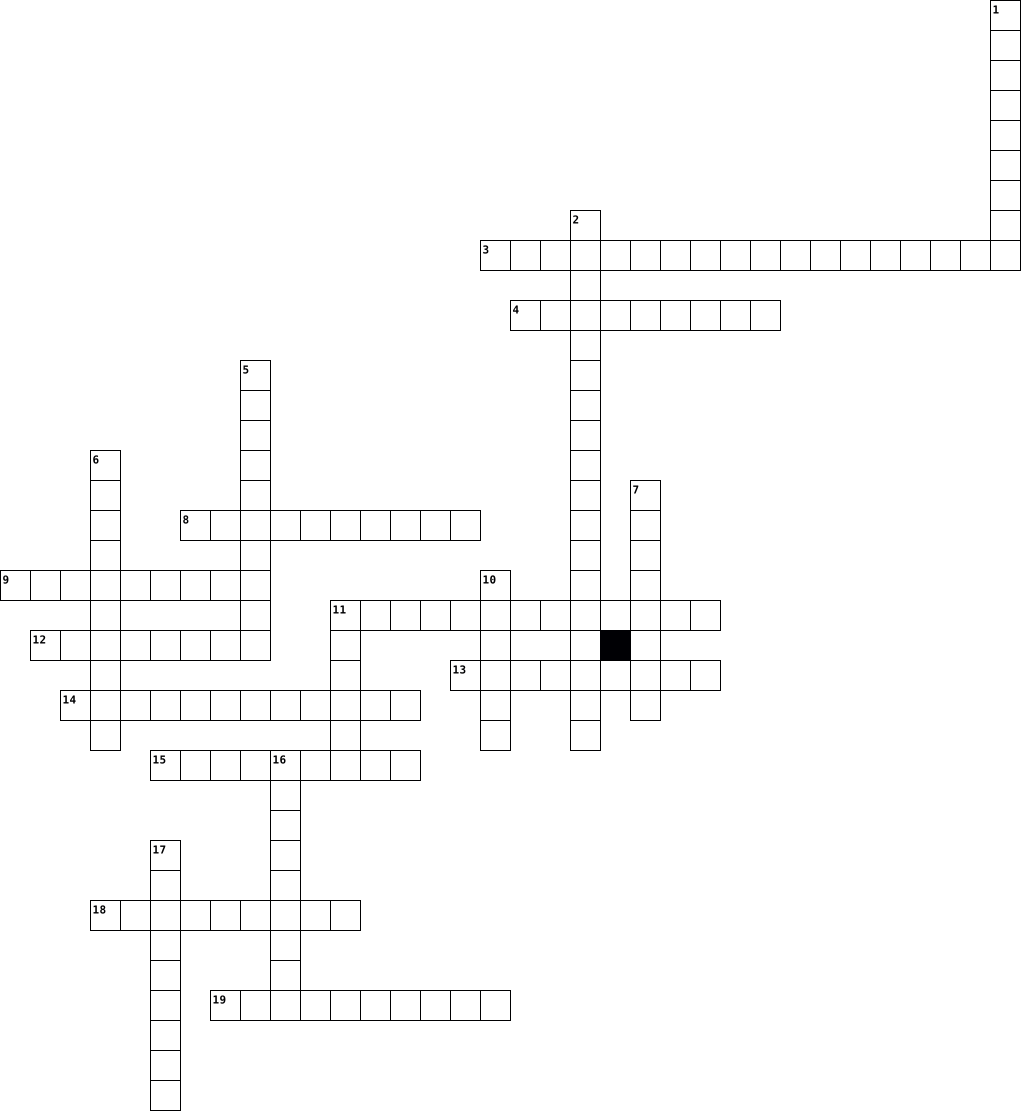
Across
- Resources that can be used repeatedly.
- Government system in which is controlled by a religious leader.
- Map that shows the amount of people in a certain area and people per square mile.
- Amount of births per 1,000 people
- Organization that promotes the European economy
- This measures distance north and south and are lines drawn on a map from East to West.
- Government system where people vote freely, government system practiced in the United States
- Building a dam is an example of _____________ of the environment.
- Plate boundaries where plates move laterally by each other
- Mid ocean ridge and rift valleys are formed at ________plate boundaries.
- Mountains and volcanoes are formed at ________ plate boundaries.
Down
- Landforms that hinder migration
- Trees, Oil, and Gold are examples of ________
- The air
- Building a house on stilts near the coast to avoid flooding is an example of ____________.
- A Map that shows physical features, landforms, and elevation.
- Climate characterized by little precipitation and high temperatures.
- The warming of surface water in the Pacific Ocean leading to changes in weather
- The Federal government of the United States is considered __________, because no other government can tell them what to do.
- Population pyramids for these countries typically have narrow bases and wider tops
20 Clues: The air • Landforms that hinder migration • Amount of births per 1,000 people • Resources that can be used repeatedly. • Trees, Oil, and Gold are examples of ________ • Organization that promotes the European economy • Plate boundaries where plates move laterally by each other • A Map that shows physical features, landforms, and elevation. • ...
Midterm 2021-12-08

Across
- Resources that can be used repeatedly.
- Government system in which is controlled by a religious leader.
- Map that shows the amount of people in a certain area and people per square mile.
- Amount of births per 1,000 people
- Organization that promotes the European economy
- This measures distance north and south and are lines drawn on a map from East to West.
- Government system where people vote freely, government system practiced in the United States
- Building a dam is an example of _____________ of the environment.
- Plate boundaries where plates move laterally by each other
- Mid ocean ridge and rift valleys are formed at ________plate boundaries.
- Mountains and volcanoes are formed at ________ plate boundaries.
Down
- Landforms that hinder migration
- Trees, Oil, and Gold are examples of ________
- The air
- Building a house on stilts near the coast to avoid flooding is an example of ____________.
- A Map that shows physical features, landforms, and elevation.
- Climate characterized by little precipitation and high temperatures.
- The warming of surface water in the Pacific Ocean leading to changes in weather
- The Federal government of the United States is considered __________, because no other government can tell them what to do.
- Population pyramids for these countries typically have narrow bases and wider tops
20 Clues: The air • Landforms that hinder migration • Amount of births per 1,000 people • Resources that can be used repeatedly. • Trees, Oil, and Gold are examples of ________ • Organization that promotes the European economy • Plate boundaries where plates move laterally by each other • A Map that shows physical features, landforms, and elevation. • ...
Plate Tectonics 2023-12-14

Across
- area around the North Pole or the South Pole
- a large land mass separated from other land masses by oceans
- scientific study of the deformation of the rocks that make up the Earth's crust and the forces that produce such deformation.
- a name for all sediment
- the mostly solid bulk of Earth's interior.
- separate different regions of Earth.
- an area on Earth where two or more lithospheric plates collide.Plate
- occurs when two tectonic plates move away from each other.
- the solid, outer part of Earth.
Down
- a fracture or zone of fractures between two blocks of rock.
- what happens when two blocks of the earth suddenly slip past one another.
- a central region in an economy, with good communications and high population density, which leads to its prosperity
- preserved remains of plants and animals whose bodies were buried in sediments,
- is the zone of the earth which lies beneath the lithosphere.
- a super-continent that incorporated almost all the landmasses on Earth
- the movement of particles through a substance,
- a type of fault in which two tectonic plates slide past one another.
- When magma flows onto Earth's surface
- the outermost shell of a terrestrial planet.
19 Clues: a name for all sediment • the solid, outer part of Earth. • separate different regions of Earth. • When magma flows onto Earth's surface • the mostly solid bulk of Earth's interior. • area around the North Pole or the South Pole • the outermost shell of a terrestrial planet. • the movement of particles through a substance, • ...
Plate motion 2024-10-22

Across
- A large section of hard solid rock that make up earths outer layer
- The layer of soft, solid rock underneath earths plates
- The place where two plates meet
- moving apart in different directions
- any of the many processes in which lava gas and ash are pushed out on the surface of earth
- a natural spring that sends hot water and steam suddenly into the air from a hole in the ground
- made of hard solid rock
- a feature that forms on the surface of a planet, such as a mountain, channel, or sand dune
- when do water mountain range formed when two plates move apart
- the sudden pushing out of something, such as lava from a volcano
Down
- to examine in detail for a purpose
- moving toward the same plate
- observed to be over and over again
- a shaking of earths surface
- hot liquid rock below the surface of Earth
- A long deep indentation in the ocean floor
- the outside or top layer of something
- the slow pulling apart of land that is caused by plate movement
- a diagram that shows what inside of something looks like
19 Clues: made of hard solid rock • a shaking of earths surface • moving toward the same plate • The place where two plates meet • to examine in detail for a purpose • observed to be over and over again • moving apart in different directions • the outside or top layer of something • hot liquid rock below the surface of Earth • A long deep indentation in the ocean floor • ...
All About Dance! 2022-02-15

Across
- a style of dance that requires a lot of space on the dance floor
- a dance that is done for the enjoyment and fulfillment of you and others around you
- the physical makeup of a human or animal including organs, bones, and flesh
- there are _____ elements of dance
- a style of dance that originated in the 20th century
- the state of being physically strong
- this style of dance is usually done without shoes
- fast-paced dance usually requires more ______ than slower paced dances
- when dancers move together and are doing the same moves at the same time
- this style of dance originated in the 16th century
- to bend at the knees
- how fast or slow a song is
Down
- this element of dance deals with how big or small dance moves are
- a dance style that does not require a lot of space
- a sequence of steps or moves in a dance
- this type of thinker will develop multiple solutions to one problem
- to rise
- this type of thinker will develop one solution to one problem
- a style of dance that requires metal taps on the bottom of shoe
19 Clues: to rise • to bend at the knees • how fast or slow a song is • there are _____ elements of dance • the state of being physically strong • a sequence of steps or moves in a dance • this style of dance is usually done without shoes • a dance style that does not require a lot of space • this style of dance originated in the 16th century • ...
Science 2023-01-20

Across
- what cooling magma becomes rock what rock does it become.
- what boundaries plates move apart.
- what occurs when two plates push against each other and become locked.
- what is the second most inner layer of earth.
- what cleans up the stuff after weathering.
- what type of weathering causes reactions to nature.
- what boundaries plates push together.
- _________ is found mostly in sediment rocks
- extreme heat and pressure creates one type of rock into a new one, what is the new rock called.
- who proposed the idea that continents sat on. large crustal plates that had moved and carried the. continents to their current positions on Earth.
Down
- what is the inner most layer of earth.
- what is the second outer most layer of earth.
- what takes away all the stuff and deposits it.
- what is a mix of two or more things together.
- plates slip past each other.
- what is a mixture which one substance dissolves in another.
- what is the outermost layer of the earth.
- what type of weathering breaks down rocks or ice.
- what rock is created when layers of sediment bonds together and forms rock.
19 Clues: plates slip past each other. • what boundaries plates move apart. • what boundaries plates push together. • what is the inner most layer of earth. • what is the outermost layer of the earth. • what cleans up the stuff after weathering. • _________ is found mostly in sediment rocks • what is the second outer most layer of earth. • ...
WEATHERING, PLATE TECTONICS AND EARTHQUAKES 2026-02-25

Across
- _____ IS THE BREAKING DOWN OF ROCKS ON THE EARTH SURFACE TO FORM SOIL
- _____ FORCES CAUSE PLATES TO MOVE AWAY FROM EACH OTHER
- FOLD MOUNTAINS ARE FORMED AT THE _____ BOUNDARY
- _____ WEATHERING INVOLVES PLANTS BREAKING DOWN ROCKS WITH THEIR ROOTS
- PLATES SLIDE PAST EACH OTHER AT THE ____ BOUNDARY
- THE FEATURE FORMED WHEN THE CONTINENTAL AND OCEANIC CRUST MEET AND COLLIDE
- POINT ON THE EARTH SURFACE WHERE THE EARTHQUAKE FIRST HITS
- THE CORE IS MAINLY MADE UP OF IRON AND _____
- THE POINT BELOW THE EARTH SURFACE WHERE THE EARTHQUAKE ORIGINATES FROM
Down
- A _____ SCALE IS USED TO MEASURE THE MAGNITUDE OF AN EARTHQUAKE
- THE ____ CRUST IS MAINLY MADE OF BASALT
- _____ FORCES CAUSE PLATES TO SLIDE PAST EACH OTHER
- A TYPE OF CHEMICAL WEATHERING THAT INVOLVES MINERALS REACTING WITH OXYGEN
- THE ______ ZONE IS WHERE THE OCEANIC CRUST SINKS BELOW THE CONTINENTAL CRUST
- ____ FORCES CAUSE PLATES TO MOVE TOWARDS EACH OTHER AND COLLIDE
- ______ IS A TYPE OF CHEMICAL WEATHERING WHERE CARBONIC ACID REACTS WITH LIMESTONE IN ROCKS
- THE BOUNDARY WHERE PLATES MOVE AWAY FROM EACH OTHER
- _____ IS WHEN MINERALS ABSORB WATER AND SWELL
- _____ IS WHEN MINERALS REACT WITH WATER AND SOFTEN
19 Clues: THE ____ CRUST IS MAINLY MADE OF BASALT • THE CORE IS MAINLY MADE UP OF IRON AND _____ • _____ IS WHEN MINERALS ABSORB WATER AND SWELL • FOLD MOUNTAINS ARE FORMED AT THE _____ BOUNDARY • PLATES SLIDE PAST EACH OTHER AT THE ____ BOUNDARY • _____ FORCES CAUSE PLATES TO SLIDE PAST EACH OTHER • _____ IS WHEN MINERALS REACT WITH WATER AND SOFTEN • ...
MOVIES 2023-11-22

Across
- MOVIE WHERE HUMANS COLONIZING THE PLANET PANDORA
- MOVIE WHERE THERE IS A SHIP AND A COUPLE ONE RICH AND ONE POOR
- EIGHT MAGICAL MOVIE FRANCHISE THE PROTAGONIST SURVIVED DEATH TWICE
Down
- THERE TWELVE DISTRICTS THAT WILL FIGHT TO THE DEATH AND ONLY ONE CAN WIN ETERNAL FAME
- THE PERFECT PINK WORLD DOLL FOR GIRLS
- THERE ARE FIVE DIFFERENT FATIONS TO CATALOG PEOPLE THE THE PROTAGONIST FITS INTO MORE THAN ONE FACTION
6 Clues: THE PERFECT PINK WORLD DOLL FOR GIRLS • MOVIE WHERE HUMANS COLONIZING THE PLANET PANDORA • MOVIE WHERE THERE IS A SHIP AND A COUPLE ONE RICH AND ONE POOR • EIGHT MAGICAL MOVIE FRANCHISE THE PROTAGONIST SURVIVED DEATH TWICE • THERE TWELVE DISTRICTS THAT WILL FIGHT TO THE DEATH AND ONLY ONE CAN WIN ETERNAL FAME • ...
Science Crossword 6.2 2016-12-02

Across
- What forms at a divergent boundary
- what do scientist measure tectonic plate movement in
Down
- what occurs at a transform boundary
- When to pieces of continental crust collide, what does this form
4 Clues: What forms at a divergent boundary • what occurs at a transform boundary • what do scientist measure tectonic plate movement in • When to pieces of continental crust collide, what does this form
DIVERGENT CROSSWORD 2013-01-02

Across
- what Beatrice discovers she is after the test.
- the fation Beatrice chooses at the choosing ceremony
Down
- what you become if you don't fail initiation
3 Clues: what you become if you don't fail initiation • what Beatrice discovers she is after the test. • the fation Beatrice chooses at the choosing ceremony
Electrical energy storage puzzle 2015-04-06

Across
- to cause to become separated, disconnected, or divergent.
- stopping or ceasing for a time; alternately ceasing and beginning again.
- a heavy disk or wheel rotating on a shaft so that its momentum gives almost uniform rotational speed to the shaft and to all connected machinery.
- to adjust to some standard or requirement, as amount or degree.
Down
- rather large or great in size, distance, extent, etc.
- requiring strict attention to rules, procedure, detail, etc
6 Clues: rather large or great in size, distance, extent, etc. • to cause to become separated, disconnected, or divergent. • requiring strict attention to rules, procedure, detail, etc • to adjust to some standard or requirement, as amount or degree. • stopping or ceasing for a time; alternately ceasing and beginning again. • ...