
earth day Crossword Puzzles
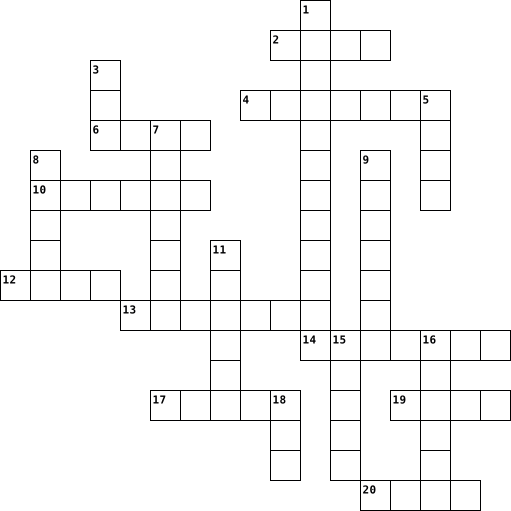
Genesis Story Review 2024-10-03

Across
- the whole world had the same ______ and words
- God said he would bring rain down on the earth for ____ days and ____ nights
- the name of the first river in Eden is _____
- what did God create on the sixth day
- what name did the man give his wife
- the Lord _____ everyone around the earth
- what did God intensify the woman's pain in
- cain killed Abel because he was ______ that God accepted Abels offering and not his
- what animal (bird) did Noah release from the ark first
- "for you are ____ and to ____ you shall return."
- what is the name of the fourth river in Eden
- what did God do on the seventh day
Down
- on the first day God created _______
- what was the name of eve's first son
- God felt _____ in making the humans and animals
- what was the name of eve's second son
- the Tower of Babel is a ____ about how we got the different languages we speak
- what part of the mans body did God remove for the woman
- what day did God create sea creatures and birds
- the people wanted to make a ____ for themselves
- when the man and woman ate the forbidden fruit their eyes were _____
- because of Cain's sin he was cursed to become a constant ______ on the earth
- what day did God make the sky
- what did the people use to build the tower
- "Am I my brothers ____?"
- what animal tricked the woman into deciding to eat the fruit
- God told the man if he ate from the tree of knowledge of good and evil that he would ___
- the man and woman were naked but they felt no ____
- God told Noah to build an ____
- how many sons did Noah have
30 Clues: "Am I my brothers ____?" • how many sons did Noah have • what day did God make the sky • God told Noah to build an ____ • what did God do on the seventh day • what name did the man give his wife • on the first day God created _______ • what was the name of eve's first son • what did God create on the sixth day • what was the name of eve's second son • ...
Chapter 1 - Daylight 2023-10-09

Across
- before middle of the day
- our capital city that is aligned with the cardinal directions
- a device for figuring out the hour of the day using the position of a shadow cast along a dial
- a boundary the encircles the world, diving the sunlit half from the dark half
- this exposure on a house will only have indirect sunlight and will be mostly shaded
- after middle of the day
- the direction Earth rotates towards
- the direction in which the sun and moon set each day.
- the round part of the sundial with numbers for measuring the hours
- noon, when the sun reaches the meridian
- the season when the sun's path is highest in the sky
- the point in Earth's rotation when the sun is directly at the equator causing equal daylight and darkness.
Down
- the pointer on the sundial that makes a shadow
- an imaginary line that defines the middle of the sky
- the astronomer who developed the Heliocentric model of the solar system
- the reason our sunlit sky appears blue
- the direction you should face to see the sun's movement through the sky
- the time of transition between the daytime sky and nighttime sky
- Earth rotates around this imaginary line
- where the lands ends and meets the sky
20 Clues: after middle of the day • before middle of the day • the direction Earth rotates towards • the reason our sunlit sky appears blue • where the lands ends and meets the sky • noon, when the sun reaches the meridian • Earth rotates around this imaginary line • the pointer on the sundial that makes a shadow • an imaginary line that defines the middle of the sky • ...
Planet Earth 2024-08-19

Across
- ... layer is called the crust.
- Most of the earth's surface is covered with it
- Space is not ... but contains gas and dust
- Material of which earth consists the most
- Makes up most of the mass of the earth
- The ... largest planet in the solar system
- Space is literally a ...
- Earth is the ... planet from the sun
Down
- The only non metal in the earth's crust
- Almost half the earth's crust consists of ...
- ... plates drift a few centimeters each year
- The earth is not round but a ...
- A day is actually 4 ... shorter than what we think
- Space contains no ...
- Earth is the only planet to have water in this form
15 Clues: Space contains no ... • Space is literally a ... • ... layer is called the crust. • The earth is not round but a ... • Earth is the ... planet from the sun • Makes up most of the mass of the earth • The only non metal in the earth's crust • Material of which earth consists the most • Space is not ... but contains gas and dust • The ... largest planet in the solar system • ...
Gensis Chapter 1 2024-01-12

Across
- God created this on the second day
- The creatures created to fill the waters on the fifth day
- And God saw that it was ___
- Which day was the two great lights to rule the day and night created?
- Which day did God caused dry land to appear?
- Which other lights did God create in addition to the two great lights on the fourth day?
Down
- What was the body of water gathered below the firmament called?
- Fruit tree that yields fruit according to its ___
- Let Us make man in Our ____
- God created this on the first day
- God called the darkness ___
- The greater light God made to rule the day
- The earth was without ___
- Which day did God create winged birds?
- The first man created in God's image
- The number of days God took to create the world
16 Clues: The earth was without ___ • Let Us make man in Our ____ • God called the darkness ___ • And God saw that it was ___ • God created this on the first day • God created this on the second day • The first man created in God's image • Which day did God create winged birds? • The greater light God made to rule the day • Which day did God caused dry land to appear? • ...
Creation Story 2024-07-15

Across
- - What God created on the first day.
- - Created to govern the night.
- - Creatures that fly in the sky.
- - The garden where the first humans lived.
- - Created to govern the day.
- - What God did on the seventh day.
- - What sprouted from the earth.
- - Creatures that swim in the sea.
Down
- - Created to light the night sky.
- - Appeared when the waters gathered.
- - Created in God's image.
- - The creature that tempted Eve.
- - The first woman.
- - Created to separate the waters.
- - Wild animals created on the sixth day.
15 Clues: - The first woman. • - Created in God's image. • - Created to govern the day. • - Created to govern the night. • - What sprouted from the earth. • - Creatures that fly in the sky. • - The creature that tempted Eve. • - Created to light the night sky. • - Created to separate the waters. • - Creatures that swim in the sea. • - What God did on the seventh day. • ...
Maps Crossword Puzzle 2023-12-14

Across
- latitude lines that runs around the middle of the earth
- the half of the Earth north of the equator
- lines that run east and west around the earth called parallels
- half of the earth west of the Prime Meridian
- what time it is in a particular place
- squares formed by lines on a map that make finding a location easier
- the half of the earth south of the equator
- imaginary line of the map that shows the boundary between one day and the next
Down
- a large area of land
- northeast, northwest, southeast, southwest
- a grid that uses letters and numbers to label the grid lines
- important line of latitude that contains the Southern Ocean
- half of sphere half of the earth
- half of the earth east of the prime merdian
- vertical lines that go from the North Pole to the South Pole around the earth
15 Clues: a large area of land • half of sphere half of the earth • what time it is in a particular place • northeast, northwest, southeast, southwest • the half of the Earth north of the equator • the half of the earth south of the equator • half of the earth east of the prime merdian • half of the earth west of the Prime Meridian • ...
Outer Space Crossword puzzle 2023-05-05

Across
- Giant Jupiter
- moon Triton
- millions in the solar system
- On the edge of the solar system
- to Sun Mercury
- Coldest body in solar system
- Day Venus
- of our solar system Saturn
Down
- Huge ring system
- smaller than earths moon
- known planets Dwarf planets
- Giant dust storms
- five percent water Earth
- rotation Mercury
- planets Havent cleared orbital path
- Moon has no atmosphere
- Known Rings Uranus
- Fastest are 26 miles per second
18 Clues: Day Venus • moon Triton • Giant Jupiter • to Sun Mercury • Huge ring system • rotation Mercury • Giant dust storms • Known Rings Uranus • Moon has no atmosphere • smaller than earths moon • five percent water Earth • of our solar system Saturn • known planets Dwarf planets • millions in the solar system • Coldest body in solar system • On the edge of the solar system • ...
Earth 2025-11-08

Across
- covers most of the earth's surface
- low land between hills or mountains
- earth's path around sun
- what the earth does on it's axis
- layer of the earth made of melted rock
- when the earth moves around the sun
- layer of the earth at the center
- thinnest layer of the earth made mostly of solid rock
- Australia is an _______ and a continent.
- deep narrow passage with steep sides and a river flowing through it
- moving of rocks, soil, or sand on the earth's surface
- learn about the earth's crust by digging holes and studying rocks
- melted rock that comes out of a volcano
Down
- breaking down of rock into smaller pieces by wind, water, ice, or plants
- what happens when large areas of the earth's surface shake and move
- largest areas of land on the earth's surface
- large bodies of salt water
- lakes are large bodies of ______ water
- what happens when the earth's crust opens and lava flows out
- landform surrounded by water
20 Clues: earth's path around sun • large bodies of salt water • landform surrounded by water • what the earth does on it's axis • layer of the earth at the center • covers most of the earth's surface • low land between hills or mountains • when the earth moves around the sun • layer of the earth made of melted rock • lakes are large bodies of ______ water • ...
Seasons Practice 2026-02-20

Across
- “_______ directions”
- Another name for an orbit
- The shape of a planetary orbit
- The centerline through an object
- An imaginary line that divides the Earth into two hemispheres
- Liquids and solids formed from the air
- Happens every March and September
- The scientist who discovered laws of planetary motion
- The northern or southern half of Earth.
- Written during the year without summer
- Air and gases surrounding Earth
- Imaginary horizontal lines that tell you how far north or south you are
Down
- Long term atmospheric conditions
- A repeating pattern of changing weather
- This star helps prove that Earth is tilted at an angle.
- Approaching at an angle other than 90 degrees
- Earth does this every 24 hours
- The longest and shortest day of the year
- The northern and southern tips of the planet
- Short term atmospheric conditions
- Imaginary vertical lines that tell you how far east or west you are
- When a planet is closest to the star it orbits.
22 Clues: “_______ directions” • Another name for an orbit • The shape of a planetary orbit • Earth does this every 24 hours • Air and gases surrounding Earth • Long term atmospheric conditions • The centerline through an object • Short term atmospheric conditions • Happens every March and September • Liquids and solids formed from the air • Written during the year without summer • ...
The planets 2014-10-30
Across
- The only other place besides Earth that man has walked on.
- There are eight of these in the solar system.
- Earth takes this long to orbit the Sun.
- Astronauts ride in these to space.
- The sun is a yellow one of these.
- The furthest planet from the Sun.
- The closest planet to the Sun.
- The second closest planet to the Sun.
- The fourth planet from the Sun after Earth.
- Planets close to the sun spin at this speed.
Down
- It is made up of eight planets.
- Takes Earth this long to spin completely around on its axis.
- Planets furthest from the sun spin at this speed.
- The sun is a star this size.
- Planets rotate around the sun.
- The largest planet.
- The sixth planet from the Sun after Jupiter.
- Third closest planet to the Sun that humans live on.
- The planet second furthest from the Sun.
- The star that is the center of the solar system.
20 Clues: The largest planet. • The sun is a star this size. • Planets rotate around the sun. • The closest planet to the Sun. • It is made up of eight planets. • The sun is a yellow one of these. • The furthest planet from the Sun. • Astronauts ride in these to space. • The second closest planet to the Sun. • Earth takes this long to orbit the Sun. • ...
Touring the Solar System 2023-01-17

Across
- Moon of Pluto
- Largest impact crater in the SS
- Windiest Planet in the Solar System
- forces How distant moons with possible sub-surface oceans are thought to be heated
- Large moon with retrograde motion & cry-volcanoes
- Largest Moon in our Solar System
- Rocky region between Mars and Jupiter (2)
- Largest canyon in the solar system (2)
- Nasa Mission that landed on an asteroid and redirected it
- Its day is longer than its year
- Largest mountain and volcano in the SS(2)
Down
- A martian natural satellite
- Most volcanically active place in the SS
- Object that struck earth and formed out moon
- Only place besides earth with lakes
- a likely spot for life outside earth
- Rotates backwards and is on its side
- Giant Hurricane that has been raging for centuries (3)
- Home of the Caloris Basin
- roughly a quarter of a million miles from earth
- 93 million miles from earth
21 Clues: Moon of Pluto • Home of the Caloris Basin • A martian natural satellite • 93 million miles from earth • Largest impact crater in the SS • Its day is longer than its year • Largest Moon in our Solar System • Windiest Planet in the Solar System • Only place besides earth with lakes • a likely spot for life outside earth • Rotates backwards and is on its side • ...
THE UNIVERSE 2018-11-22

Across
- The first of the outer planets
- It's called the blue planet.
- The name of our gallaxy
- Huge ball of gas where nuclear reactions take place
- This person invented the telescope and proved Copernicus' theory.
- This scientist suggested the heliocentric model of the solar system.
- A rocky irregular mass that orbit the Sun
- The most brilliant planet in the night sky.
- Small pieces of asteroids or comet that orbit the Sun
- It's the first day of Summer and Winter
- Dwarf planet
Down
- It's the name of a belt of asteroids
- This movement of the Earth takes 24 hours
- They are classified according to their shape.
- Celestial body that orbit a star.
- The nearest star to the Earth
- Imaginary line that goes from the North Pole to the South Pole
- The Equator is the imaginary line that divides the Earth into 2 _________________
- A natural satellite that orbit the Earth
- It occurs thanks to the Earth's revolution
20 Clues: Dwarf planet • The name of our gallaxy • It's called the blue planet. • The nearest star to the Earth • The first of the outer planets • Celestial body that orbit a star. • It's the name of a belt of asteroids • It's the first day of Summer and Winter • A natural satellite that orbit the Earth • This movement of the Earth takes 24 hours • ...
Seasons & Day/Night Review 2023-10-05

Across
- the area of Earth that always receives direct energy
- the Earth spins on this
- type of the Sun's energy when it hits earth head on
- season that occurs when one is tilted away from the Sun
- when our side of Earth is facing the Sun
- lines that measure how far north or south of the equator
- type of the Sun's energy that results in lower temperatures
- season between winter and summer
Down
- time of year when you are receiving direct sunlight
- the ability to cause change
- lines that measure east and west of the Prime Meridian
- to make something visible
- how long it takes for a planet to go around a star
- when our side of Earth is facing away from the Sun
- season between summer and winter
- what the Earth does around the Sun
16 Clues: the Earth spins on this • to make something visible • the ability to cause change • season between summer and winter • season between winter and summer • what the Earth does around the Sun • when our side of Earth is facing the Sun • how long it takes for a planet to go around a star • when our side of Earth is facing away from the Sun • ...
Audrey's 6 weeks learning crossword puzzle about the topics we learned this 6 weeks🤣 2022-02-18

Across
- equal day and night; Occurs March 21-22
- "Dirty Snowballs"
- no visible light reflected off the moon
- rocky object that is the size of
- completely visible light reflected off
- shortest day of year; Occurs Dec. 21-22
- Meteroid that has entered earth's
- than planets
- takes 29.5 days to complete
Down
- equal day and night; Occurs Sep. 22-23
- when moon passes through earth's shadow
- rock shaped object that orbits the sun;
- longest day of year; Occurs June 21-22
- increasing light in the moon phases
- meteor that has landed on earth's
- when moon passes between sun and earth
- moon.
17 Clues: moon. • than planets • "Dirty Snowballs" • takes 29.5 days to complete • rocky object that is the size of • meteor that has landed on earth's • Meteroid that has entered earth's • increasing light in the moon phases • equal day and night; Occurs Sep. 22-23 • longest day of year; Occurs June 21-22 • completely visible light reflected off • when moon passes between sun and earth • ...
Earth 2024-11-12

Across
- has so much snow it can’t melt weight increases to form ice pressure is so much it partially melts at the bottom it starts moving
- in dry areas sediment collects when it Rains it loosens sediment and water rush downhill
- Fastest longitudinal can go through solid and liquid
- sediment builds up can be many miles wide excellent farming
- Earth’s crust and the top of the mantle
- roll and tumble rocks against each other break into smaller pieces sediment acts like sand paper on rocks
- Hotter and softer rock in the upper mantle
- Boundary, plates that pull apart
- an instrument used to detect ground movement
- Spot, some places heated rock rises to make a volcano
Down
- 2nd waves transverse can only go through solid
- process of wind carrying away loose sediment mainly in desert regions
- The action of picking up and moving materials
- Dropping of weathered material somewhere else aids in creation of new landform
- Weak Layers underground move downhill as a single unit
- rapid movement of large amounts of rock and soil (often occur after heavy rain or earthquake)
- sand grains can wear away surface of rocks buildings like a piece of Sandpaper
- Gradual movement of soil downhill
- Boundaty, plate move together
- Boundary, plates that scrap off each other
20 Clues: Boundaty, plate move together • Boundary, plates that pull apart • Gradual movement of soil downhill • Earth’s crust and the top of the mantle • Hotter and softer rock in the upper mantle • Boundary, plates that scrap off each other • an instrument used to detect ground movement • The action of picking up and moving materials • ...
The Earth 2026-03-20

Across
- An imaginary line the Earth spins around
- The spinning of the Earth on its axis
- Different times of the year like summer and winter
- Half of the Earth (north or south)
- The season with the least sunlight and coldest weather
- The Earth is slightly leaning on its axis
Down
- The path the Earth takes as it travels around the Sun
- The star that gives the Earth light and heat
- When your side of the Earth faces the Sun
- When your side of the Earth faces away from the Sun
- The season with the most sunlight and warmest weather
- The planet we live on
12 Clues: The planet we live on • Half of the Earth (north or south) • The spinning of the Earth on its axis • An imaginary line the Earth spins around • When your side of the Earth faces the Sun • The Earth is slightly leaning on its axis • The star that gives the Earth light and heat • Different times of the year like summer and winter • ...
Science 2025-05-13

Across
- what does the earth rotates around
- there are 7 days in a ____
- the study of stars
- a half of a sphere
- a full 24 hours is called a ___
- opposite of southern
Down
- opposite of day
- the southern hemisphere is directly in the sun during...
- when you drop a ball it is pulled by _______
- a _____ is usually 30 days
- earth rotates on an ____
- the scientific word for spinning(isnt revolving)
12 Clues: opposite of day • the study of stars • a half of a sphere • opposite of southern • earth rotates on an ____ • there are 7 days in a ____ • a _____ is usually 30 days • a full 24 hours is called a ___ • what does the earth rotates around • when you drop a ball it is pulled by _______ • the scientific word for spinning(isnt revolving) • ...
The Genesis Story 2020-05-19

Across
- what did Cain do to his brother Gen Ch 4 vs. 8
- God created man in his own......Gen Ch 1 vs. 28
- what did God call the darkness
- the tree was placed in the .....of the garden
- God created the .....and the earth Gen Ch 1 vs. 1
- name the first son of Adam and Eve
- Abel was the keeper of........Gen Ch 4 vs. 2
- who did Adam name all of .......Gen Ch 2 vs. 19
Down
- the earth was without form and ..... Gen Ch 1 vs. 2
- what gives light in the sky at night
- what was the name of the garden in Gen
- this was created on the first day
- the woman saw that this was good for food Gen 3 vs. 6
- what was the name of he first man
- On which day did God rested
- who was created on the sixth day?
- what was the name of the first woman
- what creature was Eve tempted by
18 Clues: On which day did God rested • what did God call the darkness • what creature was Eve tempted by • this was created on the first day • what was the name of he first man • who was created on the sixth day? • name the first son of Adam and Eve • what gives light in the sky at night • what was the name of the first woman • what was the name of the garden in Gen • ...
Sun Moon & Earth 2025-01-17

Across
- number of days for Earth to orbit the sun
- time from one new moon to the next
- particular period of time
- the crescent moon
- getting dimmer
- a repeating path of an object around another object
Down
- huge, glowing ball of gas
- to throw back light
- - a large natural object that orbits Earth
- the moon orbits the _____
- getting brighter
- a large object that travels around a star
- a dark area that is made when an object stops light
- time for Earth to spin around one time
14 Clues: getting dimmer • getting brighter • the crescent moon • to throw back light • huge, glowing ball of gas • the moon orbits the _____ • particular period of time • time from one new moon to the next • time for Earth to spin around one time • number of days for Earth to orbit the sun • a large object that travels around a star • - a large natural object that orbits Earth • ...
Solar System Crossword 2020-09-09

Across
- has a nucleus, coma, and tail
- if gravity disappears Earth moves in a line
- Mercury Venus Earth Mars
- the Earth is tilted on its
- shape of our galaxy
- another name for the outer planets
- Jupiter Saturn Uranus Neptune
Down
- shape of the planet's orbits
- takes one day
- takes one year
- hottest planet
- more _____ = greater gravitational pull
- shorter ____ = greater gravitational pull
13 Clues: takes one day • takes one year • hottest planet • shape of our galaxy • Mercury Venus Earth Mars • the Earth is tilted on its • shape of the planet's orbits • has a nucleus, coma, and tail • Jupiter Saturn Uranus Neptune • another name for the outer planets • more _____ = greater gravitational pull • shorter ____ = greater gravitational pull • ...
Venessa's Geographic Terms 2013-09-11

Across
- imaginary line that run east and west
- used to reducted or enlarge the distance between places in maps
- the seven large land masses on the Earth
- a group of small islands
- half of the Earth
- a dry area with no water
- a part of body of water near a coast where boats can anchor
- imaginary line that run north and south
- a triangular deposit of sand and soil at the mouth of the river
- the map of the Earth on a sphere
- a diagram of the Earth
Down
- the southern part of the Earth
- a twelve month period from January 1 to December 31
- something used to indicate a specific object
- a large body of salt water
- a narrow piece of land that juts out from the mainland
- the longest or shortest day of the year
- a piece of land surrounded by water
- a book that contains maps of the world
- the place were a stream or river enters a sea or lake
20 Clues: half of the Earth • a diagram of the Earth • a group of small islands • a dry area with no water • a large body of salt water • the southern part of the Earth • the map of the Earth on a sphere • a piece of land surrounded by water • imaginary line that run east and west • a book that contains maps of the world • the longest or shortest day of the year • ...
Midterm Review 2023-01-18

Across
- this is the force that keeps the same side of the moon facing Earth
- the force of gravity in the solar system makes Earth and other Planets orbit around this
- the moon is visible on Earth because it reflects
- when the moon comes directly between the sun and the Earth
- Earths orbit around the Sun one year
- a large object struck Earth and the ejected material from the collision combines
- helps prevent injuries in cars because it applies force in the opposite direct as the passenger motion
- the different appearances of the moon on Earth
- first step in the scientific method is this question to be answered in an experiment
- feature that causes seasons on Earth
- when neither end of the axis is tilted away from the Sun equal hours of daylight and darkness
- this is what causes night and day on Earth
Down
- these are small planets with rocky surfaces
- when Earth's shadow falls on the moon
- a statement made using your 5 senses
- these planets are much larger than Earth, and are made mainly of hydrogen and helium
- a body in motion will remain in motion unless influenced by an outside force
- Earth is located in one of these in the universe
18 Clues: Earths orbit around the Sun one year • a statement made using your 5 senses • feature that causes seasons on Earth • when Earth's shadow falls on the moon • this is what causes night and day on Earth • these are small planets with rocky surfaces • the different appearances of the moon on Earth • the moon is visible on Earth because it reflects • ...
Day 1 of Creation 2020-08-29

Across
- what earth was like right after it was created
- what God called the darkness
- another name for night
- "Let there be...."
- what God called the light
Down
- another name for day
- the name of this book of the Bible
- one of the things God created on day one
- how God described what He had created
9 Clues: "Let there be...." • another name for day • another name for night • what God called the light • what God called the darkness • the name of this book of the Bible • how God described what He had created • one of the things God created on day one • what earth was like right after it was created
Sun, Moon, and Earth 2022-01-20

Across
- when the moon is getting bigger
- the moon revolves around this
- when the moon is getting smaller
- believed the earth was the center of the solar system
- going in a circle around something
- the earth revolves around this
- the earth rotates on this
- this revolves around the earth
- when you don't see a moon in the night sky
- occurs between the last quarter and the new moon
- one earth revolution around the sun takes this long
- occurs between the first quarter and the full moon
- believed the sun was the center of the solar system
Down
- believed the sun was the center of the solar system, the first scientist to use a telescope to study the solar system
- this NASA mission took astronauts to the moon
- spinning around in a circle
- when you see the entire moon in the night sky
- believed the earth was the center of the solar system
- this season occurs when the earth is tilted towards the sun
- when the moon is more than half, but less than full
- caused by the tilt of the earth on its axis as it revolves around the sun
- one rotation on the earth's axis takes this long
- one moon revolution around the earth takes this long
- when the moon is less than half but more than a new moon
24 Clues: the earth rotates on this • spinning around in a circle • the moon revolves around this • the earth revolves around this • this revolves around the earth • when the moon is getting bigger • when the moon is getting smaller • going in a circle around something • when you don't see a moon in the night sky • this NASA mission took astronauts to the moon • ...
Science Vocab 2023-12-03

Across
- Measure of hotness or coldness expressed in terms of any of several scales, including Fahrenheit or Celcius
- angle An angle less than 30 degrees
- An oval shaped object
- An imaginary line that divides the northern part and southern part of the Earth
- Each of the twelves named periods into which a year is divided
- tilt What causes the sun to shine on different latitudes of the Earth during times of the year
- The invisible line the Earth spins on
- The Earth turning or revolving on it's axis
- The period of time in 24 hours when there is no sun or light
- angle An angle more than 90 degrees
Down
- Zone The part of the Earth's surface between the Tropic of Cancer and the Tropic of Capricorn and where it is always hot
- Zone The part of the Earth's surface where it is always has a cold climate
- A repeating path that one object in space takes around another one
- An objects orbital motion around another object
- The time taken by the Earth to make one revolution around the Sun
- The period of time in 24 hours when there is light
- The planet we live on our world
- The star that the Earth orbits around
- Pole The bottom and most southern part of the Earth
- Pole The top and most northern part of the Earth
20 Clues: An oval shaped object • The planet we live on our world • The star that the Earth orbits around • The invisible line the Earth spins on • angle An angle more than 90 degrees • angle An angle less than 30 degrees • The Earth turning or revolving on it's axis • An objects orbital motion around another object • The period of time in 24 hours when there is light • ...
Our solar system 2024-05-15

Across
- Biggest planet in our solar system a day for it is 10 hours and takes 12 earth years to make a rotation around the sun
- is about 53% of our planet and has the biggest volcano known the Olympus Mon
- 30 times as far as earth is from the sun takes about 164 earth years to orbit the sun and has 5 rings
- how are our stars correlated
- Has rings takes 29 earth years to orbit around the sun
Down
- We live on this planet and is made up of mostly water
- A day on this planet is longer than a year for us
- has no moons,takes 88 days to make full rotation, and is closest to the sun
- Is a dwarf planet takes 153 hours for one day to pass
- is nicknamed the ice giant and has 13 faint rings
10 Clues: how are our stars correlated • A day on this planet is longer than a year for us • is nicknamed the ice giant and has 13 faint rings • We live on this planet and is made up of mostly water • Is a dwarf planet takes 153 hours for one day to pass • Has rings takes 29 earth years to orbit around the sun • ...
Seasons, Moons, and Tides 2024-04-22

Across
- tides that occur during the new and full moon
- the month the autumnal equinox occurs
- creates day and night
- the point in Earth's revolution farthest away from the sun
- when the moon appears to be getting bigger
- the darkest inner part that completely covers the light source
- tides that occur during the first and third quarter moon
- the shape of Earth's orbit around the Sun
- a planet, moon, or other object gets into the way of the sun's light
- when the lit portion of the moon is more than half full and bulges on both sides
- two nearly equal high tides and two nearly equal low tides per day
- occurs when both hemispheres receive nearly equal numbers of daylight and night hours
- the direction Earth rotates on its axis
- when the moon appears to be getting smaller
- the month the vernal equinox occurs
Down
- occurs when the Earth's tilt is at a maximum
- occurs when the sun is completely covered
- the month the summer solstice occurs
- the difference in height between high and low tide
- the month the winter solstice occurs
- the point in Earth's revolution closest to the sun
- the lighter outer part that partially covers the light source
- one high tide and one low tide per day
- when the lit portion of the moon looks thin and curved
- the cyclic rise and fall of sea levels
- if the Southern Hemisphere is experiencing fall, then what season is the Northern Hemisphere experiencing
- two unequal high tides and two unequal low tides each day
- the type of eclipse that occurs when Earth is between the moon and the sun
- the type of eclipse that occurs when the moon is between the Earth and the sun
29 Clues: creates day and night • the month the vernal equinox occurs • the month the summer solstice occurs • the month the winter solstice occurs • the month the autumnal equinox occurs • one high tide and one low tide per day • the cyclic rise and fall of sea levels • the direction Earth rotates on its axis • occurs when the sun is completely covered • ...
Creation 2024-06-25

Across
- - God saw that everything He made was __________
- - These were created on the third day to cover the land
- - Created on the sixth day to live on the land
- - Along with the sun and moon, these were created on the fourth day
- - The place where God dwells, created in the beginning
Down
- - These creatures were created on the fifth day to fly in the sky
- - What God created on the first day
- - Created in God's image on the sixth day
- - What God created on the second day
- - God separated these to create the sky
- - Humans were created in the __________ of God
- - What appeared on the third day
- - These were created on the fifth day to fill the waters
- - The planet created by God in the beginning
- - What God did on the seventh day
15 Clues: - What appeared on the third day • - What God did on the seventh day • - What God created on the first day • - What God created on the second day • - God separated these to create the sky • - Created in God's image on the sixth day • - The planet created by God in the beginning • - Humans were created in the __________ of God • ...
Our place in space 2022-05-11

Across
- Time when a half of earth isn't facing the sun (5)
- Built a telescope, viewed the solar system and challenged geocentrism (7)
- Season when the half of earth is tilted away from the sun (6)
- Season when the half of earth is tilted towards the sun (6)
- Earth rotates around its __________ (4)
- Caused by the axial tilt of the earth (7)
- Model of the solar system with the sun at the centre (12)
- Path a planet takes around the sun (5)
Down
- Model of the solar system with Earth at the centre (10)
- Time it take earth to rotate around its axis (3)
- The top/bottom halves of the planet (10)
- The amount of matter something has (4)
- Jupiter and Saturn are examples of this type of planet(8)
- An imaginary line going around the middle of earth (7)
- Time it takes for a planet to revolve (travel) around the sun (4)
- A force due to mass, creates orbits and holds us to earths surface (7)
16 Clues: The amount of matter something has (4) • Path a planet takes around the sun (5) • Earth rotates around its __________ (4) • The top/bottom halves of the planet (10) • Caused by the axial tilt of the earth (7) • Time it take earth to rotate around its axis (3) • Time when a half of earth isn't facing the sun (5) • An imaginary line going around the middle of earth (7) • ...
Genesis 2024-02-24

Across
- In the __ God created the heavens and the earth
- How should we treat God
- The day God rested
- Humans are created in Gods ___
- Adam gave them names
- A word that describes God
- The Creator of the world
Down
- God doesn't have a beginning - he is ___
- The first book of the bible
- The first Woman
- God called the Darkness ___
- Who was hovering over the waters
- The First Man
- God called the light ___
- The Deceiver
- God's creation was ___
- God created Fish and birds on this day
17 Clues: The Deceiver • The First Man • The first Woman • The day God rested • Adam gave them names • God's creation was ___ • How should we treat God • God called the light ___ • The Creator of the world • A word that describes God • The first book of the bible • God called the Darkness ___ • Humans are created in Gods ___ • Who was hovering over the waters • God created Fish and birds on this day • ...
A Grid System on a Globe: Terms Review 2024-09-30

Across
- Point that the earth's axis passes through
- Spinning of the earth
- Imaginary line through the earth
- Angle that describes the distance east or west of the prime meridian
- _______ date line: marks the place on the earth where each new day begins
- Angle that describes the distance north or south of the equator
- Unit for measuring angles in a circle or sphere
Down
- _____ Meridian: line of 0° longitude
- Line of latitude
- Line of longitude
- One of the seven major land areas of the earth
- Half the earth
- time zone: an area that has the same clock time
- Set of horizontal and vertical lines on a map
- Line of 0° latitude
15 Clues: Half the earth • Line of latitude • Line of longitude • Line of 0° latitude • Spinning of the earth • Imaginary line through the earth • _____ Meridian: line of 0° longitude • Point that the earth's axis passes through • Set of horizontal and vertical lines on a map • One of the seven major land areas of the earth • time zone: an area that has the same clock time • ...
April Crossword 2023-04-11

Across
- Flower of the month
- Day celebrating the planet; Hint: It happens April 22nd
- The Gemstone of the month
- April showers bring May _____
- Healthplan Lead
- April 10th is National ___ Day
- Prank/Joke day
Down
- Famous ship that sank in April; Hint: I'll never let go Jack
- A bunny's favorite snack
- Cherry ____
- April, but in Latin
- Month after May
12 Clues: Cherry ____ • Prank/Joke day • Healthplan Lead • Month after May • Flower of the month • April, but in Latin • A bunny's favorite snack • The Gemstone of the month • April showers bring May _____ • April 10th is National ___ Day • Day celebrating the planet; Hint: It happens April 22nd • Famous ship that sank in April; Hint: I'll never let go Jack
Day 1 of Creation 2020-08-29

Across
- the name of this book of the Bible
- what God called the darkness
- another name for day
- what God called the light
- one of the things God created on day one
Down
- another name for night
- "Let there be...."
- what earth was like right after it was created
- how God described what He had created
9 Clues: "Let there be...." • another name for day • another name for night • what God called the light • what God called the darkness • the name of this book of the Bible • how God described what He had created • one of the things God created on day one • what earth was like right after it was created
Dates 2025-10-10

Across
- Last Monday in May
- The month when D-day happened
- First Monday in September
- The month of Earth day
- What year is it
- The holiday on the last Thursday of November
- Month when Pearl Harbor happened
Down
- The day December 7th is on
- The holiday on December 25th
- The month when Independence Day happens
- Olympics happening this year
- The month the super bowl is on this year
- The holiday on October 31st
- Month when New year happens
- The holiday is on February 14th
15 Clues: What year is it • Last Monday in May • The month of Earth day • First Monday in September • The day December 7th is on • The holiday on October 31st • Month when New year happens • The holiday on December 25th • Olympics happening this year • The month when D-day happened • The holiday is on February 14th • Month when Pearl Harbor happened • The month when Independence Day happens • ...
Earth and Moon relationships 2026-02-19

Across
- If the white part of the moon is getting bigger each day we say it is
- When the Earth goes between the moon and the Sun
- When the moon, Earth, and sun are at right angles,
- When the moon, Earth, and sun are in a line, more extreme tide
- When the moon is between the Sun and the Earth
- If the white part of the moon is getting smaller each day we say it is
Down
- what holds the moon in place
- last name of the first man to walk on the moon
- what makes the moon look like it gives off light
- happens every 4 years
- caused by the Earth's tilt and light shining on the Earth at different angles, less extreme
11 Clues: happens every 4 years • what holds the moon in place • last name of the first man to walk on the moon • When the moon is between the Sun and the Earth • When the Earth goes between the moon and the Sun • what makes the moon look like it gives off light • When the moon, Earth, and sun are at right angles, • When the moon, Earth, and sun are in a line, more extreme tide • ...
Space - Grade 5 2026-01-21

Across
- When the day has an equal amount of sun and night
- The Earth is ______ which means it is slightly angled towards the Sun.
- The Earth spins along its ____.
- When the moon is fully visible in the sky
- When the moon starts to look bigger in the sky, it is _____.
- This type of eclipse is when the earth is shaded by the moon
- When the moon is just a sliver.
- The partially shaded outer region of a shadow where the light source is only partly obscured, like during a partial eclipse
Down
- This season is when the sun is furthest away from us in Canada
- When a moon is 3/4 full.
- When the moon starts to look smaller in the sky, it is _____.
- The moon casts this when it is in a solar eclipse.
- This type of eclipse is when the moon is shadowed by the Earth
- The path a celestial body takes around an object
- Sometimes called the northern lights
- The year is split up into 4 of these. Each with specific weather and day/night cycles
16 Clues: When a moon is 3/4 full. • The Earth spins along its ____. • When the moon is just a sliver. • Sometimes called the northern lights • When the moon is fully visible in the sky • The path a celestial body takes around an object • When the day has an equal amount of sun and night • The moon casts this when it is in a solar eclipse. • ...
Earth Science Crossnumber! 2024-08-15

Across
- The time in hours for one Solar Day
- The approximate number of days for each season
- A Lunar Day is 24 hours and _ _ minutes
- There are _ recognised (named) moon phases
- The summer solstice in NZ this year is _ _ December
- The number of hours of daylight and night during an equinox
Down
- The moon takes _ _ days and 7 hours to orbit Earth
- The tilt of the Earth's axis is _ _.5 degrees
- The angle of the Moon's orbit around Earth is _.1 degrees to the ecliptic plane (horizontal)
- Lunar cycle: The time between consecutive moon phases is _ _.5 days
- The number of days between consecutive spring tides
- The average distance of the Moon to Earth is 3_ _ 000 km
- The time between two consecutive high tides is _ _ hours and 25 minutes
- The time it takes for the Earth to orbit the Sun is 365._ _ days
14 Clues: The time in hours for one Solar Day • A Lunar Day is 24 hours and _ _ minutes • There are _ recognised (named) moon phases • The tilt of the Earth's axis is _ _.5 degrees • The approximate number of days for each season • The moon takes _ _ days and 7 hours to orbit Earth • The number of days between consecutive spring tides • ...
Calendar Awareness 2021-12-28

Across
- the first day of fall is in this month.
- Shumackers favorite subject in school was probably..
- thanksgiving is in...
- this occurs every 4 years.
- there are 24 ____________ in a day.
- what season is the longest day of the year?
- the first day of summer is in this month.
- they use a 24 hour clock in Europe and in the...
Down
- are based on the moons rotation around the earth.
- The only month with 28 or 29 days.
- a year is based on the earth's rotation around this.
- there are 52 __________ in a year.
- total months in a year.
- the first day of winter is also known as winter
- 365 days.
- the first day of spring is always in.
16 Clues: 365 days. • thanksgiving is in... • total months in a year. • this occurs every 4 years. • The only month with 28 or 29 days. • there are 52 __________ in a year. • there are 24 ____________ in a day. • the first day of spring is always in. • the first day of fall is in this month. • the first day of summer is in this month. • what season is the longest day of the year? • ...
Space Crossword 2016-05-25

Across
- The imaginary line that the Earth spins around
- An eclipse where all of the Sun is covered by the Moon.
- A rocky inner planet, fourth from the Sun
- A eclipse where only part of the Sun is covered
- The time it takes a planet to make one full spin on its axis.
- rock or dust that makes a streak of light in the night sky.
- Dust particles frozen in ice that orbit the Sun.
- Everything that exists.
Down
- A manmade spacecraft.
- An object that has fallen to Earth from outer space.
- when the Earth comes between the Sun and the Moon.
- A rocky inner planet, third from the Sun in the Solar System.
- where the Moon comes between the Sun and the Earth.
- A number solar systems grouped together
- Changes in weather and the temperature during the year
- The path taken by one body in space around another
- The period of time that half the earth is facing away from the sun
- Earth’s only natural satellite.
18 Clues: A manmade spacecraft. • Everything that exists. • Earth’s only natural satellite. • A number solar systems grouped together • A rocky inner planet, fourth from the Sun • The imaginary line that the Earth spins around • A eclipse where only part of the Sun is covered • Dust particles frozen in ice that orbit the Sun. • when the Earth comes between the Sun and the Moon. • ...
Solar System and Beyond Vocabulary 2023-08-28

Across
- how long it takes for the Earth to revolve around the sun
- the Earth belongs to this galaxy
- theory about the creation of the universe
- when a meteroid burns in the atmosphere and hits the ground
- objects revolving around the sun that are too small and too numerous to be considered planets
- streak of light produced by a burning meteroid in Earth's atmosphere
- a ball of ice & dust that orbits the sun
- to revolve around another object
- any consolidated, large object which orbits a star
- the movement of one object around another (Earth around the sun)
Down
- having the earth as center
- measure of the force of gravity on an object
- a chunk of rock or dust in space that comes from comets or asteroids
- how long it take for Earth to complete a rotation
- the amount of matter in an object
- force that keeps the planets in orbit
- the spinning of the Earth on its axis, day and night
- having the sun as center
18 Clues: having the sun as center • having the earth as center • the Earth belongs to this galaxy • to revolve around another object • the amount of matter in an object • force that keeps the planets in orbit • a ball of ice & dust that orbits the sun • theory about the creation of the universe • measure of the force of gravity on an object • ...
science words 2018-05-15

Across
- rock
- gas-cloud
- speed
- water
- matter
- dead
- living
- region
- moving
- dry
- gases
- work
- water
Down
- atmosphere
- animals
- weather
- earth
- transfer
- community
- ice
- liquid
- electricity
- info
- sun
- alive
- meat
- plants
- stars
28 Clues: ice • sun • dry • rock • info • dead • meat • work • earth • speed • water • alive • gases • stars • water • liquid • matter • living • region • moving • plants • animals • weather • transfer • gas-cloud • community • atmosphere • electricity
Planetae 2024-05-07

Across
- South
- Sunrise
- Night
- Neptune
- Sun
- Venus
- Saturn
- East
- Belonging to the Stars
- Orbit
- Mercury
- Moon
- Stars
Down
- Mars
- West
- Comet
- Jupiter
- Earth
- North
- Uranus
- Sunset
- Heavenly Body
- Day
- Planets
- Constellation
- Pluto
26 Clues: Sun • Day • Mars • West • East • Moon • South • Comet • Earth • Night • North • Venus • Orbit • Pluto • Stars • Uranus • Sunset • Saturn • Sunrise • Jupiter • Neptune • Planets • Mercury • Heavenly Body • Constellation • Belonging to the Stars
Earth's Orbit Review 2026-03-24

Across
- The time it takes Earth to make 1 rotation
- When Earth is farthest from the sun
- When the Earth is between the moon and the sun and casts a shadow over the moon
- When Earth is closest to the sun
- The spinning of Earth on its Axis
- When day and night are nearly equal in length
- Earth's movement around the sun(AKA orbit)
- Changes in Earth's axial tilt every 41,000 years
Down
- The extended periods of darkness at the north and south poles
- The degree at which the Earth's axis is tilted
- When the moon passes between Earth and Sun and blocks the Sun's light.
- The "line" running through the Earth from the North to South Poles
- The slow wobble of Earth on its Axis every 26,000 years
- Changes in Earth's revolution every 100,000 years
- The extended periods of light at the north and south poles
- The longest and shortest days of the year
16 Clues: When Earth is closest to the sun • The spinning of Earth on its Axis • When Earth is farthest from the sun • The longest and shortest days of the year • The time it takes Earth to make 1 rotation • Earth's movement around the sun(AKA orbit) • When day and night are nearly equal in length • The degree at which the Earth's axis is tilted • ...
Outfront Community OUTREACH 2021-03-28

Across
- To use our resources again, we must ______ our paper, plastic and glass.
- Recycling one _____ of soda will save enough energy to power a tv for three hours.
- ______ color is usually connected with taking care of our planet.
- Save _____ by turning off lights, computer, and TV when you leave a room.
- On April 22, more than a billion people celebrate Earth Day to protect the planet from things like ______ and deforestation.
- Earth Day went _____ in 1990.
- ______ is our planet.
Down
- Turning off the faucet when you brush your teeth can ______ up to eight gallons of water a day.
- _____ energy is extracted from moving air that turns the blades of a turbine connected to a generator.
- Trees absorb _____ dioxide and release oxygen for people to breathe.
- Our garbage goes to the _______.
- ______ is an annual event on April 22 to demonstrate support for environmental protection.
- _____ is a mixture with dirt that help plants.
- one _____ bag can prevent the use of 600 plastic bags.
- _____ energy is generated from the sun, often through solar panels.
15 Clues: ______ is our planet. • Earth Day went _____ in 1990. • Our garbage goes to the _______. • _____ is a mixture with dirt that help plants. • one _____ bag can prevent the use of 600 plastic bags. • ______ color is usually connected with taking care of our planet. • _____ energy is generated from the sun, often through solar panels. • ...
SPace 2022-11-04
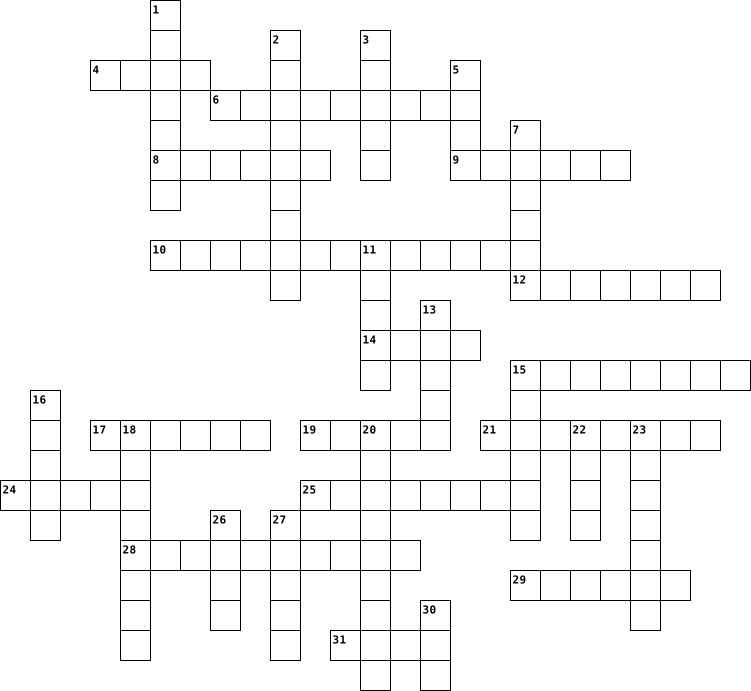
Across
- moon - the phase of the moon when Earth is between the moon and sun
- - A natural or artificial body that revolves around a planet
- - short period of climate change in an area caused by the tilt of Earth's axis as Earth revolves around the sun. (winter, summer, autumn, spring)
- - An object that orbits a star, is large enough to have become rounded by its own gravity, and has cleared the area of its orbit.
- - A group of stars that form a pattern in the sky
- - the moon's shape when more than half is illuminated
- - imaginary line that passes through the Earth's center from the North to the South
- - In summer and winter and the Earth has the longest day/shortest night or the shortest day/longest night
- - describes phases that occur after a full moon, as the visible lighted side of the Moon grows smaller
- - A ball of frozen dust and rock that orbits the sun and has a tail that glows
- - the moon's shape when less than half of it is illuminated
- - Earths path as it revolves around the sun
- - spinning on an axis
- - moving around another object in space
- - A streak of light in the sky produced by the burning of a meteoroid in Earth's atmosphere.
- - the rise and fall of Earth's water
Down
- - The shape of Earth's orbit
- - A meteoroid that has hit earth's surface.
- eclipse - when the moon comes between Earth and the sun
- tide - when the Sun, Earth and Moon make a right angle and the high tides are lower than usual and the low tides are a little higher than usual.
- - describes phases following a new moon, as more of the Moon's
- cycle - A sequence of phases of the moon as it revolves around the Earth once every 29.5 days.
- quarter - this phase of the moon occurs about 7 days after a new moon
- tide - when the Sun, Earth, and Moon are lined up and high tides are higher and low tides are lower.
- planet, planetoid - a celestial body resembling a small planet but lacking certain technical criteria that are required for it to be classed as such.
- - any of numerous small celestial bodies composed of rock and metal that move around the sun (mainly between the orbits of Mars and Jupiter)
- - a small body moving in the solar system that would become a meteor if it entered the earth's atmosphere.
- - A ball of hot gas, primarily hydrogen and helium, that undergoes nuclear fusion.
- - when the sun's direct light is closest to the equator, in spring and fall and the Earth has equal day and night
- phases - The changing appearances of the Moon as seen from Earth
- eclipse - when the shadow of Earth falls on the moon
- moon - the phase of the moon when the moon is between Earth and sun, when the moon looks like darkness. has no light reflected
32 Clues: - spinning on an axis • - The shape of Earth's orbit • - the rise and fall of Earth's water • - moving around another object in space • - A meteoroid that has hit earth's surface. • - Earths path as it revolves around the sun • - A group of stars that form a pattern in the sky • eclipse - when the shadow of Earth falls on the moon • ...
Beginners Reivew Lessons 1-5 2025-10-23

Across
- Adam and Eve fell into _____ when they disobeyed God.
- Firmament created on the second day.
- Dry _____ was created on the third day.
- This son of Adam and Eve offered a lamb to God.
- The first man.
- How many Gods are there?
- Water creatures created on the fifth day.
- _____ is our Creator.
- Satan spoke to Eve by this creature.
- Wicked son of Adam and Eve who killed his brother.
Down
- Cain built a _____.
- They could not eat fruit from one kind of plant.
- Created to give light on the fourth day.
- After the earth became so wicked, what came soon after? The ______
- A man whose sons made things from metal.
- Garden where Adam and Eve lived.
- God made this on the first day.
- The first woman.
- Son born after Abel was killed.
- A righteous man who walked with God.
20 Clues: The first man. • The first woman. • Cain built a _____. • _____ is our Creator. • How many Gods are there? • God made this on the first day. • Son born after Abel was killed. • Garden where Adam and Eve lived. • Firmament created on the second day. • Satan spoke to Eve by this creature. • A righteous man who walked with God. • Dry _____ was created on the third day. • ...
Solar Insolation 2026-03-31

Across
- Either of the two days each year when the Sun reaches its highest or lowest point in the sky at noon (longest and shortest days of the year).
- The spinning of Earth on its axis (takes 24 hours and causes day and night).
- Lines that measure how far north or south a location is from the equator.
- The time of day when the Sun is highest in the sky for a specific location.
- The point in the sky directly above your head at 90.
- How strong or concentrated something is (like how powerful sunlight feels in one spot).
Down
- The four parts of the year caused by Earth’s tilt and movement around the Sun.
- Either of the two days each year when day and night are about equal in length everywhere on Earth.
- The amount of sunlight energy that reaches a specific area on Earth’s surface.
- The length of time something lasts (like how many hours of daylight there are).
- The measure of how tilted or slanted something is (like the angle at which sunlight hits Earth).
- An imaginary line around the middle of Earth that divides it into the Northern and Southern Hemispheres.
- How something appears to look or move, even if it isn’t actually doing that (like the Sun appearing to move across the sky).
- The height of an object in the sky, measured from the horizon (how high the Sun is).
- The movement of Earth as it travels around the Sun (takes one year).
15 Clues: The point in the sky directly above your head at 90. • The movement of Earth as it travels around the Sun (takes one year). • Lines that measure how far north or south a location is from the equator. • The time of day when the Sun is highest in the sky for a specific location. • The spinning of Earth on its axis (takes 24 hours and causes day and night). • ...
World? 2024-10-27

Across
- The lowest layer of the atmosphere.
- The coldest place on Earth.
- Gas that depletes the ozone layer.
- Earth's natural satellite.
- Earth's orbit around the sun.
- Wegener Scientist who developed the theory of continental drift.
- The liquid layer within Earth's structure.
- dioxide Gas that contributes to global warming.
- Trench The deepest point on Earth's surface.
- The 4th planet from the sun.
- The location of a continent on the globe.
- Artificial objects orbiting Earth.
- level rise Rising sea levels due to melting glaciers.
- The longest mountain range on Earth.
- Elephant The largest land animal on Earth.
- Type of pollution that harms Earth’s nature.
- Rainforest The largest forest on Earth.
- A factor affecting Earth's gravitational pull.
- The earliest period of Earth's history.
- dating Method used to determine the age of Earth.
- A greenhouse gas responsible for climate change.
Down
- Everest The highest peak on Earth.
- The direction of Earth's rotation.
- Types of climates found on Earth.
- energy The most abundant energy source on Earth.
- Large landmasses separated by oceans.
- storms An event that affects Earth's magnetic field.
- gases The main cause of global climate change.
- Valley The hottest place on Earth.
- The metal found in Earth's core.
- The area with the most ocean water.
- The planet that is mostly covered in water.
- The continent with the highest human population.
- Natural resources in the Earth's crust.
- The phenomenon of day and night caused by Earth's rotation.
- Ocean The largest ocean on Earth.
- tectonics The science that explains continental formation.
- Rainforest The largest tropical rainforest on Earth.
- The largest desert on Earth.
- Agreement An important treaty in climate change.
- Marineris The largest crater on Earth's surface.
- The largest island on Earth.
- The most densely populated city on Earth.
- Total underground water resources.
- The most abundant gas in Earth's atmosphere.
- Baikal The largest freshwater lake on Earth.
- Falls The highest waterfall in the world.
47 Clues: Earth's natural satellite. • The coldest place on Earth. • The 4th planet from the sun. • The largest desert on Earth. • The largest island on Earth. • Earth's orbit around the sun. • The metal found in Earth's core. • Types of climates found on Earth. • The direction of Earth's rotation. • Gas that depletes the ozone layer. • Ocean The largest ocean on Earth. • ...
Calendar 2023-08-24

Across
- A plan that shows when events or activities will happen.
- Year A year that has an extra day, February 29th, added to keep the calendar accurate.
- The days of the week, Saturday and Sunday, when many people have a break.
- A planned time to meet or do something specific.
- A special day that is celebrated, often with no work or school.
- A single unit of time that makes up a 24-hour period.
- A specific day of the month, often written as a number.
Down
- Any day of the week from Monday to Friday.
- Something that happens at a specific time, often marked on a calendar.
- A note or alert that helps you remember important events or tasks.
- A period of about 30 or 31 days that divides a year into smaller parts.
- A period of the year with distinct weather conditions, like winter or summer.
- A group of seven days, often used for scheduling and planning.
- Phase The changing appearance of the Moon as it orbits the Earth.
- The time it takes for the Earth to go around the Sun, about 365 days.
15 Clues: Any day of the week from Monday to Friday. • A planned time to meet or do something specific. • A single unit of time that makes up a 24-hour period. • A specific day of the month, often written as a number. • A plan that shows when events or activities will happen. • A group of seven days, often used for scheduling and planning. • ...
Earth Science Astronomy and space science 2024-05-02

Across
- walked on the moon in 1968
- object that revolves around another object in an orbit
- this type of magnitude measures the amount of light received on Earth
- The Milky way is this type of galaxy
- A star system has at least ____ stars
- surface is frozen nitrogen
- a large cloud of contracting gas and dust
- built by 16 nations and has been manned every day since 2000
- most galaxies are moving away from each other, which means the universe is ____.
- known as the red planet
- has at least 60 moons
- Earth is thought to be the center of the solar system in this model
- astronimical units
Down
- during these phases more of the moon's near side is lit each night
- this type of magnitude measures the amount of light a star gives off
- a huge group of stars, systems, clusters, dust and gas
- A path around the sun
- one complete revolution of Earth around the sun takes this long
- A star is ____ when nuclear fusion starts
- dark flat areas on the moon formed from lava 3-5 billion years ago
- when Earth or the moon cast a shadow on the other
- the different forms the moon takes in its appearance from Earth
- at the end of a mission the shuttle can return to Earth and land like a ___.
- when Earth is not leaning toward or away from the sun
- during these phases less of the illuminated half of a moon is visible
- ususually come from comets and astroids
- day and night are causd by Earth's _____ on its axis
- all objets are attracted to each other by the force of ___
- First planet closest to the sun
- the Earth's motion around the sun causes the ____ to change
30 Clues: astronimical units • A path around the sun • has at least 60 moons • known as the red planet • walked on the moon in 1968 • surface is frozen nitrogen • First planet closest to the sun • The Milky way is this type of galaxy • A star system has at least ____ stars • ususually come from comets and astroids • A star is ____ when nuclear fusion starts • ...
Genesis cross word 2024-10-04

Across
- What was Adam and Eves second child'd name?
- What will happen if you do eat from the middle tree?
- What did god end with on the seventh day?
- What did the do to all of the earth with languages?
- What did god tell Noah to make?
- What did god grant Noah after everything during the great flood?
- How did god create the first woman on earth?
- what did people build and mold?
- What did god say he was bringing to the earth to destroy everything?
- What where languages doing from the east?
- What did god not have during the story of the nations?
- What was the most cunning animal God made?
- What was the one thing on the earth during the story of the nations?
- What is the story of the nations about?
- What was the one tree they could not eat fruit from?
Down
- What did Noah do every time God told him to do something?
- What did God bring to earth on the second day?
- What offerings did cain bring to God?
- How many days did god take to create the earth?
- What does god mean when he says "dome"?
- What excuse did the woman use to defend herself against God?
- What was Adam and Eves first child's name?
- What did god bring after he created the heavens and earths
- What were Adam and Eve embarrassed of when they ate the fruit?
- Called this because the there, the Lord confused the speech of all the world.
- What did god grant to Cain after he found what he had done?
- What was the heart convinced with?
- How did god create the first man on earth?
- What did Cain do to Abel in the field?
- What did the whole world have that was the same?
30 Clues: What did god tell Noah to make? • what did people build and mold? • What was the heart convinced with? • What offerings did cain bring to God? • What did Cain do to Abel in the field? • What does god mean when he says "dome"? • What is the story of the nations about? • What did god end with on the seventh day? • What where languages doing from the east? • ...
1st Creation Crossword 2025-03-26

Across
- Created alongside fish on the 5th day
- Have dominion over fish,birds, and land animals.
- Was separated from darkness on the first day
- What God did in between everything he created
- Basin of water that surrounds land
- The only thing before the 7 days of creation.
- Was created when God separated light from darkness
- "In the _____, when God created the heavens..."
- The opposite of day.
- Created for vegetation,animals, and eventually humans to use.
- The place Catholics believe they will visit after death.
- The lights in the dome of the sky.
- What Catholics consider Sunday as.
Down
- Without this event nothing that we know of would exist.
- Where all humans currently live.
- Created on the 5th day and lives in the sea.
- First thing created on the 6th day
- The dome that separated one body of water with another body of water.
- The book of the Bible the 1st Creation occurs in.
- First thing created for land
20 Clues: The opposite of day. • First thing created for land • Where all humans currently live. • First thing created on the 6th day • Basin of water that surrounds land • The lights in the dome of the sky. • What Catholics consider Sunday as. • Created alongside fish on the 5th day • Created on the 5th day and lives in the sea. • Was separated from darkness on the first day • ...
1st Creation Crossword 2025-03-28

Across
- Was separated from darkness on the first day
- Where all humans currently live.
- The opposite of day
- The place where Catholics believe they will visit after death.
- Created for vegetation,animals,and eventually humans to us.
- The lights in the dome of the sky.
- The only thing before the 7 days of creation
- The book of the Bible the 1st Creation occurs in.
- Without this event nothing that we know of would exist
- Was created when God separated light from darkness
Down
- First thing created for land.
- "In the _____, when God created the heavens..."
- Created on the 5th day and lives in the sea
- What God did in between everything he created
- Created alongside fish on the 5th day
- What Catholics consider Sunday as.
- Have dominion over fish,birds, and other land animals
- The dome that separated one body of water with another body of water
- Basin of water the surrounds land
- First thing created on the 6th day
20 Clues: The opposite of day • First thing created for land. • Where all humans currently live. • Basin of water the surrounds land • What Catholics consider Sunday as. • The lights in the dome of the sky. • First thing created on the 6th day • Created alongside fish on the 5th day • Created on the 5th day and lives in the sea • Was separated from darkness on the first day • ...
Español 3 2022-04-08

Across
- boy
- bread
- girl
- commandment
- the bread
- home
- arm
- 240
- 300
- I have an ear
- I have
Down
- let's help
- kitchen
- street
- let's sing
- to help
- I help
- day
- land, earth
- two hundred
- 213
- I sing
22 Clues: boy • day • arm • 213 • 240 • 300 • girl • home • bread • street • I help • I sing • I have • kitchen • to help • the bread • let's help • let's sing • commandment • land, earth • two hundred • I have an ear
Space Crossword 2016-05-25

Across
- A number solar systems grouped together
- The path taken by one body in space around another
- when the Earth comes between the Sun and the Moon.
- A eclipse where only part of the Sun is covered
- Changes in weather and the temperature during the year
- Everything that exists.
- The imaginary line that the Earth spins around
- A rocky inner planet, third from the Sun in the Solar System.
- rock or dust that makes a streak of light in the night sky.
- An object that has fallen to Earth from outer space.
Down
- The time it takes a planet to make one full spin on its axis.
- A manmade spacecraft.
- where the Moon comes between the Sun and the Earth.
- Earth’s only natural satellite.
- An eclipse where all of the Sun is covered by the Moon.
- The period of time that half the earth is facing away from the sun
- Dust particles frozen in ice that orbit the Sun.
- A rocky inner planet, fourth from the Sun
18 Clues: A manmade spacecraft. • Everything that exists. • Earth’s only natural satellite. • A number solar systems grouped together • A rocky inner planet, fourth from the Sun • The imaginary line that the Earth spins around • A eclipse where only part of the Sun is covered • Dust particles frozen in ice that orbit the Sun. • The path taken by one body in space around another • ...
SPace 2021-04-19
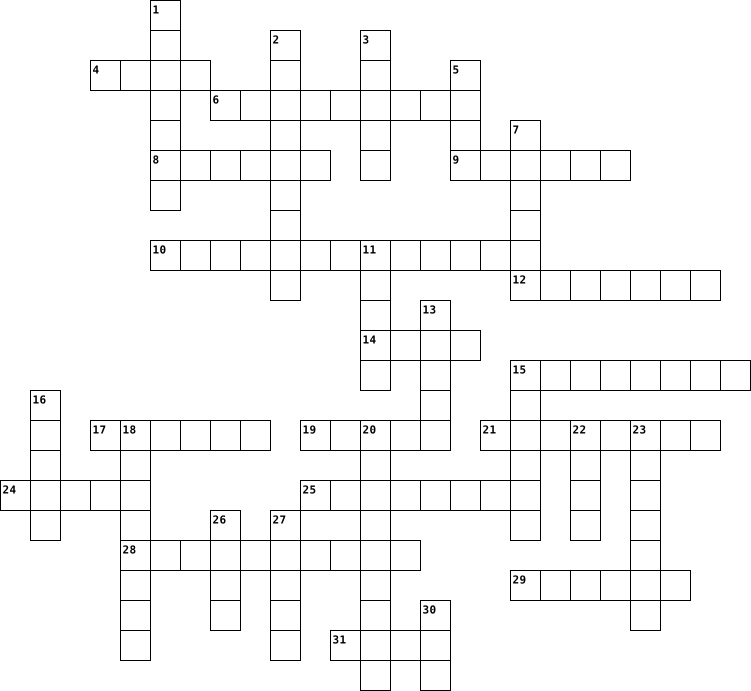
Across
- moon - the phase of the moon when Earth is between the moon and sun
- - A natural or artificial body that revolves around a planet
- - short period of climate change in an area caused by the tilt of Earth's axis as Earth revolves around the sun. (winter, summer, autumn, spring)
- - An object that orbits a star, is large enough to have become rounded by its own gravity, and has cleared the area of its orbit.
- - A group of stars that form a pattern in the sky
- - the moon's shape when more than half is illuminated
- - imaginary line that passes through the Earth's center from the North to the South
- - In summer and winter and the Earth has the longest day/shortest night or the shortest day/longest night
- - describes phases that occur after a full moon, as the visible lighted side of the Moon grows smaller
- - A ball of frozen dust and rock that orbits the sun and has a tail that glows
- - the moon's shape when less than half of it is illuminated
- - Earths path as it revolves around the sun
- - spinning on an axis
- - moving around another object in space
- - A streak of light in the sky produced by the burning of a meteoroid in Earth's atmosphere.
- - the rise and fall of Earth's water
Down
- - The shape of Earth's orbit
- - A meteoroid that has hit earth's surface.
- eclipse - when the moon comes between Earth and the sun
- tide - when the Sun, Earth and Moon make a right angle and the high tides are lower than usual and the low tides are a little higher than usual.
- - describes phases following a new moon, as more of the Moon's
- cycle - A sequence of phases of the moon as it revolves around the Earth once every 29.5 days.
- quarter - this phase of the moon occurs about 7 days after a new moon
- tide - when the Sun, Earth, and Moon are lined up and high tides are higher and low tides are lower.
- planet, planetoid - a celestial body resembling a small planet but lacking certain technical criteria that are required for it to be classed as such.
- - any of numerous small celestial bodies composed of rock and metal that move around the sun (mainly between the orbits of Mars and Jupiter)
- - a small body moving in the solar system that would become a meteor if it entered the earth's atmosphere.
- - A ball of hot gas, primarily hydrogen and helium, that undergoes nuclear fusion.
- - when the sun's direct light is closest to the equator, in spring and fall and the Earth has equal day and night
- phases - The changing appearances of the Moon as seen from Earth
- eclipse - when the shadow of Earth falls on the moon
- moon - the phase of the moon when the moon is between Earth and sun, when the moon looks like darkness. has no light reflected
32 Clues: - spinning on an axis • - The shape of Earth's orbit • - the rise and fall of Earth's water • - moving around another object in space • - A meteoroid that has hit earth's surface. • - Earths path as it revolves around the sun • - A group of stars that form a pattern in the sky • eclipse - when the shadow of Earth falls on the moon • ...
p-11 2023-05-05

Across
- (Round representation of the Earth)
- (Female big cat)
- (Desert plant with spines)
- (Place with books and resources)
- (Writing instrument)
- (Board game of strategy)
- (Stringed instrument)
- (Activity of catching aquatic animals)
- (Medical professional)
- (Middle of the workweek)
- (Man-made object orbiting Earth)
- (Musical instrument with keys)
- (Mountain that erupts with lava)
Down
- (Colorful insect with wings)
- (Day of the week)
- (Inflated rubber object)
- (Device for capturing images)
- (Multicolored arc in the sky)
- (Precious gemstone)
- (Large animal with a trunk)
20 Clues: (Female big cat) • (Day of the week) • (Precious gemstone) • (Writing instrument) • (Stringed instrument) • (Medical professional) • (Inflated rubber object) • (Board game of strategy) • (Middle of the workweek) • (Desert plant with spines) • (Large animal with a trunk) • (Colorful insect with wings) • (Device for capturing images) • (Multicolored arc in the sky) • ...
Sun Earth And moon 2023-10-23

Across
- A big ball of gas and fire
- either the shortest day of the year or the longest day of the year
- There are only two times of the year when the Earth's axis is tilted neither toward nor away from the sun, resulting in a "nearly" equal amount of daylight and darkness at all latitudes.
- The hottest season
- Comes after winter
- Comes after summer
- What earth spins around
- Revolves around the sun
- The center of our solar system
Down
- Earth's axis is pointed toward what.
- Revolves around earth
- First season of the year
- lasting changes in weather that occur 4 times a year
- made up of a star—the Sun—eight planets, 146 moons, a bunch of comets, asteroids and space rocks, ice, and several dwarf planets, such as Pluto.
- Revolves around a star
15 Clues: The hottest season • Comes after winter • Comes after summer • Revolves around earth • Revolves around a star • What earth spins around • Revolves around the sun • First season of the year • A big ball of gas and fire • The center of our solar system • Earth's axis is pointed toward what. • lasting changes in weather that occur 4 times a year • ...
Earth in Space 2025-09-17

Across
- The curved path of a celestial body around a star or planet.
- Earth's orbit around the Sun, taking about 365 days.
- An event where one celestial body blocks the light of another.
- A period of the year with specific weather patterns, caused by Earth's tilted axis.
- The slant of Earth's axis, which is about 23.5 degrees.
- The spinning of Earth on its axis, causing day and night.
- The different appearances of the Moon as seen from Earth.
- The rise and fall of ocean water, caused mainly by the Moon's gravity.
Down
- A lunar phase where more than half of the Moon is lit up.
- The two times a year when day and night are nearly equal in length.
- A curved lunar phase that looks like a sliver.
- The day with the longest or shortest period of daylight.
- An imaginary line through the center of a planet, around which it rotates.
- The force that keeps planets in orbit around the Sun.
- A weak tide that occurs when the Sun and Moon are at a right angle to Earth.
15 Clues: A curved lunar phase that looks like a sliver. • Earth's orbit around the Sun, taking about 365 days. • The force that keeps planets in orbit around the Sun. • The slant of Earth's axis, which is about 23.5 degrees. • The day with the longest or shortest period of daylight. • A lunar phase where more than half of the Moon is lit up. • ...
Earth - Sun - Moon 2026-04-17

Across
- The side of the Earth closest to the moon and the side opposite the moon will experience a . . .
- Moon phase in image A
- Seasons are caused by the Earth's ______ and its revolution around the sun.
- Season in northern hemisphere in image E
- The Earth's _______ protects Earth from harmful rays from the sun.
- Day and night are caused by Earth's _______ on its axis.
- When the Earth, Sun, and Moon are at right angles to each other, a _____ tide is formed.
- Season in northern hemisphere in image F
- A trip of the Earth around the sun is called a ______.
- Earth is generally the warmest near the ______.
- The equator is warmest because it get the most _____ sunlight.
- One revolution of the Earth around the sun takes about . . .
- The highest high tides would occur during a _____ moon and a new moon.
- The tilt of the Earth and its revolution around the sun causes _____.
Down
- Season in the northern hemisphere in image C
- The side of the Earth that faces away from the sun is experiencing _____.
- What moon phase is not visible from Earth because the side facing Earth is completely shaded?
- Season in the northern hemisphere in image D
- Moon phase in image H
- The light reflected on the moon from the sun AND the moon's location cause us to have . . .
- Moon phase in image B
- The moon's ________ causes tides.
- The Earth's atmosphere is about 80% nitrogen and 20% _____.
- Moon phase in image G
24 Clues: Moon phase in image A • Moon phase in image H • Moon phase in image B • Moon phase in image G • The moon's ________ causes tides. • Season in northern hemisphere in image E • Season in northern hemisphere in image F • Season in the northern hemisphere in image C • Season in the northern hemisphere in image D • Earth is generally the warmest near the ______. • ...
Space Crossword 2016-05-25

Across
- Everything that exists.
- A number solar systems grouped together
- Dust particles frozen in ice that orbit the Sun.
- when the Earth comes between the Sun and the Moon.
- A rocky inner planet, third from the Sun in the Solar System.
- A eclipse where only part of the Sun is covered
- An object that has fallen to Earth from outer space.
- Changes in weather and the temperature during the year
Down
- where the Moon comes between the Sun and the Earth.
- The time it takes a planet to make one full spin on its axis.
- A manmade spacecraft.
- An eclipse where all of the Sun is covered by the Moon.
- rock or dust that makes a streak of light in the night sky.
- The path taken by one body in space around another
- A rocky inner planet, fourth from the Sun
- The period of time that half the earth is facing away from the sun
- Earth’s only natural satellite.
- The imaginary line that the Earth spins around
18 Clues: A manmade spacecraft. • Everything that exists. • Earth’s only natural satellite. • A number solar systems grouped together • A rocky inner planet, fourth from the Sun • The imaginary line that the Earth spins around • A eclipse where only part of the Sun is covered • Dust particles frozen in ice that orbit the Sun. • when the Earth comes between the Sun and the Moon. • ...
GEOLOGY 2016-07-13

Across
- Days are longer than nights
- Study of the structure and composition of earth
- Formed from hot molten materials through hardening or solidification
- Precious or semi-precious e.g. diamond
- Tells the time of the day from the position of the moving shadow cast by the sun
- Thin outer layer that is made up of light rocks
- Formed from sediments of weathered rocks, deposited at the button of rivers or oceans, then compacted or lithified
- East-west location of a place
- Approximately the same length as tropical year from January to January
- Color of a thin layer of the finely powdered minerals
- Mixture of metallic element and waste mineral; e.g. uraninite
- Generally classed as metals but are not sources of metals
- Formed from already existing rocks
- Equal length of day and night
- Nights are longer than days
- Great circle that divides the earth into two equal halves
Down
- Occur because of the earth does not rotate in an upright position, compared to the plane of orbit around the sun
- Extends from about 1,800 to about 3,100 miles
- Ability to absorb light and give off visible rays of longer wavelength
- Minerals made up of silicon e.g. olivine
- During summer when daylight hours, are longer, clocks are set one hour ahead of standard time in April, ten set back again sometimes in fall
- Measured by the time the earth takes to make one revolution around the sun
- Natural solid materials of the earth's crust, made up of minerals
- Attraction to a magnet
- Ability of a mineral to reflect, refract, or absorb light falling on the surface
- It had a diameter of 7936 miles
- Reaches from 3,100 miles to the center of the earth
- Formed in nature and with fixed chemical composition
- North-south location of any place on earth
- Is able to flow very slowly like a thick liquid
30 Clues: Attraction to a magnet • Days are longer than nights • Nights are longer than days • East-west location of a place • Equal length of day and night • It had a diameter of 7936 miles • Formed from already existing rocks • Precious or semi-precious e.g. diamond • Minerals made up of silicon e.g. olivine • North-south location of any place on earth • ...
astronomy 2025-05-14

Across
- most comets can be found here, or in the Oort Cloud
- An invisible line Earth spins around.
- ____ planets: Mercuty, Venus, Earth, Mars
- everything that has ____ has gravity.
- Discovered three laws that describe the way that planets move
- the life phase that our sun is currently in
- this planet is closest to the sun
- our solar system is in this galaxy
- this motion creates one day
- A measure of how far north or south a place is from the Equator.
- an object that orbits another object
- region between Mars and Jupiter
- gas ____: Jupiter, Saturn, Uranus, Neptune
- The path Earth takes around the Sun.
- a main sequence star's fuel
- The imaginary line around Earth at 0° latitude.
- Explained why Kepler's laws must be true
Down
- The amount of time a place gets sunlight in a day.
- this process produces helium and energy in middle aged stars
- in order for an object to remain in orbit, forces must be ____
- the force of motion
- One half of the Earth (Northern or Southern).
- a collection of stars
- a push or pull that happens when two or more objects interact
- a space rock that has entered Earth's atmosphere
- refers to a star's brightness on the HR Diagram
- the final form of a medium sized star
- this motion creates one year
- an invisible force that pulls objects towards a body's center
- the theory that the sun is the center of the solar system
- this planet formed first
- The angle (23.5°) at which Earth leans from vertical.
- this planet is the only one that supports life
- the final form of a supermassive star
- increasing this will decrease one object's gravitational pull on another
- a cloud of dust and gas that will form a star
36 Clues: the force of motion • a collection of stars • this planet formed first • this motion creates one day • a main sequence star's fuel • this motion creates one year • region between Mars and Jupiter • this planet is closest to the sun • our solar system is in this galaxy • an object that orbits another object • The path Earth takes around the Sun. • ...
Influences of Weather and Climate 2023-03-14

Across
- average weather patterns for a particular region
- the day-to-day state of the atmosphere
- the large-scale movement of air around Earth
- geographic coordinate that specifies the north-south position of a point on Earth's surface
- the spinning of Earth on its axis that causes day and night to occur
Down
- the layer of gas surrounding a planet that is held in place by gravity
- directional movements of ocean water; surface currents result from steady winds over the ocean surface; deep currents result from density variations due to temperature and salinity differences
- the study of specific regions of Earth
- the distance from sea level
- The appar4ent deflection of moving air, as seen by an observer on Earth, as a result of Earth's rotation
10 Clues: the distance from sea level • the study of specific regions of Earth • the day-to-day state of the atmosphere • the large-scale movement of air around Earth • average weather patterns for a particular region • the spinning of Earth on its axis that causes day and night to occur • the layer of gas surrounding a planet that is held in place by gravity • ...
Astronomy 2024-09-26

Across
- Has 16 moons
- What Earth does that causes day & night
- Smallest Planet
- Sometimes called a shooting star
- Causes seasons
- Biggest planet
- Large space rock that orbits the sun
Down
- Earth is covered in large ______
- Group of planets Farther from the sun
- Group of planets Closer to the sun
- Earth is sometimes referred to as the ____
- Has 146 moons (6th planet from sun)
- our galaxy
- Tail always points away from the sun
- Orbits on it's side
- Doesn't clear it's neighborhood
- Main source of energy & made of plasma & superheated gas
- Result of the gravitational pull on the surface waters
18 Clues: our galaxy • Has 16 moons • Causes seasons • Biggest planet • Smallest Planet • Orbits on it's side • Doesn't clear it's neighborhood • Earth is covered in large ______ • Sometimes called a shooting star • Group of planets Closer to the sun • Has 146 moons (6th planet from sun) • Tail always points away from the sun • Large space rock that orbits the sun • ...
Creation - Days 2&3 2023-02-03

Across
- What appeared for the first time when God separated the sky from the waters?
- The waters that were gathered together by God was called ____.
- One of the Land features God created, that has water falling from a great height.
- What book of the Bible is our lesson from?
- What substance covered the entire earth?
- What did God call the air
- What is the first thing God created on Day 3?
Down
- One of the land features that God created, that is a body of water surrounded by land.
- What did God create to separate the waters?
- What did God create next on Day 3?
- What does Genesis mean?
- One type of plant God created on Day 3 that is brightly coloured.
- One type of trees God created that provides us with food, eg mango.
- What did God call his first creation on Day 3?
14 Clues: What does Genesis mean? • What did God call the air • What did God create next on Day 3? • What substance covered the entire earth? • What book of the Bible is our lesson from? • What did God create to separate the waters? • What is the first thing God created on Day 3? • What did God call his first creation on Day 3? • ...
Birthday Boaz! 2025-01-11

Across
- Milking helper
- Country new this year!
- Tractor playmate
- Race you push toward
- Favorite toddler on Earth
- Day of week born on
- Season born in
- Pushing or milking cows?
- Ocean touched day of your labor
Down
- Bless the man that fears
- Building material you are like
- Facial adornment
- O’Neill buddy!
- Wrestling matchmate
- Love to catch
- Favorite baker!
- Book series loved this year
17 Clues: Love to catch • Milking helper • O’Neill buddy! • Season born in • Favorite baker! • Facial adornment • Tractor playmate • Wrestling matchmate • Day of week born on • Race you push toward • Country new this year! • Bless the man that fears • Pushing or milking cows? • Favorite toddler on Earth • Book series loved this year • Building material you are like • Ocean touched day of your labor
NST Revision Term 4 2017-10-25

Across
- / We are close to the Sun.
- / The giant
- / Day and night
- / Rings of _&_.
- body / object with mass
- / Gas giants
- / flat area
- / Thanks to the tilt, we have...
- / Closest to the sun
- / Takes up atoms
Down
- / 84 earth years, one _year.
- / Keep your feet on the ground.
- / The red planet
- / visible on moon
- / brightest after moon
- / object that orbits a bigger object
- / Piece of rock
- / Moon landing: 20__1969.
- / The Moon ___ light on Earth.
- / 365.25 days
- / Does not move
21 Clues: / The giant • / flat area • / Gas giants • / 365.25 days • / Day and night • / Rings of _&_. • / Piece of rock • / Does not move • / The red planet • / Takes up atoms • / visible on moon • / Closest to the sun • / brightest after moon • body / object with mass • / Moon landing: 20__1969. • / We are close to the Sun. • / 84 earth years, one _year. • / The Moon ___ light on Earth. • ...
High Frequency Words 2023-05-11

Across
- deserving of attention
- commendable
- someone who live in America
- gain knowledge
- land
- photo
- sound uttered through the mouth
- all or done
- mammal
- ten times ten
- grieving the loss of a loved one
- a model or pattern
Down
- remarkable, amazing
- ordinary, plain
- great significance
- earth
- to recall facts or events from the past
- written thought
- distinct or particular
- a part
- high temperature
- likely
- maybe
- low temperature
- container
- pay attention to
- early part of the day
27 Clues: land • earth • photo • maybe • a part • likely • mammal • container • commendable • all or done • ten times ten • gain knowledge • ordinary, plain • written thought • low temperature • high temperature • pay attention to • great significance • a model or pattern • remarkable, amazing • early part of the day • deserving of attention • distinct or particular • someone who live in America • sound uttered through the mouth • ...
Unit 1 Solar System 2023-10-04

Across
- shadow of the moon falls on Earth; moon moves between the sun & Earth
- means the part of the moon we see is getting smaller
- shine day and night but only visible after the sun sets
- groups of stars in specific patterns
- first person to design an instrument that demonstrated Earth's rotation.
- change in the sunlit area of one celestial body
- Earth is between the Moon and Sun
- visible fraction of the sunlit moon continues to decrease
- sun rises in the
Down
- shadow of Earth falls on the moon; Earth is between the moon and the sun
- from Earth's Northern Hemisphere, the right half of the moon appears fully
- sun sets in the
- occurs when the sun appears to be completely blocked except for a bright halo of light.
- thin sliver of the moon becomes visible and continues to grow
- happens when the shadow of one celestial body falls on another
- period of time when the sun is directly shining on an area of Earth.
- path that a body follows as it travels around another body
- moon is between Earth and the sun
18 Clues: sun sets in the • sun rises in the • Earth is between the Moon and Sun • moon is between Earth and the sun • groups of stars in specific patterns • change in the sunlit area of one celestial body • means the part of the moon we see is getting smaller • shine day and night but only visible after the sun sets • visible fraction of the sunlit moon continues to decrease • ...
Birthday Boaz! 2025-01-11

Across
- Milking helper
- Country new this year!
- Tractor playmate
- Race you push toward
- Favorite toddler on Earth
- Day of week born on
- Season born in
- Pushing or milking cows?
- Ocean touched day of your labor
Down
- Bless the man that fears
- Building material you are like
- Facial adornment
- O’Neill buddy!
- Wrestling matchmate
- Love to catch
- Favorite baker!
- Book series loved this year
17 Clues: Love to catch • Milking helper • O’Neill buddy! • Season born in • Favorite baker! • Facial adornment • Tractor playmate • Wrestling matchmate • Day of week born on • Race you push toward • Country new this year! • Bless the man that fears • Pushing or milking cows? • Favorite toddler on Earth • Book series loved this year • Building material you are like • Ocean touched day of your labor
Earth 2022-04-25

Across
- Relating to living matter
- Place where all trash goes
- Able to be maintained
- Science dealing with organisms
- Maintain original state
- Fertilizer for plants
- Layers of gasses surrounding the planet
- Harmful gasses in the stratosphere
- Area used by specific organisms
- The conditions you live in
- No longer existing
Down
- Able to be used as much as it gets created
- Protect
- Produced by burning fuel for power or heat
- Energy from the sun
- A biological community of organisms
- Contaminate
- Trash anywhere but the trash can
- Reuse something from something else
19 Clues: Protect • Contaminate • No longer existing • Energy from the sun • Able to be maintained • Fertilizer for plants • Maintain original state • Relating to living matter • Place where all trash goes • The conditions you live in • Science dealing with organisms • Area used by specific organisms • Trash anywhere but the trash can • Harmful gasses in the stratosphere • ...
Earth 2024-10-14

Across
- – A direction corresponding to the top of the Earth.
- – To make something a part of a whole.
- – A cardinal direction opposite to north.
- – A cardinal direction, opposite to west.
- – A perfectly round three-dimensional object, like a ball.
- – A point on the Earth's surface where the axis of rotation meets, located at the farthest north or south.
- – Imaginary lines running from the North to the South Pole, used to measure longitude.
- – The measurement of distance north or south of the equator.
- – When the sun appears to drop below the horizon.
- – The imaginary line that divides the Earth into the Northern and Southern Hemispheres.
- – A division of the year marked by changes in weather, daylight, and temperature.
Down
- – Having the shape of a sphere or ball.
- – The measurement of distance east or west of the prime meridian.
- – Half of the Earth, divided by either the equator or a meridian.
- – Imaginary lines running around the Earth, parallel to the equator, used to measure latitude.
- – The average weather conditions of a region over a long period of time.
- – A fraction representing 66.67% of a whole.
- – When the sun appears to come up over the horizon.
- – A cardinal direction, opposite to east.
19 Clues: – To make something a part of a whole. • – Having the shape of a sphere or ball. • – A cardinal direction opposite to north. • – A cardinal direction, opposite to west. • – A cardinal direction, opposite to east. • – A fraction representing 66.67% of a whole. • – When the sun appears to drop below the horizon. • – When the sun appears to come up over the horizon. • ...
Earth 2024-11-12

Across
- plate move together
- process of wind carrying away loose sediment mainly in desert regions
- Fastest longitudinal can go through solid and liquid
- The action of picking up and moving materials
- in dry areas sediment collects when it Rains it loosens sediment and water rush downhill
- Hotter and softer rock in the upper mantle
- an instrument used to detect ground movement
- plates that pull apart
- Boundary plates that scrap off each other
Down
- sand grains can wear away surface of rocks buildings like a piece of Sandpaper
- sediment builds up can be many miles wide excellent farming
- rapid movement of large amounts of rock and soil (often occur after heavy rain or earthquake)
- roll and tumble rocks against each other break into smaller pieces sediment acts like sand paper on rocks
- Spot some places heated rock rises to make a volcano
- Dropping of weathered material somewhere else aids in creation of new landform
- Earth’s crust and the top of the mantle
- has so much snow it can’t melt weight increases to form ice pressure is so much it partially melts at the bottom it starts moving
- 2nd waves transverse can only go through solid
- Weak Layers underground move downhill as a single unit
- Gradual movement of soil downhill
20 Clues: plate move together • plates that pull apart • Gradual movement of soil downhill • Earth’s crust and the top of the mantle • Boundary plates that scrap off each other • Hotter and softer rock in the upper mantle • an instrument used to detect ground movement • The action of picking up and moving materials • 2nd waves transverse can only go through solid • ...
B4S4 2024-04-24

Across
- the layer of gas surrounding a planet that is held in place by gravity
- the large scale movement of air around Earth
- the apparent deflection of moving air, as seen by an observer on Earth, as a result of Earth's rotation
- directional movements of ocean water; surface currents result from steady winds over the ocean surface; deep currents result from density variations due to temperature and salinity differences.
Down
- the distance from sea level
- the study of specific regions of Earth.
- the day to day state of the atmosphere
- geographic coordinate that specifies the north-south position of a point on Earth's surface
- the spinning of Earth on its axis that causes day and night to occur
- average weather patterns for a particular region
10 Clues: the distance from sea level • the day to day state of the atmosphere • the study of specific regions of Earth. • the large scale movement of air around Earth • average weather patterns for a particular region • the spinning of Earth on its axis that causes day and night to occur • the layer of gas surrounding a planet that is held in place by gravity • ...
Ulangan Tata surya_SAYZAICP2 2026-01-22

Across
- What galaxy contains our Solar System?
- What is the outer layer of the Sun called?
- What belt of asteroids lies between Mars and Jupiter?
- What belt lies beyond Neptune?
- What is the path of a planet around the Sun called?
- Which planet that has a very visible ring?
- What is the center of our Solar System?
- What is the name of organization space USA?
- What forms when a massive star collapses completely?
- What is the hottest layer of the Sun called?
- What unit measures Earth–Sun distance?
- What explosive events release energy from the Sun’s surface?
- What object survives and hits Earth?
- What planet human live?
- What is the largest planet in solar system?
- What layer of the Sun lies above the photosphere?
- What system includes planets and the Sun?
- What dark features on the Sun indicate strong magnetic activity?
- How many minutes that sunlight take to reach earth?
- What belt lies between Mars and Jupiter?
- What is planet that has longest year?
Down
- What large system contains billions of stars?
- What gas protects Earth from harmful UV rays?
- What motion causes day and night?
- Which planet who called “Red planet”?
- What the object that orbiting sun?
- Which planet that has a day longer than a year?
- What property describes how much light a planet reflects?
- What is the coldest planet on solar systems?
- What is the true color of Sun?
- What do we call a cloud of gas in space?
- What motion is Earth orbiting the Sun called?
- What layer of gas surrounds Earth?
- What visible surface of the Sun emits light?
- Where is stars found?
- What motion causes a year?
- What object has a glowing tail near the Sun?
- What star is closest to Earth?
- Which planet who closest to sun?
- What force pulls gas together to form stars?
- What does star give?
- What gas is most abundant in the Sun?
42 Clues: What does star give? • Where is stars found? • What planet human live? • What motion causes a year? • What belt lies beyond Neptune? • What is the true color of Sun? • What star is closest to Earth? • Which planet who closest to sun? • What motion causes day and night? • What the object that orbiting sun? • What layer of gas surrounds Earth? • What object survives and hits Earth? • ...
Influences of Weather and Climate 2022-12-08

Across
- The spinning of Earth on its axis that causes day and night to occur
- The study of specific regions of Earth
- The large-scale movement of air around Earth
- The day-to-day state of the atmosphere
- The distance from sea level
Down
- The layer of gas surrounding a planet that is held in place by gravity
- Geographic coordinate that specifies the north south position of a point on Earth’s surface
- The apparent deflection of moving air, as seen by an observer on Earth, as a result of Earth’s rotation
- Average weather patterns for a particular region
- Directional movements of ocean water; surface currents result from steady winds over the ocean surface; deep currents result from density variations due to temperature and salinity differences
10 Clues: The distance from sea level • The study of specific regions of Earth • The day-to-day state of the atmosphere • The large-scale movement of air around Earth • Average weather patterns for a particular region • The spinning of Earth on its axis that causes day and night to occur • The layer of gas surrounding a planet that is held in place by gravity • ...
Earth Science Semester Exam 2022-12-14

Across
- The Creation ___ states that we should use Earth's resources to glorify God
- S waves do not travel through the Earth's ___ outer core
- ____ currents in the mantle move the tectonic plates
- The type of boundary where two plates collide
- _____ of light and dark was on Day 1 of Creation Week
- _____ scientists say Earth is 4.6 billion years old
- ___ Plate Tectonics explains rapid seafloor spreading during The Flood
Down
- States that the present is the key to the past
- Science that deals with the unobservable past
- The process that involves one plate sinking beneath another plate
- The worldview that believes in a 6-day Creation Week
- Water does this to animals' and Earth's temperatures
- ____ spreading takes place at mid-ocean ridges
- Land _____ were created on Day 6 of Creation Week
- The name Alfred Wegener came up with for the supercontinent
- The study of Earth
16 Clues: The study of Earth • Science that deals with the unobservable past • The type of boundary where two plates collide • States that the present is the key to the past • ____ spreading takes place at mid-ocean ridges • Land _____ were created on Day 6 of Creation Week • _____ scientists say Earth is 4.6 billion years old • ...
Earth Science Exam Prep 2021-12-14

Across
- The Creation ___ states that we should use Earth's resources to glorify God
- S waves do not travel through the Earth's ___ outer core
- ____ currents in the mantle move the tectonic plates
- The type of boundary where two plates collide
- _____ of light and dark was on Day 1 of Creation Week
- _____ scientists say Earth is 4.6 billion years old
- ___ Plate Tectonics explains rapid seafloor spreading during The Flood
Down
- States that the present is the key to the past
- Science that deals with the unobservable past
- The process that involves one plate sinking beneath another plate
- The worldview that believes in a 6-day Creation Week
- Water does this to animals' and Earth's temperatures
- ____ spreading takes place at mid-ocean ridges
- Land _____ were created on Day 6 of Creation Week
- The name Alfred Wegener came up with for the supercontinent
- The study of Earth
16 Clues: The study of Earth • Science that deals with the unobservable past • The type of boundary where two plates collide • States that the present is the key to the past • ____ spreading takes place at mid-ocean ridges • Land _____ were created on Day 6 of Creation Week • _____ scientists say Earth is 4.6 billion years old • ...
Tides Crossword 2023-11-08

Across
- A instrument that is used to measure tides by recording the heights of the water at different times or making continuous graphs of the height of the water over time
- Pulls the Earth through gravity but less than the Moon due to its distance from Earth
- An ecosystem that is directly affected by tides
- When ocean water advances to its furthest extent onto the shore
- A relatively strong narrow current flowing outward from the beach through the surf zone, presenting hazard to swimmers
- Acts with gravity in opposition of Earth's oceans to create two tidal bulges
- Occurs 6 hours after every high tide
- when the Sun Moon and Earth are in a straight line, causing stronger gravitational pulls and extreme tides
- The rising and falling of ocean currents, occurring every 6 hours
Down
- Pulls the Earth to create tides
- When an area only gets one high tide and one low tide per lunar day
- An industry affected directly by tides
- The force that attracts a body towards the center of the Earth or towards any other physical body that has mass
- 29 and 1/2 days measured between successive new moons
- when the Sun Moon and Earth create a right angle and the gravitational pulls balance out creating moderate tidal changes
- When an area experiences two high tides and two low tides of different sizes per lunar day
16 Clues: Pulls the Earth to create tides • Occurs 6 hours after every high tide • An industry affected directly by tides • An ecosystem that is directly affected by tides • 29 and 1/2 days measured between successive new moons • When ocean water advances to its furthest extent onto the shore • The rising and falling of ocean currents, occurring every 6 hours • ...
Mid. Sch. Sci. Test Review Lesson #46-51 2020-02-04

Across
- the planet closest to the sun
- this object tells the time of day based on its shadow
- The sun is _____ in the summer than it is in the winter.
- what is measured by the time it takes for the earth to make one orbit around the sun
- A shadow is _____ in the winter than it is in the summer.
- The sun's light must travel through _____ air in the evening than it does at noon.
- The _____ moves in the sky during the day to change the way it hits a building, which changes the length of the buildings shadow during the day, even though the building doesn't move.
Down
- what is measured by the time it takes for the earth to make one rotation.
- the planet farthest from the sun
- The earth's _____ causes it to appear that the sun is moving across the sky.
- We move quickly (even when sitting still) because the _____ rotates quickly, and we rotate with it.
- the color of light which is most likely to bounce off the particles in the air
- A tree's shadow is the shortest at _____.
13 Clues: the planet closest to the sun • the planet farthest from the sun • A tree's shadow is the shortest at _____. • this object tells the time of day based on its shadow • The sun is _____ in the summer than it is in the winter. • A shadow is _____ in the winter than it is in the summer. • what is measured by the time it takes for the earth to make one rotation. • ...
Creation 2023-11-23

Across
- the first man
- They are found in the farms and zoos
- We are h_____
- God said let there be _________
- A place where people produce and flowers
- God _______ earth
Down
- God said there was nothing but empty ________
- God called the light ___
- God called the darkness _____
- We live on the E____
- ___ Created Heaven and Earth
- The first woman
12 Clues: the first man • We are h_____ • The first woman • God _______ earth • We live on the E____ • God called the light ___ • ___ Created Heaven and Earth • God called the darkness _____ • God said let there be _________ • They are found in the farms and zoos • A place where people produce and flowers • God said there was nothing but empty ________
Creation 2025-01-29

Across
- Let the water teem the living ___________.
- On the sixth day He created ____________.
- Gen. 1:3 Let there be ____________.
- What was the dry ground called?
Down
- First woman on Earth.
- In the __________ God created the heavens and the Earth.
- Gen. 1:6-8 God called the vault ___________.
- We should keep the seventh day ___________.
- First man on Earth.
9 Clues: First man on Earth. • First woman on Earth. • What was the dry ground called? • Gen. 1:3 Let there be ____________. • On the sixth day He created ____________. • Let the water teem the living ___________. • We should keep the seventh day ___________. • Gen. 1:6-8 God called the vault ___________. • In the __________ God created the heavens and the Earth.
Earth's Rotation and Revolution 2022-03-11

Across
- imaginary line through Earth from N to S Pole
- when Earth turns around its axis
- area of the world where all clocks are the same
- side of Earth facing Sun has this
- the path a planet follows around the Sun
- side of Earth facing away from Sun has this
Down
- Earth rotates from west to...
- Earth's axis is not straight, it's...
- the movement of a planet around the Sun
- one complete turn of Earth
- the Sun rises in the east and sets in the...
- one complete trip around the Sun
12 Clues: one complete turn of Earth • Earth rotates from west to... • when Earth turns around its axis • one complete trip around the Sun • side of Earth facing Sun has this • Earth's axis is not straight, it's... • the movement of a planet around the Sun • the path a planet follows around the Sun • side of Earth facing away from Sun has this • ...
The Secret of the Forgiveness of Sins 2019-12-20

Across
- the reason we are not in heaven anymore
- there is rejoicing here when we celebrate the Passover
- the New Covenant
- Job had already been this when God created the world
- the way to remove death and sin
- the only one who can forgive our sin
- Solomon felt this is heaven day after day
Down
- to go back
- God created us with the dust and breath of what
- Job was present when God laid this of the earth
- Jesus came to call these people
- God has this on earth to forgive sins
- bread and this
- flesh and this
- Jesus came to seek and save these peoples
15 Clues: to go back • bread and this • flesh and this • the New Covenant • Jesus came to call these people • the way to remove death and sin • the only one who can forgive our sin • God has this on earth to forgive sins • the reason we are not in heaven anymore • Solomon felt this is heaven day after day • Jesus came to seek and save these peoples • ...
Crosswrod puzzle : Forest and Wild Animals 2025-01-16

Across
- largest forest in India
- oldest national park in India
- which forest is called "lungs of earth"
- largest terrestrial ecosystem of earth
- hugging and wrapping arm around tree to protect them from felling
- The International Day of Forests is in which month
Down
- Worlds only floating National Park
- planting trees where there were none
- Month in which WORLD WILDLIFE CONSERVATION DAY falls
- forest in Sundarbans is also called
- saving, protecting & using recourses wisely
- thick layer of dead leaves & organic matter on forest soil
- area to preserve/safeguard wildlife in native habitat
- country which has largest area of forest cover
- tree with needle like leaves
15 Clues: largest forest in India • tree with needle like leaves • oldest national park in India • Worlds only floating National Park • forest in Sundarbans is also called • planting trees where there were none • largest terrestrial ecosystem of earth • which forest is called "lungs of earth" • saving, protecting & using recourses wisely • ...
Capitulum XXVI Vocabularia 2023-03-03

Across
- without
- sometimes
- on the following day
- main room
- earth
- I lie down
- unless
- sword
Down
- goods
- I save
- guard
- I do harm
- it happens
- robber
- I grab hold of
- fear
- eye
17 Clues: eye • fear • goods • guard • earth • sword • I save • robber • unless • without • sometimes • I do harm • main room • it happens • I lie down • I grab hold of • on the following day
#217 Braeden Rooney 2023-03-02

Across
- The sun is made with plenty of______.
- Gravity is a_____of attraction between two or more objects
- Earth has only one______it orbits Earth about once a month.
- The earth is tilted at a 23.5______angle so we have different shadows every hour.
- Australia has_____from January-March and Winter from June-September.
- Sunset is the exact moment when the sun falls below the________.
- The northern and southern hemisphere experience__seasons.
- Earth makes one complete_______on its axis every 23 hours and 56 minutes .
Down
- As the sun takes its arc-shaped path across the sky the shadows_________.
- The sun is a____and the sun is extremely hot.
- When the sun is directly overhead very little_____is observed
- down You can feel yourself being_________toward earth.
- The sun looks________and brighter than other stars because it is closer to earth.
- The position of Earth and the sun over the course of a______rotation cause sunrise, day, Sunset and night.
- The distance from the sun_____affect seasons.
- The____also rotates on its axis just like the sun and the planets.Shadow When the sun is directly overhead very little_____is observed.
- Force is a______gravity type of pull.
- It takes___full month for the moon to circle around earth.
18 Clues: The sun is made with plenty of______. • Force is a______gravity type of pull. • The sun is a____and the sun is extremely hot. • The distance from the sun_____affect seasons. • down You can feel yourself being_________toward earth. • The northern and southern hemisphere experience__seasons. • Gravity is a_____of attraction between two or more objects • ...
Common Misconceptions project crossword 2021-11-29

Across
- A Imaginary line separating the North Hemisphere and the South Hemisphere
- A Imaginary Line that shows where you are West or East
- A Imaginary line that shows where you are North or South
- What zone is the U.S.A in
- What the Earth spins on
- When the earth spins on its axis
Down
- The object the lights up the earth and keeps it in orbit
- 23 degrees of light
- The Object the revolves around the sun that is sustainable for life
- Looks like a circle but is not a circle
- A star that is over the North pole (Real Name)
- What season does the northern hemisphere have when the southern hemisphere has indirect sun light?
- What season is the Southern Hemisphere in on july 21?
- The time when a side of the earth is facing the sun
- When the Earth does a lap around the sun
- the earth is off by 25 degrees from being straight up is called
- When the earth did 1/12 of a full revolution.
17 Clues: 23 degrees of light • What the Earth spins on • What zone is the U.S.A in • When the earth spins on its axis • Looks like a circle but is not a circle • When the Earth does a lap around the sun • When the earth did 1/12 of a full revolution. • A star that is over the North pole (Real Name) • The time when a side of the earth is facing the sun • ...
Earth Day Puzzle 2021-04-06

Across
- The month of Earth day!!
- The fantastic blue and green planet we call home.
- They help our Earth is so many ways. For example, they cooling shade, attract birds and other animals, make our air and water cleaner, and add beauty to our homes and communities.
- - - - - - - - - is very bad for our Earth!! Hint: air, water, ect...
- We need to help protect our planet, as if we don't soon our planets oceans and - - - - - - - will be harmed.
Down
- Dozens of plants and animal species go - - - - - - - each day due to human activity.
- Remember to always reduce reuse, and - - - - - - - the amount of waste that you use on a day to day basis!!
- This is an example of a recyclable material.
- You definitely shouldn’t recycle this!!
9 Clues: The month of Earth day!! • You definitely shouldn’t recycle this!! • This is an example of a recyclable material. • The fantastic blue and green planet we call home. • - - - - - - - - is very bad for our Earth!! Hint: air, water, ect... • Dozens of plants and animal species go - - - - - - - each day due to human activity. • ...
Earth day crossword 2024-04-28

Across
- g.
- a.
- h.
- d.
Down
- f.
- i.
- b.
- e.
- c.
9 Clues: f. • g. • i. • b. • a. • e. • h. • c. • d.
S-E-M Lesson 1 Crossword 2021-06-23

Across
- Collection of planets, moons, and the Sun.
- Length of time for Earth to orbit Sun.
- The planet on which we live.
- Earth____ or spins on its axis.
- Earth's rotation results in ___ and night.
- Used to collect information about space.
- Earth's natural satellite.
Down
- A measure from side to side.
- Length of time for the Moon to orbit Earth.
- Collection of dust,gas, and stars.
- The only star in our solar system.
- What is the Sun?
- The Moon____ or orbits around the Earth.
13 Clues: What is the Sun? • Earth's natural satellite. • A measure from side to side. • The planet on which we live. • Earth____ or spins on its axis. • Collection of dust,gas, and stars. • The only star in our solar system. • Length of time for Earth to orbit Sun. • The Moon____ or orbits around the Earth. • Used to collect information about space. • ...
Earth and Seasons Review 2026-02-16

Across
- Two days a year when day and night are of equal length everywhere on Earth.
- The strength or concentration of solar energy hitting a specific area of Earth's surface.
- A single complete trip around the Sun, taking approximately 365.25 days.
- Half of the Earth, divided either North/South by the Equator or East/West.
- The imaginary line running through the North and South Poles around which Earth spins.
- The point in Earth's orbit when it is farthest from the Sun (usually in July).
Down
- The specific point in Earth's orbit when it is closest to the Sun (usually in January).
- Occurs twice a year when the Sun reaches its highest or lowest point in the sky at noon.
- The actual shape of Earth's orbital path, rather than a perfect circle.
- 23.5-degree angle of Earth's axis that is the primary cause of the seasons.
- The nearly circular path Earth follows as it travels around the Sun.
- The region of Earth receiving the most direct sunlight throughout the year.
- The spinning of Earth on its axis, which creates the cycle of day and night.
13 Clues: The nearly circular path Earth follows as it travels around the Sun. • The actual shape of Earth's orbital path, rather than a perfect circle. • A single complete trip around the Sun, taking approximately 365.25 days. • Half of the Earth, divided either North/South by the Equator or East/West. • ...
Earth 2017-05-23

Across
- opening in Earth's surface
- magma that reaches Earth's surface
- block of crust and upper mantle
- Instrument used to record earthquake waves
- Earth's outer most layer
- measure of the energy released by an earthquake
- crack in Earth's crust along which rocks move
- movement of sediments from one place to another
- center part of Earth
Down
- scientist that studies Earth
- mountain that forms around a vent where magma escapes
- melted rock formed inside Earth
- force that acts on tectonic plates
- vibration of the ground caused by sudden movements along faults
- point on Earth's surface directly above an earthquakes focus
- solid iron center of Earth's core
- formed when lava cools above Earth's surface
- layer of Earth between the crust and outer core
- point in Earth's interior where earthquake energy is released
19 Clues: center part of Earth • Earth's outer most layer • opening in Earth's surface • scientist that studies Earth • melted rock formed inside Earth • block of crust and upper mantle • solid iron center of Earth's core • force that acts on tectonic plates • magma that reaches Earth's surface • Instrument used to record earthquake waves • formed when lava cools above Earth's surface • ...
earth 2021-03-04

Across
- rock layer bend under stress
- each piece of the lithosphere
- crack that forms between 2 blocks
- 2 plates move past eachother horizontally
- stress that stretches/pulls rocks apart
- located between the core and crust
- strong lower part of mantle
- stress that squeezes/pushes rock together
- large single landmass
- the innermost layer of earth
Down
- 2 plates move away from eachother
- weak soft part of the mantle that is made of rocks
- theory that earth's crust is broken into large slowly moving pieces
- rigid mart of the mantle
- form where 2 plates collide
- changes rocks shape from stress
- process of molten rock in earth rising through mid-ocean ridges
- outermost layer of earth
- stress that pushes rock parrallel but opposite directions
19 Clues: large single landmass • rigid mart of the mantle • outermost layer of earth • form where 2 plates collide • strong lower part of mantle • rock layer bend under stress • the innermost layer of earth • each piece of the lithosphere • changes rocks shape from stress • 2 plates move away from eachother • crack that forms between 2 blocks • located between the core and crust • ...
Earth 2023-07-12

Across
- The people, places, and things that exist on the earth.
- A mass of tiny water droplets or ice crystals that floats in the air and can make different shapes.
- A liquid substance that covers most of the earth’s surface and is essential for life.
- A bright point of light in the sky that is actually a very far away sun.
- A mixture of gases that surrounds the earth and that we breathe.
- Water that falls from the clouds to the earth in drops.
- A very high and steep hill of rock or earth.
- A weather condition that involves strong wind, rain, thunder, lightning, or snow.
- The star that is the center of our solar system and that gives us light and heat.
Down
- The movement of air from one place to another that we can feel and hear.
- A very large body of salt water that covers most of the earth’s surface.
- A large area of land covered with many trees and plants
- A colorful arc in the sky that is often seen after rain and is made by sunlight shining through water droplets.
- A large stream of water that flows across the land into a lake, sea, or ocean.
- A large round object that orbits the sun or another star.
- The solid part of the earth’s surface that is not covered by water.
- Water that freezes in the air and falls to the earth in flakes.
- The natural satellite that orbits the earth and that we see at night.
- The space above the earth where we see the sun, moon, stars, and clouds.
19 Clues: A very high and steep hill of rock or earth. • The people, places, and things that exist on the earth. • A large area of land covered with many trees and plants • Water that falls from the clouds to the earth in drops. • A large round object that orbits the sun or another star. • Water that freezes in the air and falls to the earth in flakes. • ...
Earth 2024-11-12

Across
- an instrument used to detect ground movement
- process of wind carrying away loose sediment mainly in desert regions
- Weak Layers underground move downhill as a single unit
- sediment builds up can be many miles wide excellent farming
- Fastest longitudinal can go through solid and liquid
- roll and tumble rocks against each other break into smaller pieces sediment acts like sand paper on rocks
- Boundary plates that scrap off each other
- Hotter and softer rock in the upper mantle
- Dropping of weathered material somewhere else aids in creation of new landform
- Gradual movement of soil downhill
Down
- rapid movement of large amounts of rock and soil (often occur after heavy rain or earthquake)
- plates that pull apart
- Earth’s crust and the top of the mantle
- has so much snow it can’t melt weight increases to form ice pressure is so much it partially melts at the bottom it starts moving
- The action of picking up and moving materials
- plate move together
- sand grains can wear away surface of rocks buildings like a piece of Sandpaper
- in dry areas sediment collects when it Rains it loosens sediment and water rush downhill
- Spot some places heated rock rises to make a volcano
- 2nd waves transverse can only go through solid
20 Clues: plate move together • plates that pull apart • Gradual movement of soil downhill • Earth’s crust and the top of the mantle • Boundary plates that scrap off each other • Hotter and softer rock in the upper mantle • an instrument used to detect ground movement • The action of picking up and moving materials • 2nd waves transverse can only go through solid • ...
Christian Crossword 2023-11-29

Across
- Jesus birth mom
- Baptized Jesus
- First man
- Jesus Rose on this day
- Jesus birth dad
- got ate by whale
Down
- Jesus birthday
- Adams and eves son
- adam's Wife
- His staff became a snake
- Gods son
- Day Jesus Die
- Created Earth
13 Clues: Gods son • First man • adam's Wife • Day Jesus Die • Created Earth • Jesus birthday • Baptized Jesus • Jesus birth mom • Jesus birth dad • got ate by whale • Adams and eves son • Jesus Rose on this day • His staff became a snake
Earth Day Crossword Puzzle 2021-04-08

Across
- Earth consists of water and ____
- Daisies, roses, and tulips are a type of this
- The planet we live on
- You can do this as a way to reuse paper and cardboard instead of throwing them away in the trash
- Often can be picked off a bush to eat
- Trees have these on their branches
Down
- Giraffes, cheetahs, and elephants are a type of this
- Like a tree but smaller
- This has a trunk, leaves, branches, and roots
- A big area that includes a bunch of trees
- Where a whale lives
- The 4th color in the rainbow
- Where you put food scraps to break down and reuse in the soil instead of throwing it away in the trash
13 Clues: Where a whale lives • The planet we live on • Like a tree but smaller • The 4th color in the rainbow • Earth consists of water and ____ • Trees have these on their branches • Often can be picked off a bush to eat • A big area that includes a bunch of trees • This has a trunk, leaves, branches, and roots • Daisies, roses, and tulips are a type of this • ...
Earth Day Environment Crossword 2023-06-04

Across
- Professional whose goal is to protect and preserve the environment
- The natural home or environment of an animal, plant, or other organism.
- Changes in the Earth’s climates, at local, regional, or global scales and the effect of these changes
- Maintain (something) in its original or existing state
- Convert (waste) into reusable material.
- The removal of a forest or stand of trees
Down
- Variety and variability of life on Earth
- A geographic area where plants, animals, and other organisms, as well as weather and landscapes, work together to form a bubble of life
- Species facing a threat of extinction
- Informed about our natural surroundings, and understanding how our actions affect the well-being of our local and global environments
- A resource that is capable of being replaced by natural ecological cycles or sound management procedures
- The area in which life is found and sustained
- The presence in or introduction into the environment of a substance or thing that has harmful or poisonous effects.
13 Clues: Species facing a threat of extinction • Convert (waste) into reusable material. • Variety and variability of life on Earth • The removal of a forest or stand of trees • The area in which life is found and sustained • Maintain (something) in its original or existing state • Professional whose goal is to protect and preserve the environment • ...