
earth day Crossword Puzzles
Unit 3B Vocabulary 2016-11-18

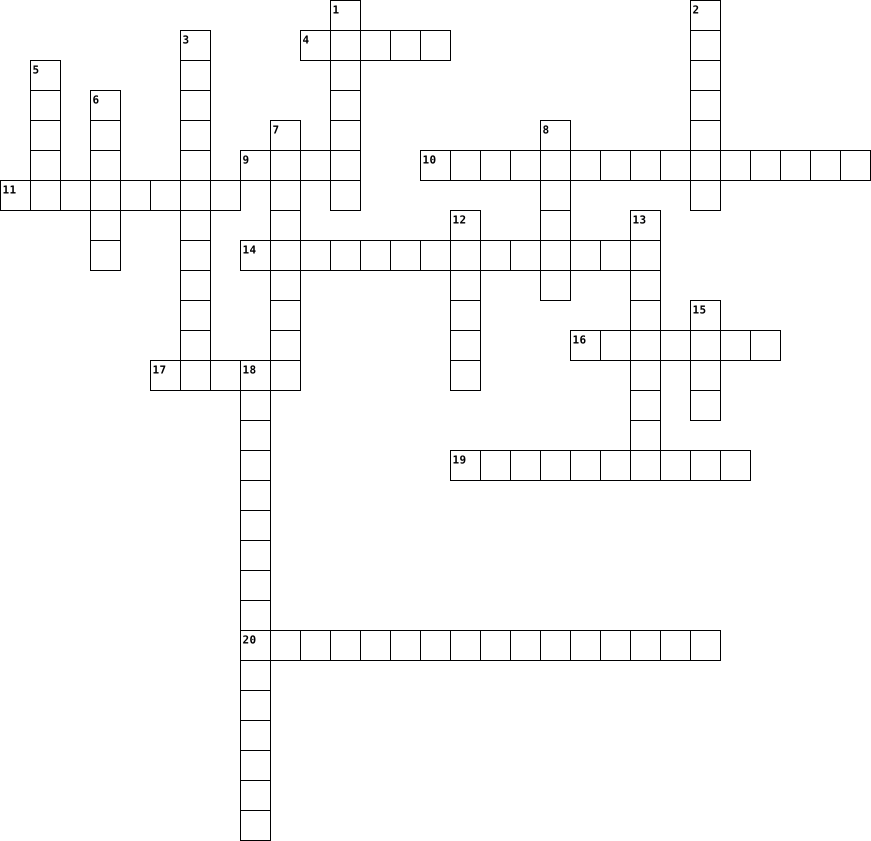
Across
- The time for earth to rotate once on its axis
- A division of the year that is characterized by reoccurring weather conditions and determined by both the Earth’s tilt relative to the sun and the Earth’s position in its orbit around
- A force of attraction between two objects due to their masses
- phases The different appearances of the moon from Earth throughout the month
- A natural or artificial body that revolves around a celestial body that is greater in mass
- The movement when the sun appears to cross the celestial equator
- tide A tide of increased range that occurs two times a month, at the new and full moons
Down
- The time required for Earth to orbit once around the Sun
- The point at which the Sun is as far north or as far south of the equator as possible
- The spin of a body on its axis
- Sun
- tide A tide of minimum range that occurs during the first and third quarters of the moon
12 Clues: Sun • The spin of a body on its axis • The time for earth to rotate once on its axis • The time required for Earth to orbit once around the Sun • A force of attraction between two objects due to their masses • The movement when the sun appears to cross the celestial equator • phases The different appearances of the moon from Earth throughout the month • ...
Tectonic Plates 2022-10-14

Across
- plates sliding past each other
- Made of Clastic pieces
- plates dragging apart
- A rift in the crust
- started out as other rocks, melted into one
- on the surface of the earth
- plates coming together
- Continents are made of these
- One of the layers of the earth
- Mountain that spews lava due to plate rift
Down
- plates;Not continental plates
- The first layer of the earth
- A straight line of data collection
- under the earth
- The first supercontinent
- Hardened lava rock
- The middle of the earth
- Caused by pressure, is like stress
- When the earth shakes, common in California
- plates; continental plates
20 Clues: under the earth • Hardened lava rock • A rift in the crust • plates dragging apart • Made of Clastic pieces • plates coming together • The middle of the earth • The first supercontinent • plates; continental plates • on the surface of the earth • The first layer of the earth • Continents are made of these • plates;Not continental plates • plates sliding past each other • ...
Matthew Zhong's Fun Friday 2025-04-11

Across
- Bend in the course of a river
- Smallest part of an element
- Images of body
- Living things on Earth
- Water vapor condenses back into rain
- Erosion formed a cliff along the edge of flood plain
- Outer surface of sun
- Weather Conditions
- Change direction of axis on earth
- wobbling around processional axis
- Gas to liquid
Down
- Anything that has volume
- Waters on earth
- Suns outer atmosphere
- Gases on Earth
- Rocky outer part of Earth
- Rock breaks but break does not move
- Glacier in a process called calving
- Run the Experiment more than once
- Liquid into gas
- Earth rotates on this line
21 Clues: Gas to liquid • Images of body • Gases on Earth • Waters on earth • Liquid into gas • Weather Conditions • Outer surface of sun • Suns outer atmosphere • Living things on Earth • Anything that has volume • Rocky outer part of Earth • Earth rotates on this line • Smallest part of an element • Bend in the course of a river • Run the Experiment more than once • Change direction of axis on earth • ...
Enviormental Science 2024-10-25

Across
- the average temperture of a reigon
- A layer in the atmoshere with that most weather and the gas most packedly tight together
- an oceanic circultion pattern that drives the mixing of surface water and deep water
- A convection current in the atmophere formed by air that rises at 60 degrees north and south
- The layer planes like to fly in because there in not as much weather
- effect the deflection of an objects path due to the Roation of the earth
Down
- The latitude that receves the most intense sunlight
- A convection currents in the atmophere that cycle between the earth and the equater
- a large scale pattern of water circlation that moves clockwise in the morthern hemiaphere and counterclock wise in the southern hemiosphere
- Aconvection in the atmosphere that lies between Hadley cells and polar cells
- The degree of the suns refelectiom from any goven surface
- the upward movment of the ocean water toward the surfaces as a result of diverging currents
- A reigon with dry condition found on the leeward side of the mountain range as a result of humid winds.
- The cool air near the top of the atomsphere is then displayed horizontially before it sinks back to eath.
- the day by day changein the tempture and precitation of an region
15 Clues: the average temperture of a reigon • The latitude that receves the most intense sunlight • The degree of the suns refelectiom from any goven surface • the day by day changein the tempture and precitation of an region • The layer planes like to fly in because there in not as much weather • effect the deflection of an objects path due to the Roation of the earth • ...
Earth Science 7 2017-05-25

Across
- Occurs when the Moon passes directly between the Sun and Earth and casts a shadow over part of Earth
- the theory that the universe originated 20 billion years ago from the cataclysmic explosion of a small mass of matter at extremely high density and temperature
- a ball of frozen dust and rock that orbits the sun and has a tail that glows
- the blocking of sunlight to the moon that occurs when earth is directly between the sun and the moon
- A group of stars that form a pattern in the sky
- a cooler darker spot appearing periodically on the sun's photosphere
- A streak of light in the sky produced by the burning of a meteoroid in Earth's atmosphere.
- spinning of Earth on its imaginary axis, which takes about 24 hours to complete and causes day and night to occur
Down
- New Moon, Waxing Crescent, First Quarter, Waxing Gibbous, Full Moon, Waning Gibbous, Third Quarter, Waning Crescent
- A large group of stars, nebulas, gases, dust particles and planets held together by gravity.
- Earth's yearly orbit around the Sun
- a region of space resulting from the collapse of a star
- a piece of rock or metal made up of material similar to that which formed the planets; mostly found in the asteroid belt between the orbits of Mars and Jupiter
13 Clues: Earth's yearly orbit around the Sun • A group of stars that form a pattern in the sky • a region of space resulting from the collapse of a star • a cooler darker spot appearing periodically on the sun's photosphere • a ball of frozen dust and rock that orbits the sun and has a tail that glows • ...
Supreme Wisdom Actual Facts 2024-12-27

Across
- The circumference of the planet Earth is
- The Pacific Ocean covers
- The total area of the Land and Water of the planet Earth is
- The Producing Land is
- The Indian Ocean covers
- The Atlantic Ocean covers
- The area of the Land is
- Mount Everest is
- The Earth weighs
- The Deserts are
- Sound travels at the rate of
- The Earth travels at the rate of
- The Lakes and Rivers cover
Down
- The Earth is
- The Hills and Mountains cover
- The Islands are
- The diameter of the Sun is
- The diameter of the Earth is
- Light travels at the rate of
- The area of the Water is
20 Clues: The Earth is • The Islands are • The Deserts are • Mount Everest is • The Earth weighs • The Producing Land is • The Indian Ocean covers • The area of the Land is • The Pacific Ocean covers • The area of the Water is • The Atlantic Ocean covers • The diameter of the Sun is • The Lakes and Rivers cover • The diameter of the Earth is • Light travels at the rate of • Sound travels at the rate of • ...
Days/months French Crossword 2025-10-09

Across
- today is ...
- first day of the work week
- a work week day nearer to the end of the week
- days of the week
- New Year's Day Month
- Halloween month
- a spring month
- St. Patrick's Day month
- middle of the work week day
- Thanksgiving month
- Christmas carol month
- St. Valentine's Day month
Down
- many people celebrate this day one time per year
- today
- Independence Day month
- day of rest
- day after today
- first month of summer vacation for school kids
- a month that includes a day of playful jokes
- first full month of school for school kids
- last full month of summer vacation for school kids
- months of the year
- second day of the work week
- weekend begins for many people around 5:00 on this day
- day before today
- a weekend day
26 Clues: today • day of rest • today is ... • a weekend day • a spring month • day after today • Halloween month • days of the week • day before today • months of the year • Thanksgiving month • New Year's Day Month • Christmas carol month • Independence Day month • St. Patrick's Day month • St. Valentine's Day month • first day of the work week • second day of the work week • middle of the work week day • ...
Layers of the Earth 2023-01-27

Across
- A part of the Compositional Layer of the Earth. The layer of solid material between Earth's crust and core. It is almost two-thirds of Earth's mass.
- Layers of the Earth divided based on composition (element) that make up (compose) the rock in each layer.
- A prefix meaning "middle".
- A part of the Mechanical Layers of the Earth. The strong, lower part of the mantle between the Asthenosphere and the outer core. It is solid due to pressure.
- Circulating currents in the mantle caused by the magma being heated by the core of the Earth. It is a process of heating and rising (increase of density), followed by cooling and falling (decrease of density).
- A field that surrounds the Earth because of the convection currents in Earth's liquid outer core.
- A prefix meaning "rock".
- A part of the Mechanical Layers of the Earth. The solid, outer layer of the Earth that consists of the crust and upper part of the mantle.
- A layer of Earth's crust made of granite and makes up continents.
- A prefix meaning "weak".
- A part of the Mechanical Layers of the Earth. It is dense liquid layer made up of iron and nickel. It surrounds the inner core.
Down
- A part of the Mechanical Layers of the Earth. A dense, rigid solid; it has the most extreme temperature and intense pressure.
- An elastic wave (P and S waves) in the earth produced by an earthquake or other means. It travels through the Earth's layers and allows us to learn about the properties of each layer.
- A part of the Compositional Layer of the Earth. The thin and solid outermost layer of the Earth above the mantle. It is only about 1% of Earth's mass.
- Layers of the Earth divided based on physical structure - state of matter and how each moves and reacts to stresses of temperature and pressure.
- A layer of Earth's crust made of basalt and lies beneath the ocean.
- A suffix meaning "layer".
- Temperature, gravity, pressure, and density - all increase moving toward the core of the Earth.
- A part of the Mechanical Layers of the Earth. It is the plastic-like layer of the mantle below the lithosphere; made of mantle rock that flows very slowly, which allows tectonic plates to move on top of it. It is ductile and weak.
- A part of the Compositional Layer of the Earth. The central part of the earth below the mantle composed of iron and nickel.
20 Clues: A prefix meaning "rock". • A prefix meaning "weak". • A suffix meaning "layer". • A prefix meaning "middle". • A layer of Earth's crust made of granite and makes up continents. • A layer of Earth's crust made of basalt and lies beneath the ocean. • Temperature, gravity, pressure, and density - all increase moving toward the core of the Earth. • ...
vocabulary 2016-11-03

Across
- tide a tide of increased range that occurs two times a month, at the new and full moons.
- the time for Earth to rotate once on its axis.
- the point at which the Sun is as far north or as far south of the equator as possible.
- the spin of a body on its axis.
- a division of the year that is characterized by reoccurring weather conditions and determined by both the Earth’s tilt relative to the sun and the Earth’s position in its orbit around
Down
- phases the different appearances of the moon from Earth throughout the month.
- a force of attraction between two objects due to their masses.
- a natural or artificial body that revolves around a celestial body that is greater in mass.
- the time required for Earth to orbit once around the Sun.
- the movement when the sun appears to cross the celestial equator.
- Sun.
- tide a tide of minimum range that occurs during the first and third quarters of the moon.
12 Clues: Sun. • the spin of a body on its axis. • the time for Earth to rotate once on its axis. • the time required for Earth to orbit once around the Sun. • a force of attraction between two objects due to their masses. • the movement when the sun appears to cross the celestial equator. • phases the different appearances of the moon from Earth throughout the month. • ...
Earth Science, Unit 2 2025-09-10

Across
- the distance east or west of the prime meridian, measured in degrees
- the theory of what that states the continents had moved about on Earth's surface
- Study of the earth
- Scientific study of the oceans
- All life on earth
- Thin, low density rock on the outer portion of the Earth
- Solid part of the earth that make up it's layers
- high density rock in the middle of the Earth
- Gas envelope that surrounds the earth
- Study of the atmosphere and weather
Down
- the distance measure that tells you the difference in elevation between adjacent lines
- Weathering and erosion wearing out the earth's surface
- The earth's surface features
- lines on a map used to indicate the elevation of the land
- scientific model for explaining the formation of the solar system
- the distance north or south of the equator, measured in degrees
- Study of the universe
- inner sphere of the Earth, rich in iron and nickel
- All the water on earth
- Mountain building and volcanism or building up the earth's surface
- represents the relationship between distance on the map and actual distance on Earth
21 Clues: All life on earth • Study of the earth • Study of the universe • All the water on earth • The earth's surface features • Scientific study of the oceans • Study of the atmosphere and weather • Gas envelope that surrounds the earth • high density rock in the middle of the Earth • Solid part of the earth that make up it's layers • inner sphere of the Earth, rich in iron and nickel • ...
science vocab crossword 2016-11-03

Across
- the time for Earth to rotate once on its axis
- the time required for Earth to orbit once around the Sun
- the movement when the sun appears to cross the celestial equator
- a force of attraction between two objects due to their masses
- the point at which the Sun is as far north or as far south of the equator as possible
- Phases the different appearances of the moon from Earth throughout the month
- Tide a tide of minimum range that occurs during the first and third quarters of the moon
Down
- a division of the year that is characterized by reoccurring weather conditions and determined by both the Earth’s tilt relative to the sun and the Earth’s position in its orbit around
- a natural or artificial body that revolves around a celestial body that is greater in mass
- Sun
- the spin of a body on its axis
- Tide a tide of increased range that occurs two times a month, at the new and full moons
12 Clues: Sun • the spin of a body on its axis • the time for Earth to rotate once on its axis • the time required for Earth to orbit once around the Sun • a force of attraction between two objects due to their masses • the movement when the sun appears to cross the celestial equator • Phases the different appearances of the moon from Earth throughout the month • ...
Outer Space 2026-03-15

Across
- Where the sun, moon, and all planets are 🌌
- Earth is one of these, we all live here ⋆⭒˚.⋆🪐 ⋆⭒˚.⋆
- It flies in the outer space 🚀
Down
- It Gives Us Light Every Single Day 🔆
- Little green men in outer space 【👽🛸☆☆👽🛸】
- The circle in the sky at night 🌙
- Our Home Where we all live 🌎
7 Clues: Our Home Where we all live 🌎 • It flies in the outer space 🚀 • The circle in the sky at night 🌙 • It Gives Us Light Every Single Day 🔆 • Little green men in outer space 【👽🛸☆☆👽🛸】 • Where the sun, moon, and all planets are 🌌 • Earth is one of these, we all live here ⋆⭒˚.⋆🪐 ⋆⭒˚.⋆
Space Vocabulary Review 2021-03-10

Across
- - the force that attracts a body toward the center of the earth, or toward any other physical body having mass. (Sun). The force that controls everything in the universe.
- Shuttle - a rocket launched spacecraft able to land like a plane, used to make repeated journeys between Earth and Earth’s orbit. ( Reusable )
- - a small, rocky body that orbits the Sun; a large asteroid belt lies between Mars and Jupiter.
- Unit (AU) - a unit of measurement equal to 149. 6 million kilometers, the mean distance from the center of the Earth to the center of the Sun.
- Planets / Gas Giants - the gas giant planets have no solid surface, and their orbit lies outside the asteroid belt. ( Jupiter, Saturn, Uranus, and Neptune )
- / Terrestrial Planets - the planets that have a solid rocky surface and whose orbit lies within the asteroid belt. ( Mercury, Venus, Earth,and Mars )
- - an elongated rocket propelled spacecraft used to take astronauts, equipment, and supplies into space.
- - a celestial body moving in a elliptical orbit around a star.
- - a person who is trained to travel and work in space.
- - the physical universe beyond the Earth’s atmosphere. The near vacuum extending between the planets and the stars, containing small amounts of gas and dust.
- - a small piece of matter from outer space that becomes a streak of light when it falls through the Earth’s atmosphere and burns up, also known as a falling or shooting star.
- Space Telescope (HST) - a large space telescope designed to take and send back pictures of planets, stars, galaxies, etc.
Down
- / Revolution - one complete orbit made by a planet or satellite around another object in space. It takes Earth one year or 365 days to orbit the Sun.
- / Rotation - the spinning of an object on its axis. The rotation of the Earth takes one day, approximately 24 hr.
- - a optical instrument designed to make distant objects appear nearer, containing an arrangement of lenses or mirrors.
- Space Station (ISS) - a large artificial satellite used as a long term base for manned operations and research in space.
- - the path that one object in space follows as it revolves around another object in space.
- System - the collection of eight planets and their moons in orbit around the sun, together with smaller bodies in the form of asteroids, meteoroids, and comets.
- - any natural or artificial body that orbits around another object in space. Natural satellites include planets, moons, comets, etc. Artificial satellites include, space station, probes, communication satellites.
- - a natural satellite of any planet. Our moon which is visible mostly at night and reflects light from the Sun.
- Probe - an unmanned exploratory spacecraft designed to transmit information about its environment.
- - an object that orbits the Sun; made of frozen water and dust, and has a tail of gas and dust particles that point away from the Sun. ( dirty snowball )
- gravity - the force of gravity at the surface of the Earth or other celestial bodies.
23 Clues: - a person who is trained to travel and work in space. • - a celestial body moving in a elliptical orbit around a star. • gravity - the force of gravity at the surface of the Earth or other celestial bodies. • - the path that one object in space follows as it revolves around another object in space. • ...
TRUE WORSHIP--Meditate on theses verses as you worship the Lord our God in spirit and in truth 2017-01-13

Across
- / PSALM 71:23 My lips shall greatly __________ when I sing unto thee; and my soul, which thou hast redeemed.
- / John 4:24 God is a __________: and they that worship him must worship him in spirit and in truth.
- / PSALM 63:3-4 Because thy __________ is better than life, my lips shall praise thee. Thus will I bless thee while I live: I will lift up my hands in thy name.
- / PSALM 9:1 I will praise thee, O Lord, with my whole __________; I will shew forth all thy marvellous works.
- / PSALM 103:1 Bless the Lord, O my __________: and all that is within me, bless his holy name.
- / PSALM 145:1 I will __________ thee, my God, O king; and I will bless thy name for ever and ever.
- / PSALM 29:2 Give unto the LORD the glory due unto his name; worship the LORD in the beauty of __________.
- / 1 CHRONICLES 16:34 O give thanks unto the Lord; for he is good; for his mercy __________ for ever.
Down
- / PSALM 99:5 Exalt ye the LORD our God, and worship at his __________; for he is holy.
- / NEHEMIAH 9:5 ...Stand up and bless the LORD your God for ever and ever: and blessed be thy glorious name, which is exalted above all __________ and praise.
- / ROMANS 12:1 I beseech you therefore, brethren, by the mercies of God, that ye present your bodies a living __________, holy, acceptable unto God, which is your reasonable service.
- / SAMUEL 2:2 There is none holy as the Lord: for there is none beside thee: neither is there any __________ like our God.
- / 1 CHRONICLES 16:23-24 Sing unto the LORD, all the earth; shew forth from day to day his salvation. Declare his glory among the heathen; his __________ works among all nations.
- / JOHN 4:23 But the hour cometh, and now is, when the true __________ shall worship the Father in spirit and in truth: for the Father seeketh such to worship him.
- / PSALM 108:5 Be thou __________, O God, above the heavens: and thy glory above all the earth.
- / 2 SAMUEL 7:22 Wherefore thou art __________, O Lord God: for there is none like thee, neither is there any God beside thee, according to all that we have heard with our ears.
- / PSALM 150:6 Let every thing that hath __________ praise the Lord. Praise ye the Lord.
- / PSALM 34:1 I will bless the Lord at all times: his praise shall continually be in my __________.
- / PSALM 73:25 Whom have I in heaven but thee? and there is none upon earth that I __________ beside thee.
- / PSALM 71:8 Let my mouth be filled with thy __________ and with thy honour all the day.
20 Clues: / PSALM 99:5 Exalt ye the LORD our God, and worship at his __________; for he is holy. • / PSALM 150:6 Let every thing that hath __________ praise the Lord. Praise ye the Lord. • / PSALM 71:8 Let my mouth be filled with thy __________ and with thy honour all the day. • ...
Space 2023-10-17

Across
- The large explosion at the end of a large star's life. It distributes most of the elements formed in the star across space
- The time it takes for the Earth to orbit the Sun once
- Rocky objects that orbit the Sun and vary in size from 1km to around 1000km
- This type of reaction happens between nuclei within a star - this is how elements are formed
- The beginning of a star's life - a cloud of dust and gas
- Nebulae are mostly made up of this
- When less than half of the illuminated part of the moon is visible
Down
- Depending on the mass at the start of the star's life, a supernova will form either a neutron star or a _____ ____
- The moon doesn't produce its own light - it _____ light from the Sun
- When the moon is not easily seen in the sky because the light from the Sun lands on the side of the moon which is facing away from the Earth
- In a main sequence star, hydrogen nuclei fuse together to form _____ nuclei
- A force that pulls us all down towards Earth
- The time it takes for the Earth to do one full spin on its axis
- Icy objects that orbit the Sun at very large distances. They can make their way into the inner solar system, where the Sun starts to melt them, producing a large tail made of gases and dust
14 Clues: Nebulae are mostly made up of this • A force that pulls us all down towards Earth • The time it takes for the Earth to orbit the Sun once • The beginning of a star's life - a cloud of dust and gas • The time it takes for the Earth to do one full spin on its axis • When less than half of the illuminated part of the moon is visible • ...
Group 2A: Alkaline Earth Metals 2014-02-03

Across
- Alkaline earth metals are ____ reactive than alkali metals.
- Many mountain ranges contain alkaline earth _______.
- Alkaline _____ metals are soft but harder than alkali metals.
- Alkaline earth metals are not found in ______ in the elemental state.
- example of a calcium-fortified food
- What kind of ion is at the center of each chlorophyll molecule?
- What is the condition in which bones become brittle and break easily?
- Alkaline earth metals react with _____ to form ionic halides.
- _____ is made by reduction of its oxide with aluminum at high temperature.
Down
- Slaked lime reacts with carbon dioxide to form ________.
- Barium ______ is used as a dry powdered bleach.
- When exposed to air alkaline earth metals quickly form a tough, thin ____ coating.
- What color is calcium carbonate
- Alkaline earth metals have a grey white _____ when freshly cut.
- What is a major component of bone and teeth?
- discovered in 1798 by Nicholas Vauquelin
- Alkaline earth metals react with ______ to form binary oxides.
- Magnesium ions forms a bond with each _____ atom.
- discovered in 1808 by Sir Humphry Davy
- Salts of highly radioactive _____ are a by-product of uranium refining.
- Alkaline earth metals are strong _______ agents.
21 Clues: What color is calcium carbonate • example of a calcium-fortified food • discovered in 1808 by Sir Humphry Davy • discovered in 1798 by Nicholas Vauquelin • What is a major component of bone and teeth? • Barium ______ is used as a dry powdered bleach. • Alkaline earth metals are strong _______ agents. • Magnesium ions forms a bond with each _____ atom. • ...
Nathan´s 3B Vocab 2016-11-18

Across
- a division of the year that is characterized by reoccurring weather conditions and determined by both the Earth’s tilt relative to the sun and the Earth’s position in its orbit around
- a force of attraction between two objects due to their masses.
- a natural or artificial body that revolves around a celestial body that is greater in mass.
- the movement when the sun appears to cross the celestial equator.
- Tide a tide of increased range that occurs two times a month, at the new and full moons.
Down
- Phases the different appearances of the moon from Earth throughout the month.
- the time required for Earth to orbit once around the Sun.
- the point at which the Sun is as far north or as far south of the equator as possible.
- the time for Earth to rotate once on its axis.
- the spin of a body on its axis.
- Sun.
- Tide a tide of minimum range that occurs during the first and third quarters of the moon.
12 Clues: Sun. • the spin of a body on its axis. • the time for Earth to rotate once on its axis. • the time required for Earth to orbit once around the Sun. • a force of attraction between two objects due to their masses. • the movement when the sun appears to cross the celestial equator. • Phases the different appearances of the moon from Earth throughout the month. • ...
In the Image of God 2020-11-11

Across
- 30 for all the wildlife of the earth, for every bird of the sky, and for every creature that crawls on the earth—?? having the breath of life in it—I have given[d] every green plant for food.” And it was so. Genesis 1:30 CSB
- 29 God also said, “Look, I have given you every ?? plant on the surface of the entire earth and every tree whose fruit contains seed. This will be food for you, Genesis 1:29 CSB
- "...he ?? him in the image of God;..." Genesis 1:27 CSB
- "...he created them ?? and female." Genesis 1:27 CSB
Down
- 28 God blessed them, and God said to them, “Be fruitful, multiply, fill the earth, and subdue it. Rule the fish of the sea, the birds of the sky, and every creature that crawls on the earth.” Genesis 1:28 CSB
- "So God created man in his own ??...." Genesis 1:27 CSB
- 31 God saw all that he had made, and it was very ?? indeed. Evening came and then morning: the sixth day. Genesis 1:31 CSB
- "...They will rule the fish of the sea, the birds of the sky, the livestock, the whole earth, and the creatures that crawl[c] on the earth.” Genesis 1:26
- "...They will rule the ?? of the sea, the birds of the sky, the livestock, the whole earth, and the creatures that crawl on the earth.” Genesis 1:26
- 26 Then God said, “Let us make ?? in our image, according to our likeness... Genesis 1:26
10 Clues: "...he created them ?? and female." Genesis 1:27 CSB • "So God created man in his own ??...." Genesis 1:27 CSB • "...he ?? him in the image of God;..." Genesis 1:27 CSB • 26 Then God said, “Let us make ?? in our image, according to our likeness... Genesis 1:26 • ...
In the Image of God 2020-11-11

Across
- 30 for all the wildlife of the earth, for every bird of the sky, and for every creature that crawls on the earth—?? having the breath of life in it—I have given[d] every green plant for food.” And it was so. Genesis 1:30 CSB
- 29 God also said, “Look, I have given you every ?? plant on the surface of the entire earth and every tree whose fruit contains seed. This will be food for you, Genesis 1:29 CSB
- "...he ?? him in the image of God;..." Genesis 1:27 CSB
- "...he created them ?? and female." Genesis 1:27 CSB
Down
- 28 God blessed them, and God said to them, “Be fruitful, multiply, fill the earth, and subdue it. Rule the fish of the sea, the birds of the sky, and every creature that crawls on the earth.” Genesis 1:28 CSB
- "So God created man in his own ??...." Genesis 1:27 CSB
- 31 God saw all that he had made, and it was very ?? indeed. Evening came and then morning: the sixth day. Genesis 1:31 CSB
- "...They will rule the fish of the sea, the birds of the sky, the livestock, the whole earth, and the creatures that crawl[c] on the earth.” Genesis 1:26
- "...They will rule the ?? of the sea, the birds of the sky, the livestock, the whole earth, and the creatures that crawl on the earth.” Genesis 1:26
- 26 Then God said, “Let us make ?? in our image, according to our likeness... Genesis 1:26
10 Clues: "...he created them ?? and female." Genesis 1:27 CSB • "So God created man in his own ??...." Genesis 1:27 CSB • "...he ?? him in the image of God;..." Genesis 1:27 CSB • 26 Then God said, “Let us make ?? in our image, according to our likeness... Genesis 1:26 • ...
Solar System Puzzle 2025-12-16

Across
- - The planet where we live
- - The red planet
- - The big, hot star we see in the day sky
Down
- - The biggest planet in our solar system
- - This planet has beautiful rings around it
- - It shines at night and goes around Earth
6 Clues: - The red planet • - The planet where we live • - The biggest planet in our solar system • - The big, hot star we see in the day sky • - It shines at night and goes around Earth • - This planet has beautiful rings around it
Unit 3B Vocabulary 2016-11-04

Across
- the spin of a body on its axis
- the time required for Earth to orbit once around the Sun
- the different appearances of the moon from Earth throughout the month
- the point at which the Sun is as far north or as far south of the equator as possible
- Sun
Down
- the movement when the sun appears across the celestial equator
- a force of attraction between two objects due to their masses
- the time for Earth to rotate once on its axis
- a tide of minimum range that occurs during the first and third quarters of the moon
- a tide of increased range that occurs two times a month, at the new and full moons
- a natural or artificial body that revolves around a celestial body that is greater in mass
- a division of the year that is characterized by reoccurring weather conditions and determined by both the Earth’s tilt relative to the sun and the Earth’s position in its orbit around
12 Clues: Sun • the spin of a body on its axis • the time for Earth to rotate once on its axis • the time required for Earth to orbit once around the Sun • a force of attraction between two objects due to their masses • the movement when the sun appears across the celestial equator • the different appearances of the moon from Earth throughout the month • ...
space 2016-11-04

Across
- a division of the year that is characterized by reoccurring weather conditions and determined by both the Earth’s tilt relative to the sun and the Earth’s position in its orbit around
- a force of attraction between two objects due to their masses.
- Sun.
- the point at which the Sun is as far north or as far south of the equator as possible.
- Tide- a tide of minimum range that occurs during the first and third quarters of the moon.
Down
- the time for Earth to rotate once on its axis.
- the time required for Earth to orbit once around the Sun.
- Phases- the different appearances of the moon from Earth throughout the month.
- the spin of a body on its axis.
- a natural or artificial body that revolves around a celestial body that is greater in mass.
- Tide- a tide of increased range that occurs two times a month, at the new and full moons.
- the movement when the sun appears to cross the celestial equator.
12 Clues: Sun. • the spin of a body on its axis. • the time for Earth to rotate once on its axis. • the time required for Earth to orbit once around the Sun. • a force of attraction between two objects due to their masses. • the movement when the sun appears to cross the celestial equator. • Phases- the different appearances of the moon from Earth throughout the month. • ...
Unit 3 Vocab By Jett Bonner 2016-11-02

Across
- a force of attraction between two objects due to their masses.
- a division of the year that is characterized by reoccurring weather conditions and determined by both the Earth’s tilt relative to the sun and the Earth’s position in its orbit around
- a natural or artificial body that revolves around a celestial body that is greater in mass.
- the spin of a body on its axis.
- Phases the different appearances of the moon from Earth throughout the month.
- the movement when the sun appears to cross the celestial equator.
- the time required for Earth to orbit once around the Sun.
Down
- the time for Earth to rotate once on its axis.
- Sun.
- the point at which the Sun is as far north or as far south of the equator as possible.
- Tide a tide of increased range that occurs two times a month, at the new and full moons.
- Tide a tide of minimum range that occurs during the first and third quarters of the moon.
12 Clues: Sun. • the spin of a body on its axis. • the time for Earth to rotate once on its axis. • the time required for Earth to orbit once around the Sun. • a force of attraction between two objects due to their masses. • the movement when the sun appears to cross the celestial equator. • Phases the different appearances of the moon from Earth throughout the month. • ...
Vocab 3B By Jett 2016-11-18

Across
- a division of the year that is characterized by reoccurring weather conditions and determined by both the Earth’s tilt relative to the sun and the Earth’s position in its orbit around
- the point at which the Sun is as far north or as far south of the equator as possible.
- Tide a tide of minimum range that occurs during the first and third quarters of the moon.
- the movement when the sun appears to cross the celestial equator.
- a force of attraction between two objects due to their masses.
Down
- Phases the different appearances of the moon from Earth throughout the month.
- the spin of a body on its axis.
- the time required for Earth to orbit once around the Sun.
- a natural or artificial body that revolves around a celestial body that is greater in mass.
- Sun.
- Tide a tide of increased range that occurs two times a month, at the new and full moons.
- the time for Earth to rotate once on its axis
12 Clues: Sun. • the spin of a body on its axis. • the time for Earth to rotate once on its axis • the time required for Earth to orbit once around the Sun. • a force of attraction between two objects due to their masses. • the movement when the sun appears to cross the celestial equator. • Phases the different appearances of the moon from Earth throughout the month. • ...
Weather and Climate 2021-12-02

Across
- The climate zones between the Polar and Tropical zones.
- The climate zones around the earth's poles.
- When it is summer in the Northern Hemisphere, it is ___ in the Southern Hemisphere.
- The earth rotates 360 degrees on its axis in one ___.
Down
- Average weather over time.
- The climate zone between the Tropic of Cancer and the Tropic of Capricorn.
- Seasons are caused by the ___ of the Earth's axis.
- The earth revolves around the sun in one ___.
8 Clues: Average weather over time. • The climate zones around the earth's poles. • The earth revolves around the sun in one ___. • Seasons are caused by the ___ of the Earth's axis. • The earth rotates 360 degrees on its axis in one ___. • The climate zones between the Polar and Tropical zones. • The climate zone between the Tropic of Cancer and the Tropic of Capricorn. • ...
Crossword for school work 2024-04-03

Across
- The measured distance between two points on two back-to-back waves
- Large body of salt water on earth
- The shaking of the earth
- An overflow of water onto normally dry land
- Giant waves caused by earthquakes or volcanic eruptions under the sea
Down
- A change in the ocean water level, reaches a high and low twice a day
- The movement of energy through the water
- An event that causes lots of destruction or violent change
8 Clues: The shaking of the earth • Large body of salt water on earth • The movement of energy through the water • An overflow of water onto normally dry land • An event that causes lots of destruction or violent change • The measured distance between two points on two back-to-back waves • A change in the ocean water level, reaches a high and low twice a day • ...
Solar system 2022-03-23

Across
- which planet is closer to the sun.venus,
- what is located between the inner and outer planets.
- which is the largest object in our solar system? Jupiter, The largest plant in the solar system is
Down
- A force of attraction between any two objects is called
- Which planet rotates to give day/night every 24 hours
- Which movement creates years?
- this cold, blue planet was discovered by a mathematical prediction
- which planet is earth twin
8 Clues: which planet is earth twin • Which movement creates years? • which planet is closer to the sun.venus, • what is located between the inner and outer planets. • Which planet rotates to give day/night every 24 hours • A force of attraction between any two objects is called • this cold, blue planet was discovered by a mathematical prediction • ...
Layers of the Earth / Seismic Waves Crossword 2022-01-21

Across
- the air and gases above the earth's surface
- type of seismic wave that causes most of the damage during an earthquake
- the deepest and hottest part of the earth
- a vibration created by an earthquake
- the outer surface of the earth, where we live
- all of the rocks on earth, including the rocks inside the earth
- the missing section of s-waves when they encounter a liquid
- the thickest layer of the earth
- the natural disaster used by scientists to map inside the earth
- the layer of the Earth that includes part of the crust and mantle
- type of body wave that can travel through only solids
- the phase of the outer core
Down
- the sensitive instrument used to detect earthquakes
- type of body wave that can travel through solids or liquids
- the source of an earthquake
- part of the mantle; below the lithosphere
- type of seismic wave that travels through the solid part of the Earth
- the only liquid layer of the earth
- locate
- the phase of the crust, mantle, and inner core
20 Clues: locate • the source of an earthquake • the phase of the outer core • the thickest layer of the earth • the only liquid layer of the earth • a vibration created by an earthquake • the deepest and hottest part of the earth • part of the mantle; below the lithosphere • the air and gases above the earth's surface • the outer surface of the earth, where we live • ...
Kelly RWP 2020-04-26

Across
- What day is March 14th
- My office’s resident doggo
- Becky’s impression of Gabi
- The word Jay used to describe me during Articulate
- Best program on earth
Down
- What did I throw at Emily
- Jason’s go to household item
- Jay
- How many times was I sick on the way home from HH
- Your favourite Harbour person
10 Clues: Jay • Best program on earth • What day is March 14th • What did I throw at Emily • My office’s resident doggo • Becky’s impression of Gabi • Jason’s go to household item • Your favourite Harbour person • How many times was I sick on the way home from HH • The word Jay used to describe me during Articulate
Laura Morales 2020-08-19

Across
- a place with glamour and splendour
- a substance that come from mines
- the place were all humans live
- A country important in the story
- a person that works of cleaning home all day
- someone that say instructions
Down
- someone that teach
- someone of the country important
- a natural substance make with iron
- To be formal and decent
10 Clues: someone that teach • To be formal and decent • someone that say instructions • the place were all humans live • someone of the country important • a substance that come from mines • A country important in the story • a place with glamour and splendour • a natural substance make with iron • a person that works of cleaning home all day
1000unit6a 2023-05-12

Across
- a drink made with hot water and leaves
- a plate or a bowl
- the earth and everything on it
- something added to food to make it sweet
Down
- the early part of the night
- the last meal of the day
- having a lot of snow
- not hot
- a little or no light
- ill; not well
10 Clues: not hot • ill; not well • a plate or a bowl • having a lot of snow • a little or no light • the last meal of the day • the early part of the night • the earth and everything on it • a drink made with hot water and leaves • something added to food to make it sweet
GRADE 3 2025-01-09

Across
- THE SMALLEST EVEN NUMBER
- SIMPLE PAST TENSE OF 'THROW'
- PROCESS OF MAKING FOOD IN PLANTS
- MAIN SOURCE OF ENERGY FOR THE EARTH
- PLANET CLOSEST TO THE SUN
- THE HOUSE HAS/HAVE FIVE WINDOWS.
- COLOUR OF THE SKY ON A CLEAR DAY
Down
- A PART OF A WHOLE
- NINE TIMES THREE
- THE LARGEST CONTINENT IN THE WORLD
10 Clues: NINE TIMES THREE • A PART OF A WHOLE • THE SMALLEST EVEN NUMBER • PLANET CLOSEST TO THE SUN • SIMPLE PAST TENSE OF 'THROW' • PROCESS OF MAKING FOOD IN PLANTS • THE HOUSE HAS/HAVE FIVE WINDOWS. • COLOUR OF THE SKY ON A CLEAR DAY • THE LARGEST CONTINENT IN THE WORLD • MAIN SOURCE OF ENERGY FOR THE EARTH
Adjectives 2024-12-19

Across
- The color of the earth or wood.
- A shape with four equal sides.
- The color of the sky on a clear day.
- Refers to a specific thing mentioned earlier.
- Belonging to you
- Not straight; smoothly bent.
Down
- A very small version of something.
- A pale shade of green
- Refers to things nearby or just mentioned.
- Belonging to us
10 Clues: Belonging to us • Belonging to you • A pale shade of green • Not straight; smoothly bent. • A shape with four equal sides. • The color of the earth or wood. • A very small version of something. • The color of the sky on a clear day. • Refers to things nearby or just mentioned. • Refers to a specific thing mentioned earlier.
What's Ameena Up to? 2023-10-21

Across
- A popular food grown on trees used in many dishes
- A disc stitched onto a garment
- A word that rhymes with well
- What you read for daily news
Down
- What you wear every day
- Used to create art with a brush
- The opposite of loud
- Something foreign to Earth
- The color of the sky
- Something you solve
10 Clues: Something you solve • The opposite of loud • The color of the sky • What you wear every day • Something foreign to Earth • A word that rhymes with well • What you read for daily news • A disc stitched onto a garment • Used to create art with a brush • A popular food grown on trees used in many dishes
The Apostles' Creed 2023-11-10

Across
- To where did he Ascend?
- Who created heaven and earth?
- Who was Born of the Virgin Mary?
- Jesus suffered under ____ Pilate
- How did Jesus die?
Down
- Life is ____________ or eternal
- Jesus died to _______ our sins
- The third person of the Trinity
- On which day did he rise again?
- Where is He seated next to the Father?
10 Clues: How did Jesus die? • To where did he Ascend? • Who created heaven and earth? • Jesus died to _______ our sins • Life is ____________ or eternal • The third person of the Trinity • On which day did he rise again? • Who was Born of the Virgin Mary? • Jesus suffered under ____ Pilate • Where is He seated next to the Father?
Christmas 2023 Treasure Hunt 2023-12-24

Across
- BIFF, CHIP AND...
- BABY YODA
- THE HALF BLOOD PRINCE
- WHAT MUMMY TEACHES ON WEDNESDAY NIGHTS
- WHAT CHICKENS AND THE EASTER BUNNY HAVE IN COMMON
Down
- HOLLY AND RORY'S FAVOURITE FOOD COLOUR
- ONE OF RORY'S YOUTUBERS AND A DAY OF THE WEEK
- WHAT THE ANCIENT EGYPTIANS BUILT
- OUR BEST HOLIDAY EVER!
- THE THIRD PLANET FROM THE SUN
10 Clues: BABY YODA • BIFF, CHIP AND... • THE HALF BLOOD PRINCE • OUR BEST HOLIDAY EVER! • THE THIRD PLANET FROM THE SUN • WHAT THE ANCIENT EGYPTIANS BUILT • HOLLY AND RORY'S FAVOURITE FOOD COLOUR • WHAT MUMMY TEACHES ON WEDNESDAY NIGHTS • ONE OF RORY'S YOUTUBERS AND A DAY OF THE WEEK • WHAT CHICKENS AND THE EASTER BUNNY HAVE IN COMMON
Wider World 1 unit 3 p.1-3 2024-11-17

Across
- another word for difficult
- animal kept inside the house as a companion
- something that you do often
- the planet we live on
- the middle part of a day, between morning and evening
Down
- speak very loudly (yell)
- to want one thing more than another
- having a lot of money
- not dirty
- feeling that you want to drink something
10 Clues: not dirty • having a lot of money • the planet we live on • speak very loudly (yell) • another word for difficult • something that you do often • to want one thing more than another • feeling that you want to drink something • animal kept inside the house as a companion • the middle part of a day, between morning and evening
Unit 1 2025-07-07

Across
- The earth and all the people on it.
- liked by many people
- a special day of celebration
- the direction the sun rises from
- cost a lot of money
Down
- to move forward using legs
- everyone or everything has been counted
- a very high hill
- an area where people grow plants
- a group of railway cars connected together
10 Clues: a very high hill • cost a lot of money • liked by many people • to move forward using legs • a special day of celebration • an area where people grow plants • the direction the sun rises from • The earth and all the people on it. • everyone or everything has been counted • a group of railway cars connected together
Crossword Game -- 0811 2022-08-11

Across
- A planet we live in
- Animales with long nose
- A fruit with red color
- The earlist time of one day
- A fruit with green color but red in it
- Same meaning of tasty
Down
- A relationship between each other
- The first season of one year
- Animales with long neck
- The earlist month of one year
10 Clues: A planet we live in • Same meaning of tasty • A fruit with red color • Animales with long neck • Animales with long nose • The earlist time of one day • The first season of one year • The earlist month of one year • A relationship between each other • A fruit with green color but red in it
Weather. 2021-04-12

Across
- :Global air circulation patterns within the atmosphere held to Earth by gravity and warmed as heat radiates from earth; influenced by convection of warm, less dense air and cool,dense air
- :the boundary between a warm air mass and a receding cooler air mass
- :A body of air extending over a large area that develops and retains certain characteristic of pressure, temp, and humidity
- :a map or chart that shows the weather conditions at a specific point over a specific region
- :the border between an advancing cold air mass and a retreating warm air mass
- :air temperature
- :an air mass with greater atmospheric pressure than the surrounding air masses; air moves away from the center of the high pressure, travelling in a clock-wise direction in a northern hemisphere and a counterclockwise direction in the southern hemisphere
Down
- :measures relative humidity
- :an insturment that measures the amount of atmospheric pressure
- :amount of water vapor or moisture content in air
- :an air mass with less atmospheric pressure than the surrounding air mass, air moves toward the area of low pressure, traveling in a counterclockwise direction in the northern hemisphere and a clockwise direction in the southern hemisphere
- :measures wind direction
- :measures air pressure
- :the force exerted by the atmosphere on Earth's surface by the weight of the air above the surface
- :measures wind speed
- :the day-to-day state of the atmosphere
- :The day-to-day state of the atmosphere.
17 Clues: :air temperature • :measures wind speed • :measures air pressure • :measures wind direction • :measures relative humidity • :the day-to-day state of the atmosphere • :The day-to-day state of the atmosphere. • :amount of water vapor or moisture content in air • :an insturment that measures the amount of atmospheric pressure • ...
Mars 2021-06-04

Across
- Moons:14
- one day= 1j 0h 37m
- Surface Temperature:-139 °C
Down
- orbit period 88 day
- Polar Diameter:12,714 km
5 Clues: Moons:14 • one day= 1j 0h 37m • orbit period 88 day • Polar Diameter:12,714 km • Surface Temperature:-139 °C
Unit 15 & 16 2021-07-08

Across
- rock
- 1/2
- there are stars and planets/universe
- who can do magic
- take things they aren't yours without asking
- the day after Sunday
Down
- a long way down from the top
- making someone or something afraid of you
- become different afterwards
- a place smaller than a city/where people live and work
- a thing you see in the night sky/it goes around earth
11 Clues: 1/2 • rock • who can do magic • the day after Sunday • become different afterwards • a long way down from the top • there are stars and planets/universe • making someone or something afraid of you • take things they aren't yours without asking • a thing you see in the night sky/it goes around earth • a place smaller than a city/where people live and work
Set 6 Vocabulary 2023-11-13

Across
- Sat,rat,hat
- Boom,clap,bang
- She was busy as a bee
- The girl hair was gold like the sun
- Stick,Lick,Mick
Down
- The boy buzzed around like a busy little bee
- The day is taking forever
- The Statue of Liberty represents friendship
- The sun smile upon the earth
- The pilots hate flying
- My best friend has a heart of gold
11 Clues: Sat,rat,hat • Boom,clap,bang • Stick,Lick,Mick • She was busy as a bee • The pilots hate flying • The day is taking forever • The sun smile upon the earth • My best friend has a heart of gold • The girl hair was gold like the sun • The Statue of Liberty represents friendship • The boy buzzed around like a busy little bee
The Apostles' Creed 2021-10-06

Across
- ____ of heaven and earth
- His only son, our ____
- and is seated at the ____ hand of the Father
- and life _____
Down
- I believe in the Holy Spirit, the holy ____ Church
- He was conceived by the power of the Holy ____
- He ascended into ____
- The commmunion of ____
- On the third day, He ____ again from the dead.
- The ____ of sins
- I believe in God, the ____ almighty
11 Clues: and life _____ • The ____ of sins • He ascended into ____ • The commmunion of ____ • His only son, our ____ • ____ of heaven and earth • I believe in God, the ____ almighty • and is seated at the ____ hand of the Father • He was conceived by the power of the Holy ____ • On the third day, He ____ again from the dead. • I believe in the Holy Spirit, the holy ____ Church
birds 2022-09-14

Across
- birds live in every part of the
- songbirds have a special voice box called a
- birds have an organ called
- ox peckers eat 100 a day
- birds can for many hours
- woodpeckers have a very long sticky
Down
- female ducks quack more than male ducks
- the Vulture Family's favorite food is
- 10,000 live on earth
- birds yearly
- parrotlest are the type of parrot
11 Clues: birds yearly • 10,000 live on earth • ox peckers eat 100 a day • birds can for many hours • birds have an organ called • birds live in every part of the • parrotlest are the type of parrot • woodpeckers have a very long sticky • the Vulture Family's favorite food is • female ducks quack more than male ducks • songbirds have a special voice box called a
birds 2022-09-14

Across
- birds live in every part of the
- songbirds have a special voice box called a
- birds have an organ called
- ox peckers eat 100 a day
- birds can for many hours
- woodpeckers have a very long sticky
Down
- female ducks quack more than male ducks
- the Vulture Family's favorite food is
- 10,000 live on earth
- birds yearly
- parrotlest are the type of parrot
11 Clues: birds yearly • 10,000 live on earth • ox peckers eat 100 a day • birds can for many hours • birds have an organ called • birds live in every part of the • parrotlest are the type of parrot • woodpeckers have a very long sticky • the Vulture Family's favorite food is • female ducks quack more than male ducks • songbirds have a special voice box called a
festivals of india 2022-07-19

Across
- the festival of colours
- arrival of lord ganesha to earth
- the festival of lights
- the ninth month of the muslim calander
- celebration of the birth of Jesus Christ
- the triumph of rama over ravana
Down
- festival of brothers and sisters
- the resurrection of Jesus from the dead
- the transition day of sun into capricorn
- festival of breaking the fast
- annual malayali harvest festival
11 Clues: the festival of lights • the festival of colours • festival of breaking the fast • the triumph of rama over ravana • festival of brothers and sisters • annual malayali harvest festival • arrival of lord ganesha to earth • the ninth month of the muslim calander • the resurrection of Jesus from the dead • the transition day of sun into capricorn • ...
Genesis Chapter 5 2024-03-12

Across
- - Noah's first son
- - Kenan's son
- - Lamech's son
- - The term used to describe the fathering of children in the genealogy
- - Enosh's son
- - What Noah will bring to the earth concerning their work
- - Jared's son
- - Mahalalel's son
Down
- - He created them male and female, and blessed them and called them ___ in the day they were created
- - Noah's third son
- - Enoch's son
- - He made him in the ___ of God
- - So all the days of Mahalalel were eight hundred and ___-five years;
- - And Enoch ___ with God
- - Seth's son
- - Enoch did not die because God ___ him
16 Clues: - Seth's son • - Enoch's son • - Kenan's son • - Enosh's son • - Jared's son • - Lamech's son • - Mahalalel's son • - Noah's third son • - Noah's first son • - And Enoch ___ with God • - He made him in the ___ of God • - Enoch did not die because God ___ him • - What Noah will bring to the earth concerning their work • ...
Unit 4 2022-11-22

Across
- The remains of an animal conserved in a rock
- When the earth starts shaking
- The superlative form of the word bad
- Think of
- We had a corona virus ___ last year
- The comparative form of the word good
- Take care of
- Smoke comes out of a ____.
Down
- To continue
- When ice pieces fall from the sky
- A natural electrical discharge, from the sky
- A procession, celebrating a special day or event
- The bigger star. The center of the solar sistem
- Low rainfall levels, a shortage of water
- Come near or nearer
- Delay
16 Clues: Delay • Think of • To continue • Take care of • Come near or nearer • Smoke comes out of a ____. • When the earth starts shaking • When ice pieces fall from the sky • We had a corona virus ___ last year • The superlative form of the word bad • The comparative form of the word good • Low rainfall levels, a shortage of water • The remains of an animal conserved in a rock • ...
Spelling Crossword Puzzle 2022-08-25

Across
- the main door at the school
- a certain type of animal
- a car needs this every 6months
- Mrs Gammie and Ms Scott have a lot of
- the place in which we live
- when a person achieves something they are ____________
- has a continuous beginning middle and end
Down
- lives in the earth
- a round shape with no corners
- what you travel to get somewhere
- subject at school
- Mrs Gammie and Ms Scott do every day
- water is vital and ___________
- comes to town with a ring master
- may have a print on your finger
- to make a choice
16 Clues: to make a choice • subject at school • lives in the earth • a certain type of animal • the place in which we live • the main door at the school • a round shape with no corners • a car needs this every 6months • water is vital and ___________ • may have a print on your finger • what you travel to get somewhere • comes to town with a ring master • Mrs Gammie and Ms Scott do every day • ...
Day to Day Electronics 2023-09-19

Across
- Short-range wireless technology
- Displays text and images on a screen
- What portable storage device is often used to transfer files between computers?
- what electronic gaming system connects to your TV to play video games?
- A multifunctional appliance that blends, chops, and mixes with precision.
- It uses lasers and mirrors to produce high-quality prints of digital documents.
- It converts sound into electrical signals
- An autonomous flying machine with a camera
- what electronic device is employed to draw intricate, detailed diagrams or charts?
- It quantifies your physical activity and health metrics.
- This portable communication device is often a pocket-sized computer with advanced capabilities.
- An advanced tool for capturing and editing high-quality video content.
- A smart tool for teaching in classrooms
- It's not a phone, but it's smarter than a watch.
- Its wireless amd connects your device
Down
- This handheld gadget transforms your voice into digital data for communication.
- It stores and keeps your favorite frozen treats ice-cold.
- An intelligent appliance that keeps your groceries fresh.
- A device used to capture memories and moments with precision.
- This versatile device has keys, a touchpad, and a screen for input and interaction.
- This kitchen appliance utilizes microwaves to cook or reheat food.
- A wireless, in-ear accessory that provides immersive audio experiences.
- An essential kitchen appliance for brewing a morning pick-me-up.
- A device to measure a circuit's resistance
- "Self-balancing two-wheeled transport".
- A mobile computing device designed for productivity, often with detachable keyboards.
- Your TV might connect to this for streaming
- This device captures the world in 360 degrees for immersive experiences.
- A sleek, pocket-sized device that stores your entire music library.
- It scans documents and photos
30 Clues: It scans documents and photos • Short-range wireless technology • Displays text and images on a screen • Its wireless amd connects your device • "Self-balancing two-wheeled transport". • A smart tool for teaching in classrooms • It converts sound into electrical signals • A device to measure a circuit's resistance • An autonomous flying machine with a camera • ...
Day to Day Electronics 2023-09-19

Across
- A mobile computing device designed for productivity, often with detachable keyboards.
- An essential kitchen appliance for brewing a morning pick-me-up.
- An intelligent appliance that keeps your groceries fresh.
- It uses lasers and mirrors to produce high-quality prints of digital documents.
- Short-range wireless technology
- This kitchen appliance utilizes microwaves to cook or reheat food.
- A device used to capture memories and moments with precision.
- Its wireless amd connects your device
- what electronic gaming system connects to your TV to play video games?
- It's not a phone, but it's smarter than a watch.
- An advanced tool for capturing and editing high-quality video content.
- What portable storage device is often used to transfer files between computers?
- It converts sound into electrical signals
- "Self-balancing two-wheeled transport".
- This versatile device has keys, a touchpad, and a screen for input and interaction.
- It quantifies your physical activity and health metrics.
- It stores and keeps your favorite frozen treats ice-cold.
- This handheld gadget transforms your voice into digital data for communication.
Down
- This device captures the world in 360 degrees for immersive experiences.
- A sleek, pocket-sized device that stores your entire music library.
- A wireless, in-ear accessory that provides immersive audio experiences.
- A multifunctional appliance that blends, chops, and mixes with precision.
- Displays text and images on a screen
- It scans documents and photos
- A device to measure a circuit's resistance
- A smart tool for teaching in classrooms
- This gadget transforms your TV into a smart, internet-connected hub.
- An autonomous flying machine with a camera
- This portable communication device is often a pocket-sized computer with advanced capabilities.
- what electronic device is employed to draw intricate, detailed diagrams or charts?
- Your TV might connect to this for streaming
31 Clues: It scans documents and photos • Short-range wireless technology • Displays text and images on a screen • Its wireless amd connects your device • A smart tool for teaching in classrooms • "Self-balancing two-wheeled transport". • It converts sound into electrical signals • A device to measure a circuit's resistance • An autonomous flying machine with a camera • ...
Day 11 & Day 12 2023-06-26

Across
- 성공적인; 성공한
- 직원, 부원
- 흥분, 신남
- (1) 이용할 수 있는 (2) 시가이 있는
- 군중, 사람들
- …을 좋아하다
- 친구, 동료; 동반자
- (1) 외모, 겉모습 (2) 등장; 출현
- (1) 부, 큰 돈 (2) 운
- 어느 쪽도 ~아닌; ~도 …도 아니다
- (1) 걱정하는 (2) 열망하는, 간절히 바라는
- (1) 방식 (2) 태도 (3) 예의
- 제의하다, 권하다; 제의, 제안
- 교육
- 얻다, 습득하다
- (1) 대하다, 취급하다 (2) 치료하다, 고치다
- 요즘에
Down
- (1) 공동체; 지역사회, 주민 (2) 집단, 계
- (1) 욕을 하다 (2) 맹세하다
- 친절, 상냥함; 친절한 행위
- 부인하다, 인정하지 않다
- 줄이다, 축소하다; 낮추다
- (1) 확증하다 (2) 확인하다
- 재능 있는, 유능한
- 믿음
- 기회
- (1) 추가, 부가 (2) 추가물, 추가된 것
- 해외에, 해외로
- 땀; 땀을 흘리다
- (1) 공연하다 (2) 수행하다
- 용서하다
- 선발하다, 선택하다
- 군의, 군사의; 군, 군대
- (1) 보통; 일반적으로 (2) 정상적으로
- 색인
- 삼키다
36 Clues: 믿음 • 기회 • 교육 • 색인 • 요즘에 • 삼키다 • 용서하다 • 직원, 부원 • 흥분, 신남 • 군중, 사람들 • …을 좋아하다 • 해외에, 해외로 • 얻다, 습득하다 • 성공적인; 성공한 • 땀; 땀을 흘리다 • 재능 있는, 유능한 • 선발하다, 선택하다 • 친구, 동료; 동반자 • 부인하다, 인정하지 않다 • 줄이다, 축소하다; 낮추다 • 군의, 군사의; 군, 군대 • 친절, 상냥함; 친절한 행위 • (1) 부, 큰 돈 (2) 운 • (1) 확증하다 (2) 확인하다 • (1) 공연하다 (2) 수행하다 • 제의하다, 권하다; 제의, 제안 • (1) 욕을 하다 (2) 맹세하다 • 어느 쪽도 ~아닌; ~도 …도 아니다 • (1) 방식 (2) 태도 (3) 예의 • (1) 외모, 겉모습 (2) 등장; 출현 • (1) 이용할 수 있는 (2) 시가이 있는 • ...
Day 17 & Day 18 2023-06-27

Across
- 실망한, 낙담한
- 상담가
- 살아남다, 생존하다
- (1) 동시대의 사람들; 세대, 대 (2) 발생
- (1) 고대의 (2) 아주 오래된
- 깎다, 면도하다
- (1) 치우다, 옮기다 (2) 없애다, 제거하다
- 미루다, 연기하다
- 설득하다
- 대부분, 대개; 주로
- (1) 강요하다, 조르다 (2) 주장하다, 우기다
- (1) ~할 것 같은 (2) 있음직한, 그럴듯한; 아마, 어쩌면
- (1) 죄가 없는, 결백한 (2) 순진한, 순결한
- 교육하다
- 신화; 믿음
- (1) 정리하다; 배열하다 (2) 계획하다, 준비하다
Down
- 다툼, 싸움
- 표준, 기준, 수준; 일반적인, 표준의
- 번개; 아주 빠른, 번개 같은
- 뒤죽박죽, 엉망진창; 어질러 놓다, 엉망으로 만들다
- 매력적인
- (1) 위험성 (2) 위험 요소
- (1) 협박, 위협 (2) 위협적인 존재
- (1) 사라지다 (2) 없어지다
- (1) 경쟁적인, 경쟁하는 (2) 경쟁심이 강한
- 사과, 사죄
- 영향려기; 영향을 미치다
- (1) 옅은, 연한 (2) 창백한
- (1) 끌어들이다 (2) 끌다
- 운이 좋은, 다행인
- 은퇴하다, 퇴직하다
- ~로 구성되다
- 불평, 항의
- (1) 반짝반짝이다 (2) 생기[활기]가 넘치다
- 게다가, 더욱이
- 목마름, 갈증
36 Clues: 상담가 • 매력적인 • 설득하다 • 교육하다 • 다툼, 싸움 • 사과, 사죄 • 불평, 항의 • 신화; 믿음 • ~로 구성되다 • 목마름, 갈증 • 실망한, 낙담한 • 깎다, 면도하다 • 게다가, 더욱이 • 미루다, 연기하다 • 살아남다, 생존하다 • 운이 좋은, 다행인 • 은퇴하다, 퇴직하다 • 대부분, 대개; 주로 • 영향려기; 영향을 미치다 • 번개; 아주 빠른, 번개 같은 • (1) 끌어들이다 (2) 끌다 • (1) 위험성 (2) 위험 요소 • (1) 사라지다 (2) 없어지다 • (1) 고대의 (2) 아주 오래된 • (1) 옅은, 연한 (2) 창백한 • 표준, 기준, 수준; 일반적인, 표준의 • (1) 협박, 위협 (2) 위협적인 존재 • (1) 동시대의 사람들; 세대, 대 (2) 발생 • (1) 경쟁적인, 경쟁하는 (2) 경쟁심이 강한 • ...
Day 3 & Day 4 2023-06-19

Across
- 믿기 어려운, 믿을 수 없는
- 결국, 종내
- 강의, 강연
- 구성 방식, 형식
- 효율적인
- 상상력
- 걱정,불안
- 비록 ~이지만
- (1) 시내, 시냇물 (2) 흐름
- 기간
- 환자; 참을성 있는
- 신뢰, 신임; (1) 신뢰하다 (2) 믿다
- (1) 일하지 않는, 놀고 있는 (2) 게으른, 나태한
- 본질, 진수
- 필요한, 필수의
- 위치, 장소
Down
- 붕대
- 지속하다, 유지하다
- 유리한 점, 이점, 장점
- (1) 환경, 장소 (2) 배경, 무대
- (1) 매우, 몹시 (2) 아주 나쁘게, 지독하게
- 경향, 추세; 유행
- 앞서의, 이전의
- 사과하다
- ~을 제외하고, ~이외에는
- 욕구, 갈망
- 한계; 제한; 한정하다, 제한하다
- 역사의, 역사적인
- 비상사태, 비상시
- (1)성격, 이격 (2) 특성, 개성
- 공업, 산업
- 최근의
- 전체의, 전부의
- (1) 상기시키다 (2) 생각나게 하다
- 직무, 과제
- 값을 매길 수 없는, 매우 귀중한
36 Clues: 붕대 • 기간 • 상상력 • 최근의 • 효율적인 • 사과하다 • 걱정,불안 • 결국, 종내 • 강의, 강연 • 욕구, 갈망 • 공업, 산업 • 본질, 진수 • 직무, 과제 • 위치, 장소 • 앞서의, 이전의 • 비록 ~이지만 • 전체의, 전부의 • 필요한, 필수의 • 구성 방식, 형식 • 역사의, 역사적인 • 비상사태, 비상시 • 지속하다, 유지하다 • 경향, 추세; 유행 • 환자; 참을성 있는 • 유리한 점, 이점, 장점 • ~을 제외하고, ~이외에는 • 믿기 어려운, 믿을 수 없는 • 한계; 제한; 한정하다, 제한하다 • (1) 시내, 시냇물 (2) 흐름 • 값을 매길 수 없는, 매우 귀중한 • (1)성격, 이격 (2) 특성, 개성 • (1) 환경, 장소 (2) 배경, 무대 • (1) 상기시키다 (2) 생각나게 하다 • 신뢰, 신임; (1) 신뢰하다 (2) 믿다 • ...
Day 7 & Day 8 2023-06-19

Across
- (1) 구성하다 (2) 작곡하다
- 강조하다; 하이라이트, 가장 중요한 부분
- 청중, 관객
- 탈것, 차량
- 통근하다
- 반복해서; 여러차례
- 행성
- 코를 골다; 코 고는 소리
- 논리
- (1) 극도의, 극심한 (2) 지나친, 과도한
- 낮, 주간
- 혁명, 변혁, 혁신
- 재채기하다; 재채기
- 빌려주다
- (1) 책임이 있는 (2) 책임지고 있는
- 대표적인, 전형적인
- 구하다, 구조하다; 구조, 구출
Down
- 노력, 수고
- 만족한, 흡족한
- (1) 신체의 (2) 물질의, 물질적인
- 실험; 실험하다
- 끈적끈적한
- 전체의, 전반적인; 전부, 전분적으로
- 면허(증); 허가하다
- 주저하다, 망설이다
- (1) 우치 (2) 자리, 자세 (3) 입장, 처지
- 기후
- (1) 대체하다, 대신하다 (2) 바꾸다, 교체하다
- (1) 그만두다 (2) 그만하다
- 상쾌하게 하다, 원기를 회복시키다
- 치료하다; 치료, 치료제
- 감소하다; 줄이다; 감소
- 편리한
- 법률가, 변호사
- (1) 통로, 복도 (2) 구절
- (1) 경제, 경기 (2) 절약, 검약
36 Clues: 기후 • 행성 • 논리 • 편리한 • 통근하다 • 빌려주다 • 끈적끈적한 • 낮, 주간 • 노력, 수고 • 청중, 관객 • 탈것, 차량 • 만족한, 흡족한 • 실험; 실험하다 • 법률가, 변호사 • 주저하다, 망설이다 • 반복해서; 여러차례 • 혁명, 변혁, 혁신 • 재채기하다; 재채기 • 대표적인, 전형적인 • 면허(증); 허가하다 • 치료하다; 치료, 치료제 • 감소하다; 줄이다; 감소 • 코를 골다; 코 고는 소리 • (1) 구성하다 (2) 작곡하다 • (1) 그만두다 (2) 그만하다 • (1) 통로, 복도 (2) 구절 • 구하다, 구조하다; 구조, 구출 • 상쾌하게 하다, 원기를 회복시키다 • 전체의, 전반적인; 전부, 전분적으로 • (1) 신체의 (2) 물질의, 물질적인 • (1) 경제, 경기 (2) 절약, 검약 • 강조하다; 하이라이트, 가장 중요한 부분 • ...
Geography Quiz Crossword Review 2024-09-17

Across
- when pressure from below the earth forces magma through the cracks in the earth's crust it is called this
- liquid rock when it is under the crust of the earth
- an opening in the earth where magma, gases and ash escape from under the crust
- all of the air that surrounds planet earth
- when two tectonic plates push into another and one of them is forced down below the other
- the second layer of the earth made of mostly iron and nickel
- the type of boundary between two tectonic plates where the plates slide past each other
- when pressure between tectonic plates releases causing a violent in the crust of the earth
- all of the water on the earth, lakes, rivers, oceans, etc
- the type of boundary where two tectonic plates move away from each other
Down
- the innermost layer of the earth that is solid and made up mostly of iron
- liquid rock when it emerges from under the crust
- all the land that makes up the surface of the earth
- large chunks of rock and dirt and vegetation that make up the crust of the earth
- the layer of the earth below the crust that is made up of magma or liquid rock
- the place tectonic plates meet each other where earthquakes and volcanic eruptions occur
- the outer layer of the earth made up of rocks and soil and vegetation
- the combination of lithosphere, hydrosphere and atmosphere where all living things reside
- the type of boundary where two tectonic plates push into each other
- the movement of water moving material along the surface and changing landforms
20 Clues: all of the air that surrounds planet earth • liquid rock when it emerges from under the crust • all the land that makes up the surface of the earth • liquid rock when it is under the crust of the earth • all of the water on the earth, lakes, rivers, oceans, etc • the second layer of the earth made of mostly iron and nickel • ...
plate tectonics 2022-04-08
Across
- where plate tectonics meet
- inner layer of earth
- tench caused by subduction
- force compressing object
- where plate tectonics pull apart
- study of earth
- top layer of earth
- plate tectonic goes under a different plate tectonic
- continents move
Down
- all continents combined
- mass per unit
- transfer of heat between objects
- devise that locates objects by using sound waves
- most common igneous rock
- large land mass
- remains of animals preserved in rocks
- largest layer of earth
- earth scientist
- solid mineral material
- well tested concept
20 Clues: mass per unit • study of earth • large land mass • earth scientist • continents move • top layer of earth • well tested concept • inner layer of earth • largest layer of earth • solid mineral material • all continents combined • most common igneous rock • force compressing object • where plate tectonics meet • tench caused by subduction • transfer of heat between objects • ...
Cosas que aprendo en la clase de espanol 2012-12-31

Across
- Mother's Day is on this month
- Arbor Day is on this month
- Christmas is on this month
- St. Patrick's Day is on this month
- The weather gets warmer on this season
- Father's Day is on this month
- The flowers bloom and the snow has melted on this season
- National Watermelon Day is on this month
- the first day of the week
- Groundhog Day is on this month
- The leaves fall from the trees on this season
- the fourth day of the week
- New Years Day is on this month
Down
- Independence Day is on this month
- the sixth day of the week
- the second day of the week
- Labor Day is on this month
- Thanksgiving is on this month
- the seventh day of the week
- It is snowing on this season
- the third day of the week
- the fifth day of the week
- Halloween is on this month
23 Clues: the sixth day of the week • the third day of the week • the fifth day of the week • the first day of the week • the second day of the week • Arbor Day is on this month • Labor Day is on this month • Christmas is on this month • Halloween is on this month • the fourth day of the week • the seventh day of the week • It is snowing on this season • Mother's Day is on this month • ...
Weather and Climate 2025-09-24

Across
- how far you are North or South from the equator
- the day to day conditions in an area.
- are caused be the tilt of the Earth
- is air that moves near Earth's surface and moves to area of higher pressure to lower presser
Down
- also helps the evaporation process increasing the chance of wildfires
- the long term average weather pattern.
- masses are large amounts of air with different charsesticts
- how high you are compared to Earth’s surface.
- also helps the evaporation process increasing the chance of wildfires
- sun and lightning are both natural ways that a wildfire can start
10 Clues: are caused be the tilt of the Earth • the day to day conditions in an area. • the long term average weather pattern. • how high you are compared to Earth’s surface. • how far you are North or South from the equator • masses are large amounts of air with different charsesticts • sun and lightning are both natural ways that a wildfire can start • ...
Science crossword 2024-11-13

Across
- tectonic plates slide
- sudden movement
- center of earth
- long narrow path in earth
- Thinnest shell
- forms landmass and continents
- tectonic plates flow above it
- movement of rocks
- tectonic plates come together
- ocean crust
Down
- mountain of lava
- we live in this sphere
- highest point on earth
- largest layer of Earth
- tectonic plates slide away from each other
- layer creates magnetic fields
- breaking down of rocks
- long narrow path in sea
- lowest point on earth
- scale uplift
20 Clues: ocean crust • scale uplift • Thinnest shell • sudden movement • center of earth • mountain of lava • movement of rocks • tectonic plates slide • lowest point on earth • we live in this sphere • highest point on earth • largest layer of Earth • breaking down of rocks • long narrow path in sea • long narrow path in earth • layer creates magnetic fields • forms landmass and continents • ...
Canada Mind Map 2015-11-03

Across
- place; where something is found
- A special day to give thanks and to gather as a family to eat a special dinner
- the state of a country or region in terms of the production and consumption of goods and services and the supply of money:
- A day to celebrate the death and resurrection of Jesus Christ; often with chocolates, easter eggs and candy
- special days a country celebrates together
Down
- A day to celebrate the birth of Jesus Christ and to share food and gifts with family and friends
- part of the land adjoining or near the sea:
- a Canadian technology and cellular manufacturer
- a viscous liquid derived from petroleum, especially for use as a fuel or lubricant.
- the study of the physical features of the earth
- wood from trees sawn into rough planks or otherwise partly prepared.
11 Clues: place; where something is found • special days a country celebrates together • part of the land adjoining or near the sea: • a Canadian technology and cellular manufacturer • the study of the physical features of the earth • wood from trees sawn into rough planks or otherwise partly prepared. • ...
the planets 2015-06-17

Across
- it has a ring around it and 2nd biggest planet
- what planet your to be a planet
- what is the biggest planet in the solar system
- closest star to the earth
- hundered sixty five days how many day does it take to rotate around the sun from earth
Down
- how many planets are in the solar system
- what's the closest planet to the sun
- what planets on its side and spins on its side nm,
8 Clues: closest star to the earth • what planet your to be a planet • what's the closest planet to the sun • how many planets are in the solar system • it has a ring around it and 2nd biggest planet • what is the biggest planet in the solar system • what planets on its side and spins on its side nm, • ...
2 Peter 3:1-9 2024-11-06

Across
- What are we to remember through the apostles?
- The earth that exists now is stored up for what?
- God wants all to reach this.
Down
- The heavens and earth existed by the ______ of God.
- Who wrote this second letter to the people of God?
- With God one day is like how many years?
- Who will come in the last days following their own sinful desires?
- The Lord is not slow to fulfill His promise but ______
8 Clues: God wants all to reach this. • With God one day is like how many years? • What are we to remember through the apostles? • The earth that exists now is stored up for what? • Who wrote this second letter to the people of God? • The heavens and earth existed by the ______ of God. • The Lord is not slow to fulfill His promise but ______ • ...
Jesus Crossword 2017-01-16

Across
- Mother of Jesus
- Bearing difficulties with calmness
- Truth/Truthful
- (good friday) Day Jesus died for us
Down
- The people who followed the star and brought Jesus gifts
- An act of traveling from one place to another
- Jesus' birthday
- Where God and Angles live
- Heavenly father; Creator of heaven and earth
- Name in the title of the crossword
10 Clues: Truth/Truthful • Jesus' birthday • Mother of Jesus • Where God and Angles live • Bearing difficulties with calmness • Name in the title of the crossword • (good friday) Day Jesus died for us • Heavenly father; Creator of heaven and earth • An act of traveling from one place to another • The people who followed the star and brought Jesus gifts
How the World Works 2014-12-09

Across
- Our universe is in this state
- Earthquake under the sea causes this in Japan
- It takes one ____ for Earth to orbit the Sun
- Carbon emission causes global ___
- Earth's ___ causes the 4 seasons
Down
- First planet from the Sun
- Earth's ___ causes day and night
- This holds our planets together
- Earth's satellite
- Make a wish when you see a shooting ___
10 Clues: Earth's satellite • First planet from the Sun • Our universe is in this state • This holds our planets together • Earth's ___ causes day and night • Earth's ___ causes the 4 seasons • Carbon emission causes global ___ • Make a wish when you see a shooting ___ • It takes one ____ for Earth to orbit the Sun • Earthquake under the sea causes this in Japan
Packing For Mars 2022-03-16

Across
- Who is Mike Zolensky?
- What was the party hosts name?
- How much does it cost for 1 trip to
- fly away?
- to travel from mars to earth?
- Who is the author?
Down
- How many miles away did the
- How many minutes does it take for
- Where was Mary the day the lander
- Did the lander land smoothly?
10 Clues: fly away? • Who is the author? • Who is Mike Zolensky? • How many miles away did the • Did the lander land smoothly? • to travel from mars to earth? • What was the party hosts name? • How many minutes does it take for • Where was Mary the day the lander • How much does it cost for 1 trip to
Creed Crossword 2022-06-03

Across
- the ending of a prayer
- God the Father, God the Son, and God the Holy Spirit are the Holy _____
- another name for the Apostle's Creed
- God is the Father ____
- creator of heaven and earth
Down
- "the _____ of saints"
- Jesus was born of the virgin ____
- "the ____ of the body"
- "the forgiveness of ____"
- the day Jesus rose from the dead
10 Clues: "the _____ of saints" • "the ____ of the body" • the ending of a prayer • God is the Father ____ • "the forgiveness of ____" • creator of heaven and earth • the day Jesus rose from the dead • Jesus was born of the virgin ____ • another name for the Apostle's Creed • God the Father, God the Son, and God the Holy Spirit are the Holy _____
CU 1 2023-11-23

Across
- The point or place where something begins
- The place where Jesus was born
- ___ harder next time.
- To utter aloud
- The fourth month of a year
Down
- The mixture of gas that surrounds the earth
- _____ the door for me please.
- The previous day
- To move the tongue across the surface of something
- Things that actually exist
10 Clues: To utter aloud • The previous day • ___ harder next time. • Things that actually exist • The fourth month of a year • _____ the door for me please. • The place where Jesus was born • The point or place where something begins • The mixture of gas that surrounds the earth • To move the tongue across the surface of something
Parwaaz 7.0 Secondary 3 2019-12-07

Across
- FIFA world cup 2018 held here.
- Egypt is famous for this
- Nitrous oxide is also known as ____ Gas
- Lightest gas.
- Suger Bowl of the world.
- April 22nd of each year is celebrated as ____ day
Down
- Ajanta Caves is situated here.
- Scotland of the East
- Country that measures Gross Natonal Happiness
- Capital of the United nations
10 Clues: Lightest gas. • Scotland of the East • Egypt is famous for this • Suger Bowl of the world. • Capital of the United nations • Ajanta Caves is situated here. • FIFA world cup 2018 held here. • Nitrous oxide is also known as ____ Gas • Country that measures Gross Natonal Happiness • April 22nd of each year is celebrated as ____ day
Energy and Change 2024-04-29

Across
- Alternative energy from animal dropping
- Windmills use ... energy
- Air in Indonesian means ...
- Humans need ...liters of water every day
- Convert electrical energy into thermal energy
Down
- Convert electrical energy into motion energy
- The biggest source energy on earth is ...
- The source energy that neede by body
- Sound energy
- The source energy that stored in dams
10 Clues: Sound energy • Windmills use ... energy • Air in Indonesian means ... • The source energy that neede by body • The source energy that stored in dams • Alternative energy from animal dropping • Humans need ...liters of water every day • The biggest source energy on earth is ... • Convert electrical energy into motion energy • Convert electrical energy into thermal energy
The Lord's Prayer 2024-04-20

Across
- Give us this day our _____ bread
- Our Father in heaven, ________ be your name
- And do not lead us into ______
- And _______ us our debts
- As we forgive our ______
Down
- Your will be done on _____ as it is in heaven
- and the ______ and the glory forever. Amen.
- Your _______ come
- But deliver us from the ____ one
- For _____ is the kingdom
10 Clues: Your _______ come • For _____ is the kingdom • And _______ us our debts • As we forgive our ______ • And do not lead us into ______ • Give us this day our _____ bread • But deliver us from the ____ one • and the ______ and the glory forever. Amen. • Our Father in heaven, ________ be your name • Your will be done on _____ as it is in heaven
Space 2025-05-14

Across
- The only planet known to have life on it
- A celestial body that orbits a star
- A massive rock in space
- An invisible pull
- The only star in our solar system
Down
- Sucks up everything that gets close
- A fiery ball of gas
- Billions of stars
- A planet with a ring
- What causes night and day
10 Clues: Billions of stars • An invisible pull • A fiery ball of gas • A planet with a ring • A massive rock in space • What causes night and day • The only star in our solar system • Sucks up everything that gets close • A celestial body that orbits a star • The only planet known to have life on it
Stars 2013-10-15

Across
- A theroy of how the universe was created
- constilation seen in the southern hemisphere
- A typre of chocolate bar
Down
- What stars are made of
- the measurement of how far stars are away from earth
- A hole in space
- The force that brings the star particles together
- Star exploding
- Lights up the day
- ....,.... little star!
10 Clues: Star exploding • A hole in space • Lights up the day • What stars are made of • ....,.... little star! • A typre of chocolate bar • A theroy of how the universe was created • constilation seen in the southern hemisphere • The force that brings the star particles together • the measurement of how far stars are away from earth
The Nience Creed Crossword 2012-12-19

Across
- Who will come again to judge the living and the dead?
- Which hand does God seated at?
- Which place has no end?
- What do we believe in?
- Who was Jesus bron from?
- Who did the pontius pilate kill?
- What did God crate?
Down
- who crucuifid Juses?
- What day did Juses rose again?
- Were did juses come down from?
10 Clues: What did God crate? • who crucuifid Juses? • What do we believe in? • Which place has no end? • Who was Jesus bron from? • What day did Juses rose again? • Which hand does God seated at? • Were did juses come down from? • Who did the pontius pilate kill? • Who will come again to judge the living and the dead?
Kelly RWP 2020-04-26

Across
- What day is March 14th
- My office’s resident doggo
- Becky’s impression of Gabi
- The word Jay used to describe me during Articulate
- Best program on earth
Down
- What did I throw at Emily
- Jason’s go to household item
- Jay
- How many times was I sick on the way home from HH
- Your favourite Harbour person
10 Clues: Jay • Best program on earth • What day is March 14th • What did I throw at Emily • My office’s resident doggo • Becky’s impression of Gabi • Jason’s go to household item • Your favourite Harbour person • How many times was I sick on the way home from HH • The word Jay used to describe me during Articulate
Apostle/Nicene Creed Crossword 2023-06-07

Across
- how does the prayer end
- Pilate who made Jesus suffer?
- what day did Jesus rise
- the Only _________ Son of God
- what side did Jesus sit on
Down
- Who judges the living and the dead
- maker of heaven and earth
- Who was Jesus born from
- he ascended into _______
- I believe in one, holy, catholic and apostolic
10 Clues: how does the prayer end • Who was Jesus born from • what day did Jesus rise • he ascended into _______ • maker of heaven and earth • what side did Jesus sit on • Pilate who made Jesus suffer? • the Only _________ Son of God • Who judges the living and the dead • I believe in one, holy, catholic and apostolic
Trick Words 2025-03-24

Across
- human beings
- America is our ____.
- a boy sibling
- a person you get along and play with
Down
- our home planet
- if you do this every day, you will know a lot!
- an older lady who loves and takes care of you
- Bement is one of these
- big, huge
- "He's got the whole ____ in his hands"
10 Clues: big, huge • human beings • a boy sibling • our home planet • America is our ____. • Bement is one of these • a person you get along and play with • "He's got the whole ____ in his hands" • an older lady who loves and takes care of you • if you do this every day, you will know a lot!
Tsunami 2025-11-13

Across
- - with fear or worry about what may happen
- - very large, gigantic
- - a roof or building with straw material
- - slope of a large hill
Down
- - the observance of a special day or event
- - gave orders with some sort of authority
- - having the most money above all
- - tectonic trembling of the earth
- - marked by excessive anger
- - money that is owed
10 Clues: - money that is owed • - very large, gigantic • - slope of a large hill • - marked by excessive anger • - having the most money above all • - tectonic trembling of the earth • - a roof or building with straw material • - gave orders with some sort of authority • - the observance of a special day or event • - with fear or worry about what may happen
Unit3 2025-12-25

Across
- To go to see someone or a place
- A class at school
- A book with words and their meanings
- A journey to a place
- A card you send by post
Down
- The area outside the Earth
- The day after today
- A moving picture that we watch
- A big shop for buying food and goods
- On this night
10 Clues: On this night • A class at school • The day after today • A journey to a place • A card you send by post • The area outside the Earth • A moving picture that we watch • To go to see someone or a place • A big shop for buying food and goods • A book with words and their meanings
Islamic crossword puzzle 2025-12-18

Across
- the predecree
- to worship Allah as if you see him
- the second level of the religion
- quran - Tora - injil - zabur
- 5 times a day
- example: jibril - mikail - israfil etc.
Down
- 2.5% of your wealth
- the lord of the heavens and the earth and that which is between them
- the first level of the religion
- Muhammad - Esa - nuh
- the third level of the religion
11 Clues: the predecree • 5 times a day • 2.5% of your wealth • Muhammad - Esa - nuh • quran - Tora - injil - zabur • the first level of the religion • the third level of the religion • the second level of the religion • to worship Allah as if you see him • example: jibril - mikail - israfil etc. • the lord of the heavens and the earth and that which is between them
Everyday Comfort 2026-03-01

Across
- Sound that expresses emotion.
- A vast body of salt water.
- The outdoors — trees, sky, and earth.
- A large area filled with trees.
- Gentle movement for clarity.
Down
- A morning comfort for many adults.
- Water falling from the sky.
- The sky at the end of the day.
- A quiet escape in printed pages.
- A warm drink that soothes.
10 Clues: A vast body of salt water. • A warm drink that soothes. • Water falling from the sky. • Gentle movement for clarity. • Sound that expresses emotion. • The sky at the end of the day. • A large area filled with trees. • A quiet escape in printed pages. • A morning comfort for many adults. • The outdoors — trees, sky, and earth.
七上U2单词 2018-07-20

Across
- do it with each other
- not often
- a place where goods are bought and sold
- a device makes a ringing sound
- doing sth. regularly in order to do it better
- happening every day
- over
Down
- the science of our world;the study of the earth
- a piece of writing that is published in a newspaper or magazine.
- rest between activities
- a small group of musicians
11 Clues: over • not often • happening every day • do it with each other • rest between activities • a small group of musicians • a device makes a ringing sound • a place where goods are bought and sold • doing sth. regularly in order to do it better • the science of our world;the study of the earth • a piece of writing that is published in a newspaper or magazine.
七上U2单词 2018-07-20

Across
- a device makes a ringing sound
- not often
- doing sth. regularly in order to do it better
- a small group of musicians
- the science of our world;the study of the earth
Down
- rest between activities
- do it with each other
- a place where goods are bought and sold
- a piece of writing that is published in a newspaper or magazine.
- over
- happening every day
11 Clues: over • not often • happening every day • do it with each other • rest between activities • a small group of musicians • a device makes a ringing sound • a place where goods are bought and sold • doing sth. regularly in order to do it better • the science of our world;the study of the earth • a piece of writing that is published in a newspaper or magazine.
birds 2022-09-14

Across
- birds live in every part of the
- songbirds have a special voice box called a
- birds have an organ called
- ox peckers eat 100 a day
- birds can for many hours
- woodpeckers have a very long sticky
Down
- female ducks quack more than male ducks
- the Vulture Family's favorite food is
- 10,000 live on earth
- birds yearly
- parrotlest are the type of parrot
11 Clues: birds yearly • 10,000 live on earth • ox peckers eat 100 a day • birds can for many hours • birds have an organ called • birds live in every part of the • parrotlest are the type of parrot • woodpeckers have a very long sticky • the Vulture Family's favorite food is • female ducks quack more than male ducks • songbirds have a special voice box called a
Set 6 Vocabulary 2023-11-13

Across
- Sat,rat,hat
- Boom,clap,bang
- She was busy as a bee
- The girl hair was gold like the sun
- Stick,Lick,Mick
Down
- The boy buzzed around like a busy little bee
- The day is taking forever
- The Statue of Liberty represents friendship
- The sun smile upon the earth
- The pilots hate flying
- My best friend has a heart of gold
11 Clues: Sat,rat,hat • Boom,clap,bang • Stick,Lick,Mick • She was busy as a bee • The pilots hate flying • The day is taking forever • The sun smile upon the earth • My best friend has a heart of gold • The girl hair was gold like the sun • The Statue of Liberty represents friendship • The boy buzzed around like a busy little bee
Harry's Crossword 2012-08-29

Across
- what produces air
- Australia is one
- horizontal lines on a world map
- a group of islands
- a map
- a planet
- jarred between countries
- half the Earth
- index or dictonary
- Earth has it's own
Down
- zone the belt of the Earth
- map drawing
- vertical lines on a world map
- a ring around the Earth
- the farming of countries
- cars, motobikes, buses etc
- what we eat
- places people live in
- the scietific study of the Earth's surface
- something that grows from the ground
20 Clues: a map • a planet • map drawing • what we eat • half the Earth • Australia is one • what produces air • a group of islands • index or dictonary • Earth has it's own • places people live in • a ring around the Earth • the farming of countries • jarred between countries • zone the belt of the Earth • cars, motobikes, buses etc • vertical lines on a world map • horizontal lines on a world map • ...
Spelling crossword 2016-06-23

Across
- A word that means to blend into something so you can't be seen.
- A school subject.
- someone wich causes trouble.
- A software brand
- A person that works in an office.
- A nation in earth.
Down
- A piece of paper with information.
- The first season.
- someone who gives out instructions.
- The side of the mountain.
- The fourth day of the week.
- Means to be involved in a competition.
- A person that tells stories.
- A light that comes out at night
- When you go to a different place usually in a school.
- Ten one hundreds.
16 Clues: A software brand • The first season. • A school subject. • Ten one hundreds. • A nation in earth. • The side of the mountain. • The fourth day of the week. • A person that tells stories. • someone wich causes trouble. • A light that comes out at night • A person that works in an office. • A piece of paper with information. • someone who gives out instructions. • ...
Genesis Chapter 5 2024-03-12

Across
- - Noah's first son
- - Kenan's son
- - Lamech's son
- - The term used to describe the fathering of children in the genealogy
- - Enosh's son
- - What Noah will bring to the earth concerning their work
- - Jared's son
- - Mahalalel's son
Down
- - He created them male and female, and blessed them and called them ___ in the day they were created
- - Noah's third son
- - Enoch's son
- - He made him in the ___ of God
- - So all the days of Mahalalel were eight hundred and ___-five years;
- - And Enoch ___ with God
- - Seth's son
- - Enoch did not die because God ___ him
16 Clues: - Seth's son • - Enoch's son • - Kenan's son • - Enosh's son • - Jared's son • - Lamech's son • - Mahalalel's son • - Noah's third son • - Noah's first son • - And Enoch ___ with God • - He made him in the ___ of God • - Enoch did not die because God ___ him • - What Noah will bring to the earth concerning their work • ...
Biblical Crossword 2023-02-04

Across
- He changed his name from Saul to this
- He made the world
- Where Jesus was born
- He got the ten commandments
- God did this on the 7th day
- Jesus's mother
- You go this place if you are a Christian
Down
- Joseph had this many brothers
- Jesus is our perfect this
- What John 3:16 is all about
- Jesus's closes follower, starts with J
- God said that his creation was this
- She was Jesus's busy friend
- He causes sin and bad things
- The first woman on earth
- He named the animals
16 Clues: Jesus's mother • He made the world • Where Jesus was born • He named the animals • The first woman on earth • Jesus is our perfect this • What John 3:16 is all about • She was Jesus's busy friend • He got the ten commandments • God did this on the 7th day • He causes sin and bad things • Joseph had this many brothers • God said that his creation was this • ...
Pola's crossword 2025-06-09

Across
- very cold thing - when water freezes
- swims in the water and we eat some of them
- the science of numbers and calculations
- they are around the moon
- we see it in the sky at night
- liquid we need to drink every day
- every tree has a lot of them
- the lesson about animals and humans
- the hottest planet
Down
- a hard part of the mountain
- your favourite language
- the lesson about atoms
- we learn about the past
- the planet we live on
- the language spoken in Madrid
- green objects in the forest or a park
16 Clues: the hottest planet • the planet we live on • the lesson about atoms • your favourite language • we learn about the past • they are around the moon • a hard part of the mountain • every tree has a lot of them • we see it in the sky at night • the language spoken in Madrid • liquid we need to drink every day • the lesson about animals and humans • very cold thing - when water freezes • ...
Mars crossword project 2015-02-18

Across
- Mars's smaller moon.
- The two exploration rovers on Mars.
- Mars is most_to life.
- Mars is the _ planet from the sun.
- Mars's larger moon.
- Mars is named after the roman God of_.
Down
- Mars's revolution around the sun in earth days.
- Mars's common nickname.
- Deminos orbits Mars every how many hours?
- Mars's atmosphere is composed mostly of what?
- Phobos orbits Mars how many times a day?
11 Clues: Mars's larger moon. • Mars's smaller moon. • Mars is most_to life. • Mars's common nickname. • Mars is the _ planet from the sun. • The two exploration rovers on Mars. • Mars is named after the roman God of_. • Phobos orbits Mars how many times a day? • Deminos orbits Mars every how many hours? • Mars's atmosphere is composed mostly of what? • ...
birds 2022-09-14

Across
- birds live in every part of the
- songbirds have a special voice box called a
- birds have an organ called
- ox peckers eat 100 a day
- birds can for many hours
- woodpeckers have a very long sticky
Down
- female ducks quack more than male ducks
- the Vulture Family's favorite food is
- 10,000 live on earth
- birds yearly
- parrotlest are the type of parrot
11 Clues: birds yearly • 10,000 live on earth • ox peckers eat 100 a day • birds can for many hours • birds have an organ called • birds live in every part of the • parrotlest are the type of parrot • woodpeckers have a very long sticky • the Vulture Family's favorite food is • female ducks quack more than male ducks • songbirds have a special voice box called a
Seasons 2020-04-03

Across
- 24 Hours
- Object orbiting another object
- Object spinning on its axis
- 23.5 degrees
- If its _________ in the Northern Hemisphere, it is fall in the Southern hemisphere
Down
- 365 1/4 days
- The next season in the Northern hemisphere after spring is __________________
- Australia is in the ____________ hemisphere
- The hemisphere where you live
- _______ comes before winter in the Southern hemisphere
- imaginary line that runs through Earth
11 Clues: 24 Hours • 365 1/4 days • 23.5 degrees • Object spinning on its axis • The hemisphere where you live • Object orbiting another object • imaginary line that runs through Earth • Australia is in the ____________ hemisphere • _______ comes before winter in the Southern hemisphere • The next season in the Northern hemisphere after spring is __________________ • ...
Set 6 Vocabulary 2023-11-13

Across
- Sat,rat,hat
- Boom,clap,bang
- She was busy as a bee
- The girl hair was gold like the sun
- Stick,Lick,Mick
Down
- The boy buzzed around like a busy little bee
- The day is taking forever
- The Statue of Liberty represents friendship
- The sun smile upon the earth
- The pilots hate flying
- My best friend has a heart of gold
11 Clues: Sat,rat,hat • Boom,clap,bang • Stick,Lick,Mick • She was busy as a bee • The pilots hate flying • The day is taking forever • The sun smile upon the earth • My best friend has a heart of gold • The girl hair was gold like the sun • The Statue of Liberty represents friendship • The boy buzzed around like a busy little bee
Advanced Health 2024-04-22

Across
- High intensity
- The areas in the world with the most centenarians
- The antioxidant that is especially good for the eyes
- The science of connecting with negative ions from the Earth
- Found in milk
Down
- One of the BZ's
- The biggest accelerator of ageing
- Found in tomato paste, the antioxidant to help the prostate
- 54321
- How many recommended fruit & veg per day
- An oily fish
11 Clues: 54321 • An oily fish • Found in milk • High intensity • One of the BZ's • The biggest accelerator of ageing • How many recommended fruit & veg per day • The areas in the world with the most centenarians • The antioxidant that is especially good for the eyes • Found in tomato paste, the antioxidant to help the prostate • ...
Tides 2023-03-03

Across
- Happens during 1st quarter moon and 3d quarter moon
- Anything related to earth
- Happens during new moon and full moon
- The ocean gets high and low twice each day while the earth rotates
Down
- A area between the high and low tides
- The force of it keeps all the planets in orbit around the sun
- The lower ocean zone
7 Clues: The lower ocean zone • Anything related to earth • A area between the high and low tides • Happens during new moon and full moon • Happens during 1st quarter moon and 3d quarter moon • The force of it keeps all the planets in orbit around the sun • The ocean gets high and low twice each day while the earth rotates
Science 2025-03-05

Across
- The force that keeps planets in orbit.
- The motion of Earth that causes day and night.
- Moon The moon phase where no light is visible.
- The path Earth takes around the Sun.
Down
- The reason we have different seasons.
- Motion The apparent movement of stars in the night sky.
- The star at the center of our solar system.
7 Clues: The path Earth takes around the Sun. • The reason we have different seasons. • The force that keeps planets in orbit. • The star at the center of our solar system. • The motion of Earth that causes day and night. • Moon The moon phase where no light is visible. • Motion The apparent movement of stars in the night sky.
SCS-THE SUN AND IT'S EFFECTS 2025-04-11

Across
- A cooler, dark patch on the Sun’s surface.
- The time when Earth faces the Sun.
- The time when Earth is turned away from the Sun.
Down
- A type of light from the Sun that can burn skin.
- The star in the center of our solar system.
- The outermost layer of the Sun.
- FLARE – A sudden burst of energy from the Sun.
- WIND A stream of charged particles from the Sun.
8 Clues: The outermost layer of the Sun. • The time when Earth faces the Sun. • A cooler, dark patch on the Sun’s surface. • The star in the center of our solar system. • FLARE – A sudden burst of energy from the Sun. • A type of light from the Sun that can burn skin. • The time when Earth is turned away from the Sun. • WIND A stream of charged particles from the Sun.
china 2021-11-12

Across
- longest dynasty
- is a device that measures the strength of an earth quake
- kings and leaders
- a prediction
- china
- a green gemstone
- uses the position of shadows cast by the sun to tell the time of the day
- started golden age of china
- Huangdi means the first emperor
Down
- the ideas of confucius
- farmers with small farms
- barrior
- wall a barrior that linked earlier walls across chinas northern frontier.
- the ideas of confucius
- stressed living in harmony with the Dau
- was the most famous Daoist teacher
- the belief that people were bad by nature and needed to be controlled
17 Clues: china • barrior • a prediction • longest dynasty • a green gemstone • kings and leaders • the ideas of confucius • the ideas of confucius • farmers with small farms • started golden age of china • was the most famous Daoist teacher • Huangdi means the first emperor • stressed living in harmony with the Dau • is a device that measures the strength of an earth quake • ...