
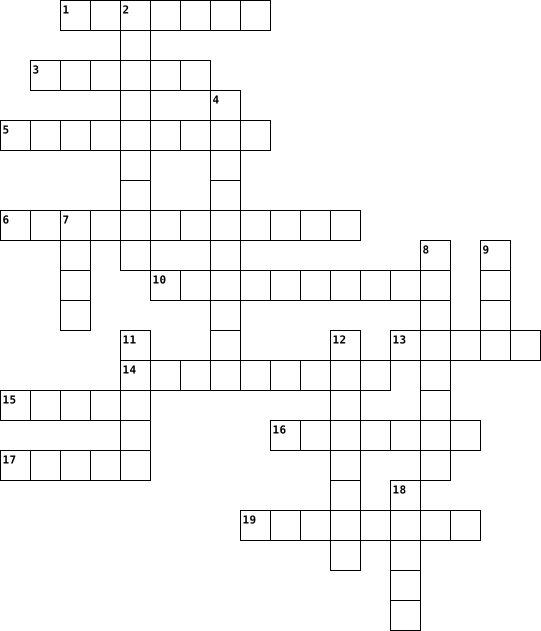
economics Crossword Puzzles
Canada's Economics 2026-03-25

Across
- True or false entrepreneurs benefit a country?
- How old do you have to be for you to contribute to the literacy rate?
- What is the name of the river Canada has?
- Who is a part of NAFTA_USMCA besides Canada and the United States?
- Is Canada market leaning or Command leaning?
- Countries with a high literacy rate are usually what?
- Making a business in Canada is
- Canada's literacy rate is
Down
- What does GDP stand for?
- What helps create jobs?
- dollar What is Canada's currency?
- How many major seaports are there in Canada?
- How many oceans is Canada touching?
13 Clues: What helps create jobs? • What does GDP stand for? • Canada's literacy rate is • Making a business in Canada is • How many oceans is Canada touching? • dollar What is Canada's currency? • What is the name of the river Canada has? • Is Canada market leaning or Command leaning? • How many major seaports are there in Canada? • True or false entrepreneurs benefit a country? • ...
Economics Vocabulary 2026-03-09

Across
- Organized associations of workers formed to protect their rights.
- A system where the state protects the health and well-being of its citizens.
- Fundamental entitlements regardless of nationality or status.
- A great difference or inequality, often regarding wealth
- Government-provided services like healthcare or education.
- Exclusive control of a commodity or service in a particular market.
Down
- A system where property is public and people are paid according to abilities/needs.
- The preoccupation with the acquisition of consumer goods.
- Support for social reform and improvement through government action.
- The advocacy of women's rights on the basis of equality.
- A system combining private enterprise with government involvement.
- The theory that wealth at the top eventually benefits everyone.
- A general increase in prices and fall in the purchasing value of money.
13 Clues: The advocacy of women's rights on the basis of equality. • A great difference or inequality, often regarding wealth • The preoccupation with the acquisition of consumer goods. • Government-provided services like healthcare or education. • Fundamental entitlements regardless of nationality or status. • ...
Unit 2 Vocab 2022-09-13

Across
- a payment from a government to a business to ensure the business can stay on it's feet.
- the use of government spending and taxation to influence the economy.
- predicament in which there is a single seller in a certain market.
- a method in which the government gains money from the people for their overall budget.
- an individual who identifies a need in the current market and acts on it.
- the regulation of the concentration of economic power, Ex: price fixing
- rules set by the government that limit things like price ranges within businesses.
- government order that restricts the exchange between a certain country or area.
- the regulation of the amount of money available in any given economy.
- the study of households, firms, and individuals behavior on an overall small scale in economics.
Down
- Public industries are mainly owned by the government or other state bodies while private industries are privately owned, Ex: Amazon, McDonalds.
- Process in which ideas and processes spread all the way around the world for economics.
- the price of a country's money in relation to another country's money.
- the amount of money someone recieves for their goods or services.
- The power of the government to be able to take private property for public use.
- example would include copyright on a book or article.
- the study of the structure of international financial interactions.
- the occupation of protecting and keeping money safe for others.
- regulation that limits the total quantity of something that can be imported of a certain amount of time.
- overall profits from sales, EX: you invest 100 stocks into something that costs $100, you then sell those 100 stocks when it costs $150, your capital-gain is $5000.
- process of paying employees.
- the study of economics on a large scale such as overall taxes, inflation, and interest rates.
- occurs when expenses exceed revenues.
- economic valuation of an individual's investments, assets, and interests.
24 Clues: process of paying employees. • occurs when expenses exceed revenues. • example would include copyright on a book or article. • the occupation of protecting and keeping money safe for others. • the amount of money someone recieves for their goods or services. • predicament in which there is a single seller in a certain market. • ...
module one Chapter 1,2, and 21 2014-10-12

Across
- Trade Organization International organization that oversees international trade agreements and rules on trade disputes
- The study of how society chooses to allocate its scares resources to the production of goods and services in order to satisfy unlimited wants
- A law that limits the quantity of goods that may be imported in a given time
- The accumulation of capital such as factories, machines, and equipment, that is used to produce good and services
- The creative ability of individuals to seek profit by taking risk and combining resources to produce innovated products
- cost the best alternative sacrificed for a chosen alternative
- advantage The ability to produce goods at a lower opportunity cost than other countries
- The condition in which human wants are forever greater then the available supply of time, goods and resources
- The branch of economics that studies decision making by a single individual, household, firm, industry, or level of government
- Account Records payments flows for financial capital, such as real estate, stocks, bonds etc..
- trade agreement Nations negotiate a reduction in trade barriers
- trade The flow of goods between countries without restrictions or special taxes
- A law that bars trade with another country
Down
- appreciation the price of currency rises in relation to another currency
- possibility curve A curve that shows the max combinations of two outputs that are economy can produce given its available resources and technology
- The branch of economics that studies decision making for the economy as a whole
- point Because all the point along the curve are maximum out put levels with give resources and technology
- growth The ability of an economy to produce greater levels of output, represented by an outward shift of its production possibilities curves
- paribus A Latin phrase that means while curtain variables change all others remain the same
- rate The number of one countries currency that is equal to one unit of another nations currency
- A simplified description of reality used to understand and predict the relationship of variables
21 Clues: A law that bars trade with another country • cost the best alternative sacrificed for a chosen alternative • trade agreement Nations negotiate a reduction in trade barriers • appreciation the price of currency rises in relation to another currency • A law that limits the quantity of goods that may be imported in a given time • ...
Environmental Science Chapter 2 2018-09-07

Across
- environmental protection agency
- interprets the law
- migrating ____ travel across international borders on land and in the oceans
- In the 1960's and 19870's were a time of major advances in environmental _____
- a producer will____ the price and supply of a product when the demand is HIGH
- study of how resources are converted into goods and services
- products explain on their labels how the products were grown, harvested, or manufactured
- both the government and individuals play roles in this type of economy
- type of environmental issue that involves more than 1 nation
- CAPT'N ______
- when demand is low, the seller may drop the price and slow __
Down
- environmental economics argue sustainability when _____ are addressed
- a government determines the overall amount of pollution it will accept for a specific pollutant and issues a permit for emission of a fraction of this amount
- founded in 1945, and consisted of 50 nations
- type of analysis where you compare the sacrifice and gains by a specific action
- type of economy where the individual decides what, how, and how much is made
- the EPA protects environmental _________
- environmental impact statement
- Founded in 1944 and owned by 186 nations
- established in 1995 to promote free trade and enforces fair trade practices
- amount of product offered for sale
21 Clues: CAPT'N ______ • interprets the law • environmental impact statement • environmental protection agency • amount of product offered for sale • the EPA protects environmental _________ • Founded in 1944 and owned by 186 nations • founded in 1945, and consisted of 50 nations • study of how resources are converted into goods and services • ...
Section 1 Crossword 2017-12-19

Across
- human resources
- basic economic problem because of limited resources
- physical items like food
- efficiency occurs when the economy is utilizing all of its resources efficiently
- economics studies economic behavior without making judgments
- is a measure that can change from observation to observation
- efficiency is a type of economic efficiency in which producers produce only those types of goods and services that are more desirable in the society while in high demand
- study of the economy as a whole
- something a person would like to have but it is not necessary for survival
- using our limited resources wisely
- actions one does for another
- is price-determined
- where goods and services produced by businesses are sold to households
Down
- refers to markets where services of the factors of production are bought and sold
- economics analyzes outcomes of economic behavior and suggests courses of action
- market profit opportunities are eliminated almost instantaneously
- capital resources
- cost is the best alternative
- study of individual consumers and businesses
- people who decided how to combine resources to create new goods and services.
- growth is an increase in the total output of the economy
- something a person cannot live without
- natural resources
23 Clues: human resources • capital resources • natural resources • is price-determined • physical items like food • cost is the best alternative • actions one does for another • study of the economy as a whole • using our limited resources wisely • something a person cannot live without • study of individual consumers and businesses • basic economic problem because of limited resources • ...
Social Studies Review 2020-11-02

Across
- central European country; home to the Rhine River
- theme of history that explains how people can view the same event differently
- islands off the coast of Europe; made up of England, Scotland, Wales, and Northern Ireland
- 2nd longest river in Europe
- the eastern/Asian side of Russia
- area of flat land that runs from central to eastern Europe
- land surrounded on 3 sides by water
- a theme of geography indicating where a place can be found
- very cold eastern European country
- mascot of Floyd Middle School
- theme of economics that explains how resources are limited
Down
- the permanent relocation of a person or group of people
- positive or negative actions humans take toward nature
- theme of history that describes the relationship between events and their outcomes
- the study of the relationship between the earth and humans
- the spread or relocation of things and ideas; the temporary relocation of people
- peninsula in the Mediterranean sea
- the best college/university in the world (as rated by Mr. Ball, Mr. Bernhardt, and Mr. Cole)
- central European mountain range; found in Switzerland, Italy, France, and Germany
- the mountain range that divides Russia
- book by Dr. Seuss that includes many themes of geography, history, and economics
21 Clues: 2nd longest river in Europe • mascot of Floyd Middle School • the eastern/Asian side of Russia • peninsula in the Mediterranean sea • very cold eastern European country • land surrounded on 3 sides by water • the mountain range that divides Russia • central European country; home to the Rhine River • positive or negative actions humans take toward nature • ...
Economics Cross Word Puzzle 2022-10-17

Across
- generalisation based on rational behaviour and logical reasoning.
- Statement of what is.Based on facts supported with evidence.
- Collecting and identifying economic problems.
- Father of economics
- Government policy aimed to improve efficiency with nations allocative resources.
- means by which objectives might be achieved.
- Studies the economy as a whole.
- Moving from facts to theory.
- What is true for one is true for all.
- Adam Smith
- Vilfredo Pareto
- Statement of one's value judgement and personal opinion on what should be, ought to be and could be done.
- Conclusion drawn to a small sample can be misleading.
- general statement of what will happen given certain circumstances.
- Also known as Inductive methodology.
Down
- "after this, therefore because of this".
- achievement of a desirable level of a particular economic variable.
- Root of technic of thinking in economics.
- Moving from theory to facts.
- Another name for Deductive.
- Combination of facts and theory to formulate economic policy.
- concerns it's self with a behaviour of a small individual economic units.
- Milton Friedman
- simplified picture of reality.
- believing in what we need to believe and ignoring the facts.
- Alfred Marshal
- Establishes cause and effect.
- J.M Keynes
- Organising facts derive economic principals,laws and theories.
29 Clues: Adam Smith • J.M Keynes • Alfred Marshal • Milton Friedman • Vilfredo Pareto • Father of economics • Another name for Deductive. • Moving from theory to facts. • Moving from facts to theory. • Establishes cause and effect. • simplified picture of reality. • Studies the economy as a whole. • Also known as Inductive methodology. • What is true for one is true for all. • ...
class work 2026-01-16

Across
- monetary value of a product as established by supply and demand
- Seen today as the father of Capitalism and GOAT of Economics.
- The study of the economy as a whole
- a little more, or a little less
- information One party to a transaction has more information than the other party does
- the study of how society manages its scarce resources who what when where why how.
- the extra benefit of adding one unit
- something new
- Complete control of a product or business by one person or group
- costs that have already been incurred and cannot be recovered
Down
- you can create a product without having to get permission of the government
- we are reluctant to waste something we have paid for
- the law applies to everyone, even those who govern
- something that induces a person to act
- graph showing growth of US economy after Industrial Revolution
- Adam Smith's term used to describe the self-regulating nature of the marketplace
- study of how households and firms make decisions and how they interact in markets
- the cost of producing one more unit of a good
- the value of your second-best choice
- A security pledged for the repayment of a loan
20 Clues: something new • a little more, or a little less • The study of the economy as a whole • the value of your second-best choice • the extra benefit of adding one unit • something that induces a person to act • the cost of producing one more unit of a good • A security pledged for the repayment of a loan • the law applies to everyone, even those who govern • ...
Session 1 Activity 2 2024-05-16

Across
- Astrology
- Economics and Political Science
- Warfare
- Health and Medicine
Down
- Phonetics
- Metrics
- Rituals
- Etymology
8 Clues: Metrics • Rituals • Warfare • Phonetics • Astrology • Etymology • Health and Medicine • Economics and Political Science
Micro Economic 2024-09-13

Across
- changes Sự thay đổi biên
- Khan hiếm
- Ngoại tác
- failure Thất bại thị trường
- Hiệu quả
- rights Quyền sở hữu tài sản
- Kinh tế học
- Lạm phát
Down
- Năng suất
- curve Đường cong Phillips
- Động cơ khuyến khích
- power Quyền lực thị trường
- cost Chi phí cơ hội
- economy Kinh tế thị trường
- cycle Chu kỳ kinh tế
- people Con người duy lý
- Công bằng
17 Clues: Hiệu quả • Lạm phát • Năng suất • Khan hiếm • Ngoại tác • Công bằng • Kinh tế học • cost Chi phí cơ hội • Động cơ khuyến khích • cycle Chu kỳ kinh tế • people Con người duy lý • changes Sự thay đổi biên • curve Đường cong Phillips • power Quyền lực thị trường • economy Kinh tế thị trường • failure Thất bại thị trường • rights Quyền sở hữu tài sản
How Well Do You Know Me? 2024-01-01

Across
- Favorite instrument
- Once a dream of mine
- Favorite TV show
- Greatest fear
- Favorite color
- One of my allergies
Down
- Where I went for summer camps
- A name we call each other
- Zodiac Sun
- Where we met
- Zodiac Moon
- Favorite movie series
- Almost my college major
- Middle school mascot
- A program I used to act for
15 Clues: Zodiac Sun • Zodiac Moon • Where we met • Greatest fear • Favorite color • Favorite TV show • Favorite instrument • One of my allergies • Once a dream of mine • Middle school mascot • Favorite movie series • Almost my college major • A name we call each other • A program I used to act for • Where I went for summer camps
Simple Solutions 2021-02-17

Across
- the type of bread invented by the Egyptians
- the process of preserving bodies for the journey to the afterlife
- describes goods produced within a country
- general heading for topics ranging from history and geography to economics and political science
- the last Egyptian pharaoh
- graphic that shows events in chronological order
- type of map that shows the features of a region, such as annual temperature, mineral distribution, or population density
- a graph that shows parts of a whole
- the type of government in which a deity is recognized as the supreme ruler
- a combined government and economic system, often with an authoritarian leader
Down
- the divisions of ancient Egypt
- a subdivision of a religion
- the study of relics, artifacts, and monuments
- the study of how people allocate limited resources and use them to satisfy their needs and wants
- the warriors with whom Ramses signed the world's first peace treaty
- exists when two or more companies are selling the same good
- the products a country buys from another country
- the type of monarchy that has a constitution and legislative body, such as parliament, sharing power with the monarch
18 Clues: the last Egyptian pharaoh • a subdivision of a religion • the divisions of ancient Egypt • a graph that shows parts of a whole • describes goods produced within a country • the type of bread invented by the Egyptians • the study of relics, artifacts, and monuments • graphic that shows events in chronological order • the products a country buys from another country • ...
Lesson 38 2021-03-17

Across
- type of map that shows the features of a region, such as annual temperature, mineral distribution, or population density
- describes goods produced within a country
- graph a type of graph that shows parts of a whole
- the divisions oF ancient Egypt
- studies general heading for topics ranging from history and geography to economics and political science
- the study of how people allocate limited resources and use them to satisfy their needs and wants
- a subdivision of religion
- the study of relics, artifacts, and monuments
- the type of monarchy that has a constitution and legislative body, such as a parliament, sharing power with the monarch
Down
- the warriors with whom Ramses signed the world's first peace treaty
- the process of preserving bodies for the journey to the afterlife
- the type of bread invented by the Egyptians
- exists when two or more companies are selling the same good
- the products a country buys from another country
- a combined government and economic system, often with an authoritarian leader
- the last Egyptian pharaoh
- the type of government in which a deity is recognized as the supreme ruler
- graphic that shows events in chronological order
18 Clues: the last Egyptian pharaoh • a subdivision of religion • the divisions oF ancient Egypt • describes goods produced within a country • the type of bread invented by the Egyptians • the study of relics, artifacts, and monuments • the products a country buys from another country • graphic that shows events in chronological order • ...
Economics Part 1 Marissa Barajas 2021-10-27

Across
- The 3 basic economic questions each nation must answer are:
- The invisible hand is linked to this economic system
- **An example of complementary goods are:
- Economics is the study of people and
- The economic driver in a market economy is:
- **Examples of this type of economy include,haiti,alaska,canada and greenland
- Crops are an example of this factor of production
- An example of a nondurable good is:
- The concept behind the ¨invisible hand¨ is that there should be
- The top level of the hierarchy in the channel of distribution is the
- This economic system has no private ownership of property or land
Down
- The economic regulator in a market economy is:
- A doctor is an example of which factor of production
- People who are willing to risk their own money to start their own business is an example of which factor of production
- The owner of dub´s on main street is an example of this type of production
- Money is an example of which factor of production
- An example of a tangible good is:
- The study of the way a nation(or business or person) uses its limited resources to satisfy unlimited wants and needs
- A forklift is an example of this type of production
- Another name for this economic system is mixed economy
20 Clues: An example of a tangible good is: • An example of a nondurable good is: • Economics is the study of people and • **An example of complementary goods are: • The economic driver in a market economy is: • The economic regulator in a market economy is: • Money is an example of which factor of production • Crops are an example of this factor of production • ...
John Galbraith 2020-08-29

Across
- Magazine
- declined
- October 1929
- Society
Down
- rich
- suffering and panic 1929
- Matters
- University of Toronto
8 Clues: rich • Matters • Society • Magazine • declined • October 1929 • University of Toronto • suffering and panic 1929
Term 1 Kupu (Māori answers) 2026-03-25

Across
- Social Sciences
- Performing Arts
- Maths
- Science
- Design Technologies
Down
- Home Economics
- English
- Music
8 Clues: Maths • Music • English • Science • Home Economics • Social Sciences • Performing Arts • Design Technologies
Economics Review 2014-03-05

Across
- A number limit on imported goods
- Buildings,Machines,Office Equipment
- When a person does their part of the process better than anyone else,and helps the buisness run better.
- Deserts,Mountains,Swamps,ect.
- People needed to do the work
- Stopping trade with another country to force political or governmental change
Down
- Very little chang,roles are handed down by generations
- Trees,Soil,Plants,Fish,ect.
- Government controls all aspect of the economy
- Tax on imported goods
- 1994 trade agreement between US,Canada,and Mexico that created a large free trade zone
- Person with idea and capital
- The government has little involvement in this economy
13 Clues: Tax on imported goods • Trees,Soil,Plants,Fish,ect. • Person with idea and capital • People needed to do the work • Deserts,Mountains,Swamps,ect. • A number limit on imported goods • Buildings,Machines,Office Equipment • Government controls all aspect of the economy • The government has little involvement in this economy • ...
Economics Crossword 2016-06-22

Across
- Money given to producers to encourage them to produce more.
- Measurement of change in demand due to change in price.
- A good that is deemed as under consumed in a market.
- A form of ad-valorem tax, currently at 20%.
- A form of false information when one person knows more than another.
- A positive or negative effect to a third party of production or consumption of a good.
Down
- A form of market in which the forces of supply and demand alone determine price.
- When the price elasticity of demand is less than 1.
- A form of tax imposed on producers.
- A form of market failure due to intervention by the __________.
- A form of economy where resources are allocated by the state.
- When demand for a product falls as real incomes increases.
- When a good has limited resources and unlimited needs.
13 Clues: A form of tax imposed on producers. • A form of ad-valorem tax, currently at 20%. • When the price elasticity of demand is less than 1. • A good that is deemed as under consumed in a market. • When a good has limited resources and unlimited needs. • Measurement of change in demand due to change in price. • When demand for a product falls as real incomes increases. • ...
Economics Block 2021-02-18

Across
- a business that protects people's money and offers them loans
- a process in which money is traded from one person to another
- chores or jobs people can pay others to do
- when one person trades goods or services for other goods or services
- objects or items people can buy
- people or businesses that buy goods or services
Down
- extra money paid with a loan
- a large sum of money people can borrow from a bank
- when someone takes money out of a bank account
- account an account that people use to save money
- an account that people easily use every day
- people or businesses that produce goods or services
- when someone puts money into a bank account
13 Clues: extra money paid with a loan • objects or items people can buy • chores or jobs people can pay others to do • an account that people easily use every day • when someone puts money into a bank account • when someone takes money out of a bank account • people or businesses that buy goods or services • a large sum of money people can borrow from a bank • ...
Economics World 2017-05-31

Across
- the production of one or just a few goods and services
- restriction on the free exchange of goods and services
- the separation of tasks in any system
- exporting goods at prices lower than the home-market prices
- an authoritative permission
- an official ban on trade with a particular country
Down
- helps to regulate the volume of trade between countries
- a secretive trade agreement that created a free-trade zone among 12 nations
- mutual reliance between two or more groups
- a tax imposed on imported goods and services
- a type of policy that limits unfair competition from foreign industries
- a form of financial aid
- an agreement designed to remove tariff barriers between the United States,Canada and Mexico
13 Clues: a form of financial aid • an authoritative permission • the separation of tasks in any system • mutual reliance between two or more groups • a tax imposed on imported goods and services • an official ban on trade with a particular country • the production of one or just a few goods and services • restriction on the free exchange of goods and services • ...
economics crossword 2020-09-11

Across
- capital of sikkim
- What is subtracted from net
- Synonym of qualitative methods
- Sense of wellbeing among people
- can borrow from central bank
- Another name of currency held with
Down
- Another name for capital formation
- central bank of india
- tax to get gross indirect
- Predominant religion of Sikkim
- Sum of credit and debit is also
- Interest rate at which commercial
- as
13 Clues: as • capital of sikkim • central bank of india • tax to get gross indirect • What is subtracted from net • can borrow from central bank • Predominant religion of Sikkim • Synonym of qualitative methods • Sum of credit and debit is also • Sense of wellbeing among people • Interest rate at which commercial • Another name for capital formation • Another name of currency held with
SQUISHY ECONOMICS 2024-04-23

Across
- imperfect competition
- the quantity of goods buyers will take at a price.
- distinction between products
- case
- cost of a product
- Squishmellows
Down
- trademark
- price point where supply meets demand
- replacement
- demand for a commodity
- counterpart
- Quantity of a commodity
- gain of money
13 Clues: case • trademark • replacement • counterpart • gain of money • Squishmellows • cost of a product • imperfect competition • demand for a commodity • Quantity of a commodity • distinction between products • price point where supply meets demand • the quantity of goods buyers will take at a price.
Economics Review 2025-01-16

Across
- the highest part in a business cycle
- the total of goods and services WITHIN one country's borders
- the total MONEY EARNED one country's people and companies
- the lowest part in a business cycle
- the kind of demand that when prices change, the amount of products bought changes: for example airline tickets, furniture, eating out at restaurants
- the consumer's desire to buy the product or services
Down
- the kind of good we buy more of when we make more money (clothes, cars, computers)
- the kind of taxes the government makes producers pay
- the increase in a business cycle from the lowest part to the highest
- the total of goods and services OF one country's people and companies (they can be outside of that country when they make money)
- the number of products that a producer or seller is willing and capable to provide to buyers
- a pattern that repeats (like girls getting their periods every month)
- the kind of good we DO NOT buy more of when we make more money (instant noodles, for example)
13 Clues: the lowest part in a business cycle • the highest part in a business cycle • the kind of taxes the government makes producers pay • the consumer's desire to buy the product or services • the total MONEY EARNED one country's people and companies • the total of goods and services WITHIN one country's borders • ...
Economics Revision 2024-10-18

Across
- Providing goods and services to households.
- Consumer _____________ on the circular flow model is what households provide to firms in exchange for goods and services.
- Used to purchase goods and services and provides value to products (Hint: Starts with M).
- The ______________ provides infrastructure such as roads and railways to help businesses.
Down
- The relationship between buyers and sellers.
- On the supply and demand graph, where supply and demand curves meet (Hint: Starts with Eq).
- Somebody who is purchasing products to satisfy wants.
- This sector has the role of collecting savings (deposits) and lending money to firms to grow their business.
- An item that is necessary for living.
- The Economic _______ is that there are limited resources and unlimited wants.
- Economics is about allocating ______ resources to satisfy unlimited wants (Hint: Another word for 'limited')
- An item that is not necessary for living, but nice to have.
- The Australian _______ is the total of all activities undertaken to produce, distribute and consume goods and services within the country.
13 Clues: An item that is necessary for living. • Providing goods and services to households. • The relationship between buyers and sellers. • Somebody who is purchasing products to satisfy wants. • An item that is not necessary for living, but nice to have. • The Economic _______ is that there are limited resources and unlimited wants. • ...
Economics Vocabulary 2022-04-25

Across
- The things that people sell.
- An economic system where property and businesses are owned by the government. Supply and Price is also controlled by the government.
- The right to make decisions for an individual's business or property
- The name of Adam Smith's idea of a free market economy.
- The government's right to take private property for the public as long as they pay a fair price to the owner.
- The person who makes the goods.
- Individuals own businesses and property rather than the government
- Scottish economist who created capitalism and wrote the Wealth of Nations.
Down
- An economic system where businesses and property are privately owned. The price and amount of goods traded are based on supply and demand and has little government regulation.
- A person who buys goods and services.
- When different businesses compete for consumers' money
- The founder of a business. Someone who assumes the risks of organizing resources to produce goods and services. Someone who sees an opportunity to make money and takes it.
- The government's job is to protect property rights.
13 Clues: The things that people sell. • The person who makes the goods. • A person who buys goods and services. • The government's job is to protect property rights. • When different businesses compete for consumers' money • The name of Adam Smith's idea of a free market economy. • Individuals own businesses and property rather than the government • ...
About Economics 2022-07-13

Across
- return of capital
- return of land
- price ________: a price control which be set below the market price
- goods are said to be _________ if they can replace each other to satisfy the same want
- a branch of economics studying individuals and firms in making decisions
- a factor of production whose return is called profit
- ________ statements involves value judgements
Down
- highest valued option forgone
- _________ goods: Goods that see an increase in demand when income rises
- _______ statements are refutable by facts
- where quantity demanded equal quantity supplied
- appears when quantity demanded is greater than the quantity supplied
- _________ goods: Goods that see an decrease in demand when income rises
13 Clues: return of land • return of capital • highest valued option forgone • _______ statements are refutable by facts • ________ statements involves value judgements • where quantity demanded equal quantity supplied • a factor of production whose return is called profit • price ________: a price control which be set below the market price • ...
Canada Economics 2026-03-23

Across
- The economy that Canada leans towards
- The largest free trade zone in the world
- The total value of all goods and services in a country
- What Canada invests in to grow their GDP
- Canada has an abundance of this
- Canada's Literacy Rate percentage
- What is Canada when it comes to entrepreneurship
- What it the rate of people who can read and writer over 15
Down
- The key to Canada's ability to trade
- The total value of all goods and services divided by the population
- The currency of Canada
- Canada's Standard of Living
- One of the things that helps Canada be a leader in trade
13 Clues: The currency of Canada • Canada's Standard of Living • Canada has an abundance of this • Canada's Literacy Rate percentage • The key to Canada's ability to trade • The economy that Canada leans towards • The largest free trade zone in the world • What Canada invests in to grow their GDP • What is Canada when it comes to entrepreneurship • ...
Economics Unit 1 and 2 Key Terms 2025-09-12

Across
- : When one variable goes up, the other goes up too; when one goes down, the other goes down.
- : The principle that producing more of one item means giving up increasing amounts of another item.
- : The study of how people and societies make decisions about scarce resources.
- : The benefit you give up when you choose one option instead of another.
- : The part of economics that deals with opinions and value judgments about what should happen.
- : The idea that adding more of one resource while keeping others the same eventually produces less and less extra output.
- : The boundary line on a production possibilities graph that shows the maximum that can be produced.
- : Choosing one option over another because it is more important or beneficial.
- : The result or outcome that happens after an action or a decision is made—or not made.
- : Someone who is directly affected by or has an interest in an economic decision.
- : A belief that sounds true but has been proven false.
- : The point (0,0) where the x-axis and y-axis meet on a graph.
- : Tools, machines, or equipment used to make other goods.
- : The idea that when all inputs are increased together, output grows at an even faster rate.
- : A resource used to make something, like land, labor, or capital.
- : The goods or services created by using resources such as land, labor, and capital.
- : To cut back or make careful choices so that limited resources are used wisely.
Down
- : The oversimplified idea that one event has only a single cause when there may be many.
- : A graph that shows the different combinations of goods an economy can produce.
- : Giving up one thing in order to gain something else.
- : Products made for people to use directly, like clothes or food.
- : When one variable goes up, the other goes down, and vice versa.
- : The false idea that just because one event happens before another, it must have caused it.
- : The part of economics that focuses on facts and real-world evidence.
- : The cost of making one item shown in terms of how much of another item must be sacrificed.
- : A system where people, businesses, and governments interact, creating flows of money, goods, and services.
- : Using resources in a way that actually reaches the goal you want, like meeting a need or desire.
- : The mistake of thinking what’s true for one person or group is automatically true for everyone.
- : Achieving a goal while using the least amount of resources possible.
- : A step-by-step process of studying problems that involves observing, collecting data, forming explanations, and testing them.
- : The satisfaction or benefit someone gets from choosing or using something.
- : A field of study that looks at human behavior, like economics, history, or sociology.
- : An imaginary unit used to measure satisfaction or happiness from consuming a product.
33 Clues: : Giving up one thing in order to gain something else. • : A belief that sounds true but has been proven false. • : Tools, machines, or equipment used to make other goods. • : The point (0,0) where the x-axis and y-axis meet on a graph. • : Products made for people to use directly, like clothes or food. • ...
economics crossword 2023-09-01

Across
- cost required for an item
- total amount withdrawn
- to make something available
- something required for life
- anything important to you
- study of how society uses resources
- automated teller machine
Down
- a request of items
- materials available
- something desirable
- a shopper
- limited amount
12 Clues: a shopper • limited amount • a request of items • materials available • something desirable • total amount withdrawn • automated teller machine • cost required for an item • anything important to you • to make something available • something required for life • study of how society uses resources
Ch 1 Lesson 1 2026-01-08

Across
- The exchange of one benefit or advantage for another that is thought to be better.
- The branch of economics that applies value judgments to data in order to recommend actions or policies.
- Something that motivates a person to take a particular course of action.
- The branch of economics that uses objective analysis to find out how the economy actually works
Down
- A way to compare the cost of an action with the benefits of that action;if benefits exceed cost, then the action is worth taking.
- The study of how people choose to use their limited resources to satisfy their unlimited wants.
- Condition that results because people have limited resources but unlimited wants.
- A system used to manage limited resources for the production, distribution,and consumption of goods and services.
8 Clues: Something that motivates a person to take a particular course of action. • Condition that results because people have limited resources but unlimited wants. • The exchange of one benefit or advantage for another that is thought to be better. • The study of how people choose to use their limited resources to satisfy their unlimited wants. • ...
traditional economy 2014-03-04

Across
- _______ ______ work full time to produce their own food.
- Nomadic herders and shifting cultivators moved through ________ _____ to produce their food.
- The description for this word is an economics system witch decisions are baced on customs, belifes or religion with in a strong social community.
- To day no government bases its ____________ decisisions on tradition.
Down
- Cultural and religious values often shape economic _______ in the system.
- You had to answer these five questions that involve the _________ ___.
- _______ _____ is often carried out on tiny fields.
- At one time most countries had _______ economies.
- Traditional economics arer found in ___________ _______.
- Now in the communities, that cooperation is gone. what inuit elder said this line.
10 Clues: At one time most countries had _______ economies. • _______ _____ is often carried out on tiny fields. • _______ ______ work full time to produce their own food. • Traditional economics arer found in ___________ _______. • To day no government bases its ____________ decisisions on tradition. • You had to answer these five questions that involve the _________ ___. • ...
Agron 342 2022-11-11

Across
- The creator of Doughnut Economics, Kate
- Revolution centered around increasing yield and production
- The country where Norman Bourlaug started his work on wheat
- Type of economics approach that focuses less on growth and more on meeting human needs without exceeding our ecological boundaries
- a pre-industrial agricultural laborer or farmer with limited land ownership
- Sales in the US were almost 20 billion for this product
Down
- One of the downsides of the Green Revolution
- The UN Declaration on the Rights of Peasants includes the right to food
- The community that formed very successful UCPs
- Made by cold pressing unroasted beans compared to cocoa which is more of a powder
10 Clues: The creator of Doughnut Economics, Kate • One of the downsides of the Green Revolution • The community that formed very successful UCPs • Sales in the US were almost 20 billion for this product • Revolution centered around increasing yield and production • The country where Norman Bourlaug started his work on wheat • ...
Economics Crossword Puzzle 2014-01-22

Across
- amount of good that is bought at a certain price
- coined, metallic money
- land and other raw materials
- a situation in which the quantity supplied exceeds the quantity demanded at a given price
- the desire to work to improve one's economic situation
- the separation of work into individualized tasks
- usefulness of a good
- point at which quantity demanded and quantity supplied are equal
- the human desire to possess or use a certain good or service
- the study of choices made in the production, distribution and consumption of goods
Down
- antitrust law
- legal tender backed only by a government's promise
- an individual who uses goods
- when there are no substitutes and consumers will pay high prices for a product
- exchange of one good for another without money being exchanged
- amount of a good that is produced
- limited availability of goods at a particular time and place
- a market in which there is only one supplier of a good
- the worth that consumers attach to a good
- production of goods by people doing the jobs they do best
- the total amount of a good that is produced
- father of economics
- encourages quality and low prices
- groups of firms that produce similar products
24 Clues: antitrust law • father of economics • usefulness of a good • coined, metallic money • an individual who uses goods • land and other raw materials • amount of a good that is produced • encourages quality and low prices • the worth that consumers attach to a good • the total amount of a good that is produced • groups of firms that produce similar products • ...
EPF Final Exam Review 2023-05-22

Across
- as price rises demand decreases (3 words)
- tax that is paid everytime you purchase something (2 words)
- where supply meets demand with no shortage or surplus
- putting away money for long-term financial goals like retirement
- the total of all goods and services produced in a country in one year
- economic system where habit and custom answer the economics questions
- economic model that shows how goods and services flow in the marketplace (2 words)
- a rise in prices and a fall in the purchasing power of money
- policy that is used by the government to manage the economy
- unlimited wants exceed limited resources
Down
- economic system where the government makes all decisions
- as price rises supply increases (3 words)
- amount you have to pay before insurance will pay
- when a small group dominates a market
- when one company or person completely controls the market
- government authority to control or change practices in a market
- tax that is paid on the money an individual makes in over a year (2 words)
- putting away money for an emergency
- policy that is used by the Federal Reserve to manage the economy
- economic system where the economics questions are answered by consumers (2 words)
- a charge for borrowing money
21 Clues: a charge for borrowing money • putting away money for an emergency • when a small group dominates a market • unlimited wants exceed limited resources • as price rises supply increases (3 words) • as price rises demand decreases (3 words) • amount you have to pay before insurance will pay • where supply meets demand with no shortage or surplus • ...
Subjects 2022-08-25

Across
- おんがく
- フランス語
- せんたくかもく
- 休み時間
- こう校
- そうじ
- すう学
Down
- ぎじゅつ
- か学
- 日本語
- クラブかつどう
- けいざい
- かていか
- えい語
- びじゅつ
15 Clues: か学 • 日本語 • えい語 • こう校 • そうじ • すう学 • ぎじゅつ • おんがく • けいざい • かていか • 休み時間 • びじゅつ • フランス語 • クラブかつどう • せんたくかもく
Harrison Dewson 2020-08-09

Across
- helps fix things
- use your economic resources in a way
- people do for you
- coffee machine
- Lamborghini
- the tool the government uses
Down
- limited resources satisfy wants
- what you would like to have
- use scarce resources to satisfy wants
- tree
- insufficient supply
- consume to satisfy needs and wants
- animals
- chop down tree
- for everyday survival
15 Clues: tree • animals • Lamborghini • coffee machine • chop down tree • helps fix things • people do for you • insufficient supply • for everyday survival • what you would like to have • the tool the government uses • limited resources satisfy wants • consume to satisfy needs and wants • use your economic resources in a way • use scarce resources to satisfy wants
BIG + LITTLE HINTS 2025-09-23

Across
- number of hours it take for me to drive to my hometown from UT
- i have __ sibling(s)
- favorite animal
- AGD mascot
- favorite t.v. show
- hometown delicacy
- former place of employment
Down
- grade
- middle name
- lucky number
- to ______ friendships with but a chosen few
- favorite musician
- dog's name
- number of months i've been with my boyfriend
- major
15 Clues: grade • major • dog's name • AGD mascot • middle name • lucky number • favorite animal • favorite musician • hometown delicacy • favorite t.v. show • i have __ sibling(s) • former place of employment • to ______ friendships with but a chosen few • number of months i've been with my boyfriend • number of hours it take for me to drive to my hometown from UT
Economics Part 1 By Persiah Roberts 2021-10-26

Across
- The owner of DuB´s on Main street is an example of this factor of production.
- Examples of this type of economy includes Haiti, Alaska, Canada & Greenland.
- A doctor is an example of what factor of production?
- **The ¨Invisible Hand¨is linked to this economic system.
- **An example of complementary goods are_____.
- **The economic regulator in a market economy is:
- **Another name for the economic system is ¨mixed economy¨.
- People who are risking their own money to start their own business is an example of which factor of production.
- The three basic questions each nation must answer are:
Down
- The concept behind the ¨Invisible Hand¨ is that there should be ________.
- Crops are an example of this factor of production.
- The top level of hierarchy in the channel of distribution is the ________ {ex.the farmer}
- **An example of nondurable goods is:
- Economics is the study of people and _______.
- The study of the way a nation(or business or person) uses its limited resources to satisfy unlimited wants and needs is_______.
- A forklift is an example of this factor of production.
- **An example of a tangible good is:
- Money is an example of what factor of production:
- The economic system has no private ownership of property or land.
- The economic driver in a market economy is:
20 Clues: **An example of a tangible good is: • **An example of nondurable goods is: • The economic driver in a market economy is: • Economics is the study of people and _______. • **An example of complementary goods are_____. • **The economic regulator in a market economy is: • Money is an example of what factor of production: • ...
Colonial Crossword 2023-10-11

Across
- Man appointed by the king to govern a colony.
- The name of a colony established due to charity, defense, and economics.
- Denoting something as true or as a fact.
- Someone who donates money to better the commonwealth.
- The branch of knowledge that deals with wealth.
Down
- A colony created to protect a successful land from invasion.
- A written statement from the leader of a country creating a new colony.
- A group of wealthy GA colonists that weren't happy with the rules.
- The supreme executive legislature of the United Kingdom
9 Clues: Denoting something as true or as a fact. • Man appointed by the king to govern a colony. • The branch of knowledge that deals with wealth. • Someone who donates money to better the commonwealth. • The supreme executive legislature of the United Kingdom • A colony created to protect a successful land from invasion. • ...
Review chapter 1-6 2026-02-27

Across
- The group of people benefit, but they do not pay what they should, while others pay, few will be willing to pay for improvement of the environment or other public goods
- goods are jointly consumed together
- A shorthand expression for any natural resource provided by nature
- addition to or subtraction from a current situation (start with M)
- The basic categories of inputs used to produce goods and services, also called factors of production
- the heart of economics
- A market condition existing at any price where the quantity supplied is less than the quantity demanded
- Any good for which there is an inverse relationship between changes in income and its demand curve
- The satisfaction, or pleasure, that people receive from consuming a good or service
- examines individual decision making units within an economy, such as a consumer’s response to changes in the price
- The mental and physical capacity of workers to produce goods and services
- The physical plants, machinery, and equipment used to produce other goods
Down
- the desire to own something and the ability to afford it
- A market condition existing at any price where the quantity supplied is greater than the quantity demanded
- Any arrangement in which buyers and sellers interact to determine the price and quantity of goods and services exchanged.
- applies an economy wide perspective that focuses on such issues as inflation, unemployment, and the growth rate of the economy
- costs of borrowing
- a type of economics statement whose analysis is based on value judgment
- A cost or benefit imposed on people other than the consumers and producers of a good or service
- A market condition that occurs at any price which the quantity demanded and the quantity supplied are equal
- The study of how society chooses to allocate its scarce resources to the production of goods and services in order to satisfy unlimited wants
- The creative ability of individuals to seek profits by taking risks and combining resources to produce innovative products
- sensitivity or responsiveness towards the change of something
- The body of knowledge applied to how goods are produced.
24 Clues: costs of borrowing • the heart of economics • goods are jointly consumed together • the desire to own something and the ability to afford it • The body of knowledge applied to how goods are produced. • sensitivity or responsiveness towards the change of something • A shorthand expression for any natural resource provided by nature • ...
Disciplines of Social Science 2020-06-19

Across
- language
- human behavior
- distribution of resources
- social structure
- abode of human beings
Down
- humankind
- revisiting the past
- exercise of authority
- human population
9 Clues: language • humankind • human behavior • human population • social structure • revisiting the past • exercise of authority • abode of human beings • distribution of resources
Father of John Tan 2025-06-10

Across
- Area of Work
- Youngest Child
- Ethnicity
- Middle Child
Down
- Oldest Child
- Subject of Interest
- Favorite cuisine
- Most Spoiled Child
- Country of Origin
- Favorite Country
10 Clues: Ethnicity • Oldest Child • Area of Work • Middle Child • Youngest Child • Favorite cuisine • Favorite Country • Country of Origin • Most Spoiled Child • Subject of Interest
Preslee Aldridge Europe's Economics 2022-10-24

Across
- They role the government plays
- 79% free 11% demand
- supply
- Their country's system
- Trading without money
- 73% free 27% demand
- Countries that are closer to one type
- Towns people
Down
- demand
- they come back together
- Government has no control over the economy
- 69% free 41% demand
- Government regulates ALL
- Traditions handed through generation
14 Clues: demand • supply • Towns people • 79% free 11% demand • 69% free 41% demand • 73% free 27% demand • Trading without money • Their country's system • they come back together • Government regulates ALL • They role the government plays • Traditions handed through generation • Countries that are closer to one type • Government has no control over the economy
History L2 Berke S8B 2025-09-02

Across
- Potassium+sulfide=💥
- Enlightenment dude
- Looking=learning=+1knowledge
- Definitions
Down
- Everyone knows everything
- Because
- Everyone has them
- Head Empty Baby
- 1dollar+1dollar=2dollar
9 Clues: Because • Definitions • Head Empty Baby • Everyone has them • Enlightenment dude • Potassium+sulfide=💥 • 1dollar+1dollar=2dollar • Everyone knows everything • Looking=learning=+1knowledge
Mother's Day Crossword 2023-05-09

Across
- your birth month
- sport you did when you were younger
- Chinese hometown
- Dad's birth month
- your Chinese nickname
- my Chinese nickname
- where you live right now
- my sister's Chinese nickname
Down
- Dad's name
- your major in college
- sport I do
- name of our dog
- your last name
- place you went to college
14 Clues: Dad's name • sport I do • your last name • name of our dog • your birth month • Chinese hometown • Dad's birth month • my Chinese nickname • your major in college • your Chinese nickname • where you live right now • place you went to college • my sister's Chinese nickname • sport you did when you were younger
vocab 2023-01-19

Across
- echange/ giving something up
- of production/ owner,land,labor,capital
- of ex changean/intermediary instrument or system used to facilitate the sale, purchase, or trade of goods between parties.
- often money or a prize, offered to make someone behave in a particular way
Down
- in economics to refer to the fact that budgeting inevitably involves sacrificing some of X to get more of Y
- more money then you spent
- in the form of money
- branch of knowledge concerned with the production, consumption, and transfer of wealth
- demand for a good or service is greater than the availability of the good or service
- cost/what you give up
- market/a system that combines aspects of both capitalism and socialism.
11 Clues: in the form of money • cost/what you give up • more money then you spent • echange/ giving something up • of production/ owner,land,labor,capital • market/a system that combines aspects of both capitalism and socialism. • often money or a prize, offered to make someone behave in a particular way • ...
BAF TIMES 3 2023-08-18

Across
- Which audit is a systematic study and evaluation of the organizational social performance.
- If PSR is not mentioned in the partnership deed then how will the profits be divided ?
- The person who transfers rights of payment in bills of exchange.
- The W in SWOT analysis stands for ?
- The bonds which can be easily convertible into Equity shares
Down
- The next best alternative forgone or sacrificed is which cost ?
- Business Economics is now termed as which economics?
- A matrix that has equal rows and columns
- The ratio which is caused by the reconstitution which generally happens due to exit or death of any existing partners
- Two sector model of Economy is also known as which economy?
- The study of touch is known as ?
11 Clues: The study of touch is known as ? • The W in SWOT analysis stands for ? • A matrix that has equal rows and columns • Business Economics is now termed as which economics? • Two sector model of Economy is also known as which economy? • The bonds which can be easily convertible into Equity shares • The next best alternative forgone or sacrificed is which cost ? • ...
Chapter 6 Crossword 2021-01-19

Across
- Those who create products and services
- left a shift on the economic continuum towards more government involvement
- In economics, rivalry among producers to sell products to consumers.
- Owned is a company that is not publicly traded
- The wants and needs of consumers for products and services
- the branch of knowledge concerned with the production, consumption, and transfer of wealth.
- owned Public ownership/state ownership, of government-owned corporations
Down
- good a good that is both non-excludable and non-rivalrous.
- Those who use products and services
- right a shift on the economic continuum towards less government involvement
- the state of being scarce or in short supply; shortage.
- system a system of production, resource allocation and distribution of goods and services within a society or a given geographic area
- the wealth and resources of a country or region, especially in terms of the production and consumption of goods and services.
- The products and services created by producers
14 Clues: Those who use products and services • Those who create products and services • The products and services created by producers • Owned is a company that is not publicly traded • the state of being scarce or in short supply; shortage. • good a good that is both non-excludable and non-rivalrous. • The wants and needs of consumers for products and services • ...
Chapter 6 Crossword 2021-01-19

Across
- The wants and needs of consumers for products and services
- right: a shift on the economic continuum towards less government involvement
- good:a good that is both non-excludable and non-rivalrous.
- Those who use products and services
- the wealth and resources of a country or region, especially in terms of the production and consumption of goods and services.
- Those who create products and services
- Owned: is a company that is not publicly traded
Down
- In economics, rivalry among producers to sell products to consumers.
- system: a system of production, resource allocation and distribution of goods and services within a society or a given geographic area
- The products and services created by producers
- the branch of knowledge concerned with the production, consumption, and transfer of wealth.
- the state of being scarce or in short supply; shortage.
- owned:Public ownership/state ownership, of government-owned corporations
- left: a shift on the economic continuum towards more government involvement
14 Clues: Those who use products and services • Those who create products and services • The products and services created by producers • Owned: is a company that is not publicly traded • the state of being scarce or in short supply; shortage. • The wants and needs of consumers for products and services • good:a good that is both non-excludable and non-rivalrous. • ...
The Basic Economic Problem 2016-08-24

Across
- Items we have to have for our survival.
- Things we wish we could have.
- Wants that are shared and consumed collectively with others in society.
- The fundamental issue of scarce resources relative to peoples' needs and wants. The underlying issue of the study of economics.
- The study of the allocation of scarce resources.
Down
- Things used in the production of goods and service.
- Goods that are scarce and therefore have an economic value.
- The situation that arises when resources are limited in relation to unlimited wants.
- Your individual wants that are not shared by anyone else.
- Goods that are not scarce and therefore have no economic value.
10 Clues: Things we wish we could have. • Items we have to have for our survival. • The study of the allocation of scarce resources. • Things used in the production of goods and service. • Your individual wants that are not shared by anyone else. • Goods that are scarce and therefore have an economic value. • Goods that are not scarce and therefore have no economic value. • ...
traditional economy 2014-03-04

Across
- At one time most countries had _______ economies.
- _______ _____ is often carried out on tiny fields.
- You had to answer these five questions that involve the _________ ___.
Down
- To day no government bases its ____________ decisisions on tradition.
- Traditional economics arer found in ___________ _______.
- Nomadic herders and shifting cultivators moved through ________ _____ to produce their food.
- Cultural and religious values often shape economic _______ in the system.
- _______ ______ work full time to produce their own food.
- The description for this word is an economics system witch decisions are baced on customs, belifes or religion with in a strong social community.
- Now in the communities, that cooperation is gone. what inuit elder said this line.
10 Clues: At one time most countries had _______ economies. • _______ _____ is often carried out on tiny fields. • Traditional economics arer found in ___________ _______. • _______ ______ work full time to produce their own food. • To day no government bases its ____________ decisisions on tradition. • You had to answer these five questions that involve the _________ ___. • ...
Ohira ES Subjects 2021-08-25

Across
- play the recorder
- study Japanese
- good and bad
- study nature
- plus and minus
- people and community
Down
- cooking and sewing
- write kanji
- running and jumping
- draw pictures
- Hello,-my name is
11 Clues: write kanji • good and bad • study nature • draw pictures • study Japanese • plus and minus • play the recorder • Hello,-my name is • cooking and sewing • running and jumping • people and community
Ashland Crossword 2026-02-22

Across
- ____ Athletic Center
- Director of ResLife
- Tallest building on campus.
- Popular coffee shop in Ashland.
- Place to watch movies.
- Business & Economics Building
Down
- Ashland's Mascot.
- Eagles__ is where we get hot food.
- Education building.
- Official college ID.
- Grandpa's ____.
11 Clues: Grandpa's ____. • Ashland's Mascot. • Education building. • Director of ResLife • ____ Athletic Center • Official college ID. • Place to watch movies. • Tallest building on campus. • Business & Economics Building • Popular coffee shop in Ashland. • Eagles__ is where we get hot food.
School Subjects 2024-10-23

Across
- learning about money
- learning about the past
- reading and writing
- learning about the universe
- painting and drawing
- learning about the world
Down
- learning a new language
- numbers
- learning about chemicals and matter
- moving to music
- acting class
- learning about the human body
12 Clues: numbers • acting class • moving to music • reading and writing • learning about money • painting and drawing • learning a new language • learning about the past • learning about the world • learning about the universe • learning about the human body • learning about chemicals and matter
French Review 2016-11-14

Across
- we pass an exam
- we take an exam
- often
- a little
Down
- Fashion design is useless
- a lot
- I like to speak on the phone
- economics
- Math is easy
- architecture
10 Clues: a lot • often • a little • economics • Math is easy • architecture • we pass an exam • we take an exam • Fashion design is useless • I like to speak on the phone
Answer to 23 down is 🇯🇵شتسدتثبختضدخцзкаблзатu 哦额好啦回家啦三等奖어쩔티비تشکتیشتهیت si señor 2022-02-24

Across
- What rejects Labour Theory of Value (focus on demand) (12)
- When a central bank buy back bonds in order to reduce interest rates (12/6)
- Large number of firms, but individual firms have monopoly power in their local market (12/11)
- when P=MC in perfect competition market (12/9)
- Why two rational individuals acting in their own self-interest may not cooperate to produce the mutually-beneficial outcome (9/7)
- bretton woods institution that fosters global monetary cooperation (3)
- a situation in which one party in a deal has more accurate and different information than the other party (7/9)
- What happens at MR=MC (6/13)
- How many firms also raise their price when a firm raises their prices in an oligopoly (4)
- the father of modern economics (5)
- The average cost of fixed and variable costs for the production for each unit of output (7/5/4)
- Many, small firms exist, homogeneous products, perfect information for stakeholders, no barriers to entering or exiting the market, price takers, perfectly elastic demand curve - equal to MR, D, AR and P (7/11)
- When someone knows more than someone else (10/11)
- Goods that share some of the characteristics of public goods but aren’t fully excludable and non-rivalrous (5-11)
- When the best strategy in a game is to not deviate from the original strategy (4/11)
Down
- the best economics teacher in MCM (7)
- the third best economics teacher in MCM after Justin (10)
- A system where a limit in placed on certain types of emissions (3/3/5/6)
- top of the left triangle part of the market equilibrium (8/7)
- Firms can buy competing firms, can price other firms out of the market (10/7)
- Governments letting the free market take its own course without intervention
- Currency of Poland (5)
- The study of rational players while participating in strategic games. (4/6)
- One of the four Asian Tigers (9)
- Looks to satisfy the most people, and benefit society for the better (11/7)
- the country with the 3rd largest GDP (5)
26 Clues: Currency of Poland (5) • What happens at MR=MC (6/13) • One of the four Asian Tigers (9) • the father of modern economics (5) • the best economics teacher in MCM (7) • the country with the 3rd largest GDP (5) • when P=MC in perfect competition market (12/9) • When someone knows more than someone else (10/11) • the third best economics teacher in MCM after Justin (10) • ...
Econ1 2014-05-13

Across
- the science deals with the production distribution, and consumption of goods and services, or the material welfare of humankind
- The whole number of people in a country or region. (the number of people who live in a place)
- the process of making or growing something for sale or use
- A plan for making and spending money
- Goods produced and used to make other goods and services.
- Consumer willingness and ability to buy products
- Something that comes in as an addition or increase, especially by chance.
- to ship to another country for sale, exchange, etc...
- Things necessary for life.
Down
- possessions,especially movable effects or personal property or articles of trade, wares, or merchandise.
- capacities or materials supplied by nature
- (economics) the utilization of economic goods to satisfy needs or in manufacturing
- A person who purchases goods and services for personal use
- An open square or place in a town where market or public sales are held.
- someone who is in charge of making and usually making the product
- to bring in from a foreign country for use. sale, processing, reexport, or services.
16 Clues: Things necessary for life. • A plan for making and spending money • capacities or materials supplied by nature • Consumer willingness and ability to buy products • to ship to another country for sale, exchange, etc... • Goods produced and used to make other goods and services. • A person who purchases goods and services for personal use • ...
Economic Policies 2013-09-26

Across
- a plan for the federal government's revenue's and spending for the coming year
- budget in which revenues are equal to spending
- inflation that is out of control; very high inflation
- a bill that sets money aside for specific spending
- fiscal policies, like higher spending and tax cuts, that encourage economic growth
- the research arm of the federal reserve
- the actions the federal reserve takes to influence the level of real GDP and the rate of inflation in the economy
- the idea that free markets can regulate themselves
- the process by which money enters into circulation
- the belief that the money supply is the most important factor in macroeconomic performance
Down
- fiscal policies, like lower spending and higher taxes, that reduce economic growth
- form of demand-side economics that encourages government action to increase or decrease demand and output
- all the money the federal government owes to bondholders
- a school of economics that believes tax cuts can help an economy by raising supply
- the title of the presentation and lesson
- the use of government spending and revenue collection to influence the economy
16 Clues: the research arm of the federal reserve • the title of the presentation and lesson • budget in which revenues are equal to spending • a bill that sets money aside for specific spending • the idea that free markets can regulate themselves • the process by which money enters into circulation • inflation that is out of control; very high inflation • ...
Arthashastra 2023-10-20

Across
- ___ rise as unemployment falls
- Name of the flagship of Russia’s Black Sea fleet
- “The more it promises to not spend any money, the less credible its other promises sound” This is called the ___ trap.
- Hungary's Prime minister
- On October 1st EU launched a groundbreaking policy under the name ___
- ___ and dagens nyheter a pair of swedish newspapers published the names hours before the official announcement of the chemistry nobel prize winner announcement.
- the crucial idea of ___ economics is to reduce risks to a country's economy
- Which currency lost its value after the Russia-Ukraine war?
Down
- Rising oil prices can lead to?
- SPACS has a poor name because of poor ______ records?
- _ Act has been implemented by America to help the domestic semiconductor industry
- To limit global warming, economics have long favoured putting a price on ___.
- India has ordered which country to remove its diplomats from India ?
- Svante Paabo received a noble prize in which field?
- Which is one of the most indebted countries of the Eurozone currently?
- Urban ___ Index is a tool to compare the policies and progress of cities towards goals of sustainable development.
16 Clues: Hungary's Prime minister • Rising oil prices can lead to? • ___ rise as unemployment falls • Name of the flagship of Russia’s Black Sea fleet • Svante Paabo received a noble prize in which field? • SPACS has a poor name because of poor ______ records? • Which currency lost its value after the Russia-Ukraine war? • ...
Business 2018-11-27
Across
- an example of this is a hammer
- the human effort
- buyers
- makes goods and services available
- an idea
- an item
- the study of business
- the cost of which an item is sold at
- an action that fulfills a want or need
- makes life more comfortable
- a 10 kill dub
Down
- sellers
- making things
- golden AR
- used to produce a good or service
- an example of this is the ocean
- essential to live
- low supply
- heals 25 shield
19 Clues: buyers • sellers • an idea • an item • golden AR • low supply • making things • a 10 kill dub • heals 25 shield • the human effort • essential to live • the study of business • makes life more comfortable • an example of this is a hammer • an example of this is the ocean • used to produce a good or service • makes goods and services available • the cost of which an item is sold at • ...
Mike & Leeza's Sip and Solve 2025-08-03

Across
- couples football team
- brides undergrad major
- city of bachelorette
- groom middle name
- Where we say "I do", with all of you
- brides middle name
- Street we live on
- couples fav cocktail
- shared brother name
- couples fav takeout food
- country Bride's father is from
Down
- grooms fav season
- honeymoon destination
- first date spot
- grooms mascot in undergrad
- month of groom bday
- brides favourite movie
- combined number of siblings of bride and groom
- month we got engaged
19 Clues: first date spot • grooms fav season • groom middle name • Street we live on • brides middle name • month of groom bday • shared brother name • city of bachelorette • month we got engaged • couples fav cocktail • couples football team • honeymoon destination • brides undergrad major • brides favourite movie • couples fav takeout food • grooms mascot in undergrad • country Bride's father is from • ...
ABM 007 QUIZ 1 2026-01-15

Across
- study of production, consumption & distribution
- Currency of Indonesia
- unsung heroes
- insufficient
- willing and able to buy
- market condition when D > S
- Currency of Russia
- Little or no role of government
- management
- Barter was the main form of trade
- rapid increase
Down
- house
- effect to price when S > D
- decision
- basis for modern trade
- one cause is the increase in population
- usually found in big cities
- supplies the expertise, manpower and service
- machinery and equipment
- single storey-home
20 Clues: house • decision • management • insufficient • unsung heroes • rapid increase • Currency of Russia • single storey-home • Currency of Indonesia • basis for modern trade • willing and able to buy • machinery and equipment • effect to price when S > D • usually found in big cities • market condition when D > S • Little or no role of government • Barter was the main form of trade • ...
かもく 2023-08-10

Across
- すう学
- けいざい
- かていか
- びじゅつ
- おんがく
- そうじ
- イタリア語
- 日本語
- たいいく
- えんげき
- ほけんたいいく
Down
- ぎじゅつ
- ほうかご
- えい語
- か学
- クラブかつどう
- れきし
- しゃかい
- ちり
19 Clues: か学 • ちり • すう学 • えい語 • そうじ • れきし • 日本語 • ぎじゅつ • ほうかご • けいざい • かていか • びじゅつ • おんがく • しゃかい • たいいく • えんげき • イタリア語 • クラブかつどう • ほけんたいいく
college terms 2025-09-16

Across
- soil harvest food
- science the social study
- Resources workforce of organiztion
- study of crime
- science tech and math
- producing and selling
- study of mind
- award givien after 4 year study
- assisting assistance in health care
- health program
- production of wants and needs
Down
- refers to money
- learning expierience
- Life and living
- science animals ad science
- resourses Study of human needs
- study of the past
- science science of tech
- the transmisssion of informtion
- natural science and math
20 Clues: study of mind • study of crime • health program • refers to money • Life and living • soil harvest food • study of the past • learning expierience • science tech and math • producing and selling • science science of tech • science the social study • natural science and math • science animals ad science • production of wants and needs • resourses Study of human needs • ...
Government crossword by Ty and Melissa 2020-11-20

Across
- ruled by one
- kings and queens
- a person who makes products
- the consumer makes choices
- ruled a few people
- gross domestic product
Down
- what you ship out
- a person that byes product
- citizens participate directly
- how money flows
- Market, no freedom
- absolute freedom
- leaders can be recalled
- what you bring in
14 Clues: ruled by one • how money flows • kings and queens • absolute freedom • what you ship out • what you bring in • Market, no freedom • ruled a few people • gross domestic product • leaders can be recalled • a person that byes product • the consumer makes choices • a person who makes products • citizens participate directly
Mega Social Studies Crossword 2016-05-22

Across
- Egyptian form of paper created by reed plants that grew along the Nile River.
- The worship of only one God.
- Government led by one absolute ruler where citizens are given no rights.
- The famous Mesopotamian king known for creating the first written set of laws.
- The Zhou Dynasty established the _______ of Heaven because they had the Gods' permission to rule
- Chinese philosophy teaching people to respect everyone.
- When a country focuses on producing one specific product that they have the resources for.
- Chinese civilization began next to this river
- The dynasty of China when the Great Wall of China was built.
- The spread of people, ideas, technology, and products among places.
- The first known form of writing invented in Mesopotamia.
- The supreme ruler/god on earth in Egyptian society
- The process of getting water to crops by digging canals from a river to crops.
- Government led by religious leaders.
- Line of rulers from the same family
- Government led by king or queen.
- One of the major rivers of Mesopotamia civilization
- An economics term meaning the amount of goods available for trade and sale.
Down
- This major religion was created in India by a Hindu Prince named Siddhartha Gautama and later spread to China
- The worship of more than one God.
- Early humans learned to train animals and grow wild crops for human use. This is called _________
- Results that were not meant to happen from changing the environment.
- A type of map that shows elevation and landforms.
- India is known as this because it is a large landmass separated from the rest of Asia by the Himalaya Mountains.
- Egyptian form of writing using pictures to stand for words and ideas.
- The major trade network connecting Asia, Europe, Africa
- Egyptians felt they could use the items in their tombs in the ______________
- A person that creates maps for specific purposes.
- Saying McDonalds is north of Taco Bell is which type of location?
- Government were citizens hold power, voting occurs, and individual freedoms are given.
- A social structure based upon a person's job that was brought to India by the Aryans.
- An economics term meaning to sell or send goods to another country.
- The major African river where Egyptian civilization began.
- The major Indian river where Harappan Civilization began
- Rivers carry this type of soil which creates fertile land along a river's banks.
- An economics term meaning the amount of people willing to buy goods and services at a certain price.
- An economics term meaning to bring in goods from another country.
- Types of resources consisting of factories, tools, machinery, and money used to create goods and services
- A religion that began in Mecca, Saudi Arabia by a prophet named Muhammed.
39 Clues: The worship of only one God. • Government led by king or queen. • The worship of more than one God. • Line of rulers from the same family • Government led by religious leaders. • Chinese civilization began next to this river • A type of map that shows elevation and landforms. • A person that creates maps for specific purposes. • ...
Landis Hammond Family 2025 2025-11-18

Across
- where Blair works
- where can you find Brooke
- Skye's major
- Brooke's favorite field site
- where can you find Brooke
- fiesty cat
- we took a vacation
- Brooke's employer
- Where Bill works
Down
- Bill's favorite field site
- Wren's degree was in
- fraidy cat
- child #2
- child #1
- Skye's other major
- times Blair has had to move to find a place to live in San Francisco
- child #3
- where bill works but no one knows
- Brooke's big trip
19 Clues: child #2 • child #1 • child #3 • fraidy cat • fiesty cat • Skye's major • Where Bill works • where Blair works • Brooke's big trip • Brooke's employer • Skye's other major • we took a vacation • Wren's degree was in • where can you find Brooke • where can you find Brooke • Bill's favorite field site • Brooke's favorite field site • where bill works but no one knows • ...
My Life Puzzle 2022-03-25

Across
- miami
- Flying mammal
- Large marsupial
- Has a trunk
Down
- Kayley
- Likes to chase mice
- Kayley
- major
- people
9 Clues: miami • major • Kayley • Kayley • people • Has a trunk • Flying mammal • Large marsupial • Likes to chase mice
Names of teachers 2024-03-03

Across
- Life orientation
- English teacher
- Natural Sciences
- social sciences
Down
- maths teacher
- Sepedi teacher
- Economics
- creative Arts
8 Clues: Economics • maths teacher • creative Arts • Sepedi teacher • English teacher • social sciences • Life orientation • Natural Sciences
Names of teachers 2024-03-03

Across
- Life orientation
- English teacher
- Natural Sciences
- social sciences
Down
- maths teacher
- Sepedi teacher
- Economics
- creative Arts
8 Clues: Economics • maths teacher • creative Arts • Sepedi teacher • English teacher • social sciences • Life orientation • Natural Sciences
Introduction to Economics Vocabulary 2026-01-07

Across
- The relationship between how much of a good or service is available and how much people want it, which helps determine price.
- In a _______________ economy the system combines elements of both a market economy and a command economy.
- Human __________________ describes the skills, education, and abilities that the working population have and use to produce goods and services.
- The branch of economics that focuses on the behavior of individuals, households, and businesses.
- The study of how people and societies make choices about the use of the limited resources available to satisfy the wants and needs of the population.
- In a ________________ economy the economic system is based on customs, traditions, and long-standing practices.
- The cost or value of the next best alternative that must be given up when a choice is made.
- A condition that occurs because people’s wants and needs are unlimited. While the resources needed to produce goods and services to meet the wants and needs of consumers are limited.
Down
- In a __________ economy the government controls what is produced, how it is produced, and how goods are distributed.
- The buying and selling of goods and services between countries around the world.
- In a __________ economy decisions about production and prices are made by individuals and businesses through buying and selling.
- The branch of economics that studies the overall performance and behavior of an economy as a whole.
12 Clues: The buying and selling of goods and services between countries around the world. • The cost or value of the next best alternative that must be given up when a choice is made. • The branch of economics that focuses on the behavior of individuals, households, and businesses. • ...
Introduction to Economics Vocabulary 2026-01-07

Across
- The relationship between how much of a good or service is available and how much people want it, which helps determine price.
- In a _______________ economy the system combines elements of both a market economy and a command economy.
- Human __________________ describes the skills, education, and abilities that the working population have and use to produce goods and services.
- The branch of economics that focuses on the behavior of individuals, households, and businesses.
- The study of how people and societies make choices about the use of the limited resources available to satisfy the wants and needs of the population.
- In a ________________ economy the economic system is based on customs, traditions, and long-standing practices.
- The cost or value of the next best alternative that must be given up when a choice is made.
- A condition that occurs because people’s wants and needs are unlimited. While the resources needed to produce goods and services to meet the wants and needs of consumers are limited.
Down
- In a __________ economy the government controls what is produced, how it is produced, and how goods are distributed.
- The buying and selling of goods and services between countries around the world.
- In a __________ economy decisions about production and prices are made by individuals and businesses through buying and selling.
- The branch of economics that studies the overall performance and behavior of an economy as a whole.
12 Clues: The buying and selling of goods and services between countries around the world. • The cost or value of the next best alternative that must be given up when a choice is made. • The branch of economics that focuses on the behavior of individuals, households, and businesses. • ...
Roman Vocab 2022-09-28

Across
- something made after the time period
- story's passed through generations
- something that happened in that time period
- Money and trade
- what happens after something
Down
- proof
- insider perspective
- inside information
- ancient pot
- Roman government
- lower class in ancient Rome
- beliefs of a group of people
- something that doesn't change
- good bad
14 Clues: proof • good bad • ancient pot • Money and trade • Roman government • inside information • insider perspective • lower class in ancient Rome • beliefs of a group of people • what happens after something • something that doesn't change • story's passed through generations • something made after the time period • something that happened in that time period
Wedding 2025-03-19

Across
- city the couple met
- first meal groom made for the bride
- birth month of the couple
- wedding cake flavor
- location of honeymoon
- technician, bride's occupation
- bride's new last name
- month the couple met
Down
- engagement ring stone
- number of bridesmaids
- bride's middle name
- name of groom's dog
- what the groom studied in college
- color of bridesmaids' dresses
- name of best man
- years together
- wedding month
17 Clues: wedding month • years together • name of best man • city the couple met • bride's middle name • name of groom's dog • wedding cake flavor • month the couple met • engagement ring stone • number of bridesmaids • location of honeymoon • bride's new last name • birth month of the couple • color of bridesmaids' dresses • technician, bride's occupation • what the groom studied in college • ...
Stem Skills 2021-09-14

Across
- business-Business economics is a field of applied economics that studies the financial, organizational, market-related, and environmental issues faced by corporations. Business economics encompasses subjects such as the concept of scarcity, product factors, distribution, and consumption.
- literacy-An individual's understanding, skills and motivation to make responsible decisions that considers his or her relationships to natural systems, communities and future generations.
- awareness - you enjoy developing an understanding of different nations and cultures and respecting and working effectively with people from all backgrounds, cultures, and religions.
- The imparting or exchanging of information or news
- thinking-the objective analysis and evaluation of an issue in order to form a judgment.
- literacy- degree to which individuals have the capacity to obtain, process, and understand basic health information needed to make appropriate health decisions.
Down
- first, typical or preliminary model of something, especially a machine, from which other forms are developed or copied.
- The action of the process of innovating
- examination of the elements or structure of something.
9 Clues: The action of the process of innovating • The imparting or exchanging of information or news • examination of the elements or structure of something. • thinking-the objective analysis and evaluation of an issue in order to form a judgment. • first, typical or preliminary model of something, especially a machine, from which other forms are developed or copied. • ...
Angle 2022-08-22

Across
- economics miss
- ICT sir
- Marathi sir
- GS of the school
Down
- agriculture miss
- hindi miss
- economic sir
- PE sir
- LR of the school
9 Clues: PE sir • ICT sir • hindi miss • Marathi sir • economic sir • economics miss • agriculture miss • LR of the school • GS of the school
time machine 2013-06-17

Across
- means of communication
- generalized group
- to make know
- in math,two ratios
- the result or product of calculating
- the ability to receive or contain
- to speak contrary to the assertions of conditioning oneself
- to signify or mean
- to engage in thought or reflection
- purchase or sale
- leshivley
Down
- finance
- to talk informally with another or others
- economics
- to speak clearly
- to occur or be between two things
- an economic system
- to take upon yourself
- to main know
19 Clues: finance • economics • leshivley • to make know • to main know • to speak clearly • purchase or sale • generalized group • in math,two ratios • an economic system • to signify or mean • to take upon yourself • means of communication • to occur or be between two things • the ability to receive or contain • to engage in thought or reflection • the result or product of calculating • ...
Abraham Lincoln 2021-03-21

Across
- studies law
- farm work
- bloodiest battle of the Civil War
- the north states
- looks the same since 1909
- Lincoln had four of them
- todd Lincoln's wife
- helps run a city
- hat a place for important papers
- 1800's toy
Down
- Obama and Lincoln sworn in with same one
- John Wilkes Booth
- Lincoln's birthplace
- to give up
- Memorial Washington, D.C.
- teach yourself
- horses
- economics in the south
- War long and bloody
19 Clues: horses • farm work • to give up • 1800's toy • studies law • teach yourself • the north states • helps run a city • John Wilkes Booth • todd Lincoln's wife • War long and bloody • Lincoln's birthplace • economics in the south • Lincoln had four of them • Memorial Washington, D.C. • looks the same since 1909 • hat a place for important papers • bloodiest battle of the Civil War • ...
mechs 2022-11-30

Across
- not personal finance
- the thing luke brings up all the time
- we need money, we call
- you punch something it punches back
- river's sister
- created during the lockdown
- not mexican
- tyler's old cars name
- hottest mom
- not economics
Down
- the dumbest thing about roanestate
- Won't get in UT
- we appreciated this
- emergency fund
- Mcdonalds
- I got them in my pants
- best swim team
- Physics crew
- best college campus for sure
19 Clues: Mcdonalds • not mexican • hottest mom • Physics crew • not economics • emergency fund • best swim team • river's sister • Won't get in UT • we appreciated this • not personal finance • tyler's old cars name • we need money, we call • I got them in my pants • created during the lockdown • best college campus for sure • the dumbest thing about roanestate • you punch something it punches back • ...
Economics Crossword 2023-07-15

Across
- This is a man who played a big role in the development of command economics. He had many beliefs and ideas regarding capitalism and equality, and he believed that society should be equal.
- This is an organization that was made to promote free trade agreements, and this is an international organization that the United States is a part of. Note: the acronym for this organization is used for this word.
- This is a type of economy that has many aspects of free market economics, however it has a bit more government control. The United States has this type of economy.
- This is a man who played a very important role in the development of free market economics. He was an economist that had many beliefs regarding how much control the government had over economics and the market, as he supported laissez-faire economics.
- This is another reason as to why governments restrict trade. This is an issue that is related to how businesses stand out, as the government wants to make sure that their businesses are succeeding and not overshadowed.
- This is a type of economy that allows consumers to have a lot of power in regards to decision making. Consumers and individuals can answer the three basic economic questions and make more decisions regarding the production of goods and services.
- This is a type of economy that involves a lot of control by the government. In this economy, the government answers the three economic questions and has a lot of power over the overall economy.
Down
- This is a type of economy that focuses on utilizing historical customs in order to dictate the economy. This type of economy is centered around family generations and community.
- This is one of the reasons why governments restrict trade. This is an issue that involves protecting the country and is a big consideration when creating trade restrictions.
- This is a trade agreement that was made between the United States, Canada, and Mexico. This agreement was made to help promote free trade among these countries. Note: the acronym for this agreement is used for this word.
10 Clues: This is a type of economy that has many aspects of free market economics, however it has a bit more government control. The United States has this type of economy. • This is one of the reasons why governments restrict trade. This is an issue that involves protecting the country and is a big consideration when creating trade restrictions. • ...
2 Branches of Economics 2024-03-09

Across
- The branch of economics that studies individual unit.
- Tools of macroeconomics
Down
- Other name of macroeconomics
- Tools of microeconomics
- Other name of microeconomics
- The branch of economics that studies the economy as a whole and its aggregates.
6 Clues: Tools of microeconomics • Tools of macroeconomics • Other name of macroeconomics • Other name of microeconomics • The branch of economics that studies individual unit. • The branch of economics that studies the economy as a whole and its aggregates.
karlee fitzsimmons. economics crossword puzzle 2020-09-10

Across
- of production capital resources
- wants > resources/supply
- fourth factor of production
- good economic services
Down
- physical/mental effort
- product to consumer
- product satisfaction
- social science study
- resources to produce
- natural resources
10 Clues: natural resources • product to consumer • product satisfaction • social science study • resources to produce • physical/mental effort • good economic services • wants > resources/supply • fourth factor of production • of production capital resources
Know your Pastor 2022-08-17

Across
- Pastor's month of birth,
- Pastor's childhood friend
- Make of his current car
- shoe size
- favourite subject
Down
- pastor's hometown, Ilesha
- favourite food
- favourite colour
- mother's maiden name, Falomo
- how many children,
10 Clues: shoe size • favourite food • favourite colour • favourite subject • how many children, • Make of his current car • Pastor's month of birth, • Pastor's childhood friend • pastor's hometown, Ilesha • mother's maiden name, Falomo
Social Sciences 2024-05-30

Across
- Our World
- What Politicians Study
- The study of humans
- Language
- What a Therapist studies
Down
- Our Past
- Our Actions
- The study of society
- Study of Money or Wealth
- Studying Dinosaur Bones
10 Clues: Our Past • Language • Our World • Our Actions • The study of humans • The study of society • What Politicians Study • Studying Dinosaur Bones • Study of Money or Wealth • What a Therapist studies
PSHE 2025-04-27

Across
- everyone treated the same
- working together
- study of money
- hygiene
- all about you
- people together
- football, basketball, horseriding
Down
- ARTS dance, music, art
- taking care of your mind
- taking care of yourself
10 Clues: hygiene • all about you • study of money • people together • working together • ARTS dance, music, art • taking care of yourself • taking care of your mind • everyone treated the same • football, basketball, horseriding
GL 4 2022-07-19

Across
- in the beginning
- awesome
- final exams in school
- to goto/to participate
- focus at university
- rest of an old building
Down
- person ruling a country
- conversation
- friend/mate
- related to business
10 Clues: awesome • friend/mate • conversation • in the beginning • related to business • focus at university • final exams in school • to goto/to participate • person ruling a country • rest of an old building
Science 2021-10-25

Across
- biology
- astronomy
- planets
- lab
Down
- geology
- metallurgy
- geography
7 Clues: lab • geology • biology • planets • geography • astronomy • metallurgy
Abbreviations of College Majors 2023-06-07

Across
- Chemistry
- Psych
- Biology
Down
- Anthro
- Sociology
- Economics
- Physics
7 Clues: Psych • Anthro • Physics • Biology • Chemistry • Sociology • Economics
ME 1 2021-02-22

Across
- resource
- income
- good
Down
- science
- person
- factor
- dollars
7 Clues: good • person • factor • income • science • dollars • resource
Introduction to Economics Vocabulary 2026-01-07

Across
- A condition that occurs because people’s wants and needs are unlimited. While the resources needed to produce goods and services to meet the wants and needs of consumers are limited.
- In a __________ economy the government controls what is produced, how it is produced, and how goods are distributed.
- The global ______ describes the buying and selling of goods and services between countries around the world.
- The branch of economics that studies the overall performance and behavior of an economy as a whole.
- The cost or value of the next best alternative that must be given up when a choice is made.
- Human __________________ describes the skills, education, and abilities that the working population have and use to produce goods and services.
- In a __________ economy decisions about production and prices are made by individuals and businesses through buying and selling.
- In a _______________ economy the system combines elements of both a market economy and a command economy.
Down
- The branch of economics that focuses on the behavior of individuals, households, and businesses.
- The study of how people and societies make choices about the use of the limited resources available to satisfy the wants and needs of the population.
- In a ________________ economy the economic system is based on customs, traditions, and long-standing practices.
- The relationship between how much of a good or service is available and how much people want it, which helps determine price.
12 Clues: The cost or value of the next best alternative that must be given up when a choice is made. • The branch of economics that focuses on the behavior of individuals, households, and businesses. • The branch of economics that studies the overall performance and behavior of an economy as a whole. • ...
Introduction to Economics Vocabulary 2026-01-07

Across
- The study of how people and societies make choices about the use of the limited resources available to satisfy the wants and needs of the population.
- In a __________ economy the government controls what is produced, how it is produced, and how goods are distributed.
- In a _______________ economy the system combines elements of both a market economy and a command economy.
- In a ________________ economy the economic system is based on customs, traditions, and long-standing practices.
- The relationship between how much of a good or service is available and how much people want it, which helps determine price.
- A condition that occurs because people’s wants and needs are unlimited. While the resources needed to produce goods and services to meet the wants and needs of consumers are limited.
Down
- The branch of economics that focuses on the behavior of individuals, households, and businesses.
- The branch of economics that studies the overall performance and behavior of an economy as a whole.
- The cost or value of the next best alternative that must be given up when a choice is made.
- Human __________________ describes the skills, education, and abilities that the working population have and use to produce goods and services.
- In a __________ economy decisions about production and prices are made by individuals and businesses through buying and selling.
- The global ______ describes the buying and selling of goods and services between countries around the world.
12 Clues: The cost or value of the next best alternative that must be given up when a choice is made. • The branch of economics that focuses on the behavior of individuals, households, and businesses. • The branch of economics that studies the overall performance and behavior of an economy as a whole. • ...
Michal's Birthday 2025-04-28

Across
- - Date you flew to UMD
- - Guy failing water classBestie - Royce or dog
- - Peach Pear, Strawberry Peach, Plain etc
- - I love you so ______
- - Restaurant that closed :(
- - Overarchingly, it is ultimately wonderful
- - obsessed with public transportation
- - Work lunches
- - Plano _____ East East
- - Michal to Aliza; ______ to UMD
- - RIP💔
Down
- - SW Corner of Coit and Parker
- - “Holy Jeez”
- - _______ Anytime
- - My best friend
- - 4th period 2021-22
- - Restaurant we ran to
- - “You thought wrong.”
- - Bagels from NYC
19 Clues: - RIP💔 • - “Holy Jeez” • - Work lunches • - My best friend • - _______ Anytime • - Bagels from NYC • - 4th period 2021-22 • - Date you flew to UMD • - I love you so ______ • - Restaurant we ran to • - “You thought wrong.” • - Plano _____ East East • - Restaurant that closed :( • - SW Corner of Coit and Parker • - Michal to Aliza; ______ to UMD • - obsessed with public transportation • ...
1920's 2025-11-18

Across
- strong and independent woman
- music born from spirituals
- new orleans capital of this
- form of mass media that exploded
- purchasing power but dangerous
- treaty at end of ww1
- illegal alcohol production
- gang of Harding's buddies
- best baseball team of the decade
- movement to ban alcohol
Down
- where Versailles treaty happened
- no alcohol
- right to vote
- suffered from overproduction
- followed Harding
- hands off approach to economics
- other popular sport
- country blamed for ww1
- illegal bar
19 Clues: no alcohol • illegal bar • right to vote • followed Harding • other popular sport • treaty at end of ww1 • country blamed for ww1 • movement to ban alcohol • gang of Harding's buddies • music born from spirituals • illegal alcohol production • new orleans capital of this • strong and independent woman • suffered from overproduction • purchasing power but dangerous • ...
School of Business & Entrepreneurship 2023-08-08

Across
- Connecting
- People
- Recording
- Caring
Down
- Administration
- Money
- Business
7 Clues: Money • People • Caring • Business • Recording • Connecting • Administration
Economic Systems 2016-01-13

Across
- amount at which a good or service would be sold in the market
- The condition that exists when wants exceed resources available to satisfy wants.
- “Gifts of nature” that are present without human intervention (ex. land)
- Goods produced and used to make other goods and services.
- Making choices and satisfying the wants and needs of consumer. Economics studies how individuals and societies seek to satisfy needs and wants through incentives, choices, and allocation of scarce resources The word "economics" is from the Greek words οκος [oikos], meaning "family, household, estate," and νόμος [nomos], or "custom, law," and hence literally means "household management" or "management of the state."
- one who buys and uses goods and services
- The knowledge, efforts, and skills people bring to their work, also known as labor.
- an individual's need or desire for a good or a service at a given price
- The type of economy where people believe in doing things the same as they have always been done in the past.
Down
- A combination of a command and market economy.
- The initiative to improve goods and services or create new ones.
- Characterized by more government ownership and central planning. Government, which relies on tax revenues, is far less likely than private businesses to heed price signals or to feel the discipline imposed by market forces.
- things that are necessary for survival
- Economic system that is run by a central government or authority
- how much of a good or service that is available at different prices
- things that are nice to have
- Characterized by private ownership of the means of production (for example, farms and factories), and supply and demand are responsible for the price and allocation decisions. Individuals decide what, how and for whom goods and services are produced.
17 Clues: things that are nice to have • things that are necessary for survival • one who buys and uses goods and services • A combination of a command and market economy. • Goods produced and used to make other goods and services. • amount at which a good or service would be sold in the market • The initiative to improve goods and services or create new ones. • ...
Dane Miller Economics 2020-09-10

Across
- the exchange of something for something else
- study of an economy as a whole
- process of getting a product to a consumer
- the land,labor,and capital
- study of how people use scarce resources
- things used to create the final product
- the use of a product
- extra of additional cost
- natural resources
- economy that relies on voluntary trade
- the management and innovative skills needed to start a business
- an arrangement that allows buyers and sellers to make exchanges
Down
- the gains
- the losses
- human resources
- positive difference between total sales and total cost
- highest valued alternative given up as a result of a choice
- study of individuals or businesses
- the fines or punishments
- process that combines economic resources
- the inequality of the resources compared to the wants
- the possessive rewards for making a choice
22 Clues: the gains • the losses • human resources • natural resources • the use of a product • the fines or punishments • extra of additional cost • the land,labor,and capital • study of an economy as a whole • study of individuals or businesses • economy that relies on voluntary trade • things used to create the final product • study of how people use scarce resources • ...
Intro to Economics 2020-08-04

Across
- when a foreign suppliers sells a good blow the price it charges in its home country
- thinking,requires purposeful evaluation of the available opportunities to make the best decision possible
- voluntary exchange of goods and services
- industry argument, states that domestic industries need trade protection
- surplus, when exports exceed imports
- how people allocate their limited resources
- rate, price of foreign country currency per unit of another foreign countries currency
- advantage, when a person, business or country produces at a lower opportunity cost than other competitors
- exchange market,currencies of different countries traded
- factors that motivate a person to act or exert effort
- taxes levied on imported goods/services
- trading a good they already have for something they want
Down
- limited resources, unlimited wants
- study of individual units that make up economy
- brings buyers and sellers to exchange goods and services
- balance, difference between total exports and imports
- demand, demand for a good or service that derives from the demand for another
- when someone focuses on his or her skills to become an expert in a particular area
- advantage, producing more than another producer with the same amount of resources
- thinking, requires decision makers to evaluate whether the benefit of one more unit of something is greater than its cost
- study of overall aspects and workings of an economy
- deficit, imports exceed exports
- costs, highest-valued alternative that must be sacrificed to get something else
- deprecation,
- appreciation, when currency becomes more valuable relative to other countries
25 Clues: deprecation, • deficit, imports exceed exports • limited resources, unlimited wants • surplus, when exports exceed imports • taxes levied on imported goods/services • voluntary exchange of goods and services • how people allocate their limited resources • study of individual units that make up economy • study of overall aspects and workings of an economy • ...
Colonial Economics Vocabulary 2020-09-23

Across
- choice made has cost of potential gain
- good sold in another country
- the quantity people want
- property resources (included slaves)
- a person who buys or uses a commodity
- money received for goods or service
- expenses exceed income
- income exceeds expenses
- resources occurring naturally
- costs incurred
- people resources; employees
- good made in another country
Down
- the quantity on hand
- a person who buys and sells to earn
- measure the strengths of alternatives
- money spent to gain profitable returns
- money paid to or received by workers
- tangible commodities
- workers
- a cruel and oppressive person
- the wealth and resources of region
- shortness of supply
22 Clues: workers • costs incurred • shortness of supply • the quantity on hand • tangible commodities • expenses exceed income • income exceeds expenses • the quantity people want • people resources; employees • good sold in another country • good made in another country • a cruel and oppressive person • resources occurring naturally • the wealth and resources of region • ...
Economics Vocabulary Crossword 2022-02-24

Across
- a financial gain, especially the difference between the amount earned and the amount spent
- the desire of purchasers, consumers, clients, employers, etc., for a particular commodity, service, or other item.
- perform a service or job for someone
- the activity of buying and selling, especially on a large scale.
- a current medium of exchange in the form of coins and banknotes
- machinery and equipment developed from the application of scientific knowledge.
- belonging or relating to a particular area or neighborhood
- the action of buying and selling goods and services.
- the way in which something is shared out among a group or spread over an area.
Down
- exchange (goods or services) for other goods or services without using money.
- a certain, usually specified, amount or number of something.
- a person who purchases goods and services for personal use.
- a mandatory contribution to state revenue, levied by the government on it's citizens
- a country's collective means of supporting itself or becoming wealthier, as represented by its reserves of minerals, land, and other assets.
- relating to the whole world; worldwide.
- the state of being scarce or in short supply; shortage.
- the wealth and resources of a country or region, especially in terms of the production and consumption of goods and services.
- merchandise or possessions.
- the amount of money expected, required, or given in payment for something.
- the amount of a good or service offered for sale.
20 Clues: merchandise or possessions. • perform a service or job for someone • relating to the whole world; worldwide. • the amount of a good or service offered for sale. • the action of buying and selling goods and services. • the state of being scarce or in short supply; shortage. • belonging or relating to a particular area or neighborhood • ...