
enlightenment Crossword Puzzles
Chapter 3 Review 2022-09-19

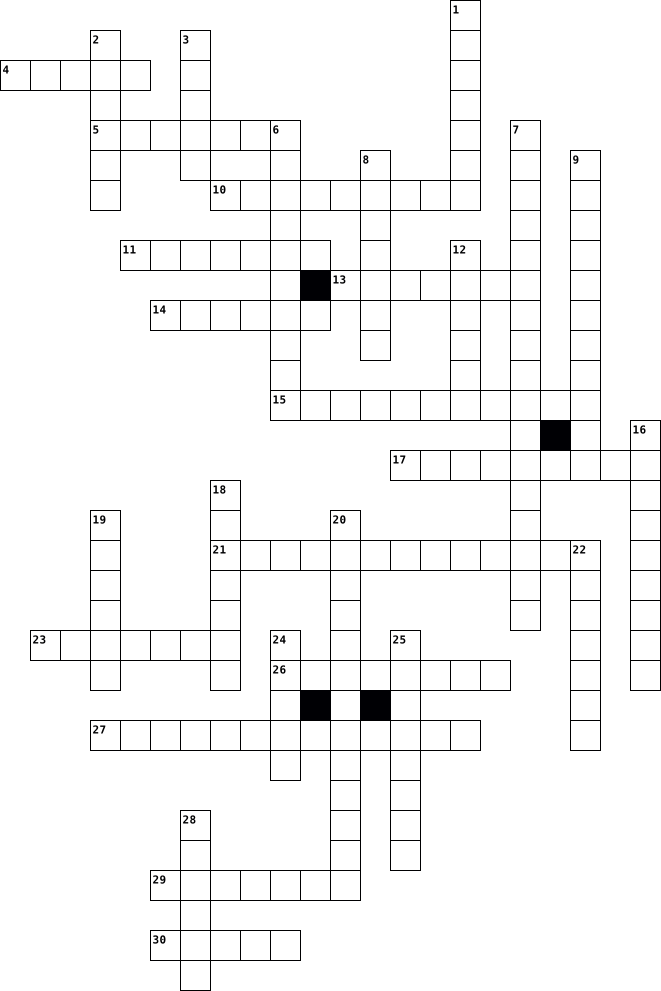
Across
- Devine Coward
- Most powerful traders in the Mediterranean
- Buddhist religious order
- Minoan capital city
- Perfect King
- Peace money
- Asia Minor
- A powerful seafaring People 2000-1400 BC
- movement of people from one region to another
- Nation where Saul, David, and Solomon Ruled
Down
- Release from selfishness and pain
- a state of perfect of understanding all things
- A belief in a single God
- Jewish Religion
- Man who lead Israelites out of slavery
- Wisdom
- Buddhist doctrine or teachings
- Promise between God and the founder of the Jews
- Father
- skin color
20 Clues: Wisdom • Father • skin color • Asia Minor • Peace money • Perfect King • Devine Coward • Jewish Religion • Minoan capital city • A belief in a single God • Buddhist religious order • Buddhist doctrine or teachings • Release from selfishness and pain • Man who lead Israelites out of slavery • A powerful seafaring People 2000-1400 BC • Most powerful traders in the Mediterranean • ...
Enlightment and revolution Abbygail McMullen 2023-01-12

Across
- sun centerd
- a system that keeps everything in line
- amendments
- observation of the natural world
- someone who suports and funds the arts
- life liberty and persuit on happines
- Discovered gravity
- Earth centerd
- extravagant
- seperation of powers
- Elegant
- 3 branches
- sighned the declaration
Down
- A method used to prove things
- Enlightoned despot
- Enlightend thinking
- scientifc thinking
- Democracy
- Used the telescope to observe the sky
- partys were enlightend thinkers went
- religious tolerance
- thinkers
- pooshed for womans schooling
- reason
- Belives in life liberty and presuit of happiness
25 Clues: reason • Elegant • thinkers • Democracy • amendments • 3 branches • sun centerd • extravagant • Earth centerd • Enlightoned despot • scientifc thinking • Discovered gravity • Enlightend thinking • religious tolerance • seperation of powers • sighned the declaration • pooshed for womans schooling • A method used to prove things • observation of the natural world • partys were enlightend thinkers went • ...
Crossword Activity 2016-10-17

Across
- Integral part of 18th Century
- Franklin's wish to gain position in
- Paine's radical religious ideas
- Someone who wrote for money
- Story of Franklin's life
- Modern image of Franklin
- Movement in 18th Century
- Washington's place of retirement
- Commander of Continental Army
Down
- Rumored spy working for British
- Wealthiest class in colonies
- Iconic figures in war of independence
- Freeing someone from slavery
- Lived by the pen
- Citizen where people hold popular sovereignty
- Radical pamphlet
- Supporters of new Constitution
- Jefferson's model patriarchal plantation
- Philosopher and Scientist
- Proclamation of __________ in 1793
20 Clues: Lived by the pen • Radical pamphlet • Story of Franklin's life • Modern image of Franklin • Movement in 18th Century • Philosopher and Scientist • Someone who wrote for money • Wealthiest class in colonies • Freeing someone from slavery • Integral part of 18th Century • Commander of Continental Army • Supporters of new Constitution • Rumored spy working for British • ...
civic literacy 2026-02-17

Across
- Locke - enlightenment thinker
- of Rights – First ten amendments
- Convention – 1787 government meeting
- Hall – Declaration signed here
- Rights Movement – Ended segregation
- Purchase – 1803 land deal
- D.C. – U.S. capital
- – Elected representatives rule
- Washington - first president of the us
- – Change to Constitution
Down
- - constitution city
- – Shared power
- Hamilton - first secretary of the Treasury & Federalist paper author
- Review – Court checks laws
- – Supreme law
- – Right to vote
- v. Madison – Judicial review case
- madison - known as the "father of the constitution"
- Jefferson - main author of the declaration of independence
- Tea Party – Tea protest
20 Clues: – Supreme law • – Shared power • – Right to vote • D.C. – U.S. capital • - constitution city • Tea Party – Tea protest • – Change to Constitution • Purchase – 1803 land deal • Review – Court checks laws • Hall – Declaration signed here • – Elected representatives rule • of Rights – First ten amendments • v. Madison – Judicial review case • Rights Movement – Ended segregation • ...
Constitutional Vocabulary Crossword 2026-03-04

Across
- a sort of representative
- Comic Con is a...
- billionaires are good at dodging these
- with democratic ideals
- like royal advisors
- of a tree
- a sort of government created by Alexander Hamilton
- give the power to government
- the 'law of the land'
- create the branches
Down
- abbreviated as 'BOR'
- a change made to across, 17
- is bicameral
- there were three of these to get everyone on board
- the biggest branch
- a pillar of the enlightenment age
- special sort of judge
- for only white men?
- serves for six years
- Miranda asked "...or state?"
20 Clues: of a tree • is bicameral • Comic Con is a... • the biggest branch • like royal advisors • for only white men? • create the branches • abbreviated as 'BOR' • serves for six years • special sort of judge • the 'law of the land' • with democratic ideals • a sort of representative • a change made to across, 17 • give the power to government • Miranda asked "...or state?" • ...
Tang & Song China 2024-11-12

Across
- of China
- the enlightened one
- he may or may not exist
- masculine
- the treacherous fox
- feminine
- Go with the flow man
- fine china
- is my boyfriend
- hot leaf water
- a foundational text for Taoists
- respect your elders and tradition
Down
- highway from Beijing to Hangzhou
- that's some elevated agriculture
- a religion based on enlightening oneself
- is there a point to this?
- the essential energy flowing through all living things
- copy that
- AKA enlightenment
- it's a vibe
- it's more nice when you can cultivate it twice
- 2008 Summer Olympics
22 Clues: of China • feminine • masculine • copy that • fine china • it's a vibe • hot leaf water • is my boyfriend • AKA enlightenment • the enlightened one • the treacherous fox • Go with the flow man • 2008 Summer Olympics • he may or may not exist • is there a point to this? • a foundational text for Taoists • highway from Beijing to Hangzhou • that's some elevated agriculture • ...
History Crossword 2024-11-14

Across
- Required colonist to pay tax
- a meeting of colonial representatives
- freedom from the control
- First president
- the war of 1775-83
- cheast of team threw into ocean
- July 4th
- basic principles of lawns of a nation
Down
- a series of events in 1688-89
- a church movement
- a British produced boundry
- seven British soldiers march into a crowd
- Age of reason
- a series of religious revivals
- An American founding father
- Initiated taxes on glass
- father of modern republican government
- one human was being owned by another
- ancient times
- spreding of ideas
20 Clues: July 4th • Age of reason • ancient times • First president • a church movement • spreding of ideas • the war of 1775-83 • freedom from the control • Initiated taxes on glass • a British produced boundry • An American founding father • Required colonist to pay tax • a series of events in 1688-89 • a series of religious revivals • cheast of team threw into ocean • ...
History Crossword 2024-11-14

Across
- Required colonist to pay tax
- a meeting of colonial representatives
- freedom from the control
- First president
- the war of 1775-83
- cheast of team threw into ocean
- July 4th
- basic principles of lawns of a nation
Down
- a series of events in 1688-89
- a church movement
- a British produced boundry
- seven British soldiers march into a crowd
- Age of reason
- a series of religious revivals
- An American founding father
- Initiated taxes on glass
- father of modern republican government
- one human was being owned by another
- ancient times
- spreding of ideas
20 Clues: July 4th • Age of reason • ancient times • First president • a church movement • spreding of ideas • the war of 1775-83 • freedom from the control • Initiated taxes on glass • a British produced boundry • An American founding father • Required colonist to pay tax • a series of events in 1688-89 • a series of religious revivals • cheast of team threw into ocean • ...
History Crossword 2024-11-14

Across
- republican government
- choosing neither side of the revolution
- forcible overthrow
- separation from Britain
- for keeping the British control of the colonies
- had the idea of separation of government
- 3 administrative powers
- for the growth of the colonies
- make the church better
- declared independence from Britain
- US charter of government
- had the idea of democracy
Down
- main author of the declaration of independence
- 3 branches of government
- make the government better
- resistance to an established government/ruler
- people who lived in the colonies
- social contract
- biased information spread
- the ancient past ideas
20 Clues: social contract • forcible overthrow • republican government • make the church better • the ancient past ideas • separation from Britain • 3 administrative powers • 3 branches of government • US charter of government • biased information spread • had the idea of democracy • make the government better • for the growth of the colonies • people who lived in the colonies • ...
Latin American Revolution Vocabulary 2025-10-02

Across
- black George Washington
- Father Miguel Hidalgo was in this caste
- natural barrier
- What Toussaint L'Overture led
- Buenos Aires residents
- Brazil's language
- Bolivia was named after him
- ideas that the Latin Revs. took ideas from
- where Tupac Amaru was from
- the wars that started the revolution
Down
- fought with Tupac
- Peruvian leader
- US statement of friendly relations
- the castle system called
- Toussaint L'Overture freed this country
- The two revolutions that Latin Revs. took ideas from
- First emperor of Brazil
- independent leaders
- Where Simon Bolivar was from
- Dom Pedro ruled
20 Clues: Peruvian leader • natural barrier • Dom Pedro ruled • fought with Tupac • Brazil's language • independent leaders • Buenos Aires residents • black George Washington • First emperor of Brazil • the castle system called • where Tupac Amaru was from • Bolivia was named after him • Where Simon Bolivar was from • What Toussaint L'Overture led • US statement of friendly relations • ...
Age of Revolutions 2023-05-19

Across
- Three branches
- Mexico's revolutionary hero
- symbol of Louis's greatness
- The slaves won this one
- given to God's angels by "divine right"
- revolutionary rights
- like father like grandson; tights and heals
- South American revolutionary hero
Down
- Reigned in terror
- He gave Napoleon a headache; won freedom
- Divine right rules
- the great equalizer; Louis, Marie, and Robespierre
- Divine right loses
- the cause of the poor
- enlightened dictator; loves waterslides
15 Clues: Three branches • Reigned in terror • Divine right rules • Divine right loses • revolutionary rights • the cause of the poor • The slaves won this one • Mexico's revolutionary hero • symbol of Louis's greatness • South American revolutionary hero • given to God's angels by "divine right" • enlightened dictator; loves waterslides • He gave Napoleon a headache; won freedom • ...
Yandex 2022-12-13

Across
- Peasant caste
- The category the people are in
- The Buddha
- Truths The things you must not do
- You are reborn when you die
- The ruler caste
- Trader caste
- The cycle of birth
Down
- The jobs for your caste
- Teacher caste
- No caste and are oppressed
- Practices to enlightenment
- The quenching worldly mind
- The belief of whatever you do comes back
- Process of being released form the caste
15 Clues: The Buddha • Trader caste • Peasant caste • Teacher caste • The ruler caste • The cycle of birth • The jobs for your caste • No caste and are oppressed • Practices to enlightenment • The quenching worldly mind • You are reborn when you die • The category the people are in • Truths The things you must not do • The belief of whatever you do comes back • ...
Ella Pena French Revolution 2022-11-30

Across
- attempted overthrow of goverment
- least harmful
- betrayal of ones country or government
- spread ideas throughout europe
- a more humane way of killing people
- third estates new name
Down
- famous french writer
- famous english writer
- convicted for treason
- freedom of speech, religion,(etc)
- usually describes rich people
11 Clues: least harmful • famous french writer • famous english writer • convicted for treason • third estates new name • usually describes rich people • spread ideas throughout europe • attempted overthrow of goverment • freedom of speech, religion,(etc) • a more humane way of killing people • betrayal of ones country or government
The Great Gatsby Colors Crossword 2023-03-23

Across
- Joy, Energy, Enthusiasm
- Power, Danger,Passion,Aggression
- Peace, Harmony, Loyalty, Depression, Hopefulness
- Earthiness, Rugidness,Poverty, Homeiness, Comfort
- Beauty, Softness, Compassion, Romantisism
Down
- Innocence, Purity, Cleanliness, Peace, Serenity
- Wealth, Class
- Optimism, Joy, Happiness, Riches
- Nature, Luck, Jealousy, Money
- Power, Death, Formality, Wealth, Mystery, Remorse, Greif
- Royalty, Power,Enlightenment, Wisdom
11 Clues: Wealth, Class • Joy, Energy, Enthusiasm • Nature, Luck, Jealousy, Money • Optimism, Joy, Happiness, Riches • Power, Danger,Passion,Aggression • Royalty, Power,Enlightenment, Wisdom • Beauty, Softness, Compassion, Romantisism • Innocence, Purity, Cleanliness, Peace, Serenity • Peace, Harmony, Loyalty, Depression, Hopefulness • Earthiness, Rugidness,Poverty, Homeiness, Comfort • ...
Importance words to Asia,Islamic, Hindu, and Buddhist religions 2026-04-22

Across
- community of Buddhist monks
- Community of Muslim believers
- book of Islam
- Supreme Reality or all-powerful spirit
- one duty or religious duty
- universal law of cause and effect
- central doctrine of the "oneness"
- oldest sancript scriptures
- state of enlightenment
Down
- Liberation from the cycle of rebirth
- records of Muhammadans words and actions
- ¨The Awakened One¨
- principle of non-violence
- terms for what is permissible
14 Clues: book of Islam • ¨The Awakened One¨ • state of enlightenment • principle of non-violence • one duty or religious duty • oldest sancript scriptures • community of Buddhist monks • Community of Muslim believers • terms for what is permissible • universal law of cause and effect • central doctrine of the "oneness" • Liberation from the cycle of rebirth • ...
Enlightment and revolution Abbygail McMullen 2023-01-12

Across
- sun centerd
- a system that keeps everything in line
- amendments
- observation of the natural world
- someone who suports and funds the arts
- life liberty and persuit on happines
- Discovered gravity
- Earth centerd
- extravagant
- seperation of powers
- Elegant
- 3 branches
- sighned the declaration
Down
- A method used to prove things
- Enlightoned despot
- Enlightend thinking
- scientifc thinking
- Democracy
- Used the telescope to observe the sky
- partys were enlightend thinkers went
- religious tolerance
- thinkers
- pooshed for womans schooling
- reason
- Belives in life liberty and presuit of happiness
25 Clues: reason • Elegant • thinkers • Democracy • amendments • 3 branches • sun centerd • extravagant • Earth centerd • Enlightoned despot • scientifc thinking • Discovered gravity • Enlightend thinking • religious tolerance • seperation of powers • sighned the declaration • pooshed for womans schooling • A method used to prove things • observation of the natural world • partys were enlightend thinkers went • ...
Indian Cities 2020-04-25

Across
- city of love
- Turmeric city
- Royal City
- wine city
- mini lahasa
- pink city
- Crwon of the Country
- Vijaynagari
- orange city
- goa of East
- nawab city
- city of Enlightenment
- oxfard of East
- diamond city
Down
- Heart of Undivided india
- cotton city
- city of Mahabharata
- queen of hills
- citynof Ghats
- suncity
- city of pearls
- tea city
- Temple City
- Gift of Dowry
- salt desert
- Detroit of Asia
- coal City
- gateway to baster
- silicon city of India
- mini Bombay
30 Clues: suncity • tea city • wine city • pink city • coal City • Royal City • nawab city • cotton city • mini lahasa • Temple City • Vijaynagari • salt desert • orange city • goa of East • mini Bombay • city of love • diamond city • citynof Ghats • Turmeric city • Gift of Dowry • queen of hills • city of pearls • oxfard of East • Detroit of Asia • gateway to baster • city of Mahabharata • Crwon of the Country • silicon city of India • ...
history 2023-03-27

Across
- tyrant rular
- selfish ruler
- time of discovery
- british empiricism
- everyone has to follow the rule of
- discoverd the moon
- protector of the roman church
- french writer
- invented gravity
- king of france in the age of absolutism
- louis xiv's nickname
- a philosopher in the age of absolutism
- said the sun was the center of the universe
Down
- czar of russia
- political thinker
- the age of reason
- wrote the spirt of laws
- protested woman education
- the king or queen are elected by god
- the king and queen follow a
20 Clues: tyrant rular • selfish ruler • french writer • czar of russia • invented gravity • political thinker • time of discovery • the age of reason • british empiricism • discoverd the moon • louis xiv's nickname • wrote the spirt of laws • protested woman education • the king and queen follow a • protector of the roman church • everyone has to follow the rule of • the king or queen are elected by god • ...
vocab unit 1-6 2012-10-29

Across
- lack of energy
- causing sleep or fatigue
- improvement or enlightenment
- firm and steadfast
- open and sincere
- green lush with vegitation
- to honor with banquet or feast
- negative and critical
- to drape or adorn
Down
- to embarrass and confuse
- misconduct or wrongdoing especially by a public offical
- drowsy sleepy
- capable of being acocomplished
- a small sin or fault
- having no flaws
- cheerful merry
- stillin existance , not destroyed
- to stop the flow of
- voilating a moral law
- characterized by joking
- resisting authority
- greenery fresh
- sleep or drowsiness
23 Clues: drowsy sleepy • lack of energy • cheerful merry • greenery fresh • having no flaws • open and sincere • to drape or adorn • firm and steadfast • to stop the flow of • resisting authority • sleep or drowsiness • a small sin or fault • negative and critical • voilating a moral law • characterized by joking • to embarrass and confuse • causing sleep or fatigue • green lush with vegitation • ...
Unit 28 Challenge Spelling 2015-03-01

Across
- desirable
- of a hundredth anniversary
- behavior; manner
- sociable
- to prevent from moving
- sadness
- something larger than life
- vacation
- the distance around a circle
- branch of medicine or biology that deals with functions
- a system where people are ranked in groups
- art or pastime of embroidering cloth
- the making fun of
- chemical element of atomic number 12
Down
- mental action of acquiring knowledge
- unsafe
- to tame
- similar to gravity
- flammable
- beyond words
- disorganized
- branch of science concerned with the bodily structure of humans
- excitement
- stylish
- for leisure
25 Clues: unsafe • to tame • sadness • stylish • sociable • vacation • desirable • flammable • excitement • for leisure • beyond words • disorganized • behavior; manner • the making fun of • similar to gravity • to prevent from moving • of a hundredth anniversary • something larger than life • the distance around a circle • mental action of acquiring knowledge • art or pastime of embroidering cloth • ...
Jeremy hajzus Enlightenment and Revolution 2023-12-20

Across
- ether centered
- looked at the sky
- fair govt
- nerd meeting
- simple
- rights for safety
- enlightened leader
- thought should be based of reson
- govt system
- sun centered
- nerd in the 1700s
- separation of powers
Down
- enlightened way of thought
- female russian tsar
- revolution of science
- signed the declaration of independence
- belief in god
- extra fancy
- philosopher social contrast
- women's rights
- 1776 important document
- made laws of gravity
- observation question hypothesis experiment conclusion
- versatile writer
- bill that gave people rights
- locked in natural rights
26 Clues: simple • fair govt • extra fancy • govt system • nerd meeting • sun centered • belief in god • ether centered • women's rights • versatile writer • looked at the sky • rights for safety • nerd in the 1700s • enlightened leader • female russian tsar • made laws of gravity • separation of powers • revolution of science • 1776 important document • locked in natural rights • enlightened way of thought • ...
Merrill 2024-03-01

Across
- You were the ___!
- If You Ain't First, You're Last!
- Absolute Stud
- Gollum! Gollum!
- Case of the "Mondays"
- Our Father, Who Art in Detroit
- Walter White Gets Real
- I Would Like to See the Baby
- This bride is PISSED
Down
- Giant Dead Squid
- Spider-Man is Too Late!
- Wanted for Many Hate Crimes
- Advice & Enlightenment
- Give me your money
- Pregame Ritual?
- The Only Man in the Sky
- Spoiled Little Brats
- Anchor Up, Abbrv.
- Affordable Sandwich, Abbrv.
- Do NOT Feed Him After Midnight
- Tom Izzo, MSU Basketball Coach
21 Clues: Absolute Stud • Pregame Ritual? • Gollum! Gollum! • Giant Dead Squid • You were the ___! • Anchor Up, Abbrv. • Give me your money • Spoiled Little Brats • This bride is PISSED • Case of the "Mondays" • Advice & Enlightenment • Walter White Gets Real • Spider-Man is Too Late! • The Only Man in the Sky • Wanted for Many Hate Crimes • Affordable Sandwich, Abbrv. • I Would Like to See the Baby • ...
Religions 2024-04-04

Across
- Jewish holy scripture
- Largest branch of islam
- Ancient hindu texts
- Hindu and buddhist concept of cause and effect
- Covenant between god and israelites
- Buddhist path to enlightenment
- Islamic Holy book
- Jewish places of worship
- Islamic place of worship
- Foundation of Buddhist teachings
- Place of worship in various religions
- Buddhist state of liberation
- Minority Branch of islam
Down
- Core practices of Islam
- Moral guidelines in Judism and Christianity
- Buddhist scriptures
- Belief in one god
- Life teachings of Jesus Christ
- Christian holy book
- Belief in more than one god
20 Clues: Belief in one god • Islamic Holy book • Buddhist scriptures • Ancient hindu texts • Christian holy book • Jewish holy scripture • Core practices of Islam • Largest branch of islam • Jewish places of worship • Islamic place of worship • Minority Branch of islam • Belief in more than one god • Buddhist state of liberation • Life teachings of Jesus Christ • Buddhist path to enlightenment • ...
World Religion 2025-01-27

Across
- result of human action of deed
- third poison
- means the way
- rebirth of a soul
- Confucianism is a ----- sysytem
- Chinese philosopher
- second of the three poisons
- no belief in one god
- religion originating in China
- represents masculine side of Yin-Yang
Down
- represents feminine side of Yin-Yang
- creation influenced by agnosticism
- German theoretical physicist
- more like a belief system not a religion
- something Confucius emphasizes
- percent of the world with no organized religion
- divine law
- path of enlightenment
- religion that originated in India
- one of the three poisons
20 Clues: divine law • third poison • means the way • rebirth of a soul • Chinese philosopher • no belief in one god • path of enlightenment • one of the three poisons • second of the three poisons • German theoretical physicist • religion originating in China • result of human action of deed • something Confucius emphasizes • Confucianism is a ----- sysytem • religion that originated in India • ...
Unit 2 AP US History Crossword Puzzle 2026-04-28

Across
- Emotional religious revival
- First elected assembly in colonies
- Worked for free travel to America
- Colonies only trade with Britain
- early self government agreement
- Wanted to fix the Church of England
- Strict laws controlling slaves
- Trade between Africa, Europe, and America
- Main cash crop in Virginia
- First English colony (1607)
- The Great E...
- Colonies make money for Britain
Down
- Life, liberty, property
- Accepting different religions
- Britain didn't enforce laws much
- Brutal trip slaves took
- People having rights and power
- Pilgrims colony (1620)
- government gets power from people
- Poor famers rebelled in Virginia
20 Clues: The Great E... • Pilgrims colony (1620) • Life, liberty, property • Brutal trip slaves took • Main cash crop in Virginia • Emotional religious revival • First English colony (1607) • Accepting different religions • People having rights and power • Strict laws controlling slaves • early self government agreement • Colonies make money for Britain • Britain didn't enforce laws much • ...
Enlightenment Vocab 2 2024-04-04

Across
- said: l'etat c'est moi
- criticized indulgences, started Protestant Reformation
- monstrous name of Thomas Hobbes book
- England's peaceful revolution
- symbol for human reason in William Blake's painting
- 1215 contact between English king and aristocracy
Down
- King Louis XIV's decadent palace
- idea that society is based on shared agreement
- political philosopher argued that role of government is to keep order and prevent chaos
- political philosopher argued that role of government is to protect property
- formalized scientific method (not breakfast)
11 Clues: said: l'etat c'est moi • England's peaceful revolution • King Louis XIV's decadent palace • monstrous name of Thomas Hobbes book • formalized scientific method (not breakfast) • idea that society is based on shared agreement • 1215 contact between English king and aristocracy • symbol for human reason in William Blake's painting • ...
The Enlightenment Vocabulary 2026-01-12

Across
- Personal, elegant style of art and architecture made popular during the mid-1700s that featured designs with the shapes of leaves, shells, and flowers
- Unchanging principle, discovered through reason, that governs human conduct
- Rights that belong to all humans from birth, such as life, liberty, and property
- Policy allowing business to operate with little or no government interference
- An agreement by which people gave up their freedom to a powerful government in order to avoid chaos
- Ornate style of art and architecture popular in the 1600s and 1700s
Down
- Market regulated by the natural laws of supply and demand
- French for "philosopher"; French thinker who desired reform in society during the Enlightenment
- Restriction on access to ideas and information
- Informal social gathering at which writers, artists, philosophes, and others exchanged ideas
- Absolute ruler who uses his or her power to bring about political and social change
11 Clues: Restriction on access to ideas and information • Market regulated by the natural laws of supply and demand • Ornate style of art and architecture popular in the 1600s and 1700s • Unchanging principle, discovered through reason, that governs human conduct • Policy allowing business to operate with little or no government interference • ...
Pharmacy Technician Winter Crossword 2024 2024-08-22

Across
- Hebrew Festival of Lights
- Hangover cure
- The most important holiday in Japan
- Activity on frozen water
- Left for Santa Claus
- White
- Pagan winter solstice festival
- Gifts
Down
- Modern African-American and pan-African holiday
- Celebrated 8th December: the enlightenment of Siddhartha Gautama
- Festive drink
- Celebrate the birthday of the 10th guru of the Sikh faith
- Festive frozen drips
- Left for Reindeers
- Festive for a tree or house
- Entrance for Santa Claus
- Christian festival
- Temperature
18 Clues: White • Gifts • Temperature • Festive drink • Hangover cure • Left for Reindeers • Christian festival • Festive frozen drips • Left for Santa Claus • Activity on frozen water • Entrance for Santa Claus • Hebrew Festival of Lights • Festive for a tree or house • Pagan winter solstice festival • The most important holiday in Japan • Modern African-American and pan-African holiday • ...
English Final 2026-03-13

Across
- terrible plague killed 30% Europe
- King Arthur's son
- love, couples, stories
- savior of the day
- Oedipus's brother
- kingdom Oedipus ruled over
- political and economic system used
- evil beast
Down
- medieval monster
- code of honor intended to govern knightly behavior
- a lord or ruler to whom one owes loyalty and service
- someone who sells things
- dedicated to minimalism and enlightenment
- ancient conquers
- Oedipus's dad
- medieval hero
- Church, God, Jesus
- member of a religious group sworn to poverty and living on charitable donations
18 Clues: evil beast • Oedipus's dad • medieval hero • medieval monster • ancient conquers • King Arthur's son • savior of the day • Oedipus's brother • Church, God, Jesus • love, couples, stories • someone who sells things • kingdom Oedipus ruled over • terrible plague killed 30% Europe • political and economic system used • dedicated to minimalism and enlightenment • ...
English Revolution and Enlightenment 2019-01-23

Across
- the House of ______ took over England after the reign of Anne...Georges
- 1689 document that limited the powers of William and Mary
- wrote Leviathan where he defends absolute monarchy
- kicked of the throne by his daughter and son-in-law...too Catholic for England
- Stuart monarch during the Restoration of the Monarchy
- inherited the throne of England from Elizabeth, began Stuart lineage
- became the Puritan "Lord Protector," military dictator of England after the Civil War
Down
- French philosopher...ideas of religious toleration
- the "Revolution" that ended the reign of James II and installed William and Mary on the throne (Prots)
- the man that was the LAST Stuart to attempt to re-take the throne of Britain...defeated at Culloden
- the rebel supporters of the Stuarts...ended at Culloden
- French philosopher...checks and balances
- defeated in the English Civil War, executed
- philosopher MOST influential in American ideas of resisting tyrannical government
- Scottish philosopher...capitalism exists with free people
- "Social Contract"...supreme will of the majority
16 Clues: French philosopher...checks and balances • defeated in the English Civil War, executed • "Social Contract"...supreme will of the majority • French philosopher...ideas of religious toleration • wrote Leviathan where he defends absolute monarchy • Stuart monarch during the Restoration of the Monarchy • the rebel supporters of the Stuarts...ended at Culloden • ...
The Age of Enlightenment 2022-11-30

Across
- English writer of Leviathan.
- Was one percent of the population.
- Was two percent of the population.
- Was ninety-seven percent of the population.
- Responcible for the king and queen's death.
- English writer of Two Treaties on Government.
- French writer of On the Spirit of Laws.
- The queen who was charged for treason.
- French writer of The Social Contract.
Down
- Who was the General who defeated European powers?
- English advocate for woman's rights
- Something to easily kill people
- The king who was found a threat.
- Age of applying to the human and natural worlds.
- Democratic Republic ended the ______.
- French writer on Freedom of Speech.
16 Clues: English writer of Leviathan. • Something to easily kill people • The king who was found a threat. • Was one percent of the population. • Was two percent of the population. • English advocate for woman's rights • French writer on Freedom of Speech. • Democratic Republic ended the ______. • French writer of The Social Contract. • The queen who was charged for treason. • ...
Fine Art Unit 1 2021-02-21

Across
- extreme lighting effect
- thick, textural application of paint
- sculpture
- painting depicts elegant party, 2 words
- artwork that depicts a scene from everyday life
- sculptor
- many self-portraits
- Eugene Delacroix
- pastel color schemes
- ordered and balanced painting
Down
- age of reason
- artwork made of three hinged panels
- Dutch
- The Third of May, 1808, 2 words
- tenebrism
- artwork, arrangement of objects, 2 words
- object appears to project toward/away from viewer
- subjects the way they appear in the natural world
18 Clues: Dutch • sculptor • sculpture • tenebrism • age of reason • Eugene Delacroix • many self-portraits • pastel color schemes • extreme lighting effect • ordered and balanced painting • The Third of May, 1808, 2 words • artwork made of three hinged panels • thick, textural application of paint • painting depicts elegant party, 2 words • artwork, arrangement of objects, 2 words • ...
F451 2024-01-20

Across
- - Control of information
- - Expected behavior in the society
- - Used for surveillance and control
- - Pursuit of knowledge and truth
- - Suppressed in the society
- - Prohibited form of expression
- - Act against the oppressive government
- - Banned in the novel
- - Heavy and unjust control
- - Unpleasant futuristic world
Down
- - Controls every aspect of life
- - Conformist and oppressive
- - Isolation and disconnection in the society
- - Forbidden in the society
- - Importance of preserving knowledge and history
- - Absolute control by the government
- - Lack of critical thinking and intellectual engagement
- - Burns books in the dystopian society
- - Defiance against unjust authority
19 Clues: - Banned in the novel • - Control of information • - Forbidden in the society • - Heavy and unjust control • - Conformist and oppressive • - Suppressed in the society • - Unpleasant futuristic world • - Controls every aspect of life • - Prohibited form of expression • - Pursuit of knowledge and truth • - Expected behavior in the society • - Used for surveillance and control • ...
Buddhism Vocabulary 2018-02-26

Across
- The religion founded by Siddhartha,which teaches that life brings suffering that one can escape by seeking nirvana through enlightenment
- A key of Buddhism whereby followers should live according to these eight teachings
- The state of gaining spiritual insight and finding universal truth;the goal of Buddhists
- Goods or money given to the poor
Down
- The four basic doctrines,or principles of Buddhism
- An ideal state of happiness and peace
- A person who gives up worldly pleasures
7 Clues: Goods or money given to the poor • An ideal state of happiness and peace • A person who gives up worldly pleasures • The four basic doctrines,or principles of Buddhism • A key of Buddhism whereby followers should live according to these eight teachings • The state of gaining spiritual insight and finding universal truth;the goal of Buddhists • ...
the enlightenment 2013-11-13

Across
- he was brilliant 18th century in french historian.
- Montesquieu searched a way to control a government.
- a french philosopher, he recognized liberty as a natural rights
Down
- intellectual movement happened during 17th and 18th centuries.
- an english philosopher, he was important in the enlightenment thinkers, he considered human nature and their role of government.
- the right to life, liberty, and property.
- system created by farmers, the power of government where to be divided by the federal.
7 Clues: the right to life, liberty, and property. • he was brilliant 18th century in french historian. • Montesquieu searched a way to control a government. • intellectual movement happened during 17th and 18th centuries. • a french philosopher, he recognized liberty as a natural rights • ...
Vocabulary Crossword Puzzle 2023-03-31

Across
- a popular vote
- a political philosophy originally based largely on Enlightenment principles, holding that people should be as free as possible from government restraint and that the basic rights of all people should be protected
- empire an empire in which people of many nationalities live
- an intellectual movement that emerged at the end of the eighteenth century in reaction to the Enlightenment; it stressed feelings, emotion, and imagination as sources of knowing that helped define the era
- military or political dictator
- a Spanish or Portuguese official who resided temporarily in Latin America for political and economic gain and then returned to Europe
Down
- German for “caesar”; the title of the emperors of the Second German Empire
- a belief that emphasizes one’s national identity and prioritizes national pride and national goals above all else
- the act of setting free
- the reliance on military strength
- agricultural crop grown to sell for profit
- relating to a political group associated with views, practices, and policies of extreme change
- a mid-nineteenth-century movement that rejected romanticism and sought to portray life as it actually was
- the right to vote in political elections
- a person of mixed European and indigenous descent
15 Clues: a popular vote • the act of setting free • military or political dictator • the reliance on military strength • the right to vote in political elections • agricultural crop grown to sell for profit • a person of mixed European and indigenous descent • empire an empire in which people of many nationalities live • ...
Types of Government 2023-01-03

Across
- a society without a government
- enlightenment thinker who believed in the separation of church & state & freedom of religion
- thinker who believed in natural rights of man
- enlightenment thinker who said government was necessary to maintain order
- rule by a king or queen
- rule by a few or small group
- form of government that attempts to assert total control over the lives of its citizens
- a system of government by one person with absolute power.
Down
- social & economic doctrine that calls for public rather than private ownership or control of property and natural resources.
- government or a social situation where one person makes all the rules and decisions without input from anyone else
- government by divine guidance or by officials who are regarded as divinely guided
- type of democracy in which policies and laws are decided by a majority of all those eligible
- type of democracy where elected people represent a group of people
- form of government that places strength in the hands of a small, privileged ruling class, the aristocrats
- from Marx, advocating class war& leading to a society in which all property is publicly owned & each person works & is paid according to their abilities & needs.
15 Clues: rule by a king or queen • rule by a few or small group • a society without a government • thinker who believed in natural rights of man • a system of government by one person with absolute power. • type of democracy where elected people represent a group of people • enlightenment thinker who said government was necessary to maintain order • ...
Nationalism 2023-05-09

Across
- the act of setting free.
- the right to vote.
- relating to a political group associated with views, practices, and policies of extreme change.
- a mid-nineteenth-century mov3m3n5 that rejected romanticism and sought to portray life as it actually was.
- a belief that emphasizes one's national identity and prioritizes national pride and national goals.
- a person born on the Iberian Peninsula; typically, a Spanish or Portuguese official who resided temporarily in Latin America for political and economic gain and then returned to Europe.
- a crop that is grown for sale rather than for personal use.
- an empire in which people of many nationalities live.
Down
- German for “caesar”; the title of the emperors of the Second German Empire.
- an intellectual movement that emerged at the end of the eighteenth century in reaction to the ideas of the Enlightenment. It stressed feelings, emotion, and imagination as sources of knowing.
- the reliance on military strength.
- a political philosophy based largely on Enlightenment principles, holding that people should be as free as possible from government restraint and that the basic rights of all people should be protected.
- a person of mixed European and indigenous descent.
- military or polotical dicator.
- a popular vote.
15 Clues: a popular vote. • the right to vote. • the act of setting free. • military or polotical dicator. • the reliance on military strength. • a person of mixed European and indigenous descent. • an empire in which people of many nationalities live. • a crop that is grown for sale rather than for personal use. • ...
Module 3 Vocabulary Crossword 2022-10-25

Across
- war with french
- scientifi invetion in europe
- give me liberty or give me death
- where the British surrend
- british law passed in 1756
- inspired colonists to declare and fight
- who remained nuetral in forinn affairs
Down
- deadly riot
- act passed in 1776
- the war between great Britain
- miliarty genral
- made the declaration of indepence
- colonist who were ready to fight
- called for indepnce
14 Clues: deadly riot • miliarty genral • war with french • act passed in 1776 • called for indepnce • where the British surrend • british law passed in 1756 • scientifi invetion in europe • the war between great Britain • give me liberty or give me death • colonist who were ready to fight • made the declaration of indepence • who remained nuetral in forinn affairs • ...
English Research Project 2023-02-03

Across
- What it's called after you die
- Day when you are judged
- Main Character in the 1st piece of literature
- Never ending life
- Number of days Gilgamesh had to stay awake to become immortal
- Name of jewish religion
Down
- No more life
- Popular author that faced a NDE
- Event where you almost die
- Islam's God
- Animal that took Gilgamesh's Plant
- Gilgamesh's Best Friend
- Enlightenment Figure
- Christianity's God
14 Clues: Islam's God • No more life • Never ending life • Christianity's God • Enlightenment Figure • Day when you are judged • Gilgamesh's Best Friend • Name of jewish religion • Event where you almost die • What it's called after you die • Popular author that faced a NDE • Animal that took Gilgamesh's Plant • Main Character in the 1st piece of literature • ...
Revolutionary Characters Crossword Puzzle 2015-10-14

Across
- Thomas Paine's birth city
- Jefferson was a symbol of ___
- Paine's father was a ___
- Washington was commander of the ___
- This was Franklin's famed pseudonym
- The first president
- Number of terms Washington served
- Washington was a child of ___
- Jefferson was born in
Down
- Paine's most famous Pamphlet
- Another name for America's founders
- Oldest revolutionary leader
- Was a shunned founding father
- Franklin was also a renowned
- Jefferson grew out of this
- This profession made Franklin rich
- Jefferson fancied this beverage
- This party influenced Washington
- Was six feet two
- What number president was Jefferson
20 Clues: Was six feet two • The first president • Jefferson was born in • Paine's father was a ___ • Thomas Paine's birth city • Jefferson grew out of this • Oldest revolutionary leader • Paine's most famous Pamphlet • Franklin was also a renowned • Jefferson was a symbol of ___ • Was a shunned founding father • Washington was a child of ___ • Jefferson fancied this beverage • ...
Revolutionary Characters Activity 2016-10-13

Across
- first president of USA
- Jefferson fully participated in the ________
- ‘future’ governor of New Jersey
- symbol for the American dream
- real master of masquerade
- "one of Plutarch's men"
- first secretary of the treasury
- first editor of New Republic
Down
- wealthy Philadelphia lawyer
- first commander in chief
- Formal Declaration of Civil Rights
- principal teacher of manners
- denied being a monarchist
- Had affair with his slave
- 1890 presidential campaign manager
- date John Adams died
- __________ leaders were not modern men
- secured 3rd term in 1940
- Thomas Jefferson invented
- created distinction between gentleman & commoner
20 Clues: date John Adams died • first president of USA • "one of Plutarch's men" • first commander in chief • secured 3rd term in 1940 • denied being a monarchist • Had affair with his slave • real master of masquerade • Thomas Jefferson invented • wealthy Philadelphia lawyer • principal teacher of manners • first editor of New Republic • symbol for the American dream • ...
Rachel Kremer - Hist 151 2017-06-03

Across
- word created by W.E. Woodward
- Madison and Hamilton’s published papers
- the will of the people
- war that got America’s independence
- loser of Seven Years’ war
- most important document Washington wrote
- civilization replaced this word
- eighteenth-century movement/revolution
- an attribute of an aristocrat
- a firm league of friendship
Down
- oldest of the revolutionary leaders
- minister to France in 1780s
- America's third vice president
- abolished the French monarchy
- Washington’s home and farm
- America's first secretary of treasure
- John Adam’s pen name
- author of Common Sense
- common form of publication
- America’s foremost political philosopher
20 Clues: John Adam’s pen name • the will of the people • author of Common Sense • loser of Seven Years’ war • Washington’s home and farm • common form of publication • minister to France in 1780s • a firm league of friendship • word created by W.E. Woodward • abolished the French monarchy • an attribute of an aristocrat • America's third vice president • civilization replaced this word • ...
Sammis Revolution 2019-06-29

Across
- Washington's plantation name
- fourth president
- act of being set free from slavery
- 85 letters written to newspapers
- ___ of Rights
- intellectual movement
- battle of __ ended the war
- king of england during revolution
- Franklin's invention
Down
- to approve
- group of men boycotting stamp-act
- political system all members have equal share
- colonists who supported the crown
- forcible overthrow of a government
- __ Tea Party
- elected head of usa
- fundamental principles to be governed
- colonists who fought for revolution
- said "all men are created equal"
- "Jefferson and Civil Liberties: The __ Side"
20 Clues: to approve • __ Tea Party • ___ of Rights • fourth president • elected head of usa • Franklin's invention • intellectual movement • battle of __ ended the war • Washington's plantation name • 85 letters written to newspapers • said "all men are created equal" • group of men boycotting stamp-act • colonists who supported the crown • king of england during revolution • ...
Revolutionary Characters Crossword Puzzle 2019-07-02

Across
- First 10 amendments
- First Revolutionary battle
- Tried for treason in 1807
- Showed expertise in wine
- Home of George Washington
- Franklin contributed to the science of ______
- Admired by Theodore Roosevelt
- Madison was coauthor of ___ ______
- Felt ignored by fellow revolutionaries
- First United States President
Down
- Who created the Constitution?
- Oldest of the revolutionary leaders
- Hamilton referred to Washington as "___ ______"
- Adams and Jefferson died on ____ ____
- Book by Thomas Paine
- Washington was a child of the _____
- Promoted their own candidacies
- Jefferson's plantation
- Opposed Hamilton's funding program
- Jefferson could not free his ______
20 Clues: First 10 amendments • Book by Thomas Paine • Jefferson's plantation • Showed expertise in wine • Tried for treason in 1807 • Home of George Washington • First Revolutionary battle • Who created the Constitution? • Admired by Theodore Roosevelt • First United States President • Promoted their own candidacies • Opposed Hamilton's funding program • Madison was coauthor of ___ ______ • ...
Noah Michael prologue 2020-09-14

Across
- movement
- controls society
- by the people
- work for world peace
- influence to religions
- a king
- legislative, judicial, executive
- apply reason to science
- major source of traditional English
- powerful people
- citizens make rules
- agreement among people
- restricted by constituion
- citezens elect represenative
- small group of nobles
Down
- government split into federal, local, central
- limited power
- financial policies
- life, liberty, property
- chosen by god
- turning point
- rebirth
- code by god
- basis of legal system
- Jews
- Muhammad
- elect leaders
- Jesus
- England national legislature
29 Clues: Jews • Jesus • a king • rebirth • movement • Muhammad • code by god • limited power • by the people • chosen by god • turning point • elect leaders • powerful people • controls society • financial policies • citizens make rules • work for world peace • basis of legal system • small group of nobles • influence to religions • agreement among people • life, liberty, property • apply reason to science • ...
Hinduism and Buddhism 2025-02-26

Across
- people who practice hinduism
- hindu branch that worships five deities
- root of everything that exists
- worhsip of the preserver
- eight spokes representing the eight fold path
- worship of female deities
- buddhists teachings
- doctrine of elders
- hindu place of worship
- you create your own destiny
Down
- final part of the vedas
- state of inner peace
- reborn after death
- people who practice buddhism
- buddhism found in northern asia
- taught the way things were
- guide individuals to escape suffering
- buddhism found in japan
- worship of shiva
- path leading to enlightenment
- hindu books of knowledge
21 Clues: worship of shiva • reborn after death • doctrine of elders • buddhists teachings • state of inner peace • hindu place of worship • final part of the vedas • buddhism found in japan • worhsip of the preserver • hindu books of knowledge • worship of female deities • taught the way things were • you create your own destiny • people who practice hinduism • people who practice buddhism • ...
Hinduisim crossword puzzle 2023-12-20

Across
- powerful words of wisdom
- series of Hindu sacred treatises
- followers of Hinduism
- awareness of your spiritual and physical body
- cycle of birth,death,rebirth
- ancient indo-European language
- Hindu word for non violence
- religious or universal duty
- the Hindu's believed creator of the world
Down
- supreme god
- the act of worship
- The Hinduism trident symbol
- religion developed from vedic religion
- Hindu god that believers said preserved the earth
- hereditary classes of Hindu society
- ancient Hindu scripture
- great lord
- consequence of a good or bad action
- beneficial for Hindus
- your soul
20 Clues: your soul • great lord • supreme god • the act of worship • followers of Hinduism • beneficial for Hindus • ancient Hindu scripture • powerful words of wisdom • The Hinduism trident symbol • Hindu word for non violence • religious or universal duty • cycle of birth,death,rebirth • ancient indo-European language • series of Hindu sacred treatises • hereditary classes of Hindu society • ...
First Nine Weeks Review 2021-10-27

Across
- Another word for nirvana
- River near Harappa and Mohenjo Daro
- Bleief in many gods
- Mesopotamian king created 1st law code
- Mesopotamian writing
- Invented by the Phoenicians
- Pattern of families ruling China
- Founded Buddhism
- Accumulation of good and bad action
- Follow this to achieve nirvana
Down
- Hindu social system
- Egyptian writing
- Divine blessing given to Chinese kings
- A tolerant imperial bureaucracy
- Hindu texts
- Supa' soaked the world with Buddhism
- Concept invented by the Gupta Empire
- Division of power to increase efficiency
- Egyptian god king
- A family of rulers who pass down power
20 Clues: Hindu texts • Egyptian writing • Founded Buddhism • Egyptian god king • Hindu social system • Bleief in many gods • Mesopotamian writing • Another word for nirvana • Invented by the Phoenicians • Follow this to achieve nirvana • A tolerant imperial bureaucracy • Pattern of families ruling China • River near Harappa and Mohenjo Daro • Accumulation of good and bad action • ...
First Nine Weeks Review 2021-10-27

Across
- Another word for "nirvana"
- River near Harappa and Mohenjo Daro
- Belief in many gods
- Mesopotamian king created 1st law code
- Mesopotamian writing
- Invented by the Phoenicians
- Pattern of families ruling China
- Founded Buddhism
- Accumulation of good and bad action
- Follow this to achieve nirvana
Down
- Hindu social system
- Egyptian writing
- Divine blessing given to Chinese kings
- A tolerant imperial bureaucracy
- Hindu texts
- Supa' soaked the world with Buddhism
- Concept invented by the Gupta Empire
- Division of power to increase efficiency
- Egyptian god king
- A family of rulers who pass down power
20 Clues: Hindu texts • Egyptian writing • Founded Buddhism • Egyptian god king • Hindu social system • Belief in many gods • Mesopotamian writing • Another word for "nirvana" • Invented by the Phoenicians • Follow this to achieve nirvana • A tolerant imperial bureaucracy • Pattern of families ruling China • River near Harappa and Mohenjo Daro • Accumulation of good and bad action • ...
Enlightment and revolution Abbygail McMullen 2023-01-12

Across
- sun centerd
- a system that keeps everything in line
- amendments
- observation of the natural world
- someone who suports and funds the arts
- life liberty and persuit on happines
- Discovered gravity
- Earth centerd
- extravagant
- seperation of powers
- Elegant
- 3 branches
- sighned the declaration
Down
- A method used to prove things
- Enlightoned despot
- Enlightend thinking
- scientifc thinking
- Democracy
- Used the telescope to observe the sky
- partys were enlightend thinkers went
- religious tolerance
- thinkers
- pooshed for womans schooling
- reason
- Belives in life liberty and presuit of happiness
25 Clues: reason • Elegant • thinkers • Democracy • amendments • 3 branches • sun centerd • extravagant • Earth centerd • Enlightoned despot • scientifc thinking • Discovered gravity • Enlightend thinking • religious tolerance • seperation of powers • sighned the declaration • pooshed for womans schooling • A method used to prove things • observation of the natural world • partys were enlightend thinkers went • ...
Latin American Vocabulary 2025-10-02

Across
- independent leaders
- Buenos Aires residents
- First emperor of Brazil
- Bolivia was named after him
- The two revolutions that Latin Revs. took ideas from
- the castle system called
- Dom Pedro ruled
- natural barrier
- Where Simon Bolivar was from
- US statement of friendly relations
- Peruvian leader
- where Tupac Amaru was from
- Toussaint L'Overture freed this country
Down
- the wars that started the revolution
- black George Washington
- Brazil's language
- What Toussaint L'Overture led
- fought with Tupac
- ideas that the Latin Revs. took ideas from
- Father Miguel Hidalgo was in this caste
20 Clues: Dom Pedro ruled • natural barrier • Peruvian leader • Brazil's language • fought with Tupac • independent leaders • Buenos Aires residents • black George Washington • First emperor of Brazil • the castle system called • where Tupac Amaru was from • Bolivia was named after him • Where Simon Bolivar was from • What Toussaint L'Overture led • US statement of friendly relations • ...
Sweet N Low 2021-05-14

Across
- The puritan army's rank and file, the __
- Benjamin
- One of theses sects, now known as the
- the throne was restored to ___
- Sells Pennsylvania to a Quaker,
- The church of England was
- The Salem ___ trials
- Believed in an abstract god
- And __became a haven of religious freedom
- The house of
Down
- A ______ commonwealth
- Anti-establishment agitators, the __
- The ____ Compact
- exploded into the ___
- __ in massachusetts
- And so in 1619, the first black slaves were
- It was a change of mind, ___
- In Virginia, a civil war erupted
18 Clues: Benjamin • The house of • The ____ Compact • __ in massachusetts • The Salem ___ trials • A ______ commonwealth • exploded into the ___ • The church of England was • Believed in an abstract god • It was a change of mind, ___ • the throne was restored to ___ • Sells Pennsylvania to a Quaker, • In Virginia, a civil war erupted • Anti-establishment agitators, the __ • ...
The Middle Ages 2015-03-29

Across
- agreement by which people created a government
- artistic design of the late 1700s
- Sun-centered theory
- Ruled and vastly enlarged Russian empire
- Earth-centered view of universe
- gathering room
Down
- Francois Marie Arouet influential philosopher
- committed to individual freedom
- studied political liberty
- helps individuals solve problems
- logical procedure for gathering and testing ideas
- fought for equal rights for women
- ornate design
- philosopher with positive view of human nature
- absolute rulers
- discovered gravity
- invented the telescope
- believe that reason can be applied to all aspects of life
18 Clues: ornate design • gathering room • absolute rulers • discovered gravity • Sun-centered theory • invented the telescope • studied political liberty • committed to individual freedom • Earth-centered view of universe • helps individuals solve problems • artistic design of the late 1700s • fought for equal rights for women • Ruled and vastly enlarged Russian empire • ...
Buddhism 2023-11-30

Across
- word or sound to aid in concentration during meditation
- School of Pure Land Buddhism
- Triple basket
- sacred geometric configuration of symbols in a circle
- 9 main qualities of the Buddha
- The true nature of all existence, suffering
- Generosity
- First branch, oldest way
Down
- The tree that Buddha sat under
- Teacher of zen Buddhism
- Scriptures
- messiah type figure
- A person who has achieved nirvana
- Flower associated with purity, spiritual awakening, and faithfulness
- Great vehicle
- Community of monks
- Sudden enlightenment
- Zen meditation preformed in the lotus position
18 Clues: Scriptures • Generosity • Triple basket • Great vehicle • Community of monks • messiah type figure • Sudden enlightenment • Teacher of zen Buddhism • First branch, oldest way • School of Pure Land Buddhism • The tree that Buddha sat under • 9 main qualities of the Buddha • A person who has achieved nirvana • The true nature of all existence, suffering • ...
American Government Crossword 2016-10-04

Across
- representative government
- principle of individual rights
- two house
- favored by small states
- rights that people have under the natural law.
- worldwide seven years war 1756-1763
- kings power was not absolute
- resentment of boston colonists toward british troops
Down
- weak document create constitutions
- philosopher believed in avoiding concentrated power.
- one house
- provided for a jury trial
- age of reason
- the british parliament in 1756
14 Clues: one house • two house • age of reason • favored by small states • representative government • provided for a jury trial • kings power was not absolute • principle of individual rights • the british parliament in 1756 • weak document create constitutions • worldwide seven years war 1756-1763 • rights that people have under the natural law. • ...
Intervention: Unit 7 2026-03-09

Across
- A monotheistic religion based on the life, teachings, death, and resurrection of Jesus.
- A monotheistic religion centered around the teachings of the Prophet Muhammad, who is considered the final messenger.
- A nontheistic religion focused on achieving Nirvana (enlightenment) to end the cycle of reincarnation.
- A monotheistic religion focusing on a covenant between God and the Jewish people.
- The extreme shortage or scarcity of food.
- Not recognizing or worshipping a God.
- The ultimate goal of Buddhism, a permanent state of enlightenment and happiness.
Down
- The belief in or worship of more than one God.
- A polytheistic religion centered around Dharma (moral code), Reincarnation (cycle of death and rebirth), Karma (sum of good and bad actions), and Moksha (freedom from reincarnation).
- The belief in or worship of a single all-powerful God.
10 Clues: Not recognizing or worshipping a God. • The extreme shortage or scarcity of food. • The belief in or worship of more than one God. • The belief in or worship of a single all-powerful God. • The ultimate goal of Buddhism, a permanent state of enlightenment and happiness. • A monotheistic religion focusing on a covenant between God and the Jewish people. • ...
Discovery 2024-02-19

Across
- (Clue: Travel for discovery)
- (Clue: Reveal for the first time)
- (Clue: Spiritual discovery)
- (Clue: New creation or discovery)
- (Clue: Find hidden information)
Down
- (Clue: Expression of discovery)
- (Clue: Surprising discovery)
- (Clue: Significant discovery)
- (Clue: Discover through investigation)
- (Clue: New discovery or idea)
10 Clues: (Clue: Spiritual discovery) • (Clue: Travel for discovery) • (Clue: Surprising discovery) • (Clue: Significant discovery) • (Clue: New discovery or idea) • (Clue: Expression of discovery) • (Clue: Find hidden information) • (Clue: Reveal for the first time) • (Clue: New creation or discovery) • (Clue: Discover through investigation)
Buddhism 2025-09-18

Across
- Belief in one god
- Guidlines for reaching enlightenment
- Founder of Buddhism
- The main topic of the Four Noble Truths
- Place of origin
Down
- Foundation rules for buddhism
- Founders nickname
- How long Siddhartha Meditated
- Holy Text
- What Siddhartha became after renouncing his wealth
10 Clues: Holy Text • Place of origin • Founders nickname • Belief in one god • Founder of Buddhism • Foundation rules for buddhism • How long Siddhartha Meditated • Guidlines for reaching enlightenment • The main topic of the Four Noble Truths • What Siddhartha became after renouncing his wealth
The Gothic Gazette Crossword 2021-12-16

Across
- Gothic Literature contains _____ imagery.
- _____ and beauty juxtapose in Gothic Literature.
- knowing things through science
- wards off vampires
- Victor's brother
Down
- first name of the monster's creator
- the monster wanted a _____.
- usually given a personality in Gothic Literature
- Victor's wife
- myth that inspired Mary Shelley's Frankenstein
- What do vampires represent in Dracula?
- Lucy's doctor
12 Clues: Victor's wife • Lucy's doctor • Victor's brother • wards off vampires • the monster wanted a _____. • knowing things through science • first name of the monster's creator • What do vampires represent in Dracula? • Gothic Literature contains _____ imagery. • myth that inspired Mary Shelley's Frankenstein • usually given a personality in Gothic Literature • ...
Ancient India Vocabulary 2024-01-09

Across
- The second most powerful group in the casts system that included warriors and other leaders
- Annual change in wind direction that usually brings huge amounts of rain
- Sacred Hindu texts written in Sanskrit
- The name of Buddha before he gave up his title of prince and began his path to enlightenment
- A group of people who were considered below the caste system and did hte worst jobs in society
- Indo-Europeans who migrated to India from easterm Europe.
- In Buddhism meaning the higher state of consciousness in which there is neither suffering nor desire
- The state of all-knowingness achieved by the Buddha
Down
- The second to lowest class in the caste system that includes merchants, skilled workers and land owners
- One of the Indian empires that occurred after the Maurya Empire
- The continent on which India is located
- Name for each of the four classes in the casts system
- One of the religions of India that can be traced back to prehistoric roots
- Largest river in India that is considered sacred in Hinduism
- A social class system where people are divided into levels based on heredity
15 Clues: Sacred Hindu texts written in Sanskrit • The continent on which India is located • The state of all-knowingness achieved by the Buddha • Name for each of the four classes in the casts system • Indo-Europeans who migrated to India from easterm Europe. • Largest river in India that is considered sacred in Hinduism • ...
sammybrunatti 2020-12-08

Across
- a great English scientist
- revolution in scientific thinking
- an Italian scientist
- old assumptions with new theory's
- a pen name
- jean Jacobs
- earth centered view of the universe
- didn't explain how the planets orbited
Down
- had the most persuasive essay
- an influential french writer
- social critics in france
- a new intellectual movement
- philosopher that had a view on human nature
- to keep everyone under control
14 Clues: a pen name • jean Jacobs • an Italian scientist • social critics in france • a great English scientist • a new intellectual movement • an influential french writer • had the most persuasive essay • to keep everyone under control • revolution in scientific thinking • old assumptions with new theory's • earth centered view of the universe • didn't explain how the planets orbited • ...
World Environment Day Crossword 2022-06-03

Across
- Another name for wildlife
- species dying out
- Lord buddha's enlightenment tree
- Heating up of earth
- Process in which soil gets destroyed
Down
- Melting of glaciers leads to
- Planting of trees on a large scale
- Widest forest range in india
- The blue planet
- Place where garbage is dumped
- Tree with aerial roots
- Cutting out on waste
12 Clues: The blue planet • species dying out • Heating up of earth • Cutting out on waste • Tree with aerial roots • Another name for wildlife • Melting of glaciers leads to • Widest forest range in india • Place where garbage is dumped • Lord buddha's enlightenment tree • Planting of trees on a large scale • Process in which soil gets destroyed
Buddhism 2025-09-18

Across
- Where the religion was founded
- Way of life
- Buddha was a son of this person
- Could only bring more suffering
- Four things you must acknowledge
- Holly text for Buddhism
Down
- Founder of Buddhism
- Based off of Hinduism
- The end goal of Buddhism
- Belief in one god
- Siddhartha Gautama
- Buddha after leaving his rich life
12 Clues: Way of life • Belief in one god • Siddhartha Gautama • Founder of Buddhism • Based off of Hinduism • Holly text for Buddhism • The end goal of Buddhism • Where the religion was founded • Buddha was a son of this person • Could only bring more suffering • Four things you must acknowledge • Buddha after leaving his rich life
History 2018-12-16
Across
- A Hebrew kingdom in Palestine.
- The "father" of the Hebrew people.
- King.
- A payment made by a weaker power to a stronger power.
- The release from pain and suffering achieved after enlightenment.
- Torah says that the man who led the Hebrews out it slavery.
- A great Indian epic poem.
- A sea.
- A group of semi-nomadic people who began to migrate.
- A seafaring and trading people.
- The Southwest Asian peninsula.
- A state of perfect wisdom in which one understands basic truths about the universe.
- In Aryan society, a member of the social class made up of priests.
- Four collections of sacred writings produced by the Aryans.
Down
- Archaeologists.
- Ancient home of the Hebrews.
- First five books of the Hebrew bible.
- Belief in a single God.
- The foundered of Buddhism.
- An Indo-Europeans people who settled in Anatolia.
- Seafaring people of Southwest Asia.
- The totality of the good and bad deeds performed by a person.
- The Phoenicians lived in a region at the eastern end of the Mediterranean Sea.
- A religion founded in India.
- An Indo-European people who began to migrate into the Indian subcontinent.
- Process by which a soul is reborn.
- Dry, grass-covered plains.
- One of the four classes of people in the social system of the Aryans who settled in India.
- A mutual promise or agreement.
- Kingdom of the United Hebrews in Palestine.
30 Clues: King. • A sea. • Archaeologists. • Belief in a single God. • A great Indian epic poem. • The foundered of Buddhism. • Dry, grass-covered plains. • Ancient home of the Hebrews. • A religion founded in India. • A Hebrew kingdom in Palestine. • A mutual promise or agreement. • The Southwest Asian peninsula. • A seafaring and trading people. • The "father" of the Hebrew people. • ...
Unit 6: Reason & Revolution Vocabulary 2023-12-04

Across
- Genevan philosopher, writer, and composer
- A process that can be characterized as the social and economic shift that turns a society into an industrialized one.
- Series of successful slave revolts in former french colony
- a person who organizes and operates a business or businesses
- A French representative assembly with three estates, discussed during crisis.
- A widespread panic known as the Great Fear occurred during the French Revolution.
- a system or mode no longer prevailing
- word that the French Enlightenment thinkers usually applied to themselves
- Process of increasing the proportion of people living in cities and towns, leading to the growth and development of urban areas.
- An agricultural practice of growing different types of crops in the same area in order to maintain the integrity of the soil.
Down
- a situation in which nations of the world have roughly equal power.
- Scottish economist and philosopher and key figure during the Scottish Enlightenment.
- declares a complete break with Britain and its King and claims the powers of an independent country.
- first ten amendments to the United States Constitution.
- last queen of France before the French Revolution.
- Haitian general and the most prominent leader of the Haitian Revolution
- A Venezuelan military and political leader.
- the transition from creating goods by hand to using machines.
- having or showing a rational, modern, and well-informed outlook.
- what is used in the production process to produce output
20 Clues: a system or mode no longer prevailing • Genevan philosopher, writer, and composer • A Venezuelan military and political leader. • last queen of France before the French Revolution. • first ten amendments to the United States Constitution. • what is used in the production process to produce output • Series of successful slave revolts in former french colony • ...
AP world history terms 2024-05-20

Across
- countries or states that have been taken over or are under the rule of another country(Mostly European)
- was Known for his nonviolent protests in India against British rule, ex. he led the salt march
- countries during the Cold War who did not take either the Americans or Soviets Europeans
- sparked after the Enlightenment and involved women who wished to be treated the same as men
- Labor in Europe where people were tied to land
- Strong feelings of pride towards one's country
- "Discovered" America in 1492
- Started by Martin Luther who opposed the Roman catholic Church and wrote 95 thesis about these ideas
- Set of plans to help America escape from the great depression
- Ideas in early China that involved always respecting the person above you as well as below you
Down
- How Islamic travelers and merchants were able to trade along the Indian ocean
- Form of government where people owned and earned the same things
- Conquered Most of Asia and used the first forms of biological weaponry
- form of Islam that was present in the Safavid empire
- The religious syncretism between Hinduism and Islam
- Form of Islam that was present in the Ottoman and Mughal empires
- Agriculture grown solely for the purpose of exporting for profit
- Military in ancient Japan that was stopped after the Meji restoration
- sparked new ideas of intelligence, reason, and humanity
- Person who works with craft and art
20 Clues: "Discovered" America in 1492 • Person who works with craft and art • Labor in Europe where people were tied to land • Strong feelings of pride towards one's country • The religious syncretism between Hinduism and Islam • form of Islam that was present in the Safavid empire • sparked new ideas of intelligence, reason, and humanity • ...
Vocab #3 2024-11-22

Across
- Ancient sacred texts of Hinduism.
- Liberation from the cycle of rebirth in Hinduism.
- An ancient Indian empire known for advances in art, science, and mathematics.
- A state of enlightenment and freedom from suffering in Buddhism.
- Indo-European people who migrated to India and influenced its culture.
- Service: Government jobs earned through exams in ancient China.
- Path: The Buddhist path to enlightenment.
- The balance of opposites in Chinese philosophy.
- Piety: Respect for one’s parents and ancestors in Chinese culture.
- of Heaven: The Chinese belief that rulers are chosen by divine approval.
- An ancient Persian religion based on good versus evil.
- The principle of non-violence in Hinduism and Buddhism.
- The major religion of India, focusing on karma, dharma, and reincarnation.
- Fertile yellow soil found in China.
Down
- The cycle of rebirth of a soul into a new body.
- The duties and moral laws in Hinduism and Buddhism.
- A Chinese philosophy focused on harmony with nature.
- A person sent to promote a religion in a foreign land.
- The individual soul in Hindu belief.
- Subcontinent: A large region in South Asia including India, Pakistan, and Bangladesh.
- The ultimate spiritual reality in Hinduism.
- Cycle: The rise and fall of ruling families in China.
- Wall: A massive wall built to protect ancient China from invasions.
- The idea that actions determine future outcomes.
- A social class system in Hindu society.
- Noble Truths: The main teachings of Buddhism about suffering and its end.
26 Clues: Ancient sacred texts of Hinduism. • Fertile yellow soil found in China. • The individual soul in Hindu belief. • A social class system in Hindu society. • Path: The Buddhist path to enlightenment. • The ultimate spiritual reality in Hinduism. • The cycle of rebirth of a soul into a new body. • The balance of opposites in Chinese philosophy. • ...
Year 7 Key Words 2025-05-12

Across
- Someone who does not believe that God exists.
- God is all-loving.
- In Buddhism this means craving, the source of suffering.
- Someone who is unsure if God exists or believes it is impossible to know.
- The teachings of Buddhism, created by The Buddha.
- Life is suffering, life is unsatisfactory and nothing can satisfy your desires.
- To understand the the nature of life and how to end suffering.
- God is all-knowing.
- “The one who knows.” The name given to those who have reached enlightenment. 'The Buddha' refers to the founder of the religion, Siddhartha Gautama.
Down
- The belief that actions, and the consequences of these actions, determine your rebirth.
- In Christianity this refers to the event when Adam and Eve first brought sin into the world through disobeying God.
- The community of Buddhism, anyone who is a Buddhist (including monks and nuns).
- Evil or suffering that is caused by people.
- The constant change of the world through a process of birth, death and rebirth.
- Impermanence, everything changes and nothing in life stays the same.
- The ‘self’ is an illusion, there is no such thing as the ‘self” or soul.
- A state of non-suffering that a person can achieve after they die and are no longer reborn.
- Someone who believes that God does exist.
- Evil or suffering that is caused by the forces of the world.
- God is all-powerful.
20 Clues: God is all-loving. • God is all-knowing. • God is all-powerful. • Someone who believes that God does exist. • Evil or suffering that is caused by people. • Someone who does not believe that God exists. • The teachings of Buddhism, created by The Buddha. • In Buddhism this means craving, the source of suffering. • ...
Chapter 10 Study Guide 2017-03-06

Across
- The belief that the sun is the center of the universe.
- The system of thought is based on the belief that reason is the chief source.
- A child prodigy, created the operas, The marriage of Figaro,The Magic Flute, and Don Giovanni.
- Professor of mathematics at the university and wrote his major work, Mathematical Principles of Natural Philosophy.
- Most famous philosphe of the later Enlightenment.
Down
- An English philosopher with few scientific credentials.
- The belief that the earth is the center of the universe.
- Someone who studies wisdom, love to study.
- A native of Poland, published his famous book, On the Revolution of the Heavenly Spheres.
- A period when philosophers believed that they could apply the scientific method and use reaso to explain human nature logically
- Seventeenth-century Englishmen that wrote the Essay Concerning Human Understanding.
- Thinking and writing about the boubt and uncertainty that seemed to be everywhere in the confusion of the seventeenth century
- A systematic procedure for collecting and analyzing evidence.
- The first European to make regular observation of the heavens using a telescope.
- A German mathematician, took the next step in destroying the Ptolemaic system.
15 Clues: Someone who studies wisdom, love to study. • Most famous philosphe of the later Enlightenment. • The belief that the sun is the center of the universe. • An English philosopher with few scientific credentials. • The belief that the earth is the center of the universe. • A systematic procedure for collecting and analyzing evidence. • ...
Anceint India: Buddism 2022-05-24

Across
- the symbol of enlightenment and the guy who buddhism is all about
- a collection of sacred texts, verses, hymns, prayers, and teachings that are in Sanskrit
- name of the prince who became buddha
- The third form of suffering Prince siddartha discovered on his journey according to the textbook
- the name of a supreme power or a divine force
- ancient Hindu society priests and religious scholars
- what Hindus call the conscience of something you did wrong. Hinduism believed that when a person died, the type of body the reborn soul received depended on how much of this the soul had.
- The second form of suffering Prince siddartha discovered on his journey according to the textbook
Down
- Name of god who tried to tempt buddha
- the cycle of birth, death, and rebirth in hinduism
- The four main social classes of hinduism
- What prince siddhartha had to reach to become buddha
- The first form of suffering Prince siddartha discovered on his journey according to the textbook
- the word to describe duty. it is also a way of life in hinduisms to help them live a balanced life
- a person who gives up their worldly pleasures like possessions, expensive clothes, money, and shelter.
15 Clues: name of the prince who became buddha • Name of god who tried to tempt buddha • The four main social classes of hinduism • the name of a supreme power or a divine force • the cycle of birth, death, and rebirth in hinduism • What prince siddhartha had to reach to become buddha • ancient Hindu society priests and religious scholars • ...
Anceint India: Buddism 2022-05-24

Across
- collection of sacred texts, verses, hymns, prayers, and teachings that are in Sanskrit
- word to describe duty. it is also a way of life in hinduisms to help them live a balanced life
- cycle of birth, death, and rebirth in hinduism
- What prince siddhartha had to reach to become buddha
- the third form of suffering Prince siddartha discovered on his journey according to the textbook
- the second form of suffering Prince siddartha discovered on his journey according to the textbook
Down
- the symbol of enlightenment and the guy who buddhism is all about
- Name of god who tried to tempt buddha
- a person who gives up their worldly pleasures like possessions, expensive clothes, money, and shelter
- name of the prince who became buddha
- Hindu society priests and religious scholars
- what Hindus call the conscience of something you did wrong. Hinduism believed that when a person died, the type of body the reborn soul received depended on how much of this the soul had.
- the name of a supreme power or a divine force
- the first form of suffering Prince siddartha discovered on his journey according to the textbook
- the four main social classes of hinduism
15 Clues: name of the prince who became buddha • Name of god who tried to tempt buddha • the four main social classes of hinduism • the name of a supreme power or a divine force • Hindu society priests and religious scholars • cycle of birth, death, and rebirth in hinduism • What prince siddhartha had to reach to become buddha • ...
PremaDhaara 2025-03-28

Across
- Has a trunk
- Large marsupial
- Flying mammal
Down
- nonviolence
- Man's best friend
- Unity is Divinity, Purity is Enlightenment
- God equal Man minus _____.
- Likes to chase mice
8 Clues: nonviolence • Has a trunk • Flying mammal • Large marsupial • Man's best friend • Likes to chase mice • God equal Man minus _____. • Unity is Divinity, Purity is Enlightenment
Revolutionary Characters 2017-10-07

Across
- 1765 tax on newspapers, etc
- George Washington's plantation
- supporters of the Constitution
- 1798 Jefferson political writing
- meeting to write the Constitution
- 1794 uprising of Pennsylvania farmers
- Continental Army Commander in Chief
- Thomas Jefferson's alma mater
- Thomas Jefferson's plantation
Down
- America's first modern intellectual
- man who designed Washington D.C.
- philosophical movement that inspired Jefferson
- American's greatest criticism of Paine
- Jefferson and Madison's party
- Franklin sent here as diplomat
- oldest Founder
- Paine's 1776 American Revolution pamphlet
- yearly writing by Ben Franklin
18 Clues: oldest Founder • 1765 tax on newspapers, etc • Jefferson and Madison's party • Thomas Jefferson's alma mater • Thomas Jefferson's plantation • George Washington's plantation • supporters of the Constitution • Franklin sent here as diplomat • yearly writing by Ben Franklin • man who designed Washington D.C. • 1798 Jefferson political writing • meeting to write the Constitution • ...
Final 2016-05-09

Across
- Associated with assembly line.
- Major industry in G.B.
- Sons of Liberty played dress-up like
- Where poor people lived
- shift from farming to factories.
- Causes of the French Revolution
- Cause of WW 1
- Peasants, city workers, and factory workers.
- Expressing reason and individualism
Down
- godly right
- U.S. policy
- U.S. rule of law is based on
- Wrote the statement of freedom.
- Putting to death of presumed enemies of the state.
- German message
- One cause of the American Revolution
- Controlled the Sons of Liberty
- Project Secret program
18 Clues: godly right • U.S. policy • Cause of WW 1 • German message • Major industry in G.B. • Project Secret program • Where poor people lived • U.S. rule of law is based on • Associated with assembly line. • Controlled the Sons of Liberty • Wrote the statement of freedom. • Causes of the French Revolution • shift from farming to factories. • Expressing reason and individualism • ...
Pharmacy Technician Winter Crossword 2024 2024-08-22

Across
- Hebrew Festival of Lights
- Hangover cure
- The most important holiday in Japan
- Activity on frozen water
- Left for Santa Claus
- White
- Pagan winter solstice festival
- Gifts
Down
- Modern African-American and pan-African holiday
- Celebrated 8th December: the enlightenment of Siddhartha Gautama
- Festive drink
- Celebrate the birthday of the 10th guru of the Sikh faith
- Festive frozen drips
- Left for Reindeers
- Festive for a tree or house
- Entrance for Santa Claus
- Christian festival
- Temperature
18 Clues: White • Gifts • Temperature • Festive drink • Hangover cure • Left for Reindeers • Christian festival • Festive frozen drips • Left for Santa Claus • Activity on frozen water • Entrance for Santa Claus • Hebrew Festival of Lights • Festive for a tree or house • Pagan winter solstice festival • The most important holiday in Japan • Modern African-American and pan-African holiday • ...
History Choice boards 2023-03-30

Across
- a popular vote
- The reliance on military strength
- a mid-nineteenth-century movement that rejected romanticism and sought to portray life as it actually was
Down
- A belief that emphasizes one’s national identity and prioritizes national pride and national goals
- The right to vote
- relating to a political group associated with views, practices, and policies of extreme change
- an intellectual movement that emerged at the end of the eighteenth century in reaction to the ideas of the Enlightenment; it stressed feelings, emotion, and imagination as sources of knowing
- the act of setting free
- a political philosophy based largely on Enlightenment principles, holding that people should be as free as possible from government restraint and that the basic rights of all people should be protected
- an empire in which people of many nationalities live
10 Clues: a popular vote • The right to vote • the act of setting free • The reliance on military strength • an empire in which people of many nationalities live • relating to a political group associated with views, practices, and policies of extreme change • A belief that emphasizes one’s national identity and prioritizes national pride and national goals • ...
Triba Newsletter Crossword Puzzle #1 2022-05-10

Across
- having attained spiritual knowledge
- to be well informed
- spreading information
- the ability to read
- to change
- the ability to think
- to transform
- the game you play right now
Down
- a direction or order.
- achieving one's aims and goals
- teaching a person or group to accept a set of beliefs uncritically.
- making life better
12 Clues: to change • to transform • making life better • to be well informed • the ability to read • the ability to think • a direction or order. • spreading information • the game you play right now • achieving one's aims and goals • having attained spiritual knowledge • teaching a person or group to accept a set of beliefs uncritically.
Buddhism Crossword puzzle 2021-12-09

Across
- one of the three things buddha saw
- good and bad _____
- symbols represents the universe
- buddha was _________
Down
- also meaning buddha
- the respect given to houks
- meaning place
- cycle of life, death, and rebirth
- "The Enlightened One"
- achieve a higher state of being
10 Clues: meaning place • good and bad _____ • also meaning buddha • buddha was _________ • "The Enlightened One" • the respect given to houks • symbols represents the universe • achieve a higher state of being • cycle of life, death, and rebirth • one of the three things buddha saw
lesson 23 2024-04-29

Across
- to assign to an appropriate place
- representative or messenger
- expressive of suffering or woe
- providing knowledge
- throw into confusion
Down
- worldwide in scope or application
- charge with crime or misdemeanor in office
- to lessen the courage
- many different people
- relating to spring
10 Clues: relating to spring • providing knowledge • throw into confusion • to lessen the courage • many different people • representative or messenger • expressive of suffering or woe • worldwide in scope or application • to assign to an appropriate place • charge with crime or misdemeanor in office
Buddhism crossword 2023-06-12

Across
- Religion created by Siddhartha Gautama
- Birth of the Buddha
- Enlightened one
- The Buddha was born under a ____ tree
- Seeing the world as it really is
- Perfect peace
Down
- Suffering by one's desires.
- 2nd noble truth
- Creator of Buddhism
- 1st noble truth
10 Clues: Perfect peace • 2nd noble truth • Enlightened one • 1st noble truth • Birth of the Buddha • Creator of Buddhism • Suffering by one's desires. • Seeing the world as it really is • The Buddha was born under a ____ tree • Religion created by Siddhartha Gautama
Words of Dharma 2017-02-22

Across
- to take leave
- a Sikh place of worship
- the tantric tradition of Buddhism
- a communal free kitchen
- the belief there is only one God
- worship devoted to one deity
- ancient Indic language of India
- meditation and intuition
Down
- the doctrine or belief in a religion
- a state of perfect happiness
- universe created from devine creation
- the act of worship
- a Sikh prayer
- Hindu or Buddhist mystical or ritual text
- a story, poem
- enlightenment experience
16 Clues: to take leave • a Sikh prayer • a story, poem • the act of worship • a Sikh place of worship • a communal free kitchen • enlightenment experience • meditation and intuition • a state of perfect happiness • worship devoted to one deity • ancient Indic language of India • the belief there is only one God • the tantric tradition of Buddhism • the doctrine or belief in a religion • ...
0 2024-01-04

Across
- sitting woman of
- water around the castle
- Mediterranean region's name for the romans
- Era of the painting "School Of Athens" created
- societies with multiple religions
- moral code of samurai
- Last emperor to rule both east and west rome
- Et tu
Down
- name of the tragedian almost no one knew in the midterm
- rule of 4
- the herald of the gods
- One of the founders of Rome
- rewriter of Draco's laws
- wisdom seller
- ignorance
- church's division of sections
16 Clues: Et tu • rule of 4 • ignorance • wisdom seller • sitting woman of • moral code of samurai • the herald of the gods • water around the castle • rewriter of Draco's laws • One of the founders of Rome • church's division of sections • societies with multiple religions • Mediterranean region's name for the romans • Last emperor to rule both east and west rome • ...
LATIHAN BAB 1 - BAB 8 2023-06-12

Across
- era reformasi gereja
- badan kerajaan yang berkuasa berkaitan rasuah
- malaysia berada di tempat ketiga teratas
- tapak integrasi yang pertama
- usaha menjatuhkan kerajaan/institusi beraja
- slogan kerajaan Malaysia ____
- tamadun yang mengasaskan yoga
Down
- tatacara melibatkan majlis rasmi
- perangai dan keperibadian
- nama lain bagi zaman penjajahan
- diasakan oleh PM ke-2 pada 1970
- pemisahan penempatan etnik
- perasaan takut akan ketiadaan telefon bimbit
- kerajaan terkuat pada kurun ke-13
- menguasai Betawi sebelum Melaka
- tengah tamadun yang membawa Islam
16 Clues: era reformasi gereja • perangai dan keperibadian • pemisahan penempatan etnik • tapak integrasi yang pertama • slogan kerajaan Malaysia ____ • tamadun yang mengasaskan yoga • nama lain bagi zaman penjajahan • diasakan oleh PM ke-2 pada 1970 • menguasai Betawi sebelum Melaka • tatacara melibatkan majlis rasmi • kerajaan terkuat pada kurun ke-13 • tengah tamadun yang membawa Islam • ...
World Religions Crossword 2023-01-06

Across
- Universal Law of cause and effect
- Jewish place of worship
- Founder of Islamic religion
- Founded by Jesus Christ
- Enlightenment and the end of a cycle
- Ancient scriptures of Hinduism
- Sacred writings of the Christian religion
- Muslims sacred writing
Down
- Virtuous or appropriate behavior
- Belief in one god
- rebirth of the soul
- Location of the Kaaba
- Sacred writing used in Judaism
- Place of worship for Muslims
- Hinduism place of worship
- Name for a Hindu priest
16 Clues: Belief in one god • rebirth of the soul • Location of the Kaaba • Muslims sacred writing • Jewish place of worship • Founded by Jesus Christ • Name for a Hindu priest • Hinduism place of worship • Founder of Islamic religion • Place of worship for Muslims • Sacred writing used in Judaism • Ancient scriptures of Hinduism • Virtuous or appropriate behavior • ...
Grace French Revolution 2022-11-30

Across
- 2% of French society
- Declaration of the _____
- Marie ______
- Age of _______
- also know as the National Assembly
- French writer of the Spirit of Laws
- The National ______
Down
- Reign of _____
- A mob overtook the _____
- A more human way of execution
- English writer of Two Treaties on Government
- All male _____ Be in gov't, army or church office
- 1% of French society
- French writer on freedom of speech
- The kings palace in France
- General who defeated European powers
16 Clues: Marie ______ • Reign of _____ • Age of _______ • The National ______ • 2% of French society • 1% of French society • A mob overtook the _____ • Declaration of the _____ • The kings palace in France • A more human way of execution • French writer on freedom of speech • also know as the National Assembly • French writer of the Spirit of Laws • General who defeated European powers • ...
Anceint India: Buddism 2022-05-24

Across
- the symbol of enlightenment and the guy who buddhism is all about
- a collection of sacred texts, verses, hymns, prayers, and teachings that are in Sanskrit
- name of the prince who became buddha
- The third form of suffering Prince siddartha discovered on his journey according to the textbook
- the name of a supreme power or a divine force
- ancient Hindu society priests and religious scholars
- what Hindus call the conscience of something you did wrong. Hinduism believed that when a person died, the type of body the reborn soul received depended on how much of this the soul had.
- The second form of suffering Prince siddartha discovered on his journey according to the textbook
Down
- Name of god who tried to tempt buddha
- the cycle of birth, death, and rebirth in hinduism
- The four main social classes of hinduism
- What prince siddhartha had to reach to become buddha
- The first form of suffering Prince siddartha discovered on his journey according to the textbook
- the word to describe duty. it is also a way of life in hinduisms to help them live a balanced life
- a person who gives up their worldly pleasures like possessions, expensive clothes, money, and shelter.
15 Clues: name of the prince who became buddha • Name of god who tried to tempt buddha • The four main social classes of hinduism • the name of a supreme power or a divine force • the cycle of birth, death, and rebirth in hinduism • What prince siddhartha had to reach to become buddha • ancient Hindu society priests and religious scholars • ...
Buddhism 2019-03-15

Across
- impermanence (anicca), unsatisfactoriness or suffering (dukkha), and non-self (anattā).
- following the path of the Buddha, Siddhartha Gautama, who went on a quest for Enlightenment around the sixth century BC. Once you get to Nirvana you are not born again.
- Siddhartha Gautama
- Soul
- Craving
- a part together with the Buddha and the dharma (teaching)—of the Threefold Refuge, a basic creed of Buddhism.
- Enlightenment is when a Buddhist finds the truth about life nad has reached Nirvana. Buddhists believe a person can become enlightened by following the Middle Way.
Down
- a life without luxury but also without poverty
- The three baskets
- The central teachings of Buddhism: to live is to suffer; suffering is caused by desire; the cessation of suffering can be achieved; the solution is the Noble Eightfold Path.
- Precepts commitments to abstain from harming living beings, stealing, sexual misconduct, lying and intoxication.
- dharma is the doctrine, the universal truth common to all individuals at all times, proclaimed by the Buddha.
- one who has gained insight into the true nature of existence and has achieved nirvana.
- Dissatisfaction/suffering
- Division of a group used in religion
15 Clues: Soul • Craving • The three baskets • Siddhartha Gautama • Dissatisfaction/suffering • Division of a group used in religion • a life without luxury but also without poverty • one who has gained insight into the true nature of existence and has achieved nirvana. • impermanence (anicca), unsatisfactoriness or suffering (dukkha), and non-self (anattā). • ...
Unit 7, 8, and 9 Review 2023-03-08

Across
- Named after the person who unified Japan, this Shogunate created a Feudal society in Japan consisting of the Shogun, Daimyo, and Samurai
- Location of the meeting that decided how the continent of Africa would be divided into Imperial colonies
- Location of the meeting that helped stabilize Europe after Napoleon was defeated
- The Enlightenment thinker who said that a government requires the "consent of the governed."
- Two nations that industrialized and formed strong central governments in response to the development of other European nations (Alphabetical Order)
- This philosophy was used in the civil service exam and placed farmers above merchants and artisans in society
- In the Mughal empire, there was a Muslim minority and a _____ majority
Down
- Used by the Ottomans, Safavids, and Mughals to create large empires
- The economic theory that emphasized the importance of free markets and laissez-faire policies
- Foreign leaders of the Qing dynasty
- The process of taking over countries to gain natural resources and stir up Nationalism
- The Enlightenment would inspire several different _____ around the world
- Product grown in India to disrupt Chinese trade
- Louis XIV and Peter the Great were _____ Monarchs
- This revolution occurred because of the heavy tax burden on the 3rd estate
15 Clues: Foreign leaders of the Qing dynasty • Product grown in India to disrupt Chinese trade • Louis XIV and Peter the Great were _____ Monarchs • Used by the Ottomans, Safavids, and Mughals to create large empires • In the Mughal empire, there was a Muslim minority and a _____ majority • The Enlightenment would inspire several different _____ around the world • ...
Age or reason 2023-11-14

Across
- Said the Sun, not the Earth, was the center of the universe.
- Introduced the ideas of separation of power and checks and balances in the government.
- A British scientist who challenged the Church by saying that Math can be used to explain everything in the Universe
- A polish Scientist who challenged the Church's idea of a geocentric universe.
- Thinkers of the Enlightenment
- Essays that state that there is a social contract between the government and the people it governs.
Down
- A german protestant, astronomer and mathematician who challenged the Church's view by using math equations to prove that the planets revolved around the sun.
- Rights granted at birth; life, liberty, and property.
- Believes that people are naturally reasonable and moral; people are entitled to some natural rights
- Gatherings in the homes of wealthy patrons.
- A proponent of Absolute Monarchy; believes that people are naturally selfish
- Long-term outcome of scientific development
- The midea that the Earth was unique and at the center of God's attention.
- Period of time when scientists emerged and questioned the ideas of the Church and previous held items.
- Made fun of the Church and promoted religious freedom, freedom of speech, and the freedom of the press.
15 Clues: Thinkers of the Enlightenment • Gatherings in the homes of wealthy patrons. • Long-term outcome of scientific development • Rights granted at birth; life, liberty, and property. • Said the Sun, not the Earth, was the center of the universe. • The midea that the Earth was unique and at the center of God's attention. • ...
Social Studies 2023-11-15

Across
- A polish Scientist who challenged the Church's idea of a geocentric universe.
- Made fun of the Church and promoted religious freedom, freedom of speech, and the freedom of the press.
- Gatherings in the homes of wealthy patrons.
- A proponent of Absolute Monarchy; believes that people are naturally selfish
- Introduced the ideas of separation of power and checks and balances in the government.
- Long-term outcome of scientific development
- Said the Sun, not the Earth, was the center of the universe.
- Period of time when scientists emerged and questioned the ideas of the Church and previous held items.
- A British scientist who challenged the Church by saying that Math can be used to explain everything in the Universe
- A german protestant, astronomer and mathematician who challenged the Church's view by using math equations to prove that the planets revolved around the sun.
Down
- Essays that state that there is a social contract between the government and the people it governs.
- Rights granted at birth; life, liberty, and property.
- Believes that people are naturally reasonable and moral; people are entitled to some natural rights
- The idea that the Earth was unique and at the center of God's attention.
- Thinkers of the Enlightenment
15 Clues: Thinkers of the Enlightenment • Gatherings in the homes of wealthy patrons. • Long-term outcome of scientific development • Rights granted at birth; life, liberty, and property. • Said the Sun, not the Earth, was the center of the universe. • The idea that the Earth was unique and at the center of God's attention. • ...
Topic 14 2025-03-28

Across
- the reliance on military strength
- a popular vote
- empire - an empire in which many nationalities reside
- military or political dictator
- the right to vote
- crop a crop that is grown for sale rather than personal use or consumption
- a political philosophy based mainly on Enlightenment principles, holding that people should be as free as possible from government restraint and that the basic rights of all people should be protected
Down
- the act of setting free
- a intellectual movement that emerged at the end of the eighteenth century in reaction to the ideas of the Enlightenment; it stressed feelings, emotions, and imagination as sources of knowing.
- relating to a political group associated with extreme views
- a person born on the Iberian peninsula; typically a Spanish or Portuguese official who temporarily resided in Latin America for political and economic gain and then returned to Europe
- German for caesar, title for emperors of the German Empire
- a belief that emphasizes national identity and prioritizes national pride and national goals
- a mid-nineteenth-century movement that rejected romanticism and sought to portray life how it truly was
- a person of mixed European descent
15 Clues: a popular vote • the right to vote • the act of setting free • military or political dictator • the reliance on military strength • a person of mixed European descent • empire - an empire in which many nationalities reside • German for caesar, title for emperors of the German Empire • relating to a political group associated with extreme views • ...
ancient india 1234 2026-04-20

Across
- the religion created by Siddhartha which teaches that life brings suffering that one can escape by seeking nirvana enlightenment.
- a place to store grain
- the ruler of the Mauryan empire from about 269 to 232 BCE.
- a fortress built to protect a city
- the state of gaining spiritual insight and finding the universal truths the goal of buddhists.
- a command that is obeyed like a law.
- a sanskrit word meaning awakened the name given to the founder of buddhism
- a journey to a holy place
- a strong wind that brings heavy raisins to southern Asia in the summer
Down
- an ancient Indian language
- the belief that a person’s soul is reborn into a new body after death
- one of the first major settlements in ancient India that became a center of the
- a concept found in Hinduism and other Indian traditions that the good and evil done in a past life determines what happens to that person’s soul in the next life
- a flat area of land that is elevated, or raised, above the land around it
- the idea that all existing things in reality come from one original source
15 Clues: a place to store grain • a journey to a holy place • an ancient Indian language • a fortress built to protect a city • a command that is obeyed like a law. • the ruler of the Mauryan empire from about 269 to 232 BCE. • the belief that a person’s soul is reborn into a new body after death • a strong wind that brings heavy raisins to southern Asia in the summer • ...
Scientific Revolution and Enlightenment 2021-04-16

Across
- the idea that human conditions can improve as time goes on if people apply reason and science
- type of literary work that includes a long story line and many characters, became popular at this time
- reformist ruler of Prussia (a German state) who made many improvements but did not end serfdom
- not based on religious ideas or rules
- studying natural phenomena by observing, hypothesizing, testing, and amending the hypothesis
- Cultural center of Europe in the 1700s
Down
- proposed the separation of government powers
- supreme law of the land to which the government itself needs to adhere
- Italian scientist who perfected the telescope, discovered sun spots, and the moons of Jupiter.
- Newton developed the law of ____
- according to him, people have the right to overthrow their government if it does not adequately protect their life, liberty, and property
- number of colonies that revolted against Britain
- Italian criminologist who said punishments should be proportional to the crimes committed
- Catherine the Great was the queen of this large empire
- accepting others' beliefs and ideas with an open mind
- according to him, people willingly surrender their rights in exchange for security
16 Clues: Newton developed the law of ____ • not based on religious ideas or rules • Cultural center of Europe in the 1700s • proposed the separation of government powers • number of colonies that revolted against Britain • accepting others' beliefs and ideas with an open mind • Catherine the Great was the queen of this large empire • ...
something 2023-11-16

Across
- 1600-1700s where civil rights are born
- beleif that rulers come from god
- kingdom without protection
- a monarchy with no limits
Down
- ability to revolt after failed government
- trade
- votings rights act
- rome governing
- having basic rights
- where ideas are exchanged
10 Clues: trade • rome governing • votings rights act • having basic rights • where ideas are exchanged • a monarchy with no limits • kingdom without protection • beleif that rulers come from god • 1600-1700s where civil rights are born • ability to revolt after failed government
Week. Vocabulary 2026-05-22

Across
- Intense happiness
- Containing error
- Short-Lived
- Requiring knowledge that is restricted to a small group
- A group of people that work together
- The act of learning information
Down
- Having the same value
- A puzzling occurrence
- To intensify in value
- Approval or support
10 Clues: Short-Lived • Containing error • Intense happiness • Approval or support • Having the same value • A puzzling occurrence • To intensify in value • The act of learning information • A group of people that work together • Requiring knowledge that is restricted to a small group
Enlightenment Study Guide - S13b 2014-10-22

Across
- people give up some of their freedom for the common good.
- influenced criminal law in Europe and North America.
- another name for the Enlightenment Period
- social critics or thinkers during the Enlightenment Period.
- used satire that got him in frequent trouble with the clergy aristocracy and the government in France. Served two prison terms and was exiled for 2 years.
- wrote The Social Contract
- philosopher who was devoted to the study of political liberty. Famous for his book On the Spirit of Laws, proposed separation of powers.
Down
- Montespuieu's ideas influenced this on the United States Constitution.
- political thinker who supported self-government and argued that the government should protect natural rights of people.
9 Clues: wrote The Social Contract • another name for the Enlightenment Period • influenced criminal law in Europe and North America. • people give up some of their freedom for the common good. • social critics or thinkers during the Enlightenment Period. • Montespuieu's ideas influenced this on the United States Constitution. • ...
American Government Crossword 2016-10-04

Across
- representative government
- principle of individual rights
- two house
- favored by small states
- rights that people have under the natural law.
- worldwide seven years war 1756-1763
- kings power was not absolute
- resentment of boston colonists toward british troops
Down
- weak document create constitutions
- philosopher believed in avoiding concentrated power.
- one house
- provided for a jury trial
- age of reason
- the british parliament in 1756
14 Clues: one house • two house • age of reason • favored by small states • representative government • provided for a jury trial • kings power was not absolute • principle of individual rights • the british parliament in 1756 • weak document create constitutions • worldwide seven years war 1756-1763 • rights that people have under the natural law. • ...
5.2 2021-01-08

Across
- escaped slaves were known as...
- a statement declaring basic human rights
- reform movements to provide rights and equality extend to freeing slaves
- new ideas and or new morals
- the enlightenment phases that lead thinkers to examine their relationship with God
- a political and economic theory of social organization which advocates that the means of production, distribution, and exchange should be owned or regulated by the community as a whole.
- a theory that states that knowledge comes only or primarily from sensory experience
- the New Zealand war was between the British and...
- A formal prison that symbolized the abuse of the monarchy
Down
- liberty,equality,and fraternity
- hostility to or prejudice against Jewish people.
- political scandal that divided the Third French Republic from 1894 until its resolution in 1906
- an economic system in which means production
- a political and social philosophy that promotes individual rights, civil liberties, democracy, and free enterprise.
- A period which the government killed everyone apposed of the revolution
- book by Thomas Paine
- an idea and movement that promotes the interests of a particular nation, especially with the aim of gaining and maintaining the nation's sovereignty over its homeland.
- desire of Jews to reestablish a independent homeland
- the advocacy of women's rights on the basis of the equality of the sexes.
- the study of the fundamental nature of knowledge, reality, and existence, especially when considered as an academic discipline.
20 Clues: book by Thomas Paine • new ideas and or new morals • liberty,equality,and fraternity • escaped slaves were known as... • a statement declaring basic human rights • an economic system in which means production • hostility to or prejudice against Jewish people. • the New Zealand war was between the British and... • A formal prison that symbolized the abuse of the monarchy • ...
AP world history terms 2024-05-20

Across
- countries or states that have been taken over or are under the rule of another country(Mostly European)
- was Known for his nonviolent protests in India against British rule, ex. he led the salt march
- countries during the Cold War who did not take either the Americans or Soviets Europeans
- sparked after the Enlightenment and involved women who wished to be treated the same as men
- Labor in Europe where people were tied to land
- Strong feelings of pride towards one's country
- "Discovered" America in 1492
- Started by Martin Luther who opposed the Roman catholic Church and wrote 95 thesis about these ideas
- Set of plans to help America escape from the great depression
- Ideas in early China that involved always respecting the person above you as well as below you
Down
- How Islamic travelers and merchants were able to trade along the Indian ocean
- Form of government where people owned and earned the same things
- Conquered Most of Asia and used the first forms of biological weaponry
- form of Islam that was present in the Safavid empire
- The religious syncretism between Hinduism and Islam
- Form of Islam that was present in the Ottoman and Mughal empires
- Agriculture grown solely for the purpose of exporting for profit
- Military in ancient Japan that was stopped after the Meji restoration
- sparked new ideas of intelligence, reason, and humanity
- Person who works with craft and art
20 Clues: "Discovered" America in 1492 • Person who works with craft and art • Labor in Europe where people were tied to land • Strong feelings of pride towards one's country • The religious syncretism between Hinduism and Islam • form of Islam that was present in the Safavid empire • sparked new ideas of intelligence, reason, and humanity • ...