
greek mythology Crossword Puzzles
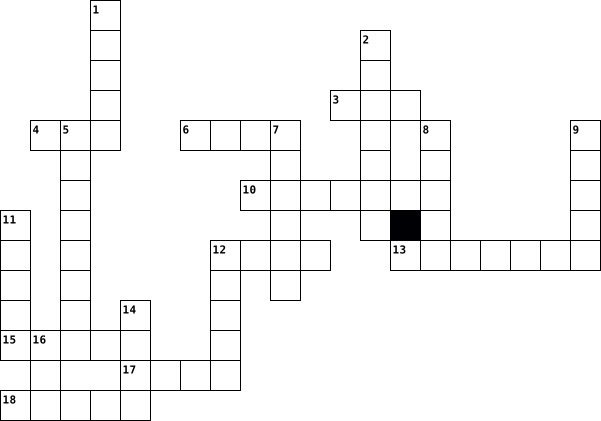
Mythology Crossword 2016-10-04

Across
- Jupiter’s wife
- God of the sun
- The river you cross to get to the underworld
- Born through Zeus’ head
- God of the Sea
- Defeated the minotaur
- One-eyed giants
- God of the moon
Down
- Married to Venus
- God of the underworld
- Where the olympian gods lived
- Cut off medusa’s head
- God of the sky
- The messenger god
- Son of Venus
15 Clues: Son of Venus • Jupiter’s wife • God of the sun • God of the sky • God of the Sea • One-eyed giants • God of the moon • Married to Venus • The messenger god • God of the underworld • Cut off medusa’s head • Defeated the minotaur • Born through Zeus’ head • Where the olympian gods lived • The river you cross to get to the underworld
Norse Mythology 2024-03-27

Across
- Who dressed as a bride to fool Heimdall
- Where does Balder go when he dies
- Who are the enemies of the gods
- Who got his hand eaten by Fenrir
- Who can shape shift
- Who made the chain that bound Fenrir
- Who did Loki cheat on his wife with
Down
- Who kills Thor in Ragnarok
- What is used to kill Balder
- Who does Thor go fishing with
- what does Odin give up an eye for
- Who is the most beloved god
- Who guards Bifrost
- Who has a chariot drawn by cats
- Where do those who died in battle go
15 Clues: Who guards Bifrost • Who can shape shift • Who kills Thor in Ragnarok • What is used to kill Balder • Who is the most beloved god • Who does Thor go fishing with • Who are the enemies of the gods • Who has a chariot drawn by cats • Who got his hand eaten by Fenrir • what does Odin give up an eye for • Where does Balder go when he dies • Who did Loki cheat on his wife with • ...
Norse Mythology 2024-03-13

Across
- short creatures who lived deep underground
- the hammer Thor carried
- known for being a troublemaker
- Another of Balder's brothers
- Odin's wife
- god of thunder
- home of the gods
Down
- goddess who refused to marry Thrym
- One of Balder's brothers
- Servants in Valhalla
- Loki's wife
- One of the sons of Odin and Frigga
- known for her golden hair
- an ugly, but rich giant
- the father of the Norse gods
15 Clues: Loki's wife • Odin's wife • god of thunder • home of the gods • Servants in Valhalla • the hammer Thor carried • an ugly, but rich giant • One of Balder's brothers • known for her golden hair • Another of Balder's brothers • the father of the Norse gods • known for being a troublemaker • goddess who refused to marry Thrym • One of the sons of Odin and Frigga • ...
Mythology Review 2025-11-13

Across
- Gets kidnapped by Hades
- Married to Zeus / Queen of the gods
- Punishes Earth every 6 months with winter
- Ate his kids when they were born
- Twin of Apollo
- Cursed into a snake monster by Athene
Down
- Kidnaps Persephone to be his bride
- Turned into spider by Athene
- Created the horse and many other creatures
- Zeus' "Brain-Child"
- Mother Earth
- Overthrew his father, Cronus
- Messenger of the gods
- Father Universe
- Flays a man alive over a music contest
15 Clues: Mother Earth • Twin of Apollo • Father Universe • Zeus' "Brain-Child" • Messenger of the gods • Gets kidnapped by Hades • Turned into spider by Athene • Overthrew his father, Cronus • Ate his kids when they were born • Kidnaps Persephone to be his bride • Married to Zeus / Queen of the gods • Cursed into a snake monster by Athene • Flays a man alive over a music contest • ...
Ancient Greece 2024-03-06

Across
- The act of one country settling another place, in order to become the new rulers of the new country, and to live in the new country.
- The philosopher who said an ideal society has only 3 classes with Philosophers at the top
- The person who conquered the Persian Empire and much land for Greece
- The main feature of Greek land which made agriculture difficult
- The city-state that was most concerned with strength and gave women rights
- The form of government when 1 person has ultimate power
- A philosopher who helped found democracy
- A famous Greek author of the Odyssey and the Iliad
- The shape of the land that Greece sits on
- The Greek ruling god and god of lightning
- The form of government when the people have a voice
- The Greek god of fire
Down
- A place in Alexandria that burned down by the Romans
- A philosopher who founded democracy and abolished slavery in Greece
- People from Greece who influenced the way people think about the world
- The style of religion the Greeks had
- The form of government when a small wealthy group rules
- The open air market in Athens Greece for debates and commerce
- The era when Greek culture spread around the world
- The Egyptian leader who stole Alexander the Great's body
- A league that was an alliance in Athens that defended Greece after the Persian War
- A place in a city like Athens near the coast where boats can dock and bring goods from far away lands
- The form of government when a noble King and his family rule
- The home of the Greek gods
- The city-state that founded democracy and supported the arts
- The Greek goddess of war
- The Greek god of the seas
- The philosopher who came up with logic and teacher of Alexander the Great
28 Clues: The Greek god of fire • The Greek goddess of war • The Greek god of the seas • The home of the Greek gods • The style of religion the Greeks had • A philosopher who helped found democracy • The shape of the land that Greece sits on • The Greek ruling god and god of lightning • The era when Greek culture spread around the world • ...
EBI Crossword 2013-09-10

Across
- The Greek god associated with two snakes wrapped round a winged staff
- Roman God of Wine
- Roman goddess, wife of Jupiter
- The daughter of Greek gods Demeter and Zeus
- Greek God of Wine
- The Greek goddess of the hunt and moon
Down
- Roman god of war
- Greek God of fire and the forge
- The Roman god of the underworld
- Greek goddess of the earth
- The Roman messenger of the gods
- Greek god of love
12 Clues: Roman god of war • Roman God of Wine • Greek God of Wine • Greek god of love • Greek goddess of the earth • Roman goddess, wife of Jupiter • Greek God of fire and the forge • The Roman god of the underworld • The Roman messenger of the gods • The Greek goddess of the hunt and moon • The daughter of Greek gods Demeter and Zeus • ...
Day One Vocabulary Practice 2021-12-23

Across
- 수확의 여신
- 결혼의 여신
- 전설
- 하늘의 신
- 여신
- 신화
Down
- 바다의 신
- 문화
- 종교
- 망자의 신
- 아궁이의 여신
- 신
12 Clues: 신 • 문화 • 종교 • 전설 • 여신 • 신화 • 바다의 신 • 망자의 신 • 하늘의 신 • 수확의 여신 • 결혼의 여신 • 아궁이의 여신
Spellin Unit 8 2014-10-18

Across
- is my poem the new _ of poetry
- our minister has a degree in _
- can I order that form the _ by phone
- bring some rock samples to _ class
- the document is full of legal _
- new _ makes many tasks easier
- a timeline shows a _ of events
- i offered my _ for breaking the cup
- human groups are the focus of _
- the origin of a word
- oil spills harm the _ of our oceans
- use _ to solve math problems
- after the end
Down
- fans of _ study stars and planets
- this _ book does not cover apes
- digs up the past
- before the beginning
- i read all three books of the _
- do weather reporters study _
- students of _ learn how minds work
- an _ shows how things are created
- the gods of ancient mythology interest me
- people who plan events must think about this
- i overheard the _ between them
- our next _ is on human growth
25 Clues: after the end • digs up the past • before the beginning • the origin of a word • do weather reporters study _ • use _ to solve math problems • new _ makes many tasks easier • our next _ is on human growth • is my poem the new _ of poetry • our minister has a degree in _ • a timeline shows a _ of events • i overheard the _ between them • this _ book does not cover apes • ...
roots and suffixes 2022-02-22

Across
- Greek/latin root that means stone
- Greek/latin root that means spave
- Greek/latin root that means water
- Greek/latin root that means to hear
- Greek/latin root that means to see
- Greek/latin root that means sea
Down
- Greed/latin root that means glow
- Greed/latin root that means to lines
- Greek/latin root that means against
- Greek/latin root that means away
- Greek/latin root that means to write
11 Clues: Greek/latin root that means sea • Greed/latin root that means glow • Greek/latin root that means away • Greek/latin root that means stone • Greek/latin root that means spave • Greek/latin root that means water • Greek/latin root that means to see • Greek/latin root that means against • Greek/latin root that means to hear • Greed/latin root that means to lines • ...
Chapter 05 - 6th Grade 2024-11-18

Across
- A drama where the story ends happily.
- Son of Philip II who conquered the Persian Empire, expanding the Hellenistic Empire from Egypt to India.
- A Greek historian who wrote the history of the Persian Wars
- A Greek philosopher who taught his pupils that the universe followed the same laws as music and numbers.
- United the Greek city-states with Macedonia to defeat the Persian Empire.
- An astronomer from Samos who claimed that the sun was at the center of the universe and that the Earth circled the sun.
- A sacred shrine where a priest of priestess spoke for a god or goddess.
- The poet who wrote the Iliad and the Odyssey.
- Long poems that told about heroic deeds.
- The greatest historian of the ancient world, who wrote the History of the Peloponnesian War.
- The belief that happiness was the goal of life and that the way to be happy was to seek out pleasure.
- What a person leaves behind when he or she dies.
- The belief that happiness came from following reason, not emotions, and doing your duty.
- A student of Socrates who wrote the Republic.
- Greek thinkers who believed the human mind could understand everything.
- A student of Plato who wrote more than 200 books on topics ranging from government to planets and stars.
- The most famous Greek scientist and inventor of the Hellenistic Era who worked on solid geometry.
- A short tale that teaches a lesson
- Asking pointed questions to force pupils to use their reason and to see things for themselves.
Down
- The branch of mathematics that shows how points, lines, angles, and surfaces relate to one another.
- The branch of mathematics that focuses on the study of ball-like shapes called spheres and tubelike shapes called cylinders.
- A writer of Greek tragedies
- An astronomer who was in charge of the library at Alexandria.
- A poet who wrote short poems about the beauty of nature.
- Professional teachers in ancient Greece.
- A story told by actors who pretend to be characters in the story.
- A writer of Greek tragedies
- A drama where a person struggles to overcome difficulties but fails.
- A Greek slaved who made up fables.
- Traditional stories about gods and heroes.
- A time when the Greek language and Greek ideas spread to the non-Greek people of southwest Asia.
- People who study stars, planets, and other heavenly bodies.
- “Love of Wisdom”
- An Athenian sculptor whose true love was philosophy.
- The most famous Greek mathematician who described plane geometry in his book, Elements.
35 Clues: “Love of Wisdom” • A writer of Greek tragedies • A writer of Greek tragedies • A Greek slaved who made up fables. • A short tale that teaches a lesson • A drama where the story ends happily. • Professional teachers in ancient Greece. • Long poems that told about heroic deeds. • Traditional stories about gods and heroes. • The poet who wrote the Iliad and the Odyssey. • ...
Celtic Mythology 2013-10-28

Across
- One of the cycles of Celtic mythology
- God of strength and eloquence
- One of the goddesses of horses
- The god of the forests
- Goddess of healing, associated with healing springs
- Cycles of the_______:One of the cycles of Celtic mythology
Down
- The god of love
- One of the Mother Goddesses
- God of healing,the sea,hunting and dogs
- One of the Mother Goddesses
- One of the goddesses of sacred waters
11 Clues: The god of love • The god of the forests • One of the Mother Goddesses • One of the Mother Goddesses • God of strength and eloquence • One of the goddesses of horses • One of the cycles of Celtic mythology • One of the goddesses of sacred waters • God of healing,the sea,hunting and dogs • Goddess of healing, associated with healing springs • ...
Milseong quiz 2023-09-07

Across
- What is the term derived from the name of a sculptor in Greek and Roman mythology that means that positive expectations of others actually have a good influence?
- What is the name of this disease that originated from the longing for home in another country?
- Which is the largest planet in the solar system?
- How many teeth does an adult human have?
- policy What policy did Roosevelt, the 32nd president of the United States, use to overcome the Great Depression?
- Which country was the first country in the world to legally allow euthanasia?
- system What is the name of India’s status system divided into four statuses?
Down
- What is this, a phenomenon in which the colors of both eyes are different because of the difference in melanin pigment concentration due to DNA abnormalities in red body cells?
- What is the capital of Vietnam?
- Which tree represents our school?
- What flower symbolizes our school?
- Which was the first country to use paper money?
12 Clues: What is the capital of Vietnam? • Which tree represents our school? • What flower symbolizes our school? • How many teeth does an adult human have? • Which was the first country to use paper money? • Which is the largest planet in the solar system? • system What is the name of India’s status system divided into four statuses? • ...
History Review 2023-04-02

Across
- sacred river to ancient Egyptians
- Greek city-state based on military strength
- ditch around a castle filled with water
- ruler that has absolute power
- knight in training
- ancient Egyptian trained to read and write
- man who was leader of a Roman family
- disease that kills many people
- 80 Roman soldiers led by a centurion
Down
- Greek goddess of beauty
- Egyptian picture and symbol writing
- ancient Greek sporting event
- government that is run by elected officials
- Roman man-made channel that delivered water
- low-lying wetland in the shape of a fan
- blinded the cyclops that imprisoned his crew
- most powerful Greek city-state
- most protected part of a castle
- code by which knights pledged to live
- Egyptian form of paper made from plants
20 Clues: knight in training • Greek goddess of beauty • ancient Greek sporting event • ruler that has absolute power • most powerful Greek city-state • disease that kills many people • most protected part of a castle • sacred river to ancient Egyptians • Egyptian picture and symbol writing • man who was leader of a Roman family • 80 Roman soldiers led by a centurion • ...
Greek Crossword 2022-01-10

Across
- Means dance in greek
- something that shocks the audience
- arrangements of events in the play
- song sung by chorus
- ancient word for king
- support the plot. their motivation drives the play
- the major festival was at
- first great theorist of dramatic art
- part woman, eagle ,lion
- Earliest known playwright
- The flat space below the slope
Down
- Theater in the western world ancient
- Father of Western Philosophy
- part goat part man
- Greek drama was honoring the god
- "an act of injustice"
- how the speech reveals characters
- one of the four categories in the greek theater
- comes from the greek word theatron
- origin of the word scene
- wrote about 127 plays
- seats that hold 14,000-17,000 people
- "to do" "act"
23 Clues: "to do" "act" • part goat part man • song sung by chorus • Means dance in greek • "an act of injustice" • ancient word for king • wrote about 127 plays • part woman, eagle ,lion • origin of the word scene • the major festival was at • Earliest known playwright • Father of Western Philosophy • The flat space below the slope • Greek drama was honoring the god • ...
Greek Crossword 2022-01-10

Across
- Means dance in greek
- something that shocks the audience
- arrangements of events in the play
- song sung by chorus
- ancient word for king
- support the plot. their motivation drives the play
- the major festival was at
- first great theorist of dramatic art
- part woman, eagle ,lion
- Earliest known playwright
- The flat space below the slope
Down
- Theater in the western world ancient
- Father of Western Philosophy
- part goat part man
- Greek drama was honoring the god
- "an act of injustice"
- how the speech reveals characters
- one of the four categories in the greek theater
- comes from the greek word theatron
- origin of the word scene
- wrote about 127 plays
- seats that hold 14,000-17,000 people
- "to do" "act"
23 Clues: "to do" "act" • part goat part man • song sung by chorus • Means dance in greek • "an act of injustice" • ancient word for king • wrote about 127 plays • part woman, eagle ,lion • origin of the word scene • the major festival was at • Earliest known playwright • Father of Western Philosophy • The flat space below the slope • Greek drama was honoring the god • ...
Greek puzzle 2026-02-02

Across
- renowned greek philosopher and Polly math a student of
- A former temple on a athenian acropolis
- volcano eruption
- Sustainable the Greek goddess how much is
- major temple located at Delphi site
- life
- oracle in the classic world
- woofs or light
- city on the island of santorini preserved
Down
- A citadel built it on a higher hill in
- of art or literature that shows thing as in
- gymnasium in ancient Athens
- city greek Sanctuary and the most
- A temple decided to Apollo Lyceus and a
- and teacher of Alexander the Great
- the future oracle
- Aristotle taught
- an epithet for the greek god Apollo often associated
- containing the parthenon
19 Clues: life • woofs or light • volcano eruption • Aristotle taught • the future oracle • containing the parthenon • gymnasium in ancient Athens • oracle in the classic world • city greek Sanctuary and the most • and teacher of Alexander the Great • major temple located at Delphi site • A citadel built it on a higher hill in • A former temple on a athenian acropolis • ...
Heroes of Olympus: The Blood Of Olympus 2017-05-30

Across
- Roman goddess of victory
- The river of fire located in Tartarus
- Goddess of the hunt
- Titan of the earth, earth mother, mother nature
- A race of creatures who were created to oppose the gods
- Ancient Greek temple to the goddess Athena who the Athenians considered their patron
- Greek goddess of wisdom and battle strategy
- Greek Hero and King of Ithaca
Down
- Greek goddess of victory
- Statue of the Greek goddess of wisdom and battle strategy
- The name of the girl who is cursed to be alone on the island of Ogygia
- Greek goddess of magic and witchcraft
- Warriors of ancient Greece
- The name of the Titan of the underworld, his body is the underworld and is used as a place of punishment
- God of the underworld
15 Clues: Goddess of the hunt • God of the underworld • Greek goddess of victory • Roman goddess of victory • Warriors of ancient Greece • Greek Hero and King of Ithaca • The river of fire located in Tartarus • Greek goddess of magic and witchcraft • Greek goddess of wisdom and battle strategy • Titan of the earth, earth mother, mother nature • ...
The Rise of Democracy 2024-02-21

Across
- Contributed most to the isolation of individual Greek city-states:
- in Athens, a group of 500 citizens chosen to form a council responsible for running the day-to-day government business.
- A government in which absolute ruling power is held by a person who is not a lawful king is a:
- Another name for a tyrant is a:
- Ancient Greek communities are called:
- A government in which the ruling power is in the hands of one person is
- From 2000 to 800 B.C.E., Greek city-states were ruled by:
Down
- a small group of Spartans who made all the important governing decisions.
- a peninsula forming the southern part of the mainland of Greece.
- The first Greek city-state to have a form of government called a democracy, or "rule by the people," was
- A government in which power is held by the people is a:
- A Greek Assembly was made up of a group of
- What was the same throughout the Greek city-states?
- A marketplace in ancient Greece.
- a city-state of ancient Greece, known for its military oligarchy.
- A government in which the ruling power is in the hands of a few people is called an:
- Most oligarchs were:
- a group of citizens, in an ancient Greek democracy, with the power to pass laws.
18 Clues: Most oligarchs were: • Another name for a tyrant is a: • A marketplace in ancient Greece. • Ancient Greek communities are called: • A Greek Assembly was made up of a group of • What was the same throughout the Greek city-states? • A government in which power is held by the people is a: • From 2000 to 800 B.C.E., Greek city-states were ruled by: • ...
Greek Alphabet Letters 2023-09-12

Across
- a letter of the Greek alphabet, used to represent the "b" sound in Ancient Greek and "v" in Modern Greek
- The golden ratio
- is the ninth letter of the Greek alphabet. The uppercase symbol is Ι, while the lowercase symbol is ι. It represents number ten in the Greek numeral system.
- represent the value 70
- , an infinite series given by. where z and w are complex numbers and the real part of z is greater than.
- circle constant to represent a full rotation around a circle in radians
- it has a value of 3.
Down
- the letter of the Greek alphabet used to represent the "k" sound
- an arbitrary number (smallest possible numbers)
- , an infinite series given by. where z and w are complex numbers and the real part of z is greater than zero.
- the seventeenth letter of the Greek alphabet
- derived from the Phoenician letter heth .
- “change” or “the change”
- The symbol θ usually represents the angular position of a vector.
- derived from the Phoenician waw .
15 Clues: The golden ratio • it has a value of 3. • represent the value 70 • “change” or “the change” • derived from the Phoenician waw . • derived from the Phoenician letter heth . • the seventeenth letter of the Greek alphabet • an arbitrary number (smallest possible numbers) • the letter of the Greek alphabet used to represent the "k" sound • ...
Greek Alphabet Letters 2023-09-12

Across
- a letter of the Greek alphabet, used to represent the "b" sound in Ancient Greek and "v" in Modern Greek
- The golden ratio
- is the ninth letter of the Greek alphabet. The uppercase symbol is Ι, while the lowercase symbol is ι. It represents number ten in the Greek numeral system.
- represent the value 70
- , an infinite series given by. where z and w are complex numbers and the real part of z is greater than.
- circle constant to represent a full rotation around a circle in radians
- it has a value of 3.
Down
- the letter of the Greek alphabet used to represent the "k" sound
- an arbitrary number (smallest possible numbers)
- , an infinite series given by. where z and w are complex numbers and the real part of z is greater than zero.
- the seventeenth letter of the Greek alphabet
- derived from the Phoenician letter heth .
- “change” or “the change”
- The symbol θ usually represents the angular position of a vector.
- derived from the Phoenician waw .
15 Clues: The golden ratio • it has a value of 3. • represent the value 70 • “change” or “the change” • derived from the Phoenician waw . • derived from the Phoenician letter heth . • the seventeenth letter of the Greek alphabet • an arbitrary number (smallest possible numbers) • the letter of the Greek alphabet used to represent the "k" sound • ...
Greek Cuisine 2024-06-28

Across
- Skewered meat
- Greek cheese
- Eggplant casserole
- Honey cookies
- Sweet pastry
- Sweet cheese pie
- Greek lasagna
- Greek salad
- Meat wrap
Down
- Fried cheese
- Lemon egg soup
- Spinach pastry
- Stuffed grape leaves
- Fried dough balls
- Yogurt cucumber dip
15 Clues: Meat wrap • Greek salad • Fried cheese • Greek cheese • Sweet pastry • Skewered meat • Honey cookies • Greek lasagna • Lemon egg soup • Spinach pastry • Sweet cheese pie • Fried dough balls • Eggplant casserole • Yogurt cucumber dip • Stuffed grape leaves
Greek vs Rome 2021-02-11
Across
- Greek had the Olympics and, rome did
- ancient Greeks decorated almost every part of their lives from art and rome got there from
- Rome had 3 wars and greek also had a lot of
- They both had People that farm
- both had sports
- They both had buildings that you learn in
- They both had movements or
- They both had wood objects, or
- They both had
Down
- They both had weddings but in greek you can get married at the age of 12-13 but in rome you have to be an
- They both had shirts or
- They both had a type of
- They both had laws and people that worked for them or
- They both had jazz
- They both had Things we do for fun
- Greek loved vegetables and rome loved heavy food or
- They both had that you could live in
- They both love
- the Greek started 3500 years ago and the roman started 1500
19 Clues: They both had • They both love • both had sports • They both had jazz • They both had shirts or • They both had a type of • They both had movements or • They both had People that farm • They both had wood objects, or • They both had Things we do for fun • Greek had the Olympics and, rome did • They both had that you could live in • They both had buildings that you learn in • ...
Are you smart enough to work at Bletchley Park 2026-04-30

Across
- The god of the dead in Egyptian mythology.
- The capital of Egypt.
- A thing that you use in your daily life that was invented in Egypt.
- Another famous female pharaoh of Egypt.
- The number of gods that the ancient Egyptians had.
- A famous pharaoh.
- The preferred type of pet in ancient Egypt.
- What they call the king in ancient Egypt.
Down
- The name of the process to transform a body into a mummy.
- One of the famous animals that lives in the Nile.
- The emperor that conquered Egypt.
- A famous female pharaoh.
- The mythical animal that guards le pyramids.
- The goddess of motherhood and joy in Egyptian mythology.
- What type of animal is Anubis?
15 Clues: A famous pharaoh. • The capital of Egypt. • A famous female pharaoh. • What type of animal is Anubis? • The emperor that conquered Egypt. • Another famous female pharaoh of Egypt. • What they call the king in ancient Egypt. • The god of the dead in Egyptian mythology. • The preferred type of pet in ancient Egypt. • The mythical animal that guards le pyramids. • ...
Characteristics of Greek Cuisine 2022-01-13

Across
- The type of fruits that are grown in Greece.
- A dish of grape leaves stuffed with rice and ground meats.
- The main type of sweetener that is produced and used in Greece.
- A white, crumbly cheese that is made from goats milk.
- A primary ingredient in Greek dishes.
- New Year's Eve in Greece. They serve honey cakes.
- A popular Greek sauces, soup or condiment. Made up of egg yolks and lemon juice.
- An animal raised in Greece & provides the main meat for the Greek diet.
- location of Greece on the globe.
- A staple vegetable in Greek food.
- dish that breaks the 7 week fast of Lent and is made from internal organs.
- a word that describes the climate of Greece.
- The dominant cooking method in Greece.
Down
- name of the type of diet that Greek’s eat and a sea by which they are located
- A country that lies to the east of Greece and ruled over Greece for several centuries.
- for Greek appetizers.
- The most important religious holiday in Greece.
- Wrote the first cookbook for the Romans.
- Two crops that are plentiful because of the deep roots terrain of Greece.
- A very thin pastry dough that is used in many Greek dishes.
- A dish made of eggplant, lamb and cheese that is baked in a rich cream sauce.
- A dish made of spinach, cheese and phyllo dough.
- A popular spice that is used in Greece.
- A type of spice used often in Greek cooking.
- A fruit that can be eaten raw or used to make olive oil.
- A popular Greek pastry made with phyllo dough, nuts and honey.
- A country that lies to the west of Greece.
- This is abundant due Greece being located on a peninsula.
28 Clues: for Greek appetizers. • location of Greece on the globe. • A staple vegetable in Greek food. • A primary ingredient in Greek dishes. • The dominant cooking method in Greece. • A popular spice that is used in Greece. • Wrote the first cookbook for the Romans. • A country that lies to the west of Greece. • The type of fruits that are grown in Greece. • ...
Ancient Greece 2021-03-24

Across
- Shrines and priests that could predict future
- the overall winner of the Persian Wars
- Government in Athens where "citizens" voted and help the power
- armies of Greek citizens
- Persian empire builder who allowed conquered people to retain culture
- mythical part man, part bull creature
- People that settled Greek mainland and had first Greek kings
- philosopher who believed in a philosopher-king
- polis dedicated to a warrior lifestyle
- polis that help the most power in the Delian League
- marketplace and an area where Greeks could debate ideas
- Alexander the Great and his father Philip II were from ___
- Philosopher who believed we must question everything
- rule by a few people
- Persia was located in present-day ____
- Part of Greece that juts out from the mainland (where Sparta was located)
- Persian leader who organized the empire into satrapies
- a city-state, small Greek kingdoms
Down
- Author of the Greek epics "The Illiad" and "The Odyssey"
- philosopher who believed in observation
- rule of the people
- Alexander the Great died due to ___
- Greek column with 2 "scrolls"
- Where Ancient Greeks believed some of the gods lived
- Coming out of the Dark Ages, these leaders seized control by force
- natural disasters that caused the downfall of early groups in the area
- Monotheistic Persian religion
- city state in Italy that was rising in power as Alexander's Empire was falling apart
- Minoan civilization formed on this island
- Killed off many Athenians during the Peloponnesian War
- tight battle formation of Greeks which utilized shields and long spears
- Alexander's Empire stretched as far east as ____
- Greek hero with a fatal flaw in his ankle
- a general who became a powerful leader during Athens' height
- Greek writer who wrote fables with a moral lesson
35 Clues: rule of the people • rule by a few people • armies of Greek citizens • Greek column with 2 "scrolls" • Monotheistic Persian religion • a city-state, small Greek kingdoms • Alexander the Great died due to ___ • mythical part man, part bull creature • the overall winner of the Persian Wars • polis dedicated to a warrior lifestyle • Persia was located in present-day ____ • ...
Ancient Greece (year 7 history) 2021-08-21

Across
- Birthplace of Sappho
- Place for the souls of wicked people
- Largest template in ancient Athens
- Key battle in second Persian War
- Famous Homer poem
- Nation formerly part of Ancient Greek empire
- Highest piece of land in a city-state
- Centre of a city-state
- Greek for 'rule'
- British archaeologist who restored palace of Knossus
- Three-headed dog guarding entrance to Hades
- Home of the Olympics
- Rule by many
- Athletes' training facility
- Greek poet
- Wife of Zeus
- Foreign-born Athenians
- Sparta was this type of state
- Substance women used to create a pale complexion
- Armoured foot solider
- Age Spartan boys enter military training
- Meeting place of city-state's council
- One of first Greek colonies established on an island
- Long building containing shops and offices
- Early Greek civilisation
Down
- Building where Council of Citizens meet
- Persian king who led army into the battle of Thermopylae
- Interpreter of deities' wishes
- Good storage container
- Fierce Olympic event
- Venue for Olympic chariot races
- Traditional enemy of ancient Greece
- Heroic king of Sparta who faced the Persian army
- Modern day Santorini
- Underworld
- Olympic sport comprising 5 events
- Civilisation centred on the island of Crete
- Council of citizens
- Key battle formation
- Major Greek city-state
- Central courtyard in a wealthy Greek home
- Robe
- Spartans involved in commercial activity
- Assembly
- Military headquarters
- Ropes used to round up citizens to attend assembly soaked in this
- Key battle of first Persian war
- Person/thing considered a portal through which gods passed messages
- Spartan slave
- Wealthy land owner
- --- Fields - for the souls of heroes who had Zeus's favour
- Rule by few
- Plainest of Greek columns
53 Clues: Robe • Assembly • Underworld • Greek poet • Rule by few • Rule by many • Wife of Zeus • Spartan slave • Greek for 'rule' • Famous Homer poem • Wealthy land owner • Council of citizens • Birthplace of Sappho • Fierce Olympic event • Modern day Santorini • Key battle formation • Home of the Olympics • Military headquarters • Armoured foot solider • Good storage container • Major Greek city-state • ...
Ancient Greece 2026-03-31

Across
- An open-air marketplace and meeting place in a city-state.
- A heavily armed foot soldier in the Greek army.
- A short story that teaches a moral lesson, often using animals.
- A government where citizens vote to make decisions.
- A type of Greek play where the main character has a sad ending.
- A person with the right to participate in government.
- A type of Greek play that ends happily and makes people laugh.
- A government where a small group of wealthy people hold power.
- The god of the sea who carried a trident.
- The city-state famous for its powerful military and strict discipline.
- The blind poet who wrote the Iliad and the Odyssey.
- A piece of land surrounded by water on three sides, like Greece.
- A famous philosopher who taught by asking many questions.
- A high, fortified hilltop in a Greek city.
- The city-state famous for its focus on education and arts.
- The Greek word for a city-state.
- A tall, vertical structure used to support Greek buildings.
Down
- The system of letters the Greeks created using Alpha and Beta.
- A military formation where soldiers stand close with overlapping shields.
- The famous storyteller known for his many fables.
- The famous temple built for Athena on the Athenian Acropolis.
- A leader who takes power by force and rules with total authority.
- Athletic games held every four years to honor Zeus.
- The "Great" king who conquered Persia and spread Greek culture.
- A person thought to be able to communicate with the gods to see the future.
- The study of wisdom, nature, and the meaning of life.
- The king of the Greek gods and ruler of Mount Olympus.
- A government ruled by a single king or queen.
- A philosopher who was the private teacher of Alexander the Great.
- A story about gods and heroes that explains the natural world.
30 Clues: The Greek word for a city-state. • The god of the sea who carried a trident. • A high, fortified hilltop in a Greek city. • A government ruled by a single king or queen. • A heavily armed foot soldier in the Greek army. • The famous storyteller known for his many fables. • A government where citizens vote to make decisions. • ...
Greek Theater Terms 2022-01-11

Across
- A Greek comedy Playwright who wrote works such as "The Birds"
- A wheeled platform carrying corpses to reflect death in the place of explicit murder or suicide.
- An area directly in front of the "temple" where actors would perform. It was eventually known as the acting area, replacing the Greek stage.
- A renowned Greek tragedy Playwright who wrote works such as "Medea."
- An actor
- A rounded structure found at ground level at the bottom of a hill. Also known as a Greek stage.
- A renowned Greek tragedy Playwright who wrote works such as "The Suppliants."
- A Greek God of wine and fertility. Annual festivals were held in their honor, and competition for the best play was held during these gatherings.
- An altar on the orchestra. The leader of the chorus would stand here.
- Prismatic pillars located at stage left and stage right used to change scenes during a performance.
- Aisles indicating that an actor is entering from a location other than the temple. The left represents fields while the right reflects a city or port.
Down
- Machanations kept within the temple that are used in a performance.
- A device used to lift "gods" from the temple to its top.
- First playwright to win the Dionysian festival. Credited as the first actor.
- Traditionally built from wood or stone, this is referred to as the auditorium of Greek theater.
- Upper and lower levels of the Koilon
- A renowned Greek tragedy Playwright who wrote works such as "Oedipus Rex."
- A term indicating describing the absolving of a conflict through supernatural intervention. Literally means "god from the machine."
- An enclosed area representing a temple or palace. Performers would traditionally wear masks and robes into this structure.
- A flat area atop the temple reserved for those playing gods.
20 Clues: An actor • Upper and lower levels of the Koilon • A device used to lift "gods" from the temple to its top. • A flat area atop the temple reserved for those playing gods. • A Greek comedy Playwright who wrote works such as "The Birds" • Machanations kept within the temple that are used in a performance. • ...
Ancient Theater of Messene 2025-06-03

Across
- The scene building was destroyed in the mid 2nd to the early 4th century CE due to this
- This is the shape of the Roman orchestra
- The religious festival dedicated to Dionysos that involved singing, dancing, processions, and theatrical performances
- The Greek term for the raised stage in front of the skene
- A sung and danced hymn to Dionysos that eventually evolves into contemporary ancient Greek drama
- How do we know what wooden theaters (and other aspects of theatrical performances that don't survive to modern day) may have looked like? (2 words)
- Performances of mythological burlesque (2 words)
- The Theban general who founded Messene in 369 BCE
- The Roman term for the seating area of the theater
- The king of Macedon's advisor and lover(?)
- A storage room that held a mobile wooden stage during the second building phase
- The person who presides over games or religious festivals
Down
- This professor led the excavations of this site (2 words)
- This is considered the first stone theater in ancient Greece (3 words)
- Refers to Greek settlements in southern Italy; translates to "Big Greece" (2 words)
- In mid 1st - mid 2nd century CE, the Hellenistic theater of Messene was renovated into this (2 words)
- A general of the Achaean League, referred to as the "Last Greek"
- This is where some of our earliest instances of theatrical structures in the ancient Greek world come from (2 words)
- The Greek and Roman term for the space in front of the stage where the chorus performed
- The Greek term for the scene building that often acted as a backdrop
- The Roman term for the multi-storied scene building that acted as a backdrop (2 words)
- By the _____ century CE, the theater of Messene was abandoned
- The Greek term for the seating area of the theater
- Walkways on either side of the stage that acted as entrances (singular)
- King of the Macedonians (two words)
25 Clues: King of the Macedonians (two words) • This is the shape of the Roman orchestra • The king of Macedon's advisor and lover(?) • Performances of mythological burlesque (2 words) • The Theban general who founded Messene in 369 BCE • The Greek term for the seating area of the theater • The Roman term for the seating area of the theater • ...
Ancient Greece 2025-12-15

Across
- a sacred place where Greeks asked the gods for advice
- a deadly disease that weakened Athens during the Peloponnesian War
- the home of the Greek gods
- the kingdom ruled by Alexander the Great
- one way Greek ideas spread
- independent communities formed because mountains separated Greece
- a system where citizens vote directly on decisions
- a hilltop used for temples and important buildings in Athens
- the idea that laws apply to everyone, including leaders
- the Greek god honored during the Olympic Games
- independent Greek city-states formed because of geography
- the city-state focused on military training and discipline
- a landform that explains why Greece had access to the sea
- the sea that allowed ancient Greeks to trade and travel
- the sea east of Greece that supported trade and travel
- a conflict between Athens and Sparta that weakened Greece
- a temple built to honor Athena and show Athenian pride
- describing Athenian democracy because not everyone could vote
- a prize showing honor mattered more than money
Down
- a thinker who seeks knowledge and understanding
- athletic games held to honor Zeus
- believing in many gods
- a government ruled by a small group of powerful people
- wars caused when Persia tried to expand into Greek land
- the philosopher who taught by asking questions
- the city-state known for democracy and education
- a free man in Athens who could participate in government
- describing the blending of Greek and local cultures
- the southern peninsula where Sparta was located
- the marketplace and meeting place in ancient Athens
- a thinking skill taught to boys in Athens
- the leader who spread Greek culture through conquest
- a philosopher who studied nature and taught Alexander
- the sea west of Greece used by Greek sailors
- a temporary peace agreement during the Olympic Games
35 Clues: believing in many gods • the home of the Greek gods • one way Greek ideas spread • athletic games held to honor Zeus • the kingdom ruled by Alexander the Great • a thinking skill taught to boys in Athens • the sea west of Greece used by Greek sailors • the philosopher who taught by asking questions • the Greek god honored during the Olympic Games • ...
Mythology Cross word 2025-02-03

Across
- Repeating details that happen 3 times throughout the story
- Egyptian god of the sun
- The person changing throughout the story
- Rapunzel (character archetype)
- Egyptian book that talks about the dead
- Woman Older woman that is often very influential to the family heritage.
- Step-siblings that are often the antagonists of the story.
- Often is very wise and instigates the antagonists to do things.
- Journey the Hero goes on
- Mythology depicted as above vs depicted as equal
- End of the world (Norse)
Down
- Getting what you put out
- A door that people are not supposed to go in, could open up into another world
- mythological creature or evil spirit originating from Algonquian folklore.
- Often when someone is in poverty and becomes royalty or rich.
- Coyote (mythology)
- Morals of specific group
- The main problem that pushes the protagonist(s) to go through puzzles to complete the problem
- Coyote (character archetype)
- Heritage of specific group
20 Clues: Coyote (mythology) • Egyptian god of the sun • Getting what you put out • Morals of specific group • Journey the Hero goes on • End of the world (Norse) • Heritage of specific group • Coyote (character archetype) • Rapunzel (character archetype) • Egyptian book that talks about the dead • The person changing throughout the story • Mythology depicted as above vs depicted as equal • ...
Ancient Greece 2017-03-05

Across
- tunic for women
- oldest period in ancient greek history
- one of the periods of greek history
- one of the periods of greek history
- a fake face actors wear to represent their character
- the place were actors perform in plays on a stage
- men who came from the city
- one of the first doctors to use scientific ideas to cure people
- big semicircular sloping place to perform plays
- stories about greek heroes
- important city in greece
- famous philosopher who founded a big academy in Athens
Down
- famous greek mathematician
- famous philosopher in ancient greece
- foreigners,women, slaves
- stories about gods and humans
- tunic for men and women
- where plays were performed
- all men who act in plays in female and male roles
- chief god
- famous greek mathematician who shouted Eureka in the bathtub when he discovered a theory
- famous philosopher in Ancient Greece whose pupil was Alexander the Great
- heavy cloak for winter
- a happy or funny play
- a sad or depressing play
- enemy of important city in greece
26 Clues: chief god • tunic for women • a happy or funny play • heavy cloak for winter • tunic for men and women • foreigners,women, slaves • a sad or depressing play • important city in greece • famous greek mathematician • where plays were performed • men who came from the city • stories about greek heroes • stories about gods and humans • enemy of important city in greece • ...
KTD-Unit 2 Review 2023-02-13

Across
- What were the three types of children Mother Earth and Sky god had together.
- Who was the god of metalworking, fire, metallurgy, etc.?
- Where were the Minoans originated from?
- What temple was built in 400s BC to honor Athena?
- What Greek city-state won the Peloponnesian war?
- What type of democracy does the U.S.A. use?
- What battle ended the Persian War?
- What was used to hold up the roofs of all Greek buildings?
- What was the scientific downfall of the Minoans?
- Who wrote the Iliad?
- What were slaves in Sparta called?
- Who won the Trojan War?
- What geographic features affected the Greek's way of life?
Down
- Who tutored Alexander the Great?
- How many winners were there in the ancient Greek Olympics?
- What were some of the Mycenaean jobs?
- What is the name of the government where one ruler rules with oppressive force?
- What Greek city-state developed the first democracy?
- Where did the olympics originally take place in ancient Greece.
- What is the name of a Greek marketplace?
- What field of mathematics did Euclid create?
21 Clues: Who wrote the Iliad? • Who won the Trojan War? • Who tutored Alexander the Great? • What battle ended the Persian War? • What were slaves in Sparta called? • What were some of the Mycenaean jobs? • Where were the Minoans originated from? • What is the name of a Greek marketplace? • What type of democracy does the U.S.A. use? • What field of mathematics did Euclid create? • ...
Vocab 4 2026-01-16

Across
- the capital city of Greece
- Spread of Greek culture across the Mediterranean
- person who seeks understanding of the world
- ruler who uses power in a cruel, oppressive way
- temple built for Athena at Athens in the fifth centry b.c
- small number of people with power
- Peice of land surrounded by water on three sides
- period of peace, harmony, and stability
- system of government where people hold the power by electing representatives or directly
- large peninsula in Europe surrounded by the Ionian, Aegean, and Black seas
- system where money replaces exchanged goods,
Down
- alliance of Greek city states lead by Sparta
- Ancient Greek city-state, which included the city and the agricultural land surrounding it
- body of troops in a close formation
- form of government or social class where power is held by a small privileged group
- war between citizens of the same country
- alliance of greek city-states to defeat persia lead by Athens
- system where people exchange goods and services
- Ancient Greek kingdom
- form of government with a single head of state
20 Clues: Ancient Greek kingdom • the capital city of Greece • small number of people with power • body of troops in a close formation • period of peace, harmony, and stability • war between citizens of the same country • person who seeks understanding of the world • alliance of Greek city states lead by Sparta • system where money replaces exchanged goods, • ...
Χριστουγεννιάτικο 2020-12-18

Across
- Card in Greek
- We decorate our Christmas trees with these
- Brings presents to the good children
- The coin we put in Vassilopita
- Greek traditional Christmas sweets with honey
- Poinsettia in Greek
Down
- Present in Greek
- Merry Christmas in Greek
- Manger in Greek
- Star in Greek
- ornament
11 Clues: ornament • Card in Greek • Star in Greek • Manger in Greek • Present in Greek • Poinsettia in Greek • Merry Christmas in Greek • The coin we put in Vassilopita • Brings presents to the good children • We decorate our Christmas trees with these • Greek traditional Christmas sweets with honey
Greek peeps 2024-09-18

Across
- greek mathematician and astronomer
- ancient ionian greek philosopher
- father of geometry
- one of great greek dramatist
- Father comedy
- ancient greek polymath
Down
- of great greek dramatist
- greek politician and general
- athenian historian and general
- ancient Greek mathematician, physicist, engineer, astronomer, and inventor
- the father of history
11 Clues: Father comedy • father of geometry • the father of history • ancient greek polymath • of great greek dramatist • greek politician and general • one of great greek dramatist • athenian historian and general • ancient ionian greek philosopher • greek mathematician and astronomer • ancient Greek mathematician, physicist, engineer, astronomer, and inventor
Genres 2024-06-13

Across
- A nonfiction genre that tells about a person’s life and is written by another person.
- A genre that tells the story of ancient cultures, such as the Greek Gods.
- A genre which includes many historical settings, events or people, but is not a true story.
- A genre of narrative writing were there are magical objects, powers and/or fantastical animal.
- A genre in which they use realistic events but that did not happen.
Down
- A nonfiction genre that tells about a person’s life and is written by that person.
- A genre of narrative writing in which the information or events of the story are not true.
- A text type that uses specifically chosen language, rhythm, rhyme and imagery.
- A genre of writing in which the information or events of the story are true.
9 Clues: A genre in which they use realistic events but that did not happen. • A genre that tells the story of ancient cultures, such as the Greek Gods. • A genre of writing in which the information or events of the story are true. • A text type that uses specifically chosen language, rhythm, rhyme and imagery. • ...
Ancient Greece Vocabulary 2022-10-20

Across
- A military tactic were the solders would lock shields with spears poking out
- A Greek philosopher credited for the republic
- A Greek philosopher credited for the invention of formal logic
- The election of leaders by the people
- A period of time were Greek culture and language was spreed by colonies in Asia and Africa
- A Greek historia who recorded the Trodgen war
- The Greeks that lived on the island of Crete
- A city-state in Greece
- The main Greeks that lived on the main land
Down
- The highest class rules
- A war of Greece and Persia
- A Greek philosopher credited for western philosophy
- Gained domination over all of Greece
- Expanded the Persian Empire
- Sea invaders that caused the decay of Greek Culture
15 Clues: A city-state in Greece • The highest class rules • A war of Greece and Persia • Expanded the Persian Empire • Gained domination over all of Greece • The election of leaders by the people • The main Greeks that lived on the main land • The Greeks that lived on the island of Crete • A Greek philosopher credited for the republic • A Greek historia who recorded the Trodgen war • ...
Ancient Greece Section 3/4 Review 2023-10-23

Across
- Persian ruler that seeked revenge on the Athenian navy and invaded Greece in 490 BCE; lost at Battle of Marathon
- (c. 570 - c. 495 BCE) Greek philosopher and mathematician who proved the Pythagorean theorem (geometry); music & numbers as essence of universe
- procedure used by Athenian assembly in 400s BCE to banish a citizen for 10 years without revoking their rights; 6,000 votes were needed for banishment
- system of government in which people gather at mass meetings to decide on government matters
- A mountain in Greece, which is home to many of the gods and goddesses
- son of Darius; became Persian king. He vowed revenge on the Athenians. He invaded Greece with 180,000 troops in 480 B.C.
- the western Asian peninsula comprising most of modern-day Turkey; Ionian Greeks lived on western coast and failed in their rebellion against the Persian Empire in the mid 500s BCE
- Greek traveling teachers of philosophy, reasoning, and public speaking & argument
- Method a method of teaching by question and answer; used by Socrates to elicit truths from his students
- Athenian statesman whose leadership contributed to Athen's political and cultural supremacy in Greece (461 - 429 BCE); died in plague
- a period of classical Athenian and Greek history in which Athens reached its highest power & cultural achievements in literature, art, and architecture (461 - 429 BCE); named after Greek politician
Down
- another name for ceremonies or rites
- the headquarters of the Delian League; Greek island sacred to Apollo
- the first Greek dramas; presented in a trilogy; serious drama about common themes such as love, hate, war or betrayal
- Athenian philosopher (ca. 470-399 BCE) who shifted the emphasis of philosophical investigation from questions of natural science to ethics and human behavior;
- (c. 460 - c. 400 BCE) Greek historian of the Peloponnesian War; reason, accuracy, human agency; considered the greatest historian of the ancient world
- an ancient Greek city in Boeotia; competed with Sparta & Athens for supremacy of Greece after the Peloponnesian War; destroyed by Alexander the Great in 336 BC
- (c. 525/524 - c. 456/455 BCE) writer of tragedies; wrote Oresteia (only complete trilogy; about Agamemnon's return from Trojan War)
- Athenian philosopher (429 BC-347 BCE) who studied under Socrates and questioned reality. He believed that studying ideas and forms held the truth to what is real and wrote the Republic
- An ancient city in central Greece; site of an oracle of Apollo
- (c. 497/6 - winter 406/5 BCE) Greek writer of tragedies; author of Oedipus Rex
- League Pact joined in by Athenians and other Greeks to continue the war with Persia; changed into Athenian Empire
- (c. 480 - c. 406 BCE) Greek writer of tragedies; more realistic characters, complex plots, real-life situations, questioning traditional values
- (c. 484 - c. 425 BCE) the ancient Greek known as the father of history; wrote History of Persian Wars; Greek freedom vs. Persian despotism
- Greek philosopher (384-322 BCE); teacher of Alexander the Great; knowledge based on observation of phenomena in material world; scientific method; virtue & moderation; politics
- organized system of thought; "love of wisdom"; rational thought about the fundamental nature of knowledge, reality, and existence
- a sacred shrine where a god or goddess revealed the future through a priest or a priestess
27 Clues: another name for ceremonies or rites • An ancient city in central Greece; site of an oracle of Apollo • the headquarters of the Delian League; Greek island sacred to Apollo • A mountain in Greece, which is home to many of the gods and goddesses • (c. 497/6 - winter 406/5 BCE) Greek writer of tragedies; author of Oedipus Rex • ...
Greek Philosophy 2024-09-27

Across
- What was the main focus of Post-Socratic Philosophy
- Philosopher referred to as the first pure mathematician
- When did Greek Philosophy Start?
- Known as the founder of Western Philosophy.
- Philosopher that also was a politician.
- Greek God of the Sky and Lightning.
- Queen of the Gods.
- Who was Plato's Teacher?
Down
- Thought Humans Should go Back to Nature.
- What is Chris' full name?
- Center of art and philosophy.
- Titan of Time?
- First philosopher?
- Valued by Greek society.
- Major events in Greek society.
- What was the main focus of Pre-Socratic Philosophy
- What was the climate like in Greece?
- City that gave women more rights.
- Common job in Greece, especially in coastal communities
19 Clues: Titan of Time? • First philosopher? • Queen of the Gods. • Valued by Greek society. • Who was Plato's Teacher? • What is Chris' full name? • Center of art and philosophy. • Major events in Greek society. • When did Greek Philosophy Start? • City that gave women more rights. • Greek God of the Sky and Lightning. • What was the climate like in Greece? • ...
Greek puzzle 2026-02-02

Across
- renowned greek philosopher and Polly math a student of
- A former temple on a athenian acropolis
- volcano eruption
- Sustainable the Greek goddess how much is
- major temple located at Delphi site
- life
- oracle in the classic world
- woofs or light
- city on the island of santorini preserved
Down
- A citadel built it on a higher hill in
- of art or literature that shows thing as in
- gymnasium in ancient Athens
- city greek Sanctuary and the most
- A temple decided to Apollo Lyceus and a
- and teacher of Alexander the Great
- the future oracle
- Aristotle taught
- an epithet for the greek god Apollo often associated
- containing the parthenon
19 Clues: life • woofs or light • volcano eruption • Aristotle taught • the future oracle • containing the parthenon • gymnasium in ancient Athens • oracle in the classic world • city greek Sanctuary and the most • and teacher of Alexander the Great • major temple located at Delphi site • A citadel built it on a higher hill in • A former temple on a athenian acropolis • ...
Greece vs Rome 2022-02-10

Across
- Where was most of the clothing made?
- In 396 BCE the Romans defeated who?
- Girls would marry as young as ______.
- Remus named the city after ______.
- The first Punic War was between ancient Rome and ________.
- There isn’t much talk of ____ in the records that survive.
- Fruits and ____ were also a large part of the Greek diet.
- Beginning in 264 B.C.E, the First Punic War lasted 23 years, _____ in 241.
- The most common pet in ancient Greece.
- Women wore tunics called what?
Down
- A _________ supposedly saved Alexander the Great from a charging elephant.
- Some of the most popular dog breeds in ancient Greece were the Laconian, the Molossian, and the ______.
- This breed seems to be an ancestor of the modern greyhound.
- ____ were a fairly common pet in Greece.
- Greek had a mild ______.
- __________ were a huge part of the Greek diet.
- Greeks went their whole life without wearing ___.
- What was the biggest dog in Greece?
- What pet did Greek parents let sleep in the childrens beds?
- Greek parents viewed what as a good way for their children to develop certain skills?
20 Clues: Greek had a mild ______. • Women wore tunics called what? • Remus named the city after ______. • In 396 BCE the Romans defeated who? • Where was most of the clothing made? • Girls would marry as young as ______. • The most common pet in ancient Greece. • What was the biggest dog in Greece? • ____ were a fairly common pet in Greece. • ...
The Mark of Athena 2018-05-13

Across
- the main character in this book and the son of Poseidon
- the place where monsters regenerate after being killed
- the Greek camp for demigods
- Frank's girlfriend and the daughter of Pluto
- the home of the Greek gods
- this was the place where Hercules allowed the crew to continue their quest
- Percy's girlfriend and the daughter of Athena
- the ship that Leo built for the fight against the giants
- the brother of Hazel and the son of Hades
- Piper's boyfriend and the son of Jupiter
- this was where Nico was being held hostage by the twin giants
Down
- this was where Jason, Piper, and Percy met Bacchus
- twin giants that are sons of Gaea
- the Roman camp for demigods
- the Greek statue that Annabeth is looking for
- this was where Leo and Hazel stole a piece of Celestial bronze from Narcissus
- a descendant of Poseidon and the son of Mars
- the daughter of Tristan McLean and Aphrodite
- a Greek hunter that was too proud and was punished by falling in love with his own reflection
- the Greek goddess of wisdom
20 Clues: the home of the Greek gods • the Roman camp for demigods • the Greek camp for demigods • the Greek goddess of wisdom • twin giants that are sons of Gaea • Piper's boyfriend and the son of Jupiter • the brother of Hazel and the son of Hades • Frank's girlfriend and the daughter of Pluto • a descendant of Poseidon and the son of Mars • ...
Architectural Terms Puzzle 2022-10-07

Across
- usually seen at the front of a Greek temple
- the architectural part in the Pantheon with the Panathenaic Festival Procession
- the public segment in a typical Roman house
- look like 3 projecting bars, imitating a wooden roof
- supports a ionic column
- infrastructure built by the Romans to transport water
- a Greek architectural order known for its massive and plain appearance
- a triangular plank right beneath the roof line in a Greek temple
- roles of columns, sometimes seen encircling a temple
- what we call a Roman city center
- a material developed and widely used by the Romans
- a platform that raises a Greek temple above the ground level
Down
- a type of column with elaborately decorated capital
- a stable system of support used by the Romans to construct tunnels
- the topmost part of a column
- framed by two triglyphs
- the private segment of a typical Roman house, usually has a garden
- another term for wall painting
- a Greek architectural order widely used in the Aegean Islands
- a painting made of small colored stones, glass, or ceramic
20 Clues: framed by two triglyphs • supports a ionic column • the topmost part of a column • another term for wall painting • what we call a Roman city center • usually seen at the front of a Greek temple • the public segment in a typical Roman house • a material developed and widely used by the Romans • a type of column with elaborately decorated capital • ...
Percy Jackson 2025-04-28

Across
- A person who is half human and half god.
- The Greek god of the sea; Percy’s father.
- A monster with snakes for hair; she can turn people to stone.
- A safe place where demigods train.
- The king of the Greek gods; god of the sky.
- The Greek goddess of wisdom and battle.
- A boy who finds out he is a demigod, the son of Poseidon.
- A flying horse.
- A demigod who becomes an enemy to Percy.
Down
- A monster that is part man, part bull.
- The place where dead souls go; ruled by Hades.
- Percy’s magical sword.
- A smart girl and daughter of Athena who is Percy’s friend.
- A dangerous journey to complete an important mission.
- A centaur (half man, half horse) who trains the heroes.
- The Greek god of the Underworld.
- The home of the Greek gods, located above the Empire State Building in the books.
- A person who tells prophecies about the future.
- A message about something that will happen in the future.
- A satyr (half human, half goat) who is Percy’s protector and friend.
20 Clues: A flying horse. • Percy’s magical sword. • The Greek god of the Underworld. • A safe place where demigods train. • A monster that is part man, part bull. • The Greek goddess of wisdom and battle. • A person who is half human and half god. • A demigod who becomes an enemy to Percy. • The Greek god of the sea; Percy’s father. • The king of the Greek gods; god of the sky. • ...
Vocab #4 2026-01-16

Across
- A government where citizens hold the power and vote.
- An alliance of Greek city-states led by Sparta.
- An ancient kingdom north of Greece, home to Alexander the Great.
- A person who seeks wisdom and truth through reason and logic.
- An economy based on direct exchange of goods/services.
- A war between citizens of the same country.
- A ruler who seized power unconstitutionally, often popular initially.
- A landmass surrounded by water on three sides.
- An economy using currency as a medium of exchange.
- A Greek city-state.
- A government ruled by a small, elite group.
Down
- An alliance of Greek city-states led by Athens.
- A peninsula in Southeast Europe.
- A temple dedicated to the goddess Athena in Athens.
- A period of great cultural and economic achievement.
- A government ruled by a small group of noble, land-owning families.
- The blend of Greek, Persian, Egyptian, and Indian cultures.
- A powerful ancient Greek city-state and center of democracy.
- A closely ranked military formation of soldiers with shields and spears.
- A government ruled by a single, hereditary leader (king/queen).
20 Clues: A Greek city-state. • A peninsula in Southeast Europe. • A war between citizens of the same country. • A government ruled by a small, elite group. • A landmass surrounded by water on three sides. • An alliance of Greek city-states led by Athens. • An alliance of Greek city-states led by Sparta. • An economy using currency as a medium of exchange. • ...
Mythical gods 2012-10-16

Across
- queen of neifelheim (Norse)
- god of war (Roman)
- goddess of life (Norse)
- goddess of chance (Greek)
- god of doors (Roman)
- god of wine (Roman)
- goddess of Flowers (Roman)
Down
- goddess of anger (Norse)
- goddess of healing (Norse)
- god of the moon (Norse)
- god of wealth (Roman)
- goddess of wisdom (Roman)
- king of the Greek gods (Greek)
- lord of the underworld (Greek)
- god of thunder and battle (Norse)
15 Clues: god of war (Roman) • god of wine (Roman) • god of doors (Roman) • god of wealth (Roman) • god of the moon (Norse) • goddess of life (Norse) • goddess of anger (Norse) • goddess of wisdom (Roman) • goddess of chance (Greek) • goddess of healing (Norse) • goddess of Flowers (Roman) • queen of neifelheim (Norse) • king of the Greek gods (Greek) • lord of the underworld (Greek) • ...
Greece Crossword 2025-02-20

Across
- The capital city of Greece
- A famous ancient site in Athens with the Parthenon
- A global sporting event that started in Greece and still takes place today
- The sea to the east of Greece
- The name of the traditional Greek soldiers who guard important sites
- The sea that surrounds Greece
- A Greek dip made with yogurt, cucumber, and garlic
Down
- A popular Greek island known for its nightlife and beaches
- The currency used in Greece
- The most popular sport in Greece
- The building where Greek politicians meet
- A famous Greek island known for its white buildings and blue domes
- The official language of Greece
- A type of cheese made in Greece
14 Clues: The capital city of Greece • The currency used in Greece • The sea to the east of Greece • The sea that surrounds Greece • The official language of Greece • A type of cheese made in Greece • The most popular sport in Greece • The building where Greek politicians meet • A famous ancient site in Athens with the Parthenon • A Greek dip made with yogurt, cucumber, and garlic • ...
Spring Crossword 2026-04-06

Across
- This Renaissance painter and architect was born on April 6, 1483.
- Susanna M. Salter was elected the first female mayor in the U.S. on April 4, 1887 in Argonia in this state.
- His Carthaginian forces defeated Gaius Flaminius' Roman army on April 8, 217 BCE.
- One of the most infamous mutinies in history occurred on April 28, 1789 on board this ship while off the coast of Tahiti.
- The legendary founding of this city is said to have taken place on April 21, 753 BCE, by brothers Romulus and Remus.
- The U.S. purchased this territory from the French on April 30, 1803, effectively doubling the size of the country.
- Greek mythology states that Greek forces began their siege of this ancient city on April 24, 1184 BCE.
- This space telescope first went into service on April 24, 1990.
- _______ of Arc joined the siege of Orleans on April 29, 1429 to aid French soldiers during the Hundred Years' War conflict.
Down
- After four years of building this city, the new capital of Brazil, was formally opened on April 21, 1960.
- President Washington issued the first one of these on April 5, 1792, rejecting a legislative bill.
- _______ O'Connor became the first woman to preside over the Supreme Court on April 3, 1995.
- The first U.S. Mint was established by Congress on April 2, 1792 in this city.
- The VIIIth of his name, this English monarch ascended the throne on April 21, 1509.
- The American Revolution kicked off on April 19, 1775 in Lexington and this other colonial town.
- The tallest structure in the world at the time, this tower was completed on April 3, 1974.
- First name Sally, she became the first woman in space on April 25, 1983 (Last Name).
- Fenway Park first opened in this Massachusetts metropolis on April 20, 1912.
18 Clues: This space telescope first went into service on April 24, 1990. • This Renaissance painter and architect was born on April 6, 1483. • Fenway Park first opened in this Massachusetts metropolis on April 20, 1912. • The first U.S. Mint was established by Congress on April 2, 1792 in this city. • ...
Ancient Greeks 2026-04-02

Across
- A powerful empire that fought several major wars against the Greek city‑states
- The Athenian practice of voting to banish a citizen for ten years
- Ages A period of decline in Greece after the fall of the Mycenaeans
- A system of government where citizens help make decisions
- A region in modern‑day Turkey where many ancient peoples lived, including the Trojans
- People from Athens known for learning, art, and early democracy
- A formal choice that citizens make in a democracy
- The group of citizens who share power in a democracy
- League An alliance of Greek city‑states led by Athens to defend against Persia
- People from Sparta known for strict discipline and military training
- The ability to make decisions or control what happens
- Early Greek warriors who conquered the Minoans and fought in the Trojan War
Down
- Persian king who expanded the empire and fought the Greeks at Marathon
- An epic poem about Odysseus’ long journey home after the Trojan War
- Broken pottery pieces used in Athens for voting to exile someone
- A Greek word meaning “rule by the people,” the root of democracy
- An epic poem about the Trojan War, traditionally attributed to Homer
- A Greek‑speaking group whose arrival helped push Greece into the Dark Ages
- A wealthy Bronze Age civilization on Crete known for trade and palace complexes
- Horse A wooden trick used by the Greeks to enter and defeat the city of Troy
- A group of early Greek settlers along the western coast of Anatolia
- A northern Greek kingdom that later produced Alexander the Great
- The sea between Greece and Anatolia, home to early Greek cultures
- A large sea that connected ancient civilizations through trade
- A great Athenian leader during the Golden Age who strengthened democracy
- Founder of the Persian Empire who united many lands under his rule
26 Clues: A formal choice that citizens make in a democracy • The group of citizens who share power in a democracy • The ability to make decisions or control what happens • A system of government where citizens help make decisions • A large sea that connected ancient civilizations through trade • People from Athens known for learning, art, and early democracy • ...
hefouhcrqjowfe; 2021-09-28

Across
- This is a versatile God because he rules music, poetry, art, prophecy, truth, archery, plague, healing, sun and light. He also has a twin sister Artemis and their parents are Zeus and Leto. His symbols are lyre, a bow and arrow, a laurel wreath, a raven, and the rays of the sun.
- The most important God in Mount Olympus. He divided the world into 3 parts and ruled the sky himself. He controlled the weather based on his mood, that's why many people were scared of him.
- He is the King of Titans and God of time. He used to swallow all his children and was married to Rhea the Goddess of marriage. Rhea managed to save their last child who was Zeus.
- He is the God of War along with his sister Athena. His parents were Zeus the god of the Sky and Hera Goddess of marriage. He is one of the twelve Olympians. He was known for being violent and strong. He had two sons with Aphrodite Phobos and Deimos from Greek Mythology.
- A God of the underworld. His parents were Chronos and Rhea. He was the only key God from Greek Mythology who wasn’t a part of the Olympian family. Everyone recognized him because he wouldn’t let a single soul leave the underground and anyone who tried to would get seriesly punished.
Down
- His parents are Zeus and Semela. He was a deity of wine which was and still is a very big part of Greek culture. He is also a God of fruitfulness and vegetation. He is the only God in the Olympian family whose parent was a mortal (born Hero).
- He is the God of speed. His parent’s are Zeus and Maia who is not from the Olympian Family. He was the second youngest Olympian god and his siblings are Athena, Apollo, Arthemis, and Dionysus. Before he became a God of speed he would be the messenger of the Deities.
- A God of the sea, earthquakes, storms and horses. He was eaten by his father Chronos along with Hades, Demeter, Hestia, and Hera. He claims to be the most moody God from the Olympian family.
- A Goddesses of War who is a daughter of Zeus and Hera. She was a very fierce warrior and also was Zeus' favorite child. She was also the goddess of one city which was named after her.
9 Clues: He is the King of Titans and God of time. He used to swallow all his children and was married to Rhea the Goddess of marriage. Rhea managed to save their last child who was Zeus. • ...
Greek Theatre 2022-09-26

Across
- When God would save the hero at the end of a Greek play. Deus Ex _________
- The Greek word for pride (a common flaw in Greek heroes)
- The first actor.
- The backstage area of a Greek theatre was known as a ______
- A rich citizen who financed the actors, costumes, and set
- The stage area where actors would perform.
Down
- The emotional release an audience experiences at a tragedy
- The full name for a greek theatre.
- A large 6-day theatre festival celebrated this Greek God.
- Worn to indicate different characters played by a Greek actor
- The audience in a Greek Theatre would sit in the _________
- A group of many actors that narrate the play is known as a Greek ______
12 Clues: The first actor. • The full name for a greek theatre. • The stage area where actors would perform. • The Greek word for pride (a common flaw in Greek heroes) • A large 6-day theatre festival celebrated this Greek God. • A rich citizen who financed the actors, costumes, and set • The emotional release an audience experiences at a tragedy • ...
Are you smart enough to work at Bletchley Park? 2026-04-30

Across
- The goddess of motherhood and joy in Egyptian mythology.
- Another famous female pharaoh of Egypt.
- The number of gods that the ancient Egyptians had.
- One of the famous animals that lives in the Nile.
- The mythical animal that guards le pyramids.
- The name of the process to transform a body into a mummy.
Down
- A thing that you use in your daily life that was invented in Egypt.
- What type of animal is Anubis?
- The emperor that conquered Egypt.
- The god of the dead in Egyptian mythology.
- What they call the king in ancient Egypt.
- A famous pharaoh.
- The preferred type of pet in ancient Egypt.
- A famous female pharaoh.
- The capital of Egypt.
15 Clues: A famous pharaoh. • The capital of Egypt. • A famous female pharaoh. • What type of animal is Anubis? • The emperor that conquered Egypt. • Another famous female pharaoh of Egypt. • What they call the king in ancient Egypt. • The god of the dead in Egyptian mythology. • The preferred type of pet in ancient Egypt. • The mythical animal that guards le pyramids. • ...
Greek Mythology & The Lightning Thief Crossword Puzzle 2025-02-11

Across
- The goddess of wisdom and war, Annabeth's mother
- A three-headed dog that guards the Underworld
- son of Poseidon
- Three eyed security guard at Camp Half Blood
- The king of the gods, wielder of the master bolt
- Underworld god, brother of Zeus
- The kindly centaur who trains heroes
- The titan father of Zeus
- three old women who control fate
Down
- director of Camp Half-Blood, also known as Mr.D
- Percy's best friend, who is a satyr
- The god of the sea and Percy's father
- The The god of war and Clarisse's father
- A famous Gorgon with snake hair
- God of thieves and travelers, messenger god
15 Clues: son of Poseidon • The titan father of Zeus • Underworld god, brother of Zeus • A famous Gorgon with snake hair • three old women who control fate • Percy's best friend, who is a satyr • The kindly centaur who trains heroes • The god of the sea and Percy's father • The The god of war and Clarisse's father • God of thieves and travelers, messenger god • ...
Crossword of the Ancient Gods 2020-11-08

Across
- Queen of the Greek gods.
- King of the Viking gods.
- The Egyptian ruler of the underworld.
- Ancient Egyptian god of the Sun.
- You can't escape this Mayan god's "rain" of terror!
- To vikings, this word would make the world end.
- A Greek god who will scare you to death.
- Home of the Greek gods.
Down
- The path to the Viking gods.
- Norse guardian of the bridge.
- Ancient Egyptian serpent god of destruction.
- This Roman god sure is hot!
- If you were hurt, this Greek/Roman god would heal you.
- The Egyptian god of the dead.
- This Greek god loves waging war.
15 Clues: Home of the Greek gods. • Queen of the Greek gods. • King of the Viking gods. • This Roman god sure is hot! • The path to the Viking gods. • Norse guardian of the bridge. • The Egyptian god of the dead. • Ancient Egyptian god of the Sun. • This Greek god loves waging war. • The Egyptian ruler of the underworld. • A Greek god who will scare you to death. • ...
Ancient Greece 2025-03-04

Across
- Armed foot soldier
- The Greek gods and godesses lived on this mountain
- A Bronze Age civilization originating on Crete
- The Greek polis that had a democratic government
- A Greek philosopher who studied reality vs. the imaginary
- The four year period between the Olympics
- The pilosopher that invented discussion to encourage critical thinking
- A play with an unhappy ending
Down
- General in the Peloponnesian War
- Goddess of wisdom
- The Dark Ages marked the end of this civilization
- God of the sun
- This war was written about in the Iliad
- The greatest Greek poet of all time
- The Greek polis that idealized physical fitness
15 Clues: God of the sun • Goddess of wisdom • Armed foot soldier • A play with an unhappy ending • General in the Peloponnesian War • The greatest Greek poet of all time • This war was written about in the Iliad • The four year period between the Olympics • A Bronze Age civilization originating on Crete • The Greek polis that idealized physical fitness • ...
Ancient Greece Terminology 2023-01-25

Across
- The citizen-soldiers of the Greek city-states.
- A type of government where the power is held by a few people.
- A region of northern Ancient Greece, Macedonia was home to the Greek kings Philip II and Alexander the Great.
- The first Greek gods.
- A large peninsula located in southern Greece; location of Sparta.
- The helots were the serfs or slaves that worked for the Spartans.
- A large city and the surrounding areas governed independently.
- The settlement of an upper part of an ancient Greek city.
Down
- A group of Greek city-states that joined together to fight against the Persian Empire.
- The central meeting place in Ancient Greek cities.
- A form of government where citizens have a say in how they are ruled including choosing their leaders and deciding on laws.
- A type of clothing worn by the Greeks. It was often made from a single piece of cloth with a belt at the waist.
- A leader of Athens during its golden age; had the Parthenon built.
- One of the most powerful Greek city-states; the birthplace of democracy.
- A power Greek city-state; its culture was based around warfare and preparing for battle.
15 Clues: The first Greek gods. • The citizen-soldiers of the Greek city-states. • The central meeting place in Ancient Greek cities. • The settlement of an upper part of an ancient Greek city. • A type of government where the power is held by a few people. • A large city and the surrounding areas governed independently. • ...
Greek influence on language 2025-04-22

Across
- an adjective for something large and powerful, named after a group of Greek gods **
- The English set of letters, it derives its name from the first two Greek letters.
- a scientific instrument vital to astronomy; from the Greek words for far and to look at
- means love of wisdom in Greek
- Pandora's _______ refers to a source of endless troubles **
- This word refers to a mountain nymph condemned to only being able to repeat the last words spoken to her. **
- a long journey, named after the epic by Homer **
- a book of maps, named for the Titan condemned to holding Earth on his shoulders **
Down
- Symbolized by a light bulb, this comes from the Greek word "to see."
- a subject in science, from the Greek words for life and study
- The name for this device that none of us can live without come from the Greek terms for "far" and "voice"
- A person's weak spot is known as their Achille's ________. **
- a continent named for a beautiful Phoenician princess **
- a scientific instrument, from the words "heat" and "to measure"
- From the Greek for people and power, this type of government is rule by the people.
15 Clues: means love of wisdom in Greek • a long journey, named after the epic by Homer ** • a continent named for a beautiful Phoenician princess ** • Pandora's _______ refers to a source of endless troubles ** • a subject in science, from the Greek words for life and study • A person's weak spot is known as their Achille's ________. ** • ...
Gods and Goddesses of Ancient Greece 2022-10-25

Across
- Ancient, pre-Olympian sea-god of the deep sea, one of the Greek primordial deities and son of Gaia.
- The greatest of the Greek heroes, he became god of heroes, sports, athletes, health, agriculture, fertility, trade, oracles and divine protector of mankind. Known as the strongest man on Earth.
- God of nature, the wild, shepherds, flocks, goats, mountain wilds. Also a satyr (half man, half-goat).
- The Greek god of sleep.
- God of the Sun and also known as Sol.
- The patron god of the “silver-swirling” Achelous River.
- The Greek god of wealth.
- An Olympian god of the grape harvest, winemaking and wine, of ritual madness.
- The Evening Star – the planet VENUS in the evening.
- Titan god of the ocean. Believed to be the personification of the World Ocean, an enormous river encircling the world.
- God of satire, mockery, censure, writers and poets and a spirit of evil-spirited blame and unfair criticism.
- Primordial god of the upper air, light, the atmosphere, space and heaven.
- The Ferryman of Hades. Took the newly dead people across the rivers Styx and Acheron to the Greek underworld if they paid him three obolus (a Greek silver coin).
- A minor god of vegetation, fruits of the earth and rebirth.
- A group of gods that came before all else.
- The immortal father of sea-goats, made into the Capricorn constellation.
- Titan god of forethought and crafty counsel who was given the task of molding mankind out of clay.
- Olympian Greek god of the sea, earthquakes, storms, and horses.
- The god of dedication, emulation, eager rivalry, envy, jealousy, and zeal.
- God of the Dead and Riches and King of the Underworld.
- God of agriculture, leader and the youngest of the first generation of Titans and father of the Titans. Not to be confused with Cronos, god of time.
- God of marriage ceremonies, inspiring feasts and songs.
- The Titan god of the sea before Poseidon and father of the Nereids (nymphs of the sea).
- One of the wind gods known as Anemoi and god of the unlucky east wind. Referred to as “The East Wind”.
- The physical embodiment of doom
- The Titan god of warcraft and of the springtime campaign season.
- God of war. Represented the physical, violent and untamed aspect of war.
- The god of time. Not to be confused with Cronus, the Titan father of Zeus.
- A wind god (Anemoi) and Greek god of the cold north wind and the bringer of winter. Referred to as “The North Wind”.
- God of dreams and sleep – has the ability to take any human form and appear in dreams.
- Another Anemoi (wind god) and Greek god of the south wind. Known as “The South Wind”.
Down
- Greek god of the winds and air
- God of strength and power.
- God of the sky, lightning, thunder, law, order, justice, King of the Gods and the “Father of Gods and men”.
- A wind god (Anemoi). God of the west wind and known as “The West Wind”.
- The physician of the Olympian gods.
- The god of the deep abyss, a great pit in the depths of the underworld, and father of Typhon.
- God of family feuds and avenger of evil deeds.
- Guardian god of the ancient city Lamark, where wounded heroes could find comfort and heal after battle. He was the son of Aphrodite.
- Minor patron god of animal husbandry, bee-keeping, and fruit trees. Son of APOLLO.
- God of medicine, health, healing, rejuvenation and physicians.
- The Primordial Titan of Astronomy. Condemned by Zeus to carry the world on his back after the Titans lost the war.
- The large and powerful wild bull tamed by Persephone and turned into the Taurus constellation.
- Black-winged daimons that personified dreams.
- The Morning Star – THE PLANET VENUS as it appears in the morning.
- Messenger of the sea and the son of Poseidon and AMPHITRITE.
- A fisherman who became immortal upon eating a magical herb, an Argonaut who may have built and piloted the Argo, and became a god of the sea.
- Primordial god of the sky and heavens, and father of the Titans.
- The deadliest MONSTER in Greek mythology and “Father of All Monsters”. Last son of Gaia, fathered by Tartarus and god of monsters, storms, and volcanoes. He challenged Zeus for control of Mount Olympus.
- Minor god of opportunity, luck and favorable moments.
- The Titan god of the heavenly constellations and the measure of the year..
- Primordial god of darkness.
- A minor god and the god of death.
- The nothingness that all else sprung from. A god who filled the gap between Heaven and Earth and created the first beings Gaia, Tartarus, Uranus, Nyx and Erebus
- God of fire, metalworking, stone masonry, forges and the art of sculpture. Created weapons for the gods and married to Aphrodite.
- Is the personification of dread and terror.
- Twin brother of Castor, together known as the Dioskouri, were transformed into the constellation Gemini.
- Olympian god of music, poetry, art, oracles, archery, plague, medicine, sun, light and knowledge.
- Minor rustic fertility god, protector of flocks, fruit plants, bees and gardens.
- God of trade, thieves, travelers, sports, athletes, and border crossings, guide to the Underworld and messenger of the gods.
- One of the twins,known as Dioscuri. Zeus transformed them into the constellation Gemini
61 Clues: The Greek god of sleep. • The Greek god of wealth. • God of strength and power. • Primordial god of darkness. • Greek god of the winds and air • The physical embodiment of doom • A minor god and the god of death. • The physician of the Olympian gods. • God of the Sun and also known as Sol. • A group of gods that came before all else. • ...
Roman Religion 2023-11-30

Across
- Olympus Early Romans believed the gods and goddesses lived here
- Greek name is Poseidon
- Tiberinus is the god of this river
- Romans honored multiple gods what belief does that make them
- Greek name is Aphrodite
- Greek name is Cronus
Down
- Janus Son
- This month is named after Janus
- What in our solar system is mostly named after Roman deities
- Greek name is Hades
- One of the main Roman gods(Greek name is Zeus)
- Greek name is Ares
- Imperial Cult This worshiped the Emperors of Rome
- Greek name is Aphrodite
14 Clues: Janus Son • Greek name is Ares • Greek name is Hades • Greek name is Cronus • Greek name is Poseidon • Greek name is Aphrodite • Greek name is Aphrodite • This month is named after Janus • Tiberinus is the god of this river • One of the main Roman gods(Greek name is Zeus) • Imperial Cult This worshiped the Emperors of Rome • ...
Greek Mythology - Layla, Kejda, Lucía and Kiara 2025-06-03

Across
- the god music, light and prophecy
- the godess of love and beauty
- the godess of fertility,the harvest and the eath
- the godess of the hunt and wilderness
- the god of the underworld
- the god of sleep
- the godess of discord and chaos
Down
- the godess of grain and agriculture also the Queen of the Underworld
- the god of the sea, earthquakes and horses
- the god of time
- the god of war
- the godess of women, marriage and childbirth
- king of the gods,the god of thunder and the sky
- the godess of the hearth, the home and family
- the godess of wisdom, craft and strategic warfare
15 Clues: the god of war • the god of time • the god of sleep • the god of the underworld • the godess of love and beauty • the godess of discord and chaos • the god music, light and prophecy • the godess of the hunt and wilderness • the god of the sea, earthquakes and horses • the godess of women, marriage and childbirth • the godess of the hearth, the home and family • ...
Ancient Greece 2022-03-29

Across
- war between Sparta and Athens
- another name for a Greek city-state
- city-state named for an Olympic event
- type of city-state Sparta was
- building on top of the acropolis in Athens
- story about the kidnapping of Helen
- period of time when no reading or writing was done.
- what animal helped defeat the city of Troy
- type of government Athens had
- famous Greek warrior
Down
- what group did Athens and Sparta fight together.
- Greek slave
- Spartan General
- A blind poet
- Persian elite fighting force
- type of government Sparta had
- This Greek came up with the Trojan Horse idea.
- at what age Spartan boys were taken away.
- high hill where the parthenon sat
19 Clues: Greek slave • A blind poet • Spartan General • famous Greek warrior • Persian elite fighting force • war between Sparta and Athens • type of city-state Sparta was • type of government Sparta had • type of government Athens had • high hill where the parthenon sat • another name for a Greek city-state • story about the kidnapping of Helen • city-state named for an Olympic event • ...
Song of Achilles 2023-10-24

Across
- Another word for pride
- Divination from omens
- Work of poetry portraying contentment
- A harp like instrument that Achilles is known to play
- Characterized by speed and agility
- Another word for arrogance
- Greek term for the best of Greeks
- Achilles' lover and most beloved companion
Down
- Hero of the trojan war, a half god
- insultingly small
- Greek term for "most beloved"
- Achilles is accused of this when he claims multiple women as war prizes
- A war caused by the supposed kidnapping of Helen
- Greek term for a brother-in-arms
- Greek term for "heartless"
- Another word for pregnant
- A sacrifice of a 100 cattle or oxen
- The mother of Achilles and sea nymph
- to contradict
19 Clues: to contradict • insultingly small • Divination from omens • Another word for pride • Another word for pregnant • Greek term for "heartless" • Another word for arrogance • Greek term for "most beloved" • Greek term for a brother-in-arms • Greek term for the best of Greeks • Hero of the trojan war, a half god • Characterized by speed and agility • A sacrifice of a 100 cattle or oxen • ...
Greek Stuff 101 2025-03-11

Across
- greek for "wise and skillful lawgiver"
- greek for "ruler"
- greek for "court of law"
- greek for "city state"
- greek for "gathering of those summoned"
Down
- greek for "army leader"
- greek deliberative council
- greek for "power"
- greek marketplace
- greek for "foreigner living in greece"
10 Clues: greek for "ruler" • greek for "power" • greek marketplace • greek for "city state" • greek for "army leader" • greek for "court of law" • greek deliberative council • greek for "wise and skillful lawgiver" • greek for "foreigner living in greece" • greek for "gathering of those summoned"
crossword 1 2023-01-12

Across
- An instrument made like large lute, but having two necks, with two sets of pegs, the lower set holding the strings governed by frets, while to the upper set were attached the long bass strings used as open notes
- In an irreverent or profane manner
- European herb that smells like garlic
- A seated statue of the supreme god of ancient Greek mythology created for the temple at Olympia; the statue was 40 feet tall and rested on a base that was 12 feet high
- Uttered with a trill
Down
- A kind of antbird found in Honduras, Nicaragua, Costa Rica and Panama, also Colombia and Ecuador of northwestern South America (Hylophylax naevioides)
- A complaint or act of complaining
- Having fluent speech characterized by clear expressive language
- A rich meat stew highly seasoned with paprika
9 Clues: Uttered with a trill • A complaint or act of complaining • In an irreverent or profane manner • European herb that smells like garlic • A rich meat stew highly seasoned with paprika • Having fluent speech characterized by clear expressive language • ...
Ancient Greece 2022-10-03

Across
- member of a Hellenic people speaking
- created a vast empire t
- student of Socrates and taught Aristotle
- The highest class in certain societies
- member of the Minoan people
- a city state in ancient Greece
- legendary author of the Iliad and the Odyssey
- king of Macedonia
- new wave of Greek colonization
Down
- government by the whole population rules
- war fought Athens and Sparta
- an ancient Greek philosopher
- troops or police officers moving in formation
- an inhabitant of Mycenae
- Greek philosopher pioneered human knowledge
- War between Greek states and Persia
16 Clues: king of Macedonia • created a vast empire t • an inhabitant of Mycenae • member of the Minoan people • an ancient Greek philosopher • war fought Athens and Sparta • a city state in ancient Greece • new wave of Greek colonization • War between Greek states and Persia • member of a Hellenic people speaking • The highest class in certain societies • ...
The Mark of Athena 2018-05-13

Across
- a descendant of Poseidon and the son of Mars
- the place where monsters regenerate after being killed
- the daughter of Tristan McLean and Aphrodite
- the Roman camp for demigods
- the brother of Hazel and the son of Hades
- twin giants that are sons of Gaea
- the Greek statue that Annabeth is looking for
- Percy's girlfriend and the daughter of Athena
- the main character in this book and the son of Poseidon
- this was where Leo and Hazel stole a piece of Celestial bronze from Narcissus
Down
- Frank's girlfriend and the daughter of Pluto
- the Greek camp for demigods
- the Greek goddess of wisdom
- this was where Nico was being held hostage by the twin giants
- the ship that Leo built for the fight against the giants
- this was the place where Hercules allowed the crew to continue their quest
- this was where Jason, Piper, and Percy met Bacchus
- Piper's boyfriend and the son of Jupiter
- the home of the Greek gods
- a Greek hunter that was too proud and was punished by falling in love with his own reflection
20 Clues: the home of the Greek gods • the Greek camp for demigods • the Greek goddess of wisdom • the Roman camp for demigods • twin giants that are sons of Gaea • Piper's boyfriend and the son of Jupiter • the brother of Hazel and the son of Hades • a descendant of Poseidon and the son of Mars • Frank's girlfriend and the daughter of Pluto • ...
Mythology Final Review 1 2022-12-12

Across
- Roman dictator who relinquished power
- Greek Goddess of Love
- King who ruled at Camelot
- Home of the Odin and Thor
- Queen of King Arthur
- Warrior who fought against the monster Grendel
- Group of nine Gods worshipped in Egypt
- Greek God of the Sun, Music, and Medicine
- Most beautiful of the Norse gods, Loki caused his death
- Scholar who sold his soul to the devil for magical power
- Knight of the Round Table who had an adventure to find the Green Knight
- Enchanted Island, final home of King Arthur
Down
- Giant wolf who fights Odin at the end of the world
- Greek God of Wine and the Theater
- Japanese Sun Goddess, founder of the Imperial Line
- Greek God of War
- Greek Goddess of Wisdom
- Vampire from Transylvania whose attempt to move to England was thwarted
- Trojan hero who led the survivors to a new home
- Hindu God of Creation
- Rainbow bridge between Midgard and Asgard
- One of the three wise men, he was a king of Arabia who brought myrrh
- Greatest warrior in Greece
23 Clues: Greek God of War • Queen of King Arthur • Greek Goddess of Love • Hindu God of Creation • Greek Goddess of Wisdom • King who ruled at Camelot • Home of the Odin and Thor • Greatest warrior in Greece • Greek God of Wine and the Theater • Roman dictator who relinquished power • Group of nine Gods worshipped in Egypt • Rainbow bridge between Midgard and Asgard • ...
Democracy and Philosophy 2025-12-11

Across
- Created first written laws of Athens (harsh dude)
- The "Father of History"
- The culture of Greek people
- Was a lyric poet; Hymn to Aphrodite
- This age occurred while Pericles held office
- Elected ten generals were called this
- this group of people played a major role in Greek economy
- Enlarged the Athenian Assembly; created council of 500
- Rewrote Draco's laws, helped the poor, ended debt enslavement
- Wrote "Theogony", a poem about Greek gods
- the type of Democracy the Greeks in Athens had
Down
- "Men of wisdom". Criticized gods and government
- Tutor to Alexander the Great; Student of Plato
- Greek word meaning "people"
- trusted slave who made sure boys got to school safely
- "Know thyself". Convicted of corrupting youth
- Who warned the Greeks about Philip of Macedonia's plans
- First scientific historian. Discussed cause and effect
- Wrote "The Republic". Founded the Academy that lasted 800 years
- Good leader. Was repeatedly elected as a strategi
- Greek word meaning "to rule"
- the art of persuasive public speaking
- Considered the greatest lyric poet
23 Clues: The "Father of History" • Greek word meaning "people" • The culture of Greek people • Greek word meaning "to rule" • Considered the greatest lyric poet • Was a lyric poet; Hymn to Aphrodite • the art of persuasive public speaking • Elected ten generals were called this • Wrote "Theogony", a poem about Greek gods • This age occurred while Pericles held office • ...
ancient world history 2018-02-20

Across
- worship of one god
- who did the egyptians believe judged the dead
- pictures that symbolizes an idea or action
- the egyptian god of the sun
- what is rebirth of the soul in another bodily form
- what is the land between the two rivers
- who were the leaders of the peloponnesian league
- this pharaoh changed his name to akenaton
- the greek god of the underworld
- who was the first women ruler known to history
- the greek god of wine
- the greek goddess of love
Down
- who founded a religion that is named after him
- the greek king of gods and the ruler of mount olympus
- who was the leader of the hebrews out of egypt
- what was found that helped the scholars be able to read hieroglyphics
- what palace city did the minoan kings rule from
- the greek queen of the heavens
- who is Phillip II son
- who was the leader of the delian league
- waterfalls or rapids
- the egyptians believed that this was a god in human form
22 Clues: worship of one god • waterfalls or rapids • who is Phillip II son • the greek god of wine • the greek goddess of love • the egyptian god of the sun • the greek queen of the heavens • the greek god of the underworld • what is the land between the two rivers • who was the leader of the delian league • this pharaoh changed his name to akenaton • ...
Ancient Greece 2022-01-21

Across
- Type of soldier that the Spartans made from conquered people
- ruler who inherited power
- Word for Greek city-state
- singular ruler
- God of archery
- Goddess of the hunt
- Hero that killed Medusa
- Formation that Greek soldiers fought in
- Ruler who took power by force
- God of war
- Wife of zeus
- Greek colony that became Constantinople
- Mountain that the gods lived on
- Center of a city-state used for safety
- ________ and the Argonauts
- Leader of the gods
Down
- Greatest Greek hero
- Messenger of the gods
- rule by the few
- Goddess of wisdom and strategy
- Greek city-state known for their warriors
- City-state that was founded on democracy
- Standard infantry soldier
- Island that Zeus was raised on
- God of the underworld
- God of the oceans
- City that the Greeks conquered in an epic war
- Titan father of many of the gods
- God of blacksmithing
- Rule by the many
- The sea that is to the East of Greece
31 Clues: God of war • Wife of zeus • singular ruler • God of archery • rule by the few • Rule by the many • God of the oceans • Leader of the gods • Greatest Greek hero • Goddess of the hunt • God of blacksmithing • Messenger of the gods • God of the underworld • Hero that killed Medusa • ruler who inherited power • Word for Greek city-state • Standard infantry soldier • ________ and the Argonauts • ...
Greece🏺 vs. Rome⚱️Crossword Puzzle 2022-02-10

Across
- What was the name of a famous Amphitheater ?
- How long did the Roman Republic last ?
- Which Punic war was the shortest ?
- What did Greeks play in 776 B.C.E ,3 thousand years ago ?
- Who was the king of the Greek gods ?
- Who is the Roman dictator that got assassinated ?
- Which emperor ruled in 54 to 68 AD ?
- What pet did the Greeks expect to catch their own food ?
- How many parts was a Greek wedding made of ?
- What was the size of Romans projects?
Down
- Who was expelled from the city in 509 B.C.E.
- Which Roman City was demolished by a volcano in 79 BC ?
- What body of water were Greek buildings near ?
- When a wife’s husband becomes her master what is this called ?
- From the ancient Roman myth, who is Romulu’s brother ?
- Greeks did not see school as a ______
- What was an important Greek drink ?
- What would Greek girls do around the age of 12 or 13 ?
- In the Punic Wars who did the Romans fight
- What were the Greeks most common pet ?
20 Clues: Which Punic war was the shortest ? • What was an important Greek drink ? • Who was the king of the Greek gods ? • Which emperor ruled in 54 to 68 AD ? • Greeks did not see school as a ______ • What was the size of Romans projects? • How long did the Roman Republic last ? • What were the Greeks most common pet ? • In the Punic Wars who did the Romans fight • ...
Technical Theatre History 2023-05-01

Across
- an example of a Medieval morality play
- dominant light source for indoor theatre until the 1800s
- performed Egyptian ritual dramas to honor their gods
- a genre of theatre that incorporates multiple styles
- movement in favor of realistic plays with social messages
- Naturalist playwright August __________.
- ancient light sources
- Greek actors wore these
- "seeing place" in Greek
- when Charles II introduced female actors to England
- a return to the artistic values of the ancients
Down
- biggest Roman contribution to technical theatre
- classical Japanese theatre
- an existentialist style from after WWII
- Greek philosopher who was the first theatre critic
- Greek god of wine and fertility
- the first form of lighting which allowed for dimming
- post-World War I German style
- theatre that wanted audiences to think instead of feel
- aboriginal Australian music and dance performance
- the dominant style of the 1800s
- primitive spiritual leaders who talked to spirits
- "dancing place" in Greek
- the greatest playwright in Elizabethan Theatre
- movement influenced by Charles Darwin's theories
25 Clues: ancient light sources • Greek actors wore these • "seeing place" in Greek • "dancing place" in Greek • classical Japanese theatre • post-World War I German style • Greek god of wine and fertility • the dominant style of the 1800s • an example of a Medieval morality play • an existentialist style from after WWII • Naturalist playwright August __________. • ...
Book report 2022-01-31
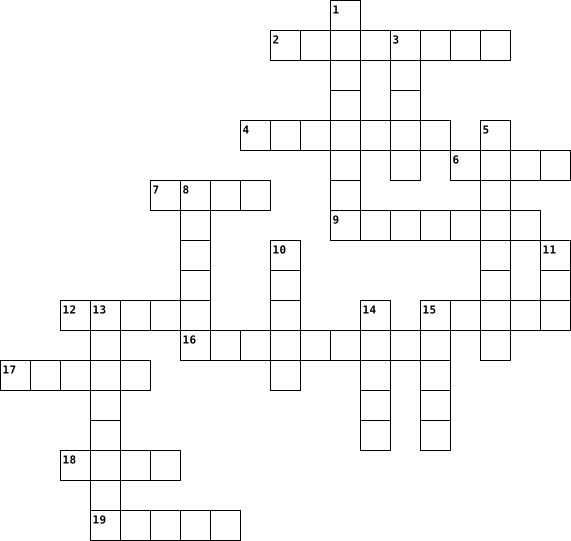
Across
- A prediction/statement about the future
- God of thunder (Roman)
- Part II of a prophecy from Percy Jackson
- Evil Representation of Earth
- God of the sea (Roman)
- Son of Jupiter
- God of the Underworld (Roman)
- Goddess of beauty
- Son of Mars
- God of the Sky (Greek)
- God of the Underworld (Greek)
Down
- God of water (Greek)
- Daughter of Pluto
- God of wine
- Goddess of intellect
- Part of a prophecy from Percy Jackson
- Son of Hephaestus
- Daughter of Athena
- Daughter of Aphrodite
- Son of Poseidon
20 Clues: God of wine • Son of Mars • Son of Jupiter • Son of Poseidon • Daughter of Pluto • Son of Hephaestus • Goddess of beauty • Daughter of Athena • God of water (Greek) • Goddess of intellect • Daughter of Aphrodite • God of thunder (Roman) • God of the sea (Roman) • God of the Sky (Greek) • Evil Representation of Earth • God of the Underworld (Roman) • God of the Underworld (Greek) • ...
cultural treasures 2020-12-14

Across
- Italian sculptor of the High Renaissance
- Lithuanian plucked string instrument
- Musical instrument popular in Greece,Cyprus
- Greek dance
- Greek composer
- Symphonic poem of LT composer Čiurlionis
- Ancient continent in the Northern Europe
- Autonomous community of Spain
- Late Romantic Spanish composer
- Resort in Latvia
- Latvian plucked string instrument
Down
- Italian folk dance
- Spanish music style
- Neolithic settlement in Cyprus
- Greek philosopher
- Spanish architect
- Longest Lithuanian river
- Latvian modern composer
- Opera of Giuseppe Verdi
- solar goddess in Lithuanian and Latvian mythologies
20 Clues: Greek dance • Greek composer • Resort in Latvia • Greek philosopher • Spanish architect • Italian folk dance • Spanish music style • Latvian modern composer • Opera of Giuseppe Verdi • Longest Lithuanian river • Autonomous community of Spain • Neolithic settlement in Cyprus • Late Romantic Spanish composer • Latvian plucked string instrument • Lithuanian plucked string instrument • ...
Trials of Apollo Book 3 2021-05-19

Across
- A path or more to confuse the mind
- A mythical beast that breaths fire
- Charging at your enemy
- Item of prophecy
- Apollo's sister
- The home of the gods
- A sorceress
- Apollo's enemy
- Difficulty
Down
- a hot substance that burns thing
- A thousand years
- A trash storage
- Mist/water vapor
- Apollo's accomplice
- Half god half human
- A group of people fighting for the same thing
- Tests
- Greek god of lightning
- Greek God of prophecy
- Greek god of war
20 Clues: Tests • Difficulty • A sorceress • Apollo's enemy • A trash storage • Apollo's sister • A thousand years • Mist/water vapor • Item of prophecy • Greek god of war • Apollo's accomplice • Half god half human • The home of the gods • Greek God of prophecy • Charging at your enemy • Greek god of lightning • a hot substance that burns thing • A path or more to confuse the mind • ...
Helen is leaving!!! :-O 2021-02-12

Across
- A raised road or track across low or wet ground
- A co-working and event space
- An arrangement where parties, known as business partners, agree to cooperate to advance their mutual interests
- Causeway Education's personal statement platform
- Ash Ketchum's travelling companion in the Pokemon franchise
- A malted chocolate powder typically mixed with hot water or milk
- A sighthound breed that originated in England, where they descended from Greyhounds
- An episodic series of spoken word digital audio files
- The action or business of promoting and selling products or services
- The first man
- Lose consciousness for a short time
- Belonging to or affecting a particular person rather than anyone else
- A non-metropolitan administrative, ceremonial and historic county, situated in the West Midlands
Down
- A kind of dry-cured ham produced in Spain
- American cloud-based software company providing customer relationship management service
- The standard of something as measured against other things of a similar kind
- The action of taking part in something
- A large district of North London
- Fast and frantic word game
- A name with origins in Greek mythology
- An area in the London Borough of Hackney
- A definite or clear expression of something in speech or writing
- A raised road or track across low or wet ground
- Five-day festival of contemporary performing arts
- Broadening access to something
25 Clues: The first man • Fast and frantic word game • A co-working and event space • Broadening access to something • A large district of North London • Lose consciousness for a short time • The action of taking part in something • A name with origins in Greek mythology • An area in the London Borough of Hackney • A kind of dry-cured ham produced in Spain • ...
Genre Crossword Puzzle 2020-11-04

Across
- Sleeping Beauty belongs in which genre
- Beauty and the Beast belongs in which genre
- In which subgenre do a play, film or book that is made up of joke telling belong
- Example of this is expository, argumentative, functional and opinion pieces
- Is made of two words, folk which means regional people and lore, which means stories
- Intends to convince readers to believe in an idea or opinion and to do an action
- The genre of literature, film comprising narratives that takes place in the past
- Example of this is Unbroken by Laura Hillenbrand
- A short piece of writing on aparticular subject
- While you Decline to Cry (By O no Yasumaro)
- In which genre do Sthepen Crane's The Open Boat belong
Down
- the biography of a person narrated by himself or herself
- They depict our world and society
- War of the Worlds by H.G Wells belongs in which genre
- A short story typically with animals as characters, conveying a moral
- A traditionsl story sometimes popularly regarded as historical but unauthenticated
- Greek Mythology is an example of which genre
- Is factual, nonfiction writing that conveys information about a topic
- Is a story with unbelievable elements, related as if it were true and factual
- Romeo and Juliet is an example of which genre
- A disastrous event
21 Clues: A disastrous event • They depict our world and society • Sleeping Beauty belongs in which genre • Beauty and the Beast belongs in which genre • While you Decline to Cry (By O no Yasumaro) • Greek Mythology is an example of which genre • Romeo and Juliet is an example of which genre • A short piece of writing on aparticular subject • ...
Genre Crossword Puzzle 2020-11-04

Across
- Romeo and Juliet is an example of which genre
- The genre of literature, film comprising narratives that takes place in the past
- A disastrous event
- They depict our world and society
- the biography of a person narrated by himself or herself
- Example of this is Unbroken by Laura Hillenbrand
- War of the Worlds by H.G Wells belongs in which genre
- Sleeping Beauty belongs in which genre
- Is made of two words, folk which means regional people and lore, which means stories
- In which subgenre do a play, film or book that is made up of joke telling belong
Down
- Greek Mythology is an example of which genre
- In which genre do Sthepen Crane's The Open Boat belong
- While you Decline to Cry (By O no Yasumaro)
- Intends to convince readers to believe in an idea or opinion and to do an action
- Example of this is expository, argumentative, functional and opinion pieces
- Is factual, nonfiction writing that conveys information about a topic
- Is a story with unbelievable elements, related as if it were true and factual
- Beauty and the Beast belongs in which genre
- A short story typically with animals as characters, conveying a moral
- A short piece of writing on aparticular subject
- A traditionsl story sometimes popularly regarded as historical but unauthenticated
21 Clues: A disastrous event • They depict our world and society • Sleeping Beauty belongs in which genre • While you Decline to Cry (By O no Yasumaro) • Beauty and the Beast belongs in which genre • Greek Mythology is an example of which genre • Romeo and Juliet is an example of which genre • A short piece of writing on aparticular subject • ...
Percy Jackson Chapter 17 and 18 2017-06-26

Across
- a type of shark considered dangerous to humans yet harmless to Percy
- the amount of money available in the lotus casino card
- the darkness under the world
- a guard defending the entrance to the underworld
- a way Percy describes his father as
- the method Percy used to grant access to the underworld
- the more I thought about my quest, the more I was sure that confronting Hades wasn't the right ______
- a three headed dog with the job of defending Hades’s door
- Procrustes’s fake identity when greeting Percy and his friends
- a glossy object that is able to teleport anyone to the sea
Down
- the final resting place of the souls of the heroic and the virtuous in Greek mythology
- an annoying news reporter that believes anything, anyone says
- “what if the plan doesn't work?” “Don't think _______.” “Right,” she said.
- “Go with what your _____ tells you, or lose all. Hades feeds on doubt and hopelessness.
- an attribute developed when you show actions of selflessness
- a section in the Underworld where ordinary souls who lived a life of neither good or evil are sent to live after death
- the solstice ________ would pass and war would begin
- the breed of dog Cerberus is known as.
- water spirits under Poseidon's command
- a rogue bandit who attacked people, either by stretching them or cutting of their legs
20 Clues: the darkness under the world • a way Percy describes his father as • the breed of dog Cerberus is known as. • water spirits under Poseidon's command • a guard defending the entrance to the underworld • the solstice ________ would pass and war would begin • the amount of money available in the lotus casino card • the method Percy used to grant access to the underworld • ...
Macbeth Crossword Puzzle 2024-05-28

Across
- A group of three goddesses who control the destiny of people in mythology
- Signs or omens that foreshadow future events
- Greedy or covetous
- A loud mouth whose words overpower their actions
- Intriguer, schemer, and/or plotter
- A thing or person who is paled, typically after experiencing shock
- Wicked, evil and/or vile
- Religious, holy, dutiful, and/or loyal
- A descriptor of something small and dainty
- Truths or fundamental principles
- Someone who talks a lot but doesn't say anything of value
- A gentle blessing
Down
- The murder of a father
- Internal organs, used as a metaphor for the innermost thoughts and secrets of a character
- To regard (someone) with disgust or hatred
- A phrase meaning "I think" or "it seems to me"
- A tragic flaw or error in judgement that leads to a downfall
- Deserving of praise of commendation
- To renounce or reject solemnly
- The Greek goddess of the underworld, often associated with music, ghosts, and/or witchcraft
- Deep sorrow and anguish which weighs heavy upon the bearer
- Divine communication delivered upon the request or the seat of prophecy
- A moment of recognition or realization
- Ill will or spite
- A substance or action that induces purging or cleansing
- A noun meaning: a slender candle
- To cut or chop with a tool
27 Clues: Ill will or spite • A gentle blessing • Greedy or covetous • The murder of a father • Wicked, evil and/or vile • To cut or chop with a tool • To renounce or reject solemnly • Truths or fundamental principles • A noun meaning: a slender candle • Intriguer, schemer, and/or plotter • Deserving of praise of commendation • A moment of recognition or realization • ...
Practice Test 2025-02-11

Across
- – A gas layer that protects Earth from harmful radiation
- – A long musical composition for an orchestra
- – A three-dimensional form of artistic expression
- – Words that sound alike but have different meanings
- – A device orbiting Earth for communication or research
- – Indian leader known for nonviolent resistance
- – A global network for sharing information
- – A surface used for painting
- – The study of shapes, angles, and spaces
- – A famous English playwright
- – A 14-line poem
- – A detailed technical drawing for construction
- – Traditional stories about gods and heroes
- – A Greek mathematician known for a famous theorem
- – A highly technical form of dance
Down
- – The "cradle of civilization"
- – A period of cultural rebirth in Europe
- – A dramatic musical performance with singing
- – The study of designing and building machines that perform tasks
- – A community of interacting organisms and their environment
- – A part of a whole, represented with a numerator and denominator
- – The process plants use to make food
- – A path for electrical current to flow
- – The smallest unit of matter
- – A famous canal connecting the Mediterranean and Red Sea
- – The force that pulls objects toward Earth
- – A number that never ends
- – The rules that structure a language
- – A branch of mathematics using symbols and letters
- – The first explorer to circumnavigate the globe
30 Clues: – A 14-line poem • – A number that never ends • – The smallest unit of matter • – A surface used for painting • – A famous English playwright • – The "cradle of civilization" • – A highly technical form of dance • – The process plants use to make food • – The rules that structure a language • – A path for electrical current to flow • – A period of cultural rebirth in Europe • ...
Ancient Athens and Sparta 2025-09-19

Across
- The only thing that a man was allowed to be in Sparta.
- This type of food was very rarely eaten in ancient Athens.
- The Athenians were the first people to write these. Some examples are comedies and tragedies.
- Athens is the birthplace of this government system.
- These people questioned Greek mythology and encouraged people to think for themselves.
- The goddess that Athens was named after.
- This conflict last 27 years between Athens and Sparta.
- The center of religious life.
- The money that the city-states would pay Athens.
- The ruler of the sea and cause of earthquakes.
- Zeus' wife and goddess of marriage and women.
Down
- The war between Greece and Troy, in which the Greeks tricked the Trojans to win.
- This battle was between Athens and the Persians. The Athenians defeated the Persians.
- Both Athens and Sparta were located on this country.
- The center of public and social life.
- The most dominate city-state in all of Greece.
- This city-state only cared about military and strength.
- The god of poetry and music.
- The temple built for the goddess, Athena.
- These people were treated very poorly in Sparta.
- The Athenian army was hit with this, thus leading to their demise.
- The god of all gods.
- The famous epic writer of the Trojan War.
23 Clues: The god of all gods. • The god of poetry and music. • The center of religious life. • The center of public and social life. • The goddess that Athens was named after. • The temple built for the goddess, Athena. • The famous epic writer of the Trojan War. • Zeus' wife and goddess of marriage and women. • The most dominate city-state in all of Greece. • ...
Etymology Crossword 1.1 2011-09-08

Across
- Many trees that fell to the ground in prehistoric ages have turned into stone over time. The weather conditions _____ the wood.
- When you can’t find the words, use a _____ to carry over your feelings to others.
- The children watched the butterfly’s _____ with rapt attention. It changed form before their eyes!
- Jamaicans speak a _____ of English between one another that sounds very different from the American _____.
- When I was younger, I had a fast _____. Even when I ate chocolate cake, my body would throw it over into energy to burn it off.
- The thick-skinned family of animals called _____s includes elephants, rhinos, and hippos.
- My _____ is that I shake my spoon every time I take it out of my mouth. Do you do something unique?
- Officers, let’s _____ our watches, so that we can each arrest our criminals together at the same time.
- During WWII, whole populations of people were killed in the _____.
- (GREEK) BURN
- This book is full of _____s: ninjas did not shoot lasers! The author has his time backwards.
- (GREEK) THROUGH, ACROSS, BETWEEN
- “Doctor, what’s my _____?” “I’m afraid it will take you three months to recover.”
- After I kill my first buck, the _____ [person noun ending in -ist] will arrange the deer’s skin in a lifelike pose.
- (GREEK) TIME
- (GREEK) SKIN
- You can skip the _____ of this book; it’s only a few words before the real story begins.
- Frogs and other ______s have lives both on land and in water.
Down
- The _____ is the layer of skin that sits upon all the other layers, to protect your body.
- Did you just say, “Put a nickel in it”? That’s a unique _____ to tell me to hurry up!
- I _____ that the Grizzlies will return to the playoffs this year.
- (GREEK) ROCK
- After looking through your symptoms, my _____ is that you do not have bird flu.
- My brother can write with both his left and his right hand. He’s _____.
- (GREEK) AFTER, CHANGED, OVER
- After my kidney was removed, I needed _____ to filter through my blood.
- The burning acids in my laboratory are _____, but your sarcasm right now is more _____ still!
- (GREEK) BOTH
- After swimming outside in February, her body heat was below normal. She had the symptoms of _____.
- Exxon-Mobil refines the oil that it pumps out of rocks into _____.
- (GREEK) ONE'S OWN, UNIQUE
- (GREEK) HEAT
- That sinus infection last month has turned into a _____ cough. You are sick all the time!
- (GREEK) BEFORE, IN FRONT OF
34 Clues: (GREEK) ROCK • (GREEK) BURN • (GREEK) BOTH • (GREEK) HEAT • (GREEK) TIME • (GREEK) SKIN • (GREEK) ONE'S OWN, UNIQUE • (GREEK) BEFORE, IN FRONT OF • (GREEK) AFTER, CHANGED, OVER • (GREEK) THROUGH, ACROSS, BETWEEN • Frogs and other ______s have lives both on land and in water. • I _____ that the Grizzlies will return to the playoffs this year. • ...
Vocabulary Crossword Puzzle 2021-10-21

Across
- latin root for bitter/sour
- to raise doubt or hesitate over something
- not showing care
- latin root for eat
- regardless of
- latin root for light
- expressing something forcibly or clearly
- being open and honest
- extremely dirty or unpleasant
- latin root for well
Down
- latin room for "do or make"
- involves conflict
- to refuse to accept; deny
- producing great protift
- greek and latin root for produce
- greek root for far
- latin root for carry
- greek root for small
- to promote
- seeming reasonable
20 Clues: to promote • regardless of • not showing care • involves conflict • greek root for far • latin root for eat • seeming reasonable • latin root for well • latin root for carry • greek root for small • latin root for light • being open and honest • producing great protift • to refuse to accept; deny • latin root for bitter/sour • latin room for "do or make" • extremely dirty or unpleasant • ...
Prima Porta 2023-08-25

Across
- thing retrieved by Augustus in his victory over the Parthians
- Animal suggesting Parthians to be untrustworthy
- original material
- ceremonial clothing
- Victory at Actium
- location statue was found
- Child
- reminiscent of a Greek hero
- pictured as a...
- Divine ancestor and patron of the Julian family
Down
- Victory at Naulochus
- Greek sculptor of influence
- Augustus' descendant depicted in the center
- symobolic of prosperity & new golden age
- consular
- present material
- raised right hand
- decorated chest plate
- Greek century of influence
- wisdom & prophecy
20 Clues: Child • consular • present material • pictured as a... • original material • Victory at Actium • raised right hand • wisdom & prophecy • ceremonial clothing • Victory at Naulochus • decorated chest plate • location statue was found • Greek century of influence • Greek sculptor of influence • reminiscent of a Greek hero • symobolic of prosperity & new golden age • ...
theatre 2022-02-14

Across
- realism
- neoclassical
- spolin
- roman
- worldwartwo
- adler
- absurd
- elizabethan
- restoration
- surrealism
- meisner
- greek
Down
- medieval
- expressionism
- checkhov
- symbolism
- worldwarone
- stanislavski
- grotowski
- grouptheatre
- hagen
- naturalism
- strasberg
- futurism
- commedia
- epic
26 Clues: epic • roman • hagen • adler • greek • spolin • absurd • realism • meisner • medieval • checkhov • futurism • commedia • symbolism • grotowski • strasberg • naturalism • surrealism • worldwarone • worldwartwo • elizabethan • restoration • neoclassical • stanislavski • grouptheatre • expressionism
theatre 2022-02-14

Across
- adler
- expressionism
- worldwarone
- spolin
- roman
- checkhov
- naturalism
- meisner
- medieval
- symbolism
- grouptheatre
- strasberg
- absurd
- elizabethan
Down
- restoration
- epic
- grotowski
- stanislavski
- futurism
- worldwartwo
- commedia
- realism
- surrealism
- neoclassical
- hagen
- greek
26 Clues: epic • adler • roman • hagen • greek • spolin • absurd • realism • meisner • futurism • checkhov • commedia • medieval • grotowski • symbolism • strasberg • naturalism • surrealism • restoration • worldwartwo • worldwarone • elizabethan • stanislavski • neoclassical • grouptheatre • expressionism
Myths and Legends of Greek and Roman Mythology 2017-04-26

Across
- lives in the underworld and goes back on his deals
- Daughter of the first olympian god
- rules the 7 seas and all its inhabitants
- King of the skies and master of lightning
- Shapes all your hopes and dreams
- shoots heart shaped arrows at you
- Was the mother of Pegasus
- is rumored to gain all his power from war
- Controls the sun and how hot it is outside
- Wife of the ruler of the skies
- Next in line to rule the ocean and all that live within
Down
- Daughter to one of the mighty titans she is known for her victories
- Huntress of the gods
- Main transportation for the gods but pet of Zeus
- Master blacksmith maker of zeus master bolt
- Sister to Helios and controls the coolness of the night
- The messenger of the gods and god of speed
- Controls the balance between human and God like affairs
- One of the first olympian gods
- Master of riddles and protector of jewels of the gods
- mother to all the gods except the three primary gods
21 Clues: Huntress of the gods • Was the mother of Pegasus • One of the first olympian gods • Wife of the ruler of the skies • Shapes all your hopes and dreams • shoots heart shaped arrows at you • Daughter of the first olympian god • rules the 7 seas and all its inhabitants • King of the skies and master of lightning • is rumored to gain all his power from war • ...
Greek Mythology - Lesson 18 - Midas, Sisyphus, Bellerophon, Melampus 2024-01-22

Across
- A wife-to-be of Zeus who was turned into an island
- failing to see the consequences of behavior
- Father of mad daughters who thought they were cows
- This satyr challenged Apollo to a music contest.
- scornfully; looking down upon; treating as below one's dignity
- to burn or scorch
- to break down suddenly; to fall down
Down
- Everything he touched turned to gold
- Grandson of Sisyphus and a great tamer of horses
- grand, splendid, dignified
- having a right to
- A great winged horse which sprang from Medusa's neck
- The clever king of Corinth
- A river god and father of Aegina
- thankful appreciation for favors received
- A fire-breathing creature made of a lion, goat, and serpent
- Understood the language of animals; cousin of Bellerophon
- sly, crafty, devious
- skillfully, cleverly
- to skip in a playful manner; to frolic
20 Clues: having a right to • to burn or scorch • sly, crafty, devious • skillfully, cleverly • grand, splendid, dignified • The clever king of Corinth • A river god and father of Aegina • Everything he touched turned to gold • to break down suddenly; to fall down • to skip in a playful manner; to frolic • thankful appreciation for favors received • ...
Mythology Vocab and Greek Gods&Goddesses Extra Credit 2024-05-27

Across
- God of fire, metalworking, and volcanoes
- God of the Underworld.
- made, happening, or chosen without method or conscious decision.
- Goddess of War and Wisdom
- Odysseus's son
- Goddess of the hearth and home
- God of the Sea, and horses
- a figure of speech that directly compares two things using “like” or “as”.
- ability to apply procedures or methods in order to create a desired result.
Down
- Synonym- Form
- half woman/half bird, their song lures sailors to their death
- Goddess of the hunt, wild animals and the moon
- Synonym- Disprove
- God of War
- Goddess of love and beauty
- a distinguishing quality or characteristic, typically one belonging to a person.
- Odysseus' wife
- Messenger God with winged sandals.
- God of thunder; most powerful of all the Olympic Gods.
- Odysseus' home island in Greece
20 Clues: God of War • Synonym- Form • Odysseus's son • Odysseus' wife • Synonym- Disprove • God of the Underworld. • Goddess of War and Wisdom • Goddess of love and beauty • God of the Sea, and horses • Goddess of the hearth and home • Odysseus' home island in Greece • Messenger God with winged sandals. • God of fire, metalworking, and volcanoes • Goddess of the hunt, wild animals and the moon • ...
Mythology Vocab and Greek Gods&Goddesses Extra Credit 2024-05-27

Across
- God of the Underworld.
- Odysseus's son
- Odysseus' home island in Greece
- God of the Sea, and horses
- ability to apply procedures or methods in order to create a desired result.
- Synonym- Disprove
- Goddess of War and Wisdom
- Odysseus' wife
- Goddess of the hearth and home
Down
- God of thunder; most powerful of all the Olympic Gods.
- made, happening, or chosen without method or conscious decision.
- Messenger God with winged sandals.
- God of Archery, Music, and Medicine
- God of fire, metalworking, and volcanoes
- Synonym- Form
- half woman/half bird, their song lures sailors to their death
- a figure of speech that directly compares two things using “like” or “as”.
- Goddess of love and beauty
- a distinguishing quality or characteristic, typically one belonging to a person.
- A witch who imprisoned Odysseus for 1 year
- Goddess of the hunt, wild animals and the moon
- God of War
22 Clues: God of War • Synonym- Form • Odysseus's son • Odysseus' wife • Synonym- Disprove • God of the Underworld. • Goddess of War and Wisdom • Goddess of love and beauty • God of the Sea, and horses • Goddess of the hearth and home • Odysseus' home island in Greece • Messenger God with winged sandals. • God of Archery, Music, and Medicine • God of fire, metalworking, and volcanoes • ...
Genre Crossword Puzzle 2020-11-04

Across
- Example of this is Unbroken by Laura Hillenbrand
- Is a story with unbelievable elements, related as if it were true and factual
- Intends to convince readers to believe in an idea or opinion and to do an action
- A traditionsl story sometimes popularly regarded as historical but unauthenticated
- A short piece of writing on aparticular subject
- Example of this is expository, argumentative, functional and opinion pieces
- Is factual, nonfiction writing that conveys information about a topic
- the biography of a person narrated by himself or herself
- The genre of literature, film comprising narratives that takes place in the past
- In which subgenre do a play, film or book that is made up of joke telling belong
Down
- Sleeping Beauty belongs in which genre
- War of the Worlds by H.G Wells belongs in which genre
- A disastrous event
- They depict our world and society
- Greek Mythology is an example of which genre
- Beauty and the Beast belongs in which genre
- Romeo and Juliet is an example of which genre
- In which genre do Sthepen Crane's The Open Boat belong
- Is made of two words, folk which means regional people and lore, which means stories
- A short story typically with animals as characters, conveying a moral
- While you Decline to Cry (By O no Yasumaro)
21 Clues: A disastrous event • They depict our world and society • Sleeping Beauty belongs in which genre • Beauty and the Beast belongs in which genre • While you Decline to Cry (By O no Yasumaro) • Greek Mythology is an example of which genre • Romeo and Juliet is an example of which genre • A short piece of writing on aparticular subject • ...
The Hidden Oracle 2022-02-16

Across
- An ancient maze built by Daedalus where the demigods enter during their race
- The safe haven for demigods where underage demigods stay at during the summer
- The mysterious place that can see the future and give out prophecies
- A famous demgod hero and son of Poseidon
- The alias/alter ego of emperor Nero
- The demigod son of Hades in camp Half-Blood
- Meg and Apollo are attacked by ___
- Apollo makes and breaks a promise to never play __ again
- The human alias of Apollo
- Percy's Girlfriend, also the daughter of Athena
- the new human oracle
Down
- The campers participate in a ____
- The evil giant snake that Apollo had killed to gain control of the oracle that is now ressurected
- The giant robot controlled by Triumvirate Holdings that tries to destroy camp half-bloood
- The type of mythology the book follows
- Apollo's father and the king of the Gods
- The setting of the book
- The main villain of the story, a descendant of Apollo and an old emperor of Rome, Meg's stepfather
- The home of the gods
- Mother of Zeus and the other first-generation gods
- The centaur activities director at camp half-blood
- The main character
- The demigod who Apollo has to serve and betrays Apollo
- Meg's mother
- Apollo's sister
25 Clues: Meg's mother • Apollo's sister • The main character • The home of the gods • the new human oracle • The setting of the book • The human alias of Apollo • The campers participate in a ____ • Meg and Apollo are attacked by ___ • The alias/alter ego of emperor Nero • The type of mythology the book follows • Apollo's father and the king of the Gods • ...
Rob's Trivia Crossword 2022-05-14

Across
- Number of signs in the Zodiac
- Non-platypus monotreme
- First movie rated PG-13
- Dried plums
- Egypt is also known as the "____ of the Nile"
- Capital of Canada
- Famed collaborator on the communist manifesto
- Henry VIII's first wife was named "Catherine of ______"
- Lowest rank in the US army
- Color of a polar bear's skin
- "H,I,J,K,L,M,N,O"
- Rarest M&M color
- Topical Mexican beer
- Hottest planet in the Solar System
- name for a group of dragons
- General pH level of water
Down
- What color eyes do most humans have?
- name for a group of hippos
- Chess piece which cannot move in a straight line
- Methane is also known as "_____ Gas"
- Nephrology is the study of what organ.
- Last name of the man credited with creating the world's first car
- Shakespeare's longest play
- Location of the smallest bone in the human body
- What month does World Environment Day take place in?
- Animal constitutionally protected in Florida
- First woman on earth in Greek mythology
- Largest bird
- Largest lake in America is "Lake ________"
- Most common gas in Earth's atmosphere
- Strongest bone in the human body
- Largest artery in the human body.
- Common phrase starting with "Heart of the"
- The day after Christmas is called "______ Day"
- Number of red stripes on the American flag
35 Clues: Dried plums • Largest bird • Rarest M&M color • Capital of Canada • "H,I,J,K,L,M,N,O" • Topical Mexican beer • Non-platypus monotreme • First movie rated PG-13 • General pH level of water • name for a group of hippos • Shakespeare's longest play • Lowest rank in the US army • name for a group of dragons • Color of a polar bear's skin • Number of signs in the Zodiac • ...
Interclass CWP 2022-05-17

Across
- a German prison camp for captured enemy officers.
- meaningless talk; to tease, fool, kid
- a marine mollusk
- to shoot into the air during a duel
- dialectal, England : vex, distress, worry
- a female ferret
- Neighbor ( a person living on adjacent or nearby land)
- a console or bracket, typically with two volutes, that supports or appears to support a cornice.
- short for debutante.
- A South American freshwater dolphin
- used in veterinary medicine as a substitute for cocaine
- a formerly used Japanese monetary unit equal to ¹/₁₀ sen
- a small axe used for cutting roof slates, with a point for making nail holes
- chiefly Scottish. : the palm of the hand.
Down
- system of train transportation that uses two sets of magnets
- a steep, narrow gully on a mountainside.
- a flat bread roll topped with chopped onions
- a valley, especially a broad one.
- a large edible abalone (mollusk)
- one of two filaments of silk combined by the silkworm to form a strand of silk
- A sneer; a flout.
- a phoenix in Chinese mythology
- dull; melancholy; dismal.
- a man who behaves dishonorably, especially toward a woman
- French for good
- chiefly Scottish of once
- fourteenth Greek alphabet
- the first letter in the Hebrew alphabet
- to stretch or extend
- the period of light between sunrise and sunset, as distinguished from the night.
30 Clues: a female ferret • French for good • a marine mollusk • A sneer; a flout. • short for debutante. • to stretch or extend • chiefly Scottish of once • dull; melancholy; dismal. • fourteenth Greek alphabet • a phoenix in Chinese mythology • a large edible abalone (mollusk) • a valley, especially a broad one. • to shoot into the air during a duel • A South American freshwater dolphin • ...
A Crossword Puzzle for My Special Bear 2023-12-16

Across
- Requires many feet
- We both now possess one
- The fans are craaaaaay
- You insist that we do this everywhere
- A better story than tinder
- I enjoy watching you do this ;)
- Your go-to cocktail (2 words)
- The most distinguished gentleman
- A place and an animal
- A difficult face to maintain
- She’ll be in Chicago soon (2 words)
- You refuse to accept that I enjoy it
- A favorite food of yours
- A mount worth hiking (2 words)
- A consolation
- A friendly visitor in the night
- A place we went to as friends (2 words)
Down
- My favorite part ;) (2 words)
- An angel who you'll always treasure <3 (2 words)
- Both a whimsical story and a word from another region
- My favorite kind of bear
- You have too many and I have too few
- A pleasant surprise for us both (2 words)
- Damian's greatest love
- One day we will get there
- A mythology worth reading about
- A tradition worth preserving
- Requires a lot of teamwork
- A sweet little thing, I'm told
- One of the ways we take trips
- You wish yours was as big as mine
- It's all just repeating
- A treat you sometimes grant me
- I am better at it
34 Clues: A consolation • I am better at it • Requires many feet • A place and an animal • The fans are craaaaaay • Damian's greatest love • We both now possess one • It's all just repeating • My favorite kind of bear • A favorite food of yours • One day we will get there • A better story than tinder • Requires a lot of teamwork • A tradition worth preserving • A difficult face to maintain • ...
Crossword 2023-10-27

Across
- What is the ancient city where the Dwarves use to live called?
- In Greek mythology, who is the goddess of the moon, archery, and hunting?
- Jeff’s cat
- To which town do the people of Laketown flee after Smaug burns their town?
- Who was the first dwarf to come to the unexpected party?
- Found in the heart of the mountain
- What does the term “archery” mean in Latin?
- What was Gollum’s real name?
- Donna’s maiden name?
- When something is going to occur, which mathematical term is used to express the likelihood of the event?
- How many in a bakers dozen?
- Who is the leader of the Orc armies?
Down
- Diana’s favorite board game?
- Who killed the Goblin King?
- Glycogen is the main way the body stores glucose—better known by what sweet common name?
- Who’s thumb was discovered in 1922?
- Grandma Doris maiden name?
- who was played by Christopher Lee?
- Where is the largest pyramid?
- Town in NJ Dad was born
- Jeffrey’s camp
- What is the medical term for a sideways curvature of the spine which most commonly occurs in young adults during a growth spurt?
- Which Dwarf uses a bow?
- What is the name of the fin-shaped part of an arrow that is often made from bark, feathers, or other light materials?
- Family first dog?
- Which number is a ‘magic number’?
26 Clues: Jeff’s cat • Jeffrey’s camp • Family first dog? • Donna’s maiden name? • Town in NJ Dad was born • Which Dwarf uses a bow? • Grandma Doris maiden name? • Who killed the Goblin King? • How many in a bakers dozen? • Diana’s favorite board game? • What was Gollum’s real name? • Where is the largest pyramid? • Which number is a ‘magic number’? • who was played by Christopher Lee? • ...
RELA crossword Chloe and Elsa 2025-07-13

Across
- Who stared the An Lushan Rebellion?
- What are the native people in New Zealand?
- What is the name of the geothermal reserve in Rotorua where you can see geysers?
- Who is the first emperor of China?
- WWI started because of the assassination of Franz Ferdinand from which country?
- Which country released two atomic bombs to Japan during World War 2?
- The term for collective false memories that contradict actual events is named after which US president?
- Who lost at the battle of Waterloo?
- Which American president was famously assassinated by a headshot in 1963?
- In Greek mythology, which king was punished to roll a boulder up a hill unsuccessfully for eternity
Down
- Which state in the US is often compared to the shape of a fried chicken leg?
- Which philosopher wrote The Republic?
- What is the name of the tower that RELA is in?
- Which country invaded Poland in World War 2?
- What is the deepest trench in the world?
- Which fold mountain range is located in the Pacific Ring of Fire?
- Which one of the four great inventions is created by Cai Lun?
- Which ancient river was crucial to the development of Egyptian civilization?
- Which ancient city is famously buried by a volcanic eruption?
- What is the tallest dormant volcano in Japan?
20 Clues: Who is the first emperor of China? • Who stared the An Lushan Rebellion? • Who lost at the battle of Waterloo? • Which philosopher wrote The Republic? • What is the deepest trench in the world? • What are the native people in New Zealand? • Which country invaded Poland in World War 2? • What is the tallest dormant volcano in Japan? • ...
Antigone 2012-05-01

Across
- A tyrannical ruler who killed his own family.
- The Greek god of wine or drunkness.
- The Greek word for tragic flaw.
- Brother of Polynices son of Oedipus.
- Queen Jocastas original husband oedipus's father.
- The Greek word meaning "cleansing of the body or soul".
- a blind soothsayer who warned Creon of his downfall.
- The theaters in which Greek plays were performed in.
- An ode sung by the chour at the begginingof a Greek play.
- Leader of the chour in a Greek play.
- The place where "Antigone" took place.
- The movement performed by the chorus during the singing of the ode.
Down
- A nation without a government, or no leader.
- To be ruled by one king or queen.
- The battle in which polynices and eteocles both died.
- A woman Antigone was compared to that got turned into stone by Zues to stop her sorrow.
- To be ruled by the few.
- Antigones sister.
- The tragic flaw of pride.
- Son of oedipus has a brother that sided with Creon.
- a man whom killed himself with his own sword to be with his fiance.
- The woman who tried to change Creon and went against him
- The rulers wife who killed herself ovr hearing all but her husband have parished.
- A inserpt that comes after the main ending of the play.
- Oedipus's wife and mother.
25 Clues: Antigones sister. • To be ruled by the few. • The tragic flaw of pride. • Oedipus's wife and mother. • The Greek word for tragic flaw. • To be ruled by one king or queen. • The Greek god of wine or drunkness. • Brother of Polynices son of Oedipus. • Leader of the chour in a Greek play. • The place where "Antigone" took place. • A nation without a government, or no leader. • ...