
greek mythology Crossword Puzzles
Theater History 2024-02-03

Across
- a genre of theater which was popular in Japan during the Edo Period
- what the roof of the Globe theater was called
- at the end of the Middle Ages, playwrights began producing these types of plays once more
- during this era, theater was said to be at its peak
- there term "thespian" is derived from the name of this Greek actor
- a short biblical scene displayed in a church during the Medieval Era
- the first era of theater, primarily defined by men acting out hunts
- an era of classical theater which took place directly after the Greek Era
- this part of the stage can either fly or travel
- an era in which European thinking went through a rebirth, causing a rebirth in theater as well
- a humorous theatrical presentation which was popular through the 16th and 18th centuries
- this type of stage originated during the Renaissance Era
Down
- a special type of play during the Greek Era which made fun of Greek gods, our word "satire" comes from this Greek word
- a recess in between performances or acts
- the era of theater in which Shakespeare wrote all of his plays
- the place where theater was reborn during the Medieval Period
- this playwright is known by many to be the greatest of all time
- this Greek philosopher became the first literary critic
- a popular playwright in Spain during the Elizabethan era
- a popular playwright in France during the Elizabethan era
- theater had largely disappeared at the beginning of this era, was reborn by the end
- a series of tropes which are shown together to tell a full story, in Medieval times
- the era of theater which we are in now
- 2,500 years ago, the Greeks held a theatrical festival in honor of this god
24 Clues: the era of theater which we are in now • a recess in between performances or acts • what the roof of the Globe theater was called • this part of the stage can either fly or travel • during this era, theater was said to be at its peak • this Greek philosopher became the first literary critic • a popular playwright in Spain during the Elizabethan era • ...
Ancient Greece 2026-03-03

Across
- a group of citizens, in an ancient Greek democracy, with the power to pass laws
- a form of government in which the ruling power in the hands of one person
- Greek thinker who believed in practicing moderation and the use of reason
- a heavily armed citizen-soldier in ancient Greece
- city-state
- the period of fighting between the Persian Empire and the allied Greek city-states for control of the land in Greece
- a form of democracy where citizens choose government officials to represent them
- a type of government where the power is shared with a small group of people
- a settlement under the control of a usually distant country
- a marketplace in ancient Greece
- Macedonian King who expanded his empire across parts of three continents
- Empire a vast empire from 550-330 BCE that ruled over lands in Africa, the Middle East, and Asia.
- a long-term war between Athens and Sparta that led to Sparta’s victory
- a high hill that housed the fortress of the city-state
- Greek-like culture
Down
- a type of government where only a small group of the wealthiest people have the power
- poet who wrote the Odyssey and the Iliad
- a government that gives people the power to rule themselves
- someone who has the right to participate in government
- Greek philosopher and teacher who created the Academy
- Greek doctor famous for the Hippocratic oath, which ensures doctors do what is best for their patients
- a form of democracy that allows all citizens to directly participate in government
- leader of Ancient Greece who promoted democracy
- group of soldiers arranged in a square
- Greek philosopher famous for using questioning techniques
- an agreement formed between groups to work together
- a type of government that uses force to rule
27 Clues: city-state • Greek-like culture • a marketplace in ancient Greece • group of soldiers arranged in a square • poet who wrote the Odyssey and the Iliad • a type of government that uses force to rule • leader of Ancient Greece who promoted democracy • a heavily armed citizen-soldier in ancient Greece • an agreement formed between groups to work together • ...
Figures in Greek Mythology 2024-01-28

Across
- God of the sea
- The mascot of absurdism
- The goddess who beat Poseidon
Down
- Had an annual festival dedicated to him
- Be careful what you wish for
- A royal Spartan princess
6 Clues: God of the sea • The mascot of absurdism • A royal Spartan princess • Be careful what you wish for • The goddess who beat Poseidon • Had an annual festival dedicated to him
Franchesca Rylee Sotto Greek crossword 2026-02-19

Across
- LOVE ( PHILA DELPHIA, CITY OF BROTHERLY …LOVE)
- Marching to India and Pakistan
- BUILT THE SCHOOL: THE ACADEMY 3 GROUPS PHILOSOPHER KINGS WARRIORS COMMON PEOPLE
- HELIO CENTRIC ( SUN CENTERED UNIVERSE)
- BUILT SCHOOL LYCEUM
- ( METHEUS) SEE INTO THE FUTURE PHECY=TO SPEAK PRO PHECY COULD MEANTELL WHAT WILL HAPPEN IN THE FUTURE
- THINKING AND LEARNING
- KNOWLEDGE
- my Greek culture Science and culture flourishing
Down
- Looked like humans ,Fought with each other,Fought wars with each other
- TEACHER
- Society Valued Thinking and writing… no doyyyyy
- GEOMETRY/ ANGLES/ LINES ALL RELATED
- all things in world can be expressed with numbers
- PI ( 3.14 DUDE) CATAPULT FOR TAKING OVER CLASSROOMS
- SOCRATIC METHOD KNOWLEDGE IN EACH PERSON TAUGHT PLATO
- STORY ABOUT GODS AND GODDESSES
- of Greek literature Fables
- THE GREAT SPREAD GREEK CULTURE ( TEMPLES , CITIES, DESIGNS, MARKETS, SETTLERS LIVED THERE HELPED SPREAD CULTURE
19 Clues: TEACHER • KNOWLEDGE • BUILT SCHOOL LYCEUM • THINKING AND LEARNING • of Greek literature Fables • Marching to India and Pakistan • STORY ABOUT GODS AND GODDESSES • GEOMETRY/ ANGLES/ LINES ALL RELATED • HELIO CENTRIC ( SUN CENTERED UNIVERSE) • LOVE ( PHILA DELPHIA, CITY OF BROTHERLY …LOVE) • all things in world can be expressed with numbers • ...
Nunez Greek Theatre Review 2020-12-02

Across
- introduction to the main character and the background of the play
- main character must be good, moral, believable, and consistent.
- refers to the chorus
- Greek term for discovery
- staging of the play
- sense and meaning that goes into the lines.
- the end of each episode, the chorus reflects on what has been said and done. The play moves back and forth between Episode and Stasima three to six times.
- entrance song of the chorus. sets the tone of the play
- Greek term is tragic flaw
- final resolution
Down
- expression of the words
- Greek term for fate
- between characters and chorus
- Greek term for pride
- Greek term for emotional purging
15 Clues: final resolution • Greek term for fate • staging of the play • Greek term for pride • refers to the chorus • expression of the words • Greek term for discovery • Greek term is tragic flaw • between characters and chorus • Greek term for emotional purging • sense and meaning that goes into the lines. • entrance song of the chorus. sets the tone of the play • ...
Friday Presentation Review 2023-02-09

Across
- The Roman name for the Greek god Hermes
- The city Alexander the Great built his own land bridge to in order to conquer it
- The Greek name of Roman private tutors
- The people who invented the Phonetic Alphabet
- The of this Ancient Greek letter:Θθ
- The Roman war goddess that was wholly unique to them
Down
- The Latin word for "family"
- The tile Augustus took rather than Imperator
- Rome's first great tyrant who declared war on the Sea
- Greek Hoplites fought in this formation
- Rome was sacked in this year
- This Ancient Greek letter: Δδ
- The large, public square where business was conducted
- The city Caesar built two walls around in order to conquer it
- The last Emperor of the Julio-Claudians who liked poetry and fires
15 Clues: The Latin word for "family" • Rome was sacked in this year • This Ancient Greek letter: Δδ • The of this Ancient Greek letter:Θθ • The Greek name of Roman private tutors • The Roman name for the Greek god Hermes • Greek Hoplites fought in this formation • The tile Augustus took rather than Imperator • The people who invented the Phonetic Alphabet • ...
Greece Vocabulary 2025-09-11

Across
- All citizens share in running the government.
- A settlement in a new territory that has close ties to its original homeland.
- A group of people living in the same place or having a particular characteristic in common.
- A marketplace outside of an acropolis.
- An amazing palace of a king named Minos.
- A Greek city-state.
- Greek word for "capture".
- Story tellers.
Down
- Island southeast of Greek mainland.
- They enforced the laws and managed the collection of taxes.
- Someone who seizes power and rules with total authority.
- A few wealthy people hold power over a larger group of citizens.
- The first Greek civilisation.
- A fortified part of an ancient Greek city, typically built on a hill.
- A body of land surrounded by water on three sides.
15 Clues: Story tellers. • A Greek city-state. • Greek word for "capture". • The first Greek civilisation. • Island southeast of Greek mainland. • A marketplace outside of an acropolis. • An amazing palace of a king named Minos. • All citizens share in running the government. • A body of land surrounded by water on three sides. • ...
Ology 2021-05-11

Across
- - Peter is currently in UNI studying ________.
- - _______ is the study of living things which would be really cool studying that.
- - He studied alchemy, ______ and the Kabbalah as a boy and later became a doctor of medicine.
- - When Dwayne went to the Prime Minister, he found out that the _______ of democracy was ideal but his theory was correct.
- - We did _________ in class which meant we looked at where the words originated from.
- - He was educated for the priesthood at St Sulpice, where in 1818 he became professor of dogmatic _______.
- - I studied biology for a while but I found marine _______ more interesting.
Down
- - Students learnt about the dangerous creatures while they studied Greek ______.
- - Whoever wants to study _______ would love the earth and would want to find out more about it.
- - Dwyane had some spare copies of his ______ or grammar write-ups to give to anyone interested.
- - Dwayne went on to complete his Bachelor's degree as a double major in _______ and physiology.
- - The role of interventional ______ in the care of patients with cancer continues to expand.
- - In the book someone _______ a crime.
- - My friend made a very important ______ that she is not very good at art.
14 Clues: - In the book someone _______ a crime. • - Peter is currently in UNI studying ________. • - My friend made a very important ______ that she is not very good at art. • - I studied biology for a while but I found marine _______ more interesting. • - Students learnt about the dangerous creatures while they studied Greek ______. • ...
Greek Theatre 2022-02-08

Across
- Euripides - a Greek playwright who wrote tragedies, including Medea
- Sophocles – a Greek playwright who wrote tragedies, including Oedipus
- Scene (pronounced SKAY-nuh) – was a temporary enclosure with
- Paradoi – were aisles that actors would use to enter if they were
- Greek Theatre Machines – were used during the performances. They
- Over time, the Koilon was built, first of wood, then stone.
- Theologion – the flat roof of the scene, reserved for actors playing gods.
- Performers would get into masks and robes in the scene and
- “Gods” would often appear at the end of a play to resolve
- kept inside the scene.
- 534 B.C. He was also the first to have a member of the chorus
- was done because Greek theatre never showed a murder or
- – an actor. The term was created from Thespis’ name.
- be rotated to change scenes during the performance
- to be coming from outside (not the temple or palace).
- step away from the group and speak lines as a solo
- rehearse their own plays.
- the leader of the chorus (koryphaios) would stand.
- festival. This is important to us because the festivities
- a competition for the best play. Playwrights would write
Down
- Thymela – originally an altar on the orchestra, this became the spot
- Aeorema – a crane that lifted the “gods” from the scene onto the
- - a Greek playwright who wrote comedies, including The
- Ekeclema – platform carrying “dead bodies” that was wheeled on.
- audience just sat on the slope of the hill, looking down to the
- Deus Ex Machina – literally “god from the machine”. This is the term
- Proscenion – the area directly in front of the scene where the actors
- perform. NOTE: the proscenion gradually became the acting
- on stage.
- Periactoi – two prismatic pillars, one stage left, one stage right. These
- was the Greek stage.
- Aeschylus - a Greek playwright who wrote tragedies, including The
- Diazoma – upper and lower levels of the Koilon (auditorium).
- a play’s conflict being solved by a supernatural power.
- – a round floor on ground level at the bottom of a hill. This
- Thespis, then, is credited with being the first actor.
- – the first playwright to win the contest at the Dionysian festival
- conflict.
- through the doors, which represented the temple or palace.
- (or Theatron) – the auditorium of the Greek theatre. Originally,
- – the original acting area was the orchestra.
- – Greek God of wine and fertility that was honored in an
42 Clues: on stage. • conflict. • was the Greek stage. • kept inside the scene. • rehearse their own plays. • – the original acting area was the orchestra. • be rotated to change scenes during the performance • step away from the group and speak lines as a solo • the leader of the chorus (koryphaios) would stand. • – an actor. The term was created from Thespis’ name. • ...
Native American Crossword 2024-05-14

Across
- a Native American sport that’s like Soccer
- first people in America
- a community of people who are to small to be a country
- a sneaky character in Native American mythology
- a holiday where the natives gave the pilgrims food
- Native American's home in the Great Basin
- a creature Native Americans hunt a lot
- a very violent attack on the Shoshone tribe
- an article of clothing that people wear mostly in plays or on a holiday
- an animal introduced through the settlers
Down
- a secret code used in ww2
- a religion that has been proven to be fake
- a treaty the U.S signed with the Cayuse
- a war in between Black Hawk and the settlers
- an area claimed by multiple tribes or a country
- to be the first ones in an area
- what you do to kill a wild animal
- an addictive activity that Native Americans did in sports
- fish released in a ceremony for the Yahooskin tribe
- a well known Native American tribe in the Southeast
- a territory around Idah, Oregon, and Washington
21 Clues: first people in America • a secret code used in ww2 • to be the first ones in an area • what you do to kill a wild animal • a creature Native Americans hunt a lot • a treaty the U.S signed with the Cayuse • Native American's home in the Great Basin • an animal introduced through the settlers • a religion that has been proven to be fake • ...
Mythologies! 2021-03-07

Across
- Zeus' wife.
- Roman goddess of wisdom
- Greek god who has a lyre.
- Greek god of the underworld.
- Thor's wife.
- Greek god who rides horses and dolphins.
- Roman goddess of marriage.
Down
- Roman goddess of hunting.
- Greek king of all the gods.
- Roman god of wine
- Roman god of war
- Norse goddess who rides a chariot with cats.
- Norse god who rules Valhalla.
13 Clues: Zeus' wife. • Thor's wife. • Roman god of war • Roman god of wine • Roman goddess of wisdom • Roman goddess of hunting. • Greek god who has a lyre. • Roman goddess of marriage. • Greek king of all the gods. • Greek god of the underworld. • Norse god who rules Valhalla. • Greek god who rides horses and dolphins. • Norse goddess who rides a chariot with cats.
Rome vs Greek 2021-03-02

Across
- Greek people ate delicious dishes, some of them are still around today, but in rome they ate food that contains olive oil, barley and ____.
- In Greek, a popular toy kids play with was marbles, but in Rome, kids played with ____, horses, playhouses, and dolls.
- In Greece, a vase for pouring the wine would be called the _______.
- Ancient Greeks were not terribly into _______, but Rome was.
- In Greece, you had to get married at the age of __+ and for boys, forteen+.
- In Greek, games were for fun, but in Rome, games were ________.
- Romans had different pets that included, greyhound dogs, ferrets, small monkeys, blackbirds nightingale, and parrots. But in Greece, ____ were the most common pet.
- The cups that had stems, were also considered vases and they were called ______.
- The Greeks spoke greek, but the Romans spoke ______.
Down
- Ancient Greeks did not have technology and _________.
- Which gender was given more of an opportunity for education?
- During ancient roman times, dancing was considered a form of entertainment, but in greek, music and dance were one of the things that made life _______.
- Greek plays were performed outdoors _________.
- In Greece, The vases were popular in hmes, especially the homes of ______ people.
- ____ were a part of a way that the ancient greeks made money.
- In Greece, The most popular vase painting was that the ancient Greeks would paint a red or black ___.
- The architecture of greek houses in ancient times was to keep their residents ____.
- Just like children of today,children in ancient greeks enjoyed playing a variety of,_____
- In Greece, the mother was in charge of the children, but later, a male _______ came in for assistance, but in Rome, the father was in charge of the household and the children always had to listen to them.
- The vases on a pottery wheel and they were made out of ____.
20 Clues: Greek plays were performed outdoors _________. • The Greeks spoke greek, but the Romans spoke ______. • Ancient Greeks did not have technology and _________. • Which gender was given more of an opportunity for education? • Ancient Greeks were not terribly into _______, but Rome was. • The vases on a pottery wheel and they were made out of ____. • ...
Ch. 9 The Greek World 2025-11-09

Across
- name of the alliance of Sparta and its allies.
- age of Spartan boys when they would leave for military training.
- Persian ruler who reorganized the government and divided it into 20 provinces.
- Part of the military of Persia whose numbers consistently maintained 10,000 warriors.
- Athenian temple dedicated to the goddess Athena.
- Ruler of the largest empire, who named over 70 cities after himself.
- Reinvaded Greece after his father, Darius, was unsuccessful.
- a famous Greek dramatist who wrote about a man that mistakenly killed his own father.
- in Greek means "love of wisdom".
- monotheistic religion of Persia, with belief in the forces of good and evil were fighting to control the universe.
- created a school called the Academy to which students, philosophers, and scientists could come to discuss ideas.
- united the Persians and built the largest empire at that time.
- 26.2 mile race named after site of Persian War battle.
- blend of cultures with Greek.
Down
- city in Egypt known for its large library.
- known as the "Father of Medicine".
- empire that failed to conquer the Greeks.
- Name for the alliance of Athens and its allies.
- Greek city-state with the strongest Army.
- site of the battle with Persian Army and 300 Spartan soldiers
- kingdom Alexander the Great was raised and would later rule.
- known as the "Father of History".
- communal slave of Sparta.
- Greek city-state with the strongest Navy.
- sight of a sea battle in which Greeks defeated the Persians.
- Greek scientist and inventor of the catapult.
- believed that people must never stop looking for knowledge.
- aught that people should live lives of moderation (based on reason-clear & ordered thinking), or balance.
- a group of warriors who stood close together in a square.
- one of the most famous Greek mathematicians that studied geometry
30 Clues: communal slave of Sparta. • blend of cultures with Greek. • in Greek means "love of wisdom". • known as the "Father of History". • known as the "Father of Medicine". • empire that failed to conquer the Greeks. • Greek city-state with the strongest Army. • Greek city-state with the strongest Navy. • city in Egypt known for its large library. • ...
Ancient Greece Vocabulary 2015-11-05

Across
- An ancient Grecian statesman and general during the Persian and Peloponnesian wars
- This man is known for his collection of fables.
- This man was an ancient Grecian political figure who is famous for turning the Athen's Constitution democratic
- This is a short story usually with a moral and personified animals as it's main characters
- The center of gathering in an ancient Grecian city
- An area of land that is almost completely surrounded with water ( Florida is an example)
- Not to be confused with the Simpson, this man was an ancient Grecian poet who wrote " The Odyssey" and "The Iliad". he was also considered Greece's first and gratest poet
- A collection of myths, usually having to do with a certain religion or culture
Down
- Having to do with ancient Greek or Latin art, music, or culture
- democracy A political form of democracy where an elected leader makes the choices
- democracy A political type of democracy that involves the people making the choices themselves
- Inhabits of a certain city or town
- In ancient Greece, this was a public area for markets, meetings, e.t.c.
- When a group of people with similar purposes gather together to discuss a problem
14 Clues: Inhabits of a certain city or town • This man is known for his collection of fables. • The center of gathering in an ancient Grecian city • Having to do with ancient Greek or Latin art, music, or culture • In ancient Greece, this was a public area for markets, meetings, e.t.c. • A collection of myths, usually having to do with a certain religion or culture • ...
book report 2023-05-01

Across
- a person who has risen suddenly to wealth or high position, especially one who behaves arrogantly. (Fleischman 120).
- is a social or religious custom prohibiting or forbidding discussion of a particular practice or forbidding association with a particular person, place, or thing.(Fleischman 41)
- excessive in size or amount. (Fleischman 122)
- a public display of works of art or items of interest, held in an art gallery or museum or at a trade fair. (Fleischman 41).
- never done or known before. (Flieschman 105)
- maintain (something) in its original or existing state. (Fleischman 123).
- extremely large or great, especially in scale or degree. ( Fleischman 104)
- a large, densely packed crowd of people or animals. (Fleischman 105)
Down
- a winged female monster in Greek mythology has a woman's head and a lion's body and is noted for killing anyone unable to answer its riddle.(Fleischman 106).
- a metal band, chain, or shackle for fastening someone's hands or ankles. (Fleischman 88).
- love, loyalty, or enthusiasm for a person, activity, or cause. (Fleischman 38).
- having or expressing a lively, cheerful, and self-confident manner. (Fleischman 58)
- demand something forcefully, not accepting refusal. (Fleischman 108)
- proclaim widely or loudly. (fleischman 107)
14 Clues: proclaim widely or loudly. (fleischman 107) • never done or known before. (Flieschman 105) • excessive in size or amount. (Fleischman 122) • demand something forcefully, not accepting refusal. (Fleischman 108) • a large, densely packed crowd of people or animals. (Fleischman 105) • maintain (something) in its original or existing state. (Fleischman 123). • ...
Ancient Greece Vocabulary 2023-10-24

Across
- Military Formation
- government ruled by nobility
- Athens and allies were defeated by Sparta
- Greek Poet
- Amazing king and military leader of Macedonia
- The Greek world from the reign of Alexander to the second century
- Greek Philosopher
- Greek Philosopher
- Indo-european citizen settled in Greece
Down
- Migrated into mainland Greece after Mycenean destruction
- Greece battled the Persian Empire
- Greek Philosopher
- King who restored peace in his country
- Government controlled by citizens or representatives
- A Greek city-state
- Seafaring trade people that lived on Crete
16 Clues: Greek Poet • Greek Philosopher • Greek Philosopher • Greek Philosopher • Military Formation • A Greek city-state • government ruled by nobility • Greece battled the Persian Empire • King who restored peace in his country • Indo-european citizen settled in Greece • Athens and allies were defeated by Sparta • Seafaring trade people that lived on Crete • ...
Dangerously Cheesey 2025-12-19

Across
- In French?
- Cozy or Creamy?
- Bronze Age Italian
- Body of a certain cake
- Wisconsin City sometimes called "Cheese Capital"
- (Hopefully) Cheesy Stadium Snack
- "Cheese Popcorn"
- Mythological Creature credited with the Greek discovery of cheese
- Danish Soft
- Arguably the only Donkey-Cheese
- In Icelandic?
Down
- In Spanish?
- Exclusively Greek
- Foul to Daniel
- Greek God of Cheese, Beekeeping, and more!
- Most associated with Wisconsin or the UK
- Oldest written evidence of cheese is in:
- Slavic/Balkan Whey
- Thin grey line
- Ukrainian Cheese (which's a homonym for the word Cheese).
- Straining device
- South Asian Acid-Set Cheese
22 Clues: In French? • In Spanish? • Danish Soft • In Icelandic? • Foul to Daniel • Thin grey line • Cozy or Creamy? • "Cheese Popcorn" • Straining device • Exclusively Greek • Slavic/Balkan Whey • Bronze Age Italian • Body of a certain cake • South Asian Acid-Set Cheese • Arguably the only Donkey-Cheese • (Hopefully) Cheesy Stadium Snack • Most associated with Wisconsin or the UK • ...
Ancient Greece 2014-03-02

Across
- of Darius.
- II/King of Macedonia.
- War/A war between Athens and Sparta that threatened to tear all of Greece apart.
- citadel or fortified part of an ancient Greek city, typically built on a hill
- great ruler of Persia.
- greatest Greek thinker.
- of Persia.
- Greek-Like.
- group of warriors who stood close together in a square.
- government system in which only a small group of people have the power.
- public open space used for assemblies and markets.
- Wars/A series of wars between Persia and Greece.
- and order thinking.
Down
- agreement to work together.
- heavily armed foot soldier of ancient Greece.
- holding hereditary titles or offices.
- government system in which people have the power.
- place of worship.
- unit of soldiers who ride horses.
19 Clues: of Darius. • of Persia. • Greek-Like. • place of worship. • and order thinking. • II/King of Macedonia. • great ruler of Persia. • greatest Greek thinker. • agreement to work together. • unit of soldiers who ride horses. • holding hereditary titles or offices. • heavily armed foot soldier of ancient Greece. • Wars/A series of wars between Persia and Greece. • ...
The Odyssey Background Information 2013-03-13

Across
- the god of the sea (the god who works against Odysseus)
- thought of as a special class--placed somewhere between the gods and ordinary human beings
- man credited with writing The Odyssey and The Iliad
- a Greek king (Helen's husband)
- greatest of the Greek warriors who died young
- Penelope and Odysseus' son
- prince of Troy (Helen ran off with him)
- Greek soldier trying to get hope from Trojan War
- traditional stories usually explain a belief, a ritual, or a mysterious phenomenon
Down
- tells of a ten-year war fought on the plains outside the walls of a great city Troy
- beautiful and faithful wife of Odysseus
- was thought to be a peace offering but it was a trick thought of by Odysseus
- "singers of tales"
- world's most beautiful woman
- leader of the Greek forces(the brother of Menelaus)
- long narrative poems that tell the adventures of heroes
- the story of the attempt of one Greek soldier to get home after the Trojan War
17 Clues: "singers of tales" • Penelope and Odysseus' son • world's most beautiful woman • a Greek king (Helen's husband) • beautiful and faithful wife of Odysseus • prince of Troy (Helen ran off with him) • greatest of the Greek warriors who died young • Greek soldier trying to get hope from Trojan War • man credited with writing The Odyssey and The Iliad • ...
Native American Crossword 2024-05-14

Across
- a Native American sport that’s like Soccer
- first people in America
- a community of people who are to small to be a country
- a sneaky character in Native American mythology
- a holiday where the natives gave the pilgrims food
- Native American's home in the Great Basin
- a creature Native Americans hunt a lot
- a very violent attack on the Shoshone tribe
- an article of clothing that people wear mostly in plays or on a holiday
- an animal introduced through the settlers
Down
- a secret code used in ww2
- a religion that has been proven to be fake
- a treaty the U.S signed with the Cayuse
- a war in between Black Hawk and the settlers
- an area claimed by multiple tribes or a country
- to be the first ones in an area
- what you do to kill a wild animal
- an addictive activity that Native Americans did in sports
- fish released in a ceremony for the Yahooskin tribe
- a well known Native American tribe in the Southeast
- a territory around Idah, Oregon, and Washington
21 Clues: first people in America • a secret code used in ww2 • to be the first ones in an area • what you do to kill a wild animal • a creature Native Americans hunt a lot • a treaty the U.S signed with the Cayuse • Native American's home in the Great Basin • an animal introduced through the settlers • a religion that has been proven to be fake • ...
norse myth 2025-07-02

Across
- / Odin’s wife; goddess of marriage and motherhood.
- / The world serpent who encircles Midgard.
- / The realms connected by Yggdrasil.
- / The realm of the gods.
- / Guardian of the Bifrost bridge.
- / A monstrous wolf destined to fight Odin.
- / Goddess of love, beauty, and war.
- / Allfather and chief god of Norse mythology.
- / God of war who sacrificed his hand to Fenrir.
- / Warrior maidens who escort fallen heroes.
- / The great tree that connects the Nine Worlds.
- / A type of Norse magic or sorcery.
Down
- / A race of giants and enemies of the gods.
- / Hall of slain warriors chosen by Odin.
- / The rainbow bridge connecting realms.
- / Thor’s powerful and magical hammer.
- / Trickster god known for mischief and chaos.
- / The icy realm of cold and mist.
- / Beloved god associated with light and purity.
- / The world of humans.
- / The end of the world in Norse mythology.
- / Carved stones inscribed with runes.
- / God of fertility and prosperity; brother of Freyja.
- / God of thunder, known for his mighty hammer.
- / Goddess ruling the underworld of the dead.
25 Clues: / The world of humans. • / The realm of the gods. • / The icy realm of cold and mist. • / Guardian of the Bifrost bridge. • / Goddess of love, beauty, and war. • / A type of Norse magic or sorcery. • / The realms connected by Yggdrasil. • / Thor’s powerful and magical hammer. • / Carved stones inscribed with runes. • / The rainbow bridge connecting realms. • ...
austral myth 2025-07-02

Across
- / Paths across the land used to remember creation stories
- / Rain and cloud spirits seen in rock art
- / Traditional curved hunting tool, also a symbol
- / Hairy, ape-like creature from Aboriginal folklore
- / Collection of cultural stories explaining the world
- / Traditional way of passing myths and teachings
- / Powerful snake-like being tied to water and creation
- / Supernatural beings from the Dreamtime
- / Something holy or spiritually significant
- / Aboriginal origin period of creation and stories
- / Symbol of a natural object linked to clan identity
- / Creator god known as the "Sky Father"
Down
- / The forming of land, people, and laws in mythology
- / Sky deity associated with initiation ceremonies
- / A divine male being linked with the heavens
- / Respected wisdom keepers and storytellers
- / Ritual event important to culture and belief
- / Spiritual beings who shaped the land
- / Eagle creator spirit and ancestral being
- / Sacred Aboriginal dance ceremony
- / Traditional tales passed through generations
- / Ancient drawings found in sacred sites
- / Female deity connected with fertility and nature
- / Frog who drank all the water in a famous tale
- / A group with shared ancestry and customs
25 Clues: / Sacred Aboriginal dance ceremony • / Spiritual beings who shaped the land • / Creator god known as the "Sky Father" • / Ancient drawings found in sacred sites • / Supernatural beings from the Dreamtime • / Rain and cloud spirits seen in rock art • / Eagle creator spirit and ancestral being • / A group with shared ancestry and customs • ...
2nd Grade Oral Traditions 2024-08-06

Across
- Isis and Osiris come from this country's mythology
- A brief, short story that is often entertaining
- Fables are ______, they are not true events
- Oral traditions can warn people about the _______ of making bad decisions
- The length of a fable, not long
- Oral traditions are representative of specific types of these
- Giving human attributes to animals or inanimate objects
- A category of skills taught by fables that includes trust
Down
- Fables and myths are both categories of this
- The difference between a myth and a legend is that a legend's story is ________
- Zeus and Poseidon come from this country's mythology
- The start point of something
- Characters in oral tradition stories often have strengths and _______
- Oral traditions are often passed down through these
- A category of skills taught by fables that includes principles
- The usual main characters in a fable
16 Clues: The start point of something • The length of a fable, not long • The usual main characters in a fable • Fables are ______, they are not true events • Fables and myths are both categories of this • A brief, short story that is often entertaining • Isis and Osiris come from this country's mythology • Oral traditions are often passed down through these • ...
Greece vocab 2024-09-27

Across
- a form of government in which power is held by nobity
- an inhabitant of mycenea or membee of the Mycenaean people
- king of ancient kingdom of macedonia
- a greek philosopher from athens
- relating to or denoting a bronze age civilization centered on cate its poeple or language
- war fought between the two leading city state in ancient Greece anthens and Sparta
- an ancient greek peot
- a body of troops or police officers standing or moving in close formation
- to imitate greeks
- an ancient Greek philosopher of the classical period
Down
- war series of wars fought by Greek state and Persia
- relating to the Dorian people or to Doris in central greece
- an ancient Greek philosopher and polymath
- king of mecadon
- a system of government in which laws politics etc are decided by the people
- a city state in ancient greece
16 Clues: king of mecadon • to imitate greeks • an ancient greek peot • a city state in ancient greece • a greek philosopher from athens • king of ancient kingdom of macedonia • an ancient Greek philosopher and polymath • war series of wars fought by Greek state and Persia • an ancient Greek philosopher of the classical period • a form of government in which power is held by nobity • ...
Greek vocab 2023-04-20

Across
- - unjust use of power, or in ancient Greece a government run by a strong ruler
- - 18-foot-long Macedonian pike
- - Messenian person forced to work as a lowly farmer by Sparta
- - form of government in which citizens hold political power
- - art and practice of government
- - man responsible for the day-to-day operation of the government in Sparta
- - city founded by Alexander the Great in Egypt
- - foreigner in a Greek city-state, often a merchant or artisan
Down
- - school of philosophy founded by Plato
- - government in which a small group of people rule
- - Greek city-state
- - logical guess
- - "high city" in Greek; the upper part of an ancient Greek city, where public buildings and the city's defenses were located
- - Greek military formation of heavily armed foot soldiers who moved together as a unit
- Someone who predicts what will happen in the future
- - legal member of a country or city-state
16 Clues: - logical guess • - Greek city-state • - 18-foot-long Macedonian pike • - art and practice of government • - school of philosophy founded by Plato • - legal member of a country or city-state • - city founded by Alexander the Great in Egypt • - government in which a small group of people rule • Someone who predicts what will happen in the future • ...
Native American Crossword 2024-05-13

Across
- a Native American sport that’s like Soccer
- first people in America
- a community of people who are to small to be a country
- a sneaky character in Native American mythology
- a holiday where the natives gave the pilgrims food
- Native American's typical home
- a creature Native Americans hunt a lot
- a very violent attack on the Shoshone tribe
- an article of clothing that people wear mostly in plays or on a holiday
- an animal introduced through the settlers
Down
- a secret code used in ww2
- a religion that has been proven to be fake
- a treaty the U.S signed with the Cayuse
- a war in between Black Hawk and the settlers
- an area claimed by multiple tribes or a country
- to be the first ones in an area
- what you do to kill a wild animal
- an addictive activity that Native Americans did in sports
- fish released in a ceremony for the Yahooskin tribe
- a well known Native American tribe in the Southeast
- a territory around Idah, Oregon, and Washington
21 Clues: first people in America • a secret code used in ww2 • Native American's typical home • to be the first ones in an area • what you do to kill a wild animal • a creature Native Americans hunt a lot • a treaty the U.S signed with the Cayuse • an animal introduced through the settlers • a religion that has been proven to be fake • a Native American sport that’s like Soccer • ...
2425 Book Week: The Magic of Reading (SS Library) #2 2025-03-03

Across
- First book in The Black Iron Legacy
- A "sharp" book about historical magic
- Story about a girl with a special gift in Midnight Gulch
- Novel featuring mythological creatures inspired by Hindu mythology
- A magic book about the power of female friendship
- Story about a special bond with horses
- Fantasy inspired by Korean mythology (gumiho)
- Book about Disney villains' children
- Series about pirate adventures and a map without an "X"
- Classic novel about a garden with some ties to India
- Story set in a winter wonderland with ice sculptures
- Fantasy novel about a boy and his unicorn
- Series about a family of thieves
- A magical fantasy with "Darling" children
- Novel featuring a mysterious forest an orphan and wizards
Down
- Book about a magical curse with an herbalist
- Novel featuring "fragile" enchanted objects
- Book featuring the Mad Hatter
- Story about a girl with special powers who discovers a Baba Yaga relative
- A sequel book about a magical mirror
- A "hot" novel featuring magical keys
- Historical novel about survival
- Book in the Sisters Grimm series
23 Clues: Book featuring the Mad Hatter • Historical novel about survival • Series about a family of thieves • Book in the Sisters Grimm series • First book in The Black Iron Legacy • Book about Disney villains' children • A sequel book about a magical mirror • A "hot" novel featuring magical keys • A "sharp" book about historical magic • Story about a special bond with horses • ...
Ancient Greece 2023-04-18

Across
- 18 ft. long macedonian pike
- a school of philosophy founded by plato
- government in which a small group of people rule
- foreigner in a Greek City State, often a merchant or artisan
- art and practice of government
- Man responsible for the day to day operation of the government in Sparta
- Greek City state
- the form of Greek culture that emerged after Alexander’s conquests
Down
- Greek military formation of heavily armed foot soldiers who moved together as a unit.
- A city founded by Alexander the Great in Egypt
- a form of government in which citizens hold political power.
- “high city” upper part of ancient Greek city where public buildings & defenses are located.
- logical guess
- Messenian person forced to work as a lowly farmer by Sparta
- legal member of city state
- a person a god or goddess used to speak through
- unjust use of power OR in ancient greece a government run by a strong ruler
17 Clues: logical guess • Greek City state • legal member of city state • 18 ft. long macedonian pike • art and practice of government • a school of philosophy founded by plato • A city founded by Alexander the Great in Egypt • a person a god or goddess used to speak through • government in which a small group of people rule • ...
The Culture of Ancient Greece--Chapter 5 Review 2012-12-11

Across
- Phillip II got Greek cities to join him by doing this to them
- Wrote the History of the Persian Wars
- Dramatist who used painted scenery and three actors to tell a story
- Considered by some to be the greatest historian of the ancient world
- Olympus Highest mountain in Greece
- Told the King there is no royal way to learn geometry
- the Great Freed the Greek cities in Asia Minor from Persian rule
- Taught that there was no right and wrong
Down
- Said, "Give me a lever and a place to stand, and I will move the earth"
- A traditional story about gods and heroes
- Taught that there happiness came from reason and doing one's duty
- taught that the universe followed the same rules as music and numbers
- This person thought that governments should be headed by philosopher-kings
- Era A time when Greek culture spread throughout the non-Greek world
- This epic by Homer is about the Trojan War
- Greece's northern neighbor
- The goddess of wisdom and crafts
- Greeks hoped to earn the favor of their gods and goddesses by performing these
- II Macedonian king who loved Greek culture
19 Clues: Greece's northern neighbor • The goddess of wisdom and crafts • Olympus Highest mountain in Greece • Wrote the History of the Persian Wars • Taught that there was no right and wrong • A traditional story about gods and heroes • This epic by Homer is about the Trojan War • II Macedonian king who loved Greek culture • Told the King there is no royal way to learn geometry • ...
Apostles by Nick Pelletier 2013-05-08

Across
- a pseudo-Messian when a human puts himself in the place of God or the new messiah
- a change of turning away from sin and looking towards God
- Letters Thirteen letters that Paul wrote in his own name
- a group of heretical religious movements the believe salvation comes from a secret knowledge only available to the elite in that religion
- Deutero,from the greek deuteros meaning"second"
- From the Latin ascendre, meaning"to climb"
- Non Jewish people
- a Greek word meaning"proclamation"or "preaching"
- "the Lord's house"
Down
- from the latin inungere,meaning" to smear"
- witness to the saving message of God through a person sacrificing their life
- Another name for a New Testament letter
- from the latin spiritus, meaning "breath"or "soul" meaning the Third person of the holy trinity
- The fiftieth day after Easter when the holy spirit came to the apostles
- From the greek eu meaning "good" and angelos,meaning "messenger"
- a latin word from the greek ekklesia, meaning "assembly"
- a special gift given to a christian for the benefit of the christian community
- from the greek discipulus, meaning"pupil"
- The original name for Christianity
19 Clues: Non Jewish people • "the Lord's house" • The original name for Christianity • Another name for a New Testament letter • from the greek discipulus, meaning"pupil" • from the latin inungere,meaning" to smear" • From the Latin ascendre, meaning"to climb" • Deutero,from the greek deuteros meaning"second" • a Greek word meaning"proclamation"or "preaching" • ...
Greek History 2023-10-22

Across
- Great war between The two most powerful city states of ancient Greece, Athens and Sparta.
- Who reformed Athenian laws?
- The man who conquered most of the Mediterranean world.
- A form of government that mainly has males in charge of running politics and making important decisions.
- Native people to the Greek land who helped to form the ancient Greek religion.
Down
- Zeus' daughter that was bestowed with great power due to her being his favorite.
- Greek god that controlled the seas of the earth.
- Brought the Greek peoples together to form a "democracy."
- Believing in multiple gods.
- Greek god of the underworld and brother to Zeus and Posideon.
- Head honcho of all the Greek gods.
- A form of government that allows everyone to be included.
- A form of government that has people who would want to rule take things by force.
- A legendary between the early Greeks and the people of Troy.
- The name that both the people and the society of ancient Greece called non-citizens
15 Clues: Believing in multiple gods. • Who reformed Athenian laws? • Head honcho of all the Greek gods. • Greek god that controlled the seas of the earth. • The man who conquered most of the Mediterranean world. • Brought the Greek peoples together to form a "democracy." • A form of government that allows everyone to be included. • ...
Greek History 2023-10-22

Across
- Great war between The two most powerful city states of ancient Greece, Athens and Sparta.
- Who reformed Athenian laws?
- The man who conquered most of the Mediterranean world.
- A form of government that mainly has males in charge of running politics and making important decisions.
- Native people to the Greek land who helped to form the ancient Greek religion.
Down
- Zeus' daughter that was bestowed with great power due to her being his favorite.
- Greek god that controlled the seas of the earth.
- Brought the Greek peoples together to form a "democracy."
- Believing in multiple gods.
- Greek god of the underworld and brother to Zeus and Posideon.
- Head honcho of all the Greek gods.
- A form of government that allows everyone to be included.
- A form of government that has people who would want to rule take things by force.
- A legendary between the early Greeks and the people of Troy.
- The name that both the people and the society of ancient Greece called non-citizens
15 Clues: Believing in multiple gods. • Who reformed Athenian laws? • Head honcho of all the Greek gods. • Greek god that controlled the seas of the earth. • The man who conquered most of the Mediterranean world. • Brought the Greek peoples together to form a "democracy." • A form of government that allows everyone to be included. • ...
Greek History 2023-10-22

Across
- Great war between The two most powerful city states of ancient Greece, Athens and Sparta.
- Who reformed Athenian laws?
- The man who conquered most of the Mediterranean world.
- A form of government that mainly has males in charge of running politics and making important decisions.
- Native people to the Greek land who helped to form the ancient Greek religion.
Down
- Zeus' daughter that was bestowed with great power due to her being his favorite.
- Greek god that controlled the seas of the earth.
- Brought the Greek peoples together to form a "democracy."
- Believing in multiple gods.
- Greek god of the underworld and brother to Zeus and Posideon.
- Head honcho of all the Greek gods.
- A form of government that allows everyone to be included.
- A form of government that has people who would want to rule take things by force.
- A legendary between the early Greeks and the people of Troy.
- The name that both the people and the society of ancient Greece called non-citizens
15 Clues: Believing in multiple gods. • Who reformed Athenian laws? • Head honcho of all the Greek gods. • Greek god that controlled the seas of the earth. • The man who conquered most of the Mediterranean world. • Brought the Greek peoples together to form a "democracy." • A form of government that allows everyone to be included. • ...
Norse Mythology 2014-10-20

Across
- The controller of fates
- Translated to "Middle Earth"
- Snake of the World
- The Land of Frost Giants
- The tree of the world
- Nordic Battle Angels
- Deals with change, chaos, trickery, and fire.
Down
- The Traveler, King
- End of the World Event
- Queen of Asgard
- The name of the collective countries involved in Norse Myths
- A very dangerous job
- Whose body was used to create the world?
13 Clues: Queen of Asgard • The Traveler, King • Snake of the World • Nordic Battle Angels • A very dangerous job • The tree of the world • End of the World Event • The controller of fates • The Land of Frost Giants • Translated to "Middle Earth" • Whose body was used to create the world? • Deals with change, chaos, trickery, and fire. • ...
Mythology Vocabulary 2024-04-10

Across
- the plan of action in a story, play, or novel
- the outcome of a story
- to change form, shape, structure, or substance
- a manner of speaking or writing that shows an attributed feeling on the aprt of the writer
- A supernatural being who has special powers over nature and humans
- the beginning: the source
- characterized by belief of worship in more than one god
Down
- the struggle that grows out of opposing forces between character and events. Conflict helps to create suspense in a story.
- a person who tells a story
- tale a fictional story that explains why something is the way it is
- Anything that is extremely unusual; an extraordinary occurrence
- a myth that has arisen, been told over time, or written to explain the origins of various social or natural phenomena
- French word for “why”
13 Clues: French word for “why” • the outcome of a story • the beginning: the source • a person who tells a story • the plan of action in a story, play, or novel • to change form, shape, structure, or substance • characterized by belief of worship in more than one god • Anything that is extremely unusual; an extraordinary occurrence • ...
Mythology Review 2024-09-13

Across
- Excessive pride
- Princess Savatri had to outwit Yamraj, who was the guardian of...
- Ix Chel was the goddess of the _________.
- Hercules was assigned _______ labors.
- Sin'opa was a skilled __________, even though it was outside of the expectations of women of the tribe.
- This hero fought the monster Grendel
Down
- person's principles or standards of behavior; one's judgment of what is important in life.
- A very typical example of a person or thing
- Anansi was a...
- A figure that is celebrated in the ancient legends of a people
- The author's attitude toward a subject
- A collection of stories especially based around a particular culture or religious tradition
- Thor, Loki, and Thalfi traveled to the land of ....
13 Clues: Excessive pride • Anansi was a... • This hero fought the monster Grendel • Hercules was assigned _______ labors. • The author's attitude toward a subject • Ix Chel was the goddess of the _________. • A very typical example of a person or thing • Thor, Loki, and Thalfi traveled to the land of .... • A figure that is celebrated in the ancient legends of a people • ...
Mythology Tales 2023-05-04

Across
- This individual is flawed because of their arrogance
- Neptune is associated with the Dolphins.
- Mercury has a theme of eloquence
- Amor is a symbol of romantic love
- Pluto's themes are unhappiness and isolation.
- The power of theme is associated with this individual
Down
- Bacchus has origins in Greece and Rome so he faces
- Vulcan has to do with disability
- unrequired love is one of the themes of this god.
- This individual is aware of their own beauty and rejects everyone else
- Jupiter gave someone the power to see the future.
- A theme that associates with this individual is the power of true love
- Sacred animals to Juno are both cows and peacocks
13 Clues: Vulcan has to do with disability • Mercury has a theme of eloquence • Amor is a symbol of romantic love • Neptune is associated with the Dolphins. • Pluto's themes are unhappiness and isolation. • unrequired love is one of the themes of this god. • Jupiter gave someone the power to see the future. • Sacred animals to Juno are both cows and peacocks • ...
Polynesian Mythology 2025-09-26

Across
- god of fertility, life, and agriculture
- The belief that all things have a soul
- god of creating and the wild
- god of darkness and the ocean
- father sky
- The explorer who discovered New Zealand
Down
- Race of small builder people in Hawaii
- The spiritual energy that allows for new life to be created
- The Disney movie that alludes to Polynesian mythology
- native people of New Zealand
- god of war and strength
- Human-like figures that are semi-gods
- Mother Earth
13 Clues: father sky • Mother Earth • god of war and strength • god of creating and the wild • native people of New Zealand • god of darkness and the ocean • Human-like figures that are semi-gods • Race of small builder people in Hawaii • The belief that all things have a soul • god of fertility, life, and agriculture • The explorer who discovered New Zealand • ...
Greek Crossword 2015-07-12

Across
- God of the underworld
- Capital city of Greece
- City famous for it's soldiers
- Throwing event at the Olympics
- Famous Greek scientist - calculated pi
- Mythical creature with the head of a bull and the body of a man
- Name of sea between Greece and Turkey
- The king of the gods
Down
- First letter of the Greek alphabet
- Hero who killed Medusa
- God of the sea
- Greek currency before joining Euro
- Largest Greek island
- The highest mountain in Greece
14 Clues: God of the sea • Largest Greek island • The king of the gods • God of the underworld • Hero who killed Medusa • Capital city of Greece • City famous for it's soldiers • Throwing event at the Olympics • The highest mountain in Greece • First letter of the Greek alphabet • Greek currency before joining Euro • Name of sea between Greece and Turkey • ...
Roman Religion 2023-12-04

Across
- One of the main Roman gods
- This worshiped the Emperors of Rome
- Early Romans believed the gods and goddesses lived here
- Tiberinus is the god of this river
Down
- Greek name is Hades
- Believing in many gods
- Tiber River runs through this city
- Cronus
- Greek name is Aphrodite
- Janus Son
- Greek name is Ares
- This month is named after Janus
- Greek name is Poseidon
- What in our solar system is mostly named after Roman deities
14 Clues: Cronus • Janus Son • Greek name is Ares • Greek name is Hades • Believing in many gods • Greek name is Poseidon • Greek name is Aphrodite • One of the main Roman gods • This month is named after Janus • Tiber River runs through this city • Tiberinus is the god of this river • This worshiped the Emperors of Rome • Early Romans believed the gods and goddesses lived here • ...
The Lightning Thief Crossword 2014-03-16

Across
- The Greek god of the sky and keeper of the Lightning Bolt
- The last obstacle to the Underworld who lures customers to his water beds.
- Daughter of Ares who bullied Percy
- Daughter of Athena
- The Greek god of the Underworld
- Son of Hermes and the thief of Zeus' Lightning Bolt
- The major gods and goddesses who rule at Mount Olympus
- The Greek goddess of wisdom and Zeus' daughter
- Echidna's part-lion, part-goat, and part-snake monster son
- AKA Mr. D, director of Camp Half-Blood and the Greek god of wine
- The monster who is Half-Man and Half-Bull
- He ferries dead spirits into the Underworld across the River Styx
- The Guardian of Percy and he is a Satyr
- Percy's mother
Down
- The deadly trio who guards Hades and the Underworld. One of them is known as Mrs. Dodds
- The titan who speaks to Percy in the Underworld and causes Luke to steal Zeus' Lightning Bolt
- Three-headed dog who guards the entrance to the Underworld.
- Chimera's mother
- Gorgon who disguised herself as Aunty Em
- The Greek god of the sea and father to Percy
- Son of Poseidon and he was framed for stealing Zeus' Lightning Bolt
- The Greek god of war who gives Percy, Annabeth, and Grover a mini-quest to retrieve his shield
- AKA Mr. Brunner, Percy's favorite teacher and he is Centaur
- Percy's stepfather
- Daughter of Zeus who sacrificed her life in order to protect Annabeth, Luke, and Grover
25 Clues: Percy's mother • Chimera's mother • Daughter of Athena • Percy's stepfather • The Greek god of the Underworld • Daughter of Ares who bullied Percy • The Guardian of Percy and he is a Satyr • Gorgon who disguised herself as Aunty Em • The monster who is Half-Man and Half-Bull • The Greek god of the sea and father to Percy • The Greek goddess of wisdom and Zeus' daughter • ...
Oedipus Crossword 2022-09-18

Across
- The former servant of King Laius who took pity on the baby Oedipus and spared his life.
- the god of plagues
- the second section of an ancient Greek choral ode or of one division of it.
- a lyric poem in the form of an address to a particular subject
- a speech that is spoken at a funeral
- the blind soothsayer of Thebes
- ancient Greek goddess of sexual love and beauty
- two cities that are near each other that both got a eulogy
- Oedipus steps out of this place
- gave Oedipus as a baby to the Corinthian king and queen.
- worn by victors at the Pythian games
- the city oedipus ruled over
- oedipus’ father
- oedipus’ daughter
- type of character in a tragedy that typicaly have heroic traits, and is usually the protagonist.
- a symbol of peace
Down
- symbolizes the way in which fate has marked him and set him apart
- oedipus’ mother
- an ancient Greek writer of plays, who developed Greek tragedy as a style of theatre.
- the sons of the classic Greek tragic hero and Theban king Oedipus
- the king of Athens
- the people of the town
- the development of events beyond a person's control
- the king of thebes that killed his father and married his mother
- a brother of queen Jocasta
- antigone’s sister
- an object, typically an inscribed ring or stone, that is thought to have magic powers and to bring good luck.
- the first section of an ancient Greek choral ode or of one division of it.
28 Clues: oedipus’ mother • oedipus’ father • antigone’s sister • oedipus’ daughter • a symbol of peace • the god of plagues • the king of Athens • the people of the town • a brother of queen Jocasta • the city oedipus ruled over • the blind soothsayer of Thebes • Oedipus steps out of this place • a speech that is spoken at a funeral • worn by victors at the Pythian games • ...
Word Origin- Mitch 2021-09-07

Across
- From Spanish south american
- From Europium meaning 'the 1 who makes the bread'
- From Latin meaning ' I see'
- Probably from Chinese meaning 'Tomato sauce'
- From Old Norse
- From Greek meaning'huge pit'
- From Latin meaning 'place to stay'
- From Old Norse meaning 'weary'
- From Japanese meaning 'Empty hand'
Down
- From Greek
- From Spanish in the middle of central america
- From Hindi
- From Old Norse 'dik'
- From Latin
- From Europium meaning '1 twelfth'
- From europium
- From Greek komos meaning 'Celebration'
- From Spanish south american
18 Clues: From Greek • From Hindi • From Latin • From europium • From Old Norse • From Old Norse 'dik' • From Spanish south american • From Latin meaning ' I see' • From Spanish south american • From Greek meaning'huge pit' • From Old Norse meaning 'weary' • From Europium meaning '1 twelfth' • From Latin meaning 'place to stay' • From Japanese meaning 'Empty hand' • ...
Revelation 1 2024-07-07

Across
- an apostle
- last letter of Greek alphabet
- complete, perfection
- seven spirits
- Greek island
- messenger of God
- who is, who was, and who is to come
- shalom
Down
- seven golden lampstands
- an unveiling
- spirit of the churches
- Lord’s Day
- first letter of Greek alphabet
- son of man
14 Clues: shalom • an apostle • Lord’s Day • son of man • an unveiling • Greek island • seven spirits • messenger of God • complete, perfection • spirit of the churches • seven golden lampstands • last letter of Greek alphabet • first letter of Greek alphabet • who is, who was, and who is to come
Annzley Period 5 2026-01-11

Across
- temple in Athens built to honor Athena
- temple in Delphi dedicated to Apollo
- high rocky hill in Athens
- sacred site in ancient Greek
- Greek philosopher who taught by asking questions
Down
- ancient Greek teacher who studied science
- Greek god showed him as a protector
- Greek city buried by volcanic eruption
- school in Greece where Aristotle taught
- Greek goddess of wisdom
- shows life as it really is
11 Clues: Greek goddess of wisdom • high rocky hill in Athens • shows life as it really is • sacred site in ancient Greek • Greek god showed him as a protector • temple in Delphi dedicated to Apollo • temple in Athens built to honor Athena • Greek city buried by volcanic eruption • school in Greece where Aristotle taught • ancient Greek teacher who studied science • ...
enlightenment and revolutions 2025-12-09

Across
- Newton
- AgeOfDiscovery
- Medici
- Sonnet
- Inquisition
- Shakespeare
- Feudalism
- HumanBody
- Locke French Revolution
- Chiaroscuro
- PrintingPress
- CouncilOfTrent
- FrenchWarsOfReligion
- Thomas hobbes
- Cervantes
- Copernicus
- Third estate
- Capitalism
Down
- ScientificMethod
- Elizabeth
- Reformation
- Enlightenment
- RenaissanceArchitecture
- Greek
- Salons
- Machiavelli
- Secularism
- ThirtyYearsWar
- OilPainting
- MartinLuther
30 Clues: Greek • Newton • Medici • Salons • Sonnet • Elizabeth • Feudalism • HumanBody • Cervantes • Secularism • Copernicus • Capitalism • Reformation • Machiavelli • Inquisition • Shakespeare • Chiaroscuro • OilPainting • MartinLuther • Third estate • Enlightenment • PrintingPress • Thomas hobbes • AgeOfDiscovery • ThirtyYearsWar • CouncilOfTrent • ScientificMethod • FrenchWarsOfReligion • RenaissanceArchitecture • ...
Theatre History Crossword 2022-01-20

Across
- The belief in many gods
- Group of 12-15 men who perform as a group
- The performance space found behind the stage that was used for mask changes and scene setting.
- One of the three types of Greek Theatre. It was used to advise people on the moralities of the culture.
- a slanted stage that allows the audience members to see better when actors are far away
- A person who provides financial backing for an artist
- Where the audience sits in the Greek theatre
- one of the three types of Greek Theatre. Used to ridicule the foolish and poke fun on political leaders.
Down
- Plays performed during the medieval time period to help citizens understand the miracles in the Bible.
- the first actor
- The Greek god of wine, parties, food, and theatre
- the most famous theatre playwright of the Renaissance
- The circular space between the theatron and the skene that was used by the chorus to perform.
- frame around the stage
- the overconfidence that leads to a character's downfall
- One of the three types of Greek Theatre. Not much is known about it except that is is inappropriate.
- a small stage on wheels that was used for displaying Miracle Plays in town
- The semi-circular area that extends beyond the proscenium arch
- The era after the Greek empire and before the Renaissance. It was mainly focused on religion and, as a result, lost focus on the arts and sciences.
19 Clues: the first actor • frame around the stage • The belief in many gods • Group of 12-15 men who perform as a group • Where the audience sits in the Greek theatre • The Greek god of wine, parties, food, and theatre • the most famous theatre playwright of the Renaissance • A person who provides financial backing for an artist • ...
ANCIENT GREECE 2018-01-24

Across
- SLAVE
- GREEK PHILOSOPHER
- MEDITERRANEAN ISLANDS
- OUTDOOR STORES
- HIRED SOLDIER
- CITY ON THE WEST COAST OF ASIAN MINOR
- MILITARY STYLE GOVERNMENT
- GATHERING OF CITIZENS
- GREEK CITY DEFEATED SPARTAN ARMY
Down
- TRADITIONAL STORIES
- HELD EVERY 4 YEARS TO HONOR GODS AND GODDESSES
- WROTE WAR STORIES
- GREEK SCIENTIST AND PHILOSOPHER
- OWN PEOPLE RAN THEIR GOVERMENT
- SICKNESS AND DISEASE
15 Clues: SLAVE • HIRED SOLDIER • OUTDOOR STORES • WROTE WAR STORIES • GREEK PHILOSOPHER • TRADITIONAL STORIES • SICKNESS AND DISEASE • MEDITERRANEAN ISLANDS • GATHERING OF CITIZENS • MILITARY STYLE GOVERNMENT • OWN PEOPLE RAN THEIR GOVERMENT • GREEK SCIENTIST AND PHILOSOPHER • GREEK CITY DEFEATED SPARTAN ARMY • CITY ON THE WEST COAST OF ASIAN MINOR • HELD EVERY 4 YEARS TO HONOR GODS AND GODDESSES
Greek stuff 2023-05-23

Across
- Goddess of the hearth
- Arachne's special skill
- Kronos's favorite weapon
- Goddess of love and beauty
- Titan, can see the future
- Meeting
- Man of many labors
Down
- Greek god Athens was named after
- government run by the people
- Mother earth
- ____ gods
- God of the sun
- Greek god of the underworld
- Home of the gods
- Animal that Arachne embodies
15 Clues: Meeting • ____ gods • Mother earth • God of the sun • Home of the gods • Man of many labors • Goddess of the hearth • Arachne's special skill • Kronos's favorite weapon • Titan, can see the future • Goddess of love and beauty • Greek god of the underworld • government run by the people • Animal that Arachne embodies • Greek god Athens was named after
SL Re 2026-05-13

Across
- You might see one of these on a road or above a shop to give you info.
- You do this on a door with your fist before entering a room.
- A small, bearded garden statue often seen in fairy tales.
- A type of drill or tool that is powered by air (starts with P).
- A brave warrior from the Middle Ages who might live in a castle.
- A type of sickness that affects the lungs and makes you cough.
- A sharp tool used for cutting fruit or spreading butter.
Down
- A trick or rhyme used to help you remember something (like 'Never Eat Soggy Weet-bix' for North, East, South, West).
- In Greek mythology, she was the Goddess of Memory (and mother of the Muses).
- What you tie in a piece of string or your shoelaces.
- To draw or plan out what a new invention or outfit will look like.
- A tiny, buzzing fly that is very small and annoying.
- The joint in the middle of your leg that helps you kick a ball.
- What a puppy does to a bone; to chew on something for a long time.
14 Clues: What you tie in a piece of string or your shoelaces. • A tiny, buzzing fly that is very small and annoying. • A sharp tool used for cutting fruit or spreading butter. • A small, bearded garden statue often seen in fairy tales. • You do this on a door with your fist before entering a room. • A type of sickness that affects the lungs and makes you cough. • ...
Japanese Mythology 2022-03-29

Across
- The Imperial Regalia is a mirror, bead, and ____.
- Supernatural fox spirits
- Tsukuyomi was born of Izanagi's _____ eye.
- Goddess of Food.
- Father of the Three Precious Children
- Popular anime series utilizing terms of myth.
Down
- Night and day are __ because of Ukemochi's death
- Amaterasu was born of Izanagi's _____ eye.
- Brother of Amaterasu.
- androgynous deity of success, rice, fertility, etc.
- God born out of Izanagi's nose.
- Goddess of the Sun.
- divine beings in Shinto religion.
13 Clues: Goddess of Food. • Goddess of the Sun. • Brother of Amaterasu. • Supernatural fox spirits • God born out of Izanagi's nose. • divine beings in Shinto religion. • Father of the Three Precious Children • Amaterasu was born of Izanagi's _____ eye. • Tsukuyomi was born of Izanagi's _____ eye. • Popular anime series utilizing terms of myth. • ...
Egyptian mythology 2021-12-01

Across
- god of the underworld
- symbol of chaos
- god who was reborn daily
- god who established order
- ra used it to travel the sky
- name of the invisible power
- humans were made with
- earliest group of gods
Down
- snake that threatened ra
- egyptian word for order
- gods were made with
- god of funerals
- other invisible power
13 Clues: symbol of chaos • god of funerals • gods were made with • god of the underworld • humans were made with • other invisible power • earliest group of gods • egyptian word for order • snake that threatened ra • god who was reborn daily • god who established order • name of the invisible power • ra used it to travel the sky
Roman Mythology 2021-12-17

Across
- "Great Mother"
- queen of the gods
- god of war
- the first king of rome
- half man, half goat
- king of the gods
- Virgil's take on the Trojan War
- goddess of wisdom
Down
- god of death
- the goddess of love
- the ferryman that crosses the river styx
- serpent king
- god of freshwater and the sea
13 Clues: god of war • god of death • serpent king • "Great Mother" • king of the gods • queen of the gods • goddess of wisdom • the goddess of love • half man, half goat • the first king of rome • god of freshwater and the sea • Virgil's take on the Trojan War • the ferryman that crosses the river styx
Norse Mythology 2021-12-17

Across
- Heaven
- a burning rainbow bridge between midgard and asgard
- the giant sea-serpent that encircles midgard
- supernatural women that choose who live and die in battle
- goddess of love
Down
- trickster god
- god of thunder
- realm of the gods
- the great wolf
- Doomsday
- hammer of the thunder god
- eight-legged horse ridden by Odin
- old norse textbook written in Iceland in the eary 13th century
13 Clues: Heaven • Doomsday • trickster god • god of thunder • the great wolf • goddess of love • realm of the gods • hammer of the thunder god • eight-legged horse ridden by Odin • the giant sea-serpent that encircles midgard • a burning rainbow bridge between midgard and asgard • supernatural women that choose who live and die in battle • ...
Norse Mythology 2021-12-15

Across
- most beautiful goddess
- Keeper of the golden apples
- god of thunder
- ruler of gods
- Balder's brother
- Odin's wife
- God of mischief
Down
- Fenrir's only friend who betrayed him
- greatest among the gods
- God of the sea
- Thor's wife
- the watcher
- Freya's brother
13 Clues: Thor's wife • the watcher • Odin's wife • ruler of gods • God of the sea • god of thunder • Freya's brother • God of mischief • Balder's brother • most beautiful goddess • greatest among the gods • Keeper of the golden apples • Fenrir's only friend who betrayed him
Ican Mythology 2025-10-13

Across
- QUILLA Moon goddess, sister-wife of Inti
- Jaguar god of the underworld
- Star goddess, protector of maidens
- Sun god and most important Incan deity
- Serpent of the underworld
- Earth mother goddess
- Goddess of the sea
Down
- God of thunder and rain
- Condor spirit, messenger of the gods
- Lightning god, brother of Illapa
- God of earthquakes
- Creator god of the Inca
- Rainbow serpent deity
13 Clues: God of earthquakes • Goddess of the sea • Earth mother goddess • Rainbow serpent deity • God of thunder and rain • Creator god of the Inca • Serpent of the underworld • Jaguar god of the underworld • Lightning god, brother of Illapa • Star goddess, protector of maidens • Condor spirit, messenger of the gods • Sun god and most important Incan deity • ...
Important Greeks 2024-09-18

Across
- Leonidas was king of the Ancient Greek city-state of Sparta. He was the son of king Anaxandridas II and the 17th king of the Agiad dynasty.
- was an ancient Greek mathematician active as a geometer and logician. Considered the "father of geometry", he is chiefly known for the Elements treatise, which established the foundations of geometry that largely dominated the field until the early 19th century.
- was an Ancient Greek philosopher and polymath. His writings cover a broad range of subjects spanning the natural sciences, philosophy, linguistics, economics, politics, psychology, and the arts.
- Phillip of Macedon was the king of the ancient kingdom of Macedonia from 359 BC until his death in 336 BC. He was a member of the Argead dynasty, founders of the ancient kingdom, and the father of Alexander the Great.
- of Cyrene was an Ancient Greek polymath: a mathematician, geographer, poet, astronomer, and music theorist. He was a man of learning, becoming the chief librarian at the Library of Alexandria.
- of Samos was an ancient Ionian Greek philosopher, polymath and the eponymous founder of Pythagoreanism. His political and religious teachings were well known in Magna Graecia and influenced the philosophies of Plato, Aristotle, and, through them, the West in general.Euclid was an ancient Greek mathematician active as a geometer and logician. Considered the "father of geometry", he is chiefly known for the Elements treatise, which established the foundations of geometry that largely dominated the field until the early 19th century.
- of Syracuse was an Ancient Greek mathematician, physicist, engineer, astronomer, and inventor from the ancient city of Syracuse in Sicily. Although few details of his life are known, he is regarded as one of the leading scientists in classical antiquity.
- commonly known as Xerxes the Great, was a Persian ruler who served as the fourth King of Kings of the Achaemenid Empire, reigning from 486 BC until his assassination in 465 BC. He was the son of Darius the Great and Atossa, a daughter of Cyrus the Great.
- commonly known as Darius the Great, was a Persian ruler who served as the third King of Kings of the Achaemenid Empire, reigning from 522 BCE until his death in 486 BCE.
- was a Greek politician and general during the Golden Age of Athens. He was prominent and influential in Ancient Athenian politics, particularly between the Greco-Persian Wars and the Peloponnesian War, and was acclaimed by Thucydides, a contemporary historian, as "the first citizen of Athens".
- was a Greek philosopher from Athens who is credited as the founder of Western philosophy and as among the first moral philosophers of the ethical tradition of thought.
Down
- was an Ancient Greek comic playwright from Athens and a poet of Old Attic Comedy. He wrote in total forty plays, of which eleven survive virtually complete today.
- was a tragedian of classical Athens. Along with Aeschylus and Sophocles, he is one of the three ancient Greek tragedians for whom any plays have survived in full. Some ancient scholars attributed ninety-five plays to him, but the Suda says it was ninety-two at most.
- is the central figure in the story that inspired three modern sporting events, the marathon race, the Spartathlon and Authentic Pheidippides Run Athens-Sparta-Athens 490km Pheidippides is said to have run from Marathon to Athens to deliver news of the victory of the battle of Marathon.
- was a Greek historian and geographer from the Greek city of Halicarnassus, part of the Persian Empire and a later citizen of Thurii in modern Calabria, Italy. He is known for having written the Histories – a detailed account of the Greco-Persian Wars.
- the Great most commonly known as Alexander the Great, was a king of the ancient Greek kingdom of Macedon.
- was an ancient Greek tragedian, known as one of three from whom at least one play has survived in full. His first plays were written later than, or contemporary with, those of Aeschylus; and earlier than, or contemporary with, those of Euripides.
- was an Athenian historian and general. His History of the Peloponnesian War recounts the fifth-century BC war between Sparta and Athens until the year 411 BC.
- born Aristocles, was an ancient Greek philosopher of the Classical period who is considered a foundational thinker in Western philosophy and an innovator of the written dialogue and dialectic forms.
19 Clues: the Great most commonly known as Alexander the Great, was a king of the ancient Greek kingdom of Macedon. • Leonidas was king of the Ancient Greek city-state of Sparta. He was the son of king Anaxandridas II and the 17th king of the Agiad dynasty. • ...
Greek Theatre 2022-02-08

Across
- Euripides - a Greek playwright who wrote tragedies, including Medea
- Sophocles – a Greek playwright who wrote tragedies, including Oedipus
- Scene (pronounced SKAY-nuh) – was a temporary enclosure with
- Paradoi – were aisles that actors would use to enter if they were
- Greek Theatre Machines – were used during the performances. They
- Over time, the Koilon was built, first of wood, then stone.
- Theologion – the flat roof of the scene, reserved for actors playing gods.
- Performers would get into masks and robes in the scene and
- “Gods” would often appear at the end of a play to resolve
- kept inside the scene.
- 534 B.C. He was also the first to have a member of the chorus
- was done because Greek theatre never showed a murder or
- – an actor. The term was created from Thespis’ name.
- be rotated to change scenes during the performance
- to be coming from outside (not the temple or palace).
- step away from the group and speak lines as a solo
- rehearse their own plays.
- the leader of the chorus (koryphaios) would stand.
- festival. This is important to us because the festivities
- a competition for the best play. Playwrights would write
Down
- Thymela – originally an altar on the orchestra, this became the spot
- Aeorema – a crane that lifted the “gods” from the scene onto the
- - a Greek playwright who wrote comedies, including The
- Ekeclema – platform carrying “dead bodies” that was wheeled on.
- audience just sat on the slope of the hill, looking down to the
- Deus Ex Machina – literally “god from the machine”. This is the term
- Proscenion – the area directly in front of the scene where the actors
- perform. NOTE: the proscenion gradually became the acting
- on stage.
- Periactoi – two prismatic pillars, one stage left, one stage right. These
- was the Greek stage.
- Aeschylus - a Greek playwright who wrote tragedies, including The
- Diazoma – upper and lower levels of the Koilon (auditorium).
- a play’s conflict being solved by a supernatural power.
- – a round floor on ground level at the bottom of a hill. This
- Thespis, then, is credited with being the first actor.
- – the first playwright to win the contest at the Dionysian festival
- conflict.
- through the doors, which represented the temple or palace.
- (or Theatron) – the auditorium of the Greek theatre. Originally,
- – the original acting area was the orchestra.
- – Greek God of wine and fertility that was honored in an
42 Clues: on stage. • conflict. • was the Greek stage. • kept inside the scene. • rehearse their own plays. • – the original acting area was the orchestra. • be rotated to change scenes during the performance • step away from the group and speak lines as a solo • the leader of the chorus (koryphaios) would stand. • – an actor. The term was created from Thespis’ name. • ...
Myth and Religion - Technical Terms 2023-12-13

Across
- Good relations with the Greek gods, maintained by respecting proper religious rules (6)
- A king whose stable Heracles was forced to clean (6)
- This Roman festival honoured the ancestors once a year (10)
- This Athenian festival honoured the dead and celebrated the maturing of new wine (11)
- Roman goddess of the earth, depicted on the Altar of Peace (6)
- "Peace with the gods": what the Romans tried to maintain through proper religious rites (3, 6)
- A Greek word for a priest able to read omens (6)
- The high priest of Rome: a title generally held by the emperor (8, 7)
- The "laying out" of the body in a Greek funeral (9)
- The father of Theseus (6)
- The front room of a Greek temple (7)
- The elevated foundation on which a Roman temple stood (6)
- A ritual song or cry of mourning, given at a funeral (6)
- The ferryman of the Underworld: Greeks and Romans were buried with a coin for him (6)
- Athenian statesman responsible for building the Parthenon (8)
- One of only two Greek festivals to include a hecatomb
- This Athenian festival honoured the dead through sacrifices and visits to their tombs (7)
Down
- Site of a famous temple of Apollo in southwest Greece (6)
- These six priestesses guarded the flame of Vesta in Rome (6, 7)
- A Roman priest responsible for reading the entrails of sacrificed animals (8)
- A temple dedicated by Augustus in the Campus Martius (8)
- A drinking-cup used in Ancient Greece; one of these famously depicts the Labours of Theseus (5)
- Site of the Temple of Hercules Victor and the Temple of Portunus in Rome (5, 7)
- An instrument played in a Greek sacrifice or funeral (5)
- The triangular structure on either side of an ancient temple (8)
- The rear room of a Greek temple, used to store treasure (12)
- A robe - two of these were made during the Great Panathenaia and taken to the Parthenon and Erechtheion (6)
- This Roman festival was aimed at appeasing the spirits of the unhappy dead (7)
- A Roman festival dedicated to a god of fertility, and to Romulus (10)
- A race involving jumping from a chariot, carried out at the Great Panathenaia (8)
- Greek term for a rectangular gravestone (5)
- The Greek word for a procession - such as those at the City Dionysia and the Great Panathenaia (5)
- One of the most important fifteen priests in Rome (8)
33 Clues: The father of Theseus (6) • The front room of a Greek temple (7) • Greek term for a rectangular gravestone (5) • A Greek word for a priest able to read omens (6) • The "laying out" of the body in a Greek funeral (9) • A king whose stable Heracles was forced to clean (6) • One of the most important fifteen priests in Rome (8) • ...
Battle of Marathon Glossary Crossword 2014-08-10

Across
- of Thermopylae – Famous battle in 480 BC between the Greeks and Persians that occurs after the Battle of Marathon.
- To name things one by one, past tense.
- A small fleet of ships or boats.
- A specific period of a person’s life time.
- “We have been victorious!” Greek word.
- A senior military title in ancient Greece.
- Ancient Greek fortress located on highest part of Athens that contains ancient buildings that are of significance to Greek history.
- Another name for Greece used by the Greeks.
- Ancient style of architecture that were a dialect of the Dorians.
- A ruler who enforces cruelty and is oppressive.
- Dictatorship as this government is harsh and punishing.
Down
- To make full use of and to gain an advantage from.
- A native of the area Lacedaemon that consists of Sparta and its surroundings.
- An improvised military shelter that usually does not have protection from enemy fire, past tense.
- Citizen-soldiers of ancient Greek city-states that were heavily armed with primarily spears and sheilds.
- An area within boundaries/walls.
- Soldiers fighting or marching on foot.
- Gravestones, Greek word.
18 Clues: Gravestones, Greek word. • A small fleet of ships or boats. • An area within boundaries/walls. • To name things one by one, past tense. • “We have been victorious!” Greek word. • Soldiers fighting or marching on foot. • A specific period of a person’s life time. • A senior military title in ancient Greece. • Another name for Greece used by the Greeks. • ...
Ancient greece vocabulary 2022-10-06

Across
- a way of governing which depends on the will of the people
- greek philosopher
- macedonia an ancient king in macedonia
- a war in ancient greece between athens an sparta
- a ancient greek author
- an ancient greek civilization
- denoting a late bronze civilization in greece represend by finds at mycenae adn other ancient cities of peloponnesus
Down
- series of wars fought by greek states and persia over almost a 1/2 a century
- former king of macedonia
- government by a relatively small priveileged class or by a minority consisting of those presumed to be the best
- a city state in ancient greece
- greek philsopher
- a member of ancient hellenic race that overthrew mycenaean civiliation
- a body of troops standing/moving in close formation
- greek philosopher
- Ancient civilization of the island of crete
16 Clues: greek philsopher • greek philosopher • greek philosopher • a ancient greek author • former king of macedonia • an ancient greek civilization • a city state in ancient greece • macedonia an ancient king in macedonia • Ancient civilization of the island of crete • a war in ancient greece between athens an sparta • a body of troops standing/moving in close formation • ...
10 Latin and 5 Greek Words 2024-02-12

Across
- to comfort or calm a person (qui) (Latin)
- a cancer that forms in epithelial tissue (oma) (Latin)
- a spongy tissue that forms in air channels (aer) (Latin)
- the study of human societies and cultures (anthropo) (Greek)
- a story mostly used for the Bible (script) (Latin)
- a stretch of land or used to warn pilots (terr) (Latin)
- a bacterium causing a disease (path) (Greek)
- a dense organelle (nuc) (Latin)
- devoted to the study of nature and reality (phil) (Greek)
- break or burst suddenly (rupt) (Latin)
Down
- a protoplasm within a living cell (cyto) (Greek)
- found within the cytoplasm of a cell (vac) (Latin)
- an organelle found in cells (mito) (Greek)
- a serious medical condition (pend) (Latin)
- a particular technique that should not be used (contra) (Latin)
15 Clues: a dense organelle (nuc) (Latin) • break or burst suddenly (rupt) (Latin) • to comfort or calm a person (qui) (Latin) • an organelle found in cells (mito) (Greek) • a serious medical condition (pend) (Latin) • a bacterium causing a disease (path) (Greek) • a protoplasm within a living cell (cyto) (Greek) • found within the cytoplasm of a cell (vac) (Latin) • ...
The Daughter of ISIS 2022-11-15

Across
- OSIRIS REPRESENTS
- THE HUSBAND OF ISIS AND THE FATHER OF HORUS IN EGYPTIAN MYTHOLOGY HE WAS THE CHIEF GOD UNTIL THE WORSHIP
- THE STUDY OF MYTHS
- A TRADITIONAL STORY SERVING TO EXPLAIN SOME CUSTOMS AND USUALLY INVOLVING THE EXPLOITS OF GODS AND HEROES
Down
- THE MOST IMPORTANT GODDESS OF THE EGYPTIANS
- A DARING ACT, BOLD DEED
- THE BROTHER OF OSIRIS
- WAS SCARED TO ISIS
- ISIS REPRESENTS
9 Clues: ISIS REPRESENTS • OSIRIS REPRESENTS • WAS SCARED TO ISIS • THE STUDY OF MYTHS • THE BROTHER OF OSIRIS • A DARING ACT, BOLD DEED • THE MOST IMPORTANT GODDESS OF THE EGYPTIANS • THE HUSBAND OF ISIS AND THE FATHER OF HORUS IN EGYPTIAN MYTHOLOGY HE WAS THE CHIEF GOD UNTIL THE WORSHIP • ...
Intertestamental Period 2024-01-09

Across
- pagan
- during the silent years Jews and pagans were dissatisfied
- A prophet indicating the end of the Old Testament
- Herod was the king of
- the Pharisees loved
- Another word for intertestamental
- Jews were in ______ during rule under Persian
- was defeated by Alexander the Great
- 400 _____ years
- Alexander the Great changed this everywhere he conquered
- desecrated the temple
Down
- period of war, violence, and infighting
- Hebrew old testament in Greek
- running low
- led the Jewish resistance
- A prophet with foresight into Israel's future
- Greek culture was very _________
- the Sadducees didn't believe in the
- Roman, Greek, and Hebrew cultures were _______ together
- Persian
20 Clues: pagan • Persian • running low • 400 _____ years • the Pharisees loved • Herod was the king of • desecrated the temple • led the Jewish resistance • Hebrew old testament in Greek • Greek culture was very _________ • Another word for intertestamental • the Sadducees didn't believe in the • was defeated by Alexander the Great • period of war, violence, and infighting • ...
Roman and Greek 2021-02-11

Across
- toga
- fivehundred
- amphitheater
- dishes
- summer
Down
- historians
- games
- mythology
- ,chore
9 Clues: toga • games • ,chore • dishes • summer • mythology • historians • fivehundred • amphitheater
Crossword: Politics and Governance 2024-01-29

Across
- RULEOFLAW
- GREEK
- VALUES
- PARTICIPATION
- INTEGRATION
- ACCOUNTABILITY
- EFFECTIVENESS&EFFICIENCY
- TUIBEO
- POLITICALSCIENCE
- SYSTEMATIZATION
- CONSENSUSORIENTED
- TRADITIONAL
Down
- PHILOSOPICAL
- VERIFICATION
- REGULARTIES
- LASSWELL
- INSTITUTIONAL
- RESPONSIVENESS
- BRECHT
- QUANTIFICATION
- GOVERNANCE
- PURESCIENCE
- PONTON&GILL
- TRANSPARENCY
- EQUITY&INCLUSIVENESS
- TECHNIQUES
- LEGAL
- BEHAVIORAL
- HISTORICAL
- POLITICS
30 Clues: GREEK • LEGAL • BRECHT • VALUES • TUIBEO • LASSWELL • POLITICS • RULEOFLAW • GOVERNANCE • TECHNIQUES • BEHAVIORAL • HISTORICAL • REGULARTIES • PURESCIENCE • PONTON&GILL • INTEGRATION • TRADITIONAL • PHILOSOPICAL • VERIFICATION • TRANSPARENCY • INSTITUTIONAL • PARTICIPATION • RESPONSIVENESS • QUANTIFICATION • ACCOUNTABILITY • SYSTEMATIZATION • POLITICALSCIENCE • CONSENSUSORIENTED • EQUITY&INCLUSIVENESS • EFFECTIVENESS&EFFICIENCY
Fantasy Creatures 2023-08-11

Across
- What mythical creature has wings and breathes fire?
- What winged horse in Greek mythology is often associated with thunder and lightning?
- What mythical creature is a human that transforms into a wolf during the full moon?
- What person uses spells and potions for both good and bad purposes?
- What tiny, magical creature has wings and is often associated with good luck?
- What half-human, half-fish creature lives in the water?
- What legendary bird is said to be reborn from its own ashes?
Down
- What creature is large, ugly, and often depicted as threatening?
- What small, bearded creature is often depicted as living underground and guarding treasure?
- What creature is known for its ability to transform into a bat and drink blood?
- What creature is known for its pointy ears and magical abilities?
- What magical creature is known for its single horn on its forehead?
- What person possesses magical powers and is skilled in sorcery?
- What mischievous creature from Irish folklore is known for hiding its pot of gold?
- What mythical creature has the body of a lion and the head of an eagle?
- What creature is half-human, half-horse, with the upper body of a human and lower body of a horse?
16 Clues: What mythical creature has wings and breathes fire? • What half-human, half-fish creature lives in the water? • What legendary bird is said to be reborn from its own ashes? • What person possesses magical powers and is skilled in sorcery? • What creature is large, ugly, and often depicted as threatening? • ...
The Persian Wars 2025-05-14

Across
- – The naval battle where Greek ships trapped the Persian fleet.
- – The battle where a Greek soldier ran over 40km to announce victory.
- – What the Spartans showed at Thermopylae.
- – The powerful empire that tried to conquer Greece.
- – The brave Spartan king who led at Thermopylae.
- – A fast Greek warship used in the Battle of Salamis.
- – The Persian king who invaded Greece with a huge army.
- – A Greek military formation used by hoplites in battle.
- – The Greek city that led the fight at Marathon and Salamis.
Down
- – The Greek city known for its strong warriors.
- – The Athenian leader who planned the victory at Salamis.
- – A fleet of warships, important at Salamis
- – The battle where 300 Spartans held off a huge Persian army.
13 Clues: – What the Spartans showed at Thermopylae. • – A fleet of warships, important at Salamis • – The Greek city known for its strong warriors. • – The brave Spartan king who led at Thermopylae. • – The powerful empire that tried to conquer Greece. • – A fast Greek warship used in the Battle of Salamis. • – The Persian king who invaded Greece with a huge army. • ...
Ancient Greece 2021-10-14

Across
- Athenian philosopher founder of Platonist school of thought
- They were the most free civilization in Greece
- A city-state in Ancient Greece
- A Greek philosopher from Athens who is credited as a founder of Western philosophy
- A series of wars fought by Greek states and Persia over a period of almost half a century
- Conquered the largest empire the world has seen
- A ruling class of nobles
- They came from Central Asia and conquered the Minoans
- Any member of a major division of the Ancient Greek people
Down
- Ancient Greek war fought by the Pelian League
- restored internal peace to his country gained domination all over Greece Alexander the Great's father
- A body of troops or officers in close formation
- Greek philosopher one of the most influential figures in history
- A government ruled by the people
- Author of the Odyssey and Iliad
- Period after Alexander the Great's death
16 Clues: A ruling class of nobles • A city-state in Ancient Greece • Author of the Odyssey and Iliad • A government ruled by the people • Period after Alexander the Great's death • Ancient Greek war fought by the Pelian League • They were the most free civilization in Greece • A body of troops or officers in close formation • Conquered the largest empire the world has seen • ...
Crossword 2017-04-28

Across
- The Greek monster who turns people into stone if looked directly in the eyes.
- The helpful cyclops who is Percy's half brother.
- The god of travellers, the god of roadways.
- Men who are part human, and part goat.
- The daughter of Ares, the one who was sent to attain the golden fleece.
- The main character who is the son of Poseidon
- Mythical creature where the top half is man, and the lower half is horse.
- The Greek god of the sea.
- The son of Hermes, the Antagonist in the book.
Down
- The Greek god of the sky and thunder.
- The goddess of wisdom.
- Giant mythical creature in Greek culture with only one large eye in the middle of the forehead.
- The Greek god of war.
- Magical horses who live un the ocean.
- The god of the underworld.
- The god of music, the god of archery.
16 Clues: The Greek god of war. • The goddess of wisdom. • The Greek god of the sea. • The god of the underworld. • The Greek god of the sky and thunder. • Magical horses who live un the ocean. • The god of music, the god of archery. • Men who are part human, and part goat. • The god of travellers, the god of roadways. • The main character who is the son of Poseidon • ...
Literature 102: Master Pieces 2016-07-04
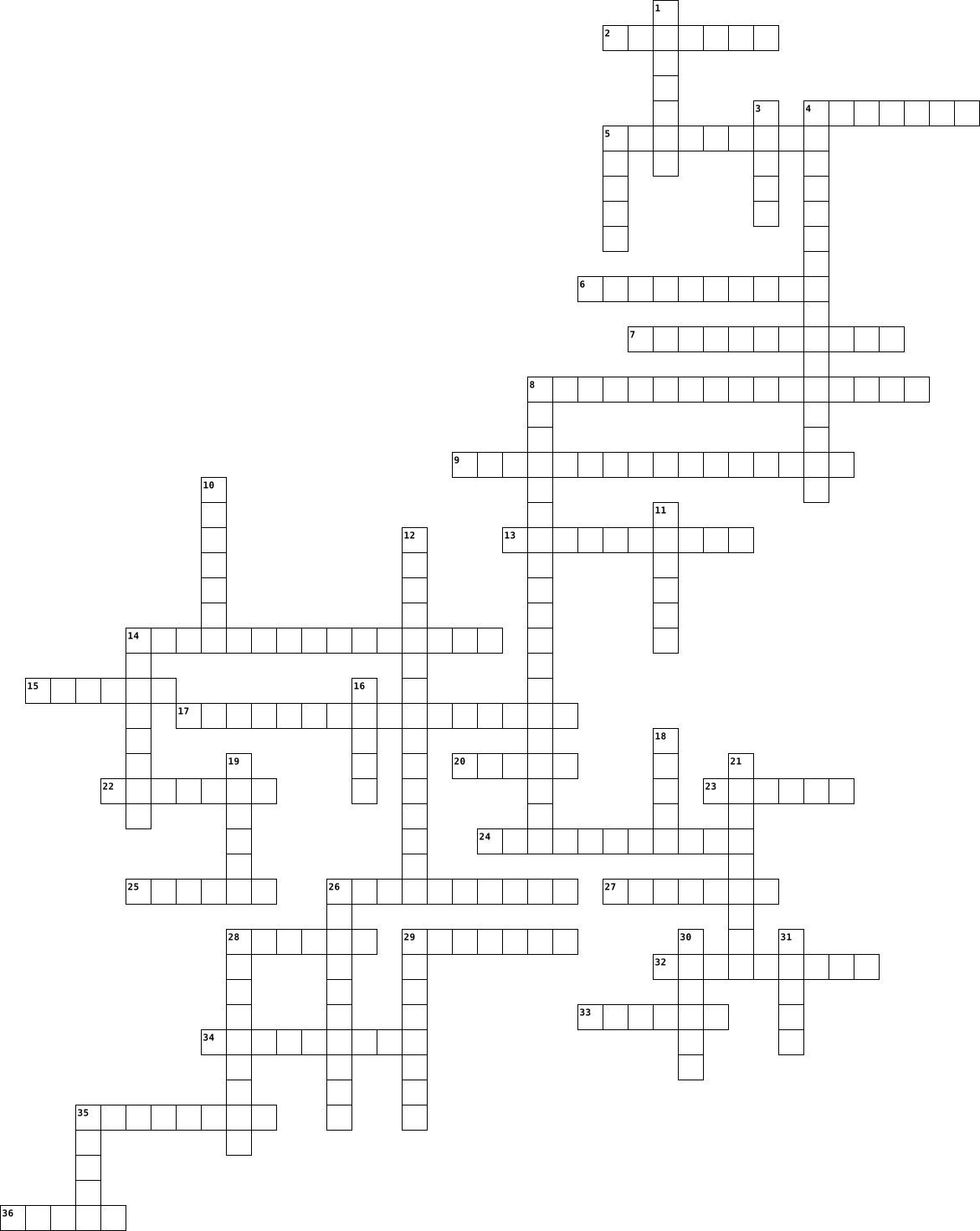
Across
- / feared sun god, who sides with the Trojans.”
- / bravest and most accomplished of the Trojan warriors; son of Priam.”
- / Greek warrior and king of the Myrmidons. He is considered the greatest warrior in the world.”
- / Commander-in-chief of the Greek armies. He anger Achilles when he takes back a prize girls, Briseis.”
- /Sells poison to ROMEO”
- servant”
- of CAPULET, age 13”
- / goddess of love and beauty, who sides with the Trojans.”
- servant”
- JOHN/Carries message for FRIAR LAWRENCE”
- of ROMEO, related to PRINCE”
- / gigantic warrior.”
- / goddess of wisdom and war, who favors the Greeks.”
- /Capulet servant to NURSE”
- / god of the forge, who favors the Greeks.”
- / wife of Menelaus, kidnapped by Paris.”
- / Greek warrior and best friend to Achilles.”
- / sea goddess who is the mother of Achilles.”
- / Son of MONTAGUE”
- PARIS/Count to wed JULIET, related to PRINCE”
- / superior Trojan archer.”
- / Trojan who took Helen From Menelaus, Hector’s brother, son of Priam.”
- / King of Sparta and brother of Agamemnon. After a Trojan named Paris took his wife, Helen, the most beautiful woman in the world, the Greeks declared war on Troy.”
- / wise Greek warrior.”
- CAPULET /Mother of JULIET, about 27”
Down
- ESCALUS/Prince of Verona”
- MONTAGUE/Mother of ROMEO”
- servant”
- / queen of the gods, who favors the Greeks.”
- servant to ROMEO”
- / wise old king who advises Agamemnon.”
- / Trojan spy who checks out the Greek camp.”
- cousin of JULIET”
- / Greek soothsayer who advises Agamemnon.”
- / messenger goddess.”
- / king of the gods who promises Thetis he’ll take Achilles’ side.”
- /Capulet servant to JULIET”
- / god of the sea.”
- Montague cousin of ROMEO”
- / superior Greek warrior.”
- / beautiful captive of Achilles, taken by Agamemnon.”
- / King of Troy.”
- / god of war, who sides with the Trojans.”
- CAPULET /Father of JULIET, in his 50's”
44 Clues: servant” • servant” • servant” • / King of Troy.” • servant to ROMEO” • cousin of JULIET” • / god of the sea.” • / Son of MONTAGUE” • of CAPULET, age 13” • / gigantic warrior.” • / messenger goddess.” • / wise Greek warrior.” • /Sells poison to ROMEO” • ESCALUS/Prince of Verona” • MONTAGUE/Mother of ROMEO” • Montague cousin of ROMEO” • /Capulet servant to NURSE” • / superior Greek warrior.” • ...
History of Greek Theater - Luis Cortes 2023-01-06

Across
- Masks made it easier for men to play _____ characters.
- Who is the earliest known actor and playwright?
- Where was Thespis' name inscribed?
- ____ comes from the greek verb meaning "to do" or "to act"
- How many festivals had theatrical performances? (Number is spelled out)
- The chorus was composed of ____?
- What does the word chorus mean in greek?
- What creature was part man and part goat?
- Where does the word theater come from?
- Which two pieces of literature influenced Greek Drama? (4 words, no spaces, no "and")
- What is the major festival?
- What object facilitated the rapid change of roles?
- Greek Drama was presented to honor who?
- What century did Socrates live in? ("th" after the number is included)
Down
- Where did greek plays usually take place?
- The theater was below the _____ in Athens.
- Who didn't wear masks?
- Where was the resting place for actors located? (one word)
- Where did characters die?
- What was the space below the slope of the hill called? Also was used for dancing.
- What type of drama emphasized the attempts of human characters to control their own destinies?
- Number of festivals held each year, in honor of Dionysus? (Number is spelled out)
- Where is the word scene derived from?
- Who had reserved seats, meant mainly for judging?
- Which greek city had huge advances in philosophy, rhetoric, literature, science, architecture, and visual arts?
- The chorus added, color, _____, and spectacle.
- A single actor could play ____ roles.
- How many tragedies were presented by the dramatists? (IN total)
- who was the first great theorist of dramatic art?
- When were rules put in place, limiting it to three speaking actors for each playwright?
- Who was born in 496BC?
- When was the first recorded theatrical event? (Regular Number, no dots)
32 Clues: Who didn't wear masks? • Who was born in 496BC? • Where did characters die? • What is the major festival? • The chorus was composed of ____? • Where was Thespis' name inscribed? • Where is the word scene derived from? • A single actor could play ____ roles. • Where does the word theater come from? • Greek Drama was presented to honor who? • ...
History of Greek Theater - Johnny Goldman 2021-03-02

Across
- a fault of character such as jealousy or pride
- arrangement of the events in a play
- a very wealthy city with 250,000-300,000 people
- mythical half-human half-goat creatures
- origin of the word "scene". place for actors to relax and change masks
- usage of words to express thought
- Greek word meaning "to do" or "to act"
- person of noble stature with a greatness about them
- flat terrace below slope in a theater
- first winner in the first play of recorded history, thespian is a word based on this person
- something that shocks the audience
- started by a prologue, the entrance of the chorus along with several episodes and songs
- the defeat of the tragic hero, usually results in gained wisdom and/or death
- an act that has magnitude and a serious impact
- god of wine and fertility
- non-speking role in greek theater
Down
- first great theorist of dramatic art
- an act of justice
- greek word for "theater", means place of seeing
- wrote The Odyssey and The Lliad
- a religious and civic celebration in the city of dionysus, involves theater
- used to help play different characters, worn over the face
- priest of dionysus
- songs between the episodes of a greek play
- described as the father of wester philosophy
- First recorded theatrical event
- how speech reveals character
- helped make rules for greek theater, including upping the amount of people in the chorus to 15 and the amount of actors to 3
- emphasized attempts of humans wanting to control their own fate
- ancient greek word for a king that took the throne, does not mean the same thing as tyrant does today
- singers and dancers at the greek theater
- Main character in Oedipus Tyrannus
32 Clues: an act of justice • priest of dionysus • god of wine and fertility • how speech reveals character • wrote The Odyssey and The Lliad • First recorded theatrical event • usage of words to express thought • non-speking role in greek theater • something that shocks the audience • Main character in Oedipus Tyrannus • arrangement of the events in a play • ...
Unit 4 review game 2019-11-07

Across
- The study of ancestry, or a chronological list of ancestors
- Latin for “in the year of the Lord"
- One of the supposed original sources of the Pentateuch
- The Old Testament books that comprise the stories of the prophets who cast judgment and warn of divine retribution while calling Israel to repentance
- A type of sacred literature characterized by symbolic imagery pointing to the expectation that the powers of evil will be destroyed and the righteous raised to a new life in justice
- From the Latin word for “common.”
- An Old English rendering of the Greek for “good news.”
- One of the supposed original sources of the Pentateuch, particularly the Book of Deuteronomy, written around the seventh century BC
- twenty seven books
- "covenant"
- An event or person in Scripture that points toward a later event or person
- An edition of the Old Testament, produced by Origen, that presented the texts in Hebrew and Greek in side-by-side columns.
Down
- One who proclaims the euangellion or gospel
- first five books of Moses
- Sacred Scripture
- From the Greek prophetes, meaning “one who speaks for”
- Those parts of the Old Testament that were removed from the Jewish or Hebrew canon of Scripture, but which appear in the Septuagint (the Greek translation) used by the early Christians
- From a Greek term meaning “five books”
- One of the supposed original sources of the Pentateuch, reflecting the perspective of Jews in the northern kingdom of Israel around the eighth or ninth century BC
- A third-century BC Greek translation of the Scriptures
- fourty six books
- Those books of the Bible that were included in the Jewish or Hebrew canon of Scriptures.
- From the Latin testamentum
- Greek and Latin for “rule.”
- A letter addressed to a particular person or people
25 Clues: "covenant" • Sacred Scripture • fourty six books • twenty seven books • first five books of Moses • From the Latin testamentum • Greek and Latin for “rule.” • From the Latin word for “common.” • Latin for “in the year of the Lord" • From a Greek term meaning “five books” • One who proclaims the euangellion or gospel • A letter addressed to a particular person or people • ...
Ancient Greece 2023-04-04

Across
- Continent of Greece
- This civilization began on Crete
- Sporting event started by the Ancient Greeks. It is held every four years today
- Queen of the Greek gods and married to Zeus
- only these people could take part in the democracy
- ages a time when people on the mainland were poor and no longer read and wrote
- What Socrates, Plato, and Aristotle were known for
- Greek god of the underworld
- Government started in Athens where citizens voted on issues and leaders
- this caused the Greek poleis to develop independently
Down
- Place where the major Greek gods lived
- The was the basic division of much of Ancient Greece. Athens and Sparta were the two largest of these.
- Greek god of war
- these were the first gods born to Cronus
- Patron god of the city of Athens. She is also the goddess of wisdom.
- a government where the power lies with a small group of wealthy people
- this connects Attica and Pelopenesus
17 Clues: Greek god of war • Continent of Greece • Greek god of the underworld • This civilization began on Crete • this connects Attica and Pelopenesus • Place where the major Greek gods lived • these were the first gods born to Cronus • Queen of the Greek gods and married to Zeus • only these people could take part in the democracy • ...
History 40 word crossword. 2013-11-12

Across
- theseus mother
- a tragic king of Thebes who unknowingly killed his father Laius and married his mother Jocasta
- Sediment
- a type of greek play
- Military Coalition of city-states led by Sparta
- a mythical monster with the head of a bull and the body of a man; slain by Theseus
- The city is notable for its rich Greek history, culture, amphitheatres, architecture, and as the birthplace of the preeminent mathematician and engineer Archimedes
- Crushed to make purple dye.
- A place where a play was performed
- the basic monetary unit of Greece
- the largest Greek island in the Mediterranean; site of the Minoan civilization that reached its peak in 1600 BC
- Mammals killed for their tusks.
- War between Athens and Sparta's City-states
- Athens an association of Greek city-states, members
- teacher of Plato
- Great conqueror from Macedonia.
- Greek Teachers
- General who took over Rome with Elephants
- an inhabitant of Minoan Crete
- Ancient town on Crete
- a hero and king of Athens who was noted for his many great deeds: killed Procrustes and the Minotaur
- capital and largest city of Italy; on the Tiber
Down
- Alexander the Great was just let into this city.
- Mountains that split Ancient Greece.
- a republic in southeastern Europe on the southern part of the Balkan peninsula
- art on walls.
- City which govern's only itself, and neighboring land.
- the largest inland sea
- what silk worms eat
- ancient Athenian philosopher; pupil of Socrates
- Container
- largest island in the Mediterranean Sea
- central space for the presentation of dramatic event.
- egypt god of underworld
- Minos king of Crete, son of Zeus and Europa.
- Ancient Greek city known for it's military Prowess
- Greek Philosopher
- Capital and largest city of Greece
- Main diet of Greeks
39 Clues: Sediment • Container • art on walls. • theseus mother • Greek Teachers • teacher of Plato • Greek Philosopher • what silk worms eat • Main diet of Greeks • a type of greek play • Ancient town on Crete • the largest inland sea • egypt god of underworld • Crushed to make purple dye. • an inhabitant of Minoan Crete • Mammals killed for their tusks. • Great conqueror from Macedonia. • ...
Greek VS. Rome 2021-02-11

Across
- This war in Greek took place between 218 B.C.E. through 201 B.C.E.
- Since the Etruscans traded regularly with the ancient Greeks, the art work resembled the art work in ancient Greece
- Are a huge part of the Greek diet
- was a military and political leader in the Roman Republic. He was instrumental in ending the Roman Republic.
- In its initial days, Roman legions fought off local warlords and adversaries to protect Rome against existential threats and later went as far as Parthia (modern day Iran) in east
- andron Were the part of the house reserved just for men
- the first Roman Emperor to convert to Christianity. He ruled from 306 C.E. until his death in 337 C.E.
- The children would go to school until the age of
- The war was fought on land and at sea lasting 23 years.
Down
- They had a powerful army and an even stronger empire. The Roman army was considered one of the strongest armies of the world.
- He reigned from 37 C.E. until his death in 41 C.E.
- Just like their counterparts in ancient Greece, the ancient Romans loved their art
- When Roman emperors returned home after a victory in battle, their accomplishments were celebrated by all in ancient Rome.
- This game in Greek was to help children with their motor skills
- a significant town because it was a resort city during Ancient Roman times.
- This food was a very good drink but also good for trade in Greek
- This is the most common pet in Ancient Greek
- This was not only a food in Greek it was a part of Greek history
- It was used much like we use sugar, as a sweetener in many different foods. It could also be used as a medicine.
- It was hard to do farming in Ancient Greece because there was not good
20 Clues: Are a huge part of the Greek diet • This is the most common pet in Ancient Greek • The children would go to school until the age of • He reigned from 37 C.E. until his death in 41 C.E. • The war was fought on land and at sea lasting 23 years. • andron Were the part of the house reserved just for men • ...
P4/4B Characters 2023-12-11

Across
- Blind prophet in Thebes, a city central in Greece. Prophet of Apollo, transformed into a woman for 7 years.
- Brother of the dead Queen. He is fierce, steadfast and even arrogant
- Greek goddess of the moon and hunt, twin sister of Apollo
- Second daughter (and half-sister) of Oedipus and Jocasta, serves as the information gatherer
- Feared Greek goddesses of vengeance; punishers of the guilty
- King of Thebes, unwittingly killed his father and married his mother. Solved the Sphinx's riddle and defeated it. Ultimately became the King of Thebes
- Brings the news of the Queens death by suicide
- Greek God of ecstasy, the theater and wine
- An old man and the only witness of the murder of Laius
- Mythical king of Phoenicia, believed to have trained the Greek hero Achilles
- They seek to maintain the status quo, they are forever observant for signs of other Gods seeking to usurp Zeus in some way. They knowingly act as spies for their God in all matters.
Down
- Theban statesman and soldier of renown
- They serve as a powerful indicator of how we, the audience, should react to the tragic events
- First, she was the wife of Laius. Then, the wife of her son, Oedipus. Sister to Creon
- Oldest daughter (and half-sister)of Oedipus and Jocasta, braver of the two daughters and sets off to make sure her brother gets a proper burial
- Greek goddess of wisdom, war and crafts
- Greek God of the sky, king of the gods and ruler of the world
- Monster in Thebes with the head of a woman, the wings of a bird and the body of a lion that killed any traveler that could not solve her riddle
- Mythical founder of Thebes, the city Oedipus rules
- The first messenger saved Oedipus when he was a baby
- Greek God of the sun, prophecy and disease
21 Clues: Theban statesman and soldier of renown • Greek goddess of wisdom, war and crafts • Greek God of ecstasy, the theater and wine • Greek God of the sun, prophecy and disease • Brings the news of the Queens death by suicide • Mythical founder of Thebes, the city Oedipus rules • The first messenger saved Oedipus when he was a baby • ...
6th Grade Greece Crossword 2024-02-14

Across
- A government in which a few wealthy citizens hold power over the rest
- The body of water between the Greek islands
- The people who invaded Greece in about 1100 BC and introduced Greece to iron
- The fort at the center of each city-state in which people could take refuge in an attack
- The Greek city-state that was on the coast on the mainland of Greece that had great education and developed democracy
- The Greek name for the letter A
- The people who were the first to develop civilization in the Aegean region from 2500 to 1450 BC
- A member of a political community with rights and responsibilities
- Soldiers of the Greek city-states who fought on foot with a spear, a short sword, and a shield
- A government in which all citizens share in running the government
- A military formation in which soldiers would fight shoulder to shoulder with their shields raised to protect from arrows
- The age that Spartan boys had to enter the military
Down
- The Greek word for a city-state
- The people who moved to Greece from central Asia and destroyed the Minoan civilization
- The site on the island of Crete that was once the palace of king Minos
- Someone who seizes power and rules with total authority
- The place outside the acropolis used as a marketplace and where people could gather and debate issues
- Five men who served as elected councilmen in Sparta who helped govern the city-state
- The people who lived in Greece beginning in 750 BC who developed the Greek alphabet
- The Greek city-state located on Peloponnesus that was a heavily militarily inclined society
- A settlement in a new territory that has close ties to its homeland
- A piece of land surrounded by water on three sides
- The ruler who ended the farmer rebellion in Athens and helped begin democracy
- Storytellers of Greece who passed down oral tradition
24 Clues: The Greek word for a city-state • The Greek name for the letter A • The body of water between the Greek islands • A piece of land surrounded by water on three sides • The age that Spartan boys had to enter the military • Storytellers of Greece who passed down oral tradition • Someone who seizes power and rules with total authority • ...
Literature 102: Master Pieces 2016-07-04
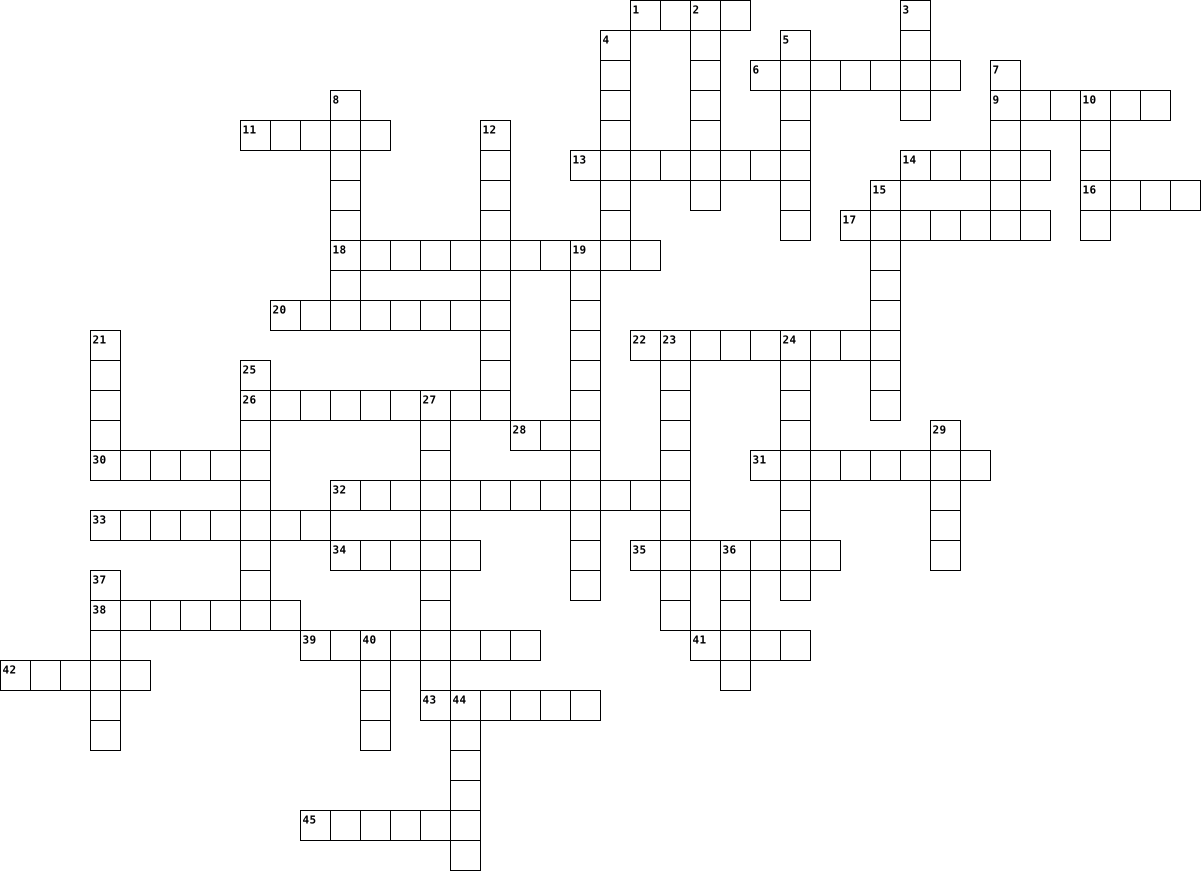
Across
- / god of war, who sides with the Trojans.
- / beautiful captive of Achilles, taken by Agamemnon.
- /capulet cousin of JULIET
- / wife of Menelaus, kidnapped by Paris.
- /friend of ROMEO, related to PRINCE
- / Son of MONTAGUE
- / gigantic warrior.
- / Greek soothsayer who advises Agamemnon.
- /Mother of JULIET, about 27
- / superior Greek warrior.
- /montague servant to ROMEO
- / Greek warrior and best friend to Achilles.
- /Carries message for FRIAR LAWRENCE
- / wise old king who advises Agamemnon.
- / King of Sparta and brother of Agamemnon. After a Trojan named Paris took his wife, Helen, the most beautiful woman in the world, the Greeks declared war on Troy.
- /Father of ROMEO
- / god of the sea.
- / King of Troy.
- /capulet servant
- / wise Greek warrior.
- / Greek warrior and king of the Myrmidons. He is considered the greatest warrior in the world.
- / king of the gods who promises Thetis he’ll take Achilles’ side.
- /Count to wed JULIET, related to PRINCE
- / sea goddess who is the mother of Achilles.
- / feared sun god, who sides with the Trojans.
Down
- /Prince of Verona
- / messenger goddess.
- /Franciscan who marries ROMEO & JULIET
- /capulet servant
- / goddess of wisdom and war, who favors the Greeks.
- /Montague cousin of ROMEO
- /montague servant
- / god of the forge, who favors the Greeks.
- / superior Trojan archer.
- /Mother of ROMEO
- / Trojan spy who checks out the Greek camp.
- /Sells poison to ROMEO
- / Commander-in-chief of the Greek armies. He anger Achilles when he takes back a prize girls, Briseis.
- / goddess of love and beauty, who sides with the Trojans.
- /Father of JULIET, in his 50's
- /Capulet servant to JULIET
- /Capulet servant to NURSE
- /daughter of CAPULET, age 13
- / queen of the gods, who favors the Greeks.
- / bravest and most accomplished of the Trojan warriors; son of Priam.
45 Clues: / King of Troy. • /capulet servant • /Mother of ROMEO • /Father of ROMEO • /capulet servant • /Prince of Verona • /montague servant • / Son of MONTAGUE • / god of the sea. • / gigantic warrior. • / messenger goddess. • / wise Greek warrior. • /Sells poison to ROMEO • /Montague cousin of ROMEO • /capulet cousin of JULIET • / superior Trojan archer. • / superior Greek warrior. • ...
CHL-006: FINAL QUIZ, PART II: CROSSWORD 2023-05-15

Across
- These were heavily armed and heavily armored citizen-soldiers of ancient Greece.
- She won a contest against Poseidon to become the patron goddess of the city of Athens.
- This is a form of government that is "rule by the people."
- This was the chief god of the ancient Greeks. He had two brothers.
- This is something made for the very first time.
- This ancient Greek King saw his city destroyed by Cyrus the Persian; his son and heir also died.
- This is a one-on-one or one-on-two teacher.
- Old stories tell us that this person was the first King of Athens.
- One of these kinds of Greek Soldiers was expected to surrender his shield.
- This is a half-man. half-bull monster killed by Theseus.
- The GOD of _____ called himself "I AM".
- Elected leaders in Athens were called this.
- He was the Greek god of the underworld and of death, and a brother to Zeus.
Down
- This is a story told to explain a truth about the world
- This was one of two major cities in ancient Greek Society. The other was Athens.
- He was one of the most famous of Athenian Tyrants.
- Ares was an unpopular god among the Greeks, as he was the god of _____.
- A Greek City was called this.
- He was a famous demi-god who died in the Trojan War by taking an arrow in his heel.
- This measures heat.
- Spartan Boys were a part of this between the ages of seven and twenty-nine years.
- This is a rocky peninsula in the Southern part of Greece; Sparta was located here.
- Spartan boys were taken from home at the age of 7 years to start this type of training.
- This was one of two major cities in ancient Greek Society. The other was Sparta.
- Except for Sparta, most Ancient Greek City-States had gotten rid of these.
25 Clues: This measures heat. • A Greek City was called this. • The GOD of _____ called himself "I AM". • This is a one-on-one or one-on-two teacher. • Elected leaders in Athens were called this. • This is something made for the very first time. • He was one of the most famous of Athenian Tyrants. • This is a story told to explain a truth about the world • ...
Ancient Greece 2015-09-14

Across
- Second of the classical orders
- Part of a Greek theatre
- Temple on the Acropolis
- Female figure supporting a structure
- Third of the classical orders
Down
- Le Corbusier's scale of proportions
- Greek Philosopher
- Period associated with Alexander the Great
- Open space at the centre of a Greek city
- Island of the Minoans
- Precursor of the classical temple
- Greek Goddess
- First of the classical orders
13 Clues: Greek Goddess • Greek Philosopher • Island of the Minoans • Part of a Greek theatre • Temple on the Acropolis • First of the classical orders • Third of the classical orders • Second of the classical orders • Precursor of the classical temple • Le Corbusier's scale of proportions • Female figure supporting a structure • Open space at the centre of a Greek city • ...
Greece vs. Rome 2021-02-11

Across
- Who was the Greek god of war?
- What city was the place that democracy was made?
- What did Greeks use to make pots?
- A person who seeks wisdom and enlightenment is a ______.
- Who was Rome’s first empire?
- What was the language that Athens spoke?
- Who was the greek god of the underworld?
- What was one resource Greeks used for their artwork?
- What is a Greek city state?
Down
- Julius ______ became dictator of Rome ending the Republic.
- What was the name of the war between Carthage and Rome?
- What kind of civilization was greece?
- What did Greek people think was barbaric?
- What was the name of the Roman god of the sky?
- The Roman god of war?
- Which holiday did Greeks celebrate by breaking pots?
- Many Roman gods were borrowed from the __________.
- What is the short Roman sword called?
- Continent of Rome?
- Leader who Julius Caesar fought in the Roman Civil War?
20 Clues: Continent of Rome? • The Roman god of war? • What is a Greek city state? • Who was Rome’s first empire? • Who was the Greek god of war? • What did Greeks use to make pots? • What kind of civilization was greece? • What is the short Roman sword called? • What was the language that Athens spoke? • Who was the greek god of the underworld? • ...
Height of Greece 2 2023-04-20

Across
- This Greek mathematician is considered the father of Geometry because he wrote the first text book on the subject.
- A famous ancient Greek medical doctor, who is considered the father of modern medicine.
- Greek mathematician who developed the A2+B2=C2 theory of triangles.
- The new culture developed by mixing Greek and Persian cultures together.
- A great Greek philosopher who stressed morality. He was killed for his beliefs.
- An important invention by Archimedes using small wheels and ropes to lift heavy objects.
Down
- This person is considered the first great historian of ancient Greece.
- A Greek philosopher who started teaching at age 40. He wrote extensively on government and its role in society.
- A famous Greek philosopher who was famous for teaching the "Golden Mean."
- The young Macedonian king who conquered the known world by age 33.
- Ancient Greek philosopher considered the father of Stoicsm.
- An ancient Greek philosophy started by Diogenes, which stressed living simply and without stress.
12 Clues: Ancient Greek philosopher considered the father of Stoicsm. • The young Macedonian king who conquered the known world by age 33. • Greek mathematician who developed the A2+B2=C2 theory of triangles. • This person is considered the first great historian of ancient Greece. • The new culture developed by mixing Greek and Persian cultures together. • ...
ion kno 10 2022-12-08

Across
- M
- C
- Z
- S
- A
Down
- E
- P
- B
- G
- M
10 Clues: E • P • B • G • M • M • C • Z • S • A
The Rise of the Greek City-State 2023-10-30

Across
- the city that developed "democracy"
- the "king of the gods"
- "the god of war"
- the Greeks believed in many gods...they were _______
- government style where citizens participate in choosing laws or leaders
- "the goddess of love"
- priests and priestesses that "told the future"
- the main city-state that developed a reputation for war and military training
- the sporting competition held in honor of Zeus every four years
- the Greek for "city-state"
- Greeks saw themselves as participants in government, not to be ruled, this makes them ______
Down
- the main Greek gods were called the _____________
- "the goddess of wisdom"
- "the god of the sea and storms"
- considered the "Father of History"
- "fortified city on a hill" (Greek fortress)
- the most important Oracle in Ancient Greece
- a Greek market place
- the Greeks worshipped their gods at the _________
19 Clues: "the god of war" • a Greek market place • "the goddess of love" • the "king of the gods" • "the goddess of wisdom" • the Greek for "city-state" • "the god of the sea and storms" • considered the "Father of History" • the city that developed "democracy" • "fortified city on a hill" (Greek fortress) • the most important Oracle in Ancient Greece • ...
Vocab #4 2026-01-16

Across
- An ancient Greek city state league led by Athens
- The capital of Greece and ancient Greece city state
- a group of soldiers in tight formation
- a cruel oppressive leader
- A peninsula in south east Europe
- a country run by a group of people
- an ancient kingdom which was concurred by romans
- a government run by the people
- an ancient Greek temple to the Goddess Athena
Down
- an ancient Greek league led by Sparta
- A system using trading for goods and services
- An age of prosper for a country
- a time period of Greek Rane followed by roman
- a piece of land connected on one side by land and on three sides by water
- a city state in ancient Greece
- A person of great academic knowledge and disciple who teaches other the same
- the highest social class
- A system using currency for goods and services
- a government run by royalty
19 Clues: the highest social class • a cruel oppressive leader • a government run by royalty • a city state in ancient Greece • a government run by the people • An age of prosper for a country • A peninsula in south east Europe • a country run by a group of people • an ancient Greek league led by Sparta • a group of soldiers in tight formation • ...
Book Genres at TL 2021-07-24

Across
- informative and only facts!
- Myths, mythology subgenre
- GOT SOME SHIVERS THIS BE SCARY
- chemistry and biology and animals and LIFE
- lots of suspense
- about me
- hera and zeus or maybe you prefer the roman forms?
- a genre that cannot be directly said in game
- thinking about reality
- worst subject ever. who likes this. simple addition is the only easy part
- do mi so mi do so do. half note + half note = whole note
- going on a quest!
Down
- going back in timeee
- let's make some food!
- how to!
- made up stories
- nursery rhymes for little kids
- zodiacs not stars
- we have too many in this genre
- Picasso? Leonardo da Vinci?? This you??
- fiction going back in time BUT THIS STORY ISNT REAL :ooooo
- futuristic and tech filled
- gotta be a detective with these :o
- Sciences, studies about all aspects of humans
- faires and eleves and magic
- knock knock
- this happens a lot in girl friend groups BAHHA
27 Clues: how to! • about me • knock knock • made up stories • lots of suspense • zodiacs not stars • going on a quest! • going back in timeee • let's make some food! • thinking about reality • Myths, mythology subgenre • futuristic and tech filled • informative and only facts! • faires and eleves and magic • nursery rhymes for little kids • GOT SOME SHIVERS THIS BE SCARY • we have too many in this genre • ...
Norse Mythology 2021-12-15

Across
- most beautiful goddess
- Keeper of the golden apples
- god of thunder
- ruler of gods
- Balder's brother
- Odin's wife
- God of mischief
Down
- Fenrir's only friend who betrayed him
- greatest among the gods
- God of the sea
- Thor's wife
- the watcher
- Freya's brother
13 Clues: Thor's wife • the watcher • Odin's wife • ruler of gods • God of the sea • god of thunder • Freya's brother • God of mischief • Balder's brother • most beautiful goddess • greatest among the gods • Keeper of the golden apples • Fenrir's only friend who betrayed him
Mythology vocab 2024-04-11

Across
- the plan or action of a story
- a supernatural being who has special power
- helps create suspense in a story
- the beginning or source
- the outcome of a story
- a myth that has arisen
- anything that is extremely unusual
Down
- the person who tells the story
- meaning more than one
- French word for why
- a fictional tale that explains why something is what it is
- a manner of speaking
- to change shape or form
13 Clues: French word for why • a manner of speaking • meaning more than one • the outcome of a story • a myth that has arisen • the beginning or source • to change shape or form • the plan or action of a story • the person who tells the story • helps create suspense in a story • anything that is extremely unusual • a supernatural being who has special power • ...
Mythology Vocabulary 2024-03-20

Across
- intense rage
- sound caused by the reflection of sound waves
- an experienced or trusted advisor
- having a complete, airtight seal
- joyful; merry; derived from Zeus' Roman name
- punished by holding up the world on his shoulders
Down
- shiny; showing all the colors of the rainbow
- lacking energy; derived from the name of an Underworld river
- deprived of water
- a task requiring great strength
- a grain used for food; connected with Demeter
- war-like; pertaining to war
- complete disorder or confusion; existed before the world took shape
13 Clues: intense rage • deprived of water • war-like; pertaining to war • a task requiring great strength • having a complete, airtight seal • an experienced or trusted advisor • shiny; showing all the colors of the rainbow • joyful; merry; derived from Zeus' Roman name • sound caused by the reflection of sound waves • a grain used for food; connected with Demeter • ...
Battle of Marathon Glossary Crossword 2014-08-10

Across
- Ancient style of architecture that were a dialect of the Dorians.
- A specific period of a person’s life time.
- A small fleet of ships or boats.
- “We have been victorious!” Greek word.
- of Thermopylae – Famous battle in 480 BC between the Greeks and Persians that occurs after the Battle of Marathon.
- An improvised military shelter that usually does not have protection from enemy fire, past tense.
- Citizen-soldiers of ancient Greek city-states that were heavily armed with primarily spears and sheilds.
- To name things one by one, past tense.
- Gravestones, Greek word.
- Dictatorship as this government is harsh and punishing.
Down
- Ancient Greek fortress located on highest part of Athens that contains ancient buildings that are of significance to Greek history.
- Another name for Greece used by the Greeks.
- A native of the area Lacedaemon that consists of Sparta and its surroundings.
- A senior military title in ancient Greece.
- To make full use of and to gain an advantage from.
- An area within boundaries/walls.
- A ruler who enforces cruelty and is oppressive.
- Soldiers fighting or marching on foot.
18 Clues: Gravestones, Greek word. • A small fleet of ships or boats. • An area within boundaries/walls. • “We have been victorious!” Greek word. • Soldiers fighting or marching on foot. • To name things one by one, past tense. • A specific period of a person’s life time. • A senior military title in ancient Greece. • Another name for Greece used by the Greeks. • ...
Greek Theater 2022-11-08

Across
- Greek Goddess of Wisdom
- The daughter who Agamemnon sacrificed
- The royal family of Sparta
- A type of drama that was about regular folks and usually was funny
- When everyone leaves the stage
- The entrance of the chorus
- Greek actors wore these on their faces to switch between characters
- Queen of Sparta, mother of Iphegenia, Electra, and Orestes
- Trojan Prince who eloped with Menelaus' wife
- The country where the origins of modern (western) theater began
- The king of Sparta who declared war on Troy
- Menelaus' wife who eloped with Paris.
- The God who the annual playwrighting competition was in honor of
Down
- the prophet who told Agamemnon to slaughter his daughter
- The Greek Goddess of hunting and the moon
- The city where the annual festival of Dionysus took place
- An ancient battleground, not part of modern Turkey
- A group of actors who represented the townspeople
- Greek City-State where Helen is from
- A type of drama that was usually about Gods and Goddesses or Royalty and often involved death
- Princess of Troy who is cursed with psychic powers
- Greek goddess of Love who promised Helen to Paris
- The king who slaughtered his daughter so he could sail from Aulis.
- The playwright who composed the Oresteia
24 Clues: Greek Goddess of Wisdom • The royal family of Sparta • The entrance of the chorus • When everyone leaves the stage • Greek City-State where Helen is from • The daughter who Agamemnon sacrificed • Menelaus' wife who eloped with Paris. • The playwright who composed the Oresteia • The Greek Goddess of hunting and the moon • The king of Sparta who declared war on Troy • ...
Greek Mythology in Modern Culture 2024-03-16

Across
- every 4 years
- luxury brand
- large shoe brand
- a space program
Down
- Disney movie starring Tate Donovan
- football team based in Tennessee
- a breakfast food
- a company and jungle
8 Clues: luxury brand • every 4 years • a space program • a breakfast food • large shoe brand • a company and jungle • football team based in Tennessee • Disney movie starring Tate Donovan
Oceania 2023-05-18

Across
- both a continent and a country
- The Demi god of Polynesian mythology
- Maui's final quest did not help him achieve _____________
- the greatest threat to the Great Barrier Reef
- indigenous people of Australia
- This flower is common to both Memorial and Anzac Day
Down
- a ceremonial war dance performed by the Maori people
- famous battle fought during WWI
- sub region of Oceania w/ thousands of small islands
- an area of land under the control of a ruler or state
- a holiday that honors New Zealand and Australian troops
- a collection of stories that belong to a particular tradition
- the tropical region of the Pacific Ocean
- True or False? Myths are common in many cultures around the world.
- One of Maui's enemies. The pieces of this animal became all the creature in the sea
15 Clues: both a continent and a country • indigenous people of Australia • famous battle fought during WWI • The Demi god of Polynesian mythology • the tropical region of the Pacific Ocean • the greatest threat to the Great Barrier Reef • sub region of Oceania w/ thousands of small islands • a ceremonial war dance performed by the Maori people • ...
Viking Corssword 2024-09-30

Across
- The place where the vikings originated from
- The place where the vikings slayed King Harald Hardrada
- The god of thunder in their mythology
- The number of realms in there mythology
- The name of the tree which the vikings believed held all the realms
- The name of the noble members of the viking society
- The type of villages the vikings raided
- The viking explorer who discovered America in 1000 A.D
- The festival they celebrated for the arrival of spring
Down
- The slaves of the vikings
- The scandinavian seafarers who raided and pillaged
- The elite warriors of the vikings who consumed the magic mushrooms for fighting
- The legal court of the vikings
- The religion the vikings converted to in the 900s
- The place the vikings beleived they would go when they die
15 Clues: The slaves of the vikings • The legal court of the vikings • The god of thunder in their mythology • The number of realms in there mythology • The type of villages the vikings raided • The place where the vikings originated from • The religion the vikings converted to in the 900s • The scandinavian seafarers who raided and pillaged • ...
Stems Crossword Puzzle 2021-01-28

Across
- Great
- Quality
- Together
- Make
Down
- Act or State
- Against
- Voice
- Rule, power
- Ability To
- Specified Study
10 Clues: Make • Great • Voice • Against • Quality • Together • Ability To • Rule, power • Act or State • Specified Study
Eyni Dzangiev 2015-04-07

Across
- калдун
- древние мифы
- советник
- интеллект
Down
- попечитель, страж
- меч
- местный турнир
- мантия, накидка, плащ
- влюблённый
- мифология
10 Clues: меч • калдун • советник • мифология • интеллект • влюблённый • древние мифы • местный турнир • попечитель, страж • мантия, накидка, плащ
Greek stuff 2023-05-23

Across
- Goddess of the hearth
- Arachne's special skill
- Kronos's favorite weapon
- Goddess of love and beauty
- Titan, can see the future
- Meeting
- Man of many labors
Down
- Greek god Athens was named after
- government run by the people
- Mother earth
- ____ gods
- God of the sun
- Greek god of the underworld
- Home of the gods
- Animal that Arachne embodies
15 Clues: Meeting • ____ gods • Mother earth • God of the sun • Home of the gods • Man of many labors • Goddess of the hearth • Arachne's special skill • Kronos's favorite weapon • Titan, can see the future • Goddess of love and beauty • Greek god of the underworld • government run by the people • Animal that Arachne embodies • Greek god Athens was named after
Extra Credit: Greece Quiz #2 (2.10-2.21) 2021-10-22

Across
- a Spartan soldier could retire at age ____
- first battle of Persian wars
- number of Spartans that fought at Thermopylae
- the Persian War battle that was fought on the sea
- name for Persian governors
- Sparta defeated Athens in the ________ war
- ______ & tragedy were the two types of theater in ancient Greece
- English words that come from Latin and Greek words
- Alex the Great's empire was divided into ___ kingdoms when he died
- restored order in Persia and led first invasion of Greece
- Emperor ________ ended the Ancient Olympic games
- ram's horn pillars (crazy eyes) used in Greek architecture
- plain pillars used in Greek architecture
- soldiers who fight on horseback
- actors wore _____ to show emotion
- Darius' son; led second invasion of Greece
- _______ road was 1700 miles long
Down
- location of the ancient Olympic games
- new Persian capital
- a marathon is ___.2 miles long
- Sparta defeating Athens in the Peloponnesian War is the end of the _____ age in Greece
- ____ the great started the Persian empire
- Alex the Great died from _________
- Sparta focused on _______ strength and was known for its army
- Last name of the person that started the modern Olympic games in 1896
- ancient Greek homes were made out of ___-bricks
- only ____ place was awarded in ancient Greek Olympics
- 10,000 soldiers chosen for their bravery and skill
- the fanciest and most ornate pillars in Greek architecture
- Modern and Ancient Olympics take place every ____ years
- new Persian religion
- Cyrus' son that dies in a revolt
32 Clues: new Persian capital • new Persian religion • name for Persian governors • first battle of Persian wars • a marathon is ___.2 miles long • soldiers who fight on horseback • Cyrus' son that dies in a revolt • _______ road was 1700 miles long • actors wore _____ to show emotion • Alex the Great died from _________ • location of the ancient Olympic games • ...