
greys anatomy Crossword Puzzles
CT Equipment 2019-01-31

Across
- Computer that serves as a digital post-processing station or an image review station.
- Radiographic examination that displays sectional anatomic images in axial, sagitall, or coronal planes.
- Similar to general radiographic tube in a construction and operation.
- An individual matrix box, each pixel is assigned a CT number.
- Technique used to view vessels as demonstrated in CT angiography.
- Replaced the high tension cables and allow for continous rotation of the x-ray tube, which when combined with patient movement through the ganry acquired data in a helical or spiral fashion.
- Central opening in the gantry
- Section of the object that is being scanned.
- Computer workstation a setup in workstation arre situated in other location for us by the radiologist or the technologist .
- A ratio that reflects the relationship between table spped and slice thickness.
- Refers to acquistion of a volume of CT data.
- Undesirable feature or density in an image not representative of anatomy
- Electronically linked to the ganrey for controlled movement during the can. pt. anatomy with the aperture is the area being scanned at that time.
Down
- Refers to the range of the CT number that are displayed as shades of gray.
- image of a CT examination that is used to plan the range of the scan; depending on the vendor, it may be called a topogram/scout.
- Allows the technologist to control the parameters of the examination.
- Consists of the x-ry tube, detector array and collimations.
- Method by which images acquired in the axial plane may be reconstructed in the coronal or sagittal plane.
- Series of rows and colums (of pixels) that give form to the digitial image.
- Solid state and composed of photodiodes coupled with scintillation crystal materal such as ocide ceramic crystal, or cadmium tungstate.
- to reduce patient dose and improves image quality.
- Number that represents the attenuation value for each pixel, relative to water.
- Window level-controls image brightness or deternines the CT number that is the center of he window width.
- predetermined for each producure includes factors such as kilovoltage milliamperage, pitch, field of view. slice thickness, table indexing, reconstruction algorithms, and display window.
- Adjustment of the window level and window width (brightness and image contrast) by the user.
- Two types of highly sophisticated software- one for the operating system and one for applications
26 Clues: Central opening in the gantry • Section of the object that is being scanned. • Refers to acquistion of a volume of CT data. • to reduce patient dose and improves image quality. • Consists of the x-ry tube, detector array and collimations. • An individual matrix box, each pixel is assigned a CT number. • ...
Dental Chairside Instruments 2024-09-23

Across
- Used for interproximal fillings
- Burnisher A burnisher in the shape of a ball
- Placing Applicator Used to place the base in the prep
- Used to mix materials such as cements
- Carrier Used to pick up Amalgam and carry it to the prep
- What is also known as the tooth feeler
- Carver Tool used to carve occlusal anatomy into amalgam restorations, one side is shaped like a disc and other is pointed
- Bridge Scissors Used to shape and trim things, outside of the mouth
- Vision The use of a mirror visualizes operating area that is not directly visualized by the operator, All movements are mirrored
- Used to hold matrix band in place; could be wooden or plastic
- Water Tip Used for rinsing and drying
- Bands Matrix bands used for any teeth
- Used for root planing
- Ejector Also called the SEJ, can bend and reshape
- Grasp An operators grasp that you hold with your whole hand
- Burnisher A burnisher in the shape of a football
- Used for giving local anesthetic also known as the "S"
Down
- Condenser Used to pack the amalgam into the prep before it sets
- Carver Tool used to contour and carve occlusal and interproximal anatomy in amalgam restorations
- Carver Tool Used to carve anatomy in a filling before it hardens
- Well Holds the amalgam while loading the amalgam carrier
- Reflection When the light reflects onto the teeth by mouth mirror
- Typically used as the most effective way of moving and retracting the gum tissue in order to get a better visual of the tooth that you're working on
- Grasp An operators grasp that you hold like a writing utensil
- Set Up Includes mouth mirror, explorer, cotton pliers, and perio probe
- Pocket Reading The average depth of what is 2-3 MM
- Bands Used to Replace the Interproximal area of a prep
- Burnisher Used to condense and polish amalgam at various stages
- Probe Used to measure the depth of the periodontal pocket around the tooth
- Placement Instrument Used to carry resin to prep, then condense and carve it
- Paper Holder Holds the articulating paper to check the bite
- Used to remove tartar or calculus
- Used to smooth and polish amalgam when slightly set
- Volume Evacuator Used to remove liquid and debris from the mouth
- Bands Matrix bands used on children
- Excavators Used to remove soft decay
- Pliers Used to place and retrieve small objects in the mouth
- Bands Matrix bands used for only the molars
38 Clues: Used for root planing • Used for interproximal fillings • Used to remove tartar or calculus • Used to mix materials such as cements • What is also known as the tooth feeler • Excavators Used to remove soft decay • Bands Matrix bands used for any teeth • Bands Matrix bands used on children • Water Tip Used for rinsing and drying • ...
ANATOMY OF A COMPUTER 2019-02-20

Across
- funnels power through the multicolored cables
- this activates when you turn on the computer and performs system checks before starting your main OS
- hand-operated input device used to manipulate objects on a computer screen
- brain that carries out your computer's instructions
- you can also call this COM
- this houses your graphics card, which supplies the image to the monitor
- device with a processor which redirects the excess data to your hard drive
- plug for older printers or scanners
- its ports transfer data as fast as 400 megabits per second
Down
- keyboard port is purple and mouse port green
- its ports transfer data as fast as 480 megabits per second
- if your motherboard does not have a sound chip or if you want better sound quality
- this houses most of your computer's components and direct data traffic
- device that converts analog audio signals into equivalent air vibrations
- this ports protrude from the back of the computer
15 Clues: you can also call this COM • plug for older printers or scanners • keyboard port is purple and mouse port green • funnels power through the multicolored cables • this ports protrude from the back of the computer • brain that carries out your computer's instructions • its ports transfer data as fast as 480 megabits per second • ...
anatomy of a computer 2019-02-20

Across
- power supply unit
- Basic Input/Output System
- bots
- Peripheral Component Interconnect
- port parallel
- port serial
- rainbow six _____
- random access memory
Down
- playstation more than one less than three
- bus
- card sound
- opposite of fatherboard
- Accelerated Graphics Port
- wirefire
- Ginger
15 Clues: bus • bots • Ginger • wirefire • card sound • port serial • port parallel • power supply unit • rainbow six _____ • random access memory • opposite of fatherboard • Basic Input/Output System • Accelerated Graphics Port • Peripheral Component Interconnect • playstation more than one less than three
Anatomy of the body 2020-06-08

Across
- away from the middle of the body
- above
- position Standing with the head facing forward arms to the side. The palms are facing forward fingers extended, thumbs are pointing away from the body. The feet are spaced slightly apart with the toes pointing forward.
- back of the body
- Furthest away from the surface
- Closest to the surface
- closest to attachment
Down
- below
- bottom of the foot
- furthest to attachment
- laying face up
- front of the body
- laying face down
- toward the middle of the body
- palm of the hand
15 Clues: below • above • laying face up • laying face down • back of the body • palm of the hand • front of the body • bottom of the foot • closest to attachment • furthest to attachment • Closest to the surface • toward the middle of the body • Furthest away from the surface • away from the middle of the body • ...
Plant Classification and Anatomy!!! 2022-02-27

Across
- pairs of cells that surround stomata and control their opening and closing
- These are plants that complete their life cycle during a single season
- angiosperm with two cotyledons inside its seed, flower parts in multiples of four or five, and vascular bundles in rings
- flowering vascular plants that produce fruits containing one or more seeds
- compound made out of sugar that provides structure and support
- plant with tube like structures that move minerals, water, and other substances throughout the plant
- tiny openings in a plant's epidermis through which carbon dioxide, water vapor, and oxygen enter and exit
Down
- These are plants that require two years to complete their life cycle
- is the second
- vascular tissue that forms hollow vessels that transport substances, other than sugar, throughout the plant
- waxy protective layer that covers the leaves, stems, and flowers of many plants and helps prevent water loss
- kingdom
- tissue that produces xylem and phloem cells as a plant grows
- They are flowering plants with seed containing one cotyledon
- These are plants that have a long lifespan – typically more than two years.
- is the science of identifying, classifying, and naming organisms
16 Clues: kingdom • is the second • tissue that produces xylem and phloem cells as a plant grows • They are flowering plants with seed containing one cotyledon • compound made out of sugar that provides structure and support • is the science of identifying, classifying, and naming organisms • These are plants that require two years to complete their life cycle • ...
Plant classification and anatomy 2022-02-25

Across
- angiosperm with two cotyledons inside its seed, flower parts in multiples of four or five, and vascular bundles in rings
- tiny openings in a plant's epidermis through which carbon dioxide, water vapor, and oxygen enter and exit
- waxy, protective layer that covers the leaves, stems, and flowers of many plants and helps prevent water loss
- vascular tissue that forms tubes that transport dissolved sugar throughout a plant
- plant, plant with tube-like structures that move minerals, water, and other substances throughout the plant
- plants, Are plants that absorb water and other substances directly through its cells wall
- species, that break down rock and build up decaying plant material so that other plants can grow
- vascular tissue that forms hollow vessels that transport substances, other than sugar, throughout the plant
Down
- angiosperm with one cotyledon inside its seed, flower parts in multiples of three, and vascular tissues in bundles scattered throughout the stem
- threadlike structures that anchor nonvascular plants to the ground
- flowering vascular plants that produce fruits containing one or more seeds
- vascular tissue that produces xylem and phloem cells as a plant grows
- , vascular plants that do not flower, generally have needlelike or scalelike leaves and produce seeds that are not protected by fruits
- a chemical compound made out of sugar that provides structure and support
- cell, pairs of cells that surround stomata and control their opening and closing
15 Clues: threadlike structures that anchor nonvascular plants to the ground • vascular tissue that produces xylem and phloem cells as a plant grows • a chemical compound made out of sugar that provides structure and support • flowering vascular plants that produce fruits containing one or more seeds • ...
Plant Anatomy and Classification 2022-03-31

Across
- Part of the stamen which supports the anther
- Part of flower that contains the ovules
- A plant that regrows every season
- The system of male plant organs
- A plant that does not bear flowers or fruit
- A plant with two embryonic leaves
- Part of plant where stalk connects to flower
Down
- A plant that grows and dies in one season
- Part of flower that develops into a seed
- The system of female plant organs
- A plant that bears flowers and fruit
- A plant with only one embryonic leaf
- Part of plant that encloses the bud to protect it
- modified leaf,colored to attract pollinators
- Part of the stamen where pollen is produced
15 Clues: The system of male plant organs • A plant that regrows every season • The system of female plant organs • A plant with two embryonic leaves • A plant that bears flowers and fruit • A plant with only one embryonic leaf • Part of flower that contains the ovules • Part of flower that develops into a seed • A plant that grows and dies in one season • ...
Anatomy of a Computer 2015-02-06

Across
- Current this transfer data as fast as 400Mbps.
- The brain that carries out your computer's instructions.
- You connect the device to this.
- Allows peripherals to communicate with computer.
- Some mice and keyboards include USB cables, most require this ports.
- Houses most of computer's components and directs data traffic
- Also known as a COM port.
- Ex: MP3 players, modern printers and PDAs requires 000 connections.
- What's this course's official name?
Down
- The motherboard manufacturer installs a basic OS(operating systems) in 0000 chip.
- The brain of the computer.
- You can buy this if you want better sound quality or if your motherboard does not have a sound chip.
- It houses your graphics card, which supplies the image to the monitor.
- It funnels power through the multicolored cables to each device.
- When it reaches its capacity, the processor redirects the excess data to your hard drive.
15 Clues: Also known as a COM port. • The brain of the computer. • You connect the device to this. • What's this course's official name? • Current this transfer data as fast as 400Mbps. • Allows peripherals to communicate with computer. • The brain that carries out your computer's instructions. • Houses most of computer's components and directs data traffic • ...
Anatomy terms and directions 2014-09-03

Across
- relating to the nose
- pertaining to the arm
- pertaining to the ear
- anterior surface of the elbow
- pertaining to the cheeck
- pertaining to the groin region
- pertaining to the sole of the foot
- pertaining to the hip
Down
- longitude plane that divides the body into anterior and posterior parts
- relating to the mouth
- area of the back of the head outer projection of the spine of the scapula; highest point of the shoulder
- refers to the neck or the necklike portion of an organ or structure
- the chest
- milk-producing glands of the breats
- one of the 8 bones in the wrist
15 Clues: the chest • relating to the nose • relating to the mouth • pertaining to the arm • pertaining to the ear • pertaining to the hip • pertaining to the cheeck • anterior surface of the elbow • pertaining to the groin region • one of the 8 bones in the wrist • pertaining to the sole of the foot • milk-producing glands of the breats • ...
Nervous System Anatomy & Physiology 2023-03-12

Across
- the plural word of this is gyri
- back part of the brain,connects the cerebrum to the spinal cord
- uppermost portion of the brainstem
- alot of spinal nerves below the end of the spinal cord
- glial cell that transports water & salts
- cord of fibers that carry electrical impulses
- this word means bridge
Down
- alot of nerve cells in the peripheral nervous system
- branching fiber of a neuron (nerve impulse)
- coordinates balance and muscle movements
- 3 membranes that surround the brain
- small fiber that is part of a neuron/carries impulse
- membrane middle layer (meninges)
- controls, vision, speech, and memory
- this cell is necessary for impulses
15 Clues: this word means bridge • the plural word of this is gyri • membrane middle layer (meninges) • uppermost portion of the brainstem • 3 membranes that surround the brain • this cell is necessary for impulses • controls, vision, speech, and memory • coordinates balance and muscle movements • glial cell that transports water & salts • branching fiber of a neuron (nerve impulse) • ...
Plant Classification and Anatomy 2022-09-22

Across
- both the xylem and phloem are created by the _____ which becomes growth rings in trees
- A mature (fertilized) ovary containing the seed or seeds
- Produce food for the plant through photosynthesis
- Two-name system
- Scientific names are written in...
- Plants that produce seeds not protected by fruit
- Support the leaves, flowers, and fruit, conduct water, minerals, and food, store food and water, produce new stem tissues
Down
- Seeds have two cotyledons therefore the seedlings have two seed leaves
- Seeds have one cotyledon therefore the seedlings have one seed leaf
- An embryonic leaf that becomes the seed leaf
- Transports food from the leaves
- Plants that flower and produce seeds protected by fruit or pods
- Anchor the plant, absorb water and minerals, store manufactured food
- The purpose of ______ is to reproduce through the production of seeds
- Transports water and minerals from the roots
15 Clues: Two-name system • Transports food from the leaves • Scientific names are written in... • An embryonic leaf that becomes the seed leaf • Transports water and minerals from the roots • Plants that produce seeds not protected by fruit • Produce food for the plant through photosynthesis • A mature (fertilized) ovary containing the seed or seeds • ...
Plant Classification and Anatomy 2022-09-22

Across
- both the xylem and phloem are created by the _____ which becomes growth rings in trees
- Scientific names are written in...
- Transports food from the leaves
- Seeds have two cotyledons therefore the seedlings have two seed leaves
- Plants that produce seeds not protected by fruit
- Produce food for the plant through photosynthesis
- The purpose of ______ is to reproduce through the production of seeds
- Anchor the plant, absorb water and minerals, store manufactured food
Down
- Seeds have one cotyledon therefore the seedlings have one seed leaf
- Transports water and minerals from the roots
- Plants that flower and produce seeds protected by fruit or pods
- Two-name system
- An embryonic leaf that becomes the seed leaf
- A mature (fertilized) ovary containing the seed or seeds
- Support the leaves, flowers, and fruit, conduct water, minerals, and food, store food and water, produce new stem tissues
15 Clues: Two-name system • Transports food from the leaves • Scientific names are written in... • Transports water and minerals from the roots • An embryonic leaf that becomes the seed leaf • Plants that produce seeds not protected by fruit • Produce food for the plant through photosynthesis • A mature (fertilized) ovary containing the seed or seeds • ...
Anatomy of a Computer 2020-09-30

Across
- Primary storage
- Startup security
- Why are these still a thing?
- Secondary storage
- Ancient scanners
- The source of everything
- Ancient mice
Down
- Too hot!
- Sight, smell, taste, touch...
- Quick communication
- Pretty lights...
- You can't put it in the wrong way
- Unlimited power!
- Put it in the right way
- The instructor
15 Clues: Too hot! • Ancient mice • The instructor • Primary storage • Startup security • Pretty lights... • Ancient scanners • Unlimited power! • Secondary storage • Quick communication • Put it in the right way • The source of everything • Why are these still a thing? • Sight, smell, taste, touch... • You can't put it in the wrong way
Anatomy Of A Computer 2021-09-10

Across
- system checks before starting your main OS.
- holds the computers components
- is related to the motherboard
- similair to USB
- 3D Graphics
- transferring information between digital
- Many peripherals need this thing
- stores memory
- You can attach some older key-
- it helps your computer have better sound quality
Down
- is the brain of the computer
- activates when you turn on the computer and per-
- mice, and modems to what
- a connector for a device that sends or receives several bits of data
- it isn't the prettiest
15 Clues: 3D Graphics • stores memory • similair to USB • it isn't the prettiest • mice, and modems to what • is the brain of the computer • is related to the motherboard • holds the computers components • You can attach some older key- • Many peripherals need this thing • transferring information between digital • system checks before starting your main OS. • ...
UNIT 4: ANIMAL ANATOMY 2021-05-14

Across
- the long thick hair around or at the back of the neck of some animals, as the horse or lion.
- a thick growth of hair that covers the skin of many different animals.
- a pair of slender, movable, segmented sensory organs on the head of insects, myriapods, and crustaceans.
- a sharp usually slender and curved nail on the toe of an animal.
- a hoofed foot especially of a horse.
- Examples of invertebrates that possesses this include squid, cuttlefish, bryozoa, snails, sea anemones, and jellyfish.
- a long, pointed tooth.
- a type of respiratory organ found in many aquatic animals.
Down
- extensions of an animal's skull found in members of the deer family.
- one of the soft, fringed plumes that cover the bodies of birds.
- the joints in your fingers that are farthest from your fingernails.
- a four-legged animal's foot. Dogs, cats, rabbits, and bears all have this.
- a permanent pointed projection on the head of various animals.
- the bill of a bird especially.
- any of the thin parts that stick out from the body of a water animal and especially a fish.
15 Clues: a long, pointed tooth. • the bill of a bird especially. • a hoofed foot especially of a horse. • a type of respiratory organ found in many aquatic animals. • a permanent pointed projection on the head of various animals. • one of the soft, fringed plumes that cover the bodies of birds. • a sharp usually slender and curved nail on the toe of an animal. • ...
Anatomy of the skin 2022-10-18

Across
- genetic disorders with little or no color
- rare diseases
- small sac formed by a membrane and filled with liquid
- fat cells
- an oily substance
- half-moon- shaped
- middle layer of the skin
Down
- itchy rash that appears on the skin
- skin lesion
- sac-like pocket
- baldness
- produces hair, eye and skin pigmentation
- bacterial infection involving inner layers
- skin condition do to oil and dead skin cells
- a sore
15 Clues: a sore • baldness • fat cells • skin lesion • rare diseases • sac-like pocket • an oily substance • half-moon- shaped • middle layer of the skin • itchy rash that appears on the skin • produces hair, eye and skin pigmentation • genetic disorders with little or no color • bacterial infection involving inner layers • skin condition do to oil and dead skin cells • ...
Skin anatomy and structure 2022-10-23

Across
- hair loss
- crack like sore
- small opening in skin
- skin inflammation
- tissue death due to ischemia
- Open sore on skin
- mole
- skin test for diphtheria
Down
- middle layer of skin
- skin pigment
- itching
- Oily secretion from skin
- hard protein in epidermis
- pus filled papule
- outer layer of skin
15 Clues: mole • itching • hair loss • skin pigment • crack like sore • pus filled papule • skin inflammation • Open sore on skin • outer layer of skin • middle layer of skin • small opening in skin • Oily secretion from skin • skin test for diphtheria • hard protein in epidermis • tissue death due to ischemia
Anatomy of the Skin 2022-10-20

Across
- Brown-black pigment
- Red-yellow pigment
- Hard protein
- Epithelial cells that are flat
- Dense connective tissue layer
- Thick fatty tissue
- Contain pigment
Down
- Elastic protein
- Fatty cells
- The deepest layer
- Thin layer containing keratin
- Gives color to the skin
- Glands in the skin
- An oily secretion
- Glands that produce a watery secretion
15 Clues: Fatty cells • Hard protein • Elastic protein • Contain pigment • The deepest layer • An oily secretion • Red-yellow pigment • Glands in the skin • Thick fatty tissue • Brown-black pigment • Gives color to the skin • Thin layer containing keratin • Dense connective tissue layer • Epithelial cells that are flat • Glands that produce a watery secretion
Flower anatomy & plant classification 2022-09-06

Across
- The part of the pistil where pollen germinates.
- clubmosses
- ferns and horsetails
- The stamen of a flower — the part that produces pollen — consists of a slender stalk
- the part of a stamen that contains the pollen.
Down
- enlarged basal portion of the pistil, the female organ of a flower.
- conifers
- ginkos
- the plant axis that bears buds and shoots with leaves and, at its basal end, roots.
- The ovule producing part of a flower.
- the part of the ovary of seed plants that contains the female germ cell and after fertilization becomes the seed.
- protects flower
- attracts pollinator
- the male reproductive part of a flower
- the stalk of the pistil.
15 Clues: ginkos • conifers • clubmosses • protects flower • attracts pollinator • ferns and horsetails • the stalk of the pistil. • The ovule producing part of a flower. • the male reproductive part of a flower • the part of a stamen that contains the pollen. • The part of the pistil where pollen germinates. • enlarged basal portion of the pistil, the female organ of a flower. • ...
Anatomy Of A Computer 2017-02-10

Across
- is the brain that carries out your computer’s instructions.
- figures out what operation is to be carried out and send the information to the specific
- Power supply unit
- retrieves program instruction and passes it onto function .
- uses binary calculators to do the math.
- The switches inside a microprocessor
- RAM
- is the computer’s brain.
Down
- The dot on the scoreboard
- is a large PCB (printed circuit board) that houses most of your computer's component.
- ROM
- Any information that has been decoded and sent out by the computer as a result.
- Used or bought if your motherboard does not have a sound chip or if you sound quality.
- Data has to be entered, there putting in something to get out of it.
- Accelerated Graphics Port
15 Clues: ROM • RAM • Power supply unit • is the computer’s brain. • The dot on the scoreboard • Accelerated Graphics Port • The switches inside a microprocessor • uses binary calculators to do the math. • is the brain that carries out your computer’s instructions. • retrieves program instruction and passes it onto function . • ...
THE HUMAN EYE ANATOMY 2024-05-24

Across
- The black circular opening in the center of the iris through which the light enters the eye.
- Photoreceptor cells in the retina that are highly sensitive to low light levels and are important for night vision.
- The transparent, flexible structure behind the iris that focuses light onto the retina.
- A small depression in the retina where visual acuity is highest, containing a high concentration of cone cells.
- The cranial nerve that transmits visual information from the retina to the brain.
- The light-sensitive layer of tissue at the back of the eye that converts light into electrical signals sent to the brain.
- The clear fluid between the cornea and the lens.
- Photoreceptor cells in the retina that detect color and are responsible for vision in bright light.
- The muscles that control the shape of the lens to focus light onto the retina for clear vision.
- The vascular layer of the eye between the retina and the sclera that supplies blood to the retina.
Down
- The colored part of the eye that controls the size of the pupil and the amount of light that enters the eye.
- The transparent frontal part of the eye that covers the iris and pupil.
- The 6 muscles surrounding the eye that control its movement in different directions.
- The white, outer layer of the eye that provides protection and structure.
- The clear gel-like substance filling the space between the lens and the retina, maintaining the eye's shape.
15 Clues: The clear fluid between the cornea and the lens. • The transparent frontal part of the eye that covers the iris and pupil. • The white, outer layer of the eye that provides protection and structure. • The cranial nerve that transmits visual information from the retina to the brain. • ...
Biomechanics and Anatomy - Basketball 2024-03-12

Across
- all movements that are leading up to the moment before releasing the ball in a jump shot
- the main joint action used to create back spin on the ball when shooting is
- a principle in biomechanics that is applied to generate force into an object
- this needs to run through the shooter's centre of gravity to the middle of the base of support before taking off for the jump shot
- should you release the ball at the peak of your jump when shooting the ball
- the basketball will remain at rest unless the shooter's muscles are used to release the ball towards the hoop
- the joint action your shoulders should be at the execution phase of the jump shot
- the joint action that the shooter should be in as they land in the follow through phase of the jump shot
- at the take off moment in the preparation phase, your torso is leaning slightly forward, what part of the body compensates for this to remain balanced at this point
Down
- your angle of release will do this if you release the ball at the peak of your jump
- the shooter needs to improve this incase they get bumped when they are about to take of for the jump shot
- the joint action that the shooting elbow should be in during the follow through phase of the jump shot
- when you are in planter flexion during the execution phase of the jump shot, the agonist muscle for this joint action is
- this impacts the ball when it becomes a projectile and forces it downwards
- the agonist muscle for hip flexion when the athlete is in the preparation phase of the jump shot
15 Clues: this impacts the ball when it becomes a projectile and forces it downwards • the main joint action used to create back spin on the ball when shooting is • should you release the ball at the peak of your jump when shooting the ball • a principle in biomechanics that is applied to generate force into an object • ...
Anatomy of a Flower 2024-04-14

Across
- A plant that has both male and female flowers on the same plant.
- Plants that flower when they are physiologically mature
- Plants that have a life span of one year. Flower first year and die.
- Insects, birds, mammals, and the wind are all ______ of plants.
- A collection of petals that encircles the stamen and carpel
- The pollen producing part of a flower.
- A _____ flower is one that has both male and female parts.
- The fusion of the male and female gametes, forming a zygote and eventually an embryo.
- The requirement for low temperature to stimulate flowering in some species
Down
- A transfer of pollen grains from an anther to a stigma.
- A group or cluster of flowers arranged on a stem that is composed of a main branch or a system of branches
- The stigma, style, ovary, and ovule together is called...
- Part of plant that becomes the flesh of the fruit
- Raspberries and blackberries are _____ fruits.
- The "energy pack" to feed the embryo.
15 Clues: The "energy pack" to feed the embryo. • The pollen producing part of a flower. • Raspberries and blackberries are _____ fruits. • Part of plant that becomes the flesh of the fruit • A transfer of pollen grains from an anther to a stigma. • Plants that flower when they are physiologically mature • The stigma, style, ovary, and ovule together is called... • ...
Flower Anatomy and Arrangement 2024-09-11

Across
- flowers on a stalk with pedicels
- flowers/fruit growing from the axil
- produces a set number of flowers
- collective of sepals
- has all four basic flower parts
- a droopy raceme/spike
- flowers on a stalk without pedicels
- is missing one or more basic flower part
- a ripened ovary
Down
- collective of petals
- collective of female parts
- subsequently produces additional flowers on the inflorescence
- collective of male parts
- covered seed
- an inflorescence with a single terminal flower
15 Clues: covered seed • a ripened ovary • collective of petals • collective of sepals • a droopy raceme/spike • collective of male parts • collective of female parts • has all four basic flower parts • flowers on a stalk with pedicels • produces a set number of flowers • flowers/fruit growing from the axil • flowers on a stalk without pedicels • is missing one or more basic flower part • ...
easy Anatomy-Byron Lopez 2026-03-30

Across
- main foundation and structural base of a lathe machine
- Secures the tool rest assembly to the lathe bed
- features a bearing-mounted point
- moves forward or backward the tailstock quill or barrel
- supporting center for the free end of a workpiece
- foundation that supports the tool rest
- secures the tailstock assembly
- secures the tool rest in place on the tool rest base
Down
- heart of the machine, holds and spins the workpiece
- used to prevent the spindle from rotating
- rotates the workpiece at controlled speeds
- used to hold and securely guide cutting tools
- Primary support for workholding attachments
- turns workpiece slowly for inspection or adjustments
- primarily for spindle turning
15 Clues: primarily for spindle turning • secures the tailstock assembly • features a bearing-mounted point • foundation that supports the tool rest • used to prevent the spindle from rotating • rotates the workpiece at controlled speeds • Primary support for workholding attachments • used to hold and securely guide cutting tools • Secures the tool rest assembly to the lathe bed • ...
Retina Anatomy and Physiology 2026-04-07

Across
- layer where bipolar cells synapse with ganglion cells
- pigmented layer that absorbs stray light and supports photoreceptors
- junctional layer formed by Muller cells that act as a barrier
- photoreceptors responsible for color vision and high acuity
- region where ganglion cell axons exit the eye
- synaptic layer where photoreceptors connect with bipolar and horizontal cells
- area of the retina lacking blood vessels for optimal light transmission
- retinal layer containing bipolar, horizontal, and amacrine cell bodies
Down
- central retinal region responsible for highest visual acuity
- retinal cells that transmit signals to the brain via the optic nerve
- transparent membrane separating retina from vitreous
- supporting glial cells that span the entire thickness of the retina
- layer containing photoreceptor cell bodies
- layer containing axons that form the optic nerve
- light-sensitive cells responsible for vision in low light
15 Clues: layer containing photoreceptor cell bodies • region where ganglion cell axons exit the eye • layer containing axons that form the optic nerve • transparent membrane separating retina from vitreous • layer where bipolar cells synapse with ganglion cells • light-sensitive cells responsible for vision in low light • ...
Plant Classification and Anatomy 2026-04-07

Across
- The part of a plant embryo that develops into the primary root.
- A non-vascular plant, such as moss, that lacks true roots and stems.
- A type of angiosperm with one seed leaf.
- Tiny pores on the underside of a leaf that allow for gas exchange.
- A group of plants that produces cones.
- The female reproductive part of a flower.
- The fine powder produced by flowers that contains male reproductive cells.
- Trees that shed their leaves annually in the fall.
Down
- A type of plant that has a specialized transport system.
- The vascular tissue responsible for transporting sugars from leaves to the rest of the plant.
- The vascular tissue that carries water and minerals upward from the roots.
- A plant that produces seeds within a protective fruit.
- The process by which plants use sunlight, water, CO2 to create food.
- The green pigment in leaves that absorbs light energy for photosynthesis.
- The male reproductive part of a flower that produces pollen.
15 Clues: A group of plants that produces cones. • A type of angiosperm with one seed leaf. • The female reproductive part of a flower. • Trees that shed their leaves annually in the fall. • A plant that produces seeds within a protective fruit. • A type of plant that has a specialized transport system. • The male reproductive part of a flower that produces pollen. • ...
Anatomy TV Assignment 4 2024-09-27

Across
- ( a thin tissue that coats the larynx and protects the airway)
- (it’s a gland that produces hormones that regulate your metabolism.)
- (these are located on top of the arytenoid they support the the voice box in voice production)
- (a muscle in your neck that helps lift the hyoid bone for you to swallow)
- (it helps support movements in the throat and mouth)
- (small wedge-shaped cartilages that keep everything within the vocal cords and its surroundings stable)
- (these are two folds that stay open for airflow and vibrate when you speak or sing as air passes through them).
Down
- (this muscle helps lower the hyoid bone and raise the thyroid cartilage when you’re swallowing and speaking.
- (small flap of tissue in the back of the throat used to prevent food from entering the windpipe)
- (located in the larynx; plays a vital role in producing sound and controlling the opening and closing of your vocal cords)
- (the muscle that helps you open your mouth and move your jaw when speaking or chewing.
- (makes sure to stabilize the hyoid bone)
- (the muscle that raises the floor of your mouth to keep everything stable in terms of swallowing and speaking)
- ( this is the base of the larynx and it helps keep your windpipe open.)
- (a U-shaped bone that supports your tongue when you swallow and speak)
15 Clues: (makes sure to stabilize the hyoid bone) • (it helps support movements in the throat and mouth) • ( a thin tissue that coats the larynx and protects the airway) • (it’s a gland that produces hormones that regulate your metabolism.) • ( this is the base of the larynx and it helps keep your windpipe open.) • ...
Anatomy Vocab Test 2 2025-01-28

Across
- During this kind of contraction, the muscle shortens.
- a fibrous connective tissue that attaches a muscle to a bone or other structure, such as the eyeball.They are responsible for transferring force from muscles to bones, which allows for movement.
- A body movement that describes a bone moving in a circle around a joint, either towards or away from the body's midline
- relating to the chest, or thorax, which is the upper part of the trunk between the neck and abdomen. The space within that contains the lungs, heart, and other organs.
- A non-medical term that describes the natural variation in how people's brains work.
- A band of fibrous tissue that connects bones and stabilizes joints. They connect one bone to another.
- The movement of an extremity away from the midline of the body
Down
- During this kind of contraction, muscles elongate in response to a greater opposing force.
- During this kind of contraction, the muscle's tension changes, but its length remains the same. This type of contraction is used to maintain posture.
- Skeletal muscles that you can control consciously. They are attached to bones and allow you to move around.
- The bending of a limb or joint
- The tightening, shortening, or lengthening of muscles when your body is working to complete an activity.
- The movement of an extremity towards the midline of the body
- Muscles that contract without conscious control.
- A movement that increases the angle between two body parts at a joint. It's the opposite of flexion.
15 Clues: The bending of a limb or joint • Muscles that contract without conscious control. • During this kind of contraction, the muscle shortens. • The movement of an extremity towards the midline of the body • The movement of an extremity away from the midline of the body • A non-medical term that describes the natural variation in how people's brains work. • ...
anatomy of a skull 2025-03-03

Across
- runs Infront of the ear and under the cheek
- covers the skull in the area of the cerebellum
- superior to the teeth and runs up the nose
- lays like a blanket on top of head
- on the side of the skull
- breaks apart food
- forms the cheekbone
Down
- hole in the bottom of the skull
- inner corner of the eye socket
- forms the bridge of the nose
- forms the forehead
- runs behind the eye socket
- runs betweens the 1st and 16th molars
- splits the nasal cavity in half
- shaped like a pickle in the nose
15 Clues: breaks apart food • forms the forehead • forms the cheekbone • on the side of the skull • runs behind the eye socket • forms the bridge of the nose • inner corner of the eye socket • hole in the bottom of the skull • splits the nasal cavity in half • shaped like a pickle in the nose • lays like a blanket on top of head • runs betweens the 1st and 16th molars • ...
topic of Avian Anatomy 2025-04-07

Across
- Clean and arrange feathers
- Fleshy skin on a turkey's neck
- Membrane covering bird's eye
- Base of the tail where feathers meet
- Bird's mouth
- Raised tuft of feathers
- Breastbone in birds
Down
- Fleshy area around a bird's nostrils
- Feathers collectively
- Hind toe on birds
- Sharp bird claw
- Colored part of a bird's eye
- Muscular bird stomach
- Shed feathers
- Fluff up feathers
15 Clues: Bird's mouth • Shed feathers • Breastbone in birds • Sharp bird claw • Fluff up feathers • Feathers collectively • Hind toe on birds • Muscular bird stomach • Raised tuft of feathers • Membrane covering bird's eye • Clean and arrange feathers • Colored part of a bird's eye • Fleshy skin on a turkey's neck • ...
Dog Hindlimb Skeleton Anatomy 2026-06-14

Across
- The small bone forming the kneecap.
- The slender bone located on the outer side of the lower leg.
- The large bony basin connecting the spine to the hindlimbs.
- The cylindrical bones between the ankle and the toes.
- The large thigh bone, the longest and strongest bone in the body.
- The cup-shaped socket in the pelvis that receives the head of the femur.
Down
- The large, bony prominences near the head of the femur.
- The bony bump on the inner or outer side of the ankle.
- The cluster of seven articulating bones in the ankle/hock.
- The largest and uppermost bone of the pelvis.
- The large bone forming the heel.
- The lower and posterior part of the pelvic bone (the "sit bone").
- The larger, inner, and weight-bearing bone of the lower leg.
- The ankle bone that articulates with the tibia and fibula.
- The forward-facing portion of the pelvic bone.
15 Clues: The large bone forming the heel. • The small bone forming the kneecap. • The largest and uppermost bone of the pelvis. • The forward-facing portion of the pelvic bone. • The cylindrical bones between the ankle and the toes. • The bony bump on the inner or outer side of the ankle. • The large, bony prominences near the head of the femur. • ...
Dog Heart Internal Anatomy 2026-06-14

Across
- The muscles in the ventricles that attach to the chordae tendineae.
- The valve between the left ventricle and the main systemic artery.
- The heart's natural pacemaker node located in the right atrium.
- The smooth inner lining of the heart chambers.
- The valve between the left atrium and left ventricle (also called Mitral).
- Specialized conductive fibers in the ventricle walls.
- The fibrous cords anchoring the valve leaflets (tendineae).
- The oval depression in the interatrial septum (ovalis).
Down
- The thick, muscular middle layer of the heart.
- The node that delays the electrical impulse before it reaches the ventricles.
- The muscular ridges on the internal surface of the ventricles (carneae).
- The innermost layer of the pericardium and outermost layer of the heart wall.
- The thick muscular wall separating the left and right sides of the heart.
- The valve between the right ventricle and the lungs' main artery.
- The valve located between the right atrium and right ventricle.
15 Clues: The thick, muscular middle layer of the heart. • The smooth inner lining of the heart chambers. • Specialized conductive fibers in the ventricle walls. • The oval depression in the interatrial septum (ovalis). • The fibrous cords anchoring the valve leaflets (tendineae). • The heart's natural pacemaker node located in the right atrium. • ...
7th TCI Lesson 35 ~ Leading Figures of the Renaissance 2023-03-02

Across
- Renaissance scientist that theorized that the earth orbits around the sun
- a wealthy supporter of the arts
- a gifted writer of Spanish satire whose work "Don Quixote" pokes fun at traditional love stories
- an English Renaissance poet and playwright whose plays show a deep understanding of human behavior
- German inventor who, in about 1450, developed the first printing press with metal movable type in Europe
- a person who works for another in order to learn a trade
- to give official permission
- Renaissance painter known for his use of bright colors and lively brushwork
- a technique use by Vesalius to study the design of the human body
- the belief that the sun was the center of the solar system and that the earth rotated around it
- bright, distinct, and clear
- Renaissance scientist who studied anatomy resulting in his famous work "On the Structure of the Human Body"
- sculpture by Michelangelo that shows Mary holding the body of a dead Jesus
- Renaissance painter & sculptor known for his realism
- letters on metal blocks that can be arranged to create words
- a print made from an engraved plate, block or other surface
- the name given by Europeans to the Americas, which were unknown to most Europeans before the voyages of Christopher Columbus
- English queen who ruled during England's "Golden Age" and who helped culture to flourish
- story of the comic adventures of a false knight
Down
- a machine used to press inked type or plates onto paper to create many copies of a work
- Renaissance artist known for his woodcut prints
- Davici's famous painting of a girl who is smiling
- a small booklet containing information about a single subject
- Renaissance painter, sculptor, and inventor who loved animals so much that he would buy animals to set them free
- the path on which one object circles another
- sections of the human heart discovered by Andreas Vesalius
- sculpture by Michelangelo that shows an intense looking 17-foot tall boy from the Bible
- a Catholic church in Vatican City, Italy whose ceiling was painted by the Renaissance artist Michelangelo
- a painting or drawing of an artist produced or created by that artist themselves
- the major study of Andreas Vesalius that led him to write "On the Structure of the Human Body"
- one field of study done by Copernicus who is the "Father" of this science
- queen known for creating a unified Catholic Spain
- painting made on wet plaster of a wall or ceiling
33 Clues: to give official permission • bright, distinct, and clear • a wealthy supporter of the arts • the path on which one object circles another • Renaissance artist known for his woodcut prints • story of the comic adventures of a false knight • Davici's famous painting of a girl who is smiling • queen known for creating a unified Catholic Spain • ...
World History Semester 1 2024-01-18

Across
- Author of the Declaration of Independence
- Production process before industrialization
- Calculated elliptical orbits for planets
- Inventor of commercial light bulb
- Britain vs China
- Promoted separation of powers
- Age of Reason
- Allowed for inland transportation in Africa
- First Emperor of Mexico after Independence
- Moderated effects of malaria
- Priest who started the Mexican War for Independence
- Smoke and fog
- Likely country of first movable type printing
- Innovator of Alternating current
- Proponent of natural rights
- Greek whose outdated theories dominated anatomy
- Slums in the Industrial Revolution
- Created the movable type printing press
- Leader of the Committee of Public Safety
- King of France before the French Revolution
- Helped create the scientific method
- Capital of France
- Emperor of France
- Father of modern anatomy
- Tool for studying small subjects
- Meeting called by the French King to avert crisis pre-revolution
- Planet with observable phases in the 17th century
- Three laws of motion
- Execution device in the French Revolution
- Procedure of experimentation
- Survival of the fittest
- Scientist who discovered moons of Jupiter
- Former name of Mexico City
- Spanish colony on the same island as Haiti
Down
- Tax on paper goods in the American colonies
- Force drawing matter together
- Code and inventor
- American-born Spaniards
- Author of the Communist Manifesto
- Former name of Haiti
- Leader of the Haitian Revolution
- First US president
- Greek to taught geocentric ideas
- Father of the Scientific Revolution
- People of mixed Native American and European ancestry in Latin America
- Lower class in France
- East African country that remained independent in the 19th century
- Sun-centered solar system
- Meeting to decide the fate of African colonization
- Inventor of a 19th century machine gun
- European-born Spaniards
- Period of British government control of India
- First Estate
- Organization that opposed major scientific advancements
- To get rid of slavery
- Inventor most associated with the steam engine
- Hourly or daily pay
- Location of Napoleon's first exile
- Father of capitalism
- Roman-Egyptian promoter of geocentric theory
- Labor group
- Positive change
- Capital of England
- No taxation without this
- Promise by the National Assembly to create a new constitution
- Revolutionary leader in Mexico
- Inventor of the cotton gin
67 Clues: Labor group • First Estate • Age of Reason • Smoke and fog • Positive change • Britain vs China • Code and inventor • Capital of France • Emperor of France • First US president • Capital of England • Hourly or daily pay • Former name of Haiti • Father of capitalism • Three laws of motion • Lower class in France • To get rid of slavery • American-born Spaniards • European-born Spaniards • ...
Prosthodontics 2026-04-10

Across
- 3D design prevents the student from working in a clinical ______.
- Ensuring all instructors teach to the same clinical standard.
- Lab setup that de-densifies the room and allows individual pace.
- The goal is to build strong clinical judgment via self-evaluation.
- Area of a prep that prevents the path of withdrawal.
- Using data to provide objective feedback on prep curvature.
- The process of moving from a digital file to a physical resin model.
- The jaw containing teeth 3, 5, and 9.
- The board exam that dictates the focus on teeth 3, 5, and 9.
- A student who designs based on specs rather than just drilling.
- 2D facial aesthetics must be integrated with 3D ______ data.
- The contour of a tooth where it exits the gingiva.
- A digital validation of the physical measurements.
- The 3Shape platform used for scanning and digital initiation.
- Traditional material used to pour physical models.
- The ideal 1.5mm gap required for structural integrity.
- Stone models allow students to appreciate this tactilely.
Down
- Clinical management software to be integrated from day one.
- Specific dental lab software for designing complex units.
- The 2025-2026 goal is to treat digital as this type of pillar.
- The transition from a physical impression to a 3D file.
- Capturing a high-resolution scan is the first acquisition step.
- The brand name of the intraoral scanner hardware.
- A biometric roadmap that serves as the student topographic guide.
- Measuring tool used to "feel" the physical reality of reduction.
- The core mystery removed when students focus on anatomy first.
- What instructors become if they lack digital basic skills.
- Digital precision is used to anchor this type of clinical intuition.
- Working backward from final tooth form to prep geometry.
- Temporary material used to fabricate the "first" restoration.
- Visualizing this path is key for removable dentistry.
- An instructor who drives student success rather than friction.
- Traditional impression material used to contrast with digital scans.
- The "one-size-fits-all" pace that leaves students stagnant.
- The ideal anterior tooth used for CDCA prep practice.
- The number of students in the traditional class format.
- The "connective tissue" between virtual design and facial aesthetics.
- These must be idealized before a handpiece is ever touched.
- Type of tray designed digitally for edentulous patients.
- Software module used to overlay preps against natural ideals.
40 Clues: The jaw containing teeth 3, 5, and 9. • The brand name of the intraoral scanner hardware. • The contour of a tooth where it exits the gingiva. • A digital validation of the physical measurements. • Traditional material used to pour physical models. • Area of a prep that prevents the path of withdrawal. • Visualizing this path is key for removable dentistry. • ...
Scientific Revolution 2024-09-12

Across
- Proof that the planets revolve around the sun
- Helped develop the scientific method
- Stole bodies for anatomy studies
Down
- Heliocentric theory
4 Clues: Heliocentric theory • Stole bodies for anatomy studies • Helped develop the scientific method • Proof that the planets revolve around the sun
Chapter 4 2018-01-10

Across
- Structure with triangular sides.
- System of many governments officials who carry out government rules and regulations
- One of the world’s first alphabets, invented in ancient Nubia
- Study of the structure of the body and its organs.
- Black wood from West Africa
- Symbol that stands for a word, idea, or sound.
- A series of rulers from the same family
Down
- Statue or other free-standing piece of art made of clay, stone, or other materials.
- A writing surface similar to paper named after the papyrus reed that grew along the Nile River in ancient Egypt.
- Group of rocky rapids
- Dependence by each country or group on the other
- Buying and selling of goods and services
- Skilled worker who practices a handicraft
- Hard white material made from elephant tusks
- A body that has been preserved so it will not decompose
- King of ancient Egypt
- A flat plain formed on the seabed where a river deposits material over many years
17 Clues: Group of rocky rapids • King of ancient Egypt • Black wood from West Africa • Structure with triangular sides. • A series of rulers from the same family • Buying and selling of goods and services • Skilled worker who practices a handicraft • Hard white material made from elephant tusks • Symbol that stands for a word, idea, or sound. • ...
Chapter 4 Key Terms 2018-01-10

Across
- Script One of the world’s first alphabets, invented in ancient Nubia
- Group of rocky rapids
- A writing surface similar to paper named after the papyrus reed that grew along the Nile River in ancient Egypt
- Buying and selling of goods and services
- System of many government officials who carry out government rules and regulations
- Symbol that stands for a word, idea or sound
- Statue or other free-standing piece of art made of clay, stone, or other materials
- Study of the structure of the body and its organs
- Hard white material made from elephant tusks
- Black wood from West Africa
Down
- A flat plain formed on a seabed where a river deposits material over many years
- Dependence by each country or group on the other
- A body that has been preserved so it will not decompose
- Series of rulers from the same family
- Structure with triangular sides
- King of ancient Egypt
- Skilled worker who practices handicraft
17 Clues: Group of rocky rapids • King of ancient Egypt • Black wood from West Africa • Structure with triangular sides • Series of rulers from the same family • Skilled worker who practices handicraft • Buying and selling of goods and services • Symbol that stands for a word, idea or sound • Hard white material made from elephant tusks • ...
Chapter 7 Level 6 2015-06-05

Across
- the branch of science concerned with the bodily structure of humans, animals,
- record (something) in written, photographic, or other form
- a substance that is released in the body of a person who is feeling a strong emotion (such as excitement, fear, or anger) and that causes the heart to beat faster and gives the person more energy
- existing or occurring before in time or order.
- fall down or in; give way.
- come to live permanently in a foreign country
- make (someone) lose courage or confidence.
- likely to have a bad outcome
- money received from work
Down
- justified
- exaggerated
- someone not acting normal because of fear, cause someone not to move every part of their body
- to make someone or something seem better than it is
- cause (someone) to believe firmly in the truth of something.
- situated far from the main centers of population; distant.
- the way a thing turns out; a consequence
- a sudden intense feeling.
17 Clues: justified • exaggerated • money received from work • a sudden intense feeling. • fall down or in; give way. • likely to have a bad outcome • the way a thing turns out; a consequence • make (someone) lose courage or confidence. • come to live permanently in a foreign country • existing or occurring before in time or order. • to make someone or something seem better than it is • ...
Histology 2022-11-09

Across
- the study of the microscopic anatomy of tissues
- nerves
- receives and processes sensory nerve impulses from the eyes
- a brain dysfunction caused by an outside force to the head
- not on purpose; subconscious
- controls behavior and emotions, plans and organizes incoming info
- the smallest unit of life
- brain and spinal cord
- a complete set of genes in an organism
Down
- a group of organs that work together to perform one or more functions
- an integrated group of cells with a common group or function
- crucial in integrating sensory and visual info
- a collection of tissues that perform a specific function
- a medical imaging technique that uses magnetic fields and radio waves to take pictures of soft tissues
- responsible for receiving,interpreting, and reacting to signals inside and outside the body
- processes language and storing information in the long term memory
- a progressive degeneration, and or death of nerve cells caused by repeated head injuries like repeated concussions
17 Clues: nerves • brain and spinal cord • the smallest unit of life • not on purpose; subconscious • a complete set of genes in an organism • crucial in integrating sensory and visual info • the study of the microscopic anatomy of tissues • a collection of tissues that perform a specific function • a brain dysfunction caused by an outside force to the head • ...
Egypt and Kush 2023-11-03

Across
- group of rocky rapids.
- a series of rulers from the same family.
- black wood from West Africa.
- symbol that stands for a word, idea, or sound.
- one of the world’s first alphabet invented in ancient Nubia.
- structure with triangular sides.
- a body that has been preserved so that it will not decompose.
- skilled worker who practices a handicraft.
- statue or other free-standing piece of art made of clay, stone, or other materials.
- buying and selling of goods and services.
Down
- system of many government officials who carry out government rules and regulations.
- study of the structure of the body and its organs
- dependence by each country or group on the other.
- a hard whit substance from the tusk of an animal such as an elephant.
- a writing surface similar to paper named after the papyrus reed that grew along the Nile River in ancient Egypt.
- a flat plain formed on the seabed where a river deposits material over many years.
- king of ancient Egypt.
17 Clues: group of rocky rapids. • king of ancient Egypt. • black wood from West Africa. • structure with triangular sides. • a series of rulers from the same family. • buying and selling of goods and services. • skilled worker who practices a handicraft. • symbol that stands for a word, idea, or sound. • study of the structure of the body and its organs • ...
Evolution and Natural Selection Vocab 2026-03-11

Across
- the process of species changing over time
- fighting over resources like food, water, and space
- how the body of an organism is built
- the selection where nature chooses the best traits fit for an environment
- any differences in traits between one species
- producing more offspring than can possibly survive (similar to overpopulation)
- structures that are built similarly, but used for different functions
- any trait or behavior that helps an organism survive
- ancient remains of organisms that lived long ago
Down
- structures that still exist but are no longer useful to the organism
- the man responsible for starting the research of natural selection
- a young and developing organism that looks very similar to other species before birth
- the genetic structure in cells responsible for traits
- and characterisitic that can be inherited and passed down
- the selection where humans choose the best traits they desire
- structures that are built differently, but used for similar functions
- the part of finches that changed based on the food they ate
17 Clues: how the body of an organism is built • the process of species changing over time • any differences in traits between one species • ancient remains of organisms that lived long ago • fighting over resources like food, water, and space • any trait or behavior that helps an organism survive • the genetic structure in cells responsible for traits • ...
Ultrasonography 2020-10-20

Across
- An electromechanical property of the special ceramic crystals within the transducer to vibrate and create sound waves in response to electrical current.
- A shadow created behind solid masses, like stones, due to sound wave interference because the signal isn’t able to penetrate through the stone.
- A technology that was the first step towards the development of medical ultrasound developed in WWI and WWII.
- A Doppler scan in which colour is added to the images to indicate the direction of movement (most commonly of blood flow) in relation to the transducer.
- An imaging modality that uses sound waves and their reflected echoes to produce diagnostic medical images without the use of ionizing radiation.
- The ability of a structure or region to reflect sound energy.
- A technological development that allowed sonographers to view the anatomy in real-time during the scan.
- A shift in frequency that occurs as a result of sound waves interacting with moving objects, like blood flowing, that helps to determine the direction and velocity of flowing blood.
- An imaging development that allowed sonographers to visualize the direction of blood flow which has been especially helpful in vascular studies.
- A procedure done under ultrasound guidance where a needle is used to withdraw some amniotic fluid from the for general analysis and determining any genetic conditions that the baby may have.
- A tool used to eliminate air between the transducer and the skin surface which helps better conduction of sound waves and creates clearer images
- A way to display the movement of a structure on a scale, often used in echocardiography to demonstrate the movement of heart valves and walls.
- A structure or region that is highly reflective compared to surrounding structures and is seen as white on the image.
- A type of transducer that uses energies of 3.5 MHz and is used for exams on larger patients.
- A mode commonly used in vascular studies where a transducer sends and receives sound energy continuously.
- An imaging professional that must be highly competent in anatomy, physiology, specialized equipment, procedures, communication skills, pathophysiology, and sectional anatomy to provide a complete assessment of a structure or system through ultrasound.
Down
- A type of ultrasound study of the heart used to detect pericardial effusion, septal defects, heart valve defects, and to provide information about the chambers.
- A change to biological tissue through thermal and/or mechanical energy during an ultrasound.
- A structure or region that produces fewer echoes than surrounding structures and is seen as dark on the image.
- The part of the ultrasound machine that produces high-frequency sound waves (through the vibration of special ceramic elements caused by electrical current), receives the echoes from within the body, and then converts these signals back to electrical energy.
- A technique that uses sonography to compare the mechanical properties of tissues and their relative stiffness to distinguish between benign and malignant tissues.
- A type of imaging where two modalities (like MRI or CT and sonography) are combined to create a single study to demonstrate anatomy and function together.
- A type of sonography system that converts the ultrasound image to a digital format for processing, manipulation, viewing, and storage, often has a significant increase in dynamic range, and is equipped with 3D and 4D imaging.
- Seen as a series of peaks on the US monitor with the height of the peaks representing the intensity of the returning echo.
- A study used to produce better diagnostic images of the uterus and ovaries than conventional scanning where masses within the uterus are well defined and abnormal accumulation of fluid surrounding uterus are easily detected.
- A structure or region that doesn’t produce any echoes and is seen as black on the image.
- A mode where a transducer sends out short bursts of sound energy followed by silent periods to listen for returning echoes that are then measured and depicted on viewing monitors as varying shades of gray according to their intensity and time that they take to return to the transducer.
- A type of ultrasound scan used in trauma situations in the emergency department, especially for chest, abdomen, and pelvis imaging. The name of this scan is an acronym for extended focus assessment with sonography for trauma.
- An ultrasound technique that measures and displays the velocities and direction of blood within a vessel, where changes in velocity and direction are seen as dots on a scale where velocity is indicated on the vertical axis and time is represented along the horizontal axis.
- A type of transducer that uses energies up to 17 MHz and is used when minimal penetration is required for high-resolution images.
- A structure or region that produces a similar number of echoes as surrounding tissue.
- A type of transducer that uses energies between 5 and 7 MHz and is used for exams on average to small abdomens.
- Grayscale images formed based on the intensity of the returning echoes.
- A pathology that appears as an anechoic area with well-defined borders.
34 Clues: The ability of a structure or region to reflect sound energy. • Grayscale images formed based on the intensity of the returning echoes. • A pathology that appears as an anechoic area with well-defined borders. • A structure or region that produces a similar number of echoes as surrounding tissue. • ...
Introduction of the Human Body - Unit 1 2022-09-13

Across
- physiology : functions of the heart and blood vessels
- anatomy : structural changes (gross to microscopic) associated with disease
Down
- physiology : functions of the air passageways and lungs
- physiology : changes in the cell and organ function, due to muscular activity
- physiology : functions of the kidneys
5 Clues: physiology : functions of the kidneys • physiology : functions of the heart and blood vessels • physiology : functions of the air passageways and lungs • anatomy : structural changes (gross to microscopic) associated with disease • physiology : changes in the cell and organ function, due to muscular activity
Anatomy Vocab 1 2020-08-05

Across
- Toward the middle
- Toward the back
- Toward the head or above
- Farther from the body
- Toward the front
- Toward the belly side
Down
- Toward the feet or below
- Closer to the body
- Toward the sides
- Toward the back or spine side
10 Clues: Toward the back • Toward the sides • Toward the front • Toward the middle • Closer to the body • Farther from the body • Toward the belly side • Toward the feet or below • Toward the head or above • Toward the back or spine side
Anatomy Crossword Assignment 2021-04-09

Across
- body segments or series of segments spin on axis
- splits body into left and right sides
- body part moves away from midline of body
- back of the body
- keeps bodily fluids in
Down
- separates front and back
- towards the feet
- front of the body
- towards the head
- body part move in to midline of body
10 Clues: towards the feet • towards the head • back of the body • front of the body • keeps bodily fluids in • separates front and back • body part move in to midline of body • splits body into left and right sides • body part moves away from midline of body • body segments or series of segments spin on axis
Blood Vessel Anatomy 2021-04-08

Across
- Vessel with the smallest mean diameter
- Type of vessel carrying blood away from the heart
- Capillaries are only composed of _____ tissue
- Venules lack ____ ____ but it is present in arterioles
Down
- Arteries have ____ walls compared to veins.
- Branch off an artery connecting to capillaries
- Arterioles lack ____ tissue, but it is present in venules
- Largest artery in the human body
- Vessel with lowest mean systemic blood pressure
- Connection between veins and capillaries
10 Clues: Largest artery in the human body • Vessel with the smallest mean diameter • Connection between veins and capillaries • Arteries have ____ walls compared to veins. • Capillaries are only composed of _____ tissue • Branch off an artery connecting to capillaries • Vessel with lowest mean systemic blood pressure • Type of vessel carrying blood away from the heart • ...
Week 6 Anatomy 2017-04-24

Across
- In the middle third of the thigh, the superficial and deep femoral arteries are separated by:
- muscle that prevent folds of the membrane from being compressed within knee joint
- only muscle attach pelvis, vertebrae and femur
- After suffering a penetrating injury in the left femoral triangle, a patient was unable to walk normally because her left knee collapsed into flexion upon weight bearing. The nerve to which muscle was damaged?
- Common tendinous insertion for gracilis, satorius and semitendinosus muscle
Down
- Following surgical opening of the adductor canal, a patient experienced a loss of cutaneous sensation of the medial side of the leg. Which nerve was cut?
- Fibrofatty subcutaneous tissue closing the saphenous opening
- largest seasamoid bone
- Inability to extend the knee and loss of cutaneous sensation over the anterior surface of the thigh would indicate a lesion or compression of the:
- flat quadrangular muscle
10 Clues: largest seasamoid bone • flat quadrangular muscle • only muscle attach pelvis, vertebrae and femur • Fibrofatty subcutaneous tissue closing the saphenous opening • Common tendinous insertion for gracilis, satorius and semitendinosus muscle • muscle that prevent folds of the membrane from being compressed within knee joint • ...
Anatomy of publication 2015-11-23

Across
- little number below the text
- readers can send these to the paper
- name of the paper
Down
- ''I'm looking for new apartment from Oulu''
- bread + text
- arial,tahoma,comic sans....?
- very small amount of knowledge
- editor-in-chief usually writes this
- =problem
- thing you read first from an article
10 Clues: =problem • bread + text • name of the paper • little number below the text • arial,tahoma,comic sans....? • very small amount of knowledge • readers can send these to the paper • editor-in-chief usually writes this • thing you read first from an article • ''I'm looking for new apartment from Oulu''
anatomy of musculoskeletal 2023-12-12

Across
- bone marrow responsible for the manufacturing of red blood cells, white blood cells and platlets
- joints move only at one axis
- fibrous connective tissue attach bone to bone
- embedded bones within tendons
Down
- cushion between bones to stop them from rubbing
- bone that protects internal organ (brain)
- joints occur where concave and convex surfaces meet
- cube shape bone of wrist
- bone marrow consists mostly of fats
- bone that support body weight
10 Clues: cube shape bone of wrist • joints move only at one axis • bone that support body weight • embedded bones within tendons • bone marrow consists mostly of fats • bone that protects internal organ (brain) • fibrous connective tissue attach bone to bone • cushion between bones to stop them from rubbing • joints occur where concave and convex surfaces meet • ...
Anatomy Extra Credit 2023-12-14

Across
- strongest gluteal muscle
- quadratus ____, often area of low back pain
- major hip flexor
- strongest respiratory muscle
- the biceps brachii is a powerful____
Down
- known as 6 pack muscles
- muscle of tricep surae
- medial rotator of shoulder
- need to eat sufficient amounts to build muscle
- medial bone of forearm
10 Clues: major hip flexor • muscle of tricep surae • medial bone of forearm • known as 6 pack muscles • strongest gluteal muscle • medial rotator of shoulder • strongest respiratory muscle • the biceps brachii is a powerful____ • quadratus ____, often area of low back pain • need to eat sufficient amounts to build muscle
Blood Crossword (Anatomy) 2023-03-30

Across
- rbc life span
- fluid portion of blood
- formation of RBC's
- shape of red blood cells
- white blood cells
- binding site of oxygen
- formation of platelets
Down
- formation of blood cells
- primary regulator
- type of connective tissue
10 Clues: rbc life span • primary regulator • white blood cells • formation of RBC's • fluid portion of blood • binding site of oxygen • formation of platelets • formation of blood cells • shape of red blood cells • type of connective tissue
Bird Anatomy & Features 2024-09-09

Across
- A bird's hard, pointed mouth part.
- This helps birds with steering and balance in flight.
- The feathers covering a bird's body.
- The tuft of feathers on a bird's head.
- The sharp claws of a bird of prey.
Down
- The distance from one wingtip to the other.
- What birds use for flight and insulation.
- The stiff, central shaft of a feather.
- Structure built by birds to lay eggs.
- A bird's pouch-like organ for storing food before digestion.
10 Clues: A bird's hard, pointed mouth part. • The sharp claws of a bird of prey. • The feathers covering a bird's body. • Structure built by birds to lay eggs. • The stiff, central shaft of a feather. • The tuft of feathers on a bird's head. • What birds use for flight and insulation. • The distance from one wingtip to the other. • ...
Anatomy-Chapter 7 2024-10-07

Across
- Is a part of the pectoral girdle. Connects the bones of the upper limbs to the axial skeleton & aids in upper limb movement
- A band of cartilage that remains between the 2 ossification centers
- Air-filled cavities that are lined with mucous membranes that are connected by passageways to the nasal cavity
- Have roughly equal lengths & widths. The bones of wrists & ankles are this type
- Contains the humerus, the radius, & the ulna. The 3 articulate each other at the elbow joint
- Have a variety of shapes, most are connected to the severed bones. These include the vertebrae that compose of backbone & many facial bones
Down
- Is a part of the pectoral girdle. Connects the bones of the upper limbs to the axial skeleton & aids in upper limb movement
- Have long longitudinal axes & expanded ends. Examples of these bones are the forearm & thigh bones
- This bone or breastbone is located along the midline in the interior portion of the thoracic cage. It contains the upper manubrium, a middle body, & a lower xiphoid process
- Each one has a long, pointed spinous process which shapes downward. These bones except for T10-T12 have 2 costal facets that articulate the ribs
- Located in the neck between the lower jaw & the larynx. It supports the tongue during swallowing
11 Clues: A band of cartilage that remains between the 2 ossification centers • Have roughly equal lengths & widths. The bones of wrists & ankles are this type • Contains the humerus, the radius, & the ulna. The 3 articulate each other at the elbow joint • Located in the neck between the lower jaw & the larynx. It supports the tongue during swallowing • ...
Human Anatomy 91 2023-07-16

Across
- The organ that controls thinking, memory, and emotions.
- The organs responsible for vision.
- The tissues that help with movement and support the body.
- The pair of organs involved in the process of breathing.
- The organ responsible for pumping blood throughout the body.
Down
- The organ involved in filtering blood and detoxification.
- The hard tissues that make up the framework of the body.
- The organ where food is broken down and digested.
- The outer protective layer of the body.
- The framework of bones in the body.
10 Clues: The organs responsible for vision. • The framework of bones in the body. • The outer protective layer of the body. • The organ where food is broken down and digested. • The organ that controls thinking, memory, and emotions. • The hard tissues that make up the framework of the body. • The pair of organs involved in the process of breathing. • ...
Neuro anatomy crossword 2023-07-28

Across
- ependymal cell in III ventricular floor
- tooth in the cerebellum
- diamond shaped depression in floor of IV ventricle
- cells that produce myelin
- outflow neurons of cerebellum
Down
- polish pathologist who described blood supply to spinal cord
- spider web around the brain
- thickened posterior part of corpus callousness
- lateral part of lentiform nucleus
- sea horse in the brain
10 Clues: sea horse in the brain • tooth in the cerebellum • cells that produce myelin • spider web around the brain • outflow neurons of cerebellum • lateral part of lentiform nucleus • ependymal cell in III ventricular floor • thickened posterior part of corpus callousness • diamond shaped depression in floor of IV ventricle • ...
anatomy of musculoskeletal 2023-09-29

Across
- bone marrow consists mostly of fats
- Joints occur where concave and convex surfaces meet
- Bone that protects internal organ (brain)
- Embedded bones within tendons
- Bone that support body weight
Down
- bone marrow responsible for the manufacturing of red blood cells, white blood cells and platlets
- Joints move on just one axis
- Fibrous connective tissue attach bone to bone
- A cushion between bones to stop them rubbing
- Cube shaped bone of wrist
10 Clues: Cube shaped bone of wrist • Joints move on just one axis • Embedded bones within tendons • Bone that support body weight • bone marrow consists mostly of fats • Bone that protects internal organ (brain) • A cushion between bones to stop them rubbing • Fibrous connective tissue attach bone to bone • Joints occur where concave and convex surfaces meet • ...
Upper limb anatomy 2025-04-09

Across
- The bones that form the middle part of the hand.
- A crescent-shaped carpal bone in the wrist.
- The longer of the two forearm bones, located on the pinky side.
- Carpal bone in the wrist, often associated with fractures.
Down
- A small, pea-shaped bone in the wrist that sits on top of the triquetrum
- A carpal bone located in the wrist, shaped like a triangle.
- Forearm bone on the thumb side.
- Joint connecting the upper arm to the forearm
- The part of the body used for grasping and manipulating objects.
- Bone found in fingers or toes
10 Clues: Bone found in fingers or toes • Forearm bone on the thumb side. • A crescent-shaped carpal bone in the wrist. • Joint connecting the upper arm to the forearm • The bones that form the middle part of the hand. • Carpal bone in the wrist, often associated with fractures. • A carpal bone located in the wrist, shaped like a triangle. • ...
Anatomy Crossword Puzzle 2025-10-24

Across
- (another term is cranial)
- (Horizontal cut)
- (away from the midline)
- (uterus is there)
- Cavity (The Stomach is there)
Down
- (another term is Dorsal)
- cavity (The brain is there)
- (encloses the heart)
- Membrane (covers ventral cavities)
- (run from top to bottom)
10 Clues: (Horizontal cut) • (uterus is there) • (encloses the heart) • (away from the midline) • (another term is Dorsal) • (run from top to bottom) • (another term is cranial) • cavity (The brain is there) • Cavity (The Stomach is there) • Membrane (covers ventral cavities)
Equine External Anatomy 2025-12-01

Across
- _____ Groove: An area that dips down slightly on the lower jaw, behind the lower lip and chin. This is where the curb chain of certain bits is fastened in order to improve control of the horse in regards to steering and stopping
- The body of the horse, enclosing major organs and the rib cage
- _______ or Cannon Bone: The area between the knee and or hock and the fetlock joint, also commonly known as the “shin” of the horse, when in reality it is the third metacarpal
- Where the saddle sits, extending from the last thoracic vertebrae (the loin or “coupling”) to the end of the withers
Down
- __________ or Coronary Band: A ring of soft tissue just above the hoof that blends into the skin of the leg – if damaged, the horse could be permanently crippled, and it should be treated immediately
- A callosity on the inside of each of the horse’s legs
- The “living” part of the tail, consisting of the coccygeal vertebrae, muscles, and ligaments.
- The upper portion of the neck where the mane grows
- The joint of the front leg at the point where belly of the horse meets the leg. It is actually quite similar to the elbows in humans
- Begins at the hip, extends along the sacral vertebrae, and ending at the dock of the tail. It’s considered the topline of the hindquarters.
10 Clues: The upper portion of the neck where the mane grows • A callosity on the inside of each of the horse’s legs • The body of the horse, enclosing major organs and the rib cage • The “living” part of the tail, consisting of the coccygeal vertebrae, muscles, and ligaments. • ...
Stationary Sander Anatomy 2026-03-31

Across
- secures the belt alignment after adjustment
- rotating circluar disc
- adjusts and locks the work table
- a function that prevents the machine from starting when it's removed.
- primary support for the sander
Down
- rotating band
- support surface for the workpiece
- adjusts alignment of sanding belt
- used to support workpieces during angled sanding operations.
- the backstop
10 Clues: the backstop • rotating band • rotating circluar disc • primary support for the sander • adjusts and locks the work table • support surface for the workpiece • adjusts alignment of sanding belt • secures the belt alignment after adjustment • used to support workpieces during angled sanding operations. • a function that prevents the machine from starting when it's removed.
The human anatomy 2026-05-12

Across
- I travel thousands of kilometers.
- I use acid powerful enough to break down food safely.
- I grow bigger and smaller, but I’m not a balloon.
- I help you taste, speak, and swallow all at once.
- I can cry without feeling sad.
Down
- I control everything, but I have no bones or muscles.
- I pull, never push, to help your body move.
- I am strong as rock, yet I can repair myself.
- I constantly fall off in tiny pieces.
- I never rest, yet I work harder when you run.
10 Clues: I can cry without feeling sad. • I travel thousands of kilometers. • I constantly fall off in tiny pieces. • I pull, never push, to help your body move. • I am strong as rock, yet I can repair myself. • I never rest, yet I work harder when you run. • I grow bigger and smaller, but I’m not a balloon. • I help you taste, speak, and swallow all at once. • ...
Revolution & Enlightenment 2016-02-23
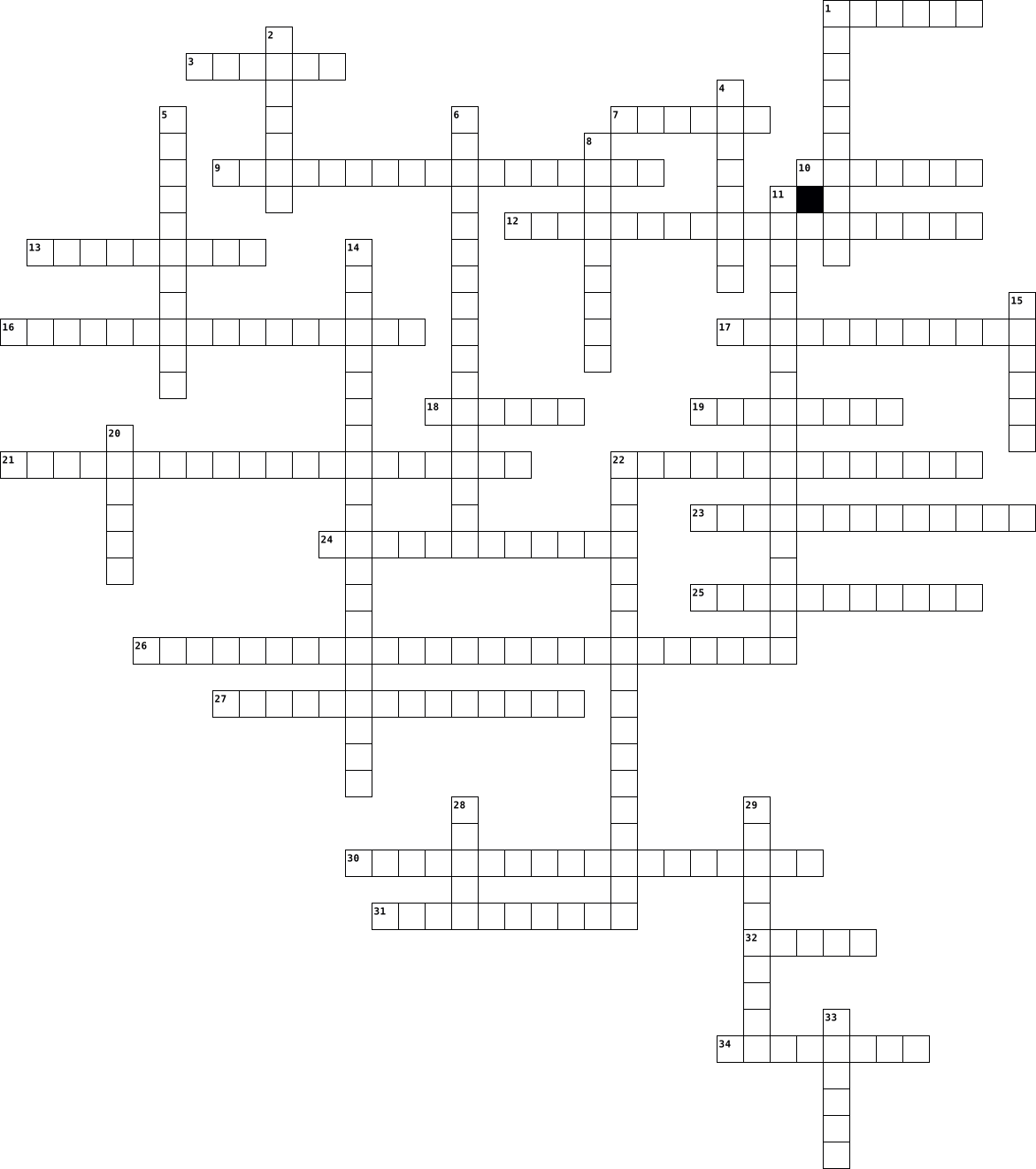
Across
- elegant drawing rooms of the upper class’s urban houses
- child prodigy, gave first concert at age six
- used detailed astronomical data to arrive at his laws of planetary motion
- enlarged Prussian army by recruiting the nobility into civil service
- wrote a collection of knowledge that he edited, “Encyclopedia”
- a universe in which every planet orbits around the earth
- stating that the pressure and volume of a gas have an inverse relationship, when temperature is held constant.
- an egg shaped path of planets around the sun
- means “to let people do what they want”
- Anglican minister who began Methodism
- the most famous philosophe of the later Enlightenment
- a universe in which the planets revolve around the sun
- through this, an entire society agrees to be governed by its general will
- a war that lasted 7 years
- inherited the throne of the Austrian Empire in 1740
- a belief or theory that opinions and actions should be based on reason and knowledge rather than on religious belief or emotional response.
- Isaac Newton’s theory that every object in the universe attracts every other object
- english writer, advanced the strongest statement for the rights of women
- a logical process in which multiple premises, all believed true or found true most of the time, are combined to obtain a specific conclusion
- discovered that we lived in a heliocentric universe
- believed the state should not interfere in economic matters
- philosophe who argued that punishments should not be brutal
Down
- method Francis Bacon process to systematically collect and analyze evidence
- invented a telescope and was the first to make regular observations of outer space
- added to the understanding of human anatomy alongside william harvey
- guy who stated that England’s government had three branches
- ruler of Russia from 1762 to 1796
- said “I think therefore i am”
- war was fought from 1740-1748 in three areas of the world
- in this system rulers tried to govern by Enlightenment principles while maintaining their royal powers
- discovered the laws of motion
- artistic style emphasizing grace, charm and gentle action
- the separation in which the branches limit and control each other in a system of checks and balances
- said every person was born with a tabula rasa or blank mind
- social reformers that talked about all parts of society to make it better
- added to the understanding of human anatomy alongside andreas versalius
36 Clues: a war that lasted 7 years • said “I think therefore i am” • discovered the laws of motion • ruler of Russia from 1762 to 1796 • Anglican minister who began Methodism • means “to let people do what they want” • child prodigy, gave first concert at age six • an egg shaped path of planets around the sun • discovered that we lived in a heliocentric universe • ...
Branches of Science Crossword Puzzle 2014-09-11
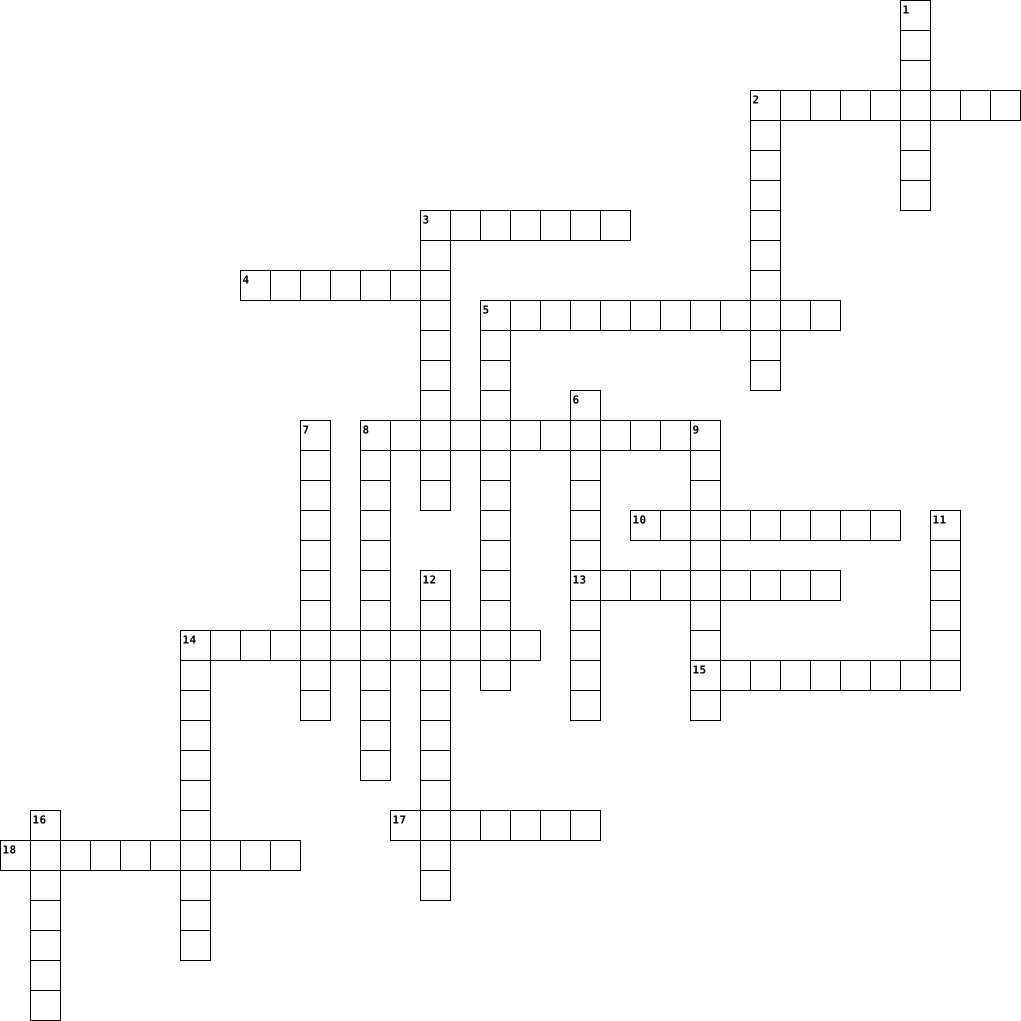
Across
- the science of the causes and effects of diseases, especially the branch of medicine that deals with the laboratory examination of samples of body tissue for diagnostic or forensic purposes.
- the branch of science concerned with the nature and properties of matter and energy.
- the study of living organisms, divided into many specialized fields that cover their morphology, physiology, anatomy, behaviour, origin, and distribution.
- the branch of medicine concerned with the uses, effects, and modes of action of drugs.
- the study of the mechanical laws relating to the movement or structure of living organisms.
- the branch of science which deals with celestial objects, space, and the physical universe as a whole.
- the branch of physics concerned with the properties of sound.
- the branch of science that deals with microorganisms.
- the branch of science concerned with the substances of which matter is composed, the investigation of their properties and reactions, and the use of such reactions to form new substances.
- the scientific study of the behaviour, structure, physiology, classification, and distribution of animals.
- the branch of zoology concerned with the study of insects.
Down
- the branch of biology that deals with the relations of organisms to one another and to their physical surroundings.
- the branch of biology that deals with the normal functions of living organisms and their parts.
- the scientific study of the human mind and its functions, especially those affecting behaviour in a given context.
- the branch of science concerned with fossil animals and plants.
- the abstract science of number, quantity, and space, either as abstract concepts or as applied to other disciplines such as physics and engineering
- the branch of science concerned with earthquakes and related phenomena.
- the branch of science concerned with the chemical and physico-chemical processes and substances which occur within living organisms.
- the practice or science of collecting and analysing numerical data in large quantities, especially for the purpose of inferring proportions in a whole from those in a representative sample.
- the scientific study of the physiology, structure, genetics, ecology, distribution, classification, and economic importance of plants.
- the scientific study of volcanoes.
- the branch of science concerned with the processes and phenomena of the atmosphere, especially as a means of forecasting the weather.
- the branch of science concerned with the bodily structure of humans, animals, and other living organisms, especially as revealed by dissection and the separation of parts.
23 Clues: the scientific study of volcanoes. • the branch of science that deals with microorganisms. • the branch of zoology concerned with the study of insects. • the branch of physics concerned with the properties of sound. • the branch of science concerned with fossil animals and plants. • the branch of science concerned with earthquakes and related phenomena. • ...
The Holistic Dancer 2024-02-13

Across
- Keeping fit can help you prevent coronary heart disease, high blood pressure, obesity, and osteoporosis. It can also help manage diabetes and _________.
- To stay physically fit you need to participate in activities that do three basic things: Get your heart and lungs pumping (aerobic) for 30 minutes or more, Keep your body limber (flexibility), Tone your muscles (strength)
- The study of the principles of mechanics and anatomy in relation to human movement.
- Do a proper warm-up, When doing knee bends (plies) keep the knees over the toes, When doing any kind of jump, start from bent knees (plie’) and land with bent knees (in a plie), Align the spine properly in every exercise, Avoidhyperextendedded back or a forward-thrust pelvis, Make sure shoulders are relaxed and pulled down. Avoid hunching, Cool down.
- Do not require conscious thought
- All dancers need to ingest sufficient energy to meet the rigors of hard training. Consuming the right amounts and types of food and fluid will provide the body with the "high-performance fuel" necessary to achieve optimal training benefits and peak performance.
- Trapezius, Deltoids, Pectorals, Biceps, Abdominals, Obliques, Quadriceps, Gastrocnemius, Trapezius, Triceps, Gluteals, Hamstrings
- With over 600 muscles, 206 bones and countless nerves, ligaments, and tendons in the body, it's almost impossible for dancers to escape getting
Down
- Proper conditioning is vital for the dancer. In order for anyone to efficiently execute a motor task, there must be adequate STRENGTH, FLEXIBILITY, and ENDURANCE. Good posture and ALIGNMENT also allow for the maximum functioning of the body with the expenditure of the least amount of energy.
- Specific problems of the dancer that can cause injuries are: __________, Improper alignment and poor body mechanics, Improper or Inadequate conditioning, Variation of dance techniques
- Skeletal, Smooth, Cardiac, Voluntary, Involuntary
- Ankle, Knee, Hamstring, Back, Hip
- Shape and support, Protect organs, Allows movement, Makes blood cells, Storage for ions, fats, and minerals, and Hormone Regulation
- bands of tough elastic tissue around your joints that connect bone to bone and give your joints support
- The science concerned with the physical structure of animals and plants.
- The _________ provides leverage, the muscles are the motors that act on the levers, and the joints are the fulcrum.
- New dancers must build their strength and _________ slowly and safely.
- Ball-and-socket, Hinge, Pivot, Ellipsoidal.
- Controlled by conscious thought
- Flat, Long, Short, Irregular, Sesamoid
20 Clues: Controlled by conscious thought • Do not require conscious thought • Ankle, Knee, Hamstring, Back, Hip • Flat, Long, Short, Irregular, Sesamoid • Ball-and-socket, Hinge, Pivot, Ellipsoidal. • Skeletal, Smooth, Cardiac, Voluntary, Involuntary • New dancers must build their strength and _________ slowly and safely. • ...
Bio quarter 3 test crossword 2024-02-02

Across
- the rearrangement of DNA sequences by the breakage and rejoining of chromosomes or chromosome segments
- suggests that life on Earth began with a simple RNA molecule that could copy itself without help from other molecules
- when species reproduce many more offspring than can possibly survive
- A mating system in which at least some individuals are more or less likely to mate with individuals of a particular genotype than with individuals of other genotypes
- a mechanism of evolution that works by altering the heritable traits of a population
- symbiosis in which one of the symbiotic organisms lives inside the other.
- symbiotic relationship in which one organism benefits and the other is neither helped or harmed
- diagram depicting patterns of shared characteristics among species
- process by which organisms that are most suited to their environment survive and reproduce most successfully
- change in the genetic material of a cell
- the sum of all biological processes by which particular characteristics are transmitted from parents to their offspring
- sum total of all the different forms of genetic information carried by a particular species, or by all organisms on Earth
- The modern theory of _________ _________ is based on the assumption that on a primitive earth a mixture of simple chemicals assembled into more complex molecular systems, from which, eventually came the first functioning cell(s).
Down
- continued breeding of individuals with similiar characteristics to maintain the derived characteristics of a kind of organism
- difference in DNA among individuals or the differences between populations among the same species.
- the study of similarities and differences in the anatomy of different species
- change over time; the process by which modern organisms have descended from ancient organisms
- difference in DNA among individuals or the differences between populations among the same species.
- classification system in which each species is assigned a two-part scientific name
- It copied the early earth conditions(NO OXYGEN, toxic gases, hot oceanwater, lightning )Inorganic (NON LIVING) compounds transformed into organic building(LIVING) compounds (AMINO ACIDS).Amino acids (proteins) are the buildingblocks of LIFE .
- system of naming and classifying organisms based on shared characteristics and universal rules
- any group of seed plants that bear their seeds within a layer of tissue that protects the seed
- group of anthropoids that include gibbons, orangutans, gorillas, chimpanzees, and humans
- a pattern of behavior in which animals travel from one habitat to another in search of food, better conditions, or reproductive needs
- the movement of genes into or out of a population
25 Clues: change in the genetic material of a cell • the movement of genes into or out of a population • diagram depicting patterns of shared characteristics among species • when species reproduce many more offspring than can possibly survive • symbiosis in which one of the symbiotic organisms lives inside the other. • ...
Unit 1 Lesson 5 Study Guide 2025-10-06

Across
- Invented the first microscope.
- Improved the astronomical telescope, was the first to observe the craters and mountains on the moon, the first to observe four of Jupiter's moons.
- Perfected the single lens microscope, became one of the first people to see cells and bacteria.
- Greek philosopher who believed that the Earth was the center of the universe and other heavenly bodies revolved around it.
- It was used to convert experiments and observations into scientific laws.
- Invented a system for naming chemical elements; considered the founder of modern chemistry.
- Careful, step-by-step process used to confirm findings and to prove or disprove a hypothesis.
- Discovered that arteries carried blood but many of his ideas about human anatomy proved to be wrong.
- Developed an ointment for preventing infections, discovered a better way to seal wounds, and introduced the use of artificial limbs.
- Force that pulls objects in Earth's sphere to the center of the Earth.
- A branch of mathematics in which calculations are made using special symbolic notations.
- Explained that all matter was composed of tiny particles that behaved in knowable ways; explained the effects of temperature and pressure on gases.
Down
- It along with the Reformation encouraged new ways of thinking about the physical world.
- Calculated the orbits of planets revolving around the sun. He proved that planets move in elliptical orbits.
- Described the circulation of the blood through the body.
- Agreed with Aristotle idea about a geocentric model of the universe.
- Contributed to the development of the scientific method; stressed experimentation and observation to find truth.
- Contributed to the development of the scientific method; stressed human reasoning as the best way to find and understand what is true.
- Explained why planets moved as they did around the sun by developing the universal laws of gravitation and contributed to the development of calculus.
- Based on the belief that the sun is the center of the universe.
- Published the first accurate and detailed study of human anatomy.
- Based on the belief that the Earth is the center of the universe.
- His research provided evidence to support Copernicus' theory.
- An unproved theory accepted for the purpose of explaining certain facts or to provide a basis for further investigation.
- Proposed a heliocentric model of the universe.
- Experimented with how liquids behave under pressure; contributed to the development of syringes and the hydraulic press.
- The power of the mind to think, understand, and form judgements by a process of logic.
27 Clues: Invented the first microscope. • Proposed a heliocentric model of the universe. • Described the circulation of the blood through the body. • His research provided evidence to support Copernicus' theory. • Based on the belief that the sun is the center of the universe. • Published the first accurate and detailed study of human anatomy. • ...
leo'crossword 2021-02-08

Across
- Port
- you ever looked inside the box you use every day?
- Card Motherboards often have integrated sound chips.
Down
- ports are much slower than new USB and FireWire ports.
- Of A Computer
5 Clues: Port • Of A Computer • you ever looked inside the box you use every day? • Card Motherboards often have integrated sound chips. • ports are much slower than new USB and FireWire ports.
Evidence for evolution 2022-03-07

Across
- The study of comparing anatomies of different species.
- An organism from which two different organisms have derived from.
- The way species are/were distributed around Earth.
- The __ limb occurs in whales, humans and dogs and is a homologous structure.
Down
- A diagram used to display ancestry.
- A physical feature of two or more species, which may not necessarily serve the same purpose but derived from a common ancestor.
- A physical feature of two or more species, which evolved independently to serve the same purpose.
- The rocks behind fossilization.
- The opposite of an ancestor.
9 Clues: The opposite of an ancestor. • The rocks behind fossilization. • A diagram used to display ancestry. • The way species are/were distributed around Earth. • The study of comparing anatomies of different species. • An organism from which two different organisms have derived from. • The __ limb occurs in whales, humans and dogs and is a homologous structure. • ...
Week 6 Anatomy 2017-04-24

Across
- only muscle attach pelvis, vertebrae and femur
- Inability to extend the knee and loss of cutaneous sensation over the anterior surface of the thigh would indicate a lesion or compression of the:
- In the middle third of the thigh, the superficial and deep femoral arteries are separated by:
- After suffering a penetrating injury in the left femoral triangle, a patient was unable to walk normally because her left knee collapsed into flexion upon weight bearing. The nerve to which muscle was damaged?
Down
- Fibrofatty subcutaneous tissue closing the saphenous opening
- largest seasamoid bone
- Following surgical opening of the adductor canal, a patient experienced a loss of cutaneous sensation of the medial side of the leg. Which nerve was cut?
- muscle that prevent folds of the membrane from being compressed within knee joint
- Common tendinous insertion for gracilis, satorius and semitendinosus muscle
- flat quadrangular muscle
10 Clues: largest seasamoid bone • flat quadrangular muscle • only muscle attach pelvis, vertebrae and femur • Fibrofatty subcutaneous tissue closing the saphenous opening • Common tendinous insertion for gracilis, satorius and semitendinosus muscle • muscle that prevent folds of the membrane from being compressed within knee joint • ...
Plant Anatomy 2 2021-10-19

Across
- food (sugar and amino acids)
- attracts insects for pollunation
- propagation of the plant
- common garden plants
- food manufacture by photosynthesis
Down
- water and minerals
- water (absorbed)
- anchors the plant, helps absorption and food storage
- seed carrying structure
- body, support for branches, passages for food and water
10 Clues: water (absorbed) • water and minerals • common garden plants • seed carrying structure • propagation of the plant • food (sugar and amino acids) • attracts insects for pollunation • food manufacture by photosynthesis • anchors the plant, helps absorption and food storage • body, support for branches, passages for food and water
Plant Anatomy Puzzle 2021-10-29

Across
- thin, branching roots growing from the stem
- How plants make their own food
- the body of a plant
- the stalk connecting a leaf to the stem of a plant
- large, dominant root
Down
- organs of the plant
- Examples include moss and woolywort
- place where plants grow to the desired age
- the practice of garden management
- mixture of organic matter, minerals, gases, liquids, and organisms that together support life
10 Clues: organs of the plant • the body of a plant • large, dominant root • How plants make their own food • the practice of garden management • Examples include moss and woolywort • place where plants grow to the desired age • thin, branching roots growing from the stem • the stalk connecting a leaf to the stem of a plant • ...
Anatomy Eye Vocab 2022-01-13

Across
- During the first 8 min of dark adaptation, light is seen as color
- Integral membrane protein of outer segment membrane
- Left _____ lobe sees right 1/2 of the world
- Color _____ which is the inability to distinguish between certain colors
- Fibers from nasal 1/2 of each retina cross in the optic ____
Down
- Reg, Green, and Blue
- Light ____ which happens when emerging from dark to light
- Rods contain _______
- Derivative of Vitamin A
- Night blindness
10 Clues: Night blindness • Reg, Green, and Blue • Rods contain _______ • Derivative of Vitamin A • Left _____ lobe sees right 1/2 of the world • Integral membrane protein of outer segment membrane • Light ____ which happens when emerging from dark to light • Fibers from nasal 1/2 of each retina cross in the optic ____ • ...
Plant Anatomy 2 2021-12-23

Across
- Protects the plant
- Main root that grows vertically downward
- Slender stalk attached to anther
- Organ that forms the seeds
- Partly undifferentiated cells for plant growth
Down
- Female organ of a flower
- Connects the stigma and the ovary
- Male organ of a flower
- Dense network that is closer to the surface
- Part of the pistil where pollen germinates
10 Clues: Protects the plant • Male organ of a flower • Female organ of a flower • Organ that forms the seeds • Slender stalk attached to anther • Connects the stigma and the ovary • Main root that grows vertically downward • Part of the pistil where pollen germinates • Dense network that is closer to the surface • Partly undifferentiated cells for plant growth
c-section anatomy 2022-09-28

Across
- Moved out of the way from the rest of the surgery
- 7th layer cut and where the baby has grown for 9 months
- Incision made across the bikini line
- Yellow layer
- This layer is spread not cut (2 Words)
Down
- Incision made up and down the lower part of the stomach
- First layer that is cut 4-6 inches wide
- Once this layer is cut, the baby is then delivered (2 Words)
- What is used to cut through different layers
- This is the third layer to be cut and is defined as a fibrous tissue
10 Clues: Yellow layer • Incision made across the bikini line • This layer is spread not cut (2 Words) • First layer that is cut 4-6 inches wide • What is used to cut through different layers • Moved out of the way from the rest of the surgery • Incision made up and down the lower part of the stomach • 7th layer cut and where the baby has grown for 9 months • ...
Topic 1 - Anatomy 2023-12-01

Across
- Thin layer of fibrous elastic tissue surounding a muscle
- Contractile unit of muscle fiber
- Back of the body
- In front of
Down
- A rod-like organelle of a muscle cell
- Elongated contractile cell. that forms the muscles of the body.
- Away from the head
- Prototype of a molecular motor
- Closer to the centre of the body
- A protein thatforms contractile filaments of muscle cells
10 Clues: In front of • Back of the body • Away from the head • Prototype of a molecular motor • Contractile unit of muscle fiber • Closer to the centre of the body • A rod-like organelle of a muscle cell • Thin layer of fibrous elastic tissue surounding a muscle • A protein thatforms contractile filaments of muscle cells • ...
Latin Animal Anatomy 2024-02-06

Across
- saeta
- ala
- pinna
- crista
- rostrum
Down
- unguis
- feather pluma
- squama
- branchiae
- penna
10 Clues: ala • saeta • pinna • penna • unguis • squama • crista • rostrum • branchiae • feather pluma
Know your anatomy? 2019-08-20

Across
- concentrates bile from the liver
- permits the flexion of the lower leg and the extension, relative to the thigh
- pumps blood throughout the body
- secretes acid and enzymes that digest food
Down
- the lens of the eye
- an important part of the immune system where cells are stored
- filters blood coming from the digestive tract
- Muscle that controls the human breathing process
- main organ of balance
- removes waste products/regulates water fluid
10 Clues: the lens of the eye • main organ of balance • pumps blood throughout the body • concentrates bile from the liver • secretes acid and enzymes that digest food • removes waste products/regulates water fluid • filters blood coming from the digestive tract • Muscle that controls the human breathing process • an important part of the immune system where cells are stored • ...
ANATOMY CROSSWORD PUZZLE 2024-08-30

Across
- closer to the side
- what allows the body to stay balanced
- closer to the midline
- the central region of the abdomen
- 1 of the 2 terms that mean toward the back
Down
- what structure do cells contain
- reproductive organs
- the anatomical term meaning below another part
- term used to describe finger
- the anatomical term meaning above another body part
10 Clues: closer to the side • reproductive organs • closer to the midline • term used to describe finger • what structure do cells contain • the central region of the abdomen • what allows the body to stay balanced • 1 of the 2 terms that mean toward the back • the anatomical term meaning below another part • the anatomical term meaning above another body part
Skeletal Muscle Anatomy 2025-01-29

Across
- Occurs when a myosin head links with the actin
- Tiny contractile units within a myofibril
- Actin and Myosin are examples of _____.
- The organelle in which calcium is stored
- The protein filaments within a myofiber is called a ____.
Down
- The plasma membrane of a muscle cell
- Channels in myofibers that aid in signal transmission
- Also known as the "thin filament"
- A bundle of myofibrils make up a _____.
- Also known as the "thick filament"
10 Clues: Also known as the "thin filament" • Also known as the "thick filament" • The plasma membrane of a muscle cell • Actin and Myosin are examples of _____. • A bundle of myofibrils make up a _____. • The organelle in which calcium is stored • Tiny contractile units within a myofibril • Occurs when a myosin head links with the actin • ...
Anatomy Volume 2 2025-03-04

Across
- Primary relay centre for sensory information in the diencephalon.
- Serous membrane lining the abdominal cavity.
- Terminal branch of the internal iliac artery supplying the perineum.
- Extensive venous network surrounding the vertebral column, providing collateral circulation.
Down
- White matter structure connecting the two cerebral hemispheres.
- ____________ is the strongest ligament in the human body, stabilizing the hip joint.
- Largest branch of the abdominal aorta.
- Fibrous structure forming the midline of the abdominal wall.
- Bone forming the posterior part of the hard palate.
- Largest salivary gland located anterior to the ear.
10 Clues: Largest branch of the abdominal aorta. • Serous membrane lining the abdominal cavity. • Bone forming the posterior part of the hard palate. • Largest salivary gland located anterior to the ear. • Fibrous structure forming the midline of the abdominal wall. • White matter structure connecting the two cerebral hemispheres. • ...
Anatomy Volume 1 2025-03-04

Across
- The primary muscle of respiration.
- The largest nerve of the brachial plexus.
- The serous membrane covering the lungs.
- The process of formation of three germ layers during early embryonic development.
Down
- The muscle responsible for the abduction of the shoulder beyond 15 degrees.
- The widest nerve in the human body.
- The primary bone of the arm.
- The artery supplying oxygenated blood to the heart muscle.
- The fetal membrane responsible for nutrient and gas exchange.
- The ligament preventing anterior displacement of the tibia.
10 Clues: The primary bone of the arm. • The primary muscle of respiration. • The widest nerve in the human body. • The serous membrane covering the lungs. • The largest nerve of the brachial plexus. • The artery supplying oxygenated blood to the heart muscle. • The ligament preventing anterior displacement of the tibia. • ...
Anatomy Lymphatic System 2025-05-13

Across
- First line of defense against pathogens?
- Channels carrying lymph?
- Fluid circulating in the lymphatic system?
- Network that helps maintain fluid balance and immunity?
- Swelling caused by fluid accumulation?
Down
- Targeted defense involving antibodies and T cells?
- Force driving water across a membrane?
- Tiny vessels collecting fluid from tissues?
- Carrying towards a center?
- Carrying away from a center?
10 Clues: Channels carrying lymph? • Carrying towards a center? • Carrying away from a center? • Force driving water across a membrane? • Swelling caused by fluid accumulation? • First line of defense against pathogens? • Fluid circulating in the lymphatic system? • Tiny vessels collecting fluid from tissues? • Targeted defense involving antibodies and T cells? • ...
Anatomy and Physiology 2023-03-23

Across
- Positive electrical charge that conducts a nerve impulse.
- Relaxation phase of the heart chambers.
- Type of flexion in the ankle when a dance goes en pointe.
- Widening of veins and venules.
Down
- Move in the oxyhaemoglobin dissociation curve to the right due to acidity.
- Plane that divides the body into left and right.
- Resting HR below 60bpm.
- the capacity of the heart to generate its own impulse.
- Return of blood to the right atria via the veins.
- Part of a joint which reduces friction between tendons and bones.
10 Clues: Resting HR below 60bpm. • Widening of veins and venules. • Relaxation phase of the heart chambers. • Plane that divides the body into left and right. • Return of blood to the right atria via the veins. • the capacity of the heart to generate its own impulse. • Positive electrical charge that conducts a nerve impulse. • ...
Plant Anatomy Roots 2025-03-03

Across
- Parts not visible from the outside
- Many shallow roots
- part of the plant that grows downward
- Parts visible from the outside
Down
- outer layer that carries nutrients down to roots
- inner layer that carries nutrients up to the stem
- Thin and green layer
- Few long roots
- cap, covers and protects the root tip
- Hairs, absorbs extra nutrients and minerals
10 Clues: Few long roots • Many shallow roots • Thin and green layer • Parts visible from the outside • Parts not visible from the outside • cap, covers and protects the root tip • part of the plant that grows downward • Hairs, absorbs extra nutrients and minerals • outer layer that carries nutrients down to roots • inner layer that carries nutrients up to the stem
gross anatomy assignment 2026-01-26

Across
- location of voluntary movement, behavior, learning, personality
- fluid-filled cavity connecting the third and fourth ventricles
- location of auditory processing, language comprehension, and memory formation
- the separation of the frontal and parietal lobes
Down
- location of visual processing
- the largest white matter structure in the brain
- location of integration of sensory information
- bridge between nervous system and endocrine system
- tree of life
- C-shaped cavities containing cerebrospinal fluid (CSF)
10 Clues: tree of life • location of visual processing • location of integration of sensory information • the largest white matter structure in the brain • the separation of the frontal and parietal lobes • bridge between nervous system and endocrine system • C-shaped cavities containing cerebrospinal fluid (CSF) • fluid-filled cavity connecting the third and fourth ventricles • ...
Anatomy of Us 2026-01-22

Across
- The month of our anniversary and the start of our ""new year."""
- "Your ""secret"" talent outside of the hospital wards."
- Our go-to shooter when we’re celebrating.
- The city where our engineering and medicine worlds meet.
- The ""love hormone"" released every time I'm with you."
- The setting of our very first restaurant date.
Down
- My special name for you; I never use your real one.
- Our very first virtual pet name.
- The accessory that looks best around your neck.
- The toughest hurdle of your first year in medicine.
10 Clues: Our very first virtual pet name. • Our go-to shooter when we’re celebrating. • The setting of our very first restaurant date. • The accessory that looks best around your neck. • My special name for you; I never use your real one. • The toughest hurdle of your first year in medicine. • "Your ""secret"" talent outside of the hospital wards." • ...
Stationary sander anatomy 2026-03-31

Across
- serves as a support surface
- rotating belt or band
- removable yellow key,safety interlock
- secures the belt alignment
- rotating circular disc
Down
- adjust and locks work table
- support workpieces
- adjusts the alignment of the sanding belt
- critical safety function
- Primary support structure
10 Clues: support workpieces • rotating belt or band • rotating circular disc • critical safety function • Primary support structure • secures the belt alignment • adjust and locks work table • serves as a support surface • removable yellow key,safety interlock • adjusts the alignment of the sanding belt
Anatomy Of Stationary 2026-03-31

Across
- Adjusts the sanding belt and prevents drifting
- A yellow object that acts as a safety interlock
- A rotating belt or band that's a important object in the stationary table
- Used in conjunction with a tracking dial to ensure the belts remain in the center
- Adjusts and locks the work table
Down
- Used to support angled pieces during sanding operations
- The MOST supportive part in the stationary and could also refer as "Legs"
- safety and functional component that fits across the table
- A rotating object used to apply sanding
- Serves as a support surface to prevent the piece from being pulled during sanding
10 Clues: Adjusts and locks the work table • A rotating object used to apply sanding • Adjusts the sanding belt and prevents drifting • A yellow object that acts as a safety interlock • Used to support angled pieces during sanding operations • safety and functional component that fits across the table • The MOST supportive part in the stationary and could also refer as "Legs" • ...
Body 2025-09-09

Across
- vessel /a tube in the body that blood flows through
- / the human body
Down
- / a body part with a special function
- / a blood vessel that carries blood from the heart
- apple/ the bump in the throat that moves when talking or swallowing
5 Clues: / the human body • / a body part with a special function • / a blood vessel that carries blood from the heart • vessel /a tube in the body that blood flows through • apple/ the bump in the throat that moves when talking or swallowing
Branches of Anthropology 2013-05-29

Across
- Study the anatomy and the behaviours of living primates.
- The in depth description of one culture.
- Study how cultures hace shaped human ideas and learned behaviour study both past and present cultures.
- Type of Anthropology that deals with analyzing human remains, providing information concerning the origin and the identity of a body as well as how and when someone died.
Down
- Study where humans as a species came from.
- Study and comparison of past and contemporary cultures.
- Cultural anthropology of the past, excavate remains of past cultures to reconstruct and understand.
- Study human languages.
- Using knowledge from one culture to help another culture.
9 Clues: Study human languages. • The in depth description of one culture. • Study where humans as a species came from. • Study and comparison of past and contemporary cultures. • Study the anatomy and the behaviours of living primates. • Using knowledge from one culture to help another culture. • ...
Moen, Lina, 6th, Game 2 2024-09-13

Across
- the multidisciplinary study of physical activity or movement
- allows only extension and flexion due to its anatomy
- away from the midline of the body
- the two bones with both concave and convex regions, with the shapes of the two bones complementing each other
- a plane that splits the body into front and back sections
Down
- formed where bones can move about one another in many directions but cannot rotate
- a plane that splits the body into upper and lower sections
- toward the midline of the body
- when one bone has a rounded end that fits into a concave cavity of another bone
- a plane that splits the body into left and right sections
10 Clues: toward the midline of the body • away from the midline of the body • allows only extension and flexion due to its anatomy • a plane that splits the body into left and right sections • a plane that splits the body into front and back sections • a plane that splits the body into upper and lower sections • the multidisciplinary study of physical activity or movement • ...
History of Anatomy 2019-09-25

Across
- Groups of atoms that have joined together
- Groups of cells that have assembled together into layers or masses with the intent to serve a specific function
- Serous membranes that surround the heart
- Thigh
- Breast
Down
- Posterior region between the hip bones
- Sole of the foot
- Cavity that houses the heart, trachea, esophagus, and thymus gland
- Posterior of the knee
- Part is above another part
10 Clues: Thigh • Breast • Sole of the foot • Posterior of the knee • Part is above another part • Posterior region between the hip bones • Serous membranes that surround the heart • Groups of atoms that have joined together • Cavity that houses the heart, trachea, esophagus, and thymus gland • ...
Jess's Anatomy Puzzle 2020-11-18

Across
- A input device used for recording
- A output device that sends a sound out
- A effective storage option,Disc like and small
- A device that transmits data
- A input device used when playing a game
Down
- A Storage option that is small,light and old
- A device used like a photocopier
- A device that can take pictures
- A device connected to a computer, with letters
- A device that prints something onto paper
10 Clues: A device that transmits data • A device that can take pictures • A device used like a photocopier • A input device used for recording • A output device that sends a sound out • A input device used when playing a game • A device that prints something onto paper • A Storage option that is small,light and old • A device connected to a computer, with letters • ...
Cardiovascular System Anatomy 2021-04-14

Across
- the cavity that is surrounded by pericardium that keeps the heart fixed in place.
- Fine branching blood vessels. Involved in the transfer of materials between the blood and tissue cells.
- This is the ventricle that receives deoxygenated blood from the right atrium, then pumps it into the pulmonary trunk.
- The largest artery in the body. Carries oxygenated blood from the left ventricle to other parts of the body.
Down
- This heart valve allows for blood flow from the left atrium to the left ventricle.
- This part of the vena cava carries blood from the head, neck, chest and arms to the heart.
- The blood vessels responsible for carrying blood towards the heart.
- The upper chambers of the heart, comprised of both a right and left chamber.
- This valve on the right side of the heart contains 3 flaps, allowing for blood to flow from the right atrium to the right ventricle.
- A depression on the inferior lobe of the left lung, which is present to accommodate space taken up by the heart.
10 Clues: The blood vessels responsible for carrying blood towards the heart. • The upper chambers of the heart, comprised of both a right and left chamber. • the cavity that is surrounded by pericardium that keeps the heart fixed in place. • This heart valve allows for blood flow from the left atrium to the left ventricle. • ...
Circulatory System Anatomy 2021-04-07

Across
- Blood vessel that connects arteries to capillaries
- Artery that takes oxygenated blood away from the heart
- Blood _____ increases with increasing bulk flow and decreasing summed cross-sectional area
- The phase of the heart when the heart contracts
- Type of vessel that carries deoxygenated blood back to the heart
Down
- Blood vessel where gas exchange occurs. Vessel wall is one cell thick
- Branches from arterioles that allow blood to bypass capillaries when precapillary sphincters constrict
- _____ capillaries have large pores
- The arteries are separated from the ventricles by the _______ valves
- These ensure one way flow through veins by opening and closing
10 Clues: _____ capillaries have large pores • The phase of the heart when the heart contracts • Blood vessel that connects arteries to capillaries • Artery that takes oxygenated blood away from the heart • These ensure one way flow through veins by opening and closing • Type of vessel that carries deoxygenated blood back to the heart • ...
Chapter 4 Anatomy 2023-09-22

Across
- where cellular respiration begins
- small organic molecule
- process in which cells"burn" glucose molecules
- a phase of the cellular respiration
Down
- the break down of lipids,carbohydrates, and proteins
- product of fatty acids and amino acids
- acid _____ cycle where glucose,fats,and protein commonly enter
- the build up of larger molecules from smaller ones
- break down of larger molecules into smaller ones
- final acceptor of electrons of electrons released in reaction of cellular respiration
10 Clues: small organic molecule • where cellular respiration begins • a phase of the cellular respiration • product of fatty acids and amino acids • process in which cells"burn" glucose molecules • break down of larger molecules into smaller ones • the build up of larger molecules from smaller ones • the break down of lipids,carbohydrates, and proteins • ...
anatomy of respiratory 2023-09-30

Across
- pleura that lines the wall of the thorax
- tiny air sacs
- posterior portion of the soft palate that terminates in a projection
- cartilage that forms an anterior projection in the neck called Adam's apple
- cell that produces mucus that traps microorganisms, dust, and other foreign particles
Down
- process that exchange oxygen and carbon dioxide between atmosphere and body cells
- moves air through a series of passages into and out of the lungs
- elastic cartilage that prevents food and water from entering larynx
- portion of the pharynx that is posterior to the oral cavity
- forms the floor of the nasal cavity and separates the nasal cavity from the oral cavity
10 Clues: tiny air sacs • pleura that lines the wall of the thorax • portion of the pharynx that is posterior to the oral cavity • moves air through a series of passages into and out of the lungs • elastic cartilage that prevents food and water from entering larynx • posterior portion of the soft palate that terminates in a projection • ...