
history Crossword Puzzles
history work 2022-02-09

Across
- not interfering with
- separating apart people of different races.
- the use of a arbitrator to settle a fight
- being kept out
- someone that owns and manages a business
- when the supply and demand of something is changed
- becoming more modorn
- the act of keeping someone prisoner to do work
- someone that gives money in return for a part of the buisiness
- a bored game with investing
- a rich banker that was born in the 1870
- a group of people that form a buisiness
- a shop that is not open
- the decreasing of the us dollar
Down
- university
- to add or combine
- railroad that crossed the us
- the total value of goods
- believing in someone
- a compony that buys and sells other companies
- a grant that is given to a person in the form of land
- A very rich person that died during the 1930
- a law that stopes someone from doing a action
- American railroad magnate
24 Clues: university • being kept out • to add or combine • not interfering with • believing in someone • becoming more modorn • a shop that is not open • the total value of goods • American railroad magnate • a bored game with investing • railroad that crossed the us • the decreasing of the us dollar • a rich banker that was born in the 1870 • a group of people that form a buisiness • ...
Medicomp History 2022-11-14

Across
- first dual monitoring device; offers Mobile Cardiac Telemetry and Wireless Event cardiac monitoring in one ambulatory monitor
- VP of Product and Strategy
- Medicomp slogan: Cardiac Monitoring _______; also part of the the new React Dx slogan: Diagnostics _________
- President and CEO
- Medicomp's Maryland office is located in this city
- Medicomp's _______ is to help physicians add quality years to patients’ lives
- Medicomp separated from this company in 2011, making them an independent company
- first Event Monitor with P-Wave analysis for the detection of atrial arrhythmias
- ambulatory MCT monitor provided by MediLynx
- VP of Finance
- the first and only Wireless Event Monitor to offer beat-to-beat analysis of the entire ECG, a patented feature previously unavailable to healthcare
- Senior VP of Operations and Technology
- portal used by both physicians and staff for reviewing and electronically signing reports and enrolling patients
- corporate office is located in this Florida city
Down
- Senior VP of Growth and Development
- first-of-its-kind patch style monitor completely free of wires and cables
- the first mobile cardiac telemetry (MCT) system capable of analyzing rate, rhythm, morphology, and P wave abnormalities
- one of our core values: intense ________ focus
- one of our core values: _________ in all we do
- Medicomp's patented AI algorithm capable of analyzing rate, rhythm, and morphology
- Medicomp's California office is located in this city
- the first event monitor capable of both real-time and continuous looping ECG monitoring
- Medicomp now offers _________ monitoring for cardiac devices such as pacemakers, ICDs, and ILRs
- one of our core values: _______ for our purpose
- one of our core values: undeniable _______
- Senior VP of Clinical Operations
- the first holter in outer space was provided by Medicomp for this Space Station in 1994
- Medicomp is now a division of _________
- the company’s flagship product; proprietary software used to analyze holter and event recordings
- one of our core values: _______ the individual
- multinational clinical trial researching atrial fibrillation
- Medicomp's new name
32 Clues: VP of Finance • President and CEO • Medicomp's new name • VP of Product and Strategy • Senior VP of Clinical Operations • Senior VP of Growth and Development • Senior VP of Operations and Technology • Medicomp is now a division of _________ • one of our core values: undeniable _______ • ambulatory MCT monitor provided by MediLynx • one of our core values: intense ________ focus • ...
History Vocabulary 2022-11-06

Across
- a person who studies the natural world by making observations and doing experiments
- using science to invent new things or to solve problems
- a prehistoric period of time when people made tools, weapons and other objects from stone
- people who get their food by hunting animals and gathering plants
- a roof covering straw or reeds
- the long period of low temperatures when thick ice covered much of the earth
- a tool with a blade for cutting down trees or chopping wood
- pieces of wood floating on the sea or carried by waves onto the shore
- objects made from baked to become hard
- a person who studies past human life, by looking at objects and other evidence.
- people who move from one place to another instead of settling in one place
- woven or knitted cloth
- what something is made of
- exchange one thing for something else
Down
- a large farming tool used to cut through soil
- something where people can use
- a place where people live and make a community
- something important that happens
- a time in the past before people could write
- a place that gives protection from bad weather or danger
- cut to form large ‘steps’ in a hillside
- a black material used for drawing and as fuel for fires
- to teach to live and work with human beings
- a layer of grass and soil held together by grass and plant roots
- a barrier build across a river to hold back water
- one hundred years
- a way of showing events in order of when they happened
27 Clues: one hundred years • woven or knitted cloth • what something is made of • something where people can use • a roof covering straw or reeds • something important that happens • exchange one thing for something else • objects made from baked to become hard • cut to form large ‘steps’ in a hillside • to teach to live and work with human beings • ...
US History 2022-11-04
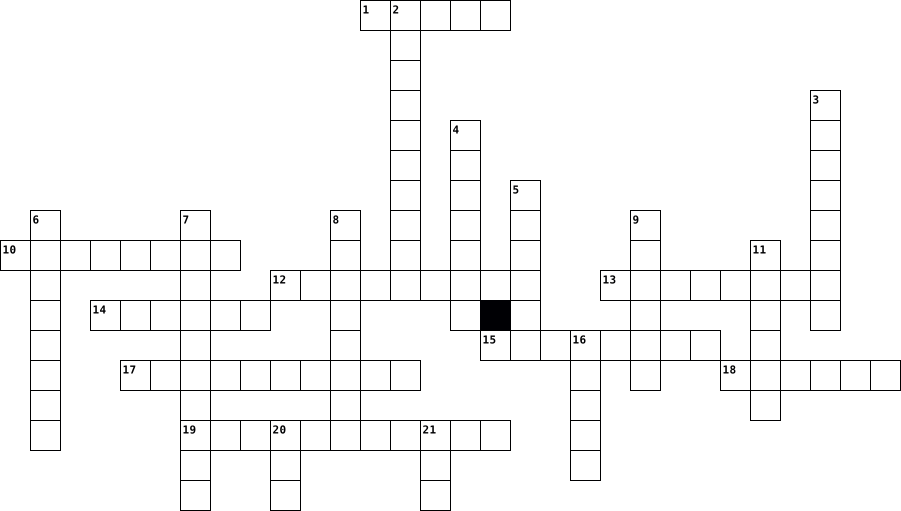
Across
- awakening Spiritual change, people spoke out against their leaders
- The ______ river was crossed by George Washington and his soldiers on Christmas Eve as a part of their "sneak attack"
- The battle of _______ was a very controversial battle in American history
- The battle that ended the war
- This man made an engraving depicting an important moment in history
- Men that were not from Britain who were employed to help fight with the British
- The act that forced colonists to allow soldiers to stay in their houses; colonists had to feed the soldiers
- A bloody massacre that questioned whether British soldiers firing into a crowd was justified
- The _______ congress consisted of representatives who met & made important decisions; these people met twice
Down
- The ______ was a war that lasted 8 years; it was a battle for independence from Great Britain
- The act that raised money to bribe magistrates to remain loyal to Britain
- The sons of ______ were patriot men that believed in independence
- This country became allies with the US & helped fight for America's independence
- A name for British soldiers
- The list of _______ were the offenses that signers of the Declaration declared against King George
- No _______ without representation
- The author of the Declaration was ______
- A pamphlet that supported leaving the rule of Britain
- The act that taxed people on all paper goods
- The act that taxed on all imported ______
- declaration of ________ was one of the most critical documents in American history; it was drafted twice
21 Clues: A name for British soldiers • The battle that ended the war • No _______ without representation • The author of the Declaration was ______ • The act that taxed on all imported ______ • The act that taxed people on all paper goods • A pamphlet that supported leaving the rule of Britain • The sons of ______ were patriot men that believed in independence • ...
US History 2022-11-04
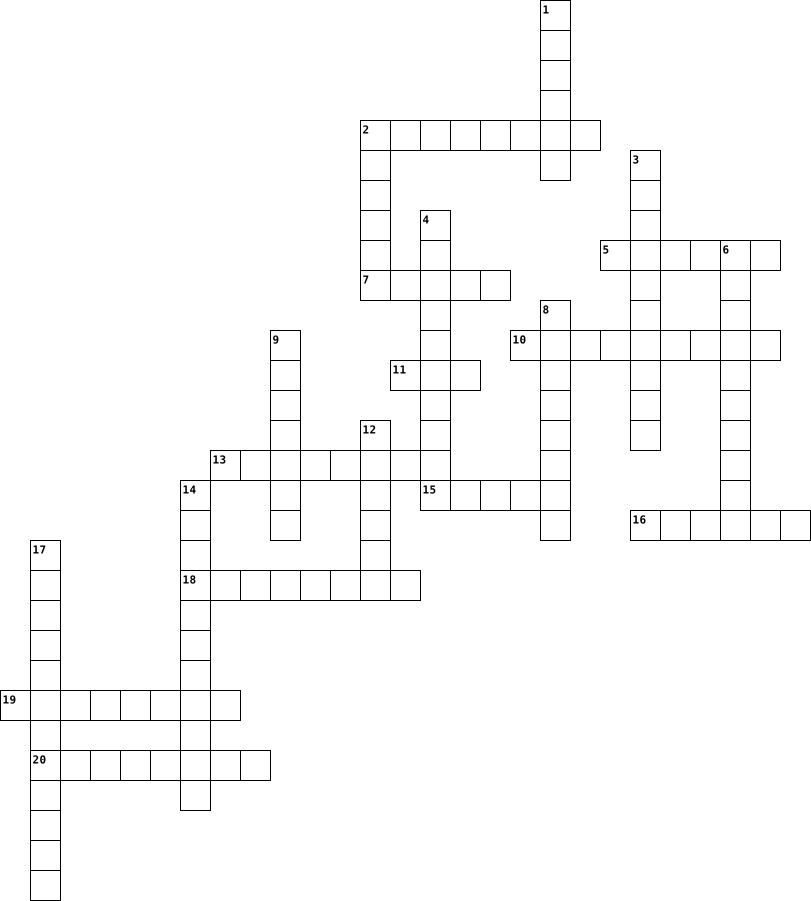
Across
- No _______ without representation
- This man made an engraving depicting an important moment in history
- The act that taxed people on all paper goods
- The battle of _______ was a very controversial battle in American history
- The act that taxed on all imported ______
- The battle that ended the war
- awakening Spiritual change, people spoke out against their leaders
- This country became allies with the US & helped fight for America's independence
- The act that raised money to bribe magistrates to remain loyal to Britain
- Men that were not from Britain who were employed to help fight with the British
- The ______ river was crossed by George Washington and his soldiers on Christmas Eve as a part of their "sneak attack"
Down
- A pamphlet that supported leaving the rule of Britain
- The author of the Declaration was ______
- The list of _______ were the offenses that signers of the Declaration declared against King George
- The act that forced colonists to allow soldiers to stay in their houses; colonists had to feed the soldiers
- The ______ was a war that lasted 8 years; it was a battle for independence from Great Britain
- A name for British soldiers
- The sons of ______ were patriot men that believed in independence
- A bloody massacre that questioned whether British soldiers firing into a crowd was justified
- The _______ congress consisted of representatives who met & made important decisions; these people met twice
- The declaration of ________ was one of the most critical documents in American history; it was drafted twice
21 Clues: A name for British soldiers • The battle that ended the war • No _______ without representation • The author of the Declaration was ______ • The act that taxed on all imported ______ • The act that taxed people on all paper goods • A pamphlet that supported leaving the rule of Britain • The sons of ______ were patriot men that believed in independence • ...
History Vocabulary 2022-11-07

Across
- theory that opinions and actions should be based on reason
- Empress of Russia
- advocated the use of reason in the reappraisal of accepted ideas and social institutions
- social gatherings
- earth is center of universe
- belief in the existence of a supreme being
- english philosopher opposed Divine Right
- French philosopher and writer whose works epitomize the Age of Enlightenment
- early feminist who denied male supremacy
- major change in European thought starting in the mid-1500s
- Absolute ruler who used power to social change
Down
- overly decorated
- believed that society threatened natural rights and freedoms
- voluntary agreement among individuals to secure their rights
- series of steps followed to solve problems
- British scientist who defined the laws of motion
- one of a group of social thinkers in France
- Major Western artistic style from 1600s to 1800s.
- idea of planets revolve around sun
- Italian astronomer
- French political philosopher
21 Clues: overly decorated • Empress of Russia • social gatherings • Italian astronomer • earth is center of universe • French political philosopher • idea of planets revolve around sun • english philosopher opposed Divine Right • early feminist who denied male supremacy • series of steps followed to solve problems • belief in the existence of a supreme being • ...
History Puzzle 2022-09-28

Across
- A cheap way to mass produce steel
- Resources needed to produce goods & services
- Toll Roads
- A way to connect two manufacturing cities
- Arkwright's invention that got power from streams
- Doubled the work speed of the weaver
- A way to transport goods against water current
- A scientific method of farming
- Division in large fields
- Jethro Tull's seed sowing tool
Down
- Process of paving
- Made thread stronger and finer
- Eli Whitney's invention to de-seed cotton
- Cartwright's invention- sped up weaving
- Buildings built by wealthy textile merchants
- Machine production of goods
- Improved efficiency of the Engine
- A person who organizes, manages and takes risks
- Invented by the Hargreaves and named for his daughter
- combined power for spinning jenny and water frame
20 Clues: Toll Roads • Process of paving • Division in large fields • Machine production of goods • Made thread stronger and finer • A scientific method of farming • Jethro Tull's seed sowing tool • A cheap way to mass produce steel • Improved efficiency of the Engine • Doubled the work speed of the weaver • Cartwright's invention- sped up weaving • Eli Whitney's invention to de-seed cotton • ...
History Crossword 2022-09-30

Across
- the power to decide whether laws are constitutional and to strike down those that are not
- citizens of each new territory made when mexico went into Annexation should be allowed to decide for themselves if they wanted to permit slavery
- Led settlers in Northern California
- Maryland’s attempt to tax the Baltimore branch of the Second Bank of the United States
- taking their states out of the Union
- Gave the idea of Nullification
- the idea that “neither slavery nor involuntary servitude shall ever exist.” in any territory the United States gained from Mexico
- the practice of appointing people to government jobs based on party loyalty and support
- 2,000 Cherokee died of starvation, disease, and exposure while being forced out of their home
- the idea that the nation was meant to spread to the Pacific
- military rule
- the powers specifically mentioned in the Constitution
- taking their states out of the Union
- absorption by the United States
Down
- powers not explicitly listed in the Constitution but necessary for the government to do its job
- party led by former National Republicans against Andrew Jackson
- A form of national currency made in 1860
- the first 10 amendments to the Constitution
- forcing people through a draft into military service
- began a campaign to seize control of the Cumberland and Tennessee Rivers
- the individuals who would head the executive departments
- official order to do something
- the wearing down of one side by the other through exhaustion of soldiers and resources
- to choose the party’s nominee
- withdraw
25 Clues: withdraw • military rule • to choose the party’s nominee • Gave the idea of Nullification • official order to do something • absorption by the United States • Led settlers in Northern California • taking their states out of the Union • taking their states out of the Union • A form of national currency made in 1860 • the first 10 amendments to the Constitution • ...
History homework 2022-10-12

Across
- The separation of religion from civic affairs snd the state
- Rebirth
- Painter/ sculptures were famous
- Technique that gives artwork depth/persision
- Common everyday language
- Challenged corruption in the church
- A deadly disease
- A focus on the individual
- guide to gain/ maintain power
Down
- Struggle between England and France
- Were Patrons
- Reknown Playright
- The Prince
- Artist, scientist, and Inventor
- German renaissance artist
- Wanted Local/economic reform an ideal
- Mocked romantic notions of chivalry
- Wealthy Merchants that supported the arts
- startled the library of classical manuscripts; wrote sonnnets to Laura
- Creator of school of Athens
20 Clues: Rebirth • The Prince • Were Patrons • A deadly disease • Reknown Playright • Common everyday language • German renaissance artist • A focus on the individual • Creator of school of Athens • guide to gain/ maintain power • Artist, scientist, and Inventor • Painter/ sculptures were famous • Struggle between England and France • Mocked romantic notions of chivalry • ...
Natural History 2022-10-11

Across
- substances that are formed naturally in the Earth
- of the five kingdoms of life, these use photosynthesis and don't move around
- the study of any living plant or animal in the sea
- the study of matter, and all forces and their effects
- cold blooded vertebrates that that live on land after they hatch and grow in water, but some always live in water
- something made or given shape by humans, such as a tool or a work of art of general archaeological interest
- space rock that has reached Earth's surface
- branch of science that deals with chemical elements and compounds
- explains movement of the Earth's lithosphere (crust and upper mantle)
- a naturally occurring solid made of crystallized minerals or other mineral-like substances
- animal that does not have a spinal column or backbone
- the study of how people lived in the past
- the study of everything outside the atmosphere of Earth
- an animal with a spinal cord surrounded by cartilage or bone
- the study of the nonliving things that the Earth is made of
- the science that focuses on the Earth's atmosphere
- rock that has been changed
- the remains or trace of an ancient living thing
Down
- the study of human beings
- vertebrates that are cold blooded, have scaly skin and lay eggs and live on land
- the study of plants
- also called "marine science"
- vertebrates that are warm blooded, have feathers, wings, and lay eggs
- the science of insects
- the study of fossils of living things, and their evolutionary relationships
- rock that has been made from sediment
- the study of animals
- vertebrates that live and breathe underwater with gills, most have scales, lay eggs and are also cold blooded
- may also be called "geoscience"
- the study of the Earth and its features, its inhabitants, and its phenomena
- studies weather conditions averaged over a period of time
- the science of life and living things
- vertebrates that give live birth, and produce milk for their young
- rock that has been made by volcanic action
- complex, with many eukaryotic cells, do not use sunlight to make food
35 Clues: the study of plants • the study of animals • the science of insects • the study of human beings • rock that has been changed • also called "marine science" • may also be called "geoscience" • rock that has been made from sediment • the science of life and living things • the study of how people lived in the past • rock that has been made by volcanic action • ...
Dalma - History 2022-11-10

Across
- írnok
- birodalom
- kötözőszer
- pap
- hinni
- bútor
- balzsamozni
- templom
- tégla
- puskapor
Down
- öntözés
- rovásírás
- hieroglifa
- rabszolga
- előkelő
- ékszer
- kerék
- kereskedő
- törvénykönyv
- eltemetni
20 Clues: pap • írnok • hinni • bútor • kerék • tégla • ékszer • öntözés • előkelő • templom • puskapor • rovásírás • birodalom • rabszolga • kereskedő • eltemetni • hieroglifa • kötözőszer • balzsamozni • törvénykönyv
history crossword 2022-11-30

Across
- large area of land
- original people
- a forcible overthrow of a government
- entitled to these because our founding fathers
- escaping the British
- live in the united states
- very powerful city/country
- fuzzy shoe
- not conservative
Down
- the pilgrims came over on this
- not liberal
- what happened in the past
- dry space
- group of people
- drinkable
- forced to do chores with no pay
- fighting
- before the pilgrims
- group people of one nationality living foreign
- type of religion
20 Clues: fighting • dry space • drinkable • fuzzy shoe • not liberal • original people • group of people • type of religion • not conservative • large area of land • before the pilgrims • escaping the British • what happened in the past • live in the united states • very powerful city/country • the pilgrims came over on this • forced to do chores with no pay • a forcible overthrow of a government • ...
U.S. History 2021-03-25

Across
- by 1830 the average word day in a factory was ____ hours
- means different
- two of the "hidden" expenses paid for out of salaries
- Am. Author who concluded America had many differences in the 1830s.
- this type of power eventually replaced hydro
- "textile ____" took the raw material cotton and produced a finished good
- one special day of the week when factories were closed
- simple tasks requiring no skills....children performed these jobs in factories
- ability to take care of oneself
- by the 1840s the Massachusetts Factory System disappeared b/c _____ took jobs for less pay.
Down
- word identifying language, religion, government and even foods eaten
- organizations that attempt to protect workers who join
- tax on imported goods
- agreements between factory owners and workers....signed documents
- rooms women stayed in....very clean but also crowded
- phrase identifying the time a raw material is turned into a good ready to be sold
- first factory town created in 1824 Massachusetts
- "_______ balance" refers to an equal number of free and slave
- created america's first factory in the 1790s
- "women had to avoid their ____ getting caught in all the moving parts"
20 Clues: means different • tax on imported goods • ability to take care of oneself • this type of power eventually replaced hydro • created america's first factory in the 1790s • first factory town created in 1824 Massachusetts • rooms women stayed in....very clean but also crowded • two of the "hidden" expenses paid for out of salaries • ...
Ancient History 2021-06-08

Across
- a government in which the ruling power is in the hands of one person
- a large Roman stadium primarily used for chariot races
- in Rome, the name for the common people
- period of prosperity, happiness, and achievement
- 2 million years ago-8000 BCE
- a person trained to fight for public entertainment
- a settlement under the control of a usually distant country
- a government in which power is held by the people, who exercise power directly or through elected representatives
- a network of trade routes that stretched for more than four thousand miles across Asia
- having to do with the community
- studying of human development
- belief that there are many gods
- a 200-year period of peace and stability established and maintained by the Roman Empire
- ruler of ancient Egypt
- a city-state of ancient Greece that was the first to have a democracy; also known as the birthplace of Western civilization; the capital of present-day Greece
- the new stone age 8000-3000 BCE
Down
- leaders are elected to represent people
- the concept that there is a universal order built into nature that can guide moral thinking
- a set of basic laws
- in Rome, a member of upper classmen
- large territory where many groups of people are ruled by one leader or one government
- symbol used in the system of writing from 3000 BCE
- a great flowering of culture based on classical Greek and Roman ideas that began in Italy around 1300 and spread throughout Europe
- a ruler with absolute power
- belief that there is one God
- studying the past by examining objects
- the group of gods worshipped in a religion
27 Clues: a set of basic laws • ruler of ancient Egypt • a ruler with absolute power • 2 million years ago-8000 BCE • belief that there is one God • studying of human development • having to do with the community • belief that there are many gods • the new stone age 8000-3000 BCE • in Rome, a member of upper classmen • studying the past by examining objects • ...
World History 2021-07-15

Across
- Germany and Italy and Japan
- fought for Independence,Mexico's 1st President
- Giving in to an aggressor to keep peace
- Police power in Western Hemisphere
- Wartime Prime Minister of England
- Lively music with loose beat born in the U S
- author of the Theory of Relativity
- Fascist General who lead a revolt against Spain's Government
- Art that sought to link dreams to Real life
- Robin Hood of Mexico
- Leader and Symbol of Mexican Independence
- called the irrational part of the mind the Unconscious
Down
- US joins Cuban war for Independence
- Belief that political ties to other nations be avoided
- Declaration by U S and England that became Allies Peace Plan
- French leader with Government in Exile
- Cuban Exile who helped Cuban Independence
- Italian leader who ordered Invasion of Ethiopia in 1935
- Europe to back away from Latin America
- General whose battle cry was Land and Liberty
- Built by US and finished in 1914
- German Leader who planned the Third Reich or German Empire
- First man to fly solo over the Atlantic Ocean
- took control of Mexico by ousting President Juarez
- developed Philosophy known as Existentialism
- Germany's military strategy
26 Clues: Robin Hood of Mexico • Germany and Italy and Japan • Germany's military strategy • Built by US and finished in 1914 • Wartime Prime Minister of England • Police power in Western Hemisphere • author of the Theory of Relativity • US joins Cuban war for Independence • French leader with Government in Exile • Europe to back away from Latin America • ...
THE HISTORY 2021-08-07

Across
- Appointed as Assistant Pastor
- Number who attended first Sunday School class
- Couple who worked together in 2 ministries
- First choir director
- "The King's business requires haste"
- He had the burden and vision
- First Ghanaian member
- Gave initial oversight to Sunday school
- The second caretaker
- The month Sunday school started
- Interim pastor
- Pioneered the Media Ministry
Down
- The first baptizer
- One of the first counsellors
- First head usher
- One of first three deacons
- Middle name of a leader
- Mother church
- Pastors a daughter work
- First minister ordained as an elder
20 Clues: Mother church • Interim pastor • First head usher • The first baptizer • First choir director • The second caretaker • First Ghanaian member • Middle name of a leader • Pastors a daughter work • One of first three deacons • One of the first counsellors • He had the burden and vision • Pioneered the Media Ministry • Appointed as Assistant Pastor • The month Sunday school started • ...
Texas History 2021-05-03

Across
- In the first battle of the Texas Revolution, Mexicans came to take back cannon, Texans waved a flag that said "come and get it", Mexicans retreated
- a person in charge of horses or other livestock on a ranch
- A limited portion or allowance of food or goods; limitation of use of a certain food
- prejudice, discrimination, or antagonism directed against someone of a different race based on the belief that one's own race is superior
- The Northern States during the Civil War
- Time after the Civil War where the South was brought back in the United States
- First to step on Texas
- Father of Texas
- Statistical data relating to the population and particular groups within it.
Down
- A person who wants to improve society
- Love for one's country
- Separate by race
- People aligning themselves more with the region of the country they live in rather than the nation as a whole
- Growing crops and animals
- Capital of Texas
- Attacked by the Mexican Army and had the same fate as the Alamo (defeated). The Mexicans executed most of the force after it had surrendered in 1836
- a government official or representative in charge of a department or district individuals
- To stop separating groups of people by race, religion, or ethnicity
- A Spanish mission converted into a fort, it was besieged by Mexican troops in 1836. The Texas garrison held out for thirteen days, but in the final battle, all of the Texans were killed by the larger Mexican force.
- pieces of companies sold off to investors hoping to make a profit
20 Clues: Father of Texas • Separate by race • Capital of Texas • Love for one's country • First to step on Texas • Growing crops and animals • A person who wants to improve society • The Northern States during the Civil War • a person in charge of horses or other livestock on a ranch • pieces of companies sold off to investors hoping to make a profit • ...
History Crossword 2021-05-04

Across
- A time alcohol was illegal in the U.S.
- A turning point in the war, in which the allies tricked the axis powers with movie props.
- Low _____ is a sign of a good economy.
- Two nights of terror against the Jewish population.
- Homeless American's moved into these during the great depression.
- This 1920s dance has a candy named after it.
- This new WW1 weapon could shoot flames.
- This was where a group of renowned black soldiers trained to be airmen for WW2.
- This country tried to appease Hitler by giving him a piece of Czechoslovakia.
- This country did not join the League of Nations.
Down
- These were times of panic, in which citizens would all try to take their savings out of the banks at once.
- A new program that President FDR initiated, in which he would talk directly to America through the radio.
- This car was very affordable during the 1920s.
- A group of socialist union workers.
- The denial of the hierarchy.
- This tariff placed a large tax on goods that came to America from overseas.
- This New York neighborhood's renaissance was a time of self-expression for black Americans, and was considered a time of rebirth for African-American pride.
- The first Japanese city that America dropped an atomic bomb on.
- The autobiography that should've been a warning sign of WW2.
- This assassination was one cause of WW1.
- The idea that one's country is superior.
- A quick, forceful attack method
- The ___ bowl was an area within the United States that was affected by ruined soil.
- This country was blamed for starting the war, and was given harsh punishment.
- The sinking of this ship caused America to join the war.
25 Clues: The denial of the hierarchy. • A quick, forceful attack method • A group of socialist union workers. • A time alcohol was illegal in the U.S. • Low _____ is a sign of a good economy. • This new WW1 weapon could shoot flames. • This assassination was one cause of WW1. • The idea that one's country is superior. • This 1920s dance has a candy named after it. • ...
Roman History 2021-04-27

Across
- Leader of Romans during 2nd Punic war
- Julius vs. Pompey
- Octavian vs. Marc Antony
- Who organized the first Roman professional army?
- Who becomes the 1st Emperor of Rome?
- What was Augustus' reign called?
- The order in which offices must be held
Down
- Carthaginian leader in the 2nd Punic war
- What does Alea iacta est mean?
- Last pharaoh of Egypt
- Highest public official during the republic
- Who fought for the poor?
- Who was murdered by the senate and a great general?
- A group of three men who led during the end of the republic
- What Roman event happened in 753 BC?
- Caesar’s military campaign
- Who is the famous orator who spoke against Caesar?
- Who was Caesar’s right hand man and was in the 2nd triumvirate?
- Who engaged in a civil war against Caesar and fled to Egypt?
- Wars between Roman and Carthage
20 Clues: Julius vs. Pompey • Last pharaoh of Egypt • Who fought for the poor? • Octavian vs. Marc Antony • Caesar’s military campaign • What does Alea iacta est mean? • Wars between Roman and Carthage • What was Augustus' reign called? • What Roman event happened in 753 BC? • Who becomes the 1st Emperor of Rome? • Leader of Romans during 2nd Punic war • ...
History/Civilisations 2021-02-19

Across
- öncelikle
- hanedan
- ele geçirmek
- teslim
- karşılıklı
- bildirildiğine göre
- yerli
- tanrılaştırılmış
- yüzleşme
Down
- sınır
- gizlice anlaşmak
- ateşkes
- müttefik
- kölelik
- istila
- geri çekilmek
- göze çarpan
- birlik
- yasama
- sayım
- kabile
21 Clues: sınır • yerli • sayım • istila • teslim • birlik • yasama • kabile • ateşkes • kölelik • hanedan • müttefik • yüzleşme • öncelikle • karşılıklı • göze çarpan • ele geçirmek • geri çekilmek • gizlice anlaşmak • tanrılaştırılmış • bildirildiğine göre
History project 2021-02-22

Across
- (last name)invented movable type
- wrote important articles on government
- what city is famous for its art,canals, and buildings
- what country did the renaissance start
- the greatest play writer of all times
- painted pictures of Mary
- what family was the most famous sponsor of art in the renaissance
- Middle Ages music
- created 3D paintings
Down
- added movement to paintings
- one of Shakespeares plays
- father of humanism
- painted the Mona Lisa
- father of Renaissance panting
- sixteen chapel
- wrote Don Quixote satire on chivalry
- focus on man’s abilities and capacities
- music was more worldly
- pointed out the evil and folly of the renaissance in society
- what are sponsors of an artist called
20 Clues: sixteen chapel • Middle Ages music • father of humanism • created 3D paintings • painted the Mona Lisa • music was more worldly • painted pictures of Mary • one of Shakespeares plays • added movement to paintings • father of Renaissance panting • (last name)invented movable type • wrote Don Quixote satire on chivalry • what are sponsors of an artist called • ...
History project 2021-02-22

Across
- what country did the renaissance start
- wrote Don Quixote satire on chivalry
- one of Shakespeares plays
- painted the Mona Lisa
- Middle Ages music
- created 3D paintings
- music was more worldly
- painted pictures of Mary
- what family was the most famous sponsor of art in the renaissance
Down
- added movement to paintings
- what are sponsors of an artist called
- (last name)invented movable type
- father of humanism
- sixteen chapel
- what city is famous for its art,canals, and buildings
- wrote important articles on government
- the greatest play writer of all times
- focus on man’s abilities and capacities
- pointed out the evil and folly of the renaissance in society
- father of Renaissance panting
20 Clues: sixteen chapel • Middle Ages music • father of humanism • created 3D paintings • painted the Mona Lisa • music was more worldly • painted pictures of Mary • one of Shakespeares plays • added movement to paintings • father of Renaissance panting • (last name)invented movable type • wrote Don Quixote satire on chivalry • what are sponsors of an artist called • ...
Holt History 2021-02-20

Across
- swimming away
- county
- mountain to east
- old family friends
- hamlet
- our city of birth
- husband of regina
- the horse
- green mountain state
Down
- gigantic cement wall
- three generations
- Guy's
- sunset mountain
- dyed her hair with coffee
- biggest in county
- swimming hole
- first Holt lt. col at W.P.
- familiar grandfather's name
- guy's brother
- familiar grandmother's name
20 Clues: Guy's • county • hamlet • the horse • swimming away • swimming hole • guy's brother • sunset mountain • mountain to east • three generations • biggest in county • our city of birth • husband of regina • old family friends • gigantic cement wall • green mountain state • dyed her hair with coffee • first Holt lt. col at W.P. • familiar grandfather's name • familiar grandmother's name
Geological History 2021-02-22

Across
- compare ages of rock to other rocks around
- slow change of living things over time
- theory of origin of universe-13.7bya
- hallow area in sediment
- supercontinent
- preserved remains or traces of living things
- covers 88% of earth history
- break in the earth's crust
- at least 50% of the species die out in a short amount of time
- solid copy of the shape of the organism
Down
- lava hardens on the surface
- 1.3 billion years-dates old things
- exact number of years since rock was formed
- record of life forms and geological events in Earth’s history
- represents a type of organism that only lived briefly
- lave cools beneath the surface
- minerals fill in spaces and preserve it
- information gathered about organisms past life
- studies fossils and classifies them
- hard-shelled animals that make great index fossils
20 Clues: supercontinent • hallow area in sediment • break in the earth's crust • lava hardens on the surface • covers 88% of earth history • lave cools beneath the surface • 1.3 billion years-dates old things • studies fossils and classifies them • theory of origin of universe-13.7bya • slow change of living things over time • minerals fill in spaces and preserve it • ...
world history 2022-10-26

Across
- a male ruler of a small independent state.
- an object surviving from an earlier time, especially one of historical or sentimental interest.
- the medieval knightly system with its religious, moral, and social code.
- a sporting event in which two knights (or two groups of knights) jousted on horseback with blunted weapons, each trying to knock the other off, the winner receiving a prize.
- the action of buying and selling goods and services.
- system was the combination of the legal, economic, military, and cultural customs that flourished in medieval Europe between the 9th and 15th centuries
- a country, state, or territory ruled by a king or queen.
- each of a series of medieval military expeditions made by Europeans to recover the Holy Land from the Muslims in the 11th, 12th, and 13th centuries.
- an agricultural laborer bound under the feudal system to work on his lord's estate.
- a defensive wall of a castle or walled city, having a broad top with a walkway and typically a stone parapet.
- a bridge, especially one over a castle's moat, that is hinged at one end so that it may be raised to prevent people's crossing or to allow vessels to pass under it.
- a professional joker or “fool” at a medieval court, typically wearing a cap with bells on it and carrying a mock scepter.
- a member of a religious community of men typically living under vows of poverty, chastity, and obedience.
- the body of all people ordained for religious duties, especially in the Christian Church.
- someone or something having power, authority, or influence; a master or ruler.
- a compulsory contribution to state revenue, levied by the government on workers' income and business profits, or added to the cost of some goods, services, and transactions.
- belonging to a hereditary class with high social or political status; aristocratic.
- the male ruler of an independent state, especially one who inherits the position by right of birth.
- pre industrial agricultural laborer or a farmer with limited land ownership
- a type of fortified tower built within castles during the Middle Ages by European nobility.
Down
- a person or company involved in wholesale trade, especially one dealing with foreign countries or supplying merchandise to a particular trade.
- the system by which coats of arms and other armorial bearings are devised, described, and regulated.
- a large country house with lands; the principal house of a landed estate.
- a sovereign head of state, especially a king, queen, or emperor.
- an estate of land, especially one held on condition of feudal service.
- a deep, wide ditch surrounding a castle, fort, or town, typically filled with water and intended as a defense against attack.
- the principal church of a diocese, with which the bishop is officially associated.
- a holder of land by feudal tenure on conditions of homage and allegiance.
- the female ruler of an independent state, especially one who inherits the position by right of birth.
- a large building, typically of the medieval period, fortified against attack with thick walls, battlements, towers, and in many cases a moat.
- a man who served his sovereign or lord as a mounted soldier in armor.
- The daughter of a monarch
- the son of a monarch
- a member of a religious community of women, especially a cloistered one, living under vows of poverty, chastity, and obedience.
34 Clues: the son of a monarch • The daughter of a monarch • a male ruler of a small independent state. • the action of buying and selling goods and services. • a country, state, or territory ruled by a king or queen. • a sovereign head of state, especially a king, queen, or emperor. • a man who served his sovereign or lord as a mounted soldier in armor. • ...
world history 2022-10-26

Across
- a male ruler of a small independent state.
- an object surviving from an earlier time, especially one of historical or sentimental interest.
- the medieval knightly system with its religious, moral, and social code.
- a sporting event in which two knights (or two groups of knights) jousted on horseback with blunted weapons, each trying to knock the other off, the winner receiving a prize.
- the action of buying and selling goods and services.
- system was the combination of the legal, economic, military, and cultural customs that flourished in medieval Europe between the 9th and 15th centuries
- a country, state, or territory ruled by a king or queen.
- each of a series of medieval military expeditions made by Europeans to recover the Holy Land from the Muslims in the 11th, 12th, and 13th centuries.
- an agricultural laborer bound under the feudal system to work on his lord's estate.
- a defensive wall of a castle or walled city, having a broad top with a walkway and typically a stone parapet.
- a bridge, especially one over a castle's moat, that is hinged at one end so that it may be raised to prevent people's crossing or to allow vessels to pass under it.
- a professional joker or “fool” at a medieval court, typically wearing a cap with bells on it and carrying a mock scepter.
- a member of a religious community of men typically living under vows of poverty, chastity, and obedience.
- the body of all people ordained for religious duties, especially in the Christian Church.
- someone or something having power, authority, or influence; a master or ruler.
- a compulsory contribution to state revenue, levied by the government on workers' income and business profits, or added to the cost of some goods, services, and transactions.
- belonging to a hereditary class with high social or political status; aristocratic.
- the male ruler of an independent state, especially one who inherits the position by right of birth.
- pre industrial agricultural laborer or a farmer with limited land ownership
- a type of fortified tower built within castles during the Middle Ages by European nobility.
Down
- a person or company involved in wholesale trade, especially one dealing with foreign countries or supplying merchandise to a particular trade.
- the system by which coats of arms and other armorial bearings are devised, described, and regulated.
- a large country house with lands; the principal house of a landed estate.
- a sovereign head of state, especially a king, queen, or emperor.
- an estate of land, especially one held on condition of feudal service.
- a deep, wide ditch surrounding a castle, fort, or town, typically filled with water and intended as a defense against attack.
- the principal church of a diocese, with which the bishop is officially associated.
- a holder of land by feudal tenure on conditions of homage and allegiance.
- the female ruler of an independent state, especially one who inherits the position by right of birth.
- a large building, typically of the medieval period, fortified against attack with thick walls, battlements, towers, and in many cases a moat.
- a man who served his sovereign or lord as a mounted soldier in armor.
- The daughter of a monarch
- the son of a monarch
- a member of a religious community of women, especially a cloistered one, living under vows of poverty, chastity, and obedience.
34 Clues: the son of a monarch • The daughter of a monarch • a male ruler of a small independent state. • the action of buying and selling goods and services. • a country, state, or territory ruled by a king or queen. • a sovereign head of state, especially a king, queen, or emperor. • a man who served his sovereign or lord as a mounted soldier in armor. • ...
world history 2022-10-26

Across
- a depression surrounding a castle, city wall, or other fortification, usually but not always filled with water
- a woman who vows to dedicate her life to religious service, typically living under vows of poverty, chastity, and obedience in the enclosure of a monastery or convent
- man who separates himself from society and lives either alone (a hermit or anchorite) or in an organized community in order to devote himself full time to religious life
- usually comprised of tracts of agricultural land, a village whose inhabitants worked that land, and a manor house where the lord who owned or controlled the estate lived
- an un-free person, esp one bound to the land
- a female member of a royal family, usually the daughter of a king or queen or the wife of a prince
- a church that contains the cathedral (Latin for 'seat') of a bishop
- medieval stronghold, generally the residence of the king or lord of the territory in which it stands
- the transfer of goods and services from one person or entity to another, often in exchange for money
- the rural poor, rural residents, serfs, agricultural laborers, and the “common” or. “simple” people
- one invested with a fief in return for services to an overlord
- a piece of land that is ruled by a king or a queen
- The wife or widow of a king
- anyone who is involved in business or trade
- the sovereign ruler of a small state in Continental Europe called a duchy
- a surviving memorial of something past
- a supreme ruler, sovereign over a nation or a territory, of higher rank than any other secular ruler except an emperor, to whom a king may be subject
- the science and the art that deal with the use, display, and regulation of hereditary symbols employed to distinguish individuals, armies, institutions, and corporations
- a series of religious wars between Christians and Muslims started primarily to secure control of holy sites considered sacred by both groups
- A defensive mound of earth or a wall with a broad top and usually a stone parapet; a wall-like ridge of earth, stones or debris; an embankment for defensive purpose
- a titled peer of the realm or an aristocrat
Down
- a person who reigns over a kingdom or empire
- a chivalrous competition or mock fight in the Middle Ages and Renaissance (12th to 16th centuries)
- the strongest portion of the fortification of a castle, the place of last resort in case of siege or attack
- a member of the household of a nobleman or a monarch employed to entertain guests during the medieval and Renaissance eras
- a male ruler (ranked below a king, grand prince, and grand duke) or a male member of a monarch's or former monarch's family
- a person who served his lord as a mounted and heavily armed soldier
- system, a system in which people were given land and protection by people of higher rank, and worked and fought for them in return
- to imply something wearisome or challenging
- a general title for a prince or sovereign or for a feudal superior
- a vassal's source of income, held from his lord in exchange for services
- a code of honor that emphasized bravery, loyalty, and generosity for knights at war in the 11th and 12th centuries
- a body of ordained ministers in a Christian church
- a type of movable bridge typically at the entrance to a castle or tower surrounded by a moat
34 Clues: The wife or widow of a king • a surviving memorial of something past • to imply something wearisome or challenging • anyone who is involved in business or trade • a titled peer of the realm or an aristocrat • a person who reigns over a kingdom or empire • an un-free person, esp one bound to the land • a piece of land that is ruled by a king or a queen • ...
world history 2022-10-26

Across
- a depression surrounding a castle, city wall, or other fortification, usually but not always filled with water
- a woman who vows to dedicate her life to religious service, typically living under vows of poverty, chastity, and obedience in the enclosure of a monastery or convent
- man who separates himself from society and lives either alone (a hermit or anchorite) or in an organized community in order to devote himself full time to religious life
- usually comprised of tracts of agricultural land, a village whose inhabitants worked that land, and a manor house where the lord who owned or controlled the estate lived
- an un-free person, esp one bound to the land
- a female member of a royal family, usually the daughter of a king or queen or the wife of a prince
- a church that contains the cathedral (Latin for 'seat') of a bishop
- medieval stronghold, generally the residence of the king or lord of the territory in which it stands
- the transfer of goods and services from one person or entity to another, often in exchange for money
- the rural poor, rural residents, serfs, agricultural laborers, and the “common” or. “simple” people
- one invested with a fief in return for services to an overlord
- a piece of land that is ruled by a king or a queen
- The wife or widow of a king
- anyone who is involved in business or trade
- the sovereign ruler of a small state in Continental Europe called a duchy
- a surviving memorial of something past
- a supreme ruler, sovereign over a nation or a territory, of higher rank than any other secular ruler except an emperor, to whom a king may be subject
- the science and the art that deal with the use, display, and regulation of hereditary symbols employed to distinguish individuals, armies, institutions, and corporations
- a series of religious wars between Christians and Muslims started primarily to secure control of holy sites considered sacred by both groups
- A defensive mound of earth or a wall with a broad top and usually a stone parapet; a wall-like ridge of earth, stones or debris; an embankment for defensive purpose
- a titled peer of the realm or an aristocrat
Down
- a person who reigns over a kingdom or empire
- a chivalrous competition or mock fight in the Middle Ages and Renaissance (12th to 16th centuries)
- the strongest portion of the fortification of a castle, the place of last resort in case of siege or attack
- a member of the household of a nobleman or a monarch employed to entertain guests during the medieval and Renaissance eras
- a male ruler (ranked below a king, grand prince, and grand duke) or a male member of a monarch's or former monarch's family
- a person who served his lord as a mounted and heavily armed soldier
- system, a system in which people were given land and protection by people of higher rank, and worked and fought for them in return
- to imply something wearisome or challenging
- a general title for a prince or sovereign or for a feudal superior
- a vassal's source of income, held from his lord in exchange for services
- a code of honor that emphasized bravery, loyalty, and generosity for knights at war in the 11th and 12th centuries
- a body of ordained ministers in a Christian church
- a type of movable bridge typically at the entrance to a castle or tower surrounded by a moat
34 Clues: The wife or widow of a king • a surviving memorial of something past • to imply something wearisome or challenging • anyone who is involved in business or trade • a titled peer of the realm or an aristocrat • a person who reigns over a kingdom or empire • an un-free person, esp one bound to the land • a piece of land that is ruled by a king or a queen • ...
World History 2022-10-26

Across
- a woman who vows to dedicate her life to religious service, typically living under vows of poverty, chastity, and obedience in the enclosure of a monastery or convent.
- a titled peer of the realm or an aristocrat.
- a series of religious wars between Christians and Muslims started primarily to secure control of holy sites considered sacred by both groups.
- person who served his lord as a mounted and heavily armed soldier
- a member of the household of a nobleman or a monarch employed to entertain guests during the medieval and Renaissance eras.
- a type of moveable bridge typically at the entrance to a castle or tower surrounded by a moat.
- a vassal's source of income, held from his lord in exchange for services.
- wife or widow of a king.
- anyone who is involved in business or trade
- A defensive mound of earth or a wall with a broad top and usually a stone parapet; a wall-like ridge of earth, stones or debris; an embankment for defensive purpose.
- man who separates himself from society and lives either alone (a hermit or anchorite) or in an organized community in order to devote himself full time to religious life.
- usually comprised of tracts of agricultural land, a village whose inhabitants worked that land, and a manor house where the lord who owned or controlled the estate lived
- the transfer of goods and services from one person or entity to another, often in exchange for money.
- to imply something wearisome or challenging.
- a code of honor that emphasized bravery, loyalty, and generosity for knights at war in the 11th and 12th centuries.
- a male ruler (ranked below a king, grand prince, and grand duke) or a male member of a monarch's or former monarch's family.
Down
- one having power and authority over others
- the sovereign ruler of a small state in Continental Europe called a duchy
- a chivalrous competition or mock fight in the Middle Ages and Renaissance (12th to 16th centuries).
- the strongest portion of the fortification of a castle, the place of last resort in case of siege or attack.
- an unfree person, esp one bound to the land.
- system,a type of social and political system in which landholders provide land to tenants in exchange for their loyalty and service.
- a person who reigns over a kingdom or empire
- supreme ruler, sovereign over a nation or a territory, of higher rank than any other secular ruler except an emperor, to whom a king may be subject.
- a piece of land that is ruled by a king or a queen
- a female member of a royal family, usually the daughter of a king or queen or the wife of a prince.
- science and the art that deal with the use, display, and regulation of hereditary symbols employed to distinguish individuals, armies, institutions, and corporations
- medieval stronghold, generally the residence of the king or lord of the territory in which it stands.
- a body of ordained ministers in a Christian church
- the rural poor, rural residents, serfs, agricultural laborers, and the “common” or. “simple” people.
- a depression surrounding a castle, city wall, or other fortification, usually but not always filled with water
- a church that contains the cathedra (Latin for 'seat') of a bishop
- a surviving memorial of something past
- ,one invested with a fief in return for services to an overlord.
34 Clues: wife or widow of a king. • a surviving memorial of something past • one having power and authority over others • anyone who is involved in business or trade • a titled peer of the realm or an aristocrat. • an unfree person, esp one bound to the land. • a person who reigns over a kingdom or empire • to imply something wearisome or challenging. • ...
History Vocabulary 2022-10-21

Across
- the name for the eastern Roman Empire, located at the crossroads of Europe and Asia; it lasted from about 500 to 1453 C.E.
- a type of surgery in which a hole is made in the skull
- a vertical stone slab pillar with carvings or inscriptions
- a regional variety of a language
- a ruling class of noble families
- a highly complex body of workers with many levels of authority
- trade between peoples north and south of the sahara
- a christian religion that developed out of early Christianity in the byzantine empire
- a bridge held up by cables anchored at each end
- rule by officials of proven merit
Down
- a city on the eastern edge or europe between france and england from 1337 to 1454
- the political leader of a territory containing several countries or groups of people
- a government body created by King Edward I that included some commoners, church officials, and nobles
- a family line traced through the mother
- a legal document written in 1215
- a medieval civilization and empire in west africa
- the legal concept that an accused person cannot be jailed and definitely without being charged with a crime
- the time it takes earth to travel once around the sun
- a symbol of a word idea or sound in a hieroglyphic system of writing
- a test given to qualify candidates for positions in the government
- a military leader operating outside the control of the government
- belonging or related to an emperor
- a person who holds beliefs that are contrary to a set of religious teachings.
- series of battles fought between France and England from 1337 to 1453.
- a drawing that stands for a word phrase or name
- in the eastern orthodox church,the bishop of an important city
26 Clues: a legal document written in 1215 • a regional variety of a language • a ruling class of noble families • rule by officials of proven merit • belonging or related to an emperor • a family line traced through the mother • a drawing that stands for a word phrase or name • a bridge held up by cables anchored at each end • a medieval civilization and empire in west africa • ...
American history 2022-09-29

Across
- the first 10 amendments to the Constitution
- ended the American revolution
- first U.S president
- the individuals who would head these departments and advise him
- yielded
- Whitney- invented the cotton gin
- the immediate end to slavery.
- the president declared that the American continents should no longer be viewed as open to colonization.
- began in Britain in the middle 1700s, brought large-scale manufacturing using complex machines and organized workforces in factories
- a preference for nativeborn people and a desire to limit immigration
- the process of a single state making null a federal law within their borders
- a closed meeting involving the members of congress
- the practice of appointing people to government jobs based on party loyalty and support
- involved Maryland’s attempt to tax the Baltimore branch of the Second Bank of the United States
- freeing, of enslaved persons
Down
- the powers specifically mentioned in the Constitution.
- the U.S. capitol
- moderation in the consumption of alcohol
- an escaped slave who would go on to get educated
- french leader and genius tactition
- groups of workers who press for better working conditions and member benefits.
- powers not explicitly listed in the Constitution but necessary for the government to do its job
- sailed the ocean blue in 1492
- the power to decide whether laws are constitutional and to strike down those that are not
- the buying of the louisiana territory from france
25 Clues: yielded • the U.S. capitol • first U.S president • freeing, of enslaved persons • ended the American revolution • the immediate end to slavery. • sailed the ocean blue in 1492 • Whitney- invented the cotton gin • french leader and genius tactition • moderation in the consumption of alcohol • the first 10 amendments to the Constitution • ...
Music History 2022-10-06
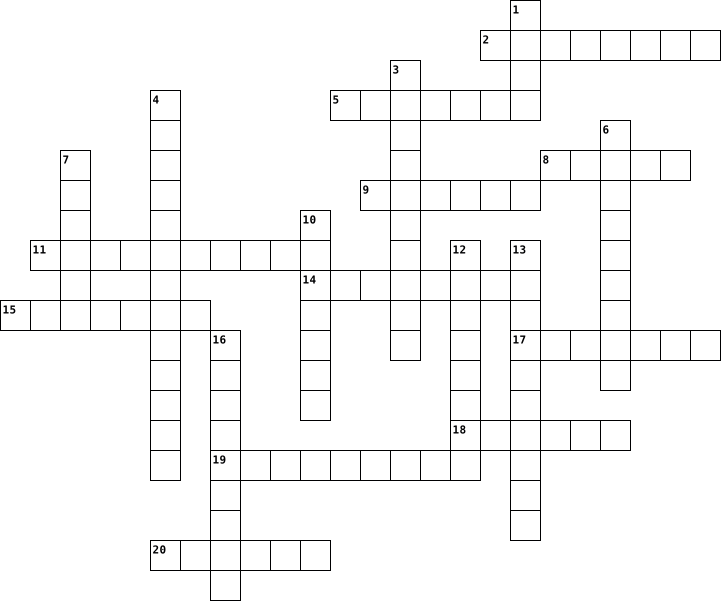
Across
- delle donne, Insatiable appetite for high voices and one that was to prevail in the following centuries
- de Sermisy, One of two principal composers in Attaingnants early chanon collections and Tant que vivray, lighthearted and optimistic poem
- Gesualdo, Madrigal writer who dramatized and intensified the antithesis in the poetry through sudden contrasts between diatonic and chromatic passages
- Italian devotional song
- (or villancico, but not both), Type of sixteenth-century Italian song and generally for three voices and in a rustic homophonic style
- de Rore, Madrigalist most admired by composers later in the century and Da le belle contrade d'oriente
- Monteverdi, Experimented wih dissonance and new textures and speechlike rhythms that led him to write for the rising genre of opera
- de Lassus, Composer of the late Renaissance and The chief representative of the mature polyphonic style in the Franco-Flemish school
- Morley, One of leading English madrigal composers and wrote canzonets and ballets and madrigals all based on Italian models and My bonny lass she smileth
- Two to eight voices and different music for different stanzas and versus no more than 3 in Trecento earlier madrigal
- Attaignant, Between 1528 and 1552 and the first French music printer and brought out more than fifty collection chansons
Down
- Dowland, Leading composer of lute song and Flow my tears and form of pavane
- System of notation used for lute or other plucked string instruments that tells the player which strings to pluck and where to place the fingers on the strings and rather than indicating which notes will result.
- The use of many notes from the chromatic scale in a passage or piece
- Sixteenth-century genre of Italian polyphonic song in mock-popular style and typically syllabic and homophonic and diatonic and with the melody in the upper voice and marked rhythmic patterns
- transalpina, Collection of Italian madrigals translated into English that accelerated the vogue of singing madrigals
- Arcadelt, Northerner and sang in pope's chapel and Il bianco e dolce cigno
- In sixteenth and seventeenth century France and an entertainment in which both professionals and guests danced and later a stage work danced by professionals
- Musical texture in which all voices move together in essentially the same rhythm and as distinct from polyphony and heterophony,
- of Oriana, Thomas Morleys own English madrigal and of the 24 others made by other composers and modeled by similar Italian anthology called Il trionfo di Dori.
20 Clues: Italian devotional song • The use of many notes from the chromatic scale in a passage or piece • Arcadelt, Northerner and sang in pope's chapel and Il bianco e dolce cigno • Dowland, Leading composer of lute song and Flow my tears and form of pavane • de Rore, Madrigalist most admired by composers later in the century and Da le belle contrade d'oriente • ...
History people 2022-10-14

Across
- an important leader in the history of social work and women's suffrage in the United States and advocated for world peace.
- contributed to urban reform in the 20ith century.
- American landscape artist who was considered to be the father of landscape architecture in the USA
- founder of the Otis elevator company and inventor of a safety device that prevents elevators from falling if the hoisting cable fails.
- contributed to the development of electric motors and railways
- the third-largest landowner in New York City and a director of the Erie Railroad
- an escape artist known for his escape acts
- considered by scholars to have been a forerunner of American 20th-century feminist authors
- American realist painter, known for his bold depictions of urban life in New York City.
- educational reformer whose ideas have been influential in education and social reform.
- philosopher who originated the expression "survival of the fittest", which he coined in Principles of Biology after reading Charles Darwin's On the Origin of Species.
- led the expansion of the American steel industry in the late 19th century and became one of the richest Americans in history.
- an American political economist and journalist who sparked several reform movements.
Down
- American novelists who is one of the first American authors to become an international celebrity and earn a large fortune from writing.
- created the lightbulb which created a new use for electricity and people stopped using candles
- American publisher who published the Social Register.
- created the Tesla Coil using electricity
- pastor and led the social gospel movement
- American novelists who is known for The Adventures of Huckelberry Finn and The Adventures of Tom Sawyerhe is widely considered one of the greatest American writers of all time.
- American novelists who wrote when he was a child
- an American nurse and contributed to human rights. Advocates to have nurses in public schools
- well-known critic of capitalism who wrote The Theory of the Leisure Class
- known for contributing to the understanding of evolutionary biology
- poet and storywriter who is recognized by modern critics as one of the most innovative writers of his generation.
- considered to be a leading thinker of the late 19th century, one of the most influential philosophers of the United States, and the "Father of American psychology".
25 Clues: created the Tesla Coil using electricity • pastor and led the social gospel movement • an escape artist known for his escape acts • American novelists who wrote when he was a child • contributed to urban reform in the 20ith century. • American publisher who published the Social Register. • contributed to the development of electric motors and railways • ...
History thing 2022-10-27

Across
- god of archery, healing, music
- god of fire and smiths
- his one weakness is his heel
- sea monsters that are usually depicted as serpentine fish with long rows of sharp teeth.
- son of jupiter and alceme, he's known for his strenth and numerous adventures
- a sea-monster with twelve dangling feet, six long necks and grisly heads lined with a triple row of sharp teeth
- goddess of the hunt
- half-man, half-horse beings who lived in the forests and mountains of thessalian magnesia
- a trojan hero, son of aphrodite and the trojan prince anchises
- spirits of sudden, sharps gusts of wind, they are singed women with the lower bodies of birds
- has the head of a woman, legs of a lion, and wings of a bird. she kills those who cannot answer her riddle
- a thracian bard, legendary prophet, musician and poet.
- god of war and battlelust
- god of the ocean
- half-goat, half-human creatures
Down
- typically depicted as gaving the upper body of a horse with the lower body of a fish
- corinthian hero of greek mythology who famously killed the chimera
- queen of gods, goddess of marriage, and women
- god of the underworld
- god of herds and flocks, travelers and hospitality
- mythical king and founder-hero of athens
- when one head is cut off, two more grow in its place
- associated with horses and sports, known for saving those in trouble at sea or in war
- a flying horse
- a female chthonic deities of vengeance in ancient greek religion and mythology, first monster to attack percy
- he beheaded medusa, son of zeus and danae
- a bull-headed monster born to queen pasiphae of crete after she coupled with a bull, second monster to attack percy
- goddess of beauty and love
- virgin goddess of the hearth
- goddess of wisdom and war
- he's king of the gods, and quite electric
31 Clues: a flying horse • god of the ocean • goddess of the hunt • god of the underworld • god of fire and smiths • god of war and battlelust • goddess of wisdom and war • goddess of beauty and love • his one weakness is his heel • virgin goddess of the hearth • god of archery, healing, music • half-goat, half-human creatures • mythical king and founder-hero of athens • ...
Theatre History 2022-10-27

Across
- Speech by actor alone on stage to express their thoughts and feelings.
- Plays concerning biblical history.
- Young lover, stock character in Italian theatre.
- Concerned the lives of the Saints.
- Backstage enclosed area behind the renaissance stage.
- Balcony over the stage in renaissance theatre.
- Plays concerning the last days of Christ.
- (Zanni) Crazy, tricky stock character in Italian theatre.
- Religious plays teaching right and wrong.
- Where penny paying audience stood on the ground for renaissance performances.
- Older father, stock character in Italian theatre.
- Roman playwright who developed Closet Drama.
- Play space set up in the church nave.
Down
- More costly seating for audience members during renaissance performances.
- Cruel, clever, mustached stock villian in Italian theatre.
- Short morality plays including humorous characters and situations.
- Old lawyer or Doctor, stock character in Italian theatre.
- Audience members who stood in the pit during renaissance performances.
- Clever, flirty, high spirited female stock character in Italian theatre.
- Huge mobile wagon/stages for medieval plays.
- Early church drama usually connected to Easter.
- Boastful braggart, stock character in Italian theatre.
- Italian plays of the renaissance using stock characters and improvisational scenarios.
23 Clues: Plays concerning biblical history. • Concerned the lives of the Saints. • Play space set up in the church nave. • Plays concerning the last days of Christ. • Religious plays teaching right and wrong. • Huge mobile wagon/stages for medieval plays. • Roman playwright who developed Closet Drama. • Balcony over the stage in renaissance theatre. • ...
world history 2022-10-26

Across
- the sovereign ruler of a small state
- a surviving memorial of the past
- a code of honor emphasized
- a chivalrous competition in the Middle Ages
- the transfer of goods
- system a system where people are given land
- a piece of land ruled by a king
- a series of religious wars
- an unfree person
- a defensive mound of earth or a wall
- a type of bridge at the entrance to a castle
- a member of a household or monarch
- man who separates himself from society
- a body of ordained ministers
- a general title for a prince
- to imply something wearisome
- a tilted peer
- the supreme ruler over a sovereign nation
- “common” or. “simple” people
- the strongest portion of the castle
Down
- anyone involved in business
- the science of the art of
- house where the lord lived
- a person who reigns over a kingdom
- a vassals source of income
- a depression surrounding a castle
- a church that contains the cathedral
- one invested with a fief
- the wife or widow of the king
- the residence of the king or lord
- a person who served as a lord
- a royal member of the family
- a male ruler
- a women who dedicates her life to religion
34 Clues: a male ruler • a tilted peer • an unfree person • the transfer of goods • one invested with a fief • the science of the art of • a code of honor emphasized • house where the lord lived • a vassals source of income • a series of religious wars • anyone involved in business • a body of ordained ministers • a general title for a prince • to imply something wearisome • ...
U.S History 2023-12-14

Across
- Someone who follows the christian faith
- Was very popular to smoke with
- A long journey
- Many religions believe in this figure; creator of the universe
- Another word for adventure
- Tried to travel to asia but wound up in America
- Someone who sells things
- Has a variety of spices
- Helps navigate you to a location; tells you where you are
- Another word for wood.
- This country supported Columbus's voyage to India
- A tool that points to where north is.
Down
- Measures the sun and Moon.
- Used to measure the altitude of stars and planets
- A type of ship used by Portugal
- Is used to buy things;very expensive
- A portuguese explorer
- A way of travel in the water
- Commander of a ship
- A follower of the islamic religion
20 Clues: A long journey • Commander of a ship • A portuguese explorer • Another word for wood. • Has a variety of spices • Someone who sells things • Measures the sun and Moon. • Another word for adventure • A way of travel in the water • Was very popular to smoke with • A type of ship used by Portugal • A follower of the islamic religion • Is used to buy things;very expensive • ...
U.S HISTORY 2023-12-06

Across
- when a nation changes from an agrarian society to modern society
- His writing would lead to major reforms in the food industry
- putting friends and family into position of political power
- anonymous voting method to try to keep elections fair
- ban on alcohol
- made travel between eastern and western states easier
- the right to vote, or a vote itself
- election in which voters chose the candidates from each party who will run in the general election
- movement that responded to problems created by industrialization and urbanization by promoting reforms and solutions
- work in an organized and active way toward a particular goal
- gave women the right to vote
Down
- was sworn in as president after McKinley was shot
- the belief that incorporating immigrants into society would make them more loyal citizens
- physical migration from rural areas to cities
- theory that suggests that humans have developed through competition and natural selection with only the strongest surviving.
- converted iron into durable steel
- gave rise to organized crime
- an unsanitary building in which several families rent a room
- a form of journalism exposing corrupt government practices
- Social Darwinism is strongly based on his theory of evolution
- a way for citizens to approve or reject a local law
- Theodore Roosevelt´s promise of equal treatment to all americans
22 Clues: ban on alcohol • gave rise to organized crime • gave women the right to vote • converted iron into durable steel • the right to vote, or a vote itself • physical migration from rural areas to cities • was sworn in as president after McKinley was shot • a way for citizens to approve or reject a local law • made travel between eastern and western states easier • ...
History Quiz 2023-12-13

Across
- was awarded the U.S. Army Air Corps contract to help train America's first Black military aviators because it had already invested in the development of an airfield
- In 1940, in his first baseball game for UCLA, Robinson went 4-for-4 at the plate and stole four bases.
- an American civil rights lawyer and jurist who served as an associate justice of the Supreme Court of the United States from 1967 until 1991.
- She honed her skills at a Black tennis club in Harlem.
- was the first black pitcher to play in the American League and was the seventh black player to play in Major League Baseball
- never learned to read or write, but was smart, calculating, and bold—and was never caught during her 13 dangerous missions to lead her friends and family out of slavery.
- His business built and repaired buggies and carriages until his death in 1910, when his company was passed on to his son.
- He oversaw over 15,000 blood donations
- She was the first skater of African descent to reach the top ranks of international skating.
- American actress and singer who first garnered attention on the reality television show American Idol and later earned acclaim for her music and acting.
Down
- Both her parents were from a mixture of African, European and Native American descent.
- She was the first female inaugural poet in U.S. presidential history and was the first Black woman to write a screenplay for a major film release.
- scored 56 or more points 61 times in regular-season games, tallied 36 field goals in a game (March 2, 1962), and captured 55 rebounds in a game (Nov. 24, 1960).
- widely v recognized as the first African American woman and only the third American woman to publish a book of poems.
- built the largest Black organization in history. 7. In 1918, nine years after the failure of his first newspaper
- One of the most influential and widely read 20th-century American poets the author of more than 20 books, she was highly regarded even during her lifetime and had the distinction of being the first Black poet to win the Pulitzer Prize.
- invented a safety helmet to protect the wearer from smoke and ammonia.
- was the first African American to win both Wimbledon (1975) and the US Open (1968) and reach the world number one ranking in professional tennis.
- Having gained experience as a lobbyist for the cable television industry in the late 1970s, Johnson saw an opportunity to reach African American audiences through a cable TV channel.
- To support herself and her daughter, Lelia, she took a job as a washerwoman. She earned roughly $1.50 a day, but managed to save up in order to provide for her daughter's education.
20 Clues: He oversaw over 15,000 blood donations • She honed her skills at a Black tennis club in Harlem. • invented a safety helmet to protect the wearer from smoke and ammonia. • Both her parents were from a mixture of African, European and Native American descent. • She was the first skater of African descent to reach the top ranks of international skating. • ...
Sports History 2023-12-11

Across
- What does MLB play with
- Was Brady's Righthand man
- what do you do on a bike
- What do you win in the Olympics
- What you yell when you shoot up a shot shot.
- A game where you throw a ball trying to hit another person
- What does the NFL Play with
- Coordinator of the team
- who was drafted to the cavs in 2011
- what brand did Jordan sign with
- What keeps your shoes tight
- Best Quarterback
Down
- what you play basketball or Volleyball in
- What is it called when you stop the defense
- the last time the panthers went to the superbowl
- Another word for fighting
- what does the NBA play with
- What old retired sports players do for fun
- what you play soccer with
- Who won the NBA Finals last year
- who stops scores on a soccer team
- who is Lebron
- What you wear in a game
23 Clues: who is Lebron • Best Quarterback • What does MLB play with • What you wear in a game • Coordinator of the team • what do you do on a bike • Another word for fighting • Was Brady's Righthand man • what you play soccer with • what does the NBA play with • What does the NFL Play with • What keeps your shoes tight • What do you win in the Olympics • what brand did Jordan sign with • ...
Sports History 2023-12-11

Across
- What does MLB play with
- Was Brady's Righthand man
- what do you do on a bike
- What do you win in the Olympics
- What you yell when you shoot up a shot shot.
- A game where you throw a ball trying to hit another person
- What does the NFL Play with
- Coordinator of the team
- who was drafted to the cavs in 2011
- what brand did Jordan sign with
- What keeps your shoes tight
- Best Quarterback
Down
- what you play basketball or Volleyball in
- What is it called when you stop the defense
- the last time the panthers went to the superbowl
- Another word for fighting
- what does the NBA play with
- What old retired sports players do for fun
- what you play soccer with
- Who won the NBA Finals last year
- who stops scores on a soccer team
- who is Lebron
- What you wear in a game
23 Clues: who is Lebron • Best Quarterback • What does MLB play with • What you wear in a game • Coordinator of the team • what do you do on a bike • Another word for fighting • Was Brady's Righthand man • what you play soccer with • what does the NBA play with • What does the NFL Play with • What keeps your shoes tight • What do you win in the Olympics • what brand did Jordan sign with • ...
Sports History 2023-12-11

Across
- What does MLB play with
- Was Brady's Righthand man
- what do you do on a bike
- What do you win in the Olympics
- What you yell when you shoot up a shot shot.
- A game where you throw a ball trying to hit another person
- What does the NFL Play with
- Coordinator of the team
- who was drafted to the cavs in 2011
- what brand did Jordan sign with
- What keeps your shoes tight
- Best Quarterback
Down
- what you play basketball or Volleyball in
- What is it called when you stop the defense
- the last time the panthers went to the superbowl
- Another word for fighting
- what does the NBA play with
- What old retired sports players do for fun
- what you play soccer with
- Who won the NBA Finals last year
- who stops scores on a soccer team
- who is Lebron
- What you wear in a game
23 Clues: who is Lebron • Best Quarterback • What does MLB play with • What you wear in a game • Coordinator of the team • what do you do on a bike • Another word for fighting • Was Brady's Righthand man • what you play soccer with • what does the NBA play with • What does the NFL Play with • What keeps your shoes tight • What do you win in the Olympics • what brand did Jordan sign with • ...
History Final 2023-12-11

Across
- A group of rebels that took over in 750 AD
- Ancient assyrian city of mesopotamia
- The 4th letter in the greek alphabet
- An ancient city
- A ruler with total power over a country
- A violent conflict between a state and one or more organized nonstate actors in the state's territory
- An inhabitant of ancient times
- The art of beautiful handwriting
- a line of hereditary rulers of a country
- The process of preserving a dead body into a mummy
- Colourful pottery, textiles and geoglyphs
- ancient kushite ring
- One of the largest deserts
- exchange for other goods
- Comes from the Spanish maíz, or corn
- Any of the 12 disciples chosen by Jesus Christ
- A large Roman town in Campania, Italy which was buried in volcanic ash following Stupa A shrine containing the remains of a holy or sainted person and/or artifacts
- A long poem
- A large amount of rainfall
- The arts and manifestations of humans
- 4000-2000BC
- The royal wife Of Thatmose the third
- A event causing great suffering
- The first roman emperor
- A member of hellenic people
- A citystate in greece
- A primate of a family
- African people who lived in Nigeria between 500BC to AD200
- Founder of persian empire
- A soldier of fortune or hired gun
- A decrease in the purchasing power of money
Down
- The chief pastor and overseer of a diocese
- A member of society having no permanent abode
- Medierianan part city in egypt
- The first elaborate pre-Columbian civilization of Mesoamerica
- A state in which supreme power is held by the people and their elected representatives
- A form of government
- Process of specializing in one subject
- The Preserver and guardian of men
- Shaped characters used for writing
- A cruel ruler
- a city with surrounding territory thats a independent state
- Last achievement king
- An indigenous pre-Columbian civilization that flourished in the Valley of Oaxaca in Mesoamerica
- The bishop of rome
- The process of becoming similar to others by taking in and using their customs and culture
- A member of iranian people
- art works made during the classical period
- Ancient greek mathmatician
- A single seller or producer that excludes competition from providing the same product
- Humans
- Provincal govenor
- a ruler in ancient egypt
- A land based country in south east europe
- An official in ancient Rome chosen by the plebeians to protect their interests
- A system of government in witch priests rule in the name of god
- Earliest highly developed culture in pre-Columbian Peru
- an extensive group of states or countries under one rule
58 Clues: Humans • A long poem • 4000-2000BC • A cruel ruler • An ancient city • Provincal govenor • The bishop of rome • A form of government • ancient kushite ring • Last achievement king • A citystate in greece • A primate of a family • The first roman emperor • exchange for other goods • a ruler in ancient egypt • Founder of persian empire • One of the largest deserts • A member of iranian people • ...
Kentucky History 2023-12-05

Across
- jellyfish/sharks
- indians against the jackson purchase
- reason kentucky is divided into regions
- which region is a belt in the middle of kentucky
- longest cave system in the world
- what montain in kentucky has a state resort park
- where can you stand in three states at once
- armed vigilantees in the tobacoo wars
- nation treasure for biodiversity
- indians forced out
- capital
- burbon capital of the world
- Clean air act
- get the knowledge of horses here, near lexington
- And their off to the races at_____.
- the lack of work in the coal industry has created___ in places that used to be rich with coal production
Down
- eastern to northeastern moutain range
- responsible for purchase of big chunk of land in kentucky
- get your stitch on at this blanket musuem?
- experience kentucky underground and kangaros
- watch out for theses large horses owned by budweiser at park
- step into a bible story
- Toyota manufacturer
- pennyroyal's other name
- watch your step so you dont join the cars in the ground at this musuem
- civil uprest and voilence to do tobacco production regulations
- large bucket suspended from a boom
- hike,kayak and ROCKCLIMBING at this popular kentucky state park
- crosses two rivers and passes over a separate county
- home to Muhammed Ali
- famous horse race
31 Clues: capital • Clean air act • jellyfish/sharks • famous horse race • indians forced out • Toyota manufacturer • home to Muhammed Ali • step into a bible story • pennyroyal's other name • burbon capital of the world • longest cave system in the world • nation treasure for biodiversity • large bucket suspended from a boom • And their off to the races at_____. • ...
American history 2023-12-15

Across
- allowed cities to grow upwards
- taxed placed on foreign goods
- the forbidding by law of the manufacture transport called prohibition
- on margin system of buying stocks in which a buyer pays a small percentage of the purchase price
- riot triggered by the death of a black boy
- policy of minimum govermental interference
- repealed prohibition and left alcohol regulation to the states
- president hardings secretary of commerce
- white residents mobbed and attbuyaked black residents
- 6 million african americans move to urban areas
- replaced harding in 1923 and was silent cal
- used assembly line to mass produce automobiles
Down
- went on strike to seek recognition
- culturual and intellecutual revial of african american music
- won 1920 presidental election
- rising stock prices
- method of purchase in which a buyer makes a small down payment
- gave women the right to vote
- person who made transported and sold alcohol
- race riots in 1918 and 1921 chicago and tulsa
- arrangement of equipment and workers
- garvey founded the universal negro improvement association
- the areas just outside the cities
- social activist poet novelist
- prominent banker served as president hardings secretary of treasury
25 Clues: rising stock prices • gave women the right to vote • won 1920 presidental election • taxed placed on foreign goods • social activist poet novelist • allowed cities to grow upwards • the areas just outside the cities • went on strike to seek recognition • arrangement of equipment and workers • president hardings secretary of commerce • riot triggered by the death of a black boy • ...
Language History 2023-09-07

Across
- - Beautiful or artistic handwriting.
- - To figure out the meaning of something that is difficult to understand, like an ancient script.
- - Writing carved or engraved on a surface.
- - A mark or character that represents an idea or object.
- - The language of ancient Rome.
- - Relating to the sounds of spoken language.
- - A room in a monastery for copying and preserving manuscripts.
- - A person who writes or records information in ancient times.
- - Very old, from a long time ago.
- - A simple picture or symbol that represents an object or concept.
Down
- - A symbolic figure or character.
- - A system of writing using pictures and symbols, often associated with ancient Egypt.
- - An ancient system of writing that used wedge-shaped marks on clay tablets, used in Mesopotamia.
- - A system of writing used for a specific language.
- - An ancient language of India.
- - A handwritten document or book.
- Stone - An ancient artifact with inscriptions in three scripts that helped decode Egyptian hieroglyphics.
- - Changing text from one language to another.
- - A set of letters used to write a language.
- - A material made from reeds used for writing in ancient Egypt.
20 Clues: - An ancient language of India. • - The language of ancient Rome. • - A symbolic figure or character. • - A handwritten document or book. • - Very old, from a long time ago. • - Beautiful or artistic handwriting. • - Writing carved or engraved on a surface. • - Relating to the sounds of spoken language. • - A set of letters used to write a language. • ...
history class 2023-08-25

Across
- ruler of the franks
- churchly kingdom
- person who wrote rules for monastaries
- places where monks lives
- lived in monastaries
- the church provides this
- the year clovis converts to christanity
- what knights in training become at age 7
- worldly power involded in politics
- where nuns used to live
- period from 500 to 1500
- the church provides this
Down
- person who wrote nun rules
- the person recieving a fief
- Gregoy I becomes pope in what year
- servant for a knight
- the Lord's Estate
- germanic people
- church does this for monastaries,convents and manuscripts
- squire's become this at age 21
- a area of land
21 Clues: a area of land • germanic people • churchly kingdom • the Lord's Estate • ruler of the franks • servant for a knight • lived in monastaries • where nuns used to live • period from 500 to 1500 • places where monks lives • the church provides this • the church provides this • person who wrote nun rules • the person recieving a fief • squire's become this at age 21 • ...
History Review 2023-11-20

Across
- 10 Amendments / Anti-Feds wouldn’t sign the constitution without this
- Hate the idea of Central Government
- Broken Document States have the power, no national army, supreme court, or president
- Went to War with Britain due to “Impressment” aka stealing American Sailors
- Basis of Star Spangled Banner, East Coast maryland, Francis Scott Key was watching from harbor
- War Poem turned National Anthemn by Francis Scott Key
- John Adam’s Alien & ___ Acts
Down
- Divided up Old Nortwest -1785
- Supreme Court considers things an “Act of Congress” is Constituional
- British kidnap American Sailors
- Two Houses, Upper, Lower
- May 1787,meeting to re-editing the Articles of Confederation
- Diary of the Federalist Why they are the best
- America bought land from (France) Napolean for $15 million
- January 8, 1815 No impact on war because it was signed after war was officailly over (Treaty of Ghent ended war, signed December 24, 1814)
- pregnant Native America lady whose very presence stopped Lewis & Clark from getting arrow shot at
- 1803, William Marbury was denied Justice of the Peace Court but due to previous Judciiary Acts job was void, Marshall was on the fense
- Ratifying the constitution
- Government takes Veterans’ farms they become angry
- Napolean being a control freak, was __ named after him
20 Clues: Two Houses, Upper, Lower • Ratifying the constitution • John Adam’s Alien & ___ Acts • Divided up Old Nortwest -1785 • British kidnap American Sailors • Hate the idea of Central Government • Diary of the Federalist Why they are the best • Government takes Veterans’ farms they become angry • War Poem turned National Anthemn by Francis Scott Key • ...
World History 2023-09-15

Across
- an organization
- classes a grouping of similar social factors
- moves from one region to another
- A succession of rulers
- plant foods and domestication of animals
- state
- An ancient temple tower
- gatherers hunts animals and gathers wild plants
- of labor perform different jobs to meet society
- The belief in many gods
- The heads of state
- an advanced and complex society
- System of writing
Down
- the system for producing and obtaining goals and services
- a member of an extinct species
- the taming of wild animals
- New Stone Age
- The use of knowledge to invent new tools or devices
- supplies of goods and labor not needed
- To water crops
20 Clues: state • New Stone Age • To water crops • an organization • System of writing • The heads of state • A succession of rulers • An ancient temple tower • The belief in many gods • the taming of wild animals • a member of an extinct species • an advanced and complex society • moves from one region to another • supplies of goods and labor not needed • plant foods and domestication of animals • ...
Ancient History 2023-09-20

Across
- A plant grown for food
- A system of writing used in the Ancient Middle East
- A person who manages or owns a farm
- The supply of water to land or crops to help growth
- The period before time was written
- Made from silk roads in china
- originating or occurring naturally in a particular place.
- Someone who moves from one place to another
Down
- An amount of something left over when requirements have been met
- Groups of states under a single supreme
- A house owned by a lord or knight
- A birthplace of writing
- producing or capable of producing abundant vegetation or crops.
- The action of Inventing something
- A natural stream of waters
- Made in the past and no longer exist
- A place for people\criminal
- a prehistoric period that followed the Stone Age and preceded the Iron Age
- Known for his surviving set of laws
- The governing body of a nation, state, or community.
20 Clues: A plant grown for food • A birthplace of writing • A natural stream of waters • A place for people\criminal • Made from silk roads in china • A house owned by a lord or knight • The action of Inventing something • The period before time was written • A person who manages or owns a farm • Known for his surviving set of laws • Made in the past and no longer exist • ...
World History 2023-09-28

Across
- rebirth
- paper material
- migration of Jews
- religious law
- deep understanding
- Tombs
- Jewish houses
- righteous conduct
- wearing a simple robe
Down
- four major social groups
- written records
- group
- forced to leave their homeland
- agreement
- church retreat
- system rigid social hierarchy
- strict
- migrate
- European language
- actions determine your afterlife
20 Clues: group • Tombs • strict • rebirth • migrate • agreement • religious law • Jewish houses • church retreat • paper material • written records • migration of Jews • European language • righteous conduct • deep understanding • wearing a simple robe • four major social groups • system rigid social hierarchy • forced to leave their homeland • actions determine your afterlife
American history 2023-10-20

Across
- states between the north and the south
- capital of virginia
- 3 day long battle
- grant besieged this city
- Union general who destroyed the south using march to sea tatic
- a general for the north
- agreement to ease tensions
- war started at his house
- Lincolns main goal
- invented cotton gin
- Federal fort in the harbor
- people rule the goverment
Down
- a system used by slaves for freedom
- plan by winfield scott
- commanded the union troops when surrendiring
- fighting on home turf
- 3 day of gettysburg
- leading union general
- large population resources
- issued by abraham lincoln on september 22 1862
- a novel that portrayed slavery
- warships covered with protective iron plates
- battle fought by grant to capture railroad
- abolition of slavery
- Former presbyterian minister
25 Clues: 3 day long battle • Lincolns main goal • capital of virginia • 3 day of gettysburg • invented cotton gin • abolition of slavery • fighting on home turf • leading union general • plan by winfield scott • a general for the north • grant besieged this city • war started at his house • people rule the goverment • large population resources • agreement to ease tensions • Federal fort in the harbor • ...
American History 2023-10-20

Across
- first state to secede.
- Abolished slavery.
- Invented the cotton gin.
- plessy v. ferguson
- south advantage.
- a way southerners stopped African Americans from voting.
- Abraham Lincolns plan.
- equal rights to everyone.
- won election by one vote.
- laws that allowed for segregation.
- a book about slavery.
- Capital of Virginia.
- a reason why African Americans had to pay to vote.
Down
- A test that African Am,ericans and poor white men had to take to vote.
- Gave African Americans the right to vote.
- Bloodiest war of the battle.
- Bleeding state.
- led the confederate army.
- who replaced lincoln after he was assassinated.
- Confederacy president.
- a group of white people who tried to stop African Americans from using their rights.
- first president assassinated.
- United States became independent.
- every man selected had to go to war.
- a northern strength.
25 Clues: Bleeding state. • south advantage. • Abolished slavery. • plessy v. ferguson • a northern strength. • Capital of Virginia. • a book about slavery. • first state to secede. • Confederacy president. • Abraham Lincolns plan. • Invented the cotton gin. • led the confederate army. • equal rights to everyone. • won election by one vote. • Bloodiest war of the battle. • first president assassinated. • ...
MonGHOULian History 2023-10-31

Across
- A specific transportation used in the sea roads
- People who speak this are found primarily in Tanzania, Kenya and Mozambique.
- A dynasty with a currency named after itself
- a broad branch of Mahayana Buddhism focused on achieving rebirth in a certain Land.
- Stops along a journey assisted by remounts, provisions, lodgings, and other necessities for their journeys
- Richest Man in the world
- Form of Buddhism focused around calm and serenity
- Can carry over 150KG
- The Guinness World Records considers it as the largest religious structure in the world.
- Famous centre of Mali
- the third emperor of the Ming dynasty, reigning from 1402 to 1424.
Down
- The best explorer of his time
- a type of paper negotiable instrument used during China's Tang dynasty invented by merchants but adopted by the state.
- a military blockade of a city, or fortress, with the intent of conquering by attrition, or by well-prepared assault.
- Capital of Mongolia
- A Real region on a map, not missing from the world
- a Chinese mariner, explorer, diplomat, fleet admiral, and court eunuch during China's early Ming dynasty, and often regarded as the greatest admiral in Chinese history.
- The Persian Invader(Not Just the Attacker)
- People of all origins who come together to find similarities
- a roadside inn where travelers could rest and recover from the day's journey.
20 Clues: Capital of Mongolia • Can carry over 150KG • Famous centre of Mali • Richest Man in the world • The best explorer of his time • The Persian Invader(Not Just the Attacker) • A dynasty with a currency named after itself • A specific transportation used in the sea roads • Form of Buddhism focused around calm and serenity • A Real region on a map, not missing from the world • ...
Olympic History 2023-10-21

Across
- The sporting event where Usain Bolt became famous.
- The city that hosted the first modern Olympics in 1896.
- The location of the famous "Miracle on Ice" in 1980.
- The ancient stadium in Olympia, Greece.
- The country where the 2016 Summer Olympics were held.
- The most decorated Olympian of all time.
- The first host city after World War II.
- The mascot for the 1980 Summer Olympics in Moscow.
- The Olympics that were canceled during World War II.
- The Olympic sport that requires you to shoot arrows.
Down
- The country that boycotted the 1980 Summer Olympics.
- The year the Olympic Games were first held.
- The Olympic flame is lit using a focused beam of what.
- The most populous country to have never won an Olympic gold.
- The Olympic athlete known as the "Flying Houseman."
- The sport that made Michael Jordan an Olympic gold medalist.
- The Olympic event featuring triple long jumps.
- The number of rings in the Olympic symbol.
- The city that hosted the 2008 Summer Olympics.
- The Olympic Games that took place in 1972.
20 Clues: The ancient stadium in Olympia, Greece. • The first host city after World War II. • The most decorated Olympian of all time. • The number of rings in the Olympic symbol. • The Olympic Games that took place in 1972. • The year the Olympic Games were first held. • The Olympic event featuring triple long jumps. • The city that hosted the 2008 Summer Olympics. • ...
Texas History 2023-11-06

Across
- The City With A Legend
- H-Town
- City of Champions
- The Prison City of Texas
- Cowtown
- Sports City, USA
- The Tomato Capital of the World
- Oleander City
- The Buckle of the Bible Belt
- The Dinosaur Capital of Texas
- Aggieland
Down
- The Fruit Cake Capital of the World
- Big D
- The Capital City
- The Sparkling City by the Sea
- The Bluebonnet City
- The Rose Capital of the World
- The Ice Cream City
- The Oldest Town in Texas
- The Alamo City
20 Clues: Big D • H-Town • Cowtown • Aggieland • Oleander City • The Alamo City • The Capital City • Sports City, USA • City of Champions • The Ice Cream City • The Bluebonnet City • The City With A Legend • The Prison City of Texas • The Oldest Town in Texas • The Buckle of the Bible Belt • The Sparkling City by the Sea • The Rose Capital of the World • The Dinosaur Capital of Texas • ...
History Vocab 2024-01-29

Across
- a person who suffers or dies because of his or her beliefs or actions
- a person injured, killed, or missing during a war, accident, or disaster
- promissory notes issued during the Civil War, with green ink giving them their nickname
- a place where weapons are kept
- a force that opposes or slows motion
- concept that laws should be made by each state and not by the federal government
- a person who is running from something, usually legal authorities
- a careful plan for solving a problem or achieving a goal
- a river or stream that flows into a larger river
- a payment made (often by authorities) as a reward
- to enroll in a group such as the military
- to firmly fix or establish
Down
- war strategy of destroying the enemy's means of survival
- slave-owning states that stayed in the U.S.
- an order issued by President Lincoln in 1863 that freed all the slaves in the Confederate states
- the act of formally separating from or leaving an organization or government
- to formally withdraw from membership in an organization or group
- a war in which groups of people from the same country fight against each other
- to give a good reason for something; to show something is right or reasonable
- to strengthen or support
20 Clues: to strengthen or support • to firmly fix or establish • a place where weapons are kept • a force that opposes or slows motion • to enroll in a group such as the military • slave-owning states that stayed in the U.S. • a river or stream that flows into a larger river • a payment made (often by authorities) as a reward • ...
Black History 2024-01-31

Across
- First black pro baseball player
- First girl to earn a win and to pitch a shutout in Little League World Series history
- Oldest HBCU in Raleigh, NC
- First African American woman astronaut in space
- greatest rapper of all time
- King of Pop
- Actor known for his role as Black Panther
- Gymnast and Olympic gold medalist
- World champion gymnast and Olympic gold medalist
- Professional tennis player and multiple Grand Slam winner
- Television producer and writer, known for creating 'Grey's Anatomy' and 'Scandal'
Down
- Young entrepreneur and founder of Mr. Cory's Cookies
- Professional basketball player and activist
- performed first open heart surgery
- Founder of #1000BlackGirlBooks campaign
- First African American and first woman Vice President of the United States
- First African American female principal dancer with the American Ballet Theatre
- Youngest inaugural poet in U.S. history
- First African American president of the United States
- Influential singer, songwriter, and actress
- Actress and singer, known for her roles in family-friendly films and television shows
- Historically Black Colleges and Universities
22 Clues: King of Pop • Oldest HBCU in Raleigh, NC • greatest rapper of all time • First black pro baseball player • Gymnast and Olympic gold medalist • performed first open heart surgery • Founder of #1000BlackGirlBooks campaign • Youngest inaugural poet in U.S. history • Actor known for his role as Black Panther • Professional basketball player and activist • ...
English history 2024-01-25

Across
- which battle made an end to the War of the Roses in 1485
- which House had the red rose as symbol
- what is the name of the protestant church started by Henry VIII
- what is the nickname of Henry VIII's oldest child(2)
- Beaker People arrived in England in the ... Age
- what was the name of the period that brought Charles II back to the throne
- William the Conqueror was the Duke of ...
- what is the name of a famous 11th C Danish King
- what was the name of the crusader king
- what was George VI called by his family
- who was Lord Protector and head of the Parliamentarians(2)
- which family had as symbol the white rose
- what is the name of the scottish branch of the royal family
- which king made his son the first Prince of Wales in 1301
- what is the name of the dynasty that started with Henry II in 1154
- what was the real name of Edward VIII
- what was the name of the founder of Westminster Abbey and Palace(3)
- what is the surname of Henry VII and of the subsequent dynasty
Down
- what is the name of the order founded by Edward III in 1348
- what was Elizabeth I also called(2)
- which king was beheaded in 1679
- which document from 1707 united England and Scotland
- what was the name of the short republic in English history
- who was the original 'people's princess' who died in childbirth in 1817
- Which queen had 17 pregnancies and no heir
- Which castle did William I build in London
- where did George I come from
- what was the period called during the madness of king George III
- who briefly defeated the Vikings in the late 9th C
- what was the name of the king who was killed in 1066
- which jubilee did Elizabeth II celebrate in 2022
- what was the revolution called that deposed king James II
- what is the name of the present royal family
- who is recognised as the first English king
- where did the famous 1066 battle take place
- which trade organisation was at the heart of the British Empire
- what happened in 1666(4)
- what is the name of Henry VIII's 3rd wife, mother of his son(2)
- which anglo-saxon kingdom emerged dominant in the 9th C
- who was the king who sealed the Magna Carta in 1215
- the 19th C is often called the ... Age
41 Clues: what happened in 1666(4) • where did George I come from • which king was beheaded in 1679 • what was Elizabeth I also called(2) • what was the real name of Edward VIII • which House had the red rose as symbol • what was the name of the crusader king • the 19th C is often called the ... Age • what was George VI called by his family • William the Conqueror was the Duke of ... • ...
History crossword 2023-10-23

Across
- non church leaders
- a series of investigation designed to find and judge heretics
- a court order to bring an arrested person before jude or court
- unsuccessful revolt by the peasants against feudal lord in England in 1381
- a serious shortage of food
- a epidemic of the bubonic plague that killed as many as one third of all Europeans between 1347 to 1352
- the peninsula where present day spain and portugal are located
- To exclude a person from a church or religious community
- destructive war between France and England from 1337 1453
Down
- a body of law that has developed from custom and judges decision rather than from law passed by the lawmaking assembly
- a system of law courts outside the control of other branches of government
- a journey undertaken to worship at a holy place
- The movement to drive muslims from spain
- a deadly infection spread by fleas on rats
- a belief that is rejected by official Church Doctrine
- To Christians, Muslims in Spain were known as
- a document that promised certain rights
- a court order
- a series of military campaigns to establish Christian control over the Holy Land
- an assembly of representatives who make laws
20 Clues: a court order • non church leaders • a serious shortage of food • a document that promised certain rights • The movement to drive muslims from spain • a deadly infection spread by fleas on rats • an assembly of representatives who make laws • To Christians, Muslims in Spain were known as • a journey undertaken to worship at a holy place • ...
World History 2023-10-19

Across
- honored
- holds people
- holy
- Muslim place of worship
- lack of growth
- Theatre
- men have all power
- leader
- wealthy landowner
Down
- Deadly
- has full authority
- old war
- made from pipes
- praising
- Hard workers
- Image breakers
- holy city of mecca
- isolated place
- citizen
- government body
20 Clues: holy • Deadly • leader • old war • honored • citizen • Theatre • praising • holds people • Hard workers • Image breakers • lack of growth • isolated place • made from pipes • government body • wealthy landowner • has full authority • holy city of mecca • men have all power • Muslim place of worship
Seattle History 2023-10-12

Across
- SPD ____ unit, 1st in the US
- Friends of _____ Seattle
- ____ ____ District, destroyed by great SEA fire
- International coffee chain
- Formerly Microsoft’s home
- Ospreys
- Visit Habitat Beach and enjoy ____ Sea
- Formerly Qwest Field & Centurylink Field
- Central District high school
- Acknowledgement
- Tuesday Pioneer Sq-based Mardi Gras festival
- Purchased the SEA Seahawks
Down
- Initiative led by architect Victor Steinbrueck
- ____ Gates, Microsoft co-founder
- Pres. who pardoned SPD Police Lieutenant
- Indigenous tribe
- Famous jazz singer Ernestine____
- ____ Allen-Barnes
- Iron ____
- East of Downtown
- Early SEA commerce
- Harrell and Lee
- ____ Gold Rush
- Stay warm on Pier 62 with this cozy feature
24 Clues: Ospreys • Iron ____ • ____ Gold Rush • Harrell and Lee • Acknowledgement • Indigenous tribe • East of Downtown • ____ Allen-Barnes • Early SEA commerce • Friends of _____ Seattle • Formerly Microsoft’s home • International coffee chain • Purchased the SEA Seahawks • SPD ____ unit, 1st in the US • Central District high school • ____ Gates, Microsoft co-founder • Famous jazz singer Ernestine____ • ...
NHFD History 2024-01-09

Across
- nick name of Fire Police Captain Reed Fancher
- long time Director, Historian and owner of the 1935 Ahrens Fox
- South Utica meat market ran by two brothers. One was President of Department and the other Assistant Chief
- former name of today’s “Heavy” Rescue
- Engine/pumper brand purchased afterwards to settle lawsuit
- department’s primary Ambulance service out of Chadwicks
- Chief during Jay-K fire
- village business owner often seen directing traffic on Genesee Street
- Chief in 60’s and 70’s and Deputy Coordinator
- name of gas station at end of fire lane
- trade name of water carrying backpack used to put out grass fires
- longest serving Secretary (34 years)
- longest serving Chief
- department’s longest serving member (67-1/2 years)
- 1st 50-year member (would serve 65 years)
- local fire apparatus founded in Preble NY that built several NHFD trucks
Down
- 1st Chief
- brand of SCBA used by department
- 1st permanent station
- former fire apparatus manufacturer from Elmira NY
- 1st Fire Police Captain
- Chief in the 50’s, long time dispatchers
- department’s only Engineer
- 1st motorized ladder truck
- 1935 Engine/pumper brand later owned privately by a member
25 Clues: 1st Chief • 1st permanent station • longest serving Chief • 1st Fire Police Captain • Chief during Jay-K fire • department’s only Engineer • 1st motorized ladder truck • brand of SCBA used by department • longest serving Secretary (34 years) • former name of today’s “Heavy” Rescue • name of gas station at end of fire lane • Chief in the 50’s, long time dispatchers • ...
Arcadia History 2024-02-02

Across
- Famous Politician that gave a "whistle stop" at Santa Anita Depot
- _________ Freeway completed through Arcadia in 1968, base of mountain
- Contains Botanic Garden & Historical Landmarks
- Indian tribe at San Gabriel Mission
- Balloon vehicle associated with Ross Field
- ________ Knoll, geologic remnant of the Raymond (Hill) Fault
- Hugo Reid's "house of stone", architecture style
- Santa Anita _____ Park, a broad, airy mall
- Drive-in theatre opened in 1949
Down
- Bird imported from India in 1880
- Where horses compete
- Hugo's last name, first private owner of Rancho Santa Anita
- Baldwin's elder daughter
- Citrus fruit, ______ grove
- Nickname of Arcadia's first mayor
- Baldwin's younger daughter
- Arcadia ________, first city newspaper in 1904
- Popular department store at Duarte Rd and Baldwin Ave
- Santa Anita Train ______, rescued by heroic community effort & Arcadia Historical Society
- _____ Field, Army Balloon School
- A city in California or mountainous region of Greece
- Arcadia's first motel, the Santa Anita _______ Inn
22 Clues: Where horses compete • Baldwin's elder daughter • Citrus fruit, ______ grove • Baldwin's younger daughter • Drive-in theatre opened in 1949 • Bird imported from India in 1880 • _____ Field, Army Balloon School • Nickname of Arcadia's first mayor • Indian tribe at San Gabriel Mission • Balloon vehicle associated with Ross Field • Santa Anita _____ Park, a broad, airy mall • ...
Russian History 2024-02-21

Across
- The tsar who tried to make Russia more European and founded a new capitol city in St. Petersburg
- Communism didn't last in Russia because it couldn't provide the freedom and _______ people wanted.
- Who is the current president of Russia
- Communism believed everyone should be ______
- This was the alliance of Germany, Italy, and Japan in WWII
- Russia is currently at war with this nation
- The first people to settle in Russia were ______.
- The majority of the population of Russia lives in which continent
- This is another word for friends
- The majority of the land in Russia is located in this continent.
- If you spoke out against the government in the USSR you could be ________ or even killed.
Down
- The Korean and Vietnam wars are examples of what?
- Free speech and _______ were limited in Communist USSR
- This is the name Russians use for ruler/leader
- Under the one party political system in the USSR, people did not have the right to ________
- In communism the government controls the means of ________
- Who was the leader of the Communist Revolution in Russia?
- Education and _______ were free to everyone in the USSR
- Who did the USSR fight alongside during WWII?
- The revolution that replaced man power with animal and machine power with a focus on increased production of goods.
- Communism does not allow for ______ ownership of land or property
- This group of people invaded Russia from the east in the Middle Ages
- The protective alliance of "western" nations against the USSR
- People's lack of _________ to work hard was a big reason communism failed in Russia.
- The conflict between the USA and USSR
25 Clues: This is another word for friends • The conflict between the USA and USSR • Who is the current president of Russia • Russia is currently at war with this nation • Communism believed everyone should be ______ • Who did the USSR fight alongside during WWII? • This is the name Russians use for ruler/leader • The Korean and Vietnam wars are examples of what? • ...
History Review 2024-02-26

Across
- To cancel a law
- Why did people move west to California?
- A man-made river
- Pilgrims landed in Plymouth, ___________
- The turning point of the Revolution, Saratoga, convinced who to help the U.S.?
- The author of the Anti-Slavery book, Uncle Tom's Cabin, was Harriet Beecher ______
- Dorothea ____ fought to make it better for the mentally ill and those in prison
- This branch enforces the laws
- The 7th president of the US
- This branch makes and laws
- Our war for independence is called the ____________ War.
- Elizabeth Cady Stanton fought for women's right to what?
- Who moved to the U.S. during the Industrial Revolution?
Down
- King George wouldn't let the colonists go west of the __________ Mountains.
- Refused to pay a poll tax because he was against the Mexican-American War
- John ______ is an enlightenment thinker, leading to one of the roots of the Constitution
- Immigrants who moved west to help build the railroads
- The type of factory that Samuel Slater invented
- This principle is where the Federal and State Governments share power
- European country that wanted to spread their Catholic religion
- The right to vote
- The 1st Amendment includes ___________, Assembly, Petition, Press, and Speech
- Mexico gives up tons of land after the Mexican-American War...Mexican _______
- This branch interprets the laws
- Washington advised us to avoid permanent _________ with foreign countries
25 Clues: To cancel a law • A man-made river • The right to vote • This branch makes and laws • The 7th president of the US • This branch enforces the laws • This branch interprets the laws • Why did people move west to California? • Pilgrims landed in Plymouth, ___________ • The type of factory that Samuel Slater invented • Immigrants who moved west to help build the railroads • ...
History crossword 2024-02-29

Across
- the government or controlling power
- breaking an established rule or law
- to put in place by authority, such a law, tax, or punishment
- to place limits or controls on something
- to take back, or to cancel, a law
- the unjust use of government power. A ruler who uses power in this way is called a tyrant.
- basic
- a formal, written request made to an official person or organization
- a nation that joins another nation in some common effort, such as fighting a war
- to formally discuss an issue
- very important or necessary
- rights common to everyone, as opposed to those given by law
- a pamphlet published in 1776 by Thomas Paine that persuaded many American colonists to support independence
Down
- a small army made up of ordinary citizens who are trained to fight in an emergency
- to express ideas or feelings in a way that is moving and well-spoken
- the struggle of the colonies in North America to gain their independence from Great Britain
- freedom from control by another government or country
- a course of action taken by a government
- to continue to keep
- to refuse to buy one or more goods from a certain source. An organized refusal by many people is also called a boycott.
20 Clues: basic • to continue to keep • very important or necessary • to formally discuss an issue • to take back, or to cancel, a law • the government or controlling power • breaking an established rule or law • a course of action taken by a government • to place limits or controls on something • freedom from control by another government or country • ...
UK history 2024-02-21

Across
- first wife of Henry VIII
- Fourth wife was divorced
- Where parliament happens is The palace of
- Written by the Lords in 1215 and given to the King
- sixth wife, lived longer than HenryVIII
- Second wife, she was beheaded
- Henry VIII went to war with...
- The family name of Henry VII
Down
- Fifth wife, she was beheaded
- there are 650 members of this.
- Third wife died after birth
- An are of the country for 1 MP
- The house that gives advice
- The red rose represented this house
- The House of king Richard III
- Another name for an agreement between countries
- The name of all the ships for fighting
- The house that decides the Law
- Brother of HenryVIII
- Another name for a king or queen
- The battle where Henry VII became king
21 Clues: Brother of HenryVIII • first wife of Henry VIII • Fourth wife was divorced • Third wife died after birth • The house that gives advice • Fifth wife, she was beheaded • The family name of Henry VII • Second wife, she was beheaded • there are 650 members of this. • An are of the country for 1 MP • The House of king Richard III • The house that decides the Law • ...
History Crossword 2020-05-27

Across
- Messiah's genre
- Musical period of 1600-1750
- any keyboard instrument besides organ
- Master of Contrupuntal techniques
- double-reed instrument
- art song
- every verse of the song is the same music
- term used to signal the use of the whole orchestra
- The best of Vivaldi's "the four seasons"
- notes that move in steps
- Vivaldi contributed to the development of ______form
- Trumpets, french horn, and tuba are part of this family
- Short _____ in a fast Machine
- Augmented fourth
- Where artists "suggest" of an idea instead of literally telling it
- his ballet sparked a riot
- Almost writing only for keyboard
Down
- an upbeat, or last beat of a measure anticipating a downbeat
- A passage in a fugue that neither the subject or answer is present
- String instrument, strike the string with stick of the bow
- The only lied we learned
- Won the Prix de Rome
- two melodies at once
- A duple metre Cuban dance
- Guy who worked at Weimar
- The initial statement of the main theme of a fugue, in the tonic key
- his Italian opera company failed
- A quickly ascending rhythmic melody going and octave or higher
- not a good employee
- nicknamed the "Red Priest"
- Genre that combines chamber music and symphony
- using note that sound good together
- The language Messiah is in
- post-minimalist composer
- little fancy add-ins to embellish music
- Most modern clavier today
- low female voice
37 Clues: art song • Messiah's genre • low female voice • Augmented fourth • not a good employee • Won the Prix de Rome • two melodies at once • double-reed instrument • The only lied we learned • Guy who worked at Weimar • notes that move in steps • post-minimalist composer • A duple metre Cuban dance • Most modern clavier today • his ballet sparked a riot • nicknamed the "Red Priest" • ...
Modern History 2020-06-03

Across
- the changes a group can experience after interacting with another culture.
- the transition to new manufacturing processes in Europe and U.S.
- a large biuldig in which machinery is used to manufacture goods
- an 18th-century European movement in which thinkers attempted to apply the principles of reason and the scientific method to all aspects of society.
- an american invention that aided the British textile industry
- the religion of the hebrews
- an 18th-century Europena movement in wich thinkers attempted to apply the principles of reason
- an imaginary land described by Thomas More in his book utopia
- was based on the teachings of the prophet Muhammad.
- the customs, ides, art, etc, of a particular civilization, society or social group
- morals principles or standards
- is known as one of the Seven Wise Men of Greece
- china´s last dunasty, which ruled from 1644 to 1912
- a division of humankind wit common characteristics, such as nationality, race or religion
Down
- movement of people to a new area or country in order to find work or better living conditions.
- a machine with a heavy blade sliding vertically in grooves, used for beheading people.
- is a cancelation of punishment still due for a sin that has been forgiven
- a person religous faith
- one of the nomads who invaded the Indian subcontinent in the 16th century and established a powerful empire there.
- is the belief in the importance of the individual and in the virtues of self-reliance and personal independence
- a pardon
- a group of people who sought freedom from religious persecution in Englandby fiunding a colony at Massachusetts Bay in the early 1600s.
- the Spanish soldiers, explorers, and fortune hunters who took part in conquest of the Americas in the 16th century
- a 16th-century movement for religiuos reform, leading to the founding of Christian churches that rejected the pope´s authority
- a government ruled by a few powerful people
25 Clues: a pardon • a person religous faith • the religion of the hebrews • morals principles or standards • a government ruled by a few powerful people • is known as one of the Seven Wise Men of Greece • was based on the teachings of the prophet Muhammad. • china´s last dunasty, which ruled from 1644 to 1912 • an american invention that aided the British textile industry • ...
Life History 2020-04-28

Across
- Is a firm but flexible special connective tissue.
- A special type of lamellar bone.
- Glands with ducts that collect and carry away the product are exocrine glands.
- The tissue lining blood and lymph vessels.
- Bone formation.
- Postparitive matrotrophy.
- Major anatomical change.
- Is a special kind of pseudostratified epithelium found only in the bladder and ducts of the urinary system.
- A specialized connective tissue in which calcium phosphate and other organic salts are deposited in the matrix.
- The act of giving birth via viviparity.
- Body cavity.
- A layer of bone matrix with its closely-packed collagen fibers aligned in parallel.
- Preparitive matrotrophy.
- Remove existing bone.
- Maintain fully formed bone.
Down
- A transparent jacket of fibrous protein.
- Meaning “tissue formation”.
- The process of forming an ectodermal tube, the neural tube.
- The inner wall of the hypomere.
- The process by which the embryo forms a distinct endodermal tube that constitutes the early gut.
- Mitotic furrows pass successfully through the entire zygote from animal to vegetal pole.
- Meaning “outside the cell”.
- Release of the ovum from the ovary.
- Occurs in the spleen, lymph nodes, and elsewhere.
- A multicellular blastula with a fluid-filled core.
- Embryonic stage wherein these formative embryonic cells become arranged into organs.
- Located inside cavities of bone.
- A syncytial layer closely adhering to the uncleaved yolk.
- Cells specialized to secrete a product.
- Is a specialized type of mineralization wherein calcium carbonate (invertebrates) or calcium phosphate (vertebrates) is deposited in the organic matrix.
30 Clues: Body cavity. • Bone formation. • Remove existing bone. • Major anatomical change. • Preparitive matrotrophy. • Postparitive matrotrophy. • Meaning “tissue formation”. • Meaning “outside the cell”. • Maintain fully formed bone. • The inner wall of the hypomere. • A special type of lamellar bone. • Located inside cavities of bone. • Release of the ovum from the ovary. • ...
History Crossword 2020-05-04

Across
- A government with a monarch at the head.
- Having the power to put plans or laws into place.
- A place of freedom with no government.
- Elected head of a republican state.
- Being joined together usually in a political context.
- Government where one person has all the power.
- Group of people having control of an organization.
- Belonging to a characteristic of the republic.
- Supporter of democracy.
- Principles that a state or party is acknowledged by.
- Power to make laws.
- Article added to the constitution.
Down
- A number of parties or groups united in an alliance.
- The highest judicial court in a country or state.
- A system of government usually through elected representatives.
- The governing body of a nation or state.
- A place where people have the power and nominates a president.
- Appropriate to a court or judge.
- A place where the ministers have the power.
- The smaller and upper assembly in the U.S Congress.
- A government where they are united but independent.
21 Clues: Power to make laws. • Supporter of democracy. • Appropriate to a court or judge. • Article added to the constitution. • Elected head of a republican state. • A place of freedom with no government. • A government with a monarch at the head. • The governing body of a nation or state. • A place where the ministers have the power. • Government where one person has all the power. • ...
History Crossword 2016-09-05

Across
- George Tupou was king of this Polynesian island nation
- ______ Khan, established the Yuan dynasty
- Name of a Swiss city; Treaty of ___ gave Turkey it's modern-day borders
- ______ Sese Seko, authoritarian leader who overthrew Patrice Lumumba
- Varus lost his legions at the Battle of ___ Forest
- Commune where papacy shifted due to conflict with the French crown
- Battle between Greek and Persian forces that occurred concurrently with Thermopylae
- Meaning ‘five principles’ in Javanese, it is Indonesia’s philosophical foundation
- Frankish dynasty that succeeded the Merovingians
- Leader of the Reign of Terror during the French Revolution
- King Taksin the Great ruled during this period which preceded the Rattanakosin period of Thailand
Down
- One of two battleships given to Ottoman Empire from Germany, renamed Yavuz Sultan Selim
- One of two greatest cities of the Indus Valley Civilisation, the other being Mohenjo-Daro
- aka Battle of Sharpsburg, the bloodiest battle in the American Civil War
- Piedmont-______, state played a key role in Italian unification
- Site of a battle where Sultan Murad I lost to Prince Lazar; a country with Pristina as its capital
- Battle that preceded the establishment of the Tokugawa Shogunate
- Island fought over during the Sino-Soviet border dispute
- House that split into the Swabian and Franconian branches
- Tactic adopted by Hannibal at the battles of Trebia and Lake Trasimene
20 Clues: ______ Khan, established the Yuan dynasty • Frankish dynasty that succeeded the Merovingians • Varus lost his legions at the Battle of ___ Forest • George Tupou was king of this Polynesian island nation • Island fought over during the Sino-Soviet border dispute • House that split into the Swabian and Franconian branches • ...
Ancient History 2016-09-02

Across
- THE STATE OR FACT OF CONTINIUING TO LIVE OR EXIST.
- A LARGE UNDERGROUND CHAMBER.
- FORMS THE BORDER BETWEEN SYRIA AND TURKEY.
- THE ACTIVITY OR BUSINESS OF GROWING CROPS AND RAISING LIVESTOCK.
- BUILT PYRAMIDS AS TOMBS FOR PHARAOHS.
- THE ONLY ONE OF THE SEVEN WONDERS THAT HAS NO PROOF THAT IT ACTUALY EXISTED.
- HAS MAJOR CITIES NAMED BAGHDAD, BABYLON, AND NIPPUR.
- THE HAN DYNASTY IS AN EXAMPLE OF ONE OF THE MOST POWERFUL _____ IN HISTORY.
- WORSHIPED GODS SUCH AS ZEUS, POSEIDON, AND ATHENA.
- WAS KING OF BABYLON DURING 605-562 B.C.
- THE STUDY OF THE PAST BY LOOKING FOR THE REMAINS AND ARTIFACTS LEFT BEHIND.
Down
- WERE ONCE UNDER RULE BY A MAN NAMED JULIUS CAESAR.
- TO USE WEAPONS TO CATCH ANIMALS.
- MOVEMENT FROM ONE PLACE TO ANOTHER.
- WAS A MAJOR CITY OF ANCIENT MESOPOTAMIA.
- A STATE CONSISTING OF A SOVEREIGN CITY.
- THE LONGEST AND ONE OF THE MOST HISTORICALLY IMPORTANT RIVERS OF WESTERN ASIA.
- IS A WELL PRESERVED BABYLONIAN LAW OF ANCIENT MASOPOTAMIA.
- AN EARLY PERIOD IN HISTORY WHERE HUMANS USED TOOLS AND WEAPONS MADE OF STONE.
- EXAMPLES OF THIS ARE FRUIT, VEGETABLES, AND GRAINS.
20 Clues: A LARGE UNDERGROUND CHAMBER. • TO USE WEAPONS TO CATCH ANIMALS. • MOVEMENT FROM ONE PLACE TO ANOTHER. • BUILT PYRAMIDS AS TOMBS FOR PHARAOHS. • A STATE CONSISTING OF A SOVEREIGN CITY. • WAS KING OF BABYLON DURING 605-562 B.C. • WAS A MAJOR CITY OF ANCIENT MESOPOTAMIA. • FORMS THE BORDER BETWEEN SYRIA AND TURKEY. • WERE ONCE UNDER RULE BY A MAN NAMED JULIUS CAESAR. • ...
FFA History 2020-08-19

Across
- The name of the first official FFA magazine in 1952
- Location of the first National FFA Convention
- Stationed by the door
- New Farmers of America
- Represents a new day in agriculture
- Developed the first FFA jacket
- Name of the first National FFA President
- Represents labor and hard work
- One of the official FFA colors
Down
- The official chapter photographer
- Presides over the meetings
- Represents the national scope of the FFA
- The FFA __________ was started in 1971
- Chairman of the finance committee
- The officer responsible for developing the POA
- Known as the "Father" of the FFA
- Wrote the FFA creed in 1930
- National FFA week is celebrated during the week of his birthday
- Symbolizes common interest in agriculture
- Stationed by the owl
20 Clues: Stationed by the owl • Stationed by the door • New Farmers of America • Presides over the meetings • Wrote the FFA creed in 1930 • Developed the first FFA jacket • Represents labor and hard work • One of the official FFA colors • Known as the "Father" of the FFA • The official chapter photographer • Chairman of the finance committee • Represents a new day in agriculture • ...
History Vocabulary 2019-01-19

Across
- a tax
- not supporting or helping either side in a conflict
- policy Problems within the nation
- Act in which men were captured and forced into naval service
- policy Matters outside the country
- Powerful or wealthy people in society
- Involved in establishing an organization.
- Review review by the US Supreme Court
- Acts A series of laws passed during the presidency of John Adams
- An attitude of letting things take their own course
- Explain the meaning of
- Relating to farming and an agricultural economy
- An amount of money or property left to someone in a will
Down
- Jurisdiction the power to hear a case for the first time
- A group of people who advise the president
- not following the constitution
- an agreement of a dispute that is reached by each side making concessions.
- A tax levied on certain goods
- Action that is regarded as an example
- a firm decision to do or not to do something
- Platform a political party's formal statement of its basic principles
- Identification with one's own nation and support for its interests
- income
- Money that is owed or due
- A person who supports a government with states under a central government
- Debt Total amount of money that a country's government has borrowed
- supreme power is held by the people and their elected representatives
27 Clues: a tax • income • Explain the meaning of • Money that is owed or due • A tax levied on certain goods • not following the constitution • policy Problems within the nation • policy Matters outside the country • Action that is regarded as an example • Powerful or wealthy people in society • Review review by the US Supreme Court • Involved in establishing an organization. • ...
History Vocabulary 2019-01-19

Across
- Involved in establishing an organization.
- a firm decision to do or not to do something
- Problems within the nation
- An attitude of letting things take their own course
- The power to hear a case for the first time
- Total amount of money that a country's government has borrowed
- A series of laws passed during the presidency of John Adams
- a tax
- an agreement of a dispute that is reached by each side making concessions.
- income
- Act in which men were captured and forced into naval service
- not supporting or helping either side in a conflict
- Money that is owed or due
Down
- Explain the meaning of
- Matters outside the country
- not following the constitution
- supreme power is held by the people and their elected representatives
- An amount of money or property left to someone in a will
- review by the US Supreme Court
- a political party's formal statement of its basic principles
- A person who supports a government with states under a central government
- Relating to farming and an agricultural economy
- A group of people who advise the president
- Identification with one's own nation and support for its interests
- Powerful or wealthy people in society
- Action that is regarded as an example
- A tax levied on certain goods
27 Clues: a tax • income • Explain the meaning of • Money that is owed or due • Problems within the nation • Matters outside the country • A tax levied on certain goods • not following the constitution • review by the US Supreme Court • Powerful or wealthy people in society • Action that is regarded as an example • Involved in establishing an organization. • ...
Canadian History 2019-01-16

Across
- a group of native people
- to say that something is yours
- where French-speaking people live
- place where Inuit live today
- Peninsula
- people from great Britain
- people from France
- first
Down
- what we use to catch animals
- land bridge
- type of difference
- one of the First Nations
- when a country is divided
- where English speaking people live
- these were made of beaver fur
- take someone's land
- animal that people trapped for its fur
- a person spreading religion
- Church
- Viking people
20 Clues: first • Church • Peninsula • land bridge • Viking people • type of difference • people from France • take someone's land • a group of native people • one of the First Nations • when a country is divided • people from great Britain • a person spreading religion • what we use to catch animals • place where Inuit live today • these were made of beaver fur • to say that something is yours • ...
Remembering History 2019-03-12

Across
- Pulled by dogs and horses
- Another name for steam train
- Many tribes say there are 13 of these in a year
- 1800's war lasting four years
- First to walk the Sauk Trail
- Powhatan call this a tamahaac
- Indian Marker Tree Location
- Used on drums and rattles
- Cowboy field kitchen
- Weapon of the European armies between 1660 and 1840
Down
- Something Given, also a General in the Civil War
- Native American Civil War General
- Cone shaped houses of the plains Tribes
- President who hung 38 Native Americans
- A type of jerky
- Another name for the Sumac Tree
- A dome-shaped hut or home of the Woodlands People
- Bunny in a blanket, can’t breath
- French Canadians who transported furs by canoe
- 1900's war lasting seventeen years
- 1812 hero also the 7th President
- Native American Sharp Shooters
- Used for food, water and bird houses
- Green, mush or meal I’m a staple to most Tribes
- Black powder weapon
25 Clues: A type of jerky • Black powder weapon • Cowboy field kitchen • Pulled by dogs and horses • Used on drums and rattles • Indian Marker Tree Location • Another name for steam train • First to walk the Sauk Trail • 1800's war lasting four years • Powhatan call this a tamahaac • Native American Sharp Shooters • Another name for the Sumac Tree • Bunny in a blanket, can’t breath • ...
History Review 2019-10-04

Across
- separatists who sailed on the Mayflower
- Mayflower ___________________; agreement signed by Pilgrims
- commander of the British army
- branch of govt to which office of President belongs
- writer of the Federalist Papers
- branch of govt that oversees court system
- where the Pilgrims decided to settle
- first ten amendments to the Constitution
- Articles of ____________________
- first Chief Justice of the Supreme Court
- important waterway in America
- idea for fair representation of small and big states
- Samuel Adams, Patrick Henry, and Tom Paine
- location of the First Continental Congress
- ___________ Purchase
- someone who represents others
- third President of the United States
Down
- second President of the United States
- wanted to purify the church
- opening part of the Constitution
- a soldier who is paid to fight
- someone who is opposed to slavery
- Continental Army spent winter of 1777
- ______________ vs. Madison
- branch of government that makes the laws
- Supreme Court can reject unconstitutional laws
- King of England in 1776
- wanted to separate from the church
- men called up at a moment's notice to fight
- country helping Continental Army after Saratoga
- given large tract of land in colonies by Charles II
- Another name for Society of Friends
32 Clues: ___________ Purchase • King of England in 1776 • ______________ vs. Madison • wanted to purify the church • commander of the British army • important waterway in America • someone who represents others • a soldier who is paid to fight • writer of the Federalist Papers • opening part of the Constitution • Articles of ____________________ • someone who is opposed to slavery • ...
History Review 2019-10-04

Across
- Mayflower ___________________; agreement signed by Pilgrims
- Continental Army spent winter of 1777
- opening part of the Constitution
- important waterway in America
- branch of govt that oversees court system
- first ten amendments to the Constitution
- first Chief Justice of the Supreme Court
- someone who represents others
- idea for fair representation of small and big states
- Supreme Court can reject unconstitutional laws
- ___________ Purchase
- given large tract of land in colonies by Charles II
- men called up at a moment's notice to fight
- second President of the United States
- branch of govt to which office of President belongs
Down
- ______________ vs. Madison
- country helping Continental Army after Saratoga
- someone who is opposed to slavery
- Samuel Adams, Patrick Henry, and Tom Paine
- separatists who sailed on the Mayflower
- branch of government that makes the laws
- where the Pilgrims decided to settle
- Articles of ____________________
- wanted to separate from the church
- King of England in 1776
- wanted to purify the church
- location of the First Continental Congress
- commander of the British army
- Another name for Society of Friends
- a soldier who is paid to fight
- third President of the United States
- writer of the Federalist Papers
32 Clues: ___________ Purchase • King of England in 1776 • ______________ vs. Madison • wanted to purify the church • important waterway in America • someone who represents others • commander of the British army • a soldier who is paid to fight • writer of the Federalist Papers • opening part of the Constitution • Articles of ____________________ • someone who is opposed to slavery • ...
BYOQ HISTORY 2020-02-14

Across
- where did truman meet stalin?
- this would allow European Nations American aid to rebuild economies
- policy that threatened to use nuclear weapons if a communist state tried to seize territory by force
- hidden operations were conducted by this
- became known as damaging reputatios with vague and unfounded charges
- who responded with the Long Telegram explaining his Soviet goals
- what did the communist countries of easter europe come to be called?
- lying under oath
- first artificial satellite to orbit the earth
Down
- act that declared world communism has its sole purpose
- this was established to screen all federal employees
- the effort to weaken a society secretely and overthrow its government
- the Long Telegram gave rise to this policy
- families built this in theyre back yard for protection and kept them stocked with canned food
- organization that included 12 countries
- curtain what seperated the communist nations of Eastern Europe from the West?
- war what did the era of confrontation and competition between 1946 to 1990 become knows as?
- a war fought to achieve a limited objective
- radiation left over after a blast
- the most prominent government official who was also a lawyer
20 Clues: lying under oath • where did truman meet stalin? • radiation left over after a blast • organization that included 12 countries • hidden operations were conducted by this • the Long Telegram gave rise to this policy • a war fought to achieve a limited objective • first artificial satellite to orbit the earth • this was established to screen all federal employees • ...
us history 2020-01-09
Across
- the profession, activity, or skill of managing international relations, typically by a country's representatives abroad.
- a person who has become rich through ruthless and unscrupulous business practices
- a person advocating or implementing social reform or new, liberal ideas.
- the policy of protecting the interests of native-born or established inhabitants against those of immigrants.
- the protection or promotion of the interests of consumers.
- the right to vote in political elections.
- the development of industries in a country or region on a wide scale.
- the action of annexing something, especially territory.
- a policy of remaining apart from the affairs or interests of other groups, especially the political affairs of other countries.
- a general vote by the electorate on a single political question which has been referred to them for a direct decision.
- the transmission of customs or beliefs from generation to generation, or the fact of being passed on in this way.
- the ability to assess and initiate things independently.
Down
- the action of coming to live permanently in a foreign country.
- the policy of territorial or economic expansion.
- make changes in (something, typically a social, political, or economic institution or practice) in order to improve it.
- administrative decisions that are directly related to all issues and activity within a nation's borders.
- the action or faculty of remembering something learned or experienced.
- a government's strategy in dealing with other nations.
- a person who supports or believes in the principles of communism.
- the process of making an area more urban.
- unusual; not typical.
- reform-minded journalists in the Progressive Era in the United States (1890s–1920s) who exposed established institutions and leaders as corrupt. They typically had large audiences in popular magazines.
- movement of people to a new area or country in order to find work or better living conditions.
- take in (information, ideas, or culture) and understand fully.
- the quality or condition of being modern.
25 Clues: unusual; not typical. • the process of making an area more urban. • the right to vote in political elections. • the quality or condition of being modern. • the policy of territorial or economic expansion. • a government's strategy in dealing with other nations. • the action of annexing something, especially territory. • ...
History review 2020-02-26

Across
- Designed the steam engine
- Who started the industrial revolution?
- Sought to create a self-sufficient community where all property and work would be shared so fighting would end
- Money invested by individuals to make profit
- A system where the people as a whole owned all property and operate all businesses
- Revolution that occurred when farmers improved livestock breeding and better crops
- Proposed the Natural rights theory(life, liberty, and property)
- Revolution that occurred when we harnessed power of water and coal
Down
- Abstention by governments from interfering in the workings of the free market
- What is an absolute monarch called?
- A rapid, major change in an economy caused by introduction of power-driven machinery
- Political theory from Karl Marx
- When people moved from villages and towns into big cities
- Willing workforce
- Collective bargaining, strikes, and child labor laws were the result of______
- Europeans began to challenge their place in the universe
- This person came up with the idea that people give up power for stability
- Funds for investments
- rotation Rotating crops to prevent fields from losing nutrients and minerals
- Coal, rivers, harbors
20 Clues: Willing workforce • Funds for investments • Coal, rivers, harbors • Designed the steam engine • Political theory from Karl Marx • What is an absolute monarch called? • Who started the industrial revolution? • Money invested by individuals to make profit • Europeans began to challenge their place in the universe • When people moved from villages and towns into big cities • ...
History Vocabulary 2019-12-11

Across
- to bring a formal charge of wrongdoing against a president or other public official
- to do away with; put an end to
- an alliance between persons, parties, states, etc., for some purpose
- a person who invests in a business in order to make a profit
- ensuring all people have the same rights
- to free from bondage, restraint, or influence
- to attach or add to something larger or more important
- a person appointed by a national government to conduct official negotiations and maintain political, economic, and social relations with another country or countries
- a group, especially of states, united for common purpose
- serving to defend; protective
- a policy or attitude that denies equal rights to certain groups of people
- an agreement of differences by mutual concessions
- to come to live in a new country for permanent residence
- the land or territory that forms the furthest extent of a country's settled or inhabited regions
- a document that sets out the laws and principles of a government
- a representative
- the division of power between the states and the national government
- to yield or formally surrender to another
- any of the persons who see the laws of a nation or state carried out
- way of life
Down
- a group inside a political party or other group
- to bring in (merchandise, goods, etc.) from a foreign country for use or sale
- the closing off of a place, as a port, harbor, or city, by hostile ships or troops to prevent entrance or exit
- process of becoming part of another culture
- actions that a nation takes in relation to other states
- to use someone or something for profit
- a person who wanted to end slavery
- a period characterized by a decline in business, high unemployment, and falling prices
- having to do with business (the production, exchange and use of goods and services
- a ban on trade with another country
- the buying and selling of goods, especially on a large scale
- to leave one country or region to settle in another
- keeping apart; blocking entrance
- the law requires people of a certain age to enlist in the military
- argument or dispute
- a meeting for discussion of and action on particular matters of common concern
- used to describe a period of time before a war, especially the American Civil War
- goods that are shipped from one country to another
- a runaway
- to alter, Modify, rephrase, or add to or subtract from; to change for the better
40 Clues: a runaway • way of life • a representative • argument or dispute • to do away with; put an end to • serving to defend; protective • keeping apart; blocking entrance • a person who wanted to end slavery • a ban on trade with another country • to use someone or something for profit • ensuring all people have the same rights • to yield or formally surrender to another • ...
Costume History 2020-03-10

Across
- triangular neckerchief used to cover the chest area due to lowering necklines
- In England, an elaborately embroidered bodice popular in the early 1600s
- unboned, sleeveless waistcoat, part of women's "undress" home fashion.
- “whalebone”, this flexible material was used to stiffen later corsets along with cord.
- onesie undergarment for women, nearly completely replaced separate chemise and drawers in the early 20th century
- More casual clothing worn at home
- accessory made to ensure that modesty was kept in the mid 19th century when wide sleeves were popular
- 2nd part of new material developed that became known as ‘artificial silk’
- A type of printed cotton from India that did not bleed in washing
- separate garment in the 18th century; tied to the waist beneath or over the petticoat depending on class
- 1st part of new material developed that became known as ‘artificial silk’
- Men's undress garment, basically a robe, usually in patterned silk, velvet, or cotton
- Court Dress dictated by Louis XIV, down to the number of ruffles on the chemise sleeves
- fashionable version of the more practical riding habit, modeled after men's justaucorps
- men’s jacket popularized at the beginning of the 19th century, notably cut short across the front and left long in the back.
- placket of fabric concealing fastening such as buttons or a zipper
- printed Indian cotton, usually in one or two colors, named for the city Calicut
- Women's robe originating in undress, worn belted with the skirt bundled up toward the back
- dolls made to show the latest fashions; miniature mannequins.
- men's hat in the 18th century, carried rather than worn by the upper class so as not to get sticky powder on it
- new option for men’s evening wear, similar to the lounge jacket with a shawl collar and single button closure, distinguished from the tailcoat by a black tie rather than white
Down
- flattened hoop skirt to support the wide silhouette of most of the 18th century
- Headdress made with stiffened lace that grew extremely tall at the end of the 1600s
- Strips of lace that lay flat against the bodice; replaced the raised supportasse
- Long men's coat toward the end of the 1600s, evolved to be fitted in the torso and flared out from the waist, with large cuffs
- men’s formal daywear around the early 20th century; consisting of often striped trousers and a coat that sloped away at the front
- replaced breeches for day wear at the beginning of the 19th century, initially adopted mostly by younger men
- maker of men's garments and fitted women's garments such as stays. Only men were allowed this job.
- early 20th century overcoat featuring a velvet lapel and fly front
- early 19th century overcoat made in the same shape as the gown
- from the French for “jumps”, this garment became popular to support the bust when the conical stays fell out of fashion at the turn of the 19th century
- early 19th century jacket inspired by menswear and incorporating military details
- maker of women's "undress", including chemise and other casual or undergarments. Women were only allowed here.
- “lamb leg” puffed sleeves of the 1830s
- women’s blouse first popular in the late 19th and early 20th centuries, closed in the back.
- idealized feminine character conceptualized by the drawings of Charles Dana Gibson
- garment developed to provide support for the bust when rising waistlines allowed for corsets to become optional
- knee-length coat that closed completely in the center front with buttons
- added collar for 1820s-30s in order to be able to make an afternoon dress appropriate for morning
- Strip of fabric wound around the neck and tied, usually with lace on the ends
40 Clues: More casual clothing worn at home • “lamb leg” puffed sleeves of the 1830s • dolls made to show the latest fashions; miniature mannequins. • early 19th century overcoat made in the same shape as the gown • A type of printed cotton from India that did not bleed in washing • early 20th century overcoat featuring a velvet lapel and fly front • ...
Puzzling history 2020-10-08

Across
- a man
- to pave a way to a home state
- modern action of banning allachol
- groups of workers
- political party
- abolishing of natives
- a Cherokee trail
- made a group
- powers mentioned in the constitution.
- the pratice of finding people
- to set free
- to chose a party’s nommanie
- when there were major industrial advances
- big land
Down
- when he told GB to stay out
- when they compromised with Missouri
- first 10 amendments.
- made the cotton gin
- Washington DC.
- power to decide if laws are constitutional
- powers not listed in the constitution.
- when he bought a lot of land
- a state
- to quit
- individuals head of a department.
- to free
26 Clues: a man • a state • to quit • to free • big land • to set free • made a group • Washington DC. • political party • a Cherokee trail • groups of workers • made the cotton gin • first 10 amendments. • abolishing of natives • when he told GB to stay out • to chose a party’s nommanie • when he bought a lot of land • to pave a way to a home state • the pratice of finding people • ...
history vocab:) 2020-09-28

Across
- issued by king George III
- King of the United Kingdom
- profitable trading
- connected the Missouri River to valleys in Oregon
- served as the second vice president
- battle between America and United Kingdom
- series of laws
- called for two houses of Congress
- the surrender at
- Limits and Settlement between the United States of America and the Mexican Republic
- series of forced relocations
- adopted by the Second Continental Congress
- "that all persons held as slaves" within the rebellious states "are, and henceforward shall be free."
- treaty of Paris
Down
- creation of a supreme national government with three branches
- an American social reformer, abolitionist, orator, writer, and statesman.
- a form of government operating on principles adopted from a
- a historic movement that sought to end the Atlantic
- an American political leader
- aimed at ending the smuggling trade
- fifteen million dollars, or approximately eighteen dollars per square mile
- battle between Mexico and united States
- sued for his freedom and that of his wife and their two daughters
- direct tax
- the coming of one person or thing after another in order
- comprises the first ten amendments
- small but pivotal battle
- an American statesman
- political protest
- crops
- belief that the expansion of the US throughout the American continents was both justified and inevitable
31 Clues: crops • direct tax • series of laws • treaty of Paris • the surrender at • political protest • profitable trading • an American statesman • small but pivotal battle • issued by king George III • King of the United Kingdom • an American political leader • series of forced relocations • called for two houses of Congress • comprises the first ten amendments • aimed at ending the smuggling trade • ...
world history 2020-03-23

Across
- Adolf
- Yugoslavia
- germany
- democracy
- period
- robin hood
- ferdinand
- Israel kill
- policy
- bomb FDROOSEVELT president
- activist CHICAGO skyscraper
- Plague
- press
- rocket
- mail PROHIBITION booze
- portugal
- mongol
- killer
- german plan
- trade union
- louis
- original three
- president GERMANY Bonn JAMESEARLRAY Luther King JACKRUBY Oswald JIMMYCARTER peanuts JOHNWILKESBOOTH Lincoln JOHNADAMS Second KHMERROUGE fighters LEAGUEOFNATIONS together LEVBRONSTEIN trotsky LUSITANIA sank MAGNACARTA census MAHATMAGANDHI independence MANHATTANPROJECT H bomb MARET french revolution MARKCHAPMAN Lennon MOUNTBATTEN ireland MTSTHELENS volcano NANCYREAGAN first lady NAPALM toxic NEWAMSTERDAM New York NEWZEALAND Antipodes NUREMBERG trial PANCHOVILLA Mexican PARTHENON greece
Down
- Cromwell
- solid DUVALIER haiti
- mongol two
- beach
- prison
- rifle
- last Egypt
- China
- Gorba
- italy
- Israel
- USA
- ur
- papa doc
- assassinated
- nixon
- assassin
- cuba
- inventor
- Idris ELCID Spain EMILYDAVIDSON suffragette
- University BOSWORTHFIELD Battle
- resistance
- bang
- desert
- forces
48 Clues: ur • USA • cuba • bang • Adolf • beach • rifle • China • Gorba • italy • nixon • press • louis • prison • period • Israel • policy • Plague • rocket • mongol • killer • desert • forces • germany • Cromwell • papa doc • assassin • inventor • portugal • democracy • ferdinand • Yugoslavia • mongol two • last Egypt • robin hood • resistance • Israel kill • german plan • trade union • assassinated • original three • solid DUVALIER haiti • activist CHICAGO skyscraper • ...
important history 2020-05-19

Across
- A series of religious wars between Christians & Muslims in the medieval era [8]
- The capital of the Roman Empire [12]
- Invented the printing press [9]
- Capital of the Inca Empire [5]
- The first man-made satellite launched by the Soviet Union [7]
- Wrote 'The Origin of Species' about evolution via natural selection [7,6]
- Greek tragedy about a king who kills his own father and marries his own mother [7,3]
- Mausoleum built by Mughal Emperor Shah Jahan for his wife [3,5]
- US President fighting to end slavery during the American Civil War [7,7]
- Mongolian conqueror who founded the largest empire in history [7,4]
- Roman city destroyed by a volcanic eruption [7]
- Extremist militant organisation responsible for 9/11 [2,5]
Down
- His assassination triggered WWI [8,5,9]
- An event in Norse mythology about the destruction of the universe and gods [8]
- Hitler's autobiographical manifesto [4,5]
- The native civilisation in Mexico before the Spanish Conquest [5]
- Churchill's famous speech about the division of Europe during the Cold War [4,7]
- Political document by Karl Marx & Friedrich Engels [3,9,9]
- The Virgin Queen [9,1]
- Nickname given to a devastating pandemic in Europe & Asia in the 1300s [3,5,5]
- Shot alongside his family during the Russian Revolution [4,8,2]
- Michelangelo takes 4 years to paint this ceiling in Rome [7,6]
- Communist founder of the People's Republic of China [3,6]
- Greek Titan, father of Zeus, who ate his own children out of fear of being overthrown [6]
- The first spacecraft to land humans on the moon in 1969 [6,2]
25 Clues: The Virgin Queen [9,1] • Capital of the Inca Empire [5] • Invented the printing press [9] • The capital of the Roman Empire [12] • His assassination triggered WWI [8,5,9] • Hitler's autobiographical manifesto [4,5] • Roman city destroyed by a volcanic eruption [7] • Communist founder of the People's Republic of China [3,6] • ...
Corvette History 2020-11-23

Across
- first corvette concept car went into production as this full size wagon instead
- American symbol illegally included in the first Corvette logo
- the T in T-top stands for this
- California city where the C8 debuted in 2019
- succeeded Arkus-Duntov as Corvette's chief engineer
- red hash marks on the left front fender denote this package
- 1963 offered the first of this body style
- Special commemorative package honoring Corvette’s success at this race
- city where Corvettes were first manufactured
- Number of Corvette Indy 500 Pace cars
- this feature was offered in 1982 as a Collector’s Edition model
- GM program provides corvettes to those who boldly represent this government agency
- factory-installed racing package was offered for the first time in 1969
- body style that marks Corvette’s 25th year of production
- Surname of the person who designed the first corvette concept car
Down
- automotive brand whose sportscar's wheelbase and other dimensions inspired those on the first Corvette
- the bow-tie logo was inspired by this popular home decor element
- 1953 GM car show where the Corvette first appeared
- Corvette was inspired by the name of this class of water vessel
- Surname of the actor who built a "radical" corvette in the movie Corvette Summer
- month the National Corvette Museum opened in 1994
- Zora Arkus-Duntov is known as the what of Corvettes
- City in which the Corvette was the Pace Car for an annual iconic race
- the second generation corvette introduced this model
- safety feature was introduced in 1958
- Original code word for the first Corvette
26 Clues: the T in T-top stands for this • Number of Corvette Indy 500 Pace cars • safety feature was introduced in 1958 • 1963 offered the first of this body style • Original code word for the first Corvette • California city where the C8 debuted in 2019 • city where Corvettes were first manufactured • month the National Corvette Museum opened in 1994 • ...
History Vocab 2020-09-24

Across
- to discuss the terms of an agreement
- a group of people who serve as representatives of their government in another country
- to preserve meat, fish, or other food by smoking drying, or salting it
- a navigational tool used to determine the position of the sun, a star, or another object in the sky
- a navigational instrument that uses a telescope and scale to determine latitude and longitude
- an area that gets less rain because it is on the protected side of a mountain
- relating to the middle ages in Europe
- never mapped
- the reason for taking a specific
- the sides and bottom of a boat rig to prepare for sailing
- a place where people buy and sell goods
Down
- a situation in which one person, country, or company has complete control of the supply of a good or service
- the act of planning and directing the movement of a ship, plane, or other vehicles
- a native of the Asian nation of
- related to controlling the movement of a ship
- a chain of islands
- a person that buys and sells goods
- a plant used to add flavor to food
- a type of fine pottery
- a person who buys and sells goods to earn money
20 Clues: never mapped • a chain of islands • a type of fine pottery • a native of the Asian nation of • the reason for taking a specific • a person that buys and sells goods • a plant used to add flavor to food • to discuss the terms of an agreement • relating to the middle ages in Europe • a place where people buy and sell goods • related to controlling the movement of a ship • ...
History Vocab 2020-09-24

Across
- to preserve food
- a group of ships sailing under one leader
- to be immune to an illness
- a person that buys and sells goods
- the reason to do something
- a mapmaker
- a place where people trade goods
- to discuss the terms of an agreement
- crop grown to be sold
- territories or countries under one ruler or government
- a large fleet of ships
- to steal or take something with force
Down
- the rebellion of a ship crew against their captain
- to explore something
- the side and bottom of a ship
- to completely travel around something
- has never been mapped before
- a record of a ship's progress
- a three mile long distance
- the days in the year to plant and harvest
- goods that are transported
21 Clues: a mapmaker • to preserve food • to explore something • crop grown to be sold • a large fleet of ships • to be immune to an illness • a three mile long distance • the reason to do something • goods that are transported • has never been mapped before • the side and bottom of a ship • a record of a ship's progress • a place where people trade goods • a person that buys and sells goods • ...
History Crossword 2020-09-30

Across
- general lee surrendered to general grant
- prohibited american colonists from settling west of the appalachia so britain can control them easier
- americans believed that they were destined to expand west, all of their actions, good and bad, were justified by god
- provided the necessities of life to newly freed slaves
- america purchased land from france in 1803 inexchange for fifteen million dollars
- a missouri slave who tried to sure for him freedom because his previous owner died but the court decided he war still property, therefore he was not a citizen and could not sue
- U.S fought great britain because of violations, the treaty of ghent ended this war
- the people elect representatives to decide the decisions
- ended the mexican american war, american gained arizona, california, new mexico, texas, colorado, nevada, and utah
- american fought mexico because they wanted to take texas
- a tax put on all paper goods
- defined citizenship to include african americans, guarantees equal protection under law
- samuel adams and sons of liberty dumped chests of tea into the boston harbor
- guarantees voting rights to all male citizens
- usually a large farm that grows only one crop
- a trading system in which the mother country benefits the most
- he shot president abraham lincoln in the back of the neck and killed him
- abolished slavery
Down
- a tax put on sugar, molasses, coffee, and indigo
- laws that enforced racial segregation in the south
- a railroad that connected the east and west together
- a plan of government which was based off of population, larger states had more power
- john chivington attacked a cheyenne and arapaho village, killing hundreds of them
- americans who wanted to abolish slavery and helped slaves escape
- the people vote on all decisions
- the first ten amendments
- this document freed slaves in rebellious states
- provided land and loans to build the transcontinental railroad
- best native american victory and the worst U.S army defeat
- a plan of government which gave all states equal power
30 Clues: abolished slavery • the first ten amendments • a tax put on all paper goods • the people vote on all decisions • general lee surrendered to general grant • guarantees voting rights to all male citizens • usually a large farm that grows only one crop • this document freed slaves in rebellious states • a tax put on sugar, molasses, coffee, and indigo • ...
U.S. History 2020-09-30

Across
- a war for Southwest and Claifornia
- written by 5 men to tell the king why they wanted to become independent
- authorized the President to subdivide Native American land
- a railroad that connected the east to the west
- Ruled the British Kingdom during the American Revolutionary War when the colonists gained independence
- site of the first permanent English settlement in America in 1607
- the first ten amendments to the U.S. Constitution
- the process of taking and understanding info
- Imposed a stamp duty on newspapers and legal and commercial documents by the British
- to remove or break away
- where the British general surrendered to George Washington
- Acts that attempted to restrict English ships the right to carry goods to and from England and its colonies
- those who wanted to abolish slavery
- Conflict fought between the U.S. and allies against the U.K. and its allies
- proclaimed that all slaves shall be free
- purchase of Louisiana from France for 15 million dollars
- Belief that the expansion of the U.S. was justified and inevitable
Down
- most influential Founding Father played a key role in defending and ratifying the U.S. constitution
- a contract between two people in which one works for passage to America
- led colonial forces to victory over the British and served two terms as the first U.S. president
- Aimed to end the smuggling trade in sugar and molasses from the French and Dutch West Indies
- a crop produced for its commercial value rather than for use by the grower
- An estate on which crops such as coffee sugar and tobacco are cultivated by resident labor
- the war in America in which France and its Indian allies opposed England 1754-60 ended by the treaty of Paris 1763
- Standoff about old tea where eventually the colonists threw all of it in the water
- small but important battle that forced the Continental Army to retreat
- proposal for the creation of supreme national government with three branches and a bicameral legislature
- the main one to draft the Declaration of Independence and was also responsible for the Louisiana Purchase
- form of democracy where the people decide on policy initiatives directly
- Belief in the benefits of profitable trading
30 Clues: to remove or break away • a war for Southwest and Claifornia • those who wanted to abolish slavery • proclaimed that all slaves shall be free • the process of taking and understanding info • Belief in the benefits of profitable trading • a railroad that connected the east to the west • the first ten amendments to the U.S. Constitution • ...
American History 2020-12-02

Across
- Who made the lightbulb?
- Who made their wealth from steel?
- Who was the dictator of Mexico?
- How much were the families paid in compensation?
- Who made their wealth from railroads?
- The commander at Fort Sumter was ____.
- Confederate artillary was under the command of ___.
- Supporters of the constitution.
- France,Germany, and who made Japan give back manchuria.
- South Carolina withdrew to ____ an island in Charleston Harbor.
- Where did the fire start?
- Who was the leader of the rebels?
- What fire is the reason we have fire alarms and safety codes?
Down
- What policy allowed nations in China to trade freely?
- Who had the "big stick policy"?
- The U.S. naval officer who attacked Spanish fleet in the Philippines
- Who started to build the Panama Canal?
- People that did not support the constitution.
- Who sent 200,000 troops to Cuba?
- Edison's power current.
- Tesla's power current.
- Who worked in these sweatshops?
- Who made the Model T?
- Cuba grew what?
- Who made their wealth from oil?
- Who made their wealth using the stock market?
26 Clues: Cuba grew what? • Who made the Model T? • Tesla's power current. • Who made the lightbulb? • Edison's power current. • Where did the fire start? • Who had the "big stick policy"? • Who was the dictator of Mexico? • Supporters of the constitution. • Who worked in these sweatshops? • Who made their wealth from oil? • Who sent 200,000 troops to Cuba? • Who made their wealth from steel? • ...
Texas History 2020-12-08

Across
- was a serious religious war in the middle ages
- traveling for the purpose of discovery
- to move from region to the other
- a rare pink rock only found in the Llano Basin
- a Spanish settlement meant for spreading Christianity
- an acre given from the government
- a high area with level ground
- word meaning "all stay together"
- someone living in Texas that had on Spanish descendent
- the first person to find the new world
- first in command of the Mexican army; dictator of Mexico
- an instrumetn used to tell directions
- led the first European expedition to the Palo Duro Canyon
- soft coal found in Post Oak Belt
Down
- a leader who takes full control
- crops grown to be sold at market
- she got the nickname known as "the Mother of Texas"
- white stone found in the Grand Canyon
- not having a permanent; to move from one place to another
- also known as farming, growing crops, and raising livestock
- Spanish work for ranches
- he was the first to start an Anglo American colony in Texas
- study of human activities and interactions with the Earth
- physical feature of Earth's surface
- a gathering of Native American groups of culture
- second in command of the Mexican army
- shelter that Native Americans used to live and travel with
- land deep valley that is rocky
- living in one place
- a state that was almost claimed by Mexico
30 Clues: living in one place • Spanish work for ranches • a high area with level ground • land deep valley that is rocky • a leader who takes full control • crops grown to be sold at market • to move from region to the other • word meaning "all stay together" • soft coal found in Post Oak Belt • an acre given from the government • physical feature of Earth's surface • ...
Texas History 2020-12-08

Across
- those who live in an area
- Spaniards born in America
- feeling created by a difficult or strained relationship
- forcing something upon others
- difficult, strenuous, grueling
- took control; took possession of
- to come together again
- not willing, hesitant, or resistant
- not allowing
- a change or conversion
- taxes on imported goods
- to suffer through
- to stop or discontinue
Down
- an official agreement
- a structure made of adobe
- an amount left over after needs are met
- government ruled by the people
- streams that flow into rivers
- to revoke or take back
- angered or made very mad
- the last
- climbed up, or over
- strengthened
- a rebellion, revolt, or uprising
- methods used to accomplish a goal
- lush, rich, productive
- lesser than, below in status
- to promise or provide assurance of something
28 Clues: the last • strengthened • not allowing • to suffer through • climbed up, or over • an official agreement • to revoke or take back • to come together again • lush, rich, productive • a change or conversion • to stop or discontinue • taxes on imported goods • angered or made very mad • a structure made of adobe • those who live in an area • Spaniards born in America • lesser than, below in status • ...
Texas History 2020-12-08

Across
- type of shelter used by the Jumano
- to make changes
- the right to vote
- a white stone found in the Grand Prairie and Black Forest
- a formal agreement between two countries
- the action of reserving something
- a soft coal found in the Post oak belt
- to adjust to the condition you are living
- a land bridge that existed between Asia and North America
- Hispanic resident of the state of Texas
- and area of land Comanche used for hunting
- wow
Down
- law making branch of the government
- canoe used by the Karankawa Indians
- Navarro known as the father of the lover rio
- Native American tent like shelter
- and area of land with common characteristics
- traveling to new territories for the purpose of discovery
- exchange or trading one good or service for another
- grant
- Anna leader of the Mexican army
- Spanish settlement founded and spread Christianity
- Houston he led the Texas military in the battle for Texas
- a Waco Indian word meaning they all stay together
- Long she was nicknamed the Mother of Texas
25 Clues: wow • grant • to make changes • the right to vote • Anna leader of the Mexican army • Native American tent like shelter • the action of reserving something • type of shelter used by the Jumano • law making branch of the government • canoe used by the Karankawa Indians • a soft coal found in the Post oak belt • Hispanic resident of the state of Texas • ...
Texas History 2020-12-08

Across
- contains a lot of water in the air
- shiny hair made form the hair of a goat
- adding water to land to help crops
- an amount left over after needs are met
- those who lived in an are
- started
- state of being under its own control
- having to do with horse
- the Father of Texas
- an agreement between two nations
- animal skins prepared for human use
- not having enoug
- to forbid
- nearness to
- learned by gathered information
- he discovered a new world
Down
- approved
- an agreement
- made an action or process grow
- a formal meeting with a specific person
- lush, rich, and productive
- to steal from
- climbed up
- more than one cactus
- a Mexican religion
- government ruled by one
- First President of the US
- he discovered the Grand Canyon
- tents made from poles covered with hides
- bound to happen
30 Clues: started • approved • to forbid • climbed up • nearness to • an agreement • to steal from • bound to happen • not having enoug • a Mexican religion • the Father of Texas • more than one cactus • government ruled by one • having to do with horse • those who lived in an are • First President of the US • he discovered a new world • lush, rich, and productive • made an action or process grow • ...