linear algebra symbols Crossword Puzzles
Basic Math Symbols 2023-03-03
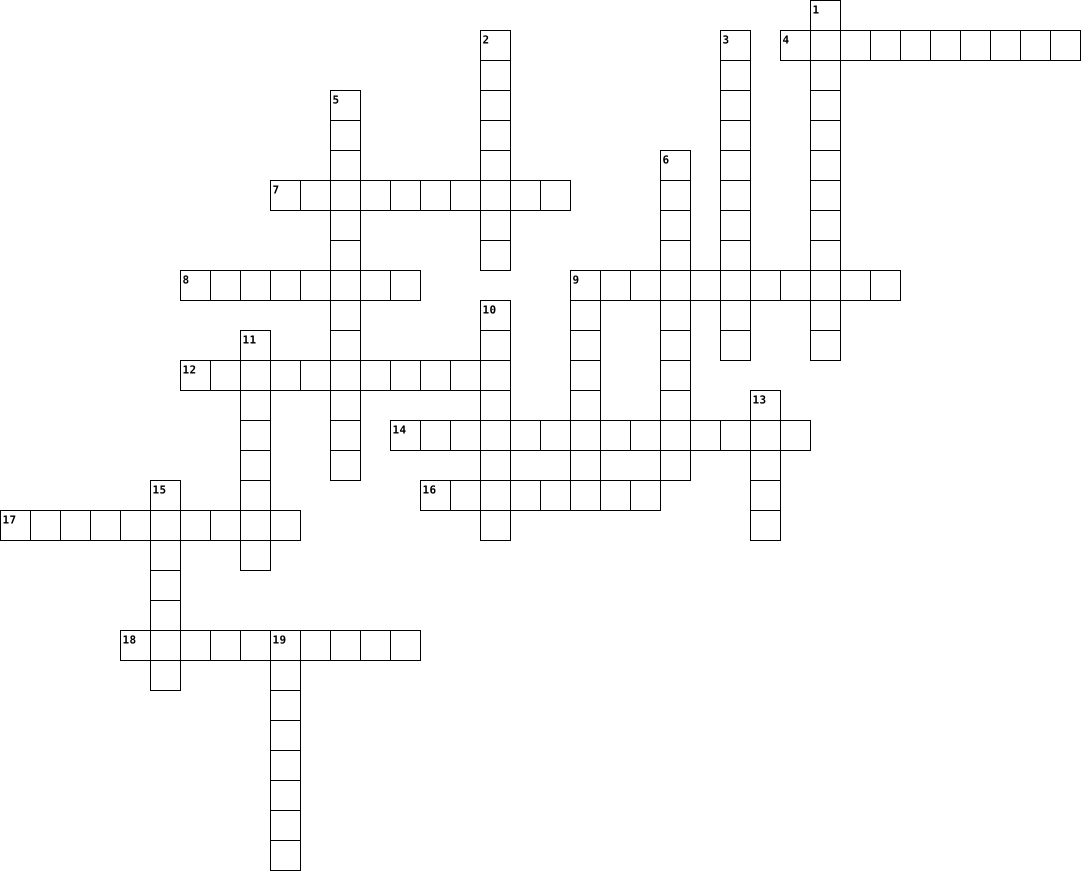
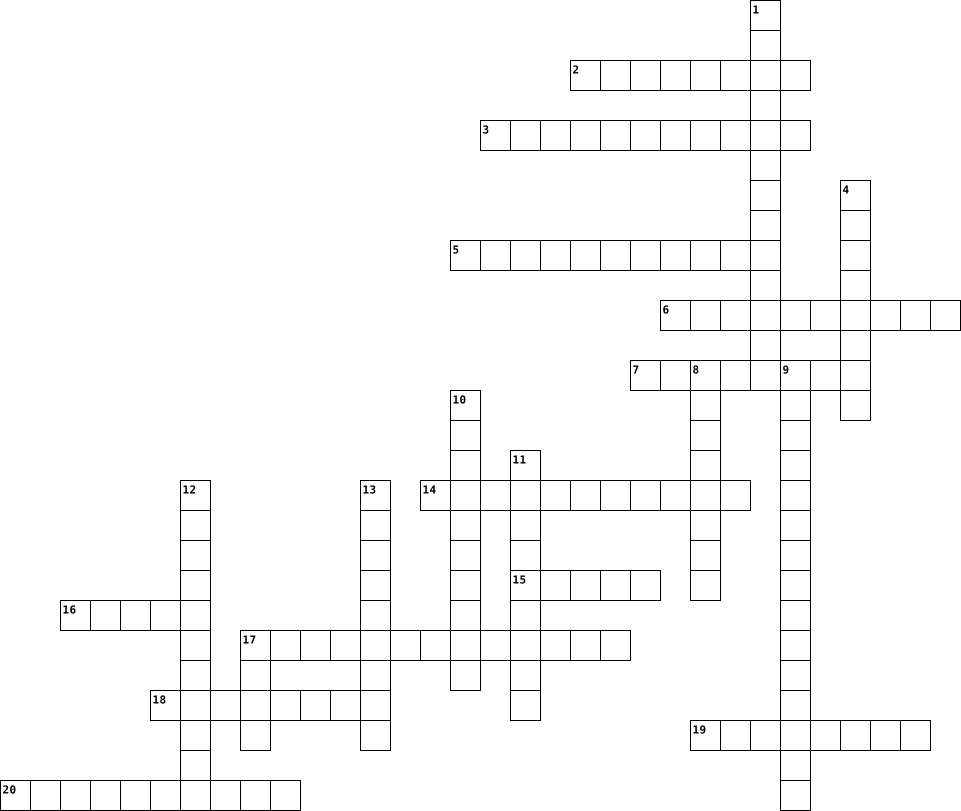
20 Clues: ≈ • / • % • x • ÷ • * • [] • mod • power • exponent • plus sign • ppb; per- • ppt; per- • ppm; per- • minus sign • equals sign • horizontal line • decimal separator • greater than or less than • calculate expression inside first
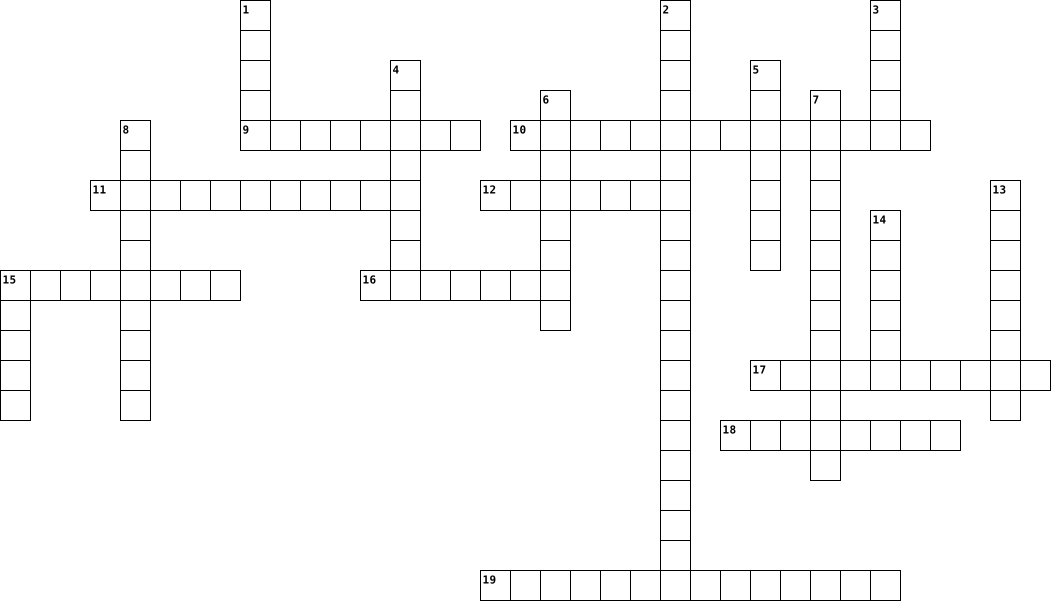
BASIC MATH SYMBOLS 2023-02-28
Across
- Aside from parenthesis, it is also used to enclose a group of terms.
- 4√a ⋅ 4√a ⋅ 4√a ⋅ 4√a = a
- <
- This "+" symbol has a symbol name called _________.
- %
- This sign or symbol is used in subtraction.
- √a
- These ≥ ≤ < > symbols are called __________.
Down
- It is the symbol name of /.
- Other than the division sign, this "÷" sign is also called ________.
- ( )
- _______ is denoted by the symbol "*".
- Aside from division sign, this symbol is also used for division/fraction which is denoted by the symbol "—".
- It is a decimal point or decimal separator.
- the meaning of mod is a remainder calculation that has a symbol name of_________.
- In what mathematical operation is this "⋅" symbol used?
- It is the word that defines this "≈" symbol.
- This "×" sign is used in multiplication, what is its symbol name?
- 17 > 13, the symbol used in this example is_________.
- The symbol name of "^".
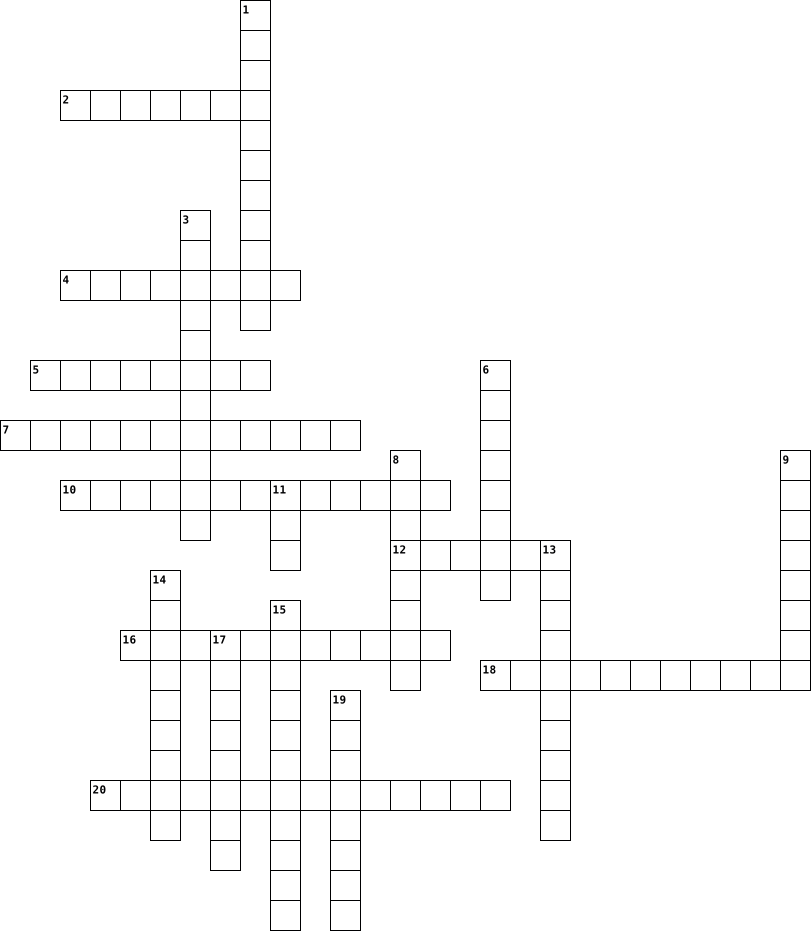
20 Clues: < • % • √a • ( ) • The symbol name of "^". • 4√a ⋅ 4√a ⋅ 4√a ⋅ 4√a = a • It is the symbol name of /. • _______ is denoted by the symbol "*". • It is a decimal point or decimal separator. • This sign or symbol is used in subtraction. • It is the word that defines this "≈" symbol. • These ≥ ≤ < > symbols are called __________. • This "+" symbol has a symbol name called _________. • ...
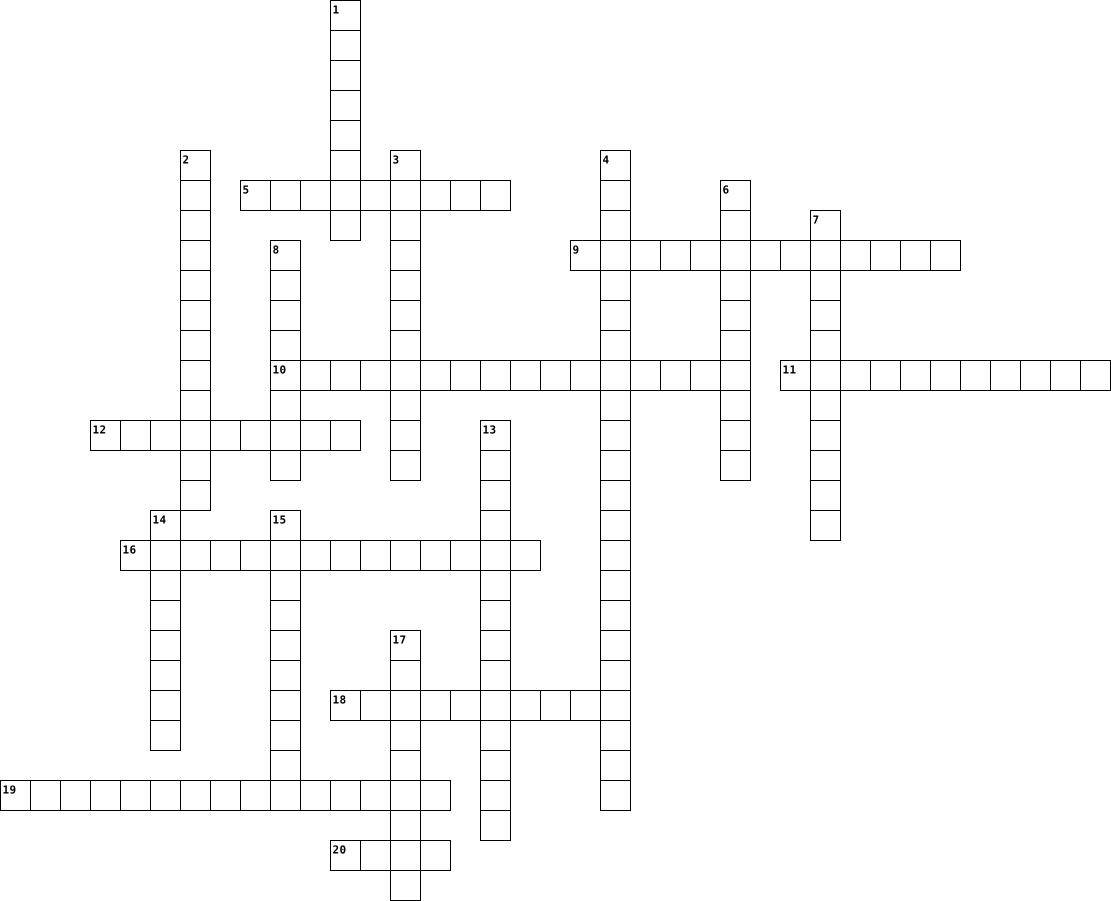
BASIC MATH SYMBOLS 2023-02-24
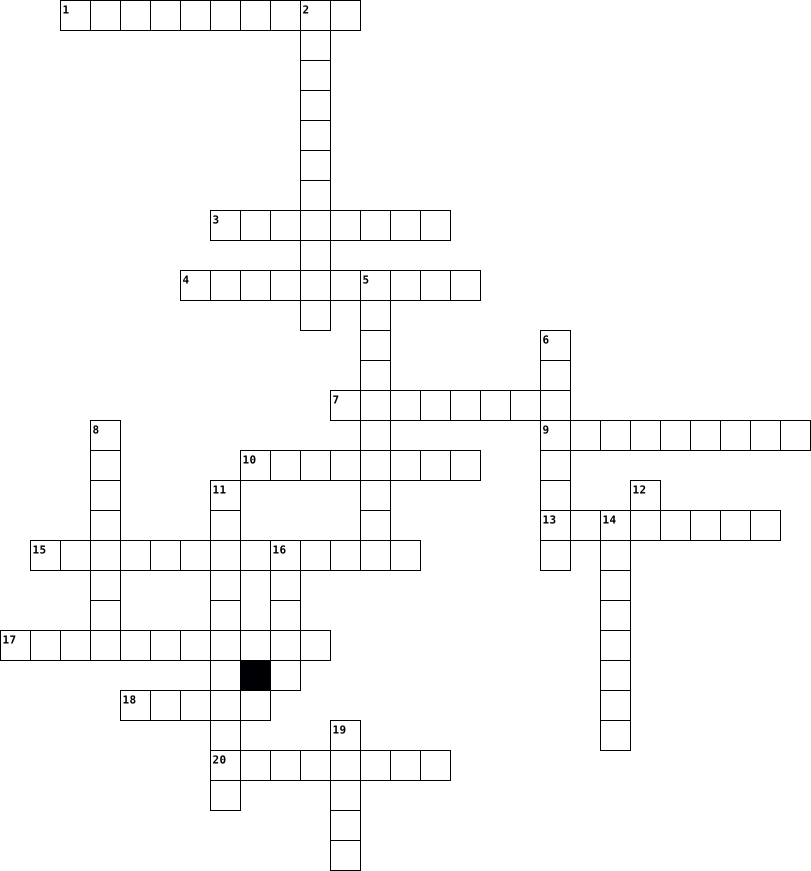
20 Clues: < • * • % • ≈ • = • × • ÷ • ppb • a^b • [ ] • ppt • ( ) • ppm • addition • subtraction • caret, power • division/fraction • remainder calculation • decimal point, decimal separator • greater than/ less than or equal to
Idaho State Symbols 2023-05-10
Across
- The state flag is on this fabric
- This type of soil makes our state perfect for growing our state vegetable.
- This native plant produces our state fruit.
- Our state fossil has been found in large quantities near this town.
- The tree on the state seal signify this.
- A trout native to Idaho but NOT the state fish
- Native Americans used this part of the syringa for bows & arrows.
- Settlers used to call our state horse ____________ horses.
- This mineral causes the star in star garnets.
- This color blazes in the sunlight, along with gold, in our state song.
- The species name of our state tree.
- The mountain bluebird is a member of this bird family.
- This is in the center of the state flag.
- The forests are described this way in our state song.
- This is growing at the woman's feet on the state seal.
- This river is represented on our state seal.
- The part of the state you would have to go to find our state tree
- In the Idaho state song, these people "made it so for you and me."
- Appaloosa horses were bred for three qualities. This is one of them.
Down
- This is our state dance
- The scientific name of our state flower honors this explorer.
- The person responsible for our state amphibian was this age at the Blue Book's publication.
- The monarch butterfly's species name.
- Our state vegetable
- The grain on the state seal signify this.
- Idaho's state song
- Our state fossil is actually more closely related to this than to what it is named after.
- Our state fruit depends on this for winter survival.
- The Mountain Bluebird's species name
- Idaho's state amphibian
- The scientific name of the cutthroat trout is in reference to this explorer.
- One of the two counties where Idaho's state gem is found.
- Our state insect was named because of its color being similar to the Prince of ___________ in England.
- The pick and shovel on the state seal signify this.
- The only continent that does not contain our state raptor.
- This falcon is our state raptor.
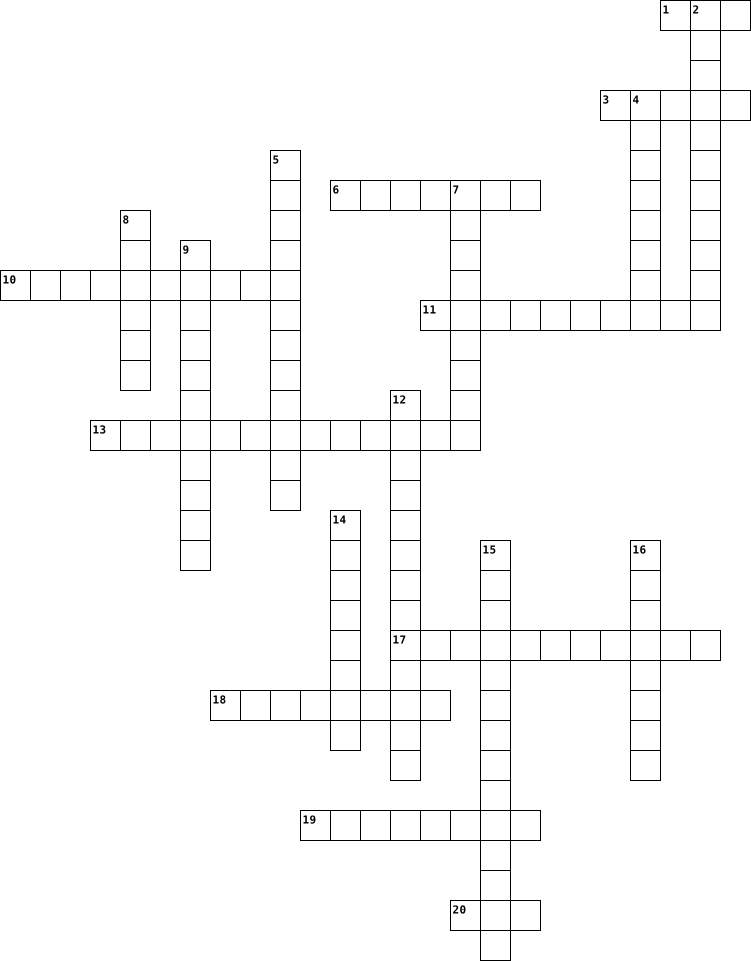
36 Clues: Idaho's state song • Our state vegetable • This is our state dance • Idaho's state amphibian • The state flag is on this fabric • This falcon is our state raptor. • The species name of our state tree. • The Mountain Bluebird's species name • The monarch butterfly's species name. • The tree on the state seal signify this. • This is in the center of the state flag. • ...
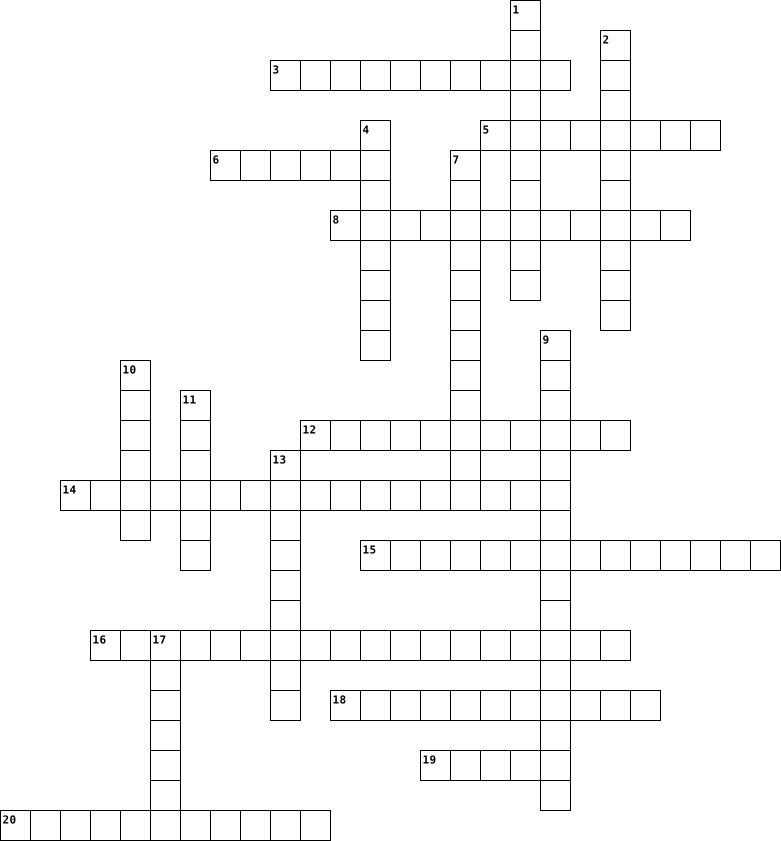
Basic Math Symbols 2021-09-14
Across
- Sign, means subtraction/ -
- means approximation/ ≈
- 1% = 1/100
- means greater than/ >
- means to calculate expression inside
- means both minus and plus operations/ ±
- means equality/ =
- root, √a ⋅ √a = a
- means exponent/ a^b
- Line, means to fraction and division/ —
- ( )
Down
- means inequality/ ≠
- means to calculate expression inside first/ [ ]
- means both plus and minus operations/ ±
- decimal point
- means to divide/ ÷
- means to multiply/ *
- means greater than or equal to/ ≥
- means only less than/ <
- 1ppm = 1/1000000
- means remainder calculation
- means addition/ +
22 Clues: ( ) • 1% = 1/100 • decimal point • 1ppm = 1/1000000 • means equality/ = • means addition/ + • means to divide/ ÷ • root, √a ⋅ √a = a • means inequality/ ≠ • means exponent/ a^b • means to multiply/ * • means greater than/ > • means approximation/ ≈ • means only less than/ < • Sign, means subtraction/ - • means remainder calculation • means greater than or equal to/ ≥ • ...
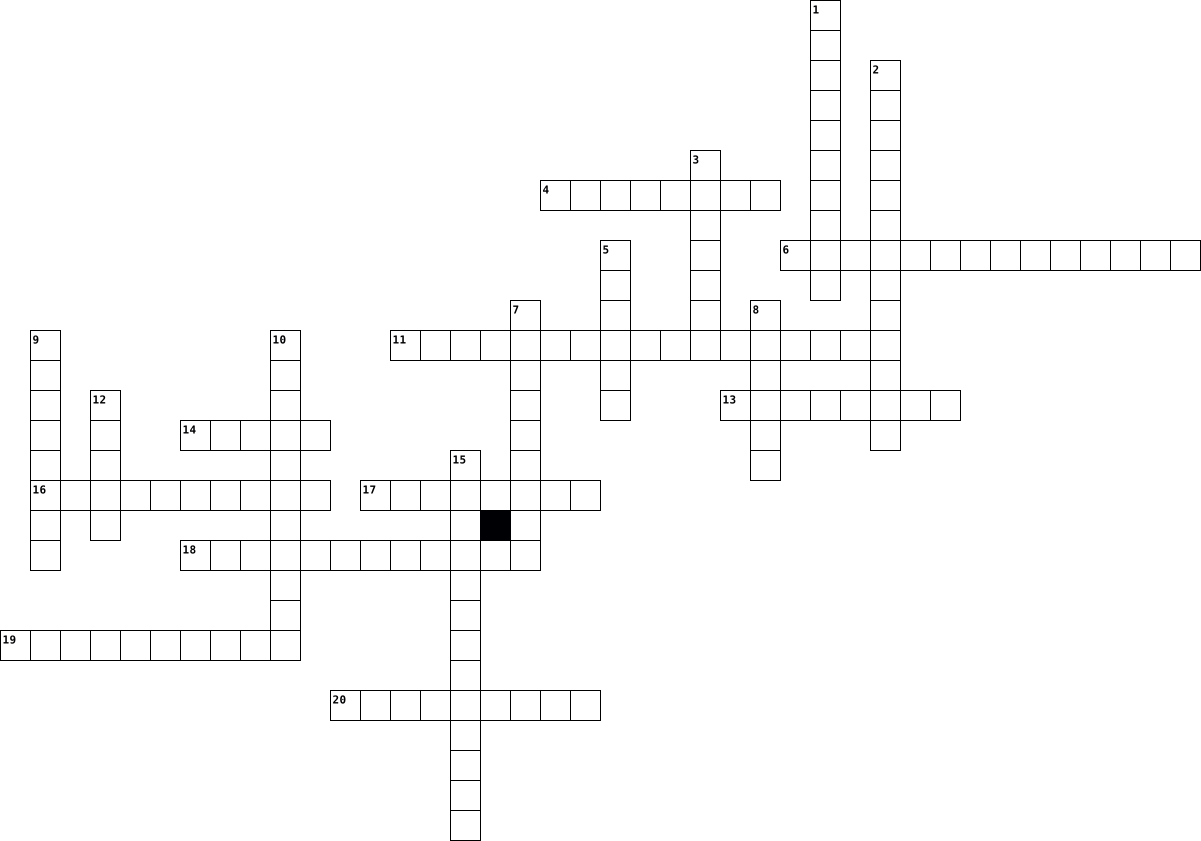
Basic Math Symbols 2021-09-14
Across
- ( )
- means only less than/ <
- means equality/ =
- decimal point
- means to divide/ ÷
- means exponent/ a^b
- means to multiply/ *
- means approximation/ ≈
- 1ppm = 1/1000000
- means greater than/ >
- means both minus and plus operations/ ±
- means addition/ +
Down
- √a ⋅ √a = a
- means to calculate expression inside
- means subtraction/ -
- means to fraction and division/ —
- means greater than or equal to/ ≥
- means both plus and minus operations/ ±
- means remainder calculation
- 1% = 1/100
- means inequality/ ≠
- means to calculate expression inside first/ [ ]
22 Clues: ( ) • 1% = 1/100 • √a ⋅ √a = a • decimal point • 1ppm = 1/1000000 • means equality/ = • means addition/ + • means to divide/ ÷ • means exponent/ a^b • means inequality/ ≠ • means subtraction/ - • means to multiply/ * • means greater than/ > • means approximation/ ≈ • means only less than/ < • means remainder calculation • means to fraction and division/ — • means greater than or equal to/ ≥ • ...
Holdays and symbols 2024-12-22
Across
- Apr. 20. Egg
- Dec. 26.- Jan. 1. Bongo
- Apr. 12.- Apr. 20. Star
- Oct. 31. Pumpkin
- May 5. Maraca
- Aug. 5. Clam
- Mar. 16. Finland
- Dec. 26.- Jan. 2. Dreidel
- Nov. 11. Green
- Mar. 17. Clover
- Aug. 3. Mop
- Feb. 14. Heart
- Dec. 25. Tree
- Aug. 3. Ball
Down
- Aug. 20./Sep. 3. Bus
- Jul. 1. Leaf
- Jan. 1. Clock
- Nov. 2. Skull
- May 27. Flag
- Dec. 31. Eye
- Jun. 16. Hat
- Nov. 28. Turkey
- Jul. 4. Firework
23 Clues: Aug. 3. Mop • Apr. 20. Egg • Jul. 1. Leaf • May 27. Flag • Aug. 5. Clam • Dec. 31. Eye • Jun. 16. Hat • Aug. 3. Ball • Jan. 1. Clock • May 5. Maraca • Nov. 2. Skull • Dec. 25. Tree • Nov. 11. Green • Feb. 14. Heart • Nov. 28. Turkey • Mar. 17. Clover • Oct. 31. Pumpkin • Mar. 16. Finland • Jul. 4. Firework • Aug. 20./Sep. 3. Bus • Dec. 26.- Jan. 1. Bongo • Apr. 12.- Apr. 20. Star • Dec. 26.- Jan. 2. Dreidel
Basic Math Symbols 2025-02-22
Across
- subtraction minus sign
- fraction horizontal line
- caret exponent
- strictinequality greater than
- obelus division
- exponent power
- multiplication times sign
- both plus ang minus
- equality equal sign
- 1%=1\100
Down
- decimalpoint period
- division slash
- 1ppm=1\1000000
- asterisk multiplication
- approximation approximately equal
- remainder calculation
- parenthesis calculate expression inside first
- brackets calculate expression inside first
- addition plus sign
- inequality not equal sign
20 Clues: 1%=1\100 • division slash • 1ppm=1\1000000 • caret exponent • exponent power • obelus division • addition plus sign • decimalpoint period • both plus ang minus • equality equal sign • remainder calculation • subtraction minus sign • asterisk multiplication • fraction horizontal line • multiplication times sign • inequality not equal sign • strictinequality greater than • ...
basic math symbols 2025-02-26
Logic Symbols by 2025-02-27
20 Clues: (<) • (+) • (≤) • (×) • (=) • (±) • (∓) • (≥) • (-) • (>) • (()) • ([]) • (mod) • To (≈) • Root (√a) • Equal To (≠) • (Overline) (—) • (Superscript) (aᵇ) • Exponentiation (a^b) • (Decimal or Multiplication) (·)
Basic Math Symbols 2025-02-19
Across
- Symbol for multiplying numbers.
- Represents a fraction out of 100.
- Finds a number that, when squared, equals the given value.
- Means a number is either greater than or the same as another.
- Indicates a number is smaller than or equal to another.
- Also represents division in fractions.
- Used when values are close but not exactly equal.
Down
- Indicates raising a number to a power.
- Finds the remainder in division.
- Used for subtraction.
- Used to divide numbers.
- Finds a number that, when cubed, equals the given value.
- Shows that a number is larger than another.
- Indicates a number is smaller than another.
- Used for addition.
- Indicates two values are not the same.
- Alternative symbol for multiplication.
- Represents both addition and subtraction.
- Used to group terms in mathematical expressions.
- Represents equality in an equation.
20 Clues: Used for addition. • Used for subtraction. • Used to divide numbers. • Symbol for multiplying numbers. • Finds the remainder in division. • Represents a fraction out of 100. • Represents equality in an equation. • Indicates raising a number to a power. • Indicates two values are not the same. • Alternative symbol for multiplication. • Also represents division in fractions. • ...
Basic Math Symbols 2025-02-25
Across
- symbol is used to indicate exponentiation, meaning raising a number to a power.
- is used as the decimal point to separate the whole number part from the fractional part
- in programming and mathematics gives you the remainder after a division. It's often described as the "remainder operator".
- means that two values are almost the same but not exactly identical.
- refers to a statement that compares two expressions or values, indicating that they are not equal.
- is a symbol used to indicate mathematical division.
- is a straight line that runs from left to right or right to left, parallel to the horizon.
- refers to a comparison between two values where one value is strictly greater than or strictly less than the other.
- is a mathematical symbol used to represent division.
Down
- a number is a value that, when multiplied by itself, equals the original number. It's like finding the "opposite" of squaring a number.
- is a mathematical symbol that indicates multiplication.
- is a mathematical symbol that indicates that two expressions have the same value.
- in mathematics refers to exponentiation, which is a mathematical operation that involves multiplying a number by itself a certain number of times.
- is a mathematical symbol used to indicate multiplication.
- mathematical symbol that indicates addition.
- is a small star-shaped symbol with several uses in writing, printing, and programming.
- symbols used to group numbers, variables, or expressions together.
- two things are different or not the same.
- is a mathematical symbol with multiple meanings. It's most commonly used to indicate subtraction.
- also known as brackets, are symbols used in mathematics to group numbers, variables, or expressions together.
20 Clues: two things are different or not the same. • mathematical symbol that indicates addition. • is a symbol used to indicate mathematical division. • is a mathematical symbol used to represent division. • is a mathematical symbol that indicates multiplication. • is a mathematical symbol used to indicate multiplication. • ...
Basic Math Symbols 2025-02-25
Basic Math Symbols 2025-02-24
21 Clues: = • % • [] • () • ppb • ppm • ppt • a^b • obelus • asterisk • exponent • plus sign • minus sign • decimal point • not equal sign • horizontal line • strict inequality • approximately equal • remainder calculation • both minus and plus operations • both minus and plus operations
Basic Math Symbols 2025-03-01
BASIC MATH SYMBOLS 2025-03-02
Basic Math Symbols 2025-03-02
SIGHTS AND SYMBOLS 2024-01-13
21 Clues: HOLLY • PEACE • TULIP • DAISY • VIOLET • VICTORY • ENTRANCE • AFFECTION • INNOCENSE • ETERNAL LIFE • WINGED STATUE • MEMORY PHRASES • DREAMING OF YOU • HOME OF DECEASED • "OUT IN THE RAIN" • USED TO OPEN GATE • EAT FROM A BASKET • JESUS, GREEK ABBR • SPIRITUAL VICTORY • CITY OF ATLANTA PARK • AUTHOR OF OAKLAND ABC BOOK
BASIC MATH SYMBOLS 2024-03-04
Other Florida Symbols 2021-08-25
Across
- Rodeo
- The Florida Citrus Archive
- Stone
- The St. John's River City _______
- Fruit
- State Song(retired)
- Honey
- Motto
- Tree(not cabbage)
- Song
- Pie
- Fossil
- Seal
Down
- Stephen Foster State Folk Culture Center
- Day(number in word form)
- Nickname
- Flag
- Play
- Beverage
- Wild Flower
- Florida(Where the Sawgrass Meets the Sky)
- Soil
- Shell
- Festival
- Flower
- Gem
- Welcome Song
27 Clues: Gem • Pie • Flag • Play • Soil • Song • Seal • Rodeo • Stone • Fruit • Honey • Motto • Shell • Flower • Fossil • Nickname • Beverage • Festival • Wild Flower • Welcome Song • Tree(not cabbage) • State Song(retired) • Day(number in word form) • The Florida Citrus Archive • The St. John's River City _______ • Stephen Foster State Folk Culture Center • Florida(Where the Sawgrass Meets the Sky)
BASIC MATH SYMBOLS 2021-09-07
20 Clues: % • * • • • / • x • — • . • () • [] • mod • a^b • exponent • equality • division • addition • inequality • subtraction • greater than • approximation • both minus and plus operations
BASIC MATH SYMBOLS 2021-09-07
Across
- %
- 1ppm=1/1000=0.1%
- decimal point, decimal separator
- example 6/2=3
- both minus and plus operations
- example 2x3=6
- power
- example 2.3=6
- calculate expression inside first
- remainder calculation
- example 2-1=1
- division/fraction
Down
- example 2^3=8
- ppb
- for example 4<5 or 4 is less than 5
- plus sign
- both plus and minus operations
- for example 5 is equal to 2+3
- example 2*3=6
- ppt
20 Clues: % • ppb • ppt • power • plus sign • example 2^3=8 • example 6/2=3 • example 2*3=6 • example 2x3=6 • example 2.3=6 • example 2-1=1 • 1ppm=1/1000=0.1% • division/fraction • remainder calculation • for example 5 is equal to 2+3 • both plus and minus operations • both minus and plus operations • decimal point, decimal separator • calculate expression inside first • for example 4<5 or 4 is less than 5
Basic Math Symbols 2022-03-18
BASIC MATH SYMBOLS 2022-03-18
Basic Mathematical Symbols 2022-03-10
Basic Math Symbols 2022-03-12
Basic Math Symbols 2022-03-14
Basic Math Symbols 2022-03-16
20 Clues: - • = • + • ÷ • * • [ ] • 2³= 8 • 1%=1/100 • 2 ^ 3 = 8 • per-billion • per-million • per-trillion • 1‰=1/1000=0.1% • decimal separator • division sign (÷) . • 3√a - 3√a - 3√a = a • remainder calculation • greater than or equal to. • calculate expression first • a numerical quantity that is not a whole number ( 1/2, 0.5).
Basic Math Symbols 2022-03-16
20 Clues: - • = • + • ÷ • * • [ ] • 2= 8 • 1%=1/100 • 2 ^ 3 = 8 • per-billion • per-million • per-trillion • 1‰=1/1000=0.1% • decimal separator • division sign (÷) . • 3√a - 3√a - 3√a = a • remainder calculation • greater than or equal to. • calculate expression first • a numerical quantity that is not a whole number ( 1/2, 0.5).
BASIC MATH SYMBOLS 2022-03-16
20 Clues: ‰ • / • > • < • - • % • [] • ppt • a^b • ppm • ppb • exponent • plus sign • √a √a = a • times sign • equal sign • not equal sign • remainder calculation • calcute expression inside first • decimal point, decimal separator
Basic Math Symbols 2022-03-17
20 Clues: — • / • × • * • ab • a^b • [ ] • power • modulo • plus sign • minus sign • 1% = 1/100 • equal sign • per-million • decimal point • not equal sign • 1ppb = 1/1000000000 • approximately equal • remainder calculation • calculate expression inside first
BASIC MATH SYMBOLS 2022-03-14
Basic Math Symbols 2022-09-08
Chemical Element Symbols 2022-09-19
Utah State Symbols 2025-12-05
Across
- state soil
- state bird
- state flower
- state song
- state fossil
- state fish
- state vegetable
- state capital
- state butterfly
Down
- state amphibian
- state mineral and state metal
- state motto
- state reptile
- state drink
- state grass
- state insect
- State nickname
- state tree
- state dinosaur
- state fruit
- state gemstone
- state fossil group
22 Clues: state soil • state bird • state song • state tree • state fish • state motto • state drink • state grass • state fruit • state flower • state insect • state fossil • state reptile • state capital • State nickname • state dinosaur • state gemstone • state amphibian • state vegetable • state butterfly • state fossil group • state mineral and state metal
Elements and Symbols 2025-12-08
Across
- Element symbol Fe
- Element symbol Rb
- Element symbol Si
- Element symbol Ni
- Element symbol As
- Element symbol Ar
- Element symbol Sr
- Element symbol I
- Element symbol Zn
- Element symbol Ti
- Element symbol Mg
- Element symbol Pb
- Element symbol Sc
- Element symbol He
- Element symbol F
- Element symbol Hg
- Element symbol N
- Element symbol O
- Element symbol W
- Element symbol Sb
- Element symbol Ra
Down
- Element symbol Au
- Element symbol Ba
- Element symbol Se
- Element symbol Cu
- Element symbol Ca
- Element symbol K
- Element symbol Sn
- Element symbol B
- Element symbol Cl
- Element symbol Co
- Element symbol Cs
- Element symbol Li
- Element symbol Na
- Element symbol Ne
- Element symbol P
- Element symbol Cr
- Element symbol C
- Element symbol Be
- Element symbol Br
- Element symbol B
- Element symbol H
- Element symbol Mn
- Element symbol Kr
- Element symbol Al
- Element symbol Ag
46 Clues: Element symbol K • Element symbol B • Element symbol I • Element symbol P • Element symbol C • Element symbol B • Element symbol F • Element symbol H • Element symbol N • Element symbol O • Element symbol W • Element symbol Au • Element symbol Fe • Element symbol Rb • Element symbol Ba • Element symbol Se • Element symbol Cu • Element symbol Ca • Element symbol Si • Element symbol Sn • Element symbol Cl • ...
Algebra III Chapter 3 Vocabulary Quiz 2012-11-20
Across
- A set of values for the variables that makes all the equations true
- A set of two or more equations using the same variables
- System that have the same solution(s)
- When the outcome of one event does not affect the probability of a second event, the two events are independent.
- A system of linear equations is consistent if it has at least one solution
- A system of equations that does not have a unique solution
- A linear system Is a set of two or more linear equations that use the same variables
Down
- A system of equations that has no solution in an inconsistent system
- Restrictions on the variables of the objective function in a linear programming problem
- Contains all the values that satisfy the constraints on the objective function.
10 Clues: System that have the same solution(s) • A set of two or more equations using the same variables • A system of equations that does not have a unique solution • A set of values for the variables that makes all the equations true • A system of equations that has no solution in an inconsistent system • ...
Process of Communication 2025-09-11
Across
- Response indicating understanding."
- Communication Between people—personal exchange."
- Method of communication."
- Content being conveyed.
- Turning thoughts into symbols.
- Communication Speech and language use.
- Communication Communication within a group.
- Listening Fully attending and responding.
- Originator of a message.
- Situational factors shaping meaning."
- Communication Gestures and expressions without words."
- Easiness of understanding.
Down
- Noise External disruption (sound, line).
- Interference distorting the message."
- The one who gets the message.
- Communication Talking to yourself.
- Communication Communication within a group.
- Communication To a large audience via media.
- Medium through which a message travels.
- Interpreting symbols back into meaning.
- Noise Misunderstandings from language/jargon.
21 Clues: Content being conveyed. • Originator of a message. • Method of communication." • Easiness of understanding. • The one who gets the message. • Turning thoughts into symbols. • Response indicating understanding." • Communication Talking to yourself. • Interference distorting the message." • Situational factors shaping meaning." • Medium through which a message travels. • ...
Mathematics Creative Assignment- Crossword Puzzle 2015-04-19
Across
- Direct and partial variations are examples of what
- A method used to help us determine if a relation is linear
- on a graph, the line that holds the dependant variables
- a group of numbers used to indicate the position of a point or line
- the point where a line crosses the vertical axis on a graph
- progressing from one stage to another in a series, sequently
- Refers to the number that relates two variables that are directly proportional to each other
- A change in one variable corresponding to a change in another
- a straight strip typically used to draw straight lines or to measure distance
- a quality in a calculation that is assumed to vary or be capable of varying in value
- the point where a line crosses the horizontal axis on a graph
- a diagram showing the relation between variable quantities
- A linear relation that is represented by an equation in the form of Ax+By+C=0
- There is no y-intercept but the equation passes through the origin
Down
- Refers to the point where the line crosses either axis
- when both lines intersect at 90 degrees
- Refers to a set of two lines
- on a graph, the line that holds the independent variables
- The number it would be when at zero or x=0
- the term used to describe the process of equating one thing with another
- when an equation is containing a variable with an exponent other then one
- When there is a y-intercept but does not pass through the origin
- When the numerator and denominator of a fraction is switched
- two lines that have the same slope
- the mathematical equation used to measure the steepness of a line
25 Clues: Refers to a set of two lines • two lines that have the same slope • when both lines intersect at 90 degrees • The number it would be when at zero or x=0 • Direct and partial variations are examples of what • Refers to the point where the line crosses either axis • on a graph, the line that holds the dependant variables • ...
Mathematics Creative Assignment- Crossword Puzzle 2015-04-19
Across
- progressing from one stage to another in a series, sequently
- a diagram showing the relation between variable quantities
- the term used to describe the process of equating one thing with another
- Refers to the point where the line crosses either axis
- When there is a y-intercept but does not pass through the origin
- a quality in a calculation that is assumed to vary or be capable of varying in value
- A method used to help us determine if a relation is linear
- When the numerator and denominator of a fraction is switched
- when an equation is containing a variable with an exponent other then one
- on a graph, the line that holds the independent variables
- There is no y-intercept but the equation passes through the origin
- Refers to a set of two lines
- Direct and partial variations are examples of what
- The number it would be when at zero or x=0
Down
- when both lines intersect at 90 degrees
- the point where a line crosses the vertical axis on a graph
- A change in one variable corresponding to a change in another
- Refers to the number that relates two variables that are directly proportional to each other
- a straight strip typically used to draw straight lines or to measure distance
- a group of numbers used to indicate the position of a point or line
- A linear relation that is represented by an equation in the form of Ax+By+C=0
- the point where a line crosses the horizontal axis on a graph
- on a graph, the line that holds the dependant variables
- the mathematical equation used to measure the steepness of a line
- two lines that have the same slope
25 Clues: Refers to a set of two lines • two lines that have the same slope • when both lines intersect at 90 degrees • The number it would be when at zero or x=0 • Direct and partial variations are examples of what • Refers to the point where the line crosses either axis • on a graph, the line that holds the dependant variables • ...
Math Crossword Puzzle 2015-11-12
Across
- If a <0 The parabola opens down and there will be a______
- A polynomial is______ when only 1 or -1 is a common factor that is a common factor of every term
- To expand an algebraic expression use the______ to multiply the expression by a constant or term
- A quadratic function in vertex form can be expressed in standard form by______ and simplifying
- Name the common factor of the terms of the polynomial 3x^2-9x+12
- When a <0 the graph is______ in the x-axis
- Name the GCF of the polynomial 16x^2-8x-10
- Quadratic functions written in standard form can be written in vertex form by______
- To simplify an algebraic expression collect______ by adding or subtracting
- To factor an algebraic expression______ out the greatest number or term that will divide into all terms
- A quadratic equation is any equation that contains a polynomial whose______ is two
- A perfect square trinomial and a difference of squares can be factored using what method?
Down
- Is the following equation linear or quadratic f(x)=3x-4y=12
- It is possible to factor a polynomial by dividing by a______ that is not the GCF
- For linear functions are the first differences constant or not constant?
- The zeros of a relation correspond to the______ of its graph
- What is the vertical line that runs through the midpoint of the zeros?
- Most linear functions have the set of______ as their domain and range
- Is this equation 4x^2+3x-1 a binomial or a trinomial?
- When a >1 the graph of the function f(x) is______
- The value of "a" can be determined graphically and______
- To evaluate f(a)______ a for x in the equation for f(x)
- What is one way to represent a function?
- If b^2-4ac=0 then the equation has______ real solution and______ x-intercept
- Factoring algebraic expressions is the______ of expanding
25 Clues: What is one way to represent a function? • When a <0 the graph is______ in the x-axis • Name the GCF of the polynomial 16x^2-8x-10 • When a >1 the graph of the function f(x) is______ • Is this equation 4x^2+3x-1 a binomial or a trinomial? • To evaluate f(a)______ a for x in the equation for f(x) • The value of "a" can be determined graphically and______ • ...
Permutation and Combination Crossword 2022-04-10
Across
- Permutation refers to the various ways of arranging some or all of the members within a specific order.
- is the study of the collection, analysis, interpretation, presentation, and organization of data.
- refers to the process of grouping objects.
- is the process or technique of determining the number of elements in a finite set of objects.
- refers to the various ways of arranging some or all of the members within a specific order.
- Permutation is another term for cyclic permutation
- a permutation that has no fixed points.
- matters when illustrating permutation.
- Listing Method is a method used to determine the number of permutations made for each problem.
- permutations are permutations or arrangements that can be distinguished from one another.
- Space is the set of all possible outcomes or findings of that experiment.
- is a set of possible outcomes resulting from a particular experiment.
- is an ordered list of objects. Unlike a set, order matters, and a particular term can appear multiple times at different positions.
- occurs when two or more common or same objects.
Down
- are the result or the effect of the experiment.
- permutations refers to the members or elements of sets are arranged here in a sequence or linear order.
- a mathematical technique for determining the number of possible arrangements in a set of items where the order of the selection is irrelevant.
- Counting Principle is another term for counting rule.
- events are when the outcome of the previous event doesn’t affect the second event.
- refers to science of numbers and their operations.
- Listing Method is a method used to determine the number of permutations made for each problem.
- also called combinatorial mathematics, are used in area of mathematic that is primarily concerned with counting.
- is indicated with the symbol exclamation point or !
- Rule are also known as Multiplication Principle.
- is a fact or rule that utilizes mathematical symbols. It is commonly used in
- of an event can be defined as the set of outcomes of an experiment.
- is any of the natural numbers (positive or negative) or zero.
- events are when the outcome of the first event influences the outcome of the second event.
- Rule is another term for Addition Principle.
- diagram is a simple way to illustrate the possible outcomes of events.
30 Clues: matters when illustrating permutation. • a permutation that has no fixed points. • refers to the process of grouping objects. • Rule is another term for Addition Principle. • are the result or the effect of the experiment. • occurs when two or more common or same objects. • Rule are also known as Multiplication Principle. • ...
Permutation and Combination Crossword 2022-04-10
Across
- Permutation refers to the various ways of arranging some or all of the members within a specific order.
- is the study of the collection, analysis, interpretation, presentation, and organization of data.
- refers to the process of grouping objects.
- is the process or technique of determining the number of elements in a finite set of objects.
- refers to the various ways of arranging some or all of the members within a specific order.
- Permutation is another term for cyclic permutation
- a permutation that has no fixed points.
- matters when illustrating permutation.
- Listing Method is a method used to determine the number of permutations made for each problem.
- permutations are permutations or arrangements that can be distinguished from one another.
- Space is the set of all possible outcomes or findings of that experiment.
- is a set of possible outcomes resulting from a particular experiment.
- is an ordered list of objects. Unlike a set, order matters, and a particular term can appear multiple times at different positions.
- occurs when two or more common or same objects.
Down
- are the result or the effect of the experiment.
- permutations refers to the members or elements of sets are arranged here in a sequence or linear order.
- a mathematical technique for determining the number of possible arrangements in a set of items where the order of the selection is irrelevant.
- Counting Principle is another term for counting rule.
- events are when the outcome of the previous event doesn’t affect the second event.
- refers to science of numbers and their operations.
- Listing Method is a method used to determine the number of permutations made for each problem.
- also called combinatorial mathematics, are used in area of mathematic that is primarily concerned with counting.
- is indicated with the symbol exclamation point or !
- Rule are also known as Multiplication Principle.
- is a fact or rule that utilizes mathematical symbols. It is commonly used in
- of an event can be defined as the set of outcomes of an experiment.
- is any of the natural numbers (positive or negative) or zero.
- events are when the outcome of the first event influences the outcome of the second event.
- Rule is another term for Addition Principle.
- diagram is a simple way to illustrate the possible outcomes of events.
30 Clues: matters when illustrating permutation. • a permutation that has no fixed points. • refers to the process of grouping objects. • Rule is another term for Addition Principle. • are the result or the effect of the experiment. • occurs when two or more common or same objects. • Rule are also known as Multiplication Principle. • ...
Permutation and Combination Crossword 2022-04-10
Across
- events are when the outcome of the first event influences the outcome of the second event.
- is indicated with the symbol exclamation point or “!”.
- is the study of the collection, analysis, interpretation, presentation, and organization of data.
- is a fact or rule that utilizes mathematical symbols. It is commonly used in mathematics.
- Space is the set of all possible outcomes or findings of that experiment.
- permutations refers to the members or elements of sets are arranged here in a sequence or linear order.
- also called combinatorial mathematics, are used in area of mathematic that is primarily concerned with counting.
- is the process or technique of determining the number of elements in a finite set of objects.
- refers to the process of grouping objects.
- Rule is another term for Addition Principle.
- occurs when two or more common or same objects.
- is an ordered list of objects. Unlike a set, order matters, and a particular term can appear multiple times at different positions.
- Listing Method is a method used to determine the number of permutations made for each problem.
- Permutation is another term for cyclic permutation.
- are the result or the effect of the experiment.
- is a set of possible outcomes resulting from a particular experiment.
- a mathematical technique for determining the number of possible arrangements in a set of items where the order of the selection is irrelevant.
- Counting Principle is another term for counting rule.
Down
- permutations are permutations or arrangements that can be distinguished from one another.
- of an event can be defined as the set of outcomes of an experiment.
- matters when illustrating permutation.
- is any of the natural numbers (positive or negative) or zero.
- Rule are also known as Multiplication Principle.
- rule is a way to figure out the number of possible outcomes for a given situation.
- refers to the various ways of arranging some or all of the members within a specific order.
- events are when the outcome of the previous event doesn’t affect the second event.
- diagram is a simple way to illustrate the possible outcomes of events.
- Permutation is the total number of ways where n distinct objects can be arranged around a circle.
- a permutation that has no fixed points.
- refers to science of numbers and their operations.
30 Clues: matters when illustrating permutation. • a permutation that has no fixed points. • refers to the process of grouping objects. • Rule is another term for Addition Principle. • occurs when two or more common or same objects. • are the result or the effect of the experiment. • Rule are also known as Multiplication Principle. • ...
Permutation and Combination Crossword 2022-04-10
Across
- a mathematical technique for determining the number of possible arrangements in a set of items where the order of the selection is irrelevant.
- is any of the natural numbers (positive or negative) or zero.
- Rule are also known as Multiplication Principle.
- also called combinatorial mathematics, are used in area of mathematic that is primarily concerned with counting.
- permutations refers to the members or elements of sets are arranged here in a sequence or linear order.
- Permutation is another term for cyclic permutation.
- rule is a way to figure out the number of possible outcomes for a given situation.
- are the result or the effect of the experiment.
- Counting Principle is another term for counting rule.
- diagram is a simple way to illustrate the possible outcomes of events.
- is the study of the collection, analysis, interpretation, presentation, and organization of data.
- is a fact or rule that utilizes mathematical symbols. It is commonly used in mathematics.
- is indicated with the symbol exclamation point or “!”.
- occurs when two or more common or same objects.
- Rule is another term for Addition Principle.
- events are when the outcome of the previous event doesn’t affect the second event.
- events are when the outcome of the first event influences the outcome of the second event.
- Space is the set of all possible outcomes or findings of that experiment.
Down
- refers to science of numbers and their operations.
- Permutation is the total number of ways where n distinct objects can be arranged around a circle.
- a permutation that has no fixed points.
- refers to the process of grouping objects.
- of an event can be defined as the set of outcomes of an experiment.
- is a set of possible outcomes resulting from a particular experiment.
- Listing Method is a method used to determine the number of permutations made for each problem.
- permutations are permutations or arrangements that can be distinguished from one another.
- matters when illustrating permutation.
- refers to the various ways of arranging some or all of the members within a specific order.
- is an ordered list of objects. Unlike a set, order matters, and a particular term can appear multiple times at different positions.
29 Clues: matters when illustrating permutation. • a permutation that has no fixed points. • refers to the process of grouping objects. • Rule is another term for Addition Principle. • are the result or the effect of the experiment. • occurs when two or more common or same objects. • Rule are also known as Multiplication Principle. • ...
Permutation and Combination Crossword 2022-04-10
Across
- are the result or the effect of the experiment.
- also called combinatorial mathematics, are used in area of mathematic that is primarily concerned with counting.
- is indicated with the symbol exclamation point or “!”.
- Permutation is another term for cyclic permutation.
- Listing Method is a method used to determine the number of permutations made for each problem.
- permutations are permutations or arrangements that can be distinguished from one another.
- of an event can be defined as the set of outcomes of an experiment.
- Space is the set of all possible outcomes or findings of that experiment.
- events are when the outcome of the first event influences the outcome of the second event.
- diagram is a simple way to illustrate the possible outcomes of events.
- is a set of possible outcomes resulting from a particular experiment.
- is an ordered list of objects. Unlike a set, order matters, and a particular term can appear multiple times at different positions.
- occurs when two or more common or same objects.
- Rule are also known as Multiplication Principle.
- permutations refers to the members or elements of sets are arranged here in a sequence or linear order.
- is any of the natural numbers (positive or negative) or zero.
- rule is a way to figure out the number of possible outcomes for a given situation.
Down
- refers to the process of grouping objects.
- Permutation is the total number of ways where n distinct objects can be arranged around a circle.
- is the study of the collection, analysis, interpretation, presentation, and organization of data.
- Counting Principle is another term for counting rule.
- Rule is another term for Addition Principle.
- is a fact or rule that utilizes mathematical symbols. It is commonly used in mathematics.
- refers to the various ways of arranging some or all of the members within a specific order.
- refers to science of numbers and their operations.
- events are when the outcome of the previous event doesn’t affect the second event.
- a permutation that has no fixed points.
- matters when illustrating permutation.
- a mathematical technique for determining the number of possible arrangements in a set of items where the order of the selection is irrelevant.
29 Clues: matters when illustrating permutation. • a permutation that has no fixed points. • refers to the process of grouping objects. • Rule is another term for Addition Principle. • are the result or the effect of the experiment. • occurs when two or more common or same objects. • Rule are also known as Multiplication Principle. • ...
Permutation and Combination Crossword 2022-04-10
Across
- are the result or the effect of the experiment.
- also called combinatorial mathematics, are used in area of mathematic that is primarily concerned with counting.
- is indicated with the symbol exclamation point or “!”.
- Permutation is another term for cyclic permutation.
- Listing Method is a method used to determine the number of permutations made for each problem.
- permutations are permutations or arrangements that can be distinguished from one another.
- of an event can be defined as the set of outcomes of an experiment.
- Space is the set of all possible outcomes or findings of that experiment.
- events are when the outcome of the first event influences the outcome of the second event.
- diagram is a simple way to illustrate the possible outcomes of events.
- is a set of possible outcomes resulting from a particular experiment.
- is an ordered list of objects. Unlike a set, order matters, and a particular term can appear multiple times at different positions.
- occurs when two or more common or same objects.
- Rule are also known as Multiplication Principle.
- permutations refers to the members or elements of sets are arranged here in a sequence or linear order.
- is any of the natural numbers (positive or negative) or zero.
- rule is a way to figure out the number of possible outcomes for a given situation.
Down
- refers to the process of grouping objects.
- Permutation is the total number of ways where n distinct objects can be arranged around a circle.
- is the study of the collection, analysis, interpretation, presentation, and organization of data.
- Counting Principle is another term for counting rule.
- Rule is another term for Addition Principle.
- is a fact or rule that utilizes mathematical symbols. It is commonly used in mathematics.
- refers to the various ways of arranging some or all of the members within a specific order.
- refers to science of numbers and their operations.
- events are when the outcome of the previous event doesn’t affect the second event.
- a permutation that has no fixed points.
- matters when illustrating permutation.
- a mathematical technique for determining the number of possible arrangements in a set of items where the order of the selection is irrelevant.
29 Clues: matters when illustrating permutation. • a permutation that has no fixed points. • refers to the process of grouping objects. • Rule is another term for Addition Principle. • are the result or the effect of the experiment. • occurs when two or more common or same objects. • Rule are also known as Multiplication Principle. • ...
Permutation and Combination Crossword 2022-04-10
Across
- events are when the outcome of the previous event doesn’t affect the second event.
- Rule is another term for Addition Principle.
- Rule are also known as Multiplication Principle.
- is any of the natural numbers (positive or negative) or zero.
- Permutation is the total number of ways where n distinct objects can be arranged around a circle.
- Space is the set of all possible outcomes or findings of that experiment.
- Listing Method is a method used to determine the number of permutations made for each problem.
- of an event can be defined as the set of outcomes of an experiment.
- is the study of the collection, analysis, interpretation, presentation, and organization of data.
- Counting Principle is another term for counting rule.
- refers to the various ways of arranging some or all of the members within a specific order.
- is a symbol for mathematical elements.
- a permutation that has no fixed points.
- diagram is a simple way to illustrate the possible outcomes of events.
- occurs when two or more common or same objects.
- is a fact or rule that utilizes mathematical symbols. It is commonly used in mathematics.
Down
- also called combinatorial mathematics, are used in area of mathematic that is primarily concerned with counting.
- permutations are permutations or arrangements that can be distinguished from one another.
- refers to science of numbers and their operations.
- are the result or the effect of the experiment.
- events are when the outcome of the first event influences the outcome of the second event.
- is a set of possible outcomes resulting from a particular experiment.
- a mathematical technique for determining the number of possible arrangements in a set of items where the order of the selection is irrelevant.
- is the process or technique of determining the number of elements in a finite set of objects.
- is an ordered list of objects. Unlike a set, order matters, and a particular term can appear multiple times at different positions.
- permutations refers to the members or elements of sets are arranged here in a sequence or linear order.
- Permutation is another term for cyclic permutation.
- matters when illustrating permutation.
- refers to the process of grouping objects.
- rule is a way to figure out the number of possible outcomes for a given situation.
- is indicated with the symbol exclamation point or “!”.
31 Clues: matters when illustrating permutation. • is a symbol for mathematical elements. • a permutation that has no fixed points. • refers to the process of grouping objects. • Rule is another term for Addition Principle. • are the result or the effect of the experiment. • occurs when two or more common or same objects. • Rule are also known as Multiplication Principle. • ...
Permutation and Combination Crossword 2022-04-10
Across
- is indicated with the symbol exclamation point or “!”.
- is the study of the collection, analysis, interpretation, presentation, and organization of data.
- matters when illustrating permutation.
- permutations are permutations or arrangements that can be distinguished from one another.
- rule is a way to figure out the number of possible outcomes for a given situation.
- refers to the process of grouping objects.
- a permutation that has no fixed points.
- Counting Principle is another term for counting rule.
- refers to science of numbers and their operations.
- occurs when two or more common or same objects.
- events are when the outcome of the previous event doesn’t affect the second event.
- is a fact or rule that utilizes mathematical symbols. It is commonly used in mathematics.
- Rule are also known as Multiplication Principle.
- Listing Method is a method used to determine the number of permutations made for each problem.
- of an event can be defined as the set of outcomes of an experiment.
- Rule is another term for Addition Principle.
Down
- also called combinatorial mathematics, are used in area of mathematic that is primarily concerned with counting.
- events are when the outcome of the first event influences the outcome of the second event.
- is any of the natural numbers (positive or negative) or zero.
- diagram is a simple way to illustrate the possible outcomes of events.
- is an ordered list of objects. Unlike a set, order matters, and a particular term can appear multiple times at different positions.
- Permutation is the total number of ways where n distinct objects can be arranged around a circle.
- a mathematical technique for determining the number of possible arrangements in a set of items where the order of the selection is irrelevant.
- is a symbol for mathematical elements.
- permutations refers to the members or elements of sets are arranged here in a sequence or linear order.
- is a set of possible outcomes resulting from a particular experiment.
- Permutation is another term for cyclic permutation.
- refers to the various ways of arranging some or all of the members within a specific order.
- are the result or the effect of the experiment.
- Space is the set of all possible outcomes or findings of that experiment.
- is the process or technique of determining the number of elements in a finite set of objects.
31 Clues: matters when illustrating permutation. • is a symbol for mathematical elements. • a permutation that has no fixed points. • refers to the process of grouping objects. • Rule is another term for Addition Principle. • occurs when two or more common or same objects. • are the result or the effect of the experiment. • Rule are also known as Multiplication Principle. • ...
Permutation and Combination Crossword 2022-04-10
Across
- Rule are also known as Multiplication Principle.
- is the study of the collection, analysis, interpretation, presentation, and organization of data.
- diagram is a simple way to illustrate the possible outcomes of events.
- refers to the process of grouping objects.
- a permutation that has no fixed points.
- Counting Principle is another term for counting rule.
- events are when the outcome of the previous event doesn’t affect the second event.
- is a fact or rule that utilizes mathematical symbols. It is commonly used in mathematics.
- are the result or the effect of the experiment.
- is indicated with the symbol exclamation point or “!”.
- also called combinatorial mathematics, are used in area of mathematic that is primarily concerned with counting.
- is the process or technique of determining the number of elements in a finite set of objects.
Down
- refers to the various ways of arranging some or all of the members within a specific order.
- occurs when two or more common or same objects.
- rule is a way to figure out the number of possible outcomes for a given situation.
- Permutation is another term for cyclic permutation.
- Space is the set of all possible outcomes or findings of that experiment.
- Listing Method is a method used to determine the number of permutations made for each problem.
- Permutation is the total number of ways where n distinct objects can be arranged around a circle.
- events are when the outcome of the first event influences the outcome of the second event.
- a mathematical technique for determining the number of possible arrangements in a set of items where the order of the selection is irrelevant.
- permutations are permutations or arrangements that can be distinguished from one another.
- is an ordered list of objects. Unlike a set, order matters, and a particular term can appear multiple times at different positions.
- is a set of possible outcomes resulting from a particular experiment.
- permutations refers to the members or elements of sets are arranged here in a sequence or linear order.
- refers to science of numbers and their operations.
- of an event can be defined as the set of outcomes of an experiment.
- matters when illustrating permutation.
- is any of the natural numbers (positive or negative) or zero.
- Rule is another term for Addition Principle.
30 Clues: matters when illustrating permutation. • a permutation that has no fixed points. • refers to the process of grouping objects. • Rule is another term for Addition Principle. • occurs when two or more common or same objects. • are the result or the effect of the experiment. • Rule are also known as Multiplication Principle. • ...
Permutation and Combination Crossword 2022-04-10
Across
- Rule are also known as Multiplication Principle.
- is the study of the collection, analysis, interpretation, presentation, and organization of data.
- diagram is a simple way to illustrate the possible outcomes of events.
- refers to the process of grouping objects.
- a permutation that has no fixed points.
- Counting Principle is another term for counting rule.
- events are when the outcome of the previous event doesn’t affect the second event.
- is a fact or rule that utilizes mathematical symbols. It is commonly used in mathematics.
- are the result or the effect of the experiment.
- is indicated with the symbol exclamation point or “!”.
- also called combinatorial mathematics, are used in area of mathematic that is primarily concerned with counting.
- is the process or technique of determining the number of elements in a finite set of objects.
Down
- refers to the various ways of arranging some or all of the members within a specific order.
- occurs when two or more common or same objects.
- rule is a way to figure out the number of possible outcomes for a given situation.
- Permutation is another term for cyclic permutation.
- Space is the set of all possible outcomes or findings of that experiment.
- Listing Method is a method used to determine the number of permutations made for each problem.
- Permutation is the total number of ways where n distinct objects can be arranged around a circle.
- events are when the outcome of the first event influences the outcome of the second event.
- a mathematical technique for determining the number of possible arrangements in a set of items where the order of the selection is irrelevant.
- permutations are permutations or arrangements that can be distinguished from one another.
- is an ordered list of objects. Unlike a set, order matters, and a particular term can appear multiple times at different positions.
- is a set of possible outcomes resulting from a particular experiment.
- permutations refers to the members or elements of sets are arranged here in a sequence or linear order.
- refers to science of numbers and their operations.
- of an event can be defined as the set of outcomes of an experiment.
- matters when illustrating permutation.
- is any of the natural numbers (positive or negative) or zero.
- Rule is another term for Addition Principle.
30 Clues: matters when illustrating permutation. • a permutation that has no fixed points. • refers to the process of grouping objects. • Rule is another term for Addition Principle. • occurs when two or more common or same objects. • are the result or the effect of the experiment. • Rule are also known as Multiplication Principle. • ...
Permutation and Combination Crossword 2022-04-10
Across
- Rule are also known as Multiplication Principle.
- is the study of the collection, analysis, interpretation, presentation, and organization of data.
- diagram is a simple way to illustrate the possible outcomes of events.
- refers to the process of grouping objects.
- a permutation that has no fixed points.
- Counting Principle is another term for counting rule.
- events are when the outcome of the previous event doesn’t affect the second event.
- is a fact or rule that utilizes mathematical symbols. It is commonly used in mathematics.
- are the result or the effect of the experiment.
- is indicated with the symbol exclamation point or “!”.
- also called combinatorial mathematics, are used in area of mathematic that is primarily concerned with counting.
- is the process or technique of determining the number of elements in a finite set of objects.
Down
- refers to the various ways of arranging some or all of the members within a specific order.
- occurs when two or more common or same objects.
- rule is a way to figure out the number of possible outcomes for a given situation.
- Permutation is another term for cyclic permutation.
- Space is the set of all possible outcomes or findings of that experiment.
- Listing Method is a method used to determine the number of permutations made for each problem.
- Permutation is the total number of ways where n distinct objects can be arranged around a circle.
- events are when the outcome of the first event influences the outcome of the second event.
- a mathematical technique for determining the number of possible arrangements in a set of items where the order of the selection is irrelevant.
- permutations are permutations or arrangements that can be distinguished from one another.
- is an ordered list of objects. Unlike a set, order matters, and a particular term can appear multiple times at different positions.
- is a set of possible outcomes resulting from a particular experiment.
- permutations refers to the members or elements of sets are arranged here in a sequence or linear order.
- refers to science of numbers and their operations.
- of an event can be defined as the set of outcomes of an experiment.
- matters when illustrating permutation.
- is any of the natural numbers (positive or negative) or zero.
- Rule is another term for Addition Principle.
30 Clues: matters when illustrating permutation. • a permutation that has no fixed points. • refers to the process of grouping objects. • Rule is another term for Addition Principle. • occurs when two or more common or same objects. • are the result or the effect of the experiment. • Rule are also known as Multiplication Principle. • ...
Permutation and Combination Crossword 2022-04-10
Across
- matters when illustrating permutation.
- a permutation that has no fixed points.
- Space is the set of all possible outcomes or findings of that experiment.
- refers to science of numbers and their operations.
- is the study of the collection, analysis, interpretation, presentation, and organization of data.
- Permutation is another term for cyclic permutation.
- is a fact or rule that utilizes mathematical symbols. It is commonly used in mathematics.
- is any of the natural numbers (positive or negative) or zero.
- diagram is a simple way to illustrate the possible outcomes of events.
- permutations are permutations or arrangements that can be distinguished from one another.
- rule is a way to figure out the number of possible outcomes for a given situation.
- occurs when two or more common or same objects.
- refers to the process of grouping objects.
- refers to the various ways of arranging some or all of the members within a specific order.
Down
- also called combinatorial mathematics, are used in area of mathematic that is primarily concerned with counting.
- Listing Method is a method used to determine the number of permutations made for each problem.
- events are when the outcome of the first event influences the outcome of the second event.
- are the result or the effect of the experiment.
- Counting Principle is another term for counting rule.
- permutations refers to the members or elements of sets are arranged here in a sequence or linear order.
- is an ordered list of objects. Unlike a set, order matters, and a particular term can appear multiple times at different positions.
- Rule is another term for Addition Principle.
- a mathematical technique for determining the number of possible arrangements in a set of items where the order of the selection is irrelevant.
- Permutation is the total number of ways where n distinct objects can be arranged around a circle.
- is a symbol for mathematical elements.
- events are when the outcome of the previous event doesn’t affect the second event.
- of an event can be defined as the set of outcomes of an experiment.
- Rule are also known as Multiplication Principle.
- is a set of possible outcomes resulting from a particular experiment.
- is indicated with the symbol exclamation point or “!”.
30 Clues: matters when illustrating permutation. • is a symbol for mathematical elements. • a permutation that has no fixed points. • refers to the process of grouping objects. • Rule is another term for Addition Principle. • are the result or the effect of the experiment. • occurs when two or more common or same objects. • Rule are also known as Multiplication Principle. • ...
Permutation and Combination Crossword 2022-04-10
Across
- matters when illustrating permutation.
- a permutation that has no fixed points.
- Space is the set of all possible outcomes or findings of that experiment.
- refers to science of numbers and their operations.
- is the study of the collection, analysis, interpretation, presentation, and organization of data.
- Permutation is another term for cyclic permutation.
- is a fact or rule that utilizes mathematical symbols. It is commonly used in mathematics.
- is any of the natural numbers (positive or negative) or zero.
- diagram is a simple way to illustrate the possible outcomes of events.
- permutations are permutations or arrangements that can be distinguished from one another.
- rule is a way to figure out the number of possible outcomes for a given situation.
- occurs when two or more common or same objects.
- refers to the process of grouping objects.
- refers to the various ways of arranging some or all of the members within a specific order.
Down
- also called combinatorial mathematics, are used in area of mathematic that is primarily concerned with counting.
- Listing Method is a method used to determine the number of permutations made for each problem.
- events are when the outcome of the first event influences the outcome of the second event.
- are the result or the effect of the experiment.
- Counting Principle is another term for counting rule.
- permutations refers to the members or elements of sets are arranged here in a sequence or linear order.
- is an ordered list of objects. Unlike a set, order matters, and a particular term can appear multiple times at different positions.
- Rule is another term for Addition Principle.
- a mathematical technique for determining the number of possible arrangements in a set of items where the order of the selection is irrelevant.
- Permutation is the total number of ways where n distinct objects can be arranged around a circle.
- is a symbol for mathematical elements.
- events are when the outcome of the previous event doesn’t affect the second event.
- of an event can be defined as the set of outcomes of an experiment.
- Rule are also known as Multiplication Principle.
- is a set of possible outcomes resulting from a particular experiment.
- is indicated with the symbol exclamation point or “!”.
30 Clues: matters when illustrating permutation. • is a symbol for mathematical elements. • a permutation that has no fixed points. • refers to the process of grouping objects. • Rule is another term for Addition Principle. • are the result or the effect of the experiment. • occurs when two or more common or same objects. • Rule are also known as Multiplication Principle. • ...
Permutation and Combination Crossword 2022-04-10
Across
- matters when illustrating permutation.
- is the process or technique of determining the number of elements in a finite set of objects.
- is any of the natural numbers (positive or negative) or zero.
- Space is the set of all possible outcomes or findings of that experiment.
- also called combinatorial mathematics, are used in area of mathematic that is primarily concerned with counting.
- is a symbol for mathematical elements.
- is a set of possible outcomes resulting from a particular experiment.
- Permutation is another term for cyclic permutation.
- events are when the outcome of the first event influences the outcome of the second event.
- is a fact or rule that utilizes mathematical symbols. It is commonly used in mathematics.
- Listing Method is a method used to determine the number of permutations made for each problem.
- refers to science of numbers and their operations.
- of an event can be defined as the set of outcomes of an experiment.
- Rule are also known as Multiplication Principle.
- is indicated with the symbol exclamation point or “!”.
- rule is a way to figure out the number of possible outcomes for a given situation.
Down
- refers to the process of grouping objects.
- Permutation is the total number of ways where n distinct objects can be arranged around a circle.
- a mathematical technique for determining the number of possible arrangements in a set of items where the order of the selection is irrelevant.
- a permutation that has no fixed points.
- permutations refers to the members or elements of sets are arranged here in a sequence or linear order.
- is an ordered list of objects. Unlike a set, order matters, and a particular term can appear multiple times at different positions.
- occurs when two or more common or same objects.
- refers to the various ways of arranging some or all of the members within a specific order.
- Counting Principle is another term for counting rule.
- diagram is a simple way to illustrate the possible outcomes of events.
- Rule is another term for Addition Principle.
- events are when the outcome of the previous event doesn’t affect the second event.
- is the study of the collection, analysis, interpretation, presentation, and organization of data.
- permutations are permutations or arrangements that can be distinguished from one another.
- are the result or the effect of the experiment.
31 Clues: matters when illustrating permutation. • is a symbol for mathematical elements. • a permutation that has no fixed points. • refers to the process of grouping objects. • Rule is another term for Addition Principle. • occurs when two or more common or same objects. • are the result or the effect of the experiment. • Rule are also known as Multiplication Principle. • ...
Permutation and Combination Crossword 2022-04-10
Across
- matters when illustrating permutation.
- a permutation that has no fixed points.
- Space is the set of all possible outcomes or findings of that experiment.
- refers to science of numbers and their operations.
- is the study of the collection, analysis, interpretation, presentation, and organization of data.
- Permutation is another term for cyclic permutation.
- is a fact or rule that utilizes mathematical symbols. It is commonly used in mathematics.
- is any of the natural numbers (positive or negative) or zero.
- diagram is a simple way to illustrate the possible outcomes of events.
- permutations are permutations or arrangements that can be distinguished from one another.
- rule is a way to figure out the number of possible outcomes for a given situation.
- occurs when two or more common or same objects.
- refers to the process of grouping objects.
- refers to the various ways of arranging some or all of the members within a specific order.
Down
- also called combinatorial mathematics, are used in area of mathematic that is primarily concerned with counting.
- Listing Method is a method used to determine the number of permutations made for each problem.
- events are when the outcome of the first event influences the outcome of the second event.
- are the result or the effect of the experiment.
- Counting Principle is another term for counting rule.
- permutations refers to the members or elements of sets are arranged here in a sequence or linear order.
- is an ordered list of objects. Unlike a set, order matters, and a particular term can appear multiple times at different positions.
- Rule is another term for Addition Principle.
- a mathematical technique for determining the number of possible arrangements in a set of items where the order of the selection is irrelevant.
- Permutation is the total number of ways where n distinct objects can be arranged around a circle.
- is a symbol for mathematical elements.
- events are when the outcome of the previous event doesn’t affect the second event.
- of an event can be defined as the set of outcomes of an experiment.
- Rule are also known as Multiplication Principle.
- is a set of possible outcomes resulting from a particular experiment.
- is indicated with the symbol exclamation point or “!”.
30 Clues: matters when illustrating permutation. • is a symbol for mathematical elements. • a permutation that has no fixed points. • refers to the process of grouping objects. • Rule is another term for Addition Principle. • are the result or the effect of the experiment. • occurs when two or more common or same objects. • Rule are also known as Multiplication Principle. • ...
Advanced Math 2023-05-25
Across
- A strategy for finding the local maxima and minima of a function subject to equality constraints
- A series of algorithms that endeavors to recognize underlying relationships in a set of data
- A function that outputs the rate at which another function is changing at a given point
- A mathematical operation that is the reverse of differentiation
- Two lines that intersect to form right angles
- A generalization of the notion of a fiber bundle
- An arrangement of objects in a specific order
- The numerical factor in a term of an algebraic expression
- A theoretical device that manipulates symbols on a strip of tape
- An integral concept that extends the simple concept of area
- The longest side of a right-angled triangle
- A quantity that has both magnitude and direction
- A triangle where all sides are equal
- A partitioning of a plane into regions based on distance to points in a specific subset of the plane
- A rectangular array of numbers or symbols
- Two structures that have the same form or structure
- A branch of mathematics initiated by Évariste Galois that provides a connection between field theory and group theory
- A scalar associated with a linear system of equations
- This property allows you to multiply a sum by multiplying each addend separately and then add the products
- A mathematical tool for studying holes in shapes
- A generalization of the concept of Euclidean space
- A fractal with an uncountably infinite number of points, but zero measure
- The study of counting, arrangement, and combination
- A number that can be expressed as a fraction
- A sequence where the difference between any two terms can be made arbitrarily small
- A non-orientable surface with no identifiable inner and outer sides
- A property of operations where the result can depend on the order of the operands
Down
- The product of all positive integers up to a certain number
- A sequence of integers where the difference between any two elements is unique
- A one-dimensional complex manifold
- A point at which a mathematical object is not defined or not "well-behaved"
- The root of a number
- A way of defining derivatives of functions that are not necessarily differentiable in the classical sense
- A mathematical concept in the fields of multivariable calculus, differential topology, and tensors
- The study of relationships involving lengths and angles of triangles
- A property of functions that preserve the action of a group
- A step-by-step procedure to solve a problem
- An ordered list of numbers
- A line touching a curve at a single point without crossing over
- A polynomial of degree
- If multiplied, it results in the identity
- An algebraic expression or equation with more than one term
- A measure of how spread out a set of numbers are
- The smallest convex set that contains all points of a given set
- A function that is both one-to-one and onto
- A vector that does not change direction under a given linear transformation
- A stochastic model describing a sequence of possible events
- A line that a curve approaches, as it heads towards infinity
- The graph of a quadratic function
- The likelihood of a particular event happening
- A number that cannot be expressed as a simple fraction
- A continuous transformation from one function to another
- The operation that switches the row and column indices of a matrix
- A type of equation that involves derivatives
- A group in which the operation is commutative
- A linear ordering of vertices in a directed acyclic graph
- A set endowed with a structure that allows definition of continuity
- A continuous, bijective, inversely continuous function
- A function that counts the positive integers up to a given integer n that are relatively prime to n
- A mathematical space that is locally Euclidean
60 Clues: The root of a number • A polynomial of degree • An ordered list of numbers • The graph of a quadratic function • A one-dimensional complex manifold • A triangle where all sides are equal • If multiplied, it results in the identity • A rectangular array of numbers or symbols • A step-by-step procedure to solve a problem • A function that is both one-to-one and onto • ...
CCA Chapter 6 Vocabulary 2021-03-05
Across
- a description of how much scatter there is in the data away from the line or curve of best-fit
- the lowest value that a prediction is likely to be
- a piece of data that does not seem to fit into the overall pattern
- the highest value that a prediction is likely to be
- a unique best-fit line that is found by making the squares of the residuals as small as possible
- an equation, table or graph can be used to interpret data that has not been seen yet
- a measure of the strength of an association already determined to be linear (values between -1 and 1)
- a hidden piece of information that was not part of the statistical study under investigation
Down
- this is created in order to analyze the appropriateness of a best-fit model
- a measure of the strength of a linear relationship and is usually expressed as a percent
- if one variable in a relationship increases as the other one increases, the __ is said to be (+pos)
- a prediction made outside the range of the observed data - often not reliable
- the distance a prediction is from the actual observed measurement in an association (R=A=P)
- a model of numerical two-variable data that helps describe the data and is used to make predictions
- a spread of data on a graph that has no discernible pattern
- the correlation coefficient which is a measurement of how much data is scattered around the LSRL
- a relationship between two (or more) variables and can be displayed on a scatterplot
- an example of this might be Hearing Loss due to Long-term Noise Exposure
- a mathematical summary (often an equation) of a trend in data
- this type of association can be linear or non-linear and can contain clusters of data
20 Clues: the lowest value that a prediction is likely to be • the highest value that a prediction is likely to be • a spread of data on a graph that has no discernible pattern • a mathematical summary (often an equation) of a trend in data • a piece of data that does not seem to fit into the overall pattern • ...
math 2025-02-12
Across
- on a plane according to a common action or operation.
- Form – The form of a linear equation: .
- Figures – Figures that have the same size and shape.
- Form – The form of a linear equation: .
- – The set of whole numbers and their opposites.
- of Linear Equations – When two or more linear equations define a
- – The coordinate of the point where a graph crosses an axis.
- – The direction and steepness of a line, usually represented with the
- – A transformation that produces a figure that is the same shape as the
- the relationship between the points.
- Operations – Pairs of operations that reverse the effects of each other.
- Parts – Angles/Sides that have the same relative positions in
- – The number of times you multiply the base of a power.
- – A flat surface, with an infinite length and width, but no depth.
- between two quantities.
- Plot – A graph of a collection of ordered pairs that allows an exploration
Down
- – When two figures’ ratios of their corresponding side lengths are equal.
- – A number multiplied by a variable expression.
- triangle equals the square of the length of the hypotenuse (a 2 + b 2 = c 2 )
- – The amount of space occupied by an object, measured in cubic units.
- – The side opposite the right angle in a right triangle.
- Notation – Used to express a very large or a very small number.
- it into two identical halves.
- figures.
- .
- of Symmetry – An imaginary line that passes through a shape or object and
- Form – The form of a linear equation: .
- – The mapping, or movement, of a plane and all the points of a
- Theorem – The sum of the squares of the lengths of the legs of a
- Pair – A pair of real numbers used to locate a point on a coordinate
- – A line that intersects two or more lines at distinct points.
- figure, but not necessarily the same size.
- Function – A function whose graph is a straight line.
33 Clues: . • figures. • between two quantities. • it into two identical halves. • the relationship between the points. • Form – The form of a linear equation: . • Form – The form of a linear equation: . • Form – The form of a linear equation: . • figure, but not necessarily the same size. • – A number multiplied by a variable expression. • – The set of whole numbers and their opposites. • ...
Permutation and Combination Crossword 2022-04-10
Across
- events are when the outcome of the first event influences the outcome of the second event.
- is indicated with the symbol exclamation point or !
- is the study of the collection, analysis, interpretation, presentation, and organization of data.
- is a fact or rule that utilizes mathematical symbols. It is commonly used in
- Space is the set of all possible outcomes or findings of that experiment.
- permutations refers to the members or elements of sets are arranged here in a sequence or linear order.
- also called combinatorial mathematics, are used in area of mathematic that is primarily concerned with counting.
- is the process or technique of determining the number of elements in a finite set of objects.
- refers to the process of grouping objects.
- Rule is another term for Addition Principle.
- occurs when two or more common or same objects.
- is an ordered list of objects. Unlike a set, order matters, and a particular term can appear multiple times at different positions.
- Listing Method is a method used to determine the number of permutations made for each problem.
- Permutation is another term for cyclic permutation
- are the result or the effect of the experiment.
- is a set of possible outcomes resulting from a particular experiment.
- a mathematical technique for determining the number of possible arrangements in a set of items where the order of the selection is irrelevant.
- Counting Principle is another term for counting rule.
Down
- permutations are permutations or arrangements that can be distinguished from one another.
- of an event can be defined as the set of outcomes of an experiment.
- matters when illustrating permutation.
- is any of the natural numbers (positive or negative) or zero.
- Rule are also known as Multiplication Principle.
- rule is a way to figure out the number of possible outcomes for a given situation.
- refers to the various ways of arranging some or all of the members within a specific order.
- events are when the outcome of the previous event doesn’t affect the second event.
- diagram is a simple way to illustrate the possible outcomes of events.
- Permutation refers to the various ways of arranging some or all of the members within a specific order.
- a permutation that has no fixed points.
- refers to science of numbers and their operations.
30 Clues: matters when illustrating permutation. • a permutation that has no fixed points. • refers to the process of grouping objects. • Rule is another term for Addition Principle. • occurs when two or more common or same objects. • are the result or the effect of the experiment. • Rule are also known as Multiplication Principle. • ...
Permutation and Combination Crossword 2022-04-10
Across
- events are when the outcome of the first event influences the outcome of the second event.
- is indicated with the symbol exclamation point or “!”.
- is the study of the collection, analysis, interpretation, presentation, and organization of data.
- is a fact or rule that utilizes mathematical symbols. It is commonly used in mathematics.
- Space is the set of all possible outcomes or findings of that experiment.
- permutations refers to the members or elements of sets are arranged here in a sequence or linear order.
- also called combinatorial mathematics, are used in area of mathematic that is primarily concerned with counting.
- is the process or technique of determining the number of elements in a finite set of objects.
- refers to the process of grouping objects.
- Rule is another term for Addition Principle.
- occurs when two or more common or same objects.
- is an ordered list of objects. Unlike a set, order matters, and a particular term can appear multiple times at different positions.
- Listing Method is a method used to determine the number of permutations made for each problem.
- Permutation is another term for cyclic permutation.
- are the result or the effect of the experiment.
- is a set of possible outcomes resulting from a particular experiment.
- a mathematical technique for determining the number of possible arrangements in a set of items where the order of the selection is irrelevant.
- Counting Principle is another term for counting rule.
Down
- permutations are permutations or arrangements that can be distinguished from one another.
- of an event can be defined as the set of outcomes of an experiment.
- matters when illustrating permutation.
- is any of the natural numbers (positive or negative) or zero.
- Rule are also known as Multiplication Principle.
- rule is a way to figure out the number of possible outcomes for a given situation.
- refers to the various ways of arranging some or all of the members within a specific order.
- events are when the outcome of the previous event doesn’t affect the second event.
- diagram is a simple way to illustrate the possible outcomes of events.
- Permutation is the total number of ways where n distinct objects can be arranged around a circle.
- a permutation that has no fixed points.
- refers to science of numbers and their operations.
30 Clues: matters when illustrating permutation. • a permutation that has no fixed points. • refers to the process of grouping objects. • Rule is another term for Addition Principle. • occurs when two or more common or same objects. • are the result or the effect of the experiment. • Rule are also known as Multiplication Principle. • ...
Permutation and Combination Crossword 2022-04-10
Across
- events are when the outcome of the previous event doesn’t affect the second event.
- Rule is another term for Addition Principle.
- Rule are also known as Multiplication Principle.
- is any of the natural numbers (positive or negative) or zero.
- Permutation is the total number of ways where n distinct objects can be arranged around a circle.
- Space is the set of all possible outcomes or findings of that experiment.
- Listing Method is a method used to determine the number of permutations made for each problem.
- of an event can be defined as the set of outcomes of an experiment.
- is the study of the collection, analysis, interpretation, presentation, and organization of data.
- Counting Principle is another term for counting rule.
- refers to the various ways of arranging some or all of the members within a specific order.
- is a symbol for mathematical elements.
- a permutation that has no fixed points.
- diagram is a simple way to illustrate the possible outcomes of events.
- occurs when two or more common or same objects.
- is a fact or rule that utilizes mathematical symbols. It is commonly used in mathematics.
Down
- also called combinatorial mathematics, are used in area of mathematic that is primarily concerned with counting.
- permutations are permutations or arrangements that can be distinguished from one another.
- refers to science of numbers and their operations.
- are the result or the effect of the experiment.
- events are when the outcome of the first event influences the outcome of the second event.
- is a set of possible outcomes resulting from a particular experiment.
- a mathematical technique for determining the number of possible arrangements in a set of items where the order of the selection is irrelevant.
- is the process or technique of determining the number of elements in a finite set of objects.
- is an ordered list of objects. Unlike a set, order matters, and a particular term can appear multiple times at different positions.
- permutations refers to the members or elements of sets are arranged here in a sequence or linear order.
- Permutation is another term for cyclic permutation.
- matters when illustrating permutation.
- refers to the process of grouping objects.
- rule is a way to figure out the number of possible outcomes for a given situation.
- is indicated with the symbol exclamation point or “!”.
31 Clues: matters when illustrating permutation. • is a symbol for mathematical elements. • a permutation that has no fixed points. • refers to the process of grouping objects. • Rule is another term for Addition Principle. • are the result or the effect of the experiment. • occurs when two or more common or same objects. • Rule are also known as Multiplication Principle. • ...
Permutation and Combination Crossword 2022-04-10
Across
- events are when the outcome of the previous event doesn’t affect the second event.
- Rule is another term for Addition Principle.
- Rule are also known as Multiplication Principle.
- is any of the natural numbers (positive or negative) or zero.
- Permutation is the total number of ways where n distinct objects can be arranged around a circle.
- Space is the set of all possible outcomes or findings of that experiment.
- Listing Method is a method used to determine the number of permutations made for each problem.
- of an event can be defined as the set of outcomes of an experiment.
- is the study of the collection, analysis, interpretation, presentation, and organization of data.
- Counting Principle is another term for counting rule.
- refers to the various ways of arranging some or all of the members within a specific order.
- is a symbol for mathematical elements.
- a permutation that has no fixed points.
- diagram is a simple way to illustrate the possible outcomes of events.
- occurs when two or more common or same objects.
- is a fact or rule that utilizes mathematical symbols. It is commonly used in mathematics.
Down
- also called combinatorial mathematics, are used in area of mathematic that is primarily concerned with counting.
- permutations are permutations or arrangements that can be distinguished from one another.
- refers to science of numbers and their operations.
- are the result or the effect of the experiment.
- events are when the outcome of the first event influences the outcome of the second event.
- is a set of possible outcomes resulting from a particular experiment.
- a mathematical technique for determining the number of possible arrangements in a set of items where the order of the selection is irrelevant.
- is the process or technique of determining the number of elements in a finite set of objects.
- is an ordered list of objects. Unlike a set, order matters, and a particular term can appear multiple times at different positions.
- permutations refers to the members or elements of sets are arranged here in a sequence or linear order.
- Permutation is another term for cyclic permutation.
- matters when illustrating permutation.
- refers to the process of grouping objects.
- rule is a way to figure out the number of possible outcomes for a given situation.
- is indicated with the symbol exclamation point or “!”.
31 Clues: matters when illustrating permutation. • is a symbol for mathematical elements. • a permutation that has no fixed points. • refers to the process of grouping objects. • Rule is another term for Addition Principle. • are the result or the effect of the experiment. • occurs when two or more common or same objects. • Rule are also known as Multiplication Principle. • ...
Permutation and Combination Crossword 2022-04-10
Across
- is indicated with the symbol exclamation point or “!”.
- is the study of the collection, analysis, interpretation, presentation, and organization of data.
- matters when illustrating permutation.
- permutations are permutations or arrangements that can be distinguished from one another.
- rule is a way to figure out the number of possible outcomes for a given situation.
- refers to the process of grouping objects.
- a permutation that has no fixed points.
- Counting Principle is another term for counting rule.
- refers to science of numbers and their operations.
- occurs when two or more common or same objects.
- events are when the outcome of the previous event doesn’t affect the second event.
- is a fact or rule that utilizes mathematical symbols. It is commonly used in mathematics.
- Rule are also known as Multiplication Principle.
- Listing Method is a method used to determine the number of permutations made for each problem.
- of an event can be defined as the set of outcomes of an experiment.
- Rule is another term for Addition Principle.
Down
- also called combinatorial mathematics, are used in area of mathematic that is primarily concerned with counting.
- events are when the outcome of the first event influences the outcome of the second event.
- is any of the natural numbers (positive or negative) or zero.
- diagram is a simple way to illustrate the possible outcomes of events.
- is an ordered list of objects. Unlike a set, order matters, and a particular term can appear multiple times at different positions.
- Permutation is the total number of ways where n distinct objects can be arranged around a circle.
- a mathematical technique for determining the number of possible arrangements in a set of items where the order of the selection is irrelevant.
- is a symbol for mathematical elements.
- permutations refers to the members or elements of sets are arranged here in a sequence or linear order.
- is a set of possible outcomes resulting from a particular experiment.
- Permutation is another term for cyclic permutation.
- refers to the various ways of arranging some or all of the members within a specific order.
- are the result or the effect of the experiment.
- Space is the set of all possible outcomes or findings of that experiment.
- is the process or technique of determining the number of elements in a finite set of objects.
31 Clues: matters when illustrating permutation. • is a symbol for mathematical elements. • a permutation that has no fixed points. • refers to the process of grouping objects. • Rule is another term for Addition Principle. • occurs when two or more common or same objects. • are the result or the effect of the experiment. • Rule are also known as Multiplication Principle. • ...
Permutation and Combination Crossword 2022-04-10
Across
- events are when the outcome of the first event influences the outcome of the second event.
- is indicated with the symbol exclamation point or “!”.
- is the study of the collection, analysis, interpretation, presentation, and organization of data.
- is a fact or rule that utilizes mathematical symbols. It is commonly used in mathematics.
- Space is the set of all possible outcomes or findings of that experiment.
- permutations refers to the members or elements of sets are arranged here in a sequence or linear order.
- also called combinatorial mathematics, are used in area of mathematic that is primarily concerned with counting.
- is the process or technique of determining the number of elements in a finite set of objects.
- refers to the process of grouping objects.
- Rule is another term for Addition Principle.
- occurs when two or more common or same objects.
- is an ordered list of objects. Unlike a set, order matters, and a particular term can appear multiple times at different positions.
- Listing Method is a method used to determine the number of permutations made for each problem.
- Permutation is another term for cyclic permutation.
- are the result or the effect of the experiment.
- is a set of possible outcomes resulting from a particular experiment.
- a mathematical technique for determining the number of possible arrangements in a set of items where the order of the selection is irrelevant.
- Counting Principle is another term for counting rule.
Down
- permutations are permutations or arrangements that can be distinguished from one another.
- of an event can be defined as the set of outcomes of an experiment.
- matters when illustrating permutation.
- is any of the natural numbers (positive or negative) or zero.
- Rule are also known as Multiplication Principle.
- rule is a way to figure out the number of possible outcomes for a given situation.
- refers to the various ways of arranging some or all of the members within a specific order.
- events are when the outcome of the previous event doesn’t affect the second event.
- diagram is a simple way to illustrate the possible outcomes of events.
- Permutation is the total number of ways where n distinct objects can be arranged around a circle.
- a permutation that has no fixed points.
- refers to science of numbers and their operations.
30 Clues: matters when illustrating permutation. • a permutation that has no fixed points. • refers to the process of grouping objects. • Rule is another term for Addition Principle. • occurs when two or more common or same objects. • are the result or the effect of the experiment. • Rule are also known as Multiplication Principle. • ...
Permutation and Combination Crossword 2022-04-10
Across
- Rule are also known as Multiplication Principle.
- is the study of the collection, analysis, interpretation, presentation, and organization of data.
- diagram is a simple way to illustrate the possible outcomes of events.
- refers to the process of grouping objects.
- a permutation that has no fixed points.
- Counting Principle is another term for counting rule.
- events are when the outcome of the previous event doesn’t affect the second event.
- is a fact or rule that utilizes mathematical symbols. It is commonly used in mathematics.
- are the result or the effect of the experiment.
- is indicated with the symbol exclamation point or “!”.
- also called combinatorial mathematics, are used in area of mathematic that is primarily concerned with counting.
- is the process or technique of determining the number of elements in a finite set of objects.
Down
- refers to the various ways of arranging some or all of the members within a specific order.
- occurs when two or more common or same objects.
- rule is a way to figure out the number of possible outcomes for a given situation.
- Permutation is another term for cyclic permutation.
- Space is the set of all possible outcomes or findings of that experiment.
- Listing Method is a method used to determine the number of permutations made for each problem.
- Permutation is the total number of ways where n distinct objects can be arranged around a circle.
- events are when the outcome of the first event influences the outcome of the second event.
- a mathematical technique for determining the number of possible arrangements in a set of items where the order of the selection is irrelevant.
- permutations are permutations or arrangements that can be distinguished from one another.
- is an ordered list of objects. Unlike a set, order matters, and a particular term can appear multiple times at different positions.
- is a set of possible outcomes resulting from a particular experiment.
- permutations refers to the members or elements of sets are arranged here in a sequence or linear order.
- refers to science of numbers and their operations.
- of an event can be defined as the set of outcomes of an experiment.
- matters when illustrating permutation.
- is any of the natural numbers (positive or negative) or zero.
- Rule is another term for Addition Principle.
30 Clues: matters when illustrating permutation. • a permutation that has no fixed points. • refers to the process of grouping objects. • Rule is another term for Addition Principle. • occurs when two or more common or same objects. • are the result or the effect of the experiment. • Rule are also known as Multiplication Principle. • ...
Permutation and Combination Crossword 2022-04-10
Across
- matters when illustrating permutation.
- is the process or technique of determining the number of elements in a finite set of objects.
- is any of the natural numbers (positive or negative) or zero.
- Space is the set of all possible outcomes or findings of that experiment.
- also called combinatorial mathematics, are used in area of mathematic that is primarily concerned with counting.
- is a symbol for mathematical elements.
- is a set of possible outcomes resulting from a particular experiment.
- Permutation is another term for cyclic permutation.
- events are when the outcome of the first event influences the outcome of the second event.
- is a fact or rule that utilizes mathematical symbols. It is commonly used in mathematics.
- Listing Method is a method used to determine the number of permutations made for each problem.
- refers to science of numbers and their operations.
- of an event can be defined as the set of outcomes of an experiment.
- Rule are also known as Multiplication Principle.
- is indicated with the symbol exclamation point or “!”.
- rule is a way to figure out the number of possible outcomes for a given situation.
Down
- refers to the process of grouping objects.
- Permutation is the total number of ways where n distinct objects can be arranged around a circle.
- a mathematical technique for determining the number of possible arrangements in a set of items where the order of the selection is irrelevant.
- a permutation that has no fixed points.
- permutations refers to the members or elements of sets are arranged here in a sequence or linear order.
- is an ordered list of objects. Unlike a set, order matters, and a particular term can appear multiple times at different positions.
- occurs when two or more common or same objects.
- refers to the various ways of arranging some or all of the members within a specific order.
- Counting Principle is another term for counting rule.
- diagram is a simple way to illustrate the possible outcomes of events.
- Rule is another term for Addition Principle.
- events are when the outcome of the previous event doesn’t affect the second event.
- is the study of the collection, analysis, interpretation, presentation, and organization of data.
- permutations are permutations or arrangements that can be distinguished from one another.
- are the result or the effect of the experiment.
31 Clues: matters when illustrating permutation. • is a symbol for mathematical elements. • a permutation that has no fixed points. • refers to the process of grouping objects. • Rule is another term for Addition Principle. • occurs when two or more common or same objects. • are the result or the effect of the experiment. • Rule are also known as Multiplication Principle. • ...
Permutation and Combination Crossword 2022-04-10
Across
- matters when illustrating permutation.
- a permutation that has no fixed points.
- Space is the set of all possible outcomes or findings of that experiment.
- refers to science of numbers and their operations.
- is the study of the collection, analysis, interpretation, presentation, and organization of data.
- Permutation is another term for cyclic permutation.
- is a fact or rule that utilizes mathematical symbols. It is commonly used in mathematics.
- is any of the natural numbers (positive or negative) or zero.
- diagram is a simple way to illustrate the possible outcomes of events.
- permutations are permutations or arrangements that can be distinguished from one another.
- rule is a way to figure out the number of possible outcomes for a given situation.
- occurs when two or more common or same objects.
- refers to the process of grouping objects.
- refers to the various ways of arranging some or all of the members within a specific order.
Down
- also called combinatorial mathematics, are used in area of mathematic that is primarily concerned with counting.
- Listing Method is a method used to determine the number of permutations made for each problem.
- events are when the outcome of the first event influences the outcome of the second event.
- are the result or the effect of the experiment.
- Counting Principle is another term for counting rule.
- permutations refers to the members or elements of sets are arranged here in a sequence or linear order.
- is an ordered list of objects. Unlike a set, order matters, and a particular term can appear multiple times at different positions.
- Rule is another term for Addition Principle.
- a mathematical technique for determining the number of possible arrangements in a set of items where the order of the selection is irrelevant.
- Permutation is the total number of ways where n distinct objects can be arranged around a circle.
- is a symbol for mathematical elements.
- events are when the outcome of the previous event doesn’t affect the second event.
- of an event can be defined as the set of outcomes of an experiment.
- Rule are also known as Multiplication Principle.
- is a set of possible outcomes resulting from a particular experiment.
- is indicated with the symbol exclamation point or “!”.
30 Clues: matters when illustrating permutation. • is a symbol for mathematical elements. • a permutation that has no fixed points. • refers to the process of grouping objects. • Rule is another term for Addition Principle. • are the result or the effect of the experiment. • occurs when two or more common or same objects. • Rule are also known as Multiplication Principle. • ...
Permutation and Combination Crossword 2022-04-10
Across
- matters when illustrating permutation.
- a permutation that has no fixed points.
- Space is the set of all possible outcomes or findings of that experiment.
- refers to science of numbers and their operations.
- is the study of the collection, analysis, interpretation, presentation, and organization of data.
- Permutation is another term for cyclic permutation.
- is a fact or rule that utilizes mathematical symbols. It is commonly used in mathematics.
- is any of the natural numbers (positive or negative) or zero.
- diagram is a simple way to illustrate the possible outcomes of events.
- permutations are permutations or arrangements that can be distinguished from one another.
- rule is a way to figure out the number of possible outcomes for a given situation.
- occurs when two or more common or same objects.
- refers to the process of grouping objects.
- refers to the various ways of arranging some or all of the members within a specific order.
Down
- also called combinatorial mathematics, are used in area of mathematic that is primarily concerned with counting.
- Listing Method is a method used to determine the number of permutations made for each problem.
- events are when the outcome of the first event influences the outcome of the second event.
- are the result or the effect of the experiment.
- Counting Principle is another term for counting rule.
- permutations refers to the members or elements of sets are arranged here in a sequence or linear order.
- is an ordered list of objects. Unlike a set, order matters, and a particular term can appear multiple times at different positions.
- Rule is another term for Addition Principle.
- a mathematical technique for determining the number of possible arrangements in a set of items where the order of the selection is irrelevant.
- Permutation is the total number of ways where n distinct objects can be arranged around a circle.
- is a symbol for mathematical elements.
- events are when the outcome of the previous event doesn’t affect the second event.
- of an event can be defined as the set of outcomes of an experiment.
- Rule are also known as Multiplication Principle.
- is a set of possible outcomes resulting from a particular experiment.
- is indicated with the symbol exclamation point or “!”.
30 Clues: matters when illustrating permutation. • is a symbol for mathematical elements. • a permutation that has no fixed points. • refers to the process of grouping objects. • Rule is another term for Addition Principle. • are the result or the effect of the experiment. • occurs when two or more common or same objects. • Rule are also known as Multiplication Principle. • ...
Permutation and Combination Crossword 2022-04-10
Across
- matters when illustrating permutation.
- a permutation that has no fixed points.
- Space is the set of all possible outcomes or findings of that experiment.
- refers to science of numbers and their operations.
- is the study of the collection, analysis, interpretation, presentation, and organization of data.
- Permutation is another term for cyclic permutation.
- is a fact or rule that utilizes mathematical symbols. It is commonly used in mathematics.
- is any of the natural numbers (positive or negative) or zero.
- diagram is a simple way to illustrate the possible outcomes of events.
- permutations are permutations or arrangements that can be distinguished from one another.
- rule is a way to figure out the number of possible outcomes for a given situation.
- occurs when two or more common or same objects.
- refers to the process of grouping objects.
- refers to the various ways of arranging some or all of the members within a specific order.
Down
- also called combinatorial mathematics, are used in area of mathematic that is primarily concerned with counting.
- Listing Method is a method used to determine the number of permutations made for each problem.
- events are when the outcome of the first event influences the outcome of the second event.
- are the result or the effect of the experiment.
- Counting Principle is another term for counting rule.
- permutations refers to the members or elements of sets are arranged here in a sequence or linear order.
- is an ordered list of objects. Unlike a set, order matters, and a particular term can appear multiple times at different positions.
- Rule is another term for Addition Principle.
- a mathematical technique for determining the number of possible arrangements in a set of items where the order of the selection is irrelevant.
- Permutation is the total number of ways where n distinct objects can be arranged around a circle.
- is a symbol for mathematical elements.
- events are when the outcome of the previous event doesn’t affect the second event.
- of an event can be defined as the set of outcomes of an experiment.
- Rule are also known as Multiplication Principle.
- is a set of possible outcomes resulting from a particular experiment.
- is indicated with the symbol exclamation point or “!”.
30 Clues: matters when illustrating permutation. • is a symbol for mathematical elements. • a permutation that has no fixed points. • refers to the process of grouping objects. • Rule is another term for Addition Principle. • are the result or the effect of the experiment. • occurs when two or more common or same objects. • Rule are also known as Multiplication Principle. • ...
Permutation and Combination Crossword 2022-04-10
Across
- matters when illustrating permutation.
- a permutation that has no fixed points.
- Space is the set of all possible outcomes or findings of that experiment.
- refers to science of numbers and their operations.
- is the study of the collection, analysis, interpretation, presentation, and organization of data.
- Permutation is another term for cyclic permutation.
- is a fact or rule that utilizes mathematical symbols. It is commonly used in mathematics.
- is any of the natural numbers (positive or negative) or zero.
- diagram is a simple way to illustrate the possible outcomes of events.
- permutations are permutations or arrangements that can be distinguished from one another.
- rule is a way to figure out the number of possible outcomes for a given situation.
- occurs when two or more common or same objects.
- refers to the process of grouping objects.
- refers to the various ways of arranging some or all of the members within a specific order.
Down
- also called combinatorial mathematics, are used in area of mathematic that is primarily concerned with counting.
- Listing Method is a method used to determine the number of permutations made for each problem.
- events are when the outcome of the first event influences the outcome of the second event.
- are the result or the effect of the experiment.
- Counting Principle is another term for counting rule.
- permutations refers to the members or elements of sets are arranged here in a sequence or linear order.
- is an ordered list of objects. Unlike a set, order matters, and a particular term can appear multiple times at different positions.
- Rule is another term for Addition Principle.
- a mathematical technique for determining the number of possible arrangements in a set of items where the order of the selection is irrelevant.
- Permutation is the total number of ways where n distinct objects can be arranged around a circle.
- is a symbol for mathematical elements.
- events are when the outcome of the previous event doesn’t affect the second event.
- of an event can be defined as the set of outcomes of an experiment.
- Rule are also known as Multiplication Principle.
- is a set of possible outcomes resulting from a particular experiment.
- is indicated with the symbol exclamation point or “!”.
30 Clues: matters when illustrating permutation. • is a symbol for mathematical elements. • a permutation that has no fixed points. • refers to the process of grouping objects. • Rule is another term for Addition Principle. • are the result or the effect of the experiment. • occurs when two or more common or same objects. • Rule are also known as Multiplication Principle. • ...
Permutation and Combination Crossword 2022-04-10
Across
- events are when the outcome of the first event influences the outcome of the second event.
- is indicated with the symbol exclamation point or “!”.
- is the study of the collection, analysis, interpretation, presentation, and organization of data.
- is a fact or rule that utilizes mathematical symbols. It is commonly used in mathematics.
- Space is the set of all possible outcomes or findings of that experiment.
- permutations refers to the members or elements of sets are arranged here in a sequence or linear order.
- also called combinatorial mathematics, are used in area of mathematic that is primarily concerned with counting.
- is the process or technique of determining the number of elements in a finite set of objects.
- refers to the process of grouping objects.
- Rule is another term for Addition Principle.
- occurs when two or more common or same objects.
- is an ordered list of objects. Unlike a set, order matters, and a particular term can appear multiple times at different positions.
- Listing Method is a method used to determine the number of permutations made for each problem.
- Permutation is another term for cyclic permutation.
- are the result or the effect of the experiment.
- is a set of possible outcomes resulting from a particular experiment.
- a mathematical technique for determining the number of possible arrangements in a set of items where the order of the selection is irrelevant.
- Counting Principle is another term for counting rule.
Down
- permutations are permutations or arrangements that can be distinguished from one another.
- of an event can be defined as the set of outcomes of an experiment.
- matters when illustrating permutation.
- is any of the natural numbers (positive or negative) or zero.
- Rule are also known as Multiplication Principle.
- rule is a way to figure out the number of possible outcomes for a given situation.
- refers to the various ways of arranging some or all of the members within a specific order.
- events are when the outcome of the previous event doesn’t affect the second event.
- diagram is a simple way to illustrate the possible outcomes of events.
- Permutation is the total number of ways where n distinct objects can be arranged around a circle.
- a permutation that has no fixed points.
- refers to science of numbers and their operations.
30 Clues: matters when illustrating permutation. • a permutation that has no fixed points. • refers to the process of grouping objects. • Rule is another term for Addition Principle. • occurs when two or more common or same objects. • are the result or the effect of the experiment. • Rule are also known as Multiplication Principle. • ...
THIRD QUARTER FINAL REQUIREMENT(WEEK 4) CROSSWORD 2022-04-10
Across
- Rule are also known as Multiplication Principle.
- Listing Method is a method used to determine the number of permutations made for each problem.
- permutations refers to the members or elements of sets are arranged here in a sequence or linear order.
- a permutation that has no fixed points.
- events are when the outcome of the previous event doesn’t affect the second event.
- refers to science of numbers and their operations.
- is indicated with the symbol exclamation point or “!”.
- refers to the process of grouping objects.
- is the process or technique of determining the number of elements in a finite set of objects.
- diagram is a simple way to illustrate the possible outcomes of events.
- rule is a way to figure out the number of possible outcomes for a given situation.
- Counting Principle is another term for counting rule.
- are the result or the effect of the experiment.
- Permutation is another term for cyclic permutation.
- of an event can be defined as the set of outcomes of an experiment.
Down
- also called combinatorial mathematics, are used in area of mathematic that is primarily concerned with counting.
- is an ordered list of objects. Unlike a set, order matters, and a particular term can appear multiple times at different positions.
- Space is the set of all possible outcomes or findings of that experiment.
- events are when the outcome of the first event influences the outcome of the second event.
- is the study of the collection, analysis, interpretation, presentation, and organization of data.
- occurs when two or more common or same objects.
- refers to the various ways of arranging some or all of the members within a specific order.
- permutations are permutations or arrangements that can be distinguished from one another.
- Rule is another term for Addition Principle.
- a mathematical technique for determining the number of possible arrangements in a set of items where the order of the selection is irrelevant.
- is any of the natural numbers (positive or negative) or zero.
- is a symbol for mathematical elements.
- is a fact or rule that utilizes mathematical symbols. It is commonly used in mathematics.
- Permutation is the total number of ways where n distinct objects can be arranged around a circle.
- matters when illustrating permutation.
30 Clues: is a symbol for mathematical elements. • matters when illustrating permutation. • a permutation that has no fixed points. • refers to the process of grouping objects. • Rule is another term for Addition Principle. • occurs when two or more common or same objects. • are the result or the effect of the experiment. • Rule are also known as Multiplication Principle. • ...
Permutation and Combination Crossword 2022-04-10
Across
- events are when the outcome of the previous event doesn’t affect the second event.
- Permutation is another term for cyclic permutation.
- is indicated with the symbol exclamation point or “!”.
- Counting Principle is another term for counting rule.
- Rule are also known as Multiplication Principle.
- a permutation that has no fixed points.
- is the study of the collection, analysis, interpretation, presentation, and organization of data.
- rule is a way to figure out the number of possible outcomes for a given situation.
- refers to the various ways of arranging some or all of the members within a specific order.
- Space is the set of all possible outcomes or findings of that experiment.
- is an ordered list of objects. Unlike a set, order matters, and a particular term can appear multiple times at different positions.
- Rule is another term for Addition Principle.
- refers to the process of grouping objects.
- diagram is a simple way to illustrate the possible outcomes of events.
Down
- is any of the natural numbers (positive or negative) or zero.
- events are when the outcome of the first event influences the outcome of the second event.
- a mathematical technique for determining the number of possible arrangements in a set of items where the order of the selection is irrelevant.
- is a fact or rule that utilizes mathematical symbols. It is commonly used in mathematics.
- occurs when two or more common or same objects.
- also called combinatorial mathematics, are used in area of mathematic that is primarily concerned with counting.
- of an event can be defined as the set of outcomes of an experiment.
- Permutation is the total number of ways where n distinct objects can be arranged around a circle.
- matters when illustrating permutation.
- permutations are permutations or arrangements that can be distinguished from one another.
- are the result or the effect of the experiment.
- Listing Method is a method used to determine the number of permutations made for each problem.
- permutations refers to the members or elements of sets are arranged here in a sequence or linear order.
- is the process or technique of determining the number of elements in a finite set of objects.
- refers to science of numbers and their operations.
- is a set of possible outcomes resulting from a particular experiment.
30 Clues: matters when illustrating permutation. • a permutation that has no fixed points. • refers to the process of grouping objects. • Rule is another term for Addition Principle. • occurs when two or more common or same objects. • are the result or the effect of the experiment. • Rule are also known as Multiplication Principle. • ...
izaiah crossword 2025-06-12
Across
- A number that cannot be expressed as a fraction, like √2 or π.
- Symbols such as <, >, ≤, ≥ that show comparison.
- A symbol usually a letter used to represent an unknown value.
- A mathematical sentence that shows that two expressions are equal, using an equal sign (=).
- A number that can be written as a ratio of two integers (fractions, whole numbers).
- Terms, Terms with the same variable(s) raised to the same power.
- A measure of how steep a line is, found by rise/run or (change in y)/(change in x).
- The distance a number is from zero on the number line; always positive.
- A number multiplied by a variable in an algebraic expression (e.g., in 3x, 3 is the coefficient).
- A way to write equations, such as Ax + By = C for linear equations.
- A mathematical phrase that can contain numbers, variables, and operations, but no equal sign.
- An expression that includes a square root or other root.
- A fixed value that does not change (e.g., in x + 5, 5 is a constant).
- A relation where each input has exactly one output.
- An equation that forms a straight line when graphed, typically written as y = mx + b.
Down
- The set of all possible output values (y-values) of a function.
- The point where a line crosses the y-axis (when x = 0).
- To combine like terms and make an expression shorter and clearer.
- The set of all possible input values (x-values) of a function.
- a(b + c) = ab + ac; used to multiply a number by a group of terms.
- A way to write linear equations as y = mx + b.
- The point where a line crosses the x-axis (when y = 0).
- To find the value of a variable that makes an equation true.
- The U-shaped graph of a quadratic function.
- An equation in the form ax² + bx + c = 0, where a ≠ 0.
- A number that shows how many times the base is multiplied by itself.
- Breaking down an expression into products of simpler expressions.
- A mathematical sentence that compares two expressions using <, >, ≤, or ≥.
- A single number, variable, or the product of numbers and variables.
29 Clues: The U-shaped graph of a quadratic function. • A way to write linear equations as y = mx + b. • Symbols such as <, >, ≤, ≥ that show comparison. • A relation where each input has exactly one output. • An equation in the form ax² + bx + c = 0, where a ≠ 0. • The point where a line crosses the y-axis (when x = 0). • ...
200 Most Commonly Misspelled Words - Lesson 4 2021-01-05
11 Clues: accept • strange • distance • required • short term • take place • matching lines • a fourth of something • a word that is a greeting • opposite of being in danger • the study of geometry, algebra, etc.
Math Revision 2021-05-24
Across
- Bringing a number to its nearest amount for example nearest 10 or nearest 100.
- Uses letters and numbers to form equations.
- Shows numbers broken down into tenths and lower with a full stop.
- When you bring a multiple step equation down using the letters, for example 3ab+9bc+1ab-6bc.
- A number below zero.
Down
- Brackets, indices, division, multiplication, addition and subtraction.
- A type of algebra that requires brackets and making equations simpler.
- Is a type of angle at 90 degrees.
- Follows a certain rule that each number follows.
- Used to present data and coordinates.
10 Clues: A number below zero. • Is a type of angle at 90 degrees. • Used to present data and coordinates. • Uses letters and numbers to form equations. • Follows a certain rule that each number follows. • Shows numbers broken down into tenths and lower with a full stop. • Brackets, indices, division, multiplication, addition and subtraction. • ...
Permutation and Combination Crossword 2022-04-10
Across
- Permutation refers to the various ways of arranging some or all of the members within a specific order.
- is the study of the collection, analysis, interpretation, presentation, and organization of data.
- refers to the process of grouping objects.
- is the process or technique of determining the number of elements in a finite set of objects.
- refers to the various ways of arranging some or all of the members within a specific order.
- Permutation is another term for cyclic permutation
- a permutation that has no fixed points.
- matters when illustrating permutation.
- Listing Method is a method used to determine the number of permutations made for each problem.
- permutations are permutations or arrangements that can be distinguished from one another.
- Space is the set of all possible outcomes or findings of that experiment.
- is a set of possible outcomes resulting from a particular experiment.
- is an ordered list of objects. Unlike a set, order matters, and a particular term can appear multiple times at different positions.
- occurs when two or more common or same objects.
Down
- are the result or the effect of the experiment.
- permutations refers to the members or elements of sets are arranged here in a sequence or linear order.
- a mathematical technique for determining the number of possible arrangements in a set of items where the order of the selection is irrelevant.
- Counting Principle is another term for counting rule.
- events are when the outcome of the previous event doesn’t affect the second event.
- refers to science of numbers and their operations.
- Listing Method is a method used to determine the number of permutations made for each problem.
- also called combinatorial mathematics, are used in area of mathematic that is primarily concerned with counting.
- is indicated with the symbol exclamation point or !
- Rule are also known as Multiplication Principle.
- is a fact or rule that utilizes mathematical symbols. It is commonly used in
- of an event can be defined as the set of outcomes of an experiment.
- is any of the natural numbers (positive or negative) or zero.
- events are when the outcome of the first event influences the outcome of the second event.
- Rule is another term for Addition Principle.
- diagram is a simple way to illustrate the possible outcomes of events.
30 Clues: matters when illustrating permutation. • a permutation that has no fixed points. • refers to the process of grouping objects. • Rule is another term for Addition Principle. • are the result or the effect of the experiment. • occurs when two or more common or same objects. • Rule are also known as Multiplication Principle. • ...
Permutation and Combination Crossword 2022-04-10
Across
- events are when the outcome of the previous event doesn’t affect the second event.
- Rule is another term for Addition Principle.
- Rule are also known as Multiplication Principle.
- is any of the natural numbers (positive or negative) or zero.
- Permutation is the total number of ways where n distinct objects can be arranged around a circle.
- Space is the set of all possible outcomes or findings of that experiment.
- Listing Method is a method used to determine the number of permutations made for each problem.
- of an event can be defined as the set of outcomes of an experiment.
- is the study of the collection, analysis, interpretation, presentation, and organization of data.
- Counting Principle is another term for counting rule.
- refers to the various ways of arranging some or all of the members within a specific order.
- is a symbol for mathematical elements.
- a permutation that has no fixed points.
- diagram is a simple way to illustrate the possible outcomes of events.
- occurs when two or more common or same objects.
- is a fact or rule that utilizes mathematical symbols. It is commonly used in mathematics.
Down
- also called combinatorial mathematics, are used in area of mathematic that is primarily concerned with counting.
- permutations are permutations or arrangements that can be distinguished from one another.
- refers to science of numbers and their operations.
- are the result or the effect of the experiment.
- events are when the outcome of the first event influences the outcome of the second event.
- is a set of possible outcomes resulting from a particular experiment.
- a mathematical technique for determining the number of possible arrangements in a set of items where the order of the selection is irrelevant.
- is the process or technique of determining the number of elements in a finite set of objects.
- is an ordered list of objects. Unlike a set, order matters, and a particular term can appear multiple times at different positions.
- permutations refers to the members or elements of sets are arranged here in a sequence or linear order.
- Permutation is another term for cyclic permutation.
- matters when illustrating permutation.
- refers to the process of grouping objects.
- rule is a way to figure out the number of possible outcomes for a given situation.
- is indicated with the symbol exclamation point or “!”.
31 Clues: matters when illustrating permutation. • is a symbol for mathematical elements. • a permutation that has no fixed points. • refers to the process of grouping objects. • Rule is another term for Addition Principle. • are the result or the effect of the experiment. • occurs when two or more common or same objects. • Rule are also known as Multiplication Principle. • ...
Permutation and Combination Crossword 2022-04-10
Across
- a mathematical technique for determining the number of possible arrangements in a set of items where the order of the selection is irrelevant.
- is any of the natural numbers (positive or negative) or zero.
- Rule are also known as Multiplication Principle.
- also called combinatorial mathematics, are used in area of mathematic that is primarily concerned with counting.
- permutations refers to the members or elements of sets are arranged here in a sequence or linear order.
- Permutation is another term for cyclic permutation.
- rule is a way to figure out the number of possible outcomes for a given situation.
- are the result or the effect of the experiment.
- Counting Principle is another term for counting rule.
- diagram is a simple way to illustrate the possible outcomes of events.
- is the study of the collection, analysis, interpretation, presentation, and organization of data.
- is a fact or rule that utilizes mathematical symbols. It is commonly used in mathematics.
- is indicated with the symbol exclamation point or “!”.
- occurs when two or more common or same objects.
- Rule is another term for Addition Principle.
- events are when the outcome of the previous event doesn’t affect the second event.
- events are when the outcome of the first event influences the outcome of the second event.
- Space is the set of all possible outcomes or findings of that experiment.
Down
- refers to science of numbers and their operations.
- Permutation is the total number of ways where n distinct objects can be arranged around a circle.
- a permutation that has no fixed points.
- refers to the process of grouping objects.
- of an event can be defined as the set of outcomes of an experiment.
- is a set of possible outcomes resulting from a particular experiment.
- Listing Method is a method used to determine the number of permutations made for each problem.
- permutations are permutations or arrangements that can be distinguished from one another.
- matters when illustrating permutation.
- refers to the various ways of arranging some or all of the members within a specific order.
- is an ordered list of objects. Unlike a set, order matters, and a particular term can appear multiple times at different positions.
29 Clues: matters when illustrating permutation. • a permutation that has no fixed points. • refers to the process of grouping objects. • Rule is another term for Addition Principle. • are the result or the effect of the experiment. • occurs when two or more common or same objects. • Rule are also known as Multiplication Principle. • ...
Permutation and Combination Crossword 2022-04-10
Across
- events are when the outcome of the previous event doesn’t affect the second event.
- Rule is another term for Addition Principle.
- Rule are also known as Multiplication Principle.
- is any of the natural numbers (positive or negative) or zero.
- Permutation is the total number of ways where n distinct objects can be arranged around a circle.
- Space is the set of all possible outcomes or findings of that experiment.
- Listing Method is a method used to determine the number of permutations made for each problem.
- of an event can be defined as the set of outcomes of an experiment.
- is the study of the collection, analysis, interpretation, presentation, and organization of data.
- Counting Principle is another term for counting rule.
- refers to the various ways of arranging some or all of the members within a specific order.
- is a symbol for mathematical elements.
- a permutation that has no fixed points.
- diagram is a simple way to illustrate the possible outcomes of events.
- occurs when two or more common or same objects.
- is a fact or rule that utilizes mathematical symbols. It is commonly used in mathematics.
Down
- also called combinatorial mathematics, are used in area of mathematic that is primarily concerned with counting.
- permutations are permutations or arrangements that can be distinguished from one another.
- refers to science of numbers and their operations.
- are the result or the effect of the experiment.
- events are when the outcome of the first event influences the outcome of the second event.
- is a set of possible outcomes resulting from a particular experiment.
- a mathematical technique for determining the number of possible arrangements in a set of items where the order of the selection is irrelevant.
- is the process or technique of determining the number of elements in a finite set of objects.
- is an ordered list of objects. Unlike a set, order matters, and a particular term can appear multiple times at different positions.
- permutations refers to the members or elements of sets are arranged here in a sequence or linear order.
- Permutation is another term for cyclic permutation.
- matters when illustrating permutation.
- refers to the process of grouping objects.
- rule is a way to figure out the number of possible outcomes for a given situation.
- is indicated with the symbol exclamation point or “!”.
31 Clues: matters when illustrating permutation. • is a symbol for mathematical elements. • a permutation that has no fixed points. • refers to the process of grouping objects. • Rule is another term for Addition Principle. • are the result or the effect of the experiment. • occurs when two or more common or same objects. • Rule are also known as Multiplication Principle. • ...
Permutation and Combination Crossword 2022-04-10
Across
- Permutation is another term for cyclic permutation.
- is any of the natural numbers (positive or negative) or zero.
- Rule is another term for Addition Principle.
- are the result or the effect of the experiment.
- is an ordered list of objects. Unlike a set, order matters, and a particular term can appear multiple times at different positions.
- events are when the outcome of the previous event doesn’t affect the second event.
- a mathematical technique for determining the number of possible arrangements in a set of items where the order of the selection is irrelevant.
- is a set of possible outcomes resulting from a particular experiment.
- Permutation is the total number of ways where n distinct objects can be arranged around a circle.
- is a fact or rule that utilizes mathematical symbols. It is commonly used in mathematics.
- rule is a way to figure out the number of possible outcomes for a given situation.
- permutations are permutations or arrangements that can be distinguished from one another.
Down
- Rule are also known as Multiplication Principle.
- Space is the set of all possible outcomes or findings of that experiment.
- refers to the process of grouping objects.
- occurs when two or more common or same objects.
- of an event can be defined as the set of outcomes of an experiment.
- Listing Method is a method used to determine the number of permutations made for each problem.
- refers to science of numbers and their operations.
- is the process or technique of determining the number of elements in a finite set of objects.
- matters when illustrating permutation.
- permutations refers to the members or elements of sets are arranged here in a sequence or linear order.
- a permutation that has no fixed points.
- is indicated with the symbol exclamation point or “!”.
- events are when the outcome of the first event influences the outcome of the second event.
- also called combinatorial mathematics, are used in area of mathematic that is primarily concerned with counting.
- diagram is a simple way to illustrate the possible outcomes of events.
- refers to the various ways of arranging some or all of the members within a specific order.
- Counting Principle is another term for counting rule.
- is the study of the collection, analysis, interpretation, presentation, and organization of data.
30 Clues: matters when illustrating permutation. • a permutation that has no fixed points. • refers to the process of grouping objects. • Rule is another term for Addition Principle. • occurs when two or more common or same objects. • are the result or the effect of the experiment. • Rule are also known as Multiplication Principle. • ...
Permutation and Combination Crossword 2022-04-10
Across
- Rule are also known as Multiplication Principle.
- Permutation is the total number of ways where n distinct objects can be arranged around a circle.
- Counting Principle is another term for counting rule.
- permutations are permutations or arrangements that can be distinguished from one another.
- rule is a way to figure out the number of possible outcomes for a given situation.
- is a fact or rule that utilizes mathematical symbols. It is commonly used in mathematics.
- matters when illustrating permutation.
- is the study of the collection, analysis, interpretation, presentation, and organization of data.
- refers to the various ways of arranging some or all of the members within a specific order.
- a permutation that has no fixed points.
- Space is the set of all possible outcomes or findings of that experiment.
- diagram is a simple way to illustrate the possible outcomes of events.
- is a set of possible outcomes resulting from a particular experiment.
- is an ordered list of objects. Unlike a set, order matters, and a particular term can appear multiple times at different positions.
- refers to science of numbers and their operations.
- is indicated with the symbol exclamation point or “!”.
- also called combinatorial mathematics, are used in area of mathematic that is primarily concerned with counting.
- events are when the outcome of the first event influences the outcome of the second event.
Down
- are the result or the effect of the experiment.
- permutations refers to the members or elements of sets are arranged here in a sequence or linear order.
- is a symbol for mathematical elements.
- a mathematical technique for determining the number of possible arrangements in a set of items where the order of the selection is irrelevant.
- occurs when two or more common or same objects.
- of an event can be defined as the set of outcomes of an experiment.
- Listing Method is a method used to determine the number of permutations made for each problem.
- Rule is another term for Addition Principle.
- refers to the process of grouping objects.
- events are when the outcome of the previous event doesn’t affect the second event.
- Permutation is another term for cyclic permutation.
- is any of the natural numbers (positive or negative) or zero.
30 Clues: is a symbol for mathematical elements. • matters when illustrating permutation. • a permutation that has no fixed points. • refers to the process of grouping objects. • Rule is another term for Addition Principle. • are the result or the effect of the experiment. • occurs when two or more common or same objects. • Rule are also known as Multiplication Principle. • ...
THIRD QUARTER FINAL REQUIREMENT(WEEK 4) CROSSWORD 2022-04-10
Across
- events are when the outcome of the first event influences the outcome of the second event.
- is indicated with the symbol exclamation point or “!”.
- is the study of the collection, analysis, interpretation, presentation, and organization of data.
- is a fact or rule that utilizes mathematical symbols. It is commonly used in mathematics.
- Space is the set of all possible outcomes or findings of that experiment.
- permutations refers to the members or elements of sets are arranged here in a sequence or linear order.
- also called combinatorial mathematics, are used in area of mathematic that is primarily concerned with counting.
- is the process or technique of determining the number of elements in a finite set of objects.
- refers to the process of grouping objects.
- Rule is another term for Addition Principle.
- occurs when two or more common or same objects.
- is an ordered list of objects. Unlike a set, order matters, and a particular term can appear multiple times at different positions.
- Listing Method is a method used to determine the number of permutations made for each problem.
- Permutation is another term for cyclic permutation.
- are the result or the effect of the experiment.
- is a set of possible outcomes resulting from a particular experiment.
- a mathematical technique for determining the number of possible arrangements in a set of items where the order of the selection is irrelevant.
- Counting Principle is another term for counting rule.
Down
- permutations are permutations or arrangements that can be distinguished from one another.
- of an event can be defined as the set of outcomes of an experiment.
- matters when illustrating permutation.
- is any of the natural numbers (positive or negative) or zero.
- Rule are also known as Multiplication Principle.
- rule is a way to figure out the number of possible outcomes for a given situation.
- refers to the various ways of arranging some or all of the members within a specific order.
- events are when the outcome of the previous event doesn’t affect the second event.
- diagram is a simple way to illustrate the possible outcomes of events.
- Permutation is the total number of ways where n distinct objects can be arranged around a circle.
- a permutation that has no fixed points.
- refers to science of numbers and their operations.
30 Clues: matters when illustrating permutation. • a permutation that has no fixed points. • refers to the process of grouping objects. • Rule is another term for Addition Principle. • occurs when two or more common or same objects. • are the result or the effect of the experiment. • Rule are also known as Multiplication Principle. • ...
Permutation and Combination Crossword 2022-04-10
Across
- matters when illustrating permutation.
- a permutation that has no fixed points.
- Space is the set of all possible outcomes or findings of that experiment.
- refers to science of numbers and their operations.
- is the study of the collection, analysis, interpretation, presentation, and organization of data.
- Permutation is another term for cyclic permutation.
- is a fact or rule that utilizes mathematical symbols. It is commonly used in mathematics.
- is any of the natural numbers (positive or negative) or zero.
- diagram is a simple way to illustrate the possible outcomes of events.
- permutations are permutations or arrangements that can be distinguished from one another.
- rule is a way to figure out the number of possible outcomes for a given situation.
- occurs when two or more common or same objects.
- refers to the process of grouping objects.
- refers to the various ways of arranging some or all of the members within a specific order.
Down
- also called combinatorial mathematics, are used in area of mathematic that is primarily concerned with counting.
- Listing Method is a method used to determine the number of permutations made for each problem.
- events are when the outcome of the first event influences the outcome of the second event.
- are the result or the effect of the experiment.
- Counting Principle is another term for counting rule.
- permutations refers to the members or elements of sets are arranged here in a sequence or linear order.
- is an ordered list of objects. Unlike a set, order matters, and a particular term can appear multiple times at different positions.
- Rule is another term for Addition Principle.
- a mathematical technique for determining the number of possible arrangements in a set of items where the order of the selection is irrelevant.
- Permutation is the total number of ways where n distinct objects can be arranged around a circle.
- is a symbol for mathematical elements.
- events are when the outcome of the previous event doesn’t affect the second event.
- of an event can be defined as the set of outcomes of an experiment.
- Rule are also known as Multiplication Principle.
- is a set of possible outcomes resulting from a particular experiment.
- is indicated with the symbol exclamation point or “!”.
30 Clues: matters when illustrating permutation. • is a symbol for mathematical elements. • a permutation that has no fixed points. • refers to the process of grouping objects. • Rule is another term for Addition Principle. • are the result or the effect of the experiment. • occurs when two or more common or same objects. • Rule are also known as Multiplication Principle. • ...
Permutation and Combination Crossword 2022-04-10
Across
- matters when illustrating permutation.
- a permutation that has no fixed points.
- Space is the set of all possible outcomes or findings of that experiment.
- refers to science of numbers and their operations.
- is the study of the collection, analysis, interpretation, presentation, and organization of data.
- Permutation is another term for cyclic permutation.
- is a fact or rule that utilizes mathematical symbols. It is commonly used in mathematics.
- is any of the natural numbers (positive or negative) or zero.
- diagram is a simple way to illustrate the possible outcomes of events.
- permutations are permutations or arrangements that can be distinguished from one another.
- rule is a way to figure out the number of possible outcomes for a given situation.
- occurs when two or more common or same objects.
- refers to the process of grouping objects.
- refers to the various ways of arranging some or all of the members within a specific order.
Down
- also called combinatorial mathematics, are used in area of mathematic that is primarily concerned with counting.
- Listing Method is a method used to determine the number of permutations made for each problem.
- events are when the outcome of the first event influences the outcome of the second event.
- are the result or the effect of the experiment.
- Counting Principle is another term for counting rule.
- permutations refers to the members or elements of sets are arranged here in a sequence or linear order.
- is an ordered list of objects. Unlike a set, order matters, and a particular term can appear multiple times at different positions.
- Rule is another term for Addition Principle.
- a mathematical technique for determining the number of possible arrangements in a set of items where the order of the selection is irrelevant.
- Permutation is the total number of ways where n distinct objects can be arranged around a circle.
- is a symbol for mathematical elements.
- events are when the outcome of the previous event doesn’t affect the second event.
- of an event can be defined as the set of outcomes of an experiment.
- Rule are also known as Multiplication Principle.
- is a set of possible outcomes resulting from a particular experiment.
- is indicated with the symbol exclamation point or “!”.
30 Clues: matters when illustrating permutation. • is a symbol for mathematical elements. • a permutation that has no fixed points. • refers to the process of grouping objects. • Rule is another term for Addition Principle. • are the result or the effect of the experiment. • occurs when two or more common or same objects. • Rule are also known as Multiplication Principle. • ...
Permutation and Combination Crossword 2022-04-10
Across
- Rule are also known as Multiplication Principle.
- is the study of the collection, analysis, interpretation, presentation, and organization of data.
- diagram is a simple way to illustrate the possible outcomes of events.
- refers to the process of grouping objects.
- a permutation that has no fixed points.
- Counting Principle is another term for counting rule.
- events are when the outcome of the previous event doesn’t affect the second event.
- is a fact or rule that utilizes mathematical symbols. It is commonly used in mathematics.
- are the result or the effect of the experiment.
- is indicated with the symbol exclamation point or “!”.
- also called combinatorial mathematics, are used in area of mathematic that is primarily concerned with counting.
- is the process or technique of determining the number of elements in a finite set of objects.
Down
- refers to the various ways of arranging some or all of the members within a specific order.
- occurs when two or more common or same objects.
- rule is a way to figure out the number of possible outcomes for a given situation.
- Permutation is another term for cyclic permutation.
- Space is the set of all possible outcomes or findings of that experiment.
- Listing Method is a method used to determine the number of permutations made for each problem.
- Permutation is the total number of ways where n distinct objects can be arranged around a circle.
- events are when the outcome of the first event influences the outcome of the second event.
- a mathematical technique for determining the number of possible arrangements in a set of items where the order of the selection is irrelevant.
- permutations are permutations or arrangements that can be distinguished from one another.
- is an ordered list of objects. Unlike a set, order matters, and a particular term can appear multiple times at different positions.
- is a set of possible outcomes resulting from a particular experiment.
- permutations refers to the members or elements of sets are arranged here in a sequence or linear order.
- refers to science of numbers and their operations.
- of an event can be defined as the set of outcomes of an experiment.
- matters when illustrating permutation.
- is any of the natural numbers (positive or negative) or zero.
- Rule is another term for Addition Principle.
30 Clues: matters when illustrating permutation. • a permutation that has no fixed points. • refers to the process of grouping objects. • Rule is another term for Addition Principle. • occurs when two or more common or same objects. • are the result or the effect of the experiment. • Rule are also known as Multiplication Principle. • ...
Linear Functions Vocabulary 2021-11-02
Across
- includes only whole numbers or integers
- a method for writing variables as a function of another variable
- set of outputs (y-values)
- expresses the nth term of a sequence in terms of n
- is a function whose graph is a line
- no two elements in the domain map to the same element in the range
- the constant difference between consecutive terms
Down
- describes the pattern of a sequence and can be used to find the next term
- an ordered list of numbers that often forms a pattern
- includes all real numbers
- a sequence where the difference between any two consecutive terms is a constant
- a set of ordered pairs
- a relation in which each input is assigned exactly one output
- set of inputs (x-values)
- of a sequence each number in the sequence
15 Clues: a set of ordered pairs • set of inputs (x-values) • includes all real numbers • set of outputs (y-values) • is a function whose graph is a line • includes only whole numbers or integers • of a sequence each number in the sequence • the constant difference between consecutive terms • expresses the nth term of a sequence in terms of n • ...
MATHS CROSSWORD PUZZLE 2021-05-12
Across
- No. of solutions a graph with coinciding lines has.
- Used to find LCM & HCF of two positive integers.
- PAIR A pair of linear equation with no solution.
- A pair of linear equations can be solved graphically and ___________.
- The graph of a quadratic polynomial is a ___________.
Down
- 2x + 3y = 9 and 4x + 6y = 18 have _______________ solutions.
- Polynomial in which the power of the variable is 1.
- Remainder (Divisor*Quotient) = ??
- All integers are ________ numbers.
- An algebraic expression on which the exponent on any variable is a whole number.
- A series of well defined steps which give a procedure for solving a particular type of problem in a well defined.
11 Clues: Remainder (Divisor*Quotient) = ?? • All integers are ________ numbers. • Used to find LCM & HCF of two positive integers. • PAIR A pair of linear equation with no solution. • Polynomial in which the power of the variable is 1. • No. of solutions a graph with coinciding lines has. • The graph of a quadratic polynomial is a ___________. • ...
Globes and Maps 2021-04-14
Across
- Shape of the Earth
- Large landmasses is also known as
- Largest ocean in the world
- Explains the meaning of colours and symbols on the map
- a smallest continent on earth.
- the latin word Mappo means
- Colour used for showing water bodies on maps.
Down
- The ratio between the map distance and the ground distance.
- Symbols The term used for signs and symbols
- Art of map making
- The term used for book of maps
11 Clues: Art of map making • Shape of the Earth • Largest ocean in the world • the latin word Mappo means • The term used for book of maps • a smallest continent on earth. • Large landmasses is also known as • Symbols The term used for signs and symbols • Colour used for showing water bodies on maps. • Explains the meaning of colours and symbols on the map • ...
Sacraments 2023-01-05
Across
- A word meaning "capable of bring about change within us".
- One of the paths of intimacy with God; involves simply beings in God's presence and often does not involve any words.
- God's loving presence made visible and tangible in our life, here and now; an experience of God.
- Observable, physical realities that represent invisible qualities or elements.
- The creative, sustaining, and transforming self-gift of God that is always being offered to us.
- Any object that represents something else.
- That which is Holy or of God.
- Another term used to describe the Church.
- One of the paths of intimacy with God; involves directly talking to God.
- Physical actions that are one-dimensional in meaning; similar to how signs relate to symbols.
- Symbols that are clearly recognized around the world for their meaning.
- Symbolic actions that help us concretely, or physically, express our beliefs, values, and deepest concerns.
- One of the paths of intimacy with God; involves focusing the mind.
Down
- A central belief in Christianity; God became flesh in the person of Jesus Christ.
- Special appreciation of the sacred in the world.
- One of the two essential sacramental skills.
- Symbols that are dependent on a specific time, place, or situation for their meaning.
- One of the two essential sacramental skills.
- The mysterious relationship between the life, death, resurrection, and ascension of Jesus alongside the sending of the Holy Spirit on his Apostles.
- One of the factors necessary for receiving the grace found in the Sacraments.
- A whole-hearted faith response to God.
21 Clues: That which is Holy or of God. • A whole-hearted faith response to God. • Another term used to describe the Church. • Any object that represents something else. • One of the two essential sacramental skills. • One of the two essential sacramental skills. • Special appreciation of the sacred in the world. • A word meaning "capable of bring about change within us". • ...
Purposive Communication 2025-08-26
Across
- : Use of voice in communication
- : One's posture is an example of ______ communication
- : Communication is always ______
- : Communication is a two-way ______
- : Cross-cultural awareness enhances ______ competence
- : The act of interpreting meaning
- : The medium of sending a message
- : Information intended for a recipient
- : Guidelines that make communication effective
- : Technical terms used in a discipline
- : Purposive communication emphasizes conveying messages ______
- : Use of words unfamiliar to the receiver
- : Barriers can be internal or ______
- : Mutual understanding is achieved when communication is ______
- : Associated meaning of a word
- : Noise caused by cultural differences
- : Recipient of a message
- : Use of internet search as a verb
- : Assigning and conveying meaning
- : Mode of sharing ideas through internet chat
- : The act of converting an idea into symbols or gestures
Down
- : Literal meaning of a word
- : A systematic process of interaction with symbols
- : Barrier caused by emotional state or daydreaming
- : Being able to communicate is the most important ______ skill
- : Response to a message
- : Noise caused by grammar mistakes
- : A two-way process of reaching mutual understanding
- : Effective communication requires ______
- : Noise from the environment
- : Physical condition like deafness or blindness as barrier
- : Communication makes use of ______
- : Non-verbal communication includes ______ expressions
- : Communication can be intentional or ______
- : Communication uses symbols and ______
- : Latin word meaning "commonness"
- : Organization of words in sentences
- : Latin word meaning "to share"
- : Purposive communication equips students with critical ______
- : Communication cannot be ______
- : One who initiates communication
41 Clues: : Response to a message • : Recipient of a message • : Literal meaning of a word • : Noise from the environment • : Associated meaning of a word • : Use of voice in communication • : Latin word meaning "to share" • : Communication is always ______ • : Communication cannot be ______ • : The act of interpreting meaning • : The medium of sending a message • ...
PREPARING NEW QUESTIONS-3 2022-07-24
Across
- IF D = 0 THE ROOTS OF A QUADRATIC EQUATION ARE_________.
- THE FORMULA USED TO FIND THE POINT WHICH DIVIDE THE LINESEGMENT IN THE GIVEN RATIO.
- THE RATIO OF CHANGE IN X CORDINATE AND CHAGE IN Y COORDINATE IS CALLED _________.
- IF WE OBSERVE THE OBJECT ONTHE GROUND FROM THE TOP OF A BUILDING IS CALLED ANGLE OF _________.
- (0,0)IS THE ____ OF THE X-AXIS.
- IF A1/A2=B1/B2 THEN PAIR OF LINEAR EQUATIONS IS___.
- THE INTERSECTION POINT OF COORDINATE AXES.
- THE PATH OF THE PROJECTILE IS DEFINED BY___FUNCTION.
Down
- A METHOD TO SOLVE QUADRATIC EQUATION IS COMPLETING THE ______.
- IF THREE OR MORE POINTS LIES ON THE SAME LINE ARE CALLED_______.
- AREA OF THE TRIANGLE PROPOSED BY_.
- THE CONCCURENT POINT OF THREE MEDIANS IN A TRIANGLE IS__.
- TO FIND THE NATURE OF THE ROOTS OF A GIVEN QUADRATIC EQUATION IS _______.
- IF WE OSERVE THE MOON FROM THE GROUND THEN ITS CALLED ANGLE OF __________.
- IF A1/A2 IS NOT EQUAL TO B1/B2 THEN PAIR OF LINEAR EQUATIONS IS___.
- IF A1/A2=B1/B2 BUT NOT C1/C2 THEN PAIR OF LINEAR EQUATIONS IS___.
- IF D > 0 THE ROOTS OF A QUADRATIC EQUATION ARE_________.
- SOLUTION OF THE GIVEN QUADRATIC EQUATION ARE ALSO KNOWN AS__.
- IF D < 0 THE ROOTS OF A QUADRATIC EQUATION ARE_________.
19 Clues: (0,0)IS THE ____ OF THE X-AXIS. • AREA OF THE TRIANGLE PROPOSED BY_. • THE INTERSECTION POINT OF COORDINATE AXES. • IF A1/A2=B1/B2 THEN PAIR OF LINEAR EQUATIONS IS___. • THE PATH OF THE PROJECTILE IS DEFINED BY___FUNCTION. • IF D = 0 THE ROOTS OF A QUADRATIC EQUATION ARE_________. • IF D > 0 THE ROOTS OF A QUADRATIC EQUATION ARE_________. • ...
Linear Equations 2024-10-16
Across
- The outcome or result of solving an equation
- 2x=4x-30 -> find x
- A no. whose value may vary
Down
- A no. whose value does not change
- The highest power of the variable in a linear equation
- x is a variable often used in a ______ equation
- A straight _____ represents a linear equation
- A number with no fraction or decimal
- The "=" sign in an equation means both sides are ____
9 Clues: 2x=4x-30 -> find x • A no. whose value may vary • A no. whose value does not change • A number with no fraction or decimal • The outcome or result of solving an equation • A straight _____ represents a linear equation • x is a variable often used in a ______ equation • The "=" sign in an equation means both sides are ____ • ...
Math EC 2025-11-08
Liam and Nick's crossword puzzle. 2023-06-06
Across
- a number used to describe a set of numeric data.
- To change an expression from one form to another like 1 yard is 3 ft
- A tool used for graphing points, lines, and other objects.
- A fact, rule, or principle that is expressed in terms of mathematical symbols.
- A prism shape is a 3D shape which has a constant cross section.
- A statement of an order relationship—greater than, greater than or equal to, less than, or less than or equal to or between two numbers or algebraic expressions.
- branch of applied mathematics that involves the collection, description, analysis, and inference of conclusions from quantitative data.
- The smallest possible equivalent fraction of the number.
- Missing areas in a set of data.
- A branch of mathematics that deals with the measurement, properties, and relationships of points, lines, angles, surfaces, and solids.
- area, The total area of the surface of a three dimensional object.
- a number that can be positive, negative, or zero
- The average of a data set, found by adding all numbers together and then dividing the sum of the numbers by the number of numbers.
Down
- the number of times the data value occurs
- Value in a data set that is very different from the other values and makes the mean be pulled out
- a number or algebraic expression that divides another number or expression evenly
- - Number that reflects the chance or likelihood that a particular event will occur.
- of the axes of a two- or three-dimensional graph.
- 5 is 5, and the of −5 is also 5.
- Is the smallest multiple of both of them.
- The middle number.
- the line on a graph that is drawn from bottom to top.
- Of a set of numbers is the largest factor that all the numbers have like 20s is 10
- A branch of mathematics in which arithmetic operations and other formal manipulations are applied to abstract symbols rather than specific numbers
- greater than, greater than or equal to, less than, or less than or equal to
- The difference between the highest and lowest values.
- There are many data points grouped together.
- Point in the graph whose y -value is larger than the y -values of both of its immediate neighbors.
- The most frequent number.
- Where the denominator is 100
30 Clues: The middle number. • The most frequent number. • Where the denominator is 100 • Missing areas in a set of data. • 5 is 5, and the of −5 is also 5. • the number of times the data value occurs • Is the smallest multiple of both of them. • There are many data points grouped together. • a number used to describe a set of numeric data. • ...
Friend group 2022-01-09
14 Clues: runkel • book worm • has knives • anti social • ______ doodle • stomach pains • Zinny’s bestie • owner of scout • person from Ghana • social action club • Myra’s snuggle buddy • can’t come b/c A-push • can name all types of penguins • got paired up with zed for projects in Algebra 2
crossword 2024-03-22
15 Clues: life is • tall guy • nah id win • kakarot enemy • algebra teacher • cooked on the pow • a gun that's long • coolest 6th grader • skinny blonde dude • bad at brawl stars • his pp doesn't exist • skibit skibiti toielet • the most sexy man alive • lego piece 4660881 food • my mom girlfriend that's radical
vocabulary list 2024-09-03
15 Clues: A big box • doing a job • a Black Widow • similar words • rolling in sand • making an issue • algebra is hard • being laughed at • the ocean ------- • the 15th amendment • blocking something • listening to water • a one-sided person • finding answers for a test • people when they see something they don't like