
matter Crossword Puzzles
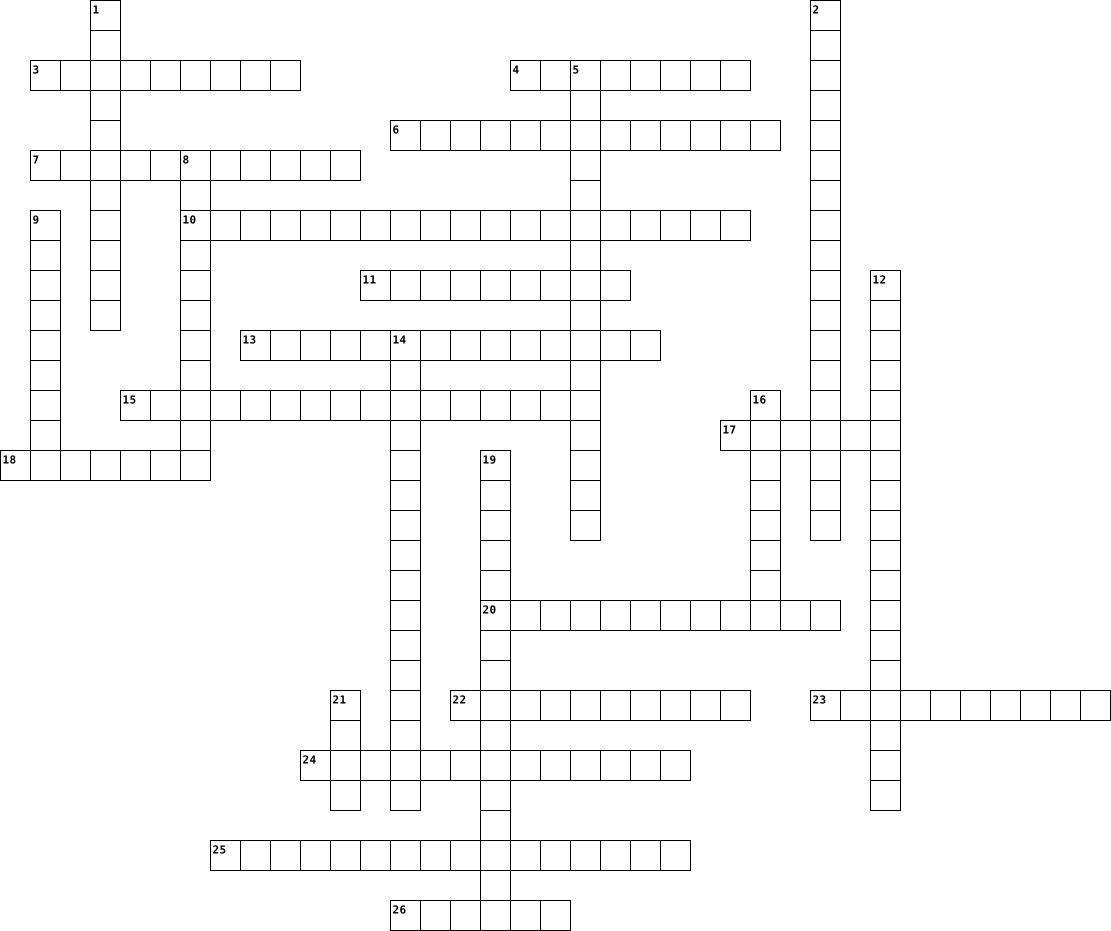
Key terms crossword puzzle 2017-10-05

Across
- the state of matter where particles are very close together but able to move
- a from of matter that is determined by the energy of its particles
- state of matter in which particles are in fixed positions due to temperature
- change of state from a liquid to a solid
- the change of state directly of solid to a vapor
- a concept that particles in random motion make up all mater
- the state of matter in which particles are far apart and have a lot of energy
- something that occupies a volume of space and has an amount of mass
- slow vaporization that happens when the temperature of the liquid is below the boiling point but above the freezing point
Down
- mixing two or more substance together
- change of state from solid to liquid when the temperature increases
- when vapor changes its state of matter direct to a solid from a gas
- microscopic, random movement of suspended matter due to the collisions of gas or liquid particles
- a substance made out of only one material
- when a liquid reaches a temperature in a specific air pressure where it bubbles and turns to vapor
- the process of which liquid particles enter the gaseous phase
- the change from vapor to liquid
17 Clues: the change from vapor to liquid • mixing two or more substance together • change of state from a liquid to a solid • a substance made out of only one material • the change of state directly of solid to a vapor • a concept that particles in random motion make up all mater • the process of which liquid particles enter the gaseous phase • ...
Science Crossword 2023-11-13

Across
- Gas to solid
- Only 1 type of atom
- Liquid to vapor
- Particles far apart
- Particles vibrate
- Keeps the same substance
- Salt is an example of this
- Solute + Solvent
- Gas to liquid
Down
- Doesn't separate easily
- Basic building block of matter
- How much space is taken up
- Mass/Volume
- Particles slide
- Amount of matter in substance/object
- Most common state of matter
- Solid to liquid
- Liquid to gas
- Solid to gas
- Particles move freely
20 Clues: Mass/Volume • Gas to solid • Solid to gas • Liquid to gas • Gas to liquid • Particles slide • Liquid to vapor • Solid to liquid • Solute + Solvent • Particles vibrate • Only 1 type of atom • Particles far apart • Particles move freely • Doesn't separate easily • Keeps the same substance • How much space is taken up • Salt is an example of this • Most common state of matter • ...
Science Crossword 2023-11-13

Across
- Gas to solid
- Only 1 type of atom
- Liquid to vapor
- Particles far apart
- Particles vibrate
- Keeps the same substance
- Salt is an example of this
- Solute + Solvent
- Gas to liquid
Down
- Doesn't separate easily
- Basic building block of matter
- How much space is taken up
- Mass/Volume
- Particles slide
- Amount of matter in substance/object
- Most common state of matter
- Solid to liquid
- Liquid to gas
- Solid to gas
- Particles move freely
20 Clues: Mass/Volume • Gas to solid • Solid to gas • Liquid to gas • Gas to liquid • Particles slide • Liquid to vapor • Solid to liquid • Solute + Solvent • Particles vibrate • Only 1 type of atom • Particles far apart • Particles move freely • Doesn't separate easily • Keeps the same substance • How much space is taken up • Salt is an example of this • Most common state of matter • ...
Cycles in Ecosystems 2024-03-07

Across
- Organelle where cellular respiration takes place
- a biological community of interacting organisms and their physical environment
- living factors
- A set of components working together
- convert light energy from the sun and store it as chemical energy. Provides food for an ecosystem.
- nonliving factors
- A process that converts organic materials into nutrient-rich soil
- flow of energy through living things in an ecosystem
- Matter is _____________ which means that it is not created or destroyed
Down
- these organisms break down matter and return it to an ecosystem
- process of matter moving from one form to another
- Energy is NOT _____________.
- physical substances in the world around us are made up of ___________.
- the mixture of gases that surround the Earth
- Sugar made by a plant during photosynthesis
- eat producers and gain matter and energy
- Organelle where photosynthesis takes place
17 Clues: living factors • nonliving factors • Energy is NOT _____________. • A set of components working together • eat producers and gain matter and energy • Organelle where photosynthesis takes place • Sugar made by a plant during photosynthesis • the mixture of gases that surround the Earth • Organelle where cellular respiration takes place • ...
Science Vocab Words for the Year 2024-03-15

Across
- the sun
- a measure of the pull of gravity on an object
- the state of matter that has a definite shape and a definite volume
- the passing of one object through the shadow of another
- nonliving factors
- something that can be used for a purpose
- a material that allows energy to pass through it
- species- plants and animals that are likely to
- the state of matter that has a definite shape or volume
Down
- the state of matter that does not have a definite shape or volume
- the smallest unit of an element
- a material that does not let energy to pass through it
- a frozen mass of different types of ice and dust
- living factors
- of matter- the form matter exists in
- the ability of a substance to dissolve in water
- endangered
17 Clues: the sun • endangered • living factors • nonliving factors • the smallest unit of an element • of matter- the form matter exists in • something that can be used for a purpose • a measure of the pull of gravity on an object • species- plants and animals that are likely to • the ability of a substance to dissolve in water • a frozen mass of different types of ice and dust • ...
Chemistry Lessons 44-52 2020-01-27

Across
- pH of pure water
- describes objects or substances that float in water
- temperature scale used in the United States
- substance with a pH less than seven
- occurs when a compound breaks down into two or more elements or simpler compounds
- substance with a density of one
- amount of space matter takes up
- substance that is being changed
- chemical reaction that gives off energy
- amount of matter a substance contains
- measure of how tightly the atoms or molecules in matter are packed together
- substance with a pH greater than seven
Down
- standard international measure of temperature
- new substance formed by a chemical reaction
- occurs when two or more elements or compounds that make a new compound
- chemical reaction that absorbs or gains energy
- chemical reaction that occurs when an acid and a base react
- occurs when an organic compound is heated and reacts with oxygen
- instrument used to measure mass of matter
- measure of the average kinetic energy of matter
- temperature used by scientists worldwide
21 Clues: pH of pure water • substance with a density of one • amount of space matter takes up • substance that is being changed • substance with a pH less than seven • amount of matter a substance contains • substance with a pH greater than seven • chemical reaction that gives off energy • temperature used by scientists worldwide • instrument used to measure mass of matter • ...
7th Grade Science Final - Term 1 2015-10-12

Across
- a column in the periodic table
- subatomic particle with positive charge
- studies fish
- type of variable we control/manipulate
- what all substances are made of
- quantum/cloud model
- the number of particles in an area; mass per unit volume
- how much matter a substance contains
- the amount of space a substance occupies
- the smallest physical unit of an element
- type of measuring system
- harmful triatomic molecule
Down
- state of matter with moderate molecular motion
- state of matter with slow molecular motion
- smallest part of an element with the properties of that element
- a minute portion, piece, fragment or amount
- diatomic molecule
- studies life and living things
- a measure of warmth or coldness
- 78% of the atmosphere/air
- type of variable we measure
- developed idea of the atom
- member of nitrogen family with 16 neutrons
- element with no neutrons
- subatomic particle with negative charge
- state of matter with fast molecular motion
- subatomic particle with no charge
- a miniature representation
28 Clues: studies fish • diatomic molecule • quantum/cloud model • element with no neutrons • type of measuring system • 78% of the atmosphere/air • developed idea of the atom • a miniature representation • harmful triatomic molecule • type of variable we measure • a column in the periodic table • studies life and living things • a measure of warmth or coldness • what all substances are made of • ...
Test Review Unit 1 2021-12-13

Across
- a change where you can get it back
- a pure substance that cannot be broken down
- measure of the amount of matter
- anything that has mass and takes up space
- mixtures that are not uniform throughout
- properties that can be observed
- relates to a substance’s ability to undergo changes that transform it into different substances
- homogeneous mixtures
- state that has definite volume but not shape
- a physical change from one state to another
- mixtures that are uniform in composition
Down
- state that has neither definite volume nor definite shape
- substances that react in a chemical change
- a fixed composition
- amount of matter that is present
- a change in which one or more substances are converted into different substances
- a blend of two or more kinds of matter, each of which retains its own identity and properties
- smallest unit of an element
- substances that are formed by the chemical change
- state that has a definite volume and shape
- do not depend on amount of matter
21 Clues: a fixed composition • homogeneous mixtures • smallest unit of an element • measure of the amount of matter • properties that can be observed • amount of matter that is present • do not depend on amount of matter • a change where you can get it back • mixtures that are not uniform throughout • mixtures that are uniform in composition • anything that has mass and takes up space • ...
science thing 2024-03-13

Across
- when a gas loses energy and turns into a liquid
- the state of matter with lots of energy
- average thermal energy
- when a substance changes to another state of matter
- where a liquid turns into a gas with bubbles
- bonded atoms
- the state of matter with a low amount of energy
- another word for movement
- where a solid turns into a liquid
- solids liquids gases and plasma are
- the amount of space something has
- where a solid changes phase into a gas
Down
- where a liquid turns into a gas fast
- the total amount of energy
- how much do the molecules move
- liquids are the only thing state of matter that is
- molecules pulling on each other
- the state of matter with a medium amount of energy
- how molecules change phase
- energy in the form of motion
- where a gas turns into a solid
- when something changes phases but not molecular make up
- energy in a system
- when a liquid turns into a gas slowly
- where a liquid turns into a gas
25 Clues: bonded atoms • energy in a system • average thermal energy • another word for movement • the total amount of energy • how molecules change phase • energy in the form of motion • how much do the molecules move • where a gas turns into a solid • molecules pulling on each other • where a liquid turns into a gas • where a solid turns into a liquid • the amount of space something has • ...
Guided Notes for Matter and Change 2024-08-14

Across
- substance that is currently a gas, but normally is a liquid or solid at room temperatures
- Many are gases, solids are brittle
- Low KE -particles can move around, but are still close together
- process that releases energy into the surroundings
- measure of the amount of space that is occupied
- A substance that is made from atoms of two or more elements that are chemically bonded
- Particles of matter are always in motion
- process that absorbs energy from the surroundings
- High KE -particles can separate and move throughout the container
- Measure of the amount of matter
Down
- A property that can be observed and measured without changing the material's composition
- The ability of a substance to undergo a specific chemical change
- Energy energy of motion
- Matter that has a definite composition
- anything with mass that occupies space
- Energy energy possessed by an object due to its position, composition or condition
- capacity to do work or transfer heat
- Most are solids at room temperature
- Very low KE -particles vibrate but can't move around
- study of the composition, structure, and properties of matter.
20 Clues: Energy energy of motion • Measure of the amount of matter • Many are gases, solids are brittle • Most are solids at room temperature • capacity to do work or transfer heat • Matter that has a definite composition • anything with mass that occupies space • Particles of matter are always in motion • measure of the amount of space that is occupied • ...
science crossword 2024-09-09

Across
- A change in matter that does not form a new substance
- An object that energy can flow through quickly
- A material that conducts heat poorly
- The circular movement of a fluid caused by heating
- A living thing made up of a single cell
- When the warmer matter rises and the colder matter sinks
- The process in which radiation bounces off an object
- A substance with a fixed shape or volume
- Any substance that can flow
- An atom or molecule
- The smallest unit of life
Down
- The process in which radiation is soaked up by an object
- Any object that takes up space and has mass
- When two objects touch and transfer heat energy
- A structure in a cell that performs a particular function
- The process in which radiation passes through an object
- When waves of heat are transmitted from an object
- energy The energy in an object that determines its temperature
- Energy a moving object has because of its motion
- A change in matter that forms one of more new substances
20 Clues: An atom or molecule • The smallest unit of life • Any substance that can flow • A material that conducts heat poorly • A living thing made up of a single cell • A substance with a fixed shape or volume • Any object that takes up space and has mass • An object that energy can flow through quickly • When two objects touch and transfer heat energy • ...
Combinations and States of Matter 2024-10-22

Across
- a substance composed of two ore more elements or compounds physically combined
- positively charged particle with a mass of 1
- the number of protons and neutrons in the nucleus
- the dense center of an atom
- the tiny building blocks of matter
- a charged atom
- anything that has mass and takes up space
- negatively charged particle with a mass of 0
- state of matter with the highest energy
- a mixture where at least one substance is dissolved in another
Down
- a substance composed of atoms of more than one element chemically bonded together
- the number of protons in the nucleus
- atoms of the same element with different numbers of neutrons
- when a liquid turns into a gas
- neutral particle with a mass of 1
- different types of atoms
- a substance composed entirely of one type of atom
- when a gas turns into a liquid
- when a liquid turns into a solid
- when a solid turns into a liquid
- state of matter where atoms are tightly packed but still flow freely
- state of matter where atoms are fixed in place
22 Clues: a charged atom • different types of atoms • the dense center of an atom • when a liquid turns into a gas • when a gas turns into a liquid • when a liquid turns into a solid • when a solid turns into a liquid • neutral particle with a mass of 1 • the tiny building blocks of matter • the number of protons in the nucleus • state of matter with the highest energy • ...
science crossword puzzle 2023-11-06

Across
- does not look the same
- fixed takes the shape
- what is matter
- I can't ___ atoms cause their tiny
- when something keeps It's properties
- when something dissolves
- do people have matter in them
- molecules are all touching
- a fancy word for solution
- what dissolves
Down
- molecules don't touch at all
- It keeps It
- not flexible
- doesn't take the shape
- a fancy word for mixture
- molecules can touch
- Its a small group of matter
- group of atoms make
- what it dissolved in
- 2 or more
20 Clues: 2 or more • It keeps It • not flexible • what is matter • what dissolves • molecules can touch • group of atoms make • what it dissolved in • does not look the same • doesn't take the shape • a fancy word for mixture • when something dissolves • a fancy word for solution • molecules are all touching • Its a small group of matter • molecules don't touch at all • do people have matter in them • ...
science crossword puzzle 2023-11-06

Across
- does not look the same
- fixed takes the shape
- what is matter
- I can't ___ atoms cause their tiny
- when something keeps It's properties
- when something dissolves
- do people have matter in them
- molecules are all touching
- a fancy word for solution
- what dissolves
Down
- molecules don't touch at all
- It keeps It
- not flexible
- doesn't take the shape
- a fancy word for mixture
- molecules can touch
- Its a small group of matter
- group of atoms make
- what it dissolved in
- 2 or more
20 Clues: 2 or more • It keeps It • not flexible • what is matter • what dissolves • molecules can touch • group of atoms make • what it dissolved in • does not look the same • doesn't take the shape • a fancy word for mixture • when something dissolves • a fancy word for solution • molecules are all touching • Its a small group of matter • molecules don't touch at all • do people have matter in them • ...
7B Lessons 5-6 crossword puzzle 2025-10-16

Across
- loss
- tolerance
- matter
- space
- sorrow
- numb
- blame
- independent
- consciously
- divorce
- struggle
- separately
Down
- shape
- prolong
- cousin
- couple
- siblings
- marriage
- adjust
- genes
- empathy
- illegal
- role
- prevent
- definition
- treat
26 Clues: loss • numb • role • shape • space • genes • blame • treat • cousin • matter • couple • sorrow • adjust • prolong • empathy • illegal • prevent • divorce • siblings • marriage • struggle • tolerance • definition • separately • independent • consciously
Chemical Magic By Paddy 2021-05-06

Across
- the smallest particle of a chemical element
- allowing liquids or gases to pass through it
- not able to be undone or altered
- make something different
- able to be dissolved
- In a chemical reaction, matter is neither created nor destroyed
- an attribute, quality, or characteristic of something
- a group of atoms bonded together
- not able to be changed or adapted
Down
- a distinct compound or substance
- a minute portion of matter
- turning from liquid into vapour
- become incorporated into a liquid
- tangible or concrete
- a substance that has space and volume
- a large body of matter with no definite shape.
- incapable of being dissolved
- capable of being reversed
18 Clues: tangible or concrete • able to be dissolved • make something different • capable of being reversed • a minute portion of matter • incapable of being dissolved • turning from liquid into vapour • a distinct compound or substance • not able to be undone or altered • a group of atoms bonded together • become incorporated into a liquid • not able to be changed or adapted • ...
Brooke chapter 22 science crossword! 2020-12-07

Across
- of reflection any angle of incidence equal to angle of reflection.
- passing of light through matter.
- matter that doesn’t transmit any light.
- Emission of energy in form of EM waves.
- matter in light that’s easily transmitted.
- spectrum Range of EM waves.
- material that gives substance color by absorbing light and reflecting others.
- matter Transmits light passing through matter.
- bending of waves around barriers through openings.
Down
- bending of wave passes from one medium to another.
- transfer energy carried by light waves.
- wave interaction that happens when two or more waves overlap.
- wave. EM wave that travels through space or matter.
- occurs when light bounces off an object.
- release of light energy that absorbs energy.
15 Clues: spectrum Range of EM waves. • passing of light through matter. • transfer energy carried by light waves. • matter that doesn’t transmit any light. • Emission of energy in form of EM waves. • occurs when light bounces off an object. • matter in light that’s easily transmitted. • release of light energy that absorbs energy. • matter Transmits light passing through matter. • ...
Matter Vocabulary Preview 2022-10-25

Across
- Anything that has mass and takes up space
- 2 or more elements chemically bonded together
- Change from a solid directly to a gas
- Matter made of one type of atom
- Change from a gas to a solid
- Matter that has definite volume and takes the shape of its container
- Change from a liquid to a solid
Down
- Change from a liquid to a gas
- Temporary high energy state of matter
- Change from a gas to a liquid
- Matter that has no definite shape and no definite volume
- 2 or more elements or compounds physically mixed together
- Change from a solid to a liquid
- Matter that has definite shape and volume
14 Clues: Change from a gas to a solid • Change from a liquid to a gas • Change from a gas to a liquid • Change from a solid to a liquid • Matter made of one type of atom • Change from a liquid to a solid • Temporary high energy state of matter • Change from a solid directly to a gas • Anything that has mass and takes up space • Matter that has definite shape and volume • ...
States of Matter 2017-05-30

Across
- When vaporization occurs at the surface of a liquid
- A state of matter in which the substance keeps its size and shape
- A change in the state of matter by adding thermal energy to change a solid to a gas
- In a gas, the atoms or molecules have ______ kinetic energy
- A change in the state of matter by adding thermal energy to change a solid to a liquid
- A change in the state of matter by adding thermal energy to change a liquid to a gas
- A change in the state of matter by decreasing thermal energy to change a liquid to a solid
Down
- A change in the state of matter by decreasing thermal energy to change a gas to a liquid
- A change in the state of matter by decreasing thermal energy to change a gas to a solid
- When vaporization occurs throughout a liquid
- A state of matter in which the substance has no fixed shape but a fixed volume
- In a liquid, the atoms or molecules have ______ kinetic energy
- A state of matter in which the substance has no fixed shape or volume
- In a solid, the atoms or molecules have ______ kinetic energy
14 Clues: When vaporization occurs throughout a liquid • When vaporization occurs at the surface of a liquid • In a gas, the atoms or molecules have ______ kinetic energy • In a solid, the atoms or molecules have ______ kinetic energy • In a liquid, the atoms or molecules have ______ kinetic energy • A state of matter in which the substance keeps its size and shape • ...
States of Matter 2024-09-25

Across
- The amount of space that an object takes up
- The amount of matter in an object
- The state of matter with a definite shape and a definite volume
- There are ___ main states of matter
- The process where a gas becomes a liquid
- The process where a solid becomes a liquid
- Anything that has mass and takes up space
Down
- The process where a liquid becomes a gas
- The process where a liquid becomes a solid
- Solids, Liquids, and Gasses are __ __ __
- A state of matter that is found in the sun
- The state of matter with no definite shape but a definite volume
- The state of matter with no definite shape or volume
13 Clues: The amount of matter in an object • There are ___ main states of matter • The process where a liquid becomes a gas • Solids, Liquids, and Gasses are __ __ __ • The process where a gas becomes a liquid • Anything that has mass and takes up space • The process where a liquid becomes a solid • A state of matter that is found in the sun • ...
Esther's Crossword Puzzle 2016-03-22

Across
- the amount of matter in a specific volume
- a unit of temperature where the freezing point is 0 degrees
- growing larger
- a unit of temperature where the freezing point is 32 degrees
- calculating a measurement by comparing measurements
- amount of matter an object is made up of
- the amount of thermal energy an object holds or gives off
- how much matter an object holds
Down
- the SI base unit of degrees Celsius
- a type of matter defined by certain characteristics
- the pull of gravity on an object
- when two liquids do not mix together
- the consistency of thickness caused by internal friction
- the lowest temperature possible
- the building block of everything
- the thermal energy radiating off an object
16 Clues: growing larger • the lowest temperature possible • how much matter an object holds • the pull of gravity on an object • the building block of everything • the SI base unit of degrees Celsius • when two liquids do not mix together • amount of matter an object is made up of • the amount of matter in a specific volume • the thermal energy radiating off an object • ...
States of Matter 2017-11-13

Across
- to apply pressure to matter
- change in state from solid to a gas
- __________ properties that can only be measured or observed only when matter undergoes a change to become an entirely different substance.
- the ability for matter to combine chemically with other substances
- homogeneous mixture
Down
- state of matter has no definite shape nor volume
- the temperature at which liquid changes to a solid
- one evidence to support the particulate theory of matter
- the amount of space matter takes up
- the change in state from liquid to gas
- state of matter with definite shape and volume
- Anything that has mass and occupies picture
12 Clues: homogeneous mixture • to apply pressure to matter • the amount of space matter takes up • change in state from solid to a gas • the change in state from liquid to gas • Anything that has mass and occupies picture • state of matter with definite shape and volume • state of matter has no definite shape nor volume • the temperature at which liquid changes to a solid • ...
State of Matter 2026-03-19

Across
- solid directly to gas
- a state of matter with a definite matter but not a fixed shape
- can exist of all 3 forms ; gas, liquid and solid
- the fifth state of matter, happens when bosons are cooled to temperatures near zero
- a state of matter with no definite matter and no fixed shape
- any substances that has matter and takes up space
Down
- the fourth state of matter that is superheated and ionized gas
- gas to liquid
- a state of matter with a definite matter and fixed shape
- solid to liquid
- is mostly made up of plasma
11 Clues: gas to liquid • solid to liquid • solid directly to gas • is mostly made up of plasma • can exist of all 3 forms ; gas, liquid and solid • any substances that has matter and takes up space • a state of matter with a definite matter and fixed shape • a state of matter with no definite matter and no fixed shape • ...
Phases of Matter 2024-05-06

Across
- gases have more ______ than solid
- liquid to gas
- gas to liquid
- phase of Matter with the most energy
- as pressure increases,volume decreases (_____'s Law)
- solid to gas
- liquid to solid
Down
- solid to liquid
- phase of Matter with no definite shape and particles that slide past each other
- gas to solid
- phase of Matter with no definite shape and particles that move rapidly in many directions
- a substance that has no definite shape and changes to the shape of its container
- as volume increases, temperature increases (_______' Law)
- everything is made of ______
- phase of Matter with tightly packed particles
15 Clues: gas to solid • solid to gas • liquid to gas • gas to liquid • solid to liquid • liquid to solid • everything is made of ______ • gases have more ______ than solid • phase of Matter with the most energy • phase of Matter with tightly packed particles • as pressure increases,volume decreases (_____'s Law) • as volume increases, temperature increases (_______' Law) • ...
17 Vocab words for chemistry! 2021-09-07

Across
- a pure substance that is formed when two or more different elements combine; can usually be separated into component elements by chemical reaction
- the smallest unit of an element that has the properties of that element
- a subatomic particle with a negative charge
- the temperature at which a liquid changes into a gas
- subatomic particles with no electric charge, located within the nucleus of the atom
- matter phase change from solid directly to gas
- the process by which a gas changes into a liquid
Down
- a pure substance that cannot be broken down into simpler substances by chemical reactions
- the process in which matter changes from a liquid to a gas
- the temperature at which a solid turns into a liquid the process in which matter changes from a liquid to a gas (related word: evaporate)
- the temperature at which a liquid turns into a solid
- a subatomic particle with a positive charge that is located in the nucleus of an atom
- a state of matter without any defined volume or shape (related word: gaseous)
- matter with a fixed volume and shape
- a state of matter with a defined volume but no defined shape
- two or more atoms joined together (related word: molecular)
- material that has mass and takes up some amount of space
17 Clues: matter with a fixed volume and shape • a subatomic particle with a negative charge • matter phase change from solid directly to gas • the process by which a gas changes into a liquid • the temperature at which a liquid turns into a solid • the temperature at which a liquid changes into a gas • material that has mass and takes up some amount of space • ...
Physics 2023-12-07

Across
- turning a gas into a liquid
- turning a solid into a gas
- a small particle, building block of matter
- turning a gas into a solid
- a combination of 2 or more compounds
- turning a solid into a liquid
- turning a liquid into a gas
Down
- the amount of matter per volume
- the amount of matter in an object
- substance that is made of only one type of atom
- anything that has mass and takes up space
- energy another word for heat
- a substance with 2 or more different elements
- turning liquid into a solid
- matter with a composition that is always the same
15 Clues: turning a solid into a gas • turning a gas into a solid • turning a gas into a liquid • turning liquid into a solid • turning a liquid into a gas • energy another word for heat • turning a solid into a liquid • the amount of matter per volume • the amount of matter in an object • a combination of 2 or more compounds • anything that has mass and takes up space • ...
Chemistry Crossword 2025-01-10

Across
- Capacity to do work or transfer heat
- Physical combination of two or more substances
- Depends on the type of matter
- Reaction that absorbs energy from its surroundings
- Measure of the amount of matter
- Variable shape and volume
- Amount of space occupied by matter
- Anything with mass that occupies space
Down
- One visibly distinct phase with the same properties throughout
- Depends on the amount of matter in the sample
- Beginning substances that start a reaction
- Substances that are formed during the reaction
- Variable shape and fixed volume
- Pure substance made of only one kind of atom
- Fixed shape and volume
15 Clues: Fixed shape and volume • Variable shape and volume • Depends on the type of matter • Variable shape and fixed volume • Measure of the amount of matter • Amount of space occupied by matter • Capacity to do work or transfer heat • Anything with mass that occupies space • Beginning substances that start a reaction • Pure substance made of only one kind of atom • ...
Challenge it 2023-10-23

Across
- from the liquid matter to the solid matter
- from the solid matter to the gas matter
- from the liquid matter to the gas matter
Down
- from the sold matter to the liquid matter
- when the liquid matter heats up
- from the gas matter to the solid mattr
- from the gas matter to the liquid matter
- the coldest form of water
- the drinkable form of water
- the air form of water
10 Clues: the air form of water • the coldest form of water • the drinkable form of water • when the liquid matter heats up • from the gas matter to the solid mattr • from the solid matter to the gas matter • from the gas matter to the liquid matter • from the liquid matter to the gas matter • from the sold matter to the liquid matter • from the liquid matter to the solid matter
Phases of Matter 2025-09-01

Across
- Energy that is transferred of from warmer things to cooler things
- State of matter that has a definite shape and definite volume
- Phase change in which a solid is converted directly to a gas
- A type of reaction that releases energy to its surroundings
- Phase change in which a liquid turns into a solid
- A physically distinctive form of matter, like solids, liquids, and gases
- State of matter that does not have a definite volume and shape
- The temperature at which a substance changes from a solid to a liquid
- Phase change in which a liquid turns into a gas
- Phase change in which a gas turns into a liquid
Down
- Phase change in which a gas is converted directly to a solid
- Phase change in which a solid turns into a liquid
- State of matter that has a definite volume but does not have a definite shape State of matter that has a definite shape and definite volume
- Anything that has mass and takes up space
- The temperature at which a substance changes from a liquid to a gas
- Physical change in the state of matter from one state to another
- A type of reaction that absorbs energy from its surroundings
17 Clues: Anything that has mass and takes up space • Phase change in which a liquid turns into a gas • Phase change in which a gas turns into a liquid • Phase change in which a solid turns into a liquid • Phase change in which a liquid turns into a solid • A type of reaction that releases energy to its surroundings • ...
Matter and its interactions 2025-09-07

Across
- two or more atoms joined together
- Motion How particles move inside matter
- A state of matter with no fixed shape or volume
- A measure of how hot or cold something is
- A state of matter with a fixed shape and volume
- The amount of matter in an object
- Anything that has mass and takes up space
- A pure substance made of only one kind of atom
Down
- A chart that organizes all known elements
- A substance made of two or more different elements bonded together
- Characteristics that describe matter, like color, shape, or hardness
- The amount of space something takes up
- A state of matter with no fixed shape or volume
- The smallest building block of matter
14 Clues: two or more atoms joined together • The amount of matter in an object • The smallest building block of matter • The amount of space something takes up • A chart that organizes all known elements • A measure of how hot or cold something is • Anything that has mass and takes up space • Motion How particles move inside matter • ...
Matter Emily S. 2015-03-11

Across
- the amount of space something takes up
- in neon lights and in lightning
- when a liquid evaporates and turns into a gas
- a change with two or more of matter into other types of matter with different
- something that can not be broken down easily
- anything that takes up space and has mass
- the temperature gets warm enough and a solid will melt to a liquid
- formed when two or more atoms join together chemically
- water that collects as water droplets on a cold surface when air is humid and is in
- smallest part of matter
- two or more substances that keep their properties when you mix them
- with it
- properties that are blended easily and loses some properties and usually is part liquid
Down
- the temperature gets cold and a liquid changes to a solid when below 32 degrees
- how much/amount
- when a liquid freezes and turns into a solid
- a change that is in some properties of matter that does not change
- to change from a liquid or a solid and into vapor
- the states of matter are, liquid, gas, and solid
- the temperature gets hot enough and the liquid boils and turns to vapor
- two or more separate elements/a mixture
- when a solid melts and turns into a liquid
22 Clues: with it • how much/amount • smallest part of matter • in neon lights and in lightning • the amount of space something takes up • two or more separate elements/a mixture • anything that takes up space and has mass • when a solid melts and turns into a liquid • when a liquid freezes and turns into a solid • something that can not be broken down easily • ...
Christmas Matter and Chemistry 2023-12-19

Across
- a state of matter that takes the shape of its container
- of matter there are 3 different forms we find matter in
- anything made of atoms and molecules
- properties that include odor, color, shape, and texture
- found around the center of an atom with a negative charge
- molecule a molecule that has a charge on each end
- change a change in shape, size, or state of matter with no new matter being formed
- the most abundant gas in the atmosphere
- how tightly packed molecules are
- found in the center of an atom with no charge/neutral
- formed by two or more atoms joined together
- symbol the abbreviation we use to identify elements on the periodic table
- a state of matter that fills a space completely
Down
- anything that dissolves another substance
- the smallest particle that makes up an element
- a substance that cannot be broken down into other substances
- table of elements all the known elements organized in a chart
- a state of matter that has a firm rigid shape
- found in the center of an atom with a positive charge
- the center of an atom
- number the number of an element on the periodic table, is also equal to the number of protons inside of an atom
- formed when atoms of two or more different elements combine
- change a change the occurs when a substance changes into a new substance
- tension the bonds that connect water molecules to each other are able to withstand small amounts of pressure
- properties the way a substance reacts with other substances
25 Clues: the center of an atom • how tightly packed molecules are • anything made of atoms and molecules • the most abundant gas in the atmosphere • anything that dissolves another substance • formed by two or more atoms joined together • a state of matter that has a firm rigid shape • the smallest particle that makes up an element • a state of matter that fills a space completely • ...
matte 2024-03-14

Across
- a combo of solute & solvent
- dissolving
- the process in which a gas changes directly to a solid without going through the liquid state
- a substance that flows freely but is of constant volume, having a consistency like that of water or oil
- a particle of matter that uniquely defines a chemical element
- substances containing only one type of atom
- firm and stable in shape; not liquid or fluid.
- a form of matter in which many of the electrons wander around freely among the nuclei of the atoms.
- the temperature at which a given solid will melt.
Down
- the temperature at which a liquid boils and turns to vapor.
- the process through which the physical state of matter changes from the gaseous phase into the liquid phase
- a substance or matter in a state in which it will expand freely to fill the whole of a container, having no fixed shape (unlike a solid) and no fixed volume (unlike a liquid).
- clumpy/will separate
- the amount of space occupied by a sample of matter
- spread evenly throughout (no clumps)
- dissolved
- the degree of compactness of a substance.
- the process that causes a substance to change from a liquid to a solid
- combinations of substances physically joint
- a coherent, typically large body of matter with no definite shape
20 Clues: dissolved • dissolving • clumpy/will separate • a combo of solute & solvent • spread evenly throughout (no clumps) • the degree of compactness of a substance. • substances containing only one type of atom • combinations of substances physically joint • firm and stable in shape; not liquid or fluid. • the temperature at which a given solid will melt. • ...
5.3 Matter final review 2024-06-15

Across
- combining atoms of different elements, creating a new substance
- change when a new substance is formed
- state of matter with no definite shape and no definite volume
- method of measuring the volume of irregularly-shaped objects
- what the water is in a sugar water solution
- factor in determining weight
- the amount of space a substance takes up
- that point at which no more solute can be added to the solvent
- a solution that has a small amount of solute in the solvent
- metric measurement for the volume of a solid
- what all matter is made from
Down
- a solution that has a large amount of solute in the solvent
- atoms joining with other atoms to form particles
- change in matter that does not form a new substance
- matter containing only one kind of atom
- what the sugar is in a sugar water solution
- metric measurement for the volume of a liquid
- two or more substances that are physically combined
- mixture in which all the substances are spread evenly throughout
- state of matter with no definite shape and definite volume
- the top factor in the density-mass-volume triangle
- increase/decrease the surface area of the solute to speed up the process of dissolving
- state of matter with definite shape and definite volume
- temperature that increases solubility
- one cubic centimeter = ____ mL
25 Clues: factor in determining weight • what all matter is made from • one cubic centimeter = ____ mL • change when a new substance is formed • temperature that increases solubility • matter containing only one kind of atom • the amount of space a substance takes up • what the sugar is in a sugar water solution • what the water is in a sugar water solution • ...
Chemistry for Skincare I 2025-08-25

Across
- Negatively charged particles found in the nucleus of an atom.
- More positive hydrogen ions than negative hydroxide ions.
- The core of an atom that contains protons and sometimes neutrons.
- Two or more atoms joined together by a chemical bond.
- measures higher than 7 on the pH scale.
- Study of matter and the physical and chemical changes of matter.
- Substances that cannot be broken down into simpler substances.
- The smallest complete unit of an element.
- The ability to allow liquids or gases to pass through a membrane, such as the skin.
- Anything that occupies space and has weight.
- Unit of measurement that indicates whether a substance is acidic, alkaline or neutral.
- Particle with no electric charge found in the nucleus of an atom.
Down
- Has never been alive and does not contain carbon.
- Matter having definite weight and volume, but no definite shape.
- Matter that has definite weight, volume and shape.
- Two saccharides linked together
- Matter that has definite weight but indefinite volume and shape.
- Triglycerides, fats and steroids, that form components that fill the intercellular spaces in the skin.
- Measures 7 on the pH scale
- Two or more substances that are physically combined
- Many saccharides linked to form larger, more complex molecules.
- Positively charged particle in the nucleus of an atom.
22 Clues: Measures 7 on the pH scale • Two saccharides linked together • measures higher than 7 on the pH scale. • The smallest complete unit of an element. • Anything that occupies space and has weight. • Has never been alive and does not contain carbon. • Matter that has definite weight, volume and shape. • Two or more substances that are physically combined • ...
States of Matter 2017-01-11

Across
- State of matter with fixed volume, but no fixed shape
- Liquid changing to a solid
- Gases move fast and freely because they have a high level of thermal _______.
- The molecules in liquids are able to ____ past each other.
- There are ____ states of matter including plasma.
- A word to describe solids, liquids, gases, and plasma.
- Liquid changing into a gas
- Anything that has mass and takes up space
- A gas has molecules with a ____ level of energy.
Down
- Gas changing into a liquid
- Changing ____ causes a change in state.
- The molecules in solids ______ in place.
- State of matter found in stars.
- The state of water where molecules move fast and freely.
- State of matter with fixed volume and shape
- Solid changing to a liquid
- Freezing and melting both occur at the ____ temperature.
17 Clues: Gas changing into a liquid • Liquid changing to a solid • Solid changing to a liquid • Liquid changing into a gas • State of matter found in stars. • Changing ____ causes a change in state. • The molecules in solids ______ in place. • Anything that has mass and takes up space • State of matter with fixed volume and shape • A gas has molecules with a ____ level of energy. • ...
Study of matter 2023-11-14

Across
- Least dense state of matter
- changes from a solid to a liquid when is cooks
- Particles are very close together,But they still move around
- a substance that cannot be broken down into other substances
- (o) Large particle with no charge
- changes from a liquid to gas
- changes from gas to liquid
- (+) positive charged large particle
- The smallest particle of an element
Down
- changes from solid to gas
- in the state of matter matter changing between solids liquids and gas.
- theory all matter is made of particles.
- (-) small negative charged particle orbiting the nucleus
- changes from a liquid to a solid.
- most dense state of matter
- slower vaporization that takes place at the surface of a liquid.
16 Clues: changes from solid to gas • most dense state of matter • changes from gas to liquid • Least dense state of matter • changes from a liquid to gas • changes from a liquid to a solid. • (o) Large particle with no charge • (+) positive charged large particle • The smallest particle of an element • theory all matter is made of particles. • ...
Study of matter 2023-11-14

Across
- Least dense state of matter
- changes from a solid to a liquid when is cooks
- Particles are very close together,But they still move around
- a substance that cannot be broken down into other substances
- (o) Large particle with no charge
- changes from a liquid to gas
- changes from gas to liquid
- (+) positive charged large particle
- The smallest particle of an element
Down
- changes from solid to gas
- in the state of matter matter changing between solids liquids and gas.
- theory all matter is made of particles.
- (-) small negative charged particle orbiting the nucleus
- changes from a liquid to a solid.
- most dense state of matter
- slower vaporization that takes place at the surface of a liquid.
16 Clues: changes from solid to gas • most dense state of matter • changes from gas to liquid • Least dense state of matter • changes from a liquid to gas • changes from a liquid to a solid. • (o) Large particle with no charge • (+) positive charged large particle • The smallest particle of an element • theory all matter is made of particles. • ...
Science Vocabulary T1/T2 2025-09-30

Across
- matter that does not have a set shape and spreads out
- change from a liquid to solid
- a force that pulls together or pushes apart certain metal objects
- change from a liquid to gas
- a push or pull that acts on an object
- the force that pulls all matter together
- the amount of matter in an object
Down
- something that repeats in a regular way
- set or fixed
- the change from a gas to a liquid
- give a good reason for a choice
- group objects based on like properties
- an observable trait of matter
- the type of matter that makes up an object
- change from a solid to a liquid
- join two or more things into one unit
16 Clues: set or fixed • change from a liquid to gas • change from a liquid to solid • an observable trait of matter • give a good reason for a choice • change from a solid to a liquid • the change from a gas to a liquid • the amount of matter in an object • join two or more things into one unit • a push or pull that acts on an object • group objects based on like properties • ...
Challenge it 2023-10-23

Across
- from the liquid matter to the solid matter
- from the solid matter to the gas matter
- from the liquid matter to the gas matter
Down
- from the sold matter to the liquid matter
- when the liquid matter heats up
- from the gas matter to the solid mattr
- from the gas matter to the liquid matter
- the coldest form of water
- the drinkable form of water
- the air form of water
10 Clues: the air form of water • the coldest form of water • the drinkable form of water • when the liquid matter heats up • from the gas matter to the solid mattr • from the solid matter to the gas matter • from the gas matter to the liquid matter • from the liquid matter to the gas matter • from the sold matter to the liquid matter • from the liquid matter to the solid matter
Challenge it 2023-10-23

Across
- from the liquid matter to the solid matter
- from the solid matter to the gas matter
- from the liquid matter to the gas matter
Down
- from the sold matter to the liquid matter
- when the liquid matter heats up
- from the gas matter to the solid mattr
- from the gas matter to the liquid matter
- the coldest form of water
- the drinkable form of water
- the air form of water
10 Clues: the air form of water • the coldest form of water • the drinkable form of water • when the liquid matter heats up • from the gas matter to the solid mattr • from the solid matter to the gas matter • from the gas matter to the liquid matter • from the liquid matter to the gas matter • from the sold matter to the liquid matter • from the liquid matter to the solid matter
Science Review 2024-11-20

Across
- mixture of substance
- takes up space
- single kind of matter
- characteristic
- fixed shape and fixed volume
- no fixed shape or volume & scatters
Down
- combination of substances
- produces another kind of matter
- fixed volume and no shape
- matter can change
- the amount of matter
- tiny particle
12 Clues: tiny particle • takes up space • characteristic • matter can change • mixture of substance • the amount of matter • single kind of matter • combination of substances • fixed volume and no shape • fixed shape and fixed volume • produces another kind of matter • no fixed shape or volume & scatters
CHEMISTRY BASICS 2024-11-25

Across
- A CHEMICAL REACTION
- A CHARACTERISTIC THAT CAN BE OBSERVED OR MEASURED WITHOUT CHANGING THE SAMPLE'S COMPOSITION
- ALTERS THE PHYSICAL PROPERTIES OF A SUBSTANCE WITHOUT CHANGING ITS COMPOSITION
- A PROPERTY THAT IS DEPENDENT ON THE AMOUNT OF SUBSTANCE PRESENT
- THE ONLY COMMON SUBSTANCE ON EARTH THT EXISTS NATURALLY AS A SOLID, A LIQUID, AND A GAS
- EXTERNAL ______ CAN AFFECT BOTH PHYSICAL AN CHEMICAL PROPERTIES
- A TYPE OF PROPERTY THAT IS NOT DEPENDENT ON THE AMOUNT OF SUBSTANCE PRESENT
- A BROWNISH-ORANGE POWDERY SUBSTANCE
- IN A CHEMICAL REACTION, PRODUCTS HAVE THE SAME ______ AS REACTANTS
- A STATE OF MATTER HAVING NEITHER A DEFINITE SHAPE OR VOLUME
Down
- THE PHYSICAL FORMS IN WHICH ALL MATTER IN NATURE EXISTS
- A LAW THAT STATES THAT MASS IS NEITHER CREATED NOR DESTROYED DURING A CHEMICAL REACTION; IT IS CONSERVED
- IN A CHEMICAL REACTION, REACTANTS FORM ______
- THE ABILITY OF A SUBSTANCE TO COMBINE WITH OR CHANGE INTO ONE OR MORE OTHER SUBSTANCES
- ANYTHING THAT MASS AND TAKES UP SPACE
- A TRANSITION OF MATTER FROM ONE STATE TO ANOTHER
- A STATE OF MATTER IN BETWEEN SOLID AND GAS
- A STATE OF MATTER THAT HAS A DEFINITE SHAPE AND VOLUME
- REFERS TO THE GASEOUS STATE OF A SUBSTANCE THAT IS A SOLID OR A LIQUID AT ROOM TEMPERATURE
19 Clues: A CHEMICAL REACTION • A BROWNISH-ORANGE POWDERY SUBSTANCE • ANYTHING THAT MASS AND TAKES UP SPACE • A STATE OF MATTER IN BETWEEN SOLID AND GAS • IN A CHEMICAL REACTION, REACTANTS FORM ______ • A TRANSITION OF MATTER FROM ONE STATE TO ANOTHER • A STATE OF MATTER THAT HAS A DEFINITE SHAPE AND VOLUME • THE PHYSICAL FORMS IN WHICH ALL MATTER IN NATURE EXISTS • ...
Chemistry 2022-03-18
Across
- the study of matter
- the substances you have a the beginning
- the amount of a substance in a given volume
- when on element replaces another in a compound
- a reaction which energy is absorbed
- when two or more elements combined to make more complex substances
- any change the alters the appearance of a substance
- a change in matter that produces one or more substances
- any thing that has mass and takes up space
- new substance after the reaction
- matter is not allowed to enter or leave
- matter can enter from or escape to the surroundings
- a reaction between oxygen and fuel
- breaks down compounds into simpler products
- a characteristic of a substance that can be observed without changing the substance into another substance
- biological catalysts
Down
- a solid that forms from solution during a chemical reaction
- a reaction that releases energy in the form of heat
- minimum amount of energy needed to start a chemical reaction
- a number placed in front of a chemical formula
- used to decrease the rate of reaction
- during a chemical reaction matter is not created of destroyed
- a way to show chemical reactions using symbols
- increases the rate of reaction by lowering the activation energy
- a characteristic of a substance that describes its ability to change into other substances
- releases energy when it buns
26 Clues: the study of matter • biological catalysts • releases energy when it buns • new substance after the reaction • a reaction between oxygen and fuel • a reaction which energy is absorbed • used to decrease the rate of reaction • the substances you have a the beginning • matter is not allowed to enter or leave • any thing that has mass and takes up space • ...
Particle Model for Matter Review 2018-07-14

Across
- Has a fixed shape and volume
- Word which means how much space something takes up
- Process of turning a gas directly into a solid
- Has a variable shape and volume
- Process of turning a gas into a liquid
- Another word for what state matter is in.
- Process of turning a solid directly into a gas
- Type of energy which increases with temperature
- Slow vaporisation at temperatures below the boiling point
- Process of turning a liquid into a solid
- Word which is a measure of how much matter there is in a substance
Down
- Another word which means it does not change.
- A type of change in which the substances remain the same composition but may have a different state size or shape.
- Has a fixed volume but variable shape
- Process of turning a solid into a liquid
- When vaporisation happens rapidly we say it has reached the _________ point.
- Means that matter can be squeezed into a smaller space or volume
- Process of turning a liquid into a gas
- Solid carbon dioxide (two words)
- Means it does not change
- The study of matter and how it behaves
- gases are the least ______ form of matter.
- Gases volumes are .....
- These are the smallest particles of matter that normally exist on their own.
24 Clues: Gases volumes are ..... • Means it does not change • Has a fixed shape and volume • Has a variable shape and volume • Solid carbon dioxide (two words) • Has a fixed volume but variable shape • Process of turning a liquid into a gas • Process of turning a gas into a liquid • The study of matter and how it behaves • Process of turning a solid into a liquid • ...
chapters 12/13 crossword 2023-03-20

Across
- brachial plexus
- Form myelin in brain and spinal cord
- The flexible bone column extending from the base of the skull to the tailbone
- cervical plexus
- the spinal cord passes through the ____
- 2nd part of CNS
- 1st part of Nervous system
- lumbar plexus
- paralysis of one side on the body
- paralysis of lowerlimbs
- inferior to lower back
- Matter thats starts with an A
- paralysis of all limbs
- beads on neuron
- Branches of cell
- What is the main symtom of the spinal cord system
Down
- How Many plexus groups branch off the spinal cord
- gender most likely to have cord trauma
- String of neuron
- they are of ranvier
- cover brain surface and nonsynaptic regions of neurons
- Matter that starts with a P
- not grey matter
- The chest level region of the spine that is located between the cervical and lumbar vertebrae
- root at the end of a neuron
- the bony channel that is formed by the invertebral foreman of the vertebrae and which contains the spinal cord and nerve roots
- matter that starts with a D
- Not white matter
- ball in the middle of a cell
- Made up of the sensory division and motor division
- Phagocytize and destroy microorganisms foreign matter and dead nervous tissue
31 Clues: lumbar plexus • brachial plexus • not grey matter • cervical plexus • 2nd part of CNS • beads on neuron • String of neuron • Not white matter • Branches of cell • they are of ranvier • inferior to lower back • paralysis of all limbs • paralysis of lowerlimbs • 1st part of Nervous system • Matter that starts with a P • root at the end of a neuron • matter that starts with a D • ...
secinece 2022-11-18

Across
- wave a wave that travels only thought matter
- the amplitude of a wave is the maximum distance that the wave moves form its restpositson
- a space entirely devoid of matter
- the section where the particles in the medium are closest together are compressions
- the perception of how high or low sound seems
- a wave causes the particles in a medium to move parallel to the direction that the wave travels
- the regions where the particles are fathers apart are rarefactions
- a disturbance that transfers energy from one place to another without transferring matter
- is a straight line at an angle of 90 to a given line plane surface
- the distance between one point on a wave to the same point
- wave a sound wave is a longitudinal wave that travel only thought matter
Down
- a back and forth or and up or down movement of an object
- bottom of the wave
- a matter in which wave travels
- a wave is the number of times the pattern repeats in a given time
- wave an earth earthquake
- a wave vibrating at right angles to the direction of its propagation
- Frequencies above range
- is the amount of sound energy that passes through a square matter of space in one second
- side by side and having the same distance continuously between them
- top of a wave
21 Clues: top of a wave • bottom of the wave • Frequencies above range • wave an earth earthquake • a matter in which wave travels • a space entirely devoid of matter • wave a wave that travels only thought matter • the perception of how high or low sound seems • a back and forth or and up or down movement of an object • the distance between one point on a wave to the same point • ...
a,d[p,w 2025-10-13

Across
- a shorthand method of describing the arrangement of electron shells of an atom
- a state of matter that have a definite shape and volume
- a process occuring at the surface of a liquid involving the change of state of liquid into gas at a temperature below the boiling point
- a substance which cannot be further divided into simpler substances by chemical method
- any basic unit of matter and energy
- The process by which different substances mix as a result of the random motions of their particles
- A solid where particle are arranged in definite way giving specific shape
- ability to do force
- tranfers thermal energy to its surroundings, leading to an increase in the temperature of the surroundings
Down
- the smallest part of an element that can exist as a stable entity
- decrease in size if cooled
- a state of matter that has neither definite shape and volume
- the temperature at which solid melts into liquid
- helps to explain the way matter behaves
- A group of atoms covalently bonded together
- a vertical column of the periodic table containing elements with the same number of electrons in their outer electron shell
- horizontal rows of the periodic table
- increase slightly in size when heated
- a state of matter that has a definite volume and moves by flowing
- Anything which occupies space and mass
20 Clues: ability to do force • decrease in size if cooled • any basic unit of matter and energy • horizontal rows of the periodic table • increase slightly in size when heated • Anything which occupies space and mass • helps to explain the way matter behaves • A group of atoms covalently bonded together • the temperature at which solid melts into liquid • ...
Science Vocabulary 2026-05-11

Across
- solid changing into liquid
- material that allows electricity to flow
- living and nonliving things interacting together
- a force that slows motion between surfaces
- matter that spreads out to fill a space
- material that blocks electricity
- matter with a definite shape and volume
- the movement of one object around another object in space
- the place where an organism lives
- the force pulling objects toward Earth
- gas changing into liquid
- preserved remains or traces of ancient life
- substances combined without chemically joining
- movement of weathered material
- dropping of sediments in a new place
- an organism that breaks down dead matter
- breaking down rocks into smaller pieces
Down
- energy of motion
- rock formed from cooled magma or lava
- the amount of salt dissolved in water
- rock changed by heat and pressure
- matter with a definite volume but no fixed shape
- a push or pull
- an organism that eats other organisms
- stored energy
- a mixture where one substance dissolves in another
- a trait that helps survival
- liquid changing into gas
- liquid changing into solid
- rock formed from compacted sediments
- the tiny building block of matter
- an area of land where all water drains into the same river, lake, or ocean
- anything that has mass and takes up space
33 Clues: stored energy • a push or pull • energy of motion • liquid changing into gas • gas changing into liquid • solid changing into liquid • liquid changing into solid • a trait that helps survival • movement of weathered material • material that blocks electricity • rock changed by heat and pressure • the place where an organism lives • the tiny building block of matter • ...
Chapter 22 vocab 2021-12-09

Across
- the release of light energy by particles of matter that have been absorbed energy
- the bounce back of waves after hitting an object
- categories of EM waves
- the passing of light through matter
- the forming of EM waves
- the transfer of energy carried by light waves
- absorbs energy released from electrons
- matter that transmits light but also scatters it as it passes through
- matter that doesn’t transmit light through
Down
- the bending of waves around barriers or openings
- when two or more waves overlap
- matter through which visible light is easily transmitted
- states an angle of incidence is equal to angle of reflection
- a wave that can travel through space or matter and consists of changing electric and magnetic fields
- is the bending of a wave as it passes from one medium to another
15 Clues: categories of EM waves • the forming of EM waves • when two or more waves overlap • the passing of light through matter • absorbs energy released from electrons • matter that doesn’t transmit light through • the transfer of energy carried by light waves • the bending of waves around barriers or openings • the bounce back of waves after hitting an object • ...
Chapter 2 Vocab- Chemistry 2020-09-04

Across
- the quantity of 3-d space within a closed surface
- the substance formed from a chemical reaction
- a physically distinctive form of matter
- phase of matter where a substance has. no set volume or shape
- the amount of matter an object has
- a substance made up of one type of atom
- phase of matter where a substance has a set volume but no set shape
- a substance made up of two or more types of atoms
Down
- the columns of elements on the periodic table
- the physical combination of substances
- matter which has a constant chemical composition
- a condensable gas
- a substance that takes part in a chemical reaction
- the rows of elements on the periodic table
- phase of matter where a substance has a set volume and set shape
15 Clues: a condensable gas • the amount of matter an object has • the physical combination of substances • a physically distinctive form of matter • a substance made up of one type of atom • the rows of elements on the periodic table • the columns of elements on the periodic table • the substance formed from a chemical reaction • matter which has a constant chemical composition • ...
Physical Properties of Matter 2022-09-14

Across
- the amount of space that an object takes up
- the concentration of matter in an object
- a measure of the pull of gravity on an object
- unit where water boils at 212 degrees
- is a measurable and observable physical property of matter
- characteristics of a substance that can be observed or measured without changing the substance into something else
Down
- state of matter where particles are tightly packed together
- divided by volume equals density
- anything that has mass and takes up space
- is the measure of how fast the particles are moving
- times width times height equals volume
- is 1/6 that of the earth
- state of matter where particles move rapidly and further apart
- unit where water boils 100 degrees
- the amount of matter in an object
- state of matter where particles slide over and past each other
16 Clues: is 1/6 that of the earth • divided by volume equals density • the amount of matter in an object • unit where water boils 100 degrees • unit where water boils at 212 degrees • times width times height equals volume • the concentration of matter in an object • anything that has mass and takes up space • the amount of space that an object takes up • ...
Physical/Chemical Change 2022-09-09

Across
- anything that has mass and takes up space
- law of conservation where amount of mass stays same
- result of one thing dissolving in another
- ability of a metal to be shaped
- measurement of the amount of thermal energy
- substance that gets dissolved
- state of matter with only a definite volume
- state of matter with no definite shape or volume
- amount of material packed into a space
Down
- substances before a chemical change
- substance that does the dissolving
- change where matter becomes new or different
- state of matter with definite shape and volume
- substances formed after a chemical change
- energy that comes from heat
15 Clues: energy that comes from heat • substance that gets dissolved • ability of a metal to be shaped • substance that does the dissolving • substances before a chemical change • amount of material packed into a space • anything that has mass and takes up space • result of one thing dissolving in another • substances formed after a chemical change • ...
Science Tic-Tac-Toe 2021-04-26

Across
- Matter that moves freely apart
- The process of changing from gas to plasma
- The process of changing from plasma to gas
- The process of changing from solid to liquid
- The process of changing from gas to liquid
- Matter that is tightly packed and vibrates about a fixed position
- Matter that is broken apart into ions
- Fast vaporization
- The process of changing from gas to solid
Down
- The process of changing from liquid to solid
- A small portion of matter
- The process of changing from liquid to gas
- Slow vaporization
- The process of changing from solid to gas
- Matter that sides over each other
15 Clues: Slow vaporization • Fast vaporization • A small portion of matter • Matter that moves freely apart • Matter that sides over each other • Matter that is broken apart into ions • The process of changing from solid to gas • The process of changing from gas to solid • The process of changing from liquid to gas • The process of changing from gas to plasma • ...
Phases of Matter 2023-05-01

Across
- Energy that is transferred of from warmer things to cooler things
- State of matter that has a definite shape and definite volume
- Phase change in which a solid is converted directly to a gas
- A type of reaction that releases energy to its surroundings
- Phase change in which a liquid turns into a solid
- A physically distinctive form of matter, like solids, liquids, and gases
- State of matter that does not have a definite volume and shape
- The temperature at which a substance changes from a solid to a liquid
- Phase change in which a liquid turns into a gas
- Phase change in which a gas turns into a liquid
Down
- Phase change in which a gas is converted directly to a solid
- Phase change in which a solid turns into a liquid
- State of matter that has a definite volume but does not have a definite shape State of matter that has a definite shape and definite volume
- Anything that has mass and takes up space
- The temperature at which a substance changes from a liquid to a gas
- Physical change in the state of matter from one state to another
- A type of reaction that absorbs energy from its surroundings
17 Clues: Anything that has mass and takes up space • Phase change in which a liquid turns into a gas • Phase change in which a gas turns into a liquid • Phase change in which a solid turns into a liquid • Phase change in which a liquid turns into a solid • A type of reaction that releases energy to its surroundings • ...
Evolution 2023-09-03

Across
- the center of the atom (where the protons and neutrons are)
- the number that tells you how many protons are in an element
- the fundamental building block of all matter
- the simplest form of matter that has a characteristic set of properties
- the energy matter has because of its motion
- Anything that has mass and takes up space(volume)
Down
- is the stored energy in matter due to its position relative to other matter
- the energy stored in the chemical bonds that hold atoms together
- one or two letters representing an element example: H or Cl
- 2 or more atoms that are combined
- the total kinetic energy of all the particles that make up the matter
- The densest form of H2O
- the capacity to move, do work, change matter, or produce heat
13 Clues: The densest form of H2O • 2 or more atoms that are combined • the energy matter has because of its motion • the fundamental building block of all matter • Anything that has mass and takes up space(volume) • the center of the atom (where the protons and neutrons are) • one or two letters representing an element example: H or Cl • ...
Energy 2023-03-10

Across
- the energy of something moving
- the state of matter where particles zoom around and are far apart
- the state of matter where particles are stacked on top of each other
- when heat moves outward without touching anything
- the measurement of heat
- when a solid becomes a liquid
- when heat transfers between objects that are touching
- the fourth state of matter
Down
- when heat moves through a liquid - hotter rises and colder sinks
- the state of matter where particles slide and rotate across each other
- when a liquid becomes a gas
- the ability to do work or cause change
- the complete absence of heat
- what everything is made of
- the vibration of molecules and particles
- when a liquid becomes a solid
- the energy of something based on its location or position
17 Clues: the measurement of heat • what everything is made of • the fourth state of matter • when a liquid becomes a gas • the complete absence of heat • when a liquid becomes a solid • when a solid becomes a liquid • the energy of something moving • the ability to do work or cause change • the vibration of molecules and particles • when heat moves outward without touching anything • ...
Matter Crossword 2014-10-31

Across
- The_____of the rock is twenty grams.
- A____consists of two or more atoms.
- ice floats due to a_____less than that of liquid water.
- property, Malleability is a_____of gold, so it is easily shaped.
- property, flammability is a_____apparent during compound combustion.
- _____is a proportional to kinetic energy of matter.
- water quickly reaches its____over a flame.
- The anchor's______held the boat steady.
Down
- carbon dioxide is a____made up of carbon and oxygen.
- Salt is a pure____while an egg is a mixture of kinds of matter.
- copper's good_____lets power flow.
- Water is not an____, as it contains two types of atoms.
- Each pure element is made up of only one type of atoms______.
- A solid becomes liquid at its_____.
14 Clues: copper's good_____lets power flow. • A____consists of two or more atoms. • A solid becomes liquid at its_____. • The_____of the rock is twenty grams. • The anchor's______held the boat steady. • water quickly reaches its____over a flame. • _____is a proportional to kinetic energy of matter. • carbon dioxide is a____made up of carbon and oxygen. • ...
Matter: Atoms 2020-10-20

Across
- matter that is composed of one type of atom
- subatomic particle with a negative charge
- subatomic particle with no charge
- A group of atoms bonded together
- right side of periodic table, gas or brittle solid, good insulators
- Definite shape and volume
- malleable, good conductors, low specific heat
- A state of matter with no definite shape or volume
Down
- Anything that has mass and takes up space
- center of atom, includes protons and neutrons, surrounded by electrons
- subatomic particle with a positive charge
- have properties of both metals and nonmetals
- A state of matter that has no definite shape but has a definite volume.
- smallest piece of matter that still has the properties of the element
14 Clues: Definite shape and volume • A group of atoms bonded together • subatomic particle with no charge • Anything that has mass and takes up space • subatomic particle with a positive charge • subatomic particle with a negative charge • matter that is composed of one type of atom • have properties of both metals and nonmetals • malleable, good conductors, low specific heat • ...
Matter Review 2023-08-10

Across
- The protein factory organelle____________________.
- Facilitated diffusion moves with a ______________________ gradient.
- Water is both a compound and a ______________________.
- If something contains _____________________ it is considered organic.
- Chemical bonds are made up of these subatomic particles____________________.
- __________________________ of the same element have different numbers of neutrons.
- The polymer made of fatty acids is a ________________.
Down
- Polysaccharide, disaccharide, glucose, starch are all examples of _____________________.
- Hydrolysis is also known as _________________.
- The subatomic particle that identifies the atom is the ____________.
- Cells communicate with each other through a __________________ antenna.
- If the _______________________ or the pH of and enzyme is out of the optimal range, the enzyme will denature.
- Ions form when atoms gain or lose ___________________.
- Maintaining a constant internal environment in response to change is known as ____________.
- The break down of waste occurs in this cellular organelle _______________.
15 Clues: Hydrolysis is also known as _________________. • The protein factory organelle____________________. • Water is both a compound and a ______________________. • Ions form when atoms gain or lose ___________________. • The polymer made of fatty acids is a ________________. • Facilitated diffusion moves with a ______________________ gradient. • ...
Describing Matter 2024-09-18

Across
- A well-mixed mixture containing a solvent and at least one solute
- A property that describes a substance's ability to change into a different substance
- A substance that cannot be broken down into any other substances by chemical or physical means
- A mixture in which substances are evenly distributed throughout the mixture
- A property of a substance that can be observed without changing it into another substance
- A single kind of matter that is pure and has a specific set of properties
Down
- A group of two or more atoms held together by chemical bonds
- Anything that has mass and takes up space
- The "chemical" force that holds two atoms together
- A mixture in which pure substances are unevenly distributed throughout the mixture
- Two or more substances that are together in the same place but their atoms are not chemically bonded
- A combination of symbols that shows the ratio of elements in a compound
- The study of the properties of matter and how it changes
- A substance made of two or more elements chemically combined in a set ratio
14 Clues: Anything that has mass and takes up space • The "chemical" force that holds two atoms together • The study of the properties of matter and how it changes • A group of two or more atoms held together by chemical bonds • A well-mixed mixture containing a solvent and at least one solute • A combination of symbols that shows the ratio of elements in a compound • ...
Matter crossword 2022-01-25

Across
- how many atoms are in the air we breathe?
- atoms and molecules join together into a solid, ______, or gas
- H2O is the _______ symbol for water
- how many atoms are in one molecule of water?
- what type of matter is it when the molecules are joined closely together?
- ______ join together to make molecules
- there are two atoms of _____ in water.
Down
- smallest piece of substance that has all the properties of the substance
- iron consists of a ______ atom and is not a compound or molecule
- NaCl is the molecular formula for ______
- a water molecule is the smallest _____ of water that still has all the properties
- different atoms come together to form ____
- atoms, molecules, and compounds are the ___ blocks of all matter
- join together to make molecules
- anything that has mass and takes up space
15 Clues: join together to make molecules • H2O is the _______ symbol for water • ______ join together to make molecules • there are two atoms of _____ in water. • NaCl is the molecular formula for ______ • how many atoms are in the air we breathe? • anything that has mass and takes up space • different atoms come together to form ____ • how many atoms are in one molecule of water? • ...
Vocab #2 2023-09-27

Across
- Law that stated that matter cannot disappear, but changes states
- Anything about a substance that can be observed
- A change that alters the composition of the substance
- A physical combination of two ore more substances
- Pure substance that consists of atoms with the same atomic number
- State of matter in which the molecules move wildly about
- Anything that has mass and occupies space
- The building blocks of all matter
- Space enclosed or occupied by an object
- Any change in matter that does not change the composition of the substance
- State of matter in which the molecules of the substance do not move/retained
- Change of state from a gas to a liquid
- Point Temperature at which a liquid starts to boil
- Amount of matter in an object
- The measure of gravity acting on the matter of an object
- Mass of matter contained within a particular volume
- Describes how a substance changes in the presence of another substance or under certain conditions
- Change of state from solid t liquid
- Temperature at which a substance changes fro a solid to a liquid
- of state from a liquid to a vapor (gas)
Down
- Change of state from a liquid to a solid
- State of matter in which the molecules of the substance are between a liquid and a gas
- States that all physical matter exists in the form of particles (atoms or molecules) in constant motion
- The mass of a substance will continue to have the same whole numbered ratio
- Distinct groups of two or more atoms
- Does not have a uniform appearance since the substances are unevenly distributed
- A relatively slow form of vaporization in which particles on the surface of the liquid state obtain sufficient energy to change to the gaseous state through the random collisions with particles
- A pure substance consisting of atoms or ftwo or more different elements that are chemically combinied
- A material made of only one kind of element or compound; it is not a mixture
- Change of state from a gas directly to a solid
- They have a uniform appearance; also known as a solution
- A relatively fast form of vaporization that as the substance is heated the particle's energy creates a pressure equals to the air pressure outside the liquid
- Change of state from a solid directly to a gas
- State of matter in which the molecules of the substance move but the movement is free but restricted
34 Clues: Amount of matter in an object • The building blocks of all matter • Change of state from solid t liquid • Distinct groups of two or more atoms • Change of state from a gas to a liquid • Space enclosed or occupied by an object • of state from a liquid to a vapor (gas) • Change of state from a liquid to a solid • Anything that has mass and occupies space • ...
Chemistry Crossword! 2024-10-04

Across
- Required to change matter from one state to another.
- The process of changing from a solid to a liquid.
- A high-energy state of matter found in stars.
- The study of matter
- State of matter with a definite shape and volume.
- The process of changing from a liquid to a solid.
- The process of changing from a gas to a liquid.
Down
- The process of changing from a liquid to a gas.
- Weighs and takes up space
- State of matter without a definite shape or volume.
- Tiny units that make up all matter.
- State of matter that takes the shape of its container but has a definite volume.
12 Clues: The study of matter • Weighs and takes up space • Tiny units that make up all matter. • A high-energy state of matter found in stars. • The process of changing from a liquid to a gas. • The process of changing from a gas to a liquid. • The process of changing from a solid to a liquid. • State of matter with a definite shape and volume. • ...
Matter Vocabulary 2017-03-07

Across
- Smallest unit of an element
- A substance that cannot be broken down into any other substances by chemical or physical means
- Characteristic that can be observed or measured without changing the substance; for example, color
- A change in matter that produces one or more new substances
- the ability of a substance to transfer heat or electrical energy
- Any form of matter that is uniform throughout and has consistent properties
- a combination of two or more substances which do not chemically combine
Down
- Any form of matter that is uniform throughout and has consistent properties
- the ability of something to be reshaped without breaking
- A change in a substance that does not involve a change in the identity of the substance
- Elements that have properties of both metals and non-metals; sometimes referred to as semiconductors
- Characteristics of a substance that determine how it will react with other substances.
- A one or two letter representation of an element
- 2 or more elements chemically combined
- Elements typically not shiny, usually a gas or brittle solid, not malleable, and poor conductors of heat and electricity
15 Clues: Smallest unit of an element • 2 or more elements chemically combined • A one or two letter representation of an element • the ability of something to be reshaped without breaking • A change in matter that produces one or more new substances • the ability of a substance to transfer heat or electrical energy • ...
Matter Review 2019-09-23

Across
- change in state from liquid to solid
- property which can be observed without destroying matter
- change in state from liquid to gas
- mixture which has similar distribution of particles (examples include solutions and alloys)
- property which involves numerical data or measurements
- substance substance which is the same throughout- made up of an element or compound
Down
- change in state from solid to liquid
- change in state from solid to gas
- two or more elements chemically combined
- chemical substance that cannot be broken down further (building blocks)
- property which involves a chemical reaction
- change in state from gas to liquid
- mixture which has uneven distribution of particles (examples include suspensions and colloids)
- property which involves descriptive observations
14 Clues: change in state from solid to gas • change in state from liquid to gas • change in state from gas to liquid • change in state from solid to liquid • change in state from liquid to solid • two or more elements chemically combined • property which involves a chemical reaction • property which involves descriptive observations • ...
Classifying Matter 2023-10-23

Across
- is the measure of gravitational force on an object
- a measurement of the average amount of energy in an object or a substance
- how much mass is in a specific amount of volume
- the basic unit which all matter is made of
- substances made up of only one type of atom
- a group of two or more atoms held together by chemical bonds
- the amount of matter in an object
Down
- describes matters ability to change into something else
- an observable property that can change without making a new substance
- single kind of matter that has the same characteristics
- anything that has mass and takes up space
- made up of two or more substances that are together in the same place
- the amount of space on object or substance takes up
- a substance made up of two or more elements that are chemically combined
14 Clues: the amount of matter in an object • anything that has mass and takes up space • the basic unit which all matter is made of • substances made up of only one type of atom • how much mass is in a specific amount of volume • is the measure of gravitational force on an object • the amount of space on object or substance takes up • ...
matter vocab 2023-10-23

Across
- alcohol and water mixed together
- pure element
- oil and water
- mass and takes space
- H2o
- made by two or more substance
- ability to change into a different substance
- mixture that is uniform
- tears after cutting onions
Down
- A neutral particle
- all elements are made of
- Elemnts combined
- Gold,Mercury,Aluminum
- color
14 Clues: H2o • color • pure element • oil and water • Elemnts combined • A neutral particle • mass and takes space • Gold,Mercury,Aluminum • mixture that is uniform • all elements are made of • tears after cutting onions • made by two or more substance • alcohol and water mixed together • ability to change into a different substance
Modeling Matter 2023-12-08

Across
- matter that is made of more than one substance
- matter that is made of only one kind of atom or molecule
- to use any of the five senses to gather information about something
- to mix evenly into a liquid by breaking apart into pieces that are too small to see
- what you can observe or measure about something that helps you identify or describe it
- to describe how something works or why something happens
- a tiny piece of matter that is too small to see
Down
- the stuff that things are made of
- able to dissolve in water or another liquid
- something you figure out based on observations and what you already know
- information that supports an answer to a question
- to pull on an object, even without touching it
- something scientists make to answer questions about the real world
- a group of atoms joined together in a particular way
14 Clues: the stuff that things are made of • able to dissolve in water or another liquid • matter that is made of more than one substance • to pull on an object, even without touching it • a tiny piece of matter that is too small to see • information that supports an answer to a question • a group of atoms joined together in a particular way • ...
Matter & Energy 2022-08-09

Across
- basic building block of matter
- forms of an element that have the same atomic number but different atomic masses
- heat
- an atom or group of atoms with a charge
- energy associated with motion
- matter than cannot be broken down into simpler substances
- carbon-based compound
- the capacity to do work
Down
- change in the chemical composition of a substance
- combination of two or more atoms of the same or different elements held together
- stored energy
- change in matter where there is no change in chemical composition
- anything that has mass and takes up space
- combinations of two or more different elements
14 Clues: heat • stored energy • carbon-based compound • the capacity to do work • energy associated with motion • basic building block of matter • an atom or group of atoms with a charge • anything that has mass and takes up space • combinations of two or more different elements • change in the chemical composition of a substance • ...
Matter Maze 2024-06-04

Across
- What is the process in which a liquid changes into a vapor when heated to its boiling point?
- How do we define the smallest unit of matter that retains the properties of an element?
- What property of matter describes the amount of mass in a given volume?
- A state of matter with no definite shape but definite volume
- What is the process in which a liquid changes into a gas at temperatures below its boiling point?
- What term refers to the combination of two or more substances that are not chemically bonded?
- What is the process in which a gas changes into a liquid when cooled?
Down
- What is the process in which a solid changes directly into a gas without passing through the liquid state?
- What type of mixture contains particles that are intermediate in size between those in solutions and suspensions?
- A state of matter with no definite shape and volume
- What do we call substances that cannot be broken down into simpler substances by chemical means?
- What is the substance that is dissolved in a solution?
- What are substances composed of two or more elements chemically combined in fixed proportions?
- What state of matter has a definite shape and volume, with particles tightly packed together?
14 Clues: A state of matter with no definite shape and volume • What is the substance that is dissolved in a solution? • A state of matter with no definite shape but definite volume • What is the process in which a gas changes into a liquid when cooled? • What property of matter describes the amount of mass in a given volume? • ...
Chemistry: MATTER 2022-09-08

Across
- substance, all particles are the same
- how shiny a substance is
- small particles e.g. mustard
- substance with indistinguishable parts
- substance with distinguishable parts
- how much space an item takes up
- weight without gravity
Down
- a kind of property such as colour or state
- burning is an example of a ______property
- has mass and volume
- particles appear different
- on the Periodic Table, e.g. Oxygen or Silver
- 2 or more elements
- fine particles e.g. sugar or salt
- can be released in a chemical reaction
15 Clues: 2 or more elements • has mass and volume • weight without gravity • how shiny a substance is • particles appear different • small particles e.g. mustard • how much space an item takes up • fine particles e.g. sugar or salt • substance with distinguishable parts • substance, all particles are the same • substance with indistinguishable parts • can be released in a chemical reaction • ...
Classifying Matter 2022-05-11

Across
- The smallest part of an element that has all the properties of that element.
- A minute, or tiny, portion of matter
- A particle with a positive charge found in the nucleus of atoms.
- Two or more atoms that are attached together.
- A property of particles. Particles with opposite charges attract each other, while particles with the same charges repel.
- A pure substance that can’t be broken down into simpler substances.
- The amount of material contained in an object, such as gold. An object's mass is always the same, even in outer space.
Down
- Any physical substance or material that takes up space and has mass. If you can put it in a jar, it’s matter.
- A particle with no charge found in the nucleus of atoms.
- A substance that consists of two substances mixed together.
- A table that lists the earth’s 118 elements in a specific order.
- The center of the atom, which contains neutrons and protons.
- A negatively charged particle that orbits the center of the atom.
- Atoms from two or more different elements that are attached together in specific proportions.
14 Clues: A minute, or tiny, portion of matter • Two or more atoms that are attached together. • A particle with no charge found in the nucleus of atoms. • A substance that consists of two substances mixed together. • The center of the atom, which contains neutrons and protons. • A table that lists the earth’s 118 elements in a specific order. • ...
Matter Matters 2024-09-16

Across
- A type of energy that travels in waves through space and makes things warmer
- To press something together to make it take up less space
- A gas that we breathe
- The words we use to describe the features of a material or a substance
- The scent or smell of something, which can be pleasant or unpleasant
- The state of matter with no fixed shape but has a definite volume
- A temperature that is not warm but not very cold either, comfortable especially in hot weather
Down
- Anything that has mass (you can weigh it) and volume (it takes up space)
- a measure of a fluid's resistance to flow
- To become smaller or to pull together
- To increase in size, volume, or quantity; to stretch out or spread
- The state of matter that spreads out to fill any space and has no definite shape
- When liquids or gases move from one place to another
- The state of matter that has both a definite shape and volume
14 Clues: A gas that we breathe • To become smaller or to pull together • a measure of a fluid's resistance to flow • When liquids or gases move from one place to another • To press something together to make it take up less space • The state of matter that has both a definite shape and volume • The state of matter with no fixed shape but has a definite volume • ...
Modeling Matter 2024-11-12

Across
- matter that is made of more than one substance
- matter that is made of only one kind of atom or molecule
- to use any of the five senses to gather information about something
- to mix evenly into a liquid by breaking apart into pieces that are too small to see
- what you can observe or measure about something that helps you identify or describe something
- to describe how something works or why something happens
- a tiny piece of matter that is too small to see
Down
- the stuff that things are made of
- able to dissolve in water or another liquid
- something you figure out based on observations and what you already know
- information that supports an answer to a question
- to pull on an object, even without touching it
- something scientists make to answer questions about the real world
- a group of atoms joined together in a particular way
14 Clues: the stuff that things are made of • able to dissolve in water or another liquid • matter that is made of more than one substance • to pull on an object, even without touching it • a tiny piece of matter that is too small to see • information that supports an answer to a question • a group of atoms joined together in a particular way • ...
Matter emery 2024-11-19

Across
- The amount of space an object takes up
- The process in which an object is layed down
- One of the 3 states of matter
- A measure of the amount of matter in an object
- How much an object weighs
- One of the 3 states of matter
- A property of matter that describes a substances ability to participate in chemical reactions
- The change of state from a solid to a liquid
- The change of state from a gas to a liquid
Down
- The change of state from a liquid to a solid
- A characteristic of a substance that does not involve a chemical change
- A 1 2 or 3 letter abbreviation of the name of an element
- Whether an object floats or sinks
- One of the 3 states of matter
- Anything that takes up space
- The change of state from a liquid to a gas
16 Clues: How much an object weighs • Anything that takes up space • One of the 3 states of matter • One of the 3 states of matter • One of the 3 states of matter • Whether an object floats or sinks • The amount of space an object takes up • The change of state from a liquid to a gas • The change of state from a gas to a liquid • The change of state from a liquid to a solid • ...
chapter 1 vocab bingo 2023-03-09

Across
- a substance that cannot be broken down into any other substances by any chemical or physical means
- releases energy
- a change in matter that produces one or more new substance
- a substance made of two or more elements that are chemically combined in a set ratio
- amount of space that matter occupies
- a measure of the force of gravity pull on you
- measure of how hot or cold something is
- the basic particle from which all elements are made
Down
- melting of ice
- a single kind of matter that is pure
- a group of two or more atoms held together by chemical bonds
- the study of matter and how it changes
- anything that has mass and takes up space
- a measure of mass of a material in a volume given
- amount of matter in an object
15 Clues: melting of ice • releases energy • amount of matter in an object • a single kind of matter that is pure • amount of space that matter occupies • the study of matter and how it changes • measure of how hot or cold something is • anything that has mass and takes up space • a measure of the force of gravity pull on you • a measure of mass of a material in a volume given • ...
Matter and Change 2024-08-14

Across
- A process that absorbs energy from the surroundings
- A mixture made up of particles that are uniformly distributed
- It depends on the TYPE of matter, not the amount present
- Its anything with mass that occupies space
- A process that releases energy into the surroundings
- A mixture made up of particles that are not uniformly distributed
Down
- Its the energy that possessed by an object due to its position
- Matter with constant composition. All particles have the same properties
- Its a form of chemical energy that has potential energy
- It depends on the AMOUNT of matter
- Its the study of Compostition, structure, and matter
- It measures the amount of space
- A substance made up of atoms with the samCompoundc number
- A homogeneous mixture two or more elements chemically combined
- It measures the amount of matter
15 Clues: It measures the amount of space • It measures the amount of matter • It depends on the AMOUNT of matter • Its anything with mass that occupies space • A process that absorbs energy from the surroundings • Its the study of Compostition, structure, and matter • A process that releases energy into the surroundings • Its a form of chemical energy that has potential energy • ...
Matter Vocabulary 2021-09-06

Across
- Whether and how fast something dissolves
- Has particles that can slide past one another, no definite shape
- Fastest form of matter, bouncing particles
- How tightly packed the mass is, determines sinking or floating
- The slowest form of matter, definite shape and volume
- How much stuff is in something, found using triple beam balance or scale
- A combination where one thing gets dissolved into another
- Anything that has mass and takes up space
Down
- Something that carries, transfers, or holds energy well
- The thing that absorbs in a solution
- Whether or not something is attracted to a magnet
- Something that stops or fences in energy
- A combination of two or more types of matter where they keep their physical characteristics
- The thing that dissolves in a solution
14 Clues: The thing that absorbs in a solution • The thing that dissolves in a solution • Whether and how fast something dissolves • Something that stops or fences in energy • Anything that has mass and takes up space • Fastest form of matter, bouncing particles • Whether or not something is attracted to a magnet • The slowest form of matter, definite shape and volume • ...
matter crossword 2021-11-10

Across
- has a nucleus
- changes changes affecting the form of a chemical substance, but not its chemical composition
- a form of matter having constant chemical composition and characteristic properties
- thing that makes up things
- occur when a substance combines with another to form a new substance, called chemical synthesis or, alternatively, chemical decomposition into two or more different substances
- atoms don't move
- atoms move but not a lot
- property that is measurable, whose value physical-property describes a state of a physical system
Down
- one of the smallest cells
- has 2 or more cells in it
- things in nature
- atoms go everywhere
- a substance made by mixing other substances together
- so hot that the electrons are ripped away from the atoms forming an ionized gas
14 Clues: has a nucleus • things in nature • atoms don't move • atoms go everywhere • atoms move but not a lot • one of the smallest cells • has 2 or more cells in it • thing that makes up things • a substance made by mixing other substances together • so hot that the electrons are ripped away from the atoms forming an ionized gas • ...
Matter vocabulary 2022-06-01

Across
- Any characteristics of a substance such as flammability
- Can be used to distinguish and separate substances
- Heterogenous mixture that particles never settle
- Heterogeneous micture that slowly settles
- Type of mixture you can see all the different materials
- substance with two or more elements combined
- Simply a substance that is a type of matter with a fixed composition
Down
- Mixture that remains constantly and uniformly mixed
- substance with the same kind of atoms
- Homogeneous mixture particles are so small you can see
- A change but the identity of the substance remains the same
- One substance to a new one
- Matter that is neither created nor destroyed in a chemical reaction
- Matter composed that can be separated by physical means
14 Clues: One substance to a new one • substance with the same kind of atoms • Heterogeneous micture that slowly settles • substance with two or more elements combined • Heterogenous mixture that particles never settle • Can be used to distinguish and separate substances • Mixture that remains constantly and uniformly mixed • ...
Chemistry: MATTER 2022-09-08

Across
- all particles are the same
- 2 or more elements
- how shiny a substance is
- small particles e.g. mustard
- substance with indistinguishable parts
- substance with distinguishable parts
- weight without gravity
Down
- burning is an example of a ______property
- a kind of property such as colour or state
- has mass and volume
- particles appear different
- how much space an item takes up
- on the Periodic Table, e.g. Oxygen/ Silver
- fine particles e.g. sugar or salt
- can be released in a chemical reaction
15 Clues: 2 or more elements • has mass and volume • weight without gravity • how shiny a substance is • all particles are the same • particles appear different • small particles e.g. mustard • how much space an item takes up • fine particles e.g. sugar or salt • substance with distinguishable parts • substance with indistinguishable parts • can be released in a chemical reaction • ...
Don't Matter 2023-11-24

Across
- Every day, this tells you information about important things
- the year the letter was sent (Numbers!)
- the boss of a newspaper
- Opposite of big
- Something or someone from the USA
- when you ask something, it's this
- when you post a letter, you do this
Down
- another name for Father Christmas
- the name of the girl who wrote a letter to santa
- how old was Virginia when she sent the letter (One number!)
- Peopele we like to talk to. Not family!
- If you learn something, now you ______ it!
- The name of the newspaper
- not a lie
14 Clues: not a lie • Opposite of big • the boss of a newspaper • The name of the newspaper • another name for Father Christmas • Something or someone from the USA • when you ask something, it's this • when you post a letter, you do this • the year the letter was sent (Numbers!) • Peopele we like to talk to. Not family! • If you learn something, now you ______ it! • ...
Matter Vocab 2023-10-24

Across
- a well-mixed mixture containing a solvent and at least one solute that has the same properties throughout
- gold, helium,aluminum
- mixture in which two or more substances are uniformly spread out
- Formula a combination of symbols that represents the elements in a compound and their proportions
- the study of the properties of matter and how matter changes
- a characteristic of a pure substance that can be observed without changing it into another substance
- materials made of two or more substances that can be separated by physical means
Down
- water (H2O), carbon dioxide (CO2)
- a neutral particle made of two or more atoms joined by covalent bonds
- mixtures in which different materials can be easily distinguished
- the basic particle from which all elements are made
- type of matter with a fixed composition that cannot be separated by physical means
- a characteristic of a pure substance that describes its ability to change into a different substance
- anything that has mass and takes up space
14 Clues: gold, helium,aluminum • water (H2O), carbon dioxide (CO2) • anything that has mass and takes up space • the basic particle from which all elements are made • the study of the properties of matter and how matter changes • mixture in which two or more substances are uniformly spread out • mixtures in which different materials can be easily distinguished • ...
Matter vocab 2023-10-24

Across
- a neutral particle made of two or more atoms joined by covalent bonds
- a well-mixed mixture containing a solvent and at least one solute that has thesame properties throughout
- substance made up of atoms the same density
- a combination of symbols that represents the elements in acompound and their proportions
- atoms of 2 or more elements combined
- materials made up of 2 or more substances that can be separated physical means
- Type of matter with fixed composition that cannot beseparated physically
- a characteristic of a pure substance that describes its ability tochange into a different substance
Down
- a characteristic of a pure substance that can be observed withoutchanging it into another substance
- anything that has mass and takes up space
- the basic particle from which all elements are made
- the study of the properties of matter and how matter changes
- mixture in which 2 or more substances are uniformly spread out
- mixture in which different materials can be easily distinguished
14 Clues: atoms of 2 or more elements combined • anything that has mass and takes up space • substance made up of atoms the same density • the basic particle from which all elements are made • the study of the properties of matter and how matter changes • mixture in which 2 or more substances are uniformly spread out • ...
Matter Crossword 2020-03-26

Across
- you find these on the periodic table
- the process of turning a substance into a vapour
- a subatomic particle with a negative charge
- a subatomic particle with a positive charge
- a substance made my mixing other substances together
- purifying a liquid by a process of heating and cooling
- a subatomic particle with a neutral charge
Down
- an element that has properties of a metal and non-metal
- an element or substance that is not a metal
- the action of something passing through a device to remove unwanted material
- a substance that flows freely but is of a constant
- firm and stable in shape
- a substance formed from two more elements
- a substance that expands freely and has no fixed shape
14 Clues: firm and stable in shape • you find these on the periodic table • a substance formed from two more elements • a subatomic particle with a neutral charge • an element or substance that is not a metal • a subatomic particle with a negative charge • a subatomic particle with a positive charge • the process of turning a substance into a vapour • ...
Modeling Matter 2023-02-16

Across
- Something like water.
- Something like air (Farts).
- Bulding blocks of nature.
- Something like rocks.
- Stable ingredient.
- Parts of things.
- One thing.
- What everything is made out of.
Down
- When something melts into another creating something new.
- A mix of something.
- Molecules that are left off from something.
- An emulsifier.
- Something you eat.
- A mixer.
14 Clues: A mixer. • One thing. • An emulsifier. • Parts of things. • Something you eat. • Stable ingredient. • A mix of something. • Something like water. • Something like rocks. • Bulding blocks of nature. • Something like air (Farts). • What everything is made out of. • Molecules that are left off from something. • When something melts into another creating something new.
Classifying Matter 2023-08-15

Across
- floating or sinking when compared to water
- a state of matter in which the substance takes the shape of the container and has an unchanged volume when poured from one container to another
- a state of matter in which the substance has a set shape and size
- energy related to the temperature of an object or a substance
- the forms matter can take, such as solid, liquid, and gas; sometimes called phases of matter
- the ability of a substance to dissolve in another substance, such as sugar dissolving in water
- an attracting or repelling force that causes a magnetic material to move
Down
- properties of matter that can be observed, measured, or changed without changing the matter itself
- the decimal measuring system based on the meter, liter, and gram as units of length, volume (capacity), and weight or mass
- a state of matter in which the substance expands to take both the shape and the volume of its container
- the process of changing a substance from a solid to a liquid by adding thermal energy
- the process of forming a mixture of a substance broken down into small pieces and spread evenly throughout a liquid (water)
- anything that has mass and takes up space
- the amount of matter in something
14 Clues: the amount of matter in something • anything that has mass and takes up space • floating or sinking when compared to water • energy related to the temperature of an object or a substance • a state of matter in which the substance has a set shape and size • an attracting or repelling force that causes a magnetic material to move • ...
Atoms and Molecules 2023-12-08

Across
- the smallest unit of all matter
- how much matter is in a substance
- state of matter with atoms far apart
- a substance with only one type of atom
- state of matter with atoms kind of close together
Down
- what can make atoms move faster
- this goes up when matter is compressed
- the amount of space something takes up
- two or more types of atoms combined
- anything that has weight and takes up space
- state of matter with atoms close together
- the mixing of two substances
12 Clues: the mixing of two substances • what can make atoms move faster • the smallest unit of all matter • how much matter is in a substance • two or more types of atoms combined • state of matter with atoms far apart • this goes up when matter is compressed • the amount of space something takes up • a substance with only one type of atom • state of matter with atoms close together • ...
Particles and their behaviour 2024-11-12

Across
- - The process of changing from a solid to a liquid.
- - A type of matter with consistent properties throughout.
- - A state of matter with a definite shape and volume.
- - a state of matter with a fixed volume but no fixed shape.
- - The specific temperature at which a solid becomes a liquid.
- - the process of changing from a liquid to a solid.
- - A state of matter with no fixed shape and can expand to fill any space.
- - the process where liquid changes to gas, often below the boiling point.
- - When particles bump into each other, especially in a gas.
Down
- - The transformation from one state of matter to another.
- - The movement of particles from an area of high concentration to low concentration.
- - Caused by particles colliding with the walls of their container.
- - the specific temperature at which a liquid becomes a gas.
- - The change of state from solid directly to gas.
- - The process where gas changes to a liquid.
- - The principle that mass is maintained in a closed system during any physical or chemical process.
- - a characteristic of a substance that can be observed or measured.
- - A combination of two or more substances that are not chemically combined.
- - The tiny units that make up all matter.
19 Clues: - The tiny units that make up all matter. • - The process where gas changes to a liquid. • - The change of state from solid directly to gas. • - The process of changing from a solid to a liquid. • - the process of changing from a liquid to a solid. • - A state of matter with a definite shape and volume. • - The transformation from one state of matter to another. • ...
chem words 2021-08-25

Across
- substance that can be broken down into simple stable substances
- state of definite volume and definite shape
- any substance that has a definite composition
- a change in a substance that does not involve a change in the identify of a substance
- the substance that are formed by the chemical change are called
- the substances that react in a chemical change are called
- relates to a substance's ability to undergo change that transform it into different substances
- change in which one or more substances are converted into different substances
- state has a definite volume but an indefinite shape
- a pure substance that cannot be broken down into simpler, stable substances
Down
- depend on the amount of matter that is present
- do no depend on the amount of matter present
- a physical change of a substance from one state to another
- measure of the amount of matter
- smallest unit of an element that maintains the chemical identity of that element
- anything that has mass and takes up space
- the state that has neither definite volume nor definite shape
- high-temperature physical state of matter in witch atoms lose most of their electrons
- the study of the composition, structure, and properties of matter
19 Clues: measure of the amount of matter • anything that has mass and takes up space • state of definite volume and definite shape • do no depend on the amount of matter present • any substance that has a definite composition • depend on the amount of matter that is present • state has a definite volume but an indefinite shape • ...
Review of Matter and Atoms Vocabulary 2017-10-02

Across
- a pure substance that cannot be broken down into simpler substances by chemical reactions.
- a state of matter without any defined volume or shape.
- a subatomic particle with a negative electric charge
- to prevent electricity or heat from passing through.
- a subatomic particle with no electric charge, located within the nucleus of the atom.
- describes a material that allow some light to travel through them.
- a state of matter with a fixed volume and shape.
- material that has mass and takes up some amount of space.
- describes a substance that will break down another object upon contact
- a measure of how many particles are packed together into a certain amount of space.
Down
- the force of gravity on an object.
- a particular form that matter can take, there are three main ones.
- the smallest unit of an element that has the properties of that element.
- substance a material with a particular chemical make up, and cannot be separated by physical means.
- the center of an atom containing protons and neutron.
- two or more atoms joined together.
- a material that transmit energy.
- a state of matter with definite volume, but no defined shape.
- a subatomic particle with a positive electric charge, located within the nucleus of the atom.
- describes a material through which light can travel.
- the amount of matter in an object
21 Clues: a material that transmit energy. • the amount of matter in an object • the force of gravity on an object. • two or more atoms joined together. • a state of matter with a fixed volume and shape. • a subatomic particle with a negative electric charge • to prevent electricity or heat from passing through. • describes a material through which light can travel. • ...
matthews the universe of the big bang 2025-05-24

Across
- Telescope NASA telescope launched in 1990 that takes clear space pictures
- planets gas giants: Jupiter, Saturn, Uranus, Neptune
- dwarf planets, e.g. Pluto
- and matter formed from particles
- Bang event 13.8 billion years ago that started the universe
- Law shows the universe is expanding
- tiny, hot point from which the universe expanded
- must orbit the sun, be spherical, and have enough gravity to affect objects
- planets rocky planets: Mercury, Venus, Earth, Mars
- Energy causes galaxies to move farther apart
- reactions process turning hydrogen into helium, releasing light and heat
- System includes the Sun, 8 planets, moons, asteroids
Down
- protons, neutrons, electrons formed first
- main gas in stars
- stuff made of atoms that takes up space
- orbit planets, not the sun
- Period star burns hydrogen (our Sun now)
- pulled matter together to form stars, planets, and galaxies
- moons over 60 moons
- Way Galaxy galaxy where Earth is located
- Dwarf star cools, shrinks, and fades
- Matter invisible matter controlling how matter clusters
- galaxies common galaxy shape
- clouds (nebulae) pulled by gravity to form a star
- huge space containing stars, planets, galaxies, and more
- huge groups of stars, billions exist, moving apart as universe expands
- gravity pulls planets, keeping them in orbit
- Giant star runs out of hydrogen, burns helium, expands
- luminous objects that produce their own light
29 Clues: main gas in stars • moons over 60 moons • dwarf planets, e.g. Pluto • orbit planets, not the sun • galaxies common galaxy shape • and matter formed from particles • Law shows the universe is expanding • Dwarf star cools, shrinks, and fades • stuff made of atoms that takes up space • Period star burns hydrogen (our Sun now) • Way Galaxy galaxy where Earth is located • ...
secinece 2022-11-18

Across
- wave a wave that travels only thought matter
- the amplitude of a wave is the maximum distance that the wave moves form its restpositson
- a space entirely devoid of matter
- the section where the particles in the medium are closest together are compressions
- the perception of how high or low sound seems
- a wave causes the particles in a medium to move parallel to the direction that the wave travels
- the regions where the particles are fathers apart are rarefactions
- a disturbance that transfers energy from one place to another without transferring matter
- is a straight line at an angle of 90 to a given line plane surface
- the distance between one point on a wave to the same point
- wave a sound wave is a longitudinal wave that travel only thought matter
Down
- a back and forth or and up or down movement of an object
- bottom of the wave
- a matter in which wave travels
- a wave is the number of times the pattern repeats in a given time
- wave an earth earthquake
- a wave vibrating at right angles to the direction of its propagation
- Frequencies above range
- is the amount of sound energy that passes through a square matter of space in one second
- side by side and having the same distance continuously between them
- top of a wave
21 Clues: top of a wave • bottom of the wave • Frequencies above range • wave an earth earthquake • a matter in which wave travels • a space entirely devoid of matter • wave a wave that travels only thought matter • the perception of how high or low sound seems • a back and forth or and up or down movement of an object • the distance between one point on a wave to the same point • ...
science crossword 2024-10-03

Across
- We had an assignment on September 19th, called
- a type of heterogeneous mixture where solid particles do not dissolve in a liquid solution
- the 4th state of matter
- substances that are made up of only one particle
- become or cause to become incorporated into a liquid so as to form a solution.
- increase the concentration of (a solution) beyond saturation point
- the same, or a similar kind of nature
- when particles are really tight together
- In the particle model of matter, all matter is made of
- the abundance of a constituent divided by the total volume of a mixture
Down
- able to dissolve other substances
- the abbreviation for the Workplace Hazardous Materials Information system
- what state of matter carbon dioxide is
- A different kind of nature or different
- the conversion of vapor or gas into a liquid
- a substance made my mixing two substances together
- able to be dissolved in especially water
- The most urgent colour on signs
- The symbol with the caution fire on it
- the laying down of sediment by the wind
- the minor component in a solution
- The symbol with a big T in the safety first assignment
- a homogeneous noncrystalline substance consisting of large molecules or ultramicroscopic particles
- what state of matter water is
- a liquid mixture in which the minor component is distributed within the major component
25 Clues: the 4th state of matter • what state of matter water is • The most urgent colour on signs • able to dissolve other substances • the minor component in a solution • the same, or a similar kind of nature • what state of matter carbon dioxide is • The symbol with the caution fire on it • A different kind of nature or different • the laying down of sediment by the wind • ...
Chapter 2 Crossword Puzzle 2024-11-21

Across
- The ability to do work or cause change.
- The energy released during nuclear fission or fusion.
- A state of matter similar to gas but consisting of positively charged ions and free electrons.
- The amount of space that a substance or object occupies.
- A combination of two or more substances that are not chemically combined.
- A push or pull exerted on an object.
- A state of matter characterized by particles arranged such that their shape and volume are relatively stable.
- The energy possessed by an object because of its position or condition.
- The principle stating that energy cannot be created or destroyed, only transformed.
- A state of matter that has a definite volume but no definite shape.
Down
- The sum of potential and kinetic energy in a system.
- The total kinetic energy of particles in a substance; often perceived as heat.
- A force that attracts a body toward the center of the earth or toward any other physical body having mass.
- Energy stored in the bonds of chemical compounds.
- The result of a force moving an object a certain distance.
- A material made of only one kind of particle.
- Anything that occupies space and has mass.
- A measure of the amount of matter in an object.
- The energy an object possesses due to its motion.
- A state of matter without a definite shape or volume.
20 Clues: A push or pull exerted on an object. • The ability to do work or cause change. • Anything that occupies space and has mass. • A material made of only one kind of particle. • A measure of the amount of matter in an object. • Energy stored in the bonds of chemical compounds. • The energy an object possesses due to its motion. • ...
Matter and Temperature 2025-03-11

Across
- smallest piece of copper or zinc
- forces that pull particles together, and determine state of matter
- the measuring device for temperature
- state of matter that holds its volume but changes shape
- a transparent homogeneous mixture
- flat part of graph, showing no change in temperature
- point solid turns to liquid at this temperature
- the temperature scale based on absolute zero
- the English units for temperature
- the state of matter that only vibrates and holds its shape
- the type of energy that comes from heat
- the temperature scale where the BP of water is 100
- a mixture that is not uniformly mixed
- point liquid turns to gas at this temperature
Down
- the average kinetic energy of a sample of matter
- a mixture that is all the same consistency
- zero the temperature at which all movement stops
- anything that has mass and takes up space.
- smallest piece of CO2 or NaCl
- substance elements and compounds, since they have 1 type of particle
- the opposite of melting
- an opaque mixture, meaning you cannot see through it because of large particles
- a mixture with particles that separate in a liquid over time
- state of matter above the boiling point
- energy of motion, fastest at high temperature
- the opposite of vaporization
- pure substances found on the periodic table
27 Clues: the opposite of melting • the opposite of vaporization • smallest piece of CO2 or NaCl • smallest piece of copper or zinc • a transparent homogeneous mixture • the English units for temperature • the measuring device for temperature • a mixture that is not uniformly mixed • state of matter above the boiling point • the type of energy that comes from heat • ...
Chemistry In Nails 2025-04-30

Across
- Soot-type particles that diffuse in the air with vapors.
- Matter with definite weight and volume but no definite shape.
- A gluelike product that creates a bond between incompatible surfaces like the nail plate and nail tip.
- A compound that starts the chemical reaction necessary to begin the curing process.
- The gaseous state of certain liquids or solids formed when liquid evaporates into air.
- Protons have which type of electrical charge?
- The process that occurs when a monomer/oligomer molecule link with other monomer/oligomer molecules to form polymer chains.
- Smallest complete unit of an element.
- The scientific study of matter and the physical and chemical changes affecting matter.
Down
- Electrons have which type of electrical charge?
- A group of two or more atoms held together by a chemical bond.
- Water freezing and becoming ice is an example of what type of change in matter?
- Mater with definite weight, volume, and shape.
- A nail product additive that prevents a product from polymerizing too soon.
- A substance formed by two or more different types of elements united chemically.
- Pure substances that cannot be broken down into simpler substances.
- A clear, highly flammable liquid solvent used in both types of removers.
- A dip powder system combines powder polymer and?
- Matter with definite weight but indefinite volume and shape.
- The term used to identify anything that occupies space and has weight.
20 Clues: Smallest complete unit of an element. • Protons have which type of electrical charge? • Mater with definite weight, volume, and shape. • Electrons have which type of electrical charge? • A dip powder system combines powder polymer and? • Soot-type particles that diffuse in the air with vapors. • Matter with definite weight but indefinite volume and shape. • ...
States of Matter Crossword 2023-05-14

Across
- the state of matter that has no definite shape or volume and whose particles have been broken apart
- anything that has mass and takes up space
- the ability to do work
- state of matter which takes the shape of its container and has a definite volume
- the state in which matter has a definite shape and volume
- state in which matter has changes in both shape and volume
- the measure of hotness of coldness expressed in terms of scales
- a type of reacting that releases energy to its surroundings
- a type of reaction that absorbs energy from its surroundings
- physical change in the state of matter from one state to another
Down
- the change of state from a liquid to a gas
- the phase of a gas at a temperature where the same substance can exist in both liquid and solid states
- vaporization occurs throughout a liquid
- change of a state from a liquid directly to a gas
- change of state from a gas to a liquid
- vapoizaion that occurs at the surface of a liquid below its boiling point
- change from a liquid to a solid
- change of a state from a gas directly to a solid
- the transfer of kinetic energy from one medium or object to another, or from an energy source to a medium of object.
- change from a solid to a liquid
20 Clues: the ability to do work • change from a liquid to a solid • change from a solid to a liquid • change of state from a gas to a liquid • vaporization occurs throughout a liquid • anything that has mass and takes up space • the change of state from a liquid to a gas • change of a state from a gas directly to a solid • change of a state from a liquid directly to a gas • ...
Chemistry 2026-06-24

Across
- Change of state from solid to liquid
- Change of state from liquid to solid
- The tiny building block that makes up all matter
- The force that holds particles close together in a solid
- Mass divided by volume (g/cm³)
- Type of energy that particles have when they move
- POINT The temperature at which a liquid becomes a gas
- The amount of matter in an object, measured in grams or kilograms
- A mixture of a dissolved solute in a solvent
- The upward force that allows objects to float
Down
- POINT The temperature at which a solid becomes a liquid
- The amount of space an object takes up, measured in mL or cm³
- When a solid turns directly into a gas, skipping the liquid state
- Able to be dissolved
- What happens to most materials when they are heated
- State of matter with no fixed shape or volume
- The spreading of particles from an area of high concentration to low concentration
- Cannot be dissolved
- State of matter with a fixed volume but no fixed shape
- What particles in a solid do, but do not move from their position
- State of matter with a fixed shape and fixed volume
- Change of state from liquid to gas
- Change of state from gas to liquid
- A fourth state of matter found in stars and lightning
24 Clues: Cannot be dissolved • Able to be dissolved • Mass divided by volume (g/cm³) • Change of state from liquid to gas • Change of state from gas to liquid • Change of state from solid to liquid • Change of state from liquid to solid • A mixture of a dissolved solute in a solvent • State of matter with no fixed shape or volume • The upward force that allows objects to float • ...