
matter Crossword Puzzles
Hannah Downes' crossword puzzle. 2024-05-15

Across
- something that gets reacted with
- smallest unit of matter
- two or more atoms connected
- coming together
- mixing chemicals
- realizing heat
Down
- gaining heat
- something made of chemicals
- the weight of matter
- something that happens when chemicals mix
- shown on the periodic table
- the thing chemicals make
- made up of molecules
- the ability to do work
- when you hot
15 Clues: gaining heat • when you hot • realizing heat • coming together • mixing chemicals • the weight of matter • made up of molecules • the ability to do work • smallest unit of matter • the thing chemicals make • something made of chemicals • two or more atoms connected • shown on the periodic table • something that gets reacted with • something that happens when chemicals mix
Matter Matters Extra Credit Crossword Puzzle 2024-01-05

Across
- Liquid changing to a gas
- The ball of burning gas that sustains life on earth
- Anything that has weight and takes up space
- ____ does not exist. It is the absence of heat.
- Solid changing to a liquid
- Solid, liquid and gas are the three ____ of matter.
- In a _____ change, a new substance is formed.
- Heat can be ____ or removed.
- The amount of matter that makes up an object
- Particles are loose and can slide passed each other.
Down
- Liquid changing to a solid
- When no new substance is formed its a _____ change.
- Clouds are made of water ____.
- Particles are spread out and move freely.
- Matter changes state when the _____ is changed.
- Particles are tightly packed together.
- Gas changing to a liquid
17 Clues: Liquid changing to a gas • Gas changing to a liquid • Liquid changing to a solid • Solid changing to a liquid • Heat can be ____ or removed. • Clouds are made of water ____. • Particles are tightly packed together. • Particles are spread out and move freely. • Anything that has weight and takes up space • The amount of matter that makes up an object • ...
Science 2024-02-08

Across
- a property that can be observed ,measure d,or change without changing the matter itself
- a state of matter in which the substance expands to take both the shape and volume of its container
- the forms matter can take, such as solid, liquid, and gas
- a tool used to measure masses very precisely
- a container with measured markings used to measure the volume of liquids
- a force of attraction that causes a magnetic material to move
Down
- a state of matter that has a constant size but does not have a constant shape
- a state of matter with a constant shape and size
- the decimal measuring system based on the meter,liter, and gram as units of length volume[capacity],and weight or mass
- a way of measuring how hot or cold something is; measured using either the fahrenheit [f] or celsius [c] scale
- any substance that has mass and takes up space
- the amount of matter in something
- the force over a unit of of area caused by the weight of the atmosphere pushing down on earth
- the amount of space that a substance or objects takes up
- how much mass a substance has in relation to the amount of space it takes up
15 Clues: the amount of matter in something • a tool used to measure masses very precisely • any substance that has mass and takes up space • a state of matter with a constant shape and size • the amount of space that a substance or objects takes up • the forms matter can take, such as solid, liquid, and gas • a force of attraction that causes a magnetic material to move • ...
Scientific Properties 2024-02-04

Across
- a container with measured markings used to measure the volume of liquids
- the forms matter can take, such as solid, liquid, and gas.
- a state of matter with a constant shape and size.
- the decimal measuring system based on the meter, liter, and gram as units of length, volume (capacity), and weight or mass.
- the force over a unit of area caused by the weight of the atmosphere pushing down on Earth.
- a property that can be observed, measured, or changed without changing the matter itself.
- a state of matter in which the substance expands to take bth the shape and the volume of its container.
Down
- a state of matter that has a constant size but does not have a constant shape.
- a way of measuring how hot or cold something is; measured using either the Fahrenheit (F) or Celsius (C) scale.
- a force of attraction that causes a magnetic material to move
- a tool used to measure masses very precisely.
- the amount of space that a substance or object takes up.
- any substance that has mass and takes up space.
- the amount of matter in something.
- how much mass a substance has in relation to the amount of space it takes up.
15 Clues: the amount of matter in something. • a tool used to measure masses very precisely. • any substance that has mass and takes up space. • a state of matter with a constant shape and size. • the amount of space that a substance or object takes up. • the forms matter can take, such as solid, liquid, and gas. • a force of attraction that causes a magnetic material to move • ...
States of Matter 2025-04-27

Across
- the decimal measuring system based on the meter, liter, and gram as units of length, volume (capacity), and weight or mass
- a tool used to measure masses very precisely
- the amount of space that a substance or object takes up
- a way of measuring how hot or cold something is; measured using either the Fahrenheit (F) or Celsius (C) scale
- the amount of matter in something
- A state of matter with a constant shape and size
- how much mass a substance has in relation to the amount of space it takes up
- a container with measured markings used to measure the volume of liquids
Down
- a property that can be observed, measured, or changed without changing the matter itself
- The forms matter can take, such as solid, liquid, and gas
- a state of matter that has a constant size but does not have a constant shape
- the force over a unit of area caused by the weight of the atmosphere pushing down on Earth
- a force of attraction that causes a magnetic material to move
- a state of matter in which the substance expands to take both the shape and the volume of its container
- Any substance that has mass and takes up space
15 Clues: the amount of matter in something • a tool used to measure masses very precisely • Any substance that has mass and takes up space • A state of matter with a constant shape and size • the amount of space that a substance or object takes up • The forms matter can take, such as solid, liquid, and gas • a force of attraction that causes a magnetic material to move • ...
States of Matter 2026-04-03

Across
- A property that can be observed, measured, or changed without changing the matter itself
- A state of matter in which the substance expands to take both the shape and the volume of its container
- The forms matter can take, such as solid, liquid, and gas
- A tool used to measure masses very precisely
- A container with measured markings used to measure the volume of liquids
- A force of attraction that causes a magnetic material to move
Down
- A state of matter that has a constant size but does not have a constant shape
- A state of matter with a constant shape and size
- The decimal measuring system based on the meter liter and gram as units of length, volume (capacity), and weight or mass
- A way of measuring how hot or cold something is; measured using either the Fahrenheit or Celsius scale
- Any substance that has mass and takes up space
- The amount of matter in something
- The force over a unit of area caused by the weight of the atmosphere pushing down on Earth
- The amount of space that a substance or object takes up
- How much mass a substance has in relation to the amount of space it takes up
15 Clues: The amount of matter in something • A tool used to measure masses very precisely • Any substance that has mass and takes up space • A state of matter with a constant shape and size • The amount of space that a substance or object takes up • The forms matter can take, such as solid, liquid, and gas • A force of attraction that causes a magnetic material to move • ...
Science Unit 1 2022-09-15

Across
- the amount of matter in something, measured in grams (g)
- mixture in which the molecules of one substance known as the solute are dissolved in another substance, known as the solvent.
- amount of space an object or substance takes up; measured in liters (L) or cubic centimeters
- compound or element that is the result of a chemical reaction
- - ability of a substance to dissolve in another substance such as sugar dissolving in water. Also, a measure of the amount of substance that will dissolve in a certain volume
- matter that has definite shape and volume such as a rock.
- - ability to do work
- state State of matter; a distinct form in which substances can exist, including solid, liquid, gas, or plasma.
- any of the basic units of matter and energy (such as a molecule, atom, proton, electron, or photon)
- energy – total kinetic energy contained in all the particles of a substance, also called heat energy
- – The attractive or repulsive force that acts between magnetic materials
- – the transfer of heat from a warmer substance to a cooler substance through direct contact. Conductor is also a substance that allows electric current to pass through it.
Down
- ability of a substance to dissolve in another substance, also a measure of a substance such as sugar dissolving in water, also a measure of the amount of a substance that will dissolve in a certain volume of water.
- general term for the interaction of electrical charges
- density/specific gravity- the density of a substance compared to the density of water
- – a substance that does not transfer heat readily, also a substance that does not allow electric current to pass through it
- - physical material from which something is made, or which has discrete existence
- - object that attracts ions
- the amount of mass (g) in each volume (cm3) of a substance or object. Found by diving the mass of the object by its volume. D=m/v
- change of matter from a liquid state to a gaseous state (vapor)
- matter that has no definite volume or shape, such as air
- rest or move on or near the surface of a liquid without sinking
- properties - physical property that can be observed without changing the composition or identity of the matter
- go down below the surface of something, especially of a liquid; become submerged
- the material that all objects are made of. Anything that has mass and takes up space.
- matter that has a definite volume but not a definite shape, for example water
26 Clues: - ability to do work • - object that attracts ions • general term for the interaction of electrical charges • the amount of matter in something, measured in grams (g) • matter that has no definite volume or shape, such as air • matter that has definite shape and volume such as a rock. • compound or element that is the result of a chemical reaction • ...
Chemistry - States of Matter 2023-08-09

Across
- square triangle circle
- rough or smooth
- the point at which materials changes from a solid to a liquid
- brown black blue green
- relationship between the mass of the substance and how much space it takes up (volume).
- amount of space that a substance or object occupies
- solid, liquid, gas
- how big something is.
Down
- scent, sensed by the nose, fragrant
- anything that has mass and occupies space
- point or the temperature at which a liquid starts to boil and gets converted to gaseous form. 100 °C
- state of matter which has a fixed shape, mass, and volume
- state of matter which has no defined shape or volume; oxygen, carbon dioxide;
- state of matter which has fixed volume but no fixed shape.
- measure of the amount of matter in an object, (grams, kilograms)
15 Clues: rough or smooth • solid, liquid, gas • how big something is. • square triangle circle • brown black blue green • scent, sensed by the nose, fragrant • anything that has mass and occupies space • amount of space that a substance or object occupies • state of matter which has a fixed shape, mass, and volume • state of matter which has fixed volume but no fixed shape. • ...
PROPERTIES OF MATTER 2023-11-25

Across
- the ability of a substance to dissolve into another substance.
- qualities that depend on the amount of matter.
- the ability to tell the difference between flavors in the mouth.
- ability of one object to withstand scratches.
- the ability of a material to change or bend shape
- the ability to conduct electricity
- the amount of matter in a given space
Down
- tells the degree of hotness or coldness of matter.
- describes how long an object is
- qualities that do not depend on the amount of matter.
- the ability of materials to be reshaped through hammering to transform it into thin sheets.
- amount of matter present
- the material's ability to be stretched or drawn into wires without breaking.
- describes the amount of space an object occupies.
- refers to the perception of the sense of smell
15 Clues: amount of matter present • describes how long an object is • the ability to conduct electricity • the amount of matter in a given space • ability of one object to withstand scratches. • qualities that depend on the amount of matter. • refers to the perception of the sense of smell • the ability of a material to change or bend shape • ...
Chapter 1 2022-05-17

Across
- is an element that has some
- is the amount of three-dimensional space an object occupies.
- is a change in a substance that does not involve a change in the identity of the substance.
- is an element that is a good electrical conductor and a good heat conductor.
- properties, depend on the amount of
- is a physical change of a substance from one state to another.
- is a pure substance that cannot be broken down into simpler stable substances and is made of one type of atom.
- are called solutions • uniform in composition (salt-water solution)
- is a substance that can be broken down into simple stable substances Each compound is made from the atoms of two or more elements that are chemically bonded.
- that is present.
- has a fixed composition.
- are the substances that are formed by the chemical change.
- are the substances that react in a chemical change.
- is anything that has mass and takes up space.
- is a high-temperature physical state of matter in which atoms lose most of their electrons, particles that make up atoms.
Down
- is any substance that has a definite composition.
- matter has definite volume and definite shape.
- typically involves the production and use of products that improve our quality of life.
- relates to a substance’s ability to undergo changes that transform it into different substances
- is a characteristic that can be observed or measured without changing the identity of the substance.
- of metals and some characteristics of nonmetals.
- the chemical identity of that element.
- temperature at which a liquid boils and changes state to become a gas at a given pressure.
- mass to volume ratio of a substance
- not uniform throughout (clay-water mixture)
- is a measure of the amount of matter.
- temperature at which a solid changes state to become a liquid
- matter has neither definite volume nor definite shape.
- is the smallest unit of an element that
- The horizontal rows of elements in the periodic table are called
- is a blend of two or more kinds of matter, each of which retains its own identity and properties.
- matter has a definite volume but an indefinite shape
- is always involved when physical or chemical changes occur.
33 Clues: that is present. • has a fixed composition. • is an element that has some • mass to volume ratio of a substance • properties, depend on the amount of • is a measure of the amount of matter. • the chemical identity of that element. • is the smallest unit of an element that • not uniform throughout (clay-water mixture) • is anything that has mass and takes up space. • ...
Science Unit 1 2022-09-15

Across
- – The attractive or repulsive force that acts between magnetic materials
- from which something is made, or which has discrete existence
- matter that has a definite volume but not a definite shape, for example water
- energy – total kinetic energy contained in all the particles of a substance, also called heat energy
- properties - physical property that can be observed without changing the composition or identity of the matter
- the amount of mass (g) in each volume (cm3) of a substance or object. Found by diving the mass of the object by its volume. D=m/v
- - object that attracts ions
- - ability of a substance to dissolve in another substance such as sugar dissolving in water. Also, a measure of the amount of substance that will dissolve in a certain volume
- mixture in which the molecules of one substance known as the solute are dissolved in another substance, known as the solvent.
- - physical
- state State of matter; a distinct form in which substances can exist, including solid, liquid, gas, or plasma.
- change of matter from a liquid state to a gaseous state (vapor)
Down
- matter that has no definite volume or shape, such as air
- general term for the interaction of electrical charges
- ability of a substance to dissolve in another substance, also a measure of a substance such as sugar dissolving in water, also a measure of the amount of a substance that will dissolve in a certain volume of water.
- amount of space an object or substance takes up; measured in liters (L) or cubic centimeters
- compound or element that is the result of a chemical reaction
- rest or move on or near the surface of a liquid without sinking
- the material that all objects are made of. Anything that has mass and takes up space.
- density/specific gravity- the density of a substance compared to the density of water
- go down below the surface of something, especially of a liquid; become submerged
- - ability to do work
- any of the basic units of matter and energy (such as a molecule, atom, proton, electron, or photon)
- the amount of matter in something, measured in grams (g)
- – the transfer of heat from a warmer substance to a cooler substance through direct contact. Conductor is also a substance that allows electric current to pass through it.
- – a substance that does not transfer heat readily, also a substance that does not allow electric current to pass through it
- matter that has definite shape and volume such as a rock.
27 Clues: - physical • - ability to do work • - object that attracts ions • general term for the interaction of electrical charges • matter that has no definite volume or shape, such as air • the amount of matter in something, measured in grams (g) • matter that has definite shape and volume such as a rock. • compound or element that is the result of a chemical reaction • ...
Unit 2: Energy and State of Matter 2023-10-25

Across
- theory that views the behavior of particles based on their motion and energy of movement
- gases in which there is no attraction between particles and no energy is lost in collisions\
- measure of the average kinetic energy of particles in a substance. Basically, a measure of the movement of particles
- tool used to measure temperature
- state of matter in which the particles are packed relatively closely but can move past one another
- state of matter in which particles are at high energies and spread out to fill their container
- The combined gas law expresses the relationship between the pressure, volume, and absolute temperature of a fixed amount of gas for a fixed number of particles of gas
- total energy of motion of particles in a substance
- a measure of a quantity that can cause change
- law that relates the pressure of a gas to its temperature at a constant volume P/T = constant
Down
- temperature scale based on the freezing and boiling point of water,
- law that states that when the temperature of a given mass of confined gas is constant, the product of its pressure and volume is also constant. P x V = constant
- state of matter in which particles are at relatively low energies and are closely packed with little movement
- of matter one of the distinct forms in which matter can exist; three common states of matter are observable in everyday life; solid, liquid, and gas
- amount of space a substance occupies
- energy contained in the physical state of matter
- spreading out of particles throughout another substance; random motion of molecules by which there is a flow of matter from a region of high concentration to a region of low concentration.
- tiny, individual part of a substance
- temperature scale based on absolute zero- the point at which particles have no more thermal energy
- force exerted by particles impacting the walls of a container. Mathematically equal to Force/unit area
- change change in physical state from gas to liquid or liquid to solid for example.
- impacts between particles
- law that relates the volume of gas to the temperature of the gas at a constant pressure V/T = constant
23 Clues: impacts between particles • tool used to measure temperature • amount of space a substance occupies • tiny, individual part of a substance • a measure of a quantity that can cause change • energy contained in the physical state of matter • total energy of motion of particles in a substance • temperature scale based on the freezing and boiling point of water, • ...
7.1 Bath Bomb Vocab 2025-09-14

Across
- curved surface at the top of a liquid in a container, often used to measure the volume of a liquid"
- type of matter that has a uniform and definite composition, such as water or salt"
- amount of matter in a given space, often measured as mass per unit of volume"
- group of two or more atoms chemically bonded together, such as water being made up of two hydrogen atoms and one oxygen atom"
- ability of a substance to catch fire easily and burn
- smallest unit of matter that still retains the properties of an element
- system ,A system is that allows both matter and energy to move in and out.
- mix evenly within a liquid, such as when salt is mixed with water"
- characteristic or quality of something that helps identify or describe it
- combination of two or more substances that are not chemically combined such as saltwater or trail mix
- thickness or resistance to flow of a liquid, such as honey being more viscous than water"
Down
- system ,"A system that does not let matter in or out, but energy (like heat or light) can still move in or out."
- substance that undergoes a chemical reaction to produce a product
- of matter,"the physical form in which matter exists, such as solid, liquid, or gas"
- change,"a change in the physical state of matter, such as ice melting into water or water boiling into steam"
- ability of a substance to dissolve in a liquid, such as salt's high solubility in water"
- salt,"a naturally occurring mineral compound of magnesium and sulfate, often used in baths to sooth sore muscles."
- reaction,a process in which one or more substances are transformed into new substances with different properties
- to dissolve in a liquid, such as sugar or water"
- able to disolve in a liquid, such as sand in water"
- ,something that can change or be changed in an experiment
- substance produced during a chemical reaction
- soda,"a white, crystalline powder often used in baking as a leavening agent to help dough rise."
- acid,"a weak acid found in citrus fruits such as lemons and oranges, often used as a natural preservative in food and drinks"
24 Clues: substance produced during a chemical reaction • to dissolve in a liquid, such as sugar or water" • able to disolve in a liquid, such as sand in water" • ability of a substance to catch fire easily and burn • ,something that can change or be changed in an experiment • substance that undergoes a chemical reaction to produce a product • ...
Space Vocab 2021-12-15

Across
- A small body of matter from outer space that enters the earth's atmosphere.
- A natural or manmade object that orbits a planet
- Coronal mass explosion
- Orbital motion around another object
- Moon’s shadow hits the earth
- Spatial matter that falls to the surface of a planet.
- Made of gases that have a nuclear reaction to produce heat and light.
- Spinning on its own axis
- A 4th state of matter that is ionized gas
- Beginning of spring and fall
Down
- The path that an object
- The earth’s magnetic field.
- Beginning of summer or winter
- A small body of matter moving in the solar system.
- Earth’s shadow hits the moon.
- A group of stars that are in a pattern.
- wind: energy produced by the sun.sSolar flares: C
17 Clues: Coronal mass explosion • The path that an object • Spinning on its own axis • The earth’s magnetic field. • Moon’s shadow hits the earth • Beginning of spring and fall • Beginning of summer or winter • Earth’s shadow hits the moon. • Orbital motion around another object • A group of stars that are in a pattern. • A 4th state of matter that is ionized gas • ...
Science LEAP Review 2022-05-03

Across
- most of the water on earth is
- example of decomposer (mushroom)
- state of matter that takes the shape of its container
- original source of all energy
- gets matter by eating dead organisms
- water falling from the sky
- water changing from a solid to a liquid
- Part of the Earth that contains water
- Part of the Earth that contains all gasses in the air
- Part of the Earth that contains all living things
Down
- process by which plants make their own food
- Accent Egyptian way of telling time
- Part of the Earth that contains rock and soil
- state of matter that holds its shape
- sun directly above you
- water changing from a liquid to a gas
- Anything that takes up space and has weight
17 Clues: sun directly above you • water falling from the sky • most of the water on earth is • original source of all energy • example of decomposer (mushroom) • Accent Egyptian way of telling time • state of matter that holds its shape • gets matter by eating dead organisms • water changing from a liquid to a gas • Part of the Earth that contains water • ...
vocabulary part 2 6th grade science 2025-09-19

Across
- when matter increases in volume, usually because it gets warmer
- energy- the total energy of particle motion in a substance
- change- when matter changes from one state to another
- when a solid changes to a liquid
- when a gas changes into a liquid
- how hot or cold something is, measured with a thermometer
- properties- a characteristic of matter that can be observed without changing it
- when liquid changes into a solid
Down
- when a liquid changes into a gas
- the form matter takes
- small,fast movements back and forth
- when energy moves from one place or object to another
- when matter decreases in volume, usually because it gets cooler
- the transfer of thermal energy from something warm to something cooler
14 Clues: the form matter takes • when a liquid changes into a gas • when a solid changes to a liquid • when a gas changes into a liquid • when liquid changes into a solid • small,fast movements back and forth • change- when matter changes from one state to another • when energy moves from one place or object to another • how hot or cold something is, measured with a thermometer • ...
Chemical Magic Crossword Puzzle!:) 2023-12-05

Across
- a type of chemical reaction that turns metals brown
- when chemicals interact to form new chemicals
- a particle of matter
- the gooey substance that moves around in a lava lamp
- state of matter that has no fixed shape or volume
Down
- the smallest building block of matter
- what happens to a match when you swipe it on a matchbox
- anything that has mass and takes up space
- a type of chemical reaction that makes desserts and treats rise in the oven using heat
- state of matter that contains it's own shape and volume
- sometimes a room decoration, a chemical reaction inside of a glass bottle
- state of matter that flows and takes shape of container
- a type of chemical reaction that heats up food on a stovetop or in an oven
13 Clues: a particle of matter • the smallest building block of matter • anything that has mass and takes up space • when chemicals interact to form new chemicals • state of matter that has no fixed shape or volume • a type of chemical reaction that turns metals brown • the gooey substance that moves around in a lava lamp • what happens to a match when you swipe it on a matchbox • ...
2.1 & 2.2 Matter 2025-09-05

Across
- There are 4 ___________ of matter
- The change from a solid to a liquid
- The change of state from a liquid to a gas
- The amount of matter that is within an object
- The state of matter that has a definite shape and a definite volume
- The exchange of heat by direct touch
Down
- The exchange of heat that uses circular motion in air or liquids
- Any object that has mass and takes up space
- The state of matter that has an indefinite shape and definite volume
- The change of state from a liquid to a solid
- A change from the gas state to the liquid state
- The sate of matter that has an indefinite shape and an indefinite volume
- The exchange of heat by electromagnetic waves
13 Clues: There are 4 ___________ of matter • The change from a solid to a liquid • The exchange of heat by direct touch • The change of state from a liquid to a gas • Any object that has mass and takes up space • The change of state from a liquid to a solid • The exchange of heat by electromagnetic waves • The amount of matter that is within an object • ...
Puzzle 2023-12-22

Across
- Everything
- Earth
- Matter
- Massive
- Fox
Down
- Dark-Matter
- Leaf
- Always
- Much
- Full
10 Clues: Fox • Leaf • Much • Full • Earth • Always • Matter • Massive • Everything • Dark-Matter
FOSS Mixtures and Solutions Vocabulary Set 1 2017-10-22

Across
- a natural shape in a substance
- a state of matter where atoms are fairly close together and can flow
- changing from liquid to gas
- what everything is made of
- the amount of matter that fills a defined space
- an unknown element or compound
Down
- a state of matter where atoms are far apart
- a small piece of something
- to change from liquid to gas
- to keep the same amount
- the amount of "stuff" in something
- a state of matter where atoms are close together
12 Clues: to keep the same amount • a small piece of something • what everything is made of • changing from liquid to gas • to change from liquid to gas • a natural shape in a substance • an unknown element or compound • the amount of "stuff" in something • a state of matter where atoms are far apart • the amount of matter that fills a defined space • ...
Final Crossword Puzzle #1 2020-12-31

Across
- matter with defined volume but not shape
- particle with no charge in the nucleus
- amount of matter
- same atoms with different numbers of neutrons
- electron energy levels
- particle with positive charge in the nucleus
Down
- matter with defined shape and volume
- measurement of mass per unit volume
- smallest unit of that element that can exist alone
- anything that has mass and takes up space
- negatively charge particle in an atom
- matter with neither defined shape or volume
12 Clues: amount of matter • electron energy levels • measurement of mass per unit volume • matter with defined shape and volume • negatively charge particle in an atom • particle with no charge in the nucleus • matter with defined volume but not shape • anything that has mass and takes up space • matter with neither defined shape or volume • ...
Matter by Afton McClintic 2025-05-09

Across
- A substance that dissolves another substance.
- Liquid to gas.
- The amount of space an object occupies.
- State of matter with a definite volume but no fixed shape.
- State of matter without a fixed shape or volume.
- Liquid to solid.
- State of matter with a fixed shape and volume.
Down
- Gas to liquid.
- Anything that has mass and takes up space.
- The temperature at which a liquid turns into a gas.
- The substance that is dissolved in a solution.
- The smallest unit of matter.
12 Clues: Gas to liquid. • Liquid to gas. • Liquid to solid. • The smallest unit of matter. • The amount of space an object occupies. • Anything that has mass and takes up space. • A substance that dissolves another substance. • The substance that is dissolved in a solution. • State of matter with a fixed shape and volume. • State of matter without a fixed shape or volume. • ...
Structures and Properties of Matter 2022-10-13

Across
- The amount of matter something contains is its
- a characteristic that can be seen with your eyes
- This matter does not change shape
- the gravitational force on an object
- When atoms are in this state of matter, they fly around freely
- If you place a solid in a liquid, it will either sink or _____
Down
- Anything that has mass and volume
- ___ of matter has three forms: solid, liquid and gas
- The amount of space that matter takes up is its
- The relationship between mass and volume
- the particles of matter has no definite shape but has definite volume
11 Clues: Anything that has mass and volume • This matter does not change shape • the gravitational force on an object • The relationship between mass and volume • The amount of matter something contains is its • The amount of space that matter takes up is its • a characteristic that can be seen with your eyes • ___ of matter has three forms: solid, liquid and gas • ...
Black Lives Matter 2021-05-28

Across
- To directly question the action or authority of (someone)
- To come at a later time : to happen as a result
- The act of deciding that a person is not guilty of a crime : the act of acquitting someone
- a new occurrence of something that happened or appeared before
- Very great in number, effect, or force
- A feeling or expression of sympathy and sadness especially when someone is suffering because of the death of a family member, a friend, etc.
- An organization (such as a television station) that is a member of a larger organization (such as a national network)
- When something that takes on a _____ of its own, it becomes very large, important, or hard to control.
Down
- A word or phrase that is easy to remember and is used by a group or business to attract attention
- To create (a new word or phrase) that other people begin to use
- A word or phrase that starts with the symbol # and that briefly indicates what a message (such as a tweet) is about
- To remove (a government or a leader) from power
- Seeming to be seen everywhere
- To cut off (something) : to remove or separate (something) by cutting
- To surround (something or someone) with a large group
- A strong public reaction against something
- Stand Your ______ Law allows people to use deadly force when acting in self-defense
- A rallying ______ is a word or phrase that is used to make people join together to support an idea, cause, etc
- A public meeting to support or oppose someone or something
- To cause (someone) to stop breathing by squeezing the throat
20 Clues: Seeming to be seen everywhere • Very great in number, effect, or force • A strong public reaction against something • To remove (a government or a leader) from power • To come at a later time : to happen as a result • To surround (something or someone) with a large group • To directly question the action or authority of (someone) • ...
Properties of matter 2021-04-26

Across
- how easily an object will light on fire
- amount of matter in an object
- how clear an object is
- a temperature at which an object becomes more malleable
- how well an object keeps out or locks in heat
- how much an object reacts to the substance
- how well an object lets electricity pass through it
- two objects that aren’t usually able to be mixed
- a solution that you cannot physically separate
- what the substance is made of
- a defining property that helps determine what an object looks like
- a solution you can physically separate
- how easily something can be changed
- an objects resistance to change
Down
- an objects attraction to magnets
- How well an object dissolves into another
- an objects repulsion to magnets
- How compact a substance is
- how hot an object is
- how much space an object takes up
- how fast an object flows
- the emission of ionizing radiation
- what the substance smells like
- point the temperature at which a substance boils
- a liquid that has objects suspended in it
25 Clues: how hot an object is • how clear an object is • how fast an object flows • How compact a substance is • amount of matter in an object • what the substance is made of • what the substance smells like • an objects repulsion to magnets • an objects resistance to change • an objects attraction to magnets • how much space an object takes up • the emission of ionizing radiation • ...
Classification of Matter 2022-08-31

Across
- are those substances that CANNOT be separated by physical means
- separating a liquid from another liquid where both have different boiling points
- separating components of a liquid mixture based on how fast the parts travel up a special paper
- has an indefinite shape and indefinite
- separating smaller solids from liquid using filter paper
- separating two solids, one which is magnetic
- separating components of a mixture based on the difference in density of the parts of the mixture
- mixture does not look uniform,which means different
- when two liquids have different densities you can remove the liquid underneath from the liquid that settled on top
- made of only ONE TYPE of atom
- a state of matter that has a definite shape and definite volume
- another name for homogeneous mixture
Down
- made of TWO OR MORE TYPES of atoms(element)
- is a state of matter that has an indefinite shape and definite volume
- is made up of charged particles of ions and electrons interacting
- the composition is uniform, means the same
- what is dissolving the solute
- anything that takes up space
- are the smallest unit of an element or a compound
- what is being dissolved
- separating LG solids from SM solids
- the smallest unit of an element that has the same chemical properties as that element
- when two or more different substances are physically mixed, but NOT chemically
- separating a liquid from a solid that has been dissolved
- is a measure of the amount of matter an object has
- is the amount of space an object takes up
26 Clues: what is being dissolved • anything that takes up space • what is dissolving the solute • made of only ONE TYPE of atom • separating LG solids from SM solids • another name for homogeneous mixture • has an indefinite shape and indefinite • is the amount of space an object takes up • the composition is uniform, means the same • made of TWO OR MORE TYPES of atoms(element) • ...
Matter (Phase Change) 2022-09-09

Across
- gas to solid
- A small particle in the nucleus of the atom, with no electrical charge
- Basic unit of matter
- Liquid to gas
- A change that occurs when one or more substances change into entirely new substances with different properties.
- the degree of compactness of a substance.
- The change in state from a solid to a liquid
- An atom's central core, containing protons and neutrons.
- positively charged particle
- A group of atoms bonded together
- a change of matter from one form to another without a change in chemical properties
- solid, liquid, gas, plasma
Down
- solid to gas
- used to measure the volume of a liquid
- The change of state from a liquid to a solid
- states of matter
- 2 hydrogen atoms(+), 1 oxygen atom(-)
- negatively charged particle
- a lipped cylindrical glass container for laboratory use.
- Gas to liquid
- Amount of space occupied by an object
21 Clues: solid to gas • gas to solid • Liquid to gas • Gas to liquid • states of matter • Basic unit of matter • solid, liquid, gas, plasma • negatively charged particle • positively charged particle • A group of atoms bonded together • 2 hydrogen atoms(+), 1 oxygen atom(-) • Amount of space occupied by an object • used to measure the volume of a liquid • ...
Matter (Phase change) 2022-09-09

Across
- molecule 2 hydrogen atoms(+), 1 oxygen atom(-)
- negatively charged particle
- a lipped cylindrical glass container for laboratory use.
- the degree of compactness of a substance.
- change a change of matter from one form to another without a change in chemical properties
- The change in state from a solid to a liquid
- change A change that occurs when one or more substances change into entirely new substances with different properties.
- Liquid to gas
- A small particle in the nucleus of the atom, with no electrical charge
- of matter solid, liquid, gas, plasma
- positively charged particle
- A group of atoms bonded together
Down
- temperature of water 32 degrees Fahrenheit and 0 degrees Celsius
- used to measure the volume of a liquid
- change a change from one state (solid or liquid or gas) to another without a change in chemical composition
- solid to gas
- The change of state from a liquid to a solid
- gas to solid
- Gas to liquid
- Basic unit of matter
- liquid, solid, plasma states of matter
- nucleus An atom's central core, containing protons and neutrons.
- Amount of space occupied by an object
23 Clues: solid to gas • gas to solid • Gas to liquid • Liquid to gas • Basic unit of matter • negatively charged particle • positively charged particle • A group of atoms bonded together • of matter solid, liquid, gas, plasma • Amount of space occupied by an object • used to measure the volume of a liquid • liquid, solid, plasma states of matter • the degree of compactness of a substance. • ...
Matter (Phase Change) 2022-09-09

Across
- atoms(+), 1 oxygen atom(-)
- gas to solid
- A change that occurs when one or more substances change into entirely new substances with different properties.
- the degree of compactness of a substance.
- a lipped cylindrical glass container for laboratory use
- a group of atoms bonded together
- the change of state from a liquid to a solid
- positively charged particle
- Basic unit of matter
- Liquid to gas
- temperature of water 32 degrees Fahrenheit and 0 degrees Celsius watermolecule
Down
- solid, liquid, gas, plasma
- used to measure the volume of a liquid
- a small particle in the nucleus of the atom, with no electrical charge
- a change of matter from one form to another without a change in chemical properties
- the change in state from a solid to a liquid
- amount of space occupied by an object
- solid to gas
- nucleus An atom's central core, containing protons and neutrons.
- negatively charged particle
- Gas to liquid
- change
22 Clues: change • gas to solid • solid to gas • Gas to liquid • Liquid to gas • Basic unit of matter • solid, liquid, gas, plasma • atoms(+), 1 oxygen atom(-) • negatively charged particle • positively charged particle • a group of atoms bonded together • amount of space occupied by an object • used to measure the volume of a liquid • the degree of compactness of a substance. • ...
Matter and Change 2022-05-25

Across
- a pure substance made of only one kind of atom
- the smallest particle of an element that can exist and still have the properties of that element
- the amount of time that it takes for half of the atoms of a radioactive nuclide to decay
- atoms of the same element that differ in the number of neutrons
- composed mostly of protons and neutrons in the nucleus
- a non evenly distributed mixture
- a substance that is made from the atoms of two or more elements that are chemically combined
- the spontaneous disintegration of the nucleus
- the process by which the approximate age of an object is determined based on the amount of certain radioactive nuclides present
- a change in which one or more substances are converted into different substances
Down
- the amount of space something takes up
- evenly distributed mixture
- 2nd weakest type of radiation
- strongest type of radiation
- a change in a substance that does not involve a change in the identity of a substance
- weakest type of radiation
- when two or more pure substances combine physically
- anything that has mass and volume
- protons,neutrons, and electrons
- a measure of the amount of matter in an object
20 Clues: weakest type of radiation • evenly distributed mixture • strongest type of radiation • 2nd weakest type of radiation • protons,neutrons, and electrons • a non evenly distributed mixture • anything that has mass and volume • the amount of space something takes up • the spontaneous disintegration of the nucleus • a pure substance made of only one kind of atom • ...
Matter in Surrounding 2022-05-25

Across
- Phenomenon of change of liquid into vapours at any temperature below its boiling point
- Unit of pressure
- Solid form of carbon dioxide
- Maximum kinetic energy
- Intermixing of two different particles on their own
- Heat required in juns to convert any state of matter
- A bulk phenomenon
- Unit of lenght
- Least kinetic energy
- Full form of bec
Down
- Evaporation causes
- Change of solid state directly into gaseous state
- Unit of temperature
- Five basic elements according early indian philosophers
- Unit of volume
- State consisting of super energetic and super excited particles
- Change of gaseous state directly into solid state
- Unit of weight
- Made up of small particles
- Unit of mass
20 Clues: Unit of mass • Unit of volume • Unit of weight • Unit of lenght • Unit of pressure • Full form of bec • A bulk phenomenon • Evaporation causes • Unit of temperature • Least kinetic energy • Maximum kinetic energy • Made up of small particles • Solid form of carbon dioxide • Change of solid state directly into gaseous state • Change of gaseous state directly into solid state • ...
Properties of Matter 2022-10-02

Across
- highest energy state of matter created when electrons tear away from the nucleus of an atom
- state of matter with NO definite shape and a definite volume.
- phase change from gas to liquid
- state of matter with a definite shape and volume
- a solid made of crystals in which particles are arranged in a regular repeating pattern
- two or more atoms that are different that are bonded together, and cannot be separated by physical means.
- phase change of a substance from a liquid to a gas below the boiling point.
- a mixture of substances that can be physically separated in which it is easy to see the different parts
- two or more atoms that can be alike or different that are bonded together, and cannot be separated by physical means
Down
- when particles in a liquid gain enough energy to move independently.
- a solid made up of particles that are not in a regular repeating pattern
- phase change from solid to liquid
- the resistance of a liquid to flowing
- two or more substances together, that can be physically separated.
- specific temperature when liquids change to gases
- smallest basic unit of matter
- change in phase from solid to a gas
- the process of burning something. Requires Oxygen
- a mixture of substances that can be physically separated in which you cannot see the different parts
- state of matter with NO definite shape or volume
- phase change from liquid to solid
- A substance that flows, a liquid or a gas.
- smallest amount of a pure substance, that is that substance. Cannot be broken down into any other substance by physical or chemical means.
23 Clues: smallest basic unit of matter • phase change from gas to liquid • phase change from solid to liquid • phase change from liquid to solid • change in phase from solid to a gas • the resistance of a liquid to flowing • A substance that flows, a liquid or a gas. • state of matter with a definite shape and volume • state of matter with NO definite shape or volume • ...
Classification of matter 2022-11-16

Across
- the horizontal rows of the periodic table
- these are also known as semi-metals.
- an abbreviation for the element.
- He
- Si
- number of protons + neutrons
- the elements in group _____ cannot react with other elements.
- F
- O
- Zn
- subtract atomic number from the atomic mass.
- Mn
- number of protons and electrons in an atom of an element.
- H
- Fe
- Al
- Cl
- Ne
Down
- P
- K
- elements in the same proud have similar _____.
- N
- Na
- Mg
- C
- C
- Cu
- vertical columns of the periodic table
- Li
- Be
- S
- B
- Ar
33 Clues: P • K • N • F • O • C • C • S • B • H • He • Si • Na • Mg • Zn • Mn • Cu • Li • Be • Fe • Al • Cl • Ar • Ne • number of protons + neutrons • an abbreviation for the element. • these are also known as semi-metals. • vertical columns of the periodic table • the horizontal rows of the periodic table • subtract atomic number from the atomic mass. • elements in the same proud have similar _____. • ...
Matter Crossword Puzzle 2023-01-17

Across
- Formed when an atom loses one or more electrons
- Elements in a row on the periodic table with one proton variation
- Elements that almost never react with other elements
- The rare earth elements with atomic numbers 58-71
- A space in which electrons move around the nucleus
- Positively charged particles
- Formed when an atom gains one or more electrons
- The measurement used for protons and neutrons (mass)
- The most reactive elements on the periodic table
- Very reactive metals that play a part in day to day human life
- An element with properties opposite to those of a metal
- Elements that are less reactive, and are some of the earliest known to man
- An element with properties of metals and nonmetals
Down
- An atom of the same element with a different number of neutrons
- An element that conducts electricity/heat well, and has a shiny appearance
- Uncharged/neutral particles
- The process in which atoms produce energy and particles
- Formed when an atom loses or gains one or more electrons
- Found in the center of the atom, contains protons and neutrons
- Negatively charged particles
- The process of a radioactive atom changing its identity
- Elements in a column on the periodic table with similar properties
- Very reactive nonmetals that easily form compounds called salts with many metals
- Elements on the periodic table that are metallic and radioactive, with the atomic numbers 90-103
- Number of protons in the nucleus of an element
25 Clues: Uncharged/neutral particles • Positively charged particles • Negatively charged particles • Number of protons in the nucleus of an element • Formed when an atom loses one or more electrons • Formed when an atom gains one or more electrons • The most reactive elements on the periodic table • The rare earth elements with atomic numbers 58-71 • ...
Cycles of Matter 2017-04-11

Across
- / A _______________ is a group of parts that work together to perform a function.
- / The main pigment used for photosynthesis.
- / "According to the ___________ laws, the total amount of matter and energy in the Earth system stays constant.
- cycle / The processes of evaporation, condensation, and precipitation make up the _______________.
- warming / One type of human impact on the carbon cycle, raising the overall temperature of the Earth.
- / Another word for "respiration".
- / Green is an example of a _____________, or colored chemical compound that absorbs light.
- / The process by which liquid water turns into a gas.
- / The process by which a cell captures energy in sunlight and uses it to make food.
- / "Together these two processes form a cycle that keeps the levels of oxygen and carbon dioxide fairly ____________"
- / The processes by which carbon and oxygen are recycled are _______________.
- / An organism that makes its own food / does NOT need to eat to survive.
- / During photosynthesis, sunlight is used to convert carbon dioxide and water into _______ and oxygen.
- / Cellular respiration and photosynthesis can be considered _____________ processes.
- / Organelle in plant cells where photosynthesis occurs.
- / A waste product of photosynthesis.
Down
- / Nitrogen fixation is done by these organisms.
- / Cellular ____________ is the process by which cells obtain energy from glucose.
- / Nearly all living things obtain energy either directly or indirectly from the energy of __________ .
- / An energy releasing process that does not require oxygen.
- / Where in the cell the second stage of cellular respiration occurs.
- / Rain, snow, sleet, and hail are all examples of ___________________.
- / An organism that cannot make its own food / must eat to survive.
- cycle / The _______________________ is the process by which carbon moves within and between organisms and their physical environment.
- / C6 H12 06 is the chemical compound for ______________.
- / When water vapor cools and turns back into liquid.
- / Number of stages in both cellular respiration AND photosynthesis.
- / Every living things needs __________.
- / A community of organisms that live in a particular areas, along with their non-living environment.
- / The ______________ in the photosynthesis formula means "yields".
30 Clues: / Another word for "respiration". • / A waste product of photosynthesis. • / Every living things needs __________. • / The main pigment used for photosynthesis. • / Nitrogen fixation is done by these organisms. • / When water vapor cools and turns back into liquid. • / The process by which liquid water turns into a gas. • ...
Cycles of Matter 2017-04-11

Across
- / The processes by which carbon and oxygen are recycled are _______________.
- / A waste product of photosynthesis.
- / A community of organisms that live in a particular areas, along with their non-living environment.
- / "Together these two processes form a cycle that keeps the levels of oxygen and carbon dioxide fairly ____________"
- / Another word for "respiration".
- / Green is an example of a _____________, or colored chemical compound that absorbs light.
- / The ______________ in the photosynthesis formula means "yields".
- / Cellular ____________ is the process by which cells obtain energy from glucose.
- / A _______________ is a group of parts that work together to perform a function.
- / "According to the ___________ laws, the total amount of matter and energy in the Earth system stays constant.
- / Rain, snow, sleet, and hail are all examples of ___________________.
- / The main pigment used for photosynthesis.
- / Number of stages in both cellular respiration AND photosynthesis.
- / Nitrogen fixation is done by these organisms.
Down
- / C6 H12 06 is the chemical compound for ______________.
- / Every living things needs __________.
- / An organism that cannot make its own food / must eat to survive.
- / When water vapor cools and turns back into liquid.
- cycle / The processes of evaporation, condensation, and precipitation make up the _______________.
- / An energy releasing process that does not require oxygen.
- / The process by which liquid water turns into a gas.
- cycle / The _______________________ is the process by which carbon moves within and between organisms and their physical environment.
- / Where in the cell the second stage of cellular respiration occurs.
- / Nearly all living things obtain energy either directly or indirectly from the energy of __________ .
- / An organism that makes its own food / does NOT need to eat to survive.
- / Cellular respiration and photosynthesis can be considered _____________ processes.
- / The process by which a cell captures energy in sunlight and uses it to make food.
- / Organelle in plant cells where photosynthesis occurs.
- warming / One type of human impact on the carbon cycle, raising the overall temperature of the Earth.
- / During photosynthesis, sunlight is used to convert carbon dioxide and water into _______ and oxygen.
30 Clues: / Another word for "respiration". • / A waste product of photosynthesis. • / Every living things needs __________. • / The main pigment used for photosynthesis. • / Nitrogen fixation is done by these organisms. • / When water vapor cools and turns back into liquid. • / The process by which liquid water turns into a gas. • ...
States of Matter 2019-04-25

Across
- The four states of matter are: solid, liquid, gas, and ____________________.
- When a liquid’s particles are moving faster, its temperature ____________________.
- When a liquid turns into a gas, its thermal energy __________________.
- When the surface of a liquid vaporizes it is called ____________________________.
- When condensation occurs, a gas‘s thermal energy ___________________________.
- This is the opposite of vaporization.
- These occur at the plateaus (flat lines) of a time vs temperature graph (2 Words)
- This state has a definite volume and a definite shape.
- A change of state from liquid to solid.
- This state has no definite shape and no definite volume.
- This state has a definite volume but no shape of its own.
- When vaporization takes place throughout a liquid it is called ____________________.
- ______ Theory of Matter-All particles in matter are inconstant, random motion
Down
- A change in state from gas directly to solid.
- A ___________________ solid has particles that form a regular, repeating pattern.
- When the temperature of a gas in increases, the molecules move _________________.
- This takes place when the particles of a liquid gain enough energy to form a gas.
- Another name for solidification is _________________.
- An _____________________ solid does not melt at a distinct temperature.
- a new substance
- The temperature at which a substance melts (2 Words)
- A change in which one kind of molecule is changed into another kind;
- This change in state goes from solid directly to gas.
- The temperature at which a liquid vaporizes. (2 Words)
- A _________________ is a substance that flows.
25 Clues: a new substance • This is the opposite of vaporization. • A change of state from liquid to solid. • A change in state from gas directly to solid. • A _________________ is a substance that flows. • The temperature at which a substance melts (2 Words) • Another name for solidification is _________________. • This change in state goes from solid directly to gas. • ...
Matter & Energy crossword 2020-03-21

Across
- a table of the chemical elements arranged in order of atomic number
- a series of interactions in which one organism eats another to gain energy
- two or more atoms joined (bonded) together chemically
- the law that states matter cannot be created or destroyed
- the number of protons plus the number of neutrons contained in an atom's nucleus
- the ability to move heat or electricity from one place to another
- a pure substance that cannot be broken down chemically
- the number of protons or electrons contained in an element
- elements located to the right of the stair-step (zig zag) line on the periodic table
- a diagram that shows many overlapping food chains
- neutrally-charged subatomic particles found in the nucleus
Down
- a substance that consists of 2 or more elements combined in a set ratio
- a diagram that shows the amount of energy moving from one feeding (trophic) level to the next
- elements or compounds on the left side of a chemical reaction (what you start with)
- the amount of space an object occupies
- the type of change that results in the formation of new chemical substances
- elements or compounds on the right side of a chemical reaction (what you produce)
- the ratio of an object's mass to its volume (M/V)
- the type of change in which the form (appearance) of matter is altered but one substance is not changed into another
- negatively-charged subatomic particles found in a cloud surrounding the nucleus
- two or more substances that are together but not chemically combined
- the center of an atom that contains the protons and neutrons
- positively-charged subatomic particles found in the nucleus
23 Clues: the amount of space an object occupies • the ratio of an object's mass to its volume (M/V) • a diagram that shows many overlapping food chains • two or more atoms joined (bonded) together chemically • a pure substance that cannot be broken down chemically • the law that states matter cannot be created or destroyed • ...
matter and energy 2020-03-21

Across
- a series of interactions in which one organism eats another to gain energy
- the type of change that results in the formation of new chemical substances
- elements located to the right of the stair-step (zig zag) line on the periodic table
- two or more substances that are together but not chemically combined
- a table of the chemical elements arranged in order of atomic number
- the ability to move heat or electricity from one place to another
- positively-charged subatomic particles found in the nucleus
- a diagram that shows the amount of energy moving from one feeding (trophic) level to the next
- the amount of space an object occupies
- the law that states matter cannot be created or destroyed
- the ratio of an object's mass to its volume (M/V)
- neutrally-charged subatomic particles found in the nucleus
Down
- the type of change in which the form (appearance) of matter is altered but one substance is not changed into another
- the number of protons plus the number of neutrons contained in an atom's nucleus
- negatively-charged subatomic particles found in a cloud surrounding the nucleus
- a pure substance that cannot be broken down chemically
- a substance that consists of 2 or more elements combined in a set ratio
- elements or compounds on the left side of a chemical reaction (what you start with)
- the number of protons or electrons contained in an element
- elements or compounds on the right side of a chemical reaction (what you produce)
- the center of an atom that contains the protons and neutrons
- two or more atoms joined (bonded) together chemically
- the amount of matter in an object
- a diagram that shows many overlapping food chains
24 Clues: the amount of matter in an object • the amount of space an object occupies • a diagram that shows many overlapping food chains • the ratio of an object's mass to its volume (M/V) • two or more atoms joined (bonded) together chemically • a pure substance that cannot be broken down chemically • the law that states matter cannot be created or destroyed • ...
Unit 1- Matter 2020-03-18

Across
- The amount of space that a substance occupies
- Another name for a column, shows elements of similar properties
- The smallest unit of an element
- A characteristic of a substance that can be observed and measured without changing the identity of the substance
- A subatomic particle that has a Negative charge and found in the electron cloud of an atom
- A change that affects one or more physial properties, but the identity stays the same
- Mass divided by Volume
- Equals the number of protons plus neutrons
- Where are Protons and Neutrons found
- Matter that has a fixed composition and unique properties
- Uniform mixture
- How much matter is in an object, measured on a triple beam balance
- When one or more substances change into an entirely new substance with different properties
- Elements that are shiny, malleable, ductile and conduct heat and electricity well
- A subatomic particle that has a Positive charge and found in the nucleus of an atom
- Another name for a row, shows a pattern between elements
Down
- Made of two or more elements
- Two physically combined compounds
- The Mixture looks different through out
- The ability if a substance to change shape
- Mass can not be created or destroyed, it simply changes form
- Anything that has mass and takes up space
- A subatomic particle that has a Neutral charge and found in the nucleus of an atom
- Equals the number of protons or Electrons
- Elements that are dull, brittle and are poor conductors of heat and electricity
- Elements that have the properties of both metals and nonmetals
26 Clues: Uniform mixture • Mass divided by Volume • Made of two or more elements • The smallest unit of an element • Two physically combined compounds • Where are Protons and Neutrons found • The Mixture looks different through out • Anything that has mass and takes up space • Equals the number of protons or Electrons • The ability if a substance to change shape • ...
Properties of Matter 2020-08-31

Across
- composition the number of atoms of each element that make up the molecules of a substance
- point the temperature at which a given substance changes from a solid to a liquid
- the ability of compounds to be broken down
- the measure of how much the volume of matter can decrease under pressure
- the readiness of a substance to undergo a chemical change
- the ability of one substance to dissolve in another substance
- the ability to be shaped, dented, or extended by physical manipulation
- a physical property that is dependent on sample size
Down
- the ability to transmit electricity or heat through the structure of a substance
- how easily a substance can be set on fire
- the irreversible damage or destruction of a material due to a chemical or electrochemical reaction
- a material's mass divided by its volume, or its mass per unit volume
- property a physical property that is not dependent on sample size
- a substance's potential to undergo a reaction or chemical change because of its composition or bonding
- a measure of the heat given off when a substance is burned
- the temperature at which a heated substance changes from a liquid to a gas; the temperature at which the vapor pressure of the liquid is equal to the atmospheric pressure
- an observable and measurable physical characteristic of matter
- the ability to be pulled or stretched to make a wire; a physical property of metals
- the ability of a substance to damage or harm an organism
- a unique form of the existence of matter
20 Clues: a unique form of the existence of matter • how easily a substance can be set on fire • the ability of compounds to be broken down • a physical property that is dependent on sample size • the ability of a substance to damage or harm an organism • the readiness of a substance to undergo a chemical change • a measure of the heat given off when a substance is burned • ...
States of Matter 2020-05-04

Across
- the amount of space taken up by a substance
- movement energy
- a property of a substance observed during a chemical reaction
- the smallest form of a particle
- free-flowing substances of fixed volume
- an increase in volume caused by an increase in heat
- amount of matter
- explanation of ideas
- a substance changing from a solid to a liquid
- the temperature at which a solid melts
- things about matter which can be measured and observed
Down
- a substance changing from a solid to a gas
- the temperature at which a liquid boils and turns to gas
- a substance changing from gas to liquid
- liquid turning to gas
- particles that are of fixed volume and stable
- chemical substance in its simplest form
- any substance that has mass and takes up space
- particles moving from high to low concentration
- substances of unfixed volume which can easily change shape
- a substance changing from a liquid to a solid
21 Clues: movement energy • amount of matter • explanation of ideas • liquid turning to gas • the smallest form of a particle • the temperature at which a solid melts • a substance changing from gas to liquid • free-flowing substances of fixed volume • chemical substance in its simplest form • a substance changing from a solid to a gas • the amount of space taken up by a substance • ...
Matter Vocabulary Review 2021-01-21

Across
- the area around the nucleus of an atom where electrons are located
- a diagram that shows an atom's nucleus surrounded by an electron cloud
- a set of letters that are used to represent an element
- The basic building blocks of matter that make up everyday objects
- A substance made up of two or more different elements joined by chemical bonds
- the number of protons plus the number of neutrons contained in an atom's nucleus
- the center of an atom that contains the protons and neutrons
- positively charged subatomic particles found in the nucleus
- negative charged subatomic particles found in the electron cloud
- the substance that does the dissolving in a solution
- the electrons on the outer shell of an atom that are involved in forming bonds
Down
- A sample of matter, either a single element or a single compound
- A combination of two or more substances that are not chemically combined
- a mixture that is evenly mixed all the way through
- a mixture that is not uniform throughout.
- anything that has mass and takes up space
- a pure substance made of only one kind of atom
- the number of protons or electrons contained in a neutral atom of an element
- a mixture that forms when one substance dissolves another
- Two or more atoms chemically combined
- neutral charged subatomic particles found in the nucleus
- the substance that is dissolved in a solution
22 Clues: Two or more atoms chemically combined • a mixture that is not uniform throughout. • anything that has mass and takes up space • the substance that is dissolved in a solution • a pure substance made of only one kind of atom • a mixture that is evenly mixed all the way through • the substance that does the dissolving in a solution • ...
States of matter 2021-03-14

Across
- Energy of movement
- Two or more atoms chemically bonded together
- Where the protons and neutrons are found
- Where the electrons are found in an atom
- Can be drawn into wires
- The more kinetic energy solid particles have, the more they ___________
- Smallest unit of matter
- Can be compressed and can take the shape of a container
- A substance made from one type of atom
- Mass per unit volume
- Gas becomes a liquid
Down
- The rows in the periodic table
- Makes a ringing sound when hit
- Breaks easily when a force is applied
- More than one atom chemically bonded together
- Cannot be compressed and has a fixed shape
- Can be hammered into thin sheets
- When a liquid becomes a gas
- Can take the shape of a container but cannot be compressed
- Subatomic particle with a positive charge
- The mass of a neutron
21 Clues: Energy of movement • Mass per unit volume • Gas becomes a liquid • The mass of a neutron • Can be drawn into wires • Smallest unit of matter • When a liquid becomes a gas • The rows in the periodic table • Makes a ringing sound when hit • Can be hammered into thin sheets • Breaks easily when a force is applied • A substance made from one type of atom • ...
More about Matter 2021-02-15

Across
- theory, The body of theory which explains the the physical properties of matter.
- A stable subatomic particle found in all atoms.
- A set of elements occupying a column in the periodic table.
- A substance that cannot be broken down into any other substance.
- Tiny things matter is made up of.
- The property of matter and radiation which is manifest as a capacity to perform work .
- A stable subatomic particle occurring in all atomic nucleus.
- ,Anything that has mass and takes up space.
- An element or substance that is not a metal.
- Smallest unit of ordinary matter that forms chemical element.
- A metal made by combining two or more metallic elements.
- metal, They are very reactive metals forming strongly alkaline hydroxides.
- A group of atoms bonded together.
- A thing that is composed of two or more separate elements.
- An element whose properties are either metals and solid non-metals or semiconductors.
- A chemical notation of one or two letters representing a chemical element.
Down
- A set of elements occupying a horizontal row in the periodic table.
- Tiny particle found in the center of the atom along with the proton.
- The singular of nuclei.
- The amount of a substance in a defined space.
- number, Another name for atomic number.
- table, A tab arranged by increasing atomic number.
- , Reactive non-metallic elements that form strongly acidic compound.
- The movement of a solvent.
- number, The total number of protons and neutrons in a nucleus.
- earth, Any of the elements occupying Group IIA (2) of the periodic table.
- A solid material which is typically hard and shiny.
- number, The number of protons in the nucleus of an atom.
- The act of spreading or allowing to spread freely.
- atomic, Smaller than or occurring within an atom.
30 Clues: The singular of nuclei. • The movement of a solvent. • Tiny things matter is made up of. • A group of atoms bonded together. • number, Another name for atomic number. • ,Anything that has mass and takes up space. • An element or substance that is not a metal. • The amount of a substance in a defined space. • A stable subatomic particle found in all atoms. • ...
Matter Key Terms 2021-02-16

Across
- The wide spreading of something
- A representative character
- Anything that has mass and volume and takes up space
- The smallest particle that can exist
- A tiny portion of matter
- The total amount of protons and neutrons in a nucleous
- A solid conductive material
- A thing that is composed of 2 or more elements
- An essential part of something molecules A group of atoms
- Any of the elements in group VIIA on the periodic table
- An intermediate property, that has some metallic properties
- Smaller than or occurring in an atom
- A stable particle with positive
- many protons it has
- A capability to perform work
- A metal made by combining 2 or more metallic elements
- An ordered table of the ordered elements
Down
- A dense organelle that contains dna
- Any of the elements in group IA on the periodic table
- A number of things
- A large gathering of things
- The number of protons in an atom nucleus
- The identity of an element depending on
- Any of the elements in group IIA on the periodic table
- A stable particle with negative electricity
- The theory that explains the physical properties of matter
- Movement of solvent molecules through a selective permeable region
- A substance that is not metal
- A particle without an electric charge
- A portion of time
30 Clues: A portion of time • A number of things • many protons it has • A tiny portion of matter • A representative character • A large gathering of things • A solid conductive material • A capability to perform work • A substance that is not metal • The wide spreading of something • A stable particle with positive • A dense organelle that contains dna • The smallest particle that can exist • ...
States of Matter 2021-03-28

Across
- This state has a definite volume but no shape of its own.
- A change in state from gas directly to solid.
- This state has a definite volume and a definite shape.
- The temperature at which a substance melts (2 Words)
- A liquid's resistance to flowing is called __________________.
- When vaporization takes place throughout a liquid it is called ____________________.
- An _____________________ solid does not melt at a distinct temperature.
- When a liquid turns into a gas, its thermal energy __________________.
- A change of state from liquid to solid.
- When the temperature of a gas in increases, the molecules move _________________.
Down
- This takes place when the particles of a liquid gain enough energy to form a gas.
- Another name for solidification is _________________.
- When the surface of a liquid vaporizes it is called ____________________________.
- These occur at the plateaus (flat lines) of a time vs temperature graph (2 Words)
- This is the opposite of vaporization.
- When a liquid’s particles are moving faster, its temperature ____________________.
- A ___________________ solid has particles that form a regular, repeating pattern.
- The temperature at which a liquid vaporizes. (2 Words)
- This state has no definite shape and no definite volume.
- This change in state goes from solid directly to gas.
- The four states of matter are: solid, liquid, gas, and ____________________.
- A _________________ is a substance that flows.
- When condensation occurs, a gas‘ thermal energy ___________________________.
23 Clues: This is the opposite of vaporization. • A change of state from liquid to solid. • A change in state from gas directly to solid. • A _________________ is a substance that flows. • The temperature at which a substance melts (2 Words) • Another name for solidification is _________________. • This change in state goes from solid directly to gas. • ...
Properties of Matter 2021-05-09

Across
- The measure of the mass of a substance compared to its volume.
- The ability of a substance to scratch another substance.
- The type of conductivity that determines how easily heat moves through a substance.
- How easily energy moves through a substance.
- The weight of matter.
- The state of matter which will expand to fill the available space
- The amount of space matter occupies.
- The strength that determines how much force a substance can withstand until it gets crushed.
- How much heat energy is required to increase the temperature of a substance.
- A substance that readily passes electricity or heat through it, eg metals.
Down
- The ability of a substance to tolerate forces.
- The strength that determines how much force is required to stretch a substance until it breaks.
- The measure of how easily a substance is able to be compressed or squashed.
- The measure of the thickness of a liquid.
- The type of conductivity that determines how easily an electric current flows through a substance.
- The state of matter with a fixed volume but takes the shape of its container.
- The ability of one substance to spread throughout another substance.
- A substance that does not readily allow electricity or heat to flow through it, eg rubber or wood.
- The ability of a substance, usually a metal, to create and be affected by magnetic fields.
- The state of matter with a fixed shape and volume.
20 Clues: The weight of matter. • The amount of space matter occupies. • The measure of the thickness of a liquid. • How easily energy moves through a substance. • The ability of a substance to tolerate forces. • The state of matter with a fixed shape and volume. • The ability of a substance to scratch another substance. • ...
States of Matter 2021-08-25

Across
- the process by which charged plasma particles revert back to a gas
- what Mr. Bellware teaches (outside of school)
- the process by which a solid has energy added and skips the liquid phase becoming a gas
- the temperature scale we use commonly in the USA
- two or more atoms bonded together
- the process by which a gas has energy removed and skips the liquid phase becoming a solid
- when a liquid has enough energy removed to revert back to a solid
- the process by which a gas has its particles charged and changes into a plasma
- a state of matter that has no definite volume or shape and has charged particles
- when a solid gets enough energy added to change into a liquid
- a state of matter that has no definite volume or shape
Down
- a state of matter that has definite volume and definite shape
- the amount of energy within the particles of an abject or substance
- what makes up a substance and moves as energy is added
- a state of matter that has definite volume but no definite shape
- a process of vaporization that occurs throughout a liquid to turn into a gas
- the temperature scale with no negative numbers, 0 is absolute Zero
- when a liquid has enough energy added to change into a gas
- the temperature scale used in the metric system and all over the world
- a process by which a gas has energy removed and reverts to a liquid
- the amount of movement of the particles of an object, relates to temperature
21 Clues: two or more atoms bonded together • what Mr. Bellware teaches (outside of school) • the temperature scale we use commonly in the USA • what makes up a substance and moves as energy is added • a state of matter that has no definite volume or shape • when a liquid has enough energy added to change into a gas • ...
Classification of Matter 2021-11-17

Across
- 2 or more different substances
- change directly from gas to solid
- ___ property seen when subst is changed
- measure of how hot or cold an object is
- associated with the motion of particles
- does not have definite volume or shape
- water vapor is converted to a liquid
- combination of nitrogen & oxygen gases
- energy of motion is ___
- body temp <28.5 degrees Celsius
- has a definite shape & volume
- defined as the ability to do work
- has a definite volume but not shape
Down
- has mass and occupies space
- separation of solid & liquid mixture
- combination of copper and zinc
- water molecules enter gas phase
- body temp >41 degrees Celsius
- change directly from solid to gas
- ___ characteristics measured or observed
- composes of one type of atom
- composition is uniform in a ___ mixture
- boiling point of water is 212 degrees ___
- SI unit of energy & work
- composition varies in a ____ mixture
- composed of 2 or more elements
- combination of helium & oxygen gases
- energy determined by position of object
28 Clues: energy of motion is ___ • SI unit of energy & work • has mass and occupies space • composes of one type of atom • body temp >41 degrees Celsius • has a definite shape & volume • 2 or more different substances • combination of copper and zinc • composed of 2 or more elements • water molecules enter gas phase • body temp <28.5 degrees Celsius • change directly from gas to solid • ...
Matter Unit Review 2023-02-08

Across
- A change in size or shape of matter
- A phase change from a solid to a liquid
- A mixture where particles separate out
- A mixture that is not uniform
- Two or more atoms chemically combined
- A mixture that is uniform, or the same throughout
- Temperature is a measure of ___ energy.
- A change that creates a new substance
- Any substance that flows
- A substance where all the atoms are alike
Down
- Only 1 type of substance (2 words)
- A phase of matter with the lowest energy
- A phase of matter where the particles are far apart
- Pressure and Temperature and ___ proportional
- The middle line on a traditional heating curve represents this.
- When a substance melts, it gains ___ energy.
- for a gas, when volume goes up, pressure goes ____.
- A mixture with the smallest particles
- Pressure and Volume are ___ proportional
- A solution with the maximum amount dissolved
- The ability of a mixture to scatter light
21 Clues: Any substance that flows • A mixture that is not uniform • Only 1 type of substance (2 words) • A change in size or shape of matter • Two or more atoms chemically combined • A mixture with the smallest particles • A change that creates a new substance • A mixture where particles separate out • A phase change from a solid to a liquid • Temperature is a measure of ___ energy. • ...
States of Matter 2023-05-04

Across
- This can expand to fill any volume.
- A silvery substance that melts at body temperature
- three physical states of this are solid, liquid, and gas
- Liquids are a type of matter that have a _______ shape.
- This takes the shape of the container in which it is placed.
- A word that means to force into a smaller space.
- the particles in a gas are usually much _____ apart than the particles in a liquid.
- The arrangement of these determine what type of state is formed.
- This is the second lightest noble gas
Down
- This doesn’t change as its shape changes in liquids.
- Gasses have the______ kinetic energy of the three states of matter.
- This has a definite shape and volume.
- Because of space between particles, gasses are easily compressed into a _____ volume.
- SI unit for temperature
- The temperature at which water freezes in celsius
- This is the energy of motion.
- Solids are organized in this.
- In solids there is not much of this between particles.
- gaseous state of a substance that is generally a liquid or solid at room temperature
- A commonly seen type of vapor
20 Clues: SI unit for temperature • This is the energy of motion. • Solids are organized in this. • A commonly seen type of vapor • This can expand to fill any volume. • This has a definite shape and volume. • This is the second lightest noble gas • A word that means to force into a smaller space. • The temperature at which water freezes in celsius • ...
Y8 - Matter Crossword 2023-06-28

Across
- Single unit of a polymer
- Tells you the number of electrons in the outer shell of an atom
- Centre of an atom contain protons and neutrons
- Example of an alkali metal
- Sub-atomic particle with a positive charge
- Example of a halogen
- Group on the periodic table whose elements reactivity decreases as you go down the group
- Sub-atomic particle with a negative charge
- Sub-atomic particle with no charge
- Word describing a substance that has been made by humans
- Group on the periodic table whose elements reactivity increases as you go down the group
- Repeating identical units in a long chain
Down
- Tells you the number of shells an atom has
- Group on the periodic table whose elements are unreactive
- Group 7 elements
- Smallest part of an element
- The alkali metals
- Salt water (for example)
- Two or more elements chemically bonded together
- Example of a noble gas
- Tungstan (for example)
- Word meaning unreactive used to describe the noble gases
- Example of a natural polymer
- Where electrons are found on an atom
- Elements that are on the right hand side of the periodic table
- Elements that are on the left hand side of the periodic table
26 Clues: Group 7 elements • The alkali metals • Example of a halogen • Example of a noble gas • Tungstan (for example) • Single unit of a polymer • Salt water (for example) • Example of an alkali metal • Smallest part of an element • Example of a natural polymer • Sub-atomic particle with no charge • Where electrons are found on an atom • Repeating identical units in a long chain • ...
Properties of Matter 2014-01-12

Across
- the loss of weight of an object immersed or submerged in a fluid
- positively charged particle
- elements in the same column of the periodic table
- instrument used to measure the pressure of the atmosphere
- fluid that is moved out of the way when an object is placed in fluid
- the study of how size affects the relationship among weight, strength, and surface area
- two or more atoms of the same or different elements bonded to form a larger particle
- changing, curling paths in turbulent flow of fluid
- a regular geometric shape found in a solid
- a property of a substance, equal to its mass per volume
Down
- force the net upward force exerted by a fluid on a submerged or immersed object
- form of an element that has a particular number of neutrons in the nuclei of its atoms
- a chemical substance made of atoms of two or more different elements
- the smooth path of a small region of fluid in steady flow
- an atom with a net electric charge
- a substance made of only one kind of atom
- a material that returns to its original shape after it has been stretched or compressed
- the net upward force produced by the difference between upward and downward pressures
- the principal building block of the nucleus
- an electrically neutral particle
20 Clues: positively charged particle • an electrically neutral particle • an atom with a net electric charge • a substance made of only one kind of atom • a regular geometric shape found in a solid • the principal building block of the nucleus • elements in the same column of the periodic table • changing, curling paths in turbulent flow of fluid • ...
Properties of Matter 2014-03-24

Across
- Repeating pattern
- Change of a liquid to a gas
- Ability to be drawn into thin wires
- Horizontal rows of elements in the periodic table
- Has no definite shape or volume
- The last group of elements on the periodic table
- Elements that have no properties of metals
- New substances are produced
- Has a definite shape and volume
- Elements that have properties of luster, ductility and malleability
- Has a definite volume but no definite shape
Down
- Change of a solid to a liquid
- Change where no new substances are produced
- Change of a liquid to a solid
- Characteristics used to describe a substance
- Change of a gas to a liquid
- Anything that has mass and takes up space
- Another term for shine
- Ability to be hammered into different shapes
- Form of matter
- Shorthand way of writing elements
- Cannot be broken down into simpler substances
- Study of matter
- Vertical columns of elements in the periodic table
24 Clues: Form of matter • Study of matter • Repeating pattern • Another term for shine • Change of a gas to a liquid • Change of a liquid to a gas • New substances are produced • Change of a solid to a liquid • Change of a liquid to a solid • Has no definite shape or volume • Has a definite shape and volume • Shorthand way of writing elements • Ability to be drawn into thin wires • ...
Matter Review Sheet 2014-10-01

Across
- when a solid changes into a liquid
- A chemical change in a material which contains carbon that releases a lot of heat
- The amount of space a material occupies.
- To move aside or push out of the way.
- The state of matter that does not have a definite shape or occupy a definite volume.
- the individual unit of a substance, often used to describe molecules and atoms
- Another name for “freezing”
- The state of matter that has a definite shape and a definite volume.
- a reversible change in which the original material or substance is not altered chemically
- a liquid changing to a gas
- the property of a material to be stretched or compressed and return to its original shape.
- Mixing two substances to make a solution.
- The state of matter that has a definite volume, but not a definite shape.
- a non-reversible process in which a substance or material is changed into a new substance or material.
- when a liquid changes into a solid
- a solid becoming a liquid
Down
- the reddish/brown material produced when iron reacts with oxygen
- The curved surface of a liquid in a container.
- a gas becoming a liquid
- able to be returned to an earlier state
- The amount of matter in a substance.
- a gas becoming a solid
- unable to be returned to an earlier state
- a property of the surface of a liquid in which its surface appears to have a skin.
- Something squeezed to make it smaller.
- the temperature at which a solid changes into a liquid
- To become larger and occupy more volume without changing the amount of matter.
- Any material with mass and volume.
28 Clues: a gas becoming a solid • a gas becoming a liquid • a solid becoming a liquid • a liquid changing to a gas • Another name for “freezing” • when a solid changes into a liquid • when a liquid changes into a solid • Any material with mass and volume. • The amount of matter in a substance. • To move aside or push out of the way. • Something squeezed to make it smaller. • ...
NATURE OF MATTER 2014-03-13

Across
- ALSO CALLED CRYSTALS
- DISCOVERED BY NASA
- REFERS TO PROPERTIES THAT CAN BE OBSERVED BY THE FIVE HUMAN SENSES
- FORCE OF ATTRACTION BETWEEN IDENTICAL MOLECULES
- ONE IN WHICH THE PARTICLES ARE NOT ARRANGE IN A REGULAR PATTERN
- VAPORIZATION ON THE SURFACE OF LIQUID
- THE FOURTH PHASE OF MATTER
Down
- RATIO OF MASS PER UNIT VOLUME
- ANYTHING THAT TAKES UP SPACE AND HAS MASS
- VAPOR PRESSURE EQUALS THE ATMOSPHERIC PRESSURE
- WHICH A LIQUID CHANGES TO GAS OR VAPOR
- ABILTY TO FLOW
- PREDICTED BY ALBERT EINSTEIN AND SATYENDRA NATH BOSE
- TENSION SURFACE AREA OF A LIQUID BY A GIVEN AMOUNT
- PURE SUBSTANCE MADE UP OF ONLY ONE TYPE OF ATOM
- PRESSURE EXERTED BY THE VAPOR
- REFERS TO PROPERTIES THAT ARE TOO SMALL TO BE SEEN EVEN WITH THE BEST OF MICROSCOPES
- GRAPH OF PRESSURE VERTUS TEMPERATURE
- TEMPERATURE WHICH AT THE LIQUID IS CHANGED TO CRYSTALLINE SOLID
- RESISTANCE OF A LIQUID TO FLOW
20 Clues: ABILTY TO FLOW • DISCOVERED BY NASA • ALSO CALLED CRYSTALS • THE FOURTH PHASE OF MATTER • RATIO OF MASS PER UNIT VOLUME • PRESSURE EXERTED BY THE VAPOR • RESISTANCE OF A LIQUID TO FLOW • GRAPH OF PRESSURE VERTUS TEMPERATURE • VAPORIZATION ON THE SURFACE OF LIQUID • WHICH A LIQUID CHANGES TO GAS OR VAPOR • ANYTHING THAT TAKES UP SPACE AND HAS MASS • ...
What's the matter? 2015-02-14

Across
- простуда
- таблетки
- отравление
- боль
- судорога
- страховка
- высокая температура
- солнечный ожог
- солнечный удар
- грудь
- болит
- лекарство
- аллергия
- тошнота
- - тошнить, вырвать
Down
- грипп
- озноб
- прием (у врача)
- болеутоляющее
- желудок
- состояние тошноты
- тяжелая, сильная (боль)
- чихать
- срочный, важный
- больное горло
- I feel ... - состояние головокружения
- головная боль
- кровь
- кашель
29 Clues: боль • грипп • озноб • грудь • болит • кровь • чихать • кашель • желудок • тошнота • простуда • таблетки • судорога • аллергия • страховка • лекарство • отравление • болеутоляющее • больное горло • головная боль • солнечный ожог • солнечный удар • прием (у врача) • срочный, важный • состояние тошноты • - тошнить, вырвать • высокая температура • тяжелая, сильная (боль) • I feel ... - состояние головокружения
Classifying Matter Vocabulary 2014-10-05

Across
- the amount of space an object takes up
- the measure of how much matter is in an object
- the ability to dissolve in another substance
- this type of conductivity transfers electricity
- has a definite shape and volume
- see, hear, smell, taste, feel
- color, state, shape, mass, volume, density, solubility
- has no definite shape, but has a definite volume
- this type of conductivity transfers heat energy
- used to measure the mass of an object
- the ability to change shape without changing the substance
- how we measure the volume of a liquid in the STEM Lab
- anything that has mass and takes up space
Down
- to group together based on similar properties
- the ability to attract iron or iron containing substances
- used to measure temperature
- used to measure the volume of an irregularly shaped object
- the standard unit for volume
- 212 degrees Fahrenheit or 100 degrees Celsius
- the standard unit for mass
- the curve in the surface of a liquid when you read a graduated cylinder
- the amount of gravitational pull on an object
- has no definite shape or volume
- the mass of an object divided by its volume
24 Clues: the standard unit for mass • used to measure temperature • the standard unit for volume • see, hear, smell, taste, feel • has a definite shape and volume • has no definite shape or volume • used to measure the mass of an object • the amount of space an object takes up • anything that has mass and takes up space • the mass of an object divided by its volume • ...
States of Matter 2014-11-04

Across
- in a gas particles move _____
- sample of matter depends on amount of ______
- has definite shape and volume
- solids are packed in a _______ arrangement
- particles _____ with eachother and walls of their containers
- can occur at liquid surface without heat
- from solid to a gas
- change from liquid to gaseous state
- particles are in constant random _____
- from a gas to a solid
- all ____ is composed of particles
Down
- the _____ point at which a liquid freezes
- indefinite shape and volume
- when ice turns into water it is _____
- energy is measured by _______
- change from a gaseous to liquid state
- liquids have an ______ volume
- only this substance expands when cooled
- a substance _______ when cooled
- high temperature gas
20 Clues: from solid to a gas • high temperature gas • from a gas to a solid • indefinite shape and volume • in a gas particles move _____ • has definite shape and volume • energy is measured by _______ • liquids have an ______ volume • a substance _______ when cooled • all ____ is composed of particles • change from liquid to gaseous state • when ice turns into water it is _____ • ...
Matter Gage k. 2015-03-11

Across
- a basic unit of a chemical element.
- a group of atoms bonded together
- when you drink
- making braking between atoms
- the amount of space that a substance or object occupies, or that is enclosed within a container, especially when great
- when water changes into ice
- that make them have a dramatically different appearance even though the chemical composition of the substance remains unchanged
- matter that is passed on into vapor
- anything that is mass and takes up space
Down
- vapor to a gas or a liquid
- something thats hard
- to things stirred together
- ionized gas consisting of positive ions and free electrons in proportions resulting in more
- shifting from one to another
- a coherent, typically large body of matter with no definite shape
- what comes out a stove when its hot
- when ice turns into water
- when a stove gets too hot it
- i figured out the answer to the
- two or more separate elements
- a part or aspect of something abstract, especially one that is essential or characteristic.
21 Clues: when you drink • something thats hard • when ice turns into water • vapor to a gas or a liquid • to things stirred together • when water changes into ice • shifting from one to another • making braking between atoms • when a stove gets too hot it • two or more separate elements • i figured out the answer to the • a group of atoms bonded together • a basic unit of a chemical element. • ...
Matter elizabeth martinez 2015-03-11

Across
- takes up space and has mass.
- it is an element.
- something hard like block or wood.
- is any change that results in the formation of new chemical substances.
- has properties unlike those of the other states.
- In physics mass is a property of a physical.
- is the change of water from its gaseous form (water vapor) into liquid water.
- an air like fluid substance which expands freely.
- how much it takes up space.
- includes part or aspect of something abstract.
- Point liquid to gas.
- two element combine.
- is somthing like water,juice.
- thing that is composed of two or more separate elements.
Down
- Point a solid is the temperature at which it changes to solid to liquid.
- a liquid to a solid
- a usually reversible change such as shape or size.
- the states in which matter can exist: as a solid, liquid, or gas.
- are groups of molecules that are mixed.
- vapor for an a example in a stream.
- the smallest physical unit of an element or compound.
21 Clues: it is an element. • a liquid to a solid • Point liquid to gas. • two element combine. • how much it takes up space. • takes up space and has mass. • is somthing like water,juice. • something hard like block or wood. • vapor for an a example in a stream. • are groups of molecules that are mixed. • In physics mass is a property of a physical. • ...
Taylor's matter crossword 2015-03-12

Across
- Change-you can’t change.
- substance without a different volume or shape.
- particles of matter.
- particles which turns gas into a liquid.
- Point-when a liquid turn into a solid.
- changes into gas.
- that takes up space.
- of space.
- that is the same.
- that is water.
- a solid turn into a liquid.
- Change-you can change.
Down
- is something that stores blood.
- smallest part of compound.
- that is a compound and a physical change.
- of Matter-it’s a liquid,solid,gas,plasma.
- much of something.
- that is formed together.
- a liquid turn into a solid.
- Point-when a solid turns into a liquid.
- Point-when a liquid turns into gas.
21 Clues: of space. • that is water. • changes into gas. • that is the same. • much of something. • particles of matter. • that takes up space. • Change-you can change. • Change-you can’t change. • that is formed together. • smallest part of compound. • a liquid turn into a solid. • a solid turn into a liquid. • is something that stores blood. • Point-when a liquid turns into gas. • ...
Taylor's matter crossword 2015-03-12

Across
- Change-you can’t change.
- substance without a different volume or shape.
- particles of matter.
- particles which turns gas into a liquid.
- Point-when a liquid turn into a solid.
- changes into gas.
- that takes up space.
- of space.
- that is the same.
- that is water.
- a solid turn into a liquid.
- Change-you can change.
Down
- is something that stores blood.
- smallest part of compound.
- that is a compound and a physical change.
- of Matter-it’s a liquid,solid,gas,plasma.
- much of something.
- that is formed together.
- a liquid turn into a solid.
- Point-when a solid turns into a liquid.
- Point-when a liquid turns into gas.
21 Clues: of space. • that is water. • changes into gas. • that is the same. • much of something. • particles of matter. • that takes up space. • Change-you can change. • Change-you can’t change. • that is formed together. • smallest part of compound. • a liquid turn into a solid. • a solid turn into a liquid. • is something that stores blood. • Point-when a liquid turns into gas. • ...
matter Daphne D 2015-03-13

Across
- the smallest part of a compound
- not a solid,liquid,or plasma
- it makes up a the four states of matter
- something that does not change into something else
- one of the four states of matter not a solid,gas,or plasma
- solid,liquid,gas and plasma
- how much or the amount
- how much space something takes up
- the atoms are very close together
- when you change a gas to a liquid
- is everything that takes up space and has mass
- when you change a liquid to a gas
Down
- it has two or more elements
- when you change a solid to a liquid
- something that can separated
- it changes to into something else
- when you change a liquid to a gas
- it is in lightning
- a compound has two or more of these
- when you change a liquid to a solid
- can not be taken apart like a mixture
21 Clues: it is in lightning • how much or the amount • it has two or more elements • solid,liquid,gas and plasma • something that can separated • not a solid,liquid,or plasma • the smallest part of a compound • it changes to into something else • when you change a liquid to a gas • how much space something takes up • the atoms are very close together • when you change a gas to a liquid • ...
Matter Jenna W. 2015-03-15

Across
- when a solid turns into a liquid
- atoms are moving slowly
- the amount of space matter takes up
- change something and add some type of energy to it
- process of reducing a gas or vapor to a liquid or solid form
- substance that can’t be broken down into smaller pieces
- when atoms are moving very fast, faster than gas
- when a liquid turns into a solid
- when water turns to a gas or steam
- anything that takes up space and has mass
Down
- materials that are placed together and keeps it’s own properties
- change physical properties
- the point when a liquid turns into a gas
- made up of two or more elements to make a new substance and is hard to separate
- liquid, solid, gas, and plasma are examples of this
- how much or amount of matter
- smallest part of matter
- the smallest part of a compound
- when atoms are moving fast but not as fast as plasma
- made up of two or more elements to make a new substance
20 Clues: atoms are moving slowly • smallest part of matter • change physical properties • how much or amount of matter • the smallest part of a compound • when a solid turns into a liquid • when a liquid turns into a solid • when water turns to a gas or steam • the amount of space matter takes up • the point when a liquid turns into a gas • anything that takes up space and has mass • ...
Matter Hannah Point 2015-03-09

Across
- smallest parts of compounds.
- when solid changes into a liquid.
- Is like gas,4th state of matter.
- has shape and volume.
- its when you change paper but it not permanent so you can change it back.
- 1 or more substance combined that can't be separated easily.
- Takes the shape of what container is.
- when a liquid changes into a solid.
- how big or small an object is or the amount of something.
- part of the water cycle or water vapor.
Down
- liquid changes into a gas or evaporation.
- when 2 or more things can be separated.
- nothing that can be change or broken down .
- changes different states, cannot be changed back into what it was originally was.
- can be change into different shapes.
- liquid, solid,plasma,and gas are all examples of this.
- smallest particles made up out nutrition protons and neutrons.
- when two or more element that are combined.
- is l water droplet that collect on a cold surfaces.
- anything that has mass and takes up space.
- the amount of space something takes up.
21 Clues: has shape and volume. • smallest parts of compounds. • Is like gas,4th state of matter. • when solid changes into a liquid. • when a liquid changes into a solid. • can be change into different shapes. • Takes the shape of what container is. • when 2 or more things can be separated. • the amount of space something takes up. • part of the water cycle or water vapor. • ...
IWO Cyrill Matter 2016-01-19

Across
- verneigen
- Hochzeit
- Ort
- wickeln
- Gewürz
- Druck
- anhängen
- Stil
- gründen
- Gericht
- Moschee
- Nadel
Down
- Armut
- unterschiedlich
- Juwel
- Linse
- Knopf
- übung
- Stoff
- schnell
20 Clues: Ort • Stil • Armut • Juwel • Linse • Knopf • Druck • übung • Stoff • Nadel • Gewürz • wickeln • gründen • Gericht • Moschee • schnell • Hochzeit • anhängen • verneigen • unterschiedlich
Classification of Matter 2016-01-10

Across
- definite shape and volume
- particular kind of matter with a definite, fixed composition
- has same properties throughout
- anything with mass and occupies space
- a material containing two or more substances, either heterogeneous or homogeneous
- not uniform in appearance, has parts with different properties, can be separated physically by using a magnet to attract iron (two words put together)
- indefinite volume and no fixed shape
- definite volume but not shape
- positively or negatively charged atom or group of atoms
- numbers that appear partially below the line and to the right of symbol of an element
- solids at room temperature
- positively charged ion
Down
- consists of two or more physically distinct phases
- smallest uncharged unit of compound: formed by union of two or more atoms
- abbreviation of each element
- the body of matter under consideration
- a fundamental or elementary substance that cannot be broken down by chemical means to simpler substances
- smallest particle of an element that can exist
- contain exactly two atoms (two words put together)
- can be prepared by mixing correct amounts of salt and water (two words put together)
- solid without any regular, internal geometric shape
- abbreviations for compounds (two words put together)
- not lustrous, have relatively low melting points and densities
- have properties that are intermediate between those of metals and those of nonmetals
- a distinct substance that contains two or more elements chemically combined in definite proportion by mass
- homogeneous part of a system separated from other parts by physical boundaries
- negatively charged ion
27 Clues: positively charged ion • negatively charged ion • definite shape and volume • solids at room temperature • abbreviation of each element • definite volume but not shape • has same properties throughout • indefinite volume and no fixed shape • anything with mass and occupies space • the body of matter under consideration • smallest particle of an element that can exist • ...
Classification of Matter 2016-01-10

Across
- definite shape and volume
- solids at room temperature
- positively charged ion
- consists of two or more physically distinct phases
- abbreviation of each element
- positively or negatively charged atom or group of atoms
- contain exactly two atoms (two words put together)
- abbreviations for compounds (two words put together)
- homogeneous part of a system separated from other parts by physical boundaries
- not lustrous, have relatively low melting points and densities
- has same properties throughout
- can be prepared by mixing correct amounts of salt and water (two words put together)
- smallest particle of an element that can exist
- anything with mass and occupies space
Down
- a material containing two or more substances, either heterogeneous or homogeneous
- a distinct substance that contains two or more elements chemically combined in definite proportion by mass
- particular kind of matter with a definite, fixed composition
- not uniform in appearance, has parts with different properties, can be separated physically by using a magnet to attract iron (two words put together)
- definite volume but not shape
- the body of matter under consideration
- negatively charged ion
- indefinite volume and no fixed shape
- a fundamental or elementary substance that cannot be broken down by chemical means to simpler substances
- solid without any regular, internal geometric shape
- smallest uncharged unit of compound: formed by union of two or more atoms
- have properties that are intermediate between those of metals and those of nonmetals
- numbers that appear partially below the line and to the right of symbol of an element
27 Clues: positively charged ion • negatively charged ion • definite shape and volume • solids at room temperature • abbreviation of each element • definite volume but not shape • has same properties throughout • indefinite volume and no fixed shape • anything with mass and occupies space • the body of matter under consideration • smallest particle of an element that can exist • ...
Classification of Matter 2016-01-10

Across
- properties intermediate between metals and those of nonmetals
- definite volume but not shape
- union of two or more atoms
- matter with a definite, fixed composition
- numbers that appear below and to the right of symbol of an element
- material containing two or more substances
- two or more physically distinct phases
- not uniform in appearance, has parts with different properties (two words put together)
- has same properties throughout
- negatively charged ion
- definite shape and volume
- substance that contains two or more elements
- solids at room temperature
- smallest particle of an element that can exist
Down
- prepared by mixing correct amounts of salt and water (two words put together)
- contain exactly two atoms (two words put together)
- anything with mass and occupies space
- homogeneous part separated by physical boundaries
- solid without any regular, internal geometric shape
- body of matter under consideration
- positively charged ion
- abbreviation of each element
- abbreviations for compounds (two words put together)
- not lustrous, low melting points and densities
- positively or negatively charged atom or group of atoms
- substance that cannot be broken down by chemical means to simpler substances
- indefinite volume and no fixed shape
27 Clues: positively charged ion • negatively charged ion • definite shape and volume • union of two or more atoms • solids at room temperature • abbreviation of each element • definite volume but not shape • has same properties throughout • body of matter under consideration • indefinite volume and no fixed shape • anything with mass and occupies space • ...
Classification of Matter 2016-01-10

Across
- positively charged ion
- anything with mass and occupies space
- negatively charged ion
- matter with a definite, fixed composition
- positively or negatively charged atom or group of atoms
- substance that cannot be broken down by chemical means to simpler substances
- union of two or more atoms
- solids at room temperature
- solid without any regular, internal geometric shape
- prepared by mixing correct amounts of salt and water (two words put together)
- numbers that appear below and to the right of symbol of an element
- smallest particle of an element that can exist
- definite volume but not shape
- has same properties throughout
Down
- substance that contains two or more elements
- homogeneous part separated by physical boundaries
- indefinite volume and no fixed shape
- abbreviations for compounds (two words put together)
- contain exactly two atoms (two words put together)
- two or more physically distinct phases
- not uniform in appearance, has parts with different properties (two words put together)
- material containing two or more substances
- properties intermediate between metals and those of nonmetals
- body of matter under consideration
- definite shape and volume
- not lustrous, low melting points and densities
- abbreviation of each element
27 Clues: positively charged ion • negatively charged ion • definite shape and volume • union of two or more atoms • solids at room temperature • abbreviation of each element • definite volume but not shape • has same properties throughout • body of matter under consideration • indefinite volume and no fixed shape • anything with mass and occupies space • ...
Classification of Matter 2016-01-10

Across
- definite shape and volume
- homogeneous part separated by physical boundaries
- union of two or more atoms
- prepared by mixing correct amounts of salt and water (two words put together)
- material containing two or more substances
- substance that contains two or more elements
- negatively charged ion
- positively charged ion
- abbreviations for compounds (two words put together)
- definite volume but not shape
- matter with a definite, fixed composition
- positively or negatively charged atom or group of atoms
- solids at room temperature
- smallest particle of an element that can exist
- abbreviation of each element
- substance that cannot be broken down by chemical means to simpler substances
- indefinite volume and no fixed shape
Down
- has same properties throughout
- numbers that appear below and to the right of symbol of an element
- body of matter under consideration
- two or more physically distinct phases
- contain exactly two atoms (two words put together)
- not uniform in appearance, has parts with different properties (two words put together)
- properties intermediate between metals and those of nonmetals
- solid without any regular, internal geometric shape
- not lustrous, low melting points and densities
- anything with mass and occupies space
27 Clues: negatively charged ion • positively charged ion • definite shape and volume • union of two or more atoms • solids at room temperature • abbreviation of each element • definite volume but not shape • has same properties throughout • body of matter under consideration • indefinite volume and no fixed shape • anything with mass and occupies space • ...
states of matter 2015-05-20

Across
- number is the sum of protons & neutrons in the nucleus of an element
- is any member of a large class of gaseous, liquid, or solid chemical compounds whose molecules contain carbon.
- is a material system made up of two or more different substances which are mixed but are not combined chemically.
- is a pure chemical substance consisting of a single type of atom distinguished by its atomic number, which is the number of protons in its atomic nucleus.
- hand side above is mass number
- are made when 2 or more atoms join together
- number is no. of protons present in the nucleus of an element
- in nature is atom
- is the symbol of iron
Down
- molecules are very loosely packed
- of cobalt is co
- is the old Latin name of copper
- is uniform in composition
- are positive
- are negative
- molecules are loosely packed
- is the symbol of helium
- molecules are tightly packed
- is neutral in nature
- A is represented as mass number
20 Clues: are positive • are negative • of cobalt is co • in nature is atom • is neutral in nature • is the symbol of iron • is the symbol of helium • is uniform in composition • molecules are loosely packed • molecules are tightly packed • hand side above is mass number • is the old Latin name of copper • A is represented as mass number • molecules are very loosely packed • ...
State of matter 2015-06-29
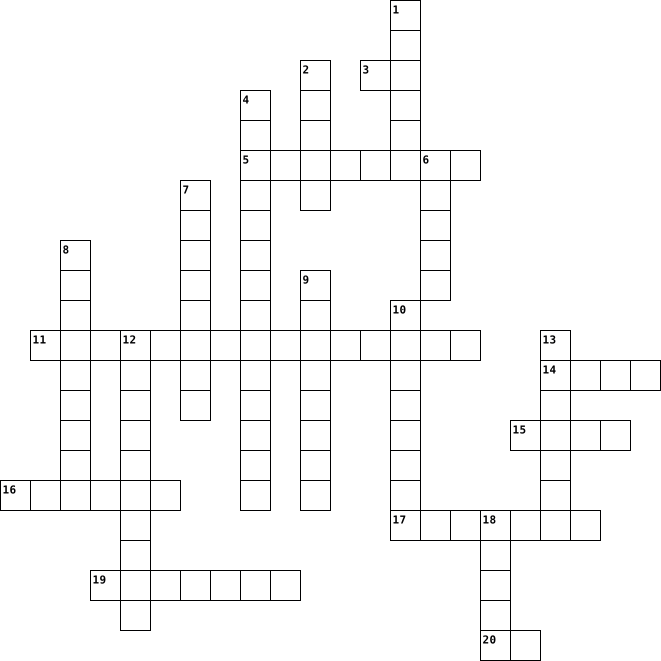
Across
- Symbol of iron
- No. of protons in Aluminum
- Who made the periodic table
- Smallest part of the matter
- How many states of matter are there
- This element is essential to the living
- We use ______________ to represent elements.
- The central part of the atom.
- Symbol of sodium
Down
- What is the mass no. of carbon
- In which state is water after freezing
- Who discovered platinum
- Protons and electrons are __________ in no.
- Ti stands for which atom
- The no. of atoms present in a molecule of an element is called___________
- Name an element whose atoms occur in pairs
- What is the latin name for beryllium
- Tc stands for which atom
- what is the group of atom either in a compound or existing alone called________
- Borum is the latin name for which atom
20 Clues: Symbol of iron • Symbol of sodium • Who discovered platinum • Ti stands for which atom • Tc stands for which atom • No. of protons in Aluminum • Who made the periodic table • Smallest part of the matter • The central part of the atom. • What is the mass no. of carbon • How many states of matter are there • What is the latin name for beryllium • In which state is water after freezing • ...
Changes in Matter 2016-10-25

Across
- butter will undergo this change in state when it is in the heat
- A chemical reaction is another name for a
- to find this in a substance, one must divide the mass by the volume
- a natural chemical change when several compounds combine with energy from the sun to produce new substances
- a chemical change when a slow combination of bright metal is combined with sulfur or another substance, producing a dark coating
- a chemical change that occurs when electricity breaks a compound into elements or simmer compounds
- forms new substances with new and different properties
- the SI unit of mass
- is the total energy of the motion of all the particles in an object
- a change in matter that produces one or more new substances
- a chemical change that occurs with a rapid combination of a fuel with oxygen produces heat, light and new substances
- a change in which energy is absorbed
- a measure of how hot or cold something is
- flammability and reactivity can only be ____ during a chemical reaction
Down
- what kind of chemical change occurs when a nail in your backyard begins to rust after it rains
- The fact that matter is not created or destroyed in any chemical or physical change
- this type of change is evident when a color changes
- when a substance undergoes a physical change it is a
- The ____ of the rock is twenty grams
- any change that alters ONLY the shape or form of matter
- alters the form or appearance of matter but does not turn the substance in the matter into a different substance
- a change which releases energy
- chemical properties describe the way ____ changes into new matter with different properties'
- physical properties can be observed without _____ them
- in a chemical change, a single substance breaks down into at least ___ or more substances to form different substances
- Is dissolving a physical change?
26 Clues: the SI unit of mass • a change which releases energy • Is dissolving a physical change? • The ____ of the rock is twenty grams • a change in which energy is absorbed • A chemical reaction is another name for a • a measure of how hot or cold something is • this type of change is evident when a color changes • when a substance undergoes a physical change it is a • ...
Matter Study Guide 2016-10-26

Across
- A thing that has weight and takes us space
- An object's weight
- Particles transferring to one another
- A property that you can reverse (2 words)
- A change where you can reverse it (2 words)
- A change that you can't reverse (2 words)
- A property that protects wires
- A point in which a solid becomes a liquid (2 words
- Metal attracting to steel or metal
- Your opinion about something
- Taste, touch, sight, hear, and smell (2 words)
- Particles attached and vibrating together
Down
- A point in which liquid changes into a solid (2 words)
- How an object can light on fire
- Particles moving around freely
- A metal property that can be worn down
- A chemical property that makes up a lightning strike
- A property that you can't reverse (2 words)
- An object that has mass and volume
- How much or how little
- A point in which the liquid becomes a gas (2 words)
- Solid, liquid, gas, plasma (3 words)
- Particles briskly moving past each other
- Sorting and separating things
24 Clues: An object's weight • How much or how little • Your opinion about something • Sorting and separating things • Particles moving around freely • A property that protects wires • How an object can light on fire • An object that has mass and volume • Metal attracting to steel or metal • Solid, liquid, gas, plasma (3 words) • Particles transferring to one another • ...
States of Matter 2017-10-06

Across
- Zinc minus one proton.
- Turning a solid into a liquid.
- Turning a liquid to a solid
- When a gas changes to a liquid.
- Is a substance that cannot be broken down into any other substance by chemical or physical means.
- A substance made of two or more elements that are chemically combined in a set ratio.
- any thing which has mass and takes up space.
- Is made of two or more substance that are together in the same place, but their atoms are not chemically bonded.
- Has ninety-six protons.
- Definite shape and definite volume.
Down
- Occurs when particles in a liquid gain enough energy to move independently and form a gas.
- When the particles of a solid gain enough energy to form a gas.
- This is measured by how much kinetic energy a substance has.
- This is one form of plasma.
- When the particles of a gas lose enough energy to form a solid.
- Has neither definite shape nor volume.
- is the basic particle from which all elements are made.
- is a group of two or more atoms held together by chemical bonds.
- Tin plus six protons.
- Has a definite volume but not a definite shape.
20 Clues: Tin plus six protons. • Zinc minus one proton. • Has ninety-six protons. • This is one form of plasma. • Turning a liquid to a solid • Turning a solid into a liquid. • When a gas changes to a liquid. • Definite shape and definite volume. • Has neither definite shape nor volume. • any thing which has mass and takes up space. • Has a definite volume but not a definite shape. • ...
Matter 2 (Changes) 2018-04-13

Across
- The substances produced as a result of a chemical reactions.
- How an objects smells. Physical property.
- How easily and intensely an object burns.
- The amount of space an object occupies.
- The amount of atoms in a given space.
- The state of matter where the atoms are semi-free and take the form of the container that they are in.
- The creation of a solid with the reaction of an object. Associated with a chemical change.
- A process that involves rearrangement of the molecular or ionic structure of a substance.
- An indication of a chemical change that involves the creation of a gas.
- The arrangement, type, and ratio of atoms in molecules of chemical substances.
- The point at which a liquid switches states to a gas.
- The hue of an object. Physical property.
- A change that affects only the looks of an object, not its chemical makeup.
- A substance that takes part in and undergoes change during a reaction.
- The state of matter where the atoms are the freest and can move the most.
- The chemical property referring to the ability for a given substance to dissolve in a solvent.
- The quantity of matter in an object. Physical property.
Down
- A materials ability to transmit heat or electricity
- The state of matter where the atoms are bunched closest together and cannot move as much.
- The degree at which a substance reacts to another substance.
- The point at which a solid switches state to a liquid.
- A change that affects the chemical makeup of an object.
- An observable train that has to do with how an object is observable by human senses.
- An observable trait that has to do with an object's molecular makeup.
- The transition of a gas or vapor to a liquid
- Transition in which a liquid turns into a solid.
- Change of a solid into a liquid when heat is applied.
- A homogeneous type of mixture of two or more substances.
- The relative resistance of a material to denting, scratching, or bending.
- The state of matter where the particles that make up an atom are free.
- The measure of how much space an object takes up. Physical property.
- An objects ability to reflect light.
32 Clues: An objects ability to reflect light. • The amount of atoms in a given space. • The amount of space an object occupies. • The hue of an object. Physical property. • How an objects smells. Physical property. • How easily and intensely an object burns. • The transition of a gas or vapor to a liquid • Transition in which a liquid turns into a solid. • ...
States of Matter 2021-12-13

Across
- energy absorbed from its surroundings
- process that occurs during boiling
- all matter is made up of tiny particles in constant motion (3 words)
- the most abundant state of matter
- occurs when a gas cools and changes to a liquid
- also known as heat energy
- direct relationship between temperature and volume (2 words)
- moving energy
- has definite shape but no definite volume
- the state of a material depends on this
- indirect relationship between pressure and volume (2 words)
- liquid to a solid
- change of a solid directly to a gas
Down
- energy needed to change a material form a liquid to a gas (3 words)
- where all three phases co-exist (2 words)
- liquid to a gas below the boiling point
- unit of pressure
- a type of solid that has repeating geometric patterns
- a type of solid that can change shape with force
- energy required to melt (3 words)
- show how temperature and pressure affect the state of matter (2 words)
- energy out
- to change from solid to liquid
- takes the shape of the container and moves very fast
- unit of temperature
25 Clues: energy out • moving energy • unit of pressure • liquid to a solid • unit of temperature • also known as heat energy • to change from solid to liquid • energy required to melt (3 words) • the most abundant state of matter • process that occurs during boiling • change of a solid directly to a gas • energy absorbed from its surroundings • liquid to a gas below the boiling point • ...
Matter And Energy 2021-12-10

Across
- - gases surrounding the earth
- current - flow of electricit
- - stretched into a wire
- - color in powder form
- of matter - physical state of a substance
- - push away
- - cannot be broken down
- - reflection of a substance
- - found in all known forms of life
- - move heat
Down
- - appearance of a substance
- - dull
- - shiny
- - shatter under stress
- - matter in a object
- beam balance - measures the mass of an object
- substance - one type of atom
- - chemical reaction
- - two of more Elements
- - ratio of an object
20 Clues: - dull • - shiny • - push away • - move heat • - chemical reaction • - matter in a object • - ratio of an object • - shatter under stress • - color in powder form • - two of more Elements • - stretched into a wire • - cannot be broken down • - appearance of a substance • - reflection of a substance • current - flow of electricit • substance - one type of atom • - gases surrounding the earth • ...
Matter and Energy 2022-01-06

Across
- used to measure the movement of heat in a chemical reaction
- property of something that doesn't use size(density, MP)
- type of mixture that is combined evenly and individual parts are not visible
- Two hundred grams of water heated from fifty deg. to seventy five deg> how much J released?(write out answer with letter with dashes in between each word-also answer with correct unit)
- releases energy and feels hot
- formula for exothermic
- going straight from a gas to a solid
- matter in its simplest form, cannot be broken down chemically
- phase change
- ability to perform a task
Down
- way to separate a mixture using their boiling points
- two or more elements joined together chemically
- two or more substances combined but each retains their individual properties
- copper in water(individual parts visible)
- way to separate a mixture using polarity and size
- property of something that uses size(mass,volume)
- released energy/energy of motion
- example of element-symbol for sodium
- has a defined mass and takes up space
- compressed energy ready to be released
- formula for endothermic
- going straight from a solid to a gas
- phase of matter in curve
- absorbs energy and feels cold
24 Clues: phase change • formula for exothermic • formula for endothermic • phase of matter in curve • ability to perform a task • releases energy and feels hot • absorbs energy and feels cold • released energy/energy of motion • example of element-symbol for sodium • going straight from a solid to a gas • going straight from a gas to a solid • has a defined mass and takes up space • ...
Structure of Matter 2022-02-26

Across
- an upward force caused by pressure being higher on the bottom than the top
- when a quantity (i.e. shape, volume, etc.) can change we say it is ____________
- where pressure is applied to an object
- negative charge particle orbiting the nucleus
- the charge of an electron
- how much space an object occupies
- positive charge particle in the nucleus of an atom
- a force caused by particles colliding with a surface
- the buoyant force is equal to the weight of the _____________________
Down
- a patterned arrangement of atoms in a solid
- when a quantity (i.e. shape, volume, etc.) will not change we say it is ____________
- if an object is more dense than the fluid it is in, it will ______________
- bonds between atoms in solids are similar to this
- the charge of a proton
- this is a combination of atoms
- how tightly atoms are packed together
- the charge of a neutron
- no regular pattern of atoms in a solid
- this tells the quantity of protons in the nucleus
- a measurement of the speed of particles
- neutral charge particle in the nucleus of an atom
- if an object is less dense than the fluid it is in, it will ______________
- pressure increases as this increases
23 Clues: the charge of a proton • the charge of a neutron • the charge of an electron • this is a combination of atoms • how much space an object occupies • pressure increases as this increases • how tightly atoms are packed together • where pressure is applied to an object • no regular pattern of atoms in a solid • a measurement of the speed of particles • ...
Matter by cale 2022-02-08

Across
- the amount of room something takes up
- condensation evaporation condensation
- gas turning into a solid
- small things that make up matter
- two or more substances mixed
- vapor
- physical weight
- liquid turning into a gas
- oxygen nitrogen and carbon dioxide
- liquid molecules slow down and becomes a solid
Down
- gas turns into a liquid
- skipping the liquid phase
- a minute pattern of matter
- hard firm keeps shape
- one or more different substances
- solid gets energy added and becomes liquid
- energy added to melt
- solid, liquid, gas
- Anything that takes up space and has mass
- fluid that takes the shape of the container
20 Clues: vapor • physical weight • solid, liquid, gas • energy added to melt • hard firm keeps shape • gas turns into a liquid • gas turning into a solid • skipping the liquid phase • liquid turning into a gas • a minute pattern of matter • two or more substances mixed • one or more different substances • small things that make up matter • oxygen nitrogen and carbon dioxide • ...
Ch. 6 Matter 2022-02-14

Across
- ________ is an electrically charged gas that can flow.
- ________ is a gas that turns back into a liquid.
- What is the opposite of a melting point?
- What is the state change from a solid into a gas?
- When particles are compressed into a smaller area, the particles will have a ___________ pressure.
- A ________ is particles that move around like crazy, no fixed volume or shape, and spreads to fill any area that it is in.
- When the volume and pressure increase, the ____________ is constant.
- When the volume decreases, what increases?
- As the temperature of a gas increases, so does the ________.
- What energy has to do with the motion of the particles?
- ________ point changes from a solid to a liquid
- Particles ________ with each other as well as the walls of the “containers.”
- ________ point is liquid to gas.
Down
- What energy is stored energy of an object?
- A ________ is packed particles with lots of attraction, fixed shape and volume.
- When the temperature increases, it will increase the ___________ of the particles.
- When the volume ___________, the pressure decreases.
- What energy is the total potential and kinetic energy?
- When the volume ___________, pressure increases.
- If it rained, what state change do the puddles go through?
- ___________ move in constant random motion.
- A ________ is a fixed volume, but not a shape-it fills the shape of the container.
- __________ results in matter changing from a gas directly to a solid without going through the liquid state.
23 Clues: ________ point is liquid to gas. • What is the opposite of a melting point? • What energy is stored energy of an object? • When the volume decreases, what increases? • ___________ move in constant random motion. • ________ point changes from a solid to a liquid • ________ is a gas that turns back into a liquid. • When the volume ___________, pressure increases. • ...
Classification of Matter 2022-03-14

Across
- Scattering of a light beam as it passes through a colloid
- Gas to liquid
- Containing the highest amount of substance
- A material's ability to allow heat or electric charges to flow.
- A pure substance made of only one kind of atom
- Different in type, incongruous; composed of different types of elements
- A characteristic of a pure substance that describes its ability to change into different substances
- A liquid substance capable of dissolving other substances
- The temperature at which a liquid changes into a solid
- Basic unit of matter
- the quality of giving off light, brightness, glitter, brilliance
- A solution that holds more dissolved solute than is required to reach equilibrium at a given temperature
- the ability of a substance to be drawn, pulled, or extruded through a small opening to produce a wire
- How readily a substance combines chemically with other substances.
- heat absorbed or radiated during a change of phase at a constant temperature and pressure
- The conversion of a liquid to a gas below the boiling point
- Describes a solution that has a relatively large amount of dissolved solute
Down
- Substances change phases by adding or subtracting energy
- A substance made up of atoms of two or more different elements joined by chemical bonds
- Mass / Volume
- A combination of two or more substances that are not chemically combined
- A mixture in which particles can be seen and easily separated by settling or filtration
- A group of atoms bonded together
- A characteristic of a pure substance that can be observed without changing it into another substance
- A substance that is dissolved in a solution.
- a plot of temperature versus time for a substance where energy is added at a constant rate
- Describes something that has a uniform structure or composition throughout.
- A solution that contains less than the maximum amount of dissolved solute in a concentration.
- Liquid to gas
- The temperature at which a liquid changes to a gas
- the ability of a substance to be hammered or beaten into thin sheets without shattering
- To make a liquid less concentrated
- A mixture that forms when one substance dissolves another.
- Solid to liquid
- A mixture containing small, undissolved particles that do not settle out.
35 Clues: Mass / Volume • Gas to liquid • Liquid to gas • Solid to liquid • Basic unit of matter • A group of atoms bonded together • To make a liquid less concentrated • Containing the highest amount of substance • A substance that is dissolved in a solution. • A pure substance made of only one kind of atom • The temperature at which a liquid changes to a gas • ...
Unit 2: Matter 2023-07-25

Across
- How it reflects light
- The measurement of average kinetic energy of an object’s particles
- Total kinetic energy of particles in a object
- Hold more solute than it could at a lower temperature
- Mass/volume
- Mixture in which two or more substances are uniformly spread out
- How easily it reacts
- Mixture in which different materials can be easily distinguished
- Heterogeneous mixture containing liquid in which visible particles will settle out over time
- Stretched into wire
- How it burns
Down
- Smashed flat into sheet
- Change in size, shape, or phase
- Heterogeneous mixture with particles that are larger than those in a solution, but still too small to settle
- Any type of matter with a fixed composition that cannot be separated by physical means
- A description of a change in which a system absorbs energy from its surroundings
- Change from one category of matter to another
- Anything that has mass and volume
- Solute is as maximum capacity
- A description of a change in which a system releases energy into its surroundings
- Substance made up of one kind of atom
- Substance made up of atoms of two or more elements combined
- How quickly it pours
- How it decomposes
- A specific type of superheated gas that has lost its electrons
25 Clues: Mass/volume • How it burns • How it decomposes • Stretched into wire • How easily it reacts • How quickly it pours • How it reflects light • Smashed flat into sheet • Solute is as maximum capacity • Change in size, shape, or phase • Anything that has mass and volume • Substance made up of one kind of atom • Change from one category of matter to another • ...
cycles of matter 2023-10-05

Across
- reactions -first step of photosynthesis uses sunlight to split H2O and make ATP and NADPH O2 is released
- -nutrient used in phosphates of nucleic acids and phospholipids of membranes often limited
- -organelle site of steps 2 and 3 aerobic cellular respiration
- -third steps of aerobic respiration NADH and FADH2 from earlier reactants are used to make 32 units of ATP
- - any number of organized or specialized structures within an living cell
- reactions -second step of photosynthesis, uses energy in ATP and NADH to make glucose
- respiration -process of breathing down glucose to make ATP starts with C6H12O6 and end with CO2 and H2O
- cycle -second step of aerobic respiration pyruvate is broken down while NADH and FADH are made releases CO2
- -nutrient forms the backbone for all macromolecules in living things
- -sphere of earth all the water on earth
- -adenosine triphosphate charged energy storage molecule with 3 phosphorus groups
- - first step of aerobic respiration breaks down glucose
- -nutrient used in proteins and acids must be fixed for living to use often limited
- -pigment in chloroplast used to trap light energy during photosynthesis
Down
- -type of organism that is able to make its own food base of the food chain
- - process of using light to create glucose
- -anything that has mass and takes up space makes up everything
- -adenosine diphosphate uncharged energy storage molecule with 2 phosphates
- -type of organism that breaks down biotic compounds into abiotic compounds recycles
- -sphere of earth all living things on earth
- - substances created during a chemical reaction made from reactants
- -substances at the beginning of a chemical reaction changed into products
- -second step of anaerobic respiration 2 types include alcoholic and lactic acid
- -sphere of earth all the gasses surrounding earth
- -describes a situation in which oxygen is not present
- - site of photosynthesis
- -type of organism that must eat other organisms to obtain energy
- -describe a situation in which oxygen is present
- -sphere of earth all soil and rocks on earth
29 Clues: - site of photosynthesis • -sphere of earth all the water on earth • - process of using light to create glucose • -sphere of earth all living things on earth • -sphere of earth all soil and rocks on earth • -describe a situation in which oxygen is present • -sphere of earth all the gasses surrounding earth • -describes a situation in which oxygen is not present • ...
Properties of Matter 2023-08-28

Across
- Change, A change that produces matter with a different composition than the original matter
- substance that contains two or more elements chemically combined in a fixed ratio or proportion
- A mixture in which one substance consisting of microscopically dispersed insoluble particles is suspended throughout another substance
- A solid that forms and settles out of a liquid mixture
- of separating a solid from a liquid in a heterogeneous mixture
- Mixture, A mixture in which the composition is uniform throughout
- A fluid's resistance to flow.
- A heterogeneous mixture in which the solid particles do not dissolve, but get suspended throughout
- The ability of a substance, usually a metal, to be deformed or molded into a different shape
Down
- the ease with which a combustible substance can be ignited, causing fire or combustion or even an explosion
- a measure of how much a substance reacts when it is mixed with another substance
- Another name for a homogeneous mixture; it can be a solid, liquid, or gas
- The measure of the ease at which an electric charge or heat can pass through a material
- Mixture, A mixture in which the composition is not uniform throughout
- Property, The ability of a substance to undergo a specific chemical change
- Substance,Matter that has a uniform and definite composition
- Smallest particle of matter that cannot be broken down
- water from a solution by means of boiling to produce a vapor then condensed
- Point, The temperature at which materials changes from a liquid to a gas
- Point, The temperature at which materials changes from a solid to a liquid
- Property, A quality or condition of a substance that can be observed or measured without changing the substance that can be observed or measured without changing the composition.
- Change, Some properties of a material change, but the composition of the material does not change
- Simplest form of matter
23 Clues: Simplest form of matter • A fluid's resistance to flow. • A solid that forms and settles out of a liquid mixture • Smallest particle of matter that cannot be broken down • Substance,Matter that has a uniform and definite composition • of separating a solid from a liquid in a heterogeneous mixture • Mixture, A mixture in which the composition is uniform throughout • ...
Properties of Matter 2023-10-10

Across
- Something dissolved in water
- Milk or Yogurt for example
- A property that lists how a substance reacts with other chemicals
- Separating a solution via chemical means
- Sodium and Iron for example
- How thick a liquid is
- Containing two or more elements
- A solid that is produced from a chemical reaction
- How well a substance transfers heat
- containing only one substance
- Ability to react with other chemicals
Down
- The temperature a substance goes from liquid to gas
- Smallest unit of matter
- The temperature a substance goes from solid to liquid
- Trail mix for example
- A change that does not change the material
- Ability to be hammered into a sheet
- Separating a solution via physical means
- Ability to burn
- A change in which the substance changes to something else
- Particles spread, not dissolved, in water
- Whipped Cream for example
- A property that can be observed
23 Clues: Ability to burn • Trail mix for example • How thick a liquid is • Smallest unit of matter • Whipped Cream for example • Milk or Yogurt for example • Sodium and Iron for example • Something dissolved in water • containing only one substance • Containing two or more elements • A property that can be observed • Ability to be hammered into a sheet • How well a substance transfers heat • ...
light and matter 2023-11-09

Across
- the matter from which a thing is or can be made
- the colored ring within your eye
- travels in a strait line
- when you make a model to the exact size
- the opening at the center of the iris through which light passes.
- a material thing that can be seen and touched
- To go through
- an extension of your central nervous system, which includes your brain and spine.
- the innermost light-sensitive membrane covering the back wall of the eyeball
- a set of things working together as parts of a mechanism
- any substance that has mass and takes up space by having volume
- 50% of light goes trough
Down
- Most light transmits through this material
- a simplified drawing showing the structure of something
- throwing back light without absorbing it
- we use them to see
- all light reflects off this material
- to bounce off
- a transparent double-convex lens.
- a fact or situation that is observed to exist or happen
- a communication system
- serves as a barrier against dirt and particles
- Type of energy that travels in straight line
23 Clues: To go through • to bounce off • we use them to see • a communication system • travels in a strait line • 50% of light goes trough • the colored ring within your eye • a transparent double-convex lens. • all light reflects off this material • when you make a model to the exact size • throwing back light without absorbing it • Most light transmits through this material • ...
black lives matter 2023-11-22

Across
- slave that helped people escape with the railroad
- city in the south
- quiet and?
- many people back then were?
- popular fraise to use for the right of black
- to stop doing something?
- organization that killed blacks
- uncle ____ cabin
- cowboy city
- I have a _____ mlk jr.
- I can't ______ George Floyd
- to separate people
Down
- something isn't fair?
- the place where it all started?
- to be fair
- attacks black people still
- the main crop?
- fighting for civil rights
- to work hard
- to be very harsh to each other
- black people used to be?
21 Clues: to be fair • quiet and? • cowboy city • to work hard • the main crop? • uncle ____ cabin • city in the south • to separate people • something isn't fair? • I have a _____ mlk jr. • to stop doing something? • black people used to be? • fighting for civil rights • attacks black people still • many people back then were? • I can't ______ George Floyd • to be very harsh to each other • ...
States of Matter 2024-01-08

Across
- The four states of matter are: solid, liquid, gas, and ____________________.
- When a liquid’s particles are moving faster, its temperature ____________________.
- When a liquid turns into a gas, its thermal energy __________________.
- When the surface of a liquid vaporizes it is called ____________________________.
- When condensation occurs, a gas‘s thermal energy ___________________________.
- This is the opposite of vaporization.
- These occur at the plateaus (flat lines) of a time vs temperature graph (2 Words)
- This state has a definite volume and a definite shape.
- A change of state from liquid to solid.
- This state has no definite shape and no definite volume.
- This state has a definite volume but no shape of its own.
- When vaporization takes place throughout a liquid it is called ____________________.
- ______ Theory of Matter-All particles in matter are inconstant, random motion
Down
- A change in state from gas directly to solid.
- A ___________________ solid has particles that form a regular, repeating pattern.
- When the temperature of a gas in increases, the molecules move _________________.
- This takes place when the particles of a liquid gain enough energy to form a gas.
- Another name for solidification is _________________.
- An _____________________ solid does not melt at a distinct temperature.
- a new substance
- The temperature at which a substance melts (2 Words)
- A change in which one kind of molecule is changed into another kind;
- This change in state goes from solid directly to gas.
- The temperature at which a liquid vaporizes. (2 Words)
- A _________________ is a substance that flows.
25 Clues: a new substance • This is the opposite of vaporization. • A change of state from liquid to solid. • A change in state from gas directly to solid. • A _________________ is a substance that flows. • The temperature at which a substance melts (2 Words) • Another name for solidification is _________________. • This change in state goes from solid directly to gas. • ...
Changes In Matter 2023-11-02

Across
- A characteristic of a pure substance that describes its ability to change into another substance.
- The ability of a material to have its shape changed, as by being drawn out into wire or thread, without losing strength or breaking.
- A characteristic of a pure substance that can be observed without changing its identity.
- A change that results in a change in the identity of a substance or produces one or more new substances.
- To lose or cause to lose luster, especially as a result of exposure to air or moisture.
- Energy is released.
- The measure of how much matter is in a given amount of space
- The quality of something that can be shaped into something else without breaking.
- A measure of how quickly a specific material is capable of catching fire and burning.
Down
- The ability to be dissolved, especially in water.
- A chemical process in which a substance reacts rapidly with oxygen and gives off heat.
- The ability of a substance to interact chemically with a second substance.
- The shiny quality of a surface that reflects light.
- A change that results in a change in appearance or form but not identity.
- Point The temperature at which a given solid will melt.
- The interaction of Iron with air and water. Likely to occur on a metal surface.
- A numerical measure of the acidity of a solution, usually measured on a scale of 0 to 14.
- The temperature at which a liquid turns to vapor.
- A way to describe the behavior of atoms and molecules in a substance.
- Energy is absorbed.
20 Clues: Energy is released. • Energy is absorbed. • The ability to be dissolved, especially in water. • The temperature at which a liquid turns to vapor. • The shiny quality of a surface that reflects light. • Point The temperature at which a given solid will melt. • The measure of how much matter is in a given amount of space • ...
Phases of Matter 2025-03-06

Across
- 2words: a compound made of bonded carbon and oxygen atoms
- a phase of matter that has definite volume and definite shape. The particles of a solid are tightly bonded and cannot move around
- a particle made of two or more atoms that are held together with strong (covalent) bonds
- the change of phase from gas to liquid (clouds and drops on the side of a cold glass)
- 2words: the temperature at which a liquid changes to a solid; different for each substance
- the smallest particle of an element (all matter is made of this)
- phase of matter that has definite volume but no definite shape. Loosely bonded particles can flow over and around one another
- the smallest piece of a substance that is still that substance (another word for atom/molecule)
- a phase of matter that has no definite shape or volume. Particles fly independently through space
- the ratio of mass and volume in a sample of matter (how much stuff is packed into a space)
- a push or a pull
- 2words: the temperature at which a solid changes to a liquid; different for each substance
- to change phase from liquid to solid
Down
- energy transfer that increases the kinetic energy of a substance’s particles
- the reduction of volume of a sample of matter as a result of cooling
- energy transfer that decreases the kinetic energy of a substance’s particles
- the physical condition of a sample of matter based on the kinetic energy of its particles; common phrases include solid, liquid, and gas. Also called state.
- 2words: energy of motion
- the change of phase from liquid to gas (a puddle drying up)
- an attractive force between atoms (holds them together)
- existing in the gas phase
- 2words: the solid phase of carbon dioxide
- an increase of volume (to get bigger)
- to move rapidly back and forth
- to change phase from solid to liquid
- a defined quantity of space (the size of an object)
26 Clues: a push or a pull • 2words: energy of motion • existing in the gas phase • to move rapidly back and forth • to change phase from solid to liquid • to change phase from liquid to solid • an increase of volume (to get bigger) • 2words: the solid phase of carbon dioxide • a defined quantity of space (the size of an object) • ...
Matter word puzzle 2025-03-09

Across
- held together by metallic bonds. they are malleable and good conductors of heat
- is a measure of how much a liquid resists flowing freely.
- Liquid to gas. One example is boiling water.
- Gas to liquid. One example is Water vapor.
- is one of the four common states of matter that is made up of electrically charged particles.
- a change of materials into another, new materials with different properties
- is a state of matter that is an intermediate phase between gas and solid.
- Solid to liquid. One example is ice.
- Liquid to solid. another word for freezing.
- is a very thin layer of particles that are more strongly attracted to each other than they are to the particles surrounding them.
- is the pressure exerted by the vapor/liquid in a closed container.
- a type of solid that lacks definition in shape, pattern, and long-range order.
- gas to solid. One example is Freeze-Drying
- is a superfluid phase formed by fermionic particles at low temperatures.
Down
- is the property of a liquid to easily vaporize at normal temperatures.
- is the temperature at which the substance transitions from a liquid to the gaseous phase
- a theory for gases was established to explain the properties of gases.
- accounts for the surface tension of a liquid.
- gives trees and other plants a boost in drawing nutrient-rich water
- is a solid material whose constituents are arranged in a highly ordered microscopic structure, forming a crystal lattice
- solid to gas.one example is Incense
- adhering to a surface or object.
- the material involved in the change is structurally the same before and after the change
- Held together by Ionic bonds. they have high melting points. an example of this is table salt.
- a classification of solids that is the weakest among the types that hold liquid together. it has a low melting point.
- What all matter is made out of.
- This basic state of matter has no fixed shape or volume
- diamonds, graphite, and silicon dioxide are examples of this classification.
- The abbreviated form of Bose-Einstein condensate
- is one of the basic states of matter: The molecules in this state are closely packed together compared to the other states of matter.
30 Clues: What all matter is made out of. • adhering to a surface or object. • solid to gas.one example is Incense • Solid to liquid. One example is ice. • Gas to liquid. One example is Water vapor. • gas to solid. One example is Freeze-Drying • Liquid to solid. another word for freezing. • Liquid to gas. One example is boiling water. • accounts for the surface tension of a liquid. • ...
PROPERTIES OF MATTER 2025-10-08

Across
- – The process of a solute mixing evenly with a solvent.
- – The pattern of separated colors seen on the paper after chromatography.
- – The liquid that dissolves a solute to make a solution.
- – A substance that contains more than one type of particle.
- – The maximum amount of solute that can dissolve in a solvent at a given temperature.
- – A tool used to separate insoluble solids from liquids.
- – The clear mixture formed when a solute dissolves in a solvent.
- – A combination of two or more substances that are not chemically joined.
- – The clear liquid that passes through filter paper.
- – The amount of solute dissolved in a certain amount of solvent.
- – A colored substance used in inks that can be separated by chromatography.
Down
- – The small mark of sample placed on chromatography paper before testing.
- – A factor that affects how much solute can dissolve in a solvent.
- – The action that helps solvent move up the chromatography paper.
- – A substance made up of only one type of particle.
- – The process used to separate a solute from a solvent by heating.
- – The substance that dissolves in a solvent.
- – A colored mixture that can be separated into its dyes using paper chromatography.
- – The solid left behind on filter paper after filtration.
- – A solution that cannot dissolve any more solute at a given temperature.
20 Clues: – The substance that dissolves in a solvent. • – A substance made up of only one type of particle. • – The clear liquid that passes through filter paper. • – The process of a solute mixing evenly with a solvent. • – The liquid that dissolves a solute to make a solution. • – A tool used to separate insoluble solids from liquids. • ...
Matter & Atomic Structure 2025-10-17

Across
- Dense center of the atom containing protons and neutrons
- Atom or group of atoms with a positive or negative charge
- Vertical column in the periodic table
- Bond formed by sharing of electrons
- State of matter with definite shape and volume
- Pure substance made of only one type of atom
- Number of protons in the nucleus of an atom
- Negatively charged particle found outside the nucleus
- Neutral particle found in the nucleus
- Substance made of two or more elements chemically combined
- Positively charged ion
- Positively charged particle found in the nucleus
Down
- High-energy state of matter where atoms lose electrons
- Regions around the nucleus where electrons are likely to be found
- Two or more atoms bonded together
- Electrons in the outermost shell of an atom
- Physical blend of two or more substances
- Atoms of the same element with different numbers of neutrons
- State of matter with neither definite shape nor volume
- Negatively charged ion
- Sum of protons and neutrons in an atom
- Bond formed by transfer of electrons
- State of matter with definite volume but no definite shape
- Horizontal row in the periodic table
24 Clues: Negatively charged ion • Positively charged ion • Two or more atoms bonded together • Bond formed by sharing of electrons • Bond formed by transfer of electrons • Horizontal row in the periodic table • Vertical column in the periodic table • Neutral particle found in the nucleus • Sum of protons and neutrons in an atom • Physical blend of two or more substances • ...
Matter Vocabulary Review 2025-10-23

Across
- around you that takes up space is called matter. It
- gets smaller (contracts) because it's cooled. The cold
- contraction is the opposite of thermal expansion. It's when
- is how tightly packed the particles in an object are. If
- Volume is how much space something takes up. If you pour water
- is a measure of how much matter is in something. It's not the
- the particles down and they take up less space.
- up more space.
- a cup, the amount of space the water occupies is its volume.
Down
- They're so tiny, you can't see them with just your eyes!
- like air.
- it's less dense.
- it's heated. The heat makes the particles move faster and
- of
- things you can see, like tables and cats, and things you
- are close together, the object is dense. If they're spread
- phases of matter are the different forms matter can take -
- liquids, and gases. They each behave differently based on
- their particles move.
- as weight, which can change if you go somewhere like the
- Particles are the super small bits that make up everything in the
- expansion happens when something gets bigger (expands)
22 Clues: of • like air. • up more space. • it's less dense. • their particles move. • the particles down and they take up less space. • around you that takes up space is called matter. It • gets smaller (contracts) because it's cooled. The cold • expansion happens when something gets bigger (expands) • They're so tiny, you can't see them with just your eyes! • ...
Chapter 1 Matter 2023-10-07

Across
- elements in a group in periodic table have the same number of _______ electrons
- at every temperature a liquid __________
- the process of a gas turning into solid
- refreezing
- water is a ____
- small particle that makes an element
- a state of matter
- ______ number of Lithium is seven
- charge outside the nucleus
- continuous motion of molecules in liquids and gases
- in a solution water is the ______
- vertical column in periodic table
- atoms having the same atomic number but different mass number
- water is at its maximum ________ at +4 centigrade degrees
- ________ bonding is an example of intermolecular forces
Down
- non-metals from _________ bonds
- a solvent with maximum dissolved solute
- mixing of two gases
- non-crystalline structure
- have complete outer shells
- positive electrical charge
- metals and non-metal form _____ bonds
- an isotope of hydrogen atom
- the number of protons
- a good conductor of heat and electricity
- horizontal row in periodic table
- a process chemical compounds can be split up
- in a solution salt is the ________
- geometric pattern of metals
- a positive ion
- a negative ion
- hydrogen atom has ____ proton
32 Clues: refreezing • a positive ion • a negative ion • water is a ____ • a state of matter • mixing of two gases • the number of protons • non-crystalline structure • have complete outer shells • positive electrical charge • charge outside the nucleus • an isotope of hydrogen atom • geometric pattern of metals • hydrogen atom has ____ proton • non-metals from _________ bonds • ...