
matter Crossword Puzzles
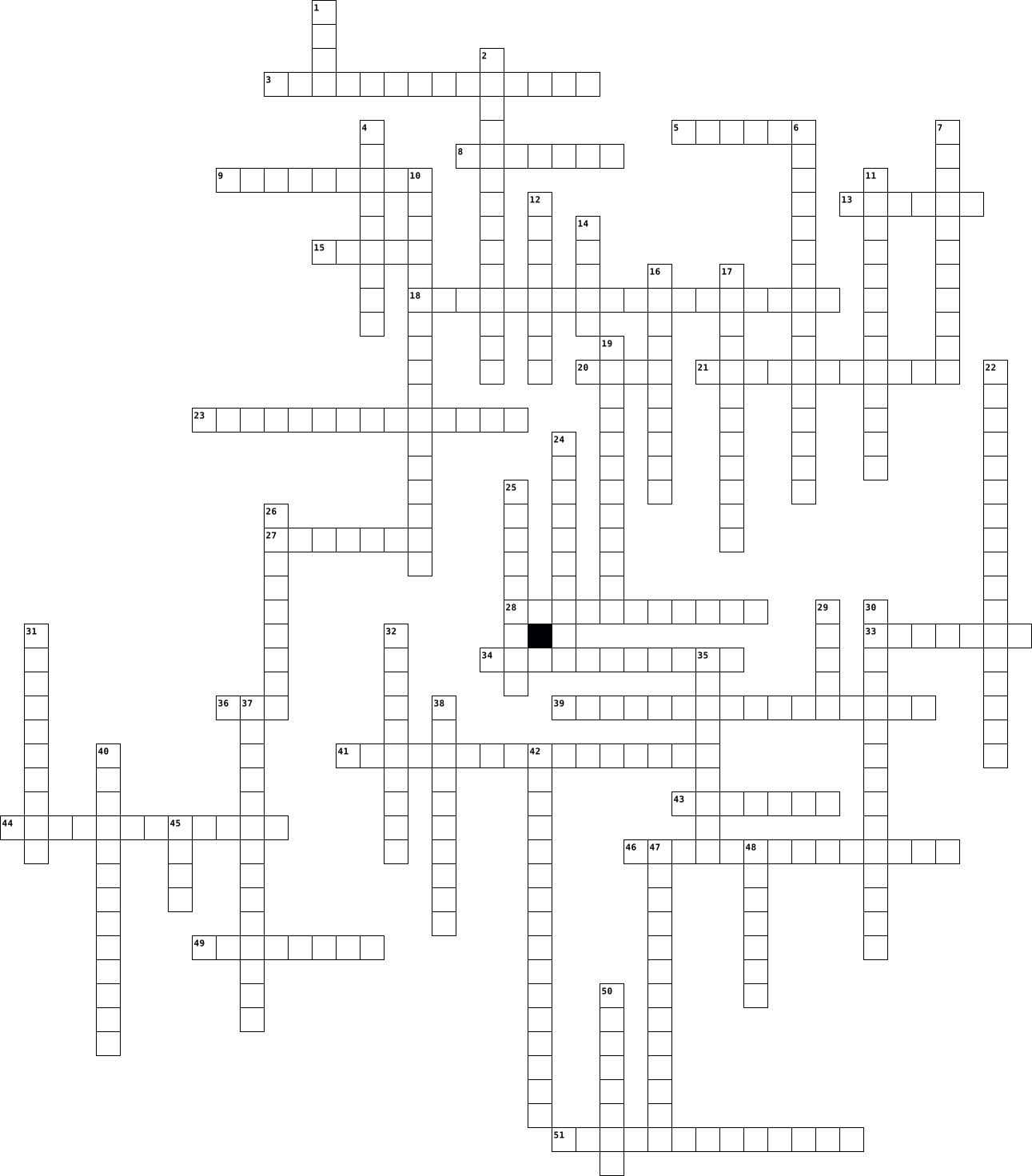
Particle Theory Review 2015-12-07

Across
- This is a measurement for the amount of space matter takes up.
- The particles of this state of matter are close together but are able to move around more than solid particles
- We know that particles are _____________ to each other because we saw that it is hard to separate water droplets, but it is easy to combine them.
- When temperature is increased particles will move ________________
- The particles in this state of matter spread out far from each other. They can be squished closer together using force.
- The volume of a substance will __________ if particles are heated and they move faster.
- The amount of matter in a substance. It is related to weight, but it is not exactly the same
Down
- Solid particles have the ____________ speed
- Energy Energy of Motion
- Building blocks of matter. These are either atoms or molecules.
- Gas particles have the ____________ speed
- Gas particles have the ___________ distance from each other.
- Particles in a liquid are _____________ than particles in a gas.
- The particles of this state of matter vibrate in place
- Around We know that particles want to __________ because scent can spread from one part of a room to another.
15 Clues: Energy Energy of Motion • Gas particles have the ____________ speed • Solid particles have the ____________ speed • The particles of this state of matter vibrate in place • Gas particles have the ___________ distance from each other. • This is a measurement for the amount of space matter takes up. • Building blocks of matter. These are either atoms or molecules. • ...
SVPS Grade 7 Matter and Materials 2020-05-10

Across
- This liquid acts as a solvent for a wide variety of substances in our bodies.
- A property of matter determined by the relationship between its mass and volume.
- Any substance that has mass and takes up space.
- A gas changes to a liquid.
- The amount of space an object takes up, is its…
- A property of matter determined by the relationship between its mass and volume.
- A burning splinter is held at the mouth of a test tube, a blue flame is seen and a popping sound is heard. The gas was…
- State of matter where the particles are arranged in an orderly fashion and the attractive forces between the particles are very strong.
- If an object is less dense than water, it will … on the water.
Down
- A substance that is composed of atoms that are all the same.
- A substance bonds with another substance to form a new substance with new properties.
- A liquid changes into a gas.
- State of matter where the particles slide over each other.
- Matter can be weighed on a scale to determine its…
- If something is more dense than water, it … in water.
- State of matter where particles are free to move far apart because they are not held together by strong forces of attraction.
16 Clues: A gas changes to a liquid. • A liquid changes into a gas. • Any substance that has mass and takes up space. • The amount of space an object takes up, is its… • Matter can be weighed on a scale to determine its… • If something is more dense than water, it … in water. • State of matter where the particles slide over each other. • ...
Chapter 2 2023-09-13

Across
- He made the first carbonated beverage using carbon dioxide.
- He discovered hydrogen was a gaseous element.
- Two or more substances mixed together but not chemically bonded
- The state of matter in which a substance has a definite shape and a definite volume.
- the amount of matter in a solid, liquid, or gas
- a pure substance that contains 2 or more elements chemically joined in a fixed proportion
Down
- anything that takes up space and has mass
- The state of matter in which a substance has neither a definite shape nor a definite volume.
- the shape that every snowflake is
- The state of matter in which a substance has a definite volume.
- measure of the mass of a substance compared to its volume.
- a pure substance that cannot be broken down into a simpler substance and only contains one type of atom
- a substance dissolved into another substance, known as a solvent. The solvent does the dissolving
- the smallest chemical unit of matter. Comes from the greek word that means “cannot be divided”
- The natural passive movement within gases and liquids that spreads out particles from an area of higher concentration to an area of lower concentration.
15 Clues: the shape that every snowflake is • anything that takes up space and has mass • He discovered hydrogen was a gaseous element. • the amount of matter in a solid, liquid, or gas • measure of the mass of a substance compared to its volume. • He made the first carbonated beverage using carbon dioxide. • The state of matter in which a substance has a definite volume. • ...
Chemistry Unit Review 2022-03-16

Across
- change To change one or more substances into a different substance
- Color, texture, flexibility, and density are all examples of ______________ properties
- Everything is made of __________
- Subatomic particle with no charge
- A _____________ mixture is the same all the way through
- The basic unit of a chemical element
- A group of atoms that are chemically bonded
- Center of an atom
- The Law of _________________ of Mass says that matter cannot be created or destroyed
- A method of separating substances using their different boiling points
Down
- Flammability is an example of a ___________ property
- The measure of the force of gravity pulling on an object
- The amount of matter in an object
- Subatomic particle with positive charge
- Two or more substances that are combined, but not chemically bonded
- A ___________ mixture is not uniform throughout
- H2O is an example of a(n) _______________
- Hydrogen is an example of a(n) ______________
- A single type of matter with uniform properties
- change To change for form or external characteristics of a substance without changing what the substance is
- Subatomic particle with negative charge
- The measure of the amount of mass per volume (mass divided by volume)
- The amount of space that an object takes up
23 Clues: Center of an atom • Everything is made of __________ • The amount of matter in an object • Subatomic particle with no charge • The basic unit of a chemical element • Subatomic particle with positive charge • Subatomic particle with negative charge • H2O is an example of a(n) _______________ • A group of atoms that are chemically bonded • ...
Exam final 2020-05-28

Across
- a way to describe the traits we see
- a substance that is made when two or more elements combine
- properties that can be measured when matter undrgoes a change to become completely different.
- the study of inheritance
- when a gene slightly varieties from person to person.
- a pure substance
- when a wave bounces back from matter they cannot pass through
- when one or more physical properties change without chemical properties changing
- _______=angle of reflection
Down
- a disturbance in matter that transfers energy
- the smallest particle of a element
- used to predict the possible offspring fro a mating of two parents
- the matirial that makes up our chroosones and stores our genetic information
- a combination of two or more substances in any proportion
- properties that can be measured or observed without changing the matter
- the smallest structural and functional unit of an organism
- the highest point of a wave
- the lowest point of a wave.
- the monemers of protein.
- the number of waves that pass through a point in a certain amount of time
20 Clues: a pure substance • the study of inheritance • the monemers of protein. • the highest point of a wave • the lowest point of a wave. • _______=angle of reflection • the smallest particle of a element • a way to describe the traits we see • a disturbance in matter that transfers energy • when a gene slightly varieties from person to person. • ...
Chemistry final crossword 2020-06-13

Across
- leading scientific theory of how the universe began
- one complete performance of a periodic process
- anything having mass and taking up space
- are dark planet-sized regions that appear on the sun
- all atoms with more than 82 protons are this
- the relative amount of solute in a solution
- able to be changed
- radiation supporting the Big Bang Theory
- atoms of same elements having a different mass
- two or more nuclei forced together to make a larger nucleus
- all of matter and space
- light from the sun
Down
- send into the air
- the basic unit of matter
- something becoming liquid by heating a solid
- table of chemical elements
- production and discharge of something, especially gas or radiation
- mountain or hill having lava
- type of rock made from cooled magma
- having a PH of less than 7
- a rearrangement of atoms into new substances
- how far is it from start to end of a periodic wave
- two protons and two neutrons released by radioactive decay
- a fluid state of matter
- turning from liquid to solid
25 Clues: send into the air • able to be changed • light from the sun • a fluid state of matter • all of matter and space • the basic unit of matter • table of chemical elements • having a PH of less than 7 • mountain or hill having lava • turning from liquid to solid • type of rock made from cooled magma • anything having mass and taking up space • radiation supporting the Big Bang Theory • ...
Chapter 5 2020-02-26

Across
- , The minimum amount of energy needed to start a chemical reaction.
- , Amount of substance in a given volume.
- , The energy that releases heat.
- , The energy that absorbs heat.
- , An alter in appearance of a substance
- , When two or more elements or compounds combine to make a more complex substance.
- , When compounds breaks down into simpler products.
- equation , A way to show a chemical reaction using symbols
- , Matter doesn't enter or leave.
Down
- , A solid that forms from liquids during a chemical reaction.
- , A material that is used to decrease the rate of a chemical reaction.
- , During a chemical reaction, matter in neither created nor destroyed.
- , substances that undergo the chemical change
- , Tiny cells in our bodies that are reactants helping occur at body temperature.
- , Increases the reaction rate by lowering activation energy.
- , a number placed in front of a chemical formula in an equation.
- , matter can enter or escape to the surroundings
- , A change in matter that produces 1 or more new substances
- , When one element replaces another element in a compound.
- , The new substance formed after a chemical change.
20 Clues: , The energy that releases heat. • , The energy that absorbs heat. • , Matter doesn't enter or leave. • , An alter in appearance of a substance • , Amount of substance in a given volume. • , substances that undergo the chemical change • , matter can enter or escape to the surroundings • , When compounds breaks down into simpler products. • ...
UNIT 1 CHEMISTRY 2023-01-24

Across
- Study of processes that occur inside living organisms
- Separates two or more liquids with different boiling points from a homogeneous mixture
- Physical blend of two or more component
- Based on multiples of ten
- Method for expressing very large and very small numbers
- Proposed explanation for an observation
- A visual way of displaying information or data
- Used to represent an element
- Study of the composition of matter
- Used to represent a compound
- Separates a solid from a liquid in a heterogeneous mixture
Down
- Separates particles in a homogeneous mixture base on size and solubility
- Study of chemicals that do not contain carbon
- Study of changes in matter and energy
- A change that does not alter the composition of the material
- The Study of Matter and The Changes it Undergoes
- Space between two grid lines on a graph, it must be consistent
- Study of chemicals containing carbon and hydrogen
- Concise statement that summarizes the results of many observations and experiments
- Anything that has mass and takes up space
20 Clues: Based on multiples of ten • Used to represent an element • Used to represent a compound • Study of the composition of matter • Study of changes in matter and energy • Physical blend of two or more component • Proposed explanation for an observation • Anything that has mass and takes up space • Study of chemicals that do not contain carbon • ...
Science Review Crossword 2023-03-31

Across
- the energy when moving
- the force that is made when two objects rub together
- the unit of work
- a state of matter that flows to the shape of its container
- when something is moving it makes this energy
- 212 Fahrenheit is the ________ of water
- the distance traveled over a certain amount of time
- the most harmful source of light
- the only light that we can see
- two or more elements combined
- a temperature that has never been reached(kelvin)
- the unit of force
Down
- solids, liquds, and gases are types of ____________
- stored up energy(not moving)
- two forces that equal the same so no movement is made
- the Milky way is a ___________
- there are 8 of these in space (Earth is one of them)
- a state of matter that also shapes to its container but the atoms are the most spread apart
- a state of matter where it has a definite shape
- the smell that something or someone gives off
- a circuit where no electricity can flow
21 Clues: the unit of work • the unit of force • the energy when moving • stored up energy(not moving) • two or more elements combined • the Milky way is a ___________ • the only light that we can see • the most harmful source of light • 212 Fahrenheit is the ________ of water • a circuit where no electricity can flow • when something is moving it makes this energy • ...
Matter and Change vocab 2025-01-09

Across
- matter that has a definite composition
- process that releases energy into the surroundings
- the measure of the amount of matter
- most are gases
- a property that can be observed and measured without changing the material's composition
- particles can move around, but are still close together
- particles vibrate but can't move around
- have properties of both metals and nonmetals
- change the appearance, without changing the composition of the material
- a process that absorbs energy from surroundings
- depends on the amount of matter in the sample
Down
- the smallest unit of an element that maintains the properties of that element
- the ability of a substance to undergo a specific chemical change
- the study of the composition, structure, and properties of matter and the changes it undergoes
- the energy possessed by an object due to its position, composition, or condition
- particles collide with enough energy to break into charged particles (+/-)
- most are solids
- energy of motion
- a pure substance made of only one kind of atom
- particles can separate and move throughout the container
20 Clues: most are gases • most are solids • energy of motion • the measure of the amount of matter • matter that has a definite composition • particles vibrate but can't move around • have properties of both metals and nonmetals • depends on the amount of matter in the sample • a pure substance made of only one kind of atom • a process that absorbs energy from surroundings • ...
Science Study Guide For 5th Grade 2025-04-29

Across
- Scientists use a quantity known as _____ to measure force
- A measure of the amount of matter in an object
- Each ____ has its own density
- A measure of how tightly packed matter is is called
- what Comes from petroleum?
- Opposite poles ____ one another
- Solids keep their what?
- Metals with very low density and relativity great strength, called ______, are very good insulators against heat
- We know of how many elements
Down
- Compounds have _____ properties than the elements that make them up
- The basic building blocks of all matter
- A ____ measures mass
- The tiny, very dense body in the atoms center is called
- When a liquid ___,it changes to a gas rapidly
- About 3/4 elements of the elements are
- A formula contains numbers below the elements called what?
- Mass is often measured in what?
- Particles that can contain more than just one atom joined together are called?
- The object's ability to float
- Anything that takes up space
- The liquid in a _____ expands or contracts with changes in temperature
21 Clues: A ____ measures mass • Solids keep their what? • what Comes from petroleum? • Anything that takes up space • We know of how many elements • Each ____ has its own density • The object's ability to float • Mass is often measured in what? • Opposite poles ____ one another • About 3/4 elements of the elements are • The basic building blocks of all matter • ...
Properties of Matter Review 2022-12-16

Across
- A property that describes matter without changing it.
- Has a definite volume, but NOT a definite shape.
- A property that describes how matter changes into new matter.
- Root word meaning thick
- A change that create new substances.
- The ability to transfer heat
- Root word meaning heat
- Has a definite shape and volume.
- The process when a gas turns into a liquid.
Down
- The ability of a substance to be hammered into thin sheets.
- The ability of a substance to dissolve.
- The process when a solid turns into a gas.
- A change that changes the appearance of matter only.
- The ability to be pulled into a wire.
- The process when a liquid turns into a gas.
- The process when a liquid turns into a solid.
- Root word meaning to hammer
- No definite shape or volume.
- How much mass per volume.
- The process when a solid turns into a liquid.
- A fluids resistance to flow.
- Root word meaning to lead
- Root word meaning to dissolve
23 Clues: Root word meaning heat • Root word meaning thick • How much mass per volume. • Root word meaning to lead • Root word meaning to hammer • No definite shape or volume. • The ability to transfer heat • A fluids resistance to flow. • Root word meaning to dissolve • Has a definite shape and volume. • A change that create new substances. • The ability to be pulled into a wire. • ...
Heat Unit Review 2025-01-22

Across
- When a liquid becomes a solid
- Particles are _________ all the time
- When a solid becomes a gas
- The coldest place on Earth
- All matter is made of tiny ___________
- The transfer of radiant energy by means of electromagnetic waves
- The transfer of thermal energy by a circulating current of faster and slower moving particles
- A material that transfers heat well
- Particles have _________ spaces between them
- In this state of matter the shape and volume will change
- A material that does not transfer heat well
- In this state of matter the shape will change but the volume will not
Down
- When a solid becomes a liquid
- When a gas becomes a solid
- The transfer of thermal energy by the collision of particles
- In this state of matter the shape and volume will not change
- Particles _____________ each other, so they tend to stay together
- Particles move __________ when they are heated
- When a gas becomes a liquid
- When a liquid becomes a gas
- The measure of the average kinetic energy of the particles of a substance.
21 Clues: When a gas becomes a solid • When a solid becomes a gas • The coldest place on Earth • When a gas becomes a liquid • When a liquid becomes a gas • When a solid becomes a liquid • When a liquid becomes a solid • A material that transfers heat well • Particles are _________ all the time • All matter is made of tiny ___________ • A material that does not transfer heat well • ...
Chemical and Physical Properties 2025-02-20

Across
- Incapable of being squeezed into a smaller volume
- Capable of breaking down naturally
- Rusting
- A state of matter in which the object has a definite shape and volume.
- To make or become liquid
- How heavy a substance is compared with other substances with the same size
- Easily broken
- The process of burning something
- Not shiny
- Temperature at which a liquid changes into a solid
- A state of matter with no definite shape or volume
Down
- Squeezed or pressed together
- Characteristics used to describe an object for example what it looks like and its reaction with water
- Temperature at which a solid becomes a liquid
- Measure of how fast a chemical reaction occurs
- Another word for smell
- A single kind of matter that is pure and has a specific set of properties.
- The amount of water vapor in the air
- Conductor a material that allows electricity to pass through easily
- A state of matter that has no definite shape but has a definite volume.
- Conductor A material that allows heat to pass through easily
21 Clues: Rusting • Not shiny • Easily broken • Another word for smell • To make or become liquid • Squeezed or pressed together • The process of burning something • Capable of breaking down naturally • The amount of water vapor in the air • Temperature at which a solid becomes a liquid • Measure of how fast a chemical reaction occurs • Incapable of being squeezed into a smaller volume • ...
Science 2026-01-23

Across
- Parts of a fish that help it breathe underwater.
- A thick layer of fat that keeps whales and penguins warm.
- A state of matter that flows, like water or milk.
- The bone that protects your brain.
- When the sun heats water and it turns into vapor.
- A state of matter that spreads out to fill any space.
- The source of energy that starts the water cycle.
- The line of bones down the middle of your back.
- When an animal's color helps it hide in its home.
- An animal that hunts and eats other animals.
- The natural home of an animal or plant.
Down
- A state of matter that keeps its own shape.
- Water falling from the sky as rain or snow.
- When water vapor cools down to form clouds.
- All the bones inside a human or animal body.
- These bones protect your heart and lungs.
- The tiny "circles" that make up all matter.
- The small bone at the front of your knee.
- A very cold, snowy habitat where polar bears live.
- Water that flows over the ground into rivers.
20 Clues: The bone that protects your brain. • The natural home of an animal or plant. • These bones protect your heart and lungs. • The small bone at the front of your knee. • A state of matter that keeps its own shape. • Water falling from the sky as rain or snow. • When water vapor cools down to form clouds. • The tiny "circles" that make up all matter. • ...
Particle Theory Review 2015-12-07

Across
- Around We know that particles want to __________ because scent can spread from one part of a room to another.
- When temperature is increased particles will move ________________
- The volume of a substance will __________ if particles are heated and they move faster.
- The particles of this state of matter are close together but are able to move around more than solid particles
- Gas particles have the ___________ distance from each other.
- Building blocks of matter. These are either atoms or molecules.
- The particles in this state of matter spread out far from each other. They can be squished closer together using force.
- The particles of this state of matter vibrate in place
Down
- Energy Energy of Motion
- This is a measurement for the amount of space matter takes up.
- Gas particles have the ____________ speed
- We know that particles are _____________ to each other because we saw that it is hard to separate water droplets, but it is easy to combine them.
- Solid particles have the ____________ speed
- The amount of matter in a substance. It is related to weight, but it is not exactly the same
- Particles in a liquid are _____________ than particles in a gas.
15 Clues: Energy Energy of Motion • Gas particles have the ____________ speed • Solid particles have the ____________ speed • The particles of this state of matter vibrate in place • Gas particles have the ___________ distance from each other. • This is a measurement for the amount of space matter takes up. • Building blocks of matter. These are either atoms or molecules. • ...
Grade 8 Chemistry Vocab 2025-05-04

Across
- Describes the process where substances react to form new substances with different properties.
- Fundamental unit of matter from which all substances are made.
- Different states of matter (solid, liquid, gas) and transitions between them.
- State of matter where molecules move freely and very fast and are spaced far apart
- The starting substances in a chemical reaction.
- Formed when more than one atom bonds together; can be the same or different type of atom
- Properties that can only be observed after a chemical reaction takes place.
- A change that affects the appearance of a substance but does not result in a new substance.
- State of matter where slow-moving atoms are packed closely together and may vibrate in position
Down
- The substances formed as a result of a chemical reaction.
- A type of molecule made of two or more different elements
- Properties like density, melting point, and boiling point that can be observed with the five senses.
- Formed or broken apart in chemical reactions, leading to new substances with different properties.
- A physical quantity that is an indicator of thermal energy, can cause changes of state.
- A change that results in a new substance.
- The smallest units of matter that participate in chemical reactions without being changed into other types of atoms.
- State of matter where molecules are in contact but move freely around each other.
17 Clues: A change that results in a new substance. • The starting substances in a chemical reaction. • The substances formed as a result of a chemical reaction. • A type of molecule made of two or more different elements • Fundamental unit of matter from which all substances are made. • Properties that can only be observed after a chemical reaction takes place. • ...
Solomon's Puzzle 2023-05-16

Across
- Fireball, An alternative term for the radiation era in the Big Bang theory, during which the Universe was hot and dense and was dominated by the effects of radiation.
- a theory of exponential expansion of space in the early universe.
- Shift, change in observed wavelength, or frequency
- the interaction of electric currents or fields and magnetic fields.
- Density, the average density of matter required for the Universe to just halt its expansion
- the science of the origin and development of the universe
- Forces, gravity, electromagnetism, and the strong and weak nuclear forces
- Hole, a region of space having a gravitational field so intense that no matter or radiation can escape.
Down
- a unit of astronomical distance equivalent to the distance that light travels in one year,
- degree of hotness or coldness measured by a thermometer with a numerical scale.
- the Standard International ( SI ) unit of thermodynamic temperature.
- stars which brigthen and dim periodically
- Era, Moving to the next era
- is a huge collection of gas, dust, and billions of stars and their solar systems, all held together by gravity.
- Matter, is a hypothetical form of matter thought to account for approximately 85% of the matter in the universe.
15 Clues: Era, Moving to the next era • stars which brigthen and dim periodically • Shift, change in observed wavelength, or frequency • the science of the origin and development of the universe • a theory of exponential expansion of space in the early universe. • the interaction of electric currents or fields and magnetic fields. • ...
elements compounds and mixtures 2023-12-08

Across
- the fourth state of matter
- atoms that are not bonded chemically
- same atoms bonded together
- bonded physical
- different atoms bonded together
Down
- matter with unique properties
- bonded through chemical reactions
- everything with mass and takes up space
- different forms of matter
- building block of matter
10 Clues: bonded physical • building block of matter • different forms of matter • the fourth state of matter • same atoms bonded together • matter with unique properties • different atoms bonded together • bonded through chemical reactions • atoms that are not bonded chemically • everything with mass and takes up space
Science Chapter 2 2024-09-22

Across
- the fourth state of matter
- a state of matter in which a substance has a definite shape and volume
- a state of matter that has a definite volume, free lowing and takes the shape of the container
- anything that takes up space and has mass
- two or more substances mixed together NOT chemically bonded
- characteristics that describe how one kind of matter is different from the other
Down
- different parts in different combinations to make a whole
- a state of matter that has neither a definite shape or volume
- something that does the dissolving
- a substance dissolved in another substance
- a pure substance that contains two or more elements chemically joined
- The smallest chemical unit of an element
12 Clues: the fourth state of matter • something that does the dissolving • The smallest chemical unit of an element • anything that takes up space and has mass • a substance dissolved in another substance • different parts in different combinations to make a whole • two or more substances mixed together NOT chemically bonded • ...
Thermal Energy 2023-12-13

Across
- Matter in which atoms are closely spaced and vibrate in a fixed position
- the transfer of thermal energy through currents in a liquid or gas
- the motion of atoms or molecules within a substance
- the transfer of thermal energy through direct contact within a solid
- the average kinetic energy of the atoms or molecules within a substance
- Matter in which atoms vibrate so much that they are far apart
- the transfer of thermal energy from a hotter area to a colder area
Down
- the transfer of thermal energy through electromagnetic waves
- the smallest unit of matter
- a group of atoms bonded together
- Matter in which atoms are constantly moving around and bumping into each other
- the energy of motion
- a measure of the total number of atoms in a substance
- anything that has mass and takes up space
14 Clues: the energy of motion • the smallest unit of matter • a group of atoms bonded together • anything that has mass and takes up space • the motion of atoms or molecules within a substance • a measure of the total number of atoms in a substance • the transfer of thermal energy through electromagnetic waves • Matter in which atoms vibrate so much that they are far apart • ...
States of Matter 2025-08-20

Across
- State of matter with DEFINITE volume and shape.
- State of matter where particles have the MOST kinetic energy.
- Anything that has mass and takes up space.
- 2 or more atoms joined by chemical bonds.
- __________ of matter. Word that describes one of the forms matter can take.
Down
- The amount of SPACE an object takes up.
- Energy of motion.
- The most BASIC unit of matter.
- Word that means unchanging.
- State of matter with definite volume, but NO definite shape. Takes the shape of container.
10 Clues: Energy of motion. • Word that means unchanging. • The most BASIC unit of matter. • The amount of SPACE an object takes up. • 2 or more atoms joined by chemical bonds. • Anything that has mass and takes up space. • State of matter with DEFINITE volume and shape. • State of matter where particles have the MOST kinetic energy. • ...
MATTER IN OUR SURROUNDINGS 2022-06-14

Across
- SI unit of temperature
- The process of changing a solid into liquid
- Process of changing of a liquid into solid
- Air, Earth, Fire, Sky and Water are called .
- The minimum temperature at which a solid melts to become a liquid at the atmospheric pressure.
- The state of matter that has definite shape
- The process of changing a solid directly to gaseous state
- The gas used as fuel in vehicles
- The gas we exhale.
- The state of matter that take the shape of container
Down
- The process of changing water to water vapors on heating
- The temperature at which a liquid starts boiling at the atmospheric pressure.
- The change of gaseous state directly to solid state without going through liquid state.
- The process of changing a gas into liquid on cooling
- Evaporation causes.
- Physical state of water at 120 degree Celsius
- Made up of small particles.
- The gas used for cooking
- The gas we inhale
- The intermixing of particles of two different types of matter on their own
20 Clues: The gas we inhale • The gas we exhale. • Evaporation causes. • SI unit of temperature • The gas used for cooking • Made up of small particles. • The gas used as fuel in vehicles • Process of changing of a liquid into solid • The process of changing a solid into liquid • The state of matter that has definite shape • Air, Earth, Fire, Sky and Water are called . • ...
Thermal Energy Unit 2015-02-01

Across
- State of matter when molecules move fast
- State of matter when molecules move slowly
- When a material changes states of matter
- Thermal Energy that moves quickly or easily
- Average kinetic energy of the particles that make up an object
- Heat is transmitted through collisions of neighboring molecules
- Transferred between objects of different temperature
- Temperature scale based on the freezing point of water at 32 degrees
- The sum of kinetic energy of the particles that make up an object
- Transferred energy between objects due to a temperature difference
- Graph of temperature that shows cooling over time vs thermal energy
Down
- Electromagnectic waves by particles absorbing and remitting each other
- Unit of measurement for temperature
- Thermal Energy that moves slowly or not easy
- Unit used to measure temperature
- The energy of position
- The energy of motion
- A graph of temperature vs time of heating of a substance
- Satate of matter when molecules move slow but faster than solid
- Movement of groups or aggregates of molecules within fluids
20 Clues: The energy of motion • The energy of position • Unit used to measure temperature • Unit of measurement for temperature • State of matter when molecules move fast • When a material changes states of matter • State of matter when molecules move slowly • Thermal Energy that moves quickly or easily • Thermal Energy that moves slowly or not easy • ...
Alliyah`s Crossword 2018-05-22

Across
- The smallest partice in matter.
- Tempurate is measused in this unit.
- To get smaller in volume.
- An example of this is esing a magnetic crane to sort metal form rubber.
- A synonym for pure substance.
- An example of a this is a solid.
- An example of this is picking out vegetables from a salad and then grouping them.
- Is a type of matter that only contains only one kind of particle.
- To separate a solution by boiling it.
- The process of turning liquid to gas.
- A state of matter that has a distinct volume and shape.
Down
- The amount of space taken up by an object.
- This allows heavier materials to sink to the bottom.
- Is a type of matter that contains more that contains one kind of particle.
- A synonym for mixture.
- Energy that is stored and can become different types of energy.
- The amount of material that makes up an object.
- Something that blokes energy.
- The process of seperating things using a sifter.
- Something that lets energy through.
20 Clues: A synonym for mixture. • To get smaller in volume. • Something that blokes energy. • A synonym for pure substance. • The smallest partice in matter. • An example of a this is a solid. • Tempurate is measused in this unit. • Something that lets energy through. • To separate a solution by boiling it. • The process of turning liquid to gas. • ...
Unit Cover 2024-03-12

Across
- States of matter
- Gas becoming a solid
- When an object transfers its heat to another object
- A change in state of matter but not substance
- Liquid becoming a solid
- When groups of atoms combine in order to make this
- Gas turning into a liquid
- A change in substance, indicators ie;Odor,Color change
- How molecules in a solid move
- When Pressure decreases and volume increases with a constant temperature
- Solid turning straight into a gas
Down
- Change in color, odor, flamability, Gas forming, preciptating, and Temperature change
- When Energy is added to a state of matter
- Solid liquid and gas
- Solid turning into a liquid
- A gas or liquid that can flow
- Liquid becoming a gas while on a surface
- Constant pressure with increased temperature and increased volume and vice versa
- How much space matter takes up
- Liquid turning into gas in the bottom of a pot
- Total kinetic energy
- When constant volume, and increase in temperature has an increase in pressure
- Average kinetic energy
- How much energy something has
24 Clues: States of matter • Gas becoming a solid • Solid liquid and gas • Total kinetic energy • Average kinetic energy • Liquid becoming a solid • Gas turning into a liquid • Solid turning into a liquid • A gas or liquid that can flow • How much energy something has • How molecules in a solid move • How much space matter takes up • Solid turning straight into a gas • ...
Science Crossword Puzzle 2023-10-25

Across
- state of matter that has no definte shape or volume
- amount of stuff
- explains changes of state by describing what happens to the particles if energy is removed
- the phase change from liquid to gas
- the tiny positive particles inside the center of an atom
- a table of elements
- mostly empty space, the mass comes from protons and neutrons in the nucleus
- the tiny neutral particles inside the center of an atom
- the phase change from solid to liquid
Down
- the phase change from solid to gas
- this number tells us how many protons are in a single atom of that element
- amount of space
- the phase change from gas to liquid
- moves around the nucleus in shells (negative)
- chemicals made up of only one kind of atom
- state of matter that has definite shape and volume
- anything that has mass and takes up space
- the phase change from liquid to solid
- state of matter that has definite volume but not shape
- the phase change from gas to solid
20 Clues: amount of space • amount of stuff • a table of elements • the phase change from solid to gas • the phase change from gas to solid • the phase change from gas to liquid • the phase change from liquid to gas • the phase change from liquid to solid • the phase change from solid to liquid • anything that has mass and takes up space • chemicals made up of only one kind of atom • ...
7 Science: States Of Matter 2025-03-12

Across
- The change from a liquid to a gas at the surface.
- A liquid’s resistance to flow.
- The rapid change from a liquid to a gas.
- The energy of motion in particles.
- The temperature at which a gas becomes a liquid.
- The energy required for a substance to change state.
- The change from a gas to a liquid.
- A state of matter with a definite volume but no fixed shape.
- A state of matter with no fixed shape or volume.
Down
- The temperature at which a liquid becomes a gas.
- The movement of particles from high to low concentration.
- The change from a gas directly to a solid.
- The mass per unit volume of a substance.
- The temperature at which a liquid becomes a solid.
- The change from a liquid to a solid.
- The change from a solid directly to a gas.
- The increase in volume of a substance when heated.
- The change from a solid to a liquid.
- A state of matter with a fixed shape and volume.
- A state of matter with charged particles, found in stars and lightning.
20 Clues: A liquid’s resistance to flow. • The energy of motion in particles. • The change from a gas to a liquid. • The change from a liquid to a solid. • The change from a solid to a liquid. • The mass per unit volume of a substance. • The rapid change from a liquid to a gas. • The change from a gas directly to a solid. • The change from a solid directly to a gas. • ...
Waves Review 2025-04-22

Across
- number of wavelengths per second
- electromagnetic waves that humans give off and TV remotes use
- electromagnetic waves that causes sunscreen
- waves that can travel through matter and empty space
- bottom of a wave
- longer wavelength=___________ frequency
- electromagnetic waves that humans can see
- waves that can only travel through matter
- some light passes through
- light passes through matter
- atoms in matter absorb light
Down
- length of a wave from one point to the corresponding point on the next wave
- no light passes through
- higher frequency=____________ pitch
- electromagnetic waves used in a microwave
- waves bend as they pass through an opening
- larger amplitude=____________ sound
- electromagnetic waves used to see bone
- shorter wavelength=___________ frequency
- light changes direction when it passes from one material to another
- electromagnetic waves with the longest wavelength that transmit data
- waves bounce off a surface
- top of a wave
- electromagnetic waves with the shortest wavelength that treat cancer
- height of the wave from resting position to the top of wave
- all light passes through
26 Clues: top of a wave • bottom of a wave • no light passes through • all light passes through • some light passes through • waves bounce off a surface • light passes through matter • atoms in matter absorb light • number of wavelengths per second • higher frequency=____________ pitch • larger amplitude=____________ sound • electromagnetic waves used to see bone • ...
Science crossword 2024-10-04

Across
- particles in a heterogeneous that settle after they are mixed
- rains name in the water cycle
- particles are super far away
- the opposite of solvent
- contains 2 or more visible materials
- the state of matter that a apple juice is
- each part of the mixture is the same
- A heterogeneous mixture in which the particles do not settle
- very tiny things
- a chemical substance that cannot be broken down into other substances by chemical reactions
- a homogeneous mixture that contains 2 or more substances
- made up of only one kind of matter
Down
- there is so much solute that you have to heat up the solvent in order for it to dissolve
- takes up weight and space
- large amount of solute compared to solvent
- particles have space between them
- contains 2 or more pure substances
- Gas to solid
- able to dissolve another mixture
- able to be dissolved
- solid to gas
- incorporated with the solvent
- created by adding more energy to gas
- Workplace Hazardous Material Information System
- the state of matter that an apple is
25 Clues: Gas to solid • solid to gas • very tiny things • able to be dissolved • the opposite of solvent • takes up weight and space • particles are super far away • rains name in the water cycle • incorporated with the solvent • able to dissolve another mixture • particles have space between them • contains 2 or more pure substances • made up of only one kind of matter • ...
Sound Crossword Puzzle 2025-11-09

Across
- Hard, ________ surfaces reflect sound waves better than soft or rough surfaces.
- When an object ____________, it causes the particles to ___________ too.
- The ____________ the frequency the higher the pitch.
- As wavelength ______________, frequency increases.
- Sound waves travel fastest through this type of matter.
- In a sound wave this determines how loud a sound is.
- A space with no matter.
- When sound waves pass through a material.
- An echo is a _____________ of a sound wave.
- The place in a sound wave where particles are spead apart
Down
- The place in a sound wave where particles are pushed together.
- When sound energy gets absorbed it gets converted into ______.
- When a material takes in sound energy.
- Any matter that sound waves can travel through.
- The ___________ the amplitude the louder the sound.
- Recording studios have ___________ on the walls to prevent echoes.
- Sound waves travel slowest through this type of matter.
- Sound travels fastest through solids because their particles are ________.
- The type of communication that astronauts have to use.
- In a sound wave this determines the pitch.
20 Clues: A space with no matter. • When a material takes in sound energy. • When sound waves pass through a material. • In a sound wave this determines the pitch. • An echo is a _____________ of a sound wave. • Any matter that sound waves can travel through. • As wavelength ______________, frequency increases. • The ___________ the amplitude the louder the sound. • ...
Stella's Matter Vocab 2024-05-15

Across
- Toxidity, combustibility, and acidity
- Carbon
- 2 or more atoms bonded together
- The smallest form of matter
- Average thermal energy in an object
- Color, solubility, and size
- The amount of space something takes up
- What holds atoms together
Down
- The release of energy
- The result
- Kool aid, trail mix, and granola
- The transfer of thermal energy from a warmer to a cooler object
- The absorbtion of energy
- Has mass and takes up space
- The ability to do work or cause change
- The amount of matter in an object
- H₂O
- The ability of the same kind of molecules to stick together
18 Clues: H₂O • Carbon • The result • The release of energy • The absorbtion of energy • What holds atoms together • The smallest form of matter • Has mass and takes up space • Color, solubility, and size • 2 or more atoms bonded together • Kool aid, trail mix, and granola • The amount of matter in an object • Average thermal energy in an object • Toxidity, combustibility, and acidity • ...
Stella's Matter Vocab 2024-05-15

Across
- Toxidity, combustibility, and acidity
- Carbon
- 2 or more atoms bonded together
- The smallest form of matter
- Average thermal energy in an object
- Color, solubility, and size
- The amount of space something takes up
- What holds atoms together
Down
- The release of energy
- The result
- Kool aid, trail mix, and granola
- The transfer of thermal energy from a warmer to a cooler object
- The absorbtion of energy
- Has mass and takes up space
- The ability to do work or cause change
- The amount of matter in an object
- H₂O
- The ability of the same kind of molecules to stick together
18 Clues: H₂O • Carbon • The result • The release of energy • The absorbtion of energy • What holds atoms together • The smallest form of matter • Has mass and takes up space • Color, solubility, and size • 2 or more atoms bonded together • Kool aid, trail mix, and granola • The amount of matter in an object • Average thermal energy in an object • Toxidity, combustibility, and acidity • ...
Changes in Matter 2025-04-28

Across
- Reaction- A process where chemicals interact
- the branch of science
- change- changes with new product
- smallest unit of matter
- the measure of matter in an object
- a substance that speeds up chem reactions
- the association of atoms or ions
- what forms during chemical reactions
- combination of two or more substances
- Takes up space
Down
- Stored in chemical bonds
- any substance with identical molecules
- there at the start of an chemical reaction
- energy transfer due to temperature
- Made up of two or more atoms
- a pure substance that can't be broken down
- kinetic energy of all atoms
- the amount of space
18 Clues: Takes up space • the amount of space • the branch of science • smallest unit of matter • Stored in chemical bonds • kinetic energy of all atoms • Made up of two or more atoms • change- changes with new product • the association of atoms or ions • energy transfer due to temperature • the measure of matter in an object • what forms during chemical reactions • ...
Ch 3 Vocabulary Words 2015-09-15

Across
- A state of matter that has a definite shape & a definite volume.
- A material that can easily flow.
- The change of state from a liquid to a gas.
- A term used to describe the relationship between 2 variables whose graph is a straight line passing through the point (0, 0).
- The temperature at which a substance changes from a solid to a liquid.
- The process that occurs when vaporization takes place inside a liquid as well as on the surface (p 99)
- The result of an inward pull among the molecules of a liquid that brings the molecules on the surface closer together.
- The change from the solid to the liquid state of matter.
- The change from the liquid to the solid state of matter.
Down
- solid A solid that is made up crystals in which particles are arranged in a regular, repeating pattern.
- A liquid’s resistance to flowing.
- A state of matter with no definite shape or volume.
- A term used to describe the relationship between 2 variables whose product is constant.
- A solid made up of particles that are not arranged in a regular pattern.
- A state of matter that has no definite shape but has a definite volume.
- The force exerted on a surface divided by the total area over which the force is exerted.
- The change in state from a solid directly to a gas without passing through the liquid state.
- The change from the gaseous to the liquid state of matter.
- The process that occurs when vaporization takes place only on the surface of a liquid.
19 Clues: A material that can easily flow. • A liquid’s resistance to flowing. • The change of state from a liquid to a gas. • A state of matter with no definite shape or volume. • The change from the solid to the liquid state of matter. • The change from the liquid to the solid state of matter. • The change from the gaseous to the liquid state of matter. • ...
Chem 50 Crossword 2020-05-15
Across
- It alters the composition of the original matter.
- state where it takes the shape of its container.
- Composed of two or more substance.
- Democritus hypothesise that atoms are?
- Chemistry is the study of?
- Other term for State.
- This where Proto s, Neuteons and Electrons belongs.
- Endothermic process needs what inorder to occur?
- Changing a state of matter into another state of matter.
- separation of mixture by passing it in solution, suspension or vapor.
- Substance which can't be breakdown to a smaller chemical component.
- Chemistry is proposed by
- Same as being chemist.
- In significant rule, Non-zero digits are always?
- state that is known to move freely.
- Characterised to be independent to the amount of substance present.
- One of the important branches in Physical Chemistry.
- The one whos profession is about Chemistry.
- Phase change: Gas to Liquid.
- Also plays important part in Physical Chemistry.
- Chemistry that requires Qualitative and Quantitative skills.
- Converting elements in Chemistry is what we called?
Down
- a substance of matter with a constant composition and property.
- Change in pressure can trigger a?
- Uniform and definite in composition.
- He developed the first periodic table.
- First modern chemist
- Characterised to be dependent on the matter being measured.
- Alchemy achieved what im chemistry
- Have a more than one element in its composition.
- In this state particles are close together.
- Woman who discovered Polonium and Radium.
- branch of Chemistry that focusing their study on living organisms.
- Effective way to separate mixture.
- Study of how matter and energy interact.
- use to separate substance in a mixture.
- Chemistry that study the metal and gases materials.
- He theorise that small particles can't be subdivided.
- A Atomis
- tabular display of the chemical elements, which are arranged by atomic number, electron configuration, and recurring chemical properties.
- Phase change: Gas to Solid.
- Help in developing Atomic Theor.
- Known for the contribution of Quantum Theory.
- He was the one who comes up to Avogadro's law
- He discovered the sub atomic particle.
- The one who discovered neutron.
- Father of Nuclear Physics.
- Build blocks of Matter.
- mixture that poses two or more phase.
- Chemistry that studies the compound present in Carbon.
- property that can be determined without changing the substance chemical identity.
51 Clues: A Atomis • First modern chemist • Other term for State. • Same as being chemist. • Build blocks of Matter. • Chemistry is proposed by • Chemistry is the study of? • Father of Nuclear Physics. • Phase change: Gas to Solid. • Phase change: Gas to Liquid. • The one who discovered neutron. • Help in developing Atomic Theor. • Change in pressure can trigger a? • ...
Chem 50 Crossword 2024-07-01

Across
- It alters the composition of the original matter.
- state where it takes the shape of its container.
- Composed of two or more substance.
- Democritus hypothesise that atoms are?
- Chemistry is the study of?
- Other term for State.
- This where Proto s, Neuteons and Electrons belongs.
- Endothermic process needs what inorder to occur?
- Changing a state of matter into another state of matter.
- separation of mixture by passing it in solution, suspension or vapor.
- Substance which can't be breakdown to a smaller chemical component.
- Chemistry is proposed by
- Same as being chemist.
- In significant rule, Non-zero digits are always?
- state that is known to move freely.
- Characterised to be independent to the amount of substance present.
- One of the important branches in Physical Chemistry.
- The one whos profession is about Chemistry.
- Phase change: Gas to Liquid.
- Also plays important part in Physical Chemistry.
- Chemistry that requires Qualitative and Quantitative skills.
- Converting elements in Chemistry is what we called?
Down
- a substance of matter with a constant composition and property.
- Change in pressure can trigger a?
- Uniform and definite in composition.
- He developed the first periodic table.
- First modern chemist
- Characterised to be dependent on the matter being measured.
- Alchemy achieved what im chemistry
- Have a more than one element in its composition.
- In this state particles are close together.
- Woman who discovered Polonium and Radium.
- branch of Chemistry that focusing their study on living organisms.
- Effective way to separate mixture.
- Study of how matter and energy interact.
- use to separate substance in a mixture.
- Chemistry that study the metal and gases materials.
- He theorise that small particles can't be subdivided.
- A Atomis
- tabular display of the chemical elements, which are arranged by atomic number, electron configuration, and recurring chemical properties.
- Phase change: Gas to Solid.
- Help in developing Atomic Theor.
- Known for the contribution of Quantum Theory.
- He was the one who comes up to Avogadro's law
- He discovered the sub atomic particle.
- The one who discovered neutron.
- Father of Nuclear Physics.
- Build blocks of Matter.
- mixture that poses two or more phase.
- Chemistry that studies the compound present in Carbon.
- property that can be determined without changing the substance chemical identity.
51 Clues: A Atomis • First modern chemist • Other term for State. • Same as being chemist. • Build blocks of Matter. • Chemistry is proposed by • Chemistry is the study of? • Father of Nuclear Physics. • Phase change: Gas to Solid. • Phase change: Gas to Liquid. • The one who discovered neutron. • Help in developing Atomic Theor. • Change in pressure can trigger a? • ...
Aamir Jones 2025-09-09

Across
- Particles of matter have _____ between them
- How well a material burns
- ____ has no definite volume and no definite shape. The particles move randomly in all directions and fill their container.
- Has no definite volume and no definite shape. The kinetic energy is very high that electrons are shed, forming ions. The particles randomly move in all directions, and it is the most abundant state of matter in the universe.
- has a definite volume and definite shape. The particles are packed together and vibrate in place
- Volume is measured using a graduated cylinder or _____
- the units used to measure volume are cubic centimeters or cubic _____
- the shininess of something
- Water turning from a liquid to a gas at 212 degrees Fahrenheit is an example of ____ ____
- atoms of the same element are ____
- the average kinetic energy of matter
- the formula to find _____ is M/V
- the ability too be drawn or pulled into a wire
- the formula to find ____ is D x V
- the formula to find _____ is M/D
- the property that reveals how substances behave when they undergo _____ changes.
- matter is made of tiny particles called _____
- the ability to dissolve in another substance
Down
- the physical form in which a substance exists, such as a solid, liquid, or gas
- there are _____ states of matter
- A silver ring darkening when it reacts with the oils in skin is an example of _____
- We describe matter using the particle theory or the _____
- how easily a substance catches fire
- the ability to be pounded into thin sheets
- the property where characteristics can be measured or observed without changing the identity of a substance.
- How readily a substance forms an acid or base in water. AKA basicity
- substances that consist of only one atom, molecule, or compound.
- A compost pile of leaves breaking down into other substances over time is an example of _____
- An iron nail becoming coated in a reddish-brown layer when it reacts with oxygen is an example of _____
- mass per unit of volume
- As temperature _____ particles of matter move faster.
- able to transfer thermal energy from place to place
- How readily a substance undergoes a chemical reaction
- scale mass is measured using grams or _____
- has no fixed shape but has a definite volume. The particles are loosely. Held and can slide over each other.
- Particles of matter are in constant _____
36 Clues: mass per unit of volume • How well a material burns • the shininess of something • there are _____ states of matter • the formula to find _____ is M/V • the formula to find _____ is M/D • the formula to find ____ is D x V • atoms of the same element are ____ • how easily a substance catches fire • the average kinetic energy of matter • Particles of matter are in constant _____ • ...
Digestion Crossword 2013-11-19

Across
- Plants make their own food with this reaction.
- feed on dead decaying matter.
- Another word for halophytic organisms.
- Animals feed heterotrophically, because they must search for their food.
- eat meat and are usually predators.
- food is ate, chewed and mixed with saliva.
Down
- Saprophytes are useful because they recycle these.
- begins from the mouth.
- the nutrients are then assimilated various organs around the body.
- When parasitic organisms feed on or in another organism harming it.
- Another word for a holozoic organism.
- the blood absorbs soluble products in the ileum.
- Plants feed with this type of feeding.
- eat both meat and vegetable matter.
- eat vegetable matter and have special bodily structures to help them digest cellulose.
- undigested matter as fibre is egested of the body.
16 Clues: begins from the mouth. • feed on dead decaying matter. • eat both meat and vegetable matter. • eat meat and are usually predators. • Another word for a holozoic organism. • Plants feed with this type of feeding. • Another word for halophytic organisms. • food is ate, chewed and mixed with saliva. • Plants make their own food with this reaction. • ...
Properties of Matter 2021-03-18

Across
- A property that can be observed without changing what type of matter it is
- Ability to disolve in another type of matter (salt+water)
- The ability to catch fire and burn
- Ability to react to oxygen (e.g. Fruit browning and rust)
- A property that is measured and given a value
- A lack or reactivity (e.g. Helium)
- The ability of matter to react with another substance to form one or more new substances with new properties
Down
- The quantity of mass in a certain volume of material (mass/volume)
- The quantity of matter in a sample
- Describes the rate at which a material flows.
- A property that can be described and compared using descriptors
- How shiny or dull a material appears
- Whether the matter is solid, liquid, gas, etc.
- The amount of space a material takes up.
14 Clues: The quantity of matter in a sample • The ability to catch fire and burn • A lack or reactivity (e.g. Helium) • How shiny or dull a material appears • The amount of space a material takes up. • Describes the rate at which a material flows. • A property that is measured and given a value • Whether the matter is solid, liquid, gas, etc. • ...
7th Grade Periodic Table and Matter 2025-10-28

Across
- I am a method to separate solids from liquids
- I am a state of matter with particles that move very fast.
- Molecules are made from these
- I am the ability of a solid to dissolve into a liquid
- I have a negative charge and am part of an atom
- I am a state of matter that has a defined shape and volume.
Down
- I have the atomic number 13
- My formula is mass divided by volume
- I am anything that takes up space and has mass.
- I am a tool you can use to separate big things from small things.
- I am the amount of matter in an object
- I am a state of matter with a volume, but I cannot hold my shape.
- A noble gas used in signs
- Nitrogen or Sulfur: which one behaves like Oxygen?
14 Clues: A noble gas used in signs • I have the atomic number 13 • Molecules are made from these • My formula is mass divided by volume • I am the amount of matter in an object • I am a method to separate solids from liquids • I am anything that takes up space and has mass. • I have a negative charge and am part of an atom • Nitrogen or Sulfur: which one behaves like Oxygen? • ...
density and mass 2021-10-08

Across
- most common state of matter in the universe
- extensive changes with the amount of the substance
- particles are in a fixed structure
- All matter has a density. Which state of matter has the highest density?
- what model helps give a better understanding of vocabulary
- one of the 4 states of matter
Down
- anything that has mass and takes up space
- fills the volume of a container
- all matter has..
- what state of matter is a paperclip in
- does oxygen have volume
- where the large metor struck
- atoms and molecules are always in...
13 Clues: all matter has.. • does oxygen have volume • where the large metor struck • one of the 4 states of matter • fills the volume of a container • particles are in a fixed structure • atoms and molecules are always in... • what state of matter is a paperclip in • anything that has mass and takes up space • most common state of matter in the universe • ...
POM Review: Inquiries 1-4 Crossword 2013-04-24

Across
- a state or phase of matter in which a substance has a definite volume but no definite shape
- the theory that suggests that all the matter and energy in the universe exploded from one point creating and forming our universe
- a phase or state of matter in which a substance has definite shape and volume
- an attribute that can be used to identify a substance
- substances that make up the universe
- the mass of a known volume of a substance
- liquids that are unable to dissolve in one another
- a proposed explanation that can be proved wrong that is backed up by scientific observations and data collection over time that can be repeated by other scientists
- matter that has definite characteristic properties
- a metric unit of force
- liquids that are able to dissolve in one another
- an instrument for weighing or a range of values forming a system for measuring or grading something
- a straight strip or cylinder of plastic, wood, metal, or other rigid material, which is usually marked at regular intervals and is used to measure lengths
Down
- an object is in the middle of water and is not touching the bottom of the surface the water is in
- a metric unit of volume and equal to one-thousandth of a liter
- a measure of the force of gravity
- an objet that touches the bottom of the surface the water is in
- a measuring instrument used for measuring the volume of a liquid, which is usually marked with intervals
- a state or phase of matter in which a substance has no definite shape or volume
- the amount of space occupied by a sample of matter
- a metric unit of volume and is equal to one milliliter
- a metric unit of density
- the layer of air that surrounds Earth
- one of the most famous mathematicians and scientists of ancient Greece who was an expert on mass, volume, and density
- a chemical (gas) that is used to kill microorganisms and microbes and was used in World War I as a weapon
- a chemical (inert gas) that is colorless, which is used to inflate weather balloons and blimps
- a metric unit used to measure mass
- a chemical (gas) that is colorless and odorless, which helps us breath, burn materials, and produce respiration
- a measure of the amount of matter in an object
- a chemical (gas) that is colorless and odorless, which helps plants grow besides carbon dioxide
30 Clues: a metric unit of force • a metric unit of density • a measure of the force of gravity • a metric unit used to measure mass • substances that make up the universe • the layer of air that surrounds Earth • the mass of a known volume of a substance • a measure of the amount of matter in an object • liquids that are able to dissolve in one another • ...
chemsitry- matter in our surroundings 2023-05-12

Across
- The resistance of a liquid to flow.
- The boiling point of a liquid is defined as the temperature at which the vapour pressure of the liquid is equal to the atmospheric pressure.
- of a solid is defined as the temperature at which solid melts to become liquid at the atmospheric pressure.
- A mixture that has a uniform composition and properties throughout, also known as a solution.
- A state of matter in which the substance has no definite shape or volume, and the particles are far apart and move freely.
- A combination of two or more substances that are not chemically combined and can be separated by physical means.
- A mixture that does not have a uniform composition and properties throughout.
- Anything that has mass and occupies space is called matter.
- It is the amount of heat energy that is required to change 1 kg of a solid into liquid at atmospheric pressure at its melting point.
- When the particles of matter intermix on their own with each other, the phenomenon is called diffusion. For example, spreading of ink in water.
- It is the amount of heat energy that is required to change 1 kg of a liquid into gas at atmospheric pressure at its boiling point.
Down
- The change of state from a solid to a liquid as a result of the addition of heat.
- The transition of a substance directly from its solid phase to gaseous phase without changing into the liquid phase
- A state of matter in which the substance has a definite shape and volume, and the particles are tightly packed together.
- The phenomenon by which molecules in liquid state undergo a spontaneous transition to the gaseous phase at any temperature below its boiling point is called evaporation.
- is an aspect of matter that can be observed or measured without changing its nature or composition.
- The change of state from a liquid to a solid as a result of the removal of heat.
- Properties Characteristics of matter that describe how a substance interacts or reacts with other substances to form new substances.
- The ability of a substance to float or sink in a fluid based on the relative densities of the substance and the fluid.
- A state of matter in which the substance has a definite volume but no definite shape, and the particles are close together but not tightly packed.
20 Clues: The resistance of a liquid to flow. • Anything that has mass and occupies space is called matter. • A mixture that does not have a uniform composition and properties throughout. • The change of state from a liquid to a solid as a result of the removal of heat. • The change of state from a solid to a liquid as a result of the addition of heat. • ...
Chemistry Review 2020-08-24

Across
- Capacity to due work
- Stored energy that could do work but is not doing so
- Proton donor
- Building blocks are amino acids
- Positive charge
- Smallest particle of an element
- Amount of matter in an object
- Simplest type of matter having unique chemical properties
Down
- Form of energy that does work
- Substance that dissolves in nonpolar solvents
- Negative charge
- Energy currency of cells
- All living and nonliving things are composed of this
- Gravitational force acting on an object of a given mass
- Functions in energy
- Proton acceptor
- No electrical charge
17 Clues: Proton donor • Negative charge • Proton acceptor • Positive charge • Functions in energy • Capacity to due work • No electrical charge • Energy currency of cells • Form of energy that does work • Amount of matter in an object • Building blocks are amino acids • Smallest particle of an element • Substance that dissolves in nonpolar solvents • ...
Elements and Compounds 2022-02-15
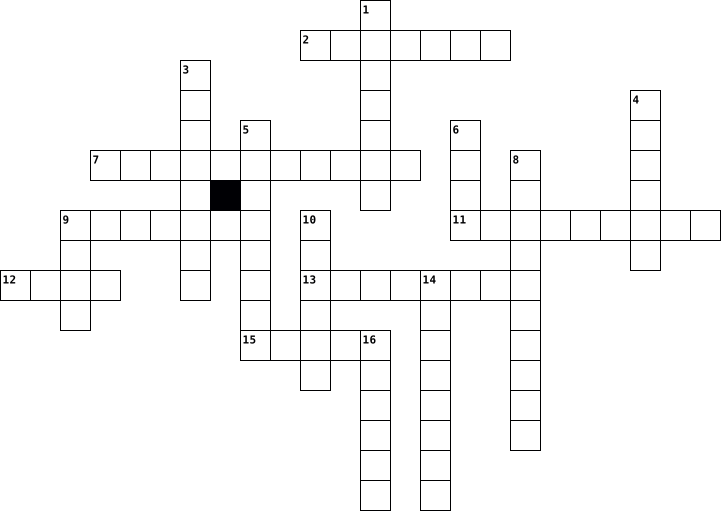
Across
- A substance that can not be broken down
- From a liquid to a gas
- Molecules physically intermingled
- Formulated the periodic law
- Quantity of matter in a physical body
- A group of 2 or more atoms
- Periodic table column
Down
- From a solid to a liquid
- Different atoms bonded together
- A substance that has mass and takes up space
- From a liquid to a solid
- Smallest piece of matter
- From a gas to a liquid
- A covering for the face
- A abbreviation of a element name
- Disease that started in 2019
- Periodic table row
17 Clues: Periodic table row • Periodic table column • From a liquid to a gas • From a gas to a liquid • A covering for the face • From a solid to a liquid • From a liquid to a solid • Smallest piece of matter • A group of 2 or more atoms • Formulated the periodic law • Disease that started in 2019 • Different atoms bonded together • A abbreviation of a element name • ...
I'm Crazy about Chemistry 2017-01-24

Across
- location of protons and neutrons
- cloud spherical area of electrons
- weight average of atomic masses
- unstable isotopes
- no (very little) mass and negative
- amount of material in matter
- atoms held by shared electrons
- shell outermost energy level of atom
- takes up space & has mass
- different # of neutrons than protons
Down
- particles what atoms are made of
- has mass & no electrical charge
- has mass & positive electrical charge
- atoms of 2 different elements in fixed proportion
- bonds formed between atoms
- smallest stable units of matter
- atoms with same atomic number
17 Clues: unstable isotopes • takes up space & has mass • bonds formed between atoms • amount of material in matter • atoms with same atomic number • atoms held by shared electrons • has mass & no electrical charge • smallest stable units of matter • location of protons and neutrons • weight average of atomic masses • particles what atoms are made of • ...
Danny's crossword 2024-05-16

Across
- explains how particles in matter behave
- Define shape and volume
- anything that has mass and takes up space
- liquid to solid
- increase in size of subtance when temp increases and contrast when cooled
- temp when liqud starts to vaporize
- indefinite shape and volume
- liquid to gas
Down
- remp who liquid freezes
- temp when gas condenses
- gas to liquid
- change from solid to liquid
- related to average kinetic energy of an object atoms
- high temp gas
- temp at which a solid melts
- indefinite shape and definite volume
- all matter is composed of
17 Clues: gas to liquid • high temp gas • liquid to gas • liquid to solid • remp who liquid freezes • temp when gas condenses • Define shape and volume • all matter is composed of • change from solid to liquid • temp at which a solid melts • indefinite shape and volume • temp when liqud starts to vaporize • indefinite shape and definite volume • explains how particles in matter behave • ...
Anthony I 2022-01-20

Across
- conposicion chemical
- is when the matter disaparece in the liquid
- is a misture of matter
- is when the componetens can be mixted and can be separated
- is a mixture of chemicals
Down
- is a pure form of matter
- is when the componetens can be mixted and can´t be separated
- matter that is liquid
- is a pure form of matter
- minium portion of matter
- is a mixture
- is a sustance that was created in the mixture of others
12 Clues: is a mixture • conposicion chemical • matter that is liquid • is a misture of matter • is a pure form of matter • is a pure form of matter • minium portion of matter • is a mixture of chemicals • is when the matter disaparece in the liquid • is a sustance that was created in the mixture of others • is when the componetens can be mixted and can be separated • ...
the eye 2023-04-05

Across
- light light produced by nature
- spectrum Roy g biv seprated colors of white light
- bro
- light bends as it passes through matter
- matter through which all light passes (clearly
- lens with thick middle and thin edges
Down
- matter which allows some light to pass (blurry)
- matter through which light cannot pass
- light made and controlled by man
- light bounces off matter in reverse
- lens with a thin middle and thick edges
11 Clues: bro • light light produced by nature • light made and controlled by man • light bounces off matter in reverse • lens with thick middle and thin edges • matter through which light cannot pass • lens with a thin middle and thick edges • light bends as it passes through matter • matter through which all light passes (clearly • matter which allows some light to pass (blurry) • ...
States of Matter by Peyton B. 2023-11-14

Across
- change from solid to a liquid when energy is added and temperature rises
- particles are very close together
- most dense state of matter
- change from a solid to a gas
- particles are very close together, but they can still move around
- rapid vaporization-change from liquid to gas
- change from a liquid to a solid
- anything that has mass and takes up space
Down
- density is between solids and gasses, closer to solids
- slower vaporization that takes place at the surface of a liquid
- least dense state of matter
- change from a liquid to a gas
- change from a gas to a liquid
- change from a gas to a solid
- the amount of matter in an object
- particles are very spread apart
16 Clues: most dense state of matter • least dense state of matter • change from a gas to a solid • change from a solid to a gas • change from a liquid to a gas • change from a gas to a liquid • change from a liquid to a solid • particles are very spread apart • particles are very close together • the amount of matter in an object • anything that has mass and takes up space • ...
Properties of Matter 2025-01-17

Across
- anything that has mass and takes up space
- liquid gains energy to form a gas
- solid gains energy to form a gas
- when one state of matter changes to another
- solid gains energy to form a liquid
- indefinite shape and definite volume
- matter that is made of different atoms
- gas with an ionized charge
- liquid loses energy to form a solid
Down
- gas loses energy to form a solid
- indefinite shape and indefinite volume
- a characteristic that has the ability of a substance to combine with or change into one or more other substances
- a characteristic that can be observed or measured without changing the substance
- gas loses energy to form a liquid
- definite shape and definite volume
- matter that is uniform throughout all atoms
16 Clues: gas with an ionized charge • gas loses energy to form a solid • solid gains energy to form a gas • liquid gains energy to form a gas • gas loses energy to form a liquid • definite shape and definite volume • solid gains energy to form a liquid • liquid loses energy to form a solid • indefinite shape and definite volume • indefinite shape and indefinite volume • ...
Earth in Space Unit Crossword Puzzle 2024-04-27

Across
- related to the moon
- happening once a day
- the North Star
- bounces off
- related to the sun
- pass across
- the angle of an object above the horizon
Down
- happening once a year
- all of space, all of matter and all the energy in it
- a large collection of stars held together by gravity
- the motion of the Earth around the Sun
- something that happens over and over
- go through
- when the position of an object blocks the other
- when light reflects off matter in all directions
- attractive force
- sticking together of matter due to gravity
17 Clues: go through • bounces off • pass across • the North Star • attractive force • related to the sun • related to the moon • happening once a day • happening once a year • something that happens over and over • the motion of the Earth around the Sun • the angle of an object above the horizon • sticking together of matter due to gravity • when the position of an object blocks the other • ...
Science Study: Matter & Its Properties 2022-08-15

Across
- the amount of space that matter takes up
- tiny bits of matter that make up objects
- anything that takes up space and has mass
- the three main forms of matter
Down
- observable characteristics of matter
- has a definite volume but no definite shape
- water as gas
- has definite volume and shape
- the amount of matter in an object
- does not have a definite shape or volume
10 Clues: water as gas • has definite volume and shape • the three main forms of matter • the amount of matter in an object • observable characteristics of matter • the amount of space that matter takes up • tiny bits of matter that make up objects • does not have a definite shape or volume • anything that takes up space and has mass • has a definite volume but no definite shape
matter by salah 2016-05-31

Across
- Two or more atoms joined together form...
- A form matter that has no definite shape or size
- All matter is made up of little particles called...
- A form of matter that flows and wets
- breaking a pencil is a ...
Down
- …. at 0 degrees
- Wood burning is a ….
- Anything that takes up space
- A form of matter that has a definite shape
- Matter can be …. Or alive
10 Clues: …. at 0 degrees • Wood burning is a …. • Matter can be …. Or alive • breaking a pencil is a ... • Anything that takes up space • A form of matter that flows and wets • Two or more atoms joined together form... • A form of matter that has a definite shape • A form matter that has no definite shape or size • All matter is made up of little particles called...
Properties of Matter 2024-09-03

Across
- TO GROUP OBJECTS BASED ON LIKE PROPERTIES
- A PHYSICAL PROPERTY THAT DESCRIBES HOW HOT OR COLD MATTER IS
- AN OBJECTS ABILITY TO SINK OR FLOAT
- A FORCE THAT PULLS TOGETHER OR PUSHES APART CERTAIN METAL OBJECTS
- MATTER THAT HAS A DEFINITE SHAPE AND VOLUME
Down
- A CHARACTERISTIC OF MATTER THAT CAN BE OBSERVED OR MEASURED
- MATTER THAT HAS NO DEFINITE SHAPE OR VOLUME (EX. OXYGEN)
- A TOOL TO MEASURE TEMPERATURE
- THE AMOUNT OF MATTER IN AN OBJECT
- A TOOL TO MEASURE MASS
- MATTER THAT HAS DEFINITE VOLUME, BUT TAKES THE SHAPE OF ITS CONTAINER (EX. WATER)
11 Clues: A TOOL TO MEASURE MASS • A TOOL TO MEASURE TEMPERATURE • THE AMOUNT OF MATTER IN AN OBJECT • AN OBJECTS ABILITY TO SINK OR FLOAT • TO GROUP OBJECTS BASED ON LIKE PROPERTIES • MATTER THAT HAS A DEFINITE SHAPE AND VOLUME • MATTER THAT HAS NO DEFINITE SHAPE OR VOLUME (EX. OXYGEN) • A CHARACTERISTIC OF MATTER THAT CAN BE OBSERVED OR MEASURED • ...
MATTER AND STATES OF MATTER 2023-03-21

Across
- solid, liquid and gas are _________ of matter
- change from liquid to solid.
- change from gas to solid.
- it’s the point in which a liquid becomes a gas.
- change from solid to gas.
- it’s the point in which a liquid becomes a solid.
Down
- change from liquid to gas.
- change from solid to liquid
- state of matter with a fixed volume and a fixed shape.
- change from gas to liquid
- state of matter. With a fixed volume but not a fixed shape.
- state of matter that lacks a fixed volume and a fixed shape.
12 Clues: change from gas to liquid • change from gas to solid. • change from solid to gas. • change from liquid to gas. • change from solid to liquid • change from liquid to solid. • solid, liquid and gas are _________ of matter • it’s the point in which a liquid becomes a gas. • it’s the point in which a liquid becomes a solid. • ...
Big Bang Theory Crossword 2022-05-11

Across
- observed wavelength or frequency
- distance light travels in a year
- matter began to dominate
- force 4 fundamental forces
- interaction of electric currents
- study of origin of universe
- even light can't get out of here
- measure of temp
Down
- hot and dense universe
- average measure of kinetic energy
- no absorbed light
- theory of exponential expansion
- star that pulsates rapidly
- halt expansion
- held by gravity
15 Clues: halt expansion • held by gravity • measure of temp • no absorbed light • hot and dense universe • matter began to dominate • star that pulsates rapidly • force 4 fundamental forces • study of origin of universe • theory of exponential expansion • observed wavelength or frequency • distance light travels in a year • interaction of electric currents • even light can't get out of here • ...
Properties 2018-02-05

Across
- New substance is formed
- Potential to change and react
- Visibly different substances
- More then 1 type of atom
- Observed with senses
- Matter into a new substance after reaction
- Salt mixed with water _________
- Heterogeneous mixtures can be
Down
- Pure matter with 2 chemicals combined
- All substances same throughout
- Heterogeneous, and Homogeneous are types of ______
- Can be observed and measured
- Only 1 type of atom
- No new substance is formed
- Physical Substance
15 Clues: Physical Substance • Only 1 type of atom • Observed with senses • New substance is formed • More then 1 type of atom • No new substance is formed • Can be observed and measured • Visibly different substances • Potential to change and react • Heterogeneous mixtures can be • All substances same throughout • Salt mixed with water _________ • Pure matter with 2 chemicals combined • ...
Pure Substances and Matter 2022-10-02

Across
- Distinct forms of matter known in everyday experience
- A state of matter with indefinite volume and shape
- simplest unit of a chemical compound that can exist
- single substance with definite composition
- state of matter with definite volume and shape
Down
- ions and free electrons
- A combination of two or more substances
- state of matter similar to a gas that
- pure substance composed of the same type of atom
- state of matter with a definite volume but no definite shape
- the smallest particle of an element
- new substance are formed when two elements bonded
12 Clues: ions and free electrons • the smallest particle of an element • state of matter similar to a gas that • A combination of two or more substances • single substance with definite composition • state of matter with definite volume and shape • pure substance composed of the same type of atom • new substance are formed when two elements bonded • ...
science 2023-05-11

Across
- bad stuff for your body
- a substance that consists of one type of atom
- a type of mixture in which the indvidual substances are not evenly mixed
- matter that has no definite vlume or shape
- measurement of liquids resistance to flow
- the mass per unit volume of a substance
Down
- matter with a definite volume but no definite shape
- a matter that can vary in composition
- the amount of matter in an object
- the amount of substance in a certain volume
- the ability of one substance to dissolvein another
- matter that has a definate shape and volume
12 Clues: bad stuff for your body • the amount of matter in an object • a matter that can vary in composition • the mass per unit volume of a substance • measurement of liquids resistance to flow • matter that has no definite vlume or shape • the amount of substance in a certain volume • matter that has a definate shape and volume • a substance that consists of one type of atom • ...
Open Book P5 2023-05-24

Across
- HOW ENERGY MOVE TROUGH MATERIAL
- SOLUTION
- HETEROGENEOUS MIXTURE
- ABILITY OF MATTER TO DISSOLVE IN LIQUID
- ANYTHING THAT HAS MASS AND TAKR UP SPACE
- PHYSICAL COMBINATION OF TWO OR MORE SUBSTANCES
- ONLY BE OBSERVED CHANGE IN THE TYPE OF MATTER
Down
- HAND SOAP
- AMOUNT OF SPACE AN OBJECT TAKES UP
- CHARACTERISTIC OF MATTER
- THE WAY LIGHT REFLECT AN OBJECT
- MEASURE OF THE AMOUNT OF MATTER IN A OBJECT
12 Clues: SOLUTION • HAND SOAP • HETEROGENEOUS MIXTURE • CHARACTERISTIC OF MATTER • HOW ENERGY MOVE TROUGH MATERIAL • THE WAY LIGHT REFLECT AN OBJECT • AMOUNT OF SPACE AN OBJECT TAKES UP • ABILITY OF MATTER TO DISSOLVE IN LIQUID • ANYTHING THAT HAS MASS AND TAKR UP SPACE • MEASURE OF THE AMOUNT OF MATTER IN A OBJECT • ONLY BE OBSERVED CHANGE IN THE TYPE OF MATTER • ...
Mass, Weight, and Volume 2019-11-05

Across
- the basic UNIT used to measure mass
- ________________ your two water levels to find the volume of the marble
- Which form of matter has a definite size but CAN change shape
- a TOOL used to find the volume of a regular solide
- the measure of the pull of gravity on an object
- anything that has mass and takes up space
- Which form of matter has a definite(unchanging)shape
- regular solids are shaped like a _____________
Down
- the measure of the amount of matter in an object
- a ______________ cylinder is used to find the volume of a liquid
- the TOOL used to measure mass
- The amount of space that an object takes up
- Which form of matter can expand and contract (get bigger and smaller)
- the formula for finding the volume of a regular solid
14 Clues: the TOOL used to measure mass • the basic UNIT used to measure mass • anything that has mass and takes up space • The amount of space that an object takes up • regular solids are shaped like a _____________ • the measure of the pull of gravity on an object • the measure of the amount of matter in an object • a TOOL used to find the volume of a regular solide • ...
Vocabulary 2017-11-17

Across
- The amount of matter that something is made of
- The curve at liquids surface by witch you measure the volume of liquid
- properties- Change that effects one or more physical substance
- A measure of the gravitational force execrate on an object
- A property of matter the describes a substance
- The amount of matter in a given space
Down
- Property of matter that can be observed
- change- A change that occurs with one or more different property's
- The amount of space that something occurs on the amount of space that something contains
- Are changed into entirely new substances with one or more physical means
- A force of attraction between objects that is due to there masses
- The tendency of all objects to resist any change in motion
- The SI unit corce
- Anything that has volume or mass
14 Clues: The SI unit corce • Anything that has volume or mass • The amount of matter in a given space • Property of matter that can be observed • The amount of matter that something is made of • A property of matter the describes a substance • The tendency of all objects to resist any change in motion • A measure of the gravitational force execrate on an object • ...
Mixture 2023-10-25

Across
- State of matter that has a definite shape
- When a solid breaks down into tiny pieces and disappears into a liquid
- A property of matter; the amount of matter there is
- Process by which water changes its liquid state to solid state
- A tool used to measure mass
- The solid material that dissolves
- a natural form of material that can be identifies by its property
Down
- Two or more materials together
- State of matter that flows and takes the shape of the container it is in
- A mixture in which a solid dissolved into a liquid
- A tool best used for separating solids such as gravel
- A tool used to separate metal materials
- a state of matter that is shapeless and expands to fill any closed container it is placed in
- The liquid part of the solution
14 Clues: A tool used to measure mass • Two or more materials together • The liquid part of the solution • The solid material that dissolves • A tool used to separate metal materials • State of matter that has a definite shape • A mixture in which a solid dissolved into a liquid • A property of matter; the amount of matter there is • ...
Mass, Weight, and Volume 2019-11-05

Across
- The amount of space that an object takes up
- the basic UNIT used to measure mass
- ________________ your two water levels to find the volume of the marble
- Which form of matter has a definite(unchanging)shape
- the TOOL used to measure mass
- regular solids are shaped like a _____________
- a TOOL used to find the volume of a regular solide
Down
- Which form of matter has a definite size but CAN change shape
- anything that has mass and takes up space
- a ______________ cylinder is used to find the volume of a liquid
- the measure of the amount of matter in an object
- the formula for finding the volume of a regular solid
- Which form of matter can expand and contract (get bigger and smaller)
- the measure of the pull of gravity on an object
14 Clues: the TOOL used to measure mass • the basic UNIT used to measure mass • anything that has mass and takes up space • The amount of space that an object takes up • regular solids are shaped like a _____________ • the measure of the pull of gravity on an object • the measure of the amount of matter in an object • a TOOL used to find the volume of a regular solide • ...
vocab 2026-01-07

Across
- a substance that cannot be separated or broken down into simpler substances by chemical means
- the state of matter that has a definite volume but not a definite shape
- the amount of force exerted per unit area of a surface
- bond an attraction between atoms or ions
- substance a sample of matter, either a single element or a single compound, that has definite chemical and physical properties
- a form of matter that does not have a definite volume or shape
- energy the total kinetic energy of a substance's particles
- a measure of how hot (or cold) something is; specifically, a measure of the average kinetic energy of the particles in an object
Down
- a group of atoms that are held together by chemical forces; a molecule is the smallest unit of a compound that keeps all the properties of that compound
- a measure of the amount of matter in an object
- the amount of space that an object takes up, or occupies
- the measure of how much mass is packed into a specific volume
- of state the change of a substance from one physical state to another
- table a table of the chemical elements arranged in order of atomic number
- Anything that has mass and takes up space
- the state of matter in which the volume and shape of a substance are fixed
- a substance made up of atoms of two or more different elements joined by chemical bonds
- the smallest unit of an element that maintains the properties of that element
18 Clues: Anything that has mass and takes up space • bond an attraction between atoms or ions • a measure of the amount of matter in an object • the amount of force exerted per unit area of a surface • the amount of space that an object takes up, or occupies • the measure of how much mass is packed into a specific volume • ...
Ch 3 Vocabulary Words 2015-09-15

Across
- The change from the solid to the liquid state of matter.
- A state of matter that has a definite shape & a definite volume.
- A term used to describe the relationship between 2 variables whose graph is a straight line passing through the point (0, 0).
- A liquid’s resistance to flowing.
- The result of an inward pull among the molecules of a liquid that brings the molecules on the surface closer together.
- A solid made up of particles that are not arranged in a regular pattern.
- A material that can easily flow.
- solid A solid that is made up crystals in which particles are arranged in a regular, repeating pattern.
- The process that occurs when vaporization takes place inside a liquid as well as on the surface (p 99)
- The change from the liquid to the solid state of matter.
- The change of state from a liquid to a gas.
Down
- The process that occurs when vaporization takes place only on the surface of a liquid.
- The force exerted on a surface divided by the total area over which the force is exerted.
- The change from the gaseous to the liquid state of matter.
- A term used to describe the relationship between 2 variables whose product is constant.
- A state of matter with no definite shape or volume.
- The change in state from a solid directly to a gas without passing through the liquid state.
- The temperature at which a substance changes from a solid to a liquid.
- A state of matter that has no definite shape but has a definite volume.
19 Clues: A material that can easily flow. • A liquid’s resistance to flowing. • The change of state from a liquid to a gas. • A state of matter with no definite shape or volume. • The change from the solid to the liquid state of matter. • The change from the liquid to the solid state of matter. • The change from the gaseous to the liquid state of matter. • ...
Ch 3 Vocabulary Words 2015-09-15

Across
- A liquid’s resistance to flowing.
- The process that occurs when vaporization takes place only on the surface of a liquid.
- The result of an inward pull among the molecules of a liquid that brings the molecules on the surface closer together.
- A state of matter that has no definite shape but has a definite volume.
- The change from the gaseous to the liquid state of matter.
- A term used to describe the relationship between 2 variables whose graph is a straight line passing through the point (0, 0).
- A state of matter with no definite shape or volume.
- A solid made up of particles that are not arranged in a regular pattern.
- The change of state from a liquid to a gas.
- The change from the solid to the liquid state of matter.
- The process that occurs when vaporization takes place inside a liquid as well as on the surface (p 99)
- The change in state from a solid directly to a gas without passing through the liquid state.
Down
- A term used to describe the relationship between 2 variables whose product is constant.
- A state of matter that has a definite shape & a definite volume.
- The change from the liquid to the solid state of matter.
- solid A solid that is made up crystals in which particles are arranged in a regular, repeating pattern.
- The temperature at which a substance changes from a solid to a liquid.
- A material that can easily flow.
- The force exerted on a surface divided by the total area over which the force is exerted.
19 Clues: A material that can easily flow. • A liquid’s resistance to flowing. • The change of state from a liquid to a gas. • A state of matter with no definite shape or volume. • The change from the liquid to the solid state of matter. • The change from the solid to the liquid state of matter. • The change from the gaseous to the liquid state of matter. • ...
Summer Properties of Matter Crossword 2021-07-07

Across
- A particle that contains more than one atom joined together
- the particular temperature for each substance at which it changes state from a liquid to a gas
- Any substance that is formed by the chemical combination of two or more elements and acts like a single substance
- A pure substance that cannot be broken down into any other substances
- a form of matter that has a definite shape and takes up a definite amount of space
- a form of matter that takes up a definite amount of space but does not have a definite shape
- the measure of how long something is
- anything that has mass and takes up space
- how something smells
- The smallest unit of an element that retains the properties of that element
- a change of matter in size, shape, or state without any change in identity
Down
- the temperature at which a substance changes state from a liquid to a solid freezing point
- A mixture of substances that are blended so completely that they mixture looks the same everywhere... something is dissolved in something else
- the particular temperature for each substance at which it changes state from a solid to a liquid
- A physical combination of two or more substances that are blended together without forming new substances
- the solid that forms when two liquids chemically react
- a change of matter that occurs when atoms ling together in a new way, creating a new substance different from the original substance
- a form of matter that does not take up a definite amount of space and has no definite shape
- scientific term for bubbling (a sign of chemical changes)
19 Clues: how something smells • the measure of how long something is • anything that has mass and takes up space • the solid that forms when two liquids chemically react • scientific term for bubbling (a sign of chemical changes) • A particle that contains more than one atom joined together • A pure substance that cannot be broken down into any other substances • ...
Chemical Interactions 2023-01-30

Across
- The name of a substance based on everyday language (e.g., baking soda, rubbing alcohol)
- A measure of how much matter
- The smallest piece of a substance that is still that substance
- The ratio of mass and volume in a sample of matter
- A process during which the atoms of starting substances (reactants) rearrange to form new substances (products)
- A gaseous element that does not react with other elements
- A phase of matter that has definite volume and definite shape. Particles are tightly bonded and cannot move around
- A characteristic of a substance that determines how it interacts with other substances
- The name chemists use for a substance; contains the names of the elements found in that substance
- An organization of the elements based on chemical properties
Down
- A code that shows the number and kinds of atoms in one particle of a substance (e.g., H2O)
- A phase of matter that has no definite shape or volume. Particles fly independently through space
- The temperature at which energy is flowing into a substance to change it from a solid to a liquid
- A substance that cannot be broken down into simpler substances by chemical or physical changes
- A representation of an element using one or two letters
- A characteristic of a substance that can be observed without changing it chemically such as size, shape, density, and phase
- A phase of matter that has definite volume, but no definite shape. Fits the container it is put in. Loosely bonded particles can flow over and around one another
- A representation of a chemical reaction using chemical formulas
- Anything that has mass and takes up space
19 Clues: A measure of how much matter • Anything that has mass and takes up space • The ratio of mass and volume in a sample of matter • A representation of an element using one or two letters • A gaseous element that does not react with other elements • An organization of the elements based on chemical properties • ...
Renewable And Non Renewable Resources Arthur 2019-09-03

Across
- a living thing
- a dense grey radioactive metal
- energy from the sun
- Forms as rain hail or snow
- a fuel derived immediately from living matter.
- organic matter used as fuel
Down
- squashed animals
- Very Dangerous
- a chemical element
- form of precipitation
- form of precipitation
- decomposition of vegetable matter
- Found under the sea
- form of precipitation
- energy created by movement of the air
- a loose granular substance
16 Clues: a living thing • Very Dangerous • squashed animals • a chemical element • energy from the sun • Found under the sea • form of precipitation • form of precipitation • form of precipitation • Forms as rain hail or snow • a loose granular substance • organic matter used as fuel • a dense grey radioactive metal • decomposition of vegetable matter • energy created by movement of the air • ...
2 2021-01-21

Across
- The ability to do work, there are two kinds
- A solid substance seems to "shrink and disappear", a solid substance turns into a vapor without becoming a liquid first.
- Solid becomes a liquid
- Opposite of vaporization, where gas becomes becomes liquid water.
- Anything that occupies space and time
- The liquid forms bubbles that rise through the liquid.
- Liquid becomes a gas
- These particles can move around but are still close together. They do not have a fixed shape
- These particles are far apart and move very fast. Have almost no attraction for each other
- Occurs at any temperature between the melting point and the boiling point of the liquid.
- of matter solid, liquid, gas
- change A type of change in matter when it doesn't change its chemical identity
- The atoms of one element can bond with atoms from other elements to form this
- Exerted by matter on other matter. The earth exerts a gravitational force on everything on its surface and near it in space. For a geologist, this is probably the most important field force he deals with. Gives things weight.
Down
- A vapor substance seems to "appear out of nowhere", a vapor turns into a solid substance without becoming a liquid first.
- Distinct particles formed by the combination of two or more atoms
- Atoms that have more or less electrons than protons. This creates atoms with negative or positive charges, due to the difference in electrons.
- Particles slow down until their attraction to each other locks them into fixed positions. Also known as solidification
- law of Thermodynamics Energy and matter cannot be created or destroyed, it can only change shape
- A measure of how hot (or cold) something is; specifically, a measure of the average kinetic energy of the particles in an object.
- Combination of two or more pure substances
- Smallest building block of matter. Have a nucleus, protons, neutrons, and electrons. The same number of electrons and protons
- A Push or Pull
- The attraction between particles is greater than their ability to move away from each other. Their particles vibrate in a fixed place
- a force that acts on an object as it moves through a distance
- Particles move very fast and collide very hard that they break apart and become electrically charged.
- The effect of gravity on an object.
- The amount of matter in an object.
- Change When a substance changes into another substance
29 Clues: A Push or Pull • Liquid becomes a gas • Solid becomes a liquid • of matter solid, liquid, gas • The amount of matter in an object. • The effect of gravity on an object. • Anything that occupies space and time • Combination of two or more pure substances • The ability to do work, there are two kinds • The liquid forms bubbles that rise through the liquid. • ...
Chem 50 Crossword 2024-05-09

Across
- It alters the composition of the original matter.
- state where it takes the shape of its container.
- Composed of two or more substance.
- Democritus hypothesise that atoms are?
- Chemistry is the study of?
- Other term for State.
- This where Proto s, Neuteons and Electrons belongs.
- Endothermic process needs what inorder to occur?
- Changing a state of matter into another state of matter.
- separation of mixture by passing it in solution, suspension or vapor.
- Substance which can't be breakdown to a smaller chemical component.
- Chemistry is proposed by
- Same as being chemist.
- In significant rule, Non-zero digits are always?
- state that is known to move freely.
- Characterised to be independent to the amount of substance present.
- One of the important branches in Physical Chemistry.
- The one whos profession is about Chemistry.
- Phase change: Gas to Liquid.
- Also plays important part in Physical Chemistry.
- Chemistry that requires Qualitative and Quantitative skills.
- Converting elements in Chemistry is what we called?
Down
- a substance of matter with a constant composition and property.
- Change in pressure can trigger a?
- Uniform and definite in composition.
- He developed the first periodic table.
- First modern chemist
- Characterised to be dependent on the matter being measured.
- Alchemy achieved what im chemistry
- Have a more than one element in its composition.
- In this state particles are close together.
- Woman who discovered Polonium and Radium.
- branch of Chemistry that focusing their study on living organisms.
- Effective way to separate mixture.
- Study of how matter and energy interact.
- use to separate substance in a mixture.
- Chemistry that study the metal and gases materials.
- He theorise that small particles can't be subdivided.
- A Atomis
- tabular display of the chemical elements, which are arranged by atomic number, electron configuration, and recurring chemical properties.
- Phase change: Gas to Solid.
- Help in developing Atomic Theor.
- Known for the contribution of Quantum Theory.
- He was the one who comes up to Avogadro's law
- He discovered the sub atomic particle.
- The one who discovered neutron.
- Father of Nuclear Physics.
- Build blocks of Matter.
- mixture that poses two or more phase.
- Chemistry that studies the compound present in Carbon.
- property that can be determined without changing the substance chemical identity.
51 Clues: A Atomis • First modern chemist • Other term for State. • Same as being chemist. • Build blocks of Matter. • Chemistry is proposed by • Chemistry is the study of? • Father of Nuclear Physics. • Phase change: Gas to Solid. • Phase change: Gas to Liquid. • The one who discovered neutron. • Help in developing Atomic Theor. • Change in pressure can trigger a? • ...
Chem 50 Crossword 2022-10-05
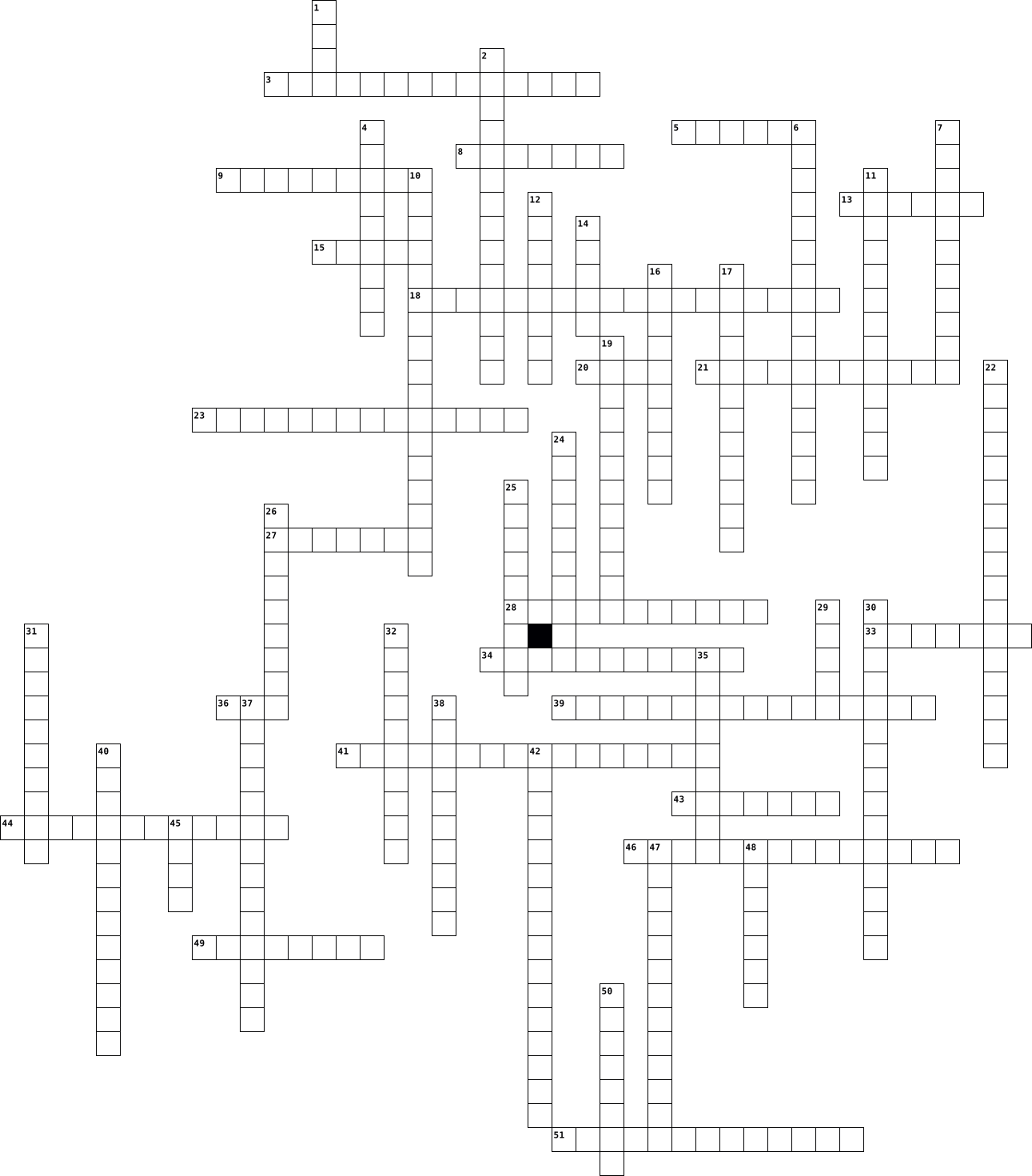
Across
- It alters the composition of the original matter.
- state where it takes the shape of its container.
- Composed of two or more substance.
- Democritus hypothesise that atoms are?
- Chemistry is the study of?
- Other term for State.
- This where Proto s, Neuteons and Electrons belongs.
- Endothermic process needs what inorder to occur?
- Changing a state of matter into another state of matter.
- separation of mixture by passing it in solution, suspension or vapor.
- Substance which can't be breakdown to a smaller chemical component.
- Chemistry is proposed by
- Same as being chemist.
- In significant rule, Non-zero digits are always?
- state that is known to move freely.
- Characterised to be independent to the amount of substance present.
- One of the important branches in Physical Chemistry.
- The one whos profession is about Chemistry.
- Phase change: Gas to Liquid.
- Also plays important part in Physical Chemistry.
- Chemistry that requires Qualitative and Quantitative skills.
- Converting elements in Chemistry is what we called?
Down
- a substance of matter with a constant composition and property.
- Change in pressure can trigger a?
- Uniform and definite in composition.
- He developed the first periodic table.
- First modern chemist
- Characterised to be dependent on the matter being measured.
- Alchemy achieved what im chemistry
- Have a more than one element in its composition.
- In this state particles are close together.
- Woman who discovered Polonium and Radium.
- branch of Chemistry that focusing their study on living organisms.
- Effective way to separate mixture.
- Study of how matter and energy interact.
- use to separate substance in a mixture.
- Chemistry that study the metal and gases materials.
- He theorise that small particles can't be subdivided.
- A Atomis
- tabular display of the chemical elements, which are arranged by atomic number, electron configuration, and recurring chemical properties.
- Phase change: Gas to Solid.
- Help in developing Atomic Theor.
- Known for the contribution of Quantum Theory.
- He was the one who comes up to Avogadro's law
- He discovered the sub atomic particle.
- The one who discovered neutron.
- Father of Nuclear Physics.
- Build blocks of Matter.
- mixture that poses two or more phase.
- Chemistry that studies the compound present in Carbon.
- property that can be determined without changing the substance chemical identity.
51 Clues: A Atomis • First modern chemist • Other term for State. • Same as being chemist. • Build blocks of Matter. • Chemistry is proposed by • Chemistry is the study of? • Father of Nuclear Physics. • Phase change: Gas to Solid. • Phase change: Gas to Liquid. • The one who discovered neutron. • Help in developing Atomic Theor. • Change in pressure can trigger a? • ...
Everything Chemistry 2026-03-10

Across
- Physically changing state from liquid to solid
- 'Fourth' state of matter that is hotter than the gas state and often glowing
- Group of elements on the periodic table that are usually shiny, solid, conductive, and bendable
- State of matter where particles are free-flowing but still stick together slightly, taking the shape of its container but *not* its full volume
- This is what we call a chemical reaction that has the same number of each atom on the reactants side AND products side
- A substance containing atoms of two or more *different* elements chemically bonded together
- "Stored energy due to the interactions between objects or particles."
- Chart that organizes all of the different elements into groups of similar properties
- A sample of matter that is made of at least two or more different substances
- Physically changing state from liquid to gas
- The amount of three-dimensional space an object takes up
- Common name of "H2O" in its liquid state
- Common name of "CO2" gas, carbon _______
- A substance that contains only *one* type of atom
- Physically changing state from solid to liquid
- "The amount of force per unit area applied to an object's surface."
- A sample of matter that is the same thing throughout
Down
- Physically changing state from solid to gas
- The substances needed before a chemical reaction can take place
- The resulting substances after a chemical has taken place
- A small particle that is the building block of matter
- "The measure of the average kinetic energy of the particles in a material."
- Common name of "CO2" *in its solid state!*
- Element name of the "O2" molecule
- Describes chemical reactions that release excess heat
- Type of energy associated with how fast things are moving
- "Two or more atoms that are held together by covalent bonds and act as a unit."
- "A process in which atoms of one or more substances rearrange to form one or more *new* substances."
- Describes chemical reactions that absorb heat from the outside and seemingly feel colder
- Common name of "H2O" in its gas state
- Common name of "H2O" in its solid state
- State of matter where particles are free-flowing with high kinetic energy, taking the shape and volume of whatever its container is
- "The amount of matter in an object."
- Coldest state of matter where particles are packed together in a defined shape, vibrating in place
34 Clues: Element name of the "O2" molecule • "The amount of matter in an object." • Common name of "H2O" in its gas state • Common name of "H2O" in its solid state • Common name of "H2O" in its liquid state • Common name of "CO2" gas, carbon _______ • Common name of "CO2" *in its solid state!* • Physically changing state from solid to gas • ...
CH 11: The Sacraments 2026-06-01

Across
- Baptism, Confirmation, and the Eucharist, which establish and nourish Christian life are known as Sacraments of Christian _____
- An example of a Sacrament that does not require an ordained minister to administer it
- The matter for the Sacrament of Penance
- Describes the Sacraments as effective signs that confer the grace they signify.
- A bishop, priest, or deacon who presides at a liturgical celebration.
- Latin for “by the very fact of the action being performed.” When properly disposed, a person receives sacramental grace because Christ acts through the Sacrament, regardless of the minister’s holiness.
- The matter for the Sacrament of Anointing of the Sick
- A thought, word, action, or omission that knowingly and willingly violates God’s law, damaging one’s relationship with God
- The matter for the Sacrament of the Eucharist
- Reconciliation and Anointing of the Sick, which bring Christ’s healing and restore spiritual and physical well-being are known as Sacraments of _____
- The disrespectful or unworthy treatment of a sacred person, place, or thing, including receiving the Eucharist unworthily
- Weakens the sanctifying grace within
Down
- A person’s spiritual attitude and readiness to receive a Sacrament. An improper one can hinder sacramental grace and may result in sacrilege.
- A gift of the Holy Spirit that shares God’s divine life with us, strengthens faith, hope, and charity, and helps us live as disciples of Christ.
- An efficacious sign of grace instituted by Christ and entrusted to the Church through which divine life is given by the Holy Spirit.
- The matter for the Sacrament of Baptism
- Holy Orders and Matrimony, which are directed toward the salvation of others and the building up of the Church are known as Sacraments at the _____ of Communion
- The term used in the Eastern Catholic Churches for a Sacrament
- The essential words required for a Sacrament.
- The matter for the Sacrament of Marriage
- An indelible spiritual mark received in Baptism, Confirmation, and Holy Orders. Because it cannot be erased, these Sacraments can only be received once.
- God’s free and undeserved help that enables us to choose good and avoid evil
- The matter for the Sacrament of Confirmation
- The physical element used in a Sacrament
- Another theological term for habitual grace
- The matter for the Sacrament of Holy Orders
- The person who administers or celebrates a Sacrament.
- The Sacraments have a fundamental _____ _____ because they make available graces needed to practice charity and so build up the unity of the Church.
28 Clues: Weakens the sanctifying grace within • The matter for the Sacrament of Baptism • The matter for the Sacrament of Penance • The matter for the Sacrament of Marriage • The physical element used in a Sacrament • Another theological term for habitual grace • The matter for the Sacrament of Holy Orders • The matter for the Sacrament of Confirmation • ...
POM Review: Inquires 1-4 Crossword 2013-04-24

Across
- a state or phase of matter in which a substance has a definite volume but no definite shape
- liquids that are able to dissolve in one another
- the theory that suggests that all the matter and energy in the universe exploded from one point creating and forming our universe
- a metric unit of density
- a phase or state of matter in which a substance has definite shape and volume
- matter that has definite characteristic properties
- liquids that are unable to dissolve in one another
- one of the most famous mathematicians and scientists of ancient Greece who was an expert on mass, volume, and density
- a metric unit of volume and is equal to one milliliter
- the amount of space occupied by a sample of matter
- a measure of the force of gravity
- the mass of a known volume of a substance
Down
- a measuring instrument for measuring volume of a liquid, usually marked at regular intervals
- a chemical (gas) that is colorless and odorless, which helps us breath, burn, and produces respiration
- the layer of air that surrounds Earth
- an object is in the middle of water and is not touching the bottom of the surface the water is in
- an objet that touches the bottom of the surface the water is in
- a characteristic of a substance that involves chemical reactions
- a measure of the amount of matter in an object
- a proposed explanation that can be proved wrong that is backed up scientific observations and data collection over time that can be repeated by other scientists
- a metric unit of volume and equal to one-thousandth of a liter
- a straight strip or cylinder of plastic, wood, metal, or other rigid material, usually marked at regular intervals used to measure lengths
- a chemical (inert gas) that is colorless, which is used to inflate weather balloons and blimps
- a metric unit used to measure mass
- a chemical (gas) that is used to kill microorganisms and microbes and was used in World War I as a weapon
- a metric unit of force
- a chemical (gas) that is colorless and odorless, which helps plants grow besides carbon dioxide
- substances that make up the universe
- a state or phase of matter in which a substance has no definite shape or volume
29 Clues: a metric unit of force • a metric unit of density • a measure of the force of gravity • a metric unit used to measure mass • substances that make up the universe • the layer of air that surrounds Earth • the mass of a known volume of a substance • a measure of the amount of matter in an object • liquids that are able to dissolve in one another • ...
Science, Matter, Energy, & Systems 2021-09-12

Across
- of Conservation of Matter, states that whenever matter undergoes a physical or chemical change, no atoms are created or destroyed
- forms of an element that have the same atomic number, but different mass numbers due to a varying amount of neutrons
- Theory, one of the most important and certain results of science, based on a large body of evidence
- Loop, occurs when an output of matter, energy, or information is fed back into the system as an input and it leads to changes in that system
- a third building block of some types of matter, it is an atom or group of atoms with a charge (positive or negative)
- Law of Thermodynamics, when energy changes from one form to another, it always goes from a more useful form to a less useful form
- compound, a carbon based compound
- Law, a well-tested and widely accepted description of observations that have been repeated many times in a variety of conditions.
- Energy, or heat, is another form of kinetic energy
- a measure of acidity that is based on the comparative amounts of hydrogen ions and hydroxide ions in the solution
- anything that has mass and takes up space
- Law of Thermodynamics, this scientific law states the total amount of energy does not change when energy is converted from one form to another in a physical or chemical change
- Review, a process where scientists review each other's work
- Tipping Point, when a natural system becomes locked into a positive feedback loop, beyond this point the system can change so drastically that it suffers from severe degradation or collapse
- Radiation, is another form of kinetic energy where energy travels as waves
- a physical or mathematical representation of a structure or system
Down
- a set of components that function and interact in some regular way
- is the basic building block of matter
- Hypothesis, is a possible and testable answer to a scientific question or explanation of what scientists observe in nature
- Methods, or practices, used to advance knowledge and understanding of how the natural world works
- combinations of two or more different elements held together in fixed proportions
- Energy, is stored and potentially available for use
- Change, or chemical reaction, when a chance in chemical composition occurs
- Change, when no change in its chemical composition occurs
- the second building block of matter, which is a combination of two or more atoms of the same or different elements held together by forces known as chemical bonds
- Energy, energy associated with motion
- a broad field of study focused on discovering how nature works and using that knowledge to describe what is likely to happen in nature
- is a type of matter with a unique set of properties that cannot be broken down into simpler substances by chemical means
- information collected to test a hypothesis
29 Clues: compound, a carbon based compound • is the basic building block of matter • Energy, energy associated with motion • anything that has mass and takes up space • information collected to test a hypothesis • Energy, or heat, is another form of kinetic energy • Energy, is stored and potentially available for use • Change, when no change in its chemical composition occurs • ...
Sci Puzzle 8 2024-05-15

Across
- – a mix of different kind of matter
- – to completely mix a solid with a liquid
- – the measure of how warm something is
- – a kind of matter that keeps its shape.
- – anything that takes up space
Down
- – one part of what something is like
- – the amount of matter an object has.
- – a kind of matter that flows and takes the shape of its container.
- – what an object feels like
- – the measure of how heavy an object feels
- – a kind of matter that fills all the space in its container and does not have its own shape.
11 Clues: – what an object feels like • – anything that takes up space • – a mix of different kind of matter • – one part of what something is like • – the amount of matter an object has. • – the measure of how warm something is • – a kind of matter that keeps its shape. • – to completely mix a solid with a liquid • – the measure of how heavy an object feels • ...
5.7 Matter Vocabulary 2024-10-10

Across
- state of matter; fast-moving molecules that go everywhere
- the characteristics of a substance that remain the same when observed
- two or more substances that are physically combined
- state of matter; definite shape; molecules vibrate
Down
- a special mixture in which one substance is dissolved by another
- a substance that has mass and takes up space
- two or more atoms that are chemically combined
- the form-solid, liquid, gas-in which a substance is found
- the smallest amount of matter
- state of matter; no definite shape; takes shape of container
- amount of matter in an object
11 Clues: the smallest amount of matter • amount of matter in an object • a substance that has mass and takes up space • two or more atoms that are chemically combined • state of matter; definite shape; molecules vibrate • two or more substances that are physically combined • state of matter; fast-moving molecules that go everywhere • ...
Lesson 1: Chemistry and Physics Matter 2026-06-28

Across
- How much matter is inside something
- To replace matter with another kind of matter or to move matter
- The amount of space something takes up
- The ability of something to float
- The ability of an object to be made into a wire
- The special features, traits, or attributes of material found in the universe
Down
- What we call something that is bendable
- When a material can be changed into a different shape without breaking
- Anything that has volume and mass
- The amount of shine something has
- How much mass is in a certain volume of matter
11 Clues: Anything that has volume and mass • The amount of shine something has • The ability of something to float • How much matter is inside something • The amount of space something takes up • What we call something that is bendable • How much mass is in a certain volume of matter • The ability of an object to be made into a wire • ...
Chapter 10 Lesson 1 2023-05-18

Across
- pushing force
- matter that has no shape
- anything that takes up space and has mass
- how the elements are arranged by scientists
- smallest particle of an element
- matter that is tightly packed together
Down
- something about matter you can observe
- matter that will take the shape of a container
- one of the senses used to describe a flower
- matter made of a single type of particle
10 Clues: pushing force • matter that has no shape • smallest particle of an element • something about matter you can observe • matter that is tightly packed together • matter made of a single type of particle • anything that takes up space and has mass • one of the senses used to describe a flower • how the elements are arranged by scientists • ...
Science terms 2022-02-23

Across
- It's made up out of only one type of matter
- It is made up out of two or more substances
- It is the energy of movement
- It means same
- It does not have matter nor volume
Down
- It is anything that has mass and takes up space
- It has matter
- It has both matter and volume
- It means different
- It is very small portions of matter
10 Clues: It has matter • It means same • It means different • It is the energy of movement • It has both matter and volume • It does not have matter nor volume • It is very small portions of matter • It's made up out of only one type of matter • It is made up out of two or more substances • It is anything that has mass and takes up space
Electricity and Properties of matter 2022-03-13

Across
- change from gas to liquid
- water in solid form
- everything which occupies space and has mass
- decreasing in the size of matter
Down
- state of matter characterized by having a definite shape
- condition that changes the state of matter
- amount of matter
- an example of an atmospheric gas
- state of matter found between solid and gas
- process of changing from solid to liquid
10 Clues: amount of matter • water in solid form • change from gas to liquid • an example of an atmospheric gas • decreasing in the size of matter • process of changing from solid to liquid • condition that changes the state of matter • state of matter found between solid and gas • everything which occupies space and has mass • state of matter characterized by having a definite shape
elements compounds and mixtures 2023-12-08

Across
- the fourth state of matter
- atoms that are not bonded chemically
- same atoms bonded together
- bonded physical
- different atoms bonded together
Down
- matter with unique properties
- bonded through chemical reactions
- everything with mass and takes up space
- different forms of matter
- building block of matter
10 Clues: bonded physical • building block of matter • different forms of matter • the fourth state of matter • same atoms bonded together • matter with unique properties • different atoms bonded together • bonded through chemical reactions • atoms that are not bonded chemically • everything with mass and takes up space
Science Review Part 1 (Cohort B) 2021-01-31

Across
- this type of matter takes the shape of its container
- this type of matter keeps its shape
- this is a property of a tomato
- this type of matter doesn't have a shape and cannot be seen by humans
- a state of matter that keeps its shape and particles are very close together
- this is a property of oil
Down
- anything that has mass and takes up space
- we identify these by using our 5 senses
- this is a property of a pencil
- a state of matter that has no shape and particles are free and flying all over the place
- a state of matter that takes the shape of the container its in and the particles are a loosely together
11 Clues: this is a property of oil • this is a property of a tomato • this is a property of a pencil • this type of matter keeps its shape • we identify these by using our 5 senses • anything that has mass and takes up space • this type of matter takes the shape of its container • this type of matter doesn't have a shape and cannot be seen by humans • ...
Grade 8 Chemistry 2020-10-05

Across
- the amount of space
- can be compressed
- will catch fire
- has mass and takes up space
- discovered energy levels of electrons
- has definite shape and volume
- has definite volume and takes the shape of its container
- the amount of matter
- burns skin on contact
- equal mass divided by volume
Down
- discovered the nucleus
- make up all matter
- supported Democritus through experiments
- for water is known as boiling
- discovered the electron
15 Clues: will catch fire • can be compressed • make up all matter • the amount of space • the amount of matter • burns skin on contact • discovered the nucleus • discovered the electron • has mass and takes up space • equal mass divided by volume • for water is known as boiling • has definite shape and volume • discovered energy levels of electrons • supported Democritus through experiments • ...
Big Bang Theory Crossword 2022-05-11

Across
- observed wavelength or frequency
- distance light travels in a year
- matter began to dominate
- force 4 fundamental forces
- interaction of electric currents
- study of origin of universe
- even light can't get out of here
- measure of temp
Down
- hot and dense universe
- average measure of kinetic energy
- no absorbed light
- theory of exponential expansion
- star that pulsates rapidly
- halt expansion
- held by gravity
15 Clues: halt expansion • held by gravity • measure of temp • no absorbed light • hot and dense universe • matter began to dominate • star that pulsates rapidly • force 4 fundamental forces • study of origin of universe • theory of exponential expansion • observed wavelength or frequency • distance light travels in a year • interaction of electric currents • even light can't get out of here • ...
science 2023-05-11

Across
- bad stuff for your body
- a substance that consists of one type of atom
- a type of mixture in which the indvidual substances are not evenly mixed
- matter that has no definite vlume or shape
- measurement of liquids resistance to flow
- the mass per unit volume of a substance
Down
- matter with a definite volume but no definite shape
- a matter that can vary in composition
- the amount of matter in an object
- the amount of substance in a certain volume
- the ability of one substance to dissolvein another
- matter that has a definate shape and volume
12 Clues: bad stuff for your body • the amount of matter in an object • a matter that can vary in composition • the mass per unit volume of a substance • measurement of liquids resistance to flow • matter that has no definite vlume or shape • the amount of substance in a certain volume • matter that has a definate shape and volume • a substance that consists of one type of atom • ...
science 2023-05-11

Across
- bad stuff for your body
- a substance that consists of one type of atom
- a type of mixture in which the indvidual substances are not evenly mixed
- matter that has no definite vlume or shape
- measurement of liquids resistance to flow
- the mass per unit volume of a substance
Down
- matter with a definite volume but no definite shape
- a matter that can vary in composition
- the amount of matter in an object
- the amount of substance in a certain volume
- the ability of one substance to dissolvein another
- matter that has a definate shape and volume
12 Clues: bad stuff for your body • the amount of matter in an object • a matter that can vary in composition • the mass per unit volume of a substance • measurement of liquids resistance to flow • matter that has no definite vlume or shape • the amount of substance in a certain volume • matter that has a definate shape and volume • a substance that consists of one type of atom • ...
science 2023-05-11

Across
- bad stuff for your body
- a substance that consists of one type of atom
- a type of mixture in which the indvidual substances are not evenly mixed
- matter that has no definite vlume or shape
- measurement of liquids resistance to flow
- the mass per unit volume of a substance
Down
- matter with a definite volume but no definite shape
- a matter that can vary in composition
- the amount of matter in an object
- the amount of substance in a certain volume
- the ability of one substance to dissolvein another
- matter that has a definate shape and volume
12 Clues: bad stuff for your body • the amount of matter in an object • a matter that can vary in composition • the mass per unit volume of a substance • measurement of liquids resistance to flow • matter that has no definite vlume or shape • the amount of substance in a certain volume • matter that has a definate shape and volume • a substance that consists of one type of atom • ...
Bath bombs- What we know 2025-09-15

Across
- amount of space matter takes up
- property that tells you if a substance can dissolve in water or not
- this cannot get in or out of a closed system
- when matter sinks
- matter can get in and out of this
Down
- this gas can float on neon, but sink in hydrogen
- amount of mass within a given volume
- often weighed in grams
- the way a substance reacts to fire
- when matter can float
- this gas can create an explosion and will float in air.
- this gas will sink and extinguish a flame (use your table on page 4)
12 Clues: when matter sinks • when matter can float • often weighed in grams • amount of space matter takes up • matter can get in and out of this • the way a substance reacts to fire • amount of mass within a given volume • this cannot get in or out of a closed system • this gas can float on neon, but sink in hydrogen • this gas can create an explosion and will float in air. • ...
Vocab words 2026-01-06

Across
- sample of matter, either a single element or a single compound, that has definite chemical and physical properties
- state: The change of a substance from one physical state to another
- The state of matter that has a definite volume but not a definite shape
- Anything that has mass and takes up space
- A group of atoms that are held together by chemical forces; a molecule is the smallest unit of a compound that keeps all the properties of that compound
- A substance made up of atoms of two or more different elements joined by chemical bonds
- The amount of force exerted per unit area of a surface
- A measure of the amount of matter in an object
- An attraction between atoms or ions that holds them together, forming molecules and compounds, driven by atoms seeking a more stable, lower-energy state
Down
- The measure of how much mass is packed into a specific volume
- A tabular display of all 118 known chemical elements
- A measure of how hot (or cold) something is; specifically, a measure of the average kinetic energy of the particles in an object
- The state of matter in which the volume and shape of a substance are fixed
- The total kinetic energy of a substance's particles
- A substance that cannot be separated or broken down into simpler substances by chemical means
- A form of matter that does not have a definite volume or shape
- The amount of space that an object takes up, or occupies
- The smallest unit of an element that maintains the properties of that element
18 Clues: Anything that has mass and takes up space • A measure of the amount of matter in an object • The total kinetic energy of a substance's particles • A tabular display of all 118 known chemical elements • The amount of force exerted per unit area of a surface • The amount of space that an object takes up, or occupies • ...
Joey's cracked crossword 2021-01-04

Across
- the atomic mass after it is rounded
- The other part in the nucleus with the proton
- a form of matter that cannot change shape, mass, or volume
- A part of an atom that hangs around the outside of the nucleus
- The number that tells you how many protons and electrons are in an atom
- A form of matter that can change its volume, mass, and shape
Down
- The thing in the nucleus that decides what kind of atom it is
- what stuff is made of
- A form of matter that can change its shape but not mass or volume
- anything that has mass and volume
- Atoms make this up
- the amount of space something takes up
- The smallest unit of matter
- The number you have to round and subtract to find the number of neutrons
14 Clues: Atoms make this up • what stuff is made of • The smallest unit of matter • anything that has mass and volume • the atomic mass after it is rounded • the amount of space something takes up • The other part in the nucleus with the proton • a form of matter that cannot change shape, mass, or volume • A form of matter that can change its volume, mass, and shape • ...
Phase Change Vocab part 1 2024-06-27

Across
- a group of atoms joined together in a particular way
- a pull between two molecules that is always the same for a substance
- weight acting on an object due to gravity
- matter with no definite shape but with a definite volume
- a measure of how hot or cold something is
- the way molecules in a substance move around relative to each other
Down
- to provide evidence that goes against a claim
- the energy that an object has because it is moving
- phase in which matter has a definite shape and volume
- amount of matter in an object
- phase in which matter has no definite shape or volume
- matter that consists of two or more substances mixed but not chemically combined
- a noticeably different form or state of the same substance
- the relative size of things
14 Clues: the relative size of things • amount of matter in an object • weight acting on an object due to gravity • a measure of how hot or cold something is • to provide evidence that goes against a claim • the energy that an object has because it is moving • a group of atoms joined together in a particular way • phase in which matter has a definite shape and volume • ...
Atoms and Radiation 2020-12-08

Across
- Decay nucleus breaks apart
- plus Radiation a proton turned into a neutron
- energy that is released by radiation
- field outside the atom, and where electrons are
- center of an atom, and contains protons and neutron
- anything that has mass and takes up space
- positive charged particles
- minus Radiation neutron turns into proton and electron
- force the glue that holds the nucleus together
- substances not bonded together
Down
- radiation that causes radiation
- capture electron and proton becomes neutrons
- The study of substances which matter is composed
- building block of matter
- neutral charged particles
- negatively charged particles
- bonds chemically bonded
- Radiation nucleus emits alpha particle
- the emission of energy from subatomic particles
19 Clues: bonds chemically bonded • building block of matter • neutral charged particles • positive charged particles • Decay nucleus breaks apart • negatively charged particles • substances not bonded together • radiation that causes radiation • energy that is released by radiation • Radiation nucleus emits alpha particle • anything that has mass and takes up space • ...
Matter Vocabulary Chapter 6&7 2016-01-13

Across
- Any object or substance that has mass and take up space
- Matter that cannot be changed into a form by any simple physical or chemical ordinary process
- Matter having definite shape and a definite volume
- An atom or group of atoms having an electric charge as a result of losing or gaining one or more electrons
- The idea stating that all matter is made of tiny particles which are in constant motion
- Two or more chemically bonded atoms in the smallest part of a compound having all the properties of the compound
- A mixture in which the components are not evenly mixed so that different parts of the mixture have different substances
- A substance made of two or more chemically combined elements
- A subatomic particle with a positive charge located in the nucleus of an atom
- Matter having definite volume but not definite shape and fluid
- A subatomic particle located in an atom's nucleus that has no electric change and that has a mass similar to that of a proton
Down
- A mixture in which the components are evenly mixed so that every part of the mixture is the same as any other
- The smallest particle of an element with all the properties of the element that can combine with other atoms to form a molecule
- A subatomic particle with a negative change located outside of an atom's nucleus
- having definite volume but not definite shape a fluid
- The central region of an atom where neutrons and protons are located
- A change in a substances physical properties but not in its chemical identity
- Change in the chemical identity of a substance
- Atoms of the same element that have different numbers of neutrons and therefore different atomic masses
- The fourth phase of matter having unique properties and formed at very high temperatures
20 Clues: Change in the chemical identity of a substance • Matter having definite shape and a definite volume • having definite volume but not definite shape a fluid • Any object or substance that has mass and take up space • A substance made of two or more chemically combined elements • Matter having definite volume but not definite shape and fluid • ...
Ch 3 Vocabulary Words 2015-09-15

Across
- The change from the solid to the liquid state of matter.
- A state of matter that has a definite shape & a definite volume.
- A term used to describe the relationship between 2 variables whose graph is a straight line passing through the point (0, 0).
- A liquid’s resistance to flowing.
- The result of an inward pull among the molecules of a liquid that brings the molecules on the surface closer together.
- A solid made up of particles that are not arranged in a regular pattern.
- A material that can easily flow.
- solid A solid that is made up crystals in which particles are arranged in a regular, repeating pattern.
- The process that occurs when vaporization takes place inside a liquid as well as on the surface (p 99)
- The change from the liquid to the solid state of matter.
- The change of state from a liquid to a gas.
Down
- The process that occurs when vaporization takes place only on the surface of a liquid.
- The force exerted on a surface divided by the total area over which the force is exerted.
- The change from the gaseous to the liquid state of matter.
- A term used to describe the relationship between 2 variables whose product is constant.
- A state of matter with no definite shape or volume.
- The change in state from a solid directly to a gas without passing through the liquid state.
- The temperature at which a substance changes from a solid to a liquid.
- A state of matter that has no definite shape but has a definite volume.
19 Clues: A material that can easily flow. • A liquid’s resistance to flowing. • The change of state from a liquid to a gas. • A state of matter with no definite shape or volume. • The change from the solid to the liquid state of matter. • The change from the liquid to the solid state of matter. • The change from the gaseous to the liquid state of matter. • ...
Ch 3 Vocabulary Words 2015-09-15

Across
- A liquid’s resistance to flowing.
- The process that occurs when vaporization takes place inside a liquid as well as on the surface (p 99)
- solid A solid that is made up crystals in which particles are arranged in a regular, repeating pattern.
- The change from the liquid to the solid state of matter.
- A material that can easily flow.
- The change from the solid to the liquid state of matter.
- A state of matter with no definite shape or volume.
- The change of state from a liquid to a gas.
- A state of matter that has a definite shape & a definite volume.
- A state of matter that has no definite shape but has a definite volume.
- A term used to describe the relationship between 2 variables whose product is constant.
Down
- The process that occurs when vaporization takes place only on the surface of a liquid.
- A term used to describe the relationship between 2 variables whose graph is a straight line passing through the point (0, 0).
- The change in state from a solid directly to a gas without passing through the liquid state.
- The change from the gaseous to the liquid state of matter.
- The result of an inward pull among the molecules of a liquid that brings the molecules on the surface closer together.
- A solid made up of particles that are not arranged in a regular pattern.
- The temperature at which a substance changes from a solid to a liquid.
- The force exerted on a surface divided by the total area over which the force is exerted.
19 Clues: A material that can easily flow. • A liquid’s resistance to flowing. • The change of state from a liquid to a gas. • A state of matter with no definite shape or volume. • The change from the liquid to the solid state of matter. • The change from the solid to the liquid state of matter. • The change from the gaseous to the liquid state of matter. • ...