
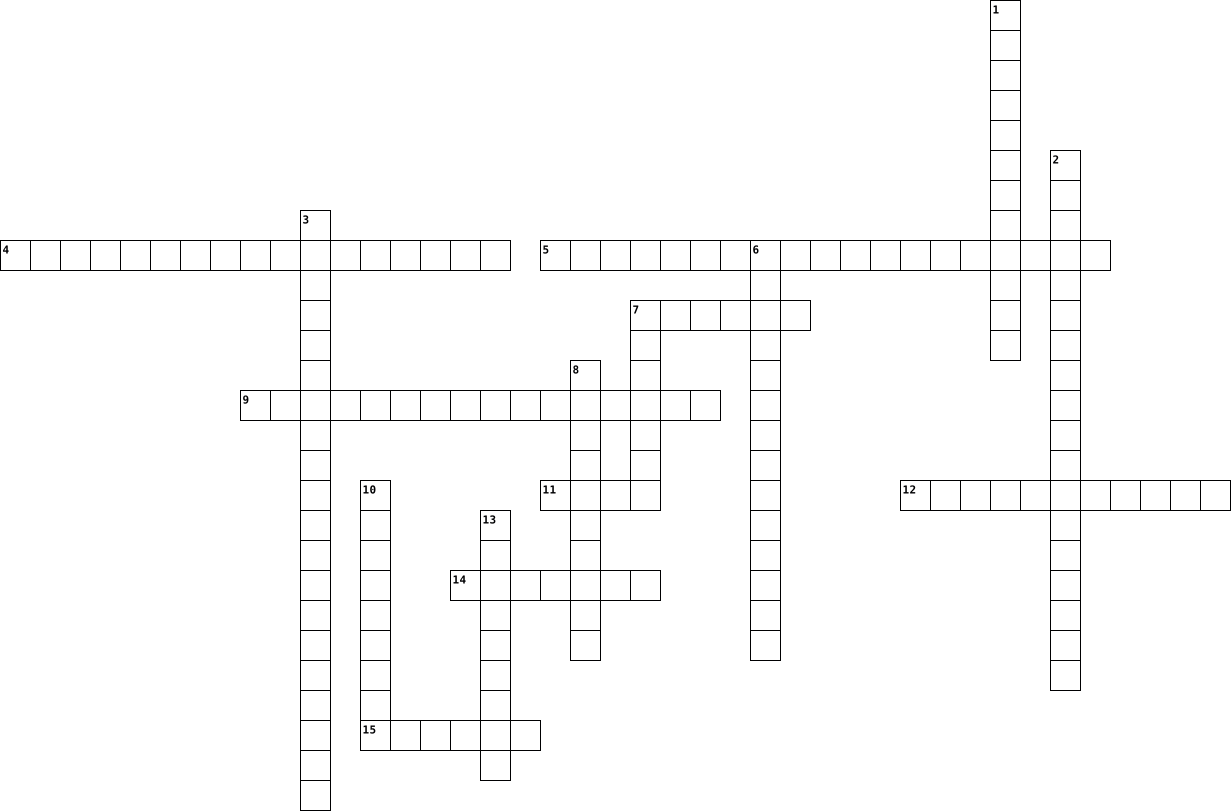
matter Crossword Puzzles
Chapter 8 Matter and Energy Transfer 2025-02-26

Across
- third trophic level; a carnivore that eats herbivores
- an organism that feeds on both plants and animals
- breaks down organic matter into small pieces such as crabs, earthworms
- meat eater
- the total mass of living matter in a given space
- transfer of energy from one tropic level to the next
- natural cycle of minerals and other nutrients in the environment
Down
- the second trophic level of the food chain
- a diagram of organisms at each trophic level
- the fourth trophic level; carnivores that eat carnivores
- a one way series of steps of food and nutrients in a ecosystem
- a pyramid of diagram of living matter by each tropic level
- feeds on plants or algae
- breaks down dead organic matter
- feeding relationships of hundreds of species
- a level that describes an individuals source of food
16 Clues: meat eater • feeds on plants or algae • breaks down dead organic matter • the second trophic level of the food chain • a diagram of organisms at each trophic level • feeding relationships of hundreds of species • the total mass of living matter in a given space • an organism that feeds on both plants and animals • a level that describes an individuals source of food • ...
Gabe All science 2017-06-16

Across
- The tissue can build up is call.
- Which is notsafe.
- The power on.
- which u can light up.
- build up cell is call.
- Take up matter is call.
- pump your whole body.
- it is evreywhere.
- Which the kids can't go to.
- which your body can eat.
- What is GABE favriot extra solar planet.
- The power go around is call.
- Which is safe.
- which is not made of metal.
Down
- The power off.
- which is not safe.
- When the Apple is brown is call.
- which your body can breath.
- size of naked eye.
- which u can use without power.
- which is the power.
- matter is.
- which atom is fast.
- The lot of atom build up is call.
24 Clues: matter is. • The power on. • The power off. • Which is safe. • Which is notsafe. • it is evreywhere. • which is not safe. • size of naked eye. • which is the power. • which atom is fast. • which u can light up. • pump your whole body. • build up cell is call. • Take up matter is call. • which your body can eat. • which your body can breath. • Which the kids can't go to. • ...
science 3.2 2021-10-07

Across
- particals move freely
- its a hard substance
- the ability of a substance to combine with another substance
- a change in matter
- the smallest type of mass in the world
- the total mass before and after a chemical reaction
- some nfl players use it wrongly sometimes
- what happens when water and oxygen
- this determines the strenght of the attraction
Down
- the ability of a material to dissolve
- happens to a marshmallow after it burns
- articles of matter
- Pokemon cards use it
- it makes things wet
- the amount of matter an object
- it happens to trees in the fall
- happens to slat in water
- a change is size,shape,and form
- the mass per unit
- things that move back and forth in all directions
20 Clues: the mass per unit • articles of matter • a change in matter • it makes things wet • Pokemon cards use it • its a hard substance • particals move freely • happens to slat in water • the amount of matter an object • it happens to trees in the fall • a change is size,shape,and form • what happens when water and oxygen • the ability of a material to dissolve • ...
Atom Chem 2021-10-18

Across
- Element with 80 protons
- Element with 1 proton
- Stored energy
- Mass divided by density
- Volume times density
- Particle with a negative charge
- going from gas to Liquid
- going from Liquid to gas
- Element with 79 Protons
- Type of chemical change
- Going from Solid to Liquid
- Smallest unit of matter
Down
- affect of gravity on matter
- mass divided by volume
- Name of columns on the periodic table
- Determined by valance electrons
- Particle with a positive charge
- motion energy
- Particle with a neutral charge
- Going from liquid to solid
- substance changes at atomic level
- Quantity of matter
- Name of horizontal rows on periodic table
- Element with 10 protons
- substance changed at surface level
- Type of physical change
26 Clues: Stored energy • motion energy • Quantity of matter • Volume times density • Element with 1 proton • mass divided by volume • Element with 80 protons • Mass divided by density • Element with 10 protons • Type of physical change • Element with 79 Protons • Type of chemical change • Smallest unit of matter • going from gas to Liquid • going from Liquid to gas • Going from liquid to solid • ...
Unit 5 States of matter 2022-05-25

Across
- Smoke or fog floating in the air
- Objects boby
- Something which can be storedand which can be used in order to do things
- Get larger
- Liquid to solid
- Weigh of the matter
- solid to gas
- Sqeezed into smaller space
- Shiftes in to shape of its container
- Small things that makes the matter
- giving and give it to another
- point
- Gas to solid
- Its everywhere
- Liquid heating
Down
- The features of a materail and how it behaves
- gas to liquid
- Is it cold or hot
- measuring device that measures the temperature
- liqiud to gas
- Ideas to explain the evidence
- Mostly invisible
- Stays the same shape
- Move back and forth repeatedly like solids particles
- Solid to liquid
- Measurement to measure temperature
26 Clues: point • Get larger • Objects boby • solid to gas • Gas to solid • gas to liquid • liqiud to gas • Its everywhere • Liquid heating • Liquid to solid • Solid to liquid • Mostly invisible • Is it cold or hot • Weigh of the matter • Stays the same shape • Sqeezed into smaller space • Ideas to explain the evidence • giving and give it to another • Smoke or fog floating in the air • ...
Term 4 Science Terms 2020-11-09

Across
- when two or more atoms combine chemically
- unit of matter,they consist of nucles
- particle without an electrical charge
- a substance formed by two other substances
- alike with the nucleus of the hydrogen atom
- has a high understanding of sciences
- substances with radiation
- 21 percent Earths atmosphere
- negativly charged particles of an atom
- kind of matter with uniform properties
- silvery-white, hard metallic element
Down
- has of only one type of atom or molecule
- has no fixed shape or volume
- group of two or more atoms
- Amount of matter in an object
- known chemical elements in an array
- two or more substances combined physically
- chemical element, with the symbol H
- element with the same atomic number
- colorless, odorless, chemically inactive
20 Clues: substances with radiation • group of two or more atoms • has no fixed shape or volume • 21 percent Earths atmosphere • Amount of matter in an object • known chemical elements in an array • chemical element, with the symbol H • element with the same atomic number • has a high understanding of sciences • silvery-white, hard metallic element • unit of matter,they consist of nucles • ...
Term 4 Science Terms 2020-11-09

Across
- when two or more atoms combine chemically
- unit of matter,they consist of nucles
- particle without an electrical charge
- a substance formed by two other substances
- alike with the nucleus of the hydrogen atom
- has a high understanding of sciences
- substances with radiation
- 21 percent Earths atmosphere
- negativly charged particles of an atom
- kind of matter with uniform properties
- silvery-white, hard metallic element
Down
- has of only one type of atom or molecule
- has no fixed shape or volume
- group of two or more atoms
- Amount of matter in an object
- known chemical elements in an array
- two or more substances combined physically
- chemical element, with the symbol H
- element with the same atomic number
- colorless, odorless, chemically inactive
20 Clues: substances with radiation • group of two or more atoms • has no fixed shape or volume • 21 percent Earths atmosphere • Amount of matter in an object • known chemical elements in an array • chemical element, with the symbol H • element with the same atomic number • has a high understanding of sciences • silvery-white, hard metallic element • unit of matter,they consist of nucles • ...
Super Cool Crossword of Science!!! 2024-05-15

Across
- 6th atomic element
- Two or more elements combined
- Not biotic
- Not abiotic
- Highest point on a wave
- Something that makes it's own food.
- Things on the periodic table
- The product of a chemical change
- Before a chemical change
- Sugar
- Breathing
- Slowest moving state of matter
- Large biological community
- Why plants are green
- What all living organisms need
- How compact something is
Down
- Things like mushrooms and bacteria
- Something that consumes energy other organisms make
- Second fastest moving state of matter
- Process of plants growing
- Chemical reaction usually creating fire
- The heat something has
- Fastest moving state of matter
- What everything is made of
- The powerhouse of the cell!!!
- Group of atoms
26 Clues: Sugar • Breathing • Not biotic • Not abiotic • Group of atoms • 6th atomic element • Why plants are green • The heat something has • Highest point on a wave • Before a chemical change • How compact something is • Process of plants growing • What everything is made of • Large biological community • Things on the periodic table • Two or more elements combined • The powerhouse of the cell!!! • ...
Chemistry 2024-05-29

Across
- the phase change of gas to liquid
- releases heat
- travels from the warmer substance to the cooler one
- the building blocks of matter
- loosely packed particles
- the phase change of solid to gas
- takes in heat
- _____ __ ______ depends on both temperature and pressure
- the phase change of liquid to gas
- no definite volume and moves freely
Down
- 23 degrees Celsius
- the phase change of solid to liquid
- the phase change of gas to solid
- ____ helps a reaction take place
- the phase change of liquid to solid
- if matter has more of this, the particles will move faster
- solids, liquids, gases, and plasma are...
- definite shape and definite volume
- electrically charged particles and extremely high energy levels
- anything that has ____ takes up space
20 Clues: releases heat • takes in heat • 23 degrees Celsius • loosely packed particles • the building blocks of matter • the phase change of gas to solid • ____ helps a reaction take place • the phase change of solid to gas • the phase change of gas to liquid • definite shape and definite volume • the phase change of liquid to gas • the phase change of solid to liquid • ...
SCIENCE 2022 2022-12-05

Across
- the study of how animals behave
- the place for experiments
- draws objects towards it center
- change with time of the position of a body
- a natural inorganic element
- the study of chemicals, elements and substances
- the movement of electric charges
- the study of living organisms
- the measure of the amount of matter in a body
- is a subject
- helps objects stay afloat
Down
- the force exerted by magnets
- information collected using specific methods
- the study of the universe
- an indisputable observation
- and individual living thing
- physical substance in general
- breaking down of rocks
- the capacity to do work
- the study of matter and energy
- the process of movement
- a group of atoms bonded together
- a push or pull
23 Clues: is a subject • a push or pull • breaking down of rocks • the capacity to do work • the process of movement • the place for experiments • the study of the universe • helps objects stay afloat • an indisputable observation • and individual living thing • a natural inorganic element • the force exerted by magnets • physical substance in general • the study of living organisms • ...
Chemistry Review 2026-02-04

Across
- does mix, same
- amount of solute in a given solution
- one substance dissolves in another
- no new substance is formed
- liquid to solid
- pure substance
- two or more substances that are combined
- center of an atom
- substance being dissolved
- amount of space something takes up
- substance that does the dissolving
- gas to liquid
- solid to liquid
- positively charged
- creates a new substance
Down
- water
- two or more elements
- does not mix, opposite
- negatively charged
- liquid to gas
- number of protons in an element
- neutral, no charge
- protons and neutrons
- amount of matter in an object
- how much mass is in a certain amount of volume
- pull of gravity on matter
- takes up space
27 Clues: water • liquid to gas • gas to liquid • does mix, same • pure substance • takes up space • liquid to solid • solid to liquid • center of an atom • negatively charged • neutral, no charge • positively charged • two or more elements • protons and neutrons • does not mix, opposite • creates a new substance • substance being dissolved • pull of gravity on matter • no new substance is formed • ...
Waves Crossword Puzzle 2015-03-09

Across
- a space with no matter
- mechanical waves where the particles of matter vibrate by moving back and forth
- waves waves that can only travel through a medium
- the number of waves passing a particular point
- the height of the wave above or below the equilibrium point
- the highest point on a transverse wave
- the place on a longitudinal wave that is pushed together
- mechanical waves where the particles of matter vibrate by pushing together
- the lowest point on a transverse wave
Down
- of waves depends on the properties of a medium
- waves that can travel through empty space or matter
- the place on a longitudinal wave that is moving apart
- a wiggle in time
- a disturbance that transfers energy
- substance that a wave travels through
- the distance between two consecutive points
16 Clues: a wiggle in time • a space with no matter • a disturbance that transfers energy • substance that a wave travels through • the lowest point on a transverse wave • the highest point on a transverse wave • the distance between two consecutive points • of waves depends on the properties of a medium • the number of waves passing a particular point • ...
Phase Changes of Matter 2023-11-13

Across
- State of matter with definite shape and a definite volume
- When a gas changes to a liquid.
- State of matter that fills its container.
- When an ionized gas becomes a regular gas.
- Phase change from a liquid to a gas.
- Energy that is also called heat.
- When a liquid changes to a gas quickly - bubbles present.
- When a gas gets super- charged and can conduct electricity.
- Phase change from a liquid to a solid.
Down
- State of matter that is an ionized gas.
- When a liquid changes to a gas slowly, below boiling.
- State of matter that takes the shape of its container.
- Phase change from a solid to a liquid.
- What happens when dry ice is at room temperature.
- When a gas becomes a solid.
- Energy of motion.
16 Clues: Energy of motion. • When a gas becomes a solid. • When a gas changes to a liquid. • Energy that is also called heat. • Phase change from a liquid to a gas. • Phase change from a solid to a liquid. • Phase change from a liquid to a solid. • State of matter that is an ionized gas. • State of matter that fills its container. • When an ionized gas becomes a regular gas. • ...
UNIT 1 2023-01-27
Across
- the branch of chemistry that studies the behavior of matter
- the study of the composition of matter
- anything that has mass and takes up space
- the study of chemicals containing carbon
- physical changes can be reversible or irreversible
- what is being changed during the experiment
- the ratio of an object to its volume
- a well tested explanation that may be changed in the future
Down
- photosynthesis is an example of what type of chemistry?
- the study study of chemicals that don't contain carbon
- a salad is an example of what type of chemistry
- used to represent a element
- is a physical blend of two or more components
- what type of separation technique is used when making tea?
- the factor that is being measured during the experiment
- the study of matter
16 Clues: the study of matter • used to represent a element • the ratio of an object to its volume • the study of the composition of matter • anything that has mass and takes up space • the study of chemicals containing carbon • what is being changed during the experiment • is a physical blend of two or more components • a salad is an example of what type of chemistry • ...
Unit 1 Thermal Energy & Matter 2023-04-06

Across
- transfer of energy through matter or space
- tool to measure temp
- another name for heat energy
- scale to measure temp
- heat moves from warmer matter to __ matter
- heat moves in a circular patter in gases/liquids
- liquid to gas
- solid to gas
- solid to liquid
Down
- gas to liquid
- liquid to solid
- heat moves through particles that are touching
- average kinetic energy of particles
- if pressure in a closed system increases, temp will
- gas to solid
15 Clues: gas to solid • solid to gas • gas to liquid • liquid to gas • liquid to solid • solid to liquid • tool to measure temp • scale to measure temp • another name for heat energy • average kinetic energy of particles • transfer of energy through matter or space • heat moves from warmer matter to __ matter • heat moves through particles that are touching • ...
science 7 2018-02-05

Across
- 2 or more atom
- what gives a positive charge
- what topic did we just do
- study of matter
- what gives negative charge
- what is all around use.
- another word for rust
Down
- something we drink
- state of matter is
- changing ex melting something
- how tight material is holing the electrons
- what am i the amount of space something occupies
- made of one type of atom
- more then one type of atom
- what you breath
15 Clues: 2 or more atom • study of matter • what you breath • something we drink • state of matter is • another word for rust • what is all around use. • made of one type of atom • what topic did we just do • what gives negative charge • more then one type of atom • what gives a positive charge • changing ex melting something • how tight material is holing the electrons • ...
Matter and its Surroundings 2022-04-20

Across
- phenomenon when water in earthen pot cools
- Highly compressable matter
- Intermixing of particles of different types
- solid carbon dioxide
- Super excited particles state
- Indian classification of of five basic elements
- change of state from solid to gas
- Hidden heat in matter
Down
- super cooling of gas of extremely low density
- Unit of Pressure
- Change of state from liquid to solid
- Increase to liquefy gases
- Unit of temperature
- It has mass and occupies space
- Evaporation causes
15 Clues: Unit of Pressure • Evaporation causes • Unit of temperature • solid carbon dioxide • Hidden heat in matter • Increase to liquefy gases • Highly compressable matter • Super excited particles state • It has mass and occupies space • change of state from solid to gas • Change of state from liquid to solid • phenomenon when water in earthen pot cools • ...
[Insert Name Here] 2021-01-04
![[Insert Name Here] crossword puzzle](/image/4019806.svg?size=30&stroke_width=1)
Across
- lives in the nucleus, and is neutral
- the father of molecules (2 make up each molecule)
- lives outside the nucleus, and is negative
- the amount of matter (stuff) that can take up an object.
- what type of atom something is, and is labeled by the amount of protons, neutrons, and electrons
Down
- lives in the nucleus, and is positive
- a form of matter that can change its volume and shape
- the amount of mass/matter in a liquid or gas.
- Anything that has mass in it.
- a form of matter that cannot move
- a form of matter that cannot change its volume, but can flow.
11 Clues: Anything that has mass in it. • a form of matter that cannot move • lives in the nucleus, and is neutral • lives in the nucleus, and is positive • lives outside the nucleus, and is negative • the amount of mass/matter in a liquid or gas. • the father of molecules (2 make up each molecule) • a form of matter that can change its volume and shape • ...
Phase Changes and States of Matter 2021-12-15

Across
- solids are made of particles that move the _____.
- This type of energy is also refered to as heat.
- solids, liquids and gases are the three _____ of matter
- the amount of space matter takes up
- For water to melt and evaporate, it needs to _____ thermal energy.
- state of matter with a definite shape and definite volume
Down
- For water to condense and freese, it needs to ___ thermal energy
- gases are made of particles that move the _____.
- state of matter without a definite shape but a definite volume
- anything that has mass and takes up space
- state of matter without a definite shape and without a definite volume
11 Clues: the amount of space matter takes up • anything that has mass and takes up space • This type of energy is also refered to as heat. • gases are made of particles that move the _____. • solids are made of particles that move the _____. • solids, liquids and gases are the three _____ of matter • state of matter with a definite shape and definite volume • ...
Particle Theory of Matter Review 2022-11-25

Across
- In this state of matter, particles are held very tightly together and vibrate in place.
- All matter is made up of ___.
- All particles in a substance are ___.
- In this state of matter, particles have overcome their attraction and are spaced very far apart.
- When matter changes state, it is really the movement of ___ speeding up or slowing down.
- In class, the food colouring spread faster through the ___ water.
Down
- The amount of space matter takes up.
- There are ___ between particles.
- Particles are always doing this.
- In this state of matter, particles are held loosely together and are able to flow over each other.
- Matter is anything that has ___ and takes up space.
- The three phases of matter are solid, liquid, and ___.
- Particles are always moving, but when ___ is added, they move even faster.
13 Clues: All matter is made up of ___. • There are ___ between particles. • Particles are always doing this. • The amount of space matter takes up. • All particles in a substance are ___. • Matter is anything that has ___ and takes up space. • The three phases of matter are solid, liquid, and ___. • In class, the food colouring spread faster through the ___ water. • ...
Unit 2 Vocabulary 2022-05-04

Across
- how much space an object takes up (mL)
- a state of matter with a definite volume and mass
- how much matter is in an object (kg)
- Change changing from a solid, liquid, or gas into another state of matter
- when a solid's particles mix in all the way with a liquid
- a change that creates a new substance
Down
- a state of mass with a definite volume but not a definite mass
- a change that does not result in a new substance
- the smallest form of matter
- anything that has mass and volume
- state of matter with no definite volume and mass
11 Clues: the smallest form of matter • anything that has mass and volume • how much matter is in an object (kg) • a change that creates a new substance • how much space an object takes up (mL) • a change that does not result in a new substance • state of matter with no definite volume and mass • a state of matter with a definite volume and mass • ...
Properties of Matter 2026-02-13

Across
- is a very tiny piece of any kind of matter.
- a gas has no shape and _______
- an example of solid matter; you can find it in a tree.
- an example of liquid; you usually drink it or mix it with cereal.
- a liquid has no _______
- the physical feel or appearance of a surface in a state of matter.
- a _______ is a characteruistic features of a matter.
Down
- the change of a liquid to a gas
- ____ made of only one kind of matter; very expensive.
- a pure substances like a gold and oxygen that can exist in different state of matter.
- each solid object has a shape and _______
11 Clues: a liquid has no _______ • a gas has no shape and _______ • the change of a liquid to a gas • each solid object has a shape and _______ • is a very tiny piece of any kind of matter. • a _______ is a characteruistic features of a matter. • ____ made of only one kind of matter; very expensive. • an example of solid matter; you can find it in a tree. • ...
Mass 2022-10-13

Across
- The smallest particle of an element that has all the properties of that element
- A substance made of only one type of atom
- change A change that occurs in atoms/mass is converted to energy
- Observable changes of matter
- A state of matter that has a definite volume but does not have a defined shape
- Change A change that occurs when matter changes from one form to another without becoming a new substance.
Down
- The amount of space occupied by a substance
- Anything that has mass and takes up space
- A state of matter that has a definite volume and definite shape
- change A change in matter that takes place when atoms are rearranged to form a new substance
- A state of matter that doesn't have a definite volume or shape
11 Clues: Observable changes of matter • Anything that has mass and takes up space • A substance made of only one type of atom • The amount of space occupied by a substance • A state of matter that doesn't have a definite volume or shape • A state of matter that has a definite volume and definite shape • change A change that occurs in atoms/mass is converted to energy • ...
Unit 1 Crossword 2024-09-20

Across
- A measure of the amount of matter in an object
- To become incorporated into a liquid to form a solution
- A combination of two or more substances that are not chemically bonded
- The mass of a substance per unit volume
Down
- Anything that has mass and takes up space
- Capable of being dissolved in a liquid
- A characteristic or trait of a substance
- State of matter that has no fixed shape or volume
- State of matter with a definite shape and volume
- State of matter that flows and takes the shape of its container
- A form of matter that has a uniform and definite composition
11 Clues: Capable of being dissolved in a liquid • The mass of a substance per unit volume • A characteristic or trait of a substance • Anything that has mass and takes up space • A measure of the amount of matter in an object • State of matter with a definite shape and volume • State of matter that has no fixed shape or volume • ...
Gr6: Foundations of Chemistry 2018-04-03

Across
- characteristic of matter that you can observe or measure without changing the identity of the matter
- change in size, shape, form, or state of matter in which the matter's identity stays the same
- force between atoms or groups of atoms
- mass per unit volume of a substance
- ability of one substance to dissolve in another
Down
- characteristic of matter that can be observed as it changes to a different type of matter
- change in matter in which the substances that make up the matter change into other substances with NEW physical and chemical properties
- amount of substance in a certain volume
- amount of matter in an object
- characteristic used to describe something
10 Clues: amount of matter in an object • mass per unit volume of a substance • force between atoms or groups of atoms • amount of substance in a certain volume • characteristic used to describe something • ability of one substance to dissolve in another • characteristic of matter that can be observed as it changes to a different type of matter • ...
Science: Matter 2025-01-15

Across
- to separate and spread out particles of matter into another substance
- a connection that holds atoms together
- a specific type of matter made of particles of the same type
- to maintain a constant quantity
- process a plan that is used to find and develop solutions to a problem
- anything that has mass and takes up space
Down
- the result when two or more types of matter interact to form a new type of matter
- information that helps answer a question, support a claim, or solve a problem
- a small particle of chemical matter
- the science of what matter is made of and how matter changes condense to change state from gas to liquid
10 Clues: to maintain a constant quantity • a small particle of chemical matter • a connection that holds atoms together • anything that has mass and takes up space • a specific type of matter made of particles of the same type • to separate and spread out particles of matter into another substance • process a plan that is used to find and develop solutions to a problem • ...
States of Matter 2026-02-27

Across
- When a gas cools down and turns back into a liquid, like dew on grass.
- This state of matter has a definite volume but takes the shape of its container.
- The tiny building block that makes up all matter.
- The process where a solid gains energy and turns into a liquid.
- The process where a liquid loses energy and turns into a solid.
Down
- When a liquid turns into a gas at the surface, like a puddle drying up.
- A rare change where a solid turns directly into a gas (like dry ice).
- In this state, particles are packed tightly together and only vibrate in place.
- The amount of space an object or substance takes up.
- The "fourth state" of matter found in stars and lightning.
- You must add or remove this to make matter change its state.
- Anything that has mass and takes up space.
- This state of matter has no definite shape or volume and fills all available space.
13 Clues: Anything that has mass and takes up space. • The tiny building block that makes up all matter. • The amount of space an object or substance takes up. • The "fourth state" of matter found in stars and lightning. • You must add or remove this to make matter change its state. • The process where a solid gains energy and turns into a liquid. • ...
State of Matter Crossword 2020-12-22

Across
- mass divided by volume
- the amount of space an object takes up
- one of the states of matter
- the attractive forces between the molecules of a liquid
- one state of matter
- takes up space and has mass, made of atoms or molecules
- one of the lesser-known states of matter
- takes the shape of its container, has a definite volume, somewhat compressible, molecules are loosely packed
Down
- a substance with high viscosity
- takes the shape of its container, no definite volume, easily compressed, high energy, and molecules are spread apart
- number of states of matter
- definite shape and volume, very hard to compress, low energy, and molecules are tightly packed
- resistance to flow of a liquid
- amount of stuff or matter in an object
- one state of matter
15 Clues: one state of matter • one state of matter • mass divided by volume • number of states of matter • one of the states of matter • resistance to flow of a liquid • a substance with high viscosity • the amount of space an object takes up • amount of stuff or matter in an object • one of the lesser-known states of matter • the attractive forces between the molecules of a liquid • ...
Crossword puzzle: Science vocab by Braelyn W 2023-12-08

Across
- change The change of one state of matter to the next
- The continuous movement of water around the earth in different stages
- Water that goes in the atmosphere then comes back to earth
- When plants loose water
- The change of matter from liquid to solid
- Large masses of ice
Down
- Store water for households, industries, and agriculture
- The change of matter from solid to liquid
- an underground layer of porous rock and/or sand that contains water
- The change of matter from liquid to gas
- The change of matter from gas to a liquid
- When soil cannot absorb water, the excess water flows across the surface
12 Clues: Large masses of ice • When plants loose water • The change of matter from liquid to gas • The change of matter from solid to liquid • The change of matter from gas to a liquid • The change of matter from liquid to solid • change The change of one state of matter to the next • Store water for households, industries, and agriculture • ...
Energy 2022-10-15
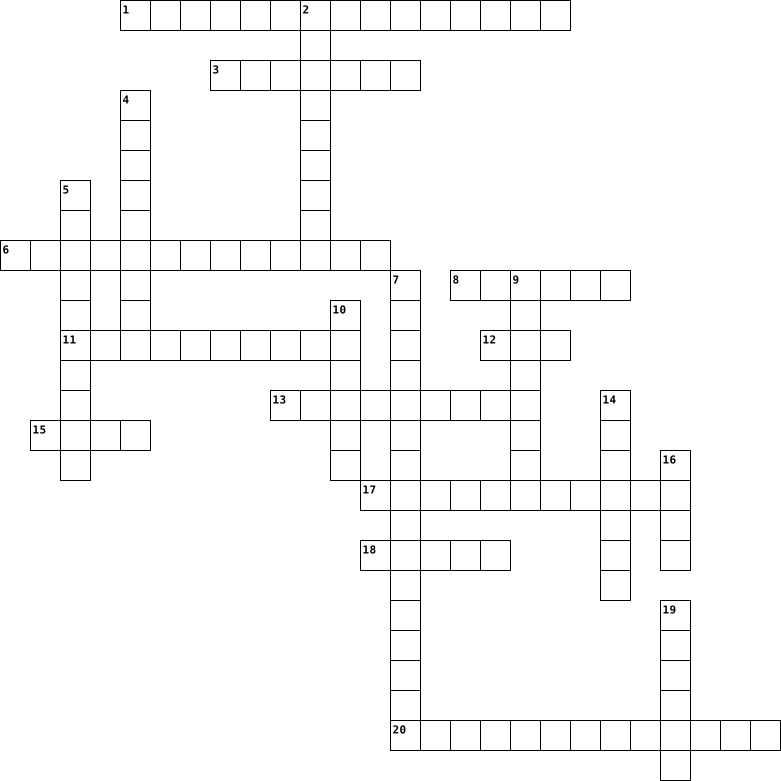
Across
- Stored energy
- how much mass is in one place
- The energy of motion
- Anything that takes up space
- transfer of energy through direct contact.
- An energy form that takes place in its container
- smallest unit of matter
- Doing anything that involves using effort
- The energy that comes from heat
- state of matter with mass that takes up space Outside of Earth
- Energy that comes from heat
Down
- It keeps heat in
- transfer of energy through waves of energy
- The energy through the movements of liquids and gases
- Hot and cold molecules
- When energy goes from one energy to the next
- The ability to do work
- take the shape of its container
- heat flows from hot objects to cool objects
- Objects combined to work together
20 Clues: Stored energy • It keeps heat in • The energy of motion • Hot and cold molecules • The ability to do work • smallest unit of matter • Energy that comes from heat • Anything that takes up space • how much mass is in one place • take the shape of its container • The energy that comes from heat • Objects combined to work together • Doing anything that involves using effort • ...
6th science Vocab review 2023-04-06

Across
- what the Chesapeake bay is
- positive charged part of atom
- energy that is being used in an object
- moon is half illuminated and shadow on left
- moon is fully illuminated
- hottest layer of atmosphere
- closed layer of atmosphere to space
- energy that is stored in a object
- state of matter with no defined shape but has defined volume
- Water sticks to non-water objects
- State of matter with no defined shape or volume
Down
- Coldest layer of atmosphere
- moon is not illuminated at all
- Layer of atmosphere were planes fly
- Water sticks to water
- Layer of atmosphere where weather happens
- the surface layer of water
- neutral part of a atom
- negative charged part of atom
- state of matter with the most dense molecules
20 Clues: Water sticks to water • neutral part of a atom • moon is fully illuminated • what the Chesapeake bay is • the surface layer of water • Coldest layer of atmosphere • hottest layer of atmosphere • positive charged part of atom • negative charged part of atom • moon is not illuminated at all • energy that is stored in a object • Water sticks to non-water objects • ...
Unit A Crossword Martin Sacdalan 2016-09-28

Across
- Dissolved In The Solvent
- Upside Down Triangle Shape
- Hazardous Symbols
- Physical Force Exerted On An Object
- A Device That Controls The Flow Of Liquids
- Risky, Dangerous
- Separation Of A Mixture
- A Liquid Mixture
- A Minute Portion Of Matter
- Octagon Shape
- More Can Be Absorbed
- No More Can Be Absorbed
- State Of Being Thick, Sticky, And Semi-Fluid
- Diamond Shape
Down
- Able To Dissolve Other Substances
- Property Of A Solid, Liquid Or Gas
- Operated By A Liquid
- Internal Heat Of A Person's Body
- A Close Gathering Of Things
- Mixing Other Substances Together
- Physical Substance In General
- Any Matter That Has No Fixed Shape
- Operated By Air Or Gas Under Pressure
- Compactness Of a Substance
- Airlike Fluid Substance
25 Clues: Octagon Shape • Diamond Shape • Risky, Dangerous • A Liquid Mixture • Hazardous Symbols • Operated By A Liquid • More Can Be Absorbed • Separation Of A Mixture • Airlike Fluid Substance • No More Can Be Absorbed • Dissolved In The Solvent • Upside Down Triangle Shape • A Minute Portion Of Matter • Compactness Of a Substance • A Close Gathering Of Things • Physical Substance In General • ...
Geography 2023-10-11

Across
- a body of water that flows
- something made by humans
- something that is from nature
- you would snowboard on it
- things IT fix alot
- a state of matter that cant be molded
- a element that powers up stuff
- something that carrys water
Down
- comes out of clouds
- it refers to rubbish and mess
- large body of slater water
- a state of matter that can be molded
- something that can be used again
- something that is in the oceans water
- a state of matter that cant be touched
- rain comes out of it
- been in the ground for millions of yers
- a well known liquid
- fills up anything back to normal
- we use it to fill up cars
20 Clues: things IT fix alot • comes out of clouds • a well known liquid • rain comes out of it • something made by humans • you would snowboard on it • we use it to fill up cars • large body of slater water • a body of water that flows • something that carrys water • it refers to rubbish and mess • something that is from nature • a element that powers up stuff • something that can be used again • ...
Force and Motion crossword 2024-08-19

Across
- Test to gather data
- Italian scientist who studied motion
- Space between two points
- Proportional: One increases as the other decreases
- Space with no matter
- Rate of change of velocity
- Force of gravity on an object
- Distance from center to edge
- Amount of matter in an object
- Force pulling objects together
- Our planet
Down
- Feeling of no weight
- Force pulling objects towards Earth
- Relating to the sky or space
- of Attraction: Pull between objects
- law of gravitation: Describes gravitational force
- Falling without air resistance
- Famous physicist who discovered gravity
- Gravitational Constant: Numerical value in gravity equation
- Opposing force
- Applicable everywhere
- Force: Attraction between masses
- Imaginary line around Earth
- Scientist who studies matter and energy
- Proportional: Increases or decreases at the same rate
25 Clues: Our planet • Opposing force • Test to gather data • Feeling of no weight • Space with no matter • Applicable everywhere • Space between two points • Rate of change of velocity • Imaginary line around Earth • Relating to the sky or space • Distance from center to edge • Force of gravity on an object • Amount of matter in an object • Falling without air resistance • ...
States of Matter Crossword 2025-12-09

Across
- the ability to do work
- Gasses and Liquids are both _________
- when solid turns to gas
- matter that has no definite shape or volume
- Energy can __________ be created or destroyed
- When heat transfers through touching.
- when liquid turns to gas
- when gas turns to liquid
- The way Gasses and Fluids move
Down
- temperature is the __________ kinetic energy
- when liquid turns to solid
- when gas turns to solid
- When solid turns to liquid
- When heat transfers through waves
- When heat transfers through fluids
- When something hot transfers to something cold
- matter that has no definite shape and definite volume
- Thermal energy is the ______ of kinetic and potential energy
- the uneven particles of liquids create Surface ___________
- Matter that has definite shape and volume
20 Clues: the ability to do work • when gas turns to solid • when solid turns to gas • when liquid turns to gas • when gas turns to liquid • when liquid turns to solid • When solid turns to liquid • The way Gasses and Fluids move • When heat transfers through waves • When heat transfers through fluids • Gasses and Liquids are both _________ • When heat transfers through touching. • ...
Waves Crossword Puzzle 2015-03-09

Across
- a space with no matter
- mechanical waves where the particles of matter vibrate by moving back and forth
- waves waves that can only travel through a medium
- the number of waves passing a particular point
- the height of the wave above or below the equilibrium point
- the highest point on a transverse wave
- the place on a longitudinal wave that is pushed together
- mechanical waves where the particles of matter vibrate by pushing together
- the lowest point on a transverse wave
Down
- of waves depends on the properties of a medium
- waves that can travel through empty space or matter
- the place on a longitudinal wave that is moving apart
- a wiggle in time
- a disturbance that transfers energy
- substance that a wave travels through
- the distance between two consecutive points
16 Clues: a wiggle in time • a space with no matter • a disturbance that transfers energy • substance that a wave travels through • the lowest point on a transverse wave • the highest point on a transverse wave • the distance between two consecutive points • of waves depends on the properties of a medium • the number of waves passing a particular point • ...
Forms of Matter and Their Changes 2025-11-02

Across
- – Matter that has a fixed volume but takes the shape of its container.
- – A mixture of gases all around us.
- – The process by which a liquid changes into a gas.
- – Solid form of water.
- – The process by which gas changes into liquid.
- – Matter that has no fixed shape or volume.
Down
- – The process when a solid turns into a liquid.
- – A man-made solid used for bottles and containers.
- – A liquid we drink, also used to make curd and butter.
- – A liquid that we drink and use every day.
- – The process when a liquid turns into a solid.
- – Fast change of a liquid into gas with bubbles.
- – Anything that has mass and occupies space.
- – Matter that has a fixed shape and volume.
- – A solid used to make furniture and doors.
- – Gas form of water.
16 Clues: – Gas form of water. • – Solid form of water. • – A mixture of gases all around us. • – A liquid that we drink and use every day. • – Matter that has a fixed shape and volume. • – A solid used to make furniture and doors. • – Matter that has no fixed shape or volume. • – Anything that has mass and occupies space. • – The process when a solid turns into a liquid. • ...
Science Lab Fun 2025-04-24

Across
- Idea for experiments.
- Glass cylinder.
- Clear material.
- Tiny liquid.
- Helps magnify.
- Tool to see tiny things.
- Combine liquids.
Down
- Place for science.
- Make warmer.
- Check something.
- Hand protector.
- Tiny fire.
- Air like matter.
- Smallest matter.
- Bubbling sound.
- Light ray.
16 Clues: Tiny fire. • Light ray. • Make warmer. • Tiny liquid. • Helps magnify. • Glass cylinder. • Clear material. • Hand protector. • Bubbling sound. • Check something. • Air like matter. • Smallest matter. • Combine liquids. • Place for science. • Idea for experiments. • Tool to see tiny things.
Kessler Physical Science Vocabulary Review 2022-05-17

Across
- to change state, you need to add or remove this
- a type of kinetic energy, movement of something from one place to another
- Law of _______ of Energy states energy cannot be created or destroyed
- a change between a solid, liquid, and a gas is called a _______ change
- the rate of motion
- the action of process of something moving or being moved, described by speed and direction
- atoms gaining energy, moving from a liquid to a gas
- a solid changing to a gas (example is dry ice)
- a phase of matter that has a definite volume but no definite shape
- anything that has mass and takes up space
- a phase of matter that has a definite shape or volume
Down
- something you use to determine the position of an object
- anything that can cause a change in matter
- stored energy or energy of position
- in a solid, the _______ vibrate in place
- the energy of movement
- a gas changing to a solid, atoms moving slower
- energy produced from vibrating waves
- a phase of matter that has no definite shape and volume
- the process of a liquid changing to a solid
20 Clues: the rate of motion • the energy of movement • stored energy or energy of position • energy produced from vibrating waves • in a solid, the _______ vibrate in place • anything that has mass and takes up space • anything that can cause a change in matter • the process of a liquid changing to a solid • a gas changing to a solid, atoms moving slower • ...
~SCIENCE~ 2022-05-19

Across
- mass/volume
- The central part of the atom
- Stored energy.
- A state of matter that has no definite shape but has a definite volume.
- What is a sound wave?
- Anything that has mass and takes up space
- The energy of motion.
- Occurs when an object causes a wave to change direction and bend around it
- Definite shape and volume
- The rate at which velocity changes
- the process or action by which one thing absorbs or is absorbed by another.
- A state of matter with no definite shape or volume
Down
- the process by which molecules move from an area of higher concentration to an area of lower concentration
- the bending of a wave as it enters a new medium at an angle
- Negatively charged particles that circle the nucleus
- Heat can move easily through a what?
- The bouncing back of a wave when it hits a surface through which it cannot pass.
- What describes force, inertia, and action-reaction?
- the amount of matter in an object
19 Clues: mass/volume • Stored energy. • What is a sound wave? • The energy of motion. • Definite shape and volume • The central part of the atom • the amount of matter in an object • The rate at which velocity changes • Heat can move easily through a what? • Anything that has mass and takes up space • A state of matter with no definite shape or volume • ...
Test 5 Physical Science 2023-11-13

Across
- solid to the gas state
- a mixture in which the composition is not uniform throughout the mixture
- superheated matter
- molecules settle out of a solution
- the change of the state of matter from the gas phase into the liquid phase
- particle that consists of a nucleus of protons and neutrons
- element of matter in a vaporous state
- incompressible fluid that conforms to the shape of its container but retains a nearly constant volume independent of pressure
Down
- special type of homogeneous mixture composed of two or more substances
- substance combines with another to form a new substance
- changing the color of a item
- characterized by structural rigidity and resistance to a force applied to the surface
- transition of a substance directly from the solid to the gas state
- the temperature at which liquid starts to boil
- maximum concentration
- transition where a liquid turns into a solid
- the measurement of how tightly a material is packed together
- a dimensionless quantity representing the amount of matter in a particle or object
- liquid phase to vapor
- a mixture of salt and water
20 Clues: superheated matter • maximum concentration • liquid phase to vapor • solid to the gas state • a mixture of salt and water • changing the color of a item • molecules settle out of a solution • element of matter in a vaporous state • transition where a liquid turns into a solid • the temperature at which liquid starts to boil • ...
Science cross word puzzel!! 2023-10-12

Across
- molecules going into air as a gas
- atoms that are attracted to one another
- anything that takes up space
- anything that takes up space
- gas changing to a solid
- related to moving atoms or molecules of a substance
- 2 or more atoms
- cooling water vapor
- are molecules that are close together and strong
- molecules slowing down
Down
- tension the tendency of liquid surfaces
- changing sold to a gas
- circles that make up matter
- faster moving molecules transfer energy to slower atoms
- is energy that is transferred from a substance at a higher temperature
- molecules that are weak and cant come together
- energy the energy an object moves
- anything that has mas
- particles sliding past each other
- study of matter
20 Clues: 2 or more atoms • study of matter • cooling water vapor • anything that has mas • changing sold to a gas • molecules slowing down • gas changing to a solid • circles that make up matter • anything that takes up space • anything that takes up space • molecules going into air as a gas • energy the energy an object moves • particles sliding past each other • ...
Science Success 2022-10-14

Across
- a firm shape;not a liquid/any fluid
- the ability to do work
- a minute portion of matter
- heat transfer through direct contact
- a set of things working together
- anything that takes up space
- a substance that expands freely
- the tiny kinetic energy particles
- energy in motion
- heat transfer through waves
Down
- something that blocks heat
- heat transfer through liquids and gasses a matter in a state which will expand freely
- activity with mental or physical effort
- the degree of compactness of a substance
- moving from one place to another
- energy that is stored
- heat present in a substance or object
- being hot or high temperature
- a substance like water or oil
19 Clues: energy in motion • energy that is stored • the ability to do work • something that blocks heat • a minute portion of matter • heat transfer through waves • anything that takes up space • being hot or high temperature • a substance like water or oil • a substance that expands freely • moving from one place to another • a set of things working together • ...
Properties of Matter H. Thonhoff 2023-04-20

Across
- takes up all available volume
- only liquid metal at room temperature
- The act of being sticky
- The act of pulling something apart
- The negative charge of an atom
- a state of matter that retains its shape and density when not confined.
- something that gives off heat
- The non-charge of an atom
- the American temperature measuring system
Down
- made out of Hydrogen and Oxygen
- Something that reacts with water
- the British tempature mesuring system
- can be hot or cold
- makes up all matter and is made from atoms
- The fear of water
- free flowing, has volume, wet
- The positive charge of an atom
- anything that takes up space
- makes up molecules
19 Clues: The fear of water • can be hot or cold • makes up molecules • The act of being sticky • The non-charge of an atom • anything that takes up space • takes up all available volume • free flowing, has volume, wet • something that gives off heat • The negative charge of an atom • The positive charge of an atom • made out of Hydrogen and Oxygen • Something that reacts with water • ...
Properties of Matter 2022-11-18

Across
- Properties that are the result of a new substance forming during a chemical reaction
- The ability to be scratched
- The ability of a substance to dissolve in water
- The resistance of a liquid to flow
- Forms when 2 liquids react to create a new solid
- How likely a substance is to light on fire
- The ability to not react
- Solid, Liquid or Gas
- (2 words)Temperature when liquids become gases
- The property of causing harm to living things
- How rapidly or vigorously something reacts
Down
- The ability to drawn out into wires
- The property of allowing electricity to flow
- Ratio of mass to volume
- The ability to be bent or hammered without cracking
- Properties that describe or measure but do not change the identity of the substance
- The shininess of a substance
- (2 words)Temperature when solids become liquids
18 Clues: Solid, Liquid or Gas • Ratio of mass to volume • The ability to not react • The ability to be scratched • The shininess of a substance • The resistance of a liquid to flow • The ability to drawn out into wires • How likely a substance is to light on fire • How rapidly or vigorously something reacts • The property of allowing electricity to flow • ...
States of Matter 2020-12-01

Across
- Some light passes through it and some does not
- What a solid does when you add heat
- A particle that cannot be divided with everyday tools
- A material that is not in the gas state and is not in the solid state
- A material dissolved in a liquid
- Oxygen is one of these
- Something that has mass and takes up space
- It keeps you from floating off into space
- Something light cannot pass through
- A new material formed when something combines with oxygen
- The state of matter that has a fixed shape and a fixed volume
- Something that has mass and takes up space
Down
- The change from a gas to a liquid
- What iron does when it reacts with oxygen
- What water is doing at 212 degrees Celsius
- How much matter is in something
- How much space something takes up
- Two pure materials scrambled together
- Either an atom or a molecule
19 Clues: Oxygen is one of these • Either an atom or a molecule • How much matter is in something • A material dissolved in a liquid • The change from a gas to a liquid • How much space something takes up • What a solid does when you add heat • Something light cannot pass through • Two pure materials scrambled together • What iron does when it reacts with oxygen • ...
Structure of Matter 2021-10-18

Across
- the name for the chemical formula H2O
- type of bond that forms from sharing electrons.
- the name for the chemical formula NH3
- the name for the chemical formula CH4
- an atom with a negative charge.
- a group of atoms bonded together
- the chemical formula for table salt.
- atoms want a _____ outer-energy level.
- the name for the elements in group 17
- an atom with a positive charge.
- the number of valence electrons in Argon.
Down
- a combination of one or more pure substances
- shows what something looks like.
- the electrons in the outer-most energy level
- a substance made of more than one element
- name for the guy that came up with the dot diagrams.
- atomic number 20 on your periodic table
- type of bond that forms from transferring electrons.
18 Clues: an atom with a negative charge. • an atom with a positive charge. • shows what something looks like. • a group of atoms bonded together • the chemical formula for table salt. • the name for the chemical formula H2O • the name for the chemical formula NH3 • the name for the chemical formula CH4 • the name for the elements in group 17 • atoms want a _____ outer-energy level. • ...
Matter and Energy 2023-05-05

Across
- an atom with a zero charge
- a job that studies the behavior of electrons, protons, light,atom and simple molecules.
- a type of atom that is shiny,malleable and good conductors
- how heavy an atom is (Combined amount of neutrons and protons
- the number of each type of atom of the molecule
- formed when two or more atoms bond together
- an atom with a negative charge
- Two or more different atoms bonded together EX: H2O
Down
- a type of atom with mostly gas, dull, and a poor conductor
- the number of electrons in the outermost energy level of the electron cloud
- an atom with a positive charge
- where the neutrons and protons are in an atom
- a element with properties of both metal and non-metal
- Makes up everything
- it is a particle that consists of a nucleus of protons and neutrons surrounded by a cloud of electrons without this almost everything would not exist.
- The letter/name of the atom
- Where the electrons are in an atom
- two of the same molecules bonded together EX:O2
18 Clues: Makes up everything • an atom with a zero charge • The letter/name of the atom • an atom with a positive charge • an atom with a negative charge • Where the electrons are in an atom • formed when two or more atoms bond together • where the neutrons and protons are in an atom • the number of each type of atom of the molecule • two of the same molecules bonded together EX:O2 • ...
Chapter 2: Matter 2012-05-21

Across
- The smallest unit of an element that maintains the chemical properties of that element
- A substance that cannot be separated or broken down into simpler substances by chemical means
- A substance made up of two or more chemical elements joined by chemical bonds
- a combination of two or more substances that are not chemically combined
- What do physical properties help determine
- A sample of matter, either a single element of a single compound, that has definite
- Elements are represented by what
- change Some compound can be broken down through what type of change
- What can gases mix with
Down
- point The temperature and pressure at which a liquid and a gas are in equilibrium
- substances What do chemical changes form
- The capacity of a substance to combine chemical with another substance
- Anything that has mass that takes up space
- A group of atoms that are held together by chemical forces
- What type of change is dissolving
- Chemical formulas represent what
- the ratio of the mass of a substance to the volume of the substance; commonly expressed as grams per cubic centimeter for solids and liquids and as grams per liter for gases
- point the temperature and pressure at which a solid becomes a liquid
18 Clues: What can gases mix with • Chemical formulas represent what • Elements are represented by what • What type of change is dissolving • substances What do chemical changes form • Anything that has mass that takes up space • What do physical properties help determine • A group of atoms that are held together by chemical forces • ...
Matter and atoms 2015-10-03

Across
- a state in which particles are very close together
- a state in which particle move semi-freely
- a change where an object has its appearance changed
- data that shows the volume and density
- when a gas becomes a liquid
- Data that shows the colour and state
- a positively charged particle
- a change where an object has its identity changed
- multiple elements mixed together i.e: water
- a state in which particles move very freely
Down
- when a liquid becomes a solid
- when a liquid becomes a gas
- a particle with no charge
- a pure substance
- a negatively charged particle
- There are _______ between molecules
- when a solid turns into a liquid
- The building blocks of everything
18 Clues: a pure substance • a particle with no charge • when a gas becomes a liquid • when a liquid becomes a gas • when a liquid becomes a solid • a negatively charged particle • a positively charged particle • when a solid turns into a liquid • The building blocks of everything • There are _______ between molecules • Data that shows the colour and state • ...
States of matter 2024-04-03

Across
- Something you can dissolve
- everything is made up of this
- When something cant dissolve anymore
- the result after using a filter
- Least dense state of matter
- The process of liquid to solid
- the process of gas to liquid
- hot liquid/gas rising or cold liquid/gas sinking
- set volume but no definite shape
- when something gets bigger
Down
- a scientific method used to separate a mixture of multiple coloured pigments
- the process of liquid to gas
- a mixture of multiple substances
- Something you can dissolve
- When something dissolves in a liquid
- The process of solid to liquid
- most dense state of matter
- when something gets smaller
- the solid you are trying to dissolve
19 Clues: Something you can dissolve • Something you can dissolve • most dense state of matter • when something gets bigger • Least dense state of matter • when something gets smaller • the process of liquid to gas • the process of gas to liquid • everything is made up of this • The process of solid to liquid • The process of liquid to solid • the result after using a filter • ...
Categories of Matter 2024-02-14

Across
- ___ substance; consistent makeup and properties
- two or more atoms chemically combined
- when atoms are chemically combined, they ___ their properties
- mixture where the parts are unevenly distributed
- anything with mass and volume
- parts of a mixture ___ their properties when mixed
- the symbol for this element is "K"
- common name for the compound called sodium chloride
- element used to make jewelry
Down
- the chemical formula H2O means that a molecule of water has two atoms of ___
- CO2 is the chemical formula for ___ dioxide.
- mixture where the parts are evenly distributed
- two or more substances in the same place, but not chemically combined
- common name for the compound called dihydrogen monoxide
- Mixtures and compounds can be ___, but the methods are different.
- chemical combination of two or more elements
- matter made entirely of one kind of atom
- smallest piece of an element
18 Clues: smallest piece of an element • element used to make jewelry • anything with mass and volume • the symbol for this element is "K" • two or more atoms chemically combined • matter made entirely of one kind of atom • CO2 is the chemical formula for ___ dioxide. • chemical combination of two or more elements • mixture where the parts are evenly distributed • ...
Matter Unit Vocabulary 2025-05-20

Across
- makes up matter and creates molecules
- takes shape of container but moves around
- mass of an object compared to its volume
- 2 substances mixed to become one
- 2 substances mixed but not chemically
- each chemical in a chemical reaction
- changing from liquid to solid when cold
- the new chemical formed end result
- amount of matter an object has
- negative charge in an atom creates electricity
- 2 or more atoms combined chemically
Down
- substance dissolves into another liquid
- anything taking up space and has mass
- a solid forming inside a liquid
- what is being tested in a experiment
- bonded atoms to create something new
- makes a new substance when mixed
- positive charge in an atom
18 Clues: positive charge in an atom • amount of matter an object has • a solid forming inside a liquid • 2 substances mixed to become one • makes a new substance when mixed • the new chemical formed end result • 2 or more atoms combined chemically • what is being tested in a experiment • bonded atoms to create something new • each chemical in a chemical reaction • ...
Woodson's matter crossword 2024-05-15

Across
- the amount of matter within a object
- a form of energy
- the branch of science that deals with the properties
- the amount of space the object takes up
- to give off heat
- the ability to do work
- a characteristic of a substance that can be observed or measured without changing the identity of the substance
- a substance made from two or more different elements
- a attraction between atoms
Down
- two or more atoms
- the basic building block of matter
- something that has weight
- a combination of two or more substances
- the starting materials in a reaction that undergo a chemical change to form a product.
- the measure of hotness or coldness expressed
- action or property of molecules adhering to one another due to mutual attraction
- a substance that is present at the end of a chemical reaction
- a change when two or more things combine
18 Clues: a form of energy • to give off heat • two or more atoms • the ability to do work • something that has weight • a attraction between atoms • the basic building block of matter • the amount of matter within a object • a combination of two or more substances • the amount of space the object takes up • a change when two or more things combine • ...
Physical Science Word Wall Review 2017-05-25

Across
- the change in an object’s position with respect to time and in comparison to the position of other objects used as reference points
- a solid substance that forms and separates from a solution
- energy that is stored in a system or object
- a substance that takes part in and undergoes change during a reaction
- a substance that is made of only one type of atom or molecule
- the rate of change of position or distance traveled with respect to time
- the total amount of potential and kinetic energy in a system
- as one variable increases, the other variable decreases
- a material that does not easily transfer thermal energy
- matter cannot be created or destroyed during a chemical reaction
- as one variable increases, the other variable increases or as one variable decreases, the other variable decreases
- method or means of changing one or more chemicals or chemical compounds
- has mass and takes up space; matter occurs as elements, compounds, and mixtures
- materials made by humans
- characteristic that can only be observed or measured when atoms of matter rearrange during a chemical change
- energy cannot be created or destroyed, it can only change forms
- a resource which can be replaced naturally
- a short, easy way to show a chemical reaction, using symbols
- two or more different atoms bonded together in a set ratio or proportion
- a push or pull upon an object resulting from the object's interaction with another object
- the total kinetic (motion) energy of tiny particles that make up matter
- energy that is related to the motion of an object or system
- physical and chemical characteristics of matter used to describe or identify a substance
- a material that can transfer thermal energy easily
- a force of air that acts against an object’s motion
Down
- characteristic that can be observed or measured without changing the substance; for example, color, melting point, or conductivity
- two or more substances which can be separated physically
- used as a general term for the atoms and molecules that make up all matter
- transfer of thermal energy between solids by direct contact
- the process by which one or more substances change to produce one or more different substances
- transfer of thermal energy through electromagnetic waves
- a description of the composition of a substance using atomic symbols with numeric subscripts
- pure substances composed of only one type of atom that cannot be broken down into any other substances
- a resource for which there is a limited supply
- a state of matter with a definite volume, but no definite shape
- a state of matter with a definite shape and volume
- the ability of a system to do work; energy is required for changes to happen within a system.
- resources that exist in the environment without human intervention
- the amount of matter in an object
- all of the living and nonliving factors in an area
- a number used in a chemical formula to express how many atoms of a specific element are in the substance
- movement of energy from one system to another
- a substance that is produced after a reaction has occurred
- transfer of thermal energy within liquids or gases by circular movement of air
- the simplest unit of a chemical compound that can exist, formed when two or more atoms join together chemically
- the average kinetic energy of all the particles in a material
- a force exerted against an object caused by rubbing against a surface or other object
- solid material whose atoms, molecules or ions are arranged in a repeating pattern
- a state of matter with indefinite shape and volume
- the smallest part of an element, made of electrons, protons and neutrons
50 Clues: materials made by humans • the amount of matter in an object • a resource which can be replaced naturally • energy that is stored in a system or object • movement of energy from one system to another • a resource for which there is a limited supply • a state of matter with a definite shape and volume • all of the living and nonliving factors in an area • ...
Discover Water Crossword 2023-04-01

Across
- When a gas changes into a liquid.
- Water exists in three _________.
- Water constantly changes forms in the water _______.
- When a liquid changes into a gas.
- Rain is a _______________.
- We can find water in (rios).
- Water vapor is a ____________.
- We can use water to ________ our cars.
Down
- A liquid is matter that can __________.
- A gas is matter that has ___ shape.
- Water changes forms when the ________ changes.
- We can find water in an ___________.
- A solid is matter that has _________.
- When a solid changes into a liquid.
- We can use water to _________ our food.
- When a liquid changes into a solid.
- Ice is a _____________.
- We can find water in (lagos).
18 Clues: Ice is a _____________. • Rain is a _______________. • We can find water in (rios). • We can find water in (lagos). • Water vapor is a ____________. • Water exists in three _________. • When a gas changes into a liquid. • When a liquid changes into a gas. • A gas is matter that has ___ shape. • When a solid changes into a liquid. • When a liquid changes into a solid. • ...
SNC Chemistry Crossword 2023-05-09

Across
- Group of one
- a variable that you control
- the study of matter
- Property that describes the ability of a substance to change into a new substance
- orbits around the nucleus
- has a positive charge and is located in the nucleus
- property that describes the physical appearance
- measurements using numbers
- an educated guess
- how the lab is performed
Down
- anything that has mass and takes up space
- located Group 18, period 1
- a variable that changes
- component of matter that can be further divided into element and compound
- ability to dissolve in a liquid
- measurement using 5 senses
- vertical columns on a periodic table
- horizontal rows on a periodic table
18 Clues: Group of one • an educated guess • the study of matter • a variable that changes • how the lab is performed • orbits around the nucleus • located Group 18, period 1 • measurement using 5 senses • measurements using numbers • a variable that you control • ability to dissolve in a liquid • horizontal rows on a periodic table • vertical columns on a periodic table • ...
Science cross word puzzel!! 2023-10-12

Across
- circles that make up matter
- changing sold to a gas
- atoms that are attracted to one another
- anything that has mas
- faster moving molecules transfer energy to slower atoms
- 2 or more atoms
- gas changing to a solid
- is energy that is transferred from a substance at a higher temperature
- related to moving atoms or molecules of a substance
- anything that takes up space
Down
- cooling water vapor
- particles sliding past each other
- molecules that are weak and cant come together
- energy the energy an object moves
- are molecules that are close together and strong
- study of matter
- molecules going into air as a gas
- molecules slowing down
- anything that takes up space
19 Clues: study of matter • 2 or more atoms • cooling water vapor • anything that has mas • changing sold to a gas • molecules slowing down • gas changing to a solid • circles that make up matter • anything that takes up space • anything that takes up space • particles sliding past each other • energy the energy an object moves • molecules going into air as a gas • ...
Concept 2.1 Prim 6 2023-12-15

Across
- measure of the average kinetic energy of molecules
- process to form different shapes of glassware by using a hollow tube
- State that has fixed shape & volume
- state that has variable shape & volume
- Group of atoms bound together
- State that has fixed volume & variable shape
Down
- Change of matter from liquid to solid state
- Change of matter from solid to liquid state
- Smallest building unit of matter
- Change of matter from gas to liquid state
- Change of matter from liquid state to gas state
11 Clues: Group of atoms bound together • Smallest building unit of matter • State that has fixed shape & volume • state that has variable shape & volume • Change of matter from gas to liquid state • Change of matter from liquid to solid state • Change of matter from solid to liquid state • State that has fixed volume & variable shape • ...
Chemistry Crossword 2025-02-24

Across
- the smallest building block of matter
- anything with mass and volume
- how much space an object takes up
- the law that says matter cannot be created or destroyed is the law of _________________ of matter.
- the starting material in a chemical reaction
Down
- vinegar and baking soda reacting to make CO2 is a __________________ change.
- mass, color, density, and shape are all _________________ properties.
- the ending material in a chemical reaction
- mass / volume
- used to describe matter
- how much stuff makes up an object
11 Clues: mass / volume • used to describe matter • anything with mass and volume • how much space an object takes up • how much stuff makes up an object • the smallest building block of matter • the ending material in a chemical reaction • the starting material in a chemical reaction • mass, color, density, and shape are all _________________ properties. • ...
Chemistry crossworrd 2023-11-03

Across
- 99% of our universe
- matter change in matter produces 1+ new substances
- 98% of matter in living systems
- 2+ atoms holding together by chemical bond
- solute+solvent
- ex:proteins,Lipids, Crabs & Nucleic Acids
Down
- form of matter w/out turning matter to different substance
- made of 1 atom
- ex:light metal, used in x-ray tubes
- ex: soft,light metal
10 Clues: made of 1 atom • solute+solvent • 99% of our universe • ex: soft,light metal • 98% of matter in living systems • ex:light metal, used in x-ray tubes • ex:proteins,Lipids, Crabs & Nucleic Acids • 2+ atoms holding together by chemical bond • matter change in matter produces 1+ new substances • form of matter w/out turning matter to different substance
properties of matter 2026-01-15

Across
- disorder
- substance changes
- high energy
- tension- liquid
- a gas
- low energy
- order
- resistance to flow
- high energy
- mass/volume
- disolvable
- matter that can be observed
- reaction
Down
- one or more physical properties
- mass and volume
- one or more substance change
- able to be made into wire
- medium energy
- loss of hydrogen
- resistance to flow
20 Clues: a gas • order • disorder • reaction • low energy • disolvable • high energy • high energy • mass/volume • medium energy • mass and volume • tension- liquid • loss of hydrogen • substance changes • resistance to flow • resistance to flow • able to be made into wire • matter that can be observed • one or more substance change • one or more physical properties
A. Griffin 2023-04-21

Across
- A substance that fills up as much of the space as it can, and it doesn't have a fixed shape
- The tendency to repel/fail to mix with water
- A small, negatively charged particle of matter
- Caused by or related to heat
- A way to measure temperature (USA uses/me too)
- A substance that flows freely, and its molecules are randomly arranged and travel at different speeds
- A group of atoms that have bonded together
- The attraction between two dissimilar phases
Down
- A substance that you can grab, and its molecules are orderly arranged and vibrate
- A small, positively charged particle of matter
- A material with special affinity for water
- The attraction between different water molecules
- A way to measure temperature (everybody else uses)
- The degree/intensity of heat
- Anything that takes up space and/or can be weighed
- A natural-occurring chemical element found in the rocks in Earths crust
- A liquid made out of Hydrogen and Oxygen
- Makes up everything
- A small, neutrally charged particle of matter
19 Clues: Makes up everything • The degree/intensity of heat • Caused by or related to heat • A liquid made out of Hydrogen and Oxygen • A material with special affinity for water • A group of atoms that have bonded together • The tendency to repel/fail to mix with water • The attraction between two dissimilar phases • A small, neutrally charged particle of matter • ...
Science cross word puzzel!! 2023-10-12

Across
- circles that make up matter
- changing sold to a gas
- atoms that are attracted to one another
- anything that has mas
- faster moving molecules transfer energy to slower atoms
- 2 or more atoms
- gas changing to a solid
- is energy that is transferred from a substance at a higher temperature
- related to moving atoms or molecules of a substance
- anything that takes up space
Down
- cooling water vapor
- particles sliding past each other
- molecules that are weak and cant come together
- energy the energy an object moves
- are molecules that are close together and strong
- study of matter
- molecules going into air as a gas
- molecules slowing down
- anything that takes up space
19 Clues: study of matter • 2 or more atoms • cooling water vapor • anything that has mas • changing sold to a gas • molecules slowing down • gas changing to a solid • circles that make up matter • anything that takes up space • anything that takes up space • particles sliding past each other • energy the energy an object moves • molecules going into air as a gas • ...
Harper Doerr 2024-05-15

Across
- - the quantity of matter given in a substance
- - change in size or form matter
- - a substance made of two or more elements
- - an action taken in response of something
- - made of one or more atoms
- - two or more substances mixed together
- - when two things stick together
- - the degree of hotness and coolness of an object
Down
- - anything that takes up space
- - to absorb heat
- - the release of heat
- - a basic part of a whole
- - the change of materials into a new substance
- - the ability to do work
- - a link between atoms
- - the smallest part of a substance
- - the amount of space occupied by an object
- - a form of energy
18 Clues: - to absorb heat • - a form of energy • - the release of heat • - a link between atoms • - the ability to do work • - a basic part of a whole • - made of one or more atoms • - anything that takes up space • - change in size or form matter • - when two things stick together • - the smallest part of a substance • - two or more substances mixed together • ...
CH 1 2023-05-01

Across
- the study of matter and changes it undergoes
- measurement that reflects amount of matter
- visual, verbal, or mathematical explanation of experimental data
- amount of matter and gravitational pull
- variable being changed
- explanation of whats observed
- the standard during an experiment
- research used for a specific purpose
- chemical with definite composistion
Down
- judgement based on information obtained
- gaining knowledge for the knowledge of knowing itself
- organized research used to conduct an experiment
- value changes in response to independent variable
- relationship in nature that is supported by experiments
- data measurements made with numerical data
- controlled observation that tests a hypothesis
- information obtained using senses
- explanation of a natural phenomenon
18 Clues: variable being changed • explanation of whats observed • information obtained using senses • the standard during an experiment • explanation of a natural phenomenon • chemical with definite composistion • research used for a specific purpose • judgement based on information obtained • amount of matter and gravitational pull • measurement that reflects amount of matter • ...
Energy Crossword...while you wait 2022-11-16

Across
- energy of stretched or compressed objects
- energy of motion in the particles
- Energy stored in chemical bonds
- change one form of energy to another
- the force of gravity on an object
- The ability to do work or cause change
- Energy stored in the nucleus of an atom
- depends on the height of an object
- the energy of motion
Down
- motion and position of everyday objects.
- the energy due to position
- movement of electrons.
- can't be created or destroyed
- Movement of energy from a place to another
- Electromagnetic energy
- Energy from vibrations; carried thru matter
- the amount of matter in an object
- Anything that has mass and takes up space
18 Clues: the energy of motion • movement of electrons. • Electromagnetic energy • the energy due to position • can't be created or destroyed • Energy stored in chemical bonds • energy of motion in the particles • the amount of matter in an object • the force of gravity on an object • depends on the height of an object • change one form of energy to another • ...
Laia's end of year crossword 2024-12-05

Across
- Not in Earth
- Another type of Matter.
- We go to on M,T,W,T,F.
- Part of a number is called a __________.
- A type of Matter.
- Another type of matter.
- In teh mornings we do ______.
- In Camp we bougnt ______ lollies.
- A sad book that we read.
- I book we wread in Term 1.
- A book we read that had Stanley in It.
Down
- To take away from a number
- For Camp we went to __________.
- For science we are learning ________.
- For camp we also went to _________.
- A way to find gold.
- A type of metal found in Ballarat.
- Ned Kelly was a __________.
- Jimmy used _______ for his ned kelly.
19 Clues: Not in Earth • A type of Matter. • A way to find gold. • We go to on M,T,W,T,F. • Another type of Matter. • Another type of matter. • A sad book that we read. • To take away from a number • I book we wread in Term 1. • Ned Kelly was a __________. • In teh mornings we do ______. • For Camp we went to __________. • In Camp we bougnt ______ lollies. • A type of metal found in Ballarat. • ...
Atoms, Elements, and Compounds 2022-01-25

Across
- A form of matter that doesn't have a fixed shape
- An example of this form of matter is water
- Quantity of matter
- Property Does not change in its chemical composition
- Anything that takes up mass
Down
- A form of matter that cannot change its shape
- A form of matter that has constant chemical composition
- The building blocks that can be combined in multiple different ways
- The amount of space something occupies
- When components are not chemically bonded together
10 Clues: Quantity of matter • Anything that takes up mass • The amount of space something occupies • An example of this form of matter is water • A form of matter that cannot change its shape • A form of matter that doesn't have a fixed shape • When components are not chemically bonded together • Property Does not change in its chemical composition • ...
Chemistry crossword 2026-04-01

Across
- The amount of matter or stuff that makes up and
- are definite.
- A state of matter in which both the shape and volume are not define.
- building blocks of matter.
- anything that makes up space
Down
- A basic part of a whole
- A state of matter in which the shape in define and the volume is not.
- A state of matter in which both the shape and
- different elements grouped together
- two or more different types of atoms
10 Clues: are definite. • A basic part of a whole • building blocks of matter. • anything that makes up space • different elements grouped together • two or more different types of atoms • A state of matter in which both the shape and • The amount of matter or stuff that makes up and • A state of matter in which both the shape and volume are not define. • ...
Balancing Equations 2023-11-07

Across
- matter cannot be ____ or destroyed
- changing from one state to another is a physical change
- anything that takes up space
- law of _______ of matter
- present after a chemical equation
- matter just takes different _____
Down
- present before a chemical equation
- this kind of change is when matter changes identity
- antoine lavoisier was a _____ chemist
- arrow in chemical equation means
10 Clues: law of _______ of matter • anything that takes up space • arrow in chemical equation means • present after a chemical equation • matter just takes different _____ • present before a chemical equation • matter cannot be ____ or destroyed • antoine lavoisier was a _____ chemist • this kind of change is when matter changes identity • ...
Matter 2018-03-26

Across
- is a measure of the amount of space an object takes up; this is
- States are the states of matter:liquid,solid and gas
- Density the density of an object compared to water; this is
Down
- or measured
- by observing if an object sinks or floats in water
- is anything that has mass and takes up space
- is a measure of the amount of matter in an object; this is
7 Clues: or measured • is anything that has mass and takes up space • by observing if an object sinks or floats in water • States are the states of matter:liquid,solid and gas • is a measure of the amount of matter in an object; this is • Density the density of an object compared to water; this is • is a measure of the amount of space an object takes up; this is
Matter 2020-06-27

Across
- The smallest particle of the matter that we can not see with with naked eye.
- The process of converting liquid into solid on cooling is called ________.
- The process when liquid turns into gas on heating.
Down
- The process of converting gas into liquid on cooling is called _________________.
- __________ is the substance which dissolves in another substance or liquid.
- ___________becomes gas on heating.
- _________can not change its shape.
7 Clues: ___________becomes gas on heating. • _________can not change its shape. • The process when liquid turns into gas on heating. • The process of converting liquid into solid on cooling is called ________. • __________ is the substance which dissolves in another substance or liquid. • The smallest particle of the matter that we can not see with with naked eye. • ...
Matter 2019-07-02

Across
- characteristics that don’t change the substance
- a pure substance that can be broken down into simpler substances
- uniform in composition and properties
Down
- characteristics that change the substance
- a pure substance that cannot be broken down into simpler substance
- made up of atoms and molecules
- nonuniform in composition and properties
7 Clues: made up of atoms and molecules • uniform in composition and properties • nonuniform in composition and properties • characteristics that change the substance • characteristics that don’t change the substance • a pure substance that can be broken down into simpler substances • a pure substance that cannot be broken down into simpler substance
Matter 2018-07-24

Across
- Anything that has mass and takes up space
- Ice to Water
- Matter that has definite shape and volume
Down
- Matter that does not have definite shape or volume
- Water to Ice
- Matter that has definite volume but not definite shape
- Water to Steam
7 Clues: Water to Ice • Ice to Water • Water to Steam • Anything that has mass and takes up space • Matter that has definite shape and volume • Matter that does not have definite shape or volume • Matter that has definite volume but not definite shape
matter 2021-08-02

Across
- the smell of perfume gradually spreads across a room due to
- what property or properties of gases can you point to support the assumption that most of the volume in gas is empty space?
- energy gas molecules at higher temperatures have more _______ than at cooler temperatures
- is the change of gaseous state directly to solid state without going through liquid state, and vice-versa.
Down
- Dry ice is
- What produces more severe burns, boiling water or steam
- Rapid evaporation depends on the ______ area exposed to atmosphere
7 Clues: Dry ice is • What produces more severe burns, boiling water or steam • the smell of perfume gradually spreads across a room due to • Rapid evaporation depends on the ______ area exposed to atmosphere • energy gas molecules at higher temperatures have more _______ than at cooler temperatures • ...
Matter 2022-04-03

Across
- Left out friend-nobody else around
- weight building up
- very close friends
Down
- particles
- matter can be one thing and move to the next
- disappearing
- social distance at school
7 Clues: particles • disappearing • weight building up • very close friends • social distance at school • Left out friend-nobody else around • matter can be one thing and move to the next
Matter 2025-02-11

Across
- anything that take up space
- can't tell the difference between the atoms
- 2 or more atoms with chemical bonds
- unit of matter that's made of molecules
Down
- smallest unit of matter
- cereal is a _________ mixture
- atoms together not combined
7 Clues: smallest unit of matter • anything that take up space • atoms together not combined • cereal is a _________ mixture • 2 or more atoms with chemical bonds • unit of matter that's made of molecules • can't tell the difference between the atoms
Matter 2025-02-14

Across
- A highly energized gas where atoms lose their electrons.
- Molecules are closely packed and vibrate in place.
- The smallest unit of matter.
- Molecules are less packed and move more freely.
Down
- A substance made of one type of atom.
- Molecules are spread far apart and move freely.
- Two or more atoms bonded together.
7 Clues: The smallest unit of matter. • Two or more atoms bonded together. • A substance made of one type of atom. • Molecules are spread far apart and move freely. • Molecules are less packed and move more freely. • Molecules are closely packed and vibrate in place. • A highly energized gas where atoms lose their electrons.
Matter 2023-11-03

Across
- - It's like ice; it doesn't change shape by itself.
- - Water turns into this when it boils.
- - What water does to become ice.
Down
- - Water, milk, and juice are all in this state; they flow.
- - Solids have a definite one, liquids and gases do not.
- - The air we breathe is in this state.
- - Everything around us is made of this; it takes up space.
7 Clues: - What water does to become ice. • - The air we breathe is in this state. • - Water turns into this when it boils. • - It's like ice; it doesn't change shape by itself. • - Solids have a definite one, liquids and gases do not. • - Water, milk, and juice are all in this state; they flow. • - Everything around us is made of this; it takes up space.
MATTER 2023-10-18

Across
- matter that does not have a definite shape or volume
- to make a statement with data and facts
- to identify differences between 2 or more
Down
- idea that everything is made of small particles
- mixture where substances are evenly distributed
- a part
- how well substance dissolves in another material
7 Clues: a part • to make a statement with data and facts • to identify differences between 2 or more • idea that everything is made of small particles • mixture where substances are evenly distributed • how well substance dissolves in another material • matter that does not have a definite shape or volume
Matter 2021-06-06

Across
- They are in constant motion as they possess kinetic energy
- liquid changes into a vapor
- vapor changes into solid
- solid changes to a liquid when heated at a fixed temp
Down
- attractive force between two different substances
- solid changes into vapor
- attractive force between same substances
7 Clues: solid changes into vapor • vapor changes into solid • liquid changes into a vapor • attractive force between same substances • attractive force between two different substances • solid changes to a liquid when heated at a fixed temp • They are in constant motion as they possess kinetic energy
matter 2022-12-02

Across
- a state of matter that people should use a lot
- something we walk thru it all the time
- the temperature that turns a liquid into a solid
- when a liquid turns into a gas(not temperature)
Down
- when a gas turns into a liquid (not temperature)
- the temperature that turns a liquid into a gas
- a state of matter that is everywhere
7 Clues: a state of matter that is everywhere • something we walk thru it all the time • a state of matter that people should use a lot • the temperature that turns a liquid into a gas • when a liquid turns into a gas(not temperature) • when a gas turns into a liquid (not temperature) • the temperature that turns a liquid into a solid
Matter 2025-09-12

Across
- Tiny building blocks that make up all materials.
- The state of matter that has a fixed shape and is very dense.
Down
- In liquid the particles are ____ packed as closely
- The state of matter that is easy to squash and fills the container.
- in gas the particles are
- The state of matter that flows easily and takes the shape of its container.
- in solids the particles are packed ..... Together
7 Clues: in gas the particles are • Tiny building blocks that make up all materials. • in solids the particles are packed ..... Together • In liquid the particles are ____ packed as closely • The state of matter that has a fixed shape and is very dense. • The state of matter that is easy to squash and fills the container. • ...
Chapter 2 Vocabulary Crossword Puzzle 2022-03-21

Across
- a solid that forms a solution during a chemical reaction
- the process in which substances undergo chemical changes that result in the formation of new substances
- a characteristic of a substance that can be observed or measured without changing the identity of the substance
- An easy way to show a chemical reaction using symbols
- a biological catalyst that lowers the activation energy of of reactions in cells
- anything that has mass and occupies space
- a material that releases energy energy when it burns
- a chemical reaction that breaks down compounds into simpler products
- a change to the physical properties of a substance.
- the amount of one material in a certain volume of another material
Down
- the study of the properties of matter and how matter changes
- a reaction that releases energy in the form of heat
- a material that decreases the rate of a reaction
- The principle stating that matter is not created or destroyed during a chemical reaction
- a system in which no matter is allowed to enter or leave
- a chemical reaction in which two or more simple substances combine to form a new, more complex substance
- a number in front of a chemical formula in an equation that indicates how many molecules or atoms of each reactant and product are involved in a reaction
- chemical reactions in which the reactants absorb heat energy from the surroundings to form products.
- a rapid reaction between oxygen and fuel that results in fire
- a characteristic of a substance that describes its ability to change into different substances
- a system in which matter can enter from or escape to the surroundings
- the minimum amount of energy needed to get a chemical reaction started
- a substance that enters into a chemical reaction
- a substance formed as a result of a chemical reaction
- a material that increases the rate of reaction by lowering the activation energy
25 Clues: anything that has mass and occupies space • a material that decreases the rate of a reaction • a substance that enters into a chemical reaction • a reaction that releases energy in the form of heat • a change to the physical properties of a substance. • a material that releases energy energy when it burns • An easy way to show a chemical reaction using symbols • ...
chapter 2 crossword 2022-03-21

Across
- a number in front of a chemical formula in an equation that indicates how many molecules or atoms of each reactant and product are involved in a reaction
- a rapid reaction between oxygen and fuel that results in fire
- a characteristic of a substance that describes its ability to change into different substances
- a substance that enters into a chemical reaction
- the minimum amount of energy needed to get a chemical reaction started
- the process in which substances undergo chemical changes that result in the formation of new substances
- anything that has mass and occupies space
- a material that increases the rate of reaction by lowering the activation energy
- a chemical reaction in which two or more simple substances combine to form a new, more complex substance
- a biological catalyst that lowers the activation energy of of reactions in cells
- The principle stating that matter is not created or destroyed during a chemical reaction
Down
- a chemical reaction that breaks down compounds into simpler products
- a reaction that releases energy in the form of heat
- a change to the physical properties of a substance.
- a material that decreases the rate of a reaction
- the amount of one material in a certain volume of another material
- a substance formed as a result of a chemical reaction
- the study of the properties of matter and how matter changes
- a characteristic of a substance that can be observed or measured without changing the identity of the substance
- a material that releases energy energy when it burns
- chemical reactions in which the reactants absorb heat energy from the surroundings to form products.
- An easy way to show a chemical reaction using symbols
- a solid that forms a solution during a chemical reaction
- a system in which matter can enter from or escape to the surroundings
- a system in which no matter is allowed to enter or leave
25 Clues: anything that has mass and occupies space • a material that decreases the rate of a reaction • a substance that enters into a chemical reaction • a reaction that releases energy in the form of heat • a change to the physical properties of a substance. • a material that releases energy energy when it burns • a substance formed as a result of a chemical reaction • ...
Vocab Unit 1 2012-08-21

Across
- An element that has some characteristics of metals and nonmetals (B, Si, Ge, As, Sb, and Te)
- Depends on the amount of matter
- The direct solidification of a vapor by cooling
- Type of compound in which bond are covalent bonds
- Any substance with definite composition
- Does not depend on the amount of matter
- Substance made of two or more types of atoms that are chemically bonded
- Measure of the amount of matter
- Not uniform in composition, visible parts
- Relates to a substances ability to undergo changes that transform it into a different substance
- Characteristics that can be observed or measured without changing the identity of a substance
- When liquid is poured off after solid has settled to bottom
- Machine that spins a sample very quickly so that components with different densities will seperate
- Anything that has mass and takes up space
Down
- Pure substance made of only one type of atom
- Uniform in composition, no visible parts
- Where the liquid portion is evaporated off to leave solid
- Smallest unit of an element that keeps the properties of element
- Used to seperate mixtures because different parts move quicker on paper than other
- The direct vaporization of a solid by heating without passing through the liquid stage
- Element that is a good conductor of electricity, most are solids, they are malleable and ductile
- An element that is a poor conductor of heat and electricity, many are gases at room temperature
- Blend of two or more types if matter, can be seperated by physical means
- Solid part is trapped by filter paper and the liquid part runs through the paper
- The study of the composition, structure, and properties of matter, the changes they undergo, and the energy changes that accompany these changes
- Every sample has the same composition and same properties
26 Clues: Depends on the amount of matter • Measure of the amount of matter • Any substance with definite composition • Does not depend on the amount of matter • Uniform in composition, no visible parts • Not uniform in composition, visible parts • Anything that has mass and takes up space • Pure substance made of only one type of atom • ...
Matter and Energy in Ecosystems Vocabulary 2023-05-29

Across
- matter matter that makes up the living and dead organisms in an ecosystem
- matter matter that makes up the nonliving parts of an ecosystem, such as air, water and rocks
- the part of cell where photosynthesis happens
- a type of energy storage molecule (it fuels your muscles during exercise)
- an organism that needs to eat in order to get energy storage molecules (such as starch and fat)
- a molecule that organisms can use to release energy, and that is made of carbon, hydrogen, and oxygen atoms
- something that is required for a process
- the part of cell where cellular respiration happens
- an ending substance that is part of a chemical reaction
- a set of interacting parts forming a complex whole
- dioxide a molecule made of carbon and oxygen atoms
- something that results from a process
- all the living and nonliving things interacting in a particular area
- storage molecule, a molecule that organisms can use to release the energy they need to survive
Down
- a group of atoms joined together in a particular way
- the process by which plants and other producers use energy from sunlight to change carbon dioxide and water into oxygen and glucose (an energy storage molecule)
- an organism that gets energy storage molecules (such as glucose) by breaking down dead matter
- the starting substance that is part of a chemical reaction
- a type of atom (tiny piece) that makes up molecules such as carbon dioxide and energy storage molecules
- to link two or more things
- respiration the chemical reaction between oxygen and glucose that releases energy into cells
- living things, such as plants, animals, and bacteria
- the tiny pieces that all matter - all the stuff in the world - is made of
- a type of energy storage molecule made of many glucose molecules connected together
- a closed ecosystem made by humans
- a type of energy storage molecule (also helps insulate us)
- an organism that can make its own energy storage molecules (such as glucose)
- the ability to make things move or change
28 Clues: to link two or more things • a closed ecosystem made by humans • something that results from a process • something that is required for a process • the ability to make things move or change • the part of cell where photosynthesis happens • a set of interacting parts forming a complex whole • dioxide a molecule made of carbon and oxygen atoms • ...
Chemistry Vocabulary (1) 2024-09-09

Across
- The amount of space something occupies
- Table of Elements A chart of the chemical elements that displays them in horizontal rows in order of increasing atomic number and in vertical columns according to similarity of the chemical properties of their atoms
- Two or more substances that are NOT chemically combined
- The amount of matter in an object
- A group of two or more atoms that bond together
- number The number of protons in the nucleus of an atom. This number is also equal to the number of electrons in an atom
- Anything that has mass and takes up space (it has volume)
- A type of subatomic particle with no charge (they are neutral). They are found in the nucleus of an atom
- A type of subatomic particle with a positive charge. They are found in the nucleus of an atom
- The amount of mass per unit of volume
- The maximum amount of solute that can dissolve in a known quantity of solvent at a certain temperature
Down
- property A characteristic of a substance that may be observed when the substance engaged in a chemical reaction
- A type of subatomic particle with a negative charge. They orbit the nucleus of an atom
- The branch of science that studies the properties of matter and how matter interacts with energy
- mass The sum of protons and neutrons in an atom
- A pure substance that contains two or more substances that are chemically bonded in a fixed ratio
- A pure substance made of only one kind of atom
- A homogeneous mixture of one or more solutes (solids) in a solvent (liquid)
- Each of two or more forms of the same element that contain equal numbers of protons but different numbers of neutrons
- property A characteristic of matter that can be observed without any change to the chemical identity of the sample
- The building blocks of matter. They are made up of protons, neutrons, and electrons
- An atom or molecule with a net electric charge due to the loss or gain of one or more electron
22 Clues: The amount of matter in an object • The amount of mass per unit of volume • The amount of space something occupies • A pure substance made of only one kind of atom • mass The sum of protons and neutrons in an atom • A group of two or more atoms that bond together • Two or more substances that are NOT chemically combined • ...
science vocab 2026-03-19

Across
- is when light shifts toward the blue end showing an object is moving closer
- is a tool used to measure the intensity of light
- is the change in wavelength of light or sound due to motion
- is the hot dense state of the universe right after the big bang
- is a measure of how hot or cold something is based on the average energy of its particles
- is when light from an object shifts toward the red end of the spectrum showing it is moving away from us
- is the distance light travels in one year through space
- era is the period when matter became the dominant part of the universe
- is the rapid expansion of the universe right after the big bang
Down
- is a region in space where gravity is so strong that nothing can escape
- is a pair of equal and opposite charges or magnetic poles
- is the exact amount of matter needed for the universe to be balanced between expanding forever or eventually collapsing
- is the vast area beyond earth where all objects in the universe exist
- is a point where gravity is so strong that space and time become infinite
- is a type of star that brightens and dims used to measure distance
- is a temperature scale based on absolute zero
- is the study of the origin structure and evolution of the universe
- is the continuous progression of events from past to future
- is matter made of particles with opposite charges to normal matter
- is the apparent shift of an object when viewed from different positions
- is a large system of stars gas and dust held together by gravity
- is the force that comes from electric charges and creates electricity magnetism and light
- is invisible matter that does not give off light but has gravity that affects galaxies
- are large empty regions in space with very few galaxies
24 Clues: is a temperature scale based on absolute zero • is a tool used to measure the intensity of light • is the distance light travels in one year through space • are large empty regions in space with very few galaxies • is a pair of equal and opposite charges or magnetic poles • is the change in wavelength of light or sound due to motion • ...
Matter Final Libertee McCullough 2015-03-10

Across
- _____ can measure liquids.
- A ____ can be a chair, ball, etc.
- of matter The states in which matter can exist.
- Element + Element=this.
- point A solid into a liquid.
- When water turns into a gas.
- Pretzels, Marshmallows, and em & ems are called a?
- _____ is bigger than a molecule.
- I have the _____ to the problem.
- Anything that takes up space.
Down
- ______ has no specific shape.
- This+This= Compound.
- Some ____ are digestible and some aren't.
- change Can not go back to its original self.
- Part of the water cycle.
- We put ___ in our cars to make it go.
- point To the point where it has bubbles.
- _____ is smaller than an atom.
- change Able to go back to its original self
19 Clues: This+This= Compound. • Element + Element=this. • Part of the water cycle. • _____ can measure liquids. • When water turns into a gas. • ______ has no specific shape. • Anything that takes up space. • _____ is smaller than an atom. • point A solid into a liquid. • _____ is bigger than a molecule. • I have the _____ to the problem. • A ____ can be a chair, ball, etc. • ...
Mechanics 2015-05-25

Across
- Calculated Force out over Force in
- Force over Area
- Force due to gravity
- Stored up energy capable of doing work
- When anti-matter and matter meet and vanish, they produce
- the point on which a lever rests or is supported and on which it pivots.
- Work out/ Work in
- Measured Force out over Force in
- Distance over Time
- Newton*Meters
- Kilograms uses what system of measurement
- Time is measured in
Down
- Measured in Newtons or lbs.
- A measure of how much matter is in an object
- Energy of speed
- A machine that has no motor
- Work over Time
- Distance from the fulcrum to the force
- Mass*Acceleration=
- Because of Einstein's law, mass plus energy is
20 Clues: Newton*Meters • Work over Time • Energy of speed • Force over Area • Work out/ Work in • Mass*Acceleration= • Distance over Time • Time is measured in • Force due to gravity • Measured in Newtons or lbs. • A machine that has no motor • Measured Force out over Force in • Calculated Force out over Force in • Stored up energy capable of doing work • Distance from the fulcrum to the force • ...
HW#1 - Matter Puzzle 2025-07-26

Across
- – State of matter with definite volume but no fixed shape
- – Change forming a new substance
- – State of matter with definite shape and volume
- – Gas turning into liquid
- – Liquid turning into solid
- – Mass per unit volume
- – Liquid turning into gas
- – Property of liquids and solids resisting compression
- – Homogeneous mixture
- – A measure of a liquid’s resistance to flow
Down
- – Change from solid to liquid
- – Solid changing directly into gas
- – Mixture with visibly different parts
- – Refers to the tension acting on the liquid surface
- – Gas turning directly into solid
- – Ability of a gas to be squeezed
- – State of matter with no definite shape or volume
- – Movement of particles from high to low concentration
- – Physical change from solid to liquid
- – Change that doesn’t alter the substance's identity
20 Clues: – Homogeneous mixture • – Mass per unit volume • – Gas turning into liquid • – Liquid turning into gas • – Liquid turning into solid • – Change from solid to liquid • – Change forming a new substance • – Gas turning directly into solid • – Ability of a gas to be squeezed • – Solid changing directly into gas • – Mixture with visibly different parts • ...
Chemistry Crossword 2025-02-27

Across
- Tungsten at 3,400 degrees Celsius
- Constant number of atoms in a mole
- Negatively charged ion
- What happens to a reducing agent in a reaction
- Number The number of protons within the nucleus
- g/dm^3
- Positively charged ion
- Gases that don't have any reactions
- At least two atoms chemically bonded together
- Most reactive element on the periodic table
Down
- State of matter most common in the human body
- Highest energy state of matter
- Particle that composes all matter
- What happens to an oxidising agent in a reaction
- Material w/ free-flowing electrons
- Most common gas in the atmosphere
- Bond type of Hydrogen gas
- Center of an atom
- Turns atoms into anions
19 Clues: g/dm^3 • Center of an atom • Negatively charged ion • Positively charged ion • Turns atoms into anions • Bond type of Hydrogen gas • Highest energy state of matter • Tungsten at 3,400 degrees Celsius • Particle that composes all matter • Most common gas in the atmosphere • Constant number of atoms in a mole • Material w/ free-flowing electrons • Gases that don't have any reactions • ...
Physical Science/Chapter 2 2015-08-27

Across
- smallest particle of matter
- energy stored in the bonds between atoms
- the study of matter and how matter changes
Down
- change, anything that alters the form or appearance
- anything that has mass and takes up space
- made up of two or more elements or compounds
- the ability to do work
- energy in an object due to its position
- energy in motion
- change, anything change that produces a new substance
- a pure substance made of only one kind of matter
11 Clues: energy in motion • the ability to do work • smallest particle of matter • energy in an object due to its position • energy stored in the bonds between atoms • anything that has mass and takes up space • the study of matter and how matter changes • made up of two or more elements or compounds • a pure substance made of only one kind of matter • ...
States of Matter 2024-03-11

Across
- When a gas turns into a solid
- A solid turning into liquid
- A liquid turning into a gas
- State of matter with volume and no shape
Down
- Any object that has mass and takes up space
- Has the most energy of all states of matter
- When a solid turns into a gas
- A gas turning into a liquid
- A liquid turning into solid
- State of matter with no volume or shape
- State of matter with volume and shape
11 Clues: A gas turning into a liquid • A liquid turning into solid • A solid turning into liquid • A liquid turning into a gas • When a gas turns into a solid • When a solid turns into a gas • State of matter with volume and shape • State of matter with no volume or shape • State of matter with volume and no shape • Any object that has mass and takes up space • ...
States of Matter 2023-08-14

Across
- how something changes in shape, area, volume, and density
- something that has mass and takes up space
- state of matter when particles are close together but have little space
- high temperature gas positively and negatively charged
- the intent to explain something especially on a specific topic
Down
- how something moves in a direction
- moves around in states of matter
- the measure of something being hot or cold
- state of matter when particles are packed closely together
- state of matter when particles are free to move around in a lot of space
- relating to motion
- the basic unit of a chemical element
12 Clues: relating to motion • moves around in states of matter • how something moves in a direction • the basic unit of a chemical element • something that has mass and takes up space • the measure of something being hot or cold • high temperature gas positively and negatively charged • how something changes in shape, area, volume, and density • ...
Unit 2 atomic structure 2023-2024 2023-10-11

Across
- Two or more different types of atoms bonded together.
- Anything that has mass and takes up space.
- Pieces of matter, any kind of matter, parts of matter.
- Parts of an atom, the things that atoms of made of.
- A repetitive organized arrangement of atoms or molecules bonded together.
Down
- Changes in our understanding of atoms over time.
- The center of an atom.
- A tiny piece of matter that can’t be seen with the eye.
- A subatomic particle in the nucleus (positive charge).
- A particle that circles the nucleus (negative charge).
- More than one atom bonded together (can be same).
- A subatomic particle in the nucleus (neutral charge).
12 Clues: The center of an atom. • Anything that has mass and takes up space. • Changes in our understanding of atoms over time. • More than one atom bonded together (can be same). • Parts of an atom, the things that atoms of made of. • Pieces of matter, any kind of matter, parts of matter. • Two or more different types of atoms bonded together. • ...
States of Matter 2025-08-24

Across
- The amount of energy that gas particles have
- What can be done to a gas as the particles are forced closer together
- The amount of energy in the particles in a solid
- State of matter where the particles are flowing ovre each other
- How the particles in a solid move
- What everything is made from
Down
- The strength of the bonds between particles in solids
- State of matter where the particles are far apart
- The tiny things that make up matter
- State of matter where the particles are in fixed positions
- The strength of the bonds between gas particles
- The shape of a solid is f______
12 Clues: What everything is made from • The shape of a solid is f______ • How the particles in a solid move • The tiny things that make up matter • The amount of energy that gas particles have • The strength of the bonds between gas particles • The amount of energy in the particles in a solid • State of matter where the particles are far apart • ...
PARTICLE THEORY 2023-04-14

Across
- when somethings the same ( alike in all ways) its called ___________
- the state of matter that takes the shape of the container its in.
- a sponge is _______ when its covered in water.
- the state of matter that contains its original shape even when put in a container
- the ___________ outside is warm,( sunny with a chance of rain)
Down
- ____ is in every one of the states of matter.
- opposite of clue 10
- the state of matter that fills what ever container its in.
- often people ______ things to make them less strong
- another word of making/thing of a solution
- another word for hot,warmth.
- everything is made of ______
12 Clues: opposite of clue 10 • another word for hot,warmth. • everything is made of ______ • another word of making/thing of a solution • ____ is in every one of the states of matter. • a sponge is _______ when its covered in water. • often people ______ things to make them less strong • the state of matter that fills what ever container its in. • ...