
moon phases Crossword Puzzles
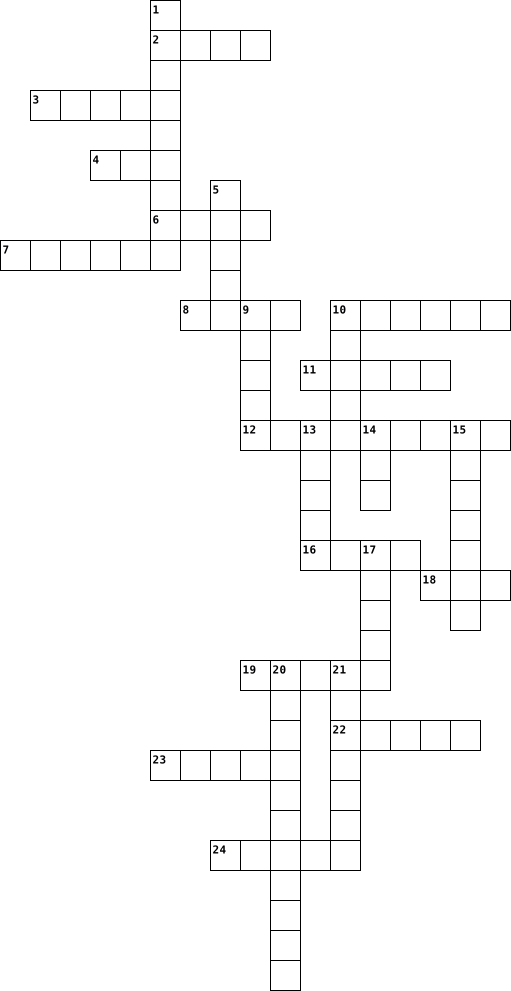
The Samanthan Sentinel 4.8.24 2024-04-08

Across
- Who was said to pull the fiery chariot of the Sun to bring about the new day in Greek Myth?
- Is the moon made out of this delicious food? Maybe!
- I've known this friendly feline to sit in the sun and lounge
- Many traditional folklore myths around the world say that the forces of the Sun and Moon are this type of family relation (plural)
- Stay out too long, and you might get this- ouch!
- Delicious types of rolls, or the different phases of the moon
- "A Total ___ of the Heart..."
- What is that name of the beautiful Gas Giant in the Planetary System?
Down
- If you know a kid, they would use this color to fill in the Sun in a drawing
- This patriotic bird has long been associated with traditional myths surrounding the Sun
- If you have ___ panels on your house, you are rocking the renewable energy!
- Who was the first to say that the Earth revolves around the sun, and introduced Heliocentrism?
- Look up to the moon and you might see a couple of these pock marks!
- The name of Rapunzel's Kingdom- and the outer edge of the sun!
- Some people can go out into the sun, and they will be sun-kissed, or this!
- If you are going to view a total Eclipse, you would head towards the Path of ___
- What element is the Sun?
- Feel an electromagnetic disturbance? This might be emitting from the Sun- also a word for something you could use as a beacon if deserted!
- The other well-known Mythical twin said to be the Goddess of the Moon
- If you sun into this geometric shape with rain, you can get a rainbow!
- Who was known to fly too high towards the heavens and melted the wax of his wings?
21 Clues: What element is the Sun? • "A Total ___ of the Heart..." • Stay out too long, and you might get this- ouch! • Is the moon made out of this delicious food? Maybe! • I've known this friendly feline to sit in the sun and lounge • Delicious types of rolls, or the different phases of the moon • The name of Rapunzel's Kingdom- and the outer edge of the sun! • ...
science 2024-03-22

Across
- he process whereby particles of liquids, gases, or solids intermingle as the result of their spontaneous movement caused by thermal agitation and in dissolved substances move from a region of higher to one of lower concentration.
- the star around which the earth orbits.
- is the study of everything in the universe beyond Earth's atmosphere.
- A consumer is a person or a group who intends to order, or use purchased goods, products, or services primarily for personal, social, family, household and similar needs.
- 1/8.
- is the first lunar phase after the New Moon.
- is an assumption, an idea that is proposed for the sake of argument so that it can be tested to see if it might be true.
- an optical instrument consisting of a lens or a combination of lenses for making enlarged or magnified images of minute objects.
- the natural satellite of the earth, visible (chiefly at night) by reflected light from the sun.
- The scientific study of the origin of the Earth along with its rocks, minerals, land forms, and life forms, and of the processes that have affected them over the course of the Earth's history.
Down
- the three months from January 1 to March 31:
- One of the four phases of the moon, occurring when the earth lies between the sun and the moon so that the moon is visible as a fully illuminated disc
- something that is related to the moon.
- the place or environment where a plant or animal naturally or normally lives and grows
- based on or characterized by the methods and principles of science.
- a giant floating rock
- the smallest unit that can live on its own and that makes up all living organisms and the tissues of the body.
- biome is an area classified according to the species that live in that location.
- the moon's phase when its dark side is toward the earth
- a representation of a person or scene in the form of a print or transparent slide; recorded by a camera on light-sensitive material.
20 Clues: 1/8. • a giant floating rock • something that is related to the moon. • the star around which the earth orbits. • the three months from January 1 to March 31: • is the first lunar phase after the New Moon. • the moon's phase when its dark side is toward the earth • based on or characterized by the methods and principles of science. • ...
Phases of the moon 2022-10-21

Across
- The phase of the moon where the light is on the left side
- The spinning of an object around another
- The path an object takes around another object
- The phase of the moon where less than half of what we see is lit
Down
- The phase of the moon where all that we see is lit
- The phase of the moon where none of what we see is lit up
- The phase of the moon where exactly half of what we see is lit
- The phase of the moon where more than half of what we see is lit
- The phase of the moon where the light is on the right side
9 Clues: The spinning of an object around another • The path an object takes around another object • The phase of the moon where all that we see is lit • The phase of the moon where none of what we see is lit up • The phase of the moon where the light is on the left side • The phase of the moon where the light is on the right side • ...
phases of the moon 2024-05-03

Across
- it orbits around the earth
- the moon is clearly visible and there are no shadows
- the shadow covers most of the right side
- the moon covers the left half, the shadow covers the right half
- most of the moon on the right side
Down
- the shadow covers all the moon; can't see
- the moon covers most of the left side
- half the shadow, half the moon
- most of the shadow covers the left part
9 Clues: it orbits around the earth • half the shadow, half the moon • most of the moon on the right side • the moon covers most of the left side • most of the shadow covers the left part • the shadow covers most of the right side • the shadow covers all the moon; can't see • the moon is clearly visible and there are no shadows • ...
Science Review 2021-02-03

Across
- part of plant that absorbs water and nutrients from the soil
- the moon has different looks called lunar ______
- this force causes the earth to move suddenly and shake
- energy of motion
- this can be part of an ax
- animal that lives in the desert
- process of destroying mold, yeast and bacteria from milk
Down
- stored energy
- layer of gases that surround the Earth
- a huge explosion that started the universe
- animal that eats meat
- the largest planet in the Milky Way Galaxy
- a substance that's the same throughout
- when this erupts, it can send lava down its sides
- everything that isn't energy
15 Clues: stored energy • energy of motion • animal that eats meat • this can be part of an ax • everything that isn't energy • animal that lives in the desert • layer of gases that surround the Earth • a substance that's the same throughout • a huge explosion that started the universe • the largest planet in the Milky Way Galaxy • the moon has different looks called lunar ______ • ...
Science! 2020-06-08

Across
- This force allows things to be stretched and then returns to its original form.
- The flow of heat through solids.
- Birds that have a layer of fat under their skin to keep them warm.
- What force pulls things down to Earth?
- The muscles in our body can exert _______.
- The two sources of electricity are ________ and electric cells.
- Special liquids that can kill germs and clean floors and toilets.
- A poisonous liquid that can be found in the thermometer.
Down
- To save ____________ at home, we use a fan instead of air conditioner.
- This gas is needed for burning.
- The appearance of the Moon changes at different times of the month, these are called ____________ of the Moon.
- What part of the teeth we use to grind and crush our food into pieces?
- Parents pass on their _________________ to their young.
- Drugs that are useful to relieve pain and cure/prevent sickness.
- To 'switch on' means to __________ a circuit.
- This protects the flower in the bud stage.
16 Clues: This gas is needed for burning. • The flow of heat through solids. • What force pulls things down to Earth? • The muscles in our body can exert _______. • This protects the flower in the bud stage. • To 'switch on' means to __________ a circuit. • Parents pass on their _________________ to their young. • A poisonous liquid that can be found in the thermometer. • ...
book bingo 2024-05-08

Across
- gentle and sweet.
- rock hard or completely dried out.
- in demand or not allowed to refuse.
- to greef the loss of a person or even an object.
- phases of the moon, any particular one full moon, half moon, crescent etc.
- an idea that people are motivated by purely self interest or skepticism
- to make a complete mess.
- can be heavy laughter or going in sane
- so completely wipe from existence or destroy.
- to be continuous non-stop.
- gentle and kind or peacefull.
- to have regret or suffering, typically unwelcomed
- something thick and heavy
- gloomy and dull or unclean.
- to eat little to keep food supplies lasting longer.
- a semiconductor device with 3 capibal amplifications.
- to lour or taunt somebody somewhere
Down
- a lose or death of a thing or person
- to take things for granted, assumed or supposed.
- a fear of small spaces, suffocating areas.
- so slop or move around lazily.
- to completely put something underwater
- to divide.
- looking ord the worst passable case
- referring to the moon a small sliver that slowly disappears
- a massive deadly wave created by an underwater earthquake.
- to get away and evade.
- chaos or disaster, danger or panic
- to free or find and help.
- crane to stretch or turn to look or to see better.
- something that's able to be eaten and causes no Harm to be digested.
- to make sure something is correct
- an estimate forecast of a future situation or trend
- scoop or create a hole with a sharp blade or tool forcefully.
- to remake or strengthen somethin and or oil refinery.
- to be unable to move due to complete fear of something.
- handmade weaving of cloth to make something, weaving patterns
- burn slowly with smoke and no flame
38 Clues: to divide. • gentle and sweet. • to get away and evade. • to make a complete mess. • to free or find and help. • something thick and heavy • to be continuous non-stop. • gloomy and dull or unclean. • gentle and kind or peacefull. • so slop or move around lazily. • to make sure something is correct • rock hard or completely dried out. • chaos or disaster, danger or panic • ...
Astronomy Review Unit 1 2022-12-13

Across
- The time to orbit another body
- Applied geometry to the motion of the celestial sphere, able to predict the motion of the planets and when solar and lunar eclipses would
- an imaginary plane connecting the earth and sun that the Earth moves through
- Built Temple of Karnak, created 24-hour day, created the first clocks
- the point on the celestial sphere that is directly overhead at night
- eclipse that happens during a full moon
- Measured the circumference of the Earth
- Made position measurements of over 1000 stars, the sun, moon, and planets
- Movement of a body on an axis
- built Newgrange
- tide that happens during the first and third quarter moons
- The study of celestial bodies to determine and predict their movements and patters
- eclipse that happens during a new moon
Down
- the line on the celestial sphere where the sky meets the Earth
- used Hipparchus’s measurements to make tables and predict the future position of the planets
- built Stonehenge, Kept track of the summer and winter solstice for agricultural and religious purposes
- The solar day that measures one complete 360 rotation of the Earth
- A group of stars that appear to make a pattern or draw a picture in the celestial sphere.
- Built Machu Pichu, Kept detailed records of the stars for agricultural purposes
- Built Chichin Itza, calendar based on the movements of the sun, moon, and Venus, calendar ended in 2012
- created the most accurate map of stars available until the 1500’s, named thousands of stars, created accurate instruments
- created a calendar based off moon phases
- The study of celestial bodies to determine omens (pseudoscience)
- tide that happens during full and new moons
- created the first zodiac
- The solar day that is from noon to noon. 4 seconds longer
26 Clues: built Newgrange • created the first zodiac • Movement of a body on an axis • The time to orbit another body • eclipse that happens during a new moon • eclipse that happens during a full moon • Measured the circumference of the Earth • created a calendar based off moon phases • tide that happens during full and new moons • ...
crosspuzzle 2022-03-02

Across
- 1 and 3 quarter of the moon
- a tide
Down
- pushing the ocean water towards
- force between objects
- stage or period in an event
- or ocean
6 Clues: a tide • or ocean • force between objects • stage or period in an event • 1 and 3 quarter of the moon • pushing the ocean water towards
Raymond Crossword puzzle 2024-02-05

Across
- gibbous Waxing Gibbous: The waxing gibbous phase is between a half moon and full moon. Waxing means it is getting bigger. 🌕 Full: We can see the Moon completely illuminated during full moons. 🌖 Waning Gibbous: The waning gibbous phase is between a full moon and a half moon. Waning means it is getting smaller.
- crescent The area illuminated on the surface of the Moon during this phase is in the shape of a crescent and the amount of sunlight reflecting off of the Moon is decreasing. The term waning means decreasing, which is why this Moon phase is called Waning Crescent.
- moon The full moon is the lunar phase when the Moon appears fully illuminated from Earth's perspective. This occurs when Earth is located between the Sun and the Moon. This means that the lunar hemisphere facing Earth—the near side—is completely sunlit and appears as an approximately circular disk.
- quarter The time of month between new moon and first half-moon.The phase of the moon after the waxing crescent when only the right half of its face, when viewed from the Northern Hemisphere, reflects sunlight to the earth.
Down
- crescent The Waxing Crescent is the second phase in the cycle of phases. This Moon phase occurs once a month, rising around 9 AM, and setting around 9 PM, sticking around for approximately 7.38 days before going into the First Quarter phase.
- gibbous The waning gibbous phase is between a full moon and a half moon. Waning means it is getting smaller. 🌗 Third Quarter: We see the third quarter moon as a half moon, too. It is the opposite half as illuminated in the first quarter moon.
- moon In astronomy, the new moon is the first lunar phase, when the Moon and Sun have the same ecliptic longitude. At this phase, the lunar disk is not visible to the naked eye, except when it is silhouetted against the Sun during a solar eclipse.
- quarter A last quarter moon looks like half a pie. It is also called third quarter moon. A last quarter moon appears half-lit by sunshine and half-immersed in its own shadow. It rises in the middle of the night, appears at its highest in the sky around dawn, and sets around midday.
- cycle The eight lunar phases are, in order: new moon, waxing crescent, first quarter, waxing gibbous, full moon, waning gibbous, third quarter and waning crescent. The cycle repeats once a month (every 29.5 days)
9 Clues: cycle The eight lunar phases are, in order: new moon, waxing crescent, first quarter, waxing gibbous, full moon, waning gibbous, third quarter and waning crescent. The cycle repeats once a month (every 29.5 days) • ...
MOON 2026-03-04

Across
- Maori moon god
- Vehicle to space and back
- Affects our tides
- Neil, in 1969
- Space travel
- To get bigger
- Shadow
- To do with the moon
- Landing craft, 1969
- To get smaller
- Gas for breathing in space
Down
- A water container
- Space mission, 1969
- To do with the sun
- Husband left on earth
- Maori lady in the moon
- Space traveller
- Beyond our planet
- partly obscured
- A cloak
20 Clues: Shadow • A cloak • Space travel • Neil, in 1969 • To get bigger • Maori moon god • To get smaller • Space traveller • partly obscured • A water container • Affects our tides • Beyond our planet • To do with the sun • Space mission, 1969 • To do with the moon • Landing craft, 1969 • Husband left on earth • Maori lady in the moon • Vehicle to space and back • Gas for breathing in space
Moon Phases Crossword Puzzle 2020-12-14

Across
- This object is the Earths only satellite?
- This moon phase can't be seen what phase is it?
- This moon phase is a half started quarter?
- This moon phase gets few light & looks banana?
Down
- This moon phase is not full but more than half?
- This moon phase is when a phase is increasing?
- This moon phase is when a phase is decreasing?
- This moon phase gets direct sunlight so it is a?
- This moon phase is half ended quarter?
9 Clues: This moon phase is half ended quarter? • This object is the Earths only satellite? • This moon phase is a half started quarter? • This moon phase is when a phase is increasing? • This moon phase is when a phase is decreasing? • This moon phase gets few light & looks banana? • This moon phase is not full but more than half? • ...
Phases of the moon 2020-12-15

Across
- -the Moon is Earth's only natural satellite. The Moon orbits Earth at an average distance of 384,402 km, or 1.28 light-seconds.
- -the Moon does not emit its own light, shining instead by reflecting sunlight. A week after New Moon, the Moon reaches its First Quarter.
- -the Moon is Earth's only natural satellite. The Moon orbits Earth at an average distance of 384,402 km, or 1.28 light-seconds.
- -in astronomy, the new moon is the first lunar phase, when the Moon and Sun have the same ecliptic longitude. At this phase, the lunar disk is not visible to the unaided eye, except when silhouetted during a solar eclipse.
- -crescent definition is - the moon at any stage between new moon and first quarter and National Geographic, "What is that glow from Europa?," 11 Nov. 2020
Down
- -a quarter moon occurs when we see the Moon half illuminated by the Sun, and half enshrouded in darkness. You can have a first quarter moon, when the Moon is halfway between a new moon and full moon.
- -third Quarter Moon is the last primary phase when the Moon has reached the third, or last, quarter of its orbit around Earth, hence the name.
- -a gibbous” moon is any moon that appears more than half lighted but less than full.
- -The full moon is the lunar phase when the Moon appears fully illuminated from Earth's perspective. This occurs when Earth is located between the Sun and the Moon.
- -the moon is called a waning moon when it is in the phase in which its visible surface area is getting smaller. A waning moon occurs between a full moon (when the visible surface is fully round and lit up) and a new moon (when the surface that faces Earth is completely covered in shadow).
10 Clues: -a gibbous” moon is any moon that appears more than half lighted but less than full. • -the Moon is Earth's only natural satellite. The Moon orbits Earth at an average distance of 384,402 km, or 1.28 light-seconds. • -the Moon is Earth's only natural satellite. The Moon orbits Earth at an average distance of 384,402 km, or 1.28 light-seconds. • ...
PHASES OF THE MOON 2026-01-25

Across
- The moon appears as a half-circle in the sky, with exactly half of its surface illuminated by the sun
- During this phase, the Moon appears as a large and bright, but gradually shrinking, crescent shape in the sky.
- During this phase, the entire face of the Moon that is visible from Earth is fully illuminated.
Down
- The moon appears as a thin crescent shape in the sky, with only a small portion of its surface illuminated
- The moon appears completely dark in the sky
- A phase of the Moon that occurs approximately three weeks after the full moon phase.
- The phase of the Moon occurs approximately three weeks after the new moon phase.
- Earth's only natural satellite
- During this phase, the moon appears in a mostly illuminated crescent shape, with only a small part appearing dark.
9 Clues: Earth's only natural satellite • The moon appears completely dark in the sky • The phase of the Moon occurs approximately three weeks after the new moon phase. • A phase of the Moon that occurs approximately three weeks after the full moon phase. • During this phase, the entire face of the Moon that is visible from Earth is fully illuminated. • ...
solar system 2021-12-02

Across
- the roman goddess of love and beauty
- the planet with a ring around it
- is the planet we live on
- the farthest planet from the sun
- a star that is a ball of plasma that gives off light.
Down
- the fifth planet from the sun
- the fourth planet from the sun
- the blue planet
- moon is a satellite that has 8 phases.
- the smallest planet in the solar system
10 Clues: the blue planet • is the planet we live on • the fifth planet from the sun • the fourth planet from the sun • the planet with a ring around it • the farthest planet from the sun • the roman goddess of love and beauty • moon is a satellite that has 8 phases. • the smallest planet in the solar system • a star that is a ball of plasma that gives off light.
Astronomy Review Vocabulary 2023-01-03

Across
- when more than half of the moon is illuminated (lit up)
- area between the latitude lines of the Tropic of Cancer and the Tropic of Capricorn
- path that planets and other objects in our around the Sun
- The point along the Earth's orbit when it is closest to the Sun
- when none of the moon is illuminated
- line of latitude found at 66.5°
- how the particles are packed in an object
- this hemisphere of the Earth has its summer solstice around June 21st
- Planets that CAN NOT clear the neighborhood around its orbit!
- a force that pulls objects towards each other
- ________ of the Earth causes Seasons
- piece of an asteroid or comet that is found within Earth’s Atmosphere
- when it is summer in the Northern Hemisphere Sunlight is directed on the Tropic of _________
- collections of ice, dust, and rock that are found in the Kuiper Belt and Oort Cloud
- _______ equinox is the first day of fall
- season when your shadows are the longest
- small rocky objects that orbit the Sun
Down
- this hemisphere of the Earth has its vernal equinox around Sep 21st
- longest and shortest days of the year
- tides caused when the Sun, Moon and the Earth are in a straight line
- areas on Earth with drastic changes in seasons
- tendency of an object to resist a change in motion
- When the light on Earth is less concentrated and hits a larger area
- when an object spins on its axis
- space occupied by an object
- a push or a pull
- measurement of how much gravity is acting on an object
- first day of spring
- when less than half of the moon is illuminated (lit up)
- _______ cycle is the amount of time it takes the Moon to go through all of its phases
- when half of the moon is illuminated
- Tides with least difference between high and low tides
- line of latitude found at 0°
- amount of matter in an object
34 Clues: a push or a pull • first day of spring • space occupied by an object • line of latitude found at 0° • amount of matter in an object • line of latitude found at 66.5° • when an object spins on its axis • when none of the moon is illuminated • ________ of the Earth causes Seasons • when half of the moon is illuminated • longest and shortest days of the year • ...
Periods 3 & 6 Crossword 2023-11-16

Across
- the system of interacting, living organisms on Earth
- the movement of energy through air & space
- the supercontinent before continents drifted
- large, bright Sun features extending outward from surface
- the force holding planets & Moons in orbit
- where life & weather happens in atmosphere
- the system of gas surrounding Earth
- a law that determines oldest rocks are below youngest rocks
- cooling & solidifying of molten rock creates . . .
- layer of Earth that's broken into plates
- layer of protection from UV rays around Earth
- the Moon getting smaller
- Earth center model
- the gravitational pull of the Moon causes these
- heat & pressure applied to previous rock creates . . .
- the system of natural, nonliving materials on Earth
- the system of ice on Earth
- type of energy transfer between rising & falling of fluids
- eruptions of radiation on the Sun
- a fracture/break in land
- darker spots on the Sun
- the settlement of rock in a new place
- an absolute dating technique
- determines locations East & West
- where convection happens in Earth's mantle
- energy from the Sun is considered this
- the movement of rock by wind, water, or gravity
- determines locations North & South
Down
- the outer part of Sun's atmosphere
- the system of water on Earth
- the breakdown of rock
- boundary where two plates pull apart
- the absence of day
- length of distance between Earth & Sun
- anything that takes up space & has mass (comes in 3 forms)
- Sun center model
- the source of day
- the movement of air
- study of rock layers
- distance light travels within a year
- revolves around Earth and shows different phases
- compaction of sediments creates . . .
- the Moon less than half lit
- the Moon more than half lit
- evidence of prehistoric organisms
- the amount of matter per space taken up
- spinning on an axis
- boundary where two plates push together
- an effect that keeps Earth warm
- where the ozone layer is
- when an isotope changes from parent to daughter
- boundary where two plates slide past each other
- the Moon getting bigger
53 Clues: Sun center model • the source of day • the absence of day • Earth center model • the movement of air • spinning on an axis • study of rock layers • the breakdown of rock • darker spots on the Sun • the Moon getting bigger • the Moon getting smaller • a fracture/break in land • where the ozone layer is • the system of ice on Earth • the Moon less than half lit • the Moon more than half lit • ...
Solar System Exploration Crossword 2024-12-10

Across
- This USA program landed on Mars in 1976 and possibly found and killed life.
- This USA program recorded the first flybys of Mars, Venus and Mercury
- This program was a series of 24 missions by the USSR that would study the moon
- This USSR program successfully studied Venus, recording pictures and sounds.
- This is the latest mars rover, landing in 2021
- The passenger aboard Sputnik 2
- This USA program recorded the first flybys of Saturn, Jupiter, Uranus and Neptune
- This USSR program had the first mars rover but also had the first public USSR failure
- This is the name of the active Chinese lunar space program
- This USA program was broken up into 3 phases and were the first to obtain close up images of the moon and hit the far side.
- This USSR program recorded the first lunar flyby
- USA's first space orbiter launched in March 1958
- This was the first mercury orbiter, discovering water on that planet
- Period of geopolitical tension between NATO and the Warsaw Pact
- This is the number of Apollo missions
Down
- This is the name of one of the first people to walk on the moon
- This was the first person to orbit the earth aboard Vostok 1
- This USA program was broken into 2 parts. The first studying the moon and the second studying other planets.
- This is the first name of the first woman in space
- This USA probe was the first Jupiter orbiter where it studied chemical composition of that planet
- This is the first Apollo Mission to land people on the moon
- Period of technological and scientific competition between USA and the USSR
- This is the first Saturn orbiter and landed the first object on an outer solar system moon, titan
- This probe gave the first images of pluto's surface
- This USA program identified Volcanism and weather patterns on Venus
- The first satellite launched on Oct 4, 1957
- This was the first USA mars Rover, it only went 100m
- This is the name of the active NASA lunar program, currently planning to establish a lunar base by 2035
28 Clues: The passenger aboard Sputnik 2 • This is the number of Apollo missions • The first satellite launched on Oct 4, 1957 • This is the latest mars rover, landing in 2021 • This USSR program recorded the first lunar flyby • USA's first space orbiter launched in March 1958 • This is the first name of the first woman in space • ...
Solar Eclipse 2024-04-08
Across
- A luminous celestial body made up of hot gases, like our sun
- Related to the sun or derived from it, like solar energy
- The star at the center of our solar system that provides light and heat
- Earth's natural satellite that orbits around it at night
- A vast system of stars, gas, and dust held together by gravity
- A soft, radiant light emitted by an object or substance
- A dark area caused by an object blocking light from a source
- The planet we live on, known as the "Blue Planet"
- An optical instrument used for observing distant objects in space
- A circular band or loop shape, like Saturn's rings
- The period of light between sunrise and sunset
- A celestial object composed of ice, dust, and gas that develops a glowing tail
- Electromagnetic radiation that allows us to see and brightens our world
- A recurring sequence or pattern that repeats over time
- The different stages or appearances of the moon or a celestial body
Down
- The study of celestial objects, space, and the universe
- Complete or whole, as in a total eclipse
- The path followed by a celestial object around another object
- The vast, seemingly infinite expanse that contains all celestial objects
- Related to the moon, like lunar phases or lunar landings
- The expanse above us that contains the sun, moon, stars, and clouds
- Incomplete or not whole, as in a partial eclipse
- The period of darkness when the sun is below the horizon
- A facility equipped for observing
- When one celestial body blocks the light from another, like a solar or lunar eclipse
25 Clues: A facility equipped for observing • Complete or whole, as in a total eclipse • The period of light between sunrise and sunset • Incomplete or not whole, as in a partial eclipse • The planet we live on, known as the "Blue Planet" • A circular band or loop shape, like Saturn's rings • A recurring sequence or pattern that repeats over time • ...
CherokeeMR 2018-03-23

Across
- One of the houses the Cherokee lived in were ______.
- In the Uka Dance the Chief or the ___ led the nation of a Ceremony of thanksgiving and rejoicing.
- Mountains in the southeast region.
- the Cherokee held seven __________ between March and November based on the phases of the crescent or new moon.
Down
- The Cherokee walked the Trail of Tears in ____.
- The clans connect the Cherokee to ______.
- Hernando de Soto was a _______ explorer who was the first to pass through Cherokee territory in 1540.
- Every seventh year the ________ replaced the Great New Moon Ceremony.
- Cut down trees to clear land for plants.
- Owned homes and raised children.
10 Clues: Owned homes and raised children. • Mountains in the southeast region. • Cut down trees to clear land for plants. • The clans connect the Cherokee to ______. • The Cherokee walked the Trail of Tears in ____. • One of the houses the Cherokee lived in were ______. • Every seventh year the ________ replaced the Great New Moon Ceremony. • ...
The Earth-Moon System 2024-03-19

Across
- round depressions in the surface caused by the impact of high-speed meteoroids
- different shapes of the moon visible from Earth
- where there is the least change between daily high tide and low tides
- when the shadow of one body in space(planet or moon) falls on another
- chunks of rock that move through the solar system
- the darkest part of the moon's shadow
Down
- regular rise and fall of ocean waters
- when the change between daily high and low tides is the greatest
- low, flat plains formed by ancient lunar lava flows
- a region of shadow that is less dark than the umbra
10 Clues: regular rise and fall of ocean waters • the darkest part of the moon's shadow • different shapes of the moon visible from Earth • chunks of rock that move through the solar system • low, flat plains formed by ancient lunar lava flows • a region of shadow that is less dark than the umbra • when the change between daily high and low tides is the greatest • ...
Chapter 1 - What Is Astronomy? 2026-02-18

Across
- an Italian scientist who is considered to be the first to use the telescope to look at the planets
- a scientist who studies celestial bodies and how they exist and move in space
- a heliocentric solar system has this at the center
- early astronomers formed stars and groups of stars that form these
- Modern astronomers can see details about stars and ________ that were not visible in ancient times.
- early civilizations used the stars and movements of celestial bodies to measure this
- this person reintroduced the heliocentric cosmos and confirmed the observations of Galileo
Down
- We live in a _____________ solar system.
- a telescope uses this to magnify distant objects
- a constellation is a group of stars that fit together in the night sky to form this
- this group of Babylonia used the phases of the moon to create the first lunar calendar
- our calendar today is connected to the yearly and monthly orbits of the moon and this
- The moon, planets, and stars are examples of what kind of bodies?
- this is a modern tool astronomers use to study the planets and stars
- Astronomers use chemistry and this other science to understand data.
- the firs person to propose a heliocentric cosmos
- An earth-centered universe is a ___________ cosmos.
- in ancient times, people believed this was the center of the universe
18 Clues: We live in a _____________ solar system. • a telescope uses this to magnify distant objects • the firs person to propose a heliocentric cosmos • a heliocentric solar system has this at the center • An earth-centered universe is a ___________ cosmos. • The moon, planets, and stars are examples of what kind of bodies? • ...
Moon 2021-10-06

Across
- Spining around something
- Water getting effected by the moon is called?
Down
- Moon changes shape overtime
- A cycle
- A force that attracts the body to center of earth
5 Clues: A cycle • Spining around something • Moon changes shape overtime • Water getting effected by the moon is called? • A force that attracts the body to center of earth
REVIEW CHP. 5 & 6 2023-11-20

Across
- Two nuclei split apart
- It's move around the nucleus
- It's made of ice, dust and gases
- Low mass and weak ionizing effect
- The ability to remove electron from atoms become ions
- the basic building blocks of matter
- substance that consists of more than one type of element
- One of the outer planet
- Strong ionizing effect
- small, heavy part of the atom
Down
- The time required for a quantity to reduce to half
- unstable isotopes
- The movement of the earth rotating on its axis
- They are outer planets.They move -----in space
- The elements with the different number of neutron
- they are rocky planets, solid and high density
- Can stopped by lead
- Different shape of the moon
18 Clues: unstable isotopes • Can stopped by lead • Two nuclei split apart • Strong ionizing effect • One of the outer planet • Different shape of the moon • It's move around the nucleus • small, heavy part of the atom • It's made of ice, dust and gases • Low mass and weak ionizing effect • the basic building blocks of matter • The movement of the earth rotating on its axis • ...
Science Vocabulary 2018-02-07

Across
- THE DIFFERENT WAYS THE MOON LOOKS
- CHANGES FROM WATER VAPOR TO DROPS OF WATER
- TO MOVE WARMER PLACES IN THE FALL
- A GROUP OF STARS THAT FORM A PICTURE
- SPINS AROUND AN IMAGINARY LINE
Down
- TO MOVE IN A PATH AROUND AN OBJECT
- WATER THAT FALLS FROM THE SKY
- VAPOR WATER IN THE FORM OF A GAS
- CHANGES TO GAS
- TO GO INTO A DEEP SLEEP
- SYSTEM THE SUN AND THE SPACE OBJECTS THAT MOVE AROUND IT
11 Clues: CHANGES TO GAS • TO GO INTO A DEEP SLEEP • WATER THAT FALLS FROM THE SKY • SPINS AROUND AN IMAGINARY LINE • VAPOR WATER IN THE FORM OF A GAS • THE DIFFERENT WAYS THE MOON LOOKS • TO MOVE WARMER PLACES IN THE FALL • TO MOVE IN A PATH AROUND AN OBJECT • A GROUP OF STARS THAT FORM A PICTURE • CHANGES FROM WATER VAPOR TO DROPS OF WATER • ...
Earth's Place in the Universe 2023-12-05

Across
- the spinning of Earth on its axis
- Having great importance
- the movement of one object around another
- a sun-centered model
- a giant ball of superheated gas composed of hydrogen and helium
- These are caused by the gravitational pull of the moon and occur every 12.5 hours
- a cold mixture of dust and ice that develops a long trail of light as it approaches the sun
- During an eclipse, this is the very darkest part of the shadow where the light from the sun is completely blocked
- the imaginary line that goes from the North Pole through the center of Earth to the South Pole
- oval shape
- a pattern or group of stars that people imagine represents a figure, animal, or object
- This is a tide with the greatest difference between consecutive low and high tides
- During an eclipse, this is the area of the shadow where the sun is only partially blocked
- sun-Earth-moon
Down
- This is a tide with the least difference between consecutive low and high tides.
- This will change when there is less of a gravity pull on an object
- These are the different shapes of the moon
- an Earth centered model
- an object that orbits the sun
- This is the tendency of an object to resist a change in motion
- the amount of matter in an object. This does not change from one location to another
- Earth's path
- A force that attracts all objects toward each other
- When an object in space comes between the sun and a third object, it causes a shadow on the third object
- a body that orbits a planet
- Earth-moon-sun
26 Clues: oval shape • Earth's path • Earth-moon-sun • sun-Earth-moon • a sun-centered model • an Earth centered model • Having great importance • a body that orbits a planet • an object that orbits the sun • the spinning of Earth on its axis • the movement of one object around another • These are the different shapes of the moon • A force that attracts all objects toward each other • ...
Unit 2 Review 2020-10-26

Across
- a terrestrial planet with large dust storms could possibly have life
- the planet with the strangest weather conditions
- the motion of a body that travels around another body
- the changing of the moon's appearance
- largest daily range
- the planet that is closest to the sun
- the measurement of the amount of gravitational force on an object and does change depending on gravity
- the moon is directly between the son and the Earth
- the only planet with life and liquid water
- spinning of a body, such as a planet
- what is it called when sunlight shines equally on the northern and Southern Hemisphere
- four rocky inner planets
- the number of moon's phases (written out)
- difference in the oceans levels high tide vs low tide
- what is it called when the area of sunlight is at a maximum in one hemisphere and minimum in the other hemisphere
Down
- the cold, gassy, and last four planets in the solar system
- the planet with the largest geysers
- the inward force that causes an object to move in a circular path
- what causes seasons
- the moon moves through the Earth's shadow
- a force attracting something with a smaller mass to something with a greater mass
- the average distance between the Earth and the sun used to measure in the solar system
- a body that orbits a larger body
- the planet that is tilted on its side
- daily changes in the level of the ocean water
- smallest daily range
- the measurement of the amount of matter in an object that does not change
- rotates in retrograde or counter clockwise
- the planet with a warm interior that controls the weather
29 Clues: what causes seasons • largest daily range • smallest daily range • four rocky inner planets • a body that orbits a larger body • the planet with the largest geysers • spinning of a body, such as a planet • the changing of the moon's appearance • the planet that is closest to the sun • the planet that is tilted on its side • the moon moves through the Earth's shadow • ...
Unit 4 Week 4 Vocabulary 2021-02-23

Across
- turns around on an axis
- makes distant objects seem larger and nearer
- the different stages of the moon
- similar things coming one after another
- exact or particular
Down
- a thin, pointed piece that has been torn off
- a curve that is wider in the middle
- studies the stars and planets
8 Clues: exact or particular • turns around on an axis • studies the stars and planets • the different stages of the moon • a curve that is wider in the middle • similar things coming one after another • a thin, pointed piece that has been torn off • makes distant objects seem larger and nearer
Moon! Earth's Best Friend Vocab 2022-03-27

Across
- the planet on which we live
- a smaller object that circles a bigger object
- the natural satellite of Earth
- can be counted on
Down
- a situation where something happens without planning
- a particular stage in a cycle of change
- force that pulls two objects together
- not made by humans; from nature
8 Clues: can be counted on • the planet on which we live • the natural satellite of Earth • not made by humans; from nature • force that pulls two objects together • a particular stage in a cycle of change • a smaller object that circles a bigger object • a situation where something happens without planning
U4W4 Vocabulary 2022-03-29

Across
- a curved shape that looks like a c
- different stages of the moon
- a thin piece of something
- something that is exact
Down
- used to make objects seem larger and closer
- a person who studies stars and planets
- to turn around on its axis
- things that come one after another
8 Clues: something that is exact • a thin piece of something • to turn around on its axis • different stages of the moon • a curved shape that looks like a c • things that come one after another • a person who studies stars and planets • used to make objects seem larger and closer
Earth-Moon System 2025-04-29

Across
- The area where all light is completely blocked during an eclipse
- When one celestial body moves into the shadow of another
- Huge plains of cooled lava seen as dark spots from Earth
- Mild tides that happen during the first and third quarter moons
- Extremely high and low tides occurring during full or new moons
- The movement of ocean water caused by gravitational pull
- Depressions caused by impacts on the Moon's surface
Down
- Space rocks that collide with celestial bodies like the Moon
- The part of a shadow where only part of the light is blocked
- The visible shape of the lit part of the Moon as seen from Earth
10 Clues: Depressions caused by impacts on the Moon's surface • When one celestial body moves into the shadow of another • Huge plains of cooled lava seen as dark spots from Earth • The movement of ocean water caused by gravitational pull • Space rocks that collide with celestial bodies like the Moon • The part of a shadow where only part of the light is blocked • ...
Moon Phases and Ocean Tides 2012-10-04

Across
- What is the time between 2 full moons?
- What is a large tide called?
- What can occur is either new or full?
- Was this awesome or what?
- What is the illuminated side of the moon called?
- What planet rotates on its axis for 25hrs?
Down
- How many times do tides change?
- During a full moon, what is the shadowing cast on the earth?
- Which way does the moon pull towards the ocean?
- What is a small tide called?
- What are the rises and falls of the sea called?
- What is another name for moon?
12 Clues: Was this awesome or what? • What is a large tide called? • What is a small tide called? • What is another name for moon? • How many times do tides change? • What can occur is either new or full? • What is the time between 2 full moons? • What planet rotates on its axis for 25hrs? • Which way does the moon pull towards the ocean? • ...
Earths Motion 2026-01-07

Across
- The center of mass in between orbits
- Formed earlier on during the solar nebula
- The type of planet Mercury,Venus, and earth is
- Causes night and day
- How all planets in the solar system revolve around the sun
Down
- The different types of orbits
- The type of planet Jupitor, Saturn, and Uranus is
- The pull of different phases of the moon
- Causes change in seasons
- The laws of planetary motion
10 Clues: Causes night and day • Causes change in seasons • The laws of planetary motion • The different types of orbits • The center of mass in between orbits • The pull of different phases of the moon • Formed earlier on during the solar nebula • The type of planet Mercury,Venus, and earth is • The type of planet Jupitor, Saturn, and Uranus is • ...
Scientific Revolution Crossword Puzzle 2021-02-10

Across
- The theory that the sun was the center of the universe and the earth rotated on an axis around the sun.
- Who observed the moon and found Venus has phases like the moon
- Who made his route to Asia on October 12th
- What explorers used to navigate directions at sea
- German astronomer and mathematician
Down
- Which ocean did the slave trade take place
- Who claimed that the sun was the center of the universe
- Revolution, New way of thinking that questioned the old ways of thinking
- Used to look out far away
- Exchange, Movement of plants, animals, diseases, people, technology, and ideas between the old world and the new world
10 Clues: Used to look out far away • German astronomer and mathematician • Which ocean did the slave trade take place • Who made his route to Asia on October 12th • What explorers used to navigate directions at sea • Who claimed that the sun was the center of the universe • Who observed the moon and found Venus has phases like the moon • ...
The Earth-Moon System 2024-03-20

Across
- Where there is the least change between daily high tide and low tides
- Regular rise and fall of ocean waters
- A region of shadow that is less dark than the umbra
- When the change between daily high and low tides is the greatest
- The darkest part of the moon's shadow
- Low, flat plains formed by ancient lunar lava flows
Down
- When the shadow of one body in space(planet or moon) falls on another
- Round depressions in the surface caused by the impact of high-speed meteoroids
- Different shapes of the moon visible from Earth
- Chunks of rock that move through the solar system
10 Clues: Regular rise and fall of ocean waters • The darkest part of the moon's shadow • Different shapes of the moon visible from Earth • Chunks of rock that move through the solar system • A region of shadow that is less dark than the umbra • Low, flat plains formed by ancient lunar lava flows • When the change between daily high and low tides is the greatest • ...
Moon 2023-04-25

Across
- listen to Luke(missions to the Moon)
- Moon gets smaller
- causes the seasons
- dark spots on the Moon
- Breathe Air(air sphere)
- coral in Bermuda
- hours in a day in 50 billion years
- period of asteroids crashing into the Earth and the Moon
- the Moon was created ___________years ago.
- send out
Down
- Earth's nickname
- Scientist who suspected that the Moon was drifting
- Earthquakes on the Moon
- what keeps us on the Earth
- Moon or Earth covers Sun
- tilt causes it
- the study of objects in space that send out radio waves
- Moon gets bigger
- movement away
- pulled around a body
20 Clues: send out • movement away • tilt causes it • Earth's nickname • Moon gets bigger • coral in Bermuda • Moon gets smaller • causes the seasons • pulled around a body • dark spots on the Moon • Earthquakes on the Moon • Breathe Air(air sphere) • Moon or Earth covers Sun • what keeps us on the Earth • hours in a day in 50 billion years • listen to Luke(missions to the Moon) • ...
Raymond Crossword puzzle 2024-02-05

Across
- gibbous Waxing Gibbous: The waxing gibbous phase is between a half moon and full moon. Waxing means it is getting bigger. 🌕 Full: We can see the Moon completely illuminated during full moons. 🌖 Waning Gibbous: The waning gibbous phase is between a full moon and a half moon. Waning means it is getting smaller.
- crescent The area illuminated on the surface of the Moon during this phase is in the shape of a crescent and the amount of sunlight reflecting off of the Moon is decreasing. The term waning means decreasing, which is why this Moon phase is called Waning Crescent.
- moon The full moon is the lunar phase when the Moon appears fully illuminated from Earth's perspective. This occurs when Earth is located between the Sun and the Moon. This means that the lunar hemisphere facing Earth—the near side—is completely sunlit and appears as an approximately circular disk.
- quarter The time of month between new moon and first half-moon.The phase of the moon after the waxing crescent when only the right half of its face, when viewed from the Northern Hemisphere, reflects sunlight to the earth.
Down
- crescent The Waxing Crescent is the second phase in the cycle of phases. This Moon phase occurs once a month, rising around 9 AM, and setting around 9 PM, sticking around for approximately 7.38 days before going into the First Quarter phase.
- gibbous The waning gibbous phase is between a full moon and a half moon. Waning means it is getting smaller. 🌗 Third Quarter: We see the third quarter moon as a half moon, too. It is the opposite half as illuminated in the first quarter moon.
- moon In astronomy, the new moon is the first lunar phase, when the Moon and Sun have the same ecliptic longitude. At this phase, the lunar disk is not visible to the naked eye, except when it is silhouetted against the Sun during a solar eclipse.
- quarter A last quarter moon looks like half a pie. It is also called third quarter moon. A last quarter moon appears half-lit by sunshine and half-immersed in its own shadow. It rises in the middle of the night, appears at its highest in the sky around dawn, and sets around midday.
- cycle The eight lunar phases are, in order: new moon, waxing crescent, first quarter, waxing gibbous, full moon, waning gibbous, third quarter and waning crescent. The cycle repeats once a month (every 29.5 days)
9 Clues: cycle The eight lunar phases are, in order: new moon, waxing crescent, first quarter, waxing gibbous, full moon, waning gibbous, third quarter and waning crescent. The cycle repeats once a month (every 29.5 days) • ...
Solar System Crossword Puzzle 2024-04-24

Across
- the star around which the planets revolve
- a boundary less area with no end
- the seventh planet from the sun
- layer of gas over Earth
- the eighth planet from the Sun.
- there are eight phases of this object
- a gas giant made up mostly of hydrogen and helium
- the smallest planet in our solar system
Down
- this planet has always been known for its rings
- second planet from sun
- the planet we live on
- rocky remnants
- a rock that falls to Earth from space
- the fourth planet from the Sun
- the repeating path that one object in space takes
15 Clues: rocky remnants • the planet we live on • second planet from sun • layer of gas over Earth • the fourth planet from the Sun • the seventh planet from the sun • the eighth planet from the Sun. • a boundary less area with no end • a rock that falls to Earth from space • there are eight phases of this object • the smallest planet in our solar system • ...
M2C Science Week 12-17 Crossword 2025-06-06

Across
- Color, size, and shape are all ____ of matter.
- the planets, the moons, and everything orbiting our Sun
- What ____ do you need to make a table?
- The Sun _____ light on the planets and moons.
- If I burn my toast, it is a ____.
- Some solids can ___, and some can not.
- Do you want to ____ better at playing piano? Practice.
Down
- Folding paper is a ____.
- Everything you can touch is made of ___.
- the amount of matter in an object
- 1/4
- We see different ___ of the Moon every month.
- Ice is ___ water.
- Earth is the third ___ from the Sun.
- the middle part of an object
15 Clues: 1/4 • Ice is ___ water. • Folding paper is a ____. • the middle part of an object • the amount of matter in an object • If I burn my toast, it is a ____. • Earth is the third ___ from the Sun. • What ____ do you need to make a table? • Some solids can ___, and some can not. • Everything you can touch is made of ___. • We see different ___ of the Moon every month. • ...
Space Unit Vocabulary 2024-09-26

Across
- The galaxy that contains our Solar System. It's a spiral-shaped collection of stars.
- The force that attracts objects toward each other, especially the pull of Earth that makes things fall.
- The path an object takes as it moves around another object in space.
- Higher high tides and lower low tides that occur when the Sun, Moon, and Earth are aligned in a straight line.
- A small rocky object that orbits the Sun.
- The angle at which a planet's axis is tilted compared to its orbit around the Sun.
- The different times of the year (spring, summer, fall, winter) that have varying weather, caused by the Earth’s axial tilt as it orbits the Sun.
- An imaginary line that a planet spins around. For Earth, this line goes through the North and South Poles.
- A small piece of rock or dust when it hits the ground.
- How heavy something is because of the gravitational pull on it.
- Tiny particles of matter floating in space or on planets, moons, and other surfaces.
- A moon that appears to get larger each night, from the new moon to full moon.
- Everything that exists, including all galaxies, stars, planets, and space.
- The star at the center of our solar system that provides light and heat to the planets.
- Sunlight that hits the Earth at a shallow angle, making it weaker and cooler.
- When the Earth moves between the Sun and the Moon, and the Earth's shadow falls on the Moon, making it look dark.
- Half of the Earth, either Northern or Southern.
- A natural object that orbits a planet.
Down
- A moon that appears to get smaller each night, from the full moon to new moon.
- The region around a star where conditions might be just right for life, not too hot or too cold, but just right.
- The spinning of a planet around its axis.
- The layer of gasses surrounding a planet or moon.
- A huge group of stars, dust, gas, and other objects bound together by gravity.
- Shaped like an oval or a slightly stretched circle.
- The movement of an object in a circular or elliptical path around another object, one year.
- A small icy object that orbits the Sun. When close to the Sun, it has a bright head and a tail that points away from the Sun.
- The amount of matter in an object.
- Sunlight that hits the Earth at a steep angle, making it stronger and warmer.
- Substances like air that can spread out and fill any space available.
- The different shapes of the visible part of the Moon from Earth, which change in a cycle every month.
- When the Moon moves between the Earth and the Sun, blocking the Sun's light for a short time.
- Tides with the least difference between high and low tides, which happen when the Sun and Moon are at right angles to each other.
- A small piece of rock or dust that burns up when it enters Earth's atmosphere, often seen as a shooting star.
- A large object that orbits a star (like our Sun) and doesn’t produce its own light.
34 Clues: The amount of matter in an object. • A natural object that orbits a planet. • The spinning of a planet around its axis. • A small rocky object that orbits the Sun. • Half of the Earth, either Northern or Southern. • The layer of gasses surrounding a planet or moon. • Shaped like an oval or a slightly stretched circle. • ...
Solar System Crossword Puzzle 2024-04-24

Across
- the star around which the planets revolve
- a boundary less area with no end
- the seventh planet from the sun
- layer of gas over Earth
- the eighth planet from the Sun.
- there are eight phases of this object
- a gas giant made up mostly of hydrogen and helium
- the smallest planet in our solar system
Down
- this planet has always been known for its rings
- second planet from sun
- the planet we live on
- rocky remnants
- a rock that falls to Earth from space
- the fourth planet from the Sun
- the repeating path that one object in space takes
15 Clues: rocky remnants • the planet we live on • second planet from sun • layer of gas over Earth • the fourth planet from the Sun • the seventh planet from the sun • the eighth planet from the Sun. • a boundary less area with no end • a rock that falls to Earth from space • there are eight phases of this object • the smallest planet in our solar system • ...
Solar System Crossword Puzzle 2024-04-24

Across
- this planet has always been known for its rings
- the smallest planet in our solar system
- a gas giant made up mostly of hydrogen and helium
- the eighth planet from the Sun.
- rocky remnants
- the fourth planet from the Sun
- layer of gas over Earth
Down
- the star around which the planets revolve
- a boundary less area with no end
- second planet from sun
- the seventh planet from the sun
- there are eight phases of this object
- a rock that falls to Earth from space
- the planet we live on
- the repeating path that one object in space takes
15 Clues: rocky remnants • the planet we live on • second planet from sun • layer of gas over Earth • the fourth planet from the Sun • the seventh planet from the sun • the eighth planet from the Sun. • a boundary less area with no end • there are eight phases of this object • a rock that falls to Earth from space • the smallest planet in our solar system • ...
Chapter 4- Our Earth, Sun and Moon 2025-10-17

Across
- to turn
- the time it takes the Moon to go through all of its phases
- the path an object takes as it moves around another object
Down
- to move around another object
- the shape of the moon that we see
- a line through the center of a spinning object
6 Clues: to turn • to move around another object • the shape of the moon that we see • a line through the center of a spinning object • the time it takes the Moon to go through all of its phases • the path an object takes as it moves around another object
Science 19-3 19-4 Vocabulary 2016-02-23

Across
- dark flat areas on the moon's surface
- a device built to observe distant objects by making them appear closer
- the very darkest part of the moon's shadow
- the rise and fall of ocean water every 12.5 hours or so
- the different shapes you see from Earth
- eclipse when a Earth is directly between the moon and the sun
Down
- tide a tide with the least difference between consecutive low and high tides
- large round pits on the moons surface
- chunks of rocks or dust from space
- when an object in space comes between the sun and a third object
- the largest and less dark part of the moon's shadow
- tide a tide with the greatest difference between consecutive low and high tides
- eclipse when a new moon blocks your view of the sun
13 Clues: chunks of rocks or dust from space • large round pits on the moons surface • dark flat areas on the moon's surface • the different shapes you see from Earth • the very darkest part of the moon's shadow • the largest and less dark part of the moon's shadow • eclipse when a new moon blocks your view of the sun • the rise and fall of ocean water every 12.5 hours or so • ...
Venus 2026-05-14

Across
- One of the various ways Venus could kill you
- What it rains on Venus
- Venus has a runaway _________ effect
- Venus is Earth's ____
Down
- Space missions from 1961-1984 with a goal of exploring Venus
- Venus has a _____ atmosphere
- The hottest planet in our solar system
- Galileo observed Venus going through ______, like the moon
- The element that makes up a small portion of Venus' atmosphere
- The amount of moons Venus has
10 Clues: Venus is Earth's ____ • What it rains on Venus • Venus has a _____ atmosphere • The amount of moons Venus has • Venus has a runaway _________ effect • The hottest planet in our solar system • One of the various ways Venus could kill you • Galileo observed Venus going through ______, like the moon • Space missions from 1961-1984 with a goal of exploring Venus • ...
Space Unit Vocabulary 2024-09-26

Across
- The galaxy that contains our Solar System. It's a spiral-shaped collection of stars.
- The force that attracts objects toward each other, especially the pull of Earth that makes things fall.
- The path an object takes as it moves around another object in space.
- Higher high tides and lower low tides that occur when the Sun, Moon, and Earth are aligned in a straight line.
- A small rocky object that orbits the Sun.
- The angle at which a planet's axis is tilted compared to its orbit around the Sun.
- The different times of the year (spring, summer, fall, winter) that have varying weather, caused by the Earth’s axial tilt as it orbits the Sun.
- An imaginary line that a planet spins around. For Earth, this line goes through the North and South Poles.
- A small piece of rock or dust when it hits the ground.
- How heavy something is because of the gravitational pull on it.
- Tiny particles of matter floating in space or on planets, moons, and other surfaces.
- A moon that appears to get larger each night, from the new moon to full moon.
- Everything that exists, including all galaxies, stars, planets, and space.
- The star at the center of our solar system that provides light and heat to the planets.
- Sunlight that hits the Earth at a shallow angle, making it weaker and cooler.
- When the Earth moves between the Sun and the Moon, and the Earth's shadow falls on the Moon, making it look dark.
- Half of the Earth, either Northern or Southern.
- A natural object that orbits a planet.
Down
- A moon that appears to get smaller each night, from the full moon to new moon.
- The region around a star where conditions might be just right for life, not too hot or too cold, but just right.
- The spinning of a planet around its axis.
- The layer of gasses surrounding a planet or moon.
- A huge group of stars, dust, gas, and other objects bound together by gravity.
- Shaped like an oval or a slightly stretched circle.
- The movement of an object in a circular or elliptical path around another object, one year.
- A small icy object that orbits the Sun. When close to the Sun, it has a bright head and a tail that points away from the Sun.
- The amount of matter in an object.
- Sunlight that hits the Earth at a steep angle, making it stronger and warmer.
- Substances like air that can spread out and fill any space available.
- The different shapes of the visible part of the Moon from Earth, which change in a cycle every month.
- When the Moon moves between the Earth and the Sun, blocking the Sun's light for a short time.
- Tides with the least difference between high and low tides, which happen when the Sun and Moon are at right angles to each other.
- A small piece of rock or dust that burns up when it enters Earth's atmosphere, often seen as a shooting star.
- A large object that orbits a star (like our Sun) and doesn’t produce its own light.
34 Clues: The amount of matter in an object. • A natural object that orbits a planet. • The spinning of a planet around its axis. • A small rocky object that orbits the Sun. • Half of the Earth, either Northern or Southern. • The layer of gasses surrounding a planet or moon. • Shaped like an oval or a slightly stretched circle. • ...
Space (the moon) 2013-06-02

Across
- pull the tides are caused by the moons ----?----
Down
- 11 mission was named the first moon landing
- what the surface of the moon has
- one of the first men on the moon
- month the time the moon takes to pass through a complete cycle of it's phases
5 Clues: what the surface of the moon has • one of the first men on the moon • 11 mission was named the first moon landing • pull the tides are caused by the moons ----?---- • month the time the moon takes to pass through a complete cycle of it's phases
Eclipse Crossword Puzzle 2020-12-22

Across
- this eclipse occurs when a portion of the Earth is engulfed in a shadow cast by the Moon which fully or partially blocks sunlight. This occurs when the Sun Moon and Earth are aligned.
- What gives the moon light
- we would see that the Moon's umbral shadow is not long enough to reach Earth. Instead, the antumbra shadow reaches Earth.
Down
- The moons dark inner shadow
- the moons faint outer shadow
- New Moon, waxing Crescent, First Quarter, Waxing Gibbous, Full Moon, Waning Gibbous, Last quarter. Waning Crescent, and New Moon (again)
- this eclipse occurs when the Moon moves into the Earth's shadow. This can occur only when the Sun, Earth and Moon are exactly or very closely aligned with Earth between the other two, and only on the night of a full moon.
7 Clues: What gives the moon light • The moons dark inner shadow • the moons faint outer shadow • we would see that the Moon's umbral shadow is not long enough to reach Earth. Instead, the antumbra shadow reaches Earth. • New Moon, waxing Crescent, First Quarter, Waxing Gibbous, Full Moon, Waning Gibbous, Last quarter. Waning Crescent, and New Moon (again) • ...
STARS AND THE SOLAR SYSTEM 2022-01-15

Across
- The stars, the planets, the moon and many other objects in the sky are called _____ objects.
- The moon completes one _______ on its axis
Down
- The various shapes of the bright part of the moon as seen during a month are called the moons ?
- ______ satellites are man-made objects which revolve around a planet
- The day on which the whole disc of the moon is visible is known as the ______ day.
- The _____ is the brightest object in the night sky.
6 Clues: The moon completes one _______ on its axis • The _____ is the brightest object in the night sky. • ______ satellites are man-made objects which revolve around a planet • The day on which the whole disc of the moon is visible is known as the ______ day. • The stars, the planets, the moon and many other objects in the sky are called _____ objects. • ...
Astronomy Crossword puzzle 2023-09-27

Across
- Outer lighter part of a shadow during an eclipse
- Occurs when day and night are the same length
- The path the sun traces in the celestial sphere - the plane where Earth orbits the sun
- Small star cluster within a constellation
- Time it takes for one cycle of phases (New Moon to New Moon)
- North Star
- Imaginary sphere surrounding the Earth with stars fixed on its surface
- The longest and shortest days of the year
- Distance that is angled from the North or South horizon
Down
- Brightest star in the constellation Boötes
- Distance that is angular north or south of the celestial sphere
- Constellations through which the sun moves as it travels around the ecliptic (12)
- Group of stars forming a pattern in the night sky
- Inner, dark part of a shadow during an eclipse
- Brightest star in the constellation Leo
- Distance that is angular which is eastward along the celestial equator
- Time it takes for one complete orbit around the Earth
- Height angle above the horizon
- Brightest star in the constellation Virgo
- Figure eight shape which represents the sun’s position in the sky
20 Clues: North Star • Height angle above the horizon • Brightest star in the constellation Leo • Small star cluster within a constellation • Brightest star in the constellation Virgo • The longest and shortest days of the year • Brightest star in the constellation Boötes • Occurs when day and night are the same length • Inner, dark part of a shadow during an eclipse • ...
6 Science-- Prep for Chapter 11 Test 2025-03-06

Across
- developed rockets for space
- the sun's atmosphere
- the planet closest to the sun
- launched the first liquid fueled rocket
- the Earth's _____ determines the planets
- unmanned research spacecraft sent beyond Earth's orbit
- known as the "ringed" planet
- the first man to walk on the moon
- the planet with a great Red Spot
- Earth's "twin" that is also the brightest object in the morning sun
- surface of the sun
- space station that orbits earth and is used by many countries
Down
- any object that orbits another object in space
- dark spots on the photosphere of the sun that may be related to solar storms
- a reusable space _____ used to transport equipment and people into space
- reflects the sun's light
- outermost part of the sun
- one orbit a planet makes around the sun
- Mercury, Venus, Earth, and Mars are all inner _____
- when different areas of the moon's surface are lit by the sun
- energy emitted in the form of beautiful colors of light
- Jupiter, Saturn, Uranus, and Neptune are all gas _____
- earthlike planets
- in order to be a planet a spherical object revolves around the _____
- the belt of small icy objects that includes Pluto
25 Clues: earthlike planets • surface of the sun • the sun's atmosphere • reflects the sun's light • outermost part of the sun • developed rockets for space • known as the "ringed" planet • the planet closest to the sun • the planet with a great Red Spot • the first man to walk on the moon • one orbit a planet makes around the sun • launched the first liquid fueled rocket • ...
Tides 2023-11-10

Across
- the difference between high and low tides
- the same as an eclipse chart,and is in a straight line
- the tidal range for spring tides are high
- a neap tide happens when the sun, moon, and earth form a 90 degree angle
- a tide that happens during a 3rd and 1st quarter moon phases, and the tides are nearly all the same
Down
- the tidal range for neap tides is low
- A tide that happens during a new or full moon, and has the strongest tides.
7 Clues: the tidal range for neap tides is low • the difference between high and low tides • the tidal range for spring tides are high • the same as an eclipse chart,and is in a straight line • a neap tide happens when the sun, moon, and earth form a 90 degree angle • A tide that happens during a new or full moon, and has the strongest tides. • ...
Did You Know? 2023-08-22

Across
- This energy involves heat.
- __________ are guesses you can make along with observations.
- Scientists notebook so that other scientists can _________ the experiment.
- A ______ beam balance is used to measure mass.
- This season is the hottest in Texas.
- When the earth completes one of these, 365 days have passed.
- The scientist on my wall is ______ Einstein.
- An __________ circuit will not allow electricity through.
- This type of energy involves movement.
- Eye covering for when you are in the science lab.
Down
- The moon has many ______.
- Scientists do many trials in an inquiry in order to make the investigation _____.
- You make ____________ with your senses.
- Something that is less dense than water will _______.
- Method What scientists follow in order to perform the correct steps in a science investigation.
- A hypothesis is an educated ______.
- This type of energy involves electricity.
- There are 365 days in one _____.
- It is _____ ok to throw things in the lab.
- This energy involves waves that bounce off of objects, creating _____.
- This kind of moon means there are 2 full moons in one month.
- When two south poles of magnets get close together, they _____ each other.
- This type of energy involves a color spectrum.
23 Clues: The moon has many ______. • This energy involves heat. • There are 365 days in one _____. • A hypothesis is an educated ______. • This season is the hottest in Texas. • This type of energy involves movement. • You make ____________ with your senses. • This type of energy involves electricity. • It is _____ ok to throw things in the lab. • ...
GALAXIES & FORMING OF SOLAR SYSTEM 2024-10-30

Across
- proposed that the Earth & planets ORBITED around the sun in ovals
- EVERY OBJECT in the universe EXERTS a GRAVITATIONAL FORCE on every other object
- clouds of gas & dust between stars, in
- particles IN SPACE THAT COLLIDED and stuck together forming planets & satellites
- grouped together in CLUSTERS bound by gravity.
- large CLOUD OF DUST & GAS in space that
- small pieces of rock that enter the Earth’s ATMOSPHERE.
- philosopher used GEOCENTRIC (EARTH-CENTERED) model of the solar system to explain phases of the moon
- large part of the Earth BLASTED into space AFTER BEING STRUCK by a planet-sized SPACE ROCK
- CENTRAL PARTS of distant galaxies when they were
Down
- explained that GRAVITY is the FORCE that keeps planets and satellites in ORBIT AROUND the sun
- meteoroids that HIT the Earth’s surface.
- MODEL COLLAPSE OF NEBULA into a FLAT ROTATING DISK due to GRAVITY FORMING A STAR AND SOLAR SYSTEM
- DEBRIS from the Earth and the IMPACTING body began to CLUMP TOGETHER TO FORM MOON
- probably leftover material, made from DUST & ICE, from when the solar system formed
- proposed a HELIOCENTRIC (SUN-CENTERED) model where the Earth & planets ORBIT the sun in perfect CIRCLES.
- QUASI-STELLAR RADIO SOURCE
- Earth STRUCK by a planet-sized SPACE ROCK
- force which PULLS things TOGETHER
- added that the sun, moon and planets ORBITED (REVOLVED) around the Earth in perfect CIRCLES.
- result from meteorite IMPACT on Earth’s SURFACE
- larger groups of galaxy clusters.
- oval or egg shaped
- collection of stars, dust, & gas bound by gravity
- the ACCUMULATION OF MATTER THAT FORMS PLANETS AND SATELLITES
25 Clues: oval or egg shaped • QUASI-STELLAR RADIO SOURCE • force which PULLS things TOGETHER • larger groups of galaxy clusters. • clouds of gas & dust between stars, in • large CLOUD OF DUST & GAS in space that • Earth STRUCK by a planet-sized SPACE ROCK • meteoroids that HIT the Earth’s surface. • grouped together in CLUSTERS bound by gravity. • ...
solar system 2023-02-09
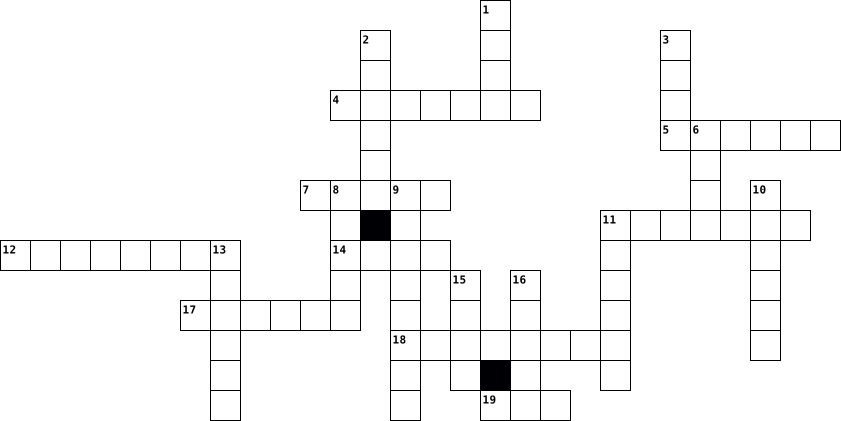
Across
- Day time is the_____in summer and the shortest in winter and spring and fall have the same number of daylight hours
- Stars shine by giving off ______ that spreads in different directions.
- We have weight depending on how much____of gravity is on us
- As the moon moves around the earth the sunlight and that's why we have different moon phases
- In the winter the sun is more______so the shadows point more north.
- What color are hot stars?
- The moon_____always has one side dark and one side light.
- The to sun from the earth is not the cause of the seasons.
- What color are cold stars
Down
- As the earth rotates around on it's_____it takes 24 hours which makes the day and night.
- the sun is brighter than other stars because it's ____.
- The moon changes_______depending on how much light from the sun is blocked out from the earth.
- At______an object's shadow is shortest but as the sun moves the sun makes the shadows get longer.
- The sun has a gravity that gravity is keeps the earth in the ____ of the sun's.
- What is the GD mascot
- Gravity pulls us to the _____ of the earth's
- Seasons are by indirect or direct sunlight.
- Different parts of the earth are______to the sun during different when one side is closer it’s summer.
- Shawdos in the summer point to the east and .
- There are 6 time zones in the USA each time zone is based on the of the sun.
20 Clues: What is the GD mascot • What color are hot stars? • What color are cold stars • Gravity pulls us to the _____ of the earth's • Seasons are by indirect or direct sunlight. • Shawdos in the summer point to the east and . • the sun is brighter than other stars because it's ____. • The moon_____always has one side dark and one side light. • ...
Chapter 4 Vocabulary 2024-10-16

Across
- the path an object takes as it moves around another object
- to turn
- the time it takes the Moon to go through all of its phases
Down
- to move around another object
- a line through the center of a spinning object
- the shape of the moon that we see
6 Clues: to turn • to move around another object • the shape of the moon that we see • a line through the center of a spinning object • the path an object takes as it moves around another object • the time it takes the Moon to go through all of its phases
Death of the Moon 2022-05-11

Across
- Damien's favorite beverage.
- One of Death of the Moon's tropes. Two words.
Down
- Alec is one.
- Its phases empower werecreatures.
- Damien's job.
- Fox shifter with up to nine tails.
6 Clues: Alec is one. • Damien's job. • Damien's favorite beverage. • Its phases empower werecreatures. • Fox shifter with up to nine tails. • One of Death of the Moon's tropes. Two words.
unit 3 vocab 2016-11-30

Across
- spin of a body on an axis
- what time of day do you see the sun
- division of s year that is characterized by reoccurring weather
- natural or artificial body that revolves around a bigger body of gas
Down
- ,a force that pulls you to earth
- ,the phases of the moon that can be seen from earth
- tide that happens on the first and third quarter the moon
7 Clues: spin of a body on an axis • ,a force that pulls you to earth • what time of day do you see the sun • ,the phases of the moon that can be seen from earth • tide that happens on the first and third quarter the moon • division of s year that is characterized by reoccurring weather • natural or artificial body that revolves around a bigger body of gas
'Tis the Season to Learn About Space 2025-12-02

Across
- Sky – What we see above Earth at night, including stars, the Moon, and planets.
- Moon – When the lit part of the Moon is getting larger each night.
- Planet – A small, rocky planet like Earth, Venus, Mars, or Mercury.
- Quarter – The phase when half of the Moon’s face is lit on the left side.
- The movement of Earth around the Sun that takes about one year.
- The spinning of Earth on its axis that causes day and night.
- Belt – A region beyond Neptune filled with icy objects and dwarf planets.
- – The phase when more than half, but not all, of the Moon’s face is lit.
- The middle of the day when the Sun is highest in the sky and shadows are shortest.
- System – The Sun and all the planets, moons, and other objects that orbit it.
- – The force that pulls objects toward each other.
- of Light: The direction or tilt at which light hits an object.
- – The shape of the lit part of the Moon seen from Earth.
- – A push or pull that can change an object’s motion.
- The direction on Earth toward the South Pole.
- An imaginary line through Earth that it spins around.
- – The curved shape of the Moon when only a thin slice is lit.
- The time of day when the Sun is moving lower in the west and shadows point east.
Down
- Quarter – The phase when half of the Moon’s surface facing Earth is lit and appears on the right side.
- The direction where the Sun sets.
- The path one object takes as it moves around another in space.
- Directions: The four main directions on a compass (north, south, east, and west).
- Cycle – The repeating pattern of Moon phases that lasts about 29 days.
- – A huge ball of hot gases that gives off light and heat.
- – A natural object that orbits a planet.
- Moon – When the lit part of the Moon is getting smaller each night.
- The direction where the Sun rises.
- Moon – The phase when the Moon’s lit side faces away from Earth.
- – A group of stars that forms a pattern in the sky.
- The line where Earth and the sky seem to meet.
- – A large body that orbits a star and does not make its own light.
- The direction on Earth toward the North Pole.
- Rose: A symbol that shows directions on a map.
- Giant – A large planet made mostly of gas (Jupiter, Saturn, Uranus, Neptune).
- Source: An object that gives off light, such as the Sun or a lamp.
- The time when the Sun appears in the sky in the morning.
- A dark shape made when light is blocked by an object.
- The time of day when the Sun is rising and shadows are long and point west.
- The time when the Sun disappears below the horizon in the evening.
- Moon – The phase when the entire face of the Moon is lit.
40 Clues: The direction where the Sun sets. • The direction where the Sun rises. • – A natural object that orbits a planet. • The direction on Earth toward the North Pole. • The direction on Earth toward the South Pole. • The line where Earth and the sky seem to meet. • Rose: A symbol that shows directions on a map. • – The force that pulls objects toward each other. • ...
Sky Science Terms 2023-11-03

Across
- The sun and all of the bodies - planets, satellites, asteroids, comets, etc. that orbit around it
- Everything that exists: the earth, the sun, the moon, satellite, asteroids, all the galaxies and the space between them
- Chunks of rock that vary in size. They orbit the sun between the orbits of Mars and Jupiter
- The motion of a planet, satellite, or the sun around its axis
- a bright star known as the North Star or Polaris, that appears in the northern hemisphere
- When meteoroid enters the earth's atmosphere creating a streak of light
- A man-made or heavenly body that orbits around a larger object
- Bright stars grouped according to the patterns they make in the sky
- Meteors that fall to the surface of the earth
- A straight line that an object or body rotates around or seems to rotate around
- Objects that send or give out light
- The four hard rocky planets (Mercury, Venus, Earth, Mars) closest to the sun
- The time it takes for the moon to go around the earth
- The motion of a planet along its orbit around the sun
- Objects that reflect light
- Stars that form patterns but are generally part of a constellation
- A phase in the moon's cycle where more than half of the moon, but not the entire face of the moon is illuminated
- When the moon gradually becomes less illuminated from a full moon to a new moon
Down
- When the moon moves in front of the sun, partially or completely blocking it
- The area between the inner and outer planets that is filled with asteroids
- The time it takes for the moon to complete all of its phases
- When the moon grows gradually more illuminated from a new moon to a full moon
- These rocks, usually not much bigger than grains of sand, may have been swept off asteroids or comets. They also orbit the sun, sometimes entering the earth's atmosphere
- Once a year the sun reaches its highest and lowest points in the northern hemisphere
- The name of the satellite that orbits the earth
- constellations that are visible in the Northern Hemisphere throughout earth's revolution around the sun
- The closest star to the earth, measuring more than a million kilometers away
- A gaseous body that produces its own energy through nuclear fusion, releasing it as light and heat
- When the moon moves into the earth's shadow preventing sunlight from falling onto the moon's surface
- Large bodies that can only be seen by reflected light, as they revolve around the sun
- A large ball of ice, dust, rock and gas that orbits the sun circling the dark edges of the solar system
- An imaginary circle around the centre of the earth
- The four giant gaseous planets (Jupiter, Saturn, Uranus, Neptune) that orbit the sun
- Twice each year when the sun crosses the celestial equator, when day and night are of equal length
- A cycle which the moon appears in different forms as it revolves around the earth
- The study of the Universe and all bodies (stars, planets, comets, galaxies) that appear in the sky
- a scale used to measure the brightness of stars and other objects in the sky
- A spiral island of stars in space. Our galaxy is called the Milky Way
- The time it takes for a planet to orbit all the way around the sun. It takes 365 days for the earth to orbit around the sun
- The phase of the moon when less than half of the moon is illuminated
40 Clues: Objects that reflect light • Objects that send or give out light • Meteors that fall to the surface of the earth • The name of the satellite that orbits the earth • An imaginary circle around the centre of the earth • The time it takes for the moon to go around the earth • The motion of a planet along its orbit around the sun • ...
3rd Grade Vocabulary 2025-03-05

Across
- a very thin, often pointed piece of something
- exact or particular
- scattered pieces of waste or remains
- a number of similar things coming one after another
- to turn on an axis
Down
- unable to be seen
- the different stages of the moon
- a person who studies the stars and planets
- a curve that is wider in the middle and tapered at the ends
9 Clues: unable to be seen • to turn on an axis • exact or particular • the different stages of the moon • scattered pieces of waste or remains • a person who studies the stars and planets • a very thin, often pointed piece of something • a number of similar things coming one after another • a curve that is wider in the middle and tapered at the ends
Physics 2025-11-17

Across
- Regions where the field lines are parallel and evenly spaced, indicating the field strength and direction are constant at all points within that region (though this is an idealization, as gravity fields are typically radial).
- An event where Earth passes between the Sun and the Moon, casting a shadow on the Moon.
- An event where the Moon passes between the Sun and Earth, blocking all or part of the Sun's light.
- The time it takes the Moon to complete one orbit around Earth with respect to the fixed stars, approximately 27.3 days.
- An Earth-centered orbit with an orbital period matching Earth's rotation on its axis (one sidereal day).
- A closed, oval-shaped curve, which is the shape of planetary orbits according to Kepler's first law.
- A phenomenon where two orbiting bodies exert a regular, periodic gravitational influence on each other, usually because their orbital periods are related by a simple integer ratio.
- A type of eclipse where the celestial body is completely obscured.
- A vector field used to explain the influence a body extends into the space around itself, measured in units of newtons per kilogram (N/kg) or m/s².
- The time period of the Moon's phases, from new moon to new moon, averaging about 29.5 days.
- A physical quantity that has a value (magnitude and direction) for each point in space and time, used to explain influences like gravity.
- Law of Universal Gravitation: A law stating that every object attracts every other object with a force proportional to the product of their masses and inversely proportional to the square of the distance between them.
Down
- A scientific law stating that the intensity of a physical quantity is inversely proportional to the square of the distance from its source.
- A type of eclipse where only part of the celestial body is obscured.
- An imaginary curve used as a visual aid to represent a vector field, tangent to the field vector at each point along its length.
- A solar eclipse in which the Moon is too far from Earth to completely cover the Sun, resulting in a "ring of fire" effect.
- The universal empirical physical constant, denoted by the capital letter G, that determines the strength of the gravitational field.
- The force of attraction between any two masses in the universe.
- The curved path of a celestial object (such as a planet or satellite) around a star, planet, or moon.
- A measure of how much an ellipse deviates from a perfect circle; a value of 0 is a circle.
20 Clues: The force of attraction between any two masses in the universe. • A type of eclipse where the celestial body is completely obscured. • A type of eclipse where only part of the celestial body is obscured. • An event where Earth passes between the Sun and the Moon, casting a shadow on the Moon. • ...
Earth-Moon 2025-11-06

Across
- When the earth faces the sun, it is______.
- The moon _______ around the Earth, causing the Moon Phases.
- It takes the Earth 24 hours to complete a full _______.
Down
- The middle of the Earth is called the _________.
- The Earth is cut into two ____________, a North and South.
- The _______ is the imaginary line that the Earth spins around.
- When the Earth faces away from the Sun, it is______.
7 Clues: When the earth faces the sun, it is______. • The middle of the Earth is called the _________. • When the Earth faces away from the Sun, it is______. • It takes the Earth 24 hours to complete a full _______. • The Earth is cut into two ____________, a North and South. • The moon _______ around the Earth, causing the Moon Phases. • ...
Astronomy 2020 2020-11-19

Across
- The moon phases we see when 3/4th of the moon is showing.
- The scientist that came up with gravity and inertia.
- The planet that is red.
- The earth ____ around the sun once each year.
- The earth has day and night because it ____ on its axis.
- What eclipse occurs when the Moon is in between the Sun and the Earth? (HINT: you saw this one)
- The scientist that took careful observations for over 20 years.
- The changing angles of the Sun, Moon, and Earth cause the moon to change?
- A Greek scientist that believed in geocentric theories.
- The innermost layer of the Sun’s atmosphere, we see it as light.
- The planet with the large rings.
- The theory that everything revolves around the earth.
- The largest planet.
- The planet with the greatest temperature change, this is also the closest planet to the Sun.
- The planet with 70% water.
- The planet that has a thick layer of poisonous atmosphere making it appear always cloudy.
- the scientist that was good at math and show that the orbits of the planets were ellipses.
- The tide with the greatest difference between low and high, occurs during a full and new moon.
- The line that runs thru the earth at a 23.5-degree angle.
- The scientist that came up with the idea of heliocentric.
- When the Earth is neither tilted towards or away from the sun we in Nebraska have what season(HINT: we are in this
- The planet we found using math.
- When the earth has rotated 1 time on its axis how much time has passed?
- The nuclear reaction that creates energy on the sun by combining two hydrogen atoms into one helium atom.
- The Earth has seasons because it is ____ on its axis.
- The scientist that proved heliocentric,
Down
- The name for the outer planets
- The theory that everything revolves around the sun.
- The gases that shoot out of the sun.
- How many months does it take for the Earth to revolve around the sun once?
- The middle layer of the Sun’s atmosphere, we see it as color.
- The tide with the least difference between low and high occurs during a quarter moon phase.
- The halo around the sun, the outer layer of the Sun’s atmosphere.
- The cooler dark spots on the Sun.
- The two forces that keep the planets orbiting around the sun.
- The moon phase we see when 1/4th of the moon is showing.
- What eclipse occurs when the Earth is in between the Sun and the Moon?
- Loops of gas that connect sunspots on the surface of the sun.
- The planet that rotates on its side.
- The moon phase we see when half of the moon is showing.
- The main characteristic of all the inner planets.
- now?
- The pull of the moon's ____ is what causes the tides on earth.
- When the Earth is tilted towards the sun Nebraska has what season?
- The center of the sun.
45 Clues: now? • The largest planet. • The center of the sun. • The planet that is red. • The planet with 70% water. • The name for the outer planets • The planet we found using math. • The planet with the large rings. • The cooler dark spots on the Sun. • The gases that shoot out of the sun. • The planet that rotates on its side. • The scientist that proved heliocentric, • ...
Earth Science SOL words 2023-04-24

Across
- tides tides during quarter phases
- virginia's main resource
- fastest earthquake wave
- age of ancient sea-life
- graduated cylinder volume
- layer of atmosphere at bottom weather
- liquid layer inside
- one year
- dating rock,fossil to an age
- moving sediments to another place
- mass volume
- cold currents coming UP
- measures air pressure
- solid planets
- heat and pressure
- moon gravity
- front front with triangles
- caused by the tilt
- layer of soil
- organics
- fizzes in HCL
- all continents together
- day and night
- compaction cementation
- break down
- age of mammals
- inside magma
- side to side earthquake wave
Down
- spectral showing moving away
- missions by nasa to moon
- outside lava
- warm rising cold falling
- breaks with smooth planes
- limestone geology
- dating but just in order
- temperature where water condenses
- compression volcano mountains
- shearing side by side
- distance light travels one year
- oldest on bottom
- remnant of a super-massive star
- luster cleavage hardness
- zone of empty spaces
- outer layer of sun, charged particles
- graph of stars magnitude vs color
- age of dinosaur
- ocean salt content
- tides tides during full,new moon
- fossil short lived wide spread fossil
- focus epicenter
- spreading rifting ridge
- zone of filled spaces
- milky way is this type of galaxy
- igneous metamorphic sedimentary
- cloud of gas and dust
55 Clues: one year • organics • break down • mass volume • outside lava • moon gravity • inside magma • solid planets • layer of soil • fizzes in HCL • day and night • age of mammals • age of dinosaur • focus epicenter • oldest on bottom • limestone geology • heat and pressure • ocean salt content • caused by the tilt • liquid layer inside • zone of empty spaces • shearing side by side • measures air pressure • ...
9.11 spelling 2025-03-06

Across
- Kristin heated up her food in the _______.
- Amit got the author's_______ in his book
- Miguel plays the _______.
- We learned about genes in ________ class.
- McKayla wrote a _________ about the play.
- Mia took a _________ of her mom.
- Poppy made announcements through a _____ so everyone could hear.
- _______ is how plants convert sunlight to energy.
- Dela made a __________ of the document.
- Dorothy called Declan on the
Down
- A _______ for two is too.
- A word and its ________ are spelled the same.
- Ariel uses a special pen to do ________.
- Cody read a _______ of MLK jr.
- Albert enjoyed listening to the ________.
- A _____ magnifies things
- People sent messages by ________ before they had computers and smartphones.
- A ________ is a musical instrument.
- Galileo used a _______ to observe the phases of the moon.
19 Clues: A _____ magnifies things • A _______ for two is too. • Miguel plays the _______. • Dorothy called Declan on the • Cody read a _______ of MLK jr. • Mia took a _________ of her mom. • A ________ is a musical instrument. • Dela made a __________ of the document. • Amit got the author's_______ in his book • Ariel uses a special pen to do ________. • ...
Earth and Space Science 2023-12-15

Across
- phases (wax, wane, gibbous, full, quarter, half)
- pressure
- cycle
- pressure
Down
- stratus, cumulus, cirrostratus)
- disasters
6 Clues: cycle • pressure • pressure • disasters • stratus, cumulus, cirrostratus) • phases (wax, wane, gibbous, full, quarter, half)
Science 3 2024-12-30

Across
- – A liquid we need to survive.
- – An element found in all living things.
- – A simple machine used to lift things.
- – Vibrations you can hear.
- – A simple machine used to lift or move objects.
- – A giant group of stars, like the Milky Way.
- – The changing shapes of the Moon in the sky.
- – Relating to the Moon.
- – The huge, endless area beyond Earth.
- – A seed from an oak tree.
- – A group of cells that work together in the body.
- – The most common gas in the air.
- – Water droplets floating in the sky.
- – A part of the body that has a special job, like the heart.
- – A cold, treeless land where plants grow low.
- – Tubes that carry blood back to the heart.
- – A layer of gas protecting Earth from the Sun.
Down
- – A tiny particle inside atoms.
- – A state of matter like gas but supercharged.
- – A solid with shiny, flat surfaces and a unique shape.
- – A huge reptile that lived long ago.
- – What helps us see and travels super fast.
- – When the Sun or Moon is hidden for a while.
- – A substance made of two or more elements.
- – A mountain that can erupt with lava.
- – A glass object that makes rainbows.
- – The planet we live on.
- – A planet and a liquid metal.
- – Powder from flowers that helps make seeds.
- – When wind or water wears rocks away.
30 Clues: – Relating to the Moon. • – The planet we live on. • – Vibrations you can hear. • – A seed from an oak tree. • – A liquid we need to survive. • – A planet and a liquid metal. • – A tiny particle inside atoms. • – The most common gas in the air. • – A huge reptile that lived long ago. • – A glass object that makes rainbows. • – Water droplets floating in the sky. • ...
Earth and Space Science 2023-12-15

Across
- phases (wax, wane, gibbous, full, quarter, half)
- pressure
- cycle
- pressure
Down
- stratus, cumulus, cirrostratus)
- disasters
6 Clues: cycle • pressure • pressure • disasters • stratus, cumulus, cirrostratus) • phases (wax, wane, gibbous, full, quarter, half)
Earth and Sun Investigation 2 2024-10-29

Across
- A natural or artificial object that orbits a planet; the Moon is Earth’s natural satellite.
- The group of four rocky planets closest to the Sun: Mercury, Venus, Earth, and Mars.
- An important astronomer known for his contributions to the study of the stars and planets, including the use of the telescope.
- The act of watching and noting the characteristics or behaviors of objects or events.
Down
- An event where one celestial body moves into the shadow of another celestial body, blocking its light.
- Large planets that are mostly composed of gases; these include Jupiter, Saturn, Uranus, and Neptune.
- Icy objects that release gas or dust, forming a glowing coma and tail when close to the Sun.
- A group of stars that form a recognizable pattern in the night sky, often named after mythological figures or objects.
- An instrument that makes distant objects in space appear closer and clearer, used by astronomers to observe celestial bodies.
- Small rocky objects that orbit the Sun, mainly found in the asteroid belt between Mars and Jupiter.
- The path an object takes as it moves around another object in space, such as planets around the Sun.
- The shape of the illuminated portion of the Moon as seen from Earth, which changes over time.
- The sequence of phases that the Moon goes through in approximately 29.5 days, from new moon to full moon and back.
13 Clues: The group of four rocky planets closest to the Sun: Mercury, Venus, Earth, and Mars. • The act of watching and noting the characteristics or behaviors of objects or events. • A natural or artificial object that orbits a planet; the Moon is Earth’s natural satellite. • ...
6th Grade Science Final 2020-05-10

Across
- a solid chemical compound that combines to create rocks
- the study of the earth
- the boundary when two plates slide past each other
- scientist which hypothesized the continental drift theory
- Planets made of hydrogen and helium, second most massive
Down
- preserved remains of once-living things
- when water vapor turns into liquid water
- process of sediment stopping after being transported
- currents that move hot material up and cold material down
- the phases of moon which show more light
- the day-to-day description of the environment
- melted rock inside of a volcano
12 Clues: the study of the earth • melted rock inside of a volcano • preserved remains of once-living things • when water vapor turns into liquid water • the phases of moon which show more light • the day-to-day description of the environment • the boundary when two plates slide past each other • process of sediment stopping after being transported • ...
moon 2023-02-28

Across
- orbit
- sun blocked
- going in shadow
- dark colored lava filled craters
- causes day and night
- barely noticeable
- hole from something impacting a space body
- extra high-high tide(new and full)
- light colored,old and created lava filling cratered areas
Down
- shrinking(left)
- darkest shadow
- moon blocked
- causes the seasons
- lightest shoadow
- a small planet collided with earth
- patterns of weather
- maximum and minimum hours of sunlight
- growing(right)
- imaginary line through poles
19 Clues: orbit • sun blocked • moon blocked • darkest shadow • growing(right) • shrinking(left) • going in shadow • lightest shoadow • barely noticeable • causes the seasons • patterns of weather • causes day and night • imaginary line through poles • dark colored lava filled craters • a small planet collided with earth • extra high-high tide(new and full) • maximum and minimum hours of sunlight • ...
Planets vocabulary 2016-11-08

Across
- Tide- Tide range that occurs two times a month with mean two new moons.
- artificial body that revolves around a celestial body.
- The spin of the body of the axis.
- For the earth to orbit once around the sun.
- how long it takes Earth to rotate on its axis.
Down
- Phases- The different's between the earth and moon each month.
- force of attraction between to objects.
- When the sun appears to cross the celestial equator.
- a division of the year that is characterized by reoccurring weather conditions and determined by both the Earth’s tilt.
- Sun is as far north or as far south of the equator as possible.
- Tide- The tide range during first quarter and third quarter of the moon.
11 Clues: The spin of the body of the axis. • force of attraction between to objects. • For the earth to orbit once around the sun. • how long it takes Earth to rotate on its axis. • When the sun appears to cross the celestial equator. • artificial body that revolves around a celestial body. • Phases- The different's between the earth and moon each month. • ...
Science 2022-11-03

Across
- Freezing
- sublimation
- Solid
- Phases
- Melting
- condensation
Down
- Liquid
- tevaportaion
- Gas
- Boiling
- Vaporize
- Atoms
12 Clues: Gas • Solid • Atoms • Liquid • Phases • Boiling • Melting • Freezing • Vaporize • sublimation • tevaportaion • condensation
Unit 5: Celebrations 2025-11-26

Across
- That trip is my favourite __________.
- A __________ follows the phases of the moon.
- We saw a __________ with a big costume and loud drums.
- I ate a sweet __________ with my family.
- Tet is an important __________ in Vietnam.
- The balloons were very __________.
- We watched a bright __________ in the night sky.
Down
- She bought some colour __________ for the art activity.
- The __________ is celebrated in the eighth lunar month.
- The town had a long __________ with music.
- Children like to __________ balls in the playground.
- The school had a big __________ for Teachers’ Day.
- He carried a small red __________ at the party.
13 Clues: The balloons were very __________. • That trip is my favourite __________. • I ate a sweet __________ with my family. • The town had a long __________ with music. • Tet is an important __________ in Vietnam. • A __________ follows the phases of the moon. • He carried a small red __________ at the party. • We watched a bright __________ in the night sky. • ...
Energy from the Sun 2024-03-13

Across
- Energy from the sun that helps us stay warm
- The layer of gases that are around the Earth
- All living things on Earth
- All of the water on Earth
Down
- Energy from the sun that helps us see
- Gets energy from the sun, food for animals
- Giving the power to do something
- Object in the sky, different phases that change each day
- Process of plants getting energy from the Sun
- 93 million miles away from Earth
- Rocks, minerals, and the ground
11 Clues: All of the water on Earth • All living things on Earth • Rocks, minerals, and the ground • Giving the power to do something • 93 million miles away from Earth • Energy from the sun that helps us see • Gets energy from the sun, food for animals • Energy from the sun that helps us stay warm • The layer of gases that are around the Earth • ...
The Galactic Crossword Puzzle! :D 2025-02-18

Across
- The galaxy our Solar System is in.
- A big cloud of dust and rock in space
- The largest dwarf planet (not Pluto!)
- The hottest planet in the Solar System
- The Largest Star (Remember numbers and hyphen!)
- The closest planet to the Sun
- Has multiple phases and orbits Earth
- What the Earth revolves around
- The closest star to the Sun
Down
- The only known planet with life
- The planet with only 2 moons
- An object that is in the center of galaxies
- The farthest planet from the Sun
- The largest planet in the Solar System
- The largest black hole (Don't Forget numbers!)
- Rains diamonds and is on its side
- The outer most boundary of the Solar System
17 Clues: The closest star to the Sun • The planet with only 2 moons • The closest planet to the Sun • What the Earth revolves around • The only known planet with life • The farthest planet from the Sun • Rains diamonds and is on its side • The galaxy our Solar System is in. • Has multiple phases and orbits Earth • A big cloud of dust and rock in space • ...
Science Vocabulary 2018-02-07

Across
- SPINS AROUND AN IMAGINARY LINE
- WATER IN THE FORM OF A GAS
- A GROUP OF STARS THAT FORM A PICTURE
- TO GO INTO A DEEP SLEEP
- THE SUN AND THE SPACE OBJECTS THAT MOVE AROUND IT
- TO MOVE WARMER PLACES IN THE FALL
Down
- THE DIFFERENT WAYS THE MOON LOOKS
- CHANGES TO GAS
- WATER THAT FALLS FROM THE SKY
- CHANGES FROM WATER VAPOR TO DROPS OF WATER
- WATER MOVING FROM EARTH TO THE AIR AND BACK AGAIN
- TO MOVE IN A PATH AROUND AN OBJECT
12 Clues: CHANGES TO GAS • TO GO INTO A DEEP SLEEP • WATER IN THE FORM OF A GAS • WATER THAT FALLS FROM THE SKY • SPINS AROUND AN IMAGINARY LINE • THE DIFFERENT WAYS THE MOON LOOKS • TO MOVE WARMER PLACES IN THE FALL • TO MOVE IN A PATH AROUND AN OBJECT • A GROUP OF STARS THAT FORM A PICTURE • CHANGES FROM WATER VAPOR TO DROPS OF WATER • WATER MOVING FROM EARTH TO THE AIR AND BACK AGAIN • ...
many different science things 2024-10-25

Across
- holds things in orbit. And is also strong and also think newton
- vs revolution: one spins around stuff. And the other revolves around stuff
- they are old and you have to dig them up. Also the remains of something
Down
- there is winter spring fall and Summer. Also earths tilt causes them
- goes dark for a couple minutes. And cant happen every month
- vs outer: one is a gas giant. And the other is nicknamed Jovian there are only two
- phases: there is a new moon and a full moon. And many different ones
- of superposition: they are related to fossils. And have lots of lairs some are rocks
8 Clues: goes dark for a couple minutes. And cant happen every month • holds things in orbit. And is also strong and also think newton • there is winter spring fall and Summer. Also earths tilt causes them • phases: there is a new moon and a full moon. And many different ones • they are old and you have to dig them up. Also the remains of something • ...
Questions for The Eclipse 2024-04-09

Across
- During a total solar eclipse, which red layer of the Sun's atmosphere can be seen?
- The darkest part of the Earth's shadow during an eclipse is called the what?
- What is the name of the Sun's outer atmosphere, which is visible during a total solar eclipse?
- The astronomical alignment of three celestial bodies in a straight line, especially during an eclipse, is called what?
- What type of eclipse occurs when the Sun and Moon are exactly in line, but the apparent size of the Moon is smaller than that of the Sun?
- Where the eclipse is visible on the Earth's surface, it's called the path of what?
- What type of eclipse occurs when the Earth passes between the Sun and the Moon?
- Beads The phenomenon where spots of light appear around the Moon's edge just before and after totality is known as what?
Down
- How often do total solar eclipses occur at any given place on Earth's surface?
- The part of the Earth's shadow that causes a partial eclipse is called the what?
- What is the term for the period over which eclipses repeat, approximately every 18 years?
- During an eclipse, the period when the Sun or Moon is completely obscured is known as what?
- What type of eclipse occurs when the Moon passes between the Earth and the Sun?
- The Moon's ____ are the regular changes in its appearance due to its position relative to Earth and the Sun.
- What kind of "ring" effect is visible just before and after a total solar eclipse?
15 Clues: The darkest part of the Earth's shadow during an eclipse is called the what? • How often do total solar eclipses occur at any given place on Earth's surface? • What type of eclipse occurs when the Moon passes between the Earth and the Sun? • What type of eclipse occurs when the Earth passes between the Sun and the Moon? • ...
Choice Board 3 Jacob Spence 2023-05-13

Across
- Object will not change motion unless a force acts on it.
- When all the continents were together.
- A chart of all the elements
- The moon goes through these phases.
- causes seasons because of the rotation.
- The substance's mass per unit of volume.
- A bunch of food chains put together.
- What the news tells us the day will be like.
- This is what holds us to earth.
Down
- When the earth spins on its axis.
- This is the energy that has not been used.
- This is at the center of our solar system.
12 Clues: A chart of all the elements • This is what holds us to earth. • When the earth spins on its axis. • The moon goes through these phases. • A bunch of food chains put together. • When all the continents were together. • causes seasons because of the rotation. • The substance's mass per unit of volume. • This is the energy that has not been used. • ...
vocab 3 science 2016-11-04

Across
- a force of attraction between two objects due to their masses
- a division of the year that is characterized by reoccurring weather conditions and determined by both the Earth's tilt relative to the sun and the Earth's position in its orbit around the sun
- phases the different appearances to the moon from Earth throughout the moon
- the spin of a body on its axis
- tide a tide of minimum range the occurs during the first and third quarters of the moon
Down
- a natural or artificial that revolves around a celestial body that is greater in mass
- the time required for Earth to orbit once around the sun
- the time for Earth to rotate once on its axis
- the point at
- tide a tide of increased range that occurs two times a month, at the new and full moons
10 Clues: the point at • the spin of a body on its axis • the time for Earth to rotate once on its axis • the time required for Earth to orbit once around the sun • a force of attraction between two objects due to their masses • phases the different appearances to the moon from Earth throughout the moon • ...
Science 2023-12-14

Across
- The dark colored areas of low, flat plains of lava on the moon are called
- The force that one surface exerts on another when the two rub against each other is called
- The force of gravity on a person or object on the surface of the planet is called
- If the Northern Hemisphere is tilted toward the sun, what season will be experienced there?
- The name of the imaginary line that passes from the North Pole to the South Pole is called the
- The different shapes of the moon that we see are called
- In physical science, a push or a pull is called
Down
- If the Northern Hemisphere is tilted away from the sun, what season will be experienced there?
- How long does it take the moon to revolve around the Earth?
- How many planets are currently part of our solar system?
- The greater the mass of an object,the greater its
- What is the most important star for life on Earth?
- What is the shape of Earth’s orbit called?
- The amount of matter in an object is called
- The force that pulls falling objects toward Earth is called
- When an object in space comes between the sun and a third object, it casts a shadow on the third object causing a(an)
16 Clues: What is the shape of Earth’s orbit called? • The amount of matter in an object is called • In physical science, a push or a pull is called • The greater the mass of an object,the greater its • What is the most important star for life on Earth? • The different shapes of the moon that we see are called • How many planets are currently part of our solar system? • ...
Benchmark Vocabulary Review 2026-05-15

Across
- when the Earth spins along its axis (24 hours)
- less than half of a circle
- the tendency of an object to resist changes in its velocity
- an imaginary line about which an object spins or rotates
- Phases parts of the moon that are lit up as it orbits the Earth
- Eclipse Moon gets blocked by the Earth
- increasing in size, getting bigger (right side seen)
- the shape of Earth’s orbit around the sun (like an oval)
- forces that are unequal (they always cause a change in position)
Down
- a force that opposes motion-it slows things down
- when the Earth goes around the Sun (365 days)
- a unit of force
- Pattern a pattern that happens over and over again, can be predicted
- decreasing in size, getting smaller (left side seen)
- forces that are equal in size but opposite in direction (does not cause a change in motion)
- when an object blocks the view of another object
- Eclipse Sun gets blocked by the Moon
- greater than half of a circle, but less than a full circle
18 Clues: a unit of force • less than half of a circle • Eclipse Sun gets blocked by the Moon • Eclipse Moon gets blocked by the Earth • when the Earth goes around the Sun (365 days) • when the Earth spins along its axis (24 hours) • a force that opposes motion-it slows things down • when an object blocks the view of another object • ...
HW #17/18 2019-11-05

Across
- the proeutectoid phase of a hypereutectoid for the iron-carbon phase diagram
- area under stress strain curve
- solid phase above the eutectoid
- pearlite thin lamellar layered steel
- cooling happening in ten's of seconds
- diamonds are not forever
- one solid phase transforms to two solid phases
- one liquid phase to two solid phases
- supercooled austenite
- the proeutectoid phase of a hypoeutectiod for the iron-carbon phase diagram
Down
- austenite when cooled very slowly becomes this
- the barrier line between liquid phase and liquid + solid phases
- moderately cooling austenite
- the growth of nuclei crystals
- solid phase below the eutectoid
- point before permanent deformation
- reheated martensite
- the ability of a metal to plastically deform
- used to form pearlite
- base structure of the metal
20 Clues: reheated martensite • used to form pearlite • supercooled austenite • diamonds are not forever • base structure of the metal • moderately cooling austenite • the growth of nuclei crystals • area under stress strain curve • solid phase below the eutectoid • solid phase above the eutectoid • point before permanent deformation • pearlite thin lamellar layered steel • ...
How Well Do You Know Jumpstart & Your Colleagues? 2025-07-17

Across
- Where Casey Lives
- Maria and Ryan's Son
- Jumpstart's visions is to instill a culture of _______ and human performance at work
- Own your _______
- What happens every Weds. morn
- Jumpstart offers Project and _____ Packages to its clients
- ________on the job - What Liz's EE's are infamous for
- Popular Service Jumpstart offers that includes vetting and interviewing
- Part Coach, Part _____
- The _____ of HR, by Joey Price
Down
- Jumpstart prides itself on delivering ______ service to its clients
- High, Low _____________
- Netflix show filmed at Suchada's hotel in Mexico
- The name of Bria's Cat
- Forward and ___ beats slow and static
- The number of Joey's Mini Me's
- Tami's Speciality
- The name of Amber's Favorite Payroll System
- Bring clarity from the _____
- While We Were ______________, Jumpstart's podcast.
- Shay believes _____ phases impact human behavior?
- __________Team
22 Clues: __________Team • Own your _______ • Where Casey Lives • Tami's Speciality • Maria and Ryan's Son • The name of Bria's Cat • Part Coach, Part _____ • High, Low _____________ • Bring clarity from the _____ • What happens every Weds. morn • The number of Joey's Mini Me's • The _____ of HR, by Joey Price • Forward and ___ beats slow and static • The name of Amber's Favorite Payroll System • ...
n 2025-09-04

Across
- most active during the day
- multiple rhythms that must occur simultaneously
- activity linked to high and low tide
- activity linked moon phases
- most active at night
Down
- most active at dusk and dawn
- a rhythm that lasts approximately 1 year under constant environmental conditions
- a rhythm that lasts approximately 24 hours under constant environmental conditions
8 Clues: most active at night • most active during the day • activity linked moon phases • most active at dusk and dawn • activity linked to high and low tide • multiple rhythms that must occur simultaneously • a rhythm that lasts approximately 1 year under constant environmental conditions • a rhythm that lasts approximately 24 hours under constant environmental conditions
Science Vocab 2025-01-13

Across
- occurring every day
- Electromagnetic or light waves from space that are bent
- when light or energy passes through a medium
- commonly referred to as the north star
- The force of gravity; to pull objects with mass towards each Other
- Determined by or resembling a moon.
- Having to do with the sun or sunlight
Down
- thinking of something in a different way
- A distinct period or stage in series of events
- Accumulation of particles into a massive object
- to happen once a year
- regularity in the world
- An astronomical even where an object is blocked by another object
- The circular movement of an object around another object
14 Clues: occurring every day • to happen once a year • regularity in the world • Determined by or resembling a moon. • Having to do with the sun or sunlight • commonly referred to as the north star • thinking of something in a different way • when light or energy passes through a medium • A distinct period or stage in series of events • Accumulation of particles into a massive object • ...
Mind & Mettle 2023-12-23

Across
- Most abundant gas in Earth’s atmosphere
- Killer whales are actually ________.
- Biggest producer of oxygen on Earth.
- Largest desert in the world
Down
- Most common mineral on Earth
- These type of clouds are the most fluffy and can be seen on sunny days.
- Polar bear’s fur is originally ________.
- How many phases does the moon go through every 29.5 days?
- Smallest bone in the human body
- Helium changes our voice because of its ________.
10 Clues: Largest desert in the world • Most common mineral on Earth • Smallest bone in the human body • Killer whales are actually ________. • Biggest producer of oxygen on Earth. • Most abundant gas in Earth’s atmosphere • Polar bear’s fur is originally ________. • Helium changes our voice because of its ________. • How many phases does the moon go through every 29.5 days? • ...
DreamCatcher History 2024-09-12

Across
- HOW MANY PARTS TO A DREAMCATCHER
- HOW MANY POINTS REPRESENT THE PHASES OF THE MOON
- HOW MANY GRANDFATHERS ARE THERE
- ARE USED TO REPRESENT THE SPIDER IN THE WEB AND REPRESENT GOOD DREAMS
- WHAT REPRESENTS THE CIRCLE OF LIFE
- ASABIKESHINH AKA ______TOOK CARE OF THE CHILDREN
- THE OJIBWE WORD FOR DREAMCATCHER
Down
- THE WEB ACTS AS A _____ TO CATCH BAD DREAMS AND LET GOOD DREAMS GO THROUGH
- SYMBOLIZE PROTECTION AND HEALING
- THE DREAMCATCHER TRAPS WHAT KIND OF DREAMS
- REPRESENTS 6 POINTS ON A DREAMCATCHER
- DREAMCATCHERS BRING ________ TO THE SLEEPER
- PURPOSE IS TO CATCH BAD DREAMS
13 Clues: PURPOSE IS TO CATCH BAD DREAMS • HOW MANY GRANDFATHERS ARE THERE • HOW MANY PARTS TO A DREAMCATCHER • SYMBOLIZE PROTECTION AND HEALING • THE OJIBWE WORD FOR DREAMCATCHER • WHAT REPRESENTS THE CIRCLE OF LIFE • REPRESENTS 6 POINTS ON A DREAMCATCHER • THE DREAMCATCHER TRAPS WHAT KIND OF DREAMS • DREAMCATCHERS BRING ________ TO THE SLEEPER • ...
Earth and its Place in the Universe 2024-03-07

Across
- Shadows are longest when the sun is ____________in the sky.
- The moon ___________ around the Earth, which causes it to be hit from different angles of the Sun and appear differently throughout a month.
- The sun sets in this direction
- The sun rises in this direction
- The moon changes in _________
- Tides on Earth are caused by the moon's ____________ pulling the tides upward
- When it is Summer in the South part of Earth, it is Winter in the _______ part of Earth
Down
- Stars that appear brighter are __________ to Earth than other stars.
- When it is Winter in the North part of Earth, it is Summer in the ________ part of Earth
- Stars that appear smaller/dimmer are _________ to Earth than other stars.
- This is the reason for Earth's seasons
- Shadows are shortest when the sun is __________ in the sky.
- The biggest star to Earth is the ___________
13 Clues: The moon changes in _________ • The sun sets in this direction • The sun rises in this direction • This is the reason for Earth's seasons • The biggest star to Earth is the ___________ • Shadows are longest when the sun is ____________in the sky. • Shadows are shortest when the sun is __________ in the sky. • ...
Oceanography Crossword 2022-02-14

Across
- the time interval between the passage of successive crest at a stationary point
- lowest tidal range , occurring near the times of the first quarter and third quarter phases of the moon
- current of ocean water that results from density differences among water masses
- the apparent deflective force of Earth's rotation on all free moving objects
- the study of the ocean
- the difference in height between successive high and low tides
Down
- the vertical distance between the trough and crest of a wave
- movement of water that flows horizontally in the upper part of the ocean's surface
- the horizontal distance separating two successive crest or troughs
- the proportion of dissolved salts to pure water
- highest tidal range that occurs due to the alignment of the Earth, moon and the sun
- the large circular surface current pattern found in each ocean
- daily change in elevation of the ocean surface
13 Clues: the study of the ocean • daily change in elevation of the ocean surface • the proportion of dissolved salts to pure water • the vertical distance between the trough and crest of a wave • the large circular surface current pattern found in each ocean • the difference in height between successive high and low tides • ...
Week 6 Vocabulary 2015-10-13

Across
- a long journey traveling by sea or in space
- to form an opinion on something or someone
- to estimate or guess
- to widen
- someone that judges other people's work
- the second to last person to perform
- a document or object from that time period
- the different phases that the moon goes through
- to make something better
- a rock made of ice and dust
Down
- the first person to perform something
- determine if something is good or bad
- to be specific about something
- a document created after the time period
- a small rocky body that orbits the sun
- to take or receive from a source
- to enlarge something
- a fiery rock that enters earth's atmosphere
- to learn something new in an unfamiliar place
- to look over work or a list
20 Clues: to widen • to estimate or guess • to enlarge something • to make something better • to look over work or a list • a rock made of ice and dust • to be specific about something • to take or receive from a source • the second to last person to perform • the first person to perform something • determine if something is good or bad • a small rocky body that orbits the sun • ...
Science Homework 4.10 2025-04-08

Across
- The sun sets in the
- Made out of two gases which burn really hot
- _______ circuit when electricity can fully travel through turning on lights
- It orbits the earth and takes 28-30 days to complete its phases
- 12:00pm is during the _______
- 12:00AM is during the _______
- The sun rises from the
- causes the seasons
Down
- the 6th planet from the sun
- causes the day and night cycle
- __________ circuit is when the circuit is not working
- This is always on the opposite side of the sun
- The only planet with water, life, craters, and landforms
13 Clues: causes the seasons • The sun sets in the • The sun rises from the • the 6th planet from the sun • 12:00pm is during the _______ • 12:00AM is during the _______ • causes the day and night cycle • Made out of two gases which burn really hot • This is always on the opposite side of the sun • __________ circuit is when the circuit is not working • ...
solar system 2022-02-15

Across
- Venus earth mars Jupiter Saturn Uranus Neptune planets of the solar system
- what we live in
- is this tiring
Down
- when is the test
- moon waxing crescent first quarter waxing gibbous third quarter full moon waning gibbous third quarter waning crescent moon phases
- Was this crossword good?
6 Clues: is this tiring • what we live in • when is the test • Was this crossword good? • Venus earth mars Jupiter Saturn Uranus Neptune planets of the solar system • moon waxing crescent first quarter waxing gibbous third quarter full moon waning gibbous third quarter waning crescent moon phases
Science Time 2022-07-31

Across
- Comes at night in phases
- It's the Milky Way
- It has millions of galaxies
Down
- It comes during the day and hides at night.
- The force that pulls us to the ground
- The red planet in our solar system
- The Planet you live in
7 Clues: It's the Milky Way • The Planet you live in • Comes at night in phases • It has millions of galaxies • The red planet in our solar system • The force that pulls us to the ground • It comes during the day and hides at night.
Science 2022-11-03

Across
- Liquid
- tevaportaion
- Boiling
- condensation
Down
- sublimation
- Vaporize
- Melting
- Freezing
- Atoms
- Phases
- Solid
- Gas
12 Clues: Gas • Atoms • Solid • Phases • Liquid • Melting • Boiling • Vaporize • Freezing • sublimation • tevaportaion • condensation
vocab unit 3b 2016-11-18

Across
- tide
- the spin of a body on its axis
- phases the different appearances of the moon from earth throughout the month
- a force of attraction between two objects due to their masses.
Down
- a natural or artificial body that revolves around a celestial body greater in mass
- tide a tide of minimum range that occurs the first and third quarters of the moon
- the time for earth to rotate once on its axis
7 Clues: tide • the spin of a body on its axis • the time for earth to rotate once on its axis • a force of attraction between two objects due to their masses. • phases the different appearances of the moon from earth throughout the month • tide a tide of minimum range that occurs the first and third quarters of the moon • ...
Astronomy 2023-06-07

Across
- the period of darkness in each twenty-four hours; the time from sunset to sunrise.
- fixed luminous point in the night sky which is a large, remote incandescent body like the sun.
- day meets night? the terminator: Orbital plane
- natural satellite of the earth, visible (chiefly at night) by reflected light from the sun
- branch of science that deals with celestial objects, space, and the physical universe as a whole.
Down
- quieter and more peaceful than daytime
- phase is the moon in today?: Waxing Gibbous
- clouds, raindrops, the Sun, the Moon, stars.
- a period of twenty-four hours as a unit of time, reckoned from one midnight to the next, corresponding to a rotation of the earth on its axis.
- Phase: Some nights, the Moon might look like a narrow crescent. Other nights, the Moon might look like a bright circle. And on other nights, you might not be able to see the Moon at all. The different shapes of the Moon that we see at different times of the month are called the Moon's phases.
- why we get seasons?: Orbital plane
- of the four divisions of the year (spring, summer, autumn, and winter) marked by particular weather patterns and daylight hours, resulting from the earth's changing position with regard to the sun.
12 Clues: why we get seasons?: Orbital plane • quieter and more peaceful than daytime • phase is the moon in today?: Waxing Gibbous • clouds, raindrops, the Sun, the Moon, stars. • day meets night? the terminator: Orbital plane • the period of darkness in each twenty-four hours; the time from sunset to sunrise. • ...
Astronomy crossword puzzle 2024-01-21

Across
- - an obscuring of the light from one celestial body by the passage of another one between it
- - the first successful attempt to determine the size of the arth was made by him by applying geometric principles;
- - astronomical model in which the Earth and planets revolve around the sun
- - growing ; describes the moon when the illuminated portion is increasing
- - Like the first quarter, it is seen illuminated on half the side facing the earth. The third quarter moon rises about midnight, is highest at dawn and sets about noon. In the morning it is in the western sky.
- -A natural object that orbits a larger object.
- - is the second planet from the sun. It is brighter than Mercury in the sky and is easily seen near the sun at either sunup or sunset.
- - planets moves in the opposite* direction for some time, after which it resume its eastward motion
- - either of the two times in the year: the summer solstice and winte solstice
- - appears only when the moon is on the side of the earth most directly in line with the sun. There is no illumination on the earth's side, so it is also sometimes called the dark moon.
- - was a studentor Plato. For him, the earth is spherical in shape since it always casts a curved shadow when it eclipses the moon.
- - Half the side of the moon facing the earth appears illuminated. It rises about noon, reaches its high point for the day at sundown, and sets near midnight.
- - the smallest and the fastest of our neighbors, is somewhat larger than the moon and similar in appearance.
- - Its famous rings, though it is much like Jupiter, characterize Saturn. The rings - two bright ones and a fainter inner one - surround the planet in the plane of its equator. The rings appear to be composed of many small bodies, which revolve around Saturn like miniature satellites.
- - a huge planet, is shrouded in thick clouds that its surface cannot be seen Its volume is about 1,300 times that of earth, but its mass is only 300 times as great.
- - is considered as the greatest of the early Greek astronomers who compared and observed the brightness of the 850 stars and arranged them into order of brightness or magnitude.
- - gave the most accurate size during their time.
Down
- - believed that the Earth was the center of the universe.
- -was believed to be at fixed position in the sky, however when the Greeks traveled,to places nearer the equator, like• Egypt, they noticed that it is closer to the horizon
- - the figure of the moon that is more than half full, looking swollen on one side.
- - the figure of the moon that appears as a curve with pointy ends
- -a type of eclipse that occurs when the Moon passes between the Sun and Earth, and the Moon fully or partially blocks the light from the Sun.
- - Earth is assumed to the center of all
- - was ableto explain what causes the phases of the moon, To him, the moon shone only by reflected sunlight.
- - one of the cyclically recurring apparent forms of the moon
- - very first Greek to profess the heliocentric views
- - the reddish planet, is the only other known body whose surface conditions seemed suitable for life of some kind. The Martian days and nights are about the same lengths as ours
- - proposed a system of fixed spheres. He believed that the sun, moon and the five known planets and the stars were attached to these spheres which carried the heavenly bodies while they revolved around the stationary Earth.
- - in the solar system is a large round object that orbits the sun and has cleared out most of the other objects in its orbit.
- - the shape of the earth.
- - the sun and all of the planets, comets, etc. that revolve around it.
- - shrinking; describes the moon when the illuminated is decreasing
- - The whole side of the moon is now illuminated to viewers from the earth. The full moon rises in the east as the sun sets in the west. It stays up all night long, reaching its highest point about midnight. In summer, it is as low in the sky as the sun is at noon in midwinter.
33 Clues: - the shape of the earth. • - Earth is assumed to the center of all • -A natural object that orbits a larger object. • - gave the most accurate size during their time. • - very first Greek to profess the heliocentric views • - believed that the Earth was the center of the universe. • - one of the cyclically recurring apparent forms of the moon • ...