
periodic table Crossword Puzzles
Periodic Table 2021-02-17

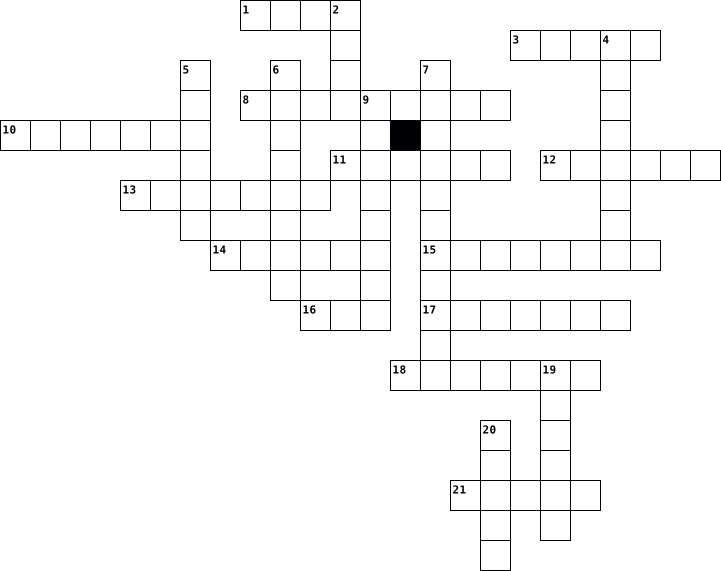
Across
- - heavy for its size
- - Heat and electricity do NOT move through easily
- – can be drawn into thin wires
- - Elements are made of unbelievably small particles
- – elements with properties that fall between those of metals and nonmetals
- a shiny surface or reflecting light brightly
- - a pure substance that CANNOT be changed into simpler substances
- – elements that are good conductors of electric current and heat
Down
- – elements that are poor conductors of heat and electric current
- – elements that form a bridge between the elements on the left and right sides of the table
- - The modern periodic table is based on the number of _______.
- - Break or shatter easily
- – Russian chemist who developed the periodic classification of the elements
- – Each row in the table of elements
- – able to be hammered or pressed permanently out of shape without breaking or cracking
- - Not shiny
- – Each column in the periodic table
17 Clues: - Not shiny • - heavy for its size • - Break or shatter easily • – can be drawn into thin wires • – Each row in the table of elements • – Each column in the periodic table • a shiny surface or reflecting light brightly • - Heat and electricity do NOT move through easily • - Elements are made of unbelievably small particles • ...
Periodic Table 2021-07-23

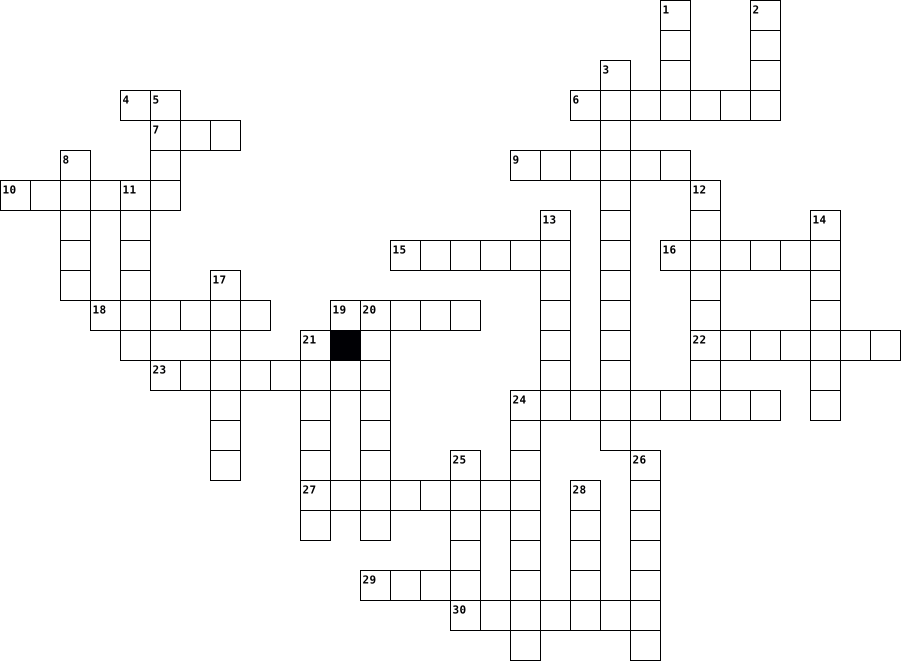
Across
- are pure substances
- found in salt
- used to make jewelry
- used to make light bulbs
- found in batteries
- used in balloons
- found in air
- table, where elements are found
Down
- found in shells and bones
- used to make poison
- found in eggs
- found in fruits and vegetables
- used to make coins
- found in emeralds
- used to disinfect swimming pools
- used to make electric wires
- used for advertising signs
17 Clues: found in air • found in eggs • found in salt • used in balloons • found in emeralds • used to make coins • found in batteries • used to make poison • are pure substances • used to make jewelry • used to make light bulbs • found in shells and bones • used for advertising signs • used to make electric wires • found in fruits and vegetables • table, where elements are found • ...
Periodic Table 2023-09-18

Across
- 4
- 8
- 5
- 13
- 6
- 7
- 2
- 16
Down
- 15
- 17
- 14
- 11
- 9
- 12
- 3
- 10
- 1
17 Clues: 4 • 8 • 9 • 5 • 3 • 6 • 7 • 1 • 2 • 15 • 17 • 14 • 11 • 12 • 13 • 10 • 16
PERIODIC TABLE 2024-05-08

Across
- Name the element with the symbol Si.
- Which element is represented by the symbol He?
- The name of the 15th element.
- The symbol for the 17th element is_________.
- What is the name of the seventh element?
- F is the symbol of what element?
- Mg is the representation of what element?
Down
- What element has the symbol Na?
- Aluminum is symbolized by _________.
- Name the element with the symbol C
- The first element on the periodic table is _____________.
- Give the name of the third element.
- The name of the element represented by S.
- Identify the 5th element of the first 20 Elements.
- Chlorine is represented by which symbol?
- What is the symbol for Neon?
- O is symbol of which element?
- Identify the element with the symbol K.
18 Clues: What is the symbol for Neon? • The name of the 15th element. • O is symbol of which element? • What element has the symbol Na? • F is the symbol of what element? • Name the element with the symbol C • Give the name of the third element. • Aluminum is symbolized by _________. • Name the element with the symbol Si. • Identify the element with the symbol K. • ...
Periodic Table 2023-02-26

Across
- __Number: The number of protons in the nucleus of an atom, which is a unique identifier for each element.
- An element that is malleable, ductile, and an electrical and thermal conductor.
- __Metals: A group of elements that includes lithium, sodium, potassium, rubidium, cesium and francium.
- __Number: The total number of protons and neutrons in the nucleus of an atom.
- A positively charged particle found in the nucleus of an atom.
- __Earth Metals: A group of elements that includes beryllium, magnesium, calcium, strontium, barium, and radium.
- A neutral particle found in the nucleus of an atom.
- __Configuration: The arrangement of electrons in the shells and subshells of an atom.
- A negatively charged particle found outside of the nucleus of an atom.
Down
- An element that has properties of both metals and non-metals.
- The smallest particle of an element that still retains the properties of that element.
- __Shell: The outermost electron shell of an atom, which contains the electrons responsible for the chemical properties of the atom.
- A chemical element that is not a metal.
- __gas: A group of elements that include helium, neon, argon, krypton, xenon and radon.
- A group of non-metals that include fluorine, chlorine, iodine, bromine and astatine.
- A vertical column in the periodic table that contains elements with similar properties.
- A horizontal row in the periodic table that contains elements with similar properties.
17 Clues: A chemical element that is not a metal. • A neutral particle found in the nucleus of an atom. • An element that has properties of both metals and non-metals. • A positively charged particle found in the nucleus of an atom. • A negatively charged particle found outside of the nucleus of an atom. • ...
Periodic table 2023-08-25

Across
- : are good sources of heat and electricity
- : Nonmetals are generally not
- : Metallic elements are typically
- : Number : On a square, above the chemical symbol
- : the most powerful tool in chemical information
- : One or two letter chemical
- : You can find them on the
- : Each element is represented by one
- : Each element has a unique number of
- : What makes a periodic table really invaluable
Down
- : Nonmetals are generally not good_____ of heat or electricity
- : It is found on the upper right of the periodic table
- : You can predict a lot about the chemical
- : This is in between Metal and Nonmetal
- : Atoms are listed in order of increasing
- : It is found on the upper left of the periodic table
- : Most elements are
- :The 7 horizontal rows is called.
18 Clues: : Most elements are • : You can find them on the • : One or two letter chemical • : Nonmetals are generally not • : Metallic elements are typically • :The 7 horizontal rows is called. • : Each element is represented by one • : Each element has a unique number of • : This is in between Metal and Nonmetal • : Atoms are listed in order of increasing • ...
Periodic Table Crossword Puzzle 2012-11-13

Across
- on the Periodic Table this color is magenta and represents a state of matter
- another name for a group
- the chemical symbol for Flourine
- describes something that repeats at regular intervals
- a column of elements
- an atomic mass of 10.8
- the name of an element
- shiny, conductor of heat, and brittle
- on the Periodic Table this color is green and represents a state of matter
- the smallest unit of an element
- the atomic mass of Phosphorus
- on the Periodic Table this color is blue and represents a state of matter
Down
- an atomic mass of 32.1
- that atomic number of Beryllium
- dull, poor conductor of heat, and not malleable
- a subatomic particle that has a positive charge
- a row of elements
- the mass of an atom expressed in atomic mass units
- the number of protons in the element
- semi-shiny, fair conductor of heat, and semi-malleable
- the symbol for magnesium
21 Clues: a row of elements • a column of elements • an atomic mass of 32.1 • an atomic mass of 10.8 • the name of an element • another name for a group • the symbol for magnesium • the atomic mass of Phosphorus • that atomic number of Beryllium • the smallest unit of an element • the chemical symbol for Flourine • the number of protons in the element • shiny, conductor of heat, and brittle • ...
Periodic Table Crossword 2014-06-04

Across
- Found to the left of the zigzag line on the periodic table
- The element with the symbol Rb
- shiny, reactive metals.
- A dark red liquid with the symbol Br
- combines with most metals to form salts
- A row of elements
- can be drawn into thin wires
- The element with the symbol Mg
- The element with the symbol Si
- The element with the symbol Hf
- The element with the symbol Na
Down
- or group A column of elements
- law the law that states that the repeating chemical and physical properties of elements change periodically with the atomic numbers of the elements
- a yellowish green gas with the symbol CI
- A dark gray solid with the symbol I
- The hardest material known.
- elements that border the zigzag line on the periodic table
- The most abundant metal in Earth's crust
- The element with the symbol N
- gases unreactive nonmetals in group 18 of the periodic table
20 Clues: A row of elements • shiny, reactive metals. • The hardest material known. • can be drawn into thin wires • The element with the symbol N • or group A column of elements • The element with the symbol Rb • The element with the symbol Mg • The element with the symbol Si • The element with the symbol Hf • The element with the symbol Na • A dark gray solid with the symbol I • ...
Elements Crossword 2025-09-08

Across
- Non-flammable noble gas that makes up just under 1% of Earth’s atmosphere
- Found in pools
- Found in fruits and vegetables like bananas, apricots, spinach, and potatoes
- Has “C” as a periodic symbol
- Makes balloons float
- Seeds, nuts, and legumes contain a lot of this element
- The first element of the periodic table
- Flammable solid found in the second group and second period of the periodic table of elements
- Makes up more than half of the atmosphere's gas
- Highly reactive element found in DNA, RNA, and ATP
Down
- Metalloid with fourteen protons
- Dairy products like milk contain this element
- Provides the saltiness in salt
- Element number ten on the periodic table
- Highly reactive gas that is in the air we breathe
- Commonly found in toothpaste, the ninth element
- Has the highest boiling point of the metalloids and five protons
- When mixed with hydrogen, this element creates a “rotten egg” smell
- Recyclable soft metal often found in tin foil
- Has three protons and three neutrons
20 Clues: Found in pools • Makes balloons float • Has “C” as a periodic symbol • Provides the saltiness in salt • Metalloid with fourteen protons • Has three protons and three neutrons • The first element of the periodic table • Element number ten on the periodic table • Dairy products like milk contain this element • Recyclable soft metal often found in tin foil • ...
Chapter 5 vocab 2023-10-20

Across
- - an arrangement of elements in columns, based on a set of properties that repeat from row to row
- - the pattern of repeating properties displayed by elements in the periodic table
- - elements that are good conductors of heat and electric current
- - metals that form a bridge between elements on the left and right sides of the periodic table
- - one twelfth the mass of a carbon-12 atom
- - a column of elements in a periodic table
Down
- - elements that are poor conductors of heat and electric current
- - the elements in group 2A of the periodic table
- - an electron that is in the highest occupied energy level of an atom
- - the elements in group 1A of the periodic table, not including hydrogen
- - elements with properties that fall between those of metals and nonmetals
- - a row in a periodic table of elements
12 Clues: - a row in a periodic table of elements • - one twelfth the mass of a carbon-12 atom • - a column of elements in a periodic table • - the elements in group 2A of the periodic table • - elements that are poor conductors of heat and electric current • - elements that are good conductors of heat and electric current • ...
Periodic Table Crossword 2017-12-14

Across
- bond A type of bond that happens whenever metals and nonmetals bond because of giving or taking electrons from each other
- Part of the atom (have positive charge)
- The elements on the right side of the periodic table
- The chart that organizes all of the elements based on their properties
- The center of an atom, made up of protons and nuetrons
- Part of the atom (have negative charge)
- The elements that form a zigzag which separate the metals and nonmetals
- Part of the atom (have NO charge)
- The outer shell of an atom
- What the electrons are placed on
Down
- The 10th element on the periodic table
- Has The atomic number of 8
- bond When two or more nonmetals share electrons to have 8 on the outershell
- The digit above an element's chemical symbol
- The vertical rows of elements
- Creator of the periodic table
- The elements on the left side of the periodic table
- The only non metal surrounded by metals
- The 7 horizontal rows of elements
19 Clues: Has The atomic number of 8 • The outer shell of an atom • The vertical rows of elements • Creator of the periodic table • What the electrons are placed on • The 7 horizontal rows of elements • Part of the atom (have NO charge) • The 10th element on the periodic table • Part of the atom (have positive charge) • Part of the atom (have negative charge) • ...
DEVELOPMENT OF THE PERIODIC TABLE OF ELEMENTS 2024-03-06

Across
- The new name of eka-aluminum which is the element predicted by Mendeleev
- periodic System, Name of Mendeleev’s periodic table.
- Number, Basis in the arrangement of the modern periodic table
- Elements are arranged periodically and if they are in the same group, they share similar _____.
- of triads, Law which states that “the group of three are chemically similar elements because of their average atomic weight”
- One of the first elements known to humans during the very early times.
- Newlands, The man behind the law of octaves
Down
- Mendeleev, Known to be the father of the periodic table
- Weight, The basis of the arrangement of the elements until the time of Mendeleev.
- Moseley, An English physicist whose observation of elements led to the development of Modern Periodic Law.
- In today's periodic table, elements in an interval of eight (8) belong to the same group or ____.
- The number of elements in the modern periodic table
- of Octaves, “Every 8th element has similar properties” Which law was established by this idea?
- Meyer, German chemist who was one of the pioneers in developing the earlier versions of the periodic table of chemical elements.
- Dobereiner, Chemist who formed the law of triads
15 Clues: Newlands, The man behind the law of octaves • Dobereiner, Chemist who formed the law of triads • The number of elements in the modern periodic table • periodic System, Name of Mendeleev’s periodic table. • Mendeleev, Known to be the father of the periodic table • Number, Basis in the arrangement of the modern periodic table • ...
Bonding and naming 2018-10-03

Across
- diatomic ions are called ______ when naming
- lose electrons
- smallest unit of an ionic bond
- type of bond, magnesium acetate
- type of bond that forms crystals and they are good conductors
- type of bond, dinitrogen pentoxide
- you add ________to covalent names
- gain electrons
- type of bond, hydrogen gas
Down
- ending of the anion when naming
- the reason elements bond to become __________
- positive ion
- which group on the periodic table have varying oxidation numbers?
- negative ion
- smallest unit of a covalent bond
- another name for an oxidation number
- the number on the periodic table we use to bond elements
- name of group where most diatomic ions are located on the periodic table
18 Clues: positive ion • negative ion • lose electrons • gain electrons • type of bond, hydrogen gas • smallest unit of an ionic bond • ending of the anion when naming • type of bond, magnesium acetate • smallest unit of a covalent bond • you add ________to covalent names • type of bond, dinitrogen pentoxide • another name for an oxidation number • diatomic ions are called ______ when naming • ...
Periodic table 2021-01-12

Across
- smallest particle of an element
- the number of protons in an atom
- nonmetal in group 17 of the periodic table that has seven valence electrons
- si unit for the mass of an atom
- elements that have properties of both metals and nonmetal
- a table organizing all of the elements known exist
Down
- a particle that is inside of the nucleus and has a positive charge
- a particle outside the nucleus that has a negative charge
- column of the periodic table that contains elements with similar properties
- class of elements that are good conductors of electricity
- the center of an atom
- nonmetal in group 18 of the periodic table that has eighth valence electrons
- located in the nucleus and has a neutral charge
- class of element that do not conduct electricity
- row of the periodic table that contains elements ranging from metals on the left to Metalloid and then nonmetals on the right
15 Clues: the center of an atom • smallest particle of an element • si unit for the mass of an atom • the number of protons in an atom • located in the nucleus and has a neutral charge • class of element that do not conduct electricity • a table organizing all of the elements known exist • a particle outside the nucleus that has a negative charge • ...
periodic table 2022-12-14

Across
- sn
- ru
- po
- ra
- k
- h
- sc
- ac
Down
- ti
- u
- nb
- og
- ba
- fr
- b
- ta
- zn
17 Clues: u • b • k • h • ti • sn • ru • nb • po • og • ba • fr • ra • ta • sc • zn • ac
Periodic Table! 2013-04-30

Across
- based around how many control you visit.
- in gasoline
- the room was solid from 8.30 and the full sign was flashing red
- it is found in Australia, Brazil, India, Russia and the United States.
- atom was in use in atomic clocks.
- alloys by the eastern zhou period.
- is obtained commercially as bromide and chloride
- it is found everywhere.
Down
- plants produce it
- at a temperature just above absolute zero would be useful.
- in the blood.
- nitride.
- bonded layers that form, providing the driving force for the process.
- valproate had received some bad press recently, which she felt was mostly undeserved.
- metal hydride.
- amalgam some years ago.
- gate onto a cobbled road.
17 Clues: nitride. • in the blood. • in gasoline • metal hydride. • plants produce it • amalgam some years ago. • gate onto a cobbled road. • it is found everywhere. • alloys by the eastern zhou period. • atom was in use in atomic clocks. • based around how many control you visit. • is obtained commercially as bromide and chloride • ...
Periodic Table 2013-11-26

Across
- solid material that is typically hard and shiny
- element whose properties are intermediate between those of metals and solid nonmetals
- of atoms bonded together
- Bond/mutual attraction between two atoms resulting from a redistribution of their outer electrons
- Bond/ chemical bond in which electrons are shared over many nuclei and electronic conduction occurs
- atom or molecule with a net electric charge due to the loss or gain of one or more electrons
- Bond/chemical bond in which one atom loses an electron to form a positive ion and the other atom gains an electron to form a negative ion
- or number used to identify an element
- Electrons/electron in the outer shell of an atom which can combine with other atoms to form molecules
- element or substance that is not a metal
Down
- Dot Diagram/ representation of an atom in which only the valence electrons are illustrated
- Mass/equivalent to the number of protons and neutrons in the atom
- of two atoms
- a column of elements
- a row of elements
- Bond/ chemical bond that involves sharing a pair of electrons between atoms in a molecule
- Structure/diagrams that show the bonding between atoms of a molecule and the lone pairs of electrons that may exist in the molecule
17 Clues: of two atoms • a row of elements • a column of elements • of atoms bonded together • or number used to identify an element • element or substance that is not a metal • solid material that is typically hard and shiny • Mass/equivalent to the number of protons and neutrons in the atom • element whose properties are intermediate between those of metals and solid nonmetals • ...
Periodic Table 2018-01-09

Across
- the number on an elements box which represents said elements average mass
- the elements located on the left side of the periodic table
- the part of an atom with a negative charge
- what the elements are organized in which distributes their properties
- what the electrons are placed on in an atom
- the elements located on the right side of the periodic table
- the way a material reflects light off of its surface
- meaning that a material can be pulled into a long wire
- the part of an atom with a positive charge
Down
- a pure substance that cannot be broken down into other substances by chemical or physical means
- 1 or 2 letters which represent an element on the periodic table
- the part of an atom with no charge
- word used to describe materials that can be rolled / hammered into flat surfaces
- the number of protons in an atoms nucleus
- made up of the nucleus, protons, neutrons, and electrons
- the center of an atom which contains the protons and neutrons
- the elements that form a zig-zag line, separating the metals and nonmetals on the periodic table
17 Clues: the part of an atom with no charge • the number of protons in an atoms nucleus • the part of an atom with a negative charge • the part of an atom with a positive charge • what the electrons are placed on in an atom • the way a material reflects light off of its surface • meaning that a material can be pulled into a long wire • ...
Periodic Table 2022-02-22

Across
- C
- Pb
- Fe
- Mn
- Sn
- Al
- Na
- Cu
- S
Down
- Ca
- Cl
- K
- Mg
- Cr
- Xe
- Zn
- Ba
17 Clues: K • C • S • Ca • Cl • Mg • Cr • Pb • Fe • Xe • Mn • Zn • Sn • Ba • Al • Na • Cu
periodic table 2026-01-26

Across
- Clue- made up of elements
- Clue- what is one element we need the most?
- Clue- The number of protons
- Clue- Makes or changes a substance
- Clue- Describes a reaction
- Clue- The number that represents it
- Clue- How many families are there?
- Clue- The mass of a single atom
- Clue- cannot be broken down
- Clue- Represents how many molecules you have
Down
- Clue- A change in shape, form, or state of matter
- Clue- When a substance isnt uniformed
- Clue- made up of 2+ atoms
- Clue- When a substance is uniform throughout
- Clue- Represents how many atoms are in each element
- Clue- A combination of 2 substances
- Clue- who made a part of the periodic table
17 Clues: Clue- made up of elements • Clue- made up of 2+ atoms • Clue- The number of protons • Clue- cannot be broken down • Clue- The mass of a single atom • Clue- Makes or changes a substance • Clue- How many families are there? • Clue- The number that represents it • Clue- A combination of 2 substances • Clue- When a substance isnt uniformed • Clue- Describes a reaction • ...
Periodic table 2025-12-03

Across
- A small group of atoms joined together by chemical bonds, like H₂O.
- The one- or two-letter abbreviation used to represent an element (e.g., He or Ag).
- The bond type formed by the sharing of electrons, typical between two nonmetal atoms.
- The subatomic particle that is transferred, shared, or forms a ""sea"" during a chemical bond.
- The type of bond formed by the transfer of electrons from a metal to a nonmetal, creating positive and negative charges.
- Elements that are shiny, malleable, and good conductors of heat and electricity.
- The large chart where all known elements are organized by atomic number and properties.
- The elements in Group 17, known for being ""Corrosive Thieves"" that need one electron.
Down
- A pure substance made of only one type of atom (e.g., Carbon or Sulfur).
- Elements that lack metallic properties and typically gain or share electrons.
- The horizontal rows in the periodic table, which indicate how many electron shells an element has.
- The type of bond where metal atoms share their outer electrons in a ""sea of electrons,"" explaining why metals are flexible.
- The basic unit of a chemical element.
- A substance formed when two or more different elements are chemically bonded together, like NaCl.
- The elements in Group 18, often called ""The Lonely Emos"" because they are stable and non-reactive.
- The vertical columns in the periodic table; elements here have similar ""personalities.
- A solid structure in which atoms or molecules are placed in a perfect, ordered, repeating pattern, like in table salt.
17 Clues: The basic unit of a chemical element. • A small group of atoms joined together by chemical bonds, like H₂O. • A pure substance made of only one type of atom (e.g., Carbon or Sulfur). • Elements that lack metallic properties and typically gain or share electrons. • Elements that are shiny, malleable, and good conductors of heat and electricity. • ...
Makayla Hair PS211- B 11-15-24 2024-11-16

Across
- An element in group 17 of the periodic table has seven valence electrons. It quickly gains an electron, forming a 1 - anion, which causes it to be highly reactive.
- A column of elements in the periodic table having similar valence electron arrangement, resulting in similar chemical properties; also known as a group.
- electrons- Any electron in the outermost energy level of a neutral atom. Unpaired valence electrons are usually involved in chemical bonding.
- metals- An element in group 2 of the periodic table, having two valence electrons that it tends to lose easily to become a 2+ cation, making it very reactive.
- metals- Any elements in groups 3-12 of the periodic table, typically having one or two valence electrons, which it easily loses, resulting in cations with charges of 1 + or 2+.
- law- The law that states that the properties of the elements vary with their atomic numbers in a regular, repeated pattern.
- groups– A wave from the upper end of the radio wave band; used for navigation, communication, and cooking.
- radius- The distance from the center of an atom’s nucleus to its outermost energy level.
- see family.
Down
- A measure of an element’s ability to attract and hold electrons when bonded to other atoms.
- gases- An element in group 18 on the periodic table having with valence electrons that fill the outer energy level. With a full outer energy level, it is inert.
- metals- An element in group 1 of the periodic table, having one valence electron that it can easily lose to form a 1+ cation, making it extremely reactive; the most reactive of all the metals.
- dot notation- A representation of an atom consisting of its chemical symbol with surrounding dots representing its valence electrons.
- A row in the periodic table of the elements; also called a series. The time interval for one complete cycle of periodic motion.
- transition metals- An element from either of two rows usually placed below the periodic table; a member of either the lanthanide or actnide series. It typically has two valence electrons.
15 Clues: see family. • radius- The distance from the center of an atom’s nucleus to its outermost energy level. • A measure of an element’s ability to attract and hold electrons when bonded to other atoms. • groups– A wave from the upper end of the radio wave band; used for navigation, communication, and cooking. • ...
Anatomy of an Atom 2020-11-05

Across
- row on the periodic table
- group of 8 electrons
- negatively charged ion
- the mass of an atom
- the number of protons in an atom's nucleus
- what you use when a number is much too big
- gaseous element
- an element in between a metal and not
- the mass of a mole
Down
- reactive nonmetals
- a part of the periodic table that is aptly named
- type of element that is solid and usually shiny
- outermost electrons
- column on the periodic table
- positively charged ion
- large amount of atoms that shares a name with a rodent
- atom that usually has a net charge
- element that is not a metal
18 Clues: gaseous element • reactive nonmetals • the mass of a mole • outermost electrons • the mass of an atom • group of 8 electrons • negatively charged ion • positively charged ion • row on the periodic table • element that is not a metal • column on the periodic table • atom that usually has a net charge • an element in between a metal and not • the number of protons in an atom's nucleus • ...
Atoms, Compounds and Chemical Equations 2018-12-15

Across
- negative charge
- circular path of particles
- positive particle
- Reactions exiting energy
- negative particle
- positive charge
- it's never free of charge
- Reactions entering entering
- Table tables of elements
- column
Down
- form of an atom
- periodic table item
- Electron electrons on the final shell
- balance
- Bond sharing electrons
- in an element
- Bond transfer of valence electrons
- consisting of several parts
- row
- neutral particle
20 Clues: row • column • balance • in an element • negative charge • form of an atom • positive charge • neutral particle • positive particle • negative particle • periodic table item • Bond sharing electrons • Reactions exiting energy • Table tables of elements • it's never free of charge • circular path of particles • consisting of several parts • Reactions entering entering • ...
Chapter 4 vocab 2023-02-14

Across
- states that the properties of the elements vary in a periodic way
- electrons in the outermost energy level of a neutral atom
- elements in group 17, 7 valence electrons
- elements in groups 3-12, 1 or 2 valence electron
- 80% of all elements
- do not exhibit the general properties of metals, typically have 4 or more valence electrons
- get their name from their place on the periodic table, typically have 2 valence electrons
- a set of elements in the same column on the periodic table
- the measure of an element's ability to attract and hold electrons when bonded
- groups 13-16(metals,nonmetals, and melloids)
Down
- a table of the chemical elements arranged so that their periodic properties are displayed in relationship to their atomic number
- elements in group 18, 8 valence electron(besides helium)
- elements that have characteristics between metals and nonmetals
- elements in group 2, 2 valence electron
- the distance from the center of an atom's nucleus to the electrons in its outermost energy level
- consists of the element's chemical symbol surrounded by the atom's valence electrons
- elements in group 1, 1 valence electron
- a set of elements in the same column on the periodic table
- a row on the periodic table
19 Clues: 80% of all elements • a row on the periodic table • elements in group 2, 2 valence electron • elements in group 1, 1 valence electron • elements in group 17, 7 valence electrons • groups 13-16(metals,nonmetals, and melloids) • elements in groups 3-12, 1 or 2 valence electron • elements in group 18, 8 valence electron(besides helium) • ...
Periodic Table Crossword 2014-06-04

Across
- A row of elements
- The hardest material known.
- The element with the symbol Mg
- elements that border the zigzag line on the periodic table
- A dark gray solid with the symbol I
- a yellowish green gas with the symbol CI
- The element with the symbol N
- Found to the left of the zigzag line on the periodic table
- gases unreactive nonmetals in group 18 of the periodic table
Down
- The element with the symbol Hf
- or group A column of elements
- A dark red liquid with the symbol Br
- The element with the symbol Rb
- law the law that states that the repeating chemical and physical properties of elements change periodically with the atomic numbers of the elements
- shiny, reactive metals.
- The element with the symbol Si
- The most abundant metal in Earth's crust
- can be drawn into thin wires
- combines with most metals to form salts
- The element with the symbol Na
20 Clues: A row of elements • shiny, reactive metals. • The hardest material known. • can be drawn into thin wires • The element with the symbol N • The element with the symbol Hf • or group A column of elements • The element with the symbol Rb • The element with the symbol Mg • The element with the symbol Si • The element with the symbol Na • A dark gray solid with the symbol I • ...
Chemistry Crossword 2020-09-03

Across
- Chemical symbol Au
- The ______ number is located above the element’s symbol
- A substance made up of two or more types of atoms
- The name of a horizontal line on the Periodic Table
- A grid like structure made up of atoms
- Is the 26th element of the periodic table
- Has a chemical symbol of K
- Ion with negative charge
- The atomic mass is made up of the number of protons and ______
- Name for electron shells
- The second electron shell holds ______ electrons
- Protons, neutrons and electrons are all ______ particles
- An atom with positive or negative charge
- Float around the nucleus in shells
- The atomic number is the number of ______ in an atom's nucleus
- Element with 9 protons
- A group of atoms that are bonded together
- The compound water is made up of 2 hydrogen atoms and 1 ______ atom
- Has the chemical symbol Be
- Sodium and ______ make up salt (NaCl).
- The periodic table was developed by ______ Mendeleev
Down
- The atom that becomes the ion, Cr3+
- Has an electron configuration of 2,8,2
- Another name for the outer shell of an atom
- First element on the periodic table
- Mendeleev was able to predict ______ of undiscovered atoms
- Non-reactive atoms have a ______ outer shell
- The name of a vertical line on the Periodic Table
- Nitrogen has ______ electrons
- Sulfur has ______ electrons in its outer shell
- Ion with positive charge
- Element with atomic number of 10
- Has a chemical symbol of Ag
- Ions are formed when an atom gains or ______ electrons
- The inside part of an atom that houses subatomic particles
- A substance made up of only one type of atom
- Smallest building block of matter
- The elements are arranged in ______ order
- There are 118 elements on the ______ table
- A group of atoms that have not been chemically bonded
40 Clues: Chemical symbol Au • Element with 9 protons • Ion with negative charge • Name for electron shells • Ion with positive charge • Has a chemical symbol of K • Has the chemical symbol Be • Has a chemical symbol of Ag • Nitrogen has ______ electrons • Element with atomic number of 10 • Smallest building block of matter • Float around the nucleus in shells • ...
Chemistry 2018-04-03
Across
- Neutrons being converted into protons occurs in ______ decay.
- The particle that is released in radioactive decay which is identical to a helium nucleus.
- Generally found on the right side of the periodic table.
- A collection of atoms or molecules of the same kind.
- The horizontal rows of the periodic table.
- Subatomic particle with a positive charge.
- The outer shell electrons that can participate in chemical bonding.
- Found in Group 6 Period 3.
- 2 or more elements chemically combined.
- A charged particle.
- Variants of a particular chemical element which differ in neutron number.
- Subatomic particle with no charge.
- Name of the group of gasses that are the most stable due to having the maximum amount of valence electrons their outer shell can hold.
Down
- The smallest constituent unit of ordinary matter that has the properties of a chemical element.
- The most abundant element in the universe.
- Generally found on the left side of the periodic table.
- 2 or more atoms chemically joined together.
- If an atom has an unstable nucleus it is __________.
- Subatomic particle with a negative charge.
- Element with atomic number 8.
- The vertical columns of the periodic table.
21 Clues: A charged particle. • Found in Group 6 Period 3. • Element with atomic number 8. • Subatomic particle with no charge. • 2 or more elements chemically combined. • The most abundant element in the universe. • Subatomic particle with a negative charge. • The horizontal rows of the periodic table. • Subatomic particle with a positive charge. • ...
Chemistry 2018-12-10
Across
- chemical symbol of the only liquid metal at room temperature
- You need this metal for strong bones
- Protons and neutrons have a mass of
- What diamonds are made from
- Rows in the periodic table
- Not all treasure is ______ and gold.
- Country Dimitri was from
- Second lightest element
- Electrons are found in these in atoms
- Element with chemical symbol Ir
- The number of electrons and protons in an atom are
- Father of the periodic table
- Negatively charged particle
- Neutrons have a charge of
- Neutral subatomic particle
Down
- The only element with a Z in
- The basic building block. Elements are made of these.
- Gas we exhale
- Pirate's favourite metal
- Columns in the periodic table
- Gas we inhale to respire
- A very reactive yellow gas
- The only liquid non-metal at room temperature
- Metal that melts just above room temperature
- The centre of the atom is called this
- Lightest element
- John Newlands discovered this law
- The element with the electron configuration 2,8,8,2
- Positively charged particle
- There are 118 different ones of these in the periodic table
- Common chemical that covers 60% of the Earth's surface
31 Clues: Gas we exhale • Lightest element • Second lightest element • Pirate's favourite metal • Gas we inhale to respire • Country Dimitri was from • Neutrons have a charge of • Rows in the periodic table • A very reactive yellow gas • Neutral subatomic particle • What diamonds are made from • Positively charged particle • Negatively charged particle • The only element with a Z in • ...
Chemistry Crossword 2020-10-01

Across
- Contains 2 Hydrogen Atoms and 1 Oxygen Atom
- Reaction Change in the Ionic structure of a substance
- Table Organized by Atomic Number, How Atoms React, and What kind of atom (metal, nonmetal, gas)
- Elements on the far left on the Periodic Table do this with elements second from right on the Periodic Table
- Flow in electric currents
- Cannot be broken or changed
- Can change the state of matter
- Number equal to a mole of atom
- Bonding that shares And exchanges electrons
- Are responsible for atomic bonding
- These are created when a group of atoms bond together
Down
- Reaction Evaporation, Freezing, and Condensation
- Has no charge
- Solid,liquid or gas
- Type of atomic bonding where atoms exchange electrons
- Positively charged and located in the nucleus
- Fourth state of matter
- Why the atomic number has a decimal
- React Gases on the far right of the Periodic Table
- If particles are not bonded they are a
- Same number of electrons and protons
- Very large molecules that make up living plants or animals
- Smallest unit of matter
- Charge When an atom gives away one electron
- of atomic bonding where atoms share electrons
- Shells around the nucleus
26 Clues: Has no charge • Solid,liquid or gas • Fourth state of matter • Smallest unit of matter • Flow in electric currents • Shells around the nucleus • Cannot be broken or changed • Can change the state of matter • Number equal to a mole of atom • Are responsible for atomic bonding • Why the atomic number has a decimal • Same number of electrons and protons • ...
35-Crossword 2025-05-31

Across
- 31-56 Periodic Table Elements forged into one
- Homer, Marge, Bart, Lisa, Maggie.
- Letters on a keyboard
- Letters in alphabetical order
- Slash, Inferno
- Quartz lung disease
- Nintendo's Console after the Nintendo Switch
- The GTA Game that got delayed.. a LONG time.. Definetally more than VI years.
- pr3typriincess' song
- Forsaken's survivor skin for the "CLOSE TO ME" Last man standing
- United States, Canada, Mexico, Panama, Haiti, Jamaica, ETC.
- =21
- Forsaken's killer skin for the "CLOSE TO ME" Last man standing
- Literally just pure screaming
- The place with London and Paris
- Players of R.E.P.O.
- Pizza Tower's main character
- Actinides
- Fear of long words
- Lanthanides
- First 30 Periodic table elements forged into one
Down
- GD Harder level that introduced the Wave
- dQw4w9WgXcQ
- Oceanian Country
- Continent with Brazil
- The original area where humans started
- Continent without any countries
- Reflecting an attack in Ultrakill
- Periodic table element with proton number 118
- Continent with the stans
- Fear of palindromes
- Periodic Table element with proton number 70
- 🇮🇹
- The-The-The bird bird bird, Bird is the word.
- Australia's other name
35 Clues: 🇮🇹 • =21 • Actinides • dQw4w9WgXcQ • Lanthanides • Slash, Inferno • Oceanian Country • Fear of long words • Quartz lung disease • Fear of palindromes • Players of R.E.P.O. • pr3typriincess' song • Letters on a keyboard • Continent with Brazil • Australia's other name • Continent with the stans • Pizza Tower's main character • Letters in alphabetical order • Literally just pure screaming • ...
Periodic Table Crossword 2026-03-09

Across
- (The only) metal that is liquid at room temperature (hint: find the symbol Hg)
- Shiny yellow metal used in jewelry
- Element with atomic number 53
- The dense center of an atom that contains protons and neutrons
- Element with symbol Ag
- Particle in the nucleus with no electric charge
- Category of element that is shiny and can be shaped easily
- Negatively charged particle found around the nucleus
- Element you need to live that you are breathing right now
- Element with properties in between metals and nonmetals
- Element with atomic mass of 40
- Smallest building block of matter that retains the properties of an element
Down
- The first element (by atomic number); also most abundant element in the Universe
- Each row of the periodic table is called a
- Category of element that is usually dull and brittle
- Positively charged particle in the nucleus of an atom
- Fill in the blank: the ___ table of elements
- A substance that contains only one type of atom
- The element in the second period and rightmost group of the Periodic Table
- Each column of the periodic table where elements have similar properties is called a
20 Clues: Element with symbol Ag • Element with atomic number 53 • Element with atomic mass of 40 • Shiny yellow metal used in jewelry • Each row of the periodic table is called a • Fill in the blank: the ___ table of elements • Particle in the nucleus with no electric charge • A substance that contains only one type of atom • Category of element that is usually dull and brittle • ...
Atoms, Compounds and Chemical Equations 2018-12-15

Across
- periodic table item
- Table tables of elements
- Electron electrons on the final shell
- Bond sharing electrons
- Reactions entering entering
- form of an atom
- circular path of particles
- negative charge
- consisting of several parts
- column
Down
- neutral particle
- balance
- Reactions exiting energy
- positive particle
- negative particle
- it's never free of charge
- Bond transfer of valence electrons
- in an element
- positive charge
- row
20 Clues: row • column • balance • in an element • form of an atom • negative charge • positive charge • neutral particle • positive particle • negative particle • periodic table item • Bond sharing electrons • Table tables of elements • Reactions exiting energy • it's never free of charge • circular path of particles • Reactions entering entering • consisting of several parts • ...
Chemistry Crossword 2022-09-29

Across
- have particles that are far apart and move very fast
- negatively charged ions
- the study of the composition, structure, properties,and reactions of matter
- positive charge
- are located along the heavy zigzag line of the periodic table
- negative charge
- composed of one type of atom
- have particles that are close together in a fixed arrangement
- contain elements with similar properties in vertical columns.
- neutral charge
Down
- are horizontal rows of elements, counted from top to bottom of the table as Periods 1−7.
- material that makes up all things
- have particles that are close together but mobile
- positively charged ions
- are located to the right of the periodic table
- most abundant element
- located to the left of the periodic table
- composed of two or more elements always combined in the same proportion
18 Clues: neutral charge • positive charge • negative charge • most abundant element • negatively charged ions • positively charged ions • composed of one type of atom • material that makes up all things • located to the left of the periodic table • are located to the right of the periodic table • have particles that are close together but mobile • ...
Chemistry Crossword 2022-09-29

Across
- negative charge
- have particles that are far apart and move very fast
- positive charge
- the study of the composition, structure, properties,and reactions of matter
- most abundant element
- negatively charged ions
- located to the left of the periodic table
- contain elements with similar properties in vertical columns.
- have particles that are close together but mobile
- composed of two or more elements always combined in the same proportion
Down
- composed of one type of atom
- positively charged ions
- are located to the right of the periodic table
- material that makes up all things
- have particles that are close together in a fixed arrangement
- are located along the heavy zigzag line of the periodic table
- are horizontal rows of elements, counted from top to bottom of the table as Periods 1−7.
- neutral charge
18 Clues: neutral charge • negative charge • positive charge • most abundant element • positively charged ions • negatively charged ions • composed of one type of atom • material that makes up all things • located to the left of the periodic table • are located to the right of the periodic table • have particles that are close together but mobile • ...
Periodic Table Crossword 2021-11-05

Across
- scientist who made the periodic table
- electron in an outer shell
- elements that are shiny and good conductors
- list of all known elements
- positive subatomic particle
- negative subatomic particle
- smallest part of an element
- row on the periodic table
Down
- elements that are insulators and are not shiny
- have properties of metals and nonmetals
- used to organize elements on the table
- subatomic particle with no charge
- column on the periodic table
13 Clues: row on the periodic table • electron in an outer shell • list of all known elements • positive subatomic particle • negative subatomic particle • smallest part of an element • column on the periodic table • subatomic particle with no charge • scientist who made the periodic table • used to organize elements on the table • have properties of metals and nonmetals • ...
Science 2024-10-28

Across
- The elements in group 2 on the periodic table.
- The elements in group 18.
- The elements in group 1.
- A column on the periodic table.
- Conducts electricity at high temperatures, but not at low temperatures.
- An element in group 17 of the periodic table.
- An element that is generally shiny.
- The ability to be pulled into thin wires.
- An element that has physical and chemical properties of both metals and nonmetals.
- Elements that have no metallic properties.
Down
- The elements in groups 3-12.
- The rows on the periodic table.
- A chart of the elements arranged into rows and columns according to their physical and chemical properties.
- The ability of a metal to reflect light.
- The ability of a substance to be hammered or rolled into sheets.
15 Clues: The elements in group 1. • The elements in group 18. • The elements in groups 3-12. • The rows on the periodic table. • A column on the periodic table. • An element that is generally shiny. • The ability of a metal to reflect light. • The ability to be pulled into thin wires. • Elements that have no metallic properties. • An element in group 17 of the periodic table. • ...
Periodic Table Crossword 2017-12-14

Across
- The center of an atom, made up of protons and nuetrons
- The only non metal surrounded by metals
- The 7 horizontal rows of elements
- bond A type of bond that happens whenever metals and nonmetals bond because of giving or taking electrons from each other
- The elements that form a zigzag which separate the metals and nonmetals
- The chart that organizes all of the elements based on their properties
- The 10th element on the periodic table
- Part of the atom (have NO charge)
- The elements on the left side of the periodic table
- Part of the atom (have negative charge)
- The elements on the right side of the periodic table
Down
- The outer shell of an atom
- The digit above an element's chemical symbol
- Part of the atom (have positive charge)
- Creator of the periodic table
- The vertical rows of elements
- bond When two or more nonmetals share electrons to have 8 on the outershell
- Has The atomic number of 8
- What the electrons are placed on
19 Clues: The outer shell of an atom • Has The atomic number of 8 • Creator of the periodic table • The vertical rows of elements • What the electrons are placed on • The 7 horizontal rows of elements • Part of the atom (have NO charge) • The 10th element on the periodic table • The only non metal surrounded by metals • Part of the atom (have positive charge) • ...
Chemistry terms. 2023-04-03

Across
- positive charged atom
- what is calciums number on the periodic table
- negative charged atom
- what is hydrogens number on the periodic table
- what is oxygens number on the periodic table
Down
- what is heliums number on the periodic table
- what is nitrogens number on the periodic table
- what is lithiums number on the periodic table
- two what is the titanium number on the periodic table
- what is flourines number on the periodic table
10 Clues: positive charged atom • negative charged atom • what is heliums number on the periodic table • what is oxygens number on the periodic table • what is lithiums number on the periodic table • what is calciums number on the periodic table • what is nitrogens number on the periodic table • what is flourines number on the periodic table • ...
Periodic Table Crossword 2014-06-04

Across
- The element with the symbol Rb
- gases unreactive nonmetals in group 18 of the periodic table
- shiny, reactive metals.
- The most abundant metal in Earth's crust
- A dark red liquid with the symbol Br
- The element with the symbol Si
- combines with most metals to form salts
- Found to the left of the zigzag line on the periodic table
Down
- can be drawn into thin wires
- A dark gray solid with the symbol I
- law the law that states that the repeating chemical and physical properties of elements change periodically with the atomic numbers of the elements
- A row of elements
- The element with the symbol Mg
- a yellowish green gas with the symbol CI
- elements that border the zigzag line on the periodic table
- The hardest material known.
- The element with the symbol N
- The element with the symbol Na
- The element with the symbol Hf
- or group A column of elements
20 Clues: A row of elements • shiny, reactive metals. • The hardest material known. • can be drawn into thin wires • The element with the symbol N • The element with the symbol Rb • The element with the symbol Mg • The element with the symbol Si • The element with the symbol Na • The element with the symbol Hf • or group A column of elements • A dark gray solid with the symbol I • ...
Periodic Table Vocab 2023-05-19

Across
- How many metalloids are in the Boron Group
- Which group are the Alkali Metals
- What metal is Copper
- How many rare earth metals are on the Periodic Table
- How many classifications are on a Periodic Table
- Which category is the largest
- Symbol for Helium
- Where is the atomic number located
- What is the atomic number of Aluminium
- How many protons are in Oxygen
- Atomic Number
Down
- Which category is Chlorine in
- Which category is the smallest
- What group is Iodine in
- Is Astitine a metal or nonmetal
- What is the Atomic number of lead
- mass Top or Bottom number of element
- How many Periods are on the Periodic Table
- What is group 18 called
- Which group of Alkali Metals has a Nonmetal
20 Clues: Atomic Number • Symbol for Helium • What metal is Copper • What group is Iodine in • What is group 18 called • Which category is Chlorine in • Which category is the largest • Which category is the smallest • How many protons are in Oxygen • Is Astitine a metal or nonmetal • Which group are the Alkali Metals • What is the Atomic number of lead • Where is the atomic number located • ...
Bonding and naming 2 2018-10-03

Across
- another name for an oxidation number
- ending of the anion when naming
- positive ion
- type of bond that forms crystals and they are good conductors
- which group on the periodic table have varying oxidation numbers?
- smallest unit of a covalent bond
- type of bond, dinitrogen pentoxide
- the reason elements bond to become __________
- diatomic ions are called ______ when naming
Down
- you add ________to covalent names
- negative ion
- type of bond, magnesium acetate
- the number on the periodic table we use to bond elements
- name of group where most diatomic ions are located on the periodic table
- type of bond, hydrogen gas
- gain electrons
- lose electrons
- smallest unit of an ionic bond
18 Clues: negative ion • positive ion • gain electrons • lose electrons • type of bond, hydrogen gas • smallest unit of an ionic bond • type of bond, magnesium acetate • ending of the anion when naming • smallest unit of a covalent bond • you add ________to covalent names • type of bond, dinitrogen pentoxide • another name for an oxidation number • diatomic ions are called ______ when naming • ...
Science crosword 2021-11-26

Across
- Force÷area
- a force may cause an object turn about a pivot
- moment÷force
- All the matter consist in _____
- First element on the periodic table
- Horizontal lines on the periodic table
- Vertical lines on the periodic table
- Chemichal symbol of sodium
- An object to transfer enrgy to electrons
- the total number of protons and neutrons
Down
- mass÷volume
- The transfer of heat by electromacnetic waves
- A device to meashure amps
- something that defines the name of an element
- Meashure of how much electric charge flows on a circuit
- An imbalance of electric charges
- A small type of battery
- Element whose chemichal symbol is "K"
18 Clues: Force÷area • mass÷volume • moment÷force • A small type of battery • A device to meashure amps • Chemichal symbol of sodium • All the matter consist in _____ • An imbalance of electric charges • First element on the periodic table • Vertical lines on the periodic table • Element whose chemichal symbol is "K" • Horizontal lines on the periodic table • ...
Chemistry Concepts Ch 4 Vocabulary 2026-01-09

Across
- a vertical column of elements in the periodic table; elements in a group share chemical properties
- one of the elements of Group 1 of the periodic table
- _____ element is an element in the s-block or p-block of the periodic table
- one of the elements of Group 17
- _____ electron is found in the outermost shell of an atom and that determines the atom's chemical properties
- a measure of the ability of an atom in a chemical compound to attract electrons
- one of the metals that can use the inner shell before using the outer shell to bond
Down
- the reduction of the attractive force between a positively charged nucleus and its outermost electrons due to the cancellation of some of the positive charge by the negative charge of the inner electrons
- the law that states that the repeating chemical and physical properties of elements change periodically with the atomic numbers of the elements
- one of the elements of Group 2 of the periodic table
- a member of the rare-earth series of elements, whose atomic numbers range from 58 to 71
- a horizontal row of elements in the periodic table
- a solid or liquid mixture of two or more metals
- the energy required for an electron to be removed from an atom
- half the distance from center to center of two like atoms that are bonded together
- an unreactive element of Group 18 of the periodic table
- a member of the highly reactive and radioactive series of elements, whose atomic numbers range from 89 to 103
17 Clues: one of the elements of Group 17 • a solid or liquid mixture of two or more metals • a horizontal row of elements in the periodic table • one of the elements of Group 2 of the periodic table • one of the elements of Group 1 of the periodic table • an unreactive element of Group 18 of the periodic table • the energy required for an electron to be removed from an atom • ...
Periodic Table 2013-06-08

Across
- Found in hot air balloons
- Group 8 elements are noble ____________
- The elements that do not belong to any groups are called ____________ metals
- Lithium and sodium have the same _________ properties
- This element receives an electron during bonding with a metal, hence it belongs to group ____________
- Elements in group 2 in the periodic table have a _________ of two
- Fluorine gas exist as a __________ molecule
- Magnesium and sulfur are from the same period
Down
- Neon is not involved in any reaction because it is _____________
- Group 7 elements are also called __________
- Elements in the periodic table are arranged in an _____________ atomic number
- The non-metals occupy the _________ side of the periodic table
- This ion has an electron configuration of 2,8,8 as an ion. It forms an oxide that turns red litmus blue
- Elements in group 3 have __________ electron shells
- Going down group I, the elements become more ____________
- Elements on the left of the periodic table forms ___________ ions
- Carbon and lead are from the same _____________
17 Clues: Found in hot air balloons • Group 8 elements are noble ____________ • Group 7 elements are also called __________ • Fluorine gas exist as a __________ molecule • Magnesium and sulfur are from the same period • Carbon and lead are from the same _____________ • Elements in group 3 have __________ electron shells • Lithium and sodium have the same _________ properties • ...
Periodic Table 2012-11-15

Across
- Two elements chemically combined make a...
- when two elements share a container but arent chemically bonded
- the result when chemically combining Sulphur and Oxygen.
- The air we breathe in
- a way of separating two liquids.
- Solid, Liquid, or Gas?
- an element starting with 'Co'
- a way to separate sand and water
- can it be hammered into shape?
Down
- the solute salt dissolves in the... water
- an element which has the same name as the item you use when taking creases out of your clothes
- when separating two soluble substances you use...
- can it be pulled into wire?
- the air we breathe out
- In the periodic table there are...
- otherxise known as suulphur dioxide
- the chemical formula is 'C'
17 Clues: The air we breathe in • the air we breathe out • Solid, Liquid, or Gas? • can it be pulled into wire? • the chemical formula is 'C' • an element starting with 'Co' • can it be hammered into shape? • a way to separate sand and water • a way of separating two liquids. • In the periodic table there are... • otherxise known as suulphur dioxide • ...
Periodic Table 2014-10-24

Across
- Group 13, Period 2
- Si
- He
- Group 13, Period 3
- Hg
- Group 2 Period 4
- Ne
- Group 8, Period 4
- Au
Down
- Co
- H
- Li
- Group 12, Period 4
- As
- Group 18, Period 3
- Group 14, Period 2
- O
17 Clues: H • O • Co • Li • Si • He • As • Hg • Ne • Au • Group 2 Period 4 • Group 8, Period 4 • Group 13, Period 2 • Group 12, Period 4 • Group 13, Period 3 • Group 18, Period 3 • Group 14, Period 2
Periodic Table 2022-12-07

Across
- Which element would have similar properties to Sulfer?
- Which element has 2 valence electrons and 4 energy levels?
- Which element has 3 energy levels and
- properties to Oxygen?
- what group is magnesium in?
- The chemical formula for sodium sulfate is Na2SO4.How many total atoms are in the formula?
- Which element has 2 valence electrons
- What is the least reactive element
- Groups tell you an atom's
Down
- How many valence electrons does gallium have?
- Which element is the most reactive?
- Which metal is the least reactive on the periodic table?
- How many valence electrons are in an atom of each element in Group 15 in the periodic table?
- How many energy levels does Calcium
- 3 energy levels?
- what group is iron in?
- Periods tells you an atom's
17 Clues: 3 energy levels? • properties to Oxygen? • Groups tell you an atom's • what group is magnesium in? • Periods tells you an atom's • what group is iron in? • What is the least reactive element • Which element is the most reactive? • How many energy levels does Calcium • Which element has 3 energy levels and • Which element has 2 valence electrons • ...
Periodic table 2020-10-14

Across
- as rocket propulsion
- is larger than its atom
- can be found in common salt
- effect is one of factors affecting IE.
- can be found in each household
- is smaller than its neutral atoms
- is tendency of an atom to attract electrons
- can make our bones and teeth stronger
Down
- form sweet salt
- radius half of the distance taken between two adjacent atoms
- IE is .... When moving across a period
- can be found in battery
- used in explosive and laughing gas
- is used in fertilizer industry
- is a grouo of atoms or ions having same electronic configuration
- ionisation energy is minimum energy needed to remove an electron from atoms or ions.
- is use to prevent cavities
17 Clues: form sweet salt • as rocket propulsion • can be found in battery • is larger than its atom • is use to prevent cavities • can be found in common salt • is used in fertilizer industry • can be found in each household • is smaller than its neutral atoms • used in explosive and laughing gas • can make our bones and teeth stronger • IE is .... When moving across a period • ...
Periodic Table 2023-08-23

Across
- a covalent bond in which electrons are shared unevenly
- These elements on the periodic table are nonreactive
- a chemical bond in which electrons are transferred
- the horizontal rows on the periodic table are called
- forms of an element with differing numbers of neutrons
- this element would likely show similar patterns in bonding to sodium
- these tend to form ionic bonds by gaining electrons
- atomic number 7 on the periodic table
- a chemical bond in which electrons are shared
- a model that shows the chemical symbol of an element surrounded by dots showing the number of valence electrons
Down
- these tend to form ionic bonds by losing electrons
- the electrons that determine chemical bonding are __________________________________
- all elements in group 2 will have _____ valence electrons
- this shows the number of protons in an element
- a charged particle
- This group has some qualities of nonmetals and some qualities of metals
- If an atom accepts an electron, it will have a ________ charge
17 Clues: a charged particle • atomic number 7 on the periodic table • a chemical bond in which electrons are shared • this shows the number of protons in an element • these tend to form ionic bonds by losing electrons • a chemical bond in which electrons are transferred • these tend to form ionic bonds by gaining electrons • These elements on the periodic table are nonreactive • ...
C1.2 Elements, Atoms and Compounds 2026-03-06

Across
- barium + fluorine -> barium .....
- A .... has different elements NOT bonded.
- Sodium + chlorine -> sodium .....
- potassium + bromine -> .... bromide.
- This is a state when particles are tightly packed.
- There are ... elements in KF
- Gas particles move .....
- Magnesium + ... -> magnesium oxide.
Down
- The ... table shows elements.
- There are ... elements in NaClO
- Simplest pat of an element.
- Non metals are found on the .... of the periodic table.
- .... are found on the left of the periodic table.
- This method separates a solid and a liquid.
- A ...... has different elements bonded.
- An .... is made of the same atoms.
16 Clues: Gas particles move ..... • Simplest pat of an element. • There are ... elements in KF • The ... table shows elements. • There are ... elements in NaClO • barium + fluorine -> barium ..... • Sodium + chlorine -> sodium ..... • An .... is made of the same atoms. • Magnesium + ... -> magnesium oxide. • potassium + bromine -> .... bromide. • A ...... has different elements bonded. • ...
Chemistry Crossword 2020-09-03

Across
- Chemical symbol Au
- The ______ number is located above the element’s symbol
- A substance made up of two or more types of atoms
- The name of a horizontal line on the Periodic Table
- A grid like structure made up of atoms
- Is the 26th element of the periodic table
- Has a chemical symbol of K
- Ion with negative charge
- The atomic mass is made up of the number of protons and ______
- Name for electron shells
- The second electron shell holds ______ electrons
- Protons, neutrons and electrons are all ______ particles
- An atom with positive or negative charge
- Float around the nucleus in shells
- The atomic number is the number of ______ in an atom's nucleus
- Element with 9 protons
- A group of atoms that are bonded together
- The compound water is made up of 2 hydrogen atoms and 1 ______ atom
- Has the chemical symbol Be
- Sodium and ______ make up salt (NaCl).
- The periodic table was developed by ______ Mendeleev
Down
- The atom that becomes the ion, Cr3+
- Has an electron configuration of 2,8,2
- Another name for the outer shell of an atom
- First element on the periodic table
- Mendeleev was able to predict ______ of undiscovered atoms
- Non-reactive atoms have a ______ outer shell
- The name of a vertical line on the Periodic Table
- Nitrogen has ______ electrons
- Sulfur has ______ electrons in its outer shell
- Ion with positive charge
- Element with atomic number of 10
- Has a chemical symbol of Ag
- Ions are formed when an atom gains or ______ electrons
- The inside part of an atom that houses subatomic particles
- A substance made up of only one type of atom
- Smallest building block of matter
- The elements are arranged in ______ order
- There are 118 elements on the ______ table
- A group of atoms that have not been chemically bonded
40 Clues: Chemical symbol Au • Element with 9 protons • Ion with negative charge • Name for electron shells • Ion with positive charge • Has a chemical symbol of K • Has the chemical symbol Be • Has a chemical symbol of Ag • Nitrogen has ______ electrons • Element with atomic number of 10 • Smallest building block of matter • Float around the nucleus in shells • ...
Elements & Periodic Table Vocabulary Test 2014-12-03

Across
- Positively charged particle in the nucleus of an atom
- The gradual wearing away of a metal element due to a chemical reaction
- A family of very reactive elements whose atoms gain or share one electron
- An element that has some characteristics of both metals and nonmetals
- The ability of a material to be pulled out into a long wire
- A material that conducts electricity under certain conditions
- The number of protons in an atom
- An element in Group 2 of the periodic table
- The ability of a material to be pounded into shapes
- A formula that gives the elements in a compound and the ratio of atoms.
- Particle in the nucleus of an atom with no charge
- The ability of an object to transfer heat or electricity
- A class of elements characterized by physical properties that include shininess, malleability, ductility and conductivity
- The mass of an atom which is the sum of the protons and neutrons
Down
- A chart of the elements showing the repeating pattern of their properties
- A one or two letter abbreviation of an element found on the periodic table
- One of the elements in Groups 3 through 12 of the periodic table
- Negatively charged particle circling the nucleus of an atom
- The ease and speed with which an element combines or reacts with other elements
- A row of elements on the periodic table (7 total)
- A family of un-reative elements whose atoms do not gain, lose, or share electrons
- A molecule consisting of two atoms
- An atom with the same number of protons and a different number of neutrons
- A column of elements on the periodic table (18 total)
- An element in Group 1 of the periodic table
- A type of element whose physical properties are opposite of metals
26 Clues: The number of protons in an atom • A molecule consisting of two atoms • An element in Group 2 of the periodic table • An element in Group 1 of the periodic table • A row of elements on the periodic table (7 total) • Particle in the nucleus of an atom with no charge • The ability of a material to be pounded into shapes • ...
Chapter 1 Vocab 2023-09-29

Across
- Letters representing an element
- elements that have alike properties on the periodic table
- A physical combination of substances, components are not evenly spread
- Group 2A on periodic table,very reactive
- Elements organized by Atomic Number
- gas forming a liquid
- luquid turning into a solid
- Elements that are not metal
- Definite shape and volume, not easily compressed
- The number of protons and electrons in an element
- Elements that fall between metal and non-metal properties
- determined by the use of 5 senses
- Building block for all matter
- anything that takes up space and has mass
- Has indefinite shape and volume, particles spread throughout
- group 17 on the periodic table
- a type of matter that can not be seperated
- Easily reversed, No new substances formed
- Elements that are found in groups 3-12 on the periodic table
- closely packed together
- a horizontal row on the periodic table
Down
- Amount of space taken up by an object
- solid turning into a liquid
- luquid turning into a gas
- depends on amount of matter
- Determined by how a substance reacts with another
- A pure substance made up of one type of atom
- elements that are clasified as a metal
- depends on the type of matter in a sample
- elements 57-71
- One or more new matter form
- 15 metalic elements 89-103
- Pure substance combination of 2 or more elements
- amount of matter in an atom of an element
- Process where a chemical forms something new
- able to be molded and shaped
- Least reactive elements
- A physical combination of substances, components are evently mixed
- a physical blend of 2 or more components
- group 1 on the periodic table
- when a solid forms from a solution
41 Clues: elements 57-71 • gas forming a liquid • Least reactive elements • closely packed together • luquid turning into a gas • 15 metalic elements 89-103 • solid turning into a liquid • depends on amount of matter • One or more new matter form • luquid turning into a solid • Elements that are not metal • able to be molded and shaped • group 1 on the periodic table • ...
Chemistry Final 2025-05-13

Across
- Term that refers to double bonds in a covalent compound
- Class of elements that have properties of both metals and nonmetals
- Scientist credited with the discovery of the mole
- Group 1 on the periodic table
- In a solution this is the substance that is dissolved
- Amount of energy required to remove an electron from an atom
- SI unit for amount of a substance
- Term that refers to single bonds in a covalent compound
- Positively charged ions, typically metals
- Starting substances in a chemical reaction
- Scientist credited with discovering the first periodic table
- Type of reaction in which one complex substance breaks down
- Group 18 on the periodic table
- Type of bonding that occurs between two nonmetals
- Property of metals, shiny
- Ability of an atom to attract electrons within a bond
- Type of bonding that occurs between a metal and a nonmetal
- Group of atoms that are always found in pairs (HNOFClBrI)
Down
- Term used to describe a covalent compound that has multiple correct Lewis structures
- Finals substances in a chemical reaction
- Type of reaction that requires fuel and oxygen and produces carbon dioxide and water
- Type of bonding that occurs between two metals
- Group 2 on the periodic table
- Group 17 on the periodic table
- Type of covalent bond in which electrons are unequally shared
- Type of reaction in which two simple substances combine to form a complex one
- Property of metals, ability to be flattened and shaped
- Property of metals, ability to be pulled into wires
- Negatively charged ion, typically nonmetals
- In a solution this is the substance that does the dissolving
- Scientist credited with discovering the modern periodic table
- Half the distance between adjacent nuclei of two corresponding atoms
- Group of atoms that function as one charged substance
- Type of covalent bond in which electrons are shared equally
34 Clues: Property of metals, shiny • Group 2 on the periodic table • Group 1 on the periodic table • Group 17 on the periodic table • Group 18 on the periodic table • SI unit for amount of a substance • Finals substances in a chemical reaction • Positively charged ions, typically metals • Starting substances in a chemical reaction • Negatively charged ion, typically nonmetals • ...
Properties of Matter 2014-03-24

Across
- Repeating pattern
- Change of a liquid to a gas
- Ability to be drawn into thin wires
- Horizontal rows of elements in the periodic table
- Has no definite shape or volume
- The last group of elements on the periodic table
- Elements that have no properties of metals
- New substances are produced
- Has a definite shape and volume
- Elements that have properties of luster, ductility and malleability
- Has a definite volume but no definite shape
Down
- Change of a solid to a liquid
- Change where no new substances are produced
- Change of a liquid to a solid
- Characteristics used to describe a substance
- Change of a gas to a liquid
- Anything that has mass and takes up space
- Another term for shine
- Ability to be hammered into different shapes
- Form of matter
- Shorthand way of writing elements
- Cannot be broken down into simpler substances
- Study of matter
- Vertical columns of elements in the periodic table
24 Clues: Form of matter • Study of matter • Repeating pattern • Another term for shine • Change of a gas to a liquid • Change of a liquid to a gas • New substances are produced • Change of a solid to a liquid • Change of a liquid to a solid • Has no definite shape or volume • Has a definite shape and volume • Shorthand way of writing elements • Ability to be drawn into thin wires • ...
cross word 2015-11-23

Across
- catalyst involved in chemical reactions in living things
- description of a solid that can be stretched into a long wire
- dull, brittle element that does not conduct electricity
- pure substance formed when two non-metals combine
- horizontal row of elements in the periodic table
- a reaction that takes place when two or more substances react to form new substance
- new substance produced in a chemical reaction between reactants
- invisible negatively charged particle that orbits the nucleus of an atom
- energy stored in chemical and released when chemicals react; a form of potential or stored energy
- element that has both metallic and non-metallic properties
- pure substance that cannot be broken down into other substances
Down
- substance that reacts with another substance or substances in a chemical reaction
- group 17 elements in the periodic table; the most reactive non-metals
- atom that has become electrically charged because it has lost or gained electrons
- description of a substance that can be pounded or rolled into sheets
- colourless, odourless gas; produced by incomplete combustion of chemicals containing carbon
- the sum of the number of protons and neutrons in an atom
- group 2 elements in the periodic table
- shiny, malleable, ductile element that conducts electricity
- a table in which the elements are organized by their physical and chemical properties
- group 18 elements in the periodic table; the most stable an unreactive elements
- or substances
- change that results when two or more substances react to create a different
- number of protons in the nucleus of one atom of an element
- pure substance formed when at least one metal and one non-metal
- group 1 elements in the periodic table, not including hydrogen
26 Clues: or substances • group 2 elements in the periodic table • horizontal row of elements in the periodic table • pure substance formed when two non-metals combine • dull, brittle element that does not conduct electricity • catalyst involved in chemical reactions in living things • the sum of the number of protons and neutrons in an atom • ...
Periodic table vocabulary crossword 2023-05-02

Across
- a substance made up of only one type of atom
- the number of an element on the periodic table; tells how many protons are in an atom of that element Always smaller than the atomic mass.
- smallest unit of a particular element
- atomic mass rounded to the nearest whole number; tells the number of protons and neutrons combined
- a characteristic or description of a substance
- gases all the way to the right on the periodic table (called group 0, group VIII, or group 18). Very unreactive because they have a full outer shell (8 valence electrons)
- Elements that have properties of both metals and non-metals and are found along the zig-zag line on the periodic chart. Also called semimetals or semiconductors.
- a row (horizontal) on the periodic table. Elements in the same period have the same number of energy levels. Properties vary gradually as you go from left to right.
- elements the do not conduct electricity, are not shiny and do not conduct heat; found toward the right of the periodic table (except Hydrogen, which is at the top left)
Down
- Group I; very reactive, one valence electron
- The average mass (number of protons and neutrons) in an atom. Always larger than the atomic number.
- the center of an atom; includes protons and neutrons
- Group VII/Group 17, very reactive nonmetals, have seven valence electrons
- how likely an element is to undergo a chemical change; depends on the number of valence electrons
- positive particle found in the nucleus of an atom
- A one or two letter abbreviation for an element. The first letter is always capitalized and the second letter is always lowercase.
- vertical column on the periodic table. Elements in the same group have the same number of valence electrons and similar chemical properties.
- Neutral (zero-charge) particle in the nucleus of an atom
- the number of electrons found in the outermost shell
- elements that conduct electricity, are shiny, heat well and are easily shaped, solid at room temperature (except mercury); found toward the left of the periodic table
20 Clues: smallest unit of a particular element • Group I; very reactive, one valence electron • a substance made up of only one type of atom • a characteristic or description of a substance • positive particle found in the nucleus of an atom • the center of an atom; includes protons and neutrons • the number of electrons found in the outermost shell • ...
Scientific terms 2013-02-16

Across
- pure substances ordered on the periodic table
- qualities of an element
- tiny building blocks of matter
- particles with a positive charge
- particles with no charge
- number/ same as number of protons in the element
Down
- created the first periodic table
- gases/ group of un-reactive elements
- these hold electrons
- vertical columns
- negatively charged particles
- Metals/ elements that separate metals and non- metals
- horizontal columns
- table/ where elements are sorted
14 Clues: vertical columns • horizontal columns • these hold electrons • qualities of an element • particles with no charge • negatively charged particles • tiny building blocks of matter • created the first periodic table • table/ where elements are sorted • particles with a positive charge • gases/ group of un-reactive elements • pure substances ordered on the periodic table • ...
Unit 6 Ch. 3 Science 2013-03-05

Across
- an arrangement of the elements showing the repeating pattern of their properties.
- the basic particle from which all elements are made; the smallest particle of an element that has the properties of that element.
- the ability of an object to transfer heat.
- an element in Group 2 of the periodic table.
- the gradual wearing away of a metal element due to a chemical reaction.
- the number of protons in the nucleus of an atom.
- a molecule consisting of two atoms.
- the ease and speed with which an element combines, or reacts, with other elements and compounds.
- one of the elements in Group 3 through 12 of the periodic table.
- a tiny, negatively charged particle that moves around the outside of the nucleus of an atom.
- the way a mineral reflects light from its surface.
- an element that lacks most of the properties of a metal.
- a class of elements characterized by physical properties that include shininess, malleability, ductility, and conductivity.
- an element in Group 18 of the periodic table.
Down
- the ability of an object to carry electric current.
- small, positively charged particles that are found in the nucleus of an atom.
- a term used to describe a material that can be pulled out into a long wire.
- the average mass of all the isotopes of an element.
- a term used to describe material that can be hammered or rolled into flat sheets.
- a substance that can conduct electric current under some conditions.
- a horizontal row of elements in the periodic table.
- an atom with the same number of protons and a different number of neutrons from other atoms of the same element.
- the sum of protons and neutrons in the nucleus of an atom.
- an element in Group 1 of the periodic table.
- the central core of an atom which contains protons and neutrons.
- a region of an atom in which electrons of the same energy are likely to be found.
- a small particle in the nucleus of the atom, with no electrical charge.
- an element found in Group 17 of the periodic table.
- an element that has some characteristics of both metals and nonmetals.
- elements in the same vertical column of the periodic table; also called family.
30 Clues: a molecule consisting of two atoms. • the ability of an object to transfer heat. • an element in Group 2 of the periodic table. • an element in Group 1 of the periodic table. • an element in Group 18 of the periodic table. • the number of protons in the nucleus of an atom. • the way a mineral reflects light from its surface. • ...
Periodic Table/Atoms Crossword Puzzle 2020-11-19

Across
- Atomic Number 23
- Which scientist got the credited for inventing the Periodic Table.
- Elements in the Periodic Table are listed by their
- Atomic Number 18
- What are the horizontal rows in the periodic table called
- Atomic Number 17
- Atomic Number 9
Down
- The abbv of the word Gold.
- What family of elements is in the most left column of the Periodic Table.
- What family of elements is in the right-most column of the Periodic Table.
- the atomic number of an atom is the number of_____in the atoms nucleus.
11 Clues: Atomic Number 9 • Atomic Number 23 • Atomic Number 18 • Atomic Number 17 • The abbv of the word Gold. • Elements in the Periodic Table are listed by their • What are the horizontal rows in the periodic table called • Which scientist got the credited for inventing the Periodic Table. • the atomic number of an atom is the number of_____in the atoms nucleus. • ...
Atoms, elements and compounds 2022-04-06

Across
- Particles found inside atoms with a positive charge
- Particles found inside atoms with no charge
- The name for columns in the periodic table
- ?? table, a diagram showing all the elements in the universe
- Two or more different elements chemically bonded
- a substance made up of only one type of element
- The name of the metals found in the middle of the periodic table
- The name for rows in the periodic table
- Two or more elements chemically bonded
Down
- A group of compounds mixed but not chemically bonded
- A join between two atoms
- Particles found inside atoms with a negative charge
- The centre of an atom, made of protons and neutrons
- Do the reactions of group 1 metals increase or decrease down the group?
- Chemical 'sum' showing the result of a reaction
- The smallest things in the universe
16 Clues: A join between two atoms • The smallest things in the universe • Two or more elements chemically bonded • The name for rows in the periodic table • The name for columns in the periodic table • Particles found inside atoms with no charge • Chemical 'sum' showing the result of a reaction • a substance made up of only one type of element • ...
Atoms and the Periodic Table 2021-08-03

Across
- Atoms to the right of the Periodic Table; usually lose electrons
- number of protons + neutrons in an atom
- Atoms become more stable when they fill their outermost shell, usually with 8 electrons. This is called the .... rule
- the Periodic Table is arranged according to this
- has most of the mass of the atom
- subatomic particle with positive charge and mass of 1
Down
- an ion with more electrons than protons
- another name for the outermost shell
- Most atoms in the table; usually form cations
- an ion with positive charge
- row in the Periodic Table. Elements here share the same number of shells.
- column in the Periodic Table. Elements here share similar chemical and physical properties.
- electrons are arranged in...
- subatomic particle with negative charge and 0 mass
14 Clues: an ion with positive charge • electrons are arranged in... • has most of the mass of the atom • another name for the outermost shell • an ion with more electrons than protons • number of protons + neutrons in an atom • Most atoms in the table; usually form cations • the Periodic Table is arranged according to this • subatomic particle with negative charge and 0 mass • ...
Periodic Table 2016-06-28

Across
- ____mass
- same as electrons
- Mg
- another organisation word for the periodic table
- atomic mass - atomic number
- atomic number of boron
Down
- Its's atomic mass is 1
- First Word of the title
- Second word of the title
- a organisation word for the periodic table
- atomic....
- atomic #
12 Clues: Mg • ____mass • atomic # • atomic.... • same as electrons • Its's atomic mass is 1 • atomic number of boron • First Word of the title • Second word of the title • atomic mass - atomic number • a organisation word for the periodic table • another organisation word for the periodic table
Periodic Trends 2025-07-31

Across
- The electrons from the inner shell(s) of an atom or ion. These electrons often can provide shielding effect to weaken the nuclear attraction felt by the valence electrons (plural).
- The rows of the periodic table are called________? (plural).
- Elements on the far-right side of the periodic table are typically considered as_______? (plural).
- Elements that can act as both metals and non-metals (plural).
- A table of chemical elements arranged in specific order, from which we can predict properties and behaviours of those elements.
- Elements from a same group in the periodic table would have the same number of ________?
Down
- The parameter that we can use to compare and contrast the size of the atoms.
- Elements from a same period in the periodic table would have the same number of _________? (plural).
- The net nuclear charge that the valence electrons actually experience after considering the shielding effect provided by the core electrons.
- The relative attraction a nucleus in an atom to the bonding electrons. Typically measured based on the Pauling’s scale from 0.7‒4.0.
- The reoccurring patterns observed in the periodic table, which can help us predict the characteristics of the elements (plural).
- The parameter that we can use to compare and contrast the size of the ions.
- The amount of energy required to remove an electron from a neutral atom in its gaseous state. Higher amount of this energy means harder to remove the electron(s) to form cations. Lower amount of this energy means easier to remove the electron(s) to form cations.
- The columns of the periodic table are called________? (plural).
- Elements on the far-left side of the periodic table are typically considered as _______? (plural).
15 Clues: The rows of the periodic table are called________? (plural). • Elements that can act as both metals and non-metals (plural). • The columns of the periodic table are called________? (plural). • The parameter that we can use to compare and contrast the size of the ions. • The parameter that we can use to compare and contrast the size of the atoms. • ...
Atoms and Periodic Table 2021-02-04

Across
- families 1-2 and 13-18 on the periodic table
- a gas with six valence electrons
- describes solid non-metals
- the smallest subatomic particle
- a metalloid with six valence electrons
- group two on the periodic table
- have properties of both metals and non-metals
- indicates the number of protons in an atom
- most of the mass of an atom is located here
- able to be hammered or pressed without breaking or cracking
- stable elements that do not react easily with other elements
- the number of valence electrons for phosphorus
- a non-metal with four valence electrons
- this atom has 32 protons
- a horizontal row on the periodic table
- a vertical column (family) on the periodic table
- elements with seven valence electrons
Down
- an element in period 3 that has seven valence electrons
- found in the outermost energy level
- shiny solids that conduct heat and electricity well
- a solid non-metal halogen
- the number of protons + neutrons in an element
- highly reactive elements with one valence electron
- the neutral subatomic particle
- able to be drawn out into a thin wire
- a charged subatomic particle found in the nucleus
26 Clues: this atom has 32 protons • a solid non-metal halogen • describes solid non-metals • the neutral subatomic particle • the smallest subatomic particle • group two on the periodic table • a gas with six valence electrons • found in the outermost energy level • able to be drawn out into a thin wire • elements with seven valence electrons • a metalloid with six valence electrons • ...
7th Prop of Atoms & Molecules L 1-15 Vocab Crossword 2021-11-19

Across
- a bond formed by transferring of electrons
- group of chemically connected atoms
- negatively charged particle orbiting the nucleus of an atom
- electrically neutral (neither + nor - )in the nucleus of an atom
- substance that cannot be broken down by ordinary chemical means
- molecules formed by sharing of electrons
- recycling of carbon for reuse by plants and animals
- number of protons plus the number of neutrons in an atom
- an element with an electrical charge due to missing or extra electrons
- two of the same type of atom bonded together
- tight mass of protons and neutrons in the center of an atom
Down
- elements in the center columns of the periodic table, labeled with the letter B
- adding of oxygen to a molecule
- positively charged particle (+) in the nucleus of an atom
- removal of oxygen from a molecule
- two or more different kinds of atoms bonded together
- elements on the periodic table between the metals and nonmetals
- bond formed when thousands of atoms freely share their electrons
- row of the periodic table
- column of the periodic table
- number of protons in an atom
- non-reactive
22 Clues: non-reactive • row of the periodic table • column of the periodic table • number of protons in an atom • adding of oxygen to a molecule • removal of oxygen from a molecule • group of chemically connected atoms • molecules formed by sharing of electrons • a bond formed by transferring of electrons • two of the same type of atom bonded together • ...
Elements, Compounds, Mixtures. 2022-09-28

Across
- You can look through it, it's in windows
- Water in the ocean
- This is the key ingredient in diamonds
- Lactose
- The only metal that is a liquid at room temperture
- Your looking at in right now
- The element on the periodic table with the smallest name
- The largest single compound
- it has an atomic wieght of 1
- The main ingredient of coffie
- very sweet
- you need it to live
- isopropyl alcohol
- Very tastey store bought pasta
- you can find this in a very heavy, casted pan
- A nice drink to cool off on a hot summer day
Down
- Ploymer
- 1 gram costs $27.13 USD
- Used for launching things into space
- baking soda
- In your carbonated berverages
- the 115th element on the periodic table
- Juiced oranges
- the longest name on the periodic table
- don't put it with #4
- Used for boxes
- the largest of the periodic table
- C2H5OH
- Makes up 78% of the atmosphere
- A tastey snack with chex, pretsles and more
- You drink this every day
- Very strong, contains iron
- use this to disinfect wounds
33 Clues: C2H5OH • Ploymer • Lactose • very sweet • baking soda • Juiced oranges • Used for boxes • isopropyl alcohol • Water in the ocean • you need it to live • don't put it with #4 • 1 gram costs $27.13 USD • You drink this every day • Very strong, contains iron • The largest single compound • Your looking at in right now • it has an atomic wieght of 1 • use this to disinfect wounds • ...
Unit 2 2025-02-26

Across
- The element with 3 protons.
- This is formed when you add or remove a neutron.
- The name of the energy level an electron takes around the nucleus?
- This is the name of an atom that has gained an electron.
- The element with the symbol C.
- Subatomic particle with a positive charge?
- The study of matter is?
- The element with an atomic mass of 20.
- The type of diagram represented with dots, 1-8 of them.
Down
- The O on the periodic table. Metal, non-metal or metalloid?
- Po on the periodic table is metal, non-metal, or metalloid?
- The element found on the periodic table in group 11, period 6.
- Subastomic particle with a neutral charge?
- The type of diagram represented with rings and dots.
- This is the name of an atom that has lost an electron.
- The center of an atom where you will find the protons and neutrons.
- Subatomic particle with a negative charge?
- The smallest unit of matter is an?
- Is element K on the periodic table. Metal, non metel or metalloid?
- This is formed when you add or remove an electron.
20 Clues: The study of matter is? • The element with 3 protons. • The element with the symbol C. • The smallest unit of matter is an? • The element with an atomic mass of 20. • Subastomic particle with a neutral charge? • Subatomic particle with a positive charge? • Subatomic particle with a negative charge? • This is formed when you add or remove a neutron. • ...
Periodic table 2021-01-12

Across
- smallest particle of an element
- the number of protons in an atom
- nonmetal in group 17 of the periodic table that has seven valence electrons
- si unit for the mass of an atom
- elements that have properties of both metals and nonmetal
- a table organizing all of the elements known exist
Down
- a particle that is inside of the nucleus and has a positive charge
- a particle outside the nucleus that has a negative charge
- column of the periodic table that contains elements with similar properties
- class of elements that are good conductors of electricity
- the center of an atom
- nonmetal in group 18 of the periodic table that has eighth valence electrons
- located in the nucleus and has a neutral charge
- class of element that do not conduct electricity
- row of the periodic table that contains elements ranging from metals on the left to Metalloid and then nonmetals on the right
15 Clues: the center of an atom • smallest particle of an element • si unit for the mass of an atom • the number of protons in an atom • located in the nucleus and has a neutral charge • class of element that do not conduct electricity • a table organizing all of the elements known exist • a particle outside the nucleus that has a negative charge • ...
First 20 Elements of the Periodic Table 2025-02-23

Across
- Atomic mass of 20.2
- "P" on the periodic table
- Has 1 valence electron on the 2nd energy shell
- Atomic number one
- 14 electrons
- What we have in some swimming pools
- Milk has this element
- Element symbol "Be"
- Six protons, 6 neutrons, and 6 electrons
Down
- Atomic mass of 32.1
- Atomic mass of 10.8
- The first element in table salt compound
- K on the periodic table
- 5th element of period 2
- Atomic number is 12
- 18 electrons
- Touches the staircase, but is not a metalloid
- What we breathe
- Has two protons
- 9 protons
20 Clues: 9 protons • 18 electrons • 14 electrons • What we breathe • Has two protons • Atomic number one • Atomic mass of 32.1 • Atomic mass of 10.8 • Atomic mass of 20.2 • Atomic number is 12 • Element symbol "Be" • Milk has this element • K on the periodic table • 5th element of period 2 • "P" on the periodic table • What we have in some swimming pools • The first element in table salt compound • ...
Chemistry CW 1 2021-11-29

Across
- A chart of all known elements that scientists reference when working with atoms or molecules
- Ag
- elements in group 18 of the periodic table that share similar properties such as a full outer electron shell
- U
- Al
- Pb
- An abbreviation for the name of an element on the periodic table.
- when an element has more than one possibility for the number of neutrons
- The average mass of the nucleus of that element.
- ________ electron is a located in the outermost shell of an atom
- Repeating rows of the periodic table that demonstrate patterns of how elements are arranged.
- elements in group 17 of the periodic table that need only one electron to complete its outer electron shell
- A subatomic particle with no charge located at the center of an atom.
- Li
- Characteristics of elements that help to identify what they are.
- C
- K
- Elements arranged in vertical columns of the periodic table that share the same properties.
- Si
- _______ family are the elements in group 16
Down
- Cr
- A subatomic particle of an atom that is negatively charged and orbits the nucleus extremely fast.
- I
- ________ family are the elements in group 14
- someone who studies chemistry
- He
- The basic unit of an element.
- ________ family are the elements in group 15
- elements in group 1 of the periodic table that are characterized as metals and only have one valence electron
- H
- this is where the electrons in an atom are found
- ________ family are the elements in group 13
- Sn
- Na
- The number of protons in the nucleus of each element.
- Anything that has mass and takes up space.
- Cl
- Two or more atoms bonded together.
- Ne
- Mg
- A positively charged subatomic particle located at the center of an atom.
- Ca
- O
- Elements that are good conductors of electricity and thermal energy and are often solid at room temperature.
- elements in group 2 of the periodic table that are characterized as metals and only have two valence electrons
- Protons and neutrons clump together at the center of an atom to form the ___________ of an atom.
- P
47 Clues: I • U • H • O • C • K • P • Cr • Ag • He • Al • Pb • Sn • Na • Cl • Ne • Mg • Li • Ca • Si • someone who studies chemistry • The basic unit of an element. • Two or more atoms bonded together. • Anything that has mass and takes up space. • _______ family are the elements in group 16 • ________ family are the elements in group 14 • ________ family are the elements in group 15 • ________ family are the elements in group 13 • ...
The Periodic Table 2021-10-26

Across
- the ability of a substance to be hammered or beaten into thin sheets
- A column on the periodic table
- a material that conducts current under certain conditions
- the ability of a substance to be drawn, pulled, or extruded through a small opening to produce a wire
- Group 1
- Group 18
- element that shares some properties with both metals and nonmetals
Down
- the elements in Group 2A of the periodic table
- elements in groups 3-12
- A horizontal row of elements in the periodic table
- A table that shows the elements, their atomic number, symbol, and average atomic mass; elements with similar chemical properties are grouped together.
- An element that lacks most of the properties of a metal
- an element that is shiny and that conducts heat and electricity well
- a nonmetal in Group 7A of the periodic table
- The way a mineral reflects light
15 Clues: Group 1 • Group 18 • elements in groups 3-12 • A column on the periodic table • The way a mineral reflects light • a nonmetal in Group 7A of the periodic table • the elements in Group 2A of the periodic table • A horizontal row of elements in the periodic table • An element that lacks most of the properties of a metal • ...
Periodic table 2021-01-12

Across
- smallest particle of an element
- the number of protons in an atom
- nonmetal in group 17 of the periodic table that has seven valence electrons
- si unit for the mass of an atom
- elements that have properties of both metals and nonmetal
- a table organizing all of the elements known exist
Down
- a particle that is inside of the nucleus and has a positive charge
- a particle outside the nucleus that has a negative charge
- column of the periodic table that contains elements with similar properties
- class of elements that are good conductors of electricity
- the center of an atom
- nonmetal in group 18 of the periodic table that has eighth valence electrons
- located in the nucleus and has a neutral charge
- class of element that do not conduct electricity
- row of the periodic table that contains elements ranging from metals on the left to Metalloid and then nonmetals on the right
15 Clues: the center of an atom • smallest particle of an element • si unit for the mass of an atom • the number of protons in an atom • located in the nucleus and has a neutral charge • class of element that do not conduct electricity • a table organizing all of the elements known exist • a particle outside the nucleus that has a negative charge • ...
The Atom 2024-04-12

Across
- Atomic # of phosphorus
- element table
- #of neutrons
- the outer shell of the nucleus
- Atom with no charge
- #of neutrons
- Located in the middle of the Orbitals
- Made up of atoms
- Building blocks of matter
- The negative atom
Down
- Same element w/ different number of Neutrons
- Example of matter
- The positive atom
- The name of the element
- #of electrons
- Properties in the periodic table
- The big letter/ letters in the middle of the element cube
- gains/ loses electrons
- Element in the periodic table
- Mass #
20 Clues: Mass # • #of neutrons • #of neutrons • #of electrons • element table • Made up of atoms • Example of matter • The positive atom • The negative atom • Atom with no charge • Atomic # of phosphorus • gains/ loses electrons • The name of the element • Building blocks of matter • Element in the periodic table • the outer shell of the nucleus • Properties in the periodic table • ...
The Periodic Table 2026-02-09

Across
- this element is the lightest on the periodic table
- the atomic number of carbon
- this unique number represents the total # of protons
- heavier positively charged particles found in the nucleus of an atom
- the organizer of the periodic table
- this element is the lightest noble gas
- this element has 12 protons in its nucleus
- electrically neutral particles found in the nucleus of an atom
- vertical columns of the periodic table
Down
- horizontal rows of the periodic table
- this element has an atomic number of 18
- this one or two letter abbreviation represents an element
- this decimal represents the sum of the protons + the neutrons
- light, negatively charged particles which circulate outside the nucleus
14 Clues: the atomic number of carbon • the organizer of the periodic table • horizontal rows of the periodic table • this element is the lightest noble gas • vertical columns of the periodic table • this element has an atomic number of 18 • this element has 12 protons in its nucleus • this element is the lightest on the periodic table • ...
Atomic Structure and the Periodic Table 2024-01-18

Across
- Two or more elements or compounds not chemically combined together.
- A separation technique used to produce solid crystals from a solution by evaporating the solvent.
- A separation technique used to separate solids from liquids.
- An atom or molecule with an electric charge due to the loss or gain of electrons.
- Positively charged object composed of protons and neutrons at the centre of every atom with one or more electrons orbiting it.
- The elements in Group 1 of the periodic table (6,6).
- Negatively charged subatomic particle which orbit the nucleus at various energy levels.
- Positively charged subatomic particle present in the nucleus of the atom.
- Elements that react to form negative ions. Found towards the right and top of the periodic table.
- The smallest part of an element that can exist.
- Atoms of the same element with the same number of protons but a different number of neutrons.
- The total number of protons and neutrons in the nucleus (4,6).
- The collection of metallic elements in the middle of the periodic table (10,6).
- A method of separating a mixture of substances according to their different boiling points (10,12).
- A chemical reaction in which a more reactive element displaces a less reactive element from its compound.
Down
- An average value that takes account of the abundance of the isotopes of the element (8,6,4).
- The columns of the periodic table.
- The number of protons in the nucleus (6,6).
- The elements in Group 7 of the periodic table.
- A substance made up of only one type of atom.
- The elements in Group 0 of the periodic table (5,5).
- A separation technique used to separate a mixture of chemicals by distributing the components between two phases.
- A substance made up of two or more types of atoms chemically combined together.
- Atomic model devised after the discovery of the electron. The model suggests the atom is a ball of positive charge with negative electrons scattered through it (4,7).
- Neutral subatomic particle present in the nucleus of the atom. Relative mass of 1.
- Elements that react to form positive ions. Found to the left and towards the bottom of the periodic table.
26 Clues: The columns of the periodic table. • The number of protons in the nucleus (6,6). • A substance made up of only one type of atom. • The elements in Group 7 of the periodic table. • The smallest part of an element that can exist. • The elements in Group 1 of the periodic table (6,6). • The elements in Group 0 of the periodic table (5,5). • ...
Atoms and Periodic Table 2021-02-03

Across
- able to be hammered or pressed without breaking or cracking
- groups families 1-2 and 13-18 on the periodic table
- most of the mass of an atom is located here
- describes solid non-metals
- a charged subatomic particle found in the nucleus
- highly reactive metals with one valence electron
- an element in period 3 that has seven valence electrons
- able to be drawn out into a thin wire
- number protons + neutrons in an element
- a gas with six valence electrons
- a horizontal row on the periodic table
- electrons found in the outermost energy level
- shiny solids that conduct heat and electricity well
Down
- number the number of protons in an atom
- the number of valence electrons for phosphorus
- earth metals group two on the periodic table
- this atom has 32 protons
- have properties of both metals and non-metals
- gases stable elements that do not react easily with other elements
- the smallest subatomic particle
- a vertical column (family) on the periodic table
- the neutral subatomic particle
- a solid non-metal halogen
- elements with seven valence electrons
- a metalloid with six valence electrons
- a non-metal with four valence electrons
26 Clues: this atom has 32 protons • a solid non-metal halogen • describes solid non-metals • the neutral subatomic particle • the smallest subatomic particle • a gas with six valence electrons • able to be drawn out into a thin wire • elements with seven valence electrons • a horizontal row on the periodic table • a metalloid with six valence electrons • ...
Elements & The Periodic Table 2017-10-18

Across
- the positively charged particle
- group 17 elements
- the metals in group 1
- atoms of the same element that have different number of neutrons
- the ease and speed with which a substance reacts with other substances
- particle with no electrical charge
- he noticed that a pattern of properties appeared when elements were arranged in order of increasing atomic mass
- these have properties of metals but also properties of nonmetals
- the _______ number is the number of protons in the nucleus of an atom
- the negatively charged particle
- the horizontal rows of the periodic table
- the center of an atom
- the largest group of elements on the periodic table
Down
- when a material can be pulled out or drawn into a long wire
- when a material can be hammered or rolled into flat sheets or other shapes
- elements with atomic numbers higher than 92 are sometimes called _______ elements
- the vertical columns of the periodic table
- can easily transmit electricity
- the gradual wearing away of a metal due to a chemical reaction
- group 2 of the periodic table are the _______ earth metals
- the ______ number is the sum of the protons and neutrons
- the ability to reflect light
22 Clues: group 17 elements • the metals in group 1 • the center of an atom • the ability to reflect light • the positively charged particle • can easily transmit electricity • the negatively charged particle • particle with no electrical charge • the horizontal rows of the periodic table • the vertical columns of the periodic table • the largest group of elements on the periodic table • ...
Chemistry Crossword 2020-10-01

Across
- Same number of electrons and protons
- Smallest unit of matter
- Charge When an atom gives away one electron
- Are responsible for atomic bonding
- of atomic bonding where atoms share electrons
- Reaction Change in the Ionic structure of a substance
- Positively charged and located in the nucleus
- If particles are not bonded they are a
- Solid,liquid or gas
- Shells around the nucleus
- Why the atomic number has a decimal
- Reaction Evaporation, Freezing, and Condensation
- Fourth state of matter
Down
- Can change the state of matter
- React Gases on the far right of the Periodic Table
- Bonding that shares And exchanges electrons
- Elements on the far left on the Periodic Table do this with elements second from right on the Periodic Table
- Flow in electric currents
- These are created when a group of atoms bond together
- Has no charge
- Cannot be broken or changed
- Type of atomic bonding where atoms exchange electrons
- Number equal to a mole of atom
- Very large molecules that make up living plants or animals
- Table Organized by Atomic Number, How Atoms React, and What kind of atom (metal, nonmetal, gas)
- Contains 2 Hydrogen Atoms and 1 Oxygen Atom
26 Clues: Has no charge • Solid,liquid or gas • Fourth state of matter • Smallest unit of matter • Flow in electric currents • Shells around the nucleus • Cannot be broken or changed • Can change the state of matter • Number equal to a mole of atom • Are responsible for atomic bonding • Why the atomic number has a decimal • Same number of electrons and protons • ...
Elements and Compounds 2025-04-22

Across
- A substance made up of two or more types of atom bonded together
- A column in the periodic table
- The smallest particle of an element
- symbol One or two letters used to represent an element
- substance A single substance without anything mixed in
- A combination of substances that can be physically separated
- table A grid arrangement of all known chemical elements
- An element that typically does not conduct heat or electricity
- A row in the periodic table
- Able to be hammered or pressed into shape without breaking
- formula A symbol that shows the chemical composition of a substance
- A substance made up of only one type of atom
- point The temperature at which a substance changes from liquid to gas
- gas An element that is highly non-reactive
Down
- reaction The re-arrangement of atoms to form one or more new substances
- Tending to chemically interact with other substances
- A group of atoms bonded together
- point The temperature at which a substance changes from solid to liquid
- A repeating arrangement of atoms in a solid
- Easily broken
- Tending not to chemically interact with other substances
- number The number by which elements are ordered in the periodic table
- A shiny element that conducts heat and electricity
- bond An attractive force that holds two atoms together
24 Clues: Easily broken • A row in the periodic table • A column in the periodic table • A group of atoms bonded together • The smallest particle of an element • gas An element that is highly non-reactive • A repeating arrangement of atoms in a solid • A substance made up of only one type of atom • A shiny element that conducts heat and electricity • ...
Atom and Periodic Table 2022-07-13

Across
- These types of metals are found in the middle of the Periodic Table.
- This scientist created the atomic theory.
- Electron’s in the outer most shell. _______________ shell.
- Table of the Elements
- Metals are considered this if they can be made into sheets.
- A _______________ is a vertical column on The
- Atoms which loses(s) electron(s) are known as __________.
- #6 on The Periodic Table of the Elements.
- Atoms which gain(s) electron(s) are known as __________.
- The positively charged dense center of an
- but different numbers of neutrons.
- and electrons, this called the
Down
- They also have luster and a high
- Atom with same number of protons and
- organic compounds consisting entirely of hydrogen and carbon.
- Metals are considered this if they can be made into wire.
- Atoms are arranged on The Periodic Table of the _____________.
- These are good conductors of heat and
- These have properties of both metals and nonmetals.
- To find the number of __________: Subtract the atomic number from the atomic mass.
- atoms always have the same number of
- Abbreviation for Atomic Mass Units.
- This particle has no charge and is found within the nucleus of an atom.
23 Clues: Table of the Elements • and electrons, this called the • They also have luster and a high • but different numbers of neutrons. • Abbreviation for Atomic Mass Units. • Atom with same number of protons and • atoms always have the same number of • These are good conductors of heat and • This scientist created the atomic theory. • #6 on The Periodic Table of the Elements. • ...
Atom and Periodic Table 2022-07-13

Across
- A _______________ is a vertical column on The
- Atom with same number of protons and
- #6 on The Periodic Table of the Elements.
- This scientist created the atomic theory.
- To find the number of __________: Subtract the atomic number from the atomic mass.
- Table of the Elements
- Atoms which loses(s) electron(s) are known as __________.
- atoms always have the same number of
- Atoms are arranged on The Periodic Table of the _____________.
- organic compounds consisting entirely of hydrogen and carbon.
- Metals are considered this if they can be made into sheets.
- These are good conductors of heat and electricity. They also have luster and a high density.
Down
- This particle has no charge and is found within the nucleus of an atom.
- Metals are considered this if they can be made into wire.
- and electrons, this called the
- but different numbers of neutrons.
- These types of metals are found in the middle of the Periodic Table.
- The positively charged dense center of an
- Abbreviation for Atomic Mass Units.
- Atoms which gain(s) electron(s) are known as __________.
- Electron’s in the outer most shell. _______________ shell.
- These have properties of both metals and nonmetals.
22 Clues: Table of the Elements • and electrons, this called the • but different numbers of neutrons. • Abbreviation for Atomic Mass Units. • Atom with same number of protons and • atoms always have the same number of • #6 on The Periodic Table of the Elements. • This scientist created the atomic theory. • The positively charged dense center of an • ...
Chem test review 2020-11-17

Across
- group 1
- says that when the elements of the periodic table are arranged in order or increasing atomic number there are periodic patterns in their physical and chemical properties
- d block
- Electronegativity is the ability of an atom to attract electrons to itself when the atomis in a...
- As you move across a period from left to right, the size of an atom will
- The size of a positive ion is always _____ than the size of the neutral atom
- A vertical column on the periodic table
Down
- this group has a p 5 configuration in their outermost energy level.
- The size of a negative ion is always _____ than the size of the neutral atom
- An atom with a positive or negative charge is called a(n)...
- As you move down a group, the size of the atoms will
- The periodic table was first arranged by
- The 2 rows on the bottom of the periodic table
- The amount of energy required to remove a second or third electron from an atom is always _____ than the amount of energy required to remove the first electron.
- The elements in the periodic table are presently arranged in order of increasing...
15 Clues: group 1 • d block • A vertical column on the periodic table • The periodic table was first arranged by • The 2 rows on the bottom of the periodic table • As you move down a group, the size of the atoms will • An atom with a positive or negative charge is called a(n)... • this group has a p 5 configuration in their outermost energy level. • ...
First 20 Elements of the Periodic Table 2025-02-07

Across
- Atomic mass of 20.2
- "P" on the periodic table
- Has 1 valence electron on the 2nd energy shell
- Atomic number one
- 14 electrons
- What we have in some swimming pools
- Milk has this element
- Element symbol "Be"
- Six protons, 6 neutrons, and 6 electrons
Down
- Atomic mass of 32.1
- Atomic mass of 10.8
- The first element in table salt compound
- K on the periodic table
- 5th element of period 2
- Atomic number is 12
- 18 electrons
- Touches the staircase, but is not a metalloid
- What we breathe
- Has two protons
- 9 protons
20 Clues: 9 protons • 18 electrons • 14 electrons • What we breathe • Has two protons • Atomic number one • Atomic mass of 32.1 • Atomic mass of 10.8 • Atomic mass of 20.2 • Atomic number is 12 • Element symbol "Be" • Milk has this element • K on the periodic table • 5th element of period 2 • "P" on the periodic table • What we have in some swimming pools • The first element in table salt compound • ...
Introduction to Periodic Table 2021-08-22

Across
- element in group 3, period 4
- the group of elements between group 2 and 3 are known as the ___ metals
- the most reactive metal
- the most reactive non-metal
- atomic mass is also the same as ___ number
- group 7 halogens exist as __ molecules
- name of group 7 elements
- non-metals such as oxygen and chlorine tend to __ electrons to form anions
Down
- name of group 1 metals
- mass number of helium
- the elements between metals and non-metals on the periodic table
- vertical column in the periodic table
- horizontal row in the periodic table
- metals such as sodium and magnesium tend to __ electrons to form cations
- the elements in the periodic table is arranged in order of increasing ___ number from left to right across the period
15 Clues: mass number of helium • name of group 1 metals • the most reactive metal • name of group 7 elements • the most reactive non-metal • element in group 3, period 4 • horizontal row in the periodic table • vertical column in the periodic table • group 7 halogens exist as __ molecules • atomic mass is also the same as ___ number • ...
Chemistry Crossword 2022-09-29

Across
- have particles that are close together in a fixed arrangement
- neutral charge
- material that makes up all things
- negative charge
- are located to the right of the periodic table
- composed of two or more elements always combined in the same proportion
- have particles that are far apart and move very fast
- located to the left of the periodic table
- are horizontal rows of elements, counted from top to bottom of the table as Periods 1−7.
Down
- contain elements with similar properties in vertical columns.
- negatively charged ions
- composed of one type of atom
- positively charged ions
- are located along the heavy zigzag line of the periodic table
- most abundant element
- the study of the composition, structure, properties,and reactions of matter
- positive charge
- have particles that are close together but mobile
18 Clues: neutral charge • negative charge • positive charge • most abundant element • negatively charged ions • positively charged ions • composed of one type of atom • material that makes up all things • located to the left of the periodic table • are located to the right of the periodic table • have particles that are close together but mobile • ...
Chemistry Crossword 2022-09-29

Across
- are located along the heavy zigzag line of the periodic table
- most abundant element
- negatively charged ions
- composed of one type of atom
- positive charge
- material that makes up all things
- located to the left of the periodic table
- have particles that are close together in a fixed arrangement
- have particles that are far apart and move very fast
Down
- neutral charge
- positively charged ions
- negative charge
- the study of the composition, structure, properties,and reactions of matter
- composed of two or more elements always combined in the same proportion
- are located to the right of the periodic table
- are horizontal rows of elements, counted from top to bottom of the table as Periods 1−7.
- have particles that are close together but mobile
- contain elements with similar properties in vertical columns.
18 Clues: neutral charge • negative charge • positive charge • most abundant element • positively charged ions • negatively charged ions • composed of one type of atom • material that makes up all things • located to the left of the periodic table • are located to the right of the periodic table • have particles that are close together but mobile • ...
Chemistry Component 1 Crossword 2021-03-30

Across
- Which side of the periodic table are non-metals found?
- The only metal that is solid at room temperature
- Calcium, nitrogen and oxygen react together to form calcium...
- These have a high melting and boiling point and are often shiny
- Elements in the same group have the same number of which sub-atomic particle on their outer shell?
- When something can be hammered or bent into shape
- How many atoms are in Ca(NO3)2?
- Aluminium sulphate is made from aluminium, sulphur and which other element?
- Two or more elements chemically bonded
- All elements in the same group have the same chemical...
- What is the name given to the gases in group 0?
Down
- Iron and chlorine react together to form iron...
- Salt water is an example of a...
- Non-metals do not allow heat and electricity to pass so they are called...
- The number that the periodic table is arranged by
- These are all shown on the periodic table
- Which elements has the symbol C?
- Name for the rows
- Which elements has the symbol Pb?
- Who left gaps in the periodic table for undiscovered elements?
- How many elements does Na2O have in it?
21 Clues: Name for the rows • How many atoms are in Ca(NO3)2? • Salt water is an example of a... • Which elements has the symbol C? • Which elements has the symbol Pb? • Two or more elements chemically bonded • How many elements does Na2O have in it? • These are all shown on the periodic table • What is the name given to the gases in group 0? • ...
Atom and Periodic Table 2022-07-13

Across
- These types of metals are found in the middle of the Periodic Table.
- This scientist created the atomic theory.
- Electron’s in the outer most shell. _______________ shell.
- Table of the Elements
- Metals are considered this if they can be made into sheets.
- A _______________ is a vertical column on The
- Atoms which loses(s) electron(s) are known as __________.
- #6 on The Periodic Table of the Elements.
- Atoms which gain(s) electron(s) are known as __________.
- The positively charged dense center of an
- but different numbers of neutrons.
- and electrons, this called the
Down
- They also have luster and a high
- Atom with same number of protons and
- organic compounds consisting entirely of hydrogen and carbon.
- Metals are considered this if they can be made into wire.
- Atoms are arranged on The Periodic Table of the _____________.
- These are good conductors of heat and
- These have properties of both metals and nonmetals.
- To find the number of __________: Subtract the atomic number from the atomic mass.
- atoms always have the same number of
- Abbreviation for Atomic Mass Units.
- This particle has no charge and is found within the nucleus of an atom.
23 Clues: Table of the Elements • and electrons, this called the • They also have luster and a high • but different numbers of neutrons. • Abbreviation for Atomic Mass Units. • Atom with same number of protons and • atoms always have the same number of • These are good conductors of heat and • This scientist created the atomic theory. • #6 on The Periodic Table of the Elements. • ...
Chemistry Basics 2024-11-22

Across
- change that doesn't create any new chemicals
- the atom with electron configuration 2,6
- has no charge
- this atom has 7 protons
- change that creates new chemicals
- the materials produced by a chemical reaction
- the rule that determines how many electrons fill the outermost shell of an atom
- negative part of the atom
- this atom has an atomic mass of 7
- atoms found on the right of the periodic table
- metals ______ electrons
- centre of the atom
Down
- the number that tells how many protons and neutrons are in the nucleus
- name for electrons found in the outermost shell
- an atom that has an overall charge
- has atomic number 79
- nonmetals _______ electrons
- a vertical column on the periodic table
- name for a negative ion
- makes up all matter
- the number that tells how many protons an atom has
- positive subatomic particle
- a row on the periodic table
- name for a positive ion
- number of electrons that fit in the first shell
- the materials used up in a chemical reaction
- number of electrons that fit in the second electron shell
- types of atoms found on the left of the periodic table
28 Clues: has no charge • centre of the atom • makes up all matter • has atomic number 79 • name for a negative ion • this atom has 7 protons • name for a positive ion • metals ______ electrons • negative part of the atom • nonmetals _______ electrons • positive subatomic particle • a row on the periodic table • change that creates new chemicals • this atom has an atomic mass of 7 • ...
Vocabulary Final Review Part II 2016-05-30

Across
- A charged atom
- Name of Family 17 of the periodic table; contain 7 valence electrons (Plural)
- Ability to be hammered into a thin sheet
- Shorthand way of representing an element (Example: F, Co, Ag, Al, W)(Plural) (2 Words)
- A bond between two metals
- Name of Family 18 (last column)on the periodic table; contain a full shell of electrons (Plural) (2 Words)
- Metals found in the middle of the periodic table (Plural) (2 Words)
- Subatomic particle that has no charge and found inside of nucleus
- Number of protons in an atom (2 Words)
- An element that contains carbon is said to be this type of substance
- Smallest part of an element that has all the properties of an element
- Horizontal row of elements in the periodic table (Plural) (2 Words)
- Shininess, Reflects light
Down
- Combination of chemical symbols (CO2, H2O, NaCl)(2 Words)
- A bond that shares electrons (between 2 nonmetals)
- Column of elements in the periodic table, shares similar properties
- Electrons in the outermost energy level of an atom (Plural)
- Are Ductile, Malleable, Lustrous, Good Conductors (Plural)
- Name of Family 1 that has one valence electron ( Includes Na, Li, K, Cs, Fr) (2 Words)
- Subatomic particle that is positively charged
- Shares properties of metals and nonmetals
- Negatively charged subatomic particle, located outside of nucleus in shells
- Number of protons + neutrons in an atom (2 Words)
- Ability to be drawn into a thin wire
- A positively charged ion
- A bond that donates/accepts electrons (between a metal and a nonmetal)
26 Clues: A charged atom • A positively charged ion • A bond between two metals • Shininess, Reflects light • Ability to be drawn into a thin wire • Number of protons in an atom (2 Words) • Ability to be hammered into a thin sheet • Shares properties of metals and nonmetals • Subatomic particle that is positively charged • Number of protons + neutrons in an atom (2 Words) • ...
Chemistry Cross word 2020-10-16

Across
- When a apple is left out for a long time it begins to start
- bond, A type of covalent bond between two atoms in which electrons are shared unequally is called a ______
- What is the name for something that is transparent, translucent or opaque
- where in the periodic table are alkaline metals located Left or Right side of the periodic table
- What language did Na In ons odium come from?
- When you leave a bottle of water in the freezer for a long time it beings to
- When a object is caught on fire it begins to
- A substance that is clear and has nothing in it Exp (water)
- bond, What is the name for the process that involves the sharing of electrons between two atoms
- A chemical that consists of two particles
- What is the name for something that is square, powder, crystalline, amorphous
- On the periodic table which vertical row has all -1 ion charges
Down
- Newtons and ______ will always have the same amount of atoms
- what does the atomic number mean on the periodic table Number of protons or Electrons?
- Why do atoms bond with each other. To become ____
- What is the name for something that is smooth, or rough
- A chemical that consists of 1 particle
- bonding, a transfer of an electron, so one atom gains an electron while one atom loses an electron is called.
- What is the name for something that is floral,pungent,choking or rancid
- When you have some water in a pot over a fire the water begins to?
- Where in the periodic table are noble gases located Left Or right side of the periodic table
21 Clues: A chemical that consists of 1 particle • A chemical that consists of two particles • What language did Na In ons odium come from? • When a object is caught on fire it begins to • Why do atoms bond with each other. To become ____ • What is the name for something that is smooth, or rough • When a apple is left out for a long time it begins to start • ...
Boomshakala 2023-12-11

Across
- Neutral charged atom
- Type of change that can be undone
- The type of table we use in class
- Negatively charged atom
- Releases heat, hot
- One structure breaking apart into 2+ things
- Bond between a metal and nonmetal
- Absorbs heat, cool
- Li(+2)
- Bond between two nonmetals
Down
- Type of replacement:Tom Holland & Serventi
- Found on L and middle on Periodic Table
- Type of replacement:Switching dates
- 1 thing+ Another thing= New thing
- Hydrogen-2
- Reactant+Reactant=Product
- Positively charged atom
- ____+____=Product
- Found on R side of table
- Type of change that cannot be undone
20 Clues: Li(+2) • Hydrogen-2 • ____+____=Product • Releases heat, hot • Absorbs heat, cool • Neutral charged atom • Negatively charged atom • Positively charged atom • Found on R side of table • Reactant+Reactant=Product • Bond between two nonmetals • 1 thing+ Another thing= New thing • Type of change that can be undone • The type of table we use in class • Bond between a metal and nonmetal • ...
Chemistry Review 2022-05-18

Across
- positively charged atomic particle found in
- proportional
- bond
- triphosphate, the name of a compound made of one
- number, the number of protons in an atom
- nucleus of an atom
- a row on the periodic table
- orbit the nucleus of an atom
- a column on the periodic table
Down
- neutrally charged atomic particle found in
- table, an organized table of all the known
- nucleus of an atom
- metals, group 1 elements
- and three phosphates
- two or more elements bond together by a
- law, states volume and temperature of a gas are
16 Clues: bond • proportional • nucleus of an atom • nucleus of an atom • and three phosphates • metals, group 1 elements • a row on the periodic table • orbit the nucleus of an atom • a column on the periodic table • two or more elements bond together by a • number, the number of protons in an atom • neutrally charged atomic particle found in • table, an organized table of all the known • ...
Periodic Table History and Basics 2021-09-06

Across
- The metal that is grouped with the metalloids
- Vertical column
- The second scientist who arranged the Periodic Table according to atomic number
- The elements in the s and p blocks
- The name for the elements who have a configuration that end in s1
- Separates metals from nonmetals
- Where the alkaline earth metals are located
- 2nd group, 4th period
- Inner transition metals
- Nonmetal that is grouped with the metals
Down
- Has properties of both metals and nonmetals
- Made into wire
- Elements that both the s and p sublevels are completely filled
- Brittle, dull, poor conductors
- Horizontal row
- What results when elements are arranged in order of increasing atomic number
- d block metals
- First scientist given credit for organizing the Periodic Table
- mass How the Periodic Table was first arranged
- Group 17
20 Clues: Group 17 • Made into wire • Horizontal row • d block metals • Vertical column • 2nd group, 4th period • Inner transition metals • Brittle, dull, poor conductors • Separates metals from nonmetals • The elements in the s and p blocks • Nonmetal that is grouped with the metals • Has properties of both metals and nonmetals • Where the alkaline earth metals are located • ...
Unit Review- Kinetic Molecular Theory 2023-01-23

Across
- Subatomic particle with a neutral charge
- Subatomic particle with a negative charge
- number of protons/neutrons in an element
- Solid, Liquid, Gas, Plasma
- center of an atom made of protons and neutrons
- Subatomic particles with a positive charge
- the outermost electrons in an atom
- two or more elements combined
- The columns of the Periodic Table
- bond between a metal and a nonmetal
- A principle or description of observed events
- The basic building blocks of all matter
- Ionic or covalent
Down
- The majority of the Periodic Table
- Elements organized by properties
- The energy of motion
- bond between two nonmetals
- a well tested hypothesis that is widely accepted
- A pure substance that cannot be broken down
- The rows of the Periodic Table
- current model of the atom
21 Clues: Ionic or covalent • The energy of motion • current model of the atom • bond between two nonmetals • Solid, Liquid, Gas, Plasma • two or more elements combined • The rows of the Periodic Table • Elements organized by properties • The columns of the Periodic Table • The majority of the Periodic Table • the outermost electrons in an atom • bond between a metal and a nonmetal • ...
Periodic table review 2024-02-13

Across
- Elements are arranged according to their ______ number.
- The number of groups on the Periodic Table of Elements.
- This element has the atomic number 8.
- The rows that go left to right are called ______.
- This element has the atomic number 16.
- The side of the Periodic Table the metals are on.
- The line that separates the metal and non-metals is shaped like _____.
Down
- The second letter in the atomic symbol is always _____.
- The atomic number is equal to the number of _____ in the nucleus.
- Gold is a ______.
- Chlorine is a _________.
- The columns that go up and down are called _______.
- The side of the Periodic Table the non-metals are on.
- The number of periods on the Periodic Table of Elements.
- The first letter in the atomic symbol is always _____.
15 Clues: Gold is a ______. • Chlorine is a _________. • This element has the atomic number 8. • This element has the atomic number 16. • The rows that go left to right are called ______. • The side of the Periodic Table the metals are on. • The columns that go up and down are called _______. • The side of the Periodic Table the non-metals are on. • ...
Elements and Atoms 2023-09-12

Across
- the unit used to measure atomic mass
- positive charge, located in nucleus
- 1s2-2s2-2p6-3s2-3p4
- the horizontal rows on the periodic table
- the percent of an isotope present on earth
- the vertical columns on the periodic table
- neutral charge, located in nucleus
- part of the alkali metals, located in period two
- atomic number 36
Down
- average mass of all isotopes of an element
- represented by amount of protons
- number of protons plus neutrons of an atom
- the first element on the periodic table
- negative charge, located in the shell
- [Xe]
- [Ar]4s2-3d6
16 Clues: [Xe] • [Ar]4s2-3d6 • atomic number 36 • 1s2-2s2-2p6-3s2-3p4 • represented by amount of protons • neutral charge, located in nucleus • positive charge, located in nucleus • the unit used to measure atomic mass • negative charge, located in the shell • the first element on the periodic table • the horizontal rows on the periodic table • average mass of all isotopes of an element • ...
Final Exam Extra Credit 2016-06-15

Across
- B
- ___ is the most reactive of the alkali metals.
- Flying mammal
- Elements 89 to 103 on the periodic table. All are radioactive.
- Ni
- Zn
- This class of elements is located directly around the staircase.
- Each row on the periodic table is called a ___.
- Cu
- This number, found in each element box, contains a decimal.
- ___ is the most reactive of the non-metals.
- Ca
- Large marsupial
- This is the short form to represent each element in its element box.
- Each column on the periodic table is called a ___.
- This zigzag line separates the metals from the non-metals.
- H
- Group ___ contains elements like fluorine, chlorine, bromine, iodine and astatine.
- This chemical family of elements contains the second group of most reactive metals.
- Na
- Au
- Si
- The ___ is a chart that organizes elements based on their increasing atomic number and their
- K
- The last name of the inventor of the periodic table.
- Pb
- Likes to chase mice
- Elements in Group 17 get more reactive as you go ___ the group.
- Has a trunk
- This chemical family of elements contains elements that do not react with other elements.
- Group ___ contains elements like lithium, sodium, potassium, and rubidium.
- Group ___ contains elements like helium, neon, argon, krypton and xenon.
- Fe
Down
- Elements in Group 1 and 2 get more reactive as you go ___ the group.
- O
- The metals are found to the ___ of the staircase.
- The periodic table was invented in the year 18__
- The non-metals are found to the ___ of the staircase.
- Alkali metals are very reactive with ___ and may combust in its presence.
- An older name for lanthanides.
- N
- Ag
- This is the whole number found in each element square.
- S
- C
- This is the full way to represent each element in its element box.
- and chemical properties.
- He
- These elements form Groups 3 to 12.
- Man's best friend
- Cl
- This chemical family of elements contains the most reactive metals.
- This chemical family of elements contains the most reactive non-metals.
- Elements 57 to 71 on the periodic table.
- Ar
- Be
- As
- These are found to the right of the staircase.
- There are ___ periods on the periodic table.
- The first name of the inventor of the periodic table.
- Hg
- Al
- Group ___ contains elements like beryllium, magnesium, calcium and strontium.
- Ne
- These are found to the left of the staircase.
65 Clues: B • O • N • S • C • H • K • Ag • Ni • Zn • He • Cu • Cl • Ca • Ar • Be • As • Na • Au • Si • Pb • Hg • Al • Ne • Fe • Has a trunk • Flying mammal • Large marsupial • Man's best friend • Likes to chase mice • and chemical properties. • An older name for lanthanides. • These elements form Groups 3 to 12. • Elements 57 to 71 on the periodic table. • ___ is the most reactive of the non-metals. • There are ___ periods on the periodic table. • ...