
periodic table Crossword Puzzles
Periodic Table 2025-02-26

Across
- Ca
- Al
- Fe
- As
- Cu
- Au
- C
- He
- H
Down
- Cl
- F
- Ar
- Ag
- Co
- Hg
- Br
16 Clues: F • C • H • Ca • Cl • Al • Fe • As • Ar • Ag • Co • Cu • Au • He • Hg • Br
Periodic Table 2025-02-26

Across
- Ca
- Al
- Fe
- As
- Cu
- Au
- C
- He
- H
Down
- Cl
- F
- Ar
- Ag
- Co
- Hg
- Br
16 Clues: F • C • H • Ca • Cl • Al • Fe • As • Ar • Ag • Co • Cu • Au • He • Hg • Br
Chemistry 2022-06-07

Across
- a diagram created by bohr rutherford
- Used to heat up objects or solutions
- an atom that has lost electrons
- The heaviest atom on the periodic table
- the vertical columns of a periodic table
- negatively charged ion
- different species of atoms of an element
- determines the amount of protons
- the negative charge in an atom
- Used to magnify microscopic organisms
Down
- has no charge in an atom
- contains one hydrogen and two oxygen atoms
- has the atomic number 2 and atomic weight of 4
- the positive charge in a atom
- Has the atomic number 15 and atomic weight of 31
- the lightest element on the periodic table
- A cylindrical holder for measuring solution
- positively charged ion
18 Clues: negatively charged ion • positively charged ion • has no charge in an atom • the positive charge in a atom • the negative charge in an atom • an atom that has lost electrons • determines the amount of protons • a diagram created by bohr rutherford • Used to heat up objects or solutions • Used to magnify microscopic organisms • The heaviest atom on the periodic table • ...
Atomic Structure 2025-10-07

Across
- A positively charged particle in an atom
- Are dull, brittle and nonconductive
- Behave like both metals and nonmetals
- Is the same as the # of protons in an atom
- Made up of more than one element
- The sum of the protons and neutrons in an atom
- Something with more than one atom
- One way of cleaning water
- Are shiny, malleable and conductive
Down
- An atom with a + or - charge
- The columns on the periodic table
- A neutral particle in an atom
- The rows on the periodic table
- The smallest unit of matter
- A negatively charged particle in an atom
- The name of the chemical H20
- Chemistry is the study of this
- The "father of the periodic table"
18 Clues: One way of cleaning water • The smallest unit of matter • An atom with a + or - charge • The name of the chemical H20 • A neutral particle in an atom • The rows on the periodic table • Chemistry is the study of this • Made up of more than one element • The columns on the periodic table • Something with more than one atom • The "father of the periodic table" • ...
Periodic Crossword - MT 2023-03-05

Across
- minimum amount of energy required to move an electron from an atom in the gaseous state
- odorless and colorless
- chemical element with properties of both metals and nonmetals
- reduction in the effective nuclear charge on the electron cloud
- produce ionic compounds known as salts
- measure of the size of an atom
- 18 of these in the Periodic Table
- hard, metallic-looking solids
Down
- the electrons in the outermost shell
- example: 2s2, 2p4
- any of the six chemical elements that make up group 1a of the periodic table
- form 'alkaline' metal solutions
- best known for formulating the Periodic Law
- soft, often colorful
- 7 of these in the Periodic Table
15 Clues: example: 2s2, 2p4 • soft, often colorful • odorless and colorless • hard, metallic-looking solids • measure of the size of an atom • form 'alkaline' metal solutions • 7 of these in the Periodic Table • 18 of these in the Periodic Table • the electrons in the outermost shell • produce ionic compounds known as salts • best known for formulating the Periodic Law • ...
Physics 2021-11-04

Across
- a push or pull
- subatomic particle with a negative charge
- speed with a direction
- subatomic particle with a positive charge
- a change in speed or direction of an object
Down
- subatomic particle with a neutral charge
- the smallest unit or part of an element
- a pure substance that can't be broken down
- mostly gas and found on the right side of the periodic table
- semiconductors
- rows on the periodic table that tell us how many shells each atom has
- columns on the periodic table that tell us how many valence electrons each atom has
- shiny substances found on the left side of the periodic table
- the distance an object travels and the time it takes to travel that distance
14 Clues: a push or pull • semiconductors • speed with a direction • the smallest unit or part of an element • subatomic particle with a neutral charge • subatomic particle with a negative charge • subatomic particle with a positive charge • a pure substance that can't be broken down • a change in speed or direction of an object • ...
Ch 5 Vocabulary 2022-10-17

Across
- column in the periodic table
- Group 7A
- row in the periodic table
- elements that are good conductors of heat and current
- Group 1A, minus hydrogen
- elements with properties between metals and nonmetals
- one twelfth the mass of carbon-12 atom; mass of a proton or neutron
- electron that is in the highest occupied energy level of an atom
Down
- pattern of repeating properties displayed by elements on the periodic table
- Group 2A
- elements that form a bridge between the right and left side of the periodic table
- Group 8A, AKA inert gases
- arrangement of elements in columns, based on properties that repeat from row to row
- elements that are poor conductors of heat and current
14 Clues: Group 2A • Group 7A • Group 1A, minus hydrogen • Group 8A, AKA inert gases • row in the periodic table • column in the periodic table • elements that are good conductors of heat and current • elements with properties between metals and nonmetals • elements that are poor conductors of heat and current • electron that is in the highest occupied energy level of an atom • ...
Physical Science Crossword 2025-08-22

Across
- Horizontal rows of the periodic table.
- Gases Group 18 elements, stable and unreactive.
- The particle with a positive charge.
- The particle with a negative charge.
- The modern periodic table is arranged by increasing ______ number.
- Energy needed to remove an electron.
- Group 2 elements, reactive but less so than Group 1.
- Elements found in the “stair-step” line, semiconductors.
- Elements in Group 17, also called “salt formers.”
- The central region of an atom.
- Elements that are dull, brittle, and poor conductors of electricity.
- Most abundant element in the universe.
Down
- Number of protons in an atom.
- Vertical columns of the periodic table.
- Elements that can act like metals or nonmetals depending on conditions.
- The particle with no charge found in the nucleus.
- Elements in Group 1, highly reactive with water.
- Trend: Atomic size ______ as you go down a group.
- Scientist who first organized the table by atomic mass.
- Smallest unit of matter.
- Ability of an atom to attract electrons in a bond.
- Shiny elements that are good conductors of heat and electricity.
- Atomic number 79, symbol Au.
- Scientist who arranged the periodic table by atomic number.
24 Clues: Smallest unit of matter. • Atomic number 79, symbol Au. • Number of protons in an atom. • The central region of an atom. • The particle with a positive charge. • The particle with a negative charge. • Energy needed to remove an electron. • Horizontal rows of the periodic table. • Most abundant element in the universe. • Vertical columns of the periodic table. • ...
ErinScienceChapter9 2018-09-11

Across
- The charge of an electron
- What family the periodic table is divided by
- An electron in the outermost energy level of the atom
- The more uncommon type of atom
Down
- Designer of the periodic table
- Family 1A on the periodic table
- Another word for groups on the periodic table
- The charge of a proton
- Another word for periods on the periodic table
- The normal type of atom
10 Clues: The charge of a proton • The normal type of atom • The charge of an electron • Designer of the periodic table • The more uncommon type of atom • Family 1A on the periodic table • What family the periodic table is divided by • Another word for groups on the periodic table • Another word for periods on the periodic table • An electron in the outermost energy level of the atom
Suaad’s Crossword Puzzle 2022-03-22

Across
- positively charged ion.
- collection of elements found in group 18 of the periodic table
- a particle with no charge
- postivly charged particles
- negatively charged ion.
- elements found in group 17
- atom found in group.
- a bond that forms between an anion and cation.
- molecule formed through covalent bonding
- found on the left hand side of periodic table.
- transfer of thermal energy
- arrangement of electrons in an atom
- found on the right hand side of periodic table.
- Diagram that shows the arrangement of electrons and electron shells in an atom.
- formed as a result of a chemical reaction
- molecule that contains only carbon and hydrogen atoms
Down
- found in group 2 of periodic table
- outer most shell in an atom
- A vertical list of elements a pure substance
- A horizontal list of elements.
- a comlecule that has 2 atoms
- a bond formed when 2 or more atoms share electrons.
- way to represent the electrons of an atom in a shell
- negatively charged particle
- the number of protons in an atom
- smallest unit
- an atom that has gained or lost electrons
- table of arranged elements a pure substance with the same type of atom
- a mixture of a solute dissolved in a liquid such as water.
- a molecule that forms by anions and cations
30 Clues: smallest unit • atom found in group. • positively charged ion. • negatively charged ion. • a particle with no charge • postivly charged particles • elements found in group 17 • transfer of thermal energy • outer most shell in an atom • negatively charged particle • a comlecule that has 2 atoms • A horizontal list of elements. • the number of protons in an atom • ...
The Periodic Table and It's Trends 2025-05-06

Across
- has metals, metalloids, and 1 NONMETAL
- also called rare earth metals, and are in a row separated from the main table
- known to be the most unreactive family, due to their stability
- very reactive, become stable when they react with Halogens
- have 3 electrons in their outer shell
- rows of the periodic table
- Groups 3-12 on the periodic table
Down
- white, malleable, and reactive, but less than Alkali metals
- a diatomic, reactive gas that belongs to it’s own family
- elements that have properties of both metals and nonmetals
- usually very brittle, BAD conductors of electricity, typically form anions
- also known as the oxygen family
- columns of the periodic table
- family that contains nitrogen
- the electrons in the outermost shell
- have a broad range of oxidation states, and are in a row separated from the main table
- have 7 valence electrons
- malleable, and ductile elements that are very GOOD conductors of electricity, typically form cations
18 Clues: have 7 valence electrons • rows of the periodic table • columns of the periodic table • family that contains nitrogen • also known as the oxygen family • Groups 3-12 on the periodic table • the electrons in the outermost shell • have 3 electrons in their outer shell • has metals, metalloids, and 1 NONMETAL • a diatomic, reactive gas that belongs to it’s own family • ...
Periodic Table 2013-06-04

Across
- Two examples are chlorine and bromine
- A poisonous gas that is heavier than air
- The colour of universal indicator in a basic solution
- Columns are called _________
- A metal that reacts explosively with water
- The element in group 2, period 4
- This group of metals have the 'typical' physical properties of metals
- The most reactive halogen
- The type of solution formed when a non-metal oxide is dissolved in water
Down
- Burns with a bright white flame
- An unreactive gas that is lighter than air
- A yellow non-metal
- The state of most elements at room temperature
- The product of the reaction between sodium and oxygen
- Metals __________ heat and electricity
- METALS This group of elements must be stored under oil so they don't react with the air
16 Clues: A yellow non-metal • The most reactive halogen • Columns are called _________ • Burns with a bright white flame • The element in group 2, period 4 • Two examples are chlorine and bromine • Metals __________ heat and electricity • A poisonous gas that is heavier than air • An unreactive gas that is lighter than air • A metal that reacts explosively with water • ...
Periodic Table 2024-05-02

Across
- Group sixteen
- Atoms with a negative charge
- Atoms that have a positive charge
- Groups three to twelve
- Atoms with a Neutral charge
- Period 2 and is very reactive
- Below the zig-zag lines are
- The groups on the right that reacts with no other elements
Down
- The creator of the periodic table
- Group fourteen
- Group thirteen
- The groups on the left
- Group Fifteen
- The groups on the right
- A highly reactive group
- Group Seventeen
16 Clues: Group sixteen • Group Fifteen • Group fourteen • Group thirteen • Group Seventeen • The groups on the left • Groups three to twelve • The groups on the right • A highly reactive group • Atoms with a Neutral charge • Below the zig-zag lines are • Atoms with a negative charge • Period 2 and is very reactive • The creator of the periodic table • Atoms that have a positive charge • ...
Periodic table 2023-06-05

Across
- an element with an atomic mass of 12.
- an element that belongs to group 2 period 3.
- element found inside the thermometer.
- an element that belongs to group 1 period 3.
- vertical columns in the periodic table.
- element that has the lowest atomic number.
- symbol F belongs to which element?.
- an element that belongs to group 2 period 4.
Down
- symbol I belongs to which element?.
- element that is mostly used to make jewellery.
- symbol cl belongs to which element?.
- element that is mostly used as an electric conductor.
- horizontal columns in the periodic table.
- poor conductors of heat and electricity.
- symbol Be belongs to which element?.
- an element that is semi_metal and has an atomic number 14.
16 Clues: symbol I belongs to which element?. • symbol F belongs to which element?. • symbol cl belongs to which element?. • symbol Be belongs to which element?. • an element with an atomic mass of 12. • element found inside the thermometer. • vertical columns in the periodic table. • poor conductors of heat and electricity. • horizontal columns in the periodic table. • ...
GEN CHEM 2020-05-26

Across
- it’s the meaning of Au in the periodic table
- a mixture that has a small diameter yet are still uniformly distributed in a solution
- is a mixture in which the components of the mixture are not uniform
- a property that does not depend on the size of matter.
- is a chemical substance composed of many identical molecules
- 57th in the periodic table
- the technique of heating a liquid to create vapor which is collected when cooled separate from the original liquid
- a laboratory technique for the separation of a mixture.
- the chemistry of carbon compounds
- change of state from solid to gas
- it is a measure of the amount of matter in an object
- Substance substances that are made of only one type of atom
- it is a special type of homogeneous mixture composed of two or more substances
- is a measure of how readily a substance undergoes a chemical reaction.
- it is a material made up of two or more different substances which are physically combined.
- branch of science that explores living organism
- makes your voice change when inhaled and it is a noble gas.
- it is the relationship between the mass of the substance and how much space it takes up
- state of matter that atoms are close together.
- is the process by which an atom or a molecule acquires a negative or positive
- 4th element in the periodic table
- chemistry that studies the structure of matter.
- is the ratio between the activity of your sample of interest.
- the meaning of Cl in the periodic table
Down
- an effect is light scattering by particles in a colloid or in a very fine suspension
- chemistry that deals with inorganic compounds
- change of state from liquid to solid
- it is a mixture in which the molecules that make up the mixture are uniformly distributed.
- the meaning of Xe in the periodic table
- what is Ti stands for in period table.
- change of state from liquid to gas
- the 18th element in the periodic table
- change of state from gas to solid
- the most abundant element in the universe
- it is a heterogeneous mixture that contains solid particles sufficiently large for sedimentation
- state of matter where atoms are far apart.
- it is a measure of the "hotness" or "coldness" of a substance.
- it is the quantity of space occupied by a liquid, solid, or gas.
- humans inhale this gas.
- it is a measure of how easily a substance burst into flames
- state of matter where atoms are not to far from each other
- is the degree to which a chemical substance or a particular mixture of substances can damage an organism
- in science it means when the properties of the substance is unchanging
- property that does depend on the size of matter
- change of state from solid to liquid
- the meaning of Rb in the periodic table
- the chemistry that study the behavior of matter
- a chemical operation that separates solid matter and fluid from a mixture with a filter medium
- 5th element in the periodic table
- it is a substance whose atoms all have the same number of protons
- the element Ca in the periodic table
51 Clues: humans inhale this gas. • 57th in the periodic table • change of state from gas to solid • the chemistry of carbon compounds • change of state from solid to gas • 5th element in the periodic table • 4th element in the periodic table • change of state from liquid to gas • change of state from liquid to solid • change of state from solid to liquid • ...
The periodic table 2022-10-07

Across
- property A characteristic of a substance.
- A vertical column on the periodic table.
- Each horizontal row of the periodic table.
- element on the stair step the periodic table.
- Elements to the left of the periodic table.
- A substance that undergoes chemical changes.
Down
- An element that does not respond.
- A chart organizes info about elements.
- electrons elements on the outermost.
- Elements to the right of the periodic table.
10 Clues: An element that does not respond. • electrons elements on the outermost. • A chart organizes info about elements. • A vertical column on the periodic table. • property A characteristic of a substance. • Each horizontal row of the periodic table. • Elements to the left of the periodic table. • Elements to the right of the periodic table. • ...
Chemistry Crossword By Cade Blevins 2018-01-26

Across
- Symbol the abbreviation for elements found on the periodic table
- composed of 2 or more compounds physically combined
- the part of an atom with a positive charge
- Gases the family of the periodic table that do not react to anything
- a way of separating a water mixture
- a solid formed after a chemical reaction
- everything to the right of the “staircase” line is a _________
- the part of an atom with no charge
- another name for the rows in the periodic table
Down
- the most basic unit in chemistry
- everything to the left of the “staircase” line is a ______
- a substance made of 2 or more elements chemically combined
- the last name of the “father” of the periodic table
- a tool used to find how compounds fit together
- a way of separating a liquid to solid mixture
- a part of an atom with a negative charge
- Electrons the name of the electrons in the outermost shell of an atom
- a way of separating a solid to solid mixture
18 Clues: the most basic unit in chemistry • the part of an atom with no charge • a way of separating a water mixture • a part of an atom with a negative charge • a solid formed after a chemical reaction • the part of an atom with a positive charge • a way of separating a solid to solid mixture • a way of separating a liquid to solid mixture • ...
Elements and Compounds Quiz 2023-05-03

Across
- A chart that shows elements arranged by their repeating properties
- A material containing two or more elements chemically combined
- Seventh-five percent of all elements are ________
- A substance made of one kind of atom
- All atoms of the same element have the same number of _________.
- What particle allows elements to form compounds
- Compounds have _______ properties from the elements they are made of
- Elements on the periodic table are arranged by this
Down
- The atomic number is equal to the number of _________
- Elements that are dull and poor conductors
- The "recipe" that shows what elements are in a compound is called a chemical_________
- Metals are good _________ of heat and electricity
- The vertical columns of the periodic table
- Scientist who arranged the first periodic table
- The horizontal rows of the periodic table
15 Clues: A substance made of one kind of atom • The horizontal rows of the periodic table • Elements that are dull and poor conductors • The vertical columns of the periodic table • Scientist who arranged the first periodic table • What particle allows elements to form compounds • Seventh-five percent of all elements are ________ • ...
Periodic table Crossword puzzle 2023-05-23

Across
- The horizontal rows of the periodic table
- Family 18
- Both metal and nonmetal
- Earth metals
Down
- 18 vertical rows on the periodic table
- Elements in Family 17
- Opposite of metal
- Left side of the periodic table
- The element guide
- Type of metal
10 Clues: Family 18 • Earth metals • Type of metal • Opposite of metal • The element guide • Elements in Family 17 • Both metal and nonmetal • Left side of the periodic table • 18 vertical rows on the periodic table • The horizontal rows of the periodic table
Elements and Compounds Quiz 2024-05-10

Across
- A chart that shows elements arranged by their repeating properties
- A material containing two or more elements chemically combined
- Seventh-five percent of all elements are ________
- A substance made of one kind of atom
- All atoms of the same element have the same number of _________.
- What particle allows elements to form compounds
- Compounds have _______ properties from the elements they are made of
- Elements on the periodic table are arranged by this
Down
- The atomic number is equal to the number of _________
- Elements that are dull and poor conductors
- The "recipe" that shows what elements are in a compound is called a chemical_________
- Metals are good _________ of heat and electricity
- The vertical columns of the periodic table
- Scientist who arranged the first periodic table
- The horizontal rows of the periodic table
15 Clues: A substance made of one kind of atom • The horizontal rows of the periodic table • Elements that are dull and poor conductors • The vertical columns of the periodic table • Scientist who arranged the first periodic table • What particle allows elements to form compounds • Seventh-five percent of all elements are ________ • ...
periodic crossword 2013-05-28

Across
- An elementin Group 1 of the periodic table.
- A substance made of two or more elements at least one of which is a metal that has the properties of a metal.
- A term used to descride material that can be pounded or rolled into shape.
- elements in Group 3 through 12 of the periodic table.
- A physical property of those metals that are attracted to magnets and can be made into magnets.
- An element is the number of protons in the nucleus of its atoms.
- The average mass of one atom of an element.
- A horizontal row of elements in the periodic table.
Down
- An element in Group 2 of the periodic table.
- An arrangement of elements.
- A substance through which electorns move freely transmitting heat or electricity.
- The gradual wearing away of a metal due to a chemical reaction.
- A term used to describe a material that can be drawn out into a long wire.
- Elements in the same vertical column of the periodic table; also called a family.
14 Clues: An arrangement of elements. • An elementin Group 1 of the periodic table. • The average mass of one atom of an element. • An element in Group 2 of the periodic table. • A horizontal row of elements in the periodic table. • elements in Group 3 through 12 of the periodic table. • The gradual wearing away of a metal due to a chemical reaction. • ...
Suaad’s Crossword Puzzle 2022-03-22

Across
- positively charged ion.
- collection of elements found in group 18 of the periodic table
- a particle with no charge
- postivly charged particles
- negatively charged ion.
- elements found in group 17
- atom found in group.
- a bond that forms between an anion and cation.
- molecule formed through covalent bonding
- found on the left hand side of periodic table.
- transfer of thermal energy
- arrangement of electrons in an atom
- found on the right hand side of periodic table.
- Diagram that shows the arrangement of electrons and electron shells in an atom.
- formed as a result of a chemical reaction
- molecule that contains only carbon and hydrogen atoms
Down
- found in group 2 of periodic table
- outer most shell in an atom
- A vertical list of elements a pure substance
- A horizontal list of elements.
- a comlecule that has 2 atoms
- a bond formed when 2 or more atoms share electrons.
- way to represent the electrons of an atom in a shell
- negatively charged particle
- the number of protons in an atom
- smallest unit
- an atom that has gained or lost electrons
- table of arranged elements a pure substance with the same type of atom
- a mixture of a solute dissolved in a liquid such as water.
- a molecule that forms by anions and cations
30 Clues: smallest unit • atom found in group. • positively charged ion. • negatively charged ion. • a particle with no charge • postivly charged particles • elements found in group 17 • transfer of thermal energy • outer most shell in an atom • negatively charged particle • a comlecule that has 2 atoms • A horizontal list of elements. • the number of protons in an atom • ...
Periodic Table Crossword Puzzle 2024-03-18

Across
- a family of elements that includes Lithium and Potassium
- a family of elements in Group 17
- the most massive Semimetal
- element symbol for Tin
- the most massive Transition Metal
- element in Group 6 with a mass number of 183
- Nonmetal with a mass number of 14.007
- element in Period 5, Grup 11
- horizontal rows of the Periodic Table
Down
- the third smallest element on the Periodic Table
- a family of elements in Group 2
- the least massive Semimetal
- vertical rows of the Periodic Table
- the least massive Transition Metal
- a family of elements that includes Helium, Neon, and Argon.
- the least massive Halogen
- element with atomic number 28
17 Clues: element symbol for Tin • the least massive Halogen • the most massive Semimetal • the least massive Semimetal • element in Period 5, Grup 11 • element with atomic number 28 • a family of elements in Group 2 • a family of elements in Group 17 • the most massive Transition Metal • the least massive Transition Metal • vertical rows of the Periodic Table • ...
chemistry vocab 2020-04-21

Across
- highly spaced out molecules
- good at carrying electrons
- water over 100 Celsius or 212 Fahrenheit
- everything
- water underneath 32 Fahrenheit or 0 Celsius
- compact molecules
Down
- middle of periodic table
- number of protons
- partially spaced molecules
- 2 or more of the same kind
- on right side of periodic table
- on left side of periodic table
12 Clues: everything • number of protons • compact molecules • middle of periodic table • partially spaced molecules • 2 or more of the same kind • good at carrying electrons • highly spaced out molecules • on left side of periodic table • on right side of periodic table • water over 100 Celsius or 212 Fahrenheit • water underneath 32 Fahrenheit or 0 Celsius
Periodic Table 2024-05-06

Across
- a column in the periodic table of the chemical elements
- he same number of protons but different numbers of neutrons
- subatomic particle symbol n with no net electric charge
- Mostly on the Left side of periodic table
- number The number of protons in a nucleus
- Mostly on the right side of the periodic table
- a one or two letter symbol that represents the element.
Down
- The total weight of an atom
- The horizontal rows of the periodic table
- subatomic particle with a positive electric charge.
- a charged atom or molecule
- particle that can be either bound to an atom or free
- an atom that has more electrons than protons
- an ion, or charged particle, with a positive charge.
- a substance whose atoms all have the same number of protons
15 Clues: a charged atom or molecule • The total weight of an atom • The horizontal rows of the periodic table • Mostly on the Left side of periodic table • number The number of protons in a nucleus • an atom that has more electrons than protons • Mostly on the right side of the periodic table • subatomic particle with a positive electric charge. • ...
Periodic Table 2021-05-14

Across
- number one in the table
- number of protons
- number 16 in the table
- number 7 in the table
- a thing that is not metal
Down
- A element that we breathe
- a column of elements in the table the periodic _____
- a element term for metals
- the gas inside a balloon
- number 28 in the table Noble Gases seven elements in group 18
- number 5 in the table
- number 13 in the table
- number 6 in the table
- number 11 in the table
- number 93 in the table
- number 26 in the table
16 Clues: number of protons • number 5 in the table • number 6 in the table • number 7 in the table • number 13 in the table • number 16 in the table • number 11 in the table • number 93 in the table • number 26 in the table • number one in the table • the gas inside a balloon • A element that we breathe • a element term for metals • a thing that is not metal • ...
Periodic Table 2023-08-22

Across
- The atomic number is 80
- The atomic number is 2
- The atomic number is 47
- The atomic mas is 58.693
- The atomic number is 26
- The atomic mass is 173.04
- The atomic mass is 267
Down
- The atomic mass is 247 and starts with a B
- The atomic number is 20
- The atomic mass is 1.0078
- The atomic mass is 223
- The atomic number is 109
- The atomic mass is 285
- The atomic mass is 102.91
- The atomic mass is 47.867
- The atomic number is 61
16 Clues: The atomic mass is 223 • The atomic mass is 285 • The atomic number is 2 • The atomic mass is 267 • The atomic number is 20 • The atomic number is 80 • The atomic number is 61 • The atomic number is 47 • The atomic number is 26 • The atomic number is 109 • The atomic mas is 58.693 • The atomic mass is 1.0078 • The atomic mass is 102.91 • The atomic mass is 47.867 • ...
Periodic Table 2021-09-30

Across
- group 3-12
- symbol K
- group 17
- group 1
- column
- element 57-71
- element 5,14,32,33,51,52
- first element
- the horizontal rows of the periodic table
- Li
Down
- any of the series of fifteen metallic elements from actinium (atomic number 89) to lawrencium (atomic number 103) in the periodic table.
- what you put in balloons that make them float
- group 18
- group 2
- symbol Pr and element 59
- symbol Fe
16 Clues: Li • column • group 2 • group 1 • group 18 • symbol K • group 17 • symbol Fe • group 3-12 • element 57-71 • first element • symbol Pr and element 59 • element 5,14,32,33,51,52 • the horizontal rows of the periodic table • what you put in balloons that make them float • ...
Periodic Table 2025-02-23

Across
- 5
- 6
- 53
- 22
- 33
- 16
- 80
- 54
Down
- 27
- 8
- 79
- 77
- 26
- 9
- 88
- 2
16 Clues: 5 • 8 • 6 • 9 • 2 • 27 • 79 • 53 • 77 • 26 • 22 • 33 • 16 • 88 • 80 • 54
Periodic Table 2023-12-21

Across
- Au
- H
- Fe
- Ca
- Ne
- Pb
- Y
- C
Down
- S
- Ar
- Ga
- B
- I
- Co
- Zn
- Mg
16 Clues: S • B • H • I • Y • C • Ar • Ga • Au • Fe • Ca • Co • Ne • Pb • Zn • Mg
periodic table 2024-02-28

Across
- A chemical bond formed when atoms share three pairs of electrons
- Particles of no charge located in the nucleus of an atom
- The central part of the atom when protons and neutrons are located
- The smallest particle of a compound that retains all the properties of the compound and its composed of one or more atoms
- A table that shows the elements,the atomic number,symbol,and average atomic mass;elements with similar chemical properties grouped together
- A charged atom due to the loss or gain of negative electrons
- A chemical bond when atoms share two parts of an electron
- A pure substance made of only one kind of atom
- A chemical bond formed when atoms share two pairs of electrons
Down
- Created in an atom when it has more protons then electrons
- The possible locations around a nucleus where electrons may be found
- A chemical bond formed when atoms share one pair of electrons
- Positively charged particles located in the nucleus of an atom
- Atoms of the same elements that have different numbers of neutrons
- The number of protons in the nucleus of an atom
- The average mass of all the isotopes of an element
16 Clues: A pure substance made of only one kind of atom • The number of protons in the nucleus of an atom • The average mass of all the isotopes of an element • Particles of no charge located in the nucleus of an atom • A chemical bond when atoms share two parts of an electron • Created in an atom when it has more protons then electrons • ...
Metals vs Non-metals 2023-04-25

Across
- Do metals or non-metals have a higher melting point.
- Unreactive monoatomic particles
- The number of valency electrons
- What charge is formed by atoms in group two that become ions.
- A horizontal row in a periodic table
Down
- The number of the group with noble gases
- Substance that conducts electricity, regardless of state.
- Substance that conducts in solution
- The side of the periodic table with metals
- A vertical row in a periodic table
- The side of the periodic table with nonmetals
- The group with four valence electrons
- The group number containing the alkali metals
- The number signifying the number of occupied period shells.
14 Clues: Unreactive monoatomic particles • The number of valency electrons • A vertical row in a periodic table • Substance that conducts in solution • A horizontal row in a periodic table • The group with four valence electrons • The number of the group with noble gases • The side of the periodic table with metals • The side of the periodic table with nonmetals • ...
science perfect 10 2022-12-19

Across
- Horizontal row of the periodic table(there are 7)
- Dull, poor conductivity, brittle
- The most reactive nonmetal elements found in group 17 of the periodic table
- Radioactive metal elements found in period 7 of the periodic table
- Shiny, conductive, malleable
- Metal that has the ability to be drawn out into long, thin wire
Down
- A material that breaks or fractures with a small amount of force
- Columns of the periodic table(there are 18)
- of their properties
- unreactive nonmetal gas elements found in group 18 of the periodic table
- An element with characteristics of both metals and nonmetals
11 Clues: of their properties • Shiny, conductive, malleable • Dull, poor conductivity, brittle • Columns of the periodic table(there are 18) • Horizontal row of the periodic table(there are 7) • An element with characteristics of both metals and nonmetals • Metal that has the ability to be drawn out into long, thin wire • ...
Unit 4 Crossword 2024-11-20

Across
- Table: a table of the chemical elements arranged in order of atomic number, so that elements with similar atomic structure and hence similar chemical properties appear in vertical columns.
- type of element typically brittle, non-conductive elements that lack the characteristics of metals.
- any of the elements fluorine, chlorine, bromine, iodine, and astatine, occupying group 17 of the periodic table.
- number: The number of protons in the nucleus of an atom, which determines the chemical properties of an element and its place in the periodic table.
- metals: Any of the elements occupying Group 1 of the periodic table. They are very reactive metals
- mass: The mass of a single atom of a chemical element. It includes the masses of the 2 subatomic particles that make up an atom’s nucleus: protons and neutrons.
- metals: any of the set of metallic elements occupying groups 4–12 in the periodic table
- electrons: a valence electron is an outer shell electron that is associated with an atom, and that can participate in the formation of a chemical bond if the outer shell is not full.
- vertical columns of the periodic table. All elements in a group have the same number of valence electrons
Down
- horizontal rows of the periodic table. All elements in a row have the same number of electron shells
- earth metals: any of the six highly reactive chemical elements in group 2 of the periodic table
- a group of elements that act between a metal and a non-metal. Sometimes they can display metallic properties, other times they can act more like a non-metal.
- type of element that is typically hard, shiny, malleable, fusible, and ductile, with good electrical and thermal conductivity.
- rule: elements are most stable when their outer electron level is full, usually with eight electrons
14 Clues: metals: any of the set of metallic elements occupying groups 4–12 in the periodic table • earth metals: any of the six highly reactive chemical elements in group 2 of the periodic table • metals: Any of the elements occupying Group 1 of the periodic table. They are very reactive metals • ...
Bonds 2023-02-24

Across
- positive
- mass#
- Negative
- by atomic mass
- chemical bonds held together in groups are
- Down the periodic table
- 0
Down
- smallest
- two
- Across Periodic table
- change identity
- Share
- Transfer
13 Clues: 0 • two • mass# • Share • smallest • positive • Negative • Transfer • by atomic mass • change identity • Across Periodic table • Down the periodic table • chemical bonds held together in groups are
Chemistry CrossWord 2022-05-12

Across
- He on the periodic table
- filled with helium
- Li on periodic table, found in batteries
- large body of salt water
- alien found on mars
- university that conducted the experiment on coral
- used to protect skin from the sun
Down
- pale yellow filters found in UVA filters
- U.S. island state
- when color is removed from coral
- name of the rover from mars
- C on the periodic table
- national aeronautics and space administration
- 4th planet from the sun
14 Clues: U.S. island state • filled with helium • alien found on mars • C on the periodic table • 4th planet from the sun • He on the periodic table • large body of salt water • name of the rover from mars • when color is removed from coral • used to protect skin from the sun • pale yellow filters found in UVA filters • Li on periodic table, found in batteries • ...
periodic table 2021-02-22

Across
- Silvery and used to make salt
- Carbon family, not in pencil
- 78% of air
- 26 protons
- 8 protons 8 neutrons
- Carbon family, fifth period
- Member of boron family most abundant in earth crust
- 47 and used to make film
Down
- 14 neutrons 2nd most abundant metal
- Halide family atomic number of 53
- Not alkali metal, 1 electron so I behave like them
- First element in fourth period used in fertiliazer
- Metal with 28 electromsm
- 79
- Transition metal 30 electrons used for paint
- Metal liquid at room temperature
16 Clues: 79 • 78% of air • 26 protons • 8 protons 8 neutrons • Metal with 28 electromsm • 47 and used to make film • Carbon family, fifth period • Carbon family, not in pencil • Silvery and used to make salt • Metal liquid at room temperature • Halide family atomic number of 53 • 14 neutrons 2nd most abundant metal • Transition metal 30 electrons used for paint • ...
periodic table 2012-11-01

Across
- Negative charge
- electrons Outermost energy levels
- levels Fixed amount of energy
- Atoms bond together
- Basic unit of matter
- Positive charge
- Horizontal lines
- Groups 1-13
Down
- model Model created by neils bohr
- Elements between metals and non metals
- metals Groups 14-16
- gases Group 18
- Vertical lines
- Neutral charge
- Center of an atom
- structured How the atom is structured
16 Clues: Groups 1-13 • gases Group 18 • Vertical lines • Neutral charge • Negative charge • Positive charge • Horizontal lines • Center of an atom • metals Groups 14-16 • Atoms bond together • Basic unit of matter • levels Fixed amount of energy • model Model created by neils bohr • electrons Outermost energy levels • structured How the atom is structured • Elements between metals and non metals
Periodic Table 2025-02-23

Across
- number one in the table
- number of protons
- number 16 in the table
- number 7 in the table
- a thing that is not metal
Down
- A element that we breathe
- a column of elements in the table the periodic _____
- a element term for metals
- the gas inside a balloon
- number 28 in the table Noble Gases seven elements in group 18
- number 5 in the table
- number 13 in the table
- number 6 in the table
- number 11 in the table
- number 93 in the table
- number 26 in the table
16 Clues: number of protons • number 5 in the table • number 6 in the table • number 7 in the table • number 13 in the table • number 16 in the table • number 11 in the table • number 93 in the table • number 26 in the table • number one in the table • the gas inside a balloon • A element that we breathe • a element term for metals • a thing that is not metal • ...
Periodic table 2023-09-29

Across
- Foundation of bone
- The element that we use to create phone battery
- The element contributed to the reaction of table salt
- Combined with oxygen to create what we breathe out
- The element with 1 valance electron
- An essential element in the creation of amino acids
- The element we use in the LED sign
- This element is used to fill up balloons
Down
- This element is used to create spring,gyroscope
- An element that is found mostly in our fruits, especially banana
- The element that is used in our toothpaste
- This element can be found at the red tip of matches
- This element is used to create a tennis racket
- The element that is used to kill germs and bacteria in pool
- A light-weight metal that we can use to create luggage
- The element that we breathe in
16 Clues: Foundation of bone • The element that we breathe in • The element we use in the LED sign • The element with 1 valance electron • This element is used to fill up balloons • The element that is used in our toothpaste • This element is used to create a tennis racket • This element is used to create spring,gyroscope • The element that we use to create phone battery • ...
Periodic Table 2025-05-16

Across
- symbol of an atomic mass unit
- a positively charged particle
- the smallest particle
- the center of an atom
- another name for period
- Symbol for mass number (has parenthesis)
- another name for metaloid
- a horizontal row of elements
- another name for a group
Down
- a neutral particle
- a region with a lot of electrons
- metals materials that are bad at conducting heat
- for atomic number (has parenthesis)
- an electrically charged particle
- a material that conducts electricity and heat
- a column of elements
16 Clues: a neutral particle • a column of elements • the smallest particle • the center of an atom • another name for period • another name for a group • another name for metaloid • a horizontal row of elements • symbol of an atomic mass unit • a positively charged particle • a region with a lot of electrons • an electrically charged particle • for atomic number (has parenthesis) • ...
METALS, NONMETALS AND METALLOIDS 2023-10-10

Across
- The ability to be pulled into thin wires
- elements in group 2 on periodic table
- A column on the periodic table
- An element in group 17 of the periodic table
- Conducts electricity at high temperatures, but not at low temperatures
- An element that is generally shiny; easily pulled into wires or hammered into thin sheets; a good conductor
- elements in group 1
- Rows on the periodic table
Down
- A chart of elements arranged into rows and columns according to their physical and chemical properties.
- Elements in group 3-12
- An element that has properties of both metals and nonmetals
- The elements in group 18
- Elements that have no metallic properties
- Describes the ability of a metal to reflect light
- The ability of a substance to be hammered or rolled into sheets
15 Clues: elements in group 1 • Elements in group 3-12 • The elements in group 18 • Rows on the periodic table • A column on the periodic table • elements in group 2 on periodic table • The ability to be pulled into thin wires • Elements that have no metallic properties • An element in group 17 of the periodic table • Describes the ability of a metal to reflect light • ...
Periodic Table and its Trends 2024-05-02

Across
- Property of metals that allows them to be drawn into wires
- Earths, These are defined as the most reactive metals on the periodic table (2 words)
- Bond, This force is strongest between elements with high electronegativity differences
- Metal, This type of elements are highly reactive due to having few valence electrons
- Metals, Group of elements on the left side that are typically solid and dense
- Metalloid elements found along this line on the periodic table (2 words)
- Table List that displays all known elements in an organized way
Down
- Property that allows metals to be hammered into sheets (2 words)
- Elements with similar properties are grouped into these on the periodic table
- Horizontal rows on the periodic table
- Atoms with the same number of protons but different mass numbers
- Smallest particle of an element that remains stable
- Mass, The mass of an atom's protons and neutrons combined (2 words)
- Neon, These two elements make up the noble gas group, one starts with an N and another with an H
- Number, The modern periodic law is based on this property
15 Clues: Horizontal rows on the periodic table • Smallest particle of an element that remains stable • Number, The modern periodic law is based on this property • Property of metals that allows them to be drawn into wires • Table List that displays all known elements in an organized way • Property that allows metals to be hammered into sheets (2 words) • ...
Periodic Table Crossword 2023-02-08

Across
- Starts With A T Ends In M
- Au
- Can Form 10 Millions Of Compunds
- Z__N_
- Valence _________
- Not A Stable Element
- Has Lawrence In It
- It Has Protact In IT
- America
Down
- The Most Abundant Element
- It Is A Shade Of Blue
- Founded In Berke California
- Makes Me Think Of California
- 6 Letters
- _______ Electrons
- ________ Table
- Reminds Me Of Neptune
- 2 atoms that combine to make a _______
- Periodic _____
- Used To Make NUKES
20 Clues: Au • Z__N_ • America • 6 Letters • ________ Table • Periodic _____ • Valence _________ • _______ Electrons • Has Lawrence In It • Used To Make NUKES • Not A Stable Element • It Has Protact In IT • It Is A Shade Of Blue • Reminds Me Of Neptune • Starts With A T Ends In M • The Most Abundant Element • Founded In Berke California • Makes Me Think Of California • Can Form 10 Millions Of Compunds • ...
vocab cross word 2022-05-18

Across
- more energy
- face of matter
- charge molecules
- compounds your write them
- ions
- splits 2 form
- matter
- motion
- less energy
- how hot it is
- sound
- periodic table
- how its stored
Down
- a change in objects postion
- take up everything
- displacement chemical reaction
- PH
- light
- what is everything
- matter
- push or pull
- resist change in motion
- transfer of energy
- anything that take space
- everything
- PH
- metals periodic table
- you apply what
- how tall
- matter
30 Clues: PH • PH • ions • light • sound • matter • matter • motion • matter • how tall • everything • more energy • less energy • push or pull • splits 2 form • how hot it is • face of matter • you apply what • periodic table • how its stored • charge molecules • take up everything • what is everything • transfer of energy • metals periodic table • resist change in motion • anything that take space • compounds your write them • ...
The Periodic Table 2023-05-16

Across
- up and down
- same form of an element
- can bend
- number total of protons and neutrons in nucleus
- he made the periodic table
- has positive charge
- smallest unit of a compound
- conduct heat
- number of proton in the nucleus
- zero charge
- Ba
Down
- left to right
- metal and nonmetal
- transfer heat
- the smallest component of an element
- has a negative charge
- does not conduct heat
- table organizes the elements
- center of an atom
- mass and volume
20 Clues: Ba • can bend • up and down • zero charge • conduct heat • left to right • transfer heat • mass and volume • center of an atom • metal and nonmetal • has positive charge • has a negative charge • does not conduct heat • same form of an element • he made the periodic table • smallest unit of a compound • table organizes the elements • number of proton in the nucleus • ...
The Periodic Table 2012-06-09

Across
- negative subatomic particle.
- vertical columns on the periodic table.
- The elements that are in between the zigzag line on the periodic table.
- To be unreactive with other elements.
- number of protons and neutrons.
Down
- the electrons in the outermost energy level.
- The elements that are on the far upper right corner of the periodic table.
- Name of metals in group 3-12 that have many useful properties.
- Elements in group 17.
- Elements in group 18, very unreactive.
- horizontal rows on the periodic table.
- number number of protons in an element.
12 Clues: Elements in group 17. • negative subatomic particle. • number of protons and neutrons. • To be unreactive with other elements. • Elements in group 18, very unreactive. • horizontal rows on the periodic table. • vertical columns on the periodic table. • number number of protons in an element. • the electrons in the outermost energy level. • ...
Chemistry Unit Crossword 2016-02-10

Across
- the item that sparks a chemical reaction
- the base of a chemical reaction
- group of atoms
- the mass of an atom
- energy absorbed
- mix of two or more elements
- a type of matter
- number of protons and electrons in an atom
- gases on right edge of periodic table
- electrons in outermost orbital
- positive charge in atom
- path of electrons around nucleus
- no charge in atom
- coating one substance with another
- element that's solid, shiny, and conducts electricity
Down
- negative charge in atom
- Russian chemist
- law concerning the change of mass
- smallest particle in the universe
- letters used to represent an atom
- a mix between metal and nonmetal
- energy released
- element without met properties
- center of an atom
- a place on the periodic table
- section of elements on periodic table
26 Clues: group of atoms • Russian chemist • energy absorbed • energy released • a type of matter • center of an atom • no charge in atom • the mass of an atom • negative charge in atom • positive charge in atom • mix of two or more elements • a place on the periodic table • electrons in outermost orbital • element without met properties • the base of a chemical reaction • ...
The first 20 elements 2012-09-05

Across
- it is found in meteorites, volcanoes,and hot springs
- found in bananas
- the most electronegative and reactive of all elements
- the 18th element on the periodic table
- in a vacuum discharge tube, it glows reddish orange
- the 15th element on the periodic table
- your breathing it at the moment
- the least dense metal
- 78% of the atmosphere is made of it
- its what makes orange street lights glow
Down
- when inhaeled your voice goes funny
- it is present in the sun and stars and of a class of meteorites
- very toxic and can scratch glass
- its in pools
- the 5th element on the periodic table
- when burnt it pruduces a very bright light
- the lightest element
- needed to keep your bones strong
- it is easily formed, machined, and decorative
- diamonds are made of this element
20 Clues: its in pools • found in bananas • the lightest element • the least dense metal • your breathing it at the moment • very toxic and can scratch glass • needed to keep your bones strong • diamonds are made of this element • when inhaeled your voice goes funny • 78% of the atmosphere is made of it • the 5th element on the periodic table • the 18th element on the periodic table • ...
Chemistry Review 2015-03-18

Across
- Group 1 elements
- is _ notation
- measure of gravitational pull
- sum of atomic masses
- Hydrogen's oxidation number is -_
- A _ ion is a cation
- naming system
- horizontal row on periodic table
- A + X yields to AX in _
- D bloc metals are _ elements
- method: approach to problems
- NH4 is an _ ion
- electrons occupy the _ orbital
- length * width * height
Down
- amount of matter
- AX yields to A + X in _
- smallest particle of an element
- Uncertainty principle
- Group 18 elements
- state opposite of excited state
- Invented periodic table
- 6.022*10^23 named after him
- mol stands for
- # before chem. equations
- number total protons and neutrons
- Study of matter
- bond formed by sharing
- _ changes in chemical reactions
- vertical column on periodic table
- broad generalization
- Lewis structures follow _ rule
- atomic number of 5
32 Clues: is _ notation • naming system • mol stands for • Study of matter • NH4 is an _ ion • amount of matter • Group 1 elements • Group 18 elements • atomic number of 5 • A _ ion is a cation • sum of atomic masses • broad generalization • Uncertainty principle • bond formed by sharing • AX yields to A + X in _ • Invented periodic table • A + X yields to AX in _ • length * width * height • ...
Chemistry crossword 2022-04-22

Across
- The transition of colours
- Non-metals bonding create ___ bonds
- Metals and non-metals bonding create ___ bonds
- Another example of pure substances besides elements
- When you leave a metal object outside for long periods of time, it begins to ___
- The right side of the periodic table
- When two liquids create a solid
- The transition of liquid to gas
- Classifications of ____
- A uniform mixture
- In the periodic table, groups are also known as ____
Down
- made up of only one kind of particles and has a fixed or constant structure
- How breakable an object is
- Another word for smell
- A substance’s ability to let light flow through it
- The number of protons and electrons in an atom
- The left side of the periodic table
- The ability of a substance to burn in air
- The inbetween of non-metals and metals
- Mass of an atom
20 Clues: Mass of an atom • A uniform mixture • Another word for smell • Classifications of ____ • The transition of colours • How breakable an object is • When two liquids create a solid • The transition of liquid to gas • Non-metals bonding create ___ bonds • The left side of the periodic table • The right side of the periodic table • The inbetween of non-metals and metals • ...
Chemistry Review 2022-11-08

Across
- rule that the cloud needs eight electrons
- molecules are spread out
- shows number of atoms in a compound
- formulas to the left of the arrow
- big number in front of chemical formula
- two or more elements bonded together
- pure substance located on the periodic table
- when atoms rearrange to form a new substance
- shows reactants forming products
- molecules slide past each other
- small number on the bottom of the formula
Down
- electrons located in the outermost shell
- determines the element's identity (two words)
- two or more elements bonded together may be same or different
- positively charged particle
- molecules are tightly packed
- things formed after a chemical reaction
- located in center of atom
- neutral charged particle
- rows on the periodic table
- area outside the nucleus
- columns on the periodic table
- negatively charged particle
23 Clues: molecules are spread out • neutral charged particle • area outside the nucleus • located in center of atom • rows on the periodic table • positively charged particle • negatively charged particle • molecules are tightly packed • columns on the periodic table • molecules slide past each other • shows reactants forming products • formulas to the left of the arrow • ...
Atoms and Bonding Vocabulary 2023-10-25

Across
- number below and next to an element symbol
- element on the left of the periodic table that is shiny and malleable
- formed when atoms combine with ionic bonds
- molecule made from two atoms of the same element
- a positive ion
- positively charged particle in the nucleus
- molecule that doesn't contain carbon
- number on the periodic table that tells the number of protons
Down
- bond formed when two nonmetals share electrons
- a charged atom with a different number of electrons and protons
- a negative ion
- formed when atoms combine with covalent bonds
- electron in the outside energy level
- neutral particle in the nucleus
- smallest building block of matter
- number in front of a chemical formula
- molecule that contains carbon
- negatively charged particle outside the nucleus
- element on the right of the periodic table that is dull and brittle
- bond formed when a metal transfers an electron to a nonmetal
20 Clues: a negative ion • a positive ion • molecule that contains carbon • neutral particle in the nucleus • smallest building block of matter • electron in the outside energy level • molecule that doesn't contain carbon • number in front of a chemical formula • number below and next to an element symbol • formed when atoms combine with ionic bonds • ...
Periodic Table DJW 2020-05-10

Across
- Shows how electrons are arranged in their shells
- Exists as single atoms
- Bonding between non-metallic atoms
- Metals that are in group 1
- Core of an atom
- The lightest of all the elements
- Formed when electrons transfer from one atom to another
- A special block of elements in groups 3–12
- Number that tells you how many protons are in the nucleus
- Small group of atoms bonded together
Down
- Bonding based on an electron ‘sea’
- Bonding that involves complete transfer of electrons
- Group 18 gases
- Non-metals that are in group 17
- Elements that have the same proton number but different numbers of neutrons
- Extended 3D structure
- 118 of these are known to exist
- Vertical columns in the periodic table
- Horizontal rows in the periodic table
- one of two special blocks of elements at the bottom of the periodic table
- Different forms of the same element
21 Clues: Group 18 gases • Core of an atom • Extended 3D structure • Exists as single atoms • Metals that are in group 1 • Non-metals that are in group 17 • 118 of these are known to exist • The lightest of all the elements • Bonding based on an electron ‘sea’ • Bonding between non-metallic atoms • Different forms of the same element • Small group of atoms bonded together • ...
Chemistry Crossword 2024-12-20

Across
- a negatively charged particle in an atom
- the ability of a substance to be shaped
- the vertical colums in the periodic table
- elements with seven valence electrons
- the ability of a substance to be drawn into wires
- a substance that can conduct electricity
- elements that are good conductors
- the number of protons and electrons in an element
- the horizontal rows in the periodic table
- a positively charged particle in an atom
Down
- elements that are not good conductors
- elements that will not react with other gases
- a neutral particle in an atom
- a change that changes the appearance of a substance
- a change that makes something into a new substance
- what does the periodic table list
- the number that is the mass of an element
- two or more substances that can be separated
- the shininess of an substance
- a substance made up of two or more elements
20 Clues: a neutral particle in an atom • the shininess of an substance • elements that are good conductors • what does the periodic table list • elements that are not good conductors • elements with seven valence electrons • the ability of a substance to be shaped • a negatively charged particle in an atom • a substance that can conduct electricity • ...
The Periodic Table 2023-05-12

Across
- Ar 18
- number what its arranged by
- Ba 56 0.89
- As 33 2.18
- the property of transmitting heat, electricity, or sound
- Am 95 1.3
- Sb 51 2.05
- At 85 2.2
- Al 13 1.61
- Be 4 1.57
Down
- a horizontal row in the periodic table
- the property of an atom that causes it to have weight
- Bk 97 1.3
- describes how likely an element is to form bonds with other elements
- any of the monovalent metals of group I of the periodic table (lithium or sodium or potassium or rubidium or cesium or francium)Actinium Ac 89 1.1Actinium Ac 89 1.1
- atom with same atomic number, different number of neutrons
- quantity of protons in the nucleus of an atom of an element
- a vertical column in the periodic table
- 7 element groups
- Bi 83 2.02
20 Clues: Ar 18 • Bk 97 1.3 • Am 95 1.3 • At 85 2.2 • Be 4 1.57 • Ba 56 0.89 • As 33 2.18 • Bi 83 2.02 • Sb 51 2.05 • Al 13 1.61 • 7 element groups • number what its arranged by • a horizontal row in the periodic table • a vertical column in the periodic table • the property of an atom that causes it to have weight • the property of transmitting heat, electricity, or sound • ...
tables crossword 2024-11-22

Across
- has multiple oxidation states
- most reactive none metal
- these are the staircase on the periodic table
- lithium has this valence charge
- nonmetals ____ electrons
- grouped into a column not a row
- created the first periodic table
- not gonna be found out in nature
- gold is this type of element
- wrote a textbook that contained 28 elements
- only group that has liquid solids and gases
- is the least reactive transition metal
- developed the periodic table by increasing mass but was not published
Down
- colorless, tasteless, and odorless
- metal has this type of charge
- borons has this valence charge
- have low melting point
- carbon is this kind of element
- most reactive type of metal
- is a atom with a charge
- considered the "rare" earth metals
- is a highly reactive alkali metal
- are good conductors of heat
- when metals and nonmetals bond together ions for from a ___ electrons
- metal ___ electrons
25 Clues: metal ___ electrons • have low melting point • is a atom with a charge • most reactive none metal • nonmetals ____ electrons • most reactive type of metal • are good conductors of heat • gold is this type of element • metal has this type of charge • has multiple oxidation states • borons has this valence charge • carbon is this kind of element • lithium has this valence charge • ...
Physical Science Vocab 2026-05-21

Across
- elements that emit radiation
- a good conductor of electricity
- a column on the periodic table
- A neutral particle
- ability to be pulled into thin wires
- a chart of the elements in rows and columns
- describes the ability of metal to reflect light
- an element with properties of both metal and nonmetals
- a particle with one negative charge
- an element in group 17 on the periodic table
Down
- a particle with one positive charge
- ability of a substance to be hammered or rolled into sheets
- where most of the atoms mass and positve charge is in
- conducts electricity at high levels
- the smallest piece of an element
- rows on the periodic table
- a group of atoms held together
- an atom that is no longer neutral
- atoms amounts same element that have different amount of neutrons.
- elements that have no metallic properties
20 Clues: A neutral particle • rows on the periodic table • elements that emit radiation • a column on the periodic table • a group of atoms held together • a good conductor of electricity • the smallest piece of an element • an atom that is no longer neutral • a particle with one positive charge • conducts electricity at high levels • a particle with one negative charge • ...
Periodic table 2020-10-10

Across
- gases aren't reactive
- Metals are the first part of the periodic table
- is what they call the rows of the table
- is an element named after the person who popularized the periodic table
- are very reactive
- in the periodic table are the columns
Down
- are a mix of metals and nonmetals
- metals are the second group of the table
- metals is the biggest group
- make up the periodic table
10 Clues: are very reactive • gases aren't reactive • make up the periodic table • metals is the biggest group • are a mix of metals and nonmetals • in the periodic table are the columns • is what they call the rows of the table • metals are the second group of the table • Metals are the first part of the periodic table • ...
Periodic Table Review 2022-01-17

Across
- columns on the table
- upper left corner in an element
- group 17
- The staircase down the periodic table
- Elements in the same group have same
- a negatively charged ion
- The period number that's elements' shells full with 2 valence electrons
- d-block
- The most reactive metal
- the section below the periodic table
Down
- The densest element
- The most reactive nonmetal
- decreases as you go down a group
- the only liquid nonmetal element(at stp)
- the ability to attract electrons
- Metallic bonds are formed by these types of elements
- period 18
- the size of an ion (increases down a group)
- groups on the table
- The only liquid metal
- group 1
21 Clues: d-block • group 1 • group 17 • period 18 • The densest element • groups on the table • columns on the table • The only liquid metal • The most reactive metal • a negatively charged ion • The most reactive nonmetal • upper left corner in an element • decreases as you go down a group • the ability to attract electrons • Elements in the same group have same • the section below the periodic table • ...
Periodic table 2023-04-25

Across
- the smallest number next to an element
- the columns of the periodic table
- these elements are fully stable
- nonmetals make these
- the number of protons + neutrons
- the rows of the periodic table
- same number as element's group no
- Carbon 12 Is this
- same numbers as element's period no
Down
- nonmetal and nonmetal bond
- metals make these
- Copper and Iron are these
- react with Na
- the elements on the left
- the elements to the right
- nonmetals and metals bonding
16 Clues: react with Na • metals make these • Carbon 12 Is this • nonmetals make these • the elements on the left • Copper and Iron are these • the elements to the right • nonmetal and nonmetal bond • nonmetals and metals bonding • the rows of the periodic table • these elements are fully stable • the number of protons + neutrons • the columns of the periodic table • ...
Periodic Table 2021-03-25

Across
- the metallic elements within groups 3 and 12 in the periodic table
- the elements that are good conductors of heat and electricity
- avg mass of all isotopes of that element
- this element is in the first period and has an atomic number of 1
- the soft metal elements in group 1 that are very reactive in water
- the primary creator of the first version of the periodic table
- the non-flammable, odorless, and nonreactive elements in group 18
Down
- abbreviations used in chemistry for chemical elements
- the elements in group 2 that are somewhat soft and reactive
- a horizontal row of elements in the periodic table
- a vertical column of elements in the periodic table
- the name of elements that do not have properties of a metal
- number of protons in an atom
- matter made up of one kind of atom
- the nonmetallic elements in group 17 that have colored vapors
- elements such as boron and silicon that are neither metals nor nonmetal
16 Clues: number of protons in an atom • matter made up of one kind of atom • avg mass of all isotopes of that element • a horizontal row of elements in the periodic table • a vertical column of elements in the periodic table • abbreviations used in chemistry for chemical elements • the elements in group 2 that are somewhat soft and reactive • ...
Periodic Table 2023-05-04

Across
- 5
- 6
- 53
- 22
- 33
- 16
- 80
- 54
Down
- 27
- 8
- 79
- 77
- 26
- 9
- 88
- 2
16 Clues: 5 • 8 • 6 • 9 • 2 • 27 • 79 • 53 • 77 • 26 • 22 • 33 • 16 • 88 • 80 • 54
Periodic Table 2023-12-21

Across
- H
- S
- Y
- Ne
- Ca
- Co
- B
- Fe
Down
- I
- Ga
- Zn
- Mg
- C
- Ar
- Pb
- Au
16 Clues: I • H • S • Y • C • B • Ga • Zn • Mg • Ne • Ca • Ar • Co • Pb • Au • Fe
periodic table 2024-02-28

Across
- A chemical bond formed when atoms share three pairs of electrons
- Particles of no charge located in the nucleus of an atom
- The central part of the atom when protons and neutrons are located
- The smallest particle of a compound that retains all the properties of the compound and its composed of one or more atoms
- A table that shows the elements,the atomic number,symbol,and average atomic mass;elements with similar chemical properties grouped together
- A charged atom due to the loss or gain of negative electrons
- A chemical bond when atoms share two parts of an electron
- A pure substance made of only one kind of atom
- A chemical bond formed when atoms share two pairs of electrons
Down
- Created in an atom when it has more protons then electrons
- The possible locations around a nucleus where electrons may be found
- A chemical bond formed when atoms share one pair of electrons
- Positively charged particles located in the nucleus of an atom
- Atoms of the same elements that have different numbers of neutrons
- The number of protons in the nucleus of an atom
- The average mass of all the isotopes of an element
16 Clues: A pure substance made of only one kind of atom • The number of protons in the nucleus of an atom • The average mass of all the isotopes of an element • Particles of no charge located in the nucleus of an atom • A chemical bond when atoms share two parts of an electron • Created in an atom when it has more protons then electrons • ...
Periodic Table 2023-10-07

Across
- Li
- Co
- Ne
- H
- Cu
- He
- Ba
Down
- Ra
- Ni
- C
- Fe
- O
- Ar
- Zn
- Os
- PB
16 Clues: C • O • H • Ra • Ni • Li • Co • Fe • Ne • Ar • Zn • Cu • Os • He • PB • Ba
Periodic Table 2024-09-19

Across
- positively charged subatomic particle
- neutrally charged subatomic particle
- a shiny appearance; usually associated with metals
- the letter abbreviation for the element name
- the center of an atom; contains protons & neutrons
- have properties of both metals and nonmetals
- the mass of an element
Down
- the vertical columns on the periodic table
- the ability of a solid to bend without breaking
- the horizontal rows on the periodic table
- the number of protons in the nucleus of an atom
- solid, shiny luster, ductile, malleable, good conductor, high density, high melting point
- no luster, brittle, not malleable, low melting point
- negatively charged subatomic particle
- smallest part of matter
- occupy the outermost shell/orbital/energy level of an atom
16 Clues: the mass of an element • smallest part of matter • neutrally charged subatomic particle • positively charged subatomic particle • negatively charged subatomic particle • the horizontal rows on the periodic table • the vertical columns on the periodic table • the letter abbreviation for the element name • have properties of both metals and nonmetals • ...
PERIODIC TABLE 2026-01-22

Across
- A symbol used in formulas to show more than one polyatomic ion.
- A type of metal that can have more than one oxidation number.
- The tendency of an atom to have a full outer electron shell.
- A negatively charged ion formed when an atom gains electrons.
- A chemical shorthand that shows the types and numbers of atoms in a compound.
- A positively charged ion formed when an atom loses electrons.
- The ability of an atom to lose, gain, or share electrons when forming compounds.
Down
- The rule that positive and negative charges must cancel out in a compound.
- The arrangement of electrons in shells around an atom.
- A horizontal row in the periodic table that shows the number of electron shells.
- A tiny negatively charged particle that moves around the nucleus of an atom.
- A vertical column in the periodic table where elements have the same number of outer electrons.
- The loss of electrons by an atom or ion.
- An energy level around the nucleus where electrons are found.
- An atom or group of atoms that has a charge because it has lost or gained electrons.
- The electrical property of an ion caused by losing or gaining electrons.
16 Clues: The loss of electrons by an atom or ion. • The arrangement of electrons in shells around an atom. • The tendency of an atom to have a full outer electron shell. • A type of metal that can have more than one oxidation number. • An energy level around the nucleus where electrons are found. • A negatively charged ion formed when an atom gains electrons. • ...
Periodic table 2025-12-11

Across
- C
- S
- Mg
- H
- Au
- Ne
- F
- Br
Down
- Ag
- K
- Pb
- Ho
- Fe
- Ar
- Ir
- Na
16 Clues: K • C • S • H • F • Ag • Pb • Ho • Fe • Mg • Ar • Ir • Na • Au • Ne • Br
Periodic Table 2024-12-05

Across
- What element has an atomic number of 1?
- The chemical symbol for Phosphorus is...?
- What is Tin's (Sn) atomic number?
- What element's atomic number is 8?
- Is Helium a metal or a nonmetal?
- Carbons atomic number is what?
- The neutral part of an atom is called a?
- True or false, atoms protons equal the number of electrons.
Down
- What element's chemical symbol is Fe?
- What is the negatively charged particle in an atom called?
- What is the positively charged particle in an atom called?
- Are metals or metalloids considered malleable(can hammer into shapes)?
- The center of an atom containing protons and neutrons is called?
- Is Boron a metalloid or a nonmetal?
- What element has an atomic mass of 20.18?
- Are gases considered metals or nonmetals?
16 Clues: Carbons atomic number is what? • Is Helium a metal or a nonmetal? • What is Tin's (Sn) atomic number? • What element's atomic number is 8? • Is Boron a metalloid or a nonmetal? • What element's chemical symbol is Fe? • What element has an atomic number of 1? • The neutral part of an atom is called a? • The chemical symbol for Phosphorus is...? • ...
Periodic Table 2024-12-03

Across
- A negatively charged ion
- A subatomic particle that has a positive charge
- The science that studies what everything is made of and how those things can mix and change to make new stuff
- Anything that has mass and takes up space
- An organized arrangement of elements according to their atomic number
- An atom that has become charged by gaining or losing electrons
Down
- A positively charged ion
- Electrons found in the outermost shell of an atom
- The area of an atom where protons and neutrons are found
- A group of elements on the periodic table that share similar chemical properties
- A subatomic particle that has no charge
- A vertical column on the periodic table, where all elements within that column share similar chemical properties
- All elements in a row that have the same number of electron shells
- A pure substance that is made of one kind of atom, and it cannot be broken down into simpler substance
- The smallest unit of matter
- A subatomic particle that has a negative charge
16 Clues: A positively charged ion • A negatively charged ion • The smallest unit of matter • A subatomic particle that has no charge • Anything that has mass and takes up space • A subatomic particle that has a positive charge • A subatomic particle that has a negative charge • Electrons found in the outermost shell of an atom • ...
Periodic table 2024-12-18

Across
- the weight of meiternium
- the weight of sulfur
- the weight of magnesium
- write seangriffithissosoverymuchmoreawesomethanmyself16
- the weight of radon
- the weight of lutetium
- the weight of silicon
- the weight of calcium
Down
- the weight of titanium
- the weight of bismuth
- the weight of germanium
- the weight of beryllium
- the weight of zinc
- the weight of nihonium
- the weight of hydrogen
- the weight of krypton
16 Clues: the weight of zinc • the weight of radon • the weight of sulfur • the weight of bismuth • the weight of krypton • the weight of silicon • the weight of calcium • the weight of titanium • the weight of nihonium • the weight of lutetium • the weight of hydrogen • the weight of germanium • the weight of beryllium • the weight of magnesium • the weight of meiternium • ...
Periodic table 2025-03-03

Across
- alkali_metals
- melting_point
- Mendeleev
- lustrous
- electronegativity
- group
- alloy
- halogens
Down
- transitional_metals
- malleable
- conductor
- brittle
- density
- ductile
- period
- symbol
16 Clues: group • alloy • period • symbol • brittle • density • ductile • lustrous • halogens • malleable • conductor • Mendeleev • alkali_metals • melting_point • electronegativity • transitional_metals
science 2022-06-07

Across
- where we live
- everything around us
- how fast something goes
- what keeps us from flying
- Star wars
- metals
- good at conducting electricity
- nonmetallic elements t
Down
- rough ground
- chemical change
- steam
- who found out gravity
- creator of the periodic table
- the ______ table
- things you can mix together to make something new
- you
16 Clues: you • steam • metals • Star wars • rough ground • where we live • chemical change • the ______ table • everything around us • who found out gravity • nonmetallic elements t • how fast something goes • what keeps us from flying • creator of the periodic table • good at conducting electricity • things you can mix together to make something new
vocab 6 2023-02-21

Across
- an atom or group of atoms that has a positive or negative charge
- a nonmetal in Group 7A of the periodic table
- When elements are arranged in order of increasing atomic number, there is a periodic repetition of their chemical and physical properties
- one half the distance between the nuclei of two atoms of the same element when atoms are joined
- any metal in Group 2A of the periodic table
- any metal in Group 1A of the periodic table
- n element in the lanthanide or actinide series; the highest occupied s sub-level and nearby f sub-level of its atoms generally contain electrons; also called inner transition element
- a chemical element in the d-block of the periodic table, though the elements of group 12 are sometimes excluded
- any group of atoms with a positive charge
Down
- an element in A group in the periodic table; as a group these elements display a wide range of physical and chemical properties. In their atoms the s and p sub-levels in the highest occupied energy level are partially filled.
- an element in Group 8A of the periodic table; the s and p sub-levels of the highest occupied energy level are filled
- the energy required to remove an electron from an atom in its gaseous state
- the ability of an atom to attract electrons when the atom is in a compound
- any atom or group of atoms with a negative charge
- an element that tends to have properties that are simular to those of metals and nonmetals
15 Clues: any group of atoms with a positive charge • any metal in Group 2A of the periodic table • any metal in Group 1A of the periodic table • a nonmetal in Group 7A of the periodic table • any atom or group of atoms with a negative charge • an atom or group of atoms that has a positive or negative charge • ...
Atoms 2022-03-07

Across
- 8th element of the periodic table
- Subatomic particles within the nucleus that, when added to the number of protons, gives the atom it's atomic mass and has a negative charge
- 47th element of the periodic table
- center of the atom containing protons and neutrons
- 55th element of the periodic table
Down
- 18th element of the periodic table
- the seventh family of the periodic table and has 7 valence electrons
- 1th element of the periodic table
- 4th element of the periodic table
- 18th element of the periodic table
10 Clues: 1th element of the periodic table • 8th element of the periodic table • 4th element of the periodic table • 18th element of the periodic table • 18th element of the periodic table • 47th element of the periodic table • 55th element of the periodic table • center of the atom containing protons and neutrons • ...
Periodic table 2024-10-09

Across
- Verticle columns in the periodic table are called....
- Only liquid metal in the periodic table
- Chlorine is a h_____________
- metal Sodium is an a__________ m__________
- Non- metals are found on the _________ side of the periodic table
- Gas Neon is a ___________ Gas
Down
- Horizontal rows in the periodic table are called...
- metal Iron is a t___________ ___________
- earth metal- Barium is a _________ _________ m___
- Metals are found on the ________ side of the periodic table
10 Clues: Chlorine is a h_____________ • Gas Neon is a ___________ Gas • Only liquid metal in the periodic table • metal Iron is a t___________ ___________ • metal Sodium is an a__________ m__________ • earth metal- Barium is a _________ _________ m___ • Horizontal rows in the periodic table are called... • Verticle columns in the periodic table are called.... • ...
Chemistry Topic Review 2020-12-28

Across
- / ______ is anything that has mass and takes up space.
- / atom with same number of protons and electrons but different numbers of neutrons.
- / this principle suggests that a body that is submerged in a fluid is buoyed up by a force equal in magnitude to the weight of the fluid that is displaced.
- / the energy of motion is _______.
- / the positively charged dense center of an atom.
- / atoms are arranged on the periodic table of the _______.
- / element number 6 on the periodic table of the elements.
- / The melting and boiling point are example of _______ properties.
- / State of matter is charged particles. 99.9% of Normal
- / this is the change of substances into other substances through a reorganization of the atoms.
- / This type of matter is believed to make up 90% of the universe; it is invisible (does not absorb or emit light).
- / frist scientist to create the atomic theory.
- / the tea is an example of ______ mixture.
- / Oxygen in the nature state are ______.
- / State of matter that has definite volume but not shape.
Down
- / These are brittle, poor conductors, have no luster.
- / These have properties of both metals and nonmetals.
- / Matter is neither created nor destroyed but merely __________ from one form to another.
- / Electron’s in the outer most shell.
- / a _____ is a vertical column on the periodic table of the elements.
- / Metals are considered this if they can be made into wire.
- / these types of metals are found in the middle of the periodic table.
- / Metals are considered this if they can be made into sheets.
- / These are good conductors of heat and electricity.
- / State of matter that has definite shape and volume.
- / this Law suggests that volumes of a gas increase with temperature.
- / made up of two or more elements bonded together.
- / a _______________ is a horizontal row on The Periodic Table of the Elements.
- /units of atomic mass.
29 Clues: /units of atomic mass. • / the energy of motion is _______. • / Oxygen in the nature state are ______. • / the tea is an example of ______ mixture. • / Electron’s in the outer most shell. • / frist scientist to create the atomic theory. • / State of matter that has definite shape and volume. • ...
Periodic Table Review 2022-10-26

Across
- particle with no charge in the nucleus
- vertical arrangement of elements, share valence electrons
- elements that are not metals
- another word for group
- number of groups
- increasing, how the entire periodic table is organized, also number of protons
- the abbreviation of an element on the periodic table
- horizontal arrangement of elements, share same number of energy shells
- number of periods
Down
- the levels where electrons are located
- represents the 'weight' of an atom
- negatively charges particle not in the nucleus
- group 1 metals, alkali metals
- center of atom with protons and neutrons
- electrons in the outermost energy shell
- positively charged particle in the nucleus
- share characteristics of metals and non-metals
- the chart that organizes all the elements
- group on the far right of the periodic table
19 Clues: number of groups • number of periods • another word for group • elements that are not metals • group 1 metals, alkali metals • represents the 'weight' of an atom • the levels where electrons are located • particle with no charge in the nucleus • electrons in the outermost energy shell • center of atom with protons and neutrons • the chart that organizes all the elements • ...
u2.1 2025-10-29

Across
- how far the outermost shell is from the nucleus
- columns
- electronegativity, ionization energy, etc.
- group 1 on the periodic table
- rows
Down
- group 2 on the periodic table
- the most stable group
- group of metals that are found in the middle of the periodic table
- group 17 on the periodic table
- outermost electrons
10 Clues: rows • columns • outermost electrons • the most stable group • group 2 on the periodic table • group 1 on the periodic table • group 17 on the periodic table • electronegativity, ionization energy, etc. • how far the outermost shell is from the nucleus • group of metals that are found in the middle of the periodic table
chapter 4 2023-10-17

Across
- the distance between from the center of the nucleus to the electrons in its outermost energy levels
- elements on row one and two the ones on the first row are rare and the second are radioactive
- set of elements in the same column on the periodic table
- a table of chemical elements arranged in a way that displays their periodic properties in relationship to their atomic number
- consists of elements chemical symbols surrounded by the atomic's valence electrons
- elements that have characteristics between those of metal and nonmetals
- elements in group 2 and has two valence electrons
- what do scientist call a row on the periodic table
- elements in group 1 and has one valence electron
- 8 valence electrons and have full outer energy levels
Down
- electrons in the outermost energy level of a neutron level
- states that the properties of elements vary in a periodic way with their atomic numbers
- has four or more valence electrons and do not exhibit the general properties of metals
- elements in groups 3-12 and has one or two valence electrons
- elements in group 17 and has 7 valence electrons
- almost 80% of elements have this and has few valence electrons
- elements in groups 13-16 and include metals, nonmetals, and metalliods
- the measure of an element's ability to attract and hold electrons when bonded to another atom
18 Clues: elements in group 17 and has 7 valence electrons • elements in group 1 and has one valence electron • elements in group 2 and has two valence electrons • what do scientist call a row on the periodic table • 8 valence electrons and have full outer energy levels • set of elements in the same column on the periodic table • ...
Chemistry Study Guide 2016-02-10

Across
- developed periodic table
- to form by combining separate things
- positive charge
- a chemical element that lacks he characteristics of a metal
- characterized by or formed with evolution of heat
- the smallest particle of a substance of that can exist by itself
- electron(s) in outermost orbital
- positive charge
- the rows going left to right on the periodic table
- also known as atomic weight
- center of an atom made of protons and neutrons
- any group of rare gases with great stability (helium, neon, argon, krypton)
- the columns that going up and down on the periodic table
Down
- the smallest possible amount of a substance that has the same characteristics
- a substance that usually has a shiny appearance, good conducted of electricity
- states that the total number of atoms stay the same
- characterized by or formed with evolution of heat
- regions of space outside the nucleus of an atom where electrons may exist
- no charge
- one of the basic substances that are made of atoms
- shorter element name on periodic table
- something that is the result of a process
- a substance that changes when it is combined with another substance
- an element intermediate in properties between metals and non-metals
- a reaction that occurs in which a larger of metal is bonded to the surface of another substance
25 Clues: no charge • positive charge • positive charge • developed periodic table • also known as atomic weight • electron(s) in outermost orbital • to form by combining separate things • shorter element name on periodic table • something that is the result of a process • center of an atom made of protons and neutrons • characterized by or formed with evolution of heat • ...
Atom and Periodic Table 2022-07-13

Across
- Electron’s in the outer most shell. _______________ shell.
- atomic number from the atomic mass.
- These are good conductors of heat and
- #6 on The Periodic Table of the Elements.
- A _______________ is a vertical column on The
- They also have luster and a high
- Metals are considered this if they can be made
- Atoms are arranged on The Periodic Table of
- Abbreviation for Atomic Mass Units. The
- This particle has no charge and is found within the nucleus of an atom.
- Atoms which loses(s) electron(s) are known as __________.
- and electrons, this called the
- To find the number of __________: Subtract
- organic compounds consisting entirely of hydrogen and carbon.
- These types of metals are found in the middle of the Periodic Table.
Down
- This scientist created the atomic theory.
- These have properties of both metals and nonmetals.
- but different numbers of neutrons.
- atoms always have the same number of
- Metals are considered this if they can be made into sheets.
- of protons, neutrons, and electrons.
- _____________.
- wire.
- Table of the Elements
- The positively charged dense center of an
- Atom with same number of protons and
- Atoms which gain(s) electron(s) are known as __________.
27 Clues: wire. • _____________. • Table of the Elements • and electrons, this called the • They also have luster and a high • but different numbers of neutrons. • atomic number from the atomic mass. • atoms always have the same number of • of protons, neutrons, and electrons. • Atom with same number of protons and • These are good conductors of heat and • ...
Electrons and The Periodic Table 2022-01-26

Across
- The greek word for wavelength.
- Electrons move and behave like ____.
- As wavelength decreases, frequency ____.
- The name of the elements in group 7A.
- These are good conductors of energy.
- When an electron loses absorbed energy and falls back to its ground state and emits light.
- These rays have the shortest wavelength.
- The number of orbitals block F contains.
- The ability of an atom to attract electrons from another element.
- The most reactive element on The Periodic Table.
- The modern-day Periodic Table is organized by increasing atomic ___.
- These elements are usually gases, except sulfur, Phosphorus, and Bromine.
Down
- These elements share the properties of nonmetals and metals.
- Typically represents the number of valence electrons in an element.
- Published the first version of The Periodic Table.
- The greek word for frequency.
- What is the height of the wave from zero to crest?
- This color has the longest wavelength, shortest frequency, lowest energy.
- Least reactive elements on The Periodic Table.
- How many electrons can each orbital hold?
- This is a negatively charged, subatomic particle found in all atoms.
- This principle states that electrons must occupy the lowest energy level first.
- On the Aufbau Diagram, electrons are depicted as ___.
23 Clues: The greek word for frequency. • The greek word for wavelength. • Electrons move and behave like ____. • These are good conductors of energy. • The name of the elements in group 7A. • As wavelength decreases, frequency ____. • These rays have the shortest wavelength. • The number of orbitals block F contains. • How many electrons can each orbital hold? • ...
Atomic Structure Crossword 2023-10-01

Across
- The horizontal rows of the periodic table.
- A particle that has positive or negative charge.
- Lives in the nucleus and has no charge.
- __________ number = protons + neutrons
- This element in period 3 makes a -2 charge when it becomes an ion.
- Elements on the periodic table are arranged in order of ________ number.
- An ion that has a positive charge.
- Lives in the nucleus and has a positive charge.
- The vertical columns of the periodic table.
- This element is a metal that has one valence electron and is found in period 3.
- Found outside of the nucleus and has a negative charge.
- A type of substance that can conduct electricity, is malleable and is shiny.
Down
- When an anion and cation are attracted to each other, they form an _________ bond.
- This element is a nonmetal in period 2 that does not make ionic bonds.
- The identity of an atom; changes when number of protons change.
- This element in period 4 makes a +2 charge when it becomes an ion.
- The smallest particle of a chemical element that can exist.
- An ion that has a negative charge.
- This element is in group 7, period 2.
- The types of substances found on the right side of the periodic table.
- This element is found in diamond.
21 Clues: This element is found in diamond. • An ion that has a negative charge. • An ion that has a positive charge. • This element is in group 7, period 2. • __________ number = protons + neutrons • Lives in the nucleus and has no charge. • The horizontal rows of the periodic table. • The vertical columns of the periodic table. • Lives in the nucleus and has a positive charge. • ...
SCIENCE STUFF 2020-08-31

Across
- First on the periodic table
- The building blocks of the world
- Raises balloons to the sky
- We need it to breath
- 110 on the periodic table
- In bananas
- Yellow metal
- In milk
- Gas that smells bad
Down
- Popular for jewelry
- Indigo uses to much
- Girls best friend
- ___,Liquid,gas
- Iron
- Solid,___,Gas
- Use in pools
- Inside a pencil
- Solid,Liquid,___
- The closest planet to the sun
- Cans are made of ___
20 Clues: Iron • In milk • In bananas • Use in pools • Yellow metal • Solid,___,Gas • ___,Liquid,gas • Inside a pencil • Solid,Liquid,___ • Girls best friend • Popular for jewelry • Indigo uses to much • Gas that smells bad • We need it to breath • Cans are made of ___ • 110 on the periodic table • Raises balloons to the sky • First on the periodic table • The closest planet to the sun • ...
Periodic Table Puzzle-Joshua Manns 2023-05-01

Across
- : A column on the periodic table is A
- : I have 11 Neutrons in group 13
- : My atomic mass is 12
- : S
- : I
- : atomic number is 1
- : Rn
- : Xe
- : My atomic number is 24
- : what equals Atomic number and electrons
- : Te
- : I have 4 neutrons in group 18
Down
- : B
- : (14,1)
- : (10,1)
- : My atomic mass is 9
- : rows on the periodic table is called A
- : Cl
- : Left of the zig zag line are
- : I have 56 neutrons in group 26
- : (2,6)
- : Pt
- : I have 127 neutrons in group 17
- : (3,2)
24 Clues: : B • : S • : I • : Cl • : Pt • : Rn • : Xe • : Te • : (2,6) • : (3,2) • : (14,1) • : (10,1) • : atomic number is 1 • : My atomic mass is 9 • : My atomic mass is 12 • : My atomic number is 24 • : Left of the zig zag line are • : I have 4 neutrons in group 18 • : I have 11 Neutrons in group 13 • : I have 56 neutrons in group 26 • : I have 127 neutrons in group 17 • : A column on the periodic table is A • ...
The Periodic Table 2026-04-27

Across
- Starts below Boron
- H2O
- Along the stair-step line
- positive charge
- group 17
- element symbol is C
- NaCl
- the number of protons an atom has
- element symbol is K
- Left of stair-step line
- The columns on the Periodic table
- CO2
Down
- the rows on the Periodic table
- Negatively charged
- electrically neutral
- Right of stair-step line
- protons + neutrons
- proton numbers always stay the same
- element symbol is Na
- the positively charged center of the atom
20 Clues: H2O • CO2 • NaCl • group 17 • positive charge • Starts below Boron • Negatively charged • protons + neutrons • element symbol is C • element symbol is K • electrically neutral • element symbol is Na • Left of stair-step line • Right of stair-step line • Along the stair-step line • the rows on the Periodic table • the number of protons an atom has • The columns on the Periodic table • ...
Periodic Table Challenge Crossword 2018-12-27

Across
- the number of protons and electrons in an atom. located on the top of the element's box
- the speed at which an element reacts with other substances
- the metals of group 2
- an arrangement of elements showing the repeating pattern of their properties
- elements that are good conductors of electric current and heat
- an element extremely important in its role in the chemistry of life
- can be used to determine number of neutrons. located at bottom of element's box
- the elements of group 17
- rows of the periodic table, left to right
- the elements of group 18
Down
- the only nonmetal placed among metals on the left of the table
- the elements in groups 3 through 12
- an element that lacks most properties of a metal
- one or two letters that stand for an element
- the metals of group 1
- one of two families set apart from the rest of the table
- one of two families set apart from the rest of the table
- share properties of both metals and nonmetals
- columns of the periodic table, also known as families
- Russian scientist, created the first version of the periodic table
20 Clues: the metals of group 1 • the metals of group 2 • the elements of group 17 • the elements of group 18 • the elements in groups 3 through 12 • rows of the periodic table, left to right • one or two letters that stand for an element • share properties of both metals and nonmetals • an element that lacks most properties of a metal • ...
Periodic Table Organization 2018-12-20

Across
- rule that talks about 8s
- first group; metal
- this group can make two different ions; spelled out
- compactness
- distance from center to outside
- repeats across the periodic table
Down
- charged element
- properties of both
- only 2 elements are this state at room temp
- row on the periodic table
- column on the periodic table
- last group; gas
12 Clues: compactness • charged element • last group; gas • properties of both • first group; metal • rule that talks about 8s • row on the periodic table • column on the periodic table • distance from center to outside • repeats across the periodic table • only 2 elements are this state at room temp • this group can make two different ions; spelled out
Isotopes 2022-09-23

Across
- Latin for Gold
- in the center of an atom
- the rows in the periodic table
- German for potassium
- have a neutral charge
Down
- formulated the periodic law and created a version of the periodic table
- have a positive charge
- have a negative charge
- German for sodium
- 30th element of the periodic table
- Latin for Silver
11 Clues: Latin for Gold • Latin for Silver • German for sodium • German for potassium • have a neutral charge • have a positive charge • have a negative charge • in the center of an atom • the rows in the periodic table • 30th element of the periodic table • formulated the periodic law and created a version of the periodic table
Chemistry Keywords 2016-02-24

Across
- A change of state, beginning with the letter S
- The number of atoms in H2O (Water)
- A change of state, beginning with the letter L
- Dioxide The name of a compound made up of carbon and 2 molecules oxygen (Hint - we breathe this gas out)
- Mixture of different metals e.g. iron and steel
- The name for the symbol Mg
- Most reactive element in group 1 of the periodic table
- The name for the symbol O
- A type of movement energy, for example a fan converts electrical energy into ------- energy
- Something made up of only one type of atom
Down
- Most elements in the periodic table are metal or non metal?
- The name for the symbol Cu
- The name for the symbol H
- The name for the symbol Fe
- The name for the symbol Na
- Something made up of more then one type of atom
- Table The table which contains all the element
- A change of state, beginning with the letter G
- Metal elements found on the right hand side of the table and are not metal
19 Clues: The name for the symbol H • The name for the symbol O • The name for the symbol Cu • The name for the symbol Fe • The name for the symbol Na • The name for the symbol Mg • The number of atoms in H2O (Water) • Something made up of only one type of atom • A change of state, beginning with the letter S • A change of state, beginning with the letter L • ...
Unit 3 Review 2015-12-06

Across
- _______________ organized the modern periodic table of the elements in order of increasing atomic number.
- An ___________ is a region of the atom where there is a high probability of finding an electron.
- Group 17 elements, also known as __________________, are very reaction.
- A __________ is a vertical column of the periodic table.
- A charged an is called an _______________.
- A __________ is a horizontal row of the periodic table.
- _____________ discovered the neutron.
- _______________ determined atoms of each element are alike.
- The six elements on the zig-zag of the periodic table which can have properties of metals under certain conditions are called _________________.
- The ____________ is the positively-charged central region of an atom.
- A negatively-charged atom is called an ______________.
- ____________ law states that properties of elements repeat at regular intervals.
- The ____________ number equals the number of protons in an atom's nucleus.
- The ____________ is one of the subatomic particles in an atom's nucleus.
- The second energy level can hold ________ electrons.
- Each element has a ___________ number of protons.
- ________________ discovered the electron.
- In order for an atom to become positively-charged, it must __________ electrons.
- Elements can be classified as _____________, nonmetals, or semiconductors.
- Isotopes are atoms that have the same atomic number, but a ______________ number of protons.
Down
- The gases in Group 18 are known as ___________ gases.
- The first energy level can hold ________ electrons.
- This element is the most abundant element in the universe.
- A positively-charged atom is called a _____________.
- ________________ electrons are the electrons in atom's outermost energy level.
- The number of valence electrons an element has determines many of the element's ____________ properties.
- In order for an atom to become negatively-charged, it must _________ electrons.
- Elements in a group of the periodic table share similar ______________.
- The ________________ is a subatomic particle outside an atom's nucleus.
- The metals found in the middle of the periodic table are called _____________ metals.
- Group 1 metals, also known as ____________ metals, are very reactive.
- An atom that has the number number of protons but a different number of neutrons as another atom is that atom's _____________.
- _____________ stated the the location of an electron could not be determined.
- _______________ determined that all matter is made up of indivisible pieces called atoms.
- __________________ determined that most of an atom's mass was in its nucleus.
- A __________ represents an element using one upper-case or one upper-case and one lower-case letter
- An element's ____________ on the periodic table is related to its number of valence electrons.
- ________________ organized a periodic table of the elements in order of increasing atomic mass.
- Noble gases are ____________ because they do not react with other elements under normal conditions.
- ________________ determined electrons orbit the nucleus at fixed energy levels.
- The __________ number equals the sum of the number of protons and neutrons in an atom's nucleus.
- The _____________ is one of the subatomic particles in an atom's nucleus.
- An atom is an ion when the number of protons and electrons is an atom are not ___________.
- The elements in a __________________ have the same number of valence electrons.
44 Clues: _____________ discovered the neutron. • ________________ discovered the electron. • A charged an is called an _______________. • Each element has a ___________ number of protons. • The first energy level can hold ________ electrons. • A positively-charged atom is called a _____________. • The second energy level can hold ________ electrons. • ...
CHEMISTRY 2014-07-19
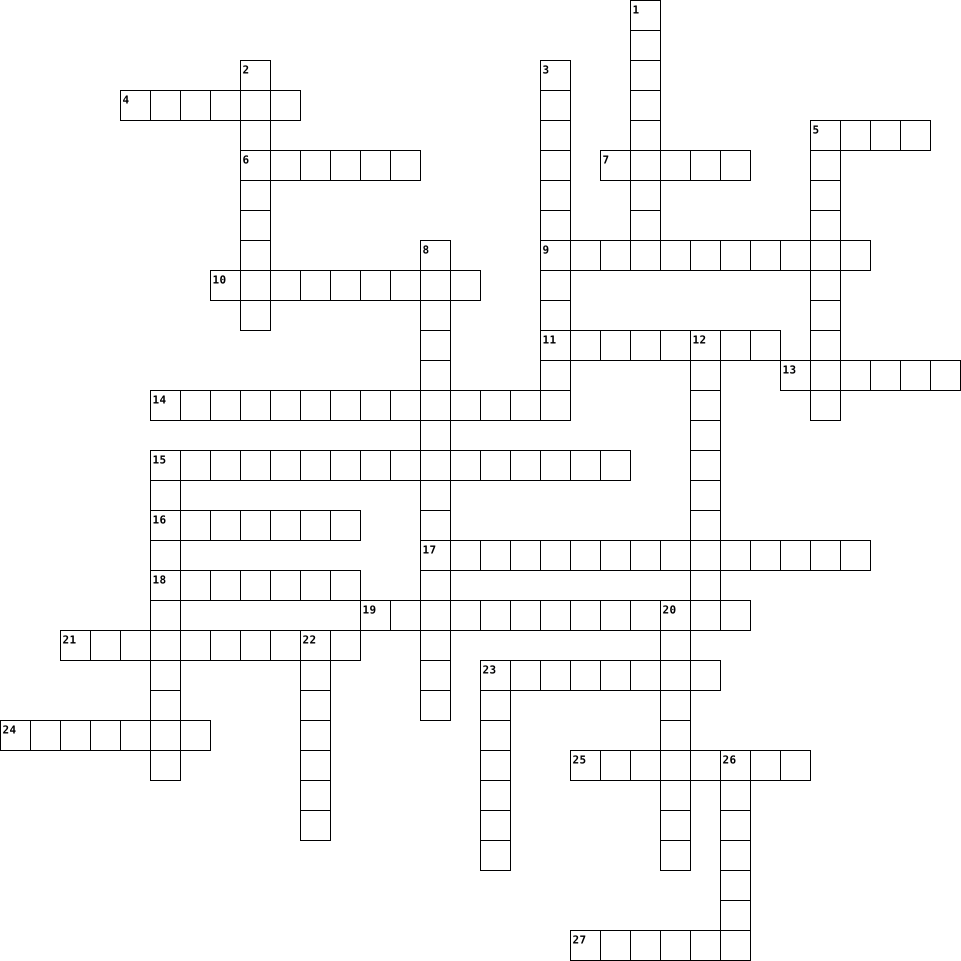
Across
- / is the name of the force exerted on an object due to the acceleration of gravity.
- / amount of matter in a body
- / is anything that has mass and occupies space.
- / a column in the periodic table
- / process of comparing something with a standard.
- / refers to the smallest estimated value taken directly from the device.
- / refers to the smallest exact value taken directly from the device.
- / a row in the periodic table
- / an element located in group 2A of periodic table.
- / an element contained in one of the 10 columns in the periodic table
- / modern periodic table
- / is a quantity that compares the density of a substance with the density of water at 4'C
- / simplest known substance.
- / cannot be broken down into simpler components by ordinary mechanical means; fixed composition
- / have properties intermediate between metals and nonmetals.
- / uncharged particles
- / contains 2 or more components whose composition may be varied.
- / atoms of the same elements having a different number of neutrons
- / are shiny substance that conduct heat and electricity.
Down
- / negatively charged particles
- / deals with the study of matter--its composition, properties, and transformations.
- / an element located in group 1A.
- / number of protons + number of neutrons
- / a group consisting of 3 elements with the same properties.
- / a compound that contains both a hydrogen atom and a lone pair of electrons so that it can be either an acid or a base.
- / is a measure of how hot or cold an object is.
- / are poor conductors of heat and electricity.
- / is a physical property that relates the mass of a substance to its volume.
- / the 1st and 8th element resemble one another in physical & chemical properties.
- / positively charged particles
30 Clues: / uncharged particles • / modern periodic table • / simplest known substance. • / amount of matter in a body • / a row in the periodic table • / negatively charged particles • / positively charged particles • / a column in the periodic table • / an element located in group 1A. • / number of protons + number of neutrons • / are poor conductors of heat and electricity. • ...
Chemistry UnitB 2014-11-06

Across
- horizontal row of elements in the periodic table
- shiny,malleable,ductile element that conducts electricity
- principle that matter is not created or destroyed in a chemical reaction
- ability to be stretched into wire
- the smallest part of an element that is representative of that element
- number of protons in the nucleus of an element
- positively charged center of an atom
- group 2 elements in the periodic table
- dull brittle element that does not conduct electricity
- an experiment in which all parts of a chemical reaction are accounted for
- atom that is electrically charged
- ability to be pounded into sheets
- description of how a substance interacts with other substances
- pure substance that cannot be broken down
- slow chemical change when oxygen reacts with a metal
- combination of symbols that represent a compound
- pure substance formed from a metal and non-metal
- absorbs energy (cold)
- workplace hazardous materials information system
- releases energy (warm)
Down
- experiment in which products can escape a chemical reaction
- negatively charged particle
- group 17 of the periodic table
- substance that helps a chemical reaction to proceed quicker
- chemical reaction that takes place in cells
- element has both metallic and non-metallic properties
- catalyst involved in chemical reactions in living things
- chemical combination of two or more elements
- group 18 of the periodic table
- group 1 metals in the periodic table
- pure substance formed when non-metals combine
- change that results when substances react to create a different substance
- reaction that occurs when oxygen reacts with a substance to form a new substance
- chemical name of CO
- mass of one atom of an element
35 Clues: chemical name of CO • absorbs energy (cold) • releases energy (warm) • negatively charged particle • group 17 of the periodic table • group 18 of the periodic table • mass of one atom of an element • ability to be stretched into wire • atom that is electrically charged • ability to be pounded into sheets • positively charged center of an atom • group 1 metals in the periodic table • ...
Chemistry Review 2021-03-21

Across
- A group of elements missing an electron in their outermost shell
- The name for having more or fewer electrons than protons
- Another name for an energy level
- A substance that increases the rate of a chemical reaction
- A solution in which the solvent is water
- A positively charged ion
- The ‘inventor’ of the modern Periodic Table
- The location of electrons
- a pattern of gradual change
- the rule describing the tendency of atoms to react in order to obtain a full outer shell
- A positively charged sub-atomic particle
- A column of elements in the periodic table
- Protons + Neutrons
- A neutral compound consisting of anions and cations
- A substance in which two or more elements are bonded together
- An element with a full valence shell of electrons
- The number of protons in the nucleus of an atom
- The relationship between the mass of a substance and the space it takes up
Down
- The bond formed between two non-metals
- A group of atoms bonded together
- Any element in the d-block (groups 3 – 12) of the periodic table
- An element in Group 1 of the Periodic Table
- An atom with a specific number of protons
- electrons involved in chemical bond formation
- A bond in which electrons are shared
- When elements/compounds exist together but without chemical bonds
- A negatively charged sub-atomic particle
- A sub-atomic particle with no charge
- The horizontal rows of the Periodic Table
- The bond formed between a metal and a non-metal in which electrons are transferred
- The arrangement of the nucleus and electrons
- An atom which has gained or lost an electron
- A negatively charged ion
33 Clues: Protons + Neutrons • A positively charged ion • A negatively charged ion • The location of electrons • a pattern of gradual change • A group of atoms bonded together • Another name for an energy level • A bond in which electrons are shared • A sub-atomic particle with no charge • The bond formed between two non-metals • A solution in which the solvent is water • ...
Periodic Table Challenge 1 2020-04-07

Across
- Maximum number of electrons in the second energy shell
- Which is more numerous metals or nonmetals?
- This element has the symbol Cd
- Atomic mass 131.29
- This is the first element of the transitional metals
- This doesn't react and is in period 3.
- You put this in a pool to keep it clean
- The series of extracted elements from period 6
- This has 22 protons
- The lightest non-metal
- The creator of the first periodic table of elements
- Protons plus neutrons
- Negatively charged part of an atom
- Location of protons and neutrons in atoms
- This element has 9 electrons
- Lightest member of group 8
- English word for Plumbum
- Wound cleaner
- Rotten egg smell
- This element is period 4 group 4
- This element has the symbol Hg
Down
- The number of periods in the periodic table
- This has symbol Al
- This has two more protons than Vanadium
- It's what we breath
- Two more protons than Cadmium
- Something our bones contain
- The symbol is Na
- This is the name of the 5cent coin in the USA
- This element is period 5 group 8
- It's symbol is Au
- This element has 78 electrons
- Positively charged part of an atom
- This element is located in period 4 and group 5
- Maximum number of electrons in the first energy shell
- This element has 49 protons
- Rows in the periodic table are called
- This has symbol K
- This is below carbon in the periodic table
- It's in a battery and in group 1
- Lightest element
- Superman's weakness
- Vertical columns in the periodic table are called
43 Clues: Wound cleaner • The symbol is Na • Lightest element • Rotten egg smell • It's symbol is Au • This has symbol K • This has symbol Al • Atomic mass 131.29 • It's what we breath • This has 22 protons • Superman's weakness • Protons plus neutrons • The lightest non-metal • English word for Plumbum • Lightest member of group 8 • Something our bones contain • This element has 49 protons • ...
CHEM 1AB 2015-10-06
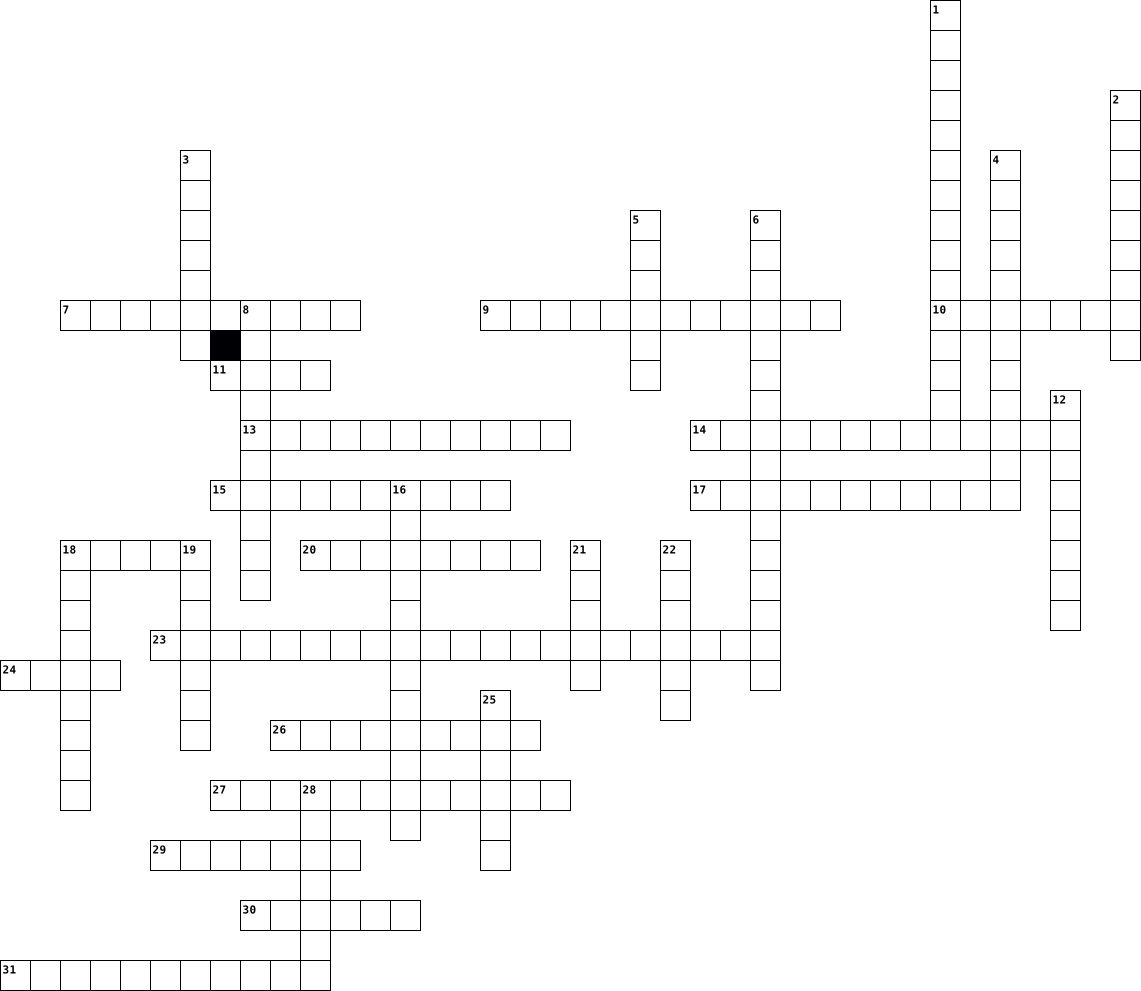
Across
- total number of protons and neutrons in a nucleus
- metals in Group IA (1) of the periodic table.
- state a state that is higher than ground state
- the smallest particle of a chemical element that can exist
- a series of fifteen metallic elements
- the space electrons travels in
- any of the gaseous elements in Group 0 (18) of the periodic table
- one of a quantized series of states in which matter may exist
- a negatively charged ion
- any element in group 17 of the periodic table
- the distribution of electrons of an atom or molecule
- an atom that has an electric charge
- an atomic model starting with B
- a type of chemical bond that generates two oppositely charged ions
- present in all atomic nuclei except those of ordinary hydrogen
- number the number of protthe smallest particle of a chemical element that can exist.ons in the nucleus of an atom
- the lowest energy state of an atom
Down
- any of the set of metallic elements occupying a central block
- something that is composed of two or more elements
- a substance consisting of atoms
- the outermost shell of an atom
- positively charged ion
- electrons in the outer most shell of an atom
- another term for semimetal
- Found in all atoms,is negatively charged
- a sign that identifies an element
- any of the series of fifteen metallic elements
- center of an atom
- a column in the periodic table
- a particle representing a quantum of light
- rows in periodic table
- each of two or more forms of the same element
32 Clues: center of an atom • positively charged ion • rows in periodic table • a negatively charged ion • another term for semimetal • the outermost shell of an atom • the space electrons travels in • a column in the periodic table • a substance consisting of atoms • an atomic model starting with B • a sign that identifies an element • the lowest energy state of an atom • ...
Science 2023-06-28

Across
- the first ever artificially produced element, produced as a by-product at nuclear power stations
- the group of metals that are shiny, soft, and react violently with water
- a category of atom on the periodic table
- where two or more substances bind to create one complex substance
- the subatomic particles with a positive charge
- the rarest element ever
- the inventor of the periodic table, Dmitri Mendeleyev, was from... ?
- the subatomic particles with a negative charge
- where electrons flow from atom to atom
- some elements abbreviations don't make much sense to english speakers because they are the element's name in this language
- where one or more complex molecule/s breaks down into simpler compounds
- subcategories of when a atom gains or loses a neutron
Down
- this country was named after the element of silver's latin name
- what is a group of interconnected atoms called?
- the element with the highest weight on the periodic table
- what is everything in the universe made of?
- the effect radioactivity has on some less dense materials
- where two molecules interact with each other and change structure
- the center of the atom
- the rarest naturally occurring element on earth
- the element with the lightest atomic weight on the periodic table
- the rows on the periodic table are called...?
- this element is widely regarded as the most versatile elements because of how it is the base element of so many things
- this element exists naturally in abundance on earth, but it was discovered because of astronomers observing the sun
- what is left after a reaction occurs
25 Clues: the center of the atom • the rarest element ever • what is left after a reaction occurs • where electrons flow from atom to atom • a category of atom on the periodic table • what is everything in the universe made of? • the rows on the periodic table are called...? • the subatomic particles with a positive charge • the subatomic particles with a negative charge • ...
Chemistry 2021-03-04

Across
- - different substances not chemically joined that can be separated
- nitrate - salt made of sodium hydroxide and nitric acid
- dish - a dish for evaporating solutions
- - number on ph scale which represents strong alkali
- - element with symbol Fe
- - element with atomic number 20
- - number on ph scale which represents strong acid
- - columns on periodic table
Down
- - compound with chemical formula H2O
- - rows on periodic table
- - one type of atom
- - number on ph scale which represents neutral
- metals - group 1 on periodic table
- cylinder - apparatus used to measure liquid
- - two or more different elements chemically joined together
- burner - gas burner used for heating things
16 Clues: - one type of atom • - rows on periodic table • - element with symbol Fe • - columns on periodic table • - element with atomic number 20 • metals - group 1 on periodic table • - compound with chemical formula H2O • dish - a dish for evaporating solutions • cylinder - apparatus used to measure liquid • burner - gas burner used for heating things • ...