
periodic table Crossword Puzzles
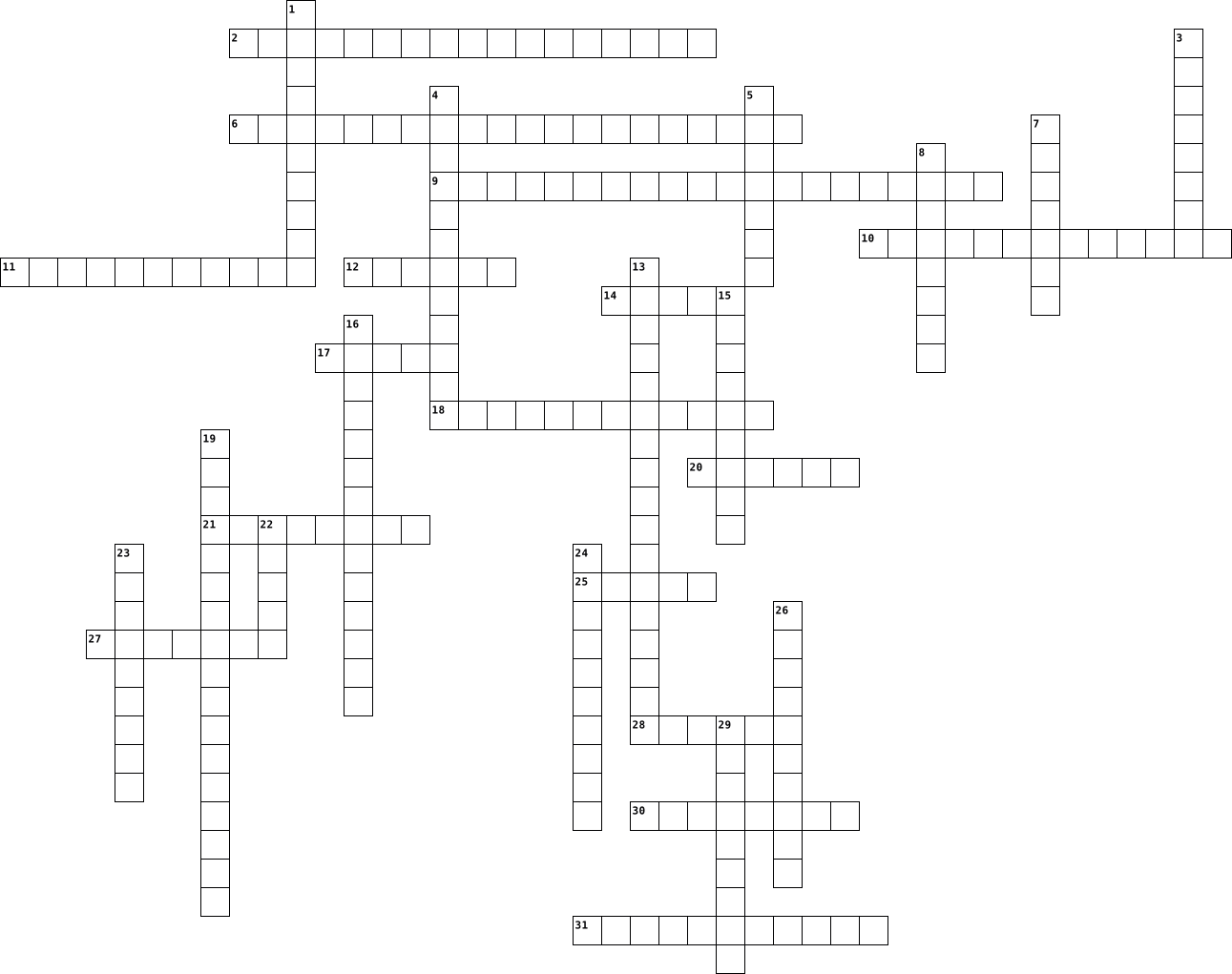
Features of the mordern periodic table 2021-05-14

Across
- what are elements like C, O, Cl, I, p etc?
- What is the current last element of the modern periodic table?
- In what group are the noble gasses kept
- What are elements like Th, pa, pa, pu, U called?
- what term refers to the radius of an atom?
- Elements of which period don not have the same number of valance electrons?
- what are elements like Mg, Cu, Zn, Au, Pt etc?
- what of an element is determined by the number of valence electrons present in the outermost shell of its atom?
Down
- What is the first element of the modern periodic table?
- Atoms of different elements with the same number of what are placed in the same period?
- What are elements which have both metal and Non-metal properties called?
- How many vertical columns/groups does the modern periodic table have?
- Elements present in the same group have the same number of what?
- How many horizontal rows/periods does the modern periodic table have?
- What are elements like Ce, Pr, Nd, Pm called?
15 Clues: In what group are the noble gasses kept • what term refers to the radius of an atom? • what are elements like C, O, Cl, I, p etc? • What are elements like Ce, Pr, Nd, Pm called? • what are elements like Mg, Cu, Zn, Au, Pt etc? • What are elements like Th, pa, pa, pu, U called? • What is the first element of the modern periodic table? • ...
ICP chapter 16 2022-02-15

Across
- cloud area around the nucleus of an atom where its electrons are most likely found
- particles with a positive 1 charge
- number the sum of the protons and the neutrons in the element
- number the number of protons in the element
- atomic mass the weighted-average mass of the mixture of its isotopes
- mass number the sum of the protons and the neutrons in the element isotope atoms of the same element that have different numbers of neutrons. (different mass numbers)
- horizontal rows in the periodic table
- the vertical columns in the periodic table
Down
- table the elements are arranged by increasing atomic number and by changes in physical and chemical properties
- neutral particles that have 0 charge
- with a negative 1 charge quark protons and neutrons are made of even smaller particles called
- particles with a negative 1 charge
- small positively charged center of the atom. contains the protons and neutrons
- electron
- the smallest piece of matter that still retains the properties of the element
- dot diagram uses the symbol of the element and dots to represent the electrons in the outer energy level
16 Clues: electron • particles with a negative 1 charge • particles with a positive 1 charge • neutral particles that have 0 charge • horizontal rows in the periodic table • the vertical columns in the periodic table • number the number of protons in the element • number the sum of the protons and the neutrons in the element • ...
Chemistry 2022-11-09

Across
- a column on the periodic table
- smallest particle of matter that retains characteristics of an element
- Water freezing (two words)
- atoms combine to make them
- positively charged particle in a nucleus
- two or more elements chemically combined
- characteristics or traits
- Determines if a substance is a solid or a liquid at room temperature (two words)
- particle orbiting the nucleus of an atom
- the amount of space an object occupies
Down
- new substance is formed (two words)
- Particle in atom with no charge
- a row on the periodic table
- matter that cannot be broken down into simpler substances
- the amount of matter in an object
- matter is not created or destroyed (three words)
16 Clues: characteristics or traits • Water freezing (two words) • atoms combine to make them • a row on the periodic table • a column on the periodic table • Particle in atom with no charge • the amount of matter in an object • new substance is formed (two words) • the amount of space an object occupies • positively charged particle in a nucleus • ...
Chapter 2 vocab 2020-09-04

Across
- a combination of two or more elements
- physically distinctive form of matter
- a substance diffused or suspended in air
- amount of space an object occupies
- element or compound
- row of elements on the periodic table
- homogeneous mixture with two or more substances
Down
- state of matter with a set volume but no set shape
- short scientific name for an element
- amount of matter an object has
- state of matter with no set volume or shape
- substance formed from a chemical reaction
- substance that changes in a reaction
- state of matter with set volume and shape
- substance with only one type of atom
- column of elements on the periodic table
16 Clues: element or compound • amount of matter an object has • amount of space an object occupies • short scientific name for an element • substance that changes in a reaction • substance with only one type of atom • a combination of two or more elements • physically distinctive form of matter • row of elements on the periodic table • a substance diffused or suspended in air • ...
Chemistry 2022-11-07

Across
- Anything that has mass and takes up space
- A molecule made of only one kind of atom
- What is the C symbol in the periodic table?
- A substance made up of atoms of two or more different elements joined by chemical bonds
Down
- The building blocks of matter
- A group of atoms bonded together
- bond. The attractive force that holds atoms or ions together
- Table of Elements, The chart scientists use to organize and classify all the known elements
- What is the H symbol in the periodic table?
- A combination of two or more substances that are not chemically combined
10 Clues: The building blocks of matter • A group of atoms bonded together • A molecule made of only one kind of atom • Anything that has mass and takes up space • What is the H symbol in the periodic table? • What is the C symbol in the periodic table? • bond. The attractive force that holds atoms or ions together • ...
Matter and the Periodic Table Puzzle 2018-02-07

Across
- Another name for a column of the periodic table.
- I take the shape of the container I am in.
- If phosphorus gains 1 proton it turns into this element.
- I have no charge and you can find me at the center of an atom.
- I am a transition metal with 47 electrons used to make photographic film.
- Two forms of the same element that contain same number of protons but different number of neutrons.
- These types of elements are malleable, ductile and conduct electricity.
- An atom that has gained or lost one or more electrons.
- I am negatively charged and barely contribute to the mass of the atom.
- I am the heaviest alkaline earth metal.
- Arsenic is an example of this type of element.
- I am the positively charged center of an atom.
- I am made up of hydrogen and oxygen atoms and you need me to live.
Down
- Another name for a row of the periodic table.
- Electrons furthest from the nucleus that are responsible for interactions of atoms with one another also referred to as _________ electrons.
- The number of _______ gives the identity of an element.
- Members of Group 17 (or VIIA) are called _______.
- Elemental symbol for tin.
- I can be either heterogeneous or homogeneous.
- Protons, neutrons and electrons are classified as ________ particles.
- A combination of two or more atoms held together in a specific shape by attractive forces.
- You can find me in Group 1 of the periodic table and in table salt.
- Substance that contains more than one element.
- My atomic number is 7.
- I have definite shape and volume.
- My atomic mass is 63.546.
- I am one of the noble gases.
27 Clues: My atomic number is 7. • Elemental symbol for tin. • My atomic mass is 63.546. • I am one of the noble gases. • I have definite shape and volume. • I am the heaviest alkaline earth metal. • I take the shape of the container I am in. • Another name for a row of the periodic table. • I can be either heterogeneous or homogeneous. • Substance that contains more than one element. • ...
Matter and the Periodic Table Puzzle 2018-02-07

Across
- I am one of the noble gases.
- Another name for a row of the periodic table.
- I have definite shape and volume.
- Electrons furthest from the nucleus that are responsible for interactions of atoms with one another also referred to as _________ electrons.
- An atom that has gained or lost one or more electrons.
- These types of elements are malleable, ductile and conduct electricity.
- A combination of two or more atoms held together in a specific shape by attractive forces.
- I am negatively charged and barely contribute to the mass of the atom.
- My atomic number is 7.
- Protons, neutrons and electrons are classified as ________ particles.
- The number of _______ gives the identity of an element.
- I take the shape of the container I am in.
- I am a transition metal with 47 electrons used to make photographic film.
Down
- My atomic mass is 63.546 amu.
- You can find me in Group 1 of the periodic table and in table salt.
- I am the heaviest alkaline earth metal.
- I am made up of hydrogen and oxygen atoms and you need me to live.
- If phosphorus gains 1 proton it turns into this element.
- I am the positively charged center of an atom.
- Members of Group 17 (or VIIA) are called _______.
- I have no charge and you can find me at the center of an atom.
- Arsenic is an example of this type of element.
- Substance that contains more than one element.
- I can be either heterogeneous or homogeneous.
- Two forms of the same element that contain same number of protons but different number of neutrons.
- Another name for a column of the periodic table.
- Elemental symbol for tin.
27 Clues: My atomic number is 7. • Elemental symbol for tin. • I am one of the noble gases. • My atomic mass is 63.546 amu. • I have definite shape and volume. • I am the heaviest alkaline earth metal. • I take the shape of the container I am in. • Another name for a row of the periodic table. • I can be either heterogeneous or homogeneous. • ...
Periodic Table Crossword 2022-03-27

Across
- What is a Negatively charged Atom Called?
- What is a Horizontal line of Elements called?
- What is the order of Electrons called?
- What is a Positively charged Atom Called?
- What is an Element that has both the properties of a Metal and Non-Metal?
- What is it called when two atoms bond?
- What is the Outermost shell of an Atom Called?
- What is ‘Electrons not being stuck to an atom’ called?
Down
- The Ninth Element of the Periodic Table
- what is an Atom that has a Charge other than Neutral?
- What is the name of the Seventeenth Group on the Periodic Table Called?
- What determines the Charge of an Atom?
- What is a Vertical line of Elements called?
- What is it called when a Cation and Anion combine?
- What Depicts the Atomic Number of an Atom?
- What is it called when Two Non-Metals bond?
16 Clues: What determines the Charge of an Atom? • What is the order of Electrons called? • What is it called when two atoms bond? • The Ninth Element of the Periodic Table • What is a Negatively charged Atom Called? • What is a Positively charged Atom Called? • What Depicts the Atomic Number of an Atom? • What is a Vertical line of Elements called? • ...
Periodic Table Crossword 2015-10-27

Across
- positively charged ion
- positively charged subatomic particle
- neutrally charged subatomic particle
- number of protons and neutrons in an atom
- negatively charge subatomic particle
- number of protons in an atom
- region in an atom where you can probably find an electron
- an atom that has gone through ionization
- the process of adding or taking away electrons from an atom
Down
- an electron in the outermost energy level
- middle of an atom
- vertical column of elements on the periodic table
- states that properties of elements change in a predictable way when arranged by atomic number
- horizontal row of elements on the periodic table
- negatively charged ion
- atom having the same number of protons but not the same number of neutrons as another atom of its element
16 Clues: middle of an atom • positively charged ion • negatively charged ion • number of protons in an atom • neutrally charged subatomic particle • negatively charge subatomic particle • positively charged subatomic particle • an atom that has gone through ionization • an electron in the outermost energy level • number of protons and neutrons in an atom • ...
Elements in the periodic table 2024-05-22

Across
- The element that diamonds are made of.
- The scientist who proposed the Law of Octaves.
- consists of a single atom
- Horizontal rows on the periodic table are called _____.
- Symbol for helium.
- Symbol for sodium.
- Metals are usually good conductors of _____.
- a molecule that consists of two atoms.
- A pure substance made of only one kind of atom.
Down
- The scientist who proposed the atomic theory and made a link between atoms and elements.
- Vertical columns on the periodic table are called _____.
- Basic unit of a chemical element.
- The scientist who created the first periodictable.
- Ancient Greek philosopher who theorized the existence of atoms.
- The lightest element.
- Element found in period 3 group 1.
- Group 1 elements are known as ______ metals.
- Nonmetals are often poor conductors of ____.
18 Clues: Symbol for helium. • Symbol for sodium. • The lightest element. • consists of a single atom • Basic unit of a chemical element. • Element found in period 3 group 1. • The element that diamonds are made of. • a molecule that consists of two atoms. • Group 1 elements are known as ______ metals. • Nonmetals are often poor conductors of ____. • ...
Anderson chemistry vocab crossword 2020-09-08

Across
- state of matter characterized by particles arranged such that their shape/volume are relatively stable
- a substance formed when 2 or more chemical elements are chemically bonded together
- substance formed from chemical reactions
- tabular display of the chemical elements
- a substance that takes part in and undergoes a chemical reaction
- a row of chemical elements in the periodic table
- measure of the amount of matter in an object
Down
- a set of chemical elements in the same vertical column on the periodic table
- the creation of a solid by a solution
- material made up of 2 or more different substances which are physically combined
- measure of the amount of space an object or substance takes up
- state of matter that conforms to the shape of its container but retains a constant volume
- process used to separate solids from liquids or gases using a filter
- state of matter consisting of particles that have no defined volume or shape
- a physically distinctive form of matter such as solid, liquid, gas, and plasma
15 Clues: the creation of a solid by a solution • substance formed from chemical reactions • tabular display of the chemical elements • measure of the amount of matter in an object • a row of chemical elements in the periodic table • measure of the amount of space an object or substance takes up • a substance that takes part in and undergoes a chemical reaction • ...
IPC Crossword p.569 2014-12-09

Across
- / Neutral particle, composed of quarks, inside the nucleus of an atom.
- / Horizontal row in the periodic table
- / Uses the symbol for an element and dots representing the number of electrons in the element's outer energy level.
- / Sum of the number of protons and neutrons in an atom's nucleus.
- / Negatively charged particles surrounding the center of an atom.
- / Vertical column in the periodic table.
- / Number of protons in an atom's nucleus
- / Atoms of the same element that have different numbers of neutrons.
Down
- / Area around the nucleus of an atom where the atom's electrons are most likely to be located.
- / Particles of matter that make up protons and neutrons.
- / Organized list of all known elements that are arranged according to repeated changes in properties
- / The smallest piece of matter that still retains the property of the element.
- / Weighted-average mass of the mixtures of an element's isotopes
- / Positively charged center of an atom that contains protons and neutrons and is surrounded by a cloud of electrons.
- / Positively charged particle, composed of quarks, inside the nucleus of an atom.
15 Clues: / Horizontal row in the periodic table • / Vertical column in the periodic table. • / Number of protons in an atom's nucleus • / Particles of matter that make up protons and neutrons. • / Weighted-average mass of the mixtures of an element's isotopes • / Sum of the number of protons and neutrons in an atom's nucleus. • ...
Atomic Structure! 2025-11-10

Across
- a neutral particle in the nucleus of an atom
- a substance made of two or more elements that are chemically combined
- the electrons in the outermost shell of an atom; they determine how an atom bond
- a pure substance made of only one kind of atom
- the number of protons in an atom; identifies the element
- a vertical column on the periodic table; elements in the same group share similar properties
- a horizontal row on the periodic table; elements in the same period have the same number of energy levels
- a positively charged particle in the nucleus of an atom
Down
- the total number of protons and neutrons in the nucleus
- a chart that organizes all known elements by their properties and atomic number
- two or more atoms bonded together
- the force that holds atoms together in a molecule or compound
- the dense center of the atom that contains protons and neutrons
- a negatively charged particle that orbits the nucleus of an atom
- the smallest particle of an element
15 Clues: two or more atoms bonded together • the smallest particle of an element • a neutral particle in the nucleus of an atom • a pure substance made of only one kind of atom • the total number of protons and neutrons in the nucleus • a positively charged particle in the nucleus of an atom • the number of protons in an atom; identifies the element • ...
Vocabulary 2025-11-10

Across
- The electrons in the outermost shell of an atom; they determine how an atom bonds.
- The number of protons in an atom; identifies the element.
- A substance made of two or more elements that are chemically combined.
- Table A chart that organizes all known elements by their properties and atomic number.
- A horizontal row on the periodic table; elements in the same period have the same number of energy levels.
- The total number of protons and neutrons in the nucleus.
Down
- A pure substance made of only one kind of atom.
- Two or more atoms bonded together.
- The smallest particle of an element that still has the properties of that element.
- The force that holds atoms together in a molecule or compound.
- A negatively charged particle that orbits the nucleus of an atom.
- A positively charged particle in the nucleus of an atom.
- A neutral particle in the nucleus of an atom.
- A vertical column on the periodic table; elements in the same group share similar properties.
- The dense center of the atom that contains protons and neutrons.
15 Clues: Two or more atoms bonded together. • A neutral particle in the nucleus of an atom. • A pure substance made of only one kind of atom. • A positively charged particle in the nucleus of an atom. • The total number of protons and neutrons in the nucleus. • The number of protons in an atom; identifies the element. • ...
Chem Vocab 2021-12-10

Across
- Columns on the periodic table
- A law in which it states that matter cannot be created nor destroyed
- Rows on the periodic table
- Can be bent
- Malleable, luster, conductor, and ductile
- Can be pulled into a wire
- The type of change that does alter the chemical composition
- A type of crust in which has to do more with land than water.
- A type of crust in which has to do more with water than land.
- How reactive something is
- A push or pull measured by Newtons
Down
- A table that sorts out all of the known elements
- The type of change that does not alter the chemical composition
- Speed or direction change
- The amount of key evidences there are when a chemical reaction goes off
- Tells you the stability of reactivity
- Distance an object travels divided by time
- Speed and direction
- Has properties of both metals and nonmetals
- Brittle, insulator, and dull
- One of the key evidences that includes bubbles, steam, smell, and smoke
21 Clues: Can be bent • Speed and direction • Speed or direction change • Can be pulled into a wire • How reactive something is • Rows on the periodic table • Brittle, insulator, and dull • Columns on the periodic table • A push or pull measured by Newtons • Tells you the stability of reactivity • Malleable, luster, conductor, and ductile • Distance an object travels divided by time • ...
Science Review 2017-02-12

Across
- absorption of heat
- number of protons in the nucleus
- have properties of both metals and metalloids
- any of the gaseous elements on the periodic table
- outermost energy level of an atom
- rule, number of atoms on both sides of the equation must be the same
- form of matter that cannot be further broken down
- central part of an atom or cell
- shiny, ductile, malleable
- result of the action or process
- positive electric charge
Down
- can't be broken down into a simpler substance, on the perodic table
- created The Periodic Table of Elements
- negative electric charge
- energy level or shell
- a substance that comes out a solid as the solution
- suggested the idea that electrons move from one orbital to another in large steps
- dull, poor conductor of electricity
- release of heat
- number of protons and neutrons in the atom
- substance that goes through a change during the reaction
- made of up of two or more separate elements
- atoms that are attracted to one another and bond this
- neutral electric charge
24 Clues: release of heat • absorption of heat • energy level or shell • neutral electric charge • negative electric charge • positive electric charge • shiny, ductile, malleable • central part of an atom or cell • result of the action or process • number of protons in the nucleus • outermost energy level of an atom • dull, poor conductor of electricity • created The Periodic Table of Elements • ...
Unit 2 Project 2012-11-01

Across
- A subatomic particle located in the nucleus of an atom and has a positive charge.
- A substance that conducts heat and is well malleable.
- Columns:_________ as Rows:Periods
- A table that shows the elements by their atomic number.
- Anything that has mass and takes up space.
- A substance made of two or more elements that are chemically combined.
- Substance made up of one kind of atom.
- Rings around the outside of the nucleus that holds electrons.
- Number of protons in an atom.
- A subatomic particle located in the nucleus of an atom with a neutral charge.
Down
- P
- A control center of every cell, made up of protons and neutrons.
- A state of matter made up of charged and uncharged atoms and free electrons.
- A subatomic particle located on the outer shell of an atom and has a negative charge.
- The elections on the outside shell of an atom.
- The smallest unit of an element.
- Another name for a row in the periodic table.
- Another name for families in the periodic table.
- Ga
- Kr
20 Clues: P • Ga • Kr • Number of protons in an atom. • The smallest unit of an element. • Columns:_________ as Rows:Periods • Substance made up of one kind of atom. • Anything that has mass and takes up space. • Another name for a row in the periodic table. • The elections on the outside shell of an atom. • Another name for families in the periodic table. • ...
Chapter 10 Crossword 2014-11-04

Across
- group 17
- the central core of an atom
- how easily the element reacts with other elements
- groups on the periodic table that classifies elements depending on their properties
- a particle with no charge
- the horizontal rows of the periodic table
- a particle that gives the nucleus it's positive charge
- the sum of the number of protons and the number of neutrons
- a particle that moves around the nucleus forming a cloud of negative charge
- the elements located along the right side of the stair-step line
- groups 3-12
- similar to each other in their properties
Down
- group 18
- the region around the nucleus occupied by electrons
- an average of the masses of all the isotopes that occur in nature for that element
- atoms of the same element with different numbers of neutrons
- have five or more electrons in their outer energy level
- the number of protons in an atom
- a table of elements classified by their properties
- the smallest particle of any element that has the properties of that element
20 Clues: group 17 • group 18 • groups 3-12 • a particle with no charge • the central core of an atom • the number of protons in an atom • the horizontal rows of the periodic table • similar to each other in their properties • how easily the element reacts with other elements • a table of elements classified by their properties • the region around the nucleus occupied by electrons • ...
Science 2022-06-21

Across
- a metal that give a violent reaction when mixed with acid
- a types of conductor that holds heat
- something used to make pots, wires ect.
- meaning metals can be pulled into a wire
- metals have a high ________.
- a table containing elements
Down
- elements are sorted into periods and _________ on a periodic table
- a chemical that can be mixed with metals
- acid is a type of _________.
- a type of conductor that can give high or low voltage
- a step by step way of doing something
- metals are mostly _________.
- a chemical ________.
- a metal always use to make electricity
- means metals are shiny
15 Clues: a chemical ________. • means metals are shiny • a table containing elements • acid is a type of _________. • metals are mostly _________. • metals have a high ________. • a types of conductor that holds heat • a step by step way of doing something • a metal always use to make electricity • something used to make pots, wires ect. • a chemical that can be mixed with metals • ...
Science 2022-06-21

Across
- a metal that give a violent reaction when mixed with acid
- a types of conductor that holds heat
- something used to make pots, wires ect.
- meaning metals can be pulled into a wire
- metals have a high ________.
- a table containing elements
Down
- elements are sorted into periods and _________ on a periodic table
- a chemical that can be mixed with metals
- acid is a type of _________.
- a type of conductor that can give high or low voltage
- a step by step way of doing something
- metals are mostly _________.
- a chemical ________.
- a metal always use to make electricity
- means metals are shiny
15 Clues: a chemical ________. • means metals are shiny • a table containing elements • acid is a type of _________. • metals are mostly _________. • metals have a high ________. • a types of conductor that holds heat • a step by step way of doing something • a metal always use to make electricity • something used to make pots, wires ect. • a chemical that can be mixed with metals • ...
Chapters 1 - 3 2024-09-13

Across
- Absolute temperature scale
- Bond where electrons are shared
- Atoms of an element with the same number of protons but a different number of neutrons
- Negatively charged monatomic ion
- Two or more nonmetal atoms joined by covalent bonds
- A column in the periodic table, also known as a family
- A substances mass divided by its volume
Down
- Subatomic particle with a negative charge and negligible mass
- energy of motion
- An atom's outermost electrons
- Positively charged monatomic ion
- Metric base unit of length
- Bond that is formed when electrons are transferred
- The elements in column 7A in the periodic table
- Indicates medication should be administered twice daily
15 Clues: energy of motion • Absolute temperature scale • Metric base unit of length • An atom's outermost electrons • Bond where electrons are shared • Positively charged monatomic ion • Negatively charged monatomic ion • A substances mass divided by its volume • The elements in column 7A in the periodic table • Bond that is formed when electrons are transferred • ...
Science chapters cross-word 2024-12-18

Across
- 1st element on the periodic table
- A type of atom with the same number of protons
- Where most of our drinking water comes from
- the center of an atom
- when water defines gravity
- the horizontal grouping on the periodic table
- Who created the "Plum pudding" model of an atom
Down
- An electron on the outer most shell
- a non-reactive substance
- the property that lets water stick to itself
- water is called the ____________ because it can dissolve most things
- a highly reactive non-metal
- The neutrally charged molecule in the nucleus
- what does the "P" in APE MAN stand for
- Positive charged Ion
15 Clues: Positive charged Ion • the center of an atom • a non-reactive substance • when water defines gravity • a highly reactive non-metal • 1st element on the periodic table • An electron on the outer most shell • what does the "P" in APE MAN stand for • Where most of our drinking water comes from • the property that lets water stick to itself • ...
This is my awesome Chemistry Crossword (that is worth 10 classwork points) 2025-11-09

Across
- how many valence electrons does lithium have?
- which way does reactivity go?
- what is the max electrons p block can hold?
- which element has the most electrons?
- what element looks like its out of place?
- where are the transition metals on the periodic table?
- what group is zinc in?
- what block is at the bottom of the periodic table?
Down
- what family has 8 valence electrons?'
- what is the max electrons d block can hold?
- what are cations charge?
- what are anions charge?
- what period is nitrogen in?
- what is neon's symbol?
- what block is known as the "transition metals?"
15 Clues: what is neon's symbol? • what group is zinc in? • what are anions charge? • what are cations charge? • what period is nitrogen in? • which way does reactivity go? • what family has 8 valence electrons?' • which element has the most electrons? • what element looks like its out of place? • what is the max electrons d block can hold? • what is the max electrons p block can hold? • ...
Chemistry 2022-05-19
Across
- The energy change that occurs when an electron is acquired by a neutral atom is called the atom’s electron affinity.
- if two or more different compounds are composed of the same two elements, then the ratio of the masses of the second element combined with a certain mass of the first element is always a ratio of small whole numbers.
- a chemical compound containing elements in exactly the same proportions by mass regardless of the size or source of the compound.
- the attraction between two or more atoms that allows them to be able to form a stable chemical compound.
- The first row of the f block are known as?
- the p block includes all of the
- has just three valence electrons, which tends to form bonds in which it is surrounded by six electrons.
- two nuclei and two electrons _____ each other.
- ______ is used to form chemical compounds.
- Red Atoms of different elements combine are known as?
- A ________ formula indicates the relative numbers of atoms of each kind in a chemical compound by using atomic symbols and numerical subscripts.
- All matter is composed of extremely small particles called?
- In the periodic table, the f-block elements are wedged between Groups 3 and 4 in the sixth and ______ periods.
- The elements of Group 1 of the periodic table are known as the _____ metals.
- Repeating patterns are referred to as ________.
- is the energy required to break a chemical bond and form neutral isolated atoms.
Down
- All six of the __________ are also in the p block.
- is a unique element.
- states that the physical and chemical properties of the elements are periodic functions of their atomic numbers.
- Cationic and _______ radii decrease across a period.
- electron of one atom and proton of the other atom _______ one another.
- A ________ is a neutral group of atoms that are held together by covalent bonds.
- A molecular formula shows the types and numbers of atoms combined in a single molecule of a molecular compound.
- except hydrogen and ______.
- is an arrangement of the elements in order of their atomic numbers so that elements with similar properties fall in the same column, or group.
- is a measure of the ability of an atom in a chemical compound to attract electrons from another atom in the compound.
- The elements of Group 2 of the periodic table are called the alkaline-_____ metals.
- A chemical compound whose simplest units are molecules is called a _________ compound.
- The p-block elements together with the s-block elements are called the __________ elements.
- Atoms cannot be __________, created, or destroyed.
- The second row of the f block are known as?
31 Clues: is a unique element. • except hydrogen and ______. • the p block includes all of the • The first row of the f block are known as? • ______ is used to form chemical compounds. • The second row of the f block are known as? • two nuclei and two electrons _____ each other. • Repeating patterns are referred to as ________. • All six of the __________ are also in the p block. • ...
vocab science words 2022-10-03

Across
- clue Found on the right side ofthe periodic table.
- clue Found along the zigzag line on the periodic table.
- clue the amount of space that a substanc object occupies
- clue break with little application of force.
Down
- property clue property (as color, hardness, boiling point) of matter not involving in its manifestation
- clue the degree of compactness of a substance
- clue has to do with proportion
- clue ,measure using a triple beam balance
- clue Ability of the surface of a substance to shine or reflect light
- clue Generally found on the left side of the periodic table.
10 Clues: clue has to do with proportion • clue ,measure using a triple beam balance • clue break with little application of force. • clue the degree of compactness of a substance • clue Found along the zigzag line on the periodic table. • clue the amount of space that a substanc object occupies • clue Found on the right side ofthe periodic table. • ...
STARR Review 2022-04-26

Across
- the way light reflects from the surface of a substance
- a series of relationships that transfer from one organism to another
- a diagram that shows energy transfering from one level to another
- the amount of space taken up by an object
- elements located the right of the stair step of the periodic table
Down
- elements located to the left of the stair step on the periodic table
- the amount of matter in an object
- the formula is m/v
- elements located on the stair step of the periodic table
- a diagram that shows many food chains overlapping
10 Clues: the formula is m/v • the amount of matter in an object • the amount of space taken up by an object • a diagram that shows many food chains overlapping • the way light reflects from the surface of a substance • elements located on the stair step of the periodic table • a diagram that shows energy transfering from one level to another • ...
Elements Crossword Puzzle 2022-05-08

Across
- Earth Metals Elements in family 2 are called what?
- metals located between the transition metals and the metalloids.
- What is it called when metals can be mixed with other elements?
- Metal Elements in families 3 through what?
- What element is number 1?
Down
- Elements in family 1 are called what?
- What are located on the left side of the periodic table?
- what is located on the right side of the periodic table?
- what displays the properties of both metals and nonmetals?
- Table A tool used by chemists to help arrange the elements based on certain characteristics they share?
10 Clues: What element is number 1? • Elements in family 1 are called what? • Metal Elements in families 3 through what? • Earth Metals Elements in family 2 are called what? • What are located on the left side of the periodic table? • what is located on the right side of the periodic table? • what displays the properties of both metals and nonmetals? • ...
Year 8 Atomic Structure 2025-04-29

Across
- the only liquid non metal element at room temperature
- the term given to the horizontal rows of elements in the Periodic Table
- the group of elements that are the least reactive
- protons and n_____ make up the nucleus at the centre of atoms
- where the transition metals are found on the periodic table
Down
- description used for the sound made when metals are hit
- the term given to the vertical columns of the periodic table
- positively charged particle
- Li,K and Na are all part of this group
- the only liquid metal at room temperature
10 Clues: positively charged particle • Li,K and Na are all part of this group • the only liquid metal at room temperature • the group of elements that are the least reactive • the only liquid non metal element at room temperature • description used for the sound made when metals are hit • where the transition metals are found on the periodic table • ...
Periodic Table Crossword Puzzle 2020-10-09

Across
- any substance made up of only 1 type of atom
- all have same basic properties of metals
- Many are man-made in labs
Down
- Has 1 Valence electron
- all nonmetals that easily combine with other elements, often from Alkali metals
- Becomes more rare as you move down the table
- Found in fireworks, batteries, flashbulbs
- Called Rare Earth Metals
- Horizontal rows on the Periodic table
- Vertical columns on the Periodic Table
10 Clues: Has 1 Valence electron • Called Rare Earth Metals • Many are man-made in labs • Horizontal rows on the Periodic table • Vertical columns on the Periodic Table • all have same basic properties of metals • Found in fireworks, batteries, flashbulbs • Becomes more rare as you move down the table • any substance made up of only 1 type of atom • ...
Unit 2 Project 2012-11-01

Across
- Another name for a row in the periodic table.
- P
- The elections on the outside shell of an atom.
- A state of matter made up of charged and uncharged atoms and free electrons.
- Ga
- A control center of every cell, made up of protons and neutrons.
- A subatomic particle located in the nucleus of an atom with a neutral charge.
- Rings around the outside of the nucleus that holds electrons.
- A subatomic particle located in the nucleus of an atom and has a positive charge.
Down
- Anything that has mass and takes up space.
- Columns:_________ as Rows:Periods
- Number of protons in an atom.
- The smallest unit of an element.
- A subatomic particle located on the outer shell of an atom and has a negative charge.
- A table that shows the elements by their atomic number.
- A substance made of two or more elements that are chemically combined.
- A substance that conducts heat and is well malleable.
- Substance made up of one kind of atom.
- Another name for families in the periodic table.
- Kr
20 Clues: P • Ga • Kr • Number of protons in an atom. • The smallest unit of an element. • Columns:_________ as Rows:Periods • Substance made up of one kind of atom. • Anything that has mass and takes up space. • Another name for a row in the periodic table. • The elections on the outside shell of an atom. • Another name for families in the periodic table. • ...
Chemistry Study Guide 2016-02-10

Across
- group of elements chemically bonded
- metal gets protection
- stuff that comes out of science experiment
- in between properties of metal and non-metals
- outer most particles in the electron
- reaction with heat
- group of atoms in purest form
- odorless colorless gas
- # of protons expressed on each element square
- a substance with high destiny, can conduct electricity, and is shiny
- lower density not good heat conductor and not shiny
Down
- 2 elements chemically bonded form a ________
- after a chemical reaction the mass is the same as before the experiment
- neutral charge in the nucleus
- middle of atom, house of protons and nucleuses
- shortened version of element usual derived from Latin or Greek
- Russian creator of the periodic table
- positive charge in the nucleus
- a row on the periodic table
- Smallest particle in the universe
- the function that describes the wave like behavior of an electron
- weight of atom
- reaction with cold stuff
- Similar elements together on table
- Negative charge that circles around the neutron
- molecule that started reaction
26 Clues: weight of atom • reaction with heat • metal gets protection • odorless colorless gas • reaction with cold stuff • a row on the periodic table • neutral charge in the nucleus • group of atoms in purest form • positive charge in the nucleus • molecule that started reaction • Smallest particle in the universe • Similar elements together on table • group of elements chemically bonded • ...
MASS NEWS CROSSWORD 2023-10-31

Across
- Vertical columns on the periodic table.
- Material or system has the same properties at every point.
- A membrane-bound cell organelle
- Something that is hard
- Able to dissolve
- The weight of an atom.
- A substance made by mixing other substances together.
- When something starts to boil
- A table of the chemicstatesofmatter Is one of the distinct forms in which matter can exist.
- Is one of the distinct forms in which matter can exist
- A basic unit of a chemical element.
Down
- Horizontal columns on the periodic table.
- The period in which aal elements arranged in order
- A thing that is composed of two or more separate elements
- The number of protons in the nucleus of an atom
- When something starts to melt
- Something that is not hard and you can see
- Something that is not hard and you can not see
- Area is waterlogged.
- A negative electric charge
- A chemical substance that cannot be broken down into other substances.
- A neutral electric charge
- A positive electric charge
23 Clues: Able to dissolve • Area is waterlogged. • Something that is hard • The weight of an atom. • A neutral electric charge • A negative electric charge • A positive electric charge • When something starts to melt • When something starts to boil • A membrane-bound cell organelle • A basic unit of a chemical element. • Vertical columns on the periodic table. • ...
Periodic trends crossword 2013-06-08

Across
- Violent gases
- In the outer energy level
- The ability to attract otheer electrons
- the size of an atom from the nucleus to the electron cloud
- doesnt conduct electricity well
- Vertical organization in periodic table
Down
- nonreactive gases
- Dull and soft
- Horizontal organization on the periodic table
- The energy required to turn an element into an ion
- Group that has only one valence electron
11 Clues: Violent gases • Dull and soft • nonreactive gases • In the outer energy level • doesnt conduct electricity well • The ability to attract otheer electrons • Vertical organization in periodic table • Group that has only one valence electron • Horizontal organization on the periodic table • The energy required to turn an element into an ion • ...
science 2022-10-04

Across
- no charge
- sea
- table a map of elements
- on table
- makes everything
- number top left
Down
- positively charged
- moves freely
- cant touch
- you can hold it
- space space with nothing
- negativity charged
12 Clues: sea • on table • no charge • cant touch • moves freely • you can hold it • makes everything • number top left • positively charged • negativity charged • space space with nothing • table a map of elements
chemistry 2023-10-04

Across
- the one or two letters that represent a symbol
- The group on the periodic table that has the elements lithium, sodium potassium, Rubidium, Cesium, and francium
- Two or more elements chemically bonded together
- a diagram that shows all the known elements in order of there atomic number
- a group on the periodic table that consist of the elements carbon, nitrogen, oxygen, phosphorous, Hydrogen, sulfur, and selenium
- a type of ion the is negative from gaining an electron
- a type of ion that is positive from losing an electron
- the small number that indicates the number of each element in a compound
Down
- the first element on the periodic table
- the number on the top right of an element that indicates the number of protons
- shown by number of protons, it's negative
- the type of boning that involves atoms sharing electrons
- Two or more thing that are combined but not chemically bonded together
- shown by the atomic number of an element, it's positive
- the type of bonding where one atom takes an electron from another
15 Clues: the first element on the periodic table • shown by number of protons, it's negative • the one or two letters that represent a symbol • Two or more elements chemically bonded together • a type of ion the is negative from gaining an electron • a type of ion that is positive from losing an electron • shown by the atomic number of an element, it's positive • ...
Introducing The Periodic Table 2024-09-24

Across
- Pure substance made of only one type of atom
- Elements that have properties of both metals and nonmetals, often used in electronics as semiconductors.
- Chart that organizes all the chemical elements
- We compared the periodic table to this place.
- Unique to each element made up of one or two letters
- The following elements all react explosively with water.
- Elements are poisonous and explode when combined with other elements.
- Vertical column on the periodic table, elements in the same group have similar chemical properties.
Down
- Elements that do not react when combined with other elements
- Elements that are shiny, good conductors of heat and electricty and can be shaped or stretched.
- Horizontal row on the periodic table, elements in the same period have the same number of electron shells
- It’s usually shown as a decimal.
- Elements that are dull, poor conductors of heat and electricty and brittle when solid.
- Tells the number of protons in an atom
- Elements that are less reactive than the Alkali metals but more reactive than other metals.
15 Clues: It’s usually shown as a decimal. • Tells the number of protons in an atom • Pure substance made of only one type of atom • We compared the periodic table to this place. • Chart that organizes all the chemical elements • Unique to each element made up of one or two letters • The following elements all react explosively with water. • ...
periodic table crossword. 2026-02-27

Across
- the small positivley charged center of an atom
- metals second left farthest on the periodic table
- particles with an electric charge of 1+
- particles with an electric charge of 1-
- the elements in the middle of the periodic table
- group farthest left on the periodic table
Down
- electrically neutral particles in the nucleus without charge
- Number of protons.
8 Clues: Number of protons. • particles with an electric charge of 1+ • particles with an electric charge of 1- • group farthest left on the periodic table • the small positivley charged center of an atom • the elements in the middle of the periodic table • metals second left farthest on the periodic table • electrically neutral particles in the nucleus without charge
The Periodic Table 2025-05-01

Across
- The element with atomic number 26.
- A halogen that is a liquid at room temperature.
- The elements on the right of the step line are the ____________ .
- Elements are arranged based on their ________ number.
- The halogens are in Group ________ .
Down
- The element with symbol Sn.
- Ag is the _________ of silver.
- The most reactive alkali metal.
- The element with symbol Cu.
- The least reactive alkali metal.
- The elements on the left of the step line are the __________ .
- Dr Van Brussel's favourite element.
- A metal but it is a liquid at room temperature.
- The element with symbol Pb.
- The element with symbol Na.
- The elements in Group 8 are called the _______ Gases.
16 Clues: The element with symbol Sn. • The element with symbol Cu. • The element with symbol Pb. • The element with symbol Na. • Ag is the _________ of silver. • The most reactive alkali metal. • The least reactive alkali metal. • The element with atomic number 26. • Dr Van Brussel's favourite element. • The halogens are in Group ________ . • ...
Periodic Table Crossword 2022-03-08

Across
- I am not an alkali metal, but I am in group 1.
- My atomic number is 47.
- I have 28 electrons when electrically neutral.
- I am a metalloid that usually has 71 neutrons.
- Eat me when you have cramps in your legs.
- my average atomic mass is 35.453
- I am the 2nd most reactive metal.
Down
- I am a gas with 8 neutrons in my most common form.
- I have 26 protons.
- I'm the only noble gas with 2 electrons.
- I am in the fifth period and the carbon family.
- I'm an alkaline earth metal used in fireworks.
- I am very important for healthy teeth and bones
- I have 6 valence electrons and 16 protons.
- I am the only liquid metal at room temperature
- I am a halogen with 5 energy levels.
16 Clues: I have 26 protons. • My atomic number is 47. • my average atomic mass is 35.453 • I am the 2nd most reactive metal. • I am a halogen with 5 energy levels. • I'm the only noble gas with 2 electrons. • Eat me when you have cramps in your legs. • I have 6 valence electrons and 16 protons. • I am not an alkali metal, but I am in group 1. • ...
Physical and chemical changes 2018-05-30

Across
- a substance diffused in the air
- sub-atomic particle
- _____are changed into other substance
- compound two molecular bonded
- columns of element in the periodic table
- pure substance
- there are 6_____ in school
- change of state from solid to a gas
- emit of gas or vapour
- liquid to gas same as evaporate
- when substance particle are collide with each other
- one atom
- only two atoms
- is the abundance of a consitituent divded by the total volume
- easily becomes a gas
Down
- two reactant makes_____
- chain of molecular simpler to each other repeating
- an arrangement in space of isolated points in a regular pattern
- speeds the chemical reaction
- two or more different substance bonded together e.g. water
- when the environment does damage to metal
- gas turn to liquid
- you can soeed this up by adding heat engery
- type of catalyst
- water turns to gas when heated
- element into a table
- ice in the sun
- two attracted to each other
28 Clues: one atom • pure substance • ice in the sun • only two atoms • type of catalyst • gas turn to liquid • sub-atomic particle • element into a table • easily becomes a gas • emit of gas or vapour • two reactant makes_____ • there are 6_____ in school • two attracted to each other • speeds the chemical reaction • compound two molecular bonded • water turns to gas when heated • ...
Chemistry vocab Unit 1 2023-09-21

Across
- scale used to classify solutions
- The ability of a material to conduct electricity or heat
- The tendency of a substance to undergo chemical changes
- ability to dissolve in a liquid
- pH of less than 7
- result in the formation of one or more new substances with new chemical and physical properties
- be recognized only when substances react or do not react chemically with one another, that is, when they undergo a change in composition.
- substance that increases the rate of a chemical reaction
Down
- elements with similar properties found on the right side of the “staircase” on the periodic table
- do not change the composition of a substance, only the physical properties
- a solid substance formed when two solutions are chemically combined.
- a quick reference for associating the name and symbol of an element.
- can be observed and measured without changing the kind of matter being studied.
- elements with similar properties that create a “staircase” on the periodic table
- elements with similar properties found on the left side of the “staircase” on the periodic table
15 Clues: pH of less than 7 • ability to dissolve in a liquid • scale used to classify solutions • The tendency of a substance to undergo chemical changes • The ability of a material to conduct electricity or heat • substance that increases the rate of a chemical reaction • a solid substance formed when two solutions are chemically combined. • ...
The Periodic Table Vocabulary (use ^ for each space) 2021-01-18

Across
- Russian chemist who developed a periodic table of the chemical elements and predicted the discovery of several new elements (1834-1907)
- a horizontal row of elements in the periodic table
- the number of protons in the nucleus of an atom
- a one or two letter representation of an element
- word part meaning neutral
- word part meaning having an electric charge
- a subatomic particle that has a positive charge and that is found in the nucleus of an atom
- a subatomic particle that has a negative charge
Down
- a subatomic particle that has no charge and that is found in the nucleus of an atom
- the average mass of all the isotopes of an element
- electrons on the outermost energy level of an atom
- a column on the periodic table
- a substance made up of atoms of two or more different elements joined by chemical bonds
- a chemical rule of thumb that elements tend to bond in such a way that each atom has eight electrons in its valence shell, giving it the same electronic configuration as a noble gas
- word part meaning first or positive
- basic unit of matter - means uncuttable in Greek
16 Clues: word part meaning neutral • a column on the periodic table • word part meaning first or positive • word part meaning having an electric charge • the number of protons in the nucleus of an atom • a subatomic particle that has a negative charge • a one or two letter representation of an element • basic unit of matter - means uncuttable in Greek • ...
Unit 2 Terms 2025-10-28

Across
- Describes an atom or ion that can have more than one valence, or charge, allowing it to bond with multiple other atoms. Transition metals, for example, are often multivalent.
- metal Any of the reactive metallic elements found in Group 2 of the periodic table, such as magnesium and calcium. They have two valence electrons and readily lose both to form a +2 ion.
- A vertical column of elements in the periodic table. Elements in the same group share similar chemical properties because they have the same number of valence electrons.
- element An element in Groups 1, 2, and 13-18 of the periodic table, also known as a main-group element. These elements have their valence electrons in s or p orbitals and represent the wide range of properties found across the table.
- Describes an atom or ion with a valence of one, meaning it typically gains, loses, or shares one electron to form a chemical bond.
Down
- gas Any of the elements in Group 18, including helium, neon, and argon. With a full outer electron shell, they are largely unreactive, or inert, under normal conditions.
- The tendency of an atom or compound to undergo a chemical reaction. It is influenced by the stability of its electron configuration and other factors like bond strength.
- metal Any of the highly reactive metallic elements found in Group 1 of the periodic table, including lithium, sodium, and potassium. They have one valence electron and readily lose it to form a +1 ion.
- Any of the highly reactive, nonmetallic elements in Group 17, which includes fluorine, chlorine, and bromine. They have seven valence electrons and tend to gain one to form a -1 ion.
- A horizontal row of elements in the periodic table. The number of the period corresponds to the highest energy level that an element's electrons occupy.
- law States that when elements are arranged in order of increasing atomic number, there is a periodic repetition of their chemical and physical properties.
11 Clues: Describes an atom or ion with a valence of one, meaning it typically gains, loses, or shares one electron to form a chemical bond. • A horizontal row of elements in the periodic table. The number of the period corresponds to the highest energy level that an element's electrons occupy. • ...
Alexander H Crossword 2023-03-29

Across
- highly reactive non-metal elements
- the lightest not naturally occurring element
- Sn
- the study of colors emitted by particles
- The heaviest natural element
- The columns of elements on the periodic table
- a group of elements that do not react
- the number of electrons or protons on a neutral atom
Down
- the electrons found on the furthest orbital from the nucleus
- the study of the different elements
- negatively charged particles that is part of an atom
- negatively charged ion
- the different rows of elements of the periodic table
- the lightest noble gas
- A positively charged ion
- a model used to visualize the structure of an atom
- the neutral particle that is part of the nucleus of an atom
17 Clues: Sn • negatively charged ion • the lightest noble gas • A positively charged ion • The heaviest natural element • highly reactive non-metal elements • the study of the different elements • a group of elements that do not react • the study of colors emitted by particles • the lightest not naturally occurring element • The columns of elements on the periodic table • ...
Chemical Bonding 2023-10-01

Across
- Simplest unit of matter
- Ability to be stretched/drawn into wires
- Electrons in the outermost shell
- A bond between a metal and nonmetal
- Consisting of many atoms; act as their own unit
- Located on the right side of the periodic table
- Only one type of atom
- Ability to transfer heat and electricity
- Located on the left side of the periodic table
Down
- A negatively charged ion
- Type of bond where electrons are free flowing
- A positively charged ion
- Ability to hammer a substance into thin sheets
- Atomic ____ tells us the number of protons + neutrons
- A type of bond where electrons are shared
- Atomic ______ tells us the number of protons in a neutral atom
- A charged atom
17 Clues: A charged atom • Only one type of atom • Simplest unit of matter • A negatively charged ion • A positively charged ion • Electrons in the outermost shell • A bond between a metal and nonmetal • Ability to be stretched/drawn into wires • Ability to transfer heat and electricity • A type of bond where electrons are shared • Type of bond where electrons are free flowing • ...
Elements, Compounds, and Mixtures 2022-10-13

Across
- a table that represents all of the elements
- anything that has mass or takes up space
- vertical row of the periodic table
- one type of element/atom
- building blocks
Down
- two different types of atoms chemically bonded
- atoms of the same type grouped together
- the horizontal row of the periodic table
- a metal mixed with at least one other element a pure substance
- not chemically bonded together
10 Clues: building blocks • one type of element/atom • not chemically bonded together • vertical row of the periodic table • atoms of the same type grouped together • the horizontal row of the periodic table • anything that has mass or takes up space • a table that represents all of the elements • two different types of atoms chemically bonded • ...
Atoms definitions 2022-10-04

Across
- Basic substance made of atoms that can't be separated
- The sixth element, it is a non-metal and is relatively reactive.
- Basic unit of a chemical element.
- Element with metallic properties.
- Mass of an atom.
- Stable subatomic particle in nuclei, and has a positive charge
Down
- First element on the periodic table, and the most abundant element.
- Stable subatomic particle revolving around nuclei, and has a negative charge.
- Element that lacks metallic properties
- Number of an element on the periodic table.
- table of elements arranged via atomic number.
- Stable subatomic particle in nuclei, and has a neutral charge.
12 Clues: Mass of an atom. • Basic unit of a chemical element. • Element with metallic properties. • Element that lacks metallic properties • Number of an element on the periodic table. • table of elements arranged via atomic number. • Basic substance made of atoms that can't be separated • Stable subatomic particle in nuclei, and has a neutral charge. • ...
Jason science crossword 2024-10-31

Across
- dull and brittle
- big reptiles from a long time ago
- biggest planet
- powerhouse of the cell
- red planet
- dwarf planet
- shiny and ductile
- h20
Down
- mix of metal
- first planet in solar system
- our solar systems star
- 2nd planet in solar system
- table of elements
- 3rd planet
- 8th planet
- planet made of gas
16 Clues: h20 • 3rd planet • red planet • 8th planet • mix of metal • dwarf planet • biggest planet • dull and brittle • table of elements • shiny and ductile • planet made of gas • our solar systems star • powerhouse of the cell • 2nd planet in solar system • first planet in solar system • big reptiles from a long time ago
Chemistry 2024-07-29

Across
- Fe
- Contained in the periodic table
- Oxygen has sixteen of them
- Au
- Hg
- Na
- N
Down
- Charged particle
- Pb
- metal-like
- K
- O2
- H2O
- H
- He
- O
16 Clues: K • H • O • N • Fe • Pb • O2 • Au • Hg • He • Na • H2O • metal-like • Charged particle • Oxygen has sixteen of them • Contained in the periodic table
Unit 4B Vocab 2025-10-29

Across
- A horizontal row in the periodic table.
- Makes up most of the periodic table.
- The distance from an atom's nucleus to the outermost electron shell.
Down
- Far right on the periodic table.
- An atom (or group of atoms) with a positive charge.
- A vertical column in the periodic table.
- An atom (or group of atoms) with a negative charge.
7 Clues: Far right on the periodic table. • Makes up most of the periodic table. • A horizontal row in the periodic table. • A vertical column in the periodic table. • An atom (or group of atoms) with a positive charge. • An atom (or group of atoms) with a negative charge. • The distance from an atom's nucleus to the outermost electron shell.
Matter and the Periodic Table Puzzle 2018-02-07

Across
- I am made up of hydrogen and oxygen atoms and you need me to live.
- I am a transition metal with 47 electrons used to make photographic film.
- The number of _______ gives the identity of an element.
- My atomic mass is 63.546 amu.
- I am one of the noble gases.
- I take the shape of the container I am in.
- A combination of two or more atoms held together in a specific shape by attractive forces.
- Two forms of the same element that contain same number of protons but different number of neutrons.
- I have no charge and you can find me at the center of an atom.
- Arsenic is an example of this type of element.
- Elemental symbol for tin.
- My atomic number is 7.
- I have definite shape and volume.
Down
- Another name for a column of the periodic table.
- Members of Group 17 (or VIIA) are called _______.
- Electrons furthest from the nucleus that are responsible for interactions of atoms with one another also referred to as _________ electrons.
- Another name for a row of the periodic table.
- You can find me in Group 1 of the periodic table and in table salt.
- I am the heaviest alkaline earth metal.
- Protons, neutrons and electrons are classified as ________ particles.
- If phosphorus gains 1 proton it turns into this element.
- Substance that contains more than one element.
- I am negatively charged and barely contribute to the mass of the atom.
- These types of elements are malleable, ductile and conduct electricity.
- I can be either heterogeneous or homogeneous.
- I am the positively charged center of an atom.
- An atom that has gained or lost one or more electrons.
27 Clues: My atomic number is 7. • Elemental symbol for tin. • I am one of the noble gases. • My atomic mass is 63.546 amu. • I have definite shape and volume. • I am the heaviest alkaline earth metal. • I take the shape of the container I am in. • Another name for a row of the periodic table. • I can be either heterogeneous or homogeneous. • ...
8th Grade Science Words 2021-10-04

Across
- part of a solution that is dissolved
- a pure substance that can't be broken down
- negatively charged particle
- how easily an element will bond with other elements
- the ratio of mass to volume in an object
- positively charged particle
Down
- two or more atoms chemically bonded
- The smallest particle of an element
- horizontal row on the periodic table
- the amount of space something takes up
- verticle column on the periodic table
- particle in the nucleus with no charge
- number the number of protons found in the nucleus
- the amount of matter in an object
14 Clues: negatively charged particle • positively charged particle • the amount of matter in an object • two or more atoms chemically bonded • The smallest particle of an element • part of a solution that is dissolved • horizontal row on the periodic table • verticle column on the periodic table • the amount of space something takes up • particle in the nucleus with no charge • ...
hi 2025-06-03

Across
- 5 What we exhale
- 3 What your bones are made of
- 8 Symbol is H on the periodic table
- 2 The most reactive non-metal
Down
- 6 Symbol is Na on the periodic table
- 4 Symbol is K on the periodic table
- 7 The most important chemical element on Earth
- 1 The smallest unit of an element
8 Clues: 5 What we exhale • 3 What your bones are made of • 2 The most reactive non-metal • 1 The smallest unit of an element • 4 Symbol is K on the periodic table • 8 Symbol is H on the periodic table • 6 Symbol is Na on the periodic table • 7 The most important chemical element on Earth
Atomic Structure Crossword 2023-02-15

Across
- If isotopes have too many neutrons, they may become unstable or ________
- The lightest element on the periodic table
- A subatomic particle with a neutral charge found in the nucleus
- The man who discovered electrons
- Tiny pieces of matter that make up everything
- How atoms are often drawn or modeled; an improvement on the planetary model
- A positively-charged subatomic particle found in the nucleus
- Where you can find most information about the elements
- The element that makes up half of table salt
- What electrons orbit around
- What ions with the same charge do
Down
- A negatively-charged subatomic particle
- A number found on the periodic table that shows an element's mass
- The Greek philosopher who first proposed the Atomic Theory
- Atoms of the same elements with different numbers of neutrons are called _____
- This number shows how many protons and electrons an element has
- The element Rutherford used in his experiment when he discovered the nucleus
- The element that makes up most of air
- An atom with an unequal number of protons and electrons
- Round the atomic mass to find this.
20 Clues: What electrons orbit around • The man who discovered electrons • What ions with the same charge do • Round the atomic mass to find this. • The element that makes up most of air • A negatively-charged subatomic particle • The lightest element on the periodic table • The element that makes up half of table salt • Tiny pieces of matter that make up everything • ...
Semester 1 Crossword Extra Credit 2023-12-12

Across
- Rapid chemical combination Of Oxygen Heat and light.
- Breaking And changing size of a object.
- Sub particle.Adam that has no charge and Found in the nucleus.
- A pulse B Forms AB
- A substance that undergoes change in a reaction.
- A group of atoms that bear one or more positive or negative electrical charge.
- table Has all the elements on it.
- Two elements are substituted
- Orbitals With a negative charge.
Down
- One element is substituted for another.
- Bond A bond that occurs when a nonmetal in a metal.
- If the energy that went into breaking bonds is greater than the energy Exothermic reaction that release heat
- element located on the right side of the perotic table
- Rearrangement of atoms of one or more substance.
- the degree of compactness of a substance.
- A representation of a chemical reaction using symbols.
- Equal numbers of protons.But different number of neutrons in their nucleus.
- (of a reaction or process) accompanied by or requiring the absorption of heat.
- The atoms and molecules produced by the action
- Found.On the left side of the periodic table.
20 Clues: A pulse B Forms AB • Two elements are substituted • Orbitals With a negative charge. • table Has all the elements on it. • One element is substituted for another. • Breaking And changing size of a object. • the degree of compactness of a substance. • Found.On the left side of the periodic table. • The atoms and molecules produced by the action • ...
Elements and Compounds: 7SCIM 2025-08-28

Across
- The vertical columns in the periodic table are called?
- The horizontal rows in the periodic table are called?
- These elements are poor conductors
- Iron is an example of a ___
- The first element is the period table is?
- A substance made up of 2 or more elements that are chemicall bonded
Down
- ____ have a positive charge
- Niels Bohr proposed the ____ model
- What is the chemical symbol Fe
- A substance made up of one type of atom
- A substance that is not chemically bonded
- The salt molecule is made of a Clorine atom and ___ atom
12 Clues: ____ have a positive charge • Iron is an example of a ___ • What is the chemical symbol Fe • Niels Bohr proposed the ____ model • These elements are poor conductors • A substance made up of one type of atom • A substance that is not chemically bonded • The first element is the period table is? • The horizontal rows in the periodic table are called? • ...
Elements Crossword Puzzle, unit "At" 2021-03-09

Across
- the entire universe is made of two things: matter and _____
- the charge of an electron
- has a positive charge and is in the nucleus of an atom
- the center of an atom, it includes both protons and neutrons
- What element has 8 protons and 8 neutrons?
- (look at a periodic table, such as on At-3 or elsewhere on the internet) What element only has one proton and NO neutrons?
- the charge of a neutron
- the charge of a proton
- anything that has mass and takes up space
Down
- travels far outside the nucleus of an atom and has a negative charge
- What is the element symbol of neon (atomic number = 10) ?
- the _______ number of an element tells you how many protons it has
- in the nucleus of an atom and has a neutral charge
- (look at a periodic table, such as on At-3 or elsewhere on the internet) What element has an atomic number of six ?
- Boron has an atomic mass of 11, but only 5 protons. How many neutrons does it have? Spell out the number
- all knowns atoms are organized on the periodic table of ___________
- an element’s atomic _____ is calculated by adding the number of protons and neutrons together
- the building block of matter
- Gold has an atomic number of 79. What is its symbol? (Fun fact, the Latin word for gold is “aurum”)
19 Clues: the charge of a proton • the charge of a neutron • the charge of an electron • the building block of matter • anything that has mass and takes up space • What element has 8 protons and 8 neutrons? • in the nucleus of an atom and has a neutral charge • has a positive charge and is in the nucleus of an atom • What is the element symbol of neon (atomic number = 10) ? • ...
Elements Crossword Puzzle, unit "At" 2021-03-09

Across
- the entire universe is made of two things: matter and _____
- the charge of an electron
- has a positive charge and is in the nucleus of an atom
- the center of an atom, it includes both protons and neutrons
- What element has 8 protons and 8 neutrons?
- (look at a periodic table, such as on At-3 or elsewhere on the internet) What element only has one proton and NO neutrons?
- the charge of a neutron
- the charge of a proton
- anything that has mass and takes up space
Down
- travels far outside the nucleus of an atom and has a negative charge
- What is the element symbol of neon (atomic number = 10) ?
- the _______ number of an element tells you how many protons it has
- in the nucleus of an atom and has a neutral charge
- (look at a periodic table, such as on At-3 or elsewhere on the internet) What element has an atomic number of six ?
- Boron has an atomic mass of 11, but only 5 protons. How many neutrons does it have? Spell out the number
- all knowns atoms are organized on the periodic table of ___________
- an element’s atomic _____ is calculated by adding the number of protons and neutrons together
- the building block of matter
- Gold has an atomic number of 79. What is its symbol? (Fun fact, the Latin word for gold is “aurum”)
19 Clues: the charge of a proton • the charge of a neutron • the charge of an electron • the building block of matter • anything that has mass and takes up space • What element has 8 protons and 8 neutrons? • in the nucleus of an atom and has a neutral charge • has a positive charge and is in the nucleus of an atom • What is the element symbol of neon (atomic number = 10) ? • ...
Atoms & Elements 2013-06-07

Across
- shiny solids
- no electrical charge
- dense core of an atom
- carries a negative charge
- sum of the number of protons and neutrons in the nucleus
- the horizontal row in the periodic table
Down
- the simplest type , composed of only one atom
- each vertical column on the periodic table
- electrons in the outermost energy levels
- has a positive charge
- helium, neon, argon, krypton, xenon, and radon
- two or more substances are physically mixed, but not chemically combined
12 Clues: shiny solids • no electrical charge • has a positive charge • dense core of an atom • carries a negative charge • electrons in the outermost energy levels • the horizontal row in the periodic table • each vertical column on the periodic table • the simplest type , composed of only one atom • helium, neon, argon, krypton, xenon, and radon • ...
Thryer 2023-03-03

Across
- a colum on the periodic table
- what is the left hand side of the periodic table classified as
- core the deepest past in the structure of the earths
- what happens when a more reactive metal displaces a less reactive metal
Down
- core deep inside the earth
- a row on the periodic table
- earth inner layer with magma
- earth outer layer
8 Clues: earth outer layer • core deep inside the earth • a row on the periodic table • earth inner layer with magma • a colum on the periodic table • core the deepest past in the structure of the earths • what is the left hand side of the periodic table classified as • what happens when a more reactive metal displaces a less reactive metal
Mid-Term Review Vocabulary 2021-12-08

Across
- The name for the columns in the periodic table.
- This makes up everything.
- A change in speed.
- The number of protons in an element.
- The name for the rows in the periodic table.
- A part of an atom that has no charge.
- Contains the majority of the mass of an atom
- Speed with direction.
Down
- This is a land feature created at transform boundaries.
- A part of an atom that has a positive charge.
- A part of an atom that has a negative charge.
- A combination of traits from metals and non-metals.
- Brittle,insulator, dull.
- Distance divided by time.
- Malleable,conductor,luster,ductile.
15 Clues: A change in speed. • Speed with direction. • Brittle,insulator, dull. • This makes up everything. • Distance divided by time. • Malleable,conductor,luster,ductile. • The number of protons in an element. • A part of an atom that has no charge. • The name for the rows in the periodic table. • Contains the majority of the mass of an atom • ...
Lab Week Crossword Puzzle 2022-04-22

Across
- Metal with the highest melting point.
- First woman to discover an element on the periodic table.
- Instrument used to analyze gadolinium tissues.
- Test code for ordering CRSY and COSY as a group.
- Only metal liquid at room temperature.
- Acronym for an IT Outage.
- Color of liquid oxygen.
- document used to run a bench.
Down
- First synthetic element created in a laboratory.
- Name of the software used to run kidney stones.
- Code for Comet's interface.
- To investigate an alarming freezer, go to this site.
- Creator of the periodic table of elements.
- Acronym for fire response.
- Acronym for fire extinguisher operation.
15 Clues: Color of liquid oxygen. • Acronym for an IT Outage. • Acronym for fire response. • Code for Comet's interface. • document used to run a bench. • Metal with the highest melting point. • Only metal liquid at room temperature. • Acronym for fire extinguisher operation. • Creator of the periodic table of elements. • Instrument used to analyze gadolinium tissues. • ...
Elements of the Periodic Table 2022-06-02

Across
- The horizontal rows on the periodic table.
- neutral particles found in the nucleus.
- Something made up of 2 or more different elements.
- Positively charged particles.
- Two or more atoms chemically bonded together.
- The building blocks of matter.
- Negatively charged particles.
- 2 of the same type of element bonded.
- Where the protons and neutrons are found in an atom.
Down
- Place where all the elements are arranged.
- Atoms that are all the same.
- Anything that has mass or takes up space.
- Cannot be broken down into simpler substances.
- The vertical rows on the periodic table.
- 2 or more things combined without chemically bonding
15 Clues: Atoms that are all the same. • Positively charged particles. • Negatively charged particles. • The building blocks of matter. • 2 of the same type of element bonded. • neutral particles found in the nucleus. • The vertical rows on the periodic table. • Anything that has mass or takes up space. • Place where all the elements are arranged. • ...
Periodic table crossword 2023-05-09

Across
- The center of an atom
- A negatively charged particle in the nucleus of an atom
- Poor conductors
- The abbreviation used for the elements
- Symbol of Si
- A horizontal column on the periodic table
- In group 7 , period 2
- number The number of protons in the nucleus of an atom
Down
- Used in balloons
- The smallest part of an element
- earth metals Strong conductors
- A vertical column on the periodic table
- an element that has properties between metals and nonmetals
- A positively charged particle in the nucleus of an atom
- A neutral particle in the nucleus of an atom
15 Clues: Symbol of Si • Poor conductors • Used in balloons • The center of an atom • In group 7 , period 2 • earth metals Strong conductors • The smallest part of an element • The abbreviation used for the elements • A vertical column on the periodic table • A horizontal column on the periodic table • A neutral particle in the nucleus of an atom • ...
Chemistry Summer School 2025-07-17

Across
- Positively charged ion
- Row on a periodic table
- HI = "______ acid"
- Represented by "B" on the periodic table
- Measure of an atom's ability to attract electrons
- Location where protons and neutrons can be found
- Specific location of an electron in an atom
- Number of valence electrons in a halogen
Down
- Ionic name for chlorine
- Represented by Hg, too much of this leads to Mad Hatter's Disease
- Measure of matter per area
- Positively charged subatomic particle
- Type of electron in outermost shell of an atom
- Last name of a scientist who discovered electron configuration rules
- Charged version of an atom
15 Clues: HI = "______ acid" • Positively charged ion • Ionic name for chlorine • Row on a periodic table • Measure of matter per area • Charged version of an atom • Positively charged subatomic particle • Represented by "B" on the periodic table • Number of valence electrons in a halogen • Specific location of an electron in an atom • Type of electron in outermost shell of an atom • ...
Ailea's Crossword 2025-10-07

Across
- Early model describing atoms as indivisible particles
- Atoms of the same element with different numbers of neutrons
- Chart organizing elements by atomic number and properties
- Neutral subatomic particle in the nucleus
- Standard unit for measuring atomic mass
- Number of protons in an atom
Down
- Weighted average of all isotopes of an element
- Positively charged particles in the nucleus
- Vertical column on the periodic table
- Center of an atom containing protons and neutrons
- Negatively charged subatomic particle
- NUMBER Sum of protons and neutrons in an atom
- Horizontal row on the periodic table
- Stream of electrons used in early atomic experiments
- Smallest unit of an element
15 Clues: Smallest unit of an element • Number of protons in an atom • Horizontal row on the periodic table • Vertical column on the periodic table • Negatively charged subatomic particle • Standard unit for measuring atomic mass • Neutral subatomic particle in the nucleus • Positively charged particles in the nucleus • NUMBER Sum of protons and neutrons in an atom • ...
Everyday Chemistry 2022-04-11

Across
- Smallest particle of an element
- The _____________ is the first antibiotic discovered by the scientist Alexander Fleming
- ______ Curie first discovered the radioactive elements polonium and radium
- Nuclear particle with no charge
- _______ is a strong acid that is used in car batteries
- Negatively charged ions
- Ti
- Vertical columns in the periodic table, where elements contain similar chemical properties
- _____ rule states when several orbitals are available in a subshell, each orbital gets one electron before the electrons pair up
Down
- a _______ table is a table of the chemical elements arranged in order of atomic number
- Made of 2 or more elements that are chemically combines
- The study ofthe behavior of matter and its charges and how it interacts with other matter and energy
- Ni
- Positively charged particles
- A substance that ionizes in water to form hydrogen ions, H+. Taste sour and turns litmus paper red.
- Electron configuration for this element is
- Fe
- The fundamental states of matter are: Liquid, solid, and _____
18 Clues: Ni • Ti • Fe • Negatively charged ions • Positively charged particles • Smallest particle of an element • Nuclear particle with no charge • Electron configuration for this element is • _______ is a strong acid that is used in car batteries • Made of 2 or more elements that are chemically combines • The fundamental states of matter are: Liquid, solid, and _____ • ...
Henry Smith Block 2 1.8 2021-01-05

Across
- The central region of an atom where most of the atom’s mass is found in protons and neutrons.
- A positively charged particle located in an atom's nucleus.
- Table A table of elements, arranged by atomic number.
- An element that tends to be shiny, easily shaped, and a good conductor of electricity or heat.
- A negatively charged particle located outside an atom’s nucleus.
- number The number of protons in the nucleus of an atom.
Down
- The length of time it takes for half of the atoms in a sample of a radioactive element to decay into atoms of another element.
- An element that is not metal and has properties generally opposite to those of metal.
- a vertical column in the periodic table of the elements
- An atom of one element that has a different number of neutrons than another element of the same element.
- An atom or group of atoms that has a positive or negative electric charge.
- mass number The total number of protons and neutrons in an atom’s nucleus.
- a certain type of bond in which nuclei float in the sea of electrons
- a horizontal row in the periodic table of the elements
- A particle that has no electric charge and is located in an atom’s nucleus.
15 Clues: Table A table of elements, arranged by atomic number. • a horizontal row in the periodic table of the elements • a vertical column in the periodic table of the elements • number The number of protons in the nucleus of an atom. • A positively charged particle located in an atom's nucleus. • A negatively charged particle located outside an atom’s nucleus. • ...
Matter & Energy 2023-05-12

Across
- positive charge in the atom
- protons plus neutrons
- Neutral charge in the atom
- the number of electrons in the outermost energy level of the electron cloud
- number of protons in an atom and can be used to identify an element
- mix of metals and non metals
- rows of the periodic table
Down
- negative charge in the atom
- holds electrons
- how much space an object takes up
- mostly gases but include dull, brittle solids and display insulating properties
- holds the protons and the neutrons
- greatest luster, the best conductivity, and greatest malleability
- building block for all matter
- everything like air and water, has volume
- columns on the periodic table of elements
16 Clues: holds electrons • protons plus neutrons • Neutral charge in the atom • rows of the periodic table • negative charge in the atom • positive charge in the atom • mix of metals and non metals • building block for all matter • how much space an object takes up • holds the protons and the neutrons • everything like air and water, has volume • columns on the periodic table of elements • ...
KS3 Unit 12 - Patterns and Materials Crossword 2025-07-17

Across
- the sound a metal makes when you hit it.
- a row on the Periodic Table.
- a list of metals which shows them in order of their reactivity, with the most reactive at the top.
- able to be easily hammered into different shapes.
- material a material made by combining two or more other materials (the separate materials do not react together).
- easily broken.
- a substance that reacts with many other substances, or reacts very easily.
- a vertical column on the Periodic Table.
- to distort the shape or form of.
Down
- a material that has ben manufactured by humans from raw materials.
- able to be stretched into a thin wire.
- are made from clay, they are stiff but brittle. They are used to make glass, porcelain and bone china.
- rock that contains a metal compound from which the metal can be extracted.
- reaction a reaction where one element takes the place of another in a compound.
- a material which does not let energy flow through it easily.
- a reaction where oxygen is removed.
- table that shows all the elements, arrange in a regular order to show patterns in properties.
- a constituent of a composite material which increase the composite’s stiffness and tensile strength.
- a very long molecule, made from a series of smaller molecules (monomers) joined together.
19 Clues: easily broken. • a row on the Periodic Table. • to distort the shape or form of. • a reaction where oxygen is removed. • able to be stretched into a thin wire. • the sound a metal makes when you hit it. • a vertical column on the Periodic Table. • able to be easily hammered into different shapes. • a material which does not let energy flow through it easily. • ...
Materials: Metal Properties Test Review 2021-12-01

Across
- A substance that conducts electricity but only under certain circumstances
- Adding "impurities" to improve a semiconductor
- Elements that are found near the diagonal separating the middle from the right of the table
- The quality of reflecting light; being shiny
- Elements that are found on the left and middle of the periodic table
- When a substance breaks apart easily
- Properties that can only be seen by changing the formula/compounds
- Metals tend to ____ electrons, which explains their other properties
Down
- The Law of Conservation of Matter states that matter can be neither created nor ____.
- Properties that are observable without changing the formula
- Nonmetals tend to ____ electrons, which explains their properties
- Elements found on the right side of the periodic table
- When a substance changes shapes but does not shatter/crumble
- When a substance loses electrons
- A ranking of elements based on their reactivities is called a reactivity _____.
- When a substance gains electrons
16 Clues: When a substance loses electrons • When a substance gains electrons • When a substance breaks apart easily • The quality of reflecting light; being shiny • Adding "impurities" to improve a semiconductor • Elements found on the right side of the periodic table • Properties that are observable without changing the formula • ...
Periodic Table Crossword 2022-02-13

Across
- A yellow-green gas at room temperature
- Inert Gas used for lighting
- highest melting point, can be found mainly in 2 forms with a valency of 4.
- Period 3 metalloid
- Element present in glass and used as a semiconductor
- Metal with atomic size 227pm has the Latin name Natrium
- A noble gas used for filling balloons and dirigibles
Down
- a diatomic molecule, with a valency of 1
- a silvery white material, also found in our bones and teeth
- I appear in as the last number in an electronic configuration
- Most reactive non metal
- Metal with valency 1 has a Latin name Kalium
- Non-metal with atomic size 188pm and valency 0
- The most widely used non ferrous metal
- The highest purity of which exists as an amorphous dark brown to black powder
- colourless and odourless gas, 21% of it is in the air
16 Clues: Period 3 metalloid • Most reactive non metal • Inert Gas used for lighting • A yellow-green gas at room temperature • The most widely used non ferrous metal • a diatomic molecule, with a valency of 1 • Metal with valency 1 has a Latin name Kalium • Non-metal with atomic size 188pm and valency 0 • Element present in glass and used as a semiconductor • ...
The Periodic Table 2013-01-09

Across
- I have the chemical symbol Au
- I have the chemical symbol Al
- I have the chemical symbol Fe
- I am located in Group 2, Period 3
- I am located in Group 1, Period 1
- I have the chemical symbol Hg
- I have the atomic number of 12
Down
- I have the chemical symbol K
- I am located in Group 17, Period 3
- I am located in Group 1, Period 3
- I have the chemical symbol Ca
- I have 2 electrons
- I have the chemical symbol Sn
- I have the chemical symbol Ag
- I have the atomic number of 14
- I have the atomic number of 16
16 Clues: I have 2 electrons • I have the chemical symbol K • I have the chemical symbol Au • I have the chemical symbol Ca • I have the chemical symbol Sn • I have the chemical symbol Al • I have the chemical symbol Fe • I have the chemical symbol Ag • I have the chemical symbol Hg • I have the atomic number of 14 • I have the atomic number of 16 • I have the atomic number of 12 • ...
The Periodic table 2019-12-04

Across
- The element with an atomic mass of 83.80 (in group 8)
- Name of the group at the end of the p.t. (group 8)
- The name of the element with the symbol Na
- The unique number associated with a specific element
- The element that diamonds (and coal!) is made from
- The element with an atomic number of 33
- Most elements are this type of atom
- Name of group 7 atoms
Down
- The one or two-letter short version of an Element name
- The element that has the symbol Au
- The symbol for Radon
- The mass of an element (the larger number on the p.t.)
- The smallest functional unit that makes up matter
- The chemical symbol for Calcium
- The name given to specific atoms
- One of the elements we breathe in
16 Clues: The symbol for Radon • Name of group 7 atoms • The chemical symbol for Calcium • The name given to specific atoms • One of the elements we breathe in • The element that has the symbol Au • Most elements are this type of atom • The element with an atomic number of 33 • The name of the element with the symbol Na • The smallest functional unit that makes up matter • ...
Matter & Periodic Table 2024-04-14

Across
- Subatomic particle with a negative (-)charge located outside the nucleus.
- mixture which is not uniform throughout, the component substances can be visibly distinguished.
- the basic building block of matter.
- physical combinations of two or more different substances.
- the number of protons in the nucleus of an atom, which determines the chemical properties of an element and its place in the periodic table.
- a column in the periodic table of the chemical elements
- the mass of an atom of a chemical element expressed in atomic mass units. It is approximately equivalent to the number of protons and neutrons in the atom
- Subatomic particle with a positive (+) charge located in the nucleus (center) of an atom.
- the horizontal rows on the periodic table
Down
- electrons in the outermost shell of an atom, and that can participate in the formation of a chemical bond
- Pure substance that is made up of two or more types of atoms/elements that are chemically bonded together
- Pure substances, made of one type of atom, that cannot be changed into simpler substances.
- abbreviations used in chemistry, mainly for chemical elements
- mixture which is uniform throughout, the substances are evenly mixed and cannot be visibly distinguished.
- Subatomic particle with no charge (neutral charge) located in the nucleus of an atom.
- anything that has mass and takes up space.
16 Clues: the basic building block of matter. • the horizontal rows on the periodic table • anything that has mass and takes up space. • a column in the periodic table of the chemical elements • physical combinations of two or more different substances. • abbreviations used in chemistry, mainly for chemical elements • ...
Periodic Table Challenge 2024-10-24

Across
- It has 2 electron shells and is in Group 2 (Alkaline earth metal).
- It has 2 valence electrons and is in Period 4.
- This element is very reactive in group 17! It has an atomic mass of 35.45.
- This metalloid is a semi conductor. It has 4 electron shells.
- It is in Group 1 and Period 3.
- This element is a Metalloid and a semi conductor. It has 3 valence electrons.
- It has 7 valence electrons and 4 electron shells. Liquid at room temperature.
- It has 8 neutrons. It is a non metal and a gas at room temperature.
Down
- It has 30 protons and is a transition metal.
- This element has one valence electron so it is highly reactive! It has 37 protons.
- It has 25 protons and electrons.
- This element is a NON metal with only one valence electron! It is a highly reactive gas at room temperature. No neutrons
- It is an unreactive noble gas with 8 valence electrons. It is in Period 4.
- This element is a metal so it is conductive! It has 65 electrons and an atomic mass of 158.93.
- The element has 2 electron shells and an atomic number of 7.
- The element is a nonreactive gas and non metal in Group 18. It has 2 electron shells.
16 Clues: It is in Group 1 and Period 3. • It has 25 protons and electrons. • It has 30 protons and is a transition metal. • It has 2 valence electrons and is in Period 4. • The element has 2 electron shells and an atomic number of 7. • This metalloid is a semi conductor. It has 4 electron shells. • It has 2 electron shells and is in Group 2 (Alkaline earth metal). • ...
MJH Periodic Table 2025-05-13

Across
- Metal that is liquid
- Element symbol is Sn
- Metal used in electrical wires
- Element found in water
- Metal used in jewelry (SYMBOL)
- Metalloid mass 75
- Element symbol for Sodium
- Used in nuclear plants
- Atomic mass 178
Down
- Atomic #1
- Used in colorful lights
- Nonmetal gas Mass 14
- Used in computer chips
- Atomic mass 132.91
- Needed for bone growth
- Atomic mass is 10.81
16 Clues: Atomic #1 • Atomic mass 178 • Metalloid mass 75 • Atomic mass 132.91 • Metal that is liquid • Nonmetal gas Mass 14 • Element symbol is Sn • Atomic mass is 10.81 • Used in computer chips • Element found in water • Needed for bone growth • Used in nuclear plants • Used in colorful lights • Element symbol for Sodium • Metal used in electrical wires • Metal used in jewelry (SYMBOL)
Periodic Table Crossword Puzzle 2020-10-09

Across
- Found in fireworks, batteries, flashbulbs
- all have same basic properties of metals
Down
- Many are man-made in labs
- Becomes more rare as you move down the table
- all nonmetals that easily combine with other elements, often from Alkali metals
- Vertical columns on the Periodic Table
- Called Rare Earth Metals
- any substance made up of only 1 type of atom
- Horizontal rows on the Periodic table
- Has 1 Valence electron
10 Clues: Has 1 Valence electron • Called Rare Earth Metals • Many are man-made in labs • Horizontal rows on the Periodic table • Vertical columns on the Periodic Table • all have same basic properties of metals • Found in fireworks, batteries, flashbulbs • Becomes more rare as you move down the table • any substance made up of only 1 type of atom • ...
Chemical Bonding 2023-10-01

Across
- Atomic ____ tells us the number of protons + neutrons
- A positively charged ion
- Atomic ______ tells us the number of protons in a neutral atom
- Ability to hammer a substance into thin sheets
- Electrons in the outermost shell
- A charged atom
- Simplest unit of matter
- Typed of bond where electrons are free flowing
- Ability to be stretched/drawn into wires
Down
- A bond between a metal and nonmetal
- A negatively charged ion
- Located on the right side of the periodic table
- Consisting of many atoms; act as their own unit
- Only one type of atom
- A type of bond where electrons are shared
- Located on the left side of the periodic table
- Ability to transfer heat and electricity
17 Clues: A charged atom • Only one type of atom • Simplest unit of matter • A negatively charged ion • A positively charged ion • Electrons in the outermost shell • A bond between a metal and nonmetal • Ability to be stretched/drawn into wires • Ability to transfer heat and electricity • A type of bond where electrons are shared • Ability to hammer a substance into thin sheets • ...
Chemistry study guide 2016-02-11

Across
- rows
- gas element that makes up group 18 in the periodic table
- Mendeleev created the periodic table
- no energy given off
- smallest part of a substance that has all the properties of that substance
- short representation of a chemical element
- carrying negative charge
- a thing that is composed of 2 or more elements
- Smallest part of an element
- wht changes in a chemical reaction
- of conservation of mass total amount of mass within substance
- columns
Down
- metal emement that lacks most of the properties of a metal
- carries no charge
- what comes out
- energy given off
- an element that has metals,solid and non metal
- substance consisting of atom
- element that has the property of shiny rushy ductility and malleability
- the positively charged center of the atom
- Carring positive charge
- mass the mass of an atomic particle
22 Clues: rows • columns • what comes out • energy given off • carries no charge • no energy given off • Carring positive charge • carrying negative charge • Smallest part of an element • substance consisting of atom • wht changes in a chemical reaction • mass the mass of an atomic particle • Mendeleev created the periodic table • the positively charged center of the atom • ...
Chemistry Crossword 2014-01-21

Across
- A negatively charged ion
- the _____side represents the products
- Rows in the periodic table
- Group 17
- Are cations metals or non-metals?
- how easily a liquid flows
- the number written in front of a chemical symbol or formula
- Describes an object as being shiny or dull
- NH3
- What are we generally call H2O?
- the_____side of the equation represents the reactants
Down
- the change in the same size or form of a substance
- O3
- which equation is one way of representing a chemical reaction?
- mass divided by volume
- What charge does a cation have?
- A column of elements in the periodic table?
- substances or vapors that can deteriorate or eat away the surface of another material
- substances,usually liquids. that can readily ignite in a wide range of temperature conditions
- this type of bond from the sharing of electrons
20 Clues: O3 • NH3 • Group 17 • mass divided by volume • A negatively charged ion • how easily a liquid flows • Rows in the periodic table • What charge does a cation have? • What are we generally call H2O? • Are cations metals or non-metals? • the _____side represents the products • Describes an object as being shiny or dull • A column of elements in the periodic table? • ...
Chemistry Crossword-High school level 2014-12-16

Across
- has a bond angle of 104.45
- Sn or stannum
- families on the periodic table
- ability to be drawn into a fine wire
- nitrogen, oxygen, fluorine, and chlorine are ________
- ability to resist breaking when pulled
- has an atomic number of 3
- jewel colored green by iron or titanium
- rows on the periodic table
- metals are recognizable by their shininess or metallic _____
- contains 47 protons
- has a melting point of 1083 C
Down
- has an electronic configuration of [Kr] 4d^1 5s^2
- Group 18
- old name of gold
- ability to be hammered or rolled into thin sheets
- ignites when exposed to air and melts at 44 C
- has wavelengths between 380 and 780 nanometers
- has an electron configuration of 1s^2 2s^2 2p^4
- has the old name of plumbum
- elements that are good conductors of heat and electricity
- old name of copper
22 Clues: Group 18 • Sn or stannum • old name of gold • old name of copper • contains 47 protons • has an atomic number of 3 • has a bond angle of 104.45 • rows on the periodic table • has the old name of plumbum • has a melting point of 1083 C • families on the periodic table • ability to be drawn into a fine wire • ability to resist breaking when pulled • jewel colored green by iron or titanium • ...
Chemistry Review Crossword 2022-01-03

Across
- ____ are a negatively charged ion
- ____ bonds transfer electrons
- vertical columns on the periodic table
- Neutrons + Protons
- _____ bonds share electrons
- horizontal rows on the periodic table
- occurs when a compound is broken into two simpler products
- metals found in group 2
- a chemical change in which an element reacts with oxygen and produces Co2 and H2O
- this subatomic particle has a negative charge
Down
- have a proton to neutron ratio over 3:2
- a subatomic particle with a positive or negative charge
- This radiation can only be stopped by large amounts of concrete or lead
- gasses found in group 18
- this subatomic particle has a positive charge
- metals that are found in group 1
- same element with more or less neutrons
- ____ is released from alpha radiation
- elements found in group 17
- ____ are a positively charged ion
- organic compounds must include _____
21 Clues: Neutrons + Protons • metals found in group 2 • gasses found in group 18 • elements found in group 17 • _____ bonds share electrons • ____ bonds transfer electrons • metals that are found in group 1 • ____ are a negatively charged ion • ____ are a positively charged ion • organic compounds must include _____ • horizontal rows on the periodic table • ...
Chemistry Review Crossword 2022-01-03

Across
- ____ are a negatively charged ion
- ____ bonds transfer electrons
- vertical columns on the periodic table
- Neutrons + Protons
- _____ bonds share electrons
- horizontal rows on the periodic table
- occurs when a compound is broken into two simpler products
- metals found in group 2
- a chemical change in which an element reacts with oxygen and produces Co2 and H2O
- this subatomic particle has a negative charge
Down
- have a proton to neutron ratio over 3:2
- a subatomic particle with a positive or negative charge
- This radiation can only be stopped by large amounts of concrete or lead
- gasses found in group 18
- this subatomic particle has a positive charge
- metals that are found in group 1
- same element with more or less neutrons
- ____ is released from alpha radiation
- elements found in group 17
- ____ are a positively charged ion
- organic compounds must include _____
21 Clues: Neutrons + Protons • metals found in group 2 • gasses found in group 18 • elements found in group 17 • _____ bonds share electrons • ____ bonds transfer electrons • metals that are found in group 1 • ____ are a negatively charged ion • ____ are a positively charged ion • organic compounds must include _____ • horizontal rows on the periodic table • ...
Periodic table and atomic structure 2022-09-08

Across
- chemistry does not have carbon, mostly metals
- any change in chemical property
- neutral particle within nucleus
- horizontal row in periodic table, number of electron shells/energy levels
- nonmetal elements combined
- CHON contains carbon,was living,is living or might be part of a living thing in future
- positive particle within nucleus
- vertical column in periodic table,same number of valence electrons
- negative particles found outside of nucleus
- positively charged atom, lost electrons
- anything with mass and takes up space
- color,shape,solid,liquid,gas,texture
Down
- solid, liquid, gas, plasma
- any change in physical property
- negatively charged atom, gained electrons
- reactive,corrosive,toxic,inert,flammable
- the number of protons,how we i.d.an element
- metal and nonmetal elements combined
- the study of matter and energy
- purest form of matter 118 of them now
- useful tool containing the elements
- the heaviness of the elements, proton+neutrons
22 Clues: solid, liquid, gas, plasma • nonmetal elements combined • the study of matter and energy • any change in physical property • any change in chemical property • neutral particle within nucleus • positive particle within nucleus • useful tool containing the elements • metal and nonmetal elements combined • color,shape,solid,liquid,gas,texture • ...
Mid-Term Review 2021-12-09

Across
- The total force upon an object.
- The reactivity or stability of an element.
- The smallest part of matter.
- The center of the atom.
- Rows from left to right on the periodic table.
- A subatomic particle with a negative charge.
- The dropping of sediment in a new place.
- A subatomic particle with a positive charge.
- A subatomic particle with no charge
- The force that pulls everything to the surface of the earth.
Down
- Shatters easily.
- A push or a pull upon an object
- The supercontinent all of the continents broke apart from millions of years ago.
- Can be hammered into a thin sheet.
- The breaking down of rock.
- Columns up and down on the periodic table.
- Can be pulled into a wire.
- Electricity can pass through it.
- Electricity and heat cannot pass through.
- The movement of sediment from broken rock.
20 Clues: Shatters easily. • The center of the atom. • The breaking down of rock. • Can be pulled into a wire. • The smallest part of matter. • A push or a pull upon an object • The total force upon an object. • Electricity can pass through it. • Can be hammered into a thin sheet. • A subatomic particle with no charge • The dropping of sediment in a new place. • ...
semester review 2018-12-17

Across
- H2O is an example of a chemical ____________
- gasses this group on the periodic table has a full outer shell
- energy of motion
- Newtons __________ law. F=ma
- the speed of something in a given direction
- particle with no charge
- negatively charged particle that orbits the nucleus
- stored energy
- a tendency to do nothing or remain unchanged (1st law)
- warm ocean currents originate here
- _________= distance / time
Down
- _________= mass / volume
- positively charged particle
- electron determines the atoms reactivity
- a push or a pull on an object
- an object that is acted on by unbalanced forces will ___________________________.
- this group on the periodic table has 7 valence electrons
- color change is an example of a _____________ reaction
- for every action, there is an equal and opposite reaction. Newtons __________ law.
- atoms that are in the same ________ will behave similarly
- warmer air rises because it is _______ dense than cooler air
21 Clues: stored energy • energy of motion • particle with no charge • _________= mass / volume • _________= distance / time • positively charged particle • Newtons __________ law. F=ma • a push or a pull on an object • warm ocean currents originate here • electron determines the atoms reactivity • the speed of something in a given direction • H2O is an example of a chemical ____________ • ...
chemistry vocab part 1 & 2 2019-11-20

Across
- positive charge, lives in the nucleus
- are the simplest form of a pure substance made up of the same atoms
- equals the number of protons
- are on the left side of the periodic table
- the most effective of organising and grouping the elements
- you cannot see the different substance that makes it up
- you can shape it
- the mass of the atom
- how shiny it is
- made up of only one type of matter
- made up of different atoms
- negative charge, lives in the orbitals
- you can stretch it
Down
- is made up of tiny particles called atoms
- the are on the right side of the periodic table
- workplace hazardous materials information system
- you can see the different substance that makes it up
- no charge, lives in the nucleus
- the smallest particle of matter
- conducts electricity
- when 2 or more atoms join up together
21 Clues: how shiny it is • you can shape it • you can stretch it • the mass of the atom • conducts electricity • made up of different atoms • equals the number of protons • no charge, lives in the nucleus • the smallest particle of matter • made up of only one type of matter • positive charge, lives in the nucleus • when 2 or more atoms join up together • ...
Chemistry Bonus 2024-04-22

Across
- Who discovered the neutron
- A solid produced during a chemical reaction
- The number of protons in the nucleus
- Who discovered electrons
- Prefix that means 1
- Donates one proton per molecule
- Chemical reactions that do not go to completion
- Who created the first periodic table
- A negatively charged ion
Down
- These tend to form covalent bonds
- Is the smallest particle of a contently bonded compound
- Sharing of electron by atoms so that all atoms involved achieve a filled valence level
- Block d on the periodic table is made up of this
- Species produced when a base accepts a hydrogen ion from an acid
- A mixture that is not uniform
- Ionic compounds are called what
- The mass of an atom given in amu
- Polar molecules can only be dissolved by these
- When two liquids do not mix
- A small amount of solute per solvent quantity
20 Clues: Prefix that means 1 • Who discovered electrons • A negatively charged ion • Who discovered the neutron • When two liquids do not mix • A mixture that is not uniform • Ionic compounds are called what • Donates one proton per molecule • The mass of an atom given in amu • These tend to form covalent bonds • The number of protons in the nucleus • Who created the first periodic table • ...
Chemistry Puzzle 2024-09-11

Across
- A solution with a pH lower than 7
- Table of elements arranged by increasing atomic number
- A gas needed for combustion
- Organic compound mainly made of carbon and hydrogen
- A pure substance made of only one kind of atom
- Smallest unit of an element
- Scientist who proposed atomic theory
- Father of the periodic table
- A type of chemical reaction that absorbs heat
- The simplest and lightest element
- A positively charged ion
- Atomic number of Oxygen
- Scientist who discovered radioactivity
- Type of bond formed by sharing electrons
Down
- Process of a solid turning directly into gas
- Table that organizes elements
- Negatively charged particle
- Type of reaction where heat is released
- Law Law relating the pressure and volume of a gas
- Measure of an atom's attraction for electrons
- The chemical symbol for gold
- Measurement unit of the amount of substance
- Amedeo, known for a gas law
23 Clues: Atomic number of Oxygen • A positively charged ion • Negatively charged particle • A gas needed for combustion • Smallest unit of an element • Amedeo, known for a gas law • The chemical symbol for gold • Father of the periodic table • Table that organizes elements • A solution with a pH lower than 7 • The simplest and lightest element • Scientist who proposed atomic theory • ...
Periodic Table of Elements 2024-09-26

Across
- named after a Russian scientist
- lightest metalloid
- has 21 protons
- most recently discovered element
- heaviest noble gas
- used in toothpaste
- the heaviest element on the Periodic Table
- is located in period 3, group 14
- located in period 6, group 2
- has 2 vowels in symbol and is a transition metal
- located in period 5, group 3
- heaviest metal
- can be used to blow up balloons
Down
- has an atomic number of 31
- has an atomic number of 82
- only element that stats with an 'x'
- main chemical found in charcoal
- has 5 protons
- has 22 protons and 26 neutrons
- only nonmetal on the left side
- has an atomic mass of 7
- has 18 protons, 22 neutrons, and 18 electrons
- has 19 protons, 20 neutrons, and 19 electrons
- this element is named after France
- has the symbol Na
- hottest element on the Periodic Table
26 Clues: has 5 protons • has 21 protons • heaviest metal • has the symbol Na • lightest metalloid • heaviest noble gas • used in toothpaste • has an atomic mass of 7 • has an atomic number of 31 • has an atomic number of 82 • located in period 6, group 2 • located in period 5, group 3 • has 22 protons and 26 neutrons • only nonmetal on the left side • named after a Russian scientist • ...
Eva's Eletromagnet Crossword 2025-01-21

Across
- Device that reads north east south and west.
- Rate in which electrons flow.
- AN object that produces a Magnetic Field
- Up on a compass
- Micromaterials that have magnetic properties.
- It's observation on the periodic table is Cu.
- A powered unit the generates motion
- A force that makes elections flow.
- Not geographical north
- Atomic number of 27 on the periodic table.
- Metal thread used to transport electricity.
Down
- Down on a compass
- Converts one energy into another.
- A magnet in which the magnet field is produced by an electrical current.
- the ends of earths rotation axis
- Has battery acid.
- Chemical Element with the atomic number of 26.
- The flow of electric power.
- The area around a magnet where a magnetic force is exerted.
- A unit that measures the rate of electron flow.
- 5 cents coin.
- A small metal spike with a flat head.
22 Clues: 5 cents coin. • Up on a compass • Down on a compass • Has battery acid. • Not geographical north • The flow of electric power. • Rate in which electrons flow. • the ends of earths rotation axis • Converts one energy into another. • A force that makes elections flow. • A powered unit the generates motion • A small metal spike with a flat head. • ...
Crossword 2026-02-05

Across
- Element with atomic number 45
- Noble gas used in advertising signs
- The lightest metal in the periodic table
- Element with the highest ionization enthalpy
- The element used as the standard for atomic mass calculations
- Least electronegative element
- contraction Cause of similar atomic radii of zirconium and hafnium
- The only liquid metal at room temperature
- Nitrogen family is also known as
- Most abundant element in the Earth’s crust
Down
- Element essential for chlorophyll formation in plants
- The only liquid non-metal at room temperature
- Which element has the highest electrical conductivity
- Metal extracted from bauxite ore
- Highly reactive alkali metal stored under kerosene
- mass Arrangement of elements in Mendeleev’s periodic table was based on
- Element showing anomalous electronic configuration 3d⁵4s¹
- Name one metalloid other than silicon and germanium
- Element with the highest electron affinity
- Naturally radioactive noble gas
20 Clues: Element with atomic number 45 • Least electronegative element • Naturally radioactive noble gas • Metal extracted from bauxite ore • Nitrogen family is also known as • Noble gas used in advertising signs • The lightest metal in the periodic table • The only liquid metal at room temperature • Element with the highest electron affinity • ...
Crossword 2026-02-05

Across
- Element with atomic number 45
- Noble gas used in advertising signs
- The lightest metal in the periodic table
- Element with the highest ionization enthalpy
- The element used as the standard for atomic mass calculations
- Least electronegative element
- contraction Cause of similar atomic radii of zirconium and hafnium
- The only liquid metal at room temperature
- Nitrogen family is also known as
- Most abundant element in the Earth’s crust
Down
- Element essential for chlorophyll formation in plants
- The only liquid non-metal at room temperature
- Which element has the highest electrical conductivity
- Metal extracted from bauxite ore
- Highly reactive alkali metal stored under kerosene.
- mass Arrangement of elements in Mendeleev’s periodic table was based on
- Element showing anomalous electronic configuration 3d⁵4s¹
- Name one metalloid other than silicon and germanium
- Element with the highest electron affinity
- Naturally radioactive noble gas
20 Clues: Element with atomic number 45 • Least electronegative element • Naturally radioactive noble gas • Metal extracted from bauxite ore • Nitrogen family is also known as • Noble gas used in advertising signs • The lightest metal in the periodic table • The only liquid metal at room temperature • Element with the highest electron affinity • ...
Crossword 2026-02-05

Across
- Metal extracted from bauxite ore
- Which element has the highest electrical conductivity
- Arrangement of elements in Mendeleev’s periodic table was based on
- Element showing anomalous electronic configuration 3d⁵4s¹
- The only liquid metal at room temperature
- Element with the highest ionization enthalpy
- The only liquid non-metal at room temperature
- Element with atomic number 45
- Noble gas used in advertising signs
Down
- Most abundant element in the Earth’s crust
- Cause of similar atomic radii of zirconium and hafnium
- Element essential for chlorophyll formation in plants
- Highly reactive alkali metal stored under kerosene
- Nitrogen family is also known as
- Element with the highest electron affinity
- Naturally radioactive noble gas
- Least electronegative element
- The element used as the standard for atomic mass calculations
- Name one metalloid other than silicon and germanium
- The lightest metal in the periodic table
20 Clues: Least electronegative element • Element with atomic number 45 • Naturally radioactive noble gas • Metal extracted from bauxite ore • Nitrogen family is also known as • Noble gas used in advertising signs • The lightest metal in the periodic table • The only liquid metal at room temperature • Most abundant element in the Earth’s crust • ...
6th Grade Science Review #2 2026-02-11

Across
- Energy cannot be ___ or destroyed.
- unequal forces cause an object to move
- the layer where tectonic plates are
- crust of the ocean
- can be found along the stairstep line
- type of energy stored due to the height of an object
- these are malleable and ductile
- the periodic table is arranged by these
- a substance when it is the same throughout, cannot be separated
- rock crust under the ocean
- type of energy; vibration of particles to your ear
Down
- mixture not evenly mixed
- the thickest layer of earth
- chemical change when a solid forms in a liquid
- kinetic energy; energy of
- force that acts in the opposite direction of motion when objects are touching
- the sphere of living things
- For every ____ ther's an equal and opposite reaction
- core hottest, solid layer of earth
- periodic table of...
20 Clues: crust of the ocean • periodic table of... • mixture not evenly mixed • kinetic energy; energy of • rock crust under the ocean • the thickest layer of earth • the sphere of living things • these are malleable and ductile • Energy cannot be ___ or destroyed. • core hottest, solid layer of earth • the layer where tectonic plates are • can be found along the stairstep line • ...
Matter 2025-12-09

Across
- matter that exists at high temperatures and consists of electrically charged particles
- state going from solid to liquid
- tells how many protons the atoms of that element contain
- Has definite shape and define volume
- positively charged particles in the nucleus
- the smallest part an element that can exist
- anything that has mass and take up space
- state going from gas to liquid
- Horizontal row on a periodic table
- no definite shape or volume
- what circle around the nucleus?
- matter that cannot be broken down into simpler substances
- negatively charged particles in the nucleus
Down
- no definite shape but definite volume
- chart of all elements
- state going from liquid to gas
- vertical column on the periodic table
- state going from liquid to solid
- weighted mass of all isotopes of the element
- electron on the outer shell
20 Clues: chart of all elements • electron on the outer shell • no definite shape or volume • state going from liquid to gas • state going from gas to liquid • what circle around the nucleus? • state going from solid to liquid • state going from liquid to solid • Horizontal row on a periodic table • Has definite shape and define volume • no definite shape but definite volume • ...
Science Vocabulary 2021-12-08

Across
- when something is easily broke
- run up and down on a periodic table
- atomic number is the amount of..
- electricity can pass through it
- can be hammered into sheets
Down
- runs side to side on the periodic table
- not shiny
- smallest part of an element
- heat and electricity cannot pass through it
- any push or pull of an object
- an object that is shiny
11 Clues: not shiny • an object that is shiny • smallest part of an element • can be hammered into sheets • any push or pull of an object • when something is easily broke • electricity can pass through it • atomic number is the amount of.. • run up and down on a periodic table • runs side to side on the periodic table • heat and electricity cannot pass through it
Integrated Science 1S 2024-03-20

Across
- First element in the periodic table
- Rules in the lab are for your
- pH of Acid
- Base soluble in water is called
Down
- Acid made when H and SO are placed together
- Nonmetal used to make steel
- Most abundant substance on the periodic table
- Any liquid with a pH of 7
- Acid made from chlorine
- Building or space used for experimants
- Most magnetic metal
11 Clues: pH of Acid • Most magnetic metal • Acid made from chlorine • Any liquid with a pH of 7 • Nonmetal used to make steel • Rules in the lab are for your • Base soluble in water is called • First element in the periodic table • Building or space used for experimants • Acid made when H and SO are placed together • Most abundant substance on the periodic table
Periodic table and Atoms 2022-09-15

Across
- A way of calling group 17.
- A way of calling group 18.
- Has a positive charge.
- A way of calling group 2.
- Horizontal on the periodic table.
- Elements that are both metals and non metals.
- Have the same amount of protons.
Down
- A way of calling group 1.
- Has a negative charge.
- Across the periodic table.
- The way of knowing how many protons.
11 Clues: Has a negative charge. • Has a positive charge. • A way of calling group 1. • A way of calling group 2. • A way of calling group 17. • A way of calling group 18. • Across the periodic table. • Have the same amount of protons. • Horizontal on the periodic table. • The way of knowing how many protons. • Elements that are both metals and non metals.