
periodic table Crossword Puzzles
periodic table 2024-02-27

Across
- A chemical bond formed when atoms share one pair of electrons.
- Positively charged particles located in the nucleus of an atom.
- The possible locations around a nucleus where electrons may be found.
- A table that shows the elements, their atomic number, symbol, and average atomic mass; elements with similar chemical properties are grouped together.
Down
- The smallest particle of a compound that retains all the properties of the compound and is composed of one or more atoms
- A chemical bond formed when atoms share three pairs of electrons.
- A chemical bond formed when atoms share two pairs of electrons
- A charged atom due to its loss or gain of negative electrons.
- A pure substance made of only one kind of atom.
9 Clues: A pure substance made of only one kind of atom. • A charged atom due to its loss or gain of negative electrons. • A chemical bond formed when atoms share two pairs of electrons • A chemical bond formed when atoms share one pair of electrons. • Positively charged particles located in the nucleus of an atom. • ...
periodic table 2024-05-24

Across
- the most electrically conductive metal on earth
- A Halogen which kills germs?
- sixth most abundant metal in the earth's crust
- element has a atomic number of 9
- Alkali Metals, Halogens, Noble Gases, etc.
Down
- the lightest element in the periodic table.
- fluorine, chlorine, bromine,iodine, and astatine. Group 17
- Protons+?=Atomic Mass
- Gas A gaseous element that is not reactive
9 Clues: Protons+?=Atomic Mass • A Halogen which kills germs? • element has a atomic number of 9 • Gas A gaseous element that is not reactive • Alkali Metals, Halogens, Noble Gases, etc. • the lightest element in the periodic table. • sixth most abundant metal in the earth's crust • the most electrically conductive metal on earth • ...
Periodic Table 2023-01-11

Across
- atoms hold it together
- has 2 or more atoms
- substances are mixed together
- has mass and takes up space
Down
- the element is (Fe)
- can be made into any substance
- Grouped together by atoms
- the element is (C)
- we breathe it daily
9 Clues: the element is (C) • the element is (Fe) • has 2 or more atoms • we breathe it daily • atoms hold it together • Grouped together by atoms • has mass and takes up space • substances are mixed together • can be made into any substance
Periodic Table 2023-05-16

Across
- Atomic Number 12
- Defines the element
- Atomic Number 16
- Metalloid
- Noble Gas
Down
- One valence electron
- Negative Charge
- Found in the nucleaus
- Au
9 Clues: Au • Metalloid • Noble Gas • Negative Charge • Atomic Number 12 • Atomic Number 16 • Defines the element • One valence electron • Found in the nucleaus
Chemistry Crossword 2017-11-11

Across
- cloudy mixture in which tiny particles of one substance are held within another and particles cannot be separated out from the other substance
- substance that helps a chemical reaction to proceed more quickly
- the smallest part of an element that is representative of that element
- combination of symbols that represent a compound
- group 1 element in the periodic table, not including hydrogen, the most reactive of the metals
- a solution in which water is the solvent
- invisible negatively charged particle that orbits around the nucleus of the atom
- chemical reaction that takes place in cells
- anything that has mass and takes up space
- positively charged center of an atom; contains protons and neutrons
- description of a substance that can be pounded or rolled into sheets
- change in state from a solid to a gas
- positively charged particle in the nucleus of an atom
- change of state from a solid to a liquid
Down
- a table in which elements are organized by their physical and chemical properties
- pure substance formed when at least one metal and non-metal combine
- mass of one atom of an element calculated from the total number of protons, electrons and neutrons of that atom
- number of protons in the nucleus of one atom of an element
- group 2 elements of the periodic table, their reactivity is not as strong as the alkali metals
- pure substance that cannot be broken down into other substances
- description of how a substance interacts with another substance
- measure of atomic mass
- change that results when 2 or more substances react to create a new substance
- vertical column of elements in the periodic table
- chemical reaction that occurs when oxygen reacts with a substance to form a new substance and give off energy
25 Clues: measure of atomic mass • change in state from a solid to a gas • a solution in which water is the solvent • change of state from a solid to a liquid • anything that has mass and takes up space • chemical reaction that takes place in cells • combination of symbols that represent a compound • vertical column of elements in the periodic table • ...
Chemistry Crossword 2017-11-11

Across
- combination of pure substances
- group 18 elements in the periodic table;the most stable and unreactive elements
- change in the appearance or state of a substance that does not change the composition
- group 17 elements in the periodic table;the most reactive non-metals
- vertical column of elements in the periodic table
- chemical reaction that releases energy
- a table in which the elements are organized by their physical and chemical properties
- chemical reaction that occurs when oxygen reacts with a substance to form a new substance and give off energy
- cloudy mixture in which tiny particles of one substance are held within another and particles cannot be separated out from the other substance
- pure substance formed when at least one metal and one non-metal combine
- cloudy mixture in which tiny particles of one substance are held within another, and the particles can be separated out
- catalyst involved in chemical reactions in living things
Down
- change that results when two or more substances react to create a different substance or substances
- neutral particle in the nucleus of an atom
- heterogeneous mixture;mixture in which the different substances that make up the mixture are visible
- substance made of only one kind of matter, which has a unique set of properties
- chemical reaction that absorbs energy
- substance that strongly resists the flow of electricity
- substance that reacts with another substance or substances in a chemical reaction to create new substances with different properties
- pure substance formed when non-metals combine
- positively charged particle in the nucleus of an atom
- an experiment in which one or more products of a chemical reaction can escape
- substance that helps a chemical reaction to proceed more quickly
- element that has both metallic and non-metallic properties
- description of a substance that can be pounded or rolled into sheets
25 Clues: combination of pure substances • chemical reaction that absorbs energy • chemical reaction that releases energy • neutral particle in the nucleus of an atom • pure substance formed when non-metals combine • vertical column of elements in the periodic table • positively charged particle in the nucleus of an atom • substance that strongly resists the flow of electricity • ...
Chemistry Crossword 2017-11-07

Across
- neutral particle in the nucleus of an atom
- element that has both metallic and non-metallic properties
- catalyst involved in chemical reactions in living things
- cloudy mixture in which tiny particles of one substance are held within another, and the particles can be separated out
- Chemical reaction that occurs when oxygen reacts with a substance to form a new substance and give off energy
- chemical reaction that absorbs energy
- pure substance formed when non-metals combine
- a table in which the elements are organized by their physical and chemical properties
- pure substance formed when at least one metal and one non-metal combine
- substance made of only one kind of matter, which has a unique set of properties
- Change that results when two or more substances react to create a different substance or substances
- an experiment in which one or more products of a chemical reaction can escape
- substance that reacts with another substance or substances in a chemical reaction to create new substances with different properties
Down
- group 18 elements in the periodic table;the most stable and unreactive elements
- group 17 elements in the periodic table;the most reactive non-metals
- cloudy mixture in which tiny particles of one substance are held within another and particles cannot be separated out from the other substance
- positively charged particle in the nucleus of an atom
- vertical column of elements in the periodic table
- heterogeneous mixture;mixture in which the different substances that make up the mixture are visible
- change in the appearance or state of a substance that does not change the composition
- chemical reaction that releases energy
- combination of pure substances
- substance that strongly resists the flow of electricity
- description of a substance that can be pounded or rolled into sheets
- substance that helps a chemical reaction to proceed more quickly
25 Clues: combination of pure substances • chemical reaction that absorbs energy • chemical reaction that releases energy • neutral particle in the nucleus of an atom • pure substance formed when non-metals combine • vertical column of elements in the periodic table • positively charged particle in the nucleus of an atom • substance that strongly resists the flow of electricity • ...
Periodic Table Crossword Project #5 2024-12-02

Across
- This represents the number of valance electrons in the form of valence electrons in the form of dots for an element
- Nonmetals that are the most reactive and have high electronegativity
- Actinium is a classification of this group
- These types of substances contain both properties contained in Metals and Nonmetals. They can be shiny or dull, and easy or hard to change their shape
- Found out that the atomic number is what organizes the periodic table.
- Transition Metals have multiple _________ states and are malleable
- Developed the first periodic table by increasing atomic mass, but did not get credit due to "incompleteness"
- Polonium is a classification of this element
- A classification of this element is Iodine
- Anions are atoms that have a ___________ charge
- A classification of this group is the element Lithium
- "Rare Earth Metals." This group has elements that are shiny/silvery white and oxidize when exposed to air
- This group has relatively soft elements, not found alone in nature, and is less reactive than alkali metals
- Tellurium is a classification of this element
Down
- This group has an ionic charge of +2
- These are the outermost electrons and in the highest energy level.
- an ion is an atom with a _______
- This group reacts with water and is less reactive compared to alkali metals
- Ions that are positively charged
- Metals have many characteristics. Some characteristics are the fact that they’re shiny, _________, and are most likely to corrode.
- Titanium is a classification of this Group
- Nonmetals are usually ____ and have a low density and melting point.
- Alkali Metals have a _______ ____ color and are very soft substances
- Helium is a classification of this group
- This group reacts with water to create strong bases
- A classification of this group is Fluorine
- Noble gases are elements that are considered colorless, tasteless, and ________.
- Cerium is a classification of this element
- Actinides are grouped into a row on the periodic table and all the elements in this row are considered ___________.
- Russian Chemist who Created an extended version of Newlands' table and is generally given credit
30 Clues: an ion is an atom with a _______ • Ions that are positively charged • This group has an ionic charge of +2 • Helium is a classification of this group • Actinium is a classification of this group • Titanium is a classification of this Group • A classification of this element is Iodine • A classification of this group is Fluorine • Cerium is a classification of this element • ...
Atomic Structure, Periodic Table & Reactivity of Metals 2025-06-20

Across
- Negatively charged particle
- Most reactive metal in reactivity series
- Gas released when metal reacts with acid
- An inert metal that resists corrosion
Down
- Metals form these when they react with oxygen
- Vertical columns in periodic table
- Horizontal rows in periodic table
- Subatomic particle with a positive charge
- The symbol for this element is Pb
9 Clues: Negatively charged particle • Horizontal rows in periodic table • The symbol for this element is Pb • Vertical columns in periodic table • An inert metal that resists corrosion • Most reactive metal in reactivity series • Gas released when metal reacts with acid • Subatomic particle with a positive charge • Metals form these when they react with oxygen
periodic table 2024-08-26

Across
- negative charge
- first element on the periodic table
- number smaller number on periodic table
Down
- positive charge
- neutral charge
- HE
- O
7 Clues: O • HE • neutral charge • positive charge • negative charge • first element on the periodic table • number smaller number on periodic table
The Periodic Table 2018-01-09

Across
- elements that are good conductors
- English chemist
- atom(s) with a positive or negative charge
- ability of atoms to attract electrons
- extremely unreactive
- German chemist
- periods
- columns
Down
- rule for 8 electrons
- atomic radii does this from left to right
- Russian chemist
- group 17
- properties of metals and nonmetals
- elements in groups 3 to 12
14 Clues: periods • columns • group 17 • German chemist • Russian chemist • English chemist • rule for 8 electrons • extremely unreactive • elements in groups 3 to 12 • elements that are good conductors • properties of metals and nonmetals • ability of atoms to attract electrons • atomic radii does this from left to right • atom(s) with a positive or negative charge
The periodic table 2020-10-08

Across
- The number of elements in period 1.
- The name of the group 1 metals (2 words).
- The only metallic element which is a liquid at room temperature and pressure.
- The name given to the horizontal rows on the periodic table.
- The name given to the vertical columns on the periodic table.
- This element makes up 21% of the air we breath.
- The element in period 3, group 3.
Down
- The number of elements in period 2.
- The name of the group of inert gases in group 0/8 (2 words).
- The name of a non-metal element which is a liquid at room temperature and pressure.
- The block of metals which is between groups 2 and 3 (2 words).
- The name of the elements in group 7.
- The element in period 2, group 5.
- This metallic element burns with a lilac flame.
14 Clues: The element in period 2, group 5. • The element in period 3, group 3. • The number of elements in period 2. • The number of elements in period 1. • The name of the elements in group 7. • The name of the group 1 metals (2 words). • This metallic element burns with a lilac flame. • This element makes up 21% of the air we breath. • ...
Periodic Table hunt 2023-06-24

Across
- in between Ruthenium and Palladium
- last but not least
- under Calcium and above Barium
- in between Iron and Nickel
- between Germanium and Selenium
- all by itself in the top right corner
- lucky number 100
Down
- my favorite nobel gas, good luck
- in between Meitnerium and Roentgenium
- under Sulfur and above Tellurium
- under Hafnium
- between Cadmium and Tim
- under Rubidum and above Francium
- all by itself in the top left corner
14 Clues: under Hafnium • lucky number 100 • last but not least • between Cadmium and Tim • in between Iron and Nickel • under Calcium and above Barium • between Germanium and Selenium • my favorite nobel gas, good luck • under Sulfur and above Tellurium • under Rubidum and above Francium • in between Ruthenium and Palladium • all by itself in the top left corner • ...
Periodic table worksheet 2022-12-09

Across
- has 32 protons
- the positive charge of the atom
- the negative charge of the atom
- a semiconductor
- has more electrons then neutrons
- number of electrons in the outer shell
- the neutral charge of the atom
- fills the outer shell
Down
- solid high boiling point good conductor
- dull brittle most are gasses
- where the electrons are
- charges attract
- the amount of energy in an atom
- like charges
14 Clues: like charges • has 32 protons • charges attract • a semiconductor • fills the outer shell • where the electrons are • dull brittle most are gasses • the neutral charge of the atom • the positive charge of the atom • the negative charge of the atom • the amount of energy in an atom • has more electrons then neutrons • number of electrons in the outer shell • ...
Matter 2020-08-23
Across
- +
- John ______'s atomic theory
- H2O
- Something composed of two or more separate elements
- a negatively charged ion
- Columns in the Periodic Table
- Last name of the creator of the plum pudding model
- Not positively or negatively charged
- A substance that cannot be broken down into any other substance
- The outer shell of an element
- Rows in the Periodic Table
Down
- A variant of an atom
- __________ atomic model, described as the atom as a tiny, dense, positively charged core called a nucleus, in which nearly all the mass is concentrated, around which the light, negative constituents, called electrons, circulate at some distance, much like planets revolving around the Sun.
- Neutral particle in an atom
- Made up with three different kinds of particles
- Niels ____ proposed a theory for the hydrogen atom
- A molecule with a positive or negative charge
- Positive particle in an atom
- A positively charged ion
- -
- Negative particle in an atom
- The part of an atom that contains the protons and neutrons
22 Clues: + • - • H2O • A variant of an atom • A positively charged ion • a negatively charged ion • Rows in the Periodic Table • Neutral particle in an atom • John ______'s atomic theory • Positive particle in an atom • Negative particle in an atom • Columns in the Periodic Table • The outer shell of an element • Not positively or negatively charged • A molecule with a positive or negative charge • ...
Electrons and the Periodic Table 2020-11-06

Across
- The atomic number of magnesium.
- The element that forms a +2 ion in period 4.
- This element has the electron configuration [Ar] 4s2 3d8 and rhymes with pickle
- The number of valence electrons that Krypton has.
- The alkali metal in period 7
- The element with the most protons in period 6.
- vertical column on the periodic table
- The alkali earth metal in period 6.
- horizontal row on the periodic table
- The noble gas in period 5.
- The halogen in period 4.
Down
- The type of electron in the outer most energy level of an atom.
- The element with 3 electrons in 2p
- The element with an atomic number of 30.
- The element in period 4 and group 6.
- The element with only 1 electron in 2s.
- The element with the atomic number of 82.
- The metalloid in period 2.
- This element is in period 2 and group 16
- The element with 3 valence electrons in period 3.
20 Clues: The halogen in period 4. • The metalloid in period 2. • The noble gas in period 5. • The alkali metal in period 7 • The atomic number of magnesium. • The element with 3 electrons in 2p • The alkali earth metal in period 6. • The element in period 4 and group 6. • horizontal row on the periodic table • vertical column on the periodic table • ...
science review crossword puzzle 2021-10-22

Across
- a solid that forms between two liquids
- flammable may ignite if exposed
- the amount of space an object takes up
- the guy who organized the periodic table
- two or more substances are visible
- the most reactive metal group
- a subatomic particle that is negative
- feeling, seeing, smelling
- a subatomic particle that is neutral
- non metals that do not react
- ability to stay unchanged
- how easy it is to bend
- the rings that surround the nucleus
- a subatomic particle that is positive
- how able it is to hammer it into a sheet
- particles are very close together
- state of matter with least attraction
Down
- the last energy level in an atom
- numbers, measuring, fixed value
- reacts with oxygen
- means unstable
- there on the periodic table
- mass/volume =
- negative ion
- from gas to solid state
- from solid to liquid
- solid, shiny, good conductor
- from liquid to solid
- positive ion
- smallest particle of an element
30 Clues: negative ion • positive ion • mass/volume = • means unstable • reacts with oxygen • from solid to liquid • from liquid to solid • how easy it is to bend • from gas to solid state • feeling, seeing, smelling • ability to stay unchanged • there on the periodic table • non metals that do not react • solid, shiny, good conductor • the most reactive metal group • numbers, measuring, fixed value • ...
General science knowledge 2012-11-29

Across
- What colour is lead on the periodic table?
- What is the hardest mineral?
- The heart has both atriums and ________?
- What is another word for gas?
- What do you use to examine cells?
- What rocks are formed when sediments are pressed together by overlying sediments?
- What colour is oxygen?
- To make an incision in a body part you can use either scissors or a _____?
- True or False, All metals are the same?
- what is the symbol silicon?
- Leonardo di _______?
Down
- Dinosaurs can be bird or _______ hipped?
- starting with F what is one cause of heat?
- What is a zygote?
- True or false, televisions are made up of 1000s of pixels?
- The particles in a solid_________?
- Who is the hardness scale for minerals named after?
- Stalagmites grow from the _______?
- What do we breathe?
- is ice a solid, liquid or gas
- Is water a solid, liquid or gas?
- what colour is titanium on the periodic table?
22 Clues: What is a zygote? • What do we breathe? • Leonardo di _______? • What colour is oxygen? • what is the symbol silicon? • What is the hardest mineral? • What is another word for gas? • is ice a solid, liquid or gas • Is water a solid, liquid or gas? • What do you use to examine cells? • The particles in a solid_________? • Stalagmites grow from the _______? • ...
Chemistry Crossword 2013-01-12

Across
- A compound that is 0-6 on the pH scale.
- When an acid and a base produce a salt and water.
- CH4
- Produces a solution that conducts electricity when dissolved in water.
- Compound made up of a non-metal and non-metal.
- Combustion that produces carbon, carbon monoxide, carbon dioxide and water.
- Lewis Dot Diagrams represents the number of ______ electron around an atom.
- Atomic number of 47.
- Colour, texture, density, viscosity, solubility are examples of _____ properties.
- CuO
- Hydrogen ion forming a bond with a polyatomic ion with an oxygen ion.
Down
- Naming chemical formulas.
- A compound formed by hydrogen and carbon.
- Columns on the periodic table
- Chemical reaction involving an element reacting with a compound.
- 18th family on periodic table
- A chemical present at the start of a chemical reaction and is used up during the reaction.
- Negatively charged ion.
- Elements that naturally exist in pairs, HOFBrINCl.
- Compound made up of a metal and non-metal.
20 Clues: CH4 • CuO • Atomic number of 47. • Negatively charged ion. • Naming chemical formulas. • Columns on the periodic table • 18th family on periodic table • A compound that is 0-6 on the pH scale. • A compound formed by hydrogen and carbon. • Compound made up of a metal and non-metal. • Compound made up of a non-metal and non-metal. • When an acid and a base produce a salt and water. • ...
Chemistry study guide 2016-02-10

Across
- conducts heat, malleable and ductile
- the numbers of protons in an element
- the rows on the periodic table
- cold, energy is adsorbed
- reaction that occurs in which a layer of metal is bonded to the surface to another substance
- mixture of two or more different elements
- total amount of mass within a substance remains constant even after a chemical reaction
- the columns on the periodic table
- includes protons, neutrons, and electrons
- negatively charged particles found in the nucleus
Down
- partially conduct heat
- heat, energy is released
- outermost electron orbital
- smallest part of an element cannot be broken down any farther
- positively charged atomic particles found in the nucleus
- Russian chemist and inventor
- the mass of an atom
- no charge, atomic particles found in the nucleus
- substance that is made entirely from one type of atom
- the substance that is formed
- atoms that bond together
- brittle, poor conductors of heat
- two metals that react
- gas gaseous element
24 Clues: the mass of an atom • gas gaseous element • two metals that react • partially conduct heat • heat, energy is released • cold, energy is adsorbed • atoms that bond together • outermost electron orbital • Russian chemist and inventor • the substance that is formed • the rows on the periodic table • brittle, poor conductors of heat • the columns on the periodic table • ...
Semiconductor Basics 1 2018-01-01

Across
- An early elemental semiconductor.
- Movement from high- to low concentration.
- Semiconductor made from different elements.
- Charge on p-type material.
- A common donor element.
- Element from Group III in the periodic table.
- Undoped, single-crystal semiconductor.
- Not negative.
- A semiconductor diode, but not pn-junction.
- Not pure.
Down
- The dual of electron.
- Reverse bias _______ current.
- An elemental semiconductor and part of the nickname for the valley south of San Francisco Bay area.
- A common acceptor element
- Region of a pn-junction without mobile carriers.
- Type of diode, not to be confused with a heavy metal.
- A subatomic particle that is more mobile that its dual.
- Highest energy band.
- A semiconductor made by adding controlled quantities of impurities.
- An element from Group V in the periodic table.
- What is generated when a hole and electron combines in direct semiconductor material.
- What is generated when a photon with enough energy interacts with a semiconductor.
22 Clues: Not pure. • Not negative. • Highest energy band. • The dual of electron. • A common donor element. • A common acceptor element • Charge on p-type material. • Reverse bias _______ current. • An early elemental semiconductor. • Undoped, single-crystal semiconductor. • Movement from high- to low concentration. • Semiconductor made from different elements. • ...
science study crossword 2022-01-12

Across
- center of a atom
- the opposite of metals
- when an atom gains or loses more than one electron
- metals metals with no melting point
- when an atom produces particles
- neutrally charged subatomic particles
- rare earth metal
- ions with one or more less electron
- columns on the periodic table that share similar properties
- negatively charged subatomic particle
- rows on the periodic table
- elements that conduct electricity and heat that are shiny
- atoms of a element with different neutron counts
- dense radioactive metallic elements
Down
- gases that don't react to anything
- positively charged subatomic particles
- elements with metal and nonmetal properties
- ion with one or more electron
- very reactive non metals that can easily form compounds
- when the atoms in a radioactive isotopes turn into different elements
- area with the most possibility a electron is
- how many protons an atom has
- less reactive metal
- unit for measuring atomic mass
24 Clues: center of a atom • rare earth metal • less reactive metal • the opposite of metals • rows on the periodic table • how many protons an atom has • ion with one or more electron • unit for measuring atomic mass • when an atom produces particles • gases that don't react to anything • metals metals with no melting point • ions with one or more less electron • ...
Physical Science 2023-11-13

Across
- mass must equal the same before and after a chemical reaction
- two or more atoms fused
- left side of a chemical equation
- can be physically separated
- letter(s) representing an element
- properties only observed after a chemical reaction
- stored energy in an object
- the ability a system has to function
Down
- matter isn't created nor destroyed
- a mixture blended evenly
- right side of a chemical equation
- horizontal rows of the periodic table
- energy can't be created or destoryed
- the amount of matter per unit of volume
- a mixture blended unevenly
- energy in the form of motion
- element symbols and subscripts representing a substance
- ionized gas
- everything and anything that has mass
- substance made of one atom throughout
- properties that can be observed before a chemical reaction
- smallest unit of an element
- organizes all known elements
- either an element or a compound
- vertical rows of the periodic table
25 Clues: ionized gas • two or more atoms fused • a mixture blended evenly • a mixture blended unevenly • stored energy in an object • smallest unit of an element • can be physically separated • energy in the form of motion • organizes all known elements • either an element or a compound • left side of a chemical equation • right side of a chemical equation • letter(s) representing an element • ...
Science Crossword 2023-12-11

Across
- Found on the Left side of the Periodic Table
- Found on the Right side of the Periodic Table
- An atom with more or less Electrons than it normally has
- This reaction gives off Water, carbon dioxide, and heat
- 1 complex substance becomes 2 or more simpler substances
- Mass divided by Volume equals this
- A reaction where heat is given off
- A change that cannot be undone
- The ability for a substance to react with another substance
Down
- What a reaction begins with
- A sub-atomic particle with a positive charge
- A bond between a metal and a nonmetal
- A change that can be undone
- 2 or more simple substances become 1 complex substance
- What is at the end of a reaction
- A sub-atomic particle with a neutral charge
- A bond between 2 nonmetals
- A sub-atomic particle with a negative charge
- A reaction where heat is taken in
- An atom with more or less Neutrons than it normally has
20 Clues: A bond between 2 nonmetals • What a reaction begins with • A change that can be undone • A change that cannot be undone • What is at the end of a reaction • A reaction where heat is taken in • Mass divided by Volume equals this • A reaction where heat is given off • A bond between a metal and a nonmetal • A sub-atomic particle with a neutral charge • ...
Fundamentals of Chemistry 2024-01-24

Across
- atom with diff. # neutrons than a. of same elem.
- atom releases energy stablizes nucleus
- grows bigger than atom when it gains electrons.
- very reactive metals, group one
- positively charged particle in nucleus
- the central region of an atom
- particle with no electric charge
- change # of protons the element changes
- groups 3-12
- not reactive elements
- neg. charged particle
- element series 90-103
Down
- elements series 58-71
- horizontal row in periodic table
- element that is good conducter of electricity
- where an electron could be if measured
- the number of protons in nucleus
- an atom that has pos. or neg. electric charge
- element with prop. of both metals and non-metals
- group 17, combine easily w/ other elements
- element that has opposite prop. of metal
- smaller than atom when it loses electrons
- reactive metals than group 1, group 2
- vertical column in periodic table
- atomic mass unit
25 Clues: groups 3-12 • atomic mass unit • elements series 58-71 • not reactive elements • neg. charged particle • element series 90-103 • the central region of an atom • very reactive metals, group one • horizontal row in periodic table • the number of protons in nucleus • particle with no electric charge • vertical column in periodic table • reactive metals than group 1, group 2 • ...
Grade 9 - Chemistry worksheet 2024-05-18

Across
- A measure of the heat content in a system
- Horizontal rows in the periodic table
- Loss of electrons in a chemical reaction
- A substance that cannot be broken down into simpler substances
- Gain of electrons in a chemical reaction
- The negative electrode in electrolysis
- The mass of one mole of a substance
- Particles smaller than an atom, such as protons, neutrons, and electrons
- The process of using electricity to split compounds into elements
Down
- Electrons in the outermost shell of an atom
- Substances that start a chemical reaction
- Molecules composed of two atoms
- Elements in group 1 of the periodic table
- Atoms of the same element with different numbers of neutrons
- A negatively charged ion
- The central part of an atom containing protons and neutrons
- The tendency of a substance to undergo chemical reactions
- A substance made of two or more elements chemically combined
- Anything that has mass and takes up space
- A positively charged ion
20 Clues: A negatively charged ion • A positively charged ion • Molecules composed of two atoms • The mass of one mole of a substance • Horizontal rows in the periodic table • The negative electrode in electrolysis • Loss of electrons in a chemical reaction • Gain of electrons in a chemical reaction • Substances that start a chemical reaction • ...
Chemistry Final Exam Review 2024-05-01

Across
- An element can have up to 8 of these electrons
- Can increase the rate of a chemical reaction
- When a chemical reaction is reversible, it has reached ________________
- Energy is absorbed
- Proton and Neutron particles are located here
- Covalent bonding is between nonmetals and involves the _____________ of electrons
- The time it takes for a radioactive isotope to reach 50% decay
- Ionic bonding is usually between a metal and nonmetal and involves the __________ of electrons
- 6.02 X 10^23
- Charged particles
Down
- The number of protons; also how elements are arranged on the periodic table
- Energy is released
- Elements in this order on the periodic table have the same number of valence electrons
- Splitting of a larger atom into 2 smaller nuclei
- Elements that have different number of neutrons
- An example of a chemical reaction, also known as combustion
- Salt dissolved in water
- Particles surrounding the nucleus
- Characteristic that helps water dissolve things
- Energy needed to start a chemical reaction
20 Clues: 6.02 X 10^23 • Charged particles • Energy is released • Energy is absorbed • Salt dissolved in water • Particles surrounding the nucleus • Energy needed to start a chemical reaction • Can increase the rate of a chemical reaction • Proton and Neutron particles are located here • An element can have up to 8 of these electrons • Elements that have different number of neutrons • ...
Biology 2025-11-14

Across
- Outer border of a cell
- Controls what enters and exits the cell
- postal service of the cell
- Monomers are glucose, fructose, and sucrose
- The least reactive group in the periodic table
- Releases O2 in exchange for CO2
- Structures that clean up the cell
- Barrier around the nucleus
- Makes up most of the leaf's interior and where photosynthesis occurs
- Uses cellular respiration to make energy
Down
- "Eukie" counterpart
- Links two amino acids together to create peptides and proteins
- Combines carbon from carbon dioxide, uses chemical energy to make glucose
- How plants make their food and energy from the sun
- Just DNA
- Number 6 on the periodic table
- Electromagnetic radiation that allows us to see light and colors
- Just ATP
- A sac like storage
- Process in which water is used to break down amino acids
- Where ribosomes are made
- Our teacher!!!
- 6H20
- Basic unit of all living organisms
- nicknamed "eukie"
25 Clues: 6H20 • Just DNA • Just ATP • Our teacher!!! • nicknamed "eukie" • A sac like storage • "Eukie" counterpart • Outer border of a cell • Where ribosomes are made • postal service of the cell • Barrier around the nucleus • Number 6 on the periodic table • Releases O2 in exchange for CO2 • Structures that clean up the cell • Basic unit of all living organisms • ...
Atomic Models 2025-12-04

Across
- Basis of organic chemistry
- Element that donates electrons
- Area where electrons are likely found
- Developed the planetary model
- Most dense region of the atom
- Simplest atom with one proton
- Smallest unit retaining chemical properties
- Two nuclei combine to form a heavier nucleus
- Elements formed during supernovae
- Region of electron probability
- Formation of heavy elements in stars
- Neutral particles in the nucleus
- Electrons orbit in energy levels
- Proposed the nuclear atom model
- Total protons and neutrons
Down
- Number of protons in the nucleus
- Horizontal rows on the periodic table
- Bond formed by sharing electrons
- Unit used to measure atomic mass
- Organizes elements by atomic number
- Proposed the plum-pudding model
- Same protons, different neutrons
- Basic building blocks of matter
- Splitting of a heavy nucleus
- Mixing of atomic orbitals
- Negatively charged subatomic particle
- Particles responsible for chemical reactions
- Vertical columns on the periodic table
- Element that tends to gain electrons
- Positively charged particle in the nucleus
30 Clues: Mixing of atomic orbitals • Basis of organic chemistry • Total protons and neutrons • Splitting of a heavy nucleus • Developed the planetary model • Most dense region of the atom • Simplest atom with one proton • Element that donates electrons • Region of electron probability • Proposed the plum-pudding model • Basic building blocks of matter • Proposed the nuclear atom model • ...
periods and groups! 2026-04-27

Across
- first groups of metals
- particles in the nucleus that are electrically neutral
- area around the nucleus of an atom where electrons are most likely to be founded
- particles in the nucleus with a positive charge of 1+
- column on a periodic table
- found on the left side of the stairstep line
- bonds when two metals bond together
- sum of the protons and the number of neutrons
- all expect hydrogen are found to the right side of the stairstep line
- capital letter with 1 or 2 lowercase some are latin
Down
- second groups of metals
- particles with a negative charge that occupy the space around the nucleus
- when nonmetals form with metal they form this
- the positively charged center of an atom
- bonds when two nonmetals bond together
- smallest particles of an elements that retains the elements properties
- number of protons plus neutrons
- row on a periodic table
- number of protons an atom has
- atoms of the same elements that have different number of neutrons
20 Clues: first groups of metals • second groups of metals • row on a periodic table • column on a periodic table • number of protons an atom has • number of protons plus neutrons • bonds when two metals bond together • bonds when two nonmetals bond together • the positively charged center of an atom • found on the left side of the stairstep line • ...
Chemistry Revision 2013-07-15

Across
- A positively charged species
- The shorthand way of writing the name of an element
- The term used to describe electrons in the outer-most shell
- A type of indicator
- Group I elements are knowns as this type of metal
- The element that has the atomic number 56
- A type of reaction where compounds breakdown into simpler compounds or elements
- The element with the symbol Zn
- The name used to describe each of the Group VII elements
- The term that describes the attraction between two atoms as a result of sharing or transferring electrons
- A substance made up of two or more element chemically combined
- The scientist who carried out the gold-foil experiment
- The term that describes an element with the same atomic number but different mass number
- The shorthand way of writing the name of a compound
- The name of the scientist who developed the theory of electron shells
Down
- The compound, table salt, is formed by this type of bond
- A common compound made up of Phosphorus and Oxygen atoms
- A substance that exhibits properties of metals and non-metals
- Non-metals tend to form compounds with this type of bond
- A type of reaction that involves acids and bases
- The name given to each element in Group VIII (2)
- The name given to the columns in the periodic table
- A model that was previously used to describe the structure of an atom (2)
- Most elements in the periodic table are found in this physical state
- The term used to describe a substance that cannot be dissolved
- A physical property of metals
- The name given to the rows in the periodic table
- A particle with no charge found in the nucleus of an atom
- A physical property of non-metals
- An example of this type of substance is soil
30 Clues: A type of indicator • A positively charged species • A physical property of metals • The element with the symbol Zn • A physical property of non-metals • The element that has the atomic number 56 • An example of this type of substance is soil • A type of reaction that involves acids and bases • The name given to each element in Group VIII (2) • ...
Chemistry Crossword 2017-11-07

Across
- group 17 elements in the periodic table;the most reactive non-metals
- cloudy mixture in which tiny particles of one substance are held within another, and the particles can be separated out
- positively charged particle in the nucleus of an atom
- an experiment in which one or more products of a chemical reaction can escape
- chemical reaction that absorbs energy
- group 18 elements in the periodic table;the most stable and unreactive elements
- chemical reaction that occurs when oxygen reacts with a substance to form a new substance and give off energy
- change in the appearance or state of a substance that does not change the composition
- change that results when two or more substances react to create a different substance or substances
- pure substance formed when non-metals combine
- combination of pure substances
Down
- description of a substance that can be pounded or rolled into sheets
- substance that helps a chemical reaction to proceed more quickly
- substance that strongly resists the flow of electricity
- catalyst involved in chemical reactions in living things
- chemical reaction that releases energy
- pure substance formed when at least one metal and one non-metal combine
- neutral particle in the nucleus of an atom
- a table in which the elements are organized by their physical and chemical properties
- heterogeneous mixture;mixture in which the different substances that make up the mixture are visible
- vertical column of elements in the periodic table
- substance made of only one kind of matter, which has a unique set of properties
- element that has both metallic and non-metallic properties
- substance that reacts with another substance or substances in a chemical reaction to create new substances with different properties
- cloudy mixture in which tiny particles of one substance are held within another and particles cannot be separated out from the other substance
25 Clues: combination of pure substances • chemical reaction that absorbs energy • chemical reaction that releases energy • neutral particle in the nucleus of an atom • pure substance formed when non-metals combine • vertical column of elements in the periodic table • positively charged particle in the nucleus of an atom • substance that strongly resists the flow of electricity • ...
Particle Physics 2014-04-07

Across
- Rays Highly energetic particles
- Scientist who created the periodic table
- This is used to arrange elements on a periodic table
- Varying number of neutrons in the same element
- means indivisible
Down
- Vapors around ionized atoms along charger particle path
- type of particle was fired during Rutherford's 1911 experiment
- Same mass as a proton
- Scientist who experiment with Neutral Cathode Rays
- Component of an atom made of quarks
10 Clues: means indivisible • Same mass as a proton • Rays Highly energetic particles • Component of an atom made of quarks • Scientist who created the periodic table • Varying number of neutrons in the same element • Scientist who experiment with Neutral Cathode Rays • This is used to arrange elements on a periodic table • Vapors around ionized atoms along charger particle path • ...
Science Challenge It Crossword 2022-11-07

Across
- Vertical line in the periodic table
- Anything that has weight and takes up space
- Law that says matter cannot be created nor destroyed
- Horizontal line in the periodic table
- The smallest unit of matter
Down
- Elements/molecules before a reaction
- 2 or more atoms bonded together
- 2 or more different atoms bonded together
- An equation where no mass was created or destroyed
- Elements/molecules after a reaction
10 Clues: The smallest unit of matter • 2 or more atoms bonded together • Vertical line in the periodic table • Elements/molecules after a reaction • Elements/molecules before a reaction • Horizontal line in the periodic table • 2 or more different atoms bonded together • Anything that has weight and takes up space • An equation where no mass was created or destroyed • ...
Periodic Table Puzzle 2020-05-24

Across
- Which element has the lowest atomic mass.
- It’s semi-metal and atomic number is 14
- Which element has an atomic number of 26.
- krypton and radon.
- Earth The group readily lose two electrons to
- What is the alkali metal on period 2?
- The most electronegative element.
- cations with a 2+ charge.
Down
- gas This chemical series contain helium, neon,
- It is only metal element that is liquid at
- The group have high negative value of electron affinity.
- The most gas in the air.
- The group are very reactive metals that do not occur freely in nature.
- temperature.
14 Clues: temperature. • krypton and radon. • The most gas in the air. • cations with a 2+ charge. • The most electronegative element. • It’s semi-metal and atomic number is 14 • What is the alkali metal on period 2? • Which element has the lowest atomic mass. • Which element has an atomic number of 26. • It is only metal element that is liquid at • ...
Periodic Table Crossword 2020-05-18

Across
- it starts with p
- Starting with H and ending with M
- Used to treat bipolar disorder
- my atomic mass is 24.305
- it is non-metallic element and the middle letter is R
- Lightest element in the periodic table
- I start and end with the same letter
- my cans are recyclable
Down
- my atomic number is 5+4
- my symbol is Na
- SI is my Symbol
- 8 letter word starting with N and finishing with N
- this element is silver grey metallic in colour
- life giving gas
14 Clues: my symbol is Na • SI is my Symbol • life giving gas • it starts with p • my cans are recyclable • my atomic number is 5+4 • my atomic mass is 24.305 • Used to treat bipolar disorder • Starting with H and ending with M • I start and end with the same letter • Lightest element in the periodic table • this element is silver grey metallic in colour • ...
PERIODIC TABLE ELEMENTS 2022-03-27

Across
- ALKALI METAL, SYMBOL Na
- 1ST ELEMENT IN GROUP 16
- 1ST ALKALINE EARTH METAL
- ATOMIC NUMBER Z = 7
- METALIC ELEMENT, SYMBOL Al
- ATOMIC NUMBER Z = 5
- Z = 14, A VALLEY IN CALIFORNIA IS NAMED AFTER THIS ELEMENT
Down
- ALKALINE EARTH METAL, Z = 12
- 1ST ELEMENT OF PERIOD 1
- 1ST ELEMENT IN NOBLE GASES GROUP
- ATOMIC NUMBER Z = 3
- NOBLE GAS WITH Z = 10
- 2ND ELEMENT IN PERIOD 2, GROUP 14
- 1ST HALOGEN ELEMENT
14 Clues: ATOMIC NUMBER Z = 3 • ATOMIC NUMBER Z = 7 • 1ST HALOGEN ELEMENT • ATOMIC NUMBER Z = 5 • NOBLE GAS WITH Z = 10 • 1ST ELEMENT OF PERIOD 1 • ALKALI METAL, SYMBOL Na • 1ST ELEMENT IN GROUP 16 • 1ST ALKALINE EARTH METAL • METALIC ELEMENT, SYMBOL Al • ALKALINE EARTH METAL, Z = 12 • 1ST ELEMENT IN NOBLE GASES GROUP • 2ND ELEMENT IN PERIOD 2, GROUP 14 • ...
Periodic Table Crossword 2025-08-13

Across
- vertical column of elements
- element type; excellent conductors
- element type; okay conductors, properties of both metals and nonmetals
- elements in Groups 1,2,and 13-18
- number how many protons are in an atom
- same atoms with different # of neutrons
Down
- element type; poor conductors
- when elements are arranged in order of atomic number, physical and chemical properties repeat
- subatomic particle, negative charge
- number of protons + neutrons
- Scientist who arranged the periodic table
- subatomic particle, positive charge
- subatomic particle, no charge
- the horizontal row of elements
14 Clues: vertical column of elements • number of protons + neutrons • element type; poor conductors • subatomic particle, no charge • the horizontal row of elements • elements in Groups 1,2,and 13-18 • element type; excellent conductors • subatomic particle, negative charge • subatomic particle, positive charge • number how many protons are in an atom • ...
The periodic Table 2025-11-14

Across
- The basic building blocks of matter
- The type of particle with a neutral charge
- The type of particle with a negative charge
- The name of the group of elements on the farthest right side of the P.T.
- Eletrons found on the outer shells of an atom
- The name of the first element in group 13 on the P.T.
Down
- The ability of atoms to combine or seperate with other atoms to create new substances
- The element in the P.T that has an atomic mass of 40.08
- The table that arranges all of the known elements in order of increasing atomic number
- The element in the P.T that has an atomic number of 27
- The type of particle with a positive charge
- The name of the rows in the Periodic Table
- The name of the groups in the Periodic Table
- A substance that has two elements bonded together
14 Clues: The basic building blocks of matter • The type of particle with a neutral charge • The name of the rows in the Periodic Table • The type of particle with a positive charge • The type of particle with a negative charge • The name of the groups in the Periodic Table • Eletrons found on the outer shells of an atom • A substance that has two elements bonded together • ...
Chapter 10 2012-12-09

Across
- The number of protons and neutrons in the nucleas of an atom
- The sum of protons and and neutrons in an atom
- A negatively charged particle that moves around the nucleus of an atom
- Atoms of the same element with different numbers of neutrons
- Region around the nucleus occupied by electrons
- the ease in which an elemnt reacts with other elements
- Particle with no charge
- An element with 5 or more electrons in the outer energy level; poor conducter of heat and electricity
- An element that has properties of both metals and nonmetals; B,Si,Ge,As,Sb,Te,Po,At
Down
- The smallest unit of an element that retains the properties of that element
- A positively charged particle in the nucleus of an atom
- The horizontal rows of the periodic table
- The average of the atomic masses of the naturally occuring isotopes that make up an element
- Elements in group 17 on the periodic table; reactive nonmetals, each with seven electrons in its outer energy level
- Elements in group 18; all except helium have 8 electrons in their outer energy level
- A vertical column in the periodic table; elements within a group have similar chemical properties
- The central portion of an atom containing neutrons and protrons
- An arrangment of of the chemical elemnts in rows according to increasing atomic numbers, in vertical columns having similar properties
- Elements whose atoms generally have three three or fewer electrons in their outer energy level; are shiny, conduct heatand electric current, tend to lose electrons in reactions
19 Clues: Particle with no charge • The horizontal rows of the periodic table • The sum of protons and and neutrons in an atom • Region around the nucleus occupied by electrons • the ease in which an elemnt reacts with other elements • A positively charged particle in the nucleus of an atom • The number of protons and neutrons in the nucleas of an atom • ...
Year 9 Elements 2021-07-21

Across
- a substance that contains two or more different types of atoms that are chemically joined
- gas this is a flammable gas but is also used for respiring in living things, can be distinguished with a glowing splint test
- the horizontal rows that tell us how any electron shells there are
- the basic unit of matter
- a negatively charged subatomic particle found in shells around the nucleus
- number the number on the periodic table that tells us the number of protons in an atom
- a neutrally charged subatomic particle found in the nucleus
- the substances that react together (the ingredients)
- this kind of change involves turning reactants into products, making new substances which means it is not easily reversible
Down
- a substance that contains two or more different elements or compounds that are not chemically joined together
- this kind of change only involves changing state and now new substances are made - it is easily reversible
- a highly flammable gas that is less dense than air, can be distinguished with a pop test
- a positive subatomic particle found in the nucleus
- a substance containing only one type of atom
- the substance produced in a chemical reaction
- this symbol must be used between reactants and products to show a reaction
- number the number on the periodic table that tells us the number of protons and neutrons added together
- a gas that is a product of respiration and also used in fire extinguishers, can be tested with limewater
- the vertical columns on the periodic table that tell us how many valence electrons there are
19 Clues: the basic unit of matter • a substance containing only one type of atom • the substance produced in a chemical reaction • a positive subatomic particle found in the nucleus • the substances that react together (the ingredients) • a neutrally charged subatomic particle found in the nucleus • the horizontal rows that tell us how any electron shells there are • ...
Chemical Reactions 2024-03-04

Across
- group 18 on the periodic table
- atoms exchange or share electrons in order to produce a noble gas electron configuration for each element involved
- have properties similar to both metals and nonmetals
- one of the two products of hydrocarbon combustion
- atoms of the same element with different numbers of neutrons
- type of bond involving a transfer of electrons
- atomic number 79
- the smallest whole number ratio of the different atoms in a compound
- one of the two products of a hydrocarbon combustion
- reaction analogous to "cutting in" on the dance floor
- group 1 on the periodic table
- type of bond where electrons are shared between two atoms
- they represent electrons in orbital diagrams
- units of molar mass
- reaction where oxygen gas is a reactant
- the Greek letter used to show that a reaction is heated
- dissolved in water
- the outermost electrons of an atom
- it speeds up a reaction but is not used up
- molecular geometry shape where four atoms are bonded to a central atom
- group 2 on the periodic table
- reverse of a decomposition reaction
- used to determine if Au + NaCl will go
Down
- an atoms ability to attract electrons from another atom in a bond
- CaS
- nitrogen, oxygen, hydrogen, and the halogens
- abbreviations for Valence Shell Electron Pair Repulsion
- atoms are neither created nor destroyed in a chemical reaction
- area of high probability of finding an electron
- a solid that separates out of solution in a reaction
- charge of silver metal
- shows locations of electrons with boxes and arrows
- group 2, period 3
- elements that contain only one atom in their elemental state
- the number of sulfur atoms in elemental sulfur
- numbers added before chemical formulas in a reaction to balance it
- hydrogen bonds, London dispersion forces, or dipole dipole interactions
- 6.022 times 10 to the 23rd
- type of reaction that gives off heat
- type of reaction when sodium chloride reacts with silver nitrate
- evidence of gas formation in a reaction
- horizontal rows in the periodic table
- abbreviation for a solid that crashes out of solution
43 Clues: CaS • atomic number 79 • group 2, period 3 • dissolved in water • units of molar mass • charge of silver metal • 6.022 times 10 to the 23rd • group 1 on the periodic table • group 2 on the periodic table • group 18 on the periodic table • the outermost electrons of an atom • reverse of a decomposition reaction • type of reaction that gives off heat • ...
chemistry 2022-12-12
Across
- how much space an object takes up
- an atom or molecule with a net electric charge due to the loss or gain of one or more electrons
- energy that exhibits wave-like behavior and travels through space at the speed of light
- amount of matter in an object
- the tendency of an atom participating in a covalent bond to attract the bonding electrons
- a nuclear reaction in which a heavy nucleus splits spontaneously or on impact with another particle, with the release of energy
- the prefix for 1
Down
- any of the gaseous elements helium, neon, argon, krypton, xenon, and radon, occupying Group 0 (18) of the periodic table. They were long believed to be totally unreactive but compounds of xenon, krypton, and radon are now known
- any of the elements lithium, sodium, potassium, rubidium, cesium, and francium, occupying Group IA (1) of the periodic table. They are very reactive, electropositive, monovalent metals forming strongly alkaline hydroxides
- electrons in the outermost shell, or energy level, of an atom
- any of the set of metallic elements occupying a central block (Groups IVB–VIII, IB, and IIB, or 4–12) in the periodic table, e.g., iron, manganese, chromium, and copper. Chemically they show variable valence and a strong tendency to form coordination compounds, and many of their compounds are colored
- any of the elements fluorine, chlorine, bromine, iodine, and astatine, occupying group VIIA (17) of the periodic table. They are reactive nonmetallic elements that form strongly acidic compounds with hydrogen from which simple salts can be made
- negatively charged ions
- electrons in their lowest energy state and are stable
- a stable subatomic particle occurring in all atomic nuclei, with a positive electric charge equal in magnitude to that of an electron, but of opposite sign
- a stable subatomic particle with a charge of negative electricity, found in all atoms and acting as the primary carrier of electricity in solids
- an element or substance that is not a metal
- a subatomic particle of about the same mass as a proton but without an electric charge, present in all atomic nuclei except those of ordinary hydrogen
- amount of mass within a certain amount of space
- positively charges ions
20 Clues: the prefix for 1 • negatively charged ions • positively charges ions • amount of matter in an object • how much space an object takes up • an element or substance that is not a metal • amount of mass within a certain amount of space • electrons in their lowest energy state and are stable • electrons in the outermost shell, or energy level, of an atom • ...
the periodic table and its trends 2024-05-06

Across
- where the number of protons are found
- found in group 1
- another name for the groups on the table
- located on the right of the staircase
- the rows across the table
- found in group 18
- the classification for elements that contains the element symbol
Down
- all over the periodic table but mainly located left of the staircase
- staircase of elements that aren't metal or non metal
- contains the protons and neutrons
- metals located in the middle of the table
- the electrons in the outer shell of the element
- the bonding that happens between 2 non metals
- the columns on the table
- the bonding that happens between a metal and non metal
15 Clues: found in group 1 • found in group 18 • the columns on the table • the rows across the table • contains the protons and neutrons • where the number of protons are found • located on the right of the staircase • another name for the groups on the table • metals located in the middle of the table • the bonding that happens between 2 non metals • ...
Unit 4 Vocabulary 2023-02-14

Across
- electrons surrounding an atom
- outermost electrons
- Sharing of electrons to become a bond
- Transfer of electrons to form a bond
Down
- the outer most energy level
- the first energy level is ____ from the nucleus
- Attraction between atoms
- groups/families are _____ in the periodic table
- what bond forms a crystal lattice
- periods are _____ in the periodic table
10 Clues: outermost electrons • Attraction between atoms • the outer most energy level • electrons surrounding an atom • what bond forms a crystal lattice • Transfer of electrons to form a bond • Sharing of electrons to become a bond • periods are _____ in the periodic table • the first energy level is ____ from the nucleus • groups/families are _____ in the periodic table
Classification of elements and periodicity in properties crossword puzzle 2021-10-06

Across
- seventeenth group elements are known as
- their are total______ group in modern periodic table
- when we go right in the period non metallic nature
- what is d-block elements known as
- group one elements are known as ______metals
- who developed the modern periodic table
- the zig-zag line deperating metals from non metals are known as
Down
- which element is not part of any block
- energy required to loose an electron is called as
- IUPAC name for 118 element is
- which elements are radioactive
- when we go right in a period size of atom
- the element whose octet is completed
- when we go down in the period it is easy to______
14 Clues: IUPAC name for 118 element is • which elements are radioactive • what is d-block elements known as • the element whose octet is completed • seventeenth group elements are known as • which element is not part of any block • who developed the modern periodic table • when we go right in a period size of atom • group one elements are known as ______metals • ...
Elements 2021-09-21

Across
- number of protons in an atom
- a column in the periodic table
- the organized array of all the chemical elements in order of increasing atomic number
- the horizontal rows of the periodic table
- each of more than one hundred substances that cannot be chemically interconverted
Down
- made up or consisting of two or more existing parts or elements
- neutral electric charge
- basic unit of a chemical unit
- positive electric charge
- negative electric charge
- a group of atoms bonded together
11 Clues: neutral electric charge • positive electric charge • negative electric charge • number of protons in an atom • basic unit of a chemical unit • a column in the periodic table • a group of atoms bonded together • the horizontal rows of the periodic table • made up or consisting of two or more existing parts or elements • ...
Structure of matter 2021-09-21

Across
- table of elements a tabular display of the chemical elements
- a row of chemical elements
- a chemical substance that combines two or more elements
- a subatomic particle with a negative charge
Down
- the number of protons found in the nucleus
- the smallest unit of matter
- a column in the periodic table
- a subatomic particle with a neutral charge
- a subatomic particle that has a positive
- an electrically neutral group of two or more atoms
- a pure substance consisting only of atoms
11 Clues: a row of chemical elements • the smallest unit of matter • a column in the periodic table • a subatomic particle that has a positive • a pure substance consisting only of atoms • the number of protons found in the nucleus • a subatomic particle with a neutral charge • a subatomic particle with a negative charge • an electrically neutral group of two or more atoms • ...
lalala1234 2022-03-17

Across
- ______ table is the tabular arrangement of elements according to their properties
- used to test acidity
- examples are water, methane, sodium chloride
- examples are hydrogen, iron, lithium
Down
- represented by the symbol Ca
- made up of two or more atoms of the same kind
- elements found on the right side of the periodic table
- For ______ substances, the composition does not vary from sample to sample
- examples are soap and drain cleaner
- generally tastes sour
- represented by the symbol Pb
11 Clues: used to test acidity • generally tastes sour • represented by the symbol Ca • represented by the symbol Pb • examples are soap and drain cleaner • examples are hydrogen, iron, lithium • examples are water, methane, sodium chloride • made up of two or more atoms of the same kind • elements found on the right side of the periodic table • ...
Elements Crossword Puzzle 2022-05-05

Across
- neutrally charged
- something made by Demtri Mendeleev to arrange the elemnts by their characteristics
- different elements that are chemically combined to make something new
- the building blocks of matter
- poor conductors located on the right side of the periodic table
- contain properties of metals and nonmetals
Down
- negative charged
- materials that are not chemically combined
- forms when 2 or more atoms are combined
- positvily charged
- located on the left side of the periodic table and are good conductors
11 Clues: negative charged • neutrally charged • positvily charged • the building blocks of matter • forms when 2 or more atoms are combined • materials that are not chemically combined • contain properties of metals and nonmetals • poor conductors located on the right side of the periodic table • different elements that are chemically combined to make something new • ...
S1 Material World Crossword 2024-12-08

Across
- Made up of one type of atom
- Element that burns with a pop
- Positive charge in an atom
- Found on the left hand side of the periodic table
- Gas that relights a glowing splint
- Second smallest element that formed after the big bang
Down
- State of matter, water is an example of this
- Negative charge in an atom
- Neutral charge in an atom
- Metals in the first row of the periodic table and are reactive
- Made up of different atoms joined together
11 Clues: Neutral charge in an atom • Negative charge in an atom • Positive charge in an atom • Made up of one type of atom • Element that burns with a pop • Gas that relights a glowing splint • Made up of different atoms joined together • State of matter, water is an example of this • Found on the left hand side of the periodic table • ...
Chemistry 2014-05-16

Across
- A subatomic particle that has a positive charge and that is found in the nucleus of an atom
- Two or more different atoms held together by chemical bonds
- Sum of the atomic masses of elements in a compound expressed in grams
- A substance made up of atoms of two or more different elements joined by chemical bonds
- A table that shows the elements, their atomic number, symbol, and average atomic mass; elements with similar chemical properties are grouped together
- The process of purifying a liquid by boiling it and condensing its vapors
- Smallest particle of an element
- Negatively charged particle; located outside the atomic nucleus
- An energy level representing the distance of an electron from the nucleus of an atom.
- A substance consisting of two or more substances mixed together but not chemically bonded together
- One of two or more atoms with the same atomic number but with different numbers of neutrons
- A subatomic particle that has no charge and that is found in the nucleus of an atom
Down
- a technique that separates the components of a mixture on the basis of the tendency of each to travel or be drawn across the surface of another material
- The sum of the numbers of protons and neutrons in the nucleus of an atom
- Separation of a mixture into fractions that differ in boiling points
- A process that separates materials based on the size of their particles
- The weighted mean mass of an atom of an element compared with one-twelfth of the mass of an atom of carbon-12; average mass of atoms of an element
- A horizontal row of elements in the periodic table
- The number of protons in the nucleus of an atom
- A substance composed of one type of atom only
- Vertical column of elements in the periodic table
21 Clues: Smallest particle of an element • A substance composed of one type of atom only • The number of protons in the nucleus of an atom • Vertical column of elements in the periodic table • A horizontal row of elements in the periodic table • Two or more different atoms held together by chemical bonds • Negatively charged particle; located outside the atomic nucleus • ...
METALS AND NONMETAL 2019-12-02

Across
- An............ is a substance in which all atoms in it are alike
- a nonmetal element that belongs to group IV and period
- it is of nonmetal element but has conducts electricity
- it is a metalloid element that is used in macro chips
- Air is a mixture, mainly of oxygen and
Down
- In which direction do periods go on periodic table
- when you heat solids, it............
- The periodic table is a table that lists
- ........... is the hardest macro molecule of carbon
- the nonmetal that belongs to group zero and period 2
10 Clues: when you heat solids, it............ • Air is a mixture, mainly of oxygen and • The periodic table is a table that lists • In which direction do periods go on periodic table • ........... is the hardest macro molecule of carbon • the nonmetal that belongs to group zero and period 2 • it is a metalloid element that is used in macro chips • ...
Chemistry 2022-04-14

Across
- easily broken cracked, or snapped
- study of substances
- a notation of one or two letters representing a chemical element.
- table table of the chemical elements arranged
- a component of an atomic nucleus with a mass defined as 1 and a charge of positive 1
Down
- fixed distances from the nucleus of an atom where electrons may be found
- basic building block of chemistry
- the appearance of a mineral surface in terms of its light reflective qualities
- material which contains movable electric charges
- a column in the periodic table of the chemical elements
10 Clues: study of substances • basic building block of chemistry • easily broken cracked, or snapped • table table of the chemical elements arranged • material which contains movable electric charges • a column in the periodic table of the chemical elements • a notation of one or two letters representing a chemical element. • ...
Periodic Table and Bonding 2025-12-05

Across
- NO. Counts protons only
- TABLE Elements arranged by properties
- NO. Sum of protons and neutrons
- Vertical column in table
- Two nuclei join together
- Has no electric charge
- Area where electron is found
- Electron in a higher energy state
- Organized elements by weight
- Gas with two protons
- Fundamental light particle
- FORCE Keeps nucleus intact
Down
- Holds protons and neutrons
- Nucleus splits into smaller parts
- Positive charge inside nucleus
- Horizontal row in table
- Electrons transferred between atoms
- Smallest part of an element
- Electrons shared between atoms
- Moves around the nucleus
- Unit for atomic mass
- CHARGE Equal positive and negative charges
- Atom with positive or negative charge
- Electron energy level
24 Clues: Unit for atomic mass • Gas with two protons • Electron energy level • Has no electric charge • Horizontal row in table • NO. Counts protons only • Vertical column in table • Two nuclei join together • Moves around the nucleus • Holds protons and neutrons • Fundamental light particle • Smallest part of an element • FORCE Keeps nucleus intact • Area where electron is found • ...
Final Review 2024-01-16

Across
- Events that are repeated and observed.
- Parts or pieces of a model.
- Element with atomic number 8.
- The number of electrons found in a Neon atom.
- Elements found on the left side of the periodic table.
Down
- A bond between a metal and non-metal element.
- The energy it takes to remove one electron from an atom.
- Subatomic particle with a mass of 1.
- Who is known for organizing the periodic table?
- The amount of charge.
- An object of ________ charge is needed to find an unkchargeharge.
- Empty space is found between these particles.
- Atoms that gain electrons and become positively charged.
13 Clues: The amount of charge. • Parts or pieces of a model. • Element with atomic number 8. • Subatomic particle with a mass of 1. • Events that are repeated and observed. • A bond between a metal and non-metal element. • The number of electrons found in a Neon atom. • Empty space is found between these particles. • Who is known for organizing the periodic table? • ...
Atomic Theory and Periodic Table 2024-07-31

Across
- Particle that has no charge
- Average mass of all the isotopes of that element
- All atoms of the same element have the same number of protons
- Same number of protons but with a different number of neutrons
- Smallest particle that still can be considered an element
- Columns or "Families" on the periodic table
Down
- Negative particle of an atom
- One- or Two- letter abbreviation
- A chart showing all of the elements arranged according to the repeating pattern of their properties
- Positive particle of an atom
- Dense center of an atom
- Sum of protons and neutrons
- Rows on the periodic table
13 Clues: Dense center of an atom • Rows on the periodic table • Particle that has no charge • Sum of protons and neutrons • Negative particle of an atom • Positive particle of an atom • One- or Two- letter abbreviation • Columns or "Families" on the periodic table • Average mass of all the isotopes of that element • Smallest particle that still can be considered an element • ...
Force and Motion 2023-10-10

Across
- you ____ when two forces are going in opposite directions
- distance and time
- represented by a straight line going up on a D vs. T graph
- when there is any change in motion
- speeding up, slowing down, change direction
- rows that go side to side on the periodic table
Down
- Atomic # = __________ = Electrons
- represented by a horizontal line on a D vs. T graph
- when you compare your number of protons and electrons
- columns that go up and down on the periodic table
- when an object is at rest or has constant speed
- you _____ when two forces are going in the same direction
- Mass - Atomic Number = ________
- speed with a direction
14 Clues: distance and time • speed with a direction • Mass - Atomic Number = ________ • Atomic # = __________ = Electrons • when there is any change in motion • speeding up, slowing down, change direction • when an object is at rest or has constant speed • rows that go side to side on the periodic table • columns that go up and down on the periodic table • ...
Periodic Table Crossword Puzzle 2025-04-22

Across
- one to two letter abbreviation of the element.
- Heavy particles with no charge.
- atoms with a charge.
- The rows on the periodic table.
- Negative charge particles.
- The number of protons and neutrons in one atom of an element added together.
- The number of protons only found in one atom of a specific element.
- Good conductors at certain temperatures, but bad conductors at other temperature.
Down
- Heavy particles with positive charge.
- Poor conductors of electricity.
- Good conductors of energy.
- The number of protons and neutrons in one atom of an element.
- The total mass in grams of a single mole of a substance.
- The up and down columns on the periodic table, also called families.
14 Clues: atoms with a charge. • Good conductors of energy. • Negative charge particles. • Poor conductors of electricity. • Heavy particles with no charge. • The rows on the periodic table. • Heavy particles with positive charge. • one to two letter abbreviation of the element. • The total mass in grams of a single mole of a substance. • ...
Science Vocabulary 2024-08-19

Across
- Positive
- Center of an atom
- negative
- Family
- symbol- abbreviation of element
- atomic theory- atoms can't be divided
Down
- table- Chart of all the elements
- Educated Guess
- Rows in the table
- mass- Average mass of an isotope
- number- number of protons in nucleus of atom
- No charge
- Smallest Particle
- number- sum of protons and neutrons
- Same number of protons and different number of neutrons
15 Clues: Family • Positive • negative • No charge • Educated Guess • Rows in the table • Center of an atom • Smallest Particle • symbol- abbreviation of element • table- Chart of all the elements • mass- Average mass of an isotope • number- sum of protons and neutrons • atomic theory- atoms can't be divided • number- number of protons in nucleus of atom • ...
Unit 5 Periodic Table 2022-12-23

Across
- what is the only metal that is a liquid at room temperature?
- the columns of the periodic table. all elements in this _______ have the same number of valence electrons
- the attraction of one atom's nucleus to the electron of another atom
- metals found in group 2 and second most reactive group of metals
- elements found in groups 3-12
Down
- the size of an atom measured from its center to its outermost energy shell
- which is nonmetal is located to the far left of the periodic table
- the amount of energy needed to pull a valence electron from an atom
- the rows of the periodic table who's number indicates the amount of energy levels an element has
- group of metals that are the most reactive
- a group of elements that are unreactive because they already have a complete outer shell
- which group has all 3 phases of matter at room temperature and are also the most reactive nonmetals?
12 Clues: elements found in groups 3-12 • group of metals that are the most reactive • what is the only metal that is a liquid at room temperature? • metals found in group 2 and second most reactive group of metals • which is nonmetal is located to the far left of the periodic table • the amount of energy needed to pull a valence electron from an atom • ...
Chemical Bonds 2023-01-24

Across
- Protons, Electrons, Neutrons
- Substance Equation
- an atom on the periodic table
- first element on table
Down
- group of atoms
- outer shell
- creates a new substance
- sharing electrons
- release of heat
- link between atoms
- best science teacher
11 Clues: outer shell • group of atoms • release of heat • sharing electrons • Substance Equation • link between atoms • best science teacher • first element on table • creates a new substance • Protons, Electrons, Neutrons • an atom on the periodic table
EMC 2023-03-29

Across
- the table of the elements
- a group of atoms
- Smallest unit of measurement
- also known as water.
Down
- makes up everything
- Chemically pure, cannot
- Salt
- salt water
- carbon dioxide
- negatively charged subatomic atom
- not chemically pure
11 Clues: Salt • salt water • carbon dioxide • a group of atoms • makes up everything • not chemically pure • also known as water. • Chemically pure, cannot • the table of the elements • Smallest unit of measurement • negatively charged subatomic atom
The periodic table 2020-10-08

Across
- The number of elements in period 1.
- The name of the group 1 metals (2 words).
- The only metallic element which is a liquid at room temperature and pressure.
- The name given to the horizontal rows on the periodic table.
- The name given to the vertical columns on the periodic table.
- This element makes up 21% of the air we breath.
- The element in period 3, group 3.
Down
- The number of elements in period 2.
- The name of the group of inert gases in group 0/8 (2 words).
- The name of a non-metal element which is a liquid at room temperature and pressure.
- The block of metals which is between groups 2 and 3 (2 words).
- The name of the elements in group 7.
- The element in period 2, group 5.
- This metallic element burns with a lilac flame.
14 Clues: The element in period 2, group 5. • The element in period 3, group 3. • The number of elements in period 2. • The number of elements in period 1. • The name of the elements in group 7. • The name of the group 1 metals (2 words). • This metallic element burns with a lilac flame. • This element makes up 21% of the air we breath. • ...
periodic table vocabulary 2020-10-12

Across
- characteristics of elements
- very reactive,group1
- organization of elements
- rare earthmetals
- less reactive than group 1
- able to be pressed w/o breakability
- shininess
- terrible conductors
Down
- non metal, has 8 valence electrons
- unreactive,
- includes actinides and lanthanides
- combines easily with group 1
- vertical columns, family
- radioactive,man-made
- drawn into thin wires
15 Clues: shininess • unreactive, • rare earthmetals • terrible conductors • very reactive,group1 • radioactive,man-made • drawn into thin wires • organization of elements • vertical columns, family • less reactive than group 1 • characteristics of elements • combines easily with group 1 • non metal, has 8 valence electrons • includes actinides and lanthanides • able to be pressed w/o breakability
Periodic Table 2020-10-14

Across
- Bigger atomic radius than aluminium
- attraction
- energy with aluminium
- A metal located in period 3 in periodic
- Has high electronegativity
Down
- Elements with anomalous case in terms of
- Fluorine has small atomic radius due
- _______ has less ionisation energy than
- radius Magnesium has larger ____ radius than
- The tendency to attract electron
- Formed negative ions
- _______ has smaller atomic radius than
12 Clues: attraction • Formed negative ions • energy with aluminium • Has high electronegativity • The tendency to attract electron • Bigger atomic radius than aluminium • Fluorine has small atomic radius due • _______ has smaller atomic radius than • _______ has less ionisation energy than • A metal located in period 3 in periodic • Elements with anomalous case in terms of • ...
Periodic Table 2020-10-14

Across
- Bigger atomic radius than aluminium
- attraction
- energy with aluminium
- A metal located in period 3 in
- Has high electronegativity
Down
- Elements with anomalous case in terms of
- Fluorine has small atomic radius due
- _______ has less ionisation energy than
- radius Magnesium has larger ____ radius than
- The tendency to attract electron
- Formed negative ions
- _______ has smaller atomic radius than
12 Clues: attraction • Formed negative ions • energy with aluminium • Has high electronegativity • A metal located in period 3 in • The tendency to attract electron • Bigger atomic radius than aluminium • Fluorine has small atomic radius due • _______ has smaller atomic radius than • _______ has less ionisation energy than • Elements with anomalous case in terms of • ...
Periodic Table 2019-09-24

Across
- Has 6 protons and is a non-metal
- Is a metal with atomic number 42
- Has an atomic number of 19 and is a metal
- Is a metalloid and has atomic number 32
Down
- Has an atomic number of 1 and is a non-metal
- Is a metalloid and has 51 protons
- Is a metal with 109 protons
- Is a nonmetal with atomic number 16
- Has 5 protons and is a metalloid
9 Clues: Is a metal with 109 protons • Has 6 protons and is a non-metal • Is a metal with atomic number 42 • Has 5 protons and is a metalloid • Is a metalloid and has 51 protons • Is a nonmetal with atomic number 16 • Is a metalloid and has atomic number 32 • Has an atomic number of 19 and is a metal • Has an atomic number of 1 and is a non-metal
Periodic Table 2019-09-02

Across
- Number Number of protons or electrons present in an atom.
- Electrons Number of electrons donated or received by an atom to form stable configuration are known as Valence electrons.
- A substance made up of more than one type of atoms in a definite proportion.
- Table The table in which elements are arranged according to atomic number in different groups & periods.
- A substance made up of one type of atom.
Down
- a positively charged particle.
- A negatively charged particle.
- A neutral particle .
- A substance made up of more than one elements or compounds in an indefinite proportion.
9 Clues: A neutral particle . • a positively charged particle. • A negatively charged particle. • A substance made up of one type of atom. • Number Number of protons or electrons present in an atom. • A substance made up of more than one type of atoms in a definite proportion. • A substance made up of more than one elements or compounds in an indefinite proportion. • ...
Periodic table 2016-03-10

Across
- ajdafjdadjfd
- andnadfnd
- anjdjadjdfj
- ajdafdjadfjadjf
- ajdafdjafdjad
Down
- ahdfhadfhdafdah
- ajdjadjfadj
- adafjdadjfadjfa
- ajdajfdjd
9 Clues: andnadfnd • ajdajfdjd • ajdjadjfadj • anjdjadjdfj • ajdafjdadjfd • ajdafdjafdjad • ahdfhadfhdafdah • adafjdadjfadjfa • ajdafdjadfjadjf
Periodic Table 2023-04-25

Across
- An element whose properties are intermediate between those of metals and solid nonmetals or semiconductors
- The only periodic table group that contains elements in all three familiar states of matter at standard temperature and pressure
- Natural materials that do not produce heat or electricity and that are structurally brittle
- Ductile and malleable, but they do not have different oxidation states since their valence electrons are only in the outer shell
- All are radioactive and the heavier members are extremely unstable and not of natural occurrence
Down
- Under standard conditions they are all odorless, colorless, monoatomic gases with very low chemical reactivity
- Shiny, silver-colored transition metals
- Very reactive, electropositive, monovalent metals
- Many of their compounds are colored
9 Clues: Many of their compounds are colored • Shiny, silver-colored transition metals • Very reactive, electropositive, monovalent metals • Natural materials that do not produce heat or electricity and that are structurally brittle • All are radioactive and the heavier members are extremely unstable and not of natural occurrence • ...
Periodic Table 2023-04-10

Across
- earth metal an element in column 2
- A column of elements:also called a group
- Mass The elements are arranged by their
- Created the first version of the modern periodic table
- Transition Metal Any metal in lanthanide or actinide series
- Any of the elements with atomic numbers 90 to 103. most are radioactive
Down
- Any of the elements with atomic numbers 58 to 71
- metal an element other than hydrogen in column 1
- An element in column 17;very reactive
- A row of elements in periodic table
10 Clues: earth metal an element in column 2 • A row of elements in periodic table • An element in column 17;very reactive • Mass The elements are arranged by their • A column of elements:also called a group • Any of the elements with atomic numbers 58 to 71 • metal an element other than hydrogen in column 1 • Created the first version of the modern periodic table • ...
Periodic Table 2022-05-13

Across
- The ______ Number tells you the number of protons and neutrons in an atom
- The group of metals with no group number (_____ metals)
- Atoms with the same number of protons but different numbers of neutrons
- The columns in the periodic table
- Group 1 metals (_____ metals)
Down
- The _______ Number tells you the number of protons in an atom
- Group 7 non metals
- The ______ Gases found in Group 0
- The rows in the periodic table
9 Clues: Group 7 non metals • Group 1 metals (_____ metals) • The rows in the periodic table • The ______ Gases found in Group 0 • The columns in the periodic table • The group of metals with no group number (_____ metals) • The _______ Number tells you the number of protons in an atom • Atoms with the same number of protons but different numbers of neutrons • ...
Periodic Table 2025-05-20

Across
- What is in group one period one?
- Mendeleev - Who created the periodic table?
- What element is at group two period four?
- What element has the symbol “O”?
- Eighteen Which group is noble gas in?
Down
- What is a non-metal structure/ bonding called?
- Four Which period does potassium belong to?
- What element has the symbol “He”?
- How many atoms does the symbol “Al” have?
- one Which group has the atomic radius increased due to the extra shell of electrons for each element?
10 Clues: What is in group one period one? • What element has the symbol “O”? • What element has the symbol “He”? • Eighteen Which group is noble gas in? • How many atoms does the symbol “Al” have? • What element is at group two period four? • Four Which period does potassium belong to? • Mendeleev - Who created the periodic table? • What is a non-metal structure/ bonding called? • ...
Periodic Table 2025-10-20

Across
- horizontal rows of elements
- a pure substance that cannot be broken down
- the number of protons in an atom's nucleus
- the average mass of an atom as it occurs naturally
- vertical columns; elements in the same group share similar properties
Down
- elements that are usually shiny and conduct heat and electricity well
- elements that are typically dull, brittle and poor conductors
- the smallest particle of an element that maintains its properties
- elements that have properties of metals and nonmetals
9 Clues: horizontal rows of elements • the number of protons in an atom's nucleus • a pure substance that cannot be broken down • the average mass of an atom as it occurs naturally • elements that have properties of metals and nonmetals • elements that are typically dull, brittle and poor conductors • the smallest particle of an element that maintains its properties • ...
same | David Sieg 2017-02-08

Across
- basic building blocks of all things
- electron that is located on the outer electron ring of an atom
- any characteristics of a given thing
- something made as the result of a chemical, natural, or manufacturing process
- elements of the periodic table that are grouped by their horizontal position on the table
Down
- substance made out of a single element
- you end up with the same amount that you started with
- a thing or trend that indicates a change has occurred in a certain substance
- Subatomic particle that determines the reactivity of an element
- elements of the periodic table grouped by their vertical position on the table
10 Clues: basic building blocks of all things • any characteristics of a given thing • substance made out of a single element • you end up with the same amount that you started with • electron that is located on the outer electron ring of an atom • Subatomic particle that determines the reactivity of an element • ...
Atoms vocab choice board 2021-09-23

Across
- basic unit of matter
- materials that are poor conductors of heat and electric current
- a one or two letter representation of an element
- a subatomic particle that has a positive charge and that is found in the nucleus of an atom
- center of an atom
- a substance that decreases the hydrogen ion concentration in a solution
- a table that classifies elements by their physical and chemical properties
- a charged atom
Down
- number of protons and neutrons
- a theory that states that all matter is composed of tiny particles called atoms
- a subatomic particle that has a negative charge and that is found around the nucleus
- a range of values used to express the concentration of hydrogen ions in a solution
- a substance made up of atoms of two or more different elements joined by chemical bonds
- the number of protons in the nucleus of an atom
- a substance that increases the hydrogen ion concentration in a solution
- vertical column in the periodic table
- elements that are good conductors of heat and electric current
- elements that have properties of both metals and nonmetals
- a horizontal row of elements in the periodic table
19 Clues: a charged atom • center of an atom • basic unit of matter • number of protons and neutrons • vertical column in the periodic table • the number of protons in the nucleus of an atom • a one or two letter representation of an element • a horizontal row of elements in the periodic table • elements that have properties of both metals and nonmetals • ...
Atoms vocabulary 2022-11-08

Across
- Substances that are the building blocks of all matter
- The smallest particle into which an element can be divided and still have the same properties of that element
- Number of protons in the nucleus of one atom of an element
- Electrons found in the outermost shell of an atom and determine the chemical properties such as reactivity
- A chart where all elements are organized into periods and groups according to their chemical properties
- Number of protons and neutrons
- Molecule that is made up of more than one element
- Dull, poor conductors, brittle, found on the right side of the periodic table
- Some properties of both metals and nonmetals. found on the stair steps of the periodic table
- A subatomic particle that has a positive charge and that is found in the nucleus of an atom; identifies the element
Down
- A way of describing the number of atoms that make up a molecule or compound
- Negative charge, 0 AMU, located in the electron cloud, outer cloud is involved in chemical reactions
- High luster, good conductor, malleable found on the left of the periodic table
- one or two letter code that stand for an element
- A subatomic particle that has no charge and is found in the nucleus of an atom
15 Clues: Number of protons and neutrons • one or two letter code that stand for an element • Molecule that is made up of more than one element • Substances that are the building blocks of all matter • Number of protons in the nucleus of one atom of an element • A way of describing the number of atoms that make up a molecule or compound • ...
Stoichiometry Tic-Tac-Toe James 2022-03-03

Across
- F
- 6.022x10^23 (Avogadro's number)
- Cl
- H
- Ag
- K
- Be
- Br
- O
- Ba
- Cu
- Au
Down
- I
- chemical formula that finds the max number of product that can be obtained
- found under an element on the periodic table
- N
- Al
- Ca
- C
- chemical formula that shows the simplest ratio
- Fe
21 Clues: I • F • N • H • K • C • O • Cl • Al • Ca • Ag • Be • Br • Ba • Fe • Cu • Au • 6.022x10^23 (Avogadro's number) • found under an element on the periodic table • chemical formula that shows the simplest ratio • chemical formula that finds the max number of product that can be obtained
Review 2024-10-25

Across
- The family of metals which are quite reactive, especially with water, and which have 2 valence electrons.
- The family of elements that contains a solid, a liquid and a gas at room temperature and which react very easily with metals and hydrogen.
- The family of metals that are very reactive and combine with halogens to form salts.
- The family of gases which are very unreactive because their valence shell is filled.
- Another name for a row on the periodic table?
- what is the name of the last electron shell which is responsible for the reactivity of the element.
Down
- A column of elements from the periodic table that have similar properties.
- The set of elements that have properties of both metals and non-metals.
- This number indicates the number of protons and electrons in an atom of an element
- Each item is designated by a one or two letter _____.
- The name of the scientist responsible for creating the periodic table.
- The set of elements that are dull, brittle, non-ductile and poor conductors.
- The set of elements that are shiny, malleable, ductile and good conductors.
- A “type” of atom; a pure substance that cannot be broken down or separated into simpler substances.
14 Clues: Another name for a row on the periodic table? • Each item is designated by a one or two letter _____. • The name of the scientist responsible for creating the periodic table. • The set of elements that have properties of both metals and non-metals. • A column of elements from the periodic table that have similar properties. • ...
chemistry crossword 2014-11-06

Across
- of or relating to chemistry or the interactions of substances as studied in chemistry
- gas any of the gaseous elements helium, neon, argon, krypton, xenon, and radon, occupying Group 0 (18) of the periodic table
- new substances produced in a chemical reaction between reactants
- rapid chemical combination of a substance with oxygen, involving the production of heat and light
- is poisonous an can kill you
- change Substances often undergo changes that make them have a dramatically different appearance even though the chemical composition of the substance remains unchanged
- a substance that takes part in and undergoes change during a reaction
- gas is a substance that is a gas at normal room temperature and pressure, and is contained under pressure, usually in a cylinder
- element that has both metallic and non-metallic properties
- mass the mass of an atom of a chemical element expressed in atomic mass units
- an atom or molecule with a net electric charge due to the loss or gain of one or more electrons
- a mathematical relationship or rule expressed in symbols
Down
- a substance produced by a living organism that acts as a catalyst to bring about a specific biochemical reaction
- a group of atoms bonded together, representing the smallest fundamental unit of a chemical compound that can take part in a chemical reaction
- is a column of elements in the periodic table of the chemical elements
- is tending to cause corrosion
- (of a reaction or process) accompanied by or requiring the absorption of heat
- a substance that increases the rate of a chemical reaction without itself undergoing any permanent chemical change
- compound A compound which is held together by ionic bonds
- a solid material that is typically hard, shiny, malleable, fusible, and ductile, with good electrical and thermal conductivity (e.g., iron, gold, silver, copper, and aluminum, and alloys such as brass and steel)
- (of a compound) formed from its constituent elements with a net release of heat
- is the name given to a horizontal row of the periodic table
- any of the elements fluorine, chlorine, bromine, iodine, and astatine, occupying group VIIA (17) of the periodic table
- a subatomic particle of about the same mass as a proton but without an electric charge, present in all atomic nuclei except those of ordinary hydrogen
24 Clues: is poisonous an can kill you • is tending to cause corrosion • a mathematical relationship or rule expressed in symbols • compound A compound which is held together by ionic bonds • element that has both metallic and non-metallic properties • is the name given to a horizontal row of the periodic table • ...
Chemistry Crossword 2015-11-17

Across
- Pure substance formed when at least one metal and one non-metal combine.
- The smallest part of an element that is representative of that element; a neutral particle made up of a nucleus containing protons and neutrons, and in which the number of electrons equals the number of protons.
- Group 18 elements in the periodic table; the most stable and unreactive elements.
- New substance produced in a chemical reaction between reactants.
- Chemical reaction that absorbs energy; example cold pack.
- Pure substance formed when non-metals combine.
- A pure substance that cannot be broken down into other substances; the substance is made up of only one type of atom.
- Metals Group 2 elements in the periodic table; their reactivity is not as strong as that of the alkali metals.
- Number of protons in the nucleus of one atom of an element.
- Group of atoms acting as one (for example, carbonate or CO32-).
Down
- Principle that matter is not created or destroyed in a chemical reaction; the mass of the products always equals the mass of the reactants.
- Substance that helps a chemical reaction to proceed more quickly.
- Description of a solid that can be stretched into a long wire.
- Change that results when two or more substances react to create a different substance or substances and the new substances have completely different properties from the original ones.
- Change in the appearance or state of a substance that does not change the composition.
- Chemical reaction that releases energy; example fire.
- A reaction that takes place when two or more substances react to form new substances.
- Mass of one atom of an element calculated from the total number of protons, neutrons, and electrons of that atom; measured in amu.
- Anything that has mass and occupies space.
- Description of a substance that can be pounded or rolled into sheets.
- Ability of a substance to conduct electricity or heat.
- Substance that reacts with another substance or substances in a chemical reaction to create new substances with different properties.
- Group 1 elements in the periodic table, not including hydrogen; the most reactive of the metals.
- Group 17 elements in the periodic table; the most reactive non-metals.
- Atom that has become electrically charged because it has lost or gained electrons.
25 Clues: Anything that has mass and occupies space. • Pure substance formed when non-metals combine. • Chemical reaction that releases energy; example fire. • Ability of a substance to conduct electricity or heat. • Chemical reaction that absorbs energy; example cold pack. • Number of protons in the nucleus of one atom of an element. • ...
Compounds and Chemical Reactions 2020-03-31

Across
- A horizontal row in the Periodic Table.
- The compound Magnesium sulfide is made up of Magnesium and ______________.
- Made of elements that are joined together.
- A pure substance made up of only one type of atom.
- The element found in Group 2, Period 4.
- This element has the symbol Mg.
- Smallest unit that elements are made of.
Down
- The nucleus consists of ____________ and neutrons.
- Two or more substances ____________ to form new substances.
- A vertical column in the Periodic Table.
- Iron can be classified as a _____________.
- Mass number of twenty seven and a atomic number of thirteen.
- Formed when Hydrogen and Oxygen atoms combine.
- The common name for Sodium Chloride.
14 Clues: This element has the symbol Mg. • The common name for Sodium Chloride. • A horizontal row in the Periodic Table. • The element found in Group 2, Period 4. • A vertical column in the Periodic Table. • Smallest unit that elements are made of. • Made of elements that are joined together. • Iron can be classified as a _____________. • ...
Unit 1 and Unit 2 General Chem I 2026-01-22

Across
- element that is shiny, malleable, good conductor of heat and electricity
- positively charged atom or molecule
- combination of substances with a composition that is uniform throughout
- property of a substance that depends on the amount of the substance
- ratio of mass to volume for a substance or object
- horizontal row on the periodic table
- element in group 18
Down
- element in group 1
- electrically charged atom or molecule
- vertical column on the periodic table
- property of a substance that is independent of the amount of the substance
- number of protons in the nucleus of the atom
- combination of substances with a composition that varies from point to point
- negatively charged atom or molecule
14 Clues: element in group 1 • element in group 18 • positively charged atom or molecule • negatively charged atom or molecule • horizontal row on the periodic table • electrically charged atom or molecule • vertical column on the periodic table • number of protons in the nucleus of the atom • ratio of mass to volume for a substance or object • ...
Atoms and the Periodic Table Review 2021-04-08

Across
- elements that have properties of both metals and non-metals
- The charge than an electron has
- The _______number is the same as the number of protons and electrons
- Electrons orbit the nucleus in ______ levels
- There are _______ periods on the periodic table.
- has no charge and is found in the nucleus
- Add the number of protons and neutrons to find the atomic ______.
Down
- the number of _____ is used to determine the atomic number
- The charge that a proton has
- the negatively charged subatomic particle
- where the protons and neutrons are found
- The Noble ______ will not react at all
- The periodic table has 18 ______.
- the overall charge of an atom
14 Clues: The charge that a proton has • the overall charge of an atom • The charge than an electron has • The periodic table has 18 ______. • The Noble ______ will not react at all • where the protons and neutrons are found • the negatively charged subatomic particle • has no charge and is found in the nucleus • Electrons orbit the nucleus in ______ levels • ...
Big Brain Science 2021-09-16

Across
- On the periodic table,____ are the opposite of periods.
- The ____(s) of an atom located in the nucleus.
- All compounds are ____.
- The ____ includes zinc, radium, and potassium.
- A ____ is made up of different atoms bonded together.
- The atomic number is how many ____ there are.
- Elements are made up of ____.
Down
- The ____ is also known as how many protons there are.
- ____ are the rows on the periodic table.
- An ____ is not bonded.
- If you know the number of protons you know the number of ____.
11 Clues: An ____ is not bonded. • All compounds are ____. • Elements are made up of ____. • ____ are the rows on the periodic table. • The atomic number is how many ____ there are. • The ____(s) of an atom located in the nucleus. • The ____ includes zinc, radium, and potassium. • The ____ is also known as how many protons there are. • ...
Everyday Chemistry 2022-04-11

Across
- Positively charged particles
- Nuclear particle with no charge
- Vertical columns in the periodic table, where elements contain similar chemical properties
- _______ is a strong acid that is used in car batteries
- Smallest particle of an element
- electron configuration for this element is
Down
- Horizontal rows in the periodic table
- Made of 2 or more elements that are chemically combines
- Negatively charged particles
- The study ofthe behavior of matter and its charges and how it interacts with other matter and energy
- Fe
11 Clues: Fe • Positively charged particles • Negatively charged particles • Nuclear particle with no charge • Smallest particle of an element • Horizontal rows in the periodic table • electron configuration for this element is • _______ is a strong acid that is used in car batteries • Made of 2 or more elements that are chemically combines • ...
Escape room clue 1 2025-01-26

Across
- state of matter where there are no intermolecular bonds between particles
- subatomic particle with charge of -1
- substance that takes up space and mass
- subatomic particle with charge of +1
- Two or more elements chemically bonded together
- subatomic particle with no charge
Down
- smallest particle of element that can exist
- Substance that consists of only one type of atom
- column of the periodic table
- row of the periodic table
- Two or more elements together without being chemically bonded
11 Clues: row of the periodic table • column of the periodic table • subatomic particle with no charge • subatomic particle with charge of -1 • subatomic particle with charge of +1 • substance that takes up space and mass • smallest particle of element that can exist • Two or more elements chemically bonded together • Substance that consists of only one type of atom • ...
atoms 6grade 2024-09-25

Across
- most of the atom is this way
- the negative part of an atom
- likes to hang out with the proton in the center
- the positive charge in the atom
- the flavor of pudding in Rutherford's model
- the columns in the periodic table
Down
- the process of going from liquid to gas
- the process of going from solid to liquid
- he made up a model of the atom which looks like the solar system
- the inventor of atomism
- the rows in the periodic table
11 Clues: the inventor of atomism • most of the atom is this way • the negative part of an atom • the rows in the periodic table • the positive charge in the atom • the columns in the periodic table • the process of going from liquid to gas • the process of going from solid to liquid • the flavor of pudding in Rutherford's model • likes to hang out with the proton in the center • ...
Elements Crossword Puzzle 2022-05-05

Across
- neutrally charged
- something made by Demtri Mendeleev to arrange the elemnts by their characteristics
- different elements that are chemically combined to make something new
- the building blocks of matter
- poor conductors located on the right side of the periodic table
- contain properties of metals and nonmetals
Down
- negative charged
- materials that are not chemically combined
- forms when 2 or more atoms are combined
- positvily charged
- located on the left side of the periodic table and are good conductors
11 Clues: negative charged • neutrally charged • positvily charged • the building blocks of matter • forms when 2 or more atoms are combined • materials that are not chemically combined • contain properties of metals and nonmetals • poor conductors located on the right side of the periodic table • different elements that are chemically combined to make something new • ...
Unit 5 Vocabulary 2025-11-10

Across
- - has all the elements on one table.
- - a type of atom defined by the number of protons and neutrons.
- - a horizontal row on the periodic table.
Down
- - a group of elements found on the left and middle of the periodic table.
- - a ground of elements on the periodic table that lack typical metallic properties.
- - up and down on the periodic table.
6 Clues: - has all the elements on one table. • - up and down on the periodic table. • - a horizontal row on the periodic table. • - a type of atom defined by the number of protons and neutrons. • - a group of elements found on the left and middle of the periodic table. • - a ground of elements on the periodic table that lack typical metallic properties.
Chemistry Crossword 2015-12-01

Across
- - dull, brittle element that does not conduct electricity
- - group 17 elements in the periodic table; the most reactive non-metals
- - the smallest part of an element that is representative of that element; a neutral particle made up of a nucleus containing protons and neutrons, and in which the number of electrons equals the number of protons
- - atom that has become electrically charged because it has lost or gained electrons; a positive ion is an atom that has lost one or more electrons; a negative ion is an atom that has gained one or more electrons
- - description of a substance that can be pounded or rolled into sheets
- - group 2 elements in the periodic table; their reactivity is not as strong as that of the alkali metals
- - anything that has mass and occupies space
- - substance that helps a chemical reaction to proceed more quickly
- - invisible negatively charged particle that orbits the nucleus of an atom
- - neutral particle in the nucleus of an atom
- - mass of one atom of an element calculated from the total number of protons, neutrons, and electrons of that atom; measured in atomic mass units (amu)
- - substance that reacts with another substance or substances in a chemical reaction to create new substances with different properties
- - change of state from a liquid to a solid
Down
- - pure substance that cannot be broken down into other substances; substance made up of only one type of atom
- - shiny , malleable, ductile element that conducts electricity
- - number of protons in the nucleus of one atom of an element
- - property that describes the physical appearance and composition of a substance
- - metals that have a density of 5 or higher heavy metals are one type of substance monitored to determine water quality
- - group 1 elements in the periodic table, not including hydrogen; the most reactive of the metals
- - substance that strongly resists the flow of electricity
- - the sum of the number of protons and neutrons in an atom
- - group 18 elements in the periodic table; the most stable and unreactive elements
- - change of state from a gas to a solid
- - positively charged centre of an atom; contains protons and neutrons
- - chemical reaction that occurs when oxygen reacts with a substance to form a new substance and give off energy
25 Clues: - change of state from a gas to a solid • - change of state from a liquid to a solid • - anything that has mass and occupies space • - neutral particle in the nucleus of an atom • - dull, brittle element that does not conduct electricity • - substance that strongly resists the flow of electricity • - the sum of the number of protons and neutrons in an atom • ...
Physical Science Vocabulary 2020-10-13

Across
- elements that are a mix of metal and nonmetal
- total number of protons and neutrons
- subatomic particle with positive charge
- subatomic particle with no charge
- a set of elements in the same vertical columns on the periodic table
- physically distinctive form of matter such as a solid, liquid, gas, or plasma
- new substances made through forces of attraction
- cations with metallic bonds
- an outer shell electron that is associated with an atom
- horizontal rows on the periodic table
- bonding where electrons are lost or gained
- the number of protons in the nucleus
- an atom loses an electron, which creates a positive ion
- atom(s) that carry an overall positive or negative charge
- organizedd array of all of the chemical elements in order of increasing atomic number
- notations used to identify compounds; consist of symbols of the elements and a small number that tells how many atoms are present
Down
- compounds that consist of only two elements the number of positive and negative charges must be the same
- model in which electrons form a cloud of negative charges surrounding the nucleus
- atoms joining together as a result of forces of attraction
- average mass of all the isotopes of that element
- groups of atoms joined by covalent bonds
- small number below the baseline; in a chemical formula, it tells how many atoms are present
- atom gains an electron, making it negative
- a regular variation of the properties of an element with increasing atomic number
- metal and nonmetals come together to form an electrically neutral compound
- electrons are organized into energy level; the ones closest to the nucleus have less energy than ones farther away
- smallest unit that still has the chemical properties of an element
- one or more columns on the periodic table
- center of the atom made up of protons and neutrons
- atoms with the same number of protons, but different numbers of neutrons
- any of the chemical elements belonging to the s and p blocks of the periodic table
- nonmetallic elements; not able to conduct electricity/heat well
- subatomic particle with a negative charge
33 Clues: cations with metallic bonds • subatomic particle with no charge • total number of protons and neutrons • the number of protons in the nucleus • horizontal rows on the periodic table • subatomic particle with positive charge • groups of atoms joined by covalent bonds • one or more columns on the periodic table • subatomic particle with a negative charge • ...
Matter 2021-02-16
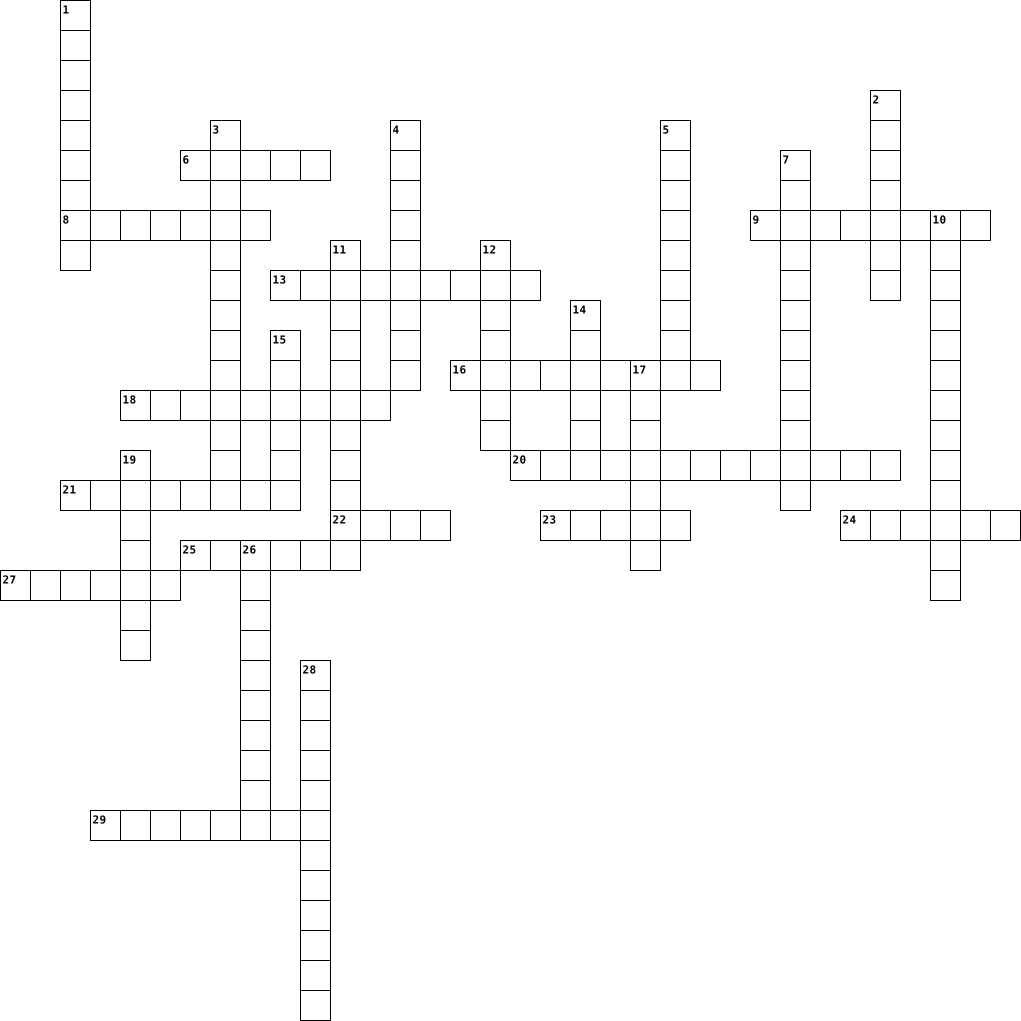
Across
- a material that is typically hard, opaque, shiny, and has good electrical and thermal conductivity the measure of the ease at which an electric charge or heat can pass through a material
- the movement of a solvent
- a chemical element that mostly lacks the characteristics of a metal
- a group of atoms bonded together
- a substance formed from two or more elements chemically united in fixed proportions
- ___________ particles are smaller than atoms
- the body of theory which explains the physical properties of matter in terms of the motions of its constituent particles
- a group in the periodic table consisting of five chemically related elements: fluorine (F), chlorine (Cl), bromine (Br), iodine (I), and astatine (At).
- the basic building block of ordinary matter
- an admixture of metals
- the ability to do work
- abbreviations used in chemistry for chemical elements
- anything that has mass and takes up place (it has volume)
- a stable subatomic particle with a charge of negative electricity
Down
- the movement of a substance from an area of high concentration to an area of low concentration
- the positively charged central core of an atom the smallest particle of an element that retains the chemical retains the chemical and physical properties of the element
- tabular display of the chemical elements
- ions,atoms or molecules
- an element that has properties that are intermediate between those of metals and nonmetals
- the number of protons in the nucleus of an atom is called
- any of the six chemical elements that comprise Group 2 (IIa) of the periodic table
- _________metals are the most electropositive (the least electronegative) of elements
- a set of elements occupying a horizontal row in the periodic table
- a subatomic structure
- a set of elements occupying a column in the periodic table
- the particles in an atom that has a neutral charge
- each of more than one hundred substances that cannot be chemically interconverted or broken down into simpler substances and are primary constituents of matter
- the sum of the numbers of protons and neutrons present in the nucleus of an atom is called
- number of protons in the nucleus of an atom is called
29 Clues: a subatomic structure • an admixture of metals • the ability to do work • ions,atoms or molecules • the movement of a solvent • a group of atoms bonded together • tabular display of the chemical elements • the basic building block of ordinary matter • ___________ particles are smaller than atoms • the particles in an atom that has a neutral charge • ...
Chemistry Crossword Challenge 1 2025-10-06

Across
- when doing Gas Law problems, my temperature must be in units of ______________
- Mass number – atomic number = number of ______________
- when I add or subtract, the number of sigfigs comes from this
- when calculating energy of heat curves, I need ______ different equations to go from cold ice to hot steam
- W
- units of measurement for Q / Heat
- 300000000m/s
- state of matter with a fixed shape and volume
- for water, 2257
- base unit for the amount of a substance
- lambda
- how to separate a mixture that has more than one phase
- sub-atomic particles that are NOT found in the nucleus of an atom
- elements that are usually non-reactive and very stable
- vertical column on the periodic table of elements
- “Exiting Heat”
- liquid to gas
- standard pressure at earths sea level
- “d” block of elements on your periodic table
- third heaviest noble gas
- 6.626E-34 is ____________’s constant
- this is released when an excited electron drops back to its ground state
- word used to describe “meaningful” numbers
Down
- gas to solid
- Cesium for example
- used to show relly big or really small numbers
- developer of the plum pudding model
- magnesium’s bohr model has 3 of these
- why the water phase diagram is different from the typical one (solid/liquid line)
- conductivity or malleability are examples
- first (lowest energy) plateau on a heat curve
- section between the “Y” shape of a phase diagram
- number of electrons of Sulfur that has a negative 2 charge
- number of protons of sodium
- calculated by dividing the number of moles of that substance by the total number of moles in the container
- P1+P2+P3+…
- decreasing the volume of a container makes the pressure….
- horizontal row on the periodic table of elements
- PV=PV
- colored green on your periodic table
- commonly measured in g/cm^3
- the bohr model for Carbon has 4 of these
- element with a mass of 200.59
- when reading a volume level in a graduated cylinder, make sure to read the bottom of the _____________
- pure substance made of 2 or more elements
45 Clues: W • PV=PV • lambda • P1+P2+P3+… • gas to solid • 300000000m/s • liquid to gas • “Exiting Heat” • for water, 2257 • Cesium for example • third heaviest noble gas • number of protons of sodium • commonly measured in g/cm^3 • element with a mass of 200.59 • units of measurement for Q / Heat • developer of the plum pudding model • colored green on your periodic table • ...
Chapter 12- Shelby Moore 2021-02-18

Across
- an attractive force that holds ions together
- also known as (H) on the periodic table
- also known as the LDS structure
- the 21 element on the periodic table
- the relative ability of a solute to dissolve into a solvent
- incapable of being dissolved
- bond found in metals
Down
- how bonds are arranged in a compound
- the molar concentration of a solution
- capable of being dissolved in liquid
10 Clues: bond found in metals • incapable of being dissolved • also known as the LDS structure • how bonds are arranged in a compound • the 21 element on the periodic table • capable of being dissolved in liquid • the molar concentration of a solution • also known as (H) on the periodic table • an attractive force that holds ions together • ...
Chapter 9- Lillian Wilhelm 2020-01-30

Across
- made of adoms
- who made the early model of the atom?
- Dmitri Mendeleiv designed this
- an electron in the outermost energy level
- What has no electrical charge at all?
Down
- Cobalt is an example of this on the periodic table
- What have a posotive charge?
- This means the same thing as groups on the periodic table.
- an atom that carries an electrical charge
- What is 2000 times larger than protons?
10 Clues: made of adoms • What have a posotive charge? • Dmitri Mendeleiv designed this • who made the early model of the atom? • What has no electrical charge at all? • What is 2000 times larger than protons? • an atom that carries an electrical charge • an electron in the outermost energy level • Cobalt is an example of this on the periodic table • ...
Magnets 2023-09-05

Across
- Strongest magnetic material
- Unlike poles on magnet do
- invisible field that surrounds magnet
- Name of magnet pole with blue tip
- Name of magnet pole with red tip
Down
- magnetic material on periodic table
- Other example of magnetic material on periodic table
- material the produces magnetic field
- A magnet that consists of a piece of iron or steel surrounded by a coil
- Like poles of a magnet do
10 Clues: Unlike poles on magnet do • Like poles of a magnet do • Strongest magnetic material • Name of magnet pole with red tip • Name of magnet pole with blue tip • magnetic material on periodic table • material the produces magnetic field • invisible field that surrounds magnet • Other example of magnetic material on periodic table • ...
Elements Crossword Puzzle 2022-05-05

Across
- neutrally charged
- something made by Demtri Mendeleev to arrange the elemnts by their characteristics
- different elements that are chemically combined to make something new
- the building blocks of matter
- poor conductors located on the right side of the periodic table
- contain properties of metals and nonmetals
Down
- negative charged
- materials that are not chemically combined
- forms when 2 or more atoms are combined
- positvily charged
- located on the left side of the periodic table and are good conductors
11 Clues: negative charged • neutrally charged • positvily charged • the building blocks of matter • forms when 2 or more atoms are combined • materials that are not chemically combined • contain properties of metals and nonmetals • poor conductors located on the right side of the periodic table • different elements that are chemically combined to make something new • ...
Elements Crossword Puzzle 2022-05-05

Across
- neutrally charged
- something made by Demtri Mendeleev to arrange the elemnts by their characteristics
- different elements that are chemically combined to make something new
- the building blocks of matter
- poor conductors located on the right side of the periodic table
- contain properties of metals and nonmetals
Down
- negative charged
- materials that are not chemically combined
- forms when 2 or more atoms are combined
- positvily charged
- located on the left side of the periodic table and are good conductors
11 Clues: negative charged • neutrally charged • positvily charged • the building blocks of matter • forms when 2 or more atoms are combined • materials that are not chemically combined • contain properties of metals and nonmetals • poor conductors located on the right side of the periodic table • different elements that are chemically combined to make something new • ...