
periodic table Crossword Puzzles
The Periodic Table / Elements 2023-01-13

Across
- have a positive charge
- elements that conduct electricity and heat
- elements that have properties of both metals and nonmetals
- the elements in groups 3 - 12
- the short form of atomic mass unit
- the # of protons and neutrons in the nucleus
- never react with other elements
- elements to the right side of the periodic table
- the process of radioactive atoms produce energy and particles from the nuclei
- very reactive nonmetals
- lose one or more electrons
- atoms produce energy and particles
Down
- elements that are related in a column
- have a neutral charge
- electrons move around the nucleus
- change in the # of neutrons
- all are radioactive
- the center of the atom
- change in the # of electrons
- the metals in group 2 and less reactive
- gains one or more electrons
- rare earth elements are referred
- have a negative charge
- metals in group 1 that are very reactive
- from left to right, one proton and one electron added
25 Clues: all are radioactive • have a neutral charge • have a positive charge • the center of the atom • have a negative charge • very reactive nonmetals • lose one or more electrons • change in the # of neutrons • gains one or more electrons • change in the # of electrons • the elements in groups 3 - 12 • never react with other elements • rare earth elements are referred • ...
periodic table in french 2023-01-19

Across
- une planète fictive dans l'univers DC Comics,
- symbole Ta et numéro atomique 73
- Résultat d'image pour ce qui est ga dans le tableau périodique
- utilisé pour fabriquer des airbags dans les automobiles
- utilisé dans les enseignes lumineuses souvent appelées enseignes "néon"
- a le potentiel d'être utilisé pour produire de l'énergie nucléaire.
- C'est le deuxième élément le plus léger.
- a été découvert à Genève en 1878 par Marc Delafontaine et Louis Soret,
- Il a été synthétisé pour la première fois en 2002 à l'Institut commun de recherche nucléaire (JINR) de Dubna, près de Moscou, en Russie, par une équipe conjointe de scientifiques russes et américains.
- Ceux-ci ont à peu près la taille d'une punaise et sont utilisés pour les stimulateurs cardiaques, les missiles guidés et les radios.
- utilisé comme catalyseur dans la teinture et le tannage du cuir.
- nommé d'après Glenn T. Seaborg
- pièce de cinq cents
- n'a trouvé aucune utilisation pratique, en raison des problèmes associés à sa fabrication et du fait qu'il se désintègre en quelques millisecondes ou secondes
- groupe 6 et période 4
- un métal brillant blanc bleuâtre. Il est très doux, très malléable, ductile et relativement peu conducteur d'électricité. Il est très résistant à la corrosion mais se ternit au contact de l'air.
- Beaucoup de gens savent qu'il est utilisé dans les bijoux, les prothèses, les raquettes de tennis, les masques de gardien de but, les ciseaux, les cadres de vélo, les outils chirurgicaux, les téléphones portables et d'autres produits de haute performance.
- Il est utilisé pour concentrer et réduire le volume des échantillons liquides.
- 25% d'un centime
- le plus réactif des 118 éléments
- élément chimique de symbole Cs et de numéro atomique 55.
- élément chimique de symbole As et de numéro atomique 33.
- métal alcalin hautement radioactif
- utilisé uniquement à des fins de recherche dans des études scientifiques, pour mieux comprendre ses propriétés et pour créer des éléments plus lourds. 111rg
- peut être utilisé pour fabriquer des alliages d'acier, pour une utilisation dans des véhicules spatiaux, des réacteurs nucléaires et des porte-avions, etc.
- hôtes pour les luminophores des lampes fluorescentes, les écrans renforçateurs de rayons X et les scintillateurs pour la tomographie aux rayons X, et comme agent de contraste pour l'imagerie par résonance magnétique (IRM) (sous forme de chélates hydrosolubles).
- Dans la nature, il est dur, ductile, malléable et brillant avec un point de fusion et d'ébullition élevé.
- Prix par once $23.46
- un métal brillant, blanc argenté, ductile et très malléable
- quele element est connu pour sa grande capacite calorifique
- métal dur et argenté. Il est presque aussi peu réactif que l'or. Il a une densité et un point de fusion très élevés.
- est rarement utilisé seul. Au lieu de cela, les chercheurs l'utilisent pour former des composés,
- l'un des durcisseurs les plus efficaces pour le platine et le palladium, et est allié à ces métaux pour établir des contacts électriques pour une résistance à l'usure sévère.
- Le nom est dérivé du grec "molybdos" qui signifie plomb
- le seul élément portant le nom d'un ustensile de cuisine
- symbole Rh et numéro atomique 45. (au féminin)
- minéral présent dans de nombreux aliments
Down
- un métal de transition solide, gris-blanc et brillant qui ressemble étroitement à l'hafnium et, dans une moindre mesure, au titane.
- utilisé dans les convertisseurs catalytiques pour automobiles, dans les piles à combustible pour générer de l'énergie, dans les bijoux, les obturations dentaires et les composants électroniques
- symbole W et numéro atomique 74.
- type de medicament connu comme stabilisateur de i'humeur
- Ses composés sont utilisés comme hôtes pour les scintillateurs et les luminophores à rayons X, et l'oxyde est utilisé dans les lentilles optiques.
- surtout dangereux dans l'environnement de travail, en raison du fait que l'humidité et les gaz peuvent être inhalés avec l'air. Cela peut provoquer des embolies pulmonaires, en particulier lors d'une exposition à long terme.
- Il existe sous des formes pures ou presque pures - comme les diamants et le graphite - mais peut également se combiner avec d'autres éléments pour former des molécules.
- troisième métal le plus abondant dans la croûte terrestre.
- soft, silvery metal that rapidly tarnishes in air and reacts with water.
- 103 électrons et la structure de la coque est de 2,8. 18h32.
- used as a rocket fuel igniter and in pyrotechnic flares. It gives the flares a distinctive green colour.
- aide les personnes atteintes de MPOC, de COVID-19, d'emphysème, d'apnée du sommeil et d'autres problèmes respiratoires
- l'élément radioactif le plus léger du tableau périodique
- l'un des éléments les plus rares sur Terre avec une abondance d'environ 1 partie par million.
- du nom latin de l'élément, hydrargyrum - littéralement, argent liquide.
- utilisé dans l'agriculture et l'assainissement et comme ignifuge
- C'est un élément synthétique car il est créé en laboratoire plutôt que d'être produit naturellement.
- quels sont les elements les plus legers?
- un metal blanc argente qui s'enflamme facilement dans l'air et brule avec une lumlere vive.
- métal légèrement cassant à température ambiante et d'aspect grisâtre brillant
- utilisé dans les matériaux de construction, la fabrication de transistors, dans les puces informatiques et les cellules solaires
- C'est un solide gris blanchâtre très mou du groupe des métaux alcalins,
- élément extrêmement rare sur Terre. On le trouve dans les minerais d'uranium. Il faut environ 7 tonnes de minerai pour produire un seul gramme
- utilisé dans les alliages, y compris l'acier inoxydable. Il améliore la résistance des alliages, en particulier à basse température. Les alliages contenant du niobium sont utilisés dans les moteurs à réaction et les fusées, les poutres et les poutres pour les bâtiments et les plates-formes pétrolières, et les oléoducs et gazoducs
- un bon absorbeur de neutrons et est utilisé pour fabriquer des barres de contrôle, telles que celles trouvées dans les sous-marins nucléaires
- Groupe 7, numéro atomique 25
- représente le nombre de protons dans un seul atome de l'élément.
- a des utilisations importantes dans la technologie Blu-ray, les téléphones portables, les LED bleues et vertes et les capteurs de pression pour les interrupteurs tactiles.
- un élément transuranien radioactif produit artificiellement dans le groupe Vb du tableau périodique
- L'utilisation la plus connue de cet alliage est celle des "pierres à feu" pour les briquets.
- Classé comme métal alcalino-terreux, le strontium est un solide à température ambiante.
- C'est un métal cher, avec un point d'ébullition élevé, qui est utilisé comme argent et/ou bijoux.
69 Clues: 25% d'un centime • pièce de cinq cents • groupe 6 et période 4 • Prix par once $23.46 • Groupe 7, numéro atomique 25 • nommé d'après Glenn T. Seaborg • symbole W et numéro atomique 74. • symbole Ta et numéro atomique 73 • le plus réactif des 118 éléments • métal alcalin hautement radioactif • C'est le deuxième élément le plus léger. • quels sont les elements les plus legers? • ...
Periodic Table of Elements 2023-02-15

Across
- Compounds containing this halogen are often used to disinfect swimming pools.
- This metal has 26 electrons.
- This radioactive element has the highest atomic mass of the naturally occuring elements.
- The third period alkaline earth metal.
- Compounds containing this element are essential to life; the element on its own is what makes up diamonds.
- A violet colored nonmetal that sublimes when heated.
- This element typically has 20 neutrons and is found in your bones.
- A yellow nonmetal that forms compounds with a horrible "rotten egg" smell.
- This nonmetal makes up about 20% of the air you breathe.
- This second period nonmetal is used in making fertilizer.
Down
- This element was named after the Titans of Greek mythology because of its strength.
- The smallest noble gas.
- A metal commonly used in electrical wiring, and is also what gives pennies their characteristic color.
- This metal can be used in photographic film.
- This element has an atomic mass of 74.9 amu.
- This element, one of the lightest, is used in certain types of batteries.
- A nonmetal that is liquid at room temperature.
- This element is named after Marie Curie, the scientist who discovered radium and polonium.
- This nobel gas glows purple when an electric current passes through it.
- This unreactive metal is very valuable and is often used in jewelry.
20 Clues: The smallest noble gas. • This metal has 26 electrons. • The third period alkaline earth metal. • This metal can be used in photographic film. • This element has an atomic mass of 74.9 amu. • A nonmetal that is liquid at room temperature. • A violet colored nonmetal that sublimes when heated. • This nonmetal makes up about 20% of the air you breathe. • ...
Atomic Structure/Periodic Table 2023-02-04

Across
- A solid material with good heat and electricity conductivity.
- A proton sans the electric charge.
- The best element with the chemical symbol BI.
- Particles of matter that make up protons and neutrons.
- An element whose attributes fall between those of a metal and a non-metal.
- The element named after a famous late scientist whose name is synonymous with "genius".
- A halogen that really hates water.
- The smallest piece of matter that retains the abilities of the element.
- Salt former.
- Number of protons in an atom.
Down
- A particle found in all atoms with a negative electrical charge.
- A stable particle in all atomic nuclei.
- Sum of protons and neutrons in a nucleus.
- The horizontal rows in the periodic table.
- A necessary element to all living beings that we know of.
- The core of an atom, built of protons and nuetrons.
- Arrangement of all known elements.
- Element that usually is a gas or brittle solid at room temperature.
- The vertical columns in the periodic table.
- A soft metal which you should invest in.
20 Clues: Salt former. • Number of protons in an atom. • A proton sans the electric charge. • Arrangement of all known elements. • A halogen that really hates water. • A stable particle in all atomic nuclei. • A soft metal which you should invest in. • Sum of protons and neutrons in a nucleus. • The horizontal rows in the periodic table. • The vertical columns in the periodic table. • ...
Periodic Table Crossword Puzzle 2020-01-22

Across
- the table that elements are organized in
- Element group 18
- able to be drawn out into a wire
- elements 57-71
- what elements have that describes them
- people who study science
- what elements in the table are organized into
- how reactive an element is
- Not metals
- Outer electrons
Down
- what separates the nonmetals and metals
- able to hammer into a sheet
- Element group 1
- Element group 17
- elements 57-71 and 89-103
- Not a metal or nonmetal
- how conductive the element is
- elements 89-103
- Conducts well
- where most elements are found
20 Clues: Not metals • Conducts well • elements 57-71 • Element group 1 • elements 89-103 • Outer electrons • Element group 17 • Element group 18 • Not a metal or nonmetal • people who study science • elements 57-71 and 89-103 • how reactive an element is • able to hammer into a sheet • how conductive the element is • where most elements are found • able to be drawn out into a wire • ...
6.1 Periodic Table Puzzle 2020-03-27

Across
- You can find me in the carbon family in the fifth period
- I have 2 electrons in the first chell, 8 in the second shell and 6 in the third shell
- I have 20 neutrons and am found in your teeth and bones
- I am a member of the carbon family often mistaken for the end of your pencil
- I am a transition metal with 25 electrons
- I am the only element in the halogen family that is a liquid
- I am the first element in the fourth period used in making fertilizer
- I am the 2nd most abundant element in the earth's crust and have 14 neutrons
- I am a member of the halogen family with an atomic number of 53
- I am a silvery white metal used to make salt
- I am a gas with mass number of 19
- I am the head of family 14, known as the "basis of life"
- I am not really an alkali metal but since I have only 1 electron, I behave like them.
Down
- My atomic number is 47 and I am used to make photographic film
- I am a member of the boron family and am the most abundant metal in the earth's crust
- I am a transition metal with 30 electrons useful in making paint
- My atomic mass is 35.45
- I am a noble gas with 2 electrons
- My atomic number is 79
- I am a member of the alkaline earth metals used to make fireworks and medicines
- I am a metal with 28 electrons
- am a member of the nitrogen family with 16 neutrons*Phosphorus
- I make up 78% of the air and am found in the 15th group
- I have 26 protons
- I am a metal that is liquid at room temperature
- I am a gas with 8 protons and 8 neutrons
26 Clues: I have 26 protons • My atomic number is 79 • My atomic mass is 35.45 • I am a metal with 28 electrons • I am a noble gas with 2 electrons • I am a gas with mass number of 19 • I am a gas with 8 protons and 8 neutrons • I am a transition metal with 25 electrons • I am a silvery white metal used to make salt • I am a metal that is liquid at room temperature • ...
Periodic Table of Elements 2020-12-10

Across
- is a transition metal that has the atomic number 25
- named after titan
- comes from the word "aurum" that is used for making jewelry
- also called “ferrum”
- A highly radioactive element with the atomic number 92
- a chemical element with the symbol Hf and atomic number 72
- It is in the p-block, high in electronegativity, and in group 14
- a noble gas with atomic number 18
- an actinide with the symbol Es
- with the symbol K
- means "plumbum" in Latin
- it is in period 2. it is an inert gas that is used for advertising signs
- an element with an electron configuration of [He] 2s1
- in period 3 and group 14
- named after Glenn T. Seaborg, an American chemist
- From the sub-region “Scandinavia”
- has the atomic number 55. A soft mineral
- atomic number 13
- Also one of the noble gases with the symbol Kr
- Means little silver in the Spanish term "platino"
- based on Ancient Greek Μόλυβδος molybdos, meaning lead
- In group 15. It is very essential for all living things
- The lightest element of all
- It is in group 6 and also known as "wolfram"
Down
- has the atomic number 108
- an element with the symbol Sn
- a chemical element with the symbol Ga and atomic number 31
- Comes from the word "argentum". It is high in electrical conductivity
- It has the atomic 53. It melts into a violet liquid and then into a violet gas
- has the symbol Zr
- a chemical element with the symbol Cr and atomic number 24
- named after the country France
- It has the atomic mass of 74.9216 u. It also occurs in many minerals
- comes from the Greek word "osme" meaning smell
- Discovered by Hennig Brand in his urine. Electrons per shell: 2, 8, 5
- nonmetal and with atomic number 8
- element with the symbol Tl
- in period and group 2
- named after the country Germany
- Rare earth metal and has the atomic number 39
- has the atomic number 30
- it is in the chemical series of lanthanides with the atomic number 57
- From the word "cuprum"
- has the symbol Ni, a hard and ductile material
- a chemical element with the symbol Xe
- has the atomic number 23
- Named after the village of Sweden, Ytterby
- atomic number 9. Some added in toothpastes
- it is from block 2p and column 3a
- a colorless, odorless and tasteless gas, in period 1
50 Clues: atomic number 13 • named after titan • has the symbol Zr • with the symbol K • also called “ferrum” • in period and group 2 • From the word "cuprum" • means "plumbum" in Latin • in period 3 and group 14 • has the atomic number 30 • has the atomic number 23 • has the atomic number 108 • element with the symbol Tl • The lightest element of all • an element with the symbol Sn • ...
periodic table crossword puzzle 2021-08-29

Across
- any of five related nonmetallic elements (fluorine or chlorine or bromine or iodine or astatine) that are all monovalent and readily form negative ions.
- an elementary particle with negative charge.
- a stable particle with positive charge.
- a mixture containing two or more metallic elements.
- a chemical element or alloy that is usually a shiny solid.
- a subatomic particle with zero charge.
- atom with same atomic number, different number of neutrons.
- capable of being shaped or bent or drawn out.
- capable of being shaped or bent.
- ready susceptibility to chemical change.
Down
- shiny and reflective.
- term for the columns of a periodic table. (also called families).
- the smallest component of an element.
- not resembling shiny, malleable, conductive elements.
- deterioration in metals from oxidation or chemical action.
- term for the rows of a periodic table.
- number, number of protons in an atom's nucleus, the positively charged dense center of an atom.
- gasses, elements of group 18.
- symbol, one or two letter abbreviation for an element.
- a nonmetallic element that has some of the properties of metal.
- of or relating to a molecule made up of two atoms.
21 Clues: shiny and reflective. • gasses, elements of group 18. • capable of being shaped or bent. • the smallest component of an element. • term for the rows of a periodic table. • a subatomic particle with zero charge. • a stable particle with positive charge. • ready susceptibility to chemical change. • an elementary particle with negative charge. • ...
Periodic Table Quiz 3 2021-08-18

Across
- O
- N
- Ne
- Co
- Hi
- P
- Cr
- Sr
- Ca
- H
- B
- Ni
- Rn
- Sn
- Si
- Fe
- Ba
- Li
- Al
- K
- Ag
- S
- Fr
- Zn
- Pb
- U
Down
- Sb
- Ma
- Ar
- As
- I
- Bi
- Cs
- Na
- Au
- Kr
- Xe
- F
- Cu
- Mg
- Hg
- Cl
- C
- Rb
- Ra
- Pt
- W
- Br
- Cd
49 Clues: O • N • I • P • F • C • H • B • W • K • S • U • Sb • Ma • Ar • As • Bi • Cs • Na • Ne • Au • Kr • Co • Hi • Xe • Cr • Cu • Mg • Sr • Ca • Hg • Cl • Rb • Ni • Rn • Sn • Si • Fe • Ra • Ba • Pt • Li • Al • Ag • Br • Fr • Zn • Cd • Pb
PERIODIC TABLE OF ELEMENTS 2022-11-01

Across
- H
- C
- Cl
- Au
- Zn
- Bi
- Ag
- Ca
- Pt
- Ni
- P
- Mg
- He
- U
- I
- Li
- K
Down
- B
- Hg
- Sn
- O
- Be
- Co
- Pb
- Si
- F
- S
- Cr
- Al
- Cu
- Na
- Mn
- Fe
33 Clues: B • H • C • O • F • S • P • U • I • K • Hg • Sn • Be • Cl • Co • Pb • Au • Zn • Bi • Si • Ag • Ca • Cr • Pt • Al • Cu • Ni • Na • Mg • He • Mn • Fe • Li
Periodic Table Generator - Elements 2022-10-26

Across
- named after the Greek words anti and monos
- does not exist in nature
- named after the Greek words 'prasios didymos'
- forty-sixth element of the periodic table
- found in some household products
- 8th most abundant element in the universe
- last natural rare earth element that was discovered
- how french people would say sink
- named after Lise Meitner
Down
- produced industrially by cryogenically distilling air
- named after mythical, death-dealing goblins.
- can absorb neutrons
- used in alloys with stainless steel
- named for physicist Niels Bohr
- rarest element on Earth
- 5th most abundant element in the earth's crust
- commonly put in ballons
- banana
- highly radioactive,glows with a visible blue light
- lonely
20 Clues: banana • lonely • can absorb neutrons • rarest element on Earth • commonly put in ballons • does not exist in nature • named after Lise Meitner • named for physicist Niels Bohr • found in some household products • how french people would say sink • used in alloys with stainless steel • forty-sixth element of the periodic table • 8th most abundant element in the universe • ...
Periodic Table of Elements 2022-08-26

Across
- Ar
- Mg
- N
- He
- C
- S
- Na
- L
- O
- Si
- Ca
Down
- B
- Be
- P
- Ne
- K
- H
- F
- Al
- Cl
20 Clues: B • P • K • N • H • C • S • F • L • O • Be • Ar • Mg • Ne • He • Na • Al • Cl • Si • Ca
PERIODIC TABLE OF ELEMENT 2017-11-22

Across
- Bh
- S
- Actinium
- N
- Terbium
- Niobium
- Moscovium
- Pd
- Th
- Aluminum
- Mt
- Astatine
- K
- Fl
- Xe
- C
- Ruthenium
- Ytterbium
- Nd
- P
- Rhodium
- Ca
- Sm
- Radium
- Sr
- Magnesium
- Cd
- Ds
- B
- Helium
- Neon
- Gold
- No
- Co
- Tantalum
- Krypton
- Mercury
- Pr
- I
- U
- Promethium
- W
- Mendelevium
- Rhenium
- Hafnium
- Ar
- Bi
- V
- Nh
- Europium
- Ce
Down
- Molybdenum
- Zirconium
- Ho
- Scandium
- Db
- Silver
- Germanium
- Gd
- Pt
- H
- Thallium
- Lv
- Fermium
- Protactinium
- Einsteinium
- Am
- Californium
- Fr
- Radon
- Tc
- Antimony
- Ga
- Manganese
- Lithium
- Plutonium
- Bromine
- Os
- Lead
- Seaborgium
- Tin
- Hassium
- Lanthanum
- Lutetium
- Ti
- Copernicium
- Rf
- Cm
- Iridium
- Barium
- Polonium
- Tellurium
- Er
- Berkelium
- Lawrencium
- Chlorine
- Cr
- Thulium
- O
- Y
- Sodium
- Selenium
- Zn
- Rg
- Dysprosium
- As
- Cesium
- Beryllium
- Tennessine
- Nickel
- F
- Copper
- In
- Neptunium
- Iron
- Silicon
- Rubidium
117 Clues: S • N • H • K • C • P • B • O • Y • I • U • W • F • V • Bh • Ho • Db • Gd • Pt • Pd • Th • Lv • Mt • Am • Fr • Tc • Ga • Fl • Xe • Nd • Os • Ca • Sm • Ti • Rf • Sr • Cd • Cm • Ds • Er • No • Co • Cr • Zn • Pr • Rg • As • Ar • Bi • In • Nh • Ce • Tin • Lead • Neon • Gold • Iron • Radon • Silver • Radium • Barium • Helium • Sodium • Cesium • Nickel • Copper • Terbium • Niobium • Fermium • Lithium • Bromine • Rhodium • Hassium • Iridium • Thulium • Krypton • Mercury • Rhenium • Hafnium • Silicon • Scandium • Actinium • Thallium • Aluminum • Astatine • Antimony • Lutetium • Polonium • Chlorine • Tantalum • Selenium • ...
Periodic table of elements 2023-05-09

Across
- the element with the lowest atomic number.
- Dy
- The most abundant element in the earth`s crust.
- The densest element of all.
- Li
- Neodymium
- The transuranium element that is the most abundant
- Pm
- Lawrencium
- Important ingredient in stainless steel and rechargable batteries.
- Einsteinium
- Cf
- Samarium
- Cm
- Americium
- Holmium
- Yb
- Thulium
- Pu
- Protactinium
- Is a basic building block of the complex compounds found in your body and other living organisms.
- Terbium
- Is called brimstone in the Bible.
- This metal is an ingredient of flashlight batteries.
- No
Down
- Pr
- Gd
- Er
- Fm
- The only metal that is liquid at room temperature.
- U
- It contains characteristichs of metals and nonmetals.
- Eu
- Mendelevium
- Th
- La
- Actinium
- Lutetium
- Cerium
- Neptunium
- Berkellium
41 Clues: U • Pr • Dy • Gd • Li • Er • Fm • Pm • Eu • Cf • Cm • Yb • Th • Pu • La • No • Cerium • Holmium • Thulium • Terbium • Samarium • Actinium • Lutetium • Neodymium • Americium • Neptunium • Lawrencium • Berkellium • Einsteinium • Mendelevium • Protactinium • The densest element of all. • Is called brimstone in the Bible. • the element with the lowest atomic number. • The most abundant element in the earth`s crust. • ...
PERIODIC TABLE CROSSWORD PUZZLE 2023-05-19

Across
- an element that has some properties of a metal and some properties of a nonmetal
- the number of protons contained in each nucleus of its atoms of the element.
- a substance that cannot be broken down into a simpler substance by ordinary chemical means
- describes how likely an element is to form bonds with other elements
- an element or substance that conducts heat and electricity
- the smallest unit of an element that has all of the propeties of the element
- three laws
- a bond formed by the transfer of electrons
- a chart that organizes information about all of the known elements accourding to thier properties
- a horizontal row ( left to right) in the periodic table
- electrons that are located in the outermost energy level of an atom
Down
- the single capital letter or capital letter followed by a lower case letter or letters that represents the name of the element
- a bond formed when two atoms share valence electrons
- an element that does not conduct electricity or heat and is usually a gas at room temperature
- the region surrounding the nucleus of an atom where the electrons are located
- the smallest unit of a compound that has all of the properties of the compound
- a vertical column (up and down) on the periodic table
- anything that has mass and volume
- number of protons and neutrons in the nucleus of one atom of the element
- an atom that has gained or lost one or more electrons
20 Clues: three laws • anything that has mass and volume • a bond formed by the transfer of electrons • a bond formed when two atoms share valence electrons • a vertical column (up and down) on the periodic table • an atom that has gained or lost one or more electrons • a horizontal row ( left to right) in the periodic table • ...
Chemistry Puzzle-Periodic table 2024-02-27

Across
- _____ energy is the energy required to remove a valence electron
- the atomic number represents the number of ___.
- is a row on the periodic table
- this ion is positively charged (meow)
- atoms that are on the stairstep are not metals, or nonmetals they are the ___
- the scientific study of the properties and behavior of matter, also the name of this class
- this type of bond is between a metal and a nonmetal
- General term for elements to the right of the stairstep
- A way to show only the valence electrons for a given atom
- electrons that exist in the outer shell, outer ring of Bohr model.
Down
- in a controlled experiment this is something that I keep the same every time
- is a column on the periodic table
- this ion is negatively charged
- name of atom found group 1 period 3
- General term for elements to the left of the satirstep
- this variable is the variable that I change in a controlled experiment
- mass divided by volume is this
- name for a charged particle formed by gaining or losing electrons
- Gas General term for the family of elements that have completely full shells of electrons
- The name for the family of elements in group 7A
20 Clues: this ion is negatively charged • is a row on the periodic table • mass divided by volume is this • is a column on the periodic table • name of atom found group 1 period 3 • this ion is positively charged (meow) • the atomic number represents the number of ___. • The name for the family of elements in group 7A • this type of bond is between a metal and a nonmetal • ...
Atom and Periodic table 2023-10-20

Across
- Positively charged subatomic particle found in the center of the nucleus
- Mainly found on the left side of the periodic table
- What have the same number of outermost electrons?
- Total number of proton and electron
- What are rows that have the same number of energy levels or energy shells?
- The centre of an atom
- A substance consisting of items which are all same
- gases What is group zero called?
- Negatively charged subatomic particle found in the shells around the nucleus
- Element in the same group have similar what?
- The smallest particle of a chemical element
- What is group seven element are called?
Down
- Mainly found on the right side of the periodic table?
- Electrons living where?
- Same number of protons but different numbers of neutrons
- metals What is group one element called?
- What is same as proton and electron
- A stbstance contaning two or more elements which are chemically combined
- Electrically neutral subatomic particle found in the nucleus
- Two or more atoms held together by covalent bonds
- Isotopes have the same chemical properties because they have the same number of what?
- The arrangement of electron is also known as what?
- A substance containing two or more elements which are not chemical combined
23 Clues: The centre of an atom • Electrons living where? • gases What is group zero called? • What is same as proton and electron • Total number of proton and electron • What is group seven element are called? • metals What is group one element called? • The smallest particle of a chemical element • Element in the same group have similar what? • ...
Periodic Table of Elements 2024-04-10

Across
- Polonium
- Rubidium
- Lanthanum
- Copper
- Barium
- Nickel
- Silicon
- Fermium
- Molybdenum
- Tantalum
- Chromium
- Thallium
- Antimony
- Lutetium
- Cerium
- Rutherfordium
- Hassium
- Phosphorus
- Helium
- Scandium
- Cobalt
- Protactinium
- Iron
- Terbium
- Cadmium
- Thorium
- Europium
- Krypton
- Einsteinium
- Arsenic
- Meitnerium
- Platinum
- Indium
- Niobium
- Nobelium
- Berkelium
- Argon
- Osmium
- Lithium
- Mendelevium
- Lead
- Titanium
- Darmstadtium
- Promethium
- Roentgenium
- Californium
- Selenium
- Rhenium
- Gold
- Bismuth
- Plutonium
- Neon
Down
- Neptunium
- Beryllium
- Magnesium
- Oxygen
- Lawrencium
- Dysprosium
- Seaborgium
- Aluminum
- Francium
- Bromine
- Holmium
- Sodium
- Chlorine
- Technetium
- Strontium
- Gadolinium
- Hydrogen
- Oganesson
- Radon
- Astatine
- Fluorine
- Palladium
- Praseodymium
- Manganese
- Curium
- Ruthenium
- Rhodium
- Americium
- Tellurium
- Dubnium
- Boron
- Actinium
- Thulium
- Bohrium
- Mercury
- Neodymium
- Cesium
- Potassium
- Sulfur
- Erbium
- Hafnium
- Iodine
- Gallium
- Germanium
- Carbon
- Radium
- Silver
- Nitrogen
- Samarium
- Calcium
- Iridium
- Tin
104 Clues: Tin • Iron • Lead • Gold • Neon • Radon • Boron • Argon • Copper • Barium • Oxygen • Nickel • Sodium • Cerium • Helium • Cobalt • Curium • Indium • Cesium • Sulfur • Osmium • Erbium • Iodine • Carbon • Radium • Silver • Silicon • Fermium • Bromine • Holmium • Hassium • Rhodium • Terbium • Cadmium • Thorium • Dubnium • Krypton • Arsenic • Thulium • Niobium • Bohrium • Mercury • Lithium • Hafnium • Gallium • Calcium • Iridium • Rhenium • Bismuth • Polonium • Rubidium • Aluminum • Francium • Tantalum • ...
Periodic table of Elements 2024-04-30

Across
- Symbol of element is Be and the atomic number is 4
- Symbol of the element is Si and the atomic number is 14
- Symbol of element is He and the atomic number is 2
- Symbol of the element is Ai and the atomic number is 13
- Symbol of element is N and the atomic number is 7
- Symbol of the element is K and the atomic number is 19
- Symbol of the element is S and the atomic number is 16
- Symbol of element is H and the atomic number is 1
- Symbol of element is F and the atomic number is 9
- Symbol of the element is Cl and the atomic number is 17
- Symbol of element is C and the atomic number is 6
- Symbol of the element is Na and the atomic number is 11
Down
- Symbol of element is V and the atomic number is 23
- Symbol of the element is Ar and the atomic number is 18
- symbol of the element is Ti and the atomic number is 22
- symbol of the element is Sc and the atomic number is 21
- Symbol of the element is Ca and the atomic number is 20
- Symbol of the element is Mg and the atomic number is 12
- Symbol of the element is P and the atomic number is 15
- Symbol of element is O and the atomic number is 8
- Symbol of element is Li and the atomic number is 3
- Symbol of the element is Ne and the atomic number is 10
22 Clues: Symbol of element is N and the atomic number is 7 • Symbol of element is O and the atomic number is 8 • Symbol of element is H and the atomic number is 1 • Symbol of element is F and the atomic number is 9 • Symbol of element is C and the atomic number is 6 • Symbol of element is V and the atomic number is 23 • Symbol of element is Be and the atomic number is 4 • ...
Periodic Table Cool Crossword 2024-04-30

Across
- determines the charge of the element
- Symbol is K
- Lightest element
- Symbol is Fe
- determines the weight of the element
- Need to breath
- on the stair step line
- Used in nukes
- Symbol is Li
- Is a liquid at room temperature
- determine the charge on element
Down
- Strongest metal
- Symbol is Cl
- link each atom to its neighbor
- Right on the stair step line
- Most common metal on Earths,s crust
- Left of the stairs step line
- Symbol is Ti
- Used in balloons
- Symbol is Ca
20 Clues: Symbol is K • Symbol is Cl • Symbol is Fe • Symbol is Ti • Symbol is Li • Symbol is Ca • Used in nukes • Need to breath • Strongest metal • Lightest element • Used in balloons • on the stair step line • Right on the stair step line • Left of the stairs step line • link each atom to its neighbor • Is a liquid at room temperature • determine the charge on element • Most common metal on Earths,s crust • ...
Periodic Table Cool Crossword 2024-04-30

Across
- determines the charge of the element
- Symbol is K
- Lightest element
- Symbol is Fe
- determines the weight of the element
- Need to breath
- on the stair step line
- Used in nukes
- Symbol is Li
- Is a liquid at room temperature
- determine the charge on element
Down
- Strongest metal
- Symbol is Cl
- link each atom to its neighbor
- Right on the stair step line
- Most common metal on Earths,s crust
- Left of the stairs step line
- Symbol is Ti
- Used in balloons
- Symbol is Ca
20 Clues: Symbol is K • Symbol is Cl • Symbol is Fe • Symbol is Ti • Symbol is Li • Symbol is Ca • Used in nukes • Need to breath • Strongest metal • Lightest element • Used in balloons • on the stair step line • Right on the stair step line • Left of the stairs step line • link each atom to its neighbor • Is a liquid at room temperature • determine the charge on element • Most common metal on Earths,s crust • ...
\Makenzie's Periodic Table Crossword 2025-11-21

Across
- Gaining electrons =?
- What react violently with most nonmetals?
- Which Metal,Nonmetal or metalliods are knowns to be dull?
- What metals come from blank in the earth's crust?
- A metal in period 4?
- Which group is where all are radioactive?
- Which group are Alkaline Earth Metals in?
- An element is classified as blank that readily forms compounds?
- What gases are colorless, odorless,tasteless?
- Who was the first person to produce a finished periodic table?
- Which scientist arranged elements in order of increasing atomic mass
- What is the most reactive metal?
- Which Metal, Nonmetal or metalloids can be properties of metals or nonmetals?
- Which group are Alkali metals in?
- Negative charged ions are known as what?
- What provides a way to visualize an atoms and potental to bond?
- Positive charged ions are known as what?
Down
- what is one way to make an element reactive?
- Which Metal,Nonmetal or metalliods are good conductors for heat and electricity?
- What metals are good conductors of heat and electricity?
- How many valence electrons does Gallium, Ga, have?
- A Nonmetal in period 3?
- Losing electrons =?
- What element is Classifed as Pr for Lanthanides?
- Classifaction for a metalliod?
- What are the most reactive nonmetals?
- What metals are less reactive than alkali metals?
- What element is Classifed as Ac for Actinides?
- Which group are halogens in?
- Who didn’t get credit for their periodic table?
30 Clues: Losing electrons =? • Gaining electrons =? • A metal in period 4? • A Nonmetal in period 3? • Which group are halogens in? • Classifaction for a metalliod? • What is the most reactive metal? • Which group are Alkali metals in? • What are the most reactive nonmetals? • Negative charged ions are known as what? • Positive charged ions are known as what? • ...
Periodic table elements puzzle 2025-02-03

Across
- salt is composed of
- some pools have
- number of 16
- a soft silver white metal
- in lamps and signs
- number of 4
- 2 valence electrons
- to make glue
- that is important in body functions
Down
- formation of bones and teeth
- symbol is Ar
- is Al
- flammable gas
- number is 9
- we breathe
- up 78 percent of the earths atmosphere
- what we put in balloons so they can go up
- an atomic number of six
- 2,3 electrons per shell
- has this
20 Clues: is Al • has this • we breathe • number is 9 • number of 4 • symbol is Ar • number of 16 • to make glue • flammable gas • some pools have • in lamps and signs • salt is composed of • 2 valence electrons • an atomic number of six • 2,3 electrons per shell • a soft silver white metal • formation of bones and teeth • that is important in body functions • up 78 percent of the earths atmosphere • ...
Periodic table elements puzzle 2025-02-03

Across
- For formation of bones and teeth
- Atomic number is 9
- Symbol is Al
- flammable gas
- Used in lamps and signs
- something that is important in body functions
- Used to make glue
- number of 4
Down
- Has an atomic number of six
- What some pools have
- Atomic number of 16
- Has 2,3 electrons per shell
- Makes up 78 percent of the earths atmosphere
- symbol is Ar
- Has 2 valence electrons
- What salt is composed of
- what we put in balloons so they can go up
- Milk has this
- a soft silver white metal
- What we breathe
20 Clues: number of 4 • Symbol is Al • symbol is Ar • flammable gas • Milk has this • What we breathe • Used to make glue • Atomic number is 9 • Atomic number of 16 • What some pools have • Has 2 valence electrons • Used in lamps and signs • What salt is composed of • a soft silver white metal • Has an atomic number of six • Has 2,3 electrons per shell • For formation of bones and teeth • ...
Periodic Table Crossword Project 2024-12-02

Across
- two valence electrons, not found alone in nature
- This element is a Noble Gas
- Copper is this type of element
- This element is a Halogen
- This element is an Alkali Metal
- These are good conductors of heat and electricity;shiny
- Arranged elements in order of increasing atomic number
- The current Periodic table is organized by this increasing physical feature
- Rare earth metals, have high melting and boiling points.
- Nonmetals _____ electrons to form ions, what is the other term for (give)
- Seven valence electrons, most reactive nonmetals.
- This group are the most reactive metals on the periodic table.
- This element is a Transition Metal in period 4
Down
- Created the first official periodic table
- The number of dots a Lewis Dot Structure for Flourine would have.
- This element is an Actinide
- Nonmetals become negative ions, called these
- One valence electron, silvery gray metals
- Metals _____ electrons to form ions, what is the other term for (lose)
- Have full valence electron shells, nonreactive.
- Hydrogen is this type of element
- Ductile and malleable, good conductors, compounds have different colors.
- This element is an Alkaline Earth Metal
- Boron is this type of element
- Are brittle, dull,and are poor conductors of heat and electricity
- All are radioactive, man made, and grouped into a row not a column
- These type of elements are semiconductors
- Valence electrons are the electrons in the ________ energy level
- The chemical property that determines how elements will react with other elements to form compounds
- Metals become positive ions, called these
30 Clues: This element is a Halogen • This element is an Actinide • This element is a Noble Gas • Boron is this type of element • Copper is this type of element • This element is an Alkali Metal • Hydrogen is this type of element • This element is an Alkaline Earth Metal • Created the first official periodic table • One valence electron, silvery gray metals • ...
Periodic Table of Elements 2024-12-05

Across
- Po
- Mn
- Highest Atomic Number, Format: 64 = sixfour
- Pd
- S
- Os
- Cd
- Sg
- Ne
- Au
- H
- Cs
- Ca
- Ir
- Si
- tl
- Rn
- Te
- Hf
- Db
- Zr
- Na
- Rf
- Sc
- P
- Ni
- Sn
- Fe
- Pt
- F
- Nb
- Hg
- Ts
- Rb
- Kr
- At
- Tc
- In
- W
- Al
- Ba
- B
- Xe
- Cu
- Re
- Mg
- K
- Fl
- Y
Down
- Og
- Se
- He
- Ga
- Cr
- Ge
- Ti
- Rg
- Cn
- Mc
- Bh
- Ds
- Rh
- O
- Ar
- I
- C
- Ac
- N
- Ru
- As
- Zn
- Hs
- Mt
- Ta
- Ag
- Li
- Sb
- Pb
- Br
- Mo
- Bi
- Be
- Ra
- La
- Sr
- Fr
- Nh
- Lv
- Cl
- V
- Co
91 Clues: S • O • H • I • C • N • P • F • W • B • V • K • Y • Po • Og • Mn • Se • He • Ga • Cr • Ge • Pd • Ti • Rg • Os • Cn • Cd • Mc • Bh • Sg • Ne • Au • Ds • Rh • Cs • Ar • Ca • Ir • Si • tl • Rn • Ac • Te • Hf • Ru • Db • Zr • Na • As • Zn • Rf • Hs • Mt • Ta • Sc • Ag • Ni • Sn • Li • Fe • Pt • Sb • Pb • Nb • Br • Hg • Mo • Ts • Bi • Rb • Be • Kr • Ra • At • La • Sr • Tc • In • Fr • Al • Nh • Lv • Ba • Cl • Xe • Cu • Re • Mg • Co • Fl • Highest Atomic Number, Format: 64 = sixfour
Periodic table of elements 2025-02-19

Across
- Li
- Cl
- B
- Na
- Be
- H
- O
- C
- S
- P
- Al
Down
- Sc
- Si
- Ti
- F
- Ne
- N
- Ca
- K
- He
20 Clues: F • N • B • H • O • C • S • K • P • Sc • Si • Li • Ti • Cl • Ne • Na • Be • Ca • He • Al
Periodic Table of Elements 2025-05-05

Across
- B
- K
- P
- Na
- Au
- Fl
- Ni
- Co
- Zn
- H
- Ag
- S
- Mg
- Hg
- Al
- U
- Be
Down
- C
- N
- Cu
- Br
- Si
- Pt
- O
- Ne
- Ca
- Li
- Cr
- Sn
- Fe
- Pb
- I
32 Clues: C • N • B • K • P • O • H • S • U • I • Cu • Br • Si • Pt • Na • Au • Fl • Ne • Ca • Li • Ni • Co • Zn • Cr • Ag • Sn • Mg • Fe • Hg • Al • Pb • Be
Periodic Table 1-20 2025-09-09

Across
- What is the chemical symbol of Fluorine?
- Hydrogen has the atomic number _
- Has the symbol O
- Has the symbol "Mg"
- What element is in column 15 and has the same atomic number?
- Chemical symbol of the element with the atomic number 2
- Has the atomic number 3 and the chemical symbol Li
- What is the chemical symbol of the element with atomic number 6?
- Atomic number of Sulfur
- The symbol of Sodium
- What element has the chemical symbol "B"?
Down
- Give the atomic number and chemical symbol of Beryllium
- Has an atomic number of 17
- It has the chemical signal K
- What is the atomic number of N?
- What element is in row 3 column 14?
- How many significant figures are in 13.007g Aluminum?
- What is teh atomic number of calcium?
- Has the atomic number 10
- The chemical symbol for an element with the atomic number 18
20 Clues: Has the symbol O • Has the symbol "Mg" • The symbol of Sodium • Atomic number of Sulfur • Has the atomic number 10 • Has an atomic number of 17 • It has the chemical signal K • What is the atomic number of N? • Hydrogen has the atomic number _ • What element is in row 3 column 14? • What is teh atomic number of calcium? • What is the chemical symbol of Fluorine? • ...
Periodic Table of Elements 2026-02-03

Across
- Mg
- C
- Be
- N
- B
- Fe
- Ni
- Ir
- S
- P
- W
Down
- Sc
- H
- Nb
- O
- Ac
- Ra
- Ca
- Cs
- Li
20 Clues: C • H • N • B • O • S • P • W • Mg • Sc • Be • Nb • Ac • Fe • Ra • Ca • Cs • Ni • Li • Ir
My Periodic Table Puzzle 2026-02-02

Across
- Li
- B
- Cl
- Ar
- P
- Ca
- Mg
- S
- F
- N
- Na
Down
- Si
- O
- K
- C
- He
- Al
- Be
- H
- Ne
20 Clues: B • O • K • C • P • S • F • H • N • Si • Li • Cl • Ar • He • Ca • Mg • Al • Be • Ne • Na
John Huggins Periodic Table 2026-04-30

Across
- The sum of protons and neutrons
- The collumns of the periodic table
- An organized chart that lists all known chemical elements in order of increasing atomic number
- The smallest particle of an element that retains the element's properties
- They are the stair-step line
- Right of the stair-step line(plus Hydrogen
- Particles in the nucleus that are electrically charged
- Left of the stair-step line(except Hydrogen)
- Area around the nucleus of an atom where electrons are most likely to be found
- Particles in the nucleus with a positive charge
- The electrons located in the outermost part of the electron shell
- The positively charged center of the atom
Down
- A strong force of attraction that holds together oppositely charged ions
- Particles with a negative charge that occupy the space around the nucleus
- The most reactive group of metals;softer than most metals
- Group 2 metals, but less reactive than group 1
- The rows of the periodic table
- An atom or molecule that has an electric charge due to the lose or gain of electrons
- Atoms of the same element that have different number of neutrons
- the number of protons an atom has
20 Clues: They are the stair-step line • The rows of the periodic table • The sum of protons and neutrons • the number of protons an atom has • The collumns of the periodic table • The positively charged center of the atom • Right of the stair-step line(plus Hydrogen • Left of the stair-step line(except Hydrogen) • Group 2 metals, but less reactive than group 1 • ...
The Periodic Table Crossword 2020-10-16

Across
- An element which has properties of both metals and nonmetals
- A group of highly stable elements due to their full outer shell of electrons
- The smallest unit of an element which still maintains the properties of that element
- The element with the lowest atomic mass
- A row of the periodic table
- The number of protons and neutrons in atom
- A pure substance containing one type of atom
- A particle with no charge found in the nucleus
Down
- The group 1 element known as
- The group 7 elements
- Negatively charged particles that moves around the nucleus
- The number of protons within an atom
- A vertical column of the periodic table
- Positively charged particle found in the nucleus of an atom
14 Clues: The group 7 elements • A row of the periodic table • The group 1 element known as • The number of protons within an atom • The element with the lowest atomic mass • A vertical column of the periodic table • The number of protons and neutrons in atom • A pure substance containing one type of atom • A particle with no charge found in the nucleus • ...
The Periodic Table Crossword 2020-10-16

Across
- The smallest unit of an element which still maintains the properties of that element
- An element which has properties of both metals and nonmetals
- The group 7 elements
- The number of protons within an atom
- Positively charged particle found in the nucleus of an atom
- A vertical column of the periodic table
- A particle with no charge found in the nucleus
- A pure substance containing one type of atom
Down
- The group 1 element known as
- Negatively charged particles that moves around the nucleus
- A group of highly stable elements due to their full outer shell of electrons
- The number of protons and neutrons in atom
- The element with the lowest atomic mass
- A row of the periodic table
14 Clues: The group 7 elements • A row of the periodic table • The group 1 element known as • The number of protons within an atom • The element with the lowest atomic mass • A vertical column of the periodic table • The number of protons and neutrons in atom • A pure substance containing one type of atom • A particle with no charge found in the nucleus • ...
Day 2 Vocab Crossword 2023-06-15

Across
- Elements that do not occur naturally
- When an electron leaves an atom because there is not enough energy
- Elements consisting of two atoms
- the columns on a periodic table
- silver-gray color, metallic luster, ductile and malleable
- The distance from the nucleus to the outer shell
Down
- Electron Electrons in the outer most shell
- The weighted average mass of all isotopes of an element
- The amount of protons in the nucleus
- no metallic luster, not malleable, liquids or gases at room temperature
- have metallic luster, brittle and easily shattered, solid at room temperature
- a diagram used to show how electrons are arranged around individual atoms
- The attraction of one atom to another
- the rows on a periodic table
14 Clues: the rows on a periodic table • the columns on a periodic table • Elements consisting of two atoms • The amount of protons in the nucleus • Elements that do not occur naturally • The attraction of one atom to another • Electron Electrons in the outer most shell • The distance from the nucleus to the outer shell • The weighted average mass of all isotopes of an element • ...
chapter 16 review kaitlyn 2021-10-14

Across
- number atom is the sum of the number of protons and the number of neutrons in the nucleus of an atom
- protons and neutrons are composed of smaller particles
- cloud the area around the nucleus of an atom where electrons are most likely to be found.
- dot diagram uses the chemical symbol of an element surrounded by dots to represent the number of electrons in the outermost energy level
- smallest particle of an element that retains the element's properties.
- positively charged center of the atom
- particles in the nucleus with an electric charge 1+
Down
- atoms of the same element that have different numbers of neutrons
- atomic mass and element is the weighed average mass of all naturally occurring isotopes of an element
- particles with an electric charge of 1-
- table the elements are arranged by increasing atomic number not atomic mass
- the horizontal rows of elements in the periodic
- number the number of protons in an atoms nucleus is equal
- electrically neutral particles in the nucleus they don't have a charge
- the vertical columns in the periodic table
15 Clues: positively charged center of the atom • particles with an electric charge of 1- • the vertical columns in the periodic table • the horizontal rows of elements in the periodic • particles in the nucleus with an electric charge 1+ • protons and neutrons are composed of smaller particles • number the number of protons in an atoms nucleus is equal • ...
All Things Chemistry 2021-06-15

Across
- to hammer a substance into thin sheets
- elements located to the left of the periodic table
- element or compound that enters into a chemical reaction
- to pull a substance into a wire
- has a negative charge, found in atomic shell
- a chemical substance formed as a result of a chemical reaction
Down
- a material that does not allow electricity to move through it easily
- the outer electron shell of an atom
- 2 or more atoms combined chemically
- a substance made up entirely of the same kind of atoms
- has a positive charge, found in the nucleus of an atom
- 2 or more substances combined physically
- has no charge, found in the nucleus of an atom
- the horizontal row in the periodic table
14 Clues: to pull a substance into a wire • the outer electron shell of an atom • 2 or more atoms combined chemically • to hammer a substance into thin sheets • 2 or more substances combined physically • the horizontal row in the periodic table • has a negative charge, found in atomic shell • has no charge, found in the nucleus of an atom • ...
All Things Physics 2021-06-15

Across
- to hammer a substance into thin sheets
- elements located to the left of the periodic table
- element or compound that enters into a chemical reaction
- to pull a substance into a wire
- has a negative charge, found in atomic shell
- a chemical substance formed as a result of a chemical reaction
Down
- a material that does not allow electricity to move through it easily
- the outer electron shell of an atom
- 2 or more atoms combined chemically
- a substance made up entirely of the same kind of atoms
- has a positive charge, found in the nucleus of an atom
- 2 or more substances combined physically
- has no charge, found in the nucleus of an atom
- the horizontal row in the periodic table
14 Clues: to pull a substance into a wire • the outer electron shell of an atom • 2 or more atoms combined chemically • to hammer a substance into thin sheets • 2 or more substances combined physically • the horizontal row in the periodic table • has a negative charge, found in atomic shell • has no charge, found in the nucleus of an atom • ...
Matter 1 Vocabulary 2023-10-16

Across
- Ability to be hammered into different shapes.
- Ability to be drawn into a wire.
- The negatively charged subatomic particle found in the shells around the nucleus.
- Elements in the vertical column of the periodic table.
- The number of protons in an atom
- Having a shiny surface.
- The basic unit that makes up all matter.
Down
- Elements in the horizontal row of the periodic table.
- Anything that has mass and takes up space.
- Ability to move heat and electricity through it easily.
- The subatomic particle with no charge found inside the nucleus.
- The sum of protons and neutrons in an atom.
- The positively charged subatomic particle found inside the nucleus.
- A pure substance that cannot be broken down into other substances.
14 Clues: Having a shiny surface. • Ability to be drawn into a wire. • The number of protons in an atom • The basic unit that makes up all matter. • Anything that has mass and takes up space. • The sum of protons and neutrons in an atom. • Ability to be hammered into different shapes. • Elements in the horizontal row of the periodic table. • ...
Matter 1 Vocabulary 2023-10-16

Across
- Ability to be hammered into different shapes.
- Ability to be drawn into a wire.
- The negatively charged subatomic particle found in the shells around the nucleus.
- Elements in the vertical column of the periodic table.
- The number of protons in an atom
- Having a shiny surface.
- The basic unit that makes up all matter.
Down
- Elements in the horizontal row of the periodic table.
- Anything that has mass and takes up space.
- Ability to move heat and electricity through it easily.
- The subatomic particle with no charge found inside the nucleus.
- The sum of protons and neutrons in an atom.
- The positively charged subatomic particle found inside the nucleus.
- A pure substance that cannot be broken down into other substances.
14 Clues: Having a shiny surface. • Ability to be drawn into a wire. • The number of protons in an atom • The basic unit that makes up all matter. • Anything that has mass and takes up space. • The sum of protons and neutrons in an atom. • Ability to be hammered into different shapes. • Elements in the horizontal row of the periodic table. • ...
Matter 1 Vocabulary 2023-10-16

Across
- Ability to be hammered into different shapes.
- Ability to be drawn into a wire.
- The negatively charged subatomic particle found in the shells around the nucleus.
- Elements in the vertical column of the periodic table.
- The number of protons in an atom
- Having a shiny surface.
- The basic unit that makes up all matter.
Down
- Elements in the horizontal row of the periodic table.
- Anything that has mass and takes up space.
- Ability to move heat and electricity through it easily.
- The subatomic particle with no charge found inside the nucleus.
- The sum of protons and neutrons in an atom.
- The positively charged subatomic particle found inside the nucleus.
- A pure substance that cannot be broken down into other substances.
14 Clues: Having a shiny surface. • Ability to be drawn into a wire. • The number of protons in an atom • The basic unit that makes up all matter. • Anything that has mass and takes up space. • The sum of protons and neutrons in an atom. • Ability to be hammered into different shapes. • Elements in the horizontal row of the periodic table. • ...
Chemistry 2021-04-22

Across
- positive charge
- can conduct electricity
- small element
- neutral
- formula,combination of symbols
Down
- table, table of elements
- electron,outer layer
- reaction,chemical bonds
- number,proton location
- center of atom
10 Clues: neutral • small element • center of atom • positive charge • electron,outer layer • number,proton location • can conduct electricity • reaction,chemical bonds • table, table of elements • formula,combination of symbols
Unit 1 Chemistry Crossword 2024-05-17

Across
- type of spectroscopy used to find electron distribution and energy
- subatomic particle with no charge
- horizontal direction of increasing electronegativity on the periodic table
- law used to calculate force between 2 charged particles
- 12.01 g/mol for carbon (2 words)
Down
- shows variance in numbers of neutrons among atoms of the same element
- subatomic particle with negative charge
- type of formula showing the ratio of each element in a molecule
- vertical direction of increasing atomic radii on the periodic table
- subatomic particle with positive charge
- type of spectrometry used to find relative abundance of each isotope
- elements of this same category generally have similar properties
- unit representing Avagadro's number
13 Clues: 12.01 g/mol for carbon (2 words) • subatomic particle with no charge • unit representing Avagadro's number • subatomic particle with negative charge • subatomic particle with positive charge • law used to calculate force between 2 charged particles • type of formula showing the ratio of each element in a molecule • ...
Christmas crossword 2025-12-18

Across
- Frozen water you might see at Christmas
- What scientists do when they watch carefully
- A green decoration brought into the house at Christmas
- Santa travels in this
- A shiny decoration often hung on a Christmas tree
- Delivers presents all around the world
- A state of matter with a fixed shape, like ice
Down
- Everything is made from these and they are found on the periodic table
- A gift you give someone at Christmas
- A gas we breathe in, shown as O on the periodic table
- A person who investigates how things work
- A state of matter like air on a cold morning
- A song sung at Christmas time
13 Clues: Santa travels in this • A song sung at Christmas time • A gift you give someone at Christmas • Delivers presents all around the world • Frozen water you might see at Christmas • A person who investigates how things work • What scientists do when they watch carefully • A state of matter like air on a cold morning • A state of matter with a fixed shape, like ice • ...
💀 2024-04-11

Across
- bite of_____
- cheeks
- former Apple ceo
- Name of this crossword
- Charisma
Down
- Biggest Twitch Streamer
- _____White
- nicest number
- LI periodic table
- toilet
- Al Qaeda leader
- One piece
- Easter Island heads
13 Clues: cheeks • toilet • Charisma • One piece • _____White • bite of_____ • nicest number • Al Qaeda leader • former Apple ceo • LI periodic table • Easter Island heads • Name of this crossword • Biggest Twitch Streamer
Element 2023-03-28

Across
- the thing that goes around the nucleus
- makes up everything
- 2 element combined
- carbon Oxygen
- salt
- same group of atom
Down
- a table of element
- substance you find everywhere
- water
- not chemically bounded
10 Clues: salt • water • carbon Oxygen • a table of element • 2 element combined • same group of atom • makes up everything • not chemically bounded • substance you find everywhere • the thing that goes around the nucleus
Periodicity Unit Review 2023-10-31

Across
- Shorthand notation is also known as what?
- Who said electrons in the same orbital had to have opposite spins?
- Mendleev's periodic table was arranged by what?
- What element is a halogen that exists as a liquid at room temp?
- Electrons occupy the ________ energy level first before filling the higher energy levels
- As the period table moves down, the proton pull _______
- The last group on the periodic table, elements with 8 valence electrons
Down
- Group 1A is classified as?
- Ions are _______ with the nearest noble gas
- the d orbital can hold a max of how many electrons?
10 Clues: Group 1A is classified as? • Shorthand notation is also known as what? • Ions are _______ with the nearest noble gas • Mendleev's periodic table was arranged by what? • the d orbital can hold a max of how many electrons? • As the period table moves down, the proton pull _______ • What element is a halogen that exists as a liquid at room temp? • ...
Spanish 2023-11-01

Across
- dos y nueve
- past noon
- opposite of spanish
- this is where they keep the libros
- opposite of english
- never
- opposite of never
- Periodic table
- Mrs Stacy does this
Down
- daily
- numbers
- Singing
- Instruments
- Type free for this one you won1
- Its dark out
- decansar
16 Clues: daily • never • numbers • Singing • decansar • past noon • dos y nueve • Instruments • Its dark out • Periodic table • opposite of never • opposite of spanish • opposite of english • Mrs Stacy does this • Type free for this one you won1 • this is where they keep the libros
Spanish 2023-11-01

Across
- dos y nueve
- past noon
- opposite of spanish
- this is where they keep the libros
- opposite of english
- never
- opposite of never
- Periodic table
- Mrs Stacy does this
Down
- daily
- numbers
- Singing
- Instruments
- Type free for this one you won1
- Its dark out
- decansar
16 Clues: daily • never • numbers • Singing • decansar • past noon • dos y nueve • Instruments • Its dark out • Periodic table • opposite of never • opposite of spanish • opposite of english • Mrs Stacy does this • Type free for this one you won1 • this is where they keep the libros
The Periodic Table 2022-05-02

Across
- the vertical rows on the periodic table
- does not combine easily with elements
- good conductors of heat and electricity
- measures a element ability to make electricity
Down
- easily combines with a element
- not metal
- the horizontal row on the periodic table
- a mixture of nonmetal & metal
8 Clues: not metal • a mixture of nonmetal & metal • easily combines with a element • does not combine easily with elements • the vertical rows on the periodic table • good conductors of heat and electricity • the horizontal row on the periodic table • measures a element ability to make electricity
Science course 2018-04-26

Across
- A row of elements across the periodic table
- The element containing 111 neutrons
- When two or more atoms combine, they form ...
- Atomic mass - atomic number = number of ...
- The atomic "..." tells you the average mass of a typical atom of that element
Down
- The element with 22 protons
- A column of elements in the periodic table
- The atomic "..." tells you how many protons an atom contains
- Has a trunk and is big
- Center of every atom
10 Clues: Center of every atom • Has a trunk and is big • The element with 22 protons • The element containing 111 neutrons • A column of elements in the periodic table • A row of elements across the periodic table • Atomic mass - atomic number = number of ... • When two or more atoms combine, they form ... • The atomic "..." tells you how many protons an atom contains • ...
PTE menu assignment 2023-09-21

Across
- the same element but in a different form
- have a neutral charge and are found in the nucleus
- the element name of H
- the periodic table of ________
Down
- democritus coined the term ____
- metals are good __________ of heat and electricity
- have a positive charge and are found in the nucleus
- _______ theory states that all substances are made up of atoms
- found in the electron cloud and has a negative charge
- take up most of the periodic table
10 Clues: the element name of H • the periodic table of ________ • democritus coined the term ____ • take up most of the periodic table • the same element but in a different form • metals are good __________ of heat and electricity • have a neutral charge and are found in the nucleus • have a positive charge and are found in the nucleus • ...
In the lab 2020-04-14

Across
- what you use to pour the chemicals
- everything is created by this
- the periodic table is full of what?
- the smallest unit of living matter is what?
- when a liquide turns to gaz it is called what?
Down
- the amount of matter in an object is what?
- positively charged subatomic particle
- the chemicals are measured by what?
- the first element of the periodic table is what?
- a force that is caused by the gravitational pull
10 Clues: everything is created by this • what you use to pour the chemicals • the periodic table is full of what? • the chemicals are measured by what? • positively charged subatomic particle • the amount of matter in an object is what? • the smallest unit of living matter is what? • when a liquide turns to gaz it is called what? • the first element of the periodic table is what? • ...
Macromolecules Lesson 4 2017-10-02

Across
- Crab on (anag.) can form up to 4 single bonds [6]
- element no. 92, warning...can go nuclear! [7]
- type of bond which involves the transfer of electrons [5]
- Russian who first devised the periodic table [9]
Down
- the lightest element in the Perioidic table [8]
- scientist who came up with the exclusion principle [5]
- bond in which valence electrons are shared [8]
- 6 electrons are shared in this bond [6]
- the name of the columns on a Periodic table [6]
9 Clues: 6 electrons are shared in this bond [6] • element no. 92, warning...can go nuclear! [7] • bond in which valence electrons are shared [8] • the lightest element in the Perioidic table [8] • the name of the columns on a Periodic table [6] • Russian who first devised the periodic table [9] • Crab on (anag.) can form up to 4 single bonds [6] • ...
The Periodic Table Crossword 2020-10-16

Across
- The smallest unit of an element which still maintains the properties of that element
- An element which has properties of both metals and nonmetals
- The group 7 elements
- The number of protons within an atom
- Positively charged particle found in the nucleus of an atom
- A vertical column of the periodic table
- A particle with no charge found in the nucleus
- A pure substance containing one type of atom
Down
- The group 1 element known as
- Negatively charged particles that moves around the nucleus
- A group of highly stable elements due to their full outer shell of electrons
- The number of protons and neutrons in atom
- The element with the lowest atomic mass
- A row of the periodic table
14 Clues: The group 7 elements • A row of the periodic table • The group 1 element known as • The number of protons within an atom • The element with the lowest atomic mass • A vertical column of the periodic table • The number of protons and neutrons in atom • A pure substance containing one type of atom • A particle with no charge found in the nucleus • ...
Matter 1 Vocabulary 2023-10-16

Across
- Ability to be hammered into different shapes.
- Ability to be drawn into a wire.
- The negatively charged subatomic particle found in the shells around the nucleus.
- Elements in the vertical column of the periodic table.
- The number of protons in an atom
- Having a shiny surface.
- The basic unit that makes up all matter.
Down
- Elements in the horizontal row of the periodic table.
- Anything that has mass and takes up space.
- Ability to move heat and electricity through it easily.
- The subatomic particle with no charge found inside the nucleus.
- The sum of protons and neutrons in an atom.
- The positively charged subatomic particle found inside the nucleus.
- A pure substance that cannot be broken down into other substances.
14 Clues: Having a shiny surface. • Ability to be drawn into a wire. • The number of protons in an atom • The basic unit that makes up all matter. • Anything that has mass and takes up space. • The sum of protons and neutrons in an atom. • Ability to be hammered into different shapes. • Elements in the horizontal row of the periodic table. • ...
Matter 1 Vocabulary 2023-10-16

Across
- Ability to be hammered into different shapes.
- Ability to be drawn into a wire.
- The negatively charged subatomic particle found in the shells around the nucleus.
- Elements in the vertical column of the periodic table.
- The number of protons in an atom
- Having a shiny surface.
- The basic unit that makes up all matter.
Down
- Elements in the horizontal row of the periodic table.
- Anything that has mass and takes up space.
- Ability to move heat and electricity through it easily.
- The subatomic particle with no charge found inside the nucleus.
- The sum of protons and neutrons in an atom.
- The positively charged subatomic particle found inside the nucleus.
- A pure substance that cannot be broken down into other substances.
14 Clues: Having a shiny surface. • Ability to be drawn into a wire. • The number of protons in an atom • The basic unit that makes up all matter. • Anything that has mass and takes up space. • The sum of protons and neutrons in an atom. • Ability to be hammered into different shapes. • Elements in the horizontal row of the periodic table. • ...
Conners Crossword puzzle 2023-11-03

Across
- number the number of an element on the periodic table
- total numbers of protons and neutrons
- radiation being emitted
- a subatomic particle with a positive electric charge
- atoms are set apart which release energy
- the mass of an element is different than the mass on the periodic table
- interval of time required for one-half of the atomic nuclei of a radioactive sample to deca
- a subatomic particle with no electric charge
Down
- a layer of aluminum
- stopped by the outer layers of the skin
- the center of an atom
- something happens causing something else to happen and just keeps happening
- stopped by lead
- two light nuclei merge to form a single heavier nucleus
14 Clues: stopped by lead • a layer of aluminum • the center of an atom • radiation being emitted • total numbers of protons and neutrons • stopped by the outer layers of the skin • atoms are set apart which release energy • a subatomic particle with no electric charge • a subatomic particle with a positive electric charge • number the number of an element on the periodic table • ...
Fixed paths where electrons orbit the nucleus 2025-09-20

Across
- Found in the outer shell of atoms and determine which group the element is in
- Scientist who discovered the neutron
- A property of metals meaning they can be bent into particular shapes
- An arrangement in the periodic table where elements have similar properties
- The scientist who discovered the electron
- A negatively charged sub-atomic particle
- Elements with the same number of protons but a different mass number/number of neutrons
- The number for how the periodic table is arranged
Down
- The scientist who proposed electrons orbit the nucleus
- The central part of an atom
- Metals conduct this very well
- Fixed paths where electrons orbit the nucleus
- A sub-atomic particle with no charge
- Positively charged particle in the nucleus
14 Clues: The central part of an atom • Metals conduct this very well • Scientist who discovered the neutron • A sub-atomic particle with no charge • A negatively charged sub-atomic particle • The scientist who discovered the electron • Positively charged particle in the nucleus • Fixed paths where electrons orbit the nucleus • The number for how the periodic table is arranged • ...
Homework: Conclusion 2023-07-24

Across
- Subatomic particle with no charge
- The 18 columns in a periodic table are known as
- Reactions that absorb energy through heat
- Subatomic particle with positive charge
- Reactions that release energy through heat
- Subatomic particle with negative charge
Down
- When a solid changes into a liquid
- The 7 rows in a periodic table are known as
- When a liquid changes into a solid
9 Clues: Subatomic particle with no charge • When a solid changes into a liquid • When a liquid changes into a solid • Subatomic particle with positive charge • Subatomic particle with negative charge • Reactions that absorb energy through heat • Reactions that release energy through heat • The 7 rows in a periodic table are known as • ...
2019/01/29 chemistry word 2019-01-27

Across
- The name of Group 1.
- The group 1 metal must keep in this condition
- The table that lists all the elements in order of increasing atomic number
- A row in the periodic table containing elements with the same number of full electron shells
Down
- The gas product when sodium react with water
- The colour of the solution after sodium react with water
- The name of Group 7
- A column in the periodic table containing elements with the same number of outer shell electrons and similar chemical properties.
- The Sodium can be cut by knife
- How does the reactivity change when going down the group 1?
- gases the name of group 0
11 Clues: The name of Group 7 • The name of Group 1. • gases the name of group 0 • The Sodium can be cut by knife • The gas product when sodium react with water • The group 1 metal must keep in this condition • The colour of the solution after sodium react with water • How does the reactivity change when going down the group 1? • ...
Chemistry Vocabulary Review 2017-08-27

Across
- A vertical column on the periodic table is called a _____.
- A horizontal row on the periodic table is called a _____.
- The _____ is the center of an atom.
- The _____ of oxygen is about 16 g/mol.
- The _____ has no charge.
Down
- The _____ has a positive charge.
- The _____ of air at sea level is about 1 atm.
- The _____ has a negative charge.
- The _____ of 1 mole of carbon is 12.0 g.
- The _____ constant is the number of particles in 1 mole of substance.
- The _____ of a gas is measured in liters.
11 Clues: The _____ has no charge. • The _____ has a positive charge. • The _____ has a negative charge. • The _____ is the center of an atom. • The _____ of oxygen is about 16 g/mol. • The _____ of 1 mole of carbon is 12.0 g. • The _____ of a gas is measured in liters. • The _____ of air at sea level is about 1 atm. • A horizontal row on the periodic table is called a _____. • ...
matter revision Yr 8 2025-06-10

Across
- This is the columns in a periodic table
- This is the number that is the smallest on an element
- This is more reactive than Lithium
- This is what plastic bags are made of
- This is the rows in a periodic table
Down
- This is what raincoats are made of
- This is the name of the group 7 elements
- This is the number of protons and neutrons
- this is the unit that polymers are made of
- This is the first metal in the alkali metals
- this is a natural polymer which makes tyres
11 Clues: This is what raincoats are made of • This is more reactive than Lithium • This is the rows in a periodic table • This is what plastic bags are made of • This is the columns in a periodic table • This is the name of the group 7 elements • This is the number of protons and neutrons • this is the unit that polymers are made of • this is a natural polymer which makes tyres • ...
Periodic Table Crossword 2020-09-09

Across
- sum of protons and neutrons are ____ number
- group II metals
- metals tend to form ______ ions
- vertical columns are called families or ___
- elements in the middle of the table __metals?
- the elements are arranged by atomic number
- most of the elements are
Down
- group I Metals
- most active non-metals
- horizontal rows
- the atomic number is the number of protons
- non-metals tend to form _____ ions
- inactive gases
13 Clues: group I Metals • inactive gases • group II metals • horizontal rows • most active non-metals • most of the elements are • metals tend to form ______ ions • non-metals tend to form _____ ions • the atomic number is the number of protons • the elements are arranged by atomic number • sum of protons and neutrons are ____ number • vertical columns are called families or ___ • ...
Periodic Table Groups 2021-10-13

Across
- highly reactive and not usually found alone in nature. Second column from the right.
- large set of metallic elements
- Highly reactive metals. First column on the left
- Consists of gases, liquids and solids
- Group of metals that aren't like other metals and are below the non-metals
Down
- has similar characteristics of metals and solid non-metals
- help to organize the elements into rows and columns of elements of similar
- reactive metals. Second column from the left.
- Rare-Earth metals. At the bottom of the Periodic Table
- The columns, going vertically
- Totally unreactive and gases at room temperature. Furthest column on the right.
- the rows, going horizontally
- all are radioactive and extremely unstable. At the bottom of the Periodic Table.
13 Clues: the rows, going horizontally • The columns, going vertically • large set of metallic elements • Consists of gases, liquids and solids • reactive metals. Second column from the left. • Highly reactive metals. First column on the left • Rare-Earth metals. At the bottom of the Periodic Table • has similar characteristics of metals and solid non-metals • ...
Periodic Table Crossword 2021-10-25
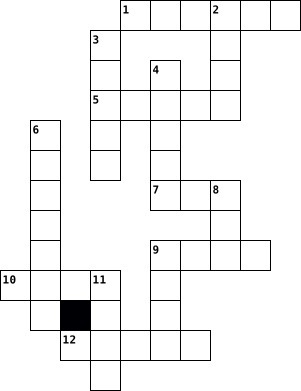
Across
- What Mr. Miller is
- Fought the south
- What you do to lemonade on a hot day
- Goes with a basketball
- Governmental alliance.
- What you use to fight
Down
- Country in the Middle East
- What a volcano does
- Covid
- What Monkeys eat
- Someone that's really good at what they do
- The opposite of cool
- Where we live
13 Clues: Covid • Where we live • Fought the south • What Monkeys eat • What Mr. Miller is • What a volcano does • The opposite of cool • What you use to fight • Goes with a basketball • Governmental alliance. • Country in the Middle East • What you do to lemonade on a hot day • Someone that's really good at what they do
Periodic Table-Miguel 2023-05-01

Across
- S
- (6,6)
- I have 82 neutrons in group 14
- is a hard brittle crystalline metallic luster
- Li
- (2,4)
- I have 27 protons
Down
- is a rare gas of group 18
- I have 79 electrons
- I have 54 protons
- I have an atomic number of 72
- Hg
- i have 86 neutrons in group 18
13 Clues: S • Li • Hg • (6,6) • (2,4) • I have 54 protons • I have 27 protons • I have 79 electrons • is a rare gas of group 18 • I have an atomic number of 72 • I have 82 neutrons in group 14 • i have 86 neutrons in group 18 • is a hard brittle crystalline metallic luster
Periodic Table Elements 2022-09-30

Across
- 6 protons; combines with oxygen to form CO2 and also pressurizes to form diamonds
- 2 protons; fills your balloons
- 79 protons; Olympic winners take this home
- 28 protons; worth five cents
- 17 protons; goes into your pool to kill bacteria
- 80 protons; liquid metal inside your thermometer
- 10 protons; lights up flashy signs
- 11 protons; combines with chlorine to form salt for your fries
Down
- 8 protons; we need to breathe this to survive!
- 1 proton; combines with oxygen to form H2O
- 20 protons; found in milk and builds strong bones
- 47 protons; Second place finishes at the Olympics take this home
- 24 protons; "everything is chrome in the future!"
13 Clues: 28 protons; worth five cents • 2 protons; fills your balloons • 10 protons; lights up flashy signs • 1 proton; combines with oxygen to form H2O • 79 protons; Olympic winners take this home • 8 protons; we need to breathe this to survive! • 17 protons; goes into your pool to kill bacteria • 80 protons; liquid metal inside your thermometer • ...
37 2024-08-23

Across
- Arithmetic device
- Ancient invention
- Infection prevention
- Pressure measure
- Machine part
- Navigation tool
- Writing material
- Nobel’s invention
- Mendeleev's table
- Medical instrument
- Infection treatment
- Video broadcast
Down
- Bacteria-killing drug
- Building material
- Disease prevention
- Synthetic materials
- Temperature measure
- Detection system
- Curie’s discovery
- Space travel
- Fabric stitching device
- Sun-centered model
- Sound recording
- Magnetic discovery
- Glowing gas
25 Clues: Glowing gas • Machine part • Space travel • Navigation tool • Sound recording • Video broadcast • Detection system • Pressure measure • Writing material • Building material • Arithmetic device • Ancient invention • Curie’s discovery • Nobel’s invention • Mendeleev's table • Disease prevention • Sun-centered model • Magnetic discovery • Medical instrument • Synthetic materials • Temperature measure • ...
Black steel stealth 2022-11-30

Across
- the male part of flower
- the song that calpurnia released june 28 2018
- aila’s first cat
- the name of group 0 in the periodic table
Down
- the female part of flower
- the reaction when something absorbs heat
- the name of the first president of Indonesia
- is known as group 1 in the periodic table
- the top part of an aerosol
9 Clues: aila’s first cat • the male part of flower • the female part of flower • the top part of an aerosol • the reaction when something absorbs heat • is known as group 1 in the periodic table • the name of group 0 in the periodic table • the name of the first president of Indonesia • the song that calpurnia released june 28 2018
Metals, nonmetals, and metalloids 2023-10-27

Across
- Which part of the periodic table is the largest?
- True or false; is Sulfur's symbol "Si"?
- Is neon a nonmetal?
- Which section is oxygen in?
- Is hydrogen in the metals section?
Down
- Are metals always the largest element section?
- Which section is between metals and nonmetals?
- How many sections are on the periodic table?
- True of false; is hydrogen's symbol "Hd"?
9 Clues: Is neon a nonmetal? • Which section is oxygen in? • Is hydrogen in the metals section? • True or false; is Sulfur's symbol "Si"? • True of false; is hydrogen's symbol "Hd"? • How many sections are on the periodic table? • Are metals always the largest element section? • Which section is between metals and nonmetals? • Which part of the periodic table is the largest?
Fun with the Periodic Table! 2014-01-05

Across
- Energy change that occurs when a neutral atom gains an electron
- Name of element in groups three to twelve
- The measure of an atom in a chemical bond to attract an electron
- Category of elements that is the smallest on the table and shares the properties of the other two categories
- Name of nonmetal in group seventeen
- Most numerous type of element on the periodic table
Down
- The energy required to remove an electron from an atom
- Inventor of the Periodic Table
- Name of element in group one
- Measured as half the distance between two bonded atoms of the same element
10 Clues: Name of element in group one • Inventor of the Periodic Table • Name of nonmetal in group seventeen • Name of element in groups three to twelve • Most numerous type of element on the periodic table • The energy required to remove an electron from an atom • Energy change that occurs when a neutral atom gains an electron • ...
periodic table 2021-11-10

Across
- The most abundant element on Earth
- Element with the atomic number of 5
- Columns in a periodic table
- particles with positive charge
Down
- the lightest gas filled in balloons
- an element with only one proton
- Rows in a periodic table.
- a gas important for living
8 Clues: Rows in a periodic table. • a gas important for living • Columns in a periodic table • particles with positive charge • an element with only one proton • The most abundant element on Earth • the lightest gas filled in balloons • Element with the atomic number of 5
CHEMISTRY VOCAB REVIEW 2025-03-11

Across
- A stable group of two or more atoms chemically bonded together (these atoms may be identical or different)
- This characteristic generally increases as you go from left to right across a period (6,4)
- A pure substance that cannot be broken down into simpler substances (e.g., oxygen)
- The lightest alkali metal, known for floating on water and reacting with it
- A vertical column in the periodic table where elements share similar chemical and physical properties
- A substance formed when two or more elements combine chemically
- Describes the pH of solutions formed by Group 1 and 2 oxides
- Describes a substance that does not react easily with other chemicals
- The densest noble gas, found at the bottom of Group 8
- A horizontal row in the periodic table where elements show a gradual change in properties
Down
- Class of elements that tend to produce acidic oxides eg. carbon dioxide
- Mass per unit volume that tends to increase as you move down Group 7
- The smallest unit of an element, defined by a nucleus with a specific number of protons
- A combination of substances that are physically blended but not chemically bonded
- Physical measure that decreases as you move down Group 1 (7,5)
- These Group 2 elements form oxides that react with water to create basic solutions—name this group of metals (8,5)
- A material made entirely of identical particles that shows one set of properties throughout (4,9)
- This property of halogens increases as you move up group 7
- A gas in group 18, 8 or 0 of the periodic table known for its low reactivity (5,3)
19 Clues: The densest noble gas, found at the bottom of Group 8 • This property of halogens increases as you move up group 7 • Describes the pH of solutions formed by Group 1 and 2 oxides • Physical measure that decreases as you move down Group 1 (7,5) • A substance formed when two or more elements combine chemically • ...
elements,atoms and molecules! 2022-05-10

Across
- Menddeev the creator of the periodic table
- negative charge
- the elements that have properties of metals and nonmetals
- are made of only one type of atom
Down
- the positive charge
- elements that are hard, shin and able to conduct electricy
- table have the elemnts and atomic number
- are the building blocks of mater
- are formed when 2 or more atoms are conbined
9 Clues: negative charge • the positive charge • are the building blocks of mater • are made of only one type of atom • table have the elemnts and atomic number • Menddeev the creator of the periodic table • are formed when 2 or more atoms are conbined • the elements that have properties of metals and nonmetals • elements that are hard, shin and able to conduct electricy
Chemical bonding 2022-10-23

Across
- Used in computer ships manufacture beside germanium
- Force that result due to sharing pair of electrons
- when atom loses or gains electrons
- kept under oil surface because its very reactive
- Elements arranged in vertical column in periodic table
Down
- Force that result when reacting atoms lose and gain electrons during chemical reaction
- Number of outermost energy level electrons lost or gained during chemical reaction
- tend to lose electrons during chemical reaction
- tend to gain electrons during chemical reaction
- said to be neutral
- Horizontal raw in periodic table
11 Clues: said to be neutral • Horizontal raw in periodic table • when atom loses or gains electrons • tend to lose electrons during chemical reaction • tend to gain electrons during chemical reaction • kept under oil surface because its very reactive • Force that result due to sharing pair of electrons • Used in computer ships manufacture beside germanium • ...
Spanish 2023-11-01

Across
- dos y nueve
- past noon
- opposite of spanish
- this is where they keep the libros
- opposite of english
- never
- opposite of never
- Periodic table
- Mrs Stacy does this
Down
- daily
- numbers
- Singing
- Instruments
- Type free for this one you won1
- Its dark out
- decansar
16 Clues: daily • never • numbers • Singing • decansar • past noon • dos y nueve • Instruments • Its dark out • Periodic table • opposite of never • opposite of spanish • opposite of english • Mrs Stacy does this • Type free for this one you won1 • this is where they keep the libros
Spanish 2023-11-01

Across
- dos y nueve
- past noon
- opposite of spanish
- this is where they keep the libros
- opposite of english
- never
- opposite of never
- Periodic table
- Mrs Stacy does this
Down
- daily
- numbers
- Singing
- Instruments
- Type free for this one you won1
- Its dark out
- decansar
16 Clues: daily • never • numbers • Singing • decansar • past noon • dos y nueve • Instruments • Its dark out • Periodic table • opposite of never • opposite of spanish • opposite of english • Mrs Stacy does this • Type free for this one you won1 • this is where they keep the libros
Chapter 16 Vocabulary 2023-08-22

Across
- subatomic particle with no charge
- element with different number of neutrons
- aka Lewis Dot Diagram;shows the symbol for the element & the valence electrons
- smallest basic unit of matter
- number of protons
- takes up most space in atom where electrons are
Down
- center of atom with protons & neutrons
- average of all isotopes (or mass numbers) of an element
- shows protons & neutrons in the nucleus & electons in the shells
- subatomic particle with negative charge
- horizontal rows on Periodic Table that have the same number of elctron shells
- aka family; vertical columns on Periodic Table that have the same number of valence electrons
- number of protons & neutrons for a specific isotope
13 Clues: number of protons • smallest basic unit of matter • subatomic particle with no charge • center of atom with protons & neutrons • subatomic particle with negative charge • element with different number of neutrons • takes up most space in atom where electrons are • number of protons & neutrons for a specific isotope • average of all isotopes (or mass numbers) of an element • ...
Biology Chapter 6 2025-10-23

Across
- The building blocks of matter
- Vertical column on the periodic table
- Pure substance that cannot be broken down into other substances by physical or chemical means
- Positively charged particle in the nucleus of an atom
- An electrical attraction between two oppositely charged atoms or groups of atoms called ions
- Neutral particle in the nucleus of an atom
Down
- Two or more different elements combined
- Chemical bond that forms when electrons are shared
- Atom of the same element with a different number of neutrons
- Negatively charged particles located outside of the nucleus
- Horizontal row on the periodic table
- Atom that has lost of gained one or more elctrons
- The center of an atom
13 Clues: The center of an atom • The building blocks of matter • Horizontal row on the periodic table • Vertical column on the periodic table • Two or more different elements combined • Neutral particle in the nucleus of an atom • Atom that has lost of gained one or more elctrons • Chemical bond that forms when electrons are shared • ...
EMC Crossword 2026-01-15

Across
- Everything that has weight is this
- The top to bottom sections of the Periodic Table
- A group of two or more substances physically although not chemically combined
- The part of an atom that has a negative charge
- The part of an atom that has a neutral charge
- The part of an atom that has a positive charge
Down
- The best element (atomic number 83)
- The organization of every element
- Combinations of two or more atoms (can be same or different type)
- A group of one or more atoms of the same type
- A group of two or more elements chemically combined
- The most basic building block
- The side to side sections of the Periodic Table
13 Clues: The most basic building block • The organization of every element • Everything that has weight is this • The best element (atomic number 83) • A group of one or more atoms of the same type • The part of an atom that has a neutral charge • The part of an atom that has a negative charge • The part of an atom that has a positive charge • ...
Classifying Elements 2015-04-30

Across
- A nonmetal that makes up almost half of Earth's crust, oceans, and atmosphere.
- A metalloid with the symbol Si.
- A mixture of a metal and a nonmetal.
- Metals located in Group 2 of the periodic table.
- The appearance of most metals.
Down
- A transition metal with the symbol Cr.
- Able to be hammered or pressed permanently out of shape without breaking.
- Make up 99% of the universe.
- The symbol for standard temperature and pressure.
- A basic metal with the symbol Ga.
- Metals located in Group 1 of the periodic table.
11 Clues: Make up 99% of the universe. • The appearance of most metals. • A metalloid with the symbol Si. • A basic metal with the symbol Ga. • A mixture of a metal and a nonmetal. • A transition metal with the symbol Cr. • Metals located in Group 2 of the periodic table. • Metals located in Group 1 of the periodic table. • The symbol for standard temperature and pressure. • ...
History of the Atom and Periodic Table 2016-07-10

Across
- Discovered that elements were defined by the number of protons
- Discovered in 1897 by Thomson
- Grouped close elements with similar properties in 3s
- Discovered the first sub-atomic particle to be found
- Was Discovered By Rutherford in 1902
Down
- Pioneered Modern Atomic Theory
- Discovered the second sub-atomic particle to be found
- Used to classify Atoms in Mendeleev's Periodic Table
- Was Discovered By James Chadwick in 1932 (particle)
- Examples of these:Proton, Neutron and Electron
- Was the Forename of the founder of the Modern Periodic Table
11 Clues: Discovered in 1897 by Thomson • Pioneered Modern Atomic Theory • Was Discovered By Rutherford in 1902 • Examples of these:Proton, Neutron and Electron • Was Discovered By James Chadwick in 1932 (particle) • Used to classify Atoms in Mendeleev's Periodic Table • Grouped close elements with similar properties in 3s • Discovered the first sub-atomic particle to be found • ...
mck 3 2022-09-13

Across
- tend to lose 2 electrons for a charge of +2
- exceptions, the ion of the atoms will tend to have the same charge
- last group on the periodic table
- column on the Periodic Table; have similar valence electron arrangements; with
Down
- tend to lose one electron for a +1 charge
- gain one electron for an overall
- how readily a substance undergoes a reaction
- have the same number of electron shells
- made of only one atom
- of -1
- has a different number of neutrons
11 Clues: of -1 • made of only one atom • gain one electron for an overall • last group on the periodic table • has a different number of neutrons • have the same number of electron shells • tend to lose one electron for a +1 charge • tend to lose 2 electrons for a charge of +2 • how readily a substance undergoes a reaction • ...
THE PERIODIC TABLE 2024-07-10

Across
- The smallest unit of matter that can exist independently
- A vertical column on the periodic table
- The mass of an atom
- The negatively charged particles in an atom that orbit the nucleus
- A substance made up of atoms of the same element
Down
- The number of protons in an atom's nucleus
- The positively charged particles in an atom's nucleus
- The abbreviation for an element
- The building blocks of all matter
- A horizontal row of elements on the periodic table
- The number of protons and neutrons in an atom's nucleus
11 Clues: The mass of an atom • The abbreviation for an element • The building blocks of all matter • A vertical column on the periodic table • The number of protons in an atom's nucleus • A substance made up of atoms of the same element • A horizontal row of elements on the periodic table • The positively charged particles in an atom's nucleus • ...
Crystal Chemistry 2024-11-05

Across
- the scientific study of crystals and crystal formation
- the material that is being dissolved
- the material that contains both the solvent and the solute
- liquid rock or magma
Down
- a solid material composed of atoms arranged in uniform pattern
- a pure substance that is made from a single type of atom
- atomic number 20 on the periodic table of elements
- the basic unit of an element
- a point where something cannot dissolve any more solute
- atomic number 14 on the periodic table of elements
- the material that does the dissolving (usually water)
11 Clues: liquid rock or magma • the basic unit of an element • the material that is being dissolved • atomic number 20 on the periodic table of elements • atomic number 14 on the periodic table of elements • the material that does the dissolving (usually water) • the scientific study of crystals and crystal formation • a point where something cannot dissolve any more solute • ...
eMotor 2025-03-24

Across
- 5S Standard
- Trumpf
- New Ideas
- Team Work
- Cleanliness
- First TIme Thru
Down
- Problem Solving
- 5s Standard
- Testing Equipment
- 5S Standard
- Stator Defect
- Rotor Defect
- Periodic Table Element
- Equipment OEM
14 Clues: Trumpf • New Ideas • Team Work • 5S Standard • 5s Standard • 5S Standard • Cleanliness • Rotor Defect • Stator Defect • Equipment OEM • Problem Solving • First TIme Thru • Testing Equipment • Periodic Table Element
Rock cycle 2023-05-11

Across
- Type of metamorfic rock
- Reverse melting
- Type of sedimentary rock
- Name
- Small rocks stuck together.
- Broken rocks
- Reverse cooling
- Heat and ________ make metamorphic rocks
- Lava+mountain
- Cooled lava
Down
- Plants
- type of metamorphic rock
- Warm
- Periodic table
- Type of igneous
- heat+presser
- Another word for gem
- Another word for lava.
- rain causing damage
- Type igneous
20 Clues: Warm • Name • Plants • Cooled lava • heat+presser • Broken rocks • Type igneous • Lava+mountain • Periodic table • Type of igneous • Reverse melting • Reverse cooling • rain causing damage • Another word for gem • Another word for lava. • Type of metamorfic rock • type of metamorphic rock • Type of sedimentary rock • Small rocks stuck together. • Heat and ________ make metamorphic rocks
Periodic Table Trends 2021-11-06

Across
- the the distance from the nucleus to the outermost electrons in a ion
- electronegativity and ionization energy both _____ from bottom to top
- the distance from the nucleus to the normal valance electrons
- the balance between the pull of the protons on valence electrons and the repulsion forces from inner electrons.
- the most electronegative element and has the strongest pull for electrons
- the ability of an atom to attract electrons when the atom is in a compound
- which atom is larger: Barium or Magnesium?
- lowest ionization energy
Down
- metallic character increases down a ____ from top to bottom
- metallic character decreases across ____ from left to right
- the energy required to remove an electron from an atom
- the amount of energy released when an electron is attached to a neutral atom or molecule in the gaseous state to form a negative ion.
- ionization energy increases from left to right because it increases _____
13 Clues: lowest ionization energy • which atom is larger: Barium or Magnesium? • the energy required to remove an electron from an atom • metallic character increases down a ____ from top to bottom • metallic character decreases across ____ from left to right • the distance from the nucleus to the normal valance electrons • ...
Science of WW2 2013-03-13

Across
- Symbol H, on the periodic table.
- A force that holds things to the Earth.
- Used in rockets and explosives to make the reaction burn faster and hotter.
- A word used to describe things that explode.
- Word meaning, "radio detection and ranging".
- Symbol O on the periodic table.
Down
- A force that gives a rocket lift.
- A medicine that was mass produced during the war.
- Country that researched rockets for war.
- Name of the first successful ballistic missile.
10 Clues: Symbol O on the periodic table. • Symbol H, on the periodic table. • A force that gives a rocket lift. • A force that holds things to the Earth. • Country that researched rockets for war. • A word used to describe things that explode. • Word meaning, "radio detection and ranging". • Name of the first successful ballistic missile. • ...
Spanish 2023-11-01

Across
- dos y nueve
- past noon
- opposite of spanish
- this is where they keep the libros
- opposite of english
- never
- opposite of never
- Periodic table
- Mrs Stacy does this
Down
- daily
- numbers
- Singing
- Instruments
- Type free for this one you won1
- Its dark out
- decansar
16 Clues: daily • never • numbers • Singing • decansar • past noon • dos y nueve • Instruments • Its dark out • Periodic table • opposite of never • opposite of spanish • opposite of english • Mrs Stacy does this • Type free for this one you won1 • this is where they keep the libros
Spanish 2023-11-01

Across
- dos y nueve
- past noon
- opposite of spanish
- this is where they keep the libros
- opposite of english
- never
- opposite of never
- Periodic table
- Mrs Stacy does this
Down
- daily
- numbers
- Singing
- Instruments
- Type free for this one you won1
- Its dark out
- decansar
16 Clues: daily • never • numbers • Singing • decansar • past noon • dos y nueve • Instruments • Its dark out • Periodic table • opposite of never • opposite of spanish • opposite of english • Mrs Stacy does this • Type free for this one you won1 • this is where they keep the libros
Spanish 2023-11-01

Across
- dos y nueve
- past noon
- opposite of spanish
- this is where they keep the libros
- opposite of english
- never
- opposite of never
- Periodic table
- Mrs Stacy does this
Down
- daily
- numbers
- Singing
- Instruments
- Type free for this one you won1
- Its dark out
- decansar
16 Clues: daily • never • numbers • Singing • decansar • past noon • dos y nueve • Instruments • Its dark out • Periodic table • opposite of never • opposite of spanish • opposite of english • Mrs Stacy does this • Type free for this one you won1 • this is where they keep the libros
Periodic Table Reactivity 2020-09-13

Across
- describes an atoms ability to bond with other elements
- the most stable group on the periodic table
- elements in same group have similar _____
- _____ metals are the most reactive metals
- _______ electrons are electrons in the outermost energy level
Down
- ___ have properties of both metals and nonmetals elements to the right of the metalloids
- reactivity ____ as you move from right to left across the table
- tendency to remain unchanged or stable
- elements in the same ______ have the same number of valence electrons
- elements to the left of the metalloids
- the rule of ____ makes all but H and He happy
- elements in the same ____ have the same number of energy levels
- are the most reactive elements on the table
13 Clues: tendency to remain unchanged or stable • elements to the left of the metalloids • elements in same group have similar _____ • _____ metals are the most reactive metals • the most stable group on the periodic table • are the most reactive elements on the table • the rule of ____ makes all but H and He happy • describes an atoms ability to bond with other elements • ...
Matter & Periodic Table 2021-08-01

Across
- Burning is … change.
- What is the proton number of Helium?
- Positively charged particle in an atom.
- Method to separate sand and water
- Potassium, iron and gold are examples of ..
- You need to use a ...to separate iron fillings and sand.
- Iron is shiny, carbon is ….
Down
- A...is formed from different types of element.
- Same type of atoms fuse together to form...
- Ability to lengthen when pulled or bent.
- Method to separate water and oil.
- The simplest particle in matter is called...
- A....of an atom consists of proton and neutron.
13 Clues: Burning is … change. • Iron is shiny, carbon is …. • Method to separate sand and water • Method to separate water and oil. • What is the proton number of Helium? • Positively charged particle in an atom. • Ability to lengthen when pulled or bent. • Same type of atoms fuse together to form... • Potassium, iron and gold are examples of .. • ...
Matter & Periodic Table 2021-08-01

Across
- Burning is … change.
- What is the proton number of Helium?
- Positively charged particle in an atom.
- Method to separate sand and water
- Potassium, iron and gold are examples of ..
- You need to use a ...to separate iron fillings and sand.
- Iron is shiny, carbon is ….
Down
- A...is formed from different types of element.
- Same type of atoms fuse together to form...
- Ability to lengthen when pulled or bent.
- Method to separate water and oil.
- The simplest particle in matter is called...
- A....of an atom consists of proton and neutron.
13 Clues: Burning is … change. • Iron is shiny, carbon is …. • Method to separate sand and water • Method to separate water and oil. • What is the proton number of Helium? • Positively charged particle in an atom. • Ability to lengthen when pulled or bent. • Same type of atoms fuse together to form... • Potassium, iron and gold are examples of .. • ...
atomic periodic table 2013-11-07

Across
- same properties
- postive charge
- a single electron or one of two or more electrons in the outer shell
- any of two or more species of atoms of a chemical element with the same atomic number
- the smallest particle of a substance that can exist by itself
Down
- Shiney ametals and nonmetals pperance good condutor
- How much the atom weights
- lacks the characteristics of a metal
- metals and nonmetals
- how many proton in the atom
- negitive charge
- no charge
- an atom or group of atoms that carries a positive or negative electric charge
13 Clues: no charge • postive charge • same properties • negitive charge • metals and nonmetals • How much the atom weights • how many proton in the atom • lacks the characteristics of a metal • Shiney ametals and nonmetals pperance good condutor • the smallest particle of a substance that can exist by itself • a single electron or one of two or more electrons in the outer shell • ...
Periodic Table 1 2024-01-15

Across
- The element, __________, has an electronic configuration of 2.8.1.
- The elements in the Periodic Table are arranged in order of increasing _____ number.
- The element, __________, can be found in Period 2, Group 14.
- Elements in the same group have the same number of _________ electrons.
- A _______ refers to a horizontal row of elements.
- Group 17 elements exist as ____________ molecules.
- Elements in the same period have the same number of electron __________.
Down
- A group refers to a vertical column of elements.
- Group 18 elements (noble gases) exist as _________ elements as they have a fully filled outer-most shell.
- Non-metals tend to _______ electrons.
- Metals tend to __________ electrons.
- Elements with the same number of valence (outermost) electrons have similar _________ properties.
- Across a period, the metallic character of the elements __________.
13 Clues: Metals tend to __________ electrons. • Non-metals tend to _______ electrons. • A group refers to a vertical column of elements. • A _______ refers to a horizontal row of elements. • Group 17 elements exist as ____________ molecules. • The element, __________, can be found in Period 2, Group 14. • The element, __________, has an electronic configuration of 2.8.1. • ...
Science - Anej Lampelj 2019-11-16

Across
- being reactive
- able to be hammered or pressed into shape without breaking or cracking
- six chemical elements in group 2 of the periodic table
- an element that when it reacts with metal it produces a wide range of salts
- process by which an unstable atomic nucleus loses energy
- consist of two protons and two neutrons bound together into a particle identical to a helium-4 nucleus
- Particle / a fast-moving electron emitted by radioactive decay of substances
- molecules composed of only two atoms
- one of the four fundamental states of matter, beside solid, liquid and gas
- penetrating electromagnetic radiation arising from the the radioactive decay of atomic nuclei
- any of the set of metallic elements occupying a central block in the periodic table, e.g. iron
- the positively charged central core of an atom, consisting of protons and neutrons and containing nearly all its mass
- has no charge
- emission of ionizing radiation or particles caused by the spontaneous disintegration of atomic nuclei
- damage caused to metal, stone, or other materials by corrosion
- the interval of time between successive occurrences
Down
- an element or substance that is not a metal.
- a solid material which is typically hard
- a comparative level of capacity for vigorous activity
- gives out negative charge
- any of the gaseous elements helium, neon, argon, krypton, xenon, and radon, occupying Group 0 (18) of the periodic table
- machine that uses electromagnetic fields to propel charged particles to very high speeds and energies
- a nuclear reaction in which atomic nuclei of low atomic number fuse to form a heavier nucleus with the release of energy
- any of the elements lithium, sodium, potassium, rubidium, caesium, and francium, occupying Group IA (1) of the periodic table
- has a positive charge
- the total number of protons and neutrons in a nucleus
- the number of protons in the nucleus of an atom
- abbreviation for a chemical element
- an element whose properties are intermediate between those of metals and solid non-metals
- a table of the chemical elements arranged in order of atomic number
- the degree to which a specified material conducts electricity
- the mass of an atom of a chemical element
- able to be deformed without losing toughness
- solid substance that has a conductivity
- a number of things
- a substance introduced into a biological organism or other system so that its subsequent distribution may be readily followed from its colour, radioactivity, or other distinctive property
- each of two or more forms of the same element that contain equal numbers of protons but different numbers of neutrons in their nuclei
- the smallest particle of a chemical element that can exist
38 Clues: has no charge • being reactive • a number of things • has a positive charge • gives out negative charge • abbreviation for a chemical element • molecules composed of only two atoms • solid substance that has a conductivity • a solid material which is typically hard • the mass of an atom of a chemical element • an element or substance that is not a metal. • ...
periodic table of elements 2021-06-01

Across
- a positively charged subatomic particle in the nucleus of an atom
- a vertical column of elements in the periodic table
- atom or a group of atoms that has lost or gained one or more electrons and therefore has a net electric charge
- subatomic particle in the nucleus of an atom
- an ion with a positive charge
- number the number of protons in the nucleus of an atom
- a negatively charged subatomic particle found in the energy level of an atom
- the total number of protons and neutrons in the nucleus of an atom
- law the properties of elements tend to repeat in a regular pattern when elements are arranged in order of increasing atomic number
Down
- an ion with a negative charge
- period a horizontal row of elements in the periodic table
- region in an atom where there is a high probability of finding electrons
- the center of the atom
- the smallest particle that has the properties of an element
- any atoms having the same number of protons but a different number of neutrons
15 Clues: the center of the atom • an ion with a negative charge • an ion with a positive charge • subatomic particle in the nucleus of an atom • a vertical column of elements in the periodic table • number the number of protons in the nucleus of an atom • the smallest particle that has the properties of an element • period a horizontal row of elements in the periodic table • ...