
periodic%20table Crossword Puzzles
Daniel Hubbard's science crossword 2024-11-04

Across
- the least common element on earth
- the smallest planet in our orbit
- the cheapest element on the periodic table
- the planet not considered a planet
- round planet mostly covered in water
- a planet with a ring around it
Down
- biggest planet in our orbit
- A positively charged subatomic particle located in the nucleus
- A group of atoms held together by chemical forces
- the most expensive element on the periodic table
- a substance that cannot be broken down into simpler substances by chemical means
- the most used element on the periodic table
- a mixture or solution
- the least used element on the periodic table
14 Clues: a mixture or solution • biggest planet in our orbit • a planet with a ring around it • the smallest planet in our orbit • the least common element on earth • the planet not considered a planet • round planet mostly covered in water • the cheapest element on the periodic table • the most used element on the periodic table • the least used element on the periodic table • ...
The Periodic Table and its Trends 2024-05-07

Across
- Opaque, lustrous elements that are good conductors of heat and electricity
- Odorless, colorless nonmetals with full shells of valence electrons
- element that exhibits some metal and some nonmetal properties
- total number of electrons an atom gains or loses to form a chemical bond with another atom
- Good insulators of heat and electricity and mostly gases and sometimes liquid
- energy amount of energy required to remove an electron from an isolated atom
Down
- six chemical elements that make up Group 1 (Ia) of the periodic table
- total mass of particles of matter in an atom
- six chemical elements that make up Group 2 (Is) of the periodic table
- number of protons in the nucleus of each atom of that element
- an atom's ability to attract shared electrons to itself
- six chemical elements that make up Group 7 (I) of the periodic table
- Vertical columns on the Periodic Table
- Horizontal rows on the Periodic Table
- The tendency of atoms to prefer to have eight electrons in the valence shell
15 Clues: Horizontal rows on the Periodic Table • Vertical columns on the Periodic Table • total mass of particles of matter in an atom • an atom's ability to attract shared electrons to itself • number of protons in the nucleus of each atom of that element • element that exhibits some metal and some nonmetal properties • ...
GEN CHEM 2020-05-26

Across
- branch of science that explores living organism
- is a chemical substance composed of many identical molecules
- change of state from solid to liquid
- a chemical operation that separates solid matter and fluid from a mixture with a filter medium
- a laboratory technique for the separation of a mixture.
- it is a measure of the amount of matter in an object
- the meaning of Xe in the periodic table
- state of matter that atoms are close together.
- it’s the meaning of Au in the periodic table
- is the process by which an atom or a molecule acquires a negative or positive
- humans inhale this gas.
- chemistry that studies the structure of matter.
- change of state from liquid to gas
- an effect is light scattering by particles in a colloid or in a very fine suspension
- a property that does not depend on the size of matter.
- it is a special type of homogeneous mixture composed of two or more substances
- a mixture that has a small diameter yet are still uniformly distributed in a solution
- it is a measure of the "hotness" or "coldness" of a substance.
- it is a material made up of two or more different substances which are physically combined.
- the most abundant element in the universe
- it is a heterogeneous mixture that contains solid particles sufficiently large for sedimentation
- what is Ti stands for in period table.
- the meaning of Rb in the periodic table
Down
- 5th element in the periodic table
- the technique of heating a liquid to create vapor which is collected when cooled separate from the original liquid
- what is Fr stands for in periodic table
- change of state from solid to gas
- chemistry that deals with inorganic compounds
- it is a mixture in which the molecules that make up the mixture are uniformly distributed.
- the chemistry of carbon compounds
- state of matter where atoms are far apart.
- in science it means when the properties of the substance is unchanging
- is the ratio between the activity of your sample of interest.
- is the degree to which a chemical substance or a particular mixture of substances can damage an organism
- 57th in the periodic table
- it is a measure of how easily a substance burst into flames
- the element Ca in the periodic table
- change of state from liquid to solid
- the chemistry that study the behavior of matter
- property that does depend on the size of matter
- the meaning of Cl in the periodic table
- state of matter where atoms are not to far from each other
- 4th element in the periodic table
- it is the quantity of space occupied by a liquid, solid, or gas.
- it is the relationship between the mass of the substance and how much space it takes up
- is a mixture in which the components of the mixture are not uniform
- the 18th element in the periodic table
- is a measure of how readily a substance undergoes a chemical reaction.
- makes your voice change when inhaled and it is a noble gas.
- change of state from gas to solid
- it is a substance whose atoms all have the same number of protons
- Substance substances that are made of only one type of atom
52 Clues: humans inhale this gas. • 57th in the periodic table • 5th element in the periodic table • change of state from solid to gas • the chemistry of carbon compounds • 4th element in the periodic table • change of state from gas to solid • change of state from liquid to gas • change of state from solid to liquid • the element Ca in the periodic table • ...
science learning 2022-05-20

Across
- atomic number 44
- earth natural causes
- striaght line
- periodic element
- atomic number 11
- a chemical element with the letter c
- quickly decays
- noble gas
- atomic number 2
- group 10
- atomic numbe (z)
Down
- atomic number 99
- atomic number 74
- type of stone
- rare and hard
- motion
- uses periodic table
- sliver element
- holds motion
- number 49
- kinetic
- number
22 Clues: motion • number • kinetic • group 10 • number 49 • noble gas • holds motion • type of stone • rare and hard • striaght line • sliver element • quickly decays • atomic number 2 • atomic number 99 • atomic number 74 • atomic number 44 • periodic element • atomic number 11 • atomic numbe (z) • uses periodic table • earth natural causes • a chemical element with the letter c
Chemistry Vocabulary 2021-12-08

Across
- a change without changing composition
- element represented by K
- element with one proton, and one energy level
- a subatomic particle with a negative charge
- a row on the periodic table
- the unit used to measure atoms
- arrangements of atoms.
- the rings around an atom with electrons
- element represented by Si
- the smallest building block of the world
Down
- the letters representing an element
- a subatomic particle with a positive charge
- electrons on the outer energy level
- shows how many protons there are
- a table with all elements arranged on it
- change in a substance atoms arrangement
- a subatomic particle with a neutral charge.
- a column on the periodic table
- element with 6 protons, and 2 energy levels
- things organized on the periodic table
20 Clues: arrangements of atoms. • element represented by K • element represented by Si • a row on the periodic table • the unit used to measure atoms • a column on the periodic table • shows how many protons there are • the letters representing an element • electrons on the outer energy level • a change without changing composition • things organized on the periodic table • ...
chem extra credit 2023-12-05

Across
- - my atomic mass is 52
- - __ frequency = long wavelength
- - atom or group of atoms with a positive charge
- - my atomic number is 80
- - my atomic mass is 6.94
- - negative charge
- - i have 72 protons
- - group 7A on the periodic table
- - atom or group of atoms with a negative charge
- - my element symbol is Zn
- - no more than __ electron per orbital
Down
- - located left of the staircase
- - distance between two crests
- - located right of the staircase
- - positive charge
- - a vertical column on the periodic table
- - an atom or group of atoms that have a positive or negative charge
- - a horizontal row on the periodic table
- - electrons fill this energy level first
- - neutral charge
- - i have 6 protons
21 Clues: - neutral charge • - positive charge • - negative charge • - i have 6 protons • - i have 72 protons • - my atomic mass is 52 • - my atomic number is 80 • - my atomic mass is 6.94 • - my element symbol is Zn • - distance between two crests • - located left of the staircase • - __ frequency = long wavelength • - located right of the staircase • - group 7A on the periodic table • ...
science crosswords 2023-12-05

Across
- can be drawn into a wire
- everything featured on the periodic table
- negative charge
- no charge
- an object in motion remains in motion
- they live in groups 13-16
- for every action, there is an equal and opposite reaction.
- they live in groups 1-16
- they live in groups 14-18
- M/S2
Down
- speed with a direction
- one evidence of a chemical reaction
- they go up and down on the periodic table
- how fast an object is moving
- where protons and neutrons are stored
- goes across on the periodic table
- the less the mass, the greater the acceleration
- Positively charged
- reflects light when polished
- how to calculate for speed
- can be bent or hammered flat
21 Clues: M/S2 • no charge • negative charge • Positively charged • speed with a direction • can be drawn into a wire • they live in groups 1-16 • they live in groups 13-16 • they live in groups 14-18 • how to calculate for speed • how fast an object is moving • reflects light when polished • can be bent or hammered flat • goes across on the periodic table • one evidence of a chemical reaction • ...
Periodic Table 2022-10-06

Across
- is the english chemist
- discoverd argon
- Distance of the atom
- ability to lose electron
- newland
- the most stable group
- atomic number
- is the law
- Rows
- mendeleev develop
- metal bonding
- created Triad
- ability of an atom
Down
- noble gas
- nonmetals by nonmetals
- Vertical
- The father of the modern periodic table
- the values of
- discoverd phosphorus
- is the element
20 Clues: Rows • newland • Vertical • noble gas • is the law • the values of • atomic number • metal bonding • created Triad • is the element • discoverd argon • mendeleev develop • ability of an atom • Distance of the atom • discoverd phosphorus • the most stable group • is the english chemist • nonmetals by nonmetals • ability to lose electron • The father of the modern periodic table
Chemistery 2020-10-10

Across
- horizontal rows in the periodic table
- how many protons does argon have
- H
- a particle in the nucleus without an electric charge
- when two elements bond together
- group 18 in the periodic table
- how many protons does hydrogen have
- a substance made up of only one type of atom
- negatively charged particles
- small, dense region at the centre of the atom
- made up of two or more different types of atoms that are chemically joined
- has 26 protons
- total number of protons and electrons in an atom
- how many electrons does boron have
- what is the smallest building blocks of matter
- i am used to blow up balloons
- Number of protons in the atom
- how many neutrons does carbon have
- an atom no longer neutrally charged because it has lost electrons
- vertical rows in the periodic table
Down
- B
- made up of two or more different substances that are mixed but not chemically bonded together
- Ne
- how many electrons does potassium have
- who created the periodic table
- Zn
- elements in the periodic table arranged in order of ___
- Ci
- F
- S
- positively charged particles
- Ca
- Na
- Ar
- group 1 elements that are metals
- Li
- how many neutrons does lithium have
- when atoms gain an electron and have more electrons than protons
- when atoms lose electrons and have more protons than electrons
- Cu
40 Clues: B • H • F • S • Ne • Zn • Ci • Ca • Na • Ar • Li • Cu • has 26 protons • positively charged particles • negatively charged particles • i am used to blow up balloons • Number of protons in the atom • who created the periodic table • group 18 in the periodic table • when two elements bond together • how many protons does argon have • group 1 elements that are metals • how many electrons does boron have • ...
Periodic Table Crossword Rishi 2022-03-22

Across
- the element needed for good bone strength
- a compound with two or more metals
- makes up more than 50% of the periodic table
- A molecule or with a electric charge
- the group which Fluorine is in
- Element known to make your voice squeaky
- type of element that is not a metal
- something which surrounds the nucleus
- the type of metal in the center of the periodic table
- the number of protons and neutron
- the element that is in a banana
- the type of science focusing on the elements
- one negative and positive charge
- An element which coal primarily releases
- the maximum number of electrons and protons on a shell
- A gas element with only one proton
- A horizontal on the periodic table
Down
- the most outer shell
- A particle which makes up the nucleus and starts with ‘n’
- the variable you purposely change
- a other nonmetal with 5 as the atomic number
- The Periodic Table of… complete the sentence
- A subatomic particle with a positive charge
- the gases which barely or don’t have a reaction
- The only metal the is liquid at room temperature
- how easy to react
- element with the atomic weight of 56
- the table were all the elements are placed
- a bond created by sharing electrons
- A vertical column in the periodic table
- The element needed to survive
- The element in group one period 8
32 Clues: how easy to react • the most outer shell • The element needed to survive • the group which Fluorine is in • the element that is in a banana • one negative and positive charge • the variable you purposely change • the number of protons and neutron • The element in group one period 8 • a compound with two or more metals • A gas element with only one proton • ...
Chemical & Physical Properties 2022-09-30

Across
- two or more atoms joined together chemically that can be the same or different
- water's is 100 degrees Celsius
- element that is found in all living things
- H2O is its chemical formula
- anything that has mass and volume
- first element on the periodic table
- ______ property, characteristic that can be observed or measured without changing the substance
- type of physical property that does depend on the size or volume of the sample
- subatomic particle with no charge (neutral)
- CO2 is its chemical formula
- the process by which one or more substances change to produce one or more different substances
- the amount of space an object takes up
- _______ change to a substance that changed its form but not its chemical composition
- type of physical property that does not depend on the size or volume of the sample
- subatomic particle with a negative charge
Down
- _______ property, characteristic that can be observed or measured only when atoms rearrange during a chemical change
- water's is 0 degrees Celsius
- physically combined and can be easily separated
- horizontal row on the periodic table
- molecule formed by two or more different atoms
- table list of all elements
- solid created during a chemical reaction
- vertical column on the periodic table
- created the periodic table
- the amount of mass per unit of volume
- pure substance made of only one type of atoms
- O2 is its chemical formula
- subatomic particle with a positive charge
28 Clues: table list of all elements • created the periodic table • O2 is its chemical formula • H2O is its chemical formula • CO2 is its chemical formula • water's is 0 degrees Celsius • water's is 100 degrees Celsius • anything that has mass and volume • first element on the periodic table • horizontal row on the periodic table • vertical column on the periodic table • ...
Periodic Table 2022-10-05

Across
- Particles with a negative charge.
- Element with the symbol He.
- It is the measure of the ability of an atom in a bond to attract electrons to itself.
- Atomic ____________ represents the number of protons and is fixed for every element.
- Which is the element with the lowest electronegativity?
- They are ions that are negatively charged.
- Number of periods in the periodic table.
- They are ions that are positively charged.
- Element with the symbol Br.
- Atomic ________ is the distance from the atom’s nucleus to the outer edge of the electron cloud.
- Chemical elements that are solid shiny, ductile, malleable and good conductors of heat and electricity.
Down
- The most abundant element on Earth.
- Particles with a positive charge.
- Comprise of the most reactive group of non-metals, also called salt farmers.
- _________ State is the formal charge on the atom if all bonds were assumed to be fully ionic.
- Electron _____________ is the way electrons are arranged around the nucleus.
- Possess some properties of metals and non-metals; they are moderate conductors of heat and electricity.
- Atomic __________ is equal to the sum of protons and neutrons.
- They are the vertical columns in the Periodic Table.
- Who is the inventor of the periodic table?
- First element in the periodic table.
- Element with the symbol Na.
- _____________ Shell is the outermost layer of an atom.
- They are the horizontal rows in the Periodic Table.
24 Clues: Element with the symbol He. • Element with the symbol Na. • Element with the symbol Br. • Particles with a positive charge. • Particles with a negative charge. • The most abundant element on Earth. • First element in the periodic table. • Number of periods in the periodic table. • Who is the inventor of the periodic table? • They are ions that are positively charged. • ...
chemistry crossword 2016-02-26

Across
- mass unit measure of atomic mass
- vertical column of elements in the periodic table
- reaction a reaction that takes place when two or more substances react to form new substances
- element that has both metallic and nonmetallic properties
- metals group 1 elements in the periodic table ,not including hydrogen
- cloudy mixture in which tiny particles of one substance are held within another
- chemical reaction that occurs when oxygen reacts with a substance to form a new substance and give off energy
- change change in appearance or state of a substance that does not change the composition
- shells orbit of electrons around the nucleus of an atom
- positively charged particle in the nucleus of an atom
- vertical of elements in the periodic table
Down
- horizontal row of elements in the periodic table
- chemical combination of two or more elements in a specific ratio
- metals group 2 elements in the elements periodic table
- cloudy mixture in which tiny particles of one substance are held within another and particles cannot be separated out from out from the other substance
- slow chemical change that occurs when oxygen in the air reacts with a metal
- neutral particle in the nucleus of an atom
17 Clues: mass unit measure of atomic mass • neutral particle in the nucleus of an atom • vertical of elements in the periodic table • horizontal row of elements in the periodic table • vertical column of elements in the periodic table • positively charged particle in the nucleus of an atom • metals group 2 elements in the elements periodic table • ...
The Periodic Table 2023-01-11

Across
- Group one metals.
- These elements form ions by loosing electrons.
- The name of group 0 elements
- The type of bonding in a bromine molecule.
- The only non-metal in Group III of the Periodic Table.
- An unreactive transition metal often used for water pipes.
- Horizontal rows in the modern Periodic Table.
- The man who left gaps in his early Periodic Table.
Down
- The trend in reactivity down group one.
- Halogens exist as this type of molecule.
- The gas produced when Group I metals react with water.
- The number of electrons in outer shell of halogens
- Vertical columns in the modern Periodic Table.
- The charge on the iron ion in iron(II)oxide.
- The least reactive halogen.
- Which group are the halogens
16 Clues: Group one metals. • The least reactive halogen. • The name of group 0 elements • Which group are the halogens • The trend in reactivity down group one. • Halogens exist as this type of molecule. • The type of bonding in a bromine molecule. • The charge on the iron ion in iron(II)oxide. • Horizontal rows in the modern Periodic Table. • ...
Electrons and The Periodic Table 2022-01-24

Across
- This is a negatively charged, subatomic particle found in all atoms.
- When an electron loses absorbed energy and falls back to its ground state and emits light.
- The most reactive element on The Periodic Table.
- The ability of an atom to attract electrons from another element.
- The name of the elements in group 7A.
- Typically represents the number of valence electrons in an element.
- The number of orbitals block F contains.
Down
- These elements share the properties of nonmetals and metals.
- The greek word for wavelength.
- Electrons move and behave like ____
- Published the first version of The Periodic Table.
- These elements are usually gases, except sulfur, Phosphorus, and Bromine.
- Least reactive elements on The Periodic Table.
- The modern-day Periodic Table is organized by increasing atomic ___
- This principle states that electrons must occupy the lowest energy level first.
- Good conductors of energy.
- These rays have the shortest wavelength.
- This color has the longest wavelength, shortest frequency, lowest energy.
18 Clues: Good conductors of energy. • The greek word for wavelength. • Electrons move and behave like ____ • The name of the elements in group 7A. • These rays have the shortest wavelength. • The number of orbitals block F contains. • Least reactive elements on The Periodic Table. • The most reactive element on The Periodic Table. • ...
Periodic Table Crossword 2026-03-29

Across
- Group 18 is known as the… noble
- Positively charged particles found in the nucleus of an atom.
- The number of periods in the periodic table is
- Group 1 is known as the… metals
- Elements in the same period have the same number of… electrons
- The element with the symbol Cl is
- The element in period 2 and group 16 is
- The horizontal rows on the periodic table are called
- A very light gas used in balloons.
- The noble gas element in period 2 is
Down
- The electrons in the outermost shell are called… electrons
- Elements that conduct electricity well are called
- The scientist who compiled the first periodic table was
- The elements in group 17 are called
- The number indicating the number of protons in an atom is called the ______ number.
- The element with the symbol Na is
- Elements needed by plants for photosynthesis from the air.
- The vertical columns on the periodic table are called
18 Clues: Group 18 is known as the… noble • Group 1 is known as the… metals • The element with the symbol Na is • The element with the symbol Cl is • A very light gas used in balloons. • The elements in group 17 are called • The noble gas element in period 2 is • The element in period 2 and group 16 is • The number of periods in the periodic table is • ...
Periodic Table 2025-05-21

Across
- any of the three phases in which an element can exist; solid (s), liquid (l), gas (g)
- elements of the periodic table are periodic functions of their atomic number
- elements that have zero or one property/characteristic of a metal; located above/to the right of the staircase
- elements that have all four properties/characteristics of a metal; located under/to the left of the staircase, except for Hydrogen (H)
- take the shape of their container and have definite volume; only 2 elements exist as liquids at STP: Br, and Hg
- all elements located in Group 1 on the periodic table except hydrogen
- a measure of the relative tendency of an atom of an element to attract or gain electrons; the “desire” to gain electrons; electronegativity is based on a scale from 0.0-4.0
- all elements located in Group 17 on the periodic table; have high electronegativities
Down
- the tendency for an atom of a given element to gain or lose electrons when interacting with an atom of another element
- all elements located in Group 18 on the periodic table; inert (do not tend to react with atoms of other elements); have a full valence shell
- vertical columns on periodic table
- have definite shape and definite volume; most elements are solids at STP
- elements that have two properties/characteristics of metals; located along the “staircase,” except for aluminum (Al)
- elements with similar properties; group 1, 2, 17, and 18 on periodic table
- character nonmetals are NOT malleable (shatter upon being hit with a hammer), NOT ductile, do NOT have luster (dull), and do NOT conduct electricity
- have no definite shape and fill their container; at STP this includes H, N, O, F, Cl, & all of group 18 (the noble gases)
16 Clues: vertical columns on periodic table • all elements located in Group 1 on the periodic table except hydrogen • have definite shape and definite volume; most elements are solids at STP • elements with similar properties; group 1, 2, 17, and 18 on periodic table • elements of the periodic table are periodic functions of their atomic number • ...
Atoms, periodic table and bonding 2025-09-13

Across
- Apart from the first one(where there are 2), how many electrons can be found in a full shell.
- What is the word for a combination of 2 metals to make the substance stronger?
- What type of bonding is used for 2 metals.
- Which subatomic particle is NOT found in the nucleus of an atom?
- What is the name of the person who developed the most recent periodic table?
- What type of bonding is used for 2 non-metals?
- Group 0 in the periodic table.
- Group 7 in the periodic table.
- Group 1 elements get more reactive as they go ..... the periodic table.
Down
- Group 1 in the periodic table.
- Noble gases are ....... as they have a full outer shell.
- Electrons are found in ....... around the nucleus.
- What type of bonding is used for a metal and a non-metal?
- The atomic ....... tells us how many protons are in an atom.
- Subatomic-particle that has a positive charge.
- This group gets less reactive as you go down the periodic table.
- The atomic ........ tells us how many subatomic particles are in the nucleus.
17 Clues: Group 1 in the periodic table. • Group 0 in the periodic table. • Group 7 in the periodic table. • What type of bonding is used for 2 metals. • Subatomic-particle that has a positive charge. • What type of bonding is used for 2 non-metals? • Electrons are found in ....... around the nucleus. • Noble gases are ....... as they have a full outer shell. • ...
Lesson 4 Vocabulary 2023-09-06

Across
- groups 13-18 on the periodic table except for helium
- an element that is dull, brittle, and a poor conductor of heat and electricity
- an element that exhibits some properties of metals and some properties of nonmetals
- groups 1 and 2 on the periodic table plus helium
- the simplest form of chemical substance which is made up of only one type of atom
- one of 18 vertical columns on the periodic table
- the number of protons in the nucleus of an atom; determines what element an atom is
- groups 3-12 on the periodic table
Down
- made up of the lanthanides and actinides; the bottom two detached rows of the periodic table
- the arrangement of electrons around the nucleus of an atom
- an element that is shiny, malleable, ductile and a good conductor of heat and electricity
- one or two letters that represent an element; the first letter must be capitalized and the second must be lowercase
- the average mass of an atom of a particular element
- one of seven horizontal rows on the periodic table
14 Clues: groups 3-12 on the periodic table • groups 1 and 2 on the periodic table plus helium • one of 18 vertical columns on the periodic table • one of seven horizontal rows on the periodic table • the average mass of an atom of a particular element • groups 13-18 on the periodic table except for helium • the arrangement of electrons around the nucleus of an atom • ...
Periodic Table Crossword 2025-02-23

Across
- element symbol is O
- element in the bottom left corner of the periodic table
- atomic number is 2
- element under neon
- elements between transition metals and noble gasses
- element in the bottom right corner of the periodic table
- element group between alkali earth metals and halogens
- element symbol is Au
- element symbol is N
- element in period 2 group 13
- element symbol is Fe
Down
- element group with full valence levels
- elements between alkali metals and transition metals
- elements on the far left side of the periodic table
- element in period 4 group 9
- atomic number is 1
- the element under hydrogen
- element symbol is N
- element symbol is C
- atomic number is 10
20 Clues: atomic number is 2 • element under neon • atomic number is 1 • element symbol is O • element symbol is N • element symbol is N • element symbol is C • atomic number is 10 • element symbol is Au • element symbol is Fe • the element under hydrogen • element in period 4 group 9 • element in period 2 group 13 • element group with full valence levels • ...
Periodic Table Crossword Puzzle 2024-12-11

Across
- When a metal and nonmetal form a bond, the metal will give away electrons to the non-metals
- Good conductors of energy(heat and electricity)
- When two or more non-metals form bonds, they share electrons between them
- The vertical columns found in the middle of the periodic table, specifically in the d-block
- When a substance reacts and one or more new substances are formed
- A Russian chemist who arranged the elements based on their atomic mass, he is credited with developing the periodic table of elements in 1869
- An arrangement of chemical elements organized based on their atomic number, electron configuration, and recurring chemical properties
- Poor conductors of electricity
Down
- Elements that have properties intermediate between metals and nonmetals, found along the zigzag line on the periodic table
- Chemically inert elements in Group 18 of the periodic table, characterized by low reactivity and are typically gases
- The number of protons ONLY found in one atom of a specific element
- The horizontal rows on the periodic table. Elements here have their valence electrons in the same shell
- A group of highly reactive elements in Group 1 of the periodic table; They readily lose 1 valence electron
- They are an atom's outermost electrons
- A substance that cannot be broken down into any simpler substances
- Anything that has mass, including all solids, liquids, and gases.
- When an atom gains or loses an electron
17 Clues: Poor conductors of electricity • They are an atom's outermost electrons • When an atom gains or loses an electron • Good conductors of energy(heat and electricity) • When a substance reacts and one or more new substances are formed • Anything that has mass, including all solids, liquids, and gases. • The number of protons ONLY found in one atom of a specific element • ...
Chapter 6 Vocabulary Crossword 2024-10-28

Across
- Contains nonmetals, 7 valence electrons in it's outermost energy level. Very reactive
- A positively charged ion
- Elements that are poor conductors of heat and electric current
- the elements in Group 2A of the periodic table
- elements with properties that fall between those of metals and nonmetals
- The amount of energy required to remove an electron from an atom
- the law that states that the repeating chemical and physical properties of elements change periodically with the atomic numbers of the elements
Down
- A measure of the ability of an atom in a chemical compound to attract electrons
- any metal in Group 1A of the periodic table
- the elements in Group 8A of the periodic table
- Elements that are good conductors of electric current and heat.
- one-half the distance between the nuclei of identical atoms that are bonded together
- One of the elements in Groups 3 through 12 of the periodic table. d block
- Elements below the body of the periodic table. (Lanthanides and Actinides) f block
- A negatively charged ion
- A charged atom
16 Clues: A charged atom • A positively charged ion • A negatively charged ion • any metal in Group 1A of the periodic table • the elements in Group 8A of the periodic table • the elements in Group 2A of the periodic table • Elements that are poor conductors of heat and electric current • Elements that are good conductors of electric current and heat. • ...
Ionic Vocabulary Review 2017-11-08

Across
- a negative ion
- a positive ion
- the one or two letters that's shorthand way of writing an element's name
- an atom with same number of protons and electrons but different amount of neutrons
- an element that is right of the zig zag line on the periodic table
- horizontal rows in the periodic table are called
Down
- vertical columns in the periodic table are called
- metals in the first column of the periodic table are called _________ metals
- the center of the atom that holds the protons and neutrons
- the group that includes fluorine and chlorine
- elements touching the zig zag on the periodic table
- a charged atom is called
12 Clues: a negative ion • a positive ion • a charged atom is called • the group that includes fluorine and chlorine • horizontal rows in the periodic table are called • vertical columns in the periodic table are called • elements touching the zig zag on the periodic table • the center of the atom that holds the protons and neutrons • ...
The Periodic Table 2023-03-16

Across
- Group with one valence electron
- measure of how much an atom attracts electrons
- Highest ionization energy out of Pd, P, Ge
- Stable gasses
- Positively Charged atom
- element with largest atomic radius
- # of valence electrons in the alkaline earth metals
- Column on the periodic table
- Metalloid in group 15
Down
- name of group that forms -1 charge
- Make up most of the periodic table
- Group 4, Period 4
- Energy required to remove an electron
- Row on the periodic table
- Semiconductors
- Negatively Charged atom
16 Clues: Stable gasses • Semiconductors • Group 4, Period 4 • Metalloid in group 15 • Positively Charged atom • Negatively Charged atom • Row on the periodic table • Column on the periodic table • Group with one valence electron • name of group that forms -1 charge • Make up most of the periodic table • element with largest atomic radius • Energy required to remove an electron • ...
Peridiocity 2023-01-24

Across
- a column in the periodic table of the chemical elements
- the number of atoms, ions, or molecules that a central atom or ion holds as its nearest neighbor in a complex or coordinate compound
- The horizontal rows of the periodic table
- any of the series of 15 consecutive chemical elements in the periodic table from lanthanum to lutetium.
- any of the six chemical elements that make up Group 1 of the periodic table
- any of a series of 15 consecutive chemical elements in the periodic table from actinium to lawrencium
- chemical catalysts whose physical phase is different from the phase of the reactants/products that take part in the catalyzed chemical reaction.
- any of the seven chemical elements that make up Group 18 of the periodic table.
Down
- a process where the reactants involved in the reaction and the catalyst are in the same phase
- the attraction exerted by the nucleus on electrons due to the positive charge of the protons and negative charge of the electron.
- the blocking of valence shell electron attraction by the nucleus, due to the presence of inner-shell electrons.
- any of various metallic elements that have valence electrons in two shells instead of only one
- a table of the chemical elements arranged in order of atomic number in rows and columns.
- any of the six nonmetallic elements that constitute Group 17 of the periodic table
- an ion or molecule attached to a metal atom by coordinate bonding
15 Clues: The horizontal rows of the periodic table • a column in the periodic table of the chemical elements • an ion or molecule attached to a metal atom by coordinate bonding • any of the six chemical elements that make up Group 1 of the periodic table • any of the seven chemical elements that make up Group 18 of the periodic table. • ...
Sistem Periodic 2024-09-10

Across
- Serie de elemente chimice cu numere atomice de la 57 la 71
- Tendința unui atom de a atrage electroni într-o legătură chimică
- Atomi ai aceluiași element cu număr diferit de neutroni
Down
- Grupa 17 în sistemul periodic, foarte reactive chimic
- Rând orizontal în tabelul periodic
- Chimistul rus care a creat prima versiune a tabelului periodic
- Elemente situate în partea dreaptă sus a tabelului periodic
- Elemente situate în partea stângă și centrală a tabelului periodic
- Grupa 18 în sistemul periodic, foarte stabile chimic
- Coloană verticală în tabelul periodic
10 Clues: Rând orizontal în tabelul periodic • Coloană verticală în tabelul periodic • Grupa 18 în sistemul periodic, foarte stabile chimic • Grupa 17 în sistemul periodic, foarte reactive chimic • Atomi ai aceluiași element cu număr diferit de neutroni • Serie de elemente chimice cu numere atomice de la 57 la 71 • Elemente situate în partea dreaptă sus a tabelului periodic • ...
periodic crossword 2022-05-04

Across
- number of electrons that have been lost or gained
- particle with a positive charge
- these elements conduct electricity well
- these elements are found right of the periodic staristep
- when nonmetals bond with metals it has a _____ bond
- nonmetals are ____ conductors
- label on the periodic table is He
- particle with a neutral charge
- what element has the atomic number of 8
Down
- label on the periodic table is H
- nonmetals found in group 18 are _____ gases
- when 2 metals combine it forms a ______ bond
- when 2 nonmetals bond it is a ______ bond
- group 17 on the periodic table is called what
14 Clues: nonmetals are ____ conductors • particle with a neutral charge • particle with a positive charge • label on the periodic table is H • label on the periodic table is He • these elements conduct electricity well • what element has the atomic number of 8 • when 2 nonmetals bond it is a ______ bond • nonmetals found in group 18 are _____ gases • ...
Periodic Table 2023-08-25

Across
- A vertical column of elements is called a __ or a family.
- __ has the most amount of protons in the periodic table.
- Atomic number of 1.
- Created the first periodic table.
- Each element has a unique atomic number which is the amount of __ in the nucleus.
- What makes the periodic table really invaulable is its use as a __ tool.
- Circles around the atom and has no charge.
- The __is the most powerful tool chemists have for organizing chemical information.
- The most radioactive atom.
Down
- Deadliest element
- Cant mix with anything else.
- The latest element to be discovered.
- The amount of __ in a element is equal to the amount of protons in a element
- Atoms on the periodic table are listed by__.
- The first element to be discovered.
- The 7 horizontal rows are called __.
16 Clues: Deadliest element • Atomic number of 1. • The most radioactive atom. • Cant mix with anything else. • Created the first periodic table. • The first element to be discovered. • The latest element to be discovered. • The 7 horizontal rows are called __. • Circles around the atom and has no charge. • Atoms on the periodic table are listed by__. • ...
Elements crossword 2013-04-19

Across
- recovered from the ocean floor Cape of Good Hope symbol C
- its atomic number is 10 it is a noble gas in group 18
- discovered in 1898 chemical symbol is Kr
- verticle on the periodic table
- atomic number 4 and in group 2
- table table of the chemical elements
- its chemical symbol is O
- group 17 atomic weight of 18.9984032
- horizontal on the periodic table
Down
- chemical symbol that is Br
- the element under hydrogen
- the very first element on the periodic table
- has the second smallest atomic number
13 Clues: its chemical symbol is O • chemical symbol that is Br • the element under hydrogen • verticle on the periodic table • atomic number 4 and in group 2 • horizontal on the periodic table • table table of the chemical elements • group 17 atomic weight of 18.9984032 • has the second smallest atomic number • discovered in 1898 chemical symbol is Kr • ...
science crosswords 2023-12-05

Across
- can be drawn into a wire
- everything featured on the periodic table
- negative charge
- no charge
- an object in motion remains in motion
- they live in groups 13-16
- for every action, there is an equal and opposite reaction.
- they live in groups 1-16
- they live in groups 14-18
- M/S2
Down
- speed with a direction
- one evidence of a chemical reaction
- they go up and down on the periodic table
- how fast an object is moving
- where protons and neutrons are stored
- goes across on the periodic table
- the less the mass, the greater the acceleration
- Positively charged
- reflects light when polished
- how to calculate for speed
- can be bent or hammered flat
21 Clues: M/S2 • no charge • negative charge • Positively charged • speed with a direction • can be drawn into a wire • they live in groups 1-16 • they live in groups 13-16 • they live in groups 14-18 • how to calculate for speed • how fast an object is moving • reflects light when polished • can be bent or hammered flat • goes across on the periodic table • one evidence of a chemical reaction • ...
Bonding MI #1 Crossword 2023-02-12

Across
- covalent bonds _____ electrons
- most reactive metal
- nonmetals only
- Ionic bonds _____ electrons
- second-last row
- _______ bonds are the strongest
- Max dots in a diagram
- energy levels represent the electron ______
- last row on periodic table
- formed between a cation and anion
- noble gas reactivity
- first row on periodic table
- diagram with the symbol in the center and dots placed around
- made only of metals
Down
- Ionic dot diagrams are surrounded in ________ with a charge symbol
- electrons that are alone in an atom
- halogens and Alkali react a..
- most reactive nonmetal
- attraction between atoms
- second row on periodic table
- __________ metals rows 3-12
- 2,8,8,18,18,32,32 is a table of ______ levels
- electrons in the topmost energy level
- made of just silicon and carbon
- metalic bonds have and electron ___
25 Clues: nonmetals only • second-last row • most reactive metal • made only of metals • noble gas reactivity • Max dots in a diagram • most reactive nonmetal • attraction between atoms • last row on periodic table • Ionic bonds _____ electrons • __________ metals rows 3-12 • first row on periodic table • second row on periodic table • halogens and Alkali react a.. • covalent bonds _____ electrons • ...
Elements, Compounds, and Mixtures 2022-05-24

Across
- forms a chemical element
- undergoes change during a reaction
- group 18 of the periodic table
- row on the periodic table
- composition is uniform throughout the mixture
- has the properties of both metals and nonmetals
- brittle, dull, and poor conductors
- positively charged particle
- ductile, lustrous, and good conductors
- cannot be further broken down by any chemical reaction
Down
- substance that is formed from a chemical reaction
- column on the periodic table
- quantity of matter in an atom of an element
- neutral particle
- composition is not uniform throughout the mixture
- tabular display of the chemical elements
- made of identical molecules consisting of atoms of two or more chemical elements
- equal protons but different neutrons
- length*width*height
- negatively charged particle
20 Clues: neutral particle • length*width*height • forms a chemical element • row on the periodic table • positively charged particle • negatively charged particle • column on the periodic table • group 18 of the periodic table • undergoes change during a reaction • brittle, dull, and poor conductors • equal protons but different neutrons • ductile, lustrous, and good conductors • ...
Laken's Project 5/9 2023-05-09

Across
- related to the number of energy shells
- name of particles in outermost shell
- element type made by humans
- element with an atomic number of 2
- first in group 14
- properties of metals and nonmetals
- located in middle of periodic table
- only bromine and mercury are this at room temperature
Down
- particle with a neutral charge
- noble gas in group 4
- element with the symbol K
- particle with a positive charge
- has an atomic mass of 47.867
- particle with a negative charge
- name of first group
- most reactive element in group 1
- located on the left side of the periodic table
- related to the number of valence electrons
- element with displaced neutrons
- located mostly on right side of the periodic table
20 Clues: first in group 14 • name of first group • noble gas in group 4 • element with the symbol K • element type made by humans • has an atomic mass of 47.867 • particle with a neutral charge • particle with a positive charge • particle with a negative charge • element with displaced neutrons • most reactive element in group 1 • element with an atomic number of 2 • ...
The Periodic Table and its Trends 2025-05-05

Across
- The ability of an atom to attract electrons in a bond.
- Reactive elements in Group 17, like chlorine and fluorine.
- Creator of the periodic table, organized elements by atomic mass.
- The size of an atom, measured from the nucleus to the outermost electron.
- Metals in the center of the periodic table, with varying oxidation states.
- A column in the periodic table with similar chemical properties.
- Gases in Group 18, chemically inert due to full electron shells.
- Elements that are shiny, malleable, and good conductors of heat and electricity.
Down
- The process of an atom gaining or losing electrons to form ions.
- The mass per unit volume of a substance.
- A horizontal row in the periodic table, with elements sharing the same electron shell count.
- The effect where inner electrons reduce the attraction of the nucleus on outer electrons.
- Negatively charged particles that orbit an atom's nucleus.
- Reactive metals in Group 1, like sodium and potassium.
- A predictable pattern in element properties across the periodic table.
15 Clues: The mass per unit volume of a substance. • The ability of an atom to attract electrons in a bond. • Reactive metals in Group 1, like sodium and potassium. • Negatively charged particles that orbit an atom's nucleus. • Reactive elements in Group 17, like chlorine and fluorine. • The process of an atom gaining or losing electrons to form ions. • ...
Chemistry Topic Review 2020-12-28

Across
- / ______ is anything that has mass and takes up space.
- / atom with same number of protons and electrons but different numbers of neutrons.
- / this principle suggests that a body that is submerged in a fluid is buoyed up by a force equal in magnitude to the weight of the fluid that is displaced.
- / the energy of motion is _______.
- / the positively charged dense center of an atom.
- / atoms are arranged on the periodic table of the _______.
- / element number 6 on the periodic table of the elements.
- / The melting and boiling point are example of _______ properties.
- / State of matter is charged particles. 99.9% of Normal
- / this is the change of substances into other substances through a reorganization of the atoms.
- / This type of matter is believed to make up 90% of the universe; it is invisible (does not absorb or emit light).
- / frist scientist to create the atomic theory.
- / the tea is an example of ______ mixture.
- / Oxygen in the nature state are ______.
- / State of matter that has definite volume but not shape.
Down
- / These are brittle, poor conductors, have no luster.
- / These have properties of both metals and nonmetals.
- / Matter is neither created nor destroyed but merely __________ from one form to another.
- / Electron’s in the outer most shell.
- / a _____ is a vertical column on the periodic table of the elements.
- / Metals are considered this if they can be made into wire.
- / these types of metals are found in the middle of the periodic table.
- / Metals are considered this if they can be made into sheets.
- / These are good conductors of heat and electricity.
- / State of matter that has definite shape and volume.
- / this Law suggests that volumes of a gas increase with temperature.
- / made up of two or more elements bonded together.
- / a _______________ is a horizontal row on The Periodic Table of the Elements.
- /units of atomic mass.
29 Clues: /units of atomic mass. • / the energy of motion is _______. • / Oxygen in the nature state are ______. • / the tea is an example of ______ mixture. • / Electron’s in the outer most shell. • / frist scientist to create the atomic theory. • / State of matter that has definite shape and volume. • ...
Year 8 Unit 2 2025-09-03

Across
- – The number of protons in the nucleus of an atom (and also the number of electrons in a neutral atom).
- – The very reactive metals in Group 1 of the periodic table (e.g. lithium, sodium, potassium).
- – A column down the periodic table; elements in a group have similar properties.
- – A way of showing the elements in a compound and how many atoms of each (e.g. H₂O).
- – A particle in the nucleus of an atom with no charge (neutral).
- – Two or more substances that are not chemically joined together and can be separated.
- – A tiny particle with a negative charge that moves around the nucleus of an atom.
- – A list of metals (and carbon/hydrogen) arranged in order of how reactive they are.
- – A reaction where a more reactive element takes the place of a less reactive element in a compound.
- – A substance made when two or more different elements are chemically joined together.
Down
- – A chart that organises all the elements in order of their atomic number and properties.
- – The reactive non-metals in Group 7 of the periodic table (e.g. chlorine, bromine, iodine).
- – A particle in the nucleus of an atom with a positive charge.
- – A row across the periodic table.
- – How easily and quickly an element reacts with other substances.
- – The unreactive gases in Group 0 of the periodic table (e.g. helium, neon, argon).
- – A pure substance made of only one type of atom.
- – The new substances made in a chemical reaction.
- – The lightest element, with one proton and one electron; found in Group 1 of the periodic table.
- – The total number of protons and neutrons in the nucleus of an atom.
- – The substances you start with in a chemical reaction.
- The smallest particle of an element that still has the properties of that element.
22 Clues: – A row across the periodic table. • – A pure substance made of only one type of atom. • – The new substances made in a chemical reaction. • – The substances you start with in a chemical reaction. • – A particle in the nucleus of an atom with a positive charge. • – A particle in the nucleus of an atom with no charge (neutral). • ...
Atoms & Periodic Table of Elements 2022-11-11

Across
- Electrons have a ___ charge and are located in the cloudlike region around the nucleus.
- Each element is distinguished by then number of ___ in the nuclei of its atoms.
- Elements on the ___ side of the periodic table are metals.
- Elements in the same vertical column or group of the periodic table contain the same number of electrons in their outer energy levels. These electrons are called ___ electrons and give rise to similar chemical properties.
- ___ are the basic building blocks of all matter.
- Atomic mass is equivalent to the number of protons and ___ in the atom of an element.
- The boxes in the periodic table are arranged in increasing order of ___ ___.
- Atoms of an element with differing numbers of neutrons are known as ___.
- Neutrons have a ___ charge and are located in the nucleus.
Down
- ___ are shiny, ductile, malleable, and good conductors of heat and electricity.
- The ___ ___ model best represents our current understanding of the atomic structure. It attempts to show the three-dimensional shape of the atom and show that the exact location of electrons can not be known.
- Protons have a ___ charge and are located in the nucleus.
- The horizontal rows of the periodic table are called ___.
- Most of the mass of an atom is located in the ___.
- ___ occur along the stair-step line of the periodic table and have both metallic and non-metallic properties.
- Gaining or losing a proton makes an atom a completely ___ element.
- The electron cloud accounts for most of the ___ of the atom.
- Gaining or losing electrons makes an atom an ___.
- The vertical columns in the periodic table are called ____. They are also commonly referred to as families.
- The ___ model is an inaccurate model and does not depict the 3-D nature of the atom; it implies that electrons are in static orbits.
20 Clues: ___ are the basic building blocks of all matter. • Gaining or losing electrons makes an atom an ___. • Most of the mass of an atom is located in the ___. • Protons have a ___ charge and are located in the nucleus. • The horizontal rows of the periodic table are called ___. • Elements on the ___ side of the periodic table are metals. • ...
Atoms, Compounds and Chemical Equations 2018-12-15

Across
- in an element
- negative charge
- positive particle
- Bond transfer of valence electrons
- negative particle
- column
- Reactions exiting energy
- balance
- Electron electrons on the final shell
Down
- positive charge
- form of an atom
- periodic table item
- neutral particle
- it's never free of charge
- Bond sharing electrons
- Reactions entering entering
- Table tables of elements
- consisting of several parts
- circular path of particles
- row
20 Clues: row • column • balance • in an element • positive charge • negative charge • form of an atom • neutral particle • positive particle • negative particle • periodic table item • Bond sharing electrons • Table tables of elements • Reactions exiting energy • it's never free of charge • circular path of particles • Reactions entering entering • consisting of several parts • ...
Periodic Table Crossword Rishi 2022-03-22

Across
- one negative and positive charge
- the type of metal in the center of the periodic table
- how easy to react
- type of element that is not a metal
- the variable you purposely change
- the table were all the elements are placed
- the most outer shell
- The element in group one period 8
- the element needed for good bone strength
- A subatomic particle with a positive charge
- A particle which makes up the nucleus and starts with ‘n’
- something which surrounds the nucleus
- a other nonmetal with 5 as the atomic number
- A molecule or with a electric charge
- makes up more than 50% of the periodic table
- the type of science focusing on the elements
Down
- the element that is in a banana
- The element needed to survive
- the number of protons and neutron
- a bond created by sharing electrons
- The only metal the is liquid at room temperature
- a compound with two or more metals
- the gases which barely or don’t have a reaction
- element with the atomic weight of 56
- An element which coal primarily releases
- the maximum number of electrons and protons on a shell
- A gas element with only one proton
- A vertical column in the periodic table
- A horizontal on the periodic table
- The Periodic Table of… complete the sentence
- Element known to make your voice squeaky
31 Clues: how easy to react • the most outer shell • The element needed to survive • the element that is in a banana • one negative and positive charge • the number of protons and neutron • the variable you purposely change • The element in group one period 8 • a compound with two or more metals • A gas element with only one proton • A horizontal on the periodic table • ...
Periodic Table 2013-10-12

Across
- noble gas which is used to create "neon signs"
- the ____ family contains oxygen and sulfur, which are essential for life.
- tin and ____ are metals used in many products.
- periodic _____ are the tendencies of certain elemental characteristics to increase or decrease as one progresses along a row or column of the periodic table
- elements in the same groups have similar _______
- electrons electrons located on the outermost energy level of an atom
- _____ metals- metals occupying center block (groups 4-12) show variable valence and strong tendency to form coordination compounds
- an element whose properties are intermediate between those metals and solid nonmetals
- solid material, hard, shiny, and has good electrical and thermal conductivity
- the state or power of being reactive or degree to which a thing is reactive
- is a column of elements in the periodic table
- another name for a group is a ______
- ____ table- table consisting of groups and periods of elements
Down
- gasses any gas in group 18, long believed to be nonreactive
- element or substance that is not a metal
- the number of protons in the nucleus of an atom which determines the chemical properties of an element
- a series of rows on the periodic table
- radioactive period of elements; several are synthetic and don't occur naturally
- element with one valence electron and one proton
- ____ metals- elements occupying group 1A, very reactive, form strong alkaline metals
- element with an atomic mass of 65.38
21 Clues: another name for a group is a ______ • element with an atomic mass of 65.38 • a series of rows on the periodic table • element or substance that is not a metal • is a column of elements in the periodic table • noble gas which is used to create "neon signs" • tin and ____ are metals used in many products. • elements in the same groups have similar _______ • ...
Chemistry Crossword Puzzle 2019-09-17

Across
- a vertical column in the Periodic Table
- the five non-metallic elements found in group 17 of the periodic table
- a substance made up of atoms of two or more different elements joined by chemical bonds
- any of the elements found in Group IA of the periodic table (the first column)
- composed of dissimilar components
- a single electron or one of two or more electrons in the outer shell of an atom that is responsible for the chemical properties of the atom
- describes something that has a uniform structure or composition throughout
- an element that has properties of both metals and nonmetals, sometimes referred to as a semiconductor
- the total number of protons and neutrons in an atom
- the positively charged center of the atom consisting of protons and neutrons
Down
- particle found in a nucleus with a positive charge
- any of the seven chemical elements that make up Group 18
- equal to the number of protons in an atom's nucleus
- the six chemical elements in group 2 of the periodic table
- a stable negatively charged component of an atom
- a substance that cannot be broken down into simpler components by any non-nuclear chemical reaction
- the smallest component of an element
- the name given to a horizontal row of the periodic table
- an element that is shiny and that conducts heat and electricity well
- an element that conducts heat and electricity poorly and that does not form positive ions in an electrolytic solution
20 Clues: composed of dissimilar components • the smallest component of an element • a vertical column in the Periodic Table • a stable negatively charged component of an atom • particle found in a nucleus with a positive charge • equal to the number of protons in an atom's nucleus • the total number of protons and neutrons in an atom • ...
Periodic Table Crossword 2024-09-08

Across
- A neutrally charged particle
- The way electrons move in an atom
- The chemist that created the periodic table
- Elements that have properties from both metals and non-metals
- The process of ions being lost or formed
- Discovered neutrons
- The chemist that modernized the periodic table
- radius The size of an atom
- The middle of an atom made of protons and neutrons
- The second most reactive group on the periodic table
- How much the element weighs
- The letters that represent the elements EX: C for Carbon
- A negatively charged particle
- The reactivity of an element
- Elements that do not combine easily with other elements
Down
- Known as the "father of chemistry"
- Elements that form Group 17 on the periodic table
- The number of protons in the element
- A positively charged particle
- A chart that organizes the elements
- The electron(s) on the outer shell of an atom
- Elements that have valence electrons in two shells
- Seventeen metallic elements that are important parts of many devices
- Elements on the right of the periodic table
- A group of elements that have the same number of valence electrons
- An atom that has lost or gained electrons
- The six elements that create Group 1A
- A row of elements with the same number of electron shells
- Discovered that electrons travel in an orbit
- Elements that lose electrons easily
30 Clues: Discovered neutrons • radius The size of an atom • How much the element weighs • A neutrally charged particle • The reactivity of an element • A positively charged particle • A negatively charged particle • The way electrons move in an atom • Known as the "father of chemistry" • A chart that organizes the elements • Elements that lose electrons easily • ...
iPhone Mineral Hunt: Brandon Ngo 2019-12-09

Across
- Silicon, the very abundant element in Earth's crust, is produced from this mineral
- can be found in Canada, Russia, and Belarus
- a source from Tetrahedrite and Argentite
- has its own series, starts the "f" orbitals.
- one element to the right of Lanthanum on the periodic table.
- can be found in Australia, Chile, Argentina, and China
- the source of Tungsten
- one element to the right of Europium
- source of Arsenic
- one element to the right of Cerium on the periodic table
- the source of rare earth elements used to produce magnets in speakers, microphones, etc.
- primary source of tin
- copper comes from this mineral
- more than one hundred different metals in its group
- three elements to the right of Neodymium on the periodic table
- primary source from Sphalerite. can be found ONLY in China.
Down
- one element to the right of Gadolinium
- Tantalum comes from this mineral
- one element to the right of Terbium.
- primary source from Sphalerite. can be found in China AND Republic of Korea
- used to create glass
- source of indium and germanium
- used for the anodes of lithium ion batteries
- the primary source of silver
- one element to the right of Praseodymium on the periodic table.
- the source of lithium
- the 39th element on the periodic table
- LED is provided by Gallium, ___ being the main source for it
28 Clues: source of Arsenic • used to create glass • primary source of tin • the source of lithium • the source of Tungsten • the primary source of silver • source of indium and germanium • copper comes from this mineral • Tantalum comes from this mineral • one element to the right of Terbium. • one element to the right of Europium • one element to the right of Gadolinium • ...
Periodic Table 2025-02-22

Across
- Particles with a negative charge.
- Element with the symbol He.
- It is the measure of the ability of an atom in a bond to attract electrons to itself.
- Atomic ____________ represents the number of protons and is fixed for every element.
- Which is the element with the lowest electronegativity?
- They are ions that are negatively charged.
- Number of periods in the periodic table.
- They are ions that are positively charged.
- Element with the symbol Br.
- Atomic ________ is the distance from the atom’s nucleus to the outer edge of the electron cloud.
- Chemical elements that are solid shiny, ductile, malleable and good conductors of heat and electricity.
Down
- The most abundant element on Earth.
- Particles with a positive charge.
- Comprise of the most reactive group of non-metals, also called salt farmers.
- _________ State is the formal charge on the atom if all bonds were assumed to be fully ionic.
- Electron _____________ is the way electrons are arranged around the nucleus.
- Possess some properties of metals and non-metals; they are moderate conductors of heat and electricity.
- Atomic __________ is equal to the sum of protons and neutrons.
- They are the vertical columns in the Periodic Table.
- Who is the inventor of the periodic table?
- First element in the periodic table.
- Element with the symbol Na.
- _____________ Shell is the outermost layer of an atom.
- They are the horizontal rows in the Periodic Table.
24 Clues: Element with the symbol He. • Element with the symbol Na. • Element with the symbol Br. • Particles with a positive charge. • Particles with a negative charge. • The most abundant element on Earth. • First element in the periodic table. • Number of periods in the periodic table. • Who is the inventor of the periodic table? • They are ions that are positively charged. • ...
Aisea's crossword 2025-05-15

Across
- the process of changing liquid to gas
- mass of an object divided by its volume
- principal states that when a force is applied to a confined fluid and increase in pressure is transmitted equally to all parts of the fluid
- measure of the average kinetic theory of the individual particles of a substance
- elements elements in group 3-12 in the periodic table all of which are metals
- a substance produced when elements combine and whose property
- the first series of inner transition elements which goes from cerium to lutetium
- change of matter from a liquid state to a solid state
- the process by which a solid changes directly into a gas
- elements elements in groups 1 and 2 and 13-18 in the periodic table that includes metals, metalloids, and nonmetals
Down
- tension the uneven forces acting on the particles on the surface of a liquid
- a liquids resistance to flow
- something made up of tiny particles such as atoms, molecules, ions
- elements in group 17 of the periodic table
- elements in group 18 of the periodic table
- horizontal row of elements in the periodic table whose properties change gradually and predictably
- the process of which a liquid changes into a gas
- the process by which a gas changes into a solid
- matter that has the same composition and properties throughout
- something that can make something happen faster but is not changed itself
20 Clues: a liquids resistance to flow • the process of changing liquid to gas • mass of an object divided by its volume • elements in group 17 of the periodic table • elements in group 18 of the periodic table • the process by which a gas changes into a solid • the process of which a liquid changes into a gas • change of matter from a liquid state to a solid state • ...
Chemistry Vocab Review 2022-12-06

Across
- This holds all of the electrons.
- The number of electrons that can go on the third ring.
- This is found on the left side of the periodic table, is a conductor, is malleable, and has luster.
- This is located in the electron cloud, has a negative charge, and doesn't contribute to total mass of atom.
- The number of electrons that can go on the first electron cloud ring.
- The number of rings that can go on the second ring
- The name of the columns on the periodic table
- This is a table that shows all the elements that make up everything we have.
- This is located on the "staircase" of the periodic table and has properties of both metals and non-metals.
- The name for something that is made of only one atom
Down
- Tells the reactivity of an element.
- The name for the grouping of electrons, protons, and neutrons. (The first word starts with an s, The second word starts with a p)
- This is located on the right side of the periodic table, is brittle , is an insulator, and is dull.
- located in the nucleus with neutral charge
- The smallest part of an element.
- When there is less valence electrons the element is more...
- The name of the rows on the periodic table of elements.
- located in nucleus with positive charge
- center of the atom.
- When there is more valence electrons the element is more...
20 Clues: center of the atom. • The smallest part of an element. • This holds all of the electrons. • Tells the reactivity of an element. • located in nucleus with positive charge • located in the nucleus with neutral charge • The name of the columns on the periodic table • The number of rings that can go on the second ring • The name for something that is made of only one atom • ...
The periodic table 2025-11-24

Across
- what classification describes elements on the far right
- what modern property is the periodic table arranged by today
- A metal in period two.
- uwhat is the name for columns on the periodic table
- what group contains the most reactive nonmetals
- Levels Elements in the same period share the same number of what?
- what charge do metals usually form
- What classification describes elements on the left side of the periodic table
- what group contains unreactive gases
- what do lewis dot structures show
- what type of ion forms when an atom gains electrons
- what type of element is dull and a poor conductor
- what type of element has properties of both metals and nonmetals
- An Alkaline Metal
Down
- Metals what group contains reactive metals that form +2 ions
- what do we call elements along the zigzag line
- what type of ion forms when an atom loses electrons
- what do we call an atom that has lost or gained electrons
- what particle has a negitive charge
- What did Mendeleev use to arrange the early periodic table
- elements in the same group share similar?
- is credited with creating the first modern periodic table
- A metalloid
- what type of element is shiny and a good conductor of heat
- what group contains heavy radioactive elements
- what group contains the most reactive metals
- what classification includes good conductors of electricity
- what group contains elements often used in magnets and lasers
28 Clues: A metalloid • An Alkaline Metal • A metal in period two. • what do lewis dot structures show • what charge do metals usually form • what particle has a negitive charge • what group contains unreactive gases • elements in the same group share similar? • what group contains the most reactive metals • what do we call elements along the zigzag line • ...
Electrons and The Periodic Table 2022-01-24

Across
- This is a negatively charged, subatomic particle found in all atoms.
- When an electron loses absorbed energy and falls back to its ground state and emits light.
- The most reactive element on The Periodic Table.
- The ability of an atom to attract electrons from another element.
- The name of the elements in group 7A.
- Typically represents the number of valence electrons in an element.
- The number of orbitals block F contains.
Down
- These elements share the properties of nonmetals and metals.
- The greek word for wavelength.
- Electrons move and behave like ____
- Published the first version of The Periodic Table.
- These elements are usually gases, except sulfur, Phosphorus, and Bromine.
- Least reactive elements on The Periodic Table.
- The modern-day Periodic Table is organized by increasing atomic ___
- This principle states that electrons must occupy the lowest energy level first.
- Good conductors of energy.
- These rays have the shortest wavelength.
- This color has the longest wavelength, shortest frequency, lowest energy.
18 Clues: Good conductors of energy. • The greek word for wavelength. • Electrons move and behave like ____ • The name of the elements in group 7A. • These rays have the shortest wavelength. • The number of orbitals block F contains. • Least reactive elements on The Periodic Table. • The most reactive element on The Periodic Table. • ...
Physics 2021-11-04

Across
- subatomic particle with a positive charge
- causes change in motion
- speed with a direction
- a pure substance that can't be broken down
- the smallest unit or part of an element
- the distance an object travels and the time it takes to travel that distance
- subatomic particle with a neutral charge
- a pulling force that pulls all objects to the center of the earth
- semiconductors
Down
- a substance made of two or more different elements bonded together
- rows on the periodic table that tell us how many shells each atom has
- a push or pull
- causes no change in motion
- mostly gas and found on the right side of the periodic table
- a change in speed or direction of an object
- shiny substances found on the left side of the periodic table
- columns on the periodic table that tell us how many valence electrons each atom has
- subatomic particle with a negative charge
18 Clues: a push or pull • semiconductors • speed with a direction • causes change in motion • causes no change in motion • the smallest unit or part of an element • subatomic particle with a neutral charge • subatomic particle with a positive charge • subatomic particle with a negative charge • a pure substance that can't be broken down • a change in speed or direction of an object • ...
Periodic table 2023-08-28

Across
- In the 1800s fewer than ______ elements were discovered
- Found on the upper left side of the periodic table
- Most elements are ______
- Each element is represented by one ______
- What makes the periodic table so invaluable is its useas a _____ tool
- On a square above the chemical symbol is the ______
- The ______ is the most powerful tool chemist have for organizing chemical information.
- Below the symbol are the full name of the element and its _______
- A one or two letter chemical ______
Down
- The elements in a gruop that have similar chemical______
- A verticle column of elements is a _______
- They have similar valence ______ configurations
- Moseley reorganized the elements in the periodic table listing them in increasing order of _____ instead of atomic mass
- ______ are found on the upper right of the periodic table
- Most metals are found of the ______
- Not good _____ of heat and electricity
- You can predict a lot about the chemical ______
- Each element has a unique atomic number . Thats the number of ______
- Seven horizontal rows are called ______
- Atoms are listed on the periodic table of increasing _____
20 Clues: Most elements are ______ • Most metals are found of the ______ • A one or two letter chemical ______ • Not good _____ of heat and electricity • Seven horizontal rows are called ______ • Each element is represented by one ______ • A verticle column of elements is a _______ • They have similar valence ______ configurations • You can predict a lot about the chemical ______ • ...
Atoms, Elements and Compounds 2026-02-27

Across
- Where the electrons are found
- A big chart that shows all the elements.
- The number above the symbol on the periodic table
- The tiny building block of everything. All materials are made of atoms.
- Subatomic particle with a charge of 0
- The middle of an atom
- A substance made when two or more different elements are joined together.
- A substance made of only one type of atom.
- A one or two letter code that represents an element (e.g., O for oxygen).
Down
- The link that holds atoms together in molecules and compounds.
- Subatomic particle with a charge of -1
- The number below the symbol on the periodic table
- Two or more atoms joined together.
- A combination of symbols and numbers that shows which atoms are in a compound (e.g., H₂O).
- The rows on the periodic table
- Two or more substances that are not chemically joined and can be separated.
- the columns on the periodic table
- Subatomic particle with a charge of +1
18 Clues: The middle of an atom • Where the electrons are found • The rows on the periodic table • the columns on the periodic table • Two or more atoms joined together. • Subatomic particle with a charge of 0 • Subatomic particle with a charge of -1 • Subatomic particle with a charge of +1 • A big chart that shows all the elements. • A substance made of only one type of atom. • ...
Ch. 14 & 15 Crossword Puzzle 2022-04-19

Across
- The vertical columns of the periodic table.
- An element with high electrical conductivity and is malleable.
- A solution that is the same throughout.
- Extremely reactive metals in group 1 of the Periodic Table.
- this part of the atom has no charge and is found in the nucleus.
- Extremely reactive nonmetals in group 17 of the Periodic Table.
- The fourth state of matter.
- The temperature scale to calculate down to absolute zero.
- This is an atom with extra neutrons. It is unstable and will decay over time.
Down
- A solution that is not the same throughout.
- The horizontal rows of the periodic table.
- this part of the atom has a positive charge and is found in the nucleus.
- Elements that are non-reactive.
- emitting radiation or particles.
- This describes an atom with equal amounts of protons and electrons.
- Any substance with mass.
- A solution of different materials.
- this part of the atom has a negative charge and is found in the cloud.
18 Clues: Any substance with mass. • The fourth state of matter. • Elements that are non-reactive. • emitting radiation or particles. • A solution of different materials. • A solution that is the same throughout. • The horizontal rows of the periodic table. • A solution that is not the same throughout. • The vertical columns of the periodic table. • ...
Periodic Table Crossword 2013-04-24

Across
- element in the bottom right corner of the periodic table
- element in period 4 group 9
- elements on the far left side of the periodic table
- element symbol is Fe
- element group between alkali earth metals and halogens
- atomic number is 2
- element symbol is N
- element in period 2 group 13
- element symbol is O
- atomic number is 10
Down
- element symbol is Au
- element in the bottom left corner of the periodic table
- element under neon
- elements between alkali metals and transition metals
- the element under hydrogen
- atomic number is 1
- element symbol is N
- elements between transition metals and noble gasses
- element group with full valence levels
- element symbol is C
20 Clues: element under neon • atomic number is 1 • atomic number is 2 • element symbol is N • element symbol is N • element symbol is C • element symbol is O • atomic number is 10 • element symbol is Au • element symbol is Fe • the element under hydrogen • element in period 4 group 9 • element in period 2 group 13 • element group with full valence levels • ...
Periodic Table Crossword 2013-04-24

Across
- element symbol is O
- element in the bottom left corner of the periodic table
- atomic number is 2
- element under neon
- elements between transition metals and noble gasses
- element in the bottom right corner of the periodic table
- element group between alkali earth metals and halogens
- element symbol is Au
- element symbol is N
- element in period 2 group 13
- element symbol is Fe
Down
- element group with full valence levels
- elements between alkali metals and transition metals
- elements on the far left side of the periodic table
- element in period 4 group 9
- atomic number is 1
- the element under hydrogen
- element symbol is N
- element symbol is C
- atomic number is 10
20 Clues: atomic number is 2 • element under neon • atomic number is 1 • element symbol is O • element symbol is N • element symbol is N • element symbol is C • atomic number is 10 • element symbol is Au • element symbol is Fe • the element under hydrogen • element in period 4 group 9 • element in period 2 group 13 • element group with full valence levels • ...
Periodic Table Crossword 2013-04-24

Across
- element symbol is O
- element in the bottom left corner of the periodic table
- atomic number is 2
- element under neon
- elements between transition metals and noble gasses
- element in the bottom right corner of the periodic table
- element group between alkali earth metals and halogens
- element symbol is Au
- element symbol is N
- element in period 2 group 13
- element symbol is Fe
Down
- element group with full valence levels
- elements between alkali metals and transition metals
- elements on the far left side of the periodic table
- element in period 4 group 9
- atomic number is 1
- the element under hydrogen
- element symbol is N
- element symbol is C
- atomic number is 10
20 Clues: atomic number is 2 • element under neon • atomic number is 1 • element symbol is O • element symbol is N • element symbol is N • element symbol is C • atomic number is 10 • element symbol is Au • element symbol is Fe • the element under hydrogen • element in period 4 group 9 • element in period 2 group 13 • element group with full valence levels • ...
Periodic Table Crossword 2013-04-24

Across
- element symbol is O
- element in the bottom left corner of the periodic table
- atomic number is 2
- element under neon
- elements between transition metals and noble gasses
- element in the bottom right corner of the periodic table
- element group between alkali earth metals and halogens
- element symbol is Au
- element symbol is N
- element in period 2 group 13
- element symbol is Fe
Down
- element group with full valence levels
- elements between alkali metals and transition metals
- elements on the far left side of the periodic table
- element in period 4 group 9
- atomic number is 1
- the element under hydrogen
- element symbol is N
- element symbol is C
- atomic number is 10
20 Clues: atomic number is 2 • element under neon • atomic number is 1 • element symbol is O • element symbol is N • element symbol is N • element symbol is C • atomic number is 10 • element symbol is Au • element symbol is Fe • the element under hydrogen • element in period 4 group 9 • element in period 2 group 13 • element group with full valence levels • ...
periodic table 2016-09-08

Across
- elements are the building blocks of
- who created the periodic table
- z is for
- elements are grouped into
- h is for
- table table of all elements organized to relate to one another
- what do we need to live
- eighteen how many elements are there
- atoms came from the greek word meaning
- how did he know there were missing elements
Down
- that make up about almost everything
- masson the bottom of the elements name
- are found in the nucleus
- how many families are on the periodic table
- how were the elements organized
- f is for
- properties what is weight of standard samples of elements
- in the top left of the element
- unchangable substances
19 Clues: z is for • f is for • h is for • unchangable substances • what do we need to live • are found in the nucleus • elements are grouped into • who created the periodic table • in the top left of the element • how were the elements organized • elements are the building blocks of • that make up about almost everything • masson the bottom of the elements name • ...
Physics 2021-11-04
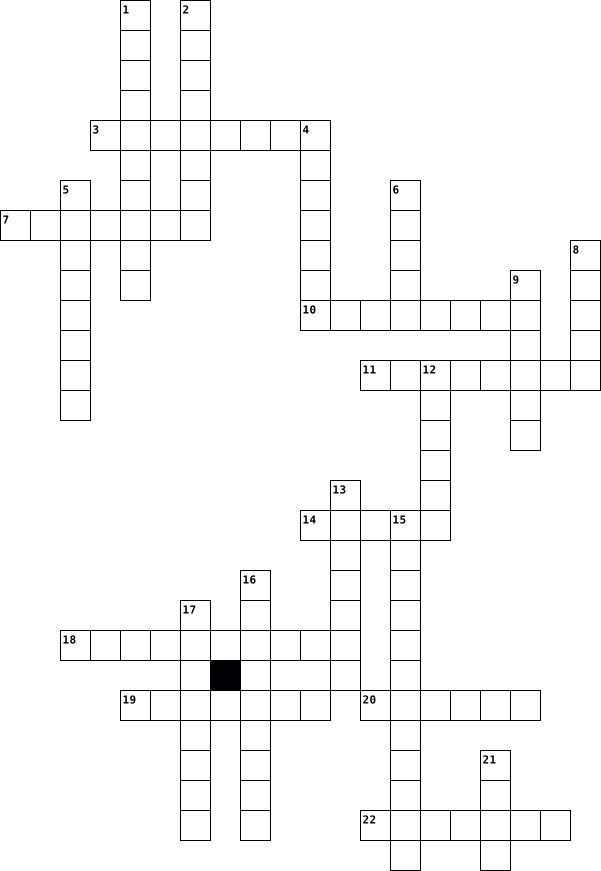
Across
- subatomic particle with a negative charge found in shells surrounding the nucleus
- a pulling force that pulls all objects to the center of the earth
- the month we celebrate Thanksgiving
- a substance made of two or more different elements bonded together, NaCl, and H2O are examples
- the state we live in
- a force that causes change in motion
- a pure substance that can't be broken down into simpler substances, found on the periodic table
- subatomic particle with a positive charge found in the nucleus
- the best football team in the NFL
Down
- elements that are semiconductors
- speed with a direction
- subatomic particle with a neutral charge found in the nucleus
- a force that causes no change in motion
- a push or pull
- the distance an object travels and the time it takes to travel that distance, or distance divided by time
- columns on the periodic table that tell us how many valence electrons each atom has
- elements that are shiny, malleable and found on the left side of the periodic table
- rows on the periodic table that tell us how many shells each atom has
- a change in speed or direction of an object
- elements that are mostly gas and found on the right side of the periodic table
- name of our school
- the smallest unit or part of an element, these tiny things make up all matter in the universe
22 Clues: a push or pull • name of our school • the state we live in • speed with a direction • elements that are semiconductors • the best football team in the NFL • the month we celebrate Thanksgiving • a force that causes change in motion • a force that causes no change in motion • a change in speed or direction of an object • ...
Chemistry 2015-09-28

Across
- Elements 89 to 103
- A model of the atom created by Niels Bohr
- The smallest matter with a chemical element
- An atom with less or more electorns
- Non-metals that can’t form a bond with metals
- An electron in the outer electron shell
- The smallest part of the atom
- The columns of the periodic table
- The configuration of the atom
- The location of protons and neutrons
- The rows on the periodic table
- Chemical elements found in Group 17 of the periodic table
- When an electron jumps up for it's ground state
Down
- An ion with a positive charge
- Light particle
- Chemical elements found in Group 1 of the periodic table
- The outer shell of the atom
- A chemical made out of two different atoms in a chemical bond
- An atom's symbol
- A group of chemical elements that go from 57 to 71
- Element of Group 3 to Group 12
- A chemical with more than one of the same element
- The mass of the atom
- Identify the atom
- Where the electrons are located
- The electron's normal shell
- When an atoms gives an electon to another atom to create a bond
- Has a neutral charge
- An ion with a negative charge
- The amount of energy an atom has
- A chemical substance with one kind of atom
- Chemical elements found in Group 18 of the periodic table
32 Clues: Light particle • An atom's symbol • Identify the atom • Elements 89 to 103 • The mass of the atom • Has a neutral charge • The outer shell of the atom • The electron's normal shell • An ion with a positive charge • The smallest part of the atom • The configuration of the atom • An ion with a negative charge • Element of Group 3 to Group 12 • The rows on the periodic table • ...
C1 Revision 2025-04-11

Across
- The centre of the atom containing protons and neutrons
- The columns in the periodic table
- A subatomic particle with a negative charge
- What happens to reactivity as you go down Group 7
- The total number of protons and neutrons
- The part of the atom where electrons are found
- The arrangement of electrons in shells
- The rows in the periodic table
- An atom that has gained or lost electrons
- Found on the right side of the periodic table
- The charge on an ion that has lost electrons
- Discovered the electron and made the plum pudding model
- The number of protons in an atom
Down
- Name of the table of elements
- A substance made of only one type of atom
- The charge on an ion that has gained electrons
- Scientist who arranged the first useful periodic table
- Discovered the neutron
- Discovered the nucleus with the gold foil experiment
- A subatomic particle with no charge
- Group 1 metals that react with water
- Suggested electrons move in fixed orbits
- Increases as you go down Group 1
- Group 0 gases that are unreactive
- Found on the left side of the periodic table
- Scientist who first described atoms as solid spheres
- A subatomic particle with a positive charge
- Noble gases have this type of outer shell
- Atoms of the same element with different numbers of neutrons
- Group 7 non-metals that get less reactive down the group
30 Clues: Discovered the neutron • Name of the table of elements • The rows in the periodic table • Increases as you go down Group 1 • The number of protons in an atom • The columns in the periodic table • Group 0 gases that are unreactive • A subatomic particle with no charge • Group 1 metals that react with water • The arrangement of electrons in shells • ...
Science Puzzle 2026-01-16

Across
- Mix of 2 or more elements
- +1 charge
- 0 charge
- Contains protons and neutrons
- Everything on the periodic table
- Elements on the far right side of the periodic table
- Most reactive metals
- -1 charge
- Made up of one element/compound
Down
- No obvious differences
- Periodic table's "Stair step"
- On far right of table but includes Hydrogen
- Takes up most of the table
- Obvious differences
14 Clues: 0 charge • +1 charge • -1 charge • Obvious differences • Most reactive metals • No obvious differences • Mix of 2 or more elements • Takes up most of the table • Periodic table's "Stair step" • Contains protons and neutrons • Made up of one element/compound • Everything on the periodic table • On far right of table but includes Hydrogen • ...
Chapter 5 ICP 2022-11-30

Across
- The most abundant metal in Earth's Crust
- Element in group 1A, Sodium is in this group
- Each column on the Periodic Table
- The element used to promote healthy bones and teeth
- This element and nitrogen are used in fertilizers
- The most abundant element in Earth's Crust
- The card game the periodic table was based on
Down
- Elements in group 8A, Not reactive
- The Elements in Group 7A
- Element that shares properties of metals and nonmetals
- The elements in Group 3A make up the ____ Family
- Each row on the periodic table
- The element that formerly known as eka-aluminum
- Last name of the man who developed the modern periodic table
- These elements conduct electricity and heat
15 Clues: The Elements in Group 7A • Each row on the periodic table • Each column on the Periodic Table • Elements in group 8A, Not reactive • The most abundant metal in Earth's Crust • The most abundant element in Earth's Crust • These elements conduct electricity and heat • Element in group 1A, Sodium is in this group • The card game the periodic table was based on • ...
Periodic Table - Recap 2013-06-08

Across
- Magnesium and sulfur are from the same ____________
- Neon is not involved in any reaction because it has a _________ outermost shell
- Fluorine gas exist as a __________ molecule
- It's ion has an electron configuration of 2,8,8. It forms an oxide that turns red litmus blue
- Group VII elements are also called __________
- Elements in the periodic table are arranged in an _____________ atomic number
- Argon is a ____________ element
Down
- Going down group I, the elements become more ____________
- Elements on the left of the periodic table forms ___________ ions
- The elements that do not belong to any groups are called ____________ metals
- This element receives an electron during bonding with a metal, hence it belongs to group ____________
- Elements in group II in the periodic table have a _________ of two
- Group 0 elements are noble ____________
- Found in hot air balloons
- Lithium and sodium have the same _________ properties
- Carbon and lead are from the same _____________
- The non-metals occupy the _________ side of the periodic table
- Elements in period 3 have __________ electron shells
18 Clues: Found in hot air balloons • Argon is a ____________ element • Group 0 elements are noble ____________ • Fluorine gas exist as a __________ molecule • Group VII elements are also called __________ • Carbon and lead are from the same _____________ • Magnesium and sulfur are from the same ____________ • Elements in period 3 have __________ electron shells • ...
Physical Science 2024-04-10

Across
- A phase that does not have a definite shape or volume.
- Vertical row in the periodic table.
- Horizontal row in the periodic table.
- Amount of matter in an object.
- A phase that has a definite volume but takes the shape of its container.
- An equal amount of charge or particles.
- Elements in Group 17 on the periodic table.
- As one variable increases the other variable decreases.
- System An isolated system.
Down
- Table Organized list of all known elements that are arranged by increasing atomic
- Amount of force exerted per unit area.
- A charged product resulting from the gain or loss of electrons.
- Group of elements with similar chemical properties.
- Atoms of the same element that have different numbers of neutrons.
- Mass per unit volume of a material.
- Bond Attraction formed between oppositely charged ions in an ionic compound.
- A pattern of gradual change in a condition output or process
- Substance with atoms that are all alike
18 Clues: System An isolated system. • Amount of matter in an object. • Vertical row in the periodic table. • Mass per unit volume of a material. • Horizontal row in the periodic table. • Amount of force exerted per unit area. • An equal amount of charge or particles. • Substance with atoms that are all alike • Elements in Group 17 on the periodic table. • ...
Periodic Table Terms 2025-11-10

Across
- a part or aspect of something abstract, especially one that is essential or characteristic.
- a chemical element, primarily located on the right side of the periodic table
- a collection of people or things acting as a unit
- an element's tendency to undergo chemical reactions
- the predictable patterns in the properties of elements that arise from their arrangement on the periodic table
- soft, shiny, and highly reactive metals that each have one electron in their outermost shell.
Down
- a table of the chemical elements arranged in order of atomic number, usually in rows,
- elements on the periodic table that have properties between those of metals and nonmetals.
- a horizontal row of the periodic table
- a group of elements found primarily on the left side of the periodic table
- how an element reacts with others, a pattern determined by its electron configuration.
- a Russian chemist known for formulating the periodic law and creating a version of the periodic table of elements.
12 Clues: a horizontal row of the periodic table • a collection of people or things acting as a unit • an element's tendency to undergo chemical reactions • a group of elements found primarily on the left side of the periodic table • a chemical element, primarily located on the right side of the periodic table • ...
Chm 2.1 Crossword puzzle 2025-10-30

Across
- Vertical on the periodic table
- Founder of the Periodic table
- The electron in the outer most shell
- The distance between the nuclei and the outermost atom
- Horizontal on the periodic table
Down
- group 17 on the periodic table
- The first element in the periodic table
- the measure of an atom ability to attract another electron to itself
- The energy required to remove an electron from an ion
- first word Group 18 on the periodic table
10 Clues: Founder of the Periodic table • group 17 on the periodic table • Vertical on the periodic table • Horizontal on the periodic table • The electron in the outer most shell • The first element in the periodic table • first word Group 18 on the periodic table • The energy required to remove an electron from an ion • The distance between the nuclei and the outermost atom • ...
periodic table terms 2025-11-10

Across
- a part or aspect of something abstract, especially one that is essential or characteristic.
- a chemical element, primarily located on the right side of the periodic table
- a collection of people or things acting as a unit
- an element's tendency to undergo chemical reactions
- the predictable patterns in the properties of elements that arise from their arrangement on the periodic table
- soft, shiny, and highly reactive metals that each have one electron in their outermost shell.
Down
- a table of the chemical elements arranged in order of atomic number, usually in rows,
- elements on the periodic table that have properties between those of metals and nonmetals.
- a horizontal row of the periodic table
- a group of elements found primarily on the left side of the periodic table
- how an element reacts with others, a pattern determined by its electron configuration.
- a Russian chemist known for formulating the periodic law and creating a version of the periodic table of elements.
12 Clues: a horizontal row of the periodic table • a collection of people or things acting as a unit • an element's tendency to undergo chemical reactions • a group of elements found primarily on the left side of the periodic table • a chemical element, primarily located on the right side of the periodic table • ...
Unit 1 Review 2022-09-09

Across
- Rows of the Periodic Table
- Type of change without creating a new substance
- element with 12 protons
- Chemical Symbol P
- Is Mg an element or a compound?
- Father of the Periodic Table
Down
- Is H2O an element or a compound?
- Columns of the Periodic Table
- Chemical Symbol K
- Type of change that cannot be reversed
- Chemical Symbol Na
- 2 or more substances easily separated
- A pure substance
- 2 substances chemically combined
- Second lightest element
- Physical changes cannot be reversed (T/F)
- How many elements in NaCO3?
17 Clues: A pure substance • Chemical Symbol K • Chemical Symbol P • Chemical Symbol Na • element with 12 protons • Second lightest element • Rows of the Periodic Table • How many elements in NaCO3? • Father of the Periodic Table • Columns of the Periodic Table • Is Mg an element or a compound? • Is H2O an element or a compound? • 2 substances chemically combined • ...
Periodic Table 2023-08-28

Across
- : most elements are ______.
- :the most powerful tool chemists.
- : good source of electricity and heat.
- : full names of the elements, and its _______.
- : it is on the upper left of the periodic table.
- : found in the upper right of the periodic table.
- :the periodic table is what you use to _____ chemicals.
- :you can predict the chemicals _______.
- : metallic elements are typically _____.
- : that the numbers of _____.
Down
- : nonmetals are generally not good _____.
- : you can find them on the _______.
- atoms are listed in order of increasing _____.
- : The 7 horizontal rows are called _____.
- : One or two letter ______.
- number : above the chemical symbol is ______.
- : nonmetals generally not _____.
- : the line that draws nonmetals and metals.
- : each element is represented by a ______.
19 Clues: : most elements are ______. • : One or two letter ______. • : that the numbers of _____. • : nonmetals generally not _____. • :the most powerful tool chemists. • : you can find them on the _______. • : good source of electricity and heat. • :you can predict the chemicals _______. • : metallic elements are typically _____. • : nonmetals are generally not good _____. • ...
Periodic Table 2023-09-11

Across
- the number of protons in an atom
- containing only one kind of atom
- 75% of the PT are these
- the right side of the PT
- stable gases
- the number of protons and neutrons
- an organizational chart of elements
Down
- the father of the modern periodic table
- create beautiful colors
- a column in the periodic table
- a way to represent valence electrons
- an atom with a different number of neutrons
- middle of the PT transition
- slaty elements
- smoke detectors
- a row in the Periodic Table
16 Clues: stable gases • slaty elements • smoke detectors • create beautiful colors • 75% of the PT are these • the right side of the PT • middle of the PT transition • a row in the Periodic Table • a column in the periodic table • the number of protons in an atom • containing only one kind of atom • the number of protons and neutrons • an organizational chart of elements • ...
GEN CHEM 2020-05-26

Across
- is a chemical substance composed of many identical molecules
- a chemical operation that separates solid matter and fluid from a mixture with a filter medium
- the meaning of Xe in the periodic table
- the chemistry of carbon compounds
- a property that does not depend on the size of matter.
- it is a measure of the "hotness" or "coldness" of a substance.
- it is a material made up of two or more different substances which are physically combined.
- state of matter that atoms are close together.
- 5th element in the periodic table
- is a measure of how readily a substance undergoes a chemical reaction.
- makes your voice change when inhaled and it is a noble gas.
- branch of science that explores living organism
- 57th in the periodic table
- chemistry that studies the structure of matter.
- is a mixture in which the components of the mixture are not uniform
- property that does depend on the size of matter
- change of state from solid to gas
- humans inhale this gas.
- an effect is light scattering by particles in a colloid or in a very fine suspension
- the meaning of Rb in the periodic table
- a mixture that has a small diameter yet are still uniformly distributed in a solution
- the most abundant element in the universe
- 4th element in the periodic table
- is the ratio between the activity of your sample of interest.
- it is a substance whose atoms all have the same number of protons
- it is the relationship between the mass of the substance and how much space it takes up
Down
- change of state from solid to liquid
- change of state from liquid to gas
- the element Ca in the periodic table
- is the process by which an atom or a molecule acquires a negative or positive
- the meaning of Cl in the periodic table
- it is a measure of how easily a substance burst into flames
- it is a special type of homogeneous mixture composed of two or more substances
- the technique of heating a liquid to create vapor which is collected when cooled separate from the original liquid
- change of state from liquid to solid
- change of state from gas to solid
- Substance substances that are made of only one type of atom
- state of matter where atoms are not to far from each other
- it is a heterogeneous mixture that contains solid particles sufficiently large for sedimentation
- it is a mixture in which the molecules that make up the mixture are uniformly distributed.
- a laboratory technique for the separation of a mixture.
- it is a measure of the amount of matter in an object
- chemistry that deals with inorganic compounds
- state of matter where atoms are far apart.
- what is Ti stands for in period table.
- the 18th element in the periodic table
- the chemistry that study the behavior of matter
- it is the quantity of space occupied by a liquid, solid, or gas.
- is the degree to which a chemical substance or a particular mixture of substances can damage an organism
- it’s the meaning of Au in the periodic table
- what is Fr stands for in periodic table
- in science it means when the properties of the substance is unchanging
52 Clues: humans inhale this gas. • 57th in the periodic table • the chemistry of carbon compounds • change of state from gas to solid • 5th element in the periodic table • change of state from solid to gas • 4th element in the periodic table • change of state from liquid to gas • change of state from solid to liquid • the element Ca in the periodic table • ...
GEN CHEM 2020-05-26

Across
- change of state from liquid to gas
- the technique of heating a liquid to create vapor which is collected when cooled separate from the original liquid
- a chemical operation that separates solid matter and fluid from a mixture with a filter medium
- is the process by which an atom or a molecule acquires a negative or positive
- it’s the meaning of Au in the periodic table
- branch of science that explores living organism
- 5th element in the periodic table
- what is Ti stands for in period table.
- the meaning of Cl in the periodic table
- it is a measure of how easily a substance burst into flames
- humans inhale this gas.
- it is the quantity of space occupied by a liquid, solid, or gas.
- it is a measure of the "hotness" or "coldness" of a substance.
- change of state from gas to solid
- is a measure of how readily a substance undergoes a chemical reaction.
- the chemistry that study the behavior of matter
- state of matter where atoms are far apart.
- it is the relationship between the mass of the substance and how much space it takes up
- a property that does not depend on the size of matter.
- what is Fr stands for in periodic table
- change of state from solid to liquid
Down
- is a mixture in which the components of the mixture are not uniform
- is a chemical substance composed of many identical molecules
- the 18th element in the periodic table
- the meaning of Xe in the periodic table
- in science it means when the properties of the substance is unchanging
- is the degree to which a chemical substance or a particular mixture of substances can damage an organism
- the most abundant element in the universe
- property that does depend on the size of matter
- the chemistry of carbon compounds
- chemistry that deals with inorganic compounds
- chemistry that studies the structure of matter.
- a laboratory technique for the separation of a mixture.
- state of matter that atoms are close together.
- the element Ca in the periodic table
- state of matter where atoms are not to far from each other
- it is a substance whose atoms all have the same number of protons
- 57th in the periodic table
- a mixture that has a small diameter yet are still uniformly distributed in a solution
- change of state from solid to gas
- is the ratio between the activity of your sample of interest.
- Substance substances that are made of only one type of atom
- makes your voice change when inhaled and it is a noble gas.
- it is a mixture in which the molecules that make up the mixture are uniformly distributed.
- it is a heterogeneous mixture that contains solid particles sufficiently large for sedimentation
- 4th element in the periodic table
- an effect is light scattering by particles in a colloid or in a very fine suspension
- it is a special type of homogeneous mixture composed of two or more substances
- the meaning of Rb in the periodic table
- it is a material made up of two or more different substances which are physically combined.
- change of state from liquid to solid
- it is a measure of the amount of matter in an object
52 Clues: humans inhale this gas. • 57th in the periodic table • the chemistry of carbon compounds • 5th element in the periodic table • change of state from solid to gas • 4th element in the periodic table • change of state from gas to solid • change of state from liquid to gas • the element Ca in the periodic table • change of state from liquid to solid • ...
The Periodic Table and its Trends 2024-05-02

Across
- Row 5, gains 1 valence electron
- Row 6, loses 2 valence electrons
- Row 1, 2 valence electrons
- Row 3, column 2
- Row 4, 7 valence electrons
- From row 3 to 12
- A noble gas that's in row 4
- Sodium symbol
Down
- Row 4, column 1
- Row 3, column 14
- Row 3, column 6 valence electrons
- Argon symbol
- On the staircase in the periodic table
- On the left side of the periodic table
- On the right side of the periodic table
15 Clues: Argon symbol • Sodium symbol • Row 4, column 1 • Row 3, column 2 • Row 3, column 14 • From row 3 to 12 • Row 1, 2 valence electrons • Row 4, 7 valence electrons • A noble gas that's in row 4 • Row 5, gains 1 valence electron • Row 6, loses 2 valence electrons • Row 3, column 6 valence electrons • On the staircase in the periodic table • On the left side of the periodic table • ...
Atoms, Chemical Bonds, and the Periodic Table 2025-10-24

Across
- The group on the periodic table that has the most reactive elements
- The number that tells us how many protons are in an atom of an element
- An atom with 8 valence electrons is considered to be ___________
- The negatively charged subatomic particle that makes up and atom
- The scientist that developed the first periodic table of elements
- The group of reactive nonmetals on the periodic table that often react with metals to form salts
- Anything that has mass and takes up space
- A force that holds two or more atoms together
- An atom with 1-7 valence electrons is considered to be __________
- The name for the columns on the periodic table
- The number that tells us how much one atom of an element weighs in amu
- The positively charged subatomic particle found in the nucleus
Down
- A chart of elements arranged into rows and columns according to their physical and chemical properties
- The region at the center of the atom that contains most of the mass of an atom
- The group of nonmetals that are clear, colorless, and unreactive gases
- An outermost electron of an atom that participates in chemical bonding
- The smallest unit of matter
- Matter made up of two or more different kinds of atoms joined together by a chemical bond
- The group of metals on the periodic table that are used for jewelry, construction, wires, and coins
- Matter made up of two or more atoms (same or different) joined together by a chemical bond
- The region surrounding the nucleus of the atom where electrons can be found
- The name for the rows on the periodic table
- A pure substace made up of only one type of atom
- the neutrally charged subatomic particle found in the nucleus
24 Clues: The smallest unit of matter • Anything that has mass and takes up space • The name for the rows on the periodic table • A force that holds two or more atoms together • The name for the columns on the periodic table • A pure substace made up of only one type of atom • the neutrally charged subatomic particle found in the nucleus • ...
Periodic Table 2023-08-25

Across
- A vertical column of elements is called a __ or a family.
- __ has the most amount of protons in the periodic table.
- Atomic number of 1.
- Created the first periodic table.
- Each element has a unique atomic number which is the amount of __ in the nucleus.
- What makes the periodic table really invaulable is its use as a __ tool.
- Circles around the atom and has no charge.
- The __is the most powerful tool chemists have for organizing chemical information.
- The most radioactive atom.
Down
- Deadliest element
- Cant mix with anything else.
- The latest element to be discovered.
- The amount of __ in a element is equal to the amount of protons in a element
- Atoms on the periodic table are listed by__.
- The first element to be discovered.
- The 7 horizontal rows are called __.
16 Clues: Deadliest element • Atomic number of 1. • The most radioactive atom. • Cant mix with anything else. • Created the first periodic table. • The first element to be discovered. • The latest element to be discovered. • The 7 horizontal rows are called __. • Circles around the atom and has no charge. • Atoms on the periodic table are listed by__. • ...
Periodic Table 2023-08-25

Across
- A vertical column of elements is called a __ or a family.
- __ has the most amount of protons in the periodic table.
- Atomic number of 1.
- Created the first periodic table.
- Each element has a unique atomic number which is the amount of __ in the nucleus.
- What makes the periodic table really invaulable is its use as a __ tool.
- Circles around the atom and has no charge.
- The __is the most powerful tool chemists have for organizing chemical information.
- The most radioactive atom.
Down
- Deadliest element
- Cant mix with anything else.
- The latest element to be discovered.
- The amount of __ in a element is equal to the amount of protons in a element
- Atoms on the periodic table are listed by__.
- The first element to be discovered.
- The 7 horizontal rows are called __.
16 Clues: Deadliest element • Atomic number of 1. • The most radioactive atom. • Cant mix with anything else. • Created the first periodic table. • The first element to be discovered. • The latest element to be discovered. • The 7 horizontal rows are called __. • Circles around the atom and has no charge. • Atoms on the periodic table are listed by__. • ...
Periodic Table 2023-08-25

Across
- A vertical column of elements is called a __ or a family.
- __ has the most amount of protons in the periodic table.
- Atomic number of 1.
- Created the first periodic table.
- Each element has a unique atomic number which is the amount of __ in the nucleus.
- What makes the periodic table really invaulable is its use as a __ tool.
- Circles around the atom and has no charge.
- The __is the most powerful tool chemists have for organizing chemical information.
- The most radioactive atom.
Down
- Deadliest element
- Cant mix with anything else.
- The latest element to be discovered.
- The amount of __ in a element is equal to the amount of protons in a element
- Atoms on the periodic table are listed by__.
- The first element to be discovered.
- The 7 horizontal rows are called __.
16 Clues: Deadliest element • Atomic number of 1. • The most radioactive atom. • Cant mix with anything else. • Created the first periodic table. • The first element to be discovered. • The latest element to be discovered. • The 7 horizontal rows are called __. • Circles around the atom and has no charge. • Atoms on the periodic table are listed by__. • ...
science crosswords 2023-12-05

Across
- can be drawn into a wire
- everything featured on the periodic table
- negative charge
- no charge
- an object in motion remains in motion
- they live in groups 13-16
- for every action, there is an equal and opposite reaction.
- they live in groups 1-16
- they live in groups 14-18
- M/S2
Down
- speed with a direction
- one evidence of a chemical reaction
- they go up and down on the periodic table
- how fast an object is moving
- where protons and neutrons are stored
- goes across on the periodic table
- the less the mass, the greater the acceleration
- Positively charged
- reflects light when polished
- how to calculate for speed
- can be bent or hammered flat
21 Clues: M/S2 • no charge • negative charge • Positively charged • speed with a direction • can be drawn into a wire • they live in groups 1-16 • they live in groups 13-16 • they live in groups 14-18 • how to calculate for speed • how fast an object is moving • reflects light when polished • can be bent or hammered flat • goes across on the periodic table • one evidence of a chemical reaction • ...
science crosswords 2023-12-05

Across
- can be drawn into a wire
- everything featured on the periodic table
- negative charge
- no charge
- an object in motion remains in motion
- they live in groups 13-16
- for every action, there is an equal and opposite reaction.
- they live in groups 1-16
- they live in groups 14-18
- M/S2
Down
- speed with a direction
- one evidence of a chemical reaction
- they go up and down on the periodic table
- how fast an object is moving
- where protons and neutrons are stored
- goes across on the periodic table
- the less the mass, the greater the acceleration
- Positively charged
- reflects light when polished
- how to calculate for speed
- can be bent or hammered flat
21 Clues: M/S2 • no charge • negative charge • Positively charged • speed with a direction • can be drawn into a wire • they live in groups 1-16 • they live in groups 13-16 • they live in groups 14-18 • how to calculate for speed • how fast an object is moving • reflects light when polished • can be bent or hammered flat • goes across on the periodic table • one evidence of a chemical reaction • ...
Elements, Mixtures and Compounds 2023-11-18

Across
- yellow metal used to make jewellery
- particle formed when atoms join together
- compound with formula H2O
- unusual metal found in thermometers
- hard, strong material eg. copper
- substance formed when 2 elements bond
- chemical used in a reaction
- chemical formed in a reaction
- describes elements such as helium, oxygen and hydrogen
- the table where elements are listed
Down
- element which we breathe in
- family of similar elements
- non metal used to purify water
- tiny particle which makes up all substances
- row across the Periodic Table
- compound which we breathe out
- simplest chemicals
- side of the Periodic Table where you find metals
- chemical change which makes new materials
- metal element found in food cans
- metal used to make ladders and windows
21 Clues: simplest chemicals • compound with formula H2O • family of similar elements • element which we breathe in • chemical used in a reaction • row across the Periodic Table • compound which we breathe out • chemical formed in a reaction • non metal used to purify water • hard, strong material eg. copper • metal element found in food cans • yellow metal used to make jewellery • ...
Periodic Table 2021-05-13

Across
- Known for arranging the periodic table
- Every element has a different _______ number
- Nonmetals typically form ______ ions
- Group 2 metals
- Metals typically form _______ ions
- Group found in between metals and nonmetals
- Number that is also the atomic number of an atom
- Total of protons and electrons
- The number of groups on the periodic table
- gas Colorless, oder-less gasses with low chemical reactivity
- Atomic mass of 35.435
Down
- Used to describe objects that conduct electricity well
- Outer shell electrons
- The vertical columns are called either families or_____
- Group 1 metals
- basic unit of a chemical element. The building blocks of life
- A substance that cannot be broken into other substances
- Particle with no charge
- 9 on the periodic table
- Most active nonmetals
20 Clues: Group 1 metals • Group 2 metals • Outer shell electrons • Atomic mass of 35.435 • Most active nonmetals • Particle with no charge • 9 on the periodic table • Total of protons and electrons • Metals typically form _______ ions • Nonmetals typically form ______ ions • Known for arranging the periodic table • The number of groups on the periodic table • ...
science crosswords 2023-12-05

Across
- can be drawn into a wire
- everything featured on the periodic table
- negative charge
- no charge
- an object in motion remains in motion
- they live in groups 13-16
- for every action, there is an equal and opposite reaction.
- they live in groups 1-16
- they live in groups 14-18
- M/S2
Down
- speed with a direction
- one evidence of a chemical reaction
- they go up and down on the periodic table
- how fast an object is moving
- where protons and neutrons are stored
- goes across on the periodic table
- the less the mass, the greater the acceleration
- Positively charged
- reflects light when polished
- how to calculate for speed
- can be bent or hammered flat
21 Clues: M/S2 • no charge • negative charge • Positively charged • speed with a direction • can be drawn into a wire • they live in groups 1-16 • they live in groups 13-16 • they live in groups 14-18 • how to calculate for speed • how fast an object is moving • reflects light when polished • can be bent or hammered flat • goes across on the periodic table • one evidence of a chemical reaction • ...
First 20 Elements of the Periodic Table 2021-10-27

Across
- this gas is needed for life processes
- element number 4 in the Periodic Table
- used to clean pools and floors
- makes up most of the atmosphere
- used to make planes and foil
- Na na na na na!
- the lightest element
- this exists in a white and a red form
- needed for strong bones and teeth
- the third element in the Periodic Table
Down
- used to fill gas balloons
- this element sounds like the word "boring"
- an element found in sand
- this gas is used to make glowing signs
- found in toothpaste
- another inert gas, the 18th element
- element number 12 in the Periodic Table
- found in bananas
- yellow element with a strong smell
- this element makes up diamonds and graphite
20 Clues: Na na na na na! • found in bananas • found in toothpaste • the lightest element • an element found in sand • used to fill gas balloons • used to make planes and foil • used to clean pools and floors • makes up most of the atmosphere • needed for strong bones and teeth • yellow element with a strong smell • another inert gas, the 18th element • this gas is needed for life processes • ...
Chapter 5 vocab 2023-10-20

Across
- - an arrangement of elements in columns, based on a set of properties that repeat from row to row
- - the pattern of repeating properties displayed by elements in the periodic table
- - elements that are good conductors of heat and electric current
- - metals that form a bridge between elements on the left and right sides of the periodic table
- - one twelfth the mass of a carbon-12 atom
- - a column of elements in a periodic table
Down
- - elements that are poor conductors of heat and electric current
- - the elements in group 2A of the periodic table
- - an electron that is in the highest occupied energy level of an atom
- - the elements in group 1A of the periodic table, not including hydrogen
- - elements with properties that fall between those of metals and nonmetals
- - a row in a periodic table of elements
12 Clues: - a row in a periodic table of elements • - one twelfth the mass of a carbon-12 atom • - a column of elements in a periodic table • - the elements in group 2A of the periodic table • - elements that are poor conductors of heat and electric current • - elements that are good conductors of heat and electric current • ...
Science crossword 2021-03-10

Across
- What is in the periodic table?
- What would 7 on the pH scale be?
- What is Fe in the periodic table?
- What is the chemical formula for water?
- What is the element in group 1 period 2?
- An element is made up of only one type of ____.
- What is Cl on the periodic table?
- What does luster mean?
Down
- What is K on the periodic table?
- What type of charge do protons have?
- What is the element in group 2 period 3?
- Would 14 on the pH scale be an acid or alkali?
- A compound is a combination of two or more elements ___________ joined together.
- A mixture is made up of two or more different __________.
- What is the chemical formula for hydrochloric acid?
- Would 1 on the pH scale be an acid or alkali?
16 Clues: What does luster mean? • What is in the periodic table? • What is K on the periodic table? • What would 7 on the pH scale be? • What is Fe in the periodic table? • What is Cl on the periodic table? • What type of charge do protons have? • What is the chemical formula for water? • What is the element in group 2 period 3? • What is the element in group 1 period 2? • ...
Periodic Table 2023-08-25

Across
- A vertical column of elements is called a __ or a family.
- __ has the most amount of protons in the periodic table.
- Atomic number of 1.
- Created the first periodic table.
- Each element has a unique atomic number which is the amount of __ in the nucleus.
- What makes the periodic table really invaulable is its use as a __ tool.
- Circles around the atom and has no charge.
- The __is the most powerful tool chemists have for organizing chemical information.
- The most radioactive atom.
Down
- Deadliest element
- Cant mix with anything else.
- The latest element to be discovered.
- The amount of __ in a element is equal to the amount of protons in a element
- Atoms on the periodic table are listed by__.
- The first element to be discovered.
- The 7 horizontal rows are called __.
16 Clues: Deadliest element • Atomic number of 1. • The most radioactive atom. • Cant mix with anything else. • Created the first periodic table. • The first element to be discovered. • The latest element to be discovered. • The 7 horizontal rows are called __. • Circles around the atom and has no charge. • Atoms on the periodic table are listed by__. • ...
Building blocks of matter 2026-03-09

Across
- Ag
- The energy produced during respiration
- Sodium chloride
- Au
- When two or more atoms are joined together
- When a molecule forms or combines chemically
- This table is an arrangement of the elements based on shared characteristics
- Iron oxide
- Positive charged particle
- This number also refers to how many protons an element has
- Vertical columns of the periodic table
Down
- Horizontal rows of the periodic table
- Neutral of no charge
- Co
- The smallest particle with lots of energy
- Negative charged particle
- The type of acid that has carbon, hydrogen and oxygen atoms
- A pure substance made up of one type of atom
- The atomic_ is the weight of one atom of that element and is shown at the bottom of the element block.
- Cu
20 Clues: Ag • Co • Au • Cu • Iron oxide • Sodium chloride • Neutral of no charge • Negative charged particle • Positive charged particle • Horizontal rows of the periodic table • The energy produced during respiration • Vertical columns of the periodic table • The smallest particle with lots of energy • When two or more atoms are joined together • A pure substance made up of one type of atom • ...
Periodic Table 2013-04-24

Across
- element in period 4 group 9
- element symbol is Fe
- elements between alkali metals and transition metals
- element symbol is Au
- element in period 2 group 13
- element symbol is O
- element symbol is N
- elements between transition metals and noble gasses
- elements on the far left side of the periodic table
- element in the bottom right corner of the periodic table
Down
- atomic number is 2
- element group with full valence levels
- element in the bottom left corner of the periodic table
- element group between alkali earth metals and halogens
- the element under hydrogen
- atomic number is 1
- element under neon
- element symbol is N
- atomic number is 10
- element symbol is C
20 Clues: atomic number is 2 • atomic number is 1 • element under neon • element symbol is N • element symbol is O • atomic number is 10 • element symbol is N • element symbol is C • element symbol is Fe • element symbol is Au • the element under hydrogen • element in period 4 group 9 • element in period 2 group 13 • element group with full valence levels • ...
Atoms and Periodic Table 2022-12-07

Across
- not likely to give away
- a positive electric charge, in the nucleus of the atom
- A simple substance that cannot be broken down into smaller parts or changed into another substance
- a group of electrons circulating around a nucleus or molecule
- the number of protons in the nucleus of the atom
- emitting or relating to the emission of ionizing radiation or particles
- something that isnt metal
- an atom or molecule with a net electric charge due to the loss or gain of one or more electrons
- the fixed amount of energy that something has
- any of the elements in group 0 of the periodic table
- a substance made by mixing other substances together
- elements in group 2 of the periodic table
- the small dense region consisting of protons and neutrons at the center of an atom
- any of the elements occupying group 17 on the periodic table
- an element whose properties are between metal and nonmetals
- a unit mass used to express atomic and molecular weights
- a table of chemical elements arranged in order of atomic number
- a column in the periodic table
Down
- the total number of protons and neutrons in a nucleus
- the horizontal rows of the periodic table
- the theoretical basis of modern physics that explains the nature and behavior of matter and energy on the atomic level
- elements in groups 3-12 on the periodic table
- an electron in the outer shell,associated with an atom
- the property of subatomic particles that cause it to experience a force when placed in an electric and magnetic field
- the recurrence of properties of the elements
- no electric charge, in the nucleus of the atom
- a negative electric charge, around the nucleus of the atom
- any of the metals in group 1 of the periodic table
- each of two or more forms of the same element that contain equal number of protons but different number of neutrons in the nuclei
- a solid material that is typically hard, shiny, malleable, fusible, and ductile
- the minimum charge possible, which charge of an electron
- the basic unit of a chemical element
- a substance formed from two or more elements
33 Clues: not likely to give away • something that isnt metal • a column in the periodic table • the basic unit of a chemical element • the horizontal rows of the periodic table • elements in group 2 of the periodic table • the recurrence of properties of the elements • a substance formed from two or more elements • elements in groups 3-12 on the periodic table • ...
Isotopes 2022-09-23

Across
- Latin for Gold
- in the center of an atom
- the rows in the periodic table
- German for potassium
- have a neutral charge
Down
- formulated the periodic law and created a version of the periodic table
- have a positive charge
- have a negative charge
- German for sodium
- 30th element of the periodic table
- Latin for Silver
11 Clues: Latin for Gold • Latin for Silver • German for sodium • German for potassium • have a neutral charge • have a positive charge • have a negative charge • in the center of an atom • the rows in the periodic table • 30th element of the periodic table • formulated the periodic law and created a version of the periodic table
Chemistry terms. 2023-04-03

Across
- positive charged atom
- what is calciums number on the periodic table
- negative charged atom
- what is hydrogens number on the periodic table
- what is oxygens number on the periodic table
Down
- what is heliums number on the periodic table
- what is nitrogens number on the periodic table
- what is lithiums number on the periodic table
- two what is the titanium number on the periodic table
- what is flourines number on the periodic table
10 Clues: positive charged atom • negative charged atom • what is heliums number on the periodic table • what is oxygens number on the periodic table • what is lithiums number on the periodic table • what is calciums number on the periodic table • what is nitrogens number on the periodic table • what is flourines number on the periodic table • ...
Elements Crossword 2015-12-11

Across
- Contained in farts
- This family contains flourine, chlorine, bromine, iodine, astatine
- Has 26 protons
- A horizontal row of elements in the Periodic Table
- A table that organizes all known elements by their properties
- Has golden tinge and violent reaction to water
- Most expensive natural metal
- When combined with hydrogen makes water and is what we breathe
- An element whose properties are mixed between metals and nonmetals (hint: not metalloid)
- Is part of every living thing
- A group of elements that is usually hard, shiny, malleable, and ductile
Down
- A law that states that when elements are arranged by atomic number they show a periodic variation of their properties
- A silvery white metal use to make salt
- A particle inside the nucleus that has a neutral charge
- A negatively-charged particle that orbits the nucleus
- Mostly on the right side of the table and not malleable or ductile
- One of the two or more forms of an element.
- First name of the inventor of the periodic table
- Makes up almost 80% of Earth's air and essential to plant life
- A vertical column of elements in the Periodic Table
20 Clues: Has 26 protons • Contained in farts • Most expensive natural metal • Is part of every living thing • A silvery white metal use to make salt • One of the two or more forms of an element. • Has golden tinge and violent reaction to water • First name of the inventor of the periodic table • A horizontal row of elements in the Periodic Table • ...
Chemistry 2018-04-03
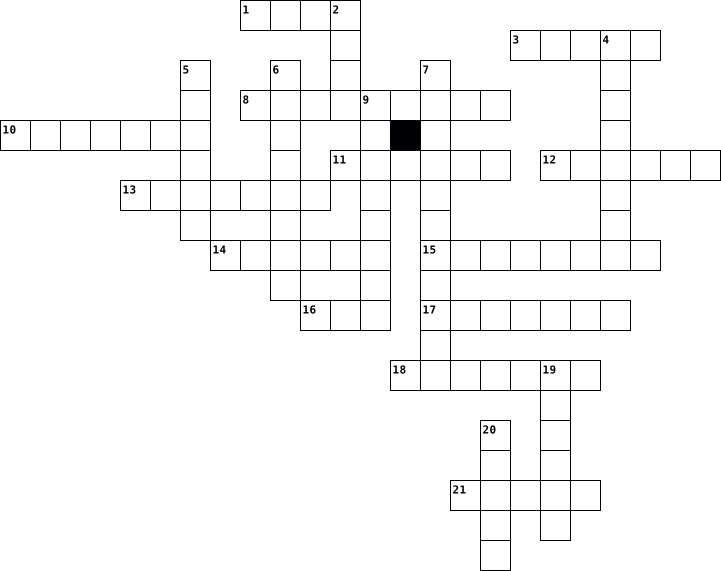
Across
- Neutrons being converted into protons occurs in ______ decay.
- The particle that is released in radioactive decay which is identical to a helium nucleus.
- Generally found on the right side of the periodic table.
- A collection of atoms or molecules of the same kind.
- The horizontal rows of the periodic table.
- Subatomic particle with a positive charge.
- The outer shell electrons that can participate in chemical bonding.
- Found in Group 6 Period 3.
- 2 or more elements chemically combined.
- A charged particle.
- Variants of a particular chemical element which differ in neutron number.
- Subatomic particle with no charge.
- Name of the group of gasses that are the most stable due to having the maximum amount of valence electrons their outer shell can hold.
Down
- The smallest constituent unit of ordinary matter that has the properties of a chemical element.
- The most abundant element in the universe.
- Generally found on the left side of the periodic table.
- 2 or more atoms chemically joined together.
- If an atom has an unstable nucleus it is __________.
- Subatomic particle with a negative charge.
- Element with atomic number 8.
- The vertical columns of the periodic table.
21 Clues: A charged particle. • Found in Group 6 Period 3. • Element with atomic number 8. • Subatomic particle with no charge. • 2 or more elements chemically combined. • The most abundant element in the universe. • Subatomic particle with a negative charge. • The horizontal rows of the periodic table. • Subatomic particle with a positive charge. • ...
Chemistry 2018-12-10
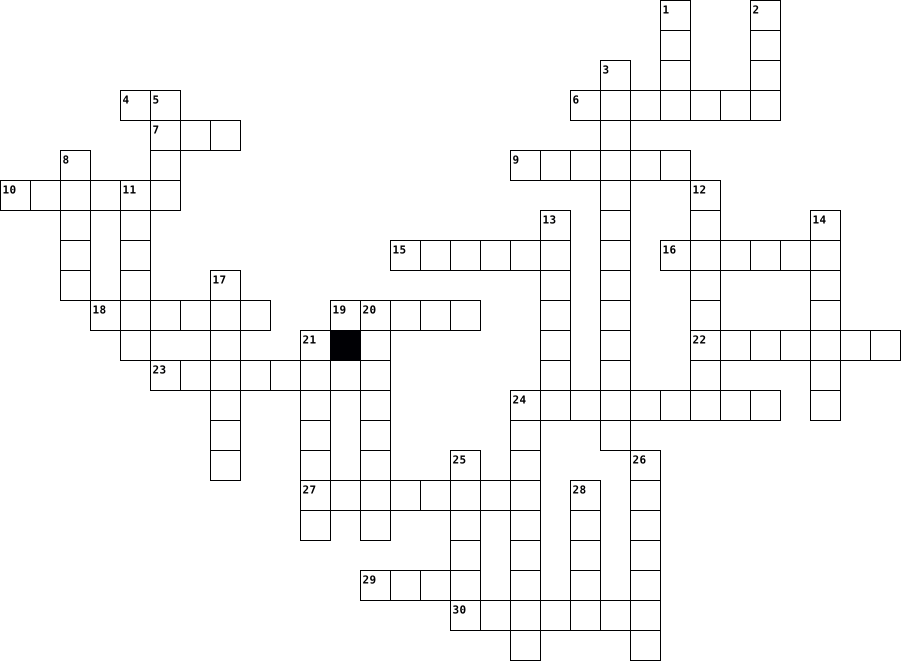
Across
- chemical symbol of the only liquid metal at room temperature
- You need this metal for strong bones
- Protons and neutrons have a mass of
- What diamonds are made from
- Rows in the periodic table
- Not all treasure is ______ and gold.
- Country Dimitri was from
- Second lightest element
- Electrons are found in these in atoms
- Element with chemical symbol Ir
- The number of electrons and protons in an atom are
- Father of the periodic table
- Negatively charged particle
- Neutrons have a charge of
- Neutral subatomic particle
Down
- The only element with a Z in
- The basic building block. Elements are made of these.
- Gas we exhale
- Pirate's favourite metal
- Columns in the periodic table
- Gas we inhale to respire
- A very reactive yellow gas
- The only liquid non-metal at room temperature
- Metal that melts just above room temperature
- The centre of the atom is called this
- Lightest element
- John Newlands discovered this law
- The element with the electron configuration 2,8,8,2
- Positively charged particle
- There are 118 different ones of these in the periodic table
- Common chemical that covers 60% of the Earth's surface
31 Clues: Gas we exhale • Lightest element • Second lightest element • Pirate's favourite metal • Gas we inhale to respire • Country Dimitri was from • Neutrons have a charge of • Rows in the periodic table • A very reactive yellow gas • Neutral subatomic particle • What diamonds are made from • Positively charged particle • Negatively charged particle • The only element with a Z in • ...
Chemistry Crossword 2020-10-01

Across
- Contains 2 Hydrogen Atoms and 1 Oxygen Atom
- Reaction Change in the Ionic structure of a substance
- Table Organized by Atomic Number, How Atoms React, and What kind of atom (metal, nonmetal, gas)
- Elements on the far left on the Periodic Table do this with elements second from right on the Periodic Table
- Flow in electric currents
- Cannot be broken or changed
- Can change the state of matter
- Number equal to a mole of atom
- Bonding that shares And exchanges electrons
- Are responsible for atomic bonding
- These are created when a group of atoms bond together
Down
- Reaction Evaporation, Freezing, and Condensation
- Has no charge
- Solid,liquid or gas
- Type of atomic bonding where atoms exchange electrons
- Positively charged and located in the nucleus
- Fourth state of matter
- Why the atomic number has a decimal
- React Gases on the far right of the Periodic Table
- If particles are not bonded they are a
- Same number of electrons and protons
- Very large molecules that make up living plants or animals
- Smallest unit of matter
- Charge When an atom gives away one electron
- of atomic bonding where atoms share electrons
- Shells around the nucleus
26 Clues: Has no charge • Solid,liquid or gas • Fourth state of matter • Smallest unit of matter • Flow in electric currents • Shells around the nucleus • Cannot be broken or changed • Can change the state of matter • Number equal to a mole of atom • Are responsible for atomic bonding • Why the atomic number has a decimal • Same number of electrons and protons • ...
35-Crossword 2025-05-31

Across
- 31-56 Periodic Table Elements forged into one
- Homer, Marge, Bart, Lisa, Maggie.
- Letters on a keyboard
- Letters in alphabetical order
- Slash, Inferno
- Quartz lung disease
- Nintendo's Console after the Nintendo Switch
- The GTA Game that got delayed.. a LONG time.. Definetally more than VI years.
- pr3typriincess' song
- Forsaken's survivor skin for the "CLOSE TO ME" Last man standing
- United States, Canada, Mexico, Panama, Haiti, Jamaica, ETC.
- =21
- Forsaken's killer skin for the "CLOSE TO ME" Last man standing
- Literally just pure screaming
- The place with London and Paris
- Players of R.E.P.O.
- Pizza Tower's main character
- Actinides
- Fear of long words
- Lanthanides
- First 30 Periodic table elements forged into one
Down
- GD Harder level that introduced the Wave
- dQw4w9WgXcQ
- Oceanian Country
- Continent with Brazil
- The original area where humans started
- Continent without any countries
- Reflecting an attack in Ultrakill
- Periodic table element with proton number 118
- Continent with the stans
- Fear of palindromes
- Periodic Table element with proton number 70
- 🇮🇹
- The-The-The bird bird bird, Bird is the word.
- Australia's other name
35 Clues: 🇮🇹 • =21 • Actinides • dQw4w9WgXcQ • Lanthanides • Slash, Inferno • Oceanian Country • Fear of long words • Quartz lung disease • Fear of palindromes • Players of R.E.P.O. • pr3typriincess' song • Letters on a keyboard • Continent with Brazil • Australia's other name • Continent with the stans • Pizza Tower's main character • Letters in alphabetical order • Literally just pure screaming • ...
Periodic Table Crossword 2026-03-09

Across
- (The only) metal that is liquid at room temperature (hint: find the symbol Hg)
- Shiny yellow metal used in jewelry
- Element with atomic number 53
- The dense center of an atom that contains protons and neutrons
- Element with symbol Ag
- Particle in the nucleus with no electric charge
- Category of element that is shiny and can be shaped easily
- Negatively charged particle found around the nucleus
- Element you need to live that you are breathing right now
- Element with properties in between metals and nonmetals
- Element with atomic mass of 40
- Smallest building block of matter that retains the properties of an element
Down
- The first element (by atomic number); also most abundant element in the Universe
- Each row of the periodic table is called a
- Category of element that is usually dull and brittle
- Positively charged particle in the nucleus of an atom
- Fill in the blank: the ___ table of elements
- A substance that contains only one type of atom
- The element in the second period and rightmost group of the Periodic Table
- Each column of the periodic table where elements have similar properties is called a
20 Clues: Element with symbol Ag • Element with atomic number 53 • Element with atomic mass of 40 • Shiny yellow metal used in jewelry • Each row of the periodic table is called a • Fill in the blank: the ___ table of elements • Particle in the nucleus with no electric charge • A substance that contains only one type of atom • Category of element that is usually dull and brittle • ...
Matter and Energy 2022-04-27

Across
- the basic building block of matter that make up everyday objects
- table, a table of the chemical elements arranged in order of atomic number
- the tendency of a substance to react with its surroundings or certain other substances
- , elements located in group/family 18 on the Periodic Table
- elements located in group/family 2 on the Periodic Table
- the name given to the horizontal rows of elements on the Periodic Table
Down
- elements located in group/family 1 on the Periodic Table
- elements located in groups/families 3-12 on the Periodic Table
- the name given to the vertical columns of elements on the Periodic Table
- elements located in group/family 17 on the Periodic Table
10 Clues: elements located in group/family 1 on the Periodic Table • elements located in group/family 2 on the Periodic Table • elements located in group/family 17 on the Periodic Table • , elements located in group/family 18 on the Periodic Table • elements located in groups/families 3-12 on the Periodic Table • ...
Periodic table 2024-05-02

Across
- types of elements located on the right of the table, normally liquids or gasses
- vertical columns
- Side of the periodic table that nonmetals are located at
- metals in groups 3-12
- types of elements located on the left of the table, usually solids with the exception of mercury
- side of the periodic table that metals are located at
- types of elements located on the staircase, a mix between metal and nonmetal
Down
- also the number of protons in an atom
- group 17
- Increases as you approach the bottom left corner of the periodic table
- protons + neutrons
- group 18
- also known as the zigzag line, where metalloids are located
- the 1 or 2 letters on each key of the periodic table that helps to identify each element
- horizontal rows
15 Clues: group 17 • group 18 • horizontal rows • vertical columns • protons + neutrons • metals in groups 3-12 • also the number of protons in an atom • side of the periodic table that metals are located at • Side of the periodic table that nonmetals are located at • also known as the zigzag line, where metalloids are located • ...
Science 2024-10-28

Across
- The elements in group 2 on the periodic table.
- The elements in group 18.
- The elements in group 1.
- A column on the periodic table.
- Conducts electricity at high temperatures, but not at low temperatures.
- An element in group 17 of the periodic table.
- An element that is generally shiny.
- The ability to be pulled into thin wires.
- An element that has physical and chemical properties of both metals and nonmetals.
- Elements that have no metallic properties.
Down
- The elements in groups 3-12.
- The rows on the periodic table.
- A chart of the elements arranged into rows and columns according to their physical and chemical properties.
- The ability of a metal to reflect light.
- The ability of a substance to be hammered or rolled into sheets.
15 Clues: The elements in group 1. • The elements in group 18. • The elements in groups 3-12. • The rows on the periodic table. • A column on the periodic table. • An element that is generally shiny. • The ability of a metal to reflect light. • The ability to be pulled into thin wires. • Elements that have no metallic properties. • An element in group 17 of the periodic table. • ...