
periodic%20table Crossword Puzzles
Chemistry Crossword 2024-01-27

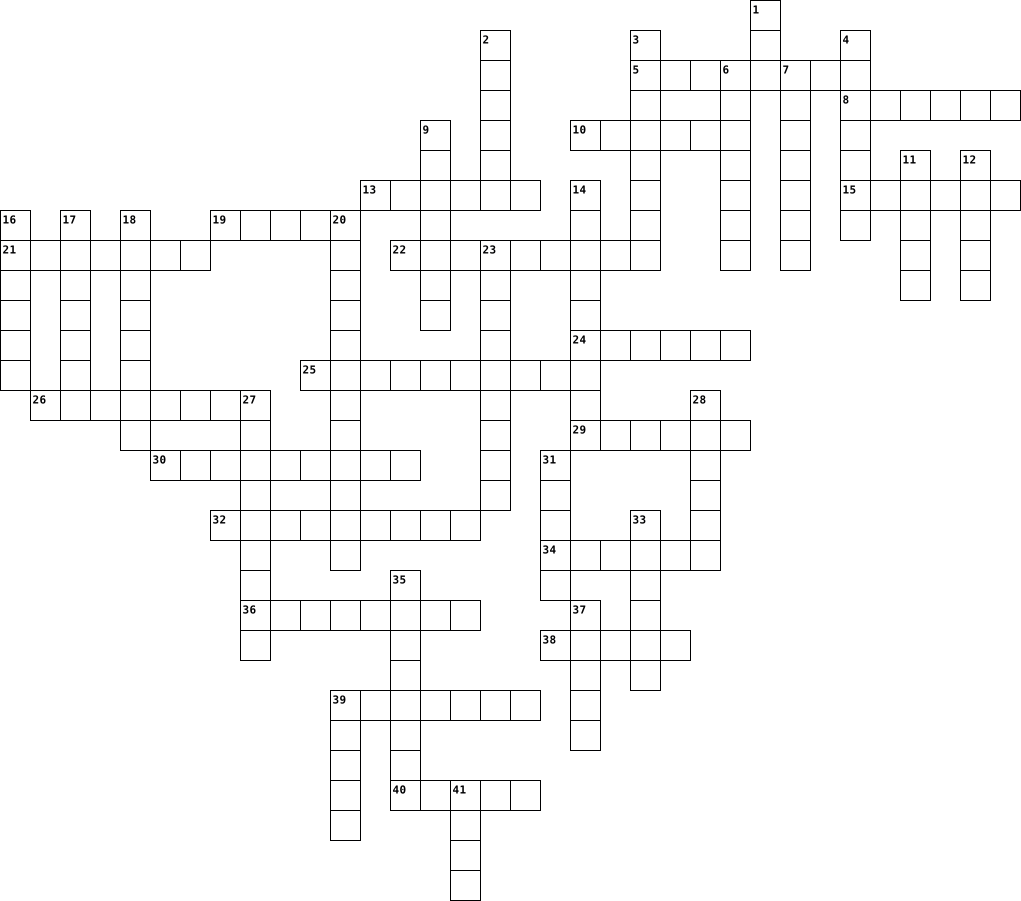
Across
- A proton has a _________ charge
- energy that has the potential to be in motion
- requiring heat absorption
- This subtracted by the # of protons = the charge
- When a molecule is both slightly positive and slightly negative
- A base that dissolves in water
- Changing from one form too another
- type of bond when a nonmetal and a metal bond
- make up most of the periodic table
- Energy in motion
- Example: g, mL, etc.
- Attracted to water
- release of heat
- number of protons minus number of neutrons
- An atom with a charge
- ______ go down the periodic table
Down
- Unit of measurement for mass, (g)
- Ability of an atom to attract electron
- determines the atomic number of an element
- A negatively charged particle
- _______ go across the periodic table
- Molecules with no charge
- Particle of matter
- A negatively charged ion
- Type of bond when 2 nonmetals bond
- A positively charged ion
- Distance from an atoms nucleus to the last orbital
- A unit of measurement for amount of substance
- An electron has a _________ charge
- Repels water
30 Clues: Repels water • release of heat • Energy in motion • Particle of matter • Attracted to water • Example: g, mL, etc. • An atom with a charge • Molecules with no charge • A negatively charged ion • A positively charged ion • requiring heat absorption • A negatively charged particle • A base that dissolves in water • A proton has a _________ charge • Unit of measurement for mass, (g) • ...
Year 9 - Science Revision 2024-09-10

Across
- A reaction using oxygen
- Heat moving in a liquid or gas
- A row in the periodic table
- The male part of the flower
- Found on the left hand side of the periodic table
- Lack or excess of nutrients
- This shows which metals are more reactive than others
- Able to block light from passing through something
- Variety of species
- A protein that helps to speed up chemical reactions
- A substance containing hydrogen and carbon only
- Stops heat from moving through an object
Down
- Mass divided by volume
- A test for carbon dioxide
- This part of the eye helps focuses light
- Fizzing or bubbling
- Gives blood cells its red colour
- A nutrient that provides energy in the body
- Another word for burning
- Respiration using oxygen
- Corrosion with iron only
- Force divided by area
- How much energy is used in a period of time
- The force that allows something to float
- The first group of the periodic table
- The bending of light
- Produced after fertilisation in plants
27 Clues: Variety of species • Fizzing or bubbling • The bending of light • Force divided by area • Mass divided by volume • A reaction using oxygen • Another word for burning • Respiration using oxygen • Corrosion with iron only • A test for carbon dioxide • A row in the periodic table • The male part of the flower • Lack or excess of nutrients • Heat moving in a liquid or gas • ...
unit 3 2026-03-24

Across
- Elements that are good conductors and malleable
- Bond Bond formed by sharing electrons between nonmetals
- Gas Unreactive elements in Group 18
- Electron Electron in the highest occupied energy level
- Atom with a positive or negative charge
- Vertical column on the periodic table
- Ion A charged group of covalently bonded atoms
- Bond Attraction between metal cations and a sea of electrons
- Horizontal row on the periodic table
- Negatively charged ion formed by gaining electrons
- Positively charged ion formed by losing electrons
Down
- Ability of an atom to attract electrons in a bond
- Metal Highly reactive elements in Group 1
- Elements that are poor conductors of heat and electricity
- Highly reactive nonmetals in Group 17
- Law Repetition of chemical and physical properties
- Energy Energy required to remove an electron from an atom
- Structure Diagram showing valence electrons and bonding
- Rule Atoms tend to gain/lose electrons to get 8 valence electrons
- Elements with properties between metals and nonmetals
- Bond Electrostatic attraction between positive and negative ions
- Radius Half the distance between nuclei of identical atoms
22 Clues: Gas Unreactive elements in Group 18 • Horizontal row on the periodic table • Highly reactive nonmetals in Group 17 • Vertical column on the periodic table • Atom with a positive or negative charge • Metal Highly reactive elements in Group 1 • Ion A charged group of covalently bonded atoms • Elements that are good conductors and malleable • ...
periodic table project 2025-11-21

Across
- Lanthanides react violently with most _________
- Alkali metals are the most ____ metal
- earth Calcium is a ____ _____ metal
- Do noble gasses need to gain or lose electrons?
- Who created the first periodic table?
- Transition metals are ductile and ___
- Noble gasses are ____ , inert
- Sodium is a ____ metal
- Actinides are all ____
- Noble gasses are colorless, odorless and __
- Metals are good conductors of heat and What else
- Alkaline earth metals have a charge of ___
- The lewis dot structure puts ___ to visualize the electrons
- Chlorine is a ____
- Helium is a ___ gas
Down
- Cerium is a_____
- Helium is this type of Element
- Who created the first incomplete periodic table
- How many elements were missing from Mendeleev's periodic table
- Metals lose/___ electrons
- Halogens have __ valence electrons
- lithium is this type of Element
- Alkali metals are extremely ____
- Hydrogen is this type of element
- Uranium is a ___
- Nonmetals become a negative ion called__
- Nonmetals Gain/___ electrons
- Neon is a ____ Metal
- Nonmetal have a ___ metaling point
- Metals become a positive ion called __
- Metalloids can be shiny or ___
31 Clues: Cerium is a_____ • Uranium is a ___ • Chlorine is a ____ • Helium is a ___ gas • Neon is a ____ Metal • Sodium is a ____ metal • Actinides are all ____ • Metals lose/___ electrons • Nonmetals Gain/___ electrons • Noble gasses are ____ , inert • Helium is this type of Element • Metalloids can be shiny or ___ • lithium is this type of Element • Alkali metals are extremely ____ • ...
Atomic Structure Crossword Review 2025-12-16

Across
- Chemical notation showing mass number and atomic number
- Elements with properties of both metals and nonmetals
- Electrons in the outermost energy level
- Atoms of the same element with different numbers of neutrons
- Negatively charged particle found outside the nucleus
- Positively charged particle in the nucleus
- Number of protons in an atom
- Ability of a material to conduct electricity
- Weighted average of an element’s isotopes
- Elements that are typically shiny and conduct electricity well
Down
- How easily an element reacts with other substances
- Vertical column on the periodic table
- Elements that are poor conductors and often gases
- Metals found in Groups 3–12 of the periodic table
- Average mass of an element’s isotopes
- Soft, very reactive metals in Group 1
- Dense center of the atom containing protons and neutrons
- Region around the nucleus where electrons are likely found
- Smallest unit of an element that retains its properties
- Horizontal row on the periodic table
- Total number of protons and neutrons in an atom
- Neutral particle found in the nucleus
- Specific region where electrons are found around the nucleus
23 Clues: Number of protons in an atom • Horizontal row on the periodic table • Vertical column on the periodic table • Average mass of an element’s isotopes • Soft, very reactive metals in Group 1 • Neutral particle found in the nucleus • Electrons in the outermost energy level • Weighted average of an element’s isotopes • Positively charged particle in the nucleus • ...
Chap. 3 Vocabulary Classifying Matter 2021-10-04

Across
- the amount of space a sample of matter occupies
- the mass per unit volume of a substance
- an element in group 17 of the periodic table that can react with metal and form a salt
- elements in group 3-12 of periodic table these elements will react less quickly with oxygen
- state of matter with a definite volume but no definite shape
- elements in group 18 that only react with other elements in a laboratory setting
- state of matter without a definite shape or a definite volume
- the amount of matter in an object
- elements that have NO metallic properties
- any characteristic of matter that you can observe without changing the identity of the substance that makes it up
Down
- elements in group 2 on the periodic table that react quickly with other elements
- an element that is generally shiny and is easily pulled wires or hammered into thin sheets
- a characteristic of matter that you observe as it reacts with or changes into a different substance
- elements in group 1 on the periodic table that only occur in compounds in nature
- elements that have both physical and chemical properties of both metals and nonmetals
- state of matter with a definite shape and volume
- conducts electricity at high temperatures but not at low temperatures
- ability for one material to dissolve into another
18 Clues: the amount of matter in an object • the mass per unit volume of a substance • elements that have NO metallic properties • the amount of space a sample of matter occupies • state of matter with a definite shape and volume • ability for one material to dissolve into another • state of matter with a definite volume but no definite shape • ...
Chemistry Vocabulary Review 2013-10-07

Across
- The number of electrons in the outermost energy level.
- the number of protons and neutrons found of the periodic table.
- Found on the periodic table and represents the number of protons in an atom.
- how the atom is organized
- substance made of atoms, all have the same number of protons.
- The small number found after an element. Tells how many atoms of that element are present in a compound.
- the amount of atoms going into a chemical equation must be the same number that comes out of the chemical equation.
- The way elements combine chemically
Down
- the original material that goes into the chemical equation. Found ont he left side of yield symbol.
- A process that involves changes in the structure of atoms.
- a subatomic particle that has a neutral charge.
- Chemical reaction represented through symbols.
- The basic building block of matter. Smallest part of a non-living substance.
- A vertical column on the periodic table.
- a solid formed out of solution
- In a chemical reaction, the number found in front of a molecule. It tells how many molecules of a particular compound are present.
- a horizontal row on the periodic table. All atoms in a row share the same number of energy levels.
- the numbre of subatomic particles that determines the type of atom. Found in the nucleus of the atom.
18 Clues: how the atom is organized • a solid formed out of solution • The way elements combine chemically • A vertical column on the periodic table. • Chemical reaction represented through symbols. • a subatomic particle that has a neutral charge. • The number of electrons in the outermost energy level. • A process that involves changes in the structure of atoms. • ...
Chemistry 2018-10-29
Across
- ________ consist of only kind of atom
- the heaviest metal on the periodic table
- anything that takes up space and has mass
- number is the number of protons and neutrons
- a horizontal row on a period table
- many of the non metals and hydrogen
- Isotope is an _______ version of that atom
- there are seven elements that form _______ consisting of two atoms
- rings electrons live in something called shells or _________________
- metals another name for group 5
- table is a list of all the elements that can build matter
- element's ________ is an abbreviation for the element
- The periodic table is a little like the alphabet of.......
- pure substances composed of two or more different elements that are chemically joined are called
- what are a good conductors of heat and electricity
- electrons have _________ charge
- lightest non-metal
- the lightest metal on the periodic table
- gases what kind of gases are stable and do not react with anything
Down
- hundred fourteen how many elements are known at the present time
- metals what kind of metals are the most reactive metals
- atomic mass is the number of protons and ______
- adding a neutron makes an _________ of that atom
- only _______ and bromine can be found as liquid on the periodic table
- where are protons and neutrons found
- the ________ & neutrons are found in the center of the area
- determines the number of vaance electrons
- bond what kind of a bond occurs between a non metal and a metal
- the most reactive non-metals are the __________
- what do neutrons have none of
- electrons the electrons int the outermost shell of any element are called
- what kind of elements are more stable when joined in a pair
- what is it called when there ia a number beside the element's symbol?
- energy rings contain what
- atoms compounds always contain the same ratio of __________
- most of the elements on the periodic table occur as ______ at room tempertaure.
- matter is made up of....
- elements ______ be broken down into simpler type of matter
- how many electrons can the 3rd energy ring hold up too.
- what state of matter does iron appear at room temprature
- dot structure only shows the elements symbol and it's outer most electron shell
- model what shows all of the particles in the atom
42 Clues: lightest non-metal • matter is made up of.... • energy rings contain what • what do neutrons have none of • metals another name for group 5 • electrons have _________ charge • a horizontal row on a period table • many of the non metals and hydrogen • where are protons and neutrons found • ________ consist of only kind of atom • the heaviest metal on the periodic table • ...
Periodic Table Crossword 2022-10-11

Across
- The element that is abbreviated by Pt
- Group Eight
- The element that Group Three was named after
- Group Five
- Alkaline Earth Metals
- Proton number of three
- Group Four
- The number of groups in the periodic table
- Group Seven
Down
- Atoms that want to have eight _____
- The element with the smallest mass number
- Group One
- The number of rows in the periodic table
- Group Three
- The element that Group Four was named after
- The element that is abbreviated by K
- Group Six
- Radioactive element with a mass number of 238
- The element that is abbreviated by Pb
- Na abbreviates this element
20 Clues: Group One • Group Six • Group Five • Group Four • Group Eight • Group Three • Group Seven • Alkaline Earth Metals • Proton number of three • Na abbreviates this element • Atoms that want to have eight _____ • The element that is abbreviated by K • The element that is abbreviated by Pt • The element that is abbreviated by Pb • The number of rows in the periodic table • ...
Finite Mathematics 2025-01-16

Across
- periodic type of growth of $
- straight line
- savings plan
- point of crossing on axis
- point of crossing graphs
- best fitting linear
- amount borrowed
- periodic loan repayment
- table of numbers
- supply equals demand
- graph of quantitative variables
- basic type of growth of $
Down
- amount of money
- number of rows and columns
- revenue equals cost
- money earned on savings
- period payments savings plan
- multiplier of a variable
- amount received
- amount needed
- measure of linearity
- money considerations
- units measure
- revenue minus costs
- steepness of a line
- amount available
- percentage
27 Clues: percentage • savings plan • straight line • amount needed • units measure • amount of money • amount received • amount borrowed • table of numbers • amount available • revenue equals cost • best fitting linear • revenue minus costs • steepness of a line • measure of linearity • money considerations • supply equals demand • money earned on savings • periodic loan repayment • multiplier of a variable • ...
Vocab term 2025-08-29

Across
- easily under pressure
- conductive and shiny elements
- electron, outer shell electron
- ability to conduct electricity
- particle in nucleus
- poor conductor
- column in periodic table
- charged particle
- number, number of protons in an atom
- charged ion
- can be shaped
- unit if matter
- positively charged ion
- non-reactive
Down
- properties of both metals and non-metals
- center of an atom
- be drawn into wire
- charged particle
- atom or molecule
- row on the periodic table
- mass, average mass f an elements atom
- cloud, region where electrons are found
- with same protons and different neutrons
- particle, smaller than an atom
24 Clues: charged ion • non-reactive • can be shaped • poor conductor • unit if matter • charged particle • atom or molecule • charged particle • center of an atom • be drawn into wire • particle in nucleus • easily under pressure • positively charged ion • column in periodic table • row on the periodic table • conductive and shiny elements • electron, outer shell electron • ability to conduct electricity • ...
Chemistry 2022-05-19

Across
- Atoms cannot be __________, created, or destroyed.
- A ________ formula indicates the relative numbers of atoms of each kind in a chemical compound by using atomic symbols and numerical subscripts.
- is a unique element.
- The second row of the f block are known as?
- has just three valence electrons, which tends to form bonds in which it is surrounded by six electrons.
- The elements of Group 2 of the periodic table are called the alkaline-_____ metals.
- Red Atoms of different elements combine are known as?
- electron of one atom and proton of the other atom _______ one another.
- A molecular formula shows the types and numbers of atoms combined in a single molecule of a molecular compound.
- two nuclei and two electrons _____ each other.
- A ________ is a neutral group of atoms that are held together by covalent bonds.
- A chemical compound whose simplest units are molecules is called a _________ compound.
- is an arrangement of the elements in order of their atomic numbers so that elements with similar properties fall in the same column, or group.
- a chemical compound containing elements in exactly the same proportions by mass regardless of the size or source of the compound.
- All matter is composed of extremely small particles called?
Down
- The first row of the f block are known as?
- In the periodic table, the f-block elements are wedged between Groups 3 and 4 in the sixth and ______ periods.
- Repeating patterns are referred to as ________.
- the p block includes all of the nonmetals except hydrogen and ______.
- is the energy required to break a chemical bond and form neutral isolated atoms.
- ______ is used to form chemical compounds.
- states that the physical and chemical properties of the elements are periodic functions of their atomic numbers.
- if two or more different compounds are composed of the same two elements, then the ratio of the masses of the second element combined with a certain mass of the first element is always a ratio of small whole numbers.
- The energy change that occurs when an electron is acquired by a neutral atom is called the atom’s electron affinity.
- is a measure of the ability of an atom in a chemical compound to attract electrons from another atom in the compound.
- Cationic and _______ radii decrease across a period.
- The elements of Group 1 of the periodic table are known as the _____ metals.
- The p-block elements together with the s-block elements are called the __________ elements.
- All six of the __________ are also in the p block.
- the attraction between two or more atoms that allows them to be able to form a stable chemical compound.
30 Clues: is a unique element. • The first row of the f block are known as? • ______ is used to form chemical compounds. • The second row of the f block are known as? • two nuclei and two electrons _____ each other. • Repeating patterns are referred to as ________. • Atoms cannot be __________, created, or destroyed. • All six of the __________ are also in the p block. • ...
Atomic Structure Crossword 2017-09-18

Across
- An atom with a different number of neutrons than number of protons
- An isotope where because the number of neutrons is uneven to the number of protons, radiation is released from the nucleus
- The relative mass of an element including protons neutrons and electrons
- The elements placed in Group 2 on the periodic table. Extremely reactive, are light and are solids at SATP
- Negatively charged sub-atomic particle found in the energy levels surrounding the nucleus of an atom
- The number of protons located in the center of the nucleus
- The elements placed in Groups 3-12 on the periodic table. Have high melting and points, are hard metals and are good conductors of electricity.
- The path around the nucleus in which electrons move
- A sharing of electrons of chemicals with opposite charges
- The things that are put into the line spectrum and are formed when electrons move from excited state to ground state by moving down levels.
- Positively charged sub-atomic particle found in the nucleus.
- In the center of an atom composed of protons and neutrons
- When electrons are at their lowest possible energy level
- An area surrounding the nucleus of an atom where electrons can move freely
Down
- The elements placed in Group 1 on the periodic table. React intensely with water, usually a silver sort of colour and soft
- The action of electrons moving between different energy levels
- Patterning coloured lines that are displayed when light is shot through a prism. The colours represent the wavelengths.
- A weak bonding through electrons of molecules
- The electrons present on the most outer octet shell of an atom
- The horizontal rows on the periodic table which are placed in relation to the number of energy levels an element has
- A covalent bond where electrons are inequality shared between two or more non-metals
- A sharing of electrons between two or more non-metals
- Uncharged sub-atomic particle found in the nucleus
- A charged atom with a different number of electrons than protons. Atom has either lost or gained electrons on it's valence shell to try to become stable and ultimately became this.
- A theory continuously shaped over generations most recently being drastically changed by Niels Bohr who proposed that elements have energy levels and how electrons move into other energy levels while releasing energy
- The elements placed in Group 17 on the periodic table. Highly reactive, not good conductors of electricity and are not lustrous.
- The elements placed in Group 18 on the periodic table. Are stable with a full valence shell, therefore are highly unreactive, have low boiling and melting points and at gases at SATP.
- Where electrons have jumped up to a different level than where they began
- The vertical columns on the periodic table which are placed in relation to the number of valence electrons present on an element
29 Clues: A weak bonding through electrons of molecules • Uncharged sub-atomic particle found in the nucleus • The path around the nucleus in which electrons move • A sharing of electrons between two or more non-metals • When electrons are at their lowest possible energy level • A sharing of electrons of chemicals with opposite charges • ...
Chapter 1 2025-06-30

Across
- An average value that takes account of the abundance of the isotopes of the element.
- The collection of metallic elements in the middle of the periodic table.
- The elements in Group 7 of the periodic table.
- This atomic model stated that the mass was concentrated at the centre of the atom and that the nucleus was charged.
- Atomic model devised after the discovery of the electron. The model suggests the atom is a ball of positive charge with negative electrons scattered through it.
- Elements that react to form positive ions. Found to the left and towards the bottom of the periodic table.
- gases The elements in Group 0 of the periodic table.
Down
- Elements that react to form negative ions. Found towards the right and top of the periodic table.
- Table of elements arranged in order of atomic number and such that elements with similar properties are in the same column (group).
- Positively charged subatomic particle present in the nucleus of the atom. Relative mass of 1.
- A mixture consists of two or more elements or compounds not chemically combined together.
- Atoms of the same element with the same number of protons but a different number of neutrons.
- The total number of protons and neutrons in the nucleus.
- Neutral subatomic particle present in the nucleus of the atom. Relative mass of 1.
- An atom or molecule with an electric charge due to the loss or gain of electrons.
- A procedure by which two liquids with different boiling points can be separated.
16 Clues: The elements in Group 7 of the periodic table. • gases The elements in Group 0 of the periodic table. • The total number of protons and neutrons in the nucleus. • The collection of metallic elements in the middle of the periodic table. • A procedure by which two liquids with different boiling points can be separated. • ...
Chapter 4 2023-02-14

Across
- typically have four or more valence electrons
- contains metals nonmetals and metalloids
- electron on the outermost energy level in a neutral atom
- states that the properties of the elements vary in a periodic way with their atomic numbers th their
- a set of elements in the same common
- have two or more valence electrons and tend to lose them
- 80% of elements that have few valence electrons
- two valence electrons and are rare and are use lasers
Down
- characteristics of metals and nonmetals
- 8 valence electrons and are chemically bonded
- family
- a table of chemical elements arranged in a way that displays there periodic propereties
- they have one valence electron and are very reactive
- two valence electrons and tend to lose them
- 7 valence electrons highly reactive
- columns and rows in the periodic table
16 Clues: family • 7 valence electrons highly reactive • a set of elements in the same common • columns and rows in the periodic table • characteristics of metals and nonmetals • contains metals nonmetals and metalloids • two valence electrons and tend to lose them • typically have four or more valence electrons • 8 valence electrons and are chemically bonded • ...
Periodic table organization 2021-12-20

Across
- a pure substance all atoms have the same # of protons, and the element cannot be broken
- exhibit great stability & extremely low reaction rates
- dull insulators, brittle (in the right direction of periodic table)
- a one-or-two-letter abbreviation for chemical elements name
- you use this strategy to find the # of neutrons, # of protons, # of electrons
- a column in the periodic table (there are 18)
Down
- to the tendency of a metal to react with chemicals in its surroundings
- Luster, malleable, and ductile (in the left direction of periodic table)
- the quantity of matter contained in an atom of an element
- a row in the periodic table
- the atomic # is the # of protons in the nucleus of an atom
- has properties between metals and non-metals, and is a semi-conductor
12 Clues: a row in the periodic table • a column in the periodic table (there are 18) • exhibit great stability & extremely low reaction rates • the quantity of matter contained in an atom of an element • the atomic # is the # of protons in the nucleus of an atom • a one-or-two-letter abbreviation for chemical elements name • ...
Structure of Matter 2021-09-16

Across
- organized on the periodic table vertically
- organized horizontally on the periodic table
- made up of more than one different element
- number of protons and neutrons
- only affects the atoms weight
- made up of the same atoms bonded together
- positively charges an atom
Down
- made up of unbonded atoms
- made of of protons electrons and neutrons
- organizes different elements
- negatively affects the atom
11 Clues: made up of unbonded atoms • positively charges an atom • negatively affects the atom • organizes different elements • only affects the atoms weight • number of protons and neutrons • made of of protons electrons and neutrons • made up of the same atoms bonded together • organized on the periodic table vertically • made up of more than one different element • ...
Structure of matter 2021-09-21

Across
- elements by themselves
- a group of atoms bonded together
- subatomic particle with negative energy
- table elements atoms sorted by atomic number
- subatomic particle with electric charge
Down
- is composed of two or more separate elements
- a substance that cant be broken down
- horizontal rows on a periodic table
- number number of protons in an atom
- subatomic particle without electric charge
- vertical columns on a periodic table
11 Clues: elements by themselves • a group of atoms bonded together • horizontal rows on a periodic table • a substance that cant be broken down • number number of protons in an atom • vertical columns on a periodic table • subatomic particle with negative energy • subatomic particle with electric charge • subatomic particle without electric charge • ...
Periodic Table 2013-05-16

Across
- A horizontal line in the Periodic Table
- Group 2 in the Periodic Table
- The Periodic Table is made up of these
- A vertical line in the Periodic Table
Down
- Group 1 in the Periodic Table
- Every element has its own one
- The gas Alkali Metals produce
- Alkali Metals have one of these in their outer shell
8 Clues: Group 1 in the Periodic Table • Every element has its own one • The gas Alkali Metals produce • Group 2 in the Periodic Table • A vertical line in the Periodic Table • The Periodic Table is made up of these • A horizontal line in the Periodic Table • Alkali Metals have one of these in their outer shell
Periodic Table of Elements 2025-01-28

Across
- What does the chemical symbol H stand for?
- What are the vertical columns on the periodic called?
- The Modern Periodic Table of Elements is arranged by(2)
- Metals are found on the ______________ side of the periodic table.
- What does the chemical symbol Na stand for?
Down
- If there are 8 protons what element does it identify?
- What is the organizational system or chart for elements?
- Which element is found in period 3 group 2?
- This element is in pencils
- What do you call the horizontal row of elements in a periodic table of elements?
10 Clues: This element is in pencils • What does the chemical symbol H stand for? • Which element is found in period 3 group 2? • What does the chemical symbol Na stand for? • If there are 8 protons what element does it identify? • What are the vertical columns on the periodic called? • The Modern Periodic Table of Elements is arranged by(2) • ...
periodic table 2024-01-24

Across
- horizontal rows on the periodic table
- pure substance that consists of one type of atom
- right side of periodic table
- nuetral particle in nucleus
- positively charged particle in nucleus
Down
- shiny, malleable, ductile, good conductors
- smallest unit of an element
- negatively charged particle in nucleus
- found along staircase
- vertical columns on the periodic table
10 Clues: found along staircase • smallest unit of an element • nuetral particle in nucleus • right side of periodic table • horizontal rows on the periodic table • negatively charged particle in nucleus • vertical columns on the periodic table • positively charged particle in nucleus • shiny, malleable, ductile, good conductors • pure substance that consists of one type of atom
Periodic Table Crossword 2020-09-20

Across
- both period two and three has this number of elements
- alkali metals, alkaline earth metals, and this family all have the same amount of elements in each period
- every element in the actinides family is ___
- this family is all located in the second, third, and forth periods
- this is the only element from the other metal family in the third period
- this element is the only metalloid in the second period
- noble gases all have a full outer ring of ___
- the number of families in the periodic table
- period one has ___ elements
- the elements in period one are hydrogen and ___
Down
- each period in the periodic table contains a different number of ___
- this family has the most elements
- this family has properties of metals and non-metals
- all the elements in this family form acids when mixed with hydrogen
- this family has an element in all seven periods
- there are this many periods in the periodic table
- this family is completely found in the 6th period
- this family is completely found in the 7th period
- noble gases are colorless and ___
19 Clues: period one has ___ elements • this family has the most elements • noble gases are colorless and ___ • every element in the actinides family is ___ • the number of families in the periodic table • noble gases all have a full outer ring of ___ • this family has an element in all seven periods • the elements in period one are hydrogen and ___ • ...
Periodic Table 2023-03-07

Across
- 1 to 2 letter for name.
- what element has the atomic number of 8
- in order
- average mass of elements and isotopes.
- number of protons in a elements atom
- Who made the first periodic table?
Down
- Process of representing.
- discovered 63 elements
- how did Mendeleev order the periodic table
- Shows elements in order
10 Clues: in order • discovered 63 elements • 1 to 2 letter for name. • Shows elements in order • Process of representing. • Who made the first periodic table? • number of protons in a elements atom • average mass of elements and isotopes. • what element has the atomic number of 8 • how did Mendeleev order the periodic table
Q2 2025 2025-03-12

Across
- Ag on Periodic Table
- US state that doesn’t observe Daylight Savings
- FL hockey team
- Pigs’ name from Charlottes Web
- Baseball stadium in the Bronx
- Dorothy’s dog name from Wizard of Oz
- Prince Charles’s daughters name
Down
- NY football team
- Au on the Periodic Table
- Texas baseball team
- (blank) Thompson Actor on SNL
- Greek Goddess of Wisdom and War
- Fruit that aided Newton discover gravity
- (blank) Mile Bridge to the Keys
- Tampa Bay football team
- Food Pandas eat
- (blank) Submarine song by The Beatles
- (blank) Road Ice Cream flavor
- Actress (blank) Ryan
19 Clues: FL hockey team • Food Pandas eat • NY football team • Texas baseball team • Ag on Periodic Table • Actress (blank) Ryan • Tampa Bay football team • Au on the Periodic Table • (blank) Thompson Actor on SNL • Baseball stadium in the Bronx • (blank) Road Ice Cream flavor • Pigs’ name from Charlottes Web • Greek Goddess of Wisdom and War • (blank) Mile Bridge to the Keys • ...
Matter 2025-12-10

Across
- electrons on the outer shell
- electricly charged particles
- definite shape and definite volume
- measures the weight of an atom
- positively charged atoms in the nucleus
- smallest part of existing element
- horizontally sorted in the periodic table
- gas to liquid
- anything that takes up space and has a mass
- no definite shape but definite volume
- liquid to solid
Down
- negatively charged atoms
- vertically sorted on the periodic table
- also known as the protons and electrons
- no definite shape or volume
- solid to liquid
- sorts the elements
- liquid to gas
- Cannot be broken down
19 Clues: liquid to gas • gas to liquid • solid to liquid • liquid to solid • sorts the elements • Cannot be broken down • negatively charged atoms • no definite shape or volume • electrons on the outer shell • electricly charged particles • measures the weight of an atom • smallest part of existing element • definite shape and definite volume • no definite shape but definite volume • ...
elements 2023-12-03

Across
- causes blindness
- is a metalloid used in electric devices
- build his periodic table based on the atomic number
- causes liver cancer
Down
- the strongest nonmetal in the periodic table
- metalloid contains 3 electrons in the outermost shell
- the strongest metal in periodic table
- a scientist that build the periodic table according to the atomic weight
- elements that react with metals giving salts
9 Clues: causes blindness • causes liver cancer • the strongest metal in periodic table • is a metalloid used in electric devices • the strongest nonmetal in the periodic table • elements that react with metals giving salts • build his periodic table based on the atomic number • metalloid contains 3 electrons in the outermost shell • ...
Ionic Crossword 2021-08-31

Across
- Relating to ions
- Different version of an element
- Negatively charged subatomic particle
- Row of periodic table
- High melting points
- Column of periodic table
- Negatively charged ion
Down
- The outermost electron shell
- Positively charged ion
- Repeating 3d arrangement of atoms
- The central mass of an atom
- Brittle
- 3rd element in group 1
13 Clues: Brittle • Relating to ions • High melting points • Row of periodic table • Positively charged ion • 3rd element in group 1 • Negatively charged ion • Column of periodic table • The central mass of an atom • The outermost electron shell • Different version of an element • Repeating 3d arrangement of atoms • Negatively charged subatomic particle
Periodic Table Of Elements 2023-05-10

Across
- the 30th element
- only 6 elements on the periodic table are this
- the name to group 18
- the name to group 17
- the 88th element
- the 5th element
- The name to group 13
- the 3rd element
- the name to group 14
- the 1st element
- the name to the group 2
Down
- only 86 elements on the periodic table are this
- the name to group 15
- the 14th element
- the name to group 4 - 12
- the 50th element
- the name to group 1
- the name to group 16
- the 28th element
- the 82st element
20 Clues: the 5th element • the 3rd element • the 1st element • the 30th element • the 14th element • the 50th element • the 88th element • the 28th element • the 82st element • the name to group 1 • the name to group 15 • the name to group 18 • the name to group 17 • The name to group 13 • the name to group 14 • the name to group 16 • the name to the group 2 • the name to group 4 - 12 • ...
Avery 2023-04-27

Across
- Weight I am the number of neutrons and protons in a atom
- I have 0 neutrons in group 1
- I have 10 neutrons
- I am a column on the periodic table
- Number I am the number of protons that gives the atoms its type
- I have 6 neutrons in group 13
- is At
- I have 29 protons
- I have 35 protons
- in 12,4
Down
- in 17,5
- is Y
- in 18,2
- I have 8 neutrons in group 16
- is Og
- table I am an attempt to organize the elements
- I have 19 protons
- is La
- I have 18 protons
- in 10,4
20 Clues: is Y • is Og • is La • is At • in 17,5 • in 18,2 • in 10,4 • in 12,4 • I have 19 protons • I have 18 protons • I have 29 protons • I have 35 protons • I have 10 neutrons • I have 0 neutrons in group 1 • I have 8 neutrons in group 16 • I have 6 neutrons in group 13 • I am a column on the periodic table • table I am an attempt to organize the elements • ...
Atoms, Ions and Isotopes 2025-02-19

Across
- Fe
- neutrally charged subatomic particle
- describes outermost shell/electrons
- He
- negative ion
- centre of an atom
- 4 or less electrons
- an atom with a different number of neutrons
- when an atom has a full outer shell
Down
- positive ion
- the smallest of the three subatomic particles
- maximum number of electrons in first shell
- 5 or more electrons
- positively charged subatomic particle
- protons plus neutrons
- atom with an imbalance of protons and electrons
- columns of a periodic table
- rows of a periodic table
- maximum number of electrons in second and third shell
19 Clues: Fe • He • positive ion • negative ion • centre of an atom • 5 or more electrons • 4 or less electrons • protons plus neutrons • rows of a periodic table • columns of a periodic table • describes outermost shell/electrons • when an atom has a full outer shell • neutrally charged subatomic particle • positively charged subatomic particle • maximum number of electrons in first shell • ...
Chemistry Crossword 2025-08-27

Across
- Electron Shells.
- Uranium.
- What Is In an Atom ?
- What Is In an Atom ?
- What Is In an Atom ?
- Metals.
- Levels.
Down
- Interaction.
- Sensitivity of an element.
- Periodic Table.
- Component of the periodic table.
- Burning.
- To be apart of something.
13 Clues: Metals. • Levels. • Uranium. • Burning. • Interaction. • Periodic Table. • Electron Shells. • What Is In an Atom ? • What Is In an Atom ? • What Is In an Atom ? • To be apart of something. • Sensitivity of an element. • Component of the periodic table.
Periodic Table 2021-12-21

Across
- Some might confuse me for Superman's weakness
- You can associate me with wealth
- I am the strongest metal on Earth
- I have an atomic mass of 200.59
- I am frequently used in pools
- I have 6 electrons
- My chemical symbol is the letter B
- My atomic number is 47
- I help balloons fly up high
- I am an element that glows red
Down
- David Guetta and SIA made a song about me
- I have an atomic number of 53
- Daniel Rutherford discovered me
- I created the periodic table
- The lightest element
- I contribute to making your teeth healthy
- I have an atomic mass of 195.08
- I have 26 protons
18 Clues: I have 26 protons • I have 6 electrons • The lightest element • My atomic number is 47 • I help balloons fly up high • I created the periodic table • I have an atomic number of 53 • I am frequently used in pools • I am an element that glows red • Daniel Rutherford discovered me • I have an atomic mass of 200.59 • I have an atomic mass of 195.08 • You can associate me with wealth • ...
Periodic Table 2013-11-05

Across
- /the set of chemical properties that metals have
- /the distance from the middle of the atom to the outer electrons
- /the energy required to make an ion
- /reactive non-metals and form acidic compounds
- /the amount of energy given off when an ion is made
- /how much an atom will share an electron
- /how reactive a atom is
- /gasses with a full outer shell of electrons and won't react with other elements
- /elements that aren't conductive, lustrous, or very malleable
- /very reactive metals, they form strong alkaline hydroxides
Down
- /elements that have some metallic characteristics and some non-metal
- /reactive metals that form basic oxides that react with water
- /in the middle of the periodic table and form coordination compounds
- /the properties of an element recur periodically as their atomic number goes up
- /an atom with a different number of electrons
- /a negative ion
- /a positive ion
- /an element that is conductive, lustrous, and malleable
18 Clues: /a negative ion • /a positive ion • /how reactive a atom is • /the energy required to make an ion • /how much an atom will share an electron • /an atom with a different number of electrons • /reactive non-metals and form acidic compounds • /the set of chemical properties that metals have • /the amount of energy given off when an ion is made • ...
Periodic Table 2023-02-08

Across
- Period5Group17
- Group14Period5
- Period4Group8
- Group1Period1
- Group15Period4
- Group2Period6
- Group13Period3
- Period1Group18
Down
- Group14Period6
- Period2Group15
- Group11Period6
- Period18Group2
- Group1Period4
- Period7Group2
- Period4Group16
- Period3Group1
- Group2Period4
- Period5Group11
18 Clues: Period4Group8 • Group1Period4 • Group1Period1 • Period7Group2 • Period3Group1 • Group2Period4 • Group2Period6 • Group14Period6 • Period5Group17 • Period2Group15 • Group11Period6 • Group14Period5 • Period18Group2 • Period4Group16 • Group15Period4 • Period5Group11 • Group13Period3 • Period1Group18
Periodic Trends 2023-09-22

Across
- the distance from the nucleus of an ion up to which it has an influence on its electron cloud
- ions that are negatively charged
- patterns in elements on the periodic table
- characteristic of a substance that may be observed when it participates in a chemical reaction
- any substance that cannot be decomposed into simpler substances by ordinary chemical processes
- vertical division of a page or text
- tendency of an atom to attract electrons in a molecule
- amount of energy required to remove an electron from an isolated atom or molecule
- When an atom has an equal number of electrons and protons
- column in the periodic table of the chemical elements
Down
- arranges the chemical elements into rows and columns
- blocking of valence shell electron attraction by the nucleus, due to the presence of inner-shell electrons
- becoming smaller or fewer in size, amount, intensity, or degree
- measure of the size of an atom
- becoming greater in size, amount, or degree
- ions that are positively charged
- horizontal row of the periodic table
- horizontal arrangement of items
18 Clues: measure of the size of an atom • horizontal arrangement of items • ions that are negatively charged • ions that are positively charged • vertical division of a page or text • horizontal row of the periodic table • patterns in elements on the periodic table • becoming greater in size, amount, or degree • arranges the chemical elements into rows and columns • ...
Periodic Puzzle 2024-11-13

Across
- Noble gas, has 10 protons
- Boron group/metal, biggest atomic radius in 3p, found in soda cans
- Noble Gas/nonmetal, atomic radius is bigger than Neon, smaller than chlorine
- smallest ionic radius out of 2p
- larger Ionic radius than Nitrogen, creates diamonds
- Oxygen group/nonmetal, atomic radius is bigger than oxygen, smaller than phosphorus
- Nitrogen group/nonmetal, atomic radius is smaller than silicon, forms the backbone of DNA and RNA
- Highest ionizaton energy 2 protons, 2 electrons , and 2 neutrons (fills up balloons)
- Halogen/nonmetal, atomic radius is smaller than sulfur, used to clean pools, diatomic
- has a moderate to high ionization, protons-12, electrons-12 neutrons-12
Down
- low ionization energy 11-protons, 11,electrons, 12 neutrons (helps make salt)
- has the highest electronegativity
- 2 valence electrons, least amount of electrons for alkaline earth metals
- Anion, makes up more than half of the atmosphere’s gas
- 1 valence electron, positive charge, in the second main energy level
- Carbon group/metalloid, atomic radius is bigger than Carbon
- has 6 valence electrons, we breathe this in
- 1 valence electron, 2 atoms that make up water
18 Clues: Noble gas, has 10 protons • smallest ionic radius out of 2p • has the highest electronegativity • has 6 valence electrons, we breathe this in • 1 valence electron, 2 atoms that make up water • larger Ionic radius than Nitrogen, creates diamonds • Anion, makes up more than half of the atmosphere’s gas • Carbon group/metalloid, atomic radius is bigger than Carbon • ...
Periodic Trends 2024-11-13

Across
- Forms a cation with a charge of -3 and is used to help package materials and food.
- Its a metal with a low melting point and high chemical reactivity. A cation with a smaller ionic radius than its nutrient neighbor.
- Has no electronegativity and the highest mass of the elements here.
- A cation, when it looses its valence electrons it has three orbitals. It and its neighbor are important nutrients for the human body,
- With 6 valence electrons, this diatomic element is breathed in every second.
- An element with a charge of -2 and is located in the 3p orbital.
- neither gains or loses electrons, is the building block of all organic compounds, atomic radius is smaller than Aluminim but larger than Helium
- In the 1s¹, Non metal
- forms neither a cation or anion naturally, and is one of the only metalloids here.
Down
- has an average atomic mass of 9.012, Has 4 protons, 5 neutrons and 4 electrons
- Used for batteries, 1 valence electron, metal
- Highest 1st ionization energy, used to blow up balloons
- Is a non-metal that forms an anion with a charge of +3 and has an average mass of 30.97.
- Regardless of its high 1st ionization energy, its low electronegativity makes it virtually unreactive, but if energized it creates a unique glow.
- This element has its own unique biochemical cycle! It also has high 1st ionization energy and electronegativety.
- With the highest electronegativity this reactive element is used to produce uranium
- Is an element with 7 valence electrons and is frequently used to treat water for us to drink and swim in.
- has a charge of +3, forms a cation,in the 2nd period
18 Clues: In the 1s¹, Non metal • Used for batteries, 1 valence electron, metal • has a charge of +3, forms a cation,in the 2nd period • Highest 1st ionization energy, used to blow up balloons • An element with a charge of -2 and is located in the 3p orbital. • Has no electronegativity and the highest mass of the elements here. • ...
chapter 9 2019-09-10

Across
- last name of the creator of the periodic table.
- groups are blank and blank.
- only gas left of the stair steps.
- The column with one valence electrons.
- positive charge
Down
- periodic table is divided into blank.
- no charge
- periods are blank to blank.
- first name for creator of the periodic table.
- negative charge
10 Clues: no charge • negative charge • positive charge • periods are blank to blank. • groups are blank and blank. • only gas left of the stair steps. • periodic table is divided into blank. • The column with one valence electrons. • first name for creator of the periodic table. • last name of the creator of the periodic table.
Periodic Table 2013-11-05

Across
- distance from the middle of the atom to the outer electrons
- reactive a atom is
- that aren't conductive, lustrous, or very malleable
- energy required to make an ion
- much an atom will share an electron
- reactive metals, they form strong alkaline hydroxides
- element that is conductive, lustrous, and malleable
- properties of an element recur periodically as their atomic number goes up
- the middle of the periodic table and form coordination compounds
- that have some metallic characteristics and some non-metal
- with a full outer shell of electrons and won't react with other elements
- set of chemical properties that metals have
- negative ion
Down
- non-metals and form acidic compounds
- amount of energy given off when an ion is made
- atom with a different number of electrons
- metals that form basic oxides that react with water
- positive ion
18 Clues: positive ion • negative ion • reactive a atom is • energy required to make an ion • much an atom will share an electron • non-metals and form acidic compounds • atom with a different number of electrons • set of chemical properties that metals have • amount of energy given off when an ion is made • metals that form basic oxides that react with water • ...
Periodic table 2017-05-20

Across
- As a neutral atom, the number of protons that an element has _____ the number of electrons.
- This Group 1 element has four neutrons.
- Name of the element in Group 1, Period 3.
- This is the number of neutrons that the second element in Period 3 has.
- The type of charge that nonmetals have.
- This is the atomic mass of the last element in Period 2.
- The type of charge that this element in Group 2, Period 4 has as an ion.
- This is the second last element in Period 2.
- As ions, metals have _____ electrons than protons.
Down
- This is the second last element in Group 2.
- This element in period 1 typically has no neutrons.
- The number of protons that aluminium (Al) has.
- The type of molecule that the second last Group of elements in the periodic table exist as naturally.
- The number of protons that this element in Group 1, Period 4 has.
- All elements in Group 1 react with this substance strongly.
- The number of electrons that the negative ions in Period 3 always have.
- The number of electrons that a neutral atom of oxygen has.
- This element in period 3 forms a negative ion with a 3- charge.
18 Clues: This Group 1 element has four neutrons. • The type of charge that nonmetals have. • Name of the element in Group 1, Period 3. • This is the second last element in Group 2. • This is the second last element in Period 2. • The number of protons that aluminium (Al) has. • As ions, metals have _____ electrons than protons. • ...
Periodic table 2023-11-15

Across
- K
- Second element
- Many of the same type of atoms
- Na
- Atomic mass of 12
- Atomic number 7
- What we take from the air
- Atomic number 5
Down
- Atomic mass of 24
- Pb
- Atomic number 3
- Au
- First element
- Hg
- W
- Atomic Mass of Helium
- Fe
- Atomic Mass 20.18
18 Clues: K • W • Pb • Au • Hg • Na • Fe • First element • Second element • Atomic number 3 • Atomic number 7 • Atomic number 5 • Atomic mass of 24 • Atomic mass of 12 • Atomic Mass 20.18 • Atomic Mass of Helium • What we take from the air • Many of the same type of atoms
Periodic Table 2025-01-29

Across
- Has 114 neutrons and 76 protons
- Has 87 electrons
- Has 27 protons and 32 Neutrons
- Has 14 protons
- Atomic number 66
- The element symbol for gold
- Element symbol is Hg
- Atomic number 50
Down
- Element symbol is Cf
- Has a mass of 247.070
- Has 2 Neutrons
- Has 90 protons
- Has a mass of 40.078
- Atomic number 3
- Has 33 electrons
- Element symbol is Bi
- The element symbol for Erbium
- Element symbol is Ne
18 Clues: Has 2 Neutrons • Has 90 protons • Has 14 protons • Atomic number 3 • Has 33 electrons • Has 87 electrons • Atomic number 66 • Atomic number 50 • Element symbol is Cf • Has a mass of 40.078 • Element symbol is Bi • Element symbol is Hg • Element symbol is Ne • Has a mass of 247.070 • The element symbol for gold • The element symbol for Erbium • Has 27 protons and 32 Neutrons • ...
Periodic Table 2022-01-19

Across
- P
- Na
- Cl
- Ne
- Be
- C
- Mg
- O
- F
Down
- Si
- B
- S
- Li
- H
- Al
- N
- He
- Ar
18 Clues: P • B • S • H • C • N • O • F • Si • Li • Na • Cl • Ne • Be • Al • Mg • He • Ar
Periodic Table 2023-01-09

Across
- Ba
- Zr
- In
- Sc
- Rb
- Mo
- Pb
- Os
Down
- Ca
- Ti
- Be
- Si
- F
- Hg
- Na
- He
- Ni
- Nb
18 Clues: F • Ca • Ti • Be • Ba • Si • Zr • In • Hg • Sc • Na • He • Ni • Nb • Rb • Mo • Pb • Os
Periodic Table 2023-01-06

Across
- H is this type of element?
- group 18 has a __ valence shell
- liquid metal
- decreases across a period
- groups 3-12
- transition metals form __ solutions
- highly reactive metal group
- liquid nonmetal
- size of an atom
Down
- energy needed to remove electron
- highly reactive nonmetal group
- attraction for electrons
- __ charge = lose electrons
- properties of both metals and nonmetals
- negative charge = __ electrons
- electrons in the outer orbital
- unreactive group
- reactivity __ down group 1
- reactivity __ down group 17
- Ge is this type of element?
20 Clues: groups 3-12 • liquid metal • liquid nonmetal • size of an atom • unreactive group • attraction for electrons • decreases across a period • __ charge = lose electrons • H is this type of element? • reactivity __ down group 1 • reactivity __ down group 17 • highly reactive metal group • Ge is this type of element? • highly reactive nonmetal group • negative charge = __ electrons • ...
periodic table 2026-02-02

Across
- N
- Ar
- C
- Ti
- He
- Na
- Ho
- Li
- O
- Ni
Down
- K
- Be
- Nd
- Br
- Ra
- H
- Cl
- Uuu
18 Clues: K • N • C • H • O • Be • Nd • Br • Ar • Ra • Ti • He • Na • Cl • Ho • Li • Ni • Uuu
Periodic table 2025-10-10

Across
- Repeating patterns of properties across periods.
- Group 2 metals; reactive; form +2 ions.
- Weighted average mass of an element’s atoms.
- Negatively charged ion (gain of electrons).
- Horizontal row; properties change across as shells fill.
- Atom or group of atoms with a net charge.
- Pure substance made of only one kind of atom.
- Group 18 gases; very unreactive and stable.
- Atoms of the same element with different numbers of neutrons.
Down
- Outermost electrons that drive bonding and reactivity.
- Element with mixed metal and non-metal characteristics.
- Central block metals; good conductors; typical metallic properties.
- Group 1 metals; very reactive; form +1 ions.
- Number of protons; defines the element.
- Group 17 nonmetals; very reactive; form −1 ions.
- Positively charged ion (loss of electrons).
- Vertical column; elements share similar properties.
- Smallest unit of matter that retains an element’s identity.
18 Clues: Group 2 metals; reactive; form +2 ions. • Number of protons; defines the element. • Atom or group of atoms with a net charge. • Negatively charged ion (gain of electrons). • Positively charged ion (loss of electrons). • Group 18 gases; very unreactive and stable. • Group 1 metals; very reactive; form +1 ions. • Weighted average mass of an element’s atoms. • ...
Chemistry Revision 2021-01-19

Across
- The reaction between copper sulfate and iron is a .... reaction.
- We can measure pH using the .... indicator.
- KOH is .... hydroxide.
- The least reactive alkali metal.
- The charge of the nucleus.
- A particle made of multiple atoms.
- When two substances mix without forming a new substance, they form a .....
- Most of the universe is made of hydrogen and ....
- A solution with a lot of solute.
- The noble metals are gold, silver and ....
- Subatomic particles that orbit the nucleus.
- Salts containing chlorine.
- Biological catalysts.
- A solution with pH<7.
- The rate of reaction .... when you increase the temperature.
- Mixtures of metals.
- The spreading of a substance from an area of high concentration to an area of low concentration.
- Compounds with the OH group.
- The rows in the Periodic Table.
- The atomic number shows the number of .... in the nucleus.
- HBr is .... acid.
- A reaction between a hydroxide and an acid is called a .... reaction.
- The substances at the beginning of the reaction.
Down
- Element number 116 in the Periodic Table.
- The particles inside .... compounds are held together by electric force.
- The metals in group 1 of the Periodic Table.
- The substance that dissolves in a solution.
- The change of state from solid to gas.
- A quantity that shows how much of a substance you can dissolve in a given solvent.
- A reaction in which heat is taken in.
- CaCO3 is calcium .....
- An indicator that turns blue in basic solutions.
- An indicator that turns pink in basic solutions.
- Compounds with oxygen.
- A reaction in which heat is given out.
- The products of a neutralisation reaction are a salt and .....
- The bonding in molecular compounds is called .... bonding.
- The substances at the end of the reaction.
- Element number 40 in the Periodic Table.
- The change of state from gas to liquid.
- The elements in group 18 of the Periodic Table.
- Salts produced using sulfuric acid.
- Element number 12 in the Periodic Table.
- The change of state from liquid to gas.
- The motion of small particles in liquids and gases is called the .... motion.
- Burning, rusting and combustion are examples of .... reactions.
- Atoms that have the same atomic number and a different mass number.
- A chemical equation that has the same number of atoms of each element on each side.
48 Clues: HBr is .... acid. • Mixtures of metals. • Biological catalysts. • A solution with pH<7. • KOH is .... hydroxide. • CaCO3 is calcium ..... • Compounds with oxygen. • The charge of the nucleus. • Salts containing chlorine. • Compounds with the OH group. • The rows in the Periodic Table. • The least reactive alkali metal. • A solution with a lot of solute. • ...
Student Leaders' Challenge 2022-03-20

Across
- Roman queen of the gods
- Deadly sin
- Organelle filled with cell sap
- All-powerful
- Philippines tropical storm
- Third letter of the greek alphabet
- ____ of synonym
- Energy store
- 'Macbeth' character
- Explosion of a dying star
- Trigonometric function
- Unit to measure current
- Sub-atomic particle
- nine squared
Down
- Form of transportation of sediment
- Abundant element of the periodic table
- Islamic pilgrimage
- Period 'An Inspector Calls' is set
- ___ Hardrada, nordic king
- Number with factors itself and one
- Most common language
- Get louder
- Audience on all sides
- Dmitri ____, inventor of the periodic table
- Religious group of Salt Lake City
25 Clues: Deadly sin • Get louder • All-powerful • Energy store • nine squared • ____ of synonym • Islamic pilgrimage • 'Macbeth' character • Sub-atomic particle • Most common language • Audience on all sides • Trigonometric function • Roman queen of the gods • Unit to measure current • ___ Hardrada, nordic king • Explosion of a dying star • Philippines tropical storm • Organelle filled with cell sap • ...
Crossword 2022-09-13

Across
- What angels have on top of their heads
- Really cool or unwell
- ITS CUTE ANIMAL
- Great for watching many things
- Darth Vader
- The Roman Emperor or Salad
- What Frida Kahlo died from
- number 54 in the Periodic Table
- you have it for 18 years
- Basic starter Pokémon
- Number 116 in the Periodic Table
- Mexican ringing
Down
- the country we live in
- Has lots of poison
- Long word
- holiday
- s’more
- Another word for sweet
- you melt it and put it in
- first movie made in 1976
- basic meme
- Otto from Minions
- _ _ Sports
23 Clues: s’more • holiday • Long word • basic meme • _ _ Sports • Darth Vader • ITS CUTE ANIMAL • Mexican ringing • Otto from Minions • Has lots of poison • Really cool or unwell • Basic starter Pokémon • the country we live in • Another word for sweet • first movie made in 1976 • you have it for 18 years • you melt it and put it in • The Roman Emperor or Salad • What Frida Kahlo died from • ...
Periodic Table Crossword 2022-10-11

Across
- Group Seven
- The element that Group Four was named after
- Group Four
- The number of rows in the periodic table
- Atoms that want to have eight _____
- Group Eight
- The element that is abbreviated by K
- Radioactive element with a mass number of 238
- Proton number of three
- Alkaline Earth Metals
Down
- Group Three
- Group Five
- The element that Group Three was named after
- The element with the smallest mass number
- Group Six
- Group One
- The element that is abbreviated by Pb
- Na abbreviates this element
- The number of groups in the periodic table
- The element that is abbreviated by Pt
20 Clues: Group Six • Group One • Group Five • Group Four • Group Three • Group Seven • Group Eight • Alkaline Earth Metals • Proton number of three • Na abbreviates this element • Atoms that want to have eight _____ • The element that is abbreviated by K • The element that is abbreviated by Pb • The element that is abbreviated by Pt • The number of rows in the periodic table • ...
Atomic Theory 2025-02-04

Across
- Found in the shells
- When two atoms bond together
- Different types of elements
- List of the elements
- columns of periodic table
- When atoms gain electrons
- Outer most electrons
Down
- When two different atoms bond together
- Atoms with different numbers of neutrons
- Area of space where electrons reside
- Neutral subatomic particle
- rows of periodic table
- Positive subatomic particle
- When atoms lose electrons
- Building blocks of matter
15 Clues: Found in the shells • List of the elements • Outer most electrons • rows of periodic table • When atoms lose electrons • Building blocks of matter • columns of periodic table • When atoms gain electrons • Neutral subatomic particle • Different types of elements • Positive subatomic particle • When two atoms bond together • Area of space where electrons reside • ...
My Chemistry Puzzle 2022-05-15

Across
- the elements of Group 18 of the periodic table
- the physical and chemical properties of the elements are periodic functions of their atomic numbers.
- the d-block elements are metals with typical metallic properties and are often referred to as
- the 14 elements with atomic numbers from 90 (thorium, Th) to 103 (lawrencium, Lr).
- the 14 elements with atomic numbers from 58 (cerium, Ce) to 71 (lutetium, Lu).
Down
- the elements of Group 1 of the periodic table
- the elements of Group 2 of the periodic table
- an arrangement of the elements in order of their atomic numbers so that elements with similar properties fall in the same column, or group.
- the elements of Group 17 of the periodic table
- element 90
10 Clues: element 90 • the elements of Group 1 of the periodic table • the elements of Group 2 of the periodic table • the elements of Group 18 of the periodic table • the elements of Group 17 of the periodic table • the 14 elements with atomic numbers from 58 (cerium, Ce) to 71 (lutetium, Lu). • ...
chemistry 2014-03-26

Across
- property of metal- _____ shiny when freshly cut
- metals are _____ and can be stretched into wires
- 8 columns are called___
- in the periodic table noble gasses are in ___ ___ boxes
- first shell has a capacity of ____ electrons
- group one metals have low density so they ___
- mass number-sum of protons and _____
- symbol for silicon
- different forms of same elements are called____
- _____ don't form ions
- phenolphthalane is pink in ____
- 7 horizontal rows are called ___
- chlorine is ___ at room temperature
- elements are arranged in groups in the ___table
- group one metals react violently with ___
- argon has ___ electronic shells
Down
- metals form ions by loosing their ____
- some metals are_____
- colour of bromine
- alkali metals include lithium, sodium and _____
- group 2 metals are called
- group 7 metals are called ______
- in writing elements they use chemical____ instead of names
- metals conduct electricity through liquid and _____
- sodium is so reactive it is kept under ___
- non metals are easily broken, they are not____
- noble gasses do not lose or ___ electrons
- berrylium is what place in the periodic table
28 Clues: colour of bromine • symbol for silicon • some metals are_____ • _____ don't form ions • 8 columns are called___ • group 2 metals are called • phenolphthalane is pink in ____ • argon has ___ electronic shells • group 7 metals are called ______ • 7 horizontal rows are called ___ • chlorine is ___ at room temperature • mass number-sum of protons and _____ • ...
Elements of Science 2012-10-24

Across
- Number the number of protons in an atom
- a substance made up of only 1 kind of atom
- anyhting that has mass and takes up space
- element that doesnt conduct heat or electricity, isnt malleable, ad breaks easily
- elements that have similar electron arrangements and properties that change in patterns
- center of every atom
- a substance made up of 2 or more elements that are chemically combined
- elements location can predict these
- what a column is called in the periodic table
- subtomic particle having a negative charge
Down
- subtomic particle having a posative charge
- smallest unit of an element
- subtomic particle having no charge (neutral charge)
- a substance that conducts heat and electricity well adn is malleable
- Table a table that shows elements arranged by their atomic numbers
- electrons each family on a periodic table has its own own characteristics based on these
- a state of mater made up of charged atoms, uncharged atoms and free electrons
- Method organized systeymatic way to solve problems
- also called periods
- the smallest amount of chemical substance that can exist
20 Clues: also called periods • center of every atom • smallest unit of an element • elements location can predict these • Number the number of protons in an atom • anyhting that has mass and takes up space • subtomic particle having a posative charge • a substance made up of only 1 kind of atom • subtomic particle having a negative charge • ...
Chemisty Crossword 2014-11-07

Across
- Group 4 period 7.
- Mass of a substance that can dissolve in a given amount of solute.
- Group 9 Period 4.
- Substance made up of only one kind of matter.
- Horizontal row of elements in a periodic table.
- group 18 elements in the periodic table.
- Vertical columns in a periodic table.
- dull, brittle element that does not conduct electricity.
- Chemical combination od two or more elements in a specific ratio.
- neutral particle in the nucleus of an atom.
- Group 15 Period 4.
- Positively charged particle in the nucleus of an atom.
Down
- A Pure substance made up of one atom.
- positively charged center of an atom.
- Change in the appearance or state of a substance.
- Information sheets about specific chemicals.
- A substance that help a reaction proceed faster.
- group 10 period 5.
- Releases heat.
- Slow chemical change that occurs when oxygen reacts with metal.
- Anything that can occupy space and has mass.
- Group 18 period 6.
- Neither an acid or a base.
- Organic catalyst.
- Found in group 11 period 5.
25 Clues: Releases heat. • Group 4 period 7. • Group 9 Period 4. • Organic catalyst. • group 10 period 5. • Group 18 period 6. • Group 15 Period 4. • Neither an acid or a base. • Found in group 11 period 5. • A Pure substance made up of one atom. • positively charged center of an atom. • Vertical columns in a periodic table. • group 18 elements in the periodic table. • ...
Science Unit B 2014-11-03

Across
- 1 electron 1 proton and 0 neutrons
- a new substance produced in a chemical reaction
- occurs when oxygen reacts with a new substance to form a new substance and give off energy
- the mass of the reactants always equal the mass of the products
- absorbs heat
- organic catalyst
- hardest material on the Mohs' hardness scale
- a substance that reacts with another substance or substances to create something new
Down
- Workplace Hazardous Materials Information System
- used the word "Atomos"
- Slow chemical change that occurs when oxygen in the air reacts to metal
- no additional material is allowed to enter or leave
- Gas to Solid and vice versa
- substances that help a reaction proceed faster
- material is allowed to leave and enter
- studied chemical reactions
- experimented with the behavior of gases
- NaCl
- releases heat
- book describing the achievements of alchemists
- the 7 rows in the periodic table
- "indivisible'
- the last Alkali metal on the Periodic table of elements
- the 18 columns in the periodic table
24 Clues: NaCl • absorbs heat • releases heat • "indivisible' • organic catalyst • used the word "Atomos" • studied chemical reactions • Gas to Solid and vice versa • the 7 rows in the periodic table • 1 electron 1 proton and 0 neutrons • the 18 columns in the periodic table • material is allowed to leave and enter • experimented with the behavior of gases • ...
Chemistry 2016-02-10

Across
- two electrons and is associated with a region of a chemical bond
- the smalles unit of an element
- electrons participate in thr formation of a chemical bond
- how the elements are arranged with increasing atomic numbers
- a group of atoms bonded together
- metal very brittle and cannot be made into wire
- sodium, alike metals has one electron
- to place farmers do what to crops every year
- energy is absorbed
- negatively charged
- gas helium
- the material of chemical gas or metal that is on the periodic table
- number contains the same amount of protons and electrons
Down
- the letters of an element (au)
- composed of two or more separate elements
- mass their absorbency
- energy is released
- changes during a reaction
- positively charged element
- no electric charge
- can form alloys with metals
- what you get after you mix things together
- 18 numbers groups on the periodic table
- consists of protons and electrons
- Mendeleev developed the periodic table
- of conservation of mass the mass of the products in a chemical reaction must equal the mass of the reactants
26 Clues: gas helium • energy is released • no electric charge • energy is absorbed • negatively charged • mass their absorbency • changes during a reaction • positively charged element • can form alloys with metals • the letters of an element (au) • the smalles unit of an element • a group of atoms bonded together • consists of protons and electrons • sodium, alike metals has one electron • ...
Chemistry Study Guide 2016-02-10

Across
- left to right on a periodic table
- element not having a metal character
- gives off heat and energy
- represents the element
- properties between metals and nonmetals
- one substance made from atoms
- any closed system subjected to no external forces, mass is constant irrespective of its changes in form
- absorbed energy; cold temperature
- represents the number of protons and electrons
- goes around the nucleus, area where electrons are
- combining two or more substances
- substance that is a conductor of electricity and heat
- positive electrical charge
Down
- substance obtained from another substance through chemical change
- created the periodic table
- neutral electrical charge
- substance that changes when combined with other substances through chemical reaction
- group of rare gases
- amount of electrons on the outer shell of an atom
- smallest particle of an element
- mass given of an element
- negative electrical charge
- center part of an atom
- one or more atoms of the same substance
- an external layer of metal
- top to bottom on a periodic table
26 Clues: group of rare gases • represents the element • center part of an atom • mass given of an element • neutral electrical charge • gives off heat and energy • created the periodic table • negative electrical charge • an external layer of metal • positive electrical charge • one substance made from atoms • smallest particle of an element • combining two or more substances • ...
chemical reactions 2023-02-06

Across
- device used for the elektrolysis of water
- a reaction between a fuel and oxygen
- smallest item with certain properties
- breaking down a single substance into two or more
- the metals in the first group of the periodic table
- the eightteen columns in the peroidic table
- rapid combustion, often creating large amount of heat
- russian scholar who created the first orginisation system
- decoposition by elektricity
- decompostiion by light
Down
- molecule consisting of a single type of atom
- amount of a certain molecule in a reaction
- when not enough oxygen is present during combustion
- molecule consisting of multiple types of atom
- decomposition by heat
- when all fuel and oxygen is burnt
- the gasses in the eightteenth group of the periodic table
- suger used in your body as fuel
- first element atomic number 1
- substances comming out of a reaction
- the non-scientific forerunner of chemistry
- the seven rows in the periodic table
- this number shows the amount of atoms in this molecule
- substances going into a reaction
24 Clues: decomposition by heat • decompostiion by light • decoposition by elektricity • first element atomic number 1 • suger used in your body as fuel • substances going into a reaction • when all fuel and oxygen is burnt • a reaction between a fuel and oxygen • substances comming out of a reaction • the seven rows in the periodic table • smallest item with certain properties • ...
chem ec periodic trends & atomic structure 2022-04-14

Across
- 3-dimensional region around the nucleus that indicates the probable location of an electron
- negative ion
- elements 90-103
- - group 17 on periodic table
- radius 1/2 the distance between nuclei
- group 1 on periodic table
- p & s block elements
- quantity of energy that can be lost or gained by an atom
- a block elements
- the physical and chemical properties of elements
- lowest energy state of an atom
- each orbital is occupied by an electron before any orbital can get a second electron
- energy required to remove an electron
- arrangement of electrons in an atom
Down
- elements 58-71
- arrangement of elements
- group 18; all elements want to be like them
- measure of ability to attract electrons
- group 2 on periodic table
- positive ion
- group of bounded atoms
- process that results in an ion
- atoms going higher than ground state
- particle of electromagnetic radiation having zero mass and carrying a quantum of energy
- energy change when the electron is acquired by a neutral atom
- electrons that can be lost, gained, or shared
26 Clues: negative ion • positive ion • elements 58-71 • elements 90-103 • a block elements • p & s block elements • group of bounded atoms • arrangement of elements • group 2 on periodic table • group 1 on periodic table • - group 17 on periodic table • process that results in an ion • lowest energy state of an atom • arrangement of electrons in an atom • atoms going higher than ground state • ...
Periodicity Vocab 2023-01-23

Across
- total charge in the nucleus of all the protons
- atomic numbers 89-103
- the occurrence of similar properties of elements on a definite interval
- the result of an unpaired electron having a magnetic dipole moment
- metallic elements in the central block of periodic table
- atomic numbers 57-71; rare-earth metals
- the phase of catalysts is the same as reactants/products
- physical phenomenon in which certain electrically uncharged materials strongly attract others
- ions/molecules that bind to a central metal atom
Down
- number of atoms/molecules/ions bonded to a substance
- a rows and columns arrangement of the elements
- columns on periodic table
- any ion containing more than one atom
- the property of a material that causes it to create a magnetic field
- elements of group 1
- the phase of catalyst differs from that of the reactants/products
- chemical compounds that bind to metal ions
- unreactive elements of group 18
- reduction in the effective nuclear charge on electron cloud
- elements of group 17
- rows on periodic table
21 Clues: elements of group 1 • elements of group 17 • atomic numbers 89-103 • rows on periodic table • columns on periodic table • unreactive elements of group 18 • any ion containing more than one atom • atomic numbers 57-71; rare-earth metals • chemical compounds that bind to metal ions • total charge in the nucleus of all the protons • a rows and columns arrangement of the elements • ...
Chemistry Crossword 2021-09-20

Across
- Sub-atomic particles with no charge
- A row in the periodic table
- These small units make up all forms of matter including living and non living things.
- Sub-atomic particles with positive charge
- Reactions that release energy
- We cannot live without this gas
- A table in which elements are organised
- The acid that is produced in our stomach
- This has the chemical symbol of Au
- This has the chemical symbol of Mg
- Substance that speeds up a reaction without itself taking part in it
- Lightest elment
- It is equal to the number of protons
Down
- What we get when we add number of protons and neutrons
- Reactions that consume energy
- They are sub-atomic particles having negative charge
- They are made up of two or more types of atoms.
- Increasing ______ will speed up the rate of a chemical reaction
- Reaction type in which things burn
- A change in which new substance is formed
- A column in the periodic table
- These are either positively charged or negative charged
- Things which react are known as _______
23 Clues: Lightest elment • A row in the periodic table • Reactions that consume energy • Reactions that release energy • A column in the periodic table • We cannot live without this gas • Reaction type in which things burn • This has the chemical symbol of Au • This has the chemical symbol of Mg • Sub-atomic particles with no charge • It is equal to the number of protons • ...
Periodic Table Crossword! By: Emma Grace Van Norman 2021-05-10

Across
- I am in group 1A, period 1.
- Solids that have high electric conductivity and are shiny when clean.
- Vertical rows on the Periodic table.
- We are the group 8A nonmetals.
- Group 7A nonmetals.
- The metals below the body of the periodic table are the _______ metals.
- The _____ number is the number of protons in the nucleus of an atom.
- We have properties of metals and nonmetals.
- Group 1A metals.
Down
- Elements that have a wide range of both chemical and physical properties are the ______ elements.
- I am a nonmetal in group 6A, period 2.
- Group 2A metals.
- I am the group that includes transition metals and inner transition metals.
- An arrangement of the elements according to similarities in their properties.
- Metals such as copper, gold, and silver are _______ metals.
- a substance that cannot be changed into a simpler substance under usual lab conditions.
- I am the group that includes the representative elements.
- We are the horizontal rows on the Periodic Table.
- I am nonlustrous and a poor conductor of electricity.
- I am a noble gas used in balloons.
20 Clues: Group 2A metals. • Group 1A metals. • Group 7A nonmetals. • I am in group 1A, period 1. • We are the group 8A nonmetals. • I am a noble gas used in balloons. • Vertical rows on the Periodic table. • I am a nonmetal in group 6A, period 2. • We have properties of metals and nonmetals. • We are the horizontal rows on the Periodic Table. • ...
Year 9 2021-06-17

Across
- the variables you keep the same
- the name of middle block of metal in the Periodic table.
- The name of the tube that connects the mouth to the stomach.
- the rows of the Periodic table
- The wave carries the energy in the same direction as it's movement
- This wave can be used to treat cancer
- The type of cells that protect the organs
- the variable that you change
- The name given to the enzyme found in the stomach
- The organ that makes bile
- the variable that you measure
Down
- The green pigment used to collect sunlight
- the columns of the Periodic table
- The name of Group 1 metals
- The chemical process plants do to make their own food.
- The name given to the enzyme found in saliva
- The type of wave used for communication
- The organ where enzymes are made
- The type of EM wave with the lowest frequency
- the name given to the process which produces energy
- The name of the sugar made in photosynthesis
- The correct name for a plant cell where chloroplasts are found
22 Clues: The organ that makes bile • The name of Group 1 metals • the variable that you change • the variable that you measure • the rows of the Periodic table • the variables you keep the same • The organ where enzymes are made • the columns of the Periodic table • This wave can be used to treat cancer • The type of wave used for communication • ...
Chemistry Review 2017-02-12

Across
- Ingredients produced after the reaction takes place
- Particles found in nucleus positive charge
- Relating to an orbit
- Composed or mixture of two or more separate elements
- electron Determines atom’s chemical properties, electrons in the outermost energy level
- A substance consisting of atoms which all have the same number of protons, chemically the substances cannot be broken down using chemical methods
- Number atoms present before and after a reaction takes places is always the same
- Share characteristics of metal and non-metal
- Elements that are gasy
- Absorption of heat
- (on the P.T.)Rows down the periodic table
- found in nucleus nucleus, atomic number - atomic mass= neutron
Down
- Russian chemist who developed a periodic table
- First letter is capitalized the second in lower-cased
- (on the P.T.)Rows across the periodic table
- Heat released
- Poor conductors of heat
- move around nucleus negative charge
- number Number of protons and electrons in a atom
- Collection of two or more atoms
- Ingredients present before the reaction
- Center of an atom
- Good conductors of heat
- Basic unit of everything
24 Clues: Heat released • Center of an atom • Absorption of heat • Relating to an orbit • Elements that are gasy • Poor conductors of heat • Good conductors of heat • Basic unit of everything • Collection of two or more atoms • move around nucleus negative charge • Ingredients present before the reaction • (on the P.T.)Rows down the periodic table • Particles found in nucleus positive charge • ...
Science: ESSENTIAL TERMS 2017-02-13

Across
- Made up of one or more of the same atoms
- A mixture of 2 or more elements
- Releases heat
- One of the horizontal rows in the periodic table
- The number of protons in the nucleus of an atom
- The electrons on the outer ring of the atom
- A negatively charged particle
- Absorbs heat
- Something that acts like a metal and a nonmetal
- What is on the left side of a chemical equation.
- The one to three numbers that stand for an element
- Made of electrons, protons, and Jimmy Neutrons
Down
- A neutrally charged particle
- How much one atom of an element weighs
- The core of an Atom
- What is left in the aftermath of a chemical reaction
- The law that new atoms can not be created or destroyed
- A column of elements in the periodic table
- A gas that does not want to bond
- A positively charged particle
- The creator of the periodic table
- The complete opposite to a metal
- Is conductive, malleable, and ductile
23 Clues: Absorbs heat • Releases heat • The core of an Atom • A neutrally charged particle • A positively charged particle • A negatively charged particle • A mixture of 2 or more elements • A gas that does not want to bond • The complete opposite to a metal • The creator of the periodic table • Is conductive, malleable, and ductile • How much one atom of an element weighs • ...
Chemistry Stuff 2019-10-30

Across
- scientist who discovered the atom's nucleus
- information collected directly with the senses
- how the periodic table was originally arranged
- group name of elements with 7 valence electrons
- number of letters NOT on the periodic table
- most important personal protective equipment
- "You must be able to tell any 2 electrons apart!"
- elements that are NOT filling their valence energy level
- technology used in nuclear power plants
- Alkaline earth metal with 4 total energy level
- vertical column on the periodic table
- figured out that electrons lived in specific energy levels
Down
- molecular shape of carbon dioxide
- number of nonmetals with a 1 letter atomic symbol
- measures mass in the lab
- elements found on the stair step line
- ion with a positive charge
- element found in pencils and diamonds
- number of particles in 1 mole
- type of bond formed between sodium and chlorine
- one intensive property
- alkali metal with a 1 letter atomic symbol
- inversely related to frequency
- only metal that is liquid at room temperature
24 Clues: one intensive property • measures mass in the lab • ion with a positive charge • number of particles in 1 mole • inversely related to frequency • molecular shape of carbon dioxide • elements found on the stair step line • element found in pencils and diamonds • vertical column on the periodic table • technology used in nuclear power plants • ...
Atoms, Ions and Isotopes 2023-12-05

Across
- carbon-13
- The region where electrons are likely to be found.
- Vertical column on the periodic table
- Atoms of the same element with different numbers of neutrons.
- substances that have high melting points, high conductivity and are shiny
- Substances that have low melting points, low conductivity and are dull and brittle
- Seperates the metals from the nonmetals on the periodic table
- Discovered the electron.
- The number of protons and neutrons in an atom.
- Particles with a negative charge.
- Horizontal row on the periodic table
Down
- Number The number of protons in an atom.
- Proposed the planetary model of the atom with electrons orbiting the nucleus.
- Atoms with the same number of protons but different numbers of neutrons
- Particles with a positive charge and mass of 1amu
- The theory that states atoms are indivisible and indestructible.
- The central part of an atom, containing protons and neutrons.
- Outer level/shell with electrons
- The smallest particle of an element that retains its chemical properties.
- Atoms with a different number of electrons than protons.
- Proposed the quantum model of the atom with electron probability clouds.
21 Clues: carbon-13 • Discovered the electron. • Outer level/shell with electrons • Particles with a negative charge. • Horizontal row on the periodic table • Vertical column on the periodic table • Number The number of protons in an atom. • The number of protons and neutrons in an atom. • Particles with a positive charge and mass of 1amu • ...
Chemistry Revision Crossword 2024-04-21

Across
- The weight of the nucleus is known as the Atomic _______
- When an atom _______ electrons it becomes negatively charged
- When two or more different atoms bond
- When two or more atoms bond together
- The type of bond formed between non-metals
- Electrons in the outer-most shell of an atom
- The substances that are formed in a chemical reaction
- An atom that has gained or lost electrons
- Negatively charged particle in an atom
- Elements that sit between the metals and non-metals
Down
- The substances that combine in a chemical reaction
- When an atom _______ electrons it becomes positively charged
- The type of bond formed between a metal and non-metal
- Positively charged particle in an atom
- The atomic particle with a neutral charge
- The large group of metals in the middle of the Periodic Table
- Pure substances in the Periodic Table
- The gasses in Group 8
- The smallest particle of matter
- Elements are positioned on the Periodic Table in order of Atomic _______
- Increases down Groups but decreases across Periods
21 Clues: The gasses in Group 8 • The smallest particle of matter • When two or more atoms bond together • When two or more different atoms bond • Pure substances in the Periodic Table • Positively charged particle in an atom • Negatively charged particle in an atom • The atomic particle with a neutral charge • An atom that has gained or lost electrons • ...
Chemistry 2025-10-26

Across
- Alkali metal that reacts vigorously with water
- Left in Mendeleev’s table for undiscovered elements
- Halogens, reactive non-metals
- How easily an element reacts with others
- Scientist who developed the early periodic table
- Arrangement of electrons in an atom
- Green halogen used in disinfectants
- Lightest noble gas, used in balloons
- Chemically unreactive, like noble gases
- Vertical columns in the periodic table
- Chart that organizes elements by atomic number and properties
- Alkali metals, very reactive and soft
- Allows heat or electricity to pass through
- Reaction where a more reactive halogen replaces a less reactive one
Down
- Prevents the flow of heat or electricity
- Most reactive halogen
- Number of protons in an atom’s nucleus
- Elements that are good conductors and form positive ions
- Can be hammered or bent into shape
- Elements that are poor conductors and form negative ions
- Patterns in properties across a group or period
- Horizontal rows in the periodic table
- First element in Group 1
- Noble gases with full outer electron shells
- Breaks or shatters easily under stress
25 Clues: Most reactive halogen • First element in Group 1 • Halogens, reactive non-metals • Can be hammered or bent into shape • Arrangement of electrons in an atom • Green halogen used in disinfectants • Lightest noble gas, used in balloons • Horizontal rows in the periodic table • Alkali metals, very reactive and soft • Number of protons in an atom’s nucleus • ...
Periodic Table of Elements 2026-03-02

Across
- A highly reactive metal that forms part of table salt
- A noble gas used in bright advertising signs
- A horizontal row on the Periodic Table
- A reactive metal that reacts violently with water
- A shiny metal used in jewellery and mirrors
- A soft metal used in many rechargeable batteries
- A strong metal used to make steel and found in blood
- A gas used to fill balloons so they float
- The element that forms the basis of all known life
- The lightest element on the Periodic Table with atomic number 1
- The only metal that is liquid at room temperature
Down
- The most reactive non metal on the Periodic Table
- A valuable yellow metal often used in jewellery
- A metal that burns with a bright white flame
- A lightweight metal commonly used in drink cans
- A reddish metal that is a good conductor of electricity
- An element used to make computer chips
- The most abundant gas in Earth’s atmosphere
- A greenish gas used to disinfect swimming pools
- The gas we breathe in to stay alive
20 Clues: The gas we breathe in to stay alive • A horizontal row on the Periodic Table • An element used to make computer chips • A gas used to fill balloons so they float • A shiny metal used in jewellery and mirrors • The most abundant gas in Earth’s atmosphere • A metal that burns with a bright white flame • A noble gas used in bright advertising signs • ...
Unit B 2014-11-03

Across
- Horizontal row in the periodic table
- abbreviation of atomic mass unit
- Smallest atomic mass
- Organic catalyst
- Going from being a solid to a gas
- Another factor that can affect the rate of reaction
- Symbol on periodic table is O
- Positively charged subatomic matter
- Materials at the start of a reaction
- Means indivisible
- Common name of Dihydrogen monoxide
- Column or family on the periodic table
Down
- Negatively charged subatomic matter
- A metal that is a liquid at room temperature
- A factor that can affect the rate of reaction
- Going from being a gas to a liquid
- Ionic compound formula is NaOH
- Man who thought all matter is made up of air, fire, water, and earth
- Planet used to identify tin
- Group of most reactive non-metals
- Group of metals that are the most reactive
- Chemical reaction that releases heat
- A liquid at room temperature atomic mass of 80
- Material that cannot be broken down into any simpler substance
- Previously represented by the planet mars
- Planet used to identify lead
26 Clues: Organic catalyst • Means indivisible • Smallest atomic mass • Planet used to identify tin • Planet used to identify lead • Symbol on periodic table is O • Ionic compound formula is NaOH • abbreviation of atomic mass unit • Group of most reactive non-metals • Going from being a solid to a gas • Going from being a gas to a liquid • Common name of Dihydrogen monoxide • ...
Chemistry Unit Study Guide 2016-02-10

Across
- on periodic table
- helium,neon,argon,krypton,Xeon,radon are this.
- shiny,hard,malleable and ductile
- substance that is not a metal
- negative charge
- electrons in outermost orbital
- positive charge
- element whose properties are intermediate between those of metals and solid non-metals
- energy absorbed/cold
- number of protons in nucleus of atom
- thin coating of gold, silver, or other metal
- atomic weight I'd another name
- no charge
Down
- groups of atoms bonded together
- basic unit of a chemical element
- substance consumed during the reaction to make products
- states mass in an isolated system is neither created, nor destroyed by chemical reactions of physical transformation
- created periodic table
- known as family
- element name on periodic table
- compound that are formed when a reaction goes to completion
- energy released/hot
- elements with the same number of electron shells arranged in same row
- composed of two or more separate elements
- center of the atom built of protons and neutrons
- regions of space outside the nucleus of atom
26 Clues: no charge • negative charge • known as family • positive charge • on periodic table • energy released/hot • energy absorbed/cold • created periodic table • substance that is not a metal • element name on periodic table • electrons in outermost orbital • atomic weight I'd another name • groups of atoms bonded together • basic unit of a chemical element • shiny,hard,malleable and ductile • ...
Chemistry Study Guide 2016-02-10

Across
- Outermost orbital.
- Number of electrons/protons.
- Energy is released.
- Make up group 18 in the periodic table.
- Column on periodic table.
- Substance that changes in a chemical reaction.
- Can't be broken down farther.
- Mass of an atom
- Positively charged center of an atom.
- Russian chemist and inventor.
- Reaction that occurs in which a layer of metal is bonded to the surface of another substance (mainly metal)
- Two atoms of different elements combine.
Down
- Total amount of mass within a substance remains constant after a chemical reaction
- Regions of space outside the nucleus where an electron may exist.
- Move around the nucleus, negative charge.
- Found in nucleus, no charge.
- Solid metrical, hard, shiny, malleable, ductile and conducts electricity.
- Brittle, not malleable or ductile, poor conductors.
- Cross between metal and non-meta, partially conducts.
- Particle found in the nucleus, positive charge.
- Smallest part of an element and can't be broken down farther.
- Abbreviation of an element
- Energy is absorbed.
- Rows on periodic table.
- Formed when one or more atoms combine.
- Result of a chemical reaction.
26 Clues: Mass of an atom • Outermost orbital. • Energy is released. • Energy is absorbed. • Rows on periodic table. • Column on periodic table. • Abbreviation of an element • Found in nucleus, no charge. • Number of electrons/protons. • Can't be broken down farther. • Russian chemist and inventor. • Result of a chemical reaction. • Positively charged center of an atom. • ...
Chemistry 2016-02-10

Across
- of conservation of mass the mass of the products in a chemical reaction must equal the mass of the reactants
- a group of atoms bonded together
- gas helium
- changes during a reaction
- energy is released
- what you get after you mix things together
- no electric charge
- negatively charged
- Mendeleev developed the periodic table
- sodium, alike metals has one electron
- consists of protons and electrons
- how the elements are arranged with increasing atomic numbers
Down
- mass their absorbency
- energy is absorbed
- the material of chemical gas or metal that is on the periodic table
- to place farmers do what to crops every year
- the smalles unit of an element
- positively charged element
- can form alloys with metals
- 18 numbers groups on the periodic table
- two electrons and is associated with a region of a chemical bond
- composed of two or more separate elements
- metal very brittle and cannot be made into wire
- electrons participate in thr formation of a chemical bond
- the letters of an element (au)
25 Clues: gas helium • energy is absorbed • energy is released • no electric charge • negatively charged • mass their absorbency • changes during a reaction • positively charged element • can form alloys with metals • the smalles unit of an element • the letters of an element (au) • a group of atoms bonded together • consists of protons and electrons • sodium, alike metals has one electron • ...
Chemistry Study Guide 2016-02-10

Across
- properties bewtween metals and nonmetals
- represents the element
- represents the number of protons and electrons
- smallest particle of an element
- created the periodic table
- amount of electrons on the outer orbital
- absorbs energy; cold temperature
- element not having a metal character
- one or more atoms of the same substance
- mass of given element
- goes around the nucleus of an atom, where electrons exist
- negative electrical charge
- substance obtained from another substance through chemical change
Down
- any closed system subjected to no external forces, the mass is constant irrespective of its changes in form
- positive electrical charge
- an external layer of metal
- substance that is a conductor of electricity and heat
- combining two or more substances
- substance that changes when combined with other substance through chemical reaction
- group of rare gases
- gives of heat and energy
- neutral electrical charge
- left to right on the periodic table
- one substance made from atoms
- positively charged center of the atom
- top to bottom on the periodic table
26 Clues: group of rare gases • mass of given element • represents the element • gives of heat and energy • neutral electrical charge • positive electrical charge • an external layer of metal • created the periodic table • negative electrical charge • one substance made from atoms • smallest particle of an element • combining two or more substances • absorbs energy; cold temperature • ...
Science study guide 2016-02-10

Across
- sets of electrons in a ring
- matter cannot be created or destroyed
- an element with properties of both metals and nonmetals
- the substance in a chemical reaction that's changed
- takes in heat
- releases heat
- a numbering of the electrons/protons an element has
- particle with a negative charge
- a set of different atoms mixed together
- a certain type of matter with unique properties
- the core of an atom, storing protons and neutrons
- an element with poor conductivity and malleability
- particle with a positive charge
- a column on the periodic table
Down
- an element with a full valence orbital
- covering one element with another
- something created by a chemical reaction
- man who created the periodic table
- an electron on the outermost orbital
- an abbreviation for the name of an element
- the mass of an element
- an element with high conductivity and malleability
- particle with no charge
- small unite of matter with the properties of a certain element
- a row on the periodic table
25 Clues: takes in heat • releases heat • the mass of an element • particle with no charge • sets of electrons in a ring • a row on the periodic table • a column on the periodic table • particle with a negative charge • particle with a positive charge • covering one element with another • man who created the periodic table • an electron on the outermost orbital • ...
Chemistry Unit 2016-02-09

Across
- smallest particle in a substance
- negative electrical charge
- element not having a metal character
- top to bottom on a Periodic Table
- any closed system subjected to no external forces, the mass is constant irrespective of its changes in form
- gives off heat and energy
- a substance changes when combined with other substances in a chemical reaction
- group of rare gases
- center part of an atom with protons and neutrons
- one or more atoms of the same substance
- represents the element
- absorbs energy and is cold
- substance that is a conductor of heat and electricity
- substance obtained from another substance through chemical change
Down
- amount of orbitals on the outer shell of an atom
- positive electrical charge
- no electrical charge
- an external layer of metal
- Russian chemist and formed the Periodic law
- combining two or more substances
- represents the number of protons and electrons
- mass of a given element
- properties between metals and nonmetals
- one substance made from atoms
- goes around the nucleus of an atom
- left to right on a Periodic Table
26 Clues: group of rare gases • no electrical charge • represents the element • mass of a given element • gives off heat and energy • positive electrical charge • negative electrical charge • an external layer of metal • absorbs energy and is cold • one substance made from atoms • smallest particle in a substance • combining two or more substances • top to bottom on a Periodic Table • ...
Families of the Periodic Table 2021-03-03

Across
- family of elements located in Group 5
- a row on the periodic table
- family of elements located in Group 3
- a column on the periodic table
- all the elements in a row have the same number of _____________
- family of elements located in Group 4
- the number of valence electrons in Group 6
- the number of valence electrons in Group 7
- the number of valence electrons in Group 4
- number of valence electrons in Group 8
- family of elements located in the middle of periodic table
Down
- family of elements located in Group 7
- number of valence electrons for each element in Group 2
- family of elements located in Group 8
- the number of valence electrons for each element in Group 3
- family of elements located in Group 2
- the number of valence electrons for each element in Group 1
- family of elements located in Group 1, not including hydrogen
- the number of valence electrons in Group 5
- the family of elements located in Group 6
20 Clues: a row on the periodic table • a column on the periodic table • family of elements located in Group 7 • family of elements located in Group 5 • family of elements located in Group 8 • family of elements located in Group 3 • family of elements located in Group 2 • family of elements located in Group 4 • number of valence electrons in Group 8 • ...
The Periodic Table 2024-05-22

Across
- Most easily oxidized element
- What type of metal is manganese
- Element with 18 electrons
- Element discovered in 1898 by Marie Curie
- Element with 58.69 grams
- An element that turns purple in liquid and gas form
- The heaviest element
- The name of the metals in group 1
- The name of the Gasses in group 8 on the Periodic table
- Person who created the Periodic table
- Element with 40 electrons
- First artificially made element
- The name for what Oxygen and Hydrgen make
Down
- What element has 37 electrons?
- The most unstable element and the least electronegative
- Most electronegative element
- Aluminum is most similar to __.
- The name of the metals in group 2
- Least easily oxidized element
- The most stable element
- Bromines state at STP
- What element makes up 27.7% of Earth's crust?
- Able to be shaped and altered without breaking
- What type of metal is arsenic?
- Group 1 is ___.
- This element makes up 25% of the universe and has the smallest radius
- Rows of the periodic table are called __.
27 Clues: Group 1 is ___. • The heaviest element • Bromines state at STP • The most stable element • Element with 58.69 grams • Element with 18 electrons • Element with 40 electrons • Most easily oxidized element • Most electronegative element • Least easily oxidized element • What element has 37 electrons? • What type of metal is arsenic? • What type of metal is manganese • ...
Chemistry Crosswords 2024-05-08

Across
- A solid formed from a liquid
- A mixture where there is no visible separation between the substances in the mixture
- A property that determines how a substance will react with another substance
- The smallest thing anything can be made of
- A substance made of one type of substance
- The second group of elements
- Physically separating solids from liquids by passing one through a media trapping the other
- An observable property of matter
Down
- A mixture where there is a visible separation between what is in the mixture
- The middle of the periodic table with relatively low reactivity
- The last group on the periodic table that aren't reactive at all
- A pure substance that has no molecular bonds
- The outermost layer of electrons
- The ability to transfer heat or electricity
- The amount of space an object takes
- When oxygen bonds with another atom
- A horizontal row on the periodic table
- A homogeneous mixture between a solvent and a solute
- A combination of two different substances
- Two or more elements that are chemically bonded to each other
20 Clues: A solid formed from a liquid • The second group of elements • The outermost layer of electrons • An observable property of matter • The amount of space an object takes • When oxygen bonds with another atom • A horizontal row on the periodic table • A substance made of one type of substance • A combination of two different substances • ...
Chemistry Crossword Puzzle 2023-06-10

Across
- Any region that has the same ratio of substances as any other region
- Average mass of all the isotopes of an element.
- Atoms of the same element that contain different numbers of neutrons
- The arrangement of electrons in the orbitals of an atom
- Different components can be seen as individual substances
- An integer that specifies a quantized energy level
- Replicated an object on a convenient scale
- Homogeneous mixture in which all components are dissolved in the same phase
- Gradual change of any property in the elements across a period of the periodic table
- Describes the behavior of a system
Down
- Number of protons each atom contains
- Total number of nucleons an atom contains
- Shiny, opaque, and conducts heat/electricity
- Force of attraction between two atoms that holds them together
- Located at upper right of periodic table
- Homogeneous mixture where various components are finely mixed, NOT dissolved
- Light consists of a stream of energy packets
- Exhibits some properties of metals and nonmetals
- Protons and Neutrons
- Vertical column on the periodic table
20 Clues: Protons and Neutrons • Describes the behavior of a system • Number of protons each atom contains • Vertical column on the periodic table • Located at upper right of periodic table • Total number of nucleons an atom contains • Replicated an object on a convenient scale • Shiny, opaque, and conducts heat/electricity • Light consists of a stream of energy packets • ...
Metal, Metalloids, Non Metals 2024-09-13

Across
- shine of an object
- where non metals lay on the periodic table
- not liquid or gas, it retains its form
- when a substance melts at a low temperature
- when an object has a lot of mass
- when something easily allows electricity and thermal energy to flow through it
- something that can easily be broken
- when a metal can be become a thin wire
- semi conductors, that typically appear metallic, but behave closer to non metals
Down
- when something is blocks the flow of electricity and thermal energy
- when an object has a small amount of mass
- when a material can be hammered into thin sheets without breaking
- blocks thermal energy and sound
- characterized by being a bad conductor, being brittle, not being shiny
- where metalloids lay on the periodic table
- when something can both block and allow electricity and thermal energy to flow
- where metals lay on the periodic table
- characterized by being a good conductor, being ductile, being malleable, having luster
- when a substance melts at a high temperature
- when an object lacks a shine
20 Clues: shine of an object • when an object lacks a shine • blocks thermal energy and sound • when an object has a lot of mass • something that can easily be broken • where metals lay on the periodic table • not liquid or gas, it retains its form • when a metal can be become a thin wire • when an object has a small amount of mass • where metalloids lay on the periodic table • ...
Chemistry Crossword 2024-01-27

Across
- This subtracted by the # of protons = the charge
- An atom with a charge
- ______ go down the periodic table
- A base that dissolves in water
- type of bond when a nonmetal and a metal bond
- A unit of measurement for amount of substance
- Example: g, mL, etc.
- number of protons minus number of neutrons
- A positively charged ion
- release of heat
- Type of bond when 2 nonmetals bond
- A negatively charged ion
- Particle of matter
- Molecules with no charge
- Repels water
- Attracted to water
Down
- energy that has the potential to be in motion
- Distance from an atoms nucleus to the last orbital
- _______ go across the periodic table
- determines the atomic number of an element
- Ability of an atom to attract electron
- Energy in motion
- make up most of the periodic table
- requiring heat absorption
- An electron has a _________ charge
- Changing from one form too another
- When a molecule is both slightly positive and slightly negative
- A negatively charged particle
- A proton has a _________ charge
- Unit of measurement for mass, (g)
30 Clues: Repels water • release of heat • Energy in motion • Particle of matter • Attracted to water • Example: g, mL, etc. • An atom with a charge • A positively charged ion • A negatively charged ion • Molecules with no charge • requiring heat absorption • A negatively charged particle • A base that dissolves in water • A proton has a _________ charge • ______ go down the periodic table • ...
Science 2024-11-20

Across
- The first element on the periodic table.
- The process of growing plants using a water-based solution.
- Element used in toothpaste.
- Used to create lightweight alloys.
- An element used in pools to sanitize them.
- The state where molecules are packed tightly.
- The state where molecules are close but move freely.
- The element found in bananas.
- When liquid gets turned into vapor.
- The system of growing plants using mist, no soil.
- Material used in pencils.
Down
- An element in the atmosphere which we rely on.
- The 118th element.
- Type of foil used for cooking.
- Fifth element on the periodic table.
- When vapor gets turned into liquid.
- The chemical symbol for water.
- Second most common element in earth's crust.
- The sixth element.
- The process of plants taking light and turning it into energy.
- The element used in floating balloons.
- The state where molecules move without limits.
- The "Father" of the Periodic Table.
- An element used to create bright signs.
- Metal found in cereals.
25 Clues: The 118th element. • The sixth element. • Metal found in cereals. • Material used in pencils. • Element used in toothpaste. • The element found in bananas. • Type of foil used for cooking. • The chemical symbol for water. • Used to create lightweight alloys. • When vapor gets turned into liquid. • The "Father" of the Periodic Table. • When liquid gets turned into vapor. • ...
Topic: Matter, Elements & Compounds 2025-07-24

Across
- Anything that takes up volume and has mass.
- Cloudy liquid mixtures with insoluble particles that will settle to the bottom when left.
- A cloudy-looking mixture where insoluble particles stay suspended.
- The substance that is dissolved in the solvent.
- A force that holds atoms together.
- Two or more atoms bonded together.
- Contains three bonded atoms.
- A substance that dissolves another substance.
- The basic unit of matter.
- mixtures that have different particles evenly dispersed.
- Substances that contain two or more different elements.
- Many atoms bonded together in a 3D framwork.
- Hozirontal rows in the periodic table.
Down
- Vertical columns on the periodic table.
- A table of chemical elements.
- One or two letters that represent an element.
- A substance that contains only one type of atom.
- The number of protons in an element.
- A substance made of only one kind of particle.
- A mixture where particles are evenly dispersed and won’t separate.
- Weight the average weight of an element.
- A particle that cannot dissolve in a solvent.
- The person who created an early version of the periodic table.
23 Clues: The basic unit of matter. • Contains three bonded atoms. • A table of chemical elements. • A force that holds atoms together. • Two or more atoms bonded together. • The number of protons in an element. • Hozirontal rows in the periodic table. • Vertical columns on the periodic table. • Weight the average weight of an element. • Anything that takes up volume and has mass. • ...
The Periodic Table 2022-11-09

Across
- elements who highest occupied s sublevel and a nearby f sublevel contain electrons
- have properties that can vary by condition
- elements with their s and p sublevels filled
- half the distance between the nuclei of two atoms of the same element when joined
- number of outer electrons in s and p sublevels that noble gases have
- poor conductors of heat and electricity
- a negatively charged atom, gained electrons
- a vertical column of elements on the periodic table
Down
- group 1A elements
- energy required to remove an electron from an atom
- element with 2 electrons in the fourth energy level
- good conductors of heat and electricity
- an atom with the highest energy electron is in the d orbital
- group 2A elements
- ability of an atom to attract electrons in a compound
- the charge of the ion that all elements in group 6A form
- scientist who revolutionized the organization of the periodic table
- the horizontal rows on the periodic table
- a metalloid with chemical properties similar to carbon
- nonmetals of group 7A
- a positively charged atom, lost electrons
21 Clues: group 1A elements • group 2A elements • nonmetals of group 7A • good conductors of heat and electricity • poor conductors of heat and electricity • the horizontal rows on the periodic table • a positively charged atom, lost electrons • have properties that can vary by condition • a negatively charged atom, gained electrons • elements with their s and p sublevels filled • ...
Periodicity Vocab 2023-01-23

Across
- number of atoms/molecules/ions bonded to a substance
- the property of a material that causes it to create a magnetic field
- the phase of catalysts is the same as reactants/products
- atomic numbers 89-103
- ions/molecules that bind to a central metal atom
- reduction in the effective nuclear charge on electron cloud
- physical phenomenon in which certain electrically uncharged materials strongly attract others
- rows on periodic table
- unreactive elements of group 18
- the phase of catalyst differs from that of the reactants/products
Down
- any ion containing more than one atom
- the result of an unpaired electron having a magnetic dipole moment
- metallic elements in the central block of periodic table
- chemical compounds that bind to metal ions
- the occurrence of similar properties of elements on a definite interval
- elements of group 1
- atomic numbers 57-71; rare-earth metals
- total charge in the nucleus of all the protons
- a rows and columns arrangement of the elements
- columns on periodic table
- elements of group 17
21 Clues: elements of group 1 • elements of group 17 • atomic numbers 89-103 • rows on periodic table • columns on periodic table • unreactive elements of group 18 • any ion containing more than one atom • atomic numbers 57-71; rare-earth metals • chemical compounds that bind to metal ions • total charge in the nucleus of all the protons • a rows and columns arrangement of the elements • ...
Unit 2 2023-01-24

Across
- What emits helium nuclei?
- Which subatomic particle has a neutral charge?
- An ion with a positive charge
- What is the p orbital called?
- What subatomic particle is massless?
- Who had the plum pudding model?
- Who arranged the periodic table in order of increasing atomic mass?
- The total number of protons and neutrons in the nucleus of an atom
- A region of space in which there is a high probability of finding an electron?
Down
- The attractive force that holds the nucleus together
- What borders the stair-step line between metals and nonmetals?
- What did Goldstein discover?
- A wave's height from zero to crest
- The way electrons are arranged in various orbitals around the nucleus of an atom
- Who used the scientific method to revise Democritus's model?
- Who arranged the periodic table in order of increasing atomic number?
- Who proposed that atoms were indestructible and indivisible?
- Characterized by the presence of electrons in d orbitals
- Who discovered the neutron?
- What is the most electronegative element on the periodic table?
20 Clues: What emits helium nuclei? • Who discovered the neutron? • What did Goldstein discover? • An ion with a positive charge • What is the p orbital called? • Who had the plum pudding model? • A wave's height from zero to crest • What subatomic particle is massless? • Which subatomic particle has a neutral charge? • The attractive force that holds the nucleus together • ...
ABBY'S CROSSWORD PUZZLE PHYSICS 2023-03-31

Across
- an animal found in a zoo and has stripes
- the 3rd element in t periodic table
- mix this with 2 oxygens and you cant breath it
- something that comes out in the spring
- a transition metal
- put this with 2 hydrogens and get water
Down
- the 47th element on the periodic table
- the last color in the rainbow
- the first element on the periodic table
- used in pools, and hot tubs
- the season that we are in and is lasting FOREVER
- can make you rich, a transition metal
12 Clues: a transition metal • used in pools, and hot tubs • the last color in the rainbow • the 3rd element in t periodic table • can make you rich, a transition metal • the 47th element on the periodic table • something that comes out in the spring • the first element on the periodic table • put this with 2 hydrogens and get water • an animal found in a zoo and has stripes • ...
Jackson word cross 2020-11-05

Across
- the mass of a sample of a compound divided by the amount of substance in the sample,
- the number of protons found in the nucleus of every atom of a certain element
- a way of writing very large or very small numbers
- this elemental group usually has a mixture of the properties of metal and nonmetals
- a chemical element that lacks the characterizations of metal and typically has a low melting or boiling point.
- a material that is usually very hard and has good electrical and thermal conductivity.
- a group seven chemical elements that make up Group 18 of the periodic table
- an atom or molecule that has a net electrical charge
- a rule that reflects the observation that main group elements tend to bond in such a way that each atom has eight electrons in its valence shell
- the line on the periodic table that indicates the metalloids
Down
- the name of an electron located on the outer shell of an atom
- a positively charged ion
- is the mass of an atom
- a row of chemical elements on the periodic table
- a negatively charged ion
- the unit of measurement for amount of substance in the International System of Units.
- a group of six nonmetallic elements that constitute Group 17 on the periotic table
- a set of chemical elements in the same vertical column of the periodic table.
18 Clues: is the mass of an atom • a positively charged ion • a negatively charged ion • a row of chemical elements on the periodic table • a way of writing very large or very small numbers • an atom or molecule that has a net electrical charge • the line on the periodic table that indicates the metalloids • the name of an electron located on the outer shell of an atom • ...
8th Grade AMI 2 (PEAK Unit 2 Vocab) 2020-11-09

Across
- when two or more substances are in a mixture and can be easily discerned
- materials produced in a chemical reaction / the right of a chemical equation
- materials before an chemical reaction / the left of a chemical equation
- the material dissolved in a solution
- chemical bond where electrons are transferred
- the ability of an element to be bent or shaped
- having the same amounts of a substance before and after an event, like matter
- the ability of a substance to be dissolved
- when two or more substances are in a mixture evenly
Down
- a pure substance which cannot be broken down by chemical means, consisting of atoms which have identical numbers of protons in their atomic nuclei
- column of elements in the periodic table of the chemical elements
- electrons in the outer shell that can be either shared or transferred
- material in which a substance is dissolved in order to make a solution
- the number of protons in an atom / the number above and usually to the right of the symbol on a periodic table
- the smallest particle of an element that retains the properties of that element
- chemical bond where electrons are shared
- horizontal rows of the periodic table
- the sum of the protons and neutrons in an atom / the number under the element symbol on the periodic table
18 Clues: the material dissolved in a solution • horizontal rows of the periodic table • chemical bond where electrons are shared • the ability of a substance to be dissolved • chemical bond where electrons are transferred • the ability of an element to be bent or shaped • when two or more substances are in a mixture evenly • ...
C2 The periodic table 2020-12-14

Across
- Horizontal row of elements on the periodic table that have the number of electrons shells
- I have two electrons in my outermost shell what group do I belong to?
- I have two electron shells what period do I belong to?
- we have full outer electron shells, we are unreactive.
- I have four electrons in my outermost shell what group do I belong to?
- Scientist who arranged the elements by atomic weight and chemical properties. He also left gaps for undiscovered elements.
- The maximum number of electrons that can occupy the second electron shell
- Smallest unit of matter that has the characteristic properties of a chemical element
- The elements found in Group 7 of the periodic table
- A column of elements in the periodic table which have similar chemical properties
Down
- I have a mass number of 12 and an atomic number of 6, how many neutrons do I have
- I'm in group 1 and period 4
- I have three electron shells what period do I belong to?
- A particle, atom or molecule with a net electrical charge
- I have five electrons in my outermost shell what group do I belong to?
- Elements in Group 1 of the periodic table
- I'm in group 7 and period 3
- I have a mass number of 12 and an atomic number of 6, what element am I?
- The maximum number of electrons that can occupy the third electron shell
- The maximum number of electrons that can occupy the first electron shell
- The centre of an atom
21 Clues: The centre of an atom • I'm in group 1 and period 4 • I'm in group 7 and period 3 • Elements in Group 1 of the periodic table • The elements found in Group 7 of the periodic table • I have two electron shells what period do I belong to? • we have full outer electron shells, we are unreactive. • I have three electron shells what period do I belong to? • ...
Atomic Structure 2021-02-09

Across
- Carbon is an example.
- Besides a family, the other name for a vertical column in the periodic table.
- The name for a vertical column in the periodic table.
- This neutrally charged particle is found inside the nucleus.
- The smallest unit of matter; first named by the ancient Greek Democritus.
- one of many forms of an element that varies only by the number of neutrons it has; Boron-5 and Boron-6 are examples.
- This is the amount of particles found inside the nucleus; it is equal to the number of protons and neutrons together.
- calcium is an example
- This negatively charged particle is found outside the nucleus.
- An abbreviation composed of one, two, or sometimes three letters that represent an element of the periodic table.
- This positively charged particle is found inside the nucleus.
Down
- the average mass of ALL the isotopes of an element.
- The whole number found in the square of the periodic table; can help you determine the amount of protons that are found in the nucleus of the atom.
- This is the area in the center of the atom.
- performed a "cathode ray tube experiment" where he discovered the existence of electrons.
- Boron is an example.
- Performed a "Gold Foil Experiment" where he discovered the existence of a positively charged nucleus.
- Theorized that electrons travel around the nucleus in orbits like planets travel around the sun.
18 Clues: Boron is an example. • Carbon is an example. • calcium is an example • This is the area in the center of the atom. • the average mass of ALL the isotopes of an element. • The name for a vertical column in the periodic table. • This neutrally charged particle is found inside the nucleus. • This positively charged particle is found inside the nucleus. • ...
Periodic Table Key Words 2024-09-04

Across
- Elements that are typically shiny, malleable, and good conductors of electricity.
- Elements that are usually brittle and poor conductors of electricity.
- A tabular arrangement of chemical elements, organized by increasing atomic number.
- The number of protons in the nucleus of an atom, which determines the element.
- Atoms of the same element with different numbers of neutrons.
- Elements with properties intermediate between metals and non-metals.
- Patterns observed in the periodic table such as changes in atomic radius, ionization energy, and electronegativity.
- A horizontal row in the periodic table. Properties of elements change progressively across a period.
- The size of an atom, typically measured from the nucleus to the outermost electrons.
Down
- How readily an element reacts with other substances.
- Elements in Group 0 (or 18), known for their lack of reactivity due to having a full outer electron shell.
- Elements in Group 7, highly reactive non-metals.
- Elements found in the central block of the periodic table, known for their ability to form various oxidation states.
- A pure substance consisting of only one type of atom.
- Configuration: The distribution of electrons in an atom's orbitals.
- The total number of protons and neutrons in an atom's nucleus.
- Elements in Group 1, highly reactive, especially with water.
- A vertical column in the periodic table. Elements in the same group have similar chemical properties.
18 Clues: Elements in Group 7, highly reactive non-metals. • How readily an element reacts with other substances. • A pure substance consisting of only one type of atom. • Elements in Group 1, highly reactive, especially with water. • Atoms of the same element with different numbers of neutrons. • The total number of protons and neutrons in an atom's nucleus. • ...
Atoms and the Periodic Table 2021-09-21

Across
- Has a trunk
- A substance made of one type of atom only.
- Subatomic particle with a positive charge and a relative mass of 1. The relative charge of a proton is +1.
- A substance formed by the chemical union of two or more elements.
- The smallest part of an element that can exist
- The characteristics of something. In chemistry, chemical properties include the reactions a substance can take part in. Physical properties include colour and boiling point.
- Large marsupial
- Electrically charged particle, formed when an atom or molecule gains or loses electrons.
Down
- The central part of an atom. It contains protons and neutrons, and has most of the mass of the atom. The plural of nucleus is nuclei.
- Likes to chase mice
- Flying mammal
- Subatomic particle, with a negative charge and a negligible mass relative to protons and neutrons.
- Element that is a poor conductor of electricity and heat, and which forms acidic oxides.
- table: A tabular representation of all known elements in order based on atomic number, eg all the noble gases are found on the right of the periodic table.
- A vertical column in the periodic table containing elements with similar chemical properties.
- A horizontal row in the periodic table.
- Shiny element that is a good conductor of electricity and heat, and which forms basic oxides.
- Man's best friend
18 Clues: Has a trunk • Flying mammal • Large marsupial • Man's best friend • Likes to chase mice • A horizontal row in the periodic table. • A substance made of one type of atom only. • The smallest part of an element that can exist • A substance formed by the chemical union of two or more elements. • ...
The Big Bang 2023-04-06

Across
- like "quirks"
- wave length in which the light is stretched (two words, no space)
- they make up the periodic table
- what you make Ramen in
Down
- system of stars
- gets bigger; expands
- bright dots in the night sky
- the first element on the periodic table
- the second element on the periodic table
- relating to the universe or cosmos
10 Clues: like "quirks" • system of stars • gets bigger; expands • what you make Ramen in • bright dots in the night sky • they make up the periodic table • relating to the universe or cosmos • the first element on the periodic table • the second element on the periodic table • wave length in which the light is stretched (two words, no space)
chemistry 2022-05-19

Across
- positively charged subatomic particle in an atom
- not evenly mixed together, you can still see the different pieces (ex. salad, or oil and water)
- Basic unit of an element. Found in everything, living and nonliving.
- organizes elements (created by Mendeleev)
- cannot be broken down, located on the periodic table.
- vertical columns on the periodic table; elements are similar
- negatively charged subatomic particle in an atom
Down
- can bend
- a homogenous mixture (evenly mixed together)
- horizontal rows on the periodic table
- two or more compounds mixed together
- electrons located in the outermost shell; helps figure out which elements can bond
- parts are evenly mixed together (ex. lemonade, air, blood)
- 2 or more atoms of different elements bonded together.
- neutral subatomic particle in an atom
15 Clues: can bend • two or more compounds mixed together • horizontal rows on the periodic table • neutral subatomic particle in an atom • organizes elements (created by Mendeleev) • a homogenous mixture (evenly mixed together) • positively charged subatomic particle in an atom • negatively charged subatomic particle in an atom • ...
Properties of the elements 2024-11-19

Across
- The smallest and lightest element
- A positively charged subatomic particle
- The name of the scientist who organized the periodic table
- The ability of an object to carry an electrical current
- Elements that have properties of both metals and nonmetals
- Elements located on the right side of the periodic table
- Elements located on the left of the periodic table
Down
- A negatively charged subatomic particle
- The ability of an element to break down other elements.
- A material that can be hammered or rolled into a flat sheet or other shapes
- The heaviest naturally occurring element
- The ability of an element to react with another element
- The resistance of the element to scratching
- The ability of an element to be pulled into a wire
- Property to describe shininess
15 Clues: Property to describe shininess • The smallest and lightest element • A negatively charged subatomic particle • A positively charged subatomic particle • The heaviest naturally occurring element • The resistance of the element to scratching • The ability of an element to be pulled into a wire • Elements located on the left of the periodic table • ...