
periodic%20table Crossword Puzzles
Periodic Table Elements 2025-02-07

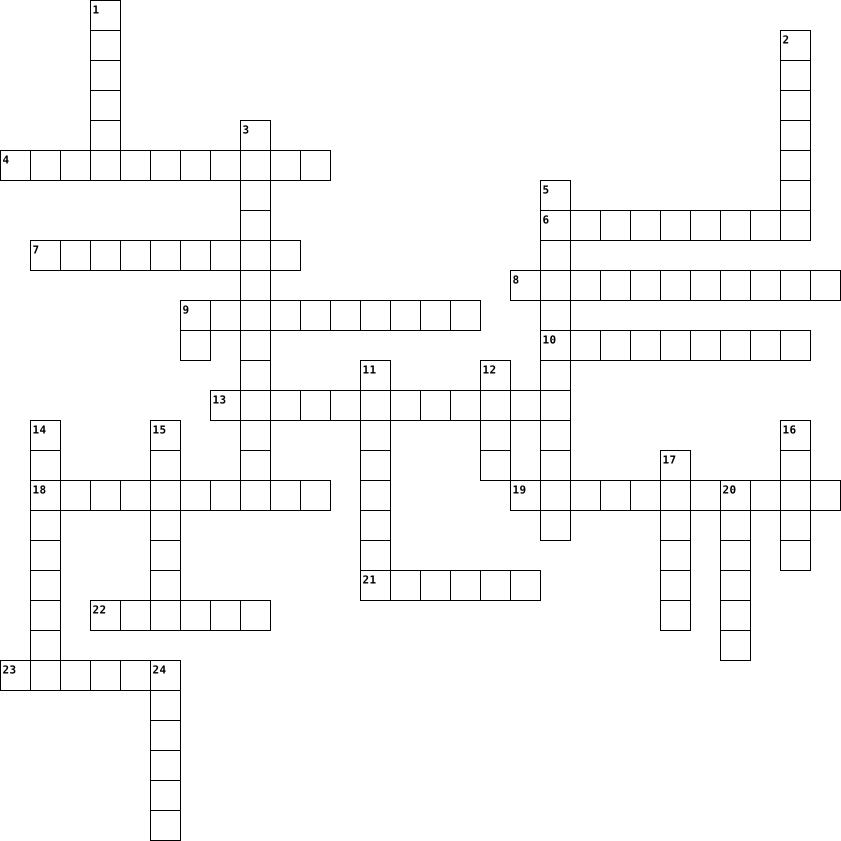
Across
- the symbol is ‘Si’
- used to give food flavor
- electronic shell: 2,8,5
- what we breathe in
- electronic shell: 2,8,3
- its atomic number is seven (7)
- its atomic number is twelve (12)
- found in pools to purify the water
Down
- its atomic number of one (1)
- the symbol is ‘C’
- is most abundant in strawberries
- the symbol is ‘Be’
- is used in dental products like mouthwash and toothpaste
- electronic shell: 2,3
- the symbol is ‘He’
- its atomic number is eighteen (18)
- its atomic number is twenty (20)
- electronic shell: 2,8,6
- the symbol is ‘Li’
- electronic shell: 2,8
20 Clues: the symbol is ‘C’ • the symbol is ‘Si’ • the symbol is ‘Be’ • the symbol is ‘He’ • what we breathe in • the symbol is ‘Li’ • electronic shell: 2,3 • electronic shell: 2,8 • electronic shell: 2,8,5 • electronic shell: 2,8,6 • electronic shell: 2,8,3 • used to give food flavor • its atomic number of one (1) • its atomic number is seven (7) • is most abundant in strawberries • ...
Periodic Table 2025 2025-01-28

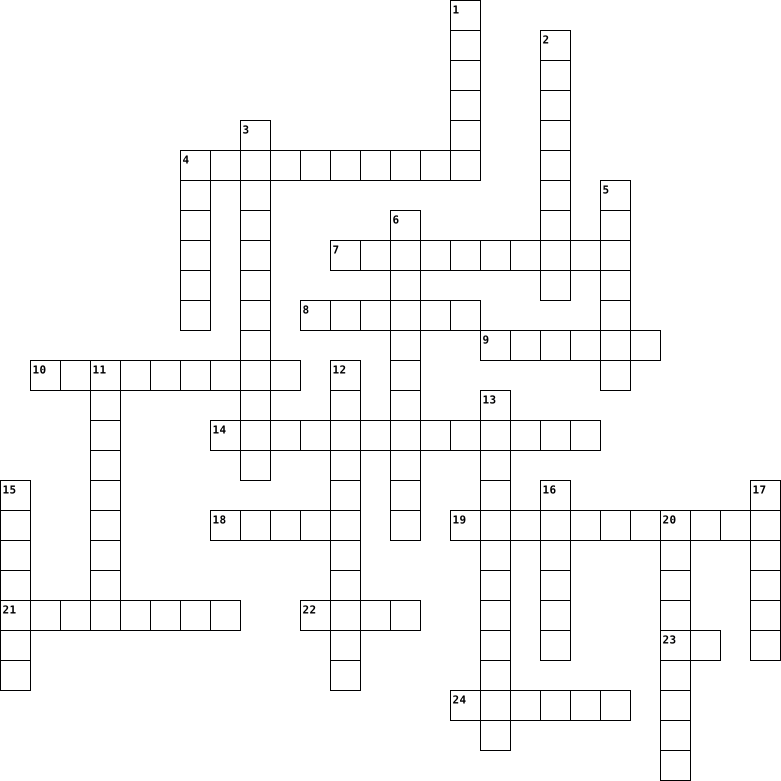
Across
- Rule that says most atoms want 8 valence electrons
- Nonmetals are _________ compared to metals which are malleable.
- Nonmetals get more reactive as you go _______.
- Most abundant metal in earth's crust
- Metals get more reactive as you go ________.
- Electrons in the outer shell (layer)
- Atomic Mass Unit
- Type of metals in group 2
- Type of metals in the f-block
- Nonmetal in group 4A
- Elements in group 7A (or 17)
- Au
- Elements with the same # of valence electrons have similar ___________.
- A row on the table that represent energy levels
- Metals __________ electricity and heat.
- Weighted average of all an elements isotopes
- Halogen in the 4th period
- Alkaline earth metal that is important to bones
- Group of nonreactive elements in group 8A (or 18)
Down
- Organized the table by atomic mass
- Only metal that is a liquid at room temperature
- Most abundant element in Earth's crust
- Alkali metal in the 3rd period
- Type of metals in the d-block
- Elements on the right side
- Elements on the left side
- Elements on the stairstep
- Metalloid in group 3A
- Type of metals in group 1
- Metal with 82 protons
- Atoms of the same element with a different mass
- Non-metal with only one valence electron
- A column on the table with similar properties
- Number of protons
- A unique type of atom with the same # of protons
- Lightest Noble Gas
- Sum of protons and neutrons
37 Clues: Au • Atomic Mass Unit • Number of protons • Lightest Noble Gas • Nonmetal in group 4A • Metalloid in group 3A • Metal with 82 protons • Elements on the left side • Elements on the stairstep • Type of metals in group 2 • Type of metals in group 1 • Halogen in the 4th period • Elements on the right side • Sum of protons and neutrons • Elements in group 7A (or 17) • Type of metals in the d-block • ...
The Periodic Table 2025-03-09

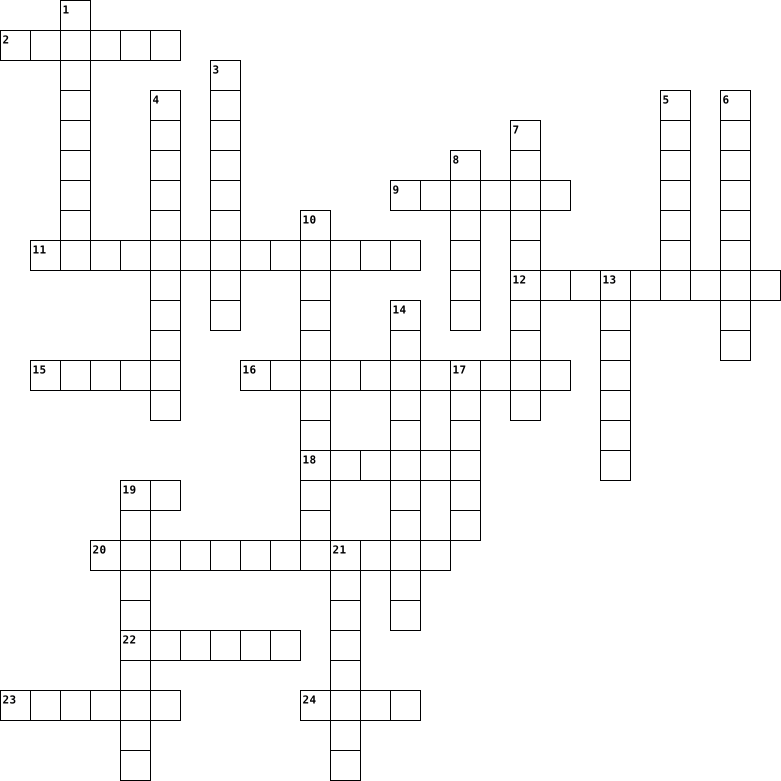
Across
- has a mass of 262
- has an atomic number of 111
- has an atomic number of 108
- has 112 protons
- has 98 electrons
- has 94 protons
- has 104 protons
- has a mass of 293
- has a mass of 281
- has 115 protons
- has 109 protons
- has an atomic number of 93
- has an atomic number of 105
- has 97 protons
Down
- has 106 protons
- has a mass of 252
- has a mass of 243
- has 102 protons
- has a mass of 238
- has an atomic number of 82
- has an atomic number of 96
- has an atomic number of 114
- has an atomic number of 101
- has 90 protons
- has a mass of 270
- has a mass of 286
26 Clues: has 94 protons • has 90 protons • has 97 protons • has 106 protons • has 112 protons • has 102 protons • has 104 protons • has 115 protons • has 109 protons • has 98 electrons • has a mass of 262 • has a mass of 252 • has a mass of 243 • has a mass of 238 • has a mass of 293 • has a mass of 281 • has a mass of 270 • has a mass of 286 • has an atomic number of 82 • has an atomic number of 96 • ...
Periodic Table Crossword 2025-04-30

Across
- only non-metal to the left of the stairstep-line
- commonly found in salt
- element 10, known for being bright\colorful
- along the stairstep-line
- also known as a common Ford package
- the rows the elements are arranged in
- to the left of the staristep-line
- commonly found in bananas
- commonly found in milk
- the only metal that is liquid at room temperature
- we cannot live without it
Down
- commonly known for it's stench
- columns that share chemical properties
- element 27 on the periodic table
- starts below boron
- to the right of the stairstep-line
- commonly used for jewelry
- a very lightweight, common metal
- used for cleaning and sterilization
- used instead of gold because it's cheaper
- commonly used for utensils
- the gas that we exhale
22 Clues: starts below boron • commonly found in salt • the gas that we exhale • commonly found in milk • along the stairstep-line • commonly used for jewelry • commonly found in bananas • we cannot live without it • commonly used for utensils • commonly known for it's stench • element 27 on the periodic table • a very lightweight, common metal • to the left of the staristep-line • ...
The Periodic Table 2025-06-09

Across
- Cu
- Zn
- Be
- B
- N
- Si
- O
- Fe
- Mg
- F
- S
Down
- Ca
- K
- Cl
- P
- Ar
- Li
- C
- Ne
- Na
- H
- He
- Al
23 Clues: K • P • C • B • N • H • O • F • S • Ca • Cu • Cl • Zn • Ar • Be • Li • Ne • Si • Na • He • Fe • Mg • Al
Periodic Table Crossword 2023-05-09

Across
- The number of protons in the nucleus of an atom
- The name for Group 2
- A small particle with a negative charge that is found in all atoms.
- Diagrams that show the atomic structure of an atom
- The amount of Valence E- in group 13
- Semi-conductor Solids
- Most reactive NON-METALS
- Non-reactive elements
- The amount of Valence E- in group 18
- The atoms in the outermost energy level in the electron cloud
Down
- Dull, brittle solids
- The positively charged central core of an atom
- Most reactive Metals
- Vertical columns on the Periodic Table
- Shiny, silvery solids
- The name for Group 3
- The horizontal rows on the period table
- A small, positively charged particle of matter found in the atoms of all elements.
- Elements in the middle of the table
- Subatomic particles found inside the nucleus of every atom
20 Clues: Dull, brittle solids • Most reactive Metals • The name for Group 3 • The name for Group 2 • Shiny, silvery solids • Semi-conductor Solids • Non-reactive elements • Most reactive NON-METALS • Elements in the middle of the table • The amount of Valence E- in group 13 • The amount of Valence E- in group 18 • Vertical columns on the Periodic Table • ...
Periodic table elements 2025-02-24

Across
- Ni
- Kr
- Sb
- Pd
- Al
- Ti
- Ra
- Cr
- Co
- O
Down
- Ag
- Nb
- U
- Pb
- Fe
- Cn
- H
- Si
- Hg
- C
20 Clues: U • H • C • O • Ag • Ni • Kr • Nb • Sb • Pd • Pb • Al • Fe • Cn • Si • Ti • Hg • Ra • Cr • Co
Periodic Table Quiz 2024-11-04

Across
- The most abundant element in the universe
- Used in jewelry, atomic number 47.
- Used to galvanize steel, symbol Zn.
- Liquid metal at room temperature
- Used in computer chips
- Metal used to make steel, symbol Fe.
- Metal with symbol Cu, used in electrical wiring.
- Makes up about 78% of the Earth's atmosphere
- Precious metal used in jewelry and catalysts
- Noble gas used in welding, symbol Ar.
Down
- Metal used in batteries
- Precious metal
- Used in toothpaste
- The lightest noble gas, used in balloons.
- Gas used in bright signs
- Essential for bones and teeth
- Known for its yellow color and smell, symbol S.
- Common element in all organic compounds
- Essential for respiration, atomic number 8.
- Element used in borosilicate glass
20 Clues: Precious metal • Used in toothpaste • Used in computer chips • Metal used in batteries • Gas used in bright signs • Essential for bones and teeth • Liquid metal at room temperature • Used in jewelry, atomic number 47. • Element used in borosilicate glass • Used to galvanize steel, symbol Zn. • Metal used to make steel, symbol Fe. • Noble gas used in welding, symbol Ar. • ...
periodic table crossword 2026-02-03

Across
- K
- Na
- Ni
- Ga
- Cu
- V
- Mg
- C
- F
- Ag
Down
- He
- Sr
- Mn
- I
- H
- Ti
- Zn
- Fe
- Ar
- Si
- S
21 Clues: K • I • H • V • C • S • F • He • Sr • Mn • Na • Ti • Zn • Ni • Ga • Fe • Cu • Ar • Mg • Si • Ag
The Periodic Table 2026-01-20

Across
- sixth element
- found in foil and cans
- used to clean pools
- forth element
- found in bananas
- often used in fireworks
- has the symbol 'B'
- first element
- seventh element
- often found in toothpaste
Down
- necessary for strong bones and teeth
- has a the symbol 'Li'
- eighteenth element
- has the symbol 'Na'
- used in light fixtures
- often used to inflate party balloons
- fourteenth element
- has the symbol 'S'
- fifteenth element
- important for respiration
20 Clues: sixth element • forth element • first element • seventh element • found in bananas • fifteenth element • eighteenth element • fourteenth element • has the symbol 'S' • has the symbol 'B' • has the symbol 'Na' • used to clean pools • has a the symbol 'Li' • found in foil and cans • used in light fixtures • often used in fireworks • important for respiration • often found in toothpaste • ...
Periodic Table Crossword 2026-01-22

Across
- Ar; atomic number 18
- atomic number 12, atomic mass 24.305
- gas making up most of Earth’s atmosphere
- balloons
- element that forms the basis of organic life
- smells like rotten eggs
- component of table salt
- used in rechargeable batteries
- essential for humans to stay alive
- used in computer chips
- important for bones and teeth
Down
- metalloid used in glassmaking
- atomic number 4, second column of the periodic table
- found in DNA
- gas used in lasers
- bananas are known for having
- most abundant element in the universe
- added to toothpaste
- used in cans and foil
- used to disinfect pools
20 Clues: balloons • found in DNA • gas used in lasers • added to toothpaste • Ar; atomic number 18 • used in cans and foil • used in computer chips • smells like rotten eggs • component of table salt • used to disinfect pools • bananas are known for having • metalloid used in glassmaking • important for bones and teeth • used in rechargeable batteries • essential for humans to stay alive • ...
Periodic Table Elements 2025-08-11

Across
- Rf 104
- Ti 22
- Os 76
- Cl 17
- Ag 47
- Og 118
- La 57
- In 49
- Cn 112
- H 1
- Pa 91
- Rg 111
- B 5
- Sc 21
- W 74
- Lv 116
- Co 27
- S 16
- Br 35
- Tm 69
- Ar 18
- N 7
- O 8
- Re 75
- He 2
- Rb 37
- Nb 41
- Te 52
- K 19
- V 23
- Sb 51
- Y 39
- Po 84
- Md 101
- Cu 29
- Na 11
- Er 68
- Xe 54
- Sr 38
- Kr 36
- I 53
- Zn 30
- Nd 60
- Am 95
- Sm 62
- Ru 44
- Th 90
- Tl 81
- Hf 72
- Se 34
- Ho 67
- Be 4
- Lr 103
- Mc 115
- Lu 71
- Ds 110
- Tc 43
Down
- Yb 70
- Ir 77
- Pu 94
- At 85
- Pd 46
- F 9
- Tb 65
- Bh 107
- P 15
- Cs 55
- Ca 20
- Nh 113
- C 6
- No 102
- Mo 42
- Ge 32
- Fe 26
- Fm 100
- Gd 64
- Ga 31
- Rh 45
- Ac 89
- Fr 87
- U 92
- Ba 56
- Es 99
- Pm 61
- Li 3
- Ne 10
- Eu 63
- Fl 114
- Mt 109
- Pr 59
- Si 14
- Cf 98
- Ts 117
- Dy 66
- Mn 25
- Pt 78
- Np 93
- Hg 80
- Au 79
- Cr 24
- Ni 28
- Sn 50
- As 33
- Rn 86
- Cm 96
- Al 13
- Ra 88
- Zr 40
- Hs 108
- Bk 97
- Ta 73
- Sg 106
- Mg 12
- Cd 48
- Db 105
- Bi 83
- Ce 58
- Pb 82
118 Clues: F 9 • C 6 • H 1 • B 5 • N 7 • O 8 • P 15 • W 74 • U 92 • S 16 • Li 3 • He 2 • K 19 • V 23 • Y 39 • I 53 • Be 4 • Yb 70 • Ir 77 • Pu 94 • Ti 22 • At 85 • Os 76 • Pd 46 • Cl 17 • Tb 65 • Ag 47 • Cs 55 • Ca 20 • La 57 • Mo 42 • In 49 • Ge 32 • Fe 26 • Gd 64 • Pa 91 • Ga 31 • Rh 45 • Sc 21 • Co 27 • Ac 89 • Fr 87 • Ba 56 • Br 35 • Es 99 • Pm 61 • Tm 69 • Ar 18 • Ne 10 • Eu 63 • Re 75 • Rb 37 • Nb 41 • Pr 59 • Te 52 • Si 14 • Cf 98 • Dy 66 • Sb 51 • Mn 25 • Po 84 • Pt 78 • Np 93 • Hg 80 • Au 79 • Cu 29 • Na 11 • Er 68 • Cr 24 • Ni 28 • Sn 50 • Xe 54 • Sr 38 • Kr 36 • ...
Periodic Table Crossword 2025-09-05

Across
- Used in balloons and MRI machines
- John William Strutt helped discover this gas in 1894
- Found in nuts, fruits, and leafy green veggies discovered in 1808
- Essential for living organisms and is what diamonds are made of
- Major producers of this element are phytoplankton and trees
- Our air is around 78% of this element
- A type of electrolyte found in fruit that monkeys like to eat
- Found in leafy greens and dairy, used for healthy bones and teeth
- Covers food in the oven also the most abundant metal in the earth's crust
- Protects teeth, and too much is highly toxic
Down
- Used to disinfect water for swimming and drinking
- Looks metallic Gray with atomic number 4
- Found in every human cell, symbol is 16th in the alphabet
- This element, we need to drink
- A famous valley, shares this name
- Deficiencies can cause muscle cramps atomic mass is 24.305
- A type of gas that helped the 1980s glow
- A mineral that enhances food's flavor and is commonly added to processed foods
- In its pure form it does not smell like rotten eggs
- Discovered in 1817 and is commonly used in batteries
20 Clues: This element, we need to drink • Used in balloons and MRI machines • A famous valley, shares this name • Our air is around 78% of this element • Looks metallic Gray with atomic number 4 • A type of gas that helped the 1980s glow • Protects teeth, and too much is highly toxic • Used to disinfect water for swimming and drinking • ...
Periodic Table Crossword 2025-09-05

Across
- found in nuts, fruits, and leafy green veggies discovered in 1808
- used in balloons and MRI machines
- our air is around 78% of this element
- a mineral that enhances food's flavor and is commonly added to processed foods
- essential for living organisms and is what diamonds are made of
- John William Strutt helped discover this gas in 1894
- deficiencies can cause muscle cramps atomic mass is 24.305
- found in leafy greens and dairy, used for healthy bones and teeth
Down
- in its pure form it does not smell like rotten eggs
- this element, we need to drink
- looks metallic Gray with atomic number 4
- A type of gas that helped the 1980s glow
- found in every human cell, symbol is 16th in the alphabet
- protects teeth, and too much is highly toxic
- a famous valley, shares this name
- used to disinfect water for swimming and drinking
- a type of electrolyte found in fruit that monkeys like to eat
- covers food in the oven also the most abundant metal in the earth's crust
- major producers of this element are phytoplankton and trees
- discovered in 1817 and is commonly used in batteries
20 Clues: this element, we need to drink • used in balloons and MRI machines • a famous valley, shares this name • our air is around 78% of this element • looks metallic Gray with atomic number 4 • A type of gas that helped the 1980s glow • protects teeth, and too much is highly toxic • used to disinfect water for swimming and drinking • ...
Periodic Table Elements 2025-10-16

Across
- (Pt)
- (Ds)
- (Po)
- (Cs)
- (Pd)
- (Fr)
- (Rg)
- (I)
- (Be)
- (Bi)
- (P)
- (Cl)
- (Mn)
- (N)
- (Tb)
- (Tc)
- (Ba)
- (Zn)
- (Mg)
- (Si)
- (U)
- (W)
- (Cf)
- (In)
- (Mt)
- (As)
- (Ta)
- (Gd)
- (Br)
- (Ac)
- (He)
- (Cr)
- (Lu)
- (Re)
- (Sn)
- (Ce)
- (Nb)
- (Eu)
- (Cm)
- (Ru)
- (B)
- (Hs)
- (Mc)
- (Os)
- (No)
- (Am)
- (La)
- (Au)
- (O)
- (Es)
- (Sr)
- (Ni)
- (Md)
- (Dy)
- (Yb)
Down
- (Pr)
- (Al)
- (Db)
- (Ar)
- (S)
- (Ra)
- (Tm)
- (Og)
- (Rf)
- (Bh)
- (Ag)
- (Pa)
- (Zr)
- (Rn)
- (Cn)
- (Rh)
- (Fm)
- (V)
- (Mo)
- (Hf)
- (Lv)
- (Se)
- (Li)
- (Ho)
- (At)
- (Nh)
- (K)
- (Sm)
- (Ca)
- (Y)
- (C)
- (Cu)
- (Tl)
- (Np)
- (Cd)
- (Rb)
- (Pu)
- (Kr)
- (F)
- (Pm)
- (Ti)
- (Co)
- (Te)
- (Ga)
- (Bk)
- (Lr)
- (Ir)
- (Ts)
- (Ge)
- (Xe)
- (Fe)
- (Sb)
- (Th)
- (Nd)
- (Sg)
- (Hg)
- (Ne)
- (Pb)
- (H)
- (Sc)
- (Na)
- (Er)
- (Fl)
118 Clues: (S) • (I) • (V) • (P) • (K) • (N) • (Y) • (C) • (U) • (W) • (F) • (B) • (H) • (O) • (Pt) • (Pr) • (Ds) • (Al) • (Db) • (Ar) • (Ra) • (Tm) • (Po) • (Og) • (Rf) • (Bh) • (Ag) • (Cs) • (Pd) • (Pa) • (Fr) • (Rg) • (Zr) • (Be) • (Rn) • (Bi) • (Cn) • (Rh) • (Fm) • (Mo) • (Hf) • (Cl) • (Lv) • (Se) • (Li) • (Ho) • (At) • (Nh) • (Mn) • (Tb) • (Tc) • (Ba) • (Zn) • (Sm) • (Ca) • (Mg) • (Si) • (Cu) • (Tl) • (Np) • (Cd) • (Rb) • (Cf) • (Pu) • (In) • (Kr) • (Pm) • (Mt) • (Ti) • (As) • (Co) • (Ta) • (Te) • (Gd) • (Ga) • (Br) • (Bk) • (Ac) • (Lr) • (Ir) • (He) • (Cr) • (Lu) • (Ts) • (Ge) • (Re) • (Sn) • (Ce) • (Xe) • (Nb) • (Fe) • ...
Unit 1: Investigating Atoms and the Periodic Table 2021-08-12

Across
- a negatively charged particle in the electron cloud surrounding the atomic nucleus
- electron(s) located in outer energy level (electron shell)
- smallest particle of an element that maintains the properties of that element
- the number of protons in the nucleus of an atom; used to determine an element's position in the Periodic Table
- a particle smaller than an atom, such as a proton, neutron, or electron
- total number of protons and neutrons in a specific atom
- a characteristic of a substance that describes how it combines with other substances to form new ones
- a pure substance that cannot be broken down chemically into simpler substances
Down
- a conceptual model in which the elements are organized according to their properties; often displayed as a chart
- property of matter that can be observed without changing the composition or identity of the matter
- the positively charged center of an atom containing the protons and neutrons
- a (neutral) particle with no electrical charge within the atomic nucleus
- average mass number of all atoms of an element (from particles in the nucleus)
- a property of a subatomic particle; positive (protons), negative (electrons), or neutral (neutrons)
- the vertical columns on the Periodic Table
- a positively charged particle within the atomic nucleus; used to identify an element
- the negatively charged space containing electrons that surrounds the atomic nucleus
- the horizontal rows on the Periodic Table
- tendency of a substance to undergo chemical changes in a system
19 Clues: the horizontal rows on the Periodic Table • the vertical columns on the Periodic Table • total number of protons and neutrons in a specific atom • electron(s) located in outer energy level (electron shell) • tendency of a substance to undergo chemical changes in a system • a particle smaller than an atom, such as a proton, neutron, or electron • ...
8th Grade - Unit 1 Vocabulary 2024-05-13

Across
- property of matter that can be observed without changing the composition or identity of the matter
- smallest particle of an element that maintains the properties of that element
- a (neutral) particle with no electrical charge within the atomic nucleus
- a characteristic of a substance that describes how it combines with other substances to form new ones
- total number of protons and neutrons in a specific atom
- the number of protons in the nucleus of an atom; used to determine an element's position in the Periodic Table
- tendency of a substance to undergo chemical changes in a system
- the negatively charged space containing electrons that surrounds the atomic nucleus
- electron(s) located in outer energy level (electron shell)
- the vertical columns on the Periodic Table
Down
- a property of a subatomic particle; positive (protons), negative (electrons), or neutral (neutrons)
- a particle smaller than an atom, such as a proton, neutron, or electron
- a negatively charged particle in the electron cloud surrounding the atomic nucleus
- the positively charged center of an atom containing the protons and neutrons
- a conceptual model in which the elements are organized according to their properties; often displayed as a chart
- average mass number of all atoms of an element (from particles in the nucleus)
- a pure substance that cannot be broken down chemically into simpler substances
- the horizontal rows on the Periodic Table
- a positively charged particle within the atomic nucleus; used to identify an element
19 Clues: the horizontal rows on the Periodic Table • the vertical columns on the Periodic Table • total number of protons and neutrons in a specific atom • electron(s) located in outer energy level (electron shell) • tendency of a substance to undergo chemical changes in a system • a particle smaller than an atom, such as a proton, neutron, or electron • ...
Ocean Motion Crossword 2026-03-24

Across
- ocean tides are
- upward motion of ocean water
- When the tidal range is the largest
- ocean waves carry
Down
- Ocean layering is caused by
- Collapsing waves
- When the tidal range is the lowest
- The periodic rise and fall of sea level
- ocean waves are caused by
9 Clues: ocean tides are • Collapsing waves • ocean waves carry • ocean waves are caused by • Ocean layering is caused by • upward motion of ocean water • When the tidal range is the lowest • When the tidal range is the largest • The periodic rise and fall of sea level
Riece's Science Element Crossword Puzzle 2020-11-27

Across
- Superman's home planet
- I am number 1 on the periodic table
- I am lucky number 7 on the periodic table
- Police are sometimes called this
- I am super bright and light up the room, Ne
- I am put in balloons and I rise up when they fill it
Down
- I rhyme with moron
- I am in every public pool you swim in
- "I" am commonly found in seafood
- I am the only one with an "X" in my name
- You breathe me in everyday
- Everyone wants to "Be" me
- I am in bananas, K
- I am know as 5 cents in money
14 Clues: I rhyme with moron • I am in bananas, K • Superman's home planet • Everyone wants to "Be" me • You breathe me in everyday • I am know as 5 cents in money • "I" am commonly found in seafood • Police are sometimes called this • I am number 1 on the periodic table • I am in every public pool you swim in • I am the only one with an "X" in my name • ...
Chapter 16: Properties of Atoms & The Periodic Table 2021-04-05

Across
- Uses the chemical symbol of an element surrounded by dots to represent the number of electrons in the outermost energy level.
- The small, positively charged center of the atom.
- Particles in the nucleus with an electric charge of 1+.
- The horizontal rows of elements in the periodic table.
- The smallest particle of an element that retains the element’s properties.
- The number of protons in an atom’s nucleus is equal to this.
- Particles with an electrical charge of 1-. They occupy the space surrounding the nucleus of an atom.
- Elements are arranged by increasing atomic number and by periodic changes in physical and chemical properties.
- The vertical columns in the periodic table.
Down
- The area around the nucleus of an atom where electrons are most likely to be found.
- Small particles that make up protons and neutrons.
- The weighted average mass of all naturally occurring isotopes of an element, measured in atomic mass units (amu), according to their natural abundances.
- The sum of the number of protons and the number of neutrons in the nucleus of an atom.
- Atoms of the same element that have different numbers of neutrons.
- Electrically charged neutral particles in the nucleus, they do not have a charge.
15 Clues: The vertical columns in the periodic table. • The small, positively charged center of the atom. • Small particles that make up protons and neutrons. • The horizontal rows of elements in the periodic table. • Particles in the nucleus with an electric charge of 1+. • The number of protons in an atom’s nucleus is equal to this. • ...
Elements and the Periodic Table 2022-05-07

Across
- is what forms when two or more atoms combine.
- you can easily see the particles might need a microscope
- A combination of two or more materials that are NOT chemically combined.
- A tool used by chemists to help arrange the elements based on certain characteristics they share.
- the building blocks of matter
Down
- are located on the right side of the periodic table.
- Two or more different elements that combine by a chemical change and create something with NEW and different physical and chemical characteristics.
- display properties of both metals and nonmetals.
- are located on the left side of the periodic table.
- The 7 horizontal (across) rows of elements in the periodic table.
10 Clues: the building blocks of matter • is what forms when two or more atoms combine. • display properties of both metals and nonmetals. • are located on the left side of the periodic table. • are located on the right side of the periodic table. • you can easily see the particles might need a microscope • The 7 horizontal (across) rows of elements in the periodic table. • ...
7th Science Ch 11 Quiz 1A 2024-04-22

Across
- elements that have physical and chemical properties of both metals and nonmetals.
- a column on the periodic table
- a row on the periodic table.
- elements that are generally shiny, easily pulled into wires or hammered into sheets and are good conductors of electricity and heat
- a chart of the elements arranged into rows and columns according to their physical and chemical properties.
- The ability of a substance to be hammered or rolled into sheets
Down
- elements found in group 17 that react with a metal to form a salt.
- found in group 18 on the periodic table.
- elements that have no metallic properties.
- The ability of a substance to be pulled into thin wires
10 Clues: a row on the periodic table. • a column on the periodic table • found in group 18 on the periodic table. • elements that have no metallic properties. • The ability of a substance to be pulled into thin wires • The ability of a substance to be hammered or rolled into sheets • elements found in group 17 that react with a metal to form a salt. • ...
Element crossword puzzle 2024-05-06

Across
- when two or more elements combine with a chemical change to create a new substance
- contains all elements and is organized by different categories
- number of protons in the nucleus
- positively charged center of the atom that contains protons and neutrons
- combination of two or more elements that are not chemically combined
Down
- combined number of protons and neutrons in the nucleus
- positively charged particles
- this substance can be found on the left side of the periodic table and is bendable and shiny
- things that make up matter and can be found on the periodic table
- this kind of substance can be found on the right side of the periodic table and are dull and brittle
10 Clues: positively charged particles • number of protons in the nucleus • combined number of protons and neutrons in the nucleus • contains all elements and is organized by different categories • things that make up matter and can be found on the periodic table • combination of two or more elements that are not chemically combined • ...
Chemistry Puzzle 2021-04-13

Across
- shiny and good electrical conductor
- one or more substances creates different substances as products
- a gentle sheen or soft glow
- horizontal rows in a periodic table
Down
- capable of being extended or shaped
- takes part in and undergoes change during a reaction
- what this unit is about
- verticle lines in a periodic table
- any substance that has mass
- contains movable electric charges
10 Clues: what this unit is about • any substance that has mass • a gentle sheen or soft glow • contains movable electric charges • verticle lines in a periodic table • capable of being extended or shaped • horizontal rows in a periodic table • shiny and good electrical conductor • takes part in and undergoes change during a reaction • ...
Periodicity Review 2022-10-27

Across
- locations of the electrons
- affects across groups
- affects across periods
- a trend that tells how much elements hold on the electrons
- created the first periodic table
- father of the modern periodic table
Down
- a trend that tells size of a atom's radius is
- s,p,d,f
- a trend that tells how much an element wants an electron
- levels which hold electrons
10 Clues: s,p,d,f • affects across groups • affects across periods • locations of the electrons • levels which hold electrons • created the first periodic table • father of the modern periodic table • a trend that tells size of a atom's radius is • a trend that tells how much an element wants an electron • a trend that tells how much elements hold on the electrons
Atom 2022-08-23

Across
- negative charged located outside of the nucleus
- it has three parts proton,neutrons,electrons
- no charge is located in the nucleus
- in the center containing protons and neutrons
- is a nonmetal in the periodic table
Down
- positive charged subatomic particle
- is mostly made of metals
- number # of protons
- protons plus Neutrons
- cloud surround the nucleus and contains the electrons
10 Clues: number # of protons • protons plus Neutrons • is mostly made of metals • positive charged subatomic particle • no charge is located in the nucleus • is a nonmetal in the periodic table • it has three parts proton,neutrons,electrons • in the center containing protons and neutrons • negative charged located outside of the nucleus • ...
Periodic Table Crossword 2024-01-18

Across
- positively charged particle in the nucleus of an atom
- pure substance that consists entirely of one type of atom
- a tiny, negatively charged particle that moves around the nucleus of an atom.
- Found along the 'staircase. Have properties of both metals and nonmetals
- vertical columns on the periodic table that have common properties. also known as families
Down
- a subatomic particle that is neutral and that is found in the nucleus of an atom
- brittle, dull, poor conductors of heat and electricity; located on the right side of the periodic table
- shiny, malleable, ductile and good conductors
- horizontal rows on the periodic table
- the smallest unit of an element that maintains the properties of that element
10 Clues: horizontal rows on the periodic table • shiny, malleable, ductile and good conductors • positively charged particle in the nucleus of an atom • pure substance that consists entirely of one type of atom • Found along the 'staircase. Have properties of both metals and nonmetals • the smallest unit of an element that maintains the properties of that element • ...
Matter and Energy Vocab 2022-04-27

Across
- Elements located on the stair-step (zigzag) line on the Periodic Table except for Aluminum
- The ability to break or shatter under stress
- The ability to be stretched into a wire
- A pure substance that cannot be broken down chemically
- The way light reflects from the surface of a substance
Down
- The ability to be hammered into thin sheets
- A substance that consists of 2 or more elements combined in a set ratio
- The ability to move heat or electricity from one place to another
- Elements are located to the right of the stair-step (zigzag) line on the Periodic Table
- Elements are located to the left of the stair-step (zigzag) line on the Periodic Table
10 Clues: The ability to be stretched into a wire • The ability to be hammered into thin sheets • The ability to break or shatter under stress • A pure substance that cannot be broken down chemically • The way light reflects from the surface of a substance • The ability to move heat or electricity from one place to another • ...
Periodic Table Crossword 2023-03-12

Across
- number Increases from left to right on the table
- Represents a different class of elements
- Located on the right side of the table
- Rows in the periodic table
- He created the first periodic table
Down
- Element with the simplest atom
- All actinides are _______?
- The most reactive nonmetal
- metals Reactive soft, shiny metals not in nature
- The table has this many periods
10 Clues: All actinides are _______? • The most reactive nonmetal • Rows in the periodic table • Element with the simplest atom • The table has this many periods • He created the first periodic table • Located on the right side of the table • Represents a different class of elements • number Increases from left to right on the table • metals Reactive soft, shiny metals not in nature
Book science thing 2021-10-29

Across
- periodic table is like a map
- Telling story of past scientists
- saying it was the most common element
- rows are friends with rows without as
- all known elements and is symbolism
- died from what she made her living
Down
- the atoms were talking to each other
- and the shed went boom
- king Midas actually had zinc
- periodic table=map of our discoveries
10 Clues: and the shed went boom • periodic table is like a map • king Midas actually had zinc • Telling story of past scientists • died from what she made her living • all known elements and is symbolism • the atoms were talking to each other • saying it was the most common element • rows are friends with rows without as • periodic table=map of our discoveries
Chemistry 2022-02-02

Across
- Horizontal row on the periodic table
- Particle with no electric charge
- The fourth state of matter
- Smallest particle in the universe
Down
- The amount of average kinetic energy of the particles of an object or substance
- Negatively charged particle
- Animal
- Vertical row on the periodic table
- Positively charged particle
- The ability of a substance to form a solution with another substance
10 Clues: Animal • The fourth state of matter • Negatively charged particle • Positively charged particle • Particle with no electric charge • Smallest particle in the universe • Vertical row on the periodic table • Horizontal row on the periodic table • The ability of a substance to form a solution with another substance • ...
Chapter 10 Modern Atomic Theory And The Periodic Table 2016-01-10

Across
- energy is emitted in tiny distinct packets called _____
- this atom's orbital configuration is 1s² 2s²2p⁶ 3s²3p⁶
- all the Group A’s elements in the Periodic Table
- German physicist who was best known for his quantum mechanics work
- When a gas emits light shown through a prism, the beaming colored lines are part of a _____
- this method of arranging electrons uses numbers, letters, and superscripts
- Who said this: “electrons revolve in specific regions at various distances from the nucleus called energy levels”
- region in space around a nucleus with a high probability of finding an electron
- small packets of energy in streams of light
- the energy level expressed by the principal quantum number n
- this atom's orbital configuration is 1s² 2s²2p⁶ 3s²3p⁶ 4s²3d¹⁰
- this method of arranging electrons uses arrows and boxes
- Group VIIA Elements
- 3rd sublevel
- neon’s orbital configuration
Down
- Which rule is this: electrons will occupy separate orbitals of the same energy before pairing of electrons occur
- 4th sublevel
- as stated by this principle, an orbital cannot contain more than 2 electrons
- all the Group IIIB to Group IIB (3-12) elements
- what is white light?
- 2nd sublevel
- this atom's orbital configuration is 1s² 2s²2p⁶ 3s²3p⁶ 4s²
- columns in the periodic table
- electrons on the outermost energy level
- distance between two peaks or trough inside a wave
- outermost electron shell
- lowest energy levelgroundstate lowest energy level
- rows in the periodic table
- Every principle energy level is divided into _____
- 1st sublevel
30 Clues: 4th sublevel • 2nd sublevel • 1st sublevel • 3rd sublevel • Group VIIA Elements • what is white light? • outermost electron shell • rows in the periodic table • neon’s orbital configuration • columns in the periodic table • electrons on the outermost energy level • small packets of energy in streams of light • all the Group IIIB to Group IIB (3-12) elements • ...
Grade 8 Chemistry Vocabulary Review 2017-03-23

Across
- this scale measures how acidic or basic a substance is
- the symbol for gold
- created when a solute is dissolved in a solvent
- also called 'rows' in the periodic table
- this type of bonding involves sharing of electrons between atoms
- substances that only contain one type of atom
- when an atom loses an electron, it forms this type of charge
- these particles are found in energy levelshydro or 'shells' in an atom
- this type of substance produces hydrogen ions, H+
- when a chemical reaction releases heat energy to the surroundings
- positive particles in the nucleus of an atom
Down
- this is the gas that is produce when an acid reacts with a alkaline earth metal like Mg
- metals all of these elements only have one valence electron in their outermost shell
- substances that contain two or more different types of atoms and are chemically bonded
- when an atom gains an electron, it forms this type of charge
- all of the elements found on the left side of the Boron Staircase
- this is the variable that is measured by the experimenter in a scientific experiment
- the sum of the protons and neutrons in an atom
- this type of bonding involves transfering electrons between atoms
- the Russian man who created the modern Periodic Table
- the group of the periodic table containing Fluorine, Chlorine and Iodine
- a charged particle
- otherwise known as the 'universal solvent' and sometimes called 'aqueous'
- gases all elements in this group have full outer shells
24 Clues: a charged particle • the symbol for gold • also called 'rows' in the periodic table • positive particles in the nucleus of an atom • substances that only contain one type of atom • the sum of the protons and neutrons in an atom • created when a solute is dissolved in a solvent • this type of substance produces hydrogen ions, H+ • ...
Mathematics Project 2012-11-05
Across
- The value of x at the point where a curve crosses the x-axis.
- A straight line that is a close approximation to a curve as the curve goes off to infinity.
- An equation, graph, or data that can be modeled by a degree 2 polynomial.
- A set of numbers that identifies the location of a point.
- Horizontal translation of a periodic function.
- The conjugate of a complex number is formed by reversing the sign on the imaginary part of the number.
- (0,1,2,3,4,5,6 ) these numbers are
- A device for measuring angles.
- The bottom part of a fraction.
- The reciprocal of the cosine.
- A table of numbers arranged in rows and columns.
- The measure of how often a function repeats its same values.
Down
- The inverse function of tan.
- A line can be used to help draw vertical translation horizontal of each cycle.
- Vertical translation of a periodic function.
- Used when to angles and any side are known.
- The ratio of the circumference of a circle to its diameter.
- (-1,0,1,2,3) these numbers called
- The additive identity. The number that when you add it to a number, n, you will get n as a result.
- Half the difference between the largest and smallest function value of a periodic function.
- A fraction in which the denominator is assumed to be 100.
- The ratio of the change in y-coordinates to the change in x-coordinates.
- To cut something in half.
- The inverse function of sin.
- The set of all possible values of the argument of a function.
25 Clues: To cut something in half. • The inverse function of tan. • The inverse function of sin. • The reciprocal of the cosine. • A device for measuring angles. • The bottom part of a fraction. • (-1,0,1,2,3) these numbers called • (0,1,2,3,4,5,6 ) these numbers are • Used when to angles and any side are known. • Vertical translation of a periodic function. • ...
Mathematics Project 2012-11-05
Across
- Horizontal translation of a periodic function.
- A device for measuring angles.
- A table of numbers arranged in rows and columns.
- The reciprocal of the cosine.
- An equation, graph, or data that can be modeled by a degree 2 polynomial.
- Vertical translation of a periodic function.
- The ratio of the change in y-coordinates to the change in x-coordinates.
- The bottom part of a fraction.
- (-1,0,1,2,3) these numbers called
- The additive identity. The number that when you add it to a number, n, you will get n as a result.
- The ratio of the circumference of a circle to its diameter.
- The inverse function of sin.
Down
- To cut something in half.
- The conjugate of a complex number is formed by reversing the sign on the imaginary part of the number.
- Used when to angles and any side are known.
- The measure of how often a function repeats its same values.
- A fraction in which the denominator is assumed to be 100.
- A set of numbers that identifies the location of a point.
- Half the difference between the largest and smallest function value of a periodic function.
- The value of x at the point where a curve crosses the x-axis.
- (0,1,2,3,4,5,6 ) these numbers are
- A line can be used to help draw vertical translation horizontal of each cycle.
- The set of all possible values of the argument of a function.
- The inverse function of tan.
- A straight line that is a close approximation to a curve as the curve goes off to infinity.
25 Clues: To cut something in half. • The inverse function of tan. • The inverse function of sin. • The reciprocal of the cosine. • A device for measuring angles. • The bottom part of a fraction. • (-1,0,1,2,3) these numbers called • (0,1,2,3,4,5,6 ) these numbers are • Used when to angles and any side are known. • Vertical translation of a periodic function. • ...
Mathematics Project 2012-11-05
Across
- The set of all possible values of the argument of a function.
- The measure of how often a function repeats its same values.
- Vertical translation of a periodic function.
- A straight line that is a close approximation to a curve as the curve goes off to infinity.
- The ratio of the change in y-coordinates to the change in x-coordinates.
- The bottom part of a fraction.
- To cut something in half.
- The ratio of the circumference of a circle to its diameter.
- Used when to angles and any side are known.
- The reciprocal of the cosine.
- A table of numbers arranged in rows and columns.
- The additive identity. The number that when you add it to a number, n, you will get n as a result.
Down
- Half the difference between the largest and smallest function value of a periodic function.
- The conjugate of a complex number is formed by reversing the sign on the imaginary part of the number.
- A set of numbers that identifies the location of a point.
- A fraction in which the denominator is assumed to be 100.
- An equation, graph, or data that can be modeled by a degree 2 polynomial.
- A device for measuring angles.
- The inverse function of sin.
- (0,1,2,3,4,5,6 ) these numbers are
- A line can be used to help draw vertical translation horizontal of each cycle.
- The value of x at the point where a curve crosses the x-axis.
- The inverse function of tan.
- Horizontal translation of a periodic function.
- (-1,0,1,2,3) these numbers called
25 Clues: To cut something in half. • The inverse function of sin. • The inverse function of tan. • The reciprocal of the cosine. • A device for measuring angles. • The bottom part of a fraction. • (-1,0,1,2,3) these numbers called • (0,1,2,3,4,5,6 ) these numbers are • Used when to angles and any side are known. • Vertical translation of a periodic function. • ...
hozie is the shis 2016-06-07

Across
- charge equal in magnitude to that of an electron, but of opposite sign.
- A chemical reaction that absorbs heat
- Earth metals group 2 elements in the periodic table their reactivity is not as strong as alkali metals
- Oxygens Chemical symbol
- Hydrogens symbol
- The basic unit of a chemical element
- A substance that is made up of one kind of matter, which has a unique set of properties
- A combo of elements
- A change when a new substance is made
- A reaction where all the products will remain and be accounted for
- Mass of one element calculated from the total number of protons and neutrons
Down
- A subatomic particle of about the same mass as a proton but without an electric charge, present in all atomic nuclei except those of ordinary hydrogen.
- A stable subatomic particle with a charge of negative electricity, found in all atoms and acting as the primary carrier of electricity in solids.
- Number of protons in the nucleus of one atom of an element
- A change in appearance
- A chemical reaction that releases heat
- a element that has both metallic and nonmetallic properties
- the most reactive of all elements
- A reaction where some of the products can be lost
- metals Group 1 elements in the periodic table not including hydrogen most reactive
- a substance that helps a chemical reaction to proceed more quickly
- Hydrogens Chemical symbol
- Group 18 elements in the periodic table
- The positively charged central core of an atom, consisting of protons and neutrons and containing nearly all its mass.
- Water's chemical formula
25 Clues: Hydrogens symbol • A combo of elements • A change in appearance • Oxygens Chemical symbol • Water's chemical formula • Hydrogens Chemical symbol • the most reactive of all elements • The basic unit of a chemical element • A chemical reaction that absorbs heat • A change when a new substance is made • A chemical reaction that releases heat • Group 18 elements in the periodic table • ...
GENERAL CHEMISTRY 1 2020-04-20

Across
- consisting of a dispersed phase or the substance that is dissolved or scattered
- Pb is the symbol in the periodic table
- the substance undergoes combustion or not
- branch of science that deals with the identification of the substances of which matter is composed
- consisting of coarse particles which are visible to the naked eye
- relatively uniform in composition; every portion is like every other portion
- ability of a substance to react with other substances such as air, water, acid and base
- substance can damage an organism or not
- simplest form of matter since it is composed of only one kind of atom
- which composition varies from one position to another
- reacts with acids, bases, oxygen, gas or not
- break into charged particles when in solution with water or not
- focuses on identifying and quantifying matter
Down
- Rn s the symbol in the periodic table
- substance can be easily decomposed or not
- sub-discipline of chemistry that studies the structure, properties and reactions of organic compounds
- composed of two or more substances combined physically in variable proportions
- looks at chemical principles in living organisms
- SUBSTANCE that has a definite composition and distinct properties
- Cf is the symbol in the periodic table
- does not depend on the size or amount of the sample
- that can be measured and observed without changing the composition of the substance
- well-mixed and behave like a single substance
- any substance that has mass and takes up space by having volume
- deals with the synthesis and behavior of inorganic and nonmetallic compounds
25 Clues: Rn s the symbol in the periodic table • Pb is the symbol in the periodic table • Cf is the symbol in the periodic table • substance can damage an organism or not • substance can be easily decomposed or not • the substance undergoes combustion or not • reacts with acids, bases, oxygen, gas or not • well-mixed and behave like a single substance • ...
Perodic Table Crossword 2024-05-05

Across
- Only Non-Metal in Group 1
- Members of a family of an element that all have the same number of protons but different numbers of neutrons
- Those which lack all the metallic attributes
- Metal atoms have complete outer shells and thus do not tend to lose, gain, or share electrons
- measures a material's ability to conduct electricity
- One of the three subatomic particles that make up an atom
- Devised the periodic Table
- Elements that lose electrons easily, are lustrous, malleable, and are good conductors of heat and electricity.
Down
- A column in the periodic table of the chemical elements
- has more electrons than protons, consequently giving it a net negative charge.
- Any of the six nonmetallic elements that constitute Group 17 (Group VIIa) of the periodic table
- the number of protons in the nucleus
- An element's ability to ionize (gain or lose electrons) or share electrons
- A substance that cannot be broken down into simpler substances by chemical means
- A row of chemical elements
- A substance consisting of atoms or ions of two or more different elements in definite proportions joined by chemical bonds into a molecule
- The basic building block of chemistry
- Chemical elements whose physical and chemical properties fall in between the metal and non-metal categories
- A small, positively charged particle of matter found in the atoms of all elements.
- A stable subatomic particle with a charge of negative electricity, found in all atoms and acting as the primary carrier of electricity in solids.
20 Clues: Only Non-Metal in Group 1 • A row of chemical elements • Devised the periodic Table • the number of protons in the nucleus • The basic building block of chemistry • Those which lack all the metallic attributes • measures a material's ability to conduct electricity • A column in the periodic table of the chemical elements • ...
Chapter 4 Vocabulary 2025-10-02

Across
- a set of postulates defining atoms as the fundamental, indivisible particles of matter that combine in simple, fixed ratios to form chemical compounds
- the dense, positively charged central core of an atom that contains protons and neutrons
- the number of protons in the nucleus of an atom, which determines the chemical properties of an element and its place in the periodic table.
- a chart that organizes all known chemical elements in order of increasing atomic number, displaying them in rows (periods) and columns (groups) to show recurring patterns in their properties
- a stable, negatively charged subatomic particle with negligible mass that orbits the positively charged nucleus of an atom in shells or orbitals
- The smallest part of a substance that cannot be broken down chemically
- a subatomic particle located in the nucleus of an atom that has no electric charge and a mass slightly greater than a proton
- a vertical column of elements on the periodic table
Down
- the total count of protons and neutrons in its nucleus, which represents the atom's approximate mass
- the negatively charged electrode by which electrons enter an electrical device.
- a unit of mass used to express atomic and molecular weights, equal to one-twelfth of the mass of an atom of carbon-12.
- the mass of an atom of a chemical element expressed in atomic mass units
- a horizontal row in the periodic table, where each row corresponds to a specific number of electron shells or energy levels an atom of an element occupies
- a variant of a chemical element that has the same number of protons but a different number of neutrons in its atomic nucleus
- a positively charged subatomic particle found in the nucleus of every atom
15 Clues: a vertical column of elements on the periodic table • The smallest part of a substance that cannot be broken down chemically • the mass of an atom of a chemical element expressed in atomic mass units • a positively charged subatomic particle found in the nucleus of every atom • the negatively charged electrode by which electrons enter an electrical device. • ...
Periodic Table Elements 2015-03-05

Across
- What we use to wrap some types of food in the kitchen. (Foil)
- When inhaled, makes your voice high-pitched.
- The only liquid metal on the periodic table
- Part of the atmosphere and what we breath in.
Down
- Found in bananas
- Found in milk and is used to build our bones
- The first part of the scientific name for salt
- The only liquid non-metal on the periodic table
- Is known for being yellow and stinking
- Found in our blood
- The only non-metal electric conductor
- Usually used in bright lights
- Used in jewelry and measured in Carats
13 Clues: Found in bananas • Found in our blood • Usually used in bright lights • The only non-metal electric conductor • Is known for being yellow and stinking • Used in jewelry and measured in Carats • The only liquid metal on the periodic table • Found in milk and is used to build our bones • When inhaled, makes your voice high-pitched. • ...
Intro to atoms/Elements 2022-10-04

Across
- Rutherford discovered these in his Gold Foil Experiment
- A pure substance that can't be broken down
- A row of the periodic table
- Exploding stars that form the heaviest of elements
- How new elements are formed in stars
- The number of protons in an atom
- The symbols for Chlorine, Oxygen, Carbon, and Potassium
- The combined weight of protons and neutrons
Down
- The smallest particle of an element
- An atomic that has the same atomic number but a different atomic mass
- Mendeleev did this about unknown elements
- A group, or column, of the periodic table
- Protons and neutrons are located here
13 Clues: A row of the periodic table • The number of protons in an atom • The smallest particle of an element • How new elements are formed in stars • Protons and neutrons are located here • Mendeleev did this about unknown elements • A group, or column, of the periodic table • A pure substance that can't be broken down • The combined weight of protons and neutrons • ...
chemistry 2024-09-09

Across
- electrons sit on them
- measure of a chemical reaction
- column periodic table
- made up by atoms
- positive in an atom
Down
- negative in an atom
- neutral in an atom
- row periodic table
8 Clues: made up by atoms • neutral in an atom • row periodic table • negative in an atom • positive in an atom • electrons sit on them • column periodic table • measure of a chemical reaction
คำศัพท์เกี่ยวกับการบำรุงรักษา(Maintenance terminology) 2020-10-15

Across
- Overhaul การซ่อมใหญ่
- Productive Maintenance: TPM การบำรุงรักษาทวีผลแบบทุกคนมีส่วนร่วม
- Maintenance การบำรุงรักษาทวีผล
- Repair การซ่อมเพียงเล็กน้อย
- แบบค่อย ๆ เสื่อมสภาพลงไปตามอายุการใช้งาน
- การเสื่อมสภาพแบบกะทันหัน
- Maintenance การบำรุงรักษานอกแผน
- Maintenance การบำรุงรักษาเชิงแก้ไขปรับปรุง
- Maintenance: PM การบำรุงรักษาเชิงป้องกัน
- Maintenance การบำรุงรักษาแบบคาดการณ์
Down
- Maintenance การบำรุงรักษาหลังเกิดเหตุขัดข้อง
- Scheduled Repair การบำรุงรักษาหรือตรวจซ่อมตามแผนที่กำหนดไว้
- Overhaul การซ่อมเพื่อดัดแปลง
- Maintenance การซ่อมฉุกเฉิน
- Maintenance การบำรุงรักษาเป็นประจำ
- การบำรุงรักษา
- Maintenance หรือ Time Based Maintenance: TBMการบำรุงรักษาตามระยะเวลา
- Repair การซ่อมขนาดปานกลาง
- Maintenance การบำรุงรักษาตามแผน
- Prevention การป้องกันเพื่อบำรุงรักษา
20 Clues: การบำรุงรักษา • Overhaul การซ่อมใหญ่ • การเสื่อมสภาพแบบกะทันหัน • Repair การซ่อมขนาดปานกลาง • Maintenance การซ่อมฉุกเฉิน • Repair การซ่อมเพียงเล็กน้อย • Overhaul การซ่อมเพื่อดัดแปลง • Maintenance การบำรุงรักษาทวีผล • Maintenance การบำรุงรักษานอกแผน • Maintenance การบำรุงรักษาตามแผน • Maintenance การบำรุงรักษาเป็นประจำ • Prevention การป้องกันเพื่อบำรุงรักษา • ...
chemistry 2016-03-17

Across
- a positive unit or subatomic particle that has a positive charge
- a subatomic particle with a net charge that is negative
- Group 7 on the Periodic Table and are all non-metals
- earth metals the metals of Group 2 on the periodic table
- metal elements that have incomplete d sub-shells, but also may be referred to as the d-block elements
Down
- a neutral unit or subatomic particle that has no net charge
- a substance possessing both the properties of metals and non-metals
- metals the metals of Group 1 on the periodic table
- a molecule that has gained or lost one or more electrons
- gases group 18 elements, those whose outer electron shell is filled
10 Clues: metals the metals of Group 1 on the periodic table • Group 7 on the Periodic Table and are all non-metals • a subatomic particle with a net charge that is negative • earth metals the metals of Group 2 on the periodic table • a molecule that has gained or lost one or more electrons • a neutral unit or subatomic particle that has no net charge • ...
The Periodic Table 2020-10-11

Across
- Helps determine the number of electrons in an element.
- Positive charged particle
- The number of protons and neutrons in an element.
- Negative charged particle
- Neutral charged particle
Down
- The number of protons in an element.
- A pure substance consisting of atoms.
- Elements of group 17
- The horizontal columns on the periodic table.
- The vertical columns on the periodic table.
10 Clues: Elements of group 17 • Neutral charged particle • Positive charged particle • Negative charged particle • The number of protons in an element. • A pure substance consisting of atoms. • The vertical columns on the periodic table. • The horizontal columns on the periodic table. • The number of protons and neutrons in an element. • ...
Science Periodic Table 2013-01-09

Across
- I am the only liquid in the non-metal side.
- I am the second lightest halogen and I am used in swimming pools.
- I am part of the pencil that help people write.
- I have an atomic mass of 32.06.
- My melting point is 1,064˚C.
- I am often used to purify the gas and my atomic volume is 8.9 cc/mol.
- I am not soluble under water in normal circumstances and my atomic mass is 26.982.
- I am used for high temperature thermometers.
- I am in Group 18 and I start with N.
Down
- My atomic number is 6 and my boiling point is 4,827˚C.
- I am all around you. People need me to breathe.
- Chloride and I make up salt.
- I am the only liquid metal.
- I am used to make safety matches and tracer bullets.
- My atomic number is 2.
- I am used for hardening platinum and my melting point is 2,447˚C.
- I am a shiny, dark- gray metal and my symbol is Ti.
- My atomic number is 1 in each hydrogen atom.
- I am used in alloys with low melting point.
- I am used in glow tubes and my atomic number is 18.
20 Clues: My atomic number is 2. • I am the only liquid metal. • Chloride and I make up salt. • My melting point is 1,064˚C. • I have an atomic mass of 32.06. • I am in Group 18 and I start with N. • I am the only liquid in the non-metal side. • I am used in alloys with low melting point. • My atomic number is 1 in each hydrogen atom. • I am used for high temperature thermometers. • ...
Science Periodic Table 2013-01-09

Across
- I am the only liquid in the non-metal side.
- I am the second lightest halogen and I am used in swimming pools.
- I am part of the pencil that help people write.
- I have an atomic mass of 32.06.
- My melting point is 1,064˚C.
- I am often used to purify the gas and my atomic volume is 8.9 cc/mol.
- I am not soluble under water in normal circumstances and my atomic mass is 26.982.
- I am used for high temperature thermometers.
- I am in Group 18 and I start with N.
Down
- My atomic number is 6 and my boiling point is 4,827˚C.
- I am all around you. People need me to breathe.
- Chloride and I make up salt.
- I am the only liquid metal.
- I am used to make safety matches and tracer bullets.
- My atomic number is 2.
- I am used for hardening platinum and my melting point is 2,447˚C.
- I am a shiny, dark- gray metal and my symbol is Ti.
- My atomic number is 1 in each hydrogen atom.
- I am used in alloys with low melting point.
- I am used in glow tubes and my atomic number is 18.
20 Clues: My atomic number is 2. • I am the only liquid metal. • Chloride and I make up salt. • My melting point is 1,064˚C. • I have an atomic mass of 32.06. • I am in Group 18 and I start with N. • I am the only liquid in the non-metal side. • I am used in alloys with low melting point. • My atomic number is 1 in each hydrogen atom. • I am used for high temperature thermometers. • ...
Periodic Table Crossword 2013-11-19

Across
- An element commonly used in thermometers.
- Each vertical column of elements.
- Each horizontal row of elements.
- The Chemical Symbol for this is N.
- A shiny, brittle substance that can be smashed into a powder.
- More than half of the these are gases at room temperature.
- Group 17.
- This describes something that occurs or repeats at regular intervals.
- Good conductors or electric currents.
- this is what each element is identified by.
- A substance almost as hard a diamond, but very brittle.
Down
- The most reactive metals.
- Also known as semiconductors.
- This group has 4 electrons in its outer level.
- The element in period 1.
- The Russian Chemist that discovered a pattern to the elements.
- The symbol for this is Na.
- The symbol for Mercury.
- The hardest material known.
- Halogens have this many electrons in its outer level.
- The type of gases in the last group.
21 Clues: Group 17. • The symbol for Mercury. • The element in period 1. • The most reactive metals. • The symbol for this is Na. • The hardest material known. • Also known as semiconductors. • Each horizontal row of elements. • Each vertical column of elements. • The Chemical Symbol for this is N. • The type of gases in the last group. • Good conductors or electric currents. • ...
The Periodic Table 2013-05-16

Across
- This is used in many pencils
- This is used in fluoride toothpaste
- This is what we breath in
- This is used on some watches
- We use this in some bracelet
- By weight, 75% of the visible universe is this
- We spend this at the store
- This gas makes up 78% of the atmosphere
- This is used in photographic flashes
Down
- This is an invisible, radioactive gas
- This used in keys and some expensive pens
- Is incredibly useful in industry for wiring, heat sinks and coins
- This highly poisonous
- This is what we use every day
- This killed soldiers in WWI
- This is used in horseshoes
- This what we use to make balloons float
- This is superman's home planet
- This what many people like and is used in some rings
- People use this in their OPEN signs at the store
20 Clues: This highly poisonous • This is what we breath in • This is used in horseshoes • We spend this at the store • This killed soldiers in WWI • This is used in many pencils • This is used on some watches • We use this in some bracelet • This is what we use every day • This is superman's home planet • This is used in fluoride toothpaste • This is used in photographic flashes • ...
The Periodic Table 2015-01-09

Across
- clue: This element has four letters and has been used for thousands of years to make brass products
- clue:this element is a chemical element that does not occur with nature, that has compounds that are in trace amounts in zinc ores and in bauxite.
- clue : this element is a Nobel gas that glows with over a thousand volts.
- this element is nonmetallic and tetravalent, making four electrons available to form covalent chemical bonds.
- this element: is a soft gray alkaline earth metal, and is the fifth-most-abundant element by mass in the Earth's crust. We find this in some food that we eat too.
- named after Niels Bor
- This element is a soft, silvery-gold alkali metal with a melting point of 28 °C.
- clue: This element is named after a town in Russia, where it was first produced. Dysprosium clue:this element is a rare earth element with a metallic silver luster, and is never found in nature as a free element, though it is found in various minerals, such as xenotime. Einsteinium clue :this element is the seventh transuranic element, and an actinide, that was named after a famous physical scientist.
- is a substance that you may find in swimming pools.
- clue:this element is an orangey-red metal, that we used for pennies.
- This element starts with bar and ends with m.
- clue: this element was identified in 1944 by Seaborg.
- clue:this element is a colorless, odorless, inert monatomic gas under standard conditions, with about two-thirds the density of air.
- This element has two Ls, begins with a B and ends with a m.
- This element is a five letter word and is as pure as crystal.
- clue: this element is a synthetic radioactive metal and has only been produced in tiny particles. Named after the city it was made in.
- clue: is often used in foods, medicines, and can also sublimate into a pink-violet gas. Fermium fact:this element is a symbol Fm and atomic number 100, and It is a member of the actinide series.
- clue : this element was discovered by George Brandt in 1735.
- clue : It is a post-transition metallic element that is rare in Earth's crust, and has no obvious role in biological processes, but is of considerable industrial importance.
- Clue: this is a radioactive element with the symbol Ac.
- this element begins with a b and ends with Uth.
- clue: this can be used to dope fiber optic cables to improve their information carrying capability, which it does by helping to amplify the signal.
Down
- clue: is the sixth element in group 2 of the periodic table, also known as the alkaline earth metals.
- clue: this element is A lustrous, silvery gray, tetravalent transition metal, hafnium chemically resembles zirconium and is found in zirconium minerals.
- This is a five letter word and is a noble gas.
- was named after the dwarf planet Ceres.
- clue:this element is a chemical element that is a dense, malleable, ductile, highly unreactive, precious, gray-white transition metal.
- clue : this element is not found as a free element in nature, and it is an essential element to photosynthesis.
- It is the first element in Group 6.
- This element is produced entirely by cosmic ray spallation.
- This element is named after it's place of origin ( California)
- This element is a lustrous gray metalloid.
- clue: The properties remain when exposed to air or water, and is yellow and is popular found in jewelry.
- this element is a soft, bluish-white metal is chemically similar to the two other stable metals in zinc and mercury.
- This element is a result of radioactive decay.
- clue: this element is silvery white and soft. It is a ductile metal.
- this element is 7 letters and is a halogen.
37 Clues: named after Niels Bor • It is the first element in Group 6. • was named after the dwarf planet Ceres. • This element is a lustrous gray metalloid. • this element is 7 letters and is a halogen. • This element starts with bar and ends with m. • This is a five letter word and is a noble gas. • This element is a result of radioactive decay. • ...
periodic table crossword 2016-02-27

Across
- im found on the left of cobalt
- my atomic symbol is o
- im found on the 4th row next to krypton
- i am named after a famous scientist
- im found on the 5th row,gold is on my right
- i am a semi metal next to iodine
- I am a semi metal next to Polonium
- i am the 87th element
- i am found on the left of element 31
- my symbol is ce
Down
- i am a noble gas,on top of neon
- i am a noble gas krypton is under me
- im the 12th element
- i begin with p and am found in bananas
- i am the 90th element
- on the left of me is cadmium
- im an alkali metal next to lithium
- my symbol is w
- my atomic number is 8
- my symbol is Ni
20 Clues: my symbol is w • my symbol is Ni • my symbol is ce • im the 12th element • i am the 90th element • my atomic symbol is o • my atomic number is 8 • i am the 87th element • on the left of me is cadmium • im found on the left of cobalt • i am a noble gas,on top of neon • i am a semi metal next to iodine • im an alkali metal next to lithium • I am a semi metal next to Polonium • ...
The Periodic Table 2016-01-26

Across
- Has a negative charge
- A chart used to organize elements
- A group of atoms
- Carries a positive charge
- Chemically joined elements
- Has no charge
- The center of an atom
- The state of matter that room temperature water is in
- Another word for group
- The state of matter that ice is in
Down
- Smallest particle of an element
- Both a metal and nonmetal
- A basic substance
- Anything with mass and volume
- Good conductors of heat
- The region surrounding the nucleus
- The number of protons
- A horizontal row of elements of the periodic table
- Poor conductors of heat
- The amount of matter an object has
20 Clues: Has no charge • A group of atoms • A basic substance • Has a negative charge • The number of protons • The center of an atom • Another word for group • Good conductors of heat • Poor conductors of heat • Both a metal and nonmetal • Carries a positive charge • Chemically joined elements • Anything with mass and volume • Smallest particle of an element • A chart used to organize elements • ...
Periodic Table Elements 2016-04-13

Across
- atomic # 107
- powers lasers
- used in making converters
- not the head balt
- LI
- melts near room temperature
- used in making pipes
- has limited practical applications
- makes drinking water safe
- colors enamels and glazes
- used in rockets
- helps remove color from glass
- named after Marie Curie
- used in electrical contacts
- not ocean, but ---
- used in production of neutrons
- makes pennies
- a red phosphor in television
- atomic symbol fl
- steel additive
- used as a lubricant
- used in sprinkler systems
- used in nuclear weapons and reactors
- atomic #100
- named after Brooklyn
- named after Neptune
- used in soft drinks
- used in wire
- highly radioactive
- City in Paris
- used in light bulbs
- atomic # 111
- most valuable element
- no scale uses
- atomic weight 258
- used in weapons,and x-rays
- poisonous, not radioactive
- causes burns when touches skin
- used in finding oil wells
- discovered in 2006
- used in jewelry
- used in drilling
- atomic weight 281
- prevents diseases in salt
- glows in the dark
- berries
- used to fill light-bulbs
- bones
- used in reactors
- 85.47 atomic mass
Down
- only a little was ever found
- makes salt
- worth 5 cents
- radiation source for portable x-rays
- used to blow up balloons
- used in smoke detectors
- most abundant element in universe
- makes rat poison
- atomic weight 164.93
- used as compounds
- improves stainless steal properties
- 7th most abundant element in the universe
- atomic #103
- production of ammonia
- used in photography
- colors glass and ceramics
- tech-named
- atomic #117
- ---- man
- atomic weight 286
- used for motion picture industry
- looks like silver
- treats forms of cancer
- makes nuclear powered battery
- resistant to electricity flow
- used to make metal bar
- used for writing
- part of a water molecule
- only used for research
- magnetic
- makes diodes and inferred detectors
- used in vacuum tubes
- pale, yellow, and brittle
- found in pens
- added to cables as a doping agent
- only small amounts have been made
- used to make tracks
- discovered in 2000
- most abundant element in earth's crust
- helped make the cyclotron
- most reactive of all elements
- banned from US in 1974
- named after Einstein
- named after astronomer Copernicus
- used in tooth fillings
- titan-like
- makes welding goggles
- gold-like
- atomic#19
- used for control rods
- makes fuel cells
- used in thermometers
- coats the bearings of high speed motors
- used in the semiconductor industry
- makes flints for lighters
- named after Scandinavia
- makes many alloys
- makes 2nd place medals
- helps make camera lenses
- atomic #66
- used in furnaces
- only tiny amounts have been produced
- used in fireworks
- eliminates static
- used for advertising
- resists corrosion
116 Clues: LI • bones • berries • ---- man • magnetic • gold-like • atomic#19 • makes salt • tech-named • titan-like • atomic #66 • atomic #103 • atomic #117 • atomic #100 • atomic # 107 • used in wire • atomic # 111 • powers lasers • worth 5 cents • makes pennies • found in pens • City in Paris • no scale uses • steel additive • used in rockets • used in jewelry • makes rat poison • used for writing • atomic symbol fl • makes fuel cells • ...
Periodic Table Puzzle 2019-11-07

Across
- I am in group 14, period 6.
- I am in group 18, period 2 and am using to make bright signs.
- I have 26 protons.
- I have 20 neutrons and am found in your teeth and bones.
- My atomic number is 79.
- I am a member of the halide family with an atomic number of 53.
- I am a gas in group 17 with a mass of 19. I am the most reactive nonmetal.
- I am in group 2, period 3 and am used to make fireworks.
- I am in group 13, have 14 neutrons, and can be used to make foil.
- I am an element with 6 protons that actually makes up the end of your pencil.
- I am in group 15 and have 16 neutrons.
- I am in group 14, period 4.
- I have 7 electrons and make up 78% of the air.
- I have 55 electrons and am very explosive when dropped in water.
- I have 2 electrons in the first cloud, 8 in the second, and 6 in the third.
Down
- I am a noble gas that easily floats in the air, which is why I am used in balloons.
- I am not really an alkali metal, but since I only have 1 electron I behave like them.
- I am a transition metal with 30 electrons and am used in making paint.
- I am a gas with 8 protons and 8 neutrons.
- I am in group 13, period 4 and can melt in your hand.
- I am the first element in the fourth period.
- My atomic number is 47 and I am used to make photographic film.
- I am the third element to the right in the Lanthanides row and make some seriously strong magnets.
- I am a transition metal with 25 electrons.
- I have 98 protons and am named after the state you are currently in.
- I have 35 electrons and am a liquid at room temperature.
- I am a silvery white metal used to make salt and have a rounded mass of 23.
- I have a rounded atomic mass of 35.
- I am a metal with 28 electrons.
29 Clues: I have 26 protons. • My atomic number is 79. • I am in group 14, period 6. • I am in group 14, period 4. • I am a metal with 28 electrons. • I have a rounded atomic mass of 35. • I am in group 15 and have 16 neutrons. • I am a gas with 8 protons and 8 neutrons. • I am a transition metal with 25 electrons. • I am the first element in the fourth period. • ...
Periodic Table Elements 2020-03-20

Across
- Symbol: Cl Atomic Mass: 35.45 Atomic Number: 17
- Symbol: S Atomic Mass: 32.07 Atomic Number: 16
- Symbol: Ar Atomic Mass: 39.95 Atomic Number: 18
- Symbol: Mg Atomic Mass: 24.31 Atomic Number: 12
- Symbol: N Atomic Mass: 14.01 Atomic Number: 7
- Symbol: F Atomic Mass: 19.00 Atomic Number: 9
- Symbol: P Atomic Mass: 30.97 Atomic Number: 15
- Symbol: Al Atomic Mass: 26.98 Atomic Number: 13
- Symbol: He Atomic Mass: 4.00 Atomic Number: 2
- Symbol: Ca Atomic Mass: 40.08 Atomic Number: 20
- Symbol: Ne Atomic Mass: 20.18 Atomic Number: 10
Down
- Symbol: O Atomic Mass: 16.00 Atomic Number: 8
- Symbol: H Atomic Mass: 1.01 Atomic Number: 1
- Symbol: B Atomic Mass: 10.81 Atomic Number: 5
- Symbol: Be Atomic Mass: 9.01 Atomic Number: 4
- Symbol: Si Atomic Mass: 28.09 Atomic Number: 14
- Symbol: K Atomic Mass: 39.10 Atomic Number: 19
- Symbol: Na Atomic Mass: 22.99 Atomic Number: 11
- Symbol: Li Atomic Mass: 3 Atomic Number: 6.94
- Symbol: C Atomic Mass: 12.01 Atomic Number: 6
20 Clues: Symbol: H Atomic Mass: 1.01 Atomic Number: 1 • Symbol: O Atomic Mass: 16.00 Atomic Number: 8 • Symbol: B Atomic Mass: 10.81 Atomic Number: 5 • Symbol: Be Atomic Mass: 9.01 Atomic Number: 4 • Symbol: N Atomic Mass: 14.01 Atomic Number: 7 • Symbol: F Atomic Mass: 19.00 Atomic Number: 9 • Symbol: Li Atomic Mass: 3 Atomic Number: 6.94 • ...
Periodic Table Vocab 2021-02-13

Across
- electrons on the outer-most energy level of any atom
- an atom, ion or molecule with an electron in a higher than normal energy level than its ground state
- the order in which electrons are arranged in an atom
- a negatively charged ion
- a smaller part within a primary energy level
- When placing electrons in equal energy orbitals, electrons should not be paired until each equal energy orbital contains one electron
- the distance from the atom's nucleus to the outermost energy level
- any smaller part of an atom such as a proton, neutron, or electron
- a specific amount of energy that can be absorbed by an electron as it moves from ground state to excited state, or released by an electron as it falls from the excited state back to ground state
- the amount of energy required to remove one valence electron from an atom
- a physical, conceptual, or mathematical representation of a real phenomenon whose purpose is to explain and predict the observed phenomenon
- a tiny particle with a negative charge that is found outside the nucleus of an atom
Down
- the lowest energy state within electron orbitals
- the net positive charge experienced by the valence electrons from the nucleus.
- a weighted average of all of the isotopes of that element in the universe
- the outer-most energy level of an electron.
- when an orbital holds two electrons, the electrons much have opposite spin
- the ability of an atom to attract additional electrons
- a region of space around the nucleus of an atom where an electron is likely to be found
- the number of protons in the nucleus of an atom
- a positively charged ion
- the same element with different numbers of neutrons
- an atom with a positive or negative charge
23 Clues: a negatively charged ion • a positively charged ion • an atom with a positive or negative charge • the outer-most energy level of an electron. • a smaller part within a primary energy level • the number of protons in the nucleus of an atom • the lowest energy state within electron orbitals • the same element with different numbers of neutrons • ...
Periodic Table Navigation 2021-01-22

Across
- I am not really an alkali metal, but since I have only 1 electron I behave like them.
- I am a metal that is liquid at room temperature.
- I am a gas with 8 protons and 8 neutrons.
- I am a transition metal with 30 electrons useful in making paint.
- I am a noble gas with 2 electrons.
- I am the head of the carbon family known as the “basis of life”.
- I am a gas with a mass number of 19.
- I have 20 neutrons and am found in your teethand bones.
- My atomic mass is 35.453.
- You can find me in the carbon family in the fifth period.
- I am a transition metal with 25 electrons.
- I am a silvery white metal used to make salt.
- I make up 78% of the air and am found in the 15th group.
Down
- I am the only member of the Halogens that is a liquid at room temperature.
- I am a member of the nitrogen family with 16 neutrons.
- I am a metal with 28 electrons.
- I have 2 electrons in the first shell, 8 in the second shell, and 6 in the third shell.
- I am the 2nd most abundant element in the Earth’s crust and have 14 neutrons.
- I am a member of the alkaline earth metals used to make fireworks and medicines.
- I am the first element in the fourth period used in making fertilizer.
- I am a member of the Halogen family with an atomic number of 53.
- I am a member of the carbon family often mistaken for the end of your pencil.
- I am a member of the boron family and am the most abundant metal in the Earth’s crust.
- My atomic number is 47 and I am used to make photographic film.
- My atomic number is 79.
- I have 26 protons.
26 Clues: I have 26 protons. • My atomic number is 79. • My atomic mass is 35.453. • I am a metal with 28 electrons. • I am a noble gas with 2 electrons. • I am a gas with a mass number of 19. • I am a gas with 8 protons and 8 neutrons. • I am a transition metal with 25 electrons. • I am a silvery white metal used to make salt. • I am a metal that is liquid at room temperature. • ...
Periodic table crossword 2020-12-17

Across
- sn
- si
- kr
- sr
- sc
- ta
- in
- rb
- ir
- mg
- no
- at
- fr
- ne
- hs
- br
- rn
- ac
- zr
- au
- ti
- be
- ni
- ce
Down
- y
- cl
- tb
- hg
- bi
- f
- os
- ir
- sb
- li
- mn
- hf
- ba
- nh
- c
- u
- pb
- nb
- o
- am
- co
- ca
- pt
- b
- ag
49 Clues: y • f • c • u • o • b • cl • sn • si • kr • tb • hg • bi • os • sr • ir • sc • ta • sb • li • in • rb • mn • hf • ir • mg • no • ba • nh • at • fr • ne • hs • pb • br • rn • ac • nb • zr • am • co • ca • pt • au • ag • ti • be • ni • ce
Periodic table crossword 2020-12-15

Across
- ce
- no
- be
- in
- he
- ag
- pb
- zr
- cr
- si
- mg
- am
- rn
- au
- ti
- mn
- co
- ni
- rb
- b
- db
- hg
- ne
- li
Down
- pt
- br
- ac
- hf
- nb
- zn
- ca
- fr
- o
- cl
- f
- kr
- w
- ar
- os
- bi
- y
- ir
- ta
- nh
- sn
- sb
- at
- sr
- ba
- tb
- c
51 Clues: o • f • w • y • c • b • pt • br • ac • ce • hf • nb • zn • ca • no • fr • be • in • he • cl • kr • ag • pb • ar • zr • os • cr • bi • si • mg • ir • am • ta • rn • nh • au • ti • sn • sb • mn • at • sr • ba • co • tb • ni • rb • db • hg • ne • li
Periodic table crossword 2017-03-13

Across
- i am used to make batteries.
- i am used a rocket fuel lighter.
- your teeth are made of me.
- i am associated as being Superman's weakness.
- i make up most of the air you breathe.
- i am the only metaloid in the Oxygen family.
- i am used to make atomic bombs.
- i am the only radioactive Halogen.
- used to be used as medicine for the def
- your voice gets high pitched when you breathe me.
Down
- the Statue of Liberty is made of me.
- i am a transition metal named after a planet.
- i am used to make flares.
- i am s metal used in aerospace industry.
- i am used to make signs.
- i am used to make air planes.
- i am used to make pennies.
- i am used to clean pools.
- three pieces of me were used to pay Judas in the New Testament.
- i was used to make your smart phone.
20 Clues: i am used to make signs. • i am used to make flares. • i am used to clean pools. • your teeth are made of me. • i am used to make pennies. • i am used to make batteries. • i am used to make air planes. • i am used to make atomic bombs. • i am used a rocket fuel lighter. • i am the only radioactive Halogen. • the Statue of Liberty is made of me. • ...
English Periodic Test 2017-06-06

Across
- The paper that you write and sign, which says how you want to divide your money between people in your family when you die
- To start fighting
- You sibling's son
- To move quickly side to side, often because something makes you feel afraid or cold
- Whistling
- A large number of people who fight for their country
- A fragrant ointment for soothing pain or for healing
- Thought fit to do something
- You
- A strong alcoholic drink
- In accord with
- The Hawthorn Blossoms which have white, pink or red blossoms
- A man who works in a temple
- To look after a place and stop people attacking it
- Worried (as in trouble)
- Noise
- Aware of oneself
- An important soldier in the army
- Your sibling's daughter
- An expensive stone
- Someone who works to help people with the law
- You put this in a pen in order to write with it
- Alarm
- Helping poor people
- The way that you do and say things
- Something that you try to see what will happen
- Passing rapidly
- Commonplace
Down
- Very bad
- Style of cooking
- Lavish
- Something that you do to hurt someone because they have hurt you
- Calmly and coolly
- Lowering of the dignity or self-respect
- In or to other country
- Of double meaning
- Forcibly expressing
- To put different colors on something
- Not easily followed or understood
- It is yellow and we find it a lot of it on the beach
- A person who cleans and works in a rich person's house
- A room in a house where people sit and talk
- A small cupboard where you keep interesting things for people to see
- Deep pain
- A person who works for someone rich
- Dark in colour
- To do or say things in a certain way
- Having decided to do something
- Not moderated
- Nice to other people
- A very bright, hard stone that looks like glass and is very expensive
- To stop being angry at someone for something bad that they did
- A picture of a person made of stone or metal
- A person that you invite to your home
54 Clues: You • Noise • Alarm • Lavish • Very bad • Whistling • Deep pain • Commonplace • Not moderated • In accord with • Dark in colour • Passing rapidly • Style of cooking • Aware of oneself • To start fighting • You sibling's son • Calmly and coolly • Of double meaning • An expensive stone • Forcibly expressing • Helping poor people • Nice to other people • In or to other country • Worried (as in trouble) • ...
Periodic Table Crossword 2017-12-15

Across
- Atoms with the same number of protons and different numbers of neutrons
- Deterioration of a metal due to a chemical reaction
- A material that can be pulled out or drawn into wires
- Opposite of brittle
- Horizontal line of elements
- Ability of an object to transfer energy
- Smallest particle that can be considered an element
- The elements on the right side of metalloids
- Neutral particles
Down
- Also called a group (Vertical lines)
- Negatively charged particles
- Ability of an object to transfer heat
- where the protons and neutrons sit in the center of the Bohr Model
- the elements on the left side of metalloids
- opposite of dull
- The structure where metals, nonmetals, and metalloids are placed
- The zig-zag line of elements
- The abbreviation for the element
- What isotopes are identified by
- Positively charged particles
- Number of protons and electrons in the nucleus of an atom
21 Clues: opposite of dull • Neutral particles • Opposite of brittle • Horizontal line of elements • Negatively charged particles • The zig-zag line of elements • Positively charged particles • What isotopes are identified by • The abbreviation for the element • Also called a group (Vertical lines) • Ability of an object to transfer heat • Ability of an object to transfer energy • ...
Periodic Table Vocabulary 2017-12-14

Across
- group 14
- the elements that are good conductors of heat and electricity.
- another name for group.
- a positively charged subatomic particle in the nucleus of an atom.
- a negatively charged subatomic particle found in the energy level of an atom.
- the smallest particle that has the properties of an element.
- a vertical column of elements in the periodic table.
- group 17 or 17A.
- the number of protons in the nucleus of an atom.
Down
- another name for metalloid.
- the center of an atom; made up of heat and electricity.
- the elements that are usually poor conductors of heat and electricity.
- an electron in the outermost energy level of an atom.
- the properties of elements tend to repeat in a regular pattern when elements are arranged in order of increasing atomic number.
- a neutral subatomic particle in the nucleus of an atom.
- a horizontal row of elements in the periodic table.
- symbol for atomic mass unit.
- group 1 or 1A.
- the total number of protons and neutrons in the nucleus of an atom.
- any atoms having the same numbers of protons but different number neutrons.
- an element that has properties of both metal and non-metal.
21 Clues: group 14 • group 1 or 1A. • group 17 or 17A. • another name for group. • another name for metalloid. • symbol for atomic mass unit. • the number of protons in the nucleus of an atom. • a horizontal row of elements in the periodic table. • a vertical column of elements in the periodic table. • an electron in the outermost energy level of an atom. • ...
Periodic Table Crossword 2018-01-26

Across
- all elements left of the staircase line
- total of protons and neutrons in an atom
- most reactive non-metal
- metal most reactive family
- diagram that relies solely on the number of valence electrons
- subatomic particle with no charge
- the number of protons in an atom
- atoms will always react until they have a full shell
- subatomic particle with a negative charge
- subatomic particle with a positive charge
Down
- elements touching the staircase line
- section of the Periodic Table that splits into a separate area to fit on paper
- an electrically charged element formed from electron movement
- the table that arranges elements in a way that is easy to remember
- the number of electrons on the outermost orbital of an atom
- scientist who arranged the current periodic table
- tells how many valence electrons an atom has
- smallest unit of matter made of protons, neutrons, and electrons
- gas non-reactive family
- tells how many shells an atom has
20 Clues: most reactive non-metal • gas non-reactive family • metal most reactive family • the number of protons in an atom • subatomic particle with no charge • tells how many shells an atom has • elements touching the staircase line • all elements left of the staircase line • total of protons and neutrons in an atom • subatomic particle with a negative charge • ...
Morrow - Periodic Table 2020-10-09

Across
- Organic chemistry is the study of this element.
- The first element in the 3rd period.
- Ar
- I am in the same group as carbon and am often mistaken for something in your pencil.
- This element rusts easily and has 26 electrons.
- I
- K
- Element in the 3rd period with similar properties to carbon.
- The 4th element in the Alkali Family.
- The 4th element in the alkaline earth metals family.
- N
Down
- I am a transition metal with 30 electrons useful in making paint.
- This element is the only liquid halogen.
- This element has 17 protons.
- Mn
- Be
- I have 20 neutrons and can be found in milk and your bones.
- Li
- I am a metal that is a liquid at room temperature.
- Au
- S
- I am not really an alkali metal, but since I have only 1 electron I behave like them.
- Gas used to fill up celebratory balloons.
- Cu
24 Clues: I • K • S • N • Mn • Be • Ar • Li • Au • Cu • This element has 17 protons. • The first element in the 3rd period. • The 4th element in the Alkali Family. • This element is the only liquid halogen. • Gas used to fill up celebratory balloons. • Organic chemistry is the study of this element. • This element rusts easily and has 26 electrons. • I am a metal that is a liquid at room temperature. • ...
Periodic Table Crossword 2020-11-15

Across
- Cu
- S
- Hg
- Au
- K
- Pb
- F
- I
- Fe
- Ni
- Ne
- Na
- Ti
Down
- Zn
- He
- Al
- Cl
- P
- Si
- Mg
- C
- H
- Ag
- O
- Ca
25 Clues: P • S • K • C • H • F • I • O • Zn • He • Al • Cl • Cu • Si • Mg • Hg • Au • Pb • Ag • Fe • Ni • Ne • Na • Ca • Ti
The Periodic Table 2018-04-08

Across
- Fe
- Au
- Ne
- K
- Cm
- B
- Si
- Es
- N
- Li
- Sb
- Ca
- Hg
- Al
- Ag
- H
- W
- Co
- Na
- He
Down
- Sn
- Pt
- Zn
- Cu
- P
- Ni
- Am
- Ar
- Cl
- C
- Fr
- F
- Mg
- Be
- Pb
- Mn
- O
- U
- S
39 Clues: P • K • C • F • B • N • O • H • W • U • S • Sn • Pt • Zn • Cu • Fe • Au • Ne • Ni • Am • Ar • Cl • Cm • Fr • Mg • Si • Be • Es • Li • Pb • Mn • Sb • Ca • Hg • Al • Ag • Co • Na • He
The Periodic Table 2018-11-26

Across
- Mercury and _______ are the only elements that are liquid at room temperature.
- Group 14.
- Diamond and graphite are ____________ of carbon.
- Group 15.
- Group 2.
- Elements having properties of both metals and nonmetals.
- The columns in the PT.
- Group 17.
- Developed the first successful Periodic Table.
- The rows in the PT.
- Number of elements that are a gas at room temperature.
- Group 1.
- Separates the metals from the nonmetals.
Down
- Group 16.
- Group 13.
- Two rows usually shown beneath the PT.
- Groups 3-12.
- _____________ are lustrous, malleable, and ductile.
- __________ are not good conductors of heat and electricity.
- Group 18.
- Elements that exist in nature as two atoms of the same element bonded together are called __________ elements.
21 Clues: Group 2. • Group 1. • Group 16. • Group 13. • Group 14. • Group 15. • Group 17. • Group 18. • Groups 3-12. • The rows in the PT. • The columns in the PT. • Two rows usually shown beneath the PT. • Separates the metals from the nonmetals. • Developed the first successful Periodic Table. • Diamond and graphite are ____________ of carbon. • _____________ are lustrous, malleable, and ductile. • ...
Periodic Table Crossword 2021-04-27

Across
- si
- group
- solid
- neutron
- table
- family
- at
- atom
- period
- as
- gas
- sb
- metalloid
- electron
Down
- liquid
- proton
- nonmetal
- electron
- metal
- mass
- number
- ge
- b
- te
- element
25 Clues: b • si • at • as • ge • sb • te • gas • atom • mass • group • solid • table • metal • liquid • proton • family • period • number • neutron • element • nonmetal • electron • electron • metalloid
Periodic Table Crossword 2021-06-11

Across
- Which element has an atomic number of 82?
- Which element has 5 Protons and Electrons?
- Which type of element is Silicon?
- Which type of element is Copper?
- Which type of element is neither Gas, Metal,or Metalloid?
- What is the lightest element?
- Which element is on Group 4, Period 4?
- Which element has 20 neutrons?
- Which element is the heaviest gas?
- What topic are we taking about?
- Which element is liquid at room temperature?
Down
- Which element glows when electric current passes through it?
- What is the most expensive element on the world?
- What is the least most common type of element?
- Which element has "As" as its symbol?
- Which element is "Xe" on the periodic table?
- What is the heaviest element?
- Which element that is used in jewelry?
- Which type of element is Oxygen?
- Name a metal
- Which element has the symbol "Fe"?
21 Clues: Name a metal • What is the heaviest element? • What is the lightest element? • Which element has 20 neutrons? • What topic are we taking about? • Which type of element is Copper? • Which type of element is Oxygen? • Which type of element is Silicon? • Which element is the heaviest gas? • Which element has the symbol "Fe"? • Which element has "As" as its symbol? • ...
Periodic Table Trends 2023-11-16

Across
- the elements in Group 18 or 8A of the periodic table; have 8 valence electrons
- the 15 elements with atomic numbers from 89 to 103; all are radioactive
- The amount of energy required to remove an electron from an atom
- Elements that are poor conductors of heat and electric current
- the net positive charge experienced by an electron in a many-electron atom; this charge is not the full nuclear charge because there is some shielding of the nucleus by the other electrons in the atom
- metallic elements in group 2 of the periodic table which are harder than the alkali metals and are also less reactive; have two valence electrons
- Groups 3-12, 1-2 electrons in the outer energy level, less reactive than alsali-earth metals, shiny, good conductor of thermal energy and electrical current, high density
- The ease and speed with which an element combines, or reacts, with other elements and compounds.
Down
- a diagram to represent electrons in the outer energy level of an atom; uses the element symbol and dots
- electric force between charged objects depends on the distance between the objects and the magnitude of the charges.
- Distance from the center of an ion's nucleus to its outermost electron
- A repulsive force caused by the similar negative charge of two or more electrons.
- Group 17 or 7A; elements have 7 valence electrons
- The electrons in the outermost shell (main energy level) of an atom; these are the electrons involved in forming bonds.
- Group 1, 1 electron in outer level, very reactive, soft, silver, shiny, low density; Lithium, Sodium, Potassium, Rubidium, Cesium, Francium
- elements with properties that fall between those of metals and nonmetals
- Most elements are metals; they are typically solid, shiny, malleable, and good conductors of heat and electricity.
- A measure of the ability of an atom in a chemical compound to attract electrons
- any of the series of fifteen metallic elements from lanthanum to lutetium in the periodic table.
- one-half the distance between the nuclei of two atoms of the same element when the atoms are joined
20 Clues: Group 17 or 7A; elements have 7 valence electrons • Elements that are poor conductors of heat and electric current • The amount of energy required to remove an electron from an atom • Distance from the center of an ion's nucleus to its outermost electron • the 15 elements with atomic numbers from 89 to 103; all are radioactive • ...
Periodic Table Crossword 2024-07-18

Across
- Zn
- Sb
- Ti
- B
- Pt
- Zi
- S
- I
- P
- Pb
- As
Down
- Si
- W
- Ba
- Sn
- Au
- K
- Kr
- Hg
- Fe
- U
- Ag
22 Clues: W • K • B • U • S • I • P • Si • Ba • Sn • Au • Zn • Sb • Ti • Kr • Pt • Hg • Fe • Zi • Ag • Pb • As
Periodic Table Elements 2024-08-16

Across
- Tb 65
- Bi 83
- Fr 87
- Os 76
- Ds 110
- C 6
- Ti 22
- Cs 55
- Sn 50
- H 1
- Pu 94
- Si 14
- Ge 32
- V 23
- Br 35
- Pd 46
- Pa 91
- Pb 82
- Cm 96
- Ta 73
- Cd 48
- O 8
- Eu 63
- No 102
- Lr 103
- Hg 80
- Sm 62
- S 16
- Nb 41
- Rn 86
- Th 90
- Og 118
- Cl 17
- Bh 107
- Fl 114
- Se 34
- Db 105
- Es 99
- Mt 109
- U 92
- Re 75
- Zn 30
- Ce 58
- Te 52
- Tl 81
- Na 11
- P 15
- Fe 26
- Lu 71
- Tm 69
- Dy 66
- Ac 89
- Np 93
- Po 84
- F 9
- He 2
Down
- Ra 88
- Sr 38
- Cr 24
- K 19
- Sc 21
- Mc 115
- Mn 25
- In 49
- Al 13
- Am 95
- Ga 31
- Xe 54
- Mo 42
- Mg 12
- B 5
- Ar 18
- Ba 56
- Bk 97
- Sb 51
- Ag 47
- Cu 29
- Pt 78
- Li 3
- Co 27
- N 7
- Ca 20
- Nh 113
- Rf 104
- Rg 111
- Tc 43
- Sg 106
- Pm 61
- At 85
- Cf 98
- Md 101
- As 33
- Ni 28
- Cn 112
- Yb 70
- Nd 60
- Rh 45
- Lv 116
- Ir 77
- Ne 10
- Be 4
- Er 68
- Gd 64
- Ts 117
- Ru 44
- Pr 59
- Hs 108
- Zr 40
- W 74
- Rb 37
- La 57
- Fm 100
- Y 39
- Ho 67
- Hf 72
- Kr 36
- I 53
- Au 79
118 Clues: C 6 • H 1 • B 5 • N 7 • O 8 • F 9 • K 19 • V 23 • Li 3 • S 16 • Be 4 • U 92 • W 74 • Y 39 • P 15 • I 53 • He 2 • Tb 65 • Ra 88 • Sr 38 • Bi 83 • Cr 24 • Fr 87 • Os 76 • Sc 21 • Mn 25 • In 49 • Ti 22 • Al 13 • Cs 55 • Sn 50 • Am 95 • Ga 31 • Xe 54 • Pu 94 • Mo 42 • Mg 12 • Si 14 • Ge 32 • Ar 18 • Ba 56 • Br 35 • Pd 46 • Bk 97 • Pa 91 • Sb 51 • Ag 47 • Pb 82 • Cm 96 • Cu 29 • Pt 78 • Ta 73 • Co 27 • Ca 20 • Cd 48 • Tc 43 • Eu 63 • Hg 80 • Pm 61 • Sm 62 • At 85 • Cf 98 • Nb 41 • As 33 • Ni 28 • Rn 86 • Th 90 • Yb 70 • Nd 60 • Rh 45 • Ir 77 • Cl 17 • Se 34 • Ne 10 • ...
Periodic Table Crossword 2024-09-05

Across
- Symbol Ni
- Atomic Mass 1.008
- Atomic number 50
- Symbol Hg
- Atomic mass 47.867
- Symbol Au
- Atomic mass 131.294
- Atomic number 14
- Atomic number 27
- Atomic mass 65.38
- Atomic number 88
- Symbol Ga
- Atomic number 35
Down
- Atomic number 47
- Atomic mass 51.996
- Atomic number 82
- Symbol Fe
- Symbol 86
- Atomic number 19
- Symbol Ne
- Symbol Sc
- 4.003
22 Clues: 4.003 • Symbol Ni • Symbol Fe • Symbol 86 • Symbol Hg • Symbol Au • Symbol Ne • Symbol Sc • Symbol Ga • Atomic number 47 • Atomic number 50 • Atomic number 82 • Atomic number 19 • Atomic number 14 • Atomic number 27 • Atomic number 88 • Atomic number 35 • Atomic Mass 1.008 • Atomic mass 65.38 • Atomic mass 51.996 • Atomic mass 47.867 • Atomic mass 131.294
The periodic table 2023-02-03

Across
- The most reactive halogen
- My symbol is Fe
- The element above aluminum
- The alkaline earth metal in the 4th row
- The anion in nitric acid
- Feature that separated metals and non metals
- The element above mercury
- Element above Tin
- My symbol is Au
- Also known as families
- My electron configuration is 1s2,2s2,2p3
- The first noble gas
- The most reactive element in group 1
Down
- The noble gas in the 5th row
- 5th row element that begins with z
- The element below chromium
- My symbol is Ag
- My symbol is Mg
- My symbol is K
- The first element on the periodic table
- My symbol is Mn
- I am the first element that uses the d block
- The symbol for this element is W
- The first element in the lanthanide series
- Least reactive metal in the single replacement lab
25 Clues: My symbol is K • My symbol is Fe • My symbol is Ag • My symbol is Mg • My symbol is Mn • My symbol is Au • Element above Tin • The first noble gas • Also known as families • The anion in nitric acid • The most reactive halogen • The element above mercury • The element below chromium • The element above aluminum • The noble gas in the 5th row • The symbol for this element is W • ...
Jourden's Periodic Table 2023-07-18

Across
- a negatively charged subatomic particle found in the energy level of an atom
- the center of an atom; made up of protons and neutrons
- a horizontal row of elements in the periodic table
- any atoms having the same number of protons but a different number of neutrons
- another name for metalloid
- the elemnts that are usually poor conductors of heat and electricity
- group 18 or 8A
- the total number of protons and neutrons in the nucleus of an atom
- a vertical column of elements in the periodic table
- an element that has properties of both a metal and nonmetal
- group 17 or 7A
Down
- a positively charged subatomic particle in the nucleus of an atom
- group 16 or 6A
- a neutral subatomic particle in the nucleus of an atom
- the smallest particle that has the properties of an element
- another name for period
- the number of protons in the nucleus of an atom
- group 1 or 1A
- another name for group
- the elements that are good conductors of heat and electricity
20 Clues: group 1 or 1A • group 16 or 6A • group 18 or 8A • group 17 or 7A • another name for group • another name for period • another name for metalloid • the number of protons in the nucleus of an atom • a horizontal row of elements in the periodic table • a vertical column of elements in the periodic table • a neutral subatomic particle in the nucleus of an atom • ...
Periodic Table Project 2023-02-24

Across
- the combining power of an element
- the name given to the set of chemical properties that are associated with metals
- follows the trends of Alkali metals,just a little less reactive
- regions surrounding the atomic nucleus containing a specific number of electrons
- the number of protons
- the mass per volume of matter
- Considered the family/group of the periodic table
- add together the total protons and neutrons
Down
- very reactive,increases in reactivity going UP
- the size of an atom
- in periodic table it first increases then decreases
- represent the number of valence electrons on an atom
- a measure of whether or not atoms will trade electrons with other atoms
- when the number of carbons increase this increases
- the tendency of an atom to attract electrons towards
- very reactive,used to kill pathogens & other things
- used to prevent chemical reactions and unreactive
- pattern of change
- an abbreviation of the name
- represent the number of shells on an atom
20 Clues: pattern of change • the size of an atom • the number of protons • an abbreviation of the name • the mass per volume of matter • the combining power of an element • represent the number of shells on an atom • add together the total protons and neutrons • very reactive,increases in reactivity going UP • used to prevent chemical reactions and unreactive • ...
Periodic Table Crossword 2023-02-27

Across
- number of Protons
- another word for unreactive
- has the highest electronegativity
- a measure of whether or not atoms will trade electrons with other atoms
- completely unreactive
- column
- size of an atom
- electrons on the outer shell
- a pattern of change
- row
- abbreviation of the atoms name
- the quantity of something per unit volume,unit area, or unit length
Down
- the act of emitting radiation spontaneously
- measure of the pull an atom has on a electron
- the sum of protons and neutrons
- Increases reactivity going DOWN
- measures how strongly a Vẽ is held by nucleus
- inner rings of electrons
- the temperature at which its vapor pressure is equal to the pressure of the gas above it
- Increases in reactivity going UP
- Follows the trends of Alkali metal but less reactive
- temperature at which the solid and liquid forms of a pure substance can exist in equilibrium
22 Clues: row • column • size of an atom • number of Protons • a pattern of change • completely unreactive • inner rings of electrons • another word for unreactive • electrons on the outer shell • abbreviation of the atoms name • the sum of protons and neutrons • Increases reactivity going DOWN • Increases in reactivity going UP • has the highest electronegativity • ...
Periodic Table Crossword 2023-02-27

Across
- number of Protons
- another word for unreactive
- has the highest electronegativity
- a measure of whether or not atoms will trade electrons with other atoms
- completely unreactive
- column
- size of an atom
- electrons on the outer shell
- a pattern of change
- row
- abbreviation of the atoms name
- the quantity of something per unit volume,unit area, or unit length
Down
- the act of emitting radiation spontaneously
- measure of the pull an atom has on a electron
- the sum of protons and neutrons
- Increases reactivity going DOWN
- measures how strongly a Vẽ is held by nucleus
- inner rings of electrons
- the temperature at which its vapor pressure is equal to the pressure of the gas above it
- Increases in reactivity going UP
- Follows the trends of Alkali metal but less reactive
- temperature at which the solid and liquid forms of a pure substance can exist in equilibrium
22 Clues: row • column • size of an atom • number of Protons • a pattern of change • completely unreactive • inner rings of electrons • another word for unreactive • electrons on the outer shell • abbreviation of the atoms name • the sum of protons and neutrons • Increases reactivity going DOWN • Increases in reactivity going UP • has the highest electronegativity • ...
Periodic Table Crossword 2023-05-08

Across
- Atomic number: 18
- Atomic number: 14
- Atomic number: 8
- Atomic number: 19
- Atomic number: 9
- Atomic number: 11
- Atomic number: 3
- Atomic number: 2
- Atomic number: 20
- Atomic number: 6
- Atomic number: 10
Down
- Atomic number: 4
- Atomic number: 7
- Atomic number: 15
- Atomic number: 12
- Atomic number: 13
- Atomic number: 1,
- Atomic number: 16
- Atomic number: 17
- Atomic number: 5
20 Clues: Atomic number: 4 • Atomic number: 7 • Atomic number: 8 • Atomic number: 9 • Atomic number: 3 • Atomic number: 2 • Atomic number: 5 • Atomic number: 6 • Atomic number: 18 • Atomic number: 15 • Atomic number: 12 • Atomic number: 13 • Atomic number: 1, • Atomic number: 14 • Atomic number: 16 • Atomic number: 19 • Atomic number: 11 • Atomic number: 20 • Atomic number: 17 • Atomic number: 10
THE PERIODIC TABLE 2023-06-05

Across
- Au
- Ag
- Pt
- Li
- C
- N
- B
- Cu
- Hg
- P
- Ar
- I
- S
- Al
- He
Down
- K
- O
- F
- Cr
- Ne
- Zn
- Be
- Mg
- Cl
- Na
- Br
- H
- Si
- Ca
29 Clues: K • O • F • C • N • B • P • H • I • S • Au • Ag • Pt • Cr • Ne • Zn • Li • Be • Cu • Hg • Mg • Cl • Na • Br • Si • Ar • Ca • Al • He
The Periodic Table 2023-05-18

Across
- / Ru
- / Cl
- / Tl
- / Lr
- / Rn
- / Ge
- / As
- / Y
- / Mo
- / Tb
- / Al
- / No
- / C
- / Sn
- / Xe
- / Rg
- / Au
- / Ra
- / S
- / Fe
- / Pu
- / Ag
- / Pt
- / Uus
- / Re
- / Th
- / U
- / Zn
- / Pm
- / Ho
- / W
- / Hs
- / Kr
- / Ca
- / Nd
- / Eu
- / Md
- / Rh
- / Uup
- / Es
- / Sr
- / Uut
- / Ga
- / In
- / Pd
- / Te
- / Er
- / Pa
- / K
- / Am
- / Pr
Down
- / Bk
- / Gd
- / Cm
- / V
- / Os
- / H
- / Ti
- / Hg
- / Co
- / Ce
- / Cr
- / Cf
- / Mg
- / Po
- / Sg
- / Ne
- / Hf
- / Cs
- / Cd
- / Se
- / Sm
- / Ac
- / Si
- / Db
- / Yb
- / Ds
- / Tc
- / B
- / Mt
- / Ta
- / Rf
- / Be
- / Np
- / Uuq
- / O
- / Na
- / Ba
- / P
- / Ir
- / La
- / Uuo
- / Bh
- / N
- / Fr
- / Fm
- / He
- / I
- / Mn
- / Ru
- / Uub
- / Pb
- / F
- / Zr
- / Li
- / Dy
- / Ni
- / Lu
- / Uuh
- / Bi
- / Cu
- / Nb
- / Sc
- / Ar
- / Tm
- / Sb
- / At
117 Clues: / V • / H • / Y • / B • / C • / O • / P • / S • / U • / N • / W • / I • / F • / K • / Bk • / Gd • / Cm • / Os • / Ru • / Ti • / Hg • / Cl • / Co • / Ce • / Cr • / Tl • / Cf • / Mg • / Lr • / Po • / Sg • / Ne • / Hf • / Cs • / Rn • / Ge • / Cd • / As • / Se • / Sm • / Ac • / Si • / Db • / Yb • / Ds • / Tc • / Mo • / Tb • / Mt • / Ta • / Rf • / Al • / No • / Be • / Np • / Sn • / Na • / Xe • / Rg • / Ba • / Au • / Ra • / Fe • / Ir • / Pu • / Ag • / Pt • / La • / Re • / Th • / Bh • / Zn • ...
Periodic Table intro2 2021-09-28

Across
- elements with similar reactivity
- arrangement of elements with same number of shells around their nucleus
- shortest period
- number of shells of ions of chlorine and potassium are similar to it
- a noble gas which shows some reactions
- an element with last two or three partially filled shells
- arranged elements in periods and columns
- coinage metals
- least reactive alkali metal
- colourless, odourless, highly flammable gas with atomic number 1
- mutual sharing of an electron pair between two atoms
- determines the group number
- they have same number of protons but different mass numbers
- last element in the periodic table
- any substance which cannot be decomposed into simpler substances
Down
- Most reactive halogen
- a noble metal
- total number of families in the periodic table
- doeesnot occur in earth's atmosphere
- electrostatic attractions between oppositely charged particles
- third element in carbon family
- has 5 electrons in the 3rd shell
- donot contain normal elements
- most reactive non metals
- a neutral subatomic particle of an atom
- metals of group II-A
- name given to group 6 A elements
- can gain one electron with highest difficulty to form negative ion as compared to other members of its group
- abbreviations used in chemistry for chemical elements
29 Clues: a noble metal • coinage metals • shortest period • metals of group II-A • Most reactive halogen • most reactive non metals • least reactive alkali metal • determines the group number • donot contain normal elements • third element in carbon family • elements with similar reactivity • has 5 electrons in the 3rd shell • name given to group 6 A elements • last element in the periodic table • ...
Periodic Table Crossword 2021-09-22

Across
- It's earlier name was magnium
- It comes from Scandinavia
- It's the 4th element on the Periodic Table
- It only reacts to fluorine gas
- It's essential in plants
- It is 38% more denser than air
- Name comes from the greek word for moon
- It's probably in almost everything
- It's the 2nd most lightest element
Down
- It was discovered twice
- First element to be isolated by electrolysis
- It has 26 neutrons
- 3rd most abundant element in the ocean
- It was known since ancient times
- Children need it to grow
- It's the 2nd most abundant of all metals
- It's used in stainless steel and magnets
- It smells bad to many humans
- It's found in bones
- It expands when it freezes
- 2nd most abundant element in Earth's core
21 Clues: It has 26 neutrons • It's found in bones • It was discovered twice • Children need it to grow • It's essential in plants • It comes from Scandinavia • It expands when it freezes • It smells bad to many humans • It's earlier name was magnium • It only reacts to fluorine gas • It is 38% more denser than air • It was known since ancient times • It's probably in almost everything • ...
Periodic Table Crossword 2021-11-18

Across
- nonmetal with 8 neutrons
- mass of 207 amu
- mass of 27 amu
- Alkali metal in Period 4
- has 29 protons
- halogen with 35 electrons
- between manganese and cobalt
- transition metal with 28 protons
- Family 1, Period 2
- has 16 protons
- has 11 protons and 12 neutrons
Down
- Family 4, Period 4
- between mercury and platinum
- Nobel gas with 2 neutrons
- atomic number equals 17
- has 15 protons and 16 neutrons
- transition metal with 35 neutrons
- has 6 protons
- Atomic number equals 12
- has only one electron
- has 80 electrons
- metalloid in period 3
- Family 2, Period 4
- nonmetal with 7 neutrons
- mass of 108 amu
25 Clues: has 6 protons • mass of 27 amu • has 29 protons • has 16 protons • mass of 207 amu • mass of 108 amu • has 80 electrons • Family 4, Period 4 • Family 2, Period 4 • Family 1, Period 2 • has only one electron • metalloid in period 3 • atomic number equals 17 • Atomic number equals 12 • nonmetal with 8 neutrons • Alkali metal in Period 4 • nonmetal with 7 neutrons • Nobel gas with 2 neutrons • ...
Periodic Table Crossword 2021-11-18

Across
- Family 1, Period 2
- Alkali metal in Period 4
- between manganese and cobalt
- nonmetal with 7 neutrons
- Nobel gas with 2 neutrons
- mass of 207 amu
- has 29 protons
- Atomic number equals 12
- metalloid in period 3
- has 6 protons
- has only one electron
- has 80 electrons
Down
- halogen with 35 electrons
- mass of 27 amu
- atomic number equals 17
- Family 4, Period 4
- mass of 108 amu
- between mercury and platinum
- transition metal with 35 neutrons
- has 16 protons
- nonmetal with 8 neutrons
- has 15 protons and 16 neutrons
- transition metal with 28 protons
- has 11 protons and 12 neutrons
- Family 2, Period 4
25 Clues: has 6 protons • mass of 27 amu • has 16 protons • has 29 protons • mass of 108 amu • mass of 207 amu • has 80 electrons • Family 4, Period 4 • Family 1, Period 2 • Family 2, Period 4 • metalloid in period 3 • has only one electron • atomic number equals 17 • Atomic number equals 12 • Alkali metal in Period 4 • nonmetal with 7 neutrons • nonmetal with 8 neutrons • halogen with 35 electrons • ...
Periodic Table Crossword 2021-05-11

Across
- elements that have properties of both a metal and a non-metal
- a vertical column of elements in the periodic table
- a region in an atom where there is a high probability of finding electrons
- an ion with a positive charge
- the process of adding electrons to or removing electrons from an atom or group of atoms
- positive charge; located inside the nucleus
- elements that are good conduct of heat and electricity
- any of the possible energies an electron may have in an atom
- neutral charge; located inside the nucleus
- group 1 or 1A
- a negative charged subatomic particle found in the energy level of an atom
- an atom or a group of atoms that has lost or gained one or more electrons and therefore has a net electric charge
Down
- the smallest particle that has the properties of an element
- a horizontal row of elements in the periodic table
- elements that are poor conductors of heat and electricity
- the number of protons in the nucleus of an atom
- the total number of protons and neutrons in the nucleus of an atom
- any atoms with the same number of protons but different number of neutrons
- an ion with a negative charge
- an electron in the outermost energy level of an atom
- the properties of elements tend to repeat in a regular pattern when elements are arranged in order of increasing atomic number
- the center of an atom; made up of protons and neutrons
22 Clues: group 1 or 1A • an ion with a positive charge • an ion with a negative charge • neutral charge; located inside the nucleus • positive charge; located inside the nucleus • the number of protons in the nucleus of an atom • a horizontal row of elements in the periodic table • a vertical column of elements in the periodic table • ...
Periodic table elements 2025-02-11

Across
- Ni
- Kr
- Sb
- Pd
- Al
- Ti
- Ra
- Cr
- Co
- O
Down
- Ag
- Nb
- U
- Pb
- Fe
- Cn
- H
- Si
- Hg
- C
20 Clues: U • H • C • O • Ag • Ni • Kr • Nb • Sb • Pd • Pb • Al • Fe • Cn • Si • Ti • Hg • Ra • Cr • Co
Periodic Table Vocab 2024-09-13

Across
- same as the atomic number
- elements with properties of both metals and nonmetals
- the most reactive elements
- elements that do not have different oxidation states since their valence electrons are only in the outer shell
- the numbers that the elements are organized by on the periodic table
- horizontal rows on the periodic table
- a positively charged ion
- elements that can’t conduct energy
- the most stable elements
- atoms of the same element that have the same number of protons but a different number of neutrons
- has a neural charge
- the physical property of matter that causes it to experience a force when placed in an electromagnetic field
- a negatively charged ion
- elements that usually bond with alkali metals
- the relative amount of each different isotope in a naturally occurring sample of a given element
- vertical columns on the periodic table
- the measure of the quantity of matter in an object
Down
- a substance made up of two or more different chemical elements combined in a fixed ratio.
- a compound made up of two or more chemical components that are not chemically linked
- protons, neutrons, and electrons are known as _______ ________
- the basic unit of a chemical element.
- a chemical substance that cannot be broken down into other substances by chemical reactions
- has a negative charge
- the part of a cell that contains its dna
- elements in which the last electron enters the f-orbital
- elements that are found in the food we eat
- electrons in the outermost shell of an atom
- where electrons are located
- a specific characteristic of a substance
29 Clues: has a neural charge • has a negative charge • a positively charged ion • the most stable elements • a negatively charged ion • same as the atomic number • the most reactive elements • where electrons are located • elements that can’t conduct energy • the basic unit of a chemical element. • horizontal rows on the periodic table • vertical columns on the periodic table • ...
Periodic Table Crossword 2024-09-19

Across
- K
- Re
- H
- Ba
- Cr
- Pm
- Sc
- Ne
- Fr
- He
- Tl
- Ni
- Ti
- P
- Zr
Down
- Fe
- C
- Na
- Cl
- Ba
- Ca
- Ag
- Au
- Mg
- Rn
- Tm
- As
- N
- Pb
- B
30 Clues: C • K • H • N • B • P • Fe • Na • Cl • Re • Ba • Ba • Cr • Ca • Ag • Au • Pm • Mg • Rn • Sc • Ne • Tm • Fr • He • Tl • As • Ni • Pb • Ti • Zr
Periodic Table Elements 2024-09-09

Across
- Fl
- O
- Cl
- Cr
- Na
- Fe
- Br
- Co
- Mn
- Zn
- V
- Ti
- Ca
- B
- S
- H
Down
- P
- Be
- C
- N
- Al
- Ne
- Cu
- Ni
- Sc
- Li
- He
- K
- Si
- Mg
- Ar
- I
32 Clues: P • C • N • O • K • V • I • B • S • H • Be • Fl • Al • Ne • Cl • Cr • Cu • Na • Fe • Ni • Sc • Li • He • Br • Co • Si • Mg • Mn • Zn • Ti • Ca • Ar
Periodic Table Elements 2025-02-25

Across
- Potassium
- Sodium
- Copper
- Manganese
- Platinum
- Titanium
- Hydrogen
- Gold
- Xenon
- Mercury
- Boron
- Phosphorus
- Chlorine
- Calcium
- Silicon
- Helium
- Silver
- Sulfur
- Lead
- Iron
- Carbon
Down
- Lithium
- Nitrogen
- Oxygen
- Krypton
- Uranium
- Cobalt
- Molybdenum
- Tin
- Magnesium
- Neon
- Argon
- Iodine
- Bromine
- Zinc
- Nickel
- Fluorine
- Aluminum
- Radon
39 Clues: Tin • Gold • Neon • Zinc • Lead • Iron • Argon • Xenon • Boron • Radon • Oxygen • Cobalt • Sodium • Copper • Iodine • Nickel • Helium • Silver • Sulfur • Carbon • Lithium • Krypton • Uranium • Mercury • Bromine • Calcium • Silicon • Nitrogen • Platinum • Titanium • Hydrogen • Chlorine • Fluorine • Aluminum • Potassium • Manganese • Magnesium • Molybdenum • Phosphorus
The Periodic Table 2025-03-09

Across
- the first element on the periodic table
- has 74 neutrons and a mass of 127
- has the symbol Au
- the symbol for Fluorine
- has a mass of 73 and 41 neutrons
- has 42 electrons
- has 125 neutrons and a mass of 209
- has a mass of 10
- has the symbol Sn
- has 14 protons and 14 neutrons
- has 121 neutrons and a mass of 201
- has an atomic number of 118
- has the symbol Rn
- has the symbol W
Down
- has 26 protons
- the symbol for Helium
- has atomic number of 54
- has a mass of 209 and 126 neutrons
- has an atomic number of 8
- has 36 electrons
- has 29 electrons
- has 100 protons
- has a mass of 14
- the symbol for Neon
- has 32 neutrons and a mass of 59
- has 16 electrons and 16 neutrons
- the symbol for Cadmium
27 Clues: has 26 protons • has 100 protons • has 36 electrons • has 29 electrons • has 42 electrons • has a mass of 14 • has a mass of 10 • has the symbol W • has the symbol Au • has the symbol Sn • has the symbol Rn • the symbol for Neon • the symbol for Helium • the symbol for Cadmium • has atomic number of 54 • the symbol for Fluorine • has an atomic number of 8 • has an atomic number of 118 • ...
The Periodic Table 2025-03-09

Across
- has an atomic number of 51
- has a mass of 169
- has 42 neutrons and a mass of 75
- has 82 neutrons and a mass of 140
- has a mass of 93
- has a mass of 55
- has 37 electrons
- has an atomic number of 28
- has 24 protons
- has an atomic number of 42
- has 61 neutrons and a mass of 107
- has an atomic number of 59
Down
- has 12 electrons
- has an atomic number of 22
- has 57 protons
- has 62 protons
- has 11 protons
- has 19 protons
- has an atomic number of 6
- has 5 electrons
- has an atomic number of 13
- has 67 protons
- has a mass of 159
- has an atomic number of 35
- has a mass of 40
- has an atomic number of 66
26 Clues: has 57 protons • has 62 protons • has 11 protons • has 19 protons • has 67 protons • has 24 protons • has 5 electrons • has 12 electrons • has a mass of 93 • has a mass of 55 • has 37 electrons • has a mass of 40 • has a mass of 169 • has a mass of 159 • has an atomic number of 6 • has an atomic number of 51 • has an atomic number of 22 • has an atomic number of 13 • has an atomic number of 28 • ...
Periodic Table Project 2023-12-01

Across
- The ____ have high melting and boiling points
- most reactive nonmetal group
- Lithium is in this group of metals
- lithium is this type of element
- metals have _____ melting points(usually are solids)
- iconic charge of oxygen
- Hydrogen is this type of element
- this kind of metal is group 3-12
- nonmetals are _____ and break easily
- boron is this type of element
- alkali have _____ melting and boiling points relative to other metals
- who is credited for organizing the first periodic table
- The _____ react with water to form bases
- ____ is most reactive nonmetal
- thorium is in this group
- The _____ is the most reactive metal
- metalloids are better _____ than nonmetal but not as good as metals
Down
- The ____ essentially non reactive, inert
- metals that become positive are called...
- alkali metals react with this to form strong bases
- how many valence electrons does krypton have
- The ____ all are radioactive
- how many valence electrons hydrogen have
- cerium is in this group
- Fluorine is in this kind of nonmetal group
- The ____ have multiple oxidation states
- how many valence electrons carbon have
- Mendeleev organized the elements in order of increasing atomic ___
- How is the modern periodic table organized
- Helium is in this kind of gas
- these types of elements become negative ions
- Beryllium is an ______ of earth metals
32 Clues: cerium is in this group • iconic charge of oxygen • thorium is in this group • most reactive nonmetal group • The ____ all are radioactive • boron is this type of element • Helium is in this kind of gas • lithium is this type of element • ____ is most reactive nonmetal • Hydrogen is this type of element • this kind of metal is group 3-12 • Lithium is in this group of metals • ...
The Periodic Table 2023-10-24

Across
- Y
- Tl
- Hs
- Br
- Hg
- Mn
- Bh
- Lr
- Rh
- Lv
- Fl
- Mo
- Cd
- Db
- Pb
- K
- At
- Nb
- Cf
- Nd
- Xe
- Na
- Mg
- Ra
- Sm
- Cm
- Es
- Co
- Re
- Bi
- Ne
- Sr
- Be
- In
- Cs
- F
- Ti
- Am
- Po
- Li
- S
- Th
- Nh
- Rn
- Np
- C
- Pt
- Au
- As
- Ta
- Pa
- Ts
- Cl
- H
- Ga
- O
- Ru
- Fr
- Rg
- Cn
- W
- Ho
- Sb
- Mc
- Rb
Down
- Rf
- Os
- Zn
- Te
- Sc
- Sg
- He
- Ca
- Og
- Ac
- Cu
- V
- Ce
- Ba
- Ag
- Ds
- Ge
- I
- Pu
- Pd
- La
- Pr
- P
- Pm
- Tb
- No
- Bk
- Lu
- Ir
- Tc
- Sn
- Er
- Ar
- Hf
- Mt
- Yb
- U
- Kr
- Cr
- Fe
- Si
- Ni
- B
- Md
- N
- Tm
- Gd
- Eu
- Dy
- Zr
- Al
- Se
- Fm
118 Clues: Y • V • K • I • P • F • S • U • C • B • N • H • O • W • Rf • Os • Zn • Tl • Te • Hs • Sc • Br • Sg • He • Hg • Mn • Bh • Ca • Lr • Rh • Og • Lv • Fl • Ac • Cu • Mo • Ce • Cd • Db • Pb • Ba • Ag • At • Nb • Cf • Nd • Ds • Ge • Xe • Na • Mg • Pu • Pd • La • Pr • Ra • Sm • Pm • Cm • Es • Tb • Co • Re • No • Bi • Bk • Ne • Sr • Be • Lu • In • Ir • Tc • Cs • Ti • Sn • Am • Er • Po • Ar • Li • Hf • Mt • Yb • Kr • Th • Nh • Cr • Rn • Np • Fe • Si • Ni • Pt • Au • As • Ta • Md • Pa • Ts • Cl • Tm • Gd • Eu • Dy • Zr • Ga • Al • Ru • Se • Fr • Fm • Rg • Cn • Ho • Sb • Mc • Rb
Periodic table elements 2023-11-02

Across
- atomic clocks
- earthmovers
- sun and stars
- bicycles
- shells and bones
- chemical pipelines
- chlorophyll
- x-ray diagnosis
- Global Navigation
- lasers
- Fireworks
- nuclear submarines
- laser atom traps
Down
- Lamp filaments
- Mag lev trains
- salt
- Fruits and vegetables
- Emeralds
- stainless steel
- luminous watches
- aerospace
- Batteries
- Cutting tools
- springs
- Mobile Phones
25 Clues: salt • lasers • springs • Emeralds • bicycles • aerospace • Batteries • Fireworks • earthmovers • chlorophyll • atomic clocks • sun and stars • Cutting tools • Mobile Phones • Lamp filaments • Mag lev trains • stainless steel • x-ray diagnosis • luminous watches • shells and bones • laser atom traps • Global Navigation • chemical pipelines • nuclear submarines • Fruits and vegetables
Periodic Table Crossword 2023-10-26

Across
- I can make balloons float!
- I am a row of elements.
- I determine the atomic number of an atom.
- We have properties in between metals and noble gases.
- I am the lightest element.
- I am an ion that is positively charged.
- Drink your milk! (Atomic number of 20)
- I am a column of elements.
- We make up the left side of the periodic table.
- I am also a coin, my atomic number is 28.
Down
- I am the second-lightest of the halogens, often used in pools.
- I am a negatively charged component of an atom.
- I am a harmful gas found in basements.
- I am a member of the earth metals and I was used in telescopes.
- I am an ion that is negatively charged.
- I am a neutral charged component of an atom.
- My atomic number is 78.
- I am used to make pennies.
- I have an atomic mass of 190.23.
- They often make jewelry out of me and my atomic mass is 196.97.
20 Clues: I am a row of elements. • My atomic number is 78. • I can make balloons float! • I am the lightest element. • I am used to make pennies. • I am a column of elements. • I have an atomic mass of 190.23. • I am a harmful gas found in basements. • Drink your milk! (Atomic number of 20) • I am an ion that is positively charged. • I am an ion that is negatively charged. • ...
Chimie-Tabelul Periodic 2023-10-10

Across
- are simbolul Cl
- are simbolul Re
- are simbolul Mg
- are simbolul Na
- are simbolul Ar
- are simboul O
- are simbolul Ti
- are simbolul C
- are simbolul Al
- are simbolu Li
Down
- are simboul K
- are simbolul Cu
- are simbolul H
- are simbolul Fe
- are simbolu Be
- are simbolul Ne
- are simbolul Zn
- are simbolul Au
- are simbolul Ag
- are simbolul Ca
20 Clues: are simboul K • are simboul O • are simbolul H • are simbolu Be • are simbolul C • are simbolu Li • are simbolul Cl • are simbolul Cu • are simbolul Fe • are simbolul Re • are simbolul Mg • are simbolul Na • are simbolul Ar • are simbolul Ne • are simbolul Zn • are simbolul Ti • are simbolul Au • are simbolul Ag • are simbolul Ca • are simbolul Al