
periodic%20table Crossword Puzzles
Modern Periodic Table 2025-06-11

Across
- Predictable increase or decrease across the table
- Vertical column with similar valence electrons
- 5f series element such as uranium
- Highly reactive s-block metal in Group 1
- Stair-step element like silicon or boron
- Chemically inert family in Group 18
- Positive or negative charged atom formed by electron transfer
- Size of an atom from nucleus to outermost electron
- Horizontal row in the modern table
- Member of the 4f series rare-earth magnets
- Scientist who used X-ray spectra to order elements by atomic number
- Properties repeat in order of atomic number
Down
- Tendency to attract bonding electrons
- Family containing Cl and F
- Point used as reference in electron shells (just for an easy short word)
- True ID badge of an element (Z)
- Number of electrons gained lost or shared
- d-block element that often forms coloured ions
- Chemist who predicted gallium and germanium
- Zone defined by the last subshell being filled (s-, p-, d-, f-)
20 Clues: Family containing Cl and F • True ID badge of an element (Z) • 5f series element such as uranium • Horizontal row in the modern table • Chemically inert family in Group 18 • Tendency to attract bonding electrons • Highly reactive s-block metal in Group 1 • Stair-step element like silicon or boron • Number of electrons gained lost or shared • ...
Periodic Table Crossword 2024-12-09

Across
- ________
- Electrons _________ are the electrons in the highest energy level
- Calcium is a type of _
- Dot Structure _________ provide a way to visualize an atom's structure and potential to bond.
- Metals become positive ions called _______
- ________ is a type of transition metal
- Metals _______ React with water to form bases
- Metals ________ electrons
- Arranged elements in order of increasing the atomic number
- ________ is a type of halogen
- Metals has a ______ melting point
- _________ is a type of noble gas
- Metalloids can be ________ or dull
- Hydrogen is a type of _
- ________ is a type of alkaline earth metal
Down
- Earth Metals _________ react with water to form bases
- Credited for creating the first periodic table
- _________ is a type of lanthanide
- Nonmetals ______ electrons
- ______ contain the largest atoms in the period (row)
- _______ have high melting and boiling points
- Nonmetals became negative ions called ______
- Nonmetals are _______ conductors of heat and electricity
- First person who developed the periodic table but not credited due to incompleteness
- ________ is a type of alkali metals
- _________ are the most reactive nonmetals
- Metals __________ have multiple oxidation states
- ________ are the most reactive metals
- _________ is a type of actinide
- Silicon is a type of _
- Gases _____ have full valence electron shells
31 Clues: ________ • Calcium is a type of _ • Silicon is a type of _ • Hydrogen is a type of _ • Metals ________ electrons • Nonmetals ______ electrons • ________ is a type of halogen • _________ is a type of actinide • _________ is a type of noble gas • _________ is a type of lanthanide • Metals has a ______ melting point • Metalloids can be ________ or dull • ...
Periodic Table Full 2024-07-17

Across
- Can look like diamond
- Slows the speed of light
- The most common isotope of this glows in the dark
- Great for eye surgery
- Famous artist and composer Beethoven & Van Gogh suffered from this
- Firelighters have this
- Has the most highest melting point
- Resists corrosion and oxidation but radioactive
- Common in meteors
- What keeps stars burning
- Means "hard to get"
- Makes black crystals that are great for superconducting
- Makes your table speak
- Is a little soft in its raw state
- Scorpion stings have the salts for it
- A light balloon filler
- Twice as common as Pb82
- Amazingly good at cleaning algae from ponds
- Was made but it decayed in seconds
- The reason Mars is red
- Quite a lot of this element has been found in China
- Was made in a cyclotron in UC Berkeley
- Even tougher than W74
- One of the few substances that expand when solid
- Probably radioactive
- The power behind nuclear bombs
- Makes brilliant yellow paints
- Rare and radioactive
- Was made by hurling Zn30 and Pb82 atoms at 67M mph
- Used for atomic clocks
- The Hiroshima bomb contained 60kg of this element
- Used for coating electronics
- Does not suffer fatigue
- The top conductor for electricity
- Stops neutrons
- Makes brilliant blue lights
- Used in lamps for stage lighting
- Edible (only if you make it) but reactive
- Used for more useful things than bombs
- Probably a noble gas
- Makes invisible ink
- Might be used to treat cancer
- Was made by bombarding Cm96 and Ca20 atoms
- Will maybe be fuel for future space probes
- Is used in fountain pen tips so the ink won't run out
- Both a metal and a noble gas
- Usually forms as a dark-gray color
- Plants can't do without it
- Named after the University of California, [removed to not make it obvious]
- People made toothpaste that's flavored like this (WHY?!)
- Could be Os76's twin
- Heals scrapes and cuts
- In metal for spaceships
- Spurts out radiation regularly
- In Euro banknotes
- From the 1950s, people argued that they created element 102
- Lightest Alkali metal
- Its cousins are Rh45 and Pt78
Down
- Used for scanning baggage for explosives from the rays of this element
- Makes tough prison bars
- Is malleable
- One of the most radioactive elements
- Named after the creator of the cyclotron but it also was created in it
- The world's rarest metal
- 25% of the 5 cent coin
- In "The American Eagle" coin that can sell for thousands
- Smells bad
- Used in bulletproof armor
- We would be dead without it
- Makes a deep violet laser
- Diamonds or lead in pencils wouldn't exist without it
- Annihilates cancers
- In Germany, people suggested calling this "poltzium" because 110 is the police number in said country
- People call it the "Magnet King"
- Gives emeralds and rubies their color
- Glows in the dark with a blue glow
- Makes brilliant red fireworks
- With O8, it makes 90% of the crust
- Makes Tyrian purple, the Roman color
- Could be Ir77's twin
- In DNA
- Without it, plants and animals won't produce the proteins they need
- In yellowfin tuna
- Is used for scanning cancers
- One-thirds of brass
- The 2nd heaviest known atom
- The most expensive element
- Light but tough
- Bones would be mesh without it
- 75% of the 5 cent coin
- Makes car exhausts less polluting
- Is the most heaviest and hardest but is Ancient Greek for stink
- Named after the capital of Russia but was made in Dubna of the same country
- This + Cu29 = bronze
- There is a little amount of this in smoke detectors
- Is banned everywhere
- The main ingredient in Pepto-Bismol
- People thought that it was a fun toy for kids (WHY!?)
- The doses of this element are usually too low to harm someone
- Was made by bombarding Bi83 and Cr24 atoms
- Comes after U92 like the 8th planet is next to the 7th
- Vaporizes quickly
- Toxic but useful
- Makes glass pink
- In fake candles
- Corrodes in the air but radioactive
- Used for nonstick coatings in pans
- Has other names like "nielsbohrium" and "hahnium"
- Popular at night
- One of the first superconductors
- the only liquid metal normally
- In metal baseball bats
- Was discovered in the fallout of a nuclear bomb test in 1952
- In MRI scans
- There's not enough of this in the world
- Napoleon died because of his wallpaper all thanks to this
- Patients with stomach illnesses may swallow this so that it ends up in their gut/stomach and shows up in scanners
- Plants would die without it
118 Clues: In DNA • Smells bad • Is malleable • In MRI scans • Stops neutrons • Light but tough • In fake candles • Toxic but useful • Makes glass pink • Popular at night • Common in meteors • In yellowfin tuna • Vaporizes quickly • In Euro banknotes • Annihilates cancers • Means "hard to get" • One-thirds of brass • Makes invisible ink • Could be Ir77's twin • Probably radioactive • Rare and radioactive • ...
Periodic Table Vocabulary 2025-10-07

Across
- The 1 or 2-letter abbreviation for an element (like H for hydrogen).
- The area around the nucleus where electrons are likely to be found.
- A tiny particle with a negative charge that moves around the nucleus of an atom.
- Elements with properties of both metals and nonmetals.
- An atom that has gained or lost electrons, so it has a charge.
- A measure of how strongly an atom pulls on electrons in a bond.
- A bond where atoms share electrons.
- Atoms of the same element with the same number of protons but different numbers of neutrons.
- A mix of two or more metals (or metal with another element).
- Elements that are not shiny, don’t conduct well, and can break easily.
- Columns on the periodic table; elements in a group have similar properties.
- The tiny particles that make up an atom: protons, neutrons, and electrons.
- A negatively charged ion (gained electrons).
- The number of protons in an atom.
- The smallest part of an element that still has the properties of that element.
- The outermost layer of electrons in an atom.
- An electron in the outermost shell of an atom; important in forming bonds.
- Rows on the periodic table; show the number of electron shells.
Down
- A tiny particle in the nucleus of an atom that has no charge (neutral).
- Another name for electron dot structure.
- A bond where electrons are transferred from one atom to another, forming charged ions.
- A simple way to show valence electrons using dots around an element’s symbol.
- A substance made of only one kind of atom.
- Two or more atoms bonded together.
- Elements that are shiny, conduct heat and electricity, and can be shaped easily.
- A drawing of an atom that shows electrons in circular orbits around the nucleus.
- A positively charged ion (lost electrons).
- Electrons in an atom’s outer shell that don’t form bonds.
- The average mass of an atom of an element (includes protons and neutrons).
- A compound made from positive and negative ions held together by ionic bonds.
- The center of an atom, made up of protons and neutrons.
- The overall charge of an atom or molecule, based on protons and electrons.
- A tiny particle in the nucleus of an atom that has a positive charge.
- A bond where electrons move freely between metal atoms.
- A molecule with a slightly positive end and slightly negative end because electrons are unevenly shared.
35 Clues: The number of protons in an atom. • Two or more atoms bonded together. • A bond where atoms share electrons. • Another name for electron dot structure. • A substance made of only one kind of atom. • A positively charged ion (lost electrons). • A negatively charged ion (gained electrons). • The outermost layer of electrons in an atom. • ...
Periodic Table Elements 2026-02-04

Across
- Na
- Mg
- Fe
- He
- O
- F
- Rf
- Rg
- N
- Sg
- C
Down
- Ds
- Al
- Li
- Be
- H
- B
- Mt
- Ne
- Si
20 Clues: O • F • H • B • N • C • Na • Ds • Al • Li • Be • Mg • Fe • He • Rf • Mt • Rg • Ne • Si • Sg
Periodic Table Crossword 2025-10-06

Across
- Co
- Kr
- S
- Mn
- N
- Zn
- Br
- Si
- V
- Ga
- Sc
- P
- Cu
- Ti
- Li
- Fe
- H
- Ca
Down
- F
- O
- As
- Se
- Ne
- Be
- Ge
- Ni
- C
- He
- K
- Ar
- Mg
- Cr
- Cl
- Na
- Al
- B
36 Clues: F • O • S • C • N • K • V • P • B • H • Co • As • Kr • Se • Ne • Be • Mn • Ge • Ni • He • Zn • Br • Si • Ar • Ga • Mg • Sc • Cr • Cl • Na • Cu • Ti • Al • Li • Fe • Ca
periodic table crossword 2026-04-28

Across
- there are two of these in water
- this sops superman
- trees absorb this
- the rows on a periodic table
- this element is named after france
- this metal melts in your hand
- pennies are made of this
- there is a valley in California named after this
- you breath this
- bones are made of this
- this element is found in thermometers
Down
- this is in toothpaste
- this element is named after a planet
- you can find this in bananas
- this makes signs glow
- if this fills balloons, they float
- there is a state named after this
- earrings are made of this
- this element makes up bronze
- this makes a protective coating around coins
20 Clues: you breath this • trees absorb this • this sops superman • this is in toothpaste • this makes signs glow • bones are made of this • pennies are made of this • earrings are made of this • you can find this in bananas • the rows on a periodic table • this element makes up bronze • this metal melts in your hand • there are two of these in water • there is a state named after this • ...
Periodic table 2024-06-26

Across
- group 1 elements
- occupy same position in periodic table
- first element of third period
- first element
Down
- third element in group 18
- they are found in s and d -block
- it is the basis of periodic table
- number of elements in second period
- first element of group 16
9 Clues: first element • group 1 elements • third element in group 18 • first element of group 16 • first element of third period • they are found in s and d -block • it is the basis of periodic table • number of elements in second period • occupy same position in periodic table
Period Table of Elements 2021-11-17

Across
- A set of elements occupying a column in the periodic table and having broadly similar properties.
- An element whose properties are intermediate between those of metals and solid nonmetals or semiconductors.
- An element or substance that is not a metal.
- An electron in the outer shell associated with an atom
Down
- A table of the chemical elements arranged in order of atomic number, usually in rows, so that elements with similar atomic structure
- Any of the set of metallic elements occupying a central block in the periodic table
- A solid material that is typically hard, shiny and malleable with good electrical conductivity
- A set of elements occupying an entire horizontal row in the periodic table.
8 Clues: An element or substance that is not a metal. • An electron in the outer shell associated with an atom • A set of elements occupying an entire horizontal row in the periodic table. • Any of the set of metallic elements occupying a central block in the periodic table • A solid material that is typically hard, shiny and malleable with good electrical conductivity • ...
Science Crossword 2013-06-13

Across
- The closeness of a measurement to the actual value of what is being measured
- The point in a planet's orbit at which it is farthest from the Sun
- Circle:The circle of latitude south of which, on the solstices, every location experiences a period of continuous day or night
- The rate of change in velocity; includes speeding up, slowing down, and changing direction
- resistance Friction acting on an object moving through the air
- complex Highest point or peak on an energy diagram; represents the highest energy point between the reactant's and product's transition state
- earth metal: Metal element belonging to group 2 of the periodic table, not including hydrogen
Down
- particle A positively charged particle emitted during the radioactive decay of some unstable atoms
- zero The lowest point on the Kelvin scale
- A base any substance having basic properties as opposed to acidic
- current A flow of electric charge that regularly reverses direction
- A negatively charged ion
- energy Amount of energy needed to start a reaction
- The maximum distance that the medium of a wave is displaced from its resting position
- series Radioactive group of elements consisting of elements 89 through 103 on the periodic table
- metal Metal element belonging to group 1 of the periodic table
- rain Rain or any other type of precipitation that is abnormally acidic as a result of air pollution
17 Clues: A negatively charged ion • zero The lowest point on the Kelvin scale • energy Amount of energy needed to start a reaction • resistance Friction acting on an object moving through the air • metal Metal element belonging to group 1 of the periodic table • A base any substance having basic properties as opposed to acidic • ...
Atoms 2022-09-19

Across
- the total number of protons and neutrons in the nucleus of an atom (two words)
- An atom or group of atoms that has a positive or negative charge.
- an electron that is found in the outermost shell of an atom and that determines the atom's chemical properties (two words)
- A horizontal row of elements in the periodic table
- A subatomic particle that has no charge and that is found in the nucleus of an atom
- an element that is a poor conductor of heat and electricity
- the number of protons in the nucleus of an atom (two words)
- A substance made up of atoms of two or more different elements joined by chemical bonds
Down
- The energy that allows atoms to stick together (two words)
- A pure substance made of only one kind of atom; found on the periodic table
- A table that shows the elements, their atomic number, symbol, and average atomic mass; elements with similar chemical properties are grouped together.(two words)
- A subatomic particle that has a negative charge and found outside the nucleus
- Basic unit of matter
- A subatomic particle that has a positive charge and that is found in the nucleus of an atom
- A class of elements characterized by physical properties that include shininess, malleability, ductility, and conductivity.
- Vertical column in the periodic table
- Unit of measurement (amu) for an atom (two words)
17 Clues: Basic unit of matter • Vertical column in the periodic table • Unit of measurement (amu) for an atom (two words) • A horizontal row of elements in the periodic table • The energy that allows atoms to stick together (two words) • an element that is a poor conductor of heat and electricity • the number of protons in the nucleus of an atom (two words) • ...
For chemistry test 2022-05-06

Across
- The metal that has the highest activity.
- The metal that has the lowest activity.
- Most elements are this.
- making bread and alcohol
- Many metals react with acids to form this and hydrogen gas.
Down
- used in metal plating.
- making metals or reduction
- burning or oxidation
- On the periodic table, they are mostly on the right.
- All substances are made up of this.
- On the periodic table, they are on the left and centre.
11 Clues: burning or oxidation • used in metal plating. • Most elements are this. • making bread and alcohol • making metals or reduction • All substances are made up of this. • The metal that has the lowest activity. • The metal that has the highest activity. • On the periodic table, they are mostly on the right. • On the periodic table, they are on the left and centre. • ...
Exam 1: Key Terms 2024-03-11

Across
- The state of matter with a definite volume but no definite shape.
- A mixture in which the composition is uniform throughout, also known as a solution.
- A change in which the form of matter is altered but one substance is not transformed into another.
- Elements found in Group 18 of the periodic table, known for being inert.
- Elements that are good conductors of heat and electricity, typically shiny and malleable.
- The lightest and most abundant element in the universe, with atomic number 1.
- Materials made of only one type of atom or molecule; elements or compounds are examples.
Down
- A mixture in which the composition is not uniform throughout.
- Highly reactive elements found in Group 17 of the periodic table.
- A process that involves one or more substances transforming into new substances with different properties.
- Elements that are poor conductors of heat and electricity, found on the right side of the periodic table.
- The amount of space that a substance or object occupies.
- The dense central part of an atom, containing protons and neutrons.
- Atoms of the same element that have different numbers of neutrons.
- Negatively charged particle orbiting the nucleus of an atom.
- Positively charged particle found in the nucleus of an atom.
16 Clues: The amount of space that a substance or object occupies. • Negatively charged particle orbiting the nucleus of an atom. • Positively charged particle found in the nucleus of an atom. • A mixture in which the composition is not uniform throughout. • Highly reactive elements found in Group 17 of the periodic table. • ...
Chemistry Crossword 2021-09-21

Across
- The ability to be hammered into sheets
- Something that is not shiny.
- A solid is formed in a chemical reaction
- Most metals are this state of matter.
Down
- When we see these, we know gas is being released
- Found on the right side of the periodic table.
- These have properties of metals and nonmetals.
- Found on the left side of the periodic table
- Breaks easily.
- a pure substance made of one kind of atom
- This happens when a new substance is formed.
- A pure substance made of two or more elements chemically combined.
- Something that is shiny.
13 Clues: Breaks easily. • Something that is shiny. • Something that is not shiny. • Most metals are this state of matter. • The ability to be hammered into sheets • A solid is formed in a chemical reaction • a pure substance made of one kind of atom • Found on the left side of the periodic table • This happens when a new substance is formed. • ...
Unit 2 Revision Crossword Puzzle 2021-02-20

Across
- made of different elements joined together
- the symbol for this element is He
- the smallest particle in an element
- a change that does not make a new substance
- these do not conduct heat or electricity
- can be stretched to make wires
Down
- when burnt this gives off a bright white light
- the element having the symbol Na
- the symbol for chlorine
- found on the left side of the periodic table
- the periodic table is a list of these
- the property of being hammered into shape
- made of different substances not joined together
13 Clues: the symbol for chlorine • can be stretched to make wires • the element having the symbol Na • the symbol for this element is He • the smallest particle in an element • the periodic table is a list of these • these do not conduct heat or electricity • the property of being hammered into shape • made of different elements joined together • ...
Unit A Topic 2 2024-10-05

Across
- more than one element chemically bonded together
- Shiny, conducts electricity, usually solid a room temperature
- dull, brittle, either solid or gas at room temperature
- a compound breaking down into its elements
- columns on the Periodic Table
Down
- the only nonmetal to be liquid at room temperature
- a way to represent a chemical compound or element with letters and numbers
- an example of a nonmetal
- a substance that is pure and cannot be broken down further
- the only metal to be liquid at room temperature
- smallest unit of matter
- an example of a metal
- rows on the Periodic Table
13 Clues: an example of a metal • smallest unit of matter • an example of a nonmetal • rows on the Periodic Table • columns on the Periodic Table • a compound breaking down into its elements • the only metal to be liquid at room temperature • more than one element chemically bonded together • the only nonmetal to be liquid at room temperature • ...
b1 chemistry crossword fun 2022-01-26

Across
- a group of the same atoms
- a substance with multiple elements that are not chemically combined
- negative charge that orbits the nucleus
- first element on the periodic table
- Mr McConnon's favourite element
- electrons in the outer shell of an atom
Down
- when 2 or more elements or molecules combine to form a new product
- horizontal row from the periodic table
- mass of one mole of an element/molecule
- smallest unit that makes up an element
- positively charged thing in the nucleus
- 6.02 x 10^23, aka Avogadro's number
- where protons and neutrons are found in an atom
13 Clues: a group of the same atoms • Mr McConnon's favourite element • first element on the periodic table • 6.02 x 10^23, aka Avogadro's number • horizontal row from the periodic table • smallest unit that makes up an element • mass of one mole of an element/molecule • negative charge that orbits the nucleus • positively charged thing in the nucleus • ...
SPS1 Periodic Table 2020-12-11

Across
- When an atom gains an electron. The excess charge comes from electrons
- Atom with the same number of protons but different numbers of neutrons.
- Vertical column in the periodic table
- Basic unit of matter
- A pure substance made of only one kind of atom. Cannot be broken down into a simpler substance.
- A chart of the elements showing the repeating pattern of their properties
- An atom or group of atoms that has a positive or negative charge.
- A horizontal row of elements in the periodic table
- A subatomic particle that has no charge and that is found in the nucleus of an atom. Has a mass of 1 AMU
- A subatomic particle that has a negative charge. Found outside the nucleus. Mass of 0 AMU
- another name for group
- Model includes a nucleus with a positive electric charge. Negatively charged electrons moved in orbits around the nucleus.
- an element that is solid at room temperature, a good conductor of heat and electricity, and generally is shiny; most metals are ductile and malleable
- A unit of mass that measure the relative amounts of matter in atoms. (AMU)
- model of atom in which the electrons seem to form a cloud as they move around the nucleus
Down
- Electrons in the outermost energy, or electron shell. This determines how the atom will react chemically with other atoms.
- an element that is typically dull in appearance and is a poor conductor of electricity. Many are gases at room temperature.
- When an atom loses and electron. The excess charge comes from protons.
- particles protons, neutrons, electrons
- the weighted average of the masses of the isotopes of an element
- A subatomic particle that has a positive charge and that is found in the nucleus of an atom. Has a mass of 1 AMU
- Elements that have properties of both metals and nonmetals.
- A region of space within an atom in which electrons with the same energy are generally located. Determined by the period the element is located on.
- A representation of an object, process or system.
- Equal to the total number of protons and neutrons in its atom.
25 Clues: Basic unit of matter • another name for group • Vertical column in the periodic table • particles protons, neutrons, electrons • A representation of an object, process or system. • A horizontal row of elements in the periodic table • Elements that have properties of both metals and nonmetals. • Equal to the total number of protons and neutrons in its atom. • ...
periodic table crossword 2022-08-25

Across
- Ba
- O
- Hg
- Au
- Ag
- Ne
- Cu
- Fe
- S
- Ti
- U
- Na
- N
Down
- Si
- Li
- H
- Rn
- Al
- Ca
- He
- C
- Zn
- Ni
- Ra
- B
- Sn
26 Clues: H • O • C • S • U • B • N • Si • Li • Ba • Hg • Rn • Al • Ca • Au • Ag • Ne • He • Cu • Zn • Fe • Ni • Ti • Ra • Na • Sn
The Periodic Table 2022-11-17

Across
- an example of a halogen
- Famous for creating the periodic table
- an example of alkali metals
- If an atom had 6 protons and 6 electrons, it would be a _______ atom.
- another example of alkali metals
- ______ and protons are two particles have 1 amu.
- _________ and protons are two particles that are attracted to each other?
- border the zigzag line on the periodic table separates
- Which particle has the smallest mass?
Down
- Which family is the least reactive?
- Which group of non-metals is the most reactive?
- Which particle has no charge?
- protons and neutrons are the two subatomic particles are located inside the _____?
- These elements are called the Nobel gases.
- another name for metalloids
- Group _____ elements are known as halogens
- An element is determined by the number of ...
- The most reactive metals are...
- Which group of metals are the most reactive?
- Which subatomic particle has a positive charge?
- The most reactive non-metals are...
- Group _____ elements are known as alkaline earth metals.
- another example of a halogen
- Group _____ elements are known as alkali metals.
24 Clues: an example of a halogen • an example of alkali metals • another name for metalloids • another example of a halogen • Which particle has no charge? • The most reactive metals are... • another example of alkali metals • Which family is the least reactive? • The most reactive non-metals are... • Which particle has the smallest mass? • Famous for creating the periodic table • ...
The Periodic Table 2020-08-20

Across
- Cu
- Na
- Ar
- Sn
- P
- Al
- H
- Li
- Ag
- C
- Au
- Be
- F
- Ca
Down
- Fe
- B
- Ne
- Ti
- K
- O
- N
- He
- Mg
23 Clues: B • K • P • O • N • H • C • F • Fe • Ne • Ti • Cu • Na • Ar • Sn • Al • Li • He • Mg • Ag • Au • Be • Ca
Periodic Table Puzzle 2020-03-20

Across
- I am the 2nd most abundant element in the Earth’s crust and have 14 neutrons.
- I am the only element in the halogen family that is a liquid.
- I am the first element in the fourth period used in making fertilizer.
- I am not really an alkali metal, but since I have only 1 electron, I behave like them.
- My atomic number is 47 and I am used to make photographic film.
- I have 26 protons.
- I have 2 electrons in the first shell, 8 in the second shell, and 6 in the third shell.
- I am a member of the boron family and am the most abundant metal in the Earth’s crust.
- My atomic number is 79.
- I am a transition metal with 25 electrons.
- I am a noble gas with 2 electrons.
- I am a gas with 8 protons and 8 neutrons.
Down
- I am a gas with a mass number of 19.
- You can find me in the carbon family in the fifth period.
- I am the head of the carbon family known as the “basis of life”.
- My atomic mass is 35.453.
- I am a member of the nitrogen family with 16 neutrons.
- I am a metal with 28 electrons.
- I am a member of the halogen family with an atomic number of 53.
- I am a metal that is liquid at room temperature.
- I have 20 neutrons and am found in your teeth and bones.
- I am a transition metal with 30 electrons useful in making paint.
- I am a silvery white metal used to make salt.
- I am a member of the alkaline earth metals used to make bright white light in fireworks.
- I make up 78% of the air and am found in the 15th group.
- I am a member of the carbon family often mistaken for the end of your pencil.
26 Clues: I have 26 protons. • My atomic number is 79. • My atomic mass is 35.453. • I am a metal with 28 electrons. • I am a noble gas with 2 electrons. • I am a gas with a mass number of 19. • I am a gas with 8 protons and 8 neutrons. • I am a transition metal with 25 electrons. • I am a silvery white metal used to make salt. • I am a metal that is liquid at room temperature. • ...
element periodic table 2020-07-19

Across
- P
- Y
- As
- F
- Li
- Ne
- Ni
- Kr
- Na
- Mn
- Ar
- Br
- Al
- Cr
- Mg
- Be
- Si
- Ga
- K
- He
- Cu
Down
- H
- Se
- Rb
- Cl
- O
- Sc
- N
- C
- Ti
- V
- B
- Ge
- Sr
- S
- Zn
- Co
- Ca
- Fe
39 Clues: P • H • Y • F • O • N • C • V • B • S • K • Se • Rb • As • Cl • Li • Ne • Sc • Ni • Kr • Ti • Na • Mn • Ar • Ge • Br • Sr • Al • Cr • Mg • Zn • Co • Be • Si • Ca • Ga • He • Fe • Cu
Periodic Table Crossword 2021-09-22

Across
- Discovered in 1735
- is a yellow greenish gaas
- has 6 valance electrons
- rediscovered in 1746
- 2nd Most abundant element in the earths crust
- its named after the us five cent
- Natural state is gas
- was discovered in 3500 BC
- Its highly reactive
- Its on of the few elemnts that can expand when it freezez
- was discovered twice
Down
- It was predicted by a man named Dimitri Mendelev
- Discovered in August 18,1896
- 4th element in the periodic table
- Its from Scandinavia
- Discovered 2000 BC
- Its naturally resisted to corosion
- its unreactive in its crystal form
- It can suffocate becaause of high density
- It doesnt react with oxygen neither hydrogen
- Low levels can cause diabities
21 Clues: Discovered in 1735 • Discovered 2000 BC • Its highly reactive • rediscovered in 1746 • Its from Scandinavia • Natural state is gas • was discovered twice • has 6 valance electrons • is a yellow greenish gaas • was discovered in 3500 BC • Discovered in August 18,1896 • Low levels can cause diabities • its named after the us five cent • 4th element in the periodic table • ...
Periodic Table Crossword 2021-02-25

Across
- You can find me in the carbon family in the fifth period
- My atomic number is 47 and I am used to make photographic film.
- I have 2 electrons in the first shell, 8 in the second shell, and 6 in the third shell
- My atomic mass is 35.453
- I am a transition metal with 30 electrons useful in making paint.
- I am the head of the carbon family known as the “basis of life”
- I have 20 neutrons and am found in my teeth and bones.
- My atomic number is 79
- I am not really an alkali metal, but since I have only 1 electron I behave like them.
- I am a noble gas with 2 electrons.
- I have 26 protons.
- I am a silvery white metal used to make salt
- I am a member of the halide family with an atomic number of 53.
- I am a gas with a mass number of 19
- I am a transition metal with 25 electrons
Down
- I am the first element in the fourth period used in making fertilizer
- I am the 2nd most abundant element in the Earth’s crust and have 14 neutrons.
- I am a metal that is liquid at room temperature
- I am a gas with 8 protons and 8 neutrons
- I am a metal with 28 electrons
- I am the only element in the halide family that is a liquid.
- I am a member of the alkaline earth metals used to make fireworks and medicines
- I am a member of the boron family and am the most abundant metal in the Earth’s crust
- I am a member of the nitrogen family with 16 neutrons
- I make up 78% of the air and am found in the 15th group.
- I am a member of the carbon family often mistaken for the end of your pencil
26 Clues: I have 26 protons. • My atomic number is 79 • My atomic mass is 35.453 • I am a metal with 28 electrons • I am a noble gas with 2 electrons. • I am a gas with a mass number of 19 • I am a gas with 8 protons and 8 neutrons • I am a transition metal with 25 electrons • I am a silvery white metal used to make salt • I am a metal that is liquid at room temperature • ...
Periodic Table Symbols 2021-04-06

Across
- Cl
- Al
- Sr
- Co
- Mo
- Ra
- P
- symbol for Radium
- Pb
- B
- Do, Re, Me, Fa, ___, La, Ti, Do
- Rn
- Ca
- He
- I
- Rb
- O
- Ne
- Cu
Down
- Ag
- C
- Ni
- U
- As
- H
- Ar
- N
- Au
- symbol for lead
- Si
- Hg
- Na
- symbol for sodium
- Os
- symbol for americium
- Fe
- Zn
- Sn
- symbol for magnesium
- symbol for Zinc
- symbol for ytterbium
- symbol for Plutonium
42 Clues: C • U • H • N • P • B • I • O • Ag • Cl • Al • Ni • Sr • As • Co • Mo • Ar • Au • Ra • Si • Hg • Na • Pb • Rn • Os • Ca • He • Fe • Zn • Sn • Rb • Ne • Cu • symbol for lead • symbol for Zinc • symbol for Radium • symbol for sodium • symbol for americium • symbol for magnesium • symbol for ytterbium • symbol for Plutonium • Do, Re, Me, Fa, ___, La, Ti, Do
Periodic Table Puzzle 2021-10-20

Across
- I am a noble gas with 2 electrons.
- I am a gas with an atomic mass of 18.998.
- I am the only element in the halide family that is a liquid.
- I am the head of the carbon family known as the "basis for life."
- I am a transition metal with 25 electrons.
- I am a transition metal with 30 electrons useful in making paint.
- I am a member of the halide family with an atomic number of 53.
- I am the first element in the fourth period used in making fertilizer.
- I make up 78% of the air and I'm found in the 5th group.
- I am a member of the alkaline earth metals used to make fireworks and medicines.
- I am the 2nd most abundant element in the Earth's crust and have 14 neutrons.
- My atomic mass is 35.453.
Down
- I am not really an alkali metal, but since I have only 1 electron I behave like them.
- I am a metal that is liquid at room temperature.
- You can find me in the carbon family in the fifth period.
- My atomic number is 47 and I am used in the making of photographic film.
- I am a gas with 8 protons and 8 neutrons.
- I have 26 protons.
- I am a member of the nitrogen family with 16 neutrons.
- I have 20 neutrons and am found in your teeth and bones.
- I am a member of the boron family and am the most abundant metal on Earth's crust.
- I am a silvery-white metal used to make salt.
- I have 2 electrons in the first shell, 8 in the second shell, and 6 in the third shell.
- My atomic number is 79.
- I am a metal with 28 electrons.
- I am a member of the carbon family often mistaken for the end of your pencil.
26 Clues: I have 26 protons. • My atomic number is 79. • My atomic mass is 35.453. • I am a metal with 28 electrons. • I am a noble gas with 2 electrons. • I am a gas with an atomic mass of 18.998. • I am a gas with 8 protons and 8 neutrons. • I am a transition metal with 25 electrons. • I am a silvery-white metal used to make salt. • I am a metal that is liquid at room temperature. • ...
periodic table crossword 2021-10-22

Across
- Ni
- W
- Al
- H
- Zn
- Ne
- B
- Au
- I
- K
Down
- Ca
- Ag
- S
- N
- P
- C
- Xe
- O
- Na
- Cu
20 Clues: W • S • N • P • H • C • O • B • I • K • Ca • Ag • Ni • Al • Zn • Xe • Ne • Na • Au • Cu
The periodic table 2023-01-31

Across
- symbols The mixture of numbers and letters that is the symbol of an element.
- I have 4 neutrons in row 1
- Co
- 2,6
- I have 40.08 electrons
- I am a conglomeration of similar elements
- I have 10 neutrons in row 17
- C
- I have 14 protons
- K
- my atomic number is 11
- Hg
- I am a positive particle in the nucleolus of the sell
Down
- Br
- I have 38 neutrons in row 13
- 1,1
- Au
- 8,4
- I have 47.87 electrons
- B
- 1,7
- N
- I have 45 neutrons in row 17
- I am a row on the table
24 Clues: B • C • N • K • Br • Co • Au • Hg • 1,1 • 2,6 • 8,4 • 1,7 • I have 14 protons • I have 47.87 electrons • I have 40.08 electrons • my atomic number is 11 • I am a row on the table • I have 4 neutrons in row 1 • I have 38 neutrons in row 13 • I have 10 neutrons in row 17 • I have 45 neutrons in row 17 • I am a conglomeration of similar elements • I am a positive particle in the nucleolus of the sell • ...
Periodic Table Puzzle 2023-01-26

Across
- Has 27 protons
- The element symbol is Cs
- The snack that smiles back ___fish
- Chemical symbol is Pb
- Chemical symbol is I
- Element in group 18, period 4
- Atomic number is 10
- Atomic number is 78
- The only liquid metal
- A transition metal in period 5 with 64 neutrons
- A transition metal in period 5 with 58 neutrons
- Element symbol is He
Down
- A member of the Halogens family in period 4
- Top element of alkali metals
- In the top right corner of transition metals
- Nutrient found in bananas
- Found in group 15, period 4
- A metal in period 6 with 126 neutrons
- An element in period 5 with 61 neutrons
- The element symbol is Ra
- Have 56 electrons
- A member of the noble gasses in period 6
- Chemical found in pools
- The coating of the smallest value coin
24 Clues: Has 27 protons • Have 56 electrons • Atomic number is 10 • Atomic number is 78 • Chemical symbol is I • Element symbol is He • Chemical symbol is Pb • The only liquid metal • Chemical found in pools • The element symbol is Cs • The element symbol is Ra • Nutrient found in bananas • Found in group 15, period 4 • Top element of alkali metals • Element in group 18, period 4 • ...
Periodic Table Crossword 2023-03-02

Across
- this family increases reactivity going down
- An electron that is located in the outer most energy level of an atom
- it's strength increases, it also decreases
- This has the MOST electron shells in the family of noble gases
- measure of how much a substance reacts when it is mixed with another substance
- This family group has 7 valence electrons
- the atomic number increases across a period and down the group
- the net positive charge felt by valence electrons from the nucleus
- this has the most atomic radius in the family of alkali mental
- Its a measure of the size of it's atom usually the mean or typical distance from the center of the nucleus
Down
- Tendency of an atom to attract electrons towards itself
- decreases across a period moving from left to right
- this group follows the trends alkali metals, just a little less reactive
- this group is used to prevent chemical reactions
- elements are arranged in 7 horizontal rows, in order of increasing atomic number from left to right and top to bottom
- this has the least valence electron in the family of alkali metals
- this has the most electronegativity in the family of halogens
- a pattern of change
- regions surrounding the atomic nucleus containing a specific number of electrons
- someone who predicated the discovery of properties of several atoms
20 Clues: a pattern of change • This family group has 7 valence electrons • it's strength increases, it also decreases • this family increases reactivity going down • this group is used to prevent chemical reactions • decreases across a period moving from left to right • Tendency of an atom to attract electrons towards itself • ...
The Periodic Table 2023-03-22

Across
- The rusted, orange version of gold
- ______ chloride
- The protein in your teeth
- A silvery gray metal that has a planet named after it
- The substance you always need from your food
- A lustrous metal found in Earth's crust
- Fills up birthday balloons
- Trees take this gas in to help us breathe
- What they add to salt
- Makes up the substance that entinguishes fire
- One step below gold
Down
- What comes before "foil" on your box of foil
- You need it to breathe
- Pencil substance was once toxic
- The softest lanthanide
- The substance in pools that stings your eyes
- Tuna are dying from the ______ in their blood
- What the bars in the Treasury are made of
- Atomic number 7
- The best material to use for a safe
20 Clues: ______ chloride • Atomic number 7 • One step below gold • What they add to salt • You need it to breathe • The softest lanthanide • The protein in your teeth • Fills up birthday balloons • Pencil substance was once toxic • The rusted, orange version of gold • The best material to use for a safe • A lustrous metal found in Earth's crust • What the bars in the Treasury are made of • ...
The Periodic Table 2023-05-08

Across
- The only gas that is found in group 1
- This element is found in period 6 group 6
- The element with 51 protons
- The original creator of the periodic table
- A metalloid with 42 neutrons
- Often associated with Superman
- A member of the Metalloids with 6 neutrons
- This element has a mass of 150.36
- Group of elements that are non-reactive
- This element combines with Hydrogen to make water
- The element that helps to build strong bones
Down
- The largest family of elements
- The only element that does not have any neutrons
- The first member of the Actinides
- This element has 113 Electrons
- Has the atomic symbol Ag
- An element with 9 Protons
- The only metal that is liquid at room temperature
- The element in group 18, period 2
- Combined with Tin in order to create bronze
- The newest member of the Halogens
- Has the atomic symbol K
- Found in group 11 Period 7
- Element with 76 electrons
- Element found in period 3 group 16
25 Clues: Has the atomic symbol K • Has the atomic symbol Ag • An element with 9 Protons • Element with 76 electrons • Found in group 11 Period 7 • The element with 51 protons • A metalloid with 42 neutrons • The largest family of elements • This element has 113 Electrons • Often associated with Superman • The first member of the Actinides • The element in group 18, period 2 • ...
periodic table crossword 2023-04-30

Across
- bond between nonmetals
- "columns"
- shows how many protons are in an elements atom
- determine reactivity
- on the staircase
- shiny good conductors
- that electrons on the outside orbital
- group 17
- number of ______ determine the element
Down
- type of model that is the most accurate that shows that atoms are mostly air
- make an atom neutral or not
- the smallest particle of an element that retains the elements properties
- "rows"
- protons plus neutrons
- type of model that shows the number of orbitals, nuclei, and electrons
- dull brittle mostly gasses
- atoms of the same element that have a different number of neutrons
- shows valence electrons
- a substance that cannot be broken down anymore than it is keeping the same properties
- atom with a charge
20 Clues: "rows" • group 17 • "columns" • on the staircase • atom with a charge • determine reactivity • protons plus neutrons • shiny good conductors • bond between nonmetals • shows valence electrons • dull brittle mostly gasses • make an atom neutral or not • that electrons on the outside orbital • number of ______ determine the element • shows how many protons are in an elements atom • ...
Periodic Table Crossword 2023-05-12

Across
- Atomic number: 19, Helps in nerve and muscle functions.
- Atomic number: 13, Used to make a variety of food containers.
- Atomic number: 14, Used in making electronics and filling holes.
- Atomic number: 6, Used in metal forging and smelting.
- Atomic number: 8, Used by everyone to breathe.
- Atomic number: 12, Regulates muscle and nerve functions
- Atomic number: 1, Generate electricity and produce heat without carbon emissions.
- Atomic number: 4, Used in nuclear weapons and reactors.
- Atomic number: 11, Used to flavour and preserve food.
- Atomic number: 7, Used to make fertilizer and explosives.
Down
- Atomic number: 17, Used to disinfect water.
- Atomic number: 9, Used as an insulating gas.
- Atomic number: 20, Helps send electrical signals from the brain to muscles
- Atomic number: 16, Used in making gunpowder and fireworks.
- Atomic number: 15, Used to build everything in our body.
- Atomic number: 10, Used in glow-up signs.
- Atomic number: 2, Used for arc-welding.
- Atomic number: 5, Used to make antiseptics and food preservatives.
- Atomic number: 3, Used in Bipolar medication and batteries.
- Atomic number: 18, Used in welding.
20 Clues: Atomic number: 18, Used in welding. • Atomic number: 2, Used for arc-welding. • Atomic number: 10, Used in glow-up signs. • Atomic number: 17, Used to disinfect water. • Atomic number: 9, Used as an insulating gas. • Atomic number: 8, Used by everyone to breathe. • Atomic number: 6, Used in metal forging and smelting. • ...
The Periodic Table 2023-05-09

Across
- What determines the family an element is in?
- Element in group 16, period 3
- Rule that says an atom should have 8 valence e-
- How many energy levels does H have?
- Not a metal or non-metal
- Last family on the periodic table
- Who created the first periodic table?
- What is a wedding ring made of?
- What is the number that appears in the top right corner of the element symbol?
- Model that is composed of a symbol and dots
Down
- Scientist who invented the model of an atom
- Where the electrons are held
- Element that can be combined with O to create water
- Element in group 9, period 4
- What tells how many energy levels an element has?
- Third element in the Halogens
- Used for regulating blood sugar levels
- invented the Lewis dot structure
- What element is combined with Cl to make table salt?
- Although hydrogen is with the metals, what is it classified as?
20 Clues: Not a metal or non-metal • Where the electrons are held • Element in group 9, period 4 • Element in group 16, period 3 • Third element in the Halogens • What is a wedding ring made of? • invented the Lewis dot structure • Last family on the periodic table • How many energy levels does H have? • Who created the first periodic table? • Used for regulating blood sugar levels • ...
THE PERIODIC TABLE 2012-10-30

Across
- my symbol is NA
- my element symbol is AG
- I am in outdoor thermometer i am the red stuff
- the periodic table is made up of what
- I have 108 protons
- I help function the human body, I'm in your blood
- my atomic number is 104
- the element symbol of me is SB
- I have 23 protons
- good job you got it right my symbol is PT
Down
- my atomic mass is 264
- I have 77 protons in me
- my atomic number is 8
- My element symbol is PB
- you guessed it my symbol is CA
- my atomic mass is 201.38
- my atomic number is 32
- I am made up of elements
- my element symbol is W
- my elment symbol is AU
20 Clues: my symbol is NA • I have 23 protons • I have 108 protons • my atomic mass is 264 • my atomic number is 8 • my atomic number is 32 • my element symbol is W • my elment symbol is AU • I have 77 protons in me • My element symbol is PB • my element symbol is AG • my atomic number is 104 • my atomic mass is 201.38 • I am made up of elements • you guessed it my symbol is CA • ...
Periodic Table Puzzle 2013-04-14

Across
- I am an element with 6 protons that actually makes up the end of your pencil.
- I am a member of the halide family with an atomic number of 53.
- My atomic mass is 35.453
- My atomic number is 79.
- My atomic number is 47 and I am used to make photographic film.
- I am a member of the Carbon family often mistaken for the end of your pencil.
- I am a transition metal with 25 electrons.
- I am a member of the Nitrogen family with 16 neutrons.
- I am found in the Carbon family in period four.
- I am an alkaline earth metal used to make fireworks and medicines.
- I am a silvery white metal used to make salt.
- I make up 78% of the air and am found in the 15th group.
- I am a metal that is liquid at room temperature.
Down
- I am a transition metal with 30 electrons and am used in making paint.
- I am the second most abundant element in the earth's crust and have 14 neutrons.
- I am the only element in the halide family that is a liquid.
- I am a metal with 28 electrons.
- I am a gas with a mass of 19 and am the most reactive non-metal.
- I am the first element in the fourth period.
- I have 26 protons.
- I am not really an alkali metal, but since I have only 1 electron I behave like them.
- I have 20 neutrons and am found in your teeth and bones.
- I have 2 electrons in the first shell, 8 in the second, and 6 in the third.
- I am a member of the Boron family and am the most abundant metal in the Earth's crust.
- I am a gas with 8 protons and 8 neutrons.
- I am a noble gas that easily floats in the air.
26 Clues: I have 26 protons. • My atomic number is 79. • My atomic mass is 35.453 • I am a metal with 28 electrons. • I am a gas with 8 protons and 8 neutrons. • I am a transition metal with 25 electrons. • I am the first element in the fourth period. • I am a silvery white metal used to make salt. • I am found in the Carbon family in period four. • ...
Periodic Table Crossword 2013-03-18

Across
- Element symbol is "S"
- has an atomic mass of 74.9
- was a popular material for making toys
- used to create cars and cans
- belongs to the transition metals and is used to make the filament in light bulbs
- belongs to the alkaline earth metals and has 2 rings of electrons
- has 3 electrons in its valence shell and belongs to other metals
- creates water when combined with 2 hydrogen atoms
Down
- when combined with chlorine it creates table salt
- has 75 protons
- has 146 neutrons and is classified under actinoids
- belongs to the 13th column and has one shell with 32 electrons on it
- found in bananas and has an element symbol with only one letter
- has 34 neutrons
- highly reactive and has an atomic mass of 126.9
- has 7 neutrons
- belongs to the noble gases and has 4 rings of electrons
- has an atomic mass of 19
- has 30 protons
- element symbol is "Au"
20 Clues: has 75 protons • has 7 neutrons • has 30 protons • has 34 neutrons • Element symbol is "S" • element symbol is "Au" • has an atomic mass of 19 • has an atomic mass of 74.9 • used to create cars and cans • was a popular material for making toys • highly reactive and has an atomic mass of 126.9 • when combined with chlorine it creates table salt • ...
Periodic Table Crossword 2013-03-16

Across
- I am named after the closest planet to the sun
- I am constantly used in jewelry
- I am named after eighth planet from the sun
- I am what a dog does with its bone
- I send people into a 'rush'
- I am named after a state on the pacific coast
- I am what doctors do to their patients
- I am used in advertisement signs
- I appeared in the 'Wizard of Oz'
- My last name is 'foil'
- I help your bones grow
Down
- Tree's create me
- I am everyone's 'bro' but everything is 'mine'
- I am named after Mickey Mouse's best friend
- I am also known as the 'Native American' element
- I am a type of famous award
- I like to be used in pools
- I am apart of table salt
- I am named after a famous sunken ship
- I am named after the Greek titan of the moon
- 'Proud to be an (BLANK)'
- I am a place where you wash your dishes
- I help your pencil write
- I am named after the five cent coin
24 Clues: Tree's create me • My last name is 'foil' • I help your bones grow • I am apart of table salt • 'Proud to be an (BLANK)' • I help your pencil write • I like to be used in pools • I am a type of famous award • I send people into a 'rush' • I am constantly used in jewelry • I am used in advertisement signs • I appeared in the 'Wizard of Oz' • I am what a dog does with its bone • ...
Periodic Table Puzzle 2013-11-13

Across
- Protons, neutrons, electrons, and a nucleus are all part of an _____.
- _____(s)are positively charged atoms.
- This element has 79 protons.
- I am in the 8th group and have 30 neutrons.
- _____(s) have no charge.
- My atomic mass is 20.18.
- _____(s) are equal to the weight of one proton.
- I am a actinide with 99 neutrons.
- _____(s) are negatively charged.
- _____(s) are positively charged.
- I am the first element in the 6th period.
Down
- This number also tells you the number of protons in an atom.
- _____(s) are atoms that have the same number of protons, but have a different number of neutrons.
- I am a metal and have 60 neutrons.
- The symbol of this element is W.
- _____(s) are negatively charged atoms.
- This number is a decimal.
- A gas with 8 protons and 8 neutrons.
- _____ is between the nucleus and electrons of an atom.
- _____(s) are charged atoms.
20 Clues: _____(s) have no charge. • My atomic mass is 20.18. • This number is a decimal. • _____(s) are charged atoms. • This element has 79 protons. • The symbol of this element is W. • _____(s) are negatively charged. • _____(s) are positively charged. • I am a actinide with 99 neutrons. • I am a metal and have 60 neutrons. • A gas with 8 protons and 8 neutrons. • ...
The Periodic Table 2013-10-09

Across
- Cs
- H
- Sb
- P
- Mg
- Fe
- N
- C
- Fr
- S
- Ar
- Kr
- In
Down
- O
- Si
- Zr
- K
- Sn
- F
- As
- V
- Cu
- Zn
- B
- Ag
- Al
- Co
27 Clues: O • H • P • K • F • V • N • C • B • S • Cs • Si • Zr • Sb • Sn • As • Cu • Mg • Fe • Zn • Ag • Fr • Al • Co • Ar • Kr • In
Periodic table crossword 2013-07-10

Across
- Number of electrons in the outermost shell is _______ number(5)
- An important element in bones present in group II(7)
- Changing the number of neutrons in an element(7)
- Most abundant gas in the earth's atmosphere(8)
- Period II,Group II(9)
- Inert gas used to make bright city lights(4)
- Father of periodic table(9)
- A metal used in foils(9)
- The most common element in the universe(8)
- Smallest part of an element(4)
- The first alkali metal(7)
- A liquid metal that was used in thermometers(7)
Down
- Alkali metal in table salt(6)
- Number of electrons present in the outermost shell(7)
- Element used to make computer chips(7)
- The first inert gas(6)
- Halogen present in toothpastes(8)
- The element we need to breathe(6)
- Framed the law of triads(9)
- The element diamonds are made from(6)
- Part of an atom that has no charge(7)
21 Clues: Period II,Group II(9) • The first inert gas(6) • A metal used in foils(9) • The first alkali metal(7) • Framed the law of triads(9) • Father of periodic table(9) • Alkali metal in table salt(6) • Smallest part of an element(4) • Halogen present in toothpastes(8) • The element we need to breathe(6) • The element diamonds are made from(6) • Part of an atom that has no charge(7) • ...
Periodic Table Crossword 2013-11-19

Across
- The Chemical Symbol for this is N.
- A substance almost as hard a diamond, but very brittle.
- The Russian Chemist that discovered a pattern to the elements.
- this is what each element is identified by.
- This group has 4 electrons in its outer level.
- Also known as semiconductors.
- The symbol for this is Na.
- The element in period 1.
Down
- An element commonly used in thermometers.
- Group 17.
- The hardest material known.
- More than half of the these are gases at room temperature.
- A shiny, brittle substance that can be smashed into a powder.
- Halogens have this many electrons in its outer level.
- The most reactive metals.
- This describes something that occurs or repeats at regular intervals.
- Each horizontal row of elements.
- Good conductors or electric currents.
- The symbol for Mercury.
- Each vertical column of elements.
- The type of gases in the last group.
21 Clues: Group 17. • The symbol for Mercury. • The element in period 1. • The most reactive metals. • The symbol for this is Na. • The hardest material known. • Also known as semiconductors. • Each horizontal row of elements. • Each vertical column of elements. • The Chemical Symbol for this is N. • The type of gases in the last group. • Good conductors or electric currents. • ...
The Periodic Table 2015-01-09

Across
- clue : this element was discovered by George Brandt in 1735.
- clue: is often used in foods, medicines, and can also sublimate into a pink-violet gas. Fermium fact:this element is a symbol Fm and atomic number 100, and It is a member of the actinide series.
- This element is a lustrous gray metalloid.
- clue: this element is A lustrous, silvery gray, tetravalent transition metal, hafnium chemically resembles zirconium and is found in zirconium minerals.
- is a substance that you may find in swimming pools.
- clue: this can be used to dope fiber optic cables to improve their information carrying capability, which it does by helping to amplify the signal.
- clue: this element is a synthetic radioactive metal and has only been produced in tiny particles. Named after the city it was made in.
- clue: is the sixth element in group 2 of the periodic table, also known as the alkaline earth metals.
- clue: this element is silvery white and soft. It is a ductile metal.
- this element: is a soft gray alkaline earth metal, and is the fifth-most-abundant element by mass in the Earth's crust. We find this in some food that we eat too.
- This element has two Ls, begins with a B and ends with a m.
- It is the first element in Group 6.
- This element is a result of radioactive decay.
- named after Niels Bor
- clue : this element is a Nobel gas that glows with over a thousand volts.
- clue:this element is a colorless, odorless, inert monatomic gas under standard conditions, with about two-thirds the density of air.
- clue: This element is named after a town in Russia, where it was first produced. Dysprosium clue:this element is a rare earth element with a metallic silver luster, and is never found in nature as a free element, though it is found in various minerals, such as xenotime. Einsteinium clue :this element is the seventh transuranic element, and an actinide, that was named after a famous physical scientist.
- this element is a soft, bluish-white metal is chemically similar to the two other stable metals in zinc and mercury.
- clue: This element has four letters and has been used for thousands of years to make brass products
Down
- was named after the dwarf planet Ceres.
- clue:this element is a chemical element that is a dense, malleable, ductile, highly unreactive, precious, gray-white transition metal.
- clue: The properties remain when exposed to air or water, and is yellow and is popular found in jewelry.
- clue:this element is a chemical element that does not occur with nature, that has compounds that are in trace amounts in zinc ores and in bauxite.
- This is a five letter word and is a noble gas.
- clue: this element was identified in 1944 by Seaborg.
- This element is a soft, silvery-gold alkali metal with a melting point of 28 °C.
- This element is named after it's place of origin ( California)
- clue : this element is not found as a free element in nature, and it is an essential element to photosynthesis.
- This element starts with bar and ends with m.
- this element begins with a b and ends with Uth.
- this element is nonmetallic and tetravalent, making four electrons available to form covalent chemical bonds.
- this element is 7 letters and is a halogen.
- clue:this element is an orangey-red metal, that we used for pennies.
- Clue: this is a radioactive element with the symbol Ac.
- This element is a five letter word and is as pure as crystal.
- clue : It is a post-transition metallic element that is rare in Earth's crust, and has no obvious role in biological processes, but is of considerable industrial importance.
- This element is produced entirely by cosmic ray spallation.
37 Clues: named after Niels Bor • It is the first element in Group 6. • was named after the dwarf planet Ceres. • This element is a lustrous gray metalloid. • this element is 7 letters and is a halogen. • This element starts with bar and ends with m. • This is a five letter word and is a noble gas. • This element is a result of radioactive decay. • ...
The Periodic Table 2015-01-09

Across
- clue: This element has four letters and has been used for thousands of years to make brass products
- clue:this element is a chemical element that does not occur with nature, that has compounds that are in trace amounts in zinc ores and in bauxite.
- clue : this element is a Nobel gas that glows with over a thousand volts.
- this element is nonmetallic and tetravalent, making four electrons available to form covalent chemical bonds.
- this element: is a soft gray alkaline earth metal, and is the fifth-most-abundant element by mass in the Earth's crust. We find this in some food that we eat too.
- named after Niels Bor
- This element is a soft, silvery-gold alkali metal with a melting point of 28 °C.
- clue: This element is named after a town in Russia, where it was first produced. Dysprosium clue:this element is a rare earth element with a metallic silver luster, and is never found in nature as a free element, though it is found in various minerals, such as xenotime. Einsteinium clue :this element is the seventh transuranic element, and an actinide, that was named after a famous physical scientist.
- is a substance that you may find in swimming pools.
- clue:this element is an orangey-red metal, that we used for pennies.
- This element starts with bar and ends with m.
- clue: this element was identified in 1944 by Seaborg.
- clue:this element is a colorless, odorless, inert monatomic gas under standard conditions, with about two-thirds the density of air.
- This element has two Ls, begins with a B and ends with a m.
- This element is a five letter word and is as pure as crystal.
- clue: this element is a synthetic radioactive metal and has only been produced in tiny particles. Named after the city it was made in.
- clue: is often used in foods, medicines, and can also sublimate into a pink-violet gas. Fermium fact:this element is a symbol Fm and atomic number 100, and It is a member of the actinide series.
- clue : this element was discovered by George Brandt in 1735.
- clue : It is a post-transition metallic element that is rare in Earth's crust, and has no obvious role in biological processes, but is of considerable industrial importance.
- Clue: this is a radioactive element with the symbol Ac.
- this element begins with a b and ends with Uth.
- clue: this can be used to dope fiber optic cables to improve their information carrying capability, which it does by helping to amplify the signal.
Down
- clue: is the sixth element in group 2 of the periodic table, also known as the alkaline earth metals.
- clue: this element is A lustrous, silvery gray, tetravalent transition metal, hafnium chemically resembles zirconium and is found in zirconium minerals.
- This is a five letter word and is a noble gas.
- was named after the dwarf planet Ceres.
- clue:this element is a chemical element that is a dense, malleable, ductile, highly unreactive, precious, gray-white transition metal.
- clue : this element is not found as a free element in nature, and it is an essential element to photosynthesis.
- It is the first element in Group 6.
- This element is produced entirely by cosmic ray spallation.
- This element is named after it's place of origin ( California)
- This element is a lustrous gray metalloid.
- clue: The properties remain when exposed to air or water, and is yellow and is popular found in jewelry.
- this element is a soft, bluish-white metal is chemically similar to the two other stable metals in zinc and mercury.
- This element is a result of radioactive decay.
- clue: this element is silvery white and soft. It is a ductile metal.
- this element is 7 letters and is a halogen.
37 Clues: named after Niels Bor • It is the first element in Group 6. • was named after the dwarf planet Ceres. • This element is a lustrous gray metalloid. • this element is 7 letters and is a halogen. • This element starts with bar and ends with m. • This is a five letter word and is a noble gas. • This element is a result of radioactive decay. • ...
The Periodic Table 2016-01-03

Across
- I am a silvery-gray transition metal and my atomic number is “26.”
- I am a highly toxic metal in a liquid state and am typically found in thermometers.
- My atomic weight is “107.868” and my element name is the same as my color.
- I am a transition metal named after the Titans--the sons of the Earth goddess in Greek mythology.
- I am a solid transition metal named after the German word “Zinke” in referral to the sharp crystals formed after smelting.
- I am a solid, silvery-white transition metal used in jewelry and dental work. My element name derives from the Spanish word “platina” which means “little silver.”
- I am a non-metal halogen gas used to produce clean drinking water and swimming pools.
- My element symbol is “V” and I am a solid transition metal with a silvery color.
- I am an orange red transition metal found in pennies.
Down
- I am presented in metallic meteorites and my element name can also describe a five-cent American coin.
- I am a nonmetal, noble gas that is colorless, odorless and inert. I am used alongside other gases to light products such as “neon light” signs and bright, white light for photography and light bulbs.
- I am a solid metal and considered a treasure. My element name in Latin is “Aurum.”
- I am a nonmetal solid that can be in two forms: black graphite and clear diamond. I am currently used as fuel and in pencil tips.
- I am a bluish-gray metal with poisonous compounds and was previously used in paint and pencils.
- I was discovered in 1806 by Sir Humphry Davy and my atomic weight is “22.98977.”
- My atomic number is “50” and I am often used in the production of cans.
- I am a silvery-white solid metal that is an explosive hazard when in powder form. I am widely used in the manufacturing of electronic devices such as phones, laptop computers and cameras.
- I am a solid, non-metal halogen that is a bluish-black solid and a purple vapor. I am sometimes found in table salt to prevent thyroid disease.
- I am a nonmetal, noble gas that is rare, colorless, odorless and heavy and was discovered in London in 1888 by William Ramsay and Morris Travers.
- I am a non-toxic, essential metal for living organisms. I was named for my occurrence in calx--the Roman name for limestone.
20 Clues: I am an orange red transition metal found in pennies. • I am a silvery-gray transition metal and my atomic number is “26.” • My atomic number is “50” and I am often used in the production of cans. • My atomic weight is “107.868” and my element name is the same as my color. • I was discovered in 1806 by Sir Humphry Davy and my atomic weight is “22.98977.” • ...
Periodic Table Puzzle 2015-10-20

Across
- 15
- 02
- 06
- 05
- 14
- 09
- 16
- 17
- 18
- 04
- 11
- 10
- 19
- 12
Down
- 07
- 03
- 13
- 01
- 21
- 08
- 20
21 Clues: 07 • 03 • 13 • 15 • 01 • 02 • 06 • 21 • 05 • 14 • 09 • 16 • 17 • 18 • 08 • 04 • 11 • 10 • 20 • 19 • 12
The Periodic Table 2017-01-18

Across
- most reactive family
- most reactive non-metal
- pure substance that can't be broken down into something simpler chemical means
- electrons in the outermost shell
- a measurement of gravity
- all particles look the same
- composed of 2 or more compounds physically combined
- a substance made up of 2 or more element chemically combined
- is the physical form in which a substance exists
Down
- the number of protons in the element
- this family doesn't react with any other elements
- is the mass per unit volume of a substance
- how much space something makes up
- the basic unit of all matter
- "the father of the Periodic Table"
- relies solely on valence electrons
- has a negative charge
- has no charge
- the particles look different
- has a positive charge
20 Clues: has no charge • most reactive family • has a negative charge • has a positive charge • most reactive non-metal • a measurement of gravity • all particles look the same • the basic unit of all matter • the particles look different • electrons in the outermost shell • how much space something makes up • "the father of the Periodic Table" • relies solely on valence electrons • ...
The Periodic Table 2017-01-17

Across
- I have 2 electrons in the first shell, 8 in the second shell, and 6 in the third shell.
- I am a transition metal with 30 electrons useful in making paint.
- I have 20 neutrons and am found in your teeth and bones.
- I am not really an alkali metal, but since I have only 1 electron I behave like them.
- I have 26 protons
- I am a gas with a mass number of 19.
- I am a silvery white metal used to make salt.
- I am the first element in the fourth period used in making fertilizer.
- You can find me in the carbon family in the fifth period.
- I make up 78% of the air and am found in the 15th group.
- I am a member of the alkaline earth metals used to make fireworks and medicines.
- I am the only element in the halide family that is a liquid.
- I am a member of the carbon family often mistaken for the end of your pencil.
- I am a gas with 8 protons and 8 neutrons.
Down
- I am a noble gas with 2 electrons.
- My atomic number is 47 and I am used to make photographic film.
- I am a metal with 28 electrons.
- I am the 2nd most abundant element in the Earth’s crust and have 14 neutrons.
- My atomic mass is 35.45.
- I am the head of the carbon family known as the “basis of life”.
- I am a member of the nitrogen family with 16 neutrons.
- I am a member of the boron family (group) and am the most abundant metal in the Earth’s crust.
- I am a transition metal with 25 electrons.
- I am a metal that is liquid at room temperature.
- I am a member of the halogen family with an atomic number of 53.
- My atomic number is 79.
26 Clues: I have 26 protons • My atomic number is 79. • My atomic mass is 35.45. • I am a metal with 28 electrons. • I am a noble gas with 2 electrons. • I am a gas with a mass number of 19. • I am a gas with 8 protons and 8 neutrons. • I am a transition metal with 25 electrons. • I am a silvery white metal used to make salt. • I am a metal that is liquid at room temperature. • ...
Periodic Table Elements 2016-04-13

Across
- pale, yellow, and brittle
- helps remove color from glass
- used in drilling
- makes salt
- named after Marie Curie
- used in sprinkler systems
- used as a lubricant
- helped make the cyclotron
- magnetic
- eliminates static
- coats the bearings of high speed motors
- atomic #66
- only a little was ever found
- named after Neptune
- used for motion picture industry
- helps make camera lenses
- most reactive of all elements
- part of a water molecule
- used in soft drinks
- named after astronomer Copernicus
- LI
- named after Einstein
- not ocean, but ---
- atomic weight 164.93
- makes many alloys
- used for writing
- atomic symbol fl
- atomic weight 281
- only used for research
- most valuable element
- most abundant element in earth's crust
- production of ammonia
- used in electrical contacts
- atomic #117
- most abundant element in universe
- atomic #103
- makes 2nd place medals
- tech-named
- used in nuclear weapons and reactors
- treats forms of cancer
- only small amounts have been made
- used in making converters
- used in smoke detectors
- makes nuclear powered battery
- used to make metal bar
- 85.47 atomic mass
- used in making pipes
- added to cables as a doping agent
- used in light bulbs
- atomic # 107
- not the head balt
- atomic weight 286
- atomic#19
- no scale uses
- worth 5 cents
- used in jewelry
- named after Scandinavia
- a red phosphor in television
- has limited practical applications
Down
- used in weapons,and x-rays
- radiation source for portable x-rays
- used to blow up balloons
- powers lasers
- used in fireworks
- melts near room temperature
- found in pens
- berries
- only tiny amounts have been produced
- colors enamels and glazes
- used in wire
- discovered in 2006
- atomic weight 258
- used for control rods
- atomic # 111
- improves stainless steal properties
- ---- man
- used to make tracks
- colors glass and ceramics
- causes burns when touches skin
- highly radioactive
- makes welding goggles
- used in furnaces
- makes rat poison
- resistant to electricity flow
- makes fuel cells
- poisonous, not radioactive
- used in finding oil wells
- used in thermometers
- used in rockets
- bones
- used in reactors
- makes flints for lighters
- resists corrosion
- discovered in 2000
- used in vacuum tubes
- makes pennies
- used in the semiconductor industry
- used for advertising
- makes drinking water safe
- used in photography
- atomic #100
- prevents diseases in salt
- glows in the dark
- gold-like
- looks like silver
- used in tooth fillings
- used as compounds
- used to fill light-bulbs
- banned from US in 1974
- makes diodes and inferred detectors
- steel additive
- City in Paris
- named after Brooklyn
- titan-like
- used in production of neutrons
- 7th most abundant element in the universe
116 Clues: LI • bones • berries • magnetic • ---- man • gold-like • atomic#19 • makes salt • atomic #66 • tech-named • titan-like • atomic #117 • atomic #103 • atomic #100 • used in wire • atomic # 111 • atomic # 107 • powers lasers • found in pens • makes pennies • City in Paris • no scale uses • worth 5 cents • steel additive • used in rockets • used in jewelry • used in drilling • used in furnaces • makes rat poison • makes fuel cells • ...
Periodic Table Crossword 2017-07-17

Across
- I am a member of the halide family with an atomic number of 53
- I have 2 electrons in the first shell, 8 in the second shell, and 6 in the third shell
- I am the first element in the fourth period used in making fertilizer
- I am the second most abundant element in the Earth's crust and have 14 neutrons
- You can find me in the Carbon family in the 5th period
- My atomic mass is 35.45
- I am a member of the boron family and am the most abundant metal in the Earth's crust
- I am a member of the carbon family often mistaken for being in pencils
- I make up 78% of the air you breath and am found in the 15th group
- I am the head of the Carbon family know as the "basis for all life on our planet"
- I am a metal with 28 electrons
Down
- I am a silvery white metal used to make salt
- I am a member of the nitrogen family with 15 neutrons
- I am the only element in the halide family that is a liquid
- I am a transition metal with 25 electrons
- My atomic number is 47 and I am used to make photographic film
- I am a member of the alkaline earth metals used to make fireworks and medicines
- I have 26 protons
- I am a gas with a mass number of 19
- I am a transition metal with 30 electrons useful in making paint
- I am a noble gas with 2 electrons
- I have 20 neutrons and am found in your teeth and bones
- I am not really an alkali metal but since I have only 1 electron I behave like them
- I am a gas with 8 protons and 8 neutrons
- I am a metal that is liquid at room temperatures
- My atomic number is 79
26 Clues: I have 26 protons • My atomic number is 79 • My atomic mass is 35.45 • I am a metal with 28 electrons • I am a noble gas with 2 electrons • I am a gas with a mass number of 19 • I am a gas with 8 protons and 8 neutrons • I am a transition metal with 25 electrons • I am a silvery white metal used to make salt • I am a metal that is liquid at room temperatures • ...
Nilen’s Periodic Table 2022-03-27

Across
- it’s a density lower than those of other common metals
- reacts rapidly with atmospheric oxygen to form flaky white potassium peroxide
- in its amorphous form it is a brown powder
- the lightest element in the universe
- where elements can be found
- nonmetallic chemical element belonging to the oxygen group
- inert monatomic gas with about two-thirds the density of air
- a silvery-white lustrous metal with a slight golden tinge
- includes muscle and nerve function, blood glucose control, and blood pressure regulation
- hard, brittle crystalline solid with a blue-grey metallic luster
- the most common element on Earth
- first element in group 6
- third most abundant gas in the Earth's atmosphere
- least dense metal and solid element
Down
- steel-gray, strong, lightweight and brittle alkaline earth metal
- lightest halogen and exists at standard conditions as a diatomic gas
- it is nonmetallic and tetravalent
- soft and ductile metal with very high thermal and electrical conductivity
- reactive metal that forms a dark oxide-nitride layer when exposed to air
- symbol n atomic number 7
- a colourless, odourless gas that is unreactive
- silvery-white metallic d-block element
- symbol Mn and atomic number 25
- soft, silvery-white, highly reactive metal
- second lightest of the halogens
- it gives our cells the ability to break down food in order to get the energy we need to survive
- lustrous transition metal with a silver color
- electrons per shell 2, 8, 5
- at room temperature and has a silvery-greyish
- free element, produced by reductive smelting, lustrous, silver-gray metal
30 Clues: symbol n atomic number 7 • first element in group 6 • where elements can be found • electrons per shell 2, 8, 5 • symbol Mn and atomic number 25 • second lightest of the halogens • the most common element on Earth • it is nonmetallic and tetravalent • least dense metal and solid element • the lightest element in the universe • silvery-white metallic d-block element • ...
Periodic Table Crossword 2022-01-05

Across
- Sb
- S
- Zr
- Au
- Name of Group 1
- Xe
- Name of Group 18
- I
- Hg
- Sn
- Po
Down
- Rb
- Name of Group 17
- Sr
- Cs
- Most reactive nonmetal
- W
- Most reactive metal
- Cd
- Cu
- Fe
21 Clues: S • W • I • Rb • Sr • Cs • Sb • Zr • Au • Xe • Hg • Cd • Cu • Sn • Fe • Po • Name of Group 1 • Name of Group 17 • Name of Group 18 • Most reactive metal • Most reactive nonmetal
The Periodic Table 2022-01-26

Across
- Element with atomic symbol Fe
- Element with 16 neutrons
- Element with atomic weight of 207.2
- Element with atomic number 107
- Element with 56 protons
- Element with three more electons than oxygen
- Element with atomic symbol of Sn
- Element named after the "father of the periodic table"
- Element with three less electrons than Neon
- Element used in filling balloons
Down
- Element with atomic weight of 58.693
- Element found in bananas
- Element used in jewelry (yellowish)
- Element used in pools to kill bacteria
- Element that is the strongest metal
- Element with 20 neutrons
- Element with 1 proton, 1 electron and atomic weight of 1.008
- Element with atomic number 92
- Element with all three energy levels full
- Element with atomic symbol K
- Element with 2 full energy levels
21 Clues: Element with 56 protons • Element found in bananas • Element with 20 neutrons • Element with 16 neutrons • Element with atomic symbol K • Element with atomic symbol Fe • Element with atomic number 92 • Element with atomic number 107 • Element with atomic symbol of Sn • Element used in filling balloons • Element with 2 full energy levels • Element used in jewelry (yellowish) • ...
4 | Periodic Table 2022-01-02

Across
- 1 fewer proton than He
- 1 more proton than Na
- 6 electrons orbiting its nucleus
- 6 neutrons (usually)
- 8 more protons than B
- 2 more electrons than Mg
- 2 fewer electrons than Be
- 3 fewer protons than Ar
- 20 electrons
- 10 electrons
- 9 protons
Down
- its chemical symbol is K
- 2 fewer electrons than Al
- 6 more electrons than He
- atomic mass number of 40
- 3 fewer protons than Ne
- 3 protons
- 4 fewer protons than O
- 3 fewer electrons than Ca
- 16 protons
20 Clues: 3 protons • 9 protons • 16 protons • 20 electrons • 10 electrons • 6 neutrons (usually) • 1 more proton than Na • 8 more protons than B • 1 fewer proton than He • 4 fewer protons than O • 3 fewer protons than Ne • 3 fewer protons than Ar • its chemical symbol is K • 6 more electrons than He • atomic mass number of 40 • 2 more electrons than Mg • 2 fewer electrons than Al • 2 fewer electrons than Be • ...
Periodic Table Crossword 2022-05-03

Across
- Columns of the Periodic Table; all elements will have the same number of valence electrons
- A metal group with all 1 valence electrons; most reactive family of metals
- Describes nonmetals; hard and rigid
- all to the right side of the stair step line, besides hydrogen; most gasses
- __ Electrons the electrons in the outer most orbital
- The kind of gasses found in group 18; unreactive
- Extremely reactive in element form; group 17
- A bond that is formed when a metal bonds with a metal
- Indicates the number of electrons lost or gained
- The scientist who the model, that shows elections orbit around a nucleus, is named after
- Rows on the Periodic Table; all elements will have the same number of electron rings
Down
- Describes metal; the ability to be hammered into sheets
- The bond formed from when two nonmetals bond
- Atoms of the same element that have different numbers of neutrons
- A metal group that is not found in element form in nature
- A bond that is formed when metals are bonded with non metals
- An atom that is positively charged
- __ Number; the sum of protons and neutrons
- Found to the left of the stair step line; shiny and good conductors
- __ number; number of protons; determines the type of element
20 Clues: An atom that is positively charged • Describes nonmetals; hard and rigid • __ Number; the sum of protons and neutrons • The bond formed from when two nonmetals bond • Extremely reactive in element form; group 17 • The kind of gasses found in group 18; unreactive • Indicates the number of electrons lost or gained • __ Electrons the electrons in the outer most orbital • ...
Periodic Table crossword 2022-05-16

Across
- number the smallest unit into which matter can be divided without the release of electrically charged particles
- Configuration the arrangement of electrons in energy levels around an atomic nucleus
- any substance composed of identical molecules consisting of atoms of two or more chemical elements
- Radiation an electric and magnetic disturbance traveling through space at the speed of light
- a component of an atomic nucleus with a mass defined as 1 and a charge of +1
- the speed of light
- energy the amount of energy required to remove an electron from an isolated atom or molecule
- neutral subatomic particle that is a constituent of every atomic nucleus except ordinary hydrogen
- a very important unit use of measurement that chemists use
- any of class of substances characterized by high electrical and thermal conductivity as well as by malleability, ductility, and high reflectivity of light
- the number of waves that pass a certain point in a specified amount of time
Down
- one of two or more species of atoms of a chemical element with the same atomic number and position in the periodic table
- atom or group of atoms carrying a negative electric charge
- smallest unit into which matter can be divided without the release of electrically charged particles
- mass the quantity of matter contained in an atom of an element
- of Mass in a chemical reaction mass is neither created nor destroyed
- atom or group of atoms that bears a positive electric charge
- number number of units in one mole of any substance (defined as its molecular weight in grams)
- the distance between identical points (adjacent crests) in the adjacent cycles of a waveform signal propagated in space or along a wire
- any substance that cannot be decomposed into simpler substances by ordinary chemical processes
- a collection of particles called protons are positively charged, and neutrons, which are electrically neutral
- Properties a characteristic of a substance that can be observed or measured without changing the identity of the substance
- a mathematically described region around a nucleus in an atom or molecule that may contain zero, one, or two electrons
- Properties a characteristic of a substance that may be observed when it participates in a chemical reaction
- that lacks the characteristics of a metal
- create a negative charge that balances the positive charge of the protons in the atomic nucleus.
26 Clues: the speed of light • that lacks the characteristics of a metal • a very important unit use of measurement that chemists use • atom or group of atoms carrying a negative electric charge • mass the quantity of matter contained in an atom of an element • atom or group of atoms that bears a positive electric charge • ...
Periodic Table Practice 2023-09-27

Across
- The number of these correspond to the column numbers
- This group has 2 valence electrons
- How many valence electrons does gallium have?
- This model only shows valence electrons
- I am in period 4 and have similar properties to sodium
- I have 2 valence electrons and found in limestone
- How many valence electrons does Lithium have?
- I am in period three and have 7 valence electrons
Down
- I belong to no special ‘group’ such as halogens, noble gases or alkali metals
- How many valence electrons do halogens have?
- This type of element is usually found as a gas...usually!
- This group of elements all have 3 valence electrons
- This element is found in family 3a, period 2.
- This element has the same number of valence electrons as O, S, Te and Po
- I have 4 valence electrons and I use 3 energy levels
- This type of element is malleable, ductile and a good conductor of electricity
- The number of protons and neutrons in an atom is that atoms _____ number
- This energy level can hold 8 electrons
- How many valence electrons does Barium possess?
- I have 6 valence electrons and am in period 2
- How many valence electrons do the noble gases posses?
- How many valence electrons does antimony have?
22 Clues: This group has 2 valence electrons • This energy level can hold 8 electrons • This model only shows valence electrons • How many valence electrons do halogens have? • This element is found in family 3a, period 2. • How many valence electrons does gallium have? • I have 6 valence electrons and am in period 2 • How many valence electrons does Lithium have? • ...
Periodic Table Crossword 2023-10-19

Across
- What is the word called underneath the symbol?
- What follows the staircase?
- Are organized based on which energy level an element places its valence electron
- What is the number at the very bottom of the box?
- what is the 2nd element down in the noble gasses?
- what has the Atomic Mass Number of 6.941?
- What has the element symbol of Na?
- What has the Atomic Mass of 131.294?
- All elements in order to become energetically stable Desire 8 valence electrons
- What is the block called on the last two periods?
Down
- What element is in the very top left?
- What is group 17 called?
- what has the Atomic Number of 50?
- what is group number 1 called?
- what has the Atomic Number of 17?
- what are the letters that represent the element called?
- what is the number in the top left corner?
- What element has the Atomic Number 47?
- what is the top element in the column with 6 Valence Electrons?
- What is the name of the element with the symbol CO?
- What element has the Atomic Number of 29?
21 Clues: What is group 17 called? • What follows the staircase? • what is group number 1 called? • what has the Atomic Number of 50? • what has the Atomic Number of 17? • What has the element symbol of Na? • What has the Atomic Mass of 131.294? • What element is in the very top left? • What element has the Atomic Number 47? • what has the Atomic Mass Number of 6.941? • ...
Periodic Table Crossword. 2023-10-19

Across
- The atomic number is in the top is the ___ part of the box.
- What is the particle of an atom with a negative cha
- What is the first element in the Lanthanide series?
- Does group 13 have a positive or negative charge?
- What is the element in the fifth period and first g
- Group 18 is the __ gasses.
- What is the vertical organization of the periodic t
- What is group name for group 17?
- Which element has the symbol Fe?
Down
- What is the element in the 4th period and second group?
- Group two is the ____ metals.
- Protons + ____ = Mass Number
- Groups 3-12 are the ___ metals.
- The metals in group 18 are reactive or non reactive?
- Group one is the ___ metals.
- What element has a mass number of 19?
- What is the horizontal organization Of the periodic
- What is the atomic number of an element also equal
- The mass number is _____ the element symbol.
- What is the first element in the Actinide series?
20 Clues: Group 18 is the __ gasses. • Protons + ____ = Mass Number • Group one is the ___ metals. • Group two is the ____ metals. • Groups 3-12 are the ___ metals. • What is group name for group 17? • Which element has the symbol Fe? • What element has a mass number of 19? • The mass number is _____ the element symbol. • Does group 13 have a positive or negative charge? • ...
The Periodic Table 2023-10-12

Across
- name for a row
- groups of 3 elements that were similar
- on the right side of the stair step line
- older versions of the PT placed the elements in increasing order of ____.
- created the current version of the PT
- father of the modern PT
- family name for the top row at the bottom of the PT
- created a PT that showed similarities by created rows of 7 elements
- created first PT that put elements in groups of 3
- elements on the stair step line that have properties of metals & nonmetals
- on the left side of the stair step line
- family name for group 17
- Fe & Zn state of matter
- family name for group 18
Down
- family name for groups 3-12
- Tc and all elements after Bi (83)
- name for a column
- N & Cl state of matter
- separates the metals from the nonmetals
- family name for group 1
- family name for group 16
- the current PT places the elements in order of _____.
- family name for group 2
- Hg & Br state of matter
- every 8th element shows a repetition of properties
- family name for the bottom row at the bottom of the PT
26 Clues: name for a row • name for a column • N & Cl state of matter • family name for group 1 • family name for group 2 • father of the modern PT • Hg & Br state of matter • Fe & Zn state of matter • family name for group 16 • family name for group 17 • family name for group 18 • family name for groups 3-12 • Tc and all elements after Bi (83) • created the current version of the PT • ...
Periodic Table Elements 2023-10-10

Across
- Cr
- At
- Yb
- Cl
- Na
- Lr
- U
- Ca
- Bh
- Nb
- Sm
- Rh
- Og
- Np
- N
- Lu
- Zr
- Bk
- Md
- Rg
- Tb
- Be
- Ts
- Hg
- O
- Mt
- Pb
- Ga
- Sg
- Cd
- Ta
- Lv
- F
- Ni
- Cu
- Th
- Nh
- Al
- Ce
- Te
- Zn
- Rn
- Ir
- Rf
- Ge
- La
- Pd
- Sn
- Br
- Ti
- Nd
- Mg
- Ra
- Fr
- Tm
- V
- Os
- Po
Down
- Tl
- Cn
- C
- Xe
- Ha
- Cf
- P
- Eu
- Ba
- Pm
- W
- Re
- Bi
- Ar
- I
- Ac
- Ru
- B
- Sc
- Pr
- Si
- Mo
- K
- Er
- Cm
- Es
- Tc
- Rb
- Kr
- He
- H
- Sr
- Pa
- No
- Ne
- Li
- Gd
- Co
- Sb
- Db
- Pt
- Pu
- Ho
- S
- Fm
- Dy
- Fl
- Am
- Ds
- Mn
- Hf
- Se
- As
- Ag
- Y
- Mc
- In
- Cs
- Au
- Fe
118 Clues: C • P • W • U • I • B • K • N • H • O • F • S • Y • V • Tl • Cn • Xe • Cr • Ha • Cf • At • Eu • Yb • Ba • Cl • Pm • Na • Lr • Re • Bi • Ar • Ac • Ru • Ca • Bh • Sc • Pr • Nb • Sm • Si • Rh • Mo • Og • Np • Er • Cm • Lu • Es • Tc • Zr • Bk • Rb • Kr • He • Md • Rg • Tb • Sr • Be • Pa • Ts • No • Hg • Mt • Ne • Pb • Ga • Li • Sg • Gd • Cd • Co • Ta • Lv • Sb • Db • Ni • Cu • Pt • Pu • Th • Ho • Fm • Nh • Al • Dy • Ce • Te • Zn • Rn • Fl • Am • Ir • Ds • Rf • Ge • Mn • Hf • Se • La • As • Pd • Ag • Sn • Br • Ti • Mc • Nd • In • Cs • Mg • Au • Ra • Fr • Tm • Fe • Os • Po
Periodic Table Memory 2023-12-08

Across
- Ne
- C
- B
- Na
- I
- Be
- Ar
- Si
- Mg
- Al
- F
- Cl
- He
Down
- P
- O
- Br
- H
- K
- Ca
- N
- S
- Li
22 Clues: P • C • O • B • H • K • N • I • S • F • Ne • Br • Ca • Na • Be • Ar • Si • Mg • Al • Li • Cl • He
periodic table 11 2024-01-25

Across
- the shiniest element
- most colorful element
- the hardest element and diamonds are made out it
- cheapest metal
- the coolest looking element
- softest metal
- the most valuable metal
- the heaviest element
- the strongest metal
- same name as the smallest planet
- the most electronegativity
Down
- row 6 column 10
- its used for power/energy
- most magnetic element
- glows in the dark
- the rarest element
- row 4 column 3
- most toxic element
- the least reactive element
- the most common in the earth
20 Clues: softest metal • cheapest metal • row 4 column 3 • row 6 column 10 • glows in the dark • the rarest element • most toxic element • the strongest metal • the shiniest element • the heaviest element • most magnetic element • most colorful element • the most valuable metal • its used for power/energy • the least reactive element • the most electronegativity • the coolest looking element • ...
Periodic Table Elements 2024-01-19

Across
- An alkali metal used commonly in medicine 6.4910
- A very hard metal used in planes 47.867
- Used only in research 262
- A metalloid used in hard fibers 12.011
- A nonmetal used in pools 34.453
- Commonly used in alloys 54.938
- A metal used mostly in foils and cans 26.982
- A metal used to make liquid thermometers 69.723
- Used in agriculture 79.904
- A metalloid used in glass 10.811
- A metal used in thermometers 200.59
Down
- An alkali metal that makes your bones very strong and makes you a big boy 40.078
- A metalloid used in alloys 28.086
- A highly radioactive metal used as fuel 238.03
- A hard metal mainly used in building and steel 55.845
- A metal used in alloys 44.596
- A gas used to inflate things 4.0026
- A Shiny metal that is worth a lot of money 196.97
- A non metal used in car batteries 32.065
- A gas that we breathe everyday 15.999
20 Clues: Used only in research 262 • Used in agriculture 79.904 • A metal used in alloys 44.596 • Commonly used in alloys 54.938 • A nonmetal used in pools 34.453 • A metalloid used in glass 10.811 • A metalloid used in alloys 28.086 • A gas used to inflate things 4.0026 • A metal used in thermometers 200.59 • A gas that we breathe everyday 15.999 • ...
Periodic Table Math 2023-09-10

Across
- combine me with oxygen to make Carbon Dioxide
- I have 46 electrons
- I am the smallest atom
- My atomic symbol is Ag
- My real name is antimony
- I have an average of 28 neutrons
- My atomic symbol is Yb
- My atomic symbol is Fe
- I have an atomic number of 84
- I have 28 protons
- Combine me with sodium to get salt
- I have an average of 114 neutrons
- Combine me with hydrogen to make water
- I have an atomic number of 83
- I have as atomic mass around 7
Down
- I have 7 protons
- I have 29 protons
- I am named after a famous scientist
- I have 35 electrons with a -2 charge
- I have an atomic number of 5
- I have an atomic mass around 200
- I have 6 electrons with a neutral charge
- My atomic symbol is UUP
- My real name is tin
- I generally have 45 electrons
- I have an atomic mass around 11
- I have 10 protons
- I have an atomic mass around 127
- I generally have 42 electrons
- I have close to 59 atomic mass
30 Clues: I have 7 protons • I have 29 protons • I have 28 protons • I have 10 protons • I have 46 electrons • My real name is tin • I am the smallest atom • My atomic symbol is Ag • My atomic symbol is Yb • My atomic symbol is Fe • My atomic symbol is UUP • My real name is antimony • I have an atomic number of 5 • I have an atomic number of 84 • I generally have 45 electrons • ...
PERIODIC TABLE ELEMENT 2025-02-23

Across
- P
- Co
- Ca
- Au
- Pb
- B
- Ti
- Al
- Zn
- Li
- Mg
- Fe
- F
- O
- N
- Si
- H
- Ga
- Na
Down
- K
- S
- Sc
- Ar
- Cl
- Be
- Br
- Ni
- Ag
- C
- Sn
- Hg
- Ne
- Cu
- Cr
- Mn
- V
- He
37 Clues: K • P • S • B • C • F • O • V • N • H • Co • Sc • Ca • Ar • Cl • Be • Au • Pb • Br • Ti • Ni • Al • Zn • Ag • Li • Sn • Mg • Hg • Fe • Ne • Cu • Cr • Mn • Si • He • Ga • Na
Periodic Table Crossword 2025-10-02

Across
- The atomic mass is 63.546
- The atomic mass is 10.81
- The atomic mass is 40.078
- The atomic mass is 58.6934
- The atomic mass is 35.453
- The atomic mass is 226
- The atomic mass is 55.845
- The atomic mass is 6.941
- The atomic mass is 20.18
- The atomic mass is 24.305
Down
- The atomic mass is 1.00784
- The atomic mass is 39.0983
- The atomic mass is 126.90447
- The atomic mass is 222
- The atomic mass is 200.59
- The atomic mass is 22.989769
- The atomic mass is 140.116
- The atomic mass is 4.0026
- The atomic mass is 26.981539
- The atomic mass is 232.038
- The atomic mass is 65.38
21 Clues: The atomic mass is 222 • The atomic mass is 226 • The atomic mass is 10.81 • The atomic mass is 6.941 • The atomic mass is 20.18 • The atomic mass is 65.38 • The atomic mass is 63.546 • The atomic mass is 40.078 • The atomic mass is 200.59 • The atomic mass is 35.453 • The atomic mass is 4.0026 • The atomic mass is 55.845 • The atomic mass is 24.305 • The atomic mass is 1.00784 • ...
Periodic Table Trends 2025-10-15

Across
- The lightest noble gas.
- The element with an electron configuration ending in 3p⁵.
- The element with the highest first ionization energy.
- The transition metal in group 11 used in wiring.
- The element used in nuclear fission fuel rods.
- The most electronegative element.
- The only liquid metal at room temperature.
- The only nonmetal on the left side of the periodic table
- Trend that increases up and to the right on the table.
- The element that defines organic chemistry.
- Element symbolized as “W”.
- The trend that increases down a group and decreases across a period.
Down
- The trend describing how tightly an atom holds its valence electrons.
- Period 4 element that forms a +2 ion with a filled 3d subshell.
- The metalloid used in computer chips.
- The least reactive group of elements.
- two The group number for the alkaline earth metals.
- Element with atomic number 82.
- The halogen in period 5.
- The most reactive alkali metal.
- Group with full outer s and p orbitals.
- The first transition metal.
- The horizontal rows on the periodic table are called ____.
23 Clues: The lightest noble gas. • The halogen in period 5. • Element symbolized as “W”. • The first transition metal. • Element with atomic number 82. • The most reactive alkali metal. • The most electronegative element. • The metalloid used in computer chips. • The least reactive group of elements. • Group with full outer s and p orbitals. • The only liquid metal at room temperature. • ...
Periodic Table Crossword 2025-10-02

Across
- Has the same number of protons but different numbers of neutrons
- good conductors of heat and electricity
- When an atom gives up one or more electrons it becomes positive
- Earth Metals Found in foods and never found freely in nature
- When an atom gains one or more electrons it bFamibecomestive
- Vertical Columns
- Forms when atoms gain or lose electrons to become stable
- Electrons The electrons found in the outermost energy level
- Energy the amount of energy needed to remove the valence electron of an atom
- + Charge
Down
- Poor conductors of heat and electricity
- the measure of an atom's ability to attract electrons
- radius The measure of the size of an atom
- Gases Stable elements that exist on their own
- conduct heat and electricity better than non-metals but not as well as Metals.
- Horizontal Rows
- the most active Non-Metals
- Metals Most reactive group
- No electric Charge
- - Charge
20 Clues: - Charge • + Charge • Horizontal Rows • Vertical Columns • No electric Charge • the most active Non-Metals • Metals Most reactive group • Poor conductors of heat and electricity • good conductors of heat and electricity • radius The measure of the size of an atom • Gases Stable elements that exist on their own • the measure of an atom's ability to attract electrons • ...
Periodic Table Crossword 2024-04-08

Across
- N
- Al
- K
- F
- I
- Au
- O
- H
- Cl
- S
- Hg
- Sn
- Be
Down
- P
- Li
- Ag
- Fe
- Mg
- Cu
- Pb
- Na
- He
- Ca
- Br
- C
25 Clues: P • N • K • F • I • O • H • S • C • Li • Ag • Fe • Al • Mg • Cu • Au • Pb • Na • He • Cl • Ca • Br • Hg • Sn • Be
Periodic Table (CH10) 2026-01-03

Across
- Scientist who arranged elements by atomic number to create the modern periodic table
- This element helps you breathe
- This nonmetal is found in all living things and fuels like coal
- This element is in table salt when combined with sodium
- Elements with properties of both metals and nonmetals
- Series of mostly radioactive elements used in nuclear energy and medicine
- Series of shiny metals used in magnets and electronics
- Scientist who arranged elements by atomic mass and predicted undiscovered elements
- This type of element can conduct electricity under certain conditions
- These elements are shiny and malleable
- The element with atomic number 1
- Reaction where fuel reacts quickly with oxygen, producing heat and light
- This group is unreactive and found in Group 18
- This element is used in computer chips and solar panels
- The chemical reaction that forms rust on iron
Down
- Property that generally increases in the middle of a period and decreases at the ends
- The number of protons in an atom
- Electrons in the outermost shell used for bonding
- Metals This group of metals is very reactive and found in Group 1
- Group 17 elements are called this
- This property allows metals to be hammered or rolled into thin sheets
- Property that usually increases across a period and down a group
- Group 2 metals are called this
- This property allows metals to be stretched into thin wires
- This metal is used to build bridges and tools
25 Clues: This element helps you breathe • Group 2 metals are called this • The number of protons in an atom • The element with atomic number 1 • Group 17 elements are called this • These elements are shiny and malleable • This metal is used to build bridges and tools • The chemical reaction that forms rust on iron • This group is unreactive and found in Group 18 • ...
Periodic Table Facts 2025-12-17

Across
- Has an atomic mass of 6.941 Lithium
- Atomic mass of Oxygen
- Number of electrons in Holmium
- The atomic number of potassium
- Has a planet AS its name
- Atomic number of 13
- Atomic symbol of Mg
- Something we breathe in everyday
- Has 30 protons and 35 neutrons
- Has a full valence shell (6 letters)
Down
- Element named after scientist Albert Einstein
- Has an Atomic mass of 74.92
- Has a planet IN its name
- Number of protons in calcium
- Has an atomic number of 14
- Element with the same name as a coin
- Has a full valence shell (4 letters)
- Has 35 protons and 45 neutrons
- Element named after scientist Ernest Rutherford
- Atomic mass of Helium
20 Clues: Atomic number of 13 • Atomic symbol of Mg • Atomic mass of Oxygen • Atomic mass of Helium • Has a planet IN its name • Has a planet AS its name • Has an atomic number of 14 • Has an Atomic mass of 74.92 • Number of protons in calcium • Number of electrons in Holmium • The atomic number of potassium • Has 35 protons and 45 neutrons • Has 30 protons and 35 neutrons • ...
Periodic table elements 2025-08-06

Across
- O 8
- Tl 81
- Ce 58
- Bi 83
- Ac 89
- Mn 25
- K 19
- Ar 18
- Cn 112
- Yb 70
- Lr 103
- Nd 60
- Sb 51
- Rf 104
- La 57
- Dy 66
- Nh 113
- Cl 17
- Fe 26
- Cf 98
- Pu 94
- B 5
- Ne 10
- Cs 55
- Rh 45
- Cu 29
- Xe 54
- Zn 30
- Tm 69
- Lu 71
- Am 95
- S 16
- Si 14
- Fl 114
- Ra 88
- P 15
- Ho 67
- Pb 82
- Na 11
- Ge 32
- Re 75
- Se 34
- Al 13
- H 1
- Hf 72
- Po 84
- Os 76
- Ti 22
- Tb 65
- Be 4
- Nb 41
- Fr 87
- Sg 106
- Ir 77
- Pr 59
- Hg 80
Down
- Ga 31
- At 85
- Np 93
- V 23
- W 74
- Ts 117
- Es 99
- He 2
- Ag 47
- Cr 24
- Mc 115
- C 6
- Sm 62
- Pt 78
- Cd 48
- Og 118
- Cm 96
- I 53
- Br 35
- Kr 36
- Gd 64
- Y 39
- Ca 20
- Zr 40
- Sc 21
- Lv 116
- Pa 91
- Eu 63
- Md 101
- No 102
- Er 68
- U 92
- Ni 28
- Pd 46
- As 33
- Rg 111
- Au 79
- Hs 108
- In 49
- Bk 97
- Tc 43
- Pm 61
- Sn 50
- Ru 44
- N 7
- Db 105
- Mg 12
- Th 90
- Mo 42
- Te 52
- Ds 110
- Bh 107
- Sr 38
- Rn 86
- Co 27
- Fm 100
- Ba 56
- Mt 109
- F 9
- Ta 73
- Rb 37
- Li 3
118 Clues: O 8 • C 6 • B 5 • N 7 • F 9 • V 23 • W 74 • He 2 • K 19 • I 53 • Y 39 • U 92 • S 16 • P 15 • H 1 • Li 3 • Be 4 • Ga 31 • Tl 81 • At 85 • Np 93 • Ce 58 • Bi 83 • Es 99 • Ac 89 • Ag 47 • Cr 24 • Mn 25 • Ar 18 • Sm 62 • Pt 78 • Yb 70 • Cd 48 • Cm 96 • Nd 60 • Br 35 • Kr 36 • Gd 64 • Sb 51 • Ca 20 • Zr 40 • La 57 • Dy 66 • Sc 21 • Pa 91 • Cl 17 • Eu 63 • Fe 26 • Cf 98 • Pu 94 • Ne 10 • Cs 55 • Er 68 • Rh 45 • Ni 28 • Pd 46 • As 33 • Au 79 • Cu 29 • Xe 54 • Zn 30 • In 49 • Tm 69 • Lu 71 • Bk 97 • Am 95 • Tc 43 • Pm 61 • Sn 50 • Si 14 • Ra 88 • Ru 44 • Ho 67 • Pb 82 • ...
Periodic Table Crossword 2026-03-08

Across
- Unique to cysteine
- Oxidation states yellow-red, green, blue, (metallic)
- Used in bath therapy
- Daily recommended intake of 140μg
- Named after a state of the USA
- Shortest element named after a swedish village
- Crimson-red flame
- Earliest artificial element
- Kalium
- A country is named after this element
- Densest stable metal
- "German goblin"
- Used for old green glass
- Transition metal with the oldest existing sample
- Latest-discovered element
Down
- Oxidation states lilac, green, blue, yellow, (metallic)
- Most expensive metal
- Variant of cysteine
- Longest element named after a Swedish village
- Hydrargyrum
- Natrium
- Melts at -210°C
- White colouring in toothpaste
- Violet-red flame
- Red, white, black and violet allotropes
- Stibium
- Hardest element
- Melts in your hand
- Heaviest element our sun produces
- Stannum
30 Clues: Kalium • Natrium • Stibium • Stannum • Hydrargyrum • Melts at -210°C • Hardest element • "German goblin" • Violet-red flame • Crimson-red flame • Unique to cysteine • Melts in your hand • Variant of cysteine • Most expensive metal • Used in bath therapy • Densest stable metal • Used for old green glass • Latest-discovered element • Earliest artificial element • White colouring in toothpaste • ...
Periodic Table Crossword 2026-01-21

Across
- Called the "lazy one" due to its nonreactive nature
- A lack of this element in a human's diet can cause irregular heart rhythms
- Has an atomic mass of 14.0067
- When breathed in, can make the voice sound high or squeaky
- Makes up about 18% of the human body by mass
- Used to be known as "Brimstone"
- An essential part in nutrition for animals
- Has an atomic mass of 3
- The most abundant element on the earth's surface
- The 7th most abundant element in the universe
- Almost all of this element in the human body is stored in the bones
Down
- Very versatile in its application, and is used as a rocket fuel igniter
- Discovered in 1798 by French chemist Nicolas-Louis Vauquelin
- Never found as a free element in nature because it is highly reactive
- Name derives from Greek "Neos"
- Has an atomic number of 19
- Can be a gas, a liquid, or a solid
- Most reactive of all chemical elements
- Does not rust, unlike other metals
- Used to clean pools
20 Clues: Used to clean pools • Has an atomic mass of 3 • Has an atomic number of 19 • Has an atomic mass of 14.0067 • Name derives from Greek "Neos" • Used to be known as "Brimstone" • Can be a gas, a liquid, or a solid • Does not rust, unlike other metals • Most reactive of all chemical elements • An essential part in nutrition for animals • Makes up about 18% of the human body by mass • ...
Periodic Table Elements 2026-02-03

Across
- Au
- Ga
- Cu
- Ar
- Pb
- F
- I
- Ra
- Cl
- Fe
Down
- H
- O
- S
- Li
- Rn
- C
- Ag
- Br
- B
- Sn
20 Clues: H • O • S • C • F • I • B • Au • Ga • Li • Cu • Rn • Ag • Ar • Pb • Br • Ra • Sn • Cl • Fe
Periodic Table Elements 2026-02-04

Across
- the most expensive metal used to make jewellery
- spoons & forks
- named after Albert Einstein
- named after America
- the very first element
- diamonds are made from this non-metal
- the symbol is another way to say "No"
- the filament of a lightbulb is made with this
- found in thermometers
- symbol "Ni"
Down
- element found in bananas
- ______ balloons are used at your birthday party
- named after California
- found in your pencil
- only elememt that starts with the letter "X"
- "Li"
- air consists about 78% of our atmosphere
- ___can
- you need this to breathe
- name of this element relates to a famous DiCaprio movie
20 Clues: "Li" • ___can • symbol "Ni" • spoons & forks • named after America • found in your pencil • found in thermometers • named after California • the very first element • element found in bananas • you need this to breathe • named after Albert Einstein • diamonds are made from this non-metal • the symbol is another way to say "No" • air consists about 78% of our atmosphere • ...
Periodic Table Elements 2024-05-03

Across
- pennies used to be made from this element
- Thomas Jefferson is on this coin
- plants produce this element
- the strongest metal on earth
- this is put in pools to keep the water clear
- the element wizards tried to make
- milk helps your bones build this
- soda cans are made from
- this element is used in Iron Man's arc reactor
- salt element
Down
- is a gas used to make signs
- makes your voice high when you breath it
- the planet that Superman is from
- is used to clean the skin before surgery
- people mad cups from this and would get poisoned
- bananas are a good source
- this can help you sleep at night
- element named after the best nation in the world
- type of battery
- used to make nuclear power
20 Clues: salt element • type of battery • soda cans are made from • bananas are a good source • used to make nuclear power • is a gas used to make signs • plants produce this element • the strongest metal on earth • Thomas Jefferson is on this coin • the planet that Superman is from • this can help you sleep at night • milk helps your bones build this • the element wizards tried to make • ...
Periodic Table Crossword 2024-11-22

Across
- alkali metal is reactive with what to make strong bases
- the group boron is in
- dull, poor conductor of heat,low melting point'
- "rare earth metals", high melting, and boiling points.
- this element is found in group 2, period 5
- this element is found in group 18,period 1
- this is a element of lanthanide
- nonmetals called anions have what type of ion charge?
- contains both metals and nonmetals,can be shiny or dull
- metals called cations have what type of ion charge
- a ion is formed from a transfer of what?
- what surrounds each element symbol
- elements are listed in what type of order by atomic number
- this is a element of actinide
- full valence, colorless, odorless, tasteless
- extremely soft. (think cream cheese.)
- group calcium is in
Down
- the group hydrogen is in.
- what provides a way to visualize a atoms structure, and amount of balanced electrons
- creator of the first periodic table
- this element if found in group 1, period 5
- ductile and malleable, come from ores in Earth's crust
- nonmetal charge is -1, high electronegativity
- relatively soft, found alone in nature
- this element is found in group 17,period 4
- creator of the most recent periodic table
- lanthanides react violently most with what type of metal?
- high melting point, dense, shiny, ductile
- group of electrons with a electric charge
- this element Is found in group 8, period 3
- all are radioactive, elements are man made.
31 Clues: group calcium is in • the group boron is in • the group hydrogen is in. • this is a element of actinide • this is a element of lanthanide • what surrounds each element symbol • creator of the first periodic table • extremely soft. (think cream cheese.) • relatively soft, found alone in nature • a ion is formed from a transfer of what? • creator of the most recent periodic table • ...
Periodic table elements 2025-02-24

Across
- Ni
- Kr
- Sb
- Pd
- Al
- Ti
- Ra
- Cr
- Co
- O
Down
- Ag
- Nb
- U
- Pb
- Fe
- Cn
- H
- Si
- Hg
- C
20 Clues: U • H • C • O • Ag • Ni • Kr • Nb • Sb • Pd • Pb • Al • Fe • Cn • Si • Ti • Hg • Ra • Cr • Co
Periodic Trends Intro 2025-01-09

Across
- Fill the blank: Ionization energy increases as you move ________ across a period.
- Element with two shells and four valence electrons
- Another term for a vertical column on the periodic table
- An ion that has a negative charge.
- Fill the blank: The atomic ________ is a measure of an atom's size.
- Whose law describes the relationship between electrostatic force, charge, and distance?
- This element has a nuclear charge of +18
- Atom with the smallest known radius
- Radium(Ra) has this many shells
- The net charge on a neutral atom
- Term that describes an atom with an equal number of protons and electrons.
Down
- Fill the blank: As the distance between charged particles decreases, the force between them ________.
- Fill the blank: The energy required to remove an electron from an atom is the ________ energy.
- Atom with the largest known radius
- Fill the blank: Cations always have a ________ charge.
- An atom that has lost one or more electrons.
- Another term for a horizontal row on the periodic table
- Outermost electrons involved in chemical reactions
- Inner electrons that provide a shield against nuclear pull
- Fill the blank: Atomic radius decreases as you move ________ a group.
20 Clues: Radium(Ra) has this many shells • The net charge on a neutral atom • Atom with the largest known radius • An ion that has a negative charge. • Atom with the smallest known radius • This element has a nuclear charge of +18 • An atom that has lost one or more electrons. • Element with two shells and four valence electrons • Outermost electrons involved in chemical reactions • ...
The Periodic Table 2024-10-15

Across
- This period has 8 elements
- located between the transitional metals and the metalloids
- They are silvery that are soft malleable, and ductile
- This period has 18 elements
- Metals in this family typically form two or more oxidation states
- This period contains rare earth metals such as gold and platinum
- This element is in the first period
- This element found in period 5 is one of the three heaviest
- These are the second most reactive group on the periodic table
- This has properties of both metals and no metals
- This consists of all the elements in group one except group one
Down
- The only group in the periodic table that has 3 states of matter at standard temperature.
- A family of rare earth metals that contain one valence electron in the 3d shell
- This element found in period 2 can be used to make glowing signs
- All elements in the 7th period are what?
- This element is on period 3 and is in the metalloid family
- This element is from period 6 and is n the noble gases family
- This element found in period 3 can be used to disinfect swimming pools
- They can be found in group 18
- This family has catalytic tendencies
20 Clues: This period has 8 elements • This period has 18 elements • They can be found in group 18 • This element is in the first period • This family has catalytic tendencies • All elements in the 7th period are what? • This has properties of both metals and no metals • They are silvery that are soft malleable, and ductile • ...
Periodic Table & Trends 2024-10-10

Across
- 1s22s22p63s23p64s23d5
- most elements on the left side of the metalloid line are classified as this
- type of electrons that are shown in an electron dot structure (used for bonding)
- the written arrangement of electrons in an atom (ex: 1s2 2s2 2p6)
- elements to the right of the metalloid line are classified as this
- where electrons are likely to be found (s,p,d,f)
- electrons have to spin in the _______ direction if they are in the same orbital
- [Kr]5s24d9
- energy required to remove an electron to overcome the attraction between the positive nucleus and the electron
- 7 of these, read from left to right
- principle states that each electron occupies the lowest energy orbital available (name only)
- e- configuration shortened with the previous noble gas in brackets
Down
- group 2 family name
- how many valance electrons does group 17 elements have (spell out the number)
- group 1 family name
- exclusion principle that states a maximum of 2 electrons can occupy a single orbital but only if they have opposite spins (name only)
- groups 3-12
- the relative ability of its atoms to attract electrons in a chemical bond
- group 17 family name
- group 18 family name
- Rule that states single electrons with the same spin must occupy each equal energy orbital before additional electrons with opposite spins can occupy the same energy level orbital (name only)
21 Clues: [Kr]5s24d9 • groups 3-12 • group 2 family name • group 1 family name • group 17 family name • group 18 family name • 1s22s22p63s23p64s23d5 • 7 of these, read from left to right • where electrons are likely to be found (s,p,d,f) • the written arrangement of electrons in an atom (ex: 1s2 2s2 2p6) • elements to the right of the metalloid line are classified as this • ...
Periodic Table Crossword 2024-09-13

Across
- Nuclear charge of an element
- Firm and stable in shape
- Element with mass but no definite shape
- Easily shattered
- Boron, Silicon, Germanium
- Group 18
- increases as you move down a group from right to left
- Forms to the shape of its container
- Lack metallic properties
- Energy needed to remove and electron from an atom
- Combining power of an element
- Single species of atoms
- Protons carry positive charge in here
- Group of atoms with one or more positive or negative charges
Down
- Can be easily bent
- Total number of protons and neutrons in an atom
- Can be made into wire
- Shiny appearance, good conductor, various substances
- Group 17
- Lithium, Sodium, Potassium are all examples of this metal
- Relating to a molecule made up of two atoms
- Horizontal Colomn
- Vertical Column
- Contains two or more metallic elements
- Atoms with the same number of protons but different neutrons
- Negative charged particle
- Positive charged atom
- Substance whos atoms have the same number of protons
- Basic building block
- Can make electricity and heat
30 Clues: Group 17 • Group 18 • Vertical Column • Easily shattered • Horizontal Colomn • Can be easily bent • Basic building block • Can be made into wire • Positive charged atom • Single species of atoms • Firm and stable in shape • Lack metallic properties • Boron, Silicon, Germanium • Negative charged particle • Nuclear charge of an element • Combining power of an element • ...
The Periodic Table 2024-10-29

Across
- #63
- #27
- #114
- #117
- #37
- #53
- #84
- #86
- #52
- #7
- #113
- #82
- #73
- #105
- #78
- #118
- #58
- #70
- #61
- #79
- #55
- #104
- #31
- #109
- #16
- #5
- #71
- #8
- #18
- #96
- #6
- #59
- #88
- #103
- #38
- #42
- #19
- #41
- #75
- #72
- #76
- #49
- #87
- #39
- #15
- #10
- #111
- #107
- #11
- #106
- #2
- #40
- #98
- #89
- #43
- #46
- #64
- #112
- #12
Down
- #91
- #95
- #22
- #4
- #100
- #30
- #33
- #28
- #93
- #65
- #44
- #110
- #25
- #3
- #23
- #36
- #1
- #81
- #56
- #97
- #9
- #14
- #102
- #77
- #17
- #116
- #80
- #20
- #67
- #74
- #26
- #92
- #47
- #35
- #60
- #62
- #69
- #94
- #115
- #99
- #51
- #13
- #68
- #66
- #83
- #45
- #50
- #21
- #90
- #24
- #57
- #101
- #32
- #34
- #85
- #29
- #108
- #48
- #54
118 Clues: #4 • #3 • #7 • #1 • #9 • #5 • #8 • #6 • #2 • #63 • #91 • #27 • #95 • #22 • #30 • #33 • #28 • #37 • #93 • #65 • #53 • #44 • #84 • #25 • #23 • #36 • #86 • #52 • #82 • #73 • #81 • #56 • #97 • #78 • #14 • #58 • #70 • #61 • #79 • #77 • #17 • #80 • #55 • #20 • #67 • #74 • #31 • #26 • #16 • #92 • #71 • #47 • #35 • #60 • #18 • #62 • #69 • #96 • #94 • #59 • #99 • #88 • #51 • #13 • #68 • #38 • #42 • #66 • #19 • #83 • #41 • #75 • #45 • #50 • #72 • #76 • #21 • #49 • #87 • #90 • #24 • #57 • #39 • #15 • #10 • #11 • #32 • #40 • #98 • #34 • #89 • #85 • #43 • #29 • #48 • #54 • #46 • #64 • #12 • #100 • #114 • #117 • #110 • #113 • #105 • #118 • #102 • #116 • #104 • #109 • #115 • #103 • #111 • #107 • ...
Periodic Table Review 2024-11-05

Across
- an outermost electron of an atom
- the center of an atom
- chart of the elements arranged into rows and columns
- a subatomic particle that is positively charged and exists in the nucleus
- the smallest piece of an element that still represents that element.
- elements that have no metallic properties.
- an element that has properties of both metals and nonmetals
- the number of protons in an atom
- an atom that is no longer neutral
- the elements in group 2
- the elements in groups 3-12
- a group of chemical symbols and numbers that make up a compound.
Down
- a subatomic particle that is neutral and exists in the nucleus
- a model that represents valence electrons
- the area where an electron is most likely to be found.
- a row on the periodic table
- the bond formed when two atoms share one or more pairs of valence electrons.
- the sum of an element's protons and neutrons
- the bond formed between positively and negatively charged ions
- a column on the periodic table
- the elements in group 1
- an element in group 17
- the elements of group 18
- a subatomic particle that is negatively charged and exists outside the nucleus
- a force that holds two or more atoms together
25 Clues: the center of an atom • an element in group 17 • the elements in group 1 • the elements in group 2 • the elements of group 18 • a row on the periodic table • the elements in groups 3-12 • a column on the periodic table • an outermost electron of an atom • the number of protons in an atom • an atom that is no longer neutral • a model that represents valence electrons • ...
Periodic Table Project 2025-11-24

Across
- Metal ions are called this
- A transition metal in period three
- Noble gases reactivity
- Did not get credit due to an "incompleteness" in his table
- A property of a metal
- Nonmetal ions are called this
- This group has full valence electron shells
- Arraned elements in order of increasing atomic number
- An alkali metal in period three
- This group is ductile and malleable
- Nonmetals do this with their electrons
- A Halogen found in period five
- A property of a nonmetal
- An alkaline earth metal in period two
- The outermost electrons are called this
Down
- A noble gas found in period four
- This group is known as "rare earth metals."
- The Lewis Dot Structure helps to visualize this in an atom
- The only group that contains solids, liquids, and gases
- The most reactive metals
- A property of metalloids
- Magnesium is this type of element
- A lanthanide found in period six
- Hydrogen is this type of element
- Arsenic is this type of element
- This group is all radioactive and man-made
- An actinide found in period seven
- This group is relatively soft and oxidizes in air
- Metals do this with their electrons
- Credited for designing the first periodic table
30 Clues: A property of a metal • Noble gases reactivity • The most reactive metals • A property of metalloids • A property of a nonmetal • Metal ions are called this • Nonmetal ions are called this • A Halogen found in period five • Arsenic is this type of element • An alkali metal in period three • A noble gas found in period four • A lanthanide found in period six • ...
Periodic Table Crossword 2025-11-21

Across
- Metals get more reactive the more they go to the ____.
- Developed the first periodic table, but didn't get credit due to incompleteness.
- The least reactive Alkali metal.
- Which nonmetal is the most reactive
- This elements contain properties of both metals and nonmetals.
- Metals become what?
- Arranged elements in order of increasing atomic number.
- Is Neon a nonmetal or metal.
- What is the charge of Alkaline earth metals.
- Which group is cerium in.
- What are all actinides?
- Apart of the Halogens group
- Another name for the lanthanides.
- Cobalt is in which group.
- Valence electrons are the _________ electrons
- Metals that are colorless, odorless, and tasteless.
Down
- Created the first periodic table.
- What is the ionic charge of Gallium
- The number of the charge depends on how many _______ electrons are lost or recieved.
- The most reactive metals.
- A metal in period 2.
- Most reactive nonmetals.
- Nonmetals are ____ conductors of heat and electricity.
- which type of element is dense and has a high melting point.
- Uranium is apart of which group.
- Where do Transition metals come from?
- Calcium is in which group.
- A metalloid in period 13.
- The number of dots is the same number of what?
- Nonmetals become what?
30 Clues: Metals become what? • A metal in period 2. • Nonmetals become what? • What are all actinides? • Most reactive nonmetals. • The most reactive metals. • A metalloid in period 13. • Which group is cerium in. • Cobalt is in which group. • Calcium is in which group. • Apart of the Halogens group • Is Neon a nonmetal or metal. • The least reactive Alkali metal. • ...
Periodic Table Project 2025-11-24

Across
- What is a property of Lanthanides?
- How was the modern periodic table organized?
- What group is Sodium in?
- What group is Neon in?
- What kind of element is Hydrogen?
- What group is Cerium in?
- What is a property of metalloids?
- Valence electrons are the ________ electrons.
- What do the dots around the element's symbol represent?
- What is a property of Transition Metals?
- What group is Flourine in?
- What nonmetal is the most reactive?
- What is a property of Alkali Metals?
- What group is Iron in?
Down
- What is a property of Halogens?
- What is a property of Actinides?
- What group is Uranium in?
- Who was credited with designing the first periodic table?
- What group is Calcium in?
- What metal is the most reactive?
- What kind of element is Boron?
- What is a property of nonmetals?
- What are negative ions called?
- What kind of element is Lithium?
- Mendeleev organized the elements in order of increasing atomic ________.
- Do metals gain or lose electrons?
- What is a property of Alkaline Earth Metals?
- What are positive ions called?
- What is a property of Noble Gases?
- What is a property of metals?
30 Clues: What group is Neon in? • What group is Iron in? • What group is Sodium in? • What group is Cerium in? • What group is Uranium in? • What group is Calcium in? • What group is Flourine in? • What is a property of metals? • What kind of element is Boron? • What are negative ions called? • What are positive ions called? • What is a property of Halogens? • What is a property of Actinides? • ...
Periodic table crossword 2026-04-28

Across
- goes in a necklace (not gold)
- A type of yellow?
- It's a planet?
- What you put in balloons?
- Vitamin with indigestion?
- its position as the first and lightest element?
- Poisonis to superman?
- Vitamin that makes your hair grow long?
- What you put in a pool?
- Sounds like a planet?
Down
- Statue of Liberty is made of?
- really strong metal?
- What we use to breathe?
- It's in a pencil?
- ____ foil
- Iron man (name is in it)
- Einstein invented?
- You get frostbite from just touching it?
- It's in milk?
- It's 5 cents in money?
20 Clues: ____ foil • It's in milk? • It's a planet? • A type of yellow? • It's in a pencil? • Einstein invented? • really strong metal? • Poisonis to superman? • Sounds like a planet? • It's 5 cents in money? • What we use to breathe? • What you put in a pool? • Iron man (name is in it) • What you put in balloons? • Vitamin with indigestion? • Statue of Liberty is made of? • goes in a necklace (not gold) • ...
GENERAL CHEMISTRY 1 2020-04-20

Across
- relatively uniform in composition; every portion is like every other portion
- consisting of a dispersed phase or the substance that is dissolved or scattered
- the substance undergoes combustion or not
- that can be measured and observed without changing the composition of the substance
- composed of two or more substances combined physically in variable proportions
- well-mixed and behave like a single substance
- consisting of coarse particles which are visible to the naked eye
- which composition varies from one position to another
- focuses on identifying and quantifying matter
- any substance that has mass and takes up space by having volume
- substance can be easily decomposed or not
- simplest form of matter since it is composed of only one kind of atom
- looks at chemical principles in living organisms
- ability of a substance to react with other substances such as air, water, acid and base
Down
- sub-discipline of chemistry that studies the structure, properties and reactions of organic compounds
- break into charged particles when in solution with water or not
- substance can damage an organism or not
- SUBSTANCE that has a definite composition and distinct properties
- deals with the synthesis and behavior of inorganic and nonmetallic compounds
- branch of science that deals with the identification of the substances of which matter is composed
- reacts with acids, bases, oxygen, gas or not
- Cf is the symbol in the periodic table
- As is the symbol in the periodic table
- Pb is the symbol in the periodic table
- does not depend on the size or amount of the sample
25 Clues: Cf is the symbol in the periodic table • As is the symbol in the periodic table • Pb is the symbol in the periodic table • substance can damage an organism or not • the substance undergoes combustion or not • substance can be easily decomposed or not • reacts with acids, bases, oxygen, gas or not • well-mixed and behave like a single substance • ...
GENERAL CHEMISTRY 1 2020-04-20

Across
- relatively uniform in composition; every portion is like every other portion
- consisting of a dispersed phase or the substance that is dissolved or scattered
- the substance undergoes combustion or not
- that can be measured and observed without changing the composition of the substance
- composed of two or more substances combined physically in variable proportions
- well-mixed and behave like a single substance
- consisting of coarse particles which are visible to the naked eye
- which composition varies from one position to another
- focuses on identifying and quantifying matter
- any substance that has mass and takes up space by having volume
- substance can be easily decomposed or not
- simplest form of matter since it is composed of only one kind of atom
- looks at chemical principles in living organisms
- ability of a substance to react with other substances such as air, water, acid and base
Down
- sub-discipline of chemistry that studies the structure, properties and reactions of organic compounds
- break into charged particles when in solution with water or not
- substance can damage an organism or not
- SUBSTANCE that has a definite composition and distinct properties
- deals with the synthesis and behavior of inorganic and nonmetallic compounds
- branch of science that deals with the identification of the substances of which matter is composed
- reacts with acids, bases, oxygen, gas or not
- Cf is the symbol in the periodic table
- As is the symbol in the periodic table
- Pb is the symbol in the periodic table
- does not depend on the size or amount of the sample
25 Clues: Cf is the symbol in the periodic table • As is the symbol in the periodic table • Pb is the symbol in the periodic table • substance can damage an organism or not • the substance undergoes combustion or not • substance can be easily decomposed or not • reacts with acids, bases, oxygen, gas or not • well-mixed and behave like a single substance • ...
Mathematics Project 2012-11-05
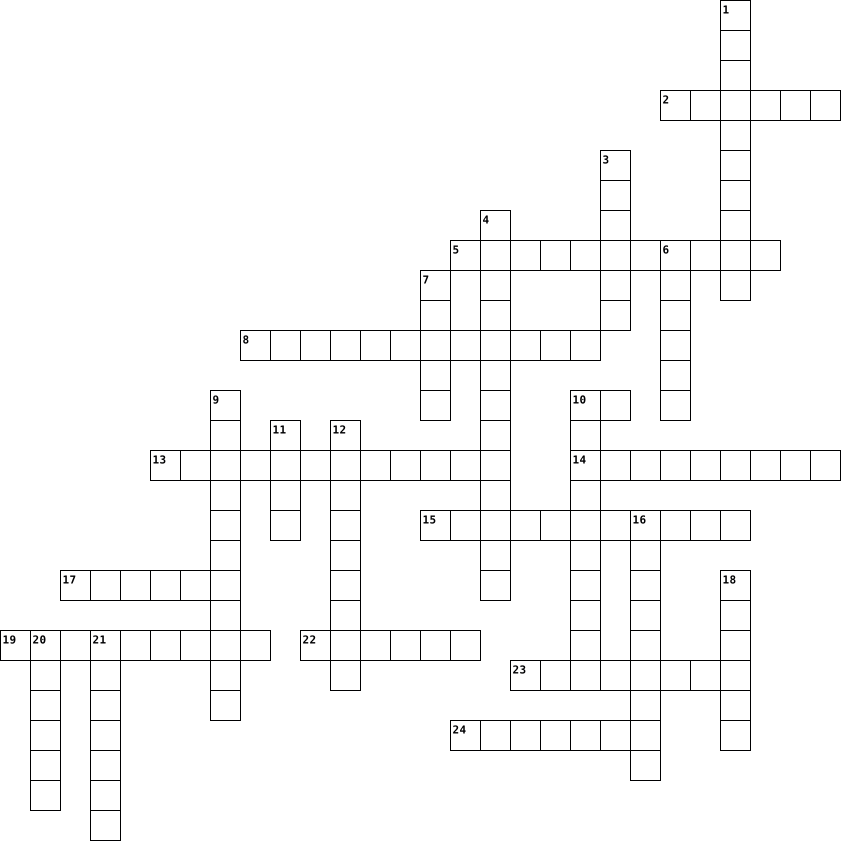
Across
- A table of numbers arranged in rows and columns.
- The bottom part of a fraction.
- Used when to angles and any side are known.
- The ratio of the circumference of a circle to its diameter.
- (0,1,2,3,4,5,6 ) these numbers are
- Half the difference between the largest and smallest function value of a periodic function.
- The value of x at the point where a curve crosses the x-axis.
- The set of all possible values of the argument of a function.
- A straight line that is a close approximation to a curve as the curve goes off to infinity.
- To cut something in half.
- (-1,0,1,2,3) these numbers called
- A fraction in which the denominator is assumed to be 100.
Down
- A device for measuring angles.
- The measure of how often a function repeats its same values.
- Vertical translation of a periodic function.
- The inverse function of tan.
- The ratio of the change in y-coordinates to the change in x-coordinates.
- A set of numbers that identifies the location of a point.
- Horizontal translation of a periodic function.
- The additive identity. The number that when you add it to a number, n, you will get n as a result.
- An equation, graph, or data that can be modeled by a degree 2 polynomial.
- The conjugate of a complex number is formed by reversing the sign on the imaginary part of the number.
- The inverse function of sin.
- The reciprocal of the cosine.
- A line can be used to help draw vertical translation horizontal of each cycle.
25 Clues: To cut something in half. • The inverse function of tan. • The inverse function of sin. • The reciprocal of the cosine. • A device for measuring angles. • The bottom part of a fraction. • (-1,0,1,2,3) these numbers called • (0,1,2,3,4,5,6 ) these numbers are • Used when to angles and any side are known. • Vertical translation of a periodic function. • ...
MATTER: PROPERTIES AND CHANGE 2013-05-12

Across
- May involve changes in temperature, color, formation of a gas or precipitate
- Appearance, texture, color, odor, melting point, boiling point, density, solubility, polarity, to name a few
- Poor conductors of electricity; have a wide range of properties
- Formation of a solid within a liquid resulting from a chemical reaction
- Atoms may be linked together in well-defined molecules, or may be packed in __________ patterns
- Mixture where substances are evenly mixed and can not be distinguished
- Process that can physically separate dissolved solute from a solution
- Combination of solvent and solute
- All physical and chemical changes involve a change in e__ __ __ __y
Down
- Principle that states that the total mass of the products of a reaction is equal to the total mass of the reactants
- Not as conductive as metals but more conductive than non-metals; located along the staircase line of the periodic table
- Mixture that is not uniform throughout
- Created by Mendeleev; based on physical properties of elements and their reactivity
- Name for horizontal row in a periodic table
- Within solutions, it is present in greater amounts that the solute
- Pure substance that is composed of two or more types of elements that are chemically combined
- Substance that is dissolved in a solution
- Method for physically separating mixtures
- Pure substance that is composed of one kind of atom and can not be changed into a simpler substance
- Composed of two or more different substances that retain their own individual properties and are combined physically
- Name for vertical row in a periodic table
21 Clues: Combination of solvent and solute • Mixture that is not uniform throughout • Substance that is dissolved in a solution • Method for physically separating mixtures • Name for vertical row in a periodic table • Name for horizontal row in a periodic table • Poor conductors of electricity; have a wide range of properties • ...
Periodic Table Crossword Puzzle 2013-09-29

Across
- elements in the same vertical column of the periodic table also called a family
- a class of elements charactrized by physical properties that include shininess, malleability, ductility, and conductivity
- symbol a one or two letter representation of an element
- the destruction of a metal through which process
- are substances that can conduct electricty under some conditions but not under other conditions
- mass the average mass of all of all the isotopes of an element.
- table used today, the properties of the elements repeat in each period or row of the table
- metals the metals in Group 1, from lithium to francium are called
Down
- number the sum of protons and neutrons in the nucleus of an atom.
- gases the elements in Group 18 are known as the ..
- is an element that lacks most of the properties of a metal
- fusion is a process in which two atomic nuclei combine, forming a larger nucleus and releasing huge amounts of energy
- material is one that can be hammered or rolled into flat sheets and other shapes
- material is one that can be puled out or drawn into a long wire
- have some characteristics of both metals and nonmetals
- earth metals Group 2 of the periodic table contains the
- the ability of an object to tansfer heat ot electricty to another object
- metals the elements in Group 3 through 12 are called the
- the ease and speed with which an element combines, or reacts, with other elements and compounds
- molecules consists of two atoms
- the table is organized in horizontal rows
21 Clues: molecules consists of two atoms • the table is organized in horizontal rows • the destruction of a metal through which process • gases the elements in Group 18 are known as the .. • have some characteristics of both metals and nonmetals • earth metals Group 2 of the periodic table contains the • symbol a one or two letter representation of an element • ...
Unit 3 Crossword 2013-11-05

Across
- Inner structure of atoms
- Examples: Fluorine, Chlorine, Iodine, Bromine, Astatine
- something with same number of protons but not same neutrons
- rate of occurrence
- positively charged ion
- distance between waves
- Examples: Helium, Neon, Argon, Krypton, Xenon, and Radon
- radiation consisting of electromagnetic waves
- Examples: Barium, Radium, Strontium, Calcium, Magnesium
- nature of all matter
- mass of an isotope
- an optical device for producing and observing a spectrum of light orradiation from any source,
- dalton
- have unstable nuclei
- negatively charged particle
- high energy vs low energy
- distance light can travel in a year
- Vertical rows on periodic chart
- radiation in the form of elementary particles emitted by anatomic nucleus,
- number of protons in an atom
- Abundance of isotopes
- horizontal rows on periodic chart
Down
- 1A, 2A, 3A, 4A, 5A, 6A, 7A, 8A
- spectrum formed by electromagnetic radiations emitted by agiven source,
- atomic weight
- what makes an atom experience a force when close to other electrically charged matter
- complete range of electromagnetic radiation from the longestradio waves
- Elements in the middle of periodic chart
- very small specks of energy
- unit smaller than atom
- negatively charged ion
- positively charged particle
- a comparative level of capacity for vigorous activity
- smallest component of an element
- quantum of electromagnetic radiation
- electrically charged atom
- anions and cations
- any sudden and significant change
- Examples: Potassium, Sodium, Lithium, Rubidium, and Cesium
- a series of lines in the visible spectrum of hydrogen
- neutral particle
- core of atom
42 Clues: dalton • core of atom • atomic weight • neutral particle • rate of occurrence • mass of an isotope • anions and cations • nature of all matter • have unstable nuclei • Abundance of isotopes • positively charged ion • distance between waves • unit smaller than atom • negatively charged ion • Inner structure of atoms • high energy vs low energy • electrically charged atom • ...
Chemistry Crossword Puzzle 2015-11-17

Across
- When 2 non-metals combine to make a pure substance
- The most stable and unreactive elements
- The mass of an one atom in a element
- Groups of atoms acting as one
- A neutral particle in the nucleus of an atom
- A column of elements on the Periodic Table
- NaCl
- A column of elements in the periodic table
- A very valuable element usually used for jewelry
- The number of protons and electrons in the nucleus of on atom of an element.
- The most reactive non-metals
Down
- Shiny,malleable, ductile element that conducts electricity
- Combination of symbols that represent a compound.Identifies the elements and the amount of each.
- Pure substance formed when at least on metal and one non-metal combvines
- A row of elements on the Periodic Table
- Element that has both metallic and non-metallic properties
- Anything that has mass and occupies space
- A table in which the elements are organized by their physical and chemical properties
- Atom that has become electrically charged because it has lost or gained electrons.
- Has 1 proton, 1 electron and an atomic mass of 1
- The most reactive of the metals
- A negatively charged particle that orbits the nucleus of an atom
- When a metal and non-metal combine to make a pure substance
- A positive particle in the nucleus of an atom
- The smallest part of an element with a nucleus containing protons and neutrons
- Dull,brittle element that does not conduct electricity
26 Clues: NaCl • The most reactive non-metals • Groups of atoms acting as one • The most reactive of the metals • The mass of an one atom in a element • A row of elements on the Periodic Table • The most stable and unreactive elements • Anything that has mass and occupies space • A column of elements on the Periodic Table • A column of elements in the periodic table • ...
chemistry crossword 2015-11-17

Across
- how well a substance dissolves in another.
- when a substance can be pounded or rolled into sheets of metal.
- chemical reaction that releases heat energy.
- positively charged center of an atom, contains protons and neutrons
- a system of easy to see warning symbols on hazards material
- the kind of mixture that the elements are visual in the mixture
- compounds are pure substances consisting of at least one metal and one non-metal.
- that has become eclectically charged because it has lost or gained electrons
- is the mass of one atom or element
- the amount of mass in a given volume of a substance.
- how well a substance is conductible with electricity.
- the rows on a periodic table
- has both metallic and non-metallic properties.
- chemical reaction that absorbs heat energy.
- a slow chemical change that occurs when oxygen in the air reacts with a metal
- how a solid can be stretched and made into a long wire.
Down
- a group of 18 elements in the periodic table
- when a liquid changes into a gas at a certain temp.
- when oxygen reacts with a substance to create a new substance and give off energy.
- when a solid changes into a liquid at as certain temp.
- a compound where two non-metals are combined.
- is a material that can not be broken down into a simper substance.
- poisons
- how well a substance can stand not getting damaged or scratched.
- the vertical columns on a periodic table
25 Clues: poisons • the rows on a periodic table • is the mass of one atom or element • the vertical columns on a periodic table • how well a substance dissolves in another. • chemical reaction that absorbs heat energy. • a group of 18 elements in the periodic table • chemical reaction that releases heat energy. • a compound where two non-metals are combined. • ...