
periodic%20table Crossword Puzzles
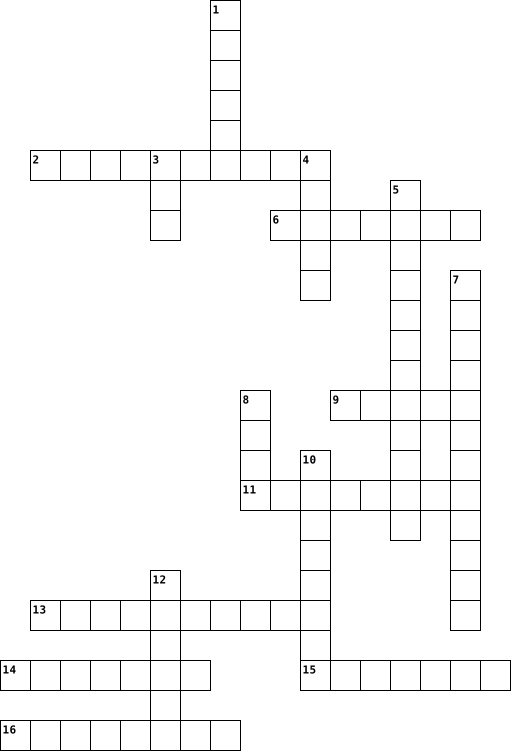
Matter Vocab 2020-04-22

Across
- The smallest part of an element is called a ____?
- The particles with negative charges the move around the nucleus of an atom
- Anything that gas mass and takes up space
- The particles with positive charges in the nucleus of an atom.
- This type of mixture looks the same throughout.
Down
- At least two elements or compounds that have been physically mixed together are a _______?
- This is made up of only one type of atom.
- This type of mixture looks different throughout.
- The particles with a neutral charge in the nucleus of an atom
- At least to elements that have been chemically mixed together are a ________?
- What are the rows of elements on the periodic table called?
- What are the column of elements on the periodic table called?
12 Clues: This is made up of only one type of atom. • Anything that gas mass and takes up space • This type of mixture looks the same throughout. • This type of mixture looks different throughout. • The smallest part of an element is called a ____? • What are the rows of elements on the periodic table called? • The particles with a neutral charge in the nucleus of an atom • ...
Hydrogen--nonmetal 2025-04-08

Across
- hydrdogen is one of the most________elements
- most common source of hydrogen
- percentage of all matter by mass in the universe that is hydrogen
- hydrogen gas is ______in Earth's atmosphere because the atoms are light and escape gravity floating into space
- hydrogen takes this place as the most abundant on Earth
- hydrogen is the element from which all other elements are formed and a process start is in these
Down
- hydrogen is in this position on the periodic table
- the number of protons that give hydrogen the number one on the periodic table
- percentage of all atoms in the universe that are hydrogen
- another source of hydrogen besides hydrocarbons in fossil fuels
- hydrogen's comparative weight compared with all the chemical elements
- the type of element that hydrogen is
12 Clues: most common source of hydrogen • the type of element that hydrogen is • hydrdogen is one of the most________elements • hydrogen is in this position on the periodic table • hydrogen takes this place as the most abundant on Earth • percentage of all atoms in the universe that are hydrogen • another source of hydrogen besides hydrocarbons in fossil fuels • ...
tonya 2019-10-18

Across
- change during a reactions
- dicovered the periodic table
- cloudy
- five senses
- of the same kind
- mass of an atom
Down
- a part of an aspect
- includes flammability
- a mixture
- a substance
- two or more elements combined
- the smallest particle
12 Clues: cloudy • a mixture • five senses • a substance • mass of an atom • of the same kind • a part of an aspect • includes flammability • the smallest particle • change during a reactions • dicovered the periodic table • two or more elements combined
Crossword Puzzle 2018-04-20

Across
- Led Salt March
- Smallest version of the ipod
- Impeached President (1999)
- A Long Speech (SNL)
- Most decorated Olympian
Down
- Pants with many pockets
- Former POTUS
- Played Ms. Doubtfire
- Sport with Shooting and Skiing
- Laughing Bone
- Opposite of Spoon
- Au on the Periodic Table
- Conservative news program
13 Clues: Former POTUS • Laughing Bone • Led Salt March • Opposite of Spoon • A Long Speech (SNL) • Played Ms. Doubtfire • Pants with many pockets • Most decorated Olympian • Au on the Periodic Table • Conservative news program • Impeached President (1999) • Smallest version of the ipod • Sport with Shooting and Skiing
Erik_sierra77 2017-09-12

Across
- A vertical column in the periodic table of elements; also known as a family of elements
- An extremely small negatively charged subatomic particle found in a cloud outside the atomic nucleus
- An abbreviatioin for an element or atom
- A count of the number of protons in the atomic nucleus
- An electrically neutral subatomic particle in the atomic nucleus
- A horizontal row in the periodic table of elements
Down
- The dense, positively charged center of every atom
- A positively charged subatomic particle in the atomic nucleus
- A chart in which all known elements are listed in order of atomic number
- Any material that is made up of one type of atom
10 Clues: An abbreviatioin for an element or atom • Any material that is made up of one type of atom • The dense, positively charged center of every atom • A horizontal row in the periodic table of elements • A count of the number of protons in the atomic nucleus • A positively charged subatomic particle in the atomic nucleus • ...
Matter Unit 2012-11-26

Across
- What can form if two or more different substances join together and can't be separated
- A change that occurs when a new substance is created
- solid material that is typically hard, shiny, malleable, good conductivity to heat
- a group of the same atoms
- What can form if two or more elements join together?
- Have characteristics of metals and non metals and are found toward the middle of the periodic table
Down
- The Scientist that created the Periodic table
- A change that occurs when no new substance is form
- Matter cannot be created nor destroyed
- non-lusturous , non conductors of heat, opposite characteristics of a metal
10 Clues: a group of the same atoms • Matter cannot be created nor destroyed • The Scientist that created the Periodic table • A change that occurs when no new substance is form • A change that occurs when a new substance is created • What can form if two or more elements join together? • non-lusturous , non conductors of heat, opposite characteristics of a metal • ...
the element crossword - green 2015-06-19

Across
- what is the compound of two hydrogen and one oxygen?
- is an electron that is associated with an atom.
- what is famous of C?
Down
- element is a species of chemical objects, chararacterized by a number of protons in atoms nucleus.
- are the elements in groups 14-16 of the periodic table.
- are the elements found along the step like line between metals and non-metals of the periodic table.
- is the number of protons in an atom of an element.
- this naturally occuring chemical compound is composed of a carbon atom covalently double bonded to two oxygen atoms.
- what is famous in N2?
- have a positive electric charge.
10 Clues: what is famous of C? • what is famous in N2? • have a positive electric charge. • is an electron that is associated with an atom. • is the number of protons in an atom of an element. • what is the compound of two hydrogen and one oxygen? • are the elements in groups 14-16 of the periodic table. • ...
Chemistry 2022-02-24

Across
- of protons in the nucleus
- average atomic mass of an element
- number in front of a symbol tat represents the number of molecules present
- subatomic particle with a negative electrical charge
- substance formed as a result of chemical reaction
- subatomic particles with a positive electrical change located in the nucleus
Down
- shows how many atom of an element are present in a molecule
- column of the elements on the periodic table with atomic properties
- subatomic particle with a neutral electrical charge located in the nucleus
- horizontal row in the periodic table were all the elements have the number of energy levels
10 Clues: of protons in the nucleus • average atomic mass of an element • substance formed as a result of chemical reaction • subatomic particle with a negative electrical charge • shows how many atom of an element are present in a molecule • column of the elements on the periodic table with atomic properties • ...
Chemistry 2022-09-07

Across
- Refers to the closeness of a set of measurement of the same quantity made in the same way
- Any substance with a definite composition
- Vertical column of the periodic table. ALso called family
- Anything that has mass and takes up space
- Blend of tow or more kinds of matter, each which retains its own identity and properties
- An element that is a good electrical conductor and a good heat conductor
Down
- Mathematical technique that uses units to solve problems
- The smallest unit of an element that maintains its identity
- Horizontal row of the periodic table
- The study of substances and processes in living things
10 Clues: Horizontal row of the periodic table • Any substance with a definite composition • Anything that has mass and takes up space • The study of substances and processes in living things • Mathematical technique that uses units to solve problems • Vertical column of the periodic table. ALso called family • The smallest unit of an element that maintains its identity • ...
Crossword puzzle 2022-01-13

Across
- - a flow of water that flows across the land.
- events that happen in a rotation (repeated).
- - This is found in plants' leaves, stems, and other parts of plants.
- -When plants and other organisms use sunlight to make nutrients.
- - This is one of the elements in the periodic table known as co2
Down
- - This is also known as the water cylce.
- - This is one of the elements in the periodic table known as N.
- - This process involves the plants and organisms taking in nitrogen and carbon dioxide.
- - These are places where carbon is store in for a long period of time.
- -little living organisms that were the first forms of life.
10 Clues: - This is also known as the water cylce. • events that happen in a rotation (repeated). • - a flow of water that flows across the land. • -little living organisms that were the first forms of life. • -When plants and other organisms use sunlight to make nutrients. • - This is one of the elements in the periodic table known as N. • ...
Kendall Wyse- Chapter 9 Atomic Structure 2021-02-01

Across
- A material that conducts heat well and has a lustrous appearance.
- Particle that is 1 amu, positive charge, located in the nucleus.
- Name of the man who created one of the best models of the atom.
- Particle that is 1 amu, with no charge located in the nucleus.
Down
- A material that has properties of both metals and nonmetals.
- Tiny particles, only 1/1200 amu, with a negative charge.
- The same meaning as a column on the periodic table.
- A material that lacks the properties of a metal.
- An atom that carries an electrical charge.
- The same meaning as row on the periodic table.
10 Clues: An atom that carries an electrical charge. • The same meaning as row on the periodic table. • A material that lacks the properties of a metal. • The same meaning as a column on the periodic table. • Tiny particles, only 1/1200 amu, with a negative charge. • A material that has properties of both metals and nonmetals. • ...
Crossword Puzzle Kesleigh 2022-10-26

Across
- number of protons and neutrons
- a way of describing the number of atoms that make up a molecule or compound
- the ability to combine and to chemically bond with each other
Down
- high luster, good conductor, malleable, found on the left of periodic table
- molecule that is made up of more than one type of element
- a chart where all elements are organized into periods and steps of the periodic table
- compounds that include Carbon
- substaces that are the building blocks of all matter(made of one kind of atom)
- a row of elements that have a certain proprties in common
- the basic unit of a chemical element
10 Clues: compounds that include Carbon • number of protons and neutrons • the basic unit of a chemical element • molecule that is made up of more than one type of element • a row of elements that have a certain proprties in common • the ability to combine and to chemically bond with each other • high luster, good conductor, malleable, found on the left of periodic table • ...
Arrangement of periodic table of elements 2024-02-02

Across
- is a column of elements in the periodic table of the chemical elements
- the elements in the two long rows at the lower section of the table
- a pure substance that cannot be broken down by any physical or chemical means into simpler substances
- is a form of carbon that is 200 times stronger than steel
- are good conductors from heat and electricity.
- the actinides elements and actinium are collectively called___.
Down
- the periodic table of elements is named after the Greek word ____ which translates to "to turn back".
- are poor conductors and likely from anions.
- the lanthanide elements and lanthanum are collectively called____.
- a row of chemical elements
10 Clues: a row of chemical elements • are poor conductors and likely from anions. • are good conductors from heat and electricity. • is a form of carbon that is 200 times stronger than steel • the actinides elements and actinium are collectively called___. • the lanthanide elements and lanthanum are collectively called____. • ...
The solar cycle 2024-04-08

Across
- parts of the sun that have a large amount of magnetic energy
- an explosive outburst of plasma from the sun
- changing pattern of the suns magnetic field changes every 11 years or so
- they happen when energy in the twisted magnetic fields release, they often occur during the peak of the suns 11 year cycle
Down
- periodic changes in the suns activity levels
- disturbance in earths magnetosphere caused by changes in space weather
- the outermost layer of the sun
- conditions in space based off of the activity of the sun
- a constant flow of electrons that come from the corona
- undergoes periodic reversals
10 Clues: undergoes periodic reversals • the outermost layer of the sun • periodic changes in the suns activity levels • an explosive outburst of plasma from the sun • a constant flow of electrons that come from the corona • conditions in space based off of the activity of the sun • parts of the sun that have a large amount of magnetic energy • ...
Atomic structure 2023-02-01

Across
- An atom or a group of atoms with a electrical charge, formed by the loss or gain of electrons
- A change that does not result in a new substance being formed. It can be reversed
- A vertical column of elements on the periodic table
- A change where new substances are formed. This can not easily be reversed
- Two or more diffrent elements chemically combined
Down
- A substance made from one type of atom
- A reaction where a chemical change occurs
- Group of atoms bonded together by sharing electrons
- A horizontal row of elements on the periodic table
- Smallest particle of a chemical element that can exist
10 Clues: A substance made from one type of atom • A reaction where a chemical change occurs • Two or more diffrent elements chemically combined • A horizontal row of elements on the periodic table • Group of atoms bonded together by sharing electrons • A vertical column of elements on the periodic table • Smallest particle of a chemical element that can exist • ...
D Block Review Crossword - Unit 7 2025-04-25

Across
- a nonmetal with a atomic number of 6 (LW)
- Outer edge electron (JW)
- All atoms are this, variations of an element (MO)
- An element named after the creator of what we know as the Periodic Table.
- are atoms of the same element with a different number of neutrons. (AC)
- A pure substance that cannot be separated. (ET)
- A range of stuff. (GM)
- Atoms with the same number of protons but different numbers of neutrons. Carbon - 12 is the most common one of these for carbon.(GMM)
Down
- A subatomic particle with a positive charge found in the nucleus of an atom. (SA)
- total mass of particles of matter in an atom (MH)
- The type of electron that exists in the outermost shell of an atom (LS)
- The number of protons plus the average number of neutrons. (GF)
- A compound formed by the reaction of a acid and a base resulting in a neutral compound. (VJ)
- an element named after the creator of the periodic table. OA
- An atom with a positive or negative charge.(MD)
15 Clues: A range of stuff. (GM) • Outer edge electron (JW) • a nonmetal with a atomic number of 6 (LW) • An atom with a positive or negative charge.(MD) • A pure substance that cannot be separated. (ET) • total mass of particles of matter in an atom (MH) • All atoms are this, variations of an element (MO) • an element named after the creator of the periodic table. OA • ...
34's & 3s 2025-04-06

Across
- 34th state - "surrender Dorothy"
- #3 on AFI's Best American Films - 1972 "I'll make him an offer he can't refuse"
- Star Wars Episode III
- 34th president - "I like Ike!"
- Currently #3 on Billboard Top 100 - Singer of A Bar Song (Tipsy). "Someone pour me up a double shot of whiskey"
Down
- #34 on AFI's Best American Films - 1962 Portrayal of Harper Lee's iconic novel
- #3 on Washingtonian's best D.C. restaurants - fancy Mexican in NE - closeby!
- #34 on Washingtonian's best D.C. restaurants - Japanese near Dupont Circle - Second floor above a CVS
- 3rd state to ratify the Constitution - of Jersey Shore fame
- 3rd element on the periodic table - symbol is Li - ____ batteries
- 3rd president
- 34th element on the periodic table - symbol is Se - health benefits and sounds like famous singer ____ Gomez
12 Clues: 3rd president • Star Wars Episode III • 34th president - "I like Ike!" • 34th state - "surrender Dorothy" • 3rd state to ratify the Constitution - of Jersey Shore fame • 3rd element on the periodic table - symbol is Li - ____ batteries • #3 on Washingtonian's best D.C. restaurants - fancy Mexican in NE - closeby! • ...
Cullompton Gazette - Crossword Of The Week 2024-04-21

Across
- Discovered Radium
- Early study of probability
- Created the Periodic Table
- English physicist for energy work
- Alternating Current Electricity
- Atomic Model
- Father of Classical Physics
Down
- Laws of Electromagnetism
- Father of Modern Science
- Planetary Motion
- Theory of Relativity
- Discovered electromagnetic waves
12 Clues: Atomic Model • Planetary Motion • Discovered Radium • Theory of Relativity • Laws of Electromagnetism • Father of Modern Science • Early study of probability • Created the Periodic Table • Father of Classical Physics • Alternating Current Electricity • Discovered electromagnetic waves • English physicist for energy work
science puzzle 2022-05-17

Across
- large electronegative
- unequal
- lose positive charge
- electron's highest available energy levels
- when rxn doesn't finish
- amount of matter
- gain a charge
Down
- table chart of elements
- equal sharing
- mass matter in an atom
- how fast something happens
- atoms with a charge
- bonds form by electronic force
13 Clues: unequal • equal sharing • gain a charge • amount of matter • atoms with a charge • lose positive charge • large electronegative • mass matter in an atom • when rxn doesn't finish • table chart of elements • how fast something happens • bonds form by electronic force • electron's highest available energy levels
Chemistry 2023-08-28

Across
- Table A powerful tool chemists use to organize.
- Each element is represented by this on the periodic table with one ore more letters.
Down
- Makes the periodic table really invaluable.
- You can predict a lot about the chemical of an element when you have this.
- Above the chemical symbol is the moss on the periodic table.
5 Clues: Makes the periodic table really invaluable. • Table A powerful tool chemists use to organize. • Above the chemical symbol is the moss on the periodic table. • You can predict a lot about the chemical of an element when you have this. • Each element is represented by this on the periodic table with one ore more letters.
Chase cromer 4th period vocabulary 6B 2017-03-23

Across
- vertical column of elements on the Periodic Table that have similar physical and chemical properties.
- states that matter is neither created nor destroyed in ordinary chemical and physical changes.
- A chemical reaction in which heat is released and usually feels warm when the heat is released from the reaction.
- horizontal row of elements on the Periodic Table that have the same number of electron shells.
Down
- elements that have some properties of metals and non-metals and are found along the zigzag on the Periodic Table.
- A chemical reaction that requires an input of energy and usually feels cold when it absorbs heat in the reaction.
- electrons on the outermost energy level of an atom that determine the reactivity of the atom.
- Bond an interaction that holds atoms together.
8 Clues: Bond an interaction that holds atoms together. • electrons on the outermost energy level of an atom that determine the reactivity of the atom. • states that matter is neither created nor destroyed in ordinary chemical and physical changes. • horizontal row of elements on the Periodic Table that have the same number of electron shells. • ...
Vocab 6b 2017-03-23

Across
- Electron electrons on the outermost energy level of an atom that determine the reactivity of the atom.
- elements that have some properties of metals and non-metals and are found along the zigzag on the Periodic Table.
- A chemical reaction in which heat is released and usually feels warm when the heat is released from the reaction
- A chemical reaction that requires an input of energy and usually feels cold when it absorbs heat in the reaction.
- an interaction that holds atoms together.
Down
- states that matter is neither created nor destroyed in ordinary chemical and physical changes.
- vertical column of elements on the Periodic Table that have similar physical and chemical properties.
- horizontal row of elements on the Periodic Table that have the same number of electron shells.
8 Clues: an interaction that holds atoms together. • states that matter is neither created nor destroyed in ordinary chemical and physical changes. • horizontal row of elements on the Periodic Table that have the same number of electron shells. • vertical column of elements on the Periodic Table that have similar physical and chemical properties. • ...
hw 6B 2017-03-23

Across
- states that matter is neither created nor destroyed in ordinary chemical and physical changes
- A chemical reaction in which heat is released and usually feels warm when the heat is released from the reaction
- vertical column of elements on the Periodic Table that have similar physical and chemical properties
- an interaction that holds atoms together
Down
- electrons on the outermost energy level of an atom that determine the reactivity of the atom
- A chemical reaction that requires an input of energy and usually feels cold when it absorbs heat in the reaction
- horizontal row of elements on the Periodic Table that have the same number of electron shells
- elements that have some properties of metals and non-metals and are found along the zigzag on the Periodic Table
8 Clues: an interaction that holds atoms together • electrons on the outermost energy level of an atom that determine the reactivity of the atom • states that matter is neither created nor destroyed in ordinary chemical and physical changes • horizontal row of elements on the Periodic Table that have the same number of electron shells • ...
Unit 6B 2017-03-21

Across
- Electron- electrons on the outermost energy level of an atom that determine the reactivity of the atom.
- horizontal row of elements on the Periodic Table that have the same number of electron shells.
- elements that have some properties of metals and non-metals and are found along the zigzag on the Periodic Table.
Down
- of Conservation of Mass- states that matter is neither created nor destroyed in ordinary chemical and physical changes.
- vertical column of elements on the Periodic Table that have similar physical and chemical properties.
- Reaction- A chemical reaction that requires an input of energy and usually feels cold when it absorbs heat in the reaction.
- Bond- an interaction that holds atoms together.
- Reaction- A chemical reaction in which heat is released and usually feels warm when the heat is released from the reaction.
8 Clues: Bond- an interaction that holds atoms together. • horizontal row of elements on the Periodic Table that have the same number of electron shells. • vertical column of elements on the Periodic Table that have similar physical and chemical properties. • Electron- electrons on the outermost energy level of an atom that determine the reactivity of the atom. • ...
Vocab 6B 2017-04-04

Across
- an interaction that holds atoms together.
- elements that have some properties of metals and non-metals and are found along the zigzag on the Periodic Table.
- A chemical reaction that requires an input of energy and usually feels cold when it absorbs heat in the reaction.
- horizontal row of elements on the Periodic Table that have the same number of electron shells.
Down
- of Mass states that matter is neither created nor destroyed in ordinary chemical and physical changes.
- electrons on the outermost energy level of an atom that determine the reactivity of the atom.
- A chemical reaction in which heat is released and usually feels warm when the heat is released from the reaction.
- vertical column of elements on the Periodic Table that have similar physical and chemical properties.
8 Clues: an interaction that holds atoms together. • electrons on the outermost energy level of an atom that determine the reactivity of the atom. • horizontal row of elements on the Periodic Table that have the same number of electron shells. • vertical column of elements on the Periodic Table that have similar physical and chemical properties. • ...
Science Review Crossword 2021-06-03

Across
- a circuit that is able to flow electricity and is complete.
- a form of light that we can see
- when light or other waves are taken in, they aren't reflected their ...
- An object that contains atoms, the atoms are far apart, and the atoms move around a lot.
- a substance that can't make electricity easily (wood,rubber,etc.)
- when two substances are combined, but can't be separated.
- when light or another wave bounces off of a surface and goes in a different direction than when the light hit it.
- An object that contains atoms, the atoms are very close together and vibrate.
- in space terms this is one full orbit around the sun it takes 365 Earth days.
- a big body of mass that orbits around the sun or a star.
- a property that you have to use your 5 senses such as color,texture,smell, etc.
- the part of the cell that directs the activities and also contains genetic information.
Down
- a zig zag line on the periodic table that features metalloids.
- the number that represents the number of protons an atom contains.
- a circuit that can't flow electricity, and is incomplete.
- stored energy that has the ability to be in motion.
- how much matter an object has.
- An object that contains atoms, the atoms are moderately close together and the atoms move around a little.
- How intense the heat is in an area or object(can be cold and hot)
- when two substances are combined, but can still be separated.
- these are lines that are horizontal on the periodic table.
- a substance on the periodic table that is only made up of one substance.
- Energy that is in motion
- a type of light ray that comes from the suns rays and can cause damage and skin cancer to humans.
- a substance that can make electricity very easily and well (metal,iron,etc.)
- an environment in which planets, the sun, moons, meteors, etc. are all incorporated in.
26 Clues: Energy that is in motion • how much matter an object has. • a form of light that we can see • stored energy that has the ability to be in motion. • a big body of mass that orbits around the sun or a star. • a circuit that can't flow electricity, and is incomplete. • when two substances are combined, but can't be separated. • ...
IHCC 21 juniors round 1 2021-09-05

Across
- a transition metal
- proton donor
- name of scientist who came up with Atomic theory
- a polymer which has identical sub units
- not a metal or a non metal and used in making computer chips
- light weight causing me to escape the atmosphere
- tested with a glowing splint
- only halide which is liquid
- hydrogen concentration of Milk
- acid base reaction
- An alloy of 2 elements
- what kind of gases are hydrogen nitrogen and oxygen
- a metal which sinks in water
- radioactive transition metal
- element which causes acid rain
- negatively charged subatomic particle
- a macromolecule which is an allotrope of hydrocarbon
- most electronegative element
- solid which does not have crystalline structure
- substances formed in the middle step of a reaction
- one of the most precise lab equipments
- silver white metal that reacts explosively
- exothermic reaction
- elements which have properties of both metals and non metals
- method for purification
- an anion which contains the element oxygen
- modern name for the element Stibnite
Down
- black oxide compound
- devise used to measure gas pressure
- elements 90 through 103
- metal that is liquid at rtm
- cause water life to die
- species that has the same electronic structure
- discrete packet of matter
- lab equipment used for only certain values
- seperation of electric charges along the bond
- sometimes used as a poison
- removes harmful gases from cars
- element which is not a liquid at room temperature
- name of scientist who discovered the periodic table
- compounds which contain only hydrogen and carbon
- substances with the same chemical properties but different physical properties
- vertical columns in the periodic table are called
- elements are listed in the periodic table in order of what atomic number
- highly toxic and soluble compound
- direct conversion of solid to gas
- 2 atoms in the plane
- first column of metal called
- formed by losing electrons
49 Clues: proton donor • a transition metal • acid base reaction • exothermic reaction • black oxide compound • 2 atoms in the plane • An alloy of 2 elements • elements 90 through 103 • cause water life to die • method for purification • discrete packet of matter • sometimes used as a poison • formed by losing electrons • metal that is liquid at rtm • only halide which is liquid • ...
Pre Calc Vocab 2021-07-03

Across
- substituting a value into a limit
- a set of numbers with contains all possible values in a function
- one pattern of y-values in a periodic function
- a linear equation that a function can never equal
- numbers like the square root of negative one which don't normally exist
- the independent variable
- a limit coming from either positive or negative infinity
- non-existent outputs in a function
- the x-value at a hole
- the output of one function is used as the input of another
- a formula using sine proportions to find missing values
- numbers close to another value
- half of the perimeter of a polygon
- a domain of a subfunction in a piecewise
- a vertical asymptote
- a function with point symmetry around (0,0)
- a formula using cosine proportions to find missing values
- a triangle without 90 degree angles
- the way that functions behave during alteration
- the horizontal length of one cycle in a periodic function
- the power which a number must be raised to in order to get another number
- the dependent variable
- two functions where the inputs and outputs are reversed
Down
- a function comprised of several parts with subdomains
- when there are no breaks in a graph
- a function which repeats y-values at regular intervals
- the combination of real and imaginary numbers
- the mathematical operations applied to functions
- what happens as a graph approaches either positive or negative infinity
- an x-value that a function can never equal
- a y-value that a function can never equal
- the point where one sub-function ends and another begins
- when a two sided limit does not exist because the one sided limits are not equivalent
- half of the difference between the maximum and minimum outputs in a periodic function
- the simplest form of a function
- a function without excluded values
- does not exist
- a function with y-axis symmetry
- two or more values multiplied to make another
39 Clues: does not exist • a vertical asymptote • the x-value at a hole • the dependent variable • the independent variable • numbers close to another value • the simplest form of a function • a function with y-axis symmetry • substituting a value into a limit • non-existent outputs in a function • half of the perimeter of a polygon • a function without excluded values • ...
GENERAL CHEMISTRY 2020-04-26

Across
- Particles in a atom with a negative charge.
- The 24th element on the Periodic table of elements.
- Group of element that readily forms positive ions(cations) and has metallic bonds.
- The 44th element on the Periodic table of elements.
- Change A change of one substance to another.
- The resistance to flow by a fluid.
- The point in temperature when the liquid starts to boil.
- Type of mixture with particles that are larger than those in solutions, but not heavy enough to settle out.
- Substance formed when two or more chemical elements are chemically bonded together.
- Liquid to Gas.
- Gas to Solid.
- The basic building block for all matter in the universe.
- Solid to Gas.
- Anything that has mass and takes up space and has volume.
- Type of mixture that has no uniform composition.
- The 66th element on the Periodic table of elements.
- The simplest substance and hence cannot be broken down using chemical reactions.
- Number of protons in an atom is equal to a number called ___?
- Gas to Liquid.
- Particles in a atom with no charge.
- A type of matter with fixed composition.
Down
- Characteristic of a substance that indicates whether it can undergo a chemical change.
- A process involving applying centrifugal force to detach particles from the solution by their scale, shape, density, medium and rotor speed viscosity.
- Liquid to Solid.
- Characteristic of a material you can observe without changing the identity.
- A change in size, shape, or state.
- Universal Solvent.
- Materials that are able to be hammered.
- Type of mixture that has the same proportions or uniform composition.
- Homogeneous mixture with particles so small that they cannot be seen with a microscope.
- A process for separating substances by evaporating a liquid and recondensing its vapor.
- The point in temperature when the solid starts to liquefy.
- Particles in a atom with a positive charge.
- Effect Scattering of light by colloidal particles.
- Solid to Liquid.
- A material made up of two or more different substances which are physically combined.
- The sum of the number of protons and neutrons.
37 Clues: Gas to Solid. • Solid to Gas. • Liquid to Gas. • Gas to Liquid. • Liquid to Solid. • Solid to Liquid. • Universal Solvent. • A change in size, shape, or state. • The resistance to flow by a fluid. • Particles in a atom with no charge. • Materials that are able to be hammered. • A type of matter with fixed composition. • Particles in a atom with a negative charge. • ...
Unit 3 Crossword 2.2: Periodic Table Groups 2023-03-21

Across
- number of valence electrons in fluorine
- the most reactive nonmetals are right(until VIIIA)and at the__of each group
- element with 8ve and 4 orbitals
- the most reactive metals are left and at the ___ of each group
- atomic name for W
- element with 45 neutrons and 39 protons
- iodine has___ valence electrons
- group IVA is the ____ family
- the ___ you are in tell you the number of energy levels
- common name for groups
- metals are found on the ____ side of the periodic table
- group VIII are called the
- only metal in the Nitrogen Family
- group VI is the _____ family
- symbol for californium
- the alkali metals are the most____ metals
- symbol for Manganese
- element with 34 protons
- Fe
- U
- only liquid non metal at room temperature
- gallium has_______ energy levels
- K
- element with 5ve and 4 orbitals
- number of valence electrons in aluminum
- group VII are the _____
- the majority of elements are classified as___
- group IIIA is the ____ family
Down
- most reactive metal
- the ____ you are in tell you the number of valence electrons an element has
- number of valence electrons in calcium
- group V is the _____ family
- most nonmetals are found on the__ side of the periodic table
- element with 3 orbitals and 6ve
- section between group IIA and IIIA
- element with 5 orbitals and 1ve
- element with 7ve and 6 orbitals
- element with 91 protons
- common name for periods
- number of valence electrons in neon
- electrons in the outer ring are called__ electrons
- atomic symbol for cesium
- radon has ____ energy levels
- number of valence electrons in sodium
- elements that touch the staircase line
- elements like nitrogen oxygen hydrogen
- only non-metal on the left side of the periodic table
- only element in VIIIA with 2 valence electrons
- group IA elements are called ______ metals
- antimony has _____ valence electrons
- group IIA are called ____ metals
- only liquid metal at room temperature
- noble gasses are the most ____ group of elements
53 Clues: U • K • Fe • atomic name for W • most reactive metal • symbol for Manganese • common name for groups • symbol for californium • element with 91 protons • common name for periods • element with 34 protons • group VII are the _____ • atomic symbol for cesium • group VIII are called the • group V is the _____ family • group IVA is the ____ family • radon has ____ energy levels • ...
Sound Vocabulary 2025-03-25

Across
- the application of inward forces (pressure) that cause an object or substance to become compacted or reduced in size.
- the frequency at which it vibrates when disturbed from its equilibrium position, in the absence of external forces.
- areas where the particles of the medium are spread out, resulting in regions of lower density and pressure.
- (symbol: dB) is a relative unit of measurement equal to one tenth of a bel (B). It expresses the ratio of two values of a power or root-power
- occurs when waves come together so that they completely cancel each other out.
- when two waves overlap in such a way that they combine to create a larger wave.
- also ask.
- a point along a standing wave where the wave has minimum amplitude.
- wave combination of two waves moving in opposite directions, each having the same amplitude and frequency.
- flight at five times or more the speed of sound (Mach 5 or higher.)
Down
- relating to or denoting sound waves with a frequency below the lower limit of human audibility.
- a wave or signal whose frequency is a positive integer multiple of the fundamental frequency of a periodic signal.
- a property of sound that we perceive, not a physical property itself.
- When two or more waves cross at a point, the displacement at that point is equal to the sum of the displacements of the individual waves.
- vibrations of frequencies greater than the upper limit of the audible range for humans.
- the ratio of flow velocity after a certain limit of the sound's speed.
- the increase (or decrease) in the frequency of sound, light, or other waves as the source and observer move towards (or away from) each other.
- The periodic and reapeating fluctuation heard in the intensity of a sound.
- a type of vibration where an external, periodic force (or driving force) is applied to a system, causing it to oscillate.
- Every object or system has a natural frequency at which it vibrates most easily. This is the frequency at which the system will oscillate if disturbed.
20 Clues: also ask. • a point along a standing wave where the wave has minimum amplitude. • flight at five times or more the speed of sound (Mach 5 or higher.) • a property of sound that we perceive, not a physical property itself. • the ratio of flow velocity after a certain limit of the sound's speed. • ...
Atoms, Elements and The Periodic Table Vocab Crossword 2025-04-10

Across
- the smallest unit of an element that has all of the properties of the element; basic building block of matter.
- anything that has mass and takes up space.
- a substance that cannot be broken down into a simpler substance by ordinary chemical means.
- a chart that organizes information about all of the known elements according to their properties.
- the smallest unit of a compound that has all of the properties of the compound.
- Number – the number of protons contained in each nucleus of its atoms of the element. Located over the elemental symbol (at the top of the element box on the periodic table).
- a region where there is a high probability of finding an electron.
- elements that are made by scientists in a laboratory and do not exist in nature. Synthetic elements are typically identified as any element with the atomic number of 93 and up.
- A vertical column (up and down) on the periodic table.
Down
- This describes how likely an element is to form bonds with other elements.
- a bond formed when two atoms share valence electrons.
- Mass – the number of protons and neutrons in the nucleus of one atom of the element. Located under the elemental symbol (at the bottom of the element box on the periodic table).
- electrons that are located in the outermost energy level of an atom.
- the single capital letter or capital letter followed by a lower case letter or letters that represents the name of the element.
- A horizontal row (left to right) in the periodic table.
- elements and/or compounds that when put together are unable to react chemically.
- an element that does not conduct electricity or heat and is usually a gas at room temperature.
- the region surrounding the nucleus of an atom where the electrons are located.
- an element that has some properties of a metal and some properties of a nonmetal.
- a bond formed by the transfer of electrons (when valence electrons of one atom are transferred to the outer energy level of another atom).
- a charged atom or bonded atoms that have gained or lost one or more electrons.
- an element or substance that conducts heat and electricity.
22 Clues: anything that has mass and takes up space. • a bond formed when two atoms share valence electrons. • A vertical column (up and down) on the periodic table. • A horizontal row (left to right) in the periodic table. • an element or substance that conducts heat and electricity. • a region where there is a high probability of finding an electron. • ...
Chemistry Crossword Test 2025-06-18

Across
- The smallest particle of an element that retains the properties of that element.
- The number of protons in an atom’s nucleus.
- An element that does not conduct electricity and is brittle.
- A method used to separate substances in a mixture.
- Atoms of the same element with different numbers of neutrons.
- An insoluble solid formed in a solution during a chemical reaction.
- A combination of substances not chemically bonded.
- A regular repeating arrangement of particles in a solid.
- A negatively charged subatomic particle orbiting the nucleus.
- A soluble base that releases hydroxide ions in solution.
- A method to separate an insoluble solid from a liquid.
- The total number of protons and neutrons in an atom.
- A liquid that dissolves a solute to form a solution.
- A method to separate mixtures based on boiling points.
- Two or more atoms bonded together covalently.
- A vertical column in the periodic table.
- A positively charged subatomic particle in the nucleus.
- A homogeneous mixture of solute and solvent.
- The central part of an atom containing protons and neutrons.
- A substance that donates hydrogen ions in solution.
Down
- A bond formed when atoms share electrons.
- An atom or molecule with a positive or negative charge.
- A chart of elements arranged by atomic number.
- A substance that can neutralise an acid.
- A compound formed from the reaction of an acid with a base.
- A pure substance made of only one type of atom.
- A reaction between an acid and a base to form salt and water.
- A bond formed through the transfer of electrons.
- A subatomic particle with no charge found in the nucleus.
- A substance that dissolves in a solvent.
- A reaction in which a substance gains oxygen or loses electrons.
- An element that conducts electricity and heat, usually malleable.
- The process of removing a liquid to obtain a solid.
- A substance formed when two or more elements are chemically bonded.
- A horizontal row in the periodic table.
35 Clues: A horizontal row in the periodic table. • A substance that can neutralise an acid. • A substance that dissolves in a solvent. • A vertical column in the periodic table. • A bond formed when atoms share electrons. • The number of protons in an atom’s nucleus. • A homogeneous mixture of solute and solvent. • Two or more atoms bonded together covalently. • ...
Year 9 - Term 1 & 2 Review 2025-05-13

Across
- A chemical messenger released into the bloodstream
- A weakened or inactive form of a pathogen used to build immunity
- Negatively charged sub-atomic particle orbiting the nucleus
- A change in the environment that causes a response
- The small gap between neurons where signals are passed chemically
- A neutral particle found in the nucleus
- Horizontal rows of the Periodic Table
- A protein produced by the immune system to fight specific antigens
- A hormone that lowers blood glucose levels
- The smallest unit of an element
- A positively charged particle in the nucleus
- The body system that uses hormones to regulate processes
- The _______ system uses electrical signals to respond quickly to stimuli
- The _________ system uses hormones to control slower body processes
- Mr Gendle's favourite musical instrument
- A type of single-celled organism; can be harmful or helpful
- A non-living infectious particle that reproduces in a host cell
- The outermost electron shell of an atom
- Ms Clay's favourite sport
Down
- The part of a neuron that receives signals from other neurons
- The ______ system in your body defends against infections
- The body’s response to injury or infection, often causing redness/swelling
- The process of maintaining internal balance in the body
- An atom that has gained or lost electrons
- A substance made from two or more elements chemically bonded
- Vertical columns of the Periodic Table
- A pure substance made of only one type of atom
- The long part of a neuron that carries impulses away from the cell body
- The _____ blood cell fights against infection
- This is found above each element symbol on the Periodic table (2 words)
- A nerve cell that transmits electrical signals
- A medicine used to kill or stop the growth of bacteria
- A muscle or gland that carries out a response
- Formula: _____ ____ = Protons + Neutrons (2 words)
- A fast, automatic response to a stimulus is a ______ action
- A type of sugar used by cells for energy, regulated by insulin
- A structure that detects a stimulus
- A microorganism that causes disease
38 Clues: Ms Clay's favourite sport • The smallest unit of an element • A structure that detects a stimulus • A microorganism that causes disease • Horizontal rows of the Periodic Table • Vertical columns of the Periodic Table • A neutral particle found in the nucleus • The outermost electron shell of an atom • Mr Gendle's favourite musical instrument • ...
8.5 A-C: Atomic Structure and Periodic Table 2023-01-09

Across
- a particle smaller than an atom; includes protons, neutrons and electrons
- tendency of an atom to undergo changes
- a material that is typically hard, shiny, malleable,and ductile, with good electrical and thermal conductivity; found on the left of the zigzag line with the exception of Hydrogen (nonmetal)
- a model/chart in which elements are organized according to their properties and atomic number
- a negatively charged particle in the electron cloud (energy shells/levels) surrounding the nucleus
- tendency of a material to resist change or decomposition
- the number of protons in the nucleus of an atom; used to determine an element’s identity and position on the Periodic Table
- average mass of one atom of an element; protons and neutrons in the nucleus
- the negatively charged space where electrons orbit/travel in energy shells/levels outside the nucleus
- a positively charged particle in the nucleus used to identify the element
- horizontal rows on the Periodic Table that indicate the number of energy shells (energy levels)
- a pure substance that cannot be broken down chemically
- a chemical element that exhibits some properties of metals and nonmetals; found on the zigzag line with the exception of Aluminum (metal)
Down
- characteristics of substances that describes how they chemically bond to form new substances with different properties
- the circular path followed by an electron outside (around) the nucleus
- vertical columns on the Periodic Table that indicate the number of valence electrons
- electron(s) located in the outermost energy shell (energy level)
- the smallest particle of an element that maintains the properties of that element
- the physical property of matter that causes it to experience a force when placed in an electromagnetic field
- a chemical element that does not have the properties of a metal; found on the right of the zigzag line
- the positively charged dense center of an atom that contains the protons and neutrons
- the property of matter that can be observed without changing the composition or identity of the matter
- a neutral particle with no electrical charge in the nucleus
23 Clues: tendency of an atom to undergo changes • a pure substance that cannot be broken down chemically • tendency of a material to resist change or decomposition • a neutral particle with no electrical charge in the nucleus • electron(s) located in the outermost energy shell (energy level) • the circular path followed by an electron outside (around) the nucleus • ...
CHEM REV> 2025-02-12

Across
- – A compound of a halogen with another element (6)
- – Mass per unit volume of a substance (7)
- – Soft, reactive metals in Group 1 of the periodic table (6,5)
- – A horizontal row in the periodic table (6)
- – A greenish-yellow halogen gas used as a disinfectant (8)
- – A highly reactive alkali metal with the symbol Na (6)
- – The smallest unit of a compound that retains its properties (8)
- – When a gas turns into a liquid (12)
- – The weighted average mass of an element's isotopes (6,6)
- – A compound containing oxygen and another element (5)
- – A vertical column in the periodic table (5)
- – A positively charged particle in the nucleus of an atom (6)
- – A pure substance made of only one type of atom (7)
- – Group 17 elements like fluorine and bromine (7)
- – The mass of an atom measured in atomic mass units (6,4)
- – A substance that flows, like liquids and gases (5)
- – When a liquid turns into a gas at its boiling point (7)
Down
- – When a solid turns into a liquid (7)
- – How easily an element or compound undergoes a chemical reaction (10)
- – Describes particles in a solid that do not move freely (not fluid) (5,8)
- – The total number of protons and neutrons in a nucleus (7,6)
- – State of matter with no fixed shape or volume (3)
- – The reverse process of melting (8)
- – State of matter that flows and takes the shape of its container (6)
- – The process where a solid turns directly into a gas (11)
- – A substance formed when two or more elements chemically combine (8)
- – The tendency of an atom to attract electrons (17)
- – The region around an atom where electrons are found (8,5)
- – The lightest and most abundant element in the universe (8)
- – The process where a gas turns directly into a solid (10)
- – State of matter with a definite shape and volume (5)
- – The basic building block of matter (4)
32 Clues: – The reverse process of melting (8) • – When a gas turns into a liquid (12) • – When a solid turns into a liquid (7) • – The basic building block of matter (4) • – Mass per unit volume of a substance (7) • – A horizontal row in the periodic table (6) • – A vertical column in the periodic table (5) • – Group 17 elements like fluorine and bromine (7) • ...
MGM DIPLOMA #Material Science : Crystal Geometry 2020-06-02

Across
- Motif gives _______ to repeat.
- Crystal = Lattice + ________.
- A 3D periodic arrangement of atoms in space.
Down
- Lattice gives _______ to repeat.
- A 3D periodic arrangement of points in space.
- Motif is also called as
6 Clues: Motif is also called as • Crystal = Lattice + ________. • Motif gives _______ to repeat. • Lattice gives _______ to repeat. • A 3D periodic arrangement of atoms in space. • A 3D periodic arrangement of points in space.
Periodic Table Elements 2025-02-07

Across
- electronic shell: 2,8,6
- is most abundant in strawberries
- its atomic number is twenty (20)
- is used in dental products like mouthwash and toothpaste
- found in pools to purify the water
- the symbol is ‘Be’
- what we breathe in
- the symbol is ‘He’
Down
- the symbol is ‘Li’
- electronic shell:
- its atomic number is seven (7)
- its atomic number is eighteen (18)
- used to give food flavor
- its atomic number of one (1)
14 Clues: electronic shell: • the symbol is ‘Li’ • the symbol is ‘Be’ • what we breathe in • the symbol is ‘He’ • electronic shell: 2,8,6 • used to give food flavor • its atomic number of one (1) • its atomic number is seven (7) • is most abundant in strawberries • its atomic number is twenty (20) • its atomic number is eighteen (18) • found in pools to purify the water • ...
Periodic Elements Crossword 2025-04-10

Across
- Element #15 that makes matches ignite
- Element #3 that energizes your smartphone
- Fusion's fundamental dance partner
- Armor-piercing metal with astronomical melting point
- Critical component in amino acid dance
- Element #18 that refuses to react
- Element #6 that forms the backbone of organic chemistry
Down
- Element #27 painting the world royal blue
- Element #53 that saves sailors from scurvy
- Element #19 that keeps bananas and hearts happy
- Element #8 that makes Earth breathe
- Element #16 that makes volcanoes smell funky
- Rare metal that laughs at chemical attacks
- Cellular communication conductor
14 Clues: Cellular communication conductor • Element #18 that refuses to react • Fusion's fundamental dance partner • Element #8 that makes Earth breathe • Element #15 that makes matches ignite • Critical component in amino acid dance • Element #27 painting the world royal blue • Element #3 that energizes your smartphone • Element #53 that saves sailors from scurvy • ...
Matter 2022-12-17
Across
- not able to see different materials
- pure substance
- same as an electron cloud
- water is an example
- unit to measure liquid
- center of an atom
- no charge
- table grouping of elements
Down
- positive charge
- vapor state
- hard object
- able to see different materials
- water moved after adding an object
- unit of weight measurement
- negative charge
- aqueous fluid
16 Clues: no charge • vapor state • hard object • aqueous fluid • pure substance • positive charge • negative charge • center of an atom • water is an example • unit to measure liquid • same as an electron cloud • unit of weight measurement • table grouping of elements • able to see different materials • water moved after adding an object • not able to see different materials
Ch.2 vocab 2023-09-22

Across
- an element whose properties are intermediate between those of metals and non-metals
- subdivision of electron shells separated by electron orbitals
- an element or substance that is not a metal
- Vertical columns on the periodic table
Down
- any class of substances characterized by high electrical and thermal conductivity
- three dimentional description of the most likely location of an electron
- horizontal row on the periodic table
- set of electron orbitals that are nearly the same energy level
- two or more forms of the same elements same number of protons different number of neutrons
9 Clues: horizontal row on the periodic table • Vertical columns on the periodic table • an element or substance that is not a metal • subdivision of electron shells separated by electron orbitals • set of electron orbitals that are nearly the same energy level • three dimentional description of the most likely location of an electron • ...
Chemistry Tripodis 2021-02-25

Across
- when two or more elements are chemically combined
- compound with only non-metals
- elements in the same vertical column
- the amount of matter per unit volume
- a type of bond where electrons are shared between atoms
- subatomic particles with a positive charge
- these gases are unreactive
- quantity of matter
- ability to be drawn into long thin wires
- this type of element is not a good conductor
- small particles that make up an atom
- electrons _________ in an ionic bond
- is made of one type of particle
- compound with a metal and a non-metal
Down
- the ability of a substance to be hammered or bent into different shapes
- the lightest element
- how much space a substance takes up
- contains two different pure substances or particles
- this chemical family includes poisonous gases
- how easily a liquid flows
- Elements are arranged in the periodic table according to their __________ number.
- only one visible part in the mixture
- the row of a periodic table
- ____________change involves the production of a new substance
- this type of element is shiny and a good conductor of electricity
- orbit the nucleus of an atom
- the smallest unit of an element that has all of its properties
- anything that has mass and occupies space
28 Clues: quantity of matter • the lightest element • how easily a liquid flows • these gases are unreactive • the row of a periodic table • orbit the nucleus of an atom • compound with only non-metals • is made of one type of particle • how much space a substance takes up • elements in the same vertical column • the amount of matter per unit volume • only one visible part in the mixture • ...
Year 9 Science Revision 2020-11-22

Across
- The lightest element on the Periodic Table
- Sub-atomic particle found in the nucleus of at atom
- Sub-atomic particle found outside the nucleus of an atom
- Element with 6 protons in its nucleus
- The outer shell of electrons is called the ? shell
- The number of electrons the first shell can hold
- Element with 3 protons in its nucleus
- A substance which releases hydrogen ions into solution
- Atoms that have the same number of protons, but have different numbers of neutrons
- Element with 8 protons in its nucleus
Down
- An example of an acid (found in your stomach)
- A substance which releases hydroxide ions into solution
- An atom who has lost an electron
- Number of protons = ? Number
- True or False? The Periodic Table was arranged by the chemical and physical properties of elements
- Bonding that occurs when atoms share valence electrons
- Elements in period 1 have ? number of valence electrons
- A positive sub atomic particle found in the nucleus
- A substance which changes colour in the presence of an acid/base
- Bonding that occurs between a metal and a non-metal
- Total number of protons and neutrons in the nucleus is the ? number
- A charged atom who has gained or lost an electron
22 Clues: Number of protons = ? Number • An atom who has lost an electron • Element with 6 protons in its nucleus • Element with 3 protons in its nucleus • Element with 8 protons in its nucleus • The lightest element on the Periodic Table • An example of an acid (found in your stomach) • The number of electrons the first shell can hold • ...
First semester final crossword 2021-12-07

Across
- The type of bond responsible for surface tension
- What is defined as "An atom's ability to attract and bond with other atoms"?
- The type of bond that takes place between only nonmetals
- An element with a positive charge is called a...
- The rule that tells us that elements have a tendency to want 8 valence electrons.
- The center of the atom is called the...
- The ___ group tells us the number of valence electrons an element has.
- If an element has more protons than electrons, the charge will be...
Down
- When an atom has a negative charge it is called an...
- Which particle has a neutral charge?
- What charge do all compounds want to have?
- The type of bond that takes place between metals and nonmetals.
- What element is found on the fourth period and second group?
- The columns of the periodic table are called...
- The dots found on orbitals going around the nucleus of an atom are called...
- Anything that has mass and takes up space
- Who created the periodic table used today?
- What is defined as "The building block for all of matter"?
- When drawing Bohr models, the first orbital can hold up to ___ electrons.
- The state of matter that has an undefined shape and an undefined volume
20 Clues: Which particle has a neutral charge? • The center of the atom is called the... • Anything that has mass and takes up space • What charge do all compounds want to have? • Who created the periodic table used today? • The columns of the periodic table are called... • The type of bond responsible for surface tension • An element with a positive charge is called a... • ...
Everyday Chemistry 2022-04-11

Across
- Positively charged particles
- _____ rule states when several orbitals are available in a subshell, each orbital gets one electron before the electrons pair up
- ___________ electrons are the electrons in the outermost principal energy level of an atom.
- He
- Ni
- Na
- A _______ table is a table of the chemical elements arranged in order of atomic number
- A substance that ionizes in water to form hydrogen ions, H+. Taste sour and turns litmus paper red.
- Ti
- Electron configuration for this element is
- _______ is a strong acid that is used in car batteries
- Fe
Down
- The _____________ is the first antibiotic discovered by the scientist Alexander Fleming
- Smallest particle of an element
- Nuclear particle with no charge
- Vertical columns in the periodic table, where elements contain similar chemical properties
- Made of 2 or more elements that are chemically combines
- Co
- Form positive ions
- The study ofthe behavior of matter and its charges and how it interacts with other matter and energy
- A substance that produces hydroxide ions, HO− , in water. Taste bitter and turns litmus paper blue
- The fundamental states of matter are: Liquid, solid, and _____
- Negatively charged ions
- ______ Curie first discovered the radioactive elements polonium and radium
24 Clues: He • Ni • Na • Co • Ti • Fe • Form positive ions • Negatively charged ions • Positively charged particles • Smallest particle of an element • Nuclear particle with no charge • Electron configuration for this element is • _______ is a strong acid that is used in car batteries • Made of 2 or more elements that are chemically combines • ...
Chemistry 1 - Unit 2 review 2021-09-25

Across
- Phase of a lightening bolt
- A family that contains liquids, solids, and gases
- Ion is formed when an atom loses or gains one or more _______
- _______ effect is when light causes electrons to be released from the surface of a metal
- The energy of motion is ________ energy
- Anything that has mass and takes up space
- The first periodic table arranged by Mendeleev was based on the atomic ________
- In a(n) _______ system, mass and energy cannot enter or exit
- Phase change from solid to liquid
- Current periodic table is organized based on the atomic ________ which gives the most information about what kind of element an atom is
Down
- Force of gravity between two objects depend on _____ of the two objects and the distance between them
- A family that is made up of all radioactive elements
- All atoms of the same element has the same number of _________
- __________ electrons determines an element's properties
- The capacity to do work
- Noble gas family contains elements with a full _____ of valence electrons
- Promethium (Pm) is in _________ family
- The last name of a person who devised the plum-pudding model
- The first group on the periodic table is called ______ metal
- The last name of a person who made an early form of the atomic theory
- The element with the atomic number of 33
21 Clues: The capacity to do work • Phase of a lightening bolt • Phase change from solid to liquid • Promethium (Pm) is in _________ family • The energy of motion is ________ energy • The element with the atomic number of 33 • Anything that has mass and takes up space • A family that contains liquids, solids, and gases • A family that is made up of all radioactive elements • ...
periotic table 2017-01-07

Across
- the smallest particle that has the properties of an element
- a negatively charged subatomic particle
- number the number of protons in the nucleus of an atom
- family group 1A
- the elements that are good conductors of heat and electricity
- an ion with a positive charge
- electron an electron in the outermost energy level of an atom
- another name for period
- level any of the possible energies an electron may have in an atom
- the process of adding electrons to or removing electrons from an atom
- a positively charged subatomic particle
- a neutral subatomic particle
- the center of an atom
Down
- number the total number of protons and neutrons in the nucleus of an atom
- gas family group 8A
- the elemnts that are usually poor conductors of heat and electricity
- family group 6A
- family group 7A
- an element that has properties of both a metal and nonmetal
- another name for metalloid
- earth metal family group 2A
- another name for group
- a vertical column of elements in the periodic table
- a horizontal row of elements in the periodic table
- any atoms having the same number of protons but a different number of neutrons
- an ion with a negative charge
26 Clues: family group 6A • family group 7A • family group 1A • gas family group 8A • the center of an atom • another name for group • another name for period • another name for metalloid • earth metal family group 2A • a neutral subatomic particle • an ion with a positive charge • an ion with a negative charge • a negatively charged subatomic particle • a positively charged subatomic particle • ...
C1a crossword starter 2016-10-17

Across
- A row in the periodic table is called a ___________.
- The common name for calcium carbonate.
- These are made up of only one type of atom.
- Two or more different elements joined together.
- The process of separating metals using electricity.
- If metals are not reused this is where they will end up.
- Most metals are found in the ground as an ________.
- The number of electrons that can fit in the 3rd shell.
- Most iron is converted to this to make it more useful.
- A limestone quarry would provide this for local people.
Down
- This metal is used to make wires due to its conductivity.
- This metal is used to make aircraft due to its properties.
- A column in the periodic table is called a _________.
- A more reactive metal replaces a less reactive metal in this type of reaction.
- A mixture of a metal with one or more elements is known as an ________.
- This metal is an example of a native metal.
- One way of reducing the amount of metal we have to extract.
- The reaction to break down limestone is called thermal _________.
- The part of the atom where protons & neutrons are found.
- This element has an electron configuration of 2,8,7.
20 Clues: The common name for calcium carbonate. • This metal is an example of a native metal. • These are made up of only one type of atom. • Two or more different elements joined together. • The process of separating metals using electricity. • Most metals are found in the ground as an ________. • A row in the periodic table is called a ___________. • ...
electro puzzle 2024-01-19

Across
- a device that points to different directions
- electricity flows in a _______
- something that could attract or repel a metal duck
- it is attracted to the south side of a magnet
- it is what makes a nail magnetic
- its a name for a fat duck that is named after a metal
- it makes a truck run
- units represented by a v
- it is where a compass points to
- it is a transition metal and its symbol on the periodic table is Co
- it can conduct electricity
Down
- it is attracted to the north side of a magnet
- it has back up power if the power goes out
- it is a magnet that uses a battery and a copper wire and a nail to pick up paperclips shaped like fat ducks
- it is the scientific name for where santa lives
- it powers things like an electromagnet
- a _____ sword does more damage than a wood sword in minecreaft
- a current that can power a lot of stuff like a fat toy duck
- fat ducks use this to know where to go
- currents are measured in ___
- on the periodic table this is the symbol Ni
- you use a hammer to hit it in something and it can conduct electricity
22 Clues: it makes a truck run • units represented by a v • it can conduct electricity • currents are measured in ___ • electricity flows in a _______ • it is where a compass points to • it is what makes a nail magnetic • it powers things like an electromagnet • fat ducks use this to know where to go • it has back up power if the power goes out • ...
electro puzzle 2024-01-19

Across
- a device that points to different directions
- electricity flows in a _______
- something that could attract or repel a metal duck
- it is attracted to the south side of a magnet
- it is what makes a nail magnetic
- its a name for a fat duck that is named after a metal
- it makes a truck run
- units represented by a v
- it is where a compass points to
- it is a transition metal and its symbol on the periodic table is Co
- it can conduct electricity
Down
- it is attracted to the north side of a magnet
- it has back up power if the power goes out
- it is a magnet that uses a battery and a copper wire and a nail to pick up paperclips shaped like fat ducks
- it is the scientific name for where santa lives
- it powers things like an electromagnet
- a _____ sword does more damage than a wood sword in minecreaft
- a current that can power a lot of stuff like a fat toy duck
- fat ducks use this to know where to go
- currents are measured in ___
- on the periodic table this is the symbol Ni
- you use a hammer to hit it in something and it can conduct electricity
22 Clues: it makes a truck run • units represented by a v • it can conduct electricity • currents are measured in ___ • electricity flows in a _______ • it is where a compass points to • it is what makes a nail magnetic • it powers things like an electromagnet • fat ducks use this to know where to go • it has back up power if the power goes out • ...
Year 8 Revision 2024-06-20

Across
- The scientific name for the chemical change that occurs when you light a match is
- The amount of protons in a single Hydrogen atom
- The process of liquid becoming gas
- The process of a solid becoming a gas
- The process of coating a metal with a stronger metal is called
- the sub-atomic particle found outside of the nucleus
- All the elements in a horizontal row of the periodic table.
- The element that causes iron to rust
- Two or more different elements which are bonded
- The substances on the left side of a chemical equation are called the
- A state of matter that can be compressed
- Lighting a match is an example of a ________ change
- The state of matter that takes the shape of its container
Down
- The process of gas becoming liquid
- All the elements in a vertical column of the periodic table
- A sub-atomic particle within the nucleus of an atom with no charge
- A positively charged sub-atomic particle
- The substances on the left side of a chemical equation are called the
- The amount of protons in a single Argon atom
- A state of matter that has the lowest amount of energy
- The smallest particle of matter
- Crushing an aluminium can is an example of a ________ change.
- The state of matter where the atoms can move around one another
23 Clues: The smallest particle of matter • The process of gas becoming liquid • The process of liquid becoming gas • The element that causes iron to rust • The process of a solid becoming a gas • A positively charged sub-atomic particle • A state of matter that can be compressed • The amount of protons in a single Argon atom • The amount of protons in a single Hydrogen atom • ...
alkali and nonmetals 2024-05-16

Across
- classified as a nonmetal, atomic number of 8
- extremely radioactive with an atomic mass of 223 U
- a nonmetal with a atomic number of 7
- the second noble gas on the periodic table
- has an atomic number of 3
- the symbol of this element is “Br”
- the lightest element and sometimes is known as dihydrogen
- appears; between fluorine and bromine on the periodic table
- it is a radioactive noble gas and colorless and odorless
- salt is also known for this element
- Has a atomic number o 19 with a chemical symbol of ‘k’
- group 18, number 36
- has an atomic number of 55
Down
- has an atomic number of 9
- has an atomic number of 54
- First alkali metal in the group to have a density higher than water
- has an atomic number of 53
- a chemical element that has a symbol of “Se”
- chemical elements that mostly lack distinctive metallic properties
- chemical element with a symbol of “C”
- the third most abundant gas in eaths atmosphere
- its boiling point is the lowest among all elements
- Clue: has an atomic symbol of “p”
- its atomic mass is 32,065 u
- metals The six chemical elements that make up group 1
25 Clues: group 18, number 36 • has an atomic number of 9 • has an atomic number of 3 • has an atomic number of 54 • has an atomic number of 53 • has an atomic number of 55 • its atomic mass is 32,065 u • Clue: has an atomic symbol of “p” • the symbol of this element is “Br” • salt is also known for this element • a nonmetal with a atomic number of 7 • chemical element with a symbol of “C” • ...
Chemistry: Types of Bonds and Reactions 2023-04-20

Across
- Type of bond between an anion and cation.
- An ion formed by losing valence electrons.
- Atoms that are grouped with the same name because they have the same number of protons.
- A chemical reaction where two compounds trade placements to create an insoluble solid.
- A type of electron in the highest energy level that are involved in bonding.
- A full set of valence electrons.
- A chemical reaction where low complexity chemicals combine to form a larger, more complex compound.
- A chemical reaction where a hydrocarbon is combined with oxygen to form carbon dioxide and water.
- Type of bond between two neutral atoms sharing valence electrons.
- A column of elements with the same number of valence electrons on the Periodic Table.
- The charge of an anion.
Down
- A row representing an energy level on the Periodic Table.
- Type of bond between metals freely sharing valence electrons.
- The charge of a cation.
- An ion formed by gaining valence electrons.
- A chemical reaction where a lower reactivity element is replaced in a compound by a higher reactivity element.
- A chemical reaction where a single large compound breaks apart into smaller, less complex chemicals.
- The charge on an Oxygen ion (oxide ion).
- The charge on an Aluminum ion.
- Protons - Electrons = _______________
20 Clues: The charge of a cation. • The charge of an anion. • The charge on an Aluminum ion. • A full set of valence electrons. • Protons - Electrons = _______________ • The charge on an Oxygen ion (oxide ion). • Type of bond between an anion and cation. • An ion formed by losing valence electrons. • An ion formed by gaining valence electrons. • ...
Atomic Structure and the Periodic Table 2025-11-12

Across
- this element is made up of atoms that have only one proton
- this is the name of the group 7 elements
- if an atom has seven protons, how many electrons will it have?
- this is the name given to the group one metals
- these are found on the right-hand side of the periodic table
- this is the number of protons and neutrons in an atom
- this subatomic particle has no charge
- this is the number of protons in an atom
- this element is made up of atoms that have 8 protons
- this tells you how many shells an atom has
- this is the mass of a proton
Down
- this scientist put elements in order of their atomic weight
- this is the name given to the group seven elements
- the tiniest particle that makes up everything
- this is the overall charge on an atom
- these are found on the left-hand side of the periodic table
- electrons orbit the nucleus in these
- this subatomic particle has a negative charge
- this subatomic particle has a positive charge
- this is the mass of an electron
- this is the name given to the central part of an atom
- this is the overall charge on an atom
- this is the group number that the alkali metals are found in
23 Clues: this is the mass of a proton • this is the mass of an electron • electrons orbit the nucleus in these • this is the overall charge on an atom • this subatomic particle has no charge • this is the overall charge on an atom • this is the name of the group 7 elements • this is the number of protons in an atom • this tells you how many shells an atom has • ...
Believe it or Not! 2017-01-23

Across
- ____change.
- more blood types than humans.
- follow the_____limit.
- material added to German toothpaste.
- Largest predator.
- shift these.
- never existed.
- what Gorillas are.
Down
- the 29th element on the Periodic Table.
- More bones than a human.
- keys go here.
- an extinct scarab beetle.
- famous for his comics.
- the russian royal jeweler (1885).
- 4 of these.
15 Clues: ____change. • 4 of these. • shift these. • keys go here. • never existed. • Largest predator. • what Gorillas are. • follow the_____limit. • famous for his comics. • More bones than a human. • an extinct scarab beetle. • more blood types than humans. • the russian royal jeweler (1885). • material added to German toothpaste. • the 29th element on the Periodic Table.
Where are we going on Sunday 2021-12-27

Across
- shape of exec office
- where we are going
- word meaning practical
- most populated country
- element on periodic table
Down
- opposite of domestic
- charles darwin studied
- what’s your ____?
- monica
- sublime, rhyme, thyme, dime
- travis scott
11 Clues: monica • travis scott • what’s your ____? • where we are going • opposite of domestic • shape of exec office • charles darwin studied • word meaning practical • most populated country • element on periodic table • sublime, rhyme, thyme, dime
Word List 3 2017-01-31

Across
- a human
- first element in periodic table
- a small
- someone who watches
- a necklace
Down
- multiple marriages
- one color
- a picture
- a calling device
- a five sided shape
10 Clues: a human • a small • one color • a picture • a necklace • a calling device • multiple marriages • a five sided shape • someone who watches • first element in periodic table
Chimie Robert 2018-05-21

Across
- Elementul chimic din gr. ||| si perioada a || este ...
- Elementul Litiu face parte din ... a ||
- Substanta alcatuita din doua sau mai multe elemente chimice este ...
- Elementul chimic cu nr. 14 in sistemul periodic este ...
Down
- Elementul Carbon este din ... a |V
- Sistemul ... este compus din 118 elemente chimice
- Substanta alcatuita dintr-un element chimic se numeste ...
7 Clues: Elementul Carbon este din ... a |V • Elementul Litiu face parte din ... a || • Sistemul ... este compus din 118 elemente chimice • Elementul chimic din gr. ||| si perioada a || este ... • Elementul chimic cu nr. 14 in sistemul periodic este ... • Substanta alcatuita dintr-un element chimic se numeste ... • ...
Chemistry 2022-10-15

Across
- melting nd boiling points less than krypton
- distance between the nucleus and the electron
- any atom or group of atoms that bears one or more positive or negative electrical charges
Down
- has a smaller atomic radius than calcium
- melting and boiling points are more than magnesium
- horizontal rows of the periodic table
- column in the periodic table
7 Clues: column in the periodic table • horizontal rows of the periodic table • has a smaller atomic radius than calcium • melting nd boiling points less than krypton • distance between the nucleus and the electron • melting and boiling points are more than magnesium • any atom or group of atoms that bears one or more positive or negative electrical charges
Choice bored 2024-04-25

Across
- Horizontal row in the periodic table.
- Vertical row in the periodic table.
- Element that typically is a hard, shiny solid, is malleable, and is a good conductor of heat and electricity.
- A phase that has a definite volume but takes the shape of its container.
- A minute portion of matter.
- The number of protons in an atom's nucleus.
- Amount of matter in an object.
- A force that holds atoms together in a compound.
- A phase that does not have a definite shape or volume.
Down
- The smallest particle of an element that still retains the properties of the element.
- Particle located inside the nucleus of an atom that has positive charge.
- Mass per unit volume of a material.
- A measure of the average kinetic energy of all the particles in an object.
- Positively charged center of an atom that contains protons and neutrons and is surrounded by a cloud of electrons.
- Element that shares some properties with metals and some with nonmetals.
- The number of protons and neutrons found in the nucleus.
- Substance with atoms that are all alike.
- Group of elements with similar chemical properties.
18 Clues: A minute portion of matter. • Amount of matter in an object. • Mass per unit volume of a material. • Vertical row in the periodic table. • Horizontal row in the periodic table. • Substance with atoms that are all alike. • The number of protons in an atom's nucleus. • A force that holds atoms together in a compound. • Group of elements with similar chemical properties. • ...
Atoms 2024-09-17

Across
- a group of two or more atoms that are chemically bonded
- the basic building blocks of matter
- the person credited with creating the periodic table we use, element 101 is named after him
- the center of the atom that contains protons and neutrons
- a way of organizing elements based on their properties
- everything in the universe that takes up space and is made of stuff
- a particle with no charge found in the nucleus
- most elements on the periodic table are found in this state, ice for example
Down
- particles that are smaller than an atom that make up the structures of an atom
- a substance made up of only one type of atom
- the process two or more atoms do to connect
- negatively charged particle that orbits around the nucleus
- the amount of stuff that is needed to make something
- a substance formed by two or more different elements
- the "fog-like" area where electrons can be found
- mercury is in this state at room temperature
- a positively charged subatomic particle
- a state of matter where the molecules are most excited, air is an example
18 Clues: the basic building blocks of matter • a positively charged subatomic particle • the process two or more atoms do to connect • a substance made up of only one type of atom • mercury is in this state at room temperature • a particle with no charge found in the nucleus • the "fog-like" area where electrons can be found • ...
Atoms&Molecules 2025-01-23

Across
- vertical columns of the periodic table
- bases that dissolve in water
- Who was the first person to come up with the idea of the atom?
- horizontal rows on the periodic table
- substances containing only one kind of atom
- a term that describes atoms that have the outermost shell filled and are less likely to form compounds
- theory the ideas that scientists have about atoms based on repeated observations of how atoms act in experiments
- a type of molecule when 2 or more elements are chemically combined
- mass the approximate sum of the number of protons and neutrons
- the study of matter, what it is made of, what its usual characteristics are, and how it reacts with other matter
Down
- a machine designed to smash atoms
- solutions with a pH of 7.0; they are neither basic nor acidic
- Who developed the “chocolate chip” model of the atom?
- the smallest piece of an element that can be recognized as that element
- symbols abbreviations for the names of the elements
- units that are formed when atoms join with other atoms
- an atom that has gained or lost an electron
- refers to the number of protons in an atom’s nucleus
- J.J. Thomson discovered which atomic particle?
19 Clues: bases that dissolve in water • a machine designed to smash atoms • horizontal rows on the periodic table • vertical columns of the periodic table • substances containing only one kind of atom • an atom that has gained or lost an electron • J.J. Thomson discovered which atomic particle? • symbols abbreviations for the names of the elements • ...
Chemistry Crossword 2016-10-14

Across
- Diagram where Ms. McCann makes you draw all the different layers of electron rings
- Gaining electrons makes an atom have a ________________ charge
- Type of element found to the LEFT of the staircase on the Periodic Table
- Losing electrons makes an atom have a _________________ charge
- Electrons in the outer shell
- Found in the nucleus, have a mass of 1 and have a positive charge
- Atom that has an electrical charge because it gained or lost electrons
- Found in the nucleus, have a mass of 1 and have a neutral charge
Down
- Type of element found to the RIGHT of the staircase on the Periodic Table
- Are found spinning around the outside of the atom in different layers, don't have a mass
- Ionic compounds are held together because __________________ charges attract
- Diagram where we only draw the outer electrons
- Type of compound where a metal gives electron(s) to a non-metal
13 Clues: Electrons in the outer shell • Diagram where we only draw the outer electrons • Gaining electrons makes an atom have a ________________ charge • Losing electrons makes an atom have a _________________ charge • Type of compound where a metal gives electron(s) to a non-metal • Found in the nucleus, have a mass of 1 and have a neutral charge • ...
Fun Times with Chemistry 2021-02-25

Across
- Any of various metallic elements that have valence electrons in two shells instead of only one
- A table of the chemical elements arranged in order of atomic number
- a horizontal row of elements in the periodic table that have the same number of electron shells
- An ion that contains more than one atom
- A negatively charged electron
- Bonding between a non-metal and a metal, that occurs when charged atoms attract
- Study of the interactions of matter with energy
Down
- A force that holds atoms together in a metallic substance
- Bonding between 2 non-metals where electrons are shared
- a column of chemical elements in the periodic table that have atoms with identical valence electron counts
- A positively charged ion
- body of delocalised electrons that surrounds positive metal ions in metallic bonds.
- Relating to electrons involved in or available for chemical bond formation
13 Clues: A positively charged ion • A negatively charged electron • An ion that contains more than one atom • Study of the interactions of matter with energy • Bonding between 2 non-metals where electrons are shared • A force that holds atoms together in a metallic substance • A table of the chemical elements arranged in order of atomic number • ...
Unit 2 Vocab 2021-11-17

Across
- found in the electron cloud, negative charge.
- neutral charge, found in the nucleus.
- substance that results from a combination of two or more different chemical element.
- Mass, the quantity of matter contained in an atom of an element.
- When two or more atoms bond by sharing electrons, they are said to have formed a
- the tendency of a substance to burn as a result of fire or chemical reaction.
Down
- Table, a tabular array of the chemical elements organized by atomic number,
- has a positive charge, found in the nucleus of an atom.
- A substance that cannot be broken down into simpler substances by chemical means.
- capable of being easily ignited and of burning quickly.
- Number, the number of a chemical element in the periodic system
- when they share electrons, which are tiny charged particles that surround the dense core of an
- a homogeneous mixture of one or more solutes dissolved in a solvent.
- the quality or power of conducting or transmitting.
14 Clues: neutral charge, found in the nucleus. • found in the electron cloud, negative charge. • the quality or power of conducting or transmitting. • has a positive charge, found in the nucleus of an atom. • capable of being easily ignited and of burning quickly. • Number, the number of a chemical element in the periodic system • ...
Chemistry 2022-01-28

Across
- any matter or substance that has mass.
- chemical species formed when two or more atoms form a chemical bond.
- solution containing a small amount of solute relative to the amount of solvent.
- chemical link between atoms or ions in which the electron pairs are more or less evenly shared between them.
- anything that has mass and occupies volume.
- alkaline earth metal with element symbol Ba and atomic number 56.
- mass of one mole of a substance.
Down
- horizontal row of the periodic table; elements with the same highest unexcited electron energy level.
- state of matter characterized by having a definite volume but not a definite shape.
- material which permits the flow of energy
- Only metal that is liquid in room temperature
- element from Group 8 of the periodic table
- particle in the atomic nucleus that has a mass of 1 and charge of 0.
13 Clues: mass of one mole of a substance. • any matter or substance that has mass. • material which permits the flow of energy • element from Group 8 of the periodic table • anything that has mass and occupies volume. • Only metal that is liquid in room temperature • alkaline earth metal with element symbol Ba and atomic number 56. • ...
Library Crossword 004 - Hard 2022-05-19
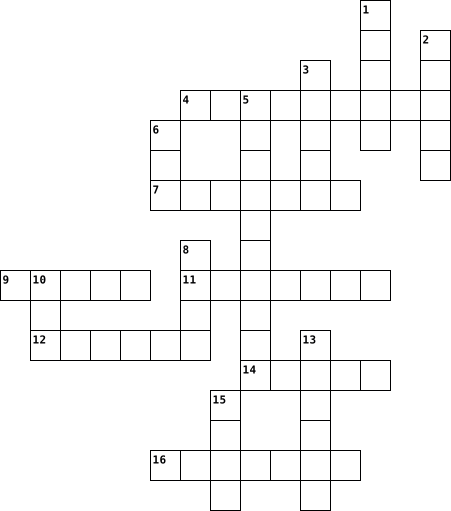
Across
- hidden
- a subdivision of an army
- Occurs everyday
- periodic element
- code word for the Letter Y in the Nato Phonetic alphabet
- European country
- intricate or complicated
Down
- to suggest something without saying it
- beneath
- to produce or provide
- Australian soap opera
- common term for a public house
- type of woodwind instrument
- Acrtess, ... Adams
- someone who cuts hair
- a circus act
16 Clues: hidden • beneath • a circus act • Occurs everyday • periodic element • European country • Acrtess, ... Adams • to produce or provide • Australian soap opera • someone who cuts hair • a subdivision of an army • intricate or complicated • type of woodwind instrument • common term for a public house • to suggest something without saying it • ...
science final 2024-12-18

Across
- water makes up
- different forms of atoms
- what is the squar root or 555656575656676756785778
- how easily something mixes into another
- bald guy
- first on periodic table
- who created the plum pudding model
- gulp gulp
Down
- Mr Ward brushes his hair
- subject
- how many different types of elements
- pr
- die if drink
- sticks to itself
- basic building block of matter
- yb
16 Clues: pr • yb • subject • bald guy • gulp gulp • die if drink • water makes up • sticks to itself • first on periodic table • Mr Ward brushes his hair • different forms of atoms • basic building block of matter • who created the plum pudding model • how many different types of elements • how easily something mixes into another • what is the squar root or 555656575656676756785778
Alice and Emily Crossword 2021-10-20

Across
- To discover something
- Length or Size of a Tsunami
- Damp or Wet
- To cause major damage
- Towers normally break this way
- After an earthquake
Down
- Measure's Earthquakes
- Lava Rock
- Studies Earthquakes
- Second Layer Of The Earth
- Periodic Table
- To loose something
12 Clues: Lava Rock • Damp or Wet • Periodic Table • To loose something • Studies Earthquakes • After an earthquake • Measure's Earthquakes • To discover something • To cause major damage • Second Layer Of The Earth • Length or Size of a Tsunami • Towers normally break this way
Alice and Emily Crossword 2021-10-20

Across
- To discover something
- Length or Size of a Tsunami
- Damp or Wet
- To cause major damage
- Towers normally break this way
- After an earthquake
Down
- Measure's Earthquakes
- Lava Rock
- Studies Earthquakes
- Second Layer Of The Earth
- Periodic Table
- To loose something
12 Clues: Lava Rock • Damp or Wet • Periodic Table • To loose something • Studies Earthquakes • After an earthquake • Measure's Earthquakes • To discover something • To cause major damage • Second Layer Of The Earth • Length or Size of a Tsunami • Towers normally break this way
Quarrt 2018-03-11

Across
- Negatively charged particles in an atom that are located outside of the nucleus.
- The temperature at which a liquid turns into a solid when cooled.
- an insoluble solid that emerges from a liquid solution.
- The measure of how much matter an object contains.
- A state of matter where the molecules are very spaced out and able to move around freely.
- The electrons are located in the _____ of the atom.
- The measure of the amount of matter in a given volume.
- the smallest piece of matter, can not be broken into smaller pieces, consists of a nucleus with protons and neutrons with electrons orbiting its nucleus.
- Created the First periodic table, arranged it by increasing atomic mass
- Same number of protons and electrons as the original element but different number of neutrons
- Any change that affects the physical properties of a substance.
- An object’s ability to dissolve
- A state of matter where the molecules are packed closely together and vibrating.
- A state of matter where the molecules are a little bit spaced out able to move a little freely.
- reorganized the Periodic Table in the early 1900’s according to increasing atomic number so now the elements within a period change in a predictable way
- When a substance releases energy making it hot
Down
- When a substance absorbs energy making it cold
- Any change that affects the chemical properties of substance.
- The temperature at which a liquid boils and turns to vapor.
- Same number of protons and neutrons as original element but different number of electrons.
- repeating chemical and physical properties of elements change periodically with the atomic number of the elements
- the number of protons in the nucleus of an atom, which determines the chemical properties of an element and its place in the periodic table.
- a substance that increases the rate of a chemical reaction without itself undergoing any permanent chemical change.
- The temperature at which a given solid will melt.
- The mass of an atom, on the periodic table
- The ability of a substance to burn or ignite, causing fire or combustion.
- Any substance that has mass and takes up space by having volume.
- used mathematical equations to describe the likelihood of finding an electron in a certain position. This atomic model is known as the quantum mechanical model of the atom.
- an abbreviation or short representation of a chemical element
- The amount of space that matter takes up.
- Positively charged particles in the nucleus of an atom.
- How shiny an objects is (how much light it can reflect)
- How good electrons or heat moves through a substance
- Has no charge, found in the nucleus of an atom
34 Clues: An object’s ability to dissolve • The amount of space that matter takes up. • The mass of an atom, on the periodic table • When a substance absorbs energy making it cold • Has no charge, found in the nucleus of an atom • When a substance releases energy making it hot • The temperature at which a given solid will melt. • ...
Chemistry 2022-06-07

Across
- plumbum in statement
- F in periodic table
- we breathe
- SO4
- hydrogen peroxide
- acid and alkaline
Down
- safety for your eyes
- proton number and neutron number
- chemotherapy
- who is gonna score in chemistry?
- potential of hydrogen
11 Clues: SO4 • we breathe • chemotherapy • hydrogen peroxide • acid and alkaline • F in periodic table • safety for your eyes • plumbum in statement • potential of hydrogen • proton number and neutron number • who is gonna score in chemistry?
Study Skills 2020-04-19

Across
- a person
- physical substance
- lunar phenomenon
- the "m" in e=mc^2
- planets path
Down
- moon stage
- table a chemistry chart
- celestial object
- star system
- three month period
10 Clues: a person • moon stage • star system • planets path • celestial object • lunar phenomenon • the "m" in e=mc^2 • physical substance • three month period • table a chemistry chart
Chemistry 2022-01-10

Across
- The Person that discovered most of the noble gases (last name).
- The element, which is needed to manufacture most microchips.
- A method, which is used to separate chemical compounds.
- The name of the group in the periodic table that contains oxygen.
- The name of the only non-metal element that is a liquid at room temperature.
Down
- The field of study that revolves around the chemistry of carbon compounds(... chemistry).
- The name of the person that discovered the element radium(last name).
- The element that is named after the inventor of the periodic table.
- The element, which our atmosphere is mostly composed of.
- The alcohol, which is derived of methane.
10 Clues: The alcohol, which is derived of methane. • A method, which is used to separate chemical compounds. • The element, which our atmosphere is mostly composed of. • The element, which is needed to manufacture most microchips. • The Person that discovered most of the noble gases (last name). • The name of the group in the periodic table that contains oxygen. • ...
same | David Sieg 2017-02-08

Across
- basic building blocks of all things
- electron that is located on the outer electron ring of an atom
- any characteristics of a given thing
- something made as the result of a chemical, natural, or manufacturing process
- elements of the periodic table that are grouped by their horizontal position on the table
Down
- substance made out of a single element
- you end up with the same amount that you started with
- a thing or trend that indicates a change has occurred in a certain substance
- Subatomic particle that determines the reactivity of an element
- elements of the periodic table grouped by their vertical position on the table
10 Clues: basic building blocks of all things • any characteristics of a given thing • substance made out of a single element • you end up with the same amount that you started with • electron that is located on the outer electron ring of an atom • Subatomic particle that determines the reactivity of an element • ...
Chemistry Vocab 2016-10-05

Across
- A horizontal row of elements in the modern periodic table.
- A subatomic particle in an atoms nucleus that has a positive charge.
- The extremely small positively charged dense center of an atom, contains protons and neutrons.
- A highly reactive group 17 element.
- The smallest particle of an element that retains all properties of the element.
Down
- An ion with a positive charge.
- A negatively charged, fast-moving particle with an extremely small mass.
- A vertical column of elements in the periodic table; arranged by increasing atomic number.
- A neutral subatomic particle in an atomic nucleus with a mass nearly equal to a proton.
- An ion with a negative charge.
10 Clues: An ion with a positive charge. • An ion with a negative charge. • A highly reactive group 17 element. • A horizontal row of elements in the modern periodic table. • A subatomic particle in an atoms nucleus that has a positive charge. • A negatively charged, fast-moving particle with an extremely small mass. • ...
Atomic structure 2023-02-01

Across
- a vertical column of elements on the periodic table
- a reaction where a chemical change occurs
- an atom or group or group of atoms with an electrical, formed by the loss or gain of electrons
- change a change where new substances are formed. this can not easily be reversed.
- a substance made from one type of atom
- smallest particle of chemical element that can exist
Down
- two or more different elements chemically combined
- change a change that does not result in a new substance being formed. it can be reversed
- group of atoms bonded together by sharing electrons
- a horizontal row of elements on the periodic table
10 Clues: a substance made from one type of atom • a reaction where a chemical change occurs • two or more different elements chemically combined • a horizontal row of elements on the periodic table • a vertical column of elements on the periodic table • group of atoms bonded together by sharing electrons • smallest particle of chemical element that can exist • ...
Science 50 points Crossword puzzle 2022-11-18

Across
- a simple substance that cannot be broken down into smaller parts or changed into another substance.
- able to be drawn out in a thin wire
- an element that does not have metal(like) properties
- between a nonmetal and a metal
- organizes all discovered chemical elements in periods and groups
- Creator of the periodic table
Down
- states that the properties are a periodic function of their atomic mass.
- conducts electricity ; able to conduct
- any of a class of substances that has high electrical and thermal conductivity as well as by malleability, ductility, and high reflectivity of light.
- able to be hammered or pressed permanently out of shape without breaking or cracking.
10 Clues: Creator of the periodic table • between a nonmetal and a metal • able to be drawn out in a thin wire • conducts electricity ; able to conduct • an element that does not have metal(like) properties • organizes all discovered chemical elements in periods and groups • states that the properties are a periodic function of their atomic mass. • ...
Gorlliam 2025-05-20

Across
- Which group contains most reactive metal?
- The electronic configuration for the _ _ _ _ _ _ _ _ _ shell's limit is always 2
- What is the 118th element on the periodic table?
- In the periodic table, there are _ _ _ _ _ _ _ _ _ _, non- metals and metals.
Down
- All elements in the same period have the same number of protons and _________
- What is the number of protons in an atom the same as? Is it Atomic Number or Outermost electrons?
- Which group of metals is the most reactive?
- The Noble metals is the least reactive group because their outermost shell is _ _ _ _ __
- This noble gas is the most reactive
- The _ _ _ _ _ _ _ _ _ _ _ _ consists of electrons in an outermost shell
10 Clues: This noble gas is the most reactive • Which group contains most reactive metal? • Which group of metals is the most reactive? • What is the 118th element on the periodic table? • The _ _ _ _ _ _ _ _ _ _ _ _ consists of electrons in an outermost shell • All elements in the same period have the same number of protons and _________ • ...
Crossword # 4 2021-08-06

Across
- ASSET provided to a CREDITOR as security for a loan.
- One type of long-term PROMISSORY NOTE
- Person in a brokerage house, bank trust dept., or mutual fund group who studies a number of companies and makes buy or sell recommendations on the securities of particular companies and industry groups.
- Individual or firm acting as a principal in a securities transaction.
- ASSET account on a balance sheet representing paper currency and coins, negotiable money orders and checks, bank balances, and certain short-term government securities.
Down
- The process of recording financial transactions and keeping financial records.
- ACCOUNTANT who has satisfied the education, experience, and examination requirements of his or her jurisdiction necessary to be certified as a public accountant.
- To clear the BALANCES of temporary accounts in order to be ready for the next accounting period.
- All or portion of an ACCOUNT, loan, or note receivable considered being uncollectible.
- Gradual and periodic reduction of any amount, such as the periodic write-down of a BOND premium, the cost of an intangible ASSET, or periodic payment Of MORTGAGES or other DEBT.
10 Clues: One type of long-term PROMISSORY NOTE • ASSET provided to a CREDITOR as security for a loan. • Individual or firm acting as a principal in a securities transaction. • The process of recording financial transactions and keeping financial records. • All or portion of an ACCOUNT, loan, or note receivable considered being uncollectible. • ...
General Chemistry 2020-05-25

Across
- it is a branch of chemistry that studies and uses instruments and methods used to separate identify and quantify matter.
- states that atoms other than hydrogen tend to form bonds until surrounded by eight valence electrons
- movement of one fluid through another.
- The digits in any measurement that are known with certainty plus one digit which is uncertain
- the branch of science that deals with the identification of the substances of which matter is composed; the investigation of their properties and the ways in which they interact combine and change; and the use of these processes to form new substances.
- Elements at the left side and in the center of the periodic table
- bond Formed by losing and gaining of electrons between metal and nonmetal
- Negatively charged subatomic particle of an atom
- Positively charged subatomic particle of an atom
- it is a branch of chemistry that studies the structure properties and reactions of organic compounds which contain carbon in covalent bonding. Study of structure determines their chemical composition and formula.
- Uncharged particle found within the atomic nuclei
- a substance or object that is solid rather than liquid or fluid
- the quality or state of being correct or precise.
- Mixture whose a composition varies from position to position within a sample.
- The quantity of matter in the body
- Indicates that one mole of an element has a mass in grams numerically equal to its atomic mass units
- inner transition elements located in the first row of the f block in the periodic table
- the quality, condition, or fact of being exact and accurate.
- a substance that flows freely but is of constant volume having a consistency like that of water or oil.
- a metric unit of length equal to one hundredth of a meter.
- Called as solution a mixture with uniform composition.
Down
- Element that appears at the far right side of the periodic table
- The sum of the number of protons and neutrons in its nucleus
- it is a branch of chemistry that studies the chemical processes within and relating to living organisms. Biochemical processes give rise to the complexity of life.
- Elements found in the zigzag order in the periodic table
- a substance or matter in a state in which it will expand freely to fill the whole of a container having no fixed shape and no fixed volume.
- Horizontal row in the periodic table
- Process in which the solid particles are filtered to allow the liquid or filtrate to pass through the filter and be collected as residue
- phase change in which liquid is converted to gas
- The separation of elemental metals from the mixtures
- a metric unit of capacity formerly defined as the volume of one kilogram of water under standard conditions now equal to 1 000 cubic centimeters
- Organic compound with carbon and oxygen only
- the size length or amount of something as established by measuring.
- it is a branch of chemistry that deals with synthesis and behavior of inorganic and organometallic compounds.
- the measurement or extent of something from end to end.
- the branch of chemistry concerned with the application of the techniques and theories of physics to the study of chemical systems.
- Compound that consists of two charged ions
- Ratio of the mass of an object to the volume occupied by that object.
- The amount of space occupied by a substance
- insert gas located at the rightmost side of the periodic table
- Anything that has mass and occupies space
- a chemical substance that neutralizes alkalis, dissolves some metals, and turns litmus red; typically, a corrosive or sour-tasting liquid of this kind.
- the fundamental unit of length in the metric system equal to 100 centimeters or approximately 39.37 inches.
- Substance consisting of only one kind of atom
- a period of time equal to sixty seconds or a sixtieth of an hour.
- Composed of two or more substances combined physically in variable proportions
- Group 7A elements
- Phase change that involves the conversion from solid to liquid
- Specific energy value of electrons for an atom
- Separates components of mixture at different boiling points.
- Formed when atom loses or gains electron
- Phase change in which liquid is converted to solid
52 Clues: Group 7A elements • The quantity of matter in the body • Horizontal row in the periodic table • movement of one fluid through another. • Formed when atom loses or gains electron • Anything that has mass and occupies space • Compound that consists of two charged ions • The amount of space occupied by a substance • Organic compound with carbon and oxygen only • ...
General Chemistry 2020-05-25

Across
- it is a branch of chemistry that studies and uses instruments and methods used to separate identify and quantify matter.
- states that atoms other than hydrogen tend to form bonds until surrounded by eight valence electrons
- movement of one fluid through another.
- The digits in any measurement that are known with certainty plus one digit which is uncertain
- the branch of science that deals with the identification of the substances of which matter is composed; the investigation of their properties and the ways in which they interact combine and change; and the use of these processes to form new substances.
- Elements at the left side and in the center of the periodic table
- bond Formed by losing and gaining of electrons between metal and nonmetal
- Negatively charged subatomic particle of an atom
- Positively charged subatomic particle of an atom
- it is a branch of chemistry that studies the structure properties and reactions of organic compounds which contain carbon in covalent bonding. Study of structure determines their chemical composition and formula.
- Uncharged particle found within the atomic nuclei
- a substance or object that is solid rather than liquid or fluid
- the quality or state of being correct or precise.
- Mixture whose a composition varies from position to position within a sample.
- The quantity of matter in the body
- Indicates that one mole of an element has a mass in grams numerically equal to its atomic mass units
- inner transition elements located in the first row of the f block in the periodic table
- the quality, condition, or fact of being exact and accurate.
- a substance that flows freely but is of constant volume having a consistency like that of water or oil.
- a metric unit of length equal to one hundredth of a meter.
- Called as solution a mixture with uniform composition.
Down
- Element that appears at the far right side of the periodic table
- The sum of the number of protons and neutrons in its nucleus
- it is a branch of chemistry that studies the chemical processes within and relating to living organisms. Biochemical processes give rise to the complexity of life.
- Elements found in the zigzag order in the periodic table
- a substance or matter in a state in which it will expand freely to fill the whole of a container having no fixed shape and no fixed volume.
- Horizontal row in the periodic table
- Process in which the solid particles are filtered to allow the liquid or filtrate to pass through the filter and be collected as residue
- phase change in which liquid is converted to gas
- The separation of elemental metals from the mixtures
- a metric unit of capacity formerly defined as the volume of one kilogram of water under standard conditions now equal to 1 000 cubic centimeters
- Organic compound with carbon and oxygen only
- the size length or amount of something as established by measuring.
- it is a branch of chemistry that deals with synthesis and behavior of inorganic and organometallic compounds.
- the measurement or extent of something from end to end.
- the branch of chemistry concerned with the application of the techniques and theories of physics to the study of chemical systems.
- Compound that consists of two charged ions
- Ratio of the mass of an object to the volume occupied by that object.
- The amount of space occupied by a substance
- insert gas located at the rightmost side of the periodic table
- Anything that has mass and occupies space
- a chemical substance that neutralizes some elements
- the fundamental unit of length in the metric system equal to 100 centimeters or approximately 39.37 inches.
- Substance consisting of only one kind of atom
- a period of time equal to sixty seconds or a sixtieth of an hour.
- Composed of two or more substances combined physically in variable proportions
- Group 7A elements
- Phase change that involves the conversion from solid to liquid
- Specific energy value of electrons for an atom
- Separates components of mixture at different boiling points.
- Formed when atom loses or gains electron
- Phase change in which liquid is converted to solid
52 Clues: Group 7A elements • The quantity of matter in the body • Horizontal row in the periodic table • movement of one fluid through another. • Formed when atom loses or gains electron • Anything that has mass and occupies space • Compound that consists of two charged ions • The amount of space occupied by a substance • Organic compound with carbon and oxygen only • ...
English 2AEN 2024-01-12

Across
- Extra
- Getting rid of
- Greenery
- Material
- Surname of author
- Element 6 in the periodic table
Down
- To bring something in danger
- Another option
- The kind of energy Lego factories run on
- Past, present and ...
- The thing Lego bricks are made of
- On the internet
- Company that makes wind turbines
- Danish company
14 Clues: Extra • Greenery • Material • Another option • Getting rid of • Danish company • On the internet • Surname of author • Past, present and ... • To bring something in danger • Element 6 in the periodic table • Company that makes wind turbines • The thing Lego bricks are made of • The kind of energy Lego factories run on
Random Things 2025-04-21

Across
- Famous reptile that lives in water
- State with about 6,000,000 people
- Snowy Season
- 45th and 47th president of USA
- 2 Cups; 473.176473 Ml
- Fruit made in South America
Down
- 2222
- Parks many cars
- Celebrity
- Country with many islands
- Famous American food
- Capital of England
- Fast highway
- A radioactive element in the periodic table
14 Clues: 2222 • Celebrity • Fast highway • Snowy Season • Parks many cars • Capital of England • Famous American food • 2 Cups; 473.176473 Ml • Country with many islands • Fruit made in South America • 45th and 47th president of USA • State with about 6,000,000 people • Famous reptile that lives in water • A radioactive element in the periodic table
unit 3 vocab 2025-10-16

Across
- hard an atom pulls bonding
- numbers set of values
- arranging elements
- radius size of ion
- effect positive nucleus on outer electrons
Down
- area of finding an electron
- electrons outermost energy level
- radius size of atom
- characteristics of metals + nonmetals
- minimum amount of energy
- organized space
- good insulator
- law physical chemical properties
- good conductor of heat
- rule empty orbitals
15 Clues: good insulator • organized space • arranging elements • good conductor of heat • radius size of atom • numbers set of values • radius size of ion • minimum amount of energy • hard an atom pulls bonding • rule empty orbitals • area of finding an electron • electrons outermost energy level • characteristics of metals + nonmetals • law physical chemical properties • ...
Rylie Spencer CrossWord 2023-09-25

Across
- in chemistry, a column in the periodic table of the chemical elements.
- a substance that cannot be separated or broken down into simpler substances by chemical means
- number the number of protons in the nucleus of an atom; the atomic number is the same for all atoms of an element
- table an arrangement of the elements in order of their atomic numbers such that elements with similar properties fall in the same column
- a subatomic particle that has no charge and that is located in the nucleus of an atom
Down
- a subatomic particle that has a positive charge and that is located in the nucleus of an atom; the number of protons in the nucleus is the atomic number, which determines the identity of an element
- a subatomic particle that has a negative charge
- number in nuclear physics, the sum of the numbers of protons and neutrons present in the nucleus of an atom.
- the smallest unit of an element that maintains the properties of that element
- a horizontal row of the periodic table.
10 Clues: a horizontal row of the periodic table. • a subatomic particle that has a negative charge • in chemistry, a column in the periodic table of the chemical elements. • the smallest unit of an element that maintains the properties of that element • a subatomic particle that has no charge and that is located in the nucleus of an atom • ...
Addison Griffin's Week 4 Vocabulary 2023-09-25

Across
- the number of protons in a nucleus in an atom
- an arrangement of elements in order of their atomic number such that elements with similar properties fall in the same group
- the smallest unit of an element that maintains the properties of that elements
- in chemistry, a column in the periodic table of the chemical elements
- A subatomic particle located in the nucleus of an atom; positively charged
Down
- nuclear physics, the sum of the numbers of protons and neutrons present in the nucleus of an atom.
- A subatomic particle that has a negative charge
- A subatomic particle that has no charge and is located in the nucleus of an atom
- a substance that can't be separated or broken
- A period is a horizontal row of the periodic table. There are seven periods in the periodic table, with each one beginning at the far left. A new period begins when a new principal energy level begins filling with electrons. Period 1 has only two elements (hydrogen and helium), while periods 2 and 3 have 8 elements.
10 Clues: the number of protons in a nucleus in an atom • a substance that can't be separated or broken • A subatomic particle that has a negative charge • in chemistry, a column in the periodic table of the chemical elements • A subatomic particle located in the nucleus of an atom; positively charged • ...
SCIENCE 2016-01-17

Across
- The study of interactions between organisms and their environment is called_____
- ____are often slippery substances that are used for cleaning.
- The longest phase of the cell cycle is______
- Elements in the same period have the same number of _____
- Which body system pumps and transports the blood to all parts of the body as well as supply oxygen and remove waste products from body tissues?
- This structure, found in cells, assembles proteins.
- This is the structure in plant cells that captures the sun's energy and changes it into chemical energy.
- Which area of Earth science includes the study of stars?
- In addition to food, what else does a mitochondrion need to release energy?
- What day is it when the sun is at its lowest elevation in the sky all year and we experience the shortest day of the year?
- A species in danger of becoming extinct in the near future is referred to as a(an)_________species.
- Which of the following nutrients is used to build and repair cells?
- On the Periodic Table, elements that are in the same vertical column are considered to be in the same_____
Down
- On the Periodic Table, all elements that are in the same horizontal rows are considered to be in the same ____
- What is the hormone responsible for causing sudden emotional changes and sexual feelings that occur in males during puberty?
- What is the recycling of chemical elements throughout an ecosystem called?
- The outer layers of plants, fungi and some protist cells which support and protect the cell are called the _____
- Which term refers to the number of protons in an atom and helps to place elements on the Periodic Table?
- Which subatomic particle is NOT found in the nucleus of an atom?
- The breaking down of rocks on the earth's surface is ____
- Which organelle contains nearly all of a eukaryotic cell's DNA?
- If fish are caught faster than they can breed, what will happen to the population?
- Which subatomic particle has a positive charge?
23 Clues: The longest phase of the cell cycle is______ • Which subatomic particle has a positive charge? • This structure, found in cells, assembles proteins. • Which area of Earth science includes the study of stars? • Elements in the same period have the same number of _____ • The breaking down of rocks on the earth's surface is ____ • ...
chapter 1 vocabulary 2013-09-08

Across
- substance that reacts in a chemical change
- element that has some characteristics of metals and non metals
- fixed composition and differs from a mixture
- vertical column of the periodic table
- pure substance made of only one kind of atom
- section of elements on the periodic table
- study of the composition, structure and properties of matter and the change it undergoes
- high temperature physical state of matter in which atoms lose their electrons
- substance that is formed by a chemical change
- any substance that has a definite composition
- property that depends on amount of matter that is present
- change in a substance that does not involve a change in the identity of the substance
- having uniform composition throughout
- element that is poor conductor of heat and electricity
- blend of 2 or more kinds of matter each of which retain its own identity and properties
Down
- anything that takes up space and has mass
- substance made from the atoms of 2 or more elements that are chemically bonded
- property that does not depend on the amount of matter present
- state of matter in which a substance has neither definite volume nor definite shape
- characteristic that can be observed or measured without changing the identity of the substance
- smallest unit of an element that maintains the properties of that element
- not having a uniform composition throughout
- element that is a good conductor of heat and electricity
- homogeneous mixture of 2 or more substances in a single phase
- horizontal row of elements in the periodic table
- ability of a substance to undergo a change that transforms it into a different substance
- which one or more substances are converted into different substances
- change in which one or more substances are converted into different substances
- state of matter which the substance has definite volume and definite shape
- state of matter in which the substances has a definite volume but not definite shape
- measured amount of matter
31 Clues: measured amount of matter • vertical column of the periodic table • having uniform composition throughout • anything that takes up space and has mass • section of elements on the periodic table • substance that reacts in a chemical change • not having a uniform composition throughout • fixed composition and differs from a mixture • ...
Chemistry crossword 2015-11-13

Across
- positively charged particle in the nucleus of an atom
- vertical column of elements in the periodic table;elements in a family all have similar chemical properties;also called a group
- catalyst involved in chemical reactions in living things
- invisible negatively charged particle that orbits the nucleus of an atom
- group 17 elements in the periodic table;the most reactive non-metals
- element that has both metallic and non-metallic properties
- description of a substance that can be pounded or rolled into sheets
- horizontal row of elements in the periodic table
- chemical reaction that occurs when oxygen reacts with a substance to form a new substance and give off energy
- substance that reacts with another substance or substances in a chemical reaction to create new substances with different properties
- group of atoms joined by covalent bonds
- atom that has become electrically charged because it has lost or gained electrons;a positive ion is an atom that has lost one or more electrons;a negative ion is an atom that has gained one or more electrons
- positively charged centre of an atom;contains protons and neutrons
Down
- ability to do work
- neutral particle in a nucleus of an atom
- combination of pure substances;unlike a compound,the components of a mixture do not combine chemically and are not always in the same ratio
- amount of mass in a given volume of a substance
- variations within a species
- pure substance that cannot be broken down into other substances;substance made up of only one type of atom
- new substances produced in a chemical reaction between reactants
- the smallest part of an element that is representative of that element;a neutral particle made up of a nucleus containing protons and neutrons,and in which the number of electrons equals the number of protons
- substance that helps a chemical reaction to proceed more quickly
- shiny,malleable,ductile element that conducts electricity
- chemical combination of two or more elements in a specific ratio
- organic molecules made up of atoms of carbon,hydrogen and oxygen (ex,fats,oils and waxes);lipids are insoluble in water
25 Clues: ability to do work • variations within a species • group of atoms joined by covalent bonds • neutral particle in a nucleus of an atom • amount of mass in a given volume of a substance • horizontal row of elements in the periodic table • positively charged particle in the nucleus of an atom • catalyst involved in chemical reactions in living things • ...
C4 The Periodic Table 2016-02-17

Across
- A chemical able to be dissolved in a SOLVENT.
- A subatomic particle with a positive electric charge.
- Different forms of the same element, which have the same number of PROTONS, but a different number of NEUTRONS.
- A man who created the basis for the modern periodic table.
- A metal that is found in the middle block of the periodic table. Examples include copper, zinc and iron.
- Elements in group 1 which have 1 electron in their outer shell.
- The energy levels which ELECTRONS can inhabit.
- When two SOLUTIONS react to form an insoluble solid.
- The way in which ELECTRONS are organised across SHELLS.
- A structure formed between metal and non-metal IONS.
- A type of bonding which happens when two non-metals share electrons in their outer shells.
- A man who, in 1828, put elements into groups, called triads, based on their Chemical properties.
- A subatomic particle with no electric charge.
Down
- The centre of an ATOM that contains the PROTON and NEUTRON.
- Elements in group 7 which have 7 electrons in their outer shell.
- The loss of electrons.
- The process of breaking down a substance by heating.
- A mixture of a SOLVENT and SOLUTES.
- A type of bonding which happens between oppositely charged IONS.
- The mass of a NUCLEUS of an ATOM.
- A substance that increases the rate of a chemical reaction without itself undergoing any permanent chemical change.
- The gain of electrons.
- A type of bonding which happens between metals. The outer electrons of the metals move freely.
- Metals that are cold enough that they have no electric resistance.
- The number on the periodic table that tells you how many PROTONS any atom has.
- A man who, in 1864, put elements into rows of 7, as he noticed every 8th element had similar properties.
- A chemical able to dissolve other substances.
- A subatomic particle with a negative electric charge.
- The smallest particle of a chemical element that can exist.
- An atom that has become charged due to the loss or gain of electrons.
30 Clues: The loss of electrons. • The gain of electrons. • The mass of a NUCLEUS of an ATOM. • A mixture of a SOLVENT and SOLUTES. • A chemical able to be dissolved in a SOLVENT. • A chemical able to dissolve other substances. • A subatomic particle with no electric charge. • The energy levels which ELECTRONS can inhabit. • The process of breaking down a substance by heating. • ...
nolans pro study thingy 2022-09-09

Across
- Each element’s AES is
- Waves per second
- Unit of frequency
- This color has the lowest frequency
- In the Plum-Pudding atom experiment, alpha particles traveled _____
- All of these waves travel at the speed of 3.00 x 10^8 m/s in a vacuum
- The flame test was _____
- Every atom has this
- The number of columns on the periodic table
- These electrons are usually at the ground state
- Atoms return to this state after absorbing energy
- These atoms do not have any charge
- This color has the highest frequency
- The unit of measurement for Wavelength
- The larger the wavelength, the _____ they are
- The top right superscript in an element’s full atomic symbol represents this
- Atoms with the same number of protons but different numbers of neutrons
- Alpha particles tend to _____ the nucleus
- We rolled these in the Gold Foil Experiment
- This element is the fourth noble gas
- A particle of light
- These waves have the highest frequency and are the most dangerous
- These atoms are positively charged
Down
- Atoms turn into this state after absorbing energy from flames
- This man discovered how to determine the diameter of the nucleus of an atom
- Most particles that went through the gold foil were _____
- This man created the formula E=hv
- Atoms are mostly _____ space
- Wavelength is inversely _____ to energy
- The number of rows on the periodic table
- This element is the first noble gas
- Atoms absorb this
- It gets _____ the closer you get to the nucleus
- This element begins with "Flu"
- This element is similar to "Board" (starts with a B)
- The unit the visible spectrum uses
- Atoms in the excited state are very
- This element represents Ne
- The plural form of nucleus
- The speed of light is :
- Atoms with a positive charge
- Light at a certain frequency causes metals to _____ their electrons
- Atoms are made up of _____ particles
- The first element on the periodic table
- Used to transmit information
45 Clues: Waves per second • Unit of frequency • Atoms absorb this • Every atom has this • A particle of light • Each element’s AES is • The speed of light is : • The flame test was _____ • This element represents Ne • The plural form of nucleus • Atoms are mostly _____ space • Atoms with a positive charge • Used to transmit information • This element begins with "Flu" • ...
ADNAN MUFLEH VOCAB 6B 2017-03-24

Across
- Reaction- A chemical reaction in which heat is released and usually feels warm when the heat is released from the reaction.
- Reaction- A chemical reaction that requires an input of energy and usually feels cold when it absorbs heat in the reaction.
- of Conservation of Mass- states that matter is neither created nor destroyed in ordinary chemical and physical changes.
- horizontal row of elements on the Periodic Table that have the same number of electron shells.
Down
- Electron- electrons on the outermost energy level of an atom that determine the reactivity of the atom.
- elements that have some properties of metals and non-metals and are found along the zigzag on the Periodic Table.
- Bond- an interaction that holds atoms together.
- vertical column of elements on the Periodic Table that have similar physical and chemical properties.
8 Clues: Bond- an interaction that holds atoms together. • horizontal row of elements on the Periodic Table that have the same number of electron shells. • vertical column of elements on the Periodic Table that have similar physical and chemical properties. • Electron- electrons on the outermost energy level of an atom that determine the reactivity of the atom. • ...
ADNAN MUFLEH VOCAB 6B 2017-03-24

Across
- Reaction- A chemical reaction that requires an input of energy and usually feels cold when it absorbs heat in the reaction.
- vertical column of elements on the Periodic Table that have similar physical and chemical properties.
- Bond- an interaction that holds atoms together.
Down
- Electron- electrons on the outermost energy level of an atom that determine the reactivity of the atom.
- horizontal row of elements on the Periodic Table that have the same number of electron shells.
- Reaction- A chemical reaction in which heat is released and usually feels warm when the heat is released from the reaction.
- elements that have some properties of metals and non-metals and are found along the zigzag on the Periodic Table.
- of Conservation of Mass- states that matter is neither created nor destroyed in ordinary chemical and physical changes.
8 Clues: Bond- an interaction that holds atoms together. • horizontal row of elements on the Periodic Table that have the same number of electron shells. • vertical column of elements on the Periodic Table that have similar physical and chemical properties. • Electron- electrons on the outermost energy level of an atom that determine the reactivity of the atom. • ...
Vocab 6b 2017-03-21

Across
- of Conservation of Mass- states that matter is neither created nor destroyed in ordinary chemical and physical changes.
- Reaction- A chemical reaction that requires an input of energy and usually feels cold when it absorbs heat in the reaction.
- vertical column of elements on the Periodic Table that have similar physical and chemical properties.
- Bond- an interaction that holds atoms together.
Down
- Electron- electrons on the outermost energy level of an atom that determine the reactivity of the atom.
- horizontal row of elements on the Periodic Table that have the same number of electron shells.
- elements that have some properties of metals and non-metals and are found along the zigzag on the Periodic Table.
- Reaction- A chemical reaction in which heat is released and usually feels warm when the heat is released from the reaction.
8 Clues: Bond- an interaction that holds atoms together. • horizontal row of elements on the Periodic Table that have the same number of electron shells. • vertical column of elements on the Periodic Table that have similar physical and chemical properties. • Electron- electrons on the outermost energy level of an atom that determine the reactivity of the atom. • ...
6B 2017-03-31

Across
- Electron- electrons on the outermost energy level of an atom that determine the reactivity of the atom.
- horizontal row of elements on the Periodic Table that have the same number of electron shells.
- Reaction- A chemical reaction in which heat is released and usually feels warm when the heat is released from the reaction.
- elements that have some properties of metals and non-metals and are found along the zigzag on the Periodic Table.
Down
- of Conservation of Mass- states that matter is neither created nor destroyed in ordinary chemical and physical changes.
- Reaction- A chemical reaction that requires an input of energy and usually feels cold when it absorbs heat in the reaction.
- Bond- an interaction that holds atoms together.
- vertical column of elements on the Periodic Table that have similar physical and chemical properties.
8 Clues: Bond- an interaction that holds atoms together. • horizontal row of elements on the Periodic Table that have the same number of electron shells. • vertical column of elements on the Periodic Table that have similar physical and chemical properties. • Electron- electrons on the outermost energy level of an atom that determine the reactivity of the atom. • ...
Group 0 elements 2022-11-01

Across
- A Group 0 element used in fluorescent lighting and signs.
- On the right-hand side of the periodic table.
- The state of matter of Group 0 elements at room temperature.
Down
- A Group 0 element in Period 4.
- A Group 0 element with the chemical symbol 'Xe'.
- On the left-hand side and centre of the periodic table.
- The element at the top of Group 0.
- The element below neon in Group 0.
8 Clues: A Group 0 element in Period 4. • The element at the top of Group 0. • The element below neon in Group 0. • On the right-hand side of the periodic table. • A Group 0 element with the chemical symbol 'Xe'. • On the left-hand side and centre of the periodic table. • A Group 0 element used in fluorescent lighting and signs. • ...
Science crossword puzzel 2017-03-20

Across
- Electron electrons on the outermost energy level of an atom that determine the reactivity of the atom.
- Reaction A chemical reaction in which heat is released and usually feels warm when the heat is released from the reaction.
- vertical column of elements on the Periodic Table that have similar physical and chemical properties.
- elements that have some properties of metals and non-metals and are found along the zigzag on the Periodic Table.
Down
- Reaction A chemical reaction that requires an input of energy and usually feels cold when it absorbs heat in the reaction.
- horizontal row of elements on the Periodic Table that have the same number of electron shells.
- Bond an interaction that holds atoms together.
- of Conservation of Mass states that matter is neither created nor destroyed in ordinary chemical and physical changes.
8 Clues: Bond an interaction that holds atoms together. • horizontal row of elements on the Periodic Table that have the same number of electron shells. • vertical column of elements on the Periodic Table that have similar physical and chemical properties. • Electron electrons on the outermost energy level of an atom that determine the reactivity of the atom. • ...
Vocab 6B 2017-03-24

Across
- Horizontal row of elements on the Periodic Table that have the same number of electron shells
- of conservation of mass States that matter is neither created nor destroyed in ordinary chemical and physical changes
- reaction A chemical reaction that requires an input of energy and usually feels cold when it absorbs heat in the reaction
- bond an interaction that holds atoms together
Down
- Vertical column of elements on the Periodic Table that have similar physical and chemical properties
- reaction A chemical reaction in which heat is released and usually feels warm when the heat is released from the reaction
- electron Electrons on the outermost energy level of an atom that determine the reactivity of the atom
- Elements that have some properties of metals and non-metals and are found along the zigzag on the Periodic Table
8 Clues: bond an interaction that holds atoms together • Horizontal row of elements on the Periodic Table that have the same number of electron shells • Vertical column of elements on the Periodic Table that have similar physical and chemical properties • electron Electrons on the outermost energy level of an atom that determine the reactivity of the atom • ...
Yeah 2017-03-23

Across
- of Conservation of Mass- states that matter is neither created nor destroyed in ordinary chemical and physical changes.
- Reaction- A chemical reaction in which heat is released and usually feels warm when the heat is released from the reaction.
- Bond- an interaction that holds atoms together.
- Reaction- A chemical reaction that requires an input of energy and usually feels cold when it absorbs heat in the reaction.
- vertical column of elements on the Periodic Table that have similar physical and chemical properties.
Down
- Electron- electrons on the outermost energy level of an atom that determine the reactivity of the atom.
- elements that have some properties of metals and non-metals and are found along the zigzag on the Periodic Table.
- horizontal row of elements on the Periodic Table that have the same number of electron shells.
8 Clues: Bond- an interaction that holds atoms together. • horizontal row of elements on the Periodic Table that have the same number of electron shells. • vertical column of elements on the Periodic Table that have similar physical and chemical properties. • Electron- electrons on the outermost energy level of an atom that determine the reactivity of the atom. • ...