
periodic+table Crossword Puzzles
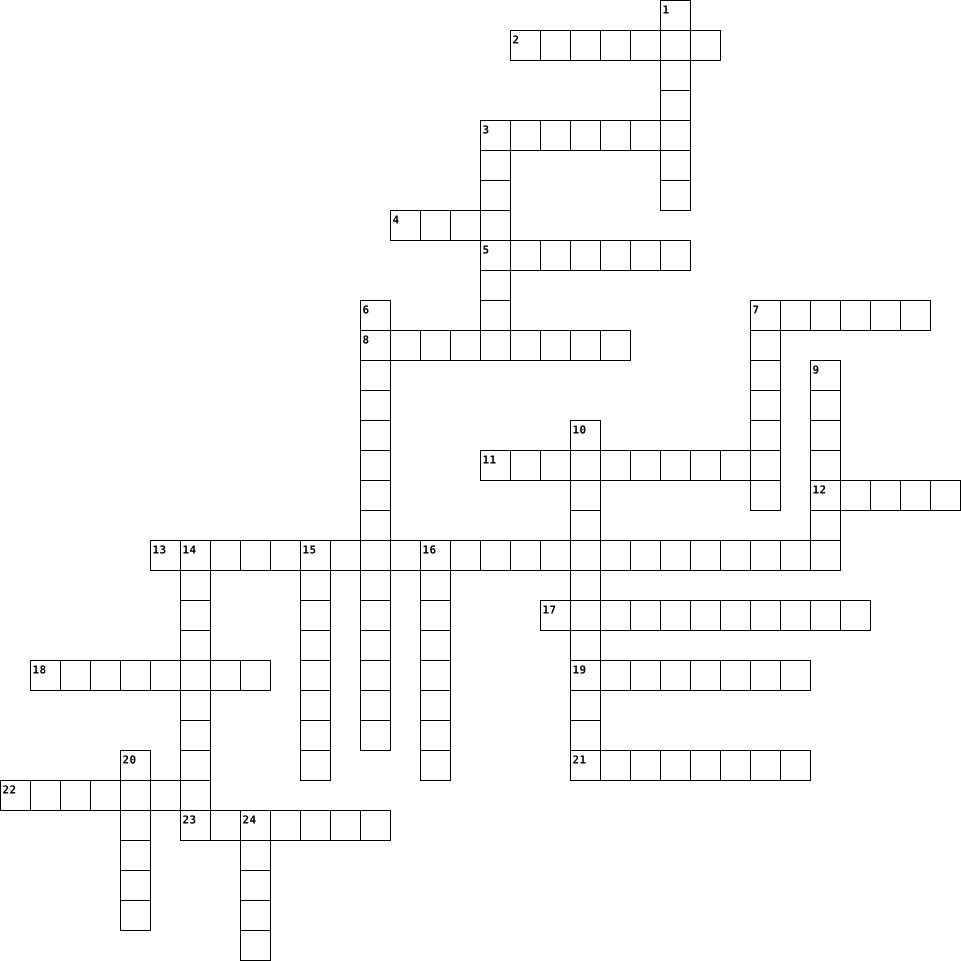
Chemistry crossword 2015-12-02

Across
- a chemical reaction that occurs when oxygen reacts with a substance to form a new substance and give off energy
- group of atoms joined by covalent bonds
- anything that has mass and occupies space
- made of only one kind of matter
- horizontal row of elements in the periodic table
- group 17 elements in the periodic table
- group 1 elements in the periodic table, not including hydrogen
- a system of easy-to-see warning symbols on hazardous materials
- pure substance formed when non-metals combine
- a table in which the elements are organized by their physical and chemical properties
- pure substance formed when at least one metal and one non-metal combine
- change in the appearance or state of a substance that does not change the composition
- vertical column of elements in the periodic table
- measure of one atomic mass
- the ability of a substance to conduct electricity or heat
Down
- positively charged centre of an atom; contains protons and neutrons
- combination of symbols that represent a compound
- occurs when two or more materials react and create new materials
- characteristics that describe a particular substance (e.g. colour, lustre, melting point)
- netrual particle in the nucleus of an atom
- a reaction that takes place when two or more substances react to form new substances
- amount of mass in a given volume of a substance
- positively charged particle in the nucleus of an atom
- group of atoms acting as one
- mass of one atom of an element calculated from the total number of protons, neutrons, electrons of that atom
25 Clues: measure of one atomic mass • group of atoms acting as one • made of only one kind of matter • group of atoms joined by covalent bonds • group 17 elements in the periodic table • anything that has mass and occupies space • netrual particle in the nucleus of an atom • pure substance formed when non-metals combine • amount of mass in a given volume of a substance • ...
Work Science 2025-08-28

Across
- The maximum number of known electron shells in an atom
- When a single compound breaks down into two or more simpler products
- The fifteenth element on the periodic table
- When elements or compounds rearrange themselves in an equation
- The type of atom bonding when electrons are shared
- The name for a row in the periodic table
- A chemical reaction between a substance and oxygen
- The name for a column in the periodic table
- The name for a bunch of atoms bonded together
- When a nucleus loses or gains a neutron
- The last element in the periodic table (118th)
- The element with the chemical symbol 'Mg'
Down
- The name of element made only in a lab by scientists
- What is produced when elements combine together chemically
- The name of the subatomic particle orbiting the nucleus
- A reaction when an acid is added to a base, forming water and at least one other substance
- The name for the number of protons in an atom (2 words no spaces)
- The positively charged subatomic particle within the nucleus of an atom
- Chemicals that change colour when added to an acid or a base
- An element made up of only one atom (2 words no spaces)
- The process or result of something being oxidised
- When two or more substances combine to produce a single substance
- The total number of protons and neutrons in an atom (2 words no spaces)
- The name of the person to develop the first scientific model of an atom (2 words no spaces)
- The type of atom bonding when electrons are transferred
- The sharing of electrons in chemistry
- The name for the metals in the first group of the peroidic table
27 Clues: The sharing of electrons in chemistry • When a nucleus loses or gains a neutron • The name for a row in the periodic table • The element with the chemical symbol 'Mg' • The fifteenth element on the periodic table • The name for a column in the periodic table • The name for a bunch of atoms bonded together • The last element in the periodic table (118th) • ...
periodic table crossword 2025-11-21

Across
- nonmetals have a __ melting point
- this elements is a halogen and has the symbol CL
- these groups are the most reactive non metals
- Fluorine sulfur and bromine are all examples of this element
- noble gasses have this many valence electrons
- this group have high melting and boiling points
- this group is radioactive
- this element is a part of the transitions metals that's symbol is TI
- this structure uses dots to show valence electrons
- bromine's charge when a ion is
- this element is a part of the noble gasses and has the symbol Ar
- the first the first periodic table sorted by ____________
- metalloids can be both shiny and ____
- this group has a full valence shell
- Lithium, sodium, and potassium are all parts of this element
Down
- these groups have a plus two charge
- this is the only group that cant be a ion
- this is the most reactive element on the table
- metals these groups are extremely soft
- oxygen's charge when a ion is
- this element is a part of the alkaline earth metals
- this is a part of the Actinide and symbol is U
- three nitrogen charge when a ion is
- Germanium Tellurium and astaline are all examples of this element
- theses groups are good conductors of heat
- Who Made the first periodic table
- metals are ____ conductors of electricity
- Changed the periodic table to be sorted by atomic numeber
- this element is a part of the alkali metals
- this is the least reactive element on the periodic table
- this event is a part of Lanthanide group and symbol is CE
31 Clues: this group is radioactive • oxygen's charge when a ion is • bromine's charge when a ion is • nonmetals have a __ melting point • Who Made the first periodic table • these groups have a plus two charge • three nitrogen charge when a ion is • this group has a full valence shell • metalloids can be both shiny and ____ • metals these groups are extremely soft • ...
Periodic Table Crossword Puzzle 2022-02-24

Across
- I am what fuels the sun.
- I am the combination of elements.
- I make the bones strong.
- We are nonreactive and are group 18.
- We are elements that touch the zig zag lines.
- We make up most of the elements on the periodic table.
Down
- We are in group 17 and are salt performers.
- I am on the right side of the periodic table.
- I am all of the periodic table.
- I am on the bottom part of the periodic table.
10 Clues: I am what fuels the sun. • I make the bones strong. • I am all of the periodic table. • I am the combination of elements. • We are nonreactive and are group 18. • We are in group 17 and are salt performers. • I am on the right side of the periodic table. • We are elements that touch the zig zag lines. • I am on the bottom part of the periodic table. • ...
atomic structure & the periodic table 2013-11-22

Across
- the number of electrons that can fit in shells past the first shell
- group one in the periodic table
- group 0 or 8 in the periodic table
- inventor of the first version of the modern periodic table
- found in the nucleus
Down
- the particles surrounding the nucleus in shells
- the number of electrons that can fit in the first shell of an atom
- the mass number of oxygen
- this tells you the number of protons in the atom
- the periodic table is arranged horizontally in ...
10 Clues: found in the nucleus • the mass number of oxygen • group one in the periodic table • group 0 or 8 in the periodic table • the particles surrounding the nucleus in shells • this tells you the number of protons in the atom • the periodic table is arranged horizontally in ... • inventor of the first version of the modern periodic table • ...
Properties of Elements DMS 2025 2025-09-10

Across
- The Periodic Table of ____________.
- breaks easily
- can be hammered into a thin sheet
- able to be stretched into thin wires
- most of the nonmetals are this at room temperature
Down
- shiny or dull
- the first metal found on the Periodic Table
- the first element on the Periodic Table
- has luster, brittle and are semiconductors
- malleable, has luster, ductile and is a good conductor
- brittle, dull and poor conductor
- all but one metal element is this at room temperature
12 Clues: shiny or dull • breaks easily • brittle, dull and poor conductor • can be hammered into a thin sheet • The Periodic Table of ____________. • able to be stretched into thin wires • the first element on the Periodic Table • has luster, brittle and are semiconductors • the first metal found on the Periodic Table • most of the nonmetals are this at room temperature • ...
Chemistry Unit Vocab 2023-04-13

Across
- It's number 6 on row 2, and you say this word before dioxide
- It's atomic number is 55.933
- Its atomic number is 131.29
- It's the only non-metal on the metal side of the periodic table.
- its atomic number is 118.71
- Its alkali metal and its atomic number is 223.02
- Its atomic number is 107.868
Down
- Its atomic number is 18.998
- It's a noble gas and its atomic number is 39.948
- Its atomic number is 196.967
- Its atomic number is 15.999
- It's atomic number is 4.003
- It's the last element on row 2 of the periodic table
- Its number 5 on row 2 of the periodic table
- It's number 28 on row 4 and its atomic number is 58.693
15 Clues: Its atomic number is 18.998 • Its atomic number is 15.999 • Its atomic number is 131.29 • It's atomic number is 4.003 • its atomic number is 118.71 • Its atomic number is 196.967 • It's atomic number is 55.933 • Its atomic number is 107.868 • Its number 5 on row 2 of the periodic table • It's a noble gas and its atomic number is 39.948 • ...
Chemistry Crossword puzzle by Eniayo 2023-04-14

Across
- A vertical row of the periodic table
- cloud where elctrons are located
- The ability for something to break easily
- a thing that is composed of two or more elements
- The center of an atom
- table the table of all the elements
Down
- a small particle with a negative charge
- anything that takes up space and has mass
- number the amount of protons in an element
- the horizontal row of the periodic table
- How shiny something is and how it reflects light
- the study of properties and the basics of matter
12 Clues: The center of an atom • cloud where elctrons are located • table the table of all the elements • A vertical row of the periodic table • a small particle with a negative charge • the horizontal row of the periodic table • anything that takes up space and has mass • The ability for something to break easily • number the amount of protons in an element • ...
Chemistry Crossword 2021-01-13

Across
- row on periodic table
- Vertical column on Periodic table
- in all atoms has - charge
- gases conduct electricity low boiling point
- same number of protons but different neutrons
- mixture of metals and non metal like tin
- total mass of atom
- particle with no electric charge
Down
- table chemical elements chart
- subatomic particle with a + charge
- readily forms positive ions
- time of half reduction from value
- center core of atom largest mass
- number of protons in the nucleus of atom
- net electric charge due to loss or gain of electrons
15 Clues: total mass of atom • row on periodic table • in all atoms has - charge • readily forms positive ions • table chemical elements chart • center core of atom largest mass • particle with no electric charge • Vertical column on Periodic table • time of half reduction from value • subatomic particle with a + charge • mixture of metals and non metal like tin • ...
Periodic Table and its Trends 2024-05-03

Across
- family What is the family to the left of the Noble gasses
- What element has the Symbol AU
- What nonmetal has a mass of 35.45
- What are the elements located on the right side of the Periodic Table called
- What is a column called on the periodic
- What is the element that has 3 protons
- What is the Metal that creates the Ionic Bond KCl
Down
- What is a row on the periodic table called
- What is the element at the top of the staircase
- What are the elements of the left side of the Periodic table called
- What is the Element that has the symbol Rb
- What is the noble gas that is located on the 6th row
- earth metal What is the name of the family to the right of the Alkali metals
- What is the only Metal that is a liquid
- What are the elements located on the staircase called
- What is the Element in the Alkali metals family on the 3rd row
- What element has the symbol FE
17 Clues: What element has the Symbol AU • What element has the symbol FE • What nonmetal has a mass of 35.45 • What is the element that has 3 protons • What is the only Metal that is a liquid • What is a column called on the periodic • What is a row on the periodic table called • What is the Element that has the symbol Rb • What is the element at the top of the staircase • ...
periodic table labs 2023-12-01

Across
- ______-metal are extremely soft
- semi_______ property of metalloids
- ______-gases colorless, oderless, tasteless
- alkaline earth type metal
- _________-metals good conductors for electricity for heat
- made periodic table by atomic number
- Russian chemist who made periodic table by mass
Down
- _________-metals oxidize in air
- first piriodic table by atomic mass was not given credit due to incompleteness
- nonmetal with 6 protons
- property of nonmetals
- metalloid with 4 protons
- property of metals
- most reactive nonmetal
14 Clues: property of metals • property of nonmetals • most reactive nonmetal • nonmetal with 6 protons • metalloid with 4 protons • alkaline earth type metal • ______-metal are extremely soft • _________-metals oxidize in air • semi_______ property of metalloids • made periodic table by atomic number • ______-gases colorless, oderless, tasteless • ...
Science crossword 2020-12-16

Across
- The element that we breathe in.
- Nutrient that provides energy.
- Drug that has a medical benefits.
- Tube that food travels to the stomach.
- Vital nutrients needed in small amounts.
- The drug found in alcoholic drinks.
- The periodic table is full of _______.
- Organisms that eat other organisms.
- Organism that makes its own food.
- Variation which comes from parents.
- Lacking a certain vitamin or mineral.
Down
- We breathe out carbon _________.
- Elements are listed in the _____ table.
- DNA is stored here.
- The _______ solution tests for sugars.
- The area in which an organism lives.
- Smallest particle is called an ____.
- Two oxygen atoms bond to form a ______.
- Table salt is called _______ chloride.
- Our cells are made up of 70% _____.
- Nutrient used for growth and repair.
21 Clues: DNA is stored here. • Nutrient that provides energy. • The element that we breathe in. • We breathe out carbon _________. • Drug that has a medical benefits. • Organism that makes its own food. • The drug found in alcoholic drinks. • Organisms that eat other organisms. • Our cells are made up of 70% _____. • Variation which comes from parents. • ...
Periodic Table 2024-12-09

Across
- The elements below the table numbered 57-71
- The staircase section on the Periodic Table
- An element that is commonly found in bananas
- A metal that is liquid at room temp.
- Rows on the Periodic Table
Down
- An element with an atomic number of 1
- A shiny, ductile, malleable solid
- The elements below the table numbered 89-103
- Columns on the Periodic Table
- A metal with a chemical symbol of Au
10 Clues: Rows on the Periodic Table • Columns on the Periodic Table • A shiny, ductile, malleable solid • A metal with a chemical symbol of Au • A metal that is liquid at room temp. • An element with an atomic number of 1 • The elements below the table numbered 57-71 • The staircase section on the Periodic Table • The elements below the table numbered 89-103 • ...
Groups and Rates 2024-10-15

Across
- A gas that is often found in bleach
- The word for a column in the periodic table
- Used to test for chlorine
- A group one metal that burns with a lilac flame
- Which group in the periodic table has 7 electrons in its outer shell?
Down
- Which group has a full outer shell?
- An element in group 1 that is less reactive than sodium
- A substance used as an antiseptic
- Which group in the periodic table has one electron in its outer shell?
- The word for a row in the periodic table
- An element in group 7 that is more reactive than Chlorine
11 Clues: Used to test for chlorine • A substance used as an antiseptic • Which group has a full outer shell? • A gas that is often found in bleach • The word for a row in the periodic table • The word for a column in the periodic table • A group one metal that burns with a lilac flame • An element in group 1 that is less reactive than sodium • ...
Atoms and Periodic Table Review! 2021-10-13

Across
- basic unit of matter
- these elements have properties of both metals and non metals
- name of horizontal columns on the Periodic Table
- number of neutrons in an atom of lithium
- number of electrons in an atom of flourine
- this class of elements are malleable, ductile, and are good conductors of electricity
- positively charged particles in an atom
- tendency of a substance to crumble or break apart when little force is applies
- part of an atom where most of the mass comes from
Down
- The Periodic Table is organized by what number
- the number in an element box that is always a decimal
- negatively charged particles in an atom
- the way metals can be rolled into wires
- the ability of metals to be hammered or rolled
- charge of a neutron
- refers to the way a metal reflects light
- name of vertical columns on the Periodic Table
17 Clues: charge of a neutron • basic unit of matter • negatively charged particles in an atom • the way metals can be rolled into wires • positively charged particles in an atom • number of neutrons in an atom of lithium • refers to the way a metal reflects light • number of electrons in an atom of flourine • The Periodic Table is organized by what number • ...
Periodic 2014-08-04

Across
- H----- Balloons
- What is the name for the chemical symbol 'Fr'?
- What element had the atomic weight 1.008
- What is the newest 'official' discovered element added to the Periodic table?
- What is the first element on the 5th line of the periodic table?
- What element was discovered in 1981?
- What is the name for the chemical symbol 'Hg'?
- What chemical has the atomic number 5?
Down
- What is the first 'official' element discovered?
- Last numbered element on the periodic table?
- Which element did P. and M. Curie observe?
- What is the name for the chemical symbol 'Fi'
- What is the name for the chemical symbol 'Hf'?
- What element was created by a bombardment of americium with alpha particles?
- What element did A. Arfwedson first observe?
- What is the name for the chemical symbol 'C'?
- What does the 'o' stand for in H2o?
17 Clues: H----- Balloons • What does the 'o' stand for in H2o? • What element was discovered in 1981? • What chemical has the atomic number 5? • What element had the atomic weight 1.008 • Which element did P. and M. Curie observe? • Last numbered element on the periodic table? • What element did A. Arfwedson first observe? • What is the name for the chemical symbol 'Fi' • ...
Chemistry Crossword puzzle by Eniayo 2023-04-14

Across
- A vertical row of the periodic table
- cloud where elctrons are located
- The ability for something to break easily
- a thing that is composed of two or more elements
- The center of an atom
- table the table of all the elements
Down
- a small particle with a negative charge
- anything that takes up space and has mass
- number the amount of protons in an element
- the horizontal row of the periodic table
- How shiny something is and how it reflects light
- the study of properties and the basics of matter
12 Clues: The center of an atom • cloud where elctrons are located • table the table of all the elements • A vertical row of the periodic table • a small particle with a negative charge • the horizontal row of the periodic table • anything that takes up space and has mass • The ability for something to break easily • number the amount of protons in an element • ...
Periodic Table 2025-01-16

Across
- The first group is known as the __________ metals
- Dmitri Mendelev organised his table into ______ and columns
- Each row on the periodic table is called a _______
- The element with atomic number 92
- Each column on the periodic table is called a __________
- Each period corresponds to the number of electron _______ the element has
Down
- Elements on the left hand side of the table are _________
- The last group on the periodic table is the ________ or inert gases
- This element has an atomic weight of one
- The atomic number is equal to the number of ________ in the nucleus
- The outer electron shells of the inert gases are ________
- The groups reflect the number of electrons in the _______ or outer electron shell
- Dmitri Mendelev left ________ for as yet undiscovered elements
13 Clues: The element with atomic number 92 • This element has an atomic weight of one • The first group is known as the __________ metals • Each row on the periodic table is called a _______ • Each column on the periodic table is called a __________ • Elements on the left hand side of the table are _________ • The outer electron shells of the inert gases are ________ • ...
B3 Chap8 Xword note 2021-07-16

Across
- In general, the density and reactivity _ as we go down group 1 & 2.
- Important to prevent tooth decay.
- Main component found in modern rechargeable batteries.
- Group 7 elements are also called _.
- Our current periodic table is sorted by _ number.
- Group 8 elements are also called _ gases.
- The modern periodic table is based on the work of _.
- In general, the density of group 2 elements _ as we go down the group.
- Krypton and Xenon are used to produce _ and high intensity light.
- Each row in the periodic table is called _.
- Johann Wolfgang Dobereiner sorted out the 12 elements known during his time into _.
- During John Dalton's time, he arranged the elements by atomic _.
- As you go _ the period from left to right, elements change from being metals to non-metals.
- Used in lights for advertising display.
Down
- Found naturally in emerald and aquamarine.
- Group 8 elements are very _. They do not take part in any chemical reactions.
- Group 2 elements are known as _ metals.
- The most common element found in the universe.
- John Newland devised the "law of _" to explain his discovery.
- Group 1 elements are known as _.
- In general, the melting and boiling point of group 1 & 2 elements _ as we go down the group.
- _ were left in the Mendeleev table to account for potentially new elements.
- Hydrogen gas can be identified in the lab because it produces "_" sound when burned, as there's a small explosion.
- Hydrogen is a clean fuel because it produces only _ when burned.
- The atomic number tells us the number of _ in an atom.
- Used in wire-filament light bulbs to ensure longevity.
- Each column in the periodic table in known as _.
27 Clues: Group 1 elements are known as _. • Important to prevent tooth decay. • Group 7 elements are also called _. • Group 2 elements are known as _ metals. • Used in lights for advertising display. • Group 8 elements are also called _ gases. • Found naturally in emerald and aquamarine. • Each row in the periodic table is called _. • The most common element found in the universe. • ...
Periodic Table Crossword 2025-02-24

Across
- This is the only nonmetal in Group 1.
- The element iodine is found in this family of elements.
- This is the heaviest discovered element.
- This metal in Period 7 produces energy in nuclear power plants.
- This is the chemical symbol for helium.
- This is another name for elements created in a laboratory.
- Iridium is an example of this kind of metal.
- This is the only metal naturally in liquid form.
- This is the most common element.
- This is the most common gas in the atmosphere.
- This is the chemical symbol for lead.
- Many metalloids are used to make these.
- Metals are good conductors of this.
- This compound combines two dangerous elements to make table salt.
- This man is credited with devising the periodic table.
Down
- This layer in the upper atmosphere screens us from the sun's radiation.
- This atom has a positive charge
- This is another name for a column on the periodic table.
- Lanthanides and Actinides are sometimes referred to as this.
- This is the chemical symbol for arsenic.
- The first group in the periodic table is called _______ metals.
- This atom has NO charge
- This atom has a negative charge
- This gas element shares a name with a type of light.
- The periodic table is organized by this.
- This is the chemical symbol for radium.
- This group of elements has 8 valence electrons.
- This is the chemical symbol for gold.
- This is the number of valence electrons elements want to have to make them happy.
- All living things contain compounds made from this element.
30 Clues: This atom has NO charge • This atom has a positive charge • This atom has a negative charge • This is the most common element. • Metals are good conductors of this. • This is the only nonmetal in Group 1. • This is the chemical symbol for lead. • This is the chemical symbol for gold. • This is the chemical symbol for helium. • This is the chemical symbol for radium. • ...
Periodic table vocabulary 2021-02-11

Across
- can be found in the nucleus of the atom
- negatively charged subatomic particle
- vertical columns in the periodic table
- a chart that lists elements
- the letter or pair of letters that stand for an element in a periodic table square
Down
- the number at the top of each square in the periodic table
- the weight of an atom of the element
- the center of an atom; where the neutron and proton is located
- subatomic particle with neutral charge
- horizontal row on the periodic table chart
10 Clues: a chart that lists elements • the weight of an atom of the element • negatively charged subatomic particle • subatomic particle with neutral charge • vertical columns in the periodic table • can be found in the nucleus of the atom • horizontal row on the periodic table chart • the number at the top of each square in the periodic table • ...
Matter 2025-12-09

Across
- electrons on the outer shell
- electricly charged particles
- definite shape and definite volume
- measures the weight of an atom
- positively charged atoms in the nucleus
- smallest part of existing element
- horizontally sorted in the periodic table
- gas to liquid
- anything that takes up space and has a mass
- no definite shape but definite volume
- liquid to solid
Down
- negatively charged atoms
- vertically sorted on the periodic table
- also known as the protons and electrons
- no definite shape or volume
- solid to liquid
- sorts the elements
- liquid to gas
- Cannot be broken down
19 Clues: liquid to gas • gas to liquid • solid to liquid • liquid to solid • sorts the elements • Cannot be broken down • negatively charged atoms • no definite shape or volume • electrons on the outer shell • electricly charged particles • measures the weight of an atom • smallest part of existing element • definite shape and definite volume • no definite shape but definite volume • ...
Periodic Table 2025-10-23

Across
- elements with properties that fall between those of metal and nonmetal.
- elements that are poor conductors of heat and electric currents.
- elements that form a bridge between elements on the left and right sides of the periodic table.
- the principle that the physical and chemical properties of elements are periodic functions of their atomic numbers
- an arrangement of elements in columns based on properties that repeat from row to row.
Down
- smallest unit of matter.
- the pattern of repeating properties displayed by elements in the periodic table.
- a characteristic of a material.
- a horizontal row of elements in the periodic table
- a vertical column in the periodic table containing elements with similar properties
- elements that are typically shiny, malleable, and ductile, and are excellent conductors of heat and electricity due to the free movement of their electrons
- pure substance made by one type of atom.
12 Clues: smallest unit of matter. • a characteristic of a material. • pure substance made by one type of atom. • a horizontal row of elements in the periodic table • elements that are poor conductors of heat and electric currents. • elements with properties that fall between those of metal and nonmetal. • ...
Atomic Structure Crossword 2017-09-18

Across
- An area surrounding the nucleus of an atom where electrons can move freely
- The relative mass of an element including protons neutrons and electrons
- An isotope where because the number of neutrons is uneven to the number of protons, radiation is released from the nucleus
- The elements placed in Group 2 on the periodic table. Extremely reactive, are light and are solids at SATP
- Negatively charged sub-atomic particle found in the energy levels surrounding the nucleus of an atom
- The elements placed in Groups 3-12 on the periodic table. Have high melting and points, are hard metals and are good conductors of electricity.
- The elements placed in Group 1 on the periodic table. React intensely with water, usually a silver sort of colour and soft
- The horizontal rows on the periodic table which are placed in relation to the number of energy levels an element has
- The elements placed in Group 18 on the periodic table. Are stable with a full valence shell, therefore are highly unreactive, have low boiling and melting points and at gases at SATP.
- The number of protons located in the center of the nucleus
- A weak bonding through electrons of molecules
- When electrons are at their lowest possible energy level
- Positively charged sub-atomic particle found in the nucleus.
- The vertical columns on the periodic table which are placed in relation to the number of valence electrons present on an element
Down
- In the center of an atom composed of protons and neutrons
- A charged atom with a different number of electrons than protons. Atom has either lost or gained electrons on it's valence shell to try to become stable and ultimately became this.
- The path around the nucleus in which electrons move
- Where electrons have jumped up to a different level than where they began
- An atom with a different number of neutrons than number of protons
- The electrons present on the most outer octet shell of an atom
- A covalent bond where electrons are inequality shared between two or more non-metals
- Patterning coloured lines that are displayed when light is shot through a prism. The colours represent the wavelengths.
- A sharing of electrons between two or more non-metals
- A theory continuously shaped over generations most recently being drastically changed by Niels Bohr who proposed that elements have energy levels and how electrons move into other energy levels while releasing energy
- Uncharged sub-atomic particle found in the nucleus
- A sharing of electrons of chemicals with opposite charges
- The action of electrons moving between different energy levels
- The things that are put into the line spectrum and are formed when electrons move from excited state to ground state by moving down levels.
- The elements placed in Group 17 on the periodic table. Highly reactive, not good conductors of electricity and are not lustrous.
29 Clues: A weak bonding through electrons of molecules • Uncharged sub-atomic particle found in the nucleus • The path around the nucleus in which electrons move • A sharing of electrons between two or more non-metals • When electrons are at their lowest possible energy level • In the center of an atom composed of protons and neutrons • ...
Unit 2 Vocabulary Crossword 2025-10-28

Across
- a group of chemical elements in Group 2 of the periodic table, including beryllium, magnesium, calcium, strontium, barium, and radium
- the electrons in the outermost energy shell of an atom,
- one of the seven reactive nonmetal elements in Group 17 of the periodic table
- a group of unreactive, gaseous elements in Group 18 of the periodic table
- any of the set of metallic elements occupying a central block (Groups IVB–VIII, IB, and IIB, or 4–12) in the periodic table
Down
- a group of highly reactive elements in Group 1 of the periodic table,
- the distance from the center of an atom's nucleus to its outermost electron shell.
- the process where an atom or molecule gains or loses electrons, resulting in a net electrical charge and the formation of an ion.
- the degree to which an element tends to gain electrons and form negative ions in chemical reactions.
- a horizontal row on the periodic table
10 Clues: a horizontal row on the periodic table • the electrons in the outermost energy shell of an atom, • a group of highly reactive elements in Group 1 of the periodic table, • a group of unreactive, gaseous elements in Group 18 of the periodic table • one of the seven reactive nonmetal elements in Group 17 of the periodic table • ...
periodic table labs 2023-12-01

Across
- ______-metal are extremely soft
- semi_______ property of metalloids
- ______-gases colorless, oderless, tasteless
- alkaline earth type metal
- _________-metals good conductors for electricity for heat
- made periodic table by atomic number
- Russian chemist who made periodic table by mass
Down
- _________-metals oxidize in air
- first piriodic table by atomic mass was not given credit due to incompleteness
- nonmetal with 6 protons
- property of nonmetals
- metalloid with 4 protons
- property of metals
- most reactive nonmetal
14 Clues: property of metals • property of nonmetals • most reactive nonmetal • nonmetal with 6 protons • metalloid with 4 protons • alkaline earth type metal • ______-metal are extremely soft • _________-metals oxidize in air • semi_______ property of metalloids • made periodic table by atomic number • ______-gases colorless, oderless, tasteless • ...
Metals & Non Metals 2013-06-05

Across
- The most reactive element in group 7 (halogens). It displaces all other halogens.
- The .............. point is where a solid turns into a liquid. Its a change of state.
- They are often a gas at room temperature. They react with metals. Examples include oxygen and nitrogen
- The metals in group 1 on the periodic table. They turn the water purple due as they make hydroxides (eg lithium Hydroxide)
- A gas which is present in many reactions. It is used by humans to allow them to survive and released by plants as a waste product.
Down
- The .............. point is where a liquid turns into a gas. Its a change of state.
- Has the element symmbol: 'H'. It is a gas which is first on the periodic table
- They are solid at room temperature. They are on the left side of the periodic table. Examples include magnesium, iron and copper
- The .............. table shows all the elements in the world. The table includes groups and periods.
- The non metals in group 7 on the periodic table. They react with metals to form halides (eg sodium chloride)
- The ............. number are the columns of the periodic table. There are 8 of these. (1-7 including 8)
11 Clues: Has the element symmbol: 'H'. It is a gas which is first on the periodic table • The most reactive element in group 7 (halogens). It displaces all other halogens. • The .............. point is where a liquid turns into a gas. Its a change of state. • The .............. point is where a solid turns into a liquid. Its a change of state. • ...
CHEMISTRY CROSSWORD 2023-07-16

Across
- six elements in Group 17 of the periodic table
- vertical column in the Periodic Table
- a pure substance made up of only one kind of atom which can't be split up into two or more substance
- a subatomic particle with a positive electrical charge
- a particle of matter that uniquely defines a chemical element
- imprecise term used to describe a chemical element that forms a simple substance having properties intermediate between those of a typical metal and a typical nonmetal
- a negatively charged subatomic particle that can be either bound to an atom or free
Down
- total number of protons and neutrons in an atom
- the first element on the periodic table
- subatomic particles found inside the nucleus of every atom,
- a horizontal row of the periodic table,
- GASES A gaseous chemical element that does not readily enter into chemical combination with other elements
- the number of protons in the nucleus of an atom
- The group 1 elements
14 Clues: The group 1 elements • vertical column in the Periodic Table • the first element on the periodic table • a horizontal row of the periodic table, • six elements in Group 17 of the periodic table • total number of protons and neutrons in an atom • the number of protons in the nucleus of an atom • a subatomic particle with a positive electrical charge • ...
Chemistry Crossword puzzle by Eniayo 2023-04-14

Across
- A vertical row of the periodic table
- cloud where elctrons are located
- The ability for something to break easily
- a thing that is composed of two or more elements
- The center of an atom
- table the table of all the elements
Down
- a small particle with a negative charge
- anything that takes up space and has mass
- number the amount of protons in an element
- the horizontal row of the periodic table
- How shiny something is and how it reflects light
- the study of properties and the basics of matter
12 Clues: The center of an atom • cloud where elctrons are located • table the table of all the elements • A vertical row of the periodic table • a small particle with a negative charge • the horizontal row of the periodic table • anything that takes up space and has mass • The ability for something to break easily • number the amount of protons in an element • ...
Chap. 5 Test Review-Periodic Table 2020-12-04

Across
- 1/12th the mass of a Carbon-12 atom is defined as an atomic ______ ______.
- Moving from left to right across a row of the Periodic Table,on sees an increasing value in the _______
- Atoms of the most reactive elements tend to have one or ________ valence electrons.
- The unit for atomic mass is __ __ __.
- To keep them from reacting, some highly reactive elements are stored in the Noble Gas __________.
- At room temperature, all metals are solids or __________.
- from element to element.
- The ______ gases emit colors when an electric current is applied.
Down
- A horizontal row on the Periodic Table is called a __________.
- Mendeleev arranged the known chemical elements in a table according to increasing atomic _______.
- The ability of metals to be drawn into wires.
- The usefulness of Mendeleev's Periodic Table was confirmed by the discovery of undiscovered _________ with predicted properties.
- A vertical column on the table is called a _______.
- The ability of metals to bend and not break.
- Unlike the Halogens, the Noble Gases are very ___-________.
15 Clues: from element to element. • The unit for atomic mass is __ __ __. • The ability of metals to bend and not break. • The ability of metals to be drawn into wires. • A vertical column on the table is called a _______. • At room temperature, all metals are solids or __________. • Unlike the Halogens, the Noble Gases are very ___-________. • ...
Chap. 5 Test Review-Periodic Table 2020-12-04

Across
- The ability of metals to bend and not break.
- Mendeleev arranged the known chemical elements in a table according to increasing atomic _______.
- Moving from left to right across a row of the Periodic Table,on sees an increasing value in the _______ number.
- Another word for non-reactive elements is _______
- Atoms of the most reactive elements tend to have one or ________ valence electrons.
- A vertical column on the table is called a _______.
- The ______ gases emit colors when an electric current is applied.
Down
- 1/12th the mass of a Carbon-12 atom is defined as an atomic ______ ______.
- The usefulness of Mendeleev's Periodic Table was confirmed by the discovery of undiscovered _________ with predicted properties.
- The unit for atomic mass is __ __ __.
- At room temperature, all metals are solids or __________.
- The ability of metals to be drawn into wires.
- Unlike the Halogens, the Noble Gases are very ___-________.
- A horizontal row on the Periodic Table is called a __________.
- To keep them from reacting, some highly reactive elements are stored in the Noble Gas __________.
15 Clues: The unit for atomic mass is __ __ __. • The ability of metals to bend and not break. • The ability of metals to be drawn into wires. • Another word for non-reactive elements is _______ • A vertical column on the table is called a _______. • At room temperature, all metals are solids or __________. • Unlike the Halogens, the Noble Gases are very ___-________. • ...
William McCorry Chemisty Crossword 2023-03-29

Across
- Neutrally charged sub-atomic particles
- The most reactive elements on the periodic table.
- Shortest half life of any element
- Positively charged sub-atomic particles
- Vertical columns on Periodic table
- The heaviest element that can be produced in a star
- Silvery white, very hard transition metal, but is softer and more ductile than tungsten
Down
- soft, malleable, ductile, silver-white metal.is naturally found in sediments.: it oxidizes rapidly in air and it reacts with water to form the hydroxide.
- Negatively charged sub-atomic particles
- A charged particle
- It is a bright, hard silvery metal. It exists in its trivalent state. It is stable in air at normal temperatures. It forms oxide with moist air. It is the hardest and most brittle rare earth element.
- The outermost electron shell
- Horizontal columns on periodic table
- Extremally Radioactive element. Isotopes include bismuth, polonium, or radon.
- soft, malleable, ductile, silver-gray metal member of the lanthanide group of the periodic table. It is reasonably stable in air, but it is slowly oxidised and it reacts with cold water.
15 Clues: A charged particle • The outermost electron shell • Shortest half life of any element • Vertical columns on Periodic table • Horizontal columns on periodic table • Neutrally charged sub-atomic particles • Negatively charged sub-atomic particles • Positively charged sub-atomic particles • The most reactive elements on the periodic table. • ...
periodic table 2025-01-13

Across
- elements of group 17 are called _____
- electronegativity ______ down the group.
- i have 26 protons
- electron affinity _____ across a period
- architect of the modern periodic table
- 7 horizontal rows in the periodic table
Down
- across a period, atomic radius _______
- the amount of energy required to remove a loosely bound electron from the outermost shell of an isolated gaseous atom is called _____ potential.
- group 3 to 12 are called _____ elements
- nuclear charge is the number of _____
- highest ionisation potential
- the scientist who arranged elements into groups of three called triads
- 18 vertical groups in the modern periodic table
- Least electronegative element
14 Clues: i have 26 protons • highest ionisation potential • Least electronegative element • elements of group 17 are called _____ • nuclear charge is the number of _____ • across a period, atomic radius _______ • architect of the modern periodic table • group 3 to 12 are called _____ elements • electron affinity _____ across a period • 7 horizontal rows in the periodic table • ...
Haozheng Yang 2020-11-05

Across
- F,Ci,Br,I,At,Ts
- 6.02214076×10^23
- 100000 = 10 x 10^5
- He,Ne,Ar,Kr,Xe,Rn,Og
- Elemental race
- 1.66053904 × 10^-27
- Valence
Down
- g/mol
- Elements between metals and non-metals
- Atom that loses charge
- Tools used to go upstairs on the periodic table
- Si,Mn,Cr...
- The most stable outer electron number is 8
- C,O,H...
- Atom that gains charge
- Element cycle
- Atom that loses or gains charge
- The number of the atom on the periodic table
18 Clues: g/mol • Valence • C,O,H... • Si,Mn,Cr... • Element cycle • Elemental race • F,Ci,Br,I,At,Ts • 6.02214076×10^23 • 100000 = 10 x 10^5 • 1.66053904 × 10^-27 • He,Ne,Ar,Kr,Xe,Rn,Og • Atom that loses charge • Atom that gains charge • Atom that loses or gains charge • Elements between metals and non-metals • The most stable outer electron number is 8 • The number of the atom on the periodic table • ...
Chemistry Crossword 2015-11-19

Across
- chemical combination of two or more elements in a specific ratio
- a substance that helps a chemical reaction that proceed more quickly
- group 18 on the periodic table
- substance made of only one kind of matter
- an organic catalyst
- most reactive non meta
- a chemical that releases heat
- positively charged particle
- a combination of symbols that represent a compound
- a reaction that takes place when two or more substances react to make a new substance
- negatively charged particle
- atomic number 8 on the periodic table
- the horizontal column on the periodic table
- an atom that has been electrically charged
Down
- an element with both metal and non metal properties
- most stable and nonreactive elements
- the result of a chemical reaction when a new substance is formed
- vertical column of elements on the periodic table
- two nonmetals combined
- slow chemical change that occurs when oxygen in the air reacts with metals
- how many protons are in the nucleus
- neutral
- a chemical reaction that absorbs energy
- two metals combined
- a solution in which water is the solvent
25 Clues: neutral • an organic catalyst • two metals combined • two nonmetals combined • most reactive non meta • positively charged particle • negatively charged particle • a chemical that releases heat • group 18 on the periodic table • how many protons are in the nucleus • most stable and nonreactive elements • atomic number 8 on the periodic table • a chemical reaction that absorbs energy • ...
Chemistry 2016-02-10
Across
- two electrons and is associated with a region of a chemical bond
- no electric charge
- the smalles unit of an element
- the material of chemical gas or metal that is on the periodic table
- positively charged element
- can form alloys with metals
- energy is released
- 18 numbers groups on the periodic table
- the mass of the products in a chemical reaction must equal the mass of the reactants
- energy is absorbed
- to place farmers do what to crops every year
- a group of atoms bonded together
- changes during a reaction
- consists of protons and electrons
- the letters of an element (au)
Down
- electrons participate in thr formation of a chemical bond
- very brittle and cannot be made into wire
- developed the periodic table
- what you get after you mix things together
- helium
- contains the same amount of protons and electrons
- their absorbency
- composed of two or more separate elements
- negatively charged
- how the elements are arranged with increasing atomic numbers
- sodium, alike metals has one electron
26 Clues: helium • their absorbency • no electric charge • energy is released • negatively charged • energy is absorbed • changes during a reaction • positively charged element • can form alloys with metals • developed the periodic table • the smalles unit of an element • the letters of an element (au) • a group of atoms bonded together • consists of protons and electrons • ...
Metals and Non metals 2015-08-04

Across
- Alloy that is harder than Zn or Cu; Used for making utensils (Cu 80%, Zn 20%)
- Ag
- Metals oxides are _________
- Can be Stretched
- This non metallic gas is needed for living
- This state of hydrogen is useful as rocket fuel
- The property of metals produce a ringing sound when struck
- This alloy is used as a support structure in buildings
- acidzinc + this acid reacts to produce zinc chloride + hydrogen
- It's a mixture of two or more metals
- The hardest known material
- For joining metals, soldering wires, electronic components
- Its chemical symbol is N
Down
- Nationality of the inventor of the periodic table
- Families of elements in the same horizontal row
- Can be beaten into shape
- Metals are good ____ of heat and electricity
- Shiny
- Colour of chlorine gas
- Alloy used to make statues (Cu 90%, Sn 10%)
- Table organizing all elements
- Its chemical symbol is H
- Its chemical symbol is C.
- Families of elements in the same vertical column
- Unreactive gases in group VIII of the periodic table
25 Clues: Ag • Shiny • Can be Stretched • Colour of chlorine gas • Can be beaten into shape • Its chemical symbol is H • Its chemical symbol is N • Its chemical symbol is C. • The hardest known material • Metals oxides are _________ • Table organizing all elements • It's a mixture of two or more metals • This non metallic gas is needed for living • Alloy used to make statues (Cu 90%, Sn 10%) • ...
The Periodic Table! 2021-01-19

Across
- substance made of one type of atom
- the type of reaction when a more reactive element takes the place of a less reactive one in its compound
- element in period 3 group 2
- the alkali metal that reacts vigorously with water but without a coloured flame
- the line separating metals and non-metals
- element in period 4 group 3
- the most reactive alkali metal
- the columns in the periodic table
- element in period 2 group 6
- the group number of the halogens (written in words)
- the type of metals found in group 1
- sodium + water --> ? + hydrogen
- the state of matter of the group 0 elements
Down
- the flame colour when potassium reacts with water
- don't conduct heat or electricity and have low melting and boiling points
- conduct heat and electricity and am found on the left of the periodic table
- element in period 5 group 7
- element in period 1 group 0
- the type of metal found in group 2
- the most reactive halogen
- the rows across a periodic table
21 Clues: the most reactive halogen • element in period 5 group 7 • element in period 3 group 2 • element in period 1 group 0 • element in period 4 group 3 • element in period 2 group 6 • the most reactive alkali metal • sodium + water --> ? + hydrogen • the rows across a periodic table • the columns in the periodic table • substance made of one type of atom • ...
Magnets Crossword Puzzle 2023-12-11

Across
- to draw an object to another object
- a peace of iron that draws anything metallic toward it
- a source of electric power containing many electrochemical cells
- the region that exerts a force on magnetic objects
- the unit electric current is measured in
- a type of metal that is labeled Co on the periodic table
- a type of metal that is labeled Fe on the periodic table
- an instrument containing a magnetized pointer that naturally points north
- it's at the top of the earth
- a type of metal that is labeled Ni on the periodic table
- a form of energy that is caused by charged particles like electrons or protons
Down
- it is a type of magnet that in which the magnetic field is produced by an electric current
- to store electrical energy
- a tool used to measure electric currents
- can be attractive or repulsive
- a material that conducts electricity and is easily heated
- having a value beneath 0
- the force a magnet exerts on certain other materials
- it's at the bottom of the earth
- having a value above 0
20 Clues: having a value above 0 • having a value beneath 0 • to store electrical energy • it's at the top of the earth • can be attractive or repulsive • it's at the bottom of the earth • to draw an object to another object • a tool used to measure electric currents • the unit electric current is measured in • the region that exerts a force on magnetic objects • ...
Unit 3 Chemistry Preview 2020-09-10

Across
- The number of protons within an atom (two words as one)
- Elements on the periodic table that have properties of metals and nonmetals (Middle)
- Element with the symbol 'Cu'
- The total number of protons and neutrons within an atom (two words as one)
- Element with the symbol 'H'
- Element with the symbol 'Hg'
- Element with the symbol 'Sn'
- A small subatomic particle with a negative (-) charge
- The central region of an atom comprised of protons and neutrons
Down
- Element with the symbol 'Ti'
- Elements on the periodic table that are not good conductors of electricity and heat (Right Side)
- Element with the symbol 'U'
- Element with the symbol 'O'
- A small subatomic particle with a neutral (0) charge
- A small subatomic particle with a positive (+) charge
- Element with the symbol 'Al'
- Element with the symbol 'Pb'
- Element with the symbol 'C'
- Element with the symbol 'Kr'
- Elements on the periodic table that are good conductors of electricity and heat (Left Side)
- Element with the symbol 'He'
- Element with the symbol 'Au'
- Element with the symbol 'Fe'
23 Clues: Element with the symbol 'U' • Element with the symbol 'O' • Element with the symbol 'C' • Element with the symbol 'H' • Element with the symbol 'Ti' • Element with the symbol 'Al' • Element with the symbol 'Pb' • Element with the symbol 'Cu' • Element with the symbol 'Kr' • Element with the symbol 'He' • Element with the symbol 'Au' • Element with the symbol 'Hg' • ...
Unit 2 chem 2023-01-24

Across
- These make up 80% of the periodic table
- The number of wave cycles that pass a given point per unit of time
- Vertical column on periodic table
- The way electrons are arranged in various orbitals around the nucleus of an atom
- The smallest particle of an element
- A wave's height from zero to crest
- The total number of protons and neutrons in the nucleus of an atom
- What represents the fixed energies of an electron
- Horizontal row on the periodic table
- Atoms that have the same number of protons but a different number of neutrons
Down
- The mnemonic for atomic number and mass number
- The attractive force that holds the nucleus together
- These are ions that loose electrons
- These have properties of both metals and nonmetals
- Electrically neutral means an overall charge of what?
- True or false, Atomic mass and mass number are the same thing
- What regions of the atom contains Protons and Neutrons
- distance between crests
- This scientist propsed and created the Bowling ball model
- This prinicple explains that every orbital in a sublevel is doubly occupied
20 Clues: distance between crests • Vertical column on periodic table • A wave's height from zero to crest • These are ions that loose electrons • The smallest particle of an element • Horizontal row on the periodic table • These make up 80% of the periodic table • The mnemonic for atomic number and mass number • What represents the fixed energies of an electron • ...
We love PEAMAN! 2021-07-28

Across
- The central part of an atom is called ______
- The number of valence electrons for boron
- The overall charge on an atom, hint think about PEA
- I have 6 protons in my nucleus
- The number of valence electrons for chlorine
- Is he a pea, is he a man? No he is ________
- This is the name of rows of the periodic table
- The A in PEAMAN stands for atomic number
- the term for the outer most electrons of an atom
- The number of valence electrons for phosphorus
Down
- The charge on a neutron
- I have 16 neutrons, who am I?
- I am found in the 4th period and 2nd group
- These particles orbit the nucleus
- Except in the case of hydrogen, the mass number is always _________ than the atomic number
- What does the M in PEAMAN stand for
- The relative mass of a proton or neutron
- This is the name for the columns of the Periodic Table
- The positively charged particle in an atom
- Considered the father of the Periodic Table
20 Clues: The charge on a neutron • I have 16 neutrons, who am I? • I have 6 protons in my nucleus • These particles orbit the nucleus • What does the M in PEAMAN stand for • The relative mass of a proton or neutron • The A in PEAMAN stands for atomic number • The number of valence electrons for boron • I am found in the 4th period and 2nd group • ...
CHEM Crossword 2025-12-02

Across
- Weakest intermolecular force found in all molecules.
- ENERGY Energy required to remove an electron from an atom.
- BONDING Strong intermolecular force involving H and N, O, or F.
- Atom’s ability to attract shared electrons in a bond.
- Solid with no long-range repeating structure.
- Table that organizes elements based on atomic number and properties.
- Solid with a highly ordered repeating arrangement of particles.
- Reaction where one compound breaks into simpler substances.
- Change of state from solid directly to gas.
Down
- Type of bond formed by sharing electrons.
- UNIT Lowest whole-number ratio of ions in an ionic compound.
- Horizontal row on the periodic table.
- Vertical column on the periodic table.
- Reaction with oxygen that produces carbon dioxide and water.
- RADIUS Distance from nucleus to outermost electron shell
- Type of bond formed by the transfer of electrons.
- Smallest unit of a covalent compound.
- Type of covalent bond where electrons are shared unequally.
- Reaction where two or more substances combine to form one product.
- Type of intermolecular force between polar molecules.
20 Clues: Horizontal row on the periodic table. • Smallest unit of a covalent compound. • Vertical column on the periodic table. • Type of bond formed by sharing electrons. • Change of state from solid directly to gas. • Solid with no long-range repeating structure. • Type of bond formed by the transfer of electrons. • Weakest intermolecular force found in all molecules. • ...
Atomic Structure Crossword 2023-11-09

Across
- This is an atom of the same element with a different number of neutrons
- This element's most common isotope has a mass number of 12
- This is used to organize all elements in order by atomic number
- These go left to right on the periodic table
- This is different for every element and tells us our number of protons
- This is the center of an atom that holds protons and neutrons
- This has a mass of 1 and a charge of 0, found in the nucleus
Down
- You get this when you add your protons and neutrons together
- This cannot be broken down in a simpler substance and is organized on the periodic table
- This has a mass of 1 and a charge of +1, found in the nucleus
- This is the smallest piece of matter
- This is the area around an atom where electrons live
- This has a mass of 0 and a charge of -1, found in the cloud around the nucleus
- This element has the atomic number 13
- This is the first element on the periodic table
- These are the electrons on the outermost ring of an atom
- These go up and down on the periodic table
17 Clues: This is the smallest piece of matter • This element has the atomic number 13 • These go up and down on the periodic table • These go left to right on the periodic table • This is the first element on the periodic table • This is the area around an atom where electrons live • These are the electrons on the outermost ring of an atom • ...
The Development of the Periodic Table Quiz 2020-09-20

Across
- Dalton was the first scientist to use what when referring to the elements?
- The horizontal rows on the modern day periodic table are known as?
- Who created the first periodic table?
- The vertical columns on the modern day periodic table are known as?
- Newlands was ridiculed because he did not leave what in his periodic table?
- Newlands' table did not work as he placed elements in the same group that had what?
Down
- Dalton's table was not accepted by scientists because he included what in his list?
- Who created a periodic table in 1864?
- Newlands said that every eighth element had similar properties, what was this known as?
9 Clues: Who created a periodic table in 1864? • Who created the first periodic table? • The horizontal rows on the modern day periodic table are known as? • The vertical columns on the modern day periodic table are known as? • Dalton was the first scientist to use what when referring to the elements? • ...
Year 9 atoms 2025-08-26

Across
- Row in the periodic table
- Atom with same protons but different neutrons
- Electron ______________ Arrangement of electrons in shells
- Negatively charged particle orbiting the nucleus
- _________Diagram is a visual representation of electron shells
- Outermost electron shell
- Element that gains electrons to form anions
- ________number is the total number of protons and neutrons
- Positively charged ion
Down
- Chart organizing elements by atomic number
- A basic unit of matter
- Number of protons in an atom
- Positively charged particle in the nucleus
- Neutral particle in the nucleus
- Column in the periodic table
- Element that loses electrons to form cations
- Center of an atom containing protons and neutrons
- Negatively charged ion
- Pure substance made of one type of atom
- Atom with a charge due to loss or gain of electrons
20 Clues: A basic unit of matter • Negatively charged ion • Positively charged ion • Outermost electron shell • Row in the periodic table • Number of protons in an atom • Column in the periodic table • Neutral particle in the nucleus • Pure substance made of one type of atom • Chart organizing elements by atomic number • Positively charged particle in the nucleus • ...
Quiz Review: Periodic Trends 2023-01-10

Across
- column in the periodic table (up and down)
- where to look for valence electron number
- ability to take away electrons
- unit that measures force
- how the periodic table is organized
- type of element that has intermediate atomic properties
Down
- unit that measures charge
- row in the periodic table (left and right)
- energy needed to remove an electron
- group 2 period 3
- two directions where metallic character is highest
- type of element that has higher atomic radius and weak attraction for electrons
- type of element that has lower atomic radius and strong attraction for electrons
13 Clues: group 2 period 3 • unit that measures force • unit that measures charge • ability to take away electrons • energy needed to remove an electron • how the periodic table is organized • where to look for valence electron number • column in the periodic table (up and down) • row in the periodic table (left and right) • two directions where metallic character is highest • ...
Chemistry Vocab 2023-08-28

Across
- definite volume, definite shape, not compressible
- highly reactive, group seven on the periodic table, want one valence electron
- can change
- indefinite volume, indefinite shape, highly compressible
- A property of matter that describes a substance’s ability to participate in chemical reactions
- group two on the periodic table, two valence electrons
- stays the same
Down
- does not have a uniform structure or composition; different parts
- definite volume, indefinite shape, slightly compressible
- group one on the periodic table, one valence electron
- A change that occurs when one or more substances change into entirely new substances with different properties
- has a uniform structure or composition throughout; same parts
- full outer shell, not reactive
- includes elements and compounds
- A change of matter from one form to another without a change in chemical properties
- A characteristic of a substance that does not involve a chemical change
- physical combination of two or more things
17 Clues: can change • stays the same • full outer shell, not reactive • includes elements and compounds • physical combination of two or more things • definite volume, definite shape, not compressible • group one on the periodic table, one valence electron • group two on the periodic table, two valence electrons • definite volume, indefinite shape, slightly compressible • ...
Periodic Table & Electrons Crossword Puzzle 2025-01-09

Across
- the number of protons an atom has is known as its ___ number
- a proton has this charge
- a nitrogen ion will always have this charge (but negative)
- the family in group 17 of the periodic table
- compared to an atom, an ion has a different number of these
- the term describing outer electrons involved in bonding or reactions
- noble gases are nonreactive because their outer valence layer is ____
- an ion with a positive charge
Down
- the family in group 1 of the periodic table
- this element in row 2 has 6 valence electrons
- according to Coulomb's Law, a proton & electron will do this
- how many valence electrons does magnesium have?
- another name for a horizontal row on the periodic table
- according to Coulomb's Law, two electrons will do this
- a cation is formed by ____ electrons
- how many valence electrons does bromine have?
- what element is in period 4, group 2?
17 Clues: a proton has this charge • an ion with a positive charge • a cation is formed by ____ electrons • what element is in period 4, group 2? • the family in group 1 of the periodic table • the family in group 17 of the periodic table • this element in row 2 has 6 valence electrons • how many valence electrons does bromine have? • how many valence electrons does magnesium have? • ...
Science Crossowrd 2023-04-06

Across
- particles are always moving because they have this kind of energy
- when matter heats up, these move slower
- This can affect how particle move
- all of this is made up of tiny moving particles
- The table where we can find the elements
- The state in which particles are further apart
- the state in which particles are closest together
- the particles are weakest in this form
Down
- The 49th element on the periodic table
- This form of heat is not considered matter
- These a very close together in a solid form
- The temperature that H20 becomes a solid
- These can be found on the periodic table
- Are made up of 2 or more different elements
14 Clues: This can affect how particle move • The 49th element on the periodic table • the particles are weakest in this form • when matter heats up, these move slower • The temperature that H20 becomes a solid • These can be found on the periodic table • The table where we can find the elements • This form of heat is not considered matter • ...
SCIENCE TERM 4 CHEMISTRY 2017-11-25

Across
- the ______ we breathe
- found in the nucleus
- form of matter that expands freely to fit any space
- large body of matter with no shape
- form of matter that flows freely
- the centre of an atom is called the __________
- table full of elements
- a subject studied by scientists
- form of matter that is tough and ridged
- we breathe it
Down
- found in the nucleus
- an element is identified by its ____________
- found in rings
- first element on the periodic table
- a study with many different branches that is studied in school from prep
- the study of rocks
- a method to extract gas from the ground by inserting toxins
- the outer layers of the atom is called the _______
- an ______ on the periodic table
- _____ can
20 Clues: _____ can • we breathe it • found in rings • the study of rocks • found in the nucleus • found in the nucleus • the ______ we breathe • table full of elements • a subject studied by scientists • an ______ on the periodic table • form of matter that flows freely • large body of matter with no shape • first element on the periodic table • form of matter that is tough and ridged • ...
periodic table vocabulary 2020-10-12

Across
- the number of protons in the nucleus of an atom
- a set of chemical elements in the same row of the periodic table
- a table of chemical elements arranged in order of atomic number
- the mass of an atom of a chemical element
- an atom without a charge
Down
- a negatively charged atom
- a set of chemical elements in the same vertical column of the periodic table
- the chemical elements in group 18 of the periodic table
- an abbreviation of the name of each chemical element discovered and expressed in the periodic table
- a positively charged atom
10 Clues: an atom without a charge • a negatively charged atom • a positively charged atom • the mass of an atom of a chemical element • the number of protons in the nucleus of an atom • the chemical elements in group 18 of the periodic table • a table of chemical elements arranged in order of atomic number • a set of chemical elements in the same row of the periodic table • ...
Chemistry Crossword 2014-11-07

Across
- The most stable and unreactive elements.
- Translates into "the chemist"
- Releases heat
- A metal and non-metal
- When 2 or more substances combine to form a new substance
- J.J Thomson's model
- Negatively charged particles
- A change that is irreversible
- Slow reaction requiring oxygen
- A non-metal and non-metal
- NaCl
- A change that is reversible
- Organic Catalyst
Down
- Absorbs heat
- Neutrally charged particles
- Below the element's name
- The number on the top left
- Located in the center of the atom
- John Dalton's model
- Rows in the periodic table
- An atom that has become electrically charged
- C02
- Columns in the periodic table
- Fast reaction requiring oxygen
- A table of elements
- Positively charged particles
26 Clues: C02 • NaCl • Absorbs heat • Releases heat • Organic Catalyst • John Dalton's model • J.J Thomson's model • A table of elements • A metal and non-metal • Below the element's name • A non-metal and non-metal • The number on the top left • Rows in the periodic table • Neutrally charged particles • A change that is reversible • Negatively charged particles • Translates into "the chemist" • ...
Periodic Table Crossword 2017-12-15

Across
- Has atomic number 5
- Has atomic number 9
- Variants of a particular chemical element which differ in neutron number
- Has atomic number 12
- Has atomic number 4
- Has atomic number 15
- Has atomic number 11
- Has atomic number 3
- usually located on the right of the periodic table.
- Includes Boron, Silicon, Germanium, and Arsenic.
Down
- Has atomic number 6
- Has atomic number 10
- Has atomic number 17
- Has atomic number 79
- each of more than one hundred substances that cannot be chemically put into simpler substances
- Includes Helium, Neon, and Krypton
- a table of the chemical elements arranged in order of atomic numbers
- Has atomic number 1
- Has atomic number 78
- usually located on the left of the periodic table
20 Clues: Has atomic number 6 • Has atomic number 5 • Has atomic number 9 • Has atomic number 4 • Has atomic number 1 • Has atomic number 3 • Has atomic number 10 • Has atomic number 17 • Has atomic number 79 • Has atomic number 12 • Has atomic number 15 • Has atomic number 78 • Has atomic number 11 • Includes Helium, Neon, and Krypton • Includes Boron, Silicon, Germanium, and Arsenic. • ...
Elements Vocab 2021-10-04

Across
- vertical column on periodic table
- horizontal row on periodic table
- elements that lack most of the properties of metals, on the right side of the zigzag line
- regions within an atom that the electron will most likely occupy
- average mass of all isotopes of an element
- class of elements characterized by physical properties such as shininess malleability and ductility
- center of an atom contains protons and neutrons
- positively charged particle in nucleus
- 1 or 2 letter representation of an element on periodic table
Down
- chart of elements showing patterns of properties
- Sum of protons and neutrons in nucleus
- where electrons are found around the nucleus of an atom
- elements on the zigzag line properties of metals and nonmetals
- number of protons in the nucleus
- basic particles of elements
- A small particle in nucleus of atom, no charge
- negatively charged particles outside nucleus
17 Clues: basic particles of elements • horizontal row on periodic table • number of protons in the nucleus • vertical column on periodic table • Sum of protons and neutrons in nucleus • positively charged particle in nucleus • average mass of all isotopes of an element • negatively charged particles outside nucleus • A small particle in nucleus of atom, no charge • ...
The Development of The Periodic Table 2025-04-27

Across
- Horizontal row in the Periodic Table.
- The number of these particles determines the arrangement in the modern Periodic Table.
- Scientist who introduced the Law of Octaves.
- For elements with 3 to 8 valence electrons, add __________ to find the group number.
- Law stating that every eighth element shows similar properties.
- The number of filled __________ determines the period of an element.
Down
- Vertical column in the Periodic Table.
- What was Johann Dobereiner’s main contribution to the Periodic Table?
- Scientist who arranged elements by increasing proton number.
- Scientist who grouped elements into gases, non-metals, metals, and metal oxides.
- Number of outermost electrons that determines the group of an element.
11 Clues: Horizontal row in the Periodic Table. • Vertical column in the Periodic Table. • Scientist who introduced the Law of Octaves. • Scientist who arranged elements by increasing proton number. • Law stating that every eighth element shows similar properties. • The number of filled __________ determines the period of an element. • ...
Periodic Trends Vocabulary 2023-09-22

Across
- Natural materials that do not produce heat or electricity and are structurally fragile
- an element whose properties are intermediate between those of metals and solid nonmetals or semiconductors
- an atom or molecule with a net electric charge due to the loss or gain of one or more electrons
- colourless, odourless, tasteless, nonflammable gases. Group 0
- helium, lithium, beryllium, boron, carbon, nitrogen, oxygen, and fluorine
- scandium (Sc), titanium (Ti), vanadium (V), chromium (Cr), manganese (Mn), iron (Fe), cobalt (Co), nickel (Ni), copper (Cu), and zinc (Zn). Period 4.
- any of a class of substances characterized by high electrical and thermal conductivity as well as by malleability, ductility, and high reflectivity of light
- the amount of energy required to remove an electron from an isolated atom or molecule
- negatively charged ion
- the tendency of an atom participating in a covalent bond to attract the bonding electrons
- "When elements are arranged in order of increasing atomic number, there is a periodic repetition of their chemical and physical properties"
Down
- any of the six chemical elements that make up Group 1 (Ia) of the periodic table
- the total distance from the nucleus of an atom to the outermost orbital of its electron.
- The vertical columns on the periodic table
- a horizontal row of the periodic table
- positively charged ion
- Group 2 elements except beryllium are known as alkaline earth metals. These are so called because their oxides and hydroxides are alkaline in nature and these metal oxides are found in Earth.
- a chemical element that forms a salt when it reacts with metal
- Russian chemist who devised the periodic table of the elements
19 Clues: positively charged ion • negatively charged ion • a horizontal row of the periodic table • The vertical columns on the periodic table • colourless, odourless, tasteless, nonflammable gases. Group 0 • a chemical element that forms a salt when it reacts with metal • Russian chemist who devised the periodic table of the elements • ...
Quarter 3 Review (3.1 & 3.2 Notes) 2026-03-12

Across
- pure substance found on the Periodic Table
- substance with pH less than 7
- The Laws of ______ state that energy/matter/mass cannot be created or destroyed, only transformed.
- Type of mixture where the composition is uniform (same) throughout.
- Process where plants make their own food using sunlight, water and carbon dioxide.
- The vertical up & down columns on the Periodic Table where elements in these share similar properties.
- Process where the burning of fossil fuels releases CO2 into the atmosphere.
- A chemical _____ includes the chemical symbols for each element present in one molecule of a compound.
Down
- Process where all living things take glucose from food and break it down for usable energy, releasing carbon dioxide.
- 2 or more different elements chemically bonded together. Cannot be simplified physically.
- Process where CO2 freely moves between the atmosphere & the oceans.
- Type of mixture where the composition is NOT uniform (different) throughout.
- substance with pH greater than 7
- Category of elements found on the Periodic Table that are shiny & good conductors of heat & electricity.
- The periodic table is organized by increasing _____ _____, the number of protons in an atom.
15 Clues: substance with pH less than 7 • substance with pH greater than 7 • pure substance found on the Periodic Table • Process where CO2 freely moves between the atmosphere & the oceans. • Type of mixture where the composition is uniform (same) throughout. • Process where the burning of fossil fuels releases CO2 into the atmosphere. • ...
Elements & The Periodic Table CW 1 2022-10-03

Across
- located in the outermost shell of an atom
- amount of matter in an object
- elements in group 17 of the periodic table that need only one electron to complete its outer electron shell
- the ability for metal to be drawn into wires
- the number of valence electrons for each element in Group 1
- Characteristics of elements that help to identify what they are.
- The average mass of the nucleus of that element.
- A subatomic particle of an atom that is negatively charged and orbits the nucleus extremely fast.
- matter with a composition that is always the same
- someone who studies chemistry
- the amount of mass a material has in a given volume
- a group of two or more atoms held together by chemical bonds
- elements that have some properties of metals and some properties of nonmetals
- A subatomic particle with no charge located at the center of an atom.
- elements in group 2 of the periodic table that are characterized as metals and only have two valence electrons
- the elements in group 14
- the elements located in Group 3 through 12
- the ability of an object to carry electric currents
Down
- the ability of an object to transfer heat
- elements in group 1 of the periodic table that are characterized as metals and only have one valence electron
- Elements arranged in vertical columns of the periodic table that share the same properties.
- Repeating rows of the periodic table that demonstrate patterns of how elements are arranged.
- when an element has more than one possibility for the number of neutrons
- an element that lacks most of the properties of a metal
- An abbreviation for the name of an element on the periodic table.
- Elements that are good conductors of electricity and thermal energy and are often solid at room temperature.
- the ability for metal to be hammered, pressed or rolled into thin sheets
- The number of protons in the nucleus of each element.
- substances that can conduct electric currents under some conditions but not under other conditions
- scientist that discovered a set of patterns that applied to all elements
- anything that has mass and takes up space
- A positively charged subatomic particle located at the center of an atom.
- a pure substance that cannot be broken down into any other substance by chemical or physical means
- force between atoms or groups of atoms
- the elements in group 15
- the elements in group 16
- elements in group 18 of the periodic table that share similar properties such as a full outer electron shell
- the elements in group 13
- the basic particle from which all elements are made
- the shine of a metal
- number of valence electrons for each element in Group 2
41 Clues: the shine of a metal • the elements in group 15 • the elements in group 16 • the elements in group 13 • the elements in group 14 • amount of matter in an object • someone who studies chemistry • force between atoms or groups of atoms • the ability of an object to transfer heat • located in the outermost shell of an atom • anything that has mass and takes up space • ...
Periodic Table 2022-10-14

Across
- elements of similar properties will be in the same.
- reactive metals in group 2.
- an organizational system for elements.
- columns on the periodic table.
- very that do not occur freely in nature.
- brittle, unreflective, and unable to conduct electricity very well.
Down
- founder of the periodic table.
- compounds containing these are called "salts"
- Shiny, ductile and malleable, and conduct electricity and heat.
- rows on the periodic table.
- many are man-made and half are radioactive
- unreactive, full outer shell, "happy elements".
- separating transition metals and nonmetals while having properties of both.
13 Clues: rows on the periodic table. • reactive metals in group 2. • founder of the periodic table. • columns on the periodic table. • an organizational system for elements. • very that do not occur freely in nature. • many are man-made and half are radioactive • compounds containing these are called "salts" • unreactive, full outer shell, "happy elements". • ...
atoms 2022-08-23

Across
- 16 elements on the periodic table
- protons,neutrons,and electrons
- the basic unit of a Chemical element
- positive charge subatomic particle
- 24 elements made by man-kind (2 words)
- negative charge
Down
- 7 element on the periodic table
- protons+neutrons (2 words)
- 7 elements on the periodic table
- inside an atom
10 Clues: inside an atom • negative charge • protons+neutrons (2 words) • protons,neutrons,and electrons • 7 element on the periodic table • 7 elements on the periodic table • 16 elements on the periodic table • positive charge subatomic particle • the basic unit of a Chemical element • 24 elements made by man-kind (2 words)
Word Work List #5 - Periodic Table Families 2022-09-14

Across
- - the 14 elements with atomic numbers from 90 to 103
- - elements and/or compounds that when put together are unable to react chemically
- - group 13; have 3 valence electrons; both metals and metalloids
- - group 2 elements; contain 2 valence electrons making them the second most reactive metals on the periodic table.
- - groups 3-12 on the periodic table; have varying numbers of valence electrons and do not follow normal trends of other metals; form brightly colored compounds and ions in solution.
Down
- - group 16; 6 valence electrons; also called Oxygen Family
- - group 1 elements, except for hydrogen, that are on the left side of the modern periodic table; contain 1 valence electron making them the most reactive metals on the periodic table.
- - A group of elements on the periodic table that share common properties
- - group 18; 8 valence electrons (He has only 2); have a full valence shell making them very stable and inert; nonreactive
- - group 14; 4 valence electrons, composed of 1 nonmetal, 2 metals, 2 metalloids; carbon forms 5 million compounds and is called 'basis of life'.
- - group 17; 7 valence electrons; only need 1 valence electron to become stable and they gain this electron easily, making them the most reactive nonmetals on the periodic table.
- - group 15; 5 valence electrons, tend to share electrons; nitrogen is the most abundant element in the earth's atmosphere
- - The 14 elements with atomic numbers from 58 to 71
13 Clues: - The 14 elements with atomic numbers from 58 to 71 • - the 14 elements with atomic numbers from 90 to 103 • - group 16; 6 valence electrons; also called Oxygen Family • - group 13; have 3 valence electrons; both metals and metalloids • - A group of elements on the periodic table that share common properties • ...
Vocab 2022-12-15

Across
- type of element;mixture
- protons plus neutrons
- holds atoms or ions together
- abbreviation of chemical names
- in the nucleus;neutral
- type of element;liquid or gas
- bond of atoms;sharing or gaining
- in the nucleus;positive
- organized chart of elements
Down
- number of protons
- type of element;forms metallic bond
- horizontal row on periodic table
- in the nucleus;negative
- is on the outermost shell
- center of an atom;positive charge
- vertical column on periodic table
- particle;positive or negative charge
- bond between metal atoms
18 Clues: number of protons • protons plus neutrons • in the nucleus;neutral • type of element;mixture • in the nucleus;negative • in the nucleus;positive • bond between metal atoms • is on the outermost shell • organized chart of elements • holds atoms or ions together • type of element;liquid or gas • abbreviation of chemical names • horizontal row on periodic table • ...
Physical Science Cross Word Puzzle 2020-10-16

Across
- composed of ions of two different elements - one of which is a metal, and the other a nonmetal.
- a group of atoms bonded together, representing the smallest fundamental unit of a chemical compound that can take part in a chemical reaction.
- the total number of protons and neutrons in an atomic nucleus
- the basic units of matter and the defining structure of elements.
- a substance composed of exactly two different elements, which are substances that cannot be simplified further by chemical means.
- an atom or molecule that has a positive charge.
- an ion with a positive charge
- A negatively charged particle
- the arrangement of electrons within an atom.
- a tabular array of the chemical elements organized by atomic number, from the element with the lowest atomic number, hydrogen, to the element with the highest atomic number, oganesson.
- the system of electrons surrounding the nucleus of an atom.
- one of two or more species of atoms of a chemical element with the same atomic number and position in the periodic table and nearly identical chemical behaviour but with different atomic masses and physical properties
- A chemical bond formed when ionic bonds
- the joining together of atoms caused by forces of attraction
- vertical line on the periodic table
- an ion with a negative charge
Down
- the mass of an atom
- any substance composed of identical molecules consisting of atoms of two or more chemical elements.
- A particle with a neutral charge
- electrons in the outermost shell of the atom that determine an atom's or group's ability to bond with others.
- A type of lettering form written lower than the things around it.
- a chemical bond that involves the sharing of electron pairs between atoms.
- any of the chemical elements belonging to the s and p blocks of the periodic table.
- the number of protons in the nucleus of an atom, which determines the chemical properties of an element and its place in the periodic table.
- an atom or molecule that carries an electric charge.
- a positively charged particle that is a fundamental constituent of all atomic nuclei.
- horizintal lines on the periodic table
- the positively charged central core of an atom consisting of protons and neutrons and containing nearly all its mass.
- vertical lines on the periodic table
- specific patterns that are present in the periodic table that illustrate different aspects of a certain element
- a notation used by scientists to show the number and type of atoms present in a molecule, using the atomic symbols and numerical subscripts.
- element that mostly lacks the characteristics of a metal.
- an atom or molecule that has a negative charge.
- an element that readily forms positive ions (cations) and has metallic bonds
34 Clues: the mass of an atom • an ion with a positive charge • A negatively charged particle • an ion with a negative charge • A particle with a neutral charge • vertical line on the periodic table • vertical lines on the periodic table • horizintal lines on the periodic table • A chemical bond formed when ionic bonds • the arrangement of electrons within an atom. • ...
Periodic Table and its Trends 2024-05-03

Across
- What element has the Symbol AU
- What is the Element in the Alkali metals family on the 3rd row
- What is the Element that has the symbol Rb
- What nonmetal has a mass of 35.45
- earth metal What is the name of the family to the right of the Alkali metals
- What are the elements of the left side of the Periodic table called
- What is the element at the top of the staircase
- What is the only Metal that is a liquid
- What are the elements located on the staircase called
Down
- What is a row on the periodic table called
- What is the noble gas that is located on the 6th row
- What is a column called on the periodic
- What are the elements located on the right side of the Periodic Table called
- What element has the symbol FE
- What is the Metal that creates the Ionic Bond KCl
- What is the family to the left of the Noble gasses
- What is the element that has 3 protons
17 Clues: What element has the Symbol AU • What element has the symbol FE • What nonmetal has a mass of 35.45 • What is the element that has 3 protons • What is a column called on the periodic • What is the only Metal that is a liquid • What is a row on the periodic table called • What is the Element that has the symbol Rb • What is the element at the top of the staircase • ...
Chemistry Crossword 2014-11-07

Across
- Releases heat
- A change that is irreversible
- Slow reaction requiring oxygen
- Fast reaction requiring oxygen
- A change that is reversible
- J.J Thomson's model
- NaCl
- When 2 or more substances combine to form a new substance
- John Dalton's model
- Positively charged particles
- A metal and non-metal
- The most stable and unreactive elements.
- Absorbs heat
Down
- The number on the top left
- Below the element's name
- A table of elements
- A non-metal and non-metal
- C02
- Located in the center of the atom
- Translates into "the chemist"
- An atom that has become electrically charged
- Neutrally charged particles
- Negatively charged particles
- Columns in the periodic table
- Rows in the periodic table
- Organic Catalyst
26 Clues: C02 • NaCl • Absorbs heat • Releases heat • Organic Catalyst • A table of elements • J.J Thomson's model • John Dalton's model • A metal and non-metal • Below the element's name • A non-metal and non-metal • The number on the top left • Rows in the periodic table • A change that is reversible • Neutrally charged particles • Negatively charged particles • A change that is irreversible • ...
Matter 2025-12-10

Across
- electrons on the outer shell
- electricly charged particles
- definite shape and definite volume
- measures the weight of an atom
- positively charged atoms in the nucleus
- smallest part of existing element
- horizontally sorted in the periodic table
- gas to liquid
- anything that takes up space and has a mass
- no definite shape but definite volume
- liquid to solid
Down
- negatively charged atoms
- vertically sorted on the periodic table
- also known as the protons and electrons
- no definite shape or volume
- solid to liquid
- sorts the elements
- liquid to gas
- Cannot be broken down
19 Clues: liquid to gas • gas to liquid • solid to liquid • liquid to solid • sorts the elements • Cannot be broken down • negatively charged atoms • no definite shape or volume • electrons on the outer shell • electricly charged particles • measures the weight of an atom • smallest part of existing element • definite shape and definite volume • no definite shape but definite volume • ...
abis crossword 2023-03-31

Across
- liquid usually in pools
- peanut butter
- something we all want to get rid of
- something we all want to come
- my favorite color
- table salt
- one of the noble gases
Down
- the 1st element on the periodic table
- dgsjfgsk
- kings would want everything to be __
- the 3rd element on the periodic table
- we breathe it everyday
12 Clues: dgsjfgsk • table salt • peanut butter • my favorite color • we breathe it everyday • one of the noble gases • liquid usually in pools • something we all want to come • something we all want to get rid of • kings would want everything to be __ • the 1st element on the periodic table • the 3rd element on the periodic table
C1 Atomic Structure Summary 2022-12-13

Across
- The person credited with arranging the elements in the modern Periodic Table
- An old model of the atom
- The vertical columns on the Periodic Table
- The process of separating a soluble solid from a liquid
- The sub-atomic particle in the nucleus with no charge
- Name of the Group 1 elements
- The process of separating an insoluble solid from a liquid
- Name of the Group 7 elements
- The element in Group 4, Period 2
- The element in Group 1, Period 4
Down
- The process of separating substances with different solubilities
- The process of separating a mixture of liquids with different boiling point
- The sub-atomic particle in the nucleus with a positive charge
- The part of an atom where electrons are found
- The horizontal rows on the Periodic Table
- The sub-atomic particle with a negative charge
- The element with the symbol Fe
17 Clues: An old model of the atom • Name of the Group 1 elements • Name of the Group 7 elements • The element with the symbol Fe • The element in Group 4, Period 2 • The element in Group 1, Period 4 • The horizontal rows on the Periodic Table • The vertical columns on the Periodic Table • The part of an atom where electrons are found • The sub-atomic particle with a negative charge • ...
Unit 5 Test 2020-11-16

Across
- the size of an ion is always smaller than the size of its
- electronegativity is the ability of atom to attract electrons to itself when the atom is in a
- the size of an atom depends on the occupied number of
- A vertical column
- bottom two rows on the periodic table
- the way the periodic table is arranged today
- electronegativity will increase as you move
- name of elements in d-block
Down
- ionization energy as you move down the group
- First person to arrange the periodic table
- the amount of energy required to remove the most loosely held electron from an atom
- ionization energy as you move across the the period
- Group 1 is also known as
- does not have defined values for electronegativity
- a element becomes charged when it loses or gains
- has the highest electronegativity
- electronegativity will decrease as you move
17 Clues: A vertical column • Group 1 is also known as • name of elements in d-block • has the highest electronegativity • bottom two rows on the periodic table • First person to arrange the periodic table • electronegativity will decrease as you move • electronegativity will increase as you move • ionization energy as you move down the group • ...
Science Extra Credit Marking Period 3 2022-02-28

Across
- what matter is made up of
- atom with a net electric charge
- model the nucleus surrounded by orbiting electrons
- protons and neutrons are in this part
- two forms of the same element
- table, a table of all the elements
- group of atoms bonded together
- a positive charge
Down
- a chemical element with the symbol C
- a chemical made up of chemical substances
- A chemical substance
- a neutral charge
- a negative charge
- in the periodic table
14 Clues: a neutral charge • a negative charge • a positive charge • A chemical substance • in the periodic table • what matter is made up of • two forms of the same element • group of atoms bonded together • atom with a net electric charge • table, a table of all the elements • a chemical element with the symbol C • protons and neutrons are in this part • ...
Chapter 11a 2016-01-10

Across
- a vertical column of elements on the Periodic Table of the Elements
- positively charged piece of an atom that electrons orbit
- the distance from the outermost valence electron to the nucleus (2w)
- a reactive family of elements with one valence electron (2w)
- the energy required to rip away an electron from an atom (2w)
- the amount of energy released when an electron is added to a neutral atom or molecule in the gaseous state to form a negative ion (2w)
- elements with high conuctivity and malleability
- the attraction of electrons to their nuclei (3w)
- a horizontal row of elements on the Periodic Table of the Elements
- the metallic metals in the middle of the periodic tables (2w)
- an aristocratic family of elements with snootily complete electron shells (2w)
- a reactive family containing 4 diatonic elements
Down
- elements with traits between metals and nonmetals and nonmetals, on the stairs
- the element with the largest atomic radius on the whole table
- elements with low conductivity that are generally found on the right side of the periodic table
- an acronym for an energetic school official of a multi-storied school
- the family with 5 valence electrons, and has a quite important element at the top (2w)
- electrons on the outermost shell (2w)
- electronegativity uses this type of bond (2w)
- s, p, d, f
- a family of elements with only a full s orbital
- a measure of the ability of a nucleus to attract electrons from a different atom
- the number of valence electrons determine its (blank) in families
- these seven elements make the shape of a seven on the table
- metalloids touch this structure in the table
- the element with the largest ionization energy and electronegativity
- the unit with which atomic radii are measured
27 Clues: s, p, d, f • electrons on the outermost shell (2w) • metalloids touch this structure in the table • electronegativity uses this type of bond (2w) • the unit with which atomic radii are measured • a family of elements with only a full s orbital • elements with high conuctivity and malleability • the attraction of electrons to their nuclei (3w) • ...
Structure of matter 2021-09-21

Across
- elements by themselves
- a group of atoms bonded together
- subatomic particle with negative energy
- table elements atoms sorted by atomic number
- subatomic particle with electric charge
Down
- is composed of two or more separate elements
- a substance that cant be broken down
- horizontal rows on a periodic table
- number number of protons in an atom
- subatomic particle without electric charge
- vertical columns on a periodic table
11 Clues: elements by themselves • a group of atoms bonded together • horizontal rows on a periodic table • a substance that cant be broken down • number number of protons in an atom • vertical columns on a periodic table • subatomic particle with negative energy • subatomic particle with electric charge • subatomic particle without electric charge • ...
Structure of Matter 2021-09-16

Across
- organized on the periodic table vertically
- organized horizontally on the periodic table
- made up of more than one different element
- number of protons and neutrons
- only affects the atoms weight
- made up of the same atoms bonded together
- positively charges an atom
Down
- made up of unbonded atoms
- made of of protons electrons and neutrons
- organizes different elements
- negatively affects the atom
11 Clues: made up of unbonded atoms • positively charges an atom • negatively affects the atom • organizes different elements • only affects the atoms weight • number of protons and neutrons • made of of protons electrons and neutrons • made up of the same atoms bonded together • organized on the periodic table vertically • made up of more than one different element • ...
Atomic Structure Crossword 2017-09-18

Across
- An atom with a different number of neutrons than number of protons
- An isotope where because the number of neutrons is uneven to the number of protons, radiation is released from the nucleus
- The relative mass of an element including protons neutrons and electrons
- The elements placed in Group 2 on the periodic table. Extremely reactive, are light and are solids at SATP
- Negatively charged sub-atomic particle found in the energy levels surrounding the nucleus of an atom
- The number of protons located in the center of the nucleus
- The elements placed in Groups 3-12 on the periodic table. Have high melting and points, are hard metals and are good conductors of electricity.
- The path around the nucleus in which electrons move
- A sharing of electrons of chemicals with opposite charges
- The things that are put into the line spectrum and are formed when electrons move from excited state to ground state by moving down levels.
- Positively charged sub-atomic particle found in the nucleus.
- In the center of an atom composed of protons and neutrons
- When electrons are at their lowest possible energy level
- An area surrounding the nucleus of an atom where electrons can move freely
Down
- The elements placed in Group 1 on the periodic table. React intensely with water, usually a silver sort of colour and soft
- The action of electrons moving between different energy levels
- Patterning coloured lines that are displayed when light is shot through a prism. The colours represent the wavelengths.
- A weak bonding through electrons of molecules
- The electrons present on the most outer octet shell of an atom
- The horizontal rows on the periodic table which are placed in relation to the number of energy levels an element has
- A covalent bond where electrons are inequality shared between two or more non-metals
- A sharing of electrons between two or more non-metals
- Uncharged sub-atomic particle found in the nucleus
- A charged atom with a different number of electrons than protons. Atom has either lost or gained electrons on it's valence shell to try to become stable and ultimately became this.
- A theory continuously shaped over generations most recently being drastically changed by Niels Bohr who proposed that elements have energy levels and how electrons move into other energy levels while releasing energy
- The elements placed in Group 17 on the periodic table. Highly reactive, not good conductors of electricity and are not lustrous.
- The elements placed in Group 18 on the periodic table. Are stable with a full valence shell, therefore are highly unreactive, have low boiling and melting points and at gases at SATP.
- Where electrons have jumped up to a different level than where they began
- The vertical columns on the periodic table which are placed in relation to the number of valence electrons present on an element
29 Clues: A weak bonding through electrons of molecules • Uncharged sub-atomic particle found in the nucleus • The path around the nucleus in which electrons move • A sharing of electrons between two or more non-metals • When electrons are at their lowest possible energy level • A sharing of electrons of chemicals with opposite charges • ...
Glossary - elements and compound stuff 2021-10-26

Across
- the way all elements are organised onto a document
- the number used to arrange elements on the periodic table
- a pure substance that has only one type of atom
- to carry out an experiment
- a column in the periodic table
- one or two letters used to represent an element
- a conclusion made using evidence
- make a judgement or approval based on evidence
- a highly reactive, soft, shiny metal
Down
- elements that are chemically bonded to create something else
- describe how something is similar or different to something else
- the smallest unit of ordinary matter in the universe
- to make a suggestion as to what is going to happen next
- a gas that is very non-reactive
- the way letters are organised to symbolise compounds
- to make minor changes or to adjust
- molecules that are mixed together but not chemically bonded
- when every atom in a solid is chemically bonded
- a row in the periodic table
- two or more atoms bonded together
- a section of data that is very different to the others
21 Clues: to carry out an experiment • a row in the periodic table • a column in the periodic table • a gas that is very non-reactive • a conclusion made using evidence • two or more atoms bonded together • to make minor changes or to adjust • a highly reactive, soft, shiny metal • make a judgement or approval based on evidence • when every atom in a solid is chemically bonded • ...
science 2021-10-07

Across
- having nothing else like it
- protons and neutrons make up the __________
- because water is a compound, its compisition does not ____________
- on the left side of the periodic table
- the atoms of some elements exist as __________
- dissolve to form a solution by mixing evenly
- Matter with a composition that is always the same
- A type of substance containing atoms of two or more different elements chemically bonded together
- Anything that has mass and takes up space
- Substance that consists of only one type of matter
- a type of mixture in which the individual substances are not evenly mixed
Down
- the combination of symbols numbers that represents a compound
- matter that can vary in composition
- the oxygen atoms in air usually exist in ________
- on the right side of the periodic table
- between metals and nonmetals on the periodic table
- a type of mixture in which individual substances are evenly
- a compound composed of carbon and oxygen atoms
- a gas that enables fuels to burn
- Building block of matter
20 Clues: Building block of matter • having nothing else like it • a gas that enables fuels to burn • matter that can vary in composition • on the left side of the periodic table • on the right side of the periodic table • Anything that has mass and takes up space • protons and neutrons make up the __________ • dissolve to form a solution by mixing evenly • ...
ATOMS, ELEMENTS, COMPOUNDS AND MIXTURES 2021-07-09

Across
- a positively charged particle found in an atom
- An atom that has lost or gained neutrons
- The number of Protons in an Atom
- Atoms that have lost or gained electrons
- The relative atomic mass of protons and neutrons
- these have high melting and boiling points and are good conductors of heat and electricity
- A negatively charged particle found in an atom
- two or more atoms bonded together
- A neutral particle found in an atom
- The table that shows all of the known elements ordered by atomic number
Down
- name for the columns on the periodic table
- name for the rows on the periodic table
- the number of electrons in an atom and how many shells it has
- Group 7 elements because they have 7 electrons on their outer shell
- where the mass of an atom is found
- The simplest form of matter
- Substance made from only one kind of atom
- two or more substances not chemically bonded
- Found by adding together the number of protons and neutrons in an atom
- Two or more elements bonded together
20 Clues: The simplest form of matter • The number of Protons in an Atom • two or more atoms bonded together • where the mass of an atom is found • A neutral particle found in an atom • Two or more elements bonded together • name for the rows on the periodic table • An atom that has lost or gained neutrons • Atoms that have lost or gained electrons • ...
Sceince 2021-11-26

Across
- movement of heat by water and air
- small particle of matter that has a negative charge
- potential difference across a conductor
- transfer of heat by electromagnetic waves
- a group of atoms bonded together
- is the horizontal raw of the periodic table
- unit of measure of the rate of a electron flow or current in an electrical conductor
- transfer of energy by direct contact only with solids
- the group 18 of the periodic table is called_________
- a substance whose atoms all have same number of protons
- space where there is no matter
- neutral subatomic particle that is constitued of every atomic nucleus except ordinary hydrogen
- a charged atom or molecule
- is the vertical column of the periodic table
Down
- machine that converts electrical energy into mechanical energy
- waves tahta re created as a result of vibrations between an electric field and a magnetic field
- the concentration of a force
- subatomic particle that has a positive charge
- the smallest particle of a chemical element that can exist
- effect a force may cause by an object to turn abut a pivot
20 Clues: a charged atom or molecule • the concentration of a force • space where there is no matter • a group of atoms bonded together • movement of heat by water and air • potential difference across a conductor • transfer of heat by electromagnetic waves • is the horizontal raw of the periodic table • is the vertical column of the periodic table • ...
Chemistry Unit Essential Terms 2017-02-08

Across
- 1 or 2 letters to name an element
- brittle, not malleable or ductile, poor conductors
- heating Endothermic cooling
- the number of atoms must be the same on both sides of the equation
- a substance that cannot chemically be broken down into a simpler substance
- energy level or shell
- electrons on outside layer of atoms, form bonds with other atoms
- a substance formed when 2 or more chemicals are chemically bonded together
- the ingredients produced after the reaction takes place
Down
- mass of an element
- made periodic table
- gaseous elements with very low chemical reactivity, odorless, colorless, monatomic gases
- carries a negative charge
- characteristics of both metals and nonmetals
- the ingredients present before the reaction begins
- carries a positive charge
- both the number of protons and electrons
- carries a neutral charge
- a vertical column of elements on the periodic table
- a form of matter that may not be further broken down using any chemical means
- solid, shiny, conductive, malleable, ductile
- the center of an atom
- a horizontal row of elements on the periodic table
23 Clues: mass of an element • made periodic table • energy level or shell • the center of an atom • carries a neutral charge • carries a negative charge • carries a positive charge • heating Endothermic cooling • 1 or 2 letters to name an element • both the number of protons and electrons • characteristics of both metals and nonmetals • solid, shiny, conductive, malleable, ductile • ...
Science Unit B 2014-11-03

Across
- studied chemical reactions
- Slow chemical change that occurs when oxygen in the air reacts to metal
- no additional material is allowed to enter or leave
- material is allowed to leave and enter
- organic catalyst
- NaCl
- releases heat
- the 7 rows in the periodic table
- occurs when oxygen reacts with a new substance to form a new substance and give off energy
- book describing the achievements of alchemists
Down
- Workplace Hazardous Materials Information System
- the 18 columns in the periodic table
- hardest material on the Mohs' hardness scale
- substances that help a reaction proceed faster
- experimented with the behavior of gases
- the mass of the reactants always equal the mass of the products
- absorbs heat
- used the word "Atomos"
- 1 electron 1 proton and 0 neutrons
- the last Alkali metal on the Periodic table of elements
- Gas to Solid and vice versa
- a new substance produced in a chemical reaction
- a substance that reacts with another substance or substances to create something new
- "indivisible'
24 Clues: NaCl • absorbs heat • releases heat • "indivisible' • organic catalyst • used the word "Atomos" • studied chemical reactions • Gas to Solid and vice versa • the 7 rows in the periodic table • 1 electron 1 proton and 0 neutrons • the 18 columns in the periodic table • material is allowed to leave and enter • experimented with the behavior of gases • ...
Chemistry Unit Study Guide 2016-02-10

Across
- compound that are formed when a reaction goes to completion
- positive charge
- states mass in an isolated system is neither created, nor destroyed by chemical reactions of physical transformation
- on periodic table
- shiny,hard,malleable and ductile
- composed of two or more separate elements
- number of protons in nucleus of atom
- negative charge
- energy released/hot
- atomic weight I'd another name
- no charge
- known as family
- elements with the same number of electron shells arranged in same row
Down
- created periodic table
- groups of atoms bonded together
- helium,neon,argon,krypton,Xeon,radon are this.
- electrons in outermost orbital
- substance that is not a metal
- element whose properties are intermediate between those of metals and solid non-metals
- element name on periodic table
- basic unit of a chemical element
- energy absorbed/cold
- substance consumed during the reaction to make products
- thin coating of gold, silver, or other metal
- regions of space outside the nucleus of atom
- center of the atom built of protons and neutrons
26 Clues: no charge • positive charge • negative charge • known as family • on periodic table • energy released/hot • energy absorbed/cold • created periodic table • substance that is not a metal • electrons in outermost orbital • element name on periodic table • atomic weight I'd another name • groups of atoms bonded together • basic unit of a chemical element • shiny,hard,malleable and ductile • ...
Unit 2: Periodic Table 2023-11-08

Across
- composed mostly of protons and neutrons
- only stable group on the periodic table
- max number of electron the second level will hold in a bohr model
- Before the reaction is called
- group of atoms bonded together
- mixture that has large particle size and unevenly distributed
- positive charged particles
- contains two or more substances that are not chemically combined.
Down
- group that makes up the most reactive metals
- mixture that has small particle size and evenly distributed.
- modern today periodic table is arrange by this
- share properties of both metals and nonmetals; separates the periodic table
- no charge or neutral particles
- elements that have the same number of valence electrons are located in the same _____.
- elements that have the same number of energy shells or levels are located in same ____.
- matter that has only one type of atom
- max number of electrons the inner level will hold on a bohr model
- negative charged particles
- The Law of Conservation of Matter states that matter cannot be created nor ______.
- after the reaction is called
- smallest piece of matter
21 Clues: smallest piece of matter • negative charged particles • positive charged particles • after the reaction is called • Before the reaction is called • no charge or neutral particles • group of atoms bonded together • matter that has only one type of atom • composed mostly of protons and neutrons • only stable group on the periodic table • ...
Chemistry Crossword 2024-01-27

Across
- A proton has a _________ charge
- energy that has the potential to be in motion
- requiring heat absorption
- This subtracted by the # of protons = the charge
- When a molecule is both slightly positive and slightly negative
- A base that dissolves in water
- Changing from one form too another
- type of bond when a nonmetal and a metal bond
- make up most of the periodic table
- Energy in motion
- Example: g, mL, etc.
- Attracted to water
- release of heat
- number of protons minus number of neutrons
- An atom with a charge
- ______ go down the periodic table
Down
- Unit of measurement for mass, (g)
- Ability of an atom to attract electron
- determines the atomic number of an element
- A negatively charged particle
- _______ go across the periodic table
- Molecules with no charge
- Particle of matter
- A negatively charged ion
- Type of bond when 2 nonmetals bond
- A positively charged ion
- Distance from an atoms nucleus to the last orbital
- A unit of measurement for amount of substance
- An electron has a _________ charge
- Repels water
30 Clues: Repels water • release of heat • Energy in motion • Particle of matter • Attracted to water • Example: g, mL, etc. • An atom with a charge • Molecules with no charge • A negatively charged ion • A positively charged ion • requiring heat absorption • A negatively charged particle • A base that dissolves in water • A proton has a _________ charge • Unit of measurement for mass, (g) • ...
Year 9 - Science Revision 2024-09-10

Across
- A reaction using oxygen
- Heat moving in a liquid or gas
- A row in the periodic table
- The male part of the flower
- Found on the left hand side of the periodic table
- Lack or excess of nutrients
- This shows which metals are more reactive than others
- Able to block light from passing through something
- Variety of species
- A protein that helps to speed up chemical reactions
- A substance containing hydrogen and carbon only
- Stops heat from moving through an object
Down
- Mass divided by volume
- A test for carbon dioxide
- This part of the eye helps focuses light
- Fizzing or bubbling
- Gives blood cells its red colour
- A nutrient that provides energy in the body
- Another word for burning
- Respiration using oxygen
- Corrosion with iron only
- Force divided by area
- How much energy is used in a period of time
- The force that allows something to float
- The first group of the periodic table
- The bending of light
- Produced after fertilisation in plants
27 Clues: Variety of species • Fizzing or bubbling • The bending of light • Force divided by area • Mass divided by volume • A reaction using oxygen • Another word for burning • Respiration using oxygen • Corrosion with iron only • A test for carbon dioxide • A row in the periodic table • The male part of the flower • Lack or excess of nutrients • Heat moving in a liquid or gas • ...
periodic table project 2025-11-21

Across
- Lanthanides react violently with most _________
- Alkali metals are the most ____ metal
- earth Calcium is a ____ _____ metal
- Do noble gasses need to gain or lose electrons?
- Who created the first periodic table?
- Transition metals are ductile and ___
- Noble gasses are ____ , inert
- Sodium is a ____ metal
- Actinides are all ____
- Noble gasses are colorless, odorless and __
- Metals are good conductors of heat and What else
- Alkaline earth metals have a charge of ___
- The lewis dot structure puts ___ to visualize the electrons
- Chlorine is a ____
- Helium is a ___ gas
Down
- Cerium is a_____
- Helium is this type of Element
- Who created the first incomplete periodic table
- How many elements were missing from Mendeleev's periodic table
- Metals lose/___ electrons
- Halogens have __ valence electrons
- lithium is this type of Element
- Alkali metals are extremely ____
- Hydrogen is this type of element
- Uranium is a ___
- Nonmetals become a negative ion called__
- Nonmetals Gain/___ electrons
- Neon is a ____ Metal
- Nonmetal have a ___ metaling point
- Metals become a positive ion called __
- Metalloids can be shiny or ___
31 Clues: Cerium is a_____ • Uranium is a ___ • Chlorine is a ____ • Helium is a ___ gas • Neon is a ____ Metal • Sodium is a ____ metal • Actinides are all ____ • Metals lose/___ electrons • Nonmetals Gain/___ electrons • Noble gasses are ____ , inert • Helium is this type of Element • Metalloids can be shiny or ___ • lithium is this type of Element • Alkali metals are extremely ____ • ...
Atomic Structure Crossword Review 2025-12-16

Across
- Chemical notation showing mass number and atomic number
- Elements with properties of both metals and nonmetals
- Electrons in the outermost energy level
- Atoms of the same element with different numbers of neutrons
- Negatively charged particle found outside the nucleus
- Positively charged particle in the nucleus
- Number of protons in an atom
- Ability of a material to conduct electricity
- Weighted average of an element’s isotopes
- Elements that are typically shiny and conduct electricity well
Down
- How easily an element reacts with other substances
- Vertical column on the periodic table
- Elements that are poor conductors and often gases
- Metals found in Groups 3–12 of the periodic table
- Average mass of an element’s isotopes
- Soft, very reactive metals in Group 1
- Dense center of the atom containing protons and neutrons
- Region around the nucleus where electrons are likely found
- Smallest unit of an element that retains its properties
- Horizontal row on the periodic table
- Total number of protons and neutrons in an atom
- Neutral particle found in the nucleus
- Specific region where electrons are found around the nucleus
23 Clues: Number of protons in an atom • Horizontal row on the periodic table • Vertical column on the periodic table • Average mass of an element’s isotopes • Soft, very reactive metals in Group 1 • Neutral particle found in the nucleus • Electrons in the outermost energy level • Weighted average of an element’s isotopes • Positively charged particle in the nucleus • ...
Chap. 3 Vocabulary Classifying Matter 2021-10-04

Across
- the amount of space a sample of matter occupies
- the mass per unit volume of a substance
- an element in group 17 of the periodic table that can react with metal and form a salt
- elements in group 3-12 of periodic table these elements will react less quickly with oxygen
- state of matter with a definite volume but no definite shape
- elements in group 18 that only react with other elements in a laboratory setting
- state of matter without a definite shape or a definite volume
- the amount of matter in an object
- elements that have NO metallic properties
- any characteristic of matter that you can observe without changing the identity of the substance that makes it up
Down
- elements in group 2 on the periodic table that react quickly with other elements
- an element that is generally shiny and is easily pulled wires or hammered into thin sheets
- a characteristic of matter that you observe as it reacts with or changes into a different substance
- elements in group 1 on the periodic table that only occur in compounds in nature
- elements that have both physical and chemical properties of both metals and nonmetals
- state of matter with a definite shape and volume
- conducts electricity at high temperatures but not at low temperatures
- ability for one material to dissolve into another
18 Clues: the amount of matter in an object • the mass per unit volume of a substance • elements that have NO metallic properties • the amount of space a sample of matter occupies • state of matter with a definite shape and volume • ability for one material to dissolve into another • state of matter with a definite volume but no definite shape • ...
Chemistry Vocabulary Review 2013-10-07

Across
- The number of electrons in the outermost energy level.
- the number of protons and neutrons found of the periodic table.
- Found on the periodic table and represents the number of protons in an atom.
- how the atom is organized
- substance made of atoms, all have the same number of protons.
- The small number found after an element. Tells how many atoms of that element are present in a compound.
- the amount of atoms going into a chemical equation must be the same number that comes out of the chemical equation.
- The way elements combine chemically
Down
- the original material that goes into the chemical equation. Found ont he left side of yield symbol.
- A process that involves changes in the structure of atoms.
- a subatomic particle that has a neutral charge.
- Chemical reaction represented through symbols.
- The basic building block of matter. Smallest part of a non-living substance.
- A vertical column on the periodic table.
- a solid formed out of solution
- In a chemical reaction, the number found in front of a molecule. It tells how many molecules of a particular compound are present.
- a horizontal row on the periodic table. All atoms in a row share the same number of energy levels.
- the numbre of subatomic particles that determines the type of atom. Found in the nucleus of the atom.
18 Clues: how the atom is organized • a solid formed out of solution • The way elements combine chemically • A vertical column on the periodic table. • Chemical reaction represented through symbols. • a subatomic particle that has a neutral charge. • The number of electrons in the outermost energy level. • A process that involves changes in the structure of atoms. • ...
Periodic Table 2013-05-16

Across
- A horizontal line in the Periodic Table
- Group 2 in the Periodic Table
- The Periodic Table is made up of these
- A vertical line in the Periodic Table
Down
- Group 1 in the Periodic Table
- Every element has its own one
- The gas Alkali Metals produce
- Alkali Metals have one of these in their outer shell
8 Clues: Group 1 in the Periodic Table • Every element has its own one • The gas Alkali Metals produce • Group 2 in the Periodic Table • A vertical line in the Periodic Table • The Periodic Table is made up of these • A horizontal line in the Periodic Table • Alkali Metals have one of these in their outer shell
Periodic Table Crossword 2022-10-11

Across
- The element that is abbreviated by Pt
- Group Eight
- The element that Group Three was named after
- Group Five
- Alkaline Earth Metals
- Proton number of three
- Group Four
- The number of groups in the periodic table
- Group Seven
Down
- Atoms that want to have eight _____
- The element with the smallest mass number
- Group One
- The number of rows in the periodic table
- Group Three
- The element that Group Four was named after
- The element that is abbreviated by K
- Group Six
- Radioactive element with a mass number of 238
- The element that is abbreviated by Pb
- Na abbreviates this element
20 Clues: Group One • Group Six • Group Five • Group Four • Group Eight • Group Three • Group Seven • Alkaline Earth Metals • Proton number of three • Na abbreviates this element • Atoms that want to have eight _____ • The element that is abbreviated by K • The element that is abbreviated by Pt • The element that is abbreviated by Pb • The number of rows in the periodic table • ...
Vocab term 2025-08-29

Across
- easily under pressure
- conductive and shiny elements
- electron, outer shell electron
- ability to conduct electricity
- particle in nucleus
- poor conductor
- column in periodic table
- charged particle
- number, number of protons in an atom
- charged ion
- can be shaped
- unit if matter
- positively charged ion
- non-reactive
Down
- properties of both metals and non-metals
- center of an atom
- be drawn into wire
- charged particle
- atom or molecule
- row on the periodic table
- mass, average mass f an elements atom
- cloud, region where electrons are found
- with same protons and different neutrons
- particle, smaller than an atom
24 Clues: charged ion • non-reactive • can be shaped • poor conductor • unit if matter • charged particle • atom or molecule • charged particle • center of an atom • be drawn into wire • particle in nucleus • easily under pressure • positively charged ion • column in periodic table • row on the periodic table • conductive and shiny elements • electron, outer shell electron • ability to conduct electricity • ...
elements 2023-12-03

Across
- causes blindness
- is a metalloid used in electric devices
- build his periodic table based on the atomic number
- causes liver cancer
Down
- the strongest nonmetal in the periodic table
- metalloid contains 3 electrons in the outermost shell
- the strongest metal in periodic table
- a scientist that build the periodic table according to the atomic weight
- elements that react with metals giving salts
9 Clues: causes blindness • causes liver cancer • the strongest metal in periodic table • is a metalloid used in electric devices • the strongest nonmetal in the periodic table • elements that react with metals giving salts • build his periodic table based on the atomic number • metalloid contains 3 electrons in the outermost shell • ...
Periodic Table Of Elements 2023-05-10

Across
- the 30th element
- only 6 elements on the periodic table are this
- the name to group 18
- the name to group 17
- the 88th element
- the 5th element
- The name to group 13
- the 3rd element
- the name to group 14
- the 1st element
- the name to the group 2
Down
- only 86 elements on the periodic table are this
- the name to group 15
- the 14th element
- the name to group 4 - 12
- the 50th element
- the name to group 1
- the name to group 16
- the 28th element
- the 82st element
20 Clues: the 5th element • the 3rd element • the 1st element • the 30th element • the 14th element • the 50th element • the 88th element • the 28th element • the 82st element • the name to group 1 • the name to group 15 • the name to group 18 • the name to group 17 • The name to group 13 • the name to group 14 • the name to group 16 • the name to the group 2 • the name to group 4 - 12 • ...
Avery 2023-04-27

Across
- Weight I am the number of neutrons and protons in a atom
- I have 0 neutrons in group 1
- I have 10 neutrons
- I am a column on the periodic table
- Number I am the number of protons that gives the atoms its type
- I have 6 neutrons in group 13
- is At
- I have 29 protons
- I have 35 protons
- in 12,4
Down
- in 17,5
- is Y
- in 18,2
- I have 8 neutrons in group 16
- is Og
- table I am an attempt to organize the elements
- I have 19 protons
- is La
- I have 18 protons
- in 10,4
20 Clues: is Y • is Og • is La • is At • in 17,5 • in 18,2 • in 10,4 • in 12,4 • I have 19 protons • I have 18 protons • I have 29 protons • I have 35 protons • I have 10 neutrons • I have 0 neutrons in group 1 • I have 8 neutrons in group 16 • I have 6 neutrons in group 13 • I am a column on the periodic table • table I am an attempt to organize the elements • ...
Atoms, Ions and Isotopes 2025-02-19

Across
- Fe
- neutrally charged subatomic particle
- describes outermost shell/electrons
- He
- negative ion
- centre of an atom
- 4 or less electrons
- an atom with a different number of neutrons
- when an atom has a full outer shell
Down
- positive ion
- the smallest of the three subatomic particles
- maximum number of electrons in first shell
- 5 or more electrons
- positively charged subatomic particle
- protons plus neutrons
- atom with an imbalance of protons and electrons
- columns of a periodic table
- rows of a periodic table
- maximum number of electrons in second and third shell
19 Clues: Fe • He • positive ion • negative ion • centre of an atom • 5 or more electrons • 4 or less electrons • protons plus neutrons • rows of a periodic table • columns of a periodic table • describes outermost shell/electrons • when an atom has a full outer shell • neutrally charged subatomic particle • positively charged subatomic particle • maximum number of electrons in first shell • ...
Periodic table organization 2021-12-20

Across
- a pure substance all atoms have the same # of protons, and the element cannot be broken
- exhibit great stability & extremely low reaction rates
- dull insulators, brittle (in the right direction of periodic table)
- a one-or-two-letter abbreviation for chemical elements name
- you use this strategy to find the # of neutrons, # of protons, # of electrons
- a column in the periodic table (there are 18)
Down
- to the tendency of a metal to react with chemicals in its surroundings
- Luster, malleable, and ductile (in the left direction of periodic table)
- the quantity of matter contained in an atom of an element
- a row in the periodic table
- the atomic # is the # of protons in the nucleus of an atom
- has properties between metals and non-metals, and is a semi-conductor
12 Clues: a row in the periodic table • a column in the periodic table (there are 18) • exhibit great stability & extremely low reaction rates • the quantity of matter contained in an atom of an element • the atomic # is the # of protons in the nucleus of an atom • a one-or-two-letter abbreviation for chemical elements name • ...
periodic table 2024-01-24

Across
- horizontal rows on the periodic table
- pure substance that consists of one type of atom
- right side of periodic table
- nuetral particle in nucleus
- positively charged particle in nucleus
Down
- shiny, malleable, ductile, good conductors
- smallest unit of an element
- negatively charged particle in nucleus
- found along staircase
- vertical columns on the periodic table
10 Clues: found along staircase • smallest unit of an element • nuetral particle in nucleus • right side of periodic table • horizontal rows on the periodic table • negatively charged particle in nucleus • vertical columns on the periodic table • positively charged particle in nucleus • shiny, malleable, ductile, good conductors • pure substance that consists of one type of atom
Chapter 11a 2016-01-11

Across
- a reactive family of elements with one valence electron (2w)
- the element with the largest atomic radius on the whole table
- the element with the largest ionization energy and electronegativity
- electronegativity uses this type of bond (2w)
- positively charged piece of an atom that electrons orbit
- a measure of the ability of a nucleus to attract electrons from a different atom
- a family of elements with only a full s orbital
- these seven elements make the shape of a seven on the table
- the family with 5 valence electrons, and has a quite important element at the top (2w)
- elements with high conuctivity and malleability
Down
- the distance from the outermost valence electron to the nucleus (2w)
- elements with traits between metals and nonmetals and nonmetals, on the stairs
- the amount of energy released when an electron is added to a neutral atom or molecule in the gaseous state to form a negative ion (2w)
- a vertical column of elements on the Periodic Table of the Elements
- electrons on the outermost shell (2w)
- the attraction of electrons to their nuclei (3w)
- an acronym for an energetic school official of a multi-storied school
- a horizontal row of elements on the Periodic Table of the Elements
- the metallic metals in the middle of the periodic tables (2w)
- elements with low conductivity that are generally found on the right side of the periodic table
- the energy required to rip away an electron from an atom (2w)
- a reactive family containing 4 diatonic elements
- s, p, d, f
- an aristocratic family of elements with snootily complete electron shells (2w)
- metalloids touch this structure in the table
- the unit with which atomic radii are measured
- the number of valence electrons determine its (blank) in families
27 Clues: s, p, d, f • electrons on the outermost shell (2w) • metalloids touch this structure in the table • electronegativity uses this type of bond (2w) • the unit with which atomic radii are measured • a family of elements with only a full s orbital • elements with high conuctivity and malleability • the attraction of electrons to their nuclei (3w) • ...
Q2 2025 2025-03-12

Across
- Ag on Periodic Table
- US state that doesn’t observe Daylight Savings
- FL hockey team
- Pigs’ name from Charlottes Web
- Baseball stadium in the Bronx
- Dorothy’s dog name from Wizard of Oz
- Prince Charles’s daughters name
Down
- NY football team
- Au on the Periodic Table
- Texas baseball team
- (blank) Thompson Actor on SNL
- Greek Goddess of Wisdom and War
- Fruit that aided Newton discover gravity
- (blank) Mile Bridge to the Keys
- Tampa Bay football team
- Food Pandas eat
- (blank) Submarine song by The Beatles
- (blank) Road Ice Cream flavor
- Actress (blank) Ryan
19 Clues: FL hockey team • Food Pandas eat • NY football team • Texas baseball team • Ag on Periodic Table • Actress (blank) Ryan • Tampa Bay football team • Au on the Periodic Table • (blank) Thompson Actor on SNL • Baseball stadium in the Bronx • (blank) Road Ice Cream flavor • Pigs’ name from Charlottes Web • Greek Goddess of Wisdom and War • (blank) Mile Bridge to the Keys • ...