
periodic+table Crossword Puzzles
The Periodic Table 2017-01-20

Across
- this family doesn't react to anything
- most reactive family
- "Father of the Periodic Table"
- have a negative charge; found outside the nucleus
- relies solely on valence electrons
- a measurement of gravity
- how many molecules that occupy a space
- how much space something makes up
- is the ability of a substance to dissolve in another substance
- the basic unit of all matter
Down
- measurement of matter
- electrons in the outermost shell
- composed of 2 or more compounds physically combined
- is the property of some materials to attract iron or objects containing iron
- a substance made up of 2 or more element chemically combined
- pure substance that can't be broken down into something simpler by chemical means
- is the ability of a substance to be pulled into a wire
- have a positive charge; found in the nucleus
- have no charge; found in the nucleus
- is the physical form in which a substance exists, such as a solid, liquid, or gas
20 Clues: most reactive family • measurement of matter • a measurement of gravity • the basic unit of all matter • "Father of the Periodic Table" • electrons in the outermost shell • how much space something makes up • relies solely on valence electrons • have no charge; found in the nucleus • this family doesn't react to anything • how many molecules that occupy a space • ...
The Periodic Table 2017-12-15

Across
- material that can be drawn into long wires
- contain either 1 or 2 letters
- some properties of nonmetals
- is made up of 2 atoms
- to transfer heat
- The metals from group 1, from lithium to Francium
- the elements through group 3 to 12
- material is one that can be hammered or rolled into flat sheets or shape
- reacts with other substances
Down
- to carry electric current
- are substances that can conduct electrical current under some conditions
- means "salt forming"
- the periodic table is arranged in rows
- is an arrangement of the elements
- the deterioration of a metal
- is an element that lacks most of the properties
- is the average mass of all the isotopes of that elements
- The metals of group
- Elements in group 18
- Shiny and reflective
20 Clues: to transfer heat • The metals of group • means "salt forming" • Elements in group 18 • Shiny and reflective • is made up of 2 atoms • to carry electric current • the deterioration of a metal • some properties of nonmetals • reacts with other substances • contain either 1 or 2 letters • is an arrangement of the elements • the elements through group 3 to 12 • ...
the periodic table 2018-01-24

Across
- made up of atoms, must have a mass, must take up space
- how closely spaced atoms are
- no charge
- negatively charged particles
- electrons number of electrons in the outermost shell
- a substance made of 2 or more elements chemically combined
- mixtures all the particles look the same
- is the ability of a substance to be pulled into a wire
- is the ability of a substance to be rolled or pounded into thin sheets
- refers to only liquids and gases and means how fast or slow it flows
Down
- rule atoms will always react when they have a full shell
- positively charged particles
- pure substance that cannot be broken down into something simpler by chemical means
- composed of 2 or more compounds, physically combined
- mixtures the particles can't be seen because they look diffrent
- the basic unit of all matter
- changes describes matters ability to change into a new matter with different properties and a new identity. 2 or more substances are changed into a new substance.
- combine liquids to form a solid
- noble gases do not react, column 8
- electrically charged element formed from the movement of electrons
20 Clues: no charge • positively charged particles • how closely spaced atoms are • negatively charged particles • the basic unit of all matter • combine liquids to form a solid • noble gases do not react, column 8 • mixtures all the particles look the same • composed of 2 or more compounds, physically combined • electrons number of electrons in the outermost shell • ...
The Periodic Table 2016-10-27

Across
- My atomic number is 79.
- An atom with a unique number of protons is called an ____________.
- The horizontal rows of the periodic table are called ____________.
- My atomic number is 47 and I am used to make photographic film.
- The number of protons in the nucleus of atoms gives an element its ____________ ____________.
- The element with the atomic number 92 is ____________.
- I have 2 electrons in the first shell, 8 in the second shell, and 6 in the third shell.
- I have 20 neutrons and am found in your teeth and bones.
- The outer energy level of electrons are called the ____________ level.
- The vertical columns of the periodic table are called ____________.
- I am the head of the group 4 and am known as the “basis of life”.
- The atomic ____________ is the number of protons in the nucleus of an element.
Down
- The positively charged particles found in the nucleus of an atom.
- Negatively charged particles that circle the nucleus of atoms are called ____________.
- The elements in group 1 are the ______________ _____________.
- Atoms which have gained or lost electrons are called ____________.
- ________________ of an element have the same atomic number but different atomic masses.
- I am a noble gas with 2 electrons.
- The shape of the orbits of electrons are called ____________.
- The ____________ is the centre of the atom.
- I am a metal that is liquid at room temperature.
- I am not really an alkali metal, but since I have only 1 electron I behave like them.
- The smallest particle of a substance which retains the properties of that substance.
23 Clues: My atomic number is 79. • I am a noble gas with 2 electrons. • The ____________ is the centre of the atom. • I am a metal that is liquid at room temperature. • The element with the atomic number 92 is ____________. • I have 20 neutrons and am found in your teeth and bones. • The elements in group 1 are the ______________ _____________. • ...
periodic table crossword 2016-02-27

Across
- i am a noble gas krypton is under me
- on the left of me is cadmium
- im found on the 4th row next to krypton
- my symbol is Ni
- i begin with p and am found in bananas
- im an alkali metal next to lithium
- i am a noble gas,on top of neon
- i am a semi metal next to iodine
- my atomic symbol is o
- my atomic number is 8
- im found on the 5th row,gold is on my right
Down
- i am found on the left of element 31
- i am the 87th element
- im found on the left of cobalt
- i am named after a famous scientist
- my symbol is w
- i am the 90th element
- I am a semi metal next to Polonium
- im the 12th element
- my symbol is ce
20 Clues: my symbol is w • my symbol is Ni • my symbol is ce • im the 12th element • i am the 87th element • i am the 90th element • my atomic symbol is o • my atomic number is 8 • on the left of me is cadmium • im found on the left of cobalt • i am a noble gas,on top of neon • i am a semi metal next to iodine • I am a semi metal next to Polonium • im an alkali metal next to lithium • ...
Periodic Table Elements 2016-04-13

Across
- radiation source for portable x-rays
- makes diodes and inferred detectors
- powers lasers
- helped make the cyclotron
- used in light bulbs
- used in drilling
- most valuable element
- named after Brooklyn
- helps remove color from glass
- not the head balt
- named after astronomer Copernicus
- makes 2nd place medals
- pale, yellow, and brittle
- atomic # 107
- makes flints for lighters
- atomic #100
- used to blow up balloons
- LI
- used in fireworks
- used in rockets
- discovered in 2000
- used in thermometers
- used to fill light-bulbs
- prevents diseases in salt
- highly radioactive
- used in the semiconductor industry
- atomic weight 281
- resistant to electricity flow
- titan-like
- resists corrosion
- atomic weight 258
- banned from US in 1974
- treats forms of cancer
- eliminates static
- atomic #66
- atomic#19
- most abundant element in universe
- only a little was ever found
- atomic weight 164.93
- used for control rods
- improves stainless steal properties
- makes many alloys
- used in electrical contacts
- not ocean, but ---
- used in smoke detectors
- makes salt
- atomic # 111
- magnetic
- used in vacuum tubes
- used in furnaces
- helps make camera lenses
- ---- man
- used in making pipes
- no scale uses
- 85.47 atomic mass
- only tiny amounts have been produced
- used for writing
- makes nuclear powered battery
- bones
Down
- most reactive of all elements
- coats the bearings of high speed motors
- used for advertising
- used in wire
- named after Scandinavia
- makes fuel cells
- used in jewelry
- glows in the dark
- atomic #103
- poisonous, not radioactive
- named after Neptune
- has limited practical applications
- used as compounds
- only small amounts have been made
- gold-like
- named after Marie Curie
- makes welding goggles
- used to make tracks
- used in photography
- used in nuclear weapons and reactors
- only used for research
- tech-named
- colors glass and ceramics
- part of a water molecule
- used in soft drinks
- used in weapons,and x-rays
- atomic symbol fl
- worth 5 cents
- City in Paris
- most abundant element in earth's crust
- production of ammonia
- used in making converters
- causes burns when touches skin
- berries
- 7th most abundant element in the universe
- colors enamels and glazes
- named after Einstein
- used in production of neutrons
- makes rat poison
- melts near room temperature
- used in finding oil wells
- atomic weight 286
- atomic #117
- used as a lubricant
- used to make metal bar
- used in reactors
- discovered in 2006
- makes pennies
- a red phosphor in television
- looks like silver
- found in pens
- used for motion picture industry
- used in tooth fillings
- makes drinking water safe
- used in sprinkler systems
- added to cables as a doping agent
- steel additive
116 Clues: LI • bones • berries • magnetic • ---- man • gold-like • atomic#19 • tech-named • titan-like • atomic #66 • makes salt • atomic #103 • atomic #100 • atomic #117 • used in wire • atomic # 107 • atomic # 111 • powers lasers • worth 5 cents • City in Paris • makes pennies • found in pens • no scale uses • steel additive • used in jewelry • used in rockets • makes fuel cells • used in drilling • atomic symbol fl • makes rat poison • ...
Periodic Table Review 2019-02-25

Across
- 8 Protons
- Na
- 20 Protons
- 6 Protons
- Atomic mass of 20.17
- Fe
- 1 Proton
- 14 Electrons
- Atomic Mass of 58.69
- 22 Electrons
- 24.3050
- Cl
- 13 Neutrons
Down
- 2 Protons
- Ay You!
- 30 Protons
- 80 Electrons
- 9 Electrons
- I see you!
- 19 neutrons
- Atomic Mass of 2017.2
- 7 Protons
- Agh! Someone took my ______!
23 Clues: Na • Fe • Cl • Ay You! • 24.3050 • 1 Proton • 2 Protons • 8 Protons • 6 Protons • 7 Protons • 30 Protons • 20 Protons • I see you! • 9 Electrons • 19 neutrons • 13 Neutrons • 80 Electrons • 14 Electrons • 22 Electrons • Atomic mass of 20.17 • Atomic Mass of 58.69 • Atomic Mass of 2017.2 • Agh! Someone took my ______!
Periodic Table Elements 2019-06-12

Across
- Spodumene, petalite, lepidolite, and amblygonite are elements where this element is found
- Element symbol B, Atomic number 5
- You need two of these to make water
- Found in the debris of the first hydrogen bomb explosion in 1952, named after Albert Einstein.
- This element appears between Fluorine (F), and Bromine (Br)
- Is a silvery-grey metal, it has 92 protons and 92 electrons
- We need this to breathe
- The elements name is derived from the Spanish term platino, meaning "little silver"
- Is a liquid with a deep red color, when evaporated it becomes a red/amber colour
Down
- A radioactive chemical atomic number 85
- It is the third-most abundant gas in the Earth's atmosphere
- Radioactive element with the element symbol Pu
- Element symbol Kr
- Can be described as a bright fluro colour
- It is a brittle, mildly toxic, rare, silver-white metalloid
- A planet has the same name as this element
- Element number is Po
- This element starts with X and is a gas
- The element above it is Carbon (C), and the element below it is Germanium (GE)
- Element symbol Fe, Atomic number 26
20 Clues: Element symbol Kr • Element number is Po • We need this to breathe • Element symbol B, Atomic number 5 • You need two of these to make water • Element symbol Fe, Atomic number 26 • A radioactive chemical atomic number 85 • This element starts with X and is a gas • Can be described as a bright fluro colour • A planet has the same name as this element • ...
The Periodic Table 2012-11-26

Across
- Atomic No.5
- Its the second element in Group 1
- Its symbol is V
- Its symbol is Ag
- Symbol is W
- Vital for the bones
- Under Nitrogen
- Last noble gas
- This elements atomic number is 1
- Used in toothpastes
- Atomic no. of 49
- Above Bismuth
- Atomic mass of 277
- Group 14 4 letters
- Supermans home planet
Down
- Between Groups 9-12, Atomic mass is 196.966569
- 2nd element in group 9
- Most Reactive with water (not hydrogen)
- Its a poisonous silver colored liquid metal
- Atomic no.98
- And dioxide is what we breath out
- One of these make table salt
- Used to blow balloons
- Nickel then copper then (answer)
- Has a atomic no. of 85
- Symbol is Si
- Its what we breath
27 Clues: Atomic No.5 • Symbol is W • Atomic no.98 • Symbol is Si • Above Bismuth • Under Nitrogen • Last noble gas • Its symbol is V • Its symbol is Ag • Atomic no. of 49 • Atomic mass of 277 • Group 14 4 letters • Its what we breath • Vital for the bones • Used in toothpastes • Used to blow balloons • Supermans home planet • 2nd element in group 9 • Has a atomic no. of 85 • One of these make table salt • ...
Periodic Table Elements 2013-01-10

Across
- My atomic number is 50
- What pennys are made out of
- My atomic number is 5
- I have 92 protons
- Liquid and starts with a b
- You get me if you get first place
- Atomic mass is 55.847
- Atomic number is 1
- This is what is in ballons
- My atomic number is 86
Down
- The Element that has 30 protons
- The element that scars superman
- Known as a version of colors very bright colors
- Atomic mass is 14.007
- I am not a metal and I am solid my atomic number 6
- A liquid and starts with a m
- My symbol is an I
- I am a gas and my atomic number is 8
- Number 27
- This is what is or was in our pencils
20 Clues: Number 27 • I have 92 protons • My symbol is an I • Atomic number is 1 • My atomic number is 5 • Atomic mass is 14.007 • Atomic mass is 55.847 • My atomic number is 50 • My atomic number is 86 • Liquid and starts with a b • This is what is in ballons • What pennys are made out of • A liquid and starts with a m • The Element that has 30 protons • The element that scars superman • ...
Periodic Table Crossword! 2013-12-06

Across
- the smallest particle for an element
- having very little color
- a minuture part of matter
- where all the elements are placed in order
- the symbol is (+)
- the symbol is (-)
- number of protons in the nucleus of an atom
- the symbol is (o)
- a molecule that never been mixed
- a shorter version of the name
- a bright color that people wear
- the central and most important part of a object
Down
- it is solid,liquid,and gas
- another word for atoms
- a pattern of elements
- how heavy the object is
- used to characterize matter
- a bigger amount of matter with no shape
- when you have different atoms
- what we breathe
20 Clues: what we breathe • the symbol is (+) • the symbol is (-) • the symbol is (o) • a pattern of elements • another word for atoms • how heavy the object is • having very little color • a minuture part of matter • it is solid,liquid,and gas • used to characterize matter • when you have different atoms • a shorter version of the name • a bright color that people wear • ...
Periodic Table Vocabulary 2014-01-21

Across
- The smallest particle into which an element can be divided and still be the same substance
- The tiny, extremely dense, positively charged region in the center of an atom
- The sum of the protons and neutrons in an atom
- the process of adding electrons to or removing electrons from an atom or group of atoms
- Particles found within the atom, mainly protons, neutrons, and electrons
- The properties of elements tend to repeat in a regular pattern when elements are arranged in order of increasing atomic number
- A region in an atom where there is a high probability of finding electrons
- A one or two letter representation of an element
- The number of protons in the nucleus of an atom
- Vertical columns on periodic table
- The particles of the nucleus that have no charge
Down
- The regions inside an atom where electrons are likely to be found
- A pure substance that is made up of only one kind of atom
- Created the first periodic table, arranged elements by increasing atomic mass
- Any of the possible energies an electron may have in an atom
- an electron in the outermost energy level of an atom
- Atoms that have the same number of protons but have different numbers of neutrons
- The horizontal rows of elements in the periodic table
- The negatively charged particles found in all atoms
- The positively charged particles of the nucleus
20 Clues: Vertical columns on periodic table • The sum of the protons and neutrons in an atom • The number of protons in the nucleus of an atom • The positively charged particles of the nucleus • A one or two letter representation of an element • The particles of the nucleus that have no charge • The negatively charged particles found in all atoms • ...
Periodic Table Crossword 2015-10-27

Across
- number of protons and neutrons in an atom
- states that properties of elements change in a predictable way when arranged by atomic number
- quantity equal to one-twelfth of a carbon-12 atom
- elements in the break in period 6
- reactive group 2 elements
- elements that are good conductors of heat and electricity
- semi-conducter used in computers
- elements that are intermediate conductors of heat and electricity
- reactive group 17 elements
- reactive group 1 elements
Down
- number of protons in an element
- the heaviest noble gas
- elements that are not good conductors of heat and electricity
- average weight of all natural occurring isotopes of an atom
- lightest noble gas
- vertical column of elements on the periodic table
- elements in the break in period 7
- unreactive group 18 elements
- metallic elements in groups 3-12
- horizontal row of elements on the periodic table
20 Clues: lightest noble gas • the heaviest noble gas • reactive group 2 elements • reactive group 1 elements • reactive group 17 elements • unreactive group 18 elements • number of protons in an element • metallic elements in groups 3-12 • semi-conducter used in computers • elements in the break in period 6 • elements in the break in period 7 • number of protons and neutrons in an atom • ...
Periodic Table Puzzle 2015-10-20

Across
- 14
- 15
- 01
- 04
- 07
- 03
- 16
- 20
- 05
- 02
- 09
- 12
- 13
Down
- 06
- 18
- 21
- 11
- 08
- 10
- 19
- 17
21 Clues: 14 • 06 • 15 • 01 • 18 • 04 • 21 • 11 • 08 • 07 • 03 • 10 • 16 • 20 • 05 • 02 • 19 • 17 • 09 • 12 • 13
Periodic Table Challenge 2014-04-30

Across
- number The number of protons in the nucleus of an atom
- A negatively charged subatomic particle found in the energy level of an atom
- The elements that are usually poor conductors of heat and electricity
- law The properties of elements tend to repeat in a regular pattern when elements are arranged in order of increasing atomic number
- Another name for group
- The center of an atom; made up of protons and neutrons
- An ion with a positive charge
- The smallest particle that has the properties of an element
- Positively charged subatomic particle in the nucleus of an atom
- An atom or a group of atoms that has lost or gained one or more electrons and therefore has a net electric charge
- number The total number of protons and neutrons in the nucleus of an atom
Down
- A vertical column of elements in the periodic table
- electron An electron in the outermost energy level of an atom
- The process of adding electrons to or removing electrons from an atom or group of atoms
- level Any of the possible energies an electron may have in an atom
- A horizontal row of elements in the periodic table
- A neutral subatomic particle in the nucleus of an atom
- The elements that are good conductors of heat and electricity
- An ion with a negative charge
- Another name for period
20 Clues: Another name for group • Another name for period • An ion with a positive charge • An ion with a negative charge • A horizontal row of elements in the periodic table • A vertical column of elements in the periodic table • number The number of protons in the nucleus of an atom • A neutral subatomic particle in the nucleus of an atom • ...
Periodic Table Practice 2016-09-09

Across
- Element with 47 protons.
- Zirconium has __ neutrons.
- Element with 13 electrons.
- Element with 3 protons.
- First element in 10th group.
- Element with 6 protons.
- Phosphorus has __ neutrons.
- Element with 60 protons.
- Element with 104 protons.
- Lithium has __ neutrons.
- Last element in the first group.
- Element with 3 electrons.
- First element in 8th group.
- Beryllium has __ neutrons.
- Seventh element in the sixth period.
- Element with 86 electrons.
- Second element in the sixteenth group.
- Last element in the second period.
- Element with 5 protons.
- Element with 8 protons.
- Magnesium has __ neutrons.
Down
- Last element in the seventh group.
- Element with 108 protons.
- Seventh element in the fourth period.
- First element in fifth period.
- First element in 3rd group.
- First element in 6th period.
- Helium has __ neutrons.
- Element with 24 electrons.
- Element with 9 electrons.
- Only element with no neutrons.
- Element with 63 Electrons
- First element in third period.
- fourth element in the 18th group.
- Element with 7 electrons.
- Silicon has __ neutrons.
- Argon has __ neutrons.
- Gallium has __ neutrons
38 Clues: Argon has __ neutrons. • Element with 3 protons. • Helium has __ neutrons. • Element with 6 protons. • Gallium has __ neutrons • Element with 5 protons. • Element with 8 protons. • Element with 47 protons. • Element with 60 protons. • Lithium has __ neutrons. • Silicon has __ neutrons. • Element with 108 protons. • Element with 9 electrons. • Element with 104 protons. • ...
PERIODIC TABLE PUZZLE 2023-11-01

Across
- have 20 neutrons and am found in your teeth and bones.
- - I am the only element in the halide family that is a liquid.
- am a member of the carbon family often mistaken for the end of your pencil.
- am a noble gas with 2 electrons.
- am a silvery white metal used to make salt.
- - I am a member of the nitrogen family with 16 neutrons.
- - I am a gas with 8 protons and 8 neutrons.
- - I am a member of the halide family with an atomic number of 53.
- - I am the head of the carbon family known as the "basis of life".
- - I am a member of the alkaline earth metals used to make fireworks and
- am the 2nd most abundant element in the Earth's crust and have 14 neutrons.
- I am a transition metal with 25 electrons.
Down
- - I am the first element in the fourth period used in making fertilizer. 22. TIN - You can find me in the carbon family in the fifth period.
- - I am a transition metal with 30 electrons useful in making paint.
- - My atomic mass is 35.453.
- have 2 electrons in the first shell, 8 in the second shell, and 6 in the third shell.
- am a metal with 28 electrons.
- I am a gas with a mass number of 19.
- - I am not really an alkali metal, but since I have only 1 electron I behave like them.
- - I am a member of the boron family and am the most abundant metal in the Earth's crust.
- atomic number is 79.
- - I am a metal that is liquid at room temperature.
- have 26 protons.
- make up 78% of the air and am found in the 15th group.
- - My atomic number is 47 and I am used to make photographic film.
25 Clues: have 26 protons. • atomic number is 79. • - My atomic mass is 35.453. • am a metal with 28 electrons. • am a noble gas with 2 electrons. • I am a gas with a mass number of 19. • I am a transition metal with 25 electrons. • am a silvery white metal used to make salt. • - I am a gas with 8 protons and 8 neutrons. • - I am a metal that is liquid at room temperature. • ...
Periodic Table Crossword 2023-10-15

Across
- ability to conduct heat or electricity.
- element with atomic number 3
- ability to reflect light
- element with the chemical symbol Be
- element with chemical symbol C
- element with chemical symbol B
- element with atomic number 8
- element with the chemical symbol He
- ability to be drawn into a wire.
- a table that contains all elements
- elements to the left of the staircase.
- elements that usually sit or touch the staircase
Down
- elements to the right of the staircase.
- element with the atomic number 1
- a pure substance found on the periodic table.
- ability to be hammered down without breaking.
- element with chemical symbol F
- a number that represents an element.
- atomic number 6
- letter or letters that represent an element.
20 Clues: atomic number 6 • ability to reflect light • element with atomic number 3 • element with atomic number 8 • element with chemical symbol F • element with chemical symbol C • element with chemical symbol B • element with the atomic number 1 • ability to be drawn into a wire. • a table that contains all elements • element with the chemical symbol Be • ...
Periodic Table Crossword 2023-10-25

Across
- soft, shiny and reactive
- atomic #2
- relating to an atom(s)
- lists the elements
- brittle and nonmalleable
- represents an object
- atomic #7
- atomic #6
- a category
- malleable and not brittle
- 2nd bottom row
Down
- found on the periodic table
- atomic #3
- first element
- brittle and malleable
- atomic #22
- atomic #5
- subatomic particle
- atomic #8
- the bottom row
20 Clues: atomic #3 • atomic #2 • atomic #5 • atomic #7 • atomic #8 • atomic #6 • atomic #22 • a category • first element • the bottom row • 2nd bottom row • lists the elements • subatomic particle • represents an object • brittle and malleable • relating to an atom(s) • soft, shiny and reactive • brittle and nonmalleable • malleable and not brittle • found on the periodic table
The Periodic Table 2023-11-03

Across
- period 4 group 8 on the table
- Vertical lines on the table
- Number of Groups
- Non-Metal In the first group
- type of property that decreases as you go right and increases as you go down on the table
- The bottom number on the element square
- Metal in the sixth group and in the "9th period" (on the separate periods)
- Metalloid in the 2nd period
- Type of element on the table with luster
- Type of element on the table with various luster
- Number of Periods
- Metal in the ninth group and fourth period
Down
- Type of element on the table with no luster
- period 2 group 16 on the table
- type of property that increases as you go right and / or down on the table
- period 1 group 18 on the table
- The squares on the table
- The top number of the element square
- The letter(s) symbolizing the element
- Horizontal lines on the table
20 Clues: Number of Groups • Number of Periods • The squares on the table • Vertical lines on the table • Metalloid in the 2nd period • Non-Metal In the first group • period 4 group 8 on the table • Horizontal lines on the table • period 2 group 16 on the table • period 1 group 18 on the table • The top number of the element square • The letter(s) symbolizing the element • ...
Periodic Table Vocabulary 2023-11-17

Across
- the basic building block of chemistry
- explains the nature and behavior of matter and energy on the atomic and subatomic level
- two things mixed together to make something else
- beryllium, magnesium, calcium, strontium, barium, and radium
- not able to decay dur to radioactivity
- A gaseous chemical element that does not readily enter into chemical combination with other elements
- the total number of protons and neutrons in an atom
- a chemical species which holds a positive or negative charge of some magnitud
- the electrons in an atom's outermost electron shell
- the minimum charge possible
- The horizontal rows of the periodic table
- the act of emitting radiation spontaneously
- a chemical element that forms a salt when it reacts with metal
Down
- one of the three subatomic particles that make up an atom
- any of the elements found in Group IA of the periodic table
- steel,iron,copper
- something repeats after fixed interval
- consists of electrically positive protons and electrically neutral neutrons
- equal to the number of protons in the nucleus of an atom or the number of electrons in an electrically neutral atom
- a chemical element that exhibits some metal and some nonmetal properties
- wool,coal,wood
- fixed distances from the nucleus of an atom where electrons may be found
- a variation of an element that possesses the same atomic number but a different mass number
- 1/12 the mass of a carbon-12 atom
- the physical property of matter that causes it to experience a force when placed in an electromagnetic field
- the table of elements
- substance made up of different elements joined together by a chemical bond
- a subatomic particle with a positive electrical charge
- a substance whose atoms all have the same number of protons
- A group of electrons circulating around a nucleus or a molecule
- a number of things put together
31 Clues: wool,coal,wood • steel,iron,copper • the table of elements • the minimum charge possible • a number of things put together • 1/12 the mass of a carbon-12 atom • the basic building block of chemistry • not able to decay dur to radioactivity • something repeats after fixed interval • The horizontal rows of the periodic table • the act of emitting radiation spontaneously • ...
The periodic table 2023-12-13

Across
- chemical symbol:Fe
- chemical symbol:N
- chemical symbol:O
- chemical symbol:Pb
- chemical symbol:Np
- chemical symbol:W
- chemical symbol:Xe
- chemical symbol:He
- chemical symbol:Ni
- chemical symbol:K
Down
- chemical symbol:U
- chemical symbol:H
- chemical symbol:Al
- chemical symbol:Ar
- chemical symbol:Kr
- chemical symbol:Na
- chemical symbol:Ne
- chemical symbol:Pu
- chemical symbol:Cl
- chemical symbol: Hg
20 Clues: chemical symbol:U • chemical symbol:H • chemical symbol:N • chemical symbol:O • chemical symbol:W • chemical symbol:K • chemical symbol:Al • chemical symbol:Fe • chemical symbol:Ar • chemical symbol:Kr • chemical symbol:Na • chemical symbol:Ne • chemical symbol:Pb • chemical symbol:Np • chemical symbol:Pu • chemical symbol:Xe • chemical symbol:Cl • chemical symbol:He • chemical symbol:Ni • ...
The Periodic Table 2022-10-06

Across
- Electrons in this shell are called
- Are elements that appear dull and are poor conductors of heat.
- Formed between non-metals and metals through an electron transfer.
- Element with the lowest electronegativity.
- The outermost layer of an atom.
- chemical property that describes the tendency of an atom to attract a shared pair of electrons towards itself.
- as "like a metal", which means that they conduct heat and electricity moderately well, and possess some properties of metals and some properties of non-metals.
- the vertical columns on the table. These define a "family" of elements which have similar chemical properties
- German chemist who observed that several elements could be classified into sets of three which is called Triad
- A group of elements that has full octet electrons.
- In the same group with the same electron configuration in their valence electron.
Down
- positively charged ion is called
- He reported the discovery of a new gaseous element ARGON This element is chemically inert and did not fit any of the known periodic groups.
- Non-metals form blank by sharing an electron-pair between them.
- negatively charged ion is called
- Eight valence electrons is described by the
- The horizontal rows on the table, with the elements arranged in order of increasing atomic number.
- Are elements that are shiny, ductile, and good conductors of heat and electricity.
- type of covalent bond in which the electrons forming the bond are unequally distributed
- An atom or a molecule that has an electrical charge is called
- English chemist who presented another way of classifying and organizing the elements.
21 Clues: The outermost layer of an atom. • positively charged ion is called • negatively charged ion is called • Electrons in this shell are called • Element with the lowest electronegativity. • Eight valence electrons is described by the • A group of elements that has full octet electrons. • An atom or a molecule that has an electrical charge is called • ...
The Periodic Table 2022-10-06

Across
- as "like a metal", which means that they conduct heat and electricity moderately well, and possess some properties of metals and some properties of non-metals.
- Are elements that appear dull and are poor conductors of heat.
- chemical property that describes the tendency of an atom to attract a shared pair of electrons towards itself.
- positively charged ion is called
- type of covalent bond in which the electrons forming the bond are unequally distributed
- In the same group with the same electron configuration in their valence electron.
- Are elements that are shiny, ductile, and good conductors of heat and electricity.
- the vertical columns on the table. These define a "family" of elements which have similar chemical properties
- Electrons in this shell are called
- negatively charged ion is called
Down
- The outermost layer of an atom.
- Formed between non-metals and metals through an electron transfer.
- An atom or a molecule that has an electrical charge is called
- A group of elements that has full octet electrons.
- He reported the discovery of a new gaseous element ARGON This element is chemically inert and did not fit any of the known periodic groups.
- The horizontal rows on the table, with the elements arranged in order of increasing atomic number.
- English chemist who presented another way of classifying and organizing the elements.
- Eight valence electrons is described by the
- Non-metals form blank by sharing an electron-pair between them.
- Element with the lowest electronegativity.
20 Clues: The outermost layer of an atom. • positively charged ion is called • negatively charged ion is called • Electrons in this shell are called • Element with the lowest electronegativity. • Eight valence electrons is described by the • A group of elements that has full octet electrons. • An atom or a molecule that has an electrical charge is called • ...
Periodic Table Trends 2023-03-01

Across
- I am a transition metal with an average mass of 95.95
- I am the last element on the modern periodic table
- I am named after what used to be a planet
- I am element number 83
- I am in period 5 and group 13
- I am found in bananas
- I am a noble gas in period 6
- I am a diatomic non-metal in group 15
- When you place me with hydrogen I make water
Down
- I am named after the capital city of Russia
- I have an average atomic mass of 24.305
- I am the only Semimetal/Metalloid in group 13
- I am the first Alkaline Earth Metal
- My element symbol is Sg
- I have only one proton
- I am used to make the penny
- I am used in nuclear power plants to generate heat/electricity
- I am a liquid metal at room temperature
- My element symbol is W
- My symbol doesn't match my name, they use to call me aurum
20 Clues: I am found in bananas • I am element number 83 • I have only one proton • My element symbol is W • My element symbol is Sg • I am used to make the penny • I am a noble gas in period 6 • I am in period 5 and group 13 • I am the first Alkaline Earth Metal • I am a diatomic non-metal in group 15 • I have an average atomic mass of 24.305 • I am a liquid metal at room temperature • ...
Periodic Table Elements 2023-04-02

Across
- Ca
- Bi
- F
- Cd
- Pb
- Rh
- Sb
- Na
- Pd
- Se
Down
- Au
- W
- Co
- Os
- V
- Ir
- Ni
- Mo
- Rn
- Ag
- Zn
21 Clues: W • F • V • Au • Ca • Co • Bi • Os • Cd • Pb • Rh • Sb • Ir • Ni • Na • Mo • Rn • Ag • Pd • Zn • Se
Periodic Table Elements 2024-05-13

Across
- Potassium
- Sodium
- Copper
- Manganese
- Platinum
- Titanium
- Hydrogen
- Gold
- Xenon
- Mercury
- Boron
- Phosphorus
- Chlorine
- Calcium
- Silicon
- Helium
- Silver
- Sulfur
- Lead
- Iron
- Carbon
Down
- Lithium
- Nitrogen
- Oxygen
- Krypton
- Uranium
- Cobalt
- Molybdenum
- Tin
- Magnesium
- Neon
- Argon
- Iodine
- Bromine
- Zinc
- Nickel
- Fluorine
- Aluminum
- Radon
39 Clues: Tin • Gold • Neon • Zinc • Lead • Iron • Argon • Xenon • Boron • Radon • Oxygen • Cobalt • Sodium • Copper • Iodine • Nickel • Helium • Silver • Sulfur • Carbon • Lithium • Krypton • Uranium • Mercury • Bromine • Calcium • Silicon • Nitrogen • Platinum • Titanium • Hydrogen • Chlorine • Fluorine • Aluminum • Potassium • Manganese • Magnesium • Molybdenum • Phosphorus
Periodic Table Elements 2024-08-16

Across
- Rb 37
- Bk 97
- Se 34
- N 7
- Gd 64
- Sg 106
- Np 93
- Rh 45
- Fe 26
- Md 101
- P 15
- Fr 87
- Ra 88
- Am 95
- Si 14
- K 19
- Au 79
- Ne 10
- Al 13
- Kr 36
- Ni 28
- Sm 62
- Sr 38
- Cd 48
- C 6
- Po 84
- Tc 43
- Cs 55
- Ag 47
- Zr 40
- Be 4
- O 8
- Cr 24
- Nh 113
- Y 39
- Ts 117
- La 57
- Og 118
- B 5
- Lu 71
- Ru 44
- Ar 18
- Cl 17
- V 23
- Br 35
- Db 105
- Mo 42
- Ir 77
- Pm 61
- Rf 104
- Ce 58
- Rg 111
- Sn 50
- Hg 80
- W 74
- Pu 94
- Cm 96
- Ho 67
- Hs 108
- Mc 115
Down
- Ds 110
- Te 52
- Tl 81
- Os 76
- Nd 60
- Pr 59
- Ac 89
- Eu 63
- At 85
- Li 3
- Ge 32
- Nb 41
- Ca 20
- Cf 98
- Lv 116
- Hf 72
- Es 99
- He 2
- Ti 22
- Bh 107
- Lr 103
- Zn 30
- S 16
- Sb 51
- U 92
- As 33
- Ba 56
- In 49
- H 1
- Mt 109
- Tm 69
- Er 68
- Th 90
- F 9
- I 53
- Mg 12
- No 102
- Bi 83
- Ga 31
- Rn 86
- Dy 66
- Mn 25
- Pd 46
- Sc 21
- Ta 73
- Pa 91
- Fl 114
- Fm 100
- Cu 29
- Pb 82
- Cn 112
- Yb 70
- Co 27
- Pt 78
- Na 11
- Tb 65
- Xe 54
- Re 75
118 Clues: N 7 • C 6 • H 1 • F 9 • O 8 • B 5 • Li 3 • P 15 • He 2 • K 19 • S 16 • U 92 • I 53 • Be 4 • Y 39 • V 23 • W 74 • Rb 37 • Te 52 • Bk 97 • Tl 81 • Os 76 • Se 34 • Nd 60 • Gd 64 • Pr 59 • Ac 89 • Eu 63 • Np 93 • Rh 45 • At 85 • Fe 26 • Ge 32 • Nb 41 • Ca 20 • Cf 98 • Hf 72 • Es 99 • Fr 87 • Ra 88 • Am 95 • Ti 22 • Si 14 • Au 79 • Ne 10 • Al 13 • Kr 36 • Ni 28 • Zn 30 • Sm 62 • Sb 51 • Sr 38 • Cd 48 • As 33 • Ba 56 • Po 84 • In 49 • Tm 69 • Tc 43 • Cs 55 • Ag 47 • Er 68 • Th 90 • Zr 40 • Mg 12 • Bi 83 • Ga 31 • Cr 24 • Rn 86 • Dy 66 • Mn 25 • Pd 46 • Sc 21 • La 57 • ...
Periodic Table Elements 2024-08-16

Across
- Cu 29
- Hs 108
- Ir 77
- Md 101
- Pu 94
- Er 68
- Gd 64
- Ne 10
- Rb 37
- C 6
- Nd 60
- Pa 91
- Nb 41
- Sr 38
- Yb 70
- Zn 30
- Mg 12
- Sb 51
- S 16
- Am 95
- Os 76
- Rg 111
- Co 27
- Lu 71
- F 9
- Fr 87
- Si 14
- Ce 58
- Sc 21
- Fe 26
- V 23
- H 1
- Bk 97
- At 85
- Y 39
- La 57
- Pd 46
- P 15
- Ag 47
- Ge 32
- Nh 113
- Bh 107
- Tl 81
- Ts 117
- In 49
- Xe 54
- Rn 86
- Fm 100
- Sm 62
- Te 52
- Cl 17
- Cr 24
- Mc 115
- W 74
- Cs 55
- Ni 28
- Ti 22
- Ds 110
- Ca 20
- Rh 45
- Hg 80
Down
- Tb 65
- Ra 88
- Na 11
- Cn 112
- Ho 67
- B 5
- Lr 103
- Mo 42
- Hf 72
- O 8
- Og 118
- Fl 114
- Th 90
- K 19
- Ar 18
- Pm 61
- Pt 78
- Mt 109
- As 33
- Lv 116
- Bi 83
- Be 4
- Db 105
- Sg 106
- Ru 44
- Ba 56
- Sn 50
- Cm 96
- Ta 73
- Zr 40
- Es 99
- Cd 48
- Mn 25
- Cf 98
- Au 79
- Li 3
- N 7
- Ga 31
- U 92
- Al 13
- Pb 82
- Po 84
- Se 34
- Ac 89
- Dy 66
- Rf 104
- No 102
- I 53
- Tc 43
- Br 35
- He 2
- Eu 63
- Pr 59
- Np 93
- Re 75
- Tm 69
- Kr 36
118 Clues: B 5 • O 8 • C 6 • F 9 • H 1 • N 7 • K 19 • Be 4 • S 16 • V 23 • Li 3 • Y 39 • U 92 • P 15 • I 53 • He 2 • W 74 • Tb 65 • Ra 88 • Cu 29 • Na 11 • Ho 67 • Ir 77 • Pu 94 • Er 68 • Gd 64 • Mo 42 • Hf 72 • Ne 10 • Rb 37 • Th 90 • Ar 18 • Pm 61 • Nd 60 • Pt 78 • As 33 • Pa 91 • Nb 41 • Sr 38 • Bi 83 • Yb 70 • Zn 30 • Mg 12 • Sb 51 • Am 95 • Os 76 • Ru 44 • Ba 56 • Co 27 • Lu 71 • Sn 50 • Cm 96 • Ta 73 • Zr 40 • Es 99 • Fr 87 • Si 14 • Ce 58 • Cd 48 • Mn 25 • Cf 98 • Sc 21 • Fe 26 • Au 79 • Bk 97 • At 85 • Ga 31 • La 57 • Al 13 • Pd 46 • Pb 82 • Po 84 • Ag 47 • Se 34 • ...
Periodic Table (Biology) 2024-07-31

Across
- Has the chemical symbol "C"
- Has an atomic mass of 140.116
- The majority of the elements are this type
- Has the chemical symbol "Se"
- Has the chemical symbol "Pr"
- The minority of the elements are this type
- It is the element directly above Lead.
- It is the smallest and lightest of the elements
- Has the chemical symbol "Cr"
- Has an atomic mass of 196.966
- On the table, it is element directly below Bromine
- Most of these elements are on the right side of the periodic table.
- Has the chemical symbol "Ca"
- Has the chemical symbol "Ag"
- Has an atomic mass of 200.59
Down
- It has an atomic number of 32
- This element has an atomic mass of 65.39
- Has the chemical symbol "Rn"
- Is the atomic number of the element "Al" or Aluminum.
- It is element 87 on the periodic table
- Has an atomic mass of 14.0067
- It is the element directly above Seaborgium
- A gas used to inflate balloons and gives you a funny voice.
- It is the element directly to the left of Indium
- Has the chemical symbol "Y"
25 Clues: Has the chemical symbol "C" • Has the chemical symbol "Y" • Has the chemical symbol "Rn" • Has the chemical symbol "Se" • Has the chemical symbol "Pr" • Has the chemical symbol "Cr" • Has the chemical symbol "Ca" • Has the chemical symbol "Ag" • Has an atomic mass of 200.59 • It has an atomic number of 32 • Has an atomic mass of 140.116 • Has an atomic mass of 14.0067 • ...
Periodic Table Elements 2024-09-09

Across
- Be
- Br
- O
- P
- Fe
- H
- Cl
- I
- Li
- Ca
- V
- Si
- Mn
- Zn
- S
- Cr
- Cu
Down
- K
- C
- Mg
- N
- Sc
- B
- Na
- Al
- He
- Co
- Ti
- Ne
- Ni
- Fl
- Ar
32 Clues: K • C • O • N • P • B • H • I • V • S • Be • Mg • Br • Sc • Fe • Na • Al • He • Cl • Co • Ti • Li • Ca • Si • Ne • Mn • Ni • Zn • Fl • Ar • Cr • Cu
The periodic table 2024-10-10

Across
- Rh
- Hs
- N
- Ag
- As
- Cu
- Si
- Pd
- Po
- Cd
- On the left of the staircase
Down
- Al
- H
- S
- On the staircase of the periodic table
- Ge
- Pt
- Kr
- In
- On the right of the staircase
20 Clues: H • S • N • Al • Rh • Hs • Ge • Ag • Pt • As • Kr • Cu • Si • In • Pd • Po • Cd • On the left of the staircase • On the right of the staircase • On the staircase of the periodic table
Periodic Table Crossword! 2023-04-27

Across
- Bond between metals and nonmetal
- A small, positively charged particle of matter found in the atoms of all elements
- Last name of scientist that named Carbon
- Last name of scientist that named Neon
- Elements that are shiny, good conductors, and found on the left side of the periodic table
- Bond between nonmetals
- The electrons on the outer orbital are called _________ electrons
- Rows across on the periodic table
- The smallest particle of an element that retains the elements properties
- An atom with charge
- Atoms of the same element that have a different number of neutrons
- Last name of scientist that distinguished Hydrogen
Down
- Columns (up/down) on the periodic table
- Element that are dull,brittle and often a gas a room temperature
- Number of protons plus number of neutrons is Atomic ____
- The number of protons an atom has is Atomic ______
- Last name of scientist that named Lithium
- Last name of scientist that named Potassium
- A particle with a negative charge that is found in all atoms.
- An uncharged atomic particle that has a mass nearly equal to that of the proton and is present in all known atomic nuclei except the hydrogen nucleus
- Last name of scientist that distinguished Helium
21 Clues: An atom with charge • Bond between nonmetals • Bond between metals and nonmetal • Rows across on the periodic table • Last name of scientist that named Neon • Columns (up/down) on the periodic table • Last name of scientist that named Carbon • Last name of scientist that named Lithium • Last name of scientist that named Potassium • ...
Periodic Table Crossword! 2023-04-27

Across
- Bond between nonmetals
- A particle with a negative charge that is found in all atoms.
- Number of protons plus number of neutrons is Atomic ____
- Last name of scientist that named Potassium
- Bond between metals and nonmetal
- Atoms of the same element that have a different number of neutrons
- An atom with charge
- A small, positively charged particle of matter found in the atoms of all elements
- Last name of scientist that distinguished Helium
- The electrons on the outer orbital are called _________ electrons
Down
- Last name of scientist that distinguished Hydrogen
- Columns (up/down) on the periodic table
- Elements that are shiny, good conductors, and found on the left side of the periodic table
- Last name of scientist that named Lithium
- Last name of scientist that named Carbon
- The smallest particle of an element that retains the elements properties
- An uncharged atomic particle that has a mass nearly equal to that of the proton and is present in all known atomic nuclei except the hydrogen nucleus
- Element that are dull,brittle and often a gas a room temperature
- The number of protons an atom has is Atomic ______
- Rows across on the periodic table
- Last name of scientist that named Neon
21 Clues: An atom with charge • Bond between nonmetals • Bond between metals and nonmetal • Rows across on the periodic table • Last name of scientist that named Neon • Columns (up/down) on the periodic table • Last name of scientist that named Carbon • Last name of scientist that named Lithium • Last name of scientist that named Potassium • ...
The Periodic Table 2023-04-27

Across
- (group, Period) (6,6)
- I have 4 Electrons.
- The weight of something.
- A small, positively charged particle of matter found.
- (group,Period) (11,7)
- (group, Period) (1,1)
- Consists of electrically positive protons and electrically neutral neutrons.
- I have 46 protons.
- Ne
- Ga
- A small particle with a negative charge that is found in all atoms.
- I have 110 neutrons in group 6.
Down
- Yb
- (group, Period) (6,5)
- My atomic number is 28.
- I have 157 neutrons in group 4.
- I have 30 neutrons in group 8.
- I have 125 neutrons in group 17.
- Sn
- My atomic number is 80.
- I have 79 protons.
- He
- (group, Period) (16,2)
- Am
24 Clues: Yb • Sn • He • Ne • Ga • Am • I have 79 protons. • I have 46 protons. • I have 4 Electrons. • (group, Period) (6,6) • (group, Period) (6,5) • (group,Period) (11,7) • (group, Period) (1,1) • (group, Period) (16,2) • My atomic number is 28. • My atomic number is 80. • The weight of something. • I have 30 neutrons in group 8. • I have 157 neutrons in group 4. • I have 110 neutrons in group 6. • ...
Periodic Table Crossword 2023-05-02

Across
- any of the six chemical elements that comprise Group 2
- The number of protons an atom has
- The electrons on the outer orbital
- Bond between a metal and nonmetal
- Number of protons plus number of neutrons
- Elements that are shiny, good conductors, and found on the left on the Periodic Table
- Bond between nonmetals
- Elements that are dull, brittle, and often a gas at room temperature
Down
- intermediate between those of metals and solid nonmetals
- Atoms of the same element that retains the element properties
- Columns (up,down)
- occupying Group IA
- a substance made up of two or more different chemical elements combined in a fixed ratio
- material formed by chemically bonding two or more chemical elements
- any of the gaseous elements helium, neon, argon
- an atom or molecule with a net electric charge
- Extremely reactive in element form; mostly extracted from water
- Rows (across)
- an uncharged atomic particle
- The smallest particle of an element that retains the element properties
- An electric charge
21 Clues: Rows (across) • Columns (up,down) • occupying Group IA • An electric charge • Bond between nonmetals • an uncharged atomic particle • The number of protons an atom has • Bond between a metal and nonmetal • The electrons on the outer orbital • Number of protons plus number of neutrons • an atom or molecule with a net electric charge • any of the gaseous elements helium, neon, argon • ...
The Periodic Table 2023-05-07

Across
- - Heavy metal used in batteries and construction materials
- - Radioactive element used as fuel in nuclear power plants
- - Element that makes up about 21% of the Earth's atmosphere
- - Light gas used to fill balloons and airships
- - Shiny metal used in jewelry and coins
- - Silvery-white metal used to coat other metals and make alloys
- - Halogen element used to disinfect water and bleach textiles
- - Gas that makes up about 78% of the Earth's atmosphere
Down
- - Liquid metal that is toxic to humans
- - Element that forms the basis of all known life on Earth
- - Inert gas that makes up about 1% of the Earth's atmosphere
- - Inert gas commonly used in advertising signs
- - Yellow metal used in jewelry and electronics
- - Lightest and most abundant element in the universe
- - Element used to make computer chips and solar panels
- - Metallic element that is essential for the human body to function properly
- - Shiny metal used in jewelry and catalytic converters
- - Reddish-brown metal used in electrical wiring and plumbing
- - Element commonly used to coat other metals to prevent corrosion
- - Element that is an important component of table salt
20 Clues: - Liquid metal that is toxic to humans • - Shiny metal used in jewelry and coins • - Inert gas commonly used in advertising signs • - Yellow metal used in jewelry and electronics • - Light gas used to fill balloons and airships • - Lightest and most abundant element in the universe • - Element used to make computer chips and solar panels • ...
The Periodic table 2022-12-13

Across
- Comes from the German word kobold, meaning "goblin ore." How magical! It is magnetic and turns glass a deep blue. Its atomic number is 27
- Roses are red, while violets are blue. Rubies are red, while this element with 24 electrons is black/gray/blue/violet/orange/green/yellow/purple/other colors/red too! In fact, rubies get their red color from small traces of this element!
- the heaviest naturally occurring element is ______(U) with atomic number 92 and atomic weight 238.0289.
- aurum is what I am called in Latin.I am yellow-ish in color.
- used as laughing gas at the dentist, to distract your mind from a possibly painful dental procedure and help you relax!
- Also called(Hg), this element dissolves and/or corrodes many metals, and as a result, it is not usually allowed aboard aircraft.
- you may be surprised by this, but this element is mainly found in stars. It is the 5th most common element in the universe but comprises only 0.0018% of the Earth's atmosphere. Its atomic symbol is Ne.
- The element that has the highest atomic number on the periodic table.
- I am Iron but my atomic "nickname" is___
- Although abundant on Earth, it is never naturally found in its pure form; it forms compounds with other elements. It is a component of salt and it is not chloride.
- The element also known as (Cs) is a reactive element. It ignites spontaneously in air and reacts explosively with water. It is usually stored and shipped in mineral oil.
- as an element, it is in crystal form. It is a metalloid and is known for being a poison.
- (Mg), also known as______ is needed for more than 300 biochemical reactions in our bodies. (Mg) wheels – better known as mag wheels – were used in the 1960s. They were lightweight, making them ideal for racing. The downside was they were prone to corrosion and (incorrectly) thought to be flammable.
- atoms are so light that they can escape Earth's gravity! This element is used in rocket propulsion (to pressurize fuel tanks, especially those for liquid. hydrogen, because only this element is still a gas at liquid-hydrogen temperature). It makes balloons float
- (At) is the rarest naturally occurring element in the Earth’s crust.
- There are only two liquid elements in the Periodic Table. ______(Hg) and Bromine (Br). They remain in liquid form at room temperature.
Down
- We associate neon (Ne) with bright signs. Neon is responsible for reddish-orange light, but another noble gas called ______ (Kr) may actually be responsible for multicoloured ‘neon’ signs. The tubes are painted with the desired colour, and krypton’s white discharge creates the glowing effect.
- the lightest of all the metals and can easily float on water.It has one less electron that Beryllium.
- Maybe this is your favorite superhero? Well, (Th) is named after Nordic god of thunder!
- the most common element in the universe. It also has only one electron.
- This highly explosive element is carbon's arch-nemesis. (Fl)______ is one of the few elements that can attack diamond.
- did you know this element was named for Germany. It has an atomic number of 32
- named after the Swedish chemist, engineer, inventor and businessman. He invented dynamite in 1867
- Where do you think we can find (k)_____ in our food? Potatoes ? (Because it's called "this element's name")Correct! It can also be found in bananas, avocados, nuts, parsley, and chocolate. (Mmm...)
- the water molecule has two of these.It is also the most abundant element in human body.
- Like carbon's diamond, the element is almost invincible. What would you do if you saw a (mg)_____ fire? Spray nitrogen or carbon dioxide? Won't work! Pour water to put it out? That will only make it worse! (Mg) ______ fires are hard to put out, because they can burn through nitrogen carbon dioxide and water.
- has an atomic number of 80.
27 Clues: has an atomic number of 80. • I am Iron but my atomic "nickname" is___ • aurum is what I am called in Latin.I am yellow-ish in color. • (At) is the rarest naturally occurring element in the Earth’s crust. • The element that has the highest atomic number on the periodic table. • the most common element in the universe. It also has only one electron. • ...
Periodic Table Crossword 2023-02-02

Across
- I am expensive
- Group 11 period 5
- Group 9 period 7
- I am put into balloons
- Mg
- You need me to breath
- I have 14 neutrons
- I have 118 electrons
- I have 58 protons
- My atomic number is 80
- I have 7 neutrons
Down
- Co
- Se
- Group 14 period 3
- Er
- Group 5 period 6
- I have 5 neutrons
- I have 10 neutrons
- I am in orange juice
- I have 16 protons
- I have 29 protons
- I am a type of coin
- I am the first element in group 3
- Xe
24 Clues: Co • Se • Er • Mg • Xe • I am expensive • Group 9 period 7 • Group 5 period 6 • Group 11 period 5 • Group 14 period 3 • I have 5 neutrons • I have 16 protons • I have 29 protons • I have 58 protons • I have 7 neutrons • I have 10 neutrons • I have 14 neutrons • I am a type of coin • I am in orange juice • I have 118 electrons • You need me to breath • I am put into balloons • My atomic number is 80 • ...
Periodic Table Vocabulary 2023-02-02

Across
- vertical columns on the periodic table
- reactions that absorb heat
- able to be shaped into something else
- protons + neutrons
- substance that allows electricity to flow easily
- a stable subatomic particle in all atomic nuclei
- all the elements to the left of the staircase
- function describing the orbit of electrons around an atom
- chemically inactive
- the number of valence electrons is equal to the atoms main group number
- a chemical substance that connot be broken down into other substances
- second family/group
Down
- seventh family/group
- all of the elements to the right of the staircase
- combining substances to make a new substance
- a particle of matter
- central core of an atom consisting of protons and neutrons
- all of the elements touching the staircase [excluding Aluminum]
- shiny
- able to be drawn into wire
- eighth family/group
- neither a conductor or insulator
- reactions that release heat
- first family/group
- horizontal rows on the periodic table
- a stable subatomic particle with a negative electric charge
- a subatomic particle with no electric charge
27 Clues: shiny • protons + neutrons • first family/group • eighth family/group • chemically inactive • second family/group • seventh family/group • a particle of matter • reactions that absorb heat • able to be drawn into wire • reactions that release heat • neither a conductor or insulator • able to be shaped into something else • horizontal rows on the periodic table • ...
Periodic Table Vocabulary 2023-02-02

Across
- uses the symbol of the element and dots to represent electrons and energy levels
- atoms of the same element that have different numbers of neutrons
- named in honor of Albert Einstein
- element that typically is a hard, shiny solid, and is a good conductor of heat and electricity
- a small positively charged center of an atom
- particles with an electrical charge of 1-
- the smaller particles that make up protons and neutrons
- this element is usually found combined with sulfur
- an arranged table of elements
Down
- element that usually is a gas or brittle solid at room temperature is not malleable, or ductile, is a poor conductor of heat and electricity and typically is not shiny
- a specific yellow fruit is a good source of this
- horizontal rows of elements in the periodic table
- the number of protons in an atom is equal to this
- particals that do not have an electrical charge
- the smallest piece of matter that still retains the property of the element
- the area around the nucleus of an atom where its electrons are most likely found
- discovered in Russia, but named after a state in the southeastern area of USA
- gold dissolves in this element
- a relatively rare, slightly orange metal
- the vertical columns in the periodic table
- the weighted average mass of the mixture of its isotopes
21 Clues: an arranged table of elements • gold dissolves in this element • named in honor of Albert Einstein • a relatively rare, slightly orange metal • particles with an electrical charge of 1- • the vertical columns in the periodic table • a small positively charged center of an atom • particals that do not have an electrical charge • ...
periodic table crossword 2022-08-25

Across
- Ba
- O
- Hg
- Au
- Ag
- Ne
- Cu
- Fe
- S
- Ti
- U
- Na
- N
Down
- Si
- Li
- H
- Rn
- Al
- Ca
- He
- C
- Zn
- Ni
- Ra
- B
- Sn
26 Clues: H • O • C • S • U • B • N • Si • Li • Ba • Hg • Rn • Al • Ca • Au • Ag • Ne • He • Cu • Zn • Fe • Ni • Ti • Ra • Na • Sn
periodic table crossword 2022-08-25

Across
- Ba
- O
- Hg
- Au
- Ag
- Ne
- Cu
- Fe
- S
- Ti
- U
- Na
- N
Down
- Si
- Li
- H
- Rn
- Al
- Ca
- He
- C
- Zn
- Ni
- Ra
- B
- Sn
26 Clues: H • O • C • S • U • B • N • Si • Li • Ba • Hg • Rn • Al • Ca • Au • Ag • Ne • He • Cu • Zn • Fe • Ni • Ti • Ra • Na • Sn
Periodic Table Challenge 2023-09-17

Across
- Heaviest element in Nature
- The scientist who discovered the periodic table
- A semimetal
- The scientist who discovered the theory of relativity
- Element in group 2 and period 6
- Lightest element
- A yellow solid nonmetal
- Metal in the same group as carbon
Down
- Makes up most of the air
- The scientist who discovered Radium
- The only liquid metal
- Symbol for metal used to make bridges
- Radioactive metal
- Symbol for tin
- Metal in the same group as carbon
- Teh symbol for Lead
- symbol for the lightest metal for its weight
- Symbol for element in same group as oxygen
- Symbol for silver
- Second lightest element
- Precious yellow metal
21 Clues: A semimetal • Symbol for tin • Lightest element • Radioactive metal • Symbol for silver • Teh symbol for Lead • The only liquid metal • Precious yellow metal • Second lightest element • A yellow solid nonmetal • Makes up most of the air • Heaviest element in Nature • Element in group 2 and period 6 • Metal in the same group as carbon • Metal in the same group as carbon • ...
Periodic Table CrossWord 2023-09-06

Across
- a substance that cannot be broken down into another substance
- the number of a chemical element in the periodic system
- a thing that is composed of two or more separate elements; a mixture.
- atoms that have the same number of protons and electrons, but a different number of neutrons.
- # of protons + # electrons
- a chemical property that describes the tendency of an atom or a functional group to attract electrons toward itself.
- he shortest distance between the nuclei of an atom and the atom's outermost shell
- 6 protons, 6 neutrons and 6 electrons.
- atoms combining to form chemical compounds
- the basic unit of a chemical element.
- the quantity of matter contained in an atom of an element.
- the membrane-enclosed organelle within a cell that contains the chromosomes.
Down
- he three-dimensional areas around the nucleus of an atom where a particular electron resides.
- an uncharged atomic particle
- An elementary particle with a positive charge, found in the nucleus of an atom.
- negative +
- negatively charged subatomic particle
- another term of atomic mass
- # of protons + # neutrons
- the sum of the numbers of protons and neutrons present in the nucleus of an atom.
- positive +
21 Clues: negative + • positive + • # of protons + # neutrons • # of protons + # electrons • another term of atomic mass • an uncharged atomic particle • negatively charged subatomic particle • the basic unit of a chemical element. • 6 protons, 6 neutrons and 6 electrons. • atoms combining to form chemical compounds • the number of a chemical element in the periodic system • ...
Periodic Table Puzzle 2022-12-07

Across
- I am the first element in the fourth period used in making fertilizer
- I am the head of the carbon family known as the "basis of life"
- I am a gas with 8 protons and 8 neutrons
- I am a member of the alkaline earth metals used to make fireworks and medicines
- I have 2 electrons in the first shell, 8 electrons in the second shell, and 6 in the third shell
- I am a noble gas with 2 electrons
- I make up 78% of the air and am found in the 15th group
- I am a transition metal with 30 electrons useful in making paint
- I am a metal with 28 electrons
- I am a member of the nitrogen family with 16 neutrons
- I am a member of the halide family with an atomic number of 53
- I am a member of the Boron family and am the most abundant metal in Earth's crust
- My atomic number is 35.453
Down
- I am a transition metal with 25 electrons
- I have 26 protons
- I am not really an alkali metal, but since I have 1 electron I behave like them
- I am a gas with a mass of 19
- My atomic number is 47 and I am used to make photographic film
- I am a metal that is a liquid at room temperature
- You can find me in the Carbon family in the fifth period
- I have 20 neutrons and am found in your teeth and bones
- I am a silvery white metal used to make salt
- I am the second most abundant element in the Earth's crust and have 14 neutrons
- I am the only element in the halide family that is a liquid
- My atomic number is 79
- I am a member of the carbon family often mistaken for the end of your pencil
26 Clues: I have 26 protons • My atomic number is 79 • My atomic number is 35.453 • I am a gas with a mass of 19 • I am a metal with 28 electrons • I am a noble gas with 2 electrons • I am a gas with 8 protons and 8 neutrons • I am a transition metal with 25 electrons • I am a silvery white metal used to make salt • I am a metal that is a liquid at room temperature • ...
Periodic table crossword 2022-05-16

Across
- the speed of light
- one of two or more species of atoms of a chemical element with the same atomic number and position in the periodic table
- a component of an atomic nucleus with a mass defined as 1 and a charge of +1
- Properties a characteristic of a substance that can be observed or measured without changing the identity of the substance
- that lacks the characteristics of a metal
- the number of waves that pass a certain point in a specified amount of time
- mass the quantity of matter contained in an atom of an element
- the distance between identical points (adjacent crests) in the adjacent cycles of a waveform signal propagated in space or along a wire
- Configuration the arrangement of electrons in energy levels around an atomic nucleus
- number number of units in one mole of any substance (defined as its molecular weight in grams)
- smallest unit into which matter can be divided without the release of electrically charged particles
- energy the amount of energy required to remove an electron from an isolated atom or molecule
- a collection of particles called protons are positively charged, and neutrons, which are electrically neutral
- a mathematically described region around a nucleus in an atom or molecule that may contain zero, one, or two electrons
- create a negative charge that balances the positive charge of the protons in the atomic nucleus.
- number the smallest unit into which matter can be divided without the release of electrically charged particles
Down
- of Mass in a chemical reaction mass is neither created nor destroyed
- Properties a characteristic of a substance that may be observed when it participates in a chemical reaction
- Radiation an electric and magnetic disturbance traveling through space at the speed of light
- any of class of substances characterized by high electrical and thermal conductivity as well as by malleability, ductility, and high reflectivity of light
- any substance composed of identical molecules consisting of atoms of two or more chemical elements
- atom or group of atoms carrying a negative electric charge
- a very important unit use of measurement that chemists use
- neutral subatomic particle that is a constituent of every atomic nucleus except ordinary hydrogen
- atom or group of atoms that bears a positive electric charge
- any substance that cannot be decomposed into simpler substances by ordinary chemical processes
26 Clues: the speed of light • that lacks the characteristics of a metal • a very important unit use of measurement that chemists use • atom or group of atoms carrying a negative electric charge • mass the quantity of matter contained in an atom of an element • atom or group of atoms that bears a positive electric charge • ...
The Periodic Table 2022-05-03

Across
- Particles in the nucleus that are electrically neutral
- Organizes table horizontally
- Particles in the nucleus with a positive charge
- Smallest particle of an element that retains it's properties
- Particles with a negative charge that are around the nucleus
- Sum of of protons and neutrons
- Elements chemically combined in a fixed proportion
- Area around the nucleus of an atom where electrons are most likely to be found
- Brittle, dull, and mostly gaseous elements
- A positively charged atom
Down
- Number of protons an atom has
- When an atom has a charge
- Shiny, conductors, malleable, ductile, and solid elements
- Electrons travel in defined circular orbits around the nucleus
- A substance made up of atoms that are alike
- Organizes table vertically
- Capital letter (with 1 or 2 lowercase)
- Positively charged center of the atom
- Atoms of the same element with different numbers of neutrons
- electrons Electrons in the outermost orbital
20 Clues: When an atom has a charge • A positively charged atom • Organizes table vertically • Organizes table horizontally • Number of protons an atom has • Sum of of protons and neutrons • Positively charged center of the atom • Capital letter (with 1 or 2 lowercase) • Brittle, dull, and mostly gaseous elements • A substance made up of atoms that are alike • ...
The Periodic Table 2022-05-03

Across
- Elements chemically combined in a fixed proportion
- Particles with a negative charge that are around the nucleus
- Organizes table vertically
- A substance made up of atoms that are alike
- Particles in the nucleus that are electrically neutral
- A positively charged atom
- Shiny, conductors, malleable, ductile, and solid elements
- Atoms of the same element with different numbers of neutrons
- Positively charged center of the atom
- electrons Electrons in the outermost orbital
- When an atom has a charge
- Electrons travel in defined circular orbits around the nucleus
Down
- Number of protons an atom has
- Sum of of protons and neutrons
- Brittle, dull, and mostly gaseous elements
- Particles in the nucleus with a positive charge
- Capital letter (with 1 or 2 lowercase)
- Organizes table horizontally
- Smallest particle of an element that retains it's properties
- Area around the nucleus of an atom where electrons are most likely to be found
20 Clues: A positively charged atom • When an atom has a charge • Organizes table vertically • Organizes table horizontally • Number of protons an atom has • Sum of of protons and neutrons • Positively charged center of the atom • Capital letter (with 1 or 2 lowercase) • Brittle, dull, and mostly gaseous elements • A substance made up of atoms that are alike • ...
Periodic Table Crossword 2023-05-09

Across
- The number of protons in the nucleus of an atom
- The name for Group 2
- A small particle with a negative charge that is found in all atoms.
- Diagrams that show the atomic structure of an atom
- The amount of Valence E- in group 13
- Semi-conductor Solids
- Most reactive NON-METALS
- Non-reactive elements
- The amount of Valence E- in group 18
- The atoms in the outermost energy level in the electron cloud
Down
- Dull, brittle solids
- The positively charged central core of an atom
- Most reactive Metals
- Vertical columns on the Periodic Table
- Shiny, silvery solids
- The name for Group 3
- The horizontal rows on the period table
- A small, positively charged particle of matter found in the atoms of all elements.
- Elements in the middle of the table
- Subatomic particles found inside the nucleus of every atom
20 Clues: Dull, brittle solids • Most reactive Metals • The name for Group 3 • The name for Group 2 • Shiny, silvery solids • Semi-conductor Solids • Non-reactive elements • Most reactive NON-METALS • Elements in the middle of the table • The amount of Valence E- in group 13 • The amount of Valence E- in group 18 • Vertical columns on the Periodic Table • ...
Periodic Table Vocab 2023-05-09

Across
- a reddish metal with a face-centered cubic crystalline structure
- the cosmic product of burning helium
- atoms of the same element with different numbers of neutrons
- negative particle in the nucleus
- has a density lower than any metals
- Gases or dull brittle solids
- The vertical columns on the periodic table
- solids or semiconductors
- abbreviation for the name of the element
Down
- a clean alternative to methane
- positive particle in the nucleus
- type of electrolyte
- a nonmetallic element of the group 15
- makes balloons rise
- the smallest particle of an element
- shiny silvery solids and good conductors
- negative atom in the neucleus
- number tells the number of protons and neutrons in the nucleus
- found in many foods and has an atomic mass of 23
- the horizontal rows on the periodic table
20 Clues: type of electrolyte • makes balloons rise • solids or semiconductors • Gases or dull brittle solids • negative atom in the neucleus • a clean alternative to methane • positive particle in the nucleus • negative particle in the nucleus • the smallest particle of an element • has a density lower than any metals • the cosmic product of burning helium • ...
Periodic Table Vocab 2023-05-09

Across
- a reddish metal with a face-centered cubic crystalline structure
- the cosmic product of burning helium
- atoms of the same element with different numbers of neutrons
- negative particle in the nucleus
- has a density lower than any metals
- Gases or dull brittle solids
- The vertical columns on the periodic table
- solids or semiconductors
- abbreviation for the name of the element
Down
- a clean alternative to methane
- positive particle in the nucleus
- type of electrolyte
- a nonmetallic element of the group 15
- makes balloons rise
- the smallest particle of an element
- shiny silvery solids and good conductors
- negative atom in the neucleus
- number tells the number of protons and neutrons in the nucleus
- found in many foods and has an atomic mass of 23
- the horizontal rows on the periodic table
20 Clues: type of electrolyte • makes balloons rise • solids or semiconductors • Gases or dull brittle solids • negative atom in the neucleus • a clean alternative to methane • positive particle in the nucleus • negative particle in the nucleus • the smallest particle of an element • has a density lower than any metals • the cosmic product of burning helium • ...
Periodic Table Vocab 2023-05-09

Across
- a reddish metal with a face-centered cubic crystalline structure
- the cosmic product of burning helium
- atoms of the same element with different numbers of neutrons
- negative particle in the nucleus
- has a density lower than any metals
- Gases or dull brittle solids
- The vertical columns on the periodic table
- solids or semiconductors
- abbreviation for the name of the element
Down
- a clean alternative to methane
- positive particle in the nucleus
- type of electrolyte
- a nonmetallic element of the group 15
- makes balloons rise
- the smallest particle of an element
- shiny silvery solids and good conductors
- negative atom in the neucleus
- number tells the number of protons and neutrons in the nucleus
- found in many foods and has an atomic mass of 23
- the horizontal rows on the periodic table
20 Clues: type of electrolyte • makes balloons rise • solids or semiconductors • Gases or dull brittle solids • negative atom in the neucleus • a clean alternative to methane • positive particle in the nucleus • negative particle in the nucleus • the smallest particle of an element • has a density lower than any metals • the cosmic product of burning helium • ...
Periodic Table Vocab 2023-05-09

Across
- a reddish metal with a face-centered cubic crystalline structure
- the cosmic product of burning helium
- atoms of the same element with different numbers of neutrons
- negative particle in the nucleus
- has a density lower than any metals
- Gases or dull brittle solids
- The vertical columns on the periodic table
- solids or semiconductors
- abbreviation for the name of the element
Down
- a clean alternative to methane
- positive particle in the nucleus
- type of electrolyte
- a nonmetallic element of the group 15
- makes balloons rise
- the smallest particle of an element
- shiny silvery solids and good conductors
- negative atom in the neucleus
- number tells the number of protons and neutrons in the nucleus
- found in many foods and has an atomic mass of 23
- the horizontal rows on the periodic table
20 Clues: type of electrolyte • makes balloons rise • solids or semiconductors • Gases or dull brittle solids • negative atom in the neucleus • a clean alternative to methane • positive particle in the nucleus • negative particle in the nucleus • the smallest particle of an element • has a density lower than any metals • the cosmic product of burning helium • ...
Periodic Table Vocab 2023-05-09

Across
- a reddish metal with a face-centered cubic crystalline structure
- the cosmic product of burning helium
- atoms of the same element with different numbers of neutrons
- negative particle in the nucleus
- has a density lower than any metals
- Gases or dull brittle solids
- The vertical columns on the periodic table
- solids or semiconductors
- abbreviation for the name of the element
Down
- a clean alternative to methane
- positive particle in the nucleus
- type of electrolyte
- a nonmetallic element of the group 15
- makes balloons rise
- the smallest particle of an element
- shiny silvery solids and good conductors
- negative atom in the neucleus
- number tells the number of protons and neutrons in the nucleus
- found in many foods and has an atomic mass of 23
- the horizontal rows on the periodic table
20 Clues: type of electrolyte • makes balloons rise • solids or semiconductors • Gases or dull brittle solids • negative atom in the neucleus • a clean alternative to methane • positive particle in the nucleus • negative particle in the nucleus • the smallest particle of an element • has a density lower than any metals • the cosmic product of burning helium • ...
The Periodic Table 2025-03-09

Across
- the first element on the periodic table
- has 74 neutrons and a mass of 127
- has the symbol Au
- the symbol for Fluorine
- has a mass of 73 and 41 neutrons
- has 42 electrons
- has 125 neutrons and a mass of 209
- has a mass of 10
- has the symbol Sn
- has 14 protons and 14 neutrons
- has 121 neutrons and a mass of 201
- has an atomic number of 118
- has the symbol Rn
- has the symbol W
Down
- has 26 protons
- the symbol for Helium
- has atomic number of 54
- has a mass of 209 and 126 neutrons
- has an atomic number of 8
- has 36 electrons
- has 29 electrons
- has 100 protons
- has a mass of 14
- the symbol for Neon
- has 32 neutrons and a mass of 59
- has 16 electrons and 16 neutrons
- the symbol for Cadmium
27 Clues: has 26 protons • has 100 protons • has 36 electrons • has 29 electrons • has 42 electrons • has a mass of 14 • has a mass of 10 • has the symbol W • has the symbol Au • has the symbol Sn • has the symbol Rn • the symbol for Neon • the symbol for Helium • the symbol for Cadmium • has atomic number of 54 • the symbol for Fluorine • has an atomic number of 8 • has an atomic number of 118 • ...
The Periodic Table 2025-03-09

Across
- has a mass of 10
- has an atomic number of 8
- has a mass of 14
- the symbol for Cadmium
- has 14 protons and 14 neutrons
- has a mass of 73 and 41 neutrons
- the first element on the periodic table
- has 29 electrons
- the symbol for Helium
- has 16 electrons and 16 neutrons
- has 36 electrons
- has the symbol Au
- has 100 protons
- has the symbol Sn
Down
- has 32 neutrons and a mass of 59
- has 125 neutrons and a mass of 209
- has 121 neutrons and a mass of 201
- has a mass of 209 and 126 neutrons
- has 42 electrons
- has an atomic number of 54
- has an atomic number of 118
- has the symbol Rn
- the symbol for Neon
- has the symbol W
- has 26 protons
25 Clues: has 26 protons • has 100 protons • has a mass of 10 • has a mass of 14 • has 42 electrons • has 29 electrons • has the symbol W • has 36 electrons • has the symbol Rn • has the symbol Au • has the symbol Sn • the symbol for Neon • the symbol for Helium • the symbol for Cadmium • has an atomic number of 8 • has an atomic number of 54 • has an atomic number of 118 • has 14 protons and 14 neutrons • ...
periodic table puzzle 2025-03-17

Across
- what has the symbol N?
- what elements has the symbol of cf?
- what has the symbol Ne?
- what has the symbol Cl?
- What elements has the symbol Fe?
- what has the symbol of Ag?
- what has the symbol I?
- what elements has the symbol He?
Down
- what elements has the symbol of H?
- what elements has the symbol of K?
- what has the symbol Cu
- what elements has the symbol of Tl?
- what elements has the symbol of Y?
- what elements has the symbol of po?
- what has the symbol C?
- what elements has the symbol of Ni?
- what has the symbol S?
- what has the symbol Ni?
- what elements has the symbol of O?
- what elements has the symbol of zr?
- what elements has the symbol of Na?
21 Clues: what has the symbol Cu • what has the symbol C? • what has the symbol N? • what has the symbol S? • what has the symbol I? • what has the symbol Ne? • what has the symbol Ni? • what has the symbol Cl? • what has the symbol of Ag? • What elements has the symbol Fe? • what elements has the symbol He? • what elements has the symbol of H? • what elements has the symbol of K? • ...
Periodic Table Crossword 2024-09-13

Across
- Group 17
- Vertical Column
- Substance whos atoms have the same number of protons
- Total number of protons and neutrons in an atom
- Firm and stable in shape
- Relating to a molecule made up of two atoms
- Group of atoms with one or more positive or negative charges
- Can be easily bent
- Can make electricity and heat
- Protons carry positive charge in here
- Positive charged atom
- Nuclear charge of an element
- Contains two or more metallic elements
Down
- Group 18
- Element with mass but no definite shape
- Can be made into wire
- Boron, Silicon, Germanium
- Horizontal Colomn
- Basic building block
- Energy needed to remove and electron from an atom
- Lack metallic properties
- Lithium, Sodium, Potassium are all examples of this metal
- Negative charged particle
- Atoms with the same number of protons but different neutrons
- increases as you move down a group from right to left
- Combining power of an element
- Shiny appearance, good conductor, various substances
- Forms to the shape of its container
- Easily shattered
- Conductor Single species of atoms
30 Clues: Group 18 • Group 17 • Vertical Column • Easily shattered • Horizontal Colomn • Can be easily bent • Basic building block • Can be made into wire • Positive charged atom • Firm and stable in shape • Lack metallic properties • Boron, Silicon, Germanium • Negative charged particle • Nuclear charge of an element • Can make electricity and heat • Combining power of an element • ...
Periodic Table Crossword 2024-09-12

Across
- Is an alkaine earth metal with 4 shells
- what is above lithium?
- gases Exist on their own
- The symbol is Al
- Atomic mass of 126.904
- Tin is the name but what's the symbol?
- Atomic mass of 4.003
- Mg is the symbol
- Has all the noble...?
- Metals 1 valence electron and is most reactive
- Atomic number of 11
- Has an atomic mass of 10.812
- Atomic number of boron
- Atomic number of 78
- Alkaline earth metals are?
- Titanium atomic number
- gases Complete valence shell
Down
- A gas like neon
- First element of line 7
- an earth metal with an atomic mass of 40.078
- The first element on row 18
- Have 7 valence electrons
- Atomic mass of 200.59
- is a non-metal with an atomic number of 16
- Pb is the Symbol
- Tin is the name
- What is the atomic number of chlorine
- It's symbol is Ba
- metals High melting point
- Is a good transition metal
30 Clues: A gas like neon • Tin is the name • The symbol is Al • Mg is the symbol • Pb is the Symbol • It's symbol is Ba • Atomic number of 11 • Atomic number of 78 • Atomic mass of 4.003 • Atomic mass of 200.59 • Has all the noble...? • what is above lithium? • Atomic mass of 126.904 • Atomic number of boron • Titanium atomic number • First element of line 7 • Have 7 valence electrons • ...
Periodic Table Crossword 2024-09-30

Across
- A nonmetal in Group 4A.
- Neon has _____ valence electrons.
- A nonmetal in Group 1.
- An element in Period 4 and Group 10.
- the element name for Mn.
- An element in Period 4 and Group 1A.
- How many energy shells does a Tc atom have?
- the element name for Fe.
- Helium has _____ valence electrons.
- Elements in Group 18
- A very expensive transition metal.
Down
- A metalloid in Group 13.
- Elements in Group 2
- Elements in Group 1
- He arranged the elements in the periodic table by increasing atomic mass.
- An element in Period 4 and Group 1B.
- Elements in Group 17
- What is the name for the element on Period 2 that has similar properties to iodine?
- He arranged the elements in the periodic table by increasing atomic number.
- Oxygen has _____ valence electrons.
20 Clues: Elements in Group 2 • Elements in Group 1 • Elements in Group 17 • Elements in Group 18 • A nonmetal in Group 1. • A nonmetal in Group 4A. • A metalloid in Group 13. • the element name for Mn. • the element name for Fe. • Neon has _____ valence electrons. • A very expensive transition metal. • Helium has _____ valence electrons. • Oxygen has _____ valence electrons. • ...
Periodic Table Trends 2024-11-21

Across
- ____________ Affinity:the amount of energy released when an electron attaches to a neutral atom
- ____________Metal:any metal in Group 1 of the periodic table
- _____________charge: the magnitude of positive charge in an atom from the pull on the valence electrons towards the positively charged nucleus
- any member of a group of gaseous elements in Group 0 or 18 or VIII A
- when the elements are arranged in order of increasing atomic number, there is a periodic repetition of their physical and chemical properties
- the tendency for an atom to attract electrons to itself when it is chemically combined with another element
- one of a class of elements having properties intermediate to metals and nonmetals
- ______________Energy:the energy required to remove an electron from a gaseous atom
Down
- _______________Metal:element characterized by addition of electrons to d suborbitals
- one of a class of elements that are not lustrous and are generally poor conductors of heat and electricity; nonmetals are grouped on the right side of the periodic table
- _____________Earth Metal:any metal in Group 2 on the periodic table
- ____________Electrons: Highest occupied energy level s and p electrons
- ________________effect: the blocking of valence shell electron attraction by the nucleus, due to the presence of inner-shell electrons
- a law stating that like charges repel and opposite charges attract, with a force proportional to the product of the charges and inversely proportional to the square of the distance between them
- any member of the nonmetallic elements in Group 17 of the periodic table
- one-half the distance between the nuclei in a molecule consisting of identical atoms
- Positively charged ion resulting from the loss of one or more electrons
- one of a class of elements that includes a large majority of the known elements; metals are characteristically lustrous, malleable, ductile, and good conductors of heat and electricity
- Negatively charged ion resulting from the gaining of one or more electrons
- _______________Transition Metals (Lanthanides & Actinides):an element in the lanthanide and actinide series; characterized by addition of electrons to f orbitals
- Elements in Groups 1,2, and 13-18.
21 Clues: Elements in Groups 1,2, and 13-18. • ____________Metal:any metal in Group 1 of the periodic table • _____________Earth Metal:any metal in Group 2 on the periodic table • any member of a group of gaseous elements in Group 0 or 18 or VIII A • ____________Electrons: Highest occupied energy level s and p electrons • ...
Periodic Table Puzzle 2024-11-20

Across
- You can find me in the carbon family in the fifth period
- My atomic number is 47 and I am used to make photographic film
- I have 2 electrons in the first shell, 8 in the second shell, and 6 in the third shell
- My atomic mass is 35.453 amu
- I am a transition metal with 30 electrons useful in making paint
- I am the head of the carbon family known as the "basis of life"
- I have 20 neutrons and am found in your teeth and bones
- My atomic number is 79
- I am not really an alkali metal, but since I have only 1 electron, I behave like them
- I am a noble gas with 2 electrons
- I have 26 protons
- I am a silvery white metal used to make salt
- I am a member of the halide family with an atomic number of 53.
- I am a gas with a mass number of 19
- I am a transition element with 25 electrons
Down
- I am the first element in the fourth period used in making fertilizer
- I am the 2nd most abundant element in Earth's crust and have 14 neutrons and protons
- I am the most electronegativity transition element in period 6
- I am a gas with 8 protons and 8 neutrons
- I am a transition metal with 28 electrons
- I am the most electronegativity halide in period 4.
- I am a member of the alkaline earth metals used to make fireworks and medicine
- I am a member of the boron family and am the most abundant metal in Earth's crust
- I am a member of the nitrogen family with 16 neutrons
- I make up 78% of the air and am found in group 5A
- I am a member of the carbon family often mistaken for the end of your pencil
26 Clues: I have 26 protons • My atomic number is 79 • My atomic mass is 35.453 amu • I am a noble gas with 2 electrons • I am a gas with a mass number of 19 • I am a gas with 8 protons and 8 neutrons • I am a transition metal with 28 electrons • I am a transition element with 25 electrons • I am a silvery white metal used to make salt • ...
The Periodic Table 2025-04-30

Across
- characteristics used for identification
- particles with neutral charge
- homogeneous mixture that remains uniformly mixed
- matter composed of two or more substances that can be separated by physical means
- a substance made of atoms that are alike
- element with abbreviation C
- heterogenous mixture with particles that never settle
- substances that are shiny conductors that are maleable, ductile, and solid at room temp
Down
- positively charged center of atom
- multiple elements bonded together
- positively charged ion
- atoms of the same element that have different numbers of neutrons
- a type of matter with fixed composition
- heterogenous mixture made of liquid and solid particles that settle
- smallest particle of an element that retains the element's properties
- anything that takes up space and has mass
- particles with negative charge
- atom with positive charge
- ability to be hammered into sheets
- particles with positive charge
20 Clues: positively charged ion • atom with positive charge • element with abbreviation C • particles with neutral charge • particles with negative charge • particles with positive charge • positively charged center of atom • multiple elements bonded together • ability to be hammered into sheets • characteristics used for identification • a type of matter with fixed composition • ...
Modern Periodic Table 2025-06-11

Across
- Predictable increase or decrease across the table
- Vertical column with similar valence electrons
- 5f series element such as uranium
- Highly reactive s-block metal in Group 1
- Stair-step element like silicon or boron
- Chemically inert family in Group 18
- Positive or negative charged atom formed by electron transfer
- Size of an atom from nucleus to outermost electron
- Horizontal row in the modern table
- Member of the 4f series rare-earth magnets
- Scientist who used X-ray spectra to order elements by atomic number
- Properties repeat in order of atomic number
Down
- Tendency to attract bonding electrons
- Family containing Cl and F
- Point used as reference in electron shells (just for an easy short word)
- True ID badge of an element (Z)
- Number of electrons gained lost or shared
- d-block element that often forms coloured ions
- Chemist who predicted gallium and germanium
- Zone defined by the last subshell being filled (s-, p-, d-, f-)
20 Clues: Family containing Cl and F • True ID badge of an element (Z) • 5f series element such as uranium • Horizontal row in the modern table • Chemically inert family in Group 18 • Tendency to attract bonding electrons • Highly reactive s-block metal in Group 1 • Stair-step element like silicon or boron • Number of electrons gained lost or shared • ...
Periodic Table Crossword 2024-12-09

Across
- ________
- Electrons _________ are the electrons in the highest energy level
- Calcium is a type of _
- Dot Structure _________ provide a way to visualize an atom's structure and potential to bond.
- Metals become positive ions called _______
- ________ is a type of transition metal
- Metals _______ React with water to form bases
- Metals ________ electrons
- Arranged elements in order of increasing the atomic number
- ________ is a type of halogen
- Metals has a ______ melting point
- _________ is a type of noble gas
- Metalloids can be ________ or dull
- Hydrogen is a type of _
- ________ is a type of alkaline earth metal
Down
- Earth Metals _________ react with water to form bases
- Credited for creating the first periodic table
- _________ is a type of lanthanide
- Nonmetals ______ electrons
- ______ contain the largest atoms in the period (row)
- _______ have high melting and boiling points
- Nonmetals became negative ions called ______
- Nonmetals are _______ conductors of heat and electricity
- First person who developed the periodic table but not credited due to incompleteness
- ________ is a type of alkali metals
- _________ are the most reactive nonmetals
- Metals __________ have multiple oxidation states
- ________ are the most reactive metals
- _________ is a type of actinide
- Silicon is a type of _
- Gases _____ have full valence electron shells
31 Clues: ________ • Calcium is a type of _ • Silicon is a type of _ • Hydrogen is a type of _ • Metals ________ electrons • Nonmetals ______ electrons • ________ is a type of halogen • _________ is a type of actinide • _________ is a type of noble gas • _________ is a type of lanthanide • Metals has a ______ melting point • Metalloids can be ________ or dull • ...
Periodic Table Full 2024-07-17

Across
- Can look like diamond
- Slows the speed of light
- The most common isotope of this glows in the dark
- Great for eye surgery
- Famous artist and composer Beethoven & Van Gogh suffered from this
- Firelighters have this
- Has the most highest melting point
- Resists corrosion and oxidation but radioactive
- Common in meteors
- What keeps stars burning
- Means "hard to get"
- Makes black crystals that are great for superconducting
- Makes your table speak
- Is a little soft in its raw state
- Scorpion stings have the salts for it
- A light balloon filler
- Twice as common as Pb82
- Amazingly good at cleaning algae from ponds
- Was made but it decayed in seconds
- The reason Mars is red
- Quite a lot of this element has been found in China
- Was made in a cyclotron in UC Berkeley
- Even tougher than W74
- One of the few substances that expand when solid
- Probably radioactive
- The power behind nuclear bombs
- Makes brilliant yellow paints
- Rare and radioactive
- Was made by hurling Zn30 and Pb82 atoms at 67M mph
- Used for atomic clocks
- The Hiroshima bomb contained 60kg of this element
- Used for coating electronics
- Does not suffer fatigue
- The top conductor for electricity
- Stops neutrons
- Makes brilliant blue lights
- Used in lamps for stage lighting
- Edible (only if you make it) but reactive
- Used for more useful things than bombs
- Probably a noble gas
- Makes invisible ink
- Might be used to treat cancer
- Was made by bombarding Cm96 and Ca20 atoms
- Will maybe be fuel for future space probes
- Is used in fountain pen tips so the ink won't run out
- Both a metal and a noble gas
- Usually forms as a dark-gray color
- Plants can't do without it
- Named after the University of California, [removed to not make it obvious]
- People made toothpaste that's flavored like this (WHY?!)
- Could be Os76's twin
- Heals scrapes and cuts
- In metal for spaceships
- Spurts out radiation regularly
- In Euro banknotes
- From the 1950s, people argued that they created element 102
- Lightest Alkali metal
- Its cousins are Rh45 and Pt78
Down
- Used for scanning baggage for explosives from the rays of this element
- Makes tough prison bars
- Is malleable
- One of the most radioactive elements
- Named after the creator of the cyclotron but it also was created in it
- The world's rarest metal
- 25% of the 5 cent coin
- In "The American Eagle" coin that can sell for thousands
- Smells bad
- Used in bulletproof armor
- We would be dead without it
- Makes a deep violet laser
- Diamonds or lead in pencils wouldn't exist without it
- Annihilates cancers
- In Germany, people suggested calling this "poltzium" because 110 is the police number in said country
- People call it the "Magnet King"
- Gives emeralds and rubies their color
- Glows in the dark with a blue glow
- Makes brilliant red fireworks
- With O8, it makes 90% of the crust
- Makes Tyrian purple, the Roman color
- Could be Ir77's twin
- In DNA
- Without it, plants and animals won't produce the proteins they need
- In yellowfin tuna
- Is used for scanning cancers
- One-thirds of brass
- The 2nd heaviest known atom
- The most expensive element
- Light but tough
- Bones would be mesh without it
- 75% of the 5 cent coin
- Makes car exhausts less polluting
- Is the most heaviest and hardest but is Ancient Greek for stink
- Named after the capital of Russia but was made in Dubna of the same country
- This + Cu29 = bronze
- There is a little amount of this in smoke detectors
- Is banned everywhere
- The main ingredient in Pepto-Bismol
- People thought that it was a fun toy for kids (WHY!?)
- The doses of this element are usually too low to harm someone
- Was made by bombarding Bi83 and Cr24 atoms
- Comes after U92 like the 8th planet is next to the 7th
- Vaporizes quickly
- Toxic but useful
- Makes glass pink
- In fake candles
- Corrodes in the air but radioactive
- Used for nonstick coatings in pans
- Has other names like "nielsbohrium" and "hahnium"
- Popular at night
- One of the first superconductors
- the only liquid metal normally
- In metal baseball bats
- Was discovered in the fallout of a nuclear bomb test in 1952
- In MRI scans
- There's not enough of this in the world
- Napoleon died because of his wallpaper all thanks to this
- Patients with stomach illnesses may swallow this so that it ends up in their gut/stomach and shows up in scanners
- Plants would die without it
118 Clues: In DNA • Smells bad • Is malleable • In MRI scans • Stops neutrons • Light but tough • In fake candles • Toxic but useful • Makes glass pink • Popular at night • Common in meteors • In yellowfin tuna • Vaporizes quickly • In Euro banknotes • Annihilates cancers • Means "hard to get" • One-thirds of brass • Makes invisible ink • Could be Ir77's twin • Probably radioactive • Rare and radioactive • ...
Periodic Table Crossword 2025-10-06

Across
- Co
- Kr
- S
- Mn
- N
- Zn
- Br
- Si
- V
- Ga
- Sc
- P
- Cu
- Ti
- Li
- Fe
- H
- Ca
Down
- F
- O
- As
- Se
- Ne
- Be
- Ge
- Ni
- C
- He
- K
- Ar
- Mg
- Cr
- Cl
- Na
- Al
- B
36 Clues: F • O • S • C • N • K • V • P • B • H • Co • As • Kr • Se • Ne • Be • Mn • Ge • Ni • He • Zn • Br • Si • Ar • Ga • Mg • Sc • Cr • Cl • Na • Cu • Ti • Al • Li • Fe • Ca
Periodic Table Vocabulary 2025-10-07

Across
- The 1 or 2-letter abbreviation for an element (like H for hydrogen).
- The area around the nucleus where electrons are likely to be found.
- A tiny particle with a negative charge that moves around the nucleus of an atom.
- Elements with properties of both metals and nonmetals.
- An atom that has gained or lost electrons, so it has a charge.
- A measure of how strongly an atom pulls on electrons in a bond.
- A bond where atoms share electrons.
- Atoms of the same element with the same number of protons but different numbers of neutrons.
- A mix of two or more metals (or metal with another element).
- Elements that are not shiny, don’t conduct well, and can break easily.
- Columns on the periodic table; elements in a group have similar properties.
- The tiny particles that make up an atom: protons, neutrons, and electrons.
- A negatively charged ion (gained electrons).
- The number of protons in an atom.
- The smallest part of an element that still has the properties of that element.
- The outermost layer of electrons in an atom.
- An electron in the outermost shell of an atom; important in forming bonds.
- Rows on the periodic table; show the number of electron shells.
Down
- A tiny particle in the nucleus of an atom that has no charge (neutral).
- Another name for electron dot structure.
- A bond where electrons are transferred from one atom to another, forming charged ions.
- A simple way to show valence electrons using dots around an element’s symbol.
- A substance made of only one kind of atom.
- Two or more atoms bonded together.
- Elements that are shiny, conduct heat and electricity, and can be shaped easily.
- A drawing of an atom that shows electrons in circular orbits around the nucleus.
- A positively charged ion (lost electrons).
- Electrons in an atom’s outer shell that don’t form bonds.
- The average mass of an atom of an element (includes protons and neutrons).
- A compound made from positive and negative ions held together by ionic bonds.
- The center of an atom, made up of protons and neutrons.
- The overall charge of an atom or molecule, based on protons and electrons.
- A tiny particle in the nucleus of an atom that has a positive charge.
- A bond where electrons move freely between metal atoms.
- A molecule with a slightly positive end and slightly negative end because electrons are unevenly shared.
35 Clues: The number of protons in an atom. • Two or more atoms bonded together. • A bond where atoms share electrons. • Another name for electron dot structure. • A substance made of only one kind of atom. • A positively charged ion (lost electrons). • A negatively charged ion (gained electrons). • The outermost layer of electrons in an atom. • ...
Periodic Table Crossword 2025-11-21

Across
- Noble gases are colorless, odorless, and ____
- When transfering electrons, it forms an ____ bond
- This group is located at the bottom of the periodic table
- Nonmetals ____ electrons
- An alkaline earth metal in period 4
- Alkaline Earth Metals ____ in air
- This metal has a charge of +1
- Published a periodic table containing all 60 known elements
- ______ is a metal in period 4
- ______ is a metalloid located in period 4
- This metal is ductile and malleable
- Designed the first periodic table but didn't get credit
- These types of elements are brittle and they break easily
- Alkali metals are the most ____ metals
- A noble gas located in period 1
Down
- An alkali metal in period 3
- A transition metal located in period 4 column 4
- All actinides are ______
- All actinides are ____
- Metals ____ electrons
- Lanthanides are also known as ____ earth metals
- ______ is a nonmetal located in period 4
- ____ are formed from a transfer of electrons
- Wrote a textbook that included 28 elements
- The Lewis Dot Structure for Mg contains ___ dots
- These types of elements are good conductors of heat and electricity
- This nonmetal has a charge of -1
- Metalloids can be shiny or ____
- The outermost electrons are called the ____ electrons
- Known as group 17 on the periodic table
- An element knwn as a Lanthanide
31 Clues: Metals ____ electrons • All actinides are ____ • All actinides are ______ • Nonmetals ____ electrons • An alkali metal in period 3 • This metal has a charge of +1 • ______ is a metal in period 4 • Metalloids can be shiny or ____ • An element knwn as a Lanthanide • A noble gas located in period 1 • This nonmetal has a charge of -1 • Alkaline Earth Metals ____ in air • ...
Periodic Table Crossword 2025-11-21

Across
- Valence Electrons are electrons in the highest _______________
- Alkali Metals react with ______ to make strong bases
- Found in the Halogens group
- Has characteristic colors when it gets really excited
- Non-metal in Period 2
- Shiny is used to describe these types of elements
- Consistent ion charge pattern that will be produced from transferring electrons
- Poor conductors of heat and electricity
- Found in the Transition Metal group
- Metalloid in Period 4
- All elements are radioactive
- The shape can be as easy or as hard to change varying on the type of metal or nonmetal
- Lanthanides react _________ with most nonmetals
- Found in the Lanthanides group
- Metal in Period 5
- The only groups that contains solid
- Designed the modern periodic table
Down
- The outermost electrons
- Metals become positive ions called ________
- Nonmetals become negative ions
- Originally from the Earth's crust
- The ______ of the charge depends on how many valence elements are lost or received
- The first person to create the periodic table by increasing atomic mass but was not published due to incompleteness
- In the Noble Gases group
- Most reactive metal of all the groups
- The most rare earth metals
- Found in the Actinies group
- In the Alkaline Earth Metal group
- earth metals Never found alone in nature
- First person to produce a published periodic table
- Found in the Alkali Metal group
31 Clues: Metal in Period 5 • Non-metal in Period 2 • Metalloid in Period 4 • The outermost electrons • In the Noble Gases group • The most rare earth metals • Found in the Halogens group • Found in the Actinies group • All elements are radioactive • Nonmetals become negative ions • Found in the Lanthanides group • Found in the Alkali Metal group • Originally from the Earth's crust • ...
Periodic Table Elements 2026-02-04

Across
- Na
- Mg
- Fe
- He
- O
- F
- Rf
- Rg
- N
- Sg
- C
Down
- Ds
- Al
- Li
- Be
- H
- B
- Mt
- Ne
- Si
20 Clues: O • F • H • B • N • C • Na • Ds • Al • Li • Be • Mg • Fe • He • Rf • Mt • Rg • Ne • Si • Sg
Year 8 Chemistry Revision 2024-04-14

Across
- _________ go down the Periodic table
- These elements are normally solid, conduct electricity and are shiny
- Made of only one type of atom
- The _________ table is an ordered arrangement of the chemical elements
- The smallest unit of matter
Down
- Group of two or more atoms bonded together
- These elements are poor conductors of electricity, are brittle and dull
- These elements sit between metals and non-metals on the Periodic Table
- _________ go across the Periodic table
9 Clues: The smallest unit of matter • Made of only one type of atom • _________ go down the Periodic table • _________ go across the Periodic table • Group of two or more atoms bonded together • These elements are normally solid, conduct electricity and are shiny • These elements sit between metals and non-metals on the Periodic Table • ...
chemistry 2021-12-08

Across
- where electrons are located
- do from left to right on the periodic table
- can be pulled in a wire
- can hold 18 electrons
- can be bet ot hammered into a sheet
- has a neutral charge
Down
- has a positive charge
- electricty passes through
- has a negitive charge
- electricty and heat dont pass through
- 1 type of atom,know as a pure substance
- shiny
- not shiny
- can only hold 2 electrons
- found on the left side of the periodic table
- can only hold 8 electrons
- in the center of a atom
- shatters easily
- smallest part of an element
19 Clues: shiny • not shiny • shatters easily • has a neutral charge • has a positive charge • has a negitive charge • can hold 18 electrons • can be pulled in a wire • in the center of a atom • electricty passes through • can only hold 2 electrons • can only hold 8 electrons • where electrons are located • smallest part of an element • can be bet ot hammered into a sheet • ...
Science key terms- metals and nonmetals 2022-10-03

Across
- breaks easily
- it is an obvious metal characteristic ,reflects
- can allow electricity to flow
- group of elements on the right side of the periodic table
- name given to the set of elements that allocated in a horizontal position in the periodic table
Down
- means to be worn out
- does not allow electricity to pass
- most of the elements in the periodic table are in this group it is allocated on the left side of it
- does not shine
- name given to a set of elements that share the same properties and they are in a vertical position in the periodic table
10 Clues: breaks easily • does not shine • means to be worn out • can allow electricity to flow • does not allow electricity to pass • it is an obvious metal characteristic ,reflects • group of elements on the right side of the periodic table • name given to the set of elements that allocated in a horizontal position in the periodic table • ...
Chemistry Vocab Words 2023-09-29

Across
- A change in which one or more new types of matter form
- the ability for a metal to be formed into a variety of shapes
- a gas turns into a liquid
- often melts at room temperature, does not produce heat or electricity, and is fragile
- process that results in the phase transition of a substance from a solid to a liquid
- A change in which no new substances are formed, change in the shape and size can be reversed easily
- is one of the four fundamental states of matter that have neither volume nor shape
- It represents the element in 1 or 2 letters
- a horizontal row of the periodic table
- depends only on the type of matter in a sample
- state with a definite volume but no fixed shape
- definite shapes and volumes
- A substance that is pure and is one kind of particle
- Atomic number = Number of protons
- A substnace's ability to react with other substances
- A mixture that is not combined, You can take off parts of the mixture
- They look like metals, they conduct heat and electricity
- A class of elements that have shininess, malleability, ductility, and conductivity, most are solid at room temperature
- occur when chemical bonds between atoms are formed or broken
Down
- A system that has elements in order by atomic number
- used by of the five senses, description of an object
- are a group of 15 chemical elements that are silver in color and can tarnish when exposed to oxygen in the air
- A solid that forms during a chemical reaction in a solution
- is the process in which a liquid state changes into a gas
- are chemical elements under the second-to-right column in the periodic table,that forms a salt when it reacts with metal
- They are all in the second column of the periodic table
- A mixture that is blended well that you cannot change it and it’s the same as before
- a column in the periodic table of the chemical elements
- changes when the size of the sample changes
- are a series of metallic elements whose atomic numbers start from 89 and end at 103
- is the amount of space occupied by a sample of matter
- When two or more elements combined
- are small and are made up of a few even smaller particles. It is made up are electrons, protons, and neutrons
- any of the elements found in columnoulumn of the periodic table
- When 2 or more substances merge together without losing their original substance
- phase change of a substance from a liquid state to a solid
- Only contains one atom and on the periodic table
- have atoms with a full outer shell of electrons, do not tend to react with other elements, the last column of the periodic table
- The sum of protons and neutrons in a single atom
- Anything that has mass and occupies space
- a element that is a combination of some metal and some nonmetal elements
41 Clues: a gas turns into a liquid • definite shapes and volumes • Atomic number = Number of protons • When two or more elements combined • a horizontal row of the periodic table • Anything that has mass and occupies space • changes when the size of the sample changes • It represents the element in 1 or 2 letters • depends only on the type of matter in a sample • ...
electron configuration 2014-05-09

Across
- having this in the outer shell makes atoms stable
- this element has the atomic mass of 14.007
- the atomic number of Sodium
- a metal atom loses this to become positively charged
- positive ions attract this type of ion
- the name of the vertical columns on the periodic table
- the maximum number of electrons in the first shell
Down
- C is the symbol for this element
- the type of compounds formed when metals react with non-metals
- the periodic table is made up of metals non-metals and
- the name of the rows on the periodic table
- alkaline metals belong to this group
- the name of the outer shell of atoms
- non-metals do this with electrons to achieve the octet arrangement
- the number of electrons in the outer shell of noble gases
15 Clues: the atomic number of Sodium • C is the symbol for this element • alkaline metals belong to this group • the name of the outer shell of atoms • positive ions attract this type of ion • the name of the rows on the periodic table • this element has the atomic mass of 14.007 • having this in the outer shell makes atoms stable • ...
Preclass of Periodic Table 2023-10-03

Across
- an English people who constructed the atomic theory
- Name of Groups Element of three according to their weights and properties
- What is piece of equipment did Dalton use in his work on atomic weights?
- unusual element cz it does have a neutron and just one proton
- Na is the symbol of element ...
- a scientist that focus only in Chemistry
- Water are consist of hydrogen and ...
Down
- a Russion scientist who arranged the whole of the modern periodic table
- The rows of Periodic table are called ...
- Many of the columns of elements in the periodic table
- a place to work some observation and experiment
- Another name for nitrogen
- ... and argon were the element that discovered after New lands had completed his work.
- the part of atom that can move
- Element number 74
15 Clues: Element number 74 • Another name for nitrogen • the part of atom that can move • Na is the symbol of element ... • Water are consist of hydrogen and ... • a scientist that focus only in Chemistry • The rows of Periodic table are called ... • a place to work some observation and experiment • an English people who constructed the atomic theory • ...
chemistry 2022-12-07

Across
- not shiny
- can be pulled into wire
- smallest part of an element
- properties of both touching in zig zag lines
- found on left side of periodic table
- metals right side of periodic table
- negative charge
- shatters easily
- electricity and heat pass through
Down
- can be bent or hammered
- on the outside and made of electrons
- made of protons and nuetrons
- electricity and heat does not pass through it
- reflects light
- positive charge
15 Clues: not shiny • reflects light • negative charge • positive charge • shatters easily • can be bent or hammered • can be pulled into wire • smallest part of an element • made of protons and nuetrons • electricity and heat pass through • metals right side of periodic table • on the outside and made of electrons • found on left side of periodic table • ...
Science Categories 2023-12-05

Across
- what law is action-reaction
- straight line on a distance time graph
- what law is inertia
- when net force is zero
- not malleable and brittle and not good at conducting.
- speed with a direction
- distance over time
- vertical lines in a periodic table
- the small text on chemical formulas
- what is f/m equal to
- no charge
Down
- the resistance to change
- around the nucleus.
- positively charged
- when the net force is not zero
- one of the highest reactive groups
- horizontal lines in periodic table
- one of the highest reactive groups
- what group are stable elements
- the middle of an atom
20 Clues: no charge • positively charged • distance over time • around the nucleus. • what law is inertia • what is f/m equal to • the middle of an atom • when net force is zero • speed with a direction • the resistance to change • what law is action-reaction • when the net force is not zero • what group are stable elements • one of the highest reactive groups • horizontal lines in periodic table • ...
Science Categories 2023-12-05

Across
- what law is action-reaction
- straight line on a distance time graph
- what law is inertia
- when net force is zero
- not malleable and brittle and not good at conducting.
- speed with a direction
- distance over time
- vertical lines in a periodic table
- the small text on chemical formulas
- what is f/m equal to
- no charge
Down
- the resistance to change
- around the nucleus.
- positively charged
- when the net force is not zero
- one of the highest reactive groups
- horizontal lines in periodic table
- one of the highest reactive groups
- what group are stable elements
- the middle of an atom
20 Clues: no charge • positively charged • distance over time • around the nucleus. • what law is inertia • what is f/m equal to • the middle of an atom • when net force is zero • speed with a direction • the resistance to change • what law is action-reaction • when the net force is not zero • what group are stable elements • one of the highest reactive groups • horizontal lines in periodic table • ...
Periodic Table Vocabulary 2021-10-04

Across
- all nonmetals very reactive. poor conductors of heat and electricity tend to form salts with metals (7 outer level electrons)
- The average mass of all the isotopes of an element
- Groups 3-12, 1-2 electrons in the outer energy level, less reactive than alsali-earth metals, shiny, good conductor of thermal energy and electrical current, high density
- metallic elements in group 2 of the periodic table which are harder than the alkali metals and are also less reactive
- electrons in the outermost shell
- vertical columns on the periodic table
- gasses Elements in group 8A of the periodic table. Have no charge and are gases under normal conditions.
Down
- Group 1, 1 electron in outer level, very reactive, soft, silver, shiny, low density
- Horizontal rows on the periodic table
- the property that describes how readily a substance combines chemically with other substances
- Elements that have properties of both metals and nonmetals
- Elements that are not metals, poor conductors of heat and electric current
- the number of protons in an atom
13 Clues: the number of protons in an atom • electrons in the outermost shell • Horizontal rows on the periodic table • vertical columns on the periodic table • The average mass of all the isotopes of an element • Elements that have properties of both metals and nonmetals • Elements that are not metals, poor conductors of heat and electric current • ...
Periodic Table Vocabulary 2021-10-04

Across
- all nonmetals very reactive. poor conductors of heat and electricity tend to form salts with metals (7 outer level electrons)
- The average mass of all the isotopes of an element
- Groups 3-12, 1-2 electrons in the outer energy level, less reactive than alsali-earth metals, shiny, good conductor of thermal energy and electrical current, high density
- metallic elements in group 2 of the periodic table which are harder than the alkali metals and are also less reactive
- electrons in the outermost shell
- vertical columns on the periodic table
- gasses Elements in group 8A of the periodic table. Have no charge and are gases under normal conditions.
Down
- Group 1, 1 electron in outer level, very reactive, soft, silver, shiny, low density
- Horizontal rows on the periodic table
- the property that describes how readily a substance combines chemically with other substances
- Elements that have properties of both metals and nonmetals
- Elements that are not metals, poor conductors of heat and electric current
- the number of protons in an atom
13 Clues: the number of protons in an atom • electrons in the outermost shell • Horizontal rows on the periodic table • vertical columns on the periodic table • The average mass of all the isotopes of an element • Elements that have properties of both metals and nonmetals • Elements that are not metals, poor conductors of heat and electric current • ...
Periodic table Trends 2023-10-24

Across
- all non metals and have seven valence electrons
- contains one metalloid and four metals and contain three valence electrons
- the energy required to remove an electron from an atom
- vertical columns that tell the number of outer shell electrons each element has
- A measure of the ability of an atom in a chemical compound to attract electrons
- Elements found on the left and middle portions of the periodic table and are generally have luster and malleable
- positively charged ions that have lost one or more electrons
- slightly less reactive than alkali metals and they always have two valence electrons
- Half the distance between nuclei in covalently bonded diatomic molecule
Down
- Elements found on the right side of the periodic table and tend to be dull and brittle
- elements in the center of the periodic table and have a variable number of valence electrons
- contains one nonmetal and two metalloids and two metals
- most stable elements in the periodic table and have a full valence electrons
- negatively charged ions that have gained one or more electrons
- Horizontal rows that tell the number of energy levels, orbitals or shells each element in that period have
- elements with the properties of both metals and non metals
- metals that are extremely reactive and are never found in nature in their pure form and they have one valence electron
17 Clues: all non metals and have seven valence electrons • the energy required to remove an electron from an atom • contains one nonmetal and two metalloids and two metals • elements with the properties of both metals and non metals • positively charged ions that have lost one or more electrons • negatively charged ions that have gained one or more electrons • ...
Periodic Table 2021-10-13

Across
- members of group 7A family that are highly reactive
- the same element but has a different mass
- name of the vertical columns on the periodic table where the elements have similar chemical properties
- ______ electrons are electrons in the outermost energy level
- _____ metals located in the middle of the periodic table groups 3-12
- _____ energy is the energy required to remove an electron from an atom
- these elements are shiny, lustrous, and are good conductors
Down
- horizontal rows of elements on the periodic table that are numbered based on energy levels
- the ability for an element to attract an electron
- _____ metals are the group 1 family name
- members of the s-block are found on which side of the periodic table
11 Clues: _____ metals are the group 1 family name • the same element but has a different mass • the ability for an element to attract an electron • members of group 7A family that are highly reactive • these elements are shiny, lustrous, and are good conductors • ______ electrons are electrons in the outermost energy level • ...
Chemistry 2025-10-16

Across
- Group 8 on the periodic table
- Group 1 on the periodic table
- where the electrons are found in an atom
- A positive particle
Down
- Where the protons and neutrons are found
- Group 7 on the periodic table
- A charged particle
- A negative particle
- A neutral particle
9 Clues: A charged particle • A neutral particle • A negative particle • A positive particle • Group 7 on the periodic table • Group 8 on the periodic table • Group 1 on the periodic table • Where the protons and neutrons are found • where the electrons are found in an atom
Chemistry Crossword 2022-05-02

Across
- In a covalent bond, electrons are __________ to become stable.
- Another term for "sea of electrons".
- The non-metals are located on the __________ side of the periodic table of elements.
- There are transferred electrons in a(n) __________ bond.
- The __________ are on the left side of the periodic table of elements
- Xenon is on the 18th __________ of the periodic table of elements.
Down
- The carbon (C) atom has 6 __________ because carbon is on the 16 group of the periodic table of elements.
- Gilbert _________ discovered the electron dot diagram.
- Helium is a __________ because it is chemically stable by itself.
- One picometer is equal to one-__________ of a meter.
- Ammonia is a __________ because it is made up of two or more different kinds of atoms joined together by chemical bonds.
- Water is a __________ molecule because it has an uneven distribution of atoms, there is a positive side and a negative one.
- Methane is __________ because the hydrogen atoms are equally distributed around the one carbon atom.
13 Clues: Another term for "sea of electrons". • One picometer is equal to one-__________ of a meter. • Gilbert _________ discovered the electron dot diagram. • There are transferred electrons in a(n) __________ bond. • In a covalent bond, electrons are __________ to become stable. • Helium is a __________ because it is chemically stable by itself. • ...
Chemistry Quiz 5.1 & 5.2 2022-11-10

Across
- The LAST name of the man to create the first version of the periodic table.
- How many sublevels are there in the periodic table?
- Part of Group 18 because its energy levels are completely filled, making it unreactive.
- Unreactive, found towards the far right side of the periodic table
- The 14 elements with atomic numbers from 90 to 103, belong in periods 6-7 and groups 3-4.
Down
- The physical and chemical properties of the elements are periodic functions of their atomic numbers.
- The 14 elements with atomic numbers from 58 to 71, elements are very similar in chemical and physical properties.
- which country was the first continental congress of chemists held?
- The horizontal rows of the periodic table going from 1 -7 with 2 extras.
- How many elements were discovered by the mid-nineteenth century?
10 Clues: How many sublevels are there in the periodic table? • How many elements were discovered by the mid-nineteenth century? • which country was the first continental congress of chemists held? • Unreactive, found towards the far right side of the periodic table • The horizontal rows of the periodic table going from 1 -7 with 2 extras. • ...
matter vocabulary 2021-05-24

Across
- makes up most elements
- not evenly distributed mixture
- smallest unit of matter
- column of periodic table
Down
- evenly distributed mixture
- what everything is made of
- different elements chemically combined
- Mercury at room temperature
- study of the properties of matter
- a row of the periodic table
- pure substance
- ex:vapor
12 Clues: ex:vapor • pure substance • makes up most elements • smallest unit of matter • column of periodic table • evenly distributed mixture • what everything is made of • Mercury at room temperature • a row of the periodic table • not evenly distributed mixture • study of the properties of matter • different elements chemically combined
Chapter 5: Review! 2023-12-12

Across
- Nonmetal in Group 4
- A unit or quantum of light
- 1s^2 2s^2 2p^6 3s^1
- A region in an atom where there is a high probability of finding electrons
- 1S^2 2S^2 2P^4
- Mendeleev Who was the first person to design a way to organize elements?
Down
- What determines the chemical properties of an atom?
- A vertical column on the periodic table
- A horizontal row of elements in the periodic table
- Group 4; Period 12
- Number How is the periodic table organize elements by?
- Is there an exact location for an electron?
12 Clues: 1S^2 2S^2 2P^4 • Group 4; Period 12 • Nonmetal in Group 4 • 1s^2 2s^2 2p^6 3s^1 • A unit or quantum of light • A vertical column on the periodic table • Is there an exact location for an electron? • A horizontal row of elements in the periodic table • What determines the chemical properties of an atom? • Number How is the periodic table organize elements by? • ...
Science Crossword 2021-11-05

Across
- Table of Elements
- Electric energy flowing
- One of the many elements on the Periodic Table, starts with O, we need it to breathe.
- The smallest unit
- Characteristics of Metals and Non-Metals
- Multiple elements mixed together
- A solid that doesn't let heat and electricity through it
- Is it shiny?
- Electricity flows through wires to activate a lightbulb (EXAMPLE)
Down
- Can it be hammered?
- Shiny, Malleable, Conductive
- One of the _______ of the Periodic Table
- A solid that lets heat and electricity through it
- Dull, Brittle, Insulative
14 Clues: Is it shiny? • Table of Elements • The smallest unit • Can it be hammered? • Electric energy flowing • Dull, Brittle, Insulative • Shiny, Malleable, Conductive • Multiple elements mixed together • One of the _______ of the Periodic Table • Characteristics of Metals and Non-Metals • A solid that lets heat and electricity through it • ...
Reece T Science 2021-12-09

Across
- Smallest part of an element
- Rings of electrons
- Change in size, shape, or state of matter
- Surrounds and atom
- Mass-Atomic#=Neutrons
- Tells how many molecules are in a chemical formula
- Unit used to measure atoms
- Something made up of only 1 type of atom
- An atom with a low amount of valance electrons is very...
Down
- Protons, Neutrons, Electrons
- Columns on the Periodic Table
- An atom with a large amount of valance electrons is...
- Negative Charge
- Rows on the Periodic Table
- Center of an atom
- Change in a substances atoms
- No Charge
- Atomic#=Protons=Electrons
- Positive Charge
- Tells how many atom are in an element
20 Clues: No Charge • Negative Charge • Positive Charge • Center of an atom • Rings of electrons • Surrounds and atom • Mass-Atomic#=Neutrons • Atomic#=Protons=Electrons • Rows on the Periodic Table • Unit used to measure atoms • Smallest part of an element • Protons, Neutrons, Electrons • Change in a substances atoms • Columns on the Periodic Table • Tells how many atom are in an element • ...
Reece T Science 2021-12-09

Across
- Smallest part of an element
- Rings of electrons
- Change in size, shape, or state of matter
- Surrounds and atom
- Mass-Atomic#=Neutrons
- Tells how many molecules are in a chemical formula
- Unit used to measure atoms
- Something made up of only 1 type of atom
- An atom with a low amount of valence electrons is very...
Down
- Protons, Neutrons, Electrons
- Columns on the Periodic Table
- An atom with a large amount of valence electrons is...
- Negative Charge
- Rows on the Periodic Table
- Center of an atom
- Change in a substance's atoms
- No Charge
- Atomic#=Protons=Electrons
- Positive Charge
- Tells how many atom are in an element
20 Clues: No Charge • Negative Charge • Positive Charge • Center of an atom • Rings of electrons • Surrounds and atom • Mass-Atomic#=Neutrons • Atomic#=Protons=Electrons • Rows on the Periodic Table • Unit used to measure atoms • Smallest part of an element • Protons, Neutrons, Electrons • Columns on the Periodic Table • Change in a substance's atoms • Tells how many atom are in an element • ...
Periodic Table of Elements 2015-04-17

Across
- metal+metal
- positively charged particle
- tiny piece of everything
- in the middle of an atom
- has the same number of protons
- a charged atom
- number of protons of an atom
- a unit of mass that describes the mass of an atom or molecule
- zero charged particle
- negatively charged particle
- around the nucleus
- holds quarks together
- the number of groups in the Periodic Table
Down
- the mass of an atom expressed in atomic mass units
- the sum of the numbers of protons and neutrons in the nucleus of an atom
- created the Periodic Table
- metal+non-metal
- makes up everything in the universe
- an atom
- non-metal+non-metal
20 Clues: an atom • metal+metal • a charged atom • metal+non-metal • around the nucleus • non-metal+non-metal • zero charged particle • holds quarks together • tiny piece of everything • in the middle of an atom • created the Periodic Table • positively charged particle • negatively charged particle • number of protons of an atom • has the same number of protons • makes up everything in the universe • ...
chemistry 2014-06-16
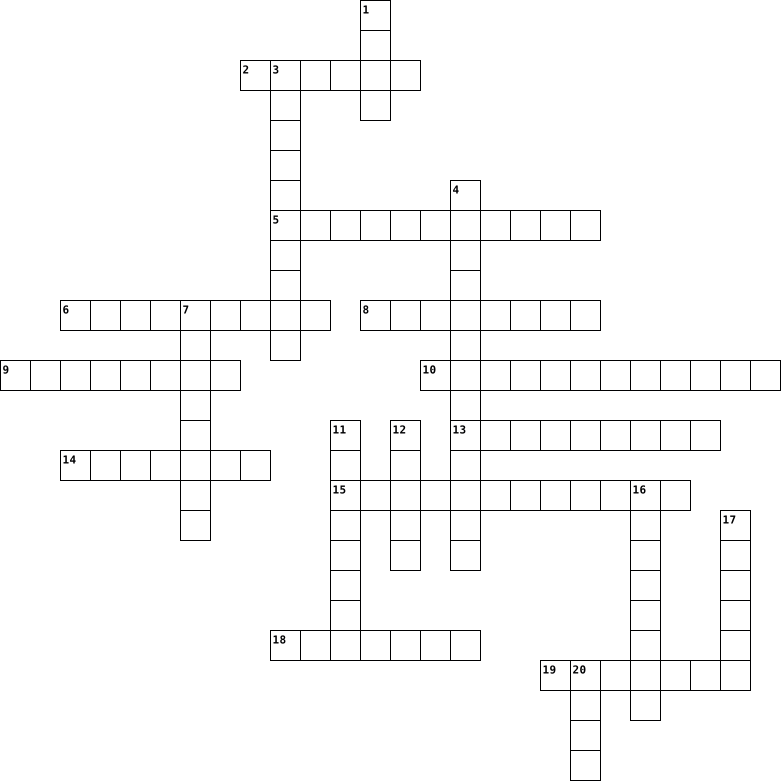
Across
- Horizontal column in periodic table
- involving absorption of energy
- reaction in which reactants combine
- symbol symbol used to represent elements
- containing two or more atoms
- bond in which electrons are shared
- bond in which electrons are gained or lost
- Something in which the solute is dissolved
- number of protons
- positive mass in an atom
- Components physically combined
Down
- contains protons, electrons and neutrons
- involving releasing of energy
- reaction in which reactant separates
- very reactive gases
- molecule containing two atoms
- vertical column in periodic table
- pure substance that cannot be broken down.
- Something dissolved in solvent
- atom in which there is a charge
20 Clues: number of protons • very reactive gases • positive mass in an atom • containing two or more atoms • involving releasing of energy • molecule containing two atoms • involving absorption of energy • Something dissolved in solvent • Components physically combined • atom in which there is a charge • vertical column in periodic table • bond in which electrons are shared • ...
Chem Crossword 2023-11-02

Across
- Bi
- Sn
- A type of change that changes the makeup of the substance
- Zn
- A charged atom
- (CN)-1
- negatively charged elements;non-metals
- Pb
- The elements along the stairs excluding aluminium
- an alloy of copper and zinc
- heat is absorbed
- A type of table that organizes elements
Down
- (MnO₄)-1
- atoms of the same element that have a different number of neutrons
- Very reactive non-metal group with a -1 charge
- pure substance made up of two or more elements
- Ag
- 3D sphereic structure in an atom
- positively charged metal
- The metals in the first column of the periodic table
- Mass per unit volume
21 Clues: Bi • Sn • Ag • Zn • Pb • (CN)-1 • (MnO₄)-1 • A charged atom • heat is absorbed • Mass per unit volume • positively charged metal • an alloy of copper and zinc • 3D sphereic structure in an atom • negatively charged elements;non-metals • A type of table that organizes elements • Very reactive non-metal group with a -1 charge • pure substance made up of two or more elements • ...
3rd Nine Weeks Crossword :D 2023-03-09

Across
- the continents brought together before they drifted
- what does the P mean is PUFLART
- what is the r in PUFLART
- your bestie!
- clue on when there is chemical changes are happening
- 2 elements combined
- what is the A in PUFLART
- density=__/volume
- A neutral charge in the nucleus
- what is the center of the earth
Down
- what is #9 on the periodic table
- where are the protons and neutrons located?
- what is the U in PUFLART
- h2o
- valence__
- what is the L in PUFLART
- number on the periodic table
- what is the F in PUFLART
- what is the T in PUFLART
- the positive charge in the nucleus
20 Clues: h2o • valence__ • your bestie! • density=__/volume • 2 elements combined • what is the U in PUFLART • what is the r in PUFLART • what is the L in PUFLART • what is the F in PUFLART • what is the T in PUFLART • what is the A in PUFLART • number on the periodic table • what does the P mean is PUFLART • A neutral charge in the nucleus • what is the center of the earth • ...
Study Guide Puzzle 2023-01-16

Across
- core of an atom
- a group of electrons
- has a negative charge
- they don’t react
- an atom that gives off radiation
- nonmetal element that consists group 17
- has same atomic number
- has a positive charge
- gains a positive charge
- metallic elements
- conduct heat and electricity
- series of nonmetal elements
Down
- has no charge
- straight row in periodic table
- sodium and potassium
- a gas
- has both metal and gas
- a hard substance
- em it’s radiation
- a charged atom with no mass number
- protons in the symbol on periodic table
- barium and radium
- molecules that float in the air
- measure of atomic mass
24 Clues: a gas • has no charge • core of an atom • they don’t react • a hard substance • em it’s radiation • barium and radium • metallic elements • a group of electrons • sodium and potassium • has a negative charge • has a positive charge • has both metal and gas • has same atomic number • measure of atomic mass • gains a positive charge • series of nonmetal elements • conduct heat and electricity • ...
Nutrition 2025-04-02

Across
- ability to attract electrons in a bond
- region where electrons are found
- element that gains or shares electrons
- vertical column on the periodic table
- atom with same protons but different neutrons
- bond bond between metal and nonmetal
- a negatively charged ion
- an atom with a charge
- horizontal row on the periodic table
- the smallest unit of matter
- connection between atoms
Down
- element that loses electrons easily
- outermost electrons
- negatively charged particle around the nucleus
- a positively charged ion
- neutral particle in the nucleus
- how easily an element reacts
- positively charged particle in the nucleus
- center of an atom
- bond bond where atoms share electrons
20 Clues: center of an atom • outermost electrons • an atom with a charge • a positively charged ion • a negatively charged ion • connection between atoms • the smallest unit of matter • how easily an element reacts • neutral particle in the nucleus • region where electrons are found • element that loses electrons easily • bond bond between metal and nonmetal • ...
Atoms 2021-02-01

Across
- the number that tells us the mass of an atom.
- the relative mass of protons and neutrons
- where all the elements are arranged in order.
- the part of the atom with no charge
- a type of atom that only has one proton and one electron
- the part of the atom with a negative charge
- where the protons and neutrons are found
- a horizontal row in the periodic table going from left to right.
Down
- a scientific word used to describe a substance.
- creator of the periodic table.
- the positively charged part of the atom
- the simplest type of substance, mad of one type of atom.
- the number that tells us the amount of protons in an atom.
- where the electrons are found
- made of two types of atom but not chemically joined
- a vertical column in the periodic table going from top to bottom
- made of two types of atoms chemically joined together
17 Clues: where the electrons are found • creator of the periodic table. • the part of the atom with no charge • the positively charged part of the atom • where the protons and neutrons are found • the relative mass of protons and neutrons • the part of the atom with a negative charge • the number that tells us the mass of an atom. • where all the elements are arranged in order. • ...