
periodic+table Crossword Puzzles
Periodic Table Crossword Puzzle(Zatone Fraser II) 2021-10-12

Across
- a substance is its mass per unit volume.
- table-a table of the chemical elements arranged in order of atomic number
- basic unit of a chemical element
- number-number of protons in the nucleus
- Danish physicist who investigated atomic structure and radiation.
- positively charged central core of an atom, consisting of protons and neutrons and containing nearly all its mass.
- charge
- a substance or matter in a state in which it will expand freely to fill the whole of a container
- large body of matter with no definite shape.
- Russian chemist who developed a periodic table of the chemical elements
Down
- packed together and contain the least amount of kinetic energy
- positive electric charge
- charge
- substance that flows freely but is of constant volume
- mass-the mass of an atom
- cloud-the system of electrons surrounding the nucleus of an atom.
- group of atoms bonded together
- thing that is composed of two or more separate elements
- be chemically interconverted or broken down into simpler substances
19 Clues: charge • charge • positive electric charge • mass-the mass of an atom • group of atoms bonded together • basic unit of a chemical element • number-number of protons in the nucleus • a substance is its mass per unit volume. • large body of matter with no definite shape. • substance that flows freely but is of constant volume • ...
matter and energy: atoms, protone, electrons, and the periodic table 2023-05-04

Across
- how many hydrogen atoms are in h2o
- what element has 84 electrons
- what is the symbol of erbium
- how many protons are there in the element mercury
- how many electrons does astatine have
- how many atoms are in c2h4o2
- what element is represented by Au
- what is the symbol of the second element on the periodic table
- how many protons does calcium have
Down
- what element has the symbol Ag
- how many atoms are in Co2
- how many protons and electrons does bismuth have
- what is the first element on the periodic table
- how many atoms are in hydronium
14 Clues: how many atoms are in Co2 • what is the symbol of erbium • how many atoms are in c2h4o2 • what element has 84 electrons • what element has the symbol Ag • how many atoms are in hydronium • what element is represented by Au • how many hydrogen atoms are in h2o • how many protons does calcium have • how many electrons does astatine have • ...
Physical Science 2022-01-03

Across
- Lose electrons to form a positive bond
- Electrons surrounding the exterior of atom
- No neutron element
- Bond through transfer
- Different Electron count
- Property of elements that allow electricity to pass through
- Gain electrons to form a negative bond
- Least reactive element group
- Size of particles that make elements
- group 3 period 6
- Horizontal lines on periiodic table
- Different neutron count
Down
- Bond through sharing
- Most reactive metals on table
- Negative ion
- Vertical lines on periodic table
- Rule that bonds will try to reach 8
- You know the element from counting these
- Positive ion
- Property of elements which aren't rigid in form
- The negative particle
21 Clues: Negative ion • Positive ion • group 3 period 6 • No neutron element • Bond through sharing • Bond through transfer • The negative particle • Different neutron count • Different Electron count • Least reactive element group • Most reactive metals on table • Vertical lines on periodic table • Rule that bonds will try to reach 8 • Horizontal lines on periiodic table • ...
Science Atoms Reveiw 2021-11-28

Across
- The electrons found in the outermost level of an atom
- A negatively charged atomic particle
- Elements that conduct heat and electricity well
- This model is an electron cloud
- The horizontal columns on the periodic table
- Smallest particle of matter
- A bond formed by atoms sharing electrons
Down
- This model first showed the electrons
- A positively charged atomic particle
- A force that brings oppositely charged atoms together
- This model showed the nucleus and electrons only
- A group of atoms bonded together
- Conduct heat and electricity poorly
- Made up of one or more of the same kind of atoms
- The verticle column on the periodic table
- Forms when an Atoms gains or loses an Electron
16 Clues: Smallest particle of matter • This model is an electron cloud • A group of atoms bonded together • Conduct heat and electricity poorly • A positively charged atomic particle • A negatively charged atomic particle • This model first showed the electrons • A bond formed by atoms sharing electrons • The verticle column on the periodic table • ...
Periodic Table crossword 2014-01-25

Across
- A small particle in the nucleus of an atom with no charge.
- vertical columns
- the smallest particle of an element.
- group 3 period 6
- horizontal rows
- group number 2
- A tinny negatively charged particle that moves around the nucleus of an atom.
- groups 13-17 found along the Zigzag
Down
- mass of the Nucleus
- the number of Protons and Electrons
- a chart of elements showing the repeating patterns of their properties.
- group 3 period 7
- the ease and speed with which an element or compound combines with other elements and compounds.
- A small positively charged particle in the nucleus of an atom.
- group 1 just Hydrogen
15 Clues: group number 2 • horizontal rows • vertical columns • group 3 period 6 • group 3 period 7 • mass of the Nucleus • group 1 just Hydrogen • the number of Protons and Electrons • groups 13-17 found along the Zigzag • the smallest particle of an element. • A small particle in the nucleus of an atom with no charge. • A small positively charged particle in the nucleus of an atom. • ...
Periodic Table Crossword 2014-01-25

Across
- mass of the Nucleus
- group 3 period 7
- the ease and speed with which an element or compound combines with other elements and compounds.
- a chart of elements showing the repeating patterns of their properties.
- group 1 just Hydrogen
- A small positively charged particle in the nucleus of an atom.
- A small particle in the nucleus of an atom with no charge.
- horizontal rows
Down
- groups 13-17 found along the Zigzag
- group number 2
- the number of Protons and Electrons
- A tinny negatively charged particle that moves around the nucleus of an atom.
- group 3 period 6
- vertical columns
- the smallest particle of an element.
15 Clues: group number 2 • horizontal rows • group 3 period 7 • group 3 period 6 • vertical columns • mass of the Nucleus • group 1 just Hydrogen • groups 13-17 found along the Zigzag • the number of Protons and Electrons • the smallest particle of an element. • A small particle in the nucleus of an atom with no charge. • A small positively charged particle in the nucleus of an atom. • ...
The Periodic Table 2021-02-01

Across
- Group 2 elements
- The horizontal rows are called ______.
- A metalloid
- Vertical columns
- Electrons on the outermost shell.
Down
- Elements in the middle of the periodic table are the ____ metals.
- Most active nonmetals
- Most of the elements are ____.
- Nonmetals occur in pairs called_____ molecules.
- Inactive gases.
- The sum of the protons and neutrons is the_____ number.
- The elements are arranged by _____ number
- Group 1 elements
- The atomic number is the number of_______.
- Liquid nonmetal
15 Clues: A metalloid • Inactive gases. • Liquid nonmetal • Group 2 elements • Group 1 elements • Vertical columns • Most active nonmetals • Most of the elements are ____. • Electrons on the outermost shell. • The horizontal rows are called ______. • The elements are arranged by _____ number • The atomic number is the number of_______. • Nonmetals occur in pairs called_____ molecules. • ...
Periodic table trends 2020-11-10

Across
- What do you look at first when trying to find the ionic radius, Who has the higher _____?
- What trend measures an atom's ability to attract or gain electrons?
- What is the trend that as it increases you have a lower nuclear charge?
- What is the most reactive and the most electronegative element?
- Does ionization energy and electronegativity increase or decrease as you move from bottom to top of the periodic table?
- What type of elements do we ignore when looking at electronegativity?
Down
- What trend is the energy required to remove the first electron from the outermost energy level
- The nuclear pull from protons felt by the electrons is, what?
- What is it called when inner electrons block outer electrons from the pull of the protons
- What do you look at third when trying to find the ionic radius, the atom with more _____ is bigger
- Is the effective nuclear charge high or low when there is a high pull on electrons?
- Does atomic & ionic radius increase or decrease as you go from left to right of the periodic table?
- What trend is how the radius of an atom changes when it becomes an ion?
- For ionization energy, is the energy high or low when it is hard to remove an electron?
- What do you look at second when trying to find the ionic radius, the atom with more _____ is smaller
15 Clues: The nuclear pull from protons felt by the electrons is, what? • What is the most reactive and the most electronegative element? • What trend measures an atom's ability to attract or gain electrons? • What type of elements do we ignore when looking at electronegativity? • What is the trend that as it increases you have a lower nuclear charge? • ...
Science periodic table 2024-12-18

Across
- atomic number of gallium followed by # of protons
- protons in bromine
- Protons in gold
- what is the 1st element
- atomic number of magnesium followed by # of protons
- Name a noble gas
- What is the 39th element
- What is the 20th element
Down
- protons in Arsenic
- protons in Platinum
- Number of protons in Selenium
- atomic number of einsteinium followed by # of protons
- atomic number of hafnium followed by # of protons
- what is the 21st element
- what is the 48th element
15 Clues: Protons in gold • Name a noble gas • protons in Arsenic • protons in bromine • protons in Platinum • what is the 1st element • what is the 21st element • What is the 39th element • what is the 48th element • What is the 20th element • Number of protons in Selenium • atomic number of gallium followed by # of protons • atomic number of hafnium followed by # of protons • ...
Periodic table crossword 2025-12-22

Across
- the number of PROTONS in this element is 21
- This element is a metal
- the number of NEUTRONS in this element is 6
- Located in Period 5
- This element is an alkali metal in group one
- This elements family name is Non metals
- This element is located in the lanthanide series
- The number of ELECTRONS in this element is 7
Down
- Located in group 12
- Has the atomic Mass of 163
- this element is located in group 3
- This elements number of PROTONS is 13
- Has the atomic number of 67
- This elements family name is noble gases
- This element is located in period 5
15 Clues: Located in group 12 • Located in Period 5 • This element is a metal • Has the atomic Mass of 163 • Has the atomic number of 67 • this element is located in group 3 • This element is located in period 5 • This elements number of PROTONS is 13 • This elements family name is Non metals • This elements family name is noble gases • the number of PROTONS in this element is 21 • ...
Atomic Theory 2025-01-29

Across
- Table, organized chart of all naturally occurring and man-made elements
- negatively charged particle, outside the nucleus
- discovered the neutron
- criticized Democritus's theory
- having no charge, equal number of positive and negative charges
- proposed the idea that electrons were in a fixed orbit around the nucleus
- abbreviation for an element
- number, another name of the number of protons
- first proposed the idea that matter was made of atoms
- neutral particle in the nucleus
- developed the Plum Pudding Model, and is credited with discovering the electron
Down
- his Gold Foil Experiment led to the discovery of the nucleus
- the three particles that make up an atom
- positively charged particle in the nucleus
- all matter is composed of __________
- developed the 5 points of the Modern Atomic Theory
- substance composed of only one type of atom
- number, protons and neutrons added together
- number of elements on the periodic table
- Mass, the average masses of all isotopes of an element
20 Clues: discovered the neutron • abbreviation for an element • criticized Democritus's theory • neutral particle in the nucleus • all matter is composed of __________ • the three particles that make up an atom • number of elements on the periodic table • positively charged particle in the nucleus • substance composed of only one type of atom • ...
Everyday Chemistry 2022-04-11

Across
- ______ Curie first discovered the radioactive elements polonium and radium
- electron configuration for this element is
- Negatively charged particles
- Smallest particle of an element
- Positively charged particles
- Made of 2 or more elements that are chemically combines
- The study ofthe behavior of matter and its charges and how it interacts with other matter and energy
- _______ is a strong acid that is used in car batteries
Down
- Fe
- _____ rule states when several orbitals are available in a subshell, each orbital gets one electron before the electrons pair up
- Vertical columns in the periodic table, where elements contain similar chemical properties
- useful in batteries since it will release electrons
- Ti
- Ni
- Horizontal rows in the periodic table
- Nuclear particle with no charge
16 Clues: Fe • Ti • Ni • Negatively charged particles • Positively charged particles • Smallest particle of an element • Nuclear particle with no charge • Horizontal rows in the periodic table • electron configuration for this element is • useful in batteries since it will release electrons • _______ is a strong acid that is used in car batteries • ...
GHI4 Chemistry 1 2022-04-13

Across
- ________________is everything that occupies space and has mass.
- A subatomic particle with a negative charge
- The _________________ is the building block of matter.
- Greek philosopher who first theorized the atom
- A subatomic particle with a positive charge
- A subatomic particle with a neutral charge
- A substance made of only one kind of atom is called an _____________________.
Down
- ______________ is the study of matter and the changes it undergoes.
- element that conducts heat and electricity well
- Russian chemist who developed the first Periodic Table
- shiny
- able to hammer into thin sheets
- Elements are arranged in the Periodic Table by ___________ atomic number
- element that has properties of metals and nonmetals
- where protons and neutrons exist
- element that conducts heat and electricity poorly
16 Clues: shiny • able to hammer into thin sheets • where protons and neutrons exist • A subatomic particle with a neutral charge • A subatomic particle with a negative charge • A subatomic particle with a positive charge • Greek philosopher who first theorized the atom • element that conducts heat and electricity well • element that conducts heat and electricity poorly • ...
Atomic Structure 2021-03-02

Across
- Group 16 period 2
- the charge of a neutron
- a negatively charged subatomic particle
- a positively charged subatomic particle
- the number of electrons needed to fill the first ring
- there are 18 of these on the Periodic Table
- these are columns in the Periodic Table
- the mass of the atom in the chart rounded
- Group 18, period 2
- the charge of a proton
Down
- the number of protons in an atom (2 words)
- a neutrally charged subatomic particle
- there are 7 of these on the Periodic Table
- most of the atom is...(two words)
- these are rows in the Periodic Table
- the center of the atom which has the protons and neutrons
- the charge of an electron
- the number of electrons needed to fill the second ring
18 Clues: Group 16 period 2 • Group 18, period 2 • the charge of a proton • the charge of a neutron • the charge of an electron • most of the atom is...(two words) • these are rows in the Periodic Table • a neutrally charged subatomic particle • a negatively charged subatomic particle • a positively charged subatomic particle • these are columns in the Periodic Table • ...
Countries, Elements, and a few dogs 2025-06-30

Across
- The first element on the periodic table
- the smaller dog that is currently at the cottage
- Country with an orange imbecile as a president
- Element 93, between Uranium and Plutonium
- The first Actinide on the periodic table
- Borders Italy, Austria and Croatia
- Country that has a movie with the same name
- The largest country by land area
Down
- The element that makes matches light, has an atomic mass of 15
- The element known for being in bananas
- The country in which Thomas & Friends was invented
- Where we are right now
- The element known for being in dairy products
- French fries are actually from this country
- Used to be part of Czechoslovakia
- The larger dog that is currently at the cottage
16 Clues: Where we are right now • The largest country by land area • Used to be part of Czechoslovakia • Borders Italy, Austria and Croatia • The element known for being in bananas • The first element on the periodic table • The first Actinide on the periodic table • Element 93, between Uranium and Plutonium • French fries are actually from this country • ...
Semiconductor Basics 1 2018-01-01

Across
- Not negative.
- An elemental semiconductor and part of the nickname for the valley south of San Francisco Bay area.
- Region of a pn-junction without mobile carriers.
- The dual of electron.
- Undoped, single-crystal semiconductor.
- Charge on p-type material.
- Element from Group III in the periodic table.
- A semiconductor diode, but not pn-junction.
- An element from Group V in the periodic table.
- What is generated when a photon with enough energy interacts with a semiconductor.
Down
- Highest energy band.
- What is generated when a hole and electron combines in direct semiconductor material.
- Reverse bias _______ current.
- An early elemental semiconductor.
- A subatomic particle that is more mobile that its dual.
- A semiconductor made by adding controlled quantities of impurities
- Semiconductor made from different elements.
- Not pure.
18 Clues: Not pure. • Not negative. • Highest energy band. • The dual of electron. • Charge on p-type material. • Reverse bias _______ current. • An early elemental semiconductor. • Undoped, single-crystal semiconductor. • Semiconductor made from different elements. • A semiconductor diode, but not pn-junction. • Element from Group III in the periodic table. • ...
The periodic table 2022-10-03

Across
- Element with the symbol Fe
- Element with the symbol Te
- The name of group two
- Halogen that is a purple solid at room temperature
- The group number of the noble gases
- Element in group five, period two
- The least reactive element in group one
Down
- Noble gas used in party balloons
- A column going down the table
- A gas produced when alkali metals react with water
- A substance made from only one type of atom Mendeleev The scientist who created the periodic table
- A row going across the table
- The most reactive element in group seven
- Element with the symbol Cs
- Element in group one, period four
15 Clues: The name of group two • Element with the symbol Fe • Element with the symbol Te • Element with the symbol Cs • A row going across the table • A column going down the table • Noble gas used in party balloons • Element in group one, period four • Element in group five, period two • The group number of the noble gases • The least reactive element in group one • ...
periodic table crossword 2022-11-02

Across
- Metals: Elements that are malleable and ductile, are good conductors of heat and electricity, and are very dense. These elements have a high melting and boiling point.
- Metals: These metals do not share characteristics with any other metals, highly malleable and ductile, and have a semi-high density. These elements are also solid at room temperature.
- Earth Metals: Elements that are shiny and silvery-white, are only somewhat reactive with elements, and easily lose their two outermost electrons. These elements have low density, low melting points, and a low boiling point.
- Elements that have similar characteristics
- number of electrons in the outermost energy level
- Gasses: These elements are very stable, almost never react with other elements, are all gasses, and are odorless and colorless. They also have a very low melting and boiling point.
- Element: One in which the nucleus breaks down and gives off particles and energy
- Elements that are found between the metals and nonmetals, and share similarities with both metals and nonmetals. Most of these are semiconductors.
- Elements that are similar and found in vertical columns on the periodic table
- Elements that are in the same horizontal row in the periodic table
Down
- These elements do not conduct heat or electricity well, are very brittle, do not reflect light, and have low shine. Oxygen and Carbon are Non-Metals.
- Dot Diagram: uses the chemical symbol of an element surrounded by dots to represent
- Materials that can be hammered or rolled into sheets
- Any of five related nonmetallic elements (fluorine or chlorine or bromine or iodine or astatine) that are all monovalent and readily form negative ions
- Metals: Elements that are soft and shiny, highly reactive with other elements, lose their outermost electron, and can be cut easily. These elements are only found in salts.
- Earth Elements: These elements are referred to as the lanthanide and actinide series, are all synthetic (man made), and are all metals.
16 Clues: Elements that have similar characteristics • number of electrons in the outermost energy level • Materials that can be hammered or rolled into sheets • Elements that are in the same horizontal row in the periodic table • Elements that are similar and found in vertical columns on the periodic table • ...
periodic table crossword 2020-11-20

Across
- what you breath in
- has 15 protons
- used in pools
- strange voice
- named after a famous German scientist
- used for building bones
- planet starts with m
Down
- first letter of Hello is the chemical symbol
- The continent we live in
- banana
- has 16 protons
- can be used as a foil
- chemical symbol: Be
- chemical symbol: Na
- used for bright signs
15 Clues: banana • used in pools • strange voice • has 15 protons • has 16 protons • what you breath in • chemical symbol: Be • chemical symbol: Na • planet starts with m • can be used as a foil • used for bright signs • used for building bones • The continent we live in • named after a famous German scientist • first letter of Hello is the chemical symbol
akili periodic table 2016-12-21

Across
- This element has the symbol Kr.
- This element’s symbol is Cu.
- This is the only metalloid in Group 17.
- This element has an atomic mass of 35.453.
- This element is close to gold and has the symbol Ag.
- This has the symbol I.
Down
- This element has the atomic mass of 196.97.
- The first element in the periodic table.
- This element is in group 10 and has the symbol Ni.
- This is the first element in period 2.
- This is the 82nd element.
- This is the only metalloid in Period 3.
- This is the 10th element in the periodic table.
- This is the only nonmetal in group 14.
- This is the only metalloid in group 13.
15 Clues: This has the symbol I. • This is the 82nd element. • This element’s symbol is Cu. • This element has the symbol Kr. • This is the first element in period 2. • This is the only nonmetal in group 14. • This is the only metalloid in Group 17. • This is the only metalloid in Period 3. • This is the only metalloid in group 13. • The first element in the periodic table. • ...
Periodic Table Vocabulary 2022-02-16

Across
- vertical column in the periodic table
- elements with properties that fall between those of metals and nonmetals; semimetals
- most reactive metals; contain 1 valence electrons; soft, silver, shiny, low density
- Radius the size of the atom; one-half the distance between the nuclei of identical atoms that are bonded together
- most reactive nonmetals that contain 7 valence electrons
- the ability of an atom to attract electrons when the atom is in a compound
- a molecule consisting of two atoms of the same element
Down
- less reactive than alkali-earth metals shiny, good conductors of thermal energy and electrical current, high density; located in groups 3-12
- least reactive elements due to a full outermost energy level; most contain 8 valence electrons
- the energy change that occurs when a neutral atom attracts an electron to become a negative ion
- the energy required to remove an electron from a neutral atom
- metallic elements in group 2 that are less reactive and harder than the alkali metals
- poor conductors of heat and electric current
- horizontal row in the periodic table
- good conductors of heat and electric current
15 Clues: horizontal row in the periodic table • vertical column in the periodic table • poor conductors of heat and electric current • good conductors of heat and electric current • a molecule consisting of two atoms of the same element • most reactive nonmetals that contain 7 valence electrons • the energy required to remove an electron from a neutral atom • ...
The Periodic Table 2023-09-13

Across
- column on the periodic table
- an alkaline earth metal with two energy levels
- ____ have similar chemical properties due to similar electron configuration
- element in the same column as alkali metals but is not an alkali metal
- ____ metals: elements of D block
- ____ metals first column, highly reactive
Down
- element that can be classified as a halogen or a metalloid
- elements that do not react with other elements
- row on the periodic table
- not shiny, bad conductors, and brittle
- shiny, good conductors, and malleable
- the second noble gas
- highly corrosive non-metals, second to far right column
- part metal, part nonmetal (7 elements)
- ____ earth metals: column to the right of alkali metals
15 Clues: the second noble gas • row on the periodic table • column on the periodic table • ____ metals: elements of D block • shiny, good conductors, and malleable • not shiny, bad conductors, and brittle • part metal, part nonmetal (7 elements) • ____ metals first column, highly reactive • elements that do not react with other elements • ...
Elements & Periodic Table 2025-09-24

Across
- – Powers nuclear reactors
- – Combines with chlorine in salt
- – Used in pennies
- – Lights up signs
- – Essential for breathing
- – Precious and conductive
- – Makes up most of the air
- – Fills balloons
Down
- – Liquid metal
- – Basis of life
- – Lightest element
- – Excellent conductor
- – Builds strong bones
- – Found in blood and steel
- – Shiny and valuable
15 Clues: – Liquid metal • – Basis of life • – Fills balloons • – Used in pennies • – Lights up signs • – Lightest element • – Shiny and valuable • – Excellent conductor • – Builds strong bones • – Powers nuclear reactors • – Essential for breathing • – Precious and conductive • – Found in blood and steel • – Makes up most of the air • – Combines with chlorine in salt
periodic table crossword 2026-01-07

Across
- smart
- mood
- yum
- cool
- dope
- yay
- vertical
- okay
Down
- yes
- kay
- blast
- table
- spell
- orbit
- horizontal
15 Clues: yes • kay • yum • yay • mood • cool • dope • okay • smart • blast • table • spell • orbit • vertical • horizontal
Periodic Table Crossword 2024-11-24

Across
- I am a noble gas that often reminds people of Superman’s weakness.
- I am nonmetal but I have the same charge as alkali metals.
- I have two valence electrons and when mistaken with calcium, I can damage human bones.
- I have 26 protons
- I am the name of the group that starts with this name because we fulfill the octet rule.
- I have six valence electrons and am needed by humans to survive.
- I have a charge of +1 and am an important nutrient that can be found in bananas.
- I am a halogen who reacts with sodium to form salt.
- I am an alkaline earth metal that humans need through milk and dairy.
Down
- I am a transition metal with 25 protons.
- I am a transition metal that is used to make pennies
- I am a metalloid whose name sounds like Germany.
- I am the name of the group of elements that all have a charge of -1
- I am an element located in group 3, period 5
- I am the noble gas with the lowest atomic mass.
15 Clues: I have 26 protons • I am a transition metal with 25 protons. • I am an element located in group 3, period 5 • I am the noble gas with the lowest atomic mass. • I am a metalloid whose name sounds like Germany. • I am a halogen who reacts with sodium to form salt. • I am a transition metal that is used to make pennies • ...
periodic table vocacb 2024-10-18

Across
- Gasses: These elements are very stable, almost never react with other elements, are all gasses, and are odorless and colorless. They also have a very low melting and boiling point.
- Earth Metals: Elements that are shiny and silvery-white, are only somewhat reactive with elements, and easily lose their two outermost electrons. These elements have low density, low melting points, and a low boiling point.
- that have similar characteristics
- that are similar and found in vertical columns on the periodic table
- Dot Diagram: uses the chemical symbol of an element surrounded by dots to represent
- Elements that are found between the metals and nonmetals, and share similarities with both metals and nonmetals. Most of these are semiconductors.
- Metals: These metals do not share characteristics with any other metals, highly malleable and ductile, and have a semi-high density. These elements are also solid at room temperature.
- These elements do not conduct heat or electricity well, are very brittle, do not reflect light, and have low shine. Oxygen and Carbon are Non-Metals.
- Element: One in which the nucleus breaks down and gives off particles and energy
Down
- that are in the same horizontal row in the periodic table
- Metals: Elements that are soft and shiny, highly reactive with other elements, lose their outermost electron, and can be cut easily. These elements are only found in salts.
- that can be hammered or rolled into sheets
- Earth Elements: These elements are referred to as the lanthanide and actinide series, are all synthetic (man made), and are all metals.
- Metals: Elements that are malleable and ductile, are good conductors of heat and electricity, and are very dense. These elements have a high melting and boiling point.
- number of electrons in the outermost energy level
- Any of five related nonmetallic elements (fluorine or chlorine or bromine or iodine or astatine) that are all monovalent and readily form negative ions
16 Clues: that have similar characteristics • that can be hammered or rolled into sheets • number of electrons in the outermost energy level • that are in the same horizontal row in the periodic table • that are similar and found in vertical columns on the periodic table • Element: One in which the nucleus breaks down and gives off particles and energy • ...
Chemistry Crossword 2021-01-05

Across
- A vertical column in the periodic table of the elements. Elements in a group have similar properties.
- An atom or group of atoms that has a positive or negative electric charge.
- An element that tends to be shiny, easily shaped, and a good conductor of electricity and heat
- number The total number of protons in an atom’s nucleus.
- A negatively charged particle outside an atom's nucleus
- An atom of one element that has a different number of neutrons than another atom of the same element.
- The central region of an atom where most of the atom's mass is found in protons and neutrons
- An element that has both properties of both metals and nonmetals.
Down
- A table of the elements, arranged by an atomic number that shows the patterns in their properties.
- A horizontal row in the periodic table of elements. Elements in a period have varying properties.
- The number of protons found in the nucleus of an atom.
- The length of time it takes for half of the atoms in a sample of a radioactive element to decay into atoms of another element.
- A positively charged particle located in an atom's nucleus
- An element that is not a metal and has properties generally opposite to those of a metal.
- A particle that has no electric charge
15 Clues: A particle that has no electric charge • The number of protons found in the nucleus of an atom. • A negatively charged particle outside an atom's nucleus • number The total number of protons in an atom’s nucleus. • A positively charged particle located in an atom's nucleus • An element that has both properties of both metals and nonmetals. • ...
Chemistry word puzzle 2022-02-24

Across
- Number average atomic mass
- a negative electrical charge
- the small part of a chemical element
- doesn't conduct electricity or heat
- central part of an atom
- a horizontal row on the periodic table
Down
- a positive electrical charge located in the nucleus
- nonmetallic elements
- Gasses group of 18 of the periodic table
- a neutral electrical charge located in the nucleus
10 Clues: nonmetallic elements • central part of an atom • Number average atomic mass • a negative electrical charge • doesn't conduct electricity or heat • the small part of a chemical element • a horizontal row on the periodic table • Gasses group of 18 of the periodic table • a neutral electrical charge located in the nucleus • a positive electrical charge located in the nucleus
Pee Pee Suck 2022-11-18

Across
- Periodic table element: FE
- Heat causing rocks to rise and fall
- Periodic table element: NI
- Made of hard, solid rock
- Made of soft, solid rock
- A material that forms most of Earth's crust
Down
- Made of solid iron and nickel
- Made of liquid iron and nickel
- Waves caused by earthquakes
- Causes Earth's layers to form one on top of another.
10 Clues: Made of hard, solid rock • Made of soft, solid rock • Periodic table element: FE • Periodic table element: NI • Waves caused by earthquakes • Made of solid iron and nickel • Made of liquid iron and nickel • Heat causing rocks to rise and fall • A material that forms most of Earth's crust • Causes Earth's layers to form one on top of another.
big bang cross word 2025-10-21

Across
- how heave some thing is
- The second one on the periodic table
- what people think made the plants
- the measr of light
- what still happens now
Down
- how many year after the big bang
- started to happen after the big bang
- Its the first one in the periodic table
- proves that other plant are moving way
- changing the pitch of sire
10 Clues: the measr of light • what still happens now • how heave some thing is • changing the pitch of sire • how many year after the big bang • what people think made the plants • started to happen after the big bang • The second one on the periodic table • proves that other plant are moving way • Its the first one in the periodic table
I AN APE 2022-11-11

Across
- the ability to combine and to chemicaly bond with each other.
- some properties of both metals and nonmetals, found on the stairsteps of the periodic table.
- the smallest particle into which an element can be divided and still have the same properties as that element.
- high luster, good conductor, malleable, found on the left of the periodic table.
- a subatomic particle that has a positive charge and that is found in the nucleus of an atom; identifies the element.
- one or two letter code that stands for an element.
- states that matter can neither be created nor destroyed.
- molecule that is made up of more than one type of element.
Down
- a way of describing the number of atoms that make up a molecule or compound.
- number of protons and nuetrons.
- the number placed just before the chemical formula; number of molecules.
- dull, poor conductors, brittle, found on the right side of the periodic table.
- number of protons in the nucleus of one atom of an element.
- compounds that include carbon.
14 Clues: compounds that include carbon. • number of protons and nuetrons. • one or two letter code that stands for an element. • states that matter can neither be created nor destroyed. • molecule that is made up of more than one type of element. • number of protons in the nucleus of one atom of an element. • the ability to combine and to chemicaly bond with each other. • ...
Classification of Matter 2021-12-06

Across
- can be broken down into simpler stable substances
- the temperature at which a liquid becomes a gas
- cannot be broken down into simpler stable substances
- element that is similar to a metal and a nonemetal
- reactions that absorb energy
- anything that has mass and takes up space
- mixture that is not uniform in composition
- vertical columns of the periodic table
- the horizontal rows of the periodic table
Down
- a blend of two or more kinds of matter
- the temperature at which a solid becomes liquid
- element that is bad electrical and heat conductor
- element that is a good electrical and heat conductor
- the ability to do work
- reactions that release energy
- measure of the amount of matter
- mixture that is uniform in composition
17 Clues: the ability to do work • reactions that absorb energy • reactions that release energy • measure of the amount of matter • a blend of two or more kinds of matter • vertical columns of the periodic table • mixture that is uniform in composition • anything that has mass and takes up space • the horizontal rows of the periodic table • mixture that is not uniform in composition • ...
Chemistry Crossword 2020-01-14

Across
- stable subatomic particle with a positive charge
- sharing of free electrons among positively charged ions
- subatomic particle with a negative charge
- row of elements on the periodic table
- large enough to be seen by the unaided eye
Down
- a covalent bond between two atoms with an unequal sharing of electrons
- subatomic particle with no charge
- substance with an identical composition
- a substance composed of different components
- a chemical change dealing with melting or freezing
- the molecular geometry of N2
- set of eight valence electrons
- the name for H2O
- column of elements on the periodic table
- atom or molecule with a net electric charge by a loss or gain of an electron(s)
15 Clues: the name for H2O • the molecular geometry of N2 • set of eight valence electrons • subatomic particle with no charge • row of elements on the periodic table • substance with an identical composition • column of elements on the periodic table • subatomic particle with a negative charge • large enough to be seen by the unaided eye • a substance composed of different components • ...
Chemistry Crossword 2024-10-09

Across
- a particle of matter with no charge
- an element that resembles both a metal and a nonmetal
- an electrically charged atom
- the smallest unit of a compound
- positively charged atomic particles
- a region where electrons are located
- relating to living organisms
- a column in the periodic table
Down
- the basic chemical substances from which all matter is made
- a solid, inorganic substance such as graphite or gold
- a substance formed by the chemical reaction of two or more elements
- a particle of matter with a negative charge
- a row in the periodic table
- atoms of the same element that contain different numbers of neutrons
- the smallest unit of an element
15 Clues: a row in the periodic table • an electrically charged atom • relating to living organisms • a column in the periodic table • the smallest unit of a compound • the smallest unit of an element • a particle of matter with no charge • positively charged atomic particles • a region where electrons are located • a particle of matter with a negative charge • ...
Science 2022-11-16

Across
- found in the atom neutral
- The horizontal rows of the periodic table
- The vertical rows of a periodic table
- element Na
- found outside of the element negatively charged
- a substance made from two or more different elements that have been chemically joined.
- central core of an atom
- a pure substance, found a chart
Down
- found in the atom positive
- the arrangement of electrons around the nucleus of an atom
- a chemical element and its compounds in the natural state
- basic unit of a chemical element
- matter is any substance that has mass and takes up space
- where the electrons are found
- the result of combining two or more substances
15 Clues: element Na • central core of an atom • found in the atom neutral • found in the atom positive • where the electrons are found • a pure substance, found a chart • basic unit of a chemical element • The vertical rows of a periodic table • The horizontal rows of the periodic table • the result of combining two or more substances • found outside of the element negatively charged • ...
Science Crossword 2022-05-10

Across
- individual molecule mixed with each other
- the electrical attraction between a negative and positive ion
- a positive sub-atomic particle
- a column of elements
- a pair of electrons shared by two atoms
- a neutral sub-atomic particle
- gets dissolved by that solvent
Down
- the electrons on the outermost part of the atom and can be shared with other atoms
- a row of elements
- how many protons and electrons are in an atom
- shows all the elements
- a negative sub-atomic particle
- something that dissolves the solute
- a mixture where the solute is dissolved in the solvent
- what the periodic table is made out of
15 Clues: a row of elements • a column of elements • shows all the elements • a neutral sub-atomic particle • a negative sub-atomic particle • a positive sub-atomic particle • gets dissolved by that solvent • something that dissolves the solute • what the periodic table is made out of • a pair of electrons shared by two atoms • individual molecule mixed with each other • ...
Nicks Crossword Puzzle 2024-04-16

Across
- a charged product resulting from the gain or loss of electrons
- matter consisting of positively and negatively charged particles
- The temperature at which the liquid becomes a gas
- Mass per unit volume of a material
- Amount of force exerted per unit area
- Group of elements with similar chemical properties
- A positively charged ion
- An isolated system
- a minute portion of matter
Down
- the degree to which a specified material conducts electricity
- Vertical row in the periodic table
- a phase that has a definite shape and volume
- A phase that does not have a definite shape or volume
- A force that holds atoms together in a compound
- substance with atom that are all alike
- an equal amount of charge or particles
- Horizontal row in the periodic table
- the action of being moved or moving
- amount of matter in an object
19 Clues: An isolated system • A positively charged ion • a minute portion of matter • amount of matter in an object • Vertical row in the periodic table • Mass per unit volume of a material • the action of being moved or moving • Horizontal row in the periodic table • Amount of force exerted per unit area • substance with atom that are all alike • an equal amount of charge or particles • ...
Periodic Table: Transition Metals 2022-06-29

Across
- Found between titanium and chromium on the Periodic Table
- Transition metal historically heavily used in plumbing
- Symbol Au
- Atomic number 78
- This anhydrous transition metal chloride changes from blue to pink when water is added
- Atomic mass 261
- Symbol W
- Electron configuration [Kr] 4d5 5s1
- Trace mineral essential for the immune system
- Electron shell arrangement [2, 8, 18, 18, 1]
Down
- Group 12 transition metal between zinc and mercury
- Used in thermometers
- First transition metal, smallest atomic mass
- Transition metals often exist in a variety of differently colored compounds due to various ... states
- Transition metals are found between Group 2 and Group ... on the Periodic Table
- 5 cents coin transition metal
- Steel is an alloy of carbon and the transition metal ...
- Atomic number of manganese
- Symbol Fe
- Named for its many-colored compounds, exists in the oxidation states of -2 to +6
20 Clues: Symbol W • Symbol Au • Symbol Fe • Atomic mass 261 • Atomic number 78 • Used in thermometers • Atomic number of manganese • 5 cents coin transition metal • Electron configuration [Kr] 4d5 5s1 • First transition metal, smallest atomic mass • Electron shell arrangement [2, 8, 18, 18, 1] • Trace mineral essential for the immune system • Group 12 transition metal between zinc and mercury • ...
Chemistry Vocab 2020-09-08

Across
- a solid formed by a change in a solution
- set volume and shape
- amount of space an object takes up
- to purify a liquid by heating and cooling
- a mixture that has many parts and phases
- horizontal row in the periodic table
- no set volume or shape
Down
- a column of elements in the periodic table
- a mixture that is uniform
- two or more elements chemically bonded to each other
- has one type of atom
- a gas-phase material made by evaporating a liquid
- set volume, no set shape
- amount of matter something has
- a substance that takes part in and undergoes change in a reaction
- a substance that takes part in and undergoes change during a reaction
16 Clues: set volume and shape • has one type of atom • no set volume or shape • set volume, no set shape • a mixture that is uniform • amount of matter something has • amount of space an object takes up • horizontal row in the periodic table • a solid formed by a change in a solution • a mixture that has many parts and phases • to purify a liquid by heating and cooling • ...
Elements and compounds 2021-10-25

Across
- a substance made up of one atom
- a repeating arrangement of molecules bonded together
- the smallest part of an element
- the letters used to show a element
- tending to chemically react with other puresubstances
- the way in which the elements are ordered on the periodic table
- a substance made up of one or more atoms
- easily broken
Down
- a source where you can recognize your elements
- a substance with nothing mixed into it
- what you put in balloons
- the point when a liquid changes from liquid to a gas
- a shiny element that conducts electricity and heat
- a column in the periodic table
- a force that holds two atoms together
15 Clues: easily broken • what you put in balloons • a column in the periodic table • a substance made up of one atom • the smallest part of an element • the letters used to show a element • a force that holds two atoms together • a substance with nothing mixed into it • a substance made up of one or more atoms • a source where you can recognize your elements • ...
Chapter 18 vocab 2023-01-25

Across
- horizontal rows of elements in the periodic table.
- the space around a nucleus that electrons are found
- smallest particle of an element.
- negatively charged practical of 1-.
- the chart that measures the elements.
- number of protons in the nucleus.
- vertical rows of elements in the periodic table.
- The sum of the protons and neutrons in a nucleus.
Down
- weighted average mass of all natural isotopes of an element.
- The chemical symbol of an element surrounded by dots
- An atom with the same element but has different numbers of neutrons.
- neutral charged particle.
- particles with an electric charge of 1+.
- small positively charged center of the atom.
- things that compose protons and electrons.
15 Clues: neutral charged particle. • smallest particle of an element. • number of protons in the nucleus. • negatively charged practical of 1-. • the chart that measures the elements. • particles with an electric charge of 1+. • things that compose protons and electrons. • small positively charged center of the atom. • vertical rows of elements in the periodic table. • ...
Chemistry revision 2021-09-26

Across
- element with the atomic number 12
- the column on the periodic table
- a charged particle
- the charge on an ion when an element looses electrons
- the part of the atom where neutrons and protons are found
- type of bonding between two non-metals
- type of bonding in compounds such as Magnesium chloride
Down
- dissolved in solution
- the charge on an ion when an element gains electrons
- a positive sub-atomic particle in the nucleus
- the rows on the periodic table
- negatively charged sub-atomic particle which orbits the nucleus
- a pure substance with just one type of atom
- type of bonding in elements such as iron
- name given to a regular structure
15 Clues: a charged particle • dissolved in solution • the rows on the periodic table • the column on the periodic table • element with the atomic number 12 • name given to a regular structure • type of bonding between two non-metals • type of bonding in elements such as iron • a pure substance with just one type of atom • a positive sub-atomic particle in the nucleus • ...
Chemistry Crossword 2024-10-09

Across
- a particle of matter with no charge
- an element that resembles both a metal and a nonmetal
- an electrically charged atom
- the smallest unit of a compound
- positively charged atomic particles
- a region where electrons are located
- relating to living organisms
- a column in the periodic table
Down
- the basic chemical substances from which all matter is made
- a solid, inorganic substance such as graphite or gold
- a substance formed by the chemical reaction of two or more elements
- a particle of matter with a negative charge
- a row in the periodic table
- atoms of the same element that contain different numbers of neutrons
- the smallest unit of an element
15 Clues: a row in the periodic table • an electrically charged atom • relating to living organisms • a column in the periodic table • the smallest unit of a compound • the smallest unit of an element • a particle of matter with no charge • positively charged atomic particles • a region where electrons are located • a particle of matter with a negative charge • ...
Chemistry Crossword 2018-12-13

Across
- This type of change is reversible
- The __ is the smallest particles of a chemical compound
- Everything in the universe that has mass and volume is made up of this
- A subatomic particle with a negative charge
- No charged
- The state of matter characterized by its non condensed nature and ability
- A mixture of two or more substances that can be easily separated
- A positively charged particle
- Hydrogen and __ make water
Down
- A column of elements in the periodic table
- This change is not reversible
- A __ maintains a defined shape and size
- __ do not have a foxed shape and takes the shape of their container
- An __ is a substance composed of atoms with identical atomic number
- The smallest unit of an element
- a mix of something
- A material formed by the chemical combinations of elements
- A row of elements in the periodic table
- The capacity or power to do work
19 Clues: No charged • a mix of something • Hydrogen and __ make water • This change is not reversible • A positively charged particle • The smallest unit of an element • The capacity or power to do work • This type of change is reversible • A __ maintains a defined shape and size • A row of elements in the periodic table • A column of elements in the periodic table • ...
Chemistry Final Project 2020-12-12

Across
- ______ change: Changes to the chemical makeup of something
- Nuclear _____: when a particle splits and causes a release of energy
- Nuclear _____: when particles combine and cause a release of energy
- type of decay that emits a beta particle
- ____ number: sum of protons and neutrons
- ______ change: Changes to something we can tell with our senses
- type of decay that emits an alpha particle
- Different versions of atoms in an element
- State of matter that has a definite volume but no shape
Down
- Ni on periodic table
- Particle with negative charge
- State of matter that has a definite shape and volume
- State of matter that doesn’t have volume or shape
- Columns on a periodic table
- 1 or 2 letters that represents the element
- type of decay that emits gamma radiation
- Particle with positive charge
- ____ Number: number of protons in an element
- Particle with neutral charge
19 Clues: Ni on periodic table • Columns on a periodic table • Particle with neutral charge • Particle with negative charge • Particle with positive charge • type of decay that emits gamma radiation • type of decay that emits a beta particle • ____ number: sum of protons and neutrons • Different versions of atoms in an element • 1 or 2 letters that represents the element • ...
Periodic Table of Elements Crossword 2021-09-28

Across
- A halogen in Period 5.
- Atomic number 40.
- It has 18 electrons.
- Has the largest first ionization energy.
- What salt is composed of.
- Number 1 on the atomic scale.
- A Period 4 element that is usually found in milk.
- An element that has a "Cr" symbol.
- An alkaline earth metal that burns with a brilliant white flame.
- The only element that has 2 electrons in its valance shell.
- It makes up about 20% of the air we breathe.
Down
- It has a 78 electrons and a Transition Metal.
- A word derived from the Latin word "cuprum"
- It has an atomic number of 14 and it is also a metalloid.
- K on the periodic table.
- It is a soft, silvery-white alkali metal.
- The third most abundant element in the Earth's crust.
- The symbol 'Fe" on periodic table.
- It has an atomic number 28.
- It is metal but can be in liquid form at room temperature.
20 Clues: Atomic number 40. • It has 18 electrons. • A halogen in Period 5. • K on the periodic table. • What salt is composed of. • It has an atomic number 28. • Number 1 on the atomic scale. • The symbol 'Fe" on periodic table. • An element that has a "Cr" symbol. • Has the largest first ionization energy. • It is a soft, silvery-white alkali metal. • ...
NAMING COMPOUNDS 2025-11-26

Across
- elements found on the left side of the periodic table
- compound formed from Mg and O (9,5)
- compound formed from Al and S (9,8)
- compound formed from H and Cl (8,8)
- the smallest unit of an element
- name fluorine takes when it bonds with a metal
- compound formed from N and O (8,8)
- compound formed from Na and Cl (6,8)
- compound formed from C and O₂ (6,7)
Down
- all compounds have these as their smallest particle
- compound formed from P and Cl₅ (10,13)
- a substance made of only one type of atom
- compound formed from S and O₂ (7,7)
- compound formed from K and I (9,6)
- compound made from magnesium and chlorine (9,8)
- element usually found on the right side of the periodic table
- compound formed from Ca and Br (7,7)
- connection between two atoms in a molecule
- ending added to a chemical name, e.g., -ide or -ate
19 Clues: the smallest unit of an element • compound formed from K and I (9,6) • compound formed from N and O (8,8) • compound formed from S and O₂ (7,7) • compound formed from Mg and O (9,5) • compound formed from Al and S (9,8) • compound formed from H and Cl (8,8) • compound formed from C and O₂ (6,7) • compound formed from Ca and Br (7,7) • compound formed from Na and Cl (6,8) • ...
Matter and Chemical Change 2013-06-17

Across
- Cannot be broken down into simpler substances
- States that the mass of the reactants equals the mass of the products
- Each horizontal row on the periodic table is called
- Each vertical row on the periodic table is called
Down
- How the substance reacts with other substances
- Can be separated into component parts by physical means
- This metal is on the right side
- Found between the metals and non-metals
- A group of atoms with an electrical
- These are located at the extreme right side of the table, are non reactive and stable
- Metals and non-metals come together because opposite charges attract
- This metal is on the left side
- Are formed when atoms share electrons
13 Clues: This metal is on the left side • This metal is on the right side • A group of atoms with an electrical • Are formed when atoms share electrons • Found between the metals and non-metals • Cannot be broken down into simpler substances • How the substance reacts with other substances • Each vertical row on the periodic table is called • ...
Periodic Table Review 2023-01-03

Across
- Atomic mass 55.85
- Smallest noble gas
- 1s2 2s2 2p6 3s2 3p6 4s2 3d3
- Atomic number 8
- 7 valence electrons
- 3 valence electrons
- Atomic symbol Ag
- One valence electron
Down
- Atomic mass 6.94
- Atomic mass 9.01
- Makes 3 bonds
- Atomic number 20
- Atomic symbol S
- Chemical symbol Na
- 4 valence electrons
15 Clues: Makes 3 bonds • Atomic symbol S • Atomic number 8 • Atomic mass 6.94 • Atomic mass 9.01 • Atomic number 20 • Atomic symbol Ag • Atomic mass 55.85 • Smallest noble gas • Chemical symbol Na • 7 valence electrons • 4 valence electrons • 3 valence electrons • One valence electron • 1s2 2s2 2p6 3s2 3p6 4s2 3d3
Periodic Table Crossword 2021-01-27

Across
- This is an element with 47 protons.
- This is the only element with no neutrons,
- In the center of the atom, the protons and neutrons are here.
- This element has an atomic mass of 23 atu
- this is a nonmetal with an atomic number of six
- this is the heaviest element on the periodic table
- This element is a noble gas with 10 neutrons
Down
- This is the lightest alkaline metal
- this element is used to make nuclear power
- This is the first Noble Gas
- The negatively charged particle
- This is a transition metal with an atomic mass of 26
- this is the element that joins with hydrogen to make water
- This element has at atomic mass of approximately 35
- The positively charged particle inside the nucleus
15 Clues: This is the first Noble Gas • The negatively charged particle • This is the lightest alkaline metal • This is an element with 47 protons. • This element has an atomic mass of 23 atu • this element is used to make nuclear power • This is the only element with no neutrons, • This element is a noble gas with 10 neutrons • this is a nonmetal with an atomic number of six • ...
THE PERIODIC TABLE 2021-07-12

Across
- THE COMBINING CAPACITY OF NOBLE GASES
- REACT WITH WATER FORMING STRONG ALKALIS
- THE MOST ABUNDANT HALOGEN
- STABLE ELECTRONIC CONFIGURATION
- IS THE MOST REACTIVE HALOGEN
- NON-CONDUCTORS OF ELECTRICIRY
- COMPOUNDS ARE FORMED WHEN ALKALI METALS REACT WITH NON-METALS
- ARE RADIOACTIVE
Down
- THE ELEMENTS IN THE 3RD AND 4TH PERIOD THAT SHOW DIAGONAL RELATIONSHIP
- HALOGENS HAVE 7 VALENCE ELECTRONS AND HENCE ARE ______
- WEAK METALS AND METALLOIDS
- COMPOUNDS FORMED WHEN HALOGENS REACT WITH NON-METALS
- ALKALI METALS ARE STRONG___________
- NOBLE GASES DO NOT REACT AND ARE INERT. HENCE, THEY ARE __________
- GOOD OXIDISING AGENTS
- EARTH METALS THAT ARE LESS REACTIVE THAN ALKALI METALS
16 Clues: ARE RADIOACTIVE • GOOD OXIDISING AGENTS • THE MOST ABUNDANT HALOGEN • WEAK METALS AND METALLOIDS • IS THE MOST REACTIVE HALOGEN • NON-CONDUCTORS OF ELECTRICIRY • STABLE ELECTRONIC CONFIGURATION • ALKALI METALS ARE STRONG___________ • THE COMBINING CAPACITY OF NOBLE GASES • REACT WITH WATER FORMING STRONG ALKALIS • COMPOUNDS FORMED WHEN HALOGENS REACT WITH NON-METALS • ...
Periodic Table Puzzle 2021-10-01

Across
- atomic mass 107.868
- symbol is Fe
- atomic number 3
- atomic number 11
- symbol is Au
- atomic number 54
Down
- atomic number 5
- atomic number 29
- atomic mass 54.938
- atomic mass 47.867
- symbol is Si
- atomic number 1
- symbol is Mg
- symbol is Sn
- atomic mass 15.999
15 Clues: symbol is Si • symbol is Fe • symbol is Mg • symbol is Au • symbol is Sn • atomic number 5 • atomic number 1 • atomic number 3 • atomic number 29 • atomic number 11 • atomic number 54 • atomic mass 54.938 • atomic mass 47.867 • atomic mass 15.999 • atomic mass 107.868
The periodic table 2023-09-15

Across
- what air is mostly made of
- the first element
- Sb-element number 51
- one of the rarest metals on earth
- with a melting point of over 3400 degrees Celsius
- named after the person who managed to split an atom
- the most common element
- AU
Down
- glows in the dark when exposed to oxygen
- the first liquid element
- elements 51 - 71
- the 24th element
- Superman
- the first element which doesn’t begin with its first letter
- What most life forms are made of
- poisonous but was used in paint in the early 1900’s
16 Clues: AU • Superman • elements 51 - 71 • the 24th element • the first element • Sb-element number 51 • the most common element • the first liquid element • what air is mostly made of • What most life forms are made of • one of the rarest metals on earth • glows in the dark when exposed to oxygen • with a melting point of over 3400 degrees Celsius • ...
The Periodic Table 2024-05-15

Across
- the sum of the number of neutrons and protons in an atomic nucleus
- an elementary particle with negative charge
- the property of transmitting heat,electricity, or sound
- a chemical element or alloy that is usually a shiny solid
- quantity of protons in the nucleus of an atom of an element
- deterioration in metals from oxidation or chemical action
- capable of being shaped or bent
Down
- atom with same atomic number, different number of neutrons
- the property of an atom that causes it to have weight
- a subatomic particle with zero charge
- the smallest component of an element
- of chemical elements according to atomic number
- a stable particle with positive charge
- the positively charged dense center of an atom
- a representation of something, often on a smaller scale
15 Clues: capable of being shaped or bent • the smallest component of an element • a subatomic particle with zero charge • a stable particle with positive charge • an elementary particle with negative charge • the positively charged dense center of an atom • of chemical elements according to atomic number • the property of an atom that causes it to have weight • ...
Periodic Table Puzzle 2023-10-04

Across
- Fr
- O
- Am
- Hg
- B
- Os
- Cs
Down
- Li
- F
- Pt
- Xe
- K
- Ga
- Zr
- Br
15 Clues: F • K • O • B • Li • Pt • Xe • Fr • Ga • Am • Zr • Hg • Br • Os • Cs
Periodic Table Crossword 2024-06-10

Across
- identifying or acknowledging the existence of something.
- combinations of symbols that show the elements present in a compound and the ratio of their atoms (e.g., H2O for water).
- representations used to stand for elements (e.g., H for hydrogen).
- substances composed of two or more elements chemically combined in a fixed ratio.
- substances composed of two or more elements or compounds physically mixed together but not chemically combined.
- formulas, notation that indicates the type and number of atoms present in a molecule of a substance.
- substances that consists of only one type of atom, which cannot be broken down into simpler substances.
- the relationship between two quantities, often expressed in terms of a fraction.
Down
- providing information or reasons to clarify a concept.
- representing or showing a system using diagrams, visuals, or other methods.
- displayed or depicted in a specific way.
- relating to substances and processes involved in chemistry.
- small units that make up matter.
- set or established in a stable manner; not subject to change.
- how particles are organized or positioned relative to one another in a substance.
15 Clues: small units that make up matter. • displayed or depicted in a specific way. • providing information or reasons to clarify a concept. • identifying or acknowledging the existence of something. • relating to substances and processes involved in chemistry. • set or established in a stable manner; not subject to change. • ...
Periodic table KD 2024-10-17

Across
- Oneinwhichthenucleusbreaksdownandgivesoffparticlesandenergy
- Elementsthathavesimilarcharacteristics
- ThesemetalsdonotsharecharacteristicswithanyothermetalshighlymalleableandductileandhaveasemihighdensityTheseelementsarealsosolidatroomtemperature
- Elementsthatareinthesamehorizontalrowintheperiodictable
- Anyoffiverelatednonmetallicelementsfluorineorchlorineorbromineoriodineorastatinethatareallmonovalentandreadilyformnegativeions
- Elementsthataresimilarandfoundinverticalcolumnsontheperiodictable
- Materialsthatcanbehammeredorrolledintosheets
- Theseelementsarereferredtoasthelanthanideandactinideseriesareallsyntheticmanmadeandareallmetals
Down
- TheseelementsdonotconductheatorelectricitywellareverybrittledonotreflectlightandhavelowshineOxygenandCarbonareNonMetals
- ElementsthatarefoundbetweenthemetalsandnonmetalsandsharesimilaritieswithbothmetalsandnonmetalsMostofthesearesemiconductors
- ElementsthatareshinyandsilverywhiteareonlysomewhatreactivewithelementsandeasilylosttheirtwooutermostselectronsTheseelementshavelowdensitylowmeltingpointsandalowboilingpoint
- Usesthechemicalsymbolofanelementsurroundedbydotstorepresentthenumberofelectronsintheoutermostenergylevel
- ElementsthataremalleableandductilearegoodconductorsofheatandelectricityandareverydenseTheseelementshaveahighmeltingandboilingpoint
- TheseelementsareverystablealmostneverreactwithotherelementsareallgassesandareodorlessandcolorlessTheyalsohaveaverylowmeltingandboilingpoint
- ElementsthataresoftandshinyhighlyreactivewithotherelementslosetheiroutermostelectronandcanbecuteasilyTheseelementsareonlyfoundinsalts
15 Clues: Elementsthathavesimilarcharacteristics • Materialsthatcanbehammeredorrolledintosheets • Elementsthatareinthesamehorizontalrowintheperiodictable • Oneinwhichthenucleusbreaksdownandgivesoffparticlesandenergy • Elementsthataresimilarandfoundinverticalcolumnsontheperiodictable • ...
Periodic Table Crossword 2024-10-18

Across
- Elements that are in the same horizontal row in the periodic table
- Elements that are soft and shiny, highly reactive with other elements, lose their outermost electron, and can be cut easily. These elements are only found in salts.
- These metals do not share characteristics with any other metals, highly malleable and ductile, and have a semi-high density. These elements are also solid at room temperature.
- Elements that are malleable and ductile, are good conductors of heat and electricity, and are very dense. These elements have a high melting and boiling point.
- These elements do not conduct heat or electricity well, are very brittle, do not reflect light, and have low shine. Oxygen and Carbon are Non-Metals.
- that can be hammered or rolled into sheets
- Elements that are similar and found in vertical columns on the periodic table
Down
- These elements are very stable, almost never react with other elements, are all gasses, and are odorless and colorless. They also have a very low melting and boiling point.
- These elements are referred to as the lanthanide and actinide series, are all synthetic (man made), and are all metals.
- uses the chemical symbol of an element surrounded by dots to represent the number of electrons in the outermost energy level
- Elements that are shiny and silvery-white, are only somewhat reactive with elements, and easily lose their two outermost electrons. These elements have low density, low melting points, and a low boiling point.
- Any of five related nonmetallic elements (fluorine or chlorine or bromine or iodine or astatine) that are all monovalent and readily form negative ions
- One in which the nucleus breaks down and gives off particles and energy
- Elements that are found between the metals and nonmetals, and share similarities with both metals and nonmetals. Most of these are semiconductors.
- Elements that have similar characteristics
15 Clues: Elements that have similar characteristics • that can be hammered or rolled into sheets • Elements that are in the same horizontal row in the periodic table • One in which the nucleus breaks down and gives off particles and energy • Elements that are similar and found in vertical columns on the periodic table • ...
Periodic Table Crossword 2025-03-05

Across
- non-reactive elements
- Less reactive than Alkali metals
- All of the electrons spinning around the nucleus
- The most reactive elements
- Solids at room temperature, Good at conducting electricity, Can bend or stretch
- Have properties of both metals and non-metals
- Tells us how many protons are in the nucleus of the element.
Down
- Tells us the mass of the element
- Gases at room temperature, Do not conduct electricity, Do not bend or stretch
- Negatively charged particles that orbit around the nucleus
- The middle part of an atom that holds the Protons and Neutrons
- The ability to come together with other elements
- Positively charged particles found in the nucleus
- Atoms with different properties. Everything around us is made up of different types of elements
- Neutral particles found in the nucleus
15 Clues: non-reactive elements • The most reactive elements • Tells us the mass of the element • Less reactive than Alkali metals • Neutral particles found in the nucleus • Have properties of both metals and non-metals • All of the electrons spinning around the nucleus • The ability to come together with other elements • Positively charged particles found in the nucleus • ...
The Periodic Table 2025-11-12

Across
- 2nd most abundant element in Earth's crust
- alloys with Zinc to create brass
- all organic living things contain this element
- can smell like rotten eggs
- 5th most abundant element in the Earth's crust
- burns an intense bright, white light
- makes up to 78% of Earth's atmosphere
- lightest element
Down
- used in Borax
- ignites spontaneously in air
- an element that is essential to life
- light, strong, doesn't corrode (used in aircraft)
- bonds with Chlorine to create Table Salt
- alloys to carbon to create steel
- 21% of air we breathe
15 Clues: used in Borax • lightest element • 21% of air we breathe • can smell like rotten eggs • ignites spontaneously in air • alloys with Zinc to create brass • alloys to carbon to create steel • an element that is essential to life • burns an intense bright, white light • makes up to 78% of Earth's atmosphere • bonds with Chlorine to create Table Salt • ...
My bosley science 2024-03-11

Across
- something created by fire
- something that starts with H on the periodic table
- something made when water meets metal
- generally found in a pencil
Down
- something used to produce heat with a collar
- on the left side of the periodic table
- the periodic symbol for water
- something when it’s added to oxygen
8 Clues: something created by fire • generally found in a pencil • the periodic symbol for water • something when it’s added to oxygen • something made when water meets metal • on the left side of the periodic table • something used to produce heat with a collar • something that starts with H on the periodic table
Chemistry 1st Quarter 2014-12-03

Across
- positively charged ion
- negatively charged subatomic particle
- arrangement of elements in order of their atomic number so that elements with similar properties fall in the same column
- change of state from a gas to a liquid
- name of the elements in group 1
- energy required to remove an electron from an atom
- property of matter that describes a substance's ability to participate in chemical reactions
- subatomic particle with no charge and a mass of 1 amu
- atom with the same number of protons, but a different number of neutrons
- number that identifies an element and is the same as the number of protons
- a negative ion
Down
- change of state from liquid to gas
- change of state from a liquid to a solid
- element with properties of both metals and nonmetals
- type of bond between two nonmetals
- elements of group 17
- physical property of nonmetals that means that they break easily
- substance that cannot be broken down into simpler substances by chemical means
- region in an atom where there is a high probability of finding electrons
- measure of the ability of an atom to attract electrons
- an element of group 18
- change of state from a solid to a liquid
- electrons found in the outermost shell of an atom that are used in bonding
- property of metals that allows them to be used in electical wiring
- number determined by adding the protons and neutrons together
- the only periodic trend that increases down and to the left on the periodic table
- subatomic particle with a positive charge and a mass of 1 amu
- type of bonding between a metal and a nonmetal
- elements in the top right of the periodic table that does not conduct heat or electricity
- elements on the bottom left side of the periodic table that conducts heat and electricity
30 Clues: a negative ion • elements of group 17 • positively charged ion • an element of group 18 • name of the elements in group 1 • change of state from liquid to gas • type of bond between two nonmetals • negatively charged subatomic particle • change of state from a gas to a liquid • change of state from a liquid to a solid • change of state from a solid to a liquid • ...
Ms. Lin Chemistry 2020-12-09

Across
- bond between a metal and nonmetal
- rule that atoms want 8 electrons on their outer shell
- energy required to remove an electron from an atom
- horizontal row on the periodic table
- another name for the electrons on the outer shell
- heat transferred through space
- bond where elements share electrons
Down
- most electronegative element
- ion with a positive charge
- transfer of heat through a fluid
- vertical column on the periodic table
- atoms that have the same number of protons but different number of neutrons
- the smallest particle of an element that retains its identity in a chemical reaction
- ion with a negative charge
14 Clues: ion with a positive charge • ion with a negative charge • most electronegative element • heat transferred through space • transfer of heat through a fluid • bond between a metal and nonmetal • bond where elements share electrons • horizontal row on the periodic table • vertical column on the periodic table • another name for the electrons on the outer shell • ...
Chapter 17 The Atom 2022-01-10

Across
- contains different numbers of electrons
- the positive particle in an atom
- atoms of the same element with a different number of neutrons
- number of protons plus number of neutrons
- smallest particle that makes up protons and electrons
- atoms with either a positive or negative charge
- the center of an atom
Down
- the negative particle in an atom
- different structural forms of the same element
- cloud, part of the atom where the electrons are located
- a verticle row on the periodic table
- a horizontal row on the periodic table
- the particle with zero charge in an atom
- indicates the number of protons in an atom
14 Clues: the center of an atom • the negative particle in an atom • the positive particle in an atom • a verticle row on the periodic table • a horizontal row on the periodic table • contains different numbers of electrons • the particle with zero charge in an atom • number of protons plus number of neutrons • indicates the number of protons in an atom • ...
unit 19 2016-04-08

Across
- change chemically
- materials that allow heat and electricity to pass through
- a column in the periodic table
- people who find new ways to use elements and compounds
- a substance that cannot split into simpler substances
- the mass per unit volume of a substance
- a row in the periodic table
Down
- change a change in matter that results in the formation of a new substance
- giving off high-energy particles
- positively charged nucleus
- imaginary paths around the nucleus of an atom
- any substance from which something can be made
- negatively charged nucleus
- the center part of an atom, which contains protons and neutrons
14 Clues: change chemically • positively charged nucleus • negatively charged nucleus • a row in the periodic table • a column in the periodic table • giving off high-energy particles • the mass per unit volume of a substance • imaginary paths around the nucleus of an atom • any substance from which something can be made • a substance that cannot split into simpler substances • ...
Chapter 1 2025-01-29

Across
- anything that has mass and occupies space
- CO2, H2O, NaCl
- a mixture that contains various composition
- when solid phase changes directly to gas phase
Down
- elements that are in the B block
- regions in molecular arrangement that is random
- particles are highly packed with very little movement
- elements that belong to group 7A
- the number of periods on the periodic table
- the element symbol is Na
- rows of elements on the periodic table
11 Clues: CO2, H2O, NaCl • the element symbol is Na • elements that are in the B block • elements that belong to group 7A • rows of elements on the periodic table • anything that has mass and occupies space • the number of periods on the periodic table • a mixture that contains various composition • when solid phase changes directly to gas phase • ...
Ch. 1 Sec. 3 Quiz Review 2022-09-22

Across
- can be drawn into a fine wire
- Each group contains elements with _______ chemical properties.
- describes how shiny a substance is
- an element that is a good electrical conductor and a good heat conductor; most are malleable, ductile, and have luster.
- elements in Group 18 of the periodic table; they are generally unreactive and are gases at room temperature
- the vertical columns of the periodic table
Down
- the horizontal rows of the periodic table
- can be hammered or rolled into thin sheets
- an element that has some characteristics of metals and some characteristics of nonmetals; some are semiconductors of electricity
- an element that is a poor conductor of heat and electricity; many are gases and most solids are brittle and dull in appearance
- Physical and chemical properties change somewhat ______ across a period.
11 Clues: can be drawn into a fine wire • describes how shiny a substance is • the horizontal rows of the periodic table • can be hammered or rolled into thin sheets • the vertical columns of the periodic table • Each group contains elements with _______ chemical properties. • Physical and chemical properties change somewhat ______ across a period. • ...
Chemistry Vocabualry 2025-04-29

Across
- the fundamental unit of matter that contains a nucleus, protons, neutrons, and electrons
- characteristics of a substance that can be observed or measured without changing its chemical composition
- substance that is doing the dissolving.
- having a regular, repeating pattern.
- two or more substances mixed together whose composition is not fixed.
- elements that are dull (not shiny) and that are poor conductors of thermal energy and electric current.
- a table that arranges chemical elements based on their atomic number, electron configuration, and recurring chemical properties
- substance that is being dissolved
- semiconductors that are elements that have properties of both metals and nonmetals.
Down
- the ability of one substance to dissolve another.
- elements that are shiny and are good conductors of thermal energy and electric current.
- anything that occupies space and has mass.
- a property of matter that describes a substance based on its ability to change into a new substance with different properties.
- a mixture that appears to be a single substance but is composed of particles of two or more substances that are distributed evenly amongst each other.
- consist of atoms of two or more elements that are joined to chemical bonds.
- a substance that cannot be broken down chemically into simpler kinds of matter.
- each horizontal row of elements on a periodic table.
- each vertical row of elements on a periodic table.
- a group of atoms held together by covalent bonds.
19 Clues: substance that is being dissolved • having a regular, repeating pattern. • substance that is doing the dissolving. • anything that occupies space and has mass. • the ability of one substance to dissolve another. • a group of atoms held together by covalent bonds. • each vertical row of elements on a periodic table. • each horizontal row of elements on a periodic table. • ...
Scientist Crossword 2014-10-19

Across
- Created Plum Pudding Model
- Discovered dense positive nucleus
- Created current periodic table
- Discovered Neutrons
Down
- Came up with the atomic theory
- Created first periodic table
- Created the Planetary Model
- Named atom
8 Clues: Named atom • Discovered Neutrons • Created Plum Pudding Model • Created the Planetary Model • Created first periodic table • Came up with the atomic theory • Created current periodic table • Discovered dense positive nucleus
Y9 Science Crossword by George 2022-06-07

Across
- the table of elements in chemistry
- a topic that ms. Choleza thought us
- the first topic we did in science this year
- Type of membrane in a leaf
- the third topic we did in science this year
- a subatomic particle found in the nucleus
Down
- the process by which plants use sunlight…
- the basic unit of a chemical element
- things in the periodic table
- a network consisting of a closed loop of current, stream of charged particles, such as electrons
10 Clues: Type of membrane in a leaf • things in the periodic table • the table of elements in chemistry • a topic that ms. Choleza thought us • the basic unit of a chemical element • the process by which plants use sunlight… • a subatomic particle found in the nucleus • the first topic we did in science this year • the third topic we did in science this year • ...
Y9 Science Crossword by George 2022-06-07

Across
- the table of elements in chemistry
- Type of membrane in a leaf
- the third topic we did in science this year
- the first topic we did in science this year
Down
- the process by which plants use sunlight…
- the basic unit of a chemical element
- a network consisting of a closed loop of current stream of charged particles, such as electrons
- things in the periodic table
- a topic that ms. Choleza thought us
- a subatomic particle found in the nucleus
10 Clues: Type of membrane in a leaf • things in the periodic table • the table of elements in chemistry • a topic that ms. Choleza thought us • the basic unit of a chemical element • the process by which plants use sunlight… • a subatomic particle found in the nucleus • the third topic we did in science this year • the first topic we did in science this year • ...
Chemistry Crossword Puzzle by Braulio Guzman 2023-04-14

Across
- The horizantal row of the periodic table.
- A thing made up of two or more separate elements.
- A table where you can find all the elements.
- A one or two letter word that represents an element.
- The basic unit of an element.
Down
- How well something conducts heat or electricity.
- The vertical row of the periodic table.
- The middle of an atom where the neutrons and protons are found.
- How much a element reacts when mixed with another element.
- How shiny something is.
10 Clues: How shiny something is. • The basic unit of an element. • The vertical row of the periodic table. • The horizantal row of the periodic table. • A table where you can find all the elements. • How well something conducts heat or electricity. • A thing made up of two or more separate elements. • A one or two letter word that represents an element. • ...
Chemistry Assessment 1 Revision Crossword 2021 2021-04-01

Across
- Which number on the periodic table is the number of protons and electrons equal to? (page 12)
- When two or more different elements are bonded together. (page 14)
- The compounds of transition metals are... (page 24)
- Atoms of the same element with the same number of protons and electrons but a different number of neutrons (page 13)
- The name of the scientist who made the biggest contribution to the development of the periodic table. (page 21)
- The name for the group of metals in the central block of the periodic table (page 24)
Down
- A substance containing only one type of atom (page 13)
- The overall charge on an atom (page 12)
- The alternative name for the group 1 metals (page 24)
- The subatomic particles that orbit the central nucleus in an atom (page 12)
- The alternative name for group 7 (page 25)
- The structure in the centre of an atom (page 12)
- The alternative name for group 0 (page 26)
- The smallest part of an element that can exist (page 12)
14 Clues: The overall charge on an atom (page 12) • The alternative name for group 7 (page 25) • The alternative name for group 0 (page 26) • The structure in the centre of an atom (page 12) • The compounds of transition metals are... (page 24) • The alternative name for the group 1 metals (page 24) • A substance containing only one type of atom (page 13) • ...
Ch. 2-1 The Nature of Matter 2020-10-14

Across
- Many connected monomers
- Bond in which electrons are shared, usually nonmetals
- Single unit, many combine to form large molecules
- Main element found in all living organisms.
- Pure substance, 1 type of atom
- 2 or more DIFFERENT elements combined
- 2 or more of the same or different elements combined
- Elements on the left side of periodic table, tend to lose electrons
Down
- Elements on the right side of the periodic table, tend to gain electrons
- Bond in which electrons are transferred, usually a metal + nonmetal
- Neutral subatomic particle, located in nucleus
- Smallest unit of matter, can´t be split
- Giant molecule
- Positive subatomic particle, located in nucleus
- Negative subatomic particle, located in orbits
15 Clues: Giant molecule • Many connected monomers • Pure substance, 1 type of atom • 2 or more DIFFERENT elements combined • Smallest unit of matter, can´t be split • Main element found in all living organisms. • Neutral subatomic particle, located in nucleus • Negative subatomic particle, located in orbits • Positive subatomic particle, located in nucleus • ...
Periodic Table and Atomic Theory 2018-10-01

Across
- The element between to germanium and zinc
- Scientist with an uncertainty principle.
- The negatively charged part of an atom
- Greek word meaning indivisible
- The positively charged part of an atom
- Created the periodic table, leaving spaces for new elements
Down
- Type of particle used in the gold foil experiment
- Discoverer of the nucleus
- Element with an atomic mass of 12
- German scientist who helped discover the nucleus
- The uncharged part of an atom
- Name of the metals that sit between Group 2 and Group 13
- Variation of an element with extra neutrons
- Name given to elements in Group 7 of the periodic table
- Surname of Danish physicist, created the electron orbit model
15 Clues: Discoverer of the nucleus • The uncharged part of an atom • Greek word meaning indivisible • Element with an atomic mass of 12 • The negatively charged part of an atom • The positively charged part of an atom • Scientist with an uncertainty principle. • The element between to germanium and zinc • Variation of an element with extra neutrons • ...
Layers Of The Earth 2024-02-06

Across
- The Hard outer shell of the layers
- It sends hot magma through volcanic vents
- The outer layer of the Earth
- Located between Earth's core and crust
- The layer that's solid but also soft
- How the layers of the earth move
- The center of the Earth's layers
Down
- Giant pieces of earth's crust and mantle
- The only liquid layer
- The very inner layer of Earth
- Its symbol on the Periodic Table is Ni
- Its symbol on the Periodic Table is Fe
- The thickest part of the mantle
- One way to sort the layers that's not by compositional
- What Scientists studied to find out the inner core was solid
15 Clues: The only liquid layer • The outer layer of the Earth • The very inner layer of Earth • The thickest part of the mantle • How the layers of the earth move • The center of the Earth's layers • The Hard outer shell of the layers • The layer that's solid but also soft • Its symbol on the Periodic Table is Ni • Its symbol on the Periodic Table is Fe • ...
Chemistry Vocab 2024-01-11

Across
- outer electrons
- a bond between two nonmetals
- the number in front of the formula
- the columns on the periodic table
- the number of protons in an element
- formed when two or more atoms of an element join together
Down
- the number after a symbol; the number of atoms of each element
- the total number of protons and electrons in an element
- a subatomic particle with a neutral charge
- a subatomic particle with a negative charge
- a subatomic particle with a positive charge
- type of molecule where atoms of two or more elements combine (ex:C02)
- an abbreviation of the element name
- a bond between a metal and nonmetal
- the rows on the periodic table
15 Clues: outer electrons • a bond between two nonmetals • the rows on the periodic table • the columns on the periodic table • the number in front of the formula • an abbreviation of the element name • a bond between a metal and nonmetal • the number of protons in an element • a subatomic particle with a neutral charge • a subatomic particle with a negative charge • ...
Atom Crossword 2022-10-04

Across
- neutral charge
- a substance that cannot be broken down
- a path of electrons orbiting the atom
- H
- something that is hard
Down
- gases on the periodic table
- negative charge
- building blocks
- list of elements
- Positive charge
- an abbreviation for elements
- not a solid or a liquid
12 Clues: H • neutral charge • negative charge • building blocks • Positive charge • list of elements • something that is hard • not a solid or a liquid • gases on the periodic table • an abbreviation for elements • a path of electrons orbiting the atom • a substance that cannot be broken down
Chemistry Crossword 2015-11-17

Across
- the amount of mass in a given volume of substance
- The purte substances on the periodic table
- Number of protons in a nucleus
- Invisible negatively charged particle that orbits the neclues of an atom
- A reaction that takes place when two or more substances form new substances
- A Chemical reaction that absorbs heat energy
- The most reactive element
- When an element changes from one state to another
- The table of Elements
- Neutral particle in a nucleus of an atom
- Most reactive non metal
- An experiment in which is one or more products of a chemical reaction can escape
- A Chemical reaction that releases heat energy
- Gas, Solid and Liquid
Down
- something that resists electricity
- Smallest part of a element
- A compound made from metal and non-metal
- Slow chemical change that occurs when oxygen in the air reacts with metal
- Change that results when two or more substances react to create a different substance or substances
- The symbol of Oxygen
- Change of state from solid to liquid
- Change of state from liquid to solid
- Water's chemical formula
- Combining of pure substance
- Vertical column of elements in the periodic table
25 Clues: The symbol of Oxygen • The table of Elements • Gas, Solid and Liquid • Most reactive non metal • Water's chemical formula • The most reactive element • Smallest part of a element • Combining of pure substance • Number of protons in a nucleus • something that resists electricity • Change of state from solid to liquid • Change of state from liquid to solid • ...
Chemistry 2013-05-09
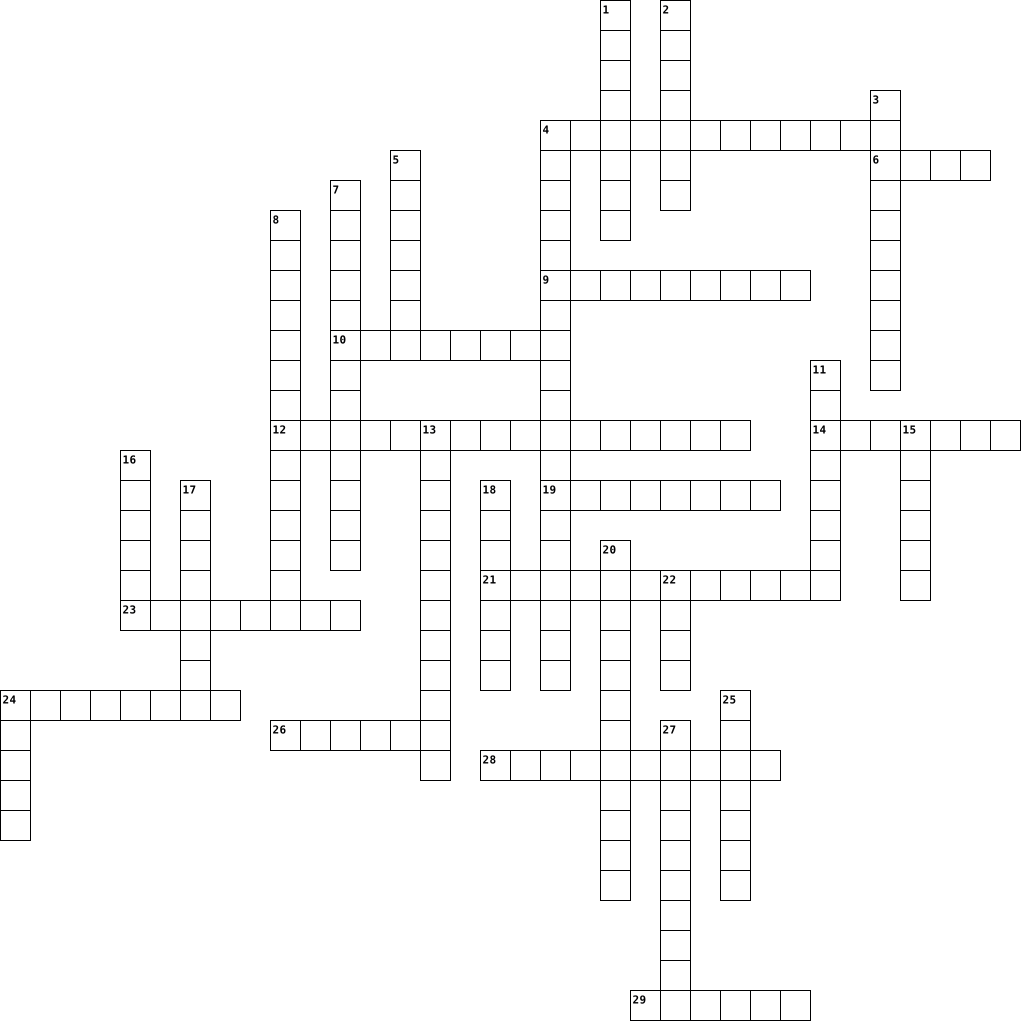
Across
- number of protons in nucleus
- smallest indivisible part of an element
- formed when a metal gives 1+ electrons to a non-metal so they both have full outer shells
- more reactive halogens........ less reactive ones
- giant ionic crystal
- simple covalent substance (CH4)
- group 7
- formed when metals become cations in a sea of electrons
- smallest mass and orbit the nucleus of an atom
- 2+ atoms covalently bonded together
- positive ion
- group 0
- columns in periodic table
Down
- elements that exist as 2 atoms
- burns red when in contact with air/oxygen
- metals which form coloured compounds and complex ions
- group 2
- rows in periodic table
- table with all atoms in it
- these forces are weak between covalent molecules
- 2+ atoms chemically joined together
- formed when 2+ atoms share electrons
- halogen ion
- noble gases are very ........
- poor conductor low melting point
- giant covalent structure, hardest substance known to man
- group 1
- formed by gain or loss of electrons
- good conductor, high melting point
- made up of 1 type of atom only
- total mass of protons and neutrons in an atom
31 Clues: group 2 • group 7 • group 1 • group 0 • halogen ion • positive ion • giant ionic crystal • rows in periodic table • columns in periodic table • table with all atoms in it • number of protons in nucleus • noble gases are very ........ • elements that exist as 2 atoms • made up of 1 type of atom only • simple covalent substance (CH4) • poor conductor low melting point • ...
APT Crossword Puzzle 2021-11-23

Across
- The smallest particle of an element
- Abbreviation of the name of an element
- The number of protons and neutrons
- A bond when atoms share one or more pairs of electrons
- Vertical column of elements in the periodic table
- Attraction between oppositely charged atoms
- An element that is shiny (Silver) and that conducts electricity well
- Charged particle that gains or loses electrons
- Group of atoms held together by chemical bonds
- Electrons in the outermost level of an atom
- Particle that has no charge
Down
- A bond formed by the attraction btw (+) metal ions and electrons
- Particle that has a positive charge
- An element that conducts heat and electricity poorly
- Average mass of isotopes
- The table of elements
- The number of protons in the nucleus of atoms
- Region around nucleus filled with electrons
- An interaction that holds atoms or ions together
- Substance made up of one or more of the same kind of atom chemically combined
- Horizontal row of elements (from left to right) on the periodic table
- Particle that has a negative charge
- Center of an atom filled with protons and neutrons
23 Clues: The table of elements • Average mass of isotopes • Particle that has no charge • The number of protons and neutrons • Particle that has a positive charge • The smallest particle of an element • Particle that has a negative charge • Abbreviation of the name of an element • Region around nucleus filled with electrons • Attraction between oppositely charged atoms • ...
Midterms Vocabulary Review 2021-12-10

Across
- An electron found on the outermost energy ring of an atom
- A substance made of atoms
- A table of the chemical elements arranged in an order
- A substance composed of 2 or more elements that are chemically combined together
- A measure on how easily an element will bond with other elements to form compounds
- The large number in front of a chemical symbol in reaction equations.
- A negatively charged particle
- A particle with no charge
- A positively charged particle
Down
- Has properties of both metals and nonmetals
- Causes a substance to change into an entirely different substance
- Consisting of three parts - protons, neutrons, and electrons
- Elements in the same vertical column of the periodic table
- Atoms of 2 or more elements, which are covalently bonded together.
- The number of protons in one atom of a particular element
- The quantity of matter contained in an atom of an element
- The process by which a substance changes to produce a different substance
- One of the starting substances in a chemical reaction
- One of the substances made during a chemical reaction
- Elements in the same horizontal column of the periodic table
20 Clues: A substance made of atoms • A particle with no charge • A negatively charged particle • A positively charged particle • Has properties of both metals and nonmetals • A table of the chemical elements arranged in an order • One of the starting substances in a chemical reaction • One of the substances made during a chemical reaction • ...
awwaw 2021-12-09

Across
- An element in Group 8A of the periodic table; the s and p sublevels of the highest occupied energy level are filled
- Any metal in Group 2A for the periodic table
- When the elements are arranged in order of increasing atomic number, there is a periodic repetition of their physical and chemical properties
Down
- An element that tends to have properties that are similar to those of metals and nonmetals
- An element in an "A" group in the periodic table; as a group these elements display a wide range of physical and chemical properties. In their atoms, the s and p sublevels in the highest occupied energy level are partially filled
- An element that tends to be a poor conductor of heat and electric current; nonmetals generally having properties opposites of those to metals
- A nonmetal in Group 7A
- Any metal in Group 1A in the periodic table
- One of a class of elements that are good conductors of heat and electric current; tend to be ductile, malleable, and shiny
9 Clues: A nonmetal in Group 7A • Any metal in Group 1A in the periodic table • Any metal in Group 2A for the periodic table • An element that tends to have properties that are similar to those of metals and nonmetals • An element in Group 8A of the periodic table; the s and p sublevels of the highest occupied energy level are filled • ...
Periodic table 2021-07-18

Across
- The most electro positive element
- most electronegative element
- A noble gas used in lights
- Group 1
Down
- Developer of Modern Periodic table
- Father of Periodic table
- inert in nature
- only liquid non metal
8 Clues: Group 1 • inert in nature • only liquid non metal • Father of Periodic table • A noble gas used in lights • most electronegative element • The most electro positive element • Developer of Modern Periodic table
Neon_Prathyusha_Cipla 2021-05-27

Across
- Gases that doesn't undergo chemical reactions under a set of given conditions are called?
- How many isotopes does Neon have?
- Name the inert gas that comes right below neon in the periodic table
- Atomic number of Neon
- What is the Group number of Neon?
Down
- Which element is 2 blocks left to Neon in periodic Table
- Inert gas that glows a reddish-orange color when put in a tube.
- Neon was first discovered in University College London by evaporating which gas in liquid argon?
- Neon has over 40 times more refrigerating capacity per unit volume than which element in liquid state?
- Total number of electrons in the element that is just above Neon in Periodic table
10 Clues: Atomic number of Neon • How many isotopes does Neon have? • What is the Group number of Neon? • Which element is 2 blocks left to Neon in periodic Table • Inert gas that glows a reddish-orange color when put in a tube. • Name the inert gas that comes right below neon in the periodic table • ...
periodic table vocab 2024-01-22

Across
- substance that consists enirley of one type of atom.
- a tiny negatively charged that moves around the nucleus of an atom.
- vertical columns on the periodic table that have common properties. Also known as families 1/3
- positively charged in the nucleus of a atom.
Down
- brittle, dull,poor conductors of heat and electricity; located on the right side of the periodic table.
- found along the staircase. Have properties of both metals and nonmetals.
- the smallest unit of an element that maintains the properties of that element
- shiny, malleable, ductile and good conductors.
- a subatomic particle that is neutral and that is found in the nucleus of an atom.
- horizontal rows on the periodic table.
10 Clues: horizontal rows on the periodic table. • positively charged in the nucleus of a atom. • shiny, malleable, ductile and good conductors. • substance that consists enirley of one type of atom. • a tiny negatively charged that moves around the nucleus of an atom. • found along the staircase. Have properties of both metals and nonmetals. • ...
Unit 5 electrons pt 2 2019-10-22

Across
- The distance from the outermost (valence) electrons and the nucleus of an atom. Periodic trend that increases as you move down and decreases as you move across (to the right) the periodic table.
- a fundamental property of all electrons that causes them to have magnetic fields associated with them
- a rule stating that when filling orbitals of equal energy, electrons will occupy empty orbitals singly before pairing with other electrons
- an unstable state for an atom or a molecule in which energy has been absorbed but not reemitted, raising an electron from the ground state into an high energy orbital
- the tendency to lose electrons in a chemical reaction. Periodic trend that increases as you move down and decreases as you move across (to the right) the periodic table.
- the electrons that are not in the outermost principal shell of an atom
- a number that indicates the shell that an electron occupies
Down
- the state of an atom or molecule in which the electrons occupy the lowest possible energy orbitals available
- an electron configuration in which electrons are represented as arrows in boxes corresponding to orbitals of a particular atom
- states that no more than 2 electrons can occupy an orbital and that the 2 electrons must have opposite spins
- a representation that shows the occupation of orbitals by electrons for a particular element
- the amount of energy required to remove an electron from the atom in the gaseous state. Periodic trend that decreases as you move down and increases you move across (to the right) the periodic table.
- the shell indicated by the principal quantum number
- the electrons in the outermost principal shell of an atom they are involved in chemical bonding
- in quantum mechanics, specifies the shape of the orbital and is represented by different letters
15 Clues: the shell indicated by the principal quantum number • a number that indicates the shell that an electron occupies • the electrons that are not in the outermost principal shell of an atom • a representation that shows the occupation of orbitals by electrons for a particular element • ...
Elements thingy 2021-03-11

Across
- two or more elements chemically bonded
- line of metalloids on the periodic table
- a substance that is not chemically bonded
- one type of element...
- another type of element...
Down
- anything that takes up space or has mass
- the building blocks of the universe
- best science teacher ever
- the thing that makes up the periodic table
- some elements can be ...
10 Clues: one type of element... • some elements can be ... • best science teacher ever • another type of element... • the building blocks of the universe • two or more elements chemically bonded • anything that takes up space or has mass • line of metalloids on the periodic table • a substance that is not chemically bonded • the thing that makes up the periodic table
Sharadhi_chemistry_9th 2023-01-30

Across
- point at which solid turns to liquid
- place where protons and neutrons are together
- group of different type of atoms
- negatively charged particle in an atom
- first element in the periodic table
Down
- chemical formula(name) of common salt
- vertical column in the periodic table
- supporter for combustion
- total of protons and neutrons in an atom
- solid form of water
10 Clues: solid form of water • supporter for combustion • group of different type of atoms • first element in the periodic table • point at which solid turns to liquid • chemical formula(name) of common salt • vertical column in the periodic table • negatively charged particle in an atom • total of protons and neutrons in an atom • place where protons and neutrons are together
Periodic Table Crossword 2022-05-27

Across
- is an alkali metal located in the first group or column of the periodic table.
- is a non-metal element that is a gas at room temperature.
- chemical element, a low-melting metal of Group 12 of the periodic table.
- is a lightweight silvery-white metal of main Group 13 of the periodic table.
Down
- is a clean fuel that produces only water when consumed in a fuel cell.
- is a colorless gaseous chemical element found in tiny amounts in the air and used in electric lights.
- is a chemical element like hydrogen-oxygen lead or any of the others in the periodic table.
- is a salt of hydriodic acid
8 Clues: is a salt of hydriodic acid • is a non-metal element that is a gas at room temperature. • is a clean fuel that produces only water when consumed in a fuel cell. • chemical element, a low-melting metal of Group 12 of the periodic table. • is a lightweight silvery-white metal of main Group 13 of the periodic table. • ...
Stormbreaker 2022-11-17

Across
- Played on a billiards table
- dead animal body
- easy to get along with
- big loud burp
- An irritable aroma
- loud electric horn
- anti-ship missile
- Group in the periodic table
- pale purple
- cut by a scythe or mower
Down
- Strangulation
- confined on all sides
- Spreading information
- used to hold a wheel in place
- Structural steel beam
- Confine a toxin or organism
- U.K slang similar to bloody
- mark or dot something
- squiggling and squirming synonym
- place to dock a boat
20 Clues: pale purple • Strangulation • big loud burp • dead animal body • anti-ship missile • An irritable aroma • loud electric horn • place to dock a boat • confined on all sides • Spreading information • Structural steel beam • mark or dot something • easy to get along with • cut by a scythe or mower • Played on a billiards table • Confine a toxin or organism • U.K slang similar to bloody • ...
Intro to Ionic Bonding 2024-11-04

Across
- An atom with a charge
- Number of Valence Electrons Atoms Want
- Elements on the Left of the Periodic Table
- Ability to attract electrons
- When an atom becomes a negative ion
Down
- Elements on the Right of the Periodic Table
- Periodic Trend for Electronegativity
- When an atom becomes a positive ion
8 Clues: An atom with a charge • Ability to attract electrons • When an atom becomes a positive ion • When an atom becomes a negative ion • Periodic Trend for Electronegativity • Number of Valence Electrons Atoms Want • Elements on the Left of the Periodic Table • Elements on the Right of the Periodic Table
Science Brainiac 2017-09-24

Across
- It is a column of elements in the periodic table.
- Its the mass of an atom.
- A table of chemical elements.
- Substance that can not be broken down into simpler substances by chemical means.
- A particle smaller then an atom.
- A subatomic particle of about the same mass as a proton but without an electric charge.
Down
- The central part atom it contains the protons and neutrons.
- It a horizontal roe of the periodic table.
- Is the basic unit of a chemical element.
- An outer shell of electrons.
- A stable subatomic particle with a charge of negative electricity.
- Were the electrons are located around the nucleus.
- Is a positive charge and its located in the nucleus.
13 Clues: Its the mass of an atom. • An outer shell of electrons. • A table of chemical elements. • A particle smaller then an atom. • Is the basic unit of a chemical element. • It a horizontal roe of the periodic table. • It is a column of elements in the periodic table. • Were the electrons are located around the nucleus. • Is a positive charge and its located in the nucleus. • ...
Chemistry Crossword 2021-09-21

Across
- The ability to be hammered into sheets
- Something that is not shiny.
- A solid is formed in a chemical reaction
- Most metals are this state of matter.
Down
- When we see these, we know gas is being released
- Found on the right side of the periodic table.
- These have properties of metals and nonmetals.
- Found on the left side of the periodic table
- Breaks easily.
- a pure substance made of one kind of atom
- This happens when a new substance is formed.
- A pure substance made of two or more elements chemically combined.
- Something that is shiny.
13 Clues: Breaks easily. • Something that is shiny. • Something that is not shiny. • Most metals are this state of matter. • The ability to be hammered into sheets • A solid is formed in a chemical reaction • a pure substance made of one kind of atom • Found on the left side of the periodic table • This happens when a new substance is formed. • ...
INTRODUCTION TO CHEMISTRY 2021-11-22

Across
- is the main component of Talcum powder .
- was the first fiber created ?
- are substances that contain sulphates of compound fertilizers help to increase the production of food.
- proposed the atomic theory
- is the non toxic mineral that the core of the pencil
- is neither loss nor created
- identified and named Oxygen in 1778
- the year in which PET was formed
Down
- an Antibiotic medicine
- created the periodic table
- periodic table has been updated to include 92 naturally occurring elements and 26 synthesized elements.
- is used in cheese as a preservative
- was the year in which the eraser was created
13 Clues: an Antibiotic medicine • proposed the atomic theory • created the periodic table • is neither loss nor created • was the first fiber created ? • the year in which PET was formed • is used in cheese as a preservative • identified and named Oxygen in 1778 • is the main component of Talcum powder . • was the year in which the eraser was created • ...
Metals, nonmetals and metalloids. 2021-02-19

Across
- the ability to transfer heat and electricity easily.
- sodium is an example of a ________.
- opposite of shiny and a characteristic of nonmetals.
- the ability to be pounded into thin sheets.
- mostly found on the right side of the periodic table.
- the ability to be pulled into wire.
- mostly found on the left side of the periodic table.
Down
- used to observe and describe matter.
- has properties of both metals, and nonmetals.
- argon is an example of a _______.
- boron is an example of a ________.
- breaks easily.
- describe the way light reflects off an object.
13 Clues: breaks easily. • argon is an example of a _______. • boron is an example of a ________. • sodium is an example of a ________. • the ability to be pulled into wire. • used to observe and describe matter. • the ability to be pounded into thin sheets. • has properties of both metals, and nonmetals. • describe the way light reflects off an object. • ...
Periodic Table Crossword 2023-10-19

Across
- What element is in Group 1 Period 1?
- In what group are noble gases located?
- What is Na on the periodic table?
- What element has 2 electrons shells and in group 13?
- What is group 3-12 called? (HINT: M...sy M...ls)
- Noble gases are.. (HINT: Nonreactive or reactive)
- The substances on the periodic table are..
- This element has 5 valence electrons (group 15) and is in period 4.
Down
- In periods 1 and 2, how reactive are elements?
- Metals are.. (HINT: nonreactive or reactive)
- How conductive are metalloids?
- Period 4 group 9
- Group 18, Period 2
13 Clues: Period 4 group 9 • Group 18, Period 2 • How conductive are metalloids? • What is Na on the periodic table? • What element is in Group 1 Period 1? • In what group are noble gases located? • The substances on the periodic table are.. • Metals are.. (HINT: nonreactive or reactive) • In periods 1 and 2, how reactive are elements? • ...
CH 3: ELEMENTS AND THE PERIODIC TABLE CROSSWORD PUZZEL 2014-10-07

Across
- AN ELEMENT THAT LACKS MOST OF THE PROPERTIES OF A METAL
- THE GRADUAL WEARING AWAY OF A METAL ELEMENT DUE TO A CHEMICAL REACTION
- A SUBSTANCE THAT CAN CONDUCT ELECTRIC CURRENT UNDER SOME CONDITIONS
- THE COLUMNS THAT THE ELEMENTS IN THE PERIODIC TABLE ARE ARRANGED
- THE CENTRAL CORE OF AN ATOM WHICH CONTAINS PROTONS AND NEUTRONS
- AN ATOM WITH THE SAME NUMBER OF PROTONS AND A DIFFERENT NUMBER OF NEUTRONS FROM OTHER ATOMS OF THE SAME ELEMENT
- A TERM USED TO DESCRIBE A MATERIAL THAT CAN BE PULLED OUT INTO A LONG WIRE
- A TERM USED TO DESCRIBE MATERIAL THAT CAN BE HAMMERED OR ROLLED INTO FLAT SHEETS
- AN ELEMENT THAT HAS SOME CHARACTERISTICS OF BOTH METALS AND NONMETALS
- A RADIOACTIVE ISOTOPE THAT CAN BE FOLLOWED THROUGH THE STEPS OF A CHEMICAL REACTION OR INDUSTRIAL PROCESS
Down
- SMALL, POSITIVELY CHARGED PARTICLES THAT ARE FOUND IN THE NUCLEUS OF AN ATOM
- ELEMENTS THAT ARE GOOD CONDUCTORS OF ELECTRIC CURRENT AND HEAT
- A TINY, NEGATIVELY CHARGED PARTICLE THAT MOVES AROUND THE OUTSIDE OF THE NUCLEUS OF AN ATOM
- THE ROWS THAT THE ELEMENTS IN THE PERIODIC TABLE ARE ARRANGED
- THE EASE AND SPEED WITH WHICH AN ELEMENT COMBINES, OR REACTS, WITH OTHER ELEMENTS AND COMPOUNDS
- THE WAY A MINERAL REFLECTS LIGHT FROM ITS SURFACE
- A SPONTANEOUS EMISSION OF RADIATION BY AN UNSTABLE ATOMIC NUCLEUS
- AN ELEMENT FOUND IN GROUP 17 OF THE PERIODIC TABLE
- THE SMALLEST PARTICLE THAT STILL CAN BE CONSIDERED AN ELEMENT
19 Clues: THE WAY A MINERAL REFLECTS LIGHT FROM ITS SURFACE • AN ELEMENT FOUND IN GROUP 17 OF THE PERIODIC TABLE • AN ELEMENT THAT LACKS MOST OF THE PROPERTIES OF A METAL • THE ROWS THAT THE ELEMENTS IN THE PERIODIC TABLE ARE ARRANGED • THE SMALLEST PARTICLE THAT STILL CAN BE CONSIDERED AN ELEMENT • ELEMENTS THAT ARE GOOD CONDUCTORS OF ELECTRIC CURRENT AND HEAT • ...
Ch 2 Vocab 2023-08-27

Across
- a negatively charged particle in the electron cloud surrounding the atomic nucleus
- electron(s) located in outer energy level (electron shell)
- smallest particle of an element that maintains the properties of that element
- the number of protons in the nucleus of an atom; used to determine an element's position in the Periodic Table
- a particle smaller than an atom, such as a proton, neutron, or electron
- total number of protons and neutrons in a specific atom
- a characteristic of a substance that describes how it combines with other substances to form new ones
- a pure substance that cannot be broken down chemically into simpler substances
Down
- a conceptual model in which the elements are organized according to their properties; often displayed as a chart
- property of matter that can be observed without changing the composition or identity of the matter
- the positively charged center of an atom containing the protons and neutrons
- a (neutral) particle with no electrical charge within the atomic nucleus
- average mass number of all atoms of an element (from particles in the nucleus)
- a property of a subatomic particle; positive (protons), negative (electrons), or neutral (neutrons)
- the vertical columns on the Periodic Table
- a positively charged particle within the atomic nucleus; used to identify an element
- the negatively charged space containing electrons that surrounds the atomic nucleus
- the horizontal rows on the Periodic Table
- tendency of a substance to undergo chemical changes in a system
19 Clues: the horizontal rows on the Periodic Table • the vertical columns on the Periodic Table • total number of protons and neutrons in a specific atom • electron(s) located in outer energy level (electron shell) • tendency of a substance to undergo chemical changes in a system • a particle smaller than an atom, such as a proton, neutron, or electron • ...
\I AN APE 2022-11-11

Across
- the ability to combine and to chemicaly bond with each other.
- a way of describing the number of atoms that make up a molecule or compound.
- a subatomic particle that has a positive charge and that is found in the nucleus of an atom; identifies the element.
- number of protons in the nucleus of one atom of an element.
- the number placed just before the chemical formula; number of molecules.
- some properties of both metals and nonmetals, found on the stairsteps of the periodic table.
- the smallest particle into which an element can be divided and still have the same properties as that element.
- number of protons and nuetrons.
Down
- one or two letter code that stands for an element.
- high luster, good conductor, malleable, found on the left of the periodic table.
- states that matter can neither be created nor destroyed.
- dull, poor conductors, brittle, found on the right side of the periodic table.
- compounds that include carbon.
- small number to the right of an element symbol that shows how many atoms of that element.
- molecule that is made up of more than one type of element.
15 Clues: compounds that include carbon. • number of protons and nuetrons. • one or two letter code that stands for an element. • states that matter can neither be created nor destroyed. • molecule that is made up of more than one type of element. • number of protons in the nucleus of one atom of an element. • the ability to combine and to chemicaly bond with each other. • ...