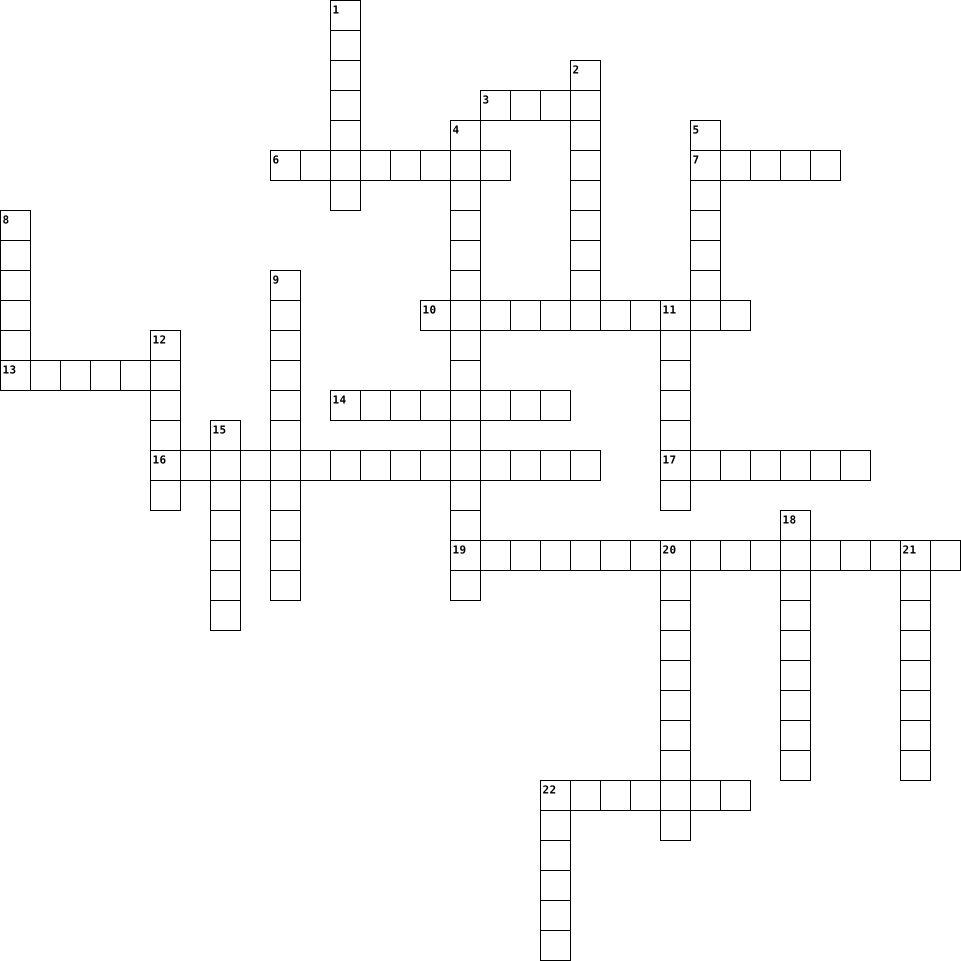
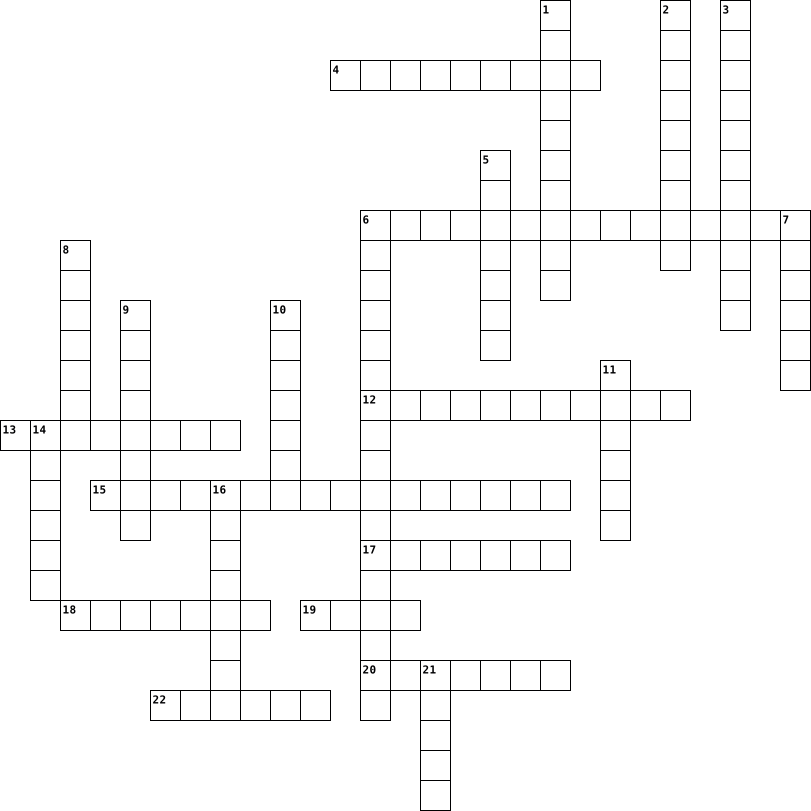
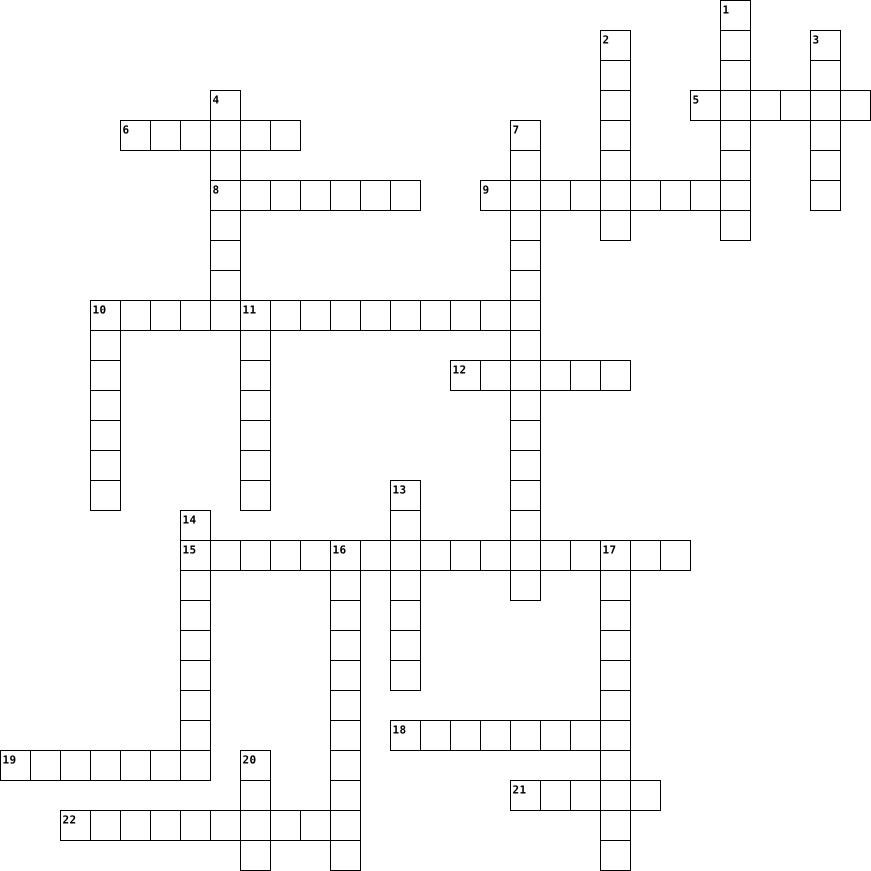
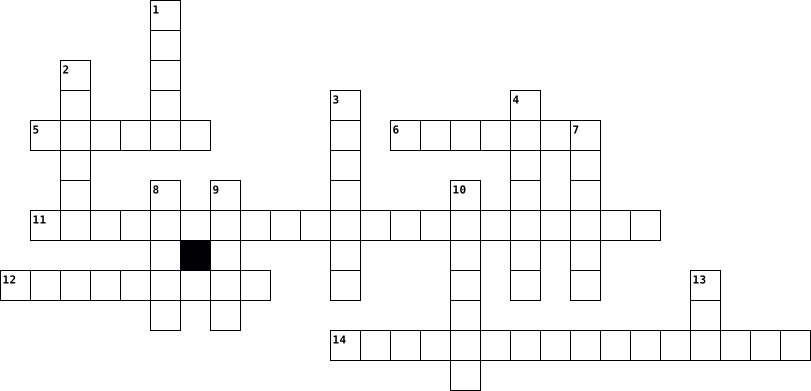
physics Crossword Puzzles
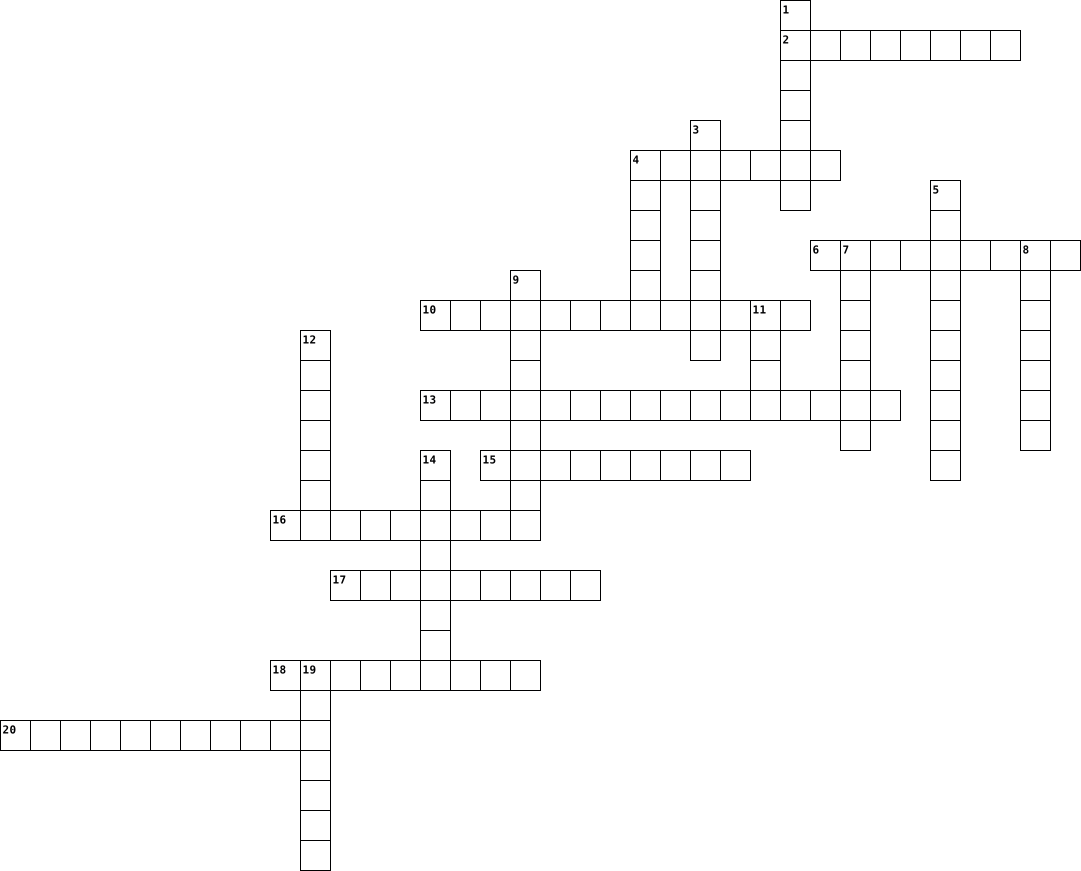
Physics D 2020-05-04
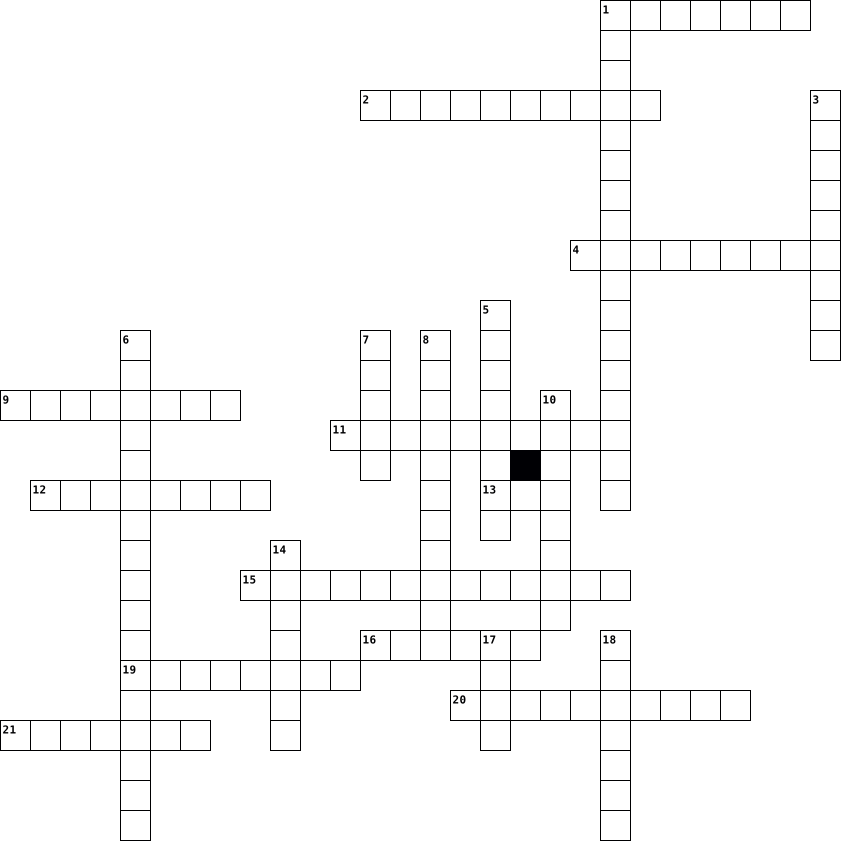
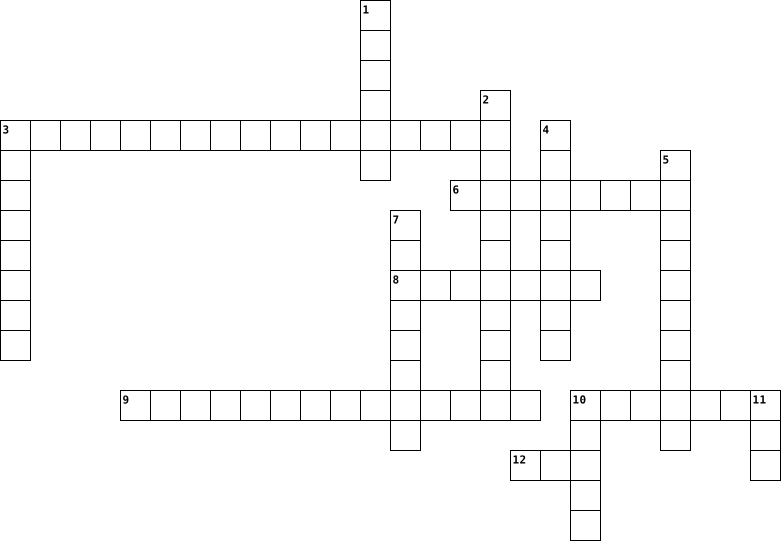
Across
- Subatomic particle that has a negative charge
- Unstable atoms (radioisotopes) emit radiation to become stable
- Different forms of an element with the same number of protons but different number of electrons
- the process of exposing an object to nuclear radiation
- very dense and positive centre of an atom
- Number of protons
- A particle that has the same number of protons and electrons
- Emits a electron
Down
- Subatomic particle that has a positive charge
- What is radiation measured in
- Number of protons and neutrons
- What is used to measure radiation
- What a unstable radioactive substance decays
- The unwanted presence of materials containing radioactive atoms on other materials
- A particle that has a uneven amount of electrons and protons
- emits a helium nucleus
- Subatomic particle that has no charge
- Emits a electromagnetic wave
- time taken for half the active nuclei in a sample to decay
19 Clues: Emits a electron • Number of protons • emits a helium nucleus • Emits a electromagnetic wave • What is radiation measured in • Number of protons and neutrons • What is used to measure radiation • Subatomic particle that has no charge • very dense and positive centre of an atom • What a unstable radioactive substance decays • Subatomic particle that has a positive charge • ...
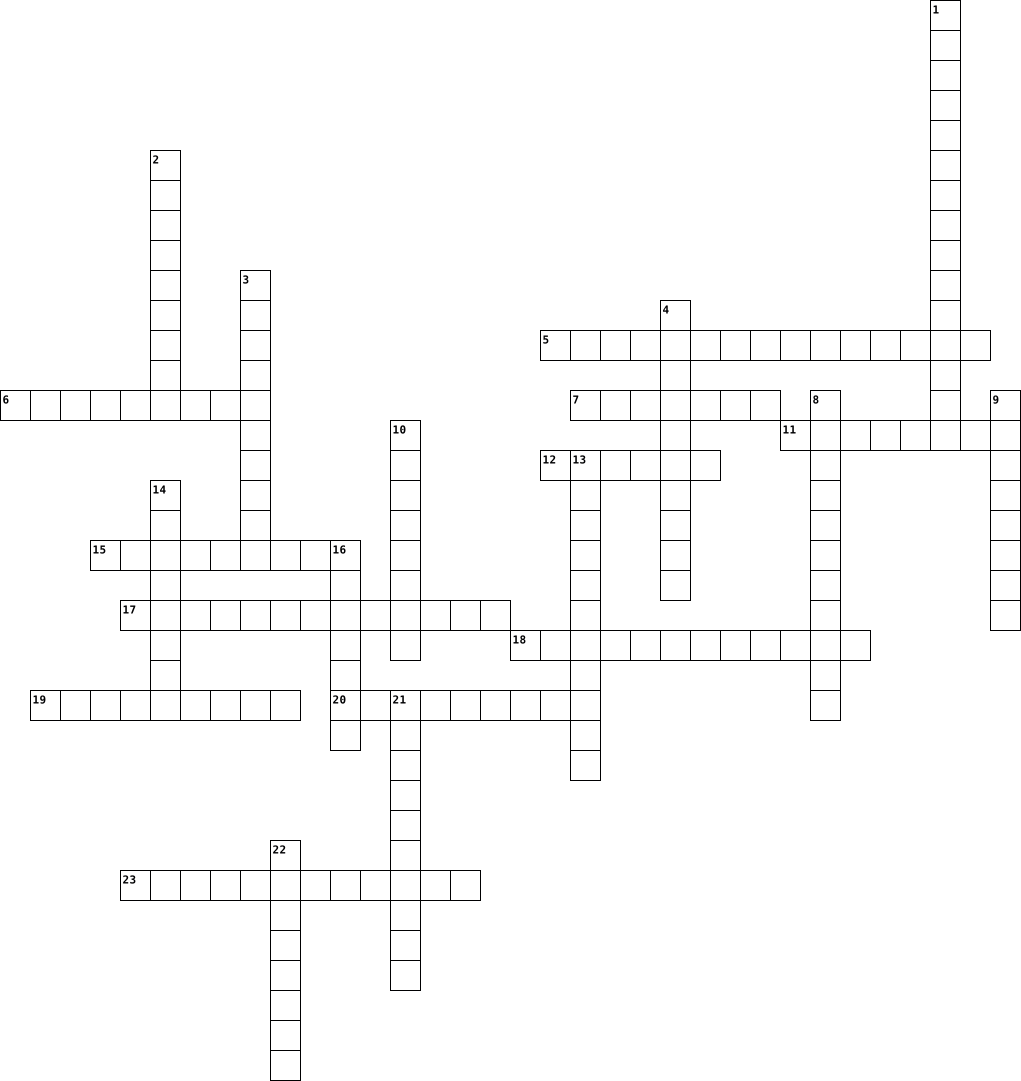
PHYSICS PUZZLE 2020-09-25
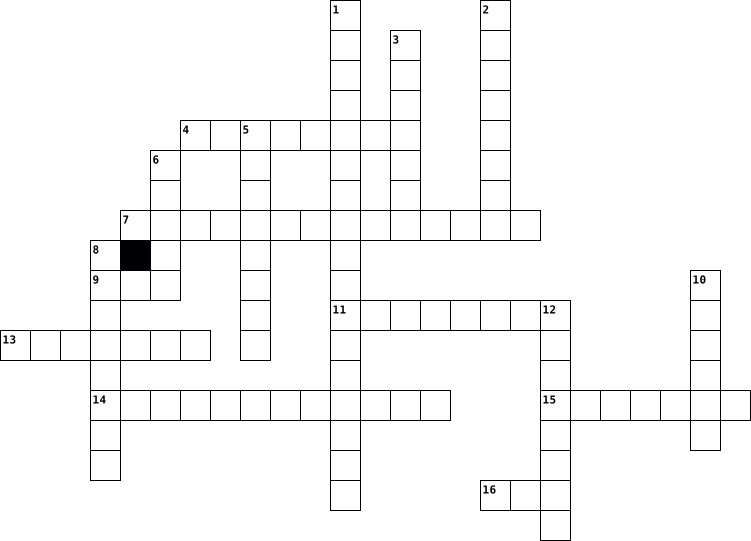
Across
- If the object placed at centre of curvature of concave mirror is moved towards the focus the magnification will ________.
- Type of refractive index of a medium with respect to air.
- _______ lens is called diverging lens.
- Incident ray falling on glass slab is ______ to emergent ray.
- size of image formed by convex mirror.
- Resiprocal of focal length of lens gives the value of_________.
- Centre: Value of refractive index is zero when light ray passes through ________.
- Type of lens which can give an enlarged image.
- Bending of light
- To obtain a point size image from a concave mirror the object must be placed at ____.
Down
- Type of mirror, if the image formed is erect and enlarged
- S.I. unit of power.
- of mirror which gives real image of the same size.
- Type of mirror which gives erect image of the same size of object
- Value of refractive index if a light ray falls normally
- Sign of focal length of convex mirror.
- Ray: The final ray produced after refractions in glass slab
- Bouncing back of light in the same medium after hitting a hard surface.
- of Curvature: In a concave lens ray of light follows the same path after reflecting, if the incident ray passes through ______.
- v/u of a lens gives the value of_____.
20 Clues: Bending of light • S.I. unit of power. • _______ lens is called diverging lens. • Sign of focal length of convex mirror. • size of image formed by convex mirror. • v/u of a lens gives the value of_____. • Type of lens which can give an enlarged image. • of mirror which gives real image of the same size. • Value of refractive index if a light ray falls normally • ...
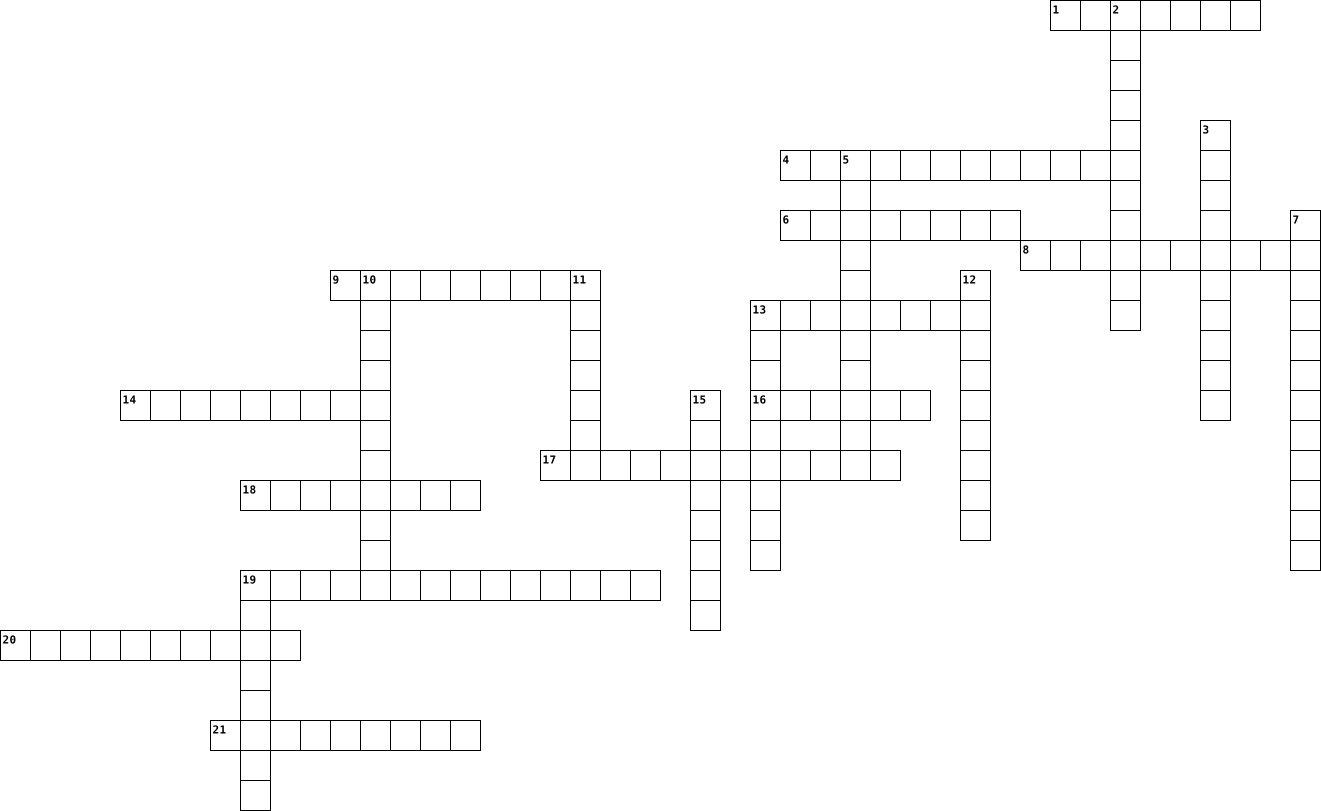
ULTRASOUND PHYSICS 2020-09-15
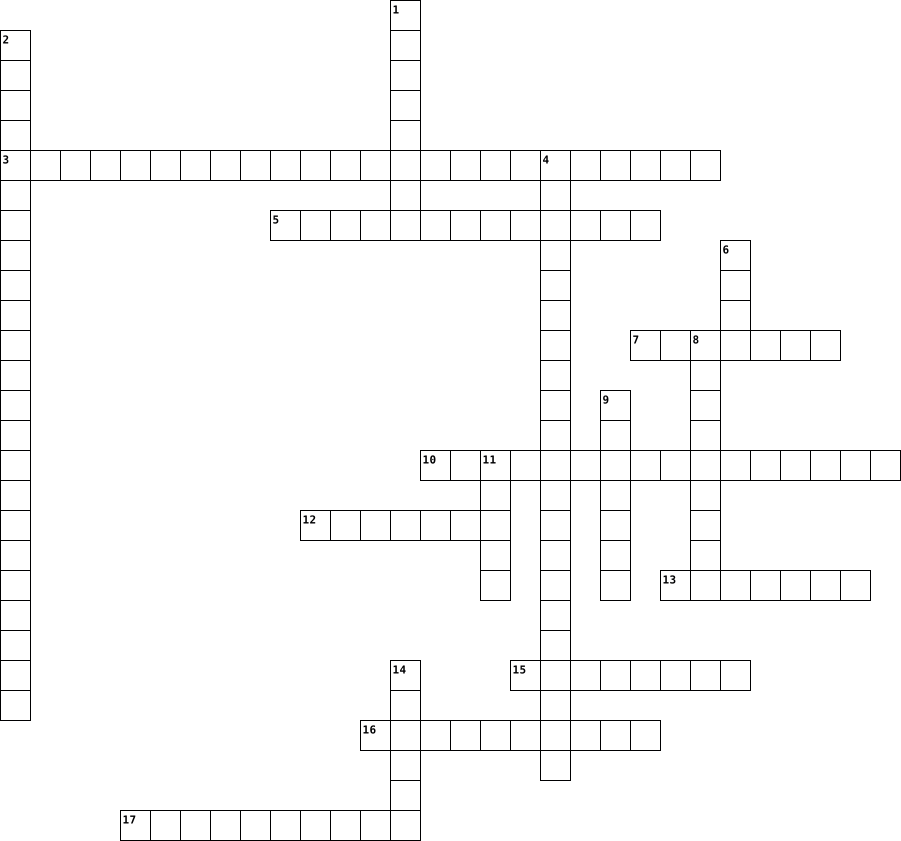
Across
- Distance from one crest to another
- Found all around us
- The speed of a particle in motion from one place to another
- How often something occurs
- What everything is made of
- There are multiples of these when high experiencing high frequency waves
- Reduction of an items density
- Time it takes to complete one cycle of vibration
- There are 4 types
- Ultrasound uses this to produce images
Down
- Xrays use this type of wave
- Use electromagnetic waves to produce images of the body
- Form of technology that uses waves to produce images
- The passing of something from one place to another
- Type of wave
- Type of wave
- What you need in order for waves to bounce back
- The movement of a particle from its equilibrium position
- Ultrasound uses this type of wave
- The way waves travel
20 Clues: Type of wave • Type of wave • There are 4 types • Found all around us • The way waves travel • How often something occurs • What everything is made of • Xrays use this type of wave • Reduction of an items density • Ultrasound uses this type of wave • Distance from one crest to another • Ultrasound uses this to produce images • What you need in order for waves to bounce back • ...
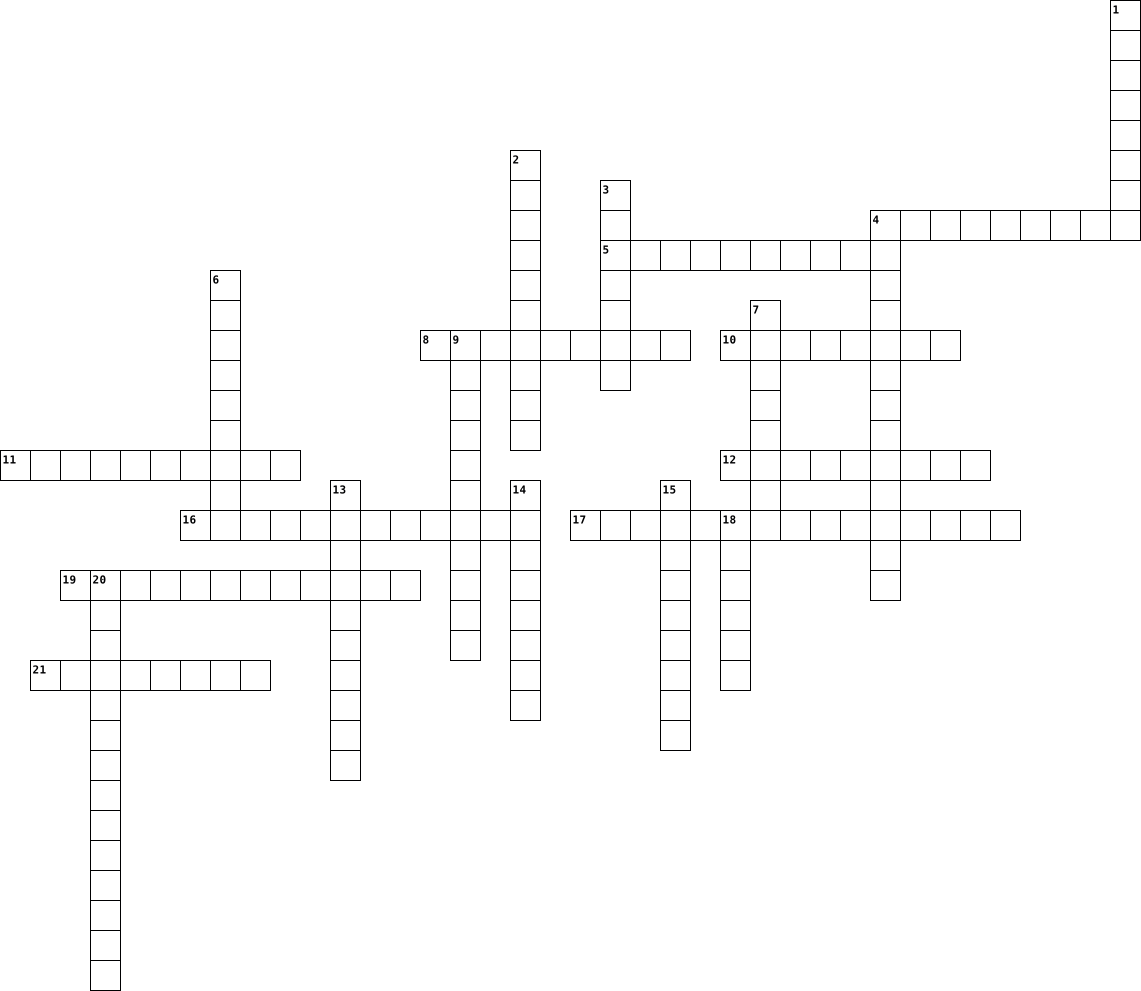
Physics - Forces 2021-09-27
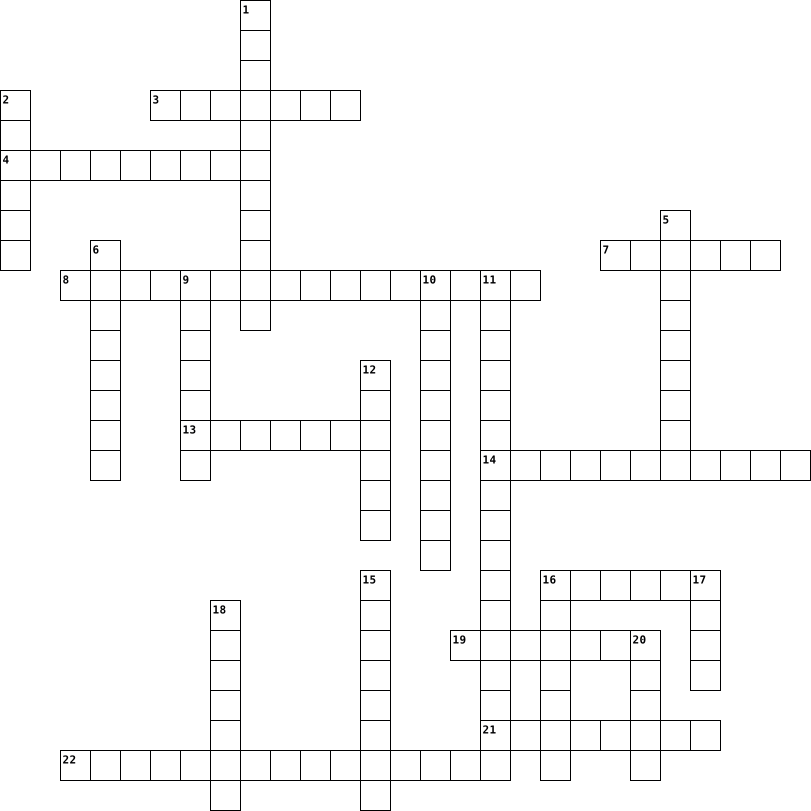
Across
- an Object at rest tends to stay at ______ unless acted upon by a force.
- An object will do this if acted on by an unbalanced force.
- A force that opposes motion such as by contact between two surfaces.
- when gravity is the only force acting on an object.
- change in velocity over a period of time.
- The tendency of any object with mass to resist changes in velocity.
- an object in motion tends to stay in ________ unless acted upon by a force?
- Which of Newtons Laws of Motion is know as the law of inertia?
Down
- SI Unit used to measure Force.
- imaginary point where mass is evenly distributed on all sides around it.
- Force that pulls object towards each other.
- the vector sum of all the forces that act upon an object, taking into account the fact that two forces of equal magnitude and opposite direction will cancel each other out.
- - A push or pull which, if unopposed, will cause an object to accelerate
- SI unit used to measure mass in.
- this frozen surface can be very close to frictionless.
- Which of Newton's Laws of Motion is put simply as F=m*a?
- How much matter an object consists of - Typically measured in Kilograms (kg)
- SI unit used to measure distance.
- Which of Newton's Laws of Motion states that for every action there is an equal and opposite reactions?
19 Clues: SI Unit used to measure Force. • SI unit used to measure mass in. • SI unit used to measure distance. • change in velocity over a period of time. • Force that pulls object towards each other. • when gravity is the only force acting on an object. • this frozen surface can be very close to frictionless. • Which of Newton's Laws of Motion is put simply as F=m*a? • ...
Physics Vocab 2016-11-06
Across
- Downward acting force created by gravity acting on the mass of an object.
- Weight A property of objects that corresponds to how heavy an object is.
- In every interaction there is a pair of forces acting on two interacting objects.
- Property of matter that resists changes in speed or direction.
- Body Diagram Sketch that isolates a single object and uses arrows to represent factors.
- Force Combination of all forces.
- A force which brings equilibrium state it is considered to be equal and opposite to resultant force.
- Friction Friction force that occurs between two surfaces that are at rest with respect to each other.
Down
- Being pulled down by planet's gravity.
- Push or pull.
- Second Law Acceleration of an object is proportional to the net force acting on it.
- Friction Force exerted on an object in motion that opposes another object.
- State of a system in which all forces are in balance.
- Force Always opposite to the object's motion.
- field The region of space surrounding a body in which another body experiences a force of gravitational attraction.
- Velocity Speed at which air friction and weight become equal and downward acceleration ceases.
- Force Force perpendicular to a surface. Typically created where objects touch other objects or surfaces such as floors.
- Force that pulls or stretches a material.
- Group of related and interacting objects and influences that we choose to investigate.
19 Clues: Push or pull. • Force Combination of all forces. • Being pulled down by planet's gravity. • Force that pulls or stretches a material. • Force Always opposite to the object's motion. • State of a system in which all forces are in balance. • Property of matter that resists changes in speed or direction. • ...
Physics crossword 2024-07-04
Across
- Speed with a direction
- Vector quantity representing change in position
- Scalar quantity representing the length of the path traveled
- Quantity with both magnitude and direction
- Product of force and displacement
- Ratio of useful output to total input
- Principle stating energy cannot be created or destroyed, only transformed
- Scalar quantity representing the rate of motion
Down
- The total force acting on an object after all forces are combined
- Force exerted by gravity on an object
- The size or extent of a quantity
- Resistance of an object to change its state of motion
- Amount of matter in an object
- Movement of energy from one place or object to another
- Rate of change of velocity
- Push or pull acting upon an object
- Capacity to do work
- Quantity with only magnitude
- transformation: Conversion of energy from one form to another
- Interaction between two bodies where they exert forces on each other
20 Clues: Capacity to do work • Speed with a direction • Rate of change of velocity • Quantity with only magnitude • Amount of matter in an object • The size or extent of a quantity • Product of force and displacement • Push or pull acting upon an object • Force exerted by gravity on an object • Ratio of useful output to total input • Quantity with both magnitude and direction • ...
Physics PATh 2023-08-04
Across
- υποτιθέμενο μέσο διάδοσης του φωτός
- φαινόμενο στο οποίο οφείλεται η άνοδος ενός υγρού σε λεπτούς σωληνίσκους
- στοιχείο από το οποίο κατασκευάζεται η πλειοψηφία των ηλεκτρονικών
- επιστημονική ονομασία κοινής γλυκαντικής ένωσης
- γλύκισμα και απαρχαιωμένο ατομικό μοντέλο
- είδος κουάρκ
- από τα μεγαλύτερα φεγγάρια του ηλιακού μας συστήματος
- πόλη από την οποία ονοματίστηκε η διασημότερη ερμηνεία της κβαντομηχανικής
Down
- αναλύει το φως στα χρώματα της ίριδας
- οδεύουσα κύματα με ταχύτητα μεγαλύτερη του ήχου στο μέσο που διαδίδονται
- περιέχει το στρώμα του όζοντος
- ισότοπο του υδρογόνου
- ...οπή
- ομάδα αστεροειδών γύρω από τα σημεία Lagrange του Δία
- δημοφιλής γλώσσα στοιχειοθέτησης επιστημονικών εργασιών
- στοιχειώδες σωματίδιο, φορέας της ηλεκτρομαγνητικής αλληλεπίδρασης
- είδος ηφαιστειακού γυαλιού
- το στοιχείο με τον μεγαλύτερο ατομικό αριθμό το οποίο δεν είναι ραδιενεργό
- όρος για τα κράματα του υδραργύρου
19 Clues: ...οπή • είδος κουάρκ • ισότοπο του υδρογόνου • είδος ηφαιστειακού γυαλιού • περιέχει το στρώμα του όζοντος • όρος για τα κράματα του υδραργύρου • υποτιθέμενο μέσο διάδοσης του φωτός • αναλύει το φως στα χρώματα της ίριδας • γλύκισμα και απαρχαιωμένο ατομικό μοντέλο • επιστημονική ονομασία κοινής γλυκαντικής ένωσης • ομάδα αστεροειδών γύρω από τα σημεία Lagrange του Δία • ...
Physics Club 2022-11-30
Across
- Satuan dari energi
- Satuan dari waktu
- Energi listrik diubah menjadi gerak
- yang menemukan Hukum Newton
- Bagian benda yang tidak bisa dibagi-bagi lagi
- Alat Ukur Panjang
- Alat bantu untuk melihat
- Salah satu skala suhu
- Alat ukur suhu
- Benda yang dapat menarik benda lain
Down
- Muatan Atom yang Positif
- Muatan Atom yang Negatif
- Besaran yang Menggunakan Alat Ukur Neraca
- Benda yang dapat menghantarkan panas yang baik
- Planet tempat kita tinggal
- Alat ukur waktu
- Benda yang menghantarkan panas yang kurang baik
- Energi listrik diubah menjadi cahaya
- Transfer energi melalui gaya
19 Clues: Alat ukur suhu • Alat ukur waktu • Alat Ukur Panjang • Satuan dari energi • Satuan dari waktu • Salah satu skala suhu • Muatan Atom yang Positif • Muatan Atom yang Negatif • Alat bantu untuk melihat • Planet tempat kita tinggal • yang menemukan Hukum Newton • Transfer energi melalui gaya • Energi listrik diubah menjadi gerak • Benda yang dapat menarik benda lain • ...
THERMAL PHYSICS 2025-01-22
Across
- - Natural cooling mechanism in humans using evaporation.
- Area - Larger this, faster the rate of evaporation.
- - Process of a liquid turning into a gas.
- - Factor that increases the rate of evaporation when higher.
- - Process of a solid turning into a liquid.
- Heat - Energy required for a substance to change its state without temperature change.
- - Heat transfer through electromagnetic waves.
- Movement - Increases evaporation by removing vapor molecules.
- - Process of a liquid turning into a gas below its boiling point.
- - Substance that melts at 0c and boing
- - Heat transfer through direct contact.
Down
- - Heat transfer by the movement of fluids.
- Point - Another name for the temperature at which a liquid solidifies.
- Forces - Forces that must be overcome during melting or evaporation.
- - Process of a gas turning into a liquid.
- - Liquid metal used in thermometers for measuring temperature.
- Insulator - Material that resists heat transfer, like wood.
- - Process of a liquid turning into a solid.
- Conductor - Material that transfers heat well, like metals.
- Energy - Type of energy molecules need to escape a liquid during evaporation.
20 Clues: - Substance that melts at 0c and boing • - Heat transfer through direct contact. • - Process of a liquid turning into a gas. • - Process of a gas turning into a liquid. • - Heat transfer by the movement of fluids. • - Process of a liquid turning into a solid. • - Process of a solid turning into a liquid. • - Heat transfer through electromagnetic waves. • ...
Physics Vocab 2025-11-11
Across
- the length of a wave
- the time taken for one complete motion
- the measure of change in a single period
- the bouncing of a wave off a surface
- the highest point of a wave
- the change in frequency of a wave in relation to an observer who is moving relative to the wave source
- a wave that oscillates in the direction parallel to the direction the wave travels
- the bending of a wave
- where two or more waves cancel each other
- a wave that travels through a vacuum at the speed of light
Down
- a wave that transfers energy through particle oscillation
- a disturbance that transfers energy
- the number of cycles of a repeating event
- the bending of waves around obstacles
- where two or more waves combine to produce a single wave
- how fast a wave travels
- what a wave travels through
- a wave that oscillates along paths at right angles
- the lowest point of a wave
19 Clues: the length of a wave • the bending of a wave • how fast a wave travels • the lowest point of a wave • what a wave travels through • the highest point of a wave • a disturbance that transfers energy • the bouncing of a wave off a surface • the bending of waves around obstacles • the time taken for one complete motion • the measure of change in a single period • ...
Physics crossword 2026-01-16
Across
- what the letter I represents in a circuit
- unit used for current
- moving objects have ____ energy
- _____ hand rule
- the force acting on every object with mass on earth
- what flows from negative to positive
- an unknown angle
- the study of motion
- when an object is only acted on by the force of gravity
Down
- the side longest side in a right angle triangle
- who has 3 laws
- which theorem is a² + b² = c²
- every action has its equal opposite _____
- what orientation y represents
- symbol to represent ‘a change in’
- time can never be
- energy before an object moves
- another word for 274 deg c
- what orientation x represents
19 Clues: who has 3 laws • _____ hand rule • an unknown angle • time can never be • the study of motion • unit used for current • another word for 274 deg c • which theorem is a² + b² = c² • what orientation y represents • energy before an object moves • what orientation x represents • moving objects have ____ energy • symbol to represent ‘a change in’ • what flows from negative to positive • ...
AS Physics 2012-12-04
Across
- energy stored in an extended or compressed material
- the force on an object cause by the gravitational field acting on it's mass
- has both magnitude and direction
- using a drawing often to scale to find the resultant vector
- force x perpendicualar distance from the pivot point to line of action of the force
- the net force acting on an object
- the force that will give a 1kg mass and acceleration of one metre per second
- the total distance travelled by an object divided by the time taken
- the ratio of stress to strain for a given materia,l resulting from tensile forces, provided Hooke's law is obeyed
Down
- the distance moved by an object in a particular direction, measured from a fixed start point
- the ratio of useful output energy to the total input energy of a device
- energy of an object due to its motion
- the point where rge ebtire weight of an object appears to act
- the rate of change of the displacement of an object
- and object in equilibrium is either at rest or travelling with a constant velocity because the net force on it is zero
- the product of the force and the distance moved by the force in the direction of travel
- the product of one of teh forces of a couple and the perpendicular distance between them
- has magnitude but no direction
- the rate of change of an object's velocity
- the rate of change of the distance moved by an object
20 Clues: has magnitude but no direction • has both magnitude and direction • the net force acting on an object • energy of an object due to its motion • the rate of change of an object's velocity • the rate of change of the displacement of an object • energy stored in an extended or compressed material • the rate of change of the distance moved by an object • ...
Motion (physics) 2013-01-10
Across
- mass x velocity
- Rate at which something is able to move or operate
- Newton's law about collisions
- What subject is motion in?
- momentum is a ________
- unit of momentum
- energy of motion
- Type of motion in three dimensional space
- significant works done in the Renaissance era
- Type of motion
- changes in velocity over a period of time
- staying still
- a downward force caused by the earth
Down
- the speed of something in a given direction
- the theory that describes speed of light
- change in postion of an object with respect to time and its surrounding
- what motion did biologist Robert Brown noticed?
- who made the three laws of motion?
- momentum that is transferred to another object
- The study of motion without regard to the forces or energies that may be involved
- remaining the same over a period of time
- final speed of a body is less than its initial speed
- something that acts upon an object and causes it to move to its direction
- having direction and magnitude
24 Clues: staying still • Type of motion • mass x velocity • unit of momentum • energy of motion • momentum is a ________ • What subject is motion in? • Newton's law about collisions • having direction and magnitude • who made the three laws of motion? • a downward force caused by the earth • the theory that describes speed of light • remaining the same over a period of time • ...
Physics-Upamanyu 2013-06-09
Across
- Can be real or virtual
- A temperature scale
- SI unit of energy
- Splitting of nuclei
- Mass/volume
- Boils at 212°F
- Measures pressure
- Unit of power
- Diverging lens
- Non-conductor
- Diverging mirror
- V
- It travels very fast
- Our nearest star
- An apple fell on his head
Down
- A body part with a lens
- Mercury at room temperature
- SI unit of mass
- Many cells together make this
- Distance/time
- Negatively charged particle
- e.g. aluminium, silver
- Unit of charge
- It attracts iron
- Uncharged particle
- Commonly used conductor
- Refracts light
27 Clues: V • Mass/volume • Distance/time • Unit of power • Non-conductor • Boils at 212°F • Unit of charge • Diverging lens • Refracts light • SI unit of mass • It attracts iron • Diverging mirror • Our nearest star • SI unit of energy • Measures pressure • Uncharged particle • A temperature scale • Splitting of nuclei • It travels very fast • Can be real or virtual • e.g. aluminium, silver • A body part with a lens • ...
ISAT Physics 2013-03-12
Across
- / A hammer is an example of which simple machine?
- / Units of work are measured in?
- / In 2 seconds a ball travels 100cm. What is the speed of the ball? ______ cm/sec.
- / This lens bulges outward and causes light rays to meet, or converge.
- / The energy of motion
- / You burn your hand when it comes into contact with a hot stove. What kind of heat transfer is this?
- / The force that pulls all objects towards each other
- / A ladder or ramp is an example of this simple machine?
- / A slinky weighs 10 newtons. How much work does it do climbing 2 meters of steps. (Hint: Work = force x distance)
- / Earth receives energy from the sun by?
- / Energy that is "stored" because of the position and/or arrangement of the object.
Down
- / when light changes direction as a result of "bouncing off" a surface like a mirror.
- / When water in a pot heats up, it becomes less __________ causing it rise to the top .
- / What is a material or an object that does not easily allow heat, electricity, light, or sound to pass through it called?
- / Bicycles, roller skates, and skate boards use this simple machine?
- / Force times distance equals what?
- / bending of light around another object is called?
- / the method of heat transfer
- / An object at rest will remain at rest unless acted on by an unbalanced force is which of Newton’s 3 laws?
- / An Axe or chisel is an example of what kind of simple machine?
- / the bending of light as it passes from one substance to another
- / This lens curves inward and causes light rays to spread apart, or diverge.
- / for every action there is an equal and opposite reaction is which of Newton’s 3 laws?
- / Light has properties of both particles and ________.
24 Clues: / The energy of motion • / the method of heat transfer • / Units of work are measured in? • / Force times distance equals what? • / Earth receives energy from the sun by? • / A hammer is an example of which simple machine? • / bending of light around another object is called? • / The force that pulls all objects towards each other • ...
ISAT Physics 2013-03-11
Across
- / An object at rest will remain at rest unless acted on by an unbalanced force is which of Newton’s 3 laws?
- / The force that pulls all objects towards each other
- / This lens curves inward and causes light rays to spread apart, or diverge.
- / the method of heat transfer
- / Energy that is "stored" because of the position and/or arrangement of the object.
- / Bicycles, roller skates, and skate boards use this simple machine?
- / You burn your hand when it comes into contact with a hot stove. What kind of heat transfer is this?
- / Force times distance equals what?
Down
- / In 2 seconds a ball travels 100cm. What is the speed of the ball? ______ cm/sec.
- / The energy of motion
- / Earth receives energy from the sun by?
- / when light changes direction as a result of "bouncing off" a surface like a mirror.
- / the bending of light as it passes from one substance to another
- / This lens bulges outward and causes light rays to meet, or converge.
- / A ladder or ramp is an example of this simple machine?
- / bending of light around another object is called?
- / An Axe or chisel is an example of what kind of simple machine?
- / What is a material or an object that does not easily allow heat, electricity, light, or sound to pass through it called?
- / A hammer is an example of which simple machine?
- / Units of work are measured in?
- / When water in a pot heats up, it becomes less __________ causing it rise to the top .
- / for every action there is an equal and opposite reaction is which of Newton’s 3 laws?
22 Clues: / The energy of motion • / the method of heat transfer • / Units of work are measured in? • / Force times distance equals what? • / Earth receives energy from the sun by? • / A hammer is an example of which simple machine? • / bending of light around another object is called? • / The force that pulls all objects towards each other • ...
Physics Club 2013-12-04
Across
- MLK was a
- Slave who brought the case of his freedom to court
- Abraham Lincoln was a member of the _________ Party
- white supremacy group
- First African American supreme court judge
- Assassinated MLK
- African americans wanted
- Legislation designed to overcome loopholes on the enforcement of desegregation laws
- Slavery abolished with this amendment
- Period in 1870s was
- Inaugurated in 1861
- Rhymes with hennesy
Down
- Segregation laws
- Rhymes with boating fights
- broke out after MLK's assassination
- First female African to become secretary of state
- First African American to receive votes
- John Brown was a
- American _____ of rights
- Martin Luther King had a
- act that prohibited slawveryr in region North of Ohio river
- people who wanted slavery abolished
- First Black President of USA
- alias for El-Haijj Malik El-Shabazz
- African Americans were to sit at the ____ of buses
- when some slaves are freed
- Civil liberties have been protected in English tradition through _________ law
- little rock _____
- Classical liberals ______ slavery
- led to compromise of 1833
30 Clues: MLK was a • Segregation laws • John Brown was a • Assassinated MLK • little rock _____ • Period in 1870s was • Inaugurated in 1861 • Rhymes with hennesy • white supremacy group • American _____ of rights • Martin Luther King had a • African americans wanted • led to compromise of 1833 • Rhymes with boating fights • when some slaves are freed • First Black President of USA • ...
Physics Review 2013-11-26
Across
- If it has 1000000000000 stars it is a ________.
- A group of a minimum number of atoms in the same ratio as in the bulk material is a ________.
- Currently the objects that we hope are the smallest components of matter are called ________.
- Energy/electron = ________.
- Difficulty on passing current is called ________.
- AMA accounts for ________.
- Electrons/sec = ________.
- The simplest (most fundamental) object obtainable by chemical means (pounding, acids, freezing, etc.) is ________.
- A ________ consists of everything observable.
Down
- If a machine is 90% efficient where does the missing 10 % go?
- The distance light travels in a year.
- A positron was the first example of ________.
- If each fission causes one additional fission you have a ________.
- If it is comfortable to live on it’s a ________.
- A fuse should be in ________ with the thing it is to protect.
- These have a very regular organized structure.
- There are about a hundred different types of ________.
- Heavy nuclei produce energy by ________.
- Magnetic field affect ________.
- A generator worked backward would probably act like a ________.
20 Clues: Electrons/sec = ________. • AMA accounts for ________. • Energy/electron = ________. • Magnetic field affect ________. • The distance light travels in a year. • Heavy nuclei produce energy by ________. • A positron was the first example of ________. • A ________ consists of everything observable. • These have a very regular organized structure. • ...
Physics Review 2013-11-26
Across
- A fuse should be in ________ with the thing it is to protect.
- Magnetic field affect ________.
- AMA accounts for ________.
- Currently the objects that we hope are the smallest components of matter are called ________.
- A positron was the first example of ________.
- Difficulty on passing current is called ________.
- A ________ consists of everything observable.
- Electrons/sec = ________.
- If it is comfortable to live on it’s a ________.
- The simplest (most fundamental) object obtainable by chemical means (pounding, acids, freezing, etc.) is ________.
Down
- Energy/electron = ________.
- Heavy nuclei produce energy by ________.
- A generator worked backward would probably act like a ________.
- These have a very regular organized structure.
- If each fission causes one additional fission you have a ________.
- There are about a hundred different types of ________.
- A group of a minimum number of atoms in the same ratio as in the bulk material is a ________.
- The distance light travels in a year.
- If it has 1000000000000 stars it is a ________.
- If a machine is 90% efficient where does the missing 10 % go?
20 Clues: Electrons/sec = ________. • AMA accounts for ________. • Energy/electron = ________. • Magnetic field affect ________. • The distance light travels in a year. • Heavy nuclei produce energy by ________. • A positron was the first example of ________. • A ________ consists of everything observable. • These have a very regular organized structure. • ...
PHYSICS - FORCE 2014-10-20
Across
- One type of force, present when we use a trampoline.
- A force that is a pull or a push by another object.
- Forces that act by contact.
- Ability of an object to resist change of motion.
- A quantity that has only magnitude.
- A vector quantity.
- The resistance of an object to a change in the motion.
- We measure this quantity in m/s.
- If gravity changes this property also changes.
- Complete the sentence:"Less ........, less inertia".
- The force that is always opposite the direction of motion and always acts to slow us down.
- A force that is a pull by a cable, rope or string.
- A push or a pull.
- An English physicist and mathematician that discovered 3 laws.
- Forces that act without contact.
Down
- Unit used to measure time.
- Is the force of gravity on mass.
- Force that also receives the name of air resistance.
- Unit to measure mass.
- Is a vector quantity.
- The pull down toward the center of the Earth acting on all objects.
- A scalar quantity.
- Unit used to measure distance.
- Is the amount matter of an object.
- The total number of Newton's law.
- A force that is a push of a surface up (perpendicular to surface).
- A quantity that has magnitude and direction.
- Which is the Newton's law that say: "Thinks keep moving or stay at rest, unless a net force acts upon them".
28 Clues: A push or a pull. • A vector quantity. • A scalar quantity. • Unit to measure mass. • Is a vector quantity. • Unit used to measure time. • Forces that act by contact. • Unit used to measure distance. • Is the force of gravity on mass. • We measure this quantity in m/s. • Forces that act without contact. • The total number of Newton's law. • Is the amount matter of an object. • ...
Conceptual Physics 2013-04-06
Across
- Work divided by time.
- Unit of energy.
- The standard unit of force.
- Mass * velocity.
- The standard unit for length.
- Kind of collision in which shape changes.
- Kind of collision in which shape does not change.
- The force due to gravity.
- The Total distance covered divided by the time it took to travel that distance.
- Fake force.
- One quantity increases the other quantity decreases.
- Energy of position.
- A measure of how well something uses energy.
- Any Push or Pull.
- Force * distance.
- Magnitude.
- The ability for an object to resist changes to it’s state of motion.
- Vector quantity for speed.
- Force that keeps an object moving in a circle.
- Simple machine.
- Units of power.
- Energy of motion.
- An object is moving if its position relative to a fixed point is changing.
- Unit of time.
Down
- Force divided by area.
- Magnitude and Direction.
- Falling under the force of gravity only.
- An object that can change the direction of a force or multiply forces.
- At the beginning. In physics it is when time equals zero.
- A distance.
- The sum of the energies of position and motion.
- The change in velocity divided by time. vector quantity.
- F=ma.
- Energy is neither created nor destroyed.
- Distance divided by time.
- The Vector sum of all of the forces acting on an object.
- At right angles.
- Pivot point.
- Force of rubbing two surfaces together. A force of sliding.
- A number. Also shown as a length.
- The number and kind of atoms that make up an object.
- An object will continue in motion or stay at rest unless acted upon by a non-zero net force.
- The Net force is zero. By Newton’s 2nd Law acceleration is zero.
- The standard unit of mass.
44 Clues: F=ma. • Magnitude. • A distance. • Fake force. • Pivot point. • Unit of time. • Unit of energy. • Simple machine. • Units of power. • Mass * velocity. • At right angles. • Any Push or Pull. • Force * distance. • Energy of motion. • Energy of position. • Work divided by time. • Force divided by area. • Magnitude and Direction. • The force due to gravity. • Distance divided by time. • ...
Physics Review 2013-09-20
Across
- / have magnitude only.
- / is displacement over total time.
- / change in position.
- / the position at a particular instant.
- / the vector that represents the sum of the other two vectors.
- / series of images showing the positions of amoving object at equal time intervals is called
- / how far the object is from the origin.
- / is the natural science that involves the study of matter and its motion through space and time, along with related concepts such as energy and force.
- / a simplified version of a motion diagram in which theobject in motion is replaced by a series of single points.
- / the difference between two times
Down
- / is the absolute value of the average velocity.
- / tells you the location of the zero point of the variable you are studying and the direction in which the values of the variable increase.
- / Length, mass, time, electric current, thermodynamic temperature, amount of substance, luminous intensity.
- / the separation between an object and the origin.
- / have both magnitude and direction.
- / the speed and direction of an object at a particular instant.
- / descibes the nearness of a measurement to the standard or true value.
- / rectilinear, curvilinear, angular.
- / plotting the time data on horizontal axis and the position data on a vertical axis.
- / the point at which both variables have the value zero.
- / is the degree to which several measurements provide answers very close to each other.
- / any movement or change in position or time.
22 Clues: / change in position. • / have magnitude only. • / rectilinear, curvilinear, angular. • / the difference between two times • / is displacement over total time. • / have both magnitude and direction. • / the position at a particular instant. • / how far the object is from the origin. • / any movement or change in position or time. • ...
Physics words 2013-09-02
Across
- Part of Science regarding lots including movement
- The degree of intensity of this, measured by acceleration.
- The moving of something from its place or position.
- Moving up
- The speed of something in a given direction.
- Having only magnitude, not direction
- Newton The creator of the 3 laws
- A tendency to do nothing or to remain unchanged
- The strength and vitality required for sustained physical or mental activity.
- A quantity having direction as well as magnitude, esp. as determining the position of one point in space relative to another.
- Deeps backward
Down
- Length
- A material thing that can be seen and touched.
- Wal backwards
- To decrease the velocity of.
- A coherent, typically large body of matter with no definite shape.
- seconds
- Not moving
- Everything
- Pressure
20 Clues: Length • seconds • Pressure • Moving up • Not moving • Everything • Wal backwards • Deeps backward • To decrease the velocity of. • Newton The creator of the 3 laws • Having only magnitude, not direction • The speed of something in a given direction. • A material thing that can be seen and touched. • A tendency to do nothing or to remain unchanged • ...
Physics Saftey 2013-09-27
Across
- Do not _______ chemicals you should waft them towards your nose
- _____, to your teacher
- Silliness that is disruptive
- you should always wear these on your feet incase of harm
- Never ____ in a lab unless told otherwise by the teacher
- In case of fire you should wear your hair
- If you have any ______ inform your teacher ASAP
- Incase of exposer to broken glass, or chemicals you should wear
- incase of a person being on fire you use a ________.
- Pour _____ into base not base into ____.
Down
- Never work in a closed space make sure it's ________.
- wear these to proctect your eyes
- use your inside voices
- If you have any ________ don't leave it on the floor, clean it up, and tell a teacher
- Be _____ in the lab
- Keep everything _____ and organized
- If you get chemicals in your eyes use the ________.
- Don't ____ chemicals down the drain, place in proper disposal areas.
- Do not do this in a lab enviroment
- Always wear a ____ over your clothing for protection
20 Clues: Be _____ in the lab • use your inside voices • _____, to your teacher • Silliness that is disruptive • wear these to proctect your eyes • Do not do this in a lab enviroment • Keep everything _____ and organized • Pour _____ into base not base into ____. • In case of fire you should wear your hair • If you have any ______ inform your teacher ASAP • ...
Nuclear Physics 2015-06-15
Across
- what is the name of the energy that when protons and neutrons go together to form the nucleus.
- what is the energy used when proton and electron come flying of at a high speed
- The things that we can find in Nuclei are Protons and ______
- Things we should get as many as possible to fission, before the bomb goes off mechinally
- the principle where neutrons or protons count as different quantum numbers; now there are five quantum numbers.
- the phenomenon, exhibited by and being a property of certain elements
- When you shoot the neutron into the nucleus
- to become decomposed
- any of two or more forms of a chemical element, having the same number of protons in the nucleus
- any of the massless or nearly massless electrically neutral leptons
- strongly interacting particle other than a baryon.
- a chain reacting pile
- a positively charged elementary particle
Down
- a proton or neutron, especially when considered as a component of a nucleus
- Extra neutrons will increase the possibility to grow
- force The difference between a nucleon and other types of particles is that they have a new kind of force called:
- matter composed only of antiparticles, especially antiprotons, antineutrons.
- rapidity of motion or operation
- One way to increase the number of fissions without increasing the amount of uranium.
- a unit charge equal to the charge on one electron
- the act of cleaving or splitting into parts
21 Clues: to become decomposed • a chain reacting pile • rapidity of motion or operation • a positively charged elementary particle • When you shoot the neutron into the nucleus • the act of cleaving or splitting into parts • a unit charge equal to the charge on one electron • strongly interacting particle other than a baryon. • Extra neutrons will increase the possibility to grow • ...
Physics force 2016-03-13
Across
- The force that stops atoms from falling apart is ..... force
- ...... force is responsible for chemical bonding.
- It opposes motion.
- The overall effect of multiple forces is called the .... force.
- Forces are ......
- The higher the mass the lower the .......
- Acts to pull a stretched object back to its original length.
- Before you put your foot on the break you have ...... distance
Down
- Stops boats sinking.
- Vector measure of speed.
- ...... = mass*acceleration
- When an object rests on another you get ...... force.
- What weight is measured in.
- The maximum vector speed an object can fall at (dash between words).
- The force that stops parachutists from going splat.
- Resistance to movement.
- A push and pull force, opposite poles attract. It is a ..... force.
- Mass is the amount of ..... something contains.
- Is used to represent forces on a diagram.
- It affects both aspects that are factors in the amount of time it takes you to stop.
20 Clues: Forces are ...... • It opposes motion. • Stops boats sinking. • Resistance to movement. • Vector measure of speed. • ...... = mass*acceleration • What weight is measured in. • Is used to represent forces on a diagram. • The higher the mass the lower the ....... • Mass is the amount of ..... something contains. • ...... force is responsible for chemical bonding. • ...
Physics force 2016-03-13
Across
- Causes almost a third of all traffic accidents in the us.
- The overall effect of multiple forces is called the .... force.
- Before you put your foot on the break you have ...... distance
- ...... force is responsible for chemical bonding.
- The force that stops atoms from falling apart is ..... force
- Resistance to movement.
- A push and pull force, opposite poles attract. It is a ..... force.
- It opposes motion.
- It affects both aspects that are factors in the amount of time it takes you to stop.
Down
- Stops boats sinking.
- Forces are ......
- The maximum vector speed an object can fall at (dash between words).
- The force that stops parachutists from going splat.
- Vector measure of speed.
- Acts to pull a stretched object back to its original length.
- The higher the mass the lower the .......
- When an object rests on another you get ...... force.
- Is used to represent forces on a diagram.
- Mass is the amount of ..... something contains.
- ...... = mass*acceleration
- What weight is measured in.
21 Clues: Forces are ...... • It opposes motion. • Stops boats sinking. • Resistance to movement. • Vector measure of speed. • ...... = mass*acceleration • What weight is measured in. • The higher the mass the lower the ....... • Is used to represent forces on a diagram. • Mass is the amount of ..... something contains. • ...... force is responsible for chemical bonding. • ...
Physics Crossword 2016-01-26
Across
- A type of circuit that only has one pathway for electrons to travel
- Doesn't pass electricity or heat as well as a conductor but better than an insulator
- Produces dangerous radioactive waste
- The rate of FLOW of electrons past a certain point in a circuit
- The unit of measurement for electrical resistance
- A method for generating electricity using steam
- An ohmmeter and a voltmeter must be connected to a circuit in __________
- Ohm's Law states that at a constant voltage, as the resistance increases, the current ____________
- The process of removing charges by connecting an object to a larger object like the Earth
- Water, the human body, and any metal are good examples of this
- Holding a charged object close to, but not touching, a neutral object
- Produces electricity by rotating a wire coil
Down
- Light energy
- A continuous path along which electrons flow
- Another way to say voltage
- Equal to using 1000 watts for 1hr
- A cell used to convert solar power into electricity
- Rubbing two objects together to create a charge
- A common and deadly example of an electric discharge
- An object that has more electrons than protons
- Heat energy
- Having no charge
22 Clues: Heat energy • Light energy • Having no charge • Another way to say voltage • Equal to using 1000 watts for 1hr • Produces dangerous radioactive waste • A continuous path along which electrons flow • Produces electricity by rotating a wire coil • An object that has more electrons than protons • Rubbing two objects together to create a charge • ...
Physics Terms 2015-11-24
Across
- An object in motion stays in motion at a constant velocity and an object at rest stays at rest unless acted on by a net external force
- A picture drawn with all forces acting on an object labeled
- Usually this value is taken as a half of the smallest increment of the instrument scale.
- A push or pull
- gravity is not balanced by an equal and opposite normal force. formula: mg+ma
- Distance over time, only a magnitude, not including a direction
- The curved path an object takes when being thrown or launched
- Change in speed over time
- can be found using the formula Vt^2/r where Vt= tangent velocity of the object
- the “center seeking” force that makes an object move in a circle
- A quantity with magnitude + direction
- is represented with the vector -9.8
- A pulling force that arises from a rope, string, or other long thin material resists being pulled apart without stretching significantly
- The magnitude of the force exerted by a spring is proportional to the amount it is stretched
- Every action has an equal and opposite reaction.
Down
- is not real! Says there is a force acting outward on an object as it rotates in a circle instead of inward.
- The absolute uncertainty divided by the measured value
- Finding the linear fit for non-linear data that shows the relationship between x and y
- How far an object is from its starting position over time
- How much ground a unit has covered over time
- The X and Y broken-down parts of a vector
- Occurs when surfaces are slipping past each other
- Speed + Direction, is a vector
- Occurs between two surfaces that are not slipping relative to each other
- rotation along a circular path
- An object with mass accelerates when acted on by a net force
- Time needed to complete one revolution
27 Clues: A push or pull • Change in speed over time • Speed + Direction, is a vector • rotation along a circular path • is represented with the vector -9.8 • A quantity with magnitude + direction • Time needed to complete one revolution • The X and Y broken-down parts of a vector • How much ground a unit has covered over time • Every action has an equal and opposite reaction. • ...
Physics Crossword 2016-04-19
Across
- only force acting on an object is gravity
- positive terminal of a diode
- tendency of an object to stay in its original state unless acted upon by another force
- the mechanical energy that an object has due to its motion
- for exerted by a string like object
- curved path an object follows when thrown near the earths surface
- = MA
- lowest point on a wave
- the mechanical energy that an object has due to its position
- negative terminal of a diode
- exhibits particle and wave properties
- a force that makes a body follow a curved path
- circuit that follows 1 path before completing the circuit
- conversion of AC current to DC current
- factor changes one thing to another version
- a unit of light energy
- distance from any point on a wave to the next point on an identical wave
- capacity to do work
- circuit which the current divides into two or more paths before recombining to complete the circuit
- incomplete electrical circuit in which no current flows
- the force exerted by a perpendicular surface
- the force of gravity on an object
- image that forms at a location from which light rays appear to come but actually do not appear
- interaction between two surfaces causing heat
- quantity defined as the product of the mass and velocity of object
- point stationary point used to measure displacement
Down
- the amount of work done
- a measurement without direction
- number of cycles of waves per unit of time
- electrical current in which the flow of electric charges periodically reverse direction
- mathematical representation of measurements with direction
- for every action, there is an equal but opposite reaction
- velocity at a certain point in time
- electrical device that resists the flow of electrical current
- flow of electrical charge is only in one direction
- an object in motion will stay in motion, while an object at rest will remain at rest unless acted on by an unbalaced force
- complete electrical circuit in which current flows
- force total force acting on an object
- change in the size of an image compared to the size of the object
- electrical device that stores electrical energy
- a diverging lens
- vector which points from initial position to its final position
- image of an object formed by light rays that come together at a specific location
- region around a magnetic material or moving electrical charge within which the force of magnetism acts
- highest point of a wave
- a proposed explanation
- semiconductor with two terminals, allowing the flow of current in one direction only
- change in the direction of a wave
- a converging lens
- ability of a system to store an electric charge
50 Clues: = MA • a diverging lens • a converging lens • capacity to do work • lowest point on a wave • a unit of light energy • a proposed explanation • the amount of work done • highest point of a wave • positive terminal of a diode • negative terminal of a diode • a measurement without direction • change in the direction of a wave • the force of gravity on an object • ...
Physics Crossword 2016-10-12
Across
- A device that produces coherent light by stimulated emission of radiation.
- Electrical device used to store charge and energy in the electrical field.
- The maximum absolute value attained by the disturbance of a wave or by any quantity that varies periodically.
- The rate of doing work.
- The point of maximum negative displacement on a transverse wave.
- The product of force and time for which force acts, also equal to the change in momentum.
- The unit of force, equal to the force that will produce an acceleration of 1m/s2 in a body of mass1 kg.
- The transfer of heat by the actual transfer of matter.
- A unit of heat, 1______ = 4.186 joules.
- The redistribution of energy due to superposition of waves from coherent sources, resulting in alternate light and dark bands
- The distance traveled by a body per unit of time.
- The total amount of energy radiated each second from the surface of a source.
- S.I. unit for power; equivalent to joule/sec.
- is done when force acting on a body displaces it.
- Microwave amplification by stimulated emission of radiation.
- An elementary particle having same mass as that of an electron but equal and positive charge.
- Sound waves of frequency less than 20 Hz, below the range of human hearing.
- Unit of sound level, if P1 & P2 are two amounts of power, the first is said to be n _______s greater, where n = 10 log10 (P1/P2)
- The force per unit area.
- A device used to accelerate the charged particles.
- Fixed amounts; usually referring to fixed amounts of energy absorbed or emitted by matter.
- The point to which rays that are initially parallel to the axis of a lens or mirror are converged or from which they appear to diverge.
Down
- The property of a body to resist a change in its state of rest or of uniform motion.
- _____ energy:The energy possessed by a body due to its motion, it is equal to ½ mv2, where m is the mass and v is the speed of the body
- Unit of potential difference, equivalent to joule/coulomb.
- A unit of pressure, equal to the pressure resulting from a force of 1 Newton acting uniformly over an area of 1m2.
- A unit of pressure, equal to 105 Pascals.
- The gravitational attraction at the surface of a planet or other celestial body.
- The bending of light from its straight line path when it travels from one medium to another.
- An object which after being given an initial velocity is allowed to fall under the effect of gravity alone.
- The ratio of charge stored per increase in potential difference.
- The mass of a substance per unit volume.
- A collective name for protons and neutrons.
- The unit of work and energy, 1J = 1N-m.
- The electric charge required to liberate gram equivalent of a substance. 1 ______ = 96485 coulomb/mole.
- The bouncing back of a wave from a boundary.
- Materials like wood that are poor conductors of heat or electricity.
- The transfer of heat from a region of higher temperature to a region of lower temperature by increased kinetic energy moving from molecule to molecule.
- The unit of frequency, also known as cycles per second.
- The actual path length covered by a body.
- atoms of the same element with same atomic no (no of protons) but different mass no (no of neutrons).
- A highly ionized gas composed entirely of equal number of positive ions and electrons.
- Matter that has the ability to flow.
- S.I. Unit of electric current, one ampere is the flow of one coulomb of charge per second.
- The number of oscillations completed in 1 second by an oscillating body.
- The central, positively charged, dense portion of an atom.
- ______ State: The lowest energy state of an atom.
- The S.I.unit of capacitance, defined as the capacitance of a capacitor that, if charged to 1 C, has a potential difference of 1 V.
- Unit of resistance; 1 _____ = 1volt/ampere.
49 Clues: The rate of doing work. • The force per unit area. • Matter that has the ability to flow. • The unit of work and energy, 1J = 1N-m. • A unit of heat, 1______ = 4.186 joules. • The mass of a substance per unit volume. • A unit of pressure, equal to 105 Pascals. • The actual path length covered by a body. • A collective name for protons and neutrons. • ...
Physics 2020 2020-03-08
Across
- object's change in position with respect to time
- yearly motion
- bouncing back of light
- moon blocks out the sun
- gaseous planet
- sun at the center of the universe
- Earth at the center of the universe
- manifestation that light appears in different colors
- disturbance in space and time
Down
- image that appears in different location than its actual
- example of diffraction
- max.distance of the crest to trough
- dwarf planet
- light passes through a medium without being absorbed
- bending of light
- medium that diffracts light
- terrestrial planet
- explained the position of the rainbow
- daily motion
- ancient Babylonian device
20 Clues: dwarf planet • daily motion • yearly motion • gaseous planet • bending of light • terrestrial planet • example of diffraction • bouncing back of light • moon blocks out the sun • ancient Babylonian device • medium that diffracts light • disturbance in space and time • sun at the center of the universe • max.distance of the crest to trough • Earth at the center of the universe • ...
Revision Physics 2021-02-05
Across
- there is ____ and negative charge
- quantitative measure for amount of substance
- the charge of electrons
- motion of air particles when sound is traveling
- shape of earth orbit
- the mass of a cubic centimeter of substance
- state of matter in which the particles are held together strongly
- substance that doesn't conduct electricity
- the overall charge of an atom
Down
- unit for amount of substance
- ____ is caused by gas particles colliding with the walls of their container
- energy stored in a battery
- the turning effect of a force
- the name of the force acting on two different charges
- splitting of white light as it travels through a prism
- unit of Force
- energy of moving objects
- the flat space occupied by a shape
- magnets have two poles, north and ___
- charge carriers that move through a circuit
20 Clues: unit of Force • shape of earth orbit • the charge of electrons • energy of moving objects • energy stored in a battery • unit for amount of substance • the turning effect of a force • the overall charge of an atom • there is ____ and negative charge • the flat space occupied by a shape • magnets have two poles, north and ___ • substance that doesn't conduct electricity • ...
Physics review 2021-02-22
Across
- Slowing down
- An object's relative mass
- Unit of force
- Size of a physical quantity
- Tenancy of an object to remain in rest or motion
- Has both a Magnitude and an associated direction
- A force that opposes or prevents movement
- Energy which an object possesses by being in motion
- Force that keeps an object moving
- The rate of change in motion
- Single force found by adding all forces acting upon an object together
- Amount of energy it takes to do a task
- How fast an object is moving
Down
- Force exerted in the opposite direction of an action force
- The speed of an object in a particular direction
- Quantity that does not have an associated direction
- An attraction or movement towards something
- Point of rotation or turning
- When the speed of an object remains the same
- Push or pull between objects that are not physically touching
20 Clues: Slowing down • Unit of force • An object's relative mass • Size of a physical quantity • Point of rotation or turning • The rate of change in motion • How fast an object is moving • Force that keeps an object moving • Amount of energy it takes to do a task • A force that opposes or prevents movement • An attraction or movement towards something • ...
Physics Midterm 2021-01-06
Across
- newton's _____ law, every action has an equal and opposite reaction
- acceleration of gravity on earth in m/s/s (include unit with symbol for per)
- would a baseball be easier to move than a car in space with very little gravity (answer in yay or nay)
- speed in a given direction
- 1/2m•v^2
- m • g • h (abbrv)
- mass • gravity
- force perpendicular to surface on which an object lies
- rate of change of velocity per unit of time
- a force toward the center of a circle that keeps something in a circular motion
Down
- the speed at which an object is falling at after 5 of freefall where g is 10m/s/s (include m/s after your number)
- vector which is the shortest distance between a starting point and ending point
- how far something has traveled
- the size or extent of something
- a property dependent on mass that requires objects to keep moving at the same speed and in the same direction forever
- unit of work
- formed 3 laws of motion
- a fake circular force
- mass • acceleration
- the sum of all forces on an object
20 Clues: 1/2m•v^2 • unit of work • mass • gravity • m • g • h (abbrv) • mass • acceleration • a fake circular force • formed 3 laws of motion • speed in a given direction • how far something has traveled • the size or extent of something • the sum of all forces on an object • rate of change of velocity per unit of time • force perpendicular to surface on which an object lies • ...
Material Physics 2019-04-10
Across
- material which can be drawn into wires
- deformation which results in ‘permanent set’
- rubber becomes very stiff prior to breaking as further extension requires an increase in bond ________
- the point at which deformation becomes permanent (7,5)
- process which increases the hardness of a material
- process by which ductile materials fail
- brittle materials are strong under ______________
- measure of stiffness (6,7)
- extension per unit length due to an applied stress
- measure of the breaking strength of a material when under tension (8,7,6)
- a material which only undergoes a small strain before failing is said to be __________.
- process which increases the ductility of material
- material with no regular internal structure
Down
- a name to describe the crystalline structure within metals
- material comprising of long chain molecules
- rubber is less stiff after its initial extension as further extension only requires the bonds to be ____________
- feature with disrupts the motion of edge dislocations through a polycrystaline material (5,8)
- prestressed glass
- force per unit cross-sectional area when equal opposing forces act on a body
- when a material is put under stress and the stress is then relaxed, the stress-strain graphs for increasing and decreasing stress do not coincide, but form a loop
- method by which brittle materials fail (5,11)
- the point at which no further stress (i.e. force) is required for a material to undergo continued extension
- material which can be shaped or formed by pressure or hammering
- deformation which is non-permanent
24 Clues: prestressed glass • measure of stiffness (6,7) • deformation which is non-permanent • material which can be drawn into wires • process by which ductile materials fail • material comprising of long chain molecules • material with no regular internal structure • deformation which results in ‘permanent set’ • method by which brittle materials fail (5,11) • ...
Physics Wordsearch 2019-05-23
Across
- A simple machine consisting of a rigid bar pivoted on a fixed point
- the rate of flow of electric charge
- system operated or moved by a fluid
- a material whose internal electric charges do not flow freely
- no matter or in which the pressure is so low
- an object or type of material that allows the flow of charge
- a measuring device used to measure the electric current in a circuit
- force per unit area
- Something done or produced through exertion
Down
- A strip or wire of metal inserted in an electric circuit
- strength or energy as an attribute of physical action or movement.
- decreasing the concentration of the particles in the air.
- any atom or group of atoms that bears one or more positive or negative electrical charges
- the opposition that a substance offers to the flow of electric current
- a measure of its tendency to cause a body to rotate about a specific point or axis
- a pivot point
- Object being carried, or moved
- the force of gravity on the object
- an electrical component that limits or regulates the flow of electrical current in an electronic circuit
- The degree of compactness of a substance.
20 Clues: a pivot point • force per unit area • Object being carried, or moved • the force of gravity on the object • the rate of flow of electric charge • system operated or moved by a fluid • The degree of compactness of a substance. • Something done or produced through exertion • no matter or in which the pressure is so low • A strip or wire of metal inserted in an electric circuit • ...
ATOMIC PHYSICS 2017-01-14
Across
- He observed that zinc plateszinc became positively charged when struck by light.
- Each packet of energy is a quantum of energy called ____.
- ______ function is the energy spent depending on the metallic surface.
- A theory that states that light is made up of very fine particles, or corpuscles, which are emitted from sources at high temperature.
- He is the first to detect the existence of EM waves and observed that radiation could eject electrons from metallic plates.
- A curve that travel from the infrared region to the ultraviolet region.
- Series of line in the spectrum of Hydrogen where in the ultraviolet region (nn to n = 1)
- 1 _____ is equal to 10-10
- The atom is almost empty, with its mass concentrated in a very small portion which he called the ____.
- He proposed that atoms do not absorb or emit light continuously, but do so in a little chunk he called quantum.
Down
- An instrument used to detect radiation outside the visible spectrum.
- Unit of frequency
- When a piece of iron was heated, it emits ____ radiation which is felt as heat.
- The highest energy of the hydrogen atom is in the __________ orbit.
- Performed a series of precise experiments confirming the photon theory.
- Series of line in the spectrum of Hydrogen where in the infrared region (nn to n = 3)
- He found that a certain substance spontaneously emit charged particle (alpha particle).
- First stationary state with a lowest energy.
- The minimum amount of any physical entity involved in an interaction
- At this frequency of the incident radiation, the KE of the ejected photon is zero.
20 Clues: Unit of frequency • 1 _____ is equal to 10-10 • First stationary state with a lowest energy. • Each packet of energy is a quantum of energy called ____. • An instrument used to detect radiation outside the visible spectrum. • The minimum amount of any physical entity involved in an interaction • The highest energy of the hydrogen atom is in the __________ orbit. • ...
Physics crossword 2017-12-30
Across
- A small breach on a surface
- The line that marks the limits or edges of something and separates it from other things or places
- A smooth surface on which regular reflection takes place
- A state, or the production of a state, in which rays of light or similar radiation exhibit different properties in different directions
- The electromagnetic radiation within a certain portion of the electromagnetic spectrum
- The point on a wave with the greatest positive value or upward displacement within a cycle
- The change of direction of a ray or a wave after bumping into a barrier or a surface
- The number of complete vibrational cycles of a medium per a given amount of time
- The time for a particle on a medium to make one complete vibrational cycle, or in other words, one complete oscillation. According to I.S. it is measured in seconds
- The position of a point in time on a waveform cycle
Down
- An attribute of things that result from the light they reflect, transmit or emit in so far as this light causes a visual sensation that depends on its wavelenght
- The imaginary surface representing corresponding points of a wave that vibrates in unison
- The combination of two or more waves trains moving on intersecting or coincident paths
- The line perpendicular to the boundary passing through the point of incidence
- A substance that makes possible the transfer of energy from one location to another, especially through waves
- A space devoid of matter
- A natural or artificial process that emits a visible electromagnetic radiation
- The magnitude, thus a scalar quantity, of the rate of change of an object's position
- The transparent optical element with flat and polished surfaces and it is mostly used to disperse light
- The distance travelled by a wave in a specified context
20 Clues: A space devoid of matter • A small breach on a surface • The position of a point in time on a waveform cycle • The distance travelled by a wave in a specified context • A smooth surface on which regular reflection takes place • The line perpendicular to the boundary passing through the point of incidence • ...
PHYSICS AAAA 2020-10-07
Across
- final_x_velocity
- range
- trajectory
- angle
- parabola
- vertical_displacement
- x_components
- resultant_vector
- projectile_motion
- final_y_velocity
- horizontal_displacement
- initial_y_velocity
Down
- initial_x_velocity
- vertical_velocity
- y_components
- horizontal_acceleration
- vertical_acceleration
- trigonometry
- horizontal_velocity
- height
20 Clues: range • angle • height • parabola • trajectory • y_components • trigonometry • x_components • final_x_velocity • resultant_vector • final_y_velocity • vertical_velocity • projectile_motion • initial_x_velocity • initial_y_velocity • horizontal_velocity • vertical_acceleration • vertical_displacement • horizontal_acceleration • horizontal_displacement
PHYSICS AAAA 2020-10-07
Across
- initial_x_velocity
- horizontal_velocity
- trigonometry
- final_y_velocity
- x_components
- trajectory
- horizontal_displacement
- horizontal_acceleration
- y_components
- vertical_acceleration
- vertical_velocity
- parabola
- height
Down
- projectile_motion
- vertical_displacement
- initial_y_velocity
- resultant_vector
- final_x_velocity
- angle
- range
20 Clues: angle • range • height • parabola • trajectory • trigonometry • x_components • y_components • final_y_velocity • resultant_vector • final_x_velocity • projectile_motion • vertical_velocity • initial_x_velocity • initial_y_velocity • horizontal_velocity • vertical_displacement • vertical_acceleration • horizontal_displacement • horizontal_acceleration
PHYSICS AAAA 2020-10-07
Across
- y_components
- angle
- vertical_displacement
- trajectory
- final_y_velocity
- projectile_motion
- height
- initial_x_velocity
Down
- initial_y_velocity
- final_x_velocity
- resultant_vector
- x_components
- vertical_acceleration
- vertical_velocity
- trigonometry
- horizontal_displacement
- parabola
- range
- horizontal_velocity
- horizontal_acceleration
20 Clues: angle • range • height • parabola • trajectory • y_components • x_components • trigonometry • final_x_velocity • resultant_vector • final_y_velocity • vertical_velocity • projectile_motion • initial_y_velocity • initial_x_velocity • horizontal_velocity • vertical_displacement • vertical_acceleration • horizontal_displacement • horizontal_acceleration
PHYSICS AAAA 2020-10-07
Across
- initial_x_velocity
- horizontal_velocity
- trigonometry
- final_y_velocity
- x_components
- trajectory
- horizontal_displacement
- horizontal_acceleration
- y_components
- vertical_acceleration
- vertical_velocity
- parabola
- height
Down
- projectile_motion
- vertical_displacement
- initial_y_velocity
- resultant_vector
- final_x_velocity
- angle
- range
20 Clues: angle • range • height • parabola • trajectory • trigonometry • x_components • y_components • final_y_velocity • resultant_vector • final_x_velocity • projectile_motion • vertical_velocity • initial_x_velocity • initial_y_velocity • horizontal_velocity • vertical_displacement • vertical_acceleration • horizontal_displacement • horizontal_acceleration
Physics Crossword 2018-12-17
Across
- location of an object in space
- any push or pull on an object
- every force has an equal and opposite force
- measure of the Earth’s pull on a mass
- total displacement divided by time
- says that energy cannot be created or destroyed
- state of an object when moving at a constant speed
- force from a coil of metal
- state of an object when the object is at rest
- force from a solid surface
- a simplified representation or model of all the forces acting on an object
- measure of an object’s resistance to change in motion
- the cause of acceleration
Down
- momentum is conserved before and after a collision so long as there are not outside forces
- measure from starting point to ending point for a moving object
- the energy of motion
- total force
- what an object possess when it is at height
- a force that resists the start of an object’s motion
- total number of steps taken by an object
- what a spring possess when it is compressed or stretched
- when a force causes an object to travel a distance _____ is done.
- total distance traveled divided by time.
- the measure of inertia and has units of kilograms
- a force that resists a moving object
- the amount speed changes each second
- the product of an object’s mass times its velocity
- force from a rope or string
28 Clues: total force • the energy of motion • the cause of acceleration • force from a coil of metal • force from a solid surface • force from a rope or string • any push or pull on an object • location of an object in space • total displacement divided by time • a force that resists a moving object • the amount speed changes each second • measure of the Earth’s pull on a mass • ...
Physics Revision 2019-01-05
Across
- Force divided by area
- Gamma Rays cause
- The shape of a planetary orbit
- Brown wire in plug
- Stops unwanted energy transfers
- Creates a magnetic field when electric current is run through it
- Used to find the direction of a magnetic field
- Energy transfered by infrared waves
- 1/2 x mass x velocity squared
- Hearing range between 20 and 20 000 Hertz
- Light waves are
- initial speed squared plus 2 x acceleration x distance moved
- Energy store that releases energy by chemical reactions
- Line drawn perpendicular to the reflective surface where the incidence ray hits it
- Shared equally between components equally in series circuit
- 1 divided by sin c
- Diagram linking useful and wasted energy
- The louder the sound the greater the
- Measures pressure
- On a temperature-time graph a flat section shows a
- Gas molecules move faster when the temperature
- Melts when too much current flows through it breaking the circuit
- Causes satellites to orbit planets
- The last stage in stellar evolution of a star with a similar mass to the sun
- When a wave source is moving away from an observer and the observed wavelength increases and the frequency decreases
- Colour of a class A star
- Gas molecules have a random
- Measures resistance
- When air resistance is equal to weight
- Has multiple pathways for the current to flow through
- Equals force times perpendicular distance from the pivot
- Affects the driver's braking distance
- When all light is reflected back into the more optically dense medium
- One Joule per Coulomb
- When it wont return to original length it reaches the limit of
- Sound waves are
- Reusable version of a fuse
- Displays sound energy as electric signals
- Rate of flow of charge carried by electrons
- Has a plastic casing with no wires connect
- Affects the driver's thinking distance
- Harmful to eyes and causes sunburn
- Affects gravitational field strength
- The length of time it takes for one complete wave
- Is not lost unless in an open system
- 230 volts in UK
Down
- A universal measurement of temperature
- Equals the gradient in a distance-time graph
- Emit the longest wavelength and lowest frequency
- Area under the line in a velocity-time graph
- Renewable, easy to manage and attach method of creating electrical energy
- Extension is directly proportional to applied force (if object does exceed limit of proportionality)
- Sin r times refractive index
- Infrared Radiation is used for
- Energy transfered by heating solids
- Shown by the fingers in the right hand rule
- A large collection of billions of stars
- Quantity that has both magnitude and direction
- The amount of energy required to raise the temperature of a substance by 1 degrees Celcius
- Allows humans to classify stars correctly and compare them
- A force that opposes motion
- A satellite that is used for communication and orbits the equator
- When removed from a magnetic field magnetism is lost quickly
- Used for observing internal structures of objects
- Used in cars and reduces forces acting on chest
- The rate of transfer of energy
- Has a regular pattern of particles that vibrate
- The bending of light when it enters a different medium
- Units for current x time
- Type of energy created by fossil fuels before kinetic
- Current through a conductor is directly proportional to potential difference across it (if temperature is constant)
- Device that convert ac current to dc
- Energy store where two charges attract or repel each other
- An imaginary surface joining all peaks of a wave
- -273 degrees Celcius is also known as
- Is higher the more something vibrates
- The angle of incidence at which the angle of refraction is 90 degrees
- A rule used to check the direction of the force, the current, and the magnetic field
- It uses negatively charged ink and positively charged parts of paper
- Increases resistance at low light intensity
- If a component breaks it keeps flowing through others in a parallel circuit
- Used by doctors to see different parts of the body
- Energy transfer by heating in liquids and gases, where more energetic particles diffuse
- Has balanced forces acting on it so it
- Equals rise over run in a velocity-time graph
- Like poles are brought together
- Evidence for Big Bang
87 Clues: Light waves are • Sound waves are • 230 volts in UK • Gamma Rays cause • Measures pressure • Brown wire in plug • 1 divided by sin c • Measures resistance • Force divided by area • One Joule per Coulomb • Evidence for Big Bang • Units for current x time • Colour of a class A star • Reusable version of a fuse • A force that opposes motion • Gas molecules have a random • ...
Particle Physics 2019-01-09
Across
- a convenient unit of charge used in particle physics (hint: not C) (1)
- another word for quark ‘type’ (7)
- 2nd generation quark with charge of -1/3e (6)
- charm and __________ are third generation quarks (6)
- number of neutrons in 14/6 C (5)
- a particle with a quark number of -3 (10)
- a lepton with a charge of zero (8)
- name for v (12)
- quark composition of a deltaminus
- name for ve (8,8)
- antiparticles have opposite _____ compared to their ‘normal’ particle counterparts (6)
- quark number = 0, charge = -1
- hadron: charge = 0, quark number = 3 (7)
- a particle which doesn’t technically have an antiparticle (5)
- 1st generation fundamental particle with a charge of +2/3 (2,5)
- a particle never found on its own (5)
Down
- quark number for v (4)
- simplest atom (8)
- e+ has a ___________ number of -1 (6)
- a meson is a particle made up of a quark and _____ (9)
- a 1st generation hadron with one name but two possible quark compositions (2,4)
- the process that occurs when a particle and its antiparticle meet (12)
- leptons and quarks are all __________ particles (11)
- another name for an anti-electron, e+ (8)
- the number of particles in the Standard Model of particle physics (6)
- the maximum number of quarks in a particle (5)
- a proton or a neutron (7)
- electrons and electron neutrinos belong to the 1st generation family of _____ (6)
- the centre of an atom (7)
- full name for t (3,5)
- two of these particles are found in a neutron (4,5)
- uud
- particles and their associated antiparticles have identical _____ (4)
- quark composition of a deltadoubleplus
34 Clues: uud • name for v (12) • simplest atom (8) • name for ve (8,8) • full name for t (3,5) • quark number for v (4) • a proton or a neutron (7) • the centre of an atom (7) • quark number = 0, charge = -1 • number of neutrons in 14/6 C (5) • another word for quark ‘type’ (7) • quark composition of a deltaminus • a lepton with a charge of zero (8) • e+ has a ___________ number of -1 (6) • ...
Physics Crossword 2018-10-18
Across
- smallest unit in metric system
- change in distance
- -9.8 m/s^2
- steady change in velocity
- variable E
- point earth's surface
- the motion of objects without reference to the forces that cause the motion.
- distance/time
- slope of position vs time graph
- quantities that only have magnitude
Down
- an object's change in position relative to a reference point
- quantities that have magnitude and direction
- how far an object is from its starting point
- standard unit of mass
- how much ground an object has covered
- biggest unit in metric system
- variable p
- slope of speed vs time graph
- standard unit of force
- movement of an object toward Earth solely because of gravity
20 Clues: variable p • -9.8 m/s^2 • variable E • distance/time • change in distance • standard unit of mass • standard unit of force • point earth's surface • steady change in velocity • slope of speed vs time graph • biggest unit in metric system • smallest unit in metric system • slope of position vs time graph • quantities that only have magnitude • how much ground an object has covered • ...
Physics Overview 2021-05-13
Across
- You can determine a projectile's trajectory if you know its
- a vector quantity has both magnitude and ___
- an object shot through the air
- which waves reach earth's surface
- increase in ___ increases the gravitational potential energy of an object
- what represents change in speed on a position time graph
- F=ma is the equation for
- which type of force is the strongest when acting upon an atom
- if there is more mass, the acceleration is
- Highest frequency of light visible
- is distance a scalar or vector quantity
- What do mechanical waves need
- momentum depends on what
- the angle between the incident ray and the normal
- electromagnetic wave with the lowest frequency
- the lowest part of a wave
- unit to measure force
- what does coulombs law involve
- which color is not included in the light spectrum
- What is the direction of the acceleration of an object in circular motion
- what increases when a voltage source is added in a series circuit
- what kind of speed is registered by automobile speedometer
- What is a force
- a joule is a unit of
- coldest temperature possible
- In physics, temperature is the average ______ of the moving particles in a substance
- if the force of an object doubles, what happens to its acceleration
Down
- increases when a metal spring is stretched horizontally
- as we become older, the frequency range of human hearing ____
- an image that forms behind the lens
- what is the unit for power
- what type of wave is a sound wave
- Who invented physics
- what is the change in momentum
- where are the protons and neutrons located in an atom
- which lens always has a positive focal length
- change in momentum
- if one bulb goes out, they all do
- what increases with pitch
- objects at rest will stay at rest is what law
- 9.8 m/s2 represents the acceleration of ___
- if a force is applied opposite the direction of the motion the work is
- the more mass an object has the ___ potential energy it has
- si unit for current
- what kinds of images do convex mirrors form
- what kind of line represents constant speed on a velocity time graph
- the laws of physics tell us that energy is
- the doppler effect changes this property of a wave
- refraction is the ___ of light rays
- energy cannot flow unless there is a __ circuit
- A light bulb transforms electrical energy into
51 Clues: What is a force • change in momentum • si unit for current • Who invented physics • a joule is a unit of • unit to measure force • F=ma is the equation for • momentum depends on what • what increases with pitch • the lowest part of a wave • what is the unit for power • coldest temperature possible • What do mechanical waves need • an object shot through the air • ...
Physics crossword 2021-05-20
Across
- force
- longest wavelength
- energy
- doctors use it to see broken bones
- acceleration
- law
- N(t)=1/2
- force
- speed
- hole
- absorption of heat
- resistance of any object due to velocity
- allows flow of charge
- final transfer of energy to a surface
- beam of light spread out
Down
- zero
- cars racing by
- radiant energy invisible to human eyes
- distributing light
- current does not flow freely
- Ex-light bulbs
- of incidence
- __ spectrum
- the higher frequency the _ wavelength
- notation
- smallest wavelength
- energy
- rate of change of its position
- two atoms with different # nuclei
- release of heat
- the lower the frequency the _ wavelength
- SI unit-hertz
32 Clues: law • zero • hole • force • force • speed • energy • energy • N(t)=1/2 • notation • __ spectrum • of incidence • acceleration • SI unit-hertz • cars racing by • Ex-light bulbs • release of heat • distributing light • longest wavelength • absorption of heat • smallest wavelength • allows flow of charge • beam of light spread out • current does not flow freely • rate of change of its position • ...
Physics crossword 2021-05-20
Across
- position over time
- applied force over elapsed time
- when speed of object is always changing
- the higher frequency the _ wavelength
- stored energy
- amount of matter in object
- strength exerted
- final transfer of energy to a surface
- used in radar, communications, food
- strongest gravity
- measure of force
- lowest temp possible
- rate of change of its position
- angle between impact and solid surface
- motion of energy
- made of protons, neutrons, & electrons
- the lower the frequency the _ wavelength
- longest wavelength
- radiant energy invisible to human eyes
- resistance of any object due to velocity
- distance or quantity
- beam of light spread out
- object wont change unless force acts
- release of heat
- transmission of energy in waves
- vector whose length is shortest
Down
- _ notation
- change in rotation over time
- acts outward on body moving in circle
- cars racing by
- SI base unit of electric current
- force that attracts objects with mass
- SI unit-hertz
- two atoms with different # nuclei
- __ spectrum
- N(t)=1/2
- force acts on body moving in circle
- Ex-light bulbs
- current does not flow freely
- capacity to gain speed within x time
- distributing light
- acceleration due to gravity
- doctors use it to see broken bones
- mistake
- heat transmitted through surface
- absorption of heat
- allows flow of charge
- smallest wavelength
48 Clues: mistake • N(t)=1/2 • _ notation • __ spectrum • SI unit-hertz • stored energy • cars racing by • Ex-light bulbs • release of heat • strength exerted • measure of force • motion of energy • strongest gravity • position over time • distributing light • longest wavelength • absorption of heat • smallest wavelength • lowest temp possible • distance or quantity • allows flow of charge • beam of light spread out • ...
Physics crossword 2021-05-20
Across
- motion of energy
- rate of change of its position
- force acts on body moving in circle
- acts outward on body moving in circle
- SI base unit of electric current
- smallest wavelength
- angle between impact and solid surface
- resistance of any object to velocity
- position over time
- applied force over elapsed time
- measure of force
- acceleration due to gravity
- made of protons, neutrons, & electrons
- used in radar, communications, food
- lowest temp possible
- two atoms with different # nuclei
- final transfer of energy to a surface
- SI unit-hertz
- current does not flow freely
- object wont change unless force acts
- _ notation
- doctors use it to see broken bones
- distributing light
- absorption of heat
- energy to an object
- the higher frequency the _ wavelength
- beam of light spread out
Down
- state of disorder
- __ spectrum
- lower the frequency the _ wavelength
- capacity to gain speed within x time
- radiant energy invisible to human eyes
- N(t)=1/2
- release of heat
- force that attracts objects with mass
- distance or quantity
- vector whose length is shortest
- heat transmitted through surface
- when speed of object is changing
- amount of matter in object
- mistake
- strength exerted
- change in rotation over time
- Ex-light bulbs
- cars racing by
- transmission of energy in waves
- strongest gravity
- heat required to raise temp
- stored energy
- allows flow of charge
- longest wavelength
51 Clues: mistake • N(t)=1/2 • _ notation • __ spectrum • SI unit-hertz • stored energy • Ex-light bulbs • cars racing by • release of heat • motion of energy • measure of force • strength exerted • state of disorder • strongest gravity • position over time • longest wavelength • distributing light • absorption of heat • smallest wavelength • energy to an object • distance or quantity • lowest temp possible • ...
Physics Crossword 2021-05-21
Across
- the amount of potential energy in each unit of energy
- distance and direction of an object's change in position from the starting point
- the motion of an object in a circle at a constant speed
- a wave in which the vibration of the medium is perpendicular to the direction of the wave
- total distance an object travels divided by the total time it takes to travel that distance
- equal force acting on a object in different directions
- waves in which the vibration of the medium is parallel to the direction the wave travels
- A quantity that has both magnitude and direction
- the SI unit of frequency, equal to one cycle per second
- the number of waves that pass a fixed point over a period of time
- the force that prevents two surfaces from sliding past each other
- a measure of how springy an object is
- matter through which the wave travels
- stored energy that depends upon the relative position of various parts of a system
- SI unit of energy
- the speed and direction of motion
- the product of the mass and velocity of an object
- a force that acts from one part of a system on another part of the same system
- force that opposes the motion of two surfaces sliding past each other
- every particle attracts every other particle in the universe with a force that is directly proportional to the product of their masses and inversely proportional to the square of the distance between their centers
- the complete path that an electric current travels along
- a twisting force
- energy stored by something that can stretch or compress
- the energy released or absorbed as a result of a chemical reaction
- a force that acts on a system from the outside
- rate of change of velocity where the velocity is increasing
- distance between corresponding points of two consecutive waves
- speed of an object at a given point in time
- an object initially propelled by a force outside itself and keeps moving
- amount of matter in an object
- the capacity for doing work
- a force pulling outward from the center of rotation
Down
- states that the ratio of potential difference to current is constant
- all the devices are connected using parallel connections
- materials that impede the free flow of electrons from atom to atom and molecule to molecule
- How well the results of an experiment agree with the measured and accepted value
- an object or type of material that allows the flow of electrical current in one or more directions
- A quantity that has only magnitude
- a single disturbance that moves through a transmission medium
- how well heat is conducted through a substance
- the force that resists motion of one object rubbing against another
- the tendency of objects to resist changes in speed or direction of motion
- a disturbance that travels through space-time, accompanied by a transfer of energy
- rate of change of velocity where the velocity is decreasing
- a measure of how fast velocity is changing
- a system in which no energy flows in or out of the system
- the flow of charges in a circuit
- a force pulling inward toward the center of rotation
- forces that produce a nonzero net force
- the overall force on an object
- the law that states that energy cannot be created or destroyed but can be changed from one form to another
- the rate of the angle turning with time
- the electrons only have one path to follow through, current is the same throughout the circuit
- an attractive force between two objects in the universe
- the energy of an object becuase of its motion
- The unit of measurement for force
- point along the wave that has the greatest maximum velocity
- transfer of heat by touch
- gravitational force exerted on an object
- The degree of exactness with which a quantity is measured using a given instrument
- the height of a wave as measured from the center of the wave to the crest or the trough
- force times distance
62 Clues: a twisting force • SI unit of energy • force times distance • transfer of heat by touch • the capacity for doing work • amount of matter in an object • the overall force on an object • the flow of charges in a circuit • the speed and direction of motion • The unit of measurement for force • A quantity that has only magnitude • a measure of how springy an object is • ...
Physics review 2021-05-21
Across
- the separation of light into colors arranged according to their frequency
- the mass of an object multiplied by its velocity
- the rate at which work is done
- the force directed toward ba fixed center that causes an object to follow a circular path
- the bending of a wave as it crosses the boundary between two media at an angle
- speed in a given direction
- a pattern of distinct lines of color, with each line corresponding to a frequency of light
- energy of motion
- unit of work
- the property of a body to resist changes to its state of motion
- unit of power
Down
- the force of gravity of an object
- how fast an object is moving
- the force that acts between materials that touch as they move past each other
- energy that is stored and held in readiness
- the angle of incidence that results in the light being refracted at an angle of 90 degrees with respect to the normal
- the product of the net force on an object and the distance through which the object is moved
- dense central region of an atom
- the return of a wave back to its original medium
- the unit of force
- a state with greater energy than the atom's lowest energy state
- the rate at which the velocity is changing
- fission the splitting of atomic nuclei
- the mass of an object multiplied by its velocity
- one quantum of light energy
25 Clues: unit of work • unit of power • energy of motion • the unit of force • speed in a given direction • one quantum of light energy • how fast an object is moving • the rate at which work is done • dense central region of an atom • the force of gravity of an object • fission the splitting of atomic nuclei • the rate at which the velocity is changing • ...
Physics Crossword 2021-06-07
Across
- if four crests of a wave pass in 36 seconds, what is the period, in seconds, of the wave?
- the product of force and time
- the rate at which work is done
- the law for when a wave passes through the surface to a different medium
- if a car is driving south with decreasing speed, is the acceleration directed northward, southward, eastward, or westward?
- if one soccer player kicked the ball 5 meters to their friend on the right, and the friend kicked it back 3 meters to the left, what is the total distance that the ball moved?
- the slope of a distance vs time graph
- if a 75kg astronaut exerts a force of 50N on a satellite, what is the magnitude of force, in newtons, that the satellite will exert on the astronaut?
- the slope of a velocity vs time graph
- the product of mass and velocity
- if a planet is orbiting the sun, is its speed the fastest when it is closer to or farther from the sun? (answer with "closer" or "farther")
Down
- refraction occurs between two transparent media because the speed of light is ___ in the two media?
- ability to cause change
- a car moves in a straight line at 20 m/s for 10 miles, then at 30 m/s for another 10 miles. Is the car's average speed less than, greater than, or equal to 25 m/s? (give answer as "less", "greater" or "equal")
- what does a vector have that a scalar doesn't
- F*d*cosine of the angle
- when the frequency of a wave is doubled, the wavelength is ___?
- the weight of a 7kg cat in newtons
- when an object is undergoing uniform circular motion does the centripetal force act towards the center or outside of the circle?
- if one soccer player kicked the ball 5 meters to their friend on the right, and the friend kicked it back 3 meters to the left, what is the displacement of the ball from the first player?
20 Clues: ability to cause change • F*d*cosine of the angle • the product of force and time • the rate at which work is done • the product of mass and velocity • the weight of a 7kg cat in newtons • the slope of a distance vs time graph • the slope of a velocity vs time graph • what does a vector have that a scalar doesn't • ...
physics optics 2024-05-29
Across
- Surface over which light has a constant phase.
- Position of a point in time on a wave cycle.
- Axis Line passing through the center of a lens or mirror.
- Light bouncing off a surface.
- Degree to which waves are in phase.
- Range of different wavelengths of light.
- Light passing through a medium.
- Splitting of light into two rays in a crystal.
- Efficiency Measure of a detector’s effectiveness in converting light to electrical signal.
- Bending of light when it passes through different media.
- Light consisting of a single wavelength.
- Path Length Product of the refractive index of the medium and the physical distance light travels.
- Point Point where light rays converge after passing through a lens.
- Optical element that disperses light into a spectrum.
- A narrow, focused stream of light.
- Distortion in an image produced by a lens.
- Device for measuring wave interference.
- Law Equation describing refraction angles.
- Constant Fundamental constant in quantum optics.
- Enlargement of an image produced by an optical instrument.
- Light spreading as it passes through a small aperture.
- Aberration Failure of a lens to focus all colors to the same point.
- Technique to record and display 3D images.
Down
- Fiber Thin glass strand for transmitting light.
- Height of a wave from its midpoint.
- Light deflection by particles in its path.
- Particle of light.
- Separation of light into colors by wavelength.
- Surface that reflects light to form an image.
- Overlapping of light waves creating a pattern.
- Orientation of light waves in a particular direction.
- Scattering Scattering of light by particles smaller than the wavelength.
- Grating Surface with many slits to disperse light.
- Light taken in by a medium and not transmitted.
- Devices emitting coherent light beams.
- Curved glass that focuses or disperses light.
- Distance between two peaks of a wave.
- Number of wave cycles per second.
- Internal Reflection Complete reflection of light within a medium.
- Resolution Ability of an optical system to distinguish small details.
40 Clues: Particle of light. • Light bouncing off a surface. • Light passing through a medium. • Number of wave cycles per second. • A narrow, focused stream of light. • Height of a wave from its midpoint. • Degree to which waves are in phase. • Distance between two peaks of a wave. • Devices emitting coherent light beams. • Device for measuring wave interference. • ...
PHYSICS REVIEW 2023-09-13
Across
- Newton's first law explains this property: 'An object at rest stays...'
- Force that causes rotation, its magnitude is distance times force.
- Type of friction that opposes the initial motion of objects. Is always equal to applied force.
- According to Newton's second law of motion, when an unbalanced force is applied to an object, it causes the object to do this.
- The equivalent of the normal force in liquids and gases. (5,8)
- Friction force with a single magnitude.
- Vector addition technique where one starts where the other ends. (3,2,4)
- Resistance encountered by objects moving through fluids; similar to solid surface friction but in liquids and gases.
- It is the convention when drawing magnetic field lines for the vector to originate from this. (5,4)
- A phenomenon that results from the imbalance of electric charges on the surface of an object.
- When the torques don't cancel out, you have this type of force.
- Who said: The magnitude of the buoyant force is equal to the weight of the fluid displaced by the submerged portion of the object.
Down
- A Cartesian diver sinks due to a decrease in the diver's ...
- This non-contact interaction always occurs as a result of induction.
- If an object floats it is described as having what kind of buoyancy?
- A mathematical quantity that has both magnitude (size) and direction.
- Refers to the single force or vector that represents the combined effect of multiple forces acting on an object.
- Greek for 'I have found it'
- The quantity that determines an object's resistance to acceleration.
- Refers to the force exerted on an object due to gravity.
- Type of charge that repels other charges of the same type.
- Refer to the two opposite ends of a magnet, such as a bar magnet or a magnetic compass.
- A material that readily acquires and retains magnetism when exposed to a magnetic field.
- To stimulate an electric current or magnetism, in a nearby object or substance.
- This object typically has the weight of 1 N on Earth
- In the formula P = ⍴gh, ⍴ represents ...
- Actual weight - the buoyant force = what type of weight?
- An upward force exerted by a fluid (liquid or gas) on an object submerged or partially submerged in that fluid. It opposes the weight of the object
- A north and south pole of a magnet will ...
- A material that readily acquires and retains magnetism when exposed to a magnetic field.
- A submarine dives due to an increase in the submarine's ...
31 Clues: Greek for 'I have found it' • Friction force with a single magnitude. • In the formula P = ⍴gh, ⍴ represents ... • A north and south pole of a magnet will ... • This object typically has the weight of 1 N on Earth • Refers to the force exerted on an object due to gravity. • Actual weight - the buoyant force = what type of weight? • ...
Physics Crossword 2023-11-30
Across
- anything that flows
- the tendency of an object to rest or move
- in proportion to something else
- the force felt between two surfaces when one attempts to slide against the other
- the force by which a planet or other body draws objects toward its center
- a force that acts in the opposite direction to an action force
- intrinsic property of a body
- m/s
- the sum of all the forces acting on an object
- the speed of something in a given direction
Down
- a unit of mass for the metric system.
- when two values change in opposite directions, so that if one is doubled the other is reduced to one half
- energy exerted or brought to bear
- reciprocal action or influence.
- increase in the rate or speed of something
- an object's resistance to a change in motion.
- the comparison of two different quantities which have different units
- the quantity of motion of a moving body, measured as a product of its mass and velocity.
- the magnitude of the change of its position over time
- force per surface area
20 Clues: m/s • anything that flows • force per surface area • intrinsic property of a body • reciprocal action or influence. • in proportion to something else • energy exerted or brought to bear • a unit of mass for the metric system. • the tendency of an object to rest or move • increase in the rate or speed of something • the speed of something in a given direction • ...
physics review 2023-12-01
Across
- Naomi's last name
- In this course so far, we often _____ air resistance
- a force is a _____ or a push
- only _____ surfaces exert a normal force; liquids and gases do not
- things of that nature
- Newton's first name
- if an unbalanced force on an object is in the _____ direction as the object's motion, then the object is speeding up
- an object's motion in one dimension is _____ of its motion in other dimensions
- symbol for "normal force"
- symbol for "net force"
- fnet=_____
- "_____ motion" is another way of saying "free fall"
- fnet=_____ (joke)
- an object is in _____ fall if the only force it is experiencing is gravity
- In the context of our unit, "normal" means _____
- where is Mason's calculator?
Down
- acceleration is the rate at which an object _____ speed
- the unit in which mass is measured
- a space in which there is no matter
- Kyle's last name
- if an unbalanced force on an object is in the direction _____ to the object's motion, the object is slowing down
- an object maintains its speed and direction unless an _____ force acts on it
- If the net force on an object is zero, is it possible that the object is moving?
- the force of gravity acting on an object is the object's _____
- the unit in which force is measured
- the 5th letter of the alphabet, repeated
- mass is the amount of _____ in an object
- symbol for "applied force"
- True or False: On Earth, the force of gravity acting on each object is the same
- Does water exert a normal force?
- the units for acceleration are meters per second _____
- symbol for "force of gravity"
32 Clues: fnet=_____ • Kyle's last name • Naomi's last name • fnet=_____ (joke) • Newton's first name • things of that nature • symbol for "net force" • symbol for "normal force" • symbol for "applied force" • a force is a _____ or a push • where is Mason's calculator? • symbol for "force of gravity" • Does water exert a normal force? • the unit in which mass is measured • ...
Physics Bowl 2023-08-04
Across
- Important part of Brine
- My oxide leave zinc chloride when reacted with HCl
- my pH value is at the center of scale and I am very important to life on earth
- Measure of Kinetic energy
- Due to me evaporation decreases, people sweat at lot. My percentage in air is measures using
- Unit of heat energy
- I neutralise acids but I am also as dangerous as them when I am strong
- The temperatures of two bodies at thermal equilibrium are
- It is me that heat energy becomes at a substance's change of state
- I am a weak acid but have a hydroxide ion in me. What acid am i?
- I am the angle of incidence at which a light never deflects from it's path
- Absolute scale of temperature measurement
Down
- A title given when a base is soluble in water
- This changes when a light travels from on medium to another
- I am a non-metal oxide. I am of which nature?
- If you are smart, you won't pour me in an acid. You pour it in me.
- This happens to light when it goes from one side of rectangular slab and emerges from another
- I am mostly seen only in cold weather. I am also part of a popular beverage name.
- what is my crystallisation of water? I am sealed because I become hard very easily when exposed to air
- It happens to light when it travels across two different mediums
- Example of total internal reflection
- I am representation of linear kinetic energy
- Since I am light, I prefer to chose a path between two points that is of least...
- I discovered relation between refractive indices of mediums and angles made by light with interface
- I leave copper sulphate when dipped in sulphuric acid and liberates hydrogen gas
25 Clues: Unit of heat energy • Important part of Brine • Measure of Kinetic energy • Example of total internal reflection • Absolute scale of temperature measurement • I am representation of linear kinetic energy • A title given when a base is soluble in water • I am a non-metal oxide. I am of which nature? • My oxide leave zinc chloride when reacted with HCl • ...
Physics crossword 2023-12-01
Across
- The rate at which work is done.
- Atoms with the same number of protons but different numbers of neutrons.
- The force of gravity on an object
- The measure of how quickly/slowly something change over time.
- The amount of matter in an object.
- State of balance between all parts of a system.
- Takes place with any change in velocity.
- A pull or push that is applied to an object.
- It is the equivalent of mass times velocity.
- Describes the speed and direction of the motion of an object.
- A negatively charged subatomic particle.
- A positively charged subatomic particle.
Down
- The direct effect that one kind of particle has on another.
- An objects resistance to a change in motion.
- The force per unit area exerted on an object.
- How fast an object or person is moving.
- Relating to a process that occurs within an atom.
- The change in momentum.
- To maintain at a constant overall total.
- Isaac Newton invented many discoveries.
20 Clues: The change in momentum. • The rate at which work is done. • The force of gravity on an object • The amount of matter in an object. • How fast an object or person is moving. • Isaac Newton invented many discoveries. • Takes place with any change in velocity. • To maintain at a constant overall total. • A negatively charged subatomic particle. • ...
Physics Crossword 2024-05-16
Across
- wave requires a medium through which to travel
- a physical environment through which a disturbance can travel
- a pendulum swings back and forth once every 3.0 s. How long is the pendulum? (3 significant figures- the entire number with no spaces)
- the energy transferred between objects because of a difference in their temperatures
- A child swings on a playground swing. How many times does the child swing through the swing's equilibrium position during the course of a single period of motion?
- A 1850 kg luxury sedan stopped at a traffic light is struck from the rear by a compact car with a mass of 975 kg. The two cars become entangled as a result of the collision. If the compact car was moving at a velocity of 22.0 m/s to the north before the collision, what is the velocity of the entangled mass after the collision in m/s to the north (entire number no spaces)
- distance between two adjacent similar points of a wave,such as from crest to crest or from trough to trough
- a wave whose particles vibrate parallel to the direction the wave is traveling
Down
- allows for the specific heat capacity of a substance to be determined
- the symbol used for wavelength
- highest point above the equilibrium position
- maximum displacement from equilibrium
- time it takes to complete one cycle of motion
- In N/m, when a mass of 25 g is attached to a certain spring, it makes 20 complete vibrations in 4.0 s. What is the spring constant of the spring?
- energy transferred by the motion of hot and cold matter
- a wave whose particles vibrate perpendicular
- lowest point below the equilibrium position
- A spring of spring constant 30.0 N/m is attached to a mass of 1.9 kg, and the system is set in motion. Find frequency of vibration to the nearest hundredth.
- spring constant unit of measure
- number of cycles or vibrations per unit of time
- the net energy exchanged between two objects is zero
21 Clues: the symbol used for wavelength • spring constant unit of measure • maximum displacement from equilibrium • lowest point below the equilibrium position • highest point above the equilibrium position • a wave whose particles vibrate perpendicular • time it takes to complete one cycle of motion • wave requires a medium through which to travel • ...
Physics Review 2024-05-14
Across
- survival fire making technique
- compactness measure
- mathematical half-pipe
- resisting arrest
- NBA offensive bullying
- forces that follow tradition
- standardized stick
- slide to the right
- math tool for many conditions, also a film
- Avis competitor
- positional difference
- velocity's extra info
- influenced by gravity alone
- all over the place
- Sonic's leg up
- baseball or football for example
- explained by Midechlorians
- light to look inside
- powerful athletic siblings
- “Into the ____” of Frozen fame
- accurate summation or some stored charge
- size and direction
- what matter's in interactions?
- finds unknowns
- physical impact
- more stressed
- the opposite of or a way to describe an ant
Down
- follows green or renewable
- unify or a protective component
- helps get the game in
- opp. of static
- center-seeking
- quantity of motion
- size or a sunday observance
- fig-icist
- automobile units
- keep Dr. Dre’s ears busy
- rate
- forced to exist in rotating frames
- inherently radiant
- happening now
- tool for snaring
- normalized temperature scale
- supersedes tela and insta
- electron encouragement
- you spin me right round
- Les Paul’s acoustic aid
- used in circuits, sounds like two poems
- serious importance
- can be untapped
- Pit Viper’s expanded sight
- “That’s a _____”
- shaped glass
- volatile _____
- equitable
- Bruce Banner’s version of a spider bite
- not to be confused with diamonds
- SI unit of electric charge
58 Clues: rate • fig-icist • equitable • shaped glass • happening now • more stressed • opp. of static • center-seeking • Sonic's leg up • volatile _____ • finds unknowns • Avis competitor • can be untapped • physical impact • resisting arrest • automobile units • tool for snaring • “That’s a _____” • quantity of motion • inherently radiant • standardized stick • slide to the right • serious importance • all over the place • ...
PHYSICS 2 2023-04-25
Across
- It has a mass of 1.675 x 10⁻²⁷kg
- He determined that penicillin had an antibacterial effect on staphylococci and other gram-positive pathogens.
- Switching direction back and forth
- During the mid-18th century, electricity was already a well-known phenomenon. However, there were disagreements over the nature of this phenomenon.
- It is an electric current flowing in one direction only.
- It has a mass of 1.673 x 10⁻²⁷kg.
- It is a Parallel motion, back and forth motion.
- State the rotation across a conductor is directly proportional to the current having through it, propelled I prompted all physical entities) the temperature remains constant.
- It refers to the traveling pattern of motion exhibited by a wave, combining both oscillatory motion and forward motion.
- Light travels in straight light until the light strikes an object, then it can reflect, refract absorb and
- It receives signals.
- Detects a small amount of current in the circuit.
Down
- Two waves interact/have an intersection pattern.
- The displacement of the crest to crest/ Trough to Trough
- It has a mass of 9.109 x 10⁻³¹kg.
- It is a shift in the direction of a wavefront at the interface of two distinct media, causing the wavefront to return to the medium from which it came.
- proposed the Corpuscular theory.
- The bending of light (it also happens with sound, water, and other waves) as it passes from one transparent substance into another.
- The highest point in the wave train
- It is the gravitational force acting between two bodies of unit mass, kept at a unit distance from each other.
- He proposed that light waves were transverse (vibrating at right angles to the direction of travel), rather than longitudinal (vibrating in the direction of travel).
- It’s a bending of a wave as it passes on a barrier with an obstacle.
- Force of attraction/repulsion of the two electrically charged parts is directly proportional to the product of magnitudes of ho charge and inversely prophetical to the square of the distance between the change.
- He proposed the wave theory of light
- equal to the product of its wavelength and frequency (number of vibrations per second) and is independent of its intensity.
25 Clues: It receives signals. • It has a mass of 1.675 x 10⁻²⁷kg • proposed the Corpuscular theory. • It has a mass of 9.109 x 10⁻³¹kg. • It has a mass of 1.673 x 10⁻²⁷kg. • Switching direction back and forth • The highest point in the wave train • He proposed the wave theory of light • It is a Parallel motion, back and forth motion. • Two waves interact/have an intersection pattern. • ...
PHYSICS 2 2023-04-25
Across
- It is an electric current flowing in one direction only.
- It is the gravitational force acting between two bodies of unit mass, kept at a unit distance from each other.
- It refers to the traveling pattern of motion exhibited by a wave, combining both oscillatory motion and forward motion.
- It receives signals.
- Two waves interact/have an intersection pattern.
- Light travels in straight light until the light strikes an object, then it can reflect, refract absorb and
- Detects a small amount of current in the circuit.
- It has a mass of 9.109 x 10⁻³¹kg.
- He determined that penicillin had an antibacterial effect on staphylococci and other gram-positive pathogens.
- Switching direction back and forth
- Force of attraction/repulsion of the two electrically charged parts is directly proportional.
Down
- is a Parallel motion, back and forth motion.
- During the mid-18th century, electricity was already a well-known phenomenon.
- He proposed the Corpuscular theory.
- The bending of light (it also happens with sound, water, and other waves) as it passes from one transparent substance into another.
- He proposed that light waves were transverse (vibrating at right angles to the direction of travel), rather than longitudinal (vibrating in the direction of travel).
- He proposed the wave theory of light
- It has a mass of 1.673 x 10⁻²⁷kg.
- It’s a bending of a wave as it passes on a barrier with an obstacle.
- The displacement of the crest to crest/ Trough to Trough
- It has a mass of 1.675 x 10⁻²⁷kg
- The highest point in the wave train
- It is a shift in the direction of a wavefront at the interface of two distinct media, causing the wavefront to return to the medium from which it came.
- states the rotation across a conductor is directly proportional to the current having through it, propelled I prompted all physical entities) the temperature remains constant.
- equal to the product of its wavelength and frequency (number of vibrations per second) and is independent of its intensity.
25 Clues: It receives signals. • It has a mass of 1.675 x 10⁻²⁷kg • It has a mass of 1.673 x 10⁻²⁷kg. • It has a mass of 9.109 x 10⁻³¹kg. • Switching direction back and forth • He proposed the Corpuscular theory. • The highest point in the wave train • He proposed the wave theory of light • is a Parallel motion, back and forth motion. • Two waves interact/have an intersection pattern. • ...
PHYSICS 2 2023-04-27
Across
- POINT Beyond this point neck forms where the local cross-sectional area becomes significantly smaller than original.
- Restoring force per unit area
- Is an exclusive right granted for an invention.
- Application of deforming force and returns original shape after removal of deforming force.
- MODULUS It is the ratio of longitudinal stress to linear strain.
- LEAD It is melted and cast into anodes.
- RUPTURE The stress which makes the material failure or Break.
- IDENTIFICATION It is highly desirable in applications such as security monitoring, authentication, etc.
- ROOF Sometimes called skylight roofing panels, fiberglass roof panels
- RING It is the world’s first smart ring with contactless payment technology.
Down
- Newton’s first law states that if a body is at rest or moving at a constant speed in a straight line, it will remain at rest or keep moving in a straight line at constant speed unless it is acted upon by a force.
- MODULUS It is the ratio of total normal stress per volume strain.
- POINT The point at which material can withstand maximum load and ultimate strength with maximum elongation.
- The force that attracts a body toward the center of the earth, or toward any other physical body having mass.
- Ratio of change in dimension to original dimension
- The law states that the acceleration of an object depends on the mass of the object and the amount of force applied.
- STRAIN It is the lateral contraction per unit length per unit tension perpendicular to force.
- LIMIT It is defined as the maximum stress that can be applied to the substance before it becomes permanently deformed and does not return to its initial length.
- LIMIT It is the point up to which hooks law is applicable i.e.,stress is directly proportional to strain.
- SOFTENING Strain softening is defined as the region in which the stress in the material is decreasing with an increase in strain.
- CONDUCTOR Materials which transport electric charge without resistance1 and with the display of associated macroscopic quantum phenomena such as persistent electrical currents and magnetic flux quantization.
- It is the property of body by the virtue of which it deforms permanently and never regain original shape after removal of deforming force.
- REFINING It is a technology developed by Aqua Metals that provides a clean way to recycle lead-acid batteries.
- POINT The stress beyond which material becomes plastic.
- STRAIN It is the increase per unit length per unit tension along the force
25 Clues: Restoring force per unit area • LEAD It is melted and cast into anodes. • Is an exclusive right granted for an invention. • Ratio of change in dimension to original dimension • POINT The stress beyond which material becomes plastic. • RUPTURE The stress which makes the material failure or Break. • MODULUS It is the ratio of longitudinal stress to linear strain. • ...
PHYSICS PROJECT 2023-04-27
Across
- A measure of the amount of matter in an object
- The distance between two corresponding points on a wave, such as crest to crest or trough to trough
- The process by which a solid changes directly into a gas without passing through the liquid state
- The phenomenon in which a wave bends as it passes through a medium with a different density.
- The angle of incidence is equal to the angle of reflection.
- A type of force that attracts any two objects with mass
- The ability of an object to resist a change in its motion
- The SI unit of force.
- A type of electromagnetic radiation that has a lower frequency than visible light.
- A type of electromagnetic radiation that has a higher frequency than visible light.
- The measure of the disorder or randomness of a system.
- A fundamental particle that carries no electric charge.
- The measure of the average kinetic energy of the particles in a substance.
Down
- ENERGY A type of energy associated with the motion of waves.
- FIELD A region of space around a magnet or a moving electric charge in which a magnetic force can be detected.
- HEAT The amount of energy needed to raise the temperature of a substance by one degree Celsius.
- ENERGY A type of energy associated with the position or configuration of an object.
- A fundamental force that holds the nucleus of an atom together.
- RAY A type of electromagnetic radiation that has the shortest wavelength and highest energy.
- ENERGY A type of energy associated with the motion of particles.
- A measure of the degree of hotness or coldness of a substance.
- The resistance of a material to the flow of electric charge.
- The property of an object that depends on both its mass and its velocity.
- The fundamental particle that carries a positive electric charge.
- The amount of work done per unit of time.
25 Clues: The SI unit of force. • The amount of work done per unit of time. • A measure of the amount of matter in an object • The measure of the disorder or randomness of a system. • A type of force that attracts any two objects with mass • The ability of an object to resist a change in its motion • ...
Physics project 2023-04-27
Across
- is the phenomenon in which an object changes its position with respect to time. Motion is mathematically described in terms of displacement, distance, velocity, acceleration, speed
- a region or part of a town, a country, or the world.
- an act of changing physical location or position or of having this changed. slight movement of the upper body"
- quantitative measure of inertia, a fundamental property of all matter.
- an influence that causes the motion of an object with mass to change its velocity, i.e., to accelerate.
- is a set of physical properties observed in certain materials where electrical resistance vanishes and magnetic flux fields are expelled from the material. Any material exhibiting these properties is a superconductor
- ENERGY: energy which a body possesses by virtue of being in motion.
- which velocity changes with time, in terms of both speed and direction. A point or an object moving in a straight line is accelerated if it speeds up or slows down.
- force that resists the sliding or rolling of one solid object over another. Frictional forces, such as the traction needed to walk without slipping, may be beneficial, but they also present a great measure of opposition to motion.
- the force acting on the unit area of a material
- force acting on the unit area of a material
- the moving of something from its place or position.
- of a bearing in navigation) measured relative to magnetic north.
Down
- the act of colliding; a coming violently into contact; crash
- physical substance in general, as distinct from mind and spirit; (in physics) that which occupies space and possesses rest mass, especially as distinct from energy.
- relating to the atmosphere of the earth or (occasionally) another planet.
- a mathematical relationship or rule expressed in symbols.
- is a reaction in which two or more atomic nuclei are combined to form one or more different atomic nuclei and subatomic particles
- energy is the quantitative property that is transferred to a body or to a physical system, recognizable in the performance of work and in the form of heat and light.
- is the directional speed of an object in motion as an indication of its rate of change in position as observed from a particular frame of reference and as measured by a particular standard of time (e.g. 60 km/h northbound)
- a property of matter by which it continues in its existing state of rest or uniform motion in a straight line, unless that state is changed by an external force.
- the basic unit of a chemical element.
- relating to or denoting the equilibrium of liquids and the pressure exerted by liquid at rest.
- is the branch of physics concerned with the mechanics of fluids and the forces on them. It has applications in a wide range of disciplines, including mechanical, aerospace, civil, chemical and biomedical engineering, geophysics, oceanography, meteorology, astrophysics, and biology.
- the ability of an object or material to resume its normal shape after being stretched or compressed; stretchiness.
25 Clues: the basic unit of a chemical element. • force acting on the unit area of a material • the force acting on the unit area of a material • the moving of something from its place or position. • a region or part of a town, a country, or the world. • a mathematical relationship or rule expressed in symbols. • the act of colliding; a coming violently into contact; crash • ...
Physics exam 2023-05-11
Across
- The energy associated with the position of a charged particle in an electric field.
- The minimum speed required for an object to escape the gravitational pull of a planet or other celestial body.
- The bouncing of a wave off a surface, with the angle of incidence equal to the angle of reflection.
- Non-renewable energy sources that release carbon dioxide when burned, such as coal, oil, and natural gas.
- The amount of greenhouse gases emitted by an individual, organization, or activity.
- Energy sources that are replenished naturally, such as solar, wind, and hydro power.
- The distance between two consecutive peaks or troughs of a wave.
- The time it takes for a planet to complete one orbit around the Sun.
- The bending of a wave as it passes from one medium to another with different properties.
- Positively charged subatomic particles that reside in the nucleus of an atom.
- Gases that trap heat in the Earth's atmosphere, such as carbon dioxide and methane.
- Changes in the Earth's climate patterns and weather conditions over time.
- The energy associated with the temperature of an object, due to the random motion of its atoms and molecules.
- The energy stored in the bonds between atoms and molecules in a substance.
- A four-dimensional framework that combines the three dimensions of space with the dimension of time.
- A mathematical transformation that describes how space and time coordinates change between different frames of reference.
- The interaction of two or more waves, which can lead to constructive or destructive interference.
Down
- The shortening of an object in the direction of motion, as observed by an observer in a different frame of reference.
- The stretching of time for an observer in motion relative to a stationary observer.
- The energy of motion.
- The maximum displacement of a wave from its rest position.
- A closed curve that describes the shape of a planet's orbit around the Sun.
- The principle that energy cannot be created or destroyed, but can only be converted from one form to another.
- The number of cycles or oscillations of a wave per unit time.
- The energy of position or configuration.
- A vector field that describes the force exerted on a charged particle by other charged particles in its vicinity.
- The transfer of energy from one system to another through the application of a force.
- A measure of how "oval-shaped" an ellipse is, with a value of 0 indicating a perfect circle and a value greater than 0 indicating an elongated ellipse.
- Negatively charged subatomic particles that orbit the nucleus of an atom.
- The rate at which work is done or energy is transferred.
- Efforts to reduce greenhouse gas emissions and slow the rate of global warming.
31 Clues: The energy of motion. • The energy of position or configuration. • The rate at which work is done or energy is transferred. • The maximum displacement of a wave from its rest position. • The number of cycles or oscillations of a wave per unit time. • The distance between two consecutive peaks or troughs of a wave. • ...
Physics Crossword 2023-03-29
Across
- a type of force that occurs when an object moves across another object
- a scalar that shows the rate of change of distance
- a vector that shows the change in location of an object
- the SI unit for mass
- how physical quantities are measured e.g. metres, seconds
- the type of energy associated with a position in a field
- a type of collision where both momentum and kinetic energy as conserved
- a vector that is the rate of change of displacement
- a quantity that is a measure of the capacity for an object to do work
- a quantity that shows the energy used when an object is moved by an external force
- the unit of force
- the property of an object that causes it to be more difficult to accelerate (require more force)
- force multiplied by time
- the type of energy associated with movement
- a quantity that has both a magnitude and a direction
Down
- something that doesn't change e.g. energy, momentum
- a physical quantity that, when unbalanced, causes acceleration to occur
- a scalar that is the length of the path that an object has travelled
- an object that is only under the influence of gravity
- a quantity that shows the level of precision of measurements
- a type of motion associated with movement in one direction only
- a quantity that has a magnitude only
- the tendency of an objects motion to remain unchanged
- the force that acts between two objects due to their masses
- a quantity that is found by multiplying mass and velocity together
25 Clues: the unit of force • the SI unit for mass • force multiplied by time • a quantity that has a magnitude only • the type of energy associated with movement • a scalar that shows the rate of change of distance • something that doesn't change e.g. energy, momentum • a vector that is the rate of change of displacement • a quantity that has both a magnitude and a direction • ...
Physics Vocab 2023-03-16
Across
- any material that attracts iron and materials that contain iron
- a coil of wire with an electric current in it
- the force that opposes the movement of two surfaces that are in contact and are moving over each other
- the region where a magnetic force can be detected
- a device that converts mechanical energy into electrical energy
- The interaction between electricity and magnetism
- A fundamental property that leads to the electromagnetic interactions among particles that make up matter.
- A push or pull exerted on an object in order to change the motion of the object
- any region in which a physical force has an effect
- The tendency of an object to resist a change in motion unless an outside force acts on the object
- The combination of all forces acting on an object
- a force parallel to the velocity of the flow; it opposes the direction of an aircraft and, in combination with thrust, determines the speed of the aircraft
Down
- an element or compound that conducts electric current better than an insulator does but not as well as a conductor does
- A device that increases or decreases the voltage of alternating current
- the force that resists the initiation of sliding motion between two surfaces that are in contact and at rest
- the process of creating a current in a circuit by changing a magnetic field
- the force of attraction or repulsion generated by moving or spinning electric charges
- one of two points, such as the ends of a magnet, that have opposing magnetic qualities
- the sum of an object's kinetic and potential energy due to gravity or elastic deformation
- a coil that has a soft iron core and that acts as a magnet when an electric current is in the coil
- A force of attraction between objects that is due to their masses.
- the motion of a body when the only force of gravity is acting on the body
- the energy an object has due to its motion
- electric charge at rest; generally produced by friction or induction
- the energy that an object has because of the position, shape, or condition, or chemical condition of the object
- the path that a body follows as it travels around another body in space
- a material in which charges can move freely
- a material in which charges cannot move freely
- a device that converts electrical energy into mechanical energy
29 Clues: the energy an object has due to its motion • a material in which charges can move freely • a coil of wire with an electric current in it • a material in which charges cannot move freely • the region where a magnetic force can be detected • The interaction between electricity and magnetism • The combination of all forces acting on an object • ...
PHYSICS KNOWLEDGE 2023-03-24
Across
- what represents directions in vector quantities
- Quantity of a matter inside a body/object
- The father of the 3 laws of motion
- the unit of measure for displacement
- magnitude and dictions at the same time
- the variable that we change
- its units are newtons
- included in the first law of newton
- the variable that we influence the dependent one
- opposite of accelerating
- surface of a shape
Down
- another way to say gradient
- extent of a size
- only magnitude
- A force that is applied to all the objects in our universe
- No change of speed over time
- a mass in motion
- whats the result of multiplying speed and time taken
- f=mg
- quickness of motion or action with a specified direction
- the variable that we measure
21 Clues: f=mg • only magnitude • extent of a size • a mass in motion • surface of a shape • its units are newtons • opposite of accelerating • another way to say gradient • the variable that we change • No change of speed over time • the variable that we measure • The father of the 3 laws of motion • included in the first law of newton • the unit of measure for displacement • ...
physics vocab 2023-03-23
Across
- the force of attraction or repulsion generated by moving or spinning electric charges
- the motion of a body when only the force of gravity is acting on the body
- a device that converts electrical energy into mechanical energy
- the tendency of an object to resist a change in motion unless an outside force acts on the object
- the combination of all of the forces acting on an object
- the force that opposes the movement of two surfaces that are in contact are moving over each other
- a region where a magnetic field can be detected
- electric charge at rest generally produced by friction or induction
- the path that a body follows as it travels around another body in space
- a device that increases or decreases the voltage of alternating
- a device that converts mechanical energy into electrical energy
- a coil or wire with an electric current
- the energy of an object that is due to the object's motion
- the interaction between electricity and magnetism
Down
- the energy that an object has because of the position condition or chemical composition of the object
- the process of creating a current in a circuit by changing a magnetic field
- a push or a pull exerted on an object in order to change the motion of an object, force has size and direction
- the sum of an object's kinetic energy and potential energy due to gravity or elastic deformation does not include chemical energy or nuclear energy
- a material in which charges cannot move freely
- a coil that has a soft iron core and that acts as a magnet when a electric current is in the coil
- an element or compound that conducts electric currents better than an insulator does but not as well a conductor does
- the force of attraction or repulsion generated by moving or spinning
- force that resists the start of sliding motion between two surfaces that are in contact at rest
- any region in which a physical force has an effect
- a material in which charges can move freely
- a force parallel to the velocity of the flow it opposes the direction of an aircraft and in combination with thrust determines the the speed of the aircraft
- a force of attraction between object that is due to their masses
- any material that attracts iron or materials containing iron
- a fundamental property of that leads to the electromagnetic interactions among particles that make up matter
29 Clues: a coil or wire with an electric current • a material in which charges can move freely • a material in which charges cannot move freely • a region where a magnetic field can be detected • the interaction between electricity and magnetism • any region in which a physical force has an effect • the combination of all of the forces acting on an object • ...
Physics Vocab 2023-06-15
Across
- the transfer of energy
- this guy's constant is 6.63 x 10^-34 Js
- product of mass and velocity
- has magnitude, but not direction
- particles are smashed apart using the large hadron ____
- property of particles like electrons and protons
- has magnitude and direction
- most of the mass of an atom can be found here
- speed, but vector
- protons and neutrons are examples of this
- change in momentum
- this atom is atomic number 1
Down
- particle of light
- the "pressure" on the circuit
- energy of motion
- this atom is atomic number 80
- push or pull, measured in newtons
- stored energy
- rate of change in velocity
- electrons are an example of this
- the ability to do work
- centripetal force acts towards the ___ of the circle
- charge / time
- the rate work is done
24 Clues: stored energy • charge / time • energy of motion • particle of light • speed, but vector • change in momentum • the rate work is done • the transfer of energy • the ability to do work • rate of change in velocity • has magnitude and direction • product of mass and velocity • this atom is atomic number 1 • the "pressure" on the circuit • this atom is atomic number 80 • ...
Physics Vocab 2023-06-15
Across
- the rate work is done
- the ability to do work
- property of particles like electrons and protons
- change in momentum
- this atom is atomic number 80
- centripetal force acts towards the ___ of the circle
- particle of light
- push or pull, measured in newtons
- rate of change in velocity
- the "pressure" on the circuit
- has magnitude and direction
Down
- stored energy
- product of mass and velocity
- particles are smashed apart using the large hadron ____
- energy of motion
- has magnitude, but not direction
- charge / time
- electrons are an example of this
- this atom is atomic number 1
- speed, but vector
- most of the mass of an atom can be found here
- the transfer of energy
- this guy's constant is 6.63 x 10^-34 Js
- protons and neutrons are examples of this
24 Clues: stored energy • charge / time • energy of motion • speed, but vector • particle of light • change in momentum • the rate work is done • the ability to do work • the transfer of energy • rate of change in velocity • has magnitude and direction • product of mass and velocity • this atom is atomic number 1 • this atom is atomic number 80 • the "pressure" on the circuit • ...
Physics Terminology 2023-06-08
Across
- Law a mathematical relationship between voltage, current, and resistance in an electric circuit
- Energy the energy an object possesses due to its position or state
- the amount of matter in an object
- the opposition to the flow of electric current
- a device that converts mechanical energy into electrical energy
- the maximum displacement or distance moved by a point on a vibrating body or wave
- Field a region around a magnet where a magnetic force can be detected
- the basic unit of a chemical element, consisting of a nucleus of protons and neutrons with electrons orbiting around it
- the force that attracts two objects with mass towards each other
- a measure of the average kinetic energy of the particles in a substance
- a type of electromagnetic radiation that travels in waves
- the rate at which an object changes its position in a given time
- Charge a fundamental property of matter that can be either positive or negative
- Mechanics the branch of physics that deals with the behavior of matter and energy at the atomic and subatomic level
- Energy the energy an object possesses due to its motion
- a measure of the force that causes an object to rotate around an axis
- the number of complete wavelengths that pass a point in a given time
- Current a flow of electric charge
Down
- a material that allows electricity to flow through it easily
- a repetitive motion of a body around an equilibrium point
- the transfer of thermal energy
- a concept that describes the sequence of events and the duration between them
- a type of mechanical wave that travels through a medium
- the product of an object's mass and velocity
- Laws of Motion three fundamental laws that describe the relationship between a body and the forces acting upon it
- the rate at which an object changes its velocity over time
- the rate at which work is done or energy is transferred
- of Conservation of Energy the total amount of energy in a system remains constant, although energy can change forms
- the transfer of energy that results from a force acting on an object over a distance
- Energy the energy a substance possesses due to the motion of its particles
- a complete path through which electric current can flow
- the bending of waves around an object or through a narrow opening
- Field a region in which an electric charge would experience a force
- a push or pull on an object due to the interaction with another object
34 Clues: the transfer of thermal energy • the amount of matter in an object • Current a flow of electric charge • the product of an object's mass and velocity • the opposition to the flow of electric current • a type of mechanical wave that travels through a medium • the rate at which work is done or energy is transferred • ...
physics 1 2023-07-31
Across
- heat required to raise a gram of water by 1ºC.
- a physical quantity expressing the amount of matter in a body
- region containing no matter
- the process by which warm air rises
- repetition in a specified time
- wavelengths shorter than light
- resistance between two bodies
- having a longer waveform than light
- a flow of electrical charge
- the tendency of a body to maintain uniform motion unless acted upon by an external force
- the rate of change of position in one direction with time
Down
- an influence that changes a body's rate of motion
- splitting an atomic nucleus
- a device to diverge or converge a beam
- the emission or transfer of radiant energy as particles
- a material electricity can pass through
- distribution of colours when white light is dispersed
- the compactness of a substance
- force of attraction
- energy bouncing of substance
20 Clues: force of attraction • splitting an atomic nucleus • region containing no matter • a flow of electrical charge • energy bouncing of substance • resistance between two bodies • repetition in a specified time • the compactness of a substance • wavelengths shorter than light • the process by which warm air rises • having a longer waveform than light • ...
Physics crosss 2021-11-01
Across
- the result of two waves interfering with one another
- vector force field that surrounds any magnetic material
- small device used in electric circuits to provide resistance
- wave oscillate at right angle to the direction the wave travels
- a filter that transmits light waves with only one direction of polarization
- measures the amount of disorder in a system
- this only can occur only when light is trying to enter a material with a lower index of refraction
- unit of electric potensial
Down
- the maximum displacement from equilibrium
- wave oscillate parallel to the direction of propagation
- formed when electric charge flows from one place to another
- an optical illusion caused by the refraction of light
- any form of matter
- device for measuring resistance
- change in direction due to a change in speed
- amount of sound energy passing through a given area in given time
- common way for electrical systems to store energy
- lowest point on wave
- electrically charged objects set up a force field around them.
- it relates the strength of the electrostatic force between point charges to the magnitude of the charges and the distance between them.
20 Clues: any form of matter • lowest point on wave • unit of electric potensial • device for measuring resistance • the maximum displacement from equilibrium • measures the amount of disorder in a system • change in direction due to a change in speed • common way for electrical systems to store energy • the result of two waves interfering with one another • ...
Physics 12 2022-02-25
Across
- The change in pitch perceived when there is relative motion between an observer and a source of a wave
- slower than Mach 1
- The distance between trough to trough, or crest to crest
- if a sound wave has a frequency lower than the human audible range it is referred to as
- has an antinode at one end and a node at the other end
- unit to measure intensity of sound
- Number of cycles in a wave per second
- if a sound wave has a frequency exceeding the human audible range it is referred to as
- the rate at which energy is transferred through a medium (per unit area)
- integral multiples of the fundamental frequencies
- a loud explosive noise caused by the shock wave when something travels faster than the speed of sound
Down
- wave that has a velocity faster than that of sound
- the loudest and lowest frequency of vibration of a standing wave
- pulsation in loudness heard when two similar frequencies sound at the same time
- Wave Continuous oscillation of a wave
- the speed of sound at 0 degrees Celsius
- has antinodes at both ends
- The frequency perceived by humans
- depends on the amplitude of waves
- blending or mixture of harmonics
20 Clues: slower than Mach 1 • has antinodes at both ends • blending or mixture of harmonics • The frequency perceived by humans • depends on the amplitude of waves • unit to measure intensity of sound • Wave Continuous oscillation of a wave • Number of cycles in a wave per second • the speed of sound at 0 degrees Celsius • integral multiples of the fundamental frequencies • ...
Physics-Sem2 2022-05-23
Across
- frequency of sound
- inverse of frequency
- zero's lowest temp
- joules in motion
- wave's frequency x wavelanth
- work ratio
- energy of heat
- colors red, green, blue
- factors in potential energy
- SI heat scale
- stationary wave point
- UV light
- metric heat scale
- tube lab of sound
- lens with slits
- interference overlap
- bending of light
- 400nm - 700nm
- greatest factor in kinetic energy
- next to red in spectrum (not a color)
- Heinrich wave scientist
- bumping of particles in heat
- back & forth movement of wave
- heaight of wave
- italic f of wave
- German physicist for heat
- energy not wasted
- wave part
Down
- mixing of heat
- perceived pitch change in moving object
- ____ lens bends light in
- low frequency wave
- measures heat
- reflects light
- equals angel of incidence
- EM
- opposite of air compression
- some light passes
- absorbs light
- black heat capacity
- high frequency waves
- energy due to heaight
- E=mc squared
- also unit of energy
- wavelength symbol
- unit of energy
- symbol for change
- wave overlap's large sound (2 words)
48 Clues: EM • UV light • wave part • work ratio • E=mc squared • measures heat • SI heat scale • absorbs light • 400nm - 700nm • mixing of heat • reflects light • energy of heat • unit of energy • lens with slits • heaight of wave • joules in motion • bending of light • italic f of wave • some light passes • metric heat scale • tube lab of sound • wavelength symbol • symbol for change • energy not wasted • frequency of sound • ...
Physics Crossword 2022-05-26
Across
- the change of momentum
- The type of energy in the nucleus
- The time of one cycle of a wave
- quantity of inertia
- The law of F=-kx
- opposition to current flow
- The gravitational force
- The number of waves per second
- Transfer of hear through waves
- Energy of electromagnetic radiation
- A push or pull
- a quantity with direction
- Transfer of heat through contact
- net rate of flow of electric particles
- The change in position
- mass per volume
- the amount of space an object takes up
- Energy generated by heat
- The rate of change in velocity
- The energy obtained by position
Down
- The maximum change within a period
- Transfer of heat of fluid movement
- The length of which traveled.
- The rate of change in position
- The amount of matter in an object
- Physicist famous for his 3 laws
- a quantity without direction
- The energy obtained by motion
- The rotational force
- The energy of gravitational fields
- the electric potential difference
- mass times velocity
- The change in kinetic energy
- the absolute value regardless of a direction
- The force resisting relative motion
- The rate something is moving.
- Energy of movement of charged particles
- The type of energy due to chemical bonds.
- Contact force perpendicular to the surface
- Sum of potential and kinetic energy
40 Clues: A push or pull • mass per volume • The law of F=-kx • quantity of inertia • mass times velocity • The rotational force • the change of momentum • The change in position • The gravitational force • Energy generated by heat • a quantity with direction • opposition to current flow • a quantity without direction • The change in kinetic energy • The length of which traveled. • ...
Physics & Energy 2022-05-26
Across
- Kilometers between any locations and coordinates
- At right angles to a line of motion or strain.
- Quantitative measure of inertia.
- Plane, machine consisting of a sloping surface
- An influence that can change the motion of an object.
- Mass formula.
- Energy that is possessed by an object due to its motion.
- The layers of gasses surrounding a planet
- Table showing names, electrons, and oxidation states.
- Matter that remains at rest.
- Energy derived as a result of movement of electrically charged particles.
- Resistance that one surface encounters when moving over another.
- Energy stored in bonds of chemical compounds.
- Energy contained in a system that is responsible for its temperature
- Gravitational force of attraction on an object
- Stored energy in an object by virtue of its position.
- Motion that happens when we throw an object up.
- Energy that occurs in a process called fission
Down
- Sir Issac
- Process of moving faster
- The maximum extent of size and the direction of an object.
- Energy from natural sources that are constantly replenished.
- Vibrations that travel through the air
- Force by which a planet or other body draws objects toward its center.
- Force formula.
- Time formula
- Speed of an object in motion as an indication of its rate of change.
- The ability to do work
- Newtons three-
- Action or process of moving
- Any object that continues in motion by its own inertia.
- Speed formula
- Energy that an object has by reason of its motion.
- Unit of work
- Energy that is transferred by electromagnetic radiation.
- An act or instance of colliding
- Quantity of motion of a moving body.
- A device that stores chemical energy and converts it to electrical energy.
- Energy transfer that occurs when an object is moved over a distance.
- Natural agent that stimulates sight and makes things visible.
40 Clues: Sir Issac • Time formula • Unit of work • Mass formula. • Speed formula • Force formula. • Newtons three- • The ability to do work • Process of moving faster • Action or process of moving • Matter that remains at rest. • An act or instance of colliding • Quantitative measure of inertia. • Quantity of motion of a moving body. • Vibrations that travel through the air • ...
Physics Crossword 2025-01-16
Across
- quantity, a physical quantity described by a single number (with a unit)
- Dimensional Motion, when an object moves in a straight line, either forwards, backwards, up, down, or left to right
- Units, Common Unit Quantities (includes mass, length, and time)
- motion, motion at a constant speed
- Occurring or done in an infinitely small amount of time
- Rough Estimate
- vector, a vector that has the direction of the object motion and magnitude that is the change in the object's position
- A number expressing the central or typical value in a set of data, most commonly the mean, which is calculated by dividing the sum of the values in the set by their number
- a word or symbol placed before a unit of measurement to indicate a multiple or fraction of that unit
- interval, changes in time
Down
- changing 12 inches to a foot
- a place where someone or something is located or has been put.
- Notation, a way of writing very large or very small numbers
- the size or length of a vector (it can be zero and positive but cannot be negative)
- Quanity, a quantity that has both a size and a direction
- an object that can be represented as a mass at a single point in space.
- the measurement of change in a physical quantity, or the interval between changes.
- a standard quantity used to measure the magnitude of a physical quantity
- Figures, a digit that is reliably known
- the measurement of change in a physical quantity, or the interval between changes.
- How Fast an object moves
- what a vector graphically represents
- an objects speed and direction
- Acronym for Miles Per Hour
24 Clues: Rough Estimate • How Fast an object moves • interval, changes in time • Acronym for Miles Per Hour • changing 12 inches to a foot • an objects speed and direction • motion, motion at a constant speed • what a vector graphically represents • Figures, a digit that is reliably known • Occurring or done in an infinitely small amount of time • ...
Physics Definitions 2024-12-19
Across
- the unit of Charge
- has a charge of -1
- the number of waves that pass a point in one second
- protons and neutrons are found here
- a unit of Pressure
- an energy resource using heat from the ground
- the ability to do work
- 2 atoms with the same atomic number but different mass number
- this kind of particle is most ionising
- when 2 small nuclei join to form a large nucleus this is called nuclear...
- a material containing free electrons
- what waves transfer
- unit of power
- an example of a longitudinal wave
- Hooke's Law: force is directly proportional to...
- energy due to movement
Down
- the EM wave which could cause skin cancer
- when light changes speed and therefore direction as it goes from one material to another
- the circuit symbol is a circle with an A inside it
- energy can't be created or destroyed but it can ... form
- the radiation detected when no radioactive sources are present
- a safety device which will melt when too high a current flows
- a method of heat transfer
- an energy resource that will run out
- Weight= mass x ...
- displacement divided by time
- the EM wave with the longest wavelength
- In Ohm's law Voltage is directly proportional to...
- F=ma is which of Newton's laws
- a force which opposes motion
30 Clues: unit of power • the unit of Charge • has a charge of -1 • a unit of Pressure • Weight= mass x ... • what waves transfer • the ability to do work • energy due to movement • a method of heat transfer • displacement divided by time • a force which opposes motion • F=ma is which of Newton's laws • an example of a longitudinal wave • protons and neutrons are found here • ...
Physics teacher 2024-12-09
Across
- Пән (Предмет)
- Физика (Физика)
- Болашақ (Будущее)
- Қоршаған орта (Среда)
- Кеңесші (Наставник)
- Эксперимент (Эксперимент)
- Оқу (Обучение)
- Әлем (Мир)
- Ғалам (Вселенная)
- Инженер (Инженер)
Down
- Мамандығы (Профессия)
- Қызығушылық (Любопытство)
- Маңызды (Актуальный)
- Ашу (Открытие)
- Ғалым (Ученый)
- life Күнделікті өмір (Повседневная жизнь)
- Оқушы (Ученик)
- Азамат (Гражданин)
- Мұғалім (Учитель)
- Ұрпақ (Поколение)
- Сынып (Класс)
- Қызықты (Увлекательный)
22 Clues: Әлем (Мир) • Пән (Предмет) • Сынып (Класс) • Ашу (Открытие) • Ғалым (Ученый) • Оқушы (Ученик) • Оқу (Обучение) • Физика (Физика) • Болашақ (Будущее) • Мұғалім (Учитель) • Ұрпақ (Поколение) • Ғалам (Вселенная) • Инженер (Инженер) • Азамат (Гражданин) • Кеңесші (Наставник) • Маңызды (Актуальный) • Мамандығы (Профессия) • Қоршаған орта (Среда) • Қызықты (Увлекательный) • Қызығушылық (Любопытство) • ...
physics 1 2024-01-09
Across
- A point about something turns
- The speed of an object
- the weight or force on something
- In balance
- The unit for the moment of a force
- Resource wont run out
- Describing the steepness of a line
- a force between two objects
- a way transferring energy
- a force pushing something
- a simple machine consisting of a wheel that can turn on an axis with a rope
Down
- a gas or liquid
- a name used to describe energy when it is stored
- a point which something turns
- the amount of force which gravity pulls something
- To change speed
- Spread out
- change shape
- Stored inside materials
- The force put on something
- fuels a fuel formed from dead remains
- energy a name used when it is stored
- the energy transferred when a force moves an object
- transferring energy by waves
- Often measured in meter per second
25 Clues: Spread out • In balance • change shape • a gas or liquid • To change speed • Resource wont run out • The speed of an object • Stored inside materials • a way transferring energy • a force pushing something • The force put on something • a force between two objects • transferring energy by waves • A point about something turns • a point which something turns • the weight or force on something • ...
Physics Puzzle 2023-12-28
Across
- type of interference that boosts amplitude
- force pushing on an object
- fundamental force responsible for radioactive decay of atoms
- combination of two interacting waves
- unit of force
- the energy that heat generates
- center-fleeing fictional force in a non-inertial frame of reference
- the product of a physical quantity and its distance to a fixed reference point
- the energy within an object due to motion or position
- change in velocity
- type of electrical current that flows in one direction only
- unit of electrical resistance
- attraction due to mass
- type of velocity required to leave orbit
- strongest point in a magnetic field
- elementary particle that is the fundamental constituent of matter
- tendency to resist changes in motion
- powerful gravitational source with an event horizon
- electrical pressure
- smallest wavelength of the electromagnetic spectrum
- the energy of an object in motion
- theory that describes dilation of spacetime
- rate of change of angular momentum
- disturbances that transfer energy but not necessarily mass
- creation of an electric current by means of motion through a magnetic field, or vice versa
- positively charged ion
- measurement of transfer of energy due to motion
- force typically associated with elongation
- measurement of the randomness of a system
- distance from one crest to another in a wave
- motion resistance due to contact
- high-speed, high-energy emitted electrons or positrons
- measurement of mass in motion
- combination of two light atomic nuclei
- swinging weight hung from a fixed point
- force that surfaces exert to prevent objects from passing through
- rate at which work is done
- a region containing no matter
- propensity of dissimilar particles to cling to each other
- measurement of magnitude and direction
- height of a wave
- when light bounces off an object
- unit of electrical charge
- transfer of heat via the transfer of matter
- type of interference that lessens amplitude
- measurement of opposition to the flow of current
Down
- change in direction of a propagating wave due to moving from one medium to another
- compactness of a substance
- theoretical repulsive force against gravity
- unit of frequency
- electrode through which electric current flows out of a polarized electrical device
- net rate of flow of charged particles through a surface
- study of sound waves
- center-attracted force
- geometry of motion
- reddening of visible light due to doppler effect
- point of a wave with maximum amplitude
- a region in which each point has a physical quantity associated with it
- peak velocity
- force typically associated with twisting
- one of two classes of elementary particles
- measurement of magnitude
- a type of momentum related to circular motion
- number of waves to pass a certain point within a certain duration
- fundamental force that binds protons and neutrons together
- change in momentum
- study of the relationship between force, matter, and motion
- theoretical matter with mass that doesn't interact with light or electromagnetic fields
- the interaction of currents or fields caused by charge or the motion of charge
- atomic split by collision with another particle
- the energy stored in an object
- a type of mechanical force that pushes in the opposite direction as an object's acceleration
- measure of electrical attraction
- ability to do work
- substance that occupies space and has mass
- pull or push interaction
- measurement of gravitational force in newtonian physics
- unit of electrical current
- diverges or converges beams
- measurement of duration
- change in position
- variable quantity that mathematically describes the wave characteristics of a particle
- quantitative measure of inertia
- elementary particle related to light
- deviation of the direction of a wave due to passing through a medium
- change of frequency of a wave for an observer moving relative to its source
- conducts electricity or heat
- emitted helium nucleus
- the smallest quantity of some physical property
- electrically neutral sub-atomic particle
- four-dimensional continuum
- a semiconductor consisting of one p-n junction
- speed and direction of displacement
- unit of electrical energy
- negatively charged ion
95 Clues: unit of force • peak velocity • height of a wave • unit of frequency • geometry of motion • change in velocity • change in momentum • ability to do work • change in position • electrical pressure • study of sound waves • center-attracted force • attraction due to mass • positively charged ion • emitted helium nucleus • negatively charged ion • measurement of duration • measurement of magnitude • ...
Physics HW 2023-11-07
Across
- we use 3D pictures to see ____
- sound spreads and reflects off surfaces like ____ in caves
- the sonar uses time of ____ to detect depth of water
- people that set a record called ____
- a sound wave is a ___ wave
- there is a time between things that you hear and echo
- 20-20000 Hz range is called ____ ranges
- bat is animal that use ____
- one of animal that use echolocation is called ____
- instrument that almost same with guitar
Down
- sound travel relatively ____
- finding a distance with sonar is example of ____
- the distinctive ____ that an instrument make is called timbre
- frequencies are measure in
- car that set a record called ____
- ship have transmitter that produces ____ of ultrasound
- ____ determine how loud sound is
- high frequencies are measure in ____
- main frequencies of note others name is the ____
- transducer transmits ultrasound of ____
20 Clues: frequencies are measure in • a sound wave is a ___ wave • bat is animal that use ____ • sound travel relatively ____ • we use 3D pictures to see ____ • ____ determine how loud sound is • car that set a record called ____ • people that set a record called ____ • high frequencies are measure in ____ • 20-20000 Hz range is called ____ ranges • ...
Atomic Physics 2023-10-14
Across
- - State of an atom with extra energy.
- - Energy levels in an atom.
- - Mathematical description of an electron's behavior.
- - Unit of length used in atomic physics.
- - Positively charged subatomic particle.
- - Atoms with the same number of protons but different neutrons.
- - Center of an atom.
- - Group of orbitals at a similar energy level.
- GAS - Model for electrons in a metal.
- - Smallest unit of an element.
- - Process of removing an electron from an atom.
- - Ionized gas.
- - Interaction of particles with other particles or fields.
- - Atom with a net electric charge.
- - Negatively charged subatomic particle.
- - Model of the hydrogen atom.
Down
- - Wavefunction for electrons in a crystal.
- - Transition of an electron to a lower energy level.
- - Principle in quantum mechanics.
- - Device emitting coherent light.
- - Energy stored in an atom.
- - Pair of electric charges of opposite signs.
- LEVEL - Highest energy state of electrons at absolute zero.
- - The colors of light emitted or absorbed by atoms.
- - Neutrally charged subatomic particle.
- - Outermost electron shell.
- - Region in an atom where an electron is likely to be found.
- - Time taken for half of a substance to decay.
- - Quantum of electromagnetic radiation.
- - What electrons have in different orbitals.
30 Clues: - Ionized gas. • - Center of an atom. • - Energy levels in an atom. • - Energy stored in an atom. • - Outermost electron shell. • - Model of the hydrogen atom. • - Smallest unit of an element. • - Principle in quantum mechanics. • - Device emitting coherent light. • - Atom with a net electric charge. • - State of an atom with extra energy. • GAS - Model for electrons in a metal. • ...
Plasma Physics 2023-10-14
Across
- - Atom with an electrical charge.
- - Magnetic confinement device for plasma.
- - Low-temperature, ionized gas.
- - Variations in plasma properties.
- - Theory of plasma turbulence.
- - Fusion process in stars.
- - Unit of electric dipole moment.
- - Plasma ejected from the Sun.
- - Study of plasma properties.
- - Neutralization of ions and electrons.
- - Unpredictable plasma behavior.
- - Waves propagating in a plasma.
- - Electrode where electrons are collected.
- - High-velocity plasma flow.
Down
- - Pair of opposite magnetic poles.
- - Force lines influencing plasma.
- - Plasma confinement device.
- - Chaotic flow in plasma.
- - Methods to keep plasma stable.
- - Electrode where electrons are emitted.
- - Negatively charged subatomic particle.
- - Interactions between plasma particles.
- - Forces between plasma particles.
- - The fourth state of matter.
- - Shaped like a doughnut.
- - Combining of atomic nuclei.
- - Confinement through rapid motion.
- - Plasma with equal ions and electrons.
- - Metal-cutting technique using plasma.
- - Propagation of waves in a plasma.
30 Clues: - Chaotic flow in plasma. • - Shaped like a doughnut. • - Fusion process in stars. • - Plasma confinement device. • - High-velocity plasma flow. • - The fourth state of matter. • - Combining of atomic nuclei. • - Study of plasma properties. • - Theory of plasma turbulence. • - Plasma ejected from the Sun. • - Low-temperature, ionized gas. • - Methods to keep plasma stable. • ...
Semiconductor Physics 2023-10-14
Across
- - The energy level that separates occupied and unoccupied states.
- - A negatively charged subatomic particle.
- - The structure of semiconductor materials.
- - The terminal in a FET through which current flows.
- - A technology using complementary metal-oxide-semiconductor transistors.
- - The ability of a semiconductor to store electrical charge.
- - The process of intentionally adding impurities to a semiconductor.
- - The energy difference between the valence and conduction bands.
- - A type of semiconductor with excess holes.
- - Used in the creation of semiconductors.
- - The band in a semiconductor where electrons can move freely.
- - Opposition to the flow of electric current in a semiconductor.
- - The terminal in a FET used to control the flow of current.
- - A semiconductor device allowing current flow in one direction.
- - The highest energy band of electrons in a semiconductor.
- - A type of semiconductor with excess electrons.
- - Combining different semiconductor materials in a device.
Down
- - A metal-oxide-semiconductor field-effect transistor.
- - A type of transistor with both electrons and holes as charge carriers.
- - Circuits combining many semiconductor components on a single chip.
- - The interface between N-type and P-type regions in a semiconductor.
- - A semiconductor device used for amplification and switching.
- - Circuits in semiconductor devices for performing digital operations.
- - Another type of bipolar junction transistor.
- - The process of increasing the strength of an electrical signal.
- - A type of bipolar junction transistor.
- - The terminal in a FET where current originates.
- - A material with intermediate electrical conductivity.
- - A field-effect transistor.
- - A positive charge carrier in a semiconductor.
30 Clues: - A field-effect transistor. • - A type of bipolar junction transistor. • - Used in the creation of semiconductors. • - A negatively charged subatomic particle. • - The structure of semiconductor materials. • - A type of semiconductor with excess holes. • - Another type of bipolar junction transistor. • - A positive charge carrier in a semiconductor. • ...
Nuclear Physics 2024-01-12
Across
- When the atoms are split apart.
- The determining factor that makes elements.
- The combination of atoms.
- The radioactive element used in the atomic bomb.
- Where the atomic bomb was built.
- The type of radiation that is least deadly.
- Where the atomic bomb first dropped.
- The name of the project made to create the first nuclear weapon.
- The harmful substance created by unstable atoms.
- The things sorted on the periodic table.
Down
- The war where the atomic bomb was dropped.
- The study of atoms.
- The thing the entire universe is made out of.
- The Danish physicist.
- The type of radiation that is most deadly.
- The table where all the elements are sorted.
- The type of radiation used in health.
- The weapon dropped on two Japaneses cities.
- The type of scientist dealing with physics.
- The radioactive element used to coat watches.
- The person who discovered Radium.
21 Clues: The study of atoms. • The Danish physicist. • The combination of atoms. • When the atoms are split apart. • Where the atomic bomb was built. • The person who discovered Radium. • Where the atomic bomb first dropped. • The type of radiation used in health. • The things sorted on the periodic table. • The war where the atomic bomb was dropped. • ...
physics term 2024-12-05
Across
- the process of one tectonic plate sliding underneath another
- when heat, energy or sound comes back from a surface
- liquid rock on the surface of the earth
- the most central part of the earth’s structure
- areas of the earth’s crust that can move relative to one another
- liquid rock below the surface of the earth
- the highness or lowness of a sound
- very small pieces of matter
- in a liquid state
- a hard outer covering
- the strength of an earthquake
- the movements that transfer sound through air or water
Down
- a word used to describe a volcano that has recently erupted or may erupt again
- an opening in the earth’s crust through which lava, gases, steam and dust erupt
- the strength or weakness of a sound
- the part of the earth between the outer core and the crust
- a word used to describe a volcano that will not erupt again
- the reflection of a sound wave
- a quality of a substance or material
- the substance that waves move through
- a straight line in which light travels
- the property of a substance that will not allow light to pass through
- an area of darkness caused by light being blocked by an opaque object
- sudden violent movement of the earth’s crust
24 Clues: in a liquid state • a hard outer covering • very small pieces of matter • the strength of an earthquake • the reflection of a sound wave • the highness or lowness of a sound • the strength or weakness of a sound • a quality of a substance or material • the substance that waves move through • a straight line in which light travels • liquid rock on the surface of the earth • ...
Quantum Physics 2025-05-07
Across
- A particle of light; carries energy but has no mass.
- The act of observing a quantum system, which forces it to choose a specific state.
- A set of instructions for solving a problem using quantum computers.
- The basic unit of quantum information, like a bit in classical computing, but it can be both 0 and 1 at the same time (superposition).
- A strong connection between quantum particles, so that the state of one instantly affects the other, even at a distance.
- When a quantum particle exists in multiple states at once until it is measured.
- A computer that uses qubits to perform calculations based on quantum mechanics.
- Using quantum principles (like entanglement) to create unbreakable codes.
Down
- States that you cannot know both the exact position and exact speed (momentum) of a particle at the same time.
- Regular computing using bits (0s and 1s) and traditional electronic devices.
- A branch of physics that deals with the behavior of very small particles like atoms and electrons.
- A mathematical way to describe where a particle is likely to be.
- A basic operation that changes the state of qubits.
- The idea that quantum computers can solve some problems much faster than regular computers.
- The smallest possible amount of a physical quantity, like energy.
- A tiny particle with a negative charge that orbits the nucleus of an atom.
- The science of keeping information secret and secure.
- The description of a particle’s properties (like position, energy, spin).
- A method of secure communication that uses quantum mechanics to share encryption keys safely.
- The concept that particles like electrons and photons can behave like both waves and particles.
20 Clues: A basic operation that changes the state of qubits. • A particle of light; carries energy but has no mass. • The science of keeping information secret and secure. • A mathematical way to describe where a particle is likely to be. • The smallest possible amount of a physical quantity, like energy. • ...
AP Physics 2024-03-24
20 Clues: kg • mm • CT • Speed • 9.8m/s • opp/hyp • adj/hyp • opp/adj • angle 90 • Force NF • Pair (x,y) • biggest side • mass x gravity • distance/speed • Chicken and blank • Advanced placement • between hyp and opp • side across from given angle • The space between one object and another • The difference in position after movement
Physics Review 2024-03-13
Across
- energy/time
- does not change when traveling in space
- "for every action there is an equal but opposite reaction"
- m*v
- energy found in springs
- change in energy
- rate of change of velocity
- m*acceleration of gravity
- speed + direction
- m*a
- SI time
Down
- SI distance
- x
- energy of movement
- kg*(m^2)/(s^2)
- measurement of Force
- SI mass
- y
- change in momentum
- direction and magnitude
- unit of power
21 Clues: x • y • m*v • m*a • SI mass • SI time • SI distance • energy/time • unit of power • kg*(m^2)/(s^2) • change in energy • speed + direction • energy of movement • change in momentum • measurement of Force • energy found in springs • direction and magnitude • m*acceleration of gravity • rate of change of velocity • does not change when traveling in space • ...
Physics Terms 2021-05-24
Across
- the force of attraction that moves or tends to move bodies towards the center of a celestial body, such as the earth or moon
- the standard unit of measure for pressure
- the number of times that a periodic function or vibration repeats itself in a specified time, often 1 second. It is usually measured in hertz
- of any particle from its equilibrium
- the standard unit of measure for energy and work
- the maximum
- the rate of increase of speed or change in velocity
- the force per unit cross-sectional area when equal opposing forces act on a body
- The amount of matter in an object
- A quantity with magnitude but not direction
- a resistance encountered when one body moves relative to another body with which it is in contact
- the distance, measured in the direction of propagation, between two points of the same phase in consecutive cycles of a wave
Down
- a quantity that has both a magnitude and a direction
- a unit for comparing two currents, voltages, or power levels
- The mass divided by the volume of an object
- the force over a given area
- the product of a body's mass and its velocity
- When two or more forces are balanced
- A physical property of materials which return to their original shape after they are deformed
- a force that tends to produce an elongation of a body or structure
- a measure of the rate of motion of a body expressed as the rate of change of its position in a particular direction with time. It is measured in meters per second, miles per hour, etc
- a dynamic influence that changes a body from a state of rest to one of motion or changes its rate of motion. The magnitude of the force is equal to the product of the mass of the body and its acceleration
- the standard unit of measure for force
23 Clues: the maximum • the force over a given area • The amount of matter in an object • of any particle from its equilibrium • When two or more forces are balanced • the standard unit of measure for force • the standard unit of measure for pressure • The mass divided by the volume of an object • A quantity with magnitude but not direction • ...
Physics Terms 2021-05-24
Across
- The amount of matter in an object.
- A measure of the rate of motion of a body expressed as the rate of change of its position in a particular direction with time. It is measured in meters per second, miles per hour, etc.
- A resistance encountered when one body moves relative to another body with which it is in contact.
- The force over a given area.
- The maximum displacement of any particle from its equilibrium position.
- A quantity that has both a magnitude and a direction.
- The standard unit of measure for force.
- When two or more forces are balanced.
- The force of attraction that moves or tends to move bodies towards the center of a celestial body, such as the earth or moon.
- The size of a measurement of a vector; scalar quantities that consist of a number and unit only, no direction, for example.
- A force that tends to produce an elongation of a body or structure.
- The mass divided by the volume of an object.
Down
- The rate of increase of speed or change in velocity.
- A quantity with magnitude but not direction.
- The tendency of a body to preserve its state of rest or uniform motion unless acted upon by an external force.
- A unit for comparing two currents, voltages, or power levels.
- A dynamic influence that changes a body from a state of rest to one of motion or changes its rate of motion.
- The distance, measured in the direction of propagation, between two points of the same phase in consecutive cycles of a wave.
- A physical property of materials which return to their original shape after they are deformed
- A form of energy, which makes a body hot or cold.
- The time required for one complete cycle of a wave.
- The number of times that a periodic function or vibration repeats itself in a specified time, often 1 second. It is usually measured in hertz.
- The standard unit of measure for energy and work.
- The product of a body's mass and its velocity
- The standard unit of measure for pressure.
- The force per unit cross-sectional area when equal opposing forces act on a body
26 Clues: The force over a given area. • The amount of matter in an object. • When two or more forces are balanced. • The standard unit of measure for force. • The standard unit of measure for pressure. • A quantity with magnitude but not direction. • The mass divided by the volume of an object. • The product of a body's mass and its velocity • ...
Waves - Physics 2021-05-21
Across
- one color, light having the same wavelength
- segment of a cycle in a longitude wave during its travel while the other segment is being compressed
- angle which a ray is perpendicular to the surface or point of incidence
- to throb or vibrate in a rhythm
- how fast light travels through an object
- increased amplitude occurring when the frequency and natural frequency is similar
- point on a wave with minimum amplitude
- equals the angle of incidence (ex: AoI = 45 degrees, LoR = 45 degrees)
- repetitive variation of a measured value
- when waves hit a corner , they bend around the obstacle
- net response by two or more stimuli is the sum of the individual stimuli
- a substance/material carry a wave or carrying it through
- two waves making a greater, smaller, or zero slope wave (ex: x+y=z)
- change in direction of a wavefront at an interface (like an angle)
- wave with perpendicular oscillation to the direction
- interference two waves are "180 degrees out of phase", positive wave is cancelled by the negative
- decrease in volume by any substance
- angle made by a ray off of a surface (perpendicular)
- ratio of the sines of the angle of incidence and refraction of a wave are constant whilst passing through medias
- the distance over which a wave repeats
- pulsation caused by two waves combining with/at different frequencies
- wave moving at constant speed
- point that undergoes maximum displacement above and below the "rest position"
- change in frequency because of an observer (ex: sound: closer you are, higher pitched things are)
Down
- a wave which oscillates but its amplitude seems still
- graphed value that follows a sine pattern
- change in direction of a passing wave from one medium to another
- range of frequencies of radiation and their wavelengths/photon energies (ex; wave chart on reference table)
- ray of light that strikes a surface
- process of a wave to transmit through a medium (ex: water, air)
- location of points on a wave cycle
- the geometrical orientation of the oscillations in transverse waves
- when the reflection of waves or light is scattered
- sensation of frequency (ex; tuning an instrument because its out of _____)
- the maximum value of a wave from the x-axis
- number of completed cycles
- interference two waves passing through each other, amplitude equals the sum (ex: a+b = a+b)
- mirror-like reflection of waves
- displacement of the medium is the same direction as the wave
- ray that represents light reflected by a surface
- the minimum point of a wave's curve
- a wave transferring energy; doesn't move far
- the maximum point of a wave's curve
- number of curves in a wavelength
44 Clues: number of completed cycles • wave moving at constant speed • to throb or vibrate in a rhythm • mirror-like reflection of waves • number of curves in a wavelength • location of points on a wave cycle • ray of light that strikes a surface • the minimum point of a wave's curve • decrease in volume by any substance • the maximum point of a wave's curve • ...
physics ig 2022-01-04
Across
- (in scientific writing)
- (the movement caused within a fluid by the tendency of hotter and therefore less dense material to rise, and colder, denser material to sink under the influence of gravity, which consequently results in transfer of heat.)
- (in scientific writing)
- (as it applies to scientific observations)
- ('a question that a research project sets out to answer')
- (degree of hotness or coldness measured on a definite scale.)
- (as it applies to the science)
- (the lowest limit of the thermodynamic temperature scale)
- (continuous physical force exerted on or against an object by something in contact with it.)
- (a large coherent body of matter)
- (in scientific writing)
- (as it applies to scientific thinking)
- (a substance which does not readily allow the passage of heat or sound.)
- (as it applies to scientific theories)
- (he emission of energy as electromagnetic waves or as moving subatomic particles, especially high-energy particles which cause ionization.)
Down
- (the process by which heat or electricity is directly transmitted through a substance when there is a difference of temperature or of electrical potential between adjoining regions, without movement of the material.)
- (a form of energy that can be converted into work)
- (also called the control in an experiment)
- (Heat is the flow of )
- (explanation made on the basis of limited evidence)
- (the amount of space that a substance or object occupies)
- (a relationship between two variables when their product equals to a constant value.)
- (matter cannot be created or destroyed, but it can change forms)
- (used to meassure atmospheric pressure)
- (the pressure within the atmosphere of Earth.)
- (as it applies to scientific data)
- (as it applies to scientific method)
- (the spreading of something more widely.)
- (the scale of temperature in which water freezes at 0° and boils at 100° under standard conditions.)
- (corresponding in size or amount to something else.)
- (also known as specific mass)
31 Clues: (Heat is the flow of ) • (in scientific writing) • (in scientific writing) • (in scientific writing) • (also known as specific mass) • (as it applies to the science) • (a large coherent body of matter) • (as it applies to scientific data) • (as it applies to scientific method) • (as it applies to scientific thinking) • (as it applies to scientific theories) • ...
Physics Crossword 2022-01-04
Across
- a coherent, typically large body of matter with no definite shape.
- the way in which a substance, typically a liquid, holds together; thickness or viscosity.
- the degree or intensity of heat present in a substance or object, especially as expressed according to a comparative scale and shown by a thermometer or perceived by touch.
- corresponding in size or amount to something else.
- relating to the atmosphere of the earth or (occasionally) another planet.
- the available body of facts or information indicating whether a belief or proposition is true or valid.
- the degree of compactness of a substance.
- the emission of energy as electromagnetic waves or as moving subatomic particles, especially high-energy particles which cause ionization.
- a supposition or proposed explanation made on the basis of limited evidence as a starting point for further investigation.
- the quality of being hot; high temperature.
- of or denoting a scale of temperature on which water freezes at 0° and boils at 100° under standard conditions.
- the systematic investigation into and study of materials and sources in order to establish facts and reach new conclusions.
Down
- continuous physical force exerted on or against an object by something in contact with it.
- an instrument measuring atmospheric pressure, used especially in forecasting the weather and determining altitude.
- a usually miniature representation of something a pattern of something to be made
- (of an experiment, test, etc.) carried out under conditions that preclude error or the influence of extraneous factors.
- in the opposite manner, position, or order.
- the fact of always behaving or occurring in the way expected.
- the amount of space that a substance or object occupies, or that is enclosed within a container, especially when great.
- action of thinking about something in a logical, sensible way.
- the movement caused within a fluid by the tendency of hotter and therefore less dense material to rise, and colder, denser material to sink under the influence of gravity, which consequently results in transfer of heat.
- a substance which does not readily allow the passage of heat or sound.
- the spreading of something more widely.
- the quality or state of being natural.
- state or assert that something is the case, typically without providing evidence or proof.
- an upward current of warm air, used by gliders, balloons, and birds to gain height.
- not qualified or diminished in any way; total
- the system of rules which a particular country or community recognizes as regulating the actions of its members and which it may enforce by the imposition of penalties.
28 Clues: the quality or state of being natural. • the spreading of something more widely. • the degree of compactness of a substance. • in the opposite manner, position, or order. • the quality of being hot; high temperature. • not qualified or diminished in any way; total • corresponding in size or amount to something else. • ...