
physics Crossword Puzzles
Physics Terms -2 2017-04-19

Across
- The continuous random motion of solid microscopic particles when suspended in a fluid medium due to the consequence of ongoing bombardment by atoms and molecules.
- The nucleus of a helium atom (two protons and two neutrons) emitted as radiation from a decaying heavy nucleus.
- The electric current that changes its direction periodically.
- The central, positively charged, dense portion of an atom.
- A unit of pressure, equal to 105 Pascals.
- For a given mass of a gas at constant pressure, the volume is directly proportional to the temperature.
- The radial force required to keep an object moving in a circular path; it is equal to mv2/r.
- The product of mass and velocity of a body.
- The combination of two lighter nuclei to form a heavier nucleus with an accompanying release of energy.
- The transfer of heat by increased kinetic energy moving from molecule to molecule.
- The strong force that exists between the nucleons.
- Unit of power of a lens.
Down
- The bending of light around the corners of an object.
- Electrical device used to store charge and energy in the electrical field.
- The science of the production, transmission and effects of sound.
- The splitting a heavy nucleus into more stable, lighter nuclei with an accompanying release of energy.
- Matter that has the ability to flow.
- The number of oscillations completed in 1 second by an oscillating body.
- The transfer of heat by the actual transfer of matter.
- The time during which half the number of atoms in the element disintegrate.
- For a given mass of a gas at constant temperature, the volume of the gas is inversely proportional to the pressure.
- A collective name for protons and neutrons.
22 Clues: Unit of power of a lens. • Matter that has the ability to flow. • A unit of pressure, equal to 105 Pascals. • The product of mass and velocity of a body. • A collective name for protons and neutrons. • The strong force that exists between the nucleons. • The bending of light around the corners of an object. • The transfer of heat by the actual transfer of matter. • ...
35 Famous Physics 2020-02-21

Across
- The ………… effect theory is the foundation for the sonar and radar. The theory says, that the observed frequency of any type of waves is dependent on the speed of the source and observer.
- is famous for advancement of the 1st and 2nd laws of thermodynamics. Developed absolute thermometric scale.
- is famous for providing a mathematical analysis of the relationship between astronomy and physics.
- is famous for the discovery of radioactivity nature of thorium, polonium and radium.
- The everyday household mercury thermometer was developed by him.
- is famous for the formulation of the quantum theory.
- As a tribute to his work, a constant was named after him. ………’s constant or number is the number of elementary entities like the atoms, ions, molecules present in 1 mole of a substance.
- is famous for his contribution to quantum theory, nuclear reactions and nuclear fission.
- Rightly known as the Father of Electrodynamics, the SI unit for measuring current is named after him. He was the one who laid the foundation of electrodynamics.
- is famous for inventing the first electric battery.
Down
- is famous for explaining Hooke’s Law of Elasticity.
- is famous for work on Path integral formulation on quantum mechanics, particle physics, theory of quantum electrodynamics and, superfluidity.
- is best known for his contributions to the design of the modern alternating current (AC) electricity supply system.
- He not only formulated the first and second Law of Thermodynamics, but also had improved the reliability of the mariner’s compass.
- originator of the Theory of Relativity.
- is Famous For his work on the Theory of Electromagnetism and the Kinetic theory of gases
- is famous for explaining the theories of gravity and mechanics.
- originator of the Quantum Theory.
- established the equation of state for liquids and gases that describes the behavior of gases and their condensation on the liquid phase.
- is famous for Showing the existence of the electron.
- is famous for the Discovery of electromagnetic induction and came up with the idea for first electrical transformer.
- is famous for explaining Black holes and Advances on the General Theory of Relativity and Quantum mechanics.
- He became a household name today for his most important contribution, the ….’s Law. The law states that ‘applied voltage is directly proportional to the resultant electric current divided by the resistance of the material’.
- He was the pioneer who proved the existence of electromagnetic waves.
- His inventions include the first calculation machine know.
- The SI unit of power, ‘…….’, is named after him, the concept of ‘horsepower’ was also his brainchild.
26 Clues: originator of the Quantum Theory. • originator of the Theory of Relativity. • is famous for explaining Hooke’s Law of Elasticity. • is famous for inventing the first electric battery. • is famous for Showing the existence of the electron. • is famous for the formulation of the quantum theory. • His inventions include the first calculation machine know. • ...
Physics 2019-2020 2020-04-26

Across
- German astronomer who figured out the relationship among a planet's orbital period and its average distance from the sun
- when an object experiences changing acceleration
- components wired in ___ share voltage and have the same current
- how quickly an object's speed or direction changes
- transfer of energy between two objects at different temperatures
- -273.15 degrees Celsius; temperature at which all particle motion would completely stop
- state in which the net force on an object is zero (zero or constant velocity); or, in thermodynamics, when two objects in contact have the same temperature
- in a vacuum, the ___ is the same for all observers no matter what they're doing
- a measurement that has both magnitude and direction
- final position compared to initial position; example = 18 meters south
- motion of an object when only gravity acts on it; causes object to accelerate at -9.80 m/s^2 near Earth's surface
- measure of energy required to make a substance undergo a phase change
- tendency of an object to maintain its current state of motion
- a transfer of energy; product of force and distance
Down
- how difficult it is to change a substance's temperature; thermal inertia
- to calculate the work done on or by a gas, multiply the ___ by the change in volume
- rate at which charges pass through a certain area; measured in amperes
- rate of change of position
- action exerted on an object that may change the object's state of motion
- measure of how stiff a stretchable/compressible object is
- electric ___ is a measure of how much work has to be done to move a charge relative to the magnitude of the charge
- thermodynamic process marked by rapid compression/expansion of gas and no heat transfer
- rate at which work is done or energy is transformed
- measure of a substance's particles' average kinetic energy
- measured in ohms, it's the opposition to electric current
- according to the 2nd law of thermo, the universe's ___ - or disorder - constantly increases
- the coefficient of friction is the ratio of the amount of frictional force to the ___ force for two solid objects in contact with each other
- thermodynamic process that takes place without a temperature change
- product of mass and velocity; is conserved when 2 objects collide
- measure of heaviness, or how much force gravity is exerting on an object
30 Clues: rate of change of position • when an object experiences changing acceleration • how quickly an object's speed or direction changes • rate at which work is done or energy is transformed • a measurement that has both magnitude and direction • a transfer of energy; product of force and distance • measure of how stiff a stretchable/compressible object is • ...
Nuclear Physics Again 2020-05-08

Across
- highest form of EM radiation
- same number of protons, just a different amount of neutrons
- _________ yields products
- E=mc^2 _______ Energy
- E=mc^2 mass _____
- amount of activity of a 240 decay per second sample after 3 half lives
- product of Al-27 being bombarded by an alpha particle, resulting in a neutron emission
- lowest form of EM radiation
- visible light is considered to be 400-700 _____
- nuclear reaction of the SUN
- units of frequency
- visible light with an effective energy of 1.91eV
- Converting one atom into a different atom. (Pb to Au)
- number of neutrons in a Cl-35 isotope
Down
- Helium Nucleus bombardment
- number of neutrons in a Carbon-14 isotope
- neutral subatomic particle
- electron emission
- photon torpedo being released during a fireworks display
- positive subatomic particle
- Visible light with an effective energy of 2.26eV
- number of protons in a Cl-34 isotope
- function amount of energy required to remove a electron from an element
- splitting of large atoms into smaller ones
24 Clues: electron emission • units of frequency • E=mc^2 mass _____ • E=mc^2 _______ Energy • _________ yields products • Helium Nucleus bombardment • neutral subatomic particle • positive subatomic particle • lowest form of EM radiation • nuclear reaction of the SUN • highest form of EM radiation • number of protons in a Cl-34 isotope • number of neutrons in a Cl-35 isotope • ...
Sascha's Physics Crossword 2021-01-06

Across
- half of the diameter of a circle
- a force that is always perpendicular to the surface
- unit of force
- a car turning a corner or speeding up is
- no direction just magnitude (length is a)
- energy found with the equation 1/2mv^2
- the last name of 17th century British physicist whose law relates "spring force with spring constant and change in length"
- while mass stays constant, on the moon (or any place gravity less than 9.81)this would have a lesser value
- energy characterized by height, weight, and gravity
Down
- a force that resists
- defined as work over time
- the friction between two stationary objects is
- quantities that have magnitude and direction are
- "how far"
- pulling force transmitted via a rope, cable, etc
- resistance encountered when moving through air
- a single one is equal to 4.19J
- equal to kg*m^2/s^2
- force x distance
- a universal force of attraction. also the title of a movie which won the academy award for best original score in 2014
- how much _____(rhymes with puff)makes up an object
21 Clues: "how far" • unit of force • force x distance • equal to kg*m^2/s^2 • a force that resists • defined as work over time • a single one is equal to 4.19J • half of the diameter of a circle • energy found with the equation 1/2mv^2 • a car turning a corner or speeding up is • no direction just magnitude (length is a) • the friction between two stationary objects is • ...
Physics Digital Review 2020-12-17

Across
- How close your answers are to the actual value
- motion of an object thrown or projected into the air
- Branch of mathematics that studies relationships between side lengths and angles of triangles
- Is a diagram that shows the force, direction, and vectors of an object
- Set of rules that explains what to do in the science lab
- Goes through one dimensional plane
- Have a size or magnitude only along with a direction
- The amount; the quantity of something
- How close your answers are together
- Goes through at least two dimensional planes
- The rate of change in velocity
- process of experimentation that is used to explore observations and answer
- Quantities, Have a size or magnitude only and no direction
- Based on observations and proven true
- a2 + b2 = c2; used to find the missing side of a triangle
Down
- Analysis that uses physical quantities
- The rate something moves with direction
- Number written in positional notation are digits that carry meaningful contributions to measurements
- The rate something moves
- A method of expressing numbers in terms of a decimal number between 1 and 10 raised to the 10th
- Change in position of an object
- cm
- The variable that stays the same
- explains the object; tells of the quality
- How far you've traveled or how far two things are apart
- The variable that is changed by the experimenter
- The normal way of writing numbers
- Is the branch of physics that describes the motion of points, bodies, and systems of bodies
- The variable that changes in response to the independent
- The why; Explains why something happens
- Units, Universal Measurement
- The total amount of forces acting on an object
- The what; says what happens based on observations
- What is the strength or energy as an attribute of physical action or movement.
- The contact force that goes against the movement of an object.
- kg
36 Clues: cm • kg • The rate something moves • Units, Universal Measurement • The rate of change in velocity • Change in position of an object • The variable that stays the same • The normal way of writing numbers • Goes through one dimensional plane • How close your answers are together • The amount; the quantity of something • Based on observations and proven true • ...
Physics Test 1 2021-09-09

Across
- the goal of a model
- a set of assumptions, values, or beliefs that control a person's aspect of reality
- This tells us to have dominion and be good stewards of the earth
- science is concerned with this type of phenomena
- science that deals with events in the past
- data that is descriptive
- a step in the scientific method that includes using the five senses
- a perspective from which a person observes and understands the world
Down
- Humans have a sinful nature
- Holds the belief that the present is key to the past
- data that measures
- science that deals with present-day observations
- Creation, fall, and redemption describe this
- a tool for exercising dominion
- mathematical relationships are examples of this type of model
- an educated guess, or temporary explanation for a phenomenon
- models or describes an observed relationship among phenomena or properties under certain conditions
- a hypothesis must be this
- the starting point for scientific investigations
- a model that accounts for an observation
- a representation of reality
21 Clues: data that measures • the goal of a model • data that is descriptive • a hypothesis must be this • Humans have a sinful nature • a representation of reality • a tool for exercising dominion • a model that accounts for an observation • science that deals with events in the past • Creation, fall, and redemption describe this • science that deals with present-day observations • ...
Physics key words 2021-09-25

Across
- These cause readings to differ from the true value by a consistent amount each time a measurement is made.
- The maximum and minimum values of a variable.
- The interval within which the true value can be expected to lie. Whenever a measurement is made, there will always be some uncertainty or doubt about the result obtained. It can be expressed in terms of spread of values obtained.
- These are values in a set of results which are judged not to be part of the variation caused by random uncertainty.
- Data which has been shown to be valid.
- xxxxxxxxxx that have values that are labels, example types of material.
- the variable of which the value is measured for each and every change in the independent variable.
- another term for uncertainty.
- A measurement is xxxxxxxxxx if the investigation is repeated by another person, or by using different equipment or techniques, and the same results are obtained. Previously known as reliable.
- Marking a scale on a measuring instrument. This involves establishing the relationship between indications of a measuring instrument and standard or reference quantity values, which must be applied. For example, placing a thermometer in melting ice to see whether it reads zero, in order to check if it has been calibrated correctly.
- this is the value that would be obtained in an ideal measurement.
- Suitability of the investigative procedure to answer the question being asked.
- Information that has been collected.
- These are physical, chemical or biological quantities or characteristics.
- xxxxxxxxx that can have values (called a quantity) that can be given a magnitude either by counting (as in the case of the number of shrimp) or by measurement (eg light intensity, flow rate etc). Previously known as discrete variable.
- These cause readings to be spread about the true value, due to results varying in an unpredictable way from one measurement to the next.
- The quantity between readings, eg a set of 11 readings equally spaced over a distance of 1 metre would give an xxxxxxx of 10 centimetres.
Down
- A measurement is xxxxxxxxx if the original experimenter repeats the investigation using same method and equipment and obtains the same results. Previously known as reliable.
- A conclusion supported by valid data, obtained from an appropriate experimental design and based on sound reasoning.
- A statement suggesting what will happen in the future, based on observation, experience or a hypothesis.
- the variable for which values are changed or selected by the investigator.
- The difference between a measured value and the true value.
- A line graph, that shows the general shape of the relationship between two variables. It will not have any points plotted and although the axes should be labelled they may not be scaled.
- Any indication that a measuring system gives a false reading when the true value of a measured quantity is zero, eg the needle on an ammeter failing to return to zero when no current flows. It may result in a systematic uncertainty.
- A test is one in which only the independent variable has been allowed to affect the dependent variable.
- This is the smallest change in the quantity being measured (input) of a measuring instrument that gives a perceptible change in the reading.
- A proposal intended to explain certain facts or observations.
- measurements are ones in which there is very little spread about the mean value.
- A measurement result is considered accurate if it is judged to be close to the true value.
- variable is one which may, in addition to the independent variable, affect the outcome of the investigation and therefore has to be kept constant or at least monitored.
30 Clues: another term for uncertainty. • Information that has been collected. • Data which has been shown to be valid. • The maximum and minimum values of a variable. • The difference between a measured value and the true value. • A proposal intended to explain certain facts or observations. • this is the value that would be obtained in an ideal measurement. • ...
Physics final project 2021-05-13

Across
- a vector quantity that refers to "how far out of place an object is"; it is the object's overall change in position.
- require a material to transmit energy, cannot transmit through a vacuum.
- the acceleration of an object is directly related to the net force and inversely related to its mass.
- a vector quantity that is defined as the rate at which an object changes its velocity.
- a measure of the amount of matter in an object.
- described by a magnitude and direction and are represented by a line and an arrow.
- the time it takes to respond to a situation.
- the branch of science concerned with the nature and properties of matter and energy.
- can transmit energy through a vacuum (empty space), does not need material – transverse waves
- An opposing force that’s applied by a surface on an object.
- a scalar quantity that refers to "how much ground an object has covered" during its motion.
- energy the total molecular motion (kinetic energy) in a substance
- quantities that are fully described by a magnitude (or numerical value) alone.
- the study of the motion of objects.
- the number of cycles per second /time
- The standard metric unit of measurement for energy
- the bending of the path of a light wave as it passes across the boundary separating two media.
- The process of a rough calculation, approximation or judging the value or size of something.
- transfer through electromagnetic waves – the sun reaches the earth
- the science of describing the motion of objects using words, diagrams, numbers, graphs, and equations
- how close the measured value agrees with the true value.
- caused by unpredictable, unknown changes in measurement instrument, procedure or environmental factors. They cannot be corrected by calculations.
- particle to particle contact, passed on by vibration of molecules, greatest in solids, least in gases
- The assignment of a number to a characteristic of an object/substance, which can be compared to a standard.
- the tendency of a force applied to an object to make it rotate about an axis.
- a diagrammatic representation of a single body or a subsystem of bodies isolated from its surroundings showing all the forces acting on it
- the resistance of any physical object to any change in its velocity.
Down
- the energy stored in an object due to its height above the Earth
- the distance between the same points on two successive waves
- a graph that represents variation in an objects position over the course of time.
- angle of incidence equals the angle of reflection.
- defined as the mass multiplied by velocity and is given the symbol p.
- the property of an object or a system that determines the strength of the gravitational interaction with other objects, systems, or gravitational fields.
- describes how repeatable the measured values are.
- For every action, there is an equal and opposite reaction.
- The extension of a spring is directly proportional to the stretching force
- a push or pull upon an object resulting from the object's interaction with another object.
- When an accelerating object changes its velocity by the same amount each second.
- two points are in phase if they form whole wavelengths
- a consistent, repeatable error associated with flawed equipment or experiment design. They can be corrected by calculations e.g. a worn out instrument.
- a change in position of an object with respect to time.
- the speed at any given instant in time.
- energy that is possessed by an object due to its motion or due to its position.
- if a body is at rest or moving at a constant speed in a straight line, it will remain at rest or keep moving in a straight line at constant speed unless it is acted upon by a force.
- the average of all instantaneous speeds; found simply by a distance/time ratio.
- maximum displacement from equilibrium position, tells the amount of energy
- a structural feature mainly used in automobiles and recently incorporated into railcars
- a mass parameter giving the inertial resistance to acceleration of the body when responding to all types of force.
- time taken to make one complete cycle
- in liquids and gases through movement of the fluid itself, the air condition, fan, refrigerator and land and sea breeze, boiling
50 Clues: the study of the motion of objects. • the number of cycles per second /time • time taken to make one complete cycle • the speed at any given instant in time. • the time it takes to respond to a situation. • a measure of the amount of matter in an object. • describes how repeatable the measured values are. • The standard metric unit of measurement for energy • ...
Physics Crossword puzzle 2021-05-21

Across
- standard unit of energy and work
- a missile designed to be fired from a rocket or gun.
- the derived SI unit of frequency
- refers to an object's overall change in position. It is a vector quantity
- force of gravity on an object
- standard unit of measure for pressure
- of flight, the time from when the object is projected to the time it reaches the surface.
- occurs in physics when a force acts on an object to move it some distance
- the measurement of the change in an object's velocity. It is equal to the change in velocity over the change in time.
- Machine, basic mechanical device for applying a force and doing work
- resistance, describes the forces that are in opposition to the relative motion of an object as it passes through the air.
- the splitting of an atomic nucleus
- quantity that has both a magnitude and a direction
- measurement of how fast on object moves relative to a reference point
- energy, the energy an object has due to its motion
- range, the distance along the horizontal plane it would travel, before reaching the same vertical position as it started from.
- force caused when the mass of physical bodies attract each other
- ability to do work
- standard unit of measure for force
- measurement of a push or pull on an object
- force over a given area
- this entity as a source of nuclear energy
- derived SI unit of electric charge; the quantity of electricity transported in one second by a current of 1 ampere
- law, the principle that the pressure of a gas varies inversely with its volume at constant temperature
Down
- a substance, body, or system that conducts electricity, heat, etc
- fall, any motion of a body where gravity is the only force acting upon it.
- force, a fictitious force that can be thought of as acting outwards on any body that rotates or moves along a curved path
- measurement of the rate at which energy is used
- of projection, the angle at which an observer draw an object to convert it from 3D to 2D plane such as real object image to a plane paper
- a stable elementary particle present in all atoms
- a symmetrical open plane curve formed by the intersection of a cone with a plane parallel to its side. The path of a projectile under the influence of gravity ideally follows a curve of this shape.
- a unit of heat
- the path followed by a projectile flying or an object moving under the action of given forces.
- the rate of increase of speed or the rate of change of velocity
- change in momentum
- occurs when any two objects bump into each other
- current, a continuous electric current that periodically reverses direction
- a negatively charged ion
- a reaction in which two nuclei combine to form a nucleus with the release of energy
- rate of change in an object's position
- resistance of motion when one object rubs against another
- the basic SI unit of electric current
- a flow of electric charge through a conductor
- velocity, velocity at time interval t = 0 and it is represented by u.
- force, a force that acts inwards on anybody that rotates or moves along a curved path and is directed towards the center of curvature of the path or the axis of rotation
- standard unit of measure for power
- measurement of how much matter is in an object
- measurement that only measures the magnitude
- measurement of mass in motion
- energy, energy stored by an object due to its state or position
50 Clues: a unit of heat • change in momentum • ability to do work • force over a given area • a negatively charged ion • force of gravity on an object • measurement of mass in motion • standard unit of energy and work • the derived SI unit of frequency • the splitting of an atomic nucleus • standard unit of measure for force • standard unit of measure for power • ...
project for physics 2021-05-26

Across
- electric potential or potential difference expressed in volts electric potential or potential difference expressed in volts
- circuit, An electric circuit includes a device to give energy to the charged particles constituting a current
- unit for electric charge
- transparent substance with curved sides for concentrating or dispersing light
- propagating dynamic disturbance
- inertia, measure of the resistance of an object to changes in its angular velocity
- less light
- opposition offered by a body or substance to the passage through it of a steady electric current
- the base unit of electric current
- circuit, the sum of the voltages consumed by each individual resistance is equal to the source voltage
- light bounces
- what the wave travels through
- a single disturbance that moves through a transmission medium
- energy, energy of motion
- quantity, one that can be described by a single element of a number
- capacity to do work
- speed, the velocity measured with the angle of travel
- unit of electric resistance
- where the waves intersect
- top of the wave
- bending out
- propagation of light ,light goes straight
- created by a lense
- rotational equivalent of linear force
- the energy transferred to or from an object via the application of force
- amount of waves per second
Down
- rate at which work is done
- made smaller
- opposite of crest
- a flow of electric charge
- negatively charged particle that orbits the nucleus of an atom
- unit for frequency
- law, the force needed to express or compress a spring is constant
- circuit, a closed circuit in which the current divides into two or more paths before recombining to complete the circuit
- maximum displacement between points
- cycles in a time period
- flipped
- reflect light
- simpson
- maintaining a balance
- bending in
- when objects collide
- hieght of wave
- point where light converges
- a slow and gradual decline
- how the wave reverberates
- potential energy, potential energy based on gravity
- made bigger
- light bends
- positively charged particle in the nucleus of an atom
50 Clues: flipped • simpson • less light • bending in • made bigger • light bends • bending out • made smaller • reflect light • light bounces • hieght of wave • top of the wave • opposite of crest • unit for frequency • created by a lense • capacity to do work • when objects collide • maintaining a balance • cycles in a time period • unit for electric charge • energy, energy of motion • a flow of electric charge • ...
Physics Crossword Puzzzle 2021-05-11

Across
- Always be a positive value.
- Slows you down so you can stop.
- Every action has an equal and opposite reaction.
- Can change the motion of an object.
- A quantity that has direction.
- How fast is something is moving at one time.
- Cant change the motion of an object.
- Change in position.
- An object that is not being pushed or pulled by a force either stays still or keeps moving.
- Resistance of an object to change speed.
Down
- The sum of all forces acting on an object.
- Increase of the rate of speed.
- Staying at the same rate.
- An unchanging velocity.
- The lighter the object the greater the motion.
- The Basis of physics.
- To find a direction on a graph.
- The faster you go the more of this you have.
- Force of attraction between things.
- Push or pull on an object.
20 Clues: Change in position. • The Basis of physics. • An unchanging velocity. • Staying at the same rate. • Push or pull on an object. • Always be a positive value. • Increase of the rate of speed. • A quantity that has direction. • Slows you down so you can stop. • To find a direction on a graph. • Can change the motion of an object. • Force of attraction between things. • ...
Physics crossword puzzle 2021-05-21

Across
- effect, frequency of a wave as a result of relative motion between the observer and the source
- push or pull on an object
- the rate in which the the velocity changes
- the capacity of a physical system to do work
- The force of gravity action on an object causing mass.
- tangential stress on a liquid undergoing streamline flow divided by its velocity gradient
- the derived SI unit of electric charge
- second law, The acceleration of an object depends on the mass and the force applied
- energy, the mechanical energy that a body has by virtue of its motion
- refers to size of a vector
- fall, when the only force acting on an object is gravity
- The explanation base on an observation
- the instrument used to measure acceleration
- the property of transmitting heat, electricity, or sound
- the force between two rubbing surfaces
- 0 velocity; not moving
- a visible mass of water or ice particles suspended at a considerable altitude
- produced by reactions involving atomic or molecular changes
- force, equal force acting on a object in different directions.
- the distance an object travels per unit of time
- force, forces that produce a nonzero net force
- when the axis of a rotating object moves in a circle
- a measure of how springy an object is
- flash of light from an electric discharge in the atmosphere
Down
- a force acting briefly on a body and producing a finite change of momentum.
- In physics and mechanics, torque is the rotational equivalent of linear force
- the force that pulls objects towards each other
- a process in which a substance reacts with oxygen to give heat and light
- an instance of one moving object or person striking violently against another
- momentum, Linear momentum is defined as the product of a system’s mass multiplied by its velocity.
- the state in which one objects distance from another is changing.
- the smallest quantity of some physical property
- the derived SI unit of power
- first law, an object in motion stays in motion
- the person who leads a musical group
- constituting the core or central part
- a substance that can be consumed to produce energy
- 3rd law, For every action, there is an equal and opposite reaction.
- the center of an object
- force, the overall force an an object
- a speed in any direction
- velocity, the maximum speed possible while free falling
- point, a place of object used for comparison to determine if something is in motion
- Force, a force that causes an object to move in a cycle
- Total path traveled.
- electromotive force is created by a change of current in the same circuit
- the basic SI unit of electric current
- energy, the mechanical energy that a body has by virtue of its position
- the product of a body's mass and its velocity
- created by the wind or a moving object and gravity
50 Clues: Total path traveled. • 0 velocity; not moving • the center of an object • a speed in any direction • push or pull on an object • refers to size of a vector • the derived SI unit of power • the person who leads a musical group • constituting the core or central part • force, the overall force an an object • the basic SI unit of electric current • ...
Physics crossword puzzle 2021-05-21

Across
- produced by reactions involving atomic or molecular changes
- a speed in any direction
- force forces that produce a nonzero net force
- the smallest quantity of some physical property
- created by the wind or a moving object and gravity
- a substance that can be consumed to produce energy
- the property of transmitting heat, electricity or sound
- the distance an object travels per unit of time
- an instance of one moving object or person striking violently against another
- effect, frequency of a wave as a result of relative motion between the observer and the source
- the derived SI unit of power
- force the overall force an an object
- The explanation base on an observation
- the state in which one objects distance from another is changing.
- In physics and mechanics, torque is the rotational equivalent of linear force
- refers to size of a vector
- momentum Linear momentum is defined as the product of a system’s mass multiplied by its velocity.
- a measure of how springy an object is
- a process in which a substance reacts with oxygen to give heat and light
- electromotive force is created by a change of current in the same circuit
- the derived SI unit of electric charge
- first law an object in motion stays in motion
- a force acting briefly on a body and producing a finite change of momentum.
- the basic SI unit of electric current
- the force that pulls objects towards each other
- point, a place of object used for comparison to determine if something is in motion
Down
- the center of an object
- the force between two rubbing surfaces
- constituting the core or central part
- force equal force acting on a object in different directions.
- the capacity of a physical system to do work
- 3rd law, For every action, there is an equal and opposite reaction.
- The force of gravity action on an object causing mass.
- the instrument used to measure acceleration
- the rate in which the the velocity changes
- energy the mechanical energy that a body has by virtue of its motion
- Total path traveled.
- tangential stress on a liquid undergoing streamline flow divided by its velocity gradient
- the person who leads a musical group
- energy the mechanical energy that a body has by virtue of its position
- velocity the maximum speed possible while free falling
- fall when the only force acting on an object is gravity
- second law, The acceleration of an object depends on the mass and the force applied
- the product of a body's mass and its velocity
- when the axis of a rotating object moves in a circle
- Force a force that causes an object to move in a cycle
- a visible mass of water or ice particles suspended at a considerable altitude
- push or pull on an object
- flash of light from an electric discharge in the atmosphere
- 0 velocity; not moving
50 Clues: Total path traveled. • 0 velocity; not moving • the center of an object • a speed in any direction • push or pull on an object • refers to size of a vector • the derived SI unit of power • the person who leads a musical group • force the overall force an an object • constituting the core or central part • a measure of how springy an object is • ...
Physics Crossword Competition 2021-07-10

Across
- An elementary particle and a fundamental constituent of matter
- A discrete unit or package of light energy
- A process that occurs without the transfer of thermal energy
- Area of low pressure (expansion) in a longitudinal wave
- The unit of power for a converging lens:
- A quantity with magnitude only
- Change in momentum
- The medium on which light waves were once presumed to propagate.
- The angle of incidence for a light ray, below which total internal reflection occurs.
- A cylindrical coil of wire that becomes electromagnetic when a current runs through it
Down
- An electrically neutral subatomic particle.
- A nuclear reaction in which two or more atomic nuclei join together
- The bending or spreading of a wave when it passes through a small opening (aperture) or around a barrier
- Collection of neighboring points on a wave that are in phase
- A is a semiconductor device used to amplify or switch electronic signals and electrical power.
- Top of a transverse wave
- A process that occurs at constant pressure
- An instrument that is used to measure current.
- Locations of maximum constructive interference on a standing wave
- A system property that expresses the degree of disorder in the system
20 Clues: Change in momentum • Top of a transverse wave • A quantity with magnitude only • The unit of power for a converging lens: • A discrete unit or package of light energy • A process that occurs at constant pressure • An electrically neutral subatomic particle. • An instrument that is used to measure current. • Area of low pressure (expansion) in a longitudinal wave • ...
Physics Terms Crossword 2021-06-15

Across
- an example of a transverse wave
- the height of a wave
- the units for frequency
- type of force from a surface
- the number of waves that pass a point each second
- a push or a pull that causes an object to move
- a closed loop that electricity flows through
- force that pulls on a rope or string
- the movement of electrons
- how far an object is from its starting point
- the units for power
- the units for energy
Down
- a measurement that has magnitude only
- the time it take for one complete wave to pass a point
- refers to motion or movement
- a measurement that has both magnitude and direction
- the substance a wave moves through
- the product of mass and velocity
- force that pulls objects down
- the product of force and distance
- the product of velocity and time
- the ability to do work
- when heat is transferred through touch or contact be two things
- the amount of matter an object contains
24 Clues: the units for power • the height of a wave • the units for energy • the ability to do work • the units for frequency • the movement of electrons • refers to motion or movement • type of force from a surface • force that pulls objects down • an example of a transverse wave • the product of mass and velocity • the product of velocity and time • the product of force and distance • ...
PS: Physics P2 2021-10-13

Across
- The amount of matter in an object.
- Newton's Law Of Motion: The magnitude of force is equal to mass multiplied by acceleration.
- The force of attraction between two bodies due to their masses.
- The speed in any given direction. It has numerical value and direction.
- Newton's Law Of Motion: An object in motion remains in motion with the same speed and in the same direction unless acted upon by an unbalanced force.
- The SI unit of force.
- The resistance that one surface or object encounters when moving over another.
- A force causing the movement or displacement of an object.
- The work done divided by the time elapsed. The speed at which work is done and energy transferred.
- Degree of consistency measured by the quantity of mass per unit volume.
- The SI of unit of power.
Down
- Resistance or Drag: A type of friction dependent on the speed, volume, and mass of the object as well as on the density of the air.
- The distance traveled divided by the time elapsed. It has numerical value.
- The change in velocity per unit time. It has numerical value and direction.
- An object having electric or magnetic properties produces magnetism, an electric charge, or an electromotive force in a neighboring object without contact
- A quality that tends to produce movement or acceleration of a body in the direction of its application; a push or pull.
- Vertical force experienced by a mass as a result of gravitation
- Newton's Law Of Motion: For every action there is an equal and opposite reaction.
- The natural tendency of an object to remain at rest or to remain moving with constant speed in a straight line.
- The quantity of motion of a moving body, measured as a product of its mass and velocity.
20 Clues: The SI unit of force. • The SI of unit of power. • The amount of matter in an object. • A force causing the movement or displacement of an object. • The force of attraction between two bodies due to their masses. • Vertical force experienced by a mass as a result of gravitation • Degree of consistency measured by the quantity of mass per unit volume. • ...
Physics and Energy 2022-05-13

Across
- Speed and Direction
- Light waves
- Unit for force
- Tendency of an object to resist
- Speed x Time
- Equal and Opposite reaction
- Distance between two identical points on a wave
- Energy by motion or position
- No change in motion
- Force that moves an object
- Energy based on position
- Longitudinal waves move ___
- Sound waves
- Ability to cause change
- Mass x Acceleration
- Transverse waves move ___
- Number of waves in a second
- 3 laws of motion
- Heat through fluids
- Heat energy
Down
- Energy of moving electrons
- A relation between mass and force
- Transfer of energy from hot to cold
- Heat through Direct contact
- Disturbance that carries energy
- Energy in bonds of atoms and molecules
- Unit for power
- Energy of nuclei of atoms
- What waves travel through
- Law of Inertia
- Change in motion
- The rate of which work is done
- Speed of Molecules
- Light energy
- Unit for work
- Heat through EM spectrum
- Rate of which velocity changes
- Distance/Time
- Energy In Motion
- Distance/Speed
40 Clues: Light waves • Sound waves • Heat energy • Speed x Time • Light energy • Unit for work • Distance/Time • Unit for force • Unit for power • Law of Inertia • Distance/Speed • Change in motion • Energy In Motion • 3 laws of motion • Speed of Molecules • Speed and Direction • No change in motion • Mass x Acceleration • Heat through fluids • Ability to cause change • Energy based on position • ...
Super Physics Crossword 2022-05-12

Across
- Name for the horizontal rows on the periodic table.
- Scientist credited with the theory of relativity.
- Negatively charged particle of atom.
- Most abundant element in Earth's atmosphere.
- Credited as the Inventor of the first practical lightbulb
- This element makes up much of Earth's core (Fe)
- The sun is mostly made of this element.
- Au is the chemical symbol for this element.
- Force that attracts any two objects with mass to each other.
Down
- The largest mountain in the solar system is located on this planet.
- Positively charged particle of an atom
- Earth is located in this galaxy
- Most H2O we've discovered on other planets is in this solid form.
- This element is an essential building block for known life.
- Only solar system planet that spins on its' side
- A form of energy resulting from the existence of charged particles (such as electrons).
- Rapid expansion of matter from a state of extremely high density and temperature that according to current cosmological theories marked the origin of the universe (2 words).
- The chemical symbol for this element is Sn.
- Our solar system has this many planets.
- Light acts both as a particle and like this.
20 Clues: Earth is located in this galaxy • Negatively charged particle of atom. • Positively charged particle of an atom • The sun is mostly made of this element. • Our solar system has this many planets. • The chemical symbol for this element is Sn. • Au is the chemical symbol for this element. • Most abundant element in Earth's atmosphere. • ...
Physics and Energy 2022-05-23

Across
- A measurement for how much the force of gravity pulls on an object.
- A sample of matter which particles are very spread out.
- The number of Newton's law which says that an object stays at rest.
- The number of Newton's law that says for every force there is and equal and opposite force.
- The measure of the average kinetic energy of molecules in a substance.
- Electricity travels in 1 path in this circuit
- Basic unit for volume
- An object where unlike poles are attracted to each other and like poles are repel to each other.
- Property of water when hydrogen bonds hold another substances with water.
- A sample of matter which particles move freely with extremely high temperature.
- Something always present but never visible.
- Substance that is doing the dissolving.
- Electricity travels in multiple paths in this circuit
- The basic unit for power.
- The thing that transforms electrical energy to mechanical energy.
- A measurement of the ability of a solute to dissolve in a solvent.
- Combination of 2 or more substances that are not chemically combined.
- Name of person that made the law of motion
- Type of energy of motion.
- Basic unit for mass.
- Type of energy depended on height.
Down
- Type of energy from the flow of electrical charges.
- Amount of space an object occupies
- The name of substance being dissolved.
- The ability to work or cause changes.
- Type of energy that is going to be used.
- How tightly atoms are packed in a substance The physical matter, material or that of which an organ or body consists.
- Type of energy stored in the nuclear of atoms.
- Property of water when hydrogen bonds hold water together.
- Basic unit for length.
- Type of energy of a moving object.
- A homogeneous mixture with one substance dissolved in another.
- The rate you change positions at.
- Amount of matter an object is made of
- A sample of matter which particles are tightly compact.
- A sample of matter which particles are tightly compact but able to move around.
- The number of Newton's law that says force equals mass times acceleration.
- Type of energy that can move through empty spaces of matter.
- Basic unit for temperature.
- Type of energy produced when a rise of temperature.
- Type of energy stored in chemical bonds.
41 Clues: Basic unit for mass. • Basic unit for volume • Basic unit for length. • The basic unit for power. • Type of energy of motion. • Basic unit for temperature. • The rate you change positions at. • Amount of space an object occupies • Type of energy of a moving object. • Type of energy depended on height. • The ability to work or cause changes. • Amount of matter an object is made of • ...
Energy/Physics Crossword 2022-05-21

Across
- When there is no current in a circuit
- It is the rate at which work is done
- Energy that is stored in the nuclei of atoms
- How much the force of gravity pulls on an object
- Produced when there is heat
- Energy that depends on weight
- Energy that can't be created or destroyed
- Tightly compact particles that are able to move around close to each other, has no definite shape but definite volume
- Energy sources such as coal, natural gas, petroleum or nuclear energy
- An object that doesn't change motion unless something acts upon it
- Object where unlike poles are attracted to each other and like poles repel each other
- What energy is measured in
- The energy of a moving object
- Particles that are tightly compact that has a definite shape and volume
- Fuel and batteries use this type of energy
- A temporary magnet made by adding an electric current to an iron core wrapped with coils of wire
- The amount of space an object takes up
- The amount of matter an object is made of
- This transforms mechanical energy to electrical energy
- Energy from the flow of electrical charges
- This is what power is measured in
- Particles that are easily spread out and has a lot of energy, no definite shape of volume
Down
- Energy sources such as solar,geothermal, tidal or wind energy
- This transforms electrical energy to mechanical energy
- Law that uses the equation force = mass x acceleration
- A device used to make work easier
- The rate at which you change positions at and the direction the change occurred at
- A circuit where when one light bulb burns out, the other bulbs in the circuit stays on
- The EM spectrum uses this type of energy
- How tightly packed atoms are in a substance
- Ability to do work or cause change
- Energy from motion
- A circuit, where if one light bulb burns out, the other bulbs also go out
- A force used to move an object over a distance when the force and motion of object are in the same direction
- The measure of the average kinetic energy of molecules in a substance
- What is time always measured in
- For every force there is an equal and opposite force
- The 3 basic laws of motion
- The rate you change positions at
- When a circuit has a current
- Energy that is going to be used
41 Clues: Energy from motion • What energy is measured in • The 3 basic laws of motion • Produced when there is heat • When a circuit has a current • Energy that depends on weight • The energy of a moving object • What is time always measured in • Energy that is going to be used • The rate you change positions at • A device used to make work easier • This is what power is measured in • ...
Physics and Energy 2022-05-22

Across
- the energy in an object in a high position compared to a low one
- The rate and direction of motion (speed and direction)
- Objects rubbing against each other, causing resistance
- stored energy
- How fast an object is moving
- the energy transfer from one object to another
- Which of Newton's Laws is the law of inertia?
- the measurement of a push or pull of an object
- a subatomic particle with a positive charge, found in the nucleus
- A flat, slanted surface
- Light energy that travels in waves
- the measurement of how much matter is in a substance, d=m/v
- The energy of the movement of electrons
- Energy stored in the nucleus of an atom. Released with fusion and fission.
- A triangular shaped inclined plane that is used to secure or separate objects
- the distance between the rest position of a wave and the trough or crest, or how compressed the compressions are.
- the temperature at which all molecular motion stops
- A solid bar with a fulcrum point used to lift things by applying force to the opposite side of the fulcrum point
- The measurement of the rate of which work is done
Down
- the distance between any 2 corresponding points on a wave
- A basic mechanical machine that can apply force to an object
- The tendency of an object to resist motion
- Which of Newton's Laws says that every action has an equal, opposite reaction?
- A wheel attached to an axle used to lift heavy things
- a type of wave that has compressions and rarefactions and includes sound waves
- a substance or object that conducts electricity or heat
- The vibration and movement of molecules
- Which of Newton's Laws is f=ma
- the energy of an object in motion
- a subatomic particle with a negative charge, found in the electron cloud
- the basic SI unit to measure electrical current
- the number of waves that pass a specific point in a fixed amount of time.
- The rate of change of velocity
- Energy stored in the bonds of atoms
- An inclined plane wrapped around a cylinder
- A wheel with a cord wrapped around it that, when pulled, can lift an object
- a wave that has crests and troughs, doesn’t need a medium to travel, and includes the electromagneticspectrum.
- a subatomic particle with a neutral charge, found in the nucleus
- The measurement for force
- potential energy stored in an elastic object
40 Clues: stored energy • A flat, slanted surface • The measurement for force • How fast an object is moving • Which of Newton's Laws is f=ma • The rate of change of velocity • the energy of an object in motion • Light energy that travels in waves • Energy stored in the bonds of atoms • The vibration and movement of molecules • The energy of the movement of electrons • ...
Waves Project Physics 2022-05-18

Across
- a force that squeezes something together
- a relationship between the path taken by a ray of light in crossing the boundary or surface of separation between two contacting substances and the refractive index of each
- a reflection such that the angle of reflection of the light is equal to the angle of incidence and on the opposite side of the normal to the point of incidence
- a wave that is an oscillation of matter, and therefore transfers energy through a medium
- the fraction of a period
- a property applying to transverse waves that specifies that geometrical orientation of the oscillations
- the spreading of waves around obstacles
- the maximum displacement or distance moved by a point on a vibrating body or wave measured from its equilibrium position
- Light: the apparent difference between the frequency at which light waves leave a source and that at which they reach an observer, caused by relative motion of the observer and the wave source
- the time for a particle on a medium to make one complete vibrational cycle
- light that has the same wavelength so it is one color
- the distance between successive crests of a wave, especially points in a sound wave or electromagnetic wave
- a region of maximum amplitude situated between adjacent nodes in a vibrating body
- the highest surface part of a wave
- the angle made by a reflected ray with a perpendicular to the reflecting surface
- when a wave is not confined to a given space along the medium
- the phenomenon of increased amplitude that occurs when the frequency of an applied periodic force is equal or close to a natural frequency of the system on which it acts
- when two or more waves overlap in space, the resultant disturbance is equal to the algebraic sum of the individual disturbances
- a type of interference that occurs at any location along the medium where the two interfering waves have a displacement in the opposite direction
- the pulsation caused by the combination of two waves of slightly different frequencies
- the apparent difference between the frequency at which sound waves leave a source and that at which they reach an observer, caused by relative motion of the observer and the wave source
- wave movement
- the incident ray bouncing back in the same medium after striking the reflecting surface
Down
- the range of frequencies of electromagnetic radiation and their respective wavelengths and photon energies
- the number of waves that pass a fixed point in unit time
- the measure of the bending of a ray of light when passing from one medium into another
- the regular variation in magnitude or position around a central point
- a substance or material that carries the wave
- when two waves of identical wavelength are in phase, they form a new wave with an amplitude equal to the sum of their individual amplitudes
- when light falls upon a plane surface it is so reflected that the angle of reflection is equal to the angle of incidence and that the incident ray, reflected ray, and normal ray all lie in the plane of incidence
- the net effect of the combination of two or wave trains moving on intersecting of coincident paths
- a wave that oscillates in time but whose peak amplitude profile does not move in space
- the angle between the normal and the ray of the light
- wave a wave with a repeating continuous pattern which determines its wavelength and frequency
- the reflection of light or other waves or particles from a surface such that a ray incident on the surface is scattered at many angles rather than at just one angle as in the case of specular reflection
- a wave vibrating in the direction of propagation
- the point on the medium that exhibits the maximum amount of negative or downward displacement from the rest position
- an abrupt change in the direction of propagation of a wave that strikes the boundary between different mediums
- a point along a standing wave where the wave has minimum amplitude
- a decrease in the density of something
- a single disturbance that moves through a transmission medium
- the sensation of a frequency
- the change in direction of a wave passing from one medium to another caused by its change in speed
- a rectilinear ray of light that strikes a surface
- a wave whose oscillations are perpendicular to the direction of the wave's advance
45 Clues: wave movement • the fraction of a period • the sensation of a frequency • the highest surface part of a wave • a decrease in the density of something • the spreading of waves around obstacles • a force that squeezes something together • a substance or material that carries the wave • a wave vibrating in the direction of propagation • ...
Physics and Energy 2022-06-03

Across
- Something that takes up space and has mass.
- A wave whose oscillations are perpendicular to the direction of the wave's travel.
- The measurement of rate and direction of motion.
- The rate or measurement at which work is done.
- A change in the path of a wave when it hits an obstacle.
- How fast something is moving.
- An electromagnetic wave is slightly shorter than Visible light.
- The theoretical lowest temperature where all molecular motion stops.
- The measure of the force of gravity acting on the mass of an object.
- A property of liquids that caused them to want to stay together.
- An area containing no matter; free space
- A wave energy reflected and emitted from objects traveling through space.
- An electric current that periodically changes direction, also called AC.
- An electromagnetic wave that can see your bones.
- An electromagnetic wave that vibrates the water molecules in your food.
- The base unit of mass.
- Heat electromagnetic wave
Down
- The measure of the compactness of a substance.
- The 60th part of a minute.
- How change in velocity is measured.
- The smallest unit of matter.
- An electromagnetic wave that has the shortest wavelength.
- A device that diverges or converges a beam of light.
- The waves where the displacement of the medium is parallel to the direction of travel.
- The longest electromagnetic wave.
- The unit used to measure electrical energy.
- An electric current that flows in one direction.
- The movement of electrons.
- Unit to measure temperature that is 273.15 + ℃.
- The amount of matter in an object.
- The measurement of an energy transfer when an object moves.
- The force of attraction between two objects.
- The simplest mechanisms known that can use leverage (or mechanical advantage) to increase force.
- The resistance from objects rubbing against each other.
- The resistance of motion.
- The measurement of a push or pull on an object.
- The height of a wave from the line of rest.
- How force is measured.
- A substance that transfers electricity, heat, etc well.
- The unit for frequency.
40 Clues: How force is measured. • The base unit of mass. • The unit for frequency. • The resistance of motion. • Heat electromagnetic wave • The 60th part of a minute. • The movement of electrons. • The smallest unit of matter. • How fast something is moving. • The longest electromagnetic wave. • The amount of matter in an object. • How change in velocity is measured. • ...
Physics and Energy 2022-06-03

Across
- energy transfer measurement when an object moves
- These are atoms of an element having the same atomic number but different atomic weights
- It is a kind of apparatus which helps to separate a mixture
- the minimum energy needed for any object to be attracted to each other
- It is a term part of some electric circuits
- It is a force away from the centre that may appear to be observed during motion in a curve
- region of space that doesn’t allow anything, including light, to escape because of its powerful gravitational pull
- the change in an object’s position
- the flow of electrically charged particles
- the planets, stars, and other celestial bodies held together by one gravitational force
- renewable energy source that comes from recently living plants
- force pushing on an object
- The temperature scale in which one division or degree is taken as one hundredth part of the interval between the freezing point (00C) and the boiling point (1000 C) of water at standard atmospheric pressure
- movement or transfer of thermal energy
- how change in velocity is measured
- attraction force between objects, bodies, and masses in the universe
- transfer of thermal energy as waves
- a body's tendency to resist motion
- when two objects collide
- magnet that can be turned on and off at will
- particle traveling through space with a highly energetic atomic nucleus
Down
- rate or measurement at which work is done
- how mass in motion is measured
- motion resistance from objects rubbing against each other
- an extremely bright star because of a catastrophic explosion
- the smallest unit of matter
- change in momentum
- rate and direction of motion measurement
- measurement of medium and direction of movement of magnitude
- wave height from the center of the wave
- measurement describing the randomness of a system
- transfer of thermal energy through fluids
- ability to cause changes in matter
- when an atom is split by impact with another particle or spontaneously
- connection between the poles of an electric energy source
- theoretical explanation for beginning of the universe
- how fast something is moving; scalar quantity of magnitude of velocity vector
- process of a nucleus breaking into two parts
- gravity countering theoretical repulsive force which causes gravity to expand quickly
- when an object emits ionizing radiation
- transfer of thermal energy by touch
- study of sound waves
- the push or pull measurement of an object
- how force is measured (think Isaac Newton)
- measurement of mass of an object
45 Clues: change in momentum • study of sound waves • when two objects collide • force pushing on an object • the smallest unit of matter • how mass in motion is measured • measurement of mass of an object • the change in an object’s position • ability to cause changes in matter • how change in velocity is measured • a body's tendency to resist motion • transfer of thermal energy by touch • ...
Physics and energy 2022-06-03

Across
- Highest point of wave
- Energy stored in the movement of objects
- A type of energy where movement is involved
- the test you preform to see if your hypothesis is correct or incorrect
- Liquid to gas at the surface of liquid
- What you see in the mirror
- Energy stored in an objects height
- Used to measure the frequency
- Heat transfer through waves
- Heat transfer through liquid or gas
- Distance from rest point to the crest or trough
- Something that keeps the temperature close the the same
- Movement of energy in longitudinal waves
- Portion where particles of the medium are crowded together
- What powers things
- turning a solid to a liquid
- the information you gather in your experiment
- portion where particles are spread out
- Amount of times a wave passes through a point in a certain time
- Causes waves to move
- Energy stored in the nuclease of an atom
- Energy that travels in waves
- The factor in an experiment that does not change
- energy that is transferred between different objects at different temperatures
Down
- Energy delivered by electrons
- Change of solid directly to gas
- Energy that is stored
- You can find them at a beach
- your best guess at how an experiment will turn out
- when a wave passes a barrier or hole and moves and spreads
- Lets you see things the human eye cant due to them being to small
- When the reflection is bent
- how hot or cold something is
- A type of energy where chemical is involved
- Temperature where all molecular motion stops
- Liquid to gas phase
- Turning a liquid to a solid
- Movement of heat or electricity by medium
- Energy that comes from heat
- What waves travel through
- Lowest point
41 Clues: Lowest point • What powers things • Liquid to gas phase • Causes waves to move • Highest point of wave • Energy that is stored • What waves travel through • What you see in the mirror • When the reflection is bent • Heat transfer through waves • Turning a liquid to a solid • Energy that comes from heat • turning a solid to a liquid • You can find them at a beach • ...
Physics Inquiry Task 2022-11-08

Across
- The energy of moving objects
- Spreading of sound by hitting uneven surfaces
- Light can pass through
- Light cannot pass through
- When sound bounces off an object
- A shape that bends outwards from the centre
- A 3D shape that has all flat surfaces
- How long a wave is
- A flat surface
- The speed of vibrating particles
- The bending of light changing the speed
Down
- A 3D shape with curved surfaces
- A shape that bends towards the centre
- Measured in hertz
- The energy of vibrating particles
- The energy which causes you to burn your hand
- What a lightbulb has
- Light can partially go through
- Material taking in and using vibration energy
- The energy that is stored
20 Clues: A flat surface • Measured in hertz • How long a wave is • What a lightbulb has • Light can pass through • Light cannot pass through • The energy that is stored • The energy of moving objects • Light can partially go through • A 3D shape with curved surfaces • When sound bounces off an object • The speed of vibrating particles • The energy of vibrating particles • ...
Chapter 2 Physics 2022-10-21

Across
- opposite/adjacent to find the angle
- It is the resistance the object receives when traveling through the air.
- An object launched in the air, moving in 2 dimensions, under the influence of gravity alone.
- adjacent/hypotenuse
- The two parts that make up the resultant.
- Maximum horizontal displacement.
- The initial velocity of an object that falls off a table is _.
- Represents a vector
- opposite/adjacent
- Sun if all the y components
- Horizontal velocity
- This velocity is only present at the highest point in its flight.
Down
- Maximum hang time.
- Minimal drag force.
- Initial vertical velocity
- The velocity in the x direction is described as _.
- It is the only value that is the same in the x and y columns.
- opposite/hypotenuse
- The only direction a projectile accelerates ___(add ly.
- The displacement from the components.
- Sum of all the x components
21 Clues: opposite/adjacent • Maximum hang time. • Minimal drag force. • adjacent/hypotenuse • opposite/hypotenuse • Represents a vector • Horizontal velocity • Initial vertical velocity • Sun if all the y components • Sum of all the x components • Maximum horizontal displacement. • opposite/adjacent to find the angle • The displacement from the components. • ...
Chapter 2 Physics 2022-10-21

Across
- opposite/adjacent to find the angle
- It is the resistance the object receives when traveling through the air.
- An object launched in the air, moving in 2 dimensions, under the influence of gravity alone.
- adjacent/hypotenuse
- The two parts that make up the resultant.
- Maximum horizontal displacement.
- The initial velocity of an object that falls off a table is _.
- Represents a vector
- opposite/adjacent
- Sun if all the y components
- Horizontal velocity
- This velocity is only present at the highest point in its flight.
Down
- Maximum hang time.
- Minimal drag force.
- Initial vertical velocity
- The velocity in the x direction is described as _.
- It is the only value that is the same in the x and y columns.
- opposite/hypotenuse
- The only direction a projectile accelerates ___(add ly.
- The displacement from the components.
- Sum of all the x components
21 Clues: opposite/adjacent • Maximum hang time. • Minimal drag force. • adjacent/hypotenuse • opposite/hypotenuse • Represents a vector • Horizontal velocity • Initial vertical velocity • Sun if all the y components • Sum of all the x components • Maximum horizontal displacement. • opposite/adjacent to find the angle • The displacement from the components. • ...
World of Physics 2017-10-17

Across
- measures how fast a body moves
- the motion of a body thrown horizontally with an angle
- systematized body of knowledge based on nature and facts of life.
- it is the different speeds at every instant
- coefficient of friction
- path that a projectile follows
- quantity that has magnitude only
- Frictional force is directly proportional to __________force
- a quantity composed of magnitude and direction
- the time to make one revolution
Down
- a friction that occurs between two bodies that are in contact but are not moving
- the outward force that causes an object to fly off from a circular path
- description of motion
- sum of all vectors
- the force that acts in opposite direction to the motion of the body
- tendency to maintain its state of motion
- closeness of agreement between a measured value and a true or accepted value
- degree of exactness of a measurement
- study of physical world
- the transfer of energy
20 Clues: sum of all vectors • description of motion • the transfer of energy • study of physical world • coefficient of friction • measures how fast a body moves • path that a projectile follows • the time to make one revolution • quantity that has magnitude only • degree of exactness of a measurement • tendency to maintain its state of motion • it is the different speeds at every instant • ...
Year 9 Physics 2019-03-27

Across
- The name of the scientist whose law is named after him. He studied the relationship between force and extension of springs.
- The term for when two magnets of opposite poles move together
- Also referred to as potential difference.
- Energy sources that do not run out
- This term describes a quantity that has a magnitude and a direction
- The term for when two magnets push away from each other
- Elastic materials store this kind of energy
- The term to describe when an object has been stretched and it returns to its original length after any forces have been removed.
- This is the unit of the quantity of electrical charge.
- The end of a magnet is called this
- Charge flow = current x ....
- These flow around a circuit and is the electrical charge.
- Speed = ........ divided by time
- A gas that traps heat energy in the atmosphere, it is a greenhouse gas
- A component of a circuit that slows down the flow of electricity
- Two or more cells together is called this.
- The word to describe how heavy an object is for its size
- This type of non-renewable energy produces radioactive waste
Down
- The proper term for the size of a quantity
- Density = mass divided by .......
- The unit for this term is g or kg. It describes how much 'matter' (stuff) is in an object.
- Objects have this type of energy when they are at a height
- The term used for a quantity that only has a size and no direction
- When force is x distance moved, this is calculated.
- The apparatus that measures current
- This type of energy source uses heat energy found naturally underground to heat water
- The proper term for the energy an object has when it is moving
- These are the three non-renewable energy sources that give off carbon dioxide when burnt.
- An energy source that can be transferred into electricity without a turbine being needed
- The spring constant of a spring can be worked out from the ........of a graph
- Force = spring constant x .........
31 Clues: Charge flow = current x .... • Speed = ........ divided by time • Density = mass divided by ....... • Energy sources that do not run out • The end of a magnet is called this • The apparatus that measures current • Force = spring constant x ......... • Also referred to as potential difference. • The proper term for the size of a quantity • ...
Physics is Phun!!! 2019-04-29

Across
- Straight line motion
- The most dense places in the universe
- The term "global warming" has been changed to this since no warming occured for 15 years.
- kgm2/s2
- The the air resistance equals the weight of a fallling object
- A change in velocity per unit of time
- When something breaks to sound barrier
- A number to describe the stiffness of a spring.
- Time is relative to a frame of reference because the speed of light is _______
- The shape of projectile motion
- The moon is a natural one of these
Down
- How you house is wired
- y=vyt+1/2gt2 This projectile formula can be solved as a ____
- A straight line distance between where you start and where you end.
- This determines the time for a horizontal projectile to hit the ground
- The father of classical mechanics.
- The most famous physicist to have ever lived.
- The application of physics principles to the makeing of things
- The force between charged particles
- A theoretical bridge between to very distance points in space-time
- The slope of position and time
- If something is moving it has this type of energy
- The releasing and rearrnging of this force runs the stars and H-bombs
- A complicated way to do a simple task
- This force always opposes motion
- The product of mass and velocity
26 Clues: kgm2/s2 • Straight line motion • How you house is wired • The slope of position and time • The shape of projectile motion • This force always opposes motion • The product of mass and velocity • The father of classical mechanics. • The moon is a natural one of these • The force between charged particles • The most dense places in the universe • A change in velocity per unit of time • ...
physics crossword puzzle 2019-07-17

Across
- PROTON ANTI PARTICLE IS
- MOTHER EARTH
- METALS ARE
- NUCLEAR PHYSICS WAS DISCOVERED BY
- SNELL'S LAW RELATES
- THE DEVICE WHICH CONVERTS AC TO DC IS
- MAGELLANIC CLOUD IS
- CONVERGING LENS IS ALSO KNOWN AS
- SI UNIT OF SURFACE TENSION
- UNIVERSE IS EXPANDING WAS DISCOVERED BY
- FURTHEST MAN MADE OBJECT FROM EARTH
- A LONG PROJECTING BEAM FIXED AT ONLY ONE END
Down
- USED TO MEASURE LINE SPECTRA
- CURRENT NAME ADVANCED X-RAY ASTROPHYSICS FACILITY
- ENERGY RELEASED IN NUCLEAR REACTORS
- NICOL PRISM MADE OF
- NUCLEAR MUSIC GENRE
- ULTIMATE FATE OF OUR SUN
- FIRST INTERSTELLAR OBJECT TO ENTER THE SOLAR SYSTEM
- ATOMIC NUMBER 88
20 Clues: METALS ARE • MOTHER EARTH • ATOMIC NUMBER 88 • SNELL'S LAW RELATES • NICOL PRISM MADE OF • NUCLEAR MUSIC GENRE • MAGELLANIC CLOUD IS • PROTON ANTI PARTICLE IS • ULTIMATE FATE OF OUR SUN • SI UNIT OF SURFACE TENSION • USED TO MEASURE LINE SPECTRA • CONVERGING LENS IS ALSO KNOWN AS • NUCLEAR PHYSICS WAS DISCOVERED BY • ENERGY RELEASED IN NUCLEAR REACTORS • FURTHEST MAN MADE OBJECT FROM EARTH • ...
PHYSICS CROSSWORD PUZZLE 2019-07-16

Across
- ATOMIC NUMBER 88
- METALS ARE
- FURTHEST MAN MADE OBJECT FROM EARTH
- NUCLEAR MUSIC GENRE
- PROTON ANTI PARTICLE IS
- MOTHER EARTH
- USED TO MEASURE LINE SPECTRA
- THE ROAD OF MILK
- CONVERGING LENS IS ALSO KNOWN AS
- CURRENT NAME ADVANCED X-RAY ASTROPHYSICS FACILITY
- FIRST INTERSTELLAR OBJECT TO ENTER THE SOLAR SYSTEM
- NICOL PRISM MADE OF
Down
- UNIVERSE IS EXPANDING WAS DISCOVERED BY
- CERN WAS LOCATED IN
- DANGEROUS LASER TO EYES
- ENERGY RELEASED IN NUCLEAR REACTORS
- MAGELLANIC CLOUD IS
- NUCLEAR PHYSICS WAS DISCOVERED BY
- SNELL'S LAW RELATES
- ULTIMATE FATE OF OUR SUN
20 Clues: METALS ARE • MOTHER EARTH • ATOMIC NUMBER 88 • THE ROAD OF MILK • CERN WAS LOCATED IN • MAGELLANIC CLOUD IS • NUCLEAR MUSIC GENRE • SNELL'S LAW RELATES • NICOL PRISM MADE OF • DANGEROUS LASER TO EYES • PROTON ANTI PARTICLE IS • ULTIMATE FATE OF OUR SUN • USED TO MEASURE LINE SPECTRA • CONVERGING LENS IS ALSO KNOWN AS • NUCLEAR PHYSICS WAS DISCOVERED BY • ENERGY RELEASED IN NUCLEAR REACTORS • ...
Chapter 5 Physics 2023-12-15

Across
- Elastic potential energy depends on distance compressed or _______.
- Energy conservation occurs even when ________ varies
- As an equation, what is power = work divided by time interval?
- the product of the component of a force along the direction of displacement and the magnitude of the displacement
- Energy can change form but can never be created or ever be ________
- the potential energy stored in the gravitational fields of interacting bodies
- Work is done only even components of a force are ______ to a displacement
- What must you include all of, when you use the Work-Kinetic energy theorem that does work on the object in calculating the net work?
- In physics mechanical energy is often ________.
- A quantity that measures the rate at which work is done or energy is transferred
- What type of energy is potential energy in physics?
- the net work done by all the forces acting on an object is equal to the change in the object’s kinetic energy
- Energy like nuclear, chemical, internal, and electrical are classified as what type of energy?
- Kinetic energy is a scalar quantity, and the SI unit for kinetic energy is the ______
- In the work equation what is the angle between the force and the direction of the displacement?
Down
- the energy associated with an object because of the position, shape, or condition of the object
- What should the measure be relative to when talking about Gravitational potential energy as a result in its object's position?
- The energy available for use when a deformed elastic object returns to its original configuration
- Potential energy depends on the ______ and also on the object’s interaction with its environment
- What type of quantity is work which can turn out to be positive or negative?
- When you find the net work when constant forces are acting on an object, you first need to find what?
- What is another unit of power that is sometimes used during physics?
- the energy of an object that is due to the object’s motion
- The length of a spring when no external forces are acting on it is called the __________ of the spring.
- Work is done on an object when a force causes a ______ of the object
- A parameter that is a measure of a spring’s resistance to being compressed or stretched
- Machines with different power rating do the same amount of work in different _________
- The sum of kinetic energy and all forms of potential energy
- When talking about kinetic energy, it always depends on _____ and mass
- Gravitational potential energy depends on _____ from a zero level
30 Clues: In physics mechanical energy is often ________. • What type of energy is potential energy in physics? • Energy conservation occurs even when ________ varies • the energy of an object that is due to the object’s motion • The sum of kinetic energy and all forms of potential energy • As an equation, what is power = work divided by time interval? • ...
Physics Cross word 2023-11-30

Across
- rate of change
- a dimensionless quantity representing the amount of matter in a particle or object
- push or pull applied to an object
- condition of a system when neither its state of motion nor its internal energy state
- a certain amount of force you apply for a certain amount of time to cause a change in momentum
- a unit of force that will accelerate one kilogram of mass one meter per second squared
- is the amount of energy transferred or converted per unit time
- a stable subatomic particle occurring in all atomic nuclei, with a positive electric charge equal in magnitude to that of an electron, but of opposite sign
- a property of matter by which it continues in its existing state of rest or uniform motion in a straight line, unless that state is changed by an external force.
- Gravitational force with which the Earth attracts the masses towards its center
Down
- the unit of pressure or stress in the International System of Units (SI)
- smaller than occurring within an atom
- a measurement of mass in motion
- the universal force of attraction acting between all matter
- the emission of energy as electromagnetic waves or as moving subatomic particles, especially high-energy particles which cause ionization.
- any material that flows in response to an applied force
- how fast an object is moving
- the action of dividing or splitting something into two or more parts.
- A stable subatomic with a charge of negative electricity, found in all atoms as the primary carrier of electricity in solids
- When the value of one quantity increases with respect to decrease in other or vice-versa
20 Clues: rate of change • how fast an object is moving • a measurement of mass in motion • push or pull applied to an object • smaller than occurring within an atom • any material that flows in response to an applied force • the universal force of attraction acting between all matter • is the amount of energy transferred or converted per unit time • ...
Physics review cwoswords 2023-12-12

Across
- to increase the concentration or abundance of one component or isotope in (a solution or mixture); concentrate
- A rod, plate, or tube containing a material such as hafnium, boron, etc., used to control the power of a nuclear reactor
- heat-driven cycles that occur in the air, ocean, and mantle
- The energy that's harvested directly from natural resources
- sources that will run out or will not be replenished in our lifetimes
- a region of the electromagnetic radiation spectrum where wavelengths range from about 700 nanometers (nm) to 1 millimeter (mm)
- the fraction of the incident sunlight that the surface reflects
- a system used to transfer heat between a source and a working fluid
- thermal energy that is released into the surrounding environment after any process
- a class of Neutron which are said to be in 'thermodynamic equilibrium' which means they are moving with the same kinetic energy as their surroundings
Down
- a type of power station in which heat energy is converted to electrical energy
- An energy source formed in the Earth's crust from decayed organic material
- energy per unit mass
- the ratio of the energy radiated from a material's surface to that radiated from a perfect emitter, known as a blackbody, at the same temperature and wavelength and under the same viewing conditions
- energy that is generated from natural processes that are continuously replenished
- The sources which involve transformation process before final use
- visualize material, energy and cost flows shown proportionally to the flow quantity
- d The minimum amount of electric power delivered or required over a given period of time at a steady rate
- the amount of energy that can be stored in a given system, substance, or region of space
- a medium that reduces the speed of fast neutrons
20 Clues: energy per unit mass • a medium that reduces the speed of fast neutrons • heat-driven cycles that occur in the air, ocean, and mantle • The energy that's harvested directly from natural resources • the fraction of the incident sunlight that the surface reflects • The sources which involve transformation process before final use • ...
Science Physics Crossword 2024-01-09

Across
- force put on something
- force that pushes things up in liquids and gases
- in balance
- the weight or force on something
- amount of force with which gravity pulls something towards the earth
- another name for air resistance
- change shape
- way of transferring energy through wires
- way of saying how much energy sometimes wastes
- how fast something is moving
- way of transferring energy by waves and is opposite of dark
- a sloping surface
Down
- a point which something turns
- fuel formed from dead animals over millions of years
- a way of transferring energy by waves
- enerdy stored in moving things
- speed of one object compared to another
- energy transferred when a force moves an object
- the turning effect of a force
- a devie such as a lever or ramp
- way of transferring energy when stored in moving things
- to change speed
- a gas or liquid
- spread out
24 Clues: in balance • spread out • change shape • to change speed • a gas or liquid • a sloping surface • force put on something • how fast something is moving • a point which something turns • the turning effect of a force • enerdy stored in moving things • another name for air resistance • a devie such as a lever or ramp • the weight or force on something • a way of transferring energy by waves • ...
Science - Physics Revision 2024-01-09

Across
- The amount of force with which gravity pulls something towards the Earth. Its measured in newtons (N).
- A gas or liquid
- force The difference between forces in 2 opposite directions
- Change of shape.
- energy A name used to describe energy when its stored in materials
- resistance A force that slows things down that are moving through water. It is caused by friction and by the object pushing the water out of the way.
- To change speed.
- energy A name used to describe energy when its stored in stretched or squashed objects.
- potential energy A name used to describe energy when its stored in objects in high places that can fall down.
- energy Energy from the sun.
- energy A name used to describe energy when its stored in chemicals. Food, fuels and batteries all stored chemical energy.
- A way of transferring energy through wires.
- per seconds Unit for distance is metres and time is seconds.
- resource Any energy resource that will run out because we cannot renew our supplies of it.
- forces When 2 forces on an object are the same strength, but in opposite directions its caused by friction.
- energy a name used to describe energy when it is stored in hot objects. The hotter something is the more thermal energy it has.
- potential energy a name used to to describe energy when its stored in stretched or squashed things that can change back back to their original shapes.
- A force between 2 objects that are touching. It usually acts to slow things down or prevent movement.
Down
- per hours unit for speed when the distance is measured in kilometers.
- A force that pushes things up in liquids and gases
- graph A graph that shows how far and how fast something travels.
- fuels A fuel from the remains of a dead organism over millions of years.
- Another name for air resistance or water resistance
- A way of transferring energy from hot substances to cold ones.
- forces When 2 forces acting in opposite directions on an object are not the same strength they change the motion of objects.
- A way of transferring energy by waves. Sound waves travel through substances. They cannot travel through a vacuum.
- A way of transferring energy by waves.
- resistance A force that slows things down that are moving through air
- resource An energy resource that will never run out.
- speed The total distance something travels divided by the total time takes is the mean.
30 Clues: A gas or liquid • Change of shape. • To change speed. • energy Energy from the sun. • A way of transferring energy by waves. • A way of transferring energy through wires. • A force that pushes things up in liquids and gases • Another name for air resistance or water resistance • resource An energy resource that will never run out. • ...
A Level Physics 2024-05-09

Across
- Reduction of intensity of a beam due to absorption or scattering
- The energy supplied by a source per unit charge passing through the source, measured in volts.
- Force times distance moved in the direction of the force.
- The product of a force and the perpendicular distance from the line of action to the pivot about which the force is acting.
- The minimum frequency of light needed to cause electrons to be emitted in the photoelectric effect regardless of the intensity.
- A force acting perpendicular to the flow of air or liquid around an object, typically upwards and against the force of gravity.
- State of an object when at rest or uniform motion
- The point on a stationary wave where the incoming and reflected waves are in phase forming a maximum point.
- A resistor which is designed to have a resistance that changes with temperature
- The range of values that could reasonably contain the true value of a measurement, based on the confidence an experimenter has about their result.
- A hypothetical gas that has molecules with no interactions and occupy negligible space so it obeys the ideal gas law.
- The upward force on a body in a fluid due to the pressure in the fluid
- The force that causes flavour change in quarks and leptons, it is responsible for beta decay.
- Rate of energy transfer in a circuit. It can be calculated as the product of the current and the potential difference between two points.
- The number of nuclei of the isotope that disintegrate per second.
- The change of momentum of an object when a force acts on it. Equal to the area underneath a force-time graph.
- The anti-matter counterpart of the electron.
- This person’s law says that as volume decreases the pressure on a gas at a constant temperature increases
- The maximum speed reached by an object when the drag force on it is equal and opposite to the force causing the motion of the object.(2 words)
- This law says that the direction of an induced current is such that it opposes the current that created it.
- When an electron is removed from an atom giving the atom a positive charge.
- How close a set of repeated measurements are to one another but not the true Value
- A physical quantity with magnitude only.
- A material that can withstand large plastic deformation without breaking.
- A force felt towards the centre of an object's orbit due to the centripetal acceleration.
- The total power radiated by a light-emitting source.
- Distance between two adjacent wave peaks.
- A center-reading electrical meter used to detect and measure an electric current.
- The amount of work done in moving a unit mass from an infinite distance to that point. (2 words)
Down
- Describes the rate of charge or discharge of a capacitor (2 words)
- A wave that transfers energy from one point to another.
- A physical quantity with magnitude and direction.
- Materials that change their resistance depending on external conditions.
- A measure of how difficult it is for charge to travel through a material, depending on the material’s cross sectional area, length and resistance.
- Force per unit area acting on a surface perpendicular to the surface.
- When the energy in a SHM system is not kept as KE or PE and the total energy is no longer constant.
- Change of velocity per unit time
- A quantity measuring the internal friction of a fluid, it acts to reduce the flow of a fluid. It is temperature dependent.
- The effect of two waves adding together when they meet.
- Positive terminal of an electrical device
- This person’s law says that the peak wavelength of emitted radiation is inversely proportional to the absolute temperature of the black body.
- The force of gravity acting on an object.
- Maximum displacement of a vibrating particle.
- When the driving force is at the natural frequency of a system causing maximal energy transfer with the amplitude of oscillation at its maximum.
- A particle consisting of one quark and one antiquark.
- How close a measurement is to its true value, influenced by the systematic and random errors of that measurement.
- Sound waves at frequencies above the range of the human ear.
- An optical instrument used to measure the wavelengths of lines in a spectrum.
- Distance in a given direction.
- A particle consisting of three quarks,
50 Clues: Distance in a given direction. • Change of velocity per unit time • A particle consisting of three quarks, • A physical quantity with magnitude only. • Positive terminal of an electrical device • The force of gravity acting on an object. • Distance between two adjacent wave peaks. • The anti-matter counterpart of the electron. • ...
Battleground 7th Physics 2024-03-07

Across
- The interaction of electric currents or fields and magnetic fields.
- Body Diagram A graphical illustration used to visualize the applied forces, movements, and resulting reactions on a body in a given condition (google.com).
- The distance between successive crests of a wave, especially points in a sound wave or electromagnetic wave.
- The unit used for force (kg x m/s^2)
- The formula for finding speed (a distance in a unit of time)
- Forces The net force is not equal to zero. There will be an acceleration.
- of Conservation of Energy Energy cannot be created or destroyed.
- A force acting between two bodies that have mass, generally the center of the earth.
- Any change in velocity (speed or direction)
- The acceleration of an object is directly related to the mass of an object and the force applied.
Down
- An object's resistance to change what it is already doing (will not start moving if it is still)
- A quantity that has both magnitude (size) and direction. Forces are vectors.
- Speed and direction
- Forces The net force is equal to zero. The velocity is constant (either moving at a constant speed in a straight line or at rest)
- Isaac Newton English mathematician and physicist; remembered for developing the calculus and for his law of gravitation and his three laws of motion (1642-1727)
- The rate of motion of an object
- For every action there is an equal and opposite reaction.
- The capacity for doing work existing in potential, kinetic, thermal, electrical, chemical, nuclear, or other various forms.
- force The total forces acting on an object at the same time.
- The formula used in Newton's 2nd Law.
- circuit A closed circuit in which the current follows one path.
- An object in motion will stay in motion, and an object at rest will stay at rest unless an unbalanced force is applied.
- circuit A closed circuit in which the current divides into two or more paths before recombining to complete the circuit.
23 Clues: Speed and direction • The rate of motion of an object • The unit used for force (kg x m/s^2) • The formula used in Newton's 2nd Law. • Any change in velocity (speed or direction) • For every action there is an equal and opposite reaction. • force The total forces acting on an object at the same time. • The formula for finding speed (a distance in a unit of time) • ...
Physics Crossword-Abbie 2024-02-15

Across
- quantity having direction
- velocity rate of change during a short time
- fall downward movement under gravity
- bodies relative mass
- speed given in a certain direction
- rate at which something moves
- of a vector length of vector
- variable doesnt depend
- moving from place or position'
- amount of space between two things
- method observation of hypothesis
- remain unchanged
Down
- change in velocity over time'
- guessed scientific answer
- of reference measurements of size,position, motion
- where something is located
- energy towards a movement
- point something that is used to judge
- opposing forces are balances
- acceleration object traveling in straight line, increased velocity
- force sum of all forces acting on object
- variable depends on another
- velocity change in position divided by time
- measure of its inertia
- no direction, only magnitudde
25 Clues: remain unchanged • bodies relative mass • variable doesnt depend • measure of its inertia • quantity having direction • guessed scientific answer • energy towards a movement • where something is located • variable depends on another • opposing forces are balances • of a vector length of vector • change in velocity over time' • rate at which something moves • ...
Physics Paper 1 2024-06-19

Across
- Which state of matter has particles that are arranged in rows, they can only vibrate round fixed positions.
- Anything within a circuit that reduces the flow of electricity around the circuit.
- This component only allows current to flow through it in one direction.
- What is missing from this equation, Potential difference = Resistance x _________?
- This is the potential difference of mains electricity
- Energy cannot be created or destroyed it can only be __________
- This device increases the voltage, it can be found at the start of the national grid.
- What is the name of the radiation that has the largest ionising power?
- What is the charge of a proton?
- The energy needed to increase 1Kg of material by 1degree celcius.
- This component must be placed in series within the circuit.
- What is the energy stored in a stretched spring?
- The name of a quantity that is the mass in a given volume.
Down
- What are the units for pressure?
- The energy needed to complete a change of state in a substance.
- This current changes rapidly from positive to negative and back again (it flipflops).
- What is the charge of an element atom when it is not an ion?
- This is what we call 'the movement of charge' around a circuit.
- This component must be placed in parallel within the circut.
- Which element has an atomic mass of 12 and an atomic number of 6
- Which type of radiation is an electromagnetic wave?
- An energy resource that is replenished (it won't run out), eg tidal / wind
- What was the name of the atomic model put forward by JJ Thompson?
- This is the energy supplied to the circuit.
- Kg are the units for?
- Which atomic particle has no charge?
- What are the units for power?
27 Clues: Kg are the units for? • What are the units for power? • What is the charge of a proton? • What are the units for pressure? • Which atomic particle has no charge? • This is the energy supplied to the circuit. • What is the energy stored in a stretched spring? • Which type of radiation is an electromagnetic wave? • This is the potential difference of mains electricity • ...
Physics Crossword 2 2024-09-15

Across
- electric charges create an electric ____ (5)
- wave where the direction of wave travel is perpendicular to the oscillation of the particles (10)
- SI base unit for mass (8)
- the H in LHC (6)
- a scalar quantity has ____ only (9)
- mathematician at NASA whose calculations were crucial to landing men on the moon (7)
- planet whose equator is nearly at a right angle to its orbit (6)
- branch of physics which includes the study of heat and energy (14)
- a cloud of gas and dust in space which can collapse under gravity to form a protostar (6)
- the first woman to win a Nobel Prize (5)
- physicist famous for his work on black holes (7)
- one of the countries CERN sits on the border of (11)
- physicist credited with the discovery of the electron (7)
Down
- useful power output / total power input (10)
- prefix shown with the letter M (4)
- process of exposing an object to a source of radiation (11)
- a renewable energy resource (10)
- transformers have two ____ (5)
- SI base unit for temperature (6)
- an example of a longitudinal wave (5)
- branch of physics which includes the study of sound (9)
- university where Isaac Newton was educated (9)
- a ____ image appears to come from behind the lens (7)
- not a planet :( (5)
- when a wave is passed across or through a material it is ____ (11)
- a precious stone and a unit (5)
- best known for his theory of general relativity (8)
- electrons can gain energy from ____ EM radiation (9)
- a Greek letter and a type of decay (5)
- the energy needed to change from a solid to liquid is the specific latent heat of ____ (6)
- in a main sequence star, hydrogen nuclei undergo ____ to form helium nuclei (6)
- prefix shown with the letter k (4)
32 Clues: the H in LHC (6) • not a planet :( (5) • SI base unit for mass (8) • transformers have two ____ (5) • a precious stone and a unit (5) • a renewable energy resource (10) • SI base unit for temperature (6) • prefix shown with the letter M (4) • prefix shown with the letter k (4) • a scalar quantity has ____ only (9) • an example of a longitudinal wave (5) • ...
Physics Review Crossword 2024-09-17

Across
- A push or pull acting on an object
- When only the force of gravity is acting on a falling object
- The tendency of an object to resist any change in motion
- The combination of all forces acting on an object
- The maximum velocity that a falling object can reach
- In a _____, there is no air, so would be no air resistance
- When one object is circling around another object, it is called _____
- Newton's _____ Law is F=ma
- Newton's _____ Law says that for every action, there is an equal and opposite reaction
- Any change in position over time is an example of _____
- This scientist wrote the Universal Law of Gravitation
- The acceleration of an object depends on the _____ of the object, and the force applied
- When the net force on an object is zero
Down
- Change in an object's speed, direction, or both
- Newton's _____ Law is the "Law of Inertia"
- The amount of gravity between two objects is based on their mass and the _____ between them
- A force of attraction between all objects in the universe
- _____ forces cause an object to change its motion
- The speed of an object in a particular direction is called
- The friction of air molecules
- A force that opposes motion
- The SI unit for measuring force
- All falling objects accelerate towards earth at a _____ rate of 9.8 m/s2
23 Clues: Newton's _____ Law is F=ma • A force that opposes motion • The friction of air molecules • The SI unit for measuring force • A push or pull acting on an object • When the net force on an object is zero • Newton's _____ Law is the "Law of Inertia" • Change in an object's speed, direction, or both • _____ forces cause an object to change its motion • ...
'Physics/Science' Vocabulary 2024-04-29

Across
- cząsteczka
- pierwiastek
- szerokość
- długość fali
- opór
- siła
- uziemienie (1)
- grawitacja
- materia
- napięcie, natężenie
- przewodnik/materiał przewodzący prąd
- żrący
- prędkość
- prąd zmienny
- wyporność
- porażenie prądem
Down
- substancja
- przyśpieszenie
- promieniowanie
- bezpiecznik
- wąski
- uziemienie (2)
- szeroki
- rozkład, niszczenie,gnicie
- gęstość (1)
- równanie
- prąd stały
- rdza
- napęd
- gęstość (2)
- tarcie
- częstotliwość
32 Clues: opór • siła • rdza • wąski • napęd • żrący • tarcie • szeroki • materia • równanie • prędkość • szerokość • wyporność • substancja • cząsteczka • prąd stały • grawitacja • bezpiecznik • pierwiastek • gęstość (1) • gęstość (2) • długość fali • prąd zmienny • częstotliwość • przyśpieszenie • promieniowanie • uziemienie (2) • uziemienie (1) • porażenie prądem • napięcie, natężenie • rozkład, niszczenie,gnicie • ...
Chapter 11 Physics 2024-04-29

Across
- the highest point above the equilibrium position
- the distance between two adjacent similar points of a wave, such as from crest to crest or from trough to trough
- Friction retards the motion of the vibrating mass, and the mass-spring system eventually comes to rest which is what type of effect?
- When a spring is stretched or compressed and then released, it __________ back and forth about its unstretched position.
- In a pendulum the magnitude of the restoring force varies with the bob’s distance from the equilibrium position, and the magnitude of restoring force is proportional to _______.
- the time that is takes a complete cycle to occur
- When force is greater, acceleration is greater and the amount of _____ required for a single cycle should decrease.
- The spring force and acceleration (increase/ decrease) as the mass moves toward the equilibrium position, and the speed of the mass increases.
- Measurements show that the restoring force is directly proportional to the displacement of the _______.
- a point in a standing wave, halfway between two nodes, at which the largest displacement occurs
- a superposition of two or more waves in which individual displacements on opposite sides of the equilibrium position are added together to form the resultant wave
- One thing that affects a period for a pendulum is the change in the free-fall acceleration but there is another factor that affects the period by changing the what of the pendulum?
- the maximum displacement from equilibrium
- a superposition of two or more waves in which individual displacements on the same side of the equilibrium position are added together to form the resultant wave
- the lowest point below the equilibrium position
- the number of cycles or vibrations per unit of time
- What is the mass called that is attached to a fixed string on a simple pendulum?
Down
- Displacements of matter where two waves can occupy the same space at the same time which causes a combination of two overlapping waves is called what?
- The forces acting on the bob at any point include the force exerted by the string and the _________ force.
- a wave whose particles vibrate perpendicularly to the direction the wave is traveling
- As the pendulum swings past its equilibrium position, the kinetic energy decreases while the gravitational potential energy _______.
- a wave that requires a medium through which to travel
- Ripple waves start with a _______ which causes water on the surface near that point to move, which in turn causes points farther away to move.
- a wave whose particles vibrate parallel to the direction the wave is traveling
- vibration about an equilibrium position in which a restoring force is proportional to the displacement from equilibrium
- a physical environment through which a disturbance can travel
- a point in a standing wave that maintains zero displacement
- What do we define the gravitational potential energy of a pendulum when it is at the lowest point of its swing?
- a wave pattern that results when two waves of the same frequency, wavelength, and amplitude travel in opposite directions and interfere with each other
- The quantity k is a positive constant called the __________ and the value of the _______ is a measure of the stiffness of the spring.
30 Clues: the maximum displacement from equilibrium • the lowest point below the equilibrium position • the highest point above the equilibrium position • the time that is takes a complete cycle to occur • the number of cycles or vibrations per unit of time • a wave that requires a medium through which to travel • a point in a standing wave that maintains zero displacement • ...
GCSE Physics - Waves 2021-04-27

Across
- The unit for frequency
- The speed of a wave
- Device used to make a thin ray of light for experiments (3,3)
- Type of EM wave used in communication (5)
- Incoming wave
- The maximum displacement from the resting point
- The part of a longitudinal wave with particles most spread apart (11)
- The stuff through which a wave travels
- Type of wave where displacement is parallel to the wave motion
- The part of a longitudinal wave with particles closest together (11)
- The number of waves passing a point per second
Down
- A wave bouncing off a boundary, eg mirror.
- The distance from one peak on a wave to the same point on the next wave (10)
- Type of electromagnetic wave that is used in medical imaging of the skeletal system (4)
- A type of wave where displacement is perpendicular to wave motion
- The change of speed of light due to change of medium, often causing direction change
- Device used to measure angles (10)
- The time for one complete wave to pass (4,6)
- Energy that is not reflected or transmitted is __________ (8)
- Type of earthquake wave that arrives first (1,4)
- Device used to observe a fluctuating signal on a screen (12)
- Xrays, UV and Gamma waves are dangerous because they are _____ (8)
- Type of earthquake wave that arrives second (1,4)
- Apparatus used to demonstrate waves in a lab (6,4)
- A typical example of a longitudinal wave
25 Clues: Incoming wave • The speed of a wave • The unit for frequency • Device used to measure angles (10) • The stuff through which a wave travels • A typical example of a longitudinal wave • Type of EM wave used in communication (5) • A wave bouncing off a boundary, eg mirror. • The time for one complete wave to pass (4,6) • The number of waves passing a point per second • ...
Forces in Physics 2025-10-28

Across
- Motion under the influence of gravity alone.
- Resistance of an object to changes in motion.
- Push or pull that can cause acceleration.
- Vector describing change in position and direction.
- Total quantity divided by total time.
- Measured at a single moment in time.
- SI unit of force.
- Total length of the path traveled.
- Visual representation of motion or forces.
- Support force exerted perpendicular to a surface.
- Perpendicular to the ground.
- A point used to define position or motion.
- Diagram showing all forces acting on a single object.
- Vector rate of change of position.
Down
- Force directly exerted by a person or object.
- Change in position relative to a reference point.
- Force resisting motion between surfaces.
- Rate of change of velocity over time.
- An object moving through the air under gravity.
- Condition where all forces cancel out.
- Gravitational force acting on a mass.
- Measure of matter and inertia in an object.
- Object or group of objects being analyzed.
- Scalar measure of distance traveled per unit time.
- Parallel to the ground.
- Forces that do not cancel, causing acceleration.
- The curved path of a projectile.
- Force of attraction between masses.
- Pulling force transmitted by a rope or string.
- Overall force resulting from all individual forces.
30 Clues: SI unit of force. • Parallel to the ground. • Perpendicular to the ground. • The curved path of a projectile. • Total length of the path traveled. • Vector rate of change of position. • Force of attraction between masses. • Measured at a single moment in time. • Rate of change of velocity over time. • Gravitational force acting on a mass. • Total quantity divided by total time. • ...
Physics Crossword Puzzle 2026-02-19

Across
- a measure of the amount of matter in an object
- the resistance of an object to change in the speed or direction of its motion
- the path that a body follows as it travels around another body in space.
- the standard unit for measuring force in physics and engineering
- a push or a pull; something that changes the motion of an object
- the combination of all of the forces acting on an object
- the acceleration directed toward the center of a circular path
- a quantity that has both size and direction
- the speed of an object in a particular direction
- the distance traveled divided by the time interval during which the motion occurred.
- a force of attraction between objects that is due to their masses.
Down
- a mathematician and physicist who is best known for making the Laws of Motion.
- the location of an object
- the collection of eight planets and their moons in orbit around the sun, together with smaller bodies in the form of asteroids, meteoroids, and comets.,
- the total length of the path traveled by an object,regardless of its direction.
- the motion of a body when only the force of gravity is acting on the body.
- the energy that an object has because of the position, shape, or condition of the object
- a change in position over time
- the rate of which velocity changes over time; an object accelerated if its speed, direction, or both change.
- the ability to do work or to cause a change
20 Clues: the location of an object • a change in position over time • a quantity that has both size and direction • the ability to do work or to cause a change • a measure of the amount of matter in an object • the speed of an object in a particular direction • the combination of all of the forces acting on an object • ...
Physics: Wave Vocabulary 2026-04-13

Across
- type of harmonic motion
- wave that interferes with itself constructively
- waves per second
- oscillating motion
- wave motion perpendicular to travel
- most nonstationary part of wave
- wave enters and bends
- Robert _______, studied harmonic motion
- constructive or destructive
- wave height
- stationary part of wave
- type of motion that goes back and forth
- wave motion same direction as travel
- swings back and forth
- not a body wave
- type of motion that goes back and forth
Down
- lowest part of wave
- a wave that bounces back
- first among a series of waves
- wave – not traveling
- one short wave
- highest top part of wave
- amount of time to complete a wave
- wave enters and bounces
- distance from one pulse to the next
- principle - two waves occupying same space
- counterpart of reflected wave
- math term - perpendicular
- type of motion that waves
- geometric straight line
30 Clues: wave height • one short wave • not a body wave • waves per second • oscillating motion • lowest part of wave • wave – not traveling • wave enters and bends • swings back and forth • type of harmonic motion • wave enters and bounces • stationary part of wave • geometric straight line • a wave that bounces back • highest top part of wave • math term - perpendicular • type of motion that waves • ...
Intro to Physics 2024-08-21

Across
- The ability to do work.
- Increasing (or decreasing) one quantity would have the same effect on another.
- Balanced forces. Net force is zero.
- An object at rest remains at rest, an object in motion remains at a constant velocity unless acted upon by unbalanced forces
- An electric circuit with a single path
- The force of attraction or repulsion of magnetic materials
- Resistance to change in motion, that only depends on mass.
- The combination of all forces acting on an object.
- For every action force, there is an equal and opposite reaction force.
- A quantity that has only magnitude
- sound waves and water waves.
- Electromagnetic radiation arranged in the order of its wavelength; a rainbow is a natural spectrum of visible light from the Sun.
- A quantity that has both magnitude and direction
- A wave that can only propagate through a medium.
- Increasing (or decreasing) one quantity would have the opposite effect on another.
- A measure of the extra positive or negative particles that an object has.
- The acceleration of an object depends on the mass of the object and the amount of force applied. Force = mass x acceleration
- A property of matter stating is can be have a positive or negative charge.
Down
- A form of energy that can move through the vacuum of space. Examples - light, heat, microwaves, radio waves, x-rays.
- It states that energy cannot be created or destroyed, it can only change form.
- The force that opposes motion between two surface that are touching
- The continuous flow of electric charges through a material
- The rate at which an object changes position (like speed), but also includes direction of motion.
- When an object changes position with respect to a reference point.
- A result of a force moving an object a certain distance.
- Energy due to the motion of an object.
- A circuit that contains more than one path for current flow.
- The study of matter and energy and the interactions between the two through forces and motion.
- Stored energy
- The DISTANCE between identical points of a wave (such from one crest to another)
- How many wave peaks pass a certain point per given time.
- A push or pull exerted on an object in an effort to change that object's velocity.
- The rate at which an object changes velocity.
- The force between electrically charged objects.
- The region of force around a charged object.
- How fast work is done.
- A force of attraction between objects that is due to their masses.
- The rate at which an object changes its position.
- Voltage = Current x Resistance
- A measure of the force of gravity on an object
- (of waves) The TIME between two wave crests or troughs.
- The amount of matter in an object.
42 Clues: Stored energy • How fast work is done. • The ability to do work. • sound waves and water waves. • Voltage = Current x Resistance • A quantity that has only magnitude • The amount of matter in an object. • Balanced forces. Net force is zero. • Energy due to the motion of an object. • An electric circuit with a single path • The region of force around a charged object. • ...
Physics Newton's Laws 2024-10-06

Across
- Stored energy
- the speed and direction of an object's motion
- This is a force that opposes motion This force works in the opposite direction of a moving object
- A force of attraction between two objects
- how much matter is in an object
- When two objects specifically touch each other
- A force exerted by electrically charged particles or objects
- When objects of equal strength are are pushing or pulling something
- an object speeds up or slows down
- Energy in motion
- When two objects do not physically touch each other
Down
- every object will remain at rest or in uniform motion in a straight line unless compelled to change its state by the action of an external force
- When objects of unequal strength are pushing or pulling something
- an object resists change in motion
- every action has an equal opposite reaction
- A force exerted by a surface on an object resting on that surface
- A force created by a stretched or compressed spring
- A force created in a wire, rope or string when two objects pull on that wire, rope or string
- English mathematician and physicist; remembered for developing the calculus and for his law of gravitation and his three laws of motion
- Force applied by a person or object that cause a second person or object to move
- A force exerted by magnets
- a force applied to an object at rest causes it to accelerate in the direction of the force
- a push or pull upon an object
- is the sum of all forces acting on an object
24 Clues: Stored energy • Energy in motion • A force exerted by magnets • a push or pull upon an object • how much matter is in an object • an object speeds up or slows down • an object resists change in motion • A force of attraction between two objects • every action has an equal opposite reaction • is the sum of all forces acting on an object • ...
Physics Crossword 3 2024-11-21

Across
- bouncing back into same medium
- interference where amplitudes are added, crests line up with crests
- change in frequency due to source or observer motion
- created by oscillations in electric and magnetic fields, can travel across a vacuum
- angle of incidence = angle of reflection
- interference where amplitudes are subtracted, crests line up with troughs
- twisting of a wave around a barrier
- electromagnetic, transverse wave
- oscillations of wave in a single plane
- height of wave, distance from equilibrium (direct with energy)
- wave moves through matter
- light wave can travel through medium
- mechanical, longitudinal wave
Down
- change of wave speed across medium (results in bending of wave)
- vibrations are perpendicular to wave motion
- vibrations are parallel to wave motion
- seconds per oscillation/cycle (inverse with period)
- related to light wave's frequency
- distance between equivalent points like crest to crest (inverse with frequency)
- ratio of speed of light in a vacuum to speed in a medium
- related to sound wave's frequency
- related to light wave's amplitude
- difference between frequencies, waves are slightly out of sync
- oscillations/cycles per second (inverse with period, inverse with wavelength)
- light wave is reflected or absorbed by a medium
- related to sound wave's amplitude
26 Clues: wave moves through matter • mechanical, longitudinal wave • bouncing back into same medium • electromagnetic, transverse wave • related to light wave's frequency • related to sound wave's frequency • related to light wave's amplitude • related to sound wave's amplitude • twisting of a wave around a barrier • light wave can travel through medium • ...
Physics Crossword 11 2024-11-24

Across
- at one end of the electromagnetic spectrum (5)
- Greek letter used to represent the energy needed to remove an electron from the surface of a metal (3)
- the rate of condensation increases if the ____ of the gas is decreased (11)
- these particles are made up of 3 quarks (7)
- country with the most Nobel laureates in physics (3)
- element 112 (symbol Cn) was named after this astronomer (10)
- country with the physicist awarded the first Nobel prize in physics (7)
- values found from a single judgement (8)
- they have no mass or charge (9)
- areas of compression and ____ (11)
- ke (5)
- type of lens that always creates virtual images (7)
- a state of balance between opposing forces (11)
Down
- happens when a particle meets its corresponding anti-particle (12)
- subatomic particle discovered in 1932 (7)
- red, green and blue are the ____ colours of light (7)
- they have no mass or charge (7)
- element 102 (symbol No) was named after this engineer (5)
- involves a liquid changing to a gas (11)
- cyan, magenta and yellow are the ____ colours of light (9)
- force caused by like-charges (9)
- subatomic particle discovered in 1897 (8)
- where NASA is based (3)
- subatomic particle discovered in early 20th century (6)
- Greek letter used to represent an exchange particle (6)
- mgh (6)
- element 100 (symbol Fm) was named after this physicist (4)
- a type of mechanical wave where pressure variation propagates through a material (8)
- ma (5)
- in our solar system there are ____ rocky planets (4)
30 Clues: ke (5) • ma (5) • mgh (6) • where NASA is based (3) • they have no mass or charge (7) • they have no mass or charge (9) • force caused by like-charges (9) • areas of compression and ____ (11) • involves a liquid changing to a gas (11) • values found from a single judgement (8) • subatomic particle discovered in 1932 (7) • subatomic particle discovered in 1897 (8) • ...
Physics Crossword 10 2024-11-17

Across
- the recent Beaver Moon is the last ____ of this year (9)
- can be measured in the unit N (5)
- at one end of the electromagnetic spectrum (5)
- a secondary colour of light (4)
- current x resistance (7)
- a primary colour of light (5)
- one of the A’s in NASA (14)
- Mercury, Venus, Earth and Mars are known as “____” planets (11)
- quantity conserved in all collisions (8)
- German physicist who studied electromagnetic waves and the photoelectric effect (5)
- all particles can be affected by the ____ nuclear force (4)
Down
- a secondary colour of light (6)
- a greater ____ leads to a smaller de Broglie wavelength (4)
- element 107 (symbol Bh) was named after this physicist (4)
- the “I” in the term “SI base unit” (13)
- element 96 (symbol Cm) was named after these 2 physicists with the same surname (5)
- at the centre of our galaxy there is a ____ black hole (12)
- radiators create ____ currents (10)
- best known for formulating the three laws of motion (6)
- a unit of electrical resistance (3)
- not even ____ can escape a black hole (5)
- German born theoretical physicist considered to be one of the most influential scientists (8)
- can be measured in the unit Pa (8)
- a watt is one joule per ____ (6)
- a primary colour of light (4)
- stars much bigger than our sun become ____ super giants later in their life (3)
- type of lens used by magnifying glasses (6)
- only ____ can be affected by the strong nuclear force (7)
- number of watts in a decawatt (3)
- a coulomb in SI base units (2)
30 Clues: current x resistance (7) • one of the A’s in NASA (14) • a primary colour of light (5) • a primary colour of light (4) • a coulomb in SI base units (2) • a secondary colour of light (6) • a secondary colour of light (4) • a watt is one joule per ____ (6) • can be measured in the unit N (5) • number of watts in a decawatt (3) • can be measured in the unit Pa (8) • ...
Physics Grade 12 2024-11-13

Across
- - Type of energy associated with motion.
- - Neutral particle in the nucleus of an atom.
- - Amount of matter in an object.
- - A particle of light.
- - Device used to store electric charge in a circuit.
- - The central part of an atom, containing protons and neutrons.
- - A closed path through which electricity flows.
- - The potential difference measured in volts.
- - Bending of light when it passes from one medium to another.
- - Number of waves that pass a point per second.
- - Force of attraction between two masses.
- - Unit of electrical resistance.
- - Product of an object's mass and velocity.
- - A particle that carries electromagnetic energy.
- - Tendency of an object to resist changes in its motion.
- - Describes the smallest quantity of energy in quantum mechanics.
Down
- - Splitting of a heavy nucleus into lighter nuclei.
- - Unit of force; also the scientist who formulated the laws of motion.
- - Component that reduces current flow in a circuit.
- - Maximum displacement of a wave from its equilibrium position.
- - Measure of disorder in a system.
- - The rate at which work is done, measured in watts.
- - Change in momentum resulting from a force applied over time.
- - Process by which a conductor becomes electrically charged by a nearby magnetic field.
- - Unit of electric charge.
- - Process where light nuclei combine to form a heavier nucleus.
- - Negatively charged particle found in atoms.
27 Clues: - A particle of light. • - Unit of electric charge. • - Amount of matter in an object. • - Unit of electrical resistance. • - Measure of disorder in a system. • - Type of energy associated with motion. • - Force of attraction between two masses. • - Product of an object's mass and velocity. • - Neutral particle in the nucleus of an atom. • ...
Physics Crossword 8 2024-11-03

Across
- the turning effect of a force (6)
- the period of a wave is the reciprocal of the ____ (9)
- there are ____ fundamental forces (4)
- this group of particles includes muons and neutrinos (6)
- force per unit area (8)
- the hand you use to check the direction of the current and magnetic field (5)
- falling objects eventually reach a ____ velocity (8)
- adding a resistor in parallel ____ the total resistance (7)
- has the quark configuration udd (7)
- the I-V graph for an Ohmic conductor at constant temperature is ____ (6)
- charge x potential difference (6)
- our model of the solar system was initially ____ (10)
- smaller planets in our solar system are primarily made of ____ (4)
- an object floats if the upthrust is equal to its ____ (6)
Down
- magnets that can have their magnetism turned on and off (14)
- an example of a longitudinal wave (5)
- the colour of a sunset on Mars (4)
- waves changing direction as they enter a new medium (10)
- mass x velocity (8)
- ammeters are connected in ____ (6)
- electrons have a very small de ____ wavelength (7)
- all waves can be ____ (8)
- SUVAT is used when acceleration is ____ (8)
- the first planet found using a telescope (6)
- protons have a ____ charge (8)
- a greater ____ leads to a smaller de Broglie wavelength (8)
- Laika the ____ was one of the first animals in space (3)
- the rate of energy transfer (5)
- the Earth ____ the Sun (6)
- the only planet in our solar system not named after a God (5)
- a ripple tank can be used to study the properties of ____ waves (5)
- number of Gamma photons produced during annihilation (3)
32 Clues: mass x velocity (8) • force per unit area (8) • all waves can be ____ (8) • the Earth ____ the Sun (6) • protons have a ____ charge (8) • the rate of energy transfer (5) • the turning effect of a force (6) • charge x potential difference (6) • the colour of a sunset on Mars (4) • ammeters are connected in ____ (6) • has the quark configuration udd (7) • ...
Physics Midterm vocab 2024-12-18

Across
- measurement is defined to be the number of digits that are actually measured plus one estimated digit
- measure of how close the measured value of a quantity is to its actual value
- the rate at which velocity changes with time
- an object launched into motion and then allowed to follow a path determined solely by the influence of gravity
- a vector that is the result of adding two or more vectors together
- object's displacement divided by total time
- push or a pull on an object
- The measure of the amount of matter in an object
- The SI unit for measuring time
- The measure of gravitational force acting on an object and varies depending on the object's location
- object's total distance divided by total time
- the vector sum of all the individual forces that act on an object
Down
- the force exerted by a string, rope or wire that is pulled tight
- an object's change in position
- projectile's horizontal distance it travels before landing
- The SI unit for measuring length
- The SI unit for measuring mass
- the force that opposes the motion of one surface over another
- a vector quantity that describes the rate of motion and its direction
- object's motion is free from influences other than gravity
- How close together the values of a series of measurement are to one another
- the tendency of an object to resist any change in its motion
- a quantity represented by a numerical value and unit
- the total length of the path that is taken on a trip
- Standard International Unit
- a scalar quantity that describes the rate of motion
- a quantity consisting of both a numerical value with its units and a direction
27 Clues: push or a pull on an object • Standard International Unit • an object's change in position • The SI unit for measuring mass • The SI unit for measuring time • The SI unit for measuring length • object's displacement divided by total time • the rate at which velocity changes with time • object's total distance divided by total time • ...
Physics Crossword 15 2025-01-05

Across
- ____ image and a ____ photon; one is formed by a lens, one is a gauge boson (7)
- a type of circuit with multiple paths for current to flow through (8)
- the transfer of heat in a solid (10)
- mass x velocity (8)
- always connected in parallel (10)
- has the unit Ωm (11)
- one of the scientists of the Manhattan project (8)
- the lowest temperature possible is ____ zero (8)
- the transfer of heat in a liquid or gas (10)
- famous space telescope launched by NASA in the 90’s (6)
Down
- often referred to as the fourth dimension (4)
- they have a very large charge to mass ratio (9)
- one of the scientists of the Manhattan project (11)
- the number of years it takes light to travel 9.46 x 10^15 m (3)
- energy type that a spring or rubber band might have (7)
- EM waves used to check for fake money (11)
- unit named after a German Physicist (3)
- EM waves used to make your food hot (10)
- g is the acceleration due to ____ (7)
- constant shown with the letter h (6)
- the distance from Earth to this planet is 30 x distance from the Earth to the Sun (7)
- how you should connect your resistors if you want maximum resistance (6)
22 Clues: mass x velocity (8) • has the unit Ωm (11) • always connected in parallel (10) • the transfer of heat in a solid (10) • constant shown with the letter h (6) • g is the acceleration due to ____ (7) • unit named after a German Physicist (3) • EM waves used to make your food hot (10) • EM waves used to check for fake money (11) • the transfer of heat in a liquid or gas (10) • ...
PHYSICS CROSSWORD PUZZLE 2024-12-30

Across
- The force exerted on a body by gravity.
- The transfer of thermal energy.
- An elementary particle that is identical to the nucleus of the hydrogen atom
- Movement back and forth at a regular speed.
- A type of circuit where the current that flows through all the devices is the same
- The set of physical phenomena associated with the presence and motion of electric charge.
- The bending of a wave when it enters a medium where its speed is different.
- The science of the origin and development of the universe.
- The emission of energy as electromagnetic waves.
- Effect observed when the source of a wave moves relative to an observer.
Down
- A closed loop that allows current to flow.
- A reaction in which the products themselves spread the reaction.
- A subatomic particle having the same mass as a given particle but opposite electric or magnetic properties.
- A hypothetical tunnel connecting two separate points in space-time.
- Scientist known for his discovery of the expansion of the universe.
- The basic unit of a chemical element.
- A device that emits light through a process of optical amplification.
- A type of energy possessed by the body due to its motion
- Atoms of the same element with different numbers of neutrons.
- A type of matter hypothesized to account for a large part of the total mass in the universe.
20 Clues: The transfer of thermal energy. • The basic unit of a chemical element. • The force exerted on a body by gravity. • A closed loop that allows current to flow. • Movement back and forth at a regular speed. • The emission of energy as electromagnetic waves. • A type of energy possessed by the body due to its motion • ...
Wave physics definitions 2025-03-11

Across
- Interference: The interaction of two or more waves overlapping in a medium.
- Sound waves with frequencies above human hearing (above 20,000 Hz).
- Speeds exceeding Mach 5, much faster than the speed of sound.
- A region in a longitudinal wave where particles are closest together.
- A region in a longitudinal wave where particles are spread apart.
- Sound waves with frequencies below human hearing (below 20 Hz).
- Whole number multiples of a fundamental frequency in a vibrating system.
- Interference: When waves combine to reduce or cancel out their amplitudes.
- A unit measuring the intensity of sound on a logarithmic scale.
- The perceived frequency of a sound, determining how high or low it is.
- A point in a standing wave where there is no movement.
- The ratio of an object's speed to the speed of sound in a given medium.
Down
- Frequency: The frequency at which an object naturally vibrates when disturbed.
- Effect: The change in frequency or pitch of a wave due to the motion of the source or observer.
- Wave: A wave pattern that appears stationary due to the interference of two opposite-traveling waves.
- Superposition: The principle that the total displacement at any point is the sum of individual wave displacements.
- Interference: When waves combine to create a wave with greater amplitude.
- The amplification of vibrations when an object is exposed to its natural frequency.
- A point in a standing wave with maximum displacement.
- Vibration: When an object is made to vibrate by an external force at a specific frequency.
- A periodic variation in sound intensity caused by the interference of two sound waves with slightly different frequencies.
21 Clues: A point in a standing wave with maximum displacement. • A point in a standing wave where there is no movement. • Speeds exceeding Mach 5, much faster than the speed of sound. • Sound waves with frequencies below human hearing (below 20 Hz). • A unit measuring the intensity of sound on a logarithmic scale. • ...
Chapter 6 Physics 2025-03-04

Across
- _________ inelastic collisions can be analyzed in terms of momentum.
- Newton’s _____ law leads to conservation of momentum.
- In a perfectly inelastic collision, two objects _____ together.
- _______ velocity is equal to the constant velocity required for the object to travel the same displacement.
- Newton called momentum, “_____ of motion”
- Kinetic energy is not conserved in _________ collisions.
- Forces in ____ collisions are not constant during the collisions.
- equals change in momentum divided by the time interval
- Elastic and perfectly inelastic collisions are ________ cases.
- Force is reduced when the time interval of an impact is ______
- In elastic collisions, colliding ______ move separately after the collision.
- Most collisions are ______ elastic nor perfectly inelastic.
- During a collision, the forces on the two cars are equal in _______ and opposite in direction.
- the theorem that says force times time interval equals change in momentum
- ______ forces are disregarded in most conservation of momentum problems
- the term on the left side of the equation (F delta t)
- In all interactions between ________ objects, momentum is conserved.
- the plural form of momentum.
Down
- momentum is conserved in ________.
- depends on the impulse-momentum theorem
- Total _______ energy is not conserved in a collision.
- The unit for impulse is ___________
- the SI units for momentum are ________ per second
- The conserved _______ in elastic collisions are momentum and kinetic energy.
- the law of ________ of motion states that total initial momentum = total final momentum
- momentum is a _____ quantity
- In an _______ collision, two objects collide and return to their original shape.
- is mass times times velocity
- momentum is conserved for objects ______ away from each other.
- A _____ in momentum takes force and time.
30 Clues: momentum is a _____ quantity • is mass times times velocity • the plural form of momentum. • momentum is conserved in ________. • The unit for impulse is ___________ • depends on the impulse-momentum theorem • Newton called momentum, “_____ of motion” • A _____ in momentum takes force and time. • the SI units for momentum are ________ per second • ...
Physics-Orbital Motion 2025-01-25

Across
- a bright object in the night sky made up of bright plasma
- the force that attracts a body towards another body
- the curved path of a celestial object
- the motion of one object around another
- a quantity having both direction and magnitude.
- strength or energy as an attribute of physical action or movement
- a collection of matter that can be considered a singular unit for scientific studies
- the interval of time between successive occurrences of the same state in an oscillatory or cyclic phenomenon, such as a mechanical vibration, an alternating current, a variable star, or an electromagnetic wave.
- the average distance between the earth and the sun
- a celestial body moving around a star
- Oval shape,sum of its distances from two other points (the foci) is constant,
- the force acting on an object moving in a circular path towards the middle of the point the object is moving around
- deviation of a curve or orbital from circularity
- distance from object to the object its orbiting
Down
- each planet's orbit about the Sun is an ellipse
- the squares of the orbital periods of the planets are directly proportional to the cubes of the semi-major axes of their orbits.
- the points on the ellipse of a planets orbit
- the imaginary line joining a planet and the Sun sweeps equal areas of space during equal time intervals as the planet orbits.
- the speed of something in a given direction
- acceleration of a object in a circular path or motion
20 Clues: the curved path of a celestial object • a celestial body moving around a star • the motion of one object around another • the speed of something in a given direction • the points on the ellipse of a planets orbit • each planet's orbit about the Sun is an ellipse • a quantity having both direction and magnitude. • distance from object to the object its orbiting • ...
motion in physics 2025-01-21

Across
- The moving of something from its place or position the change of place or position
- the symbol that represents a position along an axis
- motion This motion at a constant speed
- reasonable for displacement vectors how any two vectors are added.
- is a number with one digit to the left of the decimal point and zero or more to the right of it multiplied by a power of ten
- A system that interacts with another system to extract and store information about it.
- how we represent the velocity of an object points in the direction the object’s motion, and whose magnitude is the object’s speed.
- units, scientists use a system of units called le Système Internationale d’Unités,
Down
- interval , measures the elapsed time as an object moves from an initial position at time to a final position at time
- A number expressing the central or typical value in a set of data most commonly the mean, which is calculated by dividing the sum of the values in the set by their number
- have no uncertainty and when used in calculations do not change the number of significant figures of measured numbers
- A ratio that compares two quantities with different units of measurement, essentially expressing how much of one quantity changes with respect to another quantity often written as a fraction where the numerator represents the first quantity and the denominator represents the second quantity
- estimate, A one-significant-figure estimate or calculation such as this estimate of speed
- quantity, When a physical quantity is described by a single number with a unit
- size or length of a vector
- quantity, quantity that has both a size and a direction .
- diagram a composite image showing an object’s positions at several equally spaced instants of time
- Occurring or done in an infinitely small amount of time
- how we graphically represent a vector
- An object that is thrown or launched into the air and is only significantly influenced by the force of gravity during its flight meaning the only force acting on it is essentially gravity after the initial launch its path is called a trajectory
20 Clues: size or length of a vector • how we graphically represent a vector • motion This motion at a constant speed • the symbol that represents a position along an axis • Occurring or done in an infinitely small amount of time • quantity, quantity that has both a size and a direction . • reasonable for displacement vectors how any two vectors are added. • ...
Physics Terms Review 2025-02-05

Across
- Motion of an object when gravity is the only significant force acting on it
- Used in conjunction with displacement, velocity, and acceleration to describe an object in rotational motion
- A push or a pull
- Tendency of an object to resist changes in velocity
- Entire length of an object's path
- Gives the location of the zero point of a variable and the direction in which the values increase
- Force that a string or rope exerts on an object
- When net force on an object is zero, it is in ___.
- Quantity that includes both magnitude and direction
- Represents the sum of two other vectors
- Quantity that is just a number without any direction
Down
- Johannes ___, developed three laws that explain the motion of celestial bodies
- A change in position
- Rate at which an object's velocity changes
- Force exerted by a fluid on an object opposing motion through the fluid
- An object shot through the air
- Distance and direction from the origin to an object
- Point at which all variables in a coordinate system equal zero
- Force of attraction between two objects, proportional to the objects' masses
- Series of images showing the positions of a moving object at equal time intervals
- Object or objects of interest
- Type of friction exerted when two surfaces rub against each other because both are moving
- Acceleration experienced by an object in uniform circular motion "center-seeking"
- Type of friction exerted on one surface by another when there is not motion between them
24 Clues: A push or a pull • A change in position • Object or objects of interest • An object shot through the air • Entire length of an object's path • Represents the sum of two other vectors • Rate at which an object's velocity changes • Force that a string or rope exerts on an object • When net force on an object is zero, it is in ___. • ...
Physics Paper 1 2025-04-29

Across
- Non-renewable that does not release greenhouse gases
- EM wave that can cause skin cancer
- Energy transferred per unit of charge
- Renewable resource that uses falling water to generate electricity
- Type of wave that has oscillations parallel to wave travel
- Percentage of energy transferred in useful ways
- Downwards force on a falling body
- Mass per unit volume
- Slows neutrons to thermal speeds
- Rate of flow of Charge
- Large nuclei breaks into smaller nuclei and energy released
- Where fission occurs naturally
- Particle that can be transferred due to friction between 2 insulators
- Property of a velocity time graph that tells you acceleration
- Number of oscillations per second
- First finger stands for this in LHR
Down
- Rate of energy transfer
- Most ionizing radiation type
- Renewable resource that has free fuel and is weather dependant
- Thumb stands for this in LHR
- Longest wavelength EM Wave
- When source of radiation is in or on you
- Only lets current flow in 1 direction
- A material that retains its magnetism for a long time is magnetically ____
- Opposition to flow of electric current
- 2 small nuclei join to make a larger one
- Type of wave that has oscillations perpendicular to wave travel
- Highest energy EM wave
- Radiation used in thickness monitoring
29 Clues: Mass per unit volume • Rate of flow of Charge • Highest energy EM wave • Rate of energy transfer • Longest wavelength EM Wave • Most ionizing radiation type • Thumb stands for this in LHR • Where fission occurs naturally • Slows neutrons to thermal speeds • Downwards force on a falling body • Number of oscillations per second • EM wave that can cause skin cancer • ...
Advanced Physics DYOE 2022-08-30

Across
- Taube taught two of ________'s siblings
- the month when you ___ take the AP Physics 1 exam
- the SI unit of mass
- the first name of a student in this class who has never had Taube as a teacher
- a process of changing units
- Taube's son's nickname
- forgetting to calibrate a scale would be an example of this type of error
- type of error that is unpredictable and difficult to eliminate
- the variable that you change as the experimenter
Down
- the closeness of trials
- three of these subatomic particles make up a proton
- the number of significant figures in the measurement 5.200 m
- how close the measurement is to the true value
- reliably known digits
- the decimal place of uncertainty of a timer that measures 1.13 seconds
- a non-SI unit that can be used to measure distance
- Taube is due with her second boy in this month
- the charge of electrons
- There are one _______ grams in a kilogram
- the first name of someone who was a 9th grade MVP
- calculating the _______ of a position vs time graph will give you the velocity
- the last name of a student who was a 9th grade MVP
- the three letters after Taube's name
- something that should NOT be included in the cells below column headers of a data table
- scientific _________ is used to express really large or really small values
25 Clues: the SI unit of mass • reliably known digits • Taube's son's nickname • the closeness of trials • the charge of electrons • a process of changing units • the three letters after Taube's name • Taube taught two of ________'s siblings • There are one _______ grams in a kilogram • how close the measurement is to the true value • Taube is due with her second boy in this month • ...
Physics year 2 2025-05-14

Across
- A line representing the direction of light.
- The imaginary line at right angles to a surface.
- Example of a non-luminous object.
- Caused by Earth’s axial tilt.
- Days in a full Moon phase cycle.
- A system of billions of stars.
- Allows only one colour of light to pass through.
- A measure of the amount of matter in an object.
- Hours it takes Earth to rotate once.
- Type of eclipse when the Moon is in Earth’s shadow.
- One of the primary colours of light.
- A natural satellite of a planet.
- The distance between two peaks in a wave.
- Upward force from displaced fluid.
- The increase in length when a material is stretched.
- Type of eclipse when the Moon covers the Sun.
- Forces can cause this in shape, speed, or direction.
- The fastest and longest wavelength light colour.
- The force that pulls objects towards each other.
- A negatively charged subatomic particle.
- Cause of gas pressure in containers.
- The scientist whose law relates force to extension.
- SI unit of pressure.
- A natural form of electric discharge.
- Splitting of white light into colours.
- What may happen to the universe if it has enough mass.
- A substance often sprayed using static charge.
- All colours of light have the same one in air.
- Earth rotates on this.
- What opposite charges do.
- The bouncing of light off a surface.
- Another way to describe a force.
- The range of visible light colours.
- A small star, like the Sun.
- Tool used to measure mass.
- Metal with higher density than water, but can float in ships.
- Objects that emit their own light.
- Reflects light and forms images.
- Causes change in motion or shape.
- The force of gravity acting on an object.
- Formed from the collapse of a massive star.
- The path of a body around another in space.
- A positively charged subatomic particle.
- The SI unit of force.
- Type of pollution removed by electrostatic precipitators.
- The amount of space something occupies.
- The pulling force in a stretched object.
- What like charges do.
- When a charged object is connected to the ground.
- Force has both magnitude and this.
Down
- The region where the material is permanently deformed.
- The angle between incoming ray and the normal.
- The slowest and shortest wavelength light colour.
- Theory about the origin of the universe.
- Secondary colour formed from blue and green.
- The sum of all forces acting on an object.
- Mass divided by volume.
- Secondary colour formed from red and green.
- you like this exported to a file or as a printable format?
- What happens to light in a denser material.
- The force due to gravity on a mass.
- Electrons do this during charging by friction.
- The bending of light as it changes speed.
- Tool used to draw light rays.
- Mass is a measure of how much of this is in an object.
- The Sun will become one as it ages.
- Type of speed when no resultant force acts.
- A material that allows electric charge to move easily.
- One way to describe a force.
- Secondary colour formed from red and blue.
- The force that opposes motion between two surfaces.
- The process of removing charge from an object.
- The region where an object returns to original shape after stretching.
- Can used to measure volume of irregular objects.
- Evidence supporting the Big Bang theory.
- Used to measure displaced water volume.
- Formed when light is blocked.
- A material that does not allow charge to flow easily.
- Light rays are drawn as this shape.
- A massive ball of gas emitting energy by radiation.
- What the universe continues to do.
- Increases pressure in a liquid.
- Type of electricity involving non-moving charge.
- Tiny units that make up matter.
- An exploding star.
- When one celestial body blocks another.
- A subatomic particle with no charge.
- To spin on an axis.
- Force per unit area.
- Used to disperse white light.
- Caused by the gravity of the Moon and Sun.
- A sudden release of electric charge.
- A body orbiting a star, not producing its own light.
- State of matter where pressure comes from particle collisions.
- What objects do to appear coloured.
- Star formed after a supernova.
- Pressure is inversely proportional to this.
- Tool used to measure force.
- The unit of electric charge.
- Everything that exists in space.
- State of matter that exerts pressure with depth.
- The object used in Hooke’s Law experiments.
- Happens when an object's density is less than the fluid.
- What happens to light in a less dense material.
- The point where a material stops obeying Hooke’s Law.
105 Clues: An exploding star. • To spin on an axis. • SI unit of pressure. • Force per unit area. • The SI unit of force. • What like charges do. • Earth rotates on this. • Mass divided by volume. • What opposite charges do. • Tool used to measure mass. • A small star, like the Sun. • Tool used to measure force. • One way to describe a force. • The unit of electric charge. • ...
Year 7 Physics 2025-05-10

Across
- Opposes motion. A push force - resistance when two objects/surfaces touch/move
- Force size and direction are shown using these
- Forces are measured in this
- A non-contact force that can be a push and a pull...
- The extension of a spring is ____________ to the force applied
- The ‘thing’ that you change in an investigation
- Applied push force
- A push force on an object, always at 90 degrees to the surface
- This force exists due to gravity
- Unless the ________ limit has been reached, a spring will revert to its original shape when the force is removed.
- The sum of all forces acting on an object
Down
- Experimental term – ‘things’ that can potentially change.
- A push or a pull
- Forces acting on an object that is speeding up or slowing down
- (2 words) Something that you must keep the same in an investigation
- Happens to a spring when a pull force is applied
- A push up on an object from a liquid or gas
- The distance an object travels divided by the speed it is travelling
- Happens to a spring when a push force is applied
- The 'thing' you are measuring in an investiation
- Forces acting on a stationary object or one moving at a constant speed
- Device used to measure the size of forces
22 Clues: A push or a pull • Applied push force • Forces are measured in this • This force exists due to gravity • Device used to measure the size of forces • The sum of all forces acting on an object • A push up on an object from a liquid or gas • Force size and direction are shown using these • The ‘thing’ that you change in an investigation • ...
crossword science: physics 2025-08-06

Across
- What is the wave period measured in?
- What is the fastest wave in the universe
- What is something that sound does to the air?
- What is the type of wave that sounds travel with?
- What is the lowest type of wave? (they usually are 2 words)
- What is the 3d lowest type of wave?
- What is the pushy type of wave?
- What is the wave that goes up and down?
Down
- What is wavelength measured in?
- What is a wave that can travel through vacuum?
- What is the snail looking thing in our ear
- What is the 3rd highest wave?
- What ii the 2nd lowest type of wave?
- What a ear bone name?
- What is the 2nd highest wave?
- What is the musical instrument in our ear?
- What is frequency measured in?
- What is the highest type of wave?(usually are 2 words as well)
- What is another way of saying the outer ear?
- What is something that we can hear?
20 Clues: What a ear bone name? • What is the 3rd highest wave? • What is the 2nd highest wave? • What is frequency measured in? • What is wavelength measured in? • What is the pushy type of wave? • What is the 3d lowest type of wave? • What is something that we can hear? • What is the wave period measured in? • What ii the 2nd lowest type of wave? • ...
Module 1 Physics 2025-10-17

Across
- when an object applies a force on another object, the second object applies a force of the same strentgh on the first object but the force is in the opposite direction
- a measure of the change in velocity during a period of time
- the difference between the initial or starting position and the final position
- a force that one object applies to another object without touching it
- an attractive force that exists between all objects that have mass
- the starting point you choose to describe the location, or position, of an object
- a push or a pull on one object by another object that is touching it
- the forces two objects apply to each other
- an object's distance and direction from a reference point
- law that states that the acceleration of an object is equal to the net force exerted on the object divided by the object's mass
- the force that pushes perpendicular to the object's surface
Down
- the combination of all forces acting on an object
- when colliding objects bounce off each other
- the gravitational force exerted on an object
- a reagion of space that has a physical quantity (such as force) at every point
- an object at rest will stay at rest, and an object in motion will stay in motion unless a force acts on the object
- a measure of the distance an object travels in a given amount of time
- a quantity that has both magnitude and direction
- a contact force that resists the sliding motion of two surfaces that are touching
- the speed and direction of a moving object
- a simple model to understand what will happen to an object due to a force
- a push or a pull on an object
22 Clues: a push or a pull on an object • the speed and direction of a moving object • the forces two objects apply to each other • when colliding objects bounce off each other • the gravitational force exerted on an object • a quantity that has both magnitude and direction • the combination of all forces acting on an object • ...
Physics- Electricity Vocab 2026-02-04

Across
- The sudden, rapid flow of electrons between two objects with different electrical potentials, neutralizing a built-up, stationary charge.
- It is the positively charged particle that, together with the electrically neutral particles called neutrons, makes up the nucleus of an atom.
- The magnitude of the charge of an electron; approximately 1.602x10^-19 C.
- The SI unit of electric charge, represents the quantity of electricity transported by a current of one ampere flowing for one second
- A property of objects that determines the strength of the electric force with which they act on other charged objects, and the strength of electric forces by which other such objects act on them.
- Neutral subatomic particle that, in conjunction with protons, makes up the nucleus of every atom except ordinary hydrogen.
- The process of dispersing excess charge by touching an object to Earth or another large conductive body.
- Says that the net charge of an isolated system will always remain constant.[1] This means that any system that is not exchanging mass or energy with its surroundings will never have a different total charge at any two times.
- Atoms that have more or fewer electrons and, as a whole, are electrically charged.
- A cation has more protons than electrons, consequently giving it a net positive charge.
- A material, such as glass, through which a charge will not move easily.
- Charging by friction can be done by generating an imbalance of electrons and protons between two bodies
Down
- The process of charging a neutral object by touching it with a charged object.
- The study of electric charges that can be collected and held in one place.
- a subatomic particle whose electric charge is negative one elementary charge.
- A material, such as copper, through which a charge will move easily.
- A material with zero resistance that can conduct electricity without thermal energy transformations.
- Form of electricity resulting from the imbalance between positive and negative charges within a material that occurs when electrons move from one material to another.
- Material that behaves as a conductor under certain conditions and as an insulator in others; can be used to make solid-state electronic components.
- The process of charging an object without touching it, which can be accomplished by bringing a charged object close to a neutral object, causing a separation of charges, then separating the object to be charged, trapping opposite but equal charges.
- A negatively charged ion; an ion that is attracted to the anode during electrolysis.
21 Clues: A material, such as copper, through which a charge will move easily. • A material, such as glass, through which a charge will not move easily. • The magnitude of the charge of an electron; approximately 1.602x10^-19 C. • The study of electric charges that can be collected and held in one place. • ...
ICP Physics Q4 2026-05-15

Across
- Energy associated with visible light
- The energy that uses the mechanical energy of water
- Energy __________ is when energy transfers from one form to another
- Unit of resistance
- The kind of energy from the sun
- The energy of motion
- SI unit for work and energy
- The rate of work
Down
- The law of __________ of energy, where energy is not created or destroyed
- The potential energy that uses "mgh"
- The ability to do work
- Stored energy
- Unit of current
- The variable that gets squared for kinetic energy
- SI unit for power
- Energy associated with burning, food, and photosynthesis
- Unit for the pressure of electrical flow
- Product of force over a distance in the same direction
- Examples of this energy include ethanol, wood, and manure
- The kind of circuit that conducts electricity
20 Clues: Stored energy • Unit of current • The rate of work • SI unit for power • Unit of resistance • The energy of motion • The ability to do work • SI unit for work and energy • The kind of energy from the sun • The potential energy that uses "mgh" • Energy associated with visible light • Unit for the pressure of electrical flow • The kind of circuit that conducts electricity • ...
SL Physics Revision 2026-05-27

Across
- state in which resultant force equals zero (11)
- energy cannot be created or destroyed only transferred or transformed (12,2,6)
- rate of flow of electric charge (7)
- single force equivalent to all forces acting together (9,5)
- quantity with magnitude but no direction (6)
- voltage directly proportional to current at constant temperature (5,3)
- gravitational force acting on an object (6)
- measure of the amount of matter in an object (4)
- useful energy output divided by total energy input (10)
- energy transferred per unit charge (7)
- the rate of change of velocity with time (12)
- collision in which kinetic energy is not conserved (9,9)
- force multiplied by displacement in direction of force (8,4)
- motion caused only by the force of gravity (8)
- energy stored due to position in a gravitational field (13,9,6)
- distance travelled divided by time taken (5)
- the rate of change of displacement with time (8)
- pulling force transmitted through a rope or string (7)
- equation pressure multiplied by volume equals moles multiplied by gas constant and temperature (5,3,8)
- energy possessed by an object due to motion (7,6)
- transfer of thermal energy through particle collisions (10)
- lowest possible temperature where particle motion is minimal (8,4)
- energy required to raise temperature of one kilogram by one kelvin (8,4,8)
- force that opposes relative motion between surfaces (8)
- volume directly proportional to absolute temperature at constant pressure (8,3)
Down
- warming caused by absorption of infrared radiation by gases in the atmosphere (11,6)
- transfer of thermal energy by electromagnetic waves (9)
- pressure inversely proportional to volume at constant temperature (7,3)
- opposition to flow of electric current (10)
- electromagnetic radiation emitted by an ideal absorber (10,9)
- diagram showing all forces acting on an object (9,7)
- object remains at rest or constant velocity unless acted on by resultant force (8,5,3)
- energy stored when an object is stretched or compressed (7,9,6)
- components connected on separate branches (8,7)
- rate of energy transfer or work done per second (5)
- object moving under gravity after launch (10)
- forces occur in equal and opposite pairs (8,5,3)
- force acting per unit area (8)
- total momentum remains constant in an isolated system (12,2,8)
- total random kinetic and potential energy of particles (8,6)
- force multiplied by time for which it acts (7)
- collision in which kinetic energy is conserved (7,9)
- quantity with both magnitude and direction (6)
- transfer of thermal energy by movement of fluids (10)
- product of mass and velocity (8)
- components connected in a single loop (6,7)
- the change in position of an object in a particular direction (12)
- resultant force equals mass multiplied by acceleration (8,6,3)
- tendency of an object to resist changes in motion (7)
49 Clues: force acting per unit area (8) • product of mass and velocity (8) • rate of flow of electric charge (7) • energy transferred per unit charge (7) • opposition to flow of electric current (10) • gravitational force acting on an object (6) • components connected in a single loop (6,7) • quantity with magnitude but no direction (6) • ...
Physics Is Fun 2026-07-13

Across
- A circuit with several loops
- units for energy and work done
- The unit for potential difference
- Measured in Coulombs
- A measure of how difficult it is for current to flow
- the rate of flow of charge
- device used to measure current
- energy transferred when a force moves something over a distance
- Device used to measure potential difference
- the units for current
- a non-contact force between objects that have mass
Down
- A circuit with only one loop
- a quantity that has magnitude (size)only
- the unit for resistance
- a non-contact force involving north and south poles
- a quantity that has magnitude (size) and direction
- the type of energy wasted when current flows through wires
- a component whose resistance depends on temperature
- a component that only allows current to flow in one direction
- energy transferred per second
- units for power
21 Clues: units for power • Measured in Coulombs • the units for current • the unit for resistance • the rate of flow of charge • A circuit with only one loop • A circuit with several loops • energy transferred per second • units for energy and work done • device used to measure current • The unit for potential difference • a quantity that has magnitude (size)only • ...
epm 2017-10-31

Across
- energy the branch of physics or technology concerned with the mechanical properties of gases. pneumatics the branch of physics or technology concerned with the mechanical properties of gases. solar energy The tremendous growth in the U.S. solar industry is helping to pave the way to a cleaner, more sustainable energy future
- energy In physics, energy is the property that must be transferred to an object in order to perform work on, or to heat, the object.
- machine consisting of a beam or rigid rod pivoted at a fixed hinge, or fulcrum
- energy Biomass is an industry term for getting energy by burning wood, and other organic matter.
- advantage a measure of the force amplification achieved by using a tool, mechanical device or machine system.
Down
- In physics, a force is any interaction that, when unopposed, will change the motion of an object.
- A gear or cogwheel is a rotating machine part having cut teeth, or cogs, which mesh with another toothed part to transmit torque.
- energy A wind turbine is a device that converts the wind's kinetic energy into electrical energy work activity involving mental or physical effort done in order to achieve a purpose or result
- energy Geothermal energy is heat energy generated and stored in the Earth. Thermal energy is the energy that determines the temperature of matter.
9 Clues: machine consisting of a beam or rigid rod pivoted at a fixed hinge, or fulcrum • energy Biomass is an industry term for getting energy by burning wood, and other organic matter. • In physics, a force is any interaction that, when unopposed, will change the motion of an object. • ...
School subjects 2017-09-20

Across
- literatura
- dějepis
- tělesná výchova
- navrhování a technologie
Down
- náboženská výchova
- výtvarná výchova
- německý jazyk
- fyzika
- chemie
9 Clues: fyzika • chemie • dějepis • literatura • německý jazyk • tělesná výchova • výtvarná výchova • náboženská výchova • navrhování a technologie
Zoe's crossword 6AR 2014-04-01

Across
- That woman is very --------
- Against someone
- A smell
- The ------- was breath taking
- To stop
- The class ------- for an early lunch
- Being mean
Down
- I was ------- about this person
- Biology, Chemistry, Physics
- This movie is --------- an actor
- Going down
- When your muscles are sore
- A kingdom
- Another word for teenager
- To argue a case
15 Clues: A smell • To stop • A kingdom • Going down • Being mean • Against someone • To argue a case • Another word for teenager • When your muscles are sore • Biology, Chemistry, Physics • That woman is very -------- • The ------- was breath taking • I was ------- about this person • This movie is --------- an actor • The class ------- for an early lunch
Scientific Revolution 2016-12-06

Across
- Scottish economist
- 3laws of motion
- sun-centered
- planets, moons,stars
- Modern experimental method
- Explanation of the universe
- French Philosopher
Down
- Lord Chancellor of england
- modern physics
- period after middle ages
- English thinker who believed all people had a right to life
- greatest enlightment thinker
- student or expert of astronomy
- optical instrument
- natural phenomenon
15 Clues: sun-centered • modern physics • 3laws of motion • Scottish economist • optical instrument • natural phenomenon • French Philosopher • planets, moons,stars • period after middle ages • Lord Chancellor of england • Modern experimental method • Explanation of the universe • greatest enlightment thinker • student or expert of astronomy • ...
Space 2023-12-15

Across
- when you see It you make a wish
- area with strong Gravity
- member of space crew
- space vehicle
- star system
- outfit worn by astronauts
- colourless gas
Down
- celestial body
- born in another Planet
- orbiting body
- physics force
- our galaxy
- group of stars
- rock of a very small Planet
- dome simulating nigth Sky
15 Clues: our galaxy • star system • orbiting body • physics force • space vehicle • celestial body • group of stars • colourless gas • member of space crew • born in another Planet • area with strong Gravity • dome simulating nigth Sky • outfit worn by astronauts • rock of a very small Planet • when you see It you make a wish
Gaming engineer 2026-02-27

Across
- salary:14x10000(word form)
- SOFT to WARE
- vex.code.com has?
- islioncol(unscramble)
- Sir Isaac Newton discovered
- to search for project
- seatss(unscramble)
- meat(unscramble)
Down
- something you can mess with
- limited money
- how something looks
- bug fixes can be in
- mpraogr(unscrample)
- job growth 2020-2030 11x2=%(Word form no%)
- short for artificial intelligence
15 Clues: SOFT to WARE • limited money • meat(unscramble) • vex.code.com has? • seatss(unscramble) • how something looks • bug fixes can be in • mpraogr(unscrample) • islioncol(unscramble) • to search for project • salary:14x10000(word form) • something you can mess with • Sir Isaac Newton discovered • short for artificial intelligence • job growth 2020-2030 11x2=%(Word form no%)
Caitlin Christmas Puzzle 2025-12-11

Across
- Goodnight Emoji.
- What we baked.
- Micahel's favorite singer.
- We made Nom Nom Pasta.
- A song we both like.
- Bark Bark.
- _theorange.
- What we carved into our pumpkins.
Down
- Post-Hoco Breaky
- We snack during this class.
- Our favorite show to watch.
- Our first date
- Sheepadoodle.
- Threw up on a chair.
- Evil & orange.
15 Clues: Bark Bark. • _theorange. • Sheepadoodle. • Our first date • What we baked. • Evil & orange. • Post-Hoco Breaky • Goodnight Emoji. • Threw up on a chair. • A song we both like. • We made Nom Nom Pasta. • Micahel's favorite singer. • We snack during this class. • Our favorite show to watch. • What we carved into our pumpkins.
rajputana 2025-01-30

Across
- A fundamental particle with no electric charge, found in the nucleus of an atom.
- The branch of engineering dealing with the design and operation of industrial systems and processes.
- A body of laws or a branch of knowledge dealing with the principles of justice and legal rights.
Down
- A quantity in physics that measures the capability of a force to rotate an object about an axis.
- In philosophy, it refers to self-evident truths or statements assumed to be true without proof.
- A key concept in physics, it represents the opposition to motion in mechanics or the flow of current in electricity.
- A fundamental force in nature responsible for the behavior of charged particles and electric currents.
- A quantity in mathematics or physics that describes the rate of change of velocity with respect to time.
- A fundamental principle in programming, this refers to breaking down a problem into smaller sub-problems.
9 Clues: A fundamental particle with no electric charge, found in the nucleus of an atom. • In philosophy, it refers to self-evident truths or statements assumed to be true without proof. • A quantity in physics that measures the capability of a force to rotate an object about an axis. • ...
School Subjects 2024-07-07

Across
- - Numbers and equations
- - Study of the mind
- - Study of the natural world
- - Drawing and painting
- - Study of the Earth
- - Study of sound
- - Study of forces
- - Study of society
Down
- - Study of theater
- - Exercise and sports
- - Study of matter
- - Study of life
- - Study of markets
- - Language and literature
- - Study of the past
15 Clues: - Study of life • - Study of sound • - Study of matter • - Study of forces • - Study of theater • - Study of markets • - Study of society • - Study of the mind • - Study of the past • - Study of the Earth • - Exercise and sports • - Drawing and painting • - Numbers and equations • - Language and literature • - Study of the natural world
General Science Vocab 2023-05-25

Across
- Measures strength of earthquakes
- Supercontinent
- Regular, repeating pattern
- The ability to do work
- Basic building block of matter
- An educated guess
Down
- Pivot point of a lever
- Study of chemicals
- Element with the symbol K
- Large ocean wave
- Bonding electrons
- Unit for energy
- Particle with a negative charge
- Study of matter
- Distance/Time
15 Clues: Distance/Time • Supercontinent • Unit for energy • Study of matter • Large ocean wave • Bonding electrons • An educated guess • Study of chemicals • Pivot point of a lever • The ability to do work • Element with the symbol K • Regular, repeating pattern • Basic building block of matter • Particle with a negative charge • Measures strength of earthquakes
How well do you know me? 2025-04-16

Across
- my favourite type of salad
- my birth month
- my favourite subject
- my favourite chocolate
- my favourite drink (2 words)
- my favourite animal
- my favourite band
- my zodiac sign
Down
- my favourite season
- my biggest fear
- my least favourite subject
- my favourite sweet
- my last name
- my favourite colour
- my favourite flower
15 Clues: my last name • my birth month • my zodiac sign • my biggest fear • my favourite band • my favourite sweet • my favourite season • my favourite colour • my favourite flower • my favourite animal • my favourite subject • my favourite chocolate • my favourite type of salad • my least favourite subject • my favourite drink (2 words)
Famous Scientists and Mathematicians 2013-04-20

Across
- Created the three fundamental laws of physics. He was also a pioneer in Calculus.
- Most of us got this mathematician's question wrong on our matrices test.
- One of the founders of quantum mechanics. He also has a cat.
Down
- Created the mathematical reasoning behind Niel Bohr's work.
- created a theorem used for triangles in mathematics.
- Discovered the electron.
- Discovered the nucleus.
- First woman to win a Nobel Prize for Chemistry and Physics.
- E=MC2. If you get this one wrong, you have issues.
- He is considered the father of modern astronomy. In addition, these works were censored by the Catholic church.
10 Clues: Discovered the nucleus. • Discovered the electron. • E=MC2. If you get this one wrong, you have issues. • created a theorem used for triangles in mathematics. • Created the mathematical reasoning behind Niel Bohr's work. • First woman to win a Nobel Prize for Chemistry and Physics. • One of the founders of quantum mechanics. He also has a cat. • ...
Jehu Peters 2014-10-17

Across
- My height in feet
- My name
- My favorite number
- My favorite animal
- My second favorite subject
- My favorite subject
- My favorite accessory
- My instrument
Down
- My middle name
- My preferred operating system
- My wife's name
- My last name
12 Clues: My name • My last name • My instrument • My middle name • My wife's name • My height in feet • My favorite number • My favorite animal • My favorite subject • My favorite accessory • My second favorite subject • My preferred operating system
Chemistry 2025-03-24

Across
- A ____ reaction is when a set of substances undergo a chemical change and form a different substance
- Chemistry began as an official science during the ____s
- chemistry is closely related to _______
- Chemistry is the study of ______
- Modern chemistry is about ___ centuries old
- the formula for water is ___
- People who study chemistry
- Antoine-Laurent Lavoisier is considered the ______ of chemistry
- iron, gold, and silver are ______
Down
- the study of the chemical processes that take place in living organisms, for instance in farming, and on the effect the resulting produce will have on our body’s metabolism.
- many chemicals are harmless but some are dangerous, for example _______ can cause cancer
- there are currently ____ _______ ________ elements on the periodic table
- ________ chemistry involves looking at chemistry through the lens of physics to study changes in pressure, temperatures and rates of conversion, for example, as substances react.
- Substances made up of a single type of atom
- Elements are listed on the ______ table
- matter is made up of tiny building blocks called _____
- the study of matter and the chemical changes that matter undergoes
- chemistry is sometimes called the ______ science
- There are ____ types of chemistry
19 Clues: People who study chemistry • the formula for water is ___ • Chemistry is the study of ______ • There are ____ types of chemistry • iron, gold, and silver are ______ • chemistry is closely related to _______ • Elements are listed on the ______ table • Substances made up of a single type of atom • Modern chemistry is about ___ centuries old • ...
Chemistry 2025-08-11

Across
- A ____ reaction is when a set of substances undergo a chemical change and form a different substance
- Chemistry began as an official science during the ____s
- chemistry is closely related to _______
- Chemistry is the study of ______
- Modern chemistry is about ___ centuries old
- the formula for water is ___
- People who study chemistry
- Antoine-Laurent Lavoisier is considered the ______ of chemistry
- iron, gold, and silver are ______
Down
- the study of the chemical processes that take place in living organisms, for instance in farming, and on the effect the resulting produce will have on our body’s metabolism.
- many chemicals are harmless but some are dangerous, for example _______ can cause cancer
- there are currently ____ _______ ________ elements on the periodic table
- ________ chemistry involves looking at chemistry through the lens of physics to study changes in pressure, temperatures and rates of conversion, for example, as substances react.
- Substances made up of a single type of atom
- Elements are listed on the ______ table
- matter is made up of tiny building blocks called _____
- the study of matter and the chemical changes that matter undergoes
- chemistry is sometimes called the ______ science
- There are ____ types of chemistry
19 Clues: People who study chemistry • the formula for water is ___ • Chemistry is the study of ______ • There are ____ types of chemistry • iron, gold, and silver are ______ • chemistry is closely related to _______ • Elements are listed on the ______ table • Substances made up of a single type of atom • Modern chemistry is about ___ centuries old • ...
Branches of physics 2026-01-30

Across
- -Deals with study of electric charges and circuits
- - Deals with heat energy as it is transformed to other forms of energy
- - Deals with motion in relation to forces
Down
- Physics - Deals with quantum physics
- optics - Deals with light and its behavior
- - Deals with propagation of energy through space
- - Deals with celestial objects e.g. stars, planets
- Magnetism - Deals with the electric and magnetic fields and their relationship
8 Clues: Physics - Deals with quantum physics • - Deals with motion in relation to forces • optics - Deals with light and its behavior • - Deals with propagation of energy through space • - Deals with celestial objects e.g. stars, planets • -Deals with study of electric charges and circuits • - Deals with heat energy as it is transformed to other forms of energy • ...
Indian Nobel Laureates 2024-11-11

Across
- 1983 Nobel Prize in Physics for structure and evolution of stars
- What is the name of the Nobel Prize awarded to Kailash Satyarthi?
- Which Indian Nobel Laureate is associated with the Missionaries of Charity?
- Only Indian Economics Nobel Laureate
- Rabindranath Tagore won nobel in which field
- Oil eating bacteria were engineered by
Down
- In which field did C.V. Raman win the Nobel Prize?
- Which Indian Nobel Laureate is known for his work on the structure and function of ribosomes?
- Why did C.V. Raman receive the Nobel Prize?
- For what specific work did Har Gobind Khorana receive the Nobel Prize?
10 Clues: Only Indian Economics Nobel Laureate • Oil eating bacteria were engineered by • Why did C.V. Raman receive the Nobel Prize? • Rabindranath Tagore won nobel in which field • In which field did C.V. Raman win the Nobel Prize? • 1983 Nobel Prize in Physics for structure and evolution of stars • What is the name of the Nobel Prize awarded to Kailash Satyarthi? • ...
School Subjects 2025-02-28

Across
- This subject includes biology, chemistry, and physics
- Students use a calculator in this class that involves numbers
- We learn about the past in this subject
- In China, people speak this language
- We learn about the Earth and different countries in this subject
Down
- In this subject, people do a lot of experiments with chemicals
- People speak this language in English, the US, Australia, and more
- People learn about plants and animals in this subject
- This is the science of forces such as heat, light, and sound
- A class studied at school, like English, math, and science
10 Clues: In China, people speak this language • We learn about the past in this subject • This subject includes biology, chemistry, and physics • People learn about plants and animals in this subject • A class studied at school, like English, math, and science • This is the science of forces such as heat, light, and sound • ...
Vocabulary Menu Choice Unit 16 2026-05-06

Across
- A science that deals with matter and energy and the way they interact with heat, light, electricity, and sound
- A science who studies or is a specialist in physics
- A living thing that is not a human being or plant
- Not capable of life; nonliving things
- Used to describe an animal that eats meat
Down
- A medical doctor
- To be born again with a different body after death
- A person who creates animated movies and cartoons
- To make someone or something lively or excited; to make a drawing appear to move
- Relating to the body of a person instead of the mind
10 Clues: A medical doctor • Not capable of life; nonliving things • Used to describe an animal that eats meat • A living thing that is not a human being or plant • A person who creates animated movies and cartoons • To be born again with a different body after death • A science who studies or is a specialist in physics • Relating to the body of a person instead of the mind • ...
Korean Pop 2015-06-02
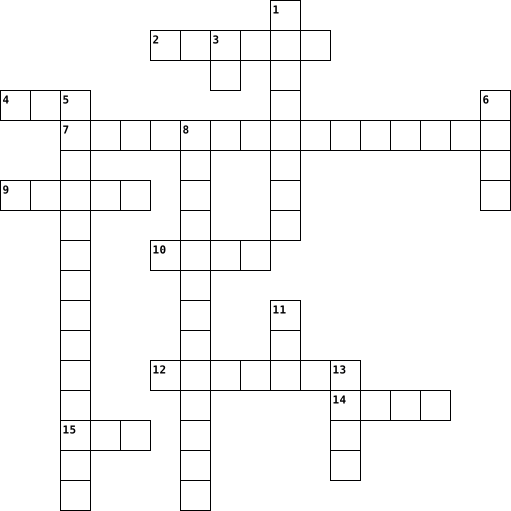
Across
- luhan and tiffany
- gangnam style
- smentertaiment girl band
- korean word for girl to older girl
- gd and top
- ygentertaiment boy band
- korean word for girl to elder boy
- aliens of kpop
Down
- physics symbol
- math equation
- Yang Hyun-suk
- twenty one
- Lee So-Man
- queen of kpop
- 7 boys martial arts
15 Clues: twenty one • Lee So-Man • gd and top • math equation • gangnam style • Yang Hyun-suk • queen of kpop • physics symbol • aliens of kpop • luhan and tiffany • 7 boys martial arts • ygentertaiment boy band • smentertaiment girl band • korean word for girl to elder boy • korean word for girl to older girl
You & Me 2020-06-04

Across
- Subject we got whole day Punishment for
- My fav Subject
- Our 1st Cinema
- 1st Theme park
- The Anniversary
- Your Fav Color
- The Babies we wished for
- Our Love starts at
Down
- The 1st 3rd Person
- Thing I want in Ur Henna
- I'm afraid of
- My name
- Your name
- The Lucky Seats
- Our name
15 Clues: My name • Our name • Your name • I'm afraid of • My fav Subject • Our 1st Cinema • 1st Theme park • Your Fav Color • The Lucky Seats • The Anniversary • The 1st 3rd Person • Our Love starts at • Thing I want in Ur Henna • The Babies we wished for • Subject we got whole day Punishment for
koulua 2017-11-10

Across
- tekninen
- fysiikka
Down
- liikunta
- biologia
- uskonto
- kemia
- elämänkatsomustieto
- espanija
8 Clues: kemia • uskonto • liikunta • biologia • tekninen • espanija • fysiikka • elämänkatsomustieto
School subjects 2025-11-21

Across
- испанский язык
- экономика
- химия
- французский язык
Down
- литература
- биология
- религиоведение
- физика
8 Clues: химия • физика • биология • экономика • литература • испанский язык • религиоведение • французский язык
5FM Back To School Crossword Puzzle 2024-01-15

Across
- Fruit
- Subject involves experiments
- Holds your beverages
- Holds your books
- Numeracy subject
Down
- Measuring tool
- Writing tool
- Physical activity
- Something you write in
- Literature subject
10 Clues: Fruit • Writing tool • Measuring tool • Holds your books • Numeracy subject • Physical activity • Literature subject • Holds your beverages • Something you write in • Subject involves experiments