
planets Crossword Puzzles
Space exploration 2023-06-28

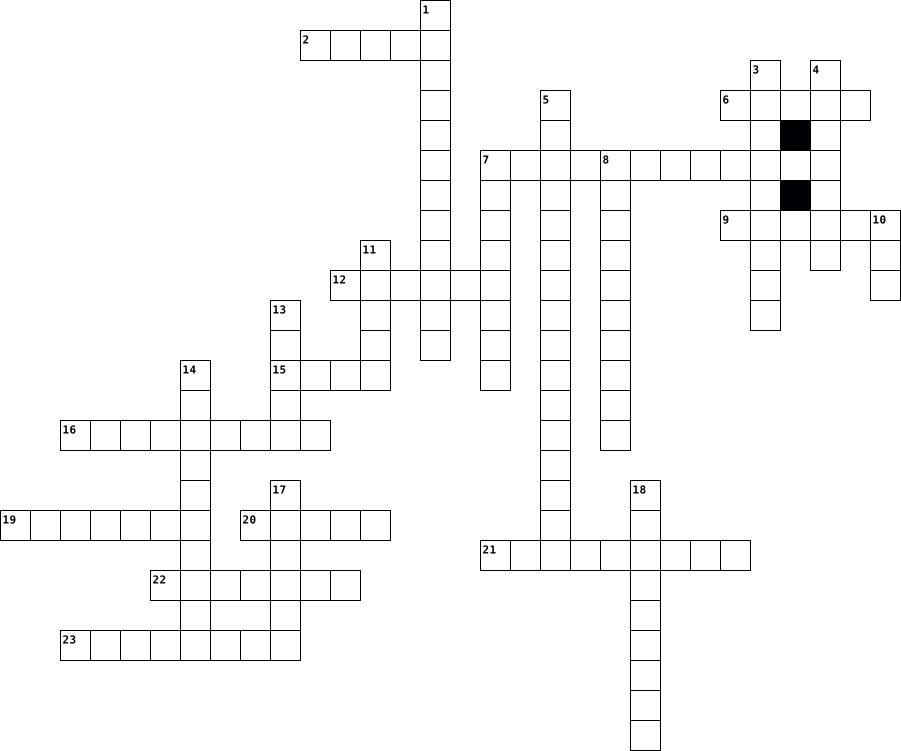
Across
- An object that is launched into space and orbits around a planet or other celestial body. It is used for communication or scientific research.
- System The collection of planets, moons, asteroids, comets, and other objects that orbit around our Sun.
- Relating to the space between stars. It refers to things that happen or exist between different star systems.
- Station A large spacecraft in orbit around Earth that serves as a home and workplace for astronauts.
- A robotic vehicle designed to explore the surface of other planets or moons. It can collect data and send it back to scientists on Earth.
- The path that a spacecraft takes as it revolves around a planet or other celestial body in space.
- A scientific instrument used to observe and study objects in space, like stars, planets, and galaxies.
- A person who travels to space aboard a spacecraft to explore and conduct scientific experiments.
- A large celestial body that orbits around a star (like our Sun) and does not produce its own light.
Down
- A vast collection of stars, gas, and dust held together by gravity. Our Milky Way is an example of a galaxy.
- A specific task or objective that astronauts and scientists work together to accomplish in space exploration.
- A scientist who studies celestial objects, such as stars, planets, galaxies, and other phenomena in outer space.
- The force that pulls objects towards each other. On Earth, it keeps us grounded and affects how things move.
- A spacecraft designed to carry astronauts and equipment into space. It can travel to other planets or orbit Earth.
- A vehicle that is used to launch spacecraft into space. It works by burning fuel to create a powerful thrust upwards.
- Relating to the Moon. The word "lunar" is often used to describe things that are associated with or found on the Moon.
16 Clues: A person who travels to space aboard a spacecraft to explore and conduct scientific experiments. • The path that a spacecraft takes as it revolves around a planet or other celestial body in space. • A large celestial body that orbits around a star (like our Sun) and does not produce its own light. • ...
Space exploration 2023-06-28

Across
- The force that pulls objects towards each other. On Earth, it keeps us grounded and affects how things move.
- A vast collection of stars, gas, and dust held together by gravity. Our Milky Way is an example of a galaxy.
- A large celestial body that orbits around a star (like our Sun) and does not produce its own light.
- A vehicle that is used to launch spacecraft into space. It works by burning fuel to create a powerful thrust upwards.
- System The collection of planets, moons, asteroids, comets, and other objects that orbit around our Sun.
- A specific task or objective that astronauts and scientists work together to accomplish in space exploration.
- A scientist who studies celestial objects, such as stars, planets, galaxies, and other phenomena in outer space.
- Station A large spacecraft in orbit around Earth that serves as a home and workplace for astronauts.
- A robotic vehicle designed to explore the surface of other planets or moons. It can collect data and send it back to scientists on Earth.
Down
- Relating to the space between stars. It refers to things that happen or exist between different star systems.
- Relating to the Moon. The word "lunar" is often used to describe things that are associated with or found on the Moon.
- A spacecraft designed to carry astronauts and equipment into space. It can travel to other planets or orbit Earth.
- A person who travels to space aboard a spacecraft to explore and conduct scientific experiments.
- A scientific instrument used to observe and study objects in space, like stars, planets, and galaxies.
- The path that a spacecraft takes as it revolves around a planet or other celestial body in space.
- An object that is launched into space and orbits around a planet or other celestial body. It is used for communication or scientific research.
16 Clues: A person who travels to space aboard a spacecraft to explore and conduct scientific experiments. • The path that a spacecraft takes as it revolves around a planet or other celestial body in space. • A large celestial body that orbits around a star (like our Sun) and does not produce its own light. • ...
reading project 2024-03-18

Across
- ice sharks
- fightingmm
- holagrams
- water
- hiking
- dead
- tall
- robot
- rockes
- girl
- big robots
Down
- telaporting
- ships
- marshmallowd
- ships
- book series
- flying ships
- not humans
- book name
- stuck
20 Clues: dead • tall • girl • ships • water • ships • robot • stuck • hiking • rockes • holagrams • book name • ice sharks • fightingmm • not humans • big robots • telaporting • book series • marshmallowd • flying ships
Space 2024-05-29

Across
- The solar system we live in
- A spacecraft that orbits planets
- The planet we live on
- A meteor that survives its passage through a planet's or moon's atmosphere
Down
- A collection of 8 planets
- A region of space that sucks in matter
- Asteroids orbit around or within the ____
- The first satellite successfully launched in space
- Orbits around planets
9 Clues: The planet we live on • Orbits around planets • A collection of 8 planets • The solar system we live in • A spacecraft that orbits planets • A region of space that sucks in matter • Asteroids orbit around or within the ____ • The first satellite successfully launched in space • A meteor that survives its passage through a planet's or moon's atmosphere
FIND THE WORDS 2025-11-19

Across
- smell
- pray
- black
- outside
- eggs
- God
- foods
Down
- nature
- planets
- dim
- answer
- skin
- sea
- paper
- you live
- long
16 Clues: dim • sea • God • pray • skin • eggs • long • smell • black • paper • foods • nature • answer • planets • outside • you live
Big Bang Theory 2021-09-17

Across
- Particles smaller than atoms
- postive charge in an atom
- galaxies are expanding
- negative charge in an atom
- neutral charge
Down
- basic chemical element
- issac newtons 1st law
- super cold
- orbits around stars
- galaxies stars and planets
10 Clues: super cold • neutral charge • orbits around stars • issac newtons 1st law • basic chemical element • galaxies are expanding • postive charge in an atom • galaxies stars and planets • negative charge in an atom • Particles smaller than atoms
Tomorrow's world 2026-03-05

Across
- vehicles that travel in space and can carry astronauts or robots.
- a huge ball of hot gas in space that makes its own light and heat. Our closest star is the Sun.
- everything that exists, including all stars, planets, galaxies, and space.
- the force that pulls things toward each other, like what keeps us on the ground.
- vehicle that can drive like a car on roads and fly like an airplane in the sky.
Down
- a tool that helps us see very far away objects in space.
- power that comes from sunlight and can be used to make electricity or heat.
- when a rocket lifts off from Earth to go into space.
- related to the Sun, like sunlight or energy that comes from the Sun.
- a huge group of stars, planets, gas, and dust held together by gravity.
- the United States space agency. It sends astronauts, rockets, and robots into space to learn about planets and the universe.
- a drawing that shows where places are, like countries, oceans, or even planets.
12 Clues: when a rocket lifts off from Earth to go into space. • a tool that helps us see very far away objects in space. • vehicles that travel in space and can carry astronauts or robots. • related to the Sun, like sunlight or energy that comes from the Sun. • a huge group of stars, planets, gas, and dust held together by gravity. • ...
Solar System Emma&Hollie 2023-10-16

Across
- known as orbiting companions
- Planets Planets smaller then a planet but big enough to have a gravitational pull
- earth in the middle of the solar system
- smaller patterns within constellations
- also referred to as "dirty snowballs"
Down
- believed to be left over remains of the formation of the solar system
- patterns made up of stars
- sun in the middle of the solar system
- an oval path that the planets orbit on
- pieces of rock floating through space
10 Clues: patterns made up of stars • known as orbiting companions • sun in the middle of the solar system • pieces of rock floating through space • also referred to as "dirty snowballs" • an oval path that the planets orbit on • smaller patterns within constellations • earth in the middle of the solar system • believed to be left over remains of the formation of the solar system • ...
Planets Crossword 2015-05-27

Across
- The planet we live on
- This planet is so big that you could fit all the other planets in it
- There were once 9 planets, until this one was downgraded to a 'dwarf' planet
- The hottest planet
- All of the planets orbit around the..
Down
- The number of planets in our solar system
- This planet lives next to the sun
- This planet lies on it's side
8 Clues: The hottest planet • The planet we live on • This planet lies on it's side • This planet lives next to the sun • All of the planets orbit around the.. • The number of planets in our solar system • This planet is so big that you could fit all the other planets in it • There were once 9 planets, until this one was downgraded to a 'dwarf' planet
Solar system 2024-02-27

Across
- The amount of dwarf planets in our solar system
- The star the solar system orbits around
- The 6th planet from the sun
- The amount of planets in the solar system
- The solar system is in the ________ way
Down
- The amount of rocky planets in our solar system
- The amount of light-years that is the diameter of the solar system
- The _______ Belt separates Rock planets from gas giants.
8 Clues: The 6th planet from the sun • The star the solar system orbits around • The solar system is in the ________ way • The amount of planets in the solar system • The amount of dwarf planets in our solar system • The amount of rocky planets in our solar system • The _______ Belt separates Rock planets from gas giants. • ...
8th Grade Astronomical Science 2 (A Beka Book, Science: Earth and Space, pp. 310-329) 2017-04-28

Across
- the most volcanically active body in the solar system
- speediest planet
- two "new planets" that were later named dwarf planets
- the largest moon in the solar system
- the first new planet discovered
- Jupiter's four moons (Ganymede, Callisto, Io, & Europa)
- Mercury, Venus, Earth, & Mars
- Earth's only natural satellite
- Jupiter, Saturn, Uranus, & Neptune
- the second largest planet
- Mars's two moons
- the red planet
- the second largest moon and the only one that has a thick atmosphere
- the biggest storm seen on Jupiter
- what happens when a full moon passes through the earth's shadow
- has the fastest rotation of any planet
Down
- the largest known mountain in the solar system
- Neptune's largest moon; experiences the coldest known temperatures in the solar system
- planets that are made primarily of gas
- the "morning star" & "evening star"
- an object that revolves around another object
- the planet discovered mathematically before it was seen
- discovered Uranus
- moving backward, from east to west
- Latin for seas; the moon's dark patches
- what happens when a new moon gets between the earth and the sun, at least partially blocking the sun
- the lighter areas on the moon
- about 93,000,000 miles from the sun
28 Clues: the red planet • speediest planet • Mars's two moons • discovered Uranus • the second largest planet • Mercury, Venus, Earth, & Mars • the lighter areas on the moon • Earth's only natural satellite • the first new planet discovered • the biggest storm seen on Jupiter • moving backward, from east to west • Jupiter, Saturn, Uranus, & Neptune • the "morning star" & "evening star" • ...
chapter 8 crossword 2019-01-25

Across
- our galaxy is known as the _______
- is earths magnetic north pole slowing down or picking up speed?
- degrees are divided into what smaller units
- in 6 billion years, the sun will turn into _______
- __________________is responsible for the formation of earths gravitational field
- occured 15 billion years ago
- how quickly the mood is moving away from earth
- what lies at 90 degrees north latitude?
- the release of volatile substances and water vapor from the earth is called ________
- the planets solidified in a process known as _______
- what type of object can give us information about the conditions in which the solid planets like earth formed?
- ____ once had a magnetic field when the planets core cooled
Down
- heavy rains fell for ______ years before the oceans were formed
- experimenter from 1953
- what brought water to earth?
- ____ is ther explosion of a star
- ________ of the clouds made heavy rains fall
- _____ are tiny crystals formed from the beginning of earth
- in 6 billion years the sun will burst and engulf other _________
- The___is between 4.5 and 4.6 billion years old.
- how many degrees are there in one hemisphere?
- ____ sank towards earths center
- ______ was most abundant in the universe after the big bang
23 Clues: experimenter from 1953 • what brought water to earth? • occured 15 billion years ago • ____ sank towards earths center • ____ is ther explosion of a star • our galaxy is known as the _______ • what lies at 90 degrees north latitude? • degrees are divided into what smaller units • ________ of the clouds made heavy rains fall • how many degrees are there in one hemisphere? • ...
Astrology 2023-07-25

Across
- - Study of celestial influences on human affairs and personalities.
- - Earth's natural satellite that influences tides and emotions.
- - Luminous spheres of plasma that populate the universe.
- - Planet linked to growth, luck, and expansion.
- - Center of our solar system and source of light and heat.
- - Planet representing energy, action, and ambition.
- - Apparent backward motion of a planet from Earth's viewpoint.
- - Planet connected to dreams, illusions, and spirituality.
- - Assessment of astrological harmony between individuals.
- - Zodiac sign rising on the eastern horizon at birth.
- - Divisions in a birth chart representing different aspects of life.
- - Personalized astrological forecast based on birth date.
Down
- - Circle of celestial divisions based on constellations.
- - Celestial bodies that orbit around the sun.
- - Grouping of stars forming a recognizable pattern.
- - Planet associated with communication and intellect.
- - One who interprets celestial positions and their effects.
- - Current positions of planets and their impact on individuals.
- chart - Map of the positions of planets at the time of birth.
- - Planet symbolizing love, beauty, and harmony.
- - Pertaining to the moment of birth or the birth chart itself.
- - Planet associated with innovation, rebellion, and change.
- - Planet related to discipline, responsibility, and challenges.
- - Four fundamental qualities in astrology: Fire, Earth, Air, Water.
- - Planet denoting transformation, power, and rebirth.
25 Clues: - Celestial bodies that orbit around the sun. • - Planet linked to growth, luck, and expansion. • - Planet symbolizing love, beauty, and harmony. • - Grouping of stars forming a recognizable pattern. • - Planet representing energy, action, and ambition. • - Planet associated with communication and intellect. • - Planet denoting transformation, power, and rebirth. • ...
Astronomy 2025-02-18

Across
- what is when something goes around something
- what is to center of the sun
- what is a pulling force based on an objects mass
- what is the shape of orbit around the sun
- what causes seasons
- what is what our atmosphere is mostly made of
- what is what the sun made of
- what cant you see during a solar eclipse
- what is a pure black moon
- what is the man trying to get to Mars
- what is when the day and night is the same
- what is the way the sun rises and sets
- what is the outer planets
Down
- what tides are strong
- what is a earth year
- what is when the planets spin around the sun
- what is when the moon is growing
- is earth the largest inner planet (true of false)
- what is when something spins on its axis
- what is when the angle of the suns rays hit to moon at different angles so we see it a different shapes
- what tides are weak
- what can't we see during a solar eclipse
- what is what earth only has
- what is when the moon is shrinking
- what is the longest/shortest day of the year
- what is the surface of the inner planets
26 Clues: what causes seasons • what tides are weak • what is a earth year • what tides are strong • what is a pure black moon • what is the outer planets • what is what earth only has • what is to center of the sun • what is what the sun made of • what is when the moon is growing • what is when the moon is shrinking • what is the man trying to get to Mars • ...
Unit 11: The Earth and Beyond Assignment 2022-01-09

Across
- Model with the Earth at the centre
- Measured how fast the galaxies were moving
- Model with the Sun at the centre.
- Made of billions of stars clustered close together in space
- Made of the Sun, the planets and their stars
- Planets close to the Sun
- To travel into space, you have to get above the Earth's __________________.
- Spacecraft to take first people to space
- The line joining the North Pole and the South Pole
- Scientist who study space
- Start of the Universe
- Moon's face is completely dark
- Planets far from the Sun
- Everything we see in space
- Moon's face is a complete circle
Down
- Found the heliocentric model
- Pattern formed by the brightest stars in the sky
- Moon show different _______________.
- When sunlight reaches a planet, it _________ off the planet.
- Stars are ____________ of light.
- Large object that orbits a star
- First person to enter space
- The Sun ________ to move across the sky during the day.
- Giant ball of hot, glowing gas
- Ball of rock which we can see in the sky
- Local star
- The Earth is in _________ around the Sun.
- Astronomer to first use a telescope
- Small lump of rock in orbit around the Sun
29 Clues: Local star • Start of the Universe • Planets close to the Sun • Planets far from the Sun • Scientist who study space • Everything we see in space • First person to enter space • Found the heliocentric model • Giant ball of hot, glowing gas • Moon's face is completely dark • Large object that orbits a star • Stars are ____________ of light. • Moon's face is a complete circle • ...
Voyager Grand Tour of the Outer Planets 2025-10-30

Across
- The planets and their moons
- Picture sent back from space
- Referring to the outer planets
- Long voyage through space
- Field of study of the universe
- A celestial body's shape
- Ringed jewel of the solar system
- Volcanically active Jovian moon
- Sideways-rotating ice giant
- Feature of gas giants
- Largest moon in the solar system
- Famous astronomer, Sagan
- Moon of Uranus with strange terrain
- Spacecraft that explored outer planets
- Planetary atmospheric light show
- Maneuver to gain speed
- Saturn's largest moon with atmosphere
- Farthest planet in Grand Tour
Down
- Agency behind the mission
- Prefix for the sun's sphere of influence
- Great Red Spot on Jupiter
- Relating to a planet's magnetic field
- Neptune's largest, retrograde moon
- Geysers observed on Triton
- Robotic spacecraft type
- Icy moon of Jupiter
- To discover new things
- Largest planet visited first
- Narrator of "Cosmos"
- Predecessor mission to Jupiter
- Natural satellite of a planet
- Communication from spacecraft
- Phonograph disc aboard Voyager
- Material of the record carried
- Close approach to a celestial body
- Used for assist maneuvers
- Used to transmit and receive signals
- Information collected by spacecraft
- Type of giant planet
- Pertaining to our star system
40 Clues: Icy moon of Jupiter • Narrator of "Cosmos" • Type of giant planet • Feature of gas giants • To discover new things • Maneuver to gain speed • Robotic spacecraft type • A celestial body's shape • Famous astronomer, Sagan • Agency behind the mission • Great Red Spot on Jupiter • Long voyage through space • Used for assist maneuvers • Geysers observed on Triton • The planets and their moons • ...
The Planets 2015-05-22

Across
- known as the 'red planet'
- The brightest planet
- They have landed on the moon
- Takes 365 days to rotate around the sun
- No longer considered a planet
- The coldest planet
Down
- The second hottest planet
- The largest planet
- Has thin outer rings
- The furthest planet from the sun
- The planets revolve around me
- Green monster
12 Clues: Green monster • The largest planet • The coldest planet • The brightest planet • Has thin outer rings • known as the 'red planet' • The second hottest planet • They have landed on the moon • No longer considered a planet • The planets revolve around me • The furthest planet from the sun • Takes 365 days to rotate around the sun
The Planets 2014-10-30

Across
- The centre of our solar system
- Neptune's blue neighbour
- Our home planet
- Largest planet
- A planet surrounded by dust and ice
Down
- A big bright planet
- A planet that looks like Earth
- A big blue planet
- When the earth goes all the way around the sun
- Too small to be a planet
- Planet closest to the sun
- Full rotation of Earth
12 Clues: Largest planet • Our home planet • A big blue planet • A big bright planet • Full rotation of Earth • Neptune's blue neighbour • Too small to be a planet • Planet closest to the sun • A planet that looks like Earth • The centre of our solar system • A planet surrounded by dust and ice • When the earth goes all the way around the sun
Planets & Space 2023-05-28

Across
- What is the term for the path that a planet follows around the Sun?
- The closest planet to the Earth
- Which spacecraft was the first to land humans on the Moon?
- The largest planet in Solar System
- The last planet in Solar System
- This planet takes 365 days to go around the sun
- Yellow star in the middle of our solar system
Down
- What is the brightest star in the night sky?
- What is the name of the galaxy that contains our solar system?
- What is the name of the red planet?
- How many planets are in Solar System?
- Planet has rings you can see with a telescope
12 Clues: The closest planet to the Earth • The last planet in Solar System • The largest planet in Solar System • What is the name of the red planet? • How many planets are in Solar System? • What is the brightest star in the night sky? • Planet has rings you can see with a telescope • Yellow star in the middle of our solar system • This planet takes 365 days to go around the sun • ...
Inner Planets 2022-10-04

Across
- hottest planet
- Mercury is made of mostly _________
- Mars has huge dust _______
- Planet with one moon
- Mars named after Roman God of _______
- Earth's _____ take 365 days
- the smallest planet
Down
- Venus has a lot of _______
- Mercury is 4.5 ________ years old
- -81 degrees F is the _____ on Mars
- 70% of the Earth's surface
- Venus named after Goddess of beauty and _______
12 Clues: hottest planet • the smallest planet • Planet with one moon • Venus has a lot of _______ • Mars has huge dust _______ • 70% of the Earth's surface • Earth's _____ take 365 days • Mercury is 4.5 ________ years old • -81 degrees F is the _____ on Mars • Mercury is made of mostly _________ • Mars named after Roman God of _______ • Venus named after Goddess of beauty and _______
Space 2018-04-19

Across
- Our galaxy
- A body that orbits Earth
- How much light travels in one year
- Objects that orbit Earth to collect information
- Solid shell of a rocky planet, or dwarf
- Known as a meteor
- Huge collection of stars and planets
- Known as Mars, Jupiter, Saturn, or Earth
Down
- A "hole" that swallows everything
- Red dwarf six light years away
- What the moon does
- An object made of ice, dust, and gases
- The biggest star next to Earth
- A very big star
- An old star
- Very beautiful in the night sky
16 Clues: Our galaxy • An old star • A very big star • Known as a meteor • What the moon does • A body that orbits Earth • Red dwarf six light years away • The biggest star next to Earth • Very beautiful in the night sky • A "hole" that swallows everything • How much light travels in one year • Huge collection of stars and planets • An object made of ice, dust, and gases • ...
Science Review 2024-03-08

Across
- a star made up of burning gas
- got bit by a dog (or something)
- this orbits around the Earth
- our closest neighbor
- famous for its rings
- loves art but needs to come to school more
- Taylor Swift's Favorite Planet
- the "Red Planet"
Down
- Planets another name for the four outer planets
- learning to shuffle cards
- King George wanted this planet named for him
- has 79 moons
- she has a nose ring
- he has great hair
- loves school when she gets here; just get here
- the third planet from the sun
16 Clues: has 79 moons • the "Red Planet" • he has great hair • she has a nose ring • our closest neighbor • famous for its rings • learning to shuffle cards • this orbits around the Earth • a star made up of burning gas • the third planet from the sun • Taylor Swift's Favorite Planet • got bit by a dog (or something) • loves art but needs to come to school more • ...
Earth,Moon and Sun 2025-02-18

Across
- mostly day or mostly night
- planets mostly gassy
- rocky, orbits earth
- atmosphere nitrogen and oxygen
- eclipse moon blocks the sun
- equal amount of hours of day and night
- planets terrestrial
Down
- day and night
- A ball of plasma
- planet that supports life
- visible part of the sun
- eclipse Earth blocks the moon
12 Clues: day and night • A ball of plasma • rocky, orbits earth • planets terrestrial • planets mostly gassy • visible part of the sun • planet that supports life • mostly day or mostly night • eclipse moon blocks the sun • eclipse Earth blocks the moon • atmosphere nitrogen and oxygen • equal amount of hours of day and night
Space 2025-05-09

Across
- our star, in solar system
- biggest planet
- belt between mars and Jupiter
- round, spherical, orbits a star
- orbits earth
Down
- billions in a galaxy
- planet Made of gas and ice
- milky way...
- 4 planets, made of rock and metal
- what is the 4th inner planet
- dwarf planet
11 Clues: milky way... • dwarf planet • orbits earth • biggest planet • billions in a galaxy • our star, in solar system • planet Made of gas and ice • what is the 4th inner planet • belt between mars and Jupiter • round, spherical, orbits a star • 4 planets, made of rock and metal
Space 2021-11-05

Across
- Rocky bodies come from the asteroid belt between Mars and Jupiter
- Rotation of a planet astroid sun etc
- Billon stars dust solar systems etc
- Big hot flame of gas and fire
Down
- Big Ball rotating around planets
- We live on one
- Ball of fire in the earth's atmosphere
- A measurement for scientists to see how far
- Place where there is a sun and planets rotate around
- Made of ice tail point away from the sun
10 Clues: We live on one • Big hot flame of gas and fire • Big Ball rotating around planets • Billon stars dust solar systems etc • Rotation of a planet astroid sun etc • Ball of fire in the earth's atmosphere • Made of ice tail point away from the sun • A measurement for scientists to see how far • Place where there is a sun and planets rotate around • ...
Ian Challenge it crossword 2022-05-04

Across
- when is the Milky Way most visible¿
- body of rock that orbit planets
- a collection of planets and rocks that orbit a center star
- a__ is at the center of our galaxy
- collection of stars dust gas and solar systems
Down
- type of galaxy that is young, and chaotic
- Very circular/oval galaxy that is old
- our galaxy
- bodies of rock dust or ice that orbit stars
- type of galaxy that has arms spiraling the center
10 Clues: our galaxy • body of rock that orbit planets • a__ is at the center of our galaxy • when is the Milky Way most visible¿ • Very circular/oval galaxy that is old • type of galaxy that is young, and chaotic • bodies of rock dust or ice that orbit stars • collection of stars dust gas and solar systems • type of galaxy that has arms spiraling the center • ...
ASTRONOMICAL TERMS 2014-11-13

Across
- the path of the earth around the sun
- are satillites of stars
- the name given to a collision between two objects
- the satellites of planets
- a group of stars which appear to form a pattern or picture in the night sky
- a measure of a body's brightness
Down
- a region in space that has such an enormous force of gravity that no light can escape
- huge spheres of burning gas, the source of light and heat
- pieces of rock or metal that orbit the sun which are too small to be planets
- a person who travels and works in space
- our closest star
- the force that holds us to the earth
12 Clues: our closest star • are satillites of stars • the satellites of planets • a measure of a body's brightness • the path of the earth around the sun • the force that holds us to the earth • a person who travels and works in space • the name given to a collision between two objects • huge spheres of burning gas, the source of light and heat • ...
Space exploration 2023-06-28

Across
- A robotic vehicle designed to explore the surface of other planets or moons. It can collect data and send it back to scientists on Earth.
- A large celestial body that orbits around a star (like our Sun) and does not produce its own light.
- Relating to the space between stars. It refers to things that happen or exist between different star systems.
- An object that is launched into space and orbits around a planet or other celestial body. It is used for communication or scientific research.
- A specific task or objective that astronauts and scientists work together to accomplish in space exploration.
- A person who travels to space aboard a spacecraft to explore and conduct scientific experiments.
- A vast collection of stars, gas, and dust held together by gravity. Our Milky Way is an example of a galaxy.
- A vehicle that is used to launch spacecraft into space. It works by burning fuel to create a powerful thrust upwards.
Down
- A scientist who studies celestial objects, such as stars, planets, galaxies, and other phenomena in outer space.
- The force that pulls objects towards each other. On Earth, it keeps us grounded and affects how things move.
- A spacecraft designed to carry astronauts and equipment into space. It can travel to other planets or orbit Earth.
- A scientific instrument used to observe and study objects in space, like stars, planets, and galaxies.
- The path that a spacecraft takes as it revolves around a planet or other celestial body in space.
- Relating to the Moon. The word "lunar" is often used to describe things that are associated with or found on the Moon.
- System The collection of planets, moons, asteroids, comets, and other objects that orbit around our Sun.
- Station A large spacecraft in orbit around Earth that serves as a home and workplace for astronauts.
16 Clues: A person who travels to space aboard a spacecraft to explore and conduct scientific experiments. • The path that a spacecraft takes as it revolves around a planet or other celestial body in space. • A large celestial body that orbits around a star (like our Sun) and does not produce its own light. • ...
reading project 2024-03-18

Across
- ice sharks
- fightingmm
- holagrams
- water
- hiking
- dead
- tall
- robot
- rockes
- girl
- big robots
Down
- telaporting
- ships
- marshmallowd
- ships
- book series
- flying ships
- not humans
- book name
- stuck
20 Clues: dead • tall • girl • ships • water • ships • robot • stuck • hiking • rockes • holagrams • book name • ice sharks • fightingmm • not humans • big robots • telaporting • book series • marshmallowd • flying ships
reading project 2024-03-18

Across
- ice sharks
- fightingmm
- holagrams
- water
- hiking
- dead
- tall
- robot
- rockes
- girl
- big robots
Down
- telaporting
- ships
- marshmallowd
- ships
- book series
- flying ships
- not humans
- book name
- stuck
20 Clues: dead • tall • girl • ships • water • ships • robot • stuck • hiking • rockes • holagrams • book name • ice sharks • fightingmm • not humans • big robots • telaporting • book series • marshmallowd • flying ships
space 2023-01-15

Across
- the first country to send a person into space
- what planet reaches 801 degrees
- the biggest planet
- what is the largest mountain that can fit in side a crater on the moon
- the speed required to leave a planets gravity
- how much countries have worked on a space Statoin
Down
- abbreviation for denvers state
- the milky way is one
- planet9
- planet4
- ice, dust, and rocks make up Saturn's ______
- the biggest star
- how much planets are there in space
- planet8
- continuously move around a star or a planet
15 Clues: planet9 • planet4 • planet8 • the biggest star • the biggest planet • the milky way is one • abbreviation for denvers state • what planet reaches 801 degrees • how much planets are there in space • continuously move around a star or a planet • ice, dust, and rocks make up Saturn's ______ • the first country to send a person into space • the speed required to leave a planets gravity • ...
chapter 3 2016-11-21

Across
- fuzzy outer layer
- must be round
- inner core of a comet
- effect the trapping of heat
- planets the latin word terra
- give of its light
- thin disk of small particles
- planet orbits the sun and spherical
Down
- giants name often given to the outer planets
- belt extends to abou 100 times Earths distance
- belt a region between Mars and Jupiter
- cloud streches out more than 1000 times between the Sun and Neptune
- loose collections of ice
- Chunks of rock or dust
- system consist of a sum
15 Clues: must be round • fuzzy outer layer • give of its light • inner core of a comet • Chunks of rock or dust • system consist of a sum • loose collections of ice • effect the trapping of heat • planets the latin word terra • thin disk of small particles • planet orbits the sun and spherical • belt a region between Mars and Jupiter • giants name often given to the outer planets • ...
Our Solar System 2024-03-18

Across
- THE LAST PLANET
- THE EARTH ROTATES ON ITS___
- THE SUN'S RAYS ___ ON THE MOON
- THERE ARE ____ PLANETS IN OUT SOLAR SYSTEM
- A PLANET THAT LAYS ON ITS SIDE
- AN ICE GIANT
- THE MOON ____ THE EARTH
- PLANETS IN OUR SOLAR SYSTEM ORBIT THE
Down
- EART'S NATURAL SATELLITE IS CALLED THE
- THE ONLY PLANET WITH LIFE
- A PLANET FAMOUS FOR ITS RINGS
- IS NOT CONSIDERED A TRUE PLANET ANYMORE
- VENUS IS A _____ PLANET (HINT: LAND)
- THE 4TH PLANET FROM THE SUN
- A GAS GIANT
- THE CLOSEST PLANET TO THE SUN
16 Clues: A GAS GIANT • AN ICE GIANT • THE LAST PLANET • THE MOON ____ THE EARTH • THE ONLY PLANET WITH LIFE • THE EARTH ROTATES ON ITS___ • THE 4TH PLANET FROM THE SUN • A PLANET FAMOUS FOR ITS RINGS • THE CLOSEST PLANET TO THE SUN • THE SUN'S RAYS ___ ON THE MOON • A PLANET THAT LAYS ON ITS SIDE • VENUS IS A _____ PLANET (HINT: LAND) • PLANETS IN OUR SOLAR SYSTEM ORBIT THE • ...
Uranus 2026-05-05

Across
- The area of our planets and star
- color of uranus
- the middle and source of heat on planets and stars
- line that a planet spins on
- atmosphere of Uranus
- Largest moon of Uranus
- way a planet revolves around the Sun
Down
- spin
- climate of a planet
- Type of planet Uranus is
- Sideways planet
- closet planet to Uranus
12 Clues: spin • color of uranus • Sideways planet • climate of a planet • atmosphere of Uranus • Largest moon of Uranus • closet planet to Uranus • Type of planet Uranus is • line that a planet spins on • The area of our planets and star • way a planet revolves around the Sun • the middle and source of heat on planets and stars
space 2026-10-08

Across
- most are betweem mars and jupiter
- shooting stars
- The sun is not a planet it is a
- chunks of rock
- natural satellite
- we live here
Down
- i have the most moons
- meteor that go to earth
- This is the biggest
- smaller then planets but big enougth for its own gravity
- dirty snowball
- the 4 planets far away for the sun
12 Clues: we live here • shooting stars • dirty snowball • chunks of rock • natural satellite • This is the biggest • i have the most moons • meteor that go to earth • The sun is not a planet it is a • most are betweem mars and jupiter • the 4 planets far away for the sun • smaller then planets but big enougth for its own gravity
The Planets Are Cracka Lackin 2021-08-09

Across
- it is big bright spherical thing
- named after roman version of poseidon
- it has an icy moon called Europa
- it is planet and also an element
- it is wrapped around planets
- the perseverance rover is on it
- a cold moon of Jupiter
- when somethin' is circlin somethin'
- it is circling Earth
- primary school students think the name is funny
Down
- they could be on mars...
- it's got rings, and it ain't a bride
- planets are this adjective
- the only satellite out of our solar system
- it's being ruined
- there is a minecraft song called Mice On '_____"
- the gravitational weight of a planet
17 Clues: it's being ruined • it is circling Earth • a cold moon of Jupiter • they could be on mars... • planets are this adjective • it is wrapped around planets • the perseverance rover is on it • it is big bright spherical thing • it has an icy moon called Europa • it is planet and also an element • when somethin' is circlin somethin' • it's got rings, and it ain't a bride • ...
The Solar System 2013-12-07

Across
- The name of our galaxy
- The type of food people eat in the International Space Station
- The planet closest to the sun
- The planet furthest away from the sun
- The number of moons that Jupiter has
- The type of planets that orbit the habitable zone around a star
Down
- The force that keeps the planets orbiting the sun
- The hole in space that pulls in anything that comes within it's range
- The type of planet that Pluto is
- The number of hours it takes the earth to make a full rotation
- The number of main planets in our Solar System
11 Clues: The name of our galaxy • The planet closest to the sun • The type of planet that Pluto is • The number of moons that Jupiter has • The planet furthest away from the sun • The number of main planets in our Solar System • The force that keeps the planets orbiting the sun • The type of food people eat in the International Space Station • ...
Astronomy Chapter 3 and 4 2013-06-27

Across
- Kepler’s ______ law states that planets orbit in ellipses.
- According to Kepler’s second law, planets travel _____ when nearer to the sun.
- The universal law of gravitation is an example of an _____ square law.
- Newton's second law states that ______ is proportional to the force acting on an object.
- The amount of matter in an object.
- Kepler’s ______ law states that more distant planets orbit the sun at a slower average speed.
- A scientific model must make _______ predictions.
- Science progresses through the c reation and testing of ______
- Thermal energy is a special type of ______ energy.
- A push or a pull.
Down
- An object has more/less gravitational potential energy when it is higher.
- Weight depends on mass and the _____ acting upon the object.
- Speed is distance over _____.
- The acceloration due to gravity is 9.8 meters per second ______.
- An educated guess.
- The first hallmark of science restricts explanations to rely solely on ______ causes.
- Momentum is mass times _____.
- The earth needs no fuel to keep to keep it going around the sun. This is due to conservation of _______ momentum.
- Velocity is _____ and direction.
- A powerful, yet simple, model that makes predictions and survives repeated and varied testing.
- _____ cannot be created or destroyed. It can only change form.
21 Clues: A push or a pull. • An educated guess. • Speed is distance over _____. • Momentum is mass times _____. • Velocity is _____ and direction. • The amount of matter in an object. • A scientific model must make _______ predictions. • Thermal energy is a special type of ______ energy. • Kepler’s ______ law states that planets orbit in ellipses. • ...
Unit 13 Vocabulary Review 2022-03-31
Across
- A dwarf planet that is found in the Kuiper Belt
- A small dwarf planet found in the Asteroid Belt
- A region of asteroids found between Mars and Jupiter
- This planet spins on its side
- A small object that enter's Earth's atmosphere and causing a bright light
- Nicknamed 'The Red Planet'
- The four outer planets
- The largest and fastest spinning planet
- The only planet with living things on it
- A small object that passes through the atmosphere and hits Earth
- The smallest planet in our solar system with a revolution of 88 days
- The movement of a planet around its central axis
Down
- The first four planets of our solar system
- A small object flying through space
- The furthest planet in the solar system
- The average distance between the Sun and Earth
- A large object made of rock and ice
- The movement of a planet around the sun
- Central star of our solar system
- The hottest planet in the solar system
- An object of smaller pieces that are comprised of rock, ice, and dust
- A large region of asteroids and dwarf planets behind Neptune
- The only planet with a visible ring system
- A large circular region of ice and other debris well beyond our solar system
24 Clues: The four outer planets • Nicknamed 'The Red Planet' • This planet spins on its side • Central star of our solar system • A small object flying through space • A large object made of rock and ice • The hottest planet in the solar system • The furthest planet in the solar system • The movement of a planet around the sun • The largest and fastest spinning planet • ...
Enlightenment 2022-02-23

Across
- The people who presented new ways of thinking during the Enlightenment
- Believed that people are born with natural rights; social contract.
- Founder of modern chemistry.
- Discovered that the planets orbit the sun
- Introduced the vaccine to prevent smallpox
- Believed that punishments should fit the crimes and that laws exist to preserve social order.
- The belief that the earth is the center of the solar system
- Worked with gravity, created the laws of motion and modern physics.
- Believed that people are not technically free as long as there are laws; social contract.
- Believed that government should exist because people are born selfish and wicked; social contract.
- Believed in separation of power, checks and balances
- Discovered that the planets orbit the sun in an elliptical motion using math
Down
- The belief that the sun is the center of the solar system
- Discovered new things about the planets, the sun, and the moon using the telescope
- Developed analytical geometry; which linked algebra and geometry
- Used the microscope to observe bacteria and red blood cells.
- To know something one did not know before
- Believed in women's rights
- Believed in freedom of speech and religion
- Encouraged scientists to use the scientific method
20 Clues: Believed in women's rights • Founder of modern chemistry. • Discovered that the planets orbit the sun • To know something one did not know before • Introduced the vaccine to prevent smallpox • Believed in freedom of speech and religion • Encouraged scientists to use the scientific method • Believed in separation of power, checks and balances • ...
Enlightenment 2022-02-23

Across
- The people who presented new ways of thinking during the Enlightenment
- Believed that people are born with natural rights; social contract.
- Founder of modern chemistry.
- Discovered that the planets orbit the sun
- Introduced the vaccine to prevent smallpox
- Believed that punishments should fit the crimes and that laws exist to preserve social order.
- The belief that the earth is the center of the solar system
- Worked with gravity, created the laws of motion and modern physics.
- Believed that people are not technically free as long as there are laws; social contract.
- Believed that government should exist because people are born selfish and wicked; social contract.
- Believed in separation of power, checks and balances
- Discovered that the planets orbit the sun in an elliptical motion using math
Down
- The belief that the sun is the center of the solar system
- Discovered new things about the planets, the sun, and the moon using the telescope
- Developed analytical geometry; which linked algebra and geometry
- Used the microscope to observe bacteria and red blood cells.
- To know something one did not know before
- Believed in women's rights
- Believed in freedom of speech and religion
- Encouraged scientists to use the scientific method
20 Clues: Believed in women's rights • Founder of modern chemistry. • Discovered that the planets orbit the sun • To know something one did not know before • Introduced the vaccine to prevent smallpox • Believed in freedom of speech and religion • Encouraged scientists to use the scientific method • Believed in separation of power, checks and balances • ...
Space 2022-01-19

Across
- I am tilted on my side.
- I have rings made of rocks and Ice.
- I contain all planets in the system.
- I study space from Earth.
- I study planets and have sent people to space and back.
- I am the biggest planet in the Solar system.
- There is 8 of us in the Solar System.
- I am the closes planet to the Sun.
- There isn't any light in me and I have a gravitational field.
- I am the smallest plant and has a oval orbit.
- I hold life.
- I carry people to the moon and back.
Down
- I am the same as the sun but farther away.
- I go to space to study it.
- I go around the Earth and people live on me.
- I surround planets to trap in the suns heat.
- I can fly through the night sky.
- There isn't any in space.
- I help you see things far into space.
- I am the Red Planet.
- I am the same size as Earth but Warmer.
- I am the center of the Universe.
- I am blue and contain Ice storms.
- I have been traveled to by Humans many times.
- When a planet goes around the sun.
25 Clues: I hold life. • I am the Red Planet. • I am tilted on my side. • I study space from Earth. • There isn't any in space. • I go to space to study it. • I can fly through the night sky. • I am the center of the Universe. • I am blue and contain Ice storms. • I am the closes planet to the Sun. • When a planet goes around the sun. • I have rings made of rocks and Ice. • ...
Space crossword for school 2023-09-18

Across
- an object that revolves around the sun that is considered too small to be a planet
- a ball of ice and dust with a long wispy tail
- a glowing ball of light that is everywhere in space
- known for its rings
- a giant or small black glowing hole that sucks anything near enough to it
- when a meteoroid hits earth surface
- small dark spot
- largest planet and has a red spot
- a stream of billions to millions of stars due to gravitational force
- a giant form of gas or dust occupying space between stars
Down
- a dwarf planet that is no longer a planet in the solar system
- a belt or ring of dust and rocks surrounding the sun and four inner planets
- has the biggest volcano
- a small rocky sphere that circles some planets
- a chunk of rock or dust in space
- The biggest star in the solar system
- a vehicle used to get to planets or the moon
- a glowing ball of white light that repels objects near it
- the 1st planet from the sun
- only planet with water
- 1 day only lasts 17 hours on this planet
- has the greenhouse effect on it
22 Clues: small dark spot • known for its rings • only planet with water • has the biggest volcano • the 1st planet from the sun • has the greenhouse effect on it • a chunk of rock or dust in space • largest planet and has a red spot • when a meteoroid hits earth surface • The biggest star in the solar system • 1 day only lasts 17 hours on this planet • ...
Space Systems 2020-05-05

Across
- The curved path of a celestial object
- A modification of the Julian Calendar
- The range of wavelengths or frequencies
- A celestial body that resembles a small planet but lacks certain criteria that are required for it to be classed as such.
- A large system of dust, gas, stars, and other celestial bodies that have a particular shape.
- An instrument designed to make distant objects appear nearer
- A celestial body moving in an elliptical orbit around a star
- An imaginary line that runs through the middle of an object
- The collection of 8 planets and their moons in orbit around the sun.
Down
- Astronomical model in which the Earth and planets revolve around the Sun at the center of the Solar System
- An object that has been intentionally placed into orbit
- A region of the solar system beyond the orbit of Neptune
- Visible at night by reflected light from the sun
- A fixed luminous point in the night sky
- A celestial object consisting of a nucleus of ice and dust
- Large body of matter with no definite shape
- A number which scales or multiplies a quantity
- A unit of astronomical distance
- All existing matter and space considered as a whole
- Branch of science that studies planets, stars, and other objects in space
20 Clues: A unit of astronomical distance • The curved path of a celestial object • A modification of the Julian Calendar • A fixed luminous point in the night sky • The range of wavelengths or frequencies • Large body of matter with no definite shape • A number which scales or multiplies a quantity • Visible at night by reflected light from the sun • ...
Unit 4 Vocabulary 2025-12-01

Across
- the top layer of the Earth where plants grow
- a hill of sand shaped by the wind
- a bright object in space with a long tail
- a vehicle used to travel in space
- the sun and the planets that orbit it
- a large hole on a planet or moon
- an object that orbits a planet
- a dark blue, windy planet
- a planet that rotates on its side
- a scientist who studies stars and planets
- the largest planet in our solar system
Down
- a dwarf planet far from the sun
- a thick layer of ice covering land
- the hottest planet in our solar system
- the smallest planet closest to the sun
- a streak of light made by a burning rock in the sky
- a tool used to see faraway objects
- a building where people watch the sky
- a huge group of stars and planets
- a person trained to travel in space
- a large round object that orbits a star
- the star at the center of our solar system
- a planet with large rings
- the planet we live on
- the red planet
- a hard piece of the Earth’s surface
- a strong metal found in space rocks
27 Clues: the red planet • the planet we live on • a planet with large rings • a dark blue, windy planet • an object that orbits a planet • a dwarf planet far from the sun • a large hole on a planet or moon • a hill of sand shaped by the wind • a huge group of stars and planets • a vehicle used to travel in space • a planet that rotates on its side • a thick layer of ice covering land • ...
Q1 reflection 2024-10-25

Across
- layers of rock
- you need special glasses to view it
- when the leaves turn cool colors
- another word for spining
- a cycle of 4 with each having different temperatures
- when the moon is fully illuminated
- a period of cold
Down
- when the earth is aligned between the sun and moon
- a law that applies to rocks and fossils
- inner planets
- revolution of a planet around a star
- a force of attraction
- an organism preserved in rock
- outer planets
- a period of no school
- an organism preserved in dried sap
16 Clues: inner planets • outer planets • layers of rock • a period of cold • a force of attraction • a period of no school • another word for spining • an organism preserved in rock • when the leaves turn cool colors • an organism preserved in dried sap • when the moon is fully illuminated • you need special glasses to view it • revolution of a planet around a star • ...
Earth and the Universe 2021-03-25

Across
- Half of the Earth is in the shade. There it is ___________.
- Earth takes one whole ________ to go round the sun.
- There are four of these and they change during the year.
- The Earth is one of the ________ in our solar system.
- The time when there is natural sunlight.
- The path of Earth around the sun.
Down
- All the planets go around the sun but it does not _________.
- For the Earth to spin on itself it takes ________hours.
- Earth spins on this invisible line.
- It is the biggest object in our solar system.
- After four years we have to add a day. This is called ____ year.
- How many planets are in our solar system.
12 Clues: The path of Earth around the sun. • Earth spins on this invisible line. • The time when there is natural sunlight. • How many planets are in our solar system. • It is the biggest object in our solar system. • Earth takes one whole ________ to go round the sun. • The Earth is one of the ________ in our solar system. • ...
Space 2022-01-20

Across
- I am the same as the sun but farther away.
- I am the smallest plant and has a oval orbit.
- I study space from Earth.
- I am the Red Planet.
- I have been traveled to by Humans many times.
- When a planet goes around the sun.
- I surround planets to trap in the suns heat.
- I am the center of the Universe.
- I can fly through the night sky.
- I am the biggest planet in the Solar system.
- I am the same size as Earth but Warmer.
- I hold life.
- I carry people to the moon and back.
Down
- There isn't any light in me and I have a gravitational field.
- There is 8 of us in the Solar System.
- I am tilted on my side.
- I contain all planets in the system.
- I go around the Earth and people live on me.
- I am the closes planet to the Sun.
- I have rings made of rocks and Ice.
- I study planets and have sent people to space and back.
- I go to space to study it.
- I help you see things far into space.
- There isn't any in space.
- I am blue and contain Ice storms.
25 Clues: I hold life. • I am the Red Planet. • I am tilted on my side. • I study space from Earth. • There isn't any in space. • I go to space to study it. • I am the center of the Universe. • I can fly through the night sky. • I am blue and contain Ice storms. • I am the closes planet to the Sun. • When a planet goes around the sun. • I have rings made of rocks and Ice. • ...
Enlightenment 2022-02-23

Across
- The people who presented new ways of thinking during the Enlightenment
- Believed that people are born with natural rights; social contract.
- Founder of modern chemistry.
- Discovered that the planets orbit the sun
- Introduced the vaccine to prevent smallpox
- Believed that punishments should fit the crimes and that laws exist to preserve social order.
- The belief that the earth is the center of the solar system
- Worked with gravity, created the laws of motion and modern physics.
- Believed that people are not technically free as long as there are laws; social contract.
- Believed that government should exist because people are born selfish and wicked; social contract.
- Believed in separation of power, checks and balances
- Discovered that the planets orbit the sun in an elliptical motion using math
Down
- The belief that the sun is the center of the solar system
- Discovered new things about the planets, the sun, and the moon using the telescope
- Developed analytical geometry; which linked algebra and geometry
- Used the microscope to observe bacteria and red blood cells.
- To know something one did not know before
- Believed in women's rights
- Believed in freedom of speech and religion
- Encouraged scientists to use the scientific method
20 Clues: Believed in women's rights • Founder of modern chemistry. • Discovered that the planets orbit the sun • To know something one did not know before • Introduced the vaccine to prevent smallpox • Believed in freedom of speech and religion • Encouraged scientists to use the scientific method • Believed in separation of power, checks and balances • ...
Astronomy Review 2024-02-12

Across
- How stars and planets form
- Bigger than a solar System
- Spinning on your axis.
- Planets made of gas
- Force responsible for Earth's Shape
- Phase of the moon for neap tides
- Correct Theory that the sun is the center of the solar system
- When the Earth moves slowest
- How the universe formed
- When earth is closest to the sun
- Happens due to Earth rotating
- If it is Winter in the Southern hemisphere it is _______ in the Northern Hemisphere
- Phase of the moon for lunar eclipse
- Idea that Earth is the center of the Universe
Down
- What the earth does as it goes around the sun
- Planets closer to the sun
- When earth has least hours of sunlight
- what criteria for being a planet does Pluto not satisfy
- Responsible for the seasons
- When the earth rotates at the same speed it revolves
- Shape of all orbits
- Cloud of dust and gas
- MOST responsible for the tides on earth
- Measures distance north and south of the equator
- When we have high, high tides and low, low tides
- Time it takes to complete one orbit of the sun
- Color we see from objects moving away from us
27 Clues: Planets made of gas • Shape of all orbits • Cloud of dust and gas • Spinning on your axis. • How the universe formed • Planets closer to the sun • How stars and planets form • Bigger than a solar System • Responsible for the seasons • When the Earth moves slowest • Happens due to Earth rotating • Phase of the moon for neap tides • When earth is closest to the sun • ...
Solar system and planets 2024-05-18

Across
- Force that attracts objects to each other, keeps planets in orbit
- Region beyond Neptune's orbit, home to dwarf planets and icy objects
- Group of stars that forms a recognizable pattern in the night sky
- Brightest planet, with a thick atmosphere and high temperatures
- Tilted planet, with a blue-green color due to methane in its atmosphere
- Dwarf planet in the Kuiper Belt, once considered the ninth planet
- Path followed by an object around another object in space
- Our home planet, the only one known to support life
- Group of planets, moons, and other objects orbiting the Sun
- Bright streak of light in the sky caused by a space rock burning up
- Coldest and windiest planet, with dark storm systems
Down
- Natural or artificial object orbiting a planet, like the Moon
- Rocky object orbiting the Sun, mostly found in the Asteroid Belt
- Largest planet, a gas giant with many moons and a Great Red Spot
- Central star of our solar system, a hot ball of gas
- Icy object that forms a tail when it nears the Sun
- Instrument used to observe distant objects in space
- Planet famous for its beautiful rings made of ice and rock
- Smallest and closest planet to the Sun
- Red planet, with polar ice caps and ancient river valleys
20 Clues: Smallest and closest planet to the Sun • Icy object that forms a tail when it nears the Sun • Central star of our solar system, a hot ball of gas • Instrument used to observe distant objects in space • Our home planet, the only one known to support life • Coldest and windiest planet, with dark storm systems • Path followed by an object around another object in space • ...
Space crossword for school 2023-09-18

Across
- an object that revolves around the sun that is considered too small to be a planet
- a ball of ice and dust with a long wispy tail
- a glowing ball of light that is everywhere in space
- known for its rings
- a giant or small black glowing hole that sucks anything near enough to it
- when a meteoroid hits earth surface
- small dark spot
- largest planet and has a red spot
- a stream of billions to millions of stars due to gravitational force
- a giant form of gas or dust occupying space between stars
Down
- a dwarf planet that is no longer a planet in the solar system
- a belt or ring of dust and rocks surrounding the sun and four inner planets
- has the biggest volcano
- a small rocky sphere that circles some planets
- a chunk of rock or dust in space
- The biggest star in the solar system
- a vehicle used to get to planets or the moon
- a glowing ball of white light that repels objects near it
- the 1st planet from the sun
- only planet with water
- 1 day only lasts 17 hours on this planet
- has the greenhouse effect on it
22 Clues: small dark spot • known for its rings • only planet with water • has the biggest volcano • the 1st planet from the sun • has the greenhouse effect on it • a chunk of rock or dust in space • largest planet and has a red spot • when a meteoroid hits earth surface • The biggest star in the solar system • 1 day only lasts 17 hours on this planet • ...
Science Chapter 9 Review 2022-05-12

Across
- of these, air, sounds, plants, and mountains, which does the moon have?
- 12 important constellations
- the entirety of God's creation
- the group of planets and our sun is called
- the earth is 93 million this from the sun
- we have seasons because the earth tilts on its
- the scientific study of stars and planets
- the movement of earth that gives us a year
- holes on the surface of the moon
- when the earth is between the sun and the room, the moon is this phase
Down
- this constellation is part of the great bear and looks like a ladle
- the red planet
- a star picture
- it takes the earth a __ to travel around the sun
- when facing the North Star, what direction is on your left
- the galaxy we are in
- 24 hours equals one
- the planet with large rings
- the only planet with life
- gravity from the __ keeps the planets circling the sun
- of the sun, earth, and moon, this one is smallest
- the length of our week is determined by
- heavenly body that helps us divide the year into 12 months
- movement of earth that gives us a day
- the sun is made of
- light-colored objects do this to heat and light
26 Clues: the red planet • a star picture • the sun is made of • 24 hours equals one • the galaxy we are in • the only planet with life • 12 important constellations • the planet with large rings • the entirety of God's creation • holes on the surface of the moon • movement of earth that gives us a day • the length of our week is determined by • the earth is 93 million this from the sun • ...
year 7 reproduction 2023-05-02

Across
- the outer most layer of the earth
- one of the conditions needed to make metamorphic rock
- a planet that orbits a star outside our solar system
- weathering and transport of weathered material
- molten rocks under the earth
- an example of a sedimentary rock
- the idea that the earth and planets orbit the sun
- a body that gives out light
Down
- an idea that the planets and sun orbited the earth
- made up of billions of galaxies
- on of the conditions needed for the formation of metamorphic rock
- an example of an igneous rock
- how the earth is on its axis, that helps create seasons
- the layer of the earth just below the crust
- the sun and planets and other bodies in orbit around it
- a property of ceramics which means they do not bend easily
- a body that orbits a planet
- a metamorphic rock made from limestone
- what must happen to lava to form rocks
- a property of ceramics which means they do not conduct electricity
- a property of ceramics which means they break easily
- after sedimentation and compaction this final stage helps form sedimentary rock
- a collection of stars held together by gravity
23 Clues: a body that orbits a planet • a body that gives out light • molten rocks under the earth • an example of an igneous rock • made up of billions of galaxies • an example of a sedimentary rock • the outer most layer of the earth • a metamorphic rock made from limestone • what must happen to lava to form rocks • the layer of the earth just below the crust • ...
Sky Patterns 2025-01-09

Across
- when less than half of the moon is visible
- A group of stars that make a shape or picture
- a large, round piece of rock and ice that revolves around a planet
- the four large planets furthest from the Sun that are made of gas
- the direction that the Sun sets each evening
- when the bright side of the moon is INCREASING
- moon phases are caused when light is reflected off the moon from the _______
- a tool that is used to view objects in space
- spinning on an axis
- an imaginary line that goes through the center of an object
- when more than half of the moon is visible
- during the moon phase we can see the full bight side of the moon
Down
- when the bright side of the moon is DECREASING
- the four rocky planets closest to the Sun
- when an object orbits around another object
- We have seasons on Earth because of the revolution of the Earth and because the Earth is _______
- the planets, asteroids, and comets that orbit the Sun
- during this moon phase we see only the dark side of the moon
- a giant ball of hot, glowing matter
- the direction that the Sun rises each morning
20 Clues: spinning on an axis • a giant ball of hot, glowing matter • the four rocky planets closest to the Sun • when less than half of the moon is visible • when more than half of the moon is visible • when an object orbits around another object • the direction that the Sun sets each evening • a tool that is used to view objects in space • ...
the planets 2014-06-02

Across
- Which planet would float in your bathtub, if your bathtub were large enough for the planet to fit into it
- Is this statement true or false? The moon, Earth's nearest neighbor in space, is a cratered ball of rock without air or water
- What is the first planet to be discovered mathematically rather than by observation
- What is the coldest planet in the solar system
- Which planet rotates the fastest
- The third brightest object is a planet. Name that planet
- Do galaxies move
Down
- Name the planet that was called the "God of War" because of its red color
- Name the only planet in the Solar System to have one moon
- Which planet rotates on its side
- Which planet has the shortest day
- which planet has the longest period of revolution
- Which planet has the shortest period of revolution
- Is this statement correct? Earth rotates on its axis in about 24 hours and revolves around the sun once a year.
- How many times have humans been to the moon
15 Clues: Do galaxies move • Which planet rotates on its side • Which planet rotates the fastest • Which planet has the shortest day • How many times have humans been to the moon • What is the coldest planet in the solar system • which planet has the longest period of revolution • Which planet has the shortest period of revolution • ...
The Planets 2015-04-22

Across
- No longer a planet
- Largest planet
- Planet closest to the sun
- Only planet that contains life
- Planet known for its rings
- Large star at the centre of our solar system
Down
- Seventh planet from the sun
- Name of our galaxy
- Farthest from the sun
- Number of planets in our solar system
- Red planet
- Brightest and hottest planet
12 Clues: Red planet • Largest planet • No longer a planet • Name of our galaxy • Farthest from the sun • Planet closest to the sun • Planet known for its rings • Seventh planet from the sun • Brightest and hottest planet • Only planet that contains life • Number of planets in our solar system • Large star at the centre of our solar system
Space/Planets 2016-06-09

Across
- A orb that orbits the sun in a elliptical pattern
- Is in the middle of a geocentric system
- Means the movement of one object around another object
- This happens because of the moon's gravitational pull
- The smallest planet
Down
- Eclipse where the moon is right behind Earth and is in Earth's shadow
- The 5th smallest planet
- Created the Heliocentric theory
- Believed in the heliocentric system(not Copernicus)
- Objects being attracted to one another
- Created the Geocentric theory
- Scientist who created Inertia and Gravity
12 Clues: The smallest planet • The 5th smallest planet • Created the Geocentric theory • Created the Heliocentric theory • Objects being attracted to one another • Is in the middle of a geocentric system • Scientist who created Inertia and Gravity • A orb that orbits the sun in a elliptical pattern • Believed in the heliocentric system(not Copernicus) • ...
About Planets 2018-08-15

Across
- What kind of planets are Mercury, Venus, Earth and Mars?
- Which planet takes approximately 365 days to go around the Sun?
- Which is the largest planet?
- Mercury has ‘____’ moons.
- Which is the coldest planet?
- Which planet is also known as the red planet?
Down
- Which planet is the most famous for its rings?
- Which planet is now considered a dwarf planet?
- Which is the smallest planet?
- A solar ‘___’ occurs when the moon passes between the Sun and the Earth.
- What tool do we use to help us see the planets?
- A ‘____’ eclipse occurs when the moon passes into the Earth’s Shadow.
12 Clues: Mercury has ‘____’ moons. • Which is the largest planet? • Which is the coldest planet? • Which is the smallest planet? • Which planet is also known as the red planet? • Which planet is the most famous for its rings? • Which planet is now considered a dwarf planet? • What tool do we use to help us see the planets? • What kind of planets are Mercury, Venus, Earth and Mars? • ...
Dwarf planets 2024-05-02

Across
- eris's one moon
- not a real planet
- orbit around planets
- roman goddess of agriculture
- where haumea is located
- made of minerals
Down
- hawaiian goddess of fertility
- god of fertility in rapanui mythology
- frozen water
- largest of pluto's 5 moons
- roman god of the underworld
- goddess of grief and strife
12 Clues: frozen water • eris's one moon • made of minerals • not a real planet • orbit around planets • where haumea is located • largest of pluto's 5 moons • roman god of the underworld • goddess of grief and strife • roman goddess of agriculture • hawaiian goddess of fertility • god of fertility in rapanui mythology
multiple meanings 2024-03-11

Across
- swim
- wrist
- playground
- heavy
- planets
- winter
- direction
Down
- ABC
- elephant
- king
- fish
- money
- sports
- bathroom
15 Clues: ABC • swim • mail • king • fish • wrist • money • heavy • sports • winter • planets • elephant • bathroom • direction • playground
Plural Rules 5 2026-07-22

Across
- family
- candy
- donkey
- country
- planet
- leaf
- shelf
Down
- match
- shoe
- pencil
- market
- dwarf
- monkey
- loaf
- glass
15 Clues: shoe • loaf • leaf • match • candy • dwarf • glass • shelf • family • pencil • market • donkey • monkey • planet • country
The Planets Crossword 2014-08-25

Across
- What planet is now classified as a dwarf planet?
- Which planet has the most distinct ring around it?
- Which planet is the only planet in our Soar Syetm not named after a god?
- What is the name of the force holding us to the Earth?
- Which is the brightest planet in the Solar System?
- Which planet is closest to the sun?
- Mercury, Venus, Earth and Mars are known as which planets?
- Which is the largest planet in the Solar System?
- What is a big ball of ice and rock known as?
Down
- Is the Sun a Star or a Planet?
- What take 8minutes and 20 seconds to move from the Sun to Earth?
- Which planet is often referred to as The Red Planet?
- Now that Pluto is not officially part of the Solar System, how many planets are in our Solar System?
- Which planet is located between Uranus and Pluto?
- Rocks that fall from space and hit the Earth are called...?
- Which planet would float in your bathtub, if it was large enough for the planet to fit into it?
- Which is the only planet in our Solar System to contain known life?
- Jupiter, Saturn, Uranus, Neptune are known as which planets?
- Does the Earth orbit the Sun?
19 Clues: Does the Earth orbit the Sun? • Is the Sun a Star or a Planet? • Which planet is closest to the sun? • What is a big ball of ice and rock known as? • What planet is now classified as a dwarf planet? • Which is the largest planet in the Solar System? • Which planet is located between Uranus and Pluto? • Which planet has the most distinct ring around it? • ...
Intro to Planets 2021-01-05

Across
- known as a dirty snowball
- many are located in between Mars and Jupiter
- rotates on its side
- a meteor that strikes earth's surface
- Brightest and hottest planet
- a large body that orbits the sun
- the planet with the largest orbit
- planet with the shortest orbit
Down
- the red planet
- includes the sun and all objects that orbit around it
- planet like objects that are considered planets
- planet with the most rings
- A satellite that orbits planets
- The largest planet
- The only planet with life on it
15 Clues: the red planet • The largest planet • rotates on its side • known as a dirty snowball • planet with the most rings • Brightest and hottest planet • planet with the shortest orbit • A satellite that orbits planets • The only planet with life on it • a large body that orbits the sun • the planet with the largest orbit • a meteor that strikes earth's surface • ...
Planets and Asteriods 2021-12-09

Across
- Venus is the hottest planet because this gas.
- the terrestrial planets are composed of rock and _________.
- the NEAR spacecraft was the first to land on Eros, an ___________.
- one of two gases that makeup Jupiter & Saturn.
- the type of gas that the sun formed from.
- the asteroid belt is found between Jupiter and _______.
- a meteor that crashed on Earth.
- 80% of the atmosphere of Neptune’s moon Triton (and Earth).
- density of Venus' atmosphere is one ________ times Earth's.
- the clouds of Venus contain this acid.
Down
- our solar system originated in a ...
- Mars is red because of an oxide of this element.
- one of two gases that makeup Jupiter & Saturn.
- a little rock in space.
- why Uranas and Neptune are aqua color.
- the Sun started out as a cloud of gas that condensed by this force.
- density of Mars' atmosphere is one ________ of Earth's.
- the Moon and this planet are very similar.
- the Earth and this planet are almost the same diameter.
- the moons of Mars are probably captured ____________.
20 Clues: a little rock in space. • a meteor that crashed on Earth. • our solar system originated in a ... • why Uranas and Neptune are aqua color. • the clouds of Venus contain this acid. • the type of gas that the sun formed from. • the Moon and this planet are very similar. • Venus is the hottest planet because this gas. • one of two gases that makeup Jupiter & Saturn. • ...
solar system crossword 2013-06-10

Across
- where the planets are
- the red planet
- the largest planet
- what the planets do around the sun
- part of the milky-way
- the only star in the solar system
Down
- the second planet from the sun
- the smallest planet
- the Galaxy that contains our solar system
- the coldest planet
- what does space not have
- what we live on
12 Clues: the red planet • what we live on • the largest planet • the coldest planet • the smallest planet • where the planets are • part of the milky-way • what does space not have • the second planet from the sun • the only star in the solar system • what the planets do around the sun • the Galaxy that contains our solar system
the imposible 2024-11-27

Across
- Collection of solar systems, including millions of stars
- what planet can life live on
- ex:Jupiter, Mars, Saturn
- what is a giant gas planet
- Small rock that lands on the Earth's surface
- A celestial booty the sun
- ex: Ceros, Eros, Hathor, Hermes, Icarus
- what is the 4th planet from the sun
Down
- sir Isaac newton discovered it
- What planet is light blue
- small rock that enters the earth's atmosphere
- celestial bodies that orbit planets
- what is the hottest planet
- What is the biggest star
- ex: Sirius, Polaris, Rifle, Vega, Pleiades, Antares
- circles orbits the Earth
- How many moons are around Neptune
17 Clues: ex:Jupiter, Mars, Saturn • What is the biggest star • circles orbits the Earth • What planet is light blue • A celestial booty the sun • what is the hottest planet • what is a giant gas planet • what planet can life live on • sir Isaac newton discovered it • How many moons are around Neptune • celestial bodies that orbit planets • what is the 4th planet from the sun • ...
Space Objects 2022-12-01

Across
- A comet that comes back every 100 year.
- Greek god of the ocean.
- The red planet.
- This planet is tilted by 98 degrees
- One of the largest dwarf planets.
- Will cause spaghettification.
- A poisonous metal.
- Will crash into 6 DOWN
Down
- The warmest planet in the solar system.
- Large space rock.
- You are on this planet.
- It is a chocolate and a galaxy.
- It is the largest planet in the solar system.
- Is has large rings made of ice and rock.
- The only star in the solar system.
- The start of the universe
- Natural satellites of planets.
17 Clues: The red planet. • Large space rock. • A poisonous metal. • Will crash into 6 DOWN • You are on this planet. • Greek god of the ocean. • The start of the universe • Will cause spaghettification. • Natural satellites of planets. • It is a chocolate and a galaxy. • One of the largest dwarf planets. • The only star in the solar system. • This planet is tilted by 98 degrees • ...
Space Crossword 2018-05-06

Across
- All the planets travel around the ... It takes the Earth 365 days.
- The first country to send astronauts into space was ......
- Someone whose job it is to travel into space.
- The Earth, Mars and Venus are all .......
- You can see this at night. The first man to walk on it was Neil Armstrong.
Down
- Outer .....
- Someone whose job it is to research space and new technologies.
- There is no ....... in space.
- You can travel into space in a .........
- Some people believe that these live on other planets.
- The first animal to travel around the Earth in space was a ...
11 Clues: Outer ..... • There is no ....... in space. • You can travel into space in a ......... • The Earth, Mars and Venus are all ....... • Someone whose job it is to travel into space. • Some people believe that these live on other planets. • The first country to send astronauts into space was ...... • The first animal to travel around the Earth in space was a ... • ...
Earth in the Solar System 2020-07-20

Across
- the small pieces of rocks that move around the sun
- all the objects shining in the night sky are called
- a celestial body that moves around the planets in the same way as the planets move around the sun
- Shape of the earth
- the north star is also called
- group of stars
Down
- a number of galaxies make a
- Apart from the stars, planets and satellites there are numerous tiny bodies which also move around the sun. These bodies are called ____
- new moon night is also called
- a natural satellite
- it is made up of hot gases
11 Clues: group of stars • Shape of the earth • a natural satellite • it is made up of hot gases • a number of galaxies make a • new moon night is also called • the north star is also called • the small pieces of rocks that move around the sun • all the objects shining in the night sky are called • ...
Uranus and Neptune 2023-05-02

Across
- What characteristic do both planets share?
- is either Uranus or Neptune capable of sustaining life?
- how many rings does Neptune have?
- rotates on its side like a ball?
- How many satellites have visited Neptune?
- How many rings does Uranus have? (spell number out)
Down
- What are these two planets made up of? (includes & in the middle)
- What's the coldest planet in the solar system?
- Who discovered Uranus? (dash between the first and last name)
- which part of the solar system are these planets a part of?
- how many moons does Uranus have?
11 Clues: rotates on its side like a ball? • how many moons does Uranus have? • how many rings does Neptune have? • How many satellites have visited Neptune? • What characteristic do both planets share? • What's the coldest planet in the solar system? • How many rings does Uranus have? (spell number out) • is either Uranus or Neptune capable of sustaining life? • ...
Space 2023-10-09

Across
- planeetat
- Saturnus
- revontulet
- meteoriitti
- kaasuplaneetat
- Merkurius
- kuukausi
- venus
- astronautti
- ilmakehä
Down
- musta aukko
- tähti
- maapallo
- tähtipöly
- Uranus
- aurinko
- satelliitti
- linnunrata
- vuosi
- kuu
- komeetta
- avaruussukkula
- Mars
- avaruus
24 Clues: kuu • Mars • tähti • vuosi • venus • Uranus • aurinko • avaruus • maapallo • Saturnus • komeetta • kuukausi • ilmakehä • planeetat • tähtipöly • Merkurius • revontulet • linnunrata • musta aukko • satelliitti • meteoriitti • astronautti • kaasuplaneetat • avaruussukkula
The Solar System 2024-04-24

Across
- known for "aliens"
- planets made up of mostly rock and metal
- Neptune crosses orbit with:
- Named after the Roman God of the Sea
- once it strikes Earth it becomes:
- Takes the Earth 24hrs complete
- pieces of dust and rock that usually break from comets or asteroid collision
- Earth's twin planet
- Around the sun. Takes Earth Apprx 365 days to complete
Down
- a giant high pressure storm in Jupiter
- Saturn's Largest moon
- planets composed of mostly gases
- Lies between Mars and Jupiter
- Shooting Star
- Central star in our solar system
- is the closest planet to the sun
- 2nd largest planet. Big rings
- Axis of rotation is tilted on its side
18 Clues: Shooting Star • known for "aliens" • Earth's twin planet • Saturn's Largest moon • Neptune crosses orbit with: • Lies between Mars and Jupiter • 2nd largest planet. Big rings • Takes the Earth 24hrs complete • planets composed of mostly gases • Central star in our solar system • is the closest planet to the sun • once it strikes Earth it becomes: • ...
Renaissance 2019-05-14

Across
- Ruled Florence for over 300 years.
- One who thought planets went around the sun
- Father of modern astronomy
- Designed the dome of Santa Maria del Fiore
- Proved that the planets revolved around the sun
- Made the printing press
- Sponsored Christopher Columbus's adventure.
- Wrote the Divine Comedy
Down
- Wrote a comic novel called Don Quixote
- Built the first telescope
- Studied human anatomy
- Poet and Playwright famous for Romeo and Juliet.
- Wrote the Prince
- Reformed Catholic Church
- Created David and La Pieta
- made England strong and wealthy (golden ages of England)
16 Clues: Wrote the Prince • Studied human anatomy • Made the printing press • Wrote the Divine Comedy • Reformed Catholic Church • Built the first telescope • Father of modern astronomy • Created David and La Pieta • Ruled Florence for over 300 years. • Wrote a comic novel called Don Quixote • Designed the dome of Santa Maria del Fiore • One who thought planets went around the sun • ...
renaissance 2019-05-14

Across
- Built the first telescope
- Designed the dome of Santa Maria del Fiore
- Proved that the planets revolved around the sun
- Wrote the Divine Comedy
- Father of modern astronomy
- Created David and La Pieta
- Ruled Florence for over 300 years.
Down
- One who thought planets went around the sun
- Wrote a comic novel called Don Quixote
- made England strong and wealthy (golden ages of England)
- Made the printing press
- Sponsored Christopher Columbus's adventure.
- Poet and Playwright famous for Romeo and Juliet.
- Reformed Catholic Church
- Wrote the Prince
- Studied human anatomy
16 Clues: Wrote the Prince • Studied human anatomy • Made the printing press • Wrote the Divine Comedy • Reformed Catholic Church • Built the first telescope • Father of modern astronomy • Created David and La Pieta • Ruled Florence for over 300 years. • Wrote a comic novel called Don Quixote • Designed the dome of Santa Maria del Fiore • One who thought planets went around the sun • ...
Q1 reflection 2025-10-30

Across
- layers of rock
- terrestrial planets
- layers of rocks stacked on top of each other
- The moon is between the sun and the earth
- from earth you can’t see the moon
- an object going to another
- jovian planets
- spinning around an object
Down
- spinning
- very cold and 1 of the 4 seasons
- hot and 1 of the 4 seasons
- the force that holds the universe together
- _____ preserved in rock are called fossils
- bones preserved in rock
- The Earth is between the sun and the moon
- from earth you see the entire moon
16 Clues: spinning • layers of rock • jovian planets • terrestrial planets • bones preserved in rock • spinning around an object • hot and 1 of the 4 seasons • an object going to another • very cold and 1 of the 4 seasons • from earth you can’t see the moon • from earth you see the entire moon • The moon is between the sun and the earth • The Earth is between the sun and the moon • ...
Unit 2 Review 2021-11-03

Across
- 2nd smallest planet
- closest planet to the sun
- inner planets
- fastest spinning planet in the solar system
- 3rd largest diameter in our solar system
- only planet not named after a god
- named after the roman god of the sea
Down
- outer planets
- all the galaxies together to form this
- 2nd brightest thing in the sky (other than the moon)
- orbit between mars and jupiter
- flattest plaanet
- large number of astroids
- classified as a planet for 75 years
14 Clues: outer planets • inner planets • flattest plaanet • 2nd smallest planet • large number of astroids • closest planet to the sun • orbit between mars and jupiter • only planet not named after a god • classified as a planet for 75 years • named after the roman god of the sea • all the galaxies together to form this • 3rd largest diameter in our solar system • ...
The Sun: by Ami-6B5 2013-04-15

Across
- Asteroids are large chunks of rock and _____
- Comets are huge dirty ________
- The sun measures about 1.4 _______
- The sun is a ____
- The inner and _____ planets
- The sun applies a pulling spot called _______
- Planets orbit around the ___
Down
- _____ colors reflect
- The ________ belt is between mars and jupiter
- The closest planet to the sun _______
- Dark spots ont the sun are called ________
- The sun is ______ then everything else put together
- ____ colors absorb
- The sun is a massive ball of exploding ___
14 Clues: The sun is a ____ • ____ colors absorb • _____ colors reflect • The inner and _____ planets • Planets orbit around the ___ • Comets are huge dirty ________ • The sun measures about 1.4 _______ • The closest planet to the sun _______ • Dark spots ont the sun are called ________ • The sun is a massive ball of exploding ___ • Asteroids are large chunks of rock and _____ • ...
space 2024-03-14

Across
- the oldest star ever
- starts with m and is a dwarf planet
- the sun
- holds the stars,planets and everything
- Scuti the biggest star
- has a big red spot
- a hole in space where light is destroyed
- the biggest moon
Down
- measures distance in space
- group of stars
- holds planets and stars, we are in it
- keeps oxygen, nitrogen and trace elements in a planet.
- cross shown on the australian flag
- centauri the closest star other than the sun
14 Clues: the sun • group of stars • the biggest moon • has a big red spot • the oldest star ever • Scuti the biggest star • measures distance in space • starts with m and is a dwarf planet • cross shown on the australian flag • holds planets and stars, we are in it • holds the stars,planets and everything • a hole in space where light is destroyed • ...
Gravity 2024-12-06

Across
- another word for weight
- What is smaller than 100 meters
- the belt that separates mars and jupiter
- what planets have a rock surface
- the gassy sphere that keeps our solar system
- Who found gravity
Down
- a icy celestial being in space
- What is bigger than 100 meters
- the smaller the distance the ________ gravity
- What does not orbit the sun
- what planet has water
- the belt that is past neptune
- what pulls you down on the ground
- what planets has a gassy surface
14 Clues: Who found gravity • what planet has water • another word for weight • What does not orbit the sun • the belt that is past neptune • a icy celestial being in space • What is bigger than 100 meters • What is smaller than 100 meters • what planets have a rock surface • what planets has a gassy surface • what pulls you down on the ground • the belt that separates mars and jupiter • ...
Minjun 2024-11-06

Across
- It is very hot and light
- The stars and the planets are in this.
- There are lots of these in the sky at night
- Earth is one of these.
- a person who goes in a spaceship
- the planet where we live
Down
- It shines at night
- what an astronaut wears
- It goes round the Earth
- An astronaut wears this on their head.
- The planets go __________ the Sun.
- When a rocket takes off
- We look up at this.
- a spaceship
14 Clues: a spaceship • It shines at night • We look up at this. • Earth is one of these. • what an astronaut wears • It goes round the Earth • When a rocket takes off • It is very hot and light • the planet where we live • a person who goes in a spaceship • The planets go __________ the Sun. • An astronaut wears this on their head. • The stars and the planets are in this. • ...
outer planets 2022-05-12

Across
- the smallest planet
- one of the coldest
- the largest planet
- clouds of ammonia
- the planets farther away from the sun
- has many rings
Down
- layers of clouds
- what separates inner and out planets
- gas giants
- coldest and windiest
10 Clues: gas giants • has many rings • layers of clouds • clouds of ammonia • one of the coldest • the largest planet • the smallest planet • coldest and windiest • what separates inner and out planets • the planets farther away from the sun
Solar System - Higgins 2021-09-28

Across
- Unit of measurement within the Solar System; average distance from Earth to the Sun. Abbreviated AU.
- Planet with the coldest atmosphere in the Solar System.
- Term that refers to the inner four planets.
- Nebular clouds consist mostly of the gases hydrogen and ____.
- Atmospheric gas which allows life to exist on Earth.
- Planet which does NOT contain an atmosphere.
- Bodies of water ice, frozen gases, rocks and dust which orbit the sun.
- Rocky bodies that form from debris.
- Third planet from the Sun.
- Extremely bright, super-powerful exploding star.
Down
- Object formed from dust, rock and materials which collide and join to form the infant stages of a planet.
- First large planet to develop through the merging of icy planetesimals.
- Our galaxy; includes the Solar System.
- Force that draws matter together to form a star and possibly planets.
- Region of the Solar System, between the orbits of Mars and Jupiter, that contain solid orbiting bodies.
- An enormous interstellar cloud of dust and gas; nursery for new stars.
- Earth's only natural satellite.
- Once considered a planet; downgraded to a "dwarf planet".
- Hottest planet in the Solar System due to its dense atmosphere.
- How many natural satellites (moons) do the inner planets combined have?
20 Clues: Third planet from the Sun. • Earth's only natural satellite. • Rocky bodies that form from debris. • Our galaxy; includes the Solar System. • Term that refers to the inner four planets. • Planet which does NOT contain an atmosphere. • Extremely bright, super-powerful exploding star. • Atmospheric gas which allows life to exist on Earth. • ...
Space crossword for school 2023-09-18

Across
- an object that revolves around the sun that is considered too small to be a planet
- a ball of ice and dust with a long wispy tail
- a glowing ball of light that is everywhere in space
- known for its rings
- a giant or small black glowing hole that sucks anything near enough to it
- when a meteoroid hits earth surface
- small dark spot
- largest planet and has a red spot
- a stream of billions to millions of stars due to gravitational force
- a giant form of gas or dust occupying space between stars
Down
- a dwarf planet that is no longer a planet in the solar system
- a belt or ring of dust and rocks surrounding the sun and four inner planets
- has the biggest volcano
- a small rocky sphere that circles some planets
- a chunk of rock or dust in space
- The biggest star in the solar system
- a vehicle used to get to planets or the moon
- a glowing ball of white light that repels objects near it
- the 1st planet from the sun
- only planet with water
- 1 day only lasts 17 hours on this planet
- has the greenhouse effect on it
22 Clues: small dark spot • known for its rings • only planet with water • has the biggest volcano • the 1st planet from the sun • has the greenhouse effect on it • a chunk of rock or dust in space • largest planet and has a red spot • when a meteoroid hits earth surface • The biggest star in the solar system • 1 day only lasts 17 hours on this planet • ...
Astronomy Topic 1 - Earth 2025-05-22

Across
- The rusty orange haze cauzed by strong artificial lights
- The name of the scale to categorise seeing conditions
- Seeing conditions are affected by turbulence in the atmosphere, so stars appear to...
- March 20-21, and September 22-23
- The Sun and planets appear to move through this plane
- For the Northern hemisphere winter, the sun is directly above here
- Allowing 20mins for your eyes to become accustomed to darkness
- The four rocky planets closest to the sun
- The Earth's crust is broken into sections
- The Earth's magnetosphere is caused by the convection of iron and...
Down
- Powerful nearby lights that cause nightblindness to those nearby
- the thickest layer of the Earths internal divisions
- The prime meridian for the Earth's longitude
- The sun rises in the...
- The natural point of 0 degrees latitude
- For the Northern hemisphere winter the sun does not rise above this line
- If viewed from above the North Pole, which direction is the Earth spinning
- North, East, South, West
- The Older, low-density crust of the Earth
- the Shape of most large bodies like planets
- For the Earth's coordinate system, this reference line goes E-W
- June 20-22, and December 21-22
22 Clues: The sun rises in the... • North, East, South, West • June 20-22, and December 21-22 • March 20-21, and September 22-23 • The natural point of 0 degrees latitude • The Older, low-density crust of the Earth • The four rocky planets closest to the sun • The Earth's crust is broken into sections • the Shape of most large bodies like planets • ...
ESL Science Exam Review 2026-06-15

Across
- Eats meat
- The _________ speed is faster for the inner planets
- A group of the same species
- These are found in the rings around the nucleus
- Eats plants
- A group of many species
- 3rd planet from the Sun
- The atomic _______ is equal to the # of protons and electrons
- _______ metals are found in Group 1
- This is the star the planets orbit
- How shiny something is
- No longer found anywhere on Earth
- Charging by rubbing two things together
- This colour star is the hottest
- Positive charges found inside the nucleus of atom
- Another name for a plant
Down
- This measures the voltage of something
- This measures current
- __________ Gasses have a full valence shell
- How plants make energy
- Equal to the atomic mass- the atomic #
- ________ charges attract
- Where all life is found on Earth
- Collection of stars and planets
- Two or more elements combined together
- The number of electrons in the outermost ring
- The layer of gasses above Earth
- All of the galaxies
- This causes day and night
- 6th planet from the Sun
- Elements that form an ion with a charge of -1
- This type of change is irreversible
- Anything living
33 Clues: Eats meat • Eats plants • Anything living • All of the galaxies • This measures current • How plants make energy • How shiny something is • 6th planet from the Sun • A group of many species • 3rd planet from the Sun • ________ charges attract • Another name for a plant • This causes day and night • A group of the same species • Collection of stars and planets • The layer of gasses above Earth • ...
Johns planet Crossword puzzle 2022-05-03

Across
- A gas lighter than air
- most notable for its rings
- hottest planet in the solar system
- the path of a planets movement around an object
- the gravitational pull of an object
- Made out of gas and eventually die.
- closest planet to the sun
Down
- biggest planet in the solar system
- only inhabitable planet
- It keeps planets in orbit
- know as the "sideways planet"
- the composition of an object
- A cloud of dust and gas
- Know as the red planet
- the universe we live in.
15 Clues: A gas lighter than air • Know as the red planet • only inhabitable planet • A cloud of dust and gas • the universe we live in. • It keeps planets in orbit • closest planet to the sun • most notable for its rings • the composition of an object • know as the "sideways planet" • biggest planet in the solar system • hottest planet in the solar system • the gravitational pull of an object • ...
Space Crossword 2024-09-04

Across
- rotating "galaxy"
- "It includes all of space and all the matter and energy that space contains"
- Theory
- When something falls it is because of
- A cloud of gas and dust in space
- Millions of planets and suns
- A very well-known Galaxy
- Have shapes that range from round to oval
Down
- Something with infinite density
- measures distances within the Solar System
- Proof
- Standard units of meusurments
- The sun and the planets around it
- The explosion of a large star
- The speed at which light travels
15 Clues: Proof • Theory • rotating "galaxy" • A very well-known Galaxy • Millions of planets and suns • Standard units of meusurments • The explosion of a large star • Something with infinite density • The speed at which light travels • A cloud of gas and dust in space • The sun and the planets around it • When something falls it is because of • Have shapes that range from round to oval • ...
Space 2024-03-13

Across
- what is our planet in
- when an object orbits another object
- a spining movement on an axis
- a belt of asteroids
- an imaginary line that runs north and south
- what is the only star in our solarsystem
- the outer planets
- an imaginary line that runs east to west
- a cloud of dust and ice
- when an object spins around another object
Down
- a planet that is small, dense and interferes with another orbit
- a group of stars
- the inner planets
- a large rock
- a ball of burning gases
15 Clues: a large rock • a group of stars • the inner planets • the outer planets • a belt of asteroids • what is our planet in • a ball of burning gases • a cloud of dust and ice • a spining movement on an axis • when an object orbits another object • what is the only star in our solarsystem • an imaginary line that runs east to west • when an object spins around another object • ...
Topic 2: Solar System 2026-09-30

Across
- Inclination or slant
- Smaller dense planets within the asteroid belt
- Moon phases becoming more full
- Perfectly round; 3D shaped, like a ball
- Another name for "Gas Giants"
- Mostly full moon phase
Down
- Icy belt outside all planets in the solar system
- To spin on one's own axis, no displacement
- Adjective for the moon
- To travel around something, displacement
- Sun over equator
- Moon phases where the left part of the moon is lit
- Sun over tropic of Cancer/Capricorn
- Part/portion/section of Earth
- Imaginary stick penetrating Earth while spinning
15 Clues: Sun over equator • Inclination or slant • Adjective for the moon • Mostly full moon phase • Part/portion/section of Earth • Another name for "Gas Giants" • Moon phases becoming more full • Sun over tropic of Cancer/Capricorn • Perfectly round; 3D shaped, like a ball • To travel around something, displacement • To spin on one's own axis, no displacement • ...
Renaissance 2019-05-14

Across
- Built the first telescope
- One who thought planets went around the sun
- Created David and La Pieta
- Designed the dome of Santa Maria del Fiore
- Studied human anatomy
- Sponsored Christopher Columbus's adventure.
Down
- made England strong and wealthy (golden ages of England)
- Poet and Playwright famous for Romeo and Juliet.
- Wrote the Prince
- Proved that the planets revolved around the sun
- Father of modern astronomy
- Wrote a comic novel called Don Quixote
- Wrote the Divine Comedy
- Reformed Catholic Church
- Ruled Florence for over 300 years.
- Made the printing press
16 Clues: Wrote the Prince • Studied human anatomy • Wrote the Divine Comedy • Made the printing press • Reformed Catholic Church • Built the first telescope • Father of modern astronomy • Created David and La Pieta • Ruled Florence for over 300 years. • Wrote a comic novel called Don Quixote • Designed the dome of Santa Maria del Fiore • One who thought planets went around the sun • ...
The Universe 2020-12-13

Across
- scientists use this tool to see space
- planet known to have rings
- planet with life forms
- the red planet
- orbit the sun but are not planets
- small ice balls in space that enter earth
Down
- orbits planets
- space junk smaller than an asteroid
- dwarf planet
- light source of the universe
- are only seen at night
- closest planet to the sun
12 Clues: dwarf planet • orbits planets • the red planet • are only seen at night • planet with life forms • closest planet to the sun • planet known to have rings • light source of the universe • orbit the sun but are not planets • space junk smaller than an asteroid • scientists use this tool to see space • small ice balls in space that enter earth
Unit 3 Week 3 2024-12-06

Across
- A measurement of hot or cold
- Provide what someone or something needs
- Bravery
- A quantity of something
- Our sun and the planets around it
- The world
Down
- Pictures taken with a camera
- The study of the stars and planets
- The outside part of something
- Heat
- Cause someone to believe or do something
- Cause someone to remember something
12 Clues: Heat • Bravery • The world • A quantity of something • Pictures taken with a camera • A measurement of hot or cold • The outside part of something • Our sun and the planets around it • The study of the stars and planets • Cause someone to remember something • Provide what someone or something needs • Cause someone to believe or do something
Astronomy 2024-03-08

Across
- Discovered the first object orbiting other planets
- Inner 4 planets
- Everything in space
- Rock body that revolves around the sun
- Distance from the Sun to Earth
- The process that combines elements
- Measuring distances to other stars based on geometry
Down
- First telescope
- First man made satellite in orbit
- Distance light travels in a year
- Most stars are in this stage
- Manned missions to orbit Earth
- The way we can tell object moving away from us
- An exploding star
- Missions that took astronauts to the moon
- Collections of stars held together by gravity
- Cloud of gas and dust from which stars form
17 Clues: First telescope • Inner 4 planets • An exploding star • Everything in space • Most stars are in this stage • Manned missions to orbit Earth • Distance from the Sun to Earth • Distance light travels in a year • First man made satellite in orbit • The process that combines elements • Rock body that revolves around the sun • Missions that took astronauts to the moon • ...
Unit E Vocab 2023-06-12

Across
- Cluster of stars that form a image
- A planet's orbit that's within the asteroid belt
- Stars fusing its hydrogen into helium
- Large round astronomical body that is not a star nor it's remnant
- Small rocky,icey or metallic body that orbits the sun or other stars
- Small body that goes throughout space (would become meteor if it enters earth's atmosphere)
Down
- Release of charged particles from the sun that can hit earth
- Collection of Millions of billions of dust, gas and stars
- Remains of a star's core after a supernova
- A planet's orbit that's outside the asteroid belt
- The star at the centre of our galaxy
- Explosion of a star
12 Clues: Explosion of a star • Cluster of stars that form a image • The star at the centre of our galaxy • Stars fusing its hydrogen into helium • Remains of a star's core after a supernova • A planet's orbit that's within the asteroid belt • A planet's orbit that's outside the asteroid belt • Collection of Millions of billions of dust, gas and stars • ...
Unit 2: Solar System Vocabulary 2025-09-10

Across
- feature that helps identify something
- a celestial body that orbits the sun
- the universal force of attraction between all objects
- an object’s tendency to resist a change in motion
- the layer of gas surrounding planet Earth or another planet, held in place by gravity
- Large and small rocks or metallic masses orbiting the sun; made up of materials similar to those that formed the planets
Down
- remains of meteoroids that strike the surface of a planet or moon
- in comparison to something else
- A celestial body of ice, dust and rock with an elongated and elliptical orbit
- outer planets made mostly of gases
- inner planets made mostly of rock;
- the general makeup of something
12 Clues: in comparison to something else • the general makeup of something • outer planets made mostly of gases • inner planets made mostly of rock; • a celestial body that orbits the sun • feature that helps identify something • an object’s tendency to resist a change in motion • the universal force of attraction between all objects • ...
inner planets 2022-10-03

Across
- mercury, venus, earth, mars
- only planet that supports life
- plaents range in thickness
- has the shortest orbit around the sun
Down
- inner planets
- orbits around the sun
- mercury
- moves repeatedly around
- red planet
- earths sister planets
10 Clues: mercury • red planet • inner planets • orbits around the sun • earths sister planets • moves repeatedly around • plaents range in thickness • mercury, venus, earth, mars • only planet that supports life • has the shortest orbit around the sun
Space Crossword 2014-06-15

Across
- the creepy creatures in space
- the only planet laying on it's side
- the planets something the sun
- the closest planet near the sun
- the fourth planet orbiting the sun
- what all the planets orbit around
- the biggest planet
Down
- the second planet orbiting the sun
- What is the milky way called
- the earth is in...
- what we live on
- the planet with the ring
- what do we use to look into space
- The last planet in line
14 Clues: what we live on • the earth is in... • the biggest planet • The last planet in line • the planet with the ring • What is the milky way called • the creepy creatures in space • the planets something the sun • the closest planet near the sun • what do we use to look into space • what all the planets orbit around • the second planet orbiting the sun • the fourth planet orbiting the sun • ...
space 2024-03-14

Across
- the oldest star ever
- starts with m and is a dwarf planet
- the sun
- holds the stars,planets and everything
- Scuti the biggest star
- has a big red spot
- a hole in space where light is destroyed
- the biggest moon
Down
- measures distance in space
- group of stars
- holds planets and stars, we are in it
- keeps oxygen, nitrogen and trace elements in a planet.
- cross shown on the australian flag
- centauri the closest star other than the sun
14 Clues: the sun • group of stars • the biggest moon • has a big red spot • the oldest star ever • Scuti the biggest star • measures distance in space • starts with m and is a dwarf planet • cross shown on the australian flag • holds planets and stars, we are in it • holds the stars,planets and everything • a hole in space where light is destroyed • ...
Astronomy Review Semester 2 2022-04-28

Across
- "fuel" of the stars
- inner part of a sunspot
- gas planets, rings and many moons
- spinning of Earth on its axis
- outer part of a sunspot
- constant for all types of EM waves
- Shape of a planet's orbit
- Sun rises on this horizon
- Sun in the center of the universe
- darker in appearance and younger region on the Moon
Down
- Besides our Sun, brightest star in the sky
- planets with no rings and rocky terrain
- reddish layer of the Sun
- only visible during a total solar eclipse
- universe expanding from a single point
- Earth's sister planet
- first rock from the sun
- Sun sets on this horizon
18 Clues: "fuel" of the stars • Earth's sister planet • inner part of a sunspot • first rock from the sun • outer part of a sunspot • reddish layer of the Sun • Sun sets on this horizon • Shape of a planet's orbit • Sun rises on this horizon • spinning of Earth on its axis • gas planets, rings and many moons • Sun in the center of the universe • constant for all types of EM waves • ...