
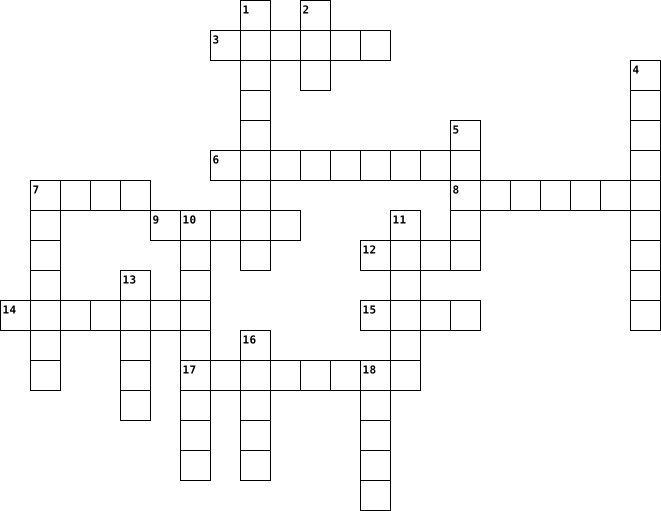
planets Crossword Puzzles
Planet Characteristics 2022-03-14

Across
- A dwarf planet that used to be a planet
- The smallest planet in our universe
- The only star in our universe
- The biggest planet in our universe
Down
- A group of planets that are gaseous and are big
- A group of planets that are rocky and are small
6 Clues: The only star in our universe • The biggest planet in our universe • The smallest planet in our universe • A dwarf planet that used to be a planet • A group of planets that are gaseous and are big • A group of planets that are rocky and are small
Crossword for NATE 2021-03-25

Across
- a little bit
- person
- tayt took ____
- pics
- no effort
- you are looking at a ______
- person that sings
- the manager was _____
- 1 foot away
- little things
- stars and planets
- a dress
Down
- calling
- the toy _____
- thing that scientics
- theres a base then the main ____
- 25 cents
- parent teacher _________
- things
- covid 19
20 Clues: pics • person • things • calling • a dress • 25 cents • covid 19 • no effort • 1 foot away • a little bit • the toy _____ • little things • tayt took ____ • person that sings • stars and planets • thing that scientics • the manager was _____ • parent teacher _________ • you are looking at a ______ • theres a base then the main ____
MARTINA Elementary 3 2014-04-06

Across
- oni
- bezpečný
- káva
- papír
- jejich
- malba
- planety
- dopis
- nábytek
- miska
- můj
- prvek
- dveře
- zdravotní sestra
- vpravo
- Španělsko
Down
- psací stůl
- stůl
- židle
- vidět
- tmavý
- počítač
- lidé
- telefon
- zajímavý
- kino
- letět
- užitečný
- pod
- náš
- unavený
- sklo
- stěna
33 Clues: oni • pod • náš • můj • stůl • káva • lidé • kino • sklo • židle • vidět • tmavý • papír • malba • dopis • letět • miska • prvek • dveře • stěna • jejich • vpravo • počítač • telefon • planety • nábytek • unavený • bezpečný • zajímavý • užitečný • Španělsko • psací stůl • zdravotní sestra
Marvel Characters 2014-09-17

Across
- Widow Romanov
- To court death
- Cap's winged ally
- The First Avenger
- Adamantium bones
- Photographer day job
- "Daywalker"
- Ex-officer Castle
- Thing Clobberin' Time
- "I am _____"
Down
- Hank Pym
- Man Mark III
- Stark Tony's Dad
- Principal
- Richest avenger
- Latverian
- Erik
- Judge, Jury, Executioner
- Trickster
- Skull "Hail Hydra!"
- Eats planets
- Mjolnir
22 Clues: Erik • Mjolnir • Hank Pym • Principal • Latverian • Trickster • "Daywalker" • Man Mark III • "I am _____" • Eats planets • Widow Romanov • To court death • Richest avenger • Stark Tony's Dad • Adamantium bones • Cap's winged ally • The First Avenger • Ex-officer Castle • Skull "Hail Hydra!" • Photographer day job • Thing Clobberin' Time • Judge, Jury, Executioner
At The Museum 2024-04-18

Across
- skatīties
- suvneīru veikaliņš
- skatīties uz mēnesi
- mācīties
- pārzīmēt gleznu
- izrakt
- doties tūrē
- mācīties par akmeņiem
- taisīt, veidot
Down
- skulptūra
- planētas
- kliegt, bļaustīties
- gids
- ēdiens līdzpaņemšanai
- doties uz kafejnīcu
- klausīties
- skraidīt apkārt
- čukstēt
- akmeņi
- apmeklēt
- pieskarties
21 Clues: gids • akmeņi • izrakt • čukstēt • planētas • mācīties • apmeklēt • skulptūra • skatīties • klausīties • doties tūrē • pieskarties • taisīt, veidot • skraidīt apkārt • pārzīmēt gleznu • suvneīru veikaliņš • kliegt, bļaustīties • doties uz kafejnīcu • skatīties uz mēnesi • ēdiens līdzpaņemšanai • mācīties par akmeņiem
Sprint to E Page 18 2024-11-10

Across
- להתעלם
- לגדול
- חיטה
- בתורו
- הוצג
- קיצוני
- עובדים
- בין
- זיהום
- לספק
- אספקה
- מַטֶה
- כַּיוֹם
- תנאים
- מוּגדָל
- צוות
- מאוים
- קיים
Down
- לייבא
- מפותח
- להפחית
- מתכון
- up לוותר
- להחליף
- להעביר
- למרות
- גלוֹבָּלִי
- לצערי
- כוכבי לכת
- סבלני
- מה שנקרא
- לשכנע
- יָלִיד
33 Clues: בין • חיטה • הוצג • לספק • צוות • קיים • לייבא • מפותח • לגדול • מתכון • בתורו • למרות • לצערי • זיהום • אספקה • סבלני • מַטֶה • לשכנע • תנאים • מאוים • להתעלם • להפחית • להחליף • להעביר • קיצוני • עובדים • יָלִיד • כַּיוֹם • מוּגדָל • up לוותר • מה שנקרא • כוכבי לכת • גלוֹבָּלִי
Sprint to E Page 18 2024-11-10

Across
- צוות
- מאוים
- קיצוני
- לספק
- גלוֹבָּלִי
- הוצג
- להחליף
- מה שנקרא
- תנאים
- לוותר
- זיהום
- אספקה
- מתכון
- לשכנע
- כוכבי לכת
Down
- לצערי
- סבלני
- קיים
- בין
- מַטֶה
- לגדול
- להעביר
- מוּגדָל
- מפותח
- כַּיוֹם
- למרות
- להפחית
- עובדים
- להתעלם
- לייבא
- יָלִיד
- חיטה
- בתורו
33 Clues: בין • צוות • קיים • לספק • הוצג • חיטה • לצערי • סבלני • מאוים • מַטֶה • לגדול • מפותח • למרות • תנאים • לייבא • לוותר • זיהום • אספקה • מתכון • בתורו • לשכנע • קיצוני • להעביר • להפחית • להחליף • עובדים • להתעלם • יָלִיד • מוּגדָל • כַּיוֹם • מה שנקרא • כוכבי לכת • גלוֹבָּלִי
Classical Composers 2026-05-28

Across
- — Set of pieces
- — Bowed instruments
- — String instrument
- — Steady musical form
- — Large musical work
- — Combined notes
- — Group of musicians
- — Main tune line
- — Wind instrument group
Down
- — Holst famous piece
- — English composer
- — Art of sound
- — Speed of music
- — Keyboard instrument
- — Beat pattern
- — Conductor tool
- — Written music
- — Deep string instrument
- — Leads musicians
- — Composer of planets
20 Clues: — Art of sound • — Beat pattern • — Set of pieces • — Written music • — Speed of music • — Conductor tool • — Combined notes • — Main tune line • — Leads musicians • — English composer • — Bowed instruments • — String instrument • — Holst famous piece • — Large musical work • — Group of musicians • — Keyboard instrument • — Steady musical form • — Composer of planets • — Wind instrument group • ...
Lost in Space 2025-04-26

Across
- Pilot and love interest.
- Large and in charge
- Baby savant.
- Matriarch.
- Middle.
- Terrestrial vehicle.
- First born.
- Family travelers.
- Equal to Star Trek's Galileo.
- Robinson's ride,
Down
- Destination original.
- Will's friend.
- original inhabitants of planets visited
- Stowaway.
- Necessary characters for drama.
- Patriarch.
- Alien Debbie.
17 Clues: Middle. • Stowaway. • Matriarch. • Patriarch. • First born. • Baby savant. • Alien Debbie. • Will's friend. • Robinson's ride, • Family travelers. • Large and in charge • Terrestrial vehicle. • Destination original. • Pilot and love interest. • Equal to Star Trek's Galileo. • Necessary characters for drama. • original inhabitants of planets visited
Forces and Space 2015-01-13

Across
- On Earth, every 1kg of mass is pulled towards earth by a force of ..... n
- Our sun is a ....
- Mass is the amount of ...... an object has
- How many planets does the solar system have?
- What is mass measured in?
- The force created when two objects rub against each other
- This planet has the strongest gravity in our solar system
Down
- What is weight measured in?
- Complex life needs liquid ...... to survive
- What is air friction also known as?
- Instrument used to look at other stars and planets
- Two forces of equal size going in opposite directions are...?
- What force pulls objects down towards Earth?
13 Clues: Our sun is a .... • What is mass measured in? • What is weight measured in? • What is air friction also known as? • Mass is the amount of ...... an object has • Complex life needs liquid ...... to survive • How many planets does the solar system have? • What force pulls objects down towards Earth? • Instrument used to look at other stars and planets • ...
Our Solar System - Stars, Planets, Moons 2025-01-09

Across
- Venus is the _______________ object in the sky
- Orbits the sun in 88 days
- The only planet that supports life
- The planet with the most known moons
- A term used to describe a very small planet that cannot clear its own orbit
- Rotates on its side
- Jupiter's largest moon
Down
- The farthest planet from the sun
- A planet known for its large, red spot
- A gas found in the atmosphere of some planets, especially Uranus
- The hottest planet in the solar system
- A planet, other than Earth, having polar ice caps
- Most of the names of the planets derive from the names of _________ gods
13 Clues: Rotates on its side • Jupiter's largest moon • Orbits the sun in 88 days • The farthest planet from the sun • The only planet that supports life • The planet with the most known moons • A planet known for its large, red spot • The hottest planet in the solar system • Venus is the _______________ object in the sky • A planet, other than Earth, having polar ice caps • ...
Space 2025-10-30

Across
- The first human to walk on the moon (last name)
- The force that keeps planets in orbit
- A powerful telescope that orbits Earth
- The red planet
- A cloud of gas and dust in space
- A vehicle used to explore space
- A ball of rock or gas that orbits a star
Down
- The boundary of a black hole
- The study of stars, planets, and space
- An astronaut’s home while orbiting Earth
- A large object made of ice and dust that has a glowing tail
- The huge system of stars we live in
- A giant explosion that happens when a star dies
13 Clues: The red planet • The boundary of a black hole • A vehicle used to explore space • A cloud of gas and dust in space • The huge system of stars we live in • The force that keeps planets in orbit • The study of stars, planets, and space • A powerful telescope that orbits Earth • An astronaut’s home while orbiting Earth • A ball of rock or gas that orbits a star • ...
scientific revolution kamila 2025-10-15

Across
- big part of the solar system that orbits the suns
- short for science
- Newtons laws of
- a tool that lets us see from afar distance
- made the telescope more improved than it original form
- a religion of some form of Christianity well known around this time
Down
- Well known scientist known for gravity and laws of motion
- an explanation that has factual evidence
- a theory that the sun and not the earth was in the middle of space
- magnetic force that is on earth newton had also studied
- everything
- watching carefully how something works
- found out planets move in ellipses
13 Clues: everything • Newtons laws of • short for science • found out planets move in ellipses • watching carefully how something works • an explanation that has factual evidence • a tool that lets us see from afar distance • big part of the solar system that orbits the suns • made the telescope more improved than it original form • ...
Earth, Moon, & Planets Recap! 2026-04-28

Across
- Category name of the four innermost planets based on their surfaces
- Name of the protoplanet that collided with Proto-Earth to form the moon
- The number of moon phases in one cycle
- _____ Distance = Stronger Gravity
- Category name of the four outermost planets based on their surfaces
- Eclipse that happens during the day
Down
- _____ Mass = Stronger Gravity
- Ex-planet now considered to be a dwarf planet
- The fourth moon phase is a ____ gibbous.
- Second planet from the sun
- A planet's path around the sun
- Eclipse that happens at night
- Name of the original 1960's/1970's missions to the moon
13 Clues: Second planet from the sun • _____ Mass = Stronger Gravity • Eclipse that happens at night • A planet's path around the sun • _____ Distance = Stronger Gravity • Eclipse that happens during the day • The number of moon phases in one cycle • The fourth moon phase is a ____ gibbous. • Ex-planet now considered to be a dwarf planet • ...
Planet Formation 2023-12-12

Across
- Collision of asteroids on planets in the early solar system
- A developing planetary body that grows by the accumulation of matter/material
- sun, planets, and all the other objects that revolve around the sun
- A gigantic explosion in which a massive star collapses and throws its outer layers into space
- A process by which the gravity of an object compresses it, reducing the size and increasing density.
Down
- the earliest stage of a star's life
- The process by which two or more small nuclei fuse to make a bigger nucleus
- a cloud of gas and dust in space
- spinning mass of gas and dust from which stars and planets form
9 Clues: a cloud of gas and dust in space • the earliest stage of a star's life • Collision of asteroids on planets in the early solar system • spinning mass of gas and dust from which stars and planets form • sun, planets, and all the other objects that revolve around the sun • The process by which two or more small nuclei fuse to make a bigger nucleus • ...
How are the Sun, Moon, and Stars Different? 2024-12-05

Across
- It is the part of the atmosphere that we can see from Earth.
- _________ are celestial bodies that can move around a star.
- Balls of gas that we can see in the nighttime.
- The _______ is all of outer space and its celestial bodies.
- It is the natural satellite of Earth.
- Any natural bodies (planets, stars, the sun, the moon) in the universe are called _________________.
Down
- The eight planets that move around the sun are called the _____________.
- A ________ is a device that makes objects that are far away, like stars and the moon, look closer and bigger.
- It is the celestial body that gives us light and heat.
9 Clues: It is the natural satellite of Earth. • Balls of gas that we can see in the nighttime. • It is the celestial body that gives us light and heat. • _________ are celestial bodies that can move around a star. • The _______ is all of outer space and its celestial bodies. • It is the part of the atmosphere that we can see from Earth. • ...
Mars Vocab part 1 2013-11-25

Across
- something shaped like a ball
- journey or goal
- an area nearby
- device used to view things far away
Down
- scientists who study the planets
- points on which the planets rotate
- widest part of a circle
- hole shaped like a bowl
8 Clues: an area nearby • journey or goal • widest part of a circle • hole shaped like a bowl • something shaped like a ball • scientists who study the planets • points on which the planets rotate • device used to view things far away
Vocabulary from outer space 2017-08-11

Across
- UFO
- Antennen
- Erde
- Milchstraße
- Flügel
Down
- Menschen
- Bullauge
- Planeten
- Raumschiff
- Außerirdischen
10 Clues: UFO • Erde • Flügel • Menschen • Bullauge • Planeten • Antennen • Raumschiff • Milchstraße • Außerirdischen
Subjects 2022-05-23

Across
- language
- writing
- sport
- people
- numbers
- planets
- listen
Down
- painting
- language
- community
- food
11 Clues: food • sport • people • listen • writing • numbers • planets • painting • language • language • community
universe 2024-12-09

Across
- mercurio
- pianeti
- star
- alieni
- luna
Down
- buconero
- marte
- terra
- spazio
- sole
10 Clues: star • sole • luna • marte • terra • spazio • alieni • pianeti • buconero • mercurio
Hannah Damaske - Ch. 28/29 Crossword 2022-05-20

Across
- Jupiter, Saturn, Uranus, and Neptune are _____ planets
- the nearest star to the Earth
- the closest planet to the Sun
- the fifth planet from the sun
- a _____ eclipse occurs when Earth's shadow falls on the moon
- pluto is a _____ planet
- Mercury, Venus, Earth, and Mars are _____ planets
Down
- masses of water, methane, and ice
- a _____ eclipse occurs when the moon's shadow falls on part of Earth
- the first stage in stellar evolution, a cloud of gas and dust
- the furthest planet from the sun
11 Clues: pluto is a _____ planet • the nearest star to the Earth • the closest planet to the Sun • the fifth planet from the sun • the furthest planet from the sun • masses of water, methane, and ice • Mercury, Venus, Earth, and Mars are _____ planets • Jupiter, Saturn, Uranus, and Neptune are _____ planets • a _____ eclipse occurs when Earth's shadow falls on the moon • ...
Gas Giants 2019-11-13

Across
- Another word for Gas giants.
- Saturn is the ____ planet from the sun.
- ______ is what separates the inner and outer planets.
- Neptune and Uranus are sometimes called_____.
- This planet spins on its side.
- All of the outer planets have more than 2____.
Down
- The biggest planet in our solar system.
- The farthest planet from the sun in our solar system.
- On Jupiter there is a storm called_____.
- The gas giants are made up of mostly Hydrogen and____.
- Has thousands of beautiful ringlets.
11 Clues: Another word for Gas giants. • This planet spins on its side. • Has thousands of beautiful ringlets. • The biggest planet in our solar system. • Saturn is the ____ planet from the sun. • On Jupiter there is a storm called_____. • Neptune and Uranus are sometimes called_____. • All of the outer planets have more than 2____. • ...
The Solar System 2026-03-30

Across
- center of the solar system
- smallest planet
- hot ball of glowing gases, can be seen from earth
- large ball of ice and dust that orbits the sun
- four planets closest to the sun
- the path the object takes as it moves around another object in space
- the force of one object
Down
- four planets farthest from the sun
- largest planet
- a large body of rock or gas that orbits around a star
- chunk of rock or metal that orbits the sun
11 Clues: largest planet • smallest planet • the force of one object • center of the solar system • four planets closest to the sun • four planets farthest from the sun • chunk of rock or metal that orbits the sun • large ball of ice and dust that orbits the sun • hot ball of glowing gases, can be seen from earth • a large body of rock or gas that orbits around a star • ...
EARTH AND SPACE 2024-10-03

Across
- Object in space with mass.
- The sun rises in the ________.
- The exterior planets are also known as the _______.
- Closest planet to the sun.
- The four planets closest to the Sun.
- Movement of the Earth around the sun.
Down
- Shape of the Earth's orbit.
- Strip of asteroids orbiting the Sun between Mars and Jupiter.
- When the Earth is closer to the Sun it is _________.
- The moon takes 28 days to complete one _______ and revolution.
- Known as Earth's natural satellite.
- Movement of Earth around its own axis.
12 Clues: Object in space with mass. • Closest planet to the sun. • Shape of the Earth's orbit. • The sun rises in the ________. • Known as Earth's natural satellite. • The four planets closest to the Sun. • Movement of the Earth around the sun. • Movement of Earth around its own axis. • The exterior planets are also known as the _______. • ...
DNA CROSS WORD PUZZLE 2021-12-12

Across
- - The study of celestial objects, space, and the universe as a whole.
- - The path one object takes as it revolves around another object in space.
- - Also called as space junk.
- - He proposed the heliocentric theory.
- - A model showing the Sun as a fixed point in the center of the universe with objects revolving around it.
- - A proof of Big Bang theory that shows a change in frequency of waves of moving objects relative to its source.
- - A galaxy of no visible pattern.
Down
- - The Sun together with the group of planets and other celestial bodies that revolve around it that are held by its gravitational attraction.
- - A scientist who studies objects in space, such as black holes, galaxies, moons, planets, stars, etc.
- - Different beliefs about the universe just like a cosmic egg, a flat island divided by river, and a powerful being created everything.
- - A theory that says the universe began as a small point that expanded rapidly about 13.8 billion years ago.
- - An icy body of frozen gas orbiting the sun.
- - He proposed the geocentric theory.
- - A model showing Earth located at the center of the universe.
- - Are rocky objects revolving around the sun that are too small to be called planets.
15 Clues: - Also called as space junk. • - A galaxy of no visible pattern. • - He proposed the geocentric theory. • - He proposed the heliocentric theory. • - An icy body of frozen gas orbiting the sun. • - A model showing Earth located at the center of the universe. • - The study of celestial objects, space, and the universe as a whole. • ...
Space 2023-04-10

Across
- High Magnetic field
- Essential Force
- Big and Bright
- Far Away
- Stars and Planets
- Far away Debris
- One word: Big
Down
- Rings
- Everything
- So Hot
- "Made of Cheese"
- Rocky Red
- Life, Water!
- 1st Planet
- Poor, Tiny ___
15 Clues: Rings • So Hot • Far Away • Rocky Red • Everything • 1st Planet • Life, Water! • One word: Big • Big and Bright • Poor, Tiny ___ • Essential Force • Far away Debris • "Made of Cheese" • Stars and Planets • High Magnetic field
Gavin WW7 Lesson 12 2024-04-24

Across
- Something holy
- Kidnap
- Likely to change
- To prevent
- House
- Settle a disagreement
- To inform
- A settlement reached by giving something up
Down
- A feature
- Religious
- Hole
- Hill
- Disturbed
- Something that is needed
- Planets path
15 Clues: Hole • Hill • House • Kidnap • A feature • Religious • Disturbed • To inform • To prevent • Planets path • Something holy • Likely to change • Settle a disagreement • Something that is needed • A settlement reached by giving something up
Mars crosswor dpuzzle 2023-08-31

Across
- coins
- atomic number seventy nine
- atomic number thirty
- atomic number seventy four
- atomic number fifty seven
- fear
- atomic number thirteen
- atomic number sixty three
- surface
- ares
- atomic number three
Down
- atomic number fourty two
- limestone
- atomic number seven
- panic
- atomic number nineteen
- ares
- ferrous
- systen planets
- brimsone
20 Clues: ares • fear • ares • coins • panic • ferrous • surface • brimsone • limestone • systen planets • atomic number seven • atomic number three • atomic number thirty • atomic number nineteen • atomic number thirteen • atomic number fourty two • atomic number fifty seven • atomic number sixty three • atomic number seventy nine • atomic number seventy four
Eliza's Vocab 3 Crossword 2024-02-21

Across
- A huge group of single stars, star systems, star clusters, dust, and gas bound together by gravity.
- An attractive force between two masses by which a planet or other body draws objects toward its center.
- Station A large artificial satellite on which people can live and work for long periods.
- belt A region in the solar system roughly located between the orbits of the planets Jupiter and Mars that contains millions of irregularly shaped pieces of rock (called asteroids) as well as ice and dust.
- Streaks of light in the sky produced by the burning of a meteoroid in Earth’s atmosphere.
- An object that revolves around another object in space.
- Loose collection of ice, dust and small rocky particles, typically with a long, narrow orbit.
- belt A large region in the solar system past Neptune where Pluto and other dwarf planets orbit the Sun along with rocks, dust, and ice.
Down
- system A gravitationally bound system consisting of a sun and the objects that orbit it.
- Rocky objects revolving around the sun that are too small and numerous to be considered planets.
- Shuttle Spacecraft that can carry a crew into space, return to Earth, and then be reused for the same purpose.
- All of space and time and their contents, including planets, stars, galaxies, and all other forms of matter and energy.
- Probe A spacecraft that has various scientific instruments that can collect data, including visual images, but has no human crew.
- An astronomical body that orbits a star, is big enough to have enough gravity to force a spherical shape, and is big enough that its gravity has cleared away any objects of a similar size near its orbit.
- A place that is empty of all matter.
- spinoff An item that has uses on Earth, but was originally developed for use in space.
- Space Telescope is a space telescope that was launched into low Earth orbit in 1990 and remains in operation.
17 Clues: A place that is empty of all matter. • An object that revolves around another object in space. • spinoff An item that has uses on Earth, but was originally developed for use in space. • system A gravitationally bound system consisting of a sun and the objects that orbit it. • ...
Galaxy 2024-12-06

Across
- Our galaxy.
- Icy space traveler.
- Stellar cloud.
- Universe entirety.
- Bright galaxy core.
- Celestial path.
- Distance measure.
- Space rock.
- Neighboring galaxy.
Down
- Gravity trap.
- Orbits a star.
- Exploding star.
- Group of galaxies.
- Orbits planets.
- Twinkling in space.
- Shooting star.
16 Clues: Our galaxy. • Space rock. • Gravity trap. • Orbits a star. • Stellar cloud. • Shooting star. • Exploding star. • Orbits planets. • Celestial path. • Distance measure. • Universe entirety. • Group of galaxies. • Icy space traveler. • Bright galaxy core. • Twinkling in space. • Neighboring galaxy.
Space Crossword 2016-10-18

Across
- It gives us our day
- I'm not the Solar System and I'm not the Galaxy
- It is made up planets and our sun
- We live here
Down
- It gives us our night
- The total sum of all matter and energy
- Our Solar System is made up of these
- The closest planet to the sun
- We can not see without it
- They are created in clouds of dust and gas
10 Clues: We live here • It gives us our day • It gives us our night • We can not see without it • The closest planet to the sun • It is made up planets and our sun • Our Solar System is made up of these • The total sum of all matter and energy • They are created in clouds of dust and gas • I'm not the Solar System and I'm not the Galaxy
Earth & Space Science 2015-11-16

Across
- What is made out of pure rock
- What happens when the earth's core separates
- The centre of the Earth
- 4 Planets made out of metal and rock.
Down
- American space company
- Layer of gases surrounding Earth
- What keeps you on the ground
- What is the name of the Planets movement
- A system of millions and billions of stars together with gas and dust.
- What is the Sun
10 Clues: What is the Sun • American space company • The centre of the Earth • What keeps you on the ground • What is made out of pure rock • Layer of gases surrounding Earth • 4 Planets made out of metal and rock. • What is the name of the Planets movement • What happens when the earth's core separates • A system of millions and billions of stars together with gas and dust.
SES6Sci 2022-03-28

Across
- how much space an object takes up
- the planet in which we live in; the world
- keeps moons in orbit around the planets
- strength and energy
- home to all the planets
Down
- a force of attraction that pulls together all matter
- scientist to think why objects fall
- a measure of the gravitational pull on an object
- force that pulls an object toward each other
- capable of doing work
10 Clues: strength and energy • capable of doing work • home to all the planets • how much space an object takes up • scientist to think why objects fall • keeps moons in orbit around the planets • the planet in which we live in; the world • force that pulls an object toward each other • a measure of the gravitational pull on an object • ...
Solar System Crossword 2021-12-06

Across
- The force of an object to pull another to itself
- Not being harmful to the environment
- Something that is made with two ore more substances mixed together
- A planet of gas
- Our solar system is a speak compared to our ________.
Down
- The name of this Crossword
- Separates the inner planets from the outer planets
- Mass of air that surrounds Earth
- The outermost layer of an object
- A planet of ice
10 Clues: A planet of ice • A planet of gas • The name of this Crossword • Mass of air that surrounds Earth • The outermost layer of an object • Not being harmful to the environment • The force of an object to pull another to itself • Separates the inner planets from the outer planets • Our solar system is a speak compared to our ________. • ...
Astronomy crossword 2022-11-30

Across
- has a black hole in the center
- visible part of the sun
- to circle a more massive object
- the spin of an object
- high tides are lower and low tides are higher
Down
- unit of measurement(how far light will travel through space in one year)
- intense explosions near sunspots
- has a star and planets revolve around it
- high tides are higher low tides are lower
- revolve around planets
10 Clues: the spin of an object • revolve around planets • visible part of the sun • has a black hole in the center • to circle a more massive object • intense explosions near sunspots • has a star and planets revolve around it • high tides are higher low tides are lower • high tides are lower and low tides are higher • ...
UNIT 1 REVIEW 2024-05-28

Across
- A celestial body that orbits around a star,
- planets move in elliptical orbits
- The amount of matter in an object
- Sun is the center of the universe
- the Earth is the center of the universe
- force of attraction between two objects
Down
- collection of planets and other solar objects
- energy from the sun
- imaginary line around which a celestial body rotates
- space, time, matter, and energy
10 Clues: energy from the sun • space, time, matter, and energy • planets move in elliptical orbits • The amount of matter in an object • Sun is the center of the universe • the Earth is the center of the universe • force of attraction between two objects • A celestial body that orbits around a star, • collection of planets and other solar objects • ...
Galaxies 2024-04-17

Across
- a ball of light and dense gases
- the star in our solar system
- galaxy a galaxy that has the shape of an oval
- a galaxy that doesn't have a shape
Down
- core the central bulge of our milky way
- a system of planets stars and dust
- system a system of planets including the sun
- galaxy a galaxy that has a spiral shape
- way our home galaxy
- our home planet
10 Clues: our home planet • way our home galaxy • the star in our solar system • a ball of light and dense gases • a system of planets stars and dust • a galaxy that doesn't have a shape • core the central bulge of our milky way • galaxy a galaxy that has a spiral shape • system a system of planets including the sun • galaxy a galaxy that has the shape of an oval
GRAVITY MARSHALL 2025-02-04

Across
- are something that can make everything on land
- is something that makes you fly
- is the big blue ball we live on
- are big planets and have gravity
- is the thing that makes everything land
Down
- make you kinda fly then fall on to the ground
- gravity is something that makes you levitate
- can make you fall
- make us live
- can fall to the ground with gravity
10 Clues: make us live • can make you fall • is something that makes you fly • is the big blue ball we live on • are big planets and have gravity • can fall to the ground with gravity • is the thing that makes everything land • gravity is something that makes you levitate • make you kinda fly then fall on to the ground • are something that can make everything on land
Space Exploration 2025-03-17

Across
- The force that keeps planets in orbit
- A person who travels in space
- A vehicle used to travel into space
- Earth’s only natural satellite
- A machine that orbits Earth to collect data
- A tool used to look at distant stars
- The "Red Planet"
Down
- A huge collection of stars, planets, and dust
- The path an object takes around a planet
- ꜱᴘᴀᴄᴇ ꜱᴛᴀᴛɪᴏɴ A space station where astronauts live and work
10 Clues: The "Red Planet" • A person who travels in space • Earth’s only natural satellite • A vehicle used to travel into space • A tool used to look at distant stars • The force that keeps planets in orbit • The path an object takes around a planet • A machine that orbits Earth to collect data • A huge collection of stars, planets, and dust • ...
space things 2023-05-12

Across
- when the core of a planet is composed of heavy metals
- coldest planet in our solar system
- known for its many beautiful rings
- planets in the milky way revolve around this star
- dictated by atmospheric levels in which gases condense into liquid droplets/solid flakes
- hottest planet
Down
- form at about 150 K
- a.k.a gas giants
- closest planet to the sun
- separates the inner and outer planets
10 Clues: hottest planet • a.k.a gas giants • form at about 150 K • closest planet to the sun • coldest planet in our solar system • known for its many beautiful rings • separates the inner and outer planets • planets in the milky way revolve around this star • when the core of a planet is composed of heavy metals • ...
Jayce 2023-05-08

Across
- A body in space that doesn't make it's own light
- To make a educated guess
- Planets that orbit a star
- Weather that changes over the years
Down
- Object in space made of gas and heat
- A push or pull
- The amount of people that live in a city
- Information collected and recorded
- Rocky object that orbits the sun and smaller than a planet
- Natural object that circles planets
10 Clues: A push or pull • To make a educated guess • Planets that orbit a star • Information collected and recorded • Natural object that circles planets • Weather that changes over the years • Object in space made of gas and heat • The amount of people that live in a city • A body in space that doesn't make it's own light • Rocky object that orbits the sun and smaller than a planet
science 9-2 2025-10-03

Across
- known as dirty snowballs
- this planet rotates on its side
- known as shooting stars
- hottest planet in the solar system
- known as the natural sattillites of planets
Down
- if a meteor reaches Earth's surface
- this planet has rings but its not saturn
- known as the gas giant
- nasa is currently exploring this planet with rovers
- made of little pieces of debris astroids and planets floating through space
10 Clues: known as the gas giant • known as shooting stars • known as dirty snowballs • this planet rotates on its side • hottest planet in the solar system • if a meteor reaches Earth's surface • this planet has rings but its not saturn • known as the natural sattillites of planets • nasa is currently exploring this planet with rovers • ...
Q 1 review crosswords 2025-10-30

Across
- the force that holds objects down or keeps them in orbit
- layers of rock stacked in cronilogical order from bottom to top
- an object spinning on its axis
- ancient bones preserved in rock
- Lunar and Solar
Down
- terrestrial planets
- waining is when the moon appears to be getting smaller
- the 4 names of them are winter, fall, summer, and spring
- an object spinning around another object
- jovian planets
10 Clues: jovian planets • Lunar and Solar • terrestrial planets • an object spinning on its axis • ancient bones preserved in rock • an object spinning around another object • waining is when the moon appears to be getting smaller • the force that holds objects down or keeps them in orbit • the 4 names of them are winter, fall, summer, and spring • ...
Substantivers flertal 2014-02-06

Across
- fødder
- ørred
- analyser
- aber
- lus
- magikere
- kalve
- fyldte chokolader
- knive
- okser
- arter
- kartofler
- mænd
- drenge
- nyheder
Down
- hatte
- serier
- tomater
- informationer
- kopper te
- fotoer
- ben
- dyr
- elefanter
- råd
- slik
- urter
- planeter
- tyve
- arbejde (som i jeg skal på arbejde)
30 Clues: lus • ben • dyr • råd • aber • slik • tyve • mænd • hatte • ørred • kalve • knive • okser • arter • urter • serier • fødder • fotoer • drenge • tomater • nyheder • analyser • magikere • planeter • kopper te • elefanter • kartofler • informationer • fyldte chokolader • arbejde (som i jeg skal på arbejde)
Genesis 1-2 2025-09-04

Across
- first section of bible
- the start
- plants
- male human
- producing fruit
- ________ and earth
- animals
- distant gaseous planets
- stop working
- opposite of dark
Down
- female human
- second trinity member
- Opposite Day
- h2o
- likeness
- moving body of water
- our light giver
- first book
- grow in number
- our planet
- divine one
21 Clues: h2o • plants • animals • likeness • the start • male human • first book • our planet • divine one • female human • Opposite Day • stop working • grow in number • our light giver • producing fruit • opposite of dark • ________ and earth • moving body of water • second trinity member • first section of bible • distant gaseous planets
Space 2023-12-13
Across
- 6th planet
- uh-oh
- man on the
- 8th planet
- 3rd planet
- 4th planet
- 5th planet
- not bright
- candy bar
Down
- communicate from space
- ball of fire
- beam me up scotty
- 2nd planet
- 1st planet
- in space
- all of the planets
- shiny lights
- not a planet
- E.T
19 Clues: E.T • uh-oh • in space • candy bar • 6th planet • 2nd planet • man on the • 1st planet • 8th planet • 3rd planet • 4th planet • 5th planet • not bright • ball of fire • shiny lights • not a planet • beam me up scotty • all of the planets • communicate from space
ดาวเคราะห์ในระบบสุริยะ 2023-06-02

Across
- ดาวเคราะห์ดวงเดียวในระบบสุริยะที่มีสภาวะแวดล้อมเอื้ออำนวยต่อการดำรงชีวิตของสิ่งมีชวิต
- ดาวเคราะห์แก็สเต็มไปด้วยแอมโมเนียและมีแทน
- ดาวเคราะห์แคระในแถบไคเปอร์
- เป็นดาวเคราะห์ที่เล็กที่สุดและยังอยู่ใกล้ดวงอาทิตย์มากที่สุด
- planets เป็นวัตถุขนาดเล็กที่มีรูปร่างคล้ายทรงกลมที่มีวงโคจรเป็นวงรอบดวงอาทิตย์ ซ้อนทับกับดาวเคราะห์ดวงอื่น และไม่อยู่ในระนาบของสุริยวิถี
- ดาวเคราะห์ที่สว่างที่สุดเป็นลำดับที่3
Down
- ดาวเคราะห์ดวงเดียวที่มีวงแหวน
- ดาวเคราะห์ที่มีขนาดใหญ่ที่สุดในระบบสุริยะ
- ลักษณะมีผิวสีน้ำเงินถูกจัดว่าเป็นดาวเคราะห์แคระ
- ดาวที่เป็นบริวารโคจรรอบดาวเคราะห์
- ดาวเคราะห์ที่เล็กที่สุดเป็นลำดับที่สองของระบบสุริยะ
11 Clues: ดาวเคราะห์แคระในแถบไคเปอร์ • ดาวเคราะห์ดวงเดียวที่มีวงแหวน • ดาวที่เป็นบริวารโคจรรอบดาวเคราะห์ • ดาวเคราะห์ที่สว่างที่สุดเป็นลำดับที่3 • ดาวเคราะห์ที่มีขนาดใหญ่ที่สุดในระบบสุริยะ • ดาวเคราะห์แก็สเต็มไปด้วยแอมโมเนียและมีแทน • ลักษณะมีผิวสีน้ำเงินถูกจัดว่าเป็นดาวเคราะห์แคระ • ดาวเคราะห์ที่เล็กที่สุดเป็นลำดับที่สองของระบบสุริยะ • ...
Eliza's Vocab 3 Crossword 2024-02-21

Across
- A huge group of single stars, star systems, star clusters, dust, and gas bound together by gravity.
- An attractive force between two masses by which a planet or other body draws objects toward its center.
- Station A large artificial satellite on which people can live and work for long periods.
- belt A region in the solar system roughly located between the orbits of the planets Jupiter and Mars that contains millions of irregularly shaped pieces of rock (called asteroids) as well as ice and dust.
- Streaks of light in the sky produced by the burning of a meteoroid in Earth’s atmosphere.
- An object that revolves around another object in space.
- Loose collection of ice, dust and small rocky particles, typically with a long, narrow orbit.
- belt A large region in the solar system past Neptune where Pluto and other dwarf planets orbit the Sun along with rocks, dust, and ice.
Down
- system A gravitationally bound system consisting of a sun and the objects that orbit it.
- Rocky objects revolving around the sun that are too small and numerous to be considered planets.
- Shuttle Spacecraft that can carry a crew into space, return to Earth, and then be reused for the same purpose.
- All of space and time and their contents, including planets, stars, galaxies, and all other forms of matter and energy.
- Probe A spacecraft that has various scientific instruments that can collect data, including visual images, but has no human crew.
- An astronomical body that orbits a star, is big enough to have enough gravity to force a spherical shape, and is big enough that its gravity has cleared away any objects of a similar size near its orbit.
- A place that is empty of all matter.
- spinoff An item that has uses on Earth, but was originally developed for use in space.
- Space Telescope is a space telescope that was launched into low Earth orbit in 1990 and remains in operation.
17 Clues: A place that is empty of all matter. • An object that revolves around another object in space. • spinoff An item that has uses on Earth, but was originally developed for use in space. • system A gravitationally bound system consisting of a sun and the objects that orbit it. • ...
Chapter 6- Solar System 2026-03-23

Across
- the curved path of an object around a star planet or a moon
- the way something looks
- a satellite made of rock and ice that orbits a planet
- chunks of ice and dust or rock that have stretched out orbits around the sun
- a huge ball of very hot matter that gives off energy
Down
- the planets closest to the sun Mercury, Venus, Earth, and Mars
- chunks of rock that measure in size from a meter to several kilometers in diameter
- the four planets that are farther from the sun (Jupiter Saturn Uranus Neptune)
- a system of eight planets and the sun, along with moons, asteroids, and comets
9 Clues: the way something looks • a huge ball of very hot matter that gives off energy • a satellite made of rock and ice that orbits a planet • the curved path of an object around a star planet or a moon • the planets closest to the sun Mercury, Venus, Earth, and Mars • chunks of ice and dust or rock that have stretched out orbits around the sun • ...
Formation of the Solar System 2023-11-06

Across
- a flat surface
- to agree with
- to look closely
- proposed explanation made on the basis of limited evidence
- facts from observations or experiment to support the theory
Down
- to move around
- the path where the planets and the moon move around
- an imaginary line where the planets and moons rotate on its own
- to go against something
- way to represent something that is difficult to observe directly
10 Clues: to agree with • to move around • a flat surface • to look closely • to go against something • the path where the planets and the moon move around • proposed explanation made on the basis of limited evidence • facts from observations or experiment to support the theory • an imaginary line where the planets and moons rotate on its own • ...
Jayce 2023-05-08

Across
- A push or pull
- Information collected and recorded
- A body in space that doesn't make it's own light
- SYSTEM Planets that orbit a star
- Natural object that circles planets
- Object in space made of gas and heat
Down
- To make a educated guess
- The amount of people that live in a city
- Rocky object that orbits the sun and smaller than a planet
- Weather that changes over the years
10 Clues: A push or pull • To make a educated guess • Information collected and recorded • Weather that changes over the years • SYSTEM Planets that orbit a star • Natural object that circles planets • Object in space made of gas and heat • The amount of people that live in a city • A body in space that doesn't make it's own light • ...
Space Exploration 2025-03-17

Across
- The "Red Planet"
- A tool used to look at distant stars
- Earth’s only natural satellite
- ꜱᴘᴀᴄᴇ ꜱᴛᴀᴛɪᴏɴ A space station where astronauts live and work
- The force that keeps planets in orbit
Down
- A person who travels in space
- A vehicle used to travel into space
- A machine that orbits Earth to collect data
- The path an object takes around a planet
- A huge collection of stars, planets, and dust
10 Clues: The "Red Planet" • A person who travels in space • Earth’s only natural satellite • A vehicle used to travel into space • A tool used to look at distant stars • The force that keeps planets in orbit • The path an object takes around a planet • A machine that orbits Earth to collect data • A huge collection of stars, planets, and dust • ...
solar system 2025-10-08

Across
- planets that are gaseous
- meteoroids that burn up when entering Earth's atmosphere
- leftover remains from the formation of the solar system
- "dirty snowball"
- "natural satellites"
- celestial body orbiting the sun
Down
- planets that are closer to the sun
- earth is in the center with the other celestial bodies orbiting it
- the sun is at the center with the other ccelestial bodies orbiting it
- the person who developed the heliocentric model.
10 Clues: "dirty snowball" • "natural satellites" • planets that are gaseous • celestial body orbiting the sun • planets that are closer to the sun • the person who developed the heliocentric model. • leftover remains from the formation of the solar system • meteoroids that burn up when entering Earth's atmosphere • earth is in the center with the other celestial bodies orbiting it • ...
Solar System 2025-10-08

Across
- the furthest planet from the sun
- a small part of a constellation
- they have a long dust tail
- planets move in this type of orbit
- can be as small as a grain of sand or be as big as 1000km in diameter
Down
- the hottest planet
- another name for inner planets
- theyre also known as "shooting stars"
- the most known dwarf planet
- they are also called "natural satellites"
10 Clues: the hottest planet • they have a long dust tail • the most known dwarf planet • another name for inner planets • a small part of a constellation • the furthest planet from the sun • planets move in this type of orbit • theyre also known as "shooting stars" • they are also called "natural satellites" • can be as small as a grain of sand or be as big as 1000km in diameter
Solar System 2025-10-08

Across
- the furthest planet from the sun
- they are also called "natural satellites"
- they have a long dust tail
- another name for inner planets
Down
- planets move in this type of orbit
- a small part of a constellation
- can be as small as a grain of sand or be as big as 1000km in diameter
- the hottest planet
- theyre also known as "shooting stars"
- the most known dwarf planet
10 Clues: the hottest planet • they have a long dust tail • the most known dwarf planet • another name for inner planets • a small part of a constellation • the furthest planet from the sun • planets move in this type of orbit • theyre also known as "shooting stars" • they are also called "natural satellites" • can be as small as a grain of sand or be as big as 1000km in diameter
Kepler's laws 2024-05-06

Across
- Kepler's second law describes how planets sweep equal areas in equal ____.
- The German astronomer who formulated the three laws of planetary motion
- the point in a planets orbit where it is closest to the sun is called this?
- The period of a planets orbit squared is proportional to this parameter cubed according to Kepler's third law
Down
- Kepler's first law states that planetary orbits are shaped like this geometric figure
- Kepler's third law is also known as the law of ___.
- This law states that planets move faster in their orbits when they are closer to the sun
7 Clues: Kepler's third law is also known as the law of ___. • The German astronomer who formulated the three laws of planetary motion • Kepler's second law describes how planets sweep equal areas in equal ____. • the point in a planets orbit where it is closest to the sun is called this? • ...
Planet Characteristics 2022-03-14

Across
- A dwarf planet that used to be a planet
- The smallest planet in our universe
- The only star in our universe
- The biggest planet in our universe
Down
- A group of planets that are gaseous and are big
- A group of planets that are rocky and are small
6 Clues: The only star in our universe • The biggest planet in our universe • The smallest planet in our universe • A dwarf planet that used to be a planet • A group of planets that are gaseous and are big • A group of planets that are rocky and are small
Space 2016-10-12

Across
- The only planet known to have life
- The belief that the position of the sun, planets and stars effects the behavior of a person or their personality.
- A repeated celestial course of an objects path around another
- to move around another object
- the force pulling an object towards its center
Down
- A man made body placed in orbit around the earth or other planets used to collect scientific information.
- The scientific study of the sun, planets, stars and other bodies up in space
- to spin on an axis
8 Clues: to spin on an axis • to move around another object • The only planet known to have life • the force pulling an object towards its center • A repeated celestial course of an objects path around another • The scientific study of the sun, planets, stars and other bodies up in space • ...
Earth in Space 2017-10-10

Across
- A force caused by all mass.
- The belief that the positions and the sun, stars and planets affect a persons personality.
- What planets do when they are trapped by the gravitational field of the sun.
- To move in a circular orbit around something.
- The third planet from the sun.
Down
- An object placed in orbit around a planet to collect information.
- The scientific study of stars, planets and other objects in the night sky.
- To move or cause to move in a circle around an axis.
8 Clues: A force caused by all mass. • The third planet from the sun. • To move in a circular orbit around something. • To move or cause to move in a circle around an axis. • An object placed in orbit around a planet to collect information. • The scientific study of stars, planets and other objects in the night sky. • ...
Name: ____________ 2023-12-11

Across
- the outside of something
- the world
- give what is needed for something
- how much of something there is
Down
- the sun and the planets that surround it
- the study of stars and planets
- how hot or cold something is
- heat
8 Clues: heat • the world • the outside of something • how hot or cold something is • the study of stars and planets • how much of something there is • give what is needed for something • the sun and the planets that surround it
Unit 3 Week 2 2023-12-13

Across
- the study of starts and planets
- provide what is needed for something
- how much of something there is
- outside of something
- how hot or cold something is
Down
- the sun and the planets that move around it
- the world
- heat
8 Clues: heat • the world • outside of something • how hot or cold something is • how much of something there is • the study of starts and planets • provide what is needed for something • the sun and the planets that move around it
Unit 3 Week 1-2 2025-12-01

Across
- the sun and planets that move around the sun
- study of stars and planets
- provide what is needed for something
- the outside of something
- the world
Down
- heat
- how much of something there is
- how hot or cold something is
8 Clues: heat • the world • the outside of something • study of stars and planets • how hot or cold something is • how much of something there is • provide what is needed for something • the sun and planets that move around the sun
Solar System 2014-06-02

Across
- planets: an object the size of a planet but that is neither a planet nor a moon
- It is the second-most-massive known dwarf planet, after Eris.
- closest to the Sun
- planet with 9 rings
- the hottest planet in the solar system
- the seventh planet from the Sun
Down
- Known as the red planet
- largest planet in the Solar System
- Belt: is a region of the Solar Systems beyond the planets
- gravitationally curved path of an object around a point in space,
- has 13 known moons
- also known as "the Blue planet"
- System: consists of the Sun and the objects that orbit it
13 Clues: has 13 known moons • closest to the Sun • planet with 9 rings • Known as the red planet • also known as "the Blue planet" • the seventh planet from the Sun • largest planet in the Solar System • the hottest planet in the solar system • Belt: is a region of the Solar Systems beyond the planets • System: consists of the Sun and the objects that orbit it • ...
CLIL CROSSWORD FERNANDO FIGUEROA 2022-06-28

Across
- IS AN SPHERICAL OBJECT THATH ORBITS A STAR.
- HIS NAME IS CHARLES....
- IS THE BIGGEST PLANET OF OUR SOLAR SYSTEM.
- IS THE ADAPTATION OF THE BODY OF A SPECIE.
- IS THE CHANGE OF THE HERITABLE TRAITS OF A ESPECIE TROWH THE GENERATIONS.
- IS THE HOTEST PLANET OF OUR SOLAR SYSTEM.
- IS THE PLANET WHERE WE LIVE.
- IS THE STAR OF OUR SOLAR SYSTEM.
- OUR SUN IS ONE OF IT.
Down
- IS THE 4 MORE CLOSEST PLNETS TO THE SUN.
- IS ONE TO PROTECT US FROM THE SUN.
- IS THE 4 MORE FAR AWAY PLANETS FROM THE SUN.
- IS THE GALAXY WHERE WHE LIVE.
13 Clues: OUR SUN IS ONE OF IT. • HIS NAME IS CHARLES.... • IS THE PLANET WHERE WE LIVE. • IS THE GALAXY WHERE WHE LIVE. • IS THE STAR OF OUR SOLAR SYSTEM. • IS ONE TO PROTECT US FROM THE SUN. • IS THE 4 MORE CLOSEST PLNETS TO THE SUN. • IS THE HOTEST PLANET OF OUR SOLAR SYSTEM. • IS THE BIGGEST PLANET OF OUR SOLAR SYSTEM. • IS THE ADAPTATION OF THE BODY OF A SPECIE. • ...
space 2023-06-25

Across
- A person who travels to space. Astronauts undergo rigorous training and wear special suits to survive in the harsh conditions of space.
- A small particle from space that enters Earth's atmosphere and burns up, creating a streak of light known as a shooting star.
- A celestial object composed of ice, dust, and gas that orbits the Sun. Comets often have a glowing tail and can be seen in the night sky for a limited period.
- An optical instrument used to observe distant objects in space. Telescopes can reveal details of planets, stars, galaxies, and other celestial phenomena.
- The force that pulls objects toward each other. Gravity keeps planets in orbit around the Sun and gives weight to objects on Earth.
- An astronomical event in which one celestial body obscures another. Solar eclipses occur when the Moon blocks the Sun, and lunar eclipses occur when Earth's shadow falls on the Moon.
- A powerful explosion that occurs at the end of a star's life. Supernovae release an enormous amount of energy and can briefly outshine an entire galaxy.
Down
- A large celestial body that orbits around a star. Planets are spherical in shape and can be made of rock, gas, or a combination of both. Earth is one of the planets in our solar system.
- The natural satellite of Earth. It orbits around our planet and can be seen at night. It appears as a bright, round object in the sky.
- A rocky object that orbits the Sun and is smaller than a planet. Asteroids are found in the asteroid belt between Mars and Jupiter.
- A luminous celestial body that appears as a tiny point of light in the night sky. Stars emit their own light and are scattered across the universe.
- A vehicle propelled by rocket engines that carries objects and people into space. Rockets provide the necessary thrust to overcome Earth's gravity.
- A meteor that survives its passage through Earth's atmosphere and lands on the surface. Meteorites can provide valuable information about the composition of space.
- A massive collection of stars, gas, dust, and other celestial objects held together by gravity. The Milky Way is the galaxy in which our solar system resides.
- The path followed by an object as it revolves around another object in space. Planets, moons, and satellites all have their own orbits.
- The star at the center of our solar system. It provides heat and light to Earth and is responsible for day and night.
16 Clues: The star at the center of our solar system. It provides heat and light to Earth and is responsible for day and night. • A small particle from space that enters Earth's atmosphere and burns up, creating a streak of light known as a shooting star. • ...
science terms 2021-11-08

Across
- heat
- high
- cold
- moon
- planets
Down
- stars
- sun
- elements
- light
- dark
10 Clues: sun • heat • high • cold • dark • moon • stars • light • planets • elements
Space crossword 2021-11-16

Across
- youcanseethisatnight
- nasahavetheseinspace
- thereare8oftheseinoursolarsystem
- ourneoghbourplanet
- biggestplanet
Down
- ifyouseethisyoucanmakeawish
- avaruus
- asteroidlookalike
- littlelightsinspace
- thesecondbiggestplanet
10 Clues: avaruus • biggestplanet • asteroidlookalike • ourneoghbourplanet • littlelightsinspace • youcanseethisatnight • nasahavetheseinspace • thesecondbiggestplanet • ifyouseethisyoucanmakeawish • thereare8oftheseinoursolarsystem
DNA CROSS WORD PUZZLE 2021-12-12

Across
- - A model showing the Sun as a fixed point in the center of the universe with objects revolving around it.
- - A scientist who studies objects in space, such as black holes, galaxies, moons, planets, stars, etc.
- - A galaxy of no visible pattern.
- - Different beliefs about the universe just like a cosmic egg, a flat island divided by river, and a powerful being created everything.
- - He proposed the geocentric theory.
- - A model showing Earth located at the center of the universe.
- - Also called as space junk.
- - Are rocky objects revolving around the sun that are too small to be called planets.
- - A theory that says the universe began as a small point that expanded rapidly about 13.8 billion years ago.
Down
- - An icy body of frozen gas orbiting the sun.
- - The Sun together with the group of planets and other celestial bodies that revolve around it that are held by its gravitational attraction.
- - He proposed the heliocentric theory.
- - The path one object takes as it revolves around another object in space.
- - A proof of Big Bang theory that shows a change in frequency of waves of moving objects relative to its source.
- - The study of celestial objects, space, and the universe as a whole.
15 Clues: - Also called as space junk. • - A galaxy of no visible pattern. • - He proposed the geocentric theory. • - He proposed the heliocentric theory. • - An icy body of frozen gas orbiting the sun. • - A model showing Earth located at the center of the universe. • - The study of celestial objects, space, and the universe as a whole. • ...
DNA CROSS WORD PUZZLE 2021-12-12

Across
- - A model showing Earth located at the center of the universe.
- - The Sun together with the group of planets and other celestial bodies that revolve around it that are held by its gravitational attraction.
- - Different beliefs about the universe just like a cosmic egg, a flat island divided by river, and a powerful being created everything.
- - He proposed the geocentric theory.
- - A theory that says the universe began as a small point that expanded rapidly about 13.8 billion years ago.
- - A proof of Big Bang theory that shows a change in frequency of waves of moving objects relative to its source.
- - An icy body of frozen gas orbiting the sun.
Down
- - A model showing the Sun as a fixed point in the center of the universe with objects revolving around it.
- - He proposed the heliocentric theory.
- - The study of celestial objects, space, and the universe as a whole.
- - Also called as space junk.
- - A scientist who studies objects in space, such as black holes, galaxies, moons, planets, stars, etc.
- - A galaxy of no visible pattern.
- - The path one object takes as it revolves around another object in space.
- - Are rocky objects revolving around the sun that are too small to be called planets.
15 Clues: - Also called as space junk. • - A galaxy of no visible pattern. • - He proposed the geocentric theory. • - He proposed the heliocentric theory. • - An icy body of frozen gas orbiting the sun. • - A model showing Earth located at the center of the universe. • - The study of celestial objects, space, and the universe as a whole. • ...
The space race 2024-11-14

Across
- It contains our sun and 8 planets
- There are eight ..., each with its own unique characteristics
- It is big and it takes astronauts into space
- It is filled with countless stars, planets and galaxies
Down
- there are multiple ... around the earth that connect us with the world
- The planet that is closest to the Earth and that we can see at night.
- A ... is flying piece of rock in space
- It is round and warm, with a yellow and orange color
8 Clues: It contains our sun and 8 planets • A ... is flying piece of rock in space • It is big and it takes astronauts into space • It is round and warm, with a yellow and orange color • It is filled with countless stars, planets and galaxies • There are eight ..., each with its own unique characteristics • ...
Week 1 Day 1 Crossword Puzzle 2026-04-15

Across
- The star at the center of our solar system
- The region between Mars and Jupiter filled with millions of rocky objects
- The Sun and all the planets that move around it
- A large, round object in space that moves around a star
Down
- A huge collection of stars, planets, gas, and dust held together by gravity
- Everything that exists: all galaxies, stars, and planets
- Our home planet — the third planet from the Sun
- The path a planet takes as it moves around the Sun
8 Clues: The star at the center of our solar system • Our home planet — the third planet from the Sun • The Sun and all the planets that move around it • The path a planet takes as it moves around the Sun • A large, round object in space that moves around a star • Everything that exists: all galaxies, stars, and planets • ...
The Solar System 2020-06-29

Across
- a layer of this is between Mars and Jupiter
- a planet that was once in the solar system but now considered as a dwarf planet
- someone who goes to space
- the Earth’s natural satellite
- the galaxy in which we live in
- the hottest planet in the solar system
Down
- when the earth comes in between sun and moon
- the study of space
- a star
- the sun together with all the planets and other bodies that revolve around it
- When the moon comes in between the sun and earth
- the total number of hours an earth day has
- the total number of planets in the solar system
13 Clues: a star • the study of space • someone who goes to space • the Earth’s natural satellite • the galaxy in which we live in • the hottest planet in the solar system • the total number of hours an earth day has • a layer of this is between Mars and Jupiter • when the earth comes in between sun and moon • the total number of planets in the solar system • ...
Solar System Crossword Puzzle 2013-02-05

Across
- and mercury the only two planets that don't have any moons
- has 8 moons and is the farthest away from the sun
- also known as "the red planet"
- the amount of moons that jupiter has
- the seventh planet from the sun
Down
- the 6th planet from the sun, with rings around it, made of rock and ice
- the smallest planet in the solar system
- and venus the "twin planets"
- the biggest planet in the solar system
- a rock in space
- first person to land on earth's moon
- the brightest star in the center of the solar system
- is now considered a dwarf planet
13 Clues: a rock in space • and venus the "twin planets" • also known as "the red planet" • the seventh planet from the sun • is now considered a dwarf planet • first person to land on earth's moon • the amount of moons that jupiter has • the biggest planet in the solar system • the smallest planet in the solar system • has 8 moons and is the farthest away from the sun • ...
Science 2026-03-10

Across
- The force that keeps planets in orbit.
- The line that divides the earth into two halves.
- The angle of the axis, responsible for seasons.
- The line where the earth and the sky meets.
- The name of half a sphere.
- Shadows become like this from sunrise to midday.
Down
- The Moon is this type of satellite.
- Celestial bodies that make their own light.
- Man made machines that move around the earth.
- The time it takes the earth to orbit the sun.
- Our solar system has eight of them.
- The line that the earth spins on.
- The way the earth moves around the sun.
13 Clues: The name of half a sphere. • The line that the earth spins on. • The Moon is this type of satellite. • Our solar system has eight of them. • The force that keeps planets in orbit. • The way the earth moves around the sun. • Celestial bodies that make their own light. • The line where the earth and the sky meets. • Man made machines that move around the earth. • ...
El Sistema Solar 2021-05-03

Across
- tierra
- galaxia
- urano
- saturno
- júpiter
- sol
Down
- planetas
- marte
- asteroide
- neptuno
10 Clues: sol • marte • urano • tierra • galaxia • saturno • neptuno • júpiter • planetas • asteroide
Vocabulary from outer space 2017-08-11

Across
- Außerirdischen
- Raumschiff
- Erde
- UFO
- Antennen
- Flügel
Down
- Planeten
- Milchstraße
- Menschen
- Bullauge
10 Clues: UFO • Erde • Flügel • Planeten • Menschen • Bullauge • Antennen • Raumschiff • Milchstraße • Außerirdischen
space 2019-03-04

Across
- lunar
- eclipse
- rocket
- bright
Down
- rings
- solar
- cold
- life
- black
- warm
10 Clues: cold • life • warm • rings • solar • lunar • black • rocket • bright • eclipse
Crossword with Jumbled Words Choices 2023-01-19

Across
- ramett
- uletoiovn
- corks
- icnstites
- ybsssmtue
Down
- olvcnao
- lnpsate
- esnalrmi
- atymronos
- olsssfi
10 Clues: corks • ramett • olvcnao • lnpsate • olsssfi • esnalrmi • atymronos • uletoiovn • icnstites • ybsssmtue
Subjects 2022-05-23

Across
- language
- people
- community
- planets
Down
- listen
- painting
- writing
- numbers
- food
- sport
- language
11 Clues: food • sport • listen • people • writing • numbers • planets • language • painting • language • community
Engelse woordjes rune 2016-12-17

Across
- het
- blij
- kijk
- zien
- woord
- èèn
- deel
- fijne
- leuk
- kruiswoordraadsel
- jou
- en
- dieren
- planeten
- oplossen
- gratis
- maak
Down
- de
- mij
- telefoon
- lijn
- hond
- gemakkelijk
- kerstmis
- bouw
- puzzels
- snel
- ik
- ruimte
- vind
- dan
- liefde
- kat
34 Clues: de • en • ik • het • mij • èèn • jou • dan • kat • blij • kijk • lijn • zien • hond • deel • bouw • leuk • snel • vind • maak • woord • fijne • print • dieren • ruimte • liefde • gratis • puzzels • telefoon • kerstmis • planeten • oplossen • gemakkelijk • kruiswoordraadsel
Sprint To E Page 18 2024-11-27

Across
- לוותר
- מוּגדָל
- מפותח
- לספק
- מתכון
- סבלני
- להתעלם
- אספקה
- מאוים
- להפחית
- צוות
- לצערי
- קיים
- עובדים
- להעביר
Down
- קיצוני
- חיטה
- יָלִיד
- הוצג
- כַּיוֹם
- לייבא
- מַטֶה
- מה שנקרא
- להחליף
- לשכנע
- כוכבי לכת
- לגדול
- זיהום
- למרות
- בין
- תנאים
- גלוֹבָּלִי
- בתורו
33 Clues: בין • חיטה • הוצג • לספק • צוות • קיים • לוותר • לייבא • מפותח • מַטֶה • מתכון • לשכנע • סבלני • לגדול • אספקה • זיהום • מאוים • למרות • תנאים • לצערי • בתורו • קיצוני • יָלִיד • להחליף • להתעלם • להפחית • עובדים • להעביר • מוּגדָל • כַּיוֹם • מה שנקרא • כוכבי לכת • גלוֹבָּלִי
DNA CROSS WORD PUZZLE 2021-12-12

Across
- - Different beliefs about the universe just like a cosmic egg, a flat island divided by river, and a powerful being created everything.
- - Are rocky objects revolving around the sun that are too small to be called planets.
- - A theory that says the universe began as a small point that expanded rapidly about 13.8 billion years ago.
- - A model showing Earth located at the center of the universe.
- - He proposed the geocentric theory.
- - A proof of Big Bang theory that shows a change in frequency of waves of moving objects relative to its source.
- - A scientist who studies objects in space, such as black holes, galaxies, moons, planets, stars, etc.
Down
- - Also called as space junk.
- - A model showing the Sun as a fixed point in the center of the universe with objects revolving around it.
- - The study of celestial objects, space, and the universe as a whole.
- - A galaxy of no visible pattern.
- - He proposed the heliocentric theory.
- - The path one object takes as it revolves around another object in space.
- - The Sun together with the group of planets and other celestial bodies that revolve around it that are held by its gravitational attraction.
- - An icy body of frozen gas orbiting the sun.
15 Clues: - Also called as space junk. • - A galaxy of no visible pattern. • - He proposed the geocentric theory. • - He proposed the heliocentric theory. • - An icy body of frozen gas orbiting the sun. • - A model showing Earth located at the center of the universe. • - The study of celestial objects, space, and the universe as a whole. • ...
Sky Science Vocabulary 2014-11-02

Across
- A man made or heavenly body that orbits around a larger object.
- The name of the satellite that orbits the Earth.
- SYSTEM The Sun and all of the bodies - planets, satellites, asteroids, comets, etc. that orbit around it.
- Large bodies that can only be seen by reflected light, as the revolve around the Sun.
- A hole created on the surface of an object or body, made by falling meteorites or by erupting volcanoes.
- The study of the universe and all of the bodies that appear in the skies.
- BELT The area between the inner and outer planets that is filled with asteroids.
- A force that attracts and holds the universe together. It gives objects weight.
- When a meteoroid enters the Earth's atmosphere, creating a bright streaky light.
Down
- YEAR The distance light travels in a year.
- Either the north or the south half of the Earth divided by the equator, and the east and west half divided by the prime meridian.
- An imaginary circle around that centre of the Earth, perpendicular to the axis of rotation.
- ECLIPSE When the moon moves into the Earth's shadow.
- To determine, check or adjust a scale of any measuring instrument.
- A spiral island of stars in space. Our ______ is called the Milky Way.
15 Clues: YEAR The distance light travels in a year. • The name of the satellite that orbits the Earth. • ECLIPSE When the moon moves into the Earth's shadow. • A man made or heavenly body that orbits around a larger object. • To determine, check or adjust a scale of any measuring instrument. • A spiral island of stars in space. Our ______ is called the Milky Way. • ...
Astronomy 2023-06-21

Across
- A massive collection of stars, gas, and dust held together by gravity.
- The path that an object takes as it moves around another object in space.
- An object that orbits a planet or other celestial body and provides information or communication.
- A vehicle that is powered by engines and used to travel into space.
- System The Sun and all the planets, moons, and other objects that orbit around it.
- A large celestial body that orbits around a star and shines by reflecting light from the star.
- A bright, glowing ball of gas in outer space that produces its own light and heat.
- A small celestial body that enters the Earth's atmosphere and burns up, producing a streak of light.
Down
- An optical instrument used to magnify and view distant objects in the sky.
- A scientist who studies celestial objects such as stars, planets, and galaxies.
- All of space and everything in it, including galaxies, stars, planets, and other objects.
- The natural satellite of the Earth, visible in the night sky as a round, shining object.
- A cloud of gas and dust in space, often where new stars are formed.
- A person who travels and works in space.
- A celestial object composed of ice, dust, and gas that orbits the Sun and develops a tail.
15 Clues: A person who travels and works in space. • A cloud of gas and dust in space, often where new stars are formed. • A vehicle that is powered by engines and used to travel into space. • A massive collection of stars, gas, and dust held together by gravity. • The path that an object takes as it moves around another object in space. • ...
Topic 5 Pt. 1 2026-03-03

Across
- - A loose collection of ice and dust that orbits the sun, typically in a long, narrow orbit
- - The movement of an object around another object (1 year)
- - The spinning motion of a planet on its axis (1 day)
- - An imaginary line that passes through a planet’s center and its north and south poles, about which the planet rotates.
- - Either of the two days of the year on which the sun reaches its greatest distance from the equator
- - A streak of light in the sky produced by the burning of a meteoroid in Earth’s atmosphere
- - The shape that the planets orbit; oval
- - An object that orbits a star and has cleared the area of its orbit.
- - The term describing a model of the solar system in which Earth and the other planets revolve around the sun
Down
- - Information or data that is gathered using one of the 5 senses
- - The term describing a model of the universe in which Earth is at the center of the revolving planets and starts
- - A ball of hot gas that undergoes nuclear fusion
- - An object that orbits a planet
- - A pattern of grouping of stars that people imagine to represent a figure or object
- - The path of an object as it revolves around another object in space
15 Clues: - An object that orbits a planet • - The shape that the planets orbit; oval • - A ball of hot gas that undergoes nuclear fusion • - The spinning motion of a planet on its axis (1 day) • - The movement of an object around another object (1 year) • - Information or data that is gathered using one of the 5 senses • ...
Julianna 5th 2022-02-01

Across
- :Cardiac muscle
- :Energy from the stars
- :Takes pictures
- :Grouping of stars
- :Sun, Planets and moons
- :Maps planet
- :Voluntary
- :Smooth muscle
- :Gathers visible light and EMradiation
- :Path around object
Down
- :Measures atmosphere
- :Gathers rock samples
- :Skeletal muscle
- :Hole from space rock
- :Involuntary
- :Everything
- :Stars form a pattern
- :Smaller orbits
- :Tendons
19 Clues: :Tendons • :Voluntary • :Everything • :Involuntary • :Maps planet • :Smooth muscle • :Cardiac muscle • :Takes pictures • :Smaller orbits • :Skeletal muscle • :Grouping of stars • :Path around object • :Measures atmosphere • :Gathers rock samples • :Hole from space rock • :Stars form a pattern • :Energy from the stars • :Sun, Planets and moons • :Gathers visible light and EMradiation
UNIVERSAL KNOWLEDGE 2018-04-06

Across
- closest planet to the Sun
- Explorers the rocket that found K2-138
- James Webb's to be partner for exploring exoplanets
- The abbreviation for Stratospheric Observatory for Infrared Astronomy
- the amount of planets orbiting TRAPPIST-1
Down
- has a double shadow on planets with two suns
- the second brightest star
- The abbreviation for Nation Aeronautics and Space Administration
- the only planet in our solar system with rings
- lets us live
10 Clues: lets us live • closest planet to the Sun • the second brightest star • Explorers the rocket that found K2-138 • the amount of planets orbiting TRAPPIST-1 • has a double shadow on planets with two suns • the only planet in our solar system with rings • James Webb's to be partner for exploring exoplanets • The abbreviation for Nation Aeronautics and Space Administration • ...
SPACE CROSSWORD 2017-05-14

Across
- twinkles in the night sky
- the layer of gas that surrounds earth beginning with A
- the earth and planets do what around the sun?
- the force that keeps humans to the ground
- something very hot and gives us light during the day
- the largest planet
Down
- makes up all of the planets
- also known as a shooting star
- the planet we live on
- a person who travels in a spacecraft
10 Clues: the largest planet • the planet we live on • twinkles in the night sky • makes up all of the planets • also known as a shooting star • a person who travels in a spacecraft • the force that keeps humans to the ground • the earth and planets do what around the sun? • something very hot and gives us light during the day • the layer of gas that surrounds earth beginning with A
The Sun 2013-04-15

Across
- The ___ is not as big as it seems.
- What comes out of the sun.
- The sun has spots called ________.
- The sun is 1.3 times ______ than the earth.
- _____ look directly at the sun.
Down
- The planets farther from the sun are called the _____ planets.
- The sun is measured about 1.4 _______ km.
- The sun gives out lots of ______.
- The ___ is what is on your sunscreen.
- The sun is made up of exploding _____.
10 Clues: What comes out of the sun. • _____ look directly at the sun. • The sun gives out lots of ______. • The ___ is not as big as it seems. • The sun has spots called ________. • The ___ is what is on your sunscreen. • The sun is made up of exploding _____. • The sun is measured about 1.4 _______ km. • The sun is 1.3 times ______ than the earth. • ...
The Scientific Revolution 2023-03-27

Across
- proved that planets orbit in ellipses
- challenged the church--taught heliocentric theory
- discovered inertia and that matter falls at the same speed
- introduced the scientific method
- an oval shape in which the planets orbit
- the sun is in the middle
Down
- invented the first modern telescope
- the earth is in the middle
- overthrow of a government or social order
- crime of believing or saying things that go against the church
10 Clues: the sun is in the middle • the earth is in the middle • introduced the scientific method • invented the first modern telescope • proved that planets orbit in ellipses • an oval shape in which the planets orbit • overthrow of a government or social order • challenged the church--taught heliocentric theory • discovered inertia and that matter falls at the same speed • ...
chapter 21 crossword 2017-04-20

Across
- millions of small rocks objects that orbit the sun
- planets closest to the sun
- made up of gas and dust and orbits the sun
Down
- used to measure the distance from earth to space
- an objects journey around the sun
- largest object in the solar system
- when a planets atmosphere traps solar energy
- the time an object takes to complete one rotation
- closest planet to the sun
- nearly spherical
10 Clues: nearly spherical • closest planet to the sun • planets closest to the sun • an objects journey around the sun • largest object in the solar system • made up of gas and dust and orbits the sun • when a planets atmosphere traps solar energy • used to measure the distance from earth to space • the time an object takes to complete one rotation • ...
Crossword 2023-12-01

Across
- travel out of earth's orbit to explore
- telesope that uses mirrors
- galaxy where we live
Down
- uses radio waves to see space
- made up of planets, moons, asteroids, and comets
- the amount of distance light can travel in one earth year
- has a terrstrial or gaseous surface
- made of gas, dust and billions of stars
- big arches of energy
- star at the center of our solar system
10 Clues: big arches of energy • galaxy where we live • telesope that uses mirrors • uses radio waves to see space • has a terrstrial or gaseous surface • travel out of earth's orbit to explore • star at the center of our solar system • made of gas, dust and billions of stars • made up of planets, moons, asteroids, and comets • the amount of distance light can travel in one earth year
Planet Crossword 2025-09-15

Across
- Large rings of ice, rock, and dust circle the planet
- The smallest and closest planet to the Sun.
- The outer 4 planets
- The largest planet; has 67 moons
- The Blue Planet; only known planet to support life.
Down
- Earth's twin, covered by clouds of gas.
- The furthet from the Sun
- The inner 4 planets
- This planet spins on its side.
- Explored by rovers; thought to possibly have once harbored life.
10 Clues: The inner 4 planets • The outer 4 planets • The furthet from the Sun • This planet spins on its side. • The largest planet; has 67 moons • Earth's twin, covered by clouds of gas. • The smallest and closest planet to the Sun. • The Blue Planet; only known planet to support life. • Large rings of ice, rock, and dust circle the planet • ...
The Solar System 2025-09-22

Across
- .....is the largest planet of the solar system
- ......is also called as blue planet
- .......is the planet farthest from the Sun
- planets revolve around the sun in fixed path called....
- .......is called the red planet.
Down
- .....is it the coldest planet of the solar system
- ........is the dwarf planet
- There are ...... planets revolving around the sun
- ..... is the hottest and the brightest planet
- ........is the second largest planet after Jupiter
10 Clues: ........is the dwarf planet • .......is called the red planet. • ......is also called as blue planet • .......is the planet farthest from the Sun • ..... is the hottest and the brightest planet • .....is the largest planet of the solar system • .....is it the coldest planet of the solar system • There are ...... planets revolving around the sun • ...
MARTINA Elementary 3 2014-04-06

Across
- oni
- bezpečný
- káva
- papír
- jejich
- malba
- planety
- dopis
- nábytek
- miska
- můj
- prvek
- dveře
- zdravotní sestra
- vpravo
- Španělsko
Down
- psací stůl
- stůl
- židle
- vidět
- tmavý
- počítač
- lidé
- telefon
- zajímavý
- kino
- letět
- užitečný
- pod
- náš
- unavený
- sklo
- stěna
33 Clues: oni • pod • náš • můj • stůl • káva • lidé • kino • sklo • židle • vidět • tmavý • papír • malba • dopis • letět • miska • prvek • dveře • stěna • jejich • vpravo • počítač • telefon • planety • nábytek • unavený • bezpečný • zajímavý • užitečný • Španělsko • psací stůl • zdravotní sestra
The hardest crossword puzzle you have ever seen 2023-05-17
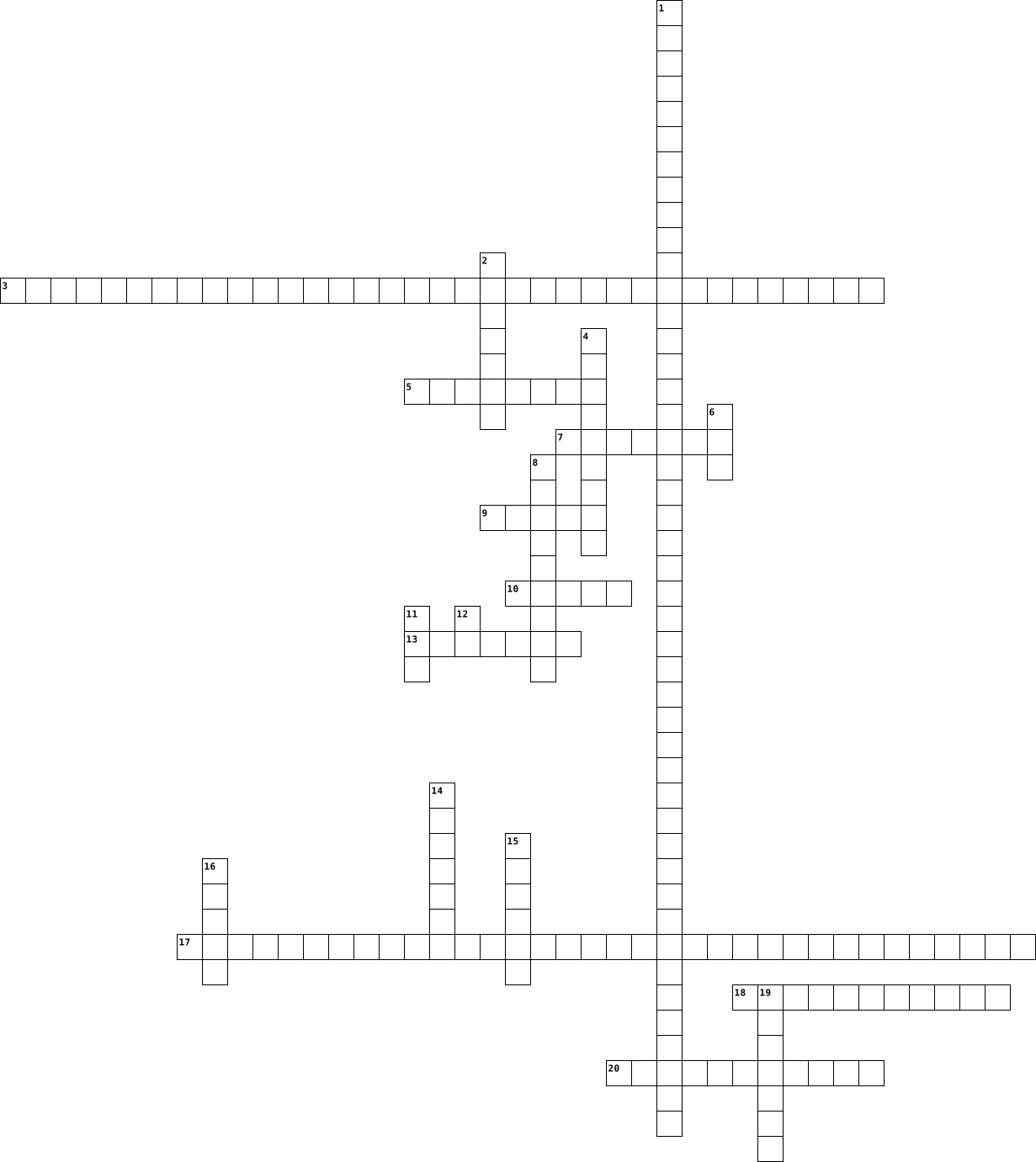
Across
- what
- battleroyale
- science but for high school
- a thing you sit on
- The dude in our class
- meow
- Wonderful
- the teacher
- Evil
Down
- lung
- place
- science but hard
- bye
- grammar
- it goes meow
- yo
- yay
- the make of the crassword puzzle best friend
- the maker of this crossword puzzle
- science
20 Clues: yo • bye • yay • lung • what • meow • Evil • place • grammar • science • Wonderful • the teacher • battleroyale • it goes meow • science but hard • a thing you sit on • The dude in our class • science but for high school • the maker of this crossword puzzle • the make of the crassword puzzle best friend
Space Exploration 2026-03-02

Across
- A type of spacecraft that flies out and passes by certain planets or moons and then keeps going out.
- The name of the first mars rover.
- The first spacecraft sent to the inner planets.
- A type of spacecraft that goes to a planet or moon and orbits around it to collect data.
- The state that John Glenn and Neil Armstrong are from.
- Neil _________ was the first person to walk on the moon.
- A robotic vehicle designed to explore on a terrestrial solid surface like a moon or planet.
- The abbreviated way of saying "National Aeronautics and Space Administration" which is the United States agency to help with space exploration.
Down
- A type of spacecraft that contains telescopes to take pictures of the universe.
- The name of the first spacecraft to visit the outer planets.
- It is designed to land and stay in one place like a terrestial planet, moon, asteroid or comet and relay information back
- This provides the force needed for a spacecraft to overcome earth's gravity and get into space.
- The first spacecraft to explore pluto up close.
- The farthest any spacecraft has traveled from earth. It is expected to be 1 lightday from earth in November of 2026.
- Designed to help with navigation (GPS) and weather tracking.
- John __________ was the first American to orbit around earth.
16 Clues: The name of the first mars rover. • The first spacecraft to explore pluto up close. • The first spacecraft sent to the inner planets. • The state that John Glenn and Neil Armstrong are from. • Neil _________ was the first person to walk on the moon. • The name of the first spacecraft to visit the outer planets. • ...
Unit 3 Week 3 2020-03-30

Across
- the study of stars and planets
- the sun and the planets that move around it
- how hot or cold something is
Down
- heat
- the world
- the outside of something
- provide what is needed for something
- how much of something there is
8 Clues: heat • the world • the outside of something • how hot or cold something is • the study of stars and planets • how much of something there is • provide what is needed for something • the sun and the planets that move around it
Earth 2018-04-30

Across
- how much of something there is
- how hot of cold something is
- the world
Down
- the study of stars and planets
- provide what is needed for something
- system the sun and planets that move around it
- the outside of something
- heat
8 Clues: heat • the world • the outside of something • how hot of cold something is • the study of stars and planets • how much of something there is • provide what is needed for something • system the sun and planets that move around it
Unit 3 Week 3 Earth and Its Neighbors 2026-01-12

Across
- system the sun and the planets that move around it
- the study of stars and planets
- heat
- how hot or cold something is
- the world
- provide what is needed for something
Down
- the outside of something
- how much of something there is
8 Clues: heat • the world • the outside of something • how hot or cold something is • the study of stars and planets • how much of something there is • provide what is needed for something • system the sun and the planets that move around it