
planets Crossword Puzzles
Muslim Crossword 2021-02-05

Across
- Contains zeros and decimals
- Contained the house of wisdom
- Preparation of medicine
- Was used in the dark ages
- Muslims used to find direction
- Study of planets and stars
Down
- Designing buildings
- Momentum, gravity, and optics
- Study of history
- Known as Sufis in Muslim
- Writing and decorative
- Studying whatever things god created
12 Clues: Study of history • Designing buildings • Writing and decorative • Preparation of medicine • Known as Sufis in Muslim • Was used in the dark ages • Study of planets and stars • Contains zeros and decimals • Momentum, gravity, and optics • Contained the house of wisdom • Muslims used to find direction • Studying whatever things god created
Words from space and from earth 2018-10-11

Across
- a ball is ...
- people in space
- water
- go down the ...
- a game with a small ball and a stick
- nature, everything around us
- synonym for rocket
Down
- a game with a racket and shuttlecock
- learn about planets
- Person who goes to space
- we live in the 21st ...
- make the screen work again
- water
13 Clues: water • water • a ball is ... • people in space • go down the ... • synonym for rocket • learn about planets • we live in the 21st ... • Person who goes to space • make the screen work again • nature, everything around us • a game with a racket and shuttlecock • a game with a small ball and a stick
Try This 2022-08-14

Across
- Plaything Tale 1995
- Maker of TVs, computers, etc
- small earth shakes in 1990
- passing Outlandish by
- little Link called them I-forgots
Down
- midwest expression of dismay
- "What's poppin', ____?"
- it helps the medicine go down
- kicked out of the planets club
- Inara _____
- Last survivor's only hope
- plastic triangle finger tip
12 Clues: Inara _____ • Plaything Tale 1995 • passing Outlandish by • "What's poppin', ____?" • Last survivor's only hope • small earth shakes in 1990 • plastic triangle finger tip • midwest expression of dismay • Maker of TVs, computers, etc • it helps the medicine go down • kicked out of the planets club • little Link called them I-forgots
IPC Daily Cross Word 2025-06-02

Across
- The name of our company
- Everyone lives in one
- Popular Game
- These can be superimposed
- Homely star
- Used to hold important information, 3 down makes these
- Currency you might use...or save
Down
- An aquarium but for planets
- Ms.Herta might be interested in these
- 4 Down times 5
- Yearly
- Military Planet
12 Clues: Yearly • Homely star • Popular Game • 4 Down times 5 • Military Planet • Everyone lives in one • The name of our company • These can be superimposed • An aquarium but for planets • Currency you might use...or save • Ms.Herta might be interested in these • Used to hold important information, 3 down makes these
Chron,ment,orium,arium vocab 2022-10-18

Across
- glass,fish,plants,home
- arranged,order,measured
- events,order,description
- watch,clock,measure,time
Down
- building,look,stars,planets Etc...
- store,rental,articles
- agree,happen,same time and speed
- occurring,continuing,long time
- act,judgment
- change,laws,document
10 Clues: act,judgment • change,laws,document • store,rental,articles • glass,fish,plants,home • arranged,order,measured • events,order,description • watch,clock,measure,time • building,look,stars,planets Etc... • occurring,continuing,long time • agree,happen,same time and speed
Space Exploration 2024-07-21

Across
- - Mars rover
- - International Space Station
- - Space probes exploring the outer planets
- - Space shuttle disaster
Down
- - First artificial satellite
- - Rocket used in Apollo missions
- - NASA's first manned space program
- - NASA's second manned space program
- - NASA's moon missions
- - Space telescope
10 Clues: - Mars rover • - Space telescope • - NASA's moon missions • - Space shuttle disaster • - First artificial satellite • - International Space Station • - Rocket used in Apollo missions • - NASA's first manned space program • - NASA's second manned space program • - Space probes exploring the outer planets
The Galaxies 2023-01-12

Across
- planets, stars, gas
- No defined shape
- Oval or Circle shape
- where we live
- our sun, clustered
Down
- part of a spiral galaxy "B"
- our galaxy
- spiral is an example of this
- clump, stars
- in a spiral galaxy
10 Clues: our galaxy • clump, stars • where we live • No defined shape • in a spiral galaxy • our sun, clustered • planets, stars, gas • Oval or Circle shape • part of a spiral galaxy "B" • spiral is an example of this
The Inner Planets 2014-05-09

Across
- a type of planet is distinct from the gas giants, which are the other type of planet in the Solar System. The planets are divided evenly between terrestrial planets and gas giants.
- What is the force that attracts a body toward the center of the earth, or toward any other physical body having mass?
- Is Mars an inner planet?
Down
- How many days is a year in Mercury have in Earth days?
- What is Earths atmosphere made out of?
- Which planet is the smallest terrestrial planet?
- What is Venus' atmosphere mostly made out of?
- What was the first probe that visited Venus?
- What planet has no moons?
9 Clues: Is Mars an inner planet? • What planet has no moons? • What is Earths atmosphere made out of? • What was the first probe that visited Venus? • What is Venus' atmosphere mostly made out of? • Which planet is the smallest terrestrial planet? • How many days is a year in Mercury have in Earth days? • ...
The World Beyond Us 2023-03-30

Across
- the occupation of a person who travels to space
- formed when the moon comes between the Sun and Earth blocking the sunlight and so, the moon casts a shadow on Earth
- this object travels around the Sun and on rare occasions seen as a bright light in the sky from Earth
- the study of the Sun, moon, stars and planets
Down
- a rocky object that moves around the Sun
- any large systems of stars in outer space
- the movement of asteroids around the Sun
- space and everything in it, like the Earth, planets and star
- the equipment which has solar filters and helps you to view eclipses
9 Clues: a rocky object that moves around the Sun • the movement of asteroids around the Sun • any large systems of stars in outer space • the study of the Sun, moon, stars and planets • the occupation of a person who travels to space • space and everything in it, like the Earth, planets and star • the equipment which has solar filters and helps you to view eclipses • ...
Gravity 2023-05-05

Across
- The change in speed of an object is called _________.
- Low tide is when the tide is______.
- Any action that changes the shape or direction of an object is called_____.
- What direction does gravity pull?
Down
- The change in speed of an object, (when it speeds up) is called___________.
- True or False We would weigh the same amount on all the planets?
- The force that keeps objects pulled down to Earth.
- True or False Gravitational pull is the force that lets airplanes fly.
- The curved path an object takes around a star, planet, or moon is called ________.
- True or False Gravity always pulls up.
- What keeps all the planets moving around the way they do because it has an immense mass and a strong gravitational pull?
- True or False Tides are based on the moon.
12 Clues: What direction does gravity pull? • Low tide is when the tide is______. • True or False Gravity always pulls up. • True or False Tides are based on the moon. • The force that keeps objects pulled down to Earth. • The change in speed of an object is called _________. • True or False We would weigh the same amount on all the planets? • ...
Solar System 2024-12-12

Across
- lumps of rock or iron that orbit the sun
- fairly small objects that survive earth's atmosphere and land on the ground
- farthest belt from the sun composed of icy comet-like objects
- small rocky objects that orbit the sun (not dwarf planets)
Down
- a piece of rock usually that enter earth's flaming. Also known as a shooting Star
- large objects made of dust and ice that orbit the sun
- large celestial bodies that revolve around the sun in the solar system
- The star that the planets orbit. This is where we recieve heat and light.
- large round object that circles the earth and reflects sunlight at night
9 Clues: lumps of rock or iron that orbit the sun • large objects made of dust and ice that orbit the sun • small rocky objects that orbit the sun (not dwarf planets) • farthest belt from the sun composed of icy comet-like objects • large celestial bodies that revolve around the sun in the solar system • ...
Tuarangi 2021-04-12

Across
- ranginui
- te marama
- ngā aorangi
Down
- te rā
- te auahiroa
- papatuānuku
- ngā ao-ātea
- ngā whetū
8 Clues: te rā • ranginui • te marama • ngā whetū • te auahiroa • papatuānuku • ngā aorangi • ngā ao-ātea
NASCAR 2021-05-04

Across
- having to do with the moon
- write, print, engrave word on a surface
- to roam widely
- a person who limits other
- show or point out
Down
- reasonable
- the study of stars, planets
- to stand up to
- to tremble
- to cover up
- to delay leaving
11 Clues: reasonable • to tremble • to cover up • to stand up to • to roam widely • to delay leaving • show or point out • a person who limits other • having to do with the moon • the study of stars, planets • write, print, engrave word on a surface
Georgia’s Crossword Puzzle 2024-07-05

Across
- Def: motherhood
- Proclamation
- We are
- Calf, kid, guppie (generic, singular)
Down
- Super+noise (syn.)
- No. Planets (circa 2000)
- Holiday celebrated first Monday in September
- Fourth state of the United States of America
- Birth month of 3 Wartmans
- Method for reducing speed; speed ___
- Services; UPS, FedEx
11 Clues: We are • Proclamation • Def: motherhood • Super+noise (syn.) • Services; UPS, FedEx • No. Planets (circa 2000) • Birth month of 3 Wartmans • Method for reducing speed; speed ___ • Calf, kid, guppie (generic, singular) • Holiday celebrated first Monday in September • Fourth state of the United States of America
outer planets crossword puzzle 2023-03-20

Across
- layers of clouds
- gas giants
- 4th outer planet
- 2nd outer planet
Down
- gas clouds
- a core made of rock
- divides inner and outer planets
- 1st outer planet
- 3rd outer planet
9 Clues: gas clouds • gas giants • layers of clouds • 1st outer planet • 4th outer planet • 3rd outer planet • 2nd outer planet • a core made of rock • divides inner and outer planets
CROSSWORD PUZZLE: LANGUAGE ARTS 2016-01-25

Across
- same time
- events in order
- fish bowl
- images of stars, planets, etc.
- store
- occurring again and again
Down
- watch or clock
- description of events in the order they happened
- change of law
- make a judgement about something
10 Clues: store • same time • fish bowl • change of law • watch or clock • events in order • occurring again and again • images of stars, planets, etc. • make a judgement about something • description of events in the order they happened
Protect Environment <3 2014-10-10

Across
- The world of our live
- Where we transform trees
- chemical molecules that are clear from the ground
- The world protection
- The subject of our Oral
- So Many Trees
Down
- Big collins
- Lot of Trash
- Cut Trees
- Reuse object
10 Clues: Cut Trees • Big collins • Lot of Trash • Reuse object • So Many Trees • The world protection • The world of our live • The subject of our Oral • Where we transform trees • chemical molecules that are clear from the ground
Chron,ment,orium,arium vocab 2022-10-18

Across
- glass,fish,plants,home
- arranged,order,measured
- events,order,description
- watch,clock,measure,time
Down
- building,look,stars,planets Etc...
- store,rental,articles
- agree,happen,same time and speed
- occurring,continuing,long time
- act,judgment
- change,laws,document
10 Clues: act,judgment • change,laws,document • store,rental,articles • glass,fish,plants,home • arranged,order,measured • events,order,description • watch,clock,measure,time • building,look,stars,planets Etc... • occurring,continuing,long time • agree,happen,same time and speed
Hidden Figures 2023-08-02

Across
- unsteady movement of air or water
- revolves around a star
- human computer
- gas surrounding Earth or other planets
Down
- force
- orbits Earth
- faster than the speed of sound
- science of flying
- propelled by burning fuel
- government agency
10 Clues: force • orbits Earth • human computer • science of flying • government agency • revolves around a star • propelled by burning fuel • faster than the speed of sound • unsteady movement of air or water • gas surrounding Earth or other planets
Braden's Crossword Puzzle 2025-10-03

Across
- Made of gas
- Dirty snowball
- Has rings
- Meteor that hits the surface
- First scientist to believe in heliocentric
Down
- Coldest planet
- Grain of sand to 1000 km diameter
- Has a big red spot
- Planets Celestial
- Natural satellites
10 Clues: Has rings • Made of gas • Coldest planet • Dirty snowball • Planets Celestial • Has a big red spot • Natural satellites • Meteor that hits the surface • Grain of sand to 1000 km diameter • First scientist to believe in heliocentric
timmy the tryhard 2018-03-14

Across
- dark,flat areas on the moon's surface formed from huge ancient lava flows
- an object that orbits around a planet
- an imaginary line that passes through a planets center and its north and south poles, about which the planets rotate
- the spinning motion of a planets on its axis
- The part of a shadow surrounding the darkest part
- the attractive forces between objects
- one of the different apparent shapes of the moon as seen from earth
- a loose collection of ice and dust that orbits the sun, typically in a long narrow orbit
- the tide with the greatest difference between consecutive low and high tides
- the tide with the least difference between consecutive low and high tides
- a pattern or grouping of stars that people imagine to represent a image or object
- The darkest part of the shadow
- the blocking sunlight to the moon that occurs when earth is directly be between the sun and the moon
- a streak of light in the sky produced by the burning of a meteoroid in earths atmosphere
- either of the two days of the year on which the sun reaches its greatest distance north or south of the equator
- a large round pit caused by the impact of a meteoroid
Down
- a system of organizing time that defines the beginning,length,and divisions of a year
- a chunk of rock or dust in space,generally smaller than an asteroid
- the scientific law that states that every object in the universe attracts every other object
- either of the two days of the year on which neither hemisphere is tilted toward or away from the sun
- an object that orbits a star, is large enough to have become rounded by its own gravity, and has cleared the area of its orbit
- the periodic rise and fall of the level of water in the ocean
- The movement of an object around another object
- the path of an object as it revolves around another object in space
- the blocking of the sunlight to earth that occurs when the moon is directly between the sun and earth
- an oval shape, which may be elongated or nearly circular
- a ball of hot gas,primarily hydrogen and helium, that undergoes nuclear fusion
27 Clues: The darkest part of the shadow • an object that orbits around a planet • the attractive forces between objects • the spinning motion of a planets on its axis • The movement of an object around another object • The part of a shadow surrounding the darkest part • a large round pit caused by the impact of a meteoroid • ...
Observing the Night Sky Glossary 2023-11-27

Across
- Sun-centered. A model of the solar system where the Sun is at the center and the Earth and planets revolve around the Sun. The stars are outside the solar system.
- The line at which the earth's surface and the sky appear to meet.
- An object that is in a highly elliptical orbit orbit around a star which generates a tail of dust and gas as it approaches the star.
- A collection of millions to billions of stars, mostly seen as spiral or elliptical shapes.
- The angle of the object around the observer's local horizon, measured from north and increasing eastward. It is similar to right ascension and longitude.
- The angle between the object and the observer's local horizon. It is similar to declination and latitude.
- Length of time defined by the rotation of a planet around its axis.
- The point in the sky that Earth’s axis of rotation points at, which the stars seem to rotate around. Also called the North Star.
- The two days of the year when there is an equal amount of daylight and nighttime.
- An imaginary line running from North to South, dividing the sky in half.
- A small circle whose center moves around the circumference of a larger one.
Down
- The four main directions on a map - North, South, East, and West.
- Earth-centered. A model of the solar system where the Earth is at the center and the Sun, planets, and stars revolve around Earth.
- A small, rocky object that is in a orbit around a star, but doesn’t qualify as a planet.
- An imaginary sphere projected onto the background stars, with gridlines on it.
- Pollution The scattering of artificial light that makes night skies brighter and makes it hard to see stars.
- A grouping of stars that seems to represent an item or figure. The entire sky is divided into 88 constellations.
- The circles measuring degrees from the celestial poles, similar to lines of latitude.
- A ranking of the apparent brightness of the stars in the night sky.
- An imaginary line that is the approximate path of the Sun, Moon, and planets across the sky.
- Tilt When the axis of a planet’s rotation is not perpendicular to the planet’s orbit. A tilted planet will have seasons.
21 Clues: The four main directions on a map - North, South, East, and West. • The line at which the earth's surface and the sky appear to meet. • A ranking of the apparent brightness of the stars in the night sky. • Length of time defined by the rotation of a planet around its axis. • An imaginary line running from North to South, dividing the sky in half. • ...
Third Grade Module 2 Vocabulary 2026-04-30

Across
- An element of art; how light or dark a color appears to a viewer, where white is the lightest value and black is the darkest
- The curved path of an object as it travels repeatedly around a star, planet or moon OR to travel repeatedly around a star, planet or moon in a curved path
- A person who is an expert in mathematics
- To lose hope or feel hopeless
- The distant region in which there are stars and planets, beyond the layer of air that surrounds Earth; outer space OR an empty area between things
- A part or section of something that lies over or under another part
- A device or tool used to observe distant objects
- The curved path along which an object moves through the air or through space
- A group of stars that forms a particular shape in the sky
- Completely correct or accurate
- A large, mostly flat area of grassland in North America
- Everywhere and everything on Earth, in the air, and in space, including all the stars and other planets
- To give someone a severe punishment
- The force within someone that is believed to give the body life, energy and power
- Of or relating to the moon
- To free someone from punishment for a crime; to forgive
- A number or calculation OR a person who is important in some way
Down
- To move in a curved path around a center point
- When an artist uses very different or opposite elements of art
- A person's assigned task or a job they have to do OR a flight by an aircraft or a spacecraft to perform a specific task
- To solve a mathematical problem
- A scientist who studies stars, planets, and other objects found in space
- To watch someone or something carefully
- Involving the ordinary or usual meaning of a word
- Involving a meaning that is not ordinary or usual
- An action, invention or idea a person adds to a mission or body of knowledge
- A person who travels in a spacecraft into outer space
- To run away from danger
- Highly valued and important; deserving great respect
- A man-made object placed in orbit around Earth, another planet, or the Moon to collect information or help with communication
30 Clues: To run away from danger • Of or relating to the moon • To lose hope or feel hopeless • Completely correct or accurate • To solve a mathematical problem • To give someone a severe punishment • To watch someone or something carefully • A person who is an expert in mathematics • To move in a curved path around a center point • A device or tool used to observe distant objects • ...
Our Solar System 2023-09-27

Across
- Revolving
- Luminous in the night sky
- Consists of all of our planets
- Electromagnetic radiation towards the sun
- Gases surrounding a planet
- Humans planet
- One of the brightest stars
- High energy particles
- "Revolving"
Down
- So we don't float
- Explosion of electromagnetic radiation
- Angle that an object moves in
- Ultra violet waves that cause conditions like skin cancer
- Ultra violet A
- Sloping position
- Outward expansion of plasma
- The section of the slope line
- A thin layer that obsorbs ultraviolet light
18 Clues: Revolving • "Revolving" • Humans planet • Ultra violet A • Sloping position • So we don't float • High energy particles • Luminous in the night sky • Gases surrounding a planet • One of the brightest stars • Outward expansion of plasma • Angle that an object moves in • The section of the slope line • Consists of all of our planets • Explosion of electromagnetic radiation • ...
Puzzle #8 2023-03-04

Across
- A group of stars forming a recognizable pattern
- Final frontier that includes planets, stars, and galaxies
- A hypothetical region in space with gravity so strong that nothing, not even light, can escape
- The study of the universe beyond Earth's atmosphere
Down
- The point in a planet or moon's orbit where it is closest to the sun
- The phenomenon of a celestial body passing in front of another, as seen from Earth
- The point in a planet or moon's orbit where it is farthest from the sun
- The force that keeps planets and other celestial bodies in orbit around the sun
- A large, spherical celestial body that emits light and heat due to nuclear reactions in its core
- the natural satellite that orbits the Earth
10 Clues: the natural satellite that orbits the Earth • A group of stars forming a recognizable pattern • The study of the universe beyond Earth's atmosphere • Final frontier that includes planets, stars, and galaxies • The point in a planet or moon's orbit where it is closest to the sun • The point in a planet or moon's orbit where it is farthest from the sun • ...
Astronomy 2022-09-06

Across
- the astronomer that proposed the idea of the Geocentric model.
- the oval path that the planets move in.
- the theory that the Sun is in the middle of the universe and everything orbits around it.
- physicist that came up with the Observations of Universal Gravitation
- the study of the universe
Down
- objects speed up when closer to what they are orbiting due to the pull of?
- the help of his famous telescope he was able to help prove that the Sun was in the middle of the Universe.
- proposed the Heliocentric model.
- a mathematician who believed the planets orbited in oval paths.
- the theory that the Earth is in the middle of the universe and everything orbits around it.
10 Clues: the study of the universe • proposed the Heliocentric model. • the oval path that the planets move in. • the astronomer that proposed the idea of the Geocentric model. • a mathematician who believed the planets orbited in oval paths. • physicist that came up with the Observations of Universal Gravitation • ...
solar system 2021-05-10

Across
- is a collection of celestial bodies with the Sun as its center and the various space objects that surround it are called
- that is often said to have a long tail is it?
- which has the most satellites is?
- the layer that makes up the earth is?
Down
- satellitespallapa come from the country?
- planet which has a state almost similar to Earth, has a thin layer of atmosphere, and has two satellites, namely Demos and Fobos.
- The planets that are related to the beauty of their rings are planets?
- The celestial bodies that are included as natural satellites for the earth are?
- when the position of the moon is in the penumbra, will it happen?
- planet that has oxygen gas as well as a habitable planet?
10 Clues: which has the most satellites is? • the layer that makes up the earth is? • satellitespallapa come from the country? • that is often said to have a long tail is it? • planet that has oxygen gas as well as a habitable planet? • when the position of the moon is in the penumbra, will it happen? • The planets that are related to the beauty of their rings are planets? • ...
Harkeerat's Science Project 2023-11-27

Across
- Travel out of Earth's orbit to study places dangerous for astronauts. Contain scientific instruments.
- A telescope that collects radio waves to image faraway stars and planets. Can be used day or night.
- Tool used to identify the elements of a star. Collects light and separates it into bands of different colors.
- A planet that orbits a planet outside the solar system.
- Telescopes and other instruments sent to space.
- A telescope that uses lenses to focus light from faraway stars and planets.
Down
- Something that orbits a planet or another celestial body.
- A telescope that uses mirrors to focus light and view objects far away.
- Any natural satellite orbiting another body.
- The explosion of a massive star. Sends out gas and dust.
10 Clues: Any natural satellite orbiting another body. • Telescopes and other instruments sent to space. • A planet that orbits a planet outside the solar system. • The explosion of a massive star. Sends out gas and dust. • Something that orbits a planet or another celestial body. • A telescope that uses mirrors to focus light and view objects far away. • ...
Physics 2025-10-18

Across
- A huge cloud of gas and dust in space where new stars can form.
- Large round objects that move around a star, such as Earth or Mars.
- The force of gravity acting on an object’s mass, measured in newtons (N).
- A force that pulls objects toward each other, especially toward the center of the Earth.
- The unit used to measure force, including weight.
Down
- The star at the center of our Solar System that gives heat and light to the planets.
- The amount of matter in an object, measured in kilograms (kg).
- The planet we live on; the third planet from the Sun.
- A force that happens when two objects physically touch, like pushing or friction.
- The unit used to measure mass.
10 Clues: The unit used to measure mass. • The unit used to measure force, including weight. • The planet we live on; the third planet from the Sun. • The amount of matter in an object, measured in kilograms (kg). • A huge cloud of gas and dust in space where new stars can form. • Large round objects that move around a star, such as Earth or Mars. • ...
Spelling March 27-March 30 2023-03-28

Across
- used for support
- to swap something
- location of a person or thing
- to stop immediately
- put in groud to hold up fencing
- small green or purple fruit
Down
- object used to carry things
- to rub something off
- to go somewhere
- fire in a candle
- opposite of run
- where planets are located
12 Clues: to go somewhere • opposite of run • used for support • fire in a candle • to swap something • to stop immediately • to rub something off • where planets are located • object used to carry things • small green or purple fruit • location of a person or thing • put in groud to hold up fencing
Science term 4 Crossword 2017-10-09

Across
- to move around an object
- to rotate and orbit
- is the belief of where the Sun, stars and planets are located in our solar system
Down
- to move on an object's axis
- the scientific study of stars, planets and other objects
- a force that attracts other objects
6 Clues: to rotate and orbit • to move around an object • to move on an object's axis • a force that attracts other objects • the scientific study of stars, planets and other objects • is the belief of where the Sun, stars and planets are located in our solar system
space 2026-03-27

Across
- slowest rotating planet wich in between Mars and Saturn
- a mixture of a star, planets, asteroids, dwarf planets and more
- what is the milky way
Down
- Ceres, Makemake, Haumea, Eris and Ploto what are they
- the largest object in the asteroid belt
- the name of our moon
6 Clues: the name of our moon • what is the milky way • the largest object in the asteroid belt • Ceres, Makemake, Haumea, Eris and Ploto what are they • slowest rotating planet wich in between Mars and Saturn • a mixture of a star, planets, asteroids, dwarf planets and more
OUTER SPACE! 2025-09-24

Across
- - A round, glowing rock that shines at night and goes around Earth
- - Huge balls in space like Earth, Mars, and Jupiter that go around the Sun
- - A big space family with the Sun in the middle and planets all around
- - The team that builds rockets and sends people to space
- - A big space rock that zooms around the solar system
- - A tiny planet that’s too small to be a regular one, like Pluto
Down
- - The big, dark place above the sky where stars and rockets go
- - A cool space vehicle that flies astronauts and robots into space
- - The path something takes when it goes around a planet or the Sun
9 Clues: - A big space rock that zooms around the solar system • - The team that builds rockets and sends people to space • - The big, dark place above the sky where stars and rockets go • - A tiny planet that’s too small to be a regular one, like Pluto • - A round, glowing rock that shines at night and goes around Earth • ...
Grace's Crossword Puzzle 2 2017-10-09

Across
- shaped like a ball
- can be noticed
- land
- sixth planet from the sun
- fifth planet from the sun
- has six sides
- what gets on your desk if you don't clean it
- gold is a _ _ _ _ _.
- pieces of sand are called these
Down
- not ice
- center of the world
- a star and a group of planet
- the study of stars and planets
- take care of
- can be seen around Saturn
- feel the heat
- reach, distance
17 Clues: land • not ice • take care of • feel the heat • has six sides • can be noticed • reach, distance • shaped like a ball • center of the world • gold is a _ _ _ _ _. • sixth planet from the sun • fifth planet from the sun • can be seen around Saturn • a star and a group of planet • the study of stars and planets • pieces of sand are called these • what gets on your desk if you don't clean it
The Enlightenment, Ch. 17 Sections 1 and 2 2024-04-22

Across
- The concept of the social contract.
- Placed under house arrest for his ideas.
- Women can reason, too.
- Encyclopedia man.
- Laisse-faire.
- The scientific method.
- Religion for the masses.
- A place for philosophical discussions.
- The universe revolves around the sun.
- Separation of powers.
Down
- The universe revolves around the earth.
- Championed deism.
- Against capital punishment.
- Critical to his argument was the universal law of gravity.
- From specific to general.
- Orbits of the planets is elliptical.
- Born with a blank mind.
17 Clues: Laisse-faire. • Championed deism. • Encyclopedia man. • Separation of powers. • Women can reason, too. • The scientific method. • Born with a blank mind. • Religion for the masses. • From specific to general. • Against capital punishment. • The concept of the social contract. • Orbits of the planets is elliptical. • The universe revolves around the sun. • ...
ASTRONOMY TERMS AND CONCEPTS 2024-12-04

Across
- Closest major galaxy
- Planet outside our solar system
- Exploding star
- Shooting star
- Bright object powered by a black hole
- When the Moon blocks the Sun
- Distance light travels in a year
Down
- Space object with intense gravity
- Earth's natural satellite
- Ice and dust in space
- Rock orbiting the Sun
- Tool for stargazing
- Brightest planet in the night sky
- Force keeping planets in orbit
- Celestial body that shines
- Planet with rings
- Milky Way, for example
17 Clues: Shooting star • Exploding star • Planet with rings • Tool for stargazing • Closest major galaxy • Ice and dust in space • Rock orbiting the Sun • Milky Way, for example • Earth's natural satellite • Celestial body that shines • When the Moon blocks the Sun • Force keeping planets in orbit • Planet outside our solar system • Distance light travels in a year • ...
General Information 2019-11-10

Across
- Popular brand in mobile phones
- Popular soft drink
- One of the American States
- The smallest number
- European country
Down
- Capital of Bahrain
- Who painted the mona lisa?
- Used for shooting
- Used by air travelers
- The smallest planets of the solar system
- Japanese car brand
11 Clues: European country • Used for shooting • Capital of Bahrain • Popular soft drink • Japanese car brand • The smallest number • Used by air travelers • Who painted the mona lisa? • One of the American States • Popular brand in mobile phones • The smallest planets of the solar system
D&C 76:22-24 2025-09-08

Across
- Redeemer of mankind
- planets
- given name, homophone of city in Australia
- heart ___ the matter
- first word of BTW
Down
- finished
- brought into existence
- given name of first latter-day prophet
- plural past of be
- a witness gives this on the stand
- all bets ___ off
11 Clues: planets • finished • all bets ___ off • plural past of be • first word of BTW • Redeemer of mankind • heart ___ the matter • brought into existence • a witness gives this on the stand • given name of first latter-day prophet • given name, homophone of city in Australia
States of Matter 2025-09-15

Across
- - Water is matter in the form of ________
- - Turn up the __________
- - Rhymes with ape.
- - What is the ________
- - This is the smallest parts of matter
- - Rhymes with
Down
- - Rhymes with mention.
- - Rhymes with exploration
- - Math has a lot of this.
- - Rhymes with make.
- - Planets are in outer _______
11 Clues: - Rhymes with • - Rhymes with ape. • - Rhymes with make. • - Rhymes with mention. • - What is the ________ • - Turn up the __________ • - Rhymes with exploration • - Math has a lot of this. • - Planets are in outer _______ • - This is the smallest parts of matter • - Water is matter in the form of ________
Year 5 Space Revision 2021-03-01

Across
- Earth is the _____ closest planet to the Sun
- How long does it take the Earth to rotate on its axis?
- Jupiter is famous for its 'Great _____ _____ '
- Ours is called the Milky Way and is made from hundreds of thousands of millions of stars
- We have one of these every 4 years
- It takes ______ minutes for the Sun's light to reach the Earth (in words)
- This is the second closest planet to the Sun
- The name for the invisible line that runs through the Earth from top to bottom through the middle
- The sun rises in the _____
- When the Sun is shining on the Earth, we call this _____ time
- Between Mars and Jupiter there is an ______ _____
- The name for the path that the Earth takes around the Sun
- The Earth's axis is __________
- Pluto was famously demoted to a _______ planet
- This is how many days it takes the moon to orbit the Earth
- This is the name for the invisible line that goes all the way around the middle of the Earth
- Saturn is famous for its ______
Down
- When the Earth is in shadow we call this _____ time
- How many days does it take the Earth to go around the Sun? (Written as words)
- This planet is nicknamed 'The Red Planet'
- When the moon passes in between the Sun and the Earth and the Su's light is blocked we call this a ____ _______
- When the moon passes behind the Earth and into the Earth's shadow we call this a ______ _______
- This is the force that pulls us towards the Earth
- When the Earth goes around the Sun once, we call that 'one _____ '
- When light is blocked by an object, a ______ is created
- The Sun is a ______
- The 4 inner planets are known as the _____ planets because they are solid
- We can see pictures of planets, stars and galaxies because we use these things to take pictures
- When the moon orbits the Earth once we call this one ________
- This is the time when the Sun is highest in the sky
- The sun sets in the _____
- This planet is know as Earth's 'sister' planet
- This is the furthest planet from the Sun
- Jupiter has a giant ______ on its surface
- This is the smallest planet in the solar system
- This is the force that holds all the planets in orbit around the Sun
36 Clues: The Sun is a ______ • The sun sets in the _____ • The sun rises in the _____ • The Earth's axis is __________ • Saturn is famous for its ______ • We have one of these every 4 years • This is the furthest planet from the Sun • This planet is nicknamed 'The Red Planet' • Jupiter has a giant ______ on its surface • Earth is the _____ closest planet to the Sun • ...
science 2020-11-10

Across
- An orbital position with special climate conditions: spring, summer, fall, and winter.
- A small, rocky object that orbits the sun.
- The study of matter.
- The star at the center of our solar system.
- field The area around a magnet in which there is a magnetic force.
- The path that a body follows as it travels around another body in space. the planet, Gassy planets: Jupiter, Saturn, Uranus, or Neptune.
- The spin of a body on its axis. model, A physical representation of something too large or too small to see that has a size relationship.
- Anything that has mass and takes up space.
- An event in which the shadow of one celestial body falls on another.
- A planet orbits a star is rounded by gravity and cleared its neighborhood.
- The third rocky planet from the sun with 70% covered in water.
- The force between a planet and other objects.
- radiation, Radiant energy from the sun. system Gravity bound system to sun and objects that orbit it.
- All space and time and their contents.
Down
- A thick layer of ice and snow that covers less than 50,000 km2 planets Mercury, Venus, Earth, and Mars, all rocky planets.
- A bright streak of light that results when a meteoroid burns up in the Earth’s atmosphere.
- phase The lunar phase or Moon phase is the shape of the directly sunlit portion of the Moon as viewed from Earth
- planet A celestial body that orbits the sun has enough mass for a round shape has not cleared the neighborhood around its orbit and is not a moon.
- A vehicle or machine designed to fly in outer space.
- An instrument that collects electromagnetic radiation from the sky and concentrates it for better observation.
- The periodic rise and fall of the water level in the gets smaller.
- Moon gets larger.
- a small body of ice, rock, and cosmic dust with an elliptical orbit around the sun that forms a tail.
- A mixture of gases that surround a planet or moon.
- The natural satellite of the earth, visible (chiefly at night) by reflected light from the sun.
- The motion of a body that travels around another body in space; one complete trip along an orbit.
- tilt The angle between the planet’s rotational axis and its orbital axis.
27 Clues: Moon gets larger. • The study of matter. • All space and time and their contents. • A small, rocky object that orbits the sun. • Anything that has mass and takes up space. • The star at the center of our solar system. • The force between a planet and other objects. • A mixture of gases that surround a planet or moon. • A vehicle or machine designed to fly in outer space. • ...
Scientific Revolution and Enlightenment 2023-11-16

Across
- Alexandrian astronomer who proposed a geocentric system of astronomy that was undisputed until Copernicus
- Assistant to Brahe; used Brahe's data to prove that the earth moved in an elliptical, not circular, orbit; Wrote 3 laws of planetary motion based on mechanical relationships and accurately predicted movements of planets in a sun-centered universe
- A Polish astronomer who proved that the Ptolemaic system was inaccurate, he proposed the theory that the sun, not the earth, was the center of the solar system.
- Flemish scientist who pioneered the study of anatomy and provided detailed overviews of the human body and its systems.
- Improved one of the first microscopes. He saw the first living microorganisms/
- Based on the belief that the sun is the center of the universe
- Wrote the first encyclopedia
- English writer and early feminist who denied male supremacy and advocated equal education for women
Down
- Philosopher who believed that people are born selfish and need a strong central authority
- Influenced by Copernicus; Built observatory and collected data on the locations of stars and planets
- Italian math professor who discovered the laws of motion. He made his own telescope and observed 4 moons of Jupiter. He was tried for heresy but recanted his teachings
- English physician and scientist who described the circulation of the blood
- Philosopher who believed that people were good but get corrupted by civilization. He stressed the good of community over the individual
- Philosopher who believed government should have separation of powers
- A series of steps followed to solve problems including collecting data, formulating a hypothesis, testing the hypothesis, and stating conclusions.
- A model of the universe in which Earth is at the center of the revolving planets and stars.
- English philosopher who advocated the idea of a "social contract" in which government powers are derived from the consent of the governed and in which the government serves the people; also said people have natural rights to life, liberty and property.
- Philosopher who believed that punishment should fit the crime, in speedy and public trials, and that capital punishment should be done away with completely
- Philosopher who believed in religious tolerance the separation of church and state
- Defined the laws of motion and gravity. Tried to explain motion of the universe.
20 Clues: Wrote the first encyclopedia • Based on the belief that the sun is the center of the universe • Philosopher who believed government should have separation of powers • English physician and scientist who described the circulation of the blood • Improved one of the first microscopes. He saw the first living microorganisms/ • ...
Astronomy Project 2024-03-27

Across
- The type of planet that includes Mercury, Venus, Earth, and Mars
- The hottest planet in the solar system
- Weather occurs in this atmospheric layer along with containing nearly all the atmospheric gases
- The closest celestial object to earth
- The layers of Earth's atmosphere that contain the ozone layer
- The theory that rapid rotation and a conducting liquid metal core creates a magnetic field
- The planet with the largest most visible rings
- Type of pollution formed by car exhaust and burning coal
- The theorized source of water on Earth
- The force of air determined by temperature and the distance from sea level
- These transverse waves arrive second and can only travel through solids, not liquids
- Subatomic particle found in the outer Van Allen Belt
- The higher frequency radio waves
- The name of the only star in our solar system
- The study of seismic waves
- The fraction of solar energy that is reflected back into space
Down
- Ignoring the Sun, the closest star to Earth
- These longitudinal(compression) waves are the first to arrive, they can travel through solids and liquids
- The only planet with liquid water on the surface
- Giant wave caused by an earthquake
- Once considered a planet, this object is now a dwarf planet out in the Kuiper Belt
- The type of planet that includes Jupiter, Saturn, Uranus,and Neptune
- The month in which the Earth is closest to the sun
- The layer of Earth's atmosphere immediately before space
- The semi-solid rock layer of Earth undergoes convection and is sometimes visible in rifts and volcanoes
- The month in which the northern hemisphere receives the most direct sunlight
- The point in a planets orbit which it is closest to the sun and traveling at the greatest speed
- The study of plate movement
- The 'supercontinent' land mass that was present 200 million years ago
- Events that are the source of seismic waves
- Instrument that leads to the magnetic north pole
- The instrument that records and measures seismic activity
- Our current North Star
- Type of fault the San ANdreas Fault would be considered as
- The average distance of plate movement in a year
35 Clues: Our current North Star • The study of seismic waves • The study of plate movement • The higher frequency radio waves • Giant wave caused by an earthquake • The closest celestial object to earth • The hottest planet in the solar system • The theorized source of water on Earth • Ignoring the Sun, the closest star to Earth • Events that are the source of seismic waves • ...
The solar System 2023-04-13

Across
- : The path that an object takes as it revolves around another object under the influence of gravity.
- : The largest planet in the solar system, with a distinctive striped appearance and many moons.
- : A massive, luminous ball of gas held together by its own gravity that produces light and other forms of radiation.
- : The collection of planets, moons, asteroids, comets, and other objects that orbit around the sun.
- : The second planet from the sun and the brightest natural object in the night sky after the moon.
- : A hypothetical region of the solar system far beyond the orbit of Pluto that is thought to contain many icy objects and comets.
- : The eighth and farthest known planet from the sun, with a deep blue coloration and many storms, including the Great Dark Spot.
Down
- : The seventh planet from the sun, with a tilted axis of rotation that causes it to appear to roll on its side.
- : A small icy object that orbits the sun and produces a visible coma or tail when it approaches the sun.
- : A region of the solar system beyond Neptune that contains many small icy objects, including dwarf planets like Pluto.
- : The force of attraction between objects that has a mass, which causes them to move toward each other.
- : The fourth planet from the sun, also known as the Red Planet due to its reddish appearance in the night sky.
- : The sixth planet from the sun, known for its iconic rings made up of ice particles and debris.
- : The smallest planet in the solar system and the one closest to the sun.
- : A small rocky or metallic object that orbits the sun and is often found in the asteroid belt between Mars and Jupiter.
- : A dwarf planet and the largest known object in the Kuiper Belt, located beyond Neptune.
- : The third planet from the sun and the only known planet with an atmosphere and liquid water on its surface, making it capable of supporting life.
- : A large group of stars, gas, and dust held together by gravity, with the Milky Way being the galaxy that includes the solar system.
- : The natural satellite of Earth, which orbits around it and causes tides on the planet's surface.
- : The star at the center of the solar system, around which the planets and other objects orbit.
20 Clues: : The smallest planet in the solar system and the one closest to the sun. • : A dwarf planet and the largest known object in the Kuiper Belt, located beyond Neptune. • : The largest planet in the solar system, with a distinctive striped appearance and many moons. • ...
Earth systems puzzle 2023-05-11

Across
- an eruption of gas from the sun's surface that occurs when the loops in sunspot regions suddenly connect.
- earth's only natural satellite.
- term describing a model of the solar system in which Earth and the other planets revolve around the sun.
- seventh planet from the sun.
- the spinning motion of a planet on its axis.
- morning star.
- an imaginary line that passes through a planet's center and its north and south poles, about which the planet rotates.
- an object that orbits a star, is large enough to have become rounded by its own gravity, and has cleared area of its orbit.
- the central region of the sun, where nuclear fusion takes place.
- the blue planet.
- the largest planet in the solar system.
- the middle layer of the sun's atmosphere.
- this is the largest moon of.
- the red planet.
- our galaxy.
- the outer layer of the sun's atmosphere.
- distance traveled by light in a vacuum in one tropical year.
Down
- a region of very tightly packed gas in the sun's interior where energy is transferred mainly in the form of electromagnetic radiation.
- the trapping of heat near a planet's surface by certain gases in the planet's atmosphere.
- term describing a model of the universe in which Earth is at the center of the revolving planets and stars.
- a stream of electrically charged particles that emanate from the sun's corona.
- the inner layer of the sun's atmosphere that gives off its visible light; the sun's surface.
- the path of an object as it revolves around another object in space.
- a dark area of gas on the sun's surface that is cooler than surrounding gases.
- shape of the planet orbits.
- smaller bodies in orbit around the sun.
- the name often given to the four inner planets: Mercury, Venus, Earth, and Mars.
- the star at the center of the solar system.
- the process in which two atomic nuclei combine to form a larger nucleus, forming a heavier element and releasing huge amounts of energy; the process by which energy is produced in stars.
- smallest planet in the solar system.
- the outermost layer of the sun's interior.
31 Clues: our galaxy. • morning star. • the red planet. • the blue planet. • shape of the planet orbits. • seventh planet from the sun. • this is the largest moon of. • earth's only natural satellite. • smallest planet in the solar system. • smaller bodies in orbit around the sun. • the largest planet in the solar system. • the outer layer of the sun's atmosphere. • ...
Earth & The Solar System 2024-11-13

Across
- A relatively small, rocky body that travels through space
- A rotating cloud of gas and dust from which the sun and planets formed
- The path that a body follows as it travels around another body in space
- One complete orbit
- The spin of a body on its axis
- A region of the solar system that starts just beyond the orbit of Neptune and that contains dwarf planets and other small bodies made mostly of ice
- A small, rocky object that orbits the sun; most asteroids are located in a band between the orbits of Mars and Jupiter
- The warming of the surface and lower atmosphere of Earth that occurs when water vapor, carbon dioxide, and other gases absorb and reradiate energy
- A large celestial body that is composed of gas and emits light
- A celestial body that orbits the sun, is round because of its own gravity, and has cleared the neighborhood around its orbital path
- A celestial body that revolves around a body that is greater in mass; a natural satellite
- A force of attraction between objects that is due to their masses and that decreases as the distance between the objects increases
Down
- A spherical region that surrounds the solar system, that extends from the Kuiper belt to almost halfway to the nearest star, and that contains billions of comets
- The _____________ point is the temperature and pressure at which a solid becomes a liquid
- A natural or artificial body that revolves around a celestial body that is greater in mass
- A mixture of gases that surrounds a planet, moon, or other celestial body
- Distance from the sun that allows for liquid water
- A bright streak of light that results when a meteoroid burns up in Earth's atmosphere
- A small body of ice, rock, and cosmic dust that follows an elliptical orbit around the sun and that gives off gas and dust in the form of a tail as it passes close to the sun
- The sun and all of the planets and other bodies that travel around it
- The ___________ point is the temperature and pressure at which a liquid becomes a gas
- The transfer of energy as electromagnetic waves
22 Clues: One complete orbit • The spin of a body on its axis • The transfer of energy as electromagnetic waves • Distance from the sun that allows for liquid water • A relatively small, rocky body that travels through space • A large celestial body that is composed of gas and emits light • The sun and all of the planets and other bodies that travel around it • ...
Science Review Crossword (4-7) 2026-05-07

Across
- a group of stars that when seen make a shape or picture
- to put into groups
- a change that happens because of some kind of action
- a flammable gas
- natural substances made up of one or more minerals
- the presence of substances in the environment that are harmful to humans or other organisms
- the change from water vapor to liquid water
- connected
- naturally occurring nonliving solids in Earth's crust
- the amount of salt dissolved in water
- the energy that comes from the movement of water
- an imaginary line that goes through the center of an object
- a huge ball of very hot matter that gives off energy
- underground water supplies
- something found in nature that humans use
- water that falls as rain/snow/sleet/hail
- a satellite made of rock and ice that orbits a planet
- a resource that is not made fast enough to replace what is used
Down
- a dark area or shape that is made when an object blocks a source of light
- the continuous movement of water on Earth
- the practice of protecting the environment and using resources carefully
- the four planets that are farther from the sun (Jupiter, Saturn, Uranus, Neptune)
- we get as much as we can and do not waste
- the planets closest to the sun Mercury, Venus, Earth, and Mars
- the way something looks
- places to collect and store water
- the movement of one object around another object
- a slowly moving body of ice on land
- spread out
- a system of eight planets and the sun, along with moons, asteroids, and comets
- a swirling motion
- the curved path of an object around a star, planet, or moon
- a group of objects or events that repeat in the same order
- the spinning of Earth and other bodies in space on an axis
- a material that is made by nature at least as quickly as people use it
- a force of attraction between two objects
- the process of changing liquid water into water vapor
- chunks of rock that measure in size from a meter to several kilometers in diameter
- chunks of ice and dust or rock that have stretched out orbits around the sun
39 Clues: connected • spread out • a flammable gas • a swirling motion • to put into groups • the way something looks • underground water supplies • places to collect and store water • a slowly moving body of ice on land • the amount of salt dissolved in water • water that falls as rain/snow/sleet/hail • the continuous movement of water on Earth • we get as much as we can and do not waste • ...
Space 2024-12-11

Across
- mars rover
- very large and recent telescope.
- they can get pictures with no astronaut inside
- ________ are small, rocky objects that orbit the Sun. Although ________ orbit the Sun like planets, they are much smaller than planets.
Down
- differs between a planet and dwarf planet
- light can not escape
6 Clues: mars rover • light can not escape • very large and recent telescope. • differs between a planet and dwarf planet • they can get pictures with no astronaut inside • ________ are small, rocky objects that orbit the Sun. Although ________ orbit the Sun like planets, they are much smaller than planets.
crossword review 2023-05-25

Across
- age compared to other rocks Determined by stratigraphy
- a disturbance in a medium that carries energy without a net movement of particles
- age of a rock in years. Determined by radiometrics.
- the ability to do work
- what erupted in June 1883
- Two forces thrusting in opposite directions
- at the center of our solar system.
Down
- a push or pull upon
- a boundless, three-dimensional extent in which objects and events occur and have relative position and direction.
- keeps planets in orbit around the sun.
- A giant cloud in space.
- form of energy
- the large round object that circles the Earth and that shines at night by reflecting light from the sun.
- Opposite of compression. Force which pulls away from the center
- the solid mineral material forming part of the surface of the earth and other similar planets exposed on the surface or underlying the soil or oceans.
- the state of the atmosphere at a place and time as regards heat, dryness, sunshine, wind, rain,
- planet that is the third in order from the sun.
- is molten rock that has been expelled from the interior of a planet or Compression Force pushes towards the center of an object.
- vibrations that travel through the air or another medium and can be heard when they reach a person's or animal's ear.
19 Clues: form of energy • a push or pull upon • the ability to do work • A giant cloud in space. • what erupted in June 1883 • at the center of our solar system. • keeps planets in orbit around the sun. • Two forces thrusting in opposite directions • planet that is the third in order from the sun. • age of a rock in years. Determined by radiometrics. • ...
Universe menu 2022-04-27

Across
- Moons – also known as natural satellites – orbit planets and asteroids in our solar system. Earth has one moon, and there are more than 200 moons in our solar system. Most of the major planets – all except Mercury and Venus – have moons
- The Universe is everything we can touch, feel, sense, measure or detect
- Galaxies are sprawling systems of dust, gas, dark matter, and anywhere from a million to a trillion stars that are held together by gravity
- A planet is a celestial body that (a) is in orbit around the Sun, (b) has sufficient mass for its self-gravity to overcome rigid body forces so that it assumes a hydrostatic equilibrium (nearly round) shape, and (c) has cleared the neighbourhood around its orbit
- solar system, assemblage consisting of the Sun—an average star in the Milky Way Galaxy—and those bodies orbiting around it: 8 (formerly 9) planets with about 210 known planetary satellites (moons); countless asteroids, some with their own satellites; comets and other icy bodies
Down
- a group of galaxy clusters typically consisting of 3 to 10 clusters and spanning as many as 200,000,000 light-years
- A star is any massive self-luminous celestial body of gas that shines by radiation derived from its internal energy sources. Of the tens of billions of trillions of stars in the observable universe, only a very small percentage are visible to the naked eye
- Clusters are aggregates of atoms, molecules, or ions that adhere together under forces like those that bind the atoms, ions, or molecules of bulk matter
- void space, a vacuum
9 Clues: void space, a vacuum • The Universe is everything we can touch, feel, sense, measure or detect • a group of galaxy clusters typically consisting of 3 to 10 clusters and spanning as many as 200,000,000 light-years • Galaxies are sprawling systems of dust, gas, dark matter, and anywhere from a million to a trillion stars that are held together by gravity • ...
Space 2025-06-24

Across
- Big rings
- exploration vehicle
- the home for all the planets
- The largest planet
- big and bright
Down
- moving superfast through the galaxy
- Watery and Cold
- bright and there are many
- we live on
- Also named after a chocolate
10 Clues: Big rings • we live on • big and bright • Watery and Cold • The largest planet • exploration vehicle • bright and there are many • the home for all the planets • Also named after a chocolate • moving superfast through the galaxy
moon phases 2025-10-13

Across
- resembling the moon
- a shining star
- orbits around earth
- solar ...?...
- one of the moons phases
Down
- the ray from the moon
- my little pony main character
- benson boone
- a tail of gas and particle
- planets ,sun ,moon
10 Clues: benson boone • solar ...?... • a shining star • planets ,sun ,moon • resembling the moon • orbits around earth • the ray from the moon • one of the moons phases • a tail of gas and particle • my little pony main character
Space Crossword 2022-10-21

Across
- system Our Space neighborhood.
- designs and manufactures advanced spacecraft.
- planets beyond our solar system.
- Pluto is one of these.
- Planet that shares a name with a motor company.
- 2nd planet from the sun.
- All existing matter is in here.
- The big red planet.
Down
- No longer a planet. ):
- Largest planet.
- An American space organization.
- The Planet that has Rings
- The big blue planet.
- The Funny named planet.
- We live here.
- Our Galaxy.
16 Clues: Our Galaxy. • We live here. • Largest planet. • The big red planet. • The big blue planet. • No longer a planet. ): • Pluto is one of these. • The Funny named planet. • 2nd planet from the sun. • The Planet that has Rings • system Our Space neighborhood. • An American space organization. • All existing matter is in here. • planets beyond our solar system. • ...
Homework 2017-01-31

Across
- the earth's natural satellite
- It is the only planet that has liquid water on its surface
- relating to the earth as center
- The act or process of turning around a center or an axis
Down
- system made up of all the planets that orbit our Sun
- a theory that places the Sun as the center of the universe, and the planets orbiting around it
- the star that the Earth moves around and that gives the Earth heat and light
- a repeating path that one object in space takes around another
8 Clues: the earth's natural satellite • relating to the earth as center • system made up of all the planets that orbit our Sun • The act or process of turning around a center or an axis • It is the only planet that has liquid water on its surface • a repeating path that one object in space takes around another • ...
Science 2022-03-28

Across
- the revolution of planets around the sun caused by gravity
- a famous scientist who first thought about gravity
- what newton called the fact that gravity acts on all planets
Down
- the force that pulls objects toward each other.
- the theory about an ancient star blowing up starting the universe
- the measure of gravitational pull on an object
- when lots of space material compressed into the middle of the universe and it’s atoms merged causing an explosion it creates… (it produces heat and light)
- how much space an object takes up
8 Clues: how much space an object takes up • the measure of gravitational pull on an object • the force that pulls objects toward each other. • a famous scientist who first thought about gravity • the revolution of planets around the sun caused by gravity • what newton called the fact that gravity acts on all planets • ...
Science 2023-07-17

Across
- The study of living organisms, including plants, animals, and humans.
- A person who studies and explores the world through experiments and observations.
- Tools, devices, and machines created to make tasks easier or solve problems.
- The force that pulls objects toward each other, like keeping us on the ground and planets in orbit.
- The branch of science that studies the properties and composition of substances.
- The study of celestial objects like stars, planets, and galaxies in outer space.
Down
- Paying close attention to something to gather information and learn from it.
- The genetic material that carries the instructions for how living things grow and function.
- The study of matter, energy, and how they interact with each other.
- The ability to do work or make things happen, like heat, light, and electricity.
- Finding or learning something new or previously unknown.
11 Clues: Finding or learning something new or previously unknown. • The study of matter, energy, and how they interact with each other. • The study of living organisms, including plants, animals, and humans. • Paying close attention to something to gather information and learn from it. • Tools, devices, and machines created to make tasks easier or solve problems. • ...
Science Knowledge 2023-08-20

Across
- animal with a long neck
- lays eggs and breathes through gills
- the subject you're studying now
- lives in both water and land
- found in the outer space
- Likes to chase mice
- make up our skeleton
- ability to do work
- the planet you're living on now
Down
- Has a trunk
- Extinct
- energy we can see
- energy we can hear
- push or pull
- traces of dead animals under the ground
- center of the solar system
- Flying mammal
17 Clues: Extinct • Has a trunk • push or pull • Flying mammal • energy we can see • energy we can hear • ability to do work • Likes to chase mice • make up our skeleton • animal with a long neck • found in the outer space • center of the solar system • lives in both water and land • the subject you're studying now • the planet you're living on now • lays eggs and breathes through gills • ...
Scientific Revolution 2023-09-20

Across
- Father of the scientific method, which became fundamental in modern scientific inquiry. The steps are observe, hypothesis, experiment, collect data, conclusion, and retest
- Scientist and observer who discovered the functions of the heart, such as how it acts as a pump to circulate blood through the body
- English physicist that discovered gravity and the three Laws of Motion in the 1600s
- Formal questioning
- Also known as the Aristotelian View of the Universe, the belief was that the Earth sat motionless in the center of the universe while everything else, such as the planets, stars, Sun, moon, and other objects revolved around it. This was later proved inaccurate.
- The study of the sun, moon, stars, and the heavens
- Founder of chemistry, founded Boyle's Law of pV=k and rejected Aristotle's four-element theory
- A Polish monk, mathematician, and astronomer who created the theory of Heliocentric universe
- The study of numbers, arithmetic; the science of numbers
- A mathematician, scientists, and astronomer who formulated the Law of Inertia, stating that rest is not the natural state of objects
- A rule found by Sir Issac Newton where an object in motion or at rest will stay in motion or at rest unless acted on by an unbalanced force
Down
- Astronomical observer and Danish nobleman who built and astronomy observatory in Denmark and researched the stars and planets for over 20 years
- Scientist who dissected human bodies to see how they worked, drew organs, bones, and muscles in detail. Also wrote On the Fabric of the Human Body
- Theory by Nicholas Copernicus, which challenged Aristotle's theory,where the sun was actually in the center of the solar system.
- Greek mathematician, astronomer, and geographer who put forward the geocentric theory that the Earth was the center of the solar system
- Assistant to Brahe, he formulated three laws of the motion of planets. Made huge contributions that helped prove the relations of a heliocentric universe
- The study of writing and books; printed material
- Branch of knowledge including math and the method of recording findings of classified information of the physical world
- Mathematician who created the Cartesian coordinate system, which is a graph consisting of an x- and y-axis. This connected algebra and geometry
- The study of moral and mental sciences
20 Clues: Formal questioning • The study of moral and mental sciences • The study of writing and books; printed material • The study of the sun, moon, stars, and the heavens • The study of numbers, arithmetic; the science of numbers • English physicist that discovered gravity and the three Laws of Motion in the 1600s • ...
Science: Mid-year review 2024-01-31

Across
- the MASS of a planet increases, the strength of its gravity will: _____________
- This is at the center of the solar system. Holds all the planets in orbit
- Sunlight strikes the surface of the Earth in straight and _________ lines
- describes the speed AND direction an object is moving
- The __________ force is the number you get when you add up all the forces acting on an object. If it is bigger than 0, the forces are unbalanced and the object will accelerate
- A __________ eclipse occurs when the Sun, Moon and Earth line up and the moon's shadow blocks out the sun
- If the net force applied to an object increases, its acceleration will ____________
- The _________ of the sunlight to the Earth determines the season/ temperature/ climate. The ________ of the moon to the Earth and sun determines the phase we see! (same word)
- A CHANGE in speed and/or direction
- The two things that affect how fast an object will accelerate are _________ and force
- This is the variable that you change in a lab. The before/ cause
- Which object, a feather or brick will be easier to accelerate?
- This is the variable that you measure or observe in a lab. The after/ effect
Down
- The only way to accelerate an object is to apply an ____________ force
- Happens twice a year, when night and day are the exact same length
- The most massive planet in the solar system
- Means mass. The more ____________ an object has, the harder it will be to move
- The longest day of the year when the northern hemisphere is tilted directly at the sun is called the summer ___________
- If the mass of an object increases, its acceleration will __________
- When the visible part (lit up) is getting bigger
- What is the independent variable in this question: "What is the effect of MASS on ACCELERATION?"
- The moon lights up because it ___________ sunlight
- The angle of the Sun to the Earth's surface is also called _______
- This can happen when the Sun, Earth and moon line up perfectly
- This is the reason why Earth has seasons and other planets don't
- What is the force that pulls you down and keeps you from floating off into space? It also holds the planets in orbit!
26 Clues: A CHANGE in speed and/or direction • The most massive planet in the solar system • When the visible part (lit up) is getting bigger • The moon lights up because it ___________ sunlight • describes the speed AND direction an object is moving • This can happen when the Sun, Earth and moon line up perfectly • ...
Space Crossword by Max Carvin and Seb Butler 2026-04-29

Across
- Shaped like an oval or a flattened circle.
- A reusable spacecraft designed to transport people and cargo to and from space.
- A huge ball of burning gas (mostly hydrogen and helium) that produces its own light and heat.
- Energy that travels through space as waves or particles, like light or heat.
- A large, round object that orbits a star and has cleared its own path of debris.
- The distance light travels in one year (about 9.5 trillion kilometres).
- An imaginary line through the centre of an object (like Earth) around which it rotates.
- A colourless, odourless gas found on some planets and moons (like Titan).
- The branch of science that studies stars, planets, and space.
- A regular or repeating way in which something happens or is arranged.
- A small, rocky object that orbits the Sun, mostly found between Mars and Jupiter.
- When one heavenly body moves into the shadow of another, blocking its light.
Down
- The force that pulls objects toward each other; it keeps planets in orbit.
- A "dirty snowball" of ice and dust that develops a glowing tail when it gets close to the Sun.
- An object that orbits a planet; can be natural (like the Moon) or man-made.
- diagram: A drawing that shows a real object with its sizes reduced or enlarged by a specific amount (the scale).
- The layer of gases surrounding a planet or moon.
- The lightest and most abundant chemical element; it’s the main "fuel" for stars.
- All of space, time, matter, and energy that exists.
- A giant cloud of gas and dust in space, often where new stars are born.
- The curved path an object takes around a star, planet, or moon.
- A group of related objects or parts that work together (e.g., the Solar System).
- A massive system of billions of stars, gas, and dust held together by gravity.
- A streak of light caused by a piece of space rock burning up in Earth’s atmosphere (a "shooting star").
- A group of stars that forms a recognisable pattern or shape in the sky.
- An unmanned spacecraft sent to explore and gather data from space.
- dust: Tiny particles of matter floating in space.
27 Clues: Shaped like an oval or a flattened circle. • The layer of gases surrounding a planet or moon. • dust: Tiny particles of matter floating in space. • All of space, time, matter, and energy that exists. • The branch of science that studies stars, planets, and space. • The curved path an object takes around a star, planet, or moon. • ...
Final Review 2026-05-13

Across
- The apparent backward motion of planets as seen from Earth
- The proportion of the universe made of normal matter (about 5%) compared to dark matter and energy
- A cloud of gas and dust from which the solar system formed
- A stream of gas and dust released from a comet that can create meteor showers
- The sequence of planets from the Sun outward in our solar system
- The changing appearance of the Moon based on its position relative to Earth and the Sun
- The average distance between Earth and the Sun
- orbiting around another object
- An imaginary sphere surrounding Earth used to map objects in the sky divided into 24 hours
- When an object rotates at the same rate it revolves, showing only one side
- The scientific study of objects, space, and everything beyond Earth’s atmosphere
- The apparent path the Sun, planets, and zodiac constellations follow across the sky
- A small planetary body that orbits the Sun but has not cleared its orbital path
- The longest day of the year in a hemisphere when it is tilted most toward the Sun
- The process of wearing away surfaces by wind, water, or other natural forces
- The distance that light travels in one year
Down
- A very high and very low tide that occurs during full and new moons
- The point in the sky directly above an observer
- The force exerted by air; absence of it in space requires pressurized suits
- The apparent shift in position of a nearby object used to measure distance
- The angle (23.5° for Earth) between a planet’s axis and its orbital plane
- Changes in climate caused by Earth’s axial tilt as it orbits the Sun
- The constant speed at which light travels through space (about 186,000 miles per second)
- The trapping of heat by gases in a planet’s atmosphere, leading to higher temperatures
- The spinning of Earth on its axis causing day and night and apparent star movement
- When the Moon passes between Earth and the Sun, blocking sunlight
- Spinning on an axis
- The amount of mass contained within a given volume
- When Earth passes between the Sun and Moon, casting a shadow on the Moon
- A region between Mars and Jupiter filled with rocky objects orbiting the Sun
30 Clues: Spinning on an axis • orbiting around another object • The distance that light travels in one year • The average distance between Earth and the Sun • The point in the sky directly above an observer • The amount of mass contained within a given volume • The apparent backward motion of planets as seen from Earth • ...
There could be tens of billions of planets 2025-03-12

Across
- movement of a planet around a star
- the sun and the planets which go around it
- the power that makes something fall to the ground
Down
- the mixture of gases around the planet
- space and everything that exists in it
- extremely large group of stars and planets
6 Clues: movement of a planet around a star • the mixture of gases around the planet • space and everything that exists in it • extremely large group of stars and planets • the sun and the planets which go around it • the power that makes something fall to the ground
Chapter 4 Cross Word 2021-09-16

Across
- taxes paid by the people
- forging iron into weapons
- to rob or steal goods
- person who works with their hands
- greatest Chaldean king
- system built by Persia to connect provinces
- area such as a state
- to grow
Down
- to rule
- person who keeps track of stars suns planets
- nation that rules a large area
- two wheeled horse carriage
- fierce warriors
- to disobey
- soldier with bows and arrows
- soldiers on horseback
16 Clues: to rule • to grow • to disobey • fierce warriors • area such as a state • to rob or steal goods • soldiers on horseback • greatest Chaldean king • taxes paid by the people • forging iron into weapons • two wheeled horse carriage • soldier with bows and arrows • nation that rules a large area • person who works with their hands • system built by Persia to connect provinces • ...
Week 7 Spelling 2021-10-25

Across
- Animal from the forest
- A place where you may work
- Make the ground shake
- Don't jump to _______
- You only can have 3
- What we do in Science
- Need these when you move
Down
- Around the ring of fire
- You make these during an experiment
- Fuzzy fruit
- Saturn, Earth, Mars, Venus
- A place to worship
- Create giant waves
- Wash them after dinner
- Women who have roles in movies and shows
- Spinning funnel
16 Clues: Fuzzy fruit • Spinning funnel • A place to worship • Create giant waves • You only can have 3 • Make the ground shake • Don't jump to _______ • What we do in Science • Animal from the forest • Wash them after dinner • Around the ring of fire • Need these when you move • A place where you may work • Saturn, Earth, Mars, Venus • You make these during an experiment • ...
Solar System 2022-10-27

Across
- How many planets are there?
- The smallest and closest to the sun
- Is it or is it not a planet?
- Someone really wanted it (and put rings on it)
- You are in it
- Gas giant
- God of war
Down
- Poseidon
- A goddess
- The biggest star
- Goes through more phases than your average teenager
- Is expanding
- The belt
- Rhymes with ignoramus
- Made of star dust
- Our galaxy and a chocolate bar
16 Clues: Poseidon • The belt • A goddess • Gas giant • God of war • Is expanding • You are in it • The biggest star • Made of star dust • Rhymes with ignoramus • How many planets are there? • Is it or is it not a planet? • Our galaxy and a chocolate bar • The smallest and closest to the sun • Someone really wanted it (and put rings on it) • Goes through more phases than your average teenager
space 2023-10-04

Across
- Only one of these in solar system
- Shape
- Football shaped galaxy
- No shape or pattern galaxy
- Galaxy we are in
Down
- Cluster of stars
- Biggest star in solar system
- Pattern
- Has planets, solar systems and stars in it
- In a spiral galaxys middle
- Round galaxy
11 Clues: Shape • Pattern • Round galaxy • Cluster of stars • Galaxy we are in • Football shaped galaxy • In a spiral galaxys middle • No shape or pattern galaxy • Biggest star in solar system • Only one of these in solar system • Has planets, solar systems and stars in it
SES6Sci 2022-03-28

Across
- the revolution of planets around the sun caused by gravity
- a famous scientist who first thought about gravity
- what newton called the fact that gravity acts on all planets
Down
- the force that pulls objects toward each other.
- the theory about an ancient star blowing up starting the universe
- the measure of gravitational pull on an object
- when lots of space material compressed into the middle of the universe and it’s atoms merged causing an explosion it creates… (it produces heat and light)
- how much space an object takes up
8 Clues: how much space an object takes up • the measure of gravitational pull on an object • the force that pulls objects toward each other. • a famous scientist who first thought about gravity • the revolution of planets around the sun caused by gravity • what newton called the fact that gravity acts on all planets • ...
ishowspeed 2022-09-27

Across
- in the sky
- takes 1 day
- dark in the sky
- you see at night
Down
- the earth turns on it
- is in the solar system
- 1 year
- we live on
- light
9 Clues: light • 1 year • in the sky • we live on • takes 1 day • dark in the sky • you see at night • the earth turns on it • is in the solar system
Earth in Space 2017-10-09

Across
- 3rd planet from the Sun
- The scientific study of stars, planets and other objects seen in the night sky
- Move in a circular object around an object
- Attempts to pull masses together
Down
- Spinning on an axis
- The belief that the positions of the Sun, stars and planets affect a person's personality and the day-to-day events of their life
- A path a planet takes around a star or a moon.
7 Clues: Spinning on an axis • 3rd planet from the Sun • Attempts to pull masses together • Move in a circular object around an object • A path a planet takes around a star or a moon. • The scientific study of stars, planets and other objects seen in the night sky • ...
Space 2022-12-05

Across
- hottest planet
- lots of burning balls in the sky
- third farthest planet from the sun
- earth's closest neghibor
- only planet with living beings on it
- has rings
Down
- hot ball that heats earth
- retired planets
- flying rocks
- largest planet
- second farthest planet from the sun
11 Clues: has rings • flying rocks • hottest planet • largest planet • retired planets • earth's closest neghibor • hot ball that heats earth • lots of burning balls in the sky • third farthest planet from the sun • second farthest planet from the sun • only planet with living beings on it
Space puzzle 2026-09-03

Across
- has only one moon
- Has a giant red storm
- The ice giant planet
- A giant star
- Rotates on it's side
Down
- The number of planets there are
- Has the most moons
- Hottest planet
- smallest planet
- The dwarf planet
- Is known as the red planet
11 Clues: A giant star • Hottest planet • smallest planet • The dwarf planet • has only one moon • Has the most moons • The ice giant planet • Rotates on it's side • Has a giant red storm • Is known as the red planet • The number of planets there are
Astronomers 2023-03-21

Across
- Perfected the telescope
- Discovered planets and moons
Down
- Discovered the Sun is center of Solar System
- Invented the Clock
- Discovered orbit of planets
5 Clues: Invented the Clock • Perfected the telescope • Discovered orbit of planets • Discovered planets and moons • Discovered the Sun is center of Solar System
Galaxy Crossword 2021-01-29

Across
- space and all the matter and energy in it
- matter that does not give off electromagnetic radiation but is quite abundant in the universe
- The study of the moon, stars, and other objects in space
- an object in space whos gravity is so strong not even light can escape it
- Sun, planets, and all the other objects that revolve around the sun
- A fixed luminous point in the night sky that is a large, remote incandescent body like the sun
Down
- The distance light travels in one year
- A system of objects, such as a galaxy that is held together by gravity
- A mixture of gases that surrounds a planet or moon
- The name given to the first four outer planets :Jupiter, Saturn, Uranus, and Neptune
- environments given production and unstable growths
- A celestial body resembling a small planet but lacking certain technical criteria that are require for it to be classed as such.
- A large spiral galaxy that is home to earth and the rest of our solar system, and about a trillion stars
- no definite shape or volume
14 Clues: no definite shape or volume • The distance light travels in one year • space and all the matter and energy in it • A mixture of gases that surrounds a planet or moon • environments given production and unstable growths • The study of the moon, stars, and other objects in space • Sun, planets, and all the other objects that revolve around the sun • ...
Constellations 2023-06-21

Across
- A constellation shaped like a dragon and known for its long winding shape.
- A constellation shaped like a swan and known as the "Northern Cross."
- A bright point of light in the sky, like the Sun but much farther away.
- A large group of stars, gas, and dust held together by gravity.
- A device used to see distant objects in space, like stars and planets.
- The study of stars, planets, and other objects in the universe.
- The time when it is dark outside, and the stars and moon are visible.
Down
- A constellation shaped like a "W" or "M" and named after a queen in Greek mythology.
- A constellation shaped like a hunter, with three bright stars in a row.
- A constellation shaped like a bull and one of the zodiac constellations.
- A constellation named after a mythical winged horse from Greek mythology.
- The space above the Earth where the stars, moon, and sun can be seen.
- A constellation shaped like a lion and one of the zodiac constellations.
- A constellation representing twin brothers and one of the zodiac constellations.
14 Clues: A large group of stars, gas, and dust held together by gravity. • The study of stars, planets, and other objects in the universe. • A constellation shaped like a swan and known as the "Northern Cross." • The space above the Earth where the stars, moon, and sun can be seen. • The time when it is dark outside, and the stars and moon are visible. • ...
Solar System Crossword 2025-02-27

Across
- A natural satellite of a planet.
- The distance from a star at which liquid could exist on orbiting planets surface.
- One complete trip of a planet around the Sun.
- Belt In a region of space located past Neptune.
- The average distance from Earth to the Sun about 150 million km.
- An object that is almost spherical, it's not classified as a planet, instead it's classified as a satellite.
Down
- The spinning motion of Earth on its axis, which runs from the North Pole to the South Pole.
- The star in the center of our Solar System which the planets revolve and receive light from.
- A small piece of matter from outer space that becomes a streak of light when it falls through Earth's atmosphere and burns up.
- Most distant region of our solar system.
- An object that orbits a star that is a sphere.
- Force that a planet or other body draws objects toward its center.
- A small, rocky object that orbits the sun.
- A small rocky, ICY, object that orbits the sun.
14 Clues: A natural satellite of a planet. • Most distant region of our solar system. • A small, rocky object that orbits the sun. • One complete trip of a planet around the Sun. • An object that orbits a star that is a sphere. • Belt In a region of space located past Neptune. • A small rocky, ICY, object that orbits the sun. • ...
Numbers 2023-01-12

Across
- famous attraction park
- fingers in your hand
- main characters in Titanic
- Harry Potter movies
- Planets in our solar system
Down
- Snow White friends
- The Beatles
- primary colors
- British Boy Band (2010)
9 Clues: The Beatles • primary colors • Snow White friends • Harry Potter movies • fingers in your hand • famous attraction park • British Boy Band (2010) • main characters in Titanic • Planets in our solar system
Space 2021-06-08

Across
- The subject of twinkle twinkle little star
- Where all the planets are
- Biggest planet
- People not from earth
- A galaxy
- Dwarf planet
- Without it, we can't live
Down
- Without it, humans can't land on the moon.
- People say they killed dinosaurs
- The reason we're standing
- What we are living on
- Hot fireball
- What Galileo Galilei landed on
13 Clues: A galaxy • Hot fireball • Dwarf planet • Biggest planet • People not from earth • What we are living on • Where all the planets are • The reason we're standing • Without it, we can't live • What Galileo Galilei landed on • People say they killed dinosaurs • The subject of twinkle twinkle little star • Without it, humans can't land on the moon.
oceans and continents 2015-07-11

Across
- our planets satellite
- smallest continent
- the tallest mountain in the world
- india is in this continent
- capital of Nepal
- native dog of australia
- largest ocean of the world
- first planet from the sun
Down
- newest ocean created in 2000
- deepest point on the earths crust
- a group of islands
- north and south continents
- an archipelago near kerela
13 Clues: capital of Nepal • smallest continent • a group of islands • our planets satellite • native dog of australia • first planet from the sun • north and south continents • india is in this continent • an archipelago near kerela • largest ocean of the world • newest ocean created in 2000 • deepest point on the earths crust • the tallest mountain in the world
Nia's crossword puzzle! 2023-12-14

Across
- second smallest planet in the soler system
- orbits earth
- makes-up constalations
- on a 97 degree tilt
- not a real plannet any more
- has a population ofn 7 billion
- farthest planet from the sun
- has 146 moons
Down
- orbited by 8 planets
- no moons or atmosphere
- separates mars and jupiter
- has a storm thats bigger than earth
- hottest planet
13 Clues: orbits earth • has 146 moons • hottest planet • on a 97 degree tilt • orbited by 8 planets • no moons or atmosphere • makes-up constalations • separates mars and jupiter • not a real plannet any more • farthest planet from the sun • has a population ofn 7 billion • has a storm thats bigger than earth • second smallest planet in the soler system
Yr 8 solar puzzle 2025-04-10

Across
- only one in our solar system
- largest planet
- known as the 'RED' planet
- smallest planet in the solar system
- a capacity to do work
- second planet from the sun
- gas giant
Down
- radiation emitted by the sun
- bodies that orbit the sun
- only inhabited planet
- rays of sun
- earths natural saterlite
- only star in the solar system
13 Clues: gas giant • rays of sun • largest planet • only inhabited planet • a capacity to do work • earths natural saterlite • bodies that orbit the sun • known as the 'RED' planet • second planet from the sun • only one in our solar system • radiation emitted by the sun • only star in the solar system • smallest planet in the solar system
s/ss/se/ce/x/c 2025-08-11

Across
- – From a certain time until now
- – To make something clear
- – Another, or different
- – A boat moves with the wind using this
- – The taste of sugar
- – Something you hear
Down
- – Happened one time
- – Where the planets are
- – A round shape
- – Summer, autumn, winter, or spring
- – Something taught at school
- – One hundredth of a dollar
- – The season after winter
13 Clues: – A round shape • – Happened one time • – The taste of sugar • – Something you hear • – Where the planets are • – Another, or different • – To make something clear • – The season after winter • – One hundredth of a dollar • – Something taught at school • – From a certain time until now • – Summer, autumn, winter, or spring • – A boat moves with the wind using this
Space and the Planets 2015-04-11

Across
- This is by far the largest object in the solar system. The _______.
- The third planet from the Sun.
- NASA launches their space shuttles from here.
- The brightest star in Earth's night sky.
- The first man to walk on the moon. Neil ____________.
- Ten, nine, eight, seven, six, five, four, three, two, one....
- Which planet is the hottest in our solar system.
Down
- This planet is sometimes referred to as a 'dwarf' planet.
- This planet is so massive that, by itself, it accounts for more than 70% of the mass of all the planets in the solar system. It is the largest planet.
- The huge system of stars that contains our solar system. The ________ Way Galaxy.
- Which planet is sometimes referred to as the "Red Planet"?
- These are in orbit around the Earth to collect information or for communication.
- The sun is the brightest object in the sky. The second brightest object is the _____________.
- This planet is easily identified by its rings.
14 Clues: The third planet from the Sun. • The brightest star in Earth's night sky. • NASA launches their space shuttles from here. • This planet is easily identified by its rings. • Which planet is the hottest in our solar system. • The first man to walk on the moon. Neil ____________. • This planet is sometimes referred to as a 'dwarf' planet. • ...
Shannon and J'Ann's planets 2023-11-01

Across
- What planet has the thickest atmosphere
- Mercury also looks like what in space
- The first four planets are what
- What does Earth mean
- How many gas giants are there
- what planet has the god of agriculture
- What planet is the closest to the sun
Down
- Neptune is known as the _ (color) planet
- what planet spins on it's side
- Neptune and Uranus are
- What planet has 70 moons
- What planet would float in water
- biggest planet
- what planet is Olympus Mons on
- coldest planet
- Uranus's God is the God of _
16 Clues: biggest planet • coldest planet • What does Earth mean • Neptune and Uranus are • What planet has 70 moons • Uranus's God is the God of _ • How many gas giants are there • what planet spins on it's side • what planet is Olympus Mons on • The first four planets are what • What planet would float in water • Mercury also looks like what in space • What planet is the closest to the sun • ...
Planets of the solar system 2021-04-26

Across
- It is what decides how much we weigh and how far a basketball will travel when thrown before it returns to the surface.
- a large body of matter in orbit around the sun or a star and thought to be developing into a planet.
- the angular distance of a point north or south of the celestial equator.
- physically explore or examine (something) with the hands or an instrument.
- a group of stars forming a recognizable pattern that is traditionally named after its apparent form or identified with a mythological figure.
- a small body of matter from outer space that enters the earth's atmosphere, becoming incandescent as a result of friction and appearing as a streak of light.
- the fully shaded inner region of a shadow cast by an opaque object, especially the area on the earth or moon experiencing the total phase of an eclipse.
- the star around which the earth orbits.
- a fixed luminous point in the night sky which is a large, remote incandescent body like the sun.
- the shadow cast by the earth or moon over an area experiencing a partial eclipse.
- have a progressively smaller part of its visible surface illuminated, so that it appears to decrease in size.
- a celestial object consisting of a nucleus of ice and dust and, when near the sun, a “tail” of gas and dust particles pointing away from the sun.
- an obscuring of the light from one celestial body by the passage of another between it and the observer or between it and its source of illumination.
- the natural satellite of the earth, visible (chiefly at night) by reflected light from the sun.
- a meteor that survives its passage through the earth's atmosphere such that part of it strikes the ground.
- a celestial body moving in an elliptical orbit around a star.
- a way in which something is usually done, especially within a particular area or activity.
- a tide just after the first or third quarters of the moon when there is least difference between high and low water.
- unit a unit of measurement equal to 149.6 million kilometers, the mean distance from the center of the earth to the center of the sun.
- the force that attracts a body toward the center of the earth, or toward any other physical body having mass.
- an obscuring of the light from one celestial body by the passage of another between it and the observer or between it and its source of illumination.
- the angular distance of a place north or south of the earth's equator, or of a celestial object north or south of the celestial equator, usually expressed in degrees and minutes.
- each of the four divisions of the year (spring, summer, autumn, and winter) marked by particular weather patterns and daylight hours, resulting from the earth's changing position with regard to the sun.
Down
- a single orbit of one object around another or about an axis or center.
- have a progressively larger part of its visible surface illuminated, increasing its apparent size.
- a kind of radiation including visible light, radio waves, gamma rays, and X-rays, in which electric and magnetic fields vary simultaneously.
- the point in the orbit of a planet, asteroid, or comet at which it is furthest from the sun.
- the angular distance of a place east or west of the meridian at Greenwich, England, or west of the standard meridian of a celestial object, usually expressed in degrees and minutes.
- relating to or belonging to a planet or planets.
- the action of rotating around an axis or center.
- an optical instrument designed to make distant objects appear nearer, containing an arrangement of lenses, or of curved mirrors and lenses, by which rays of light are collected and focused and the resulting image magnified.
- an imaginary line drawn around the earth equally distant from both poles, dividing the earth into northern and southern hemispheres and constituting the parallel of latitude 0°.
- the collection of eight planets and their moons in orbit around the sun, together with smaller bodies in the form of asteroids, meteoroids, and comets.
- measured from or considered in relation to the center of the sun.
- planet a celestial body resembling a small planet but lacking certain technical criteria that are required for it to be classed as such.
- a tide just after a new or full moon, when there is the greatest difference between high and low water.
- the point in the orbit of a planet, asteroid, or comet at which it is closest to the sun.
- the action or process of moving or being moved.
- a small body moving in the solar system that would become a meteor if it entered the earth's atmosphere.
- having or representing the earth as the center, as in former astronomical systems.
- the time or date (twice each year) at which the sun crosses the celestial equator, when day and night are of approximately equal length (about September 22 and March 20).
- the alternate rising and falling of the sea, usually twice in each lunar day at a particular place, due to the attraction of the moon and sun.
- an eclipse in which the sun is obscured by the moon.
- the act of rising to an important position or a higher level.
- a small rocky body orbiting the sun
45 Clues: a small rocky body orbiting the sun • the star around which the earth orbits. • the action or process of moving or being moved. • relating to or belonging to a planet or planets. • the action of rotating around an axis or center. • an eclipse in which the sun is obscured by the moon. • a celestial body moving in an elliptical orbit around a star. • ...
Jupiter: King of the Planets 2025-03-23

Across
- A substance with no fixed shape or volume.
- A natural satellite orbiting a planet.
- A natural electrical phenomenon characterized by the appearance of streamers of reddish or greenish light in the sky, usually near the northern or southern magnetic pole.
- A very large expanse of sea, in particular, each of the main areas into which the sea is divided geographically.
- A vehicle used for traveling in space.
- A planet that orbits a star outside our solar system.
- A colorless, odorless, inert gaseous element that is the second lightest element and the most abundant element in the universe after hydrogen.
- A violent disturbance of the atmosphere.
- The force that attracts a body towards the center of the earth, or towards any other physical body having mass.
- Exceptionally large.
Down
- The envelope of gases surrounding a planet.
- The capacity to have an effect on the character, development, or behavior of someone or something.
- The largest planet in our solar system.
- A rupture in the crust of a planetary-mass object, such as Earth, that allows hot lava, volcanic ash, and gases to escape from a magma chamber below the surface.
- Having the properties of a magnet.
- A colorless, odorless, highly flammable gas, the simplest and most abundant element in the universe.
- The curved path of a celestial object around a star, planet, or moon.
- A mark or area different from its surroundings.
- A large, bowl-shaped cavity in the ground or on the surface of a planet or the moon, typically one caused by an explosion or the impact of a meteorite or other celestial body.
- An important assignment carried out for a specific purpose, typically one that involves traveling some distance.
20 Clues: Exceptionally large. • Having the properties of a magnet. • A natural satellite orbiting a planet. • A vehicle used for traveling in space. • The largest planet in our solar system. • A violent disturbance of the atmosphere. • A substance with no fixed shape or volume. • The envelope of gases surrounding a planet. • A mark or area different from its surroundings. • ...
mars 2022-03-16

Across
- space company
- outside our world
- whta we live near
- they pretect our state
Down
- some special jurney
- we go to space in it
- we use it to get things
- planet we live in
- the closset planet to earth
- prep fro the jurney
- what we are
11 Clues: what we are • space company • planet we live in • outside our world • whta we live near • some special jurney • prep fro the jurney • we go to space in it • they pretect our state • we use it to get things • the closset planet to earth
animals 2022-12-12

Across
- Man's best friend
- forever blackness with stars and planets
- Likes to chase mice
- pitch black center and absorbs whatever its near
- Flying mammal
- legless, armless long animal
- howls at the moon
Down
- swings around the trees
- underwater apex predator
- Large marsupial
- Has a trunk
11 Clues: Has a trunk • Flying mammal • Large marsupial • Man's best friend • howls at the moon • Likes to chase mice • swings around the trees • underwater apex predator • legless, armless long animal • forever blackness with stars and planets • pitch black center and absorbs whatever its near
Science Semester 1 - Sanskar 2025-06-26

Across
- - 5th Planet from Sun
- - Known for its Rings
- - Negative Charge
- - Often found in Wires
- - Colourless, Odourless & Tastless
- - The Place where planets live in
Down
- - Positive Charges
- - The type of energy made from a Nuclear Power Plant
- - Flows through Cooper Wire
- - No Charge
- - Ice Giant
11 Clues: - No Charge • - Ice Giant • - Negative Charge • - Positive Charges • - 5th Planet from Sun • - Known for its Rings • - Often found in Wires • - Flows through Cooper Wire • - The Place where planets live in • - Colourless, Odourless & Tastless • - The type of energy made from a Nuclear Power Plant
The Red Planet 2021-02-26

Across
- The red planets moon that starts with a letter P
- 95% of the mars atmosphere is comprised of this
- Humans inhale this to survive
- the name of the roman god of war
Down
- deespest valley in our solar system
- The red planets moon that starts with the letter D
6 Clues: Humans inhale this to survive • the name of the roman god of war • deespest valley in our solar system • 95% of the mars atmosphere is comprised of this • The red planets moon that starts with a letter P • The red planets moon that starts with the letter D
Uranus 2023-11-13

Across
- Uranus spins in the _______ direction of earth and other planets
- It was the _____ planet to be discovered through a telescope
- True or False: Uranus is the coldest planet
Down
- It is the ____ planet that spins on its side
- Uranus has _______ rings
- Uranus has the _____ largest diameter out of the planets
6 Clues: Uranus has _______ rings • True or False: Uranus is the coldest planet • It is the ____ planet that spins on its side • Uranus has the _____ largest diameter out of the planets • It was the _____ planet to be discovered through a telescope • Uranus spins in the _______ direction of earth and other planets
SCIENTIFIC REVOLUTION 2018-04-12

Across
- Created the idea of universal gravitation
- Physicist found that only part of the air is used in respiration; helped discover oxygen
- Study of stars on human behavior
Down
- Term used to state that earth is simply one of several planets to orbit around the sun
- Study of metals through purification
- Writer of "On the Motion of Animals" and studied mechanics of bodies
- Creator of Laws of Planetary Motion: (Planets move elliptical, not uniformly)
7 Clues: Study of stars on human behavior • Study of metals through purification • Created the idea of universal gravitation • Writer of "On the Motion of Animals" and studied mechanics of bodies • Creator of Laws of Planetary Motion: (Planets move elliptical, not uniformly) • Term used to state that earth is simply one of several planets to orbit around the sun • ...
WORDCROSS 2019-04-30

Across
- / soap for hair
- / paraffin, petrolatum, mineral oil
- / a bright object in space, around which planets orbit
- / exchange of information, speaking, writing
- / place of books
- / dangerous
- / a satellite
- / the place you go to learn
Down
- / a powerful energie source, also a infinity stone
- / the ... to the problem is
- / another name for mercury
- / to be able to live there
- / a meal
- / everything beyond earth
- / a planet in Captain Marvel
- / the red planet
16 Clues: / a meal • / dangerous • / a satellite • / soap for hair • / the red planet • / place of books • / everything beyond earth • / another name for mercury • / the ... to the problem is • / to be able to live there • / the place you go to learn • / a planet in Captain Marvel • / paraffin, petrolatum, mineral oil • / exchange of information, speaking, writing • ...
Earth and Space 2024-06-25

Across
- What is the name of the galaxy our solar system is in?
- What is the name of the plates that make up the Earth's crust?
- List the first letters of the planet in our solar system, starting closest to the Sun.
- How many planets are there in our solar system?
- Which planet is referred to as the Red Planet?
- What is the force that keeps all of the planets in orbit around the Sun?
Down
- What is the hottest layer of Earth?
- Which planet is the closest to Earth and is also the hottest in the solar system?
- What do we call the large wave that can be created by an earthquake in the sea?
- What is the name of the celestial body that removed as a planet in 2006?
- What do we call the substance that makes up most of the Mantle?
- Which planet takes approximately 365 days to orbit the Sun?
- What is the closest planet to the Sun?
- What is the name of the second largest planet in our solar system?
14 Clues: What is the hottest layer of Earth? • What is the closest planet to the Sun? • Which planet is referred to as the Red Planet? • How many planets are there in our solar system? • What is the name of the galaxy our solar system is in? • Which planet takes approximately 365 days to orbit the Sun? • What is the name of the plates that make up the Earth's crust? • ...
Space Vocabulary 2025-11-06

Across
- a collection of planets, moons, and other objects that orbit a sun
- the distance light travels in one year
- a ball of very hot gas that gives off electromagnetic radiation
- the total amount of energy an object produces as light
- the study of outer space, including the stars and planets
Down
- a huge system of stars, dust, and gas held together by gravity
- a group of stars that forms a pattern
- the curved path that an object takes around a central body, like a planet, moon, or star, due to gravity
8 Clues: a group of stars that forms a pattern • the distance light travels in one year • the total amount of energy an object produces as light • the study of outer space, including the stars and planets • a huge system of stars, dust, and gas held together by gravity • a ball of very hot gas that gives off electromagnetic radiation • ...
Solar System 2013-11-12

Across
- The third planet from the sun
- Black ____
- 7th planet from the sun
- This planet is known for its rings
- Largest planet
- This planet heats the Earth
Down
- The red planet
- Planet nearest to Earth
- Once considered a planet,_____ was recently reclassified as a dwarf planet
- _____ System
- 8th planet from the sun
- There are eight in our Solar System
- _____ Way
13 Clues: _____ Way • Black ____ • _____ System • The red planet • Largest planet • Planet nearest to Earth • 7th planet from the sun • 8th planet from the sun • This planet heats the Earth • The third planet from the sun • This planet is known for its rings • There are eight in our Solar System • Once considered a planet,_____ was recently reclassified as a dwarf planet
Anime Club 2023-12-06
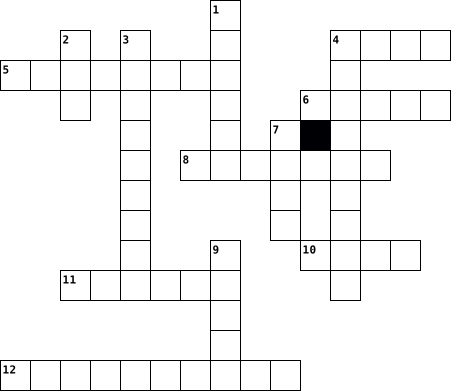
Across
- Broccoli boy wants to be a hero
- Anime club's god
- Anime book
- Ash's first pokemon
- Anime club's symbol
- My neighbor ___
- Girls get powers and are named after planets
Down
- Protagonist gets brought into a new world
- Yuri on ice is a __ romance
- Fullmetal ____
- Write down name and they go bye-bye
- Dragon __ Z
- Goldfish princess wants to be human
13 Clues: Anime book • Dragon __ Z • Fullmetal ____ • My neighbor ___ • Anime club's god • Ash's first pokemon • Anime club's symbol • Yuri on ice is a __ romance • Broccoli boy wants to be a hero • Write down name and they go bye-bye • Goldfish princess wants to be human • Protagonist gets brought into a new world • Girls get powers and are named after planets
SOLAR SYSTEM by Halle Cromwell 2024-10-30

Across
- Can't float in water
- means sun
- The smallest planets in our solar system
- Hottest Planet
- Not a perfect square
- and NEPTUNE are called what_____
- Billion years old
Down
- The biggest planet
- Primary planet and a Rocky Planet
- = Centric
- Closet to the sun
- Fourth planet from the sun
- Pluto is a _____ Planet
- 2.8 miles away from the sun
- 93 Billion miles away from earth
15 Clues: means sun • = Centric • Hottest Planet • Closet to the sun • Billion years old • The biggest planet • Can't float in water • Not a perfect square • Pluto is a _____ Planet • Fourth planet from the sun • 2.8 miles away from the sun • 93 Billion miles away from earth • and NEPTUNE are called what_____ • Primary planet and a Rocky Planet • The smallest planets in our solar system
Solar system Class 5 2022-02-14

Across
- baby planet or very small planet
- The farthest and coldest planet
- ball of ice or rock
- Sun Planets and other celestial bodies
- Second largest plant
- The largest planet
- found in orbit between Jupiter and Mars
Down
- Tilted side and along the pole
- Smallest planet
- Red Planet
- Small rocky metallic object
- The ring planet
- the force of attraction of earth
13 Clues: Red Planet • Smallest planet • The ring planet • The largest planet • ball of ice or rock • Second largest plant • Small rocky metallic object • Tilted side and along the pole • The farthest and coldest planet • baby planet or very small planet • the force of attraction of earth • Sun Planets and other celestial bodies • found in orbit between Jupiter and Mars
Se games 2026-02-03

Across
- Remember, licking doorknobs is illegal on other planets
- The world needs more ___
- Lost part of their foot while drinking
- Se's pet full name
- The realm of _____
- Erto's discord Name
- Pink star
- Do you pay the one?
Down
- That's that me espresso
- Creator of "Slow Down"
- Red Miku
- What type of phone does Se have?
- Fairy with big hammer
13 Clues: Red Miku • Pink star • Se's pet full name • The realm of _____ • Erto's discord Name • Do you pay the one? • Fairy with big hammer • Creator of "Slow Down" • That's that me espresso • The world needs more ___ • What type of phone does Se have? • Lost part of their foot while drinking • Remember, licking doorknobs is illegal on other planets
big band thoery 2022-03-23

Across
- was discovered this man years ago
- our planets are in the..
- the planets are?
Down
- the big band was an..
- condensed in this
5 Clues: the planets are? • condensed in this • the big band was an.. • our planets are in the.. • was discovered this man years ago