
planets Crossword Puzzles
land forms and Geography Terms 2021-09-20

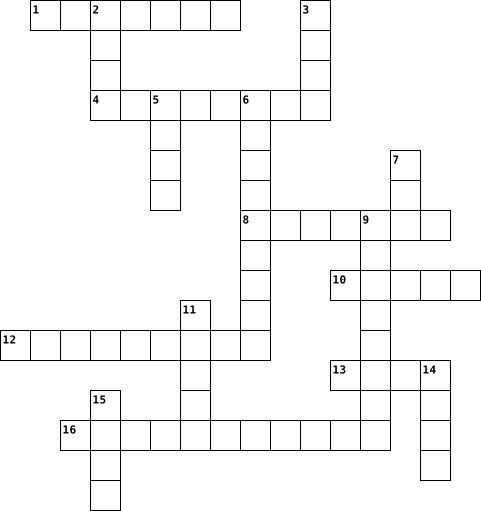
Across
- Frozen water
- how farm ;land is measured
- Sandy land form
- Beaches have this on the shore
- Green stuff on a football field
Down
- Puffy looking thing in the sky
- Earth, Mars and Jupiter
- Replacement grass
- Frozen ground
- Earth's source of daylight
10 Clues: Frozen water • Frozen ground • Sandy land form • Replacement grass • Earth, Mars and Jupiter • how farm ;land is measured • Earth's source of daylight • Puffy looking thing in the sky • Beaches have this on the shore • Green stuff on a football field
land forms and Geography Terms 2021-09-20

Across
- Frozen water
- how farm land is measured
- Sandy land form
- Beaches have this on the shore
- Green stuff on a football field
Down
- Puffy looking thing in the sky
- Earth, Mars and Jupiter
- Replacement grass
- Frozen ground
- Earth's source of daylight
10 Clues: Frozen water • Frozen ground • Sandy land form • Replacement grass • Earth, Mars and Jupiter • how farm land is measured • Earth's source of daylight • Puffy looking thing in the sky • Beaches have this on the shore • Green stuff on a football field
Mercury 2022-01-04

Across
- Equal to 88 Earth days
- __________ planet to the sun
- Journey around sun (fastest of any planet)
- Nearest planetary neighbor
- Mercury moon count
Down
- Equal to 58 Earth days
- Main surface feature
- Member of inner __________ planets
- Missing layer of protection
- Core composition
10 Clues: Core composition • Mercury moon count • Main surface feature • Equal to 58 Earth days • Equal to 88 Earth days • Nearest planetary neighbor • Missing layer of protection • __________ planet to the sun • Member of inner __________ planets • Journey around sun (fastest of any planet)
Ruby's crossword Wk 4 2013-08-08

Across
- a planet that is light blue
- contains lots of planets in space
- a commandment of Jewish Law
- a mate
Down
- you look up words in it
- me
- a planet that has rings
- very sad
- a colour
- a place of Jewish prayer
10 Clues: me • a mate • very sad • a colour • you look up words in it • a planet that has rings • a place of Jewish prayer • a planet that is light blue • a commandment of Jewish Law • contains lots of planets in space
Solar eclipse 2015-03-09

Across
- the cycle the planets go in
- not complete
- sun related
- between east and south
- condensed steam formation in the sky
- the dusk that comes before complete darkness
Down
- spins around the earth
- doesnt let everything through
- makes something safe
- Finlands astronomical association
10 Clues: sun related • not complete • makes something safe • spins around the earth • between east and south • the cycle the planets go in • doesnt let everything through • Finlands astronomical association • condensed steam formation in the sky • the dusk that comes before complete darkness
Vocabulary Development Lessons 1&2 * 2014-11-24

Across
- a foreigner
- tactful
- kid; sympathetic
- a group of well-known people
- a being who will eventually die
- serene; undisturbed
Down
- rate of speed
- global; moving in an orbit; referring to a planet or planets
- a dependent person, company, or state
- horrid; ghostlike
10 Clues: tactful • a foreigner • rate of speed • kid; sympathetic • horrid; ghostlike • serene; undisturbed • a group of well-known people • a being who will eventually die • a dependent person, company, or state • global; moving in an orbit; referring to a planet or planets
Solar System celestial bodies 2023-10-16

Across
- ¨dirty snowballs¨.
- over 165 have been detected.
- patterns
- Lived in the city of Alexandria
- orbit between Mars and Jupiter
Down
- everything orbiting Earth
- Center of the solar system
- ¨shooting stars¨.
- ¨The Lion
- planets- not enough mass or gravity to clean its
10 Clues: patterns • ¨The Lion • ¨shooting stars¨. • ¨dirty snowballs¨. • everything orbiting Earth • Center of the solar system • over 165 have been detected. • orbit between Mars and Jupiter • Lived in the city of Alexandria • planets- not enough mass or gravity to clean its
flight , souvenirs , bought , treasures , satellite , astronaut , jupiter , environment , unfortunately 2023-10-21

Across
- buy something
- clean
- a machin that orbit around planets
- some one who travel to spase
- some gifts from travel
Down
- sadly
- conditions in which someone or something lives
- largest planet in solar system
- old thigns that hidden
- rising high on air
10 Clues: sadly • clean • buy something • rising high on air • old thigns that hidden • some gifts from travel • some one who travel to spase • largest planet in solar system • a machin that orbit around planets • conditions in which someone or something lives
Isaac Newton 2025-01-02

Across
- Capacity to do work
- How fast something happens
- Planets follow this path
- Bounce back light
- Building block of matter
- Field of Newton's work
Down
- Tool for observing stars
- Tendency to resist motion change
- Key to scientific calculations
- Bend light through a medium
10 Clues: Bounce back light • Capacity to do work • Field of Newton's work • Tool for observing stars • Planets follow this path • Building block of matter • How fast something happens • Bend light through a medium • Key to scientific calculations • Tendency to resist motion change
4th Nine Weeks Test Review 2022-05-15

Across
- this is the smallest type of star
- smaller pieces broken off of astroids or comets
- this is the largest planet in the solar system
- meteors become this when they make contact with the earth surface
- Jupiter, Saturn, Uranus, and Neptune are these planets
- it takes the earth 365.25 days to complete this type of motion
- this space material is large enough to be a planet and is believed to be remnants of the early solar system
- the launching of this satellite started the Space race between the US and USSR
- during the spring and fall seasons the earths axis is not tilted to or away from the sun resulting in a _______.
- a _____ is a glowing ball of hydrogen and helium gas
Down
- this theory, derived by early scientist, states that the sun is in the center of the solar system
- this is the largest type of star
- this space material is made of rock and ice and revolve around the sun in a narrow ellipse
- HR diagrams conclude that a stars ______ indicates what temperature it is
- meteoroids become this when they enter the atmosphere of earth
- this is the hottest planet in the solar system
- it takes the earth 24 hours to complete this type of motion
- Mercury, Venus, Earth, and Mars are these planets
18 Clues: this is the largest type of star • this is the smallest type of star • this is the hottest planet in the solar system • this is the largest planet in the solar system • smaller pieces broken off of astroids or comets • Mercury, Venus, Earth, and Mars are these planets • a _____ is a glowing ball of hydrogen and helium gas • ...
Our solar system 2023-10-23

Across
- a fundamental system in condensed matter sciences and the main constituent of gas giant planets
- a large planet mostly composed of helium and/or hydrogen
- a doughnut-shaped region of icy objects beyond the orbit of Neptune
- a line of cliffs formed by the faulting or fracturing of the earth's crust
- they have a compact, rocky surface like Earth's terra firma
- Objects in space that range in size from dust grains to small asteroids
- a rock that falls to Earth from space.
- cosmic snowballs of frozen gases, rock, and dust that orbit the Sun
- the distance from a star that allows liquid water to persist on its surface
- apparent motion of a body in a direction opposite to that of the motions of most members of the solar system
Down
- a torus-shaped region in the Solar System
- a celestial body that -orbits the sun
- the average distance between Earth and the Sun
- a solid object arising during the accumulation of orbiting bodies
- When meteoroids enter Earth's atmosphere
- apparent motion of a body in a direction opposite to that of the (direct) motions of most members of the solar system
- happens when Earth passes through the path of a comet.
- a measure of how non-circular the orbit of a body is
18 Clues: a celestial body that -orbits the sun • a rock that falls to Earth from space. • When meteoroids enter Earth's atmosphere • a torus-shaped region in the Solar System • the average distance between Earth and the Sun • a measure of how non-circular the orbit of a body is • happens when Earth passes through the path of a comet. • ...
Astronomy 2022-03-09

Across
- eclipse, Blocking of Sun's light which can occur during a new moon.
- a person who is trained to travel in a spacecraft.
- Closest planet to the Sun
- Complete shadow, the fully shaded inner region of a shadow cast by an opaque object, especially the area on the earth or moon experiencing the total phase of an eclipse.
- Largest planet in the solar system
- Layer of air, made up of many layers and gases surrounding the Earths and other planets' surface.
- A satellite is a natural or man made object that orbits around a planet.
Down
- Partial shadow, lighter, outer parts of a shadow. the partially shaded outer region of the shadow cast by an opaque object.
- the spinning of Earth in its axis.
- Sixth planet to the Sun, second largest planet in the solar system.
- the movement of one object around another object.
- little chunks of rock and debris in space that falls through a planet’s atmosphere.
- sunlight on its surface.
- Largest objects in the Solar system which revolve around the Sun.
- Second closest planet to the Sun. Sometimes called earth's twin.
- eclipse, Blocking of Sunlight to the moon, this can occur during a full moon
- small body of ice, rock and cosmic dust that follows an elliptical orbit around the Sun.
- primary source of heat and energy for the solar system.
18 Clues: sunlight on its surface. • Closest planet to the Sun • Largest planet in the solar system • the spinning of Earth in its axis. • the movement of one object around another object. • a person who is trained to travel in a spacecraft. • primary source of heat and energy for the solar system. • Second closest planet to the Sun. Sometimes called earth's twin. • ...
Astronomy 2022-03-09

Across
- eclipse, Blocking of Sun's light which can occur during a new moon.
- a person who is trained to travel in a spacecraft.
- Closest planet to the Sun
- Complete shadow, the fully shaded inner region of a shadow cast by an opaque object, especially the area on the earth or moon experiencing the total phase of an eclipse.
- Largest planet in the solar system
- Layer of air, made up of many layers and gases surrounding the Earths and other planets' surface.
- A satellite is a natural or man made object that orbits around a planet.
Down
- Partial shadow, lighter, outer parts of a shadow. the partially shaded outer region of the shadow cast by an opaque object.
- the spinning of Earth in its axis.
- Sixth planet to the Sun, second largest planet in the solar system.
- the movement of one object around another object.
- little chunks of rock and debris in space that falls through a planet’s atmosphere.
- sunlight on its surface.
- Largest objects in the Solar system which revolve around the Sun.
- Second closest planet to the Sun. Sometimes called earth's twin.
- eclipse, Blocking of Sunlight to the moon, this can occur during a full moon
- small body of ice, rock and cosmic dust that follows an elliptical orbit around the Sun.
- primary source of heat and energy for the solar system.
18 Clues: sunlight on its surface. • Closest planet to the Sun • Largest planet in the solar system • the spinning of Earth in its axis. • the movement of one object around another object. • a person who is trained to travel in a spacecraft. • primary source of heat and energy for the solar system. • Second closest planet to the Sun. Sometimes called earth's twin. • ...
planets and gravity 2022-04-13

Across
- Man's best friend
- Has a trunk
- planets
- Flying mammal
- system
Down
- planets
- Large marsupial
- Likes to chase mice
8 Clues: system • planets • planets • Has a trunk • Flying mammal • Large marsupial • Man's best friend • Likes to chase mice
Solar System Week 2 2015-02-02

Across
- _________ are made up of ice, gas, dust, and small rocky particles.
- Our moon is covered in large _________, or pits.
- I saw a large number of meteors fall during the __________________.
- My favorite ____________ is Neil Armstrong because he was the first person to walk on the moon.
- Earth is able to complete one _______________ in 365 days.
Down
- In order to see the planets I had to use my ________ because the planets are so far away.
- When I look up at the stars I always look for my favorite ____________, The Big Dipper.
- There is 8 different _________ in the moon, including full moon and new moon.
- ___________ are irregular-shaped pieces of rock and metal that exist in space.
9 Clues: Our moon is covered in large _________, or pits. • Earth is able to complete one _______________ in 365 days. • _________ are made up of ice, gas, dust, and small rocky particles. • I saw a large number of meteors fall during the __________________. • There is 8 different _________ in the moon, including full moon and new moon. • ...
celestial bodies 2015-06-06

Across
- orbit around the sun and are the size of a pebble.
- when a meteoroid infiltrate earth's atmosphere , meteors usually burn up.
- around the sun, star and are too small to be a planet.
- is relating or positioned to space and/or the sky.
- body that orbits around a star.
Down
- of ice and dust, when it is close to the sun it forms a tail directing away from the sun.
- of stars that create a pattern.
- system/Consist of eight planets that contain each oft heir own moons aligned orbiting around the sun with smaller celestial bodies.
- star patterns as well, but do not create their own constellations.
- formed by gravity pulling gas & dust with billions stars, stellar remnants and dark matter.
10 Clues: of stars that create a pattern. • body that orbits around a star. • orbit around the sun and are the size of a pebble. • is relating or positioned to space and/or the sky. • around the sun, star and are too small to be a planet. • star patterns as well, but do not create their own constellations. • ...
celestial bodies 2015-06-06

Across
- nucleus of ice and dust, when it is close to the sun it forms a tail directing away from the sun.
- are formed by gravity pulling gas & dust with billions stars, stellar remnants and dark matter.
- group of stars that create a pattern.
- celestial bodies that orbits around a star.
- are star patterns as well, but do not create their own constellations.
- orbit around the sun, star and are too small to be a planet.
- is when a meteoroid infiltrate earth's atmosphere , meteors usually burn up.
Down
- it is relating or positioned to space and/or the sky.
- orbit around the sun and are the size of a pebble.
- Consist of eight planets that contain each oft heir own moons aligned orbiting around the sun with smaller celestial bodies.
10 Clues: group of stars that create a pattern. • celestial bodies that orbits around a star. • orbit around the sun and are the size of a pebble. • it is relating or positioned to space and/or the sky. • orbit around the sun, star and are too small to be a planet. • are star patterns as well, but do not create their own constellations. • ...
Planet and The Sun 2022-09-21

Across
- This is a celestial body in space that orbits stars.
- This planet is known as a dwarf planet because it is smaller than a regular planet.
- This word represents 4 of the outer planets because of their gaseous surface.
- The sun is a source of _______, which is light and heat.
Down
- If you get too much sun, it could lead to this skin disease.
- This can be used to create something to be remembered such as "My Very Excellent Mother Just Served Us Nachos"
- These are the dark, cooler spots on the sun's surface.
- The sun helps increase our ability to produce this. It helps to strengthen our bones.
- This is what the sun is.
- This word represents 4 of the inner planets because of their terrestrial nature.
10 Clues: This is what the sun is. • This is a celestial body in space that orbits stars. • These are the dark, cooler spots on the sun's surface. • The sun is a source of _______, which is light and heat. • If you get too much sun, it could lead to this skin disease. • This word represents 4 of the outer planets because of their gaseous surface. • ...
Science Revolution 2023-12-14

Across
- Rejected the traditional theory that all matter was composed of four elements (earth, fire, water, air) in The Sceptical Chymist
- American public official, scientist, inventor, and writer
- Considered the father of modern anatomy
- Wrote The Mathematical Principles of Natural Philosophy or Principia
- His last name is Bacon
Down
- Believed that scientists needed to reject old assumptions
- Used Brahe’s data to formulate laws to describe planetary motion.
- Developed the heliocentric system (the Sun is at the center of the universe, with all the planets and stars revolving around it in circular orbits)
- Developed the Tychonic System – planets revolved around the Sun, while the Sun revolved around the Earth
- The scale associated with this thermometer is called the Fahrenheit scale; 32°F was the temperature for freezing water; 212°F was the boiling point
10 Clues: His last name is Bacon • Considered the father of modern anatomy • Believed that scientists needed to reject old assumptions • American public official, scientist, inventor, and writer • Used Brahe’s data to formulate laws to describe planetary motion. • Wrote The Mathematical Principles of Natural Philosophy or Principia • ...
Important Astronomy History 2025-03-20

Across
- refined the original geocentric model in his masterpiece ‘Almagest,’ which listed 48 constellations , and chartered the motions of the stars and planets.
- becomes the first man-made object to orbit the Earth marking the beginning of the space age.
- Dutch spectacles maker invents a refractor telescope
- , During this period in Mesopotamia, the constellations of Leo, Taurus, Scorpius, Gemini, Capricorn, and Sagittarius were invented
- The Egyptians start to use sundials.
Down
- The worlds oldest solar observatory
- put into orbit from space shuttle Discovery. The 2.4m aperture reflecting telescope continues to circle the Earth taking extremely sharp images of outer space.
- Indian astronomer Yajnavalkya proposes a heliocentric concept of the universe
- discovered that the planets orbit about the Sun in an elliptical and not circular motion
- Greek philosopher Anaxagoras suggests that the stars are actually suns
10 Clues: The worlds oldest solar observatory • The Egyptians start to use sundials. • Dutch spectacles maker invents a refractor telescope • Greek philosopher Anaxagoras suggests that the stars are actually suns • Indian astronomer Yajnavalkya proposes a heliocentric concept of the universe • ...
Cross word numbers 2013-10-27

Across
- Ponuds in a stone
- Countries in Europe
- The number of planets
- Hours in a day
- Weeks in six months
Down
- The seasons
- Days till Christmas
- Length of pregnancy in months
- The lives of a cat
9 Clues: The seasons • Hours in a day • Ponuds in a stone • The lives of a cat • Days till Christmas • Countries in Europe • Weeks in six months • The number of planets • Length of pregnancy in months
SCHOOL SUBJECTS 2023-09-26

Across
- NUMBERS, SHAPES
- PLANETS,ANIMALS, HUMAN BODY
- CONTINENTS, COUNTRIES, CITIES
- EVENTS OF THE PAST
Down
- LANGUAGE SPOKEN IN CHILE, ARGENTINA, PERU
- PIANO, VIOLIN, GUITAR
- SOCCER, VOLLEYBALL, BASEBALL
- LANGUAGE SPOKEN IN THE USA
- DRAWING, CRAFTS, PAINTING
9 Clues: NUMBERS, SHAPES • EVENTS OF THE PAST • PIANO, VIOLIN, GUITAR • DRAWING, CRAFTS, PAINTING • LANGUAGE SPOKEN IN THE USA • PLANETS,ANIMALS, HUMAN BODY • SOCCER, VOLLEYBALL, BASEBALL • CONTINENTS, COUNTRIES, CITIES • LANGUAGE SPOKEN IN CHILE, ARGENTINA, PERU
space crossword puzzle 2024-04-24

Across
- only planet with water
- goes around space
- the largest thing that orbits the earth
- a planet with rings
Down
- spheres that float in space
- orbits the earth
- second planet
- person in space
- very hot
9 Clues: very hot • second planet • person in space • orbits the earth • goes around space • a planet with rings • only planet with water • spheres that float in space • the largest thing that orbits the earth
FIND THE SECRET WORD FOR OUR JOURNEY 2023-04-30

Across
- an ice-dust mixture object
- minor planets
- h
- our solar system largest planet
- ..
- this planet lies between the sun and Venus
Down
- the 3rd planet in our solar system
- planet with rings
- red planet
9 Clues: h • .. • red planet • minor planets • planet with rings • an ice-dust mixture object • our solar system largest planet • the 3rd planet in our solar system • this planet lies between the sun and Venus
Matter & Energy Flow Definitions 2022-01-27

Across
- formed when carbon dioxide dissolves in water
- small units that are joined together to form polymers
- warming effect caused by the Earth's atmosphere
- the solid Earth
- storage
- building blocks of matter
- large molecule that contains thousands of repeating units
Down
- polymer found in plants
- makes up limestone
- includes rivers, lakes & the oceans
- the world's major source of energy
- burning
- regions populated by living things
- contains protons, neutrons & electrons
- the layer of gases that surrounds planets
- polymer found in animals
16 Clues: burning • storage • the solid Earth • makes up limestone • polymer found in plants • polymer found in animals • building blocks of matter • the world's major source of energy • regions populated by living things • includes rivers, lakes & the oceans • contains protons, neutrons & electrons • the layer of gases that surrounds planets • formed when carbon dioxide dissolves in water • ...
Anabelle Spelling List 2 2022-02-17

Across
- Earth is one of many in the Universe
- Make something small appear bigger
- How we find out how many pounds we are
- Direction: This ____ or that ____?
- Not bear but _____.
- Opposite of push
- Your ice cream sits upon it
- Listening with your ears
Down
- Speaking out loud
- You can find one in Egypt
- A tool used to view the stars
- Not old
- Word to describe an action
- Big hairy, growling forest friend.
- Made for to dos and groceries
- Not hear but _____.
16 Clues: Not old • Opposite of push • Speaking out loud • Not bear but _____. • Not hear but _____. • Listening with your ears • You can find one in Egypt • Word to describe an action • Your ice cream sits upon it • A tool used to view the stars • Made for to dos and groceries • Make something small appear bigger • Direction: This ____ or that ____? • Big hairy, growling forest friend. • ...
Contagion 2023-04-28

Across
- Lowe. Annoying person.
- Research base.
- Its powerful.
- Gun. Thea got told she isnt worthy enough of using one.
- system. Bunch of planets.
- Shes smart and quite.
- He was found in the crewship.
- It spreads easily.
Down
- A place or piece of equipment.
- The crew ship mightve had one.
- Dont let it spread.
- ship. A group of people exploring a...
- Name of book.
- A dead man was found haiving this on him.
- Smart and talkitive person.
- A space craft.
16 Clues: Its powerful. • Name of book. • Research base. • A space craft. • It spreads easily. • Dont let it spread. • Shes smart and quite. • Lowe. Annoying person. • system. Bunch of planets. • Smart and talkitive person. • He was found in the crewship. • A place or piece of equipment. • The crew ship mightve had one. • ship. A group of people exploring a... • ...
Kids Hint 2023-05-09
Across
- Largest planet in our solar system
- Oldest organized sport in North America
- Sport played on an indoor alley
- A sandy shore
- He or she watches swimmers
- Group of players
- A star and the planets orbiting around it
Down
- A place to swim
- Toy for a windy day
- Baby cow
- Use this to ride the waves
- Closest start to Earth
- A frozen treat
- Covers 70% of the Earth's surface
- Nicknamed "The Red Planet"
- Baseball hit that is out of bounds
16 Clues: Baby cow • A sandy shore • A frozen treat • A place to swim • Group of players • Toy for a windy day • Closest start to Earth • Use this to ride the waves • He or she watches swimmers • Nicknamed "The Red Planet" • Sport played on an indoor alley • Covers 70% of the Earth's surface • Largest planet in our solar system • Baseball hit that is out of bounds • ...
Planets of the Milky Way Study Guide Version 2021-10-16

Across
- Coldest planet in our galaxy, and farthest away from the sun, with 14 known moons.
- hot burning ball of gas, with 8 planets orbiting around it in the milky way.
- Largest planet in the Milky way, and a gas giant.
- orbit around a planet, with craters, , usually with a crust, mantle, and a core of iron.
- two moons, fourth planet from the sun.
- A ringed planet named after the greek god of the sky, ice giant, with 27 known moons.
Down
- Spins in an opposite direction than most planets, covered in thick clouds, making it the hottest planet in the solar system.
- Used to be a planet, but was ruled a dwarf planet in 2006.
- Smallest planet in the galaxy, with no moons or rings. Very hot.
- Made of hydrogen and helium, it is the second biggest planet in our solar system.
- Built of land and water, and contains the only known life in the galaxy.
11 Clues: two moons, fourth planet from the sun. • Largest planet in the Milky way, and a gas giant. • Used to be a planet, but was ruled a dwarf planet in 2006. • Smallest planet in the galaxy, with no moons or rings. Very hot. • Built of land and water, and contains the only known life in the galaxy. • ...
Science review 2024-01-18

Across
- Something that causes acceleration (speeding up or slowing down)
- A black hole has such strong gravity that no ____ can escape.
- When a rockets thrusters shoot down, the rocket is pushed up. This is an example of Newtons ____ law.
- All the planets in the solar system orbit around this star.
- "Clouds" of dust and gas that are probably the birth place of star.
Down
- This force causes lighter objects to move towards the center of heavier objects.
- Newtons third law states that whenever you apply force to an object, there is an _____ and opposite reaction.
- This state of matter changes shape but keeps the same volume.
- This state of matter consists of free floating molecules.
- Newtons first law states that an object in ______ will stay in ____ unless acted on by an outside force.
- The ____ System includes all the planets and other objects that orbit the sun.
11 Clues: This state of matter consists of free floating molecules. • All the planets in the solar system orbit around this star. • A black hole has such strong gravity that no ____ can escape. • This state of matter changes shape but keeps the same volume. • Something that causes acceleration (speeding up or slowing down) • ...
Voyager Crossword 2023-05-05

Across
- 5 years after ________ 11
- age December 19 1972,the splashdown of the Apollo 17 crew capsule marked the end of the ______________of manned spaceflight.
- _________ was the only thing in space that was like Earth, with liquids
- Voyager 2 reached ________ and found out that is wss tipped on its side
- There where rivers of liquid _________
- ________ on lots of planets
Down
- Mercury, gemini, and apollo proved we can put __________ into spaceThe voyager spacecraft made us find out a lot of stuff thereThe voyager spacecraft made us find out a lot of stuff there
- Astron one of ________ moons there was 9 active volcanoes things that they would never expectGeysers on lots of planets
- The ________ spacecraft made us find out a lot of stuff thereThe voyager spacecraft made us find out a lot of stuff there
- Miranda may have ________ with something else but fixed itself
- Voyager 2 flew by _________
11 Clues: 5 years after ________ 11 • Voyager 2 flew by _________ • ________ on lots of planets • There where rivers of liquid _________ • Miranda may have ________ with something else but fixed itself • _________ was the only thing in space that was like Earth, with liquids • Voyager 2 reached ________ and found out that is wss tipped on its side • ...
Mid-Point Review 2025-09-28

Across
- The point in a planet’s orbit when it is closest to the Sun.
- A cloud of gas and dust in space that formed the Sun and planets.
- The force that keeps an object moving in a circle, pulling it toward the center.
- The group of the Sun and all the planets, moons, asteroids, and comets that orbit around it.
- The point in a planet’s orbit when it is farthest from the Sun.
- A model of the solar system where the Sun is at the center.
Down
- The path an object takes as it moves around another object in space.
- A small object made of rock and ice that can come together to form a planet.
- The apparent shift in position of an object when viewed from different places.
- The force that pulls objects toward each other, like the Earth pulling things down.
- A model of the solar system where the Earth is at the center.
11 Clues: A model of the solar system where the Sun is at the center. • The point in a planet’s orbit when it is closest to the Sun. • A model of the solar system where the Earth is at the center. • The point in a planet’s orbit when it is farthest from the Sun. • A cloud of gas and dust in space that formed the Sun and planets. • ...
Sun and Space Crossword 2019-01-03

Across
- Really bright sun in your _ will make you squint.
- The sun is really _ even when it's cold on earth.
- Sunlight makes you feel _.
- The hottest planet.
- A planet follows an orbital _ around the sun.
- _ make up the sun, so its surface never stays the same.
- The Milky Way _ is the home for our solar system.
- _ energy is a sustainable way to power things on earth.
- The moon doesn't make light of its own, it _ the light of the sun.
- The sun is a _ that anchors our solar system.
- Sunlight can _ your skin even when it's not hot.
- The sun is so _ that you can't stare at it.
- Used to be the smallest, ninth planet.
Down
- The sun sets in the _.
- Our _ makes Vitamin D when sun shines directly on it.
- The number of planets that orbit our sun.
- The area between objects in space.
- Column of light.
- 365 is the number of _ it takes Earth to orbit the sun.
- _ can block the sun from view.
- The shape of the sun.
- Keeps our feet on the ground and the planets going around the sun.
- The closest planet to the sun.
- The name we call the planet we live on.
- The object that blocks the sun in a solar eclipse.
- The sun's _ is a form of energy.
- The pattern of a smaller object going around a bigger space object.
27 Clues: Column of light. • The hottest planet. • The shape of the sun. • The sun sets in the _. • Sunlight makes you feel _. • _ can block the sun from view. • The closest planet to the sun. • The sun's _ is a form of energy. • The area between objects in space. • Used to be the smallest, ninth planet. • The name we call the planet we live on. • The number of planets that orbit our sun. • ...
THE EARTH AND BEYOND 2020-04-22

Across
- the planet that moves faster than any other planet
- when the Moon's position blocks our view of the Sun
- large groups of stars and planets found in the universe
- the galaxy in which Earth is located
- phase in which the entire side of the Moon is sunlit and visible as a complete circle
- meteors that did not burn up as they fell through our atmosphere and hit Earth
- collections of dust that move through the sky so fast they burn
- the only planet with known life
- the smallest and the farthest from the sun
- means to revolve around
- bowl-shaped depressions formed where meteorites hit Earth
- the planet with a giant red spot and the most moons
- planet which is most visible in the night sky
- the large gaseous star that is the closest star to the Earth
Down
- a group of planets and heavenly bodies revolving around the Sun
- an object that orbits another object
- a heavenly body that produces it's own light and is made of gas
- large bodies of ice and dust that form in the sky
- a force caused by the mass of a body that attracts lesser matter to it
- nicknamed the "red planet"
- phase in which the moon appears totally black
- planet which has narrow rings
- planet which has many rings that look like one giant ring
- the third largest planet
24 Clues: means to revolve around • the third largest planet • nicknamed the "red planet" • planet which has narrow rings • the only planet with known life • an object that orbits another object • the galaxy in which Earth is located • the smallest and the farthest from the sun • phase in which the moon appears totally black • planet which is most visible in the night sky • ...
Astronomy Vocabulary Crossword 2021-05-19

Across
- term describing a model of the solar system in which earth and other planets revolve around the sun
- fast lakes of lava that form dark areas
- term describing a model of the universe in which earth is at the center of the revolving planets and stars.
- occurs when the moon moves into the earths shadow
- goddess of the moon
- The tide with the lease difference between consecutive Low and high tides
- either of the two days of the year on which the sun reaches its greatest distance north or south of the equator
- The darkest part of a shadow
- either of the two days of the year on which neither hemisphere is tilted towards or away from the sun
Down
- The tide with the greatest difference between consecutive Low and high tides
- any phase during the lunar cycle between the new moon and the full moon
- A large bowl shaped cavity in the ground
- occurs when a portion of the earth is engulfed and a shadow cast by the Moon
- The tendency of an object to resist a change in motion
- side The lunar hemisphere that always faces away from earth
- The part of a shadow surrounding the darkest part
- The spinning motion of a planet on it’s axis
- an object that orbits a planet
- The movement of an object around another object
- The phase in which it’s visible surface area is getting smaller
20 Clues: goddess of the moon • The darkest part of a shadow • an object that orbits a planet • fast lakes of lava that form dark areas • A large bowl shaped cavity in the ground • The spinning motion of a planet on it’s axis • The movement of an object around another object • The part of a shadow surrounding the darkest part • occurs when the moon moves into the earths shadow • ...
Third Grade Science Test #3 2025-11-28

Across
- Red Planet
- star always almost right above the North Pole
- planet tipped on its side
- our solar system is part of this galaxy
- the star that is closest to Earth; the moon reflects the light of it
- a small piece of space rock traveling in space
- a continual path around the sun
- the sun and all the heavenly bodies that orbit it; the sun is the center
- the only planet that is habitable
- when all of the moon is visible
- the largest planet; has the Great Red Spot
- the tilt of the earth gives us these
- the earth continuously spins or rotates on this
- a hole on the surface of the moon or other planet
- sun, Mercury, Venus, Earth, Mars, Jupiter, Saturn, Uranus, Neptune is the what of the plants?
- these show the Earth is what for life: plant life, water cycle, weather, temperature, right atmosphere?
Down
- largest planet with rings
- something natural or man-made that orbits Earth
- the reason planets orbit the sun
- planet that takes the longest to orbit the sun
- things God created to stay the same
- a natural satellite of Earth
- the four planets farthest from the sun
- group of stars that make a picture
- the moon's gravity affects these
- when North America is tilted toward the sun
- word that means "suitable for life"
- scientists in space can live and work here
- smallest planet
- brightest planet; Earth's twin
30 Clues: Red Planet • smallest planet • largest planet with rings • planet tipped on its side • a natural satellite of Earth • brightest planet; Earth's twin • a continual path around the sun • when all of the moon is visible • the reason planets orbit the sun • the moon's gravity affects these • the only planet that is habitable • group of stars that make a picture • ...
ulangan tata surya_Rama 2026-01-23

Across
- Movement around the sun
- The force that pulls objects together
- Earth's natural satellite
- The layer of gases surrounding a planet
- The partial outer shadow
- The farthest planet from the sun
- The path of a planet
- Theory that the sun is the center
- An object that emits its own light
- A space rock that hits the ground
- The time taken for one full rotation
- The center of the solar system
- The hottest planet
- The study of celestial bodies
- The shape of a planetary orbit
- The name of our galaxy
- The red planet
- Rocky planets like Earth
- Movement spinning on an axis
Down
- The smallest planet
- The sun's outermost layer
- The largest moon in the solar system
- When one object hides another in space
- Saturn's largest moon
- The visible surface of the sun
- Often called a shooting star
- The time for one revolution of Earth
- Giant gas planets
- The rise and fall of sea levels
- The sun's atmosphere above the photosphere
- The largest planet
- The planet with life
- The darkest part of a shadow
- The coldest planet
- A well-known dwarf planet
- An object that orbits a planet
- The effect of Earth's rotation facing the sun
- The planet with rings
- A celestial body with a tail
- Rocks located between Mars and Jupiter
40 Clues: The red planet • Giant gas planets • The largest planet • The hottest planet • The coldest planet • The smallest planet • The path of a planet • The planet with life • Saturn's largest moon • The planet with rings • The name of our galaxy • Movement around the sun • The partial outer shadow • Rocky planets like Earth • The sun's outermost layer • Earth's natural satellite • ...
Spelling Group 5 Lesson 35 2025-12-11

Across
- - a large room designed for people to gather and watch performances or presentations.
- - an official announcement or statement made to share important information.
- - a way of dealing with a situation or problem.
- - relating to cats or having characteristics of cats, such as being graceful or independent.
- - a person chosen to represent others at a meeting or event.
- - a statement expressing dissatisfaction or unhappiness about something.
- - a person trained to travel and work in space.
- - the study of how stars, planets, and other objects in space behave and interact.
- - an examination of financial records to check if they are correct and follow rules.
Down
- - a person who checks financial records to make sure everything is accurate.
- - a public sale where items are sold to the highest bidder.
- - something that is loud enough to be heard clearly.
- - very large or relating to astronomy, which is the study of space and celestial bodies.
- - related to hearing or the sense of sound.
- - a state in the United States known for its history and cities like Philadelphia and Pittsburgh.
- - an idea or thought about something that helps us understand it better.
- - a test where someone performs to show their talent, often for acting or singing roles.
- - a significant change or movement, often referring to a major shift in power or ideas.
- - the belief that the positions of stars and planets can influence people's lives and personalities.
- - sounds that can be heard, especially when recorded or played back.
20 Clues: - related to hearing or the sense of sound. • - a way of dealing with a situation or problem. • - a person trained to travel and work in space. • - something that is loud enough to be heard clearly. • - a public sale where items are sold to the highest bidder. • - a person chosen to represent others at a meeting or event. • ...
The Galaxy 2024-11-18

Across
- A large cloud of gas and dust in space, often a nursery for new stars
- The phase of the moon when it is completely illuminated
- A group of stars forming a recognizable pattern
- A rocky object that orbits the Sun, smaller than a planet
- The closest star to Earth
- The planet known for its ring system
- A region of space with gravity so strong that not even light can escape
- The second largest moon in the Solar System, orbiting Saturn
- dying star that collapses into a dense core
- The galaxy containing our Solar System
- A star that suddenly increases in brightness before fading
- An instrument used to view distant stars and planets
- force keeping planets in orbit
Down
- The bright object sometimes seen before sunrise or after sunset
- A dwarf planet located in the Kuiper Belt
- The point directly above an observer in the sky
- largest planet in our Solar System
- The process by which a star produces energy through nuclear reactions
- A system of millions or billions of stars, along with gas and dust, held together by gravity
- The second planet from the Sun, known for its thick atmosphere
- Earth's natural satellite
- The planet known as the Red Planet
- The smallest planet in our Solar System
- A space body composed mostly of ice and dust, with a glowing tail
- The science of celestial objects, space, and the physical universe
- The galaxy type shaped like a flat disk
- The outermost layer of a star's atmosphere
- A glowing streak of light caused by a meteoroid entering Earth's atmosphere
28 Clues: Earth's natural satellite • The closest star to Earth • force keeping planets in orbit • largest planet in our Solar System • The planet known as the Red Planet • The planet known for its ring system • The galaxy containing our Solar System • The smallest planet in our Solar System • The galaxy type shaped like a flat disk • A dwarf planet located in the Kuiper Belt • ...
Unit 2 Vocab- Maci Bailey 2025-08-28

Across
- The complete range of electromagnetic waves
- the study of the universe
- Tide just after a new or full moon
- Process by which plants and organisms need light and water to live
- Incoming solar radiation
- The turning or spinning of a body on its axis.
- Planets made primarily out of gas
- tide after a first or quarter moon
- large cloud of dust and gas in space
- The center of mass of two or more bodies orbiting around each other:
- Either of the two times in the year, the summer solstice in the N or S hemisphere
- The direct transfer of heat from one substance to another
Down
- The process by which larger nucleus's are split into smaller peices
- Two times of the year on which neither hemisphere is tilted toward or away from the sun
- The point at which the planets orbit their furthest away from the sun
- Shortwave emitted by the sun
- The process by which smaller nuclei merge together to make a larger one
- Process by which in fluid is being heated:
- The transfer of energy by electromagnetic waves
- A stream of electrically charged particles produced by the sun
- the motion of a body, such as a planet or moon
- The point in a planet's orbit at which it is closest to the sun
- The wobbling of Earth's axis
- The process of burnign something
- is a slow motion of Earth's axis
25 Clues: Incoming solar radiation • the study of the universe • Shortwave emitted by the sun • The wobbling of Earth's axis • The process of burnign something • is a slow motion of Earth's axis • Planets made primarily out of gas • Tide just after a new or full moon • tide after a first or quarter moon • large cloud of dust and gas in space • Process by which in fluid is being heated: • ...
modern astronomy 2025-06-29

Across
- Orbiting a body in space
- A device that allows astronomers to view afar objects in the universe.
- The study of planets, stars, and space
- The force that keeps planets in orbit
- A planet that exists outside our Solar System.
- An enormous explosion in the life cycle of a star.
- A planet that is tilted and light blue
- A pattern of stars recognized by a name and a story
- American physicist that proved the expansion of the universe
- A telescope in space, named after the astronomer that proved the universe was growing.
- The force that pulls objects together and keeps planets in orbit.
- A small rocky object that orbits the Sun, mainly between Mars and Jupiter.
- The stretching of light from distant galaxies, proving that the universe is growing.
- Earth's natural satellite
Down
- A model of the solar system where the Sun is the center point.
- What we call space outside Earth’s atmosphere
- A large body orbiting the Sun and not clearing its path
- The astronomer that first stated that the universe was heliocentric.
- When the Moon blocks the Sun's light
- The planet with the most moons
- An astronomer who made detailed observations of the stars before the invention of the telescope.
- A scientist that discovered the three laws of planetary motion.
- Earth's yearly path around the Sun
- A giant cloud of gas and dust in space, and it is a place where stars often begin to form.
- An Italian scientist who advocated for heliocentrism and improved the telescope.
25 Clues: Orbiting a body in space • Earth's natural satellite • The planet with the most moons • Earth's yearly path around the Sun • When the Moon blocks the Sun's light • The force that keeps planets in orbit • The study of planets, stars, and space • A planet that is tilted and light blue • What we call space outside Earth’s atmosphere • ...
Across the Universe 2025-05-07

Across
- Apparent motion of the equinoxes along the ecliptic as Earth wobbles on its axis
- Amount of mass which doesn’t reflect or emit any light (2)
- Imaginary sphere with earth located at its center (2)
- Shape of Earth according to Greek during 500BC
- Planet visible to the eye
- Observed the shadows that the Earth cast on the moon during a lunar eclipse to predict Earth’s shape
- Gave the most accurate size of spherical Earth
- Season that falls on Mar 21 – Jun 21
- Eclipse when the moon passes directly between the sun and the earth
- A unit of length equal to the distance that light would travel in a vacuum in one year
- Apparent daily revolution of the celestial sphere around celestial poles (2)
- Explained clearly than Aristarchus that Sun is center of universe
- Study the universe overall & ask questions about the origin of everything
- Earth-centered universe model
- Shape of Earth according to Pythagoras & his pupils
- Study of the physics of celestial bodies
- Terrestrial motion that is innate characteristics of humans and animals
- Causes the annual motion and changes to length of daytime & night time, & different seasons
- Antenna pointed into space that allowed scientist to discover background radiation
- Cycle in the sky which is based on seasons
- The disappearance of these was one of the argument of Aristotle for a spherical Earth
- Stars that keep changing position, aka planets
Down
- Law that expresses the velocity at which a galaxy is speeding away from Earth
- Size of the Earth to be approximately 25000 stadia
- Because of these difference in which planet orbits the Sun, it creates the apparent retrograde motion
- Due to this presence, gravity is actually causing space to expand and accelerate (2)
- Equal to 3.26 light years
- Added in the model of Aristotle, aka Cronos
- Proposed that the universe is made of 27 concentric spheres
- One of the elements in the terrestrial realm
- imaginary line that the earth spins around (2)
- The effect which occurs with light emitted by an object away from the Earth.
- Days where the sun is the furthest away from the celestial equator
- Not convinced by concentric spheres instead proposed sun-centered universe
- Theorized that the universe began in a state of highly compressed hot ___
- The line that the sun traces in its movement across the sky
- Anticlockwise motion or normal motion of planets
- Sun-centered universe model
- Motion in the universe that is perfect & circular according to the ancient Greeks
- Motivated his students to explain their observation on the movement of planets
- The only celestial object that significantly changes appearance
- Point that doesn’t move at all; experiences no lateral motion as the earth rotates (2)
- Proposed by Eudoxos and Aristotle to be the center of the universe
- Hemisphere that experiences longer days during winter since the axis of rotation is titled away
- Shapes of stars that can be traced by connecting the dots
- Theory developed by Russian-American physicists George Gamov (2)
- Any of the planets whose orbit is further away from the Sun than the Earth’s
- Proposed Earth-centered model of universe using concept of deferent instead of concentric spheres.
- Means to move backward
- When the sun crosses the celestial equator on Mar 21 or Sept 22
50 Clues: Means to move backward • Equal to 3.26 light years • Planet visible to the eye • Sun-centered universe model • Earth-centered universe model • Season that falls on Mar 21 – Jun 21 • Study of the physics of celestial bodies • Cycle in the sky which is based on seasons • Added in the model of Aristotle, aka Cronos • One of the elements in the terrestrial realm • ...
Science Terms 2024-04-15

Across
- A consumer that only eats plants.
- A relationship where one organism benefits and the other is harmed.
- A consumer that only eats other consumers (other animals).
- This happens when light hits a dark surface or sound hits a soft surface.
- A consumer that eats plants and animals.
- The last 4 planets from the sun(Jupiter, Saturn, Uranus, and Neptune)
- ______ prey relationship is when one consumer (lion) hunts and kills another (like a gazelle).
- A relationship where one organism benefits from the other and the other is unaffected.
- This happens when light hits a mirror or sound hits a hard surface.
- The vibration rate of the sound and is described with how high or low.
- The energy sound has and is described how loud or quiet it is.
- Breaks down dead matter and recycles it into nutrients to enrich soil. Examples are bacteria, fungi and earthworms.
- A living thing that gets energy from other living things. Examples include any animal or insect.
- These objects go slower than lighter objects when the same force is applied to both.
- A relationship between two or more organisms that are getting energy from the same thing.
- The first 4 planets from the sun (Mercury, Venus, Earth and Mars).
Down
- __________ planet that orbits the sun only, sphere shaped but does not clear orbital path. Examples include Pluto, makemake and ceres.
- A species that enters a new habitat and takes it over because it does not have any natural predators and out competes others for resources.
- Small piece that broke off of asteroid or comet and is burning up in the earth's atmosphere.
- The star at the center of our solar system.
- the earth does this on its axis every 24 hours and causes us to have day and night. Another word for this is spin.
- This happens when light goes through a different material like a prism and bends.
- A group of stars that form an image from our view and help to map the night sky. Examples include Orion, Big Dipper and Little Dipper.
- Found mainly between Mars and Jupiter and made of rock and metal.
- A large sphere of hot gas found at the center of a solar system and gives off heat and light.
- A sphere shaped object, orbits the sun only, and clears its orbital path. Our solar system has 8.
- Found mainly beyond Neptune's orbital path in Kuiper Belt and made of ice dust and frozen gasses. It gest a vapor tail when it gets close to the sun.
- Small piece that broke off of an asteroid or comet and stays in space.
- ______ system with a star at the center and other objects like planets, asteroids, comets and dwarf planets orbiting around it.
- Small piece that broke off of asteroid or comet and lands on the earth's surface.
- A living thing that gets its energy from the sun.
- This describes the distance an object can travel in a unit of time. It is calculated by taking the distance divided by the time.
- The color we see when all the colors of the rainbow are mixed together.
- A relationship where two organisms benefit from each other.
- The earth does this every 365.25 days as it makes a nearly circular path around the sun. Another word for it is revolve.
35 Clues: A consumer that only eats plants. • A consumer that eats plants and animals. • The star at the center of our solar system. • A living thing that gets its energy from the sun. • A consumer that only eats other consumers (other animals). • A relationship where two organisms benefit from each other. • The energy sound has and is described how loud or quiet it is. • ...
Comet ride crunch 2023-04-06

Across
- ice and rock.
- earth mars Jupiter Saturn
Down
- mad scientist
- space.
- strongest computer
- earth
- holds strongest computer
7 Clues: earth • space. • mad scientist • ice and rock. • strongest computer • holds strongest computer • earth mars Jupiter Saturn
Universe 2023-06-27

Across
- A person who travels and works in space. It undergo special training and wear spacesuits to survive in the extreme conditions of outer space.
- The vast expanse of space that includes galaxies, stars, planets, and everything that exists.
- A celestial object made of ice, dust, and rock that orbits the sun. When it gets closer to the sun, it develops a glowing coma and a tail.
- A large celestial body that orbits a star. Planets are round and can be rocky or gaseous. It is a part of a solar system and may support life.
- A vehicle designed for travel and exploration in outer space. They are used to transport astronauts, satellites, and scientific equipment.
- A system of millions or billions of stars, along with gas, dust, and other celestial objects, bound together by gravity.
Down
- An instrument used to observe distant objects in space. It helps scientists study galaxies, stars, and other celestial phenomena.
- An object that orbits a planet or star. They can be natural (like the moon) or artificial (man-made) and are used for communication and observation.
- An event in which one celestial body partially or completely blocks the light from another.
- The force that pulls objects towards each other. It keeps planets in orbit, gives weight to objects, and is responsible for many phenomena in space.
- A luminous celestial object made of hot gases, such as hydrogen and helium. It emit light and heat, and our sun is an example of a star.
11 Clues: An event in which one celestial body partially or completely blocks the light from another. • The vast expanse of space that includes galaxies, stars, planets, and everything that exists. • A system of millions or billions of stars, along with gas, dust, and other celestial objects, bound together by gravity. • ...
solarsystem 2023-02-15

Across
- planets closest to the sun
- dwarth planet
- big and hot
- spins around something
- big roch that extingted the dinosaurs
Down
- moon on jupiter that is a kontinent on earth
- big stars death
- home
- biggest
9 Clues: home • biggest • big and hot • dwarth planet • big stars death • spins around something • planets closest to the sun • big roch that extingted the dinosaurs • moon on jupiter that is a kontinent on earth
rando puzzle 2023-05-12

Across
- Milliard angolul
- Hamis informacio
- Angol kifejezes a bolygókra
Down
- Allatok angolul
- Videomegoszto oldal ami a 2000 es evek fele jelent meg
- Talking ben egyik kifejezese
- Millio angolul
- megtalalni angolul
- Angolul igy mondjuk az idojarast
9 Clues: Millio angolul • Allatok angolul • Milliard angolul • Hamis informacio • megtalalni angolul • Angol kifejezes a bolygókra • Talking ben egyik kifejezese • Angolul igy mondjuk az idojarast • Videomegoszto oldal ami a 2000 es evek fele jelent meg
the universe 2020-08-18

Across
- round floaty things
- telescopes in space are called___________
- jupiter has 67
- pluto is a_________
Down
- how do you see up closely
- lets go_______gazing
- gedeebedeeee bondy boo, suvulahaiy, canidicoo
- swirly twirly stary things
- big rock from out of space
- day and night
10 Clues: day and night • jupiter has 67 • round floaty things • pluto is a_________ • lets go_______gazing • how do you see up closely • swirly twirly stary things • big rock from out of space • telescopes in space are called___________ • gedeebedeeee bondy boo, suvulahaiy, canidicoo
Solar System 2021-11-18

Across
- hottest planet
- Planets ranges in thickness
- Like the earth in some ways
- closest planet to sun
- moves repitivly around a planet
Down
- Jupiter, Saturn,Uranus, and Neptune
- Known to support life
- known as red planet
- Mercury,mars, venus, and earth
- celestial object
10 Clues: hottest planet • celestial object • known as red planet • Known to support life • closest planet to sun • Planets ranges in thickness • Like the earth in some ways • Mercury,mars, venus, and earth • moves repitivly around a planet • Jupiter, Saturn,Uranus, and Neptune
. 2021-12-02

Across
- Place when you get in trouble by police
- Orbiting earth
- work for a school teaching art
- century
- not able to see at all
- A place about important things
Down
- usually to see planets
- at home doing time
- school after highschool
- religious people
10 Clues: century • Orbiting earth • religious people • at home doing time • usually to see planets • not able to see at all • school after highschool • work for a school teaching art • A place about important things • Place when you get in trouble by police
Crossword puzzle 4 2023-04-16

Across
- The final product of the bees.
- The coldest season.
- One of the oceans.
- A herbivor animal giving milk.
- The origin of bread.
Down
- The female of the king.
- The colour of bananas.
- In the feet.
- They lay eggs.
- One of the planets.
10 Clues: In the feet. • They lay eggs. • One of the oceans. • The coldest season. • One of the planets. • The origin of bread. • The colour of bananas. • The female of the king. • The final product of the bees. • A herbivor animal giving milk.
8th Grade_Solar System 2023-02-01

Across
- planet taking shortest revolution
- planet with longest day
- first person in space
- Deepest point from sea level
- largest planet in size
- natural satellite of Earth
- Highest density planet
Down
- Red planet of the solar system
- inner planets
- green planet of solar system
10 Clues: inner planets • first person in space • largest planet in size • Highest density planet • planet with longest day • natural satellite of Earth • green planet of solar system • Deepest point from sea level • Red planet of the solar system • planet taking shortest revolution
flight , souvenirs , bought , treasures , tidy , satellite , astronaut , jupiter , environment , unfortunately 2023-10-21

Across
- some gifts from travel
- someone that travel to spase
- a machin that orbit around planets
- olde things that get hiden
- chean
- conditions in which someone or something lives
Down
- sadly
- buy some thing
- rising high on air
- bigest planet in solar system
10 Clues: sadly • chean • buy some thing • rising high on air • some gifts from travel • olde things that get hiden • someone that travel to spase • bigest planet in solar system • a machin that orbit around planets • conditions in which someone or something lives
Scientists 2024-12-16

Across
- Created the laws of motion
- Discovered planets orbit in elliptical paths
- Contributed to the theory of evolution
- Discovered cells
- Created the theory of relativity
- Invented the radio
Down
- Invented the periodic table
- Discovered radioactivity
- Invented the light bulb
- Pioneered the scientific method
10 Clues: Discovered cells • Invented the radio • Invented the light bulb • Discovered radioactivity • Created the laws of motion • Invented the periodic table • Pioneered the scientific method • Created the theory of relativity • Contributed to the theory of evolution • Discovered planets orbit in elliptical paths
Isaac Newton 2025-01-02

Across
- Study of natural phenomena
- Smallest unit of matter
- Orbits Earth
- Causes things to fall
- Third planet from the Sun
Down
- How heavy something is
- Newton did this with gravity
- Motion of planets around stars
- What powers work
- Energy that helps us see
10 Clues: Orbits Earth • What powers work • Causes things to fall • How heavy something is • Smallest unit of matter • Energy that helps us see • Third planet from the Sun • Study of natural phenomena • Newton did this with gravity • Motion of planets around stars
Astronomy 2025-03-07

Across
- Its hot
- Our univerese
- Milions around th euniverese
- Big colourful around
- Goes out of space
Down
- It glows at night
- It roams around the planet
- Biggest planet in solar system
- A giant rock floating in space
- 7 planets in the solar system
10 Clues: Its hot • Our univerese • It glows at night • Goes out of space • Big colourful around • It roams around the planet • Milions around th euniverese • 7 planets in the solar system • Biggest planet in solar system • A giant rock floating in space
Unit 9 2021-11-06

Across
- A person whose job is chopping trees
- Paul's favorite food
- It's when you gather similar is things
- Not straight
- Save someone from danger
- Thick and sweet liquid
- Something on fire is
- The cook used it to make pancakes for Paul Bunyan
Down
- Not wide
- This is how Paul and Babe the Ox played
- Very big
- Not light
- The place where stars and planets are
- You put these in your ears when it's noisy
- Not narrow
- Pull something along forcefully
16 Clues: Not wide • Very big • Not light • Not narrow • Not straight • Paul's favorite food • Something on fire is • Thick and sweet liquid • Save someone from danger • Pull something along forcefully • A person whose job is chopping trees • The place where stars and planets are • It's when you gather similar is things • This is how Paul and Babe the Ox played • ...
Moons of the Solar System 2022-03-22

Across
- the planets without moons
- largest moon of Neptune, orbits in retrograde
- most impacted moon
- the moon of Earth
- smallest of the 5 major satellites of Uranus
- darkest moon
- one of the most eccentrically orbiting moons
- same side always faces the planet
Down
- liquid water ocean under water ice crust, likely has life
- moons of mars
- shepherd moons of Uranus
- brightest moon
- largest moon
- most volcanic moon
- most earth-like moon
- darkest of the 5 major satellites of Uranus
16 Clues: largest moon • darkest moon • moons of mars • brightest moon • the moon of Earth • most volcanic moon • most impacted moon • most earth-like moon • shepherd moons of Uranus • the planets without moons • same side always faces the planet • darkest of the 5 major satellites of Uranus • smallest of the 5 major satellites of Uranus • one of the most eccentrically orbiting moons • ...
Jobs 2017-11-22

Across
- travels to outer space and explores other planets
- designs roads and bridges
- studies rocks that make up the earth
- creates new devices
- does experiments
- performs live on stage
- studies numbers
- creates statues from clay, wax, etc.
- travels to and finds about unexplored regions
Down
- designs buildings
- rules the country or a company
- paints portraits of people
- studies physical objects and energy
- works on a ship
- plays a musical instrument
- takes care of the sick
16 Clues: works on a ship • studies numbers • does experiments • designs buildings • creates new devices • performs live on stage • takes care of the sick • designs roads and bridges • paints portraits of people • plays a musical instrument • rules the country or a company • studies physical objects and energy • studies rocks that make up the earth • creates statues from clay, wax, etc. • ...
2022 Crossword #1 2022-05-08
Across
- Purple _______
- The new TV show that just came out that Olivia likes
- A yummy fruit
- Agent Derek ______ (from criminal minds)
- What they don’t allow Olivia to have here :(
- How many planets are there in the solar system?
- The most recent holiday
- A state that a sushi roll is named after
Down
- This type of puzzle
- RR
- Appetizer at asian restaurants
- Dorothy’s dog
- Yesterdays wordle
- How many leaves on a lucky clover?
- Think milk tea
- The name Olivia goes by here
16 Clues: RR • Dorothy’s dog • A yummy fruit • Purple _______ • Think milk tea • Yesterdays wordle • This type of puzzle • The most recent holiday • The name Olivia goes by here • Appetizer at asian restaurants • How many leaves on a lucky clover? • Agent Derek ______ (from criminal minds) • A state that a sushi roll is named after • What they don’t allow Olivia to have here :( • ...
Science final 2024-11-07

Across
- in the middle of our solar system
- group of stars,gas and dust
- biggest planet
- piece of rock that orbits sun
- the shape of our galaxy
- the type of star the sun is
- cloud of dust and gas
- largest layer of the sun
Down
- gas eruptions
- visible surface of the sun
- in the middle of the galaxy
- cloud of comets
- our galaxy name
- loop of gas erupting
- cooler areas on surface
- how many planets in the solar system
16 Clues: gas eruptions • biggest planet • cloud of comets • our galaxy name • loop of gas erupting • cloud of dust and gas • cooler areas on surface • the shape of our galaxy • largest layer of the sun • visible surface of the sun • group of stars,gas and dust • in the middle of the galaxy • the type of star the sun is • piece of rock that orbits sun • in the middle of our solar system • ...
space adventures 2025-10-18

Across
- – Orbits a planet
- – Massive system of stars
- – Orbits planets or stars
- – Star at the center of our solar system
- – Space-faring vehicle
- – Small rocky body in space
- – Vehicle to reach space
Down
- – Person trained to travel in space
- – Cloud of gas in space
- – Measure of astronomical distance
- – Collapsed star with immense gravity
- – Orbits a star
- – Shooting star
- – Path of a planet around a star
- – Icy body glowing near the sun
- – Vast void beyond Earth
16 Clues: – Orbits a star • – Shooting star • – Orbits a planet • – Space-faring vehicle • – Cloud of gas in space • – Vast void beyond Earth • – Vehicle to reach space • – Massive system of stars • – Orbits planets or stars • – Small rocky body in space • – Icy body glowing near the sun • – Path of a planet around a star • – Measure of astronomical distance • – Person trained to travel in space • ...
Unit 5 Mid-Unit Crossword 2023-12-01

Across
- Italian astronomer who first used a telescope to observe the planets; discovered moons around Jupiter.
- Polish astronomer who proved that the earth and planets goes around the sun, basically starting the Scientific Revolution.
- The old (and wrong) belief that the earth is at the center of the universe; disproven by Copernicus.
- Movement that followed the Scientific Revolution, where thinkers wanted to apply observation and reason to human society.
- French philosophe who advocated for freedom
Down
- First feminist; advocated for women's rights
- English physicist who described three laws of motion, gravity, and "invented" calculus; Isaac _____.
- The philosopher who invented the scientific method was named Francis ______.
- French philosophe who advocated for freedom of speech, tolerance.
- The _____ Revolution was a major shift in thinking in the early modern period where people began trying to understand the world through experiments, observations, and reason.
- English philosopher who believed all people were equal and had natural rights.
11 Clues: French philosophe who advocated for freedom • First feminist; advocated for women's rights • French philosophe who advocated for freedom of speech, tolerance. • The philosopher who invented the scientific method was named Francis ______. • English philosopher who believed all people were equal and had natural rights. • ...
Geography: A Living Planet 2024-08-13

Across
- the thin rock layer making up the earth's surface.
- drift the hypothesis that all continents were once joined into a supercontinent that split apart over millions of years.
- the earth's center, made up of iron and nickel; the inner core is solid, and the outer core is liquid.
- the layers of gasses immediately surrounding the earth.
- the molten rock material formed when solid rock in the earth's mantle or crust melts.
- a landmass above water on the earth.
- the solid rock portion of the earth's surface.
Down
- the waters comprising the earth's surface, including oceans, seas, rivers, lakes, and vapor in the atmosphere.
- the waters comprising the earth's surface, including oceans, seas, rivers, lakes, and vapor in the atmosphere.
- consists of the sun and eight known planets, as well as other celestial bodies that orbit the sun
- How many regular planets does our solar system consist of?
- a rock layer about 1,800 miles thick that is between the earth's crust and the earth's core.
12 Clues: a landmass above water on the earth. • the solid rock portion of the earth's surface. • the thin rock layer making up the earth's surface. • the layers of gasses immediately surrounding the earth. • How many regular planets does our solar system consist of? • the molten rock material formed when solid rock in the earth's mantle or crust melts. • ...
Universe Crossword Puzzle (STAAR Review Sheet) 2026-03-30

Across
- The stage where stars spend most of our life usually being in the middle of the H-R diagram.
- A big hole in space that is formed by a super giant reaching a super nova.
- Our group of planets that revolve around our sun.
- A big star that has passed its main sequence stage.
- A chart that shows all of the stars in our galaxy.
- A Galaxy that is in a flat spiral shape ex: The Milky Way.
Down
- A small dead star that has already passed its super giant stage.
- The galaxy that we all live in.(no one has ever been outside of it)
- A big explosion in space that happens when a super giant has too much pressure that it cant hold so it releases it in a big explosion.
- The small dense core of a star left over from a super nova.
- A big group of millions of planets and stars.
11 Clues: A big group of millions of planets and stars. • Our group of planets that revolve around our sun. • A chart that shows all of the stars in our galaxy. • A big star that has passed its main sequence stage. • A Galaxy that is in a flat spiral shape ex: The Milky Way. • The small dense core of a star left over from a super nova. • ...
Astronomy 2022-03-09

Across
- Largest objects in the Solar system which revolve around the Sun.
- Closest planet to the Sun
- Blocking of Sunlight to the moon, this can occur during a full moon
- Layer of air, made up of many layers and gases surrounding the Earths and other planets' surface.
- Second closest planet to the Sun. Sometimes called earth's twin.
- Complete shadow, the fully shaded inner region of a shadow cast by an opaque object, especially the area on the earth or moon experiencing the total phase of an eclipse.
- sunlight on its surface.
- the spinning of Earth in its axis.
- a person who is trained to travel in a spacecraft.
- primary source of heat and energy for the solar system.
Down
- Blocking of Sun's light which can occur during a new moon.
- small body of ice, rock and cosmic dust that follows an elliptical orbit around the Sun.
- little chunks of rock and debris in space that falls through a planet’s atmosphere.
- A satellite is a natural or man made object that orbits around a planet.
- the movement of one object around another object.
- Largest planet in the solar system
- Sixth planet to the Sun, second largest planet in the solar system.
- Partial shadow, lighter, outer parts of a shadow. the partially shaded outer region of the shadow cast by an opaque object.
18 Clues: sunlight on its surface. • Closest planet to the Sun • Largest planet in the solar system • the spinning of Earth in its axis. • the movement of one object around another object. • a person who is trained to travel in a spacecraft. • primary source of heat and energy for the solar system. • Blocking of Sun's light which can occur during a new moon. • ...
Solar system 2023-05-04

Across
- hole, a place where there is such strong gravity nothing can escape it
- all of space and time and their contents, including planets, stars, galaxies, and all other forms of
- a round celestial body that revolves around the Sun
- an icy small Solar System body that releases gases when passing close to the Sun
- A event that occurs when an object is temporarily obscured. or another object is blocking the moon
- an astronomical object there are a bunch of these all over the solar system
- an interaction that causes immense attraction between all things with mass or energy.
- A small rocky body in outer space these are significantly smaller than asteroids
- system, a system of the Sun and the objects that orbit it. It formed 4.6 billion years ago from the
Down
- is an area on the sphere a group of visible stars forms a pattern or outline, typically representing
- the star at the center of the Solar System. It is a nearly perfect ball of hot plasma
- the earth's only natural satellite, is the fifth largest satellite in the Solar System
- A system of stars. gas, dust, and dark matter, bound together by gravity. The milky way is an example
- collapse.
- sun
- A minor planets of the inner solar system sizes of these vary
- and energy.
- animal, mythological subject, or inanimate object.
18 Clues: sun • collapse. • and energy. • animal, mythological subject, or inanimate object. • a round celestial body that revolves around the Sun • A minor planets of the inner solar system sizes of these vary • hole, a place where there is such strong gravity nothing can escape it • an astronomical object there are a bunch of these all over the solar system • ...
Ch 20 Sec 1 Vocab 2025-05-14

Across
- Isaac Newton – English scientist who formulated the laws of motion and universal gravitation
- Revolution – A period of major scientific change in the 1500s and 1600s that changed how people understood the natural world.
- Copernicus – Polish astronomer who proposed the heliocentric (sun-centered) model of the solar system
- – The careful watching and recording of events or phenomena.
- – The process of conducting tests to explore scientific ideas.
- Theory – The belief that Earth is the center of the universe.
- Theory – The belief that the Sun is at the center of the solar system.
- – The force explained by Newton that pulls objects toward each other.
Down
- – Basic ideas or rules that explain how something works or should be done
- – Explanations developed through observations and evidence, used to understand how things work
- – Clear and sound reasoning used to form conclusions.
- – The belief that reason and logic are the primary sources of knowledge
- – Ancient Greek thinker who taught that the Earth was the center of the universe7th Grade World History….
- – A decision or judgment based on observation and experimentation.
- – An instrument used by Galileo to study planets and moons, making distant objects appear closer.
- Galilei – Italian scientist who improved the telescope and provided evidence supporting the heliocentric model
- Method – A step-by-step process for performing experiments and making observations to answer questions
- Kepler – German astronomer who discovered that planets move in elliptical (oval-shaped) orbits
- – A proposed explanation made as a starting point for investigation.
19 Clues: – Clear and sound reasoning used to form conclusions. • – The careful watching and recording of events or phenomena. • Theory – The belief that Earth is the center of the universe. • – The process of conducting tests to explore scientific ideas. • – A decision or judgment based on observation and experimentation. • ...
The Universe 2025-04-14

Across
- All of space and time and their contents, including planets, stars, galaxies, and all other forms of matter and energy.
- The prevailing cosmological model for the universe's origin and early development.
- Our cosmic address, a spiral galaxy.
- The theory that explains the rapid expansion of the early universe.
Down
- A period of extremely rapid expansion in the very early universe.
- The star at the center of our solar system
- Vast collections of stars, gas, dust, and dark matter held together by gravity; our "island universe."
- Gravity is the fundamental force of nature by which all things with mass are brought toward one another.
- The collection of planets, moons, and other celestial bodies gravitationally bound to a star.
- The galaxy that contains our solar system.
10 Clues: Our cosmic address, a spiral galaxy. • The star at the center of our solar system • The galaxy that contains our solar system. • A period of extremely rapid expansion in the very early universe. • The theory that explains the rapid expansion of the early universe. • The prevailing cosmological model for the universe's origin and early development. • ...
the universe 2024-01-23

Across
- this theory states that the sun gravitational pull captured nearby planets
- most of it is made from water
- closest to the sun
- created due to clumping of dust
- fourth largest
- creates planetesimals
- red planet
Down
- has an ongoing storm on it
- this theory states that a supernova created the solar system
- closest in size to earth
- dwarf planet
- has oxygen
- very windy planet
13 Clues: has oxygen • red planet • dwarf planet • fourth largest • very windy planet • closest to the sun • creates planetesimals • closest in size to earth • has an ongoing storm on it • most of it is made from water • created due to clumping of dust • this theory states that a supernova created the solar system • this theory states that the sun gravitational pull captured nearby planets
dehart 2 DH 2025-02-04

Across
- two passages of the sun over the meridian
- depends on earths seasons
- what the planets do around the sun
- coordinate
- escaping gravity's pull
- half of earth
- round and round
Down
- coordinate
- top layer of earth body of water
- outside layer of earth
- makes up 84% of earths volume
- main element in core
- the point in the orbit of the planet
- gravity earth pull
14 Clues: coordinate • coordinate • half of earth • round and round • gravity earth pull • main element in core • outside layer of earth • escaping gravity's pull • depends on earths seasons • makes up 84% of earths volume • top layer of earth body of water • what the planets do around the sun • the point in the orbit of the planet • two passages of the sun over the meridian
Fun Crossword 🤩 With Lingua! 2025-02-07

Across
- another name for Polaris star
- – A machine or natural object that orbits a planet, like the Moon or a weather satellite.
- – A small, rocky object that orbits the Sun, mostly found in a belt between Mars and Jupiter.
- – The natural object that orbits the Earth and changes shape in the sky.
- – A person who is trained to travel and work in space.
- – A giant explosion that happens when a star dies.
- – A tool that helps people see stars and planets far away.
Down
- – The biggest planet in our solar system, famous for its Great Red Spot.
- hole – A mysterious space object with gravity so strong that nothing can escape from it.
- – The planet with large, beautiful rings made of ice and rock.
- – The farthest planet from the Sun, known for its deep blue color.
- – The planet we live on, covered with land and water.
- – The force that keeps planets in orbit and makes things fall to the ground.
- – The "Red Planet" that is known for its dusty surface and large volcanoes.
- – A huge group of stars, gas, and dust, like the Milky Way.
- – A vehicle used to travel into space.
- – A space object made of ice and dust that has a glowing tail when it gets close to the Sun.
- – The big star at the center of our solar system that gives us light and heat.
18 Clues: another name for Polaris star • – A vehicle used to travel into space. • – A giant explosion that happens when a star dies. • – The planet we live on, covered with land and water. • – A person who is trained to travel and work in space. • – A tool that helps people see stars and planets far away. • – A huge group of stars, gas, and dust, like the Milky Way. • ...
Universe 2023-06-25

Across
- A person who travels and works in space. It undergo special training and wear spacesuits to survive in the extreme conditions of outer space.
- The vast expanse of space that includes galaxies, stars, planets, and everything that exists.
- A celestial object made of ice, dust, and rock that orbits the sun. When it gets closer to the sun, it develops a glowing coma and a tail.
- A large celestial body that orbits a star. Planets are round and can be rocky or gaseous. It is a part of a solar system and may support life.
- A vehicle designed for travel and exploration in outer space. They are used to transport astronauts, satellites, and scientific equipment.
- A system of millions or billions of stars, along with gas, dust, and other celestial objects, bound together by gravity.
Down
- An instrument used to observe distant objects in space. It helps scientists study galaxies, stars, and other celestial phenomena.
- An object that orbits a planet or star. They can be natural (like the moon) or artificial (man-made) and are used for communication and observation.
- An event in which one celestial body partially or completely blocks the light from another.
- The force that pulls objects towards each other. It keeps planets in orbit, gives weight to objects, and is responsible for many phenomena in space.
- A luminous celestial object made of hot gases, such as hydrogen and helium. It emit light and heat, and our sun is an example of a star.
11 Clues: An event in which one celestial body partially or completely blocks the light from another. • The vast expanse of space that includes galaxies, stars, planets, and everything that exists. • A system of millions or billions of stars, along with gas, dust, and other celestial objects, bound together by gravity. • ...
Space 2023-06-24

Across
- A person who travels and works in space. It undergo special training and wear spacesuits to survive in the extreme conditions of outer space.
- The vast expanse of space that includes galaxies, stars, planets, and everything that exists.
- A celestial object made of ice, dust, and rock that orbits the sun. When it gets closer to the sun, it develops a glowing coma and a tail.
- A large celestial body that orbits a star. Planets are round and can be rocky or gaseous. It is a part of a solar system and may support life.
- A vehicle designed for travel and exploration in outer space. They are used to transport astronauts, satellites, and scientific equipment.
- A system of millions or billions of stars, along with gas, dust, and other celestial objects, bound together by gravity.
Down
- An instrument used to observe distant objects in space. It helps scientists study galaxies, stars, and other celestial phenomena.
- An object that orbits a planet or star. They can be natural (like the moon) or artificial (man-made) and are used for communication and observation.
- An event in which one celestial body partially or completely blocks the light from another.
- The force that pulls objects towards each other. It keeps planets in orbit, gives weight to objects, and is responsible for many phenomena in space.
- A luminous celestial object made of hot gases, such as hydrogen and helium. It emit light and heat, and our sun is an example of a star.
11 Clues: An event in which one celestial body partially or completely blocks the light from another. • The vast expanse of space that includes galaxies, stars, planets, and everything that exists. • A system of millions or billions of stars, along with gas, dust, and other celestial objects, bound together by gravity. • ...
Astronomy Crossword Puzzle 2024-01-22

Across
- - Any theory of the structure of the solar system (or the universe) in which earth is assumed to be at the center of it all.
- - An imaginary line through earth
- - It is the shape of the earth and some other planets. It's is like a sphere squashed from the top so the diameter from pole to pole is less than the diameter from equator to equator.
- - shrinking; describes the moon when the illuminated portion is descreasing.
- - Are three scientific laws describing the motion of planets around the Sun, by Johannes Kepler.
- - Earth’s path in space.
- - A moment when the sun's path in the sky is farthest south in the Northern Hemisphere or farthest north in the Southern Hemisphere.
- - An obscuring of the light from one celestial body by the passage of another between it and the observer or between it and its source of illumination
- - A Greek philosopher who computed the circumference of the earth and who gave the most accurate size during their time.
- - The perimeter of a circle or ellipse.
- - A representation of the sun-Earth-moon system.
- - The astronomical model in which the earth and planets revolve around the sun at the center of the solar system.
Down
- - His accurate measurements of Mars were his greatest contributions to astronomy.
- - The figure of the moon that appears as a curve with pointy ends.
- - Dark region of the Sun due to lower temperature.
- - A natural object that orbits a larger object.
- - The longest day of the year. In the Northern Hemisphere it is in June, while in the Southern Hemisphere it's in December.
- - Developed and formalized Galileo’s concept of inertia.
- - He was the greatest Italian scientist of the Renaissance. Due to the telescope, he was able to discover and observe important astronomical facts such as lunar craters, the phases of the Venus, the moon's of Jupiter, sun spots, and the sizes of the stars.
- - A student of Plato and considered as one of the great philosophers of his time; his earth-centered view dominated for almost 2,000 years.
- - a dark (real image) area where light from light source is blocked by an opaque object.
- - It claims that the planets moved in a complicated system of circles. This model also became known as the Ptolemic System.
- - It was believed to be in fixed position in the sky. However, when the Greeks traveled to places nearer the equator, like Egypt, they noticed that it is closer to the horizon.
- - Discovered by Galileo to look at the moon, discover the four satellites of Jupiter, observe supernova, and discover sunspot.
- - They are much noted for their contributions in different fields. They were not only great philosophers but great scientists and mathematicians as well.
- - growing; describes the moon when the illuminated portion is descreasing.
- - Earth does this around the sun once a year.
- - Developed a heliocentric system where in the orbits were elliptical rather than circular. This advanced the Sun-centered view.
- - Justified his Earth-centered model and explained retrograde motion through cycles and epicycles.
- - A displacement or difference in the apparent position of an object viewed along two different lines of sight, and is measured by the angle or semi-angle of inclination between those two lines.
30 Clues: - Earth’s path in space. • - An imaginary line through earth • - The perimeter of a circle or ellipse. • - Earth does this around the sun once a year. • - A natural object that orbits a larger object. • - A representation of the sun-Earth-moon system. • - Dark region of the Sun due to lower temperature. • - Developed and formalized Galileo’s concept of inertia. • ...
The Code to the Safe in the Spaceship 2021-06-18

Across
- Made up of a star, eight planets, and countlesss other dwarf planets
- Rocky worlds revolving around the sun
Down
- Made up by seven stars, forms the shape of a spoon
- The whole mass of air surrounding the earth
- the plate like planet you see at night.
- An object that has been intentionally placed into orbit
6 Clues: Rocky worlds revolving around the sun • the plate like planet you see at night. • The whole mass of air surrounding the earth • Made up by seven stars, forms the shape of a spoon • An object that has been intentionally placed into orbit • Made up of a star, eight planets, and countlesss other dwarf planets
Marius's Crossword Puzzle 2017-05-17

Across
- A large circle object that orbits a star.
- Is a place that holds planets and stars.
- A shiny ball that is in the sky.
Down
- of the moon When the moon is close up to the sun it is more lighter than it is.
- A ball that orbits around big planets.
- When the moon blocks the sun.
6 Clues: When the moon blocks the sun. • A shiny ball that is in the sky. • A ball that orbits around big planets. • Is a place that holds planets and stars. • A large circle object that orbits a star. • of the moon When the moon is close up to the sun it is more lighter than it is.
science 2024-02-07

Across
- the place where all of the planets and sun our located
- an ice giant that is the 7th planet from the sun
- a planet that has wide and thin rigs
Down
- a name refering to non-terestrial planets
- a planet that has a dark vortex that may go away soon
- a planet with 79 moons
6 Clues: a planet with 79 moons • a planet that has wide and thin rigs • a name refering to non-terestrial planets • an ice giant that is the 7th planet from the sun • a planet that has a dark vortex that may go away soon • the place where all of the planets and sun our located
Formation of the Solar System 2026-08-03

Across
- A nearby exploding star that disturbed the cloud of gas and dust.
- The force that pulled pieces of matter together.
- A large cloud of gas and dust where the Solar System began.
Down
- The objects formed from larger clumps.
- Small pieces that stuck together to form planets
- The star at the centre of our Solar System
6 Clues: The objects formed from larger clumps. • The star at the centre of our Solar System • Small pieces that stuck together to form planets • The force that pulled pieces of matter together. • A large cloud of gas and dust where the Solar System began. • A nearby exploding star that disturbed the cloud of gas and dust.
planets and gravity 2022-04-13

Across
- Large marsupial
- Has a trunk
Down
- planets
- Man's best friend
- Flying mammal
- planets
- system
- Likes to chase mice
8 Clues: system • planets • planets • Has a trunk • Flying mammal • Large marsupial • Man's best friend • Likes to chase mice
JOBS 2017-03-21

Across
- He colours your room.
- He brings letters and cards.
- She writes emails.
- He is fun at the birthday parties.
- She teaches kids at school.
- He makes bread for you.
- He builds houses.
- Shakira's job :-).
Down
- He can fly a plane.
- You phone him when your house is on fire.
- He helps sick people.
- He goes to other planets.
- He mends cars in a garage.
- He works on a farm.
- He works in a restaurant.
- She helps sick people in hospital.
16 Clues: He builds houses. • She writes emails. • Shakira's job :-). • He can fly a plane. • He works on a farm. • He helps sick people. • He colours your room. • He makes bread for you. • He goes to other planets. • He works in a restaurant. • He mends cars in a garage. • She teaches kids at school. • He brings letters and cards. • He is fun at the birthday parties. • ...
Are you smart? 2021-09-16

Across
- biggest continent
- known as bad luck if broken
- what fish do bears mainly catch?
- fastest bird
- largest mammal on earth
- 50th state
Down
- what ocean are we surrounded by?
- Animal with no vocal cords
- largest state in America
- animal that can’t jump
- how many planets are in our solar system?
- fish what type of fish is Nemo?
- what color are smurfs?
- closest star to earth
- what is Ms.Kiana’s favorite Marvel character
- what do bee’s make
16 Clues: 50th state • fastest bird • biggest continent • what do bee’s make • closest star to earth • animal that can’t jump • what color are smurfs? • largest mammal on earth • largest state in America • Animal with no vocal cords • known as bad luck if broken • fish what type of fish is Nemo? • what ocean are we surrounded by? • what fish do bears mainly catch? • ...
Jobs 2017-11-22

Across
- plays a musical instrument
- creates statues from clay, wax, etc.
- studies numbers
- studies rocks that make up the earth
- paints portraits of people
- designs roads and bridges
- does experiments
- creates new devices
Down
- travels to outer space and explores other planets
- studies physical objects and energy
- rules the country or a company
- performs live on stage
- designs buildings
- travels to and finds about unexplored regions
- takes care of the sick
- works on a ship
16 Clues: studies numbers • works on a ship • does experiments • designs buildings • creates new devices • performs live on stage • takes care of the sick • designs roads and bridges • plays a musical instrument • paints portraits of people • rules the country or a company • studies physical objects and energy • creates statues from clay, wax, etc. • studies rocks that make up the earth • ...
Mesopotamia 2023-11-21

Across
- Abraham came from here
- Hanging gardens of...
- form of writing
- Assyrian Empire capital city
- one who studies stars and planets
- pyramid-shaped structure with temple on top
- Where the first civilizations arose
Down
- two rivers empty here
- Mesopotamia, Turkey, Syria,Lebanon etc.
- King who destroyed Temple in Jerusalem
- a river in Mesopotamia
- Greek for "land between the rivers"
- world's first known emperor
- king of the Persians
- He created the first law code
- People taken to Babylon in captivity
16 Clues: form of writing • king of the Persians • two rivers empty here • Hanging gardens of... • Abraham came from here • a river in Mesopotamia • world's first known emperor • Assyrian Empire capital city • He created the first law code • one who studies stars and planets • Greek for "land between the rivers" • Where the first civilizations arose • People taken to Babylon in captivity • ...
Science Crossword Puzle 2024-10-25

Across
- Isaac Newton disovered it
- You take this class every day in school
- When a planet spins on its axis
- You drink this
- Could be faster than light
- Caused by earths tilt
- A planets orbit around the sun
Down
- When rock breaks down
- Full moon and new moon
- It's hot and water kills it
- Old remains of a animal
- Solar and lunar
- It has 365 days
- Layers of fossils
- No rings , few moons, shorter orbits
- Space station
16 Clues: Space station • You drink this • Solar and lunar • It has 365 days • Layers of fossils • When rock breaks down • Caused by earths tilt • Full moon and new moon • Old remains of a animal • Isaac Newton disovered it • Could be faster than light • It's hot and water kills it • A planets orbit around the sun • When a planet spins on its axis • No rings , few moons, shorter orbits • ...
Apollo 8/ Matteo Stella 2025-11-14

Across
- Large or powerful
- Oval Shape path planets follow
- Willing to take a risk
- Symbol and always will be known
- Introduction to an event that comes before a bigger event
- Dodging a spacecraft
- Inactive, but could become active
- When a planet is furthest from the sun
Down
- Dissappearance of an object
- Describes a Discovery
- Travel fully around a planet
- quality of communication
- Going beyond
- Rise higher or move upwards
- Surrounding a place
- A curved path that an object follows through space
16 Clues: Going beyond • Large or powerful • Surrounding a place • Dodging a spacecraft • Describes a Discovery • Willing to take a risk • quality of communication • Dissappearance of an object • Rise higher or move upwards • Travel fully around a planet • Oval Shape path planets follow • Symbol and always will be known • Inactive, but could become active • When a planet is furthest from the sun • ...
David 2026-04-30

Across
- Develops new medicines
- Designs and builds complex machines
- Plans and oversees construction projects
- Studies the Earth’s physical structure
- Creates legal documents and advises clients
- Treats teeth and oral issues
- Studies living organisms
- Studies past human societies through artifacts
- Analyzes data to find trends
- Studies human behavior and mental processes
- Studies stars, planets, and space
Down
- Studies weather patterns
- salary
- Investigates financial records for fraud
- Specializes in nervous system disorders
- Creates visual concepts for media
16 Clues: salary • Develops new medicines • Studies weather patterns • Studies living organisms • Treats teeth and oral issues • Analyzes data to find trends • Creates visual concepts for media • Studies stars, planets, and space • Designs and builds complex machines • Studies the Earth’s physical structure • Specializes in nervous system disorders • Investigates financial records for fraud • ...
Grade 5M - Solar System Scientists 2017-05-07

Across
- This freezing cold dwarf planet has a surface temperature between -228 to -230 degrees celsius
- This dark, cold and windy planet takes 165 earth years to complete one orbit around the sun
- The smallest planet in the solar system
- The force that keeps the planets in orbit around the sun
- A day on this planet is longer than a year! (That is, it takes longer to rotate on its axis than it takes to orbit around the sun)
- One year on this planet is the same as 687 earth days
Down
- This planet has seven rings, made of chunks of ice and rock
- The largest planet in the solar system, where 1 day is 10 hours and 1 year equals about 12 earth years
- The third planet from the sun and fifth largest in the solar system
- There are ... planets in our solar system
- This planet appears to spin on its side
11 Clues: The smallest planet in the solar system • This planet appears to spin on its side • There are ... planets in our solar system • One year on this planet is the same as 687 earth days • The force that keeps the planets in orbit around the sun • This planet has seven rings, made of chunks of ice and rock • ...
Our Solar System Crossword Puzzle; by: Emily H. Boggs 2017-01-05

Across
- This happens when a planet's atmosphere traps solar energy and causes the surface temperature to increase
- The time it takes an object in space to travel once around the Sun
- The time it takes an object in space to spin a full rotation on its axis
- The average distance from Earth to the Sun
- The four largest of Jupiter, Io, Europa, Ganymede, Callisto
- a meteoroid that strikes a planet, moon, or any other space object by the impact of a meteorite
Down
- Millons of small, rocky, objects that orbit the sun in a belt of themselves between the orbits of Mars and Jupiter
- Inner,rocky planets
- a streak of light in Earth's atmosphere made by meteoroid streaking through our atmosphere
- This is made of gas, dust, and ice and orbits around the sun in an oval shape
- a small rocky particle that moves through space
11 Clues: Inner,rocky planets • The average distance from Earth to the Sun • a small rocky particle that moves through space • The four largest of Jupiter, Io, Europa, Ganymede, Callisto • The time it takes an object in space to travel once around the Sun • The time it takes an object in space to spin a full rotation on its axis • ...
Vocabulary 3 2017-01-28

Across
- A unit of astronomical distance equivalent to the distance that light travels in which is about 6 trillion miles per year.
- The star around which the earth orbits.
- A fixed luminous point in the sky that is a large, remote incandescent body like the sun.
- A system of millions or billions of stars, together with gas and dust, held together by gravitational attraction.
- The natural satellite of the earth, visible by reflected light from the sun.
- The collection of eight planets and their moons in orbit around the sun.
- The degree or intensity of heat present in a substance or object.
Down
- A celestial body moving in an elliptical orbit around a star.
- The universe originated billions of years ago in an explosion from a point of nearly infinite energy density.
- The intrinsic brightness of a celestial object.
- All existing matter and space considered as a whole.
11 Clues: The star around which the earth orbits. • The intrinsic brightness of a celestial object. • All existing matter and space considered as a whole. • A celestial body moving in an elliptical orbit around a star. • The degree or intensity of heat present in a substance or object. • The collection of eight planets and their moons in orbit around the sun. • ...
Space Project 2017-01-30

Across
- a meteroid observed as it burns in the Earth’s atmosphere
- galaxy galaxy with no internal structure and contains little to no gas and dust
- everything that exists, including all matter and energy, consists of mostly empty space
- galaxy has a bulge, disk, halo, the Milky Way is this kind of galaxy
- celestial objects, we have 8 of these in our solar system
- large rocks that are too small to be planets
Down
- called “dirty snowballs”, mixture of frozen gases and particles of dust
- galaxy this galaxy has no distinct shape and are oddly shaped
- giant clouds of gas and dust in the spaces between stars, birthplace of stars
- of the Big Bang Arno Penzias and Robert Wilson detected leftover radiation through a radio telescope, Hubble’s Law states that the farther away the galaxy is, the faster it’s moving
- made of gas and produce their own light and heat
11 Clues: large rocks that are too small to be planets • made of gas and produce their own light and heat • a meteroid observed as it burns in the Earth’s atmosphere • celestial objects, we have 8 of these in our solar system • galaxy this galaxy has no distinct shape and are oddly shaped • galaxy has a bulge, disk, halo, the Milky Way is this kind of galaxy • ...
planets in star wars 2021-02-12

Across
- hidden world of the sith
- planet where mace windu was killed
- where Han solo died
- where Han met Becket in solo
- sacred planet
- where the rebels destroyed the deathstar shield generator
- where rey found luke in episode 7
Down
- home of the wookies
- where the mining colony was in solo
- where darth vader killed the emperor
- where Han grew up
- princess leia's home planet
- planet where galen erso died in rouge one
13 Clues: sacred planet • where Han grew up • home of the wookies • where Han solo died • hidden world of the sith • princess leia's home planet • where Han met Becket in solo • where rey found luke in episode 7 • planet where mace windu was killed • where the mining colony was in solo • where darth vader killed the emperor • planet where galen erso died in rouge one • ...
Planets and Celestial Bodies 2025-10-31

Across
- known as the red planet
- has a funny name
- known as the sister planet
- center of the solar system
- light up the night sky, make constellations
- used to be a planet
- famous god of the see
Down
- causes the tides on our planet
- closest planet to the sun
- holds all of outer space
- only planet with life on earth (as we know)
- has largest rings in the solar system
- biggest planet in the solar system
13 Clues: has a funny name • used to be a planet • famous god of the see • known as the red planet • holds all of outer space • closest planet to the sun • known as the sister planet • center of the solar system • causes the tides on our planet • biggest planet in the solar system • has largest rings in the solar system • only planet with life on earth (as we know) • ...
Solar System Crossword 2020-09-09

Across
- has a nucleus, coma, and tail
- if gravity disappears Earth moves in a line
- Mercury Venus Earth Mars
- the Earth is tilted on its
- shape of our galaxy
- another name for the outer planets
- Jupiter Saturn Uranus Neptune
Down
- shape of the planet's orbits
- takes one day
- takes one year
- hottest planet
- more _____ = greater gravitational pull
- shorter ____ = greater gravitational pull
13 Clues: takes one day • takes one year • hottest planet • shape of our galaxy • Mercury Venus Earth Mars • the Earth is tilted on its • shape of the planet's orbits • has a nucleus, coma, and tail • Jupiter Saturn Uranus Neptune • another name for the outer planets • more _____ = greater gravitational pull • shorter ____ = greater gravitational pull • ...
At Night 2023-07-12

Across
- police car and ambulance lights do this
- to see for a long time
- the sun ______
- having no light
- when it is dark outside
- how a bat 'sees'
Down
- the big circle you can see at night
- having no empty space
- where stars and planets are
- star pattern
- this makes light bounce
- the sun is a ____
- the big blue thing high up above you
13 Clues: star pattern • the sun ______ • having no light • how a bat 'sees' • the sun is a ____ • having no empty space • to see for a long time • this makes light bounce • when it is dark outside • where stars and planets are • the big circle you can see at night • the big blue thing high up above you • police car and ambulance lights do this
Astronomy Crossword Puzzle 2024-01-22

Across
- - It was believed to be in fixed position in the sky. However, when the Greeks traveled to places nearer the equator, like Egypt, they noticed that it is closer to the horizon.
- - He was the greatest Italian scientist of the Renaissance. Due to the telescope, he was able to discover and observe important astronomical facts such as lunar craters, the phases of the Venus, the moon's of Jupiter, sun spots, and the sizes of the stars.
- - Earth does this around the sun once a year.
- - They are much noted for their contributions in different fields. They were not only great philosophers but great scientists and mathematicians as well.
- - a dark (real image) area where light from light source is blocked by an opaque object.
- - Any theory of the structure of the solar system (or the universe) in which earth is assumed to be at the center of it all.
- - growing; describes the moon when the illuminated portion is descreasing.
- - The perimeter of a circle or ellipse.
- - An imaginary line through earth
- - His accurate measurements of Mars were his greatest contributions to astronomy.
- - A displacement or difference in the apparent position of an object viewed along two different lines of sight, and is measured by the angle or semi-angle of inclination between those two lines.
- - A natural object that orbits a larger object.
- - An obscuring of the light from one celestial body by the passage of another between it and the observer or between it and its source of illumination
- - The astronomical model in which the earth and planets revolve around the sun at the center of the solar system.
- - A moment when the sun's path in the sky is farthest south in the Northern Hemisphere or farthest north in the Southern Hemisphere.
- - The longest day of the year. In the Northern Hemisphere it is in June, while in the Southern Hemisphere it's in December.
- - Are three scientific laws describing the motion of planets around the Sun, by Johannes Kepler.
Down
- - A student of Plato and considered as one of the great philosophers of his time; his earth-centered view dominated for almost 2,000 years.
- - It is the shape of the earth and some other planets. It's is like a sphere squashed from the top so the diameter from pole to pole is less than the diameter from equator to equator.
- - It claims that the planets moved in a complicated system of circles. This model also became known as the Ptolemic System.
- - A representation of the sun-Earth-moon system.
- - Developed and formalized Galileo’s concept of inertia.
- - Earth’s path in space.
- - shrinking; describes the moon when the illuminated portion is descreasing.
- - A Greek philosopher who computed the circumference of the earth and who gave the most accurate size during their time.
- - Discovered by Galileo to look at the moon, discover the four satellites of Jupiter, observe supernova, and discover sunspot.
- - Dark region of the Sun due to lower temperature.
- - Developed a heliocentric system where in the orbits were elliptical rather than circular. This advanced the Sun-centered view.
- - Justified his Earth-centered model and explained retrograde motion through cycles and epicycles.
- - The figure of the moon that appears as a curve with pointy ends.
30 Clues: - Earth’s path in space. • - An imaginary line through earth • - The perimeter of a circle or ellipse. • - Earth does this around the sun once a year. • - A natural object that orbits a larger object. • - A representation of the sun-Earth-moon system. • - Dark region of the Sun due to lower temperature. • - Developed and formalized Galileo’s concept of inertia. • ...
Astronomy Crossword Puzzle 2024-01-22

Across
- - It was believed to be in fixed position in the sky. However, when the Greeks traveled to places nearer the equator, like Egypt, they noticed that it is closer to the horizon.
- - He was the greatest Italian scientist of the Renaissance. Due to the telescope, he was able to discover and observe important astronomical facts such as lunar craters, the phases of the Venus, the moon's of Jupiter, sun spots, and the sizes of the stars.
- - Earth does this around the sun once a year.
- - They are much noted for their contributions in different fields. They were not only great philosophers but great scientists and mathematicians as well.
- - a dark (real image) area where light from light source is blocked by an opaque object.
- - Any theory of the structure of the solar system (or the universe) in which earth is assumed to be at the center of it all.
- - growing; describes the moon when the illuminated portion is descreasing.
- - The perimeter of a circle or ellipse.
- - An imaginary line through earth
- - His accurate measurements of Mars were his greatest contributions to astronomy.
- - A displacement or difference in the apparent position of an object viewed along two different lines of sight, and is measured by the angle or semi-angle of inclination between those two lines.
- - A natural object that orbits a larger object.
- - An obscuring of the light from one celestial body by the passage of another between it and the observer or between it and its source of illumination
- - The astronomical model in which the earth and planets revolve around the sun at the center of the solar system.
- - A moment when the sun's path in the sky is farthest south in the Northern Hemisphere or farthest north in the Southern Hemisphere.
- - The longest day of the year. In the Northern Hemisphere it is in June, while in the Southern Hemisphere it's in December.
- - Are three scientific laws describing the motion of planets around the Sun, by Johannes Kepler.
Down
- - A student of Plato and considered as one of the great philosophers of his time; his earth-centered view dominated for almost 2,000 years.
- - It is the shape of the earth and some other planets. It's is like a sphere squashed from the top so the diameter from pole to pole is less than the diameter from equator to equator.
- - It claims that the planets moved in a complicated system of circles. This model also became known as the Ptolemic System.
- - A representation of the sun-Earth-moon system.
- - Developed and formalized Galileo’s concept of inertia.
- - Earth’s path in space.
- - shrinking; describes the moon when the illuminated portion is descreasing.
- - A Greek philosopher who computed the circumference of the earth and who gave the most accurate size during their time.
- - Discovered by Galileo to look at the moon, discover the four satellites of Jupiter, observe supernova, and discover sunspot.
- - Dark region of the Sun due to lower temperature.
- - Developed a heliocentric system where in the orbits were elliptical rather than circular. This advanced the Sun-centered view.
- - Justified his Earth-centered model and explained retrograde motion through cycles and epicycles.
- - The figure of the moon that appears as a curve with pointy ends.
30 Clues: - Earth’s path in space. • - An imaginary line through earth • - The perimeter of a circle or ellipse. • - Earth does this around the sun once a year. • - A natural object that orbits a larger object. • - A representation of the sun-Earth-moon system. • - Dark region of the Sun due to lower temperature. • - Developed and formalized Galileo’s concept of inertia. • ...
Space And Planets 2016-10-12

Across
- monitors space
- the study of people
- spins around
- Brug
Down
- going around
- knowledge of stars
- pulls towards planet
- path of going around a planet
- the planet we live on
9 Clues: Brug • going around • spins around • monitors space • knowledge of stars • the study of people • pulls towards planet • the planet we live on • path of going around a planet
planets and more 2020-07-08

Across
- 7th from the sun
- named after a roman goddess
- blue planet 8th away from the sun
- largest planet
Down
- second largest planet
- dwarf planet
- the god of war
- known as the blue planet
- closest to the sun
9 Clues: dwarf planet • the god of war • largest planet • 7th from the sun • closest to the sun • second largest planet • known as the blue planet • named after a roman goddess • blue planet 8th away from the sun
Alex planets puzzle 2023-12-12

Across
- this planet is NOT as hot as venus
- this planet is blue because of methane
- this planet is closest to the sun
- this planet is sidways
- nasa has landed rovers here
Down
- this planet is farthist frome the sun
- the hotist planet is the soular system
- nasa sent this to mars
- this planet has a storm
- this planet has rings
- we live here
11 Clues: we live here • this planet has rings • nasa sent this to mars • this planet is sidways • this planet has a storm • nasa has landed rovers here • this planet is closest to the sun • this planet is NOT as hot as venus • this planet is farthist frome the sun • the hotist planet is the soular system • this planet is blue because of methane