
plants Crossword Puzzles
Ecology II 2022-03-18

Across
- A thin cylinder of meristematic tissue that can run the entire length of roots and stems
- Are plant cells that often are elongated and occur in long strands or cylinders that provide support for the surrounding cells.
- When the plant has a life span of two years.
- A plant that lives anchored to an object or another plant.
- A structure that contains the male or female reproductive structures of cycads and other gymnosperm plants.
- Plant cells that lack cytoplasm and other living components when they mature, but their thick rigid cell walls remain.
- Regions of rapidly dividing cells.
- Structures that either store food or help absorb food for the tiny sporophyte.
- sprouts from a seed,grows,produces new seeds, dies.
- The structure fern spores form in.
Down
- Plants that lack specialized transport tissues.
- Most flexible, thin-walled cells found throughout a plant.
- A food-storage organ.
- Specialized transport tissue.
- A compact cluster of spore-bearing structures.
- A plant that can live for several years.
- Plants with vascular tissue.
- Clusters of sporangia form this.
- A plant structure that contains an embryo,contains nutrients for the embryo, and is covered with a protective coat.
- Produces cells that develop tough cell walls.
- Openings in the outer call layer of leaves and some stems.
21 Clues: A food-storage organ. • Plants with vascular tissue. • Specialized transport tissue. • Clusters of sporangia form this. • Regions of rapidly dividing cells. • The structure fern spores form in. • A plant that can live for several years. • When the plant has a life span of two years. • Produces cells that develop tough cell walls. • ...
Ecosystems by Talia Klein 2021-04-21

Across
- process how plants get their energy, also the theme of this puzzle
- animals or plants in a foodweb; the order of food
- Plant AND meat eater
- global ecosystem - all around the world!
- animals that eat dead organic matter-yuck!
- living matter that creates energy
- Non-living thing
- the trip carbon takes from earth to atmosphere
- the place where animals and plants live
- bubbles of life used by plants and animals, theme of this puzzle
- Another word for 3 down; lichen, algae, etc
- organism that makes its own food
- the effect we have on the environment (hint: it's not always in a good way!)
Down
- non-native species that invades an ecosystem
- small rodents aka meadow mice
- Flower that hasn't been planted, name of a song by 5 Seconds of Summer
- organism that eats plants or animals for energy
- animal that preys on others
- Nocturnal, large-headed bird that gives a hoot
- carnivores that eat mice, shed skin, scare moms
- Meat eater, sometimes called a predator
- Power! Can be conserved or exerted
- Living thing
- a food ____ is the order that things depend on each other for food
- consumer that eats the dead (not zombies)
- Organism that can't make its own food, like me in the kitchen
- danger to animals, something my mom gives
- plant eater, vegan of the ecosystem
28 Clues: Living thing • Non-living thing • Plant AND meat eater • animal that preys on others • small rodents aka meadow mice • organism that makes its own food • living matter that creates energy • Power! Can be conserved or exerted • plant eater, vegan of the ecosystem • Meat eater, sometimes called a predator • the place where animals and plants live • ...
Introduction to science 2023-05-18

Across
- The sun produces this
- Organism that contains Chlorophyll and uses photosynthesis
- Anything that takes up space, and can be weighed
- Substance that is present at the end of the chemical reactions
- Stored energy
- Sugar in your blood
- Colorless, odorless, and tasteless gas essential to living organisms
- Increasing of a plants volume and/or mass
- The begin of the growth of a seed into a seedling
- A simple molecule consisting of two atoms of hydrogen, and one of oxygen
- Tells you the number of atoms in an element
- Produces light energy
- The embryonic stage of a plant life cycle
- The process of breathing in oxygen and breathing out carbon dioxide
- Atoms bonded together
Down
- Disc shaped structure only found in plants
- The number of molecules or atoms involved in a chemical reaction
- Substance that is present at the start of the chemical reaction
- Made up of protons, neutrons, and electrons
- Parts of plants that absorb water and minerals and transport them to the stems
- Characteristics that enable us to differentiate one material from another
- How plants make food
- Generates ATP
- A chemical element and its compounds in the natural state
- A type of matter with special properties that make it less rigid than a solid, but more rigid than a gas
- Plants need this along with water and oxygen for photosynthesis
26 Clues: Stored energy • Generates ATP • Sugar in your blood • How plants make food • The sun produces this • Produces light energy • Atoms bonded together • Increasing of a plants volume and/or mass • The embryonic stage of a plant life cycle • Disc shaped structure only found in plants • Made up of protons, neutrons, and electrons • Tells you the number of atoms in an element • ...
Autumn Maltba - Ecology Crossword Puzzle 2024-04-05

Across
- Only eats plants
- Individual living thing
- All of the food chains in an ecosystem
- The natural home/environment of a plant/animal
- Only eats meat
- An interacting group of various species in a shared location
- Organisms that hunt and kill other organisms for food
- Larger organism that harbors a smaller organism and usually gets hurt
- Animals that are killed and eaten by other animals
- Organisms that make their own food
- An organism that eats other plants/animals for energy and nutrients
- Studying interactions between organisms
- Position of an organism in the food chain
Down
- Eats both plants and animals
- All of the same organisms of a certain type/species
- Living components of an organism
- An organism (often fungi) that breaks down dead organisms and puts nutrients back into the environment
- An organism that mostly consumes decaying biomass, such as meat or rotting plants
- A linear sequence of organisms based on which animals eats the other
- Part of Earth where living things exist
- Non-living parts of an ecosystem that help shape its environment
- An organism that produces its own food using light, water, and carbon dioxide
- Organism that can't produce its own food
- An smaller organism that lives on/in another organism and benefits by causing its host pain
- Area where plants, animals and other organisms work together to create life
25 Clues: Only eats meat • Only eats plants • Individual living thing • Eats both plants and animals • Living components of an organism • Organisms that make their own food • All of the food chains in an ecosystem • Part of Earth where living things exist • Studying interactions between organisms • Organism that can't produce its own food • Position of an organism in the food chain • ...
GMO and Organic Crossword puzzle 2024-04-16

Across
- A genetically modified organism
- A necessary element that humans and animals need that plants produce
- A interaction between 2 different organisms
- The vehicle that is used to apply a foreign trait into a plant
- the process by which organisms combine oxygen with foodstuff molecules
- To set or place apart
- process that uses laboratory-based technology to alter DNA
- The genetic info in an organism or Deoxyribonucleic acid
- occurs when a person's immune system reacts to substances in the environment that are harmless to most people
- A certain quality in a thing that makes it special
- A symbiotic association between plants and roots
- A nutrient that allows growth
- plant cells that convert light energy into relatively stable chemical energy with photosynthesis
- A green house gas Humans produce and plants take in
Down
- The energy that plants produce that is their food
- The job that does the process of altering DNA
- 3rd step in cellular respiration
- A person who chooses what and what to breed or combine
- H2O
- Adenosine Triphosphate
- First step in cellular respiration
- A individual plant, animal or single celled life form
- Second step in cellular respiration
- The process and way plants make food
- A cell that generates most of the chemical energy needed to power the cell's biochemical reactions
25 Clues: H2O • To set or place apart • Adenosine Triphosphate • A nutrient that allows growth • A genetically modified organism • 3rd step in cellular respiration • First step in cellular respiration • Second step in cellular respiration • The process and way plants make food • A interaction between 2 different organisms • The job that does the process of altering DNA • ...
Future of Food 2025-11-19

Across
- Natural substance that helps the body work properly
- Flying device used in modern farming
- Material often used for packaging food
- Quick-energy nutrient found in sweet foods
- What the body gets from food to move and grow
- Energy source plants use to make food
- Tools and machines that make food production easier
- Helps the body digest food properly
- Place where crops are grown and animals raised
- Where plants grow and get nutrients
- Place where food and produce are sold
- Essential liquid for all life
- Plant grown for food or materials
- Leftover or unused food that can be reduced or recycled
- Main producers of food on Earth
Down
- The act of collecting crops from the field
- Nutrient needed in small amounts for health
- Used to cook or preserve food
- Nutrient that stores energy in the body
- The foods that a person usually eats
- Gas needed by living things for respiration
- Nutrient used to build and repair muscles
- Turning waste materials into something new
- Person who cooks food professionally
- The weather patterns that affect farming
- Small parts of plants that can grow into new plants
- Microorganism used to make bread rise
- Tiny living cells that can help or spoil food
- Machine that can do jobs automatically
- The tiny units that make up all living things
30 Clues: Used to cook or preserve food • Essential liquid for all life • Main producers of food on Earth • Plant grown for food or materials • Helps the body digest food properly • Where plants grow and get nutrients • Flying device used in modern farming • The foods that a person usually eats • Person who cooks food professionally • Energy source plants use to make food • ...
Science 2024-12-09

Across
- Chemical substances that organisms need to grow, reproduce, and carry out other life processes.
- Autotrophs that produce food using chemical energy (e.g., bacteria in deep-sea vents).
- Organisms that cannot produce their own food and rely on other organisms for nutrition.
- Autotrophs that produce food using light energy (e.g., plants, algae).
- Consumer Herbivores that consume producers.
- A consumer that eats both plants and animals (e.g., humans, bears).
- A group of individuals of the same species living in the same area.
- Autotrophs that generate food for an ecosystem (e.g., plants).
- Heterotrophs that eat other organisms for energy.
- A consumer that eats only plants (e.g., deer, rabbits).
- A community of living organisms and their physical environment interacting as a system.
Down
- A consumer that eats only other animals (e.g., lions, sharks).
- Organisms that break down dead or decaying matter (e.g., fungi, bacteria).
- Non-living components of an ecosystem (e.g., sunlight, temperature, water, soil)
- Living components of an ecosystem (e.g., plants, animals, bacteria).
- Microscopic photosynthetic organisms found in aquatic environments, crucial for oxygen production.
- Organisms that feed on dead organic matter (e.g., earthworms, vultures).
- Organisms that produce their own food through processes like photosynthesis or chemosynthesis.
- Cycling The movement and exchange of organic and inorganic matter back into the production of living matter (e.g., nitrogen, carbon cycles).
- The total mass of all living organisms in a given area or ecosystem at a given time.
- All the biotic (living) organisms in a particular area interacting with each other.
21 Clues: Consumer Herbivores that consume producers. • Heterotrophs that eat other organisms for energy. • A consumer that eats only plants (e.g., deer, rabbits). • A consumer that eats only other animals (e.g., lions, sharks). • Autotrophs that generate food for an ecosystem (e.g., plants). • A consumer that eats both plants and animals (e.g., humans, bears). • ...
The Environment 2025-02-18

Across
- Power used for light, heat, and movement.
- Tiny plastic pieces polluting the environment.
- – The top layer of the ground where plants grow.
- A long-term change in Earth’s weather.
- Catching too many fish, harming the ocean.
- Illegally hunting animals.
- – To reuse materials instead of throwing them away.
- Animals living in nature, not as pets.
- – A gas we breathe out, and plants use to grow.
- Cutting down too many trees.
- A group of plants, animals, and land working together.
- – A large, slow-moving ice mass.
- Dirty air, water, or land caused by people.
- – The gas we breathe to stay alive.
Down
- The variety of plants and animals in nature.
- Everything not made by humans, like plants and animals.
- Using resources in a way that won’t harm the future.
- Unwanted or leftover materials, like trash.
- A resource that can be used again, like wind or sun.
- Protecting nature and resources.
- The Earth getting hotter due to pollution.
- At risk of disappearing forever.
- A large area filled with trees.
- – A place where an animal or plant lives.
- Small pieces of trash left on the ground.
- A gas layer that protects Earth from the sun’s rays.
- – A dangerous gas from burning fuel.
- A huge body of saltwater covering most of Earth.
- A place where garbage is buried.
29 Clues: Illegally hunting animals. • Cutting down too many trees. • A large area filled with trees. • Protecting nature and resources. • At risk of disappearing forever. • – A large, slow-moving ice mass. • A place where garbage is buried. • – The gas we breathe to stay alive. • – A dangerous gas from burning fuel. • A long-term change in Earth’s weather. • ...
Science 7 Vocabulary Crossword 2021-10-21

Across
- an organism that gets energy by eating both plants and animals
- gases to exchange...ex: Oxygen, Carbon Dioxide and Water Vapor
- an organism that obtains energy by eating only plants
- an essential gas for plants in order to make their own food
- shaking and vibration at the surface of the earth resulting from underground movement along a fault, tectonic plate, or from volcanic activity
- the name for the substances that start a chemical reaction
- a mountain that is created as liquid rock and ash that can erupt from inside the earth, creates new land
- a large, destructive forest or brush fire that spreads quickly, creates rich soil
- a carnivore that feeds on the bodies of dead organisms.
- sugar; made during photosynthesis; main source of energy for plants and animals
- energy from food
- (stimuli) something that causes and organisms to respond
- the rising of a body of water and its overflowing onto normally dry land usually due to an abnormal amount of rainfall
- an organism that obtains energy by feeding on other organisms
- the release of water vapor from the leaves of plants through the stomata on the bottom of leaves
- a giant wave usually caused by an earthquake beneath the ocean
- how plants respond to stimulus like touch, gravity, water, and sunlight
- a push or pull on an object
- the force that pulls objects toward each other
- causes and object to move in the direction of the force
- any natural event that occurs on earth and causes significant changes or damage to the earth's surface. May include storms, earthquakes, and volcanic eruptions.
- a long period of dry weather or lack of rain (precipitation)
- plant tissue that transports water and minerals from the roots to the leaves/flowers
- a catastrophic event, not caused by human activity, that can upset the balance in an ecosystem; includes weather events such as hurricanes, floods, etc., earthquakes, volcanoes, etc.
- a severe storm that develops over tropical oceans and whose strong winds of more than 120 km/h spiral in toward the intensely low-pressure storm center, can be catastrophic when it makes landfall
- an organism that eats primary consumers; example: an omnivore or carnivore
Down
- organelle responsible for ATP (energy) generation for cellular activities through process of cellular respiration
- how plants respond to light
- an organism that gets energy by eating flesh (meat)
- an organism that eats producers; example: an herbivore
- the process of energy changing easily from one form to another. Example: Eating food (chemical) allows us to move our bodies (kinetic) until we begin to sweat (thermal).
- a green pigment found in the chloroplasts of plants, algae, and some bacteria that absorbs radiant energy
- water pressure within a plant cell
- the process by which plants use the sun's energy to convert water and carbon dioxide into sugars, which they use for food
- a community of organisms where there are several food chains inter-connected to show the transfer of energy from one organism to the next
- a diagram that shows the amount of energy that moves from one feeding level to another in a food web
- a gas that is the waste product in photosynthesis
- how plants respond to the pull of gravity
- the continual breathing in of carbon dioxide and out of oxygen gas in a plant
- energy from the sun
- an organelle found in plant and algae cells where photosynthesis occurs
- a substance produced in a chemical reaction
- the transfer of energy from one organism to the next
- (stomata) small opening (pore) in the lower epidermis of a plant that allows for respiration
- an organism that eats secondary consumers; example: a carnivore
- energy of electromagnetic waves;(the sun)
- feeding level (and energy level) in an ecosystem
- a localized and violently destructive windstorm occurring over land characterized by a funnel-shaped cloud extending toward the ground
- how plants respond to water
- how plants respond to touch
- plant tissue that carries sugar and organic substances throughout a plant
- an organism that makes its own food; plants and algae
- an organism that breaks down and obtains energy from dead organic matter(biomass)
53 Clues: energy from food • energy from the sun • how plants respond to light • a push or pull on an object • how plants respond to water • how plants respond to touch • water pressure within a plant cell • how plants respond to the pull of gravity • energy of electromagnetic waves;(the sun) • a substance produced in a chemical reaction • the force that pulls objects toward each other • ...
Solve Me 2023-12-04

Across
- -Only _____ plants can photosynthesize
- It is an organism in which photosynthesis happen
- Dioxide -It is a gas that need to have an increase amount during photosynthesis
- Dioxide -Plants take in _____from the air
- -It is a by-product of photosynthesis
- Plants take in _____ from the soil
- -Plant are green because their cell contains chloroplast which has green coloured pigment known.
- -It is produced by photosynthesis that is stored within the plant.
Down
- The process of photosynthesis occurs in
- and Oxygen - It is a product of photosynthesis
- -Plants leaves have small pores called as
- -Photosynthesis starts when chlorophyll absorbs energy from
- -Plants use a process called photosynthesis to make
- -It is a green color pigment, present in leaves helps plant in absorbing energy of light
- -Plants make their food using sunlight, water, carbon dioxide and nutrients and minerals from the soil. This process is called
15 Clues: Plants take in _____ from the soil • -It is a by-product of photosynthesis • The process of photosynthesis occurs in • -Only _____ plants can photosynthesize • -Plants leaves have small pores called as • Dioxide -Plants take in _____from the air • and Oxygen - It is a product of photosynthesis • It is an organism in which photosynthesis happen • ...
Cell Respiration Puzzle 2024-01-10

Across
- The process Plants go through
- The thing we need for cellular respiration
- The powerhouse of the cell
- We breathe this, plants make this
Down
- The process of converting O2 to CO2
- The cell organelle only found in plants
- What we create through respiration, plants use this for photosynthesis
- True or False: Plants and animals do cell respiration
- Plants make this for food :b
- We exhale this, plants need it for conversion
10 Clues: The powerhouse of the cell • Plants make this for food :b • The process Plants go through • We breathe this, plants make this • The process of converting O2 to CO2 • The cell organelle only found in plants • The thing we need for cellular respiration • We exhale this, plants need it for conversion • True or False: Plants and animals do cell respiration • ...
Summer Garden 2020-07-08

Across
- Microscopic worms that live in the soil and cause more damage in sandy soils than in clay soils
- Benefit of gardening
- This flowers name is derived from the Greek word for rainbow
- A miniature plant in a resting state
- Sucking insects common on houseplants
- A fern's main means of propagation
- Nutrient necessary to prevent blossom end rot
- The age-old question - is it a fruit or a vegetable
- An example of a warm-season grass
- The number of pairs of legs insects have
- Non-green plants such as molds and mushrooms
- A decoy to discourage birds
- Corn, A variety of maize with a high sugar content
Down
- Keeps blisters at bay
- This flower is a cousin of a daisy
- Plants that complete the entire life cycle in one season
- Easy to grow vegetable
- Helps with weeding or digging a garden
- Don't eat the leaves of this vegetable
- Added to reduce soil acidity
- Move seedling to the garden
- Garden, This garden can be planted in a window box
- Soil that becomes slick & sticky when wet
- Where you can find babies or plants
- Plants that complete life cycles in two seasons
- The study of plants
- Nutrient necessary to prevent blossom end rot
- The end product of flowers
- A skin soother, and its extract is often used as a remedy for sunburns
29 Clues: The study of plants • Benefit of gardening • Keeps blisters at bay • Easy to grow vegetable • The end product of flowers • Move seedling to the garden • A decoy to discourage birds • Added to reduce soil acidity • An example of a warm-season grass • This flower is a cousin of a daisy • A fern's main means of propagation • Where you can find babies or plants • ...
ecology definition puzzle 2023-04-16

Across
- they eat the waste left by the dead plants and animals
- animals that can eat both plants and animals
- the non-living factors in the ecosystem
- are known as the producers or the living species that can produce their own food with the help of sunlight
- animals that only eat plants
- it occurs when an organism (predator) consumes another organism (prey)
- the ultimate source of energy in a food chain
- the interaction between two different species that live closely together
- factors, they are the living factors in an ecosystem
- ecosystem, is an ecosystem that can withstand pressure and give support to a wide variety of organisms
- they are the ultimate source of all the food energy on earth
Down
- an interaction that benefits both species. For example: bees and flowers
- chains, the directory of who eats who in an ecosystem
- the study of plants and animals
- competition, when two or more animals of the same species fight over resources
- all the organisms of the same species in a given area
- they are massive ecological areas on the earth’s surface defined by abiotic factors such as temperature, climate, and soils
- a group if different species living in the same area
- groups of plants animals and environment that work together
- it is the amount of sunlight that is reflected
20 Clues: animals that only eat plants • the study of plants and animals • the non-living factors in the ecosystem • animals that can eat both plants and animals • the ultimate source of energy in a food chain • it is the amount of sunlight that is reflected • a group if different species living in the same area • factors, they are the living factors in an ecosystem • ...
Introduction to science 2023-05-18

Across
- Anything that takes up space, and can be weighed
- Stored energy
- A simple molecule consisting of two atoms of hydrogen, and one of oxygen
- Atoms bonded together
- Made up of protons, neutrons, and electrons
- Sugar in your blood
- The process of breathing in oxygen and breathing out carbon dioxide
- Characteristics that enable us to differentiate one material from another
- How plants make food
- Substance that is present at the end of the chemical reactions
- The number of molecules or atoms involved in a chemical reaction
- A chemical element and its compounds in the natural state
Down
- The embryonic stage of a plant life cycle
- Generates ATP
- Plants need this along with water and oxygen for photosynthesis
- Colorless, odorless, and tasteless gas essential to living organisms
- Increasing of a plants volume and/or mass
- Parts of plants that absorb water and minerals and transport them to the stems
- Substance that is present at the start of the chemical reaction
- Disc shaped structure only found in plants
- A type of matter with special properties that make it less rigid than a solid, but more rigid than a gas
- The sun produces this
- Tells you the number of atoms in an element
- The begin of the growth of a seed into a seedling
- Organism that contains Chlorophyll and uses photosynthesis
- Produces light energy
26 Clues: Generates ATP • Stored energy • Sugar in your blood • How plants make food • Atoms bonded together • The sun produces this • Produces light energy • The embryonic stage of a plant life cycle • Increasing of a plants volume and/or mass • Disc shaped structure only found in plants • Made up of protons, neutrons, and electrons • Tells you the number of atoms in an element • ...
Introduction to science 2023-05-18

Across
- Substance that is present at the start of the chemical reaction
- A simple molecule consisting of two atoms of hydrogen, and one of oxygen
- Stored energy
- Generates ATP
- Increasing of a plants volume and/or mass
- The embryonic stage of a plant life cycle
- Organism that contains Chlorophyll and uses photosynthesis
- A type of matter with special properties that make it less rigid than a solid, but more rigid than a gas
- How plants make food
- The process of breathing in oxygen and breathing out carbon dioxide
- The number of molecules or atoms involved in a chemical reaction
- Parts of plants that absorb water and minerals and transport them to the stems
Down
- Characteristics that enable us to differentiate one material from another
- A chemical element and its compounds in the natural state
- Plants need this along with water and oxygen for photosynthesis
- Anything that takes up space, and can be weighed
- The sun produces this
- The begin of the growth of a seed into a seedling
- Made up of protons, neutrons, and electrons
- Atoms bonded together
- Disc shaped structure only found in plants
- Substance that is present at the end of the chemical reactions
- Sugar in your blood
- Tells you the number of atoms in an element
- Produces light energy
- Colorless, odorless, and tasteless gas essential to living organisms
26 Clues: Stored energy • Generates ATP • Sugar in your blood • How plants make food • The sun produces this • Atoms bonded together • Produces light energy • Increasing of a plants volume and/or mass • The embryonic stage of a plant life cycle • Disc shaped structure only found in plants • Made up of protons, neutrons, and electrons • Tells you the number of atoms in an element • ...
Champyboyyyyyyyyy 2017-10-18

Across
- the estimated carrying capacity in billions of people of the Earth
- Effects plants by killing them and spotting them which ruin habitats
- the percentage of air pollution caused by transportation
- the application of controlled amounts of water to plants at needed intervals
- the number of living organisms an area can hold
- poisons that effect the environment in a negative way
- a gas in the atmosphere that absorbs and emits radiation
- a chemical with the symbol S and atomic number of 16
- buried combustible geologic deposits of organic materials formed from decayed plants and animals that have been converted to crude oil, coal, natural gas, or heavy oils
- a chemical compound that contains at least one oxygen atom and one other element in it's chemical formula
Down
- cutting into hills an mountains to create slab edges to plant on and reduces erosion
- the way VOC's enter the atmosphere
- lack of food
- Reduces visibility
- a factor or situation the limits the population and holds it on the same number
- the total number of organisms in a given area
- chemical compounds sprayed on plants to rid them of insects, rodents, and other pests so the plants have an easier chance to thrive
- the number in billions of people in the world
- the number of inhabitants in an area
- volatile organic compounds such as methane
20 Clues: lack of food • Reduces visibility • the way VOC's enter the atmosphere • the number of inhabitants in an area • volatile organic compounds such as methane • the total number of organisms in a given area • the number in billions of people in the world • the number of living organisms an area can hold • a chemical with the symbol S and atomic number of 16 • ...
taxonomy 2022-05-06

Across
- What is the second highest taxonomic rank?
- What is the fifth highest taxonomic rank?
- Who was the english naturalist that contributed to the establishment of species?
- What is the fourth highest taxonomic rank?
- Who was known as the father of botany? cesalpino Who was the Italian physician who created the first new systems of classifying plants?
- Who constructed a botanical classification that came to the rule of botanical taxonomy?
- What is a cell with no nucleus?
- Who were one of the botanist influenced by Cesalpino?
- What is the lowest taxonomic rank?
- Who was known as the little botanist as a child?
- What is the notable for the overall framework of classification that organized all plants and animals in levels
- Who proposed a five kingdom system?
Down
- Who wrote the Families des plants?
- What is the highest taxonomic rank?
- Who was involved in the roman army, that the book 160 volumes which described several plants and there Latin names?
- What did aristotle interpret the taxonomic rank as?
- Which philosopher was taxonomy's first father?
- What means two?
- What is the second to lowest taxonomic rank?
- What is a cell that has a nucleus?
- What is the third highest taxonomic rank?
- Who is the Greek physician who traveled in the roman and Greek world to gather knowledge about plants?
22 Clues: What means two? • What is a cell with no nucleus? • Who wrote the Families des plants? • What is the lowest taxonomic rank? • What is a cell that has a nucleus? • What is the highest taxonomic rank? • Who proposed a five kingdom system? • What is the fifth highest taxonomic rank? • What is the third highest taxonomic rank? • What is the second highest taxonomic rank? • ...
SCIENCE 2014-11-15

Across
- – consumer that breaks down the remains of plants and animals
- - consumer that eats only plants
- – is the physical part of the ecosystem that meets the needs and were an organism finds food and shelter.
- – is a group made up of the same type of individuals in the same ecosystem
- - any living thing that makes its own food
- – consumer that eats both plants and animals
- - animals that hunts
Down
- – consist of all the living and non-living thing in an area
- – are made up of both living and non-living parts that impact one another
- – the transfer of energy from one living thing to another
- – eats dead animals and plants
- – an adult frog in a pond eating dragonflies
- - an animals that eats plants and animals to get energy
- – shows that relationship among all the food chains in a ecosystem
- – animals that hunted
15 Clues: - animals that hunts • – animals that hunted • – eats dead animals and plants • - consumer that eats only plants • - any living thing that makes its own food • – an adult frog in a pond eating dragonflies • – consumer that eats both plants and animals • - an animals that eats plants and animals to get energy • – the transfer of energy from one living thing to another • ...
Gardening Crossword 2024-05-23

Across
- A small container used for starting seeds. (6 letters)
- A plant's underground storage organ, often used as food. (6 letters)
- Nutrient-rich material added to soil. (7 letters
- Tiny granules that provide essential nutrients to plants. (9 letters)
- Colorful part of the plant often used in bouquets. (6 letters)
- Protective structure for growing plants, especially in cold weather. (9 letters)
- Insect that is beneficial for pollinating flowers. (3 letters)
Down
- Substance used to kill weeds. (9 letters)
- The process of transferring a plant from one place to another. (12 letters)
- Season when most plants begin to grow. (6 letters)
- Planting area often raised to improve drainage. (6 letters)
- A type of plant that produces vegetables like tomatoes and cucumbers. (8 letters)
- Tool used for trimming plants. (7 letters)
- A tool used for digging. (3 letters)
- The top layer of the earth where plants grow. (4 letters)
15 Clues: A tool used for digging. (3 letters) • Substance used to kill weeds. (9 letters) • Tool used for trimming plants. (7 letters) • Nutrient-rich material added to soil. (7 letters • Season when most plants begin to grow. (6 letters) • A small container used for starting seeds. (6 letters) • The top layer of the earth where plants grow. (4 letters) • ...
CFU/Day 2: Vocabulary Crossword Puzzle 2023-09-14

Across
- A place where an organism makes its home.A habitat meets all the environmental conditions
- there are plants that produce the energy then it moves up to higher-level
- living organism
- eat fruits and vegetables but cannot eat grass or grains
- They all depend on plants and other animals for their food
- gets energy
- Mushroom is a kind of fungi that breed on the ground
Down
- non livin
- A niche is a subset of a habitat where only a particular species lives.
- meaning they require meat
- Something like plants, algae plankton and bacteria
- an animal that mainly eats plants like bugs, they are very small
- cannot produce its own food and must eat other plants
- an organism that mostly consumes decaying biomass, such as meat or rotting plant material
- all the food chains in a single ecosystem,meaning each living thing in an ecosystem
15 Clues: non livin • gets energy • living organism • meaning they require meat • Something like plants, algae plankton and bacteria • Mushroom is a kind of fungi that breed on the ground • cannot produce its own food and must eat other plants • eat fruits and vegetables but cannot eat grass or grains • They all depend on plants and other animals for their food • ...
Take Home Activity 2022-03-09

Across
- Process which plants and animals use to make carbon dioxide, water, and energy
- Involves photosynthesis and respiration
- Repeated sequence in which water moves around Earth and the atmosphere
- Bacteria that turn nitrogen gas in the air to nitrogen-containing substances the plants can use to make their proteins
- Examples of this are rivers, lakes, oceans, etc.
- Process that turns gas into water
- In the soil; breaks down plant proteins from dead plants and animals
Down
- Something that turns nitrates back into nitrogen gas
- Process that brings water down to Earth
- Process which plants use to make sugars and oxygen
- Absorb nitrates dissolved in water through their roots
- Made up of about 78% nitrogen
- Process that turns water into gas
- Eat plant proteins, or they eat others with plant proteins
14 Clues: Made up of about 78% nitrogen • Process that turns water into gas • Process that turns gas into water • Process that brings water down to Earth • Involves photosynthesis and respiration • Examples of this are rivers, lakes, oceans, etc. • Process which plants use to make sugars and oxygen • Something that turns nitrates back into nitrogen gas • ...
Nursery Production 2024-09-24

Across
- Selling goods directly to consumers, typically in small quantities.
- Selling goods in large quantities, typically to be retailed by others.
- The artificial application of water to soil or land to assist in the growing of crops.
- Plants grown for decorative purposes rather than for food or medicinal use.
- A variety of a plant that has been produced in cultivation by selective breeding.
- ____________________Selection - The process of choosing specific plants to grow based on various factors such as climate, market demand, and production method.
- _______________ Management- Strategies and practices used to control pests that threaten plants or crops.
- ____________________ Production - Growing plants directly in the soil of a field.
Down
- Characterized by the ability to create and manage a new business venture, often with high risk and reward.
- relating to the health of plants, particularly regarding the prevention of plant pests and diseases.
- _____________Production -Growing plants in pots or containers instead of in the ground.
- A place where young plants are grown for sale or for planting elsewhere.
- Meeting the needs of the present without compromising the ability of future generations to meet their own needs, often in reference to environmental practices.
- The process of promoting, selling, and distributing a product or service.
- ________________ Investment - Money spent to purchase or improve long-term assets, such as equipment or facilities needed for a business.
15 Clues: Selling goods directly to consumers, typically in small quantities. • Selling goods in large quantities, typically to be retailed by others. • A place where young plants are grown for sale or for planting elsewhere. • The process of promoting, selling, and distributing a product or service. • ...
Ecosystems 2020-09-24

Across
- Eats mostly plants.
- Make their own food.
- Anything that is not living.
- Group of animals that are genetically related.
- Eats other living things for food.
- Green, Absorbs light energy from the sun.
Down
- Eats mostly other animals.
- Feed off of living things that are dead.
- Break down dead plants/animals and waste.
- Living & nonliving things interacting together
- Anything that is alive or was alive.
- Eats both plants and animals.
- Process where plants transform sunlight.
13 Clues: Eats mostly plants. • Make their own food. • Eats mostly other animals. • Anything that is not living. • Eats both plants and animals. • Eats other living things for food. • Anything that is alive or was alive. • Feed off of living things that are dead. • Process where plants transform sunlight. • Break down dead plants/animals and waste. • ...
FOODS ONE CROSSWORD 2018-09-25

Across
- green pigment in plants
- simple carbohydrates
- plant material that can be eaten but not ingested
- Example is starches
- glucose units into complex structures
- process in which plants make energy
- chemical arrangements formed by plants
- your main source of energy
Down
- sugars with single unit chemical structures
- sugars extracted from plants and used for foods
- substances that are used to replace sugar
- simple sugars combine to for glucose units
- when two monosaccharides combine
13 Clues: Example is starches • simple carbohydrates • green pigment in plants • your main source of energy • when two monosaccharides combine • process in which plants make energy • glucose units into complex structures • chemical arrangements formed by plants • substances that are used to replace sugar • simple sugars combine to for glucose units • ...
Photosynthesis and Cellular Respiration 2022-12-12

Across
- Main source of energy for cells.
- Some plants don't use this during photosynthesis
- A way plants make energy from sunlight.
- Plants get this through their roots.
- We breath it everyday.
- Single celled organisms.
Down
- Breaks down glucose.
- The reason as to why some plants are green.
- Making energy in cells.
- One of the two products of photosynthesis.(G)
- Electrons are passed through one molecule to another.
- Source of energy.
- Plant and animal cells.
13 Clues: Source of energy. • Breaks down glucose. • We breath it everyday. • Making energy in cells. • Plant and animal cells. • Single celled organisms. • Main source of energy for cells. • Plants get this through their roots. • A way plants make energy from sunlight. • The reason as to why some plants are green. • One of the two products of photosynthesis.(G) • ...
Nutrition in Plants 2017-05-15

Across
- small pores in the leaves
- organisms that live on other organisms and derive their food from them
- organisms that live n dead plants and derive their food from them
- green pigment that traps energy from the sun
- control the opening and closing of the stomata
- food necessary for energy and growth
Down
- plants which can make their own food
- plants which cannot make their own food
- plants that catch insects by ingenious methods
- inside plants where photosynthesis takes place
- transports water and minerals
- two different organisms work together for their mutual benefit
12 Clues: small pores in the leaves • transports water and minerals • plants which can make their own food • food necessary for energy and growth • plants which cannot make their own food • green pigment that traps energy from the sun • plants that catch insects by ingenious methods • inside plants where photosynthesis takes place • control the opening and closing of the stomata • ...
Food Chains Crossword 2024-02-13

Across
- Organism that eats only Meat
- a diagram which shows the flow of energy through many organisms in the ecosystem
- a smaller food web
- Consumers get there energy by eating plants or animals
- Also called autotrophs producers make their own food through photosynthesis.
- Organism that eats only plants
Down
- An organism that eats producers/plants
- defines the position of organisms within the webs
- organism that eats both plants and animals
- An organism that eats primary consumers
- an organism that eats secondary consumers
- they break down dead plants and animals.
12 Clues: a smaller food web • Organism that eats only Meat • Organism that eats only plants • An organism that eats producers/plants • An organism that eats primary consumers • they break down dead plants and animals. • an organism that eats secondary consumers • organism that eats both plants and animals • defines the position of organisms within the webs • ...
Food Chains Crossword 2024-02-13

Across
- Organism that eats only Meat
- a diagram which shows the flow of energy through many organisms in the ecosystem
- a smaller food web
- Consumers get there energy by eating plants or animals
- Also called autotrophs producers make their own food through photosynthesis.
- Organism that eats only plants
Down
- An organism that eats producers/plants
- defines the position of organisms within the webs
- organism that eats both plants and animals
- An organism that eats primary consumers
- an organism that eats secondary consumers
- they break down dead plants and animals.
12 Clues: a smaller food web • Organism that eats only Meat • Organism that eats only plants • An organism that eats producers/plants • An organism that eats primary consumers • they break down dead plants and animals. • an organism that eats secondary consumers • organism that eats both plants and animals • defines the position of organisms within the webs • ...
Take Home Activity 2022-03-09

Across
- Process that turns water into gas
- Bacteria that turn nitrogen gas in the air to nitrogen-containing substances the plants can use to make their proteins
- Process which plants use to make sugars and oxygen
- Process that brings water down to Earth
- Made up of about 78% nitrogen
- Process which plants and animals use to make carbon dioxide, water, and energy
- In the soil; breaks down plant proteins from dead plants and animals
Down
- Something that turns nitrates back into nitrogen gas
- Eat plant proteins, or they eat others with plant proteins
- Repeated sequence in which water moves around Earth and the atmosphere
- Examples of this are rivers, lakes, oceans, etc.
- Absorb nitrates dissolved in water through their roots
- Involves photosynthesis and respiration
- Process that turns gas into water
14 Clues: Made up of about 78% nitrogen • Process that turns water into gas • Process that turns gas into water • Involves photosynthesis and respiration • Process that brings water down to Earth • Examples of this are rivers, lakes, oceans, etc. • Process which plants use to make sugars and oxygen • Something that turns nitrates back into nitrogen gas • ...
Carbon-oxygen Cycle 2022-03-29

Across
- Releases Carbon back into the atmosphere as animals and plants die.
- The repeated pattern that happens in the natural world
- Necessary to break down all Carbon Dioxide.
- Breathing that animals do that puts Carbon Dioxide back into the air.
- Important sugar that is made by plants
- Carbon is necessary to perform this function in a plant that will create what is needed to live, grow, and reproduce.
Down
- Waste product of plants.
- Important ingredient in making Glucose
- All organisms use glucose to power their cells.
- Most animals and plants have a great deal of this type of atom.
- Important ingredient in making Glucose.
- Release Oxygen into the air and water
- The release of Carbon into the air through combustion and factories.
- The chemical breakdown of Carbon Dioxide
14 Clues: Waste product of plants. • Release Oxygen into the air and water • Important ingredient in making Glucose • Important sugar that is made by plants • Important ingredient in making Glucose. • The chemical breakdown of Carbon Dioxide • Necessary to break down all Carbon Dioxide. • All organisms use glucose to power their cells. • ...
Photosynthesis definitions 2025-09-17

Across
- the thing that gives a plants its green pigment
- cells-special cells that control to opening and closing of stomach
- an organism that makes its own food
- small openings in leaves thar gases move in and out
- a waxy layer on the leaf surface that reduces water loss
- dioxide-a gas that plants take in for Photosynthesis
- plant tissue that transport glucose from the leaves to the rest of the plant
Down
- the organelles where Photosynthesis happens
- a disc shaped structure inside chloroplast where light enters
- the other layer of cells on a leaf that protects inner tissues
- sugar made by plants during Photosynthesis
- a process where plants make their own food
- a gas that plants release
- plant tissues that carries water and minerals from roots to leaves
14 Clues: a gas that plants release • an organism that makes its own food • sugar made by plants during Photosynthesis • the organelles where Photosynthesis happens • a process where plants make their own food • the thing that gives a plants its green pigment • small openings in leaves thar gases move in and out • dioxide-a gas that plants take in for Photosynthesis • ...
Cycles in Ecology 2022-02-17

Across
- desalination by means of applying pressure to salt water through a semi-permeable membrane and pushing potable water through the other side
- examples of this are rain, snow, hailstones
- desalination by means of evaporating water and then condensing it, leaving salt in the flask
- death or excretion by plants/ animals produces this type of nitrogen
- process by which nitrogen gas is converted to nitrates
- process by which plants release water vapour
- nitrates are converted to nitrogen gas by this type of bacteria
- the form of carbon found in the atmosphere
- the type of bacteria that is associated with ammonia
- what dead plants/animals form after death, when not decomposed by microorganisms
Down
- describes the burning of fossil fuels
- a practice in farming which allows replenishment of nutrients in soil, by the production of nitrates by bacteria in legume roots
- the removal of salt from water
- farmers apply this nitrate to soil for better plant growth
- describes clean, drinking water
- the process in which plants use up the CO2 in the atmosphere (also how animals release the CO2)
- nitrifying bacteria converts ammonia into this type of nitrogen
- the second stage of the water cycle
- the only form of nitrogen that can be used by plants
19 Clues: the removal of salt from water • describes clean, drinking water • the second stage of the water cycle • describes the burning of fossil fuels • the form of carbon found in the atmosphere • examples of this are rain, snow, hailstones • process by which plants release water vapour • the only form of nitrogen that can be used by plants • ...
Photosynthesis 2022-01-16

Across
- Dustin's country
- Plant's process to create nutrition
- Plants receive this gas
- Plant kingdom
- Plants produce this gas
Down
- The light plants use
- Interaction, Reproduction and ________
- Animal kingdom
- Gives plants its green colour
- Football team that won the derby on Sunday
- H2O
11 Clues: H2O • Plant kingdom • Animal kingdom • Dustin's country • The light plants use • Plants receive this gas • Plants produce this gas • Gives plants its green colour • Plant's process to create nutrition • Interaction, Reproduction and ________ • Football team that won the derby on Sunday
nutrition in plants 2016-04-20

Across
- a unicelluar or multicellular organism relater to thallaphyta group
- tiny pores present in the leaves
- carnivores plants that feed on insects
- plants that depend on other plants and insects for food
Down
- plants that make thier own food
- the gas produced durin photocynthesis
- prosess by wich plants make their own food
- a green pigment in plants
- organisms that feed on thier hosts
- A chemical used to test for starch in plants
10 Clues: a green pigment in plants • plants that make thier own food • tiny pores present in the leaves • organisms that feed on thier hosts • the gas produced durin photocynthesis • carnivores plants that feed on insects • prosess by wich plants make their own food • A chemical used to test for starch in plants • plants that depend on other plants and insects for food • ...
JMecology 2023-03-17

Across
- Consumer Organism that cannot make its own food
- one gnome in one body
- all the species of one organism in an area
- the study of organisms and how they interact with the environment around them
- Factor Nonliving enviroenmental factors such as wind
- organism that consumes both plants and animals
- where plants and animals all work together
- study of the distribution of plants and animals
- Organism that cannot make its own food
- all the populations of different organisms in an area
Down
- Substance substance that always contain carbon and hydrogen
- Organism that eat meat
- vegitation and types of land uses
- organis that eats plants
- Substance substance that do not containa combination of carbon and hydrogen
- Consumer Organisms that rely on typically consume the primary producers
- Chain chain that shows the flow of energy from primary producers
- the variety of different species in an area
- Factor living organism that interact with other living organisms
- Web all food chains connected to show all relationships between organism
20 Clues: one gnome in one body • Organism that eat meat • organis that eats plants • vegitation and types of land uses • Organism that cannot make its own food • all the species of one organism in an area • where plants and animals all work together • the variety of different species in an area • organism that consumes both plants and animals • ...
Cellular Rep and Photosynthesis Overview 2022-12-21

Across
- input for photosynthesis; gas; brought in through pores in leaves from the atmosphere
- type of energy from the Sun; a form of kinetic energy
- organelle in which cellular respiration takes place
- low-energy by-product of photosynthesis
- energy is ___________ in an exergonic reaction
- input for photosynthesis brought in from the roots of plants
- process that transforms light to chemical energy
- plants, animals, or both? which organisms perform cellular respiration
- organelle in which photosynthesis takes place
- is the high-energy molecule produced in photosynthesis
- all organisms, including you, can trace their source of energy back to this
Down
- cellular respiration and photosynthesis rely on each other, therefore they are ___________________
- capacity to cause change
- cellular respiration is this type of reaction
- organ in plants in which photosynthesis takes place
- photosynthesis is this type of reaction
- type of energy found in glucose and molecules; a form of potential energy
- process that uses carbon dioxide and water to build glucose
- organisms that perform photosynthesis; not animals
- energy is ___________ in an endergonic reaction
20 Clues: capacity to cause change • low-energy by-product of photosynthesis • photosynthesis is this type of reaction • cellular respiration is this type of reaction • organelle in which photosynthesis takes place • energy is ___________ in an exergonic reaction • energy is ___________ in an endergonic reaction • process that transforms light to chemical energy • ...
Food Chemistry 2020-09-30

Across
- a chemical that animals and plants need for life and growth
- carbohydrate made and stored in plants
- the main source of carbohydrates is
- test to determine if a substance has starch
- test that identifies if a protein is present in a substance
- a chemical that animals and plants need for life and growth
- main source of energy
- test to determine if a substances contains lipids
- wheat or any other cereal crop used as food
- a sugar found in plants, fruit, and blood. A source of energy
Down
- building blocks for protien
- a sugar found in milk
- Made up of amino acids and are used to build maintain, and repair the body
- Compounds found in food that help regulate many body processes
- "healthy" fats
- sugar the occurs naturally in fruits
- nutrient name for fats and oils
- An important substance needed for proper repair of the skin and tissues
- in the form of rice,paste,and bread products
- test to determine if a substances contains glucose
20 Clues: "healthy" fats • a sugar found in milk • main source of energy • building blocks for protien • nutrient name for fats and oils • the main source of carbohydrates is • sugar the occurs naturally in fruits • carbohydrate made and stored in plants • test to determine if a substance has starch • wheat or any other cereal crop used as food • ...
Earth Systems 2025-04-07

Across
- How plants use water to meet their needs
- Needed for life to exist
- The amount of daylight in summer compared to winter in Alberta
- Imaginary line around the Earth where sunlight is most direct
- What we should show for water in our environment
- What animals do to use water to meet their needs
- What the Sun’s warmth allows to exist
- The way sunlight hits the Earth at the equator
- An example of an animal that lives in bodies of water
Down
- Water provides this for many organisms
- What the Earth’s surface is warmed by
- The temperature near the equator compared to the poles
- Canadian province with more direct sunlight in summer
- Relating to the water found in our nearby environment
- Water is this kind of need for plants and animals
- What organisms require from the Sun to live
- Living things that use water for survival
- Responsibility of caring for water sources
- Plants Plants that live in bodies of water
19 Clues: Needed for life to exist • What the Earth’s surface is warmed by • What the Sun’s warmth allows to exist • Water provides this for many organisms • How plants use water to meet their needs • Living things that use water for survival • Responsibility of caring for water sources • Plants Plants that live in bodies of water • What organisms require from the Sun to live • ...
biology unit 1 2026-05-07

Across
- two identical daughter cells are created during this process
- what is is called when two cells have a even 46 chromosomes
- what do plants roots take in to start photosynthesis
- what is dna
- what protective schell protects dna or rna for viruses
- what is the chemical equation for photosynthesis
- what sugar does plants produce?
- what process is a fast short term process that effects a host cell
- what needs a host cell to reproduce
- what process is a slow long term process that effects a host cell
Down
- what process breaks down glucose
- what cells have nucleus
- what is the powerhouse of a cell
- what process do plants go through to make glucose?
- what cells do not have a nucleus
- what doe plants take in from the earth
- what convers solar energy into chemical energy
- what does a plant release during photosynthesis
- what process splits 46 chromosones in half
19 Clues: what is dna • what cells have nucleus • what sugar does plants produce? • what process breaks down glucose • what is the powerhouse of a cell • what cells do not have a nucleus • what needs a host cell to reproduce • what doe plants take in from the earth • what process splits 46 chromosones in half • what convers solar energy into chemical energy • ...
biosphere crossword 2019-11-26

Across
- both species benefit
- consumed in a chemical reaction
- place with abiotic and biotic components
- animal that eats plants and meat
- animal that eats meat
- when a body of water grows to much algae in it
- where an organism lives
- something that an organism does to survive
- generated in chemical reaction
- factor the availability of a resource to an organism
- living organism
- organism that eats other plants or animals
- one organism lives in another organism
- breathing
- species plant that is the first to grow in an ecosystem
- one organism benefits and the other does not
- change in an ecosystem over time
Down
- relationship benefiting both organisms
- feed on dead organisms
- capacity maximum population size of an environment
- an organism eats another organism
- plants and animals that live in the same habitat
- organism's environment and their job in that environment
- organism that produces its own food
- number of organisms of the same species that live in the same place at the same time
- animal that eats plants
- making food from sun water and carbon dioxide
- region of the earth that is occupied by organisms
- community of plants and animals that have common characteristics for the place they live in
- nonliving organism
- group of the same organism
31 Clues: breathing • living organism • nonliving organism • both species benefit • animal that eats meat • feed on dead organisms • where an organism lives • animal that eats plants • group of the same organism • generated in chemical reaction • consumed in a chemical reaction • animal that eats plants and meat • change in an ecosystem over time • an organism eats another organism • ...
Layla Tilley 2A 2021-04-27

Across
- all living organisms like single-celled. fungi, bacteria
- cycle is part of seawater, atmosphere, rock, soil, and living things
- largest reservoir of carbon
- largest reservoir of nitrogen
- this cycle relies on the Sun and gravity to move through and around Earth. Also called hydrologic cycle
- lightning and __ can transform into usable form for plants/animals
- purifying process of water converting to water vapor going up in atmosphere
- ground, minerals, rocks found on/in Earth
- form commonly used by plants and secind substance created in nitrification (NO3-)
- water becomes ___ when it flows along the surface into bodies of water
Down
- occurs when water vapor turns into liquid water because of cold atmosphere
- water that can absorb in the ground
- water from the leaves of plants changing to water vapor because of Sun's heat
- all water on Earth including moisture in air, glaciers, ice caps, and groundwater
- dead organic matter/substance decays/break down. it becomes a simpler matter/substance such as mineral salt and carbon dioxide
- when nitrogen is changed by bacteria to allow plants to consume nitrogen
- gravity causes this to fall to Earth's surface when clouds become too heavy with liquid
- 97% of Earth's water is ___water
- 3% of Earth's water
- element needed for plants/animals to ake proteins, amino acids, DNA
20 Clues: 3% of Earth's water • largest reservoir of carbon • largest reservoir of nitrogen • 97% of Earth's water is ___water • water that can absorb in the ground • ground, minerals, rocks found on/in Earth • all living organisms like single-celled. fungi, bacteria • lightning and __ can transform into usable form for plants/animals • ...
Champyboyyyyyyyyy 2017-10-18

Across
- the number of inhabitants in an area
- a chemical with the symbol S and atomic number of 16
- the way VOC's enter the atmosphere
- the total number of organisms in a given area
- the number of living organisms an area can hold
- a gas in the atmosphere that absorbs and emits radiation
- poisons that effect the environment in a negative way
- the estimated carrying capacity in billions of people of the Earth
Down
- the percentage of air pollution caused by transportation
- lack of food
- buried combustible geologic deposits of organic materials formed from decayed plants and animals that have been converted to crude oil, coal, natural gas, or heavy oils
- cutting into hills an mountains to create slab edges to plant on and reduces erosion
- the number in billions of people in the world
- volatile organic compounds such as methane
- a factor or situation the limits the population and holds it on the same number
- Reduces visibility
- chemical compounds sprayed on plants to rid them of insects, rodents, and other pests so the plants have an easier chance to thrive
- the application of controlled amounts of water to plants at needed intervals
- Effects plants by killing them and spotting them which ruin habitats
- a chemical compound that contains at least one oxygen atom and one other element in it's chemical formula
20 Clues: lack of food • Reduces visibility • the way VOC's enter the atmosphere • the number of inhabitants in an area • volatile organic compounds such as methane • the number in billions of people in the world • the total number of organisms in a given area • the number of living organisms an area can hold • a chemical with the symbol S and atomic number of 16 • ...
Champyboyyyyyyyyy 2017-10-18

Across
- a chemical with the symbol S and atomic number of 16
- the way VOC's enter the atmosphere
- the estimated carrying capacity in billions of people of the Earth
- the number of living organisms an area can hold
- volatile organic compounds such as methane
- the percentage of air pollution caused by transportation
- lack of food
- Effects plants by killing them and spotting them which ruin habitats
- Reduces visibility
- buried combustible geologic deposits of organic materials formed from decayed plants and animals that have been converted to crude oil, coal, natural gas, or heavy oils
- the total number of organisms in a given area
Down
- cutting into hills an mountains to create slab edges to plant on and reduces erosion
- a factor or situation the limits the population and holds it on the same number
- the number in billions of people in the world
- chemical compounds sprayed on plants to rid them of insects, rodents, and other pests so the plants have an easier chance to thrive
- a gas in the atmosphere that absorbs and emits radiation
- the application of controlled amounts of water to plants at needed intervals
- the number of inhabitants in an area
- a chemical compound that contains at least one oxygen atom and one other element in it's chemical formula
- poisons that effect the environment in a negative way
20 Clues: lack of food • Reduces visibility • the way VOC's enter the atmosphere • the number of inhabitants in an area • volatile organic compounds such as methane • the number in billions of people in the world • the total number of organisms in a given area • the number of living organisms an area can hold • a chemical with the symbol S and atomic number of 16 • ...
SCIENCE 9-ECOLOGY 2018-10-04

Across
- Living things need food to give them____
- ______consumers eat primary consumers.
- _____ is the study of the interaction between living organisms and their environment.
- Which animals eat only plants in their diet?
- Humans are at the ______ of the food chain.
- Which organisms break down organic material? _____
- Which animals eat meat and plants in their diet?
- Which carbon cycle process moves carbon from the atmosphere into plants? ___
- Which eat only meat in their diet?
- The Atlantic ocean is a good example of what sphere?____
- Physical parts of an ecosystem are called ______ factors
Down
- ______ consumers eat producers.__
- A carbon _______ stores carbon dioxide.
- Which group of organisms make their own food? ______
- Which sphere includes mountains, volcanoes and inner landforms?____
- What carbon cycle process moves carbon from plants back into the atmosphere?
- What sphere is the layer of gas that surrounds earth?____
- What sphere is the layer of planet earth that life exists on?_____
- _______ agents free carbon into the atmosphere.
- What gas do humans and animals exhale?___
- What two-term naming system is a way of formally naming species?_______
- What part of the carbon cycle increases the biomass of plants? _______
- A ______ is an environment where living things work together with other species and their environment.
- A ___ is the role a species plays in its ecosystem
- Living things in an ecosystem are called _______ factors
25 Clues: ______ consumers eat producers.__ • Which eat only meat in their diet? • ______consumers eat primary consumers. • A carbon _______ stores carbon dioxide. • Living things need food to give them____ • What gas do humans and animals exhale?___ • Humans are at the ______ of the food chain. • Which animals eat only plants in their diet? • ...
SCIENCE 9-ECOLOGY 2018-10-04

Across
- Living things need food to give them____
- Which animals eat only plants in their diet?
- Which carbon cycle process moves carbon from the atmosphere into plants? ___
- Living things in an ecosystem are called _______ factors
- Which eat only meat in their diet?
- _____ is the study of the interaction between living organisms and their environment.
- What gas do humans and animals exhale?___
- A carbon _______ stores carbon dioxide.
- A ___ is the role a species plays in its ecosystem
- ______consumers eat primary consumers.
- Physical parts of an ecosystem are called ______ factors
- Which organisms break down organic material? _____
- What sphere is the layer of gas that surrounds earth?____
- Which sphere includes mountains, volcanoes and inner landforms?____
Down
- A ______ is an environment where living things work together with other species and their environment.
- What two-term naming system is a way of formally naming species?_______
- ______ consumers eat producers.__
- Which group of organisms make their own food? ______
- Humans are at the ______ of the food chain.
- What carbon cycle process moves carbon from plants back into the atmosphere?
- Which animals eat meat and plants in their diet?
- What part of the carbon cycle increases the biomass of plants? _______
- The Atlantic ocean is a good example of what sphere?____
- _______ agents free carbon into the atmosphere.
- What sphere is the layer of planet earth that life exists on?_____
25 Clues: ______ consumers eat producers.__ • Which eat only meat in their diet? • ______consumers eat primary consumers. • A carbon _______ stores carbon dioxide. • Living things need food to give them____ • What gas do humans and animals exhale?___ • Humans are at the ______ of the food chain. • Which animals eat only plants in their diet? • ...
Ecosystems and Biogeochemical Cycles 2023-03-20

Across
- The second tropic level of consumers usually omnivores or carnivores
- Non-living factors
- the first trophic level of consumer that eats the producers
- A type of consumer that feeds off of dead animals
- A type of consumer that eats meat and plants
- The third tropic level of consumer usually carnivores
- when water heats up and turns into a gas then travels into the atmosphere
- when a new spot of land is made or exposed and an environment has to be grown from nothing
- the total quantity or weight of organisms in a given area or volume
Down
- A symbol using trophic levels that represents the flow of energy though an environment starting with producers at the bottom moving upwards
- organisms that consume other plants/animals for energy
- plants that use energy from the sun to create food
- a plant that uses sunlight to create its own food
- bacteria/plants that break down dead animals and puts the nutrients back in the soil
- Living factors
- when a disaster destroys an environment and it has to. grow back from preexisting plants that were left behind
- when water falls back down to the earths surface in liquid or solid form
- A type of consumer that only eats meat
- levels of consumers representing flow of energy through an ecosystem
- A type of consumer that only eats producers
20 Clues: Living factors • Non-living factors • A type of consumer that only eats meat • A type of consumer that only eats producers • A type of consumer that eats meat and plants • a plant that uses sunlight to create its own food • A type of consumer that feeds off of dead animals • plants that use energy from the sun to create food • ...
Amazon Rainforest 2023-08-22

Across
- woody plants with branches near the ground and no main trunk
- thick, large areas of trees and plants
- long, woody vines that grow from the soil to the tops of the trees
- a forest found within Earth's temperate zones, with cooler
- water containing lots of salt, such as the ocean
- coming through or getting a new set of characteristics
- the layer of decaying leaves and plants and animal parts on the
- breaking down into smaller parts through the action of fungi, bacteria, and weather
- all the offspring of a person or a group of people
- water with very little salt, such as in lakes and streams
- the smaller sections of a river
- the uppermost part of the trees of a forest
Down
- categories of living things, made up of related individuals
- the plants and trees of a rainforest that are below the canopy and above the forest floor; usually shaded by the canopy
- and high amount of even rainfall
- of the forest
- an animal that is hunted or captured by another animal and eaten as food
- large extensions from the mouths of birds, used for catching food
- the cutting or burning down of plants and trees of a forest and
- them away
- forests found within Earth's tropical zone, with higher temperatures and a high, even amount of rainfall
21 Clues: them away • of the forest • the smaller sections of a river • and high amount of even rainfall • thick, large areas of trees and plants • the uppermost part of the trees of a forest • water containing lots of salt, such as the ocean • all the offspring of a person or a group of people • coming through or getting a new set of characteristics • ...
CHAPTER 1: PHOTOSYNTHESIS AND PLANT GROWTH 2023-08-29

Across
- this is good for development of roots, flowers, seeds, and fruit
- mineral salts are ... for plants to grow well
- when you test a leaf for the prsence of starch using iodine solution. If starch is present, the iodine solution will turn ...
- one of the reason why do plants need water is to keeps the cells firm and turgid
- one of photosynthesis product that important for our life
- man-made product that can provide minaral salts for the plant
- water and minerals moves through this tissues
- the plant absorbs this from the air
- this mineral salt can help to prevent deficiency that can lead to leaves turning yellow
- this is required as the energy to do photosynthesis
Down
- water are stored in this part of the plant cell
- the process that plants use to get energy
- the main product of photosynthesis
- one way of providing plants with nutrients is to add ... to the soil
- this substance moves from the roots,to the leaves through the stem
- plants lose water from their leaves
- this is one type of high-tech farms, by immerse plant roots into a rich mineral salts solution
- the transport tissues that carries food from the leaves to all part of the plant
- the plant take in carbon dioxide through this tiny openings
- a green pigment found in the plant cells
20 Clues: the main product of photosynthesis • plants lose water from their leaves • the plant absorbs this from the air • a green pigment found in the plant cells • the process that plants use to get energy • mineral salts are ... for plants to grow well • water and minerals moves through this tissues • water are stored in this part of the plant cell • ...
PLANT LIFE 2024-09-12

Across
- The organelle where photosynthesis occurs
- The process by which plants make their own food
- Non-flowering plant with seeds in cones
- The male reproductive part of a flower
- The study of interactions between organisms and their environment
- The part of a plant that anchors it in the ground
- The process by which a seed sprouts
- Tiny pores on leaves for gas exchange
- The female reproductive part of a flower
- The region of plant tissue where growth occurs
- The mature ovule of a flowering plant
- A large organelle in plant cells that stores water and other substances
- The colorful part of a flower that attracts pollinators
- The science and art of cultivating plants
- Flowering plant
- Transfer of pollen from anther to stigma
Down
- The study of plants
- The loss of water vapor from plants
- The outermost part of a flower that protects the bud
- Vascular tissue that transports water and minerals
- The part of the pistil that contains the ovules
- A large community of plants and animals
- The green pigment responsible for photosynthesis
- A horizontal underground stem
- Vascular tissue that transports food
- The main support structure of a plant
- The practice of farming and cultivating crops
- The ripened ovary of a flowering plant
- WALL The rigid outer layer of a plant cell
- The main photosynthetic organ of a plant
30 Clues: Flowering plant • The study of plants • A horizontal underground stem • The loss of water vapor from plants • The process by which a seed sprouts • Vascular tissue that transports food • Tiny pores on leaves for gas exchange • The main support structure of a plant • The mature ovule of a flowering plant • The male reproductive part of a flower • ...
Unit 3 Vocabulary 2024-10-31

Across
- noun; an animal or person that eats something to gain energy.
- verb; to change to the things around.
- noun; plants grown for food or to be used.
- adjective; more than the amount that is needed
- adjective; choosing something with a purpose.
- noun; a cooperative relationship between two or more things.
- verb; to purposely grow and care for specific plants.
- noun; the ability to do things, that is either obtained by being made from the sun or eaten.
- noun; a wild grass plant collected by Natives to plant.
- verb; to give or make.
- noun; corn based renewable biofuel.
Down
- noun; a living thing that is made up of cells (plants, people, animals).
- noun; corn before European settlers.
- noun; use of something
- noun; a Native American way of planting three crops- beans, corn, and squash- to produce a surplus of crops.
- verb; to bring pollen, or the plant material, to other plants in order for seeds to form.
- noun; something that provides energy and helps living things.
- noun; a plant that turns sunlight into energy.
- noun; a chemical process done by plants that take in carbon dioxide, sun, and water and produces sugars and oxygen.
- noun; a source of non-renewable energy used to make things work- it comes from things like coal, natural gas, and oil.
- noun; a change that happens over time.
21 Clues: noun; use of something • verb; to give or make. • noun; corn based renewable biofuel. • noun; corn before European settlers. • verb; to change to the things around. • noun; a change that happens over time. • noun; plants grown for food or to be used. • adjective; choosing something with a purpose. • noun; a plant that turns sunlight into energy. • ...
Photosynthesis 2025-09-29

Across
- what plants produce for food
- the energy source for photosynthesis
- dioxide also known as CO2
- taken in from the roots
- allows plants to harvest energy from sunlight
- sunlight, water, and carbon dioxide
- what plants make
Down
- the process that plants use to make food
- the part of the plant where photosynthesis occurs
- released into the air from plants
- another term for glucose
11 Clues: what plants make • taken in from the roots • another term for glucose • dioxide also known as CO2 • what plants produce for food • released into the air from plants • sunlight, water, and carbon dioxide • the energy source for photosynthesis • the process that plants use to make food • allows plants to harvest energy from sunlight • ...
Plant Terms 2023-03-01

Across
- the movement and loss of water through evaporation
- transports water and minerals from the roots
- seeds have one cotyledon therefore the seedlings have oneseed leaf
- plants that produce for more than two years or growing seasons
- means “naked seed” in Greek language
- transports food from the leaves
- plants that complete their life cycle in one year
- seeds have two cotyledons therefore the seedlings have twoseed leaves
Down
- an embryonic leaf which become the seed leaf
- in Greek means “covered seed” or “enclosed seed”
- the process of plants using stored energy
- produce food for the plant through photosynthesis
- reproduce through the production of seeds
- anchor the plant
- support the leaves, flowers, and fruit
- plants that complete their life cycle in two growing seasons
- the chemical process converting sunlight into energy and food for the plant
17 Clues: anchor the plant • transports food from the leaves • means “naked seed” in Greek language • support the leaves, flowers, and fruit • the process of plants using stored energy • reproduce through the production of seeds • an embryonic leaf which become the seed leaf • transports water and minerals from the roots • in Greek means “covered seed” or “enclosed seed” • ...
Valentine 2025-02-14

Across
- A fragrant herb often used in oils and perfumes
- A bright color found in many flowers (like daffodils)
- The sweet liquid produced by flowers for pollination
- Simple, water-growing plants
- A popular, fragrant flower
- A spring flower known for its vibrant colors
- A pleasant sound, often used in describing music
- The genus of nettle plants
- A vocal or instrumental part in music, higher than tenor
Down
- A small, fragrant purple flower
- Electric Light Orchestra, a famous music band
- A fruit often grown in warm climates like the Algarve
- A living thing, from plants to animals
- A large genus of flowering plants
- A material used for knitting, also related to "string" in music
- A bird known for its beautiful song
- A color often used in music, also a type of plant
17 Clues: A popular, fragrant flower • The genus of nettle plants • Simple, water-growing plants • A small, fragrant purple flower • A large genus of flowering plants • A bird known for its beautiful song • A living thing, from plants to animals • A spring flower known for its vibrant colors • Electric Light Orchestra, a famous music band • ...
photoshnthesis 2021-09-07

Across
- the green pigment in plants
- gates for the plants chemicals
- radiant energy
- engine for photosynthesis
- food for plants
Down
- processes for plants food
- transports water to leaves
- liquid necessary for photosynthesis
- not needed for photosynthesis
- not very valuable for plants
10 Clues: radiant energy • food for plants • processes for plants food • engine for photosynthesis • transports water to leaves • the green pigment in plants • not very valuable for plants • not needed for photosynthesis • gates for the plants chemicals • liquid necessary for photosynthesis
Ecosystems 2021-08-25

Across
- Discharges into the atmosphere from such sources as smokestacks, residential chimneys, motor vehicles, locomotives, and aircraft.
- something that is hunted
- A process occurring in the cells of green plants and some micro-organisms in which solar energy is transformed into stored chemical energy
- An area that is regularly saturated by surface water or groundwater
- eats only plants
- an organism that produces it's own energy
- The breakdown of organic matter by bacteria and fungi
- an organisms home
- A type of wetland that is dominated by woody vegetation
- Simple rootless plants that grow in sunlit waters
- eats only meat
Down
- All the living material in a given area
- A type of wetland
- The wearing away of land surface by wind or water
- Any substance introduced into the environment that adversely affects the usefulness of a resource.
- how living things interact with the environment around them
- Food ___: The complex feeding network occurring within and between food chains in an ecosystem
- something that hunts
- eats both plants and meat
19 Clues: eats only meat • eats only plants • A type of wetland • an organisms home • something that hunts • something that is hunted • eats both plants and meat • All the living material in a given area • an organism that produces it's own energy • The wearing away of land surface by wind or water • Simple rootless plants that grow in sunlit waters • ...
JMecology 2023-03-17

Across
- Consumer Organism that cannot make its own food
- one gnome in one body
- all the species of one organism in an area
- the study of organisms and how they interact with the environment around them
- Factor Nonliving enviroenmental factors such as wind
- organism that consumes both plants and animals
- where plants and animals all work together
- study of the distribution of plants and animals
- Organism that cannot make its own food
- all the populations of different organisms in an area
Down
- Substance substance that always contain carbon and hydrogen
- Organism that eat meat
- vegitation and types of land uses
- organis that eats plants
- Substance substance that do not containa combination of carbon and hydrogen
- Consumer Organisms that rely on typically consume the primary producers
- Chain chain that shows the flow of energy from primary producers
- the variety of different species in an area
- Factor living organism that interact with other living organisms
- Web all food chains connected to show all relationships between organism
20 Clues: one gnome in one body • Organism that eat meat • organis that eats plants • vegitation and types of land uses • Organism that cannot make its own food • all the species of one organism in an area • where plants and animals all work together • the variety of different species in an area • organism that consumes both plants and animals • ...
JMecology 2023-03-17

Across
- Consumer Organism that cannot make its own food
- one gnome in one body
- all the species of one organism in an area
- the study of organisms and how they interact with the environment around them
- Factor Nonliving enviroenmental factors such as wind
- organism that consumes both plants and animals
- where plants and animals all work together
- study of the distribution of plants and animals
- Organism that cannot make its own food
- all the populations of different organisms in an area
Down
- Substance substance that always contain carbon and hydrogen
- Organism that eat meat
- vegitation and types of land uses
- organis that eats plants
- Substance substance that do not containa combination of carbon and hydrogen
- Consumer Organisms that rely on typically consume the primary producers
- Chain chain that shows the flow of energy from primary producers
- the variety of different species in an area
- Factor living organism that interact with other living organisms
- Web all food chains connected to show all relationships between organism
20 Clues: one gnome in one body • Organism that eat meat • organis that eats plants • vegitation and types of land uses • Organism that cannot make its own food • all the species of one organism in an area • where plants and animals all work together • the variety of different species in an area • organism that consumes both plants and animals • ...
photosynthesis 2025-10-30

Across
- Tubes that transport food from leaves to other parts of the plant
- What plants capture from sunlight to make food
- Plant part that absorbs water and minerals from the soil
- Raw material absorbed by roots and transported to leaves
- Organelle in plant cells where photosynthesis happens
- Main source of energy for photosynthesis
- Leaf tissue where most photosynthesis occurs
- Gas released during photosynthesis
- oxygen The two main products of photosynthesis
- dioxide Gas taken in by plants from the air for photosynthesis
- Structure in leaves containing xylem and phloem
Down
- Simple sugar produced during photosynthesis
- Vessels that carry water and minerals from roots to leaves
- Process by which plants make food using light energy
- Green pigment in plants that captures light energy for photosynthesis
- Process by which water evaporates from the leaves
- materials Substances needed for photosynthesis water and carbon dioxide
- Supports the plant and transports substances between roots and leaves
- Small openings on the leaf surface that allow gas exchange
- Main organ where photosynthesis takes place
20 Clues: Gas released during photosynthesis • Main source of energy for photosynthesis • Simple sugar produced during photosynthesis • Main organ where photosynthesis takes place • Leaf tissue where most photosynthesis occurs • What plants capture from sunlight to make food • oxygen The two main products of photosynthesis • Structure in leaves containing xylem and phloem • ...
REVISION SCIENCE YEAR 3 2025-12-09

Across
- The organ that helps us digest food.
- The basic unit used to measure length (cm or m).
- The planet with the most visible rings.
- An animal that eats both plants and animals.
- A method of reproduction where plants grow from its tissue called tissue ______..
- The organ that absorbs nutrients in the digestive system.
- Molar teeth are used to ______ food.
Down
- The amount of space taken up by a liquid is called ______.
- Light objects usually ______ on water. Has a trunk
- A material that sinks is ______ dense than water.
- Animals that eat plants only
- A pulley that moves together with the load is called a ______ pulley.
- A tool used for measuring length accurately.
- The part of a plant that grows in the soil.
- A tool that uses a wheel and rope to lift heavy loads.
- The teeth used for cutting food
- The imaginary path of Earth around the Sun is called ______.
- Plants can reproduce using stems called ______.
- the hottest planet
19 Clues: the hottest planet • Animals that eat plants only • The teeth used for cutting food • The organ that helps us digest food. • Molar teeth are used to ______ food. • The planet with the most visible rings. • The part of a plant that grows in the soil. • A tool used for measuring length accurately. • An animal that eats both plants and animals. • ...
Plant classification and anatomy 2022-02-25

Across
- angiosperm with two cotyledons inside its seed, flower parts in multiples of four or five, and vascular bundles in rings
- tiny openings in a plant's epidermis through which carbon dioxide, water vapor, and oxygen enter and exit
- waxy, protective layer that covers the leaves, stems, and flowers of many plants and helps prevent water loss
- vascular tissue that forms tubes that transport dissolved sugar throughout a plant
- plant, plant with tube-like structures that move minerals, water, and other substances throughout the plant
- plants, Are plants that absorb water and other substances directly through its cells wall
- species, that break down rock and build up decaying plant material so that other plants can grow
- vascular tissue that forms hollow vessels that transport substances, other than sugar, throughout the plant
Down
- angiosperm with one cotyledon inside its seed, flower parts in multiples of three, and vascular tissues in bundles scattered throughout the stem
- threadlike structures that anchor nonvascular plants to the ground
- flowering vascular plants that produce fruits containing one or more seeds
- vascular tissue that produces xylem and phloem cells as a plant grows
- , vascular plants that do not flower, generally have needlelike or scalelike leaves and produce seeds that are not protected by fruits
- a chemical compound made out of sugar that provides structure and support
- cell, pairs of cells that surround stomata and control their opening and closing
15 Clues: threadlike structures that anchor nonvascular plants to the ground • vascular tissue that produces xylem and phloem cells as a plant grows • a chemical compound made out of sugar that provides structure and support • flowering vascular plants that produce fruits containing one or more seeds • ...
Plant Parts Crosswords 2023-04-24

Across
- vascular plants that do not flower, generally have needlelike or scalelike leaves and produce seeds that are not protected by fruits
- vascular tissue that forms tubes that transport dissolved sugar throughtout a plant
- angiosperm with two cotyledons inside its seed, flower parts in multiples of four or five, and vascular bundles in rings
- vascular tissue that forms hollow vessels that transport substances, other than sugar, throughout the plant
- pairs of cells that surround stomata and control their opening and closing
- plants that absorb water and other substances directly through their cells wall
- plant with tubelike structures that move minerals, water, and other substances throughout the plant
- threadlike structures that anchor nonvascular plants to the ground
- flowering vascular plants that produce fruits containing one or more seeds
Down
- chemical compound made out of sugar that provides structure and support
- angiosperm with one cotyledon inside its seed, flower parts in multiples of three, and vascular tissues in bundles scattered throughout the stem
- species that break down rock and build up decaying plant material so that other plants can grow
- waxy, protective layer that covers the leaves, stems, and flowers of many plants and helps prevent water loss
- tiny openings in a plant's epidermis through which carbon dioxide, water vapor, and oxygen enter and exit
- vascular tissue that produces xylem and phloem cells as a plant grows
15 Clues: threadlike structures that anchor nonvascular plants to the ground • vascular tissue that produces xylem and phloem cells as a plant grows • chemical compound made out of sugar that provides structure and support • pairs of cells that surround stomata and control their opening and closing • ...
Trees & Forests 2018-09-12

Across
- trees must be made of a _______-like material.
- the very top level of the forest. It includes the tops of trees.
- a forest is an __________ where living and non-living things interact.
- only eats animals/meat.
- this means it grows for more than two seasons.
- plants make their food through this process.
- gets energy/food from the sun. All green plants are classified as this.
Down
- eats both plants and animals/meat.
- only eats plants.
- gets energy/food from eating plants or animals or both. All animals are classified as this.
- non-living things.
- breaks down dead or decaying things which gives nutrients to the soil. Bugs, worms, and fungi are examples of this.
- living things.
- the base of a tree - it must be supportive.
14 Clues: living things. • only eats plants. • non-living things. • only eats animals/meat. • eats both plants and animals/meat. • the base of a tree - it must be supportive. • plants make their food through this process. • trees must be made of a _______-like material. • this means it grows for more than two seasons. • the very top level of the forest. It includes the tops of trees. • ...
sources of food 2017-04-15

Across
- from we get milk from
- what provides us with energy
- those animals who eat plants
- a chemical substance in food that your body needs
- where do we get honey from
- animals those who depend on other living beings for food
- one ingredient which is obtained from earth
Down
- those who eat both plants and animals
- those animals who eat the flesh of other animals
- what are plants called
- where do we get our food from(one item)
- plants how does all food chains begin with
12 Clues: from we get milk from • what are plants called • where do we get honey from • what provides us with energy • those animals who eat plants • those who eat both plants and animals • where do we get our food from(one item) • plants how does all food chains begin with • one ingredient which is obtained from earth • those animals who eat the flesh of other animals • ...
Ecology 2022-09-19

Across
- Interconnected food chains
- Used to collect information on plants in a habitat
- An organism that eats both plants and animals
- An organism that feeds on dead plants and animals and returns nutrients to the soil
- When two organisms/species rely on each other for survival
- An organism that makes its own food
- Two straws connected to a container, used to collect insects
- Does damage to the environment
- An organism that eats only animals
Down
- Used to collect crawling insects when they fall into this
- The variety of living things that exist
- An organism that eats only plants
- An organism that eats food
- A feature that improves an organisms ability to survive in its conditions
- When organisms fight for a resource
- Shows how nutrition moves through an ecosystem
- Where an organism lives
17 Clues: Where an organism lives • Interconnected food chains • An organism that eats food • Does damage to the environment • An organism that eats only plants • An organism that eats only animals • An organism that makes its own food • When organisms fight for a resource • The variety of living things that exist • An organism that eats both plants and animals • ...
Food chain and web 2021-11-17

Across
- , An animal that eats dead organisms.
- , an organism that makes its own food.
- Web , the interconnected food chains within a ecosystem.
- , A living thing.
- , An animal that is hunted and eaten by a predator.
- , an animal that eats only other animals.
- , Source of energy for plants.
- , an animal that eats only plants.
Down
- consumer , An animal that eats the secondary consumer.
- Consumer , An animal that eats the primary consumer.
- Chain , a series of organisms each depend on the next as a source of food.
- , a biological community of organisms and their environment.
- , The process by which plants convert energy from the sun into food.
- , An animal that hunts and eats other animals to survive.
- , an organism that breaks down organic matter.
- , an organism that eats other organisms.
- consumer , An animal that eats producers.
- An animal that eats both plants and animals.
18 Clues: , A living thing. • , an animal that eats only plants. • consumer , An animal that eats producers. • , Source of energy for plants. • , An animal that eats dead organisms. • , an organism that makes its own food. • An animal that eats both plants and animals. • , an animal that eats only other animals. • ...
Environment Unit Crossword 2024-01-10

Across
- A non-living factor in an environment.
- Organisms that only eat plants.
- Organisms that make their food or energy.
- Organisms that eat both meat and plants.
- An organism that's not native to an area.
- They break down dead organisms, making nutrients for primary consumers.
Down
- Animals that eat primary consumers.
- A pyramid that shows the flow of energy from trophic levels of an ecosystem.
- A living organism.
- An organism that consumes rotting organisms such as meat and plants.
- Animals that eat secondary consumers.
- The order of a sequence in which organisms depend on each other for food.
- Animals that eat plants.
- All of the food chains in an ecosystem.
- Organisms that are hunted by other organisms.
- Organisms that hunt and kill other organisms.
- Organisms that only eat meat.
17 Clues: A living organism. • Animals that eat plants. • Organisms that only eat meat. • Organisms that only eat plants. • Animals that eat primary consumers. • Animals that eat secondary consumers. • A non-living factor in an environment. • All of the food chains in an ecosystem. • Organisms that eat both meat and plants. • Organisms that make their food or energy. • ...
Reach Higher Review 2025-03-26

Across
- A type of very dry weather.
- Make its own food and produces food energy for other living things.
- A story that sounds as if it could be true.
- chains Something that uses arrows to show where energy goes.
- The name of baby badgers.
- One of the types of animal from our story.
- The process that plants use to make their food.
- It means to move from one place to another.
- An animal that eats both plants and other animals.
Down
- Something that eats plants or animals.
- How a problem is solved.
- An animal that eats other animals.
- An animal that only eats plants.
- It means something important and necessary.
- When you keep something somewhere until it is needed.
- Where and when a story takes place.
- Another name for a rabbit.
17 Clues: How a problem is solved. • The name of baby badgers. • Another name for a rabbit. • A type of very dry weather. • An animal that only eats plants. • An animal that eats other animals. • Where and when a story takes place. • Something that eats plants or animals. • One of the types of animal from our story. • A story that sounds as if it could be true. • ...
Spring Forward! 2022-03-17

Across
- ______ blossoms (hint: a sophomore's first name)
- a bunch of 6 Down
- plant eggs
- what triggers allergies
- what plants exhale
- on flowers
- green part of plants that contributed to photosynthesis
- bees ____
Down
- what plants inhale
- marks the first day of spring
- bees _____
- April showers bring May ______
- red pollinators
13 Clues: bees ____ • plant eggs • bees _____ • on flowers • red pollinators • a bunch of 6 Down • what plants inhale • what plants exhale • what triggers allergies • marks the first day of spring • April showers bring May ______ • ______ blossoms (hint: a sophomore's first name) • green part of plants that contributed to photosynthesis
Plant Classification - Saihaan Selim 2021-01-14

Across
- flowering plants have two cotyledons
- have specialized tissue that helps to transport water and nutrients throughout the plant
- an environment where the plants have adapted with built-in antifreeze
- plants who reproduce with an embryo surrounded by a seed coat
- plants who reproduce without seeds and are spread by windblown spores
- plants whose seeds are formed in the shape of a cone and are exposed
Down
- plants without the xylem and phloem structures
- flowering plants whose seeds have one cotyledon
- plants that flowers and bear their seeds in the form of fruit
- an environment where the plants have adapted with long, shallow root systems
10 Clues: flowering plants have two cotyledons • plants without the xylem and phloem structures • flowering plants whose seeds have one cotyledon • plants that flowers and bear their seeds in the form of fruit • plants who reproduce with an embryo surrounded by a seed coat • plants whose seeds are formed in the shape of a cone and are exposed • ...
Plant Classification - Saihaan Selim 2021-01-14

Across
- flowering plants have two cotyledons
- have specialized tissue that helps to transport water and nutrients throughout the plant
- an environment where the plants have adapted with built-in antifreeze
- plants who reproduce with an embryo surrounded by a seed coat
- plants who reproduce without seeds and are spread by windblown spores
- plants whose seeds are formed in the shape of a cone and are exposed
Down
- plants without the xylem and phloem structures
- flowering plants whose seeds have one cotyledon
- plants that flowers and who bear their seeds in the form of fruit
- an environment where the plants have adapted with long, shallow root systems
10 Clues: flowering plants have two cotyledons • plants without the xylem and phloem structures • flowering plants whose seeds have one cotyledon • plants who reproduce with an embryo surrounded by a seed coat • plants that flowers and who bear their seeds in the form of fruit • plants whose seeds are formed in the shape of a cone and are exposed • ...
Characteristics of Plants 2022-06-02

Across
- the top of a stamen
- female reproductive part of a flower
- reproductive part of an angiosperm
- plants that produce seeds not enclosed in fruit
- above-ground stems that can grow into new plants
- plants that produce flowers and fruits
Down
- part of the stamen that supports the anther
- when a plant grows in response to light
- tiny plants that grow along the edges of a plant's leaves
- where seeds develop in a flower
- underground stems that store nutrients and grow into new plants
- male reproductive part of a flower
12 Clues: the top of a stamen • where seeds develop in a flower • reproductive part of an angiosperm • male reproductive part of a flower • female reproductive part of a flower • plants that produce flowers and fruits • when a plant grows in response to light • part of the stamen that supports the anther • plants that produce seeds not enclosed in fruit • ...
Organisms Depend on One Another - pg. 295-297 2021-11-07

Across
- Plants need this to make seeds.
- Plants depend on these to bring pollen.
- The acacia tree depends on these for protection.
- Sometimes these drop the seeds they are carrying.
- Trees provide this for birds.
Down
- Bees and butterflies cannot survive without these plant parts.
- Seeds with these can stick to animals.
- Animals depend on this for food.
- This is food for bees.
- Animals eat these from plants.
- This helps disperse seeds.
- New plants will get more of this if they sprout away from their parent plant.
12 Clues: This is food for bees. • This helps disperse seeds. • Trees provide this for birds. • Animals eat these from plants. • Plants need this to make seeds. • Animals depend on this for food. • Seeds with these can stick to animals. • Plants depend on these to bring pollen. • The acacia tree depends on these for protection. • Sometimes these drop the seeds they are carrying. • ...
Criss Cross Applesauce 2026-03-16

Across
- What plants release into the air after photosynthesis
- The green pigment in plants that absorbs energy
- Can make their own energy
- The chemical proccess that plant use to make energy
- The cell where photosynthesis takes place
- Dioxide What plants take in to perform photosynthesis
Down
- The Chemical proccess that animals use to get energy
- Can not make their own energy (needs to take from others)
- Usable energy
- Unusable energy that plants turn into usable energy
- Where cellular respiration takes place in animals
- What all animals need to survive
12 Clues: Usable energy • Can make their own energy • What all animals need to survive • The cell where photosynthesis takes place • The green pigment in plants that absorbs energy • Where cellular respiration takes place in animals • Unusable energy that plants turn into usable energy • The chemical proccess that plant use to make energy • ...
Plant Growth Requirements 2026-03-24

Across
- Affects growth with photosynthesis
- loses more water
- Goes faster in warm temperatures and slower in cooler temperatures
- a solvent for essential salts and minerals in plants
- plants that prefer light all day long
Down
- The growth response to the length of a dark period
- affects many essential plant growth processes
- loses less water
- plants that prefer to not be in the sun at all
- The tendency of plants to grow towards a light source
- This is required for photosynthesis
- plants that prefer to be in the sun part of the day
12 Clues: loses less water • loses more water • Affects growth with photosynthesis • This is required for photosynthesis • plants that prefer light all day long • affects many essential plant growth processes • plants that prefer to not be in the sun at all • The growth response to the length of a dark period • plants that prefer to be in the sun part of the day • ...
Science 2020-12-11

Across
- non-flowering plant
- A plant with unbranched stem
- an example for an areal roots
- one of the static electric charges
- flower
- a root we can eat
- plants without flowers
- an example for a prop roots
Down
- one of other static electric charges
- plants with flowers
- founder of static electric charges
- A plant with a branched stem
12 Clues: flower • a root we can eat • non-flowering plant • plants with flowers • plants without flowers • an example for a prop roots • A plant with unbranched stem • A plant with a branched stem • an example for an areal roots • founder of static electric charges • one of the static electric charges • one of other static electric charges
Cells & Organelles 2025-10-19

Across
- outer boundary of the cell
- transports within the cell
- surrounds the control center of the cell
- stores food and water
- makes ribosomes
- packaging and exporting
- 1st person to see cells
- photosynthetic organelle in plants
Down
- tool used to view cells
- stores water; large in plants
- makes proteins
- in plants, outside the membrane of the cell
- interior of the cell, mostly water
- control center of the cell
- break down substances
- “powerhouse” of the cell
16 Clues: makes proteins • makes ribosomes • stores food and water • break down substances • tool used to view cells • packaging and exporting • 1st person to see cells • “powerhouse” of the cell • outer boundary of the cell • transports within the cell • control center of the cell • stores water; large in plants • interior of the cell, mostly water • photosynthetic organelle in plants • ...
TISSUES 2021-08-25

Across
- Tissue with irregular thickening at the corners of the cells.
- _____________tissues have the ability to divide throughout their lives.
- _________ are more effective in conducting water in flowering plants.
- ________ cells are responsible for the exchange of gases and transpiration.
- Cell wall of a sclereid is made up of _________.
- Skeletal or voluntary muscles are also called __________ muscles.
- group of cells that combine together to perform a particular function
- Blood is type of _________ tissue.
- __________muscles make up our heart.
Down
- The spinal cord is composed of _____________ tissue.
- Most abundant living cell in the plant body.
- Complex permanent tissue that conducts water.
- Waxy layer secreted by the epidermis in desert plants.
- The process by which meristematic tissues turn into permanent tissues.
- Dead simple permanent tissue in plants.
- Type of parenchyma that helps aquatics plants to float on water.
- Nerve cells are also called __________.
- Pore-like structures present in the epidermis of leaves.
- Outermost layer that covers the entire plant.
19 Clues: Blood is type of _________ tissue. • __________muscles make up our heart. • Dead simple permanent tissue in plants. • Nerve cells are also called __________. • Most abundant living cell in the plant body. • Complex permanent tissue that conducts water. • Outermost layer that covers the entire plant. • Cell wall of a sclereid is made up of _________. • ...
Ecosystems 2021-08-25

Across
- Discharges into the atmosphere from such sources as smokestacks, residential chimneys, motor vehicles, locomotives, and aircraft.
- something that is hunted
- A process occurring in the cells of green plants and some micro-organisms in which solar energy is transformed into stored chemical energy
- An area that is regularly saturated by surface water or groundwater
- eats only plants
- an organism that produces it's own energy
- The breakdown of organic matter by bacteria and fungi
- an organisms home
- A type of wetland that is dominated by woody vegetation
- Simple rootless plants that grow in sunlit waters
- eats only meat
Down
- All the living material in a given area
- A type of wetland
- The wearing away of land surface by wind or water
- Any substance introduced into the environment that adversely affects the usefulness of a resource.
- how living things interact with the environment around them
- Food ___: The complex feeding network occurring within and between food chains in an ecosystem
- something that hunts
- eats both plants and meat
19 Clues: eats only meat • eats only plants • A type of wetland • an organisms home • something that hunts • something that is hunted • eats both plants and meat • All the living material in a given area • an organism that produces it's own energy • The wearing away of land surface by wind or water • Simple rootless plants that grow in sunlit waters • ...
Biodiversity Crossword 2022-04-18

Across
- An output of photosynthesis
- An input of photosynthesis
- An element that isn't a part of glucose that plants need to make proteins and DNA
- The percent of energy that gets stored in a trophic level
- The shape we use to model how energy leaves an ecosystem as you go up trophic levels
- The atom that makes up most of the mass of plants
- "other eater"
- Third level
- All of the food chains in an ecosystem make a food ________
- "self-eater"
- and input of photosynthesis
Down
- the percent of energy and matter that leaves the ecosystem each level you go up the pyramid
- A secondary consumer of above
- Found at the bottom of the trophic pyramid
- When humans cut down large areas of trees
- A diet where you eat mainly foods that are plants
- The process which takes abiotic energy from the sun and brings it into the living parts of the ecosystem
- A primary consumer
- The sugar plants make through photosynthesis
19 Clues: Third level • "self-eater" • "other eater" • A primary consumer • An input of photosynthesis • An output of photosynthesis • and input of photosynthesis • A secondary consumer of above • When humans cut down large areas of trees • Found at the bottom of the trophic pyramid • The sugar plants make through photosynthesis • A diet where you eat mainly foods that are plants • ...
JMecology 2023-03-17

Across
- Consumer Organism that cannot make its own food
- one gnome in one body
- all the species of one organism in an area
- the study of organisms and how they interact with the environment around them
- Factor Nonliving enviroenmental factors such as wind
- organism that consumes both plants and animals
- where plants and animals all work together
- study of the distribution of plants and animals
- Organism that cannot make its own food
- all the populations of different organisms in an area
Down
- Substance substance that always contain carbon and hydrogen
- Organism that eat meat
- vegitation and types of land uses
- organis that eats plants
- Substance substance that do not containa combination of carbon and hydrogen
- Consumer Organisms that rely on typically consume the primary producers
- Chain chain that shows the flow of energy from primary producers
- the variety of different species in an area
- Factor living organism that interact with other living organisms
- Web all food chains connected to show all relationships between organism
20 Clues: one gnome in one body • Organism that eat meat • organis that eats plants • vegitation and types of land uses • Organism that cannot make its own food • all the species of one organism in an area • where plants and animals all work together • the variety of different species in an area • organism that consumes both plants and animals • ...
JMecology 2023-03-17

Across
- Consumer Organism that cannot make its own food
- one gnome in one body
- all the species of one organism in an area
- the study of organisms and how they interact with the environment around them
- Factor Nonliving enviroenmental factors such as wind
- organism that consumes both plants and animals
- where plants and animals all work together
- study of the distribution of plants and animals
- Organism that cannot make its own food
- all the populations of different organisms in an area
Down
- Substance substance that always contain carbon and hydrogen
- Organism that eat meat
- vegitation and types of land uses
- organis that eats plants
- Substance substance that do not containa combination of carbon and hydrogen
- Consumer Organisms that rely on typically consume the primary producers
- Chain chain that shows the flow of energy from primary producers
- the variety of different species in an area
- Factor living organism that interact with other living organisms
- Web all food chains connected to show all relationships between organism
20 Clues: one gnome in one body • Organism that eat meat • organis that eats plants • vegitation and types of land uses • Organism that cannot make its own food • all the species of one organism in an area • where plants and animals all work together • the variety of different species in an area • organism that consumes both plants and animals • ...
JMecology 2023-03-17

Across
- Consumer Organism that cannot make its own food
- one gnome in one body
- all the species of one organism in an area
- the study of organisms and how they interact with the environment around them
- Factor Nonliving enviroenmental factors such as wind
- organism that consumes both plants and animals
- where plants and animals all work together
- study of the distribution of plants and animals
- Organism that cannot make its own food
- all the populations of different organisms in an area
Down
- Substance substance that always contain carbon and hydrogen
- Organism that eat meat
- vegitation and types of land uses
- organis that eats plants
- Substance substance that do not containa combination of carbon and hydrogen
- Consumer Organisms that rely on typically consume the primary producers
- Chain chain that shows the flow of energy from primary producers
- the variety of different species in an area
- Factor living organism that interact with other living organisms
- Web all food chains connected to show all relationships between organism
20 Clues: one gnome in one body • Organism that eat meat • organis that eats plants • vegitation and types of land uses • Organism that cannot make its own food • all the species of one organism in an area • where plants and animals all work together • the variety of different species in an area • organism that consumes both plants and animals • ...
GARDENING 2025-05-12

Across
- - a plant or animal that lives on or inside another plant or animal in order to get food
- - you do it by using shears
- - when a seed starts growing
- - lasting multiple years
- - to provide too much water for the plant
- - an unwanted plant / action of removing said plant
- - a very small insect that lives on plants
- - lasting one year
- - you use it to plant plants or to dig
Down
- -synonym to "droop"
- - when the plant is unhappy and slowly starts to die
- - a type of a plant that doesn't lose leaves in the winter
- -a chemical that is used to kill insects which damage plants
- - you use it to remove leaves from the ground
- - to make grass shorter
- - a kind of a tree that has leaves that drop off every autumn.
- - lasting for two years
- - e.g flowers, bushes, trees etc / or to put into soil
- - you use it to water the plants
19 Clues: - lasting one year • -synonym to "droop" • - to make grass shorter • - lasting for two years • - lasting multiple years • - you do it by using shears • - when a seed starts growing • - you use it to water the plants • - you use it to plant plants or to dig • - to provide too much water for the plant • - a very small insect that lives on plants • ...
biology unit 1 2026-05-07

Across
- two identical daughter cells are created during this process
- what is is called when two cells have a even 46 chromosomes
- what do plants roots take in to start photosynthesis
- what is dna
- what protective schell protects dna or rna for viruses
- what is the chemical equation for photosynthesis
- what sugar does plants produce?
- what process is a fast short term process that effects a host cell
- what needs a host cell to reproduce
- what process is a slow long term process that effects a host cell
Down
- what process breaks down glucose
- what cells have nucleus
- what is the powerhouse of a cell
- what process do plants go through to make glucose?
- what cells do not have a nucleus
- what doe plants take in from the earth
- what convers solar energy into chemical energy
- what does a plant release during photosynthesis
- what process splits 46 chromosones in half
19 Clues: what is dna • what cells have nucleus • what sugar does plants produce? • what process breaks down glucose • what is the powerhouse of a cell • what cells do not have a nucleus • what needs a host cell to reproduce • what doe plants take in from the earth • what process splits 46 chromosones in half • what convers solar energy into chemical energy • ...
Unit 9 Review 2023-04-10

Across
- The process by which organic substances move through the phloem of a plant
- Hole through the testa where seed was attached to parent plant
- A class of related plant hormones that stimulate growth in the stem and leaves, trigger the germination of seeds and breaking of bud dormancy, and stimulate fruit development with auxin.
- A plant's response to light
- The movement of seeds away from a parent plant
- Transport Energy-requiring process that moves material across a cell membrane against a concentration difference
- Plant cells associated with controlling neighbouring sieve cells
- A type of plant that produces flowers and whose seeds are contained in fruit
- An animal that carries pollen from one plant to another of the same species, enabling plants to reproduce.
- Embryonic root
- Plants that tolerate higher salt concentrations.
- Substance in vascular plants that makes cell walls rigid
- The transfer of pollen from male reproductive structures to female reproductive structures in plants
- Embryonic plant tissue in the tips of roots and in the buds of shoots that supplies cells for the plant to grow in length.
- Part of stem where growth occurs, contains meristem tissue that is capable of quick growth
- The early growth of a seed. Requires water and warmth
- Plants that have adapted to dry climates
- The device used to measure the amount of transpiration occurring from a plant
- Plants that flower when nights are longer than a critical length
- Growth response of a plant toward or away from a stimulus
Down
- A plant's response to seasonal changes in length of night and day.
- Loading the active transport of sucrose into a sieve tube element
- The major auxin produced in plants
- these plants flower when nights are SHORTER than a critical length
- Process by which a gene produces its product and the product carries out its function.
- Non-living vascular tissue that carries water and dissolved minerals from the roots of a plant to its leaves
- Aphids are green insects that feed on phloem sap. The stylet is their mouth part that penetrates the phloem vessel
- Seed coat
- Evaporation of water from the leaves of a plant
- Growth response to gravity
- A subdivision of flowering plants whose members possess an embryonic seed leaf made of two halves or cotyledons
- Light receptor pigment that controls photoperiodism. There are 2 types - Pr (red-light absorbing) vs Pfr (infrared light absorbing). Pfr is the active form.
- The fusion of a male gamete and female gamete to form a diploid zygote.
- A method of rapidly cloning large numbers of plants using explants and tissue culture.
- A plant hormone that promotes root formation and bud growth
- Embryo shoot
- An isotope that has an unstable nucleus and undergoes radioactive decay
- An attraction between molecules of different substances
- Found in phloem; stacked end to end; have holes so materials can get in and out of the phloem
- Attraction between molecules of the same substance
40 Clues: Seed coat • Embryo shoot • Embryonic root • Growth response to gravity • A plant's response to light • The major auxin produced in plants • Plants that have adapted to dry climates • The movement of seeds away from a parent plant • Evaporation of water from the leaves of a plant • Plants that tolerate higher salt concentrations. • ...
Garden Crossword Puzzle 2025-03-11

Across
- blossom
- necessary for plant growth
- drought tolerant
- holds plants together
- unwanted plants
- watering
Down
- used in our school cafeteria
- add nutrients to the soil
- healthy food
- potential for growth
- plants die without it
- dirt
12 Clues: dirt • blossom • watering • healthy food • unwanted plants • drought tolerant • potential for growth • holds plants together • plants die without it • add nutrients to the soil • necessary for plant growth • used in our school cafeteria
Weeds and seeds 2025-11-18

Across
- breath in and out
- horizontal undergroundstem
- 2 year life cycle
- before above ground
- long term grower
- dicot(2cotyledons)
- order of death in weeds
- windy death
- root shoot emergence
- plants moving water
- first leaf
Down
- food prep for plants
- plant anchor
- C6H12O6
- umbrella
- grass leaf
- one and done
- weedkiller
- fast populating weed group
- bird and bees inplants
20 Clues: C6H12O6 • umbrella • grass leaf • weedkiller • first leaf • windy death • plant anchor • one and done • long term grower • breath in and out • 2 year life cycle • dicot(2cotyledons) • before above ground • plants moving water • food prep for plants • root shoot emergence • bird and bees inplants • order of death in weeds • fast populating weed group • horizontal undergroundstem
Interdependence 2025-08-29

Across
- provides plants with energy
- eats dead animals and plants
- an organism that doesn't need to kill anything in order to make food
- an environment where living organisms interact with each other
- may be carnivores, omnivores, or herbivores
- the weather within a particular environment
- the process by which plants make their own food
- found at the top of the food chain
- study the relationship between living things
- plants collect these from the soil
Down
- these help organisms break down after they die
- a fruity example of a producer
- study the interaction between organisms in an ecosystem
- pull food into the soil in order to eat them
- may be a city, forest, ocean, or desert
- required for a plant to grow
- a living organism that can create its own food
- known to be the most important part of land ecosystems
18 Clues: provides plants with energy • eats dead animals and plants • required for a plant to grow • a fruity example of a producer • found at the top of the food chain • plants collect these from the soil • may be a city, forest, ocean, or desert • may be carnivores, omnivores, or herbivores • the weather within a particular environment • pull food into the soil in order to eat them • ...
Plant classification and anatomy 2022-02-25

Across
- species, that break down rock and build up decaying plant material so that other plants can grow
- vascular tissue that forms tubes that transport dissolved sugar throughout a plant
- vascular tissue that produces xylem and phloem cells as a plant grows
- , vascular plants that do not flower, generally have needlelike or scalelike leaves and produce seeds that are not protected by fruits
- plant, plant with tube-like structures that move minerals, water, and other substances throughout the plant
- angiosperm with two cotyledons inside its seed, flower parts in multiples of four or five, and vascular bundles in rings
- tiny openings in a plant's epidermis through which carbon dioxide, water vapor, and oxygen enter and exit
Down
- threadlike structures that anchor nonvascular plants to the ground
- flowering vascular plants that produce fruits containing one or more seeds
- a chemical compound made out of sugar that provides structure and support
- waxy, protective layer that covers the leaves, stems, and flowers of many plants and helps prevent water loss
- plants, Are plants that absorb water and other substances directly through its cells wall
- cell, pairs of cells that surround stomata and control their opening and closing
- angiosperm with one cotyledon inside its seed, flower parts in multiples of three, and vascular tissues in bundles scattered throughout the stem
- vascular tissue that forms hollow vessels that transport substances, other than sugar, throughout the plant
15 Clues: threadlike structures that anchor nonvascular plants to the ground • vascular tissue that produces xylem and phloem cells as a plant grows • a chemical compound made out of sugar that provides structure and support • flowering vascular plants that produce fruits containing one or more seeds • ...
Crossword puzzle 2021-08-19

Across
- trees on the mountains bear ______ instead of flowers
- plants that grow in water are ______ plants
- plants that trap insects and consume
- natural home of a plant is called its
- plants that grow on land are ______ plants
Down
- the dried remains of plants used as feed for animals
- mangroves grow in _____ areas
- pistia is an example for _____ plants
- the ______ of the grass help in preventing soil erosion
- the pitchers of the pitcher plant are filled with
10 Clues: mangroves grow in _____ areas • plants that trap insects and consume • pistia is an example for _____ plants • natural home of a plant is called its • plants that grow on land are ______ plants • plants that grow in water are ______ plants • the pitchers of the pitcher plant are filled with • the dried remains of plants used as feed for animals • ...
Photosynthesis Review 2021-12-10

Across
- the gas absorbed by plants
- the process of absorbing sunlight to make sugar
- the light reaction that needs the sun to work
- where energy comes from that plants absorb
Down
- another name for the second stage of photosynthesis
- the organelle in charge of photosynthesis
- a molecule that plants need in order to do photosynthesis
- the sugar that plants make for food
- the energy coin of an organism
- the light reaction that does not need the sun to work
- the gas released by plants
- the amount of stages in photosynthesis
12 Clues: the gas absorbed by plants • the gas released by plants • the energy coin of an organism • the sugar that plants make for food • the amount of stages in photosynthesis • the organelle in charge of photosynthesis • where energy comes from that plants absorb • the light reaction that needs the sun to work • the process of absorbing sunlight to make sugar • ...
Unit 7.4.2 Crossword 2023-02-17

Across
- they break down dead plants and animals
- meat eaters
- shows the flow of food energy from one organism to another ecosystem
- gets energy by eating plants or other animals (heterotrophs)
- makes it's own food and gives energy to the primary consumer
- an organism that eats primary consumers
- defines the positions of organisms within food webs
Down
- an organism that east secondary consumers
- a diagram which shows the flow of energy through many organisms of an ecosystem.
- an organism that eats plants(producers)
- eats both plants and animals
- eats plants only
12 Clues: meat eaters • eats plants only • eats both plants and animals • they break down dead plants and animals • an organism that eats plants(producers) • an organism that eats primary consumers • an organism that east secondary consumers • defines the positions of organisms within food webs • gets energy by eating plants or other animals (heterotrophs) • ...
Traits and Advantages Crossword Review 2024-11-19

Across
- A type of clam.
- The female part of a flower is called this.
- The male part of a flower is called this.
- To blend in with the surroundings
- Something good that helps something do better.
- The plants are called ___________ Fast Plants.
- A type of moth.
- Some plants have a purple _______ and some have a green ______.
- All the plants have this same trait, this color flower.
Down
- The name of this class.
- A feature or characteristic of a living thing
- We are interested to see what the next ________ of plants will look like.
12 Clues: A type of clam. • A type of moth. • The name of this class. • To blend in with the surroundings • The male part of a flower is called this. • The female part of a flower is called this. • A feature or characteristic of a living thing • Something good that helps something do better. • The plants are called ___________ Fast Plants. • ...
Habitat Components: Food and Water 2025-11-12

Across
- – A nutrient that helps plants grow and can make algae grow faster.
- – The natural home where an animal or plant lives.
- – Any living thing, like a plant or animal.
- – Tall plants that grow in wet places like ponds and swamps.
- – A gas that animals and plants need to live.
- – A long time with little or no rain.
Down
- – A place that gives protection.
- – Substances that help plants and animals grow.
- – A wet area with water and plants.
- – Tiny water plants that live in lakes and rivers.
- – Wet, soft earth found near water.
11 Clues: – A place that gives protection. • – A wet area with water and plants. • – Wet, soft earth found near water. • – A long time with little or no rain. • – Any living thing, like a plant or animal. • – A gas that animals and plants need to live. • – Substances that help plants and animals grow. • – The natural home where an animal or plant lives. • ...
Ecosystem Crossword 2017-10-22

Across
- The Greek word for light
- What makes leaves green
- eaten by snails in an aquarium
- What isopods have that frogs do not
- The Greek word for putting together
- What plants love to breath in
- What is the only living organism that makes its own food
- A fish in an aquarium is one of these
Down
- Another name for plants
- Using light to put things together
- All energy stored in food comes from
- Breaks down dead plants and animals
- connecting two ecosystems vertically
13 Clues: Another name for plants • What makes leaves green • The Greek word for light • What plants love to breath in • eaten by snails in an aquarium • Using light to put things together • Breaks down dead plants and animals • What isopods have that frogs do not • The Greek word for putting together • All energy stored in food comes from • connecting two ecosystems vertically • ...
Ecosystem Crossword 2017-10-22

Across
- What plants love to breath in
- A fish in an aquarium is one of these
- The Greek word for light
- connecting two ecosystems vertically
- What is the only living organism that makes its own food
- Another name for plants
- The Greek word for putting together
Down
- What makes leaves green
- eaten by snails in an aquarium
- Using light to put things together
- What isopods have that frogs do not
- Breaks down dead plants and animals
- All energy stored in food comes from
13 Clues: What makes leaves green • Another name for plants • The Greek word for light • What plants love to breath in • eaten by snails in an aquarium • Using light to put things together • What isopods have that frogs do not • Breaks down dead plants and animals • The Greek word for putting together • All energy stored in food comes from • connecting two ecosystems vertically • ...
Ecosystem Crossword 2017-10-22

Across
- What plants love to breath in
- What is the only living organism that makes its own food
- All energy stored in food comes from
- connecting two ecosystems vertically
- The Greek word for putting together
- eaten by snails in an aquarium
- A fish in an aquarium is one of these
- Another name for plants
Down
- Breaks down dead plants and animals
- What makes leaves green
- Using light to put things together
- What isopods have that frogs do not
- The Greek word for light
13 Clues: What makes leaves green • Another name for plants • The Greek word for light • What plants love to breath in • eaten by snails in an aquarium • Using light to put things together • Breaks down dead plants and animals • What isopods have that frogs do not • The Greek word for putting together • All energy stored in food comes from • connecting two ecosystems vertically • ...
Ecosystem Vocabulary 2024-10-29

Across
- the role or function of an organism or species within an ecosystem, including its habitat, resource use, and interactions with other organisms.
- large geographical areas characterized by specific climate conditions, plants, and animals, such as deserts, forests, and grasslands.
- an organism that eats both plants and animals for food.
- organisms, typically plants and algae, that produce their own food through photosynthesis.
- organisms that obtain their energy by feeding on other organisms, including herbivores, carnivores, and omnivores.
- a relationship between two organisms where one organism benefits at the expense of the other.
- living components of an ecosystem, including plants, animals, and microorganisms.
- the natural home or environment where an organism lives and grows.
- a group of individuals of the same species living in a specific area at the same time.
- non-living chemical and physical factors in the environment, such as sunlight, temperature, and water.
Down
- the community of living organisms and their physical environment interacting as a system.
- an organism that primarily feeds on plants.
- an organism that primarily consumes meat or the flesh of other animals.
- the act of one organism hunting and consuming another for food.
- a type of symbiotic relationship where one organism benefits while the other is neither helped nor harmed.
- any individual living thing, such as plants, animals, fungi, or microorganisms.
16 Clues: an organism that primarily feeds on plants. • an organism that eats both plants and animals for food. • the act of one organism hunting and consuming another for food. • the natural home or environment where an organism lives and grows. • an organism that primarily consumes meat or the flesh of other animals. • ...
Discovering Fossils Day 2 2021-10-20

Across
- living things that cannot move around
- living things that can move around
- living plants or animals
- had life (past tense)
- areas of trees, plants, and animals
- first and third singular past of be
- at times
Down
- parts of organisms from the past
- a location or spot
- a great duration in time
- animals with six legs
- second person singular past of be
- additional or different
- an unspecified amount
- to locate
15 Clues: at times • to locate • a location or spot • animals with six legs • had life (past tense) • an unspecified amount • additional or different • a great duration in time • living plants or animals • parts of organisms from the past • second person singular past of be • living things that can move around • areas of trees, plants, and animals • first and third singular past of be • ...
Environment 2023-10-30
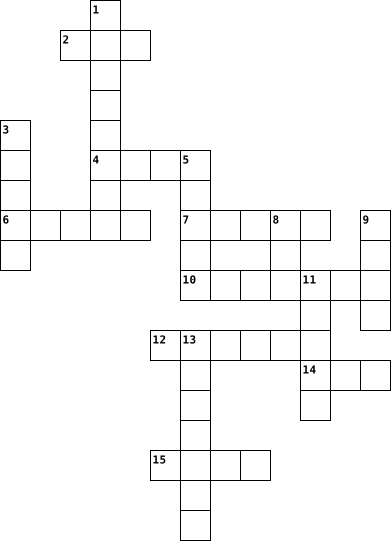
Across
- Bright, hot, in the sky.
- Plants getting bigger; maturing.
- Our planet; where we live.
- Things we throw away.
- Reuse things; help the Earth.
- Everything not made by humans.
- What we breathe; invisible gas.
- Outdoor green space for people.
Down
- Light from the sun.
- Tall, green, with leaves.
- Rivers, lakes, oceans; wet.
- Blue space above us.
- Small thing plants grow from.
- Not dirty; safe and healthy.
- Living creatures, not plants.
15 Clues: Light from the sun. • Blue space above us. • Things we throw away. • Bright, hot, in the sky. • Tall, green, with leaves. • Our planet; where we live. • Rivers, lakes, oceans; wet. • Not dirty; safe and healthy. • Small thing plants grow from. • Reuse things; help the Earth. • Living creatures, not plants. • Everything not made by humans. • What we breathe; invisible gas. • ...