
solar system Crossword Puzzles
Earth, Moon, and Sun 2021-02-02

Across
- the amount of time it takes for a planet to complete one orbit around a star or stars
- phase, the shape of the illuminated part of the Moon as it appears from Earth
- the star that is the main source of light at the center of our solar system
- to shine light on an object and make it visible
- when the Moon is completely dark
- the sun, the planets that orbit the sun, and other objects that orbit the sun
- moon a moon phase that looks like more than half a circle from Earth
- a moon phase that looks like a half-circle from Earth
- a moon phase that looks like less than half a circle from Earth
- a moon outside our solar system
- something we observe to be similar over and over again
Down
- a planet outside our solar system
- a moon phase that looks like a full circle from Earth
- the border between light and dark on the Moon
- the relative size of things
- the nearly circular path a smaller object (like the Moon) travels around a larger object (like Earth).
- a rocky sphere that travels around a planet
- a moon phase in which the Moon is not visible from Earth
- an object, diagram, or computer program that helps us understand something by making it simpler or easier to see
19 Clues: the relative size of things • a moon outside our solar system • when the Moon is completely dark • a planet outside our solar system • a rocky sphere that travels around a planet • the border between light and dark on the Moon • to shine light on an object and make it visible • a moon phase that looks like a full circle from Earth • ...
Earth, Moon, And Sun 2021-02-02

Across
- the relative size of things
- something we observe to be similar over and over again
- a moon phase that looks like a half-circle from Earth
- an object, diagram, or computer program that helps us understand something by making it simpler or easier to see
- a moon phase in which the Moon is not visible from Earth
- the sun, the planets that orbit the sun, and other objects that orbit the sun
- the amount of time it takes for a planet to complete one orbit around a star or stars
- a moon outside our solar system
Down
- to shine light on an object and make it visible
- the star that is the main source of light at the center of our solar system
- when the Moon is completely dark
- the nearly circular path a smaller object (like the Moon) travels around a larger object (like Earth).
- a moon phase that looks like less than half a circle from Earth
- the border between light and dark on the Moon
- phase the shape of the illuminated part of the Moon as it appears from Earth
- moon a moon phase that looks like more than half a circle from Earth
- a moon phase that looks like a full circle from Earth
- a planet outside our solar system
- a rocky sphere that travels around a planet
19 Clues: the relative size of things • a moon outside our solar system • when the Moon is completely dark • a planet outside our solar system • a rocky sphere that travels around a planet • the border between light and dark on the Moon • to shine light on an object and make it visible • a moon phase that looks like a full circle from Earth • ...
Solar System Crossword 2024-04-14

Across
- Planet closest to the sun
- Planet named after the roman god of agriculture
- Gravity Force that keeps a planet moving in orbit
- A star and the planets orbiting around it
- Closest star to Earth
- Now called a dwarf planet
- Third largest planet in our solar system
Down
- Layer of gas that surrounds a planet
- Planet furthest from the sun
- Nicknamed "the red planet"
- Largest planet in our solar system
- Our solar system is part of this galaxy
- Covers 70 percent of the Earth's surface
- Planet named offer the Roman goddess of love and beauty
14 Clues: Closest star to Earth • Planet closest to the sun • Now called a dwarf planet • Nicknamed "the red planet" • Planet furthest from the sun • Largest planet in our solar system • Layer of gas that surrounds a planet • Our solar system is part of this galaxy • Covers 70 percent of the Earth's surface • Third largest planet in our solar system • ...
The solar system crosword 2026-02-20

Across
- Is the oppesite of the sun
- Is it over 10 millions degrees inside the sun
- It is the the farthest planet away from the sun
- It is a amarican space company
- Is it under -200 degrees on Uranus
- The planet is known its rings
- A person who is trained to travel in a spacecraft
Down
- It is the closets planet to the sun
- you can breathe it on earth but not in space
- The biggest star in the solar system
- There are 8 of them in the solar system
- The first to step on the moon
- It is the closets planet to Earth
- Is the coldest planet in the solar system
14 Clues: Is the oppesite of the sun • The first to step on the moon • The planet is known its rings • It is a amarican space company • It is the closets planet to Earth • Is it under -200 degrees on Uranus • It is the closets planet to the sun • The biggest star in the solar system • There are 8 of them in the solar system • Is the coldest planet in the solar system • ...
Origins of Galaxy and Solar System 2017-08-06

Across
- Explains how we know that galaxies are moving farther and farther away from us
- point in Earth's orbit when it's farthest from the Sun
- explains how the solar system formed 4.6 billion years ago
- the Milky Way's nearest neighboring galaxy
- model that says that the planets orbit the Sun
- all existing matter and space
- how elliptical a planet's orbit is
- type of planets made of gas
Down
- point in Earth's orbit when it's closest to the Sun
- shape of Earth's orbit
- idea that the universe started out as a single point in space that expanded
- galaxy we live in
- planet in our solar system closest to the Sun
- type of planets made of rock
- model that says that the moon, sun and planets orbit Earth
- planet in our solar system furthest from the Sun
16 Clues: galaxy we live in • shape of Earth's orbit • type of planets made of gas • type of planets made of rock • all existing matter and space • how elliptical a planet's orbit is • the Milky Way's nearest neighboring galaxy • planet in our solar system closest to the Sun • model that says that the planets orbit the Sun • planet in our solar system furthest from the Sun • ...
Andrew Hartwig - Space Review 2019-02-21

Across
- an extremely hot, dense mass of gases
- what humans need to breathe and function
- the 3rd planet from the sun
- the dwarf planet that used to be called a planet
- a small mass of dust and ice that orbits the sun
- 58 million km from the sun
- the first four planets in our solar system (the terrestrial planets)
- rocky objects that orbit the sun
- the outer planet with the most moons in our solar system
- Protects the head from harmful radiation, and flying debris
- A thin layer of gold
Down
- the first man on earths moon
- the gas planets in our solar system
- force of attraction between two or more objects
- protects earth from radiation
- the moon that orbits earth
- a mass that orbits the planet that is holding it in its gravitational pull
- rocky objects moving in space between the inner planets and the outer planets
- what a meteor becomes when it impacts earths surface
- Protects the astronauts fingers from radiation and flying debris
20 Clues: A thin layer of gold • the moon that orbits earth • 58 million km from the sun • the 3rd planet from the sun • the first man on earths moon • protects earth from radiation • rocky objects that orbit the sun • the gas planets in our solar system • an extremely hot, dense mass of gases • what humans need to breathe and function • force of attraction between two or more objects • ...
Space (wowowowow) 2019-08-07

Across
- a small celestial body, primarily made of ice and rock
- The largest planet in our solar system
- A bright ball of hot gas
- A natural or artificial object that moves around a planet
- A large cloud of dust and gas that is in space
- The planet we all live on
- A measure of the total amount of material in a body
- The farthest planet from the sun
- A small rocky object in orbit around the Sun
- A large grouping of stars
Down
- The total or partial blocking of one celestial body by another
- Known as the "red planet"
- The closest planet to the sun
- A zodiac symbol representing a fish
- The hottest planet in our solar system
- A layer of gases, surrounding a planet, moon or star
- The planet with the 2nd most amount of moons in our solar system
- An exploding star that produces an extremely bright light
- A noncontact force keeping us on Earth
- A large spherical object that orbits the sun or and another star
20 Clues: A bright ball of hot gas • Known as the "red planet" • The planet we all live on • A large grouping of stars • The closest planet to the sun • The farthest planet from the sun • A zodiac symbol representing a fish • The largest planet in our solar system • The hottest planet in our solar system • A noncontact force keeping us on Earth • ...
Astronomy Crossword 2024-05-27

Across
- Known for its ring system.
- The smallest planet in our solar system.
- The layer of the Sun only visible during a solar eclipse.
- The outermost layer of the Sun's atmosphere.
- The blue planet.
- A cooler, darker spot on the Sun’s surface.
- Someone who studies the sun.
- A rocky body orbiting the Sun, mostly found between Mars and Jupiter.
Down
- The visible surface of the Sun.
- A large, bright feature extending outward from the Sun's surface, often in a loop shape.
- Named after the Roman god of war.
- The process of combining lighter elements to form heavier ones.
- A particle from a comet or asteroid that manages to survive the fall to earth.
- Named after the roman god of the sea.
- This planet rotates on its side.
- The hottest planet.
- An icy body that releases gas and dust, forming a glowing tail when near the Sun.
- Once considered the ninth planet, now classified as a dwarf planet.
- The largest planet in our solar system.
- On of the only moons with a thick atmosphere.
20 Clues: The blue planet. • The hottest planet. • Known for its ring system. • Someone who studies the sun. • The visible surface of the Sun. • This planet rotates on its side. • Named after the Roman god of war. • Named after the roman god of the sea. • The largest planet in our solar system. • The smallest planet in our solar system. • A cooler, darker spot on the Sun’s surface. • ...
Space 2024-06-17

Across
- What are the inner and outer planets separated by?
- What's the name of a galaxy that's shaped like a elongated sphere?
- What Is a colossal explosion of a star called?
- Where is our sun and entire galaxy located in the Milky Way?
- Which planet orbits closet to the sun?
- What's the name of the only dwarf planet located in the asteroid belt?
- What planet is known as the red planet?
- What's the name of Saturn's largest moon?
- Which planet is the smallest out of the gas giants?
- What is another name for a spiral galaxy?
- Who was the first person to land on the moon?
Down
- What does NASA stand for?
- Which planet is known as Earths sister planet?
- What force keeps planets in their orbit?
- What planet has the shortest days?
- What is Saturn mostly composed of?
- On what planet are the sunsets blue?
- What's the words frozen leftovers from the formation of the solar system composed of dust, rock, and ices?
- What do the planets in our solar system orbit around?
- How many planets are in our solar system? red planet
- Which planet spins sideways?
21 Clues: What does NASA stand for? • Which planet spins sideways? • What planet has the shortest days? • What is Saturn mostly composed of? • On what planet are the sunsets blue? • Which planet orbits closet to the sun? • What planet is known as the red planet? • What force keeps planets in their orbit? • What's the name of Saturn's largest moon? • ...
crossward creator project 2022-03-17
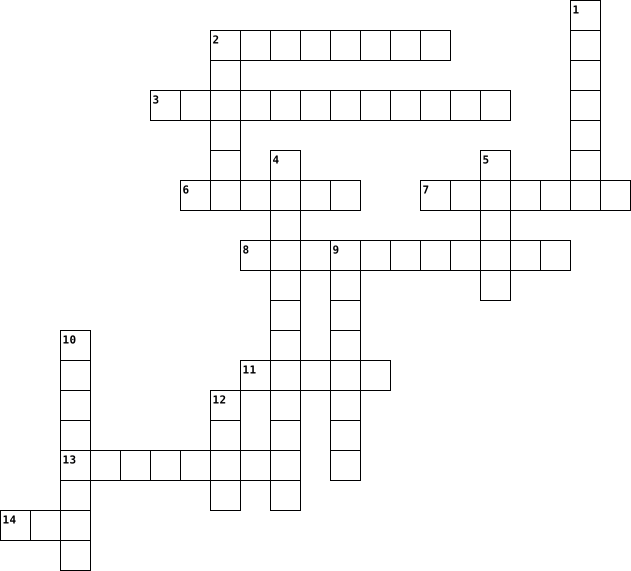
Across
- an invisble halo
- the last four planets
- the coldest planet in the solar system
- the closetes planet towards the sun
- rocky planets
- only livable planet
- cold planets
- center star in solar system
Down
- the largest planet
- a small rock
- the first for planets
- the rounding of an celestrial object
- roatating on an axis
- planets with lower density
- an celestrial body of gas that shines
15 Clues: a small rock • cold planets • rocky planets • an invisble halo • the largest planet • only livable planet • roatating on an axis • the last four planets • the first for planets • planets with lower density • center star in solar system • the closetes planet towards the sun • the rounding of an celestrial object • an celestrial body of gas that shines • ...
Root Word Review 2024-02-13

Across
- favorable or advantageous
- extremely large
- to persuade
- a person who studies the solar system
- make known by name
- make or create
Down
- a symbol used in text
- to teach
- gentle, kind, not harmful
- large in quantity
- kindly, charitable
- a rock that orbits in the solar system
- a person trained to fly in a spaceship
- an amount of money added to wages
- subtract or takeaway
15 Clues: to teach • to persuade • make or create • extremely large • large in quantity • kindly, charitable • make known by name • subtract or takeaway • a symbol used in text • gentle, kind, not harmful • favorable or advantageous • an amount of money added to wages • a person who studies the solar system • a rock that orbits in the solar system • a person trained to fly in a spaceship
Space 2025-01-29

Across
- Balls of ice.
- The sideways planet.
- The smallest planet.
- A huge collection of gas, dust and billions of stars and their solar systems held together by gravity.
- Planet of life.
- Hole Space vacuum.
- The failed planet.
- The force that pulls objects towards each other.
- Stars that make a figure.
- The biggest space rocks.
- A failed star.
- Red planet.
- Second biggest planet.
Down
- Balls of energy.
- Collect information about space.
- Bang How the universe was created.
- belt The region between Mars and Jupiter that contains the largest population of asteroids in our solar system.
- A person wearing a spacesuit.
- Way Our galaxy that contains over 200 billion stars.
- Hot planet.
- System Planets are going around a star.
- The universe.
- The last planet.
- Orbits around the earth.
- The most well known star.
25 Clues: Hot planet. • Red planet. • Balls of ice. • The universe. • A failed star. • Planet of life. • Balls of energy. • The last planet. • The failed planet. • The sideways planet. • The smallest planet. • Hole Space vacuum. • Second biggest planet. • Orbits around the earth. • The biggest space rocks. • Stars that make a figure. • The most well known star. • A person wearing a spacesuit. • ...
Astronomy 2022-03-09

Across
- Largest objects in the Solar system which revolve around the Sun.
- Closest planet to the Sun
- Blocking of Sunlight to the moon, this can occur during a full moon
- Layer of air, made up of many layers and gases surrounding the Earths and other planets' surface.
- Second closest planet to the Sun. Sometimes called earth's twin.
- Complete shadow, the fully shaded inner region of a shadow cast by an opaque object, especially the area on the earth or moon experiencing the total phase of an eclipse.
- sunlight on its surface.
- the spinning of Earth in its axis.
- a person who is trained to travel in a spacecraft.
- primary source of heat and energy for the solar system.
Down
- Blocking of Sun's light which can occur during a new moon.
- small body of ice, rock and cosmic dust that follows an elliptical orbit around the Sun.
- little chunks of rock and debris in space that falls through a planet’s atmosphere.
- A satellite is a natural or man made object that orbits around a planet.
- the movement of one object around another object.
- Largest planet in the solar system
- Sixth planet to the Sun, second largest planet in the solar system.
- Partial shadow, lighter, outer parts of a shadow. the partially shaded outer region of the shadow cast by an opaque object.
18 Clues: sunlight on its surface. • Closest planet to the Sun • Largest planet in the solar system • the spinning of Earth in its axis. • the movement of one object around another object. • a person who is trained to travel in a spacecraft. • primary source of heat and energy for the solar system. • Blocking of Sun's light which can occur during a new moon. • ...
Earth, Moon and Sun 2024-02-02

Across
- system the sun, the planets that orbit the sun and other objects that orbit the sun
- something we observe to be similar over and over again
- a moon phase that looks like half a circle from earth
- a moon outside our solar system
- a moon phase that looks like a full circle from earth
- the relative size of things
- a moon phase that looks like less than half a circle from earth
- the nearly circular path a smaller object (like the moon) travels around a lager object (like earth)
- the amount of time it takes for a planet to complete one orbit around the star or stars
Down
- a rocky sphere that travels around a planet
- the shape of the illuminated part of the moon as it appears from earth
- to shine light on an object and make it visible
- a moon phase in which the moon is not visible from earth
- an object, diagram, or computer program that helps us understand something by making it simpler or easier to see
- a moon phase that looks like more than half a circle from earth
- a planet outside our solar system
- the border between light and dark on the moon
- the star that is the main source of light at the center of our solar system
18 Clues: the relative size of things • a moon outside our solar system • a planet outside our solar system • a rocky sphere that travels around a planet • the border between light and dark on the moon • to shine light on an object and make it visible • a moon phase that looks like half a circle from earth • a moon phase that looks like a full circle from earth • ...
Sustainable Anaïs Lilian 2026-03-12

Across
- Is a consequence with environnement
- Energy are used
- Material or substance there are usefull and are throun
- is a valor for respect here environnement
- is a characteristic to upgrade structure and object
- Less detruction nature
- relater to the environnement
- Is a greate system for reuse system water and produce energy
- Can be used during a long time
Down
- Absord the energy solar
- Is a system for reuse all now material
- a machine that produce electricity
- is a raw material for a bio structure with tree
- Use the wind for energy
- Is a system to reuse material and objects
- is a economy of energy for a world better
- Is a all material eco friendly
- Last in the time
- A new idea
- Make again the objects
20 Clues: A new idea • Energy are used • Last in the time • Less detruction nature • Make again the objects • Absord the energy solar • Use the wind for energy • relater to the environnement • Is a all material eco friendly • Can be used during a long time • a machine that produce electricity • Is a consequence with environnement • Is a system for reuse all now material • ...
Space 2021-01-10

Across
- Collection of stars held together by gravity
- A model of the solar system with the sun at the centre
- Time it takes a planet to make one full spin on its axis
- Any Large body that orbits a star in a solar system
- Path taken by one object moving around another larger object
- The distance light travels in a year
- Sun and the planets and other bodies in an orbit around it
Down
- Changes in the temperature during the year as the Earth moves around the sun
- Planets that orbit a star outside a solar system
- Lumps Of Rock Orbiting the sun left over from when the solar system was formed
- Length of time it takes for a planet to orbit the sun
- The imaginary line that the Earth spins around
12 Clues: The distance light travels in a year • Collection of stars held together by gravity • The imaginary line that the Earth spins around • Planets that orbit a star outside a solar system • Any Large body that orbits a star in a solar system • Length of time it takes for a planet to orbit the sun • A model of the solar system with the sun at the centre • ...
Space 2021-01-10

Across
- Collection of stars held together by gravity
- A model of the solar system with the sun at the centre
- Time it takes a planet to make one full spin on its axis
- Any Large body that orbits a star in a solar system
- Path taken by one object moving around another larger object
- The distance light travels in a year
- Sun and the planets and other bodies in an orbit around it
Down
- Changes in the temperature during the year as the Earth moves around the sun
- Planets that orbit a star outside a solar system
- Lumps Of Rock Orbiting the sun left over from when the solar system was formed
- Length of time it takes for a planet to orbit the sun
- The imaginary line that the Earth spins around
12 Clues: The distance light travels in a year • Collection of stars held together by gravity • The imaginary line that the Earth spins around • Planets that orbit a star outside a solar system • Any Large body that orbits a star in a solar system • Length of time it takes for a planet to orbit the sun • A model of the solar system with the sun at the centre • ...
Space 2021-01-10

Across
- Planets that orbit a star outside a solar system
- Sun and the planets and other bodies in an orbit around it
- Time it takes a planet to make one full spin on its axis
- Collection of stars held together by gravity
- A model of the solar system with the sun at the centre
- Path taken by one object moving around another larger object
- Length of time it takes for a planet to orbit the sun
Down
- The imaginary line that the Earth spins around
- Any Large body that orbits a star in a solar system
- The distance light travels in a year
- Changes in the temperature during the year as the Earth moves around the sun
- Lumps Of Rock Orbiting the sun left over from when the solar system was formed
12 Clues: The distance light travels in a year • Collection of stars held together by gravity • The imaginary line that the Earth spins around • Planets that orbit a star outside a solar system • Any Large body that orbits a star in a solar system • Length of time it takes for a planet to orbit the sun • A model of the solar system with the sun at the centre • ...
Space 2021-01-10

Across
- Collection of stars held together by gravity
- A model of the solar system with the sun at the centre
- Time it takes a planet to make one full spin on its axis
- Any Large body that orbits a star in a solar system
- Path taken by one object moving around another larger object
- The distance light travels in a year
- Sun and the planets and other bodies in an orbit around it
Down
- Changes in the temperature during the year as the Earth moves around the sun
- Planets that orbit a star outside a solar system
- Lumps Of Rock Orbiting the sun left over from when the solar system was formed
- Length of time it takes for a planet to orbit the sun
- The imaginary line that the Earth spins around
12 Clues: The distance light travels in a year • Collection of stars held together by gravity • The imaginary line that the Earth spins around • Planets that orbit a star outside a solar system • Any Large body that orbits a star in a solar system • Length of time it takes for a planet to orbit the sun • A model of the solar system with the sun at the centre • ...
Space Crossword 2022-10-21

Across
- system Our Space neighborhood.
- designs and manufactures advanced spacecraft.
- planets beyond our solar system.
- Pluto is one of these.
- Planet that shares a name with a motor company.
- 2nd planet from the sun.
- All existing matter is in here.
- The big red planet.
Down
- No longer a planet. ):
- Largest planet.
- An American space organization.
- The Planet that has Rings
- The big blue planet.
- The Funny named planet.
- We live here.
- Our Galaxy.
16 Clues: Our Galaxy. • We live here. • Largest planet. • The big red planet. • The big blue planet. • No longer a planet. ): • Pluto is one of these. • The Funny named planet. • 2nd planet from the sun. • The Planet that has Rings • system Our Space neighborhood. • An American space organization. • All existing matter is in here. • planets beyond our solar system. • ...
Space 2021-06-24

Across
- British astronaut
- our planet
- the solar system
- coldest planet in solar system
- the red planet
- its the blue planet
- earth's satelite
Down
- first man on moon
- nearest planet to the sun
- its around jupiter
- our star
- number of planets
12 Clues: our star • our planet • the red planet • the solar system • earth's satelite • first man on moon • British astronaut • number of planets • its around jupiter • its the blue planet • nearest planet to the sun • coldest planet in solar system
Space 2022-03-02

Across
- all celestial bodies exist in this
- second planet from the sun
- planet closest to the sun
- passes by Earth every 75 years
- nothing but light can escape
- center of our solar system
- large rocky body in outer space
- many solar systems grouped together
- this planet is furthest from our sun
- group of planets and their sun
- our home
- this planet is tilted on its side
Down
- this planet has spectacular rings around it
- any planet beyond our solar system
- small rocky body in outer space
- celestial body made of ice
- space probe launched in 1977
- orbits the earth
- this planet has a large red spot
- once a planet, now classified as a planetoid
- the red planet
- a sun that is very far away
- search for extraterrestrial intelligence
- unidentified flying object
24 Clues: our home • the red planet • orbits the earth • planet closest to the sun • second planet from the sun • celestial body made of ice • center of our solar system • unidentified flying object • a sun that is very far away • nothing but light can escape • space probe launched in 1977 • passes by Earth every 75 years • group of planets and their sun • small rocky body in outer space • ...
section 2 vocab words 2022-11-18

Across
- planets with a dence rocky surface
- white halo around the sun
- earth is the center of the solar system
- dark places on the sun
- middle of the sun
- donut shaped ring around the solar system
- outer layer of the sun
- clouds of gas
- small chunk of rock
- loose conection of space particles
- meteroid enter earth
- reddish loops of gas on the sun
- elongated circle
Down
- inner layer of the suns atmosphere
- hydrogen atoms join together
- sudden eruption of magnetic energy
- heat trapped in an atmosphere
- center part of a comet
- middle layer of the suns atmosphere
- sun at the center
- rocky space rocks too small too be a planet
- the middle layer of the sun
- big circle that surronds the solar
- strikes earth surface
- outer planets
- particles around planets
26 Clues: clouds of gas • outer planets • elongated circle • middle of the sun • sun at the center • small chunk of rock • meteroid enter earth • strikes earth surface • center part of a comet • dark places on the sun • outer layer of the sun • particles around planets • white halo around the sun • the middle layer of the sun • hydrogen atoms join together • heat trapped in an atmosphere • ...
SPACE 2023-05-31

Across
- - A habitable artificial structure in space
- - A rocky object that orbits the Sun
- - The fourth planet from the Sun
- - A vast system of stars, gas, and dust
- - A person who travels and works in space
- - A cloud of gas and dust in space
- - Earth's natural satellite
- - A celestial object composed of ice and dust
- - A large celestial body that orbits a star
Down
- - An object that orbits a planet or a star
- - An explosive event in a star
- - The largest planet in our solar system
- - A celestial body that emits light
- - A vast system of stars, gas, and dust
- - The center of our solar system
- - An instrument used to observe distant objects in space
- - The planet known for its prominent ring system
- - A person who travels and works in space
- - A vehicle that propels itself into space
- - Unidentified Flying Object
20 Clues: - Earth's natural satellite • - Unidentified Flying Object • - An explosive event in a star • - The center of our solar system • - The fourth planet from the Sun • - A cloud of gas and dust in space • - A celestial body that emits light • - A rocky object that orbits the Sun • - A vast system of stars, gas, and dust • - A vast system of stars, gas, and dust • ...
Space 2023-06-02

Across
- bang start of everything
- a giant made out of gas
- the scariest thing in space
- where our solar system is
- where all galaxys are
- where all space sound are
- the blue lazer star
- the empty universe part
Down
- the bubble we are always in
- opposite of a blackhole
- our home
- the sun shooting fire
- people who go to space
- thing that's responsible for life
- star exploding
- The Biggest in our solar system
16 Clues: our home • star exploding • the blue lazer star • the sun shooting fire • where all galaxys are • people who go to space • opposite of a blackhole • a giant made out of gas • the empty universe part • bang start of everything • where our solar system is • where all space sound are • the bubble we are always in • the scariest thing in space • The Biggest in our solar system • ...
Chapter 28 2023-04-27

Across
- Mercury,Venus,Earth, and Mars
- deviation of an orbit
- range of orbits around a star
- celestial event in which a number of meteors come into earths atmosphere.
- type of measurment to measure distance from sun to earth
- 1 minute planet
- small body of matter entering the earths atmosphere
- actual or apparent motion of a body
Down
- rock that falls to earth from space
- oval shape with two focal points
- circumstellar disc in the outer solar system
- ex. PLuto
- containing solid irregularly shaped bodies
- neptune,uranus,saturn, Jupiter
- Fundamental system in condensed matter
- a line of cliffs
- small body moving in the solar system
17 Clues: ex. PLuto • 1 minute planet • a line of cliffs • deviation of an orbit • Mercury,Venus,Earth, and Mars • range of orbits around a star • neptune,uranus,saturn, Jupiter • oval shape with two focal points • rock that falls to earth from space • actual or apparent motion of a body • small body moving in the solar system • Fundamental system in condensed matter • ...
Alternative Energy - Solar Crossword 2021-10-18

Across
- What is used to convert solar energy into electricity?
- another name for a solar cell
- What time of day does solar energy not work?
- Energy from the sun is called?
- a form of energy that is clean and reduces carbon emissions
- How does solar energy generate electricity through movement?
Down
- subatomic particle with negative charge
- a collection of solar panels
- Solar energy is measured in?
- particle released by the sun
- A method of energy storage
- Solar energy is what kind of resource?
12 Clues: A method of energy storage • a collection of solar panels • Solar energy is measured in? • particle released by the sun • another name for a solar cell • Energy from the sun is called? • Solar energy is what kind of resource? • subatomic particle with negative charge • What time of day does solar energy not work? • What is used to convert solar energy into electricity? • ...
Solar System 2020-09-01

Across
- I am the hottest and rightest planet in the solar system
- I am the second largest planet in the solar system
- i am called as the red planet
- i am the largest planet in the solar system and I am a gas giant
- i am the first planet in the solar system
Down
- I am named after the greek god of the sky
- belt I am located in between Mars and Jupiter
- I am the windiest and the last planet in the solar system
- I am the only planet that has life
9 Clues: i am called as the red planet • I am the only planet that has life • I am named after the greek god of the sky • i am the first planet in the solar system • belt I am located in between Mars and Jupiter • I am the second largest planet in the solar system • I am the hottest and rightest planet in the solar system • ...
Solar systems 2025-01-07

Across
- A region of icy bodies beyond Neptune, home to Pluto and other dwarf planets
- A group of celestial objects orbiting a star.
- The only planet in our solar system known to support life
- A giant ball of hot gas at the center of our solar system
Down
- The largest planet in our solar system
- The hottest planet in our solar system
- A dwarf planet, known for its unusual tilted axis potential for an underground ocean
- A dwarf planet known for its icy surface and potential for life
- The second largest planet in our solar system
9 Clues: The largest planet in our solar system • The hottest planet in our solar system • A group of celestial objects orbiting a star. • The second largest planet in our solar system • The only planet in our solar system known to support life • A giant ball of hot gas at the center of our solar system • A dwarf planet known for its icy surface and potential for life • ...
Space 2026-06-02

Across
- type of planet that is too small to be considered a regular planet
- the motion of moving around another object
- the gravitational phenomenon that causes us to only see one side of the Moon
- we have sent rovers to this planet
- area of gas and dust where stars are "born"
- the unit used to measure distance inside our solar system
- Earth's natural satellite
- Jupiter's moon that is believed to have water under its icy crust
Down
- region between the inner planets and outer planets
- the motion of spinning on an axis
- a massive system that is held together by gravity that includes countless stars, nebulas, planets, etc.
- the path of one object around another object
- the object at the center of our solar system
- a result of the gravitational pull between the Earth, Sun, and Moon
- the unit used to measure distance outside of our solar system
15 Clues: Earth's natural satellite • the motion of spinning on an axis • we have sent rovers to this planet • the motion of moving around another object • area of gas and dust where stars are "born" • the path of one object around another object • the object at the center of our solar system • region between the inner planets and outer planets • ...
The Solar System 2024-02-18

Across
- This planet is a failed star, its also the most massive planet in our solar system.
- The hottest planet in our solar system, a single day on this planet lasts longer than its year does.
- Sized similarly to earths moon, it is the planet orbiting closest to the sun.
- Between Mars and Jupiter, this region of space has over 600,000 asteroids.
- Our home solar system where the solar winds from the sun protect us from interstellar radiation.
- The central star in our solar system.
- With more planets (146) than any other planet in our solar system, you can't stand on this gas giant planet known for its rings.
Down
- The most famous object in this donut shaped piece of space is Pluto.
- With dust storms that last for months this red planet is covered in iron oxide.
- This celestial body was too small to become spherical under its own gravitational weight. Its limited gravity also was too weak to cleared its orbit of other debris.
- This planet was discovered by math, not by telescopes. It has 5 rings and 14 moons.
- It takes 8 minutes for suns light to get to this planet, over half of this planet's surface remains unexplored.
- With 13 rings, this ice giant world spins on its side and is the 7th planet from the sun.
13 Clues: The central star in our solar system. • The most famous object in this donut shaped piece of space is Pluto. • Between Mars and Jupiter, this region of space has over 600,000 asteroids. • Sized similarly to earths moon, it is the planet orbiting closest to the sun. • With dust storms that last for months this red planet is covered in iron oxide. • ...
Earth in Space 2024-05-23

Across
- Eclipse: When Earth passes between the Sun and the Moon, causing Earth's shadow to fall on the Moon.
- Refers to the various entities within the solar system, including planets, moons, asteroids, and comets.
- Eclipse: When the Moon passes between the Sun and Earth, blocking the Sun's light from reaching Earth.
- Occurs when one celestial body moves into the shadow of another celestial body. For example, solar eclipses happen when the Moon passes between the Sun and Earth, blocking the Sun's light.
- The four divisions of the year are marked by particular weather patterns and daylight hours, resulting from the Earth's tilt and its orbit around the Sun.
- Phases : The different shapes of the illuminated portion of the Moon as seen from Earth.
- Large systems of stars, gas, dust, and dark matter held together by gravity. The Milky Way is an example of a galaxy.
Down
- System: The collection of planets and other objects orbiting the Sun, including planets, moons, asteroids, and comets.
- The act of explaining the meaning or significance of data to understand its implications.
- The force of attraction between objects with mass. It is responsible for the motion of planets in the solar system and stars within galaxies.
- The ratio of the size of a model or representation to the actual size of the object it represents, used to provide a sense of proportion.
- A representation or simulation used to explain or predict how something works. In this context, a model is used to describe the role of gravity in the motions within galaxies and the solar system.
- Refers to the movement or trajectory of celestial bodies within galaxies and the solar system, influenced by the gravitational forces at play.
- Properties: Characteristics of objects in the solar system, such as size, distance, or mass, represented proportionally to their actual dimensions.
- Analysis: The process of inspecting, cleaning, transforming, and modeling data to extract useful information and draw conclusions.
15 Clues: Phases : The different shapes of the illuminated portion of the Moon as seen from Earth. • The act of explaining the meaning or significance of data to understand its implications. • Eclipse: When Earth passes between the Sun and the Moon, causing Earth's shadow to fall on the Moon. • ...
Mixed Word 2024-11-24

Across
- Not a single light emare of it.
- Nearest planet to the sun.
- Set of stars.
- Unreal transport in space.
- system of billions/trillions of stars.
- Blue planet.
Down
- Best saga.
- It's the "territory" where this univers extends.
- Natural satellite of Earth.
- Twin planet of Earth.
- Optical instrument with mirror for observing distant stars.
- Only star of solar system.
- Our solar system.
- Bright spot in the night sky.
- A small rock who fly in space.
- A celestial body distinguished from the fixed stars by having an apparent motion of it's own.
16 Clues: Best saga. • Blue planet. • Set of stars. • Our solar system. • Twin planet of Earth. • Only star of solar system. • Nearest planet to the sun. • Unreal transport in space. • Natural satellite of Earth. • Bright spot in the night sky. • A small rock who fly in space. • Not a single light emare of it. • system of billions/trillions of stars. • ...
Milky Way 2025-02-06

Across
- the largest planet in the solar system
- the planet known as the "Red Planet"
- the group of planets that includes Mercury, Venus, Earth, and Mars
- the group of planets that includes Jupiter, Saturn, Uranus, and Neptune
- the star at the center of our solar system
- a celestial object with such strong gravity that nothing, not even light, can escape it
- the planetary system that includes the Sun and everything bound to it by gravity
- the closest planet to the Sun
Down
- a neighboring galaxy to the Milky Way
- the fundamental force that keeps planets in orbit around the Sun
- a natural satellite that orbits a planet
- the planet known for its rings and extreme winds
- a dwarf planet that was once considered the ninth planet of the solar system
- a tool used by scientists to explore space without humans onboard
- the collection of stars, dust, and gas, including the Milky Way
15 Clues: the closest planet to the Sun • the planet known as the "Red Planet" • a neighboring galaxy to the Milky Way • the largest planet in the solar system • a natural satellite that orbits a planet • the star at the center of our solar system • the planet known for its rings and extreme winds • the collection of stars, dust, and gas, including the Milky Way • ...
GTT Crossword 2021-02-25

Across
- Python(coding language)
- Electrical Radio
- 3D Printing
- Fiber Optics
- Manufacture medicines
- Manufacturing Processes
- Eco light
- Multi-directional Elevators
- Generative Design
- Systems Electrochemical water filtration system
- Preamplifier
- Seabin
- Microprocessor
- Robotics
- DNA-Sequencer
Down
- Airplanes
- Microscopes
- Cotton Gin
- Solar Cars
- ENIAC
- High-temperature vacuums
- Nuclear reactor
- X-ray Machines
- Gears
- Aquifer
- Bio-artificial-liver
26 Clues: ENIAC • Gears • Seabin • Aquifer • Robotics • Airplanes • Eco light • Cotton Gin • Solar Cars • 3D Printing • Microscopes • Fiber Optics • Preamplifier • DNA-Sequencer • X-ray Machines • Microprocessor • Nuclear reactor • Electrical Radio • Generative Design • Bio-artificial-liver • Manufacture medicines • Python(coding language) • Manufacturing Processes • High-temperature vacuums • Multi-directional Elevators • ...
Astronomy Crossword 2024-05-28

Across
- A scientific name for the "shooting star".
- Meteorite, whose composition is similar to the Earth's basalt material, belongs to the ___ type.
- When a thin ring of the sun is visible around the moon's silhouette, it is a/an ___ eclipse.
- A type of nucleus that has one proton and one neutron.
- Jupiter's clouds appear so bright because of this element.
- The escaping dust and gas from the comet.
- Another name for solar prominences.
- The edge of the solar system is the ___ Cloud.
- An extremely hot matter that produces ionized gas.
- When the gravity pulling inward is balanced with the pressure that is being pushed out, it is called a gravitational...
Down
- Only Uranus and Venus have this type of rotation.
- The oldest type of meteorite, which may be as old as 4.6 billion years old.
- The time of the solar cycle, during which the solar weather is most active.
- Among all of the inner terrestrial planets, this one has the densest atmosphere.
- The belt is similar to the asteroid belt between Mars and Jupiter.
- A type of nebula that was created by the Big Bang, which later would form the solar system.
- The lowest layer of the sun's atmosphere
- If this type of field is wound together, a sunspot may appear.
- To determine the mass of an asteroid, the scientists measure its ___ effect.
- The process during which the atom's nucleus splits into smaller parts.
20 Clues: Another name for solar prominences. • The lowest layer of the sun's atmosphere • The escaping dust and gas from the comet. • A scientific name for the "shooting star". • The edge of the solar system is the ___ Cloud. • Only Uranus and Venus have this type of rotation. • An extremely hot matter that produces ionized gas. • ...
Tour of the Solar System 2026-04-14

Across
- A moon that as far as we know is the only other object in our solar system with liquid on its surface.
- An extremely large asteroid that was large enough to become spherical in shape but not clear its orbit making it a dwarf planet.
- Jovian planet that is furthest from the sun. Consists mostly of various types of ice and light gasses.
- One of the large Galilean Moons. Due to tidal forces it is incredibly volcanically active.
- A region of smaller debris that separates the terrestrial planets from the Jovian.
- The largest Galilean Moon (also the largest in the solar system). Larger than Mercury with its own magnetic field.
- One of the moons that orbits Mars (starts with a "P")
- Another of the Galilean Moons. Brightly lit craters suggest it may have ice just underneath its rocky surface.
- A region of space beyond Neptune in which small icy objects orbit the sun - hundreds of thousand of object.
- An object in our solar system that had sufficient mass to become spherical in shape, but could not clear debris from its orbit.
- A Kuiper Belt Object (KBO) that is also a dwarf planet. A very distant chunk of ice.
- Called "The Red Planet" due to high levels of iron oxide on the surface
- A Jovian planet that "rolls" through its orbit because the poles are rotated almost entirely onto the plane of the ecliptic
Down
- Plane of the ____________ - The imaginary disc that extends out from the equator of the sun. All planets are on this disc.
- This is the dusty area surrounding the protostar during the initial formation of the planets.
- Terrestrial planet with a runaway greenhouse effect. Sometimes called Earth's Twin.
- A Galilean moon with an incredibly smooth surface suggesting it might have large liquid water oceans just under its surface.
- The other moon that orbits Mars (starts with a "D")
- The region well outside of the solar system in which long period comets originate.
- Jovian planet with a density low enough that it would float on water.
- The largest planet in the solar system.
- Currently the theory for the origin of our solar system has it starting out as a cloud of dust. This is the name for the cloud of dust.
- This is the stage a star is in while it is surrounded by an accretion disk. Undergoing nuclear fusion, but not stable.
- Planet that is nearly tidally locked with the sun. Orbit and rotation take nearly the same amount of time.
24 Clues: The largest planet in the solar system. • The other moon that orbits Mars (starts with a "D") • One of the moons that orbits Mars (starts with a "P") • Jovian planet with a density low enough that it would float on water. • Called "The Red Planet" due to high levels of iron oxide on the surface • ...
GTT Crossword 2021-02-25

Across
- Python(coding language)
- Electrical Radio
- 3D Printing
- Fiber Optics
- Manufacture medicines
- Manufacturing Processes
- Eco light
- Multi-directional Elevators
- Generative Design
- Systems Electrochemical water filtration system
- Preamplifier
- Seabin
- Microprocessor
- Robotics
- DNA-Sequencer
Down
- Airplanes
- Microscopes
- Cotton Gin
- Engineer Solar Cars
- ENIAC
- High-temperature vacuums
- Nuclear reactor
- X-ray Machines
- Gears
- Aquifer
- Bio-artificial-liver
26 Clues: ENIAC • Gears • Seabin • Aquifer • Robotics • Airplanes • Eco light • Cotton Gin • 3D Printing • Microscopes • Fiber Optics • Preamplifier • DNA-Sequencer • X-ray Machines • Microprocessor • Nuclear reactor • Electrical Radio • Generative Design • Engineer Solar Cars • Bio-artificial-liver • Manufacture medicines • Python(coding language) • Manufacturing Processes • High-temperature vacuums • ...
Arvind 2017-03-07

Across
- The study of stars
- Groupings of Stars
- Distance travelled by light in one year
- Planet with 300 year old hurricane
- What a very large star collapses into
- Red Planet
- Name of Earth's Star
- The seven sisters
- Known for its rings
- 70% covered with water
- Nearest to the Sun
Down
- 4.3 light years away
- Hottest planet in Solar System
- Super Red Giant
- Contains comets in their orbits
- A dawrf planet
- Super bright super hot star
- Windiest planet in our Solar System
- The Hunter Constellation
- Orbits the Sun on its side
- The Dog Star
- Super Blue Giant
22 Clues: Red Planet • The Dog Star • A dawrf planet • Super Red Giant • Super Blue Giant • The seven sisters • The study of stars • Groupings of Stars • Nearest to the Sun • Known for its rings • 4.3 light years away • Name of Earth's Star • 70% covered with water • The Hunter Constellation • Orbits the Sun on its side • Super bright super hot star • Hottest planet in Solar System • ...
Astronomy Puzzle 2023-05-14

Across
- A very cold planet
- the rocks that causes destruction when it hits
- A very very very hot planet
- Scuti the largest star in the universe.
- the furthest planet from the sun
- icy astronomy object
- the second planet from the sun
- everything
- hole a force that can suck in anything
- The closest planet to earth
Down
- the third largest planet
- The only planet with living things.
- Appears at night
- the brightest planet
- system contains planet
- dwarfs the smallest star
- A dwarf planet
- the galaxy that contains the solar system
- shines at night
- the red planet
20 Clues: everything • A dwarf planet • the red planet • shines at night • Appears at night • A very cold planet • the brightest planet • icy astronomy object • system contains planet • the third largest planet • dwarfs the smallest star • A very very very hot planet • The closest planet to earth • the second planet from the sun • the furthest planet from the sun • The only planet with living things. • ...
Astronomy 2025-01-28

Across
- The closest planet to the sun
- what causes craters
- Biggest planet in the solar system
- State of matter of inner planets
- The planet next to Earth
- Planet with big rings
- Planet farthest away from the Sun
- Belt Separates the inner and outer planets
- The star of are solar system
Down
- Hottest Planet
- Mars soil mostly made up of
- Used to be a planet
- Inner Planets
- State of matter of outer planets
- One of Mars moons
- Outer Planets
- What orbits the Earth
- what are the spots on mercury
- What planet do we live on
- Small Icy Objects
20 Clues: Inner Planets • Outer Planets • Hottest Planet • One of Mars moons • Small Icy Objects • Used to be a planet • what causes craters • What orbits the Earth • Planet with big rings • The planet next to Earth • What planet do we live on • Mars soil mostly made up of • The star of are solar system • The closest planet to the sun • what are the spots on mercury • State of matter of outer planets • ...
Astronomy 2024-01-30

Across
- System the gravitational domination of the planet
- grains tiny dust particles
- lumpy structure
- wind flow of ions
- cloud solar nebula theory
- ultraviolet radiation
- belt orbit of Neptune
- object inner Solar System
- tail smaller grains
- Tail bluish color
- a glowing trail of hot gas
- Chondrites
Down
- cloud of gas
- Pressure tiny force to them
- Belt orbits of Jupiter
- produced when light a wavelength
- largest part
- before it reach the atmosphere
- meteoroids the size of a raisin or smaller
- cloud icy bodies swarm
- crosses path with Earth
- planets gaseous and liquid
- gaps asteroid belt
- size of planet
- block of ice
- planets small rocky bodies
26 Clues: Chondrites • cloud of gas • largest part • block of ice • size of planet • lumpy structure • wind flow of ions • Tail bluish color • gaps asteroid belt • tail smaller grains • ultraviolet radiation • belt orbit of Neptune • Belt orbits of Jupiter • cloud icy bodies swarm • crosses path with Earth • cloud solar nebula theory • object inner Solar System • grains tiny dust particles • ...
Last Day On Mars: Kevin Emerson 2022-02-22

Across
- Ship used to travel in space
- Force that changes the world in a flow
- Watch that protects Liam from harm
- Robot servant
- Planet with water and life
- Main character of the story
- Planet with rings
- Escape ship used to exit Mars
- Aaru5’s solar system
- Aliens that infected the sun
- Largest moon of Jupiter
Down
- Star that earth and other planets orbit
- Explosion of a large star
- Main character’s best friend
- Largest planet in the solar system
- Casino on Saturn
- Red Planet
- Earth-like exoplanet
- Endless void that everything is in
- Largest moon of Saturn
20 Clues: Red Planet • Robot servant • Casino on Saturn • Planet with rings • Earth-like exoplanet • Aaru5’s solar system • Largest moon of Saturn • Largest moon of Jupiter • Explosion of a large star • Planet with water and life • Main character of the story • Ship used to travel in space • Main character’s best friend • Aliens that infected the sun • Escape ship used to exit Mars • ...
Shehensha 2022-02-07

Across
- found first sea route to india
- it's an star and centre of solar system
- cheapest mode of transport
- animal known fir its black and white strips on its body
- it mean king
- currency of America
- national flower of india
- king of the fruits
- longest river of World
- grape juice
Down
- the pink city of india
- the largest planet in the solar system
- used to Store waste
- is the largest country in the world
- fastest moving creature on earth
- largest continent
- ship of the desert
- bikers safety hat
- currency of india
- faithful pet animal
- king of the jungle
21 Clues: grape juice • it mean king • largest continent • bikers safety hat • currency of india • ship of the desert • king of the fruits • king of the jungle • used to Store waste • currency of America • faithful pet animal • the pink city of india • longest river of World • national flower of india • cheapest mode of transport • found first sea route to india • fastest moving creature on earth • ...
6th grade science vocab review 2023-04-06

Across
- big space company
- what measures the humidity in the air
- first country to land on moon
- rock with a tail
- person who teaches science
- center of are solar system
- measurement used for space
- first dog in space
- produces heat
- cycle what a frog and butterfly goes thru
- first country in space
Down
- what measures how much rain falls
- big fluffy and puffy cloud
- blanket cloud
- sucks things in and cannot escape
- caused by factories and hurts atmosphere
- biggest planet in solar system
- 3rd planet from the sun
- 4th planet
- rain,snow,sleet,ice,hail
20 Clues: 4th planet • blanket cloud • produces heat • rock with a tail • big space company • first dog in space • first country in space • 3rd planet from the sun • rain,snow,sleet,ice,hail • big fluffy and puffy cloud • person who teaches science • center of are solar system • measurement used for space • first country to land on moon • biggest planet in solar system • ...
6th grade science vocab 2023-04-06

Across
- solid,liquid,gas
- earths sister planet
- Example is led floating on top of water
- Water sticking to other objects
- measures air pressure
- thin,wispy clouds,made of ice crystals
- farthest planet from the sun
- largest planet in the solar system
- measures precipitation
Down
- measures temperature
- Big gray clouds,indicate stormy weather
- bright star,center of our solar system
- giant ball of gas
- measures wind speed
- vane measures wind direction
- measures humidity
- the "red planet"
- Low level clouds,indicated light rain or drizzle
- looks like cotton balls, indicates fair weather
- water sticking to water
20 Clues: solid,liquid,gas • the "red planet" • giant ball of gas • measures humidity • measures wind speed • measures temperature • earths sister planet • measures air pressure • measures precipitation • water sticking to water • vane measures wind direction • farthest planet from the sun • Water sticking to other objects • largest planet in the solar system • bright star,center of our solar system • ...
Crossword 2024-11-14

Across
- Fastest land animals
- Mona Lisa's painter
- Felis catus is the Latin name for
- Largest country in the world
- "Osis" in English is...
- Triticum aestivum stands for...
- Indonesian ideology
- Student city
- The color black on the TGP logo means
- The smallest planet in solar system
- The first islamic kingdom in Indonesia
- The center of solar system
Down
- The 1st president of Indonesia
- Scientist who discovered the theory of gravity
- Largest ocean in the world
- First person who discover the American continent
- location of the UN headquarters
- Climate in Indonesia
- Big lizard in East Nusa Tenggara
- Medical term for giving artificial respiration
20 Clues: Student city • Mona Lisa's painter • Indonesian ideology • Fastest land animals • Climate in Indonesia • "Osis" in English is... • Largest ocean in the world • The center of solar system • Largest country in the world • The 1st president of Indonesia • location of the UN headquarters • Triticum aestivum stands for... • Big lizard in East Nusa Tenggara • Felis catus is the Latin name for • ...
Astronomy Crossword 2024-05-29

Across
- The time of the solar cycle, during which the solar weather is most active.
- The process during which the atom's nucleus splits into smaller parts.
- The oldest type of meteorite, which may be as old as 4.6 billion years old.
- Among all of the inner terrestrial planets, this one has the densest atmosphere.
- Only Uranus and Venus have this type of rotation.
- The edge of the solar system is the ___ Cloud.
- This belt is similar to the asteroid belt between Mars and Jupiter.
- The lowest layer of the sun's atmosphere.
- The escaping dust and gas from the comet.
- If this type of field is wound together, a sunspot may appear.
Down
- When the gravity pulling inward is balanced with the pressure that is being pushed out, it is called a gravitational...
- Another name for the solar prominences.
- A type of nucleus that has one proton and one neutron.
- A type of nebula that was created by the Big Bang, which later would fornm the solar system.
- A scientific name for the "shooting star."
- Meteorite, whose composition is similar to the Earth's basalt material, belongs to the ___ type.
- When a thin ring of the sun is visible around the moon's sillhouette, it is a/an ___ eclipse.
- To determine the mass of an asteroid,the scientists measure its ___ effect.
- An extremely hot matter that produces ionized gas.
- Jupiter's clouds appear so bright because of this element.
20 Clues: Another name for the solar prominences. • The lowest layer of the sun's atmosphere. • The escaping dust and gas from the comet. • A scientific name for the "shooting star." • The edge of the solar system is the ___ Cloud. • Only Uranus and Venus have this type of rotation. • An extremely hot matter that produces ionized gas. • ...
General knowledge Year 5 2026-02-19

Across
- System of government where people vote
- Mountain that erupts lava
- Gas humans need to breathe
- Closest planet to the Sun
- Highest mountain in the world
- Ancient triangular structure in Egypt
- Hardest natural substance
- Tool used to find direction
- Ocean between Europe and America
- Largest ocean on Earth
- Largest planet in our solar system
- Playwright who wrote Hamlet
Down
- Capital city of Japan
- Metal used to make many early tools
- Capital city of Australia
- International sporting event held every four years
- Longest river in the world
- Largest hot desert in the world
- Scientist who developed the theory of relativity
- Temperature scale used in the UK
- Large sea wave caused by an earthquake
- Hottest planet in our solar system
22 Clues: Capital city of Japan • Largest ocean on Earth • Mountain that erupts lava • Capital city of Australia • Closest planet to the Sun • Hardest natural substance • Gas humans need to breathe • Longest river in the world • Tool used to find direction • Playwright who wrote Hamlet • Highest mountain in the world • Largest hot desert in the world • Temperature scale used in the UK • ...
The Planets Crossword 2014-10-28

Across
- What lights up the world at day time
- A collection of stars, dust and gas
- What lights everything up at night
- A rocky object in Space
- Cannot be seen from earth without a telescope
- A big, bright burning ball
- Where everything, including space, exists
- The biggest in space
- To move around another planet
- A small frozen mass of gas, dust, and ice
- The red planet
Down
- Where all of these words exist
- The brightest planet in the solar system
- A person who explores space
- The planet closest to the sun
- The 8th planet from the sun
- The planet with the most rings around it
- The only known planet with life
- What astronauts go to space in
- The word that comes before system "..... System"
20 Clues: The red planet • The biggest in space • A rocky object in Space • A big, bright burning ball • A person who explores space • The 8th planet from the sun • The planet closest to the sun • To move around another planet • Where all of these words exist • What astronauts go to space in • The only known planet with life • What lights everything up at night • ...
Planet 2025-05-14

Across
- Often called the twin planet:
- Dwarf planets located in the outer part of the solar system:
- Planet with rings and satellites:
- A trans Neptunian object:
- A system of dust gas and dark matter stars:
- Planets beyond Neptune:
- Eating their own light and not reached:
- The largest planet in the solar system:
- The closest planets are located in asteroids:
- what is the name of the planet where humans live:
Down
- Word planets located in the Kuiper belt:
- Dwarf planets like eggs:
- The closest planet to the sun:
- Planet whose status was downgraded to a dwarf planet:
- Famous for its rings:
- Like the planet Saturn:
- Called the angry planet:
- The farthest planet from the sun:
- Located in the Kuiper belt outside the orbit:
- The youngest planet:
20 Clues: The youngest planet: • Famous for its rings: • Like the planet Saturn: • Planets beyond Neptune: • Dwarf planets like eggs: • Called the angry planet: • A trans Neptunian object: • Often called the twin planet: • The closest planet to the sun: • Planet with rings and satellites: • The farthest planet from the sun: • Eating their own light and not reached: • ...
Astronomy Puzzle 2023-05-14

Across
- A very cold planet
- the rocks that causes destruction when it hits
- A very very very hot planet
- Scuti the largest star in the universe.
- the furthest planet from the sun
- icy astronomy object
- the second planet from the sun
- everything
- hole a force that can suck in anything
- The closest planet to earth
Down
- the third largest planet
- The only planet with living things.
- Appears at night
- the brightest planet
- system contains planet
- dwarfs the smallest star
- A dwarf planet
- the galaxy that contains the solar system
- shines at night
- the red planet
20 Clues: everything • A dwarf planet • the red planet • shines at night • Appears at night • A very cold planet • the brightest planet • icy astronomy object • system contains planet • the third largest planet • dwarfs the smallest star • A very very very hot planet • The closest planet to earth • the second planet from the sun • the furthest planet from the sun • The only planet with living things. • ...
Universe 2021-12-08

Across
- our galaxy
- a planet which is not anymore a part of our solar system
- I.Newton discovered it
- brings us vitamin D
- celestial object in orbit around a planet
- everything is made of it
- shines in the sky
- set of stars
- something a clock can mesure
- the planet we live on
Down
- creation of the universe
- separate humans from the stars
- satellite of the Earth
- celestial entity orbiting the sun
- lack of material
- biggest planet of our solar system
- set of planets and sun
- hole without light and matter
- lack of noise
- lack of light
20 Clues: our galaxy • set of stars • lack of noise • lack of light • lack of material • shines in the sky • brings us vitamin D • the planet we live on • satellite of the Earth • I.Newton discovered it • set of planets and sun • creation of the universe • everything is made of it • something a clock can mesure • hole without light and matter • separate humans from the stars • ...
Crossword Puzzle 2022-02-01

Across
- iron man of India
- world tallest building
- closest planet to sun
- removing marks from paper
- King fo the jungle
- KGF full form
- GB full form
Down
- national song of India
- founder of Amazon app
- coldest planet of solar system
- amount of water vapour in the air
- like to roll around in the mud
- has black and white stripes
- largest planet of solar system
- Taj Mahal
- large animal with horn
- a place where plane take off and land
- tallest land animal
- the place where we lives permanently
- remember opposite word
- man's best friend
21 Clues: Taj Mahal • GB full form • KGF full form • iron man of India • man's best friend • King fo the jungle • tallest land animal • founder of Amazon app • closest planet to sun • national song of India • world tallest building • large animal with horn • remember opposite word • removing marks from paper • has black and white stripes • coldest planet of solar system • like to roll around in the mud • ...
space exploration 2024-11-27

Across
- most common for its rings
- these are found in a space belt
- these are rock and surround planets
- the biggest boadie in our solar system
- most icy moon
- what we live on
- hottest planet in our solar system
- these planets are solid
- furthest planet
- we can see them from earth
Down
- second biggest moon
- what holds gravity
- biggest moon
- made by Elon musk
- closest to the sun
- no longer a planet
- we send the moon
- closest to earth
- there are more of these than grains of sand
- this planet is kind of slanted
20 Clues: biggest moon • most icy moon • what we live on • furthest planet • we send the moon • closest to earth • made by Elon musk • what holds gravity • closest to the sun • no longer a planet • second biggest moon • these planets are solid • most common for its rings • we can see them from earth • this planet is kind of slanted • these are found in a space belt • hottest planet in our solar system • ...
Planets 2023-07-11

Across
- The second planet from the sun and the hottest planet in our solar system.
- A small piece of rock or metal that burns up upon entering Earth’s atmosphere.
- The fourth planet from the sun and often called the “Red Planet” because of its reddish appearance.
- An instrument used to observe distant objects in space.
- A vehicle designed to travel in space.
- A natural satellite that orbits a planet. Earth has one moon while Jupiter has 79!
- The path an object takes as it revolves around another object in space.
- The eighth planet from the sun and known for its blue color.
Down
- A small icy object that orbits the sun and has a tail of gas and dust.
- The largest planet in our solar system and known for its many moons.
- A meteor that survives its passage through Earth’s atmosphere and lands on Earth’s surface.
- The smallest planet in our solar system and the closest to the sun.
- The third planet from the sun and the only planet known to support life.
- A small rocky object that orbits the sun.
- A dwarf planet that was once considered the ninth planet from the sun.
- The sixth planet from the sun and known for its rings made of ice and rock.
- A large group of stars, gas, and dust held together by gravity.
- The star at the center of our solar system.
- The seventh planet from the sun and known for its blue-green color.
19 Clues: A vehicle designed to travel in space. • A small rocky object that orbits the sun. • The star at the center of our solar system. • An instrument used to observe distant objects in space. • The eighth planet from the sun and known for its blue color. • A large group of stars, gas, and dust held together by gravity. • ...
Amplify 8th Grade: Earth, Moon, Sun 2024-01-24

Across
- is an object, diagram, or computer program that helps us understand something by making it
- is the star that is the main source of light at the center of our solar system
- is the nearly circular path a smaller object (like the Moon) travels around a larger object (like Earth)
- moon is a moon phase that looks like a half-circle from Earth
- moon is a moon phase that looks like a full circle from Earth
- moon is a moon phase that looks like less than half a circle from Earth
- is the border between light and dark on the Moon
- system is the sun, the planets that orbit the sun, and other objects that orbit the sun
- is a rocky sphere that travels around a plane
- is something we observe to be similar over and over again
Down
- phase is the shape of the illuminated part of the Moon as it appears from Earth
- is to shine light on an object and make it visible
- is the amount of time it takes for a planet to complete one orbit around a star or stars
- is a planet outside our solar system
- moon is a moon phase that looks like more than half a circle from Earth
- moon is a moon phase in which the Moon is not visible from Earth
- is the relative size of things
- or easier to see
- eclipse is when the Moon is completely dark
- is a moon outside our solar system
20 Clues: or easier to see • is the relative size of things • is a moon outside our solar system • is a planet outside our solar system • eclipse is when the Moon is completely dark • is a rocky sphere that travels around a plane • is the border between light and dark on the Moon • is to shine light on an object and make it visible • ...
Earth, Moon, And Sun Crossword 2024-02-02

Across
- a moon phase that looks like a full circle from earth
- a moon phase that looks like less than half a circle from earth
- the amount of time it takes for a planet to complete one orbit around the earth
- a moon phase that looks like a half circle from the earth
- the sun,the planets that orbit the sun and other objects that orbit the sun
- when the moon is completely dark
- a rocky sphere that travels around a planet
- something we observe to be similar over and over again
- a moon outside our solar system
- the shape of the illuminated portion of the moon as it appears to the earth
Down
- a moon phase that looks lime more than a half circle from earth
- to shine light on an object and make it visible
- an object, diagram, or computer program that helps us understand something by making it simpler or easier to see
- a planet outside our solar system
- the border between the light and dark parts on the moon
- the star that is the main source of light at the center of our solar system
- the nearly circular path a smaller object like the moon takes around a larger object like the earth
- the relative size of things
- a moon phase in which the moon is not visible from the earth
19 Clues: the relative size of things • a moon outside our solar system • when the moon is completely dark • a planet outside our solar system • a rocky sphere that travels around a planet • to shine light on an object and make it visible • a moon phase that looks like a full circle from earth • something we observe to be similar over and over again • ...
solar system 2026-03-24

Across
- only planet with life
- Earth's natural satellite
- largest star
- 5th planet in our solar system
- 6th planet in our solar system
Down
- 2nd planet in our solar system
- highest wind speed
- 7th planet in our solar system
8 Clues: largest star • highest wind speed • only planet with life • Earth's natural satellite • 2nd planet in our solar system • 5th planet in our solar system • 6th planet in our solar system • 7th planet in our solar system
Colton Ritchey Enlightenment and Revolution 2024-12-18

Across
- Earth centered solar system
- Used telescopes to study astronomy
- All branches of government are equal
- Gathering of philisophes
- Classical style
- Giving up rights for protection from the government
- New kind of absolute monarch
- Using reason to answer something
- System of government
- Sun centered solar system
- Smart person during the enlightenment
- Believed in three branches of government
Down
- Thinking rationally
- Russian ruler during enlightenment
- Questioning past theories
- Main person who wrote the declaration of independence
- Belief in the existence of god
- Extravagant style
- Believed people were naturally evil
- Fought for women's rights
- July 4 1777
- Discovered gravity
- Method used to solve something
- Believed in free speech
- The ten amendments
- Believed in natural rights
26 Clues: July 4 1777 • Classical style • Extravagant style • Discovered gravity • The ten amendments • Thinking rationally • System of government • Believed in free speech • Gathering of philisophes • Questioning past theories • Fought for women's rights • Sun centered solar system • Believed in natural rights • Earth centered solar system • New kind of absolute monarch • ...
Chapter 5 Checkup 2026-03-31

Across
- first spacecraft designed to be reused
- system is tipped on its side
- windiest planet
- Russian space station launched in 1986
- the red planet
- first man to step on the moon
- discovered light is a combination of colors
- largest moon in the solar system
Down
- helped American take the lead in space exploration
- first American satellite
- first space station launched by the United States
- first American to orbit the earth
- discovered the planet Uranus
- first artificial object to orbit the earth
- discovered electromagnetic waves
- largest planet in our solar system
- first manned mission to land on the moon
- largest moon of Saturn
- known for its rings
- closet planet to the sun
- "Father of Rocketry"
- sometimes called the morning star
22 Clues: the red planet • windiest planet • known for its rings • "Father of Rocketry" • largest moon of Saturn • first American satellite • closet planet to the sun • discovered the planet Uranus • system is tipped on its side • first man to step on the moon • discovered electromagnetic waves • largest moon in the solar system • first American to orbit the earth • ...
Dwarf Planets and Exoplanets 2023-03-30

Across
- A theoretical region of space where comets originate.
- A spacecraft that explored Vesta and Ceres, two objects in the asteroid belt.
- A dwarf planet located in the Kuiper Belt.
- A planet that orbits a star outside of our solar system.
- The system of planets, moons, and other objects that orbit around our sun.
- An astronomer who discovered four of Jupiter's largest moons.
- When one celestial body passes in front of another, such as a solar or lunar eclipse.
- A spacecraft that flew by Pluto in 2015 and is now exploring the Kuiper Belt.
- The largest planet in our solar system.
- The rise and fall of ocean water levels caused by the gravitational pull of the Moon and Sun.
- A method used to discover exoplanets by observing the star's light as a planet passes in front of it.
Down
- A type of small, cool star that is the most common type in the galaxy.
- A region of icy objects beyond Neptune's orbit.
- A telescope launched in 2009 that discovered thousands of exoplanets.
- A region between Mars and Jupiter where most asteroids in our solar system are found.
- The outermost layer of Earth's atmosphere, where the atmosphere gradually merges with outer space.
- The largest object in the asteroid belt and a dwarf planet.
- A telescope that has been used to study exoplanets and other objects in space.
- A dwarf planet that is slightly larger than Pluto and located in the Kuiper Belt.
19 Clues: The largest planet in our solar system. • A dwarf planet located in the Kuiper Belt. • A region of icy objects beyond Neptune's orbit. • A theoretical region of space where comets originate. • A planet that orbits a star outside of our solar system. • The largest object in the asteroid belt and a dwarf planet. • ...
Science 2021-07-05

Across
- solid to a gas
- particles moving closer together
- liquid to a solid
- the study of space
- the biggest planet in the solar system
- how many inner planets are there?
- the more the ---- the heavier
- the weight of something
- what all matter is made of
- how many planets are in the solar system?
- gas to a liquid
Down
- particles stay in a fixed shape
- liquid to a gas
- the study of earth/rocks
- what planet is third from the sun
- particles can move completely free
- how many dwarf planets are there?
- gas to a solid
- what is the sun
- solid to a liquid
- smallest planet
21 Clues: solid to a gas • gas to a solid • liquid to a gas • what is the sun • smallest planet • gas to a liquid • liquid to a solid • solid to a liquid • the study of space • the weight of something • the study of earth/rocks • what all matter is made of • the more the ---- the heavier • particles stay in a fixed shape • particles moving closer together • what planet is third from the sun • ...
6th grade science vocab review 2023-04-06

Across
- big space company
- what measures the humidity in the air
- first country to land on moon
- rock with a tail
- person who teaches science
- center of are solar system
- measurement used for space
- first dog in space
- produces heat
- cycle what a frog and butterfly goes thru
- first country in space
Down
- what measures how much rain falls
- big fluffy and puffy cloud
- blanket cloud
- sucks things in and cannot escape
- caused by factories and hurts atmosphere
- biggest planet in solar system
- 3rd planet from the sun
- 4th planet
- rain,snow,sleet,ice,hail
20 Clues: 4th planet • blanket cloud • produces heat • rock with a tail • big space company • first dog in space • first country in space • 3rd planet from the sun • rain,snow,sleet,ice,hail • big fluffy and puffy cloud • person who teaches science • center of are solar system • measurement used for space • first country to land on moon • biggest planet in solar system • ...
FAST CROSSWORD PUZZLE #2 2026-05-11

Across
- Sun center of the solar system.
- Dissolved
- Inside the punnett square is called?
- larger
- Humans maintain homeoststasis when they get too hot?
- Rain Clouds
- Plate move side by side
- Reason for the season
- Earth center of the solar system.
- in the cell are chromosomes found?
- Brightness
- soaking up
Down
- smaller
- Mirror
- Smallest level of hierarcy that can support life.
- Temperture Cooler
- Relationship in which both species benefit.
- Balance
- Satilite
- One species benefits and the other is harmed,but not usually killed.
- Shortest Wave
- Fall and Spring
- Bending of light.
- Makes
- Terrestrial planets
- Table salt
26 Clues: Makes • Mirror • larger • smaller • Balance • Satilite • Dissolved • Table salt • Brightness • soaking up • Rain Clouds • Shortest Wave • Fall and Spring • Temperture Cooler • Bending of light. • Terrestrial planets • Reason for the season • Plate move side by side • Sun center of the solar system. • Earth center of the solar system. • in the cell are chromosomes found? • Inside the punnett square is called? • ...
Solar system 2016-08-28

Across
- Sun is the star at the center of the Solar System. It is a nearly perfect sphere of hot plasma
- the seventh planet from the Sun. It has the third-largest planetary radius and fourth-largest planetary mass in the Solar System.
- the planet we live on
- the fifth planet from the Sun and the largest in the Solar System.
Down
- the second planet from the Sun, orbiting it every 224.7 Earth days. It has the longest rotation period of any planet in the Solar System and rotates in the opposite direction to most other planets. It has no natural satellite
- the fourth planet from the Sun and the second-smallest planet is the Solar System, after Mercury.
- the eighth and farthest known planet from the Sun in the Solar System. In the Solar System, it is the fourth-largest planet by diameter, the third-most-massive planet, and the densest giant planet
- the sixth planet from the Sun and the second-largest in the Solar System, after Jupiter. It is a gas giant with an average radius about nine times that of Earth.
- the smallest and innermost planet in the Solar System. Its orbital period is less than any other planet in the Solar System. Seen from Earth, it appears to move around its orbit in about 116 days. It has no known natural satellites
9 Clues: the planet we live on • the fifth planet from the Sun and the largest in the Solar System. • Sun is the star at the center of the Solar System. It is a nearly perfect sphere of hot plasma • the fourth planet from the Sun and the second-smallest planet is the Solar System, after Mercury. • ...
Solar system 2023-03-16

Across
- belt that is a torus-shaped region in the Solar System
- blue ice giant in the outer solar system
- is the seventh planet from the Sun
- is the star at the center of the Solar System
Down
- is the fifth planet from the Sun and the largest in the Solar System
- belt that is a circumstellar disc in the outer Solar System
- is the sixth planet from the Sun and the second-largest in the Solar System
- The Red Planet
8 Clues: The Red Planet • is the seventh planet from the Sun • blue ice giant in the outer solar system • is the star at the center of the Solar System • belt that is a torus-shaped region in the Solar System • belt that is a circumstellar disc in the outer Solar System • is the fifth planet from the Sun and the largest in the Solar System • ...
Space because why not? 2023-02-03

Across
- Fourth planet.
- Used to be the ninth planet.
- A system of millions or billions of stars.
- The speed of what?
- A cleaner you use to clean a carpet.
- Big rock in the solar system.
- Biggest planet in our solar system.
- Second planet.
- Seventh planet.
- Has rings.
- We live on it.
- The opposite of light.
- A large object made of dust and ice that orbits the sun.
- First planet.
Down
- Sends people to space.
- What orbit the sun
- Eighth planet.
- Human made objects sent to space to collect information.
- Also sends people to space.
- What gives us light.
- What the topic is.
- Far away suns.
- A meteoroid that enters Earth’s atmosphere.
- Orbits the Earth
24 Clues: Has rings. • First planet. • Fourth planet. • Eighth planet. • Second planet. • Far away suns. • We live on it. • Seventh planet. • Orbits the Earth • What orbit the sun • The speed of what? • What the topic is. • What gives us light. • Sends people to space. • The opposite of light. • Also sends people to space. • Used to be the ninth planet. • Big rock in the solar system. • ...
Unit C: Heat and Temperature Vocabulary Review 2025-02-24

Across
- Coal and oil are examples of this type of resource
- The transfer of heat by the movement of gas or liquid particles
- A term to describe how easy it is for heat to pass through a material
- The flow of thermal energy from a hot object to a cold object
- A material that makes it difficult for heat to pass through
- Particles are spread apart and move around quickly
- The measurement of the average amount of kinetic energy
- The transfer of heat from waves of energy moving particles
- A type of heat transfer that occurs when two objects or substances are in contact
- The total amount of kinetic energy
- A type of heating system that only heats up one room or small space
- The energy of movement
- A type of solar heating that doesn't require machinery, but instead uses techniques that keep heat in a home
- Water, air, and solar are examples of this type of resource
Down
- The circular pattern that particles move in during convection
- A type of solar heating that uses machines and devices
- A type of central heating system that distributes heated air through a building use convection currents
- A material that allows heat to easily pass through
- One of the components of active solar heating. An example of this would be a solar panel.
- A type of central heating system that uses water that is heated by a boiler that passes through radiators that heat the air in rooms
- Using resources in a way that they can continue to be used in the future
- A type of heating system that uses vents and pipes to distribute heat to a whole building
- A measurement to describe the thermal conductivity of insulation
- Particles are close together but move around easier than a solid
- A type of energy that uses the sun
- Makes up everything we see around us
- Particles are very close together and can't move much
27 Clues: The energy of movement • A type of energy that uses the sun • The total amount of kinetic energy • Makes up everything we see around us • Coal and oil are examples of this type of resource • A material that allows heat to easily pass through • Particles are spread apart and move around quickly • Particles are very close together and can't move much • ...
Planet Crossword 2021-09-29

Across
- Which is the farthest planet in the solar system.
- Which is the planet also known as the red planet.
- Which is the coldest planet in the solar system.
- Which is the largest planet in the solar system.
Down
- Which is the closest and smallest planet in the solar system.
- Which is the hottest planet in the solar system.
- Which has the ring and 2nd largest planet in the solar system.
- Which is the planet where we live.
8 Clues: Which is the planet where we live. • Which is the hottest planet in the solar system. • Which is the coldest planet in the solar system. • Which is the largest planet in the solar system. • Which is the farthest planet in the solar system. • Which is the planet also known as the red planet. • Which is the closest and smallest planet in the solar system. • ...
Class III lesson : 1 The Universe 2020-07-22

Across
- mars is the fourth nearest planet to the sun and is also called the
- the movement of the planet around the sun along its elliptical and fixed orbit
- the spinning of the planet on its imaginary axis
- many planets in the solar system have small heavenly bodies
- the only source of heat and light in the solar system
Down
- it includes asteroids,comets and meteors.
- is the another name of the solar system
- the totality of everything that exists.
- the biggest planet of the solar system
- morning and evening star as it appears bright to us from Earth
- the centre of the solar system
11 Clues: the centre of the solar system • the biggest planet of the solar system • is the another name of the solar system • the totality of everything that exists. • it includes asteroids,comets and meteors. • the spinning of the planet on its imaginary axis • the only source of heat and light in the solar system • many planets in the solar system have small heavenly bodies • ...
THE SOLAR SYSTEM 2025-05-25

Across
- A belt between Mars and Jupiter contains many of these rocky bodies.
- They orbit planets and are smaller than planets.
- The outermost planet in the Solar System.
- The planet we live on.
- The force that keeps planets in orbit around the Sun.
Down
- The group name for Mercury, Venus, Earth, and Mars.
- The largest planet in the Solar System.
- An icy object that forms a tail when it approaches the Sun.
- The center of the Solar System.
- A giant planet with rings, second largest in the Solar System.
10 Clues: The planet we live on. • The center of the Solar System. • The largest planet in the Solar System. • The outermost planet in the Solar System. • They orbit planets and are smaller than planets. • The group name for Mercury, Venus, Earth, and Mars. • The force that keeps planets in orbit around the Sun. • An icy object that forms a tail when it approaches the Sun. • ...
Solar System Crossword 2021-12-16

Across
- What is the Largest Star in Our Solar System
- What is the Third Rock From the Sun?
- What Force Keeps Planets Suspended in Space?
- This Planet is Named After the Roman God of War?
- How Many Planets are in Our Solar System?
- What is the Largest Planet in Our Solar System?
Down
- How Many Moons Does Jupiter Have
- A Group of Stars that Appears to Form a Pattern or Picture
- What is the Smallest Planet in Our Solar System?
- The Moons Gravitational Pull is the Primary ____ Force?
10 Clues: How Many Moons Does Jupiter Have • What is the Third Rock From the Sun? • How Many Planets are in Our Solar System? • What is the Largest Star in Our Solar System • What Force Keeps Planets Suspended in Space? • What is the Largest Planet in Our Solar System? • What is the Smallest Planet in Our Solar System? • This Planet is Named After the Roman God of War? • ...
Gravity 2022-05-16

Across
- The force that pulls objects to other objects
- the scientist who suggested there was gravity
- how much gravitational pull is on an object
- how much matter the object is made of
- is a cloud and dust cloud that formed our solar system
Down
- was a scientist who dropped objects at the same time off of the leaning tower of Pisa
- is the third planet in our solar system
- the governing force in the solar system
- it orbits the Earth
- The star at the center of our solar system
10 Clues: it orbits the Earth • how much matter the object is made of • is the third planet in our solar system • the governing force in the solar system • The star at the center of our solar system • how much gravitational pull is on an object • The force that pulls objects to other objects • the scientist who suggested there was gravity • ...
The Solar System 2012-11-29

Across
- The hottest planet in the solar system (average 461 Celsius)
- The galaxy our solar system is in
- A Roman god of war and a planet share this name.
- There are eight of these in the solar system
- Former planet declassified to a Kuiper Belt object
Down
- The largest planet in the solar system.
- Gas converted to helium by nuclear fusion in the sun
- This comet is visible from earth every 75 - 76 years
- A moon of jupiter with an icy surface and water below
- "A small icy celestial body that orbitsn around the sun"
10 Clues: The galaxy our solar system is in • The largest planet in the solar system. • There are eight of these in the solar system • A Roman god of war and a planet share this name. • Former planet declassified to a Kuiper Belt object • Gas converted to helium by nuclear fusion in the sun • This comet is visible from earth every 75 - 76 years • ...
Outer Space Puzzle 2026-01-18

Across
- The term that encompasses Pluto, Haumea, Makemake, Ceres, and Eris
- A moon of Mars that is slowly drifting into Mars
- A planet out side of the Solar System
- The brightest star in the night sky
- The largest planet in the Solar System
- ____'s Comet — it comes around once
Down
- The constellation where the Solar System is headed
- The term used by astronomers to describe a rocky planet larger than Earth
- The only Solar System planet whose day is longer than their year
- The innermost Galilean moon of Jupiter
10 Clues: The brightest star in the night sky • ____'s Comet — it comes around once • A planet out side of the Solar System • The largest planet in the Solar System • The innermost Galilean moon of Jupiter • A moon of Mars that is slowly drifting into Mars • The constellation where the Solar System is headed • The only Solar System planet whose day is longer than their year • ...
Test Your Space Vocab! 2015-06-07

Across
- an optical device for producing and observing a spectrum of light or radiation
- small,airless rocky worlds that revolve around the sun and are too small to be called planets.
- remote-controlled mechanical arm
- stellar explosion that briefly outshines an entire galaxy
- unit of length used informally to express astronomical distances
- an array of telescopes or mirror segments acting together to probe structures with higher resolution
- large and heavy or solid
Down
- marking the longest and shortest days
- icy small Solar System body
- Global Positioning System
- one way to create this environment is to travel away from Earth.
- its held together by its own gravity
- an example would be The Big Dipper
- occurs twice a year, around 20 March and 22 September
- natural phenomenon by which all physical bodies attract each other.
- all stars, planets, and solar systems are formed from these
- a meteorite when hits the Earths surface
- the star that is the central body of the solar system
18 Clues: large and heavy or solid • Global Positioning System • icy small Solar System body • remote-controlled mechanical arm • an example would be The Big Dipper • its held together by its own gravity • marking the longest and shortest days • a meteorite when hits the Earths surface • occurs twice a year, around 20 March and 22 September • ...
Planets Review 2023-02-17

Across
- The sun is a medium-sized _____ star.
- There are __ planets in our solar system.
- The most massive object in our solar system that takes up about 99.9% of the mass.
- The little red planet and Earth's closest neighbor.
- The closest planet to the sun and the smallest planet.
- The 1st four planets are called the ______ planets, because they are closest.
- The last 4 planets are called _______ planets.
- To get to Jupiter you must cross the ________ belt
- The hottest planet in our solar system mostly made of metal.
Down
- Earth is in the ______ zone.
- The 3rd planet from the sun.
- This planets takes the longest to go around the sun, because it is farthest away.
- This planet has the most beautiful giant rings.
- The largest planet with the most moons.
- How many planets have rings?
- What prefix means sun?
- One of the Ice giants that spins on its side.
- What prefix means Earth?
18 Clues: What prefix means sun? • What prefix means Earth? • Earth is in the ______ zone. • The 3rd planet from the sun. • How many planets have rings? • The sun is a medium-sized _____ star. • The largest planet with the most moons. • There are __ planets in our solar system. • One of the Ice giants that spins on its side. • The last 4 planets are called _______ planets. • ...
Celestial Bodies 2023-07-31

Across
- Small rocky object orbiting the sun
- Vast system of stars and planets
- Second planet from the sun
- Center of our solar system
- Major celestial body orbiting a star
- Prominent constellation in the night sky
- Earth’s natural satellite
- The red planet
- Largest planet in our solar system
Down
- Cloud of gas and dust in space
- Known for its rings
- Dwarf planet in the Kuiper Belt
- Celestial body which emits light
- Space rock burning up in the atmosphere
- Icy space traveler with a tail
15 Clues: The red planet • Known for its rings • Earth’s natural satellite • Second planet from the sun • Center of our solar system • Cloud of gas and dust in space • Icy space traveler with a tail • Dwarf planet in the Kuiper Belt • Vast system of stars and planets • Celestial body which emits light • Largest planet in our solar system • Small rocky object orbiting the sun • ...
Moon Crossword 2020-08-25

Across
- different shapes of the moon visible from earth
- the plane containing Earth's orbit
- sun and moon's gravitational pull add together creating large changes in the high and low tides
- the unit used to measure distance between objects in space
- dark flat plains formed by lava flows
- region of a shadow that is less dark
Down
- chunks of rock moving through the solar system
- depressions on the surface formed by meteoroids
- model of the solar system where Earth and other planets revolved around the Sun
- light areas of the moon with rough terrain
- model of the solar system where the planets revolved around the Earth
- eclipse Earth casts a shadow on the moon
- small, natural body in space that revolves around a planet
- regular rise and fall of ocean water
- tide moon is in 1st and 3rd quarter with the least change in tides
- moon casts a shadow on Earth's surface
- darkest part of a shadow
- shadow of one body in space falls on another
18 Clues: darkest part of a shadow • the plane containing Earth's orbit • regular rise and fall of ocean water • region of a shadow that is less dark • dark flat plains formed by lava flows • moon casts a shadow on Earth's surface • eclipse Earth casts a shadow on the moon • light areas of the moon with rough terrain • shadow of one body in space falls on another • ...
Space 2017-05-26

Across
- A bright streak of light caused by meteoroid
- The closed path of one object around another
- Which star is the only star in our solar system?
- A medium-sized rocky object orbiting the Sun
- To turn in a circle or move in an orbit
- The second largest planet in our solar system
- An extra terrestrial rock found on Earth
- A small object in space orbiting a larger one.
- The coldest of all the planets in our solar system
Down
- Bowl-shaped depression formed by the impact of a meteoroid
- The hiding or blocking of one celestial object from another
- Which planet has more than 50 moons?
- Which planet has no moons and no rings?
- What is the third planet from the sun?
- The distance travelled by light in a year
- Which planet is an icy gas planet that is bright blue?
- This planet was excluded and reclassified as a dwarf planet
- Which planet orbits the Earth every 29 days?
18 Clues: Which planet has more than 50 moons? • What is the third planet from the sun? • Which planet has no moons and no rings? • To turn in a circle or move in an orbit • An extra terrestrial rock found on Earth • The distance travelled by light in a year • A bright streak of light caused by meteoroid • The closed path of one object around another • ...
PHYS 106 2024-11-16

Across
- - dusty snowball with a coma and a tail
- - trans-Neptunian objects that orbit in 2:3 mean-motion resonance with Neptune
- - rocky minor bodywith irregular shapes
- - Pluto's largest moon, almost as large as Pluto itself
- - Where short-periodod comets come from
- - only spaceship to fly by and observe Uranus and Neptune
- - only planet discovered through mathematical calculations
- - Name of the cloud where long-period comets come from
- - objects that around shaped, orbit the Sun, but haven't cleared their orbit
Down
- - parts of asteroids/comets that entered Earth’s atmosphere
- - Galilean moon that is furthest away from its planet
- - once a meteor lands on Earth, it is a...
- - the largest moon in the Solar System
- - planet with an axis tilt larger than 90 degrees
- - only large moon in the solar system that orbits its planet backwards (opposite to the planets rotation)
- - the most volcanically active object in the Solar System
- - “doughnut”-shaped disk beyond Neptune's orbit
- - discovered the 4 most famous moons of Jupiter
18 Clues: - the largest moon in the Solar System • - dusty snowball with a coma and a tail • - rocky minor bodywith irregular shapes • - Where short-periodod comets come from • - once a meteor lands on Earth, it is a... • - “doughnut”-shaped disk beyond Neptune's orbit • - discovered the 4 most famous moons of Jupiter • - planet with an axis tilt larger than 90 degrees • ...
The Solar System, so far 2026-01-12

Across
- the red planet, with two robots living on it
- the smallest planet in our solar system
- Saturn and Jupiter are _________ giants.
- Saturn has seven of these, some people think they're pretty
- this used to be a planet but isn't anymore
- Venus has many of these! They erupt lava.
- the robots that are researching on Mars
- small things orbiting planets - Earth has 1, Saturn has 274.
- the only planet with life on it (that we've found!)
- a gas giant planet with seven rings
Down
- the biggest planet in our solar system, a gas giant
- this gives us light and keeps our planet warm
- what you need to ride in to get to space
- Mars, Venus, and Mercury are ________ planets (not gas planets!)
- Jupiter's big red spot is actually an old _________
- the hottest planet in our solar system
- one of Mars' moons - the one that starts with a 'P'!
- someone whose job is to go into space
18 Clues: a gas giant planet with seven rings • someone whose job is to go into space • the hottest planet in our solar system • the smallest planet in our solar system • the robots that are researching on Mars • Saturn and Jupiter are _________ giants. • what you need to ride in to get to space • Venus has many of these! They erupt lava. • ...
Space 2026-05-06

Across
- The planet most similar in size to Earth
- A cloud of dust and gas in space
- The name for the study of the origin and structure of the universe
- The name of our galaxy
- The name of the path a planet takes around a star
- The largest planet in the solar system
- A small rocky object orbiting a star
- An object that orbits a planet
- The closest star to Earth
- The name of the force that holds the solar system together
Down
- A small icy object that orbits a star
- The process a star uses to produce energy
- The closest planet to the Sun
- A region of space with gravity so strong not even light can escape
- The name of the man-made object that has travelled furthest into space (no number)
- The number of planets in the solar system
- Caused by the explosive death of a massive star
- the distance light travels in one year
18 Clues: The name of our galaxy • The closest star to Earth • The closest planet to the Sun • An object that orbits a planet • A cloud of dust and gas in space • A small rocky object orbiting a star • A small icy object that orbits a star • The largest planet in the solar system • the distance light travels in one year • The planet most similar in size to Earth • ...
Random Trivia 2022-11-21

Across
- body system that includes hair/skin
- ____ in the Boots
- goldberg machine
- something that starts a chemical reaction
- a large island next to Australia
- largest desert in the world
Down
- only U.S president to resign (last name)
- dwarf planet in the asteroid belt
- an herb that has anti-inflammatory properties
- 7th planet in the solar system
- the biggest dwarf planet in our solar system
- tallest building in the world
- a nut that's pronunciation is debated
- Stark trek next generation security chief
- leader of Islam
15 Clues: leader of Islam • goldberg machine • ____ in the Boots • largest desert in the world • tallest building in the world • 7th planet in the solar system • a large island next to Australia • dwarf planet in the asteroid belt • body system that includes hair/skin • a nut that's pronunciation is debated • only U.S president to resign (last name) • ...
Space Exploration 2023-02-09

Across
- One of the countrys that wanted to display its power
- Total number of Earth's planets that can fit inside the sun
- 70% of its surface is covered with liquid water
Down
- It's an unmanned rover that was sent to mars
- It was the first country to put a man in space
- It's the bigest planet in our Solar System
- Small pieces of rock or metal
- It has the bigest rings in our Solar System
- It's the brightest planet in our Solar System
- It's the smallest planet in our Solar System
10 Clues: Small pieces of rock or metal • It's the bigest planet in our Solar System • It has the bigest rings in our Solar System • It's an unmanned rover that was sent to mars • It's the smallest planet in our Solar System • It's the brightest planet in our Solar System • It was the first country to put a man in space • 70% of its surface is covered with liquid water • ...
The Solar System 2013-10-28

Across
- Takes 248 years to orbit the Sun.
- Has the most cratered surface out of every planet in the Solar System.
- May be the first planet (other than Earth) that astronauts will go to.
- The windiest planet in the Solar System.
- Has the hottest temperatures out of all the planets in the Solar System.
Down
- Orbits the Sun on its side.
- The only planet known to support life.
- The largest planet in the Solar System.
- Is famous for its visible rings that orbit the planet.
- A star made from the gases: Hydrogen and Helium.
10 Clues: Orbits the Sun on its side. • Takes 248 years to orbit the Sun. • The only planet known to support life. • The largest planet in the Solar System. • The windiest planet in the Solar System. • A star made from the gases: Hydrogen and Helium. • Is famous for its visible rings that orbit the planet. • Has the most cratered surface out of every planet in the Solar System. • ...
SPACE 2016-10-19

Across
- Which planet is surrounded by rings excluding uranus
- The planets nearest to the sun are called blank planets
- Which is the last of the planets in the solar system
- The planets furthest from the sun are known as the blank planets
Down
- Pluto is classed as what type of planet
- The hottest planet in the solar system
- The largest planet in the solar system
- Earth sits between mars and which other planet
- What is the smallest planet excluding pluto
- There are 8 planets in our blank system
10 Clues: The hottest planet in the solar system • The largest planet in the solar system • Pluto is classed as what type of planet • There are 8 planets in our blank system • What is the smallest planet excluding pluto • Earth sits between mars and which other planet • Which planet is surrounded by rings excluding uranus • Which is the last of the planets in the solar system • ...
Space 2017-05-26

Across
- A medium-sized rocky object orbiting the Sun
- An extra terrestrial rock found on Earth
- The closed path of one object around another
- The distance travelled by light in a year
- Which star is the only star in our solar system?
- Which planet orbits the Earth every 29 days?
- What is the third planet from the sun?
- The hiding or blocking of one celestial object from another
- Which planet has no moons and no rings?
Down
- The second largest planet in our solar system?
- A bright streak of light caused by meteoroid
- A small object in space orbiting a larger one.
- Bowl-shaped depression formed by the impact of a meteoroid
- Which planet has more than 50 moons?
- Which planet is an icy gas planet that is bright blue?
- To turn in a circle or move in an orbit
- The coldest of all the planets in our solar system?
- Planet was excluded and reclassified as a dwarf planet
18 Clues: Which planet has more than 50 moons? • What is the third planet from the sun? • To turn in a circle or move in an orbit • Which planet has no moons and no rings? • An extra terrestrial rock found on Earth • The distance travelled by light in a year • A bright streak of light caused by meteoroid • A medium-sized rocky object orbiting the Sun • ...
Celestial Bodies 2023-07-29

Across
- Known for its rings
- Prominent constellation in the night sky
- Space rock burning up in the atmosphere
- Center of our solar system
- Largest planet in our solar system
- Celestial body that emits light
- Vast system of stars and planets
Down
- Earth's natural satellite
- Major celestial body orbiting a star
- Dwarf planet in the Kuiper Belt
- Icy space traveler with a tail
- Small rocky object orbiting the Sun
- The Red Planet
- Cloud of gas and dust in space
- Second planet from the Sun
15 Clues: The Red Planet • Known for its rings • Earth's natural satellite • Second planet from the Sun • Center of our solar system • Icy space traveler with a tail • Cloud of gas and dust in space • Dwarf planet in the Kuiper Belt • Celestial body that emits light • Vast system of stars and planets • Largest planet in our solar system • Small rocky object orbiting the Sun • ...
Samko Maruška 2026-04-17

Across
- the planet with famous rings
- the star at the center of our solar system
- a person who travels into space
- the closest planet to the Sun
- the hottest planet
- a tool used to observe space
- the farthest planet from the Sun
Down
- the red planet
- the largest planet in the solar system
- a body that orbits a star
- a huge system of stars and planets
- a giant ball of hot gas that shines
- Earth’s natural satellite
- the planet we live on
- a vehicle used to travel into space
15 Clues: the red planet • the hottest planet • the planet we live on • a body that orbits a star • Earth’s natural satellite • the planet with famous rings • a tool used to observe space • the closest planet to the Sun • a person who travels into space • the farthest planet from the Sun • a huge system of stars and planets • a giant ball of hot gas that shines • ...
Solar Systems & Big Space 2023-04-18

Across
- everything that exists in, on and around the Earth
- a comparison of two numbers that each represent the parts of a whole
- the eighth planet from the Sun and the farthest known planet in the Solar System.
- second planet from the Sun
- a fundamental interaction which causes mutual attraction between all things with mass
- a group of solar systems, dust, and gas held together by gravity
- The ratio of the length in a drawing (or model) to the length on the real thing
- the smallest planet in our solar system
Down
- the fifth planet from the Sun and the largest in the Solar System. It is a gas giant.
- the number of an object
- the fourth planet from the Sun – a dusty, cold, desert world with a very thin atmosphere.
- the collection of eight planets and their moons in orbit around the sun
- a pale blue gas planet and the seventh planet from the Sun.
- the sixth planet from the Sun encircled with icy rings
- our "home planet"
15 Clues: our "home planet" • the number of an object • second planet from the Sun • the smallest planet in our solar system • everything that exists in, on and around the Earth • the sixth planet from the Sun encircled with icy rings • a pale blue gas planet and the seventh planet from the Sun. • a group of solar systems, dust, and gas held together by gravity • ...
Space 2024-03-01

Across
- The biggest planet in our Solar System
- A big ball that shines
- The planet that has rings
- The smalles planet in our Solar System
- What does a comet has
Down
- The planet we live on
- Big balls that go around the sun
- Some people say it is made of cheese
- A rock that floats in space
- The coldest planet in our Solar System
- A flying object that we can see sometimes
11 Clues: The planet we live on • What does a comet has • A big ball that shines • The planet that has rings • A rock that floats in space • Big balls that go around the sun • Some people say it is made of cheese • The biggest planet in our Solar System • The coldest planet in our Solar System • The smalles planet in our Solar System • A flying object that we can see sometimes
Solar System 2025-03-25

Across
- The last planet of our solar system
- This planet is known for its rings
- This planet is currently being terraformed
- The biggest planet in our solar system with a stronger gravitational pull then any other planet
Down
- Hottest planet in our solar system
- The coldest and smelliest planet with rings
- A big ball of plasma radiation
- First planet of our solar system
- The planet we live on
9 Clues: The planet we live on • A big ball of plasma radiation • First planet of our solar system • Hottest planet in our solar system • This planet is known for its rings • The last planet of our solar system • This planet is currently being terraformed • The coldest and smelliest planet with rings • ...
SPACE 2016-10-19

Across
- Pluto is classed as what type of planet
- The largest planet in the solar system
- There are 8 planets in our blank system
- The hottest planet in the solar system
- Earth sits between mars and which other planet
- What is the smallest planet excluding pluto
Down
- Which planet is surrounded by rings excluding uranus
- Which is the last of the planets in the solar system
- The planets nearest to the sun are called blank planets
- The planets furthest from the sun are known as the blank planets
10 Clues: The largest planet in the solar system • The hottest planet in the solar system • Pluto is classed as what type of planet • There are 8 planets in our blank system • What is the smallest planet excluding pluto • Earth sits between mars and which other planet • Which planet is surrounded by rings excluding uranus • Which is the last of the planets in the solar system • ...
LETS Lesson: Colonizing Planets 2020-04-22

Across
- a ball of hot gases in the center of our solar system.
- an icy blue planet that is the farthest away from the Sun.
- the Sun and the planets it is able to influence.
- a light blue planet that is known for rotating on its axis.
Down
- the largest planet in our solar system.
- the hottest planet in our solar system.
- the only planet in our solar system known to have life.
- a planet known for its large rings.
- a rocky planet known for its red appearance.
- the closet planet to the sun.
10 Clues: the closet planet to the sun. • a planet known for its large rings. • the largest planet in our solar system. • the hottest planet in our solar system. • a rocky planet known for its red appearance. • the Sun and the planets it is able to influence. • a ball of hot gases in the center of our solar system. • the only planet in our solar system known to have life. • ...
Space Project 2023-04-27

Across
- 2nd planet from the sun; the hottest planet in the solar system
- Was named after the Greek god of war; 4th planet from the sun
- When the moon gets directly between the Sun and Earth, or Earth gets directly between the Moon and the Sun
- 7th planet from the sun; the first planet found with the aid of a telescope
- 6th planet from the sun; 2nd largest planet in the solar system; a gas giant
- Object of rock and metal that becomes a meteorite when it enters the Earth's atmosphere
- An ellipse of which an object in space follows
Down
- 5th planet from the sun; the largest in the solar system
- closest planet to the sun; has the fastest orbit
- Made out of dust, rock, and ice; has two tails; Has a very long orbit
- 8th planet from the sun; densest giant planet
- Sun
- A medium sized star that the Earth orbits
- Moon
- 3nd planet from the sun; the only planet with life
15 Clues: Sun • Moon • A medium sized star that the Earth orbits • 8th planet from the sun; densest giant planet • An ellipse of which an object in space follows • closest planet to the sun; has the fastest orbit • 3nd planet from the sun; the only planet with life • 5th planet from the sun; the largest in the solar system • ...
THE SPACE 2022-06-27

Across
- Our planet.
- The biggest planet on the Solar System.
- The galaxy where we live.
- What we see during the night.
- The planet with the biggest rings.
- The satellite of our planet.
Down
- The closest planet to the Sun.
- The only dwarf planet of our Solar System.
- What we use to watch the sky.
- The belt between Mars and Jupiter is full of them.
- The star in the centre of the Solar System.
11 Clues: Our planet. • The galaxy where we live. • The satellite of our planet. • What we use to watch the sky. • What we see during the night. • The closest planet to the Sun. • The planet with the biggest rings. • The biggest planet on the Solar System. • The only dwarf planet of our Solar System. • The star in the centre of the Solar System. • ...
Comparing Planets 2022-09-16

Across
- Has the most moons
- The smallest planet in the solar system
- Mercury has _______ moons.
- This planet has the biggest valley in the solar system.
- The largest terrestrial planet
- The planet that is the most similar in size to Earth.
- The hottest planet in the solar system.
Down
- Saturn is _________ times wider than Earth.
- Has the most rings
- The largest planet in the solar system
- This planet has the biggest mountain in the solar system.
- The furthest planet from the sun.
- Uranus rotates on its _________.
- Mercury has the ______________ revolution of all the planets.
14 Clues: Has the most rings • Has the most moons • Mercury has _______ moons. • The largest terrestrial planet • Uranus rotates on its _________. • The furthest planet from the sun. • The largest planet in the solar system • The smallest planet in the solar system • The hottest planet in the solar system. • Saturn is _________ times wider than Earth. • ...
Judah's Space Crossword 2024-11-27

Across
- what planet did we put rovers on
- what colour is Neptune
- how many moons does Mars have
- another name for rock planet
- what is the hottest planet in the solar system
Down
- what colour is the sun
- how many gas giants are in our solar system
- what is a dwarf planet that use to be a planet
- what is the sun
- which planet has rings
- how many planets are in our solar system
11 Clues: what is the sun • what colour is the sun • what colour is Neptune • which planet has rings • another name for rock planet • how many moons does Mars have • what planet did we put rovers on • how many planets are in our solar system • how many gas giants are in our solar system • what is a dwarf planet that use to be a planet • what is the hottest planet in the solar system