
states and capitals Crossword Puzzles
Federalism 2014-05-26

Across
- Supreme Court decision that established the supremacy of the national government over state
- An alleged criminal offender is surrendered by the officials of one state to the state in which the crime was committed
- Layer cake
- Marble cake
- Citizens of each state have privleges of citizens of other states
- Two or more levels of government have authority over the same land and people
- Grant given for a specific purpose
- Money given to support broad programs
- Makes the constitution, national laws, and treaties supreme over state laws
Down
- States recognize laws of other states
- Interactions among national, state, and local governement
- Pattern of spending,taking, and providing grants
- directs governments to comply with federal rules
- Money given based on merit
14 Clues: Layer cake • Marble cake • Money given based on merit • Grant given for a specific purpose • States recognize laws of other states • Money given to support broad programs • Pattern of spending,taking, and providing grants • directs governments to comply with federal rules • Interactions among national, state, and local governement • ...
Important dates 2013-04-10

Across
- papers Essays written by James Madison, Alexander Hamilton, and John Jay to support the ratification of the constitution
- Gave women the right to vote
- Declaration by Truman to economically assist any country fighting communism after wwI.The declaration marked the beginning of the containment Policy(plan to keep communism from spreading)
- Gave freedom to the slaves in all of the states
- Ended poll taxes
- Written mostly by Jefferson to list the grievances (complaints) against Great Britain and to declare independence from Great Britain
- Gave African American men the right to vote
- Peace Plan issued by Wilson that called for freedoms of the seas, reduction of armaments, and end to secret diplomacy. Important part was the creation of the League of Nations a national peace organization
- Provided direct election of senators
- Required states to give citizenship to all citizens born in the United States and gave other basic rights
- Treaty that ended World warI.Was extremely harsh on Germany
- Foundation for American government for freedoms such as freedom of speech and trail by jury
Down
- The right of 18 years old to vote
- Created a graduated income tax
- A document outlining the basic form and rules of the U.S. government
- Major Ideas found in the U.S constitution of limiting power to tax and right to a fair trail
- Document, which formed the first government of the U.S. near the end of the American Revolution. States had more power than the national government
- First ten amendments to the constitution guaranteeing individual liberties and due process
18 Clues: Ended poll taxes • Gave women the right to vote • Created a graduated income tax • The right of 18 years old to vote • Provided direct election of senators • Gave African American men the right to vote • Gave freedom to the slaves in all of the states • Treaty that ended World warI.Was extremely harsh on Germany • ...
Important History 2013-04-10

Across
- Ended poll taxes
- Provided direct election of senators
- Foundation for American government for freedoms such as freedom of speech and trail by jury
- Gave African American men the right to vote
- Required states to give citizenship to all citizens born in the United States and gave other basic rights
- Document, which formed the first government of the U.S. near the end of the American Revolution. States had more power than the national government
- Peace Plan issued by Wilson that called for freedoms of the seas, reduction of armaments, and end to secret diplomacy. Important part was the creation of the League of Nations a national peace organization
- Treaty that ended World warI.Was extremely harsh on Germany
- Major Ideas found in the U.S constitution of limiting power to tax and right to a fair trail
Down
- Declaration by Truman to economically assist any country fighting communism after wwI.The declaration marked the beginning of the containment Policy(plan to keep communism from spreading)
- The right of 18 years old to vote
- Written mostly by Jefferson to list the grievances (complaints) against Great Britain and to declare independence from Great Britain
- Created a graduated income tax
- A document outlining the basic form and rules of the U.S. government
- First ten amendments to the constitution guaranteeing individual liberties and due process
- Gave women the right to vote
- Gave freedom to the slaves in all of the states
- Essays written by James Madison, Alexander Hamilton, and John Jay to support the ratification of the constitution
18 Clues: Ended poll taxes • Gave women the right to vote • Created a graduated income tax • The right of 18 years old to vote • Provided direct election of senators • Gave African American men the right to vote • Gave freedom to the slaves in all of the states • Treaty that ended World warI.Was extremely harsh on Germany • ...
Social Studies Crossword 2023-05-18

Across
- The ______ Purchase was in 1803 and doubled the size of the United States.
- This person would have wanted to rebel from Britain during the American Revolution.
- Lewis & Clark traded with the Shoshone to get these. They rode them across the Rocky Mountains.
- ______ doctrine said that the US would no longer tolerate further European colonization.
- This person wrote the Declaration of Independence.
- The Hogwarts house Mrs. Toney is in.
- The highest most powerful federal court in the United States.
- This side won the Civil War.
- Changes to the Constitution.
- ______ affair was when three French agents attempted to obtain a bribe from American representatives in Paris.
- Early factories ran on this.
- Plan to rebuild after the Civil War.
- This amendment made slavery illegal across the entire United States.
- Tax on imported foreign goods.
- This person would have wanted to remain loyal to the British during the American Revolution.
- The college Mrs. Toney attended.
- Alexander Hamilton belonged to this political party.
- ______destiny is the belief that the United States would expand across the continent.
- Washington created the Presidential ______ to advise him and help make important decisions.
Down
- The ______ Gin was invented by Eli Whitney.
- The Boston _______ is where five people died and sparked the American Revolution.
- The trail many waggoneers took to expand West.
- King ______ III was the leader of Britain when we were the British colonies.
- In order to hold this title in Congress you must be at least 25.
- Not taking sides in a conflict.
- The growth of Northeastern textile mills increased demand for this.
- The Articles of ______ was the United States' first attempt at a self government.
- This is the power of the President to deny a bill being turned into a law.
- Jefferson ______ was the President of the Confederate States of America.
- Mrs. Toney's last name before she got married.
- The amount of children Mrs. Toney has.
- What battle ended the American Revolution?
- This is how many branches of government there are.
- Mrs. Toney's husband's name.
34 Clues: This side won the Civil War. • Changes to the Constitution. • Early factories ran on this. • Mrs. Toney's husband's name. • Tax on imported foreign goods. • Not taking sides in a conflict. • The college Mrs. Toney attended. • The Hogwarts house Mrs. Toney is in. • Plan to rebuild after the Civil War. • The amount of children Mrs. Toney has. • ...
Articles of confederation 2025-01-15

Across
- Two parts of government combined
- Idea that people have the highest power
- Voting to agree on something.
- Creates laws but cannot pass them
- Teaming up to unite
- Highest powered government.
- system that divides power through states and government.
Down
- Puts laws in place
- States teaming up
- Federal government, and the states powers cobined
- Checks over laws from the executive to see if it is good
- Could replace first letter in NHL
12 Clues: States teaming up • Puts laws in place • Teaming up to unite • Highest powered government. • Voting to agree on something. • Two parts of government combined • Could replace first letter in NHL • Creates laws but cannot pass them • Idea that people have the highest power • Federal government, and the states powers cobined • ...
Entrepreneurship 2023-05-24

Across
- for business relationships that benefit both you and the person you have developed the connection with.
- a type of intellectual property that helps to protect your brand by distinguishing it from competitors
- putting capital to use today in order to increase its value over time.
- a financial gain
- the practice of establishing creating new business ideas intending to generate profit, assist their community and accomplish company goals.
- prepares them to start their own businesses.
- the individual entrepreneur's distinct understanding and appraisal of the accomplishment of standards that are personally crucial to him/her.
Down
- , the business must be carried on independently, not under the management and supervision of an employer or other principal.
- focused on sustaining competitive advantage which is achieved with greater enthusiasm when human and relational capitals are transformed into structural capital.
- strategy that involves company planning, consumer research, brand awareness strategies, the creation of an effective promotional message, and customer relationship management.
- an exclusive right granted for an invention
- the means through which an organization establishes and re- establishes its fundamental set of relationships with its environment
- presenting business ideas to another party.
- the ability and readiness to develop, organize and run a business enterprise, along with any of its uncertainties in order to make a profit.
- the process of identifying, evaluating, mitigating, and trying out potential opportunities and strategies that may help you build or grow your business
15 Clues: a financial gain • an exclusive right granted for an invention • presenting business ideas to another party. • prepares them to start their own businesses. • putting capital to use today in order to increase its value over time. • a type of intellectual property that helps to protect your brand by distinguishing it from competitors • ...
Chicano/a Studies Review Crossword 2023-03-16

Across
- This is another term used to describe people of Mexican descent in the United States, but many Mexican-Americans do not like it because it also includes people from this country, who brutally colonized Mexico in the 1500s.
- Two word name for the period of violence that people of Mexican descent underwent throughout the American Southwest in the early 1900s.
- This is a term used to describe people of Mexican descent who were born in or live in the United States. It is unique because it focuses on empowerment and pride.
- The name of the town in Texas that was home to a deadly massacre in 1918. 15 innocent people of Mexican descent were murdered by White law enforcement agents.
- During the Great Depression in the 1930s, people of Mexican descent were blamed for the bad economy by being accused of taking these away from "real" Americans.
- White Americans began a revolution in this Mexican-owned territory in 1835. Although White Americans claimed they were oppressed by the Mexican government, the truth is that they wanted to expand slavery into this territory.
- Over 60% of people of Mexican descent who were removed from the United States during the Great Depression were American __________.
- One of the ways the United States tried to justify treating Mexican immigrants so cruelly at the border in the early 1900s was by spreading the belief that people of Mexican descent carried this with them into the United States.
- Two word name for the 17 year old girl who led a riot at the U.S. - Mexico border in 1917 over the cruel treatment Mexican immigrants faced.
- Two word name of the law enforcement group that was responsible for much of the violence against people of Mexican descent in the early 1900s. Many of the people of Mexican descent who were murdered by this group were innocent.
- Despite being legally viewed as "White" under the Treaty of Guadalupe-Hidalgo, Mexican-Americans quickly learned that they were socially viewed and treated as __________ by White Americans.
- The Treaty of Guadalupe-Hidalgo granted Mexican people now living in the United States the opportunity to gain American __________, which would grant them rights and privileges (in theory).
Down
- The United States experienced a big increase in this in the early 1900s. Unfortunately, many White Americans were not big fans of this and worked to try and stop it.
- The term for the act of unlawfully settling on a piece of land that is not yours. White Americans began doing this to land owned by Mexican-Americans shortly following the end of the Mexican-American War.
- Three word name for the resistance group that fought back against White Americans stealing land away from Mexican-Americans in the late 1800s.
- Nearly 2 million people of Mexican descent were forcibly removed from the United States during the Great Depression, in what has become known as Mexican __________.
- Two word name for the style of clothing that was popular among Mexican American youth during World War II. Mexican American youth wearing these clothes were stereotyped as criminals and eventually the victims of racial violence in the Zoot Suit Riots.
- Las Gorras Blancas and the 1917 Bath Riots are two early examples of Mexican ___________ to oppression.
- Political cartoons in the late 1800s and early 1900s portrayed people of Mexican descent as lazy, stupid, and criminals. All of these were examples of this, an assumption that is made about an entire group of people.
- A two word belief spread among White Americans in the mid-1800s that they were a racially superior people who had been chosen by God to conquer all parts of North America.
- The name of the indigenous Mexican group who are traditionally known for their practice of human sacrifice, but in this class we looked at the ingenuity and advancements of the group!
- Two word name of the city in Texas that was home to a mass shooting against people of Mexican descent in 2019. The mass shooting shared similarities with the period of violence against people of Mexican descent in the early 1900s.
- As a result of being negatively stereotyped and dehumanized in the early 1900s, Mexican immigrants were forced to take baths in this when entering the United States.
- A two word type of class that focuses on the histories, experiences, and cultures of racial and ethnic groups in the United States. It is the type of class that we are in right now!
24 Clues: Las Gorras Blancas and the 1917 Bath Riots are two early examples of Mexican ___________ to oppression. • Over 60% of people of Mexican descent who were removed from the United States during the Great Depression were American __________. • ...
Civil War Crossword Puzzle 2022-05-09

Across
- What was the North called?
- Where did Lee surrender at?
- Who was the General of the Confederate States?
- What battle ended the idea that the war would be short?
- What was the capital of the Confederate States?
- What couldn't the South sell to European Countries?
- What were the states called in between the North and the South?
Down
- What was the whole war called?
- What was the border called that the North put around the South?
- What battle was the Union in a fish hook shape?
- Who murdered President Lincoln?
- Who was elected President in 1860?
- What caused soldiers to go into the war?
- What set the slaves free in the Southern States?
- What was the South called?
15 Clues: What was the North called? • What was the South called? • Where did Lee surrender at? • What was the whole war called? • Who murdered President Lincoln? • Who was elected President in 1860? • What caused soldiers to go into the war? • Who was the General of the Confederate States? • What battle was the Union in a fish hook shape? • ...
Find The Imperialism Vocab Words! 2025-12-21

Across
- Dutch for "Farmer"
- The development of industries through raw materials and manufacturing goods.
- Animals people in Hanoi made money off of
- The materials that helped motivate imperialism
- "Cake Slice"
- Strong belief and pride towards a nation.
- To carve Africa into colonies for other nations to share.
- Used in cellphones
- Leader of Belgium and ruled over DRC
- Whip
Down
- Opposing something
- Plant that Indigenous people planted
- Empire building and extending influence through diplomacy or military force.
- Spain and the United States in 1898.
- Hutu and Tutsi people had to have these.
- British Crown rule over the Indian subcontinent from 1858 to 1947
- 50 states in this country
- white mans burden
- belief that all humans compete for survival and that the strongest will replace the weaker; survival of the fittest.
- Indian Soldiers
20 Clues: Whip • "Cake Slice" • Indian Soldiers • white mans burden • Opposing something • Dutch for "Farmer" • Used in cellphones • 50 states in this country • Plant that Indigenous people planted • Spain and the United States in 1898. • Leader of Belgium and ruled over DRC • Hutu and Tutsi people had to have these. • Animals people in Hanoi made money off of • ...
Science Vocabulary 2022-05-05

Across
- The Height Of An Object
- Rate Of Speed
- Newtons law that states a object in motion stays in motion and a object at rest stays at rest
- The Study Of Earths Physical Structure
- The Force Of Resistance On An Object
- Rate Of Speed In A Given Direction
- Study of Animals/Living Organisms
Down
- The Force That Keeps Us From Floating
- Rate Of Which Something Gains Speed At
- The Object That Has A South And North Pole and Connects to Things
- The Study Of Space And Celestial Objects
- Newtons law that states when 2 objects interact they move away at the same magnitude and opposite directions
- Newtons law that states F= mass x acceleration
13 Clues: Rate Of Speed • The Height Of An Object • Study of Animals/Living Organisms • Rate Of Speed In A Given Direction • The Force Of Resistance On An Object • The Force That Keeps Us From Floating • Rate Of Which Something Gains Speed At • The Study Of Earths Physical Structure • The Study Of Space And Celestial Objects • Newtons law that states F= mass x acceleration • ...
United States- Physical and Human Geography 2020-05-08

Across
- 1964 was the nation's premier civil rights legislation
- a group of people living in the same place or having a particular characteristic in common.
- is any system allowing individuals to own, buy and sell other individuals, as a de jure form of property
- is a basic good used in commerce that is interchangeable
- protects people's right to live, speak, and act according to their beliefs
- first British parliamentary
- chain of mountain ranges.
- The National Highway System.
- is a principal agency of the U.S. Federal Statistical System, responsible for producing data about the American people and economy.
- the capital or chief city of a country or region.
- is a climate characterized by long winters,to mild summers.
Down
- is a traveler who is on a journey to a holy place
- narrow strip of land connecting two larger land masses.
- specifies the north–south position of a point on the Earth
- is a form of Christianity
- is the monetary value of all finished goods and services
- is a territory under the immediate complete political control
- conditions that surround and influence an organism.
- Department of Transportation.
19 Clues: is a form of Christianity • chain of mountain ranges. • first British parliamentary • The National Highway System. • Department of Transportation. • is a traveler who is on a journey to a holy place • the capital or chief city of a country or region. • conditions that surround and influence an organism. • 1964 was the nation's premier civil rights legislation • ...
United States- Physical and Human Geography 2020-05-08

Across
- is the monetary value of all finished goods and services
- protects people's right to live, speak, and act according to their beliefs
- narrow strip of land connecting two larger land masses.
- specifies the north–south position of a point on the Earth
- is a form of Christianity
- a group of people living in the same place or having a particular characteristic in common.
- the capital or chief city of a country or region.
- Department of Transportation.
Down
- 1964 was the nation's premier civil rights legislation
- is a principal agency of the U.S. Federal Statistical System, responsible for producing data about the American people and economy.
- is a traveler who is on a journey to a holy place
- The National Highway System.
- is a basic good used in commerce that is interchangeable
- chain of mountain ranges.
- is a climate characterized by long winters,to mild summers.
- first British parliamentary
- conditions that surround and influence an organism.
- is any system allowing individuals to own, buy and sell other individuals, as a de jure form of property
- is a territory under the immediate complete political control
19 Clues: chain of mountain ranges. • is a form of Christianity • first British parliamentary • The National Highway System. • Department of Transportation. • is a traveler who is on a journey to a holy place • the capital or chief city of a country or region. • conditions that surround and influence an organism. • 1964 was the nation's premier civil rights legislation • ...
United States- Physical and Human Geography 2020-05-08

Across
- is the monetary value of all finished goods and services
- protects people's right to live, speak, and act according to their beliefs
- narrow strip of land connecting two larger land masses.
- specifies the north–south position of a point on the Earth
- is a form of Christianity
- a group of people living in the same place or having a particular characteristic in common.
- the capital or chief city of a country or region.
- Department of Transportation.
Down
- 1964 was the nation's premier civil rights legislation
- is a principal agency of the U.S. Federal Statistical System, responsible for producing data about the American people and economy.
- is a traveler who is on a journey to a holy place
- The National Highway System.
- is a basic good used in commerce that is interchangeable
- chain of mountain ranges.
- is a climate characterized by long winters,to mild summers.
- first British parliamentary
- conditions that surround and influence an organism.
- is any system allowing individuals to own, buy and sell other individuals, as a de jure form of property
- is a territory under the immediate complete political control
19 Clues: chain of mountain ranges. • is a form of Christianity • first British parliamentary • The National Highway System. • Department of Transportation. • is a traveler who is on a journey to a holy place • the capital or chief city of a country or region. • conditions that surround and influence an organism. • 1964 was the nation's premier civil rights legislation • ...
United States- Physical and Human Geography. 2020-05-06

Across
- the belief in and worship of a superhuman controlling power, especially a personal God or gods.
- Highway Network this is a network of highways which are important to the United States’ strategic defense policy and which provide defense access, continuity and emergency capabilities for defense purposes.
- area of land that receives no more than 25 centimeters of precipitation a year.
- Reef rocky ocean features made up of millions of coral
- Arterials these are highways in rural and urban areas which provide access between an arterial and a major port, airport, public transportation facility, or other intermodal transportation facility.
- a journey or voyage undertaken by a group of people with a particular purpose, especially that of exploration, scientific research, or war.
- a group of people of one nationality or ethnic group living in a foreign city or country.
- The Eisenhower interstate System of highways retains its separate identity within the NHS.
- a long journey involving travel by sea or in space.
Down
- the legally or formally recognized union of two people as partners in a personal relationship.
- Connectors these highways provide access between major intermodal facilities and the other four subsystems making up the National Highway System.
- area of the planet which can be classified according to the plant and animal life in it.
- ecosystem with large, flat areas of grasses.
- these are highways in rural and urban areas which provide access between an arterial and a major port, airport, public transportation facility.
- a settler in or inhabitant of a colony.
- a large island in E Canada.
- economy is where a central government makes all economic decisions.
- economy is a system that combines characteristics of market, command and traditional economies.
- cold,treeless region in Arctic and Antarctic climates.
19 Clues: a large island in E Canada. • a settler in or inhabitant of a colony. • ecosystem with large, flat areas of grasses. • a long journey involving travel by sea or in space. • cold,treeless region in Arctic and Antarctic climates. • Reef rocky ocean features made up of millions of coral • economy is where a central government makes all economic decisions. • ...
Precedents Crossword 2021-10-29

Across
- founding father of the United States
- the fourth president of the United States
- a collection of religious texts
- a solemn promise
- supreme law of the United States of America
- form of government
- the seventh president of the United States
Down
- an american landmark
- a political party
- formal announcement made by george washington
- where federal hall is
- a body of high-ranking state officials
- the elected head of the U.S.A
- the second united states president
- the first president of the United States
15 Clues: a solemn promise • a political party • form of government • an american landmark • where federal hall is • the elected head of the U.S.A • a collection of religious texts • the second united states president • founding father of the United States • a body of high-ranking state officials • the first president of the United States • the fourth president of the United States • ...
Chapter 5 vocabulary 2023-10-16

Across
- a large population concentration made up of several large and many smaller cities, such as the area between boston and washington, d.c
- religious settlment
- industries invovled in the production, distribution and marketing of farm products, supplies, and equipment
- a resource formed in the Earth by plant and animal remains
- a farming method used in dry regions in which crops are grown that rely only on the natural precipitation
- a steep cliff or slope between a higher and lower land surface
- a smaller river or stream that feeds into a larger river headwaters the source of a stream or river
- precipitation carrying large amounts of dissolved acids, which kills wildlife and damages buildings, forests and crops
- haze caused by the interaction of ultraviolet solar radiation with chemical fumes from automobile exhausts and other pollution sources
- public land set aside for Native American settlements
- to withdraw
- the creation of a variety of businesses and industries to fuel economic growth
- a high point or ridge that determines the direction rivers flow
Down
- chemical product derived from petroleum or natural gas
- economy that emphasizes services and technology rather than industry and manufacturing
- a large, powerful windstorm that forms over warm ocean waters
- a boundary in the eastern united states where the higher land of the piedmont drops to the lower Atlantic Coastal Plain
- a blast of cold northern air that sweeps across the plains, causing winter temperatures to drop below freezing
- a mild climate region in the southern and southwestern portions of the united states
- region that includes a central city and its surrounding suburbs
- a concentrated region of manufacturing industries in the northeastern and midwestern United States
- process by which a body of water becomes too rich in dissolved nutrients, leading to plant growth that depletes oxygen in the water
- a channel or pipeline for carrying a large quantity of flowing water
- musical form that developed in the United States in the early 1900s, blending African rhythms and European harmonies
- the removal of all trees in a stand of timber
- a manufacturing plant owned by a foreign company
- a network of safe houses in the United States that helped thousands of enslaved people escape to freedom
- legal proceeding in which a borrower's rights to a property are relinquised due to his or her inability to make payments on the loan
- agent who contracted with mexico to settle families in texas
29 Clues: to withdraw • religious settlment • the removal of all trees in a stand of timber • a manufacturing plant owned by a foreign company • public land set aside for Native American settlements • chemical product derived from petroleum or natural gas • a resource formed in the Earth by plant and animal remains • agent who contracted with mexico to settle families in texas • ...
Sergio Cadena's Articles X-Words 2024-02-09

Across
- a ___ from each colony who was apart of the Continental Congress
- The states could have their own wars with Native Americans,since congress can't stop them from making their own ___.
- what did the aftermath of shay's rebellion create?
- how many houses of congress did America have?
- Alexander ___ hated Congress because they didn't share his vision.
- what was the name of the rebellion that started in 1785, which a group of farmers revolted in Massachusetts.
- Since congress was bankrupt, British troops where still on American soil, and the UNITED states are divided, what was most likely going to happen to the new nation.
- Another flaw in the articles that specifically almost destroyed economies with other states.
- who lead the protest that almost made Massachusetts go into a civil war?
- Congress is the only ones that can make money because the states made so much that it was usless.
- Since the continental army had been disbanded after the revolutionary war, what did the federal government need, but had no money to buy.
Down
- What came into effect in 1789?
- Because of shay's rebellion, the legislature (person to tax a state/country) relized that it was ___
- what was the first constitution in America
- A system in which states share power with a strong national government.
- how many years did the revolutionary war last?
- Delegates met in philidalphia because they wanted to help ___ the Articles.
- Articles are flawed because Congress can't____
- how did the states act with one another after the war
- Shay's rebellion showed the ____ of the articles of confedersation.
20 Clues: What came into effect in 1789? • what was the first constitution in America • how many houses of congress did America have? • how many years did the revolutionary war last? • Articles are flawed because Congress can't____ • what did the aftermath of shay's rebellion create? • how did the states act with one another after the war • ...
chapter 9 crossword enrichment 2016-01-26

Across
- the system of fundamental principles according to which a nation, state, corporation, or the like, is governed
- an early American statesman, diplomat and veteran of both the American Revolutionary War and the War of 1812
- law passed to prevent any negative opinions about the government
- On March 17, 1778, four days after a French ambassador informed the British government that France had officially recognized the United States
- a formal statement of the fundamental rights of the people of the United States, incorporated in the Constitution as Amendments 1–10, and in all state constitutions
Down
- gave president right to deport
- a revolt of settlers in western Pennsylvania in 1794 against a federal excise tax on whiskey
- an American lawyer, author, statesman, and diplomat. He served as the second President of the United States, the first Vice President
- U.S. general and political leader: 1st president of the U.S.
- The war for American independence from Britain
- American statesman and writer on government: the first Secretary of the Treasury
- Capital: Washington, D.C
- 3rd president of the U.S,U.S. statesman, diplomat, architect
- the seventh Governor of Virginia, the second Secretary of State, and the first United States Attorney General
- A system of government in which power is divided between a central authority and constituent political units
15 Clues: Capital: Washington, D.C • gave president right to deport • The war for American independence from Britain • U.S. general and political leader: 1st president of the U.S. • 3rd president of the U.S,U.S. statesman, diplomat, architect • law passed to prevent any negative opinions about the government • ...
Chapter 2 Vocab. 2020-09-06

Across
- The leadership in charge of running the state.
- The fundamental rules and norms of politics.
- States that cannot fulfill basic tasks like defending their territory and enforcing rules.
- Based off of the force of ideas and presence of the leader.
- When a weak state breaks down.
- A state’s ability to wield power independently.
- The process of exhibiting a tendency towards decentralization.
- One of the most important elements of a state. It is the ability to carry out actions and policies.
- A state’s ability to wield power and carry out basic tasks of security and rights.
Down
- Powers such as taxation and lawmaking.
- It is based off of habit and custom over time.
- States where political power is concentrated at the national level and local authority is limited.
- A combination of state, regime, and government.
- Based off of rules and procedures. It is strongly institutionalized.
- States that are able to fulfill basic tasks like defending their territory and enforcing rules.
- A value where people accept something or someone as right and/or proper.
- An organization that maintains a monopoly of violence over a territory.
17 Clues: When a weak state breaks down. • Powers such as taxation and lawmaking. • The fundamental rules and norms of politics. • The leadership in charge of running the state. • It is based off of habit and custom over time. • A combination of state, regime, and government. • A state’s ability to wield power independently. • ...
Constitution Crossword 2022-01-21

Across
- How many terms can a president have?
- Power of both states and federal government to incur debt (To ______ ______)
- Freedom of the _____.
- What majority of congress is necessary to propose an amendment?
- What kind of citizen must the President be?
- Who can grant pardons?
- What majority of state conventions are necessary to pass amendments?
- Who can stride down unconstitutional laws?
- Power reserved for the President to reject Congressional legislation.
- The concept our government divides powers between the states and federal government.
- educational power reserved for the states?
- Which government established the Post Office?
Down
- Who can impeach judges?
- 2nd amendment guarantees the right to ____.
- Last name of the junior senator from NJ.
- Which branch hears cases regarding foreign officials?
- What right is guaranteed by the 15th amendment?
- Who elects senators?
- Senate majority leader.
- Search and ____ regulated.
- The Representative from NJ's 5th district.
- How long do judges hold office for?
- How long must a representative be a citizen?
- Which branch of Congress can start revenue bills?
- Which branch of Congress holds impeachment trials?
25 Clues: Who elects senators? • Freedom of the _____. • Who can grant pardons? • Who can impeach judges? • Senate majority leader. • Search and ____ regulated. • How long do judges hold office for? • How many terms can a president have? • Last name of the junior senator from NJ. • The Representative from NJ's 5th district. • Who can stride down unconstitutional laws? • ...
Social Studies Crossword 2023-12-04

Across
- Prohibition and ban of alcohol. 17.
- The southern states during the Civil War. 4.
- The US strategy of staying out of WW1. 8.
- The three New South "leaders". 19.
- The act of a mob attacking and killing somebody who was publicly found guilty. 6.
- In order to vote, you need to pay a tax. 13.
- Women's right to vote. 16.
- Also called the Seven Years War. 5.
Down
- The northern states during the Civil War. 3.
- Leader of the yamacraw. 1.
- Called Mr. New South. 18.
- The court case that sparked the KKK and anti-semitism. 15.
- The act of mass-building weapons. 9.
- The president of the US during WW1. 11.
- The ban of slavery in the United States. 20.
- The coded message sent from Germany to Mexico asking to help by attacking the US. 12.
- The mindset of your country being better than all others. 10.
- The outlawing of alcohol. 7.
- Young girl killed by Leo Frank. 2.
- These expositions were held in Atlanta to promote the "New South". 14.
20 Clues: Called Mr. New South. 18. • Leader of the yamacraw. 1. • Women's right to vote. 16. • The outlawing of alcohol. 7. • Young girl killed by Leo Frank. 2. • The three New South "leaders". 19. • Prohibition and ban of alcohol. 17. • Also called the Seven Years War. 5. • The act of mass-building weapons. 9. • The president of the US during WW1. 11. • ...
Motion and Three Laws 2024-05-07

Across
- Frame of ___________ is the location of the observer
- Creator of the three laws
- Force that occurs when two objects are touching
- Resistance of motion between two objects
- acceleration that has a negative value
- when two objects push against each other with equal force
- is affected by the distance and mass on an object
- speed in a given direction
- the tendency of an object to resist change in motion
- Push or pull one body exerts on another
- _________ motion is how we appear to move relative to something else
Down
- the size of a force
- Law that states " an object at rest stays at rest unless acted upon"
- when two objects are pushing against each other with unequal forces
- Acceleration can be change by changing the speed or __________
- the change in position over time
- Law that states "For every action there is an equal and opposite reaction"
- increase in the rate or velocity over time
- Law that states "F=mxa"
- distance an object moved from its starting position
- Has both magnitude and direction
21 Clues: the size of a force • Law that states "F=mxa" • Creator of the three laws • speed in a given direction • the change in position over time • Has both magnitude and direction • acceleration that has a negative value • Push or pull one body exerts on another • Resistance of motion between two objects • increase in the rate or velocity over time • ...
Terms Crossword 2020-10-21

Across
- is a phrase that encompasses the massive changes in agriculture and manufacturing processes during the 18th and 19th centuries
- was a landmark U.S. Supreme Court
- is widely known for inventing the cotton gin
- a historic highway that in the early 19th century led from Maryland through the Appalachian Mountains to St. Louis in Missouri
- a crisis in financial and economic conditions in the nation following changes in the banking system
- 6th president of the US
- 8th president of the US
- A member of an 18th- and 19th-century British political party that was opposed to the Tories
- nicknamed the Great Pacificator and the Great Compromiser
- produces mass
- the policy of promoting industry in the U.S.
- an agreement between the United States and Spain signed in 1819
- a machine for separating cotton from its seeds
Down
- US statesman and lawyer. A noted orator, he represented New Hampshire 1813–17
- A US political party that was founded in 1792 by Thomas Jefferson
- 10th president of the US
- was a protective tariff passed by the Congress of the United States on May 19, 1828
- Preindustrial gun making
- a principle of US policy, originated by President James Monroe in 1823
- identification with one's own nation and support for its interests
- the first bank was in existence from 1791 to 1811
- was the forced relocation of approximately 100,000 Native Americans in the 1830s
- 9th president of the US
- the practice of a successful political party giving public office to its supporters
- A settlement of a dispute between slave and free states
- a historic canal that connects the Hudson River at Albany in eastern New York with the Niagara River and the Great Lakes
- 7th president of the US
- his middle name is Caldwell
- a federal law enacted to provide for an exchange of lands with the Indians residing in any of the states
- was the second protective tariff
30 Clues: produces mass • 9th president of the US • 7th president of the US • 6th president of the US • 8th president of the US • 10th president of the US • Preindustrial gun making • his middle name is Caldwell • was the second protective tariff • was a landmark U.S. Supreme Court • is widely known for inventing the cotton gin • the policy of promoting industry in the U.S. • ...
Unit 2 Government 2025-02-03

Across
- / What best describes powers that are assumed by the Constitution, but not clearly listed?
- / Powers in Article III
- / Protection against self-incrimination and double jeopardy
- / This event showed leaders the Articles of Confederation were too weak.
- / What best describes that the people have all the political control in a government?
- / Powers in Article II.
- / Protection from cruel and unusual punishment
- / Wanted a Bill of Rights, Wanted a weak national government that would not threaten states’ rights, and Wanted the states to have the power to print money
- / What type of government did the Articles of Confederation set up?
- / Which compromise created a bicameral legislature and determined how representation in the House and Senate are determined.
- / No one is above the law.
- / Which compromise states that Congress cannot tax exports from states or interfere with the slave trade for 20 years.
- / What best describes that a government’s power is not absolute?
- / The people have more rights than those listed in the Constitution
- / What best describes having powers and responsibilities of the government divided between the branches to prevent one group from having too much power?
- / What best describes powers that are explicitly listed in the Constitution?
- / What best describes having each branch of government check in and monitor the powers of the others to prevent abuse of power?
- / Representation in the ___ is based on equal representation.
Down
- / The ___ is where the drafting of the Constitution took place.
- / Freedom of speech, religion, petition, the press, and assembly
- / Powers in Article I.
- / The states have more rights than those listed in the Constitution
- / The Founders were responding to Anti-Federalists’ fears of an overly powerful national government that could trample on individual rights by placing this in the Constitution.
- / Protection against unreasonable searches and seizures
- / Representation in the House of Representatives is based on…
- / What powers best describes the power to make laws?
- / Congress having one legislative body?
- / The ___ papers were successful primarily because they clearly explained the principles of American constitutional government.
- / What best describes this method of distributing power: power is divided among the national and regional governments?
- / No soldiers quartered in peoples’ homes
- / What compromise said that slaves would be counted as less than a whole person?
- / Favored ratification of the Constitution, strong National Government, did not need Bill of Rights, and wrote the Federalists Papers.
- / Right to a speedy trial in criminal cases
- / ___ are the first 10 amendments, which identify the freedoms of citizens
34 Clues: / Powers in Article III • / Powers in Article I. • / Powers in Article II. • / No one is above the law. • / Congress having one legislative body? • / No soldiers quartered in peoples’ homes • / Right to a speedy trial in criminal cases • / Protection from cruel and unusual punishment • / What powers best describes the power to make laws? • ...
Unit 3 vocabulary 2023-02-08

Across
- Jay-was an American statesman, patriot, diplomat, abolitionist, signatory of the Treaty of Paris, and a Founding Father of the United States. He served as the second governor of New York and the first chief justice of the United States.
- the first ten amendments to the United States Constitution
- Hamilton-was a Nevisian-born American military officer, statesman, and Founding Father who served as the first United States secretary of the treasury from 1789 to 1795. Born out of wedlock in Charlestown, Nevis, Hamilton was orphaned as a child and taken in by a prosperous merchant.
- to the Constitution-constitutional amendment is a modification of the constitution of a polity, organization or other type of entity. Amendments are often interwoven into the relevant sections of an existing constitution, directly altering the text.
- of Confederation-the original constitution of the US, ratified in 1781, which was replaced by the US Constitution in 1789.
- of Rights -
- of the Constitution -to form a more perfect Union, establish Justice, insure domestic Tranquility, provide for the common defence, [and] promote the general Welfare.”
- division and sharing of power between the national and state governments.
Down
- sovereignty, limited government, separation of powers, federalism, checks and balances, republicanism, and individual rights.
- -a late-18th-century political movement that opposed the creation of a stronger U.S. federal government
- Madison -made a major contribution to the ratification of the Constitution by writing The Federalist Papers,
- of the Constitution -alk about the duties of the three main parts of government: the Executive Branch, the Legislative Branch, and the Judicial Branch.
- Rebellion- a series of violent attacks on courthouses and other government properties in Massachusetts that began in 1786 and led to a full-blown military confrontation in 1787.
- Convention -s a formal meeting held in 1787 for the purpose of creating a constitution for the United States.
- Papers-a series of eighty-five essays urging the citizens of New York to ratify the new United States Constitution.
- fundamental law of the U.S. federal government, setting forth the three principal branches of the federal government and outlining their jurisdictions.
16 Clues: of Rights - • the first ten amendments to the United States Constitution • division and sharing of power between the national and state governments. • -a late-18th-century political movement that opposed the creation of a stronger U.S. federal government • ...
The Civil War! 2017-05-13

Across
- The president during the time of the Civil War
- letting the people decide, would have ended slavery, created by Stephen Douglas
- The side of the country the Union was on
- Freedom from slavery. Abraham Lincoln wrote the __________ Proclamation
- Manufacturing goods from raw materials, such as cloth from cotton or machine parts from iron. The north had a big clothing and machinery _________
- To practice marching
- The distance around the inside of a gun barrel (measured in thousands of an inch.) Bullets are labeled by what caliber gun they fit.
- A military made up from the community for an emergency
- A branch of the military that mostly uses ships
Down
- A cap worn by the civil war soldiers
- The War Between the States
- A southern term for peanuts
- Also called the South or the Confederate States of America, the __________ incorporated the states that seceded from the United States of America to form their own nation.
- Someone who wants slavery abolished or gone
- A Northerner; someone loyal to the Federal government of the United States. ____ doodle is a song written. The New York ______ baseball team
- A metal blade, like a short sword, that could be attached to the end of a musket or rifle-musket and used as a spear in hand-to-hand combat.
- A ship protected by metal armor
- The side of the country supporting Confederacy
- A mass killing of people
- A group of soldiers fighting on foot
- The portion of the country that stayed loyal to the federal government
21 Clues: To practice marching • A mass killing of people • The War Between the States • A southern term for peanuts • A ship protected by metal armor • A cap worn by the civil war soldiers • A group of soldiers fighting on foot • The side of the country the Union was on • Someone who wants slavery abolished or gone • The president during the time of the Civil War • ...
Unit 4 - Vocabulary 2022-10-28

Across
- the increase of something in size, number, or importance
- not friendly : having or showing unfriendly feelings
- the system by which goods and services are produced sold, and bought in a country or region
- to keep in its original state
- the group of states that remained part of the United States - the North
- a person who comes from the north of a country
- the practice of growing crops or raising livestock (animals)
- to withdraw (leave) formally
- an exaggerated loyalty to the interests of a region or section of a country
- to move from one place to another
Down
- treaty that ended the Mexican-American War in 1846
- produced in a large-scale industrial operation - made in a factory
- the southern states that seceded from the United States in 1861 - the South
- a large farm used to grow cash crops for sale
- the transfer of land from one country to another
- a person who comes from the south of a country
- a tax placed on imported or exported goods
- a crop produced for profit
- take or capture by force
- the belief popular in the United States in the 1800s that the country must expand its boundaries to the Pacific Ocean
- living in or characteristic of farming or country life
- a person who wants to end slavery
- (an area of) land, or sometimes ocean, that is considered as belonging to or connected with a particular country or person
- located in or characteristic of a city or city life
- legally adding land area to a country, no war involved
25 Clues: take or capture by force • a crop produced for profit • to withdraw (leave) formally • to keep in its original state • a person who wants to end slavery • to move from one place to another • a tax placed on imported or exported goods • a large farm used to grow cash crops for sale • a person who comes from the south of a country • ...
Landmark Trials 2024-08-07

Across
- v. Maxwell, fair trial rights
- v. Macomber, income tax and constitutional limits
- v. California, obscenity and free speech
- Scott v. Sandford, slavery and Citizenship ruling
- v. Vitale, school prayer prohibition
- v. Lopez, student due process rights
- v. Des Moines, student free speech case
- Jersey v. TLO, student search and seizure case
- v. Board of Education, desegregation case
Down
- v. Madison established judicial review
- v. United States, Internment Camps legality
- v. Reproductive Health Services, abortion regulations
- v. Nixon, executive privilege limits
- v. Texas, equal protection under the law
- v. Ferguson upheld segregation laws
- v. State, privacy and criminal justice
- v. Wainwright, right to legal counsel
- v. Wade, abortion rights decision
- v. United States, federal gun control limits
- v. Arizona, Miranda rights ruling
20 Clues: v. Maxwell, fair trial rights • v. Wade, abortion rights decision • v. Arizona, Miranda rights ruling • v. Ferguson upheld segregation laws • v. Nixon, executive privilege limits • v. Vitale, school prayer prohibition • v. Lopez, student due process rights • v. Wainwright, right to legal counsel • v. Madison established judicial review • ...
GEO A CROSSWORD (WORLD COUNTRY) 2024-11-13

Across
- Country known for the Eiffel Tower
- Country known for kangaroos
- Country known for ancient ruins
- Country with the Great Wall
- Country famous for the Amazon Rainforest
- Country known for its fjords
- Country known for Turkish delight
- Zealand Country known for its kiwi bird and scenic views
- Country south of the United States
- Country famous for spices and the Taj Mahal
Down
- Country north of the United States
- Largest country in the world
- Country known for its beaches and temples
- Country known for flamenco dancing
- Country known for sushi and cherry blossoms
- Country in Africa known for safaris
- Country with the Great Pyramids
- Country shaped like a boot in Europe
- Country known for tango dancing
- Country known for sausages and Oktoberfest
20 Clues: Country known for kangaroos • Country with the Great Wall • Largest country in the world • Country known for its fjords • Country known for ancient ruins • Country with the Great Pyramids • Country known for tango dancing • Country known for Turkish delight • Country known for the Eiffel Tower • Country north of the United States • Country known for flamenco dancing • ...
govt terms 2021-11-30

Across
- secretary of ___ is the head of the Department of Defense and the president's key adviser of military policy and, as such, a key foreign policy actor
- a count of the population issued by the government for demographic changes
- states holding primaries early to capitalize on media attention
- A system of selecting policymakers and of organizing government so that policy represents and responds to the public's preferences.
- party's official endorsement of a candidate for office
- A statement of legal reasoning behind a judicial decision.
- Right to a speedy and public trial, with help of a lawyer, and the right to confront witnesses in criminal cases.
- designed to achieve policy change
- a type of tax where the govt takes greater share of income from the rich than the poor
- A constitutional amendment giving full rights of citizenship to all people born or naturalized in the United States, except for American Indians.
Down
- The institutions that make authoritative decisions for any given society
- legal right to vote in US
- An official SCOTUS decision "the way similar cases were handled in the past"
- A fund created by Congress in 1980 to clean up hazardous waste sites.
- supporters of the US Constitution at the time the states were contemplating its adoption
- the ___ war was the hostility between the United States and the Soviet Union, which often brought them to the brink of war and which spanned the period from the end of WWII until the collapse of the Soviet Union and Eastern European communist regimes in 1989 and the years following
- groups such as parties or interest groups, which according to James Madison arose from the unequal distribution of property or wealth had the potential to cause instability in government
- rise in price of goods and services
- A federal system of health insurance for those requiring financial assistance.
- constitutional amendment that abolished slavery
20 Clues: legal right to vote in US • designed to achieve policy change • rise in price of goods and services • constitutional amendment that abolished slavery • party's official endorsement of a candidate for office • A statement of legal reasoning behind a judicial decision. • states holding primaries early to capitalize on media attention • ...
Vocab Words 2024-11-22

Across
- Concurrent Powers - powers that are shared by both the federal government and state
- Articles of Confederation: the first constitution of the United States, establishing how the
- Delegated Powers - powers that are given to a specific branch of the federal government or
- Judicial Branch - the branch of government that reviews the laws
- Executive Branch - the branch of government that enforces the laws
- E.g. Taxes and court systems
- usually in a written constitution.
- or Rights - the first 10 amendments to the United States Constitution, which guarantee
- powers, because they aren't specifically assigned to the federal government.
- and Balances: system by which each branch of government limits power of other
- an agency that works for the government. The term is also known as enumerated powers
- Sovereignty: government based on the consent and will of the people
- system in which power is divided between the national and state governments
- of Powers: three-way division of power among the branches of the federal
Down
- Reserved Powers - The powers and rights protected by the 10th Amendment are called
- Rule of Law: a principle in the constitution that states that the law applies to everyone
- U.S. Constitution: the highest set of laws in the United States, and it defines the
- Limited Government: a form of government with roles and powers given, and limited by
- Veto: the power of a person or branch of government to forbid or reject an action or
- principles of the US government
- Legislative Branch - the branch of government that makes the laws
- a form of government in which people elect representatives to carry on the work
- government for them
- rights and liberties of American citizens
- owed to a person
- expressed powers
- a change or addition to the terms of a contract, law, government regulatory
- would function and after the American Revolution
- or other documents.
- Process: the legal requirement that the government must respect all legal rights that
30 Clues: owed to a person • expressed powers • government for them • or other documents. • E.g. Taxes and court systems • principles of the US government • usually in a written constitution. • rights and liberties of American citizens • would function and after the American Revolution • Judicial Branch - the branch of government that reviews the laws • ...
UNIT 9 CROSSWORD 2025-04-24

Across
- a person from the northern states who went south after the civil war to profit from reconstruction
- a white southern who collaborated with northern republicans during reconstruction, often for personal profit
- to reject, refuse a law made by legislature
- rising to an important position
- agreement between southern democrats and the repubicans to settle the result of the 1876 presidential election and marked the end of the reconstruction era
- A proposal by Abraham Lincoln tthe o readmit Confederate States to the union
- the status of being a legal citizen of a country and entitled to certain rights
- laws passed in the south to limit the rights of formerly enslaved people
- a term in the 14th amendment requiring that states guarantee the same rights, privlages, and protections to all people
- laws that enforced racial segregation in the United States from the post civil war era until the 1960s
Down
- a law passed in 1867 that limited the power of the president to remove certain federal officials
- the right to vote
- a system of beliefs and practices in which white people are considered to be superior to people of other races
- Abolished Slavery
- The period of rebuilding social, economic, and political systems after the Civil War
- a system that keeps different groups separate from each other
- a republican favoring drastic and usually repressive measures against the South following the Civil War
- the rights of all people to social, economic, and political freedom and equality
- the right of a citizen to be treated fairly by the government when laws are made and enforced
- defined U.S citizen, which receives due process and equal protection under the law
- a fixed sum tax levied on all persons
- murder usually under secret attack for political reasons
- Males that could vote regardless of race,(gave voting rights to African Americans)
23 Clues: the right to vote • Abolished Slavery • rising to an important position • a fixed sum tax levied on all persons • to reject, refuse a law made by legislature • murder usually under secret attack for political reasons • a system that keeps different groups separate from each other • laws passed in the south to limit the rights of formerly enslaved people • ...
Major Event's 2015-04-16

Across
- requires states to give citizenship to all citizens born in the United States and gave other basic civil rights
- gave women right to vote
- ended poll taxes
- Major ideas found in the U.S. Constitution of limiting the power tax and right to a fair trail.
- Declaration made by Truman to economically assis any country fighting communism after ww2
- provided direct election of senators
- peace plan issued by Wilson that called for fredom of the seas.
- Written mostly by Jefferson to list the complains and reasons for declaring independence.
- a document outlining the basic form and rules of the U.S. government.
- Gave African Americans the right to vote
- Essays written by James Madison, Alexander Hamilton, and John Jay.
- Treaty that ended WW1 was extremely harsh on Germany
- First ten amendments
Down
- gave freedom to the slaves in all of the states.
- the right for 18 year old's to vote
- Document, which formed the first government of the U.S. near the end of the American Revolution.
- Foundation for the American government for freedoms such as freedom of speech, etc...
- Created a graduated income tax
18 Clues: ended poll taxes • First ten amendments • gave women right to vote • Created a graduated income tax • the right for 18 year old's to vote • provided direct election of senators • Gave African Americans the right to vote • gave freedom to the slaves in all of the states. • Treaty that ended WW1 was extremely harsh on Germany • ...
United States Geography 2022-11-04

Across
- Alaska and ________ are not included in the lower 48 states
- The vast _________ Plains allow for harvesting of many types of crops
- This is the most common natural disaster in the United States
- This river is important because it is used to transport goods to port cities along the coast
- ____________ resources like water and wood make it worthwhile for people to live in the United States
- Weather in the United State is impacted by ______ _______
Down
- The average temperature and precipitation over a long period of time
- This state produces oil which is important to producing energy in the United States
- The United States is about half the size of this country
- Most of the United States is considered this type of climate
10 Clues: The United States is about half the size of this country • Weather in the United State is impacted by ______ _______ • Alaska and ________ are not included in the lower 48 states • Most of the United States is considered this type of climate • This is the most common natural disaster in the United States • ...
Ch. 3: Federalism 2019-01-18

Across
- grant categorical grant distributed according to a particular formula that specifies who is eligible for the grant and how much they will receive.
- requirement laid down by act of Congress prohibiting a state or local government from exercising a certain power.
- federalism view that national government may impose its policy preferences in the states through regulations in the form of mandates and restraints.
- federalism view that holds the Constitution is a compact among sovereign states, so that the powers of the national government are fixed and limited.
- grant grant-in-aid awarded for general purposes, allowing the recipient great discretion in spending the grant money.
- federalism view that holds that the Constitution is an agreement among people who are citizens of both state and nation, so there is little distinction between state powers and national powers.
- clause third clause in Section 8 of Article I of the Constitution, which gives Congress the power to regulate commerce among the states.
- money provided by one level of government to another, to be spent for a given purpose.
- governments government unit that administers a city or town.
- governments government unit that administers a county.
- rights idea that all rights not specifically conferred on the national government by the Constitution are reserved for the states.
Down
- clause last clause in Section 8 of Article I of the Constitution, which gives Congress the means to execute its enumerated powers.
- grant categorical grant awarded on the basis of competitive applications submitted by prospective recipients.
- powers powers that Congress requires in order to execute its enumerated powers.
- districts government unit created to perform particular functions, especially when those functions are best performed across jurisdictional boundaries.
- grant grant-in-aid targeted for a specific purpose by formula or by project.
- power of Congress to enacts laws by which the nationals government assumes total or partial responsibility for a state government function.
- quality of being supreme in power or authority.
- division of power between a central government and regional governments.
- requirement that a state undertake an activity or provide a service in keeping with minimum national standards.
20 Clues: quality of being supreme in power or authority. • governments government unit that administers a county. • governments government unit that administers a city or town. • division of power between a central government and regional governments. • grant grant-in-aid targeted for a specific purpose by formula or by project. • ...
Bill of Rights and Amendments 11-27 2024-02-20

Across
- The Fourteenth Amendment gives all citizens equal protection and due_____
- The Twenty-sixth Amendment allows ______year-olds to vote
- The freedom of religion, speech and assembly are protected by the _____ Amendment
- The _________ vote is counting the number of people voting in an election
- The Eighteenth Amendment prohibited the sale of ______
- The tenth Amendment states that powers not directly delegated to the federal government are held by the ______
- The Twenty-first Amendment _________ the Eighteenth Amendment.
- The Eleventh Amendment says that citizens who live in a different state can't _____another state
- The _________ Amendment provides us with a speedy and public trial
- The Fourth Amendment protects us from unreasonable _____ and seizures
- The Twenty-fourth Amendment protects us from having to pay a poll ____to vote
- The fifteenth Amendment states that persons can not be denied the right to vote due to their _____
- The Twenty-third Amendment gave ________ D.C. three electors in the Electoral College.
- The Twelfth Amendment sets up two separate votes for President and ____ President
Down
- The Twenty-fifth Amendment determines the _____of the President should a vacancy occur during his term
- The ______ Amendment states that we have other rights not enumerated in the Constitution
- The ________ Amendment protects us from self-incrimination
- The Eighth Amendment protects us from cruel and ______ punishments
- The Sixteenth Amendment allows Congress to collect _____ tax
- The Twenty-second Amendment limits the President to two 4-year _____
- The ____ of Rights are the first 10 amendments of the Constitution
- The Thirteenth Amendment abolished ____
- The Twentieth Amendment states that the new President will take office on ______ 20th
- Voting rights.
- The Seventeenth Amendment determines that U.S. ______ are to be elected by popular vote
- The right to bear arms is protected by the ______ Amendment
- The _______ Amendment protects us from the quartering of soldiers during peace time
- The Seventh Amendment provides us with the right to a jury trial in ________ cases
- The twenty-seventh Amendment says ______ cannot have a pay raise until after the next election.
- ________suffrage was addressed by the Nineteenth Amendment
30 Clues: Voting rights. • The Thirteenth Amendment abolished ____ • The Eighteenth Amendment prohibited the sale of ______ • The Twenty-sixth Amendment allows ______year-olds to vote • The ________ Amendment protects us from self-incrimination • ________suffrage was addressed by the Nineteenth Amendment • The right to bear arms is protected by the ______ Amendment • ...
Unit 3: Forming a New Nation Crossword Puzzle 2024-03-22

Across
- the system that allows each branch of government to limit the powers of the other two branches
- the “Age of Reason” in 17th- and 18th-century Europe. Enlightenment thinkers emphasized using rational thought to discover truths about nature and society.
- a basic set of ideas used to develop a larger plan
- a law passed by Congress in 1787 that specified how western lands would be governed
- to treat a person or group unfairly
- a country governed by elected representatives
- the plan of government adopted at the Constitutional Convention that established a two-house Congress. In the House of Representatives, representation from each state is based on state population. In the Senate, each state is represented by two senators.
- a region of the United States bounded by the Ohio and Mississippi rivers and the Great Lakes. The region was given to the United States by the Treaty of Paris in 1783.
- supporting ideas of freedom, change, and progress
- a difference between two statements or situations that means they cannot both be true
- to issues within a country
- the group established by the Constitution to elect the president and vice president. Voters in each state choose their electors.
- a written plan that provides the basic framework of a government
Down
- a meeting held in Philadelphia in 1787 at which delegates from the states wrote the U.S. Constitution
- relating to issues within a country
- the first written plan of government for the United States. A confederation is an association of states that cooperate for a common purpose.
- to formally approve a plan or an agreement. The process of approval is called ratification.
- an agreement made at the Constitutional Convention stating that enslaved persons would be counted as three-fifths of a person when determining a state’s population for representation in the House of Representatives
- a group of people or things with obvious differences among them
- to agree or pledge to support someone or something
- a strong disagreement
21 Clues: a strong disagreement • to issues within a country • relating to issues within a country • to treat a person or group unfairly • a country governed by elected representatives • supporting ideas of freedom, change, and progress • a basic set of ideas used to develop a larger plan • to agree or pledge to support someone or something • ...
Unit 3: Forming a New Nation Crossword Puzzle 2024-03-22

Across
- the system that allows each branch of government to limit the powers of the other two branches
- the “Age of Reason” in 17th- and 18th-century Europe. Enlightenment thinkers emphasized using rational thought to discover truths about nature and society.
- a basic set of ideas used to develop a larger plan
- a law passed by Congress in 1787 that specified how western lands would be governed
- to treat a person or group unfairly
- a country governed by elected representatives
- the plan of government adopted at the Constitutional Convention that established a two-house Congress. In the House of Representatives, representation from each state is based on state population. In the Senate, each state is represented by two senators.
- a region of the United States bounded by the Ohio and Mississippi rivers and the Great Lakes. The region was given to the United States by the Treaty of Paris in 1783.
- supporting ideas of freedom, change, and progress
- a difference between two statements or situations that means they cannot both be true
- to issues within a country
- the group established by the Constitution to elect the president and vice president. Voters in each state choose their electors.
- a written plan that provides the basic framework of a government
Down
- a meeting held in Philadelphia in 1787 at which delegates from the states wrote the U.S. Constitution
- relating to issues within a country
- the first written plan of government for the United States. A confederation is an association of states that cooperate for a common purpose.
- to formally approve a plan or an agreement. The process of approval is called ratification.
- an agreement made at the Constitutional Convention stating that enslaved persons would be counted as three-fifths of a person when determining a state’s population for representation in the House of Representatives
- a group of people or things with obvious differences among them
- to agree or pledge to support someone or something
- a strong disagreement
21 Clues: a strong disagreement • to issues within a country • relating to issues within a country • to treat a person or group unfairly • a country governed by elected representatives • supporting ideas of freedom, change, and progress • a basic set of ideas used to develop a larger plan • to agree or pledge to support someone or something • ...
Unit 3: Forming a New Nation Crossword Puzzle 2024-03-22

Across
- the system that allows each branch of government to limit the powers of the other two branches
- the “Age of Reason” in 17th- and 18th-century Europe. Enlightenment thinkers emphasized using rational thought to discover truths about nature and society.
- a basic set of ideas used to develop a larger plan
- a law passed by Congress in 1787 that specified how western lands would be governed
- to treat a person or group unfairly
- a country governed by elected representatives
- the plan of government adopted at the Constitutional Convention that established a two-house Congress. In the House of Representatives, representation from each state is based on state population. In the Senate, each state is represented by two senators.
- a region of the United States bounded by the Ohio and Mississippi rivers and the Great Lakes. The region was given to the United States by the Treaty of Paris in 1783.
- supporting ideas of freedom, change, and progress
- a difference between two statements or situations that means they cannot both be true
- to issues within a country
- the group established by the Constitution to elect the president and vice president. Voters in each state choose their electors.
- a written plan that provides the basic framework of a government
Down
- a meeting held in Philadelphia in 1787 at which delegates from the states wrote the U.S. Constitution
- relating to issues within a country
- the first written plan of government for the United States. A confederation is an association of states that cooperate for a common purpose.
- to formally approve a plan or an agreement. The process of approval is called ratification.
- an agreement made at the Constitutional Convention stating that enslaved persons would be counted as three-fifths of a person when determining a state’s population for representation in the House of Representatives
- a group of people or things with obvious differences among them
- to agree or pledge to support someone or something
- a strong disagreement
21 Clues: a strong disagreement • to issues within a country • relating to issues within a country • to treat a person or group unfairly • a country governed by elected representatives • supporting ideas of freedom, change, and progress • a basic set of ideas used to develop a larger plan • to agree or pledge to support someone or something • ...
Unit 3: Forming a New Nation Crossword Puzzle 2024-03-22

Across
- the system that allows each branch of government to limit the powers of the other two branches
- the “Age of Reason” in 17th- and 18th-century Europe. Enlightenment thinkers emphasized using rational thought to discover truths about nature and society.
- a basic set of ideas used to develop a larger plan
- a law passed by Congress in 1787 that specified how western lands would be governed
- to treat a person or group unfairly
- a country governed by elected representatives
- the plan of government adopted at the Constitutional Convention that established a two-house Congress. In the House of Representatives, representation from each state is based on state population. In the Senate, each state is represented by two senators.
- a region of the United States bounded by the Ohio and Mississippi rivers and the Great Lakes. The region was given to the United States by the Treaty of Paris in 1783.
- supporting ideas of freedom, change, and progress
- a difference between two statements or situations that means they cannot both be true
- to issues within a country
- the group established by the Constitution to elect the president and vice president. Voters in each state choose their electors.
- a written plan that provides the basic framework of a government
Down
- a meeting held in Philadelphia in 1787 at which delegates from the states wrote the U.S. Constitution
- relating to issues within a country
- the first written plan of government for the United States. A confederation is an association of states that cooperate for a common purpose.
- to formally approve a plan or an agreement. The process of approval is called ratification.
- an agreement made at the Constitutional Convention stating that enslaved persons would be counted as three-fifths of a person when determining a state’s population for representation in the House of Representatives
- a group of people or things with obvious differences among them
- to agree or pledge to support someone or something
- a strong disagreement
21 Clues: a strong disagreement • to issues within a country • relating to issues within a country • to treat a person or group unfairly • a country governed by elected representatives • supporting ideas of freedom, change, and progress • a basic set of ideas used to develop a larger plan • to agree or pledge to support someone or something • ...
Unit 3: Forming a New Nation Crossword Puzzle 2024-03-22

Across
- the system that allows each branch of government to limit the powers of the other two branches
- the “Age of Reason” in 17th- and 18th-century Europe. Enlightenment thinkers emphasized using rational thought to discover truths about nature and society.
- a basic set of ideas used to develop a larger plan
- a law passed by Congress in 1787 that specified how western lands would be governed
- to treat a person or group unfairly
- a country governed by elected representatives
- the plan of government adopted at the Constitutional Convention that established a two-house Congress. In the House of Representatives, representation from each state is based on state population. In the Senate, each state is represented by two senators.
- a region of the United States bounded by the Ohio and Mississippi rivers and the Great Lakes. The region was given to the United States by the Treaty of Paris in 1783.
- supporting ideas of freedom, change, and progress
- a difference between two statements or situations that means they cannot both be true
- to issues within a country
- the group established by the Constitution to elect the president and vice president. Voters in each state choose their electors.
- a written plan that provides the basic framework of a government
Down
- a meeting held in Philadelphia in 1787 at which delegates from the states wrote the U.S. Constitution
- relating to issues within a country
- the first written plan of government for the United States. A confederation is an association of states that cooperate for a common purpose.
- to formally approve a plan or an agreement. The process of approval is called ratification.
- an agreement made at the Constitutional Convention stating that enslaved persons would be counted as three-fifths of a person when determining a state’s population for representation in the House of Representatives
- a group of people or things with obvious differences among them
- to agree or pledge to support someone or something
- a strong disagreement
21 Clues: a strong disagreement • to issues within a country • relating to issues within a country • to treat a person or group unfairly • a country governed by elected representatives • supporting ideas of freedom, change, and progress • a basic set of ideas used to develop a larger plan • to agree or pledge to support someone or something • ...
Unit 5 Civil War and Reconstruction 2024-05-08

Across
- Fort ____ was a sea fort built near Charlestown, SC
- He was a famous Civil War general and later becomes president
- Surrounding an enemy town/fort to get them to surrender
- He was President of the Confederate States of America.
- This many southern states broke away from the Union
- In this South, this crop was a major export.
- This term refers to people being loyal to their region of the country
- ____'s March to the Sea was a destructive march from Atlanta to Savanna
- The Northern side of the Civil War is known as the ____.
- Fighting between pro and anti-slavery over Kansas is known as ____ Kansas
- This state was the first to secede from the Union.
- This battle occurred early in the Civil War in the state of Maryland
- Southern states wanted to ____ from the Union and be their own country
- Invention as a form of communication that transmits info by electrical signals sent by wire
- This was the first major battle of the Civil War (2 wds)
- This major conflict was between the North and South
- Soldiers that move on foot and carry muskets/rifles
- Uncle Tom's ___ was written by Harriet Beecher Stowe
Down
- In the Senate chamber, this man was beaten with a cane by Preston Brooks
- Division of soldiers that specialize in cannons and explosives
- Famous Confederate General that invaded Northern states
- Someone who wants to end slavery is known as this.
- The South argued for secession in order to protect state's ____
- Slang term used to describe Union soldiers
- Slaves were emancipated by Abraham _____.
- This was the official name of the southern states during the Civil War
- The surrender at ____ was the beginning of the end for the Confederacy
- In 1863, this battle took place in Adams County, PA
- Southerners referred to the Civil War as the War of Northern ______
- Series of military operations that form a distinct phase of the war.
- Group of soldiers that ride into battle on horseback
- Naval tactic where ships block off the coast from getting supplies
32 Clues: Slaves were emancipated by Abraham _____. • Slang term used to describe Union soldiers • In this South, this crop was a major export. • Someone who wants to end slavery is known as this. • This state was the first to secede from the Union. • Fort ____ was a sea fort built near Charlestown, SC • This many southern states broke away from the Union • ...
SHUBHAM_GA_Crossword Puzzle 2020-09-29

Across
- Who is not the Internal User of financial statements
- In case of fixed capitals, undistributed profits, General Reserves,etc., are transferred to Partner's __________ Accounts
- Dividend paid by a financial company is shown as cash outflow under __________ activities
- On dissolution, Goodwill Account is transferred to ____________ Account
- On retirement of a partner, unrecorded assets are credited to __________ Account
Down
- Nitish and Rahul were partners in a firm sharing profits or losses in the ratio of 2:1. With effect from 1st October,2020, they agreed to share profits in the ratio of 3:1. Due to change in profit-sharing ratio, Rahul will gain or sacrifice 1/12
- The amount due to deceased partner is paid to his
- Receipts and Payments Account is prepared on
- Goodwill is an ____________ asset
- In the absence of Partnership Deed, profit of a firm is divided among the partners
10 Clues: Goodwill is an ____________ asset • Receipts and Payments Account is prepared on • The amount due to deceased partner is paid to his • Who is not the Internal User of financial statements • On dissolution, Goodwill Account is transferred to ____________ Account • On retirement of a partner, unrecorded assets are credited to __________ Account • ...
hunger games-Dwayne Barer 2021-10-11

Across
- what do they call kids from 1,2,3,4 district
- who hosted the hunger games intervew
- who is the capitol guard
- what district do the gamemakers not care for
- what act does katniss not like
- what do they call the black market
- who is the boy picked from district twelve
- who is the girl from district 11
- what is peeta good at
- who is hatniss's sister
- who is the boy from district 11
- who is katniss best friend
Down
- what is katniss good at
- who is katniss stylist
- what does the training grounds have around it
- who is the capitals president
- who is the escort for district twelve
- who is katniss's mom
- who controls the games
- who is always drunk most of the time
- who is peeta's stylist
- who is the girl picked from district twelve
- what score did katniss get
- what do they call people who betrays the capital
24 Clues: who is katniss's mom • what is peeta good at • who is katniss stylist • who controls the games • who is peeta's stylist • what is katniss good at • who is hatniss's sister • who is the capitol guard • what score did katniss get • who is katniss best friend • who is the capitals president • what act does katniss not like • who is the boy from district 11 • ...
Taylor & Joseph Sip and Solve 2024-07-05

Across
- Taylor's zodiac sign
- The U.S. territory Taylor was born in
- Joe's zodiac sign
- Taylor's favorite color
- The month Joe proposed to Taylor
- The mascot of the college Joe attended
- The city where Joe proposed to Taylor
- Military branch Taylor's mother served in
- Joe's middle name
- The number of years the couple have been together
- Joe's sister's first name (Hint: She's a bridesmaid!)
- Where Joe's parents went on their first date
- Joe's major in college
Down
- The couple's first international trip
- Taylor's new last name
- The state Joe was born in
- Taylor's favorite sports betting app
- The couple's honeymoon location
- The month Taylor's birthday is in
- Joe's favorite baseball team
- U.S. City that the couple love to travel to the most (Hint: The lucky one!)
- The NFL team that Taylor dislikes the most (Hint: Mascot only!)
- The couple's favorite hockey team
- Name of the first NFL stadium the couple traveled to for an away game (Hint: Joe's favorite team was home!)
24 Clues: Joe's zodiac sign • Joe's middle name • Taylor's zodiac sign • Taylor's new last name • Joe's major in college • Taylor's favorite color • The state Joe was born in • Joe's favorite baseball team • The couple's honeymoon location • The month Joe proposed to Taylor • The month Taylor's birthday is in • The couple's favorite hockey team • Taylor's favorite sports betting app • ...
Biome Multi Task 2026-06-15

Across
- plants that are unique to a biome
- a visual or symbolic representation of an area
- something quick
- a biome that isn't on land and doesn't contain salt
- the dirt in a biome
- the development and adaptations of animals and plants over time in according to their environment
- the process of manufacturing
- a biome's location in relation to hight
- a biome with harsh conditions and little rain
- a biome's location on a map in relation to the equator
- the loss of trees
- highly developed monkeys
- the differences between living organisms and topography in a relative location to each other
- the quality or condition of something declining or deteriorating
Down
- a type of map that shows boarders, capitals, cities, and provinces
- an opening in the earths crust that allows magma, molten rock, gas, and ash to escape from the surface
- a type of grassy biome
- the temperature weather and topography of a biome
- the process or result of becoming different
- a type of map that shows physical features of a map like mountains, rivers, lakes, and deserts
- animals that are unique to a biome
- a type of map that shows features specific to the map's topic, like a map of Australia showing introduced species reports
- the climate cycles of a biome
- a type of biome full of trees
- something made by a biome that isn't artificial
- air or weather with a high amount of moister
- a humid forest biome
- a type of map that shows the physical features and shape of an area
- commonly found in forests they store carbon
- its in the title
30 Clues: something quick • its in the title • the loss of trees • the dirt in a biome • a humid forest biome • a type of grassy biome • highly developed monkeys • the process of manufacturing • the climate cycles of a biome • a type of biome full of trees • plants that are unique to a biome • animals that are unique to a biome • a biome's location in relation to hight • ...
Foreign Policymaking Crossword 2023-04-08

Across
- The foreign policy course the United States followed throughout most of its history.
- Also known as nongovernmental organizations, these are groups that are not connected with the government.
- Foreign policy that pledges America supports countries or people threatened by Soviet forces or Communist rebellion
- The practice of forcing a confrontation in order to achieve the desired outcome.
- A policy beginning in the early 1970s that attempted some kind of peace between the Soviet Union and the United States.
Down
- A competition between the United States and the Soviet Union for superiority in the development and accumulation of weapons.
- Union A transnational government composed of mostly European nations that coordinate things like trade, immigration, and labor policies
- Fees on imported goods into the United States
- Also known as North Atlantic Treaty Organization, it is a regional organization created in 1949. With 30 alliances from North America and Europe.
- Also known as World Health Organization, it is a specialized agency of the United Nation responsible for health internationally.
- Also known as multinational corporations, it is a large portion of the world's industrial output.
- One of the first major international crises of the Cold War. When the Soviet Union blocked Western railways, roads, and canals.
- A group created in 1945. Currently has 193 members. A group created to maintain world peace.
- Foreign policy position that opposes European colonialism in the United States.
14 Clues: Fees on imported goods into the United States • Foreign policy position that opposes European colonialism in the United States. • The practice of forcing a confrontation in order to achieve the desired outcome. • The foreign policy course the United States followed throughout most of its history. • ...
Civil War Choice Board 2021-11-15

Across
- a speech that U.S. President Abraham Lincoln delivered during the American Civil War at the dedication of the Soldiers' National Cemetery in Gettysburg,
- the period (1865–77) that followed the American Civil War and during which attempts were made to redress the inequities of slavery
- were restrictive laws designed to limit the freedom of African Americans and ensure their availability as a cheap labor force
- the Battle of First Manassas, was the first major battle of the American Civil War
- commonly referred to as the Confederate States or the Confederacy, was an unrecognized breakaway state
- Southern state legislatures employed literacy tests as part of the voter registration process
- Confederate general best known for his service to the Confederate States of America
- for a naval blockade of the Confederate littoral,
- The Bureau of Refugees, Freedmen, and Abandoned Lands
Down
- was a controversial federal law meant to restrict the ability of the U.S. president to remove certain officials that Congress had already approved.
- supreme Court in which the Court ruled that racial segregation laws
- American lawyer and statesman who served as the 16th president of the United States from 1861 until his assassination in 1865.
- Era enforced racial segregation in the Southern United States.
- Campaign fought during the American Civil War on July 22, 1864,
- County, Virginia, United States. The population was 1,733 at the 2010
15 Clues: for a naval blockade of the Confederate littoral, • The Bureau of Refugees, Freedmen, and Abandoned Lands • Era enforced racial segregation in the Southern United States. • Campaign fought during the American Civil War on July 22, 1864, • supreme Court in which the Court ruled that racial segregation laws • ...
civil war puzzle 2021-03-26

Across
- Old hunters and Indian fighters
- the action or fact of joining or being joined
- who served as the 16th president of the United States
- American Confederate general best known as a commande
- pioneering American nurse
- the Confederate
- where the Civil War’s opening shots were fired.
Down
- the owner, master, or one of the crew of a
- a league or alliance, especially of confederate states.
- American politician who served as the president of the Confederate States from 1861 to 1865.
- war between organized groups
- where the first battle of the Civil War began
- The plan called for a naval blockade
- as the capital of the Confederate States of America during the American Civil War
- a US state that borders Canada or Mexico.
15 Clues: the Confederate • pioneering American nurse • war between organized groups • Old hunters and Indian fighters • The plan called for a naval blockade • a US state that borders Canada or Mexico. • the owner, master, or one of the crew of a • the action or fact of joining or being joined • where the first battle of the Civil War began • ...
Women in Combat 2015-12-10

Across
- Study that deals with the normal functions of humans and their parts
- Fundamental reference for testing physical ability
- An elite military formation of the United States Army
- The 44th and current President of the U.S.
- Engaging an enemy on the ground while being exposed to enemy fire
- An organization working to promote equal opportunity and freedom to serve in the U.S. military
- Prejudice for/against another gender
- Also known as “Conscription” in the United States
- The military line closest to the enemy
Down
- The current Defense Secretary
- A retired individual who served in the military
- A large body of troops ready for battle, especially an infantry unit
- Executive branch concerned with maintaining national security
- The 1st Army Ranger class with graduating women
- Implemented procedure or protocol for the Federal Government
- The leader of the Department of Defense
- Branch of the U.S. Armed Forces, using the mobility of the U.S. Navy
- 1948 Act that excluded women from combat positions
- Building serving as the headquarters of the US Department of Defense
- The bicameral legislature of the federal government of the United States
20 Clues: The current Defense Secretary • Prejudice for/against another gender • The military line closest to the enemy • The leader of the Department of Defense • The 44th and current President of the U.S. • A retired individual who served in the military • The 1st Army Ranger class with graduating women • Also known as “Conscription” in the United States • ...
Mears Chapter 3 Vocabulary 2023-11-03

Across
- of individuals or groups.
- a change or addition to the terms of a
- to revoke or withdraw formally or
- administration of justice or the
- an act of vesting the legislative,
- powers those powers granted to the national
- to refuse admit or approve.
- rule the principle that the greater number
- government a political system where government
- includes the supreme court and other federal
- powers shared by both states and the
- political power is not concentrated in the
- sovereignty Government based on consent of the
- a preliminary or preparatory.
Down
- to aid him in making decisions
- an advice giving group selected by the
- branch Power to make the law.
- or document.
- prohibited from certain activities.
- review of or relating to a judgement
- In charge of making sure that the laws
- powers businesses within a state.
- under the united states constitution.
- counter balancing influences by which organization
- is regulated typically those
- the united states are obeyed.
- exercise greater power.
- a change or addition to the terms of
- judicial powers of government in separate bodies.
29 Clues: or document. • exercise greater power. • of individuals or groups. • to refuse admit or approve. • is regulated typically those • branch Power to make the law. • the united states are obeyed. • a preliminary or preparatory. • to aid him in making decisions • administration of justice or the • powers businesses within a state. • to revoke or withdraw formally or • ...
Social Studies Crossword 2023-12-04

Across
- Prohibition and ban of alcohol. 17.
- The southern states during the Civil War. 4.
- The US strategy of staying out of WW1. 8.
- The three New South "leaders". 19.
- The act of a mob attacking and killing somebody who was publicly found guilty. 6.
- In order to vote, you need to pay a tax. 13.
- Women's right to vote. 16.
- Also called the Seven Years War. 5.
Down
- The northern states during the Civil War. 3.
- Leader of the yamacraw. 1.
- Called Mr. New South. 18.
- The court case that sparked the KKK and anti-semitism. 15.
- The act of mass-building weapons. 9.
- The president of the US during WW1. 11.
- The ban of slavery in the United States. 20.
- The coded message sent from Germany to Mexico asking to help by attacking the US. 12.
- The mindset of your country being better than all others. 10.
- The outlawing of alcohol. 7.
- Young girl killed by Leo Frank. 2.
- These expositions were held in Atlanta to promote the "New South". 14.
20 Clues: Called Mr. New South. 18. • Leader of the yamacraw. 1. • Women's right to vote. 16. • The outlawing of alcohol. 7. • Young girl killed by Leo Frank. 2. • The three New South "leaders". 19. • Prohibition and ban of alcohol. 17. • Also called the Seven Years War. 5. • The act of mass-building weapons. 9. • The president of the US during WW1. 11. • ...
Unit 1 SCAPE Vocabulary 2023-08-31

Across
- the spread of cultural beliefs
- the Supreme Being for Hinduism
- religion practiced by Muslims
- supported the constitution
- how many branches of government are there in the U.S.
- people move from farm areas to cities to work in factories
- a right and responsibility citizens have in a representative government
- freedom of speech, religion, and petition
- America built factories to make money
- Money
- millions moved to the USA to find jobs
Down
- economy driven by profit and competition
- claimed the southern part of the United States
- branch that makes laws
- claimed land in New World for fur trading
- freedom from cruel punishment
- Americans are able to buy goods from other countries through?
- branch that interprets laws
- What does the S in SCAPE mean
- ended slavery in the United States
- branch that enforces laws
- against constitution, believed people needed more freedom
- United States desire to own land from the Atlantic Ocean to the Pacific Ocean
- What does the C in SCAPE mean
- the study of the past
- the holy book for Christianity
- Government
27 Clues: Money • Government • the study of the past • branch that makes laws • branch that enforces laws • supported the constitution • branch that interprets laws • freedom from cruel punishment • religion practiced by Muslims • What does the S in SCAPE mean • What does the C in SCAPE mean • the spread of cultural beliefs • the Supreme Being for Hinduism • the holy book for Christianity • ...
Cold war puzzle 2026-04-21

Across
- spy plane that flew high altitude
- president of United States during Cuban missile crisis
- closest USA and soviet union got to nuclear war
- Vietnam was the first war you could watch on one of these
- name given to the insurgents fighting the United States in Vietnam
- aircraft heavily used in Vietnam
- last name of the pilot of the u2 spy plane that was captured by Russia
- this couple was executed for treason and espionage (last name only)
- jungle war against communism
Down
- first man made object in space
- Government the Soviet Union was
- war that turned out to be a stalemate
- separated Berlin
- Soviet leader that lead to the Soviet Unions collapse
- Vietnam was the first time us soldiers returned home and weren’t treated as
- government the United States is
- what Sputnik did in orbit
- event where allies used aircraft to drop supplies in Soviet Berlin
- country that helped North Korea turn the tide in the Korean War
- first country to put a man on the moon
20 Clues: separated Berlin • what Sputnik did in orbit • jungle war against communism • first man made object in space • Government the Soviet Union was • government the United States is • aircraft heavily used in Vietnam • spy plane that flew high altitude • war that turned out to be a stalemate • first country to put a man on the moon • closest USA and soviet union got to nuclear war • ...
South American Countries and Capitals 2024-02-27

Across
- Means “equator” in Spanish
- Home of the driest desert on Earth
- The capital, number 4
- The capital, number 5 down
- The capital, number 10
- The largest country in South America
Down
- The best geography teacher ever
- Home of 70% of the world’s alpacas
- The capital, number 5 across
- Famous for pink dolphins
- The capital, number 2
11 Clues: The capital, number 4 • The capital, number 2 • The capital, number 10 • Famous for pink dolphins • Means “equator” in Spanish • The capital, number 5 down • The capital, number 5 across • The best geography teacher ever • Home of 70% of the world’s alpacas • Home of the driest desert on Earth • The largest country in South America
Canada History Crossword 2025-07-16

Across
- a CITY known for Niagra Falls and the Hockey Hall of Fame
- a TERRITORY with the city of Vancouver
- a language spoken by the first colonizers of Canada
- one of the world’s largest waterfalls
- a CITY known for skiing and is next to the Pacific Ocean
- A ship ran into another ship carrying explosives for the war and many people died.
- a country on the southern border of the United States
- a northern TERRITORY with the city of Iqaluit
- a person who declares that Indigenous Canadian land is for France and Christianity
- one of the first colonizers of North America and fought with the French over Canada
- a common sport played while skating in Canada and in Boston
Down
- a CITY that mainly speaks French and has 1.7 million people
- a language spoken by the British
- a northern CITY of 8,000 people that are mainly indigenous
- a country on the northern border of the United States
- the first people of Canada, who have lived there for over 10,000 years.
- a TERRITORY with the city of Toronto
- a TERRITORY with the city of Montreal
- a legal document which guarantees all citizens the rights to religion, speech, and religion.
- _________ Canadians are immigrants, mostly from China, Japan, and India
- _________ Canadians were mostly runaway slaves from the United States and later migrants from the Caribbean.
21 Clues: a language spoken by the British • a TERRITORY with the city of Toronto • one of the world’s largest waterfalls • a TERRITORY with the city of Montreal • a TERRITORY with the city of Vancouver • a northern TERRITORY with the city of Iqaluit • a language spoken by the first colonizers of Canada • a country on the northern border of the United States • ...
US State Capitals (Territories and nearby Countries) 2013-04-03

Across
- Montana
- Belize
- Marshall Islands
- Indiana
- Kansas
- New Hampshire
- Rhode Island
- New Mexico
- Utah
- Hawaii
- Northern Mariana Islands
- Minnesota
- Alabama
- Arkansas
- Mississippi
- West Virginia
- Missouri
- Guatemala
- Pennsylvania
- Guam
- American Samoa
- Arizona
- Oregon
- South Carolina
- New York
- Maryland
- Georgia
- Virginia
- District of Columbia
- North Carolina
Down
- Ohio
- Oklahoma
- Florida
- Massachusetts
- Tennessee
- Delaware
- Iowa
- South Dakota
- Puerto Rico
- Nevada
- Wyoming
- North Dakota
- Vermont
- Kentucky
- Connecticut
- Mexico
- Canada
- Palau
- Nebraska
- Colorado
- Michigan
- Louisiana
- Alaska
- Honduras
- US Virgin Islands
- California
- El Salvador
- Maine
- New Jersey
- Texas
- Illinois
- Idaho
- Federated States of Micronesia
- Washington
- Wisconsin
65 Clues: Ohio • Iowa • Utah • Guam • Palau • Maine • Texas • Idaho • Belize • Kansas • Nevada • Hawaii • Mexico • Canada • Alaska • Oregon • Montana • Florida • Indiana • Wyoming • Vermont • Alabama • Arizona • Georgia • Oklahoma • Delaware • Kentucky • Nebraska • Colorado • Michigan • Arkansas • Honduras • Missouri • Illinois • New York • Maryland • Virginia • Tennessee • Minnesota • Louisiana • Guatemala • Wisconsin • New Mexico • California • New Jersey • Washington • Puerto Rico • ...
Countries and Capitals of Spanish-Speaking World 2020-09-15

Across
- Santiago es la capital de _?
- Montevideo es la capital de _?
- Quito es la capital de _?
- La Ciudad de Guatemala es la capital de _?
- San Salvador es la capital de _?
- El D.F. es la capital de _?
- Asunción es la capital de _?
- Lima es la capital de _?
- Malabo es la capital de _?
- Buenos Aires es la capital de _?
Down
- Managua es la capital de _?
- Madrid es la capital de _?
- Santo Domingo es la capital de _?
- Bogotá es la capital de _?
- La Habana es la capital de _?
- San José es la capital de _?
- La ciudad de Panamá es la capital de _?
- Caracas es la capital de _?
- San Juan es la capital de _?
- Tegucigalpa es la capital de _?
- Sucre (y La Paz) son las capitales de _?
21 Clues: Lima es la capital de _? • Quito es la capital de _? • Madrid es la capital de _? • Bogotá es la capital de _? • Malabo es la capital de _? • Managua es la capital de _? • El D.F. es la capital de _? • Caracas es la capital de _? • Santiago es la capital de _? • San José es la capital de _? • Asunción es la capital de _? • San Juan es la capital de _? • La Habana es la capital de _? • ...
AFRICAN COUNTRIES AND THEIR CAPITALS - CROSSWORD PUZZLE 2023-01-07

Across
- Kinshasa
- Maseru
- Cairo
- Banjul
- Port Louis
- Yamoussoukro
- Bujumbura
- Accra
- Luanda
- Freetown
- Asmara
- Antananarivo
- Moroni
- Juba
- Rabat
- Yaoundé
- Pretoria
- Libreville
- Kampala
- Tripoli
- Tunis
- Lilongwe
- Conakry
- Niamey
- Gaborone
- Harare
- Nouakchott
- Bamako
Down
- Kigali
- Brazzaville
- Dodoma
- Bangui
- Djibouti
- Porto Novo
- Maputo
- Malabo
- Addis Ababa
- São Tomé
- Nairobi
- Victoria
- Mbabane
- Bissau
- Windhoek
- Dakar
- Ouagadougou
- Lusaka
- Khartoum
- Lomé
- Algiers
- Praia
- Monrovia
- Mogadishu
- N'Djamena
53 Clues: Juba • Lomé • Cairo • Accra • Rabat • Dakar • Tunis • Praia • Kigali • Dodoma • Maseru • Bangui • Banjul • Luanda • Maputo • Malabo • Asmara • Moroni • Bissau • Lusaka • Niamey • Harare • Bamako • Nairobi • Mbabane • Yaoundé • Kampala • Tripoli • Algiers • Conakry • Kinshasa • Djibouti • Freetown • São Tomé • Victoria • Windhoek • Pretoria • Khartoum • Lilongwe • Monrovia • Gaborone • Bujumbura • Mogadishu • N'Djamena • Port Louis • Porto Novo • Libreville • Nouakchott • Brazzaville • ...
EASY (if you are Einstein) 2014-12-15

Across
- Also called oxidation numbers.
- diamonds
- answer to life, the universe, and everything
- Four states of matter [no space between them, you have to figure out the order :)]
- di- means ___
- element with the symbol AU
- A redox hydrogel protects ____________ from high-potential deactivation and oxygen damage (A article)
- A type of reaction that are concerned with the transfer of electrons between species.
- states that the rates of effusion of gases at the same temperature and pressure are inversely proportional to the square roots of their molar masses.
- What is your name? (Think about it)
- F`(x)
- Atomic number of 1
- Atomic number of 2
Down
- The number of groups.
- The _____ of the object.
- substance that has little tendency to become a gas under existing conditions.
- how many students are in class?
- How many verbs are in this sentence? The red cat ran.
- mixtures that are uniform in composition.
- The answer is the key
- The _____ of the object.
- element with the symbol O
- Also called oxidation states.
- What class are we in?
- The number of periods.
25 Clues: F`(x) • diamonds • di- means ___ • Atomic number of 1 • Atomic number of 2 • The number of groups. • The answer is the key • What class are we in? • The number of periods. • The _____ of the object. • The _____ of the object. • element with the symbol O • element with the symbol AU • Also called oxidation states. • Also called oxidation numbers. • how many students are in class? • ...
Vietnam War 2021-05-27

Across
- On August 7th, 1964, two us destroyers got fired at by North Vietnamese forces
- President Nixion's US policy to train South Vietnamese soldiers to take over the fighting
- Vietnamese and communist Viet Cong forces made a surprise attack on south Vietnam
- President Eisenhower refused to leave Vietnam
- The United States foreign policy of containing communism at all costs
- Who was invading Vietnam
- irregulars use military tactics including ambush
- In April 1970 President Nixon ordered a surprise bombing attack
- An anti-war movement led by anti-war college students
- a widespread public skepticism about becoming involved in foreign conflicts
- france leaves vietnam in 1954
Down
- The Ohio national guard on May 4th, 1970 opened fire on unarmed college students
- South Vietnam
- When was the Vietnam War
- The Geneva Accords were created and put in place here
- who was communist in Vietnam
- North Vietnam
- A treaty signed by the united states, south Vietnam, Viet Cong, and north Vietnam
- killed in 1963 by a coup supported by the United States
- Who did the U.S. support
20 Clues: South Vietnam • North Vietnam • When was the Vietnam War • Who was invading Vietnam • Who did the U.S. support • who was communist in Vietnam • france leaves vietnam in 1954 • President Eisenhower refused to leave Vietnam • irregulars use military tactics including ambush • The Geneva Accords were created and put in place here • ...
Forces and Newton's Laws 2022-11-02

Across
- Newton's ___ law states that a force on an object
- force that includes a rope, string, or chain
- force that acts in the same direction as motion
- magnitude and direction
- upward force, opposite of gravity, and perpendicular to the surface
- unit of measurement for time
- zero net force resulting in no motion
- Newton's ___ law states an object at rest will remain at rest unless and an object in motion will remain in motion unless an outside force acts on it
- change in an object's position
- upward force, opposite of gravity, but occurs in air or water
Down
- non-zero net force resulting in motion
- change of motion either by speed or direction
- unit of measurement for mass
- unit of measurement for distance
- unit for force
- Newton's ___ law states that for every action there is an equal but opposite action
- move the object in the direction of the force,f=ma
- a push or pull that causes a change in an object's motion
- downward force with constant 9.8 m/s2
- combination of forces acting on an object
- force that opposes motion
21 Clues: unit for force • magnitude and direction • force that opposes motion • unit of measurement for mass • unit of measurement for time • change in an object's position • unit of measurement for distance • downward force with constant 9.8 m/s2 • zero net force resulting in no motion • non-zero net force resulting in motion • combination of forces acting on an object • ...
unit 5: westward expatiation 2024-04-12
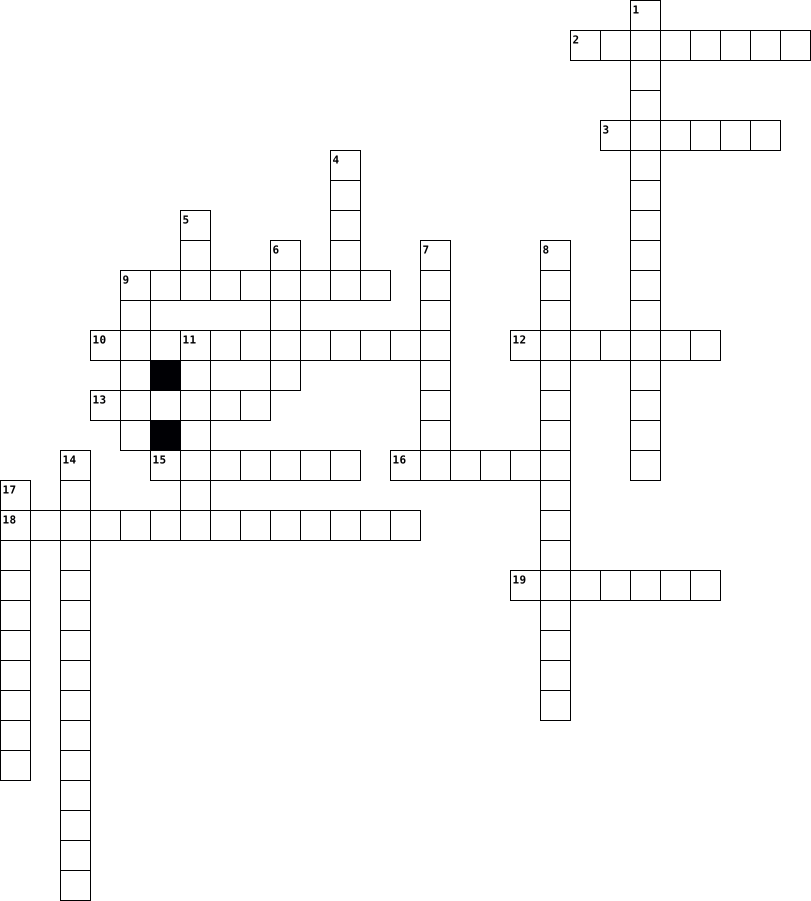
Across
- american indians watched the railroad.(wk 21)
- British would have to ______ in order to win. (wk 15)
- the Maine and Missouri ______ wanted to become states.(wk 18)
- the _______ of each southern states. (wk 20)
- Lincoln and dug met in a sires of_____. (wk 18)
- the leaders of the _____ were not strangers to each other. (wk 19)
- _____ were forced to leave their homes. (wk16)
- the telegraph seplfied the way _______ sent messages. (wk 17)
- the corps discovery arrived back in st Louis in September _____.
- inventor _______ Arkwright. (wk 17)
Down
- in ______ the sale of Louisiana territory. (wk 15)
- ____ to the civil war. (wk 20)
- we are now engaged in a great civil ____. (wk 19)
- stay warm in every colony and then in every ____. (wk 18)
- ______ bought a controlling limestone company
- the United States suffered two great defeats in _____. (wk 15)
- president ________ Jefferson. (wk 15)
- ____ advanced in the 1800s to control system . (wk 17)
- the war of ____ crafted many issues. (wk 17)
- the battle of ______ in july 1863 lasted 3 days. (wk 19)
20 Clues: ____ to the civil war. (wk 20) • inventor _______ Arkwright. (wk 17) • president ________ Jefferson. (wk 15) • the _______ of each southern states. (wk 20) • the war of ____ crafted many issues. (wk 17) • american indians watched the railroad.(wk 21) • ______ bought a controlling limestone company • _____ were forced to leave their homes. (wk16) • ...
Kendra McCart - Gov. Unit 1 2024-09-19

Across
- required a government tax stamp on paper goods and all legal documents
- how many states sent representatives?
- some colonist still had hope of reconciliation so colonist send one final appeal & delegates pledged continuing loyalty
- enjoy the most independence from the crown
- secured independence from Great Britain
- headed by a prime minister who is chosen by parliament
- The seeds of democracy took root here
- life liberty and property
- three-fifths of the enslaved people in a state would be counted when determining a states population
- Government is legitimate only so long as the parties to the agreement hand over their power to the state
- refused to sign the constitution because it lacked a bill of rights
- two-chamber legislature
Down
- King of England in 1760
- Civil War in England when the __ was signed
- series of articles defending the constitution
- to become __ nine of thirteen states had to ratify
- seek to dominate society ex. North Korea
- upper house composed of nobles
- the supreme power to act within its territory and to control its external affairs
- formally approve
20 Clues: formally approve • King of England in 1760 • two-chamber legislature • life liberty and property • upper house composed of nobles • how many states sent representatives? • The seeds of democracy took root here • secured independence from Great Britain • seek to dominate society ex. North Korea • enjoy the most independence from the crown • ...
Chapter 9 2025-10-30

Across
- Each territory can decide for themselves means they have what
- Had 20 kids and chose to fight against slavery
- President of the Confederate states
- Vice president to Jefferson Davis
- Competed with Lincoln in his election, also debated him 7 times
- Where two days of fighting but no one died, the first fighting before war was declared
- the real name for the know nothing party
- What court case decided that black people were not citizens and had no right to sue
- Where did John Brown raid a federal armory
- What year did James Buchanan win presidency
Down
- "__________" Jackson, loyal to Virginia
- What made it law that slaves who escaped had to be returned to their owners
- slave states who joined the union
- what means to leave, 9 states did this?
- Underground railroad
- Wrote "Uncle Tom's Cabin"
- Won the election in 1860
- (ABBR) which state left first?
- the first to start a rebellion against slavery
- Anti-slavery party who wanted Free speech Free men and Free Labor
20 Clues: Underground railroad • Won the election in 1860 • Wrote "Uncle Tom's Cabin" • (ABBR) which state left first? • slave states who joined the union • Vice president to Jefferson Davis • President of the Confederate states • "__________" Jackson, loyal to Virginia • what means to leave, 9 states did this? • the real name for the know nothing party • ...
Ch. 3: Federalism 2019-01-18

Across
- grant / categorical grant awarded on the basis of competitive applications submitted by prospective recipients.
- grant / grant-in-aid targeted for a specific purpose by formula or by project.
- / requirement laid down by act of Congress prohibiting a state or local government from exercising a certain power.
- grant / categorical grant distributed according to a particular formula that specifies who is eligible for the grant and how much they will receive.
- / quality of being supreme in power or authority.
- federalism / view that holds that the Constitution is an agreement among people who are citizens of both state and nation, so there is little distinction between state powers and national powers.
- governments / government unit that administers a city or town.
- grant / grant-in-aid awarded for general purposes, allowing the recipient great discretion in spending the grant money.
- / power of Congress to enacts laws by which the nationals government assumes total or partial responsibility for a state government function.
- / requirement that a state undertake an activity or provide a service in keeping with minimum national standards.
Down
- federalism / view that national government may impose its policy preferences in the states through regulations in the form of mandates and restraints.
- rights / idea that all rights not specifically conferred on the national government by the Constitution are reserved for the states.
- districts / government unit created to perform particular functions, especially when those functions are best performed across jurisdictional boundaries.
- / money provided by one level of government to another, to be spent for a given purpose.
- clause / last clause in Section 8 of Article I of the Constitution, which gives Congress the means to execute its enumerated powers.
- / division of power between a central government and regional governments.
- clause / third clause in Section 8 of Article I of the Constitution, which gives Congress the power to regulate commerce among the states.
- federalism / view that holds the Constitution is a compact among sovereign states, so that the powers of the national government are fixed and limited.
- powers / powers that Congress requires in order to execute its enumerated powers.
- governments / government unit that administers a county.
20 Clues: / quality of being supreme in power or authority. • governments / government unit that administers a county. • governments / government unit that administers a city or town. • / division of power between a central government and regional governments. • grant / grant-in-aid targeted for a specific purpose by formula or by project. • ...
Unit 6 Vocabulary 2018-02-09

Across
- Congressman who represented the wants of the southern states
- an important trade trail west from Independence, Missouri, to Santa Fe, New Mexico
- law passed in 1803 that forced many Native American nations to move west of the Mississippi River
- Treaty ending Mexican War and granting vast territories to the United States
- the right to vote
- the right of states to limit the power of the federal government
- the sixth president
- declaring the new tariff illegal
- led the Mormon migration to Utah
- founder of Texas
- 8th President during his presidency America went through an economic crisis called the Panic of 1837
- road built by the federal government in early 1800s that extended from Maryland to Illinois
- Congressman who represented the wants of the western states
- canal completed in 1825 that connected Lake Erie to the Hudson River
Down
- 10th President he took over for Harrison when he died
- A political party formed by supporters of Andrew Jackson after the presidential election of 1824
- Texans defeated Mexicans gaining their independence
- 9th President he served the shortest term as president, only 31 days
- leader of the Texas revolution and the first president of the republic of texas
- to add or take over
- purchase of land from mexico in 1853 that established the present U.S.-mexico boundary
- 11th President during his presidency America gained Texas, and Mexican Cession, and the Gadsden Purchase
- trail from independence Missouri to Oregon used by many pioneers during the 1840s
- Mexican territory surrendered to the United States at the end of the war with Mexico
- the practice of giving supporters government jobs
- Political party formed in 1834 to oppose policies of Andrew Jackson
- the forced removal of Cherokees and their transportation to Oklahoma
- people who went to California during the gold rush of 1849
- 1800s belief the America had the right to spread across the continent
- trappers who explored and hunted in Oregon territory
- spanish mission in san antonio, texas
- to give up
32 Clues: to give up • founder of Texas • the right to vote • to add or take over • the sixth president • declaring the new tariff illegal • led the Mormon migration to Utah • spanish mission in san antonio, texas • the practice of giving supporters government jobs • Texans defeated Mexicans gaining their independence • trappers who explored and hunted in Oregon territory • ...
Unit 3: Forming a New Nation Crossword Puzzle 2024-03-22

Across
- the system that allows each branch of government to limit the powers of the other two branches
- the “Age of Reason” in 17th- and 18th-century Europe. Enlightenment thinkers emphasized using rational thought to discover truths about nature and society.
- a basic set of ideas used to develop a larger plan
- a law passed by Congress in 1787 that specified how western lands would be governed
- to treat a person or group unfairly
- a country governed by elected representatives
- the plan of government adopted at the Constitutional Convention that established a two-house Congress. In the House of Representatives, representation from each state is based on state population. In the Senate, each state is represented by two senators.
- a region of the United States bounded by the Ohio and Mississippi rivers and the Great Lakes. The region was given to the United States by the Treaty of Paris in 1783.
- supporting ideas of freedom, change, and progress
- a difference between two statements or situations that means they cannot both be true
- to issues within a country
- the group established by the Constitution to elect the president and vice president. Voters in each state choose their electors.
- a written plan that provides the basic framework of a government
Down
- a meeting held in Philadelphia in 1787 at which delegates from the states wrote the U.S. Constitution
- relating to issues within a country
- the first written plan of government for the United States. A confederation is an association of states that cooperate for a common purpose.
- to formally approve a plan or an agreement. The process of approval is called ratification.
- an agreement made at the Constitutional Convention stating that enslaved persons would be counted as three-fifths of a person when determining a state’s population for representation in the House of Representatives
- a group of people or things with obvious differences among them
- to agree or pledge to support someone or something
- a strong disagreement
21 Clues: a strong disagreement • to issues within a country • relating to issues within a country • to treat a person or group unfairly • a country governed by elected representatives • supporting ideas of freedom, change, and progress • a basic set of ideas used to develop a larger plan • to agree or pledge to support someone or something • ...
The War of 1812 pgs. 360-367 2023-04-25

Across
- (2 words) This man led an army that forced the British to retreat.
- A devotion to one's country.
- Tecumseh was killed during this battlem but American Indian nations continued his fight.
- (2 words) a Government's actions toward other nations.
- (3 words) This captain forced british ships on Lake Erie to surrender.
- A Shawnee chief who wanted to unite all American Indian nations west of the Appalachian Mountains.
- (2 words) This battle was an important victory for the United States in the War of 1812.
- This created the most interest in the national flag of the United States
- (2 words) This doctrine warned other countries that the United States might act to protect te Western Hemisphere.
- An official statement of policy.
- (3 words) This man thought Tecumseh and his followers were a threat.
Down
- A economic success and security.
- (2 words)This man was elected president in 1808.
- (3 words) This lawyer watched the battle in the Baltimore Harbor.
- (2 words) This man was trying to keep the United States neutral during the war between Britain and France.
- (2 words)This first lady collected important documents and took them to safety when the British Army were headed to the White House.
- (2 words) A painting of this famous president Dolley refused to leave with out.
- (2 words) This person published the first dictionary of English that was uniquely American.
- When British soldiers captured American sailors and forced them to serve in the British Navy.
- (2 words) During the Battle of Lake Champlain British and U.S. troops fired annons at each other across this river.
- On June 18, 1812 Congress decared war against this country.
21 Clues: A devotion to one's country. • A economic success and security. • An official statement of policy. • (2 words)This man was elected president in 1808. • (2 words) a Government's actions toward other nations. • On June 18, 1812 Congress decared war against this country. • (3 words) This lawyer watched the battle in the Baltimore Harbor. • ...
New Nation 2021-12-12

Across
- The act of negotiating alliances, treaties, and agreements between nations
- An artificial waterway
- Republicans: Member or supporter of the Democratic-Republican party
- Something done or said that becomes an example for other to follow
- Hawks: A term used in politics for someone who favors war or continuing to escalate an existing conflict as opposed to other solutions
- and Proper Clause: A section of the U.S. Constitution that enables Congress to make the laws
- Seizing people against their will and forcing them to serve in the military or other public service
- A strong sense of devotion to one’s country
- Dealing with or occuring inside a country
- Commerce: Economic activity taking place between two or more states
- Member or supporter of the Federalist party
- A group of people who are in charge of the executive departments and help the President make decisions and policy
Down
- A court’s power or right to hear and decide cases
- Clause: An article of the U.S. Constitution that establishes the supremacy of the Constitution itself over any other law established within the country
- A device that used electronic signals to send messages
- Dealing with or relating to other countries
- Firmly favoring one party or faction
- A prohibition or blocking of trade with a certain country (used as an economic punishment or sanction)
- Activities aimed at weakening the established government by inciting resistance or rebellion to authority
- To withdraw or break away from a nation or organization
- A person living in a country that is not a citizen of the country
- Rights: The idea that states should have all the powers that the Constitution does not give to the federal government or forbid the states
22 Clues: An artificial waterway • Firmly favoring one party or faction • Dealing with or occuring inside a country • Dealing with or relating to other countries • A strong sense of devotion to one’s country • Member or supporter of the Federalist party • A court’s power or right to hear and decide cases • A device that used electronic signals to send messages • ...
New Nation 2021-12-12

Across
- The act of negotiating alliances, treaties, and agreements between nations
- Clause: An article of the U.S. Constitution that establishes the supremacy of the Constitution itself over any other law established within the country
- An artificial waterway
- Dealing with or occuring inside a country
- Commerce: Economic activity taking place between two or more states
- A device that used electronic signals to send messages
- A person living in a country that is not a citizen of the country
- Seizing people against their will and forcing them to serve in the military or other public service
- Dealing with or relating to other countries
- A court’s power or right to hear and decide cases
Down
- Something done or said that becomes an example for other to follow
- and Proper Clause: A section of the U.S. Constitution that enables Congress to make the laws
- Activities aimed at weakening the established government by inciting resistance or rebellion to authority
- Rights: The idea that states should have all the powers that the Constitution does not give to the federal government or forbid the states
- A prohibition or blocking of trade with a certain country (used as an economic punishment or sanction)
- A strong sense of devotion to one’s country
- A group of people who are in charge of the executive departments and help the President make decisions and policy
- To withdraw or break away from a nation or organization
- Member or supporter of the Federalist party
- Firmly favoring one party or faction
- Republicans: Member or supporter of the Democratic-Republican party
- Hawks: A term used in politics for someone who favors war or continuing to escalate an existing conflict as opposed to other solutions
22 Clues: An artificial waterway • Firmly favoring one party or faction • Dealing with or occuring inside a country • A strong sense of devotion to one’s country • Member or supporter of the Federalist party • Dealing with or relating to other countries • A court’s power or right to hear and decide cases • A device that used electronic signals to send messages • ...
American Revolution to Washington's Presidency 2024-02-15

Across
- The location where the Constitutional Convention took place in 1787.
- The turning point battle of the American Revolution (1777).
- The branch of government responsible for interpreting laws.
- The rebellion by American farmers against taxation and debt in 1786-1787.
- The agreement that established a system of government for the United States before the Constitution.
- The "Father of the American Navy" and a naval hero during the American Revolution.
- The first ten amendments to the U.S. Constitution.
- The decisive American victory led by Washington on Christmas night (1776).
- The system that allows each branch of government to limit the powers of the other branches.
- The winter encampment where Washington's troops faced harsh conditions (1777-1778).
- The battle where Washington's army faced harsh winter conditions in 1777-1778.
- The first battle of the American Revolution (1775)
Down
- The document declaring the thirteen American colonies independent from British rule.
- The first Secretary of the Treasury and architect of the financial system
- Washington's farewell address warned against the dangers of political parties and foreign alliances.
- The compromise that settled the dispute between slave and free states during the Constitutional Convention.
- The first Vice President of the United States.
- The compromise that determined how slaves would be counted for representation in the Constitution.
- The treaty that improved relations between the United States and Britain in 1795.
- The series of essays written to encourage ratification of the U.S. Constitution.
- The treaty that officially ended the American Revolution (1783).
- The rebellion against the newly formed federal government over taxes on whiskey (1794).
- The final battle of the American Revolution in 1781.
23 Clues: The first Vice President of the United States. • The first ten amendments to the U.S. Constitution. • The first battle of the American Revolution (1775) • The final battle of the American Revolution in 1781. • The turning point battle of the American Revolution (1777). • The branch of government responsible for interpreting laws. • ...
Cold War Crossword 2024-04-30

Across
- more than 40 countries of the UN sent troops, equipment, or other aid to South Korea during this war
- The secretary-general of the Communist Party of the Soviet Union
- A term used by Winston Churchill in a speech to describe the growing divide between western democracies and Soviet-influenced states
- Ongoing political rivalry between the United States and the Soviet Union
- When the cold war started (A year spelled out)
- First named the European Recovery Program, but better known as
- First Secretary of the Communist Party of the Soviet Union from 1953 to 1964
- Economic system where the government decides how wealth is distributed
- Proposed by Pres. Harry S. Truman to justify sending military aid to Greece and Turkey in the 1940s
- Event in 1948 that supplied food and fuel to citizens of west Berlin when the Russians closed off land access to Berlin
- Military alliance originally established in 1949 to create a counterweight to Soviet armies stationed in central and eastern Europe after World War II
Down
- Communist leader of China who was responsible for the deaths of 45 million Chinese people during his rule
- Prime Minister of the United Kingdom from 1940 to 1945
- What crisis occurred from October 16th 1962 to October 29th
- 33rd president of the United States
- A U.S. foreign policy aimed at checking the alleged expansionist intentions of the Soviet Union
- Created by the Communist government after the Bolshevik Revolution of 1917
- Described a period of intense anti-communism in the United States during the early 1950s
- Economic system based on private ownership, working hard, and rich getting richer
- Countries subject to Soviet domination located on the western border of U.S.S.R
20 Clues: 33rd president of the United States • When the cold war started (A year spelled out) • Prime Minister of the United Kingdom from 1940 to 1945 • What crisis occurred from October 16th 1962 to October 29th • First named the European Recovery Program, but better known as • The secretary-general of the Communist Party of the Soviet Union • ...
Cold War 2024-04-26

Across
- a period of intense anti-communism in the United States during the early 1950s.
- An independent agency of the U.S.
- a guarded concrete wall, 28 miles long, across the city of Berlin
- The belief that if the United States allowed one country to fall to Communism, then many more would follow suit
- The dropping of thousands of tons of food and medical supplies to starving West Berliners
- A bomb that rapidly releases nuclear energy
- relies on a larger nation for political direction and economic support
- An organization formed in 1949 that bound the United States, Canada, most of Western Europe
- A US foreign policy doctrine that argued that the Soviet Union needed to be “contained”
- A world Organization that was formed to prevent war.
- an economic system based on the private ownership of capital (land, resources and other means of production)
Down
- a war started by a powerful country in which it does not fight in directly.
- An economic theory in which collective ownership of property leads to a classless society
- A list of suspected communist who were unable to get work in the movie industry.
- responsible for the civilian space program
- an acronym for a committee of the US Congress.
- The race where the U.S.A and USSR built rockets
- a foreign policy adopted by Jimmy Carter in 1980. It pledged to protect American allies
- the promotion of fear of a potential rise of communism or radical leftism, used by anti-leftist
- a period of competition or rivalry between two or more nations, focusing on the production of military technology and equipment
- A term used to describe the growing divide between western democracies and Soviet-influenced states
21 Clues: An independent agency of the U.S. • responsible for the civilian space program • A bomb that rapidly releases nuclear energy • an acronym for a committee of the US Congress. • The race where the U.S.A and USSR built rockets • A world Organization that was formed to prevent war. • a guarded concrete wall, 28 miles long, across the city of Berlin • ...
Civil War Review 2022-04-11

Across
- the Union General who replaced McClellan and should have won best facial hair.
- The battle where Lee was forced to surrender to Ulysses S Grant
- The turning point of the Civil War and bloodiest battle. This will be the last battle where General Lee and the Confederate Army attacks on Union soil
- The main general for the Confederate Army. Will surrender to Grant at Appomattox Courthhouse.
- This proclamation freed all slaves in the rebelling states.
- South Carolina decided to do this after Lincoln became President of the United States. Other southern states will follow after the attack at Fort Sumter
- These states had slavery but did not secede with the Confederate states
- The Union General who was fired after defeating Lee at the battle of Antietam and defying Lincoln's order to pursue him
- Caused the prices of goods to go up, especially in the Confederacy.
- the name of the U.S. General who would win the war for the Union
- People from Washington D.C. show up to this battle with picnics to watch the first battle of the war. They initially believed the Confederacy would be run off the battlefield and the war would be over quickly. This battle proves them wrong.
Down
- This battle secured the Mississippi for the Union and cut the Confederacy in half
- The battle at this Fort was the first conflict of the Civil War
- President of the Confederacy
- Single bloodiest day of the Civil War. Lee's first attempt to attack the Union
- The name of the Union plan to win the war
- the type of ship used in the Battle of Hampton Roads. This battle will change navy warfare forever, because now wooden ships are seen as useless.
- The Union General who adopted a scorched earth policy as he Marched his men through Georgia to Savannah
- The nickname of the Confederate General who is fatally wounded by his own man at the Battle of Chancellorsville.
- this event happened in New York as working class men were angered that they were being forced to serve in the army.
20 Clues: President of the Confederacy • The name of the Union plan to win the war • This proclamation freed all slaves in the rebelling states. • The battle at this Fort was the first conflict of the Civil War • The battle where Lee was forced to surrender to Ulysses S Grant • the name of the U.S. General who would win the war for the Union • ...
Ch. 3: Federalism 2019-01-18

Across
- grant categorical grant distributed according to a particular formula that specifies who is eligible for the grant and how much they will receive.
- federalism view that national government may impose its policy preferences in the states through regulations in the form of mandates and restraints.
- federalism view that holds that the Constitution is an agreement among people who are citizens of both state and nation, so there is little distinction between state powers and national powers.
- districts government unit created to perform particular functions, especially when those functions are best performed across jurisdictional boundaries.
- grant grant-in-aid targeted for a specific purpose by formula or by project.
- governments government unit that administers a county.
- money provided by one level of government to another, to be spent for a given purpose.
- power of Congress to enacts laws by which the nationals government assumes total or partial responsibility for a state government function.
- federalism view that holds the Constitution is a compact among sovereign states, so that the powers of the national government are fixed and limited.
- grant categorical grant awarded on the basis of competitive applications submitted by prospective recipients.
Down
- rights idea that all rights not specifically conferred on the national government by the Constitution are reserved for the states.
- requirement that a state undertake an activity or provide a service in keeping with minimum national standards.
- grant grant-in-aid awarded for general purposes, allowing the recipient great discretion in spending the grant money.
- quality of being supreme in power or authority.
- division of power between a central government and regional governments.
- requirement laid down by act of Congress prohibiting a state or local government from exercising a certain power.
- governments government unit that administers a city or town.
- clause last clause in Section 8 of Article I of the Constitution, which gives Congress the means to execute its enumerated powers.
- powers powers that Congress requires in order to execute its enumerated powers.
- clause third clause in Section 8 of Article I of the Constitution, which gives Congress the power to regulate commerce among the states.
20 Clues: quality of being supreme in power or authority. • governments government unit that administers a county. • governments government unit that administers a city or town. • division of power between a central government and regional governments. • grant grant-in-aid targeted for a specific purpose by formula or by project. • ...
Unit 3: Forming a New Nation Crossword Puzzle 2024-03-22

Across
- the system that allows each branch of government to limit the powers of the other two branches
- the “Age of Reason” in 17th- and 18th-century Europe. Enlightenment thinkers emphasized using rational thought to discover truths about nature and society.
- a basic set of ideas used to develop a larger plan
- a law passed by Congress in 1787 that specified how western lands would be governed
- to treat a person or group unfairly
- a country governed by elected representatives
- the plan of government adopted at the Constitutional Convention that established a two-house Congress. In the House of Representatives, representation from each state is based on state population. In the Senate, each state is represented by two senators.
- a region of the United States bounded by the Ohio and Mississippi rivers and the Great Lakes. The region was given to the United States by the Treaty of Paris in 1783.
- supporting ideas of freedom, change, and progress
- a difference between two statements or situations that means they cannot both be true
- to issues within a country
- the group established by the Constitution to elect the president and vice president. Voters in each state choose their electors.
- a written plan that provides the basic framework of a government
Down
- a meeting held in Philadelphia in 1787 at which delegates from the states wrote the U.S. Constitution
- relating to issues within a country
- the first written plan of government for the United States. A confederation is an association of states that cooperate for a common purpose.
- to formally approve a plan or an agreement. The process of approval is called ratification.
- an agreement made at the Constitutional Convention stating that enslaved persons would be counted as three-fifths of a person when determining a state’s population for representation in the House of Representatives
- a group of people or things with obvious differences among them
- to agree or pledge to support someone or something
- a strong disagreement
21 Clues: a strong disagreement • to issues within a country • relating to issues within a country • to treat a person or group unfairly • a country governed by elected representatives • supporting ideas of freedom, change, and progress • a basic set of ideas used to develop a larger plan • to agree or pledge to support someone or something • ...
Unit 3: Forming a New Nation Crossword Puzzle 2024-03-22

Across
- the system that allows each branch of government to limit the powers of the other two branches
- the “Age of Reason” in 17th- and 18th-century Europe. Enlightenment thinkers emphasized using rational thought to discover truths about nature and society.
- a basic set of ideas used to develop a larger plan
- a law passed by Congress in 1787 that specified how western lands would be governed
- to treat a person or group unfairly
- a country governed by elected representatives
- the plan of government adopted at the Constitutional Convention that established a two-house Congress. In the House of Representatives, representation from each state is based on state population. In the Senate, each state is represented by two senators.
- a region of the United States bounded by the Ohio and Mississippi rivers and the Great Lakes. The region was given to the United States by the Treaty of Paris in 1783.
- supporting ideas of freedom, change, and progress
- a difference between two statements or situations that means they cannot both be true
- to issues within a country
- the group established by the Constitution to elect the president and vice president. Voters in each state choose their electors.
- a written plan that provides the basic framework of a government
Down
- a meeting held in Philadelphia in 1787 at which delegates from the states wrote the U.S. Constitution
- relating to issues within a country
- the first written plan of government for the United States. A confederation is an association of states that cooperate for a common purpose.
- to formally approve a plan or an agreement. The process of approval is called ratification.
- an agreement made at the Constitutional Convention stating that enslaved persons would be counted as three-fifths of a person when determining a state’s population for representation in the House of Representatives
- a group of people or things with obvious differences among them
- to agree or pledge to support someone or something
- a strong disagreement
21 Clues: a strong disagreement • to issues within a country • relating to issues within a country • to treat a person or group unfairly • a country governed by elected representatives • supporting ideas of freedom, change, and progress • a basic set of ideas used to develop a larger plan • to agree or pledge to support someone or something • ...
Reconstruction 2022-06-03

Across
- crow Laws laws that required segregation were common in southern states in the 1800s
- Louisiana quickly elected a new legislature under this ten percent plan
- Hiram revels born free in North Carolina and went to college in Illinois
- sneaked into the president's theater box and shot Abe Lincoln
- The process of reuniting the nation and rebuilding the southern states without slavery
- The included the following provisions
- Under the a state had to meet two conditions before it could rejoin the union
- reconstruction acts divided the south into five districts with the us military commander in control of each district
Down
- The gave African American men throughout the United States the right to vote
- Vice president was sworn into presidency that morning
- wanted the southern states to change much more than they had before they could return to the union
- Redeemer governments also introduced legal this forced the whites to separate from african americans
- amendment congress proposed the to the constitution it made slavery illegal throughout the u.s
- Southern democrats referred to them as
- Many white southerners called these republicans
- in 1865 congress established its purpose was to provide relief for all the poor people
- Thought that the black codes were cruel and unjust
- passed the law that greatly limited the freedom of african americans to sign work contracts
18 Clues: Southern democrats referred to them as • The included the following provisions • Many white southerners called these republicans • Thought that the black codes were cruel and unjust • Vice president was sworn into presidency that morning • sneaked into the president's theater box and shot Abe Lincoln • ...
Bisma Younas 2024-02-13

Across
- The first vote of the convetion is to keep their proceeding absolutely ___________.
- At least ____________ states need to agree to the Constitution for it to become official
- laws The biggest obstacle facing the Continental Congress was
- THe states had different ____________.
- Nine-thirteenths of the delegates to agree To pass a new law in the Confederation Congress
- Alexander Hamilton hated congress, the world, and __________
- The __________ decide to scrap the Articles of Confederation
- Who graphs the Bill Of Rights? (James __________)
- Some people were afraid of losing ________- to the national government
- America is founded on _________ pieces of paper.
Down
- depression The states were falling into a ___________ ______________
- People did not want to pay _________ because they claimed that the Americans government was acting like the Brititsh government
- of Prussia Nathaniel Gorham asked who to come to the United States and become the king
- Those who opposed the Constitution were called ________.
- Those who were in favor of the Consitution were called ___________.
- One of the reasons that Alexander Hamiliton thought that U.S. would be a future power was because? (natural ____________)
- In the end the Consitution is ____________. (approved)
- Who was a popular federalist? (Noah ___________)
- what did the loyalists feel like after moving to Canada or England
- The antifeleralists feared that the government way too ________________.
20 Clues: THe states had different ____________. • Who was a popular federalist? (Noah ___________) • America is founded on _________ pieces of paper. • Who graphs the Bill Of Rights? (James __________) • In the end the Consitution is ____________. (approved) • Those who opposed the Constitution were called ________. • ...
House Divided Speech 2026-01-12

Across
- an unstable, dangerous situation
- the compromise that named Missouri as a slave state
- 1861 battle in Charlston Harbor, SC- confederate victory
- won the 1860 Election
- states who relied on industrialization
- the powers with control cannot agree
- to open/strech something over a larger area
- norther states
- a defined area of land that is controlled by a government
- repealed the Missouri Compromise
- amendment that granted citizenship to all people born in the US
- 1863 battle in Warren County, MS- union victory
- 1863 battle in Adams County, PA- union victory
- movements that promoted the abolishment of slavery
Down
- to formally end or eliminate
- protected the right to vote for all US citizens
- president during the civil war
- war fought in the US because of slavery
- amendment that abolished slavery
- 1862 battle in Washington County, MD- union victory
- the dying out or disappearance of a thing or movement
- a large, established organization
- allowed settlers of a state to decide on the slavery laws
- states who relied on slavery for farming
- 1862 battle in Washington County, MD- union victory
- a system in which people are "owned" and forced to work by others
- southern states
- 1861 battle in Fairfax County, VA- confederate victory
- living through hardship
- final and most extreme of its kind
30 Clues: norther states • southern states • won the 1860 Election • living through hardship • to formally end or eliminate • president during the civil war • an unstable, dangerous situation • amendment that abolished slavery • repealed the Missouri Compromise • a large, established organization • final and most extreme of its kind • the powers with control cannot agree • ...
House Divided Speech 2026-01-12

Across
- an unstable, dangerous situation
- the compromise that named Missouri as a slave state
- 1861 battle in Charlston Harbor, SC- confederate victory
- won the 1860 Election
- states who relied on industrialization
- the powers with control cannot agree
- to open/strech something over a larger area
- norther states
- a defined area of land that is controlled by a government
- repealed the Missouri Compromise
- amendment that granted citizenship to all people born in the US
- 1863 battle in Warren County, MS- union victory
- 1863 battle in Adams County, PA- union victory
- movements that promoted the abolishment of slavery
Down
- to formally end or eliminate
- protected the right to vote for all US citizens
- president during the civil war
- war fought in the US because of slavery
- amendment that abolished slavery
- 1862 battle in Washington County, MD- union victory
- the dying out or disappearance of a thing or movement
- a large, established organization
- allowed settlers of a state to decide on the slavery laws
- states who relied on slavery for farming
- 1862 battle in Washington County, MD- union victory
- a system in which people are "owned" and forced to work by others
- southern states
- 1861 battle in Fairfax County, VA- confederate victory
- living through hardship
- final and most extreme of its kind
30 Clues: norther states • southern states • won the 1860 Election • living through hardship • to formally end or eliminate • president during the civil war • an unstable, dangerous situation • amendment that abolished slavery • repealed the Missouri Compromise • a large, established organization • final and most extreme of its kind • the powers with control cannot agree • ...
The "Federal" in Federalism 2022-04-25

Across
- Powers that are actually stated in the constitution
- The country that ruled the American colonies before the Revolutionary War
- The federal government gets all of its power from this
- Division of power between a central government and state governments
- Special name for powers that both the states and federal government share
- Powers that are not actually stated in the Constitution
Down
- Clause that says federal laws are superior to state laws
- When America was born, each state already had one of these
- A word that describes the relationship of the states in America
- Type of government where the central government gets its power from the states
- Type of government where the central government has all the power
- Type of government where states and a central government share power
- The necessary and proper clause is also known as the[ BLANK] clause
13 Clues: Powers that are actually stated in the constitution • The federal government gets all of its power from this • Powers that are not actually stated in the Constitution • Clause that says federal laws are superior to state laws • When America was born, each state already had one of these • A word that describes the relationship of the states in America • ...
Chapter 15: Civil War & Reconstruction 2012-03-29

Across
- the closing of an area to keep people or supplies from moving in or out
- to charge a government official with wrongdoing
- laws passed by Southern states after Reconstruction that established segregation
- announcement made by President Lincoln that led to the end of slavery in Confederate States
- a person who is not in the armed forces
- laws passed by Southern states after the Civil War that limited the rights of newly-freed African-Americans
- the period after the Civil War in which Congress passed laws designed to bring Southern states back into the Union
- officially established African-Americans as citizens with the same rights as whites
- the speech made by President Lincoln at the site of this battle
- a war in which both sides strike against each other's soldiers, civilians, and economy
- the process of selection of men for compulsory military service
Down
- the war between the Union and the Confederacy
- a system in which farmers rented land from the owner and paid with a share of their crops
- made it illegal to withhold voting rights "on account of race or color"
- it abolished slavery
- a government agency that provided food, schools, and medical care for freed slaves in the South
- the separation of people, usually based on race or religion
- the Union’s 3-step plan for defeating the Confederacy in the Civil War
18 Clues: it abolished slavery • a person who is not in the armed forces • the war between the Union and the Confederacy • to charge a government official with wrongdoing • the separation of people, usually based on race or religion • the speech made by President Lincoln at the site of this battle • the process of selection of men for compulsory military service • ...
Reconstruction Crossword Puzzle 2024-04-11

Across
- Granted citizenship and equal civil and legal rights to anyone born in the United States or who became a citizen of the country
- A system where the landlord allows a former slaves to use the land in exchange for a share of the crop
- A white Southerner who collaborated with northern Republicans during Reconstruction, often for personal profit
- 17th President
- A faction within the Republican Party
Down
- A U.S. government agency of early post American Civil War Reconstruction, assisting freedmen in the South
- An American Republican politician, minister in the African Methodist Episcopal Church, and a college administrator
- A process by which a legislative body or other legally constituted tribunal initiates charges against a public official for misconduct
- A largely historical pejorative used by Southerners to describe allegedly opportunistic or disruptive Northerners who came to the Southern states
- Reintegrating the former Confederate States of America into the United States
- Laws passed at different periods in the southern United States to enforce racial segregation and curtail the power of Black voters
- A bill to guarantee to certain States whose governments have been usurped or overthrown a republican form of government
12 Clues: 17th President • A faction within the Republican Party • Reintegrating the former Confederate States of America into the United States • A system where the landlord allows a former slaves to use the land in exchange for a share of the crop • A U.S. government agency of early post American Civil War Reconstruction, assisting freedmen in the South • ...
Enthalpy 2022-01-13

Across
- a push or a pull
- Do these increase or decrease a reaction rate: stirring, adding heat, adding a catalyst, increasing the concentration
- Do these increase or decrease a reaction rate: cooling down, adding water, adding less reactants
- The change in heat.
- the rate at which an object speeds up or slows down.
- Newtons law that states force is equal to the change in momentum per the change in time.
- Newtons law that states an object at rest will stay at rest and an object in motion will stay in motion.
- Newtons law that states forces always come in pairs, equal in size, and opposite in direction.
Down
- a chemical used to speed up a reaction.
- speed
- The release of heat leaving the surrounds warmer.
- mass in motion
- The Conservation of ___ states that a substance cannot be created or destroyed.
- the molecules that come out of a reaction.
- 6.02 x 10^23 atoms
- The absorption of heat leaving the surrounds colder.
- the molecules that go in to a reaction.
17 Clues: speed • mass in motion • a push or a pull • 6.02 x 10^23 atoms • The change in heat. • a chemical used to speed up a reaction. • the molecules that go in to a reaction. • the molecules that come out of a reaction. • The release of heat leaving the surrounds warmer. • the rate at which an object speeds up or slows down. • The absorption of heat leaving the surrounds colder. • ...
Civil War Crossword 2024-12-10

Across
- Nickname of Confederate General Thomas J. Jackson
- Leading General of the Confederate army
- ______ Court House; Site where Robert E Lee surrendered to Ulysses S. Grant
- Essential for transporting troops in the Civil War
- ____'s Theater; Site of President Lincoln assassination
- The South Army
- City captured by Sherman during his "March to the Sea"
- The Northern States during the Civil War
- Communication tool Lincoln called "lightning messages"
- Political party of Lincoln
- Presedient during the Civil War
- John Wilkes _____; Assassin of President Lincoln
- The first major battle of the Civil War, also known as Manassas
Down
- Commanding general of the Union Army
- ______ Douglass;Former enslaved and leading abolitionist
- _____ States; Maryland, Missouri, West Virginia, Deleware,Kentucky
- The act of states leaving the Union
- Capital of the Confederacy
- Bloodiest single day battle in American History
- City that the "March to the Sea" started at
- The primary cause of the Civil War
- Document that declared slaves freedom in Confederate States
- Turning Point of the Battle in Pennsylvania
- _________ Van Lew; A union women spy during the civil war
24 Clues: The South Army • Capital of the Confederacy • Political party of Lincoln • Presedient during the Civil War • The primary cause of the Civil War • The act of states leaving the Union • Commanding general of the Union Army • Leading General of the Confederate army • The Northern States during the Civil War • City that the "March to the Sea" started at • ...
Mid-Term Project: Constitution Crossword Puzzle 2023-11-06

Across
- The group of influential individuals who played a pivotal role in shaping the Constitution and the United States.
- The two-house system of Congress outlined in the Constitution, consisting of the House of Representatives and the Senate.
- A series of essays written by Alexander Hamilton, James Madison, and John Jay, advocating for the ratification of the U.S. Constitution.
- This amendment alters the process of electing the President and Vice President.
- This amendment addresses lawsuits against states in federal courts.
- The clause in the Constitution that establishes federal law as the supreme law of the land, overriding state laws in the event of a conflict.
- This amendment limits the President to two terms in office.
- This article defines the authority and role of the judicial branch, ensuring justice is upheld.
- The power of the courts, particularly the Supreme Court, to review and potentially invalidate laws or government actions that are deemed unconstitutional.
- This amendment grants equal protection under the law to all citizens.
- This amendment gives citizens freedom of speech, religion, and the press.
- This amendment abolished slavery inFifteened States.
- The branch of government responsible for interpreting laws and ensuring justice.
- The powers shared by both the federal government and the states.
- The opening of the Constitution, outlining its purposes and goals.
- The powers granted to the federal government by the Constitution.
- This article focuses on the powers and duties of the executive branch, headed by the President.
- The branch of government responsible for enforcing and implementing laws.
- This amendment prohibits cruel and unusual punishment, setting standards for penalties.
- A legal action through which a person can seek relief from unlawful detention, ensuring that a person cannot be held without charges.
- This article emphasizes its supreme status and the supremacy of federal laws.
- The year when the Bill of Rights was ratified, adding the first ten amendments to the Constitution.
- This amendment lowered the voting age to 18.
- The first ten amendments to the U.S. Constitution, protecting individual rights.
- This amendment secures the right to bear arms.
- The constitutional principle that ensures no single branch of government becomes too powerful.
- This amendment prevents the quartering of troops in private homes during peacetime.
- This amendment deals with congressional pay adjustments.
- This amendment introduced Prohibition, banning the sale and consumption of alcohol.
- The location where the original U.S. Constitution was written and signed.
- This amendment defines the terms of the President and Congress.
Down
- This amendment established the direct election of U.S. Senators by popular vote.
- This amendment emphasizes states' rights, granting them powers not delegated to the federal government.
- This amendment guarantees the right to a speedy and public trial by an impartial jury.
- The process by which a government official, including the President, can be charged with misconduct and removed from office as specified in the Constitution.
- This amendment repealed Prohibition, allowing alcohol again.
- The branch of government responsible for making and passing laws.
- This amendment permits Congress to collect income taxes.
- This amendment safeguards unenumerated rights, ensuring people aren't denied fundamental liberties.
- This amendment ensures the right to vote regardless of race or color, this amendment is a milestone in civil rights.
- This amendment addresses presidential succession and disability.
- This amendment ensures due process and protection against self-incrimination, this amendment safeguards individual rights.
- The powers not delegated to the federal government and reserved for the states.
- This amendment secured women's right to vote.
- The trade and commercial activity between states, regulated by the Commerce Clause in the Constitution.
- The legal requirement that the government must respect the rights of individuals and provide fair legal procedures.
- This amendment secures the right to a jury trial in civil cases.
- This article details the powers and responsibilities of the legislative branch, making laws for the nation.
- The initial framework of government in the United States before the adoption of the U.S. Constitution, known for its limited central authority.
- This amendment grants residents of Washington, D.C., the right to vote in presidential elections.
- This article specifies the ratification process for the Constitution.
- This amendment prohibits poll taxes as a condition for voting.
- This article outlines the amendment process, allowing for changes to the document.
- The year when the U.S. Constitution was drafted and signed in Philadelphia.
- The division of power between the federal government and state governments, a foundational principle in the U.S. Constitution.
- The government's power to take private property for public use, with compensation to the property owner, as protected by the Constitution.
- The system for electing the President and Vice President, outlined in the Constitution
- This amendment protects against unreasonable searches and seizures, this amendment is crucial for privacy.
- The process by which foreign-born individuals become U.S. citizens, regulated by the Constitution and federal law.
- The formal approval or acceptance of the Constitution by the states.
- This article addresses the relationship between states and the federal government.
61 Clues: This amendment lowered the voting age to 18. • This amendment secured women's right to vote. • This amendment secures the right to bear arms. • This amendment abolished slavery inFifteened States. • This amendment permits Congress to collect income taxes. • This amendment deals with congressional pay adjustments. • ...
Causes of the Civil War 2023-04-18

Across
- The election of President Lincoln
- the withdrawal of 11 slave states
- an effort to initiate a slave revolt in Southern states
- Term for resources and money in the US
- the admission of California as a "free state,"
- States that bordered the North and South
- required that slaves be returned to their owners, even if they were in a free state
- repealed the Missouri Compromise, created two territories, and allowed for popular sovereignty
Down
- a series of violent civil confrontations in Kansas Territory
- Southern government
- A legislation of the US that balanced the North preventing the expansion of slavery and the South wanting the expansion
- Northern government
- the practice of forced labor and restricted liberty
- loyalty to a state or section rather than to the whole country.
- Even though he was in a free state and territory, it did not give him, an enslaved person, his freedom
15 Clues: Southern government • Northern government • The election of President Lincoln • the withdrawal of 11 slave states • Term for resources and money in the US • States that bordered the North and South • the admission of California as a "free state," • the practice of forced labor and restricted liberty • an effort to initiate a slave revolt in Southern states • ...
Causes of the Civil War 2023-04-18

Across
- The election of President Lincoln
- the withdrawal of 11 slave states
- an effort to initiate a slave revolt in Southern states
- Term for resources and money in the US
- the admission of California as a "free state,"
- States that bordered the North and South
- required that slaves be returned to their owners, even if they were in a free state
- repealed the Missouri Compromise, created two territories, and allowed for popular sovereignty
Down
- a series of violent civil confrontations in Kansas Territory
- Southern government
- A legislation of the US that balanced the North preventing the expansion of slavery and the South wanting the expansion
- Northern government
- the practice of forced labor and restricted liberty
- loyalty to a state or section rather than to the whole country.
- Even though he was in a free state and territory, it did not give him, an enslaved person, his freedom
15 Clues: Southern government • Northern government • The election of President Lincoln • the withdrawal of 11 slave states • Term for resources and money in the US • States that bordered the North and South • the admission of California as a "free state," • the practice of forced labor and restricted liberty • an effort to initiate a slave revolt in Southern states • ...
Causes of the Civil War 2023-04-18

Across
- The election of President Lincoln
- the withdrawal of 11 slave states
- an effort to initiate a slave revolt in Southern states
- Term for resources and money in the US
- the admission of California as a "free state,"
- States that bordered the North and South
- required that slaves be returned to their owners, even if they were in a free state
- repealed the Missouri Compromise, created two territories, and allowed for popular sovereignty
Down
- a series of violent civil confrontations in Kansas Territory
- Southern government
- A legislation of the US that balanced the North preventing the expansion of slavery and the South wanting the expansion
- Northern government
- the practice of forced labor and restricted liberty
- loyalty to a state or section rather than to the whole country.
- Even though he was in a free state and territory, it did not give him, an enslaved person, his freedom
15 Clues: Southern government • Northern government • The election of President Lincoln • the withdrawal of 11 slave states • Term for resources and money in the US • States that bordered the North and South • the admission of California as a "free state," • the practice of forced labor and restricted liberty • an effort to initiate a slave revolt in Southern states • ...
1950's Crossword Puzzle 2024-05-03

Across
- A main road, especially one connecting major towns or citie
- Involved the birth of almost 4 million babies a year during the 1950-1960's
- The capital city of Alabama that played a significant role in both American history and civil rights movements.
- Convicted of passing secret information about the atomic bomb to the Soviet Union in 1945 and sentenced to death.
- Committee which was charged with identifying Communist threats to the United States.
- A policy which stated that the US would give aid to any country threatened by communism.
- Movement aimed at gaining equal rights among races in the United States
- An outlying residential area of a city or town
- A strategy used by the United States to try to prevent the spread of Communism during the Cold War.
- Chief Justice of the Supreme Court who ruled that racial segregation in public schools unconstitutional.
- Activist who was arrested for refusing to give up her seat on a bus
Down
- Accused of being a communist and was later charged with perjury and espionage against the United States.
- A 13-month mass protest that ended with the U.S. Supreme Court ruling that segregation on public buses is unconstitutional.
- A period of moral panic provoked by fear of the rise, supposed or real, of leftist ideologies in a society, especially communism.
- A law that provided a range of benefits for some of the returning World War II veterans.
- An attempt by the Soviet Union to limit the ability of France, Great Britain and the United States to travel to their sectors of Berlin,
16 Clues: An outlying residential area of a city or town • A main road, especially one connecting major towns or citie • Activist who was arrested for refusing to give up her seat on a bus • Movement aimed at gaining equal rights among races in the United States • Involved the birth of almost 4 million babies a year during the 1950-1960's • ...
Unit 3 2023-02-13

Across
- was a late-18th-century political movement that opposed the creation of a stronger U.S. federal government and which later opposed the ratification of the 1787 Constitution.
- one of the framers of the Constitution, author of five of The Federalist Papers, and the first Chief Justice of the United States
- was a series of violent attacks oncourthouses and other government properties in Massachusetts that began in 1786 and led to a full-blown military confrontation in 1787
- talk about the duties of the three main parts of government: the Executive Branch, the Legislative Branch, and the Judicial Branch.
- system of government in which the same territory is controlled by two levels of government.
- made a major contribution to the ratification of the Constitution by writing The Federalist Papers, along with Alexander Hamilton and John Jay. In later years, he was referred to as the “Father of the Constitution.”
- change or addition to the terms of a contract, law, government regulatory filing, or other documents
- first 10 Amendments to the Constitution.
Down
- "We the People of the United States, in Order to form a more perfect Union, establish Justice, insure domestic Tranquility, provide for the common defense, promote the general Welfare, and secure the Blessings of Liberty to ourselves and our Posterity, do ordain and establish this Constitution for the United States of America.
- took place from May 14 to September 17, 1787, in Philadelphia, Pennsylvania. The point of the event was decide how America was going to be governed.
- a founding father of the United States, who fought in the American Revolutionary War, helped draft the Constitution, and served as the first secretary of the treasury. He was the founder and chief architect of the American financial system.
- This document served as the United States' first constitution.
- series of eighty-five essays urging the citizens of New York to ratify the new United States Constitution.
- defines the fundamental law of the U.S. federal government, setting forth the three principal branches of the federal government and outlining their jurisdictions.
- a fundamental truth or proposition that serves as the foundation for a system of belief or behavior or for a chain of reasoning.
15 Clues: first 10 Amendments to the Constitution. • This document served as the United States' first constitution. • system of government in which the same territory is controlled by two levels of government. • change or addition to the terms of a contract, law, government regulatory filing, or other documents • ...
Iron Curtain 2024-04-27

Across
- A military alliance for all the Western states.
- A form of government that the Soviet Union tried to put on the occupied territory they were in following WWII. A system of common ownership that distributes everything based on needs.
- A former British general who gave the famous Iron Curtain speech which lengthened the British and American Alliance helping them win the Cold War.
- The Soviet Union leader at the time
- A war between the Soviets and France, Britain, and America that was over the Soviets wanting to use Communism on the states they occupied after WWII and the rest saying thats not what we agreed on. The Iron Curtain was the division between the two sides in this war.
- A plan for America to send economic aid and help with post war economic infrastructure. It exposed the division between the East and West leading to the Iron Curtain.
- A Soviet Foreign policy that stated a socialist rule threat to own state in the Eastern Bloc was a threat to all of them and justified Czechoslovakia occupation.
- The name of Winston Churchills very famous speech in America where the term Iron Curtain was first introduced. It offered a blueprint for Westerners to win the war.
Down
- The country that placed the Iron Curtain and wanted to separate their new countries they occupied after WWII from the democratic form of government in the West.
- A document where the US will help anyone threatened by Soviet Union. It was influenced by the Iron Curtain and put in place after it.
- group of eastern European countries that were aligned militarily, politically, economically, and culturally with the Soviet Union during the Cold War.
- An imaginary boundary placed to separate Europe after WWII because the Soviets and the western states who occupied invaded European states after the war had different ideas on how to run the governments in the states they occupied.
- A physical part of the curtain separating Germany's capital.
- The first place where the boundary was removed and broken.
- A defense treaty among Soviet states in the Eastern part of Europe.
15 Clues: The Soviet Union leader at the time • A military alliance for all the Western states. • The first place where the boundary was removed and broken. • A physical part of the curtain separating Germany's capital. • A defense treaty among Soviet states in the Eastern part of Europe. • ...
by Kasay Nichols 2014-03-11

Across
- A person, group, or nation that is associated with another or others for some common cause or purpose
- Powers In World War I, Germany and Austria-Hungary, often with their allies Turkey and Bulgaria
- Boat A German Submarine
- Policy of extending the rule or authority of an empire or nation over foreign countries
- Franz Ferdinand An archduke of Austro-Hungarian
- Mans Land An area between opposing armies, over which no control has been established
- Form of communicated aimed towards influencing the attitude of the community toward some cause or position
- Exeditionary Force Were the United States Armed Forces sent to Europe in World War I
- A strong military spirit or policy
- of Versailles Peace treaty at the end of World War I, it ended the state of war between Germany and the Allied Powers
Down
- v United States A United States Supreme Court decision concerning enforcement of the Espionage Act of 1917 during World War I
- Wilson The 28th President of the United States
- Maine Commissioned in 1895, was the first US Navy ship to be named after the state of Maine
- Service Act Enacted May 18, 1917, authorized the federal government to raise a national army for the American entry into World War I through conscription
- Note The Zimmerman telegram was a 1917 diplomatic proposal from the German Empire for Mexico to join Central Powers in the event of the United States entering World War I
- A British luxury liner sunk by a German submarine in the North Atlantic on May 7, 1915
- Spirit or aspirations common to the whole of a nation
- Jackets Journalism that exploits, distorts, or exaggerates the news to create sensations and attract readers
- Warfare Combat in which each side occupies a system of protective trenches
- System A formal agreement or treaty between two or more nations to cooperate for specific purposes
20 Clues: Boat A German Submarine • A strong military spirit or policy • Wilson The 28th President of the United States • Franz Ferdinand An archduke of Austro-Hungarian • Spirit or aspirations common to the whole of a nation • Warfare Combat in which each side occupies a system of protective trenches • ...
Lakshya Venkatesan Articles X-Word 2024-02-09

Across
- The refined Constitution could now enforce new ______.
- The Articles of Confederation was America's first __________.
- A serious financial issue called ________ affected the lives.
- The refined Constitution could now manage the nation's ________ and minted coins.
- Although America declared itself as the ________ States of America, the states never really followed that.
- Alexander ______________ hated the Congress, the world, and himself.
- The Articles of _________ was made by the Congress for their drive to create a national government.
- The country's borders were so hard to protect, that even _________ had their forts still standing there.
- In the Congress, each state got one vote meaning a total of _______ votes.
- When each state was worried about the national government favoring other states, they decided to make the government ______.
- The states tried to repay their debt __________, not unitedly.
- The national government was losing the value of money from issuing it as ________ money.
- A group of ________ rebelled against the government of Massachusetts for the taxes and other serious issues.
- With the states so deeply divided, getting votes was so hard or _________.
Down
- Each state was never the same. They had _______ flags, colors, and currency values.
- Congress couldn't levy taxes to support George ________'s Army.
- In 1787, the state representatives discussed for _________ in the Articles.
- Broken ________ angered many people like farmers to rebell.
- The Articles defined America as a "firm league of _________"
- The "underlying crisis" for the US was ___________.
- Many representatives argued to start a whole new document based on _________ when the Articles flawed.
- After Shays' Rebellion, America realized that it needed a strong, central ________.
- No matter the changes made, the problem of of federal powr versus state power was still there leading to the ________.
- Articles are flawed because the Continental Congress couldn't _____________
- The Congress couldn't do anything about Shay's ________, militia had to take action.
25 Clues: The "underlying crisis" for the US was ___________. • The refined Constitution could now enforce new ______. • Broken ________ angered many people like farmers to rebell. • The Articles defined America as a "firm league of _________" • The Articles of Confederation was America's first __________. • A serious financial issue called ________ affected the lives. • ...
27 Amendments 2024-01-11

Across
- The twenty seventh amendment says that congress cant _____ their wages.
- The fourth amendment protects your property from unconstitutional searches and _____.
- The fifteenth amendment states that ________ can vote.
- The twenty sixth amendment lowered the voting age to __
- The third amendment sates ______ cant be quartered in your home.
- The eleventh amendment states that people cant sue _____ if its not in that ______ court. (both words are the same)
- The first amendment gives you rights like, freedom of religion, press,and what?
- The sixteenth amendment gives congress the ability to enforce and collect______.
- The second amendment gives people the right to do what?
- The thirteenth amendment had the ___________ proclamation, which banned slavery.
- The eighth amendment protects you from excessive _______.
- The seventeenth amendment gives every state _ senators
- The seventh amendment gives people the right a ______ in a civil trial if the value exceeds $20.
- The twentieth amendment said that presidents terms end on january ___
Down
- The fourteenth amendment states that anyone born in the us has _________.
- The Nineteenth amendment gave _____ the right to vote
- The twenty first amendment repealed the ____ amendment
- The ninth amendment gives the state the ability to make their own laws about what rights?
- The eighteenth amendment made __________, or banning alcoholic beverages.
- The twenty fourth amendment abolished _______ so everyone can vote no
- The twenty second amendment limited each person the 2 _ year terms in offcie
- The tenth amendment gives _____ power not stated in the constitution.
- The twelfth amendment made it so the election is based on _________ votes.
- The fifth amendment make is so a grand jury has to issue an ______ to prosecute anyone.
- The twenty third amendment gave D.C a vote in the house.
- how poor you are.
- The twenty fifth amendment states if the president dies the vice president takes office, and have to _____ another vice president
- The sixth amendment gives the people the right to know their criminal _______.
28 Clues: how poor you are. • The Nineteenth amendment gave _____ the right to vote • The fifteenth amendment states that ________ can vote. • The twenty first amendment repealed the ____ amendment • The seventeenth amendment gives every state _ senators • The twenty sixth amendment lowered the voting age to __ • The second amendment gives people the right to do what? • ...
world war 1 2022-01-11

Across
- an agency of the United States government established January 12, 1942 by executive order to mediate labor disputes during World War II.
- a statement of principles for peace that was to be used for peace negotiations in order to end World War I.
- adjective smuggle
- archduke of Austria and heir apparent to Francis Joseph I
- called war gardens or food gardens for defense
- a group of vehicles
- the belief or desire of a government or people that a country should maintain a strong military capability and be prepared to use it aggressively to defend or promote national interests.
- a United States government agency established on July 28, 1917, during World War I, to coordinate the purchase of war supplies between the War Department
- easternmost of Europe's three great southern peninsulas
- an independent agency of the government of the United States under the Wilson administration created to influence public opinion to support the US in World War I, in particular, the US home front.
- Telegram a secret diplomatic communication issued from the German Foreign Office in January 1917 that proposed a military alliance between Germany and Mexico if the United States entered World War I against Germany.
- the compensation for war damage paid by a defeated state.
- was a promise made by Germany to the United States in 1916,
Down
- Creation of national governmental institutions by a group of people who view themselves as a distinct nation
- an agreement made by opposing sides in a war to stop fighting for a certain time; a truce.
- information
- process of obtaining military, political, commercial, or other secret information by means of spies
- an idea and movement that holds that the nation should be congruent with the state.
- an area of unowned, unclaimed, or uninhabited land.
- service in the armed forces under conscription.
20 Clues: information • adjective smuggle • a group of vehicles • called war gardens or food gardens for defense • service in the armed forces under conscription. • an area of unowned, unclaimed, or uninhabited land. • easternmost of Europe's three great southern peninsulas • archduke of Austria and heir apparent to Francis Joseph I • ...
reconstruction 2024-04-11

Across
- referred to white Southerners who supported Reconstruction policies and efforts after the conclusion of the American Civil War
- laws passed at different periods in the southern United States to enforce racial segregation and curtail the power of Black voters
- a process by which a legislative body or other legally constituted tribunal initiates charges against a public official for misconduct
- a faction within the Republican Party originating from the party's founding in 1854
- No State shall make or enforce any law which shall abridge the privileges or immunities of citizens of the United States
- the 17th president of the United States.
Down
- At the end of the Civil War----created a framework for Reconstruction and the re-admittance of the Confederate states to the Union
- a system where the landlord/planter allows a tenant to use the land in exchange for a share of the crops
- a largely historical pejorative used by Southerners to describe allegedly opportunistic or disruptive Northerners who came to the Southern states
- Abandoned Lands, usually referred to as simply the
- an American Republican politician, minister in the African Methodist Episcopal Church, and a college administrator
- was a period in United States history following the American Civil War
12 Clues: the 17th president of the United States. • Abandoned Lands, usually referred to as simply the • was a period in United States history following the American Civil War • a faction within the Republican Party originating from the party's founding in 1854 • a system where the landlord/planter allows a tenant to use the land in exchange for a share of the crops • ...
Articles of Confederation Test Review 2024-02-07

Across
- A farmer who led a farmer rebellion against high taxes
- the national government was ____ in security and strength
- How many votes did each state have under the Articles?
- What ordinance established a plan for dividing new territories and statehood?
- What ordinance established a plan for surveying, selling and settling new land?
- government in which citizens rule through their elected leaders
- first Constitution of the United States called?
- Amendments added only with _______ states agreeing
Down
- Articles of confederation didn't have the _____ branch (where the presiden is)
- state where Shay's rebellion took place
- 9/13 majority was needed to pass ____ ______
- wrote the first Constitution
- How many years did the Articles governed (math needed)
- articles of confederation couldn't collect
- What was it missing to settle disputes between states?
- What branch(es) of government did the Articles have?
16 Clues: wrote the first Constitution • state where Shay's rebellion took place • articles of confederation couldn't collect • 9/13 majority was needed to pass ____ ______ • first Constitution of the United States called? • Amendments added only with _______ states agreeing • What branch(es) of government did the Articles have? • ...