
states Crossword Puzzles
Civil War 2026-09-10

Across
- Battle of Bull Run – July 21, 1861,First major battle of the Civil War
- Emancipation Proclamation
- War Soldiers Soldiers enlisted because of loyalty, patriotism, excitement, or fear of being called cowards
- first, Lincoln did not make ending slavery an official goal of the war.
- included:• He especially worried about the reaction of the slaveholding border states.
- Wanted to become an independent nation
- Monitor and Merrimack fought on March 9,1862
- of the North Larger population
- took effect January 1,1863
- Capitol of the south
- in the West,The Union wanted control of the Mississippi River and its tributaries.
- Battle fought in Tenneessee.
Down
- in the east, Capitol of confederacy
- of Antietam , Robert E,lee invaded Maryland
- Orleans April 25,1862. The union navy captured New Orleans
- the Mississippi would:Allow Union troops and ships to move deeper into the South.
- confederate victories in the east included,second battle of bull run
- Henry and Fort Donelson,• Captured by Union forces in early 1862.
- States • Slavery was legal in all four border states.
- Wanted to restore and preserve the union
- Union strategy
- successful military leaders. Knowledge of the terrain
- E.lee and Stonewall,Jackson were two of the south's
- of the South Strong military leadership
24 Clues: Union strategy • Capitol of the south • Emancipation Proclamation • took effect January 1,1863 • Battle fought in Tenneessee. • of the North Larger population • in the east, Capitol of confederacy • Wanted to become an independent nation • of the South Strong military leadership • Wanted to restore and preserve the union • of Antietam , Robert E,lee invaded Maryland • ...
Some of famous places to visit in NYC and WDC 2022-10-03

Across
- is a island in New York Harbor, situated within the U.S. states of New York and New Jersey, that was the busiest immigrant inspection and processing station in the United States
- is the most densely populated and geographically smallest of the five boroughs of New York City.
- is a transcontinental country located primarily in North America.
- is the 46th and current president of the United States.
- is an urban park in New York City located between the Upper West and Upper East Sides of Manhattan
Down
- is the main building of the rebuilt World Trade Center complex in Lower Manhattan, New York City.
- a major commercial intersection, tourist destination, entertainment hub, and neighborhood in Midtown Manhattan, New York City.
- is the capital city and federal district of the United States
- is the official residence and workplace of the president of the United States.
- is the headquarters building of the United States Department of Defense.
10 Clues: is the 46th and current president of the United States. • is the capital city and federal district of the United States • is a transcontinental country located primarily in North America. • is the headquarters building of the United States Department of Defense. • is the official residence and workplace of the president of the United States. • ...
Civil War Crossword :^) 2019-06-11

Across
- Grant Surrounded the city
- Conflit from 1861 to 1865
- Made slavery illegal in the South
- First to secede.
- Turning point of the war
- North didnt get bridges
- General of the South
- President of the Confederacy
- Stonewall Jackson got his name here
Down
- Someone who wanted to abolish slavery
- The general at Fort Sumter
- Capital of the South
- Stonewalk Jackson is killed after this battle
- let states decide on slavery
- Number of boarder states
- Had a larger industry
- Better military leaders
- General during Battle of Richmond
- won the election of 1860
19 Clues: First to secede. • Capital of the South • General of the South • Had a larger industry • North didnt get bridges • Better military leaders • Number of boarder states • Turning point of the war • won the election of 1860 • Grant Surrounded the city • Conflit from 1861 to 1865 • The general at Fort Sumter • let states decide on slavery • President of the Confederacy • ...
American States 2019-08-26

Across
- Texas
- California
- Hawaii
Down
- Indiana
- Florida
- Mississippi
- Ohio
7 Clues: Ohio • Texas • Hawaii • Indiana • Florida • California • Mississippi
50 States 2023-03-21

Across
- The lone star state
- Parts have been in a drought for over 5 years
- The ocean state
Down
- Touches the borders
- The coldest state
- Won the college softball last year!
- Great for skiing
7 Clues: The ocean state • Great for skiing • The coldest state • Touches the borders • The lone star state • Won the college softball last year! • Parts have been in a drought for over 5 years
Indian States 2021-10-16

Across
- the capital of punjab and haryana
- the biggest state
- how many states in India
- the state of dehradun
Down
- the state of shimla
- the smallest state
- the capital of India
7 Clues: the biggest state • the smallest state • the state of shimla • the capital of India • the state of dehradun • how many states in India • the capital of punjab and haryana
midwest states 2021-12-01

Across
- Illinois
- Ohio
- Indiana
Down
- Wisconsin
- Iowa
- Michigan
- Minnesota
7 Clues: Iowa • Ohio • Indiana • Illinois • Michigan • Wisconsin • Minnesota
Division of Power 2023-10-10

Across
- powers directly stated in the Constitution.
- a sum of money given to a state or local government for a specific purpose
- a formal order given by a higher authority
- powers the government requires to carry out its expressed constitutional powers.
- a law that requires periodic checks of laws or of government agencies to see if they are still needed.
- a position that favors national action in dealing with problems.
Down
- powers that both the national government and the states have.
- powers the Constitution grants or delegates to the national government
- statement found in the Constitution establishing that the Constitution and treaties of the United States "shall be the supreme Law of the Land".
- to return a fugitive who flees across state lines back to the original state.
- a system of government in which two or more governments exercise power over the same people and the same territory.
- powers that belong strictly to the states.
- a written agreement between two or more states.
- the stated course of action the government takes to address problems or issues.
- a law prohibiting public officials from holding meetings not open to the public.
- a position that favors state and local action in dealing with problems.
16 Clues: powers that belong strictly to the states. • a formal order given by a higher authority • powers directly stated in the Constitution. • a written agreement between two or more states. • powers that both the national government and the states have. • a position that favors national action in dealing with problems. • ...
Chapter 16 Georgia in the Civil War Crossword Puzzle 2024-11-08

Across
- a document that serves as proof of a debt and that requires payment of the debt plus interest
- Davis president of the Confederate States of America
- Bartow was a prominent Confederate Colonel from Georgia who was killed in action at the First Battle of Manassas (Bull Run) in J
- Lincoln served as the 16th President of the United States –issued the Emancipation Proclamation
- a statement of the principles and policies a political party supports
- a factory that makes gold and silver money
- Proclamation a document issued by President Lincoln in 1862 that freed the slaves in the Confederacy
- Wirz a Swiss-American convicted war criminal who served as a Confederate Army officer during the Civil War
- T Sherman served as a general in the Union Army during the Civil War
Down
- States of America name given to the government formed by the southern states that seceded from the Union
- H T Walker served as a Confederate general during the American Civil War
- Olmstead served through the bombardment of Fort Pulaski, in which he commanded the Confederate forces
- a compulsory enrollment for military service
- abusive or discriminatory behavior towards members of another race
- to obstruct or prevent access to
- killed wounded or missing
- a general increase in the price of goods and services over time
17 Clues: killed wounded or missing • to obstruct or prevent access to • a factory that makes gold and silver money • a compulsory enrollment for military service • Davis president of the Confederate States of America • a general increase in the price of goods and services over time • abusive or discriminatory behavior towards members of another race • ...
Constitutional 2022-02-18

Across
- All Debts contracted and Engagements entered into, before the Adoption of this Constitution
- the judicial branch of Government with the creation of the Supreme Court
- states respect and honor the state laws and court orders of other states
- the Legislative Branch consists of the House of Representatives and the Senate
- It changed the number of states needing to ratify the Constitution from 13 to 9.
- the President is responsible for the execution and enforcement of the laws created by Congress.
- slavery is illegal
- added to ensure ratification in the constitution
Down
- responsible for enforcing
- he helped ratify the Constitution by writing 51 of the 85 installments of The Federalist Papers
- is known as the Father of the Constitution because of his pivotal role in the document's drafting as well as its ratification.
- contributed to the ratification of the constitution and worked on the federalist papers
- states have the power to pass their own laws in their own area
- The Congress, whenever two thirds of both houses shall deem it necessary
- was serving as an ambassador in London during the Constitutional Convention of 1787, ;;
- as president of the Convention, signed first
16 Clues: slavery is illegal • responsible for enforcing • as president of the Convention, signed first • added to ensure ratification in the constitution • states have the power to pass their own laws in their own area • the judicial branch of Government with the creation of the Supreme Court • states respect and honor the state laws and court orders of other states • ...
SCOTUS 2024-03-01

Across
- religion
- state laws that go against federal laws are not valid
- when everyone agrees on something
- symbolic speech
- Supreme Court sees a case
- ___versus Kuhlmeier
- armbands
- illegal search of residence
Down
- the Supreme Court asserted the power of Judicial Review
- Location
- Supreme Court Of The United States
- interracial marriage
- criminal and Civil
- 'friend of the court' in Latin
- ___versus United States
- the first Supreme Court decision addressing federal power
- was refused to the right to a lawyer
- Marital privacy
18 Clues: Location • religion • armbands • symbolic speech • Marital privacy • criminal and Civil • ___versus Kuhlmeier • interracial marriage • ___versus United States • Supreme Court sees a case • illegal search of residence • 'friend of the court' in Latin • when everyone agrees on something • Supreme Court Of The United States • was refused to the right to a lawyer • ...
The Rise of Democracy 2024-02-21

Across
- Contributed most to the isolation of individual Greek city-states:
- in Athens, a group of 500 citizens chosen to form a council responsible for running the day-to-day government business.
- A government in which absolute ruling power is held by a person who is not a lawful king is a:
- Another name for a tyrant is a:
- Ancient Greek communities are called:
- A government in which the ruling power is in the hands of one person is
- From 2000 to 800 B.C.E., Greek city-states were ruled by:
Down
- a small group of Spartans who made all the important governing decisions.
- a peninsula forming the southern part of the mainland of Greece.
- The first Greek city-state to have a form of government called a democracy, or "rule by the people," was
- A government in which power is held by the people is a:
- A Greek Assembly was made up of a group of
- What was the same throughout the Greek city-states?
- A marketplace in ancient Greece.
- a city-state of ancient Greece, known for its military oligarchy.
- A government in which the ruling power is in the hands of a few people is called an:
- Most oligarchs were:
- a group of citizens, in an ancient Greek democracy, with the power to pass laws.
18 Clues: Most oligarchs were: • Another name for a tyrant is a: • A marketplace in ancient Greece. • Ancient Greek communities are called: • A Greek Assembly was made up of a group of • What was the same throughout the Greek city-states? • A government in which power is held by the people is a: • From 2000 to 800 B.C.E., Greek city-states were ruled by: • ...
Cold War Review 2023-05-22

Across
- Political cartoons always contain _________, meaning that they represent real-life events.
- JFK and Khrushchev avoided WWIII by de-escalating tensions during this scary event.
- Americans who believed we should stay out of Vietnam's Civil War were nicknamed this bird.
- A country that has the power to influence and control large portions of the world.
- Congressional panel whose investigations violated people's rights.
- The world came close to WWIII in this conflict because the two superpowers were both involved.
- The peak of America's paranoia about Communists in the United States.
- Americans were terrified in the 50s and 60s that this would happen between the US & USSR.
- $13 billion given by the United States to try and restore capitalism and democracy in Europe after WWII.
- The United States sent troops to both Korea and Vietnam for the purpose of ________.
- The policy of providing aid to help foreign countries resist Communism.
Down
- Americans who believed the mission in Vietnam was important for containment were nicknamed this bird.
- The struggle for global power between the United States and the Soviet Union.
- The line of separation between US influence and Soviet influence in Europe.
- The first country in the world to become Communist.
- The Cold War military alliance in Eastern Europe.
- The system of economics in America and other democracies.
- The Cold War military alliance in Western Europe.
18 Clues: The Cold War military alliance in Eastern Europe. • The Cold War military alliance in Western Europe. • The first country in the world to become Communist. • The system of economics in America and other democracies. • Congressional panel whose investigations violated people's rights. • The peak of America's paranoia about Communists in the United States. • ...
USA Icons and Symbols (Francisco Hernández Gómez) 2025-12-06

Across
- The national bird and symbol of the USA
- Flag with stars and stripes representing the 50 states and 13 colonies
- Official seal used for authenticating U.S. documents
- Historic document proclaiming freedom from Britain
- The capital city of the United States
Down
- Symbolic statue in New York Harbor representing freedom
- Where the U.S. Congress meets
- Residence and workplace of the U.S. president
- Monument with four presidents carved into a mountain
- The national anthem of the United States
- Pledge taken by new U.S. citizens
- Famous cracked bell symbolizing American independence
- Personification of the U.S. government
13 Clues: Where the U.S. Congress meets • Pledge taken by new U.S. citizens • The capital city of the United States • Personification of the U.S. government • The national bird and symbol of the USA • The national anthem of the United States • Residence and workplace of the U.S. president • Historic document proclaiming freedom from Britain • ...
Vietnam War 2014-02-18

Across
- A creature that would latch onto skin and suck blood.
- The side that the United States were trying to aid.
- Nickname for a Vietcong soldier.
- The political leader for the United States at the time.
- The type of fire bomb dropped on the NVA in the jungle.
- A common bug ridden disease that troops came down with.
- The most common vehicle used for ground transportation.
- The common assault rifle for United States troops.
Down
- Something used to stop enemy movement or progress.
- The communist party in the war.
- Plastic explosive used for tactical blasts.
- The type of rocket launcher used by the NVA.
- The most common type of transport helicopter used in combat.
- The type of government in North Vietnam.
- Which animal did soldiers have to watch out for in the jungle?
- The president who sent troops into the war in Vietnam.
- When did the war officially end?
17 Clues: The communist party in the war. • Nickname for a Vietcong soldier. • When did the war officially end? • The type of government in North Vietnam. • Plastic explosive used for tactical blasts. • The type of rocket launcher used by the NVA. • Something used to stop enemy movement or progress. • The common assault rifle for United States troops. • ...
chapter 7 vocabulary 2014-11-16

Across
- To ___________ the constitution it must be voted.
- Coach Ann is a good coach because she does not _________ her players even when they make mistakes.
- Branch/ lawyers present their cases to the _____________ of the government.
- Please sign the __________ , to allow us to wear headbands in school.
- _________ is the constitutional relationship between the states and the federal government.
- The United States has a _____.
- The _________ states not to feed the birds
- Branch/ The __________ of the government makes our laws.
- Our mom told us that we have to __________ on a toy to buy.
- Our federal congress is ________.
Down
- The united Sates of America is a _________.
- _________ allowed the slaves to be free.
- his shoe size is _________ to his height.
- During the Great _________ in 1929 many people committed suicide.
- Branch/ The ________ decides to pass or veto a bill.
- and Balances/ In order to keep a budget you have to use ___________.
- College/ The _________ decides the Presidency.
17 Clues: The United States has a _____. • Our federal congress is ________. • _________ allowed the slaves to be free. • his shoe size is _________ to his height. • The _________ states not to feed the birds • The united Sates of America is a _________. • College/ The _________ decides the Presidency. • To ___________ the constitution it must be voted. • ...
Astronomy 2025-03-06

Across
- Discovered spots on Sun and craters on the Moon.
- Discovered in 1801 by William Herschel and Giuseppe Piazzi.
- This planet was discovered in 1846.
- States that the Earth is at the center of the universe.
- Allows for us to see further into space than simply using the human eye. It was invented by Hans Lippershey.
- First space shuttle.
- _____'s Laws of Motion.
- The first artificial space satellite.
- First man to step foot on the moon.
Down
- States that the Sun is at the center of the universe.
- Observed a supernova in the sky.
- Known for the geocentric theory.
- Discovered by William Herschel in 1800, it focuses on energy given out by different colors.
- An international space station that was established in 1958.
- First spacecraft to reach interstellar space.
- Known for the heliocentric theory.
- The United States first space station.
17 Clues: First space shuttle. • _____'s Laws of Motion. • Observed a supernova in the sky. • Known for the geocentric theory. • Known for the heliocentric theory. • This planet was discovered in 1846. • First man to step foot on the moon. • The first artificial space satellite. • The United States first space station. • First spacecraft to reach interstellar space. • ...
The Age Of Jackson - Bailey Mefford 2025-03-06

Across
- In 1820 what ensured that the number of free slave states would remain the same?
- What made it so states didn't have to follow laws if seen unconstitutional
- What party supported high tariffs?
- What was encouraged by the National Bank
- Roads were most important to __
- What shut down due to lack of money?
- What party was suspected to favor the wealthy
- Jacksons child
- What act did Jackson put in place?
- who was the 7th president?
- Why did banks fail after losing hard currency?
Down
- Jackson caused a repression after what tarrif?
- What did Whigs believe their workers would do if land was sold cheap in the west?
- Andrew Jackson was the ____th President of the United States
- how many Indians died on the trail of tears?
- What currency did people have to use after Jacksons presidency to buy land?
- Southerners oppossed what because they bought foreign goods?
17 Clues: Jacksons child • who was the 7th president? • Roads were most important to __ • What party supported high tariffs? • What act did Jackson put in place? • What shut down due to lack of money? • What was encouraged by the National Bank • how many Indians died on the trail of tears? • What party was suspected to favor the wealthy • Jackson caused a repression after what tarrif? • ...
GEOGRAPHY OF U.S. AND CANADA 2023-10-20

Across
- The French-speaking province of Canada.
- The tallest mountain in North America.
- Ships can cross the Atlantic Ocean to the Pacific Ocean using this canal.
- Largest city in North America by population is ________ City.
- Largest freshwater lake in the world by surface area.
- Word that means native to, or originating in a particular place.
- Over 500 ________ people live in North America.
- The Rio ________ forms the border between Texas and Mexico.
- Longest river in North America.
- The Appalachian ________ are located in the eastern United States.
Down
- Largest country in North America by area.
- Most populated city in Canada.
- Capital of this city is San Jose.
- North America is the third largest ________.
- The ________ Mountains stretch from Canada across the United States including Colorado.
- Puerto Rico is not a U.S. state, but a ________ of the United States.
- Capital of Canada
17 Clues: Capital of Canada • Most populated city in Canada. • Longest river in North America. • Capital of this city is San Jose. • The tallest mountain in North America. • The French-speaking province of Canada. • Largest country in North America by area. • North America is the third largest ________. • Over 500 ________ people live in North America. • ...
Ch.4 Imperialism Review 2023-01-18

Across
- the act of expanding your territory by conquering others
- small island in the pacific
- US President that promoted imperialism
- territory purchased to expand the USA
- sea where European countries and the United States wanted to conquer
- United States put a military base here after the Spanish-American War
- the most common way that land is taken
- Wanted freedom from Spain but then was taken by United States
Down
- led the US to "help" Philippines defeat spain
- island that was taken during Spanish-American War
- military branch used to control the seas
- popular crop that needed tropical climate
- common type of food fished from the seas
- Land was taken from here during wars in the 1800s
- land was taken here to build a canal
- Pacific island that was conquered by the Dole company
- companies needed this to grow certain types of crops
17 Clues: small island in the pacific • land was taken here to build a canal • territory purchased to expand the USA • US President that promoted imperialism • the most common way that land is taken • military branch used to control the seas • common type of food fished from the seas • popular crop that needed tropical climate • led the US to "help" Philippines defeat spain • ...
Articles of Confederation/Constitutional Convention 2025-09-17

Across
- The Articles lacked a national _______ to enforce laws.
- The "father" of the Constitution
- The __________ Compromise counted enslaved people partially for representation and taxes
- Without tax money, the government could not pay off its ____ from the Revolutionary War.
- The __________ Plan favored representation based on population
- The Three-Fifths Compromise was about taxation and __________ representation
- Under the Great Compromise, each state got two representatives in the ______.
- Shays’ Rebellion was caused by high ______ and debt.
- An agreement where both sides make concessions
- The __________ Plan favored equal representation for all states
Down
- The new constitution was written at the Constitutional __________.
- Under the Articles, the government could not collect ____.
- Dividing power between national and state governments.
- The leader of a farmers’ rebellion in Massachusetts
- The ______ Compromise created a two-house Congress
- The orginial intention of the convention was to ______ the Articles.
- The Articles of Confederation gave most power to the ______.
- The first constitution of the United States
18 Clues: The "father" of the Constitution • The first constitution of the United States • An agreement where both sides make concessions • The leader of a farmers’ rebellion in Massachusetts • Shays’ Rebellion was caused by high ______ and debt. • The ______ Compromise created a two-house Congress • Dividing power between national and state governments. • ...
CIVIL WAR CROSSWORD PUZZLE 2016-11-13

Across
- a fortified military post where troops are stationed
- the United States
- run away quickly
- a region where a battle is being fought
- a war between factions in the same country
Down
- an offensive against an enemy
- the southern states that seceded from the United States in 1861
- build again
- indicate by signs
- bringing death
10 Clues: build again • bringing death • run away quickly • indicate by signs • the United States • an offensive against an enemy • a region where a battle is being fought • a war between factions in the same country • a fortified military post where troops are stationed • the southern states that seceded from the United States in 1861
Civil War 2017-05-25

Across
- A place where they aided freed slaves
- Confederate
- bloodiest battle in American history
- laws passed by southern states
- last name of the confederate president
Down
- slave states states
- of bull run The first battle
- another way of saying union
- separation of whites and blacks
- last name of the man who shot Lincoln
10 Clues: Confederate • slave states states • another way of saying union • of bull run The first battle • laws passed by southern states • separation of whites and blacks • bloodiest battle in American history • A place where they aided freed slaves • last name of the man who shot Lincoln • last name of the confederate president
Mississippi and the Civil War 2021-10-19

Across
- known as the "War Between the States"
- MS was a member of the ____________.
- _______ Davis was the Confederacy's President
- the confederacy were the ______ states
- number one cash crop in Mississippi
Down
- to leave
- Abraham _______ was the Union President
- the Union wanted to _______ slavery
- Mississippi was the ______ state to secede
- Northern States during the Civil War
10 Clues: to leave • the Union wanted to _______ slavery • number one cash crop in Mississippi • MS was a member of the ____________. • Northern States during the Civil War • known as the "War Between the States" • the confederacy were the ______ states • Abraham _______ was the Union President • Mississippi was the ______ state to secede • ...
Unit 5 Vocabulary Crossword 2022-02-01

Across
- a line that cuts through two or more other lines
- the sum of the ___________ angles in EVERY polygon is 360 degrees
- the vertical angles theorem states if angles are vertical angles, then they are ____________
- the segment congruence theorem states that two segments are congruent if and only if they have the same ____________
- the sum of the ____________ angles in a polgyon is (n-2)*180
Down
- the _______________ property of congruence states if F is congruent to G and G is congruent to H then F is congruent to H
- same side interior angles are __________________.
- the A-B-C-D theorem states that every isometry preserves angle measure, betweenness, collinearity and ____________
- the justification for step 1 in EVERY proof
- the definition of a circle states that if a figure is a circle, then its radii are congruent.
- the abbreviation for the Corresponding Parts in Congruent Figures Theorem
11 Clues: the justification for step 1 in EVERY proof • a line that cuts through two or more other lines • same side interior angles are __________________. • the sum of the ____________ angles in a polgyon is (n-2)*180 • the sum of the ___________ angles in EVERY polygon is 360 degrees • the abbreviation for the Corresponding Parts in Congruent Figures Theorem • ...
Chapter 3: The Consitution 2015-11-02

Across
- Any law or government action that is found to violate a part of the Constitution.
- of powers The principle that states that the duties of governing are divided among three branches: legislative, executive, and judicial.
- A group of advisers consisting of the heads of the executive departments.
- The principle that states that the powers of government are distributed between the national government and state governments.
- of Law The concept that every member of society, including the ruler of government, must obey the law and is never above it.
- To cancel or revoke by a legislative act.
Down
- Sovereignty The concept that government gets its authority from the people and that ultimate political power remains with the people.
- and balances Refers to the system that gives each branch of government the power to change or cancel acts of another branch.
- A majority - such as three-fifths, two-thirds, or three-fourths - that is larger than a simple majority.
- Inability to govern effectively due to Separation of Powers.
- Party An organized group that seeks to win elections in order to influence the activities of government.
- Government The principle that states that the powers and functions of government are restricted by the United States Constitution and other laws.
- Review Power to determine whether the actions of the legislative and executive branches of government are constitutional.
- To reject
- agreements Agreements or compacts with foreign leaders or foreign governments - even though the power is found nowhere in the Constitution's text.
- College The body of 538 people elected from the 50 states and the District of Columbia.
16 Clues: To reject • To cancel or revoke by a legislative act. • Inability to govern effectively due to Separation of Powers. • A group of advisers consisting of the heads of the executive departments. • Any law or government action that is found to violate a part of the Constitution. • ...
American Women in History 2023-03-14

Across
- Longest-serving First Lady of the United States.
- Women's right's activist known for her work during the suffrage movement.
- Her works such as "I Know Why the Caged Bird Sings" and "Still I Rise" are still quoted today in reference to her years of activism in the civil rights movement.
- First American woman in space aboard the Space Shuttle Challenger.
- Was a justice on the United States Supreme Court from 1993 until her death in 2020.
- First Asian-American woman to serve in Congress where she fought for social welfare and civil liberties.
- Novelist and writer known for her portrayal of New York's upper class and first woman to win a Pulitzer Prize for her novel.
- First woman of color to become the first lady of the United States in 2008.
- Known as the Queen of Soul and was the first woman to ever be elected into the Rock and Roll Hall of Fame.
Down
- First female publisher of a major newspaper and became the first female CEO of a Fortune 500 company on 1972 as the CEO of the Washington Post company.
- Hosted the first Women's Rights convention at Seneca Falls,New York.
- Professional tennis player with 23 Grand Slam single titles to her name.
- First Hispanic and Latina Justice to serve on the United States Supreme Court after she was nominated by President Barack Obama.
- Current Vice President of the United States.
- First female pilot to fly solo across the Atlantic Ocean.
- First Black woman to win the directing award at the Sundance Film Festival.
16 Clues: Longest-serving First Lady of the United States. • Current Vice President of the United States. • First female pilot to fly solo across the Atlantic Ocean. • Hosted the first Women's Rights convention at Seneca Falls,New York. • Professional tennis player with 23 Grand Slam single titles to her name. • ...
1950's Crossword Puzzle 2024-05-03

Across
- A main road, especially one connecting major towns or citie
- Involved the birth of almost 4 million babies a year during the 1950-1960's
- The capital city of Alabama that played a significant role in both American history and civil rights movements.
- Convicted of passing secret information about the atomic bomb to the Soviet Union in 1945 and sentenced to death.
- Committee which was charged with identifying Communist threats to the United States.
- A policy which stated that the US would give aid to any country threatened by communism.
- Movement aimed at gaining equal rights among races in the United States
- An outlying residential area of a city or town
- A strategy used by the United States to try to prevent the spread of Communism during the Cold War.
- Chief Justice of the Supreme Court who ruled that racial segregation in public schools unconstitutional.
- Activist who was arrested for refusing to give up her seat on a bus
Down
- Accused of being a communist and was later charged with perjury and espionage against the United States.
- A 13-month mass protest that ended with the U.S. Supreme Court ruling that segregation on public buses is unconstitutional.
- A period of moral panic provoked by fear of the rise, supposed or real, of leftist ideologies in a society, especially communism.
- A law that provided a range of benefits for some of the returning World War II veterans.
- An attempt by the Soviet Union to limit the ability of France, Great Britain and the United States to travel to their sectors of Berlin,
16 Clues: An outlying residential area of a city or town • A main road, especially one connecting major towns or citie • Activist who was arrested for refusing to give up her seat on a bus • Movement aimed at gaining equal rights among races in the United States • Involved the birth of almost 4 million babies a year during the 1950-1960's • ...
Nationalism/Unification Assignment 2018-02-26

Across
- was an Italian statesman and a leading figure in the movement toward Italian unification
- a Polish theatre and film actor, notable for his roles in two of the most popular Polish television series
- was the King of Sardinia from 1849 until 17 March 1861. At that point, he assumed the title of King of Italy and became the first king of a united Italy since the 6th century, a title he held until his death in 1878
- a prominent historical German state originating out of the Duchy of Prussia and the Margraviate of Brandenburg
- agreement that secured commercial and diplomatic privileges for the United States in Japan and constituted the basis for Western economic penetration of Japan
- white supremacist paramilitary groups that were active in the late 19th century in the last years and after the end of the Reconstruction era of the United States
- the Japanese government, opening the ports of Shimoda and Hakodate to American trade and permitting the establishment of a U.S. consulate in Japan
- was fought between the Qing Empire and the Empire of Japan, primarily over influence of Korea
- The war of 1870–71 between France (under Napoleon III) and Prussia, in which Prussian troops advanced into France and decisively defeated the French at Sedan. The defeat marked the end of the French Second Empire.
- a conservative Prussian statesman who dominated German and European affairs from the 1860s until 1890
- war between Prussia on the one side and Austria, Bavaria, Saxony, Hanover, and certain minor German states on the other. It ended in a Prussian victory, which meant the exclusion of Austria from Germany
- a system of politics or principles based on practical rather than moral or ideological considerations
Down
- is the German word for "emperor"
- Commodore of the United States Navy and commanded a number of ships. He served in several wars, most notably in the Mexican-American War and the War of 1812
- the period when Japan was ruled by the emperor Meiji Tenno, marked by the modernization and westernization of the country
- Italian politician, journalist, activist for the unification of Italy and spearhead of the Italian revolutionary movement.
- a senior state or legal official
- was an agreement between the United States and the Empire of Japan negotiated between United States Secretary of State Elihu Root and Japanese Ambassador to the United States Takahira Kogorō
- fought between the Russian Empire and the Empire of Japan over rival imperial ambitions in Manchuria and Korea
- the name given to a speech made by Otto von Bismarck given on 30 September 1862, at the time when he was Minister President of Prussia, about the unification of the German territories
- Patriotic feeling, principles, or efforts
- Italian general, politician and nationalist who played a large role in the history of Italy
22 Clues: is the German word for "emperor" • a senior state or legal official • Patriotic feeling, principles, or efforts • was an Italian statesman and a leading figure in the movement toward Italian unification • Italian general, politician and nationalist who played a large role in the history of Italy • ...
Friday Activity Suzuki 2019-08-26

Across
- Authority of courts to declare laws passed by Congress and acts of the executive branch to be unconstitutional.
- System of government in which ultimate authority rests with the national government.
- Broad coalitions of interests organized to win elections in order to enact a commonly supported set of public policies.
- Gives Congress the power to tax to provide for the general welfare.
- Compromise over slavery at the Constitutional Convention that granted states extra representation in the House of Representatives based on their number of slaves at the ratio of three-fifths.
- Authority of the president to block legislation passed by Congress. Congress can override a veto by two-thirds majority in each chamber.
- Initially, those who supported the Constitution during the ratification period; later, the name of the political party established by supporters of Alexander Hamilton.
- Initial governing authority of the United States, 1781-88
- Meeting in 1787 at which twelve states intended to revise the Articles of Confederation but ended up proposing an entirely new Constitution.
- Gives Congress the power to pass all laws necessary and proper to the powers enumerated in section 8.
- Rule by the people.
- Formal process of changing the Constitution
- Powers retained by the states under the constitution.
- Right of states to invalidate acts of Congress they believe to be illegal.
- System of government in which sovereignty is constitutionally divided between national and state governments.
- Form of government in which power derives from citizens, but public officials make policy and govern according to existing law.
Down
- The presidential electors, selected to represent the votes of their respective states, who meet every four years to cast the electoral votes for president and vice president.
- Compromise on legislative representation whereby the lower chamber is base on population, and the upper chamber provides equal representation to the states.
- The 1776 document declaring American independence from Great Britain and calling for equality, human rights, and citizen participation.
- Those who opposed the new proposed Constitution during the ratification period.
- Government structure that authorizes each branch of government (executive, legislative, and judicial) to share powers with the other branches, thereby holding some scrutiny of and control over the other branches.
- Government structure in which authority is divide among branches (executive, legislative, and judicial), with each holding separate and independent powers and areas of responsibility.
- Document or set of documents that establish the basic rules and procedures for how a society shall be governed.
- Powers expressly granted to Congress by the Constitution.
- First ten amendments to the Constitution, which provide basic political rights.
- System of government in which ultimate authority rests with the regional governments.
- Powers held by both the national and state government in a federal system.
- Powers not expressly granted to Congress but added through the necessary and proper clause.
- To formally withdraw from a nation-state.
29 Clues: Rule by the people. • To formally withdraw from a nation-state. • Formal process of changing the Constitution • Powers retained by the states under the constitution. • Powers expressly granted to Congress by the Constitution. • Initial governing authority of the United States, 1781-88 • Gives Congress the power to tax to provide for the general welfare. • ...
Week 2 American Government Crossword 2019-08-28

Across
- System of government in which sovereignty is constitutionally divided between national and state governments.
- To formally withdraw from a nation-state.
- Governemnt structure that authorizes each branch of government (executive, legislative, and judicial) to share powers with other branches, thereby holding some scrutiny of and control over other branches.
- Formal process of changing the constitution.
- Power Powers retained by the states under the constitution.
- Form of government in which power derives from citizes, but public officials make policy and govern accordibg to existing law.
- First ten amendments to the constitution, which provide basic political rights.
- Compromise on legislative representation whereby the lower chamber is based on population, and the upper chamber provides equal representaion to the states.
- Authority of the presidet to block legislation passed by the Congress. Congress can override a veto by a two-thrids najorty in each chamber.
- Compromise over slavery at the constitutional convention that granted states extra representation in the house of representatives based on their number of slaves at the ration three-fifths.
- Powers grented by Congress by the constitution.
- Rule by the people.
- Authority of cours to declare laws passed by congres and acts of the executive branch to be unconstitutional.
- Meeting in 1787 at which twelve states intended to revice the Artiles of Conferderation but ended up proposing an entirely new Constitution.
- Required states to return runaway slaves; negated by the Thirtheenth Admendment (Article IV, Section 2).
- System of governemtn in which ultimate authority rest with the regional (for example, state) governments.
- Initially, those who supported the Constituion during the ratification period; later, the name of the political party established by supporters of Alexander Hamilton.
Down
- Makes federal law supreme over state law (Article VI).
- Form of democracy in which political power is exercised by citizens.
- Doctrine holding that state government have almost completely separate functions.
- The 1776 document declaring American independence from Great Britain and calling equality, human rights, and citizen participation.
- Powers held by both the national and state governemnts in a federal system.
- Gives congress the power to pass all laws necessary and propoer to the powers enumerated in Article 1, Section 8.
- Government structure in which authority is divided among branches executive, legislative, and judicial), with each holding separate and independent areas of responsibility.
- Those who opposed the new proposed Constitution durig the ratification period.
- System System of government in which ultimate authority rest with the national government.
- The presidential electors, selected to represent the votes of their respective states, who meet every four years to cast the electoral votes for the president ad vice president.
- Iitial governing authority of the United States, 1781-88.
- Document or set of documents that establish the basic rules and procedures for how a society shall be governed.
- Powers not expressly granted to congress but added through the necessary and proper clause.
30 Clues: Rule by the people. • To formally withdraw from a nation-state. • Formal process of changing the constitution. • Powers grented by Congress by the constitution. • Makes federal law supreme over state law (Article VI). • Iitial governing authority of the United States, 1781-88. • Power Powers retained by the states under the constitution. • ...
CH 15 RECONSTRUCTION (REBUILDING AFTER CIVIL WAR) 2025-05-15

Across
- Laws passed in the Southern states after the Civil War that limited the rights of African Americans
- To formally accuse a public official of wrongdoing, which could lead to their removal from office
- A white Southerner who supported Reconstruction and the Republican Party. They were often seen as traitors by other white Southerners
- The process of bringing different groups of people together, especially different races, so they have equal opportunities and are not separated
- The period after the Civil War (1865-1877) when the United States worked to rebuild the South and bring the Confederate states back into the Union
- Formerly enslaved people who were freed after the Civil War
- A system where a farmer rents land and pays the landowner with a share of the crops they grow. This often kept formerly enslaved people in poverty
- The right to vote
- Unfair treatment of a person or group based on things like race, religion, or gender
- The United States of America as one country. During the Civil War, it referred to the states that remained loyal to the federal government
- When the army controls an area, often used in the South during Reconstruction to enforce new laws
- A test of reading and writing skills that was sometimes required before people could vote. These tests were often unfairly used to prevent African Americans from voting
Down
- The act of bringing people or groups back together after a conflict
- A change or addition to the U.S. Constitution
- A Northerner who moved to the South after the Civil War, sometimes to help with Reconstruction but often seen as trying to profit from the situation
- A federal agency created to help formerly enslaved people with things like food, housing, education, and medical care after the Civil War
- A secret organization that used violence and intimidation to prevent African Americans from exercising their rights
- The act of separating people based on race or other differences
- The status of being a legal member of a country, with rights and responsibilities
- A group of Republicans in Congress who believed the South should be punished for the Civil War and that African Americans should have full equality
- The group of 11 Southern states that seceded (left) the United States and formed their own government during the Civil War
- An official pardon (forgiveness) for people who have committed a crime, often used for large groups of people
- The act of ending slavery
- The basic rights that all citizens have under the law, such as freedom of speech and the right to vote
- To officially approve or accept a document, like an amendment to the Constitution
- A fee that people had to pay in order to vote. This was used to prevent poor African Americans from voting
26 Clues: The right to vote • The act of ending slavery • A change or addition to the U.S. Constitution • Formerly enslaved people who were freed after the Civil War • The act of separating people based on race or other differences • The act of bringing people or groups back together after a conflict • ...
10 Based Crossword 2025-11-14

Across
- His tenth number 1 hit asked the question, “Are you Lonesome Tonight?”
- Whose portrait is featured on the U.S. $10 bill?
- This drilling rig exploded in 2010 creating the worst oil spill in U.S. history.
- Michael Jackson had 13 number one hits on the Billboard Chart, but this other Jackson wasn’t far behind with 10 number one hits.
- This country fought for its independence from Spain in the Ten Years War
- The tenth commandment in the Bible says you shall not do this regarding your neighbor’s wife, servants, ox, donkey or anything else.
- Who was the tenth Vice President of the United States?
- In 2013 Washington gained a tenth district of this kind.
- This organization for boys was founded in 1910.
- It is the tenth element in the Periodic Table
- In the tenth amendment to the U.S. Constitution, the powers not delegated to the United States by the Constitution, nor prohibited by it to the states, are reserved to the states or to _____ ______.
Down
- The Tenth Movie to star John Wayne was called “The Big ________”
- Another term for the Ten Commandments found in the book of Exodus.
- This star of 1979’s “10” also played the stepmother in 1995’s “Tommy Boy.”
- The title of one of her greatest mysteries was changed for U.S. audiences to “And Then There Were None” due to a racial slur in the original name.
- Apple released the first of these in 2010
- The tenth of 27 of these laid out in the Declaration of Independence condemned the king’s creation of a multitude of new offices.
- This world renown Brazilian soccer player wore jersey number 10
- In 1994, this hit sitcom began its ten-season run about 6 young people and their romantic lives, frequently set in their high-rise apartment with an intimate view of their neighbor.
- The tenth state to ratify the Constitution and join the United States.
- Ten track and field athletics events combined into one.
- The first ten amendments to the United States Constitution.
- Roland Hill Hartley served as mayor of Everett and the tenth governor of Washington. In what country was he born?
- Mark Twain’s tenth stand-alone novel (in chronological order) was titled “King Leopold’s _________”
- Ten years ago in 2015, Spokane was hit by a windstorm so powerful, two were killed, 200,000 were left without power and this company called it the “largest crisis” they’d faced in their 126-year history.
- The first law regulating this method of protecting intellectual property was issued in Great Britain in 1710
- Who was the tenth President of the United States?
- In his History of the World Part 1, he played Moses delivering the 15 Commandments… until he dropped a tablet.
- Since 1790, One of these has been conducted every ten years in the United States.
29 Clues: Apple released the first of these in 2010 • It is the tenth element in the Periodic Table • This organization for boys was founded in 1910. • Whose portrait is featured on the U.S. $10 bill? • Who was the tenth President of the United States? • Who was the tenth Vice President of the United States? • Ten track and field athletics events combined into one. • ...
Civil War - AAS 2023-05-08

Across
- The right of citizens of the United States to vote shall not be denied or abridged by the United States or by any State on account of race, color, or previous condition of servitude.
- All persons born or naturalized in the United States, and subject to the jurisdiction thereof, are citizens of the United States and of the State wherein they reside. No State shall make or enforce any law which shall abridge the privileges or immunities of citizens of the United States; nor shall any State deprive any person of life, liberty, or property, without due process of law; nor deny to any person within its jurisdiction the equal protection of the laws.
- also called War Between the States, a four-year war (1861–65) between the United States and 11 Southern states that seceded from the Union and formed the Confederate States of America.
- A set of laws, passed in the midst of fierce wrangling between groups favoring slavery and groups opposing it that attempted to give something to both sides. The compromise admitted California to the United States as a “free” (no slavery) state but allowed some newly acquired territories to decide on slavery for themselves. Part of the Compromise included the Fugitive Slave Act, which proved highly unpopular in the North. Senator Henry Clay was a force behind the passage of the compromise.
- an American clergyman, educator, and politician who became the first African American to serve in the U.S. Senate (1870–71), representing Mississippi during Reconstruction.
- a pre-Civil War doctrine asserting the right of the people living in a newly organized territory to decide by vote of their territorial legislature whether or not slavery would be permitted there.
Down
- the act of Congress in 1854 annulling the Missouri Compromise, providing for the organization of the territories permitting these territories self-determination on the question of slavery.
- an agreement in 1820 between pro-slavery and anti-slavery factions in the United States concerning the extension of slavery into new territories
- Measures enacted by the U.S. Congress for the division and settlement of the Northwest Territory, the frontier region extending north of the Ohio River to the Great Lakes and west of Pennsylvania to the Mississippi River
- was a series of violent clashes between supporters and opponents of slavery over control of the new territory
- Neither slavery nor involuntary servitude, except as a punishment for crime whereof the party shall have been duly convicted, shall exist within the United States, nor any place subject to their jurisdiction.
11 Clues: was a series of violent clashes between supporters and opponents of slavery over control of the new territory • an agreement in 1820 between pro-slavery and anti-slavery factions in the United States concerning the extension of slavery into new territories • ...
Cross word 2016-04-27

Across
- farming The raising of crops without the benefit of irrigation for water.
- A land act similar to the Donation Land Claim Act.
- a Walla Walla business man.
- a track or set of tracks made of steel rails along which passenger and freight trains run.
- a town undergoing rapid growth due to sudden prosperity.
- a factory where food is made.
- forbid new immigrants from coming into the united states from china.
- A trail into oregon.
- a union railroad.
- a central railroad.
- partially completed two sections of the proposed transcontinental railroad before he went bankrupt in 1873.
Down
- literally buys everything on page 240.
- where people could move across the united states for the first time.
- a person who runs a ranch.
- farming farming for profit.
- farmers who use irrigation.
- farmers who do drylands farming.
- chartered and approved the construction of the united states first transcontinental railroads.
- refrigeration what made it possible to buy fresh salmon for consumption.
- a change in the way that goods are produced.
20 Clues: a union railroad. • a central railroad. • A trail into oregon. • a person who runs a ranch. • farming farming for profit. • farmers who use irrigation. • a Walla Walla business man. • a factory where food is made. • farmers who do drylands farming. • literally buys everything on page 240. • a change in the way that goods are produced. • ...
Political Parties, Interest Groups, and Mass Media 2014-01-30

Across
- Andrew Jackson became the leader of which party?
- The animal that represents the Democratic party.
- The Democratic formula rewards ____ states.
- Ideology parties are based off of what?
- In minority parties, their principle can usually not be ____.
- Which country has the oldest party in the world?
- The National Convention is every ____ years.
- George Washington was the only ____ not to be a member of a party.
- How many dominant parties does America have?
- These are delegates who elect party members different from the states.
- The person who created the animals that represent the two political parties is ____ Nast.
Down
- The number of seats given to a party in European parliament is determined by the ____ of the votes.
- This was used to have a serious commitment to vote.
- Republicans reward ____ states.
- In Europe, citizen's votes are based on party ____.
- A group that seeks to elect candidates to public office by supplying them with a label.
- Thomas Jefferson formed the Democratic-____ party.
- The animal that represents the Republican party.
- George Washington disliked these.
- To become president you must win 51% of the ____.
20 Clues: Republicans reward ____ states. • George Washington disliked these. • Ideology parties are based off of what? • The Democratic formula rewards ____ states. • The National Convention is every ____ years. • How many dominant parties does America have? • Andrew Jackson became the leader of which party? • The animal that represents the Democratic party. • ...
EASY (if you are Einstein) 2014-12-15

Across
- Also called oxidation numbers.
- diamonds
- answer to life, the universe, and everything
- Four states of matter [no space between them, you have to figure out the order :)]
- di- means ___
- element with the symbol AU
- A redox hydrogel protects ____________ from high-potential deactivation and oxygen damage (A article)
- A type of reaction that are concerned with the transfer of electrons between species.
- states that the rates of effusion of gases at the same temperature and pressure are inversely proportional to the square roots of their molar masses.
- What is your name? (Think about it)
- F`(x)
- Atomic number of 1
- Atomic number of 2
Down
- The number of groups.
- The _____ of the object.
- substance that has little tendency to become a gas under existing conditions.
- how many students are in class?
- How many verbs are in this sentence? The red cat ran.
- mixtures that are uniform in composition.
- The answer is the key
- The _____ of the object.
- element with the symbol O
- Also called oxidation states.
- What class are we in?
- The number of periods.
25 Clues: F`(x) • diamonds • di- means ___ • Atomic number of 1 • Atomic number of 2 • The number of groups. • The answer is the key • What class are we in? • The number of periods. • The _____ of the object. • The _____ of the object. • element with the symbol O • element with the symbol AU • Also called oxidation states. • Also called oxidation numbers. • how many students are in class? • ...
Vietnam War 2021-05-27

Across
- On August 7th, 1964, two us destroyers got fired at by North Vietnamese forces
- President Nixion's US policy to train South Vietnamese soldiers to take over the fighting
- Vietnamese and communist Viet Cong forces made a surprise attack on south Vietnam
- President Eisenhower refused to leave Vietnam
- The United States foreign policy of containing communism at all costs
- Who was invading Vietnam
- irregulars use military tactics including ambush
- In April 1970 President Nixon ordered a surprise bombing attack
- An anti-war movement led by anti-war college students
- a widespread public skepticism about becoming involved in foreign conflicts
- france leaves vietnam in 1954
Down
- The Ohio national guard on May 4th, 1970 opened fire on unarmed college students
- South Vietnam
- When was the Vietnam War
- The Geneva Accords were created and put in place here
- who was communist in Vietnam
- North Vietnam
- A treaty signed by the united states, south Vietnam, Viet Cong, and north Vietnam
- killed in 1963 by a coup supported by the United States
- Who did the U.S. support
20 Clues: South Vietnam • North Vietnam • When was the Vietnam War • Who was invading Vietnam • Who did the U.S. support • who was communist in Vietnam • france leaves vietnam in 1954 • President Eisenhower refused to leave Vietnam • irregulars use military tactics including ambush • The Geneva Accords were created and put in place here • ...
Civil War Assignment 2021-09-03

Across
- To have widely developed industries.
- Last name of the first president of the South. "Jefferson _____"
- The early government party opposite of democrats.
- Later government party that is opposite of democrats.
- "The articles of _____," First writen form of US government.
- The city where Fort Sumter is located, in South Carolina.
- The state where former President Lincoln was from.
- Agriculture based part of the nation, emphasis on slavery.
- The political party opposite of republican.
- Industrialized part of the nation, opposes slavery.
- "The era of good ______" 1820-30
Down
- The only state aside from New Jersy that
- Person who is in charge of the executive branch of government.
- "Fort ______" The place where the South secured their first win.
- Amount of presidents before the civil war.
- The early United States. Another name for the north.
- First republican president. Only his last name.
- Document of supreme law in the United States.
- The act in which 7 states broke from the Union
- The experienced military personel that the South had many more of.
- in favor of voting Douglas for president.
21 Clues: "The era of good ______" 1820-30 • To have widely developed industries. • The only state aside from New Jersy that • in favor of voting Douglas for president. • Amount of presidents before the civil war. • The political party opposite of republican. • Document of supreme law in the United States. • The act in which 7 states broke from the Union • ...
vocab crossword 2022-01-07

Across
- explains the purpose of the constitution
- first ten amendments of the constitution
- Fourth president of the U.S.
- the citizens have political authority
- Belief that monarchs were chosen by God
- states count three-fifths of the slave population in a state when allocating how many representatives a state was entitled to in the house of representatives.
- An english political philosopher
- The third president
Down
- power is held at the national level
- A compromise reached in writing the constitution to satisfy both small and large states
- Believed in natural rights
- the distribution of power between the national government and the states within a union
- the government is not all powerful
- King/Queen controls all aspects of life
- First plan of government adopted in the US after the revolution
- The government attempts to control all facets of the lives of its citizens
- Each branch of government is subject to a number of constitutional restraints
- The first president of the U.S.
- government is defined by law and serves the people.
- Believed in a strong central government with limited checks and balances
20 Clues: The third president • Believed in natural rights • Fourth president of the U.S. • The first president of the U.S. • An english political philosopher • the government is not all powerful • power is held at the national level • the citizens have political authority • King/Queen controls all aspects of life • Belief that monarchs were chosen by God • ...
Nationalism in Europe 2022-04-28

Across
- two separate equal states under one ruler
- government owns everything
- government with one ruler with all power
- Garibaldi's loyal army of volunteer troops
- representative assembly that approves laws
- people tied to the land they worked
- founder of Young Italy
- 7 week war between Austria and Prussia
- began revolution in Turkey in 1908
- unified the southern Italian states
- economic alliance for free trade in German states
- Prussian king in 1848
- war in 1912 between many European nations
- politics of reality
Down
- leader of the Italian unification movement
- leader of German unification
- Russian Czar who was in power in 1855
- massacre of Russian protestors in 1905
- railroad linking east and west Russia
- supported the overthrowing of the Czar
- Britain, France, and Ottomans fought Russia
- war that resulted in a unified Germany
- ethnic group who fought for independence in Hungary
- emperor of Austria in 1848
- violent attacks on Jews by Russians
- first king of united Italy
- king of Prussia
- war in 1904 between Russia and Japan
28 Clues: king of Prussia • politics of reality • Prussian king in 1848 • founder of Young Italy • government owns everything • emperor of Austria in 1848 • first king of united Italy • leader of German unification • began revolution in Turkey in 1908 • people tied to the land they worked • violent attacks on Jews by Russians • unified the southern Italian states • ...
Cold War 2022-05-03

Across
- cuba fell to communism under this person
- country in europe
- this was created and created massive moveouts from the city
- way the soviet union responded
- he United States had two goals for their occupation
- country in north america
- of united states of america
- czechoslovaakian leader
- elected to roll back the welfare state created
- 50 percent 0f this was pruduced in the us
Down
- the us was concerned about communism spreasing around this place
- north atlantic treaty organization
- ussr invaded this country
- an act or means of sealing off a place to prevent goods or people from entering or leaving
- they used this to help their beliefs and value system
- can take numerous forms like payments
- led West Germans to rebuild factories, cities, and trade
- main focus in cold war tensions
- a person who practices socialism
- truman policy
- 2 groups met to discuss this to reduce the threat of a nuclear war
- a communist reformer that gained power in hungary
- the united states offered packages
- tension and hostility between nations
- woes in poland torched
25 Clues: truman policy • country in europe • woes in poland torched • czechoslovaakian leader • country in north america • ussr invaded this country • of united states of america • way the soviet union responded • main focus in cold war tensions • a person who practices socialism • north atlantic treaty organization • the united states offered packages • can take numerous forms like payments • ...
Forces and Newton's Laws 2022-11-02

Across
- Newton's ___ law states that a force on an object
- force that includes a rope, string, or chain
- force that acts in the same direction as motion
- magnitude and direction
- upward force, opposite of gravity, and perpendicular to the surface
- unit of measurement for time
- zero net force resulting in no motion
- Newton's ___ law states an object at rest will remain at rest unless and an object in motion will remain in motion unless an outside force acts on it
- change in an object's position
- upward force, opposite of gravity, but occurs in air or water
Down
- non-zero net force resulting in motion
- change of motion either by speed or direction
- unit of measurement for mass
- unit of measurement for distance
- unit for force
- Newton's ___ law states that for every action there is an equal but opposite action
- move the object in the direction of the force,f=ma
- a push or pull that causes a change in an object's motion
- downward force with constant 9.8 m/s2
- combination of forces acting on an object
- force that opposes motion
21 Clues: unit for force • magnitude and direction • force that opposes motion • unit of measurement for mass • unit of measurement for time • change in an object's position • unit of measurement for distance • downward force with constant 9.8 m/s2 • zero net force resulting in no motion • non-zero net force resulting in motion • combination of forces acting on an object • ...
For father 2023-08-20

Across
- a bird and a fruit
- the capitol of greenland
- capitol of Ukraine
- Canada's least populated territory
- Japanese treat made from sweet rice dough
- the best selling video game of all time
- Italy's second largest island
- united states #1 crop
- extensively eroded sedimentary rock thats has multi colored layers
- half of Mongolian population lives in this city
- first fast food restaurant in the United States
- the lifeless body of a flat burrowing sea urchin
Down
- the tallest mountain in the continental unites states
- An ex soviet country now divided into 7 separate countries
- The primary home of nomadic herders tribes in Europe and asia
- longest mountain range in russia
- the country with the lowest population density
- the national cheese of france
- traditional Slavic soup
- Australia's national dish
- Swedish car manufacturer that closed in 2014
- norweigan archipelago covered by glaciers, known for having 24 hours of darkness during winter months
- a rare amphibian endemic to high altitude lakes around Mexico city, that is now a popular pet
- romanias most well known character
24 Clues: a bird and a fruit • capitol of Ukraine • united states #1 crop • traditional Slavic soup • the capitol of greenland • Australia's national dish • the national cheese of france • Italy's second largest island • longest mountain range in russia • Canada's least populated territory • romanias most well known character • the best selling video game of all time • ...
For father 2023-08-20

Across
- a bird and a fruit
- the capitol of greenland
- capitol of Ukraine
- Canada's least populated territory
- Japanese treat made from sweet rice dough
- the best selling video game of all time
- Italy's second largest island
- united states #1 crop
- extensively eroded sedimentary rock thats has multi colored layers
- half of Mongolian population lives in this city
- first fast food restaurant in the United States
- the lifeless body of a flat burrowing sea urchin
Down
- the tallest mountain in the continental unites states
- An ex soviet country now divided into 7 separate countries
- The primary home of nomadic herders tribes in Europe and asia
- longest mountain range in russia
- the country with the lowest population density
- the national cheese of france
- traditional Slavic soup
- Australia's national dish
- Swedish car manufacturer that closed in 2014
- norweigan archipelago covered by glaciers, known for having 24 hours of darkness during winter months
- a rare amphibian endemic to high altitude lakes around Mexico city, that is now a popular pet
- romanias most well known character
24 Clues: a bird and a fruit • capitol of Ukraine • united states #1 crop • traditional Slavic soup • the capitol of greenland • Australia's national dish • the national cheese of france • Italy's second largest island • longest mountain range in russia • Canada's least populated territory • romanias most well known character • the best selling video game of all time • ...
Civics Crossword 2024-05-09

Across
- The most serious type of crime
- Acronym for the president of the United States
- First left handed president (last name only)
- What branch of the government contains the President?
- who is the first president?
- What year was the white house website uploaded?
Down
- What document ended slavery within the United States
- How many states are there in America?
- Part of the legislative branch that has 100 members
- What court is utilized for civil cases, that are over small sums of Money?
- What president was the first to have a stepmother (last name only)
- How many years does a Senator Serve?
- What type of court case has 8 steps?
- How many Amendments are there in the Constitution?
- What political party is represented with an elephant?
- How many years does a member in the house of Representatives Serve?
- what president got a speeding ticket for going too fast in a buggy (last name only)
- What amendment gives people the right to stay silent?
- who was the tallest president (last name only)
- What part of America was known as the confederacy?
20 Clues: who is the first president? • The most serious type of crime • How many years does a Senator Serve? • What type of court case has 8 steps? • How many states are there in America? • First left handed president (last name only) • Acronym for the president of the United States • who was the tallest president (last name only) • What year was the white house website uploaded? • ...
Civics 2024-05-09

Across
- who was the first president to be left handed
- who was given a $20 speeding ticket for riding his horse and buggy too fast
- the highest court in the United States
- what area of land does a senator represent
- who becomes the president is the president and vice president are both unable
- what branch is the president apart of
- what does the first amendment guarantee for everyone
- how many parts of the legislative branch are there
- how old must a citizen be to vote for president
- who advises the president
- how long does a supreme court justice serve
Down
- who was the first president to visit all 50 states
- Youngest president ever
- what is the supreme law of the land
- who represents a certain district of a state
- what problem was the major cause of the civil war
- what year do we vote for the president
- which ocean is located on the west coast of the united states
- who's hair did Roosevelt have a piece of
- who vetos bills
20 Clues: who vetos bills • Youngest president ever • who advises the president • what is the supreme law of the land • what branch is the president apart of • what year do we vote for the president • the highest court in the United States • who's hair did Roosevelt have a piece of • what area of land does a senator represent • how long does a supreme court justice serve • ...
Causes of the Civil War Crossword 2024-04-14

Across
- A strong love for your country or area of origin.
- The nation the south created as a way to secede from the north.
- Is the US a country or collection of random states with similar laws?.
- The President during the civil war.
- Caused the north to pass laws to protect fugitive slaves.
- What the south wanted after problems with the north.
- Lincoln won the...
- What the states did to leave the union.
Down
- Northern citizens had to help catch runaway slaves.
- Caused bleeding Kansas; allowed slavery based on vote, economic competition between north and south
- Where the first shots of the war were fired.
- tax on imports or exports.
- John C. Calhoun believed this was a state's right.
- Sued his owner to become free but failed.
- States above 36"30 line can't have slaves.
- Slavery made the south a lot of this...
- A dark time in Kansas similar to a real-life purge.
- Judging people based on the tone of their skin.
- Mainly used in the south; manual labor.
- The year the Civil War started.
20 Clues: Lincoln won the... • tax on imports or exports. • The year the Civil War started. • The President during the civil war. • Slavery made the south a lot of this... • Mainly used in the south; manual labor. • What the states did to leave the union. • Sued his owner to become free but failed. • States above 36"30 line can't have slaves. • ...
unit 5: westward expatiation 2024-04-12
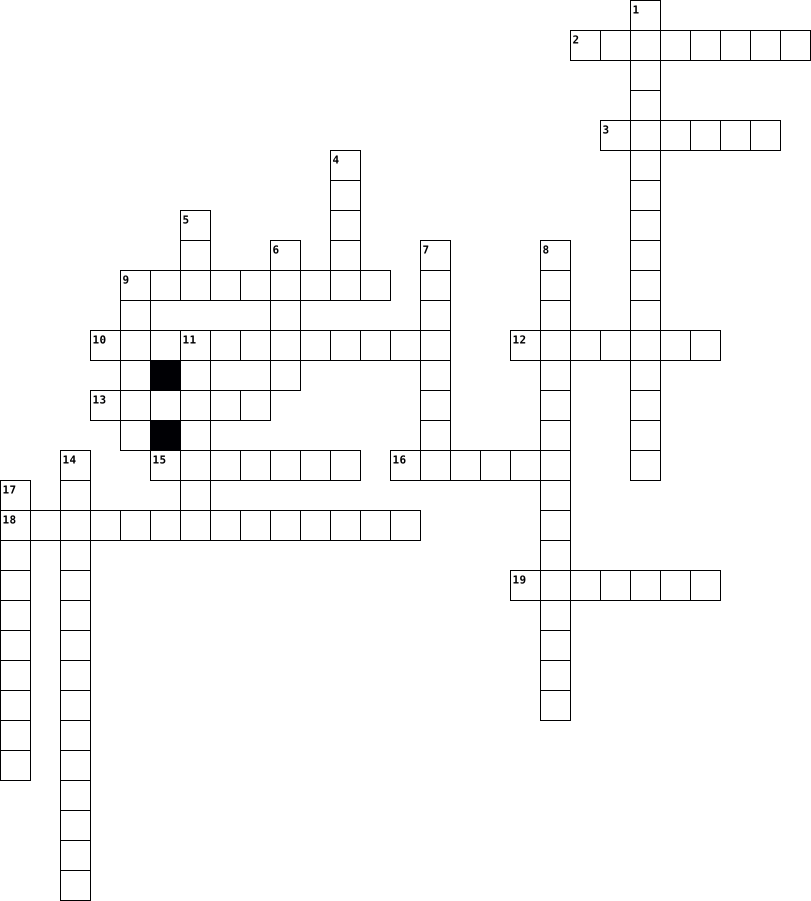
Across
- american indians watched the railroad.(wk 21)
- British would have to ______ in order to win. (wk 15)
- the Maine and Missouri ______ wanted to become states.(wk 18)
- the _______ of each southern states. (wk 20)
- Lincoln and dug met in a sires of_____. (wk 18)
- the leaders of the _____ were not strangers to each other. (wk 19)
- _____ were forced to leave their homes. (wk16)
- the telegraph seplfied the way _______ sent messages. (wk 17)
- the corps discovery arrived back in st Louis in September _____.
- inventor _______ Arkwright. (wk 17)
Down
- in ______ the sale of Louisiana territory. (wk 15)
- ____ to the civil war. (wk 20)
- we are now engaged in a great civil ____. (wk 19)
- stay warm in every colony and then in every ____. (wk 18)
- ______ bought a controlling limestone company
- the United States suffered two great defeats in _____. (wk 15)
- president ________ Jefferson. (wk 15)
- ____ advanced in the 1800s to control system . (wk 17)
- the war of ____ crafted many issues. (wk 17)
- the battle of ______ in july 1863 lasted 3 days. (wk 19)
20 Clues: ____ to the civil war. (wk 20) • inventor _______ Arkwright. (wk 17) • president ________ Jefferson. (wk 15) • the _______ of each southern states. (wk 20) • the war of ____ crafted many issues. (wk 17) • american indians watched the railroad.(wk 21) • ______ bought a controlling limestone company • _____ were forced to leave their homes. (wk16) • ...
Kendra McCart - Gov. Unit 1 2024-09-19

Across
- required a government tax stamp on paper goods and all legal documents
- how many states sent representatives?
- some colonist still had hope of reconciliation so colonist send one final appeal & delegates pledged continuing loyalty
- enjoy the most independence from the crown
- secured independence from Great Britain
- headed by a prime minister who is chosen by parliament
- The seeds of democracy took root here
- life liberty and property
- three-fifths of the enslaved people in a state would be counted when determining a states population
- Government is legitimate only so long as the parties to the agreement hand over their power to the state
- refused to sign the constitution because it lacked a bill of rights
- two-chamber legislature
Down
- King of England in 1760
- Civil War in England when the __ was signed
- series of articles defending the constitution
- to become __ nine of thirteen states had to ratify
- seek to dominate society ex. North Korea
- upper house composed of nobles
- the supreme power to act within its territory and to control its external affairs
- formally approve
20 Clues: formally approve • King of England in 1760 • two-chamber legislature • life liberty and property • upper house composed of nobles • how many states sent representatives? • The seeds of democracy took root here • secured independence from Great Britain • seek to dominate society ex. North Korea • enjoy the most independence from the crown • ...
Rev War crossword puzzle 2024-06-17

Across
- The legislature, or law-making body, in the government of Great Britain
- A British soldier during the Revolutionary War
- The overthrow of a government to establish a new system.
- – A document that announced that the thirteen colonies were an independent country separate from Great Britain
- A formal agreement between countries
- The ones rebelling against the king
- Congress – A gathering of delegates from the thirteen colonies which served as the first governing body for the United States of America
- The original states
- A nickname for the British soldiers
Down
- The center of the thirteen colonies
- What we where called before changing it to United states
- The end of the thirteen colonies
- A person who is chosen to speak or act for others.
- What we fought for
- The weapon used by the British
- The person in charge of the British
- Campaign – An organized series of military decisions intended to achieve a goal
- The war that won us our country
- The other side of the war
- The tip of the thirteen colonies
20 Clues: What we fought for • The original states • The other side of the war • The weapon used by the British • The war that won us our country • The end of the thirteen colonies • The tip of the thirteen colonies • The center of the thirteen colonies • The person in charge of the British • The ones rebelling against the king • A nickname for the British soldiers • ...
Foundations of Government 2024-10-30

Across
- This group supported a strong government
- Powers of the federal government
- The government is divided into 3 branches
- National and state governments share power
- The people elect representatives to run the government
- This branch enforces laws;President
- Supported by small states
- Powers shared between the state and federal government
- Representation based on population
- This branch interprets laws;Supreme Court
Down
- Protects your individual rights
- This group would not ratify the U.S. Constitution without a Bill of Rights
- Each branch is able to check the other to keep power balanced
- Powers of the state
- Consent of the governed; the government gets its power from THE people
- We get this legislature from the Great Compromise
- This branch makes the laws;Congress
- Supported by LARGE states
- Rule of Law;NO one is above the law. Constitution limits the government
- For every 5 slaves, 3 are counted as 'free people' for taxation and representation
- This compromise settles issues between LARGE and small states
- Based on equal representation
22 Clues: Powers of the state • Supported by LARGE states • Supported by small states • Based on equal representation • Protects your individual rights • Powers of the federal government • Representation based on population • This branch makes the laws;Congress • This branch enforces laws;President • This group supported a strong government • The government is divided into 3 branches • ...
Vocabulary Module 2 2024-11-22

Across
- having to do with producing items
- assistance; help given in time of need
- having to do with the activities of people who are members of a country
- southern states that separated from the United States
- to break away, leave
- to destroy by cutting off a needed part
- headdress worn by Creole women of Louisiana
- way of speaking
- not working; not active
- to join; to sign up to serve in the military
- the owning of a person by another person
- in a way that shows you are distracted and thinking about something else
- serious, solemn
Down
- having to do with farming
- a swamp; wet, muddy ground
- cut off
- simple or not developed
- northern states that stayed under a single government
- lacking knowledge or experience
- fascinated; held motionless (as in wonder or astonishment)
- the process of getting someone to join a group
- comforters
- got rid of, removed
- a feature of the landscape that is easy to see and recognize
- truth
- useless
- those who live in a country who are not citizens of that country
27 Clues: truth • cut off • useless • comforters • way of speaking • serious, solemn • got rid of, removed • to break away, leave • simple or not developed • not working; not active • having to do with farming • a swamp; wet, muddy ground • lacking knowledge or experience • having to do with producing items • assistance; help given in time of need • to destroy by cutting off a needed part • ...
Unit 5 Crossword 2026-01-26

Across
- What code was developed to send messages through the telegraph
- term that means 'obvious fate to expand out west & spread democracy
- States that remained in the US
- means secret- not actually in the ground
- Letting states decide
- War that occurs between its own citizens
- The South was focused on ______
- President of the Union during the Civil War
- Escaping slaves wove codes into _____
- First state to secede from the Union
- Who aided Lewis & Clark with their trip out west
- Lewis & Clark went on a ______ to explore the new land out west
- This invention made the demand for cotton production go up
Down
- Growing divide between the North & South before Civil War
- This railroad went across the US
- means transportation- not actually a train
- land bought by POTUS Jefferson to expand US
- The North was focused on _______
- Someone who fights to end slavery
- President of the Confederacy during the Civil War
- Novel that changed the North's perception of slavery
- French leader who Jefferson bought land from
- Debate over allow _______ in the west
- States that secede from the US
24 Clues: Letting states decide • States that remained in the US • States that secede from the US • The South was focused on ______ • This railroad went across the US • The North was focused on _______ • Someone who fights to end slavery • First state to secede from the Union • Escaping slaves wove codes into _____ • Debate over allow _______ in the west • ...
Chapter 9 2025-10-30

Across
- Each territory can decide for themselves means they have what
- Had 20 kids and chose to fight against slavery
- President of the Confederate states
- Vice president to Jefferson Davis
- Competed with Lincoln in his election, also debated him 7 times
- Where two days of fighting but no one died, the first fighting before war was declared
- the real name for the know nothing party
- What court case decided that black people were not citizens and had no right to sue
- Where did John Brown raid a federal armory
- What year did James Buchanan win presidency
Down
- "__________" Jackson, loyal to Virginia
- What made it law that slaves who escaped had to be returned to their owners
- slave states who joined the union
- what means to leave, 9 states did this?
- Underground railroad
- Wrote "Uncle Tom's Cabin"
- Won the election in 1860
- (ABBR) which state left first?
- the first to start a rebellion against slavery
- Anti-slavery party who wanted Free speech Free men and Free Labor
20 Clues: Underground railroad • Won the election in 1860 • Wrote "Uncle Tom's Cabin" • (ABBR) which state left first? • slave states who joined the union • Vice president to Jefferson Davis • President of the Confederate states • "__________" Jackson, loyal to Virginia • what means to leave, 9 states did this? • the real name for the know nothing party • ...
Vocabulary Word List 2024-09-05

Across
- Change: Object still has the same composition, and is just represented in a different form
- Change: A change in chemical properties or composition of a substance, resulting in the formation of at least one new substance.
- When matter changes states from a liquid to gas form.
- When matter changes states from a solid to liquid form
- of State: The change of a substance from one physical state to another
Down
- When matter changes states from a gas to liquid form
- When matter changes states from a solid to gas form
- Point: The exact temperature that liquid matter changes states into a solid matter
- When matter changes states from a liquid to solid form
9 Clues: When matter changes states from a solid to gas form • When matter changes states from a gas to liquid form • When matter changes states from a liquid to gas form. • When matter changes states from a liquid to solid form • When matter changes states from a solid to liquid form • of State: The change of a substance from one physical state to another • ...
Civil war crossword 2023-05-04

Across
- Increased sales of U.S. made products
- Movement of slaves across the Atlantic to be sold
- states that allowed slaves to be owned
- belief that political power comes from the people
- North’s economic dependent
- people who wanted to get rid of slavery
- Invention that separated the seeds from the cotton making the cotton industry boom
Down
- law designed to decide weather Missouri would be a free state or a slave state
- Book that explained the life of enslaved people
- In 1800s states that did not allow slavery
- All America was built off the backs of:
- 16th president of United States
- South’s economy was based off:
- Law’s/rules that keep people from discussing certain topics
14 Clues: North’s economic dependent • South’s economy was based off: • 16th president of United States • Increased sales of U.S. made products • states that allowed slaves to be owned • All America was built off the backs of: • people who wanted to get rid of slavery • In 1800s states that did not allow slavery • Book that explained the life of enslaved people • ...
History Unit 4 Crossword 2022-01-28

Across
- Premier of Quebec who started the Quebec independence movement.
- President of France during the cold war
- A crisis that was a major event in world history
- President of the United states during the cold war. Also ended the Vietnam war.
- proxy war of the Cold war
- Easternmost canadian province
- wall built to separate Germany
- Premier of quebec during the 1960s and 70s
- Canadian Prime Minister during the 1960s
Down
- Legendary Canadian who created our constitution
- Soviet Union vs the United States
- Civil rights activist in Canada in the 1950s
- President of the United States during the cold war
- Organization designed to prevent wars and keep the peace
- Movie actor during the 1950s who played in a cold war movie called Hellcats of the navy
- Athlete who ran across canada to raise money for cancer
16 Clues: proxy war of the Cold war • Easternmost canadian province • wall built to separate Germany • Soviet Union vs the United States • President of France during the cold war • Canadian Prime Minister during the 1960s • Premier of quebec during the 1960s and 70s • Civil rights activist in Canada in the 1950s • Legendary Canadian who created our constitution • ...
Physics Crossword 2016-04-15

Across
- The tendency for something to resist motion
- Speed and direction
- The amount of matter that something takes up
- A graph that measures time and distance
- When something is moving away from a still reference point it is in __________
- The combination of different forces
- One of Newtons 3 laws that states that objects in motion will stay in motion
- One of Newtons 3 laws that states that force equals mass times acceleration
- A specific location
Down
- The rate of change in velocity
- One of Newtons 3 laws that states every action has an equal or opposite reaction
- A location based on another location
- Equal forces acting on one object in opposite directions
- A unit used to measure force
- A force that causes something to move
- A rate or time at which something goes
16 Clues: Speed and direction • A specific location • A unit used to measure force • The rate of change in velocity • The combination of different forces • A location based on another location • A force that causes something to move • A rate or time at which something goes • A graph that measures time and distance • The tendency for something to resist motion • ...
Articles of Confederation Test Review 2024-02-07

Across
- A farmer who led a farmer rebellion against high taxes
- the national government was ____ in security and strength
- How many votes did each state have under the Articles?
- What ordinance established a plan for dividing new territories and statehood?
- What ordinance established a plan for surveying, selling and settling new land?
- government in which citizens rule through their elected leaders
- first Constitution of the United States called?
- Amendments added only with _______ states agreeing
Down
- Articles of confederation didn't have the _____ branch (where the presiden is)
- state where Shay's rebellion took place
- 9/13 majority was needed to pass ____ ______
- wrote the first Constitution
- How many years did the Articles governed (math needed)
- articles of confederation couldn't collect
- What was it missing to settle disputes between states?
- What branch(es) of government did the Articles have?
16 Clues: wrote the first Constitution • state where Shay's rebellion took place • articles of confederation couldn't collect • 9/13 majority was needed to pass ____ ______ • first Constitution of the United States called? • Amendments added only with _______ states agreeing • What branch(es) of government did the Articles have? • ...
Civil War Review 2022-09-05

Across
- under the concept of popular sovereignty, this act that gave Kansas and Nebraska the right to self-determine whether they would enter the union as a slave state or a free state
- the belief that the expansion of the US was both justified and inevitable which led to the mass killing of indigenous populations & the eventual claiming of all modern day America
- Supreme Court decision that said,“a negro, whose ancestors were imported into [the U.S.], and sold as slaves,” whether enslaved or free, could not be an American citizen and therefore did not have standing to sue in federal court.
- The compromise in the Constitution that allowed southern states to count their enslaved people as ⅗ of a person for the purposes of population for Congress
- a person who favors the abolition of the institution of slavery.
- the ability of new territories to determine if slavery should be allowed through referendum.
- in an effort to maintain the delicate balance of power between slave states and free states, Maine was admitted to the Union as a free state and Missouri was admitted as a slave state
- These laws made concessions to both free and slave states in an attempt to placate both sides of the slavery debate and preserve the union. The south gained by the strengthening of the fugitive slave law, the north gained a new free state, California. Texas lost territory but was compensated with 10 million dollars to pay for its debt. Slave trade was prohibited in Washington DC, but slavery was not.
Down
- a conglomeration of southern states that committed treason and rebelled against the US in an effort to retain the practices of slavery.
- a series of violent civil conflicts between pioneers in Kansas over the issue of whether Kansas would be a slave state or a free state
- undue concern with local interests or petty distinctions at the expense of general well-being.
- The act of taking a state out of the Union of the United States of America.
- a Collection of 20 free states and 4 border slave states that remained loyal to the national government after the onset of the Civil War.
13 Clues: a person who favors the abolition of the institution of slavery. • The act of taking a state out of the Union of the United States of America. • the ability of new territories to determine if slavery should be allowed through referendum. • undue concern with local interests or petty distinctions at the expense of general well-being. • ...
Newton's Laws of Motion 2013-10-28

Across
- newton’s belief of three laws
- measure of how much matter in an object
- the force that occurs when two surfaces rub against the other
- a synonym for movement
- distance that something travels in time
- the law that states that an object with an unbalanced force acting on it will accelerate in the direction of that force
- force that a first object acts on a second
- equal forces acting on an object without causing any motion
Down
- the force that pulls objects downwards
- a unit of measure that calculates force
- the law that states forces always occur in equal and opposite pairs
- unequal forces that changes an object's motion or speed
- a tool used to measure force
- the product of an objects mass and velocity
- the force of gravity on an object
- the law that states an object in motion will stay in motion
- when something begins to move more quickly
- a tendency to remain unchanged
- all individual forces working together on an object
- push or pull on an object
20 Clues: a synonym for movement • push or pull on an object • a tool used to measure force • newton’s belief of three laws • a tendency to remain unchanged • the force of gravity on an object • the force that pulls objects downwards • a unit of measure that calculates force • measure of how much matter in an object • distance that something travels in time • ...
Women in Combat 2015-12-10

Across
- Study that deals with the normal functions of humans and their parts
- Fundamental reference for testing physical ability
- An elite military formation of the United States Army
- The 44th and current President of the U.S.
- Engaging an enemy on the ground while being exposed to enemy fire
- An organization working to promote equal opportunity and freedom to serve in the U.S. military
- Prejudice for/against another gender
- Also known as “Conscription” in the United States
- The military line closest to the enemy
Down
- The current Defense Secretary
- A retired individual who served in the military
- A large body of troops ready for battle, especially an infantry unit
- Executive branch concerned with maintaining national security
- The 1st Army Ranger class with graduating women
- Implemented procedure or protocol for the Federal Government
- The leader of the Department of Defense
- Branch of the U.S. Armed Forces, using the mobility of the U.S. Navy
- 1948 Act that excluded women from combat positions
- Building serving as the headquarters of the US Department of Defense
- The bicameral legislature of the federal government of the United States
20 Clues: The current Defense Secretary • Prejudice for/against another gender • The military line closest to the enemy • The leader of the Department of Defense • The 44th and current President of the U.S. • A retired individual who served in the military • The 1st Army Ranger class with graduating women • Also known as “Conscription” in the United States • ...
Civil War 2020-02-13

Across
- A military person lost through death, wounds, injury or sickness
- Where the United States Military Academy is located
- Major battle in Mississippi where the Union Army defeated the Confederates
- An artillery weapon that fires explosive shells
- Also known as the North
- The president during the Civil War
- What amendment ended slavery
- An American politician who served as vice president of the Confederate States
- To prevent any goods, troops, and weapons from entering Southern states
- The branch of military that conducts military operations at sea
Down
- Name used to describe new troops to the military
- Also known as the Confederacy
- Document that stated all slaves should be set free
- Steam propelled warship protected by iron and steel
- First vehicle used for transporting wounded soldiers
- Where the first battle of the Civil War was fought
- The person who assassinated Abraham Lincoln
- Military officer responsible for providing quarters
- A stretcher used to transport wounded soldiers
- Military cap with a flat circular top with a peak of leather or cloth
20 Clues: Also known as the North • What amendment ended slavery • Also known as the Confederacy • The president during the Civil War • The person who assassinated Abraham Lincoln • A stretcher used to transport wounded soldiers • An artillery weapon that fires explosive shells • Name used to describe new troops to the military • Document that stated all slaves should be set free • ...
Political Unit by Addy Greninger 2021-04-29

Across
- when a nation doesn't have a territory to call it's own
- government by a single person having unlimited power
- living in a defined space
- if overthrown by force, new ruling group is sometimes called this
- domination through threat and violence
- NO government
- a few people have power
- ruled by a single leader, not elected
- people who share a common culture
- a body of people
- united states, mexico and Canada agreement
- a territorial political extension of another state
- includes more nation within border
Down
- the supreme governing power of state
- elected by the people
- with the power to make and in force laws without having to check with higher authority
- a country that has no monarch, usually elected president
- people are forced to do what tells them may be prevented from leaving
- the organization that makes and enforce the laws
- member states surrender power to a higher organization
- a state with only one nation within its borders
- has a king, queen, emperor,empress
- a body of people, living in a defined space, with the power to make and enforce laws
- state completely surrounded by another state
24 Clues: NO government • a body of people • elected by the people • a few people have power • living in a defined space • people who share a common culture • has a king, queen, emperor,empress • includes more nation within border • the supreme governing power of state • ruled by a single leader, not elected • domination through threat and violence • ...
Civil War 2021-09-10

Across
- Someone wanted to get rid of slavery.
- the 16th president of the US.
- group of states that seceded from the US.
- Nickname of general Thomas Jonathan Jackson.
- The name of the battle, that was the turning point of the war.
- The political party who wanted the spread of slavery to territories.
- Name of the bloodiest battle of the war.
- Name of the confederate president.
- Slave states that remained in the union.
- A person who is loyal to the federal government.
- the act of a state leaving from its nation.
- A region or area where fighting takes place.
Down
- Group of states that remained part of the US.
- Commanding general of the Union armies.
- Freedom from slavery.
- an iron ship used during the War.
- The political party that wanted to prevent the spread of slavery to the territories.
- Confederate general, who commanded the army of Virginia.
- The gettysburg ___ was given by abraham lincoln, to inspire the north.
- A long gun that soldiers shot from the shoulder.
20 Clues: Freedom from slavery. • the 16th president of the US. • an iron ship used during the War. • Name of the confederate president. • Someone wanted to get rid of slavery. • Commanding general of the Union armies. • Name of the bloodiest battle of the war. • Slave states that remained in the union. • group of states that seceded from the US. • ...
Constitution Day Activity 2021-07-30

Across
- The 1st president was George _____.
- The head executive of a state government
- The president is the _____in-chief
- How many stripes are there on the US flag?
- How many stars are there on the US flag?
- How many branches are in the government?
- The Pilgrims came to America for _____ freedom.
- What was the 50th state added to the union?
- The United States President is elected for ____ years.
- The Bill of Rights is the first ___ amendments.
- A change to the United States constitution is called:
- It is the duty of Congress to make _____.
- There are 50 _____ in the Union.
Down
- Our national anthem: “The Star ___ Banner”
- There is one _____ for each state on the flag.
- Who has the power to declare war?
- What was our country's first constitution called? "Articles of _____________"
- The date of Independence Day is July
- Ship that brought the pilgrims to America
- The colors of the flag are red, white, and _____.
- The highest court in the US.
- Laws for the United States are made by:
- How many Supreme Court justices are there?
- Who was our first Vice President?
24 Clues: The highest court in the US. • There are 50 _____ in the Union. • Who has the power to declare war? • Who was our first Vice President? • The president is the _____in-chief • The 1st president was George _____. • The date of Independence Day is July • Laws for the United States are made by: • The head executive of a state government • How many stars are there on the US flag? • ...
Civil War Crossword 2022-05-11

Across
- this battle gave Lincoln the chance to abolish slavery
- assassinator of Lincoln
- The Union's strategy to win the war
- Where General Sherman stated “The scenes on this field would have cured anybody of war”
- ___War lasted four years and is Still the bloodiest war in history
- amendment that ended slavery
- Bullet with a hollow base that expands when fired
- Women____ were used by the North and South to spread and collect information
- most important battle of the Civil War
- South broke off from the rest of the Union and called themselves the _____ states of America
- 54th____ was an all-black regiment
Down
- speech dedicating a national cemetery for the soldiers on the ground where the Battle of Gettysburg had taken place
- Becomes the President of the Confederate States of America
- Becomes the President of the United States
- issued by Lincoln on January 1st
- General Sherman's war strategy
- First battle in the Civil War
- Leader of the Confederate troops
- Lincoln appreciated his leadership skills
- A fort created as extra protection for South Carolina
20 Clues: assassinator of Lincoln • amendment that ended slavery • First battle in the Civil War • General Sherman's war strategy • issued by Lincoln on January 1st • Leader of the Confederate troops • 54th____ was an all-black regiment • The Union's strategy to win the war • most important battle of the Civil War • Lincoln appreciated his leadership skills • ...
US history Bruce 2017-01-10

Across
- Relating to a city
- A numerical limit
- A market structure dominated by only a few large,profitable firms
- Federal land set aside for native Americans
- war between the union states of north and the confederate states of the south;fought from 1861 to 1865
- union that organizes workers from all crafts in a given industry
- term used to describe the 190s
- virginia legislature formed in 1619
Down
- The right to vote
- the federal government's plan for the makeup and quantity of the nation's money supply
- group of electors ,chosen by the voters ,who vote for president
- a japanese American whose parents were born in japan
- states of texas,louisiana ,mississippi ,alabama,florida,georgia,and south varolina
- group organized around a common interest and concerned only with furthering that interest
- the ability to read and write
- area in which one ethnic or racial group dominates
- to revise
- Laws that restricted freedmen's rights
- An official forgiveness of a crime
- official postponement,as in a postponement of compulsory military service
20 Clues: to revise • The right to vote • A numerical limit • Relating to a city • the ability to read and write • term used to describe the 190s • An official forgiveness of a crime • virginia legislature formed in 1619 • Laws that restricted freedmen's rights • Federal land set aside for native Americans • area in which one ethnic or racial group dominates • ...
Civil War Crossword 2023-05-10

Across
- key battle that turned the tides against the Confederacy
- States that did not join the Confederacy
- politically motivated murder
- Name given to the new country that was given to the 11 states that seceded
- General of the Union Army
- African American soldier who received a Medal of Honor for saving the American Flag
- First shots fired in Civil War
- freeing of slaves
- Navy Seaman who won a Medal of Honor for his actions during Fort Fisher
- President of the Confederate States during the war
Down
- Lincoln's speech that praised the bravery of the Union's soldiers
- small town where Lee surrendered to Grant
- North's plan to cut off supplies to the South through Naval blockades
- The US
- Proclamation issued by Lincoln that freed all the slaves in areas still at war in the union
- President of the US during the Civil War
- Commander of the Confederate Army
- Bloodiest single day battle of the Civil War
- Formally withdraw from the union
- Founder of the American Red Cross
20 Clues: The US • freeing of slaves • General of the Union Army • politically motivated murder • First shots fired in Civil War • Commander of the Confederate Army • Formally withdraw from the union • Founder of the American Red Cross • States that did not join the Confederacy • President of the US during the Civil War • small town where Lee surrendered to Grant • ...
Mears Chapter 3 Vocabulary 2023-11-03

Across
- of individuals or groups.
- a change or addition to the terms of a
- to revoke or withdraw formally or
- administration of justice or the
- an act of vesting the legislative,
- powers those powers granted to the national
- to refuse admit or approve.
- rule the principle that the greater number
- government a political system where government
- includes the supreme court and other federal
- powers shared by both states and the
- political power is not concentrated in the
- sovereignty Government based on consent of the
- a preliminary or preparatory.
Down
- to aid him in making decisions
- an advice giving group selected by the
- branch Power to make the law.
- or document.
- prohibited from certain activities.
- review of or relating to a judgement
- In charge of making sure that the laws
- powers businesses within a state.
- under the united states constitution.
- counter balancing influences by which organization
- is regulated typically those
- the united states are obeyed.
- exercise greater power.
- a change or addition to the terms of
- judicial powers of government in separate bodies.
29 Clues: or document. • exercise greater power. • of individuals or groups. • to refuse admit or approve. • is regulated typically those • branch Power to make the law. • the united states are obeyed. • a preliminary or preparatory. • to aid him in making decisions • administration of justice or the • powers businesses within a state. • to revoke or withdraw formally or • ...
The U.S. Constitution 2023-11-15

Across
- wants to go first
- grand or Graham (but no "C")
- how many dates are you supposed to have memorized by now...
- Embrie, Kendra, & Zoe
- broadway play or Federalist
- "Father of the U.S. Constitution"
- the 3/5 Compromise centered around ___
- always told to turn around
- last eighth grader by first name alphabetically
- U.S.' first constitution
- Hamilton, Madison, & ___
- essays to persuade for ratification
- Anti-federalists say they needed one to protect liberties
- total Amendments in the Bill of Rights
Down
- both sides get something they want...but not everything
- the Articles of Confederation created a ___ government
- under the Articles, the ___ held most of the power
- first president of the United States
- "best" compromise ever between large & small states
- famous Anti-federalists who wanted "liberty or death"
- year in which the Constitution was written
- rebellion that convinced Americas that the Articles was a no go
- two seats per state
- senators per state
- Corter, or Conner, or Caden
- where the Constitutional Convention was held (for short)
26 Clues: wants to go first • senators per state • two seats per state • Embrie, Kendra, & Zoe • U.S.' first constitution • Hamilton, Madison, & ___ • always told to turn around • broadway play or Federalist • Corter, or Conner, or Caden • grand or Graham (but no "C") • "Father of the U.S. Constitution" • essays to persuade for ratification • first president of the United States • ...
Social Studies Crossword 2023-12-04

Across
- Prohibition and ban of alcohol. 17.
- The southern states during the Civil War. 4.
- The US strategy of staying out of WW1. 8.
- The three New South "leaders". 19.
- The act of a mob attacking and killing somebody who was publicly found guilty. 6.
- In order to vote, you need to pay a tax. 13.
- Women's right to vote. 16.
- Also called the Seven Years War. 5.
Down
- The northern states during the Civil War. 3.
- Leader of the yamacraw. 1.
- Called Mr. New South. 18.
- The court case that sparked the KKK and anti-semitism. 15.
- The act of mass-building weapons. 9.
- The president of the US during WW1. 11.
- The ban of slavery in the United States. 20.
- The coded message sent from Germany to Mexico asking to help by attacking the US. 12.
- The mindset of your country being better than all others. 10.
- The outlawing of alcohol. 7.
- Young girl killed by Leo Frank. 2.
- These expositions were held in Atlanta to promote the "New South". 14.
20 Clues: Called Mr. New South. 18. • Leader of the yamacraw. 1. • Women's right to vote. 16. • The outlawing of alcohol. 7. • Young girl killed by Leo Frank. 2. • The three New South "leaders". 19. • Prohibition and ban of alcohol. 17. • Also called the Seven Years War. 5. • The act of mass-building weapons. 9. • The president of the US during WW1. 11. • ...
Unit 1 SCAPE Vocabulary 2023-08-31

Across
- the spread of cultural beliefs
- the Supreme Being for Hinduism
- religion practiced by Muslims
- supported the constitution
- how many branches of government are there in the U.S.
- people move from farm areas to cities to work in factories
- a right and responsibility citizens have in a representative government
- freedom of speech, religion, and petition
- America built factories to make money
- Money
- millions moved to the USA to find jobs
Down
- economy driven by profit and competition
- claimed the southern part of the United States
- branch that makes laws
- claimed land in New World for fur trading
- freedom from cruel punishment
- Americans are able to buy goods from other countries through?
- branch that interprets laws
- What does the S in SCAPE mean
- ended slavery in the United States
- branch that enforces laws
- against constitution, believed people needed more freedom
- United States desire to own land from the Atlantic Ocean to the Pacific Ocean
- What does the C in SCAPE mean
- the study of the past
- the holy book for Christianity
- Government
27 Clues: Money • Government • the study of the past • branch that makes laws • branch that enforces laws • supported the constitution • branch that interprets laws • freedom from cruel punishment • religion practiced by Muslims • What does the S in SCAPE mean • What does the C in SCAPE mean • the spread of cultural beliefs • the Supreme Being for Hinduism • the holy book for Christianity • ...
MODULE 1 TEST REVIEW 2023-09-01

Across
- The North was called what during the war?
- Lincoln's Assassin
- Time period of rebuilding & readmitting the Southern states to the Union.
- Forced military service.
- The date of President Lincoln's ___________________ was April 15, 1865
- Plan proposed by Lincoln that required a state to have 10% of all voters in 1860 take an oath of loyalty.
- 18th President of the United States Union general during the Civil War.
- The South was called what during the war?
- White Southerners who joined the Republican Party.
Down
- Issued by President Lincoln; freed all slaves under Confederate control.
- Amendment that provided all races the right to vote.
- 16th President of the United States; tried to reunite the nation after the Civil War.
- Amendment that provided equal protection under the law.
- Amendment that abolished slavery.
- First African American U.S. Senator
- President who was impeached; took office on the death of Lincoln.
- A system in the South that was another version of slavery.
- Gave clothes & food to former slaves; set up schools and hospitals.
- A minority of Republicans in Congress.
- Northerners who moved South after the Civil War.
20 Clues: Lincoln's Assassin • Forced military service. • Amendment that abolished slavery. • First African American U.S. Senator • A minority of Republicans in Congress. • The North was called what during the war? • The South was called what during the war? • Northerners who moved South after the Civil War. • White Southerners who joined the Republican Party. • ...
Constitution Crossword 2023-08-30

Across
- First ten amendments to the Constitution
- There are seven of these in the Constitution
- The three branches of the government was ___________, Executive, and Judicial
- There are ___________ Amendments
- Father of the Constitution
- How many states were there originally
- The Constitution is the _______ law of the land
- Power held by the people
- A pamphlet written by Thomas Paine that advises the 13 colonies to break away from England and gain independence
- Document that outlined the first form of government in the United States of America
Down
- The first president
- Supporters of the Constitution during ratification debates in state legislatures
- Life, _______, and the pursuit of happiness
- Freedom of Religion, Expression, Assembly, and the Right to Petition
- this branch of government includes the Supreme Court of the united states and decides whether laws are constitutional or not
- Amendment that granted women the right to vote
- First three words of the Constitution
- The branch of government established in the Constitution that includes the president
- A section in the constitution that ended slavery
- The document of government that serves as the foundation of our government
20 Clues: The first president • Power held by the people • Father of the Constitution • There are ___________ Amendments • First three words of the Constitution • How many states were there originally • First ten amendments to the Constitution • Life, _______, and the pursuit of happiness • There are seven of these in the Constitution • Amendment that granted women the right to vote • ...
US Amendments Crossword Puzzle - Mausham S 2023-09-22

Across
- no poll taxes are allowed
- forbids cruel and unusual punishments
- Congress cannot get a pay raise until the next term
- equal protection under the Constitution for all US citizens
- limits the terms Presidents can serve
- powers not specifically given to the national government are reserved to states
- right to remain silent
- Washington D.C. have the right to vote for President
- protects the states from lawsuits
- separate ballots for the President and Vice President
- right to a speedy and public trial
- people have other rights not listed in the Constitution
- soldiers may not move into private homes
Down
- women's right to vote
- popular vote for United States Senate
- no voting discrimination of race
- no unreasonable searches and seizures
- moving of dates for terms of presidency
- income tax is legal
- freedom of speech
- right to bear arms
- repeal of prohibition of alcohol
- the succession for presidency shall something happen to the President
- the minimum voting age is 18
- prohibition of alcohol
- the abolishment of slavery
- right to a jury trial
27 Clues: freedom of speech • right to bear arms • income tax is legal • women's right to vote • right to a jury trial • prohibition of alcohol • right to remain silent • no poll taxes are allowed • the abolishment of slavery • the minimum voting age is 18 • no voting discrimination of race • repeal of prohibition of alcohol • protects the states from lawsuits • right to a speedy and public trial • ...
history chapter 7 2024-04-08

Across
- What is it called when there is one legislature and equal representation for all states?
- What group led the fight to religious freedom?
- What state was under Puritan control for a short amount of time?
- Who wrote the Democracy in America?
- Who was the youngest delegate?
- What was the convention in Philadelphia called?
- Congress finally accepted what in November 1777?
- Who presented the New Jersey Plan?
- Congress passed many laws based upon what?
- What is it called when there are taxes on imported goods?
- What bill was added to the constitution in 1791?
Down
- Who is in the lower house?
- Who proposed the Virginia Plan?
- Which state submitted to the people for ratification
- Who was the first president of the United States?
- What were people called who did not support the new constitution?
- What were people called who supported the new constitution?
- Most states provided what kind of legislatures with broad powers?
- Who is in the upper house?
- Who eventually become known as Father of the Constitution
20 Clues: Who is in the lower house? • Who is in the upper house? • Who was the youngest delegate? • Who proposed the Virginia Plan? • Who presented the New Jersey Plan? • Who wrote the Democracy in America? • Congress passed many laws based upon what? • What group led the fight to religious freedom? • What was the convention in Philadelphia called? • ...
Articles of Confederation 2024-02-12

Across
- who were the articles of confederation adopted by?
- Best synonym for anarchy
- What treaty ended the war?
- What was held exclusively by the national government under the Articles of Confederation?
- What was the biggest obstacle facing the Continental Congress?
- Who lacked the power to tax the states?
- Why did the articles of confederation not last?
- How many sections was the articles of confederation divived up into?
- How many states were involved in creating the articles of confederation?
- Describes the federalist system of government?
- How many years did it take for the ratification of the articles of confederation?
Down
- What war ended September 3, 1783?
- what was the first state to sign the articles of confederation?
- What was known as the first constitution of the United States?
- Who was the primary writer of the article of confederation?
- What was established by the Declaration of Independence?
- One of the American Solder Leaders who led the fight with England was?
- What Battle ended on October 19, 1781
- Where did Lord Cornwallis bring his redcoats in 1781?
- The articles of confederation were _____ by the states in 1781?
- of paris This treaty was signed in 1783.
21 Clues: Best synonym for anarchy • What treaty ended the war? • What war ended September 3, 1783? • What Battle ended on October 19, 1781 • Who lacked the power to tax the states? • Describes the federalist system of government? • Why did the articles of confederation not last? • who were the articles of confederation adopted by? • ...
Rev War crossword puzzle 2024-06-14

Across
- The weapon used by the British
- The overthrow of a government to establish a new system.
- Of Independence – A document that announced that the thirteen colonies were an independent country separate from Great Britain
- A nickname for the British soldiers
- Congress – A gathering of delegates from the thirteen colonies which served as the first governing body for the United States of America
- The legislature, or law-making body, in the government of Great Britain
- The war that won us our country
- A person who is chosen to speak or act for others.
- What we fought for
- The other side of the war
Down
- The tip of the thirteen colonies
- What we where called before changing it to United states
- The original states
- The center of the thirteen colonies
- The end of the thirteen colonies
- The person in charge of the British
- Campaign – An organized series of military decisions intended to achieve a goal
- The ones rebelling against the king
- A formal agreement between countries
- A British soldier during the Revolutionary War
20 Clues: What we fought for • The original states • The other side of the war • The weapon used by the British • The war that won us our country • The tip of the thirteen colonies • The end of the thirteen colonies • The center of the thirteen colonies • A nickname for the British soldiers • The person in charge of the British • The ones rebelling against the king • ...
US Independence Day 2025-06-05

Across
- Feeling or expressing devotion to and vigorous support for one's country
- These represent states on the US flag
- To observe (a day or event) with ceremonies or festivities
- First US President
- Explosive devices used for celebratory displays
- The thirteen original ____
- The American ____ War
- The number of original colonies
- The day of the month Independence Day is celebrated
- Freedom from control by others
Down
- The power or right to act, speak, or think as one wants without hindrance
- A public procession, especially one celebrating a special day or event
- The supreme law of the United States
- The United States is often called the ____
- The US won its independence from this country
- The ____ of Independence
- Thirteen of these are on the US flag
- The Liberty ____ rings in Philadelphia
- The state of being free within society from oppressive restrictions
- The month Independence Day is celebrated
- A piece of cloth or similar material, typically rectangular, attached to a pole or rope and used as a symbol or emblem
21 Clues: First US President • The American ____ War • The ____ of Independence • The thirteen original ____ • Freedom from control by others • The number of original colonies • The supreme law of the United States • Thirteen of these are on the US flag • These represent states on the US flag • The Liberty ____ rings in Philadelphia • The month Independence Day is celebrated • ...
Civics MCAS Review: Vocabulary 2025-05-05

Across
- the first constitution of the United States
- the line in the Constitution that gives Congress a lot of flexibility in their powers
- national
- movement to end slavery
- the process of the Supreme Court interpreting the Constitution
- the right to vote
- the complex process for electing the US president
- the process of running for office
- "two house" or "two part"
- an uprising by Massachusetts farmers in 1786 that showed that the United States needed a stronger national government and economy
- the way power is divided between the three branches of government
- a system where each branch of government can amend or veto another branch
Down
- the way power divided between the three levels of government
- the place where the Constitution was written in 1787
- a change to the Constitution
- President Lincoln's executive order that said slavery was illegal in the United States
- agreements between countries
- a series of essays that encouraged people to accept the US Constitution
- money
- a yearly tax to the government based on how much money they earned that year
20 Clues: money • national • the right to vote • movement to end slavery • "two house" or "two part" • a change to the Constitution • agreements between countries • the process of running for office • the first constitution of the United States • the complex process for electing the US president • the place where the Constitution was written in 1787 • ...
Cold war puzzle 2026-04-21

Across
- spy plane that flew high altitude
- president of United States during Cuban missile crisis
- closest USA and soviet union got to nuclear war
- Vietnam was the first war you could watch on one of these
- name given to the insurgents fighting the United States in Vietnam
- aircraft heavily used in Vietnam
- last name of the pilot of the u2 spy plane that was captured by Russia
- this couple was executed for treason and espionage (last name only)
- jungle war against communism
Down
- first man made object in space
- Government the Soviet Union was
- war that turned out to be a stalemate
- separated Berlin
- Soviet leader that lead to the Soviet Unions collapse
- Vietnam was the first time us soldiers returned home and weren’t treated as
- government the United States is
- what Sputnik did in orbit
- event where allies used aircraft to drop supplies in Soviet Berlin
- country that helped North Korea turn the tide in the Korean War
- first country to put a man on the moon
20 Clues: separated Berlin • what Sputnik did in orbit • jungle war against communism • first man made object in space • Government the Soviet Union was • government the United States is • aircraft heavily used in Vietnam • spy plane that flew high altitude • war that turned out to be a stalemate • first country to put a man on the moon • closest USA and soviet union got to nuclear war • ...
How does the organization of a federal system of government impact citizens? 2026-05-22

Across
- Powers shared by both state and national governments.
- The national government of the United States.
- Government actions and decisions on public issues.
- Being a legal member of a country with rights and responsibilities.
- A change or addition made to the Constitution.
- Powers specifically given to the national government.
- A system where each branch limits the powers of the others.
- The branch responsible for enforcing laws.
- States that federal laws are above state laws when conflicts happen.
Down
- Rights that protect citizens from unfair treatment.
- Dividing government power among three branches.
- The percentage of eligible voters who participate in elections.
- A system where power is shared between the national and state governments.
- The document that explains the structure and powers of government.
- Amendment stating powers not given to the federal government belong to states or people.
- The branch responsible for making laws.
- A government where citizens participate in decision-making.
- Powers kept by state governments.
- The branch responsible for interpreting laws.
- The lawmaking body of the federal government.
20 Clues: Powers kept by state governments. • The branch responsible for making laws. • The branch responsible for enforcing laws. • The national government of the United States. • The branch responsible for interpreting laws. • The lawmaking body of the federal government. • A change or addition made to the Constitution. • Dividing government power among three branches. • ...
Chapter 15: Civil War & Reconstruction 2012-03-29

Across
- the closing of an area to keep people or supplies from moving in or out
- to charge a government official with wrongdoing
- laws passed by Southern states after Reconstruction that established segregation
- announcement made by President Lincoln that led to the end of slavery in Confederate States
- a person who is not in the armed forces
- laws passed by Southern states after the Civil War that limited the rights of newly-freed African-Americans
- the period after the Civil War in which Congress passed laws designed to bring Southern states back into the Union
- officially established African-Americans as citizens with the same rights as whites
- the speech made by President Lincoln at the site of this battle
- a war in which both sides strike against each other's soldiers, civilians, and economy
- the process of selection of men for compulsory military service
Down
- the war between the Union and the Confederacy
- a system in which farmers rented land from the owner and paid with a share of their crops
- made it illegal to withhold voting rights "on account of race or color"
- it abolished slavery
- a government agency that provided food, schools, and medical care for freed slaves in the South
- the separation of people, usually based on race or religion
- the Union’s 3-step plan for defeating the Confederacy in the Civil War
18 Clues: it abolished slavery • a person who is not in the armed forces • the war between the Union and the Confederacy • to charge a government official with wrongdoing • the separation of people, usually based on race or religion • the speech made by President Lincoln at the site of this battle • the process of selection of men for compulsory military service • ...
Theories of Global Politics 2026-09-20

Across
- The idea that, although states are the most important actors in global politics, it is in their interests to co-operate through intergovernmental organisations and follow accepted international rules of conduct.
- The idea that nation states have a "hard shell" of sovereignty, protected from external interference.
- A theory that sees self-interested, power-maximising nation states as the most important actors in global politics.
- States seek to protect themselves by building up their military and economic strength. However, this may alarm that state's rivals, leading to an arms race.
- Organisations like the UN, NATO, and Bretton Woods institutions that regulate relationships between nation states.
Down
- Nations, intergovernmental organisations, non-governmental organisations and other actors in international bodies are linked by multiple threads of common interest that encourage them to work together.
- The idea that states have sovereignty and therefore should not intervene in each other's internal affairs.
- A territory where a single government rules over a people with a common national identity.
- A theory that sees co-operation and global governance as both possible and desirable. Believe in a rules-based international order, and a transfer of power from nation states to intergovernmental organisations.
- The idea that states and other actors in international politics are increasingly linked by common interests. This encourages them to work together in ways that are mutually beneficial.
10 Clues: A territory where a single government rules over a people with a common national identity. • The idea that nation states have a "hard shell" of sovereignty, protected from external interference. • The idea that states have sovereignty and therefore should not intervene in each other's internal affairs. • ...
CCA Chapter 3 Vocabulary 2014-12-01

Across
- an ordered pair makes the equation true
- this form Ax = By = C
- a polynomial with two terms
- the inverse property that states: the reciprocal of a number
- the number that indicates how many time the base in a power is used as a factor
Down
- a monomial or a sum of difference of monomials
- a number multiplied by a variable
- the property that states: a + b + c = (a + b) + c = a (b + c)
- the number in a power that is used as a factor
- the property that states: a(b+c)=ab + ac
- the property of addition that states: a + 0 =a
11 Clues: this form Ax = By = C • a polynomial with two terms • a number multiplied by a variable • an ordered pair makes the equation true • the property that states: a(b+c)=ab + ac • a monomial or a sum of difference of monomials • the number in a power that is used as a factor • the property of addition that states: a + 0 =a • ...
Aarav Pattani's Civil War crossword puzzle 2022-04-21

Across
- A speech Abe Lincoln made to end slavery
- a war between the north and the south over slavery and states rights.
- president of confederate states
- people that believed slavery was good
- Southern General
- a fort in ruins after a siege by the south which started the civil war
Down
- 16th president of the United states and was president of the union during the civil war.
- the civil wars most bloody battle which the Union won
- union general and 18th president of the united states.
- People that fought in the civil war against slavery
- a system that allows people to sell and buy whatever
11 Clues: Southern General • president of confederate states • people that believed slavery was good • A speech Abe Lincoln made to end slavery • People that fought in the civil war against slavery • a system that allows people to sell and buy whatever • the civil wars most bloody battle which the Union won • union general and 18th president of the united states. • ...
Reconstruction 2022-06-03

Across
- crow Laws laws that required segregation were common in southern states in the 1800s
- Louisiana quickly elected a new legislature under this ten percent plan
- Hiram revels born free in North Carolina and went to college in Illinois
- sneaked into the president's theater box and shot Abe Lincoln
- The process of reuniting the nation and rebuilding the southern states without slavery
- The included the following provisions
- Under the a state had to meet two conditions before it could rejoin the union
- reconstruction acts divided the south into five districts with the us military commander in control of each district
Down
- The gave African American men throughout the United States the right to vote
- Vice president was sworn into presidency that morning
- wanted the southern states to change much more than they had before they could return to the union
- Redeemer governments also introduced legal this forced the whites to separate from african americans
- amendment congress proposed the to the constitution it made slavery illegal throughout the u.s
- Southern democrats referred to them as
- Many white southerners called these republicans
- in 1865 congress established its purpose was to provide relief for all the poor people
- Thought that the black codes were cruel and unjust
- passed the law that greatly limited the freedom of african americans to sign work contracts
18 Clues: Southern democrats referred to them as • The included the following provisions • Many white southerners called these republicans • Thought that the black codes were cruel and unjust • Vice president was sworn into presidency that morning • sneaked into the president's theater box and shot Abe Lincoln • ...
1815 Crossword puzzle 2018-11-15

Across
- one's own territory by appropriation.
- states that have slaves
- Life Among the Lowly, is an anti-slavery novel by American author Harriet Beecher Stowe.
- in the united states consitutional history is a legal theory that a state the right to nullify
- s a package of five separate bills passed by the United States Congress in September 1850
- is the principle that the authority of a state and its government are created and sustained by the consent of its people,
- was a network of secret routes and safe houses established in the United States during the early to mid-19th century
- led the slaves to the underground railroad
- existing before a war
- beleved that slavery was a sin
Down
- It allowed people in the territories of Kansas and Nebraska to decide for themselves whether or not to allow slavery within their borders.
- restriction of interst to a narrow sphere
- a person who oversees and urges on slaves at work
- a system of labor under slavery characteristics in the americans
- an effort by congress to defuse the sectional and political rivalries triggered by the request of Missourilate in 1819 for admission as a state in which slavery would be permitted
- an American abolitionist newspaper founded by William Lloyd Garrison and Isaac Knapp
- a state that has prohibited slaves
- the criminal act of deliberately setting fire to property
18 Clues: existing before a war • states that have slaves • beleved that slavery was a sin • a state that has prohibited slaves • one's own territory by appropriation. • restriction of interst to a narrow sphere • led the slaves to the underground railroad • a person who oversees and urges on slaves at work • the criminal act of deliberately setting fire to property • ...
Chain of Command 2026-02-09

Across
- Commander of Naval Service and Training
- Chief of Naval Operations
- Director of Homeland Secretary
- Naval Science Instructor
- President of the United states
- Area 5 Manager
- Commandant of the Marine Corps
Down
- Director of NJROTC
- Senior Naval Science Instructor
- Commander of Naval Education and Training
- Sergeant Major of the Marine Corps
- Secretary of the Navy
- Secretary of Defense/War
- Vice President of the united states
- Secretary of State
- MCPON of the Navy
16 Clues: Area 5 Manager • MCPON of the Navy • Director of NJROTC • Secretary of State • Secretary of the Navy • Naval Science Instructor • Secretary of Defense/War • Chief of Naval Operations • Director of Homeland Secretary • President of the United states • Commandant of the Marine Corps • Senior Naval Science Instructor • Sergeant Major of the Marine Corps • ...
Constitution Intro 2016-02-20

Across
- Article II
- Article IV
- Executive Branch identifies whose duties?
- The Judicial Branch identifies the _____ _____.
- Article 1 Sec 8 Clause 3
- Article I Sec 8 Clause 1
- Judicial
- Amendments
- The Legislative Branch represents the United States _____
Down
- Article I Sec 8 Clause 18
- Article VI Clause 2
- Ratification
- Article VI Clause 2
- Article I
- how many articles in the constitution
15 Clues: Judicial • Article I • Article II • Article IV • Amendments • Ratification • Article VI Clause 2 • Article VI Clause 2 • Article 1 Sec 8 Clause 3 • Article I Sec 8 Clause 1 • Article I Sec 8 Clause 18 • how many articles in the constitution • Executive Branch identifies whose duties? • The Judicial Branch identifies the _____ _____. • ...
What led to the Civil War 2026-03-12

Across
- Against slavery
- Tariff that made southerners angry
- Wrote Uncle Tom's Cabin
- Debated against Abraham Lincoln on slavery
- Statehood in 1820
- Raided Harper Ferry
- What the north used instead of slaves
Down
- Prevented slaves from gaining liberty
- Cashcrop
- Southern Economy
- 16th president of the US
- Sued for his freedom
- Balanced Free states and Slave states
- Was Raided by abolistionist
14 Clues: Cashcrop • Against slavery • Southern Economy • Statehood in 1820 • Raided Harper Ferry • Sued for his freedom • Wrote Uncle Tom's Cabin • 16th president of the US • Was Raided by abolistionist • Tariff that made southerners angry • Prevented slaves from gaining liberty • Balanced Free states and Slave states • What the north used instead of slaves • ...
The bill of rights 2023-10-20

Across
- helps with criminal cases.
- allows you to practice what religion you want
- presidential elections
- black suffrage
- helps with civil cases
- Fair trial
- allows you to deny any searches without warrant.
Down
- allows you to deny soldiers in your home.
- states rights
- civil rights
- lawsuits against states
- allows you to plead the fifth.
- abolition of slavery
- bail, fines, punishment
- allows you to carry a gun.
15 Clues: Fair trial • civil rights • states rights • black suffrage • abolition of slavery • presidential elections • helps with civil cases • lawsuits against states • bail, fines, punishment • helps with criminal cases. • allows you to carry a gun. • allows you to plead the fifth. • allows you to deny soldiers in your home. • allows you to practice what religion you want • ...
WWE 2025-09-28

Across
- Zayn men’s United States champion
- Stratton wwe woman’s world champion
- undisputed wwe universal champion
- nxt men’s champion
- Nxt tag team champs
- World heavyweight champion
- Jayne nxt woman’s champion
Down
- Mysterio men’s intercontinental champion
- nxt woman’s north american champion
- smackdown tag champs
- page men’s nxt North American champion
- day raw tag champs
- woman’s United States champion
- VAQUER woman’s world champion
- lynch woman’s intercontinental champion
15 Clues: day raw tag champs • nxt men’s champion • Nxt tag team champs • smackdown tag champs • World heavyweight champion • Jayne nxt woman’s champion • VAQUER woman’s world champion • woman’s United States champion • Zayn men’s United States champion • undisputed wwe universal champion • nxt woman’s north american champion • Stratton wwe woman’s world champion • ...
Presidents of United States 2020-02-28

Across
- an American soldier and statesman who served as the seventh president of the United States. He gained fame as a general in the United States Army
- He is often referred to by the initials JFK and served as the 35th president. He was assassinated in November 1963.
- Founding Father who served as the first president of the United States
- His contribution to the overall creation of the Constitution earned him the nickname "Father of the Constitution".
- an American politician who served as the 42nd president. His name was William Jefferson.
Down
- he is often referred to by his initials FDR, was an the 32nd president of America
- The third president who is famous for writing the Declaration of Independence
- The nation's 36th vice president
- the 45th and current president of the United States.
- an American statesman and lawyer who served as the 16th president
- the first African-American president of the United States
11 Clues: The nation's 36th vice president • the 45th and current president of the United States. • the first African-American president of the United States • an American statesman and lawyer who served as the 16th president • Founding Father who served as the first president of the United States • ...
Jefferson Davis 2025-05-21

Across
- best confederate army general
- when states remove themselves from a country
- the southern states
- the northern states
Down
- one of the top cash crops
- Confederacy president during the civil war
- One country fighting against itself
- crops that the southern economy relied on
- the main reason that the civil war started
- union president
10 Clues: union president • the southern states • the northern states • one of the top cash crops • best confederate army general • One country fighting against itself • crops that the southern economy relied on • Confederacy president during the civil war • the main reason that the civil war started • when states remove themselves from a country
history vocab crossword puzzle 2021-12-07

Across
- was a third party in the United States formed in 1912 by former president Theodore Roosevelt after he lost the presidential nomination of the Republican Party to his former protégé and conservative rival, incumbent president William Howard Taft.
- use for conservation purposes, created and protected by national governments.
- a person who wanted to destroy all trusts.
- was Woodrow Wilson's campaign platform in the 1912 presidential election, and also refers to the progressive programs enacted by Wilson during his first term as president from 1913 to 1916 while the Democrats controlled Congress.
- was the 27th president of the United States and the tenth chief justice of the United States, the only person to have held both offices.
Down
- was passed by the 63rd United States Congress and signed into law by President Woodrow Wilson on December 23, 1913.
- was an American politician, statesman, conservationist, naturalist, historian, and writer who served as the 26th president of the United States from 1901 to 1909.
- is an independent agency of the United States government whose principal mission is the enforcement of civil U.S.
- Theodore Roosevelt's campaign promise that all groups would have an equal opportunity to succeed.
- was an American politician and academic who served as the 28th president of the United States from 1913 to 1921.
- The Pure Food and Drug Act of 1906 was the first of a series of significant consumer protection laws which was enacted by Congress in the 20th century and led to the creation of the Food and Drug.
- planned management of a natural resource to prevent exploitation, destruction, or neglect water conservation wildlife conservation.
12 Clues: a person who wanted to destroy all trusts. • use for conservation purposes, created and protected by national governments. • Theodore Roosevelt's campaign promise that all groups would have an equal opportunity to succeed. • was an American politician and academic who served as the 28th president of the United States from 1913 to 1921. • ...
Creating Territories 2021-01-25

Across
- people who supported expanding the size of the United States
- a discussion between nations with the goal of reaching an agreement
- group of islands that the US and Britain "fought" over for 12 years (3 words)
- capital of Oregon Territory
- lasting from 1861-1865, this war between northern and southern states over slavery, states' rights, and westward expansion was the bloodiest conflict in American history (2 words)
- "war" that started in 1859 after an American farmer shot and killed a pig belonging to his British neighbor with the pig being the only casualty of the conflict (2 words)
- president of the United States during the Civil War
- capital of Washington Territory
- the belief that it was the divine mission of Americans to spread their political and religious values to others (2 words)
Down
- to step in and settle a dispute or a disagreement
- famed Union general who also served at Fort Vancouver before the Civil War and would later become the 18th US president (name with middle initial)
- name for the northern forces of the Civil War who fought to end slavery
- name Congress rejected when deciding what to call Washington Territory, claiming it would be confused with the nation's capital
- law that allowed for the creation of Washington Territory in 1853 (2 words)
- first governor of Washington Territory who was also named the Secretary of Indian Affairs and later died fighting for the Union in the Civil War (2 words)
- added more territory to the US than any other president, including Oregon Territory (2 words)
- 1946 document that determined the border between the US and Canada at the 49th parallel (2 words)
- people who live in these can vote for their elected representatives but those representatives are not allowed to vote in Congress
- name for the southern forces of the Civil War after southern states ceded (left) the US over slavery
19 Clues: capital of Oregon Territory • capital of Washington Territory • to step in and settle a dispute or a disagreement • president of the United States during the Civil War • people who supported expanding the size of the United States • a discussion between nations with the goal of reaching an agreement • ...
Different states of matter 2015-07-19

Across
- is the liquid needed by most cars and trucks to run.
- gas is needed by plants to make their food.
- are the example of this state of matter.
- the solid white flakes of water that falls from the sky.
- is the type of gas that human beings need to stay alive.
- might pour this thick, red liquid on a hot dog or hamburger.
- changes from a liquid state to a solid-state at ____ degree
- ____ to fill whatever space is available to them.
Down
- the tiny particles that make matter.
- which pours out from a volcano.
- particles in ____ move back and forth in their place.
- is that form of matter that has a definite shape and volume is in this
- a warm day, the liquid water in a pool will ____ and turns into a
- state of matter does not change its .
- of space that matter takes up.
- atoms are in this state of matter, they fly around freely.
16 Clues: of space that matter takes up. • which pours out from a volcano. • the tiny particles that make matter. • state of matter does not change its . • are the example of this state of matter. • gas is needed by plants to make their food. • ____ to fill whatever space is available to them. • is the liquid needed by most cars and trucks to run. • ...