
the earth Crossword Puzzles
The Earth 2017-01-31

Across
- It's formed by all living organisms
- The 44th President of the USA
- The study of the movement, distribution, and quality of fresh water on Earth
- All the water on Earth, in all physical states, is called like that
- It's made up of never ending exchanges of water
- The scientific study of the weather
- The study of climate
- They can be open or closed or isolated
- A system of food chains
Down
- The rocky, external layer of the Earth
- Includes the hydrosphere, the atmosphere and the lithosphere
- The study of the movement, distribution, and quality of salt water on Earth
- That's what you study if you're very interested in the Earth
- The singer of Queen
- A blend of gases that envelops and protects the Earth
- That's what you study if you want to know more about eruptions
- When geology... goes back through history
- Includes metamorphism, erosion and melting
- That's what you are passionate about if you want to study earthquakes
- It's about the movement of plates
20 Clues: The singer of Queen • The study of climate • A system of food chains • The 44th President of the USA • It's about the movement of plates • It's formed by all living organisms • The scientific study of the weather • The rocky, external layer of the Earth • They can be open or closed or isolated • When geology... goes back through history • ...
THE EARTH 2013-01-27

Across
- a dense ball of solid iron and nickel
- in the troposphere all the earths what occurs here
- the second layer of the atmosphere
- the lower part of the mantle
- the first layer of the atmosphere
- the uppermost part of the mantle
- a layer made up of molten iron and nickel
- a dark rock with fine grains
- the third layer of the atmosphere
- the bottom part of the thermosphere
- a rock with light color and coarse grains
Down
- the highest part of the atmosphere in the thermosphere
- a layer of hot, solid rock below the crust
- the last layer of the atmosphere
- in the thermosphere you can find this floating around
- a wave produced by a earthquake
- in the mesosphere you can find this being burned up
- in the stratosphere you can find this flying
- how we measure the climate
- as we go down into the earth what increases
- earths outer skin of rock
21 Clues: earths outer skin of rock • how we measure the climate • the lower part of the mantle • a dark rock with fine grains • a wave produced by a earthquake • the last layer of the atmosphere • the uppermost part of the mantle • the first layer of the atmosphere • the third layer of the atmosphere • the second layer of the atmosphere • the bottom part of the thermosphere • ...
THE EARTH 2013-01-27

Across
- earths outer skin of rock
- the first layer of the atmosphere
- the third layer of the atmosphere
- in the mesosphere you can find this being burned up
- in the thermosphere you can find this floating around
- a dense ball of solid iron and nickel
- in the troposphere all the earths what occurs here
- in the stratosphere you can find this flying
Down
- the last layer of the atmosphere
- a rock with light color and coarse grains
- the lower part of the mantle
- a dark rock with fine grains
- the highest part of the atmosphere in the thermosphere
- a layer of hot, solid rock below the crust
- a layer made up of molten iron and nickel
- the uppermost part of the mantle
- a wave produced by a earthquake
- the second layer of the atmosphere
- how we measure the climate
- the bottom part of the thermosphere
- as we go down into the earth what increases
21 Clues: earths outer skin of rock • how we measure the climate • the lower part of the mantle • a dark rock with fine grains • a wave produced by a earthquake • the last layer of the atmosphere • the uppermost part of the mantle • the first layer of the atmosphere • the third layer of the atmosphere • the second layer of the atmosphere • the bottom part of the thermosphere • ...
The earth 2024-05-22

Across
- tectonic plates move causing an ___________
- the part of the earth made up of rock
- the best soil for growing plants
- soil lies on top of this rock
- Dead and decayed remains of plants and animals
- moving sediments to another location
- rocks formed due to heat and pressure
- fragments of weathered rock
- The smallest particles of the soil
Down
- The process in which the rock breaks up
- movement of the earth's core causes a __________ field
- rocks formed from cooling and drying lava
- water seeping down through the soil
- acid rain is a form of ________ weathering
- radioactive material in the earth's core
- when rock fragments scrape against and break rocks
- dropping broken rocks in low lying areas
- the texture of silt
- the soil type with the most airspaces
- the mantle is made of this
20 Clues: the texture of silt • the mantle is made of this • fragments of weathered rock • soil lies on top of this rock • the best soil for growing plants • The smallest particles of the soil • water seeping down through the soil • moving sediments to another location • the part of the earth made up of rock • the soil type with the most airspaces • rocks formed due to heat and pressure • ...
The Earth 2022-01-23

Across
- street
- clan
- difficult
- smooth
- gain
- wild forest
- discover
- frightening
- sit around
- quick
Down
- emerge
- peers
- lack of
- meadow
- earlier
- plenty
- primitive
- get together
- lie low
- stand up for
- enormous
21 Clues: clan • gain • peers • quick • street • emerge • meadow • smooth • plenty • lack of • earlier • lie low • enormous • discover • difficult • primitive • sit around • wild forest • frightening • get together • stand up for
The Earth 2017-01-31

Across
- A blend of gases that envelops and protects the Earth
- Includes metamorphism, erosion and melting
- That's what you study if you want to know more about eruptions
- That's what you study if you're very interested in the Earth
- The study of climate
- All the water on Earth, in all physical states, is called like that
- The singer of Queen
- The scientific study of the weather
- That's what you are passionate about if you want to study earthquakes
Down
- They can be open or closed or isolated
- It's formed by all living organisms
- The 44th President of the USA
- Includes the hydrosphere, the atmosphere and the lithosphere
- The study of the movement, distribution, and quality of salt water on Earth
- The rocky, external layer of the Earth
- When geology... goes back through history
- The study of the movement, distribution, and quality of fresh water on Earth
- It's made up of never ending exchanges of water
- A system of food chains
- It's about the movement of plates
20 Clues: The singer of Queen • The study of climate • A system of food chains • The 44th President of the USA • It's about the movement of plates • It's formed by all living organisms • The scientific study of the weather • They can be open or closed or isolated • The rocky, external layer of the Earth • When geology... goes back through history • ...
The Earth 2017-02-02

Across
- process of eroding or being eroded by wind, water, or other natural agents
- a piece of land almost surrounded by water
- these are toxic and dirty substances that pollute the environment
- energy obtained from nature
- dangerous place from which emits lava
- it is process which cause fast industrial development
- substances friendly for environment
- it is substance which is very healthy and useful for people
- piece of land surrounded by water
- a low area of land between hills or mountains
Down
- for example Atakama
- very high and dangerous form of land
- it take place when somewhere is too many people
- large natural sandpit
- place where was lived Ann Shirley
- person who deal with environment and take care about it
- a place on the coast where ships may find shelter
- all things that live together and affect each other
- colorful underwater rock which usually consist of living organisms
- elektromagnetic waves which may be used to cure cancer
- floating mass of ice
- for example Niagara
- place where rubbish are stored
- major cause of air pollution in big cities
- a river or stream flowing into a larger river or lake
25 Clues: for example Atakama • for example Niagara • floating mass of ice • large natural sandpit • energy obtained from nature • place where rubbish are stored • place where was lived Ann Shirley • piece of land surrounded by water • substances friendly for environment • very high and dangerous form of land • dangerous place from which emits lava • ...
The Earth 2017-01-31

Across
- The study of the movement, distribution, and quality of fresh water on Earth
- It's about the movement of plates
- The rocky, external layer of the Earth
- The study of the movement, distribution, and quality of salt water on Earth
- When geology... goes back through history
- That's what you study if you want to know more about eruptions
- That's what you study if you're very interested in the Earth
- The singer of Queen
- That's what you are passionate about if you want to study earthquakes
- They can be open or closed or isolated
- Includes metamorphism, erosion and melting
- Includes the hydrosphere, the atmosphere and the lithosphere
Down
- It's formed by all living organisms
- The 44th President of the USA
- It's made up of never ending exchanges of water
- The scientific study of the weather
- The study of climate
- A system of food chains
- All the water on Earth, in all physical states, is called like that
- A blend of gases that envelops and protects the Earth
20 Clues: The singer of Queen • The study of climate • A system of food chains • The 44th President of the USA • It's about the movement of plates • It's formed by all living organisms • The scientific study of the weather • The rocky, external layer of the Earth • They can be open or closed or isolated • When geology... goes back through history • ...
THE EARTH 2013-03-30

Across
- faults can suddenly slip past each other causing a disturbance on the Earth's surface.
- The man that proposed the idea that the continents were once connected together.
- The Yellowstone Park provides this substance and other minerals.
- This rock is able to absorb water (hint: widely used as stones, tiles and tombstones).
- Commonly found in Sedimentary Rocks.
- A rock that is altered by extreme heat and pressure.
- The gradual movement of the continents across the earth's surface.
- An example of what water can be erupted as.
- The extremely hot layer that is made of solid iron.
- one of the two examples of the Earth's crust. It is the relatively thin part of the earth's crust that underlies the ocean basins.
Down
- This substance and oil is trapped under the Earth's surface.
- The process in which new ocean floor is created as molten material from the earth's mantle rises in cracks between plates or ridges and spreads out.
- An example of a hard Igneous rock that is mostly used as building material.
- An igneous rock that is glossy and black in colour. Generally used as a cutting tool.
- Cracks in the Earth's layers.
- The explosion of dense matter that, according to current theories, marked the origin of the universe.
- The outer layer of the Earth - it is divided into two parts.
- A scientific theory that describes the large-scale motions of Earth's lithosphere.
- The crust and upper mantle of the Earth.
- An opening, or rupture, on the surface of the Earth, which allows hot magma, volcanic ash and gases to escape from the magma chamber below the surface.
20 Clues: Cracks in the Earth's layers. • Commonly found in Sedimentary Rocks. • The crust and upper mantle of the Earth. • An example of what water can be erupted as. • The extremely hot layer that is made of solid iron. • A rock that is altered by extreme heat and pressure. • This substance and oil is trapped under the Earth's surface. • ...
the earth 2021-11-10

Across
- lava that has not gone through the crust.
- the layer in witch convection currents are found.
- a sound beam used to map the sea floor.
- the rising and falling of materials in the mantle.
- the layer that creates the magnetic field.
- the land mass that existed 230 million years ago.
- a molten runny state of matter.
- molten rock that has exited the crust.
- a theory or idea made by a scientist.
- came up with the hypothesis of sea floor spreading.
Down
- the person who came up with the hypothesis about Pangea.
- the layer that reflects solar flares.
- the outermost layer of the earth.
- the solid innermost layer.
- the crust on the sea floor.
- the crust on the continents.
- the force that keeps you in place.
- the molten layer containing nickel and iron.
- the layer the crust floats on.
- the location on each end of the magnetic field.
20 Clues: the solid innermost layer. • the crust on the sea floor. • the crust on the continents. • the layer the crust floats on. • a molten runny state of matter. • the outermost layer of the earth. • the force that keeps you in place. • the layer that reflects solar flares. • a theory or idea made by a scientist. • molten rock that has exited the crust. • ...
The Earth 2021-07-23

Across
- It's formed by all living organisms
- The 44th President of the USA
- The study of the movement, distribution, and quality of fresh water on Earth
- All the water on Earth, in all physical states, is called like that
- It's made up of never ending exchanges of water
- The scientific study of the weather
- The study of climate
- They can be open or closed or isolated
- A system of food chains
Down
- The rocky, external layer of the Earth
- Includes the hydrosphere, the atmosphere and the lithosphere
- The study of the movement, distribution, and quality of salt water on Earth
- That's what you study if you're very interested in the Earth
- The singer of Queen
- A blend of gases that envelops and protects the Earth
- That's what you study if you want to know more about eruptions
- When geology... goes back through history
- Includes metamorphism, erosion and melting
- That's what you are passionate about if you want to study earthquakes
- It's about the movement of plates
20 Clues: The singer of Queen • The study of climate • A system of food chains • The 44th President of the USA • It's about the movement of plates • It's formed by all living organisms • The scientific study of the weather • The rocky, external layer of the Earth • They can be open or closed or isolated • When geology... goes back through history • ...
The earth 2024-05-09

Across
- the preserved remains of plants and animals whose bodies were buried in sediments
- metamorphic rock easily split into smooth, flat plates
- hot fluid material below the earthcrust
- happens when tetonic plates dont move smoothly
- an area of volcanic activity
- the hot centre of the earth
- substance naturally formed in the earth
- clear transparent mineral
- A pale grey sedimentary rock common in NZ
- not active volcano
- an extended break in a rock formation
Down
- a layer within the Earth between the crust and the core
- these occur at "hotspots" in the crust were plates meet
- form when hot, molten rock crystallizes and solidifies
- a very light and porous volcanic rock
- plates that float on the mantle
- not having erupted in recorded history.
- the point on the earth's surface vertically above the focus of an earthquake.
- the solid outer layer of the earth
- hot, liquid rock
20 Clues: hot, liquid rock • not active volcano • clear transparent mineral • the hot centre of the earth • an area of volcanic activity • plates that float on the mantle • the solid outer layer of the earth • a very light and porous volcanic rock • an extended break in a rock formation • hot fluid material below the earthcrust • not having erupted in recorded history. • ...
The Earth 2019-10-18

Across
- A European country that looks like a boot on the map.
- People speak this language in Egypt.
- The largest ocean.
- The capital of this country is Hanoi.
- The capital of Italy.
- The Mississippi River is in this continent.
- The capital of Spain.
- This ocean is between Great Britain and the USA.
- This language is spoken in India.
- The capital of Great Britain.
- The capital of Egypt.
- A European country. Its flag is red and yellow.
Down
- The capital of France.
- The smallest ocean.
- The largest country in the world.
- A continent and a country.
- There is a maple leaf on the flag of this country.
- It forms a continent together with Asia.
- The capital of Germany.
- A hot continent.
- The capital of India.
- One of the longest rivers in the world.
22 Clues: A hot continent. • The largest ocean. • The smallest ocean. • The capital of Italy. • The capital of Spain. • The capital of India. • The capital of Egypt. • The capital of France. • The capital of Germany. • A continent and a country. • The capital of Great Britain. • The largest country in the world. • This language is spoken in India. • People speak this language in Egypt. • ...
The Earth 2017-01-31

Across
- That's what you study if you're very interested in the Earth
- They can be open or closed or isolated
- Includes metamorphism, erosion and melting
- It's formed by all living organisms
- The singer of Queen
- Includes the hydrosphere, the atmosphere and the lithosphere
- When geology... goes back through history
- All the water on Earth, in all physical states, is called like that
- That's what you study if you want to know more about eruptions
- The study of climate
- The study of the movement, distribution, and quality of salt water on Earth
Down
- A blend of gases that envelops and protects the Earth
- A system of food chains
- The rocky, external layer of the Earth
- It's made up of never ending exchanges of water
- It's about the movement of plates
- That's what you are passionate about if you want to study earthquakes
- The scientific study of the weather
- The study of the movement, distribution, and quality of fresh water on Earth
- The 44th President of the USA
20 Clues: The singer of Queen • The study of climate • A system of food chains • The 44th President of the USA • It's about the movement of plates • It's formed by all living organisms • The scientific study of the weather • They can be open or closed or isolated • The rocky, external layer of the Earth • When geology... goes back through history • ...
THE EARTH 2017-07-20

Across
- Largest country in South America
- Smallest country in The World
- The envelope of gases surrounding Earth
- Largest continent in The World
- Fastest land animal in The World
- Capital of France
- Second largest country in The World
- Capital of China
- The number of continents on Earth
- Language spoken by Haiti
Down
- National bird of New Zealand
- Coldest continent in The World
- Number of oceans in The World
- Largest animal in The world
- Continent where the Sahara Desert is located
- Capital of Italy
- Longest river in The World
- The layer between the crust and core of the Earth
- Largest ocean in The World
- The outermost layer of the Earth
20 Clues: Capital of Italy • Capital of China • Capital of France • Language spoken by Haiti • Longest river in The World • Largest ocean in The World • Largest animal in The world • National bird of New Zealand • Number of oceans in The World • Smallest country in The World • Coldest continent in The World • Largest continent in The World • Largest country in South America • ...
The Earth 2024-10-24

Across
- the method used to date something using the half life and radiometric decay
- all the air surrounding the Earth
- the outermost layer of crust and inner mantle of the geosphere
- an atom that has more or fewer neutrons than its stable form
- the entire solid part of the Earth including the surface and interior
- the process of losing energy as neutrons decay
- the type of rock formed from pieces of other rock and organic matter
- two or more elements that have combined chemically
- the wearing down of matter due to living organisms
- when condensed water falls to the Earth
- when water vapor cools into liquid form
- the type of rock that forms when other rocks undergo extreme pressure and or heat
- the movement of matter from one place to another
- any compound that contains carbon
Down
- water in all forms in, on, an above the Earth
- the weathering of matter as oxygen combines with metals to form other materials
- the weathering of water due to acid rain
- the cycling of all matter in, around, and on the Earth
- the time required for half the amount of an element to decay
- precipitation that runs off land into rivers, streams, etc
- all living and formerly living things in, on, and above the Earth
- the wearing down of matter through friction
- the type of rock that forms from molten rock that cools and solidifies
- the dumping of matter that has been eroded
- when weathering occurs due to the formation of carbonic acid
- a chemical element with the atomic number 6 found in all living things
- any chemical that has not combined with another element
- water vapor that leaves through the leaves of plants due to photosynthesis and cellular respiration
28 Clues: all the air surrounding the Earth • any compound that contains carbon • when condensed water falls to the Earth • when water vapor cools into liquid form • the weathering of water due to acid rain • the dumping of matter that has been eroded • the wearing down of matter through friction • water in all forms in, on, an above the Earth • ...
The Earth 2026-01-09

Across
- rock that is usually light in color with coarse grains
- dark fine grained rock
- dense ball of solid
- group of parts that work together
- the ability to do work
- three main parts:a metal core, a solid middle layer, and a rocky outer layer
- destroy and wear away landmasses
- soft layer
- layer of rock that forms Earth's outer skin
- contains all living things
Down
- produced by earthquakes
- layer of hot rock
- results from a force pressing on an area
- thin envelope of glasses that forms Earth's outermost layer
- layer of molten metal surrounding the core
- contains all of Earth's water
- shape the land's surface by building landmasses
- crust and mantle
18 Clues: soft layer • crust and mantle • layer of hot rock • dense ball of solid • dark fine grained rock • the ability to do work • produced by earthquakes • contains all living things • contains all of Earth's water • destroy and wear away landmasses • group of parts that work together • results from a force pressing on an area • layer of molten metal surrounding the core • ...
The Earth 2017-01-30

Across
- The rocky, external layer of the Earth
- A system of food chains
- The scientific study of the weather
- A blend of gases that envelops and protects the Earth
- When geology... goes back through history
- That's what you study if you want to know more about eruptions
- That's what you are passionate about if you want to study earthquakes
Down
- Includes metamorphism, erosion and melting
- It's formed by all living organisms
- The study of the movement, distribution, and quality of salt water on Earth
- Includes the hydrosphere, the atmosphere and the lithosphere
- The study of the movement, distribution, and quality of fresh water on Earth
- The study of climate
- It's about the movement of plates
- It's made up of neverending exchanges of water
- All the water on Earth, in all physical states, is called like that
- That's what you study if you're very interested in the Earth
- They can be open or closed or isolated
18 Clues: The study of climate • A system of food chains • It's about the movement of plates • It's formed by all living organisms • The scientific study of the weather • The rocky, external layer of the Earth • They can be open or closed or isolated • When geology... goes back through history • Includes metamorphism, erosion and melting • ...
The Earth 2019-11-04

Across
- Branch of science that studies the Earth
- American islands made from volcanos
- One of the verbs studied this morning
- The inside of an apple
- Period 1 fill-in teacher
- Adjective used to describe the inside of the Earth
- Metal found in the Earth's core
- Thin layer of gas around the Earth
- To recognise and name
Down
- Period 2 fill-in teacher
- 8 Blue's 2nd maths teacher this year
- The name of magma once it is on the Earth's surface
- Thickest layer of the Earth
- Large mountain that spews out hot rocks
- Hottest layer of the Earth
- Absolute best subject at school
- Identify the tallest student in 8 Blue
- Thin outer layer of the Earth
- Metal found in the Earth's core
19 Clues: To recognise and name • The inside of an apple • Period 2 fill-in teacher • Period 1 fill-in teacher • Hottest layer of the Earth • Thickest layer of the Earth • Thin outer layer of the Earth • Absolute best subject at school • Metal found in the Earth's core • Metal found in the Earth's core • Thin layer of gas around the Earth • American islands made from volcanos • ...
The Earth 2023-02-16

Across
- mineral with sharp edges
- tectonics The modern theory that the Earth’s surface is split into separate plates that are moved around
- Rock grains and fragments dropped on the bottom of a river, lake or sea
- The idea that rocks were formed over many millions of years by the same processes that we see happening today.
- Molten rock beneath the surface of the Earth.
- Minerals from water that flows through the sediment ‘glue’ the grains of rock together
Down
- When rocks are broken up by physical, chemical or biological processes
- signs of past life, such as the remains of a dead animal or plant, preserved in rock
- igneous rock with very tiny crystals
- The theory that all the rocks were formed by sudden events such as volcanic eruptions.
- The idea that the world was created by a divine being.
- layers of sediment or rock are squashed by the weight of sediment above them
- molten rock that runs out of volcanoes.
- Rock made from interlocking crystals that are not in layers.
- An igneous rock with large crystals.
- The part of the Earth below the crust.
- Rock made from interlocking crystals that are usually lined up or in layers.
17 Clues: mineral with sharp edges • igneous rock with very tiny crystals • An igneous rock with large crystals. • The part of the Earth below the crust. • molten rock that runs out of volcanoes. • Molten rock beneath the surface of the Earth. • The idea that the world was created by a divine being. • Rock made from interlocking crystals that are not in layers. • ...
The Earth 2014-12-22

Across
- Causes the movement of tectonic plates
- A dense metal of the inner layers
- Keeps the inner earth hot
- The scientific name for Continental drift
- A property of the biggest layer
- A magnetic metal of the inner layers
- The scientist who proposed Continental drift
- Describe the physical state of the biggest layer
Down
- The physical state of the outer core
- The outer layers are made of these
- Found in the biggest layer
- The second hottest layer
- The crust and upper mantle
- The gassy layer
- The most dense layer
- The biggest layer
- Broken into a number of pieces
17 Clues: The gassy layer • The biggest layer • The most dense layer • The second hottest layer • Keeps the inner earth hot • Found in the biggest layer • The crust and upper mantle • Broken into a number of pieces • A property of the biggest layer • A dense metal of the inner layers • The outer layers are made of these • The physical state of the outer core • ...
The Earth 2025-01-19

Across
- The crust layer is this temperature.
- Move the ground we stand on.
- The layer closest to the crust.
- We walk on this layer.
- The inner core is this temperature.
- The big round ball that we live on.
Down
- Convection currents happen here.
- A type of rock found in the oceanic crust.
- The layer closest to the outer core.
- A type of rock found in the continental crust.
- The ocean floor.
- The crust is the ____________ layer.
- The mantle is the ___________ layer.
- The very center of the earth and is made of iron.
- Liquid rock is called this.
- The earth has this many layers.
- The layer that sits under the mantle and is made of iron and nickel.
17 Clues: The ocean floor. • We walk on this layer. • Liquid rock is called this. • Move the ground we stand on. • The layer closest to the crust. • The earth has this many layers. • Convection currents happen here. • The inner core is this temperature. • The big round ball that we live on. • The layer closest to the outer core. • The crust layer is this temperature. • ...
The Earth 2025-01-10

Across
- It comes out of a volcano.
- The name given to liquid rock.
- The centre of an apple and the centre of the Earth.
- When they erupt, lava, smoke and ash comes out.
- A big wave caused by an underwater earthquake.
- There are 7 different ones in the world. The biggest is Asia.
- There was a big one in Uzbekistan in 1966.
- They cover 70% of the Earth's surface.
- You are standing on it right now!
Down
- There are 8 in our Solar System.
- There are lots of different types including gold, silver and steel.
- This force stops you from flying away!
- They can be salty or fresh water and include the Mediterranean and the Dead.
- This metal is in the centre of the Earth.
- There are 198 of them in the world including ours, Uzbekistan.
- Some are so tall, they go through the clouds and are covered in snow.
- This is the bit of the planet where you can breathe.
17 Clues: It comes out of a volcano. • The name given to liquid rock. • There are 8 in our Solar System. • You are standing on it right now! • This force stops you from flying away! • They cover 70% of the Earth's surface. • This metal is in the centre of the Earth. • There was a big one in Uzbekistan in 1966. • A big wave caused by an underwater earthquake. • ...
The Earth 2021-12-15

Across
- study of the earth
- eruption that occurs with magma
- type of sedimentary rock
- All the water on Earth
- layer of the core that is mostly liquid
- Molten rock that forms inside earth
- not from a living thing
- layer of the core that is solid
Down
- a hard colourful mineral
- the earth itself
- a solid inorganic rock
- point inside earth where rock breaks or moves
- type of rock that forms under the magma
- scale used to rate the hardness of a mineral
- upper layer of the earth
- type of metamorphic rock
16 Clues: the earth itself • study of the earth • a solid inorganic rock • All the water on Earth • not from a living thing • a hard colourful mineral • type of sedimentary rock • upper layer of the earth • type of metamorphic rock • eruption that occurs with magma • layer of the core that is solid • Molten rock that forms inside earth • type of rock that forms under the magma • ...
The Earth 2024-10-01

Across
- hajol, dől
- hosszúsági kör
- napforduló
- kettéoszt
- iránytű
- befolyásol, kihat
- Tropic of
- kőzet(bolygó)
Down
- hold, műhold
- kavarog, örvénylik, forog
- szélességi kör
- napéjegyenlőség
- (planet)törpebolygó
- évszak
- Tropic of...
- fénysugár
16 Clues: évszak • iránytű • kettéoszt • Tropic of • fénysugár • hajol, dől • napforduló • hold, műhold • Tropic of... • kőzet(bolygó) • szélességi kör • hosszúsági kör • napéjegyenlőség • befolyásol, kihat • (planet)törpebolygó • kavarog, örvénylik, forog
THE EARTH 2017-11-02

Across
- The narrow passage of water connecting two larger bodies of water is called a
- Middle layer of Earth
- The vertical lines on a world map
- The pieces on the surface of the Earth
- Imaginary line around which the Earth spins
- A large body of salt water that surrounds a continent
- An opening in the Earth’s crust from which lava flows
- Innermost layer of Earth
Down
- Number of layers in Earth
- The vertical line at 0 degrees
- The horizontal lines on a world map
- The youngest and highest mountain range
- A piece of land surrounded on three sides by water
- The horizontal line that divides the Earth into two halves
- The low land between hills or mountains
- Top layer of Earth
16 Clues: Top layer of Earth • Middle layer of Earth • Innermost layer of Earth • Number of layers in Earth • The vertical line at 0 degrees • The vertical lines on a world map • The horizontal lines on a world map • The pieces on the surface of the Earth • The youngest and highest mountain range • The low land between hills or mountains • Imaginary line around which the Earth spins • ...
The earth 2021-12-10

Across
- A sudden violent shaking of the ground.
- When two plates collide and one goes under the other.
- A long deep narrow canyon in the ocean
- rock A rock that is formed from the cooling of magma
- 28 million years ago where all the plates were together.
- the layer of earth where convection currents happen
- When two plates move towards each other
- rock A rock that is formed from erosion and weathering and is compacted in layers.
Down
- When two plates move away from each other
- A hot spring in which water boils becoming hot
- A massive weird shaped rock that is found in the mantle and moves due to convection currents
- rock A rock that is formed from immense heat rand pressure deep in the earth
- The heat source of the earth and the hottest part of the earth
- When two plates slide past each other.
- A mountain that has vents which magma and gasses can erupt from
15 Clues: A long deep narrow canyon in the ocean • When two plates slide past each other. • A sudden violent shaking of the ground. • When two plates move towards each other • When two plates move away from each other • A hot spring in which water boils becoming hot • the layer of earth where convection currents happen • rock A rock that is formed from the cooling of magma • ...
The Earth 2016-03-04

Across
- area where an oceanic plate goes into the mantle
- boundary where two plates move apart
- the inner most layer of Earth; made completely of dense metal
- the largest layer of earth
- cycle of heating, rising, cooling, and sinking
- a rigid layer of Earth made of the crust and upper mantle
- plasticlike layer of Earth
- sections of the lithosphere
Down
- theory that the continents slowly moved apart
- place where two plates move together
- plate boundary where two plates slide past each other
- the continent that is believed to once be all the continents together
- a plate found under the sea floor
- a plate found on land
- outermost layer of Earth
15 Clues: a plate found on land • outermost layer of Earth • the largest layer of earth • plasticlike layer of Earth • sections of the lithosphere • a plate found under the sea floor • place where two plates move together • boundary where two plates move apart • theory that the continents slowly moved apart • cycle of heating, rising, cooling, and sinking • ...
The earth 2021-12-10

Across
- A sudden violent shaking of the ground.
- When two plates collide and one goes under the other.
- A long deep narrow canyon in the ocean
- rock A rock that is formed from the cooling of magma
- 28 million years ago where all the plates were together.
- the layer of earth where convection currents happen
- When two plates move towards each other
- rock A rock that is formed from erosion and weathering and is compacted in layers.
Down
- When two plates move away from each other
- A hot spring in which water boils becoming hot
- A massive weird shaped rock that is found in the mantle and moves due to convection currents
- rock A rock that is formed from immense heat rand pressure deep in the earth
- The heat source of the earth and the hottest part of the earth
- When two plates slide past each other.
- A mountain that has vents which magma and gasses can erupt from
15 Clues: A long deep narrow canyon in the ocean • When two plates slide past each other. • A sudden violent shaking of the ground. • When two plates move towards each other • When two plates move away from each other • A hot spring in which water boils becoming hot • the layer of earth where convection currents happen • rock A rock that is formed from the cooling of magma • ...
The Earth 2021-12-08

Across
- caused by the very hot material at the deepest part of the mantel rising and then cooling and sinking again over and over again
- he is known for his theory of continental drift
- solid ball of metal made of solid nickel and iron
- hot molten or semifluid rock erupted from a volcano
- extremely hot liquid and simi-liquid rock located under the earth
- formed when two tectonic plates meet under the ocean
- it is the reason the crustal plates move
- made up of the crust and upper mantle, brittle rock
Down
- layer of molten liquid core
- plates moving across the earth's surface for hundreds of millions of years
- a landform where molten rocks erupt through the surface of the planet
- shaking, rolling or sudden shocks of the earth's surface
- a theory explaining the structure of the earth's crust
- he was a professor of geology
- the layer that you live on and most widely studied
15 Clues: layer of molten liquid core • he was a professor of geology • it is the reason the crustal plates move • he is known for his theory of continental drift • solid ball of metal made of solid nickel and iron • the layer that you live on and most widely studied • hot molten or semifluid rock erupted from a volcano • made up of the crust and upper mantle, brittle rock • ...
The earth 2014-02-05

Across
- when two tectonic plates meet at a converting boundary
- the name when two plates move away from each other
- a massive shaped slab of rock under the surface
- the name when two plates slide by each other in different directions
- the skin of the earth
- when two plates push together
- caused by plates moving under the surface
- the last layer of the earth
Down
- the name when two plates collide
- caused by earthquakes
- when two plates move apart
- cause by earthquakes under water
- when magma escapes from the core
- what the earths mantle is made of
- the first layer of the earth
15 Clues: caused by earthquakes • the skin of the earth • when two plates move apart • the last layer of the earth • the first layer of the earth • when two plates push together • the name when two plates collide • cause by earthquakes under water • when magma escapes from the core • what the earths mantle is made of • caused by plates moving under the surface • ...
The earth 2014-02-05

Across
- caused by plates moving under the surface
- a massive shaped slab of rock under the surface
- when magma escapes from the core
- the first layer of the earth
- the name when two plates collide
- when two tectonic plates meet at a converting boundary
Down
- the skin of the earth
- the name when two plates slide by each other in different directions
- what the earths mantle is made of
- the last layer of the earth
- the name when two plates move away from each other
- when two plates move apart
- when two plates push together
- caused by earthquakes
- cause by earthquakes under water
15 Clues: the skin of the earth • caused by earthquakes • when two plates move apart • the last layer of the earth • the first layer of the earth • when two plates push together • when magma escapes from the core • the name when two plates collide • cause by earthquakes under water • what the earths mantle is made of • caused by plates moving under the surface • ...
The Earth 2022-11-17

Across
- Example for metal minerals
- An example for exogenic process
- To detect the tsunami in advance
- The layer of air that covers the surface of Earth
- This type of rock formed from the process of cooling and freezing of magma
- Light cannot penetrate into this zone
Down
- Other name for underground water
- The meaning of the word fossil in Latin
- The period in Cenozoic era
- Animals during this period were soft bodied organisms
- Examples for this type of water are pond and river
- The period during paleozoic era
- The diversity of dinosaurs
- Process that caused by forces within the Earth
- Place where coal is formed
15 Clues: The period in Cenozoic era • Example for metal minerals • The diversity of dinosaurs • Place where coal is formed • An example for exogenic process • The period during paleozoic era • Other name for underground water • To detect the tsunami in advance • Light cannot penetrate into this zone • The meaning of the word fossil in Latin • ...
The Earth 2025-06-19

Across
- What is Earth's closest neighbor in space?
- What do we call a very dry, sandy region?
- What is the name for a flat, raised area of land?
- What is the largest ocean on Earth?
- What is the hottest continent?
- What is frozen water called?
Down
- What is the bottom layer of the ocean called?
- What do we call moving air?
- What do we call a very tall landform?
- What do we call a deep valley in the ocean?
- What is Earth's largest continent?
- What is a large area of flat grassland called?
- What covers most of Earth's surface?
- What is falling water from clouds called?
- What do plants need to grow besides water and sunlight?
15 Clues: What do we call moving air? • What is frozen water called? • What is the hottest continent? • What is Earth's largest continent? • What is the largest ocean on Earth? • What covers most of Earth's surface? • What do we call a very tall landform? • What do we call a very dry, sandy region? • What is falling water from clouds called? • ...
The Earth 2024-06-27

Across
- heterotrophs that consume other organisms for energy
- areas that contain biotic (living) and abiotic (non-living) factors
- meat eaters
- plant eaters
- both plant and meat eaters
- feed on dead matter speeding up the decay process
- all of the different populations in an ecosystem
- each layer of the ecological pyramid representing a different type of organism and how they feed
Down
- the population growth rate
- producers that make their own food
- groups of organisms of the same species
- the max number of individuals an ecosystem can sustain
- areas where there is a consistent environment which is home to a distinct population
- consume dead matter and breaks it down using enzymes
14 Clues: meat eaters • plant eaters • the population growth rate • both plant and meat eaters • producers that make their own food • groups of organisms of the same species • all of the different populations in an ecosystem • feed on dead matter speeding up the decay process • heterotrophs that consume other organisms for energy • consume dead matter and breaks it down using enzymes • ...
The earth 2022-03-04

Across
- plate gigantic pieces of the Earth's crust and uppermost mantle.
- weathering
- an area with high ground
- any liquid that forms on the atmosphere then falls down onto earth
- shelf the shallow part of the sea
- tall, steep sided towers of rock
- shaking of the earths surface
- opening in the earths crust
- when water vapor turns into a liquid
- flat piece of land.
Down
- when liquid turns into gas
- the time or date at which the sun reaches its maximum or minimum declination
- drift movement of the continents with earths surface
- a catastrophic ocean wave
- when the sun crosses the celestial equator, in which day and night are of approximately equal length
15 Clues: weathering • flat piece of land. • an area with high ground • a catastrophic ocean wave • when liquid turns into gas • opening in the earths crust • shaking of the earths surface • tall, steep sided towers of rock • shelf the shallow part of the sea • when water vapor turns into a liquid • drift movement of the continents with earths surface • ...
The earth 2022-12-02

Across
- an area of water on 70% of the earth compared to the geosphere.
- a subatomic particle found in the nucleus of every atom except that of simple hydrogen.
- a continent with al the continent
- rocks under the heat and pressure of the core or mantle.
- a rock made from cooled lava or magma.
Down
- a type of science with movement
- rocks made of sediment forced together mostly in the ocean by using the process of erosion.
- where two plates meet.
- a big chunk of earth.
- a source of light using electromagnetic radiation.
- plates of the earth's crusts in big chunks that move.
- a part of the earth that is 30 % of the earth compared to the water, or hydrosphere.
- an area of gas around the planet.
13 Clues: a big chunk of earth. • where two plates meet. • a type of science with movement • a continent with al the continent • an area of gas around the planet. • a rock made from cooled lava or magma. • a source of light using electromagnetic radiation. • plates of the earth's crusts in big chunks that move. • rocks under the heat and pressure of the core or mantle. • ...
The earth 2022-12-02

Across
- an area of water on 70% of the earth compared to the geosphere.
- a subatomic particle found in the nucleus of every atom except that of simple hydrogen.
- a continent with al the continent
- rocks under the heat and pressure of the core or mantle.
- a rock made from cooled lava or magma.
Down
- a type of science with movement
- rocks made of sediment forced together mostly in the ocean by using the process of erosion.
- where two plates meet.
- a big chunk of earth.
- a source of light using electromagnetic radiation.
- plates of the earth's crusts in big chunks that move.
- a part of the earth that is 30 % of the earth compared to the water, or hydrosphere.
- an area of gas around the planet.
13 Clues: a big chunk of earth. • where two plates meet. • a type of science with movement • a continent with al the continent • an area of gas around the planet. • a rock made from cooled lava or magma. • a source of light using electromagnetic radiation. • plates of the earth's crusts in big chunks that move. • rocks under the heat and pressure of the core or mantle. • ...
The earth 2022-12-02

Across
- an area of water on 70% of the earth compared to the geosphere.
- a subatomic particle found in the nucleus of every atom except that of simple hydrogen.
- a continent with al the continent
- rocks under the heat and pressure of the core or mantle.
- a rock made from cooled lava or magma.
Down
- a type of science with movement
- rocks made of sediment forced together mostly in the ocean by using the process of erosion.
- where two plates meet.
- a big chunk of earth.
- a source of light using electromagnetic radiation.
- plates of the earth's crusts in big chunks that move.
- a part of the earth that is 30 % of the earth compared to the water, or hydrosphere.
- an area of gas around the planet.
13 Clues: a big chunk of earth. • where two plates meet. • a type of science with movement • a continent with al the continent • an area of gas around the planet. • a rock made from cooled lava or magma. • a source of light using electromagnetic radiation. • plates of the earth's crusts in big chunks that move. • rocks under the heat and pressure of the core or mantle. • ...
The earth 2022-12-02

Across
- an area of water on 70% of the earth compared to the geosphere.
- a subatomic particle found in the nucleus of every atom except that of simple hydrogen.
- a continent with al the continent
- rocks under the heat and pressure of the core or mantle.
- a rock made from cooled lava or magma.
Down
- a type of science with movement
- rocks made of sediment forced together mostly in the ocean by using the process of erosion.
- where two plates meet.
- a big chunk of earth.
- a source of light using electromagnetic radiation.
- plates of the earth's crusts in big chunks that move.
- a part of the earth that is 30 % of the earth compared to the water, or hydrosphere.
- an area of gas around the planet.
13 Clues: a big chunk of earth. • where two plates meet. • a type of science with movement • a continent with al the continent • an area of gas around the planet. • a rock made from cooled lava or magma. • a source of light using electromagnetic radiation. • plates of the earth's crusts in big chunks that move. • rocks under the heat and pressure of the core or mantle. • ...
The earth 2022-12-02

Across
- an area of water on 70% of the earth compared to the geosphere.
- a subatomic particle found in the nucleus of every atom except that of simple hydrogen.
- a continent with al the continent
- rocks under the heat and pressure of the core or mantle.
- a rock made from cooled lava or magma.
Down
- a type of science with movement
- rocks made of sediment forced together mostly in the ocean by using the process of erosion.
- where two plates meet.
- a big chunk of earth.
- a source of light using electromagnetic radiation.
- plates of the earth's crusts in big chunks that move.
- a part of the earth that is 30 % of the earth compared to the water, or hydrosphere.
- an area of gas around the planet.
13 Clues: a big chunk of earth. • where two plates meet. • a type of science with movement • a continent with al the continent • an area of gas around the planet. • a rock made from cooled lava or magma. • a source of light using electromagnetic radiation. • plates of the earth's crusts in big chunks that move. • rocks under the heat and pressure of the core or mantle. • ...
The earth 2022-12-02

Across
- an area of water on 70% of the earth compared to the geosphere.
- a subatomic particle found in the nucleus of every atom except that of simple hydrogen.
- a continent with al the continent
- rocks under the heat and pressure of the core or mantle.
- a rock made from cooled lava or magma.
Down
- a type of science with movement
- rocks made of sediment forced together mostly in the ocean by using the process of erosion.
- where two plates meet.
- a big chunk of earth.
- a source of light using electromagnetic radiation.
- plates of the earth's crusts in big chunks that move.
- a part of the earth that is 30 % of the earth compared to the water, or hydrosphere.
- an area of gas around the planet.
13 Clues: a big chunk of earth. • where two plates meet. • a type of science with movement • a continent with al the continent • an area of gas around the planet. • a rock made from cooled lava or magma. • a source of light using electromagnetic radiation. • plates of the earth's crusts in big chunks that move. • rocks under the heat and pressure of the core or mantle. • ...
The Earth 2020-10-13

Across
- in the tsunami picture the big fish's
- a storm with with thunder comes
- south pole is also written as
- a natural disaster
- an animal that lives in north pole with santa
- an animal that lives in the south pole
- north pole is also written as
Down
- a season where the sun is shining
- a festival that is celebrated on christmas
- earth's blanket
- the season where all the leaves fall
- weather and seasons are the same
- the season where all flowers blossom
- the part of earth where people live in
14 Clues: earth's blanket • a natural disaster • south pole is also written as • north pole is also written as • a storm with with thunder comes • weather and seasons are the same • a season where the sun is shining • the season where all the leaves fall • the season where all flowers blossom • in the tsunami picture the big fish's • the part of earth where people live in • ...
The Earth 2020-03-29

Across
- The one and only star in our solar system is the...
- This is how long it takes for light to travel from the sun to the earth (2 words).
- The amount of time it takes for the Earth to spin around once (2 words).
- The amount of time it takes to get from the Earth to the Moon (2 words).
- This is what people have used to study space.
- This is what we call the phase of the Moon when it is fully bright and appears perfectly round.
Down
- The amount of time it takes for the Earth to go around the sun (2 words).
- The hottest planet.
- The northern most point on the earth (2 words).
- This is the coldest planet in our solar system
- The number of people who have walked on the moon.
- Venus has more of these than any other planet.
- Scientists have sent these to Mars to explore the surface of the planet.
13 Clues: The hottest planet. • This is what people have used to study space. • This is the coldest planet in our solar system • Venus has more of these than any other planet. • The northern most point on the earth (2 words). • The number of people who have walked on the moon. • The one and only star in our solar system is the... • ...
the earth 2018-06-27

Across
- Large marsupial
- the capital city of Kenya
- Has a trunk
- the continent that Kenya is in
- the amount of continents there are
- Likes to chase mice
- Flying mammal
Down
- an invisible line going around the Earth
- a large piece of land
- Man's best friend
- something that can breathe
- the largest continent
- something made from fabric
13 Clues: Has a trunk • Flying mammal • Large marsupial • Man's best friend • Likes to chase mice • a large piece of land • the largest continent • the capital city of Kenya • something that can breathe • something made from fabric • the continent that Kenya is in • the amount of continents there are • an invisible line going around the Earth
The earth 2022-12-02

Across
- an area of water on 70% of the earth compared to the geosphere.
- a subatomic particle found in the nucleus of every atom except that of simple hydrogen.
- a continent with al the continent
- rocks under the heat and pressure of the core or mantle.
- a rock made from cooled lava or magma.
Down
- a type of science with movement
- rocks made of sediment forced together mostly in the ocean by using the process of erosion.
- where two plates meet.
- a big chunk of earth.
- a source of light using electromagnetic radiation.
- plates of the earth's crusts in big chunks that move.
- a part of the earth that is 30 % of the earth compared to the water, or hydrosphere.
- an area of gas around the planet.
13 Clues: a big chunk of earth. • where two plates meet. • a type of science with movement • a continent with al the continent • an area of gas around the planet. • a rock made from cooled lava or magma. • a source of light using electromagnetic radiation. • plates of the earth's crusts in big chunks that move. • rocks under the heat and pressure of the core or mantle. • ...
The earth 2022-12-02

Across
- an area of water on 70% of the earth compared to the geosphere.
- a subatomic particle found in the nucleus of every atom except that of simple hydrogen.
- a continent with al the continent
- rocks under the heat and pressure of the core or mantle.
- a rock made from cooled lava or magma.
Down
- a type of science with movement
- rocks made of sediment forced together mostly in the ocean by using the process of erosion.
- where two plates meet.
- a big chunk of earth.
- a source of light using electromagnetic radiation.
- plates of the earth's crusts in big chunks that move.
- a part of the earth that is 30 % of the earth compared to the water, or hydrosphere.
- an area of gas around the planet.
13 Clues: a big chunk of earth. • where two plates meet. • a type of science with movement • a continent with al the continent • an area of gas around the planet. • a rock made from cooled lava or magma. • a source of light using electromagnetic radiation. • plates of the earth's crusts in big chunks that move. • rocks under the heat and pressure of the core or mantle. • ...
The earth 2022-12-02

Across
- an area of water on 70% of the earth compared to the geosphere.
- a subatomic particle found in the nucleus of every atom except that of simple hydrogen.
- a continent with al the continent
- rocks under the heat and pressure of the core or mantle.
- a rock made from cooled lava or magma.
Down
- a type of science with movement
- rocks made of sediment forced together mostly in the ocean by using the process of erosion.
- where two plates meet.
- a big chunk of earth.
- a source of light using electromagnetic radiation.
- plates of the earth's crusts in big chunks that move.
- a part of the earth that is 30 % of the earth compared to the water, or hydrosphere.
- an area of gas around the planet.
13 Clues: a big chunk of earth. • where two plates meet. • a type of science with movement • a continent with al the continent • an area of gas around the planet. • a rock made from cooled lava or magma. • a source of light using electromagnetic radiation. • plates of the earth's crusts in big chunks that move. • rocks under the heat and pressure of the core or mantle. • ...
The earth 2022-12-02

Across
- an area of water on 70% of the earth compared to the geosphere.
- a subatomic particle found in the nucleus of every atom except that of simple hydrogen.
- a continent with al the continent
- rocks under the heat and pressure of the core or mantle.
- a rock made from cooled lava or magma.
Down
- a type of science with movement
- rocks made of sediment forced together mostly in the ocean by using the process of erosion.
- where two plates meet.
- a big chunk of earth.
- a source of light using electromagnetic radiation.
- plates of the earth's crusts in big chunks that move.
- a part of the earth that is 30 % of the earth compared to the water, or hydrosphere.
- an area of gas around the planet.
13 Clues: a big chunk of earth. • where two plates meet. • a type of science with movement • a continent with al the continent • an area of gas around the planet. • a rock made from cooled lava or magma. • a source of light using electromagnetic radiation. • plates of the earth's crusts in big chunks that move. • rocks under the heat and pressure of the core or mantle. • ...
The Earth 2020-10-12

Across
- fixed path around which earth orbits the sun
- the wet weather
- a hot season
- the first season of a starting year
- the pole where polar bears live
- the season where leaves start falling from the trees
Down
- blanket of air around the earth
- weather and season is the same
- a season where rain pours
- the shape of the earth
- know as the cold season
- living creatures only live on the land
- the part of earth where people live
13 Clues: a hot season • the wet weather • the shape of the earth • know as the cold season • a season where rain pours • weather and season is the same • blanket of air around the earth • the pole where polar bears live • the part of earth where people live • the first season of a starting year • living creatures only live on the land • fixed path around which earth orbits the sun • ...
the Earth 2023-02-01

Across
- забруднення
- природа
- повітря
- навколишнє середовище
- небезпека
- використати повторно
Down
- населення
- зберегти, врятувати
- клімат
- річка
- зменшити
- переробити
- сміття
13 Clues: річка • клімат • сміття • природа • повітря • зменшити • населення • небезпека • переробити • забруднення • зберегти, врятувати • використати повторно • навколишнє середовище
The earth 2022-12-02

Across
- an area of water on 70% of the earth compared to the geosphere.
- a subatomic particle found in the nucleus of every atom except that of simple hydrogen.
- a continent with al the continent
- rocks under the heat and pressure of the core or mantle.
- a rock made from cooled lava or magma.
Down
- a type of science with movement
- rocks made of sediment forced together mostly in the ocean by using the process of erosion.
- where two plates meet.
- a big chunk of earth.
- a source of light using electromagnetic radiation.
- plates of the earth's crusts in big chunks that move.
- a part of the earth that is 30 % of the earth compared to the water, or hydrosphere.
- an area of gas around the planet.
13 Clues: a big chunk of earth. • where two plates meet. • a type of science with movement • a continent with al the continent • an area of gas around the planet. • a rock made from cooled lava or magma. • a source of light using electromagnetic radiation. • plates of the earth's crusts in big chunks that move. • rocks under the heat and pressure of the core or mantle. • ...
The earth 2022-12-02

Across
- an area of water on 70% of the earth compared to the geosphere.
- a subatomic particle found in the nucleus of every atom except that of simple hydrogen.
- a continent with al the continent
- rocks under the heat and pressure of the core or mantle.
- a rock made from cooled lava or magma.
Down
- a type of science with movement
- rocks made of sediment forced together mostly in the ocean by using the process of erosion.
- where two plates meet.
- a big chunk of earth.
- a source of light using electromagnetic radiation.
- plates of the earth's crusts in big chunks that move.
- a part of the earth that is 30 % of the earth compared to the water, or hydrosphere.
- an area of gas around the planet.
13 Clues: a big chunk of earth. • where two plates meet. • a type of science with movement • a continent with al the continent • an area of gas around the planet. • a rock made from cooled lava or magma. • a source of light using electromagnetic radiation. • plates of the earth's crusts in big chunks that move. • rocks under the heat and pressure of the core or mantle. • ...
The earth 2022-12-02

Across
- an area of water on 70% of the earth compared to the geosphere.
- a subatomic particle found in the nucleus of every atom except that of simple hydrogen.
- a continent with al the continent
- rocks under the heat and pressure of the core or mantle.
- a rock made from cooled lava or magma.
Down
- a type of science with movement
- rocks made of sediment forced together mostly in the ocean by using the process of erosion.
- where two plates meet.
- a big chunk of earth.
- a source of light using electromagnetic radiation.
- plates of the earth's crusts in big chunks that move.
- a part of the earth that is 30 % of the earth compared to the water, or hydrosphere.
- an area of gas around the planet.
13 Clues: a big chunk of earth. • where two plates meet. • a type of science with movement • a continent with al the continent • an area of gas around the planet. • a rock made from cooled lava or magma. • a source of light using electromagnetic radiation. • plates of the earth's crusts in big chunks that move. • rocks under the heat and pressure of the core or mantle. • ...
The earth 2022-12-02

Across
- an area of water on 70% of the earth compared to the geosphere.
- a subatomic particle found in the nucleus of every atom except that of simple hydrogen.
- a continent with al the continent
- rocks under the heat and pressure of the core or mantle.
- a rock made from cooled lava or magma.
Down
- a type of science with movement
- rocks made of sediment forced together mostly in the ocean by using the process of erosion.
- where two plates meet.
- a big chunk of earth.
- a source of light using electromagnetic radiation.
- plates of the earth's crusts in big chunks that move.
- a part of the earth that is 30 % of the earth compared to the water, or hydrosphere.
- an area of gas around the planet.
13 Clues: a big chunk of earth. • where two plates meet. • a type of science with movement • a continent with al the continent • an area of gas around the planet. • a rock made from cooled lava or magma. • a source of light using electromagnetic radiation. • plates of the earth's crusts in big chunks that move. • rocks under the heat and pressure of the core or mantle. • ...
The earth 2022-12-02

Across
- an area of water on 70% of the earth compared to the geosphere.
- a subatomic particle found in the nucleus of every atom except that of simple hydrogen.
- a continent with al the continent
- rocks under the heat and pressure of the core or mantle.
- a rock made from cooled lava or magma.
Down
- a type of science with movement
- rocks made of sediment forced together mostly in the ocean by using the process of erosion.
- where two plates meet.
- a big chunk of earth.
- a source of light using electromagnetic radiation.
- plates of the earth's crusts in big chunks that move.
- a part of the earth that is 30 % of the earth compared to the water, or hydrosphere.
- an area of gas around the planet.
13 Clues: a big chunk of earth. • where two plates meet. • a type of science with movement • a continent with al the continent • an area of gas around the planet. • a rock made from cooled lava or magma. • a source of light using electromagnetic radiation. • plates of the earth's crusts in big chunks that move. • rocks under the heat and pressure of the core or mantle. • ...
The Earth 2020-10-13

Across
- in the tsunami picture the big fish's
- a storm with with thunder comes
- south pole is also written as
- a natural disaster
- an animal that lives in north pole with santa
- an animal that lives in the south pole
- north pole is also written as
Down
- a season where the sun is shining
- a festival that is celebrated on christmas
- earth's blanket
- the season where all the leaves fall
- weather and seasons are the same
- the season where all flowers blossom
- the part of earth where people live in
14 Clues: earth's blanket • a natural disaster • south pole is also written as • north pole is also written as • a storm with with thunder comes • weather and seasons are the same • a season where the sun is shining • the season where all the leaves fall • the season where all flowers blossom • in the tsunami picture the big fish's • the part of earth where people live in • ...
The earth 2022-12-02

Across
- an area of water on 70% of the earth compared to the geosphere.
- a subatomic particle found in the nucleus of every atom except that of simple hydrogen.
- a continent with al the continent
- rocks under the heat and pressure of the core or mantle.
- a rock made from cooled lava or magma.
Down
- a type of science with movement
- rocks made of sediment forced together mostly in the ocean by using the process of erosion.
- where two plates meet.
- a big chunk of earth.
- a source of light using electromagnetic radiation.
- plates of the earth's crusts in big chunks that move.
- a part of the earth that is 30 % of the earth compared to the water, or hydrosphere.
- an area of gas around the planet.
13 Clues: a big chunk of earth. • where two plates meet. • a type of science with movement • a continent with al the continent • an area of gas around the planet. • a rock made from cooled lava or magma. • a source of light using electromagnetic radiation. • plates of the earth's crusts in big chunks that move. • rocks under the heat and pressure of the core or mantle. • ...
The earth 2022-12-02

Across
- an area of water on 70% of the earth compared to the geosphere.
- a subatomic particle found in the nucleus of every atom except that of simple hydrogen.
- a continent with al the continent
- rocks under the heat and pressure of the core or mantle.
- a rock made from cooled lava or magma.
Down
- a type of science with movement
- rocks made of sediment forced together mostly in the ocean by using the process of erosion.
- where two plates meet.
- a big chunk of earth.
- a source of light using electromagnetic radiation.
- plates of the earth's crusts in big chunks that move.
- a part of the earth that is 30 % of the earth compared to the water, or hydrosphere.
- an area of gas around the planet.
13 Clues: a big chunk of earth. • where two plates meet. • a type of science with movement • a continent with al the continent • an area of gas around the planet. • a rock made from cooled lava or magma. • a source of light using electromagnetic radiation. • plates of the earth's crusts in big chunks that move. • rocks under the heat and pressure of the core or mantle. • ...
The earth 2022-12-02

Across
- an area of water on 70% of the earth compared to the geosphere.
- a subatomic particle found in the nucleus of every atom except that of simple hydrogen.
- a continent with al the continent
- rocks under the heat and pressure of the core or mantle.
- a rock made from cooled lava or magma.
Down
- a type of science with movement
- rocks made of sediment forced together mostly in the ocean by using the process of erosion.
- where two plates meet.
- a big chunk of earth.
- a source of light using electromagnetic radiation.
- plates of the earth's crusts in big chunks that move.
- a part of the earth that is 30 % of the earth compared to the water, or hydrosphere.
- an area of gas around the planet.
13 Clues: a big chunk of earth. • where two plates meet. • a type of science with movement • a continent with al the continent • an area of gas around the planet. • a rock made from cooled lava or magma. • a source of light using electromagnetic radiation. • plates of the earth's crusts in big chunks that move. • rocks under the heat and pressure of the core or mantle. • ...
The Sun & The Earth 2023-09-28

Across
- The star of the Solar System
- A meteor that hits earth
- Something that comes out of the sun, giving earth energy
- A dwarf planet in the Kuiper Belt
- (2x) A lot of meteors at once
- The average distance from the Sun to the Earth
- The farthest planet from the sun
- A planet that has more than 120 moons
- A spherical object that orbits around a star
- Brought ice water to earth
- (2x) The galaxy that contains Earth
- The planet that has a ridiculously high tilt
- The only habitable planet
- A set of gases, that protects earth from radiation
- A meteoroid that penetrates earth's atmosphere
- (2x) The set of asteroids separating the inner four planets from the outer four
Down
- The largest planet in the solar system
- The haze around the comet
- The red planet inside the asteroid belt
- The line that earth follows around the Sun
- The object that creates tides on earth
- The trail behind a comet
- (2x) The set of asteroids outside of Neptune
- (2x) A greenhouse gas that allows earth to warm
- The thing that protects against stellar wind
- The direction in which earth rotates
- The smallest and closest planet to the sun
- (2x) A planetary system that the Sun is part of
- The state of matter that the Sun is made of
- (2x) 0.5 AU to 3.0 AU
- The planet with the longest rotation around the sun
31 Clues: (2x) 0.5 AU to 3.0 AU • A meteor that hits earth • The trail behind a comet • The haze around the comet • The only habitable planet • Brought ice water to earth • The star of the Solar System • (2x) A lot of meteors at once • The farthest planet from the sun • A dwarf planet in the Kuiper Belt • (2x) The galaxy that contains Earth • The direction in which earth rotates • ...
The Active Earth 2019-10-26

Across
- A hot, malleable semi-liquid zone in the upper mantle, directly underneath the lithosphere, on which the plates of the lithosphere move (or float).
- A trembling and shaking of the earth's surface resulting from the sudden release of energy in the crust, either along fault lines or from volcanic activity.
- The innermost layer of the earth, an extremely hot, solid sphere of mostly iron and nickel. The inner core is 3,200 to 3,960 miles (5,150 to 6,378 km) below the surface and about 750 miles (1,200 km) thick.
- This layer of the earth lies between the mantle and the solid inner core. It is the only liquid layer, a sea of mostly iron and nickel about 1,400 miles (2,300 km) thick.
- The type of crust lying under the oceans of the world. It is only 4 to 6 miles (7 to 10 km) thick and usually younger than continental crust.
- The boundary that occurs where two plates slide past each other.
- Hard and rigid, the earth's outermost and thinnest layer. It is only a few miles (5 km) thick under the oceans and averages 20 miles (30 km) thick under the continents.
- The place where one plate is getting bent and pulled under the edge of another plate.
- The name given to the supercontinent that existed more than 225 million years ago, in which the present-day continents were joined together in one large landmass.
- Made up of the crust and a tiny bit of the upper mantle, this zone is divided into several constantly (very slowly) moving plates of solid rock that hold the continents and oceans.
Down
- A crack or fracture in Earth's crust where two tectonic plates grind past each other in a horizontal direction.
- Boundary The boundary that occurs where two plates are moving apart from each other.
- A huge ocean wave caused by a sudden, powerful shift on the ocean floor, like an undersea earthquake, landslide, or volcanic eruption.
- The process that forms new ocean floor and oceanic crust. Magma oozes up from the mantle through a crack in the ocean floor, filling in the space between the plates and spreading out from the plate boundary.
- This dense layer of the earth is made of hot, semisolid rock and is located directly below the crust. It is about 1,800 miles (2,900 km) thick.
- Boundary The boundary that occurs where two plates are pushing toward each other.
- Several large slabs of the lithosphere that hold the continents and oceans and are slowly but constantly moving around the earth.
- The border between two tectonic plates.
- A deep valley that forms at the edge of a continent when an oceanic plate sinks underneath a continental plate.
- Molten rock that flows beneath the earth's surface and is made up of gases, liquids, and crystals. When magma reaches the surface, it is called lava.
- A raised area or mountain range under the oceans formed when magma fills the space between two tectonic plates that are spreading apart.
- Crust A layer of the earth's crust that lies under the seven continents. It is about 20 to 40 miles (35 to 70 km) thick and very old.
- Zone The place where a collision between two continental plates crunches and folds the rocks at the boundary, lifting them up and leading to mountain formation.
- A dropped zone where two tectonic plates are pulling apart.
24 Clues: The border between two tectonic plates. • A dropped zone where two tectonic plates are pulling apart. • The boundary that occurs where two plates slide past each other. • Boundary The boundary that occurs where two plates are pushing toward each other. • Boundary The boundary that occurs where two plates are moving apart from each other. • ...
The Dynamic Earth 2020-12-03

Across
- What we call lava before it comes out of the volcano
- A deep cave where old sea-floor is "swallowed"
- A "sleeping" volcano
- This is the very hot liquid layer made of iron that is able to it spins faster than the entire Earth, which helps create Earth’s magnetic field.
- The scale earthquakes are measured on
- A volcano that will probably never erupt again
- The orange, molten "stuff" that comes out of the volcano
- A volcano of hot water
- This is the hottest layer at the center of the earth. It provides the heat and energy for the rest of the layers and is solid due to the high pressure.
Down
- A spot on the Earth's surface where magma comes out
- The process of "swallowing" old sea-floor
- A volcano that is "awake" and can erupt at any time
- Plates that are coming together
- Small peaks and valleys on the ocean floor where new sea-floor is made
- Plates that are moving apart
- Volcanoes on Hawaii are not on a plate boundary, instead they are found a weak crack in the Earth’s crust called…..
- The location of the earthquake on the Earth's surface above the focus
- This is the solid and outermost layer of the earth that contains the Tectonic Plates, also known as the Lithosphere.
- Plates that are moving past each other
- The device used to measure earthquakes
- This layer of the Earth is made of molten rock and is responsible for Tectonic Plate Movement and the Cycling of Earth’s Materials through Convection.
21 Clues: A "sleeping" volcano • A volcano of hot water • Plates that are moving apart • Plates that are coming together • The scale earthquakes are measured on • Plates that are moving past each other • The device used to measure earthquakes • The process of "swallowing" old sea-floor • A deep cave where old sea-floor is "swallowed" • A volcano that will probably never erupt again • ...
Mapping the Earth 2023-05-25

Across
- identifies symbols on a map
- what are north, south, east and west called
- measures the earths elevations
- The north star
- shows us real life measurements
- the difference in elevation between the highest and lowest parts of an area
- an imaginary line between the North and South Poles dividing the Earth into Northern and Southern hemispheres
- the shape of the land that includes the areas elevation, relief and landforms
- is where measurements are taken.
- is the side image of a topographic feature
Down
- lines that show elevation changes
- lines that run horizontally around the earth
- change in elevation from one contour line to another
- imaginary line connecting North and South poles dividing Earth into Western and Eastern hemispheres
- shows the change in elevation over a certain distance
- shows compass directions on a map
- tells us what the map shows
- the height above sea level of a point on Earth's surface
- lines that run like a ladder around the earth
- a feature of topography, such as a hill or valley, formed by the processes that shape Earth’s surface.
20 Clues: The north star • identifies symbols on a map • tells us what the map shows • measures the earths elevations • shows us real life measurements • is where measurements are taken. • lines that show elevation changes • shows compass directions on a map • is the side image of a topographic feature • what are north, south, east and west called • ...
Mapping The Earth 2015-09-14

Across
- A spherical map.
- One testable guess.
- The difference in elevation.
- A flat landform.
- A landform with high elevation and a level surface.
- A line from North pole to South pole running through England.
- A landform with high elevation and relief.
- The height above sea level.
- Lines running east-west around the globe.
Down
- Something in an experiment that doesn't change.
- One half of the planet.
- A tested explanation of a law.
- A flat model of the Earth's surface.
- Imaginary line halfway between the two poles.
- The shape of the land.
- Lines running north-south around the globe.
- The result of the experiment.
- The trial in the experiment done first as a comparison.
- A scientific rule that is always true.
- The variable changed on purpose.
- A natural feature of topography.
21 Clues: A spherical map. • A flat landform. • One testable guess. • The shape of the land. • One half of the planet. • The height above sea level. • The difference in elevation. • The result of the experiment. • A tested explanation of a law. • The variable changed on purpose. • A natural feature of topography. • A flat model of the Earth's surface. • A scientific rule that is always true. • ...
About the Earth 2016-04-08

Across
- natural landforms are mountains, plateaus, river valleys, coastal plains and beaches
- planet we live on
- flat section of land between two mountains
- very steep cliff with a closing river at the bottom
- that was pushed to the earth's surface
- force in which pieces of rock are moved from place to place by flowing water, wind, gravity, or ice
- plate of earth's crust that crashed into another that raised a part of the land
- very, very dry and flat land with barely any water
Down
- shaking of earth's crust as built up energy is released
- innermost structure
- force that breaks down rocks into smaller pieces
- mountain that spouts lava, smoke and toxic gasses
- rock below the earth's surface
- sediments slide down from a steep slope
- to a cave, and has really hollow holes in the ground
- dry lands usually covered in grass
- layer of earth's structure just below the earth's crust
- thin, rocky outer layer of earth that makes up the continents and ocean floor
- flowing or connecting over land that is usually dry
- tiny section of land that forms in the sea with trees and sand and surrounded by water
20 Clues: planet we live on • innermost structure • rock below the earth's surface • dry lands usually covered in grass • that was pushed to the earth's surface • sediments slide down from a steep slope • flat section of land between two mountains • force that breaks down rocks into smaller pieces • mountain that spouts lava, smoke and toxic gasses • ...
The Restless Earth 2017-02-02

Across
- Used to measure the strength of an earthquake
- When plates collide these are formed
- The part of the earth between the crust and the outer core
- The Alps and The Andes were formed during this period
- The point where the earthquake started
- This type of volcano has not erupted for a long time but may erupt again
- When magma reaches the surface of the earth it is called
- Name of a fault line in California
- The thin outer layer of the earth is called
Down
- The largest earthquake and volcanic zone lie along this
- When lava breaks down it creates this
- Instrument used to measure earthquakes
- An example of a Mid Ocean Ridge
- The point on the earths surface directly above where it began
- The line seperating one plate from another
- Hot liquid rock beneath the earths surface
- Example of a volcanic island
- Huge tidal wave
- Magma reaches the surface of the earth through this
- Plates that slip by one another are referred to as
20 Clues: Huge tidal wave • Example of a volcanic island • An example of a Mid Ocean Ridge • Name of a fault line in California • When plates collide these are formed • When lava breaks down it creates this • Instrument used to measure earthquakes • The point where the earthquake started • The line seperating one plate from another • Hot liquid rock beneath the earths surface • ...
The Restless Earth 2017-01-26

Across
- the physical layer of Earth that is below the asthenosphere
- a place where two or more tectonic plates slide alongside each other formed by shear stress
- ground movements that happen when blocks of rock move suddenly and release energy
- a break in Earth's crust
- the physical layer of Earth that is below the lithosphere, where tectonic plates float on top of
- the outermost compositional layer of earth that is Earth's thin outer shell
- a place where two or more tectonic plates move apart from each other caused by tension
- outer layer of the core, liquid due to very high temperatures
- a place where two or more tectonic plates move toward each other and collide caused by compression
- a series of long waves that can travel across the ocean at very high sp
- the process by which one tectonic plate is pulled under another
- the compositional layer below the crust that is dense and has magnesium and iron
- the center of the Earth, containing iron and nickel
Down
- mineral sources that form along mid-ocean ridges
- waves of energy that earthquakes release
- the outermost physical layer of Earth
- the process by which new sea-floor forms
- the place within a fault that the Earthquake starts in
- the energy of motion
- directly above the focus on Earth's surface, where an Earthquake is strongest
- any movement of matter that results from differences in density
- theory that states that giant moving slabs in the lithosphere called tectonic plates that move
- drift a hypothesis formed by Alfred Wegener that states that the Earth used to be one single land mass, and the continents drifted
- the center of the Earth that is solid due to extreme amounts of pressure from other layers
24 Clues: the energy of motion • a break in Earth's crust • the outermost physical layer of Earth • waves of energy that earthquakes release • the process by which new sea-floor forms • mineral sources that form along mid-ocean ridges • the center of the Earth, containing iron and nickel • the place within a fault that the Earthquake starts in • ...
save the earth 2021-12-09

Across
- 에너지
- 플라스틱
- 날씨
- 컵
- 샤워
- 지구
- 너무
- 계단
- 캔
- 구하다,아끼다
- 종이
Down
- 승강기,엘리베이터
- 빛, 전등
- 병
- 사용하다,쓰다
- 짧은,간결한
- 작동이 안되는,끊어진, 떨어진
- 재활용하다
- 물건들
- ~해야 한다
- 물
- 가방
22 Clues: 병 • 컵 • 캔 • 물 • 날씨 • 샤워 • 지구 • 너무 • 계단 • 가방 • 종이 • 에너지 • 물건들 • 플라스틱 • 빛, 전등 • 재활용하다 • 짧은,간결한 • ~해야 한다 • 사용하다,쓰다 • 구하다,아끼다 • 승강기,엘리베이터 • 작동이 안되는,끊어진, 떨어진
The Restless Earth 2022-02-28

Across
- Largest Mountain range formed by convergence
- Molten rock that reaches the surface
- The Earth's crust is broken into these Plates
- Exact spot where Earthquake happens
- Tectonic boundary where plates move apart
- These seismic waves travel fastest
- Motlen rock beneath the Earth's surface
- The line along which plates move causing quakes
- Circular motion of magma that moves the plates
- Location on surface directly above the focus
- When a tectonic plate is forced downward
- This type of rebound or snapping back of plates
- These seismic waves travel slow
- Tectonic boundary where plates come together
- Tectonic boundary where plates slide by another
Down
- Type of volcano with gentle slopes like Hawaii
- Layer below the crust that is semi molten
- Large ocean waves created by oceanic earthquake
- Earth's interior layer made of solid iron
- Inside layer made of hot liquid iron and nickel
- Type of waves given off by earthquakes
- A type of valley produced by divergent plates
- measurement of how thick or thin liquid is
- Term used to describe hot melted rock
- The name of the plate that outlines Ring of Fire
- The bending of tectonic plates
- Composite Volcanoes are also known as these type
- Scale that measures the magnitude of earthquakes
28 Clues: The bending of tectonic plates • These seismic waves travel slow • These seismic waves travel fastest • Exact spot where Earthquake happens • Molten rock that reaches the surface • Term used to describe hot melted rock • Type of waves given off by earthquakes • Motlen rock beneath the Earth's surface • When a tectonic plate is forced downward • ...
Measuring the Earth 2023-11-15

Across
- layer in which we live in atmosphere
- thinnest layer of the earth
- layer of water
- Region of measurable quantity
- molecules that absorb harmful UV radiation
- represents and area and shows its features
- layer of living things
- Lines measuring air pressure
- lines that meet at the poles
- Lines measuring elevation (2words)
- layer where meteors burn up
- Star in the sky that indicates the latitude by its altitude
- Layer we live on top of
- layer of gases
- Formula for finding the change in field value over the distance
Down
- Lines measuring temperature
- Layer where the temperature rises significantly
- layer above the troposphere
- the main reference line for latitude
- Lines that never cross
- Lines measuring rainfall
- lines that are parallel
- Height above or below sea level
- largest layer of the earth
- main reference line for longitude(2 words)
25 Clues: layer of water • layer of gases • Lines that never cross • layer of living things • lines that are parallel • Layer we live on top of • Lines measuring rainfall • largest layer of the earth • Lines measuring temperature • thinnest layer of the earth • layer above the troposphere • layer where meteors burn up • Lines measuring air pressure • lines that meet at the poles • ...
The Earth Crossword 2023-09-15

Across
- The process by which rocks and soil slowly break apart and are swept away
- A violent shaking of Earth's crust
- Layer of Earth that consists of molten rock, known as magma
- A level area on Earth's surface
- Slow movement of continents over time
- A plain high above sea level with cliff on all sides
- Large, powerful ocean waves that can cause great destruction of coasts
- Formed by the sun, Earth, and seven other planets
- A circle of volcanoes along the outer edge of the Pacific Ocean
- Landform that is elevated, but less steep and rugged than a mountain
- Layer of Earth that contains landmasses and the ocean floor
Down
- Layer of Earth that consists of two sub-layers, the outer and the inner. Made up mostly of iron and nickel
- The edge of a continent that extends under water into the sea
- As section of Earth's crust that floats on the mantle
- The process of water falling to Earth
- The beginning of Spring and Autumn
- The exact moment when Summer and Winter start
- A low lying area surrounded by mountains
- High and steep landform
- Third planet from the sun
- A mountain that erupts in an explosion of molten rock, gases and ash
21 Clues: High and steep landform • Third planet from the sun • A level area on Earth's surface • A violent shaking of Earth's crust • The beginning of Spring and Autumn • The process of water falling to Earth • Slow movement of continents over time • A low lying area surrounded by mountains • The exact moment when Summer and Winter start • ...
The Solid Earth 2025-03-06

Across
- when one tectonic plate slides beneath another
- a transfer of heat by the emission and absorption of electromagnetic waves
- the sequence rock materials undergo that allows any type of rock to change into a different type
- the boundary formed when two tectonic plates move apart from each other
- the transfer of heat in fluids by circulation
- rock formed by the crystallization of magma on Earth's surface
- rock formed from existing rock due to heat, pressure, or added chemicals
- a transfer of heat within an object or between two objects that are touching
- one of many continental arrangements, where several modern continents were part of a single landmass
- heat energy generated and stored inside Earth's crust
- a process in which soil particles are pressed together, reducing the space between them
- the Van Allen ____ are two radiation belts that surround Earth, and contain charged particles from the Sun
- small particles becoming bound together by some other binding compound
- rock formed by the deposition of material on Earth's surface or within a body of water
- a naturally occurring substance that is often solid and inorganic; minerals make up rocks
Down
- a solid, homogeneous substance that has a defined structure
- the ____ field is the region surrounding any magnetic object, which can affect other magnetic or electrically charged matter
- a hard solid substance that is part of Earth's surface
- rock formed by the cooling of magma or lava
- the boundary formed when two tectonic plates meet and move toward each other
- organic and inorganic particles resulting from weathering, often carried away by wind, water, and ice
- a system for measuring distance based on the amount of time it takes for an echo to return; sonar is an acronym for “sound navigation and ranging”
- molten rock found beneath Earth's surface
- relating to the structure of Earth's crust and the processes within
- the continental ____ theory that described Earth's continents "drifting" relative to each other through time; this theory has since been replaced by the science of plate tectonics
- the heat produced in Earth's interior by the radioactive decay of certain atoms
- the boundary formed when two tectonic plates slide past each other
- the colorful lights that often appear in the night sky near Earth's poles
- rock formed by the crystallization of magma under Earth's surface
29 Clues: molten rock found beneath Earth's surface • rock formed by the cooling of magma or lava • the transfer of heat in fluids by circulation • when one tectonic plate slides beneath another • heat energy generated and stored inside Earth's crust • a hard solid substance that is part of Earth's surface • a solid, homogeneous substance that has a defined structure • ...
save the earth 2025-01-21

Across
- Kompos
- warming Pemanasan global
- iklim
- penggundulan hutan
- Hujan asam
- Lapisan ozon
- Ekosistem
- fuel Bahan bakar fosil
- energy Energi terbarukan
- Kualitas udara
- Konservasi
- sampah
- Bisa terurai
- Tanah
- Organik
- Pestisida
- Penipisan
Down
- Lingkungan
- Polusi
- Jejak karbon
- Tempat pembuangan sampah
- Keberlanjutan
- Emisi
- Keanekaragaman hayati
- rumah kaca
- Limbah
- Tenaga surya
- Habitat
- Satwa liar
- Kepadatan penduduk
- Siklus air
- Erosi
- Daur ulang
- Kepunahan
34 Clues: iklim • Emisi • Erosi • Tanah • Polusi • Kompos • Limbah • sampah • Habitat • Organik • Ekosistem • Kepunahan • Pestisida • Penipisan • Lingkungan • Hujan asam • rumah kaca • Satwa liar • Konservasi • Siklus air • Daur ulang • Jejak karbon • Lapisan ozon • Tenaga surya • Bisa terurai • Keberlanjutan • Kualitas udara • penggundulan hutan • Kepadatan penduduk • Keanekaragaman hayati • fuel Bahan bakar fosil • warming Pemanasan global • ...
Inside the Earth 2021-04-28

Across
- The crust and upper part of mantle
- The layer of slowly moving rock
- The outer core creates a ____field
- Tectonic is a latin word for
- Element that is found in the crust
- Layer of Earth between core and crust
- Outer layer of Earth
- Innermost layer of Earth
- Type of crust on land
- All plates were joined to make this landmass
- The core that is liquid
- The element that makes up the core
Down
- Shifting plates create
- Pieces of lithosphere;_________plates
- Measures earthquake waves
- Type of crust under the sea
- Where plates come apart, we get
- Where plates come together, we get
- Shoots hot water into the air
- A substance composed of 2 or more elements
- The Earth is composed of several
- Hollow places in the crust
- The core that is solid
23 Clues: Outer layer of Earth • Type of crust on land • Shifting plates create • The core that is solid • The core that is liquid • Innermost layer of Earth • Measures earthquake waves • Hollow places in the crust • Type of crust under the sea • Tectonic is a latin word for • Shoots hot water into the air • Where plates come apart, we get • The layer of slowly moving rock • ...
The Active Earth 2019-10-26

Across
- Boundary The boundary that occurs where two plates are moving apart from each other.
- A dropped zone where two tectonic plates are pulling apart.
- The boundary that occurs where two plates slide past each other.
- Made up of the crust and a tiny bit of the upper mantle, this zone is divided into several constantly (very slowly) moving plates of solid rock that hold the continents and oceans.
- Crust A layer of the earth's crust that lies under the seven continents. It is about 20 to 40 miles (35 to 70 km) thick and very old.
- This dense layer of the earth is made of hot, semisolid rock and is located directly below the crust. It is about 1,800 miles (2,900 km) thick.
- Several large slabs of the lithosphere that hold the continents and oceans and are slowly but constantly moving around the earth.
- A deep valley that forms at the edge of a continent when an oceanic plate sinks underneath a continental plate.
- A huge ocean wave caused by a sudden, powerful shift on the ocean floor, like an undersea earthquake, landslide, or volcanic eruption.
- Boundary The boundary that occurs where two plates are pushing toward each other.
- A crack or fracture in Earth's crust where two tectonic plates grind past each other in a horizontal direction.
Down
- The place where one plate is getting bent and pulled under the edge of another plate.
- The name given to the supercontinent that existed more than 225 million years ago, in which the present-day continents were joined together in one large landmass.
- The border between two tectonic plates.
- A hot, malleable semi-liquid zone in the upper mantle, directly underneath the lithosphere, on which the plates of the lithosphere move (or float).
- The process that forms new ocean floor and oceanic crust. Magma oozes up from the mantle through a crack in the ocean floor, filling in the space between the plates and spreading out from the plate boundary.
- Hard and rigid, the earth's outermost and thinnest layer. It is only a few miles (5 km) thick under the oceans and averages 20 miles (30 km) thick under the continents.
- Molten rock that flows beneath the earth's surface and is made up of gases, liquids, and crystals. When magma reaches the surface, it is called lava.
- A raised area or mountain range under the oceans formed when magma fills the space between two tectonic plates that are spreading apart.
- Zone The place where a collision between two continental plates crunches and folds the rocks at the boundary, lifting them up and leading to mountain formation.
- The innermost layer of the earth, an extremely hot, solid sphere of mostly iron and nickel. The inner core is 3,200 to 3,960 miles (5,150 to 6,378 km) below the surface and about 750 miles (1,200 km) thick.
- The type of crust lying under the oceans of the world. It is only 4 to 6 miles (7 to 10 km) thick and usually younger than continental crust.
- This layer of the earth lies between the mantle and the solid inner core. It is the only liquid layer, a sea of mostly iron and nickel about 1,400 miles (2,300 km) thick.
- A trembling and shaking of the earth's surface resulting from the sudden release of energy in the crust, either along fault lines or from volcanic activity.
24 Clues: The border between two tectonic plates. • A dropped zone where two tectonic plates are pulling apart. • The boundary that occurs where two plates slide past each other. • Boundary The boundary that occurs where two plates are pushing toward each other. • Boundary The boundary that occurs where two plates are moving apart from each other. • ...
The Active Earth 2019-10-26

Across
- This dense layer of the earth is made of hot, semisolid rock and is located directly below the crust. It is about 1,800 miles (2,900 km) thick.
- The place where one plate is getting bent and pulled under the edge of another plate.
- A dropped zone where two tectonic plates are pulling apart.
- A trembling and shaking of the earth's surface resulting from the sudden release of energy in the crust, either along fault lines or from volcanic activity.
- This layer of the earth lies between the mantle and the solid inner core. It is the only liquid layer, a sea of mostly iron and nickel about 1,400 miles (2,300 km) thick.
- Made up of the crust and a tiny bit of the upper mantle, this zone is divided into several constantly (very slowly) moving plates of solid rock that hold the continents and oceans.
- Boundary The boundary that occurs where two plates are pushing toward each other.
- Several large slabs of the lithosphere that hold the continents and oceans and are slowly but constantly moving around the earth.
- The process that forms new ocean floor and oceanic crust. Magma oozes up from the mantle through a crack in the ocean floor, filling in the space between the plates and spreading out from the plate boundary.
- A crack or fracture in Earth's crust where two tectonic plates grind past each other in a horizontal direction.
- A raised area or mountain range under the oceans formed when magma fills the space between two tectonic plates that are spreading apart.
- The name given to the supercontinent that existed more than 225 million years ago, in which the present-day continents were joined together in one large landmass.
Down
- Hard and rigid, the earth's outermost and thinnest layer. It is only a few miles (5 km) thick under the oceans and averages 20 miles (30 km) thick under the continents.
- The boundary that occurs where two plates slide past each other.
- Crust A layer of the earth's crust that lies under the seven continents. It is about 20 to 40 miles (35 to 70 km) thick and very old.
- The border between two tectonic plates.
- The type of crust lying under the oceans of the world. It is only 4 to 6 miles (7 to 10 km) thick and usually younger than continental crust.
- The innermost layer of the earth, an extremely hot, solid sphere of mostly iron and nickel. The inner core is 3,200 to 3,960 miles (5,150 to 6,378 km) below the surface and about 750 miles (1,200 km) thick.
- A hot, malleable semi-liquid zone in the upper mantle, directly underneath the lithosphere, on which the plates of the lithosphere move (or float).
- A huge ocean wave caused by a sudden, powerful shift on the ocean floor, like an undersea earthquake, landslide, or volcanic eruption.
- A deep valley that forms at the edge of a continent when an oceanic plate sinks underneath a continental plate.
- Zone The place where a collision between two continental plates crunches and folds the rocks at the boundary, lifting them up and leading to mountain formation.
- Molten rock that flows beneath the earth's surface and is made up of gases, liquids, and crystals. When magma reaches the surface, it is called lava.
- Boundary The boundary that occurs where two plates are moving apart from each other.
24 Clues: The border between two tectonic plates. • A dropped zone where two tectonic plates are pulling apart. • The boundary that occurs where two plates slide past each other. • Boundary The boundary that occurs where two plates are pushing toward each other. • Boundary The boundary that occurs where two plates are moving apart from each other. • ...
The Dynamic Earth 2023-09-17

Across
- what the Earth's inner core is made of
- large slabs of rock that move across the face of the Earth.
- the thin, cool, outer layer of the Earth made up of rocks and sediment
- the transfer of heat by air currents.
- rivers cutting through rock to make new canyons is an example of __________.
- type of heat (energy) transfer that occurs when heat is released from the surface of the Earth and heats the air.
- the part of the Earth's atmosphere where all weather occurs.
- the area of the Earth that contains all living things.
- the hottest layer of the Earth's atmosphere.
- the main gas in the Earth's atmosphere.
- part of the Earth that contains all of the rocks, minerals, and sediment.
- scientific theory that states the Earth's continents used to be 1 large continent, but have slowly moved apart.
Down
- layer found in the Earth's oceans that separate the warmer surface waters from the freezing water at the bottom of the oceans.
- a fluid, but solid area of the Earth beneath the Earth's crust.
- the part of the Earth's atmosphere that creates the Northern and Southern Lights
- process driven by evaporation, condensation, and precipitation.
- the process in which certain gases trap heat in the Earth's atmosphere keeping the Earth warm.
- the coldest layer of the Earth's atmosphere
- part of the atmosphere that protects against UV radiation; found in the stratosphere.
- the part of the Earth that contains all of the Earth's water.
20 Clues: the transfer of heat by air currents. • what the Earth's inner core is made of • the main gas in the Earth's atmosphere. • the coldest layer of the Earth's atmosphere • the hottest layer of the Earth's atmosphere. • the area of the Earth that contains all living things. • large slabs of rock that move across the face of the Earth. • ...
The Active Earth 2024-11-22

Across
- defined by what the layers are MADE from
- how much matter is in an object. Measured in grams (g)
- I am a way to describe rocks high in iron and magnesium
- I am a physical layer of earth that is solid and brittle
- example of a mafic rock
- made of light colored FELSIC rocks with low iron and low density
- heat is transferred to your hand if you touch a hot surface.
- I am a physical layer of Earth that is liquid metal.
- an increase in size of a heated substance
- The densest layer, made of iron and nickel metalss
- Heat transferred by flowing matter.
- heat is transferred by electromagnetic waves
- I am a way to describe rocks low in iron
Down
- defined by what layers DO
- how heavy something is for its size.
- I am a physical layer of earth that solid, fluid, but NOT liquid (think of peanut butter or toothpaste!)
- I am a physical layer of Earth that is liquid and gooey
- example of a felsic rock
- the ability or tendency to float
- I am a physical layer of earth that is a solid, spinning ball of metal.
- how much space an object occupies, measured in mL or cm3.
- made of dark-colored MAFIC rocks with higher iron and higher density
22 Clues: example of a mafic rock • example of a felsic rock • defined by what layers DO • the ability or tendency to float • Heat transferred by flowing matter. • how heavy something is for its size. • defined by what the layers are MADE from • I am a way to describe rocks low in iron • an increase in size of a heated substance • heat is transferred by electromagnetic waves • ...
Shaping the Earth 2025-11-12

Across
- a bowl shaped valley on the side of a mountain often with a glacier in it
- created when a smaller glacier empties into a larger one
- rocks worn down because of friction of other rocks or other forces
- breaking down of rock into smaller pieces
- a pointed mountain formed by several glaciers
- original rock that is underneath an area
- the process of rock pieces being placed in a different location after erosion
- the process that moves soil & rock to reshape the land
- all glaciers form these
- large amounts of soil or rock move because of gravity
- large ice sheets that move slowly across the land because of gravity
- the process that breaks down rocks
- water gets into cracks & freezes
Down
- breaking down of rock by changing the chemical formula
- picks up little pieces of rock as it moves across the surface
- weathered rock & original material
- weathering by living things
- moves dust & rock pieces around
- a thin spine of rock formed by 2 glaciers moving side by side
- movement of nutrients from the soil because of rain
20 Clues: all glaciers form these • weathering by living things • moves dust & rock pieces around • water gets into cracks & freezes • weathered rock & original material • the process that breaks down rocks • original rock that is underneath an area • breaking down of rock into smaller pieces • a pointed mountain formed by several glaciers • ...
Save the Earth 2025-12-24

Across
- 2월
- 종이
- 물
- 생일
- 잠그다
- 언제
- 10월
- 사랑
- 3월
- 청소하다
- 1월
Down
- 지키다/구하다
- 시장
- 체험 학습
- 집
- 축제
- 세계
- 11월
- 4월
- 돕다
- 날
- 7월
22 Clues: 물 • 집 • 날 • 시장 • 2월 • 종이 • 생일 • 축제 • 언제 • 세계 • 4월 • 사랑 • 3월 • 돕다 • 7월 • 1월 • 잠그다 • 11월 • 10월 • 청소하다 • 체험 학습 • 지키다/구하다
The Changing Earth 2014-06-04
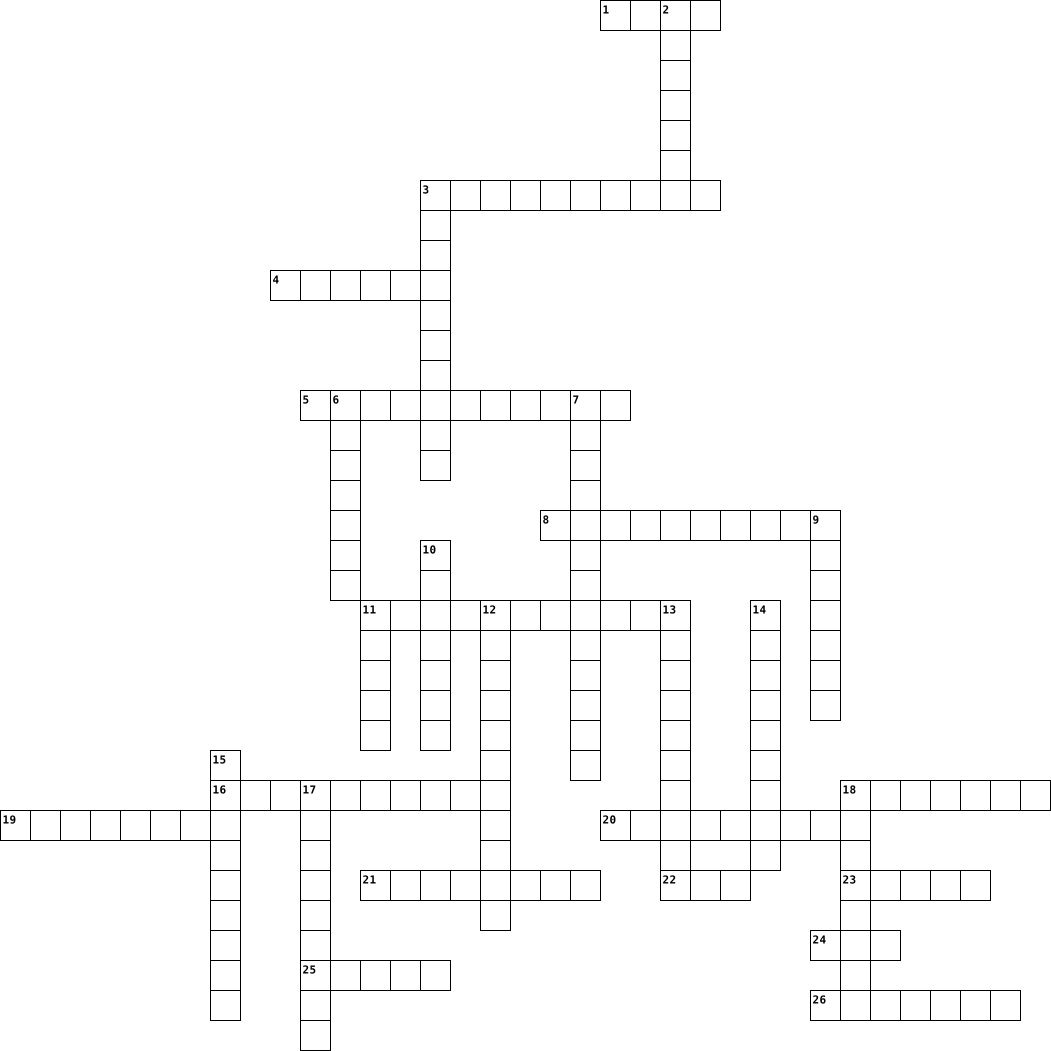
Across
- / Molten rock below the Earth's surface
- / When oceanic crust collides with continental crust, and the oceanic plate then sinks below the continental plate
- Arc / A chain of islands formed at the edges of colliding tectonic plates where one plate subducts
- Drift / The separating of continents by drifting across the oceans
- / An instruments that detects the seismic waves from an earthquakes
- Flow / A cloud of ash, rock and gas about 500°C that exists from a volcano like an avalanche
- / The rapid movement of the ground, usually back and forth and up and down in a wave motion due to the movement of tectonic plates
- Wave / The shaking, wave-like movement of the ground in an earthquake
- Stripping / Patterns of magnetism trapped in rocks on each side of plate boundaries
- / The point on the Earth's surface directly above the focus of an earthquake
- A huge wave in the ocean caused by an earthquake occurring on the seafloor
- Ground Station / A receiver and computer that can detect satellite signals and calculate its position on the Earth's surface
- / The place below ground where an earthquake starts
- Spots / Isolated places away from plate boundaries where a lot of hot magma is being created
- Trench / A deep trench in the ocean floor that is much deeper than the rest of the ocean floor
- Wave / A longitudinal seismic wave that travels fast through the Earth
Down
- / A place where and extremely hot material from inside the Earth erupts at the surface
- / Where the crust is sinking down into the Earth
- Crust / The crust that forms the ocean floor
- / A layer of 'plastic' semi-solid rock in the lower mantle
- / The process of continents breaking up, subsiding and allowing in the sea
- Wave / A seismic wave that travels along the surface of the Earth in the crust
- Tectonics / The theory that the Earth's crust is cracked into many large pieces that move on the asthenosphere
- Crust / The crust that forms the continents
- Boundary / Where plates are colliding with each other
- Boundary / Where plates are moving apart from each other in opposite directions
- Wave / A transverse seismic wave that travels through the Earth
- Boundary / Where plates are sliding parallel to each other but in opposite directions
- Spreading / The process of new crust forming at the ocean ridges and spreading outwards
29 Clues: / Molten rock below the Earth's surface • Crust / The crust that forms the continents • Crust / The crust that forms the ocean floor • / Where the crust is sinking down into the Earth • / The place below ground where an earthquake starts • Boundary / Where plates are colliding with each other • / A layer of 'plastic' semi-solid rock in the lower mantle • ...
The Changing Earth 2012-10-30

Across
- a layer of liquad metals that surrounds the inner core
- where plates scrape past each other
- most rigid of all layers
- a layer of hoter, softer rock in the upper mantle
- plates push together
- a smaller earthquake that follows a powerful one
- a ball of hot, solid metal
- the point on Earth's surface
- ancient plants and animals buried in Earth's crust for millions of years
Down
- heated rock rises in plumes
- natural resource that cannnot be replaced in nature
- a fracture, or break, in Earth's Lithosphere
- when one plate sinks under another
- natural resource that can be replaced in nature
- vibrations caused by earthquakes
- continents split apart
- substance found in nature people use
- type of hot spring and shoots water out in the air
- an openeing in Earth's crust
- a thin layer of cool rock
20 Clues: plates push together • continents split apart • most rigid of all layers • a thin layer of cool rock • a ball of hot, solid metal • heated rock rises in plumes • an openeing in Earth's crust • the point on Earth's surface • vibrations caused by earthquakes • when one plate sinks under another • where plates scrape past each other • substance found in nature people use • ...
The Earth System 2023-03-13

Across
- The dynamic, interconnected set of physical, chemical, biological, and human components that interact to shape the Earth's environment and determine its state over time.
- A region of space surrounding a magnet or a moving electric charge that exerts a magnetic force on other magnets or moving charges. The Earth has a magnetic field generated by the motion of molten iron in its core, which helps to protect the planet from harmful solar radiation.
- A layer located in the Earth's mantle beneath the lithosphere. This layer has the ability to flow and deform in a manner similar to plastic when subjected to stress, which means that it can change shape without breaking. It is situated at a depth of approximately 100-200 kilometres beneath the Earth's surface.
- The central part of the Earth, divided into an outer core and an inner core. The outer core is liquid and surrounds the solid inner core, and both are composed primarily of iron and nickel. The core generates the Earth's magnetic field.
- The scientific study of the Earth's shape, gravity field, and rotation, as well as its orientation and position in space. Geodesy uses techniques such as satellite-based positioning and precise measurements of distances and angles.
- Tectonic System The theory that the Earth's outermost layer (the lithosphere) is broken into several plates that move around on the underlying asthenosphere. The plate tectonic system is responsible for many geological phenomena, including earthquakes, volcanoes, and mountain ranges.
- The preserved remains or traces of ancient organisms, typically found in rocks or sediments. Fossils provide important information about the history of life on Earth.
- The transfer of heat by the movement of a fluid, such as a gas or liquid, due to differences in density caused by temperature variations. Convection is an important mechanism for the transfer of heat within the Earth's mantle and core.
- Layer between Earth's mantle and inner core made of liquid iron and nickel, approximately 2,300 kilometres thick with an average temperature of 4,000 degrees Celsius. Movement of molten metals generates the Earth's magnetic field, which protects the planet from harmful radiation and is essential for life.
- A fundamental concept in geology that states that the same physical, chemical, and biological processes that operate in the present also operated in the past. This principle allows geologists to interpret the past by studying present-day processes and their effects on the Earth's surface.
Down
- A complex, interconnected system of physical, chemical, biological, and human components that interact to shape the Earth's environment and determine its state over time.
- A systematic approach to understanding the natural world through observation, hypothesis testing, and experimentation. The scientific method is used to develop and refine scientific theories, which are explanations of natural phenomena supported by evidence.
- The solid, central part of the Earth's core, consisting primarily of iron and nickel. It is surrounded by the liquid outer core and generates the Earth's magnetic field.
- The thin outermost layer of the Earth, ranging from 5-70 km in thickness, that comprises the continents and ocean basins. It is composed of relatively low-density rocks such as granite and basalt.
- The layer of the Earth between the crust and the core. The mantle is composed of solid rock, but it can flow slowly over long periods of time. It is divided into the upper and lower mantle based on differences in physical properties.
- The scientific study of the Earth's physical structure, composition, history, and processes, including the study of rocks, minerals, fossils, and other geological materials.
- The complex interplay of physical, chemical, biological, and human factors that determine the Earth's climate, including the atmosphere, oceans, land surfaces, ice sheets, and living organisms.
- A vibration that travels through the Earth in response to an earthquake or other seismic event. Seismic waves provide valuable information about the interior structure of the Earth, including the location and nature of seismic discontinuities.
- The process by which the Earth's magnetic field is generated by the motion of molten iron in the outer core. The geodynamo is driven by convection and plays a crucial role in protecting the Earth from harmful solar radiation.
- The collection of rocks, minerals, fossils, and other materials that provide a record of the Earth's history, including its geological, biological, and environmental evolution over billions of years.
- The rigid outer layer of the Earth, consisting of the crust and the uppermost part of the mantle. It is divided into a series of large plates that move and interact with each other along boundaries.
- The physical features of the Earth's surface, including mountains, valleys, and plains. Topography is influenced by a variety of factors, including tectonic activity, erosion, and climate.
- The long-term average of weather patterns in a particular region, including measures such as temperature, humidity, precipitation, wind, and atmospheric pressure.
23 Clues: The long-term average of weather patterns in a particular region, including measures such as temperature, humidity, precipitation, wind, and atmospheric pressure. • The preserved remains or traces of ancient organisms, typically found in rocks or sediments. Fossils provide important information about the history of life on Earth. • ...
The Living Earth 2022-12-01

Across
- the number of people, other living organisms, or crops that a region can support without environmental degradation.
- (in green plant cells) a plastid that contains chlorophyll and in which photosynthesis takes place
- relating to, involving, or requiring an absence of free oxygen.
- the capacity to recover quickly from difficulties; toughness
- the impeding, slowing, or stopping effect exerted by one material thing on another.
- a series of chemical reactions that break down glucose to produce ATP
- the variety of life in the world or in a particular habitat or ecosystem
- a set of things working together as parts of a mechanism or an interconnecting network.
- the regions of the surface, atmosphere, and hydrosphere of the earth (or analogous parts of other planets) occupied by living organisms.
Down
- a hierarchical series of organisms each dependent on the next as a source of food.
- the process by which green plants and some other organisms use sunlight to synthesize foods from carbon dioxide and water.
- the powerhouse of the cell
- relating to, involving, or requiring free oxygen.
- a group of atoms bonded together, representing the smallest fundamental unit of a chemical compound that can take part in a chemical reaction
- a large natural or artificial lake used as a source of water supply.
- a compound consisting of an adenosine molecule bonded to three phosphate groups, present in all living tissue
- a system of interlocking and interdependent food chains.
- a biological community of interacting organisms and their physical environment
- the total mass of organisms in a given area or volume.
- a natural fuel such as coal or gas, formed in the geological past from the remains of living organisms.
20 Clues: the powerhouse of the cell • relating to, involving, or requiring free oxygen. • the total mass of organisms in a given area or volume. • a system of interlocking and interdependent food chains. • the capacity to recover quickly from difficulties; toughness • relating to, involving, or requiring an absence of free oxygen. • ...
The Changing Earth 2017-06-08

Across
- There was once a supercontinent called _____________.
- Plates do not slide easily over each other because of _________ between them.
- Supercontinent comprising of Australia, Antarctica, South America, Africa and India
- The slabs of crust, soggy bottom and top layer of the mantle move as one and are called ___________ ____________.
- A ________ _________ is when a heavier ocean plate is forced under the continental plate at an angle of 20° to 60°.
- ___________ have formed and split apart, species have arisen and become extinct.
- Tectonic plates and their boundaries: split, bang and ____________.
- The layer of the earth we live on is called the ___________.
- What new technology, used during World War II, provided new evidence for the theory of tectonic plates?
- where plates move apart.
- A _________ ________ conserves rock. They neither create nor destroy it.
- where plates scrape along each other.
- where one plate collides with another.
- A weakened line (called a fault) in the crust causes a huge crack or _____ _____ to form.
- The ________ is 2800 km thick. The rock here is under extreme heat and pressure and behaves like a sludgy slow-moving liquid.
Down
- The rocks of the ocean floor have _________ stripes, parallel with the underwater ridges.
- Hot air and liquid rise and so will hot liquid rock, this cycle of moving rock is called a __________ __________.
- The ______________ has changed in both its composition and its temperature.
- _________ evidence suggests the southern continents were originally joined.
- Supercontinent comprising of North America, Europe and most of Asia
- Magnetic stripes indicate that the youngest rock is next to the ridges and the oldest next to the ___________.
- ___________ has seen many changes since it was formed 4.6 billion years ago.
- Rock is melted here and is returned to the mantle for recycling.
- A chain of ________ often forms when ocean plate meets ocean plate.
- Hot patches and cool patches create the convection ___________ that push the plates around.
- _____________ result from the movement of tectonic plates.
- ______________ and trenches come from collisions between an ocean plate and a continental plate.
27 Clues: where plates move apart. • where plates scrape along each other. • where one plate collides with another. • There was once a supercontinent called _____________. • _____________ result from the movement of tectonic plates. • The layer of the earth we live on is called the ___________. • Rock is melted here and is returned to the mantle for recycling. • ...
Protect The Earth 2021-10-19

Across
- Wood
- to conserve
- Glass
- Flower
- Snake
- Earth
- Bottle
- Whale
- horse
- To know facts, Information
- Reduce
- Aluminio
Down
- Cow
- To say, To tell
- People
- Air
- Tiger
- Recycle
- Bear
- To pick up
- Can
- Clean
- Threat
- To turn off
- Elephant
- Light
- Animal
- Use
28 Clues: Cow • Air • Can • Use • Wood • Bear • Tiger • Glass • Snake • Clean • Earth • Whale • horse • Light • People • Flower • Threat • Bottle • Animal • Reduce • Recycle • Elephant • Aluminio • To pick up • to conserve • To turn off • To say, To tell • To know facts, Information
Save the Earth 2022-11-01

Across
- use __________c ✖
- recycle ________ ✓
- re______ glass ✓
- use ____________ bags ✖
- waste ______r ✖
- re______ waste ✓
- re____ paper ✓
- _____ down _________ ✖
Down
- use too much _________ ✖
- save _________ ✓
- ________ trees ✓
- build ___________ ✖
- pick ____ ___________ ✓
- take ________ baths ✖
- s______ energy ✓
- waste ____d ✖
- ____________ cans ✓
- waste e_____ ✖
- _______ the ________ ✓
- ___________ paper ✖
20 Clues: waste ____d ✖ • waste e_____ ✖ • re____ paper ✓ • waste ______r ✖ • save _________ ✓ • ________ trees ✓ • s______ energy ✓ • re______ glass ✓ • re______ waste ✓ • use __________c ✖ • recycle ________ ✓ • build ___________ ✖ • ____________ cans ✓ • ___________ paper ✖ • take ________ baths ✖ • _______ the ________ ✓ • _____ down _________ ✖ • pick ____ ___________ ✓ • use ____________ bags ✖ • ...
The Planet Earth 2022-10-20

Across
- The energy from the core of the Earth that causes the magma to flow in the mantle.
- The smallest tectonic plate.
- The temperature of this layer is approximately 4500 degrees Celcius.
- The geological change when where two or more of Earth's tectonic plates are pushed together.
- The second name of the geologist who introduced the continental drift theory.
- The heat transfer process in fluids.
- The condition of volcanoes that have not erupted in a long time but are expected to erupt again in the future
- Hot molten or semifluid rock in the mantle of Earth.
- This plate lies between North American plate and South American plate.
- A funnel-shaped depression that usually lies directly above the vent from which volcanic material is ejected.
Down
- Two tectonic plates sliding past each other.
- In this layer iron (Fe) and nickel (Ni) are in the phase of liquid (molten).
- The combination of Earth's crust and upper mantle.
- The modern idea to replace the theory of continental drift.
- Energy or particles from a source that travel through space or other mediums.
- The Himalayan mountain range was formed due to the interaction between this plate and Eurasian plate.
- The tectonic plate beneath the ocean.
- A geological process in which the oceanic lithosphere is recycled into the Earth's mantle at convergent boundaries.
- The most common non metal element in Earth's crust.
- When magma flows or erupts onto Earth's surface.
20 Clues: The smallest tectonic plate. • The heat transfer process in fluids. • The tectonic plate beneath the ocean. • Two tectonic plates sliding past each other. • When magma flows or erupts onto Earth's surface. • The combination of Earth's crust and upper mantle. • The most common non metal element in Earth's crust. • Hot molten or semifluid rock in the mantle of Earth. • ...
Discovering the Earth 2016-11-30

Across
- name, volcano, Hawaiian
- point above earthquake
- the solid, outer part of the Earth
- measure of energy, earthquake
- study of physical structure
- the first layer of the core
- rise and fall of the waters of the ocean
- brittle rocks, ductile rocks
- a crack in the Earth's crust
- plates, away
- studies earthquakes
- volcanic gases
- changed, heat, pressure
- uppermost layer, oceanic
- fossils, mineral fragments
- rupture incrust
- mostly-solid bulk of Earth's interior
- wearing away of rock
Down
- violent shaking, ground
- middle of Earth
- two sub-layers, earth's crust
- geophysicist &meteorologist
- continental crust above sea level
- “supercontinent” on the Earth
- plates, toward
- flexible upper layer
- transform fault
- transfer of heat, mass movement
- cooled lava
29 Clues: cooled lava • plates, away • plates, toward • volcanic gases • middle of Earth • transform fault • rupture incrust • studies earthquakes • flexible upper layer • wearing away of rock • point above earthquake • violent shaking, ground • name, volcano, Hawaiian • changed, heat, pressure • uppermost layer, oceanic • fossils, mineral fragments • geophysicist &meteorologist • study of physical structure • ...
Across The Earth 2019-12-05

Across
- We are the ____
- Toyota ____
- A community of organisms that depend on each other and the environment they inhabit.
- Sharing a car to a destination to reduce fuel use, pollution and travel costs.
- Proper way to travel.
- The area occupied by a community or species (group of animals or plants), such as a forest floor, desert or sea shore.
- To take care of a place or building in order to prevent it from being harmed or destroyed.
- Using methods that do not harm the environment.
- Retrieve or recover (something previously lost, given, or paid); obtain the return of.
- Matter from living, or once-living, things.
- Save the ____
- Discarded matter; refuse.
Down
- The reduction of trees in a wood or forest due to natural forces or human activity such as burning or logging.
- Things harmful to the body and/or environment.
- To prevent land, water, or other natural resources from being damaged or destroyed.
- The mass of air surrounding the Earth.
- Bill's favorite pastime.
- Where all of our trash goes.
- Air pollution consisting of smoke and fog, which occurs in large urban and industrial areas and is mainly caused by the action of sunlight on burned fuels, mostly from car exhausts.
- Reduce,Reuse,______
- Killing the planet
21 Clues: Toyota ____ • Save the ____ • We are the ____ • Killing the planet • Reduce,Reuse,______ • Proper way to travel. • Bill's favorite pastime. • Discarded matter; refuse. • Where all of our trash goes. • The mass of air surrounding the Earth. • Matter from living, or once-living, things. • Things harmful to the body and/or environment. • Using methods that do not harm the environment. • ...
The Dynamic Earth 2025-09-25

Across
- transfer of energy across space and in the atmosphere
- Earth's outer layer that includes the crust and uppermost part of the mantle
- narrow layer around Earth's surface in which life can exist
- process by which water vapor forms water droplets on dust particles
- atmospheric layer above the troposphere
- atmospheric layer nearest to Earth
- middle layer of the Earth
- mixture of gases surrounding Earth
- molecule made up of three oxygen atoms
- concentration of dissolved salt in the ocean
Down
- process by which liquid water is heated by the sun and then rises into the atmosphere
- larger droplets fall from clouds as rain
- plastic, solid layer of the mantle
- Earth's outer layer
- the transfer of heat by air currents
- solid part of the Earth that consists of all the rocks
- flow of heat from a warmer object to a colder object
- 3 percent of all of Earth's water
- innermost layer of the Earth
- removal and transport of surface material through weathering
20 Clues: Earth's outer layer • middle layer of the Earth • innermost layer of the Earth • 3 percent of all of Earth's water • plastic, solid layer of the mantle • atmospheric layer nearest to Earth • mixture of gases surrounding Earth • the transfer of heat by air currents • molecule made up of three oxygen atoms • atmospheric layer above the troposphere • ...
Shaping the Earth 2025-11-17

Across
- Most common glaciers
- Sand piles where the water slows
- The movement of rock pieces due to water
- Rocks rapidly moving downhill
- When a smaller glaciers empties into a larger glacier
- Canoe shaped hills
- The movement of rock and dust due to wind
- Dirt and rock pushed in front of glaciers
- Bowl shaped valley on the side of a mountain
- Rivers emptying into larger bodies of water
Down
- Large amounts of rock and soil moving due to gravity
- Every Glacier makes this shape
- Cause rocks beneath to break and sink into the mantle
- The movement of land sliding downhill
- Large Icesheets that move slowly across land which changes the enviorment changing the shape of
- The process that reshapes the land through movement
- Piles of sand steeper on one side
- Rocks being left after Erosion
- Pointed mountain
- Crash into beaches and carry away rock
- Very slow movement of soil
21 Clues: Pointed mountain • Canoe shaped hills • Most common glaciers • Very slow movement of soil • Rocks rapidly moving downhill • Every Glacier makes this shape • Rocks being left after Erosion • Sand piles where the water slows • Piles of sand steeper on one side • The movement of land sliding downhill • Crash into beaches and carry away rock • The movement of rock pieces due to water • ...
The Restless Earth 2017-02-02

Across
- Hot liquid rock beneath the earths surface
- Example of a volcanic mountain
- Plates that slip by one another are referred to as
- Boundary Where plates meet
- Mountain When plates collide these are formed
- The point on the earths surface directly above where it began
- Andreas Name of a fault line in California
- The thin outer layer of the earth is called
- Huge tidal wave
Down
- When magma reaches the surface of the earth
- Atlantic Ridge An example of a Mid Ocean Ridge
- folding The Alps and The Andes were formed during this period
- Scale Used to measure the strength of an earthquake
- The part of the earth between the crust and the outer core
- Soil When lava breaks down it creates this
- Instrument used to measure earthquakes
- Magma reaches the surface of the earth through this
- This type of volcano has not erupted for a long time but may erupt again
- The point where the earthquake occurs
- Ocean The largest earthquake and volcanic zone lie along this
20 Clues: Huge tidal wave • Boundary Where plates meet • Example of a volcanic mountain • The point where the earthquake occurs • Instrument used to measure earthquakes • Hot liquid rock beneath the earths surface • Soil When lava breaks down it creates this • Andreas Name of a fault line in California • When magma reaches the surface of the earth • ...
Beyond the Earth 2014-03-13

Across
- propsed the Nebular Hypotesis Theory
- are small chunks of irregularly shaped objects
- is the color sphere of the sun
- referred to as "Shooting Stars"
- formulated the Big Bang Theory
- accoreding to him, two forces hold the plants in their orbit around the sun
- is the second type of asteroids
- proposed the Planetismal Theory
- is the largest asteroid
- is the first type of asteroids
- are darker, cooler areas in the atmosphere.
Down
- are small, but sharp eruptions which last for about 15 minutes to 1 hour
- is the light sphere and the main body of the sun
- are billowing arches of rose-colored flame
- is the outermost layer of the sun's atmosphere
- are bubbles of hot gases
- are the third type of asteroids
- are purely electrical charges that look like neon lights
- proposed the Companion Star Theory
- is the second largest asteroid
20 Clues: is the largest asteroid • are bubbles of hot gases • is the color sphere of the sun • formulated the Big Bang Theory • is the first type of asteroids • is the second largest asteroid • referred to as "Shooting Stars" • are the third type of asteroids • is the second type of asteroids • proposed the Planetismal Theory • proposed the Companion Star Theory • ...
The Dynamic Earth 2022-09-01

Across
- states that geologic processes that happened in the past can be explained by current geologic processes
- the breakdown of rock by physical and chemical processes
- large pieces of the lithosphere that move across the mantle
- the process by which sediment and other materials are moved from one place to another
- the process by which other chemicals combine with oxygen
- a pure substance that cannot be broken down into simpler substances by ordinary chemical means
- the time needed for half of a sample of radioactive material to decay
- the sudden and rapid movement of a large amount of material downslope
- the weather conditions in an area over a long period of time
- a large mass of moving ice that forms by the compacting of snow
Down
- living things and the areas of Earth where they are found
- the color of the powdered form of a mineral
- any place where gas, ash, or melted rock come out of the ground
- the rising of regions of the Earth's crust to higher elevations
- anything that has volume and mass
- An ordered arrangement of rock layers based on the relative ages of the rocks
- type of rock that forms from the cooling of magma or lava
- the trace or remains of an organism that lived long ago
- the invisible gasses that surround and protect the Earth
- an underwater or exposed ridge of sand, gravel, or shell material
20 Clues: anything that has volume and mass • the color of the powdered form of a mineral • the trace or remains of an organism that lived long ago • the breakdown of rock by physical and chemical processes • the process by which other chemicals combine with oxygen • the invisible gasses that surround and protect the Earth • ...
The Dynamic Earth 2020-08-27

Across
- the solid outer layer of the Earth that consists of the crust and the rigid upper part of the mantle
- a mixture of gases that surrounds a planet like Earth
- the part of Earth where life exists
- the solid plastic layer of the mantle beneath the lithosphere; made of mantle rock that flows very slowly, which allows tectonic plates to move on top of it
- the thin and solid outermost layer of the Earth above the mantle
- a process in which the materials of Earth's surface are loosened, dissolved, or worn away and transported from one place to another by a natural agent; such as wind or gravity
- in Earth science it is the layer of rock between the Earth's crust and core
- the portion of Earth that is water
- a gas molecule that is made up of three Oxygen atoms
Down
- the energy that is transferred as electromagnetic waves, such as visible light and infrared waves
- the lowest layer of the atmosphere, in which temperature drops at a constant rate as altitude increases; the layer of where weather conditions exists
- the movement of matter due to differences in density that are caused by temperature variations; can result in the transfer of energy as heat
- the warming of the surface and lower atmosphere of Earth that occurs when carbon dioxide, water vapor, and other gases in the air absorb and reradiate infrared radiation
- the central part of the Earth below the mantle; also the center of the Sun
- the transfer of energy as heat through a material
- a block of lithosphere that consists of the crust and the rigid outermost part of the mantle
- the mostly solid rocky part of Earth; extends from the center of the core to the surface of the crust
- any form of water that falls to the Earth's surface from the clouds; includes rain, snow, sleet, and hail
- a measure of the amount of dissolved salts in a given amount of liquid
- the layer of the atmosphere that lies between the troposphere and mesophere and in which temperature increases as altitude increases; contains the ozone layer
- the change of state from a liquid to a gas
- the continuous movement of water between the atmosphere, the land, and the oceans
22 Clues: the portion of Earth that is water • the part of Earth where life exists • the change of state from a liquid to a gas • the transfer of energy as heat through a material • a gas molecule that is made up of three Oxygen atoms • a mixture of gases that surrounds a planet like Earth • the thin and solid outermost layer of the Earth above the mantle • ...
The Earth Vocab 2024-10-02

Across
- The layer of the earth that extends from the bottom of the crust to the earth's core
- A map that shows the different shapes and sizes of a land surface
- The lines on a map or globe between the points that represent the geographic north and south poles of the earth, measures longitude
- The turning of an object on its axis
- Ball-shaped/ every point on its surface is an equal distance from the center
- The movement of the earth in its orbit around the sun
- The topmost solid part of the earth
- A large land area that measures millions of square kilometers and rises a considerable distance above sea level
- The measure of the distance east or west of the prime meridian
- The thin outer layer of the earth
- The envelope of gases surrounding the earth
Down
- The solid, most inner layer of the earth
- The lines from east to west across a map or globe that measures latitude
- The part of the earth's surface covered by water
- Imaginary line around the earth that divides the earth into two hemispheres, parallel halfway between the North and South poles.
- The partially melted layer in the mantle
- A sphere that flattens at the poles and bulges at the equator
- The drawing of the earth or part of the earth on a flat surface
- The measure of distance north or south of the equator
- The liquid layer of the earth surrounding the inner core
- Spherical model of the earth
- The shape of the earth's surface
22 Clues: Spherical model of the earth • The shape of the earth's surface • The thin outer layer of the earth • The topmost solid part of the earth • The turning of an object on its axis • The solid, most inner layer of the earth • The partially melted layer in the mantle • The envelope of gases surrounding the earth • The part of the earth's surface covered by water • ...
The Active Earth 2024-11-20

Across
- Made of dark-colored MAFIC rocks with higher iron and higher density
- Made of dark-colored MAFIC rocks with higher iron and higher density
- How much matter is in an object. Mass is measured in grams (g)
- an increase in size of a heated substance
- Heat transferred to your hand if you touch a hot surface
- I am a physical layer of earth that is solid and brittle
- Heat transferred by flowing matter
- the ability or tendency to float
- How much space an object occupies. Volume is measured in mL or cm3
- How heavy something is for its size.
- I am a physical layer of earth that is liquid and gooey
Down
- I am a physical layer of earth that is solid, fluid, but NOT liquid (think of peanut butter or toothpaste!)
- Heat is transferred as electromagnetic waves
- example of a felsic rock
- example of a mafic rock
- defined by what the layers are MADE from
- Made of light-colored FELSIC rocks with low iron and low density
- defined by what the layers DO
- I am a physical layer of earth that is liquid metal
- I am a way to describe rocks high in iron and magnesium
- I am a physical layer of earth that is a solid, spinning ball of metal
- I am a way to describe rocks low in iron
22 Clues: example of a mafic rock • example of a felsic rock • defined by what the layers DO • the ability or tendency to float • Heat transferred by flowing matter • How heavy something is for its size. • defined by what the layers are MADE from • I am a way to describe rocks low in iron • an increase in size of a heated substance • Heat is transferred as electromagnetic waves • ...
The Earth Crust 2025-06-01

Across
- a large, continuous landmass on earth.
- a scientist who studies volcanoes and volcanic activity.
- the idea that continents move slowly across the earth’s surface.
- a well-supported explanation based on facts and evidence.
- a sudden shaking of the ground caused by movement along faults.
- something accepted as true without proof for the sake of argument.
- the earth's thin, outermost layer where we live.
- the edges where tectonic plates meet and interact.
Down
- the power or force something can withstand or apply.
- a crack in the earth's crust where earthquakes can occur.
- the innermost layer of the earth, made of solid and liquid metals.
- a weakness or restriction in a scientific method or result.
- a massive piece of the earth's crust that moves slowly over the mantle.
- a large sea wave caused by underwater earthquakes or eruptions.
- mountains formed when layers of rock are compressed and folded.
- an opening in the earth's crust where lava and gases erupt.
- evaluation of scientific work by other experts in the field.
- a testable idea or explanation based on limited evidence.
- a deep valley formed as tectonic plates move apart.
- the thick layer of semi-solid rock beneath the crust.
20 Clues: a large, continuous landmass on earth. • the earth's thin, outermost layer where we live. • the edges where tectonic plates meet and interact. • a deep valley formed as tectonic plates move apart. • the power or force something can withstand or apply. • the thick layer of semi-solid rock beneath the crust. • a scientist who studies volcanoes and volcanic activity. • ...
Page 1 of 100 Next