
the earth Crossword Puzzles
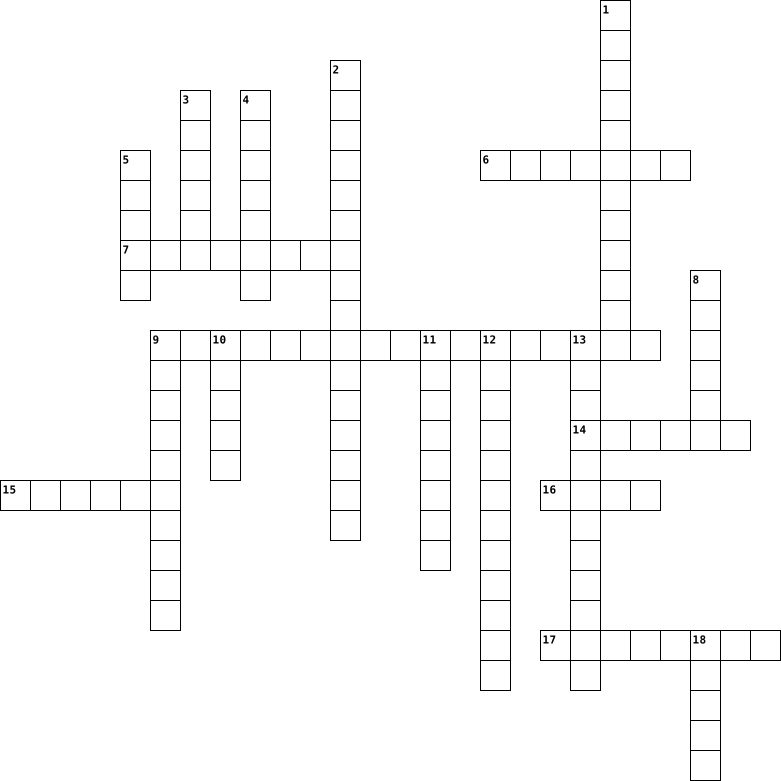
E.Q crossword 2021-10-13

Across
- opposite of brittle
- 80% of the earth
- ditch
- moving toward
- liquid metal
- opposite of compression
- change is a synonmyn
Down
- hard but liable to break easily
- rigid
- contracting is a synonym
- next to the lithosphere
- moving away
- center of the earth
- last layer of the earth
- applied force
15 Clues: rigid • ditch • moving away • liquid metal • moving toward • applied force • 80% of the earth • opposite of brittle • center of the earth • change is a synonmyn • next to the lithosphere • last layer of the earth • opposite of compression • contracting is a synonym • hard but liable to break easily
Inside the earth 2022-05-19

Across
- - Dense sphere of solid iron and nickel at the center of Earth
- - Layer of molten iron and nickel that surrounds the inner core of the Earth
- - Portion of the Earth’s crust that primarily contains granite, is less dense than oceanic crust, and his 20-50 km thick
- - Upper layer of the Earth’s mantle, below the lithosphere, in which there is relatively low resistance to plastic flow and convection is thought to occur
- - Thin and solid outermost layer of the Earth above the mantle
- - Vibrations that travel through Earth carrying the energy released during an earthquake
Down
- - Earth’s crust located under the ocean
- - Rigid layer made up of the uppermost part of the mantle and the crust
- - the layer of the Earth between the core
9 Clues: - Earth’s crust located under the ocean • - the layer of the Earth between the core • - Dense sphere of solid iron and nickel at the center of Earth • - Thin and solid outermost layer of the Earth above the mantle • - Rigid layer made up of the uppermost part of the mantle and the crust • ...
Save the Earth 2025-07-19

Across
- v. to keep (someone or something) from being harmed, lost, etc.
- n. a change in global or regional climate patterns
- n. the conditions that surround someone or something; the conditions and influences that affect the growth, health, progress, etc., of someone or something
- n. the recent increase in the world's temperature that is believed to be caused by the increase of certain gases (such as carbon dioxide) in the atmosphere compare greenhouse effect
Down
- adj. able to be used without being completely used up or destroyed
- v. to make something new from (something that has been used before)
- v. to keep (someone or something) safe; to stop (someone or something) from dying or being hurt, damaged, or lost
- adj. not harmful to the environment, not having a bad effect on the natural world
- v. to put(a seed, flower) in the ground to grow
9 Clues: v. to put(a seed, flower) in the ground to grow • n. a change in global or regional climate patterns • v. to keep (someone or something) from being harmed, lost, etc. • adj. able to be used without being completely used up or destroyed • v. to make something new from (something that has been used before) • ...
the Earth Day 2026-03-23

Across
- You turn this off to save water.
- We use this again and again.
- You turn this off to save energy.
- We turn old things into new things.
Down
- Another word for garbage.
- A material we can recycle.
- The planet we live on.
- We use less water, less energy.
- We put trash in this.
9 Clues: We put trash in this. • The planet we live on. • Another word for garbage. • A material we can recycle. • We use this again and again. • We use less water, less energy. • You turn this off to save water. • You turn this off to save energy. • We turn old things into new things.
Types of Weather 2022-10-28

Across
- water vapor in the atmosphere
- when water vapor forms into ice without passing through the liquid state
- rain drops freeze as they hit the earth and form an icy glaze
- water returns to the atmosphere
- vibrations in the air produces by the rapid change of air temperature after a bolt of lightning occurs
- when cooler dense air from the valley moves up the mountain to replace the warmer, rising air
- rain drops freeze on their way to the earth and land as icy pellets
- a storm with spiraling winds that forms over the Atlantic ocean or the Eastern Pacific ocean
- water falls to the earth
- when water droplets in the clouds join together to form larger drops
- when ice crystals in the clouds join together and fall to the earth
Down
- a period of time with higher-than-average temperatures
- a funnel-shaped windstorm on land
- local wind where sea meets the land
- when cooler, denser air flows down a mountain to replace the warmer, less dense valley air
- local wind where land meets the sea
- appears when water vapor condenses on the surface of objects
- a type of static electricity that moves between clouds or between clouds and the earth
- frozen precipitation that usually falls during warm weather
- a snowstorm with strong, freezing winds and blowing snow
20 Clues: water falls to the earth • water vapor in the atmosphere • water returns to the atmosphere • a funnel-shaped windstorm on land • local wind where sea meets the land • local wind where land meets the sea • a period of time with higher-than-average temperatures • a snowstorm with strong, freezing winds and blowing snow • ...
Science 2023-01-20

Across
- what cooling magma becomes rock what rock does it become.
- what boundaries plates move apart.
- what occurs when two plates push against each other and become locked.
- what is the second most inner layer of earth.
- what cleans up the stuff after weathering.
- what type of weathering causes reactions to nature.
- what boundaries plates push together.
- _________ is found mostly in sediment rocks
- extreme heat and pressure creates one type of rock into a new one, what is the new rock called.
- who proposed the idea that continents sat on. large crustal plates that had moved and carried the. continents to their current positions on Earth.
Down
- what is the inner most layer of earth.
- what is the second outer most layer of earth.
- what takes away all the stuff and deposits it.
- what is a mix of two or more things together.
- plates slip past each other.
- what is a mixture which one substance dissolves in another.
- what is the outermost layer of the earth.
- what type of weathering breaks down rocks or ice.
- what rock is created when layers of sediment bonds together and forms rock.
19 Clues: plates slip past each other. • what boundaries plates move apart. • what boundaries plates push together. • what is the inner most layer of earth. • what is the outermost layer of the earth. • what cleans up the stuff after weathering. • _________ is found mostly in sediment rocks • what is the second outer most layer of earth. • ...
Earth's Layers 2024-05-03

Across
- The primary rock that makes up the ocean crust
- A method of heat transfer through a fluid
- The shape of the inner core
- Movement in the outer core creates this field
- Crust that dense, thin, and young
- The reason a planet develops interior layers
- The primary rock that makes up the continental crust
- The outer core exists in this state of matter
- thinnest type of crust
- A term for the crust and the rigid mantle
- The deepest layer we have dug into
Down
- This increases as you travel deeper into the Earth
- The layer of gases that surrounds the Earth
- The center of Earth is as hot as the surface of this object
- Earth's layers were discovered by studying these
- The force that pulls towards Earth's core
- Crust that is less dense, thick, and old
- This part of the mantle is located above the asthenosphere
- Oceans, rivers, and seas are part of this
- This layer acts like hot, plastic putty
- core The densest Earth later
- The composition of the inner core
- The asthenosphere is part of which layer
23 Clues: thinnest type of crust • The shape of the inner core • core The densest Earth later • Crust that dense, thin, and young • The composition of the inner core • The deepest layer we have dug into • This layer acts like hot, plastic putty • Crust that is less dense, thick, and old • The asthenosphere is part of which layer • A method of heat transfer through a fluid • ...
the insides 2017-02-16

Across
- Exactly why tectonic plates move
- Contributes to the heat inside he Earth
- On average it switches every 200,000 years
- The type of plate underlying most land
- Temperatures as high as 10,000 F
- It keeps the inner core solid
- Molten rock in side the earth
- Process that controls the structure and properties of the Earth's crust
Down
- What happens where oceanic plates and continental plates collide
- The outermost and thinnest part of the earth
- The layer of rock between the crust and the core
- Boundaries where plates move together
- Crack in the earth
- 200 miles wide at their widest point
- Consists of the crust and rigid upper mantle
- Boundaries where plates move apart
16 Clues: Crack in the earth • It keeps the inner core solid • Molten rock in side the earth • Exactly why tectonic plates move • Temperatures as high as 10,000 F • Boundaries where plates move apart • 200 miles wide at their widest point • Boundaries where plates move together • The type of plate underlying most land • Contributes to the heat inside he Earth • ...
earth layers, biotic,abioti 2021-12-16

Across
- the thinnest layer of earth
- a not living thing
- loose molecules
- is the hot that conducts to a item wen touchin
- movement cause whiten fluid
- energy that comes from a source
- a liquid fluid layer
- solid layer in mantle
Down
- it's underneath of the earth
- living things
- the middle of the earth
- a firm molecules
- mass divided by volume
- thickest layer of earth
14 Clues: living things • loose molecules • a firm molecules • a not living thing • a liquid fluid layer • solid layer in mantle • mass divided by volume • the middle of the earth • thickest layer of earth • the thinnest layer of earth • movement cause whiten fluid • it's underneath of the earth • energy that comes from a source • is the hot that conducts to a item wen touchin
WED Crossword Puzzle 2024-03-11

Across
- When one side of a mountain range is covered in green while the the other side is dry
- When sediment gets carried to a new place
- All water on earth
- When sediment finds a new home and makes a new feature
- All the air and gases on the earth
- climbing Name a scenario when the Biosphere interacts with the Geosphere.
Down
- Shadows Name a scenario when the Geosphere and the Hydrosphere interact
- All life on earth
- Nimbus definition
- 97% of water on earth is in the
- Currents One way the ocean can moderate the temperature of a coastal city.
- All land on earth
- What color is coral when it bleaches
- Rock breaking into sediment
- Name a scenario when the Atposphere interacts with the Hydrosphere
15 Clues: All life on earth • Nimbus definition • All land on earth • All water on earth • Rock breaking into sediment • 97% of water on earth is in the • All the air and gases on the earth • What color is coral when it bleaches • When sediment gets carried to a new place • When sediment finds a new home and makes a new feature • ...
LET THE FORCE BE WITH YOU STAGE 3 2022-06-27

Across
- another name for air resistance
- energy that an object has while it's moving
- air ...... is a force that slows down movement
- this is produced when an object is moving fast
- the force of water that pushes an object upwards
- wood is ........... than plastic
- water vessels that are not made of solid metal
- by changing this you can reduce air resistance
- space travellers
- a satellite with less gravity than earth
Down
- a man made material used in flotation devices
- these are good floaters
- a planet that is half the size of earth
- slow down objects that are falling to earth
- the invisible earth force that pulls downwards
- goes with a bowling ball in an air experiment
- a bike helmet's shape can ..... air resistance
- the antonym of pulling
- a water vessel that can float and dive
- the force when objects move past each other
20 Clues: space travellers • the antonym of pulling • these are good floaters • another name for air resistance • wood is ........... than plastic • a water vessel that can float and dive • a planet that is half the size of earth • a satellite with less gravity than earth • energy that an object has while it's moving • slow down objects that are falling to earth • ...
The Solar System 2025-12-01

Across
- Demoted to a dwarf planet in 2006.
- This planet is the farthest from the Sun.
- “The Red Planet”
- Every 365.25 days, the Earth completes a __________ around the Sun.
- Belt Similar to the Asteroid Belt, but colder.
- Belt An area between Mars and Jupiter consisting of millions of rock and ice pieces.
- This planet is closest to the Sun.
- Solar System The Sun and the eight planets make up the…
- Planet A miniature planet that does not meet the criteria of what makes a planet.
- Neptune is the _____ planet from the Sun.
Down
- People think that this thing produces its own light, but really, it reflects the Sun’s light.
- Planets The gas giants.
- This planet is known for being in the “Goldilocks Zone”.
- The seventh planet of the solar system.
- Food Astronauts eat this type of food whilst in space.
- The Earth is the ____ planet from the Sun.
- This is the biggest planet in the solar system.
- Planets The four rocky planets.
- This is very similar to Earth.
- This planet is known for its colossal rings.
- Sun The center of our solar system.
21 Clues: “The Red Planet” • Planets The gas giants. • This is very similar to Earth. • Planets The four rocky planets. • Demoted to a dwarf planet in 2006. • This planet is closest to the Sun. • Sun The center of our solar system. • The seventh planet of the solar system. • This planet is the farthest from the Sun. • Neptune is the _____ planet from the Sun. • ...
Gavin-6th hour social studies 2021-12-17

Across
- egypt is on this continent
- hover dam and the Colorado river
- located southwest of the middle east
- bhutan is on this continent
- the coldest continent on earth
- located south of norway and east of the uk
- between the arabian peninsula and the continent of africa
- relative and absolute
- the center point of longitude
- the ocean located on the eastern side of the united states of america
- the only natural satellite earth has
- honduras is on this continent
- named after a country in asia
- examples include I-70 and the autobahn
- a part of the earth based on similar characteristics
Down
- a symbol of the ancient roman empire
- the center point of latitude
- latitude and longitude
- the continent with a lot of islands
- largest ocean on earth
- bolivia is on this continent
- the southernmost ocean in the world
- the northernmost ocean of the world
- study of the world
- the #1 largest island in the world
- examples include chinese, korean, english, sign, etc.
- Germany is on this continent
27 Clues: study of the world • relative and absolute • latitude and longitude • largest ocean on earth • egypt is on this continent • bhutan is on this continent • the center point of latitude • bolivia is on this continent • Germany is on this continent • the center point of longitude • honduras is on this continent • named after a country in asia • the coldest continent on earth • ...
Supermoon Crossword 2025-10-23

Across
- – “How much sunlight the moon reflects toward Earth”
- – “Complete orbit of the moon around Earth”
- – “Path the moon travels around Earth”
- – “Shape of the moon’s visible portion”
- – “Tilt of the moon’s orbit relative to Earth”
- – “Moon’s farthest point from Earth”
- – “Apparent intensity of a supermoon in the night sky”
- – “Reflected sunlight, especially bright during supermoons”
Down
- Cycle – “Recurring sequence of moon phases”
- Month – “Time between full moons (~29.5 days)”
- – “Shape of moon’s orbit causing size differences”
- Size – “Why supermoons look bigger than normal full moons”
- – “Moon’s closest point to Earth, creating a supermoon”
13 Clues: – “Moon’s farthest point from Earth” • – “Path the moon travels around Earth” • – “Shape of the moon’s visible portion” • Cycle – “Recurring sequence of moon phases” • – “Complete orbit of the moon around Earth” • Month – “Time between full moons (~29.5 days)” • – “Tilt of the moon’s orbit relative to Earth” • – “Shape of moon’s orbit causing size differences” • ...
Volcano Crossword Puzzle - Michelle & Ella 2021-11-25

Across
- It builds up to create natural disasters
- A mass of smoke that rises out of a volcano
- A temporarily inactive volcano
- A type of volcano space
- Some examples are water and juice
- Our planet
- A cone shaped crack in the Earth
- A hard substance found on Earth (like stone)
Down
- To burst
- When a volcano ejects lava and ash
- A powder left after burning things
- The Earth's outer layer
- Melted rock in the volcano's chamber
- A fully non active volcano
- The center of the Earth
- A liquid that flows down a volcano
16 Clues: To burst • Our planet • A type of volcano space • The Earth's outer layer • The center of the Earth • A fully non active volcano • A temporarily inactive volcano • A cone shaped crack in the Earth • Some examples are water and juice • When a volcano ejects lava and ash • A powder left after burning things • A liquid that flows down a volcano • Melted rock in the volcano's chamber • ...
Auroras 2024-06-07

Across
- Discovered why and how auroras occur
- Can capture auroras better than the human eye
- The name of the temporary dark spots that cover the sun
- What part of the sun are coronial mass ejections from
- What solar flares are bursts of
- The earliest records of humans sighting auroras
- The place on earth where auroras are located
- particles What solar winds are a stream of
- The second most common aurora colour occurs when there is high overactive oxygen atoms
Down
- The season were auroras are most visible
- The common shape of auroras
- The most common aurora colour
- What causes an aurora to occur?
- Protects the earth from the sun's harmful particles
- oval The place where auroras occur every night
- Where the particles from the sun get drawn into when they hit the earth
- Where the name 'aurora' originated from
- What the particles of the sun turn into when they combine with the oxygen and nitrogen on earth
- The main factor that determines an aurora colour
- The tone of colour that is usually seen at the bottom of auroras
20 Clues: The common shape of auroras • The most common aurora colour • What causes an aurora to occur? • What solar flares are bursts of • Discovered why and how auroras occur • Where the name 'aurora' originated from • The season were auroras are most visible • particles What solar winds are a stream of • The place on earth where auroras are located • ...
Chapter 1 vocabulary 2023-10-02

Across
- general form and shape on a map that connects all points having the same elevation
- solid, think outer layer of earth
- thick layer of rock below the crust
- distance in degrees north or south of the equator
- solid part of earth
- high of point on earth above or below sea level
- part of earth that is water
- measurement in degrees east or west of the prime meridian
Down
- line drawn on a map that connects all points having the same elevation
- line on a map or globe running from the north pole to the south pole along earths surface
- difference in elevation between one contour line and the next
- error in shapes,size or distance
- line most region of the earth
- envelope of gasses surrounding earth
14 Clues: solid part of earth • part of earth that is water • line most region of the earth • error in shapes,size or distance • solid, think outer layer of earth • thick layer of rock below the crust • envelope of gasses surrounding earth • high of point on earth above or below sea level • distance in degrees north or south of the equator • ...
our changing earth 2022-04-19

Across
- an instance of vibrating
- a mass of rock that rises very high and is almost vertical, or straight up-and-down
- formed or occurring beneath the surface of the earth
- formed over time by wind and water, processes of coastal geomorphology
- the breaking down or dissolving of rocks and minerals on Earth’s surface
- wetlands that form as rivers empty their water and sediment into another body of water, such as an ocean, lake, or another river.
- a branch of a river that does not return to the main stream after leaving it
- a bend in a river channel
- Related to the deposit
Down
- the rocky outer part of the Earth
- the shaking of the surface of the Earth
- the process of deformation of the Earth's crust which involves folding and faulting
- an area of low-lying ground adjacent to a river, formed mainly of river sediments and subject to flooding
- a river or stream flowing into a larger river or lake
- formed or occurring on the surface of the earth
- the point on the earth's surface vertically above the focus of an earthquake
- relating to earthquakes or other vibrations of the earth and its crust
- openings, or vents where lava, tephra (small rocks), and steam erupt on to the Earth's surface
- especially after a long delay
- the process of eroding
20 Clues: Related to the deposit • the process of eroding • an instance of vibrating • a bend in a river channel • especially after a long delay • the rocky outer part of the Earth • the shaking of the surface of the Earth • formed or occurring on the surface of the earth • formed or occurring beneath the surface of the earth • a river or stream flowing into a larger river or lake • ...
Hy 2026-03-02

Across
- Sudden shaking of the ground
- Device used to measure earthquakes
- Red planet
- Molten rock that flows on the surface
- Rock formed from sediments
- All water on Earth
- Movement of Earths plates
- Burning of fossil fuels
- Pattern of stars in the sky
- Frozen rain
- Study of weather
- Process plants use to make food
- Plate boundary that moves apart
- Rock formed by heat and pressure
- Increase in Earths temperature
- Energy from underground heat
- Earths natural satellite
- Bowl shaped top of a volcano
- Plate boundary that collides
- Long term change in climate
- Release of magma from a volcano
- Movement of rock by wind or water
- Scientist who studies volcanoes
Down
- Cutting down of trees
- Opening where magma escapes
- Solid materials from eruption
- Largest planet
- Innermost layer of Earth
- Harmful gases in air
- Thick layer below the crust
- Rock formed from cooled lava
- Path of a planet around the sun
- Giant ball of hot gas in space
- Center star of our solar system
- Layer of Earth where we live
- All living things on Earth
- Breaking rocks into smaller pieces
- Layer of gases around Earth
- Protects Earth from UV rays
- Hottest planet
- Scientist who studies weather
- Trapped heat in Earths atmosphere
- Moving air
- Related to earthquakes
- Volcanic ash cloud
- Plate boundary that slides past
- Force that pulls objects toward Earth
- Molten rock beneath Earths surface
- Water from clouds
- Planet with rings
50 Clues: Red planet • Moving air • Frozen rain • Largest planet • Hottest planet • Study of weather • Water from clouds • Planet with rings • All water on Earth • Volcanic ash cloud • Harmful gases in air • Cutting down of trees • Related to earthquakes • Burning of fossil fuels • Innermost layer of Earth • Earths natural satellite • Movement of Earths plates • Rock formed from sediments • ...
Science Assignment (Dominic Lim 30pts) 2022-11-16

Across
- Where an earthquake rupture starts
- A giant wave
- There are seven of these in the world
- When all the continents are joined together
- Something that erupts lava
- The point at the surface of the earth directly above the focus
- Result of plates shifting
- Top layer of the Earth
Down
- A preserved prehistoric organism
- A fracture in the rocks that make up the earth's crust
- When two plates move toward each other
- When two plates move away from each other
- Second layer of the earth
- Located in the middle of the earth
- Giant slabs of irregularly shaped rock
15 Clues: A giant wave • Top layer of the Earth • Second layer of the earth • Result of plates shifting • Something that erupts lava • A preserved prehistoric organism • Where an earthquake rupture starts • Located in the middle of the earth • There are seven of these in the world • When two plates move toward each other • Giant slabs of irregularly shaped rock • ...
plate tectonics XD 2021-02-02

Across
- the full name of the plates
- a type of heat waves
- a hot mountain
- part of the earths crust
- the thinnest layer of the earth
- the sea floor
- when the continents moved
- the thickest layer of the earth
Down
- a region of the earths crust
- when two plates move away
- old bones
- a bord zone
- a long part of the ocean
- part of the mantle
- when two plates collide
- when plates of the earth move
- what the crust is made of
17 Clues: old bones • a bord zone • the sea floor • a hot mountain • part of the mantle • a type of heat waves • when two plates collide • a long part of the ocean • part of the earths crust • when two plates move away • what the crust is made of • when the continents moved • the full name of the plates • a region of the earths crust • when plates of the earth move • the thinnest layer of the earth • ...
Seasons 2026-01-26

Across
- Earth’s yearly orbit around the Sun.
- primary reason Earth has seasons.
- day when sunlight is equal in both hemispheres.
- Hemisphere experiencing summer in June.
- the tilted line Earth spins around.
- causes day and night as Earth spins on its axis.
- planet with seasons lasting about six Earth months.
- shape of Earth’s orbit.
- season when a hemisphere is tilted away from the Sun.
Down
- season occurring when Sun is directly over the equator in September.
- Hemisphere experiencing winter in June.
- point where Earth is closest to the Sun.
- day when one hemisphere is tilted most toward or away from the Sun.
- season when a hemisphere is tilted toward the Sun.
- season occurring when Sun is directly over the equator in March.
15 Clues: shape of Earth’s orbit. • primary reason Earth has seasons. • the tilted line Earth spins around. • Earth’s yearly orbit around the Sun. • Hemisphere experiencing winter in June. • Hemisphere experiencing summer in June. • point where Earth is closest to the Sun. • day when sunlight is equal in both hemispheres. • causes day and night as Earth spins on its axis. • ...
Earth and space 2019-01-16

Across
- Movement of air
- The weather conditions in an area
- All water on earth
- How much water vapor is in the air
- A Hurricane
- The layer in the atmosphere that shields UV rays
- The layers of air that surround earth
- The star up in the middle of the solar system
- any non living thing that makes up earth
Down
- cover with something so you don't get electrocuted
- How hot or cold something is
- The sun heats up water and turns it into water vapor
- The second layer in the atmosphere
- An object like earth that orbits the sun
- how much the air weighs
- all living things
16 Clues: A Hurricane • Movement of air • all living things • All water on earth • how much the air weighs • How hot or cold something is • The weather conditions in an area • How much water vapor is in the air • The second layer in the atmosphere • The layers of air that surround earth • An object like earth that orbits the sun • any non living thing that makes up earth • ...
Eclipse 2024-05-02

Across
- the darkest part of the shadow
- earth moves around the sun
- eclipse when the sun-moon-earth are perfectly aligned
- sun's outer atmosphere seen during a total solar eclispe
- third planet from the sun
- main source of energy
Down
- eclipse this happens when the moon passes between the sun and earth.
- partial shadow
- satellite of the earth
- eclipse when earth passes between the sun and moon
- when an object moves around its axis
- occurs when one celestial body moves in the shadow of another
12 Clues: partial shadow • main source of energy • satellite of the earth • third planet from the sun • earth moves around the sun • the darkest part of the shadow • when an object moves around its axis • eclipse when earth passes between the sun and moon • eclipse when the sun-moon-earth are perfectly aligned • sun's outer atmosphere seen during a total solar eclispe • ...
◜??????? ? : ?????? ???? ??? ??????◞ 2019-06-27

Across
- Concentration of heat in the mantle capable of creating magma
- Boundary where plates slide past each other
- Theory which suggests that earth is made up of plates that interact in various ways
- A depression in the seafloor produced by subduction process
- Refers to the deformation of the earth's crust
- Any break in a rock in which no significant event has taken place
- A continuous mass of land with long width and height on the ocean floor
- A vibration of the earth due to rapid release of energy
- The outer solid portion of the earth which includes the crust
- The process of one lithospheric plate descending under another
- A break in a rock along which movement occurs
- There are consolidated mixture of minerals
- A device used to record earthquake waves
- The outer portion of the earth
- Molten material formed at a depth
Down
- Plate that consists primarily of the earth's outher crust
- Where plates meet
- Boundary where plates move away from each other
- Plate that consists primarily of oceanic crust
- The first type of seismic wave to be recorded
- The thin part of the earth's crust located under the ocean
- Boundary where plates move towards each other
- The science that studies earth
- The graph output by a seismograph
- Rigid sections of the lithosphere that move as one unit
25 Clues: Where plates meet • The science that studies earth • The outer portion of the earth • The graph output by a seismograph • Molten material formed at a depth • A device used to record earthquake waves • There are consolidated mixture of minerals • Boundary where plates slide past each other • The first type of seismic wave to be recorded • ...
Earth Science Unit Vocabulary Crossword!!!!! 2024-01-12

Across
- The shaking of the earth made by two tectonics plates transforming together
- Molten rock located under the lithosphere in the mantle
- Top part of a very thick layer of rock And upper part of the Lithosphere
- Innermost layer of the Earth made of Mostly solid iron
- Rocks Formed from really hot stuff and then cold into a new rock
- made up of the crust and mantle and split up into different parts
- the process of breaking down rocks and minerals from the earth's surface.
- a type of rock that has little bumps and not smooth
- This event happens when the convergent boundaries come together
- The outermost shell of the Earth And part of the lithosphere
- this is a rock that is formed from previous rocks that are broken down.
Down
- Cold magma formed Within the crust of the Earth
- This is an event where earthquakes volcanoes and tsunamis can happen
- formed when rocks come in contact with high heat and pressure
- Liquid layer of the Earth made from liquid Metal
- small broken down rocks that are formed into new bigger rocks
- a type of rock that has repetitive layers on the rock and smooth
- This is the reason why the tectonic plates move
- This stuff can spew out of volcanoes
- molten rock that is usually made from silicate liquid and migrates under the earth's surface.
20 Clues: This stuff can spew out of volcanoes • Cold magma formed Within the crust of the Earth • This is the reason why the tectonic plates move • Liquid layer of the Earth made from liquid Metal • a type of rock that has little bumps and not smooth • Innermost layer of the Earth made of Mostly solid iron • Molten rock located under the lithosphere in the mantle • ...
Astronomy Topics 1-3 2024-05-29

Across
- when the Moon is waning, the lit portion gets _______
- Earth's orbit around the Sun is __________ shaped
- moon phases occur as it ________ around Earth
- eclipse when the new Moon passes directly between the Earth and Sun
- Earth's _________ around the Sun takes 365.24 days
- darkest part of the moon's shadow
- solar eclipse happens during a ____ moon
- in what direction is the Earth rotating
Down
- model with the sun as the center, and the planets revolve around the sun
- the Earth rotates on its _______ every 24 hours
- eclipse when the full Moon moves through Earth's shadow
- the spinning movement of Earth on its axis
- seasons in the Northern Hemisphere are _________ than those in the Southern Hemisphere
- the longest day of the year is the summer ________
- most rare eclipse lasting minutes as the Moon casts a small shadow
- seasons are due to the _____ of Earth’s axis
16 Clues: darkest part of the moon's shadow • in what direction is the Earth rotating • solar eclipse happens during a ____ moon • the spinning movement of Earth on its axis • seasons are due to the _____ of Earth’s axis • moon phases occur as it ________ around Earth • the Earth rotates on its _______ every 24 hours • Earth's orbit around the Sun is __________ shaped • ...
Bower Earth Science 2025-08-29

Across
- a greek work meaning all world or all earth
- the outermost layer or surface of the earth
- the innermost layer of the core made of hot dense metals
- the process of forming new oceanic crusts
- the outermost layer of the core made of mainly liquid iron and nickel
- the earth's crust and its inner layers
- a large section of the earths crust
- theory that the earths crust is divided into sections that move
Down
- the air that surrounds the earth
- the layer of iron rich minerals surrounding the core
- the part of the earth that holds all living and non living things
- all the earth's salt water and freshwater
- the open space created after 2 plates move apart
- minerals in the form of hot liquid rock
- the innermost layer or center of the earth
15 Clues: the air that surrounds the earth • a large section of the earths crust • the earth's crust and its inner layers • minerals in the form of hot liquid rock • all the earth's salt water and freshwater • the process of forming new oceanic crusts • the innermost layer or center of the earth • a greek work meaning all world or all earth • ...
Sun - Earth - Moon 2025-09-11

Across
- Refers to the wave patterns within Earth's waters.
- The wide array within the variances of light arranged by differing wavelengths and frequencies.
- When the tilt is most pointed away from the sun
- The Earth is in the middle and it's shadow is cast upon the moon.
- Causes Earth's seasons.
- Matter that enables a wave to travel through.
- Occurs when the moon's lit portion is increasing.
- Number of hours before the next tide change.
- Occurs when the Sun-Moon-Earth are perpendicular.
- Allows light to pass through and refract.
- Tilt is moving away from the sun.
- Means that it happens twice a day.
- The spinning motion an object makes as it moves around a central object.
- Time where the Earth experiences intense seasons due to Earth's tilt being pointed towards or away from the sun.
- More of this increases gravity.
- Shaped like )( and makes light diffract, expanding the image.
- The moon is in the middle and it's shadow is cast upon Earth.
- Tilt is beginning to get closer to the sun.
- Shaped like () and makes light focus to a specific point.
Down
- Travel fastest through the least dense matter or a vacuum.
- Occurs when the moon's lit portion is decreasing.
- The path an object makes around a more massive one.
- Half of the Earth
- Light wave with the longest wavelength.
- Time where the Earth experiences mild seasons due to the tilt being balanced.
- Moon is at maximum luminosity.
- Days in the lunar cycle.
- Light wave with the highest frequency.
- Travel fastest through dense matter, like a solid.
- Devices used by scientists to enable individuals to see things at different distances and wavelengths they cannot.
- Occurs when the Sun-Moon-Earth are parallel.
- Does light ever travel faster than sound?
- Less of this increases gravity.
- Allows light to reflect off of it.
- When the tilt is most pointed towards the sun
- The object that has the greatest influence on the tides.
36 Clues: Half of the Earth • Causes Earth's seasons. • Days in the lunar cycle. • Moon is at maximum luminosity. • Less of this increases gravity. • More of this increases gravity. • Tilt is moving away from the sun. • Means that it happens twice a day. • Allows light to reflect off of it. • Light wave with the highest frequency. • Light wave with the longest wavelength. • ...
KARENS 2017-05-07

Across
- A BRUSH WAS USED FOR THIS TASK
- WE DON'T WANT THEM IN THE GARDEN
- THEY SOMETIMES SMELL
- PUT IN THE EARTH TO GROW
- THESE CAN BE BAKED IN THE OVEN
- THEY ARE USUSALLY GREEN AND BUSHY
- REPAIRED
- ALEXA DID THIS BEFORE SHE BOUGHT THE FLOWERS INSIDE
- REMOVED FROM THE EARTH WITH A SPADE
Down
- IT KEEPS THE GARDEN PRIVATE
- WE KEEP GARDEN EQUIPMENT HERE
- PULLED FROM THE EARTH
- A PLANT GROWS FROM HERE
- THE LEAVES WERE ____ AWAY
- PLANTS GIVEN A DRINK
- THE HEDGE LOOKED NEAT IT HAD BEEN _______
- ARRANGED NEATLY-NOT MESSY
- PUT UP
- USED FOR WALKING ON
19 Clues: PUT UP • REPAIRED • USED FOR WALKING ON • THEY SOMETIMES SMELL • PLANTS GIVEN A DRINK • PULLED FROM THE EARTH • A PLANT GROWS FROM HERE • PUT IN THE EARTH TO GROW • THE LEAVES WERE ____ AWAY • ARRANGED NEATLY-NOT MESSY • IT KEEPS THE GARDEN PRIVATE • WE KEEP GARDEN EQUIPMENT HERE • A BRUSH WAS USED FOR THIS TASK • THESE CAN BE BAKED IN THE OVEN • WE DON'T WANT THEM IN THE GARDEN • ...
Space Exploration 2012-05-05

Across
- rocket with a bomb as a payload
- four planets closest to the sun
- Russian term for astronaut
- angle measured clockwise from north
- measures altitude
- completes one Earth orbit in 1.5h
- measure azimuth
- speed at which exhaust leaves a rocket
- enables spacecraft to change speed by using gravity
- used to magnify objects at greater distances
- device a rocket carries
- earth -centered
- Global Positioning System
- rocket with more than one stage
- charge coupled device
- trajectory in which space craft is boosted out of and back into Earth
Down
- contains combustible material in one end and payload in the other
- looks like a squashed circle
- sun centered
- satellite made by humans
- orbit of satellites orbiting Earth once everyone 24 hours
- four planets furthest from the sun
- angle measured above the horizon
- measures planets from space
- high energy subatomic particles that stream off the sun
25 Clues: sun centered • measure azimuth • earth -centered • measures altitude • charge coupled device • device a rocket carries • satellite made by humans • Global Positioning System • Russian term for astronaut • measures planets from space • looks like a squashed circle • rocket with a bomb as a payload • four planets closest to the sun • rocket with more than one stage • ...
Crossword 1 2024-10-11

Across
- a team game
- this lays eggs for us to eat
- formed by people for governance of a country
- an emotional state when provoked
- a symptom shown by humans when they are sick
- we use this to write with a pen
- they keep law and order
- this insect collects nectar
- it helps us to think
- falls from the sky as water
Down
- a very tasty food
- formed on earth after very long periods
- the five large land masses on earth
- a vegetable
- the earth is full of these
- a domestic animal
- without this vehicles cannot run
- World's largest land animal
- a large city in Europe
- the biggest water mass on earth
- a tropical tree of which the center part is black
- people do this with their legs
- a six legged creature
23 Clues: a team game • a vegetable • a very tasty food • a domestic animal • it helps us to think • a six legged creature • a large city in Europe • they keep law and order • the earth is full of these • World's largest land animal • this insect collects nectar • falls from the sky as water • this lays eggs for us to eat • people do this with their legs • we use this to write with a pen • ...
Science 2024-11-04

Across
- streak of different collord lights you sometimes see in the sky at night
- The most expensive natural element on earth
- least common element on earth
- the smallest unit of an element that maintpropertieshemical proprodies of that element
- planet that is not really considered a planet anymore
- biggest star in our galaxy
- Horizontal rows of elements that have the same number of electron shells
Down
- a table of all elements found on earth
- frozen water
- a streak of stars you sometimes see in the sky
- the electrons filling the outermost shell
- vertical columns of elements that have the same amount of valance electrons
- only planet with rings
- planet we all live on
- most common element on earth
15 Clues: frozen water • planet we all live on • only planet with rings • biggest star in our galaxy • most common element on earth • least common element on earth • a table of all elements found on earth • the electrons filling the outermost shell • The most expensive natural element on earth • a streak of stars you sometimes see in the sky • ...
MAP 2018-03-06

Across
- north The opposite of the magnetic south.
- When two lines can never meet.
- circle A circle that is near the north pole.
- When the co-ordinates for the longitude is 0.
- The four boxes on a Cartesian plane.
- hemisphere The bottom half of the earth.
- Two numbers showing a spot on a graph.
- hemisphere The top half of the earth.
- A line going from north to south around the earth.
- north North according to the earth's axis.
- pole the opposite of the north pole.
- The temperature.
- of Capricorn The opposite of the tropic of cancer.
Down
- A period of time that takes 60 seconds.
- A ratio between real life and a drawing.
- circle A circle that is near the south pole.
- date line A imaginary line that goes from north to south
- A navigation system.
- A person who creates maps.
- Dividing the north and south hemisphere.
- A line going from east to west around the earth.
- A particular land.
- pole the opposite of the south pole.
- The symbol is SEC.
24 Clues: The temperature. • A particular land. • The symbol is SEC. • A navigation system. • A person who creates maps. • When two lines can never meet. • The four boxes on a Cartesian plane. • pole the opposite of the south pole. • pole the opposite of the north pole. • hemisphere The top half of the earth. • Two numbers showing a spot on a graph. • A period of time that takes 60 seconds. • ...
LUNAR CYCLE 2022-03-11

Across
- It occurs after the first quarter phases
- It occurs after the third quarter or last quarter
- When the sun is obscured by the moon from the perspective of earth
- another name for the new moon
- any object that orbits another celestial body
- The movement of one celestial body as it orbits another
- The force that attracts body towards the center of the earth
- tide When the moon is at its Firstquarter or thirdquarter
- The earth is no longer illuminated by the sun's rays
Down
- After the New moon phases
- It occurs before the waxing gibbous phases
- Face after waxing gibbous
- occurs after the full moon
- the path an object follows as it moves around another thing or object
- The planet which we live in
- The sun acts to augment the tidal forces of the moon, creating a higher than a normal tide
- Lunar cycle segment
- Occurs after the waning Gibbous phases
- The motion of a sphere that is spinning around its own axis
- Focus of a lunar eclipse
20 Clues: Lunar cycle segment • Focus of a lunar eclipse • After the New moon phases • Face after waxing gibbous • occurs after the full moon • The planet which we live in • another name for the new moon • Occurs after the waning Gibbous phases • It occurs after the first quarter phases • It occurs before the waxing gibbous phases • any object that orbits another celestial body • ...
Science Grade 10 Topic 2025-06-28

Across
- - ground shaking of that location by considering the effects of the shaking on people
- - part of the earth’s surface directly above the focus of an earthquake
- - massive irregularly shape slab of solid rocks
- - a weak point in tectonic plate where pressure within the crust is released to last waves
- - result or the output
- - water or sea land, relatively thinner but denser
- - an apparatus to measure and record
- - a seismic waves that moves through the interior of the earth
- - it is the thickest part of the Earth
- - land, thicker but less dense
Down
- - they travel through the earth's interior
- - can be used to locate the earthquake
- - a surface waves having a horizontal motion
- - it is located below the litosphere
- - move the surface of the earth around in a circle
- - the crust and part of the upper mantle
- - where the earthquake begins
- - the data or the main part of seismograph
- - the first waves to arrive at a seismograph
- - a seismic waves that is trapped near the surface of the earth
20 Clues: - where the earthquake begins • - result or the output • - land, thicker but less dense • - it is located below the litosphere • - an apparatus to measure and record • - can be used to locate the earthquake • - the crust and part of the upper mantle • - the first waves to arrive at a seismograph • - they travel through the earth's interior • ...
earth layers, biotic, abiotic 2021-12-16

Across
- the thinnest layer of earth
- a not living thing
- loose molecules
- is the hot that conducts to a item wen touchin
- movement cause whiten fluid
- energy that comes from a source
- a liquid fluid layer
- solid layer in mantle
Down
- it's underneath of the earth
- living things
- the middle of the earth
- a firm molecules
- mass divided by volume
- thickest layer of earth
14 Clues: living things • loose molecules • a firm molecules • a not living thing • a liquid fluid layer • solid layer in mantle • mass divided by volume • the middle of the earth • thickest layer of earth • the thinnest layer of earth • movement cause whiten fluid • it's underneath of the earth • energy that comes from a source • is the hot that conducts to a item wen touchin
Moon, Earth, and Sun 2023-02-28

Across
- A what last about 3.5 days
- A what last about 29.5 days
- What side of the moon do we always see
- What is the last quarter of the moon phase called
- what force is responsible for the earth's revolution
- What is the moon called when it's fully lit
- The earth's what causes day and night
- what is the 4th phase of the lunar cycle
- This is the 8th phase in the lunar cycle
- Tides are affected by what gravity
- How does the moon revolve around the earth
Down
- When light is being taken away from the moon
- The earth's what causes seasons
- When light is being added to the moon
- What is the first stage of the lunar cycle called
- What occurs when the sun, earth, and moon are in a straight line
- The tides are caused by the moons what
- The earth spins on its' what
- What occurs when the sun, earth, and moon are at a right-degree angle
- The moon shines because it does what with the suns light
20 Clues: A what last about 3.5 days • A what last about 29.5 days • The earth spins on its' what • The earth's what causes seasons • Tides are affected by what gravity • When light is being added to the moon • The earth's what causes day and night • What side of the moon do we always see • The tides are caused by the moons what • what is the 4th phase of the lunar cycle • ...
Space Crossword 2014-05-29

Across
- A Solar _____ occurs when the moon blocks the sun light from Earth.
- Theory that the Earth collided with another planet and the debris created the Moon.
- First person to walk on the moon.
- Where fusion takes place in the sun, and temperatures are over 15 million °C
- Contains 100,000s of stars, pulled together in a sphere shape by gravity.
- Called the 'red' planet because of its rust colour on the surface.
- Contains 100-100,000 stars in a small region of space.
- A layer of the Sun that can only been seen during a Solar Eclipse.
- A Canadian Commander for the International Space Station.
- Most stars are a _____ System.
- Our ______ contains eight planets and a medium massed star.
- A medium mass star in our Solar System.
- Large cloud of dust and gas, also called a 'Star Nursery.'
- The _____ System is about 4.3ly away from our Solar System.
- A radiation given off by the sun, also gives us sun burns.
- A complete orbit of the Earth around the Sun.
- Cool spots on the Sun's surface that can be larger than Earth.
- Water covers up to 70% of the planet and exists in all three states.
- Brightest star in our galaxy, also shares a name with a character in Harry Potter.
Down
- A planet with 90x the pressure of Earth.
- Gives of 3x more energy than it receives from the Sun.
- The largest of galaxies and contains little dust.
- Caused because of two galaxies colliding with each other.
- There are 100 billion stars in a ______.
- Different coloured lights in the sky appearing in the North and South of the Earth.
- _____ has a rocky surface like the moon, but also has some smooth areas because of lava flow.
- Theory that the Moon was once part of Earth until it was cast out by the rotation.
- An ______ unit is used to measure the distance in our Solar System.
- Contains 100s-1000s of stars together in a region of space.
- One of his conclusions was that almost all the galaxies are moving away from each other.
- 10% of all of space is filled with billions of celestial objects. The rest is filled with ________.
- Scientists believe these are at the center of all galaxies
- A layer of the Sun that oozes Plasma towards the surface.
- Two weeks into the Moon's cycle, when no light from the moon is illuminated to the Earth.
- Large explosions on the surface of the sun.
- The debris and matter from a ______ can form another celestial object.
- A _____ is equivalent to 63,000AU.
- Our galaxy is called the ________ and stretches across 100,000ly.
- Radius of the planet is 71,oookm, and is larger than twice the mass of all the planets combined.
- A complete spin of Earth on it's axis.
- Planet that's tilted 90° on its axis, making it appear to roll.
- Wind speeds at the equator of this planet get up to 1800km/h.
- As old arms disappear in a _____ galaxy, new ones appear.
43 Clues: Most stars are a _____ System. • First person to walk on the moon. • A _____ is equivalent to 63,000AU. • A complete spin of Earth on it's axis. • A medium mass star in our Solar System. • A planet with 90x the pressure of Earth. • There are 100 billion stars in a ______. • Large explosions on the surface of the sun. • A complete orbit of the Earth around the Sun. • ...
Chapter 13 Vocabulary 2020-12-04

Across
- cycle the continuous movement of water between the atmosphere, the land, and the oceans
- a process in which hte materials of Earth's surface are loosened, dissolved, or worn away and transported from one place to another by a natural agent, such as wind, water, ice, or gravity
- the thin and solid outermost layer of the earth above the mantle
- the change of state from a gas to a liquid
- the lowest layer of the atmosphere, in which temperature drops at a constant rate as altitutde increases; the part of the atmosphere where weather conditions exist
- the transfer of energy as heath through a material
- weathering the process by which rocks break down as a result of chemical reactions
- water that contains insignificant amounts of salts, as in rivers and lakes
- the solid, outer layer of the Earth that consists of the crust and the rigid upper part of the mantle
- in Earth science, the layer of rock between the Earth's crust and core
- a gas molecule that is made up of three oxygen atoms
- the change of state from a liquid to a gas
- the portion of Earth that is water
- plate a block of lithosphere that consists of the crust and the rigid, outermost part of the mantle; also called lithospheric plate
Down
- the solid, plastic layer of the mantle beneath the lithosphere; made of mantle rock that flows very slowly, which allows tectonic plates to move on top of it
- the mostly solid, rocky part of Earth; extends from the center of the core to the surface of the crust
- the energy that is transferred as eelctromagnetic waves, such as visible light and infrared waves
- a measure of the amount of dissolve salts in a given liquid
- the layer of the atmosphere that lies between the troposphere and the mesosphere and in which temperature increases as altitude increases; contains the ozone layer
- any form of water that falls to the Earth's surface from the clouds; includes rain, snow, sleet, and hail
- a mixture of gases that surrounds a planet, such as Earth
- effect the warming of the surface and lower atmophse that occurs when carbond dioxide, water vapor, and other gases in the air absorb and reradiate infrared radiation
- the movement of matter due to differences in density that are caused by temperature variations; can result in the transfer of energy
- the part of Earth where life exists
- the central part of the earth below the mantle; also the center of the sun
25 Clues: the portion of Earth that is water • the part of Earth where life exists • the change of state from a gas to a liquid • the change of state from a liquid to a gas • the transfer of energy as heath through a material • a gas molecule that is made up of three oxygen atoms • a mixture of gases that surrounds a planet, such as Earth • ...
LUNAR CYCLE 2024-04-24

Across
- It occurs after the first quarter phases
- It occurs after the third quarter or last quarter
- When the sun is obscured by the moon from the perspective of earth
- another name for the new moon
- any object that orbits another celestial body
- The movement of one celestial body as it orbits another
- The force that attracts body towards the center of the earth
- tide When the moon is at its Firstquarter or thirdquarter
- The earth is no longer illuminated by the sun's rays
Down
- After the New moon phases
- It occurs before the waxing gibbous phases
- Face after waxing gibbous
- occurs after the full moon
- the path an object follows as it moves around another thing or object
- The planet which we live in
- The sun acts to augment the tidal forces of the moon, creating a higher than a normal tide
- Lunar cycle segment
- Occurs after the waning Gibbous phases
- The motion of a sphere that is spinning around its own axis
- Focus of a lunar eclipse
20 Clues: Lunar cycle segment • Focus of a lunar eclipse • After the New moon phases • Face after waxing gibbous • occurs after the full moon • The planet which we live in • another name for the new moon • Occurs after the waning Gibbous phases • It occurs after the first quarter phases • It occurs before the waxing gibbous phases • any object that orbits another celestial body • ...
Plate tectonics crossword 2024-02-22

Across
- the study of the physics of the earth and its environment in space
- the center of the earth
- the process in which one plate collides with and is forced under another plate
- the layer below the crust
- something that erupts and lava comes out
- the separation of plates
- theory of earth's outer shell
- a deep depression in the ocean floor caused by the convergence of plates and subduction of one plate
- a fluid layer above the inner core and below the mantle
- force on an object by something touching it
Down
- a scientist who studies the solid, liquid, and gaseous matter that constitutes earth and other terrestrial planets
- a sudden shaking of the ground
- circle of volcanoes
- an area of rock that has been bent by stress
- the uppermost layer of the earth
- the theory that the configuration of the earth's continents was once different
- it is the molten version of rock
- the transfer of heat caused by molecular motion in liquid or gas
- above the core
- an area of fracturing between rocks
20 Clues: above the core • circle of volcanoes • the center of the earth • the separation of plates • the layer below the crust • theory of earth's outer shell • a sudden shaking of the ground • the uppermost layer of the earth • it is the molten version of rock • an area of fracturing between rocks • something that erupts and lava comes out • force on an object by something touching it • ...
Earth,Sun,Moon System Crossword Puzzle By Gael Aleman 2h 2021-10-08

Across
- A phase Moon that is completely dark.
- an example could be the lunar cycle.
- occurs when Earth it's between Sun and Moon
- Earth has one at 23.5
- Earth around the Sun.
- Earth rotates on its own axis causing a day.
Down
- The south hemisphere of the Earth
- is a sequence of phases of the moon as it revolves around Earth.
- The north hemisphere of the Erath
- the angle at which the sun hits the Earth
- occurs when Moon is between Sun and Earth
11 Clues: Earth has one at 23.5 • Earth around the Sun. • The south hemisphere of the Earth • The north hemisphere of the Erath • an example could be the lunar cycle. • A phase Moon that is completely dark. • the angle at which the sun hits the Earth • occurs when Moon is between Sun and Earth • occurs when Earth it's between Sun and Moon • Earth rotates on its own axis causing a day. • ...
chapter 16/17 2015-03-20

Across
- a type of mass movement where a slope is undercut by erosion (e.g.: base of cliff eroded by waves)
- forms when carbon dioxide combines with water (bubbles in soda)
- caused by the tilt of Earth's axis and Earth's revolution
- erosion where wind blows across loose sediment, leaving behind big particles
- Moon phases are growing larger
- groups of stars that form patterns in the sky
- the galaxy that our solar system belongs to
- water that flows over Earth's surface
- Earth's orbit around the Sun
- large body of ice and rock the travels around the Sun
- erosion the forms U-shaped valleys
- the changes in the way the moon appears from Earth
- causes night and day
- can result after a massive star produces a supernova
- creates "desert pavement"
Down
- type of weathering caused by freezing water of plant roots growing into cracks
- Moon is between the Sun and Earth casting a shadow on Earth
- 150km or the distance from Earth to the Sun
- Earth is between the Sun and Moon casting a shadow on the Moon
- group of stars, gas, and dust held together by gravity (can be elliptical, spiral, or irregular)
- type of weathering caused by acids or oxygen (rust)
- the planets and other objects that orbit our Sun make up the _____ _____
- fragments of rock from space the land on Earth's surface
- sediments move slowly downhill
- Earth is which planet from the sun?
- causes rocks to weather to a reddish color
- erosion that produces smooth, polished surfaces
- water that flows over Earth's surface
- movement of rock or sediment because of gravity, water, and wind
29 Clues: causes night and day • creates "desert pavement" • Earth's orbit around the Sun • Moon phases are growing larger • sediments move slowly downhill • erosion the forms U-shaped valleys • Earth is which planet from the sun? • water that flows over Earth's surface • water that flows over Earth's surface • causes rocks to weather to a reddish color • ...
sannal.crossword 2020-05-28

Across
- if the sun warms up the earth would become too hot for the water to exist and life will ...
- this place is probably infinite
- only planet where life is known to exist
- the number of planets in our system
- month in which Leonard was arrested
- in universe there are 170 billion ...
- if this liquid did not exist, humans would die
- Bradbury's name
- sun's system
- the earth ... on its axes
- the earth is the right ... if it was bigger we wouldn't be able to move but if it's smaller wouldn't hold oceans
Down
- a person walking along a road
- if it was further from the sun it would be too cold
- leonard's job
- ... Center for Research on
- main character in the Bradbury story
- if Leonard had stayed in this place he would not have been arrested
- people in their house were watching ...
- Tendencies
- if there isn't harmful solar radiation would pass
- if Leonard was ... he would have a wife
21 Clues: Tendencies • sun's system • leonard's job • Bradbury's name • the earth ... on its axes • ... Center for Research on • a person walking along a road • this place is probably infinite • the number of planets in our system • month in which Leonard was arrested • main character in the Bradbury story • in universe there are 170 billion ... • people in their house were watching ... • ...
Rocks and Rock Cycle 2018-10-28

Across
- Formed from heat and pressure.
- When minerals crystallize from the water.
- Pieces of rocks and minerals that have broken off over a long period of time.
- Made up of small fragments of rock.
- A rock formed on the surface of the earth.
- Molten rock that is formed outside the earth.
- A cycle of processes undergone by rocks in the earth's crust.
- Rocks that are slowly compacted and squished together.
- Rocks that have bands.
Down
- A rock formed inside the earth.
- Naturally occurring, non-living, and inorganic.
- Made up of once living things.
- The process of rocks sticking together with clay.
- Made up of 2 or more minerals.
- Sediments are dropped off to a different place.
- When bits and pieces of rock get chipped away.
- Rocks that don't have bands or layers.
- Decomposed animal remains that have been left over many years.
- When the rock wears away over time.
- Molten rock that is formed inside the earth.
20 Clues: Rocks that have bands. • Formed from heat and pressure. • Made up of once living things. • Made up of 2 or more minerals. • A rock formed inside the earth. • Made up of small fragments of rock. • When the rock wears away over time. • Rocks that don't have bands or layers. • When minerals crystallize from the water. • A rock formed on the surface of the earth. • ...
Space 2015-10-09
Across
- hollow or depressions made by impacting meteoroids.
- lunar soil, often referred to as moon dust.
- two high tides and two low tides occur in a day-most common.
- channel in maria formed from open lava channels or lava tubes.
- when the shape of the moon is decreasing, left side of the moon is visible.
- bright streak of material blasted out from impact crater.
- partial blockage of the suns rays during and eclipse.
Down
- when the moon blockage of the suns rays from the earth.
- high tide created on side farthest from the moon.
- when the shape of the moon is growing, right side of the moon is visible.
- ridges long narrow, wrinkly, hilly section in maria.
- complete blockage of the sun's rays during an eclipse.
- bright heavily cratered highlands.
- highest tidal ranges, occurs when the sun, moon, and earth align.
- ancient seas of solidified lava, appear as smooth dark plains.
- lowest tidal ranges, occurs when the sun, moon, and earth are at the right angle.
- when the earth blocks the suns rays from the moon.
- only one high tide and one low tide occur in a day.
- high tide created on side of earth nearest to the moon.
19 Clues: bright heavily cratered highlands. • lunar soil, often referred to as moon dust. • high tide created on side farthest from the moon. • when the earth blocks the suns rays from the moon. • hollow or depressions made by impacting meteoroids. • only one high tide and one low tide occur in a day. • ridges long narrow, wrinkly, hilly section in maria. • ...
Earth moon sun and solar system 2024-06-10

Across
- what killed the dinosaurs
- can see trough a telescope made of fire (not sun)
- the smallest planet in our solar system and nearest to the Sun
- the fourth planet from the Sun
- space rock
- a lot of rings
- technology in space that takes photos
- the largest planet
- many solar systems inside
Down
- exploded star.
- one of two ice giants in the outer solar system
- where everything is not on earth
- the second planet from the Sun
- what the moon dose around earth
- where we live.
- asteroid or space ____
- the center of the solar system
- is the eighth and most distant planet from the Sun
- around Saturn
- way the most known galaxy
20 Clues: space rock • around Saturn • exploded star. • where we live. • a lot of rings • the largest planet • asteroid or space ____ • what killed the dinosaurs • many solar systems inside • way the most known galaxy • the second planet from the Sun • the fourth planet from the Sun • the center of the solar system • what the moon dose around earth • where everything is not on earth • ...
A Closer Look at the Earth 2025-10-28

Across
- The Earth's crust is primarily made of these types of rocks
- The scientific study of the Earth
- The Earth's core is primarily composed of iron and this other metal
- Liquid layer of iron and nickel surrounding the inner core
- The Earth’s magnetic field is generated by movements in this layer
- The process that generates heat within the Earth
- This layer is solid due to immense pressure
- The Earth's surface is divided into these tectonic features
Down
- The layer beneath the crust
- The inner core is primarily composed of this metal
- The process of heat transfer through liquids
- The planet we live on
- The outermost layer of the Earth
- The movement of this liquid metal creates Earth's magnetic field
- The solid centre of the Earth
- A radioactive element contributing to Earth's heat (
- The layer of the Earth between the crust and the core
17 Clues: The planet we live on • The layer beneath the crust • The solid centre of the Earth • The outermost layer of the Earth • The scientific study of the Earth • This layer is solid due to immense pressure • The process of heat transfer through liquids • The process that generates heat within the Earth • The inner core is primarily composed of this metal • ...
MAP 2018-03-06

Across
- north The opposite of the magnetic south.
- When two lines can never meet.
- circle A circle that is near the north pole.
- When the co-ordinates for the longitude is 0.
- The four boxes on a Cartesian plane.
- hemisphere The bottom half of the earth.
- Two numbers showing a spot on a graph.
- hemisphere The top half of the earth.
- A line going from north to south around the earth.
- north North according to the earth's axis.
- pole the opposite of the north pole.
- The temperature.
- of Capricorn The opposite of the tropic of cancer.
Down
- A period of time that takes 60 seconds.
- A ratio between real life and a drawing.
- circle A circle that is near the south pole.
- date line A imaginary line that goes from north to south
- A navigation system.
- A person who creates maps.
- Dividing the north and south hemisphere.
- A line going from east to west around the earth.
- A particular land.
- pole the opposite of the south pole.
- The symbol is SEC.
24 Clues: The temperature. • A particular land. • The symbol is SEC. • A navigation system. • A person who creates maps. • When two lines can never meet. • The four boxes on a Cartesian plane. • pole the opposite of the south pole. • pole the opposite of the north pole. • hemisphere The top half of the earth. • Two numbers showing a spot on a graph. • A period of time that takes 60 seconds. • ...
Map Crossword 2018-03-06

Across
- pole the opposite of the south pole.
- A person who creates maps.
- A line going from north to south around the earth.
- hemisphere The top half of the earth.
- date line A imaginary line that goes from north to south through pacific ocean
- A line going from east to west around the earth.
- A navigation system.
- A ratio between real life and a drawing.
- Dividing the north and south hemisphere.
- A period of time that takes 60 seconds.
- circle A circle that is near the north pole.
- hemisphere The bottom half of the earth.
- The symbol is SEC.
Down
- of Capricorn The opposite of the tropic of cancer.
- When the coordinates for the longitude is 0.
- circle A circle that is near the south pole.
- Two numbers showing a spot on a graph.
- When two lines can never meet.
- north The opposite of the magnetic south.
- pole the opposite of the north pole.
- The four boxes on a Cartesian plane.
- north North according to the earth's axis.
- The temperature.
- A particular land.
24 Clues: The temperature. • A particular land. • The symbol is SEC. • A navigation system. • A person who creates maps. • When two lines can never meet. • pole the opposite of the south pole. • pole the opposite of the north pole. • The four boxes on a Cartesian plane. • hemisphere The top half of the earth. • Two numbers showing a spot on a graph. • A period of time that takes 60 seconds. • ...
Plate Motion 2022-11-17

Across
- The border between two plates
- Changed into a stone substance
- an elastic wave in the earth produced by an earthquake or other means.
- Second Layer of the Earth
- A Super continent made of all the continents we know today
- Gigantic pieces of the Earth's crust and uppermost mantle.
- The is the place inside Earth's crust where an earthquake originates
- When plates are pushed to together
- The is the measure of shaking at each location
- The outer layer of earth
Down
- When plates go the opposite way of each other
- A large sea wave that is caused by a earthquake
- When the Earths plates shift and overlap each other
- The point on the Earth's surface directly above the focus of an earthquake
- The imprint left by the shell on the rock that surrounded it
- Center of the Earth
- Measurement scale for the size of the earthquake
- Any of the Earth's named Mainlands
- A plant or a animal that has been preserved in the Earth's crust
- A fossil formed when a animal or plant has died
20 Clues: Center of the Earth • The outer layer of earth • Second Layer of the Earth • The border between two plates • Changed into a stone substance • Any of the Earth's named Mainlands • When plates are pushed to together • When plates go the opposite way of each other • The is the measure of shaking at each location • A large sea wave that is caused by a earthquake • ...
Hervey’s Crossword of Greenhouse effect 2016-11-10

Across
- Water in atmosphere also acts as a
- Is a gas that is part of the greenhouse effect
- Clouds are water vapor that has cooled and condensed back into tiny droplets of
- the increase of carbon dioxide in ocean makes the water
- What happen to the gases that don't comes back to Eath
- When the plants take the carbon dioxide in what they turn it in
- The atmosphere has a lot of
- What reflects sunlight before it touch Earth surface
Down
- How we call the process of the Earth getting warmer
- The Earth surface reflects
- A greenhouse gets warmer
- What is the average of temperature in Earth
- If the water is in form of gas is called
- Of what material is a greenhouse made of
- At night, Earth surface
15 Clues: At night, Earth surface • A greenhouse gets warmer • The Earth surface reflects • The atmosphere has a lot of • Water in atmosphere also acts as a • If the water is in form of gas is called • Of what material is a greenhouse made of • What is the average of temperature in Earth • Is a gas that is part of the greenhouse effect • ...
Volcano 2016-05-04

Across
- a large area of land surrounded by water
- a hole in the ground made by an animal
- made up of many a parts from different sources
- the center layer of Earth
- an engine powered by steam, water, or gas
- a large mass of falling rocks or snow falling off a mountain
Down
- the middle layer of the Earth
- a swelling
- spot: a place where magma has burned through the Earth crust
- a sudden shaking of the Earth
- the scattered pieces of something that has been destroyed
- the thin outer layer of Earth
- able to live forever
- the pointed top of a mountain
14 Clues: a swelling • able to live forever • the center layer of Earth • the middle layer of the Earth • a sudden shaking of the Earth • the thin outer layer of Earth • the pointed top of a mountain • a hole in the ground made by an animal • a large area of land surrounded by water • an engine powered by steam, water, or gas • made up of many a parts from different sources • ...
The Planets 2014-10-21

Across
- beleived to live in space
- the closest planet to the sun
- the only other planet people have walked on
- used to go to space
- sometimes sent to space to take photos
- rises when the sun goes down
- furthest from the sun
- the largest planet
Down
- the second last planet
- the planet before earth
- used to see the planets
- famous for its rings
- people who go to space
- provides heat and light
- no longer a planet
- rocks that crash on earth
- the planet we live on
- can seem them in the sky at night
18 Clues: no longer a planet • the largest planet • used to go to space • famous for its rings • furthest from the sun • the planet we live on • the second last planet • people who go to space • the planet before earth • used to see the planets • provides heat and light • beleived to live in space • rocks that crash on earth • rises when the sun goes down • the closest planet to the sun • ...
Earth Science Midterm Exam Review 2025-11-19

Across
- latitude lines on a map use this
- resource that is living
- map that shows a larger area and few details
- location or purpose of the map is found
- what a scientists thinks will happen in an experiment and is stated in an "if/then" statement
- amount of major tectonic plates
- commandment to study and use the Earth for God's glory and man's benefit
- thickest layer of the Earth
- this is found at the bottom of the crust and above the mantle
- when an oceanic plate slides under a continental plate
- lines on a topographic map to show elevation
- mission that gave a biblical narrative for what the astronauts were seeing from space
- color of powder from a mineral
- study of the Earth
- scientists collect data the same way, but their what is different
- Earth's core is composed of
- the position of the layer of rock compared to other layers
- assumption that current natural, earth shaping processes also shaped the earth in the past as it does today
Down
- deals with events in the past
- maps that shows a theme
- layer that is 100% liquid
- map maker
- crust is composed of large divisions
- caused primarily by the gravitational force between Earth and the Moon
- used to identify a minerals hardness
- map that sailors use
- manipulated variable (changed by the scientist on purpose)
- data using words and description
- layer that has the greatest amount of pressure
- mathematical equation
- this principle compare the position of strata to nearby strata and gives it a relative age
- solid rock and outermost layer
32 Clues: map maker • study of the Earth • map that sailors use • mathematical equation • maps that shows a theme • resource that is living • layer that is 100% liquid • thickest layer of the Earth • Earth's core is composed of • deals with events in the past • solid rock and outermost layer • color of powder from a mineral • amount of major tectonic plates • latitude lines on a map use this • ...
#221 Science project 2023-02-15

Across
- What are the seasons not caused by
- Our Mascot
- Which places only have summer and winter and barely any fall and spring
- What keeps the earth in the sun’s orbit
- The moon orbit the earth is in an ___________ way
- By using what can you tell time
- What does the earth do to cause day and night
- Which season has the shortest shadows?
- If where you are it’s night then the sun is shining on the oppisite ____
Down
- The moon is only lite up __________
- Which season has the least daylight
- what pattern does the moon phases follow?
- What tool measures using gravity
- What type of force is gravity
- What side are shadows facing from the sun
- What do stars use to keep gases in ball form
- What place has not many changes in season?
- What is 140,600,000 km away from earth
- The seasons are caused by the earths ____
19 Clues: Our Mascot • What type of force is gravity • By using what can you tell time • What tool measures using gravity • What are the seasons not caused by • The moon is only lite up __________ • Which season has the least daylight • What is 140,600,000 km away from earth • Which season has the shortest shadows? • What keeps the earth in the sun’s orbit • ...
Emil 2016-10-27

Across
- made the law of universal gravitation
- the darkest part of the moons shadow
- the amount of matter in an object
- a system of organizing time
- is a push or pull
- occurs when the moon passes directly between Earth and the sun
- always faces Earth
- Attracts all objects toward each other
Down
- the measure of force of gravity
- the largest part of the shadow
- occurs at a full moon
- are caused by the motions of the moon around Earth
- always faces away from Earth
- The tendency of an object to resist a change in motion
- equal night
15 Clues: equal night • is a push or pull • always faces Earth • occurs at a full moon • a system of organizing time • always faces away from Earth • the largest part of the shadow • the measure of force of gravity • the amount of matter in an object • the darkest part of the moons shadow • made the law of universal gravitation • Attracts all objects toward each other • ...
Forces that Change the Earth 2024-01-31

Across
- The first layer of the Earth
- Two plates coming together
- Thin layer between the mantle and crust
- Two plates separating or dividing
- Continous range of underwater volcanoes
- Ancient super continent
Down
- Located in the upper mantle below the lithosphere
- Theory that the continents shifted
- Oceanic plate runs into continental plate and slides beneath it
- How much space an object or substance takes up
- Gigantic pieces of Earths crust
- The fourth layer of the Earth
- When two plates slide past each other
- the third layer of the Earth
- The second layer of the Earth
15 Clues: Ancient super continent • Two plates coming together • The first layer of the Earth • the third layer of the Earth • The fourth layer of the Earth • The second layer of the Earth • Gigantic pieces of Earths crust • Two plates separating or dividing • Theory that the continents shifted • When two plates slide past each other • Thin layer between the mantle and crust • ...
Earth Science chapter 19 and 20 Crossword 2013-03-07

Across
- Jupiter Saturn Uranus Neptune.
- The spinning of Earth on its axis.
- Large round pits on the moons surface.
- The tendency of an object to resist change in motion,
- The trapping of heat in the atmospere.
- a chunk of rock or dust in spaces that comes from comets or asteroids.
- The movement of one object around another.
- Meteoroid that passs through Earth's atmosphere and hit the surface.
- Sun centered model of the solar system developed by Copernicus.
- The imaginary line that passes through Earth's center and the North and South Poles.
- Doughnut shaped region that extends from beyond Neptunes orbit.
- A tide with the greatest difference between consecutive low and high tides.
- When a meteoroid enters Earth's atmosphere and produces a streak of light in the sky.
- The rise and fall of the oceans water
- The amount of matter in an object.
- 23.5 degrees.
- The darkest part of the moon's shadow.
- shape of planetary orbits.
- Dark, flat areas on the moon's surface.
Down
- An array of Radio telescopes located in West Virginia.
- The different shapes of the moon you see from Earth.
- The path that Earth follows.
- The force of gravity on an object.
- Sun Moon Earth
- The force that attracts all objects towards one another.
- Mercury Venus Earth Mars
- Sun Earth Moon
- A tide with the least difference between consecutive low and high tides.
- Rocky objects that are too small and too numerous to be considered full fledged planets.
- A spherical region of comets that surround the solar system.
- Earth centered model of the solar system developed by Ptolemy.
- When an object in space comes between the sun and a third object.
- The larger part of the moon's shadow andis less dark.
- means "equal night"
- when the sun reaches its greatest distance north or south of the equator.
- The study of moon, stars, and other objects in space.
- A "dirty snowball"
37 Clues: 23.5 degrees. • Sun Moon Earth • Sun Earth Moon • A "dirty snowball" • means "equal night" • Mercury Venus Earth Mars • shape of planetary orbits. • The path that Earth follows. • Jupiter Saturn Uranus Neptune. • The force of gravity on an object. • The spinning of Earth on its axis. • The amount of matter in an object. • The rise and fall of the oceans water • ...
Vocab 1 2024-02-14

Across
- when the earth, moon, and sun are in a straight line
- The force that draws objects toward each other
- A natural object that exists outside the Earths atmosphere. Ex.stars, planets, asteroids
- A measure of how hot or cold something is
- Imaginary lines that run east and west to measure the distance north of the equator
- Measure a measure of the intensity of light hitting earths surface
- To move in a circle about/around a central axis.
Down
- The imaginary line of latitude that divides the earth into 2 hemispheres
- the imaginary line at which earth rotates
- Either of the 2 times in a year when the sun reaches its highest or lowest point in the sky.
- A pattern of motion that happens constantly because of the sun and moon
- Occurs when the sun and moon are at a right angle with the earth
- The spinning or Earth on its axis. Every day the Earth rotates or spins on its axis.
- The path that a body follows as it moves/travels around another body in space.
- The time/date when both day and night are at equal time
- A period of year characterized by particular conditions of weather or temperature
- state of the atmosphere in any given time/place
17 Clues: the imaginary line at which earth rotates • A measure of how hot or cold something is • The force that draws objects toward each other • state of the atmosphere in any given time/place • To move in a circle about/around a central axis. • when the earth, moon, and sun are in a straight line • The time/date when both day and night are at equal time • ...
Geography Concepts!! 2015-05-25

Across
- how things are arranged on a surface
- size
- man-made
- everything around us
- life
- measurement from east to west
- overall feature of the land
- water
- part of earth's surface
Down
- air
- ability to sustain
- measurement from north to south
- rocks/earth
- can be small or big
- not man-made
- trees, mountains, hills
- study of physical features of the earth
- planet
18 Clues: air • size • life • water • planet • man-made • rocks/earth • not man-made • ability to sustain • can be small or big • everything around us • trees, mountains, hills • part of earth's surface • overall feature of the land • measurement from east to west • measurement from north to south • how things are arranged on a surface • study of physical features of the earth
Earth 2021-06-04

Across
- A zone of fractures between two blocks of rock
- Scale- measures the strength of an earthquake
- boundaries- Where many earthquakes and volcanoes occur
- Rocks slide past each other
- The point within the earth where the earthquake originates
- Rocks move together
Down
- The point on the earth's surface directly above the focus
- Scale- measures the intensity of an earthquake
- Rocks move away from each other
- tectonics- This causes much stress on the rocks
- This pent up pressure is released as energy
11 Clues: Rocks move together • Rocks slide past each other • Rocks move away from each other • This pent up pressure is released as energy • Scale- measures the strength of an earthquake • Scale- measures the intensity of an earthquake • A zone of fractures between two blocks of rock • tectonics- This causes much stress on the rocks • ...
earth 2022-12-16

Across
- also made out of iron and nickle
- made out of iron and nickle
- how many layers of the earth are there
- how big is the earth
- mostly made out of molten rock
Down
- what is one of the crusts of the earth
- what shape is the earth
- what is one of the things the earth is made out of
- what is one of the things that makes earthqackes happen
- the thinnest layer of the earth
10 Clues: how big is the earth • what shape is the earth • made out of iron and nickle • mostly made out of molten rock • the thinnest layer of the earth • also made out of iron and nickle • what is one of the crusts of the earth • how many layers of the earth are there • what is one of the things the earth is made out of • what is one of the things that makes earthqackes happen
Earth 2020-01-07

Across
- life and everything to do with it
- when water falls from clouds in different forms of liquid
- earth and everything to do with it
- weather recorded over a long period of time
- water held underwater in the soil
Down
- the effect of when the Earth gets warming based on the things in the Atmosphere
- water and everything to do with it
- the conversion of vapor or gas to a liquid
- air and everything to do with
- water in the form of a gas
- Change weather change recorded over a long period of time
11 Clues: water in the form of a gas • air and everything to do with • life and everything to do with it • water held underwater in the soil • water and everything to do with it • earth and everything to do with it • the conversion of vapor or gas to a liquid • weather recorded over a long period of time • when water falls from clouds in different forms of liquid • ...
EARTH 2020-11-06

Across
- any of various units of measurement, especially of temperature or angles
- the space between two places
- a collection or mass, especially of something that cannot be counted
- the measured amount of heat in a place or in the body
- the top part or layer of something
- the amount that something or someone weighs
Down
- an amount of something
- a rise in the amount or size of something
- the distance from the top to the bottom of something
- a particular part of a place, piece of land, or country
10 Clues: an amount of something • the space between two places • the top part or layer of something • a rise in the amount or size of something • the amount that something or someone weighs • the distance from the top to the bottom of something • the measured amount of heat in a place or in the body • a particular part of a place, piece of land, or country • ...
earth 2021-01-05

Across
- they move away from each other
- they slide by each other
- they push and pull
- can only move through solid rock
Down
- are scientists who studied the waves
- are waves caused by explosions on or rocks
- the origin of an earthquake
- the point on the earth's surface vertically above the focus of an earthquake.
- are the fastest waves
- they move towards each other
10 Clues: they push and pull • are the fastest waves • they slide by each other • the origin of an earthquake • they move towards each other • they move away from each other • can only move through solid rock • are scientists who studied the waves • are waves caused by explosions on or rocks • the point on the earth's surface vertically above the focus of an earthquake.
earth 2021-01-19

Across
- Make smaller.
- Words and deeds seeking change.
- Public objection to an idea or action.
- Utilize again.
- Cutting down trees without replanting.
Down
- Warming and cooling of Earth’s natural temperature.
- Garbage without purpose.
- Making waste reusable.
- Protect from harm or waste.
- Third planet from the Sun.
10 Clues: Make smaller. • Utilize again. • Making waste reusable. • Garbage without purpose. • Third planet from the Sun. • Protect from harm or waste. • Words and deeds seeking change. • Public objection to an idea or action. • Cutting down trees without replanting. • Warming and cooling of Earth’s natural temperature.
EARTH 2021-09-16

Across
- Disappeared into thin air
- Ocular covering worn by a pirate
- Clark Kent's hero name
- bread-making shops
- Parts of a TV Show that make up a series
- polite response to being given a gift
Down
- Type of computer network that does not need cables
- member of the press who conducts interviews
- California's city of roses
- compelling attractiveness; charm
10 Clues: bread-making shops • Clark Kent's hero name • Disappeared into thin air • California's city of roses • Ocular covering worn by a pirate • compelling attractiveness; charm • polite response to being given a gift • Parts of a TV Show that make up a series • member of the press who conducts interviews • Type of computer network that does not need cables
Earth 2021-04-01

Across
- which layer of the erth is olmot hot as the sun
- which volcano is the most dangerous
- which tectonic plates separate from each other
- what is the smallest volcano in the world
- which layer of the is the thinnest
Down
- which layer of the earth is the thivckest
- which tectonic plats create mauntens
- what comes out of a volcano
- which tectonic plate can cause erthquake
- what is the biggest vollcano in the world
10 Clues: what comes out of a volcano • which layer of the is the thinnest • which volcano is the most dangerous • which tectonic plats create mauntens • which tectonic plate can cause erthquake • which layer of the earth is the thivckest • what is the biggest vollcano in the world • what is the smallest volcano in the world • which tectonic plates separate from each other • ...
earth 2016-12-01

Across
- front- the edge of a moving mass of cold air.
- pressure- a whirling of cool, dry air that generally brings fair weather and light winds.
- the movement in a gas or a liquid in which the warmer parts move up and the
- It is the mix of events that happens each day in our atmosphere.
- stream- The jet stream is a fast flowing, river of air found in the atmosphere at around 12 km above the surface
Down
- is the average weather in a place over many years.
- pressure- A low pressure system is a whirling mass of warm, moist air that generally brings stormy weather with strong winds.
- winds- the movement of air over Earth’s surface in patterns that are worldwide.
- parts move down.
- front- the front edge of a moving mass of warm air.
10 Clues: parts move down. • front- the edge of a moving mass of cold air. • is the average weather in a place over many years. • front- the front edge of a moving mass of warm air. • It is the mix of events that happens each day in our atmosphere. • the movement in a gas or a liquid in which the warmer parts move up and the • ...
Earth 2021-12-15

Across
- Number of layers that Earth have
- An animal whose caracteristic color is pink
- Force that mantein humans on the floor
- A giant blue that covered a lot of space.
- Type of elephant who lived in the ice age
- The sistem where the Earth is
Down
- A giant animal that contain a very high IQ
- A jungle that produce a lot of oxygen
- Number of layers that Atmosphere have
- The best friend that humans have
10 Clues: The sistem where the Earth is • Number of layers that Earth have • The best friend that humans have • A jungle that produce a lot of oxygen • Number of layers that Atmosphere have • Force that mantein humans on the floor • A giant blue that covered a lot of space. • Type of elephant who lived in the ice age • A giant animal that contain a very high IQ • ...
Earth 2023-08-02

Across
- The top layer of the Earth's surface where plants grow
- A large area covered with many trees and vegetation
- A dry and sandy region with very little rainfall
- A tall and elevated landform with a peak or summit
Down
- One of the seven large land masses on Earth
- A visible mass of condensed water vapor in the sky
- A natural flowing watercourse that moves towards the ocean
- A mountain that erupts with hot lava and gases
- The third planet from the Sun, our home in the universe
- A vast body of saltwater that covers most of the Earth's surface
10 Clues: One of the seven large land masses on Earth • A mountain that erupts with hot lava and gases • A dry and sandy region with very little rainfall • A visible mass of condensed water vapor in the sky • A tall and elevated landform with a peak or summit • A large area covered with many trees and vegetation • The top layer of the Earth's surface where plants grow • ...
Earth 2024-02-02

Across
- - 2 things pushed together
- 2 layers, asthenosphere, and lithosphere
- core- Only liquid layer
- The center of the earth
- Spreading- Harry Hess found this
- One of the 2 layers of the mantle
- core- hot as the surface of the sun
Down
- One of the 2 layers of the mantle
- Boundary- Mountains and Trenches
- The layer we live on
- Tectonic Theory- Created by Alfred Wegener
11 Clues: The layer we live on • core- Only liquid layer • The center of the earth • - 2 things pushed together • Boundary- Mountains and Trenches • Spreading- Harry Hess found this • One of the 2 layers of the mantle • One of the 2 layers of the mantle • core- hot as the surface of the sun • 2 layers, asthenosphere, and lithosphere • Tectonic Theory- Created by Alfred Wegener
Earth 2025-06-10

Across
- Cycle that includes melting, cooling, weathering, and pressure
- Type of plate boundary where two plates move apart
- Process of determining a rock’s age using radioactive isotopes
- The movement of sediment by wind or water
- Rock formed by cooling magma or lava
Down
- Outer layer of the Earth broken into plates
- Breakdown of rocks by wind, rain, or biological activity
- Super-heated, flowing layer beneath the crust
- Crushed rock and mineral extraction industry
- Geologic time period known for dinosaurs
10 Clues: Rock formed by cooling magma or lava • Geologic time period known for dinosaurs • The movement of sediment by wind or water • Outer layer of the Earth broken into plates • Crushed rock and mineral extraction industry • Super-heated, flowing layer beneath the crust • Type of plate boundary where two plates move apart • ...
EARTH 2021-04-22

Across
- body of water
- not snow or rain
- Mateirall
- has roots underground
- puffy white thing in the sky
- tropic island
Down
- living thing
- mamal
- water saving
- the biggest star
10 Clues: mamal • Mateirall • living thing • water saving • body of water • tropic island • not snow or rain • the biggest star • has roots underground • puffy white thing in the sky
earth 2024-10-05

Across
- time to get ready
- how far away can you see with this?
- everything is broken
- we’re all back together again
- you should be worried about this
- keeps everyone on the ground
Down
- you will only see these in movies
- reach for the moon
- never to be seen again
- not safe for surfing
10 Clues: time to get ready • reach for the moon • everything is broken • not safe for surfing • never to be seen again • keeps everyone on the ground • we’re all back together again • you should be worried about this • you will only see these in movies • how far away can you see with this?
earth 2024-07-30

Across
- the middle of the night, 12 am
- middle of the day when it is very hot
- when the sun goes up in the morning
- the movement of a planet around the sun
Down
- the path that planet travels around the sun
- line where the sky and the land meet
- the imaginary line from the North to South Pole
- when the sun goes down at night
- the movement of the Earth on its axis
- the 3rd planet from the sun. The planet we live on
10 Clues: the middle of the night, 12 am • when the sun goes down at night • when the sun goes up in the morning • line where the sky and the land meet • middle of the day when it is very hot • the movement of the Earth on its axis • the movement of a planet around the sun • the path that planet travels around the sun • the imaginary line from the North to South Pole • ...
earth 2024-10-24

Across
- A large round object that travels around a star
- The blanket of gases that surrounds a planet
- What are glacier
- What the building blocks of rocks?
Down
- The earth's crust is made up of huge sections of rock known as
- What gives us different season
- What rock formed when molten magma cools
- Magma that has burst out of a volcano and cooled
- When lava turns to ash it forms a
- The place that a few animal and plants can survive in hot
10 Clues: What are glacier • What gives us different season • When lava turns to ash it forms a • What the building blocks of rocks? • What rock formed when molten magma cools • The blanket of gases that surrounds a planet • A large round object that travels around a star • Magma that has burst out of a volcano and cooled • The place that a few animal and plants can survive in hot • ...
Earth 2024-09-17

Across
- The solid center of the Earth (no space).
- The property that indicates how much matter is contained in an object.
- The imaginary line or circle around the center of the Earth that divides the entire Earth into two hemispheres.
- A rock from space that hits the Earth's atmosphere and burns up (no space).
- The layer of Earth just below the Earth's crust and above the Earth's core.
- The solid outermost layer of the Earth.
Down
- A large magnetic field that surrounds the Earth and some other planets.
- Half of the Earth. The top half is the northern _______, the bottom half is the Southern ______.
- The section of the Earth below the mantle and above the central inner core, made up of melted metals like nickel and iron (no space).
- The stuff that makes up everything around you. Anything that occupies space.
10 Clues: The solid outermost layer of the Earth. • The solid center of the Earth (no space). • The property that indicates how much matter is contained in an object. • A large magnetic field that surrounds the Earth and some other planets. • A rock from space that hits the Earth's atmosphere and burns up (no space). • ...
earth 2026-04-21

Across
- - tropical area
- Source of protein
- - who produces food
- source of wood / timber
Down
- - Farthest planet to SUN
- - source of Honey
- Earth spins around
- - Best source for oxygen
- - Planet we live in that revolves around sun
- - Eco friendly color
10 Clues: - tropical area • - source of Honey • Source of protein • Earth spins around • - who produces food • - Eco friendly color • source of wood / timber • - Farthest planet to SUN • - Best source for oxygen • - Planet we live in that revolves around sun
6th Unit 3: Ecosystems 2021-02-17

Across
- one organism (predator) eats another organism (prey) to obtain nutrients
- the nonliving parts of an ecosystem
- all the living and nonliving parts of an environment
- the living parts of an ecosystem
- one organism benefits while the other is neither helped nor harmed (win-meh relationship)
- relationship where organisms compete for resources (food, light, water, shelter, mates, etc)
- a large region of Earth that has a certain climate and certain types of living things
- all of the water on Earth (lakes, oceans, clouds)
- is all of the food chains in an ecosystem
- a living thing that makes its own food from sunlight, air, water, and soil
Down
- one organism benefits and the other organism (host) is harmed
- outlines who eats whom in an ecosystem
- all living organisms on Earth (plants, animals, bacteria)
- both species benefit (win-win relationship)
- a living thing that gets energy by breaking down dead plants and animals
- the solid parts of the Earth; non-living (rock, soil, and landforms)
- a living thing that cannot make its own food
- all of the gases surrounding Earth (five layers)
- resources whose stock or reserves is limited or fixed (oil, coal, natural gas)
- resources that can be replaced over time by natural processes (ex. solar, wind, hydroelectric)
20 Clues: the living parts of an ecosystem • the nonliving parts of an ecosystem • outlines who eats whom in an ecosystem • is all of the food chains in an ecosystem • both species benefit (win-win relationship) • a living thing that cannot make its own food • all of the gases surrounding Earth (five layers) • all of the water on Earth (lakes, oceans, clouds) • ...
Earth Science. 2015-03-24

Across
- the center of the earth
- A fault in which the hanging wall moves down relative to the footwall
- the outer layer of the earth
- The bending or rock layers due to stress in the earths crust
- the upper layer of the mantle
- the formation of new areas of oceanic crust
- where 2 tectonic plates move away from each other
- the hot liquid that forms when rock partially or completely melts.
Down
- where 2 tectonic plates move away form each other
- the slow movement of the continents across the earth
- the biggest layer of the earth
- The rigid outer part of the Earth
- the amount of force per unit area that is put on a given material
- A break in the Earth's crust.
- where 2 tectonic plates slide past each other
15 Clues: the center of the earth • the outer layer of the earth • the upper layer of the mantle • A break in the Earth's crust. • the biggest layer of the earth • The rigid outer part of the Earth • the formation of new areas of oceanic crust • where 2 tectonic plates slide past each other • where 2 tectonic plates move away form each other • ...
Earth and Human Activity Group B Vocabulary Crossword 2020-10-20

Across
- an unusually large sea wave produced by a seaquake or undersea volcanic eruption
- resource a resource that forms at a rate that is much slower than the rate at which the resource is consumed
- an unwanted change in the environment caused by substances or forms of energy
- boundaries the boundary between tectonic plates that are moving toward each other
- boundaries the boundary between two tectonic plates that are moving away from each other
- of the nature of a catastrophe, or disastrous event
- a mass of stone or metal that has reached the earth from outer space; a fallen meteoroid.
- the mostly solid, rocky part of Earth; extends from the center of the core to the surface of the crust; one of the four major spheres of the Earth system
- the place where an organism usually lives
- describes a species that has died out completely
- capita consumption the average consumption per person within a population
- Disaster widespread injury, death, and property damage caused by a natural hazard
- destruction the ruin or alteration of a place inhabited by an ecological community
- resource a natural resource that can be replaced at the same rate at which the resource is consumed
- a small, rocky object that orbits the sun; most asteroids are located in a band between the orbits of Mars and Jupiter
- boundary a process at a convergent boundary in which an oceanic plate is descending beneath another, overriding plate
Down
- the part of Earth that is water; one of the four major spheres of the Earth system
- source pollution pollution that comes from many sources rather than from a single, specific site
- a group of organisms of the same species that live in a specific geographical area
- limitations that define the boundaries of a design process
- the science dealing with the atmosphere and its phenomena, including weather and climate.
- Resources any natural material or enegy source that is used by humans, such as water, petroleum, minerals, forsests, and animals
- a meteoroid that has entered the earth's atmosphere.
- any of various instruments for measuring and recording the vibrations of earthquakes.
- the part of Earth where life exists; includes all of the living organisms on Earth; one of the four major spheres of the Earth system
- the specific requirements and standards a design should meet
- a mixture of gases and particles that surrounds a planet, moon, or other celestial body; one of the four major spheres of the Earth system
- effect the warming of the surface and lower atmosphere of Earth that occurs when water vapor, carbon dioxide, and other gases absorb and reradiate energy
- the natural process by which atmospheric and environmental agents, such as wind, rain, and temperature changes, disintegrate and decompose rocks
- land that has a wet and spongy soil, as a marsh, swamp, or bog
- Hazard a natural process or phenomenon that may cause widespread injury, death, and property damage
- to reduce the severity or impact of something
- source pollution pollution that comes from a specific site
- development the development or improvement of an town or city area by building
- tectonics the theory that explains how large pieces of Earth's outermost layer, called tectonic plates, move and change shape
35 Clues: the place where an organism usually lives • to reduce the severity or impact of something • describes a species that has died out completely • of the nature of a catastrophe, or disastrous event • a meteoroid that has entered the earth's atmosphere. • limitations that define the boundaries of a design process • ...
Earth and Human Activity Group B Crossword Puzzle 2020-10-20

Across
- the part of Earth that is water; one of the four major spheres of the Earth system
- an unusually large sea wave produced by a seaquake or undersea volcanic eruption
- limitations that define the boundaries of a design process
- an unwanted change in the environment caused by substances or forms of energy
- a mixture of gases and particles that surrounds a planet, moon, or other celestial body; one of the four major spheres of the Earth system
- the natural process by which atmospheric and environmental agents, such as wind, rain, and temperature changes, disintegrate and decompose rocks
- tectonics the theory that explains how large pieces of Earth's outermost layer, called tectonic plates, move and change shape
- resource a natural resource that can be replaced at the same rate at which the resource is consumed
- to reduce the severity or impact of something
- the place where an organism usually lives
- a mass of stone or metal that has reached the earth from outer space; a fallen meteoroid.
- boundaries the boundary between tectonic plates that are moving toward each other
- boundary a process at a convergent boundary in which an oceanic plate is descending beneath another, overriding plate
- effect the warming of the surface and lower atmosphere of Earth that occurs when water vapor, carbon dioxide, and other gases absorb and reradiate energy
- any of various instruments for measuring and recording the vibrations of earthquakes.
- describes a species that has died out completely
- Resources any natural material or enegy source that is used by humans, such as water, petroleum, minerals, forsests, and animals
- a meteoroid that has entered the earth's atmosphere.
- the specific requirements and standards a design should meet
Down
- the mostly solid, rocky part of Earth; extends from the center of the core to the surface of the crust; one of the four major spheres of the Earth system
- a group of organisms of the same species that live in a specific geographical area
- Hazard a natural process or phenomenon that may cause widespread injury, death, and property damage
- source pollution pollution that comes from many sources rather than from a single, specific site
- Disaster widespread injury, death, and property damage caused by a natural hazard
- boundaries the boundary between two tectonic plates that are moving away from each other
- land that has a wet and spongy soil, as a marsh, swamp, or bog
- a small, rocky object that orbits the sun; most asteroids are located in a band between the orbits of Mars and Jupiter
- destruction the ruin or alteration of a place inhabited by an ecological community
- capita consumption the average consumption per person within a population
- the science dealing with the atmosphere and its phenomena, including weather and climate.
- resource a resource that forms at a rate that is much slower than the rate at which the resource is consumed
- development the development or improvement of an town or city area by building
- the part of Earth where life exists; includes all of the living organisms on Earth; one of the four major spheres of the Earth system
- source pollution pollution that comes from a specific site
- of the nature of a catastrophe, or disastrous event
35 Clues: the place where an organism usually lives • to reduce the severity or impact of something • describes a species that has died out completely • of the nature of a catastrophe, or disastrous event • a meteoroid that has entered the earth's atmosphere. • limitations that define the boundaries of a design process • ...
Water Cycle Andrew Pd 6 2023-11-27

Across
- Water coming out of the ground naturaly
- Water from land to sea above ground
- Condensing water close to or on the ground
- Over 70% of earth
- Water evaporating from plants
- The energy that drives the water cycle
- Water soaking into the ground from any direction
- Liquid to gas
- Water in the earth
Down
- Water from sky to earth
- Gas to liquid
- Downward soaking of water into the ground
- Water flowing underground
- Water from ground to plants
- The space between ground and space
- Most common type of runoff
- Snow to runoff
- Water as a solid
- Another name for Water
- 3rd largest body of water.
20 Clues: Gas to liquid • Liquid to gas • Snow to runoff • Water as a solid • Over 70% of earth • Water in the earth • Another name for Water • Water from sky to earth • Water flowing underground • Most common type of runoff • 3rd largest body of water. • Water from ground to plants • Water evaporating from plants • The space between ground and space • Water from land to sea above ground • ...
Plate tectonic 2024-09-27

Across
- the transfer of heat through matter
- a fluid's resistance to flowing
- a supercontinent
- slide sideways past each other
- 400 to 1,800 miles below the surface.
- solid outer-part of earth
- two or more lithospheric plates collide
- mass per volume
- the innermost layer of the Earth.
- tectonic plates move away
- The location where two plates meet
Down
- the outer most layer
- a flow of particles that comes off the sun
- composed of mostly iron and nickel
- flows like hot plastic
- As two tectonic plates slowly separate
- center of earth
- the region around a magnetic material
- motion in a gas or liquid
- solid bulk of earths interior
20 Clues: center of earth • mass per volume • a supercontinent • the outer most layer • flows like hot plastic • solid outer-part of earth • motion in a gas or liquid • tectonic plates move away • solid bulk of earths interior • slide sideways past each other • a fluid's resistance to flowing • the innermost layer of the Earth. • composed of mostly iron and nickel • ...
Tectonic Plates Crossword Puzzle 2022-11-17

Across
- The point within the earth where an earthquake rupture starts
- Strength of quake measure by the amount of ground movement
- A solid (3D) copy of the shape of an organism
- A hollow area in sediment in the shape of the organism
- the remains of a prehistoric animal
- The movement of continents
- A fracture in rocks that make up the Earth's crust
- The point on the Earth's surface above the focus
- A long and giant sea wave
Down
- A Place where the majority of earthquakes and volcanoes are
- An opening in the Earth's crust that shoots out lava
- The thinnest layer of the Earth
- A giant plate of land
- The second main layer of the Earth
- Massive rocks that make up the outer layer of the Earth's surface, and whose movement along faults triggers earthquakes
- The hottest layer of the Earth
- When two plates move away from each other
- A fossil that is replaced by minerals
- Measures the effects of an earthquake
- A supercontinent millions of years ago
20 Clues: A giant plate of land • A long and giant sea wave • The movement of continents • The hottest layer of the Earth • The thinnest layer of the Earth • The second main layer of the Earth • the remains of a prehistoric animal • A fossil that is replaced by minerals • Measures the effects of an earthquake • A supercontinent millions of years ago • ...
Map Crossword 2018-03-06

Across
- Dividing the north and south hemisphere.
- Two numbers showing a spot on a graph.
- pole the opposite of the south pole.
- A period of time that takes 60 seconds.
- A line going from east to west around the earth.
- A navigation system.
- date line A imaginary line that goes from north to south
- When two lines can never meet.
- pole the opposite of the north pole.
- The symbol is SEC.
- A line going from north to south around the earth.
- circle A circle that is near the north pole.
- hemisphere The bottom half of the earth.
- north The opposite of the magnetic south.
Down
- north North according to the earth's axis.
- The four boxes on a Cartesian plane.
- A person who creates maps.
- of Capricorn The opposite of the tropic of cancer.
- The temperature.
- When the co-ordinates for the longitude is 0.
- circle A circle that is near the south pole.
- A particular land.
- hemisphere The top half of the earth.
- A ratio between real life and a drawing.
24 Clues: The temperature. • A particular land. • The symbol is SEC. • A navigation system. • A person who creates maps. • When two lines can never meet. • The four boxes on a Cartesian plane. • pole the opposite of the south pole. • pole the opposite of the north pole. • hemisphere The top half of the earth. • Two numbers showing a spot on a graph. • A period of time that takes 60 seconds. • ...
Science Unit 9 Review 2024-02-06

Across
- The smallest planet and is closest to the sun
- The solar system is made out of how many planets?
- What planet is similar to Earth in size and mass?
- Jupiter, Saturn, Uranus, Neptune are all _____ giants.
- The phases of the moon are caused by the sun _______ light to the moon
- Earth’s _______ is constantly changing.
- ____ tides are associated with the first and last quarter, when the earth, sun, and moon are at right angles
- ______ tides are associated with new and full moons
- The phases of the moon are responsible for the changes in the ________ range.
- A very cold planet!
- A planet also known as the red planet that has canyons and riverbeds
- The largest planet
Down
- To go around
- All four gas giants have ______
- The _______ of the moon are caused by its position relative to the Earth and the sun
- A ____ moon is the beginning of the phases
- To spin or turn
- Earth’s ______ tilt causes the suns rays to hit the Earth’s surface at different angles
- Mercury, Venus, Earth, and Mars are ______ planets
- What planet spins on its side?
20 Clues: To go around • To spin or turn • The largest planet • A very cold planet! • What planet spins on its side? • All four gas giants have ______ • Earth’s _______ is constantly changing. • A ____ moon is the beginning of the phases • The smallest planet and is closest to the sun • The solar system is made out of how many planets? • What planet is similar to Earth in size and mass? • ...
LUNAR CYCLE 2026-04-21

Across
- It occurs after the first quarter phases
- It occurs after the third quarter or last quarter
- When the sun is obscured by the moon from the perspective of earth
- another name for the new moon
- any object that orbits another celestial body
- The movement of one celestial body as it orbits another
- The force that attracts body towards the center of the earth
- tide When the moon is at its Firstquarter or thirdquarter
- The earth is no longer illuminated by the sun's rays
Down
- After the New moon phases
- It occurs before the waxing gibbous phases
- Face after waxing gibbous
- occurs after the full moon
- the path an object follows as it moves around another thing or object
- The planet which we live in
- The sun acts to augment the tidal forces of the moon, creating a higher than a normal tide
- Lunar cycle segment
- Occurs after the waning Gibbous phases
- The motion of a sphere that is spinning around its own axis
- Focus of a lunar eclipse
20 Clues: Lunar cycle segment • Focus of a lunar eclipse • After the New moon phases • Face after waxing gibbous • occurs after the full moon • The planet which we live in • another name for the new moon • Occurs after the waning Gibbous phases • It occurs after the first quarter phases • It occurs before the waxing gibbous phases • any object that orbits another celestial body • ...
Science Crossword One 2017-05-12

Across
- destructive process when water and wind loosen fragments of rock
- 3D model of earth
- one pair of genes that appear at a particular location on a particular chromosome
- natural feature of earth's surface
- soft interior of earth that lies above the core
- boundary between the earth's crust and mantle
- circular flow of matter in currents in heated material
- shaking that results from the movement of rock under earth
- weak spot in crust where magma comes to the surface
- the thin top most layer, floats upon the softer, denser mantle
- cell formed by union of 2 sets of gene when male and female gamete unite
Down
- continuous flow of liquid, air or gas
- super continent
- a bend in rock
- gene combination that determines phenotype
- rigid upper layer containing the crust and upper mantle
- anything that can be changed in an experiment
- break in earth's crust
- strong form of gene
- the top layer of earth covered by the ocean
20 Clues: a bend in rock • super continent • 3D model of earth • strong form of gene • break in earth's crust • natural feature of earth's surface • continuous flow of liquid, air or gas • gene combination that determines phenotype • the top layer of earth covered by the ocean • anything that can be changed in an experiment • boundary between the earth's crust and mantle • ...
Rocks and Rock Cycle 2018-10-28

Across
- Decomposed animal remains that have been left over many years.
- Made up of small fragments of rock.
- The process of rocks sticking together with clay and other substances.
- Rocks that don't have bands or layers.
- Made up of once living things.
- Rocks that have bands.
- A rock formed on the surface of the earth.
- Made up of 2 or more minerals.
Down
- When the rock wears away over time.
- Rocks that are slowly compacted and squished together.
- A cycle of processes undergone by rocks in the earth's crust.
- A rock formed inside the earth.
- Pieces of rocks and minerals that have broken off over a long period of time.
- Formed from heat and pressure.
- Molten rock that is formed inside the earth.
- Molten rock that is formed outside the earth.
- When bits and pieces of rock get chipped away.
- Sediments are dropped off to a different place.
- Naturally occurring, non-living, and inorganic.
- When minerals crystallize from the water.
20 Clues: Rocks that have bands. • Formed from heat and pressure. • Made up of once living things. • Made up of 2 or more minerals. • A rock formed inside the earth. • When the rock wears away over time. • Made up of small fragments of rock. • Rocks that don't have bands or layers. • When minerals crystallize from the water. • A rock formed on the surface of the earth. • ...
KARENS 2017-05-07

Across
- A BRUSH WAS USED FOR THIS TASK
- WE DON'T WANT THEM IN THE GARDEN
- THEY SOMETIMES SMELL
- PUT IN THE EARTH TO GROW
- THESE CAN BE BAKED IN THE OVEN
- THEY ARE USUSALLY GREEN AND BUSHY
- REPAIRED
- ALEXA DID THIS BEFORE SHE BOUGHT THE FLOWERS INSIDE
- REMOVED FROM THE EARTH WITH A SPADE
Down
- IT KEEPS THE GARDEN PRIVATE
- WE KEEP GARDEN EQUIPMENT HERE
- PULLED FROM THE EARTH
- A PLANT GROWS FROM HERE
- THE LEAVES WERE ____ AWAY
- PLANTS GIVEN A DRINK
- THE HEDGE LOOKED NEAT IT HAD BEEN _______
- ARRANGED NEATLY-NOT MESSY
- PUT UP
- USED FOR WALKING ON
19 Clues: PUT UP • REPAIRED • USED FOR WALKING ON • THEY SOMETIMES SMELL • PLANTS GIVEN A DRINK • PULLED FROM THE EARTH • A PLANT GROWS FROM HERE • PUT IN THE EARTH TO GROW • THE LEAVES WERE ____ AWAY • ARRANGED NEATLY-NOT MESSY • IT KEEPS THE GARDEN PRIVATE • WE KEEP GARDEN EQUIPMENT HERE • A BRUSH WAS USED FOR THIS TASK • THESE CAN BE BAKED IN THE OVEN • WE DON'T WANT THEM IN THE GARDEN • ...
Unit 1 Review 2022-02-15

Across
- day with the longest night or longest day
- shows direction on a map
- all the water on Earth
- shows what the symbols on the map mean
- the line at 0 degrees latitude
- day with equal day and night
Down
- the turning or spinning of Earth on its axis
- the gases around Earth; the air we breathe
- the line at 0 degrees longitude
- shows distance on a map
- all the life on Earth
- all the land on Earth
- the complete orbit or circuit around the sun
13 Clues: all the life on Earth • all the land on Earth • all the water on Earth • shows distance on a map • shows direction on a map • day with equal day and night • the line at 0 degrees latitude • the line at 0 degrees longitude • shows what the symbols on the map mean • day with the longest night or longest day • the gases around Earth; the air we breathe • ...
Vocabulary Crossword 2024-05-03
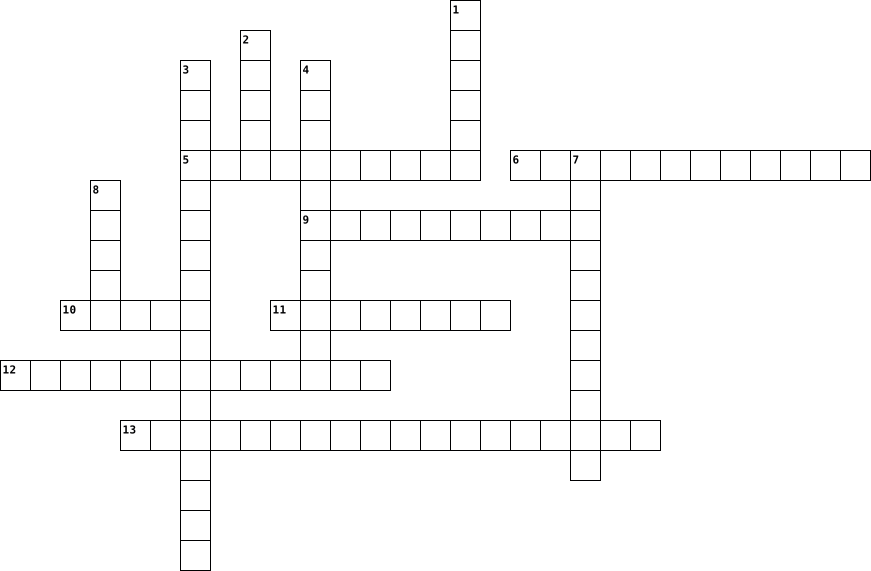
Across
- When parts of the earth´s crust move
- Measurement of an earthquake
- When two plates overlap each other
- A thin outer layer that surrounds the earth
- Plate When the crust is broken into large pieces
- Layer beneath the lithosphere
- When plates move toward each other and collide
Down
- Layer of the earth beneath the lithosphere
- Core The layer that surrounds the Inner core
- When plates move away from each other
- The solid outer layer of the earth
- Drift The movement of continents
- Core The highest layer of the earth
13 Clues: Measurement of an earthquake • Layer beneath the lithosphere • Drift The movement of continents • The solid outer layer of the earth • When two plates overlap each other • When parts of the earth´s crust move • Core The highest layer of the earth • When plates move away from each other • Layer of the earth beneath the lithosphere • ...
Vocab 2025-05-07

Across
- to move or travel around in an orbital path (Example:The earth ____ the sun once every 365.25 days)
- distinct periods of the year marked by specific weather patterns, daylight hours, and temperature changes
- the motion of an object as it moves around another object in an orbit
- a celestial neighborhood, consisting of the Sun and everything that orbits it
- The only planet that contains life
- What the Earth does tilted at its axis
- moderate tides that occur during the quarter moon phases, when the Sun and Moon are at right angles to each other
- The star of our solar system that lights up the planet
- a type of orbit around the sun
Down
- Movement
- the rhythmic rise and fall of sea levels
- The force that pulls the moon towards the earth
- The force that pulls objects towards the center of the Earth
- Push and pull
- a group of interacting or interrelated elements that work together to form a unified whole
- occurs twice a month when the Sun, Earth, and Moon align, creating the highest high tides and lowest low tides
16 Clues: Movement • Push and pull • a type of orbit around the sun • The only planet that contains life • What the Earth does tilted at its axis • the rhythmic rise and fall of sea levels • The force that pulls the moon towards the earth • The star of our solar system that lights up the planet • The force that pulls objects towards the center of the Earth • ...
Science Crossword 2025-09-26

Across
- the thick layer of hot, solid rock beneath the Earth’s crust
- layers of rock or soil placed on top of each other
- hot, melted rock found under the surface of the Earth
- all the solid parts of Earth, like rocks and land
- a type of rock made from bits of sand, shells, and other materials that get pressed together
- the very center part of the Earth, made mostly of metal
- the place deep underground where an earthquake starts
- a type of rock that forms when melted rock cools and hardens
- the thin, outer layer of the Earth where we live
Down
- a layer of soil with its own color and texture, different from the layers above and below
- the study of the Earth, its rocks, and how they change
- a type of rock that has been changed by heat or pressure into a new kind of rock
- the idea that Earth is at the center of the universe
- a nonliving solid that comes from nature and is made from one or more elements
- the idea that the Sun is at the center of the solar system
- soft, dark, decayed plant and animal material in soil that helps plants grow
16 Clues: the thin, outer layer of the Earth where we live • all the solid parts of Earth, like rocks and land • layers of rock or soil placed on top of each other • the idea that Earth is at the center of the universe • hot, melted rock found under the surface of the Earth • the place deep underground where an earthquake starts • ...
Dynamic Earth - Crossword 2024-05-11

Across
- How the earth's plates are slowly moving
- A mudflow
- Short and sharp compression waves that can go 8 km per second
- The final layer of the earth and is made from solid iron and nickle.
- The third layer of the earth, contains liquid that is mainly Iron and Nickle
- Not likely to erupt any time soon, but can still erupt again
- Non living things that are broken down and that form layers
- Rocks that form when other rocks break down and are deposited in lakes and oceans
- The outer layer of the earth
- Measures earthquakes
- Crust that is found on the ocean floor
- Brown, black or purple-reddish coloured igneous rock
- Large earthquake that moves in a snakelike way and can go 4km per second
- When two plates slide past each other
- Erupting
Down
- Will never erupt
- Crust that makes our continents
- Magma that is escaping from the surface and coming out of a volcano
- Where we can feel an earthquake
- The second layer of the earth, has semi liquid rock
- When igneous and sedimentary rocks melt and become different rocks
- When two plates move away from each other
- molten rock
- Weaknesses in the crust where magma can work its way to the surface
- Plates that make up the earth
- From living things
- Volcanic rocks
- An opening in the earth that lets magma out
- Glassy smooth black rock that forms when lava cools quickly
- The exact spot under the crust where the earthquake happened
- Shaking of the ground
- Floats on water
32 Clues: Erupting • A mudflow • molten rock • Volcanic rocks • Floats on water • Will never erupt • From living things • Measures earthquakes • Shaking of the ground • The outer layer of the earth • Plates that make up the earth • Crust that makes our continents • Where we can feel an earthquake • When two plates slide past each other • Crust that is found on the ocean floor • ...
Space Crossword 2014-05-29

Across
- Brightest star in our galaxy, also shares a name with a character in Harry Potter.
- Our galaxy is called the ________ and stretches across 100,000ly.
- A Solar _____ occurs when the moon blocks the sun light from Earth.
- Wind speeds at the equator of this planet get up to 1800km/h.
- Contains 100-100,000 stars in a small region of space.
- Our ______ contains eight planets and a medium massed star.
- Planet that's tilted 90° on its axis, making it appear to roll.
- Two weeks into the Moon's cycle, when no light from the moon is illuminated to the Earth.
- There are 100 billion stars in a ______.
- An ______ unit is used to measure the distance in our Solar System.
- A complete spin of Earth on it's axis.
- A Canadian Commander for the International Space Station.
- The _____ System is about 4.3ly away from our Solar System.
- A layer of the Sun that can only been seen during a Solar Eclipse.
- Contains 100,000s of stars, pulled together in a sphere shape by gravity.
- A _____ is equivalent to 63,000AU.
- First person to walk on the moon.
- A radiation given off by the sun, also gives us sun burns.
- A medium mass star in our Solar System.
- Radius of the planet is 71,oookm, and is larger than twice the mass of all the planets combined.
- Called the 'red' planet because of its rust colour on the surface.
- Gives of 3x more energy than it receives from the Sun.
Down
- A planet with 90x the pressure of Earth.
- 10% of all of space is filled with billions of celestial objects. The rest is filled with ________.
- Most stars are a _____ System.
- Theory that the Earth collided with another planet and the debris created the Moon.
- Theory that the Moon was once part of Earth until it was cast out by the rotation.
- _____ has a rocky surface like the moon, but also has some smooth areas because of lava flow.
- Large explosions on the surface of the sun.
- Cool spots on the Sun's surface that can be larger than Earth.
- Water covers up to 70% of the planet and exists in all three states.
- Contains 100s-1000s of stars together in a region of space.
- Caused because of two galaxies colliding with each other.
- Different coloured lights in the sky appearing in the North and South of the Earth.
- One of his conclusions was that almost all the galaxies are moving away from each other.
- Scientists believe these are at the center of all galaxies
- A layer of the Sun that oozes Plasma towards the surface.
- The debris and matter from a ______ can form another celestial object.
- Where fusion takes place in the sun, and temperatures are over 15 million °C
- A complete orbit of the Earth around the Sun.
- The largest of galaxies and contains little dust.
- As old arms disappear in a _____ galaxy, new ones appear.
- Large cloud of dust and gas, also called a 'Star Nursery.'
43 Clues: Most stars are a _____ System. • First person to walk on the moon. • A _____ is equivalent to 63,000AU. • A complete spin of Earth on it's axis. • A medium mass star in our Solar System. • A planet with 90x the pressure of Earth. • There are 100 billion stars in a ______. • Large explosions on the surface of the sun. • A complete orbit of the Earth around the Sun. • ...