
verbs Crossword Puzzles
Grammar 2022-05-19

Across
- a word that can take the place of a noun like: he,she,it,them,those.
- a small word (a, an, the) that is usually used with nouns.
- what or who a sentence is about
- a person, place, thing, or idea
- to make an idea know or understandable to someone
Down
- words that describe a noun
- words that are shortened in form and are put together to form one new word.
- a word that shows location like: there,under,over
- words that usually modify verbs. Adverbs answer the question when?, where?, how?, how much?, how long?, or how often? They often end in 'ly'.
- a word that describes an action
10 Clues: words that describe a noun • what or who a sentence is about • a person, place, thing, or idea • a word that describes an action • a word that shows location like: there,under,over • to make an idea know or understandable to someone • a small word (a, an, the) that is usually used with nouns. • a word that can take the place of a noun like: he,she,it,them,those. • ...
Toefl listening skills 1 - 17 2021-09-11

Across
- Skill 5. Listen for who and what in P_____ (pas actif)
- Skill 1. Focus on the last L_____
- Skill 10. Listen for negatives with the C________ (comparaison)
- Skill 13. Listen for emphatic expressions of _______ (on t'as fait un anniversaire ....)
- Skill 4. Draw C ________ (end of essay)
- Skill 2. Choose answer with S______ (pas antonymes)
- Skill 6. Listen for who and what with multiple N_____(tu as un prénom et un ...)
Down
- Skill 16. Listen for two and three part V________. (le sujet et le ..)
- Skill 11. Listen for expressions of A_________(d'accord)
- Skill 9. Listen for A_____ ‘ negative’ expressions (presque en anglais)
- Skill 7. Listen for N______ expressions (pas positif)
- Skill 12. Listen for expressions of U____________ and suggestion. (l'incertitude)
- Skill 8. Listen for D____ negative expressions (un ...expresso)
- Skill 17. Listen for I_________ (expressions en anglais)
- Skill 3. Avoid similar S______
- Skill 14. Listen for __________. (des souhaits en anglais)
- Skill 15. Listen for U________ conditions (pas vrai)
17 Clues: Skill 3. Avoid similar S______ • Skill 1. Focus on the last L_____ • Skill 4. Draw C ________ (end of essay) • Skill 2. Choose answer with S______ (pas antonymes) • Skill 15. Listen for U________ conditions (pas vrai) • Skill 5. Listen for who and what in P_____ (pas actif) • Skill 7. Listen for N______ expressions (pas positif) • ...
Eng.1 Semester One Final Practice 2013-12-04

Across
- The beat of writing, when read aloud.
- The dirty bus sped past us on the crowded road.
- clause Because I wanted to see what was under there.
- The part of every clause or sentence that answers the question, "Who did it?"
- Writing that focuses on the beautiful sounds of words, and that doesn't include any extra words.
- A close friend who is always with you and helps you out.
- Sneeze, laugh, eat, were, borrow, is.
- In, on, under, for, to, before, after, through, between.
- A hug, or accepting an idea.
- A weakness or something that isn't perfect about someone.
- A ruler who has unlimited power and abuses the people they rule, taking everything for themself.
- How an author wants the reader to feel when reading.
- Writing that is not poetry.
- A suffix meaning "something you can do"
- A prefix meaning "with or together"
- A suffix used to turn adjectives into nouns.
- A prefix meaning "self"
- A prefix meaning "between"
- A synonym for fate -- the idea that some things are meant to happen in the future and can't be stopped.
- A suffix used to turn verbs like enjoy, treat, and excite into nouns.
- A suffix used to turn verbs like act, depress, and discuss into nouns.
Down
- A type of poem that doesn't rhyme, but does have a special rhythm of some kind.
- A type of anger that makes you want to hurt someone or break something.
- A type of poem that doesn't rhyme and doesn't have any special rhythm.
- A morpheme that goes at the beginnings of words.
- Splat, creak, pop
- A type of poem that has just three lines, the first with five syllables, then seven, then five.
- Pretty, soft, dangerous, confusing, fun.
- Gilgamesh, firefighters, Superman, Einstein.
- A group of words in poetry, separated by a line break (extra space between lines).
- The rabbit, my annoying sister, might have gone, before the storm.
- Happily, freely, carefully, eventually, excitedly.
- A prefix meaning "across or through"
- The part of every clause or sentence that answers the question, "What did they do?"
- Living forever and never dying.
- Trying to figure out what a message means.
- A type of narrative where a hero goes on a big journey or adventure.
- Happy/sappy, excited/requited, free/knee
- A morpheme that goes at the ends of words.
- Doctor, bathroom, hat, lunch.
40 Clues: Splat, creak, pop • A prefix meaning "self" • A prefix meaning "between" • Writing that is not poetry. • A hug, or accepting an idea. • Doctor, bathroom, hat, lunch. • Living forever and never dying. • A prefix meaning "with or together" • A prefix meaning "across or through" • The beat of writing, when read aloud. • Sneeze, laugh, eat, were, borrow, is. • ...
Eng.1 Semester One Final Practice 2013-12-04

Across
- A morpheme that goes at the ends of words.
- A shape or personality that can be changed easily.
- The outside edge of a shape, usually of property.
- When a person in charge says something is okay.
- The rabbit, my annoying sister, might have gone, before the storm.
- The dirty bus sped past us on the crowded road.
- Pretty, soft, dangerous, confusing, fun.
- Doctor, bathroom, hat, lunch.
- To put something off for a while, instead of doing it right away.
- A morpheme that goes at the beginnings of words.
- A word used to describe a response to something bad, that you think was *also* bad.
- What other people think and say about you.
- A modern way to do things. Antonym of old-fashioned.
- How an author wants the reader to feel when reading.
- Pushing something under, usually under water.
- To notice something small or hard to notice.
- A word used to describe a response to something bad, that you think was a *good* response and made things better.
- A prefix meaning "self"
- A suffix used to turn verbs like enjoy, treat, and excite into nouns.
Down
- A suffix meaning "something you can do"
- A prefix meaning "between"
- The part of every clause or sentence that answers the question, "Who did it?"
- Sneeze, laugh, eat, were, borrow, is.
- How an author shows the personality of characters, usually through their actions and dialogue.
- A prefix meaning "with or together"
- In, on, under, for, to, before, after, through, between.
- Splat, creak, pop
- Passed on, lost an arm, use the restroom.
- Because I wanted to see what was under there.
- A small or childish fight or argument.
- Laying on your back facing up.
- A prefix meaning "across or through"
- A suffix used to turn verbs like act, depress, and discuss into nouns.
- Writing with a broken pencil is pointless.
- A suffix used to turn adjectives into nouns.
- To share sadness with someone as a way of helping them.
- The part of every clause or sentence that answers the question, "What did they do?"
- Writing that tries to remind the reader of a famous event or person.
- Happily, freely, carefully, eventually, excitedly.
- To take back, or change your mind about, something you said was okay.
40 Clues: Splat, creak, pop • A prefix meaning "self" • A prefix meaning "between" • Doctor, bathroom, hat, lunch. • Laying on your back facing up. • A prefix meaning "with or together" • A prefix meaning "across or through" • Sneeze, laugh, eat, were, borrow, is. • A small or childish fight or argument. • A suffix meaning "something you can do" • Pretty, soft, dangerous, confusing, fun. • ...
Year 8 Grammar and Sentences! 2025-06-25

Across
- A kind of sentence that gives information.
- The noun in this sentence: "She booked a consultation with the specialist."
- The noun in this sentence: "Her main contention was that social media does more harm than good."
- Words that describe actions or states of being.
- The adverb in this sentence: "She was very excited about the trip."
- Words that describe nouns.
- An incomplete sentence.
- Nouns name a person, place, thing or ________.]
- A kind of sentence that expresses strong emotion!
- A kind of sentence that wants to know or find out something.
- These words replace nouns.
- The noun in this sentence: "Climate change is a serious global issue."
- The verb in this sentence: "The child began to whine about bedtime."
- The adverb in this sentence: "He could scarcely believe his luck."
- The noun in this sentence: "The doctor treated a rare malady."
Down
- The adverb in this sentence: "She quickly packed her bag."
- A ____________ is a complete idea.
- Words that name people, places, things or ideas.
- A kind of sentence that starts with the verb and tells someone what to do.
- The noun in this sentence: "A sense of foreboding filled the room."
- The verb in this sentence: "Chaos ensues when the alarm goes off."
- The noun in this sentence: "Her tone suggested she was angry."
- A verb describes an _______ or a state of being
- Words that help to connect parts of sentences
- A conjunction that indicates a reason or explanation
- The verb in this sentence: "We rejoice when justice is served."
- A conjunction that shows difference or contrast
- The adverb in this sentence: "The turtle moved slowly across the path."
- The adjective in this sentence: "It was hypocritical of him to criticise others for lying."
- The noun in this sentence: "Each soldier received a daily ration of food."
- The pronoun in this sentence: "We are going to the park."
- The noun in this sentence: "The speaker adjusted her language to suit the audience."
- The adverb in this sentence: "The cat jumped suddenly when it heard the noise."
- The adjective in this sentence: "The novel features a queer protagonist navigating identity and love."
- A conjunction that introduces a consequence or result of something
- These words modify verbs, adjectives and other adverbs.
- The verb in this sentence: "She erased the mistake from the whiteboard."
37 Clues: An incomplete sentence. • Words that describe nouns. • These words replace nouns. • A ____________ is a complete idea. • A kind of sentence that gives information. • Words that help to connect parts of sentences • A verb describes an _______ or a state of being • Words that describe actions or states of being. • A conjunction that shows difference or contrast • ...
Grammar Terms 2015-05-28

Across
- any member of a small class of words found in many languages that are used as replacements or substitutes for nouns and noun phrases, and that have very general reference.
- a noun, as herd, jury, or clergy, that appears singular in formal shape but denotes a group of persons or objects.
- a grammatical unit of one or more words that expresses an independent statement, question, request, command or exclamation.
- a noun that may be preceded by an article or other limiting modifier and that denotes any or all of a class of entities and not an individual.
Down
- any member of a small class of words distinguished in many languages by their function as connectors between words, phrases, clauses, or sentences.
- any member of a class of words expressing emotion, distinguished in most languages by their use in grammatical isolation.
- any member of a class of words that modify nouns and pronouns, primarily by describing a particular quality of the word they are modifying.
- a noun that is used to denote a particular person, place, or thing.
- any member of a class of words found in many languages that are used before nouns, pronouns, or other substantives to form phrases functioning as modifiers of verbs, nouns, or adjectives, and that typically express a spatial, temporal, or other relationship.
- any member of a class of words that function as modifiers of verbs or clauses, and in some languages, as Latin and English, as modifiers of adjectives, other adverbs or adverbial phrases.
- any member of a class of words that function as the main elements of predicates, that typically express action, state, or a relation between two things, and that may be inflected for tense, aspect, voice, mood, and to show agreement with their subject or object.
11 Clues: a noun that is used to denote a particular person, place, or thing. • a noun, as herd, jury, or clergy, that appears singular in formal shape but denotes a group of persons or objects. • any member of a class of words expressing emotion, distinguished in most languages by their use in grammatical isolation. • ...
Eng.1 Semester One Final Practice 2013-12-04

Across
- A prefix meaning "self"
- The rabbit, my annoying sister, might have gone, before the storm.
- A type of poem that doesn't rhyme and doesn't have any special rhythm.
- A prefix meaning "between"
- Writing that focuses on the beautiful sounds of words, and that doesn't include any extra words.
- The beat of writing, when read aloud.
- A synonym for fate -- the idea that some things are meant to happen in the future and can't be stopped.
- How an author wants the reader to feel when reading.
- A morpheme that goes at the beginnings of words.
- A prefix meaning "across or through"
- The part of every clause or sentence that answers the question, "Who did it?"
- The dirty bus sped past us on the crowded road.
- A ruler who has unlimited power and abuses the people they rule, taking everything for themself.
- Splat, creak, pop
- A type of poem that doesn't rhyme, but does have a special rhythm of some kind.
- Happily, freely, carefully, eventually, excitedly.
- A type of poem that has just three lines, the first with five syllables, then seven, then five.
- The part of every clause or sentence that answers the question, "What did they do?"
- A suffix used to turn adjectives into nouns.
Down
- A weakness or something that isn't perfect about someone.
- Pretty, soft, dangerous, confusing, fun.
- In, on, under, for, to, before, after, through, between.
- Living forever and never dying.
- A suffix meaning "something you can do"
- Gilgamesh, firefighters, Superman, Einstein.
- Sneeze, laugh, eat, were, borrow, is.
- A suffix used to turn verbs like enjoy, treat, and excite into nouns.
- A morpheme that goes at the ends of words.
- A close friend who is always with you and helps you out.
- Trying to figure out what a message means.
- Because I wanted to see what was under there.
- Writing that is not poetry.
- Doctor, bathroom, hat, lunch.
- A group of words in poetry, separated by a line break (extra space between lines).
- A suffix used to turn verbs like act, depress, and discuss into nouns.
- A type of anger that makes you want to hurt someone or break something.
- Happy/sappy, excited/requited, free/knee
- A type of narrative where a hero goes on a big journey or adventure.
- A hug, or accepting an idea.
- A prefix meaning "with or together"
40 Clues: Splat, creak, pop • A prefix meaning "self" • A prefix meaning "between" • Writing that is not poetry. • A hug, or accepting an idea. • Doctor, bathroom, hat, lunch. • Living forever and never dying. • A prefix meaning "with or together" • A prefix meaning "across or through" • The beat of writing, when read aloud. • Sneeze, laugh, eat, were, borrow, is. • ...
SWS Review 2022-04-13

Across
- This piece of punctuation is used before one of the FANBOYS to create a coordinating conjunction.
- The first conjunction in the acronym FANBOYS.
- The action or linking verb that tells what the subject of each clause is doing, feeling, sensing, and/or being.
- Simple, compound, complex, and complex-compound are all types of these.
- This type of phrase begins with a part of speech such as “around, over, to, under,” followed by a modifier(s).
- A small group of words that work together to form a significant part of a clause. They never include the subject or the main verb of the clause.
- A clause that contains a subject, a verb, but does not express a complete thought.
- This type of verb combines with the main verb (action or linking) to create a verb phrase.
- This type of conjunction is always the first word(s) of the dependent clause; it reveals the relationship of the independent clause to the dependent clause.
- This type of sentence is a single independent clause with capitalization at the beginning and punctuation at the end. It can have a variety of subject(s) and verb(s).
- This word or words tells us what the sentence or clause is about. They are always nouns or pronouns.
- This is the first word used in an infinitive phrase.
- This type of conjunction combines a comma and one of the FANBOYS. It connects independent clauses.
Down
- This clause is a group of words that contain a subject and a verb, and form a complete thought.
- What your brain is going to become and what you will not need to pay for once you learn grammar and sentence writing structures.
- These parts of speech show action or state of being of the subject.
- A group of words that complete a phrase. Ex. “...to the store.” (Can also be a single word.)
- This person, place, thing, or idea can be the subject(s) of a sentence.
- This part of speech is used to modify nouns and pronouns.
- SV, SVV, SSV, SSVV, I;I, I,cI, D,I, ID, and D,cID are all examples of sentence writing ____________.
- Type of phrase formed by combining the word “to” with any verb and modifier(s).
- The part of speech that begins this phrase “...over the fence …”
- Verbs: Am, Are, Is, Was, Were, Be, Being, Been.
23 Clues: The first conjunction in the acronym FANBOYS. • Verbs: Am, Are, Is, Was, Were, Be, Being, Been. • This is the first word used in an infinitive phrase. • This part of speech is used to modify nouns and pronouns. • The part of speech that begins this phrase “...over the fence …” • These parts of speech show action or state of being of the subject. • ...
Year 9 English 2024-11-26

Across
- A group of sentences focusing on a single idea or topic.
- One of the nouns in this sentence "The music filled the room with joy."
- One of the adjectives in this sentence "The fluffy marshmallow exploded in the microwave like a tiny cloud."
- The part of the narrative arc where something changes or goes wrong
- One of the nouns in this sentence "Their friendship grew stronger over the years."
- Nouns name a person, place, thing or ________.]
- The beginning of the narrative arc where characters, setting, and context are introduced.
- One of the verbs in this sentence "He juggled six bananas while riding a unicycle."
- The adjective in this sentence "The exciting game kept everyone on their toes."
- A verb describes an _______ or a state of being
- Words that name people, places, things or ideas.
- The main character of the story, often facing the central conflict.
- A brief, evocative scene or description that captures a moment or detail.
- The structure that outlines the flow of a story from beginning to end.
- A character or force opposing the protagonist.
- The verb in this sentence "He is cooking dinner for his family."
- The grammatical time frame of the narrative, such as past, present, or future.
- The spoken exchange between characters in a narrative.
- The repetition of the same initial consonant sounds in a series of words.
Down
- Events in the narrative arc that build tension and lead to the climax.
- A style of writing that explores personal thoughts, feelings, and insights.
- A comparison between two things using "like" or "as" to highlight similarities.
- Events after the climax where the conflict begins to resolve.
- The turning point of the narrative arc where the main conflict reaches its peak.
- A literary device where non-human objects are given human characteristics.
- The conclusion of the narrative arc where loose ends are tied up.
- One of the nouns in this sentence "He found a pickle under the couch and wondered how it got there."
- A figure of speech where one thing is described as if it were another, without using "like" or "as."
- Words that describe nouns.
- The perspective or persona through which a story is told, such as first-person or omniscient.
- Descriptive language that engages the senses of sight, sound, smell, touch, and taste.
- One of the nouns in this sentence "The music filled the room with joy."
- Words that describe actions or states of being.
- The perspective from which a story is told, such as first-person or third-person.
34 Clues: Words that describe nouns. • A character or force opposing the protagonist. • Nouns name a person, place, thing or ________.] • A verb describes an _______ or a state of being • Words that describe actions or states of being. • Words that name people, places, things or ideas. • The spoken exchange between characters in a narrative. • ...
Eng.10, 11, & 12 Semester One Final Practice 2013-12-04

Across
- To put something off for a while, instead of doing it right away.
- A shape or personality that can be changed easily.
- A prefix meaning "self"
- The part of every clause or sentence that answers the question, "Who did it?"
- A suffix used to turn verbs like act, depress, and discuss into nouns.
- The dirty bus sped past us on the crowded road.
- Writing that tries to remind the reader of a famous event or person.
- What other people think and say about you.
- Happily, freely, carefully, eventually, excitedly.
- The rabbit, my annoying sister, might have gone, before the storm.
- Because I wanted to see what was under there.
- A morpheme that goes at the beginnings of words.
- When a person in charge says something is okay.
- How an author wants the reader to feel when reading.
- A prefix meaning "between"
- To share sadness with someone as a way of helping them.
- A suffix meaning "something you can do"
- The outside edge of a shape, usually of property.
- A modern way to do things. Antonym of old-fashioned.
- A word used to describe a response to something bad, that you think was *also* bad.
- The part of every clause or sentence that answers the question, "What did they do?"
- Pushing something under, usually under water.
- Passed on, lost an arm, use the restroom.
Down
- Splat, creak, pop
- A prefix meaning "with or together"
- Sneeze, laugh, eat, were, borrow, is.
- Laying on your back facing up.
- A morpheme that goes at the ends of words.
- How an author shows the personality of characters, usually through their actions and dialogue.
- To take back, or change your mind about, something you said was okay.
- Writing with a broken pencil is pointless.
- A suffix used to turn adjectives into nouns.
- A word used to describe a response to something bad, that you think was a *good* response and made things better.
- Pretty, soft, dangerous, confusing, fun.
- Doctor, bathroom, hat, lunch.
- A suffix used to turn verbs like enjoy, treat, and excite into nouns.
- A small or childish fight or argument.
- To notice something small or hard to notice.
- A prefix meaning "across or through"
- In, on, under, for, to, before, after, through, between.
40 Clues: Splat, creak, pop • A prefix meaning "self" • A prefix meaning "between" • Doctor, bathroom, hat, lunch. • Laying on your back facing up. • A prefix meaning "with or together" • A prefix meaning "across or through" • Sneeze, laugh, eat, were, borrow, is. • A small or childish fight or argument. • A suffix meaning "something you can do" • Pretty, soft, dangerous, confusing, fun. • ...
Eng.1 Semester One Final Practice 2013-12-04

Across
- The rabbit, my annoying sister, might have gone, before the storm.
- Pretty, soft, dangerous, confusing, fun.
- A prefix meaning "with or together"
- A close friend who is always with you and helps you out.
- Living forever and never dying.
- Because I wanted to see what was under there.
- Happy/sappy, excited/requited, free/knee
- In, on, under, for, to, before, after, through, between.
- Splat, creak, pop
- A hug, or accepting an idea.
- A type of poem that doesn't rhyme and doesn't have any special rhythm.
- A morpheme that goes at the ends of words.
- A ruler who has unlimited power and abuses the people they rule, taking everything for themself.
- A type of poem that doesn't rhyme, but does have a special rhythm of some kind.
- A group of words in poetry, separated by a line break (extra space between lines).
- The part of every clause or sentence that answers the question, "Who did it?"
- A suffix meaning "something you can do"
- Gilgamesh, firefighters, Superman, Einstein.
- The beat of writing, when read aloud.
- A suffix used to turn verbs like act, depress, and discuss into nouns.
Down
- The part of every clause or sentence that answers the question, "What did they do?"
- A suffix used to turn adjectives into nouns.
- Happily, freely, carefully, eventually, excitedly.
- A suffix used to turn verbs like enjoy, treat, and excite into nouns.
- A prefix meaning "across or through"
- Writing that is not poetry.
- Trying to figure out what a message means.
- A prefix meaning "between"
- The dirty bus sped past us on the crowded road.
- Writing that focuses on the beautiful sounds of words, and that doesn't include any extra words.
- How an author wants the reader to feel when reading.
- A type of narrative where a hero goes on a big journey or adventure.
- A morpheme that goes at the beginnings of words.
- A prefix meaning "self"
- A weakness or something that isn't perfect about someone.
- A synonym for fate -- the idea that some things are meant to happen in the future and can't be stopped.
- A type of anger that makes you want to hurt someone or break something.
- Sneeze, laugh, eat, were, borrow, is.
- A type of poem that has just three lines, the first with five syllables, then seven, then five.
- Doctor, bathroom, hat, lunch.
40 Clues: Splat, creak, pop • A prefix meaning "self" • A prefix meaning "between" • Writing that is not poetry. • A hug, or accepting an idea. • Doctor, bathroom, hat, lunch. • Living forever and never dying. • A prefix meaning "with or together" • A prefix meaning "across or through" • Sneeze, laugh, eat, were, borrow, is. • The beat of writing, when read aloud. • ...
Eng.10, 11, & 12 Semester One Final Practice 2013-12-04

Across
- A prefix meaning "with or together"
- To take back, or change your mind about, something you said was okay.
- A morpheme that goes at the ends of words.
- A small or childish fight or argument.
- The rabbit, my annoying sister, might have gone, before the storm.
- A suffix used to turn verbs like enjoy, treat, and excite into nouns.
- To share sadness with someone as a way of helping them.
- Happily, freely, carefully, eventually, excitedly.
- To put something off for a while, instead of doing it right away.
- When a person in charge says something is okay.
- Splat, creak, pop
- The dirty bus sped past us on the crowded road.
- A word used to describe a response to something bad, that you think was a *good* response and made things better.
- A prefix meaning "self"
- Writing that tries to remind the reader of a famous event or person.
- A morpheme that goes at the beginnings of words.
- A suffix meaning "something you can do"
- A suffix used to turn verbs like act, depress, and discuss into nouns.
- A word used to describe a response to something bad, that you think was *also* bad.
- To notice something small or hard to notice.
Down
- How an author wants the reader to feel when reading.
- The outside edge of a shape, usually of property.
- A suffix used to turn adjectives into nouns.
- A prefix meaning "between"
- A shape or personality that can be changed easily.
- Doctor, bathroom, hat, lunch.
- A modern way to do things. Antonym of old-fashioned.
- How an author shows the personality of characters, usually through their actions and dialogue.
- The part of every clause or sentence that answers the question, "Who did it?"
- Because I wanted to see what was under there.
- What other people think and say about you.
- The part of every clause or sentence that answers the question, "What did they do?"
- Pretty, soft, dangerous, confusing, fun.
- In, on, under, for, to, before, after, through, between.
- Passed on, lost an arm, use the restroom.
- Laying on your back facing up.
- A prefix meaning "across or through"
- Pushing something under, usually under water.
- Sneeze, laugh, eat, were, borrow, is.
- Writing with a broken pencil is pointless.
40 Clues: Splat, creak, pop • A prefix meaning "self" • A prefix meaning "between" • Doctor, bathroom, hat, lunch. • Laying on your back facing up. • A prefix meaning "with or together" • A prefix meaning "across or through" • Sneeze, laugh, eat, were, borrow, is. • A small or childish fight or argument. • A suffix meaning "something you can do" • Pretty, soft, dangerous, confusing, fun. • ...
Morphology and Syntax Crossword puzzle 2023-03-31

Across
- A part of speech that carries information about tense and number. (finite)
- A type of modifier that describes a noun or pronoun. (adjective)
- A class of words that provides additional information about nouns, pronouns and verbs; is generally either an adjective or an adverb. (modifier)
- A clause contains a subject and a ----------. (predicate)
- A connecting word, in particular a form of the verb be connecting a subject and complement. (copula)
- A helping verb is linked to or combined with a main verb to provide additional information about a person, tense or ----------. (mood)
- A word that represent a person, place, thing or idea. (noun)
- An antecedent is also referred to as a ----------. (referent)
- A verbal is derived from a verb that includes gerunds, particles and ----------. (infinitives)
- The present participle form of a verb used as an noun. (gerund)
- A syntactic structure that contains a subject and a predicate; is either independent or dependent. (clause)
- A word that has a general, unstated referent can function as a pronoun or a limiting adjective. (indefinite)
- A word or group of words that follows copular verbs and provides further information about the subject. For example, "she is pretty." (complement)
Down
- The noun to which a pronoun refers. (antecedent)
- A verb form created by adding -ing, -d, or ed to a verb stem. (participle)
- An article is either definite or ----------. (indefinite)
- A word that links a noun or pronoun to another sentence element by expressing direction, location, time, or figurative location usually serves as the first word in a prepositional phrase. (preposition)
- A syntactic structure that contains one or more words but does not contain both a subject and a verb. (phrase)
- a modifying word that determines the kind of reference a noun or noun group has. (determiner)
- A quantifier is a type of determiner that provides additional information about a noun regarding ----------. (quantity)
- A part of speech that does not carry information specific to tense or number. (nonfinite)
- A word or words that serve to join other words, phrases and clauses; is generally one of three classes: coordinating, subordinating or correlative. (conjunction)
- clause, A sentence contains at least one ---------- with one complete thought. (independent clause)
- Either the recipient of an action in a clause or sentence or an object that indicates who or what is the beneficiary of an action in a clause or sentence. (object)
- The state or quality of being intricate or complicated. (complexity)
- A nominal clause always contains a ----------. (subject)
26 Clues: The noun to which a pronoun refers. (antecedent) • A nominal clause always contains a ----------. (subject) • An article is either definite or ----------. (indefinite) • A clause contains a subject and a ----------. (predicate) • A word that represent a person, place, thing or idea. (noun) • An antecedent is also referred to as a ----------. (referent) • ...
Morphology 2018-04-05

Across
- Nouns can have two types of inflection morphemes affixed to them: possessive and ______.
- Functions as a noun but looks like a verb.
- The creation of a word with two or more words e.g. dishcloth
- Modifies nouns.
- The creation of a new word by removing an affix from an old word e.g. edit from editor.
- The word class of 'ball'
- Nouns, verbs adjective and adverbs are all _______ words?
- Express time, manner, quantity, frequency etc.
- 'Civil' in the word 'uncivil' is what type of root?
- The name of affixes placed at the beginning of words.
Down
- A variant of a morpheme determined by the phonological environment i which it occurs.
- Morphemes that cannot stand alone as a word.
- Bound morphemes which form new words with new meanings.
- Bound morphemes which have a strictly grammatical function.
- Smallest unit of linguistic meaning or function at word level.
- The name of affixes placed at the ends of words.
- The word class of 'ran'.
17 Clues: Modifies nouns. • The word class of 'ball' • The word class of 'ran'. • Functions as a noun but looks like a verb. • Morphemes that cannot stand alone as a word. • Express time, manner, quantity, frequency etc. • The name of affixes placed at the ends of words. • 'Civil' in the word 'uncivil' is what type of root? • The name of affixes placed at the beginning of words. • ...
Grammar Part 1 2013-06-10

Across
- a word that extends or limits the meaning of verbs
- extremely common; usually involves a period
- a indirect word that answers the question
- reference to one place or thing ex turtle
- something that stands for or represents an idea or quality
- a figure of speech that expresses a comparison between two unlike things using "like" or "as"
- never the subject of the verb
- literal meaning of the word
Down
- the form of an alphabetical letter that is used to begin sentences
- a word, phrase, or clause that is referred to by a pronoun or adverb
- a class or words that limit add meaning of the noun ex: a blue shirt
- further understanding of the term denotation
- reference to more than one example ex dogs
- a word or construction in this particular form ex: their
- a word that answers the question
- the subject of the verb
- a word used instead of a noun ex; we, you, or I
17 Clues: the subject of the verb • literal meaning of the word • never the subject of the verb • a word that answers the question • a indirect word that answers the question • reference to one place or thing ex turtle • reference to more than one example ex dogs • extremely common; usually involves a period • further understanding of the term denotation • ...
Chapter 3 2023-10-23

Across
- _______ Constraints or "help from family and friends"
- _____ Assumption when a word refers to types of objects that are alike in basic ways.
- The Social ________ : to figure out what new words mean, think like other people think
- rapid learning in children
- ______ constraints or "using your head"
- ______ are used to indicate relations between words.
- first ____ words a child says are nouns
- Framing a new verb
- when a child refers to something as one thing when is instead many different things (Eg, cow, horse, dog = dog)
Down
- Parents use fewer of these when talking to their children.
- children are _______ when it comes to looking at language
- The first _______ children learn are the ones they hear most frequently in the speech of their parents
- The ________ Constraints: when children rely on what they've already learned in another language
- An _________ Constraint: when there
- first words tend to be close to ______.
- _____ Assumption when a word refers to a ____ of thing, not the whole.
- Whole ______ Assumption, where a word refers to the whole of something
17 Clues: Framing a new verb • rapid learning in children • An _________ Constraint: when there • ______ constraints or "using your head" • first ____ words a child says are nouns • first words tend to be close to ______. • ______ are used to indicate relations between words. • _______ Constraints or "help from family and friends" • ...
Figurative Language 2025-12-10

Across
- Comparing without using like or as
- Going in depth with verbs
Down
- Using your 5 senses
- Comparing by using like or as
4 Clues: Using your 5 senses • Going in depth with verbs • Comparing by using like or as • Comparing without using like or as
Morphological changes: the story of English 2021-03-29

Across
- Is less synthetic and less inflectional than Old English
- The name of the period, where progressive the “be + -ing” construction was required
- The smallest units of language, the smallest meaningful parts of a word
- The only inflection to be lost after 1700, the second personal singular ending
Down
- Describes inflectional change of verbs
- The branch of linguistics that studies word structures
- Describes inflectional change of nouns, adjectives, pronouns, determiners
- The name of the period, where all kinds of writing in English were proliferated (as there was a reading public willing to pay).
- Has 3 types: indicative, subjunctive, imperative
9 Clues: Describes inflectional change of verbs • Has 3 types: indicative, subjunctive, imperative • The branch of linguistics that studies word structures • Is less synthetic and less inflectional than Old English • The smallest units of language, the smallest meaningful parts of a word • Describes inflectional change of nouns, adjectives, pronouns, determiners • ...
Creative Terminology 2023-07-06

Across
- D_______ address- using words like 'you' to feel like you're talking to your audience
- Exaggerating and being over-the-top for effect.
- R_________ questions- questions that encourage your audience to think or their answers.
Down
- When a story or text ends with similarities to where it began.
- A story that a writer tells that can be funny or engaging, to engage their reader and give evidence for their point.
- Using 'bossy' verbs to address your audience
- Saying something is like something else.
- How a writer uses language to 'sound' a certain way.
- Saying something is something else to describe it.
9 Clues: Saying something is like something else. • Using 'bossy' verbs to address your audience • Exaggerating and being over-the-top for effect. • Saying something is something else to describe it. • How a writer uses language to 'sound' a certain way. • When a story or text ends with similarities to where it began. • ...
Eng.10, 11, & 12 Semester One Final Practice 2013-12-04

Across
- Pushing something under, usually under water.
- The part of every clause or sentence that answers the question, "What did they do?"
- A suffix used to turn adjectives into nouns.
- Splat, creak, pop
- A suffix used to turn verbs like enjoy, treat, and excite into nouns.
- A prefix meaning "across or through"
- A morpheme that goes at the ends of words.
- A word used to describe a response to something bad, that you think was a *good* response and made things better.
- To take back, or change your mind about, something you said was okay.
- The dirty bus sped past us on the crowded road.
- A shape or personality that can be changed easily.
- Pretty, soft, dangerous, confusing, fun.
- A suffix used to turn verbs like act, depress, and discuss into nouns.
- What other people think and say about you.
- A morpheme that goes at the beginnings of words.
- In, on, under, for, to, before, after, through, between.
- A word used to describe a response to something bad, that you think was *also* bad.
- Sneeze, laugh, eat, were, borrow, is.
- How an author wants the reader to feel when reading.
- A prefix meaning "with or together"
Down
- Laying on your back facing up.
- To share sadness with someone as a way of helping them.
- How an author shows the personality of characters, usually through their actions and dialogue.
- A prefix meaning "self"
- The rabbit, my annoying sister, might have gone, before the storm.
- A small or childish fight or argument.
- To notice something small or hard to notice.
- When a person in charge says something is okay.
- Doctor, bathroom, hat, lunch.
- The outside edge of a shape, usually of property.
- The part of every clause or sentence that answers the question, "Who did it?"
- A modern way to do things. Antonym of old-fashioned.
- Writing that tries to remind the reader of a famous event or person.
- A suffix meaning "something you can do"
- Because I wanted to see what was under there.
- Passed on, lost an arm, use the restroom.
- Happily, freely, carefully, eventually, excitedly.
- A prefix meaning "between"
- To put something off for a while, instead of doing it right away.
- Writing with a broken pencil is pointless.
40 Clues: Splat, creak, pop • A prefix meaning "self" • A prefix meaning "between" • Doctor, bathroom, hat, lunch. • Laying on your back facing up. • A prefix meaning "with or together" • A prefix meaning "across or through" • Sneeze, laugh, eat, were, borrow, is. • A small or childish fight or argument. • A suffix meaning "something you can do" • Pretty, soft, dangerous, confusing, fun. • ...
Morphology and Syntax Crossword puzzle 2023-03-31

Across
- A part of speech that carries information about tense and number. (finite)
- A type of modifier that describes a noun or pronoun. (adjective)
- A class of words that provides additional information about nouns, pronouns and verbs; is generally either an adjective or an adverb. (modifier)
- A clause contains a subject and a ----------. (predicate)
- A connecting word, in particular a form of the verb be connecting a subject and complement. (copula)
- A helping verb is linked to or combined with a main verb to provide additional information about a person, tense or ----------. (mood)
- A word that represent a person, place, thing or idea. (noun)
- An antecedent is also referred to as a ----------. (referent)
- A verbal is derived from a verb that includes gerunds, particles and ----------. (infinitives)
- The present participle form of a verb used as an noun. (gerund)
- A syntactic structure that contains a subject and a predicate; is either independent or dependent. (clause)
- A word that has a general, unstated referent can function as a pronoun or a limiting adjective. (indefinite)
- A word or group of words that follows copular verbs and provides further information about the subject. For example, "she is pretty." (complement)
Down
- The noun to which a pronoun refers. (antecedent)
- A verb form created by adding -ing, -d, or ed to a verb stem. (participle)
- An article is either definite or ----------. (indefinite)
- A word that links a noun or pronoun to another sentence element by expressing direction, location, time, or figurative location usually serves as the first word in a prepositional phrase. (preposition)
- A syntactic structure that contains one or more words but does not contain both a subject and a verb. (phrase)
- a modifying word that determines the kind of reference a noun or noun group has. (determiner)
- A quantifier is a type of determiner that provides additional information about a noun regarding ----------. (quantity)
- A part of speech that does not carry information specific to tense or number. (nonfinite)
- A word or words that serve to join other words, phrases and clauses; is generally one of three classes: coordinating, subordinating or correlative. (conjunction)
- clause, A sentence contains at least one ---------- with one complete thought. (independent clause)
- Either the recipient of an action in a clause or sentence or an object that indicates who or what is the beneficiary of an action in a clause or sentence. (object)
- The state or quality of being intricate or complicated. (complexity)
- A nominal clause always contains a ----------. (subject)
26 Clues: The noun to which a pronoun refers. (antecedent) • A nominal clause always contains a ----------. (subject) • An article is either definite or ----------. (indefinite) • A clause contains a subject and a ----------. (predicate) • A word that represent a person, place, thing or idea. (noun) • An antecedent is also referred to as a ----------. (referent) • ...
CLOSED CLASS WORDS 2017-04-03

Across
- words that link other words, phrases, or clauses together.
- short words (on, in, to) that usually stand in front of nouns (sometimes also in front of gerund verbs).
- pronoun that is used to point to something specific within a sentence. These pronouns can indicate items in space or time, and they can be either singular or plural.
- type of conjunctions that are pairs of conjunctions that work together.
- preposition used to point out specific time/place/e-mail
- type of conjunctions that join independent and dependent clauses. Can signal a cause-and-effect relationship, a contrast, or some other kind of relationship between the clauses.
- when a personal pronoun is the direct or indirect object of a verb, or when it is used as the object of a preposition, it is called an ________ pronoun.
- pronoun that is preceded by the adverb, adjective, pronoun, or noun to which it refers, so long as that antecedent is located within the same clause.
- pronoun that ends in self or selves and places emphasis on its antecedent by referring back to another noun or pronoun used earlier in the sentence.
- a word that is used instead of a noun or a noun phrase
- pronoun which is used to refer to nouns mentioned previously, whether they are people, places, things, animals, or ideas.
- preposition used to express a surface of something/specific days/dates/indicate a part of the body/indicate the state of something.
- preposition used for unspecific times during a day, month, season, year/indicate a location or place
Down
- type of conjunction that allow you to join words, phrases, and clauses of equal grammatical rank in a sentence.
- pronoun which is used to indicate that two or more people are carrying out or have carried out an action of some type, with both receiving the benefits or consequences of that action simultaneously.
- pronoun which is used to make asking questions easy.
- When a personal pronoun takes the place of a noun as the subject of a sentence, it is both a personal pronoun and a _________ pronoun.
- is one of the eight major parts of speech, along with verbs, nouns, pronouns, adjectives, adverbs, prepositions and conjunctions.
- pronouns used to referring to one or more unspecified objects, beings, or places.
- pronouns that define designating possession. They may also be used as substitutes for noun phrases, and they are typically found at the end of a sentence or clause.
- pronoun that is associated primarily with a particular person, in the grammatical sense.
21 Clues: pronoun which is used to make asking questions easy. • a word that is used instead of a noun or a noun phrase • preposition used to point out specific time/place/e-mail • words that link other words, phrases, or clauses together. • type of conjunctions that are pairs of conjunctions that work together. • ...
Morphology and Syntax 2018-10-26

Across
- A syntactic structure that contains one or more words but does not contain both a subject and a verb; may fill the subject or predicate slot in a sentence and be combined to form a sentence
- What is the auxiliary verb in the sentence "Jane will see a shooting star tonight."?
- A word that takes the place of a noun; major categories include personal, demonstrative, indefinite, relative, and interrogative
- A "be" verb when it stands alone as a main verb and does not require an object (e.g., "I am hungry.")
- Adding -s or -es to a noun changes the form of the noun to make it a __________ noun.
- One of the determiners; is either definite (the) or indefinite (a, an)
- The three cases of personal pronouns are nominative, objective, and ________________.
- The recipient of an action in a clause or sentence (e.g., "Mary baked THE CAKE.")
- The noun to which a pronoun refers
- A word that represents a person, place, thing, or idea; can be common or proper
- A class of words that provides additional information about nouns, pronouns, and verbs; is generally either an adjective or an adverb.
- An "action word" in a sentence; describes what is done to a noun or pronoun or describes a state of being or existence
- A syntactic structure that contains a subject and a predicate
Down
- The present participle form of a verb used as a noun (e.g., "Singing helps me express myself.")
- Of the following compound nouns, which is considered a closed noun when represented in written form? (possible answers: sister-in-law, vice president, hotdog)
- Is, seems, appears, feels, and became are examples of _______________ verbs.
- A verb form that is the bare stem of a verb preceded by "to" (e.g., "I love TO DANCE.")
- In the sentence, "She ran around the track.," what work is the adverb/prepositional phrase "around the track" accomplishing? (Possible answers: time, location, frequency, manner)
- The three tenses of the verb "to be" are simple, __________________, and perfect.
- What is the adjective in the sentence "We will have apple pie for dessert."?
- True or False: Proper nouns precede common nouns in a speaker's lexicon.
- What is the comparitive form of the word "hungry"?
- In the sentence, "She is a beautiful person.," which word is the adjective?
- Information depicted by the verb in a clause or sentence that refers to time
- What is the time adverb in the sentence "We've been waiting forever for the show to start."
25 Clues: The noun to which a pronoun refers • What is the comparitive form of the word "hungry"? • A syntactic structure that contains a subject and a predicate • One of the determiners; is either definite (the) or indefinite (a, an) • True or False: Proper nouns precede common nouns in a speaker's lexicon. • ...
Simple Present Tense 2024-12-08

Across
- The auxiliary verb used to form Yes/No questions in the simple present tense.
- A type of sentence that describes facts or habits positively.
- The auxiliary verb used with "I, You, We, They" in affirmative sentence.
- The tense used to state facts about people, places or things.
- A type of question formed with "What", "Where" or "Why".
Down
- The type of verbs used to describe states, senses, desires, emotions, and opinions.
- The tense used to describe habits, hobbies and regular activities.
- The form of the verb used in negative and interrogative statements.
- The auxiliary verb used with "he, she, it" in affirmative sentences.
- An example of a non-action verb.(emotion)
10 Clues: An example of a non-action verb.(emotion) • A type of question formed with "What", "Where" or "Why". • A type of sentence that describes facts or habits positively. • The tense used to state facts about people, places or things. • The tense used to describe habits, hobbies and regular activities. • ...
Report text 2025-08-12

Across
- The aim of a report text: to describe the way things are
- Words that name general categories or groups, not specific names
- Verbs that link a subject with its attribute or identity
- Report text does not tell a story, but gives
- Part of report text that explains details such as qualities, habits, and behaviors
Down
- The text that describes something in general and presents information based on facts
- Words or phrases used in a specific field of study
- The tense used in report text
- The first part of report text that states general information about the subject
9 Clues: The tense used in report text • Report text does not tell a story, but gives • Words or phrases used in a specific field of study • The aim of a report text: to describe the way things are • Verbs that link a subject with its attribute or identity • Words that name general categories or groups, not specific names • ...
Stem Changing Verbs (Sandal Verbs) 2023-04-26

Across
- Ellos (traer)
- Laura,Raúl and Esteban (decir)
- Tú (estar)
- Luis (pedir)
- Tú (dar)
- Yo (preferir)
- Ellas (servir)
- Maribel and Juan (ver)
Down
- Tú (dormir)
- Jose (poder)
- Nosotros (competir)
- Jose y Raúl (dormir)
- Yo (preferir)
- Yo (pedir)
- Yo (tener)
- Lorena (hacer)
- Nosotros (tener)
17 Clues: Tú (dar) • Tú (estar) • Yo (pedir) • Yo (tener) • Tú (dormir) • Jose (poder) • Luis (pedir) • Ellos (traer) • Yo (preferir) • Yo (preferir) • Lorena (hacer) • Ellas (servir) • Nosotros (tener) • Nosotros (competir) • Jose y Raúl (dormir) • Maribel and Juan (ver) • Laura,Raúl and Esteban (decir)
Stem Changing Verbs (Sandal Verbs) 2023-04-26

Across
- Jose (poder)
- Yo (pedir)
- Ellas (servir)
- Tú (estar)
- Maribel and Juan (ver)
- Ellos (traer)
- Yo (preferir)
- Nosotros (tener)
Down
- Lorena (hacer)
- Jose y Raúl (dormir)
- Laura,Raúl and Esteban (decir)
- Yo (tener)
- Tú (dar)
- Nosotros (competir)
- Tú (dormir)
- Yo (preferir)
- Luis (pedir)
17 Clues: Tú (dar) • Yo (pedir) • Yo (tener) • Tú (estar) • Tú (dormir) • Jose (poder) • Luis (pedir) • Yo (preferir) • Ellos (traer) • Yo (preferir) • Lorena (hacer) • Ellas (servir) • Nosotros (tener) • Nosotros (competir) • Jose y Raúl (dormir) • Maribel and Juan (ver) • Laura,Raúl and Esteban (decir)
Transitive Words 2020-10-03

Across
- Richa baked me some cakes What is the direct object
- _ doesn't have an object receiving the action
Down
- Transitive Verbs have an __ to receive that action
- A transitive word requires both object and __
- Threw is not a Transitive word True or False
5 Clues: Threw is not a Transitive word True or False • A transitive word requires both object and __ • _ doesn't have an object receiving the action • Transitive Verbs have an __ to receive that action • Richa baked me some cakes What is the direct object
Crossword 2014-09-27

Across
- We have a break now, let's go to the ...
- You have to study the irregular verbs ...
Down
- Can you ... the film that you saw last?
- I have to read a book for english, I'm going to the ...
- To say something again.
5 Clues: To say something again. • Can you ... the film that you saw last? • We have a break now, let's go to the ... • You have to study the irregular verbs ... • I have to read a book for english, I'm going to the ...
Writing Recommendation 2023-06-19

Across
- Clearly state how challenges can be addressed for better outcomes
- solution-oriented approach to problem-solving and easy to follow
- Use verbs denoting measurable outcomes, such as identify, analyze, design
Down
- Relevant to the field of study
- Time-based or time-sensitive
5 Clues: Time-based or time-sensitive • Relevant to the field of study • solution-oriented approach to problem-solving and easy to follow • Clearly state how challenges can be addressed for better outcomes • Use verbs denoting measurable outcomes, such as identify, analyze, design
Stem Changing Verbs (Sandal Verbs) 2023-04-26

Across
- Ellos (traer)
- Tú (dar)
- Nosotros (tener)
- Tú (estar)
- Jose (poder)
- Lorena (hacer)
- Tú (dormir)
- Yo (preferir)
Down
- Nosotros (competir)
- Laura,Raúl and Esteban (decir)
- Jose y Raúl (dormir)
- Maribel and Juan (ver)
- Yo (tener)
- Ellas (servir)
- Yo (preferir)
- Luis (pedir)
- Yo (pedir)
17 Clues: Tú (dar) • Yo (tener) • Tú (estar) • Yo (pedir) • Tú (dormir) • Jose (poder) • Luis (pedir) • Ellos (traer) • Yo (preferir) • Yo (preferir) • Ellas (servir) • Lorena (hacer) • Nosotros (tener) • Nosotros (competir) • Jose y Raúl (dormir) • Maribel and Juan (ver) • Laura,Raúl and Esteban (decir)
Stem Changing Verbs (Sandal Verbs) 2023-04-26

Across
- Yo (tener)
- Laura,Raúl and Esteban (decir)
- Tú (dormir)
- Yo (preferir)
- Jose y Raúl (dormir)
- Luis (pedir)
- Nosotros (competir)
- Ellos (traer)
Down
- Tú (dar)
- Tú (estar)
- Ellas (servir)
- Yo (preferir)
- Yo (pedir)
- Maribel and Juan (ver)
- Nosotros (tener)
- Lorena (hacer)
- Jose (poder)
17 Clues: Tú (dar) • Yo (tener) • Tú (estar) • Yo (pedir) • Tú (dormir) • Luis (pedir) • Jose (poder) • Yo (preferir) • Yo (preferir) • Ellos (traer) • Ellas (servir) • Lorena (hacer) • Nosotros (tener) • Nosotros (competir) • Jose y Raúl (dormir) • Maribel and Juan (ver) • Laura,Raúl and Esteban (decir)
Stem Changing Verbs (Sandal Verbs) 2023-04-26

Across
- Yo (tener)
- Laura,Raúl and Esteban (decir)
- Tú (dormir)
- Yo (preferir)
- Jose y Raúl (dormir)
- Luis (pedir)
- Nosotros (competir)
- Ellos (traer)
Down
- Tú (dar)
- Tú (estar)
- Ellas (servir)
- Yo (preferir)
- Yo (pedir)
- Maribel and Juan (ver)
- Nosotros (tener)
- Lorena (hacer)
- Jose (poder)
17 Clues: Tú (dar) • Yo (tener) • Tú (estar) • Yo (pedir) • Tú (dormir) • Luis (pedir) • Jose (poder) • Yo (preferir) • Yo (preferir) • Ellos (traer) • Ellas (servir) • Lorena (hacer) • Nosotros (tener) • Nosotros (competir) • Jose y Raúl (dormir) • Maribel and Juan (ver) • Laura,Raúl and Esteban (decir)
Stem Changing Verbs (Sandal Verbs) 2023-04-26

Across
- Yo (pedir)
- Ellas (servir)
- Luis (pedir)
- Yo (preferir)
- Jose (poder)
- Maribel and Juan (ver)
- Ellos (traer)
- Tú (estar)
- Nosotros (tener)
Down
- Jose y Raúl (dormir)
- Laura,Raúl and Esteban (decir)
- Tú (dormir)
- Yo (preferir)
- Nosotros (competir)
- Tú (dar)
- Yo (tener)
- Lorena (hacer)
17 Clues: Tú (dar) • Yo (pedir) • Yo (tener) • Tú (estar) • Tú (dormir) • Luis (pedir) • Jose (poder) • Yo (preferir) • Yo (preferir) • Ellos (traer) • Ellas (servir) • Lorena (hacer) • Nosotros (tener) • Nosotros (competir) • Jose y Raúl (dormir) • Maribel and Juan (ver) • Laura,Raúl and Esteban (decir)
Stem Changing Verbs (Sandal Verbs) 2025-11-05

Across
- Ellos (traer)
- Laura,Raúl and Esteban (decir)
- Tú (estar)
- Luis (pedir)
- Tú (dar)
- Yo (preferir)
- Ellas (servir)
- Maribel and Juan (ver)
Down
- Tú (dormir)
- Jose (poder)
- Nosotros (competir)
- Jose y Raúl (dormir)
- Yo (preferir)
- Yo (pedir)
- Yo (tener)
- Lorena (hacer)
- Nosotros (tener)
17 Clues: Tú (dar) • Tú (estar) • Yo (pedir) • Yo (tener) • Tú (dormir) • Jose (poder) • Luis (pedir) • Ellos (traer) • Yo (preferir) • Yo (preferir) • Lorena (hacer) • Ellas (servir) • Nosotros (tener) • Nosotros (competir) • Jose y Raúl (dormir) • Maribel and Juan (ver) • Laura,Raúl and Esteban (decir)
Morphological changes: the story of English 2021-03-29

Across
- Is less synthetic and less inflectional than Old English
- The name of the period, where progressive the “be + -ing” construction was required
- The smallest units of language, the smallest meaningful parts of a word
- The only inflection to be lost after 1700, the second personal singular ending
Down
- Describes inflectional change of verbs
- The branch of linguistics that studies word structures
- Describes inflectional change of nouns, adjectives, pronouns, determiners
- The name of the period, where all kinds of writing in English were proliferated (as there was a reading public willing to pay).
- Has 3 types: indicative, subjunctive, imperative
9 Clues: Describes inflectional change of verbs • Has 3 types: indicative, subjunctive, imperative • The branch of linguistics that studies word structures • Is less synthetic and less inflectional than Old English • The smallest units of language, the smallest meaningful parts of a word • Describes inflectional change of nouns, adjectives, pronouns, determiners • ...
Grammar 2013-11-24

Across
- these can expland on the nouns to provide more information
- this is a major bridge linking words, phrases or clauses
- a word used instead of a noun to avoid repeating the noun
- a person place or thing you are writing about
Down
- these can give information about a verb, describe adjectives and other adverbs
- words that express a releationship between two elements of a sentence, clause or phrase.
- describe teh action with a sentence
- a group of words tht express a thought and contains both a subject and a verb
- a type of word for people, places, things, qualities and concepts
9 Clues: describe teh action with a sentence • a person place or thing you are writing about • this is a major bridge linking words, phrases or clauses • a word used instead of a noun to avoid repeating the noun • these can expland on the nouns to provide more information • a type of word for people, places, things, qualities and concepts • ...
English Language Structure and Conventions 2023-05-30

Across
- A _ is a person, place, thing, animal, idea, almost anything.
- An _ is a word that describes a verb (an action or doing word)
- Group of the same kind of common nouns are called _ nouns. Example: A peep of "chickens".
- A _ _ names a specific person, place, or thing and begins with a capital letter.
Down
- A proper noun starts with a _ letter.
- _ can come before or after a verb, for example: He "quickly" ate his lunch.
- A _ _ names any person, place, or thing.
- The noun in the following sentence is _. My teacher is very friendly.
- _ are doing or action words.
9 Clues: _ are doing or action words. • A proper noun starts with a _ letter. • A _ _ names any person, place, or thing. • A _ is a person, place, thing, animal, idea, almost anything. • An _ is a word that describes a verb (an action or doing word) • The noun in the following sentence is _. My teacher is very friendly. • ...
Stem Changing Verbs - Boot Verbs 2023-04-18

Across
- tú(querer)
- la profesora(muestra)
- yo(querer)
- yo(encontrar)
- ustedes(recordar)
- usted(perder)
- Alan y yo(recordar)
- tu(pensar)
- vosotros(pensar)
Down
- ustedes(dormir)
- nosotros(almorzamos)
- los estudiantes(cerrar)
- ella(empezar)
- tú(entender)
- el autobús(volver)
- los niños(contar)
16 Clues: tú(querer) • yo(querer) • tu(pensar) • tú(entender) • ella(empezar) • yo(encontrar) • usted(perder) • ustedes(dormir) • vosotros(pensar) • ustedes(recordar) • los niños(contar) • el autobús(volver) • Alan y yo(recordar) • nosotros(almorzamos) • la profesora(muestra) • los estudiantes(cerrar)
Suspense 2025-02-27

Across
- Words that describe actions, often adding intensity to a suspenseful scene
- The peak of tension or conflict in a story
- A punctuation mark consisting of three dots, often used to create suspense
Down
- Vivid details used to create imagery and build atmosphere
- Information that is suggested but not directly stated
- The feeling of uncertainty or tension about what will happen next
6 Clues: The peak of tension or conflict in a story • Information that is suggested but not directly stated • Vivid details used to create imagery and build atmosphere • The feeling of uncertainty or tension about what will happen next • Words that describe actions, often adding intensity to a suspenseful scene • ...
Latin 2023-11-20

Across
- Nominative or Accusative ending of a 3rd declension noun
- What case does Latin use for the object of a sentence?
- Accusative singular ending of a 3rd declension noun
- What case does Latin use for the subject of a sentence?
- The person or thing receiving the action in a sentence is called the..
- Accusative plural ending of a 1st declension noun
- The person or thing doing the action in a sentence is called the...
Down
- Nouns belong to families called......
- Most 1st declension nouns are in this gender
- Accusative singular ending of a 1st declension noun
- Accusative singular ending of a 2nd declension noun
- Nominative plural ending of a 1st declension noun
- 'they' m ending of a verb
- In Latin verbs generally go at the ... of the sentence
- Most 2nd declension nouns are in this gender
- Adjectives agree with the nouns they describe in three ways - number, case and ....
- 'he/she' ending of a verb
- Accusative plural ending of a 2nd declension noun
- Parts of speech: A describing word is called an adjective
19 Clues: 'they' m ending of a verb • 'he/she' ending of a verb • Nouns belong to families called...... • Most 1st declension nouns are in this gender • Most 2nd declension nouns are in this gender • Nominative plural ending of a 1st declension noun • Accusative plural ending of a 2nd declension noun • Accusative plural ending of a 1st declension noun • ...
Latin 2023-11-20

Across
- Accusative singular ending of a 2nd declension noun
- Most 1st declension nouns are in this gender
- Accusative singular ending of a 1st declension noun
- The person or thing doing the action in a sentence is called the...
- Adjectives agree with the nouns they describe in three ways - number, case and ....
- Nouns belong to families called......
- Accusative plural ending of a 2nd declension noun
- 'he/she' ending of a verb
- Parts of speech: A describing word is called an .......
- In Latin verbs generally go at the ... of the sentence
Down
- What case does Latin use for the object of a sentence?
- Nominative plural ending of a 1st declension noun
- Nominative or Accusative plural ending of a 3rd declension noun
- Accusative singular ending of a 3rd declension noun
- What case does Latin use for the subject of a sentence?
- 'they' ending of a verb
- Accusative plural ending of a 1st declension noun
- The person or thing receiving the action in a sentence is called the..
- Most 2nd declension nouns are in this gender
19 Clues: 'they' ending of a verb • 'he/she' ending of a verb • Nouns belong to families called...... • Most 1st declension nouns are in this gender • Most 2nd declension nouns are in this gender • Nominative plural ending of a 1st declension noun • Accusative plural ending of a 1st declension noun • Accusative plural ending of a 2nd declension noun • ...
Class Schedule and Telling Time: Ruth 2025-09-02

Across
- El periodo que termina a las dos y trenta y nueve
- In this class we can use paper,dots or paint to make a picture
- In this class we learn about verbs, predicates and adjectives
- In this class we learn about the best-selling book in the world
- El periodo antes de periodo almuerzo
- El periodo despues de periodo Segundo
- El periodo que empieza a las ocho y cincuenta y cuatro
- In this class you can throw a ball or stretch real good
- we learn this so we don't repeat past mistakes
- El periodo antes de periodo quinto
Down
- In this class we learn to solve for x
- El periodo que termina a las ocho y cincuenta y uno
- I don't know choose whatever you want
- El periodo que termina a las doce y ventidos
- El periodo que empieza a la uno y nueve
- In this class we learn about nature and energy
- In this class we learn about telling time and to be
- In this class we learn about notes and beats
- El periodo despues de periodo sexto
19 Clues: El periodo antes de periodo quinto • El periodo despues de periodo sexto • El periodo antes de periodo almuerzo • In this class we learn to solve for x • I don't know choose whatever you want • El periodo despues de periodo Segundo • El periodo que empieza a la uno y nueve • El periodo que termina a las doce y ventidos • In this class we learn about notes and beats • ...
Ghosts List 12 2019-07-31

Across
- In every place or part; in all places.
- Any person or people
- Used with plural nouns and verbs, to mean ‘a large number of’.
- Used to end a conversation, to change the subject, or to resume a subject after interruption.
- A person you know well and like, and who is not usually a member of your family
Down
- Used instead of something in negative sentences and in questions
- Every person
- Every single thing or every particular of an aggregate or total; all.
- Used to refer to one or some of a thing or number of things, no matter how much or how many
- Any person or people
10 Clues: Every person • Any person or people • Any person or people • In every place or part; in all places. • Used with plural nouns and verbs, to mean ‘a large number of’. • Used instead of something in negative sentences and in questions • Every single thing or every particular of an aggregate or total; all. • ...
Affirmative and negative sentences 2021-08-17

Across
- Negative sentence in simple past to make the negation uses the auxiliary
- Negative sentence expresses a
- The structure of negative sentence in simple future uses auxiliary will not and infinitive
- Affirmative sentence tells you about something that is happening or
- Auxiliary “to be” for negative sentence in continuous past for I, he, she, it
Down
- Auxiliary “to be” for negative sentence in simple present for I, you, we, they
- Negative sentence contains the word
- Affirmative sentences in continuous past uses the auxiliary “was/were” and the verb ending with
- Affirmative sentences in simple past we add to the end in the regular verbs
- Affirmative sentences in continuous present uses auxiliary to be: am, is and
- The basic structure of the affirmative sentences in simple present are: Subject + ?
- Affirmative sentences in continuous future uses auxiliary will +
- Affirmative sentences in simple future uses auxiliary:
- Affirmative and negative sentence can be in different verb
14 Clues: Negative sentence expresses a • Negative sentence contains the word • Affirmative sentences in simple future uses auxiliary: • Affirmative and negative sentence can be in different verb • Affirmative sentences in continuous future uses auxiliary will + • Affirmative sentence tells you about something that is happening or • ...
GE KPI 2022 Unit 6 Inspiring People 2022-02-17

Across
- This is one of the reporting verbs we use in reported speech.
- A comment that expresses praise or approval of somebody.
- Nelson Mandela was an _________ leader.
- We use this to describe what someone said without using their exact words. (2 words)
- We always use this tense in reported speech. (2 words)
- A person who draws pictures in books.
- "Keep at it." (3 words)
Down
- Describes something that is extremely large.
- We use this to show EXACTLY what was said by someone. (2 words)
- Describes someone who has a natural ability to do something well.
- To produce a book or magazine to sell to the public.
- Someone who sets a good example for others to follow. (2 words)
- I _________ you for working hard to improve your English.
- When we report what a person said, we usually add this word.
- A suggestion you make to someone about what they should do.
- To encourage someone to do something well.
- To copy someone.
- A word that is used instead of a noun.
- Describes someone who is happy about their achievements.
19 Clues: To copy someone. • "Keep at it." (3 words) • A person who draws pictures in books. • A word that is used instead of a noun. • Nelson Mandela was an _________ leader. • To encourage someone to do something well. • Describes something that is extremely large. • To produce a book or magazine to sell to the public. • We always use this tense in reported speech. (2 words) • ...
Week 8 2025-02-26

Across
- A change of the structure of a gene.
- Typhoid is an example of a highly infectious _____________.
- I need to research and discuss this in one part of my paper.
Down
- settle on, bring about, and around the clock are examples of ________ verbs.
- This is one of the errors in writing a thesis statement.
- This is what most Bridge students lack.
6 Clues: A change of the structure of a gene. • This is what most Bridge students lack. • This is one of the errors in writing a thesis statement. • Typhoid is an example of a highly infectious _____________. • I need to research and discuss this in one part of my paper. • settle on, bring about, and around the clock are examples of ________ verbs.
procedure text 2025-12-12

Across
- Used to describe what is needed before doing the process
- To mix things together with a spoon or mixer
- Part of the text that shows what the reader will make or do
Down
- A word often used to show the first step in procedure text
- Another word for ‘goal’ in procedure text
- Words like mix, cut, pour, stir are called … verbs
6 Clues: Another word for ‘goal’ in procedure text • To mix things together with a spoon or mixer • Words like mix, cut, pour, stir are called … verbs • Used to describe what is needed before doing the process • A word often used to show the first step in procedure text • Part of the text that shows what the reader will make or do
Language Cross Word Puzzle 2020-11-06

Across
- What type of noun names a collection or groups?
- Stands in place of the noun.
- What type of speech is the following sentence. "How long until half-time?" asked an excited spectator.
- A sentence always start with this punctuation.
- What punctuation mark is used to separate items on a list?
- Gran asked why that bothered me. What type of speech is the sentence written in?
- Words that tell us more about verbs.
- What punctuation mark shows the end of a sentence?
- These are the words a, an and the which usually precede nouns or adjectives.
Down
- Link or join parts of sentences.
- A doing or action word.
- What type of speech is the following sentence. The team all exclaimed, "Hoorah, we've won the trophy!"
- A group of words containing a finite verb.
- Is the following sentence active or passive voice. The boy kicked the ball.
- Is the following sentence active or passive voice. The answer was known by half of the audience.
15 Clues: A doing or action word. • Stands in place of the noun. • Link or join parts of sentences. • Words that tell us more about verbs. • A group of words containing a finite verb. • A sentence always start with this punctuation. • What type of noun names a collection or groups? • What punctuation mark shows the end of a sentence? • ...
Commonly Misused Words- Brianna Puorro 2016-10-04

Across
- "The aliens are ______ us."
- Question: What can Miss never be ____________? Answer: A Mrs.
- Why can’t the moon catch its breath after chasing the Earth? Answer: It can't ______.
- My Great-Grandmother always told me that you attitude in life will always ____________ your outcome in a situation.
- What words's definition is inside the word?
- What has seven letters, three "e", and fourth letter is a "w"?
- Cause and ______.
Down
- In order to ________, you have a strong opinion and express it.
- Adverb and Definition: correct etiquette or official.
- What is a conjunction, preposition,verb, and starts with an "E?"
- Definition: A consent to receiving an offer.
- __________ being a star athlete, Nate was great student and respectful to everyone in school.
- When someone gets worked up, people say "Just take a deep ____."
- My teacher implied to me that verbs would be on the test by stating it a couple of times. (Hint: What is the student doing?)
14 Clues: Cause and ______. • "The aliens are ______ us." • What words's definition is inside the word? • Definition: A consent to receiving an offer. • Adverb and Definition: correct etiquette or official. • Question: What can Miss never be ____________? Answer: A Mrs. • What has seven letters, three "e", and fourth letter is a "w"? • ...
Ms. C's Unit 1 ELA Recap 2025-10-22

Across
- compares two unlike things without like or as
- Marks like periods, commas, and quotation marks that guide meaning and pauses.
- Words that show an action or link a subject to its action.
- uses like or as to compare two unlike things
- The overall feeling or atmosphere that a reader experiences while reading a story.
- Descriptive language that helps the reader see, hear, or feel what the writer is describing.
- The sequence of main events in a story that includes the exposition, rising action and climax.
- The perspective from which a story is told.
- The author’s attitude toward the subject
- When an object, color, or action represents a deeper idea or meaning.
Down
- The way an author reveals a character’s personality
- A word formed from the first letters of other words (LOL).
- Words that describe or give more detail about nouns.
- Words that name people, places, things, or ideas.
14 Clues: The author’s attitude toward the subject • The perspective from which a story is told. • uses like or as to compare two unlike things • compares two unlike things without like or as • Words that name people, places, things, or ideas. • The way an author reveals a character’s personality • Words that describe or give more detail about nouns. • ...
SIMPLE PAST TENSE AND FUTURE TENSE 2020-12-26

Across
- It is form of "live" for he/she/ it in Simple Present Tense.
- This auxiliary verb is used for instant decisions,promises,or offers.
- This auxiliary verb is used for future intentions and plans.
- It is a frequency adverb which opposite of "always".
- It is name of the verbs that have -ed ending.
- It is a verb that has the same verb form both in Simple Present Tense and in Simple Past Tense.
- It is a time expression that is used in Simple Past Tense.
- it is the second form of "play".
Down
- It's a ending that shows the using of Simple Continuous Tense.
- It is a time expresion which is used for Future Tense.
- It is the negatıve form of "will".
- It is the name of verbs whose verb pattern change from tense to tense.
- It is the past form of "have".
13 Clues: It is the past form of "have". • it is the second form of "play". • It is the negatıve form of "will". • It is name of the verbs that have -ed ending. • It is a frequency adverb which opposite of "always". • It is a time expresion which is used for Future Tense. • It is a time expression that is used in Simple Past Tense. • ...
Genesis 1 2014-01-08

Across
- In what do the creatures God made on day 4 live?
- What did God create on day 1?
- How many days does Genesis 1 describe?
- On what do the creatures God made on day 5 live?
- What unique creature did God create on day 5?
- What did God create on day 2?
- The Hebrew word for God is Elohim, which is a plural word. Singular verbs are used with this plural noun. Literally, v. 1 would read "In the beginning, God(s) (he) created..." Writing it this way refers to the __________.
Down
- What did God create on day 3?
- What worldviews does v. 1 refute?
- God made man in His _____.
- Man is supposed to exercise __________ over the earth.
- In what do the creatures God made on day 4 fly?
12 Clues: God made man in His _____. • What did God create on day 3? • What did God create on day 1? • What did God create on day 2? • What worldviews does v. 1 refute? • How many days does Genesis 1 describe? • What unique creature did God create on day 5? • In what do the creatures God made on day 4 fly? • In what do the creatures God made on day 4 live? • ...
Genesis 1 2014-01-08

Across
- What did God create on day 1?
- How many days does Genesis 1 describe?
- God made man in His _____.
- Man is supposed to exercise __________ over the earth.
- In what do the creatures God made on day 4 fly?
Down
- What did God create on day 3?
- What did God create on day 2?
- On what do the creatures God made on day 5 live?
- The Hebrew word for God is Elohim, which is a plural word. Singular verbs are used with this plural noun. Literally, v. 1 would read "In the beginning, God(s) (he) created..." Writing it this way refers to the __________.
- In what do the creatures God made on day 4 live?
- What worldviews does v. 1 refute?
- What unique creature did God create on day 5?
12 Clues: God made man in His _____. • What did God create on day 3? • What did God create on day 1? • What did God create on day 2? • What worldviews does v. 1 refute? • How many days does Genesis 1 describe? • What unique creature did God create on day 5? • In what do the creatures God made on day 4 fly? • On what do the creatures God made on day 5 live? • ...
ELA Terms 2013-02-28

Across
- it's what you need to prove something to be true
- when the writer provides clues for what will occur later in the story
- words that replace nouns
- when you get the opposite of what you would expect
- when a noun is replaced by a pronoun later in a sentence or statement
Down
- when a verb is used as a noun
- the punctuation mark that substitutes for a conjunction when connecting two independent clauses
- when a noun is explained in more detail by the word(s) next to it
- type of sentence with two independent clauses connected by a conjunction
- type of sentence with one subject and one predicate
- words that change verbs, adjectives, or other adverbs
- type of sentence with one independent clause and one or more dependent clauses
- a concern of the writer in a work
13 Clues: words that replace nouns • when a verb is used as a noun • a concern of the writer in a work • it's what you need to prove something to be true • when you get the opposite of what you would expect • type of sentence with one subject and one predicate • words that change verbs, adjectives, or other adverbs • ...
crossword 1 2023-01-11

Across
- A geological fault in which the upper side appears to have been pushed upward by compression
- A solution of guaiac resin in ethanol, used to detect proteins.
- A mountain peak in the San Juan Mountains in southwestern Colorado (14,048 feet high)
- Capable of being remitted or forgiven
- Relating to vibrations that occur as a result of vibrations in a nearby body
- Any plant of the family Asclepiadaceae
- Pronouns and verbs used to refer to the speaker or writer of the language in which they occur
- Sexual intercourse between persons too closely related to marry (as between a parent and a child)
Down
- In isolation and without reference to anything else
- In a blunt direct manner
- Paralysis of one side of the body
- Of the most contemptible kind
- Issue a gruff, low, animal-like noise
13 Clues: In a blunt direct manner • Of the most contemptible kind • Paralysis of one side of the body • Capable of being remitted or forgiven • Issue a gruff, low, animal-like noise • Any plant of the family Asclepiadaceae • In isolation and without reference to anything else • A solution of guaiac resin in ethanol, used to detect proteins. • ...
Parts Of Speech 2023-04-18

Across
- is the noun or pronoun following a preposition.
- receives what the direct object names.
- is located after the linking verb describe the simple subject.
- is located after the linking verb and means the same thing as the simple subject
Down
- action verbs that have a direct object.
- receives the action of the verb and is someone or something different from the subject noun.
- a verb that expresses a state of being instead of an action
7 Clues: receives what the direct object names. • action verbs that have a direct object. • is the noun or pronoun following a preposition. • a verb that expresses a state of being instead of an action • is located after the linking verb describe the simple subject. • is located after the linking verb and means the same thing as the simple subject • ...
DESXIFRATS 2023-08-31

Across
- Text narratiu que informa sobre fets d'actualitat, i que té una longitud considerable.
- Propietat del text que en lliga les diferents parts.
- Rima que només repeteix les vocals a partir de l'última síl.laba tònica.
- Tipus de text amb la finalitat de convèncer.
Down
- Tipus de complement verbal que alguns verbs necessiten per completar la significació.
- Categoria gramatical que substitueix un nom o un sintagma nominal.
- Dialecte del català que es parla a la Catalunya Nord.
7 Clues: Tipus de text amb la finalitat de convèncer. • Propietat del text que en lliga les diferents parts. • Dialecte del català que es parla a la Catalunya Nord. • Categoria gramatical que substitueix un nom o un sintagma nominal. • Rima que només repeteix les vocals a partir de l'última síl.laba tònica. • ...
Language Cross Word Puzzle 2020-11-06

Across
- What type of noun names a collection or groups?
- A group of words containing a finite verb.
- Stands in place of the noun.
- Gran asked why that bothered me. What type of speech is the sentence written in?
- What punctuation mark is used to separate items on a list?
- Is the following sentence active or passive voice. The boy kicked the ball.
- What type of speech is the following sentence. The team all exclaimed, "Hoorah, we've won the trophy!"
Down
- What type of speech is the following sentence. "How long until half-time?" asked an excited spectator.
- stop, What punctuation mark shows the end of a sentence?
- Link or join parts of sentences.
- Is the following sentence active or passive voice. The answer was known by half of the audience.
- A doing or action word.
- Words that tell us more about verbs.
- These are the words a, an and the which usually precede nouns or adjectives.
- Letters, A sentence always start with this punctuation.
15 Clues: A doing or action word. • Stands in place of the noun. • Link or join parts of sentences. • Words that tell us more about verbs. • A group of words containing a finite verb. • What type of noun names a collection or groups? • Letters, A sentence always start with this punctuation. • stop, What punctuation mark shows the end of a sentence? • ...
Post-test 2025-03-10

Across
- when you put words on paper, what verb describes the action?
- When you make an attempt to solve a problem, what verb describes the action?
- If the teacher tells you why something is correct, what verb describes this?
- What action do you take when.....to an audio file?
- what do you do when the teacher says 'open your book'?
- what verbs are related to doors?
- What verb means to give a response to a question?
- If the door is shut, what verb do you use to describe opening it?
Down
- what verb describes reading words in a book
- what verb means to say a word correctly?
- what verb describes gaining new knowledge?
- When you do the same steps as your teacher, what verb describes this?
- what verb describes saying letters in order, like b-r-i-n-g
- if you review your answers to find mistakes, what verb describe this?
- If you take your book to school, what verb describe this action?
15 Clues: what verbs are related to doors? • what verb means to say a word correctly? • what verb describes gaining new knowledge? • what verb describes reading words in a book • What verb means to give a response to a question? • What action do you take when.....to an audio file? • what do you do when the teacher says 'open your book'? • ...
Media and Persuasion 2022-02-20

Across
- a photographer who pursues celebrities to get photographs of them
- Using adverbs that intensify meaning such as ‘extremely’ or ‘mostly’
- The type of questions to get your audience thinking but don’t require an answer
- Use of pronouns like ‘we’ and ‘us’ to make the audience feel included
- This clearly tells the audience what to do next – great at the end
- Using strong modal verbs like ‘must’ and ‘have to’
Down
- Being over-the-top to get a point across
- An appeal to the emotion of the audience
- An appeal to ethics of the audience - normally by giving credentials
- Unfair treatment for or against a person or group
- An appeal to the logic of the audience - often using facts and figures
- the beliefs or opinions that are generally held about someone or something
- Repeating the same word, phrase or idea more than once for emphasis
- Media that write popular but sensationalist journalism
14 Clues: Being over-the-top to get a point across • An appeal to the emotion of the audience • Unfair treatment for or against a person or group • Using strong modal verbs like ‘must’ and ‘have to’ • Media that write popular but sensationalist journalism • a photographer who pursues celebrities to get photographs of them • ...
Language Keywords 2013-10-31

Across
- A participants' stance towards the other in communication
- Words which have opposite meanings.
- A, E, I, O, U.
- Language use considered to be inferior
- A familiar grouping of words, especially words that habitually appear together and thereby convey meanings by association.
- A speech sound that's not a vowel.
- Stop The sound produced by the momentary closure of the glottis followed by an explosive.
- The basic unit in written language.
- Pronunciation that is considered superior
- Voice When the action comes first in a sentence
- The degree of emphasis given a sound or syllable in speech.
Down
- When verbs are transformed into nouns. Ex. Running
- Voice When the action comes last in a sentnce
- The omission of a sound or syllable when speaking (as in I'm, let's ).
- The general idea or reputation a word has besides its actual meaning. Ex, Rainbow- clouds, happiness, treasure
- Most common phoneme in English
- Person Pronoun I/me/we/us
- The smallest sound unit in a language that is capable of conveying a distinct meaning.
- Person Pronoun You/thee
19 Clues: A, E, I, O, U. • Person Pronoun You/thee • Person Pronoun I/me/we/us • Most common phoneme in English • A speech sound that's not a vowel. • Words which have opposite meanings. • The basic unit in written language. • Language use considered to be inferior • Pronunciation that is considered superior • Voice When the action comes last in a sentnce • ...
Latin Crossword 1 2020-08-16

Across
- The case of the subject of the verb.
- The accusative plural of the Latin word for 'a wood'.
- Roman author of the Tusculanae Disputationes.
- The 3rd person plural present tense of 'specto, spectari, spectavi, spectatum' - to watch.
- The case taken by a noun governed by the preposition 'ad'.
- The 3rd person singular of the verb 'sum, esse, fui' of the verb 'to be'.
- The translator of the 'Vulgate' version of the Bible.
- Nominative plural of the Latin word for 'mule'.
- The name for a family of nouns.
Down
- Nominative plural of the latin noun for 'sack'.
- number of possible endings for a Latin noun.
- The gender of the noun 'mulus'.
- The Latin word for an ostrich.
- The name for a family of verbs.
- The second person singular of 'porto, portare, portavi, portatum'.
- The attribute of the noun that indicates the role of a noun in the sentence.
- The case of the object of the verb.
- Roman author of the Aeneid.
- Accusative singular of the Latin word for 'monk'.
- '..., gender and case' the three attributes needed for an adjective to agree with a noun.
20 Clues: Roman author of the Aeneid. • The Latin word for an ostrich. • The gender of the noun 'mulus'. • The name for a family of verbs. • The name for a family of nouns. • The case of the object of the verb. • The case of the subject of the verb. • number of possible endings for a Latin noun. • Roman author of the Tusculanae Disputationes. • ...
Language Keywords 2013-10-31

Across
- Pronunciation that is considered superior
- You/thee
- A participants' stance towards the other in communication
- The degree of emphasis given a sound or syllable in speech.
- When the action comes first in a sentence
- A, E, I, O, U.
- The omission of a sound or syllable when speaking (as in I'm, let's ).
- When verbs are transformed into nouns. Ex. Running
Down
- Words which have opposite meanings.
- When the action comes last in a sentnce
- The smallest sound unit in a language that is capable of conveying a distinct meaning.
- I/me/we/us
- A familiar grouping of words, especially words that habitually appear together and thereby convey meanings by association.
- The basic unit in written language.
- The general idea or reputation a word has besides its actual meaning. Ex, Rainbow- clouds, happiness, treasure
- Language use considered to be inferior
- A speech sound that's not a vowel.
- Stop The sound produced by the momentary closure of the glottis followed by an explosive.
- Most common phoneme in English
19 Clues: You/thee • I/me/we/us • A, E, I, O, U. • Most common phoneme in English • A speech sound that's not a vowel. • Words which have opposite meanings. • The basic unit in written language. • Language use considered to be inferior • When the action comes last in a sentnce • Pronunciation that is considered superior • When the action comes first in a sentence • ...
SINTAX CHAPTER 3 2025-10-24

Across
- The rules for combining words into phrases and sentences
- Lexical category for words that modify verbs or adjectives
- Ability to produce and understand novel sentences
- A verb's requirement for syntactic category of its complement
- Formal representation of a sentence's hierarchical structure
- Sentence that violates syntactic rules of a language
- Functional category for time reference and modals
- Functional category including articles like "the" and "a"
- Property of having more than one possible meaning or structure
- A sentence that makes a statement rather than asks a question
- The core word that gives a phrase its name
Down
- A verb that doesn't take a direct object like "sleep"
- The hierarchical organization of words in a sentence
- A family of expressions that can substitute for each other
- A verb's requirement for semantic properties of arguments
- A word that substitutes for a noun phrase like "he" or "it"
- A famous linguist mentioned in the text
- A verb that requires a direct object like "find"
- Grammar that prescribes rules rather than describes mental grammar
- A natural grouping of words that function as a unit
20 Clues: A famous linguist mentioned in the text • The core word that gives a phrase its name • A verb that requires a direct object like "find" • Ability to produce and understand novel sentences • Functional category for time reference and modals • A natural grouping of words that function as a unit • The hierarchical organization of words in a sentence • ...
Questions 2015-02-01

Across
- Give a synonym for yes/no questions: ...questions
Down
- There are yes/no guestions and ...
- How do we call the verbs 'to be' and 'to do' that we need to form questions?
- We answer yes/no questions with .........
- ...she like to play games?
5 Clues: ...she like to play games? • There are yes/no guestions and ... • We answer yes/no questions with ......... • Give a synonym for yes/no questions: ...questions • How do we call the verbs 'to be' and 'to do' that we need to form questions?
procedure text 2025-11-20

Across
- feature: verbs used to give direct commands
- section that lists tools or items needed
- part of a procedure text that explains the steps to do something
- purpose of a procedure text; what the text is written for...
Down
- type often used to show sequence, such as first, next, then
- feature: words that describe how an action is done (e.g., slowly, carefully)
- term for the purpose of the text
- opening part stating the goal of the activity
8 Clues: term for the purpose of the text • section that lists tools or items needed • feature: verbs used to give direct commands • opening part stating the goal of the activity • type often used to show sequence, such as first, next, then • purpose of a procedure text; what the text is written for... • part of a procedure text that explains the steps to do something • ...
SIMPLE PAST TENSE AND FUTURE TENSE ALİ ARZU DİLAN 2020-12-26

Across
- It is form of "live" for he/she/ it in Simple Present Tense.
- This auxiliary verb is used for instant decisions,promises,or offers.
- This auxiliary verb is used for future intentions and plans.
- It is a frequency adverb which opposite of "always".
- It is name of the verbs that have -ed ending.
- It is a verb that has the same verb form both in Simple Present Tense and in Simple Past Tense.
- It is a time expression that is used in Simple Past Tense.
- it is the second form of "play".
Down
- It's a ending that shows the using of Simple Continuous Tense.
- It is a time expresion which is used for Future Tense.
- It is the negatıve form of "will".
- It is the name of verbs whose verb pattern change from tense to tense.
- It is the past form of "have".
13 Clues: It is the past form of "have". • it is the second form of "play". • It is the negatıve form of "will". • It is name of the verbs that have -ed ending. • It is a frequency adverb which opposite of "always". • It is a time expresion which is used for Future Tense. • It is a time expression that is used in Simple Past Tense. • ...
Memory Palace 2023-09-15

Across
- Miranda can't ____________ where she left her keys! She completely forgot!
- To improve your speaking, it is important to ____________ conversation.
- Dr. Lao works as a ____________, but he used to be a teacher of biology at the university.
- The team from Argentina was the ____________ of the 2022 World Cup.
- The ____________ published a paper with all the results of their study.
- Do you have the ____________ to speak English?
- Bisrat needs to see an eye doctor because she is starting to have ____________ problems.
Down
- It is difficult to ____________ all of the different verbs in English.
- We need to change one, small ____________ of the plan.
- When you feel stress, close your eyes and ____________ your favorite place.
- All of the books at the library are in alphabetical ____________.
- A psychologist can give you good advice about your ____________ health.
12 Clues: Do you have the ____________ to speak English? • We need to change one, small ____________ of the plan. • All of the books at the library are in alphabetical ____________. • The team from Argentina was the ____________ of the 2022 World Cup. • It is difficult to ____________ all of the different verbs in English. • ...
Bohdan's English vocabulary 2022-04-11

Across
- a single piece of grass, sharp side of a knife
- a logical fallacy which means one thing will lead to something very drastic. it goes before the word slope
- a diet without any animal products
- a verb, to think too much about a negative thing
- adj which means something is untrustworthy in American slang. It can also refer to an area protected from the sun
- a fallacy that means people falsely believe what is popular must be correct or true
Down
- the shape of the US President's office
- cars drive in these, and you 'change' them on the road
- a word used to make food countable, bread, cheese
- in California slang, this means 'very'
- phrasal verbs which means to disappoint
- a way to speak about wind, makes it countable
12 Clues: a diet without any animal products • the shape of the US President's office • in California slang, this means 'very' • phrasal verbs which means to disappoint • a way to speak about wind, makes it countable • a single piece of grass, sharp side of a knife • a verb, to think too much about a negative thing • a word used to make food countable, bread, cheese • ...
CW1_Intro2Mktg 2022-09-11

Across
- What you charge for a product
- Group of consumers or customers aimed at by a business (2 words)
- Tangible item what has value and satisfies need/want.
- Topic in Marketing that focuses on where a firm's products are sold.
- Laptop manufacturers see vacation packages as this kind of competition
- Definition of this activity contains four verbs - creating communicating, delivering and exchanging
Down
- intangible item that has value and satisfies need/want
- Distribution ______. How a business gets its product to the end-user.
- The combination of product, price, promotion, and place (2 words)
- Verizon vs. AT&T is an example of ________competition in the telecommunications sector
- coca-cola sees all other beverage makers (alcoholic/non-alcoholic) as competition based on _______.
- Good/Service produced by a business
12 Clues: What you charge for a product • Good/Service produced by a business • Tangible item what has value and satisfies need/want. • intangible item that has value and satisfies need/want • Group of consumers or customers aimed at by a business (2 words) • Distribution ______. How a business gets its product to the end-user. • ...
P28 More Nouns and Verbs "Verbs" 2022-05-04

Across
- ~にみえる
- おす
- しゅうちゅうする
- きふする
- そうじゅうする
- いじする
- あんしんさせる
- なしとげる
- そしきする
- きょうりょくする
Down
- きょかする
- しょうひする
- か(変)える
- とうちする
- ~をひきつける
- しらせる
- はつめいする
- よきする
- かくだいする
- きずつける
- えらぶ
21 Clues: おす • えらぶ • きふする • しらせる • いじする • よきする • ~にみえる • きょかする • とうちする • なしとげる • そしきする • きずつける • しょうひする • か(変)える • はつめいする • かくだいする • ~をひきつける • そうじゅうする • あんしんさせる • しゅうちゅうする • きょうりょくする
Irregular "yo" verbs & stem-changing verbs 2025-10-07

Across
- I give
- it costs (él/ella conjugation)
- he/she wants
- he/she prefers
- I do/make
- I return/come back
- I know (people)
- we start
- they ask for/order
- I say
- we lose
- they have
- I hear
- you eat lunch
- you can
- you think
Down
- you say
- you sleep
- you (f) ask for/order
- I close
- I don't leave
- you remember
- they repeat
- I don't understand
- they can
- I see/watch
- I don't bring
- they serve
- I put
- I know (information)
30 Clues: I say • I put • I give • I hear • you say • I close • we lose • you can • they can • we start • you sleep • I do/make • they have • you think • they serve • they repeat • I see/watch • he/she wants • you remember • I don't leave • I don't bring • you eat lunch • he/she prefers • I know (people) • I don't understand • I return/come back • they ask for/order • I know (information) • you (f) ask for/order • ...
Parts of Speech 2023-08-16

Across
- Words you use to replace specific nouns like he, she, or I
- Person, place or thing
- Words that describe nouns like funny, hairy, or cute
Down
- Words that join sentences, clauses, or other singular words together like and or but.
- Words that tell you the relationships between other words in a sentence
- Words that describes an adjective, a verb, or another adverb like quietly or softly
- Words that describe specific actions like run, jump, fall
7 Clues: Person, place or thing • Words that describe nouns like funny, hairy, or cute • Words that describe specific actions like run, jump, fall • Words you use to replace specific nouns like he, she, or I • Words that tell you the relationships between other words in a sentence • Words that describes an adjective, a verb, or another adverb like quietly or softly • ...
Language Cross Word Puzzle 2020-11-06

Across
- Link or join parts of sentences.
- What punctuation mark is used to separate items on a list?
- What type of speech is the following sentence. "How long until half-time?" asked an excited spectator.
- What type of speech is the following sentence. The team all exclaimed, "Hoorah, we've won the trophy!"
- A group of words containing a finite verb.
- Gran asked why that bothered me. What type of speech is the sentence written in?
- Is the following sentence active or passive voice. The answer was known by half of the audience.
- A doing or action word.
Down
- What type of noun names a collection or groups?
- Words that tell us more about verbs.
- Stands in place of the noun.
- These are the words a, an and the which usually precede nouns or adjectives.
- stop, What punctuation mark shows the end of a sentence?
- Letters, A sentence always start with this punctuation.
- Is the following sentence active or passive voice. The boy kicked the ball.
15 Clues: A doing or action word. • Stands in place of the noun. • Link or join parts of sentences. • Words that tell us more about verbs. • A group of words containing a finite verb. • What type of noun names a collection or groups? • Letters, A sentence always start with this punctuation. • stop, What punctuation mark shows the end of a sentence? • ...
Language Cross Word Puzzle 2020-11-06

Across
- Is the following sentence active or passive voice. The boy kicked the ball.
- What type of speech is the following sentence. "How long until half-time?" asked an excited spectator.
- Stands in place of the noun.
- Gran asked why that bothered me. What type of speech is the sentence written in?
- Link or join parts of sentences.
- Is the following sentence active or passive voice. The answer was known by half of the audience.
- What type of speech is the following sentence. The team all exclaimed, "Hoorah, we've won the trophy!"
- A group of words containing a finite verb.
Down
- What punctuation mark is used to separate items on a list?
- A sentence always start with this punctuation.
- These are the words a, an and the which usually precede nouns or adjectives.
- What type of noun names a collection or groups?
- What punctuation mark shows the end of a sentence?
- Words that tell us more about verbs.
- A doing or action word.
15 Clues: A doing or action word. • Stands in place of the noun. • Link or join parts of sentences. • Words that tell us more about verbs. • A group of words containing a finite verb. • A sentence always start with this punctuation. • What type of noun names a collection or groups? • What punctuation mark shows the end of a sentence? • ...
Minor Role 2019-03-20

Across
- What type of sentences are used in first part of the 6th stanza?
- What technique is used on the 1st line of the 4th stanza?
- What sort of building is created through the semantic fields in the second stanza?
- What technique would the word "unobtrusive" seem to be in the second stanza?
- What type of pronoun is used in the line of the first stanza?
- What technique is used in the 2nd line of the 5th stanza?
- Who is the poem by?
- What punctuation is used in the last line of the 6th stanza?
Down
- What type of speech is used in the 3rd line in the 3rd stanza?
- What type of stanza is the 7th one?
- What verbs are used in the 4th stanza?
- What structure is the poem?
- What is the technique used in the phrase "midget movement"?
- What language is used in the 6th stanza?
14 Clues: Who is the poem by? • What structure is the poem? • What type of stanza is the 7th one? • What verbs are used in the 4th stanza? • What language is used in the 6th stanza? • What technique is used on the 1st line of the 4th stanza? • What technique is used in the 2nd line of the 5th stanza? • What is the technique used in the phrase "midget movement"? • ...
TKT Vocab 2013-09-25

Across
- a combination of two vowel sounds
- Helping learners to use dictionaries develops learner ...
- 'and, but, so' are all examples of this
- the smallest unit of sound that has meaning in a language
- for example, 'on, into, above'
- an activity where students have to complete the spaces is called a gap...
- one of the three learning styles
Down
- "The teacher asks the class to write down all the vocabulary they know connected to transport" is an example of what kind of task?
- a listening or reading that is real - i.e. not adapted for learners
- nouns, verbs, adjectives and adverbs are all parts of what?
- skills can be productive and ...
- reading quickly to get a general idea of what a text is about is reading for...
- speaking tasks will either focus on fluency or ...
- there are four main ones and various sub ones
14 Clues: for example, 'on, into, above' • skills can be productive and ... • one of the three learning styles • a combination of two vowel sounds • 'and, but, so' are all examples of this • there are four main ones and various sub ones • speaking tasks will either focus on fluency or ... • Helping learners to use dictionaries develops learner ... • ...
Chapter 3 2025-10-15

Across
- “He is sleeping.” The word sleeping shows an action in ______.
- The subject in the sentence “They are playing football.”
- The sentence “She is reading a book” is in the ______ tense.
- The pronoun used to refer to yourself.
- The tense used to describe an event happening at the moment.
- The auxiliary verb used with “-ing” verbs to show something happening now.
- The action of expressing your thoughts or ideas to others.
- A question word used to ask about what someone is doing.
Down
- The base verb plus “-ing” form used in the present continuous tense.
- The auxiliary verb used for subjects we, you, they in present continuous tense.
- The opposite of “past.”
- A group of related sentences that express one idea.
- The main idea of a paragraph is called the ______ sentence.
- The verb form “is studying” means the action is happening ______.
- The auxiliary verb used with “he” or “she” in present continuous tense.
15 Clues: The opposite of “past.” • The pronoun used to refer to yourself. • A group of related sentences that express one idea. • The subject in the sentence “They are playing football.” • A question word used to ask about what someone is doing. • The action of expressing your thoughts or ideas to others. • The main idea of a paragraph is called the ______ sentence. • ...
Language Cross Word Puzzle 2020-11-06

Across
- What type of speech is the following sentence. "How long until half-time?" asked an excited spectator.
- Gran asked why that bothered me. What type of speech is the sentence written in?
- Is the following sentence active or passive voice. The boy kicked the ball.
- What type of speech is the following sentence. The team all exclaimed, "Hoorah, we've won the trophy!"
- Is the following sentence active or passive voice. The answer was known by half of the audience.
- What punctuation mark shows the end of a sentence?
- Link or join parts of sentences.
- A group of words containing a finite verb.
Down
- A sentence always start with this punctuation.
- What type of noun names a collection or groups?
- These are the words a, an and the which usually precede nouns or adjectives.
- Words that tell us more about verbs.
- Stands in place of the noun.
- A doing or action word.
- What punctuation mark is used to separate items on a list?
15 Clues: A doing or action word. • Stands in place of the noun. • Link or join parts of sentences. • Words that tell us more about verbs. • A group of words containing a finite verb. • A sentence always start with this punctuation. • What type of noun names a collection or groups? • What punctuation mark shows the end of a sentence? • ...
Post-test 2025-03-07

Across
- When you put words on paper, what verb describes the action?
- What verbs are related to doors?
- What verb means to give a response to a question?
- What verb means to say a word correctly?
- If you take your book to school, what verb describes this action?
- What do you do when the teacher says "Open your book"?
Down
- If you review your answers to find mistakes, what verb describes this?
- When you make an attempt to solve a problem, what verb describes the action?
- When you do the same steps as your teacher, what verb describes this?
- What verb describes gaining new knowledge?
- What action do you take when listening to an audio file?
- If the teacher tells you why something is correct, what verb describes this?
- If the door is shut, what verb do you use to describe opening it?
- What verb describes reading words in a book?
- What verb describes saying letters in order, like B-R-I-N-G?
15 Clues: What verbs are related to doors? • What verb means to say a word correctly? • What verb describes gaining new knowledge? • What verb describes reading words in a book? • What verb means to give a response to a question? • What do you do when the teacher says "Open your book"? • What action do you take when listening to an audio file? • ...
Pre-test 2025-03-07

Across
- When you put words on paper, what verb describes the action?
- What verbs are related to doors?
- What verb means to give a response to a question?
- What verb means to say a word correctly?
- If you take your book to school, what verb describes this action?
- What do you do when the teacher says "Open your book"?
Down
- If you review your answers to find mistakes, what verb describes this?
- When you make an attempt to solve a problem, what verb describes the action?
- When you do the same steps as your teacher, what verb describes this?
- What verb describes gaining new knowledge?
- What action do you take when listening to an audio file?
- If the teacher tells you why something is correct, what verb describes this?
- If the door is shut, what verb do you use to describe opening it?
- What verb describes reading words in a book?
- What verb describes saying letters in order, like B-R-I-N-G?
15 Clues: What verbs are related to doors? • What verb means to say a word correctly? • What verb describes gaining new knowledge? • What verb describes reading words in a book? • What verb means to give a response to a question? • What do you do when the teacher says "Open your book"? • What action do you take when listening to an audio file? • ...
1st Conjugation Verbs Extra Credit 2014-10-21

Across
- Statements with unfulfilled possibilities
- The characteristic of a verb that expresses the speaker's attitude
- Quality that refers to the speaker of the sentence
- The verb refers to only one subject
- The kind of voice where the action is being performed by something other than the subject
- A possible mood for a verb that is the statement of a fact
- The amount of qualities that Latin verbs have
- The speaker is expressed by subject pronouns I and we in this point of view
- The kind of voice where the action is being performed by the subject
- The fourth mood that is sometimes added, statements that express opinion
- A word that shows action or being
Down
- Refers to the number of subjects in the sentence
- Statements with direct commands
- The perspective of which a person is being spoken to using "you"
- Refers to the performer of the action
- The number of verb tenses
- The verb refers to multiple subjects
- The perpective of which the person is being spoken about using "he, she, it, they"
- The time of the verb's action
19 Clues: The number of verb tenses • The time of the verb's action • Statements with direct commands • A word that shows action or being • The verb refers to only one subject • The verb refers to multiple subjects • Refers to the performer of the action • Statements with unfulfilled possibilities • The amount of qualities that Latin verbs have • ...
PRONOUNS 2022-05-16

Across
- how many gender-neutral pronouns are there
- would 'ils' or 'elles' be used to represent our class
- how many pronouns are there
- are tu and vous interchangeable (always, sometimes, or never)
- what is the informal way of saying you
- does every conjugation of ils/elles end in 'ent'
- which three pronouns share the same conjugation(alphabetical order)
- in what pronouns make the accents in preferer look like a house (alphabetical order)
- the 's' in ils/elles is pronounced (true or false)
- what pronoun does not follow the Er verb conjugation in "manger"
- conjugate danser with nous (danser is ER verb)
Down
- what rule do you follow to conjugate ER verbs
- which two pronouns share the same conjugation
- is "on" singular or plural
- You pronounce the "s" in "vous avez"(true or false)
- what pronoun is the verb "faites" conjugated with
- what pronoun would be used to represent Mrs. McWhinnie
- what pronouns can be used to say "we"(alphabetical order)
- French is the _____ most spoken language in the world
19 Clues: is "on" singular or plural • how many pronouns are there • what is the informal way of saying you • how many gender-neutral pronouns are there • what rule do you follow to conjugate ER verbs • which two pronouns share the same conjugation • conjugate danser with nous (danser is ER verb) • does every conjugation of ils/elles end in 'ent' • ...
SIMPLE PAST TENSE AND FUTURE TENSE 2020-12-26

Across
- It is the name of verbs whose verb pattern change from tense to tense.
- It is a time expresion which is used for Future Tense.
- It's an ending that shows the using of Simple Continuous Tense.
- This auxiliary verb is used for instant decisions,promises,or offers.
- It is a time expression that is used in Simple Past Tense.
- It is form of "live" for he/she/it in Simple Present Tense.
Down
- It is the past form of "have".
- is the negatıve form of "will".
- This auxiliary verb is used for future intentions and plans.
- It is a verb that has the same verb form both in Simple Present Tense and in Simple Past Tense.
- It is name of the verbs that have -ed ending.
- It is the second form of "play".
- It is a frequency adverb which opposite of "always".
13 Clues: It is the past form of "have". • is the negatıve form of "will". • It is the second form of "play". • It is name of the verbs that have -ed ending. • It is a frequency adverb which opposite of "always". • It is a time expresion which is used for Future Tense. • It is a time expression that is used in Simple Past Tense. • ...
Genesis Chapter One 2014-01-08

Across
- What did God create on day 1?
- How many days does Genesis 1 describe?
- What unique creature did God create on day 5?
- God made man in His _____.
- Man is supposed to exercise __________ over the earth.
- In what do the creatures God made on day 4 live?
Down
- What did God create on day 3?
- What did God create on day 2?
- On what do the creatures God made on day 5 live?
- The Hebrew word for God is Elohim, which is a plural word. Singular verbs are used with this plural noun. Literally, v. 1 would read "In the beginning, God(s) (he) created..." Writing it this way refers to the __________.
- What worldviews does v. 1 refute?
- In what do the creatures God made on day 4 fly?
12 Clues: God made man in His _____. • What did God create on day 3? • What did God create on day 1? • What did God create on day 2? • What worldviews does v. 1 refute? • How many days does Genesis 1 describe? • What unique creature did God create on day 5? • In what do the creatures God made on day 4 fly? • On what do the creatures God made on day 5 live? • ...
Verbs 2020-07-22

Across
- What do I do if I'm thirsty
- when you desair something
- when you portrait a picture
- in this support group yo .....in a good person. start the opposite of finish
Down
- Andres....around the park
- you ..... when the teacher dictates a text
- Jhon want to ..... a very old thing
- I´m going to ..... the newspaper of today.
- juan please ..... all this pictures to do a wall
9 Clues: Andres....around the park • when you desair something • What do I do if I'm thirsty • when you portrait a picture • Jhon want to ..... a very old thing • you ..... when the teacher dictates a text • I´m going to ..... the newspaper of today. • juan please ..... all this pictures to do a wall • ...
verbs 2022-03-02

Across
- grafo
- pontikia
- ego trexo
- mitera
Down
- omilo
- adelfos
- kabalao
- ego pidao
- diabazo
9 Clues: omilo • grafo • mitera • adelfos • kabalao • diabazo • pontikia • ego pidao • ego trexo
Verbs 2022-03-01

Across
- Pizza
- for an exam
- a car
- dinner
Down
- in an apartment building
- to radio
- videogames
- movies
- hard
9 Clues: hard • Pizza • a car • movies • dinner • to radio • videogames • for an exam • in an apartment building
Verbs 2021-11-12

Across
- go
- do
- write
- read
Down
- see
- watch
- make
- break
- talk
9 Clues: go • do • see • make • talk • read • watch • break • write
Verbs 2013-09-25

Across
- to fear
- to understand
- to cover
Down
- to drive
- to know
- to describe
- to gown down
- to drive
- to believe
- to run
10 Clues: to run • to fear • to know • to drive • to drive • to cover • to believe • to describe • to gown down • to understand
verbs 2014-06-01

Across
- THERE ARE 7 OF THESE IN A WEEK
- YOU CLOSE YOUR EYES WHEN YOUR DOING THIS
- YOU SOMETIMES USE A PEN TO DO THIS
- THERE ARE 12 OF THESE IN A YEAR
- A JAPANESE FOOD
Down
- YOU USE THIS WHEN YOU ARE DOING MATHS
- YOU USE YOUR EARS FOR THIS
- YOU DO THIS EVERY MORNING
- YOU USE YOUR EYES TO DO THIS
9 Clues: A JAPANESE FOOD • YOU DO THIS EVERY MORNING • YOU USE YOUR EARS FOR THIS • YOU USE YOUR EYES TO DO THIS • THERE ARE 7 OF THESE IN A WEEK • THERE ARE 12 OF THESE IN A YEAR • YOU SOMETIMES USE A PEN TO DO THIS • YOU USE THIS WHEN YOU ARE DOING MATHS • YOU CLOSE YOUR EYES WHEN YOUR DOING THIS
Verbs 2015-04-20

Across
- anhalten
- herausholen
- ersetzen
- entdecken
Down
- speichern
- entbehren können
- erhalten
- verfallen
- beinhalten
9 Clues: anhalten • erhalten • ersetzen • speichern • verfallen • entdecken • beinhalten • herausholen • entbehren können
Verbs 2023-03-23

Across
- Zara ________ when she was sad.
- Mr. Barnes does it a lot if Riley is silly.
- Xavier _______ like a camel.
- barnsey was __________ at ava
- Zoe_____ over onto her face.
- Toni ______ like a dog.
Down
- Barnsey _________ Zoe chatting to matilda nonstop
- Indi ________ like if you stretch a balloon neck.
- Alice ________ like a wild beast.
9 Clues: Toni ______ like a dog. • Xavier _______ like a camel. • Zoe_____ over onto her face. • barnsey was __________ at ava • Zara ________ when she was sad. • Alice ________ like a wild beast. • Mr. Barnes does it a lot if Riley is silly. • Barnsey _________ Zoe chatting to matilda nonstop • Indi ________ like if you stretch a balloon neck.
Verbs 2022-08-15
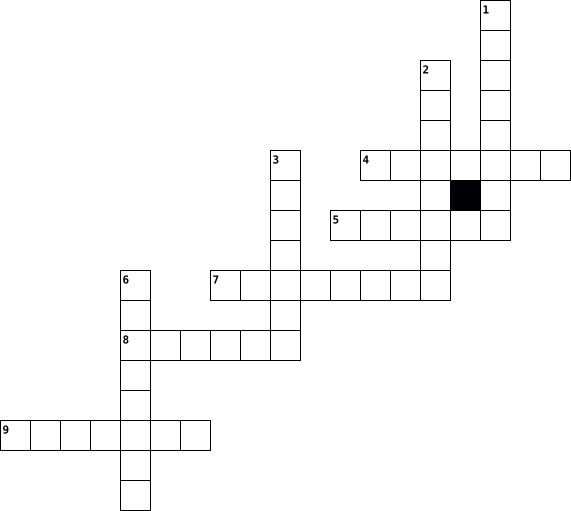
Across
- jumping
- flying
- swimming
- eating
- running
Down
- drinking
- climbing
- walking
- sleeping
9 Clues: flying • eating • walking • jumping • running • drinking • climbing • sleeping • swimming
Verbs 2023-01-08

Across
- A situation to get free from
- Birds can do this
- Your parents do this in a car
- Artists do this to make a picture
- To put things together
Down
- When you enter into a building you must ____ the door first
- It is what we do during the night
- It is what you better do in water if you don't want to sink
- When you hear a good song you often feel like...
9 Clues: Birds can do this • To put things together • A situation to get free from • Your parents do this in a car • It is what we do during the night • Artists do this to make a picture • When you hear a good song you often feel like... • When you enter into a building you must ____ the door first • It is what you better do in water if you don't want to sink
Verbs 2023-02-01

Across
- re__(Nous)
- Er__(je)
- re__(Elles/Ills)
- IR__(elles)
- Er__(Tu)
Down
- Ir__(nous)
- er__(nous)
- re__(Vous)
- Er__(Je)
- Re__(je)
10 Clues: Er__(je) • Er__(Je) • Re__(je) • Er__(Tu) • Ir__(nous) • re__(Nous) • er__(nous) • re__(Vous) • IR__(elles) • re__(Elles/Ills)
verbs 2017-04-27

Across
- washinh
- listening
- coming
- quetal
- bebito
Down
- amighiu
- seeing
- nos vemos
- loving
9 Clues: seeing • coming • loving • quetal • bebito • washinh • amighiu • listening • nos vemos
Verbs 2021-01-19

Across
- walked
- used
- slept
- farted
Down
- spoke
- jumped
- listened
- talked
- ate
9 Clues: ate • used • spoke • slept • jumped • walked • talked • farted • listened
Verbs 2021-01-20

Across
- fight
- use
- talk
- eat
- drink
Down
- speak
- jump
- laugh
- run
9 Clues: use • run • eat • jump • talk • speak • fight • laugh • drink