
50 states Crossword Puzzles
President Ronald Reagan 2026-04-20

Across
- He ate ______ jelly beans to quit pipe-smoking.
- He was the first president to be a Hollywood _____.
- He served for a total of _____ terms (1981-1989).
- His Vice President was ______________.
- In his second attempt at running for president, he beat _________ in the 1980 election to become the next president.
- He was the first president to appoint a ______, Sandra Day O'Connor, to the Supreme Court.
- His economic policies were called _______.
- Films He served in the Army Air Force during WWII and helped to produce over 400 _____ _____.
- He oversaw the accumulation of more new _____ than all previous presidents added together.
- He left office with the highest _______ rating of any president.
- He originally supported the Democratic Party, but his views became more conservative and he turned to the _______ party.
Down
- He is the first president to be ________ prior to taking office.
- His nickname was ___ _____ _________ because of his ability to connect with people
- He famously told Gorbachev to "____ ____ ____ ____," referring to the Berlin Wall.
- He was once the ______ man elected president.
- One of his greatest achievements was receiving the ________ Medal of Honor.
- He survived an __________ attempt by John Hinckley.
- He won 49/50 states in the 1984 _______ election.
- He officially made ___ ___ a federal holiday in 1983.
- He signed a nuclear ______ treaty with Gorbachev.
- He achieved the biggest ___ cuts in US history.
21 Clues: His Vice President was ______________. • His economic policies were called _______. • He was once the ______ man elected president. • He ate ______ jelly beans to quit pipe-smoking. • He achieved the biggest ___ cuts in US history. • He served for a total of _____ terms (1981-1989). • He won 49/50 states in the 1984 _______ election. • ...
Civil War Review 2025-03-07

Across
- Southern states that seceded, fought for independence and slavery
- Movement to end slavery, gained strength in the North before the war
- Fort in South Carolina where the Civil War began in April 1861
- To withdraw from a group, Southern states left Union to form Confederacy
- Large farm often using slave labor, common in Southern states
- Idea that states should have more power than federal government
- 16th President of the United States, led during Civil War, issued Emancipation Proclamation
- Farming and growing crops, main economic activity in the South
- Loyalty to a region, differences between North and South led to conflict
Down
- Important Mississippi River city, Union siege in 1863 split Confederacy
- Commander of the Union Army, later 18th President, led Union to victory
- Bloodiest single-day battle, fought in Maryland in 1862, changed war's course
- Crops grown to be sold, cotton was major Southern cash crop
- Commander of the Confederate Army, skilled military leader from Virginia
- Manufacturing and production, more developed in the North before war
- Military tactic of surrounding a place to force surrender, used at Vicksburg
- Major battle in Pennsylvania in 1863, turning point, site of famous Address
- Northern states that fought to preserve country and end slavery
18 Clues: Crops grown to be sold, cotton was major Southern cash crop • Large farm often using slave labor, common in Southern states • Fort in South Carolina where the Civil War began in April 1861 • Farming and growing crops, main economic activity in the South • Northern states that fought to preserve country and end slavery • ...
Unit 5 Review 2026-03-23

Across
- Jackson’s fight against the Second Bank of the United States.
- The economic recession that followed Jackson’s banking policies.
- To formally withdraw from the United States.
- The idea that a state can cancel a federal law it believes is unconstitutional.
- The movement of settlers into western territories of the United States.
- Land gained from Mexico after the Mexican-American War, including California and New Mexico.
- The 1830 law that forced Native Americans west of the Mississippi River.
- The national bank that Jackson believed favored the wealthy.
- The forced relocation of Native Americans that resulted in thousands of deaths.
Down
- The belief that the United States was destined by God to expand across North America.
- The conflict between South Carolina and the federal government over tariffs.
- Land purchased from Mexico to build a southern railroad route.
- President who signed the Indian Removal Act and opposed the national bank.
- The addition of Texas to the United States.
- The president’s power to reject a bill passed by Congress.
- The belief that states have powers separate from the federal government.
- The agreement with Britain that gave the U.S. access to the Pacific Ocean.
- Political movement that supported the “common man” and expanded voting rights for white men.
18 Clues: The addition of Texas to the United States. • To formally withdraw from the United States. • The president’s power to reject a bill passed by Congress. • The national bank that Jackson believed favored the wealthy. • Jackson’s fight against the Second Bank of the United States. • Land purchased from Mexico to build a southern railroad route. • ...
Chapter 9 - Civil War and Reconstruction 2020-09-11

Across
- – A barrier of troops or ships to keep people and supplies from moving in and out of an era.
- – A situation when groups on each side of an issue give in a little to reach an agreement.
- – The United States; also the Northern States that remained part of the nation and fought against the Confederacy in the Civil War.
- – The period when laws were passed that sought to rebuild and heal the northern and southern regions of the United States after the Civil War.
- – Together, the Southern states that left the United States and formed their own nation; the Confederate States of America.
- – A system in which someone who owns land lets someone else “rent” the land to farm it.
- – To murder someone famous or powerful, usually for political reasons.
- – The act of bringing charges of wrongdoing against a high government official by the House of Representatives.
- – To join the military.
- – A method of warfare that seeks to destroy civilian as well as military targets to force a surrender.
Down
- – The separation of a state from a nation.
- – The division of groups of people, usually by race.
- – A person who works to end or get rid of something, especially slavery.
- – The freeing of a group from slavery.
- – A military blockade and extended attack designed to make a city or other location surrender.
- – The celebration of the day when enslaved African Americans were freed during the Civil War.
- – Northerners who went South after the Civil War to start businesses and make money.
- – A group of laws passed in the late 1800s that denied African American men the right to vote, kept African Americans from owning guns or taking certain types of jobs.
- – Before the Civil War, a series of secret routes out of the South along which escaped slaves traveled to freedom in the North.
- – The right of each United States state to make its own local laws.
- – A large farm, especially in the southern United States, that usually grows one kind of crop.
- – A change or improvement.
- – An official announcement, usually by the government.
23 Clues: – To join the military. • – A change or improvement. • – The freeing of a group from slavery. • – The separation of a state from a nation. • – The division of groups of people, usually by race. • – An official announcement, usually by the government. • – The right of each United States state to make its own local laws. • ...
New Nation vocab 2021-09-29

Across
- A statement that describes a document's purpose.
- was an agreement over counting of slaves as the state's total population.
- A document to establish organization in the state
- which the Kentucky and Virginia legislatures took the position that the federal Alien and Sedition Acts were unconstitutional.
- A treaty that defined The border between the United States and Spanish florida.
- A person who opposed the U.S constitution.
- 85 essays of a proposed declaration of independence.
- The elected head of a republic
- pin name for hamilton in the 85 articles.
- to give consent
- The first ten amendment of the U.S constitution
- was a landmark U.S. Supreme Court case that established the principle of judicial review in the United States,
- A violent tax protest.
- a series of violent attacks on courthouses and other government properties in Massachusetts
- agreement that assuaged antagonisms between the United States and Great Britain.
- The highest judicial court in a state or country.
- Maryland lacked to tax the bank.
Down
- created legislative bodies in congress.
- A member or supporter of the federalist party.
- A judge of the supreme court.
- refers to the judicial appointments made by President John Adams just before he was succeeded by President Thomas Jefferson
- A meeting of the political party.
- The lower house of us congress.
- an act that is used to show gratitude.
- interpreting state laws
- carries out and enforces laws.
- The first set of laws in the United states.
- The Louisiana Purchase was the acquisition of the territory of Louisiana by the United States from Napoleonic France
- a procedure by which a court can review an administrative action by a public body
- France seizing ships and the United States Failed to negotiate with France because America refused to pay.
- Establish the number of something.
- were four acts passed by the Federalist-dominated 5th United States Congress and signed into law by President John Adams
- several states form a unity but remain independent
- Make all the laws.
- A form of government in which it is held by the people.
- the US congress
36 Clues: the US congress • Make all the laws. • A violent tax protest. • interpreting state laws • to give consent • A judge of the supreme court. • carries out and enforces laws. • The elected head of a republic • The lower house of us congress. • Maryland lacked to tax the bank. • A meeting of the political party. • Establish the number of something. • ...
Civics Test 2024-09-17

Across
- Who was President during World War I?
- How old do citizens have to be to vote?
- If both the President and the Vice President can no longer serve, who becomes President?
- Who wrote the Declaration of Independence?
- Who signs bills and vetoes bills?
- What is the economic system in the United States?*
- What is the name of the Speaker of the House of Representatives now?
- Who was President during the Great Depression and World War II?
- Who is the "Father of our country" and the first President?
- What do we call the first ten amendments to the Constitution?
- Who is the Chief Justice of the United States now?
- What are the two parts of the U.S. Congress?
- How many Supreme Court Justices are there?
- What is the last day to file taxes?
- What did Martin Luther King, Jr. fight for`?
- What ocean is on the East Coast of the United States?
- When was the Constitution written?
Down
- The idea of self-government is in the first three words of the Constitution. What are these words?
- What is the name of the national anthem?
- What stops one branch of government from becoming too powerful?
- Who makes federal laws?
- The House of Representatives has how many voting members?
- We elect a senator for how many years?
- How many senators are there?
- What is the capital of the United States?*
- Who is the Governor of AZ?
- When do we celebrate Independence Day?*
- Name the longest river in the United States.
- What is the supreme law of the land?
- During the Cold War, what was the main concern of the United States?
- How many amendments does the Constitution have?
- What is an amendment?
- Who is in charge of the executive branch?
- Name the U.S. war between the North and the South.
- What territory did the United States buy from France in 1803?
- What ocean is on the West Coast of the United States?
36 Clues: What is an amendment? • Who makes federal laws? • Who is the Governor of AZ? • How many senators are there? • Who signs bills and vetoes bills? • What is the last day to file taxes? • When was the Constitution written? • What is the supreme law of the land? • Who was President during World War I? • We elect a senator for how many years? • ...
US History Ch 10 Vocab 2025-03-04

Across
- of 1837 – A financial crisis caused by Jackson’s economic policies, including the veto of the national bank and the Specie Circular.
- Banks – State banks where Jackson placed federal funds after dismantling the national bank.
- War – Jackson’s campaign to destroy the Second Bank of the United States, which he viewed as corrupt.
- Crisis – A confrontation between South Carolina and the federal government over the Tariff of 1828, leading to debates on states' rights.
- Removal Act (1830) – Law signed by Jackson that forced Native American tribes to relocate west of the Mississippi River.
- Circular – Jackson’s order that government land could only be bought with gold or silver, contributing to the economic downturn.
- v. Georgia (1832) – Supreme Court case ruling that Georgia had no authority over Cherokee lands; Jackson ignored the ruling.
- Rights Doctrine – The belief that states have the right to ignore federal laws they deem unconstitutional.
- Bill (1833) – Gave Jackson the power to use military force to enforce federal tariffs in response to the Nullification Crisis.
Down
- Tariff of 1833 – A tariff proposed by Henry Clay to ease tensions over the Tariff of Abominations.
- Democracy – A movement for more democratic participation in government, expanding voting rights to more white men.
- System – The practice of rewarding political supporters with government jobs.
- Van Buren – Jackson’s close ally and successor as the 8th President; dealt with the Panic of 1837.
- of Tears – The forced migration of Cherokee and other tribes to Indian Territory (present-day Oklahoma), resulting in thousands of deaths.
- C. Calhoun – Jackson’s Vice President who supported states' rights and nullification.
- of Abominations (1828) – A high tariff on imports that angered Southern states, especially South Carolina.
- Jackson – The 7th President of the United States (1829-1837); known for his populist policies and expansion of presidential power.
- Party – The political party founded by Jackson and his supporters, emphasizing states' rights and limited government.
- Clay – A political rival of Jackson who supported the American System and helped negotiate the Compromise Tariff of 1833.
- Party – A political party formed in opposition to Jackson, supporting a strong Congress and internal improvements.
20 Clues: System – The practice of rewarding political supporters with government jobs. • C. Calhoun – Jackson’s Vice President who supported states' rights and nullification. • Banks – State banks where Jackson placed federal funds after dismantling the national bank. • ...
Fractions to Decimals 2012-11-09

Across
- 1/4
- 3/10
- 1/2
- 4/1
- 1/1,2/2,3/3 etc
- 1 1/2 14
- 5/1
- 7/10
- 1/10
- 1/5
Down
- 3/4
- 8/10
- 6/1
- 1/20
- 2/1
- 7/1
- 3/1
- 6/10
- 9/10
- 4/10
20 Clues: 3/4 • 1/4 • 6/1 • 1/2 • 2/1 • 4/1 • 7/1 • 3/1 • 5/1 • 1/5 • 8/10 • 3/10 • 1/20 • 6/10 • 7/10 • 9/10 • 1/10 • 4/10 • 1/1,2/2,3/3 etc • 1 1/2 14
les numeros 2014-05-01

Across
- 19
- 71
- 20
- 3
- 40
- 72
- 18
- 17
- 2
- 75
- 62
- 1
- 16
- 14
- 9
- 5
Down
- 50
- 7
- 61
- 11
- 60
- 70
- 6
- 77
- 10
- 8
- 30
- 21
- 65
- 4
- 12
- 15
- 13
33 Clues: 7 • 3 • 6 • 8 • 2 • 4 • 1 • 9 • 5 • 50 • 19 • 71 • 61 • 11 • 20 • 60 • 40 • 70 • 72 • 77 • 18 • 10 • 30 • 17 • 21 • 75 • 65 • 62 • 12 • 15 • 16 • 14 • 13
Sfeermaker 2014-08-09

Across
- reistas
- werelddeel
- waterloop
- eten in restaurant
- vervoermiddel vorige eeuw
- 50 jaar
- rund
- vakantieverblijf
- edelmetaal
- reisje over water
- kaartspel
- intens prettig beleven
Down
- deel van een maand
- plaats in Noorwegen
- muziekpresentatie
- schijnzoon
- begeleider van vee
- persoonsbewijs geldig in Europa
- winterse neerslag
- kledingdracht voor alledag
- meisjeskinderen
- andere schijnzoon
22 Clues: rund • reistas • 50 jaar • waterloop • kaartspel • schijnzoon • werelddeel • edelmetaal • meisjeskinderen • vakantieverblijf • muziekpresentatie • winterse neerslag • reisje over water • andere schijnzoon • deel van een maand • begeleider van vee • eten in restaurant • plaats in Noorwegen • intens prettig beleven • vervoermiddel vorige eeuw • kledingdracht voor alledag • persoonsbewijs geldig in Europa
French Numbers 2013-10-22

Across
- 5
- 6
- 16
- 12
- 11
- 4
- 17
- 60
- 13
- 1
- 40
- 20
- 9
- 90
- 10
- 100
Down
- 1000
- 18
- 7
- 15
- 2
- 19
- 70
- 8
- 80
- 50
- 14
- 30
- 3
29 Clues: 5 • 6 • 7 • 2 • 4 • 8 • 1 • 9 • 3 • 18 • 16 • 15 • 12 • 11 • 19 • 17 • 60 • 70 • 13 • 80 • 40 • 20 • 50 • 14 • 90 • 30 • 10 • 100 • 1000
Nombres 2020-11-06

Across
- 29
- 13
- 17
- 76
- 40
- 11
- 43
- 74
- 50
- 15
- 58
Down
- 52
- 21
- 19
- 72
- 36
- 30
- 20
- 78
- 65
- 60
- 47
- 34
- 70
24 Clues: 52 • 21 • 19 • 72 • 36 • 30 • 20 • 29 • 13 • 78 • 17 • 65 • 60 • 47 • 34 • 70 • 76 • 40 • 11 • 43 • 74 • 50 • 15 • 58
NUMBERS 2020-11-03
Across
- 42
- 82
- 11
- 19
- 1
- 89
- 51
- 50
- 78
- 40
- 93
- 37
- 74
Down
- 98
- 55
- 63
- 21
- 25
- 90
- 70
- 8
- 80
- 60
- 30
- 66
- 100
26 Clues: 1 • 8 • 98 • 55 • 63 • 42 • 21 • 82 • 25 • 90 • 11 • 19 • 70 • 80 • 89 • 51 • 60 • 30 • 50 • 78 • 66 • 40 • 93 • 37 • 74 • 100
Numbers 1-1,000 2021-04-01

Across
- 314
- 371
- 300
- 511
- 70
- 600
- 20
- 650
- 80
- 120
- 1,000
- 30
- 532
- 900
- 123
- 90
- 700
- 246
- 40
Down
- 960
- 50
- 712
- 777
- 413
- 200
- 400
- 490
- 10
- 100
- 500
- 206
- 60
32 Clues: 50 • 70 • 20 • 80 • 10 • 30 • 90 • 60 • 40 • 314 • 960 • 712 • 777 • 413 • 371 • 300 • 511 • 600 • 200 • 650 • 400 • 120 • 490 • 100 • 500 • 532 • 206 • 900 • 123 • 700 • 246 • 1,000
French Numbers 2021-07-11

Across
- 19
- 7
- 3
- 90
- 11
- 5
- 8+8
- 30
- 100
- 70
- 8
- 80
- 40
- 2
Down
- 10+4
- 60
- 50
- 9
- 10
- 17
- 6+6
- 6
- 14-1
- 18
- 3x5
- 20
- 4
- 1
28 Clues: 7 • 3 • 9 • 6 • 5 • 8 • 4 • 2 • 1 • 19 • 60 • 50 • 10 • 17 • 90 • 11 • 30 • 18 • 70 • 20 • 80 • 40 • 6+6 • 8+8 • 100 • 3x5 • 10+4 • 14-1
Teka-teki: Nomor-nomor 2023-02-26

Across
- (12)
- (100)
- (18)
- (80)
- (3)
- (million)
- (-teen)
- (1)
- (6)
- (90)
- (15)
- (5)
- (-ty)
- (thousand)
- (50)
- (10)
Down
- (13)
- (7)
- (14)
- (2)
- (11)
- (30)
- (17)
- (8)
- (4)
- (hundred)
- (9)
- (20)
- (19)
- (40)
- (70)
- (16)
- (60)
33 Clues: (7) • (2) • (3) • (8) • (4) • (9) • (1) • (6) • (5) • (13) • (12) • (14) • (18) • (11) • (30) • (80) • (17) • (20) • (19) • (40) • (70) • (90) • (15) • (16) • (60) • (50) • (10) • (100) • (-ty) • (-teen) • (million) • (hundred) • (thousand)
Foods, days and numbers 2023-04-29

Across
- tej
- 100
- 97
- 200
- 80
- narancs
- vacsora
- 51
- 80
- 15
- csütörtök
- 50
- péntek
- vasárnap
- keksz
- 60
Down
- hétfő
- kenyér
- 5
- 11
- ebéd
- 12
- 69
- 20
- reggeli
- citrom
- 90
- 40
- 70
- 26
- 30
- 19
32 Clues: 5 • 11 • 97 • 12 • 69 • 80 • 20 • 90 • 40 • 70 • 26 • 51 • 80 • 15 • 30 • 50 • 19 • 60 • tej • 100 • 200 • ebéd • hétfő • keksz • kenyér • citrom • péntek • reggeli • narancs • vacsora • vasárnap • csütörtök
Les fournitures scolaires 2022-02-18

Across
- 50
- How much is it? = C'est _______?
- 80
- 30
- You're welcome = A votre ________
- 40
- 90
- orange
- I'm looking for = Je _______
Down
- white
- red
- a blue pen = un _________
- black
- 60
- yellow
- 70
- I need = Il me _______
- I need= J'ai _________ de
- 100
- grey
- purple
- a white pencil case = une _______
22 Clues: 50 • 60 • 80 • 70 • 30 • 40 • 90 • red • 100 • grey • white • black • yellow • purple • orange • I need = Il me _______ • a blue pen = un _________ • I need= J'ai _________ de • I'm looking for = Je _______ • How much is it? = C'est _______? • You're welcome = A votre ________ • a white pencil case = une _______
periodic table 2025-02-23

Across
- Number 1 on the periodic table
- Number 31
- Number 6
- Number 28
- Number 50
- Number 10
- Number 79
- Number 22
- Number 53
- Number 47
Down
- What we breath in
- Number 80
- Number 78
- Number 73
- Number 82
- Number 36
- Number 7
- Number 2
- Number 30
- Number 13
20 Clues: Number 6 • Number 7 • Number 2 • Number 80 • Number 78 • Number 73 • Number 31 • Number 82 • Number 28 • Number 36 • Number 50 • Number 10 • Number 79 • Number 30 • Number 22 • Number 13 • Number 53 • Number 47 • What we breath in • Number 1 on the periodic table
h1 woordjes 2024-11-15

Across
- 90
- 76
- 60
- bril
- 50
- 87
- 32
- kaal
- 43
- klein, kort
- paardenstaart
- lang
Down
- 80
- 65
- 40
- 100
- 98
- lang (haar)
- klein
- groot
- steil (haar)
- krullend
- 70
- 54
- baard
- beugel
- 30
27 Clues: 80 • 65 • 90 • 40 • 98 • 76 • 60 • 70 • 50 • 54 • 87 • 32 • 43 • 30 • 100 • bril • kaal • lang • klein • groot • baard • beugel • krullend • lang (haar) • klein, kort • steil (haar) • paardenstaart
Vocab Man #3 (Time) 2024-11-18

Across
- quarter
- late
- 50
- it is
- It is 1:00 in the morning
- in the afternoon
- at night
- midnight
- early
- It is 7:40 (with menos)
Down
- 40
- It´s 1:00
- in the morning
- minus
- everyday
- on the dot
- half an hour
- ends
- noon
- starts
20 Clues: 40 • 50 • late • ends • noon • minus • it is • early • starts • quarter • everyday • at night • midnight • It´s 1:00 • on the dot • half an hour • in the morning • in the afternoon • It is 7:40 (with menos) • It is 1:00 in the morning
U1, U4 2024-03-11

Across
- GLEDATI
- SEDEŽNA GARINUTA/KAVČ
- KOPALNICA
- KNJIGA
- HLADILNIK
- BRATI
- ŠTEDILNIK
- OMARA
- 90
- SPALNICA
- NASLANJAČ/FOTELJ
- 20
- 30
- MIZA
- SLIKA
- UPORABLJATI
- 80
Down
- BANJA
- KUHATI
- 14
- SPATI
- 50
- 12
- OGLEDALO
- POSTELJA
- KUHINJA
- 40
- IGRATI
- TUŠ
- 18
- TELEVIZIJA
31 Clues: 14 • 50 • 12 • 90 • 40 • 20 • 18 • 30 • 80 • TUŠ • MIZA • BANJA • SPATI • BRATI • OMARA • SLIKA • KUHATI • KNJIGA • IGRATI • GLEDATI • KUHINJA • OGLEDALO • POSTELJA • SPALNICA • KOPALNICA • HLADILNIK • ŠTEDILNIK • TELEVIZIJA • UPORABLJATI • NASLANJAČ/FOTELJ • SEDEŽNA GARINUTA/KAVČ
Numbers 2022-01-19

Across
- 100
- 45
- 6
- 15
- 64
- 1000
- 3
- 83
- 12
- 10
- 14
- 4
- 7
Down
- 79
- 50
- 17
- 97
- 5
- 13
- 1
- 62
- 8
- 20
- 8
- 11
- 31
- 2
- 9
- 56
29 Clues: 6 • 5 • 1 • 8 • 3 • 8 • 2 • 9 • 4 • 7 • 79 • 45 • 50 • 17 • 15 • 97 • 64 • 13 • 62 • 20 • 83 • 12 • 10 • 11 • 31 • 14 • 56 • 100 • 1000
Numbers 2022-09-05

Across
- 60
- 6
- 20
- 14
- 7
- 16
- 2
- 19
- 1
- 1000
- 5
- 15
- 30
- 80
- 9
- 70
- 12
- 90
Down
- 13
- 17
- 11
- 10
- 100
- 40
- 4,000,000
- 50
- 8
- 4
- 18
- 20,000
- 3
- 300,000
32 Clues: 6 • 7 • 2 • 1 • 5 • 8 • 4 • 9 • 3 • 60 • 13 • 17 • 11 • 20 • 10 • 14 • 16 • 19 • 40 • 50 • 15 • 30 • 80 • 18 • 70 • 12 • 90 • 100 • 1000 • 20,000 • 300,000 • 4,000,000
Sp 1 Numbers 1-100 2022-12-15

Across
- 34
- 20
- 7
- 100
- 70
- 40
- 14
- 4
- 12
- 5
- 52
- 11
- 60
- 9
- 73
Down
- 50
- 85
- 90
- 3
- 13
- 99
- 15
- 27
- 71
- 8
- 30
- 2
- 80
- 1
- 10
- 6
- 0
32 Clues: 3 • 7 • 8 • 4 • 2 • 5 • 1 • 6 • 9 • 0 • 50 • 85 • 90 • 34 • 13 • 20 • 99 • 15 • 27 • 70 • 71 • 40 • 14 • 30 • 12 • 80 • 52 • 10 • 11 • 60 • 73 • 100
NUMBERS and PLURAL project 1 2025-09-23

Across
- ljudi
- dete
- osoba
- 5
- 50
- 28
- satovi
- 12
- 40
- 14
- 100
- muškarci
- 71
- 11
- kutije
Down
- žene
- četkice za zube
- 69
- 13
- 93
- 30
- autobusi
- 67
- deca
- žena
- 15
- muškarac
- 3
28 Clues: 5 • 3 • 69 • 13 • 93 • 30 • 67 • 50 • 28 • 12 • 15 • 40 • 14 • 71 • 11 • 100 • žene • dete • deca • žena • ljudi • osoba • satovi • kutije • autobusi • muškarci • muškarac • četkice za zube
los números grandes 2026-05-21

Across
- 42
- 700
- 26
- 400
- 40
- 1,000,000
- 14
- 500
- 70
- 12
- 17
- 800
- 100,000
- 20
- 200
- 900
- 60
- 100
- 105
- 0
Down
- 7,000
- 30
- 3,000,000
- 15
- 13
- 50
- 600
- 251,000
- 300
- 1,000
- 15
- 90
- 80
- 11
34 Clues: 0 • 42 • 30 • 26 • 15 • 40 • 14 • 13 • 50 • 70 • 12 • 17 • 15 • 20 • 90 • 80 • 60 • 11 • 700 • 400 • 500 • 600 • 300 • 800 • 200 • 900 • 100 • 105 • 7,000 • 1,000 • 251,000 • 100,000 • 3,000,000 • 1,000,000
U.S. Geography 2021-09-30

Across
- Island state
- California, Texas, New Mexico, and Arizona border this country
- federal capital
- third most populous country in the world
- Ocean to the west of the United States
- largest river in the U.S.
- The capital city of Texas
- U.S. territory that belonged to Spain
Down
- territory in the Pacific
- territory in the Atlantic
- This river flows across the middle of the United States from Minnesota to Louisiana
- Mexico is __________ of the U.S.
- mountain range on the Eastern side of the U.S.
- Canada is _________ of the U.S.
- the number of states bordering the country North of the U.S.
- important landmark in New York
- Ocean to the east of the United States
17 Clues: Island state • federal capital • territory in the Pacific • territory in the Atlantic • largest river in the U.S. • The capital city of Texas • important landmark in New York • Canada is _________ of the U.S. • Mexico is __________ of the U.S. • U.S. territory that belonged to Spain • Ocean to the east of the United States • Ocean to the west of the United States • ...
numbers 2021-07-08
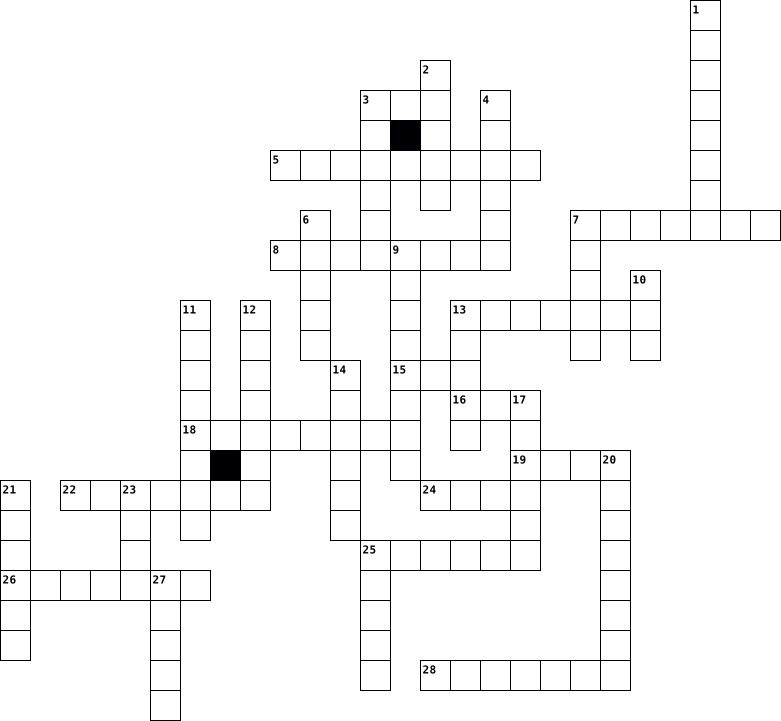
Across
- 2
- 17
- 70
- 19
- 16
- 6
- 10
- x000000000000
- 9
- 15
- 5
- 20
- x00
- x000000
Down
- 14
- 40
- 12
- 11
- 50
- 7
- x000
- 1
- 13
- x000000000
- 60
- 30
- 90
- 18
- 80
- 4
- 3
- 8
32 Clues: 2 • 7 • 1 • 6 • 9 • 4 • 5 • 3 • 8 • 14 • 40 • 12 • 11 • 17 • 50 • 70 • 19 • 13 • 16 • 60 • 30 • 10 • 90 • 18 • 80 • 15 • 20 • x00 • x000 • x000000 • x000000000 • x000000000000
Legendary/Mythical Pokemon 2022-08-08

Across
- Genie with hoops
- gem princess
- Ice Dragon
- Space dragon
- Core, 10%, 50%, Complete
- fire dog
- Electric dog
- Electric dragon
- Lava Dino
- Space Bat
Down
- Fire bird
- Dog with sword
- Fire dragon
- Dog with sheild
- Whale with wings
- Ice dog
- Ice bird
- time traveler
- Electric brid
- Space Lion
20 Clues: Ice dog • Ice bird • Fire bird • Lava Dino • Space Bat • Ice Dragon • Space Lion • Fire dragon • gem princess • Space dragon • fire dog • Electric dog • time traveler • Electric brid • Dog with sword • Dog with sheild • Electric dragon • Genie with hoops • Whale with wings • Core, 10%, 50%, Complete
Retired Numbers (LAA,MIN,SEA,BAL,COL) 2022-06-27

Across
- Angels #26
- Twins #34
- Orioles #4
- Twins #28
- Angels #30
- Angels #29
- Angels #50
- Rockies #33
- Mariners #11
- Twins #14
Down
- Twins #7
- Twins #3
- Twins #29
- orioles #33
- Orioles #8
- Orioles #22
- Twins #6
- Twins #10
- Rockies #17
- Angels #11
- Mariners #24
- Orioles #20
- Orioles #5
23 Clues: Twins #7 • Twins #3 • Twins #6 • Twins #34 • Twins #29 • Twins #10 • Twins #28 • Twins #14 • Angels #26 • Orioles #8 • Orioles #4 • Angels #30 • Angels #11 • Angels #29 • Angels #50 • Orioles #5 • orioles #33 • Orioles #22 • Rockies #17 • Orioles #20 • Rockies #33 • Mariners #24 • Mariners #11
Los números 2021-08-28

Across
- 12
- 100
- 28
- 30
- 19
- 70
- 21
- 6
- 10
- 14
- 4
- 16
- 50
- 9
- 7
Down
- 80
- 8
- 35
- 17
- 40
- 90
- 18
- 11
- 2
- 1
- 0
- 3
- 15
- 60
- 13
- 20
- 5
32 Clues: 8 • 2 • 1 • 0 • 6 • 3 • 4 • 9 • 5 • 7 • 12 • 80 • 35 • 17 • 28 • 40 • 90 • 30 • 18 • 11 • 19 • 70 • 21 • 10 • 14 • 15 • 60 • 13 • 16 • 50 • 20 • 100
Spanish Numbers 30 and Up 2021-10-11

Across
- 30
- 700
- 400
- 80
- 5.000
- 101
- 40
- hundreds
- 300
- thousands
- 1.000
Down
- 90
- 70
- 2.000
- 1.000.000
- 50
- 600
- 200
- 900
- 1.100
- 500
- 800
- 60
- 100
- 100.000
25 Clues: 30 • 90 • 70 • 50 • 80 • 60 • 40 • 700 • 400 • 600 • 200 • 900 • 500 • 800 • 101 • 100 • 300 • 2.000 • 1.100 • 5.000 • 1.000 • 100.000 • hundreds • 1.000.000 • thousands
Contact 1-3 2014-09-20

Across
- schoolbord
- wensen
- reis
- geven
- natuur
- bank
- 90
- nu
- valies
- 50
- blad
- verbeteren
- potlood
- 40
- 30
- zin
- ochtend
Down
- balpen
- werken
- 70
- boom
- droevig
- 60
- hoek
- 20
- kopiëren
- directrice
- leren
- spreken
- terugkeren
- zwemmen
- tekst
- bladzijde
33 Clues: 70 • 60 • 20 • 90 • nu • 50 • 40 • 30 • zin • boom • reis • hoek • bank • blad • geven • leren • tekst • balpen • werken • wensen • natuur • valies • droevig • spreken • zwemmen • potlood • ochtend • kopiëren • bladzijde • schoolbord • directrice • verbeteren • terugkeren
opa 75 jaar 2014-10-27

Across
- beroep
- gereedschap
- gebak
- geboorteplaats
- Italiaans gerecht
- badplaats
- boom
- borgmoer
- soort bier
- slaginstrument
- getal
Down
- meer in Europa
- fruit
- vervoersmiddel
- huisdier
- Europees land
- meisjes naam
- eetgelegenheid
- slachtmaand
- Glockner berg in Oostenrijk
- wie kom je tegen als je 50 wordt
- groenten
- buitenmuur
- mannen
24 Clues: boom • fruit • gebak • getal • beroep • mannen • huisdier • groenten • borgmoer • badplaats • buitenmuur • soort bier • gereedschap • slachtmaand • meisjes naam • Europees land • meer in Europa • vervoersmiddel • geboorteplaats • eetgelegenheid • slaginstrument • Italiaans gerecht • Glockner berg in Oostenrijk • wie kom je tegen als je 50 wordt
ON THIS PAGE 2016-02-14

Across
- ........ Page
- Levin ....... School
- Safe And Secure .........
- ....... 40 Units
- Security ....... Entry
- ......Your Imagination
- ........ With Me
- Paper ......
- Open 24 .......
- ........ Chronicle
- Georgies Wigs & Hair ......
- Great read
Down
- Secure Self .........
- ....... $50 Paper Plus
- Old Kimberley ........ Grounds
- Some ....... Apply
- Shape ......
- WINZ Subsidies ........
- 20 ........ Avenue
- Early ....... Education
- 0800 00 .......
- ...... Just Love It
22 Clues: Great read • Shape ...... • Paper ...... • ........ Page • Open 24 ....... • 0800 00 ....... • ....... 40 Units • ........ With Me • Some ....... Apply • 20 ........ Avenue • ........ Chronicle • ...... Just Love It • Levin ....... School • Secure Self ......... • ....... $50 Paper Plus • Security ....... Entry • ......Your Imagination • WINZ Subsidies ........ • Early ....... Education • ...
Numbers 2017-11-11
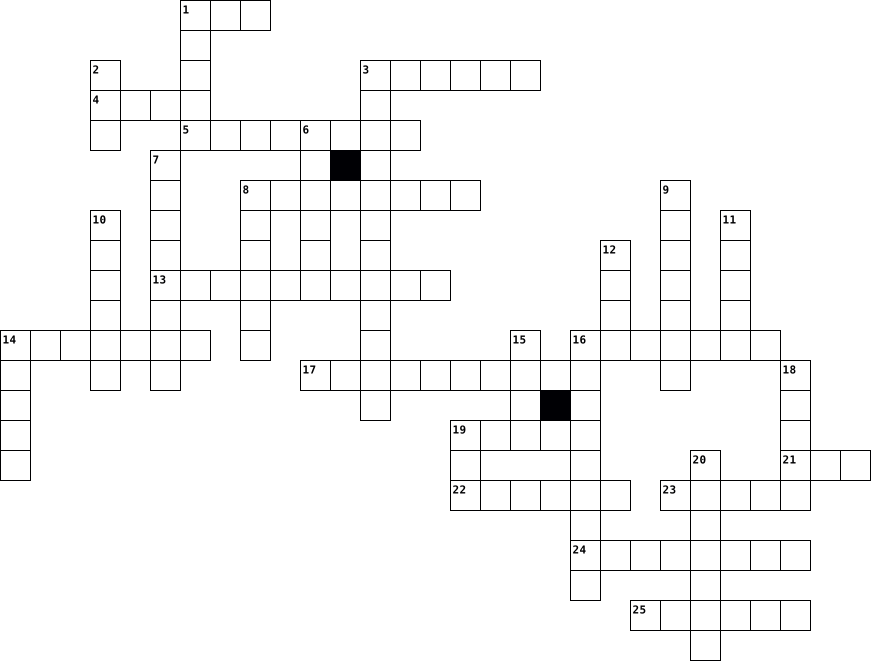
Across
- 6
- 12
- 9
- 19
- 13
- 22
- 15
- 70
- 21
- 3
- 2
- 90
- 50
- 18
- 11
Down
- 7
- 1
- 23
- 30
- 14
- 20
- 100
- 80
- 8
- 5
- 40
- 4
- 17
- 60
- 10
- 16
31 Clues: 6 • 7 • 1 • 9 • 8 • 5 • 4 • 3 • 2 • 12 • 23 • 19 • 30 • 14 • 13 • 20 • 80 • 22 • 15 • 40 • 70 • 17 • 21 • 60 • 10 • 16 • 90 • 50 • 18 • 11 • 100
Vocab Choice #1 2022-01-24

Across
- 8
- 70
- 11
- 15
- 14
- 80
- 100
- 4
- 10
- 19
- 6
- 13
- 7
- 1000000
- 18
- 40
Down
- 60
- 1
- 17
- 90
- 22
- 0
- 50
- 30
- 16
- 20
- 9
- 3
- 1000
- 5
- 2
- 21
- 12
33 Clues: 1 • 8 • 0 • 9 • 3 • 4 • 5 • 2 • 6 • 7 • 60 • 17 • 90 • 22 • 50 • 70 • 30 • 11 • 15 • 14 • 16 • 20 • 80 • 10 • 19 • 21 • 13 • 12 • 18 • 40 • 100 • 1000 • 1000000
pelda 2022-04-21

Across
- 94,95,00,01,02,03,04
- 96
- 58
- 21
- 76
- 81,83,87
- 88,90,91
- 69,71,73
- 07
- 09
- 92
- 72,74
- 70,
- 79
- 75,77,84
- 61
- 98,99
Down
- 78
- 64
- 51,54,55,56,57
- 08,14,15,17,18,19,20
- 62,68
- 50
- 10,11,12,13
- 85,86,89,93
- 05,06
- 82
- 97
- 67
- 59,60
- 16
- 80
- 63,65
33 Clues: 78 • 64 • 96 • 50 • 58 • 21 • 76 • 07 • 82 • 97 • 09 • 92 • 67 • 16 • 79 • 80 • 61 • 70, • 62,68 • 05,06 • 72,74 • 59,60 • 63,65 • 98,99 • 81,83,87 • 88,90,91 • 69,71,73 • 75,77,84 • 10,11,12,13 • 85,86,89,93 • 51,54,55,56,57 • 94,95,00,01,02,03,04 • 08,14,15,17,18,19,20
Daily Crossword 2022-04-23

Across
- 82, poisonous
- 5
- 1
- 78
- 47, Ag
- 19, essential nutrient
- 22
- 20, essential nutrient
- 53
- 54, used in automatic headlights
Down
- 79, Au
- 6
- 29, used to make bronze
- 11, used in salt
- 26
- 50, formerly used for tin cans
- 2
- 27
- 3
- 17
- 8
- 7
22 Clues: 6 • 5 • 1 • 2 • 3 • 8 • 7 • 26 • 78 • 27 • 22 • 17 • 53 • 79, Au • 47, Ag • 82, poisonous • 11, used in salt • 19, essential nutrient • 20, essential nutrient • 29, used to make bronze • 50, formerly used for tin cans • 54, used in automatic headlights
Tener, Expressions, and Numbers in Spanish 2024-01-25

Across
- to be cold
- 31
- beard/chin
- to be_years old
- 50
- How old is
- 30
- you all(inf.) have
- to be hot
- long
- we have
Down
- You have(inf.)
- 60
- 40
- gray-haired
- to be in a hurry
- brown hair
- I have
- to be hungry
- short(length)
20 Clues: 60 • 40 • 31 • 50 • 30 • long • I have • we have • to be hot • to be cold • beard/chin • brown hair • How old is • gray-haired • to be hungry • short(length) • You have(inf.) • to be_years old • to be in a hurry • you all(inf.) have
Numeros 2025-03-03

Across
- 5
- 20
- 16
- 8
- 15
- 23
- 29
- 25
- 24
- 13
- 7
- 26
- 12
- 11
- 90
- 6
- 18
- 19
- 12
- 4
Down
- 17
- 14
- 22
- 40
- 21
- 50
- 9
- 2
- 28
- 1
- 27
- 3
- 10
33 Clues: 5 • 8 • 9 • 2 • 1 • 7 • 6 • 3 • 4 • 17 • 14 • 22 • 20 • 16 • 40 • 21 • 50 • 15 • 23 • 29 • 25 • 24 • 28 • 13 • 26 • 27 • 12 • 11 • 90 • 18 • 10 • 19 • 12
divisioni 3 2025-12-23

Across
- 72:9
- 27:9
- 96:4
- 68:4
- 36:6
- 440:4
- 80:2
- 40:4
- 58:2
- 222:4
- 39:3
Down
- 72:2
- 36:9
- 36:3
- 172:2
- 18:9
- 50:10
- 150:3
- 49:7
- 45:5
- 66:6
- 100:10
22 Clues: 72:9 • 72:2 • 27:9 • 36:9 • 36:3 • 96:4 • 68:4 • 18:9 • 36:6 • 80:2 • 40:4 • 49:7 • 45:5 • 58:2 • 66:6 • 39:3 • 172:2 • 440:4 • 50:10 • 150:3 • 222:4 • 100:10
spanish 2024-09-05

Across
- 50
- 19
- good evening
- 18
- good bye
- what is your name
- 17
- good afternoon
- how are you
- 2
- 12
- head
- mouth
Down
- good morning
- 4
- finger
- you're
- 16
- delighted
- 5
- 100
- 14
- 1 oclock
- 10
- 0
- arm
- 40
27 Clues: 4 • 5 • 2 • 0 • 50 • 19 • 16 • 18 • 17 • 14 • 10 • 12 • 40 • 100 • arm • head • mouth • finger • you're • good bye • 1 oclock • delighted • how are you • good morning • good evening • good afternoon • what is your name
Telling the time (use _ for space) 2024-11-01

Across
- este 11
- 12 óra
- korán reggel
- 20 perc múlva 7 óra
- korán
- fél 9
- délután 2
- 21:00
- 22:02
- 8 múlt 5 perccel
Down
- 5:55
- este 7
- késő este
- kora reggel
- este későn
- 8 múlt 8 perccel
- későn
- 15:50
- dél
- éjfél
- 9:00
21 Clues: dél • 5:55 • 9:00 • korán • későn • fél 9 • 21:00 • 15:50 • 22:02 • éjfél • este 7 • 12 óra • este 11 • késő este • délután 2 • este későn • kora reggel • korán reggel • 8 múlt 8 perccel • 8 múlt 5 perccel • 20 perc múlva 7 óra
ηθοποιοι 2017-03-14

Across
- γνωστος ηθοποιος που συμμετειχε στο survivor του 2017
- δολοφονηθηκε στο διαμερισμα του το 2008
- συμπρωταγωνιστης σε πολλες ταινιες με την Αλικη βουγιουκλακη
- πρωταγωνιστησε στη σειρα φιλα τον βατραχο σου
- κωμικος την δεκαετια του '60
Down
- κωμικος την δεκαετια του '80
- επαιζε στην σειρα λατρεμενη μου γειτονες
- σκηνοθετισε και πρωταγωνιστει σε γνωστη σειρα σε Ελλαδα και Κυπρο
- ο θυρωρος στην σειρα πολυκατοικια
- το ατακτο παιδι στη σειρα ευτυχισμενοι μαζι
- υποδυθηκε το ρολο του Νικηφορου στη σειρα 50-50
11 Clues: κωμικος την δεκαετια του '80 • κωμικος την δεκαετια του '60 • ο θυρωρος στην σειρα πολυκατοικια • δολοφονηθηκε στο διαμερισμα του το 2008 • επαιζε στην σειρα λατρεμενη μου γειτονες • το ατακτο παιδι στη σειρα ευτυχισμενοι μαζι • πρωταγωνιστησε στη σειρα φιλα τον βατραχο σου • υποδυθηκε το ρολο του Νικηφορου στη σειρα 50-50 • ...
Civics 2013-03-12

Across
- Law making body for the small states
- Helps president enforce laws
- Government for the entire nation
- A complaint
- To deny
- Government cannot interfere in personal life
- One person makes decisions for a group
- Checks and _____
- Everyone has equal say
Down
- Law making body for the big states
- Head of the Executive Branch
- To remove from office
- Governments for individual states
- Determines laws unconstitutional
- Makes laws
- Enforces laws
- No one is above the law
- Body of judges
18 Clues: To deny • Makes laws • A complaint • Enforces laws • Body of judges • Checks and _____ • To remove from office • Everyone has equal say • No one is above the law • Head of the Executive Branch • Helps president enforce laws • Government for the entire nation • Determines laws unconstitutional • Governments for individual states • Law making body for the big states • ...
midterm cross word 2020-09-29

Across
- a conflict fought between the United States and its allies
- a small but pivotal battle during the American Revolutionary War
- omprises the first ten amendments to the United States Constitution
- The last battle of the Revolutionary War
- A democratic republic
- the acquisition of the territory of Louisiana by the United States
- a 2,170-mile east-west, large-wheeled wagon route and emigrant trail in the United States
- an armed conflict between the United States and Mexico
- belief in the benefits of profitable trading
- The Navigation Acts were a series of laws passed by the British Parliament that imposed restrictions on colonial trade
- a proposal for the structure of the United States Government presented by William Paterson at the Constitutional Convention
- the first president of the United States
- is the pronouncement adopted by the Second Continental Congress
- colonial history, British legislation aimed at ending the smuggling trade in sugar and molasses from the French and Dutch West Indies
- was a series of forced relocations of approximately 60,000 Native Americans
Down
- King George III declared all lands west of the Appalachian Divide off limits to colonial settlers
- was a widely held American imperialist cultural belief in the 19th-century United States that American settlers were destined to expand across North America
- the U.S. Supreme Court's ruling on March 6, 1857, that having lived in a free state and territory did not entitle an slaved person
- a political and mercantile protest by the Sons of Liberty in Boston
- a proposal to the United States Constitutional Convention for the creation of a supreme national government with three branches and a bicameral legislature
- King of Great Britain
- transport is a means of transferring passengers and goods on wheeled vehicles running on rails
- was an American stage actor who assassinated President Abraham Lincoln
- was an American statesman, politician, legal scholar, military commander, lawyer, banker, and economist
- was an American statesman, diplomat, lawyer, architect, philosopher, and Founding Father who served as the third president of the United States
- pure democracy is a form of democracy in which people decide on policy initiatives directly
- an estate on which crops such as coffee sugar and tobacco are cultivated by resident labor
- a person who favors the abolition of a practice or institution
- an act regulating stamp duty (a tax on the legal recognition of documents)
- The French and Indian War pitted the colonies of British America against those of New France
- the process in which a minority group or culture comes to resemble a dominant group
31 Clues: A democratic republic • King of Great Britain • The last battle of the Revolutionary War • the first president of the United States • belief in the benefits of profitable trading • an armed conflict between the United States and Mexico • a conflict fought between the United States and its allies • a person who favors the abolition of a practice or institution • ...
Pre Civil War Vocab - SHS McCurry 2025-03-03

Across
- Tax on imports
- _________________ Railroad - Secret network helping enslaved people escape. Not an actual railroad
- Land within the mainland boundaries of the country that had not yet become a state by 1861.
- A Latin phrase that means "before the war". It's used to describe the time period before the Civil War, which lasted from 1861–1865.
- ______________ - A term for the pre-Civil War era in the South, when the economy was based on slave labor and plantation farming.
- Wealth and resources of a nation
- Someone who wishes to abolish or get rid of slavery.
- a dramatic and wide-reaching change in the way something works or is organized or in people's ideas about it.
- When a state focuses on its own region's needs instead of the nation's interests.
- _____________ Compromise (1820) - Agreement about admitting new states. Missouri entered as slave state, Maine entered as free state. Set 36°30' parallel as slavery boundary
- Warehouse of weapons
Down
- Compromise of Eighteen-_______ - Series of bills to maintain balance between free/slave state and included controversial Fugitive Slave Law
- Another word for Rebellion
- Loyalty to one's region over the nation
- Manufacturing goods from raw materials, such as cloth from cotton or machine parts from iron.
- Party: A political party generally against slavery and its expansion into the territories. This political party had basically been swallowed up by the Democrat and Republican parties by the time of the Civil War.
- Rights: This doctrine held the powers of the individual states as greater than the powers of the Federal government. States rights meant that the Federal government held its power only through the consent of the states and that any powers not specifically given to the Federal government remained in control of the states.
- the 1857 Supreme Court ruling that enslaved people were not U.S. citizens and could not sue in federal court. The decision also declared the Missouri Compromise unconstitutional
- Product purchased from other nations
- Community that shares laws and culture
- The science of growing crops or raising livestock; farming.
- _____________________ line: A boundary surveyed in the 1760s that ran between Pennsylvania to the North and Delaware, Maryland and (West) Virginia to the South. It became a symbolic division between free states and slave states.
- A nickname for the South.
- ________ Gin - Invented by Eli Whitney in 1793. Machine that quickly removed seeds from cotton
- Popular ______________ - Letting voters in territories decide about slavery
- Withdrawal from the Federal government of the United States. Southern states, feeling persecuted by the North, seceded by voting to separate from the Union. Southerners felt this was perfectly legal but Unionists saw it as rebellion.
- Free __________ - Political movement opposing slavery's expansion. Wanted western territories free for white settlers
- _______ Crops - crops grown to be sold
28 Clues: Tax on imports • Warehouse of weapons • A nickname for the South. • Another word for Rebellion • Wealth and resources of a nation • Product purchased from other nations • Community that shares laws and culture • _______ Crops - crops grown to be sold • Loyalty to one's region over the nation • Someone who wishes to abolish or get rid of slavery. • ...
Codes 2021-07-18

Across
- SIG 8
- SIG 52
- SIG 61
- SIG 26
- 10-14
- SIG 89
- 10-22
- SIG 88
Down
- SIG 60
- SIG 31
- SIG 50
- SIG 69
- 10-63
- SIG 21
- 10-7
- 10-4
16 Clues: 10-7 • 10-4 • SIG 8 • 10-63 • 10-14 • 10-22 • SIG 60 • SIG 31 • SIG 52 • SIG 61 • SIG 50 • SIG 69 • SIG 26 • SIG 21 • SIG 89 • SIG 88
presidentes 2018-01-31

Across
- Jackson
- trump
- Lincoln
- f. kenedy
- jefferson
- Hamilton
- W. Bush
- S. Grant
Down
- a martin luther king jr con racismo
- presidente de 2018
- Obama
- Franklin
- Roosevelt
- presidente en el billete de 50$
- primero presidente
- Clinton
16 Clues: Obama • trump • Jackson • Lincoln • Clinton • W. Bush • Franklin • Hamilton • S. Grant • f. kenedy • jefferson • Roosevelt • presidente de 2018 • primero presidente • presidente en el billete de 50$ • a martin luther king jr con racismo
Addition 2024-07-11

Across
- 12 + 68
- 100 + 80
- 23 + 77
- 3 + 15
- 13 + 68
- 22 + 36
- 12 + 5
- 91 + 20
Down
- 101 + 699
- 18 + 83
- 5 + 11
- 11 + 40
- 35 + 50
- 35 + 52
- 55 + 26
- 5 + 6
- 6 + 4
17 Clues: 5 + 6 • 6 + 4 • 5 + 11 • 3 + 15 • 12 + 5 • 12 + 68 • 18 + 83 • 23 + 77 • 11 + 40 • 35 + 50 • 13 + 68 • 35 + 52 • 22 + 36 • 55 + 26 • 91 + 20 • 100 + 80 • 101 + 699
Interim Review 2023-11-30

Across
- Ordinance Established a government for the northwest territory
- Against the constitution
- an action to begin a riot
- she aided Lewis and Clark
- declared war on Britain due to impressment
- Battle of january 8, 1815
- A Vote to confirm
- right to job but the job was void
- Land agreement between France and the United States
- The first constitution of the united states/ agreement among the 13 states
- First 10 amendments
Down
- failed bombardment
- The movement of American farmers who protested against high taxes
- An agreement made among the delegates to the Constitutional Convention
- The “Federalist Papers” are a series of essays supporting the ratification of the U.S. Constitution
- national anthem of the United States
- A gathering to address the weak laws of AOF
- force american sailors to fight
- How to determine its constitutional
19 Clues: A Vote to confirm • failed bombardment • First 10 amendments • Against the constitution • an action to begin a riot • she aided Lewis and Clark • Battle of january 8, 1815 • force american sailors to fight • right to job but the job was void • How to determine its constitutional • national anthem of the United States • declared war on Britain due to impressment • ...
7th Grade Vocab Review 2026-05-14

Across
- math symbol ≥
- The rate of change for proportional relationships
- A triangle with 3 equal sides.
- the sequence in which we simplify the operations in an expression
- The total area of all the faces of a 3D shape.
- number being multiplied by a variable
- A number on its own, not paired with a variable
- The amount of money paid to an employee for selling something
- expressions that simplify to the same value
- value for a variable that makes an equation true
- A fraction whose numerator, denominator, or both are fractions
- representative group of individuals from a larger population
- mathematical terms with the same variable(s) to the same power
- graph showing data in intervals
- Answer to an addition problem
- Volume is measured in ________ units.
- average distance of all data points to the mean
- A 3D shape with one base and triangular sides.
- The ratio between two similar objects.
- when a number is multiplied by itself a certain # of times
- A decimal that continues forever
- average or "fair share" of a group of numbers
- math statement with numbers, variables, & one of these: < > ≤ ≥
- _____ likely as not: 50/50 chance
- The distance across the middle of a circle.
- total group of individuals in an experiment or study
- middle number of a list from least to greatest
- An angle equal to 90 degrees.
- Pair of opposite and equal angles created by intersecting lines.
- a math statement containing numbers, variables, and no = sign
- A decimal with one or more repeating digits
- Answer to a division problem
- a value that can be divided evenly into another, no remainder
- An angle less than 90 degrees.
- a combination of numbers, variables, or both; separated by + and - signs in an expression
- to "plug in" a value for a variable in an algebraic expression, then simplify
- The ______ of -4 is 4.
- The only number that is neither negative nor positive
Down
- Any positive or negative whole number, or 0
- The corner of an angle or shape.
- A 3D shape with two triangular bases at either end, connected by rectangular faces.
- Any number that can be written as a fraction
- A number’s distance from 0 on the number line
- letter or symbol that stands for an unknown number
- Answer to a multiplication problem
- _____ probability: chances of 2+ events happening
- math symbol ≠
- The number of cubic units it takes to fill a three-dimensional shape.
- The price paid for the use of credit or savings money
- _____ probability: what is predicted to happen
- A number to the left of 0 on the number line
- Angles whose sum is 180 degrees.
- chance of an event happening
- conclusion drawn from experimental data
- Area is measured in ________ units.
- Distance around a circle.
- math symbol <
- A decimal that ends
- more than 50% chance of happening
- Answer to a subtraction problem
- math symbol >radius The distance from the center of a circle to any point on the outside.
- A number to the right of 0 on the number line
- Any rate with a denominator of 1; usually used with “per”
- difference between lowest and highest value in a data set
- under 50% chance of occurring
- Having a constant ratio to another quantity.
- Any number that cannot be written as a fraction
- A 3D shape whose sides are all rectangles.
- An amount of money given as an additional payment for a service; usually 15-20%
- Ratio of a circle's circumference to diameter.
- decimal that continues forever without a pattern
- An angle greater than 90 but less than 180.
- The number of square units it takes to fill a two-dimensional shape.
- math symbol ≤
- Angles whose sum is 90 degrees.
- probability of event not occurring
- _____ probability: what actually happens in an experiment
- range of the middle 50% of data in a box plot
- A triangle with 2 out of 3 equal sides.
- the ________ property states that a number on the outside of a parenthetical expression must be multiplied by all terms inside
- A triangle with 3 different side lengths.
- visual representation showing all branches of probabilities
- describes a sample that is selected without bias
- The ______ of 3/4 is 4/3
- all possible outcomes in a list
- a math statement containing numbers, variables, and an = sign
86 Clues: math symbol ≥ • math symbol ≠ • math symbol < • math symbol ≤ • A decimal that ends • The ______ of -4 is 4. • The ______ of 3/4 is 4/3 • Distance around a circle. • chance of an event happening • Answer to a division problem • Answer to an addition problem • under 50% chance of occurring • An angle equal to 90 degrees. • A triangle with 3 equal sides. • An angle less than 90 degrees. • ...
AP GOV 2025-12-09

Across
- The leader of the House of Representatives and the most powerful member of the chamber.
- A federal law that prohibits monopolies and promotes competition.
- Federal funds provided to states for specific, narrowly defined purposes.
- Powers shared by both federal and state governments.
- A system in which political supporters are rewarded with government jobs.
- Supreme Court case that affirmed federal supremacy and upheld implied powers.
- A system of government agencies and officials that administer and enforce laws.
- The use of federal funds and financial incentives to influence state policies.
- A presidential veto that occurs when the president takes no action on a bill and Congress adjourns.
- A model in which states compete with each other to attract businesses and residents.
- The senator who presides over the Senate when the Vice President is absent.
- A form of federalism where the national government pressures states to follow federal policies.
Down
- The redrawing of electoral district boundaries based on population changes.
- A rule created by the government to control or manage activities and behaviors.
- The authority of states to regulate behavior and enforce laws for public safety and welfare.
- Federal funds given to states for broadly defined purposes with few restrictions.
- The legislative branch of the U.S. government responsible for making laws.
- The manipulation of electoral district boundaries to benefit a political party.
- A tactic in the Senate where a senator delays a vote by speaking for an extended period.
- A model where cooperation occurs among federal, state, and local agencies within specific policy areas.
- “The powers not delegated to the United States by the Constitution, nor prohibited by it to the States, are reserved to the States respectively, or to the people.”
- A process that allows voters to remove an elected official from office before the end of their term.
- A system in which government employees are hired and promoted based on merit rather than politics.
- The president’s power to reject a bill passed by Congress.
- A system of government in which power is divided between a national government and regional governments.
25 Clues: Powers shared by both federal and state governments. • The president’s power to reject a bill passed by Congress. • A federal law that prohibits monopolies and promotes competition. • Federal funds provided to states for specific, narrowly defined purposes. • A system in which political supporters are rewarded with government jobs. • ...
Review crossword project. 2020-09-30

Across
- was a long series of English laws that developed, promoted, and regulated English ships, shipping, trade, and commerce between other countries and with its own colonies.
- was an American stage actor who assassinated President Abraham Lincoln at Ford's Theatre in Washington, D.C., on April 14, 1865.
- was an American political leader, military general, statesman, and founding father who served as the first president of the United States from 1789 to 1797.
- was issued by King George III on October 7, 1763, following Great Britain's acquisition of French territory in North America after the end of the Seven Years' War.
- Is an economic policy that is designed to maximize the exports and minimize the imports for an economy.
- This treaty, signed on February 2, 1848, ended the war between the United States and Mexico.
- was a widely held American imperialist cultural belief in the 19th-century United States that American settlers were destined to expand across North America.
- Tobacco, cotton and sugar were grown on large-scale farms called...
- was an American social reformer, abolitionist, orator, writer, and statesman.
- abolished slavery and involuntary servitude, except as punishment for a crime.
- was a political and mercantile protest by the Sons of Liberty in Boston, Massachusetts, on December 16, 1773.
- was an enslaved African American man in the United States who unsuccessfully sued for his freedom and that of his wife and their two daughters
- is a form of government operating on principles adopted from a republic and a democracy.
- is the pronouncement adopted by the Second Continental Congress meeting in Philadelphia, Pennsylvania, on July 4, 1776.
Down
- was a presidential proclamation and executive order issued by United States President Abraham Lincoln on September 22, 1862, during the Civil War.
- was a proposal to the United States Constitutional Convention for the creation of a supreme national government with three branches and a bicameral legislature.
- were state and local laws that enforced racial segregation in the Southern United States.
- was an American statesman, politician, legal scholar, military commander, lawyer, banker, and economist. He was one of the Founding Fathers of the United States.
- was a conflict fought between the United States and its allies, and the United Kingdom of Great Britain and Ireland and its allies.
- was an American statesman, diplomat, lawyer, architect, philosopher, and Founding Father who served as the third president of the United States from 1801 to 1809.
- was the acquisition of the territory of Louisiana by the United States from France in 1803.
- was an Act of the Parliament of Great Britain which imposed a direct tax on the British colonies in America and required that many printed materials in the colonies be produced on stamped paper produced in London, carrying an embossed revenue stamp.
- comprises the first ten amendments to the United States Constitution.
- was a 2,170-mile east-west, large-wheeled wagon route and emigrant trail in the United States that connected the Missouri River to valleys in Oregon.
- is the withdrawal of a group from a larger entity, especially a political entity, but also from any organization, union or military alliance.
- was a decisive victory by a combined force of American Continental Army troops led by General George Washington
- fought in Appomattox County, Virginia, on the morning of April 9, 1865, was one of the last battles of the American Civil War.
- was a proposal for the structure of the United States Government presented by William Paterson at the Constitutional Convention on June 15, 1787.
- was King of Great Britain and King of Ireland from 25 October 1760 until the union of the two countries on 1 January 1801, after which he was King of the United Kingdom of Great Britain and Ireland until his death in 1820.
- was a revenue-raising act passed by the Parliament of Great Britain on 5 April 1764.
- is a form of democracy in which people decide on policy initiatives directly.
- pitted the colonies of British America against those of New France, each side supported by military units from the parent country and by Native American allies.
- was a small but pivotal battle during the American Revolutionary War, which took place on the morning of December 26, 1776, in Trenton, New Jersey.
- was the movement to end slavery.
- was an armed conflict between the United States and Mexico from 1846 to 1848.
- was a series of forced relocations of approximately 60,000 Native Americans between 1830 and 1850 by the United States government.
36 Clues: was the movement to end slavery. • Tobacco, cotton and sugar were grown on large-scale farms called... • comprises the first ten amendments to the United States Constitution. • is a form of democracy in which people decide on policy initiatives directly. • was an American social reformer, abolitionist, orator, writer, and statesman. • ...
Social Studies 2020-09-08

Across
- protect individuals freedoms.
- People that criticized the Constitution because it lacked the bill of rights
- the system of courts that interprets and applies law in legal cases
- Morris an English-born merchant and a Founding Father of the United States. He served as a member of the Pennsylvania legislature, the Second Continental Congress, and the United States
- release from slavery.
- of Rights a landmark Act in the constitutional law of England that sets out certain basic civil rights and clarifies who would be next to inherit the Crown.
- Hamilton was an American statesman, politician, legal scholar, military commander, lawyer, banker, and economist. He was one of the Founding Fathers of the United States.
- shays an American soldier, revolutionary, and farmer famous for being one of the leaders and namesake of Shays' Rebellion,
- Approved.
- and Balances principles of government under which separate branches are empowered to prevent actions by other branches
- the action of enlightening or the state of being enlightened.
- otis warren a published poet, political playwright and satirist during the age of the American Revolution—a time when women were encouraged and expected to keep silent on political matters.
- sovereignty the principle that the authority of a state and its government are created and sustained by the consent of its people, through their elected representatives, who are the source of all political power
- papers a series of 85 essays arguing in support of the United States Constitution
- having the power to make laws.
- a long and severe recession in an economy or market
- Ordinance an organic act of the Congress of the Confederation of the United States
Down
- Compromise an agreement between delegates from the Northern and the Southern states at the United States Constitutional Convention that three-fifths of the slave population would be counted for determining direct taxation and representation in the House of Representatives.
- Madison America's fourth President (1809-1817), made a major contribution to the ratification of the Constitution by writing The Federalist Papers, along with Alexander Hamilton and John Jay.
- having two branches or chambers
- of Confederation an agreement among the 13 original states of the United States of America that served as its first constitution
- people who opposed the ratification of the Constitution in 1789 and thereafter allied with Thomas Jefferson's Anti Federalist Party,
- a piece of legislation enacted by a municipal authority.
- branches of government the executive branch, the legislative branch, and the judicial branch.
- Virginia planter.
- having the power to put plans, actions, or laws into effect.
- Sherman American politician whose plan for representation of large and small states prevented a deadlock at the U.S. Constitutional Convention of 1787
27 Clues: Approved. • Virginia planter. • release from slavery. • protect individuals freedoms. • having the power to make laws. • having two branches or chambers • a long and severe recession in an economy or market • a piece of legislation enacted by a municipal authority. • having the power to put plans, actions, or laws into effect. • ...
amendments 2023-09-29

Across
- Papers/A collection of articles and essays promoting the ratification of the United States Constitution
- Constitution/A document that embodies the fundamental laws and principles by which the United States is governed.
- of Confederation/The original constitution of the US, ratified in 1781
- Amendment: Right to be free from discrimination in states to have due process of law, to have equal protection of the law
- Carta/A document constituting a fundamental guarantee of rights and privileges.
- of Versailles/It ended the state of war between Germany and the Allied Powers
- of Rights/The first ten amendments to the US Constitution, ratified in 1791
- Amendment/Abolition of poll taxes
- Amendment/Black Suffrage
- Amendment/Election of National Senators
Down
- of Independence/The fundamental document establishing the United States as a nation, adopted on July 4, 1776.
- Points/Statement given on January 8, 1918 by United States President Woodrow Wilson
- Doctrine/United States would provide political, military and economic assistance to all democratic nations under threat from authoritarian forces.
- Bill of Rights/An Act Declaring the Rights and Liberties of the Subject and Settling the Succession of the Crown.
- Amendment/Abolition of slavery Outlawed
- Amendment/18 year olds given the right to vote
- Amendment/Individual Income Tax
- Amendment/Women's Suffrage
18 Clues: Amendment/Black Suffrage • Amendment/Women's Suffrage • Amendment/Individual Income Tax • Amendment/Abolition of poll taxes • Amendment/Abolition of slavery Outlawed • Amendment/Election of National Senators • Amendment/18 year olds given the right to vote • of Confederation/The original constitution of the US, ratified in 1781 • ...
U.S. Grography 2021-09-30

Across
- Island state
- California, Texas, New Mexico, and Arizona border this country
- federal capital
- third most populous country in the world
- Ocean to the west of the United States
- largest river in the U.S.
- The capital city of Texas
- U.S. territory that belonged to Spain
Down
- territory in the Pacific
- territory in the Atlantic
- This river flows across the middle of the United States from Minnesota to Louisiana
- Mexico is __________ of the U.S.
- mountain range on the Eastern side of the U.S.
- Canada is _________ of the U.S.
- the number of states bordering the country North of the U.S.
- important landmark in New York
- Ocean to the east of the United States
17 Clues: Island state • federal capital • territory in the Pacific • territory in the Atlantic • largest river in the U.S. • The capital city of Texas • important landmark in New York • Canada is _________ of the U.S. • Mexico is __________ of the U.S. • U.S. territory that belonged to Spain • Ocean to the east of the United States • Ocean to the west of the United States • ...
TEST PREP - US Imperialism & WWI 2021-05-25

Across
- California Gold Rush, Homestead Act, and the Completion of transcontinental railroad all factors that contributed to Westward _________________.
- _________________ telegram was part of an effort to enlist Mexican support for Germany if the United States declared war.
- construction of the _________________ become more important to the United States after the Spanish-American War because the navy needed a faster way to move ships between the Atlantic and Pacific Oceans.
- Renewal of unrestricted _________________ warfare by Germany was one of the events that influenced President Woodrow Wilson’s decision to enter World War I
- Securing land for the Panama Canal and military interventions in Latin America are examples of Roosevelt's use of the "________________" diplomacy.
- _________________ companies sold land in the West for very low price.
- After World War I, senators who opposed United States participation in the ___________________ argued that American membership in the organization would involve the nation in future world conflicts.
- As a result of low land prices and the Homestaed Act many farmers moved West and the Native American Indians on the Great Plains were forced onto _________________.
- _________________ policy of unrestricted submarine warfare, interception of the Zimmermann Note, and American loans to Allied nations led to United States entry into World War I.
- ____________________ bonds were used during the administration of President Woodrow Wilson to help finance (pay for) the war effort.
- Some of the major reasons for United States _________________ included: the desire for markets and raw materials; closing of the western frontier; missionary spirit; belief in the White Man's Burden.
- The United States Senate refused to ratify the Treaty of Versailles after World War I because many senators believed that the League of Nations could draw the United States into future ___________________.
- President Theodore Roosevelt's __________________ strengthened the Monroe Doctrine by establishing the policy that the United States would intervene in Latin America to prevent European interference.
Down
- The United States tried to avoid involvement in World War I by following a policy of _________________.
- President Theodore Roosevelt’s commitment to the proverb, “Speak softly and carry a big stick; you will go far,” was most clearly shown when he intervened in _________________ affairs.
- The primary goal of the _________________ of 1887 regarding Native American Indians was to assimilate Native American Indians into mainstream American life.
- _________________ Offered free 160 acres of land in the West to anyone willing to live on it for 5 years.
- The disclosure of the Zimmerman document contributed to the entry of the United States into _________________.
- During World War I, President Woodrow Wilson outlined the ___________________ suggesting a peace plan to prevent future wars.
- The federal government supported rail road construction by giving rail road companies _________________ grants.
- One of the major characteristics of American imperialism in the late 19th and early 20th centuries was acquiring _________________ to promote economic and strategic interests.
- A major result of the _________________ War (1898) was that the United States assumed a more prominent role in world affairs.
- American newspapers used yellow journalism to build public support for the war against _________________.
- Secretary of State John Hay sent his Open Door Notes (1899–1900) to world powers to gain equal access to _________________ markets.
- The Homestead Act and grants of land to railroads were used to encourage settlement of the _________________.
- Exaggerated, sensational newspaper headlines and articles are often referred to as __________________ journalism.
- The establishment of the Open Door policy (1899–1900) and the response to the _________________ Rebellion (1900) showed that the United States wanted to protect American trading interests in China.
27 Clues: _________________ companies sold land in the West for very low price. • The United States tried to avoid involvement in World War I by following a policy of _________________. • _________________ Offered free 160 acres of land in the West to anyone willing to live on it for 5 years. • ...
TEST PREP PERIOD 9 - US Imperialism & WWI 2021-05-25

Across
- California Gold Rush, Homestead Act, and the Completion of transcontinental railroad all factors that contributed to Westward _________________.
- _________________ telegram was part of an effort to enlist Mexican support for Germany if the United States declared war.
- construction of the _________________ become more important to the United States after the Spanish-American War because the navy needed a faster way to move ships between the Atlantic and Pacific Oceans.
- Renewal of unrestricted _________________ warfare by Germany was one of the events that influenced President Woodrow Wilson’s decision to enter World War I
- Securing land for the Panama Canal and military interventions in Latin America are examples of Roosevelt's use of the "________________" diplomacy.
- _________________ companies sold land in the West for very low price.
- After World War I, senators who opposed United States participation in the ___________________ argued that American membership in the organization would involve the nation in future world conflicts.
- As a result of low land prices and the Homestaed Act many farmers moved West and the Native American Indians on the Great Plains were forced onto _________________.
- _________________ policy of unrestricted submarine warfare, interception of the Zimmermann Note, and American loans to Allied nations led to United States entry into World War I.
- ____________________ bonds were used during the administration of President Woodrow Wilson to help finance (pay for) the war effort.
- Some of the major reasons for United States _________________ included: the desire for markets and raw materials; closing of the western frontier; missionary spirit; belief in the White Man's Burden.
- The United States Senate refused to ratify the Treaty of Versailles after World War I because many senators believed that the League of Nations could draw the United States into future ___________________.
- President Theodore Roosevelt's __________________ strengthened the Monroe Doctrine by establishing the policy that the United States would intervene in Latin America to prevent European interference.
Down
- The United States tried to avoid involvement in World War I by following a policy of _________________.
- President Theodore Roosevelt’s commitment to the proverb, “Speak softly and carry a big stick; you will go far,” was most clearly shown when he intervened in _________________ affairs.
- The primary goal of the _________________ of 1887 regarding Native American Indians was to assimilate Native American Indians into mainstream American life.
- _________________ Offered free 160 acres of land in the West to anyone willing to live on it for 5 years.
- The disclosure of the Zimmerman document contributed to the entry of the United States into _________________.
- During World War I, President Woodrow Wilson outlined the ___________________ suggesting a peace plan to prevent future wars.
- The federal government supported rail road construction by giving rail road companies _________________ grants.
- One of the major characteristics of American imperialism in the late 19th and early 20th centuries was acquiring _________________ to promote economic and strategic interests.
- A major result of the _________________ War (1898) was that the United States assumed a more prominent role in world affairs.
- American newspapers used yellow journalism to build public support for the war against _________________.
- Secretary of State John Hay sent his Open Door Notes (1899–1900) to world powers to gain equal access to _________________ markets.
- The Homestead Act and grants of land to railroads were used to encourage settlement of the _________________.
- Exaggerated, sensational newspaper headlines and articles are often referred to as __________________ journalism.
- The establishment of the Open Door policy (1899–1900) and the response to the _________________ Rebellion (1900) showed that the United States wanted to protect American trading interests in China.
27 Clues: _________________ companies sold land in the West for very low price. • The United States tried to avoid involvement in World War I by following a policy of _________________. • _________________ Offered free 160 acres of land in the West to anyone willing to live on it for 5 years. • ...
Cold War Vocabulary 2022-05-18

Across
- - A superpower is a country that is significantly stronger, especially in regards to their military, than most other countries. During the Cold War the Soviet Union and the United States were the two world superpowers.
- a competition between the United States and the Soviet Union to explore space. Russia got off to a fast start by putting up the first satellite and the first manned flight into orbit. The United States, however, was the first to put a man on the Moon.
- A competition between the United States and the Soviet Union to manufacture the most nuclear weapons. They also tried to outdo each other in weapons technology and defense.
- economic and political philosophy named after its author German philosopher Karl Marx. It is the basis of many communist governments.
- A softening or easing of relations between the United States and the Soviet Union. It started around 1971 and included President Nixon's visit to Moscow as well as the SALT talks. It ended when the Soviet Union invaded Afghanistan in 1979.
- a movement in Poland to create a trade union that was not controlled by the communist party. It was led by Lech Walesa who became President of Poland in 1990.
- a device that uses nuclear forces to create a huge explosion capable of destroying an entire city.
- when two sides use third parties to fight rather than fighting each other directly. The United States and the Soviet Union fought proxy wars during the Cold War such as the Korean War and the Vietnam War.
- an alliance between the Soviet Union and other Eastern Europe communist nations
- This is the term given to accusations of treason or disloyalty without having evidence. It comes from a time when Senator McCarthy of the US made several accusations of people being communists and traitors during the Cold War.
- policy introduced by Mikhail Gorbachev that allowed for more openness in the Soviet government as well as some level of freedom of speech.
Down
- An economic system based on private ownership (rather than government ownership) and the free market system.
- a time of extreme anti-communism in the United States. People were scared that communists had infiltrated the government.
- An economic system based on government ownership and control of resources.
- an effort to stop the spread of communism. It said that the United States would help countries that were threatened by "armed minorities or outside pressures".
- a name given to the Soviet Union and its communist controlled states in Eastern Europe such as Poland, East Germany, and Bulgaria.
- Strategic Arms Limitation Talks. It was when the United States and the Soviet Union agreed to limit the number of nuclear weapons they made.
- a descriptive term or symbol used to describe the border between the communist and democratic countries of Europe. The idea of the iron curtain was that it kept information and people from crossing from the communist east to the democratic west.
- North Atlantic Treaty Organization. It is an alliance of democratic and western countries including much of Western Europe, Canada, and the United States.
- term used by Mikhail Gorbachev to describe a reconstruction of the Soviet economy and industry. It included some private ownership of businesses.
- Doctrine stated that a country could ask for military support from the United States if it was threatened by another country. It was based on a speech President Eisenhower gave to Congress and was a warning to the Soviet Union.
21 Clues: An economic system based on government ownership and control of resources. • an alliance between the Soviet Union and other Eastern Europe communist nations • a device that uses nuclear forces to create a huge explosion capable of destroying an entire city. • ...
The U.S Constitution Pt 2 2023-11-02

Across
- Each House is the Judges of the Elections, Returns, and Qualifications of its Members. Also may determine the Rules of its Proceedings, punish its Members for disorderly Behaviour, and, with the Concurrence of two-thirds, expel a Member. Each House shall keep a Journal of its Proceedings, and from time to time publish the same, except parts that they deem as Secrecy.
- The Senate of the United States should be made up of two Senators from each State, chosen by the Legislature and each Senator shall have one Vote.
- The Congress shall assemble at least once a year, and this should be held on the first Monday in December, or by law change the date. The Times, Places, and Manner of holding Elections for Senators and Representatives, shall be prescribed in each State by the Legislature
- The president has all charge of the US Army and the Navy as Commander in Chief. The President has the power to fill up all vacancies that may happen during the recess of the Senate, by granting commissions.
- The House of Representatives is voted by the people of every state and if you aren’t above the age of 25 or lived in America for 7 years you cannot be a representative.
- It is said at least nine states needed to ratify the Constitution for it to be applied to all of the states.
- States, Citizenship, New States
- Judicial Branch
- All legislative powers are given to Congress, which is made up of a Senate and a House of Representatives.
- Ratification
Down
- All debt before this constitution was made was valid against the United States under the Confederation. Religion cannot be used as a test as a requirement for a qualification to any office or public trust under the United States. The Senators and Representatives before mentioned, the members of the several State Legislatures, and all executive and judicial Officers, both of the United States and of the States are to be bound by oath and affirmation.
- To amend an Amendment, ⅔ of Congress has to agree to even want a change in the amendment to propose a change. Once proposed ¾ of the States Legislature has to ratify the amendment for it to be ratified.
- Every citizen of any State is given all privileges and immunities of citizens of several states. If someone commits a crime in one state but flees to another then that state has the authority to remove that person and be sent back to the original state where the crime was committed to be charged.
- Full Faith and Credit shall be given in each State to the public Acts, Records, and judicial Proceedings of every other State
- The executive power belongs to the President of the United States. President should serve 4 years as 1 term. If the president’s spot is vacant because of unseen circumstances, then all the powers of a president go to the Vice president, making them the president and repeat if that president's spot is vacant again.
- Amendment Process
- Debts, Supremacy, Oaths, Religious Tests
- 2 Executive Branch
- All Judicial power is given to the Supreme Court and those powers should be extended to all cases
- Legislative branch
20 Clues: Ratification • Judicial Branch • Amendment Process • 2 Executive Branch • Legislative branch • States, Citizenship, New States • Debts, Supremacy, Oaths, Religious Tests • All Judicial power is given to the Supreme Court and those powers should be extended to all cases • ...
Soirée spéciale 2021-09-19

Across
- chanter
- Marika
- savourer
- fête
- Mois
Down
- bientôt 50
- vaccinal
- solution
- spéciale
- larmes
- devinette
11 Clues: fête • Mois • Marika • larmes • chanter • vaccinal • savourer • solution • spéciale • devinette • bientôt 50
Numbers 2020-10-13

Across
- 20
- 90
- 50
- 360
Down
- 40
- 29
- 60
- 991
- 70
- 30
- 80
11 Clues: 40 • 20 • 29 • 60 • 90 • 70 • 50 • 30 • 80 • 991 • 360
TEST PREP PERIOD 4 - US Imperialism & WWI 2021-05-25

Across
- California Gold Rush, Homestead Act, and the Completion of transcontinental railroad all factors that contributed to Westward _________________.
- _________________ telegram was part of an effort to enlist Mexican support for Germany if the United States declared war.
- construction of the _________________ become more important to the United States after the Spanish-American War because the navy needed a faster way to move ships between the Atlantic and Pacific Oceans.
- Renewal of unrestricted _________________ warfare by Germany was one of the events that influenced President Woodrow Wilson’s decision to enter World War I
- Securing land for the Panama Canal and military interventions in Latin America are examples of Roosevelt's use of the "________________" diplomacy.
- _________________ companies sold land in the West for very low price.
- After World War I, senators who opposed United States participation in the ___________________ argued that American membership in the organization would involve the nation in future world conflicts.
- As a result of low land prices and the Homestaed Act many farmers moved West and the Native American Indians on the Great Plains were forced onto _________________.
- _________________ policy of unrestricted submarine warfare, interception of the Zimmermann Note, and American loans to Allied nations led to United States entry into World War I.
- ____________________ bonds were used during the administration of President Woodrow Wilson to help finance (pay for) the war effort.
- Some of the major reasons for United States _________________ included: the desire for markets and raw materials; closing of the western frontier; missionary spirit; belief in the White Man's Burden.
- The United States Senate refused to ratify the Treaty of Versailles after World War I because many senators believed that the League of Nations could draw the United States into future ___________________.
- President Theodore Roosevelt's __________________ strengthened the Monroe Doctrine by establishing the policy that the United States would intervene in Latin America to prevent European interference.
Down
- The United States tried to avoid involvement in World War I by following a policy of _________________.
- President Theodore Roosevelt’s commitment to the proverb, “Speak softly and carry a big stick; you will go far,” was most clearly shown when he intervened in _________________ affairs.
- The primary goal of the _________________ of 1887 regarding Native American Indians was to assimilate Native American Indians into mainstream American life.
- _________________ Offered free 160 acres of land in the West to anyone willing to live on it for 5 years.
- The disclosure of the Zimmerman document contributed to the entry of the United States into _________________.
- During World War I, President Woodrow Wilson outlined the ___________________ suggesting a peace plan to prevent future wars.
- The federal government supported rail road construction by giving rail road companies _________________ grants.
- One of the major characteristics of American imperialism in the late 19th and early 20th centuries was acquiring _________________ to promote economic and strategic interests.
- A major result of the _________________ War (1898) was that the United States assumed a more prominent role in world affairs.
- American newspapers used yellow journalism to build public support for the war against _________________.
- Secretary of State John Hay sent his Open Door Notes (1899–1900) to world powers to gain equal access to _________________ markets.
- The Homestead Act and grants of land to railroads were used to encourage settlement of the _________________.
- Exaggerated, sensational newspaper headlines and articles are often referred to as __________________ journalism.
- The establishment of the Open Door policy (1899–1900) and the response to the _________________ Rebellion (1900) showed that the United States wanted to protect American trading interests in China.
27 Clues: _________________ companies sold land in the West for very low price. • The United States tried to avoid involvement in World War I by following a policy of _________________. • _________________ Offered free 160 acres of land in the West to anyone willing to live on it for 5 years. • ...
American Cit Crossword Puzzle 2024-05-21

Across
- System that ensures no single branch of government gains too much power.
- The supreme law of the United States.
- The branch of government that enforces laws.
- Branch of government responsible for making laws.
- The introductory part of the Constitution.
- The principle that government derives its power from the consent of the governed.
- A change or addition to the Constitution.
- The first President of the United States.
Down
- War fought between the North and South in the United States.
- Document declaring American independence from Britain.
- The right to vote.
- A system where citizens elect representatives to make decisions on their behalf.
- The movement to end slavery in the United States.
- The right to express any opinions without censorship or restraint.
- First ten amendments to the U.S. Constitution.
- The highest court in the United States.
16 Clues: The right to vote. • The supreme law of the United States. • The highest court in the United States. • A change or addition to the Constitution. • The first President of the United States. • The introductory part of the Constitution. • The branch of government that enforces laws. • First ten amendments to the U.S. Constitution. • ...
7th Grade Social Studies - Interim #4 Review Guide 2025-02-21

Across
- An _____ is a journey with a clearly set purpose or set of purposes
- The _____ roughly doubled the size of the United States for 15 million dollars in 1803 (2 words)
- Type of road where users had to pay every few miles to use it
- The British process of taking US sailors hostage to serve in the British Royal Navy
- The _____ stated that the United States would not permit Europe from interfering with Central or South America (2 words)
- The United States belief that God wanted it to conquer all of the land from the Atlantic to the Pacific Ocean (2 words)
- A large unsettled but not uninhabited area next to a settled area is called a _____
- The young Congressmen who wanted to go to war with Great Britain before the War of 1812 started were nicknamed the _____ (2 words)
- Shawnee Native American leader who lead armed resistance against the United States until his death in 1813
- President _____ (last name) signed the Indian Removal Act of 1830 into law
- The President takes the ____ to officially become the President of the United States on inauguration day (3 words)
- The modern day state of Oklahoma used to be called _____ (2 words)
- Last name of the US Army officer who found was sent to find the headwaters of the Mississippi River, along with mapping the Rocky Mountains and the Spanish Southwest
- Fishhooks and sewing needles made out of _____ were the primary trading tools with Native Americans used by Lewis and Clark
Down
- In early US Presidential elections, whoever came in second place became _____ (2 words)
- To process of being removed from the usual place or land
- The _____ is the system used to formally elect the President of the United States (2 words)
- Made made waterway connecting two or more bodies of water
- Type of watercraft powered by a steam powered engine
- The point in the Rocky Mountains where water flows either to the east or west is called the _____ (2 words)
- The _____ Court is the highest and most powerful court in the United States
- The Battle of the _____ ended with the biggest military defeat the United States ever received by Native American forces
- The United States bought this Spanish held area from Spain during Monroe's Presidency
- The _____ Gap was a pass found through the Appalachian Mountains by Daniel Boone in 1769
- The Presidential ____ is a group of expert advisors meant to help the President make decisions on different issues impacting the United States overall
- A _____ is an example for future actions or decisions
26 Clues: Type of watercraft powered by a steam powered engine • A _____ is an example for future actions or decisions • To process of being removed from the usual place or land • Made made waterway connecting two or more bodies of water • Type of road where users had to pay every few miles to use it • The modern day state of Oklahoma used to be called _____ (2 words) • ...
Compromises & Principles 2025-10-29

Across
- In Limited Government, No one, even the President is above this
- Three-Fifths of all enslaved persons would count for this purpose
- Roger Sherman and Oliver Ellsworth came up with the Great Compromise to appease both Large and Small states and it was also known as this.
- This principle is all about sharing power between Federal and State Government
- This plan benefits smaller states
- The New Jersey plan is based on this concept
- This is the upper house that uses equal representation which addresses the concerns of the smaller states
Down
- This was the amount of enslaved persons that would be for representation purpose for the population count for their number for Congress
- The Virginia Plan benefited these type of states
- This was a major topic debated at the Constitutional Convention in 1781
- The smaller states feared the system based on population would leave them with this
- This is the lower house that bases representation off of population which satisfies the larger states
- Under the Great Compromise, it created this type of legislature, when means two houses.
- The Virginia Plan argued for this type of national government
- Large states, such as Virginia, liked the Virginia plan because they would gain more of this in Congress
- Under the Virginia Plan, representation would be based off of this
16 Clues: This plan benefits smaller states • The New Jersey plan is based on this concept • The Virginia Plan benefited these type of states • The Virginia Plan argued for this type of national government • In Limited Government, No one, even the President is above this • Three-Fifths of all enslaved persons would count for this purpose • ...
American Government 2023-05-16

Across
- the current government of the United States
- When the president rejects a law written by Congress
- First Black judge on the Supreme Court
- this half of Congress has two representatives per state
- the first government of the United States
- the building that holds Congress
- This branch contains the Supreme Court
- whose rebellion lead to the end of the Articles of Confederation?
- a change to the Constitution
Down
- this group of men wrote the Constitution
- first ten amendments of the Constitution
- this half of Congress has each states representatives by population
- First Black woman on the Supreme Court
- current president of the United States
- This branch writes the laws
- The person in charge of the Executive Branch
- another word for the Legislative Branch
- this person chooses the Supreme Court Justices
- How many years does a president's term last?
- and Balances
20 Clues: and Balances • This branch writes the laws • a change to the Constitution • the building that holds Congress • First Black woman on the Supreme Court • current president of the United States • First Black judge on the Supreme Court • This branch contains the Supreme Court • another word for the Legislative Branch • this group of men wrote the Constitution • ...
February Crossword 2019-02-14

Across
- The 26th president of the United States
- The 1st president of the United States
- A piece of paper (a gift) that talks about or illustrates someone's love
- A deep admiration for someone
- The day the United States represents their thanks for the presidents
- A flavor that is in many sweets and is a sweet it self
- The 2nd president of the United States
Down
- A beautiful white bird that is often represented as a symbol of love
- A holiday to show your love
- Sharp red flower
- Small snacks packed with sugar
- The shape that represents love
- A small piece of chocolate in the shape similar to a bell. Also seen as a way of affection
- The first color of the rainbow
- The 16th president of the United States
- The god that makes people fall in love
16 Clues: Sharp red flower • A holiday to show your love • A deep admiration for someone • Small snacks packed with sugar • The shape that represents love • The first color of the rainbow • The 1st president of the United States • The god that makes people fall in love • The 2nd president of the United States • The 26th president of the United States • ...
Five Years ago 2013-08-26

Across
- Tiefe Zuneigung
- Startversuch ohne n
- 5jähriger Hochzeitstag
- 50°03´24.34n/9°57´57.02o
- Verückt
- Anagramm von Lieh
Down
- Kühlraum
- Wehrbau
- Lager
- Apostel
- Zufahrt
- Knappe
- Irgendwie Wohnen
- BerühmteSängerin Vorname
14 Clues: Lager • Knappe • Wehrbau • Apostel • Zufahrt • Verückt • Kühlraum • Tiefe Zuneigung • Irgendwie Wohnen • Anagramm von Lieh • Startversuch ohne n • 5jähriger Hochzeitstag • 50°03´24.34n/9°57´57.02o • BerühmteSängerin Vorname
RLH208 2025-04-30

Across
- Lefties
- El casa
- Amherst
- Where you get cooked
- Your knee
- Pete
Down
- Dalton
- Where you cook
- Dad
- Bonnie
- 50
- Old crib
- Great Sports Year
- Best when 70%
14 Clues: 50 • Dad • Pete • Dalton • Bonnie • Lefties • El casa • Amherst • Old crib • Your knee • Best when 70% • Where you cook • Great Sports Year • Where you get cooked
Tall 2025-09-22

Across
- 9+1
- 25-3
- 100-5
- 17-2
- 100x10
- 10x10
- 19-2
- tre+en
Down
- 91-2
- 27+6
- 7+6
- 25+26
- 50+10
- 30+10
14 Clues: 9+1 • 7+6 • 91-2 • 27+6 • 25-3 • 17-2 • 19-2 • 100-5 • 25+26 • 50+10 • 30+10 • 10x10 • 100x10 • tre+en
Unit 2: Articles of Confederation, Constitution, Bill of Rights 2012-04-27

Across
- The A. of C. required this type of decision to pass amendments
- To approve an amendment
- The amendment protecting you from illegal search and seizure
- Percentage of states that must ratify an amendment
- Constitutional Convention president
- Powers for the national government
- The President's branch
- This rebellion confirmed the need for a new government
- The amendment protecting you from incriminating yourself
Down
- Powers that are shared
- The Courts' branch
- Congress' branch
- System of shared power between national and local governments
- Powers that belong to the states
- 20 year policy of not talking about slavery in Congress
- Plan for 1 legislative house, favors smaller states
- The A. of C. government struggled with money because it could not collect ___
- "Father of the Constitution"
- Plan for 2 legislative houses, favors larger states
- The amendment prohibiting cruel and unusual punishment
20 Clues: Congress' branch • The Courts' branch • Powers that are shared • The President's branch • To approve an amendment • "Father of the Constitution" • Powers that belong to the states • Powers for the national government • Constitutional Convention president • Percentage of states that must ratify an amendment • Plan for 1 legislative house, favors smaller states • ...
Chapter 5 Review 2016-10-30

Across
- A person who supported the Constitution
- Chosen to lead the Constitutional Convention
- Farmer who led a rebellion against the government
- Number of people five African American slaves equaled
- Branch created by Article III of the Constitution
- Plan favored by larger states that based government representation on a state's population
- Divided into two houses
- America's First Government
- Ninth state to approve the Constitution
- Change to the Constitution
- Branch created by Article II of the Constitution
- Number of Articles in the Constitution
Down
- Branch created by Article I of the Constitution
- Connecticut leader who proposed the Great Compromise
- System of government in which power is divided between the federal and stave governments
- Number of states needed to agree on a change to the government
- To approve
- A detailed written plan of government
- Introduction to the Constitution
- Plan favored by smaller states that granted equal representation to all states
20 Clues: To approve • Divided into two houses • America's First Government • Change to the Constitution • Introduction to the Constitution • A detailed written plan of government • Number of Articles in the Constitution • A person who supported the Constitution • Ninth state to approve the Constitution • Chosen to lead the Constitutional Convention • ...
Chapter 5 Review 2016-10-30

Across
- Ninth state to approve the Constitution
- A detailed written plan of government
- System of government in which power is divided between the federal and state governments
- Plan favored by larger states that based government representation on a state's population
- Number of Articles in the Constitution
- Branch created by Article II of the Constitution
- Plan favored by smaller states that granted equal representation to all states
- Chosen to lead the Constitutional Convention
- Branch created by Article I of the Constitution
- Change to the Constitution
Down
- Branch created by Article III of the Constitution
- America's First Government
- To approve
- Divided into two houses
- Farmer who led a rebellion against the government
- Introduction to the Constitution
- Number of people five African American slaves equaled
- Number of states needed to agree on a change to the government
- A person who supported the Constitution
- Connecticut leader who proposed the Great Compromise
20 Clues: To approve • Divided into two houses • America's First Government • Change to the Constitution • Introduction to the Constitution • A detailed written plan of government • Number of Articles in the Constitution • Ninth state to approve the Constitution • A person who supported the Constitution • Chosen to lead the Constitutional Convention • ...
Civil War Word Puzzle 2021-02-09

Across
- Confederacy's first general officer
- Took over men's work, disguised as men in order to fight, etc.
- Capital of the Union
- Union naval ships and soldiers captured Port Royal
- President of the United States during the Civil War
- A war measure that isolates some area of importance to the enemy
- Former slave, traveled the country speaking out against slavery, newspaper called North Star
- A war between citizens of the same country
- The Southern states during the Civil War
Down
- African American unit in the Union ArmyU
- Former slave, freed himself and others during blockade
- Capital of the Confederacy
- The Northern States during the Civil War
- General of the Union
- The Union Navy cut off South's major port from trade
- General of the Confederate
- at fort sumter First battle of the Civil War
- Freed slaves
- Confederate submarine
- President of the Confederate States of America
20 Clues: Freed slaves • General of the Union • Capital of the Union • Confederate submarine • Capital of the Confederacy • General of the Confederate • Confederacy's first general officer • African American unit in the Union ArmyU • The Northern States during the Civil War • The Southern states during the Civil War • A war between citizens of the same country • ...
The Civil War Alayna Aguon Ordot 2017-02-15

Across
- was the final major military action
- two armies fought on September 17 beside a sluggish creek
- Southern states
- color of cross
- the last battle of the American Civil war
- amendment for slaves
- given no rights
- 16th president of the United States
- 18th president of the United states
- the president of confederate states of America
Down
- Johnston was wounded, and command of the army passed to
- emancipation proclamation freed slaves
- the site of a famous civil war
- before heavy casualties and widespread desertions
- Union and Confederate forces during Civil war
- help decide the outcome of most civil war battles
- withdraw formally from membership in a federal union
- Union strategy to conquer South
- american stage actor
- was a military campaign of the American Civil war
- where the civil war started
- Union had advantages
22 Clues: color of cross • Southern states • given no rights • amendment for slaves • american stage actor • Union had advantages • where the civil war started • the site of a famous civil war • Union strategy to conquer South • was the final major military action • 16th president of the United States • 18th president of the United states • emancipation proclamation freed slaves • ...
Conner texas history 2022-04-21

Across
- was The first major war between many countries at once
- The flattest region in texas
- was The first president of texas
- the movement westward across the country
- one of the most deadly
- to stop separating groups of people by race, religion, or ethnicity.
- the event of the native Americans getting moved from their original homes
- each branch of government has control over the other two branches
- the rebellion was created in texas
- texas joins the united states
- remember the
Down
- the practice of achieving goals such as social change through symbolic protests.
- migrating within one country or state
- villages that were paced near missions
- the dictator and military leader of Mexico
- southern States that left the United States in 1861
- constitution limits the government on what they can do.
- a financial gain
- the region closest the texas coast
- the Northern States during the Civil War
20 Clues: remember the • a financial gain • one of the most deadly • The flattest region in texas • texas joins the united states • was The first president of texas • the region closest the texas coast • the rebellion was created in texas • migrating within one country or state • villages that were paced near missions • the movement westward across the country • ...
Civil War 2025-12-11

Across
- Technology that allowed almost instant communication over great distances
- Union plan aimed to "squeeze" the confederacy into submission
- Took place in Mississippi and was one of general Grant's most successful sieges
- First conflict of the Civil War
- Large metal warships
- Group of Southern States that wanted to preserve slavery
- Communication system using dots and dashes
- Southern States withdrawing from the Union
- Battle at which Lee surrendered the Army of Northern Virginia
Down
- 16th president of the United States
- Abolitionist who led the slave revolt at Harpers Ferry
- First battle between two ironclads
- More accurate version of a musket
- First major battle of the Civil War
- Bloodiest single day of battle in the Civil War
- Bloodiest battle of the Civil War
- 10 month siege in Virginia
- War tactic of destroying anything useful in enemy territory
- Collection of Northern States that opposed the spread of slavery
- Transportation system on tracks
20 Clues: Large metal warships • 10 month siege in Virginia • First conflict of the Civil War • Transportation system on tracks • More accurate version of a musket • Bloodiest battle of the Civil War • First battle between two ironclads • 16th president of the United States • First major battle of the Civil War • Communication system using dots and dashes • ...
Studies Weekly Week 27 Crossword 2026-03-29

Across
- Loose union of states with a weak central government
- Group that wanted a strong national government
- Plan that gave equal power to each state
- Part of Congress where each state has two members
- First ten amendments protecting freedoms
- Lawmaking group under the Articles of Confederation
- Plan that gave more power to large states
- Easy: Famous inventor and Founding Father
- Group of citizen soldiers
- Agreement that helped states settle disagreements
- Continental __________ (meeting in 1787 where delegates created a new government)
Down
- Number of people used to determine representation
- Word describing why the Articles did not work well
- Government ruled by a king or queen
- Easy: First Secretary of the Treasury
- Main writer of the Declaration of Independence
- Easy: First president of the United States
- Money the government collects from people
- Known as the Father of the Constitution
- Anti-Federalist who pushed for a Bill of Rights
20 Clues: Group of citizen soldiers • Government ruled by a king or queen • Easy: First Secretary of the Treasury • Known as the Father of the Constitution • Plan that gave equal power to each state • First ten amendments protecting freedoms • Money the government collects from people • Plan that gave more power to large states • Easy: Famous inventor and Founding Father • ...
The United States of America 2026-02-04

Across
- What is the largest river in the United States?
- What is the full name of the USA?
- What is the residence of the President of the United States called?
- the name of the American flag
- the national bird of the United States of America
- the head of state of the United States
- a famous canyon in America
- a famous bridge in San Francisco
- School buses in America are ...(colour)... .
Down
- the nickname of New York
- one of the most famous skyscrapers in New York
- the number of stripes on the American flag
- Which state consists of islands?
- a famous statue in New York
- What holiday is celebrated in America in November?
- the capital of the USA
- the number of stars on the American flag
- one of the most famous national parks in America
- What does L.A. stand for?
- the currency of the USA
20 Clues: the capital of the USA • the currency of the USA • the nickname of New York • What does L.A. stand for? • a famous canyon in America • a famous statue in New York • the name of the American flag • Which state consists of islands? • a famous bridge in San Francisco • What is the full name of the USA? • the head of state of the United States • ...
AMSCO crossword 2025-03-18

Across
- George Washington's home in Virginia
- uprising among farmers against high state taxes
- discussed ways to improve commercial relations among the states
- surveying and selling the western lands
- counted each slave as three-fifths of a person for purpose of states level of taxation and representation.
- made congress bicameral (two houses)
Down
- favored larger states
- Chief Pontiac led an attack against colonial settlements
- Thomas Paine wrote this pamphlet
- Mothers educate their young therefore educating women more
- The colonist continued their refusal to buy British tea
- placed duties on foreign sugar and certain luxuries. Supporters wanted to regulated the sugar trade and to regulate the sugar trade and to raise revenue.
- favored smaller states
- New England states patriots
- Pro-British Loyalist
15 Clues: Pro-British Loyalist • favored larger states • favored smaller states • New England states patriots • Thomas Paine wrote this pamphlet • George Washington's home in Virginia • made congress bicameral (two houses) • surveying and selling the western lands • uprising among farmers against high state taxes • The colonist continued their refusal to buy British tea • ...
PENTECOST 2026-05-13

Across
- 50 days prior to Pentecost
- A group of people waiting for Jesus
- Followers of Jesus
- Appeared above heads
Down
- Speaking different languages
- 50 days after Easter
- a city were biblical events happened
- Apostle that stood up
8 Clues: Followers of Jesus • 50 days after Easter • Appeared above heads • Apostle that stood up • 50 days prior to Pentecost • Speaking different languages • A group of people waiting for Jesus • a city were biblical events happened
The European Union 2021-05-05

Across
- consists of 27 judges and 11 independant advocates-general
- EU primary legislation
- 55% of member states must agree, representing at least 65% of EU population
- 14 out of 27 member states must agree
- one or more departments of the European Commission added to a portfolio
- 31 January 2020
- executive body consisting of the heads of state of heads of government of Member States
- - an individual can directly enforce EU law against the state, not an individual
- - an individual can directly enforce EU law against any other individual in the UK
- all member states must agree
- executive body who act as "the guardian of EU Treaties"
Down
- has legislative function and passes EU secondary legislation proposed by the European Commission. Presidency changes every 6 months
- monarch (or president) with full powers
- if monarch has only ceremonial role, this person runs the country
- elected law making body with legislative function. Can amend EU Treaties.
- secondary legislation setting out EU law in general terms only and is addressed to one or more member states who will then have to amend their national law accordingly
- secondary legislation directly applicable to all member states
17 Clues: 31 January 2020 • EU primary legislation • all member states must agree • 14 out of 27 member states must agree • monarch (or president) with full powers • executive body who act as "the guardian of EU Treaties" • consists of 27 judges and 11 independant advocates-general • secondary legislation directly applicable to all member states • ...
chapter 3 section 3 2024-02-23

Across
- collage body of 538 people elected from the 50 states and the district of columbia who elect the president and vice president
- party an organized group that seeks to win elections in order to influence the activities of government
- agreements arrangements or compacts with foreign leaders or foreign governments
Down
- a group of advisers consisting of the heads of the executive departments
- inability to govern effectively due to separation of powers
5 Clues: inability to govern effectively due to separation of powers • a group of advisers consisting of the heads of the executive departments • agreements arrangements or compacts with foreign leaders or foreign governments • party an organized group that seeks to win elections in order to influence the activities of government • ...
Culture 2024-02-23

Across
- is a country of 50 states covering a vast swath of North America, with Alaska in the northwest and Hawaii extending the nation’s presence into the Pacific Ocean
- is the largest country by area in Oceania and the world's sixth-largest country
Down
- is a country in the western region of Central Europe
- is a country located primarily in Western Europe
- is a country that is part of the United Kingdom.
5 Clues: is a country located primarily in Western Europe • is a country that is part of the United Kingdom. • is a country in the western region of Central Europe • is the largest country by area in Oceania and the world's sixth-largest country • ...
Unit 1 Vocab: "The Fab 5" 2025-09-09

Across
- After the test, Ms. Higgins asked us to reflect on what review strategies helped us.
- The firefighters’ mission was to rescue everyone from the burning building, no matter how hard it was.
- Everyone will contribute an idea to the math group project.
Down
- I didn’t recognize my friend at first because she dyed her hair.
- We had to memorize the names of all 50 states for the quiz.
5 Clues: We had to memorize the names of all 50 states for the quiz. • Everyone will contribute an idea to the math group project. • I didn’t recognize my friend at first because she dyed her hair. • After the test, Ms. Higgins asked us to reflect on what review strategies helped us. • ...
TEST PREP PERIOD 3 - US Imperialism & WWI 2021-05-25

Across
- California Gold Rush, Homestead Act, and the Completion of transcontinental railroad all factors that contributed to Westward _________________.
- _________________ telegram was part of an effort to enlist Mexican support for Germany if the United States declared war.
- construction of the _________________ become more important to the United States after the Spanish-American War because the navy needed a faster way to move ships between the Atlantic and Pacific Oceans.
- Renewal of unrestricted _________________ warfare by Germany was one of the events that influenced President Woodrow Wilson’s decision to enter World War I
- Securing land for the Panama Canal and military interventions in Latin America are examples of Roosevelt's use of the "________________" diplomacy.
- _________________ companies sold land in the West for very low price.
- After World War I, senators who opposed United States participation in the ___________________ argued that American membership in the organization would involve the nation in future world conflicts.
- As a result of low land prices and the Homestaed Act many farmers moved West and the Native American Indians on the Great Plains were forced onto _________________.
- _________________ policy of unrestricted submarine warfare, interception of the Zimmermann Note, and American loans to Allied nations led to United States entry into World War I.
- ____________________ bonds were used during the administration of President Woodrow Wilson to help finance (pay for) the war effort.
- Some of the major reasons for United States _________________ included: the desire for markets and raw materials; closing of the western frontier; missionary spirit; belief in the White Man's Burden.
- The United States Senate refused to ratify the Treaty of Versailles after World War I because many senators believed that the League of Nations could draw the United States into future ___________________.
- President Theodore Roosevelt's __________________ strengthened the Monroe Doctrine by establishing the policy that the United States would intervene in Latin America to prevent European interference.
Down
- The United States tried to avoid involvement in World War I by following a policy of _________________.
- President Theodore Roosevelt’s commitment to the proverb, “Speak softly and carry a big stick; you will go far,” was most clearly shown when he intervened in _________________ affairs.
- The primary goal of the _________________ of 1887 regarding Native American Indians was to assimilate Native American Indians into mainstream American life.
- _________________ Offered free 160 acres of land in the West to anyone willing to live on it for 5 years.
- The disclosure of the Zimmerman document contributed to the entry of the United States into _________________.
- During World War I, President Woodrow Wilson outlined the ___________________ suggesting a peace plan to prevent future wars.
- The federal government supported rail road construction by giving rail road companies _________________ grants.
- One of the major characteristics of American imperialism in the late 19th and early 20th centuries was acquiring _________________ to promote economic and strategic interests.
- A major result of the _________________ War (1898) was that the United States assumed a more prominent role in world affairs.
- American newspapers used yellow journalism to build public support for the war against _________________.
- Secretary of State John Hay sent his Open Door Notes (1899–1900) to world powers to gain equal access to _________________ markets.
- The Homestead Act and grants of land to railroads were used to encourage settlement of the _________________.
- Exaggerated, sensational newspaper headlines and articles are often referred to as __________________ journalism.
- The establishment of the Open Door policy (1899–1900) and the response to the _________________ Rebellion (1900) showed that the United States wanted to protect American trading interests in China.
27 Clues: _________________ companies sold land in the West for very low price. • The United States tried to avoid involvement in World War I by following a policy of _________________. • _________________ Offered free 160 acres of land in the West to anyone willing to live on it for 5 years. • ...
History Vocab 2020-09-30

Across
- The right of citizens of the United States to vote shall not be denied or abridged by the United States or by any State on account of race, color, or previous condition of servitude
- state constitutional provisions mandated the segregation of public schools, public places, and public transportation, and the segregation of restrooms, restaurants, and drinking fountains between white and black people
- All persons born or naturalized in the United States and subject to the jurisdiction thereof, are citizens of the United States and of the State wherein they reside
- the process in which a minority group or culture comes to resemble a dominant group or assume the values, behaviors, and beliefs of another group
- a proposal to the United States Constitutional Convention for the creation of a supreme national government with three branches and a bicameral legislature.
- was the acquisition of the territory of Louisiana by the United States from France
- series of laws passed by the British Parliament that imposed restrictions on colonial trade
- a proposal for the structure of the United States Government presented by William Paterson at the Constitutional Convention
- political and mercantile protest by the Sons of Liberty in Boston
- comprises the first ten amendments to the United States Constitution
- This royal proclamation, issued on October 7, 1763, closed down colonial expansion westward beyond Appalachia
- First Transcontinental Railroad was a 1,912-mile continuous railroad line constructed between 1863 and 1869
- British legislation aimed at ending the smuggling trade in sugar and molasses from the French and Dutch West Indies
Down
- The proclamation declared "that all persons held as slaves" within the rebellious states "are, and henceforward shall be free."
- formally known as the Bureau of Refugees, Freedmen and Abandoned Lands, was established in 1865 by Congress to help millions of former black slaves and poor whites in the South in the aftermath of the Civil War
- authorized the federal government to break up tribal lands by partitioning them into individual plots
- pure democracy is a form of democracy in which people decide on policy initiatives directly
- a conflict between the United States and Mexico, fought from April 1846 to February 1848
- a person who favors the abolition of a practice or institution, especially capital punishment or (formerly) slavery
- Amendment to the United States Constitution abolished slavery and involuntary servitude
- the action of withdrawing formally from membership of a federation or body, especially a political state
- a series of forced relocation's of approximately 60,000 Native Americans between 1830 and 1850
- a slave who sued for freedom but was denied for being considered property
- small but pivotal battle during the American Revolutionary War, which took place on the morning of December 26, 1776, in Trenton, New Jersey
- joint Franco-American land and sea campaign that entrapped a major British army on a peninsula at Yorktown
- an estate on which crops such as coffee, sugar, and tobacco are cultivated by resident labor
- a form of government operating on principles adopted from a republic and a democracy
- an act regulating stamp duty (a tax on the legal recognition of documents)
- was a massacre of Cheyenne and Arapaho people by the U.S. Army in the American Indian Wars that occurred on November 29
- belief in the benefits of profitable trading; commercialism.
- a conflict fought between the United States and its allies, and the United Kingdom of Great Britain and Ireland and its allies
31 Clues: belief in the benefits of profitable trading; commercialism. • political and mercantile protest by the Sons of Liberty in Boston • comprises the first ten amendments to the United States Constitution • a slave who sued for freedom but was denied for being considered property • an act regulating stamp duty (a tax on the legal recognition of documents) • ...
Civil War 2015-04-30

Across
- Turning point of the War that made it clear the North would win. 50,000 people died, and the South lost its chance to invade the North.
- Fort attacked by South Carolina starting the Civil War. (April 12, 1861)
- warship covered with protective iron plates
- Amendment It states that no state can make or enforce any law which deprives any person of life, liberty, or property, without due process of law. Also, states could not deny to any person within its jurisdiction the equal protection of the laws. This was passed to help blacks since the Civil Rights laws were not being enforced.
- withdraw from an organization or communion
- a Union general and the eighteenth President of the United States (1869-1877). He achieved international fame as the leading Union general in the American Civil War.
- Last name of the President of the Confederacy
- the southern states that seceded from the United States in 1861
- The constitutional amendment ratified after the Civil War that forbade slavery and involuntary servitude.
- an American stage actor who, as part of a conspiracy plot, assassinated Abraham Lincoln, the 16th President of the United States, at Ford's Theatre in Washington, D.C. on April 14, 1865.
- a war measure that isolates some area of importance to the enemy
- Tax paid to the state, federal, and local governments based on income earned over the past year.
Down
- Civil War battle in which the North suceedeed in halting Lee's Confederate forces in Maryland. Was the bloodiest battle of the war resulting in 25,000 casualties
- Law that provided for harsh treatment for escaped slaves and for those who helped them
- issued by Abraham Lincoln on September 22, 1862, it declared that all slaves in the rebellious Confederate states would be free
- 1863 Union army's blockade of Vicksburg, Mississippi, that led the city to surrender during the Civil War
- Lincoln 16th President of the United States
- where the surrender of the Confederate Army under Robert E. Lee To Ulysses S. Grant took place on April 9, 1865
- a slave state that remained in the Union during the Civil War (Maryland, Delaware, Missouri, Kentucky, and West Virginia)
- This Act set up Kansas and Nebraska as states. Each state would use popular sovereignty to decide what to do about slavery. People who were proslavery and antislavery moved to Kansas, but some antislavery settlers were against the Act. This began guerrilla warfare
- 1857 Supreme Court decision that stated that slaves were not citizens; that living in a free state or territory, even for many years, did not free slaves; and declared the Missouri Compromise unconstitutional
- Includes California admitted as a free state, the Fugitive Slave Act, Made popular sovereignty in most other states from Mexican- American War
- a constitutional amendment that gave African American men the right to vote
- Confederate general who had opposed secession but did not believe the Union should be held together by force
- general whose march to sea caused destruction to the south
- "Squeeze" and "Choke" the South out of its resources through blockades of bodies of water
- Written by Harriet Beecher Stowe in 1853 that highly influenced england's view on the American Deep South and slavery. a novel promoting abolition. intensified sectional conflict.
- nation formed by the states that did not secede
- nation formed by states that seceded
29 Clues: nation formed by states that seceded • withdraw from an organization or communion • warship covered with protective iron plates • Last name of the President of the Confederacy • Lincoln 16th President of the United States • nation formed by the states that did not secede • general whose march to sea caused destruction to the south • ...
Unit 4: Key Terms 2024-11-08

Across
- Plan proposed at the 1787 Constitutional Convention for creating a national bicameral, two body, legislature.
- The first ten amendments to the U.S. Constitution describing citizen’s rights that the new federal government must protect.
- Conference of state delegates at Annapolis, Maryland call for a meeting at Philadelphia to consider fundamental changes for the new Republic.
- This first tariff, tax on imported goods, was intended to raise revenue and not protect American manufacturers from foreign competition.
- Group of leaders in the 1780s loyal to American nationality working to replace the Articles of Confederation.
- Treaty of 1795 in which Native Americans in the Northwest Territories were forced to cede most of the present state of Ohio to the U.S.
- Collective name given to the four acts passed by Congress in 1798 that curtailed freedom of speech and the liberty of foreign residents in the U.S.
- Act of Congress that implemented the judiciary clause of the Constitution by establishing the Supreme Court & a system of lower federal courts.
- Opponents of the Constitution in the debate over its ratification, demanding a weak central government & more power delegated to individual states.
- Diplomatic incident in 1789 in which Americans were outraged by the demand of the French for a bribe as a condition for negotiating with American diplomats.
- Party headed by Thomas Jefferson that formed in opposition to financial & diplomatic policies of the Federalist Party, favoring limited government and giving more power to the states.
- The sharing of powers between governments with the national government having certain authority over the states but also preserving some power to the states.
- Basic law passed by Congress in 1790 which stated that the U.S. would regulate trade & interaction with Native Americans tribes.
Down
- Written document creating a weak confederation, or group, of states form the first national government of the United States.
- Law that provided the authority to survey and sell land in the west to the Mississippi River to U.S. citizens.
- A bill authored by Thomas Jefferson establishing religious freedom in Virginia ultimately being added to the Bill of Rights.
- An armed movement of debt-ridden farmers in western Massachusetts in the winter of 1786-1787 rising up to redistribute wealth from the rich to the poor.
- Favoring the rights of individual states over rights claimed by the national government.
- The written document that created a new form of centralized government over the states and replacing the Articles of Confederation.
- Treaty with Britain negotiated in 1794 in which the U.S. made major concessions to avert a war over British seizures of American ships.
- Proposal of the New Jersey delegation for a strengthened national government in which all states would have an equal representation in a unicameral, single body, legislature.
- Chartered government territory, currently the Midwest, that created a framework for states to join the newly formed Union and listed a bill of rights.
- Undeclared naval war of 1797 to 1800 between the United States and France.
- A power implied in the Constitution that gives federal courts the right to review and determine the constitutionality of acts passed by Congress and state legislatures.
- Supporters of the Constitution who favored ratification, demanding a strong central government that oversees smaller state governments.
- Proposal calling for a national legislature in which the states would be represented according to population.
- The right to vote in a political election.
27 Clues: The right to vote in a political election. • Undeclared naval war of 1797 to 1800 between the United States and France. • Favoring the rights of individual states over rights claimed by the national government. • Plan proposed at the 1787 Constitutional Convention for creating a national bicameral, two body, legislature. • ...
American Presidents 2016-04-28

Across
- He served as head of the U.S. Food Administration during World War I.
- The only president with a PHD.
- His father was vice president during his presidency.
- Was president during the Teapot Dome scandal.
- The Space Race happened during his presidency.
- He led the nation to victory in the Spanish–American War.
- The only president to resign from office.
- He ended all U.S. military involvement in Southern politics after the Civil War.
- Only president during the Civil War.
- He is the only president that was not elected for his position.
- Gave name to a very popular plush toy.
- First president of the 21st century.
Down
- He was a peanut farmer before the presidency.
- Considered by many the coolest president.
- He is the president in the 50 dollar bill.
- He is the first African American president.
- Previously an actor, he came up with the Star Wars initiative.
- He was the first Supreme Commander of NATO.
- First vice president to take place of an assassinated president.
- He was elected to office four terms prior to the Twenty-second Amendment.
- Chosen as successor by the president before him.
- He spent six years as Senate Majority Leader.
- He made the decision to drop the atomic bombs on Hiroshima and Nagasaki.
- After his presidency he was the 43rd Vice President of the United States.
24 Clues: The only president with a PHD. • Only president during the Civil War. • First president of the 21st century. • Gave name to a very popular plush toy. • Considered by many the coolest president. • The only president to resign from office. • He is the president in the 50 dollar bill. • He is the first African American president. • He was the first Supreme Commander of NATO. • ...
CROSSWORD PUZZLE ON POLITICS AND GOVERNANCE 2023-03-12

Across
- Both a national government and governments of the 50 states
- A mechanism through which the scarce resources are prioritized and organized for the production of goods and services
- The core purpose of an organization or a company
- The coordination and administration of tasks to achieve a goal
- A group of people who work together
- A powerful person who is responsible for making things run smoothly
- A body of one or more persons subordinate to a deliberative assembly
- A space that is given to have the freedom for proposal
- To achieve a Political Change
- A set of rules
- Freedom or Entitlement
- The right to govern or rule or determine
- The Management
Down
- Make laws for a political entity such as a country or city
- A choice or judgment
- Leaders
- A type of government as well as an economic system
- The System
- The Political System
- Rightfulness
- Power of the People
- A body of basic laws and principles
- The formal and informal rules that organize social, political and economic relations
- A deliberate system of guidelines to guide decisions and achieve rational outcomes
- A group of people/nation
- Vote Wisely
- The absence of necessity, coercion, or constraint in choice or action
- A method of choosing a right person to be incharge
- Rational justification for our moral judgments
- Relationship
30 Clues: Leaders • The System • Vote Wisely • Rightfulness • Relationship • A set of rules • The Management • Power of the People • A choice or judgment • The Political System • Freedom or Entitlement • A group of people/nation • To achieve a Political Change • A group of people who work together • A body of basic laws and principles • The right to govern or rule or determine • ...
Fundamentals 2 Unit 7 2023-04-20

Across
- a plant with spines instead of leaves that grows in hot, dry places
- people who travel to new and unfamiliar places in order to learn what those places are like
- the U.S. is divided into 50 of these
- a large area of flat land with few trees
- a area defined by one or more natural or cultural characteristics
- the main part of a word
- story of a person's life written by another person
- to backup with details or evidence
- a deep, narrow valley with steep sides
- a hired hand who tends cattle and performs other duties on horseback
- an extremely dry area with little water and few plants
- the beginning of a word
Down
- a group of people who settle in a new country
- word ending
- people who have left the country of their birth to live in another country
- a flat or platform rigged with wheels
- to stay alive
- to look around and find out about a new place
- a group of people or things having something in common
- a way of life
- a person who makes a journey for religious reasons
- people who are the first to settle in a region
- sleeping
- a conclusion based on evidence
- things made in a certain area of the country
25 Clues: sleeping • word ending • to stay alive • a way of life • the main part of a word • the beginning of a word • a conclusion based on evidence • to backup with details or evidence • the U.S. is divided into 50 of these • a flat or platform rigged with wheels • a deep, narrow valley with steep sides • a large area of flat land with few trees • things made in a certain area of the country • ...
Welcome to kansas Colby McLaughlin 2022-04-19

Across
- lack of wood created a shortage of this
- means a mass migration
- Kansas opened its land to settlers from the east
- the towns firs settlers had 350 men
- was Built to protect frontier settlers.
- a german club that uses athletics
- artist survived the 1864 sand creek massacre
- 50 year old skotish silk merchant
- a well-known county in Kansas
- located on the Missouri Pacific and Atchison.
- was born before Kansas opened for settlement
- a wagon to cook meals on
- One of Kansa's most prominent businessmen.
- emigrated to the united states from england
- become a skilled carpenter
Down
- After the civil war there was a major shortage of beer.
- People were organized into the ninth and tenth calvery.
- texas longhorn carried a disease
- plains Indians considered this to be a sacred place
- grew up with three brothers and three sisters
- a way to keep livestock in
- artists who painted a picture of the sand creek massacre.
- organization that brought farmers together.
- a pricipal art asistant and tought language
- He worked in the Kansas cattle industry
- Buffalo soldier in the ninth Calvery
- railroad started in san Fransisco and ended in san Diego.
- a county-owned by Abraham Eitzen
- cultivated someone else's land as a renter
- worn by german beer brewers
30 Clues: means a mass migration • a wagon to cook meals on • a way to keep livestock in • become a skilled carpenter • worn by german beer brewers • a well-known county in Kansas • texas longhorn carried a disease • a county-owned by Abraham Eitzen • a german club that uses athletics • 50 year old skotish silk merchant • the towns firs settlers had 350 men • ...
PA221 Review 2023-12-04

Across
- SEVERE AND INCURABLE ALLERGY TO GLUTEN
- ABSTRACT, BALANCED, ARTISTIC STYLE OF PLATING
- FLAVOR PROFILE PRESENT IN COFFEE AND DARK CHOCOLATE
- PROTEIN STRANDS COMMONLY FOUND IN WHEAT, BARLEY AND RYE
- PLATING STYLE WITH SMALL PORTIONS, PRECISE DETAILS
- THIS GROUP WILL OFTEN HAVE TO SUPPLEMENT VITAMIN B12 NOT NATURALLY FOUND IN THEIR DIET
- THE GLUTEN FREE SUBSTITUTE OF THIS INCLUDES USING 50% RICE FLOUR, 25% STARCH FLOUR & 25% PROTEIN FLOUR
- A TYPE OF GREENHOUSE GAS EMISSION
- OVER THE TOP PRESENTATION, EVOKES OR PORTRAYS AN EMOTION
- BEVERAGE GENERALLY MADE WITH MALT AND OTHER PRODUCTS THAT CONTAIN GLUTEN
Down
- DONE IN ORDER TO MAKE ROOM FOR LARGE FACTORIES, HOMES AND OTHER BUSINESSES
- FOOD LABEL THAT BASICALLY STATES THE INGREDIENTS ARE THINGS YOU WOULD EXPECT TO ALREADY BE PRESENT IN THE PRODUCT
- YOUR ENVIRONMENTAL IMPACT
- TRADITIONAL AND NEAT STYLE OF PLATING
- PLATING STYLE THAT UTILIZES FRESH INGREDIENTS WITH NATURAL FORMS AND FLAVORS
- THIS ENHANCES THE MOUTHFEEL OF A FULLY COMPOSED DESSERT
- AN IMPORTANT COMPONENT TO A PROPERLY COMPOSED DESSERT THAT CAN ADD COLOR, TEXTURE AND DRAMA
- THE MAIN DIFFERENCE BETWEEN VEGANS AND VEGETARIANS IS THAT VEGANS DO NOT EAT PRODUCTS CONTAINING THESE 2 THINGS
- WHEN USING VEGAN BUTTER FOR PIE CRUST, YOU SHOULD DO THIS TO IT FIRST
- BALANCES & ENHANCES FLAVORS IN SWEET, SOUR AND BITTER
- TASTE THAT DETECTS THE PRESENCE OF GLUTAMATE THAT BINDS TO OUR TASTE BUDS
21 Clues: YOUR ENVIRONMENTAL IMPACT • A TYPE OF GREENHOUSE GAS EMISSION • TRADITIONAL AND NEAT STYLE OF PLATING • SEVERE AND INCURABLE ALLERGY TO GLUTEN • ABSTRACT, BALANCED, ARTISTIC STYLE OF PLATING • PLATING STYLE WITH SMALL PORTIONS, PRECISE DETAILS • FLAVOR PROFILE PRESENT IN COFFEE AND DARK CHOCOLATE • BALANCES & ENHANCES FLAVORS IN SWEET, SOUR AND BITTER • ...
Inside out and Back again 2023-12-11

Across
- The brother that owned a hen in the sart of the book
- Another one of Ha's friends from her American school
- the oldest of the brothers, who is studying engineering
- communist side of Vietnam
- Ha's Vietnamize teacher
- the city Ha grew up in
- the kind of economy that south Vietnam had during the Vietnam war
- this is the year of the ____ during a big portion of the book
- Ha's bully in school
- This character offers to teach ha how to speak english
- the island that they first land on during their trip to america
Down
- The narrator of inside out and back again
- Ha believes that on Tet she gave her family bad ______ from putting her big toe on the floor
- capitalist side of Vietnam
- The brother that admires and imitates Bruce lee
- One of Ha's friends from her American school
- Ha's best friend
- Ha's American teacher
- an economic system where the government controls all wealth
- a country that is known for its 50 states
- The state that ha's family moved to
- beginning of the lunar calendar
- The variety of tree that Ha has at the start of the book
- Ha's Uncle
- These were dropped verry close to Ha's House during the time that she was living in Vietnam
25 Clues: Ha's Uncle • Ha's best friend • Ha's bully in school • Ha's American teacher • the city Ha grew up in • Ha's Vietnamize teacher • communist side of Vietnam • capitalist side of Vietnam • beginning of the lunar calendar • The state that ha's family moved to • The narrator of inside out and back again • a country that is known for its 50 states • ...
The Mighty Mac Crossword Puzzle 2024-10-04

Across
- "Hitsville USA" founded by Berry Gordon
- Official definition of a resident of the State of Michigan
- Filled donut in Polish cuisine
- 27 of her singles reached the Billboard top 40 including "I'm Coming Out" and "Endless Love"
- State flower
- Pastry filled with meat and veggies
- Michigan's largest freshwater spring that's 200 feet across and 40 feet deep
- Soo locks
- Salted Caramel, Mint Cookie Dough, Traverse City Cherry Fudge just to name a few flavors
- Founded in Greenville by a local barber and his son, Fred
- Froot Loops, Frosted Flakes, Apple Jacks, Raisin Bran - all made in Battle Creek
- The oldest soda pop in America with its sweet, ginger flavor
- "Anything for Baby," Started in 1927 by straining fruits and vegetables at a Fremont canning business
Down
- Mineral-stained sandstone cliffs located in Munising, first designated national lakeshore in the United States
- U of M Stadium
- Murdick's, Ryba's, JoAnn's, May's all famous for this sweet treat
- Largest freshwater lake in the world
- Ship that sank in Lake Superior and lost entire crew
- Use this to make pizza crust, biscuits, corn muffins, even brownies
- Michigan grows nearly 75% of the US's supply of these tart fruits
- Capital
- The "One true pop" made in Detroit with over 50 flavors
- Person from the Upper Peninsula
- Employs over 165,000 people, headquartered in Detroit
- Christmas Wonderland in Frankenmuth
25 Clues: Capital • Soo locks • State flower • U of M Stadium • Filled donut in Polish cuisine • Person from the Upper Peninsula • Pastry filled with meat and veggies • Christmas Wonderland in Frankenmuth • Largest freshwater lake in the world • "Hitsville USA" founded by Berry Gordon • Ship that sank in Lake Superior and lost entire crew • ...