
bill of rights Crossword Puzzles
CORTLYN'S PENGUINS 2024-01-19

Across
- a penguin that is friends with Captain Cook
- the owner of the theater
- the brother of Janie
- the sister of Bill
- the mother of Bill and Janie
- the athers
- she hates penguins
- Captain Cooks and Greta's child
Down
- the poppers needed this in the begining of the book
- he cuts hair
- a setting
- Duval he knows how to do stunts
- a antarctic explorer
- friends with Greta
- would like to be a antarctic explorer
15 Clues: a setting • the athers • he cuts hair • the sister of Bill • friends with Greta • she hates penguins • the brother of Janie • a antarctic explorer • the owner of the theater • the mother of Bill and Janie • Duval he knows how to do stunts • Captain Cooks and Greta's child • would like to be a antarctic explorer • a penguin that is friends with Captain Cook • ...
CORTLYN'S PENGUINS 2024-01-19

Across
- friends with Greta
- she hates penguins
- would like to be a antarctic explorer
- Captain Cooks and Greta's child
- a penguin that is friends with Captain Cook
- the mother of Bill and Janie
- he cuts hair
- the sister of Bill
- a antarctic explorer
Down
- the athers
- a setting
- the owner of the theater
- he knows how to do stunts
- the brother of Janie
- the poppers needed this in the begining of the book
15 Clues: a setting • the athers • he cuts hair • friends with Greta • she hates penguins • the sister of Bill • the brother of Janie • a antarctic explorer • the owner of the theater • he knows how to do stunts • the mother of Bill and Janie • Captain Cooks and Greta's child • would like to be a antarctic explorer • a penguin that is friends with Captain Cook • ...
Chapter 12 by Jimmy 2022-06-03

Across
- a law that covered all federally regulated businesses regarding human rights in Canada
- a racist system in South Africa that was removed due to pressure by human rights organizations
- a body that oversees all federal human rights complaints in Canada
- delivers tax-free monthly payments to families to help raise their children
- intentional mass destruction against a specific group due to their religion or ethnicity
- the state of children living in poor conditions with no or limited resources
- the current Canadian Constitution
- monitors the compliances of the International Covenant on Civil and Political Rights by state parties
- actions purposefully committed by a state that usually targets civilians in the time of peace or war
- passed in 1960 by the Diefenbaker government
Down
- a treaty that provides the full list of rights for children internationally
- a organization that conducts research into how Canada is fulfilling its international obligation to the UN Convention on the Rights of the Child
- oversees human rights complaints in British Columbia
- a court that deals with international cases
- a international document that houses every rights that every human should have
- given benefits such as being able to live on reserve land when registered as one
- a law in british columbia that protects your human rights regarding tenancy, employment, etc
- a section of the Charter invoked by only Quebec and Saskatchewan
- a intergovernmental organization whose goal is to prevent new outbreak of war and maintain international peace
- an agency that collects statistics regarding Canada
- violation of the international laws of warfare
- every human should be entitled to these
- the state of being at the same level and fair
- the highest court in Canada
- a specialized body that deals with human rights cases passed from the British Columbia Human Rights Committee
- regime that governed the nation with absolute control
26 Clues: the highest court in Canada • the current Canadian Constitution • every human should be entitled to these • a court that deals with international cases • passed in 1960 by the Diefenbaker government • the state of being at the same level and fair • violation of the international laws of warfare • an agency that collects statistics regarding Canada • ...
The Legislative Branch 2024-02-09

Across
- the process of reassigning representation based on population after every census.
- power divided between the three branches
- Kamala Harris, president of the Senate.
- powers listed in the constitution.
- Mike Johnson, leaders the House of Representatives
- as a whole, statewide
- rejection of a bill by the president
- a bill that establishes a program and says how much money can be spent
- elected official who is already in office
- a permanent committee in Congress that oversees bills that deal with certain kinds of issues.
- a meeting
- a proposed law for raising money.
- to draw district boundaries to gain an advantage in elections.
- each branch of government has the ability to limit the powers of the other branches.
Down
- a provision on a subject other than the one covered i the bill
- powers the government requires to carry out its expressed powers.
- consists of 435 members, determined by a state's population
- another name for the the Necessary and Proper Clause.
- a count of the population.
- a method of defeating a bill in the Senate by stalling the legislative process and preventing a vote.
- committee set up when the House and Senate have passed different versions of the same bill.
- consists of 100 members, 2 per state
- a proposed law to authorize spending money.
- a person whom a member of Congress represents
- deal with individual people or places
- to set up new district lines after reapportionment.
- trade among the states.
- involve general matters and apply to the entire nation.
- a two-chamber legislature.
29 Clues: a meeting • as a whole, statewide • trade among the states. • a count of the population. • a two-chamber legislature. • a proposed law for raising money. • powers listed in the constitution. • consists of 100 members, 2 per state • rejection of a bill by the president • deal with individual people or places • Kamala Harris, president of the Senate. • ...
Identifying Currency 2025-02-04

Across
- Strap color for $50 bill?
- Who is on the $20 bill?
- Who is on the $5 bill?
- Strap color for $100 bill?
- Who is on the $50 bill?
- Who is on the $10 bill?
- Strap color for $1 bill?
Down
- Who is on the $1 bill?
- Strap color for $10 bill?
- Strap color for $20 bill?
- Who is on the $100 bill?
- Strap color for $5 bill?
12 Clues: Who is on the $1 bill? • Who is on the $5 bill? • Who is on the $20 bill? • Who is on the $50 bill? • Who is on the $10 bill? • Who is on the $100 bill? • Strap color for $5 bill? • Strap color for $1 bill? • Strap color for $50 bill? • Strap color for $10 bill? • Strap color for $20 bill? • Strap color for $100 bill?
The 5 Amendments 2013-11-18

Across
- a temporary release of an accused trial, have to pay a fine
- federal system
- speech freedom of speech
- written by the founding fathers
- a large amount of bail is not mandatory or a large amount of fines is to be forced upon
- powers that are not given to the federal government that are not illegal are given to the states
- citizens enrolled for military service
- a person who saw what happened
- a place where you hear your case
Down
- no soldier can stay in anyones house without a permission of the owner in a time of peace or warrant
- guilty of crime
- the highest federal court
- people,buildings,documents etc.,cannot be searched without a warrant
- still have right to trial Jury in civil cases
- of rights amendments 1-10
15 Clues: federal system • guilty of crime • speech freedom of speech • the highest federal court • of rights amendments 1-10 • a person who saw what happened • written by the founding fathers • a place where you hear your case • citizens enrolled for military service • still have right to trial Jury in civil cases • a temporary release of an accused trial, have to pay a fine • ...
Texas bill 2021-10-19

Across
- Forum of justice made of the judge or judges of a court
- Opposing abortion and euthanasia
- To make a firm promise or decision to protect something
- to file a case against someone
- to break or deviate from law
- Legal prohibition
- The highest judicial court in a country or a state
- a political entity ruled by a government
- Force a decision on someone
- a significant event or development
Down
- Amnesty International
- Non dominant group which is numerically less than the majority population
- To make something permissible by law
- a court decision that is considered as authority for deciding subsequent cases involving identical or similar facts eg: Roe v Wade
- A reduction or decrease
- Obstacle,delay in development;defeat
- In accordance with a political constitution
- sexual relations with a first degree relative i.e parent, sibling
- pledged to a certain policy; dedicated
19 Clues: Legal prohibition • Amnesty International • A reduction or decrease • Force a decision on someone • to break or deviate from law • to file a case against someone • Opposing abortion and euthanasia • a significant event or development • To make something permissible by law • Obstacle,delay in development;defeat • pledged to a certain policy; dedicated • ...
Blinky Bill 2021-11-07

Across
- where he lives
- first name of the author
- the things blinky eats
- what he likes to play with
- The name of the ophan female
- the main characters last name
- The first name of the main character
- last name wagtail
- the last name of the author
- Colour of mountain range
Down
- is another name for a. elcuyliptices tree.
- An expression of surprise Aussie slang
- snubbys mum
- blinkys mum
- the name of chapter 2
- Name of the 4th chapter
- who helped give birth to blinky.
- blinky godmother
- The name of blinkys friend
- An expression of surprise Aussie slang
20 Clues: snubbys mum • blinkys mum • where he lives • blinky godmother • last name wagtail • the name of chapter 2 • the things blinky eats • Name of the 4th chapter • first name of the author • Colour of mountain range • The name of blinkys friend • what he likes to play with • the last name of the author • The name of the ophan female • the main characters last name • ...
Lorena & Bill 2025-04-08

Across
- Lorena's birth month.
- Couple's favorite ice cream spot.
- The season the couple met.
- Bill's birth month.
- First date spot.
- Couple's first vacation location.
- Years the couples has been together.
- Lorena's hometown.
- Bill's favorite coffee order.
Down
- Couple's favorite snack.
- Honeymoon destination.
- Lorena's favorite coffee order.
- Couple's first concert together.
- Month of their anniversary.
- who is older?
- First dance song.
- The proposal month.
- Where the couple got engaged.
- Couple's apartment number.
- Couple's favorite cocktail.
20 Clues: who is older? • First date spot. • First dance song. • Lorena's hometown. • The proposal month. • Bill's birth month. • Lorena's birth month. • Honeymoon destination. • Couple's favorite snack. • The season the couple met. • Couple's apartment number. • Month of their anniversary. • Couple's favorite cocktail. • Where the couple got engaged. • Bill's favorite coffee order. • ...
Legislative Branch 2024-05-03

Across
- publicly funded projects secured by legislators to benefit their home districts or states
- personal services provided by members of congress to their constituents, often to help with problems they are having with the federal bureaucracy
- a permanent committee of legislators from either the House or Senate responsible for specific policy areas
- a condition placed on a bill by the House Rules Committee that permits floor debate and amendments, this allows opponents to change the bill or even kill it
- public funds allocated for a particular purpose by a legislature
- a temporary committee of legislators from both the House and Senate created to work out differences in bills passed by both houses of Congress
- the process used to end a filibuster in the Senate, at least 60 senators must support to overcome a filibuster
- an official statement from both houses of congress. once signed by the president, it has the force of law
Down
- a person who lives in an electoral district and is represented by an elected official
- a request by a senator to delay action on a bill
- seek to represent their districts by responding directly to the wishes or needs of their constituents
- an amendment attached to a bill that has little or no relation to the subject of the bill
- a permanent committee of legislators from both the House and Senate that deals with matters of common interest
- represent their districts by exercising their best independent judgement
- a number of voters greater than a simple majority, sometimes required to pass a particular motion or proposal
- a condition placed on a bill by the House Rules Committee that severely limits floor debate and amendments, allows for the bill to move through the House quickly
16 Clues: a request by a senator to delay action on a bill • public funds allocated for a particular purpose by a legislature • represent their districts by exercising their best independent judgement • a person who lives in an electoral district and is represented by an elected official • ...
Day’s Puzzle (Midterm) 2020-10-01

Across
- Act Act to tax all paper goods
- of Yorktown Battle with 1000 deaths, won by the British
- of Guadalupe Hidalgo Limits settlements and line of Mexico and America
- Democracy People decide directs on policies
- Trail U.S. continued to move west in the mid 1800s creating opportunity
- Destiny Belief that expansion was good and inevitable
- Scott Case Slave sued for freedom but was considered nothing but property
- Washington 1st president
- Plan Plan with population advantages
- Democracy Government ran by Republicans and Democrats
- of Independence Article saying the U.S. is separating from the king and become there own nation
- of Rights List of rights that apply to all citizens
- Tea Party Peaceful protest in the harbor dumping tea over the harbor
- of 1763 Not allowing colonists past the Appalachian Mountains
- Acts Act to restrict colonial trade
- of Trenton Small Battle, Hassian army vs British army
Down
- Large farms where slaves are forced to work
- War Armed conflict between two races
- of Tears Native Americans were forced to relocate west of the Mississippi river
- Jefferson wrote the Declaration Of Independence
- Act Act to end smuggling of goods
- and Indian War War between native people and intruders
- Jersey Plan 3 branch plan with equal say
- of 1812 Conflict between U.S.+ allies and British+ allies
- George III Ruler of the United Kingdom
- People completely against slavery and want it gone
- Inheriting characteristics and traits
- Purchase U.S. bought land for $15 million from France
- Belief in the benefit of profitable trading
- Hamilton Was a statesman, politician, and a founding father
30 Clues: Washington 1st president • Act Act to tax all paper goods • Act Act to end smuggling of goods • Acts Act to restrict colonial trade • War Armed conflict between two races • Plan Plan with population advantages • Inheriting characteristics and traits • George III Ruler of the United Kingdom • Jersey Plan 3 branch plan with equal say • ...
The Constitution 2025-04-06

Across
- : The first ten amendments are called the Bill of _______.
- : This amendment ended slavery.
- : This group helps make laws and includes the Senate and House of Representatives.
- : The highest law in the United States.
- : These are changes or additions to the Constitution.
Down
- : The city where the Constitution was written.
- : This group decides if laws are fair.
- : This amendment gave women the right to vote.
- : One of the Framers who helped write the Constitution. His first name is Ben.
- : There were 13 of these when the Constitution was written.
10 Clues: : This amendment ended slavery. • : This group decides if laws are fair. • : The highest law in the United States. • : The city where the Constitution was written. • : This amendment gave women the right to vote. • : These are changes or additions to the Constitution. • : The first ten amendments are called the Bill of _______. • ...
Government #2 2015-10-14

Across
- To choose a representative in an election
- A king or queen of a country.
- Bills that are passed by Parliament.
- A university student who works for the Senate or the House of Commons.
- The political party with the most members elected to the House of Commons usually forms the Government.
- A senator or a Member of House of Commons.
- The set of rules that a country like Canada follows to work as a nation.
- A proposal for the law to be considered by Parliament
- The process of choosing a representative by vote.
- A change that is made to a bill, a motion or a committee report with the intention of improving it.
- A person living in an area in Canada represented by a Member of Parliament.
- To change or improve something; for example, a law or an Act of Parliament
- The periods into which a Parliament is divided.
- The government's plan for how it will collect and spend money each year.
Down
- Canada's Parliament is composed of the Monarch, the Senate and the House of Commons.
- A discussion in which the arguments for and against a subject are presented according to specific rules.
- The Upper House of Parliament is made up of 105 Senators.
- The city where a country's legislature is located and the government carries out its business.
- A person who speaks for you.
- A rule for all Canadians made by Senators, Members of Parliament and the Governor General through discussion and voting.
- A person who has full political and civil rights in his or her country.
- A member of the Senate or House of Commons who does not belong to a political party.
- To pick one person from a group of several people by voting.
- All political parties and independent Members who do not belong to the governing party.
- A group of Senators, Member of Parliament, or both, selected to study a specific or bill and write a report about it.
- A group made up of all Senators and Members of Parliament from the same political party.
- Of two chambers, or rooms
- A meeting of the Senate or of the House of Commons within a session.
28 Clues: Of two chambers, or rooms • A person who speaks for you. • A king or queen of a country. • Bills that are passed by Parliament. • To choose a representative in an election • A senator or a Member of House of Commons. • The periods into which a Parliament is divided. • The process of choosing a representative by vote. • ...
Congress 2025-09-29

Across
- - lasting a short amount of time
- - a temporary committee formed to study one specific issue and report its finds to the House or Senate
- - a government security
- - an assistant to the party floor leader in the legislature
- - to commit to an activity
- - powers the government requires to carry out its expressed constitutional powers
- - a proposed law
- - the Speaker’s top assistant whose job is to help plan the majority party’s legislative program and to steer important bills through the House
- - the president’s refusal to spend money Congress has voted to fund a program
- - the power of an executive to reject one or more items in a bill without vetoing the entire bill
- - the action or process of inheriting a title or office
- - capable of readily adapting to change
- - a series of events, as in time
- - an important topic or problem for debate or discussion
- - prominent or significant in size, amount, or degree
- - a method of defeating a bill in the Senate by stalling the legislative process and preventing a vote
- - to make up, form, compose
- - the yearly financial plan for the federal government
Down
- - the Senate member who stands in as president of the Senate in the absence of the vice president
- - corresponding to
- - a committee that consists of members from both the House and Senate, formed to act as a study group that reports back to the House and Senate on a topic or bill
- - powers directly stated in the Constitution
- - to correct or improve
- - a motion by all members of the Senate who are present to set aside formal rules and consider a bill from the calendar
- - a system that gives the members of the majority party with the longest uninterrupted service on a particular committee the leadership of that committee
- - a person whom a member of Congress has been elected to represent
- - when one party controls the White House and the other controls the House and Senate
- - having distinct or particular characteristics
- - a group within a standing committee that specializes in a subcategory of its standing committee’s responsibility
- - a motion placed on a bill in the Senate that alerts party leaders that if unanimous consent were to be sought, they would object
30 Clues: - a proposed law • - corresponding to • - a government security • - to correct or improve • - to commit to an activity • - to make up, form, compose • - lasting a short amount of time • - a series of events, as in time • - capable of readily adapting to change • - powers directly stated in the Constitution • - having distinct or particular characteristics • ...
Georgia Studies Milestone Review 2026-04-21

Across
- CROW The name given to laws used to segregate and deny rights to Black citizens after the Civil War.
- The complex hierarchical society organized by Mississippian Indians.
- WEEVIL, A tiny insect that devastated Georgia’s cotton crops in the early 1900s.
- The last major prehistoric Native American culture in Georgia.
- German-speaking Protestant refugees who settled in colonial Georgia to escape religious persecution.
- A formal charge of a serious crime issued by a grand jury.
- To deprive a person of the right to vote or rights of citizenship.
- A less serious crime, often handled in State Court, punishable by fines or short jail time
Down
- The act of making a law legally void, which caused a national crisis in 1832.
- The opening statement of the Georgia Constitution that states its fundamental purposes
- An economic policy where a country seeks to export more than it imports.
- AND BALANCES The system that ensures no one branch of government becomes too powerful.
- The act of a state separating from a nation to become independent.
- One of the three reasons for Georgia’s founding, aimed at helping the "worthy poor".
- The first capital of Georgia, founded in 1733.
- One of the 21 men responsible for governing the colony of Georgia during its first twenty years.
- Georgia's military role served as this between South Carolina and Spanish Florida
- Another term for corn, the dominant crop for Mississippians.
- A formal reading of charges against a suspect in the legal process.
- The power of the Governor to reject a bill passed by the General Assembly.
20 Clues: The first capital of Georgia, founded in 1733. • A formal charge of a serious crime issued by a grand jury. • Another term for corn, the dominant crop for Mississippians. • The last major prehistoric Native American culture in Georgia. • The act of a state separating from a nation to become independent. • ...
Legislative Branch Vocabulary Puzzle 2021-10-26

Across
- rejection of a bill by the president
- to argue about a subject (bill) in a formal matter
- elected official who is already in office
- an annual set of meeting in Congress that usually has two sessions beginning on the 3rd of January on every odd-ending year
- the House's presiding officer, party leader, and the institution's administrative head
- a proposed law
- a motion by all members of the Senate who are present to set aside formal rules and to consider a bill from the calendar
- a method of defeating a bill in the Senate by stalling the legislative process and preventing a vote
- a vote of formal approval of a member's actions
- a paid representative of an interest group who contacts government officials on behalf of these interest groups
- to set up new district lines after appointment is complete
- a procedure that allows each senator to speak only one hour on a bill under debate
- a group of people who share common goals and organize to influence government and policy
- the Speaker's top assistant whose job is to help plan the minority party's legislative program and to steer important bills through the House
- a person whom a member or Congress has been elected to represent
- a proposed law to authorize spending money
- a group within a standing committee that specializes in a subcategory of its standing committee’s responsibility
- a temporary joint committee set up when the House and the Senate have passed different versions of the same bill
- the second ranking members of each party's leadership; main function is to gather up votes of their respective parties on major issues
Down
- the process of reassigning representation based on population, after every census
- an essential part of the legislative branch that monitors ongoing governmental operations
- to change, alter
- a temporary committee formed to study one specific issue and to report its findings to the House or Senate
- considers all bills reported and determines which to debate on in the floor of the House
- a two-chamber legislative
- the Senate member, elected by the Senate, who stands in as president of the Senate in the absence if the vice president
- a permanent committee in Congress that oversees bills that deal with certain kinds of issues
- a resolution passed in the same form by both houses
- a motion placed on a bill in the Senate that alerts party leaders that if unanimous consent were to be sought, they would object
- a private meeting of party leaders to choose candidates for office
- to draw a district's boundaries to gain an advantage in elections
- to make direct contact by lobbyist to persuade government officials to support the policies their interest groups favor
- a session at which a committee listens to testimony from people interested in the bill
- the president of the Senate
- the action or process of inheriting a title or office
- the minimum number of members who must be present to permit a legislative body to take official action
36 Clues: a proposed law • to change, alter • a two-chamber legislative • the president of the Senate • rejection of a bill by the president • elected official who is already in office • a proposed law to authorize spending money • a vote of formal approval of a member's actions • to argue about a subject (bill) in a formal matter • a resolution passed in the same form by both houses • ...
Women of the U.S. 2026-04-29

Across
- First woman to graduate college and was the president of the Wisconsin's Woman Suffrage Movement
- The word to describe having the same rights as men
- A former slave who fought for her freedom in court and became one of the richest women in California
- Helped to connect ideas from U.S. and British suffrage movements
- The journey that many women traveled on with their husbands before they died or divorced them
- A place for women to meet and advocate for voting rights
- The best sharpshooter in the world during the time
- The most encouraged path for women to take
- Went to college and kept her last name after marriage
- An article of clothing that was uncommon for women to wear back then
- A form of resistance for women in jail which almost killed them
Down
- A famous abolitionist whose face is proposed to be on the twenty dollar bill
- Organized the Seneca Falls Convention
- A cowgirl who rode all around the Wild West
- A modified form of a famous document written by Thomas Jefferson
- A song about a woman and her lover Ike who travelled the Oregon Trail
- The direction on a compass which helped many women gain independence
- An escaped slave who helped others through the Underground Railroad and met Abraham Lincoln
- What the women's suffrage movement was fighting for
- The man who was a notable supporter for the women's suffrage movement
20 Clues: Organized the Seneca Falls Convention • The most encouraged path for women to take • A cowgirl who rode all around the Wild West • The word to describe having the same rights as men • The best sharpshooter in the world during the time • What the women's suffrage movement was fighting for • Went to college and kept her last name after marriage • ...
Government Unit 2012-10-22

Across
- An assembly to conduct judicial business
- Bill passed to a house of congress; bill gets majority of votes in both houses; president can then pass bill into law or veto it. If vetoed, bill must attain 2/3 majority in both houses to become law.
- The central government the unties the states today.
- The power to execute, enforce, and administer law.
- The upper house of the Untied States Congress
- Vote against
- of the Untied States Head of state
- The way in which changes are added to the constitution
- A member of the democratic Party
Down
- Law determining the fundamental political principles of a government
- The lower Legislative house of the Untied States Congress
- Representatives
- The government of a local area
- The branch of Untied States Government that has power over legislating
- The act of officially naming a candidate
- Election in which voters choose the candidates from each party who will run in the General Election
- Not dependent on or conditions by or relative to anything else
17 Clues: Vote against • Representatives • The government of a local area • A member of the democratic Party • of the Untied States Head of state • An assembly to conduct judicial business • The act of officially naming a candidate • The upper house of the Untied States Congress • The power to execute, enforce, and administer law. • The central government the unties the states today. • ...
Final Review - Civic Literacy 2023-05-22

Across
- The process in which a government official is removed from office.
- The group the President holds exclusive rights to command (Commander & Chief)
- The branch of government in charge of interpreting laws.
- The presidential power to overturn a potential law.
- The branch of government in charge of making new laws.
- The amount of time a government official stays in office.
Down
- The jurisdiction held by the second+ court to hear a court case.
- The jurisdiction held by the first court to hear a court case.
- A potential law.
- The title of a head of a district, appellate, or Supreme Court.
- The head of the Executive Branch
- The branch of government in charge of enforcing the law.
12 Clues: A potential law. • The head of the Executive Branch • The presidential power to overturn a potential law. • The branch of government in charge of making new laws. • The branch of government in charge of interpreting laws. • The branch of government in charge of enforcing the law. • The amount of time a government official stays in office. • ...
Chapter 6 Section 2 Vocab 2023-02-28

Across
- to formally accuse
- the idea that the greatest number of people in society can make policies for everyone
- gives authorities permission to search one's property
Down
- the power to take personal property to benefit the public
- the law must be fairly applied
- promised a Bill of Rights would be added
- a person cannot be tried for the same crime twice
- to make a request of the government
8 Clues: to formally accuse • the law must be fairly applied • to make a request of the government • promised a Bill of Rights would be added • a person cannot be tried for the same crime twice • gives authorities permission to search one's property • the power to take personal property to benefit the public • ...
Founding Fathers 2020-11-16

Across
- The first president to live in the Whitehouse
- The first president of the United States
- The Declaration of __________ was written by the founding fathers
Down
- How many colonies were united by the founding fathers?
- _______ Adams was another founding father.
- _________ Franklin is another one of the founding fathers.
- ________ of Rights was written by the founding fathers
7 Clues: The first president of the United States • _______ Adams was another founding father. • The first president to live in the Whitehouse • How many colonies were united by the founding fathers? • ________ of Rights was written by the founding fathers • _________ Franklin is another one of the founding fathers. • ...
General American History Extra Credit Crossword 2024-09-05

Across
- The enforced separation of different racial groups in a country, notably prevalent in the United States until the mid-20th century.
- A foreign policy stance that advocates avoiding involvement in international conflicts and alliances, particularly prominent in the U.S. prior to World War II.
- First ten amendments of the constitution
- Conflict that America became involved in between 1966-1973.
- The act of establishing control over a foreign territory, often associated with European powers in North America.
- Last name of the only president from Missouri, and gave the order to drop atomic bombs on Japan.
- A formal change or addition to the Constitution, such as the Bill of Rights.
- A series of programs and policies implemented by President Franklin D. Roosevelt in response to the Great Depression.
- A fundamental change in political power or organizational structures, often associated with the American Revolution against British rule.
Down
- Last name of the president who authored the Emancipation Proclamation.
- A nationwide constitutional ban on the production, importation, transportation, and sale of alcoholic beverages from 1920 to 1933.
- Name of the largest land purchase in US history. This doubled the landmass of the US.
- The supreme law of the United States, establishing the framework of the government and the rights of citizens.
- The process by which a sitting president or other federal officials can be charged with misconduct and potentially removed from office.
- A period of geopolitical tension between the Soviet Union and the United States after World War II, characterized by political, military, and ideological rivalry.
- The right to vote in political elections, notably championed by women's rights activists in the early 20th century.
- Last name of the president who led the nation during the Great Depression & World War II
- Last name of the sitting president during the Cuban Missile Crisis
18 Clues: First ten amendments of the constitution • Conflict that America became involved in between 1966-1973. • Last name of the sitting president during the Cuban Missile Crisis • Last name of the president who authored the Emancipation Proclamation. • A formal change or addition to the Constitution, such as the Bill of Rights. • ...
Constitution Crossword 2024-02-01

Across
- Suffrage regulates voter registration and selection of electors for president and ____ _______
- Taxation shall be ____ ___ ____
- Article VII: Education heavily emphasized to maintain “an _______ system of public free schools”
- All property shall be taxed in _______ to its value.
- With the presence and approval of ___ _______ of the Senate, A governor may remove an appointed public official
Down
- The Bill of Rights - “Texas is a ____ ___ ____________ State, subject only to the Constitution of the United States, and the maintenance of our free institutions and the perpetuity of the Union depend on the preservation of local self-government, unimpaired to all the States.”
- Sections 2-8 provide the funds and the creation of a State _____ __ ________ to maintain elementary and secondary education.
- The ___ __ ______ embodies certain ideas such as equal rights, freedom of worship, and liberty of speech and press.
- The Executive Department consists of ___ distinct offices also known as the Plural Executive
- Suffrage decides who can ____
10 Clues: Suffrage decides who can ____ • Taxation shall be ____ ___ ____ • All property shall be taxed in _______ to its value. • The Executive Department consists of ___ distinct offices also known as the Plural Executive • Suffrage regulates voter registration and selection of electors for president and ____ _______ • ...
Alex's Canadian Government 2013-01-29

Across
- When candidates in the riding convince voters why he or she is the best choice
- A proposal for a law to be considered by Parliament
- A person who has full political and civil rights in his or her country
- Made up of the following three parts: the Monarch, the Senate and the House of Commons
- When voters do not tell who they are voting for
- Appointed by the Governor General on the Prime Minister's recommendation
- An incorrectly marked ballot
- The candidate who gets the most votes
- Represents his or her chamber when dealing with the other parts of Parliament
- The valid age to vote
- Must be held at least once every five years to decide who will represent Canadians in the House of Commons.
- means to choose
- The leader of the political party that wins the most seats in the House of Commons
Down
- A group of Senators, Members of Parliament, or both, selected to study a specific subject or bill and write a report about it
- The place where voters vote
- The government's plan for how it will collect and spend money each year
- The elected law-making body in Parliament
- The party with the most number of elected MPs across the country usuall forms this
- A rule for all Canadians made by Senators, Members of Parliament and the Governor General through discussion and voting
- A king or queen of a country
- Incharge of national defense, foreign affairs, banking, fedral taxes, and criminal laws
- Another word for constituency or electoral district
- Takes collective responsibility for government policies
- in an elction means that you are competing with other candidates to represent your riding
24 Clues: means to choose • The valid age to vote • The place where voters vote • A king or queen of a country • An incorrectly marked ballot • The candidate who gets the most votes • The elected law-making body in Parliament • When voters do not tell who they are voting for • A proposal for a law to be considered by Parliament • Another word for constituency or electoral district • ...
democracy crossword 2020-02-26

Across
- you can do this when you 18
- this is of the levels of Australia
- there are 3 levels in Australia
- this is a law before its official
- rights you have the right to be an Australia citizen
Down
- minister you become the leader of the whole of Australia
- this is in your local area where you have the permission to add something
- this is what 2 people do to become the prime minister
- i have the right to do something
- this is something you can not brake or you could get a big fine
10 Clues: you can do this when you 18 • there are 3 levels in Australia • i have the right to do something • this is a law before its official • this is of the levels of Australia • rights you have the right to be an Australia citizen • this is what 2 people do to become the prime minister • minister you become the leader of the whole of Australia • ...
democracy crossword 2020-02-26

Across
- you can do this when you 18
- this is of the levels of Australia
- there are 3 levels in Australia
- this is a law before its official
- rights you have the right to be an Australia citizen
Down
- minister you become the leader of the whole of Australia
- this is in your local area where you have the permission to add something
- this is what 2 people do to become the prime minister
- i have the right to do something
- this is something you can not brake or you could get a big fine
10 Clues: you can do this when you 18 • there are 3 levels in Australia • i have the right to do something • this is a law before its official • this is of the levels of Australia • rights you have the right to be an Australia citizen • this is what 2 people do to become the prime minister • minister you become the leader of the whole of Australia • ...
SS ELA PROJECT 2023-06-21

Across
- Rebellion Caused by a debt crises at the end of the revouloutionary war
- The first assassinated president
- Theater Where president lincoln was assassinated
- Mudd Was not charged with murder for the death of lincoln
- tubman A person who helped many slaves escape from their owners
Down
- of Rights added the first 10 amendments to the constitution
- Will be the new reciver of memory
- A person who grew up and went back to his home country and helped them
- Herold Escaped to Maryland with John Wilkes Booth
- Giver Jonas's mentor and teacher
10 Clues: The first assassinated president • Will be the new reciver of memory • Giver Jonas's mentor and teacher • Theater Where president lincoln was assassinated • Herold Escaped to Maryland with John Wilkes Booth • of Rights added the first 10 amendments to the constitution • Mudd Was not charged with murder for the death of lincoln • ...
The Constitution 2015-01-19

Across
- You don't have to house __ during peacetime.
- The Bill of Rights is made up of these.
- Citizens have the right to bear __.
- Amendment 1 Freedom of __.
- You have the right o have a __ hear your criminal case.
Down
- Bail, fines and __ must not be excessive.
- The government can't deprive you of life, __ or property
- No unreasonable __ and seizure.
- If a __ is not given to the federal government it belongs to the states or the people
- You have the right to have a jury hear your case in most __ trials.
10 Clues: Amendment 1 Freedom of __. • No unreasonable __ and seizure. • Citizens have the right to bear __. • The Bill of Rights is made up of these. • Bail, fines and __ must not be excessive. • You don't have to house __ during peacetime. • You have the right o have a __ hear your criminal case. • The government can't deprive you of life, __ or property • ...
White Fang 2014-06-05

Across
- Who saved White Fang?
- Mother of White Fang
- Indian Owner of White Fang
- White Fang's bully
- _____ Smith.
- White Fang looked to people as ___.
- What killed White Fang's father?
Down
- What did White Fang never do, unlike most dogs.
- How many bullets did Bill have?
- Tribe of Gray Beaver
- Fort that Bill and Henry were trying to reach
- What type of dog was Cherokee?
- Father of White Fang
- _____.
- How many dogs did Henry and Bill start with?
15 Clues: _____. • _____ Smith. • White Fang's bully • Tribe of Gray Beaver • Mother of White Fang • Father of White Fang • Who saved White Fang? • Indian Owner of White Fang • What type of dog was Cherokee? • How many bullets did Bill have? • What killed White Fang's father? • White Fang looked to people as ___. • How many dogs did Henry and Bill start with? • ...
Government 2015-10-12

Across
- to pick one person from a group of several people by voting
- the city where a country's legislature carries out its business
- a rule for all Canadians made by Senators, Members of Parliament and the Governor General
- a group of Senators, Members of Parliament, or both, selected to study a specific subject or bill and write a report about it
- the government's plan for how it will collect and spend money each year
- another word for constituency or electoral district
- one of two large rooms in the centre block of the Parliament Buildings
- to choose a representative in an election
- a king or queen of a country
- the set of rules that a country follows to work as a nation
- the person that directs the discussion of business in a Senate or a House of commons committee meeting
- of two chambers or rooms; for example the Senate and the House of Commons
- the bringing to an end of a Parliament
- a formal event that follows rules or traditions
- a special title given to Senators and Cabinet Ministers for life
- the process of choosing a representative by vote
- a proposal for a law to be considered by Parliament
- the periods into which a Parliament is divided
Down
- a discussion in which the arguments for and against a subject are presented according to specific rules
- a group of all Ministers who make decisions about governmental issues
- a change that is made to a bill, a motion or a committee report
- formed by the political party with the most members elected to the House of Commons
- a person who speaks for you
- a group made up of all Senators and Members of Parliament from the same political party that meet up regularly
- the daily official record of debates in the Senate and the House of Commons in English and French
- bills that are passed by Parliament
- a member of the Senate or House of Commons who does not belong to a political party
- to change or improve something; a law or an act of Parliament
- to place a document before the Senate, House of Commons or a committee for consideration
- a person who has full political and civil rights in his or her country
30 Clues: a person who speaks for you • a king or queen of a country • bills that are passed by Parliament • the bringing to an end of a Parliament • to choose a representative in an election • the periods into which a Parliament is divided • a formal event that follows rules or traditions • the process of choosing a representative by vote • ...
Civics Vocabulary Crossword 2026-03-19

Across
- principles or goals of party or individual
- to disagree with something
- branch determines constitutionality
- veto the president ignores the passed bill
- branch enforce the laws
- having traditional values
- states the purpose of the constitution
- having progressive social views
- a person considered for an elected office
- President of the United States
- group of people who determine guilt or innocence
- a political organization whose members have similar views
- reason for the Revolutionary War
- Branch consists of the President, VP and cabinet
Down
- largest political conservative party
- branch write and pass laws
- plead the fifth
- a written suggestion for a law that hasn't been passed
- really long speech to delay a vote
- consists of both the Senate and the House of Representatives
- to reject a bill
- largest liberal political party
- commander-in-chief of military
23 Clues: plead the fifth • to reject a bill • branch enforce the laws • having traditional values • to disagree with something • branch write and pass laws • President of the United States • commander-in-chief of military • having progressive social views • largest liberal political party • reason for the Revolutionary War • really long speech to delay a vote • ...
R & R Unit 7 2023-02-24

Across
- approve is what?
- or power is what?
- are people who invest in stocks, property, or other ventures in the hope of making a profit?
- is a constitutional right to reject a decision or proposal made by a law-making body?
- is the term for: A mode of government that combines a general government with regional governments in a single political system, dividing the powers between the two ?
- college:What is a body of people representing the states of the US, who formally cast votes for the election of the president and vice president.?
Down
- is having the authority to administer justice in a certain area?
- is a proposed law?
- sovereignty:What is the principle that the authority of a state and its government are created and sustained by the consent of its people, through their elected representatives, who are the source of all political power
- The name of the group of people who supported the new Constitution
- is use of legislative authority to reject a veto of a bill by voting again to get a two-thirds majority?
- is to charge a public official with misconduct?
- Bill of Rights:What is the name of the first ten amendments to the US Constitution, ratified in 1791 and guaranteeing such rights as the freedoms of speech, assembly, and worship
- tax on foreign trade items?
- deficit:What is it called when a country has more imports than exports?
15 Clues: approve is what? • or power is what? • is a proposed law? • tax on foreign trade items? • is to charge a public official with misconduct? • is having the authority to administer justice in a certain area? • The name of the group of people who supported the new Constitution • deficit:What is it called when a country has more imports than exports? • ...
Chapter 13 Review 2022-11-09

Across
- Title waves are caused by an earthquake under the ocean.
- Designated
- The bill that limited African American voting rights in Oklahoma.
- Actual, if not legal
- A local law
- - The tendency to prefer one person or thing over another
- A required enrollment for military service
- - A temporary stop to the fighting
- - A nation, state, or other political units
- An amount of money charged to citizens and businesses by their government - federal, state, local - to pay for services provided.
Down
- Laws that will protect the environment
- Something that occurs over a wide geographic area; in this case, the world
- Low carts that carry heavy loads
- An interest for each tribal member in the funds collected from mineral leases sales of lands, etc.
- The process of redrawing voting to give an unfair advantage to one political party.
- The process of charging a public official with wrongdoing while that official is still in office.
- Laborers
17 Clues: Laborers • Designated • A local law • Actual, if not legal • Low carts that carry heavy loads • - A temporary stop to the fighting • Laws that will protect the environment • A required enrollment for military service • - A nation, state, or other political units • Title waves are caused by an earthquake under the ocean. • ...
Chicago 7 Crossword 2023-03-13

Across
- This controversial civil rights leader initially advocated for black separatism and the use of violence in the struggle for civil rights before later embracing a more moderate stance.
- This police officer was involved in the shooting of Black Panther Party leader Fred Hampton in 1969
- This judge presided over the infamous trial of the Chicago Seven and was criticized for his handling of the case.
- This period of social and political upheaval in China during the 1960s and 70s had a profound impact on the global civil rights movement, inspiring activists around the world.
- This political activist and member of the Chicago Seven was known for his pacifist beliefs and his opposition to the Vietnam War.
- This activist co-founded the Black Panther Party and served as its chairman during the Civil Rights era.
- This militant civil rights organization advocated for black empowerment, self-defense, and community organizing in the face of racial discrimination and police brutality.
Down
- This federal court system played a key role in many civil rights cases during the 1960s and 70s, including the Chicago Seven trial and the desegregation of public schools.
- This lawyer was known for his work defending civil rights activists, including the Freedom Riders, the Chicago Seven, and members of the Black Panther Party.
- This philosophy, espoused by civil rights leaders such as Martin Luther King Jr., emphasized peaceful protest and resistance to achieve change.
- This lawyer represented many civil rights activists and political dissidents during the 1960s and 70s, including the Chicago Seven.
- This political activist and writer was a founder of Students for a Democratic Society and played a key role in the anti-war and civil rights movements of the 1960s.
- This prosecutor was a key figure in the trial of the Chicago Seven and was criticized for his handling of the case.
- This political activist and member of the Chicago Seven was known for his theatrical protests and countercultural antics during the 1960s and 70s.
- This federal agency played a key role in enforcing civil rights laws and investigating cases of discrimination during the Civil Rights era.
- This political party was instrumental in the passage of major civil rights legislation during the 1960s, including the Civil Rights Act of 1964 and the Voting Rights Act of 1965.
- This member of the Chicago Seven was charged with conspiracy and incitement to riot during the 1968 Democratic National Convention.
- This politician was a champion of civil rights and served as Vice President under Lyndon B. Johnson during the passage of major civil rights legislation.
18 Clues: This police officer was involved in the shooting of Black Panther Party leader Fred Hampton in 1969 • This activist co-founded the Black Panther Party and served as its chairman during the Civil Rights era. • This judge presided over the infamous trial of the Chicago Seven and was criticized for his handling of the case. • ...
A CONSTITUTION FOR THE UNITED STATES 2026-01-14

Across
- the gathering of state representatives on May 25, 1787 to revise the Articles of Convention
- to give up
- the plan at the Constitutional Convention that called for a strong national government with three branches and a two-chamber legislature
- money
- a 1786 revolt in Massachusetts led by farmers in reaction to high taxes
- the first American constitution, passed in 1777, which created a loose alliance of 13 independent states
Down
- a 1787 law that set up a government for the Northwest Territory
- a British document signed in 1215 that contained two basic ideas: monarchs themselves have to obey the laws, and citizens have basic rights
- a plan at the Constitutional Convention that settled the differences between large and small states
- a document that sets out the laws; principles, organization, and processes of government
- the plan at the Constitutional Convention, favored by smaller states, that called for three branches of government with a single-chamber legislature
- the first ten amendments to the United States Constitution
- a system of government in which citizens choose representatives to govern them
- a government in which one person or a small group holds complete authority
14 Clues: money • to give up • the first ten amendments to the United States Constitution • a 1787 law that set up a government for the Northwest Territory • a 1786 revolt in Massachusetts led by farmers in reaction to high taxes • a government in which one person or a small group holds complete authority • ...
Topic 2 2022-01-12

Across
- a tropical plant of the pea family, which was formerly widely cultivated as a source of dark blue dye.
- prejudice, discrimination, or antagonism directed against a person or people on the basis of their membership in a particular racial or ethnic group, typically one that is a minority or marginalized.
- people of good social position, specifically (in the UK) the class of people next below the nobility in position and birth.
- a person or institution that owes a sum of money.
- bring (goods or services) into a country from abroad for sale.
- meeting, a meeting of the voters of a town for the transaction of public business.
- colony, a colony governed directly by the crown through a governor and council appointed by it — compare charter colony, proprietary colony.
- of Toleration,________ Act, (May 24, 1689), act of Parliament granting freedom of worship to Nonconformists (i.e., dissenting Protestants such as Baptists and Congregationalists). It was one of a series of measures that firmly established the Glorious Revolution (1688–89) in England.
- Awakening, The Great Awakening stemmed the tide of Enlightenment rationalism among a great many people in the colonies. One of its results was division within denominations, for some members supported the revival and others rejected it.
- a published false statement that is damaging to a person's reputation; a written defamation.
- a written grant by a country's legislative or sovereign power, by which a body such as a company, college, or city is founded and its rights and privileges defined.
- a member of a black people living on the coast of South Carolina and nearby islands.
- school, small private school for young children run by women; such schools were the precursors of nursery, or infant, schools in England and colonial America.
- of rights, the first ten amendments to the US Constitution, ratified in 1791 and guaranteeing such rights as the freedoms of speech, assembly, and worship.
- send (goods or services) to another country for sale.
- code, It was this fear of rebellion that led each colony to pass a series of laws restricting slaves' behaviors. The laws were known as slave codes. Although each colony had differing ideas about the rights of slaves, there were some common threads in slave codes across areas where slavery was common.
- an inhabitant of a town or borough with full rights of citizenship.
- Acts, in English history, a series of laws designed to restrict England's carrying trade to English ships, effective chiefly in the 17th and 18th centuries. Various fish imports and exports were entirely reserved to English shipping, as was the English coastal trade.
- Government, That means it's a system of government in which citizens elect representatives who propose and vote on legislation or policy initiatives on their behalf. It's a form of indirect democracy, as opposed to direct democracy, in which people vote directly on policy initiatives.
- Court, The general court, which functioned as a legislature, administrative agency, and judicial body, served as the central governing body of Massachusetts Bay from the colony's inception.
- class, Pew defines “_____ class” as a person earning between two-thirds and twice the median American household income, which in 2019 was $68,703, according to the United States Census Bureau. That puts the base salary to be in the middle class just shy of $46,000.
- legislative body of a country or state.
Down
- tolerance, refers to the ability to appreciate spiritual values, beliefs, and practices that are different from your own. This goal is a complex one due to the great diversity of religions and spiritual beliefs existing in the world today. Religion is also a very emotional topic.
- a person who journeys to a sacred place for religious reasons.
- a member of a group of English Protestants of the late 16th and 17th centuries who regarded the Reformation of the Church of England under Elizabeth as incomplete and sought to simplify and regulate forms of worship
- colony, in British American colonial history, a type of settlement dominating the period 1660–90, in which favorites of the British crown were awarded huge tracts of land in the New World to supervise and develop.
- an inhabitant of New England or one of the northern states.
- hostility and ill-treatment, especially because of race or political or religious beliefs.
- trade,a multilateral system of trading in which a country pays for its imports from one country by its exports to another.used to refer to the trade in the 18th and 19th centuries that involved shipping goods from Britain to West Africa to be exchanged for slaves, these slaves being shipped to the West Indies and exchanged for sugar, rum, and other commodities which were in turn shipped back to Britain.
- the economic theory that trade generates wealth and is stimulated by the accumulation of profitable balances, which a government should encourage by means of protectionism.
- a person who is learning a trade from a skilled employer, having agreed to work for a fixed period at low wages.
- Dutch, the German-speaking inhabitants of Pennsylvania, descendants of 17th- and 18th-century Protestant immigrants from the Rhineland.
- a member of the Religious Society of Friends, a Christian movement founded by George Fox c. 1650 and devoted to peaceful principles. Central to the Quakers' belief is the doctrine of the “Inner Light,” or sense of Christ's direct working in the soul. This has led them to reject both formal ministry and all set forms of worship.
- Revolution, The Glorious Revolution refers to the events of 1688–89 that saw King James II of England deposed and succeeded by one of his daughters and her husband. ... James's support dwindled, and he fled to France. William and Mary were then crowned joint rulers.
- passage, historical sea passage of the North American continent. It represents centuries of effort to find a route westward from the Atlantic Ocean to the Pacific Ocean through the Arctic Archipelago of what became Canada.
- de bois, a woodsman or trader of French origin
- Compact,was a set of rules for self-governance established by the English settlers who traveled to the New World on the Mayflower.
- Rebellion, The rebellion is significant in that it was the first to unite black and white indentured servants with black slaves against the colonial government, and, in response, the government established policies to ensure nothing like it would happen again.
- Bill of Rights, The English Bill of Rights was an act signed into law in 1689 by William III and Mary II, who became co-rulers in England after the overthrow of King James II. The bill outlined specific constitutional and civil rights and ultimately gave Parliament power over the monarchy.
- crop, a crop produced for its commercial value rather than for use by the grower.
- a union or association formed for mutual benefit, especially between countries or organizations.
- the action of enlightening or the state of being enlightened.
42 Clues: legislative body of a country or state. • de bois, a woodsman or trader of French origin • a person or institution that owes a sum of money. • send (goods or services) to another country for sale. • an inhabitant of New England or one of the northern states. • the action of enlightening or the state of being enlightened. • ...
Alex's Canadian Government 2013-01-31

Across
- Appointed by the Governor General on the Prime Minister's recommendation
- Takes collective responsibility for government policies
- A rule for all Canadians made by Senators, Members of Parliament and the Governor General through discussion and vot
- Made up of the following three parts: the Monarch, the Senate and the House of Commons
- The government's plan for how it will collect and spend money each year
- A group of Senators, Members of Parliament, or both, selected to study a specific subject or bill and write a report about it
- A king or queen of a country
- Incharge of national defense, foreign affairs, banking, federal taxes, and criminal laws
- The party with the most number of elected MPs across the country usually forms this
- An incorrectly marked ballot
- The leader of the political party that wins the most seats in the House of Commons
- Another word for “choose” a candidate
Down
- Another word for constituency or electoral district
- The elected law-making body in Parliament
- Must be held at least once every five years to decide who will represent Canadians in the House of Commons.
- When voters do not tell who they are voting for
- The valid age to vote
- When candidates in the riding convince voters why he or she is the best choice
- The candidate who gets the most votes
- A person who has full political and civil rights in his or her country
- The place where voters vote
- A proposal for a law to be considered by Parliament
- Represents his or her chamber when dealing with the other parts of Parliament
23 Clues: The valid age to vote • The place where voters vote • A king or queen of a country • An incorrectly marked ballot • The candidate who gets the most votes • Another word for “choose” a candidate • The elected law-making body in Parliament • When voters do not tell who they are voting for • Another word for constituency or electoral district • ...
Ameerika 2024-11-21

Across
- Mis valiku tegi kongress mis põhjustas kolooniate lahkulöömist Suurbritanniast
- Kes tulid kolonistidele appi
Down
- Mis on põhiseadus teise nimega
- Kuidas nime tatakse Bill Of Rights Eesti keeles
- Kes oli vägede ülemjuhatajaks märatu
- Millise riigivormi valisit ameeriklased
6 Clues: Kes tulid kolonistidele appi • Mis on põhiseadus teise nimega • Kes oli vägede ülemjuhatajaks märatu • Millise riigivormi valisit ameeriklased • Kuidas nime tatakse Bill Of Rights Eesti keeles • Mis valiku tegi kongress mis põhjustas kolooniate lahkulöömist Suurbritanniast
FIRST AMENDMENT/GEOGRAPHY 2020-09-29

Across
- state that borders Mexico
- total number of amendments to the Constitution
- means people have the right to come together, meet and protest by having rallies and marches (three words)
- means government cannot stop people from SAYING what they think (three words)
- ocean on the East Coast of the US
- ocean on the West Coast
Down
- number of stripes on the US flag
- means freedom to request or demand the government to make changes (three words)
- protects newspaper and other writers(three words)
- means you can practice any religion you want or none at all(three words)
- Bill of _______- first ten amendments to the Constitution
- change or addition to the Constitution
- main writer of the Constitution (last name
- name of harbor the Statue of Liberty is in (two words)
14 Clues: ocean on the West Coast • state that borders Mexico • number of stripes on the US flag • ocean on the East Coast of the US • change or addition to the Constitution • main writer of the Constitution (last name • total number of amendments to the Constitution • protects newspaper and other writers(three words) • name of harbor the Statue of Liberty is in (two words) • ...
Industrial Revolution Review 2025-10-07

Across
- TEXT BY KARL MARX AND FRIEDRICH ENGELS DESCRIBING PROPER COMMUNISM
- STAR OF HAPPY GILMORE
- THE COUNTRY WHERE THE INDUSTRIAL REVOLUTION STARTED
- THE TOPIC OF THIS UNIT
- STATE TAKEOVER OF COMPANIES OR INDUSTRIES
- WHEN PRIVATE INDIVIDUALS AND COMPANIES OWN THE MEANS OF PRODUCTION
- TEXT BY THOMAS MORE ABOUT IDEAL SOCIALISM
- FIRST ENGLISH BILL TO ACTUALLY GIVE WORKERS RIGHTS
- LAND, LABOR, CAPITAL
- WHEN WORKERS RISE UP TO SEIZE THE MEANS OF PRODUCTION
- TINY APARTMENTS IN CITIES FOR THE WORKING CLASS
- PEOPLE WHOSE JOB WAS TO BREAK UP STRIKING WORKERS
Down
- COMPANY THAT HAD A HORRIBLE FIRE WITH MANY DEATHS CAUSED BY LOCKED EXITS
- AUTHOR OF THE WEALTH OF NATIONS, ONE OF THE MAIN TEXTS EXPLAINING CAPITALISM
- SITE OF A LABOR PROTEST AND RIOT IN CHICAGO THAT LED TO 4 MEN BEING EXECUTED
- WHEN THE PEOPLE/GOVERNMENT OWN THE MEANS OF PRODUCTION
- PEOPLE MOVING FROM FARMS TO THE CITIES
- GROUPS OF WORKERS FIGHTING FOR BETTER WORKING CONDITIONS
18 Clues: LAND, LABOR, CAPITAL • STAR OF HAPPY GILMORE • THE TOPIC OF THIS UNIT • PEOPLE MOVING FROM FARMS TO THE CITIES • STATE TAKEOVER OF COMPANIES OR INDUSTRIES • TEXT BY THOMAS MORE ABOUT IDEAL SOCIALISM • TINY APARTMENTS IN CITIES FOR THE WORKING CLASS • PEOPLE WHOSE JOB WAS TO BREAK UP STRIKING WORKERS • FIRST ENGLISH BILL TO ACTUALLY GIVE WORKERS RIGHTS • ...
Government 2025-08-10

Across
- part of Constitution that establishes the Legislative Branch
- first President
- a statute in draft before it becomes law
- form of government in which all citizens exercise political power
- set of fundamental laws and principles of a nation, state, or group
- document that declare the colonies as independent from British rule
- a vote that blocks a decision
- Freedom of speech, religion, assembly, press, petition
- small group of people holds all the power; type of government
Down
- a country where power is held by the people or the representatives they elect; a representative government
- rights that are inherent to all humans/born with
- branch that controls the justice system
- opening statement of the constitution
- the right to a speedy and public trial
- name for the group of men who help lead the colonies to independence
- fair treatment through the justice system
- the first constitution of the United States
- a system of government where power is divided between a national government and state government
18 Clues: first President • a vote that blocks a decision • opening statement of the constitution • the right to a speedy and public trial • branch that controls the justice system • a statute in draft before it becomes law • fair treatment through the justice system • the first constitution of the United States • rights that are inherent to all humans/born with • ...
CROSSWORD 2021-08-03

Across
- : father of Indian constitution.
- : one of the key feature of our constitution
- : the derivation of the bill of rights of the indian constitution.
- : a short statement for a constitution to depict its basic value
- : written rules and regulations of a country .
Down
- : freedom of following any religion .
- : the indian constitution is the ________ written constitution in the world .
- : A state without Constitution would not be a state but a regime of
- : no one has the right to treat anyone as an inferior .
- : the derivation of socialist revolutions for the making of Indian constitution
- : one of the two terms which were added in the 42th constitutional amendment act in 1976
11 Clues: : father of Indian constitution. • : freedom of following any religion . • : one of the key feature of our constitution • : written rules and regulations of a country . • : no one has the right to treat anyone as an inferior . • : a short statement for a constitution to depict its basic value • : the derivation of the bill of rights of the indian constitution. • ...
Final Exam Crossword 2021-01-14

Across
- senators being elected by popular vote
- the holding of an office
- a body composed of the senate and the house of reps
- chief tax-writing committee
- other actions congress can pass besides bills
- procedure used to keep the senate going during a filibuster
- who introduces a bill in the senate
- permits some amendments but not others
- which rule allows for the right to filibuster?
- who originally chose our senators?
- leader of our country
- an action taken to prolong speeches
- old nickname for the senate
- what is a two chamber legislature called?
- which bills control how much money is spent
Down
- who introduces a bill in the house of reps
- determines which bills should be sent to the floor
- an electoral district which is fully secure
- lower house of a legislative body
- political district where candidates win in close elections
- rule that permits amendments on the floor
- permits no amendments on the floor
- a bill that has a lot of riders
- the minimum number of senators that must be present to conduct business
- asks to bring a bill to the floor
25 Clues: leader of our country • the holding of an office • chief tax-writing committee • old nickname for the senate • a bill that has a lot of riders • lower house of a legislative body • asks to bring a bill to the floor • permits no amendments on the floor • who originally chose our senators? • who introduces a bill in the senate • an action taken to prolong speeches • ...
Bill and Tam: The Early Years 2022-06-30

Across
- The potato potage served at their wedding dinner
- The state they lived in briefly after returning from overseas missions
- The name of the woman who asked TamiSue if Bill made her bones melt
- What Tamisue suffered from during their wedding ceremony
- The name of the woman who warned Tami Sue that she might lose Bill if she didn’t act soon
- The name of the best man at their wedding
- The name of the chef (Bill’s friend) who prepared Bill and Tami Sue's wedding dinner
Down
- Where Tami Sue worked when they got married
- The name of the missionary ship they travelled on
- The surname of the priest who performed the wedding ceremony
- The name of the first street the lovebirds lived on immediately after marrying
- Where Bill worked after they got married: The __ Room
- What TamiSue kept handing Allyson while standing at the altar during the wedding ceremony
- Three letter acronym for where Bill worked while they were dating
- The state in which their children were born
15 Clues: The name of the best man at their wedding • Where Tami Sue worked when they got married • The state in which their children were born • The potato potage served at their wedding dinner • The name of the missionary ship they travelled on • Where Bill worked after they got married: The __ Room • What Tamisue suffered from during their wedding ceremony • ...
Parliament 2020-09-29

Across
- After a Bill is approved by both Houses of Parliament it goes the the Governor or Governor General for Royal...
- The party with the most seats in the lower house
- The name of the Victorian upper house is the Legislative...
- The current Victorian Premier is called Dan...
- Represents the Crown at state level.
- A member of Parliament in charge of a portfolio.
- The Federal lower house is called the House of...
- What members of Parliament do during the Second Reading of a Bill.
Down
- The process through which Australians vote for their representatives in Parliament
- Law made by Parliament is called .... Law
- Where is Federal Parliament?
- Australia's Prime Minister is called Scott...
- The Federal upper house.
- The name of the Victorian lower house is the Legislative...
- The name of an idea for a law.
- The number of readings that a Bill must go through to become Law
16 Clues: The Federal upper house. • Where is Federal Parliament? • The name of an idea for a law. • Represents the Crown at state level. • Law made by Parliament is called .... Law • Australia's Prime Minister is called Scott... • The current Victorian Premier is called Dan... • The party with the most seats in the lower house • A member of Parliament in charge of a portfolio. • ...
Socials 10 Chapter 10 Crossword 2022-06-20

Across
- Laws of state, nation, or group that determine the powers, duties, and rights to people in it
- ballot A person ranks the politicians running by how much they like them
- Administrative jurisdiction in current or former commonwealth countries
- Unity and mutual agreement and support within group
- A strong followers of a party, cause, or perso
- Social democratic political party in Canada
- Politician who leads ministry and makes decisions with other ministers
- A person who receives money from companies to speak on their behalf
- A law or a policy voted on by the public rather than by representatives
- Constitution, a constitution not written on a single document but based on values and customs
- Clause Allows parliament to temporarily override section 2 and 7-15 of charter of rights
- Symbol of authority of house of representatives
- State of council that has shared legislative power
- System of government where population typically elect their representatives facism, Political system leaded by a dictator where government controls all businesses and labour
Down
- Enforcing strict authority at the expensive of personal freedom
- A legislative body
- Working towards a political goal
- Stalling a bill from being passed in a
- National socialism typically more facist and anti-semeitc
- A sponsorship
- A system in government where decisions are made by states officials instead of representatives
- When the state owns the means of production, and suppresses political dissidents
- Count, record, and list systematically
- Where controlling the government policy is in the hands of senior ministers
24 Clues: A sponsorship • A legislative body • Working towards a political goal • Stalling a bill from being passed in a • Count, record, and list systematically • Social democratic political party in Canada • A strong followers of a party, cause, or perso • Symbol of authority of house of representatives • State of council that has shared legislative power • ...
Government 2015-10-05

Across
- - To pick a group or a person by voting
- - the upper house of parliament made up of 105 senators
- -a proposal for a law to be considered by Parliament
- - a person who speaks for you
- - a formal event that follows rules and traditions
- - king or queen of a country
- - A argument between parties that discuss issues
- - another word for constituency or electoral district
Down
- - to choose a representative in an election
- - a senator or a member of the house of commons
- - bills that are passed by parliament
- - a rule that all citizens of the country have to follow
- - the political party that is in control of the country
- - a person who has full political rights of his/her country
- - queen is the head of state
- - the process of choosing a representative by vote
- -to change something like a law or an Act of Parliament
- - the governments plan for how will it will spend money
18 Clues: - queen is the head of state • - king or queen of a country • - a person who speaks for you • - bills that are passed by parliament • - To pick a group or a person by voting • - to choose a representative in an election • - a senator or a member of the house of commons • - A argument between parties that discuss issues • - the process of choosing a representative by vote • ...
Einstein Words for A New Nation 2013-02-12

Across
- Powers/ A political power not expressly named in a constitution but that is inferred because it is necessary to the performance of an enumerated power.
- meeting held by a political party
- inconsistant with the Constitution
- debt/the amount the Nation is in debt
- cancel or make ineffective
- notes promising to repay money
- a group of advisers to the President
Down
- who is not a naturalized citizen of the country where they are living
- tradition
- strong supporter of a party, cause, or person.
- or speech inciting people to rebel against the authority of a state or monarch
- who risk money in order to make a larger profit
- tax on imports
- official count or survey of a population, typically recording various details of individuals
- position to not take sides in a conflict
- of Rights/ 10 Amendments added to the Constitution
16 Clues: tradition • tax on imports • cancel or make ineffective • notes promising to repay money • meeting held by a political party • inconsistant with the Constitution • a group of advisers to the President • debt/the amount the Nation is in debt • position to not take sides in a conflict • strong supporter of a party, cause, or person. • ...
Birds 2022-12-14

Across
- colorful cavity nester
- the snake bird
- warbler named for the yellow robes of clergymen
- smaller cousin of the long billed curlew
- horned or pied-billed
- latin name means many tongued mimic
- colored by high carotenoid diet
- most colorful bird in North America
- pelican, pelicanus erythrorynchos
- shorebird with thin upturned bill
Down
- large Corvid common at bird feeders
- common shorebird known for chasing waves
- diving seabird with totipalmate feet
- tridactyl feet
- cinnamon plumage with a pink bill
- common shorebird
- D-curved pink bill
17 Clues: the snake bird • tridactyl feet • common shorebird • D-curved pink bill • horned or pied-billed • colorful cavity nester • colored by high carotenoid diet • cinnamon plumage with a pink bill • pelican, pelicanus erythrorynchos • shorebird with thin upturned bill • large Corvid common at bird feeders • latin name means many tongued mimic • most colorful bird in North America • ...
Period 7 Review AP US History 2016-04-20

Across
- act that prevented wrong labeling of food and helped consumers stay away from unclean food
- amendment that repealed prohibition of the 18th amendment
- amendment for direct election of senators
- amendment for prohibition during the Progressive Era
- part of voter participation and allowed voters to vote out corrupt politicians
- laws that were created in order to separate whites and blacks
- journalist who exposed the Standard Oil company
- a New Deal program that provided jobs to people and worked on construction
- economic downfall that led to the Great Depression
- required clean conditions in meat packing industry
- wrote The Jungle which described dirty meat packing industry
- nomination of party candidates through majority vote
- amendment that granted voting rights to women
Down
- disagreement in conservation which divided Republican Party
- a New Deal program that provided insurance to disabled people or people over age 65
- program of the United States that created the atomic bomb
- court case that allowed segregation among blacks and whites
- program that tried to help with recovery and unemployment
- president that created New Deal which funded programs in order to bring America out of the Great Depression
- famous for story How The Other Half Lives
- belief in money for expanding foreign policy
- march of veterans during the Great Depression demanding for money for serving in World War 1
- court case that advocated for the women in the workforce
- advocated of rights of blacks and his movement led to creation of NAACP
- part of voter participation and allowed for voters to vote for a bill or law
25 Clues: amendment for direct election of senators • famous for story How The Other Half Lives • belief in money for expanding foreign policy • amendment that granted voting rights to women • journalist who exposed the Standard Oil company • economic downfall that led to the Great Depression • required clean conditions in meat packing industry • ...
U.S. History 2015-03-29

Across
- and Sedition / imposed harm to anyone interfering with or speaking against U.S.
- Exclusion Act / prohibited all Chinese except student teachers, merchants, tourist, and gov. officials
- Service Act / men registered with the gov. in order to be selected randomly
- / stronger nation extend their economic, political, or military control over weaker nations
- War / the state orhoslity without militaryconflict
- Crow Laws / separation of whites and blacks i public and private places
- Act / laws enchanted in 1935-1936 to prevent U.S. sales and loans to nation at war
- Plan / plan used to subdue enemy supplies and reinforcements
- Stick Diplomacy / Roosevelt policy with intimidated countries without having to harm them
- Plan / act intended to "Americanize"
Down
- Antitrust Act / legal free trust to trade between states or countries
- / movement of people seeking to restore trust in farmers and laborers
- Act / offered 160 acres to head of household or any free citizen
- Act / law passed to allow U.S to ship arms and supplies to other nations without immediate payment
- Machines / organised group that controlled the activities of political parties
- Rights Act Of 1964 / law that banned discrimination
- Plan / an arrangement of payment of purchase over time
- Bill Of Rights / laws that provided financial and educational benefits for WWII veterans
- / the development of organised forces and leader diplomacy
- Bonds / debt securities increased by a gov. to fiance military operation and their expansion in time of war
- Of Nations / organization an association of nations established in 1920 to promote international cooperation and peace
21 Clues: Plan / act intended to "Americanize" • Rights Act Of 1964 / law that banned discrimination • War / the state orhoslity without militaryconflict • Plan / an arrangement of payment of purchase over time • / the development of organised forces and leader diplomacy • Plan / plan used to subdue enemy supplies and reinforcements • ...
The US Government Crossword 2024-11-13

Across
- The current government of the United States.
- The ____________ Court is the highest court in America.
- The system of ___________ and balances makes sure no part of government is too powerful in the United States.
- The branch of government that makes laws.
- Supreme court justices are _____________ for life.
- The large government that rules over the entire country.
- The first 10 Amendments to the Constitution are called the ___________ of Rights.
- The Legislative Branch is made up of the House of Representatives and the ______________.
- The first sentence to the Constitution.
- No illegal search and seizure is in this amendment.
- A law making body with two branches.
- When something is fair and unbiased.
Down
- The right to bear arms is in this amendment.
- This person breaks a tie in the Senate.
- A jury that is unable to reach a decision.
- I plead the _________ means you don't have to speak against yourself.
- The branch of government that decides if laws are constitutional or not.
- A rule or law that directs peoples' actions.
- This amendment deals with fair trials.
- Paying taxes, serving on a jury, and voting are all examples of ________ duties.
- The branch of government that enforces the laws.
- The head of the Executive Branch is the _________.
- Rights to free speech, assembly, press, religion are in this Amendment.
- To change something.
- There are _____ Senators per state.
- The number of representatives in the House is based on _______________.
- You need 270 votes to win the ____________ College and become President.
27 Clues: To change something. • There are _____ Senators per state. • A law making body with two branches. • When something is fair and unbiased. • This amendment deals with fair trials. • This person breaks a tie in the Senate. • The first sentence to the Constitution. • The branch of government that makes laws. • A jury that is unable to reach a decision. • ...
Crystal 2016-11-14

Across
- Boone was one of the earliest American settlers in what state
- people who opposed the Constitution were called what?
- bill of rights what became know as the ten amendments?
- the first four state conventions to ratify the Convention were?
- one of the ablest delegates
Down
- what was the trial that Daniel Boone helped build called?
- mason who is the most influential Virginian aside Washington
- what discribed how the
- how many delegates were at the constitutional convention?
9 Clues: what discribed how the • one of the ablest delegates • people who opposed the Constitution were called what? • bill of rights what became know as the ten amendments? • what was the trial that Daniel Boone helped build called? • how many delegates were at the constitutional convention? • mason who is the most influential Virginian aside Washington • ...
Reform movement `2 2024-03-27

Across
- Rights to improve working conditions
- Anthony Activist for women's right to vote
- Abolitionist who attacked Harper's Ferry
- ban drinking
- American writer and activist
- American nurse
- Rights Equal rights
- Anti-Slavery Society
- Rights improve the conditions in prisons
- Underground railroad
Down
- American journalist printed a newspaper The Liberator
- the right for women to vote
- Ain't I a Woman
- to create more Equal learning
- Rights to improve services for people who are mentally ill
- to end slavery
- end the sale of alcohol
- Father of Public Education
- Abolitionist and great speaker
- right to vote
20 Clues: ban drinking • right to vote • to end slavery • American nurse • Ain't I a Woman • Rights Equal rights • Anti-Slavery Society • Underground railroad • end the sale of alcohol • Father of Public Education • the right for women to vote • American writer and activist • to create more Equal learning • Abolitionist and great speaker • Rights to improve working conditions • ...
Max's Crossword week 5 2015-02-23

Across
- It was created Australia in 1901.
- It is when people come to countries to live their.
- Each colony had one of them to discuss the draft constitution bill.
- It was created in 1901 in Australia to govern the continent.
- A person with a lot of power over others.
Down
- All the colonies became this in 1901.
- They fought for their rights to vote.
- It was held twice to decide if Australia would be federated.
- It was created in 1901 to dicier political matters.
- Each state has one wich is their leader.
- There were six of them before Australia was federated.
11 Clues: It was created Australia in 1901. • All the colonies became this in 1901. • They fought for their rights to vote. • Each state has one wich is their leader. • A person with a lot of power over others. • It is when people come to countries to live their. • It was created in 1901 to dicier political matters. • There were six of them before Australia was federated. • ...
Government 2015-10-05

Across
- - to choose a representative in an election
- - a person who speaks for you
- -a proposal for a law to be considered by Parliament
- - To pick a group or a person by voting
- - the process of choosing a representative by vote
- - bills that are passed by parliament
- - a formal event that follows rules and traditions
- - queen is the head of state
Down
- - the political party that is in control of the country
- - the governments plan for how will it will spend money
- - king or queen of a country
- - a senator or a member of the house of commons
- - A argument between parties that discuss issues
- - the upper house of parliament made up of 105 senators
- - another word for constituency or electoral district
- - a person who has full political rights of his/her country
- - a rule that all citizens of the country have to follow
- -to change something like a law or an Act of Parliament
18 Clues: - king or queen of a country • - queen is the head of state • - a person who speaks for you • - bills that are passed by parliament • - To pick a group or a person by voting • - to choose a representative in an election • - a senator or a member of the house of commons • - A argument between parties that discuss issues • - the process of choosing a representative by vote • ...
Unit 5 Vocabulary 2025-04-02

Across
- refusal to obey or comply with law as a means of peaceful opposition
- theory that access to opportunities should be given to all
- a test that defines the point at which free speech loses protection
- when the federal government is preventing material from being published
- policy used to overcome the effects of past discrimination
- freedoms to protect people from abuses of government
- says the government will not create and support an official state church
- laws created to segregate people based on race.
- protected free speech that may be visual
- when police have proof of evidence to that can call for a search warrant
- makes it a crime to say anything negative about the government during times of war
Down
- segregated by law
- the Bill of Rights are applied to state and local governments, not just federal
- theory that everyone will not achieve the same thing all the time
- the Frist Amendment right to practice one's religon.
- segregated by social norms rather than by law
- the government may not deprive a person of their life, liberty, and property without this
- also known as separation of church and state."
- the first ten amendments to the U.S. Constitution
- help with extra education, training or services due to previous segregation laws
- evidence that can not be used against a person if it was collected illegally
- laws created to protect from discrimination
- protecting the rights of all at all levels of government
- lawsuit for the publication of false and malicious words of a person
24 Clues: segregated by law • protected free speech that may be visual • laws created to protect from discrimination • segregated by social norms rather than by law • also known as separation of church and state." • laws created to segregate people based on race. • the first ten amendments to the U.S. Constitution • the Frist Amendment right to practice one's religon. • ...
Unit 3-Constitution and Bill of Rights 2022-10-19

Across
- a written change to the Constitution
- a system in which the powers of government are balanced among different branches so that each branch can check, or limit, the power of the other branches
- powers the federal and state governments share
- consent of the governed
- to give or provide the meaning of
Down
- powers set aside by the Constitution for the states or for the people
- when people disagree, everyone accepts the decision of the majority (more than half the people)
- powers the Constitution gives to the federal government
- a system of government in which the powers or government are divided between the national government and the state governments
- to revoke
10 Clues: to revoke • consent of the governed • to give or provide the meaning of • a written change to the Constitution • powers the federal and state governments share • powers the Constitution gives to the federal government • powers set aside by the Constitution for the states or for the people • ...
Constitution/Amendment Crossword 2024-11-10

Across
- article that creates the amendment process
- topic that the 12, 20, 22, and 25 amendments deal with
- acronym for the 1st amendment
- how many amendments are there?
Down
- what the 15,19, and 24 amendments deal with
- what the bill of rights protects for each citizen
- what the 5th, 6th, and 7th amendments grant citizens
- the 13,14, and 15 amendments are known as the ___ amendments
- first 10 amendments to the Constitution
9 Clues: acronym for the 1st amendment • how many amendments are there? • first 10 amendments to the Constitution • article that creates the amendment process • what the 15,19, and 24 amendments deal with • what the bill of rights protects for each citizen • what the 5th, 6th, and 7th amendments grant citizens • topic that the 12, 20, 22, and 25 amendments deal with • ...
Roman Republic 2026-03-11

Across
- were women allowed to vote in Rome?
- This is the river where Rome began
- Romulus' twin brother
- He wanted a third punic war, ____ the Elder
- any male in Rome could vote - free, enslaved, rich, or poor
Down
- Became the first emperor when the republic ended
- innocent until proven guilty is in the ___ tables and bill of rights
- rome fought carthage during these wars
- who rome was named after
9 Clues: Romulus' twin brother • who rome was named after • This is the river where Rome began • were women allowed to vote in Rome? • rome fought carthage during these wars • He wanted a third punic war, ____ the Elder • Became the first emperor when the republic ended • any male in Rome could vote - free, enslaved, rich, or poor • ...
November 8th Spelling 2023-11-08

Across
- a fraction greater than 1 where the numerator is greater than the denominator
- a fraction greater than 1 with a whole number and fraction combined
- the individual writing style of an author
- an exaggerated statement
- national
- of, by, twice, product, factors, and area of a few clue words that mean to multiply
- plan of government
Down
- the big idea, or main idea, that readers should take away from reading a text
- an angry dispute
- first ten amendments to the U.S. Constitution
- an organization that has authority over a certain part of the world
- to examine or study something to notice the important details
- writing a fraction where the GCF of the numerator and denominator is 1
13 Clues: national • an angry dispute • plan of government • an exaggerated statement • the individual writing style of an author • first ten amendments to the U.S. Constitution • to examine or study something to notice the important details • a fraction greater than 1 with a whole number and fraction combined • an organization that has authority over a certain part of the world • ...
Constitution and Bill Of Rights Crossword 2022-05-04

Across
- holds all power to make laws for the country.
- highest court
- congress can vote to impeach the president of what branch?
- nations top court
- what month was the constitution finally signed
Down
- what court comes after the supreme court
- An expression of individual freedoms
- how many senates are in each state
- the legislative branch is ran by this group.
9 Clues: highest court • nations top court • how many senates are in each state • An expression of individual freedoms • what court comes after the supreme court • the legislative branch is ran by this group. • holds all power to make laws for the country. • what month was the constitution finally signed • congress can vote to impeach the president of what branch?
Constitution and Bill Of Rights Crossword 2022-05-04

Across
- holds all power to make laws for the country.
- highest court
- congress can vote to impeach the president of what branch?
- nations top court
- what month was the constitution finally signed
Down
- what court comes after the supreme court
- An expression of individual freedoms
- how many senates are in each state
- the legislative branch is ran by this group.
9 Clues: highest court • nations top court • how many senates are in each state • An expression of individual freedoms • what court comes after the supreme court • the legislative branch is ran by this group. • holds all power to make laws for the country. • what month was the constitution finally signed • congress can vote to impeach the president of what branch?
Bill Of Rights Emma.R And Rowan.S 2022-05-12

Across
- a shield that protects the citizens
- describes how government would work
- In may 1787 delegates from 12 of the 13 states met in philadelphia
- fought against british government for rights
- when was the constitution completed
Down
- make the laws
- the government could pay continental army
- ratified it
8 Clues: ratified it • make the laws • a shield that protects the citizens • describes how government would work • when was the constitution completed • the government could pay continental army • fought against british government for rights • In may 1787 delegates from 12 of the 13 states met in philadelphia
Bill of Rights Vocabulary Crossword Puzzle 2024-03-06

Across
- permission
- complaints about unfair actions
- lodged
- danger
Down
- formally requested
- required
- limited beyond established boundaries
- established as true
8 Clues: lodged • danger • required • permission • formally requested • established as true • complaints about unfair actions • limited beyond established boundaries
Jerry Crossword Puzzle - Unit 2 2022-09-28

Across
- d'etat the sudden, violent overthrow of an existing government by a small group.
- the rational investigation of the truths and principles of being, knowledge, or conduct.
- Bonaparte A popular general, Napoleon Bonaparte came to power after a coup d'état in 1799. A coupd’état is a sudden seizure and/or shift of power in a country. In this case, Napoleon seized control of France from the Jacobins. He ruled France under a dictatorship.
- L’Ouverture born a slave in the French colony of Saint Domingue (later named Haiti), was well educated and skilled in military matters and politics. He led the people of Haiti into revolution against the French.
- sovereignty the principle that the authority of a state and its government are created and sustained by the consent of its people, through their elected representatives, who are the source of all political power.
- empire Transoceanic empires that use the ocean and technological advances that eventually led to the colonization of other land and its people.
- General a general assembly representing the French estates of the realm summoned by Louis XVI to propose solutions to France's financial problems. It ended when the Third Estate formed into a National Assembly, signaling the outbreak of the French Revolution.
- a philosophical movement of the 18th century, characterized by belief in the power of human reason and by innovations in political, religious, and educational doctrine.
- of rights Comprises the first ten amendments to the United States Constitution. The first 10 amendments to the Constitution make up the Bill of Rights. James Madison wrote the amendments, which list specific prohibitions on governmental power, in response to calls from several states for greater constitutional protection for individual liberties.Unalienable rights: rights that cannot be taken away from someone.
Down
- the action or process of settling among and establishing control over the indigenous people of an area.
- government by the people; a form of government in which the supreme power is vested in the people and exercised directly by them or by their elected agents under a free electoral system.
- Exchange The Columbian Exchange refers to the exchange of diseases, ideas, food, crops, and populations between the New World and the Old World following the voyage to the Americas by Christo pher Columbus in 1492.
- Robespierre Robespierre led as a dictator and used fear to control the people of France. His rule became known as the Reign of Terror. Robespierre killed anyone who opposed his ideas.
- Contract an implicit agreement among the mems of a society to cooperate for social benefits, for example by sacrificing some individual freedom for state protection.
- Nzinga the monarch of the Mbundu people, was a resilient leader who fought against the Portuguese and their expanding slave trade in Central Africa.
- slave trade The transatlantic slave trade was an oceanic trade in African men, women, and children which lasted from the mid-sixteenth century until the 1860s. The trafficking was initiated by the Portuguese and Spanish especially after the settlement of sugar plantations in the Americas.
- of Exploration beginning in the 1400s and continuing through the 1600s, it was a period of time when the European nations began “exploring” the world. They identified new routes to India, much of the Far East, and the Americas.
- of terror The Reign of Terror, also called the Terror, was a period of state-sanctioned violence and mass executions during the French Revolution. Between Sept. 5, 1793, and July 27, 1794, France's revolutionary government ordered the arrest and execution of thousands of people
18 Clues: d'etat the sudden, violent overthrow of an existing government by a small group. • the rational investigation of the truths and principles of being, knowledge, or conduct. • the action or process of settling among and establishing control over the indigenous people of an area. • ...
The Civil Rights Movement 2024-05-11

Across
- On Washington where King delivered his "I Have a Dream" speech
- Campaign against segregation in Alabama
- Ins at segregated lunch counters
- Rock Nine, students who integrated Central High School
- Student Nonviolent Coordinating Committee
- Southern Christian Leadership Conference led by King
- Evers, NAACP leader assassinated in Mississippi
- Bus Boycott protesting segregated buses
- Lou Hamer, activist who fought for voting rights
- Till, teenager whose murder galvanized the movement
- activist who refused to give up her bus seat
Down
- Meredith, first African American student at the University of Mississippi
- Rights Act of 1964 banning discrimination based on race
- activist who advocated for black empowerment
- To Montgomery marches for voting rights
- Luther King Jr., prominent civil rights leader
- Rights Act of 1965 prohibiting racial discrimination in voting
- V Board of Education, Supreme Court case desegregating schools
- Congress of Racial Equality, civil rights organization
- Riders who challenged segregated bus terminals
20 Clues: Ins at segregated lunch counters • Campaign against segregation in Alabama • To Montgomery marches for voting rights • Bus Boycott protesting segregated buses • Student Nonviolent Coordinating Committee • activist who advocated for black empowerment • activist who refused to give up her bus seat • Luther King Jr., prominent civil rights leader • ...
Government 2015-10-05

Across
- - another word for constituency or electoral district
- - a formal event that follows rules and traditions
- - to choose a representative in an election
- - To pick a group or a person by voting
- - a person who speaks for you
- - bills that are passed by parliament
- - a rule that all citizens of the country have to follow
- - queen is the head of state
Down
- - a person who has full political rights of his/her country
- - the governments plan for how will it will spend money
- - the political party that is in control of the country
- - a senator or a member of the house of commons
- - A argument between parties that discuss issues
- - the process of choosing a representative by vote
- - the upper house of parliament made up of 105 senators
- -a proposal for a law to be considered by Parliament
- -to change something like a law or an Act of Parliament
- - king or queen of a country
18 Clues: - king or queen of a country • - queen is the head of state • - a person who speaks for you • - bills that are passed by parliament • - To pick a group or a person by voting • - to choose a representative in an election • - a senator or a member of the house of commons • - A argument between parties that discuss issues • - the process of choosing a representative by vote • ...
United States Government 2026-05-12

Across
- The supreme set of rules and laws
- The lawmaking branch of the United States government
- The leader of our country
- The upper house or smaller, more senior chamber of a legislature
- To Reject a proposal
- To approve a law and make it legally binding
- A system of government where power is shared
Down
- basic, fair rules about what people are allowed to do or have
- A formal, written change, addition, or correction made to a law, contract, or constitution
- A formal proposal for a new law
- an entire country as a whole, rather than just one local part
- An official, periodic count of every person living in a country or region
- An individual who speaks, or make decisions on behalf of a group or organization
- A country where power belongs to the people
- A group of people that manages and controls a country, state, or community
- A rule
16 Clues: A rule • To Reject a proposal • The leader of our country • A formal proposal for a new law • The supreme set of rules and laws • A country where power belongs to the people • To approve a law and make it legally binding • A system of government where power is shared • The lawmaking branch of the United States government • ...
Chapter 3 Crossword 2020-09-07

Across
- People who opposed the ratifications.
- The idea that each enslaved person was considered this amount of a person instead of a full one for each state.
- This was governed by the consent of the governed.
- A period where economic activity slowed and unemployment increased.
- A movement that promoted knowledge, reading, science, and a better society.
- Detailed plans for developing a new government.
- Some of the bill of right's rights were inspired by this and the Magna Carta.
- A powerful speaker and writer who wrote the final draft of the constitution.
- an agreement between two sides that was proposed by Roger Sherman.
- The lawmaking branch.
- philosopher, powers of government separated and balanced against each other.
- The lands north of the Ohio river and east to the Mississippi river.
- the freeing of individual enslaved people.
- philosopher, believed everyone had natural rights.
- Legislatures that were divided into two houses.
- People who feared disorder without a strong government.
Down
- A continental army captain who led over 1000 farmers tot he federal arsenal.
- This is what created the Northwest Territory.
- A Philadelphia merchant who pledged a lot of money for the wars.
- An idea proposed by Edmund Randolph for a strong national government.
- People who gathered in Philadelphia to discuss problems.
- Something that guaranteed certain laws and freedoms to the people.
- Legislative, executive, and judicial.
- A place near the Northwest Territory.
- A system that called for three branches of government.
- A Virginia planter who is considered the father of the constitution.
26 Clues: The lawmaking branch. • People who opposed the ratifications. • Legislative, executive, and judicial. • A place near the Northwest Territory. • the freeing of individual enslaved people. • This is what created the Northwest Territory. • Detailed plans for developing a new government. • Legislatures that were divided into two houses. • ...
Civil Rights and Civil Liberties Vocabulary 2025-03-13

Across
- freedoms to protect people from abuses of government
- policy used to overcome the effects of past discrimination
- protected free speech that may be visual
- segregated by social norms rather than by law
- theory that everyone will not achieve the same thing all the time
- refusal to obey or comply with law as a means of peaceful opposition
- laws created to segregate people based on race.
- protecting the rights of all at all levels of government
- segregated by law
- the first ten amendments to the U.S. Constitution
- also known as "separation of church and state."
- the government may not deprive a person of their life, liberty and property without this
- says the government will not create and support an official state church
- the First Amendment right to practice one's religion.
- evidence that can not be used against a person if it was collected illegally
Down
- when the federal government is preventing material from being published
- a test that defines the point a which free speech loses protection
- the Bill of Rights are applied to state and local governments, not just federal
- lawsuit for the publication of false and malicious words of a person
- laws created to protect from discrimination
- help with extra education, training or services due to previous segregation laws
- when police have proof of evidence to that can call for a search warrant
- theory that access to opportunities should be given to all
- makes it a crime to say anything negative about the government during times of war
24 Clues: segregated by law • protected free speech that may be visual • laws created to protect from discrimination • segregated by social norms rather than by law • laws created to segregate people based on race. • also known as "separation of church and state." • the first ten amendments to the U.S. Constitution • freedoms to protect people from abuses of government • ...
Government 2026-02-03

Across
- The Canadian document that protects rights and freedoms
- Branch that carries out laws
- Branch of government that interprets laws
- The right to vote
- A system with a king or queen as head of state
- A society that values diversity
- The head of the federal government in Canada
- An elected Member of Parliament (abbrev.)
- A system where power is shared between national and regional governments
- The head of a provincial government
- When a party wins more than half the seats
- A geographic area represented by an elected official
- When two or more parties join together to govern
- The written rules that organize a country’s government
- Legal freedoms protected by law
- Being responsible to the public for decisions
- A vote to choose political representatives
Down
- A direct vote by citizens on a specific issue
- A system of government where citizens vote to choose leaders
- The upper house of Canada’s Parliament
- An elected Member of the Legislative Assembly (abbrev.)
- The paper or digital form used to vote
- When a party has fewer than half the seats but still governs
- The elected lower house of Parliament
- A rule made and enforced by government
- A group of senior ministers who advise the prime minister
- Canada’s law-making body
- Civil liberties such as speech and religion
- A proposed law
- A plan or course of action by government
- A legal member of a country
- The monarch’s representative in Canada
- Parties that challenge the government
- Branch that creates laws
34 Clues: A proposed law • The right to vote • Canada’s law-making body • Branch that creates laws • A legal member of a country • Branch that carries out laws • A society that values diversity • Legal freedoms protected by law • The head of a provincial government • The elected lower house of Parliament • Parties that challenge the government • The upper house of Canada’s Parliament • ...
Government 2015-10-02

Across
- a change that is made to a bill with the intention of improving it
- bills that are passed by Parliament
- the person in charge of a meeting
- a group or Senators, MPs or both, selected to study a specific subject or bill
- the political party with the most members elected to the House of Commons forms this
- the city where a country's legislature is located
- a group of all Ministers and makes decisions about the Government's priorities and policies
- a group made up of all Senators and Members of Parliament from the same political party
- the specific geographic area in Canada that a MP represents in the House of Commons
- a meeting of the Senate or of the House of Commons within a session
- a king or queen of a country
- a proposal for a law to be considered by Parliament
- a large silver and gold-covered staff that represents the power and authority of Parliament
- the Upper House of Parliament
- to change or improve something
- all political parties and independent Members who do not belong to the governing party
- a person who has full political and civil rights
- a rule for all Canadians made by Senators, MPs and the Governor General through discussion and voting
- a discussion in which the arguments for and against a subject are presented
Down
- a Senator or a Member of the House of Commons
- a persona living in an area in Canada represented by a Member of Parliament
- to choose a representative in an election
- the process of choosing a representative by vote
- the set of rules that a country like Canada follows to work as a nation
- one of the two large rooms in the Centre Block of the Parliament Buildings
- (verb) to place a document before the Senate, the House of Commons or a committee for consideration
- a formal event that follows rules or traditions
- another word for constituency or electoral district
- the daily official record of debates in the Senate and the House of Commons in English and French
- (noun) the MP of Senator in a political party who is responsible for keeping other party Members informed about the Chamber's business
30 Clues: a king or queen of a country • the Upper House of Parliament • to change or improve something • the person in charge of a meeting • bills that are passed by Parliament • to choose a representative in an election • a Senator or a Member of the House of Commons • a formal event that follows rules or traditions • the process of choosing a representative by vote • ...
Government 2015-10-05

Across
- a group of all Ministers, which makes decisions about the Government's priorities and policies
- the senior official in the Senate, and the main advisor to the Speaker of the Senate's rules and procedures
- A group of Senators, Member Parliament, or both, selected to study a specific subject or bill and write a report about it
- the set of rules that a country like Canada follows to work as a nation
- a person who has full political and civil rights in is or her ceremony
- a person living in an area of Canada represented by a member of Parliament
Down
- a formal event that follows rules or traditions
- the agreement by the provinces to join together to form the nation of Canada and create a federal Parliament
- the process of choosing a representative by vote.
- to change or improve something, e.g an Act of Parliament
- a group made up of all senators and Members of Parliament from the same political party
- the member of parliament or Senator in a political party who is responsible for keeping other party members informed about the Chambers business and making sure they are present in the Chamber
- the specific geographic area in Canada that a member of Parliament represents in the House of Commons
- to choose a representative in election
- a proposal for a law to be considered by Parliament
15 Clues: to choose a representative in election • a formal event that follows rules or traditions • the process of choosing a representative by vote. • a proposal for a law to be considered by Parliament • to change or improve something, e.g an Act of Parliament • a person who has full political and civil rights in is or her ceremony • ...
Constitution 2023-10-24

Across
- this group wanted to add the bill of rights to the constitution
- a change to the constitution
- this amendment gives you a right to a fair and speedy trial
- these powers are shared between the state and federal government
- this plan benefitted smaller states
Down
- this plan benefitted larger states
- A major source of income for the government
- powers that are given to the states
- this is where power was held under the articles of confederation
9 Clues: a change to the constitution • this plan benefitted larger states • powers that are given to the states • this plan benefitted smaller states • A major source of income for the government • this amendment gives you a right to a fair and speedy trial • this group wanted to add the bill of rights to the constitution • ...
Government Vocab 2022-01-06

Across
- judges that stick to the constitution
- free lawyers
- reject bill
- wars that are fought using other people to fight them
- reject just one part of the bill
- a statement from the president on how agencies will use their resources
- when presidents try to fill courts with judges of their own court
- money given to the court so that you can go free until the date of your trial
- president succession
Down
- a case with a person or a private party
- the highest court in america
- when judge candidates are tested on their ideology
- when the president uses their influence to sway public opinion
- reject bill by not signing the bill for 10 days
- making a deal to plea guilty, even if free, to get a reduced sentence
- the relationship between the congressional committees,the bureaucracy and interest groups
- person representing america
- Latin for friend of the court
- judges that see the constitution as a living document
- A case with the public, a person, or the state
20 Clues: reject bill • free lawyers • president succession • person representing america • the highest court in america • Latin for friend of the court • reject just one part of the bill • judges that stick to the constitution • a case with a person or a private party • A case with the public, a person, or the state • reject bill by not signing the bill for 10 days • ...
Aiden's Italian Number Crossword 2022-10-06

Across
- What dollar bill is Andrew Jackson on?
- What dollar bill is George Washington on?
- How Many Letters In The Word Halloween
- What dollar bill is Benjamin Franklin on?
- What dollar bill is Secretary Hamilton on?
- What dollar bill is Abraham Lincoln on?
- The Date Of Halloween
- Friday The ----
Down
- Days In October
- How Many Days In A Week
- Full Day In Hours
- Half A Day
- Total Amount Of Halloween (Michael Myers) Movies
- Total Amount Of Friday The 13th Movies
- What dollar bill is President Grant on?
15 Clues: Half A Day • Days In October • Friday The ---- • Full Day In Hours • The Date Of Halloween • How Many Days In A Week • What dollar bill is Andrew Jackson on? • How Many Letters In The Word Halloween • Total Amount Of Friday The 13th Movies • What dollar bill is Abraham Lincoln on? • What dollar bill is President Grant on? • What dollar bill is George Washington on? • ...
U.S. History Kassius Maynard 2024-12-10

Across
- A temporary committee formed to study one specific issue and report its findings to the House or Senate
- The minimum number of members who must be present to permit a legislative body to take official action
- Trade among the states
- A legal order that a person appear or produce requested documents
- The work a lawmaker dose to help constituents with problems
- The power of an executive to reject one or more items in a bill without vetoing the entire
- a resolution adopted by both houses of a legislative assembly that does not require the signature of the chief executive and that does not have the force of law
- Laws that are passed by congress to appropriate money for local federal projects
- A resolution that cover matters requiring the action of the house and senate but on which a law is not needed
- Rule that forbids members of congress to offer amendments to a bill from the floor
- A member of a lawmaker’s personal staff who runs the lawmaker's office, supervises the schedule, and gives advice
- A bill dealing with individual people or places
- A proposal law
- A private meeting of party leaders to choose candidates for office
- A paid representative of an interest group who contacts government officials on behalf of these interest groups
- A motion placed on a bill in the senate that alerts party leaders that if unanimous consent were to be sought, they would object.
- The speaker’s top assistant whose job is to help plan the majority party’s legislative program and to steer important bills through the House
- The exclusive right to publish and sell a literary, musical, or artistic work for a specified period of time.
- Approval of government spending
- Direct contact made by lobbyist to persuade government officials to support the policies their interest group favors
- Powers directly stated in the constitution
- Willful obstruction of justice
- A population count
- Rejection of a bill by the president
- A required government expenditure that continues from one year to the next
- A person whom a member of Congress has been elected to represent
- A provision that Congress wrote into some laws that allowed it to review and cancel actions of executive agencies
- The money that people and businesses pay to support the activities of the government
- A group within a standing committee that specializes in a subcategory of its standing committee’s responsibility
- A statement adopted to cover matters affecting only one house
- Lying under oath
- Powers that government requires to carry out its expressed powers
- Authority shared by two or more committees
- A bill that establishes a program and says how much can be spent on the program
- A proposed law to authorize spending money
Down
- When a president kills a bill passed during the last 10 days congress is in session by simply refusing to act on it
- The president’s refusal to spend money Congress has voted to fund a program
- meeting
- A proposed law to authorize spending money
- session at which a committee listens to testimony from people interested in the bill
- A member of a lawmaker’s personal staff who makes a certain that the lawmaker is well informed about proposed legislation
- A system that gives the member of the majority party with the longest uninterrupted service on a particular committee the leadership of that committee
- The exclusive right to an inverter to manufacture, use, and sell his or her invention for a specific period, currently 20 years
- To set up new district lines after reappointment is complete
- The formal accusation of misconduct in office
- The yearly financial plan for the federal government
- Part of a funding bill that will go to a certain purpose
- A provision included in a bill on a subject other than the one covered on the bill
- When one party controls the White House and the other controls the House and the other controls the House and Senate
- Power of the legislative branch to review the policies, programs, and activities of the executive branch on an ongoing basis
- Article I, Section 8, of the Constitution, which gives congress the power to make all laws that are necessary and proper for carrying out its duties
- A bill that sets up a federal program and specifies how much money may be appropriated for the program
- A motion by all members of the senate who are present to set aside formal rules and consider a bill from the calendar
- The process of reassigning representation based on population, after every census
- An agreement by 2 or more lawmakers to support each other's bills
- A two chamber legislature
- To draw a district’s boundaries to gain an advantage in elections
- As a whole
- A resolution passed in the same form by both house
- The people who work directly for individual senators and representatives
- The people who work for house and senate
- A method of defeating a bill in the senate by stalling the legislative process and preventing a vote
- The senate member, elected by the senate, who stands in as president of the senate in the absence of the vice president
- A procedure that allows each senator to speak only one hour on a bill under debate
- Rule that permits floor debate and the addition of amendments to the bill
- A permanent committee in congress that oversees bills that deal with certain kinds of issues
- A temporary joint committee set up when the house and the senate have passed different versions of the same bill
- A law for raising money
- A group of people who share common goals
- An assistant to the party floor leader in the legislative
- A member of a lawmaker’s personal staff who handles request for help from constituents
- A vote of formal disapproval of a member’s actions
- Elected official who is already in office
- A bill dealing with general matters and applying to the nation
- A schedule that lists the order in which bills will be considered in congress
- Freedom from prosecution for witnesses whose testimony ties them to illegal acts
76 Clues: meeting • As a whole • A proposal law • Lying under oath • A population count • Trade among the states • A law for raising money • A two chamber legislature • Willful obstruction of justice • Approval of government spending • Rejection of a bill by the president • The people who work for house and senate • A group of people who share common goals • ...
Bill of Rights Vocabulary Crossword Puzzle 2024-03-06

Across
- permission
- complaints about unfair actions
- lodged
- danger
Down
- formally requested
- required
- limited beyond established boundaries
- established as true
8 Clues: lodged • danger • required • permission • formally requested • established as true • complaints about unfair actions • limited beyond established boundaries
Constitution and Bill Of Rights Crossword 2022-05-04

Across
- what month was the constitution finally signed
- highest court
- how many senates are in each state
- what court comes after the supreme court
- the legislative branch is ran by this group.
Down
- congress can vote to impeach the president of what branch?
- nations top court
- An expression of individual freedoms
- holds all power to make laws for the country.
9 Clues: highest court • nations top court • how many senates are in each state • An expression of individual freedoms • what court comes after the supreme court • the legislative branch is ran by this group. • holds all power to make laws for the country. • what month was the constitution finally signed • congress can vote to impeach the president of what branch?
Bill of frights crossword 2022-01-25

Across
- in all criminal prosecutions, who has the right to a speedy and public trial?
- the full value to be paid for the property taken
- a system of rules created and enforced by the government
- you have the right to remain...
- what does the 2nd amendment give us the right to keep?
- where the decision of the accused is made
- you can only be trialed ___ time for the same offence
- what is it called when you are gathering people's signatures to make a change
- group of people sworn to give a verdict in a legal case in court.
Down
- you have other rights not listed in the...
- To give permission for something to happen
- law enforcement need this to allow them to search for evidence
- the law prohibits the government to require who to stay in your home?
- search and...
- cannot be deprived of liberty, property and ____
15 Clues: search and... • you have the right to remain... • where the decision of the accused is made • you have other rights not listed in the... • To give permission for something to happen • the full value to be paid for the property taken • cannot be deprived of liberty, property and ____ • you can only be trialed ___ time for the same offence • ...
Cannon 2023-03-15

Across
- Did the railroad help unite the country?
- A nickname for the people from the North as well as Union soldiers
- What were people who wanted to outlaw slavery called?
- Who was our first president?
- What law was passed in 1830 that forced the tribes out of the Southern United States?
- Founding Father was a diplomat who helped convince the French to join the Patriots
- Where was the Declaration of Independence written and signed?
- The people that supported the Union were from the
- Who was the president of the USA during the civil war?
- What famous general from the south surrendered at Appomattox Court House on April 9th 1865 ending the Civil War?
- What state did the gold rush take place?
- Who was the great Native American warrior that fought hard against the English?
- What was the name of the Native American who helped the pilgrims?
- BC stands for
- A rapid rise in prices is called
- The Native Americans fought mostly on _____ side
- resources that come naturally from the earth are called
- The people that supported the Confederacy in the war were from the
- What did the Homestead Act give to U.S. citizens?
- Who wrote the book called Common Sense
- Who used propaganda to get the patriots really MAD?
- Who wrote the Bill of Rights?
- The Bill of Right limits the power of the ________?
Down
- Who was the president of the Confederate States of America during the Civil War
- Which group of people fled from England and settled in North America for religious freedom?
- AD stands for
- Who was the famous traitor who switched from the Continental Army's side to the British side?
- Which are a challenge of the early explorers?
- Amendment II of the bill of rights states that we have the right to _____
- This was the first self governing document in the colonies
- Culture is
- Where were the Native American tribes forced to march during the Trail of Tears?
- What was taxed that made the people of Pennsylvania so MAD?
- The Proclamation of 1763 was passed to prevent French settlers from moving pass the
- Who wrote most of the Declaration of Independence?
- Colonist that supported Great Britain were called
- What town had witches in it during 1692?
- What was William Sherman's famous march called?
- What was it called when people raced to get the best plots of land?
- What document marked the END of the American Revolution
- the act of taking control of an area, usually in a distant land, by a powerful country is called
- What was the name of the new country that was formed by the southern states?
- WHO BECAME OVERNIGHT MILLIONAIRES DURING THE CIVIL WAR?
- The single biggest real-estate in history was the______
- Who was king of England during the American Revolution?
- In what state did the first fighting over slavery take place?
- A treaty is a
- Who led the raid on the Harpers Ferry arsenal?
48 Clues: Culture is • AD stands for • BC stands for • A treaty is a • Who was our first president? • Who wrote the Bill of Rights? • A rapid rise in prices is called • Who wrote the book called Common Sense • Did the railroad help unite the country? • What town had witches in it during 1692? • What state did the gold rush take place? • Which are a challenge of the early explorers? • ...
Gov. Crossword Puzzle 2022-10-05

Across
- a Proposed law.
- interprets laws.
- The US is one of these.
- Carry out/enforce laws.
- Someone running for office
- A freedom that the government cannot take away.
- The person who represents the country.
- When a bill is discussed
Down
- 50% + 1
- They make laws.
- They make sure that the laws are constitutional.
- the head of the legislative branch
- A power one branch has over another.
- small groups within each chamber that decide which bill goes to the floor.
- Chamber of congress made up of 100 of these.
- US is made up of 50 of these.
16 Clues: 50% + 1 • a Proposed law. • They make laws. • interprets laws. • The US is one of these. • Carry out/enforce laws. • When a bill is discussed • Someone running for office • US is made up of 50 of these. • the head of the legislative branch • A power one branch has over another. • The person who represents the country. • Chamber of congress made up of 100 of these. • ...
The Constitution of the United States of America 2023-10-03

Across
- The Senate and the House of Representatives is what we call ___.
- The____ on the United States flag represent the original 13 states.
- A change to the United States Constitution is called an ___.
- How many stripes are on the United States flag?
- The first president of the United States was George ____.
- How many branches are there in the government of the United States?
- It is the duty of Congress to make ___.
Down
- The ___ is the supreme law of the United States.
- Before the constitution, the 13 colonies had the ________ of Confederation.
- The Constitution was written in the state of ____________. (P)
- The stars on the United States flag are ____.
- The Bill of Rights has ___ amendments.
- The constitution is divided into _____ parts.
- The stripes on the United States flag is ___ and white.
14 Clues: The Bill of Rights has ___ amendments. • It is the duty of Congress to make ___. • The stars on the United States flag are ____. • The constitution is divided into _____ parts. • How many stripes are on the United States flag? • The ___ is the supreme law of the United States. • The stripes on the United States flag is ___ and white. • ...
Alex's Canadian Government 2013-01-31

Across
- A rule for all Canadians made by Senators, Members of Parliament and the Governor General through discussion and voting
- The leader of the political party that wins the most seats in the House of Commons
- Made up of the following three parts: the Monarch, the Senate and the House of Commons
- The party with the most number of elected MPs across the country usually forms this
- Another word for constituency or electoral district
- The candidate who gets the most votes
- Represents his or her chamber when dealing with the other parts of Parliament
- Appointed by the Governor General on the Prime Minister's recommendation
- An incorrectly marked ballot
- A group of Senators, Members of Parliament, or both, selected to study a specific subject or bill and write a report about it
- The valid age to vote
- Another word for “choose” a candidate
Down
- Incharge of national defense, foreign affairs, banking, federal taxes, and criminal laws
- Takes collective responsibility for government policies
- When candidates in the riding convince voters why he or she is the best choice
- The elected law-making body in Parliament
- When voters do not tell who they are voting for
- Must be held at least once every five years to decide who will represent Canadians in the House of Commons.
- The place where voters vote
- The government's plan for how it will collect and spend money each year
- A proposal for a law to be considered by Parliament
- A person who has full political and civil rights in his or her country
- A king or queen of a country
23 Clues: The valid age to vote • The place where voters vote • An incorrectly marked ballot • A king or queen of a country • The candidate who gets the most votes • Another word for “choose” a candidate • The elected law-making body in Parliament • When voters do not tell who they are voting for • Another word for constituency or electoral district • ...
24 2022-06-28

Across
- Nixon's former attorney general
- A day set aside for environmental education, celebrated annually on April 22
- An economic condition marked by both inflation and high unemployment
- The Watergate trial's presiding judge who believed that the men had not acted alone
Down
- A person who works to protect the environment from destruction and pollution
- A scandal arising from the Nixon administration's attempt to cover up its involvement in the 1972 break-in at the Democratic National Committee headquarters in the Watergate apartment complex
- A foreign policy advocated by Henry Kissinger in the Nixon administration based on consideration of a nation's power rather than its ideals or moral principles
- The process of accusing a public official of wrongdoing and being removed from position
- The rights and freedoms, such as those named in the Declaration of Independence and the Bill of Rights, to which all people are entitled
- flexible policy, involving a willingness to negotiate and an easing of tensions, that was adopted by President Richard Nixon and his adviser Henry Kissinger in their dealings with communist nations
10 Clues: Nixon's former attorney general • An economic condition marked by both inflation and high unemployment • A person who works to protect the environment from destruction and pollution • A day set aside for environmental education, celebrated annually on April 22 • The Watergate trial's presiding judge who believed that the men had not acted alone • ...
Ethics 2024-11-28

Across
- For Kant a moral action is not based upon_______ or pity.
- Natural Rights=
- It Can be understand as legal and moral claim to do something and can also be rational.
- Right Is a right that requires that others do not hinder or impede your ability to do.
- Debt of ___________involves the concept of reciprocity of returning the received favor back.
- Rights This kind of rights are established by legal systems or social agreement and are not inherent like natural rights. This also created by human.
- Rights Kind of rights that ensure individuals’ access to resources and opportunities for economic well-being.
- Refers to the feeling that pushes us to select a particular option or make a
- For Linda Gambrell and Brian Rowan (2015) Moral Courage is _______.
- Courage This demonstrate when standing up for what is right, even when it involves personal risk or sacrifice?
- This means giving each other person what he or she deserves or in more traditional terms, giving each person his or her due.
- Rights This kind of rights is considered as inalienable?
- According to Linda Gambrell and Brian Rowan (2015) The ______ enables a person to act deliberately and courageously.
- Rights Kind of rights that enable individual to participate in the governance of their country?
- This is moral courage in action.
Down
- Right Is a right that requires others to do something to see that the right is fulfilled.
- It is the faculty of the mind that chooses a desire among different desires present.
- According to Kant, this is the concept of the most important factor in determining what is ethical.
- Kant ethical theory bases on ___________.
- This theory claims that a certain distribution is just if every member of a group receives an equal share of the distribution.
- He argued that moral action is one that is performed out of a “sense of duty” or an “obligation”
- Propio This translated as self-esteem or self-respect or sense of pride.
- Rights Kind of rights that protect individuals’ freedom and equality under the law?
- Rights It is rights granted and protected by law.
- It is a principle of justice holding that decision should be based on objective criteria, rather than on the basis of bias, self-interest, prejudice, or preferring the benefit to one person over another for improper reason.
- It is the capability for logical thought with the ability to reason towards sound conclusions based on facts and evidence.
- Hospitality This innate ability and trait of Filipinos to be courteous and entertaining to their guests.
- decision.
- Kant Don’t agree in many ethicists that happiness is summum bonum or the highest good.
- This requires impartiality with regard to those moral agents affected by a violation of moral rule.
- It is also identified with the capacity that enables us to identify “reasons”, the particular considerations that count in favor of belief or action.
31 Clues: decision. • Natural Rights= • This is moral courage in action. • Kant ethical theory bases on ___________. • Rights It is rights granted and protected by law. • Rights This kind of rights is considered as inalienable? • For Kant a moral action is not based upon_______ or pity. • For Linda Gambrell and Brian Rowan (2015) Moral Courage is _______. • ...
Big social movements 2024-05-03
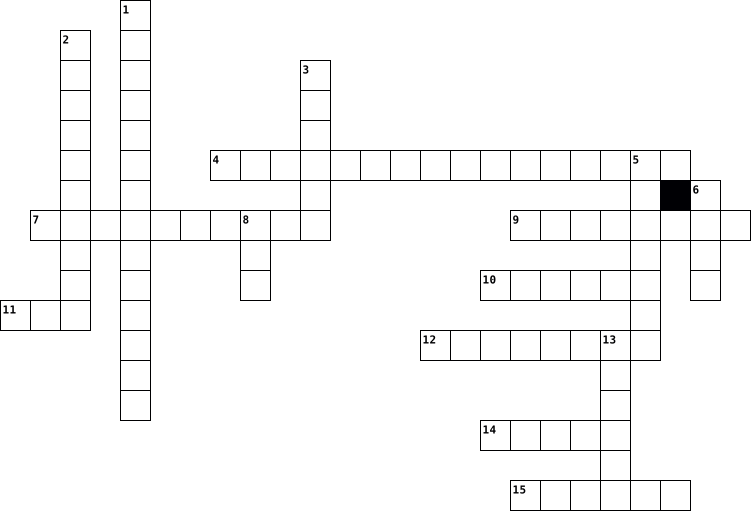
Across
- "Concern for nature and conservation."
- "Empowerment and pride in black identity."
- "Societal upheaval and change." ____ Revolution
- "Embrace of love, peace, and psychedelia." ___ Movement
- "Struggle for LGBTQ+ rights." ___ Rights Movement
- "Campaign for women's rights." ____ Movement
- "Advocacy for non-violence and harmony." ___ Movement
- "Struggle for racial equality." Civil ____ Movement
Down
- "Rejection of mainstream values."
- "Rights and empowerment of disabled individuals." ___ Rights Movement
- "Rights and empowerment of the elderly. ___ Citizens Movement
- "Activism on college campuses." ___ Protests
- "Advocacy for labor rights in agriculture." __ Workers Movement
- "Opposition to Vietnam conflict." Anti ___ Movement
- "Advocacy for freedom of expression." Free ___ Movement
15 Clues: "Rejection of mainstream values." • "Concern for nature and conservation." • "Empowerment and pride in black identity." • "Activism on college campuses." ___ Protests • "Campaign for women's rights." ____ Movement • "Societal upheaval and change." ____ Revolution • "Struggle for LGBTQ+ rights." ___ Rights Movement • "Opposition to Vietnam conflict." Anti ___ Movement • ...
MLK Crossword Puzzle 2024 2023-10-30

Across
- King played a pivotal role in the success of the Montgomery Bus Boycott, a catalyst for the civil rights movement.
- King's message of equality extends beyond racial lines and includes the fight for gender and LGBTQ+ rights.
- and Ethical Leadership King's commitment to justice and equality inspired people across the nation and the world.
- King was awarded the Nobel Peace Prize in 1964, highlighting his global impact.
- The March on Washington for Jobs and Freedom, where King delivered his famous speech, was a historic event that furthered the cause of civil rights.
- King's work was instrumental in dismantling the system of legal segregation in the United States.
- King's leadership and dedication continue to inspire activists and leaders in various social justice movements.
- The holiday stands as a reminder of the universal principles of human rights, dignity, and equality that Dr. King fought for throughout his life.
Down
- Recognizing MLK Day signifies the nation's commitment to healing and reconciliation in the wake of historical injustices.
- The holiday allows for the celebration of African American culture, history, and achievements.
- He promoted nonviolent civil disobedience and resistance as a powerful tool for achieving social change.
- His advocacy and activism contributed to the passage of key civil rights legislation, including the Civil Rights Act of 1964 and the Voting Rights Act of 1965.
- Martin Luther King Jr. was a prominent leader in the American Civil Rights Movement, advocating for racial equality and justice.
- King's teachings foster an atmosphere of tolerance, respect, and understanding among diverse communities.
- He championed the importance of voting rights for African Americans and other marginalized groups.
- MLK's legacy encourages the pursuit of education and knowledge to empower individuals and communities.
- It brings people of various backgrounds together to commemorate and reflect on the importance of civil rights.
- The holiday serves as a reminder of the ongoing struggle for social justice and the need to address systemic inequalities.
- His commitment to nonviolent protest serves as a model for resolving social conflicts without resorting to violence.
- His iconic "I Have a Dream" speech is a symbol of his vision for a more inclusive and just society.
20 Clues: King was awarded the Nobel Peace Prize in 1964, highlighting his global impact. • The holiday allows for the celebration of African American culture, history, and achievements. • King's work was instrumental in dismantling the system of legal segregation in the United States. • ...
Government 2015-10-09

Across
- A formal event that follows rules or traditions
- Of two chambers or rooms. Canada's Parliament is made up of two separate chambers. They are the Senate and the House of Commons.
- The process of choosing a representative by vote.
- A person living in an area in Canada represented by a Member of Parliament
- A person who has full political and civil rights in his or her country
- The agreement by the provinces to join together to form the nation of Canada and create a federal Parliament.
- The government's plan for how it will collect and spend money each year
- To pick one person from a group of several people by voting
- To change or improve something; for example, a law
Down
- A group of Senators or MP selected to study a specific subject or bill and write a report about it.
- A person who is normally a MP or a Senator who is chosen by the Prime Minister and appointed by the Governor General to help govern. Usually the head of a government department.
- A proposal for a law to be considered by Parliament
- A group made up of all Senators and Members of Parliament from the same political party
- A group of Ministers. Cabinets makes decisions about the Government's priorities and policies
- The person in charge of a meeting
15 Clues: The person in charge of a meeting • A formal event that follows rules or traditions • The process of choosing a representative by vote. • To change or improve something; for example, a law • A proposal for a law to be considered by Parliament • To pick one person from a group of several people by voting • ...
Government 2015-10-05

Across
- A person who has full political and civil rights in his or her country
- A person who is normally a MP or a Senator who is chosen by the Prime Minister and appointed by the Governor General to help govern. Usually the head of a government department.
- A person living in an area in Canada represented by a Member of Parliament
- To pick one person from a group of several people by voting
- The government's plan for how it will collect and spend money each year
- To change or improve something; for example, a law
- A formal event that follows rules or traditions
Down
- A group of Senators or MP selected to study a specific subject or bill and write a report about it.
- The process of choosing a representative by vote.
- Of two chambers or rooms. Canada's Parliament is made up of two separate chambers. They are the Senate and the House of Commons.
- The agreement by the provinces to join together to form the nation of Canada and create a federal Parliament.
- A group of Ministers. Cabinets makes decisions about the Government's priorities and policies
- The person in charge of a meeting
- A proposal for a law to be considered by Parliament
- A group made up of all Senators and Members of Parliament from the same political party
15 Clues: The person in charge of a meeting • A formal event that follows rules or traditions • The process of choosing a representative by vote. • To change or improve something; for example, a law • A proposal for a law to be considered by Parliament • To pick one person from a group of several people by voting • ...
Civics Review: Vlaminck 2023-04-12

Across
- 2nd amendment
- 2nd to President
- Current U.S. President
- Legislative
- Head of State
- MN Governor
- Land of a Thousand Lakes
- Cruel and unusual punishments
- three
- First ten amendments
- Lowest court level
Down
- Highest court level
- Say no to a bill
- Take out one line
- Rule
- Head of U.S. executive branch
- Two houses
- Not yet a law
- No one wants to pay them
- Executive
20 Clues: Rule • three • Executive • Two houses • Legislative • MN Governor • 2nd amendment • Head of State • Not yet a law • Say no to a bill • 2nd to President • Take out one line • Lowest court level • Highest court level • First ten amendments • Current U.S. President • Land of a Thousand Lakes • No one wants to pay them • Head of U.S. executive branch • Cruel and unusual punishments
enlightenment and revolution-noah rager 2025-01-10

Across
- gave colonies rights
- belief in god
- wrote most of decleration of independince
- establishing education reform
- fought for womens rights
- He is well known for his work On the Social Contract
- Belives we have certain rights and ability to overthrow goverment
- Earth as center of solar system
- when a group of people agree to give up certain rights and accept a authority in order to protect their other rights
- time of learning and reason
Down
- protects rights of people
- simple but elegant style
- ruled with great reason
- Came up with basics of gravity
- government split in 3 parts
- age of reason
- Each branch checks the other
- Socal gatherings where people talk about important things
- sun as center of solar system
- grand and fancy style
- idea that everyone has free speech
- French enlightenment thinkers
- influenced the constitution greatly
- ideas based on reason
- Use reason to understand things
- theory suns at the center
26 Clues: age of reason • belief in god • gave colonies rights • grand and fancy style • ideas based on reason • ruled with great reason • simple but elegant style • fought for womens rights • protects rights of people • theory suns at the center • government split in 3 parts • time of learning and reason • Each branch checks the other • sun as center of solar system • French enlightenment thinkers • ...
Legislative Branch 2025-10-17

Across
- type of bill dealing with money/revenue
- when the senate 'talks a bill to death'
- membership based on state population
- people represented
- leader of senate (other than VP)
- means two parts
- population count
Down
- leader of house of reps
- private meetings based on political party
- refers to a majority vote
- the right to mail official letters & packages for free
- membership two per state
- small groups; congressional work done in these
- areas represented; states have one house rep for each of these
- a proposed law
- formal disapproval of an action
16 Clues: a proposed law • means two parts • population count • people represented • leader of house of reps • membership two per state • refers to a majority vote • formal disapproval of an action • leader of senate (other than VP) • membership based on state population • type of bill dealing with money/revenue • when the senate 'talks a bill to death' • ...
Rights 2023-10-03

Across
- A collection of laws one one topic together under a single stature
- The Crimes Act 1958 (Vic) protects people's rights
- 'Beyond the powers'
- Unfavourable treatment of a person based on a certain attribute (age)
- A criminal offence that has been proved.
- Victorian Human Rights Statute
- A principle established in common law that must be followed by lower courts
- A moral or legal entitlement to have or do something
Down
- Being free to move between one state and another
- Free or low-cost legal representation
- A limited right to say what you want
- To cancel or abolish a court-made law by passing an act of parliament
- Confirmation by a nations parliament that enacts its obligations under a treaty
- Signing an international treaty
- Are rights permanently protected by legislation?
- Laws made by parliament
- Judge made law
17 Clues: Judge made law • 'Beyond the powers' • Laws made by parliament • Victorian Human Rights Statute • Signing an international treaty • A limited right to say what you want • Free or low-cost legal representation • A criminal offence that has been proved. • Being free to move between one state and another • Are rights permanently protected by legislation? • ...
SamSantana - Unit 3 Crossword 2023-01-23

Across
- the constitutional amendment adopted after the Civil War "equal protection of the laws."
- an official government restriction of speech prior to publication
- communication in the form of advertis-ing, which can be restricted more than many other types of speech.
- behavior of knowingly and deliberately causing harm
Down
- State laws in the South that legalized segregation.
- Racial segregation that occurs in schools, not as a result of the law, but as a result of patterns of residential settlement
- A written defamation of a person's character, reputation, business, or property rights.
- nonverbal communication, such as burning a flag or wearing an armband. the Supreme Court has accorded some symbolic speech protection under the First Amendment.
- Institutions that connect citizens to government. The mass media, interest groups, and political parties are the three main linkage institutions.
- Racial segregation that occurs because of laws or administrative decisions by public agencies.
- A process that extended the protections of the Bill of Rights against the actions of state and local governments
11 Clues: State laws in the South that legalized segregation. • behavior of knowingly and deliberately causing harm • an official government restriction of speech prior to publication • A written defamation of a person's character, reputation, business, or property rights. • the constitutional amendment adopted after the Civil War "equal protection of the laws." • ...
Constitution 2026-04-02

Across
- of Rights the first ten amendments
- the President's advisors
- a change to the Constitution
- making officially valid
- College the process used to elect the President
- a fixed period of time
- upper house of Congress
- the leader of the United States
- a form of government where the citizens have the power
- a member of the House of Reps
- Papers essays written in support of the Constitution
- central government with state governments
Down
- interprets the law
- formal process of accusing a government official
- a judge on the Supreme Court
- two-house system
- the supreme law of the land
- creates the laws
- those who created the Constitution
- and Balances ensures each branch does not become too powerful
- the opening verse of the Constitution
- of Reps lower house of Congress
- of Powers divides the power into three distinct branches
- Review the process to determine if actions are constitutional
- of Law no one is above the law
- Clause the Constitution is above everything else
- a member of the Senate
- enforces the laws
28 Clues: two-house system • creates the laws • enforces the laws • interprets the law • a fixed period of time • a member of the Senate • making officially valid • upper house of Congress • the President's advisors • the supreme law of the land • a judge on the Supreme Court • a change to the Constitution • a member of the House of Reps • of Law no one is above the law • ...
Politics and Governance 2025-09-06

Across
- - System of government with division of powers
- - Legal member of a state
- - Process of choosing leaders by voting
- - Government’s financial plan
- - System of government by the people or elected representatives
- - Supreme authority of a state
- - Rule created by authority
- - Principle of fairness in law
- - One who leads or guides others
- - Basic law or constitution
- - Head of a government department
- - Political organization seeking power
- - One who casts a ballot
- - Formal agreement between states
- - Ability to influence or control
Down
- - Paper used to cast a vote
- - Head of state and government
- - A course of action adopted by government
- - Presiding officer in the House of Representatives
- - Legislative branch of the U.S. government
- - President’s power to reject a bill
- - Management of international relations
- - Head of a province
- - Upper chamber of the legislature
- - Advisory body to the head of government
- - Official who decides cases in court
- - Place where legal cases are heard
- - Absolute ruler with total power
- - Legal freedoms of citizens
- - Head of a city or municipality
30 Clues: - Head of a province • - One who casts a ballot • - Legal member of a state • - Paper used to cast a vote • - Rule created by authority • - Basic law or constitution • - Legal freedoms of citizens • - Government’s financial plan • - Head of state and government • - Supreme authority of a state • - Principle of fairness in law • - One who leads or guides others • ...
Government 2015-10-02

Across
- to change of improve something for example, a law of an Act of Parliament
- a senator of a member of the House of Commons
- a person who has full political civil rights
- a group made up of all Senators and members of Parliament from the same political party. ________ meet regularly
- A group of Senators, members of Parliament, or both, selected to study a specific subject or bill and write a report about it
- a rule for all Canadians made by Senators, member of Parliament and the Governor General
- a proposal by a member of either the senate of the House of Commons to do something
- the government's plan for how it will collect and spend money each year
Down
- Canada's parliament is composed of the Monarch, the Senate and the House of commons.
- The political party with the most members elected to the House of Commons usually forms the Government
- the bringing to an end of a Parliament, either at the end of its four year term or if the government is defeated on a motion of non-confidence, by proclamation
- the city where a country's legislature is located
- a king or queen of a country
- Of two chambers or rooms
- the cabinet is a group of all Ministers (mostly from the House of Commons and at least on from the Senate. The _____ makes decisions about the Government's priorities and policies
- a special title given to Senators and Cabinet ministers for life
- the person in charge of a meeting
- the pick one person from a group of several people by voting
- a proposal for a law to be considered by Parliament
19 Clues: Of two chambers or rooms • a king or queen of a country • the person in charge of a meeting • a person who has full political civil rights • a senator of a member of the House of Commons • the city where a country's legislature is located • a proposal for a law to be considered by Parliament • the pick one person from a group of several people by voting • ...
U.S. History 2015-03-29

Across
- Act / offered 160 acres to head of household or any free citizen
- Exclusion Act / prohibited all Chinese except student teachers, merchants, tourist, and gov. officials
- Plan / an arrangement of payment of purchase over time
- Crow Laws / separation of whites and blacks i public and private places
- and Sedition / imposed harm to anyone interfering with or speaking against U.S.
- Of Nations / organization an association of nations established in 1920 to promote international cooperation and peace
- Act / law passed to allow U.S to ship arms and supplies to other nations without immediate payment
- / the development of organised forces and leader diplomacy
- Service Act / men registered with the gov. in order to be selected randomly
- Antitrust Act / legal free trust to trade between states or countries
Down
- Machines / organised group that controlled the activities of political parties
- / stronger nation extend their economic, political, or military control over weaker nations
- Stick Diplomacy / Roosevelt policy with intimidated countries without having to harm them
- Bill Of Rights / laws that provided financial and educational benefits for WWII veterans
- / movement of people seeking to restore trust in farmers and laborers
- War / the state orhoslity without militaryconflict
- Act / laws enchanted in 1935-1936 to prevent U.S. sales and loans to nation at war
- Plan / act intended to "Americanize"
- Plan / plan used to subdue enemy supplies and reinforcements
- Rights Act Of 1964 / law that banned discrimination
- Bonds / debt securities increased by a gov. to fiance military operation and their expansion in time of war
21 Clues: Plan / act intended to "Americanize" • Rights Act Of 1964 / law that banned discrimination • War / the state orhoslity without militaryconflict • Plan / an arrangement of payment of purchase over time • / the development of organised forces and leader diplomacy • Plan / plan used to subdue enemy supplies and reinforcements • ...